Giga-WHAT? We cut 1M kilowatt-hours, that’s what: #Denver Water employees hunt down huge energy cuts in latest round of sustainability efforts — News on Tap

Denver Water’s sustainability operations include generating energy from solar power panels installed on the roof of its Administration Building, parking garage and over its visitor’s parking lot at its Operations Complex near downtown. Photo credit: Denver Water.

Click the link to read the article on the Denver Water website (Todd Hartman):

September 21, 2024

Denver Water’s mission is water, but efforts to cut energy use and carbon emissions have become more front and center over the last decade. 

After all, climate change threatens water supplies, so water utilities need to do their part to reduce the fossil-fuel ingredients that are warming the atmosphere and jeopardizing snowfall and river flows. [ed. emphasis mine]

Already, Denver Water powers its main Administration Building with solar panels, harnesses the power of water to generate enough hydroelectricity to juice 6,000 homes and employs a system that uses water, not air, to heat and cool its headquarters, making it easier and cheaper to keep temperatures comfortable. 

But it’s not stopping there. 

Always on the lookout for new sustainability features, Denver Water last year set a goal to cut its energy use by one gigawatt-hour. That’s 1 million kilowatt-hours — a ton of electricity (or, in some cases, the equivalent amount of fuel, like gasoline) — enough to power 750,000 homes for one hour, or roughly 100 homes for a year.

And, in the last 12 months, the utility accomplished its goal.

Employees scoured the organization for low-hanging fruit, the relatively easy fixes that could be done at little or no cost or would provide a rapid payback by quickly cutting energy expenses. 


It takes all kinds of passionate people to ensure a clean, safe water supply for 1.5 million people. Join the team at denverwater.org/Careers.


And it unleashed its in-house expertise, including personnel specializing in electrical, HVAC, plumbing, information technology, vehicle fleet, dams, reservoirs and the network of pipes that moves water through the city.

Teams pinpointed energy savings that could be snared by closing unused facilities that were still drawing power, replacing outdated boilers in the utility’s Winter Park facilities, updating old lighting, reducing the idling of fleet trucks (which wastes gas and diesel) and adding its first batch of electric vehicles — among other steps.

“This was an energy treasure hunt,” said Adam Hutchinson, an energy management specialist and part of Denver Water’s Sustainability Team. “We’ve focused on energy efficiency for many years now, but we wanted to take another hard look across the organization for relatively quick and easy energy-saving opportunities.”

Hunt they did, and Denver Water employees put their expertise to work to find savings large and small. 
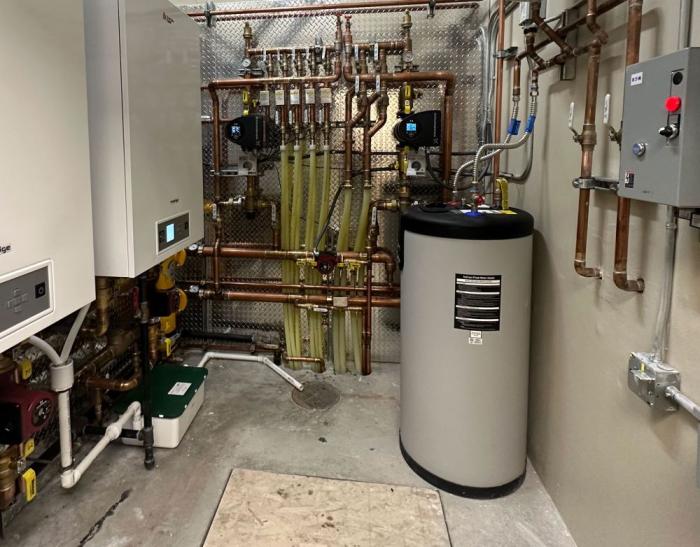
A new, more efficient boiler saves some 300,000 kilowatt-hours of electricity per year. Photo credit: Denver Water.

Some of the finds were big, like taking out a problem boiler used to heat a key Denver Water facility in Winter Park, home to workers and a fleet of heavy equipment that helps keep things running in the high country. 

The new equipment installed in Winter Park was more energy efficient, with an efficiency rating of 96% (compared to the old boiler’s 80% efficiency), and the switchover saved some 300,000 kilowatt-hours of electricity per year.

“We installed a more efficient boiler that uses flue gas that would otherwise be expelled. The new equipment keeps it in the boiler to provide more heat,” said Jeffrey Gulley, who leads the trade shop for Denver Water. “We wanted to have efficiency and reliability with the frigid temperatures up there.” 

The utility’s transmission and distribution employees determined that a few small, scattered facilities in the metro area could be closed and their functions consolidated. That amounted to cutting another 100,000 kilowatt-hours via reductions in heating, cooling and lighting.

Smaller changes also added up. 

At Marston Treatment Plant in southwest Denver, an air bubbler keeps the water intake from freezing in winter months. Typically, the bubbler stays on constantly from November through May. But the simple addition of a temperature sensor means the bubbler can shut down when winter weather hits a warm stretch. 

And boom! That simple sensor produced another 9,000 kilowatt-hours of savings — enough to pay for itself in 18 months.

Installing a temperature sensor on a water intake at Marston Treatment Plant in southwest Denver produced additional energy savings. Photo credit: Denver Water.

All told, the gigawatt project fit cleanly into the second phase of Denver Water’s Sustainability Plan, which includes a goal to reduce greenhouse gas emissions by 50% by 2025 from a 2015 baseline.

And it chips away at a broader strategy: To drive down energy usage as low as possible, then get what power you still need through renewable energy. 

“All of this aligns with Denver Water’s overall push to aggressively do our part to address climate change,” said Kate Taft, the utility’s sustainability manager. “On the water planning side, we must adapt to the ongoing changes, but we can work on our operations side to reduce our own footprint. That is why we continue to move forward with change.”

And continue it does. After reaching the 1-gigawatt (that is, 1 million kilowatt-hours) goal, ongoing work has found more savings.

Denver Water is now at 1.2 million kilowatt-hours in energy savings since setting the goal a bit over a year ago.

And all of this isn’t good news only for the environment. By cutting energy costs, Denver Water can also keep expenses down. 

“We’re driven on our sustainability goals,” Hutchinson said. “Along with that, we’re keeping in mind our customers and our rates.”

Water quality to remain centric in the #RoaringForkRiver Basin — The #Aspen Times

Beavers have constructed a network of dams and lodges on this Woody Creek property. Pitkin County is betting big on beavers, funding projects that may eventually reintroduce the animals to suitable habitat on public lands. CREDIT: HEATHER SACKETT/ASPEN JOURNALISM

Click the link to read the article on The Aspen Times website (Westley Crouch). Here’s an excerpt:

Hunter and Woody Creeks and Avalanche and Thompson creeks in the Crystal River Basin are now designated Outstanding Waters by the Water Quality Control Commission. The Colorado Water Quality Control Commission on Aug. 21 unanimously designated roughly 385 miles of waterways across 15 rivers and streams in the upper and lower Colorado, Eagle, Yampa, and Roaring Fork River basins as Outstanding Waters.  The Outstanding Waters designations are authorized by the Colorado Water Quality Control Act and the Clean Water Act…

“An Outstanding Waters designation is a protection that can be given to reaches of streams that offer water quality protection. It is the highest level of water quality protection that can be given by the state of Colorado,” [Mathew] Anderson said. “With the protection, future projects that may happen along these reaches have to ensure that the water quality will not be diminished.”

[…]

This designation can protect creeks and rivers from future developments and pollution. He noted that all existing industries, ranches, homes, and utilities along these sections of designations will be grandfathered in…He said that obtaining this designation took a coalition between different watershed groups that ranged from the Yampa to Eagle rivers…or creeks, streams, and rivers to receive this designation, the water quality must already be of a high standard. Eleven respective criteria points must be met as it relates to water quality before this designation can be obtained.

St. Vrain and Left Hand Water Conservancy District Launches Fish Salvage Pilot Project to Protect Local Fisheries

Screenshot from the Highland Ditch Company website.

Here’s the release from the St. Vrain and Left Hand Water Conservancy District (Sean Cronin):

September 9, 2024

LONGMONT, COLO – This fall, the St. Vrain and Left Hand Water Conservancy District (“District”) and the Highland Ditch Company are collaborating on a unique pilot project to save fish in St. Vrain Creek. As ditch diversions are closed off for the fall, fish often become trapped in standing pools behind the headgates, which eventually dry up. The pilot project will rescue these fish and return them to the adjacent creek, protecting local fish populations and aligning with the community’s values of environmental stewardship.

Healthy fisheries are essential not only for the ecological health of local streams but also for supporting the recreational fishing economy—well worth the half days’ work it will take to move the fish back into the creek.

“The District and Highland are piloting this salvage effort, in the hopes that the results may be scaled up across the District, and potentially in other parts of Colorado,” said the District’s Watershed Program Manager Jenny McCarty.

Highland Ditch Company, which has been diverting water for over a century, sees this initiative as an example of the symbiotic relationship that can exist between local agriculture and environmental health.

The channel’s water “is used to irrigate 35,000 agriculture acres in this valley. Those farms are part of the fabric of this community… residents eat food from [these] farms,” said Wade Gonzales, Highland’s Ditch and Reservoir Superintendent. “We are all connected, and this pilot project will show how we can work together toward common goals.”

“Our constituents across the St. Vrain and Left Hand Valley have time and again supported approaches that balance water needs for thriving agriculture and a healthy environment”, said Sean Cronin, the District’s Executive Director. “We’re honored to be a trusted partner to Highland in leading this effort.”

Media are invited to the fish salvage effort in late September, 2024. Date to be determined. Please email jenny.mccarty@svlh.gov if you are interested in attending.

About the St. Vrain and Left Hand Water Conservancy District

The St. Vrain and Left Hand Water Conservancy District, created in 1971, is a local government, non -profit agency that serves Longmont and the surrounding land area. The District is dedicated to safeguarding water resources for all and promotes/partners on local water protection and management strategies that align with the five pillars of its Water Plan. Learn more at http://www.svlh.gov.

About the Highland Ditch Company

The Highland Ditch Company, based in Longmont, CO, was established in 1871 and irrigates about 35,000 acres of land along St. Vrain Creek, the most of any within District boundaries. The Highland Ditch Company pursues its mission to manage and deliver water for its shareholders by embracing innovative opportunities. Learn more at http://www.highlandditch.com.

Topsoil Moisture % short/very short: 47% of the Lower 48 is short/very short, 1% more than last week — @NOAADrought

Soils dried out in the Midwest. Areas of the East and Gulf Coast that saw tropical moisture improved; areas that missed out dried out further.

Blazing Tuesday sunset. #SanLuisValley #Colorado

Sunset September 10, 2024 in the San Luis Valley. Photo credit: Alamosa Citizen

#LakePowell plumbing will be repaired, but some say Glen Canyon Dam needs a long-term fix — Alex Hager (KUNC) #ColoradoRiver #COriver

In this undated photo, water flows through Glen Canyon Dam’s river outlet works. The pipes will undergo $9 million in repairs, but conservation groups want to see more permanent renovations at the dam, which holds back Lake Powell as Colorado River supplies shrink. Photo credit: Reclamation

Click the link to read the article on the KUNC website (Alex Hager):

September 9, 2024

This story is part of ongoing coverage of the Colorado River, produced by KUNC and supported by the Walton Family Foundation. KUNC is solely responsible for its editorial coverage.

Federal water managers will repair a set of little-used pipes within Glen Canyon Dam after discovering damage earlier this year. The tubes, called river outlet works, have been a focus for Colorado River watchers in recent years. If Lake Powell falls much lower, they could be the only way to pass water from the nation’s second-largest reservoir to the 25 million people downstream of the dam.

The Bureau of Reclamation will use $8.9 million from the Bipartisan Infrastructure Law to apply a new lining to all four pipes, which were originally coated more than 60 years ago. Conservation groups, however, say Reclamation should turn its attention and finances to bigger, longer-term fixes for the dam.

“Duct tape and baling wire won’t work in the long run,” said Kyle Roerink, executive director of the nonprofit Great Basin Water Network. “These short-term efforts are myopic in the grand scheme of things.”

The river outlet works were originally designed to release excess water when the reservoir nears full capacity. Now, Lake Powell is facing a different problem: critically low water levels.

After more than two decades of climate-change-fueled drought and steady demand, the reservoir is less than 40% full. It was only 22% full as recently as 2023.

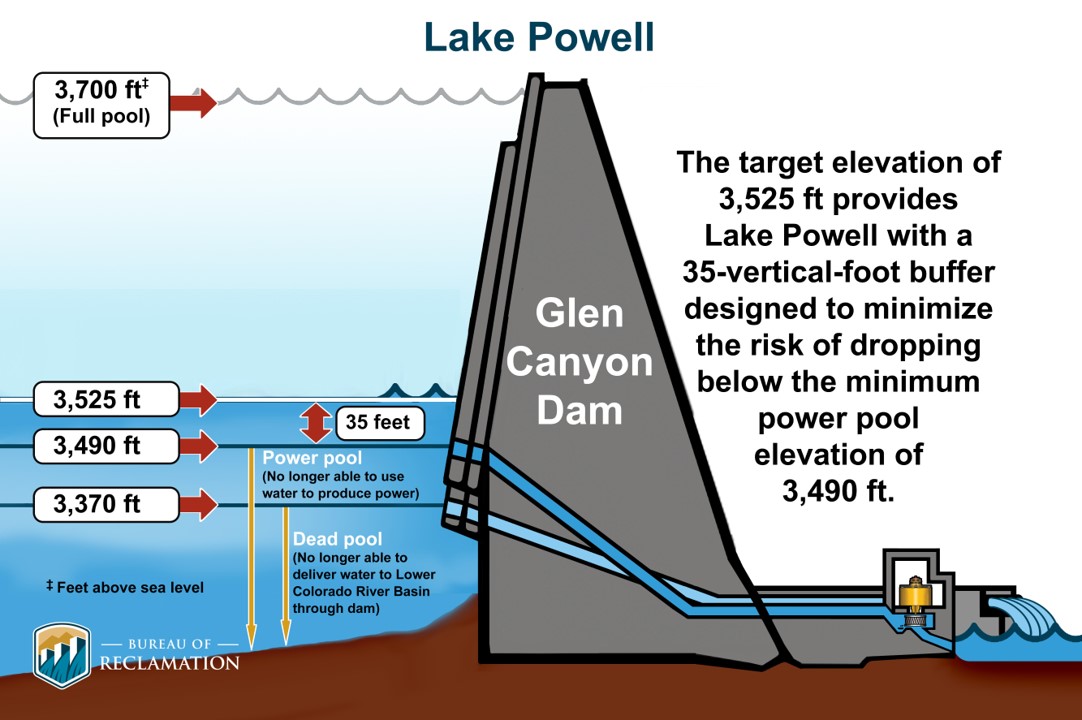
Lake Powell key elevations. Credit: Reclamation

Currently, water passes through hydroelectric generators inside Glen Canyon Dam before flowing into the Colorado River. Water experts fear that shrinking supplies and unsustainably heavy demand will keep sapping Lake Powell, bringing the top of the reservoir below the intakes for the generators.

Bob Martin, who manages hydropower at Glen Canyon Dam, shows the effects of cavitation on a decommissioned turbine on Nov. 2, 2022. When air pockets enter the dam’s pipes, they cause structural damage. Similar damage is the focus of upcoming repairs. Photo credit: Alex Hager/KUNC

Not only would such a drop jeopardize power generation for about 5 million people across seven states, but it would leave the river outlet works as the only means of passing water from Lake Powell to the other side of the dam.

The pipes are only capable of carrying a relatively small amount of water. If they become the only means of passing water through the dam, the Colorado River’s Upper Basin states  Colorado, Wyoming, New Mexico, and Utah  could fail to meet a longstanding legal obligation to share a certain amount of water with their downstream neighbors each year.

That could mean less water for cities like Las VegasPhoenix and Los Angeles, as well as massive farm districts that put vegetables in grocery stores across the country.

Recent boosts in Lake Powell water levels are mostly due to back-to-back snowy winters, which climate experts say are becoming increasingly rare.

Conservation groups are putting pressure on policymakers to rein in demand. Some environmental advocates are asking them to consider draining Lake Powell altogether and storing its water elsewhere.

“We need to start planning for a river with less water,” said Eric Balken, executive director of the nonprofit Glen Canyon Institute. “That means drastically rethinking infrastructure that was built for a much bigger river. As climate change and overuse continue to put pressure on this river system, Glen Canyon Dam’s plumbing limitations will become more and more problematic.”

The back of Glen Canyon Dam circa 1964, not long after the reservoir had begun filling up. Here the water level is above dead pool, meaning water can be released via the river outlets, but it is below minimum power pool, so water cannot yet enter the penstocks to generate electricity. Bureau of Reclamation photo. Annotations: Jonathan P. Thompson