
Click the link to read the article on The Land Desk website (Jonathan P. Thompson):
September 13, 2024
Note: Here’s the second and final part of this little essay/data dump. Yeah, it’s paywalled AGAIN! I know, I know. I’ll be back next week with more good content for you free-riders. In the meantime, consider becoming a paid supporter of the Land Desk and knock down that paywall in the process.
The math and the charts in Part I of this essay are discouraging to many of us because they mess with our value system. There’s just not enough water in the places that we feel should be cut, for moral or practical or aesthetic reasons, to make much of a difference. I mean, sure, halting evaporation from the reservoirs would get you about 2 million acre-feet in cuts. But the only way to do that is to come up with a couple 250-square-mile swimming pool covers — one for Lake Mead and one for Lake Powell. Or you could just take down the dams, but I won’t wade into that one right yet.
The math dictates that the biggest user, irrigated agriculture, is going to have to make the biggest cuts. And the crop that uses the most water? Alfalfa — by a mile. About 6.3 million acre-feet of Colorado River water is consumed to irrigate alfalfa and other hay crops.
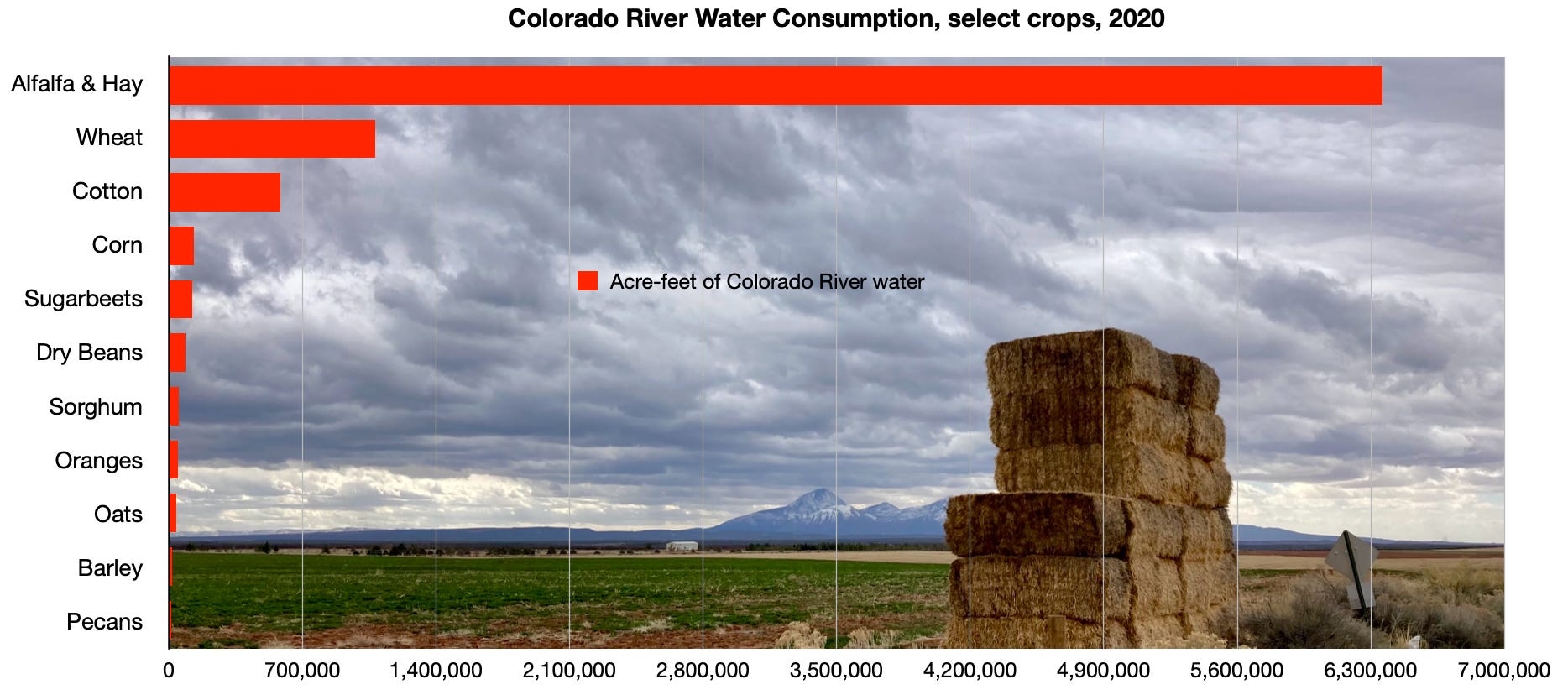
This isn’t news to Land Desk readers; I’ve been pointing it out for a long time. And it’s this simple observation, this acknowledgment of the math, that has the Family Farm Alliance demonizing me for supposedly demonizing alfalfa. Apparently those folks would rather we journalists ignore these numbers and fuzzy-up the math, make some insignificant cuts here and there while continuing to send gobs of water to hay fields, and continue drawing down the reservoirs until there’s no savings account left. Then, when we have another year like 2002 or 2021, when there were 10 million acre-feet deficits, the entire region will devolve into chaos. Seems like a bad idea to me.
Alfalfa has a lot of uses: It can be made into pellets for rabbits and other animals, it is a good cover crop that retains soil nutrients, it can be fed to horses, and you can even go down to your health food store and pay a small fortune for some alfalfa extract, which is apparently full of nutrients. But mostly it goes to livestock, especially cattle.
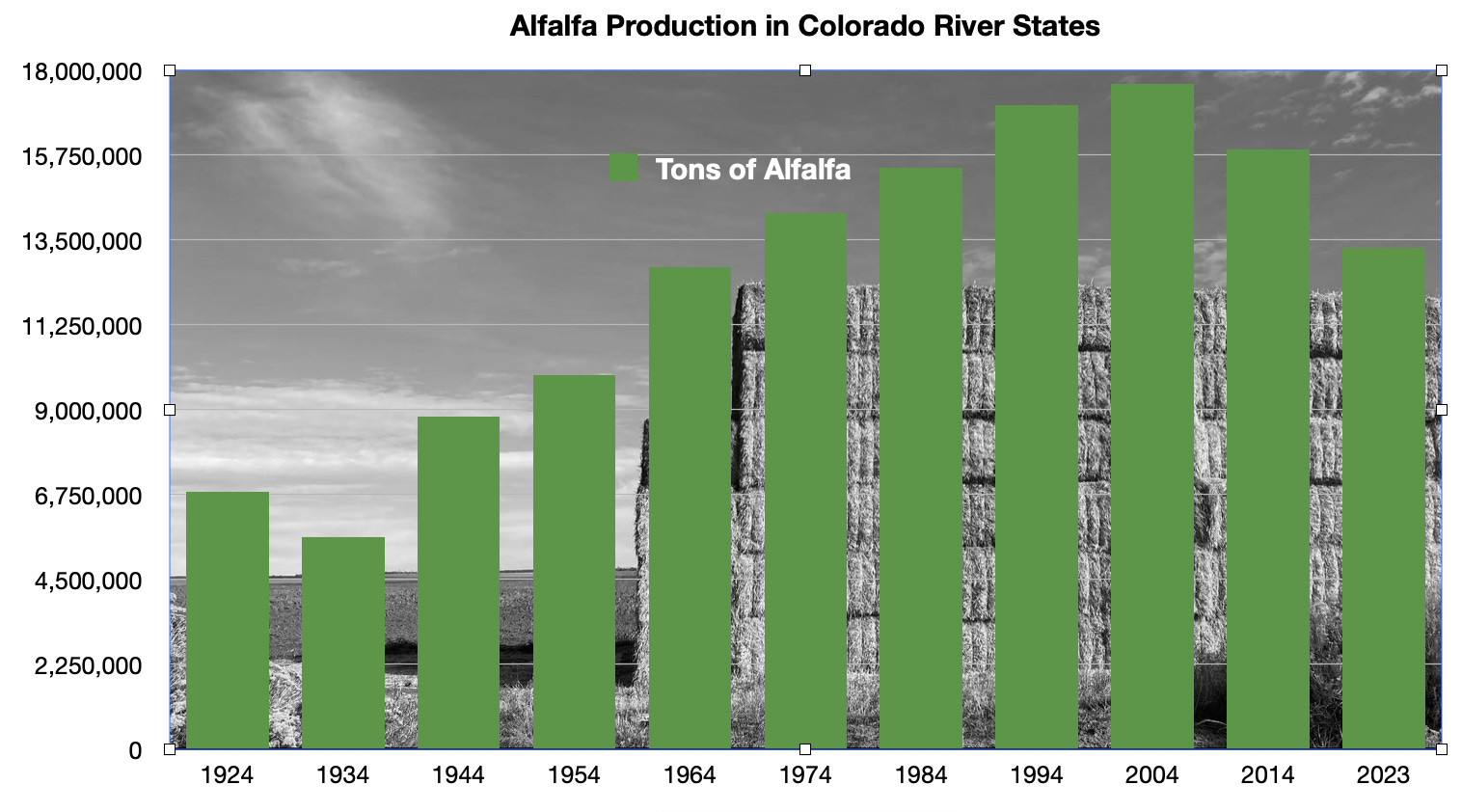
Over the past five decades, the Colorado River states have grown more and more alfalfa. There are a number of reasons for this. Alfalfa is a valuable crop that is relatively drought tolerant, it can be harvested a couple of times each summer even in cold climates — more than that in southern California — and it’s a perennial, meaning you don’t have to till the soil every year.
But the main driver is demand, and demand is growing because people want more beef, right? Well, yeah, maybe. But — to the chagrin of my vegetarian friends — beef is not the primary culprit, it’s the world’s ever-growing hunger for dairy. Because of the specific nutrients in alfalfa, it is favored by dairy operators: At least 75% of the 3 million tons of alfalfa grown annually in California goes to milk cows. Which is to say that my ice-cream and cheese habit is playing an even bigger role in draining the Colorado River dry than my green-chile hamburger. The growing demand is regional: Over the past several decades there has the astronomical rise in the number of large-scale dairies in the West, especially in California and New Mexico.
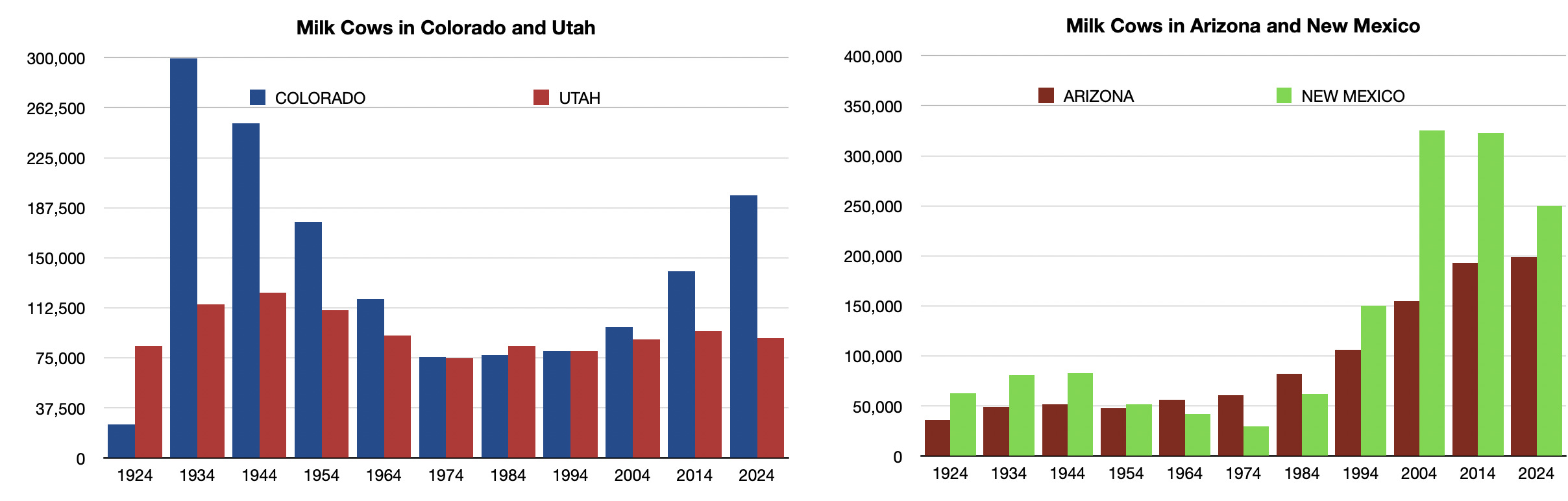
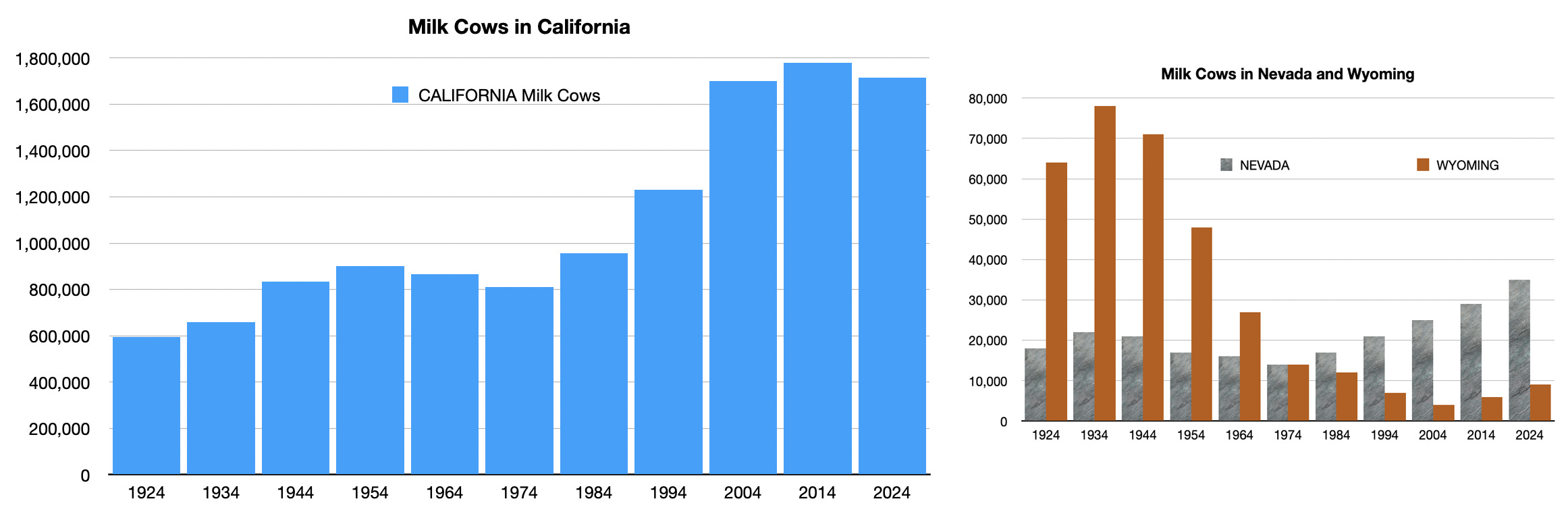
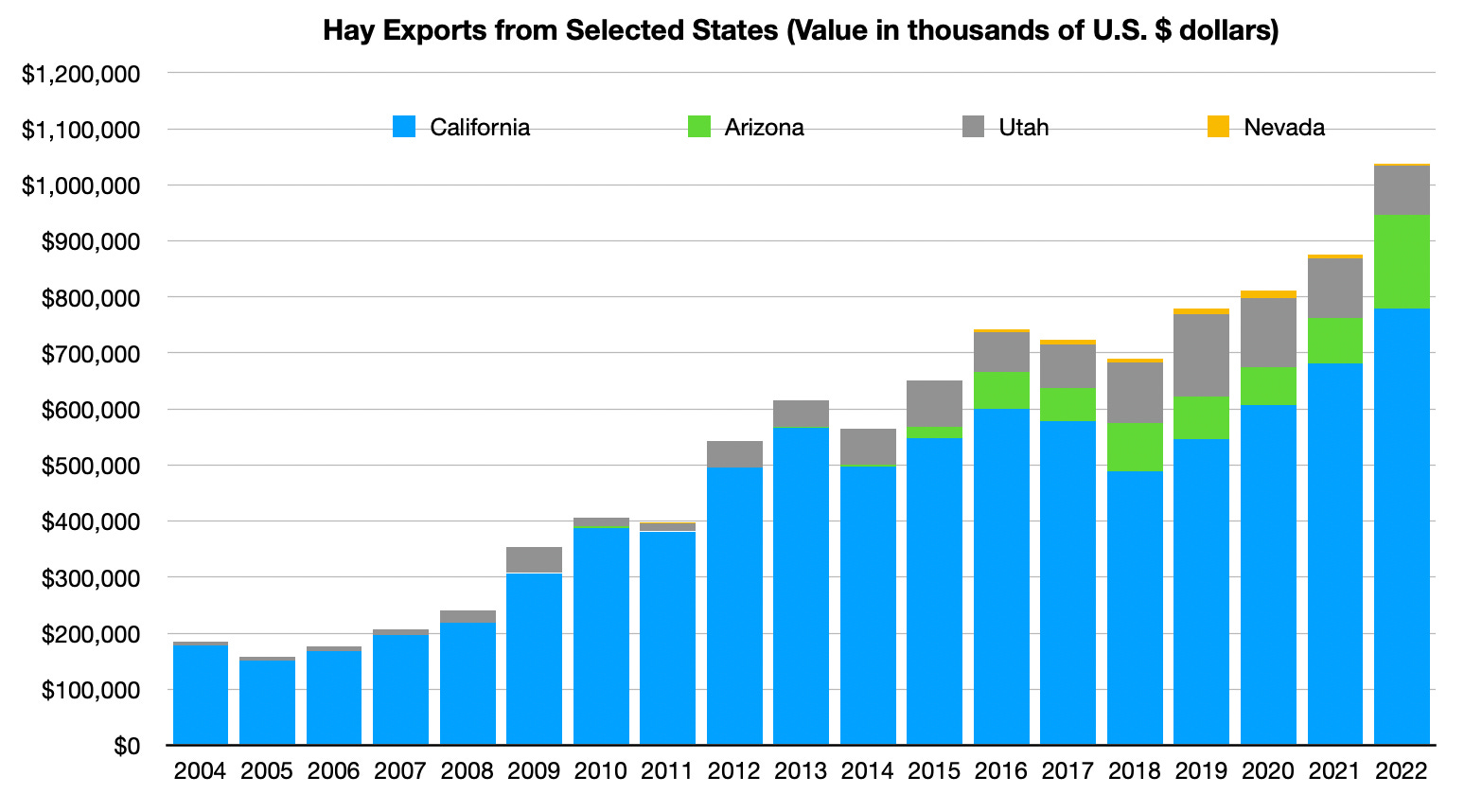
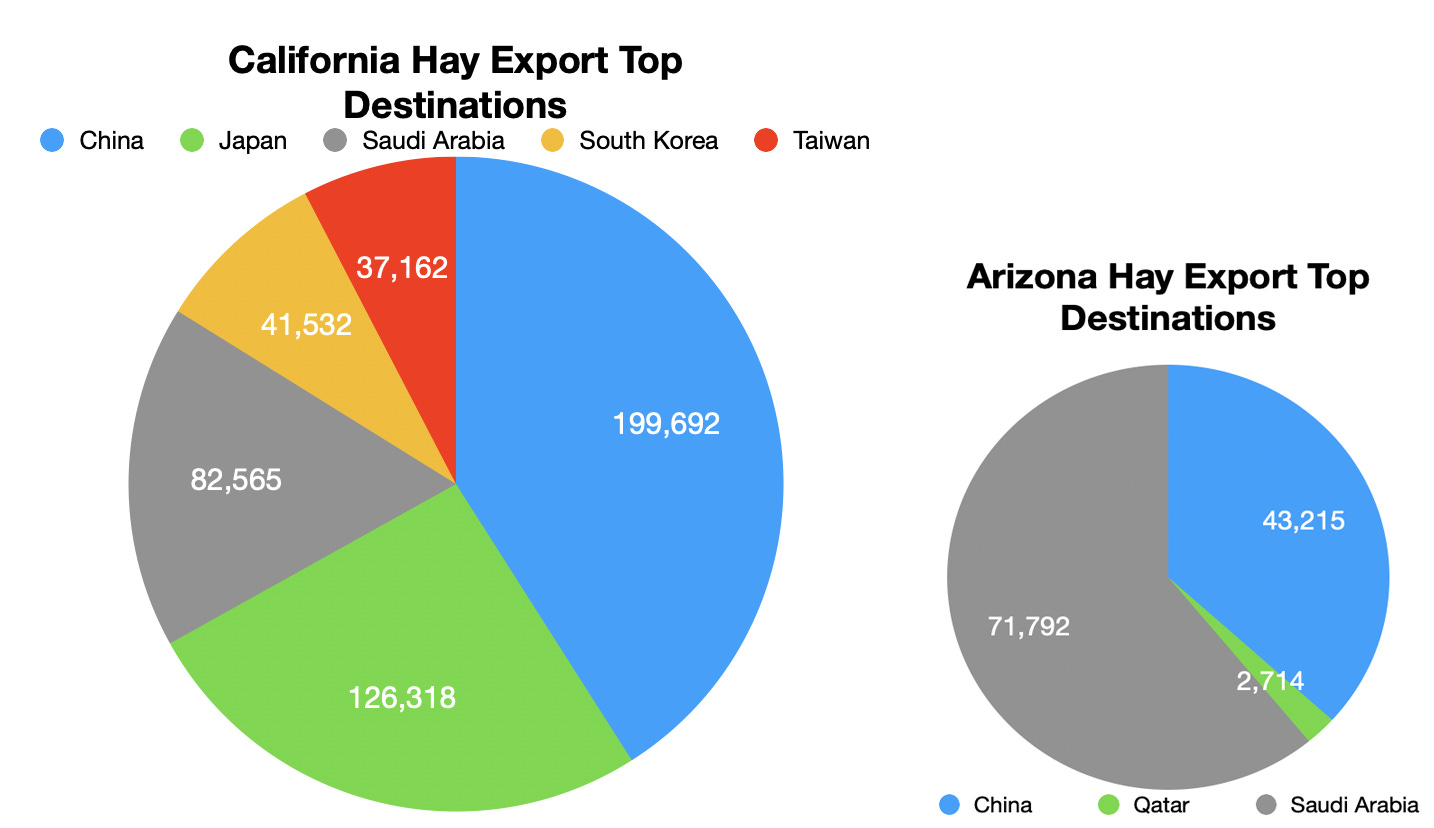
There’s also been an explosion of demand on the global level, as other nations that once mostly relied on goat or sheep milk have developed a taste for cow’s milk. That has led to a rise in alfalfa exports from Western states — hitting over $1 billion in value in 2022. However, exports still represent a small proportion of total production.
So, that’s the math. And it seems to suggest the Colorado River’s problems all could be solved if growing alfalfa stopped, right?
Maybe. But I kind of doubt it. This isn’t about a crop. It’s about water consumption.
This is where the law comes in and screws with both the math-oriented and the value-oriented solutions.
I mean, first of all, I doubt that a state or federal decree banning alfalfa growing would fly in the courts unless alfalfa was determined to be an illicit drug or something. And even if you could pull that one off, it wouldn’t accomplish much.
Alfalfa tends to be thirstier than other crops, but not significantly so. It uses such a huge percentage of Colorado River mostly because there’s so much of it and because of its long growing season. That means that if you were to replace all the alfalfa with other crops, you wouldn’t necessarily cut water consumption by that much. Maybe the new crop would use less water, but would the farmers then simply return the surplus water to the river? Not likely. Probably they would just grow more of the new crop and, ultimately, consume the same amount of water.
The only thing that would work is cutting off irrigation to all of those alfalfa fields, no matter what is being grown there. That would certainly be effective, though it would probably lead to a Dust Bowl, would make Ben & Jerry’s ice cream — and a lot of other food products — more expensive, and would wreck economies. And legally? I think not.
Western water law can be distilled down to one sentence: First in time, first in right. It is an almost sacred concept among Western water users, akin to the first lines of the U.S. Constitution or even the Bible.
It means, in the simplest of terms, that whoever appropriates a set amount of water for “beneficial use” first has the most senior rights to it1. When there’s not enough water in the river to fulfill all of the rights, then the senior users can make a “call,” forcing the most junior rights-holders to take the first cuts, and it goes on down the line from there. These rights are usually for a particular ditch or diversion, not an individual user. In the North Fork Valley, for example, the Farmers Ditch has some of the most senior rights, with 1896 appropriation and 1901 adjudication dates; individual property owners own shares of that ditch and the water in it. During dry years, Farmers Ditch is usually among the last to lose water. But if a downstream, more senior user were to put a legitimate call on the river, Farmers Ditch might also be shut down. These water rights are administered state-by-state.
If you have two shares of the Farmers Ditch, then you have no incentive to use less than that. If you conserve, the surplus water will simply keep going down the ditch to the next person. In fact, in most states there’s a “use it or lose it” provision. Though rarely enforced, and revoked in some places, it is still a dominant mindset; I’ve seen property owners pull their full share of water out of the ditch just to let it run down their driveway, perhaps because they just want what’s “theirs,” or maybe because they worry about losing their rights due to non-use.
The largest single water user on the Colorado River, which happens to have some of the most senior water rights, is the Imperial Irrigation District in southern California. They grow a lot of crops, but their primary one is alfalfa. The Colorado River Compact — and a series of compacts and court cases that ensued — adds another layer to all of this by apportioning water between the basins and the states2. Under this set of laws, California and the Imperial Irrigation District are senior, for example, to the Central Arizona Project, which conveys Colorado River water to Phoenix and Tucson.
In theory, the Upper Basin states and Lower Basin states are on an equal footing: Each gets 7.5 million acre-feet of water from the river. Since the Upper Basin uses less than its full allotment, it should be able to continue to use water at its current rate. But there’s one little provision in the Compact that makes that impossible, and that essentially makes the Upper Basin into the junior water rights holders. It reads:

There are conflicting interpretations over the clause, “will not cause … to be depleted.” But for now let’s go with the predominant, historic understanding of the whole sentence, which is that an average of 7.5 million acre-feet must come out of Lake Powell, the Upper Basin’s savings account, and pass Lee Ferry each year to be “delivered” to the Lower Basin’s savings account, i.e. Lake Mead.
This is no problem during an especially wet decade, or even during a dry one when Lake Powell is fairly full. But a string of drought years now, when the savings account has been depleted, could theoretically force the Upper Basin to either violate the provision, or to make some seriously painful cuts to comply.
So if values are trumped by math, and math is trumped by law, how the hell are we supposed to make this all work?

All I know for sure is there are no easy answers. We all can eat less cheese and ice cream and beef, we can install low-flow shower-heads and tear out those turf lawns. Cities can limit the size of or ban swimming pools and golf courses, implement tiered and progressive water rates that incentivize efficiency and hit gluttons in the pocketbook, and ban ornamental turf. They can embark on major leak-detecting and repair programs (it’s amazing how much water is lost to leaky pipes). And they can recycle water by treating it and reusing it for, at the very least, irrigation. With today’s treatment technology “toilet-to-tap” is just fine, and is not as gross as it sounds.
Federal and state governments can lease water from farmers for a year or so, paying them to shut off their headgates so the water stays in the river, instead. And they can incentivize folks to put less water on their crops, be it alfalfa or something else. That’s happening in the Imperial Valley, where the federal government is paying farmers some $700 million to stop irrigating alfalfa for 60 days this summer3. The effort is expected to save about 700,000 acre-feet of water, or twice the amount southern Nevada uses each year, through 2026, according to an excellent story by the Desert Sun’s Janet Wilson. Already the effects are being seen, with the IID forecast to pull their lowest amount of water from the Colorado River since 1941, according to John Fleck at his Inkstain blog. That should leave more water for the savings account-reservoirs, and for the river, itself.
As Wilson points out, there are drawbacks to the plan: irrigation runoff from the Imperial Valley fields runs into the Salton Sea. Without as much of it, the waterbody will shrink, exposing an additional 13,000 acres of lakebed, which is bad for the sea and for the air, as it will liberate a lot of pesticide-laden dust that will be picked up by the wind and dropped on nearby communities. The savings are large, but still not large enough. Plus, what happens when the funding runs out?
And, finally, the small ditch companies and farmers, including the ones in the North Fork or McElmo Canyon, are going to have to get more efficient. This will probably mean lining some laterals, piping some ditches, replacing flood irrigation with low-evaporation sprinklers or drip lines, and replacing water-intensive crops with ones that can get by on less irrigation. My question is how can this be done without destroying the distinct, post-irrigation character of these places? Could you leave some leaks to allow water to flow to some of the artificial wetlands? Could you lease water from the guy who allows the ditch to run down his driveway unused and irrigate the cottonwoods, willows, and milkweed? I’d love to hear readers’ ideas on this and, especially, examples of places where efficiency measures have worked to save water — without killing the character.
It’s true that the water saved would likely reach California, eventually, and might even be used to water a lawn or irrigate an alfalfa field. But in the many miles in between the two places, it would also add a little more water to the river for the fish and for boaters and for all of us. Maybe values, math, and Western water law can align.


