Click on a thumbnail graphic to view a gallery of drought data from the US Drought Monitor website. Here’s an excerpt:
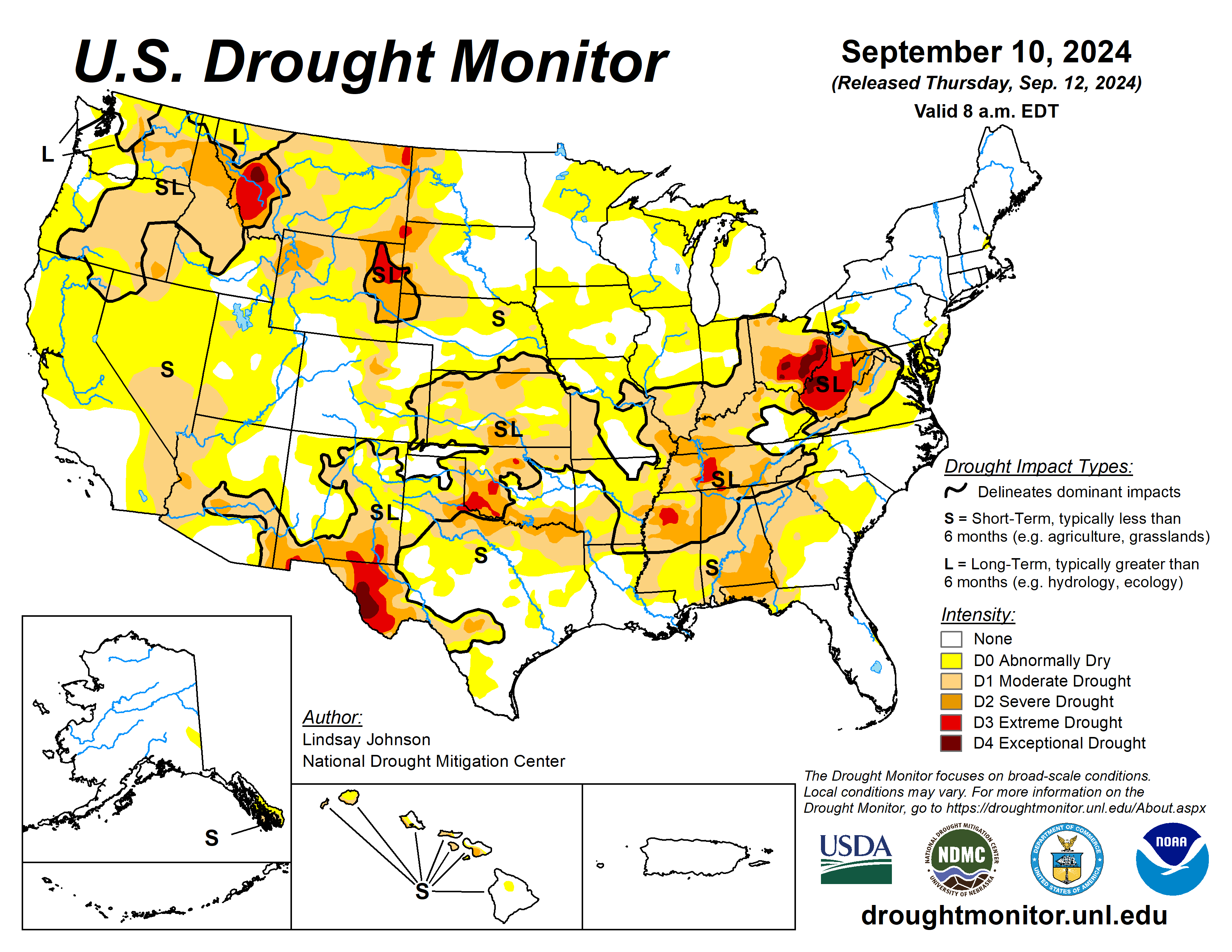

This Week’s Drought Summary
There was a sharp difference in temperatures across the U.S. this week (Sep. 3 to Sep. 10). Temperatures in the West were above normal, whereas areas from Texas to Wisconsin and east saw temperatures of 3 to 9 degrees below normal. Very little precipitation fell, with Hurricane Francine providing most of it along the Gulf Coast. Overall, the central and eastern portions of the country saw continued deterioration, adding onto already expansive deterioration from last week. The Ohio River Basin continues to be the epicenter of the extremely dry conditions, though moderate and severe drought conditions are spreading through the southern Midwest into the Southeast. Improvements made along the Gulf Coast were primarily due to the well-above-normal precipitation brought by Hurricane Francine. There were some other areas of improvement in New Mexico, northeastern Arizona, eastern Utah, southern Wyoming and northwestern Montana. Areas of the West that have not seen any meaningful precipitation in a while are beginning to see dropping streamflows and drying soils…
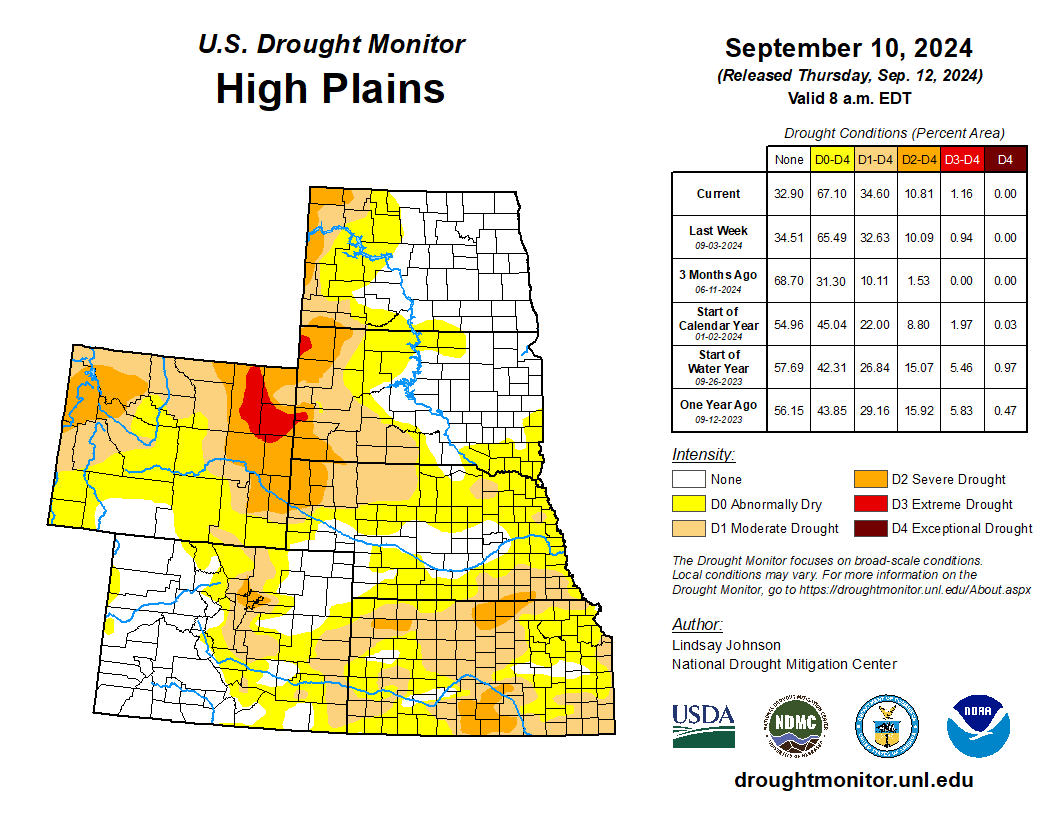
High Plains
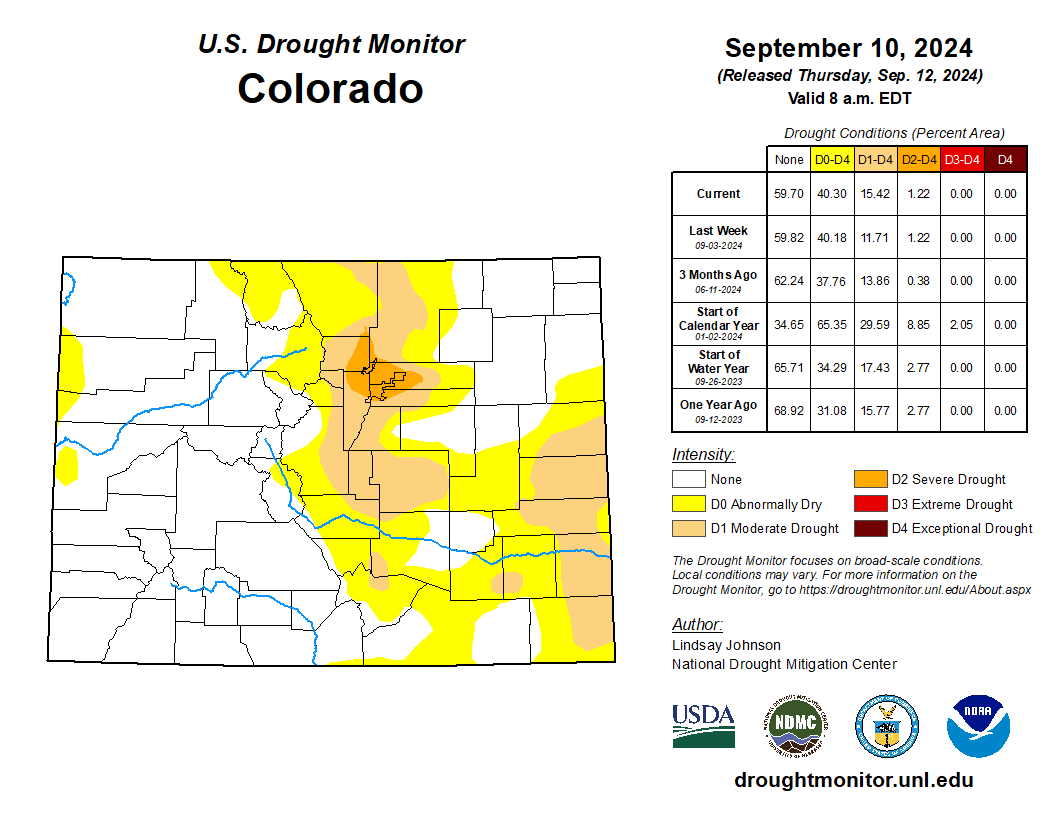
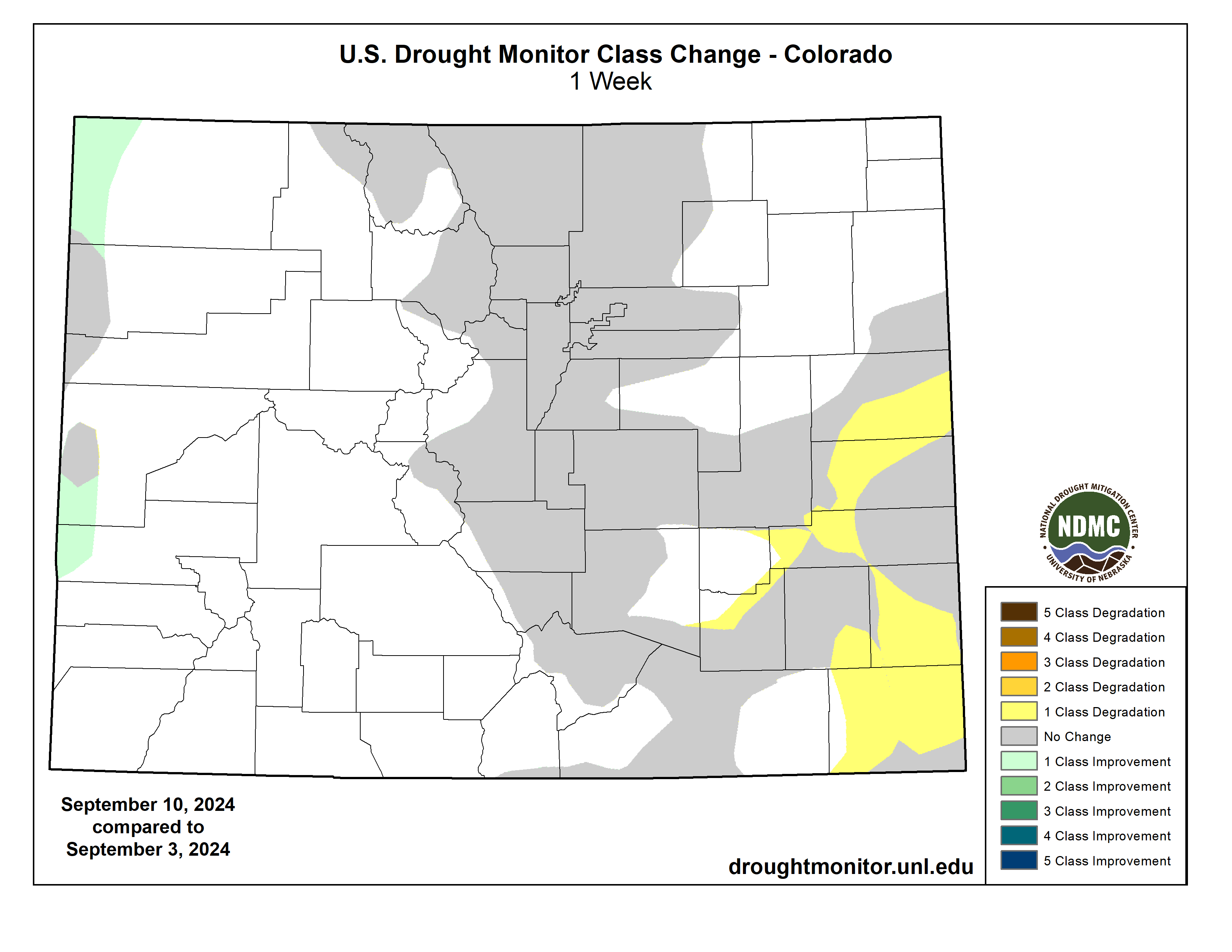
The High Plains saw a mixed bag of improvements and degradations. The area remained hot and dry, except for eastern Nebraska and Kansas. Higher elevations of Colorado and Wyoming did receive some precipitation, but conditions remained mostly status quo. Kansas has experienced feast or famine precipitation since the beginning of summer. Some isolated, slow-moving thunderstorms provided good moisture in the center of the state, but abnormally dry or moderate drought conditions expanded along the Kansas western, southern and eastern borders. Eastern Colorado is beginning to show signs of a prolonged dry period, with moderate drought creeping further eastward from the Kansas border. Similarly, central and northern Wyoming are showing drier signals in the short-term, including soil moistures. These same conditions brought abnormally dry conditions along the North and South Dakota border and into southern and eastern Nebraska…
West
The West remained mostly dry with little to no precipitation and above-normal temperatures, except for southern New Mexico where conditions improve mainly on the residual effects of a wet few weeks and aided by below-normal temperatures. Central and northeastern Arizona into southeastern Utah also saw some improvements. Arizona also saw the expansion of moderate drought, overflowing into southern California. Central California also saw abnormally dry conditions expand. Northern Nevada, eastern Oregon and west-central Idaho saw widespread moderate drought expansion due to warm temperatures, lack of precipitation and drying soils. Washington into northwestern Idaho saw severe conditions expand, but extreme dryness was removed in Grant County, Washington as conditions were similar to the surrounding severe drought conditions.
South
The western portion of the South saw widespread improvements from central Texas to central Mississippi. Heavy rainfall from Hurricane Franciene dropped 2 to 6 inches of rain and the southeastern tip of Louisiana got as much as 14 inches of rain. Outside of the Gulf Coast, precipitation was lacking with precipitation hovering below normal. Temperatures were 2 to 6 degrees below normal, with localized areas being 6 to 8 degrees below normal. Central and southern Texas continued to see one-category improvements. Louisiana saw most of the abnormal dryness added last week removed due to abundant precipitation. Things started to degrade in Oklahoma, northeast Texas, Arkansas and northern Mississippi, where one-category degradations were widespread…
Looking Ahead
Over the next five days (September 11-16), precipitation is expected in the high elevation of Alberta Canada into Montana and Idaho, southern Arizona, and across the Gulf and southern Atlantic Coasts. Precipitation amounts of 2 to 5 inches are expected in Mississippi, northern Alabama, western Tennessee, the Florida Panhandle, and coasts of North and South Carolina.
The National Weather Service Climate Predication Center’s 6-10 day outlook heavily favors above-normal temperatures from the north-central to eastern Canadian border to Texas-Mexican border with Minnesota, Wisconsin, and Michigan 80 to 95% likely to see above normal temperatures. Conversely, southern California and Arizona are 70 to 90% likely to see below-normal temperatures. Shifting northward towards the western Canadian border, there is a change of at- or slightly below-normal temperatures. Hawaii and northern Alaska are leaning toward above-normal temperatures.
The National Weather Service Climate Predication Center’s 6-10 day outlook heavily favors above-normal precipitation in Montana and central Idaho, as well as the Atlantic Coast of Maryland, Virginia and North Carolina. Alaska and Hawaii are also leaning toward above-normal precipitation. Arizona, New Mexico, the Gulf Coast of Texas and Louisiana, and the Great Lakes region are leaning towards below-normal precipitation.