

Click the link to read the article on the InkStain website (John Fleck):
June 1, 2026
I’ve been on a “Colorado River sabbatical” of late, but I took a peek last week at Reclamation’s latest 24-month study. Holy moly things have gotten bad since the last time I looked!
Those not on sabbatical already know all of this, but to keep Lake Powell above a surface elevation of 3,500 feet, Reclamation is:
- increasing releases out of Flaming Gorge on the Wyoming-Utah border
- dropping releases out of Lake Powell to 6 million acre feet this year
Even with those two “hail Mary” moves, Lake Mead is projected in the “most probable” scenario to drop to elevation 1,020 by summer 2027. Under the “minimum probable” forecast, Mead drops all the way to elevation 1,008 in 2027.
We are on the brink, as a group of my colleagues explains in a new analysis out this morning (Monday June 1, 2026), of a system crash:
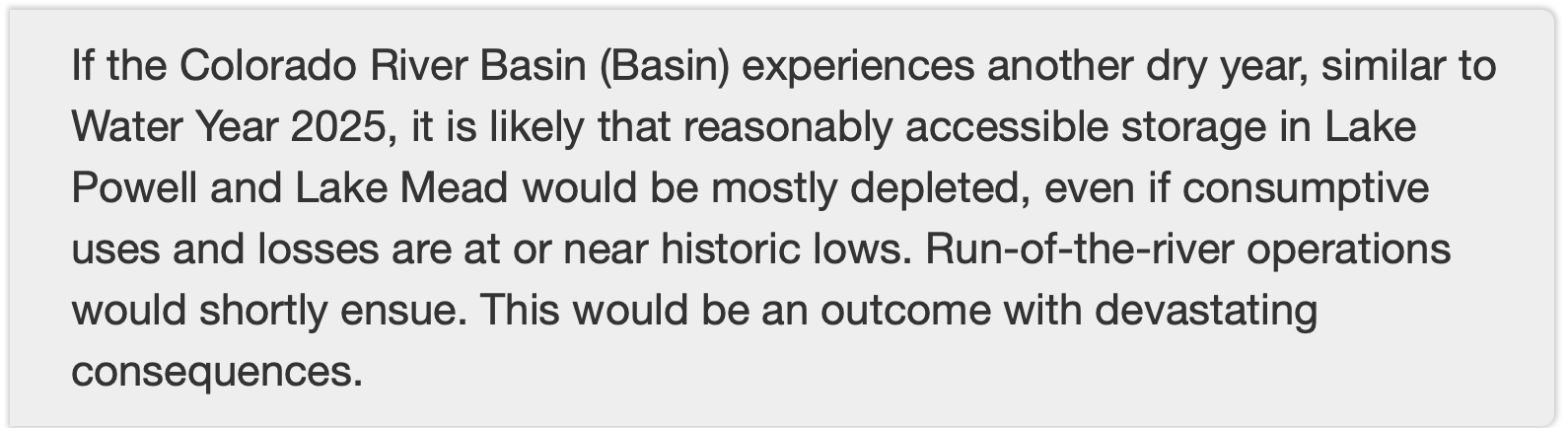
That’s from the latest report from the team of Castle-Schmidt-Kuhn-Sorensen-Tara, the Traveling Wilburys of the Colorado River. I’ve been on “sabbatical”, so I didn’t work on this one with my friends. (The joke is that I’m busy catching up on old movies, which is at least partly true, did you know Billy Wilder made, like, 50 movies?)
Even a wet year, my friends conclude, would only provide a short reprieve from the need to significantly reduce consumptive use.
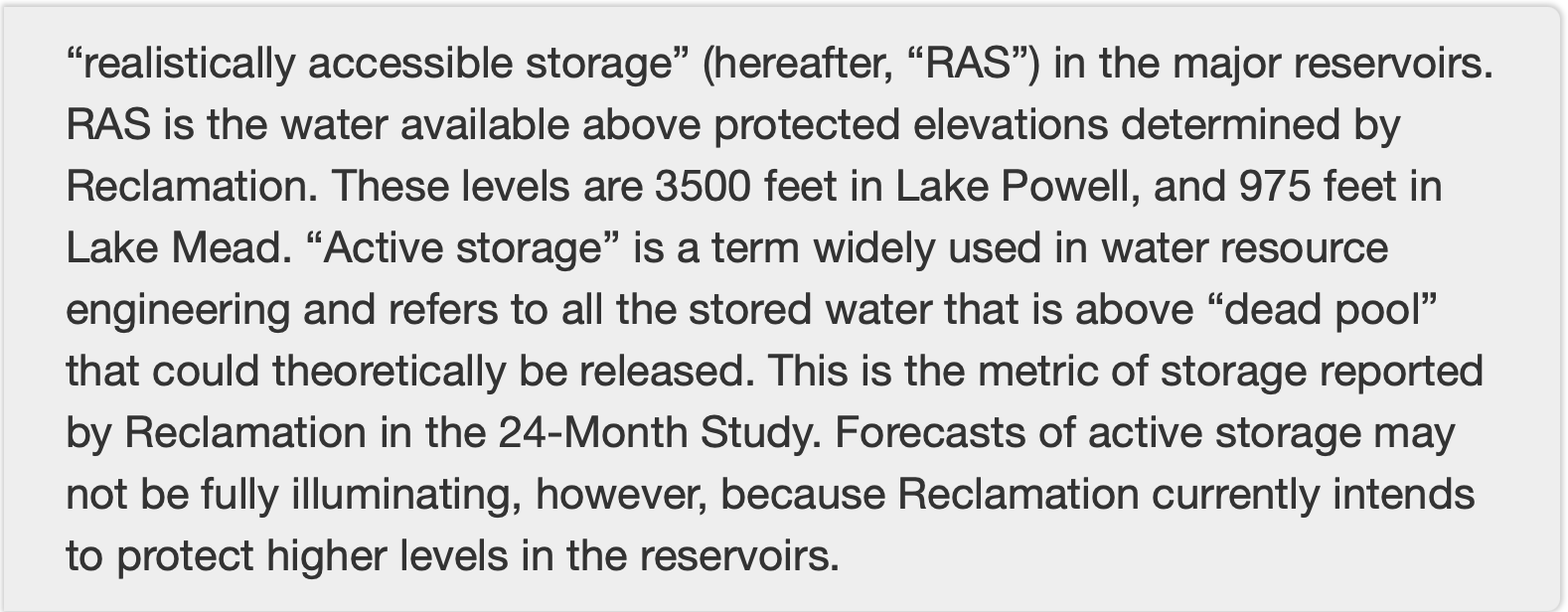
Building on a similar analysis done last September (I was a co-author on that one), the authors attempt to overcome one of the shortcomings of the traditional Colorado River accounting systems, which is to treat any water above “dead pool” as usable storage. This is not the case, with clear do-not-cross lines in the reservoirs that are maintained for technical reasons well above the bottom, defined by my colleagues as…
One of the reasons for my “sabbatical” is, frankly, an agonized frustration with the abject failure of Colorado River governance at the basin scale, and a desire to turn my attention to the local level, which is where the problem solving responsibility seems to rest right now. Each community needs to be having a serious conversation right now about the specifics of its Colorado River water supply, and how it intends to go about using less. Blaming other people for using too much isn’t particularly useful at this point, we seem to have chosen to hand that set of questions (the rule-based part of “who is entitled to how much”) over to the courts, and who knows what that process holds. We know the answer for everyone is “use less water”, and each community needs to be getting on with that conversation.