
Click the link to access the report (Jeff Lukas and Juli Vano). Here’s an excerpt:
As water utilities expand climate considerations across business functions and climate hazards—amid a rapidly growing landscape of climate model datasets—selecting data that are truly “fit for purpose” has become increasingly complex. To address this, the Water Utility Climate Alliance (WUCA) Climate Modeling Work Group sought to develop several case studies that would illuminate the factors behind the selection, processing, and application of climate model datasets in planning analyses.
The purpose of the case studies was not to identify general “best practices” or create formal guidance, which has been done elsewhere (here,1 here,2 and here3). Rather, it was to capture the specific circumstances and priorities that drove each utility’s decisions—what climate data to use, in what ways, and for what analyses—providing practical, real-world examples for other utilities to learn from. The case studies were informed by interviews with key utility staff and consultants as well as supporting project documents.
Each of the four case studies follows a WUCA member utility through selecting and processing climate model data, establishing a data workflow, conducting project analyses, and applying the results to planning and decision-making. Three of the projects centered on future water supply and/or demand, and the fourth focused on infrastructure flood risk. Two projects were complete at the time of writing, and the other two were in their final phases. Each case study begins with a brief overview of the utility, followed by sections addressing:
- Project context
- Project methods, including data selection and processing
- Results of the analyses
- Use of results in decision support (intended and realized)
- Lessons learned
Each case study also includes links to additional resources that describe the project, climate data, and workflow—such as utility reports and peer-reviewed studies—and a utility contact for further questions.
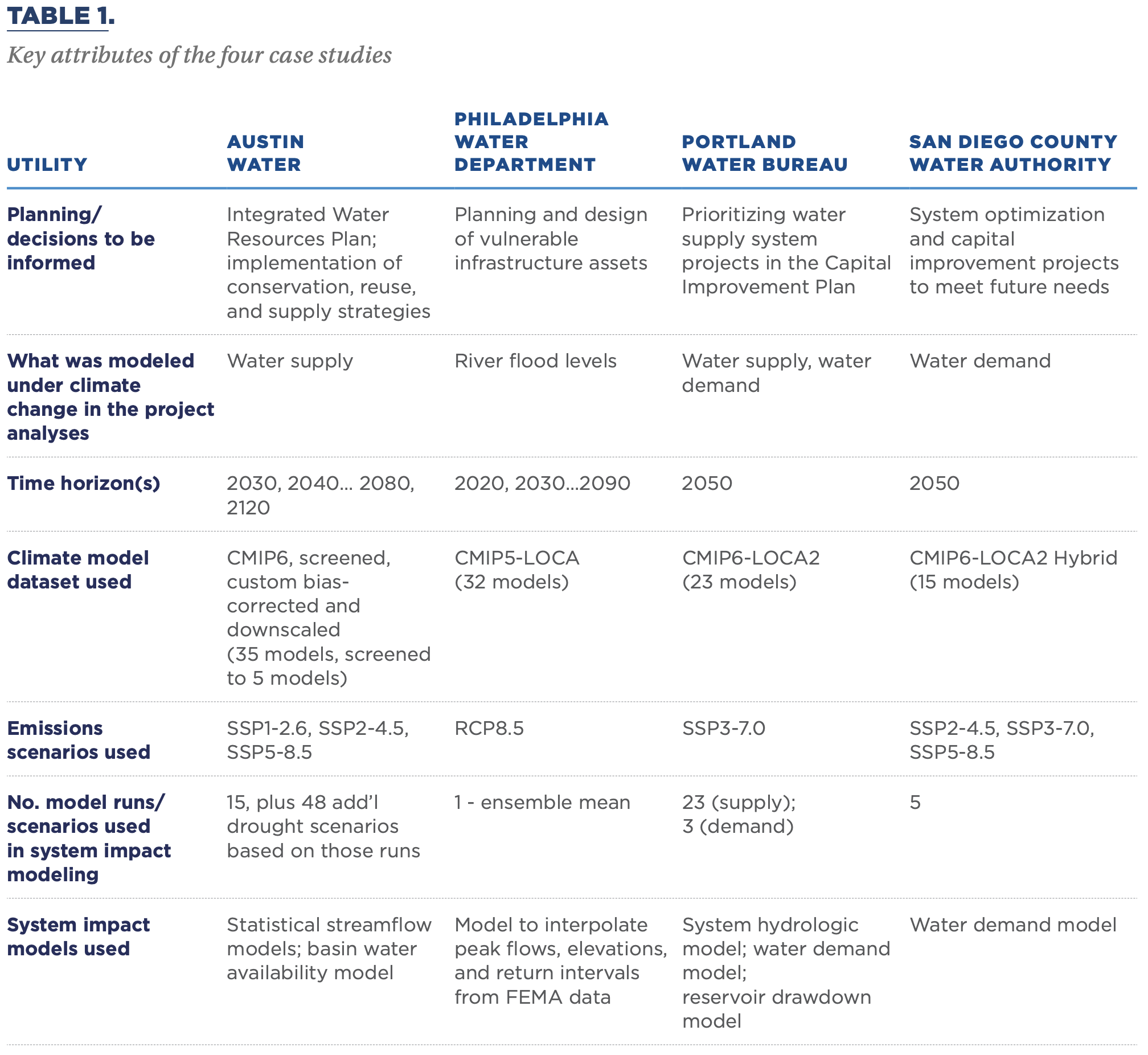
In all four projects, the workflows began with an ensemble of runs from 15 to 35 CMIP5 or CMIP6 climate models. From there, they followed quite different paths in processing those model runs to construct discrete climate and hydrology scenarios for the subsequent impact modeling (Table 1), illustrating that there is no one “right” approach to using climate models to effectively inform planning. Unsurprisingly, the results from all four projects showed the potential for greater climate-related stresses and risks to the utility in the decades ahead—more severe droughts, larger flood events, reduced water supply, and/or increased water demand.