Click the link to read the article on The New York Times website (John Vaillant). Here’s an excerpt:
October 12, 2026
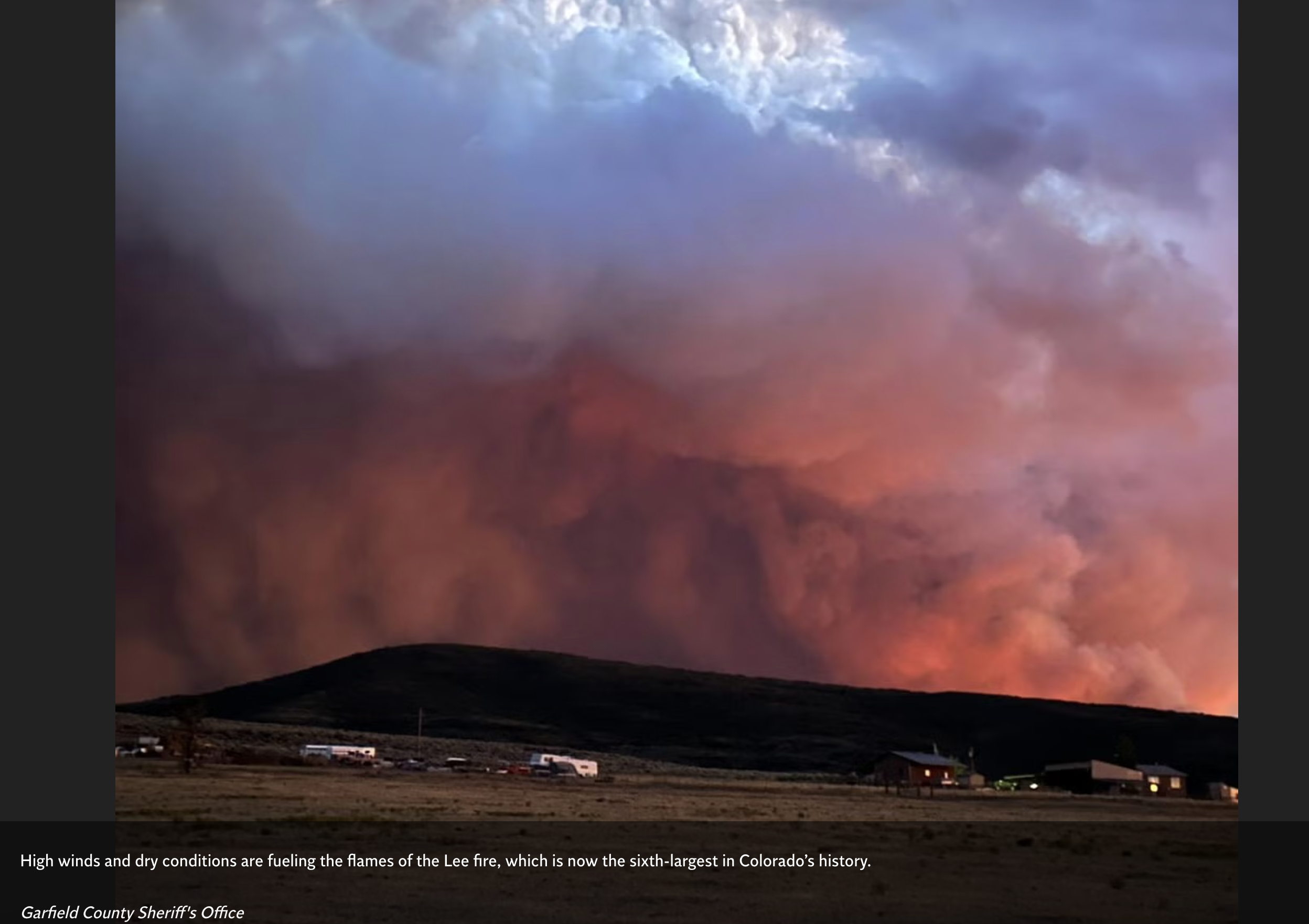
In past years, the U.S. Forest Service’s red-flag warning was sufficient to convey extreme fire risk, but officials this year found it inadequate. In Washington State, they appended a designation typically reserved for life-threatening tornadoes: particularly dangerous situation. This wasn’t adjective inflation — it was a sincere effort to articulate the extraordinary fire conditions that burned nearly 1,000 structures in and around Spokane in August, making it the most destructive wildfire in the state’s history. As of Oct. 5, more than 9 million acres have burned across the United States, the largest area set aflame by this date in more than a decade, and much of the country is still primed to burn. Oregon has declared 2026 the worst fire season in state history. Utah, Ontario, France, Spain, Britain and Belgium have either experienced their worst or are on track to do so. But what’s really striking this year is how many civilians and firefighters across the hemisphere have described lethal combinations of velocity and ferocity. Hundred-meter flames are not uncommon anymore, nor are cyclonic winds with towering fire whirls, corkscrewing skyward like molten ten-story unicorn’s horns. Both phenomena can be precursors for pyrocumulonimbus “fire clouds” — enormous, combustive weather systems that affect entire geographic regions. By growing so big that it becomes a weather system unto itself and so tall that it gyres like a hurricane, effectively controlling the entire air column of a region’s lower atmosphere, the pyroCb, as it’s known, creates optimal conditions for self-perpetuation. Lightning strikes can start new fires 20 or 30 miles beyond the fire’s epicenter, and hurricane-force winds can fan flames to sky-scraping heights while driving embers far beyond any fire break, retardant line or back burn. Simply put, nothing can stop one of these firestorms except a change in the weather or a lack of fuel…
When you place this summer’s fire events alongside persistent drought conditions that have brought water levels to historic lows from western Canada to Siberia, it becomes clearer that severe conditions are playing out across an entire hemisphere. Some might see these as random events. I see a superheated Earth. Add the Asian heat waves that broke 122 degrees Fahrenheit in Xinjiang, China, and “boiled” potatoes in the ground in Yanggu County, South Korea, and there’s no getting around the fact that we — as a species and as a planet — are now living in the future that climate scientists have been warning us about for more than half a century. With these new conditions comes a physical retreat of the human footprint and an aspirational contraction of what humans can do and where we can do it. The contraction is underway not just in terms of coastlines, forests and glacial valleys becoming unsafe or untenable to inhabit, but in terms of previously hospitable spaces becoming uncomfortably hot and smoky. Outdoor activities such as hiking, camping and patio dining have in many places been severely constrained. These impacts are accompanied by a parallel contraction of civic resources: Investment and creative capital previously dedicated to development, expansion and improvement must now be redirected toward repair, recovery and remediation. According to Spokane’s mayor, Lisa Brown, her city’s recovery from August’s fires will take years. Replacing the 16,000 buildings lost in the 2025 Los Angeles fires will most likely take a decade, and the specter of uninsurability looms over the country. Meanwhile, billions of dollars are disappearing from the economy in the form of burned houses and forests, lost wages, lost waterfronts, closed businesses, degraded health and the millions of potential customers who simply decide to stay home because of heat and smoke. Consider, too, how much more we now spend on air conditioning and air filtration. The rawest and most dramatic manifestation of civilizational retreat is mass evacuation during catastrophic fire, and this summer saw some of the biggest ever: Tens of thousands of Americans and Canadians were forced to flee wildfires from British Columbia to Texas. In southern Europe, hundreds of thousands of French and Spanish citizens were evacuated in one of the region’s largest dislocations since World War II, along with many thousands more in neighboring countries. Nepal’s devastating glacier collapse is another ominous indicator: There are dozens of similarly vulnerable communities not just in the Himalayas but also in the Andes, the Alps and the Rocky Mountains.