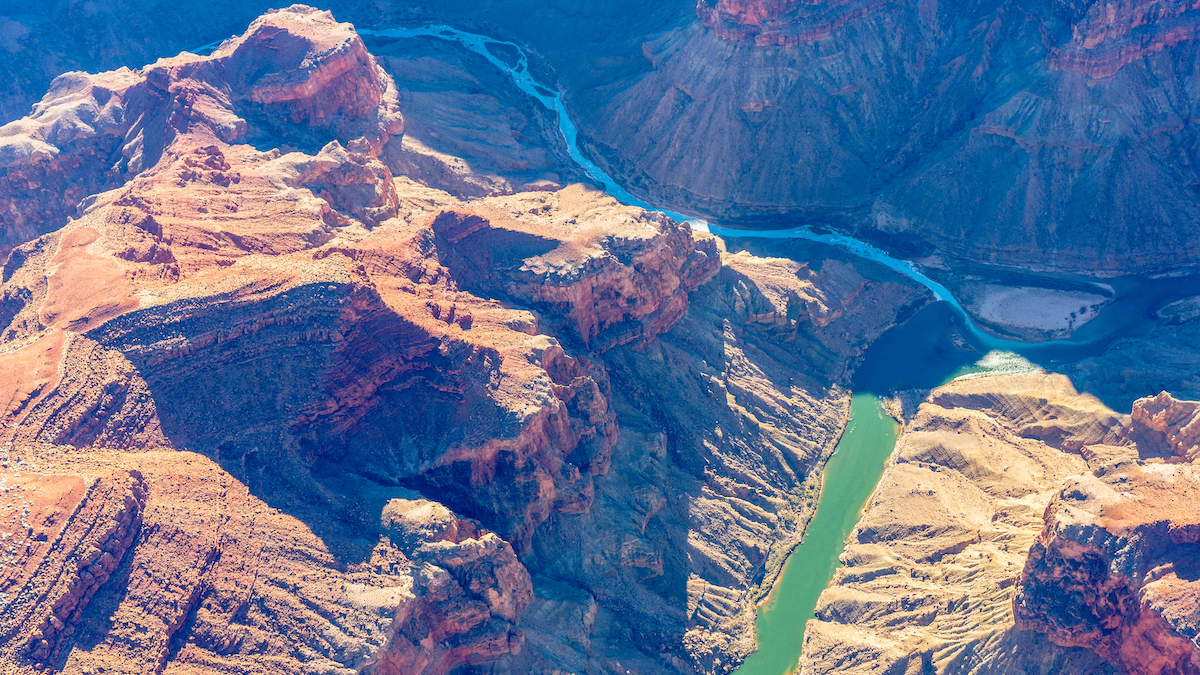
I write with a steadfast commitment to Hopi – the land, animals and people that have been in so-called Arizona since life began. We Hopi claim responsibility not just for Arizona life, but for biodiversity throughout the world, endowed to us by the Creator. In my political and nonprofit positions, I’ve worked to protect Bears Ears National Monument, Baaj Nwaavjo I’tah Kukveni-Ancestral Footprints of the Grand Canyon National Monument, and Chaco Canyon. In my current role as a consultant on land protection campaigns with WildEarth Guardians, I am engaged in the Greater Gila campaign, protecting Hopi ancestral homelands in the Gila National Forest and Apache-Sitgreaves National Forests. Unrelenting uranium mining, fracking, livestock grazing and recreational abuse have decimated the land as well as our sacred sites. Tribes, nonprofits and community members cannot afford to backslide during this second Trump administration, and we cannot give away our power by waiting four years.
Through my work with environmental nonprofits and elected officials, I have witnessed small strides toward LandBack, tribal sovereignty and less extractive management of public lands. While I am certainly grateful for actions to protect places sacred to the Hopi and other tribes, I am deeply concerned about this second Trump administration, and the disturbing pattern of Democrats crafting campaigns that are disconnected from the poorest in this country – in rural America and on tribal lands. To address the polycrises of the current moment, we need bold action from decision makers. Standing in the middle of the road will only continue to perpetuate the harms of colonization.
The founding of the United States, and its subsequent accrual of wealth and power, were built on slavery and genocide. Most Native people have never fully recovered from this, continuing to live without access to running water, concerned about our water rights in general, and well aware that the federal government could break treaties at any time – a practice that has never stopped or been fully remediated. We do not need more apologies or statements. We need meaningful, direct action – legislative and community-led, before the Trump administration begins eviscerating the work we have done.
My work with WildEarth Guardians relies on decolonization and addressing past harms – including those done by the conservation movement – to ensure they are not repeated in the future. From the Native perspective, we have always cared about the land, through common teachings, oral history, ceremony and relationships. From the nonprofit perspective, conservation has historically been rooted in science and law. Steps towards honoring and uplifting traditional ecological knowledge and wisdom through co-stewardship, co-management and LandBack efforts must not be abandoned. Courageous allyship from our public servants – congressional and state officials alike – in dismantling an oligarchic takeover of both parties is imperative. We invite you to stand arm in arm with us in a bold renunciation of campaign contributions from entities that enable genocide (both at home and abroad), empower the fossil fuel industry, and generally create more poverty, climate change, racism and extinction. It will not be possible to achieve the continuation of life while also prioritizing re-election through corporate contributions and political vanity.
Clark Tenakhongva, former vice chairman of the Hopi Nation and former co-chairman of the Bears Ears Inter-Tribal Coalition via his Facbook page.
To protect our sacred lands and, at minimum, hold the line on what tribes have fought for (and won), there must be a bold alternative to Trump’s authoritarianism.To meet these trying times, members of Congress, federal and state agencies, and state legislatures must:
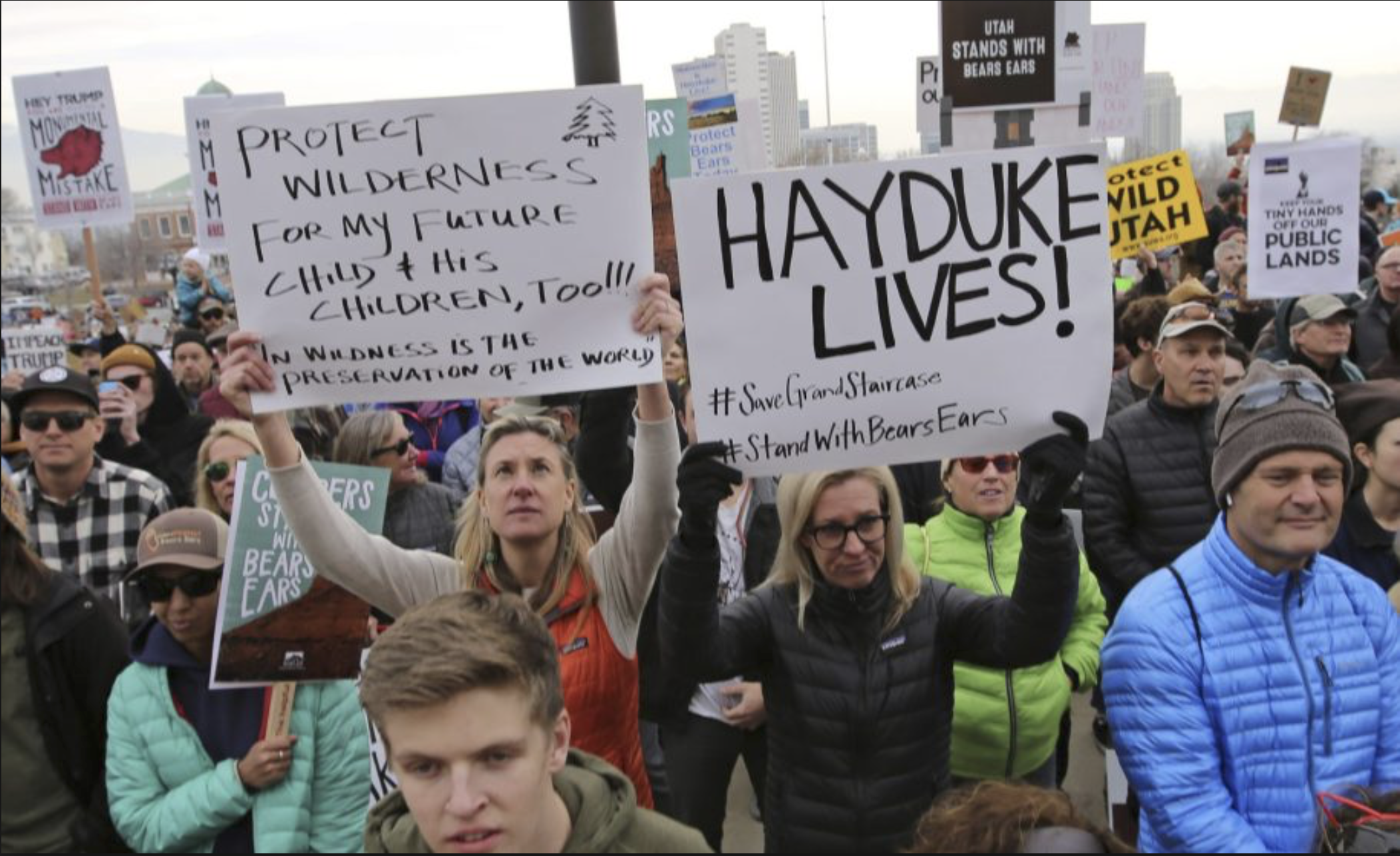
Protect and defendthe existing boundaries of the most vulnerable national monuments, including Bears Ears, Ancestral Footprints, Grand Staircase, and others targeted by the Trump administration.
Recognize that water is life. Contamination of our rivers and streams and underground aquifers are a perpetual problem. Hopi people have significant rates of cancer due to uranium poisoning.
Congress must reform the archaic 1872 Mining Law, which gives free reign to corporations (many of them foreign) to exploit our lands and poison our bodies.
Congress must also ratify and fund the Northeastern Arizona Indian Water Rights Settlement Act of 2024.This urgent matter has already cost our tribes millions of dollars as we’ve searched for an agreement. Securing these water rights is potentially the most important thing Congress can do to immediately benefit the Hopi.
The U.S. government must fully fund agencies like the Bureau of Land Management, the National Park Service and the U.S. Forest Service. Lack of capacity and law enforcement has led to increased vandalism, looting and illegal ATV use, as well as recreational overuse. The Schultz Fire, in the Coconino National Forest, was started by an abandoned campfire. The 15,000-acre burn destroyed much of our sacred Douglas Fir that we use for ceremonies, and resulted in a new, bureaucratic process for Hopi with the U.S. Forest Service. Permits are now required in a place our ancestors had gathered freely for centuries. This is one example of how an underfunded, understaffed agency, coupled with a push for more tourism, had devastating and far-reaching consequences.
The Biden administration’s Executive Order 13175 mandatesthat federal agencies consult with tribes regarding land management. Congress should uphold this mandate and, in fact, increase contact with tribal governments and communities in order to honor all perspectives. This mandate has not yet resulted in deep or meaningful changes. Support and directives for agencies to meaningfully engage with tribes, even under a second Trump administration, is critical.
As a veteran, I support our troops and responsible military behavior. But low-level military flights over current and ancestral Hopi lands have resulted in poor nesting conditions and survival outcomes for golden eagles and hawks. Military flights have increased over the tribal and ancestral lands of the White Mountain Apache, San Carlos Apache, Tohono O’odham, Hopi and others. We ask that Congress continue to hold the Department of Defense accountable for reckless overflights, dropping flares (which have caused forest fires) and dropping chaff (toxic military training material which contains PFAS and other contaminants).
It is my hope that if elected officials, community members and agencies truly act out the values they purport, we can start down a path of healing. I close this letter with a sincere prayer and a reminder that life is precious.
Red Water Pond Road Community leader, Larry King, addresses plans to relocate the Quivera Mine Waste Pile that is located about 1,000 feet from the closest residence. Shayla Blatchford
As a child, herding her grandmother’s sheep, Teracita Keyanna unknowingly wandered onto land contaminated with radioactive waste from three abandoned uranium mine and mill waste sites located near her home on the Navajo Nation.
Keyanna and other Diné citizens have been living with the consequences of uranium mining near the Red Water Pond Road community since the 1960s. But now, uranium waste rock that has sat for decades at a Superfund site will finally be moved to a landfill off tribal land.
“This is a seismic shift in policy for Indigenous communities,” said Eric Jantz, an attorney for the New Mexico Environmental Law Center.
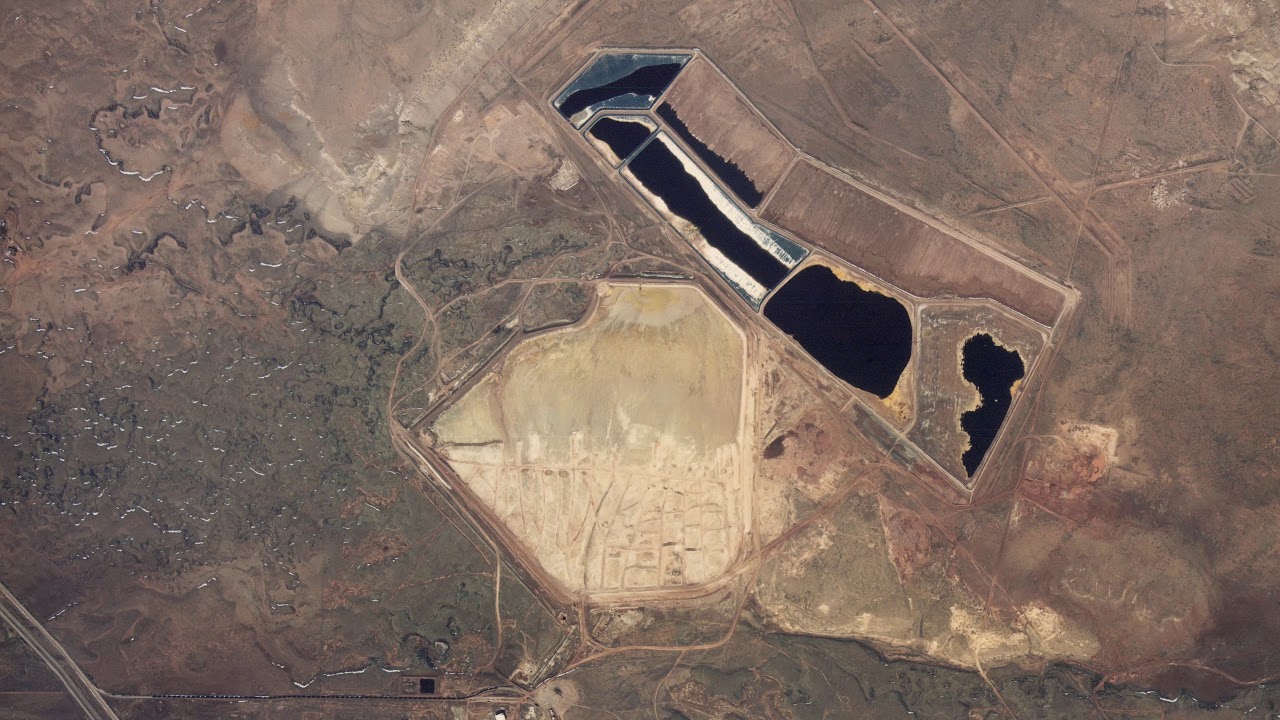
On Jan. 5, in a first-of-its-kind move, the Environmental Protection Agency signed an action memo to transport 1 million cubic yards of low-grade radioactive waste from the Quivira Mining Co. Church Rock Mine to a disposal site at the Red Rock Regional Landfill. The Northwest New Mexico Regional Solid Waste Authority owns and operates the landfill, which is located about 6 miles east of Thoreau, New Mexico.
“I feel like our community has finally had a win,” Keyanna said. She is a member of the Red Water Pond Road Community Association, a grassroots organization made up of Diné families that have been advocating for the waste removal for almost two decades. “It’ll help the community heal.”
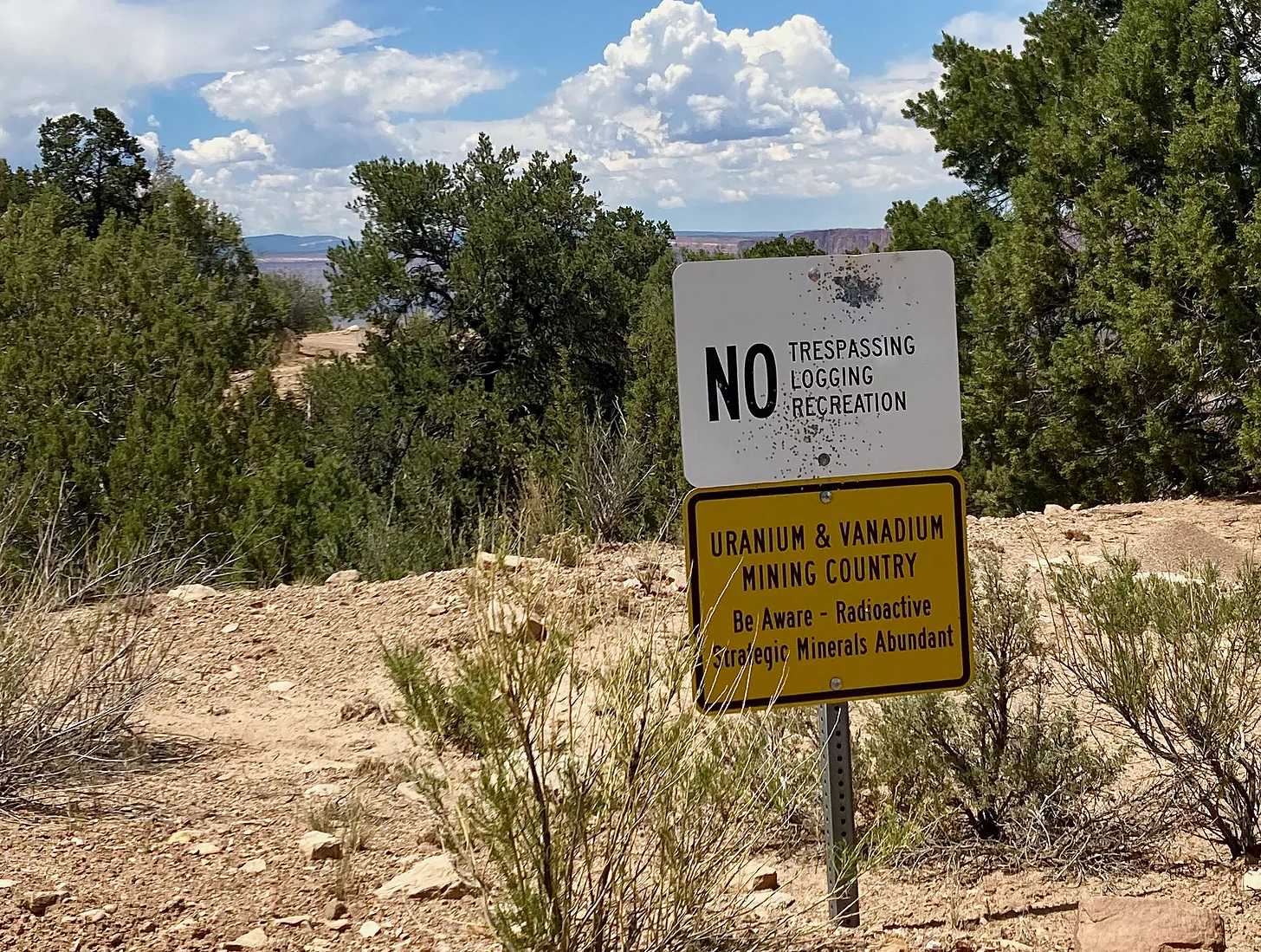
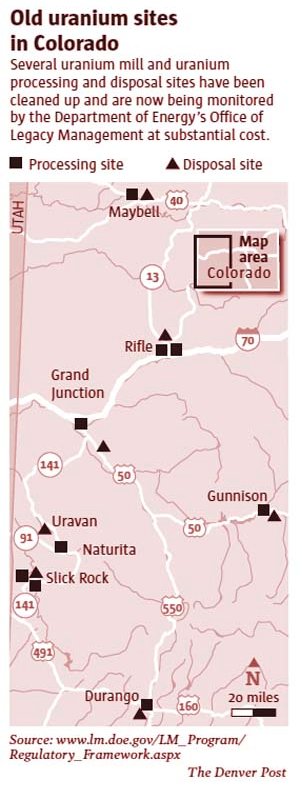
Companies extracted an estimated 30 million tons of uranium ore on or near the Navajo Nation from 1944 to 1986, largely to fuel the federal government’s enormous nuclear arsenal. When the mines were abandoned in the 1980s, the toxic waste remained. Today, there are hundreds of abandoned mines in plain sight on the Navajo Nation, contaminating the water, air and soil. Altogether, there are an estimated 15,000 uranium mines across the West — 1,200 of them on the Navajo Nation alone — with the majority located in the Four Corners region.
The impact of all this mining on Diné communities has been devastating. A 2008 study found uranium contamination in 29 water sources across the Navajo Nation, while other studies show that people living near waste sites face a high risk of kidney failure and various cancers.
At Quivira, the cleanup is set to begin in early 2025 and will continue for six to eight years, according to an EPA news release. The permitting process, which will provide opportunity for public comment, will be overseen by the New Mexico authority that manages the proposed waste site and is responsible for its long-term safety monitoring.
Mine Waste Area with Limited Vegetation. Photo credit: EPA
The EPA had considered multiple options for waste remediation. But for years, Red Water Pond Road advocates and other local organizations continually pushed it to simply remove the waste, a course of action that the EPA has never taken before, even though the Navajo Nation has repeatedly called for the federal government to move all uranium waste from Diné tribal land.
Throughout the Navajo Nation, said Jantz, “prior to this decision, EPA’s primary choice in terms of remediation of mine was to bury the piles under some dirt and plant some grass seeds on top, called cap in place.” But studies have shown that this approach is not effective at containing radioactive waste in the long term, he said.
The agency took a similar approach when addressing the other uranium waste in the Church Rock area. In 2013, the EPA and the Nuclear Regulatory Commission, which oversees uranium mine-waste cleanup, dumped 1 million cubic yards of waste from the Northeast Church Rock Mine — a different waste site, roughly 3 miles from the Quivira Mine — on top of existing tailings located half a mile from the Red Water Pond Road communities.
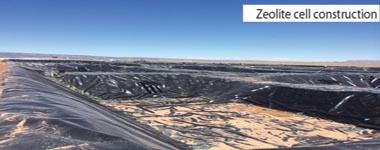
But the EPA plans to handle the Quivira Mine’s waste differently, placing it in geoengineered disposal cells with a groundwater leak protection system after it is moved off-site, an approach that Jantz called “state-of-the-art.”
The Quivira Mine cleanup is part of the 2014 Tronox settlement, which provided $5.15 billion to clean up contaminated sites across the United States. The settlement allocated $1 billion of those funds to clean up 50 uranium mines across the Navajo Nation.
There is a lot more to be done, said Susan Gordon, coordinator for the Multicultural Alliance for a Safe Environment, a grassroots organization led by uranium-impacted communities. Hundreds of abandoned mines pepper the Navajo Nation, and the EPA has not formulated a broader plan to clean up the majority of them. Funding is also an issue, she added.
What the EPA’s decision means for the future of uranium mine waste remediation is unclear. Under other circumstances, Jantz said that the decision would signal a sea change for the EPA’s policy of removing waste from the Navajo Nation. But the incoming Trump administration has not indicated its policy on hazardous waste disposal.
After years of demanding the cleanup of uranium waste at the Kerr-McGee Quivira Mines on the Navajo Nation community advocates got the news this week that the Environmental Protection Agency will remove waste rock from three areas of the site and move it to a new off-site repository. The removal of over 1 million cubic yards of radioactive waste from the sites about 20 miles northeast of Gallup will begin in early 2025, the EPA said. The waste will be taken to a new off-site repository at Red Rocks Landfill east of Thoreau, N.M. The process, including permitting, construction, operation and closure of the repository, is expected to take 6-8 years.
“I feel as though our community finally has something of a win,” said Teracita Keyanna, a member of the executive committee for Red Water Pond Road Community Association. “Removing the mine waste from our community will protect our health and finally put us back on a positive track to Hózhǫ.”
Commercial exploration, development, and mining of uranium at Quivira Mines began in the late 1960s by the Kerr-McGee Corporation and later its subsidiary. The mine sites are the former Church Rock 1 (CR-1) mining area; the former Church Rock 1 East (CR-1E) mining area; and the Kerr-McGee Ponds area. The mines were in operation from 1974 to the mid-1980s and had produced about 1.2 million tons of ore, making them among the 10 highest producing mines on the Navajo Nation…From World War II until 1971, the U.S. government was the sole purchaser of uranium ore, driving extensive mining operations primarily in the southwestern United States. These efforts employed many Native Americans and others in mines and mills. Between 1944 and 1986, nearly 30 million tons of uranium ore were extracted from Navajo lands under leases with the Navajo Nation. With over 500 abandoned uranium mines — many say the total could be in the thousands — clean up of mines has always been a battle.
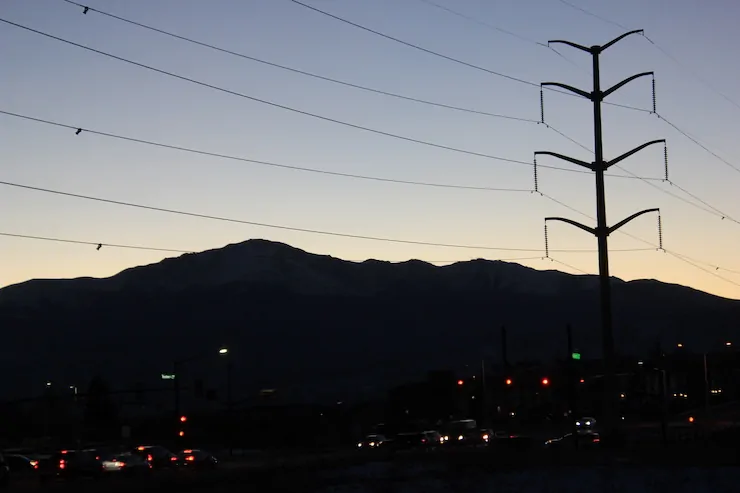
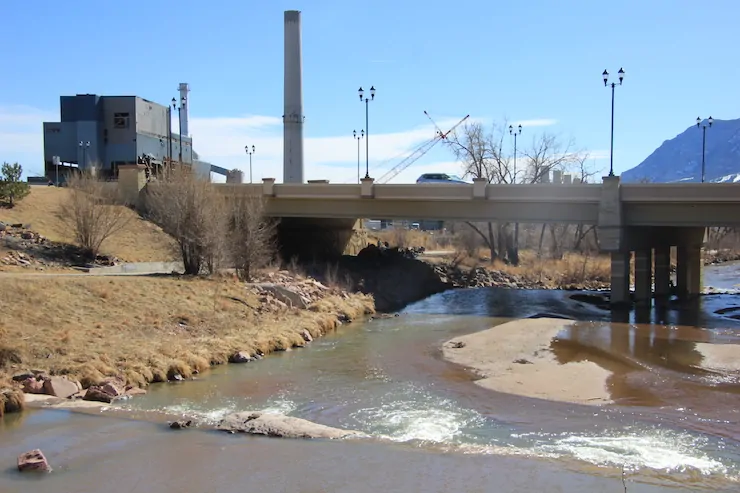
Colorado Springs. Photo credit: Allen Best/Big Pivots
Click the link to read the article on the Big Pivots website (Allen Best):
December 19, 2024
Transmission line in southeast Colorado a cause for guarded optimism among utility leaders
Interstate highways have transformed Colorado and America altogether. People growing up in the 1950s rarely had fresh fruit or vegetables in winter. Now, broccoli beheaded yesterday in a field near Yuma, Ariz., can be on a store shelf in metro Denver within a day or two. Much of that journey will be on an interstate highway.
High-voltage transmission lines are our four-lane highways of electricity. They worked well enough when giant coal plants provided most of our electricity. Now, as Colorado and other states strive to replace fossil fuels with renewables, new connections must be built, to knit us together across broader areas.
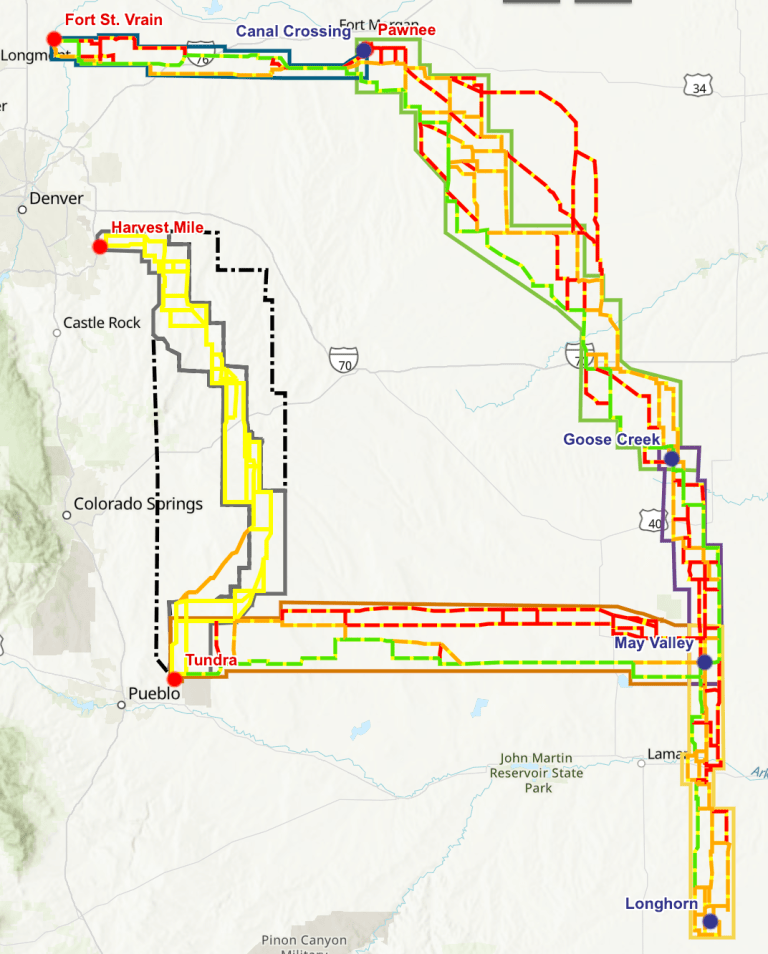
A federal agency this week delivered cause for cautious optimism. The Department of Energy has picked three transmission corridors among 10 national candidates for advanced work. One of them, the Southwestern Grid Connector Corridor, would begin in southeast Colorado near Lamar, and work south into New Mexico and then somewhat west.
The 2021 Bipartisan Infrastructure Law authorized the secretary of energy to designate any geographic area as a national interest electric transmission corridor. The energy department has found that absence of transmission harms consumers. With more transmission, we can share low-cost renewable generation across broader areas. We need an electric grid larger than one weather system and covering more than one time zone.
The existing transmission network is akin to our highways of 50 to 60 years ago. We have transmission, but it’s as if Interstate 70 stopped at the state line. In fact, transmission lines do. Colorado is in the Western electrical grid of 10 states and some adjoining areas. This grid, however, is better understood as a collection of 34 different islands connected by narrow causeways.
“A cautious hurrah,” said Mark Gabriel, the CEO of United Power when I asked his reaction. The Brighton-based electrical cooperative supplies 113,000 members from the foothills to Weld County’s oil and gas fields, including many new industrial centers along I-76.
“Anything that promotes additional transmission is a good thing,” said Gabriel. “However, the challenge remains in actually getting something constructed in a reasonable period of time to make a difference.”
Gabriel pointed out that more than $40 billion in transmission projects have been announced. “Only a fraction are actually being built.”
Permitting has been the bane of many transmission projects. For example, it took 18 years before the TransWest Express Transmission project that will ferry wind-generated electricity from southern Wyoming to Utah and West Coast markets finally broke ground in 2023. It nicks the corner of northwest Colorado.
A bill being negotiated in Congress would ease federal permitting requirements to allow more rapid creation of transmission lines. Other provisions of the Energy Permitting Reform Act of 2024 would also benefit oil and gas extraction.
Tri-State Generation and Transmission, the wholesale provider for 17 of Colorado’s 22 electrical cooperatives, pointed to the need for streamlined permitting in its reaction to the transmission line in southeastern Colorado.
Transmission doesn’t come cheap. And just as interstate highways have their unsavory aspects — my companion and I can routinely hear I-70 roaring a mile away — transmission lines have their downsides. Who wants one in their backyard?
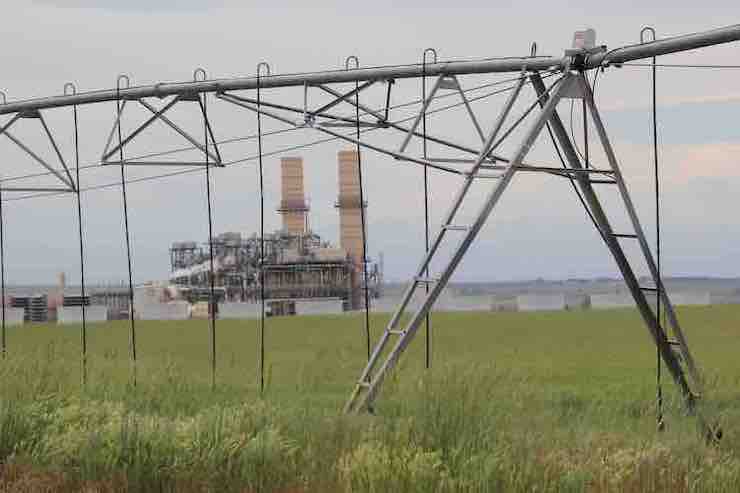
Baca County has Colorado’s best wind resource and it gets plenty of sunshine. Lacking has been transmission. Top photo transmission in Colroado Springs. Photo credit: Allen Best/Big Pivots
Some want to believe nuclear energy will solve all of our problems. The Pueblo City Council, while saying nice things about nuclear, intends to scrap a goal of 100% renewables by 2035. Maybe nuclear will be an answer, but recent projects have had eye-bulging costs. Natural gas has problems, too, as was evident in Winter Storm Uri of February 2021 when costs soared.
Chris Hansen, as a state legislator from Denver, sponsored key legislation to push transmission planning in Colorado. Now in Durango as CEO of La Plata Electric, he has started working on guiding his electrical cooperative to 97% emission-free electricity in the next decade. Transmission, he says, will be crucial.
Capacity of existing transmission lines can be expanded by reconductoring and other technology. But we altogether need to be better connected east and west, north and south.
One crucial question, says Hansen, is whether Denver-based Chris Wright, the choice of Donald Trump to be secretary of energy, will support continued transmission planning. His Colorado-based career has been in oil and gas. Wright sees renewables as a distant solution.
Southeastern Colorado brims with renewable energy potential. Baca County has Colorado’s best wind, according to a 2017 study by the National Renewable Energy Laboratory. It also has strong solar. That’s why corn grows so well there — assuming it has water. The water of the Ogallala Aquifer won’t last, but the solar and wind almost certainly will. What it lacks now is a farm-to-market transmission highway.
The Land Desk is taking a break from its regularly scheduled programming to set something straight. It has come to our attention that one or more of our readers don’t realize that under the Biden administration the United States has become the planet’s leading oil and gas producing powerhouse. Well, it has, mostly on the strength of a drilling frenzy on public, private, and state land in the Permian Basin of New Mexico and Texas.
For those who pay attention, this shouldn’t come as a surprise. But apparently it is news to those who have been duped by President-elect Trump’s claims that his “drill, baby, drill” agenda will bring an end to Biden’s alleged “war on energy” and make America energy-dominant again. There is no war on energy, and under the Biden administration the U.S. has been more “energy dominant” than ever before. In fact, it is the globe’s leading producer (and consumer) of petroleum and natural gas.
The United States’ crude oil and petroleum production surpassed both Saudi Arabia’s and Russia’s in 2013, during the Obama administration, and has continued climbing ever since. Now the U.S. produces more crude oil than any nation in history. This is largely due to advances in drilling technology opening up new sources of hydrocarbons, but is also driven by global oil prices. Source: U.S. Energy Information Administration.
This is not something to celebrate, or for the outgoing administration to take pride in — all that oil and gas gets burned, adding more greenhouse gases to the atmosphere and exacerbating the climate crisis. It’s just the facts, which include:
U.S. oilfields are producing more crude oil and natural gas than ever before, and production continues to increase steadily, particularly from the Permian Basin.
13.4 million barrels per day: Crude oil production from U.S. oil fields in August 2024. In August 2008 it was 5 million barrels per day.
The U.S. is the globe’s leading producer of crude oil, extracting as much crude oil and other petroleum liquids as Saudi Arabia and Russia combined.
21.91 million barrels/day; 11.13 million b/d; 10.75 million b/d: U.S.; Saudi Arabia; and Russia crude oil and other petroleum liquid production in 2023. They are the world’s top three producers.
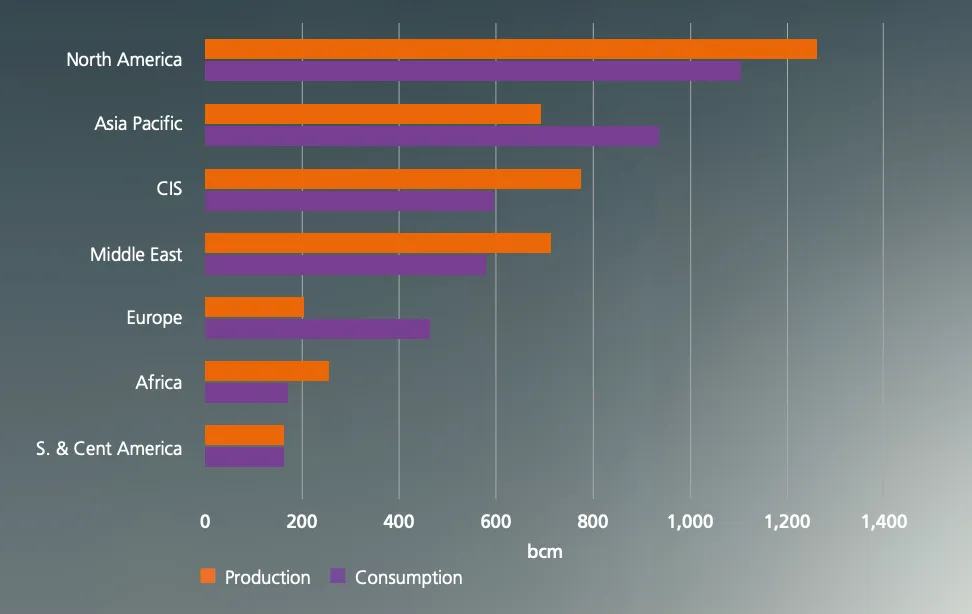
The U.S. is even more methane-dominant, producing 25% of the globe’s natural gas.
Natural gas production and consumption for various regions. Source: Statistical Review of World Energy.
The U.S. is exporting more liquefied natural gas, crude oil, and petroleum products than ever before, becoming one of the world’s leading exporters of hydrocarbons.
The United States exports nearly as much LNG, or liquefied natural gas, as all Middle Eastern producers combined. Source: Statistical Review of World Energy.
The U.S. is a net exporter of crude oil and other petroleum products, making it more “energy independent” than it has been since the early 1900s — if you fall for that sort of thing.
While the U.S. continues to import millions of barrels of crude oil each day, it exports substantially more petroleum products as a whole, making it a net exporter to the tune of over 5 million barrels per day. Source: Energy Information Administration.
The U.S. also continues to import large volumes of crude oil, because oil is a global commodity and many of the nation’s refineries are equipped to handle “sour” crude from the Middle East.
Oil and gas corporations have enjoyed tremendous profits during the Biden administration.
ExxonMobil pulled in $13.2 billion in operating profit during the third quarter of this year. Source: Tradingeconomics.com
Whether this is because of or in spite of or totally unrelated to the Biden administration’s policies is open to debate. Biden revived or implemented a handful of new regulations on oil and gas drilling during his term, some of which have only just begun to take effect. And the Bureau of Land Management offered less acreage for federal oil and gas leasing than previous administrations. But the agency also handed out about as many drilling permits, on average, as the Obama and Trump administrations.
That the oil and gas industry was able to reap such bounty regardless is partially due to the fact that, intentionally or not, Biden’s policies were crafted to allow drilling to continue at a rapid pace while still giving the taxpayers a better return and protecting more fragile areas. This included designating (intentionally or not) the Permian Basin as a de facto oil and gas sacrifice zone. A huge majority of the drilling permits issued under Biden were for federal land on the New Mexico side of the Permian Basin, and the Environmental Protection Agency delayed its response to rising pollution in the area, allowing drilling to go on unfettered. Nearly all of the domestic crude oil and natural gas production growth of the last several years has come from the Permian Basin.
The Biden administration issued around the same number of drilling permits, on average, as the Obama and first Trump administrations. But it handed out far more permits in New Mexico’s Permian Basin than ever before. Source: BLM.
The incoming Trump administration has announced plans to roll back Biden-era environmental protections and expedite oil and gas drilling permitting and leasing on federal lands shortly after taking office. This will almost certainly include opening up more acreage in Wyoming, Utah, and Alaska to leasing. And they’ll try to issue more drilling permits in those places, too.
But even if companies lease more land or pull more permits in Wyoming, they won’t necessarily put them to use— most oil and gas leasing is speculative, anyway, meant to build up a corporation’s land-holdings to entice more investment. And petroleum firms currently are sitting on thousands of unused federal drilling permits. These days the industry has shown little interest in developing areas outside of the Permian Basin, and the Biden administration has more or less let it run rampant down there, leading to the current state of U.S. energy dominance.
Oil and gas production from the Permian Basin will continue to increase for the foreseeable future regardless of who is in the White House. But you shouldn’t expect Trump’s “drill, baby, drill” agenda to further increase drilling or oil and gas production — or to lead to lower gasoline prices. In fact, Trump’s threatened tariffs on Canada will actually increase gas prices in some parts of the U.S., because we get quite a bit of crude oil from them. Besides, his policies are not really aimed at bolstering production or bringing down your prices. They are intended to cut costs for petroleum corporations, thereby increasing their profits, which are already ridiculously high. And it will come at the expense of human health and the environment. [ed. emphasis mine]
⛏️Mining Monitor ⛏️
Drilling material near Slick Rock, Colorado. Jonathan P. Thompson photo.
My email box has been hopping with press releases from various lithium and uranium mining companies tooting their horn about their latest acquisition or exploratory drilling campaign in the Four Corners Country, which tends to get my hackles up. And yet, among the noise is still very little news about actual mining. I have to admit I’m a bit surprised by the lack of ore production, given all of the hype over the last few years.
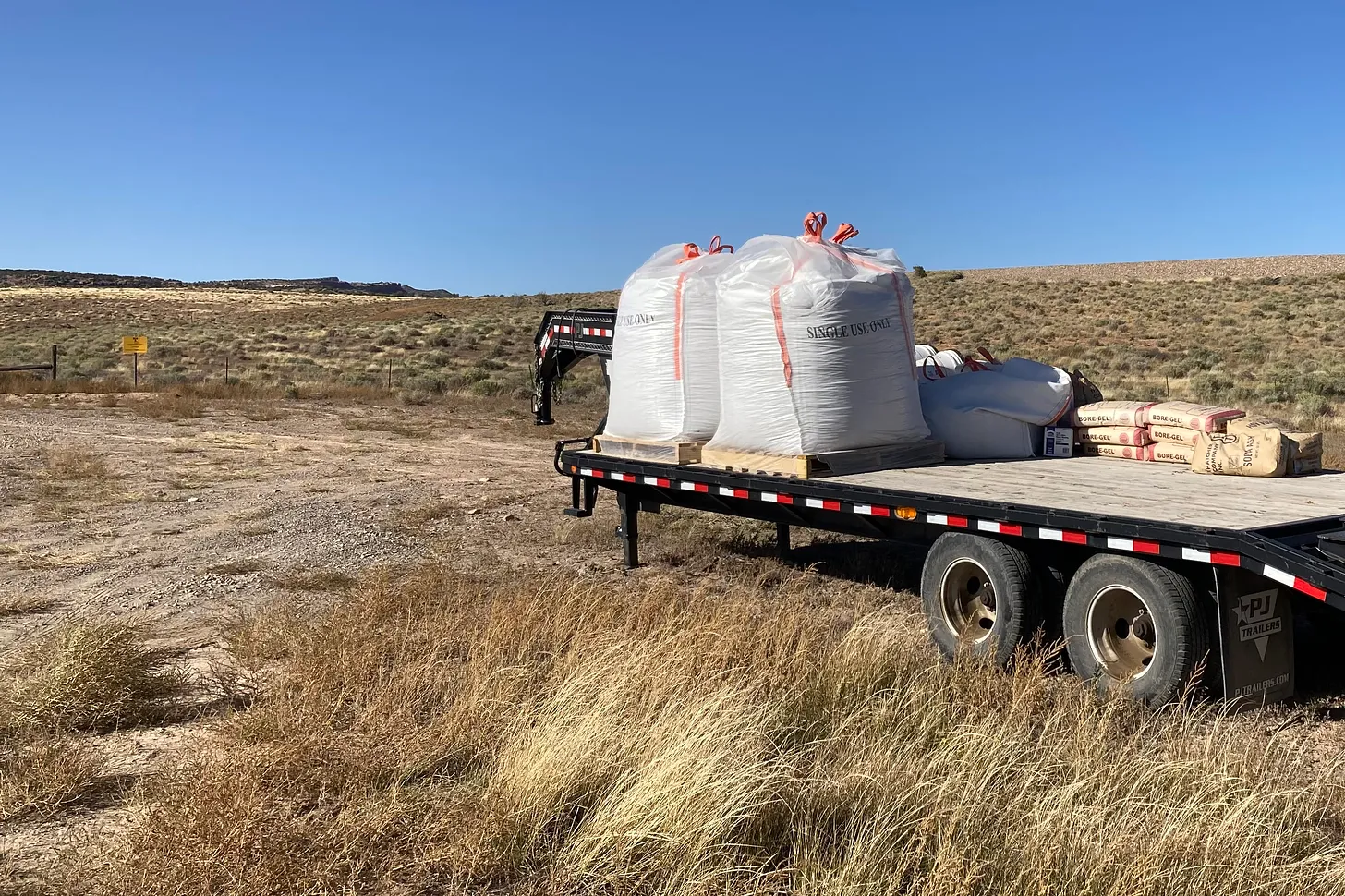
I did visit one of the more contentious exploratory drilling projects just outside Slick Rock, Colorado. They weren’t drilling when I was there, but a flatbed trailer loaded down with drilling material was on hand, right next to the radioactive-symbol signs warning folks of the presence of a uranium mill tailings repository. Anfield, one of the bigger companies operating in the area, is behind that project.
Anyway, here’s a sampling of the hype — and a bit of whatever the opposite of hype is:
Thor Energy says it has begun drilling at its Wedding Bell Project, which sits right near the San Miguel-Montrose county line in the Uravan Mineral Belt in western Colorado. The area has seen heavy prospecting (and a bunch of road-building) in the past.
Pegasus Resources says it has secured drilling permits — contingent upon posting a reclamation bond — for its Energy Sands and Jupiter claims along the San Rafael Swell, west of Green River, Utah, and just north of I-70 where it intersects the Swell. They’re planning on drilling 48 exploratory wells on 50’x50’ pads.
C2C Metals acquired five groups of uranium mining claims in the Uravan Mineral Belt, including the Eula Belle and Mum-Whitney claims in Montrose County and the Norther, Spud Patch, and Dulaney extension in San Miguel County. The claims cover a total of about 5,400 acres.
American Battery Materials says it has received the “necessary agency approvals” — pending the posting of a financial bond — to reenter an old oil and gas well in the Lisbon Valley of southeastern Utah to search for lithium.
And then there’s the anti-hype: Even as all of these projects appear to be ramping up the exploratory phase, one of the few companies that’s actually producing lithium is shutting down. That’s right. U.S. Magnesium, which extracts lithium and magnesium and other materials from Great Salt Lake brine, is idling its operations and laying off 186 employees, according to KUER. They cite “deteriorating market conditions for lithium carbonate.” That is, the price for the stuff isn’t high enough to make mining it profitable.
I guess this sort of thing was inevitable? The Family Farm Alliance is now offering “Make Alfalfa Great Again” hats. It makes me wonder what that would mean, exactly? Maybe they want to genetically engineer it to use less water? Hmmm…
On Nov. 5, more than 73 million Americans — or just over half of those who voted — chose to send Donald J. Trump to the White House for a second time. Trump garnered a smaller percentage of votes in my southwestern Colorado hometown. Still, four out of ten Durangatans opted for a candidate who stands diametrically opposed to the values I hold dear. And some of those folks are friends or people I admire.
Surely many of them disapprove of Trump’s behavior and many of his policies, but voted for him anyway simply because he’s a Republican, because he’s not the status quo or Joe Biden or Kamala Harris or a Clinton, because they’re fed up with “wokeness,” because they believe he’ll lower the price of eggs and gasoline, or because he’s the only viable white male on the ballot. Others may have chosen him or not voted at all to protest Biden’s tacit support for the atrocities in Gaza, or his failure to end oil and gas drilling on federal land, or because they believe that Democrats and Republicans are all cut from the same power-hungry cloth.
I suppose I should be reassured by this, and feel happy for these Trump voters since their side won — as if it were a football game and the Cowboys had crushed the Broncos. But this isn’t a sporting event. And as much as the media may treat elections as horse races, they are not. They have consequences, potentially huge ones, and regardless of why someone may have voted the way they did, the results are the same. This election was a referendum on civility and decency, on compassion and the rule of law, on human rights and equality; and all of those things lost. Corporate power, fear, vindictiveness, and the oligarchy won.
So no, it’s not going to be “okay.” And no, I’m not going to feel happy for folks who voted for Trump, because even though their “team” may have won, they will likely end up losers — unless they are oil companies or billionaires, that is.
Beauty will persevere, regardless of who is in the White House. Jonathan P. Thompson photo.
When Trump was elected in 2016, it was a shock, of course, but also a bit of a mystery: No one knew what kind of president he’d be or what sort of policies he’d push. Now we have a far clearer sense of what the next four years might look like.
I’m not convinced Trump will carry out all the threats he made on the campaign trail. Call me a pollyanna, but I doubt he’ll rule as an all-out fascist dictator, as some fear. He probably won’t try to prosecute Liz Cheney and Joe Biden, or sic the military on the “enemies within,” or overtly punish members of the media. His pledge to round up and deport 11 million human beings who came to the U.S. to escape persecution or pursue economic betterment will run up against reality: The nation can’t afford to live without immigrants, whether they are here legally or not.
But judging from Trump’s platform, promises, and his first-term record, we do know he and his minions will set out to dismantle the administrative state, which is to say gut federal agencies, replace experienced staffers with Trump loyalists, and remove government protections on human health, the environment, and worker safety. Elon Musk, who bought himself a cabinet-level position in the administration, will do his damnedest to slash $2 trillion in government spending, which will include unraveling the already frail social safety net.
While that image might appeal to those of you with an anarchist or libertarian bent, I can assure you these guys aren’t doing this in the name of Liberty or Freedom. The administrative state may be bloated, inefficient, sometimes ineffective, and often irritating, but its aim is to protect Americans and keep corporations in check. And when Trump and company look to destroy it, they are doing so to clear the way for the super-rich to become even wealthier, for the corporations to pull in more profit, and for Trump and his cronies to evade accountability for wrongdoings — all at the expense of you and me. A Trump administration will be a government by the narcissistic oligarchs, for the narcissistic oligarchs.
Shiprock and a moody sky. Jonathan P. Thompson photo.
Meanwhile, the MAGA movement’s theocratic strain will decimate the liberties of women, people of color, and LGBTQ+ people. Conservative congress members will push for a federal abortion ban, and Trump may go along with it to pay back his christian-nationalist voters. Trump will give Netanyahu the green light to decimate Gaza and the people who live there, and will similarly step aside and let Putin have his way with Ukraine.
Then there’s the question of what another Trump administration will mean for public lands, the environment, energy development, and the West’s air and water. Again, we can determine a lot by what he did — or attempted to do — during his first administration, along with plans laid out in Trump’s own Agenda 47 and Project 2025. Trump tried to distance himself from the latter during the election, but it was crafted by dozens of his former staffers and associates and is generally seen as the playbook for a second Trump administration. Trump’s public lands agenda will become clearer as he starts to line up cabinet appointments in the coming months. But regardless, I fear our public lands and environment and climate — and by extension all of us humans — are going to suffer. [ed. And countless species will suffer]
First dusting of snow on the Abajos and a windmill. Jonathan P. Thompson photo.
The following is a list of potential Trump targets relating to public lands and the environment. It’s important to remember that a president doesn’t have the power to kill just any rule and regulation with the stroke of a pen, but that didn’t stop Trump from trying to do so during his first administration.
Trump will work to implement his “drill baby drill” and “energy dominance” policies by opening up more public land to oil and gas leasing and removing regulations on public land drilling. He is likely to roll back Biden’s leasing reforms, which included higher royalty rates — to get a better deal for taxpayers — and stricter reclamation bond requirements to help ensure companies would clean up their messes.
Biden banned new oil and gas leasing on lands around Chaco Culture National Historical Park and on the Thompson Divide in western Colorado. Trump and whomever he appoints as Interior secretary will almost certainly try to reverse these bans. In the short-term, lifting the ban wouldn’t be too harmful: There is little interest in drilling either of these places currently. But if oil and gas prices climb, all bets could be off for these special places.
The Biden administration’s public lands rule, which aims to put conservation on a par with extractive uses, will probably go on the chopping block. If Trump doesn’t kill it, Congress will.
After being closed to drilling for decades, in 2017 Congress and Trump mandated oil and gas leasing in the Arctic National Wildlife Refuge. The Biden administration revoked the leases, then issued a new environmental review, offering the bare minimum of acreage required by law. Expect Trump to significantly expand the acreage available for drilling.
The first Trump administration revoked or attempted to revoke the Obama administration’s methane emissions regulations. They’ll probably try the same with Biden’s rules.
New EPA rules aimed at reducing coal plants’ greenhouse gas and mercury pollution are in Trump’s crosshairs. If they are revoked, it would allow the Colstrip power plant in Montana to continue spewing toxic and planet-warming emissions for years to come.
Trump will end the Bureau of Land Management’s proposal to end new federal coal leasing in the Powder River Basin. The ban wouldn’t come into play until current leases are depleted decades from now. Chances are the market for coal will dry up before then, making both the leasing ban and the rollback fairly irrelevant.
Trump dramatically shrunk Grand Staircase-Escalante and Bears Ears National Monuments during his first term, in part to curry favor with the late Sen. Orrin Hatch, the Utah Republican who held a lot of sway in Washington. Sen. Mike Lee, the Utah Republican and Trump acolyte, may push for a repeat. It would be even more consequential now: high uranium prices have unleashed a flurry of new mining claims and exploratory drilling on all sides of Bears Ears National Monument.
Trump is likely to shrink or revoke the Baaj Nwaavjo I’tah Kukveni-Ancestral Footprints of the Grand Canyon National Monument, thereby re-opening more than a half-million acres of uranium-rich lands to new mining claims. The Avi Kwa Ame National Monument in Nevada seems to be safer, simply because the only corporations interested in developing the land are solar and wind companies — and Trump’s no fan of clean energy.
Project 2025 calls for revoking the Antiquities Act, which has been used by presidents to protect natural and cultural sites as national monuments since 1906, with many going on to become national parks, the list includes: El Morro National Monument, Petrified Forest National Park, Muir Woods National Monument, Grand Canyon National Park … I could go on and on.
You can forget about mining law reform under a Trump administration and GOP-controlled Senate. And global mining corporation Rio Tinto, which is behind the proposed Resolution copper mine at Oak Flat in Arizona, is already urging the incoming Trump administration to weaken environmental laws and expedite permitting for mines.
Trump and the GOP dominated Congress will work to weaken the Endangered Species Act.
The list, unfortunately, goes on …
During his first term, Trump’s mission was hampered by his own lack of preparation, his incompetence, and his chaotic approach. This time he and an army of professional ideologues are prepared to march into the White House with Project 2025 in hand to lay waste to government as we know it. And they will have the support of a GOP-dominated Congress and a conservative Supreme Court.
It’s depressing and scary and discouraging. But it is not hopeless. The Biden administration prepared for this possibility by working to make regulations — and national monuments — more resilient to future challenges. Democratic leaders in Western states are already preparing to defend their environmental laws and climate programs against inevitable Trump administration attacks. And environmental groups such as the Center for Biological Diversity, Earthjustice, the Western Environmental Law Center, and many others are ready to challenge Trump at every turn.
Meanwhile, the Land Desk vows to stay on top of it all, and keep its special community of readers informed.
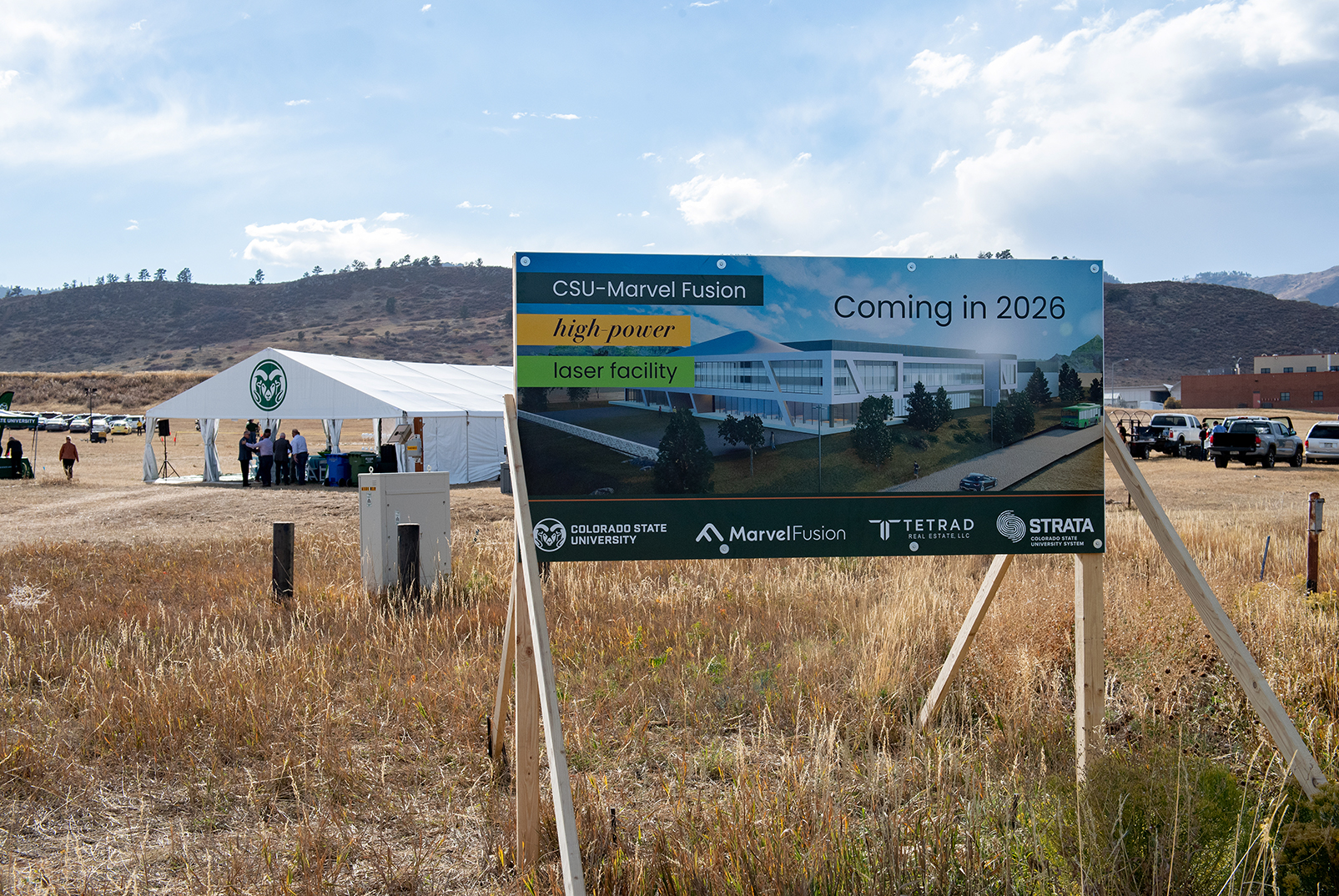
Artist rendering of the new laser research facility which will be located on Foothills Campus and is set to finish in 2026. A major topic of research in the facility will be laser-driven fusion as a viable clean energy source. Credit: Colorado State University
Construction activity will start this month on a powerful new laser research facility located on Colorado State University’s Foothills Campus. Set to come online in mid-2026, the facility is the combined result of 40 years of laser development research at CSU in partnership with the U.S. Department of Energy’s Fusion Energy Sciences program in the Office of Science and a strategic $150 million public-private partnership with industry leader Marvel Fusion that launched in 2023.
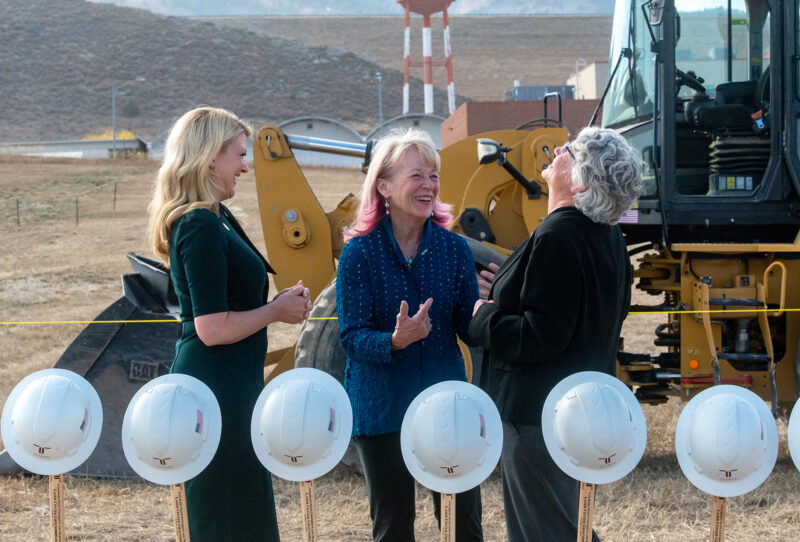
Geraldine Richmond, the DOE undersecretary for science and innovation, spoke at the groundbreaking event for the Advanced Technology Lasers for Applications and Science (ATLAS) Facility. Photo credit: Colorado State University
The new building will be known as the Advanced Technology Lasers for Applications and Science (ATLAS) Facility. A major topic of research there will be laser-driven fusion as a viable clean energy source. CSU President Amy Parsons hosted a groundbreaking ceremony for the facility on Wednesday that included comments from Geraldine Richmond, under secretary for science and innovation at the U.S. Department of Energy, U.S. Rep. Joe Neguse, and Marvel Fusion CEO Moritz von der Linden, among other CSU leaders.
Fusion energy is a form of power generation that aims to recreate the process that powers the sun by fusing atomic nuclei together. If successful, laser-driven fusion energy promises to safely generate practically unlimited, sustainable, carbon-free energy. When finished, the facility will feature an upgraded version of an existing ultrahigh power laser developed at CSU in combination with two new lasers provided by Marvel Fusion. The new structure will be located near existing laser research-focused buildings and will house related labs and offices. Taken together, the project is a major expansion of space and capabilities for the university.
The ATLAS Facility will be a unique cluster of high-intensity, high-repetition rate lasers that can be configured to fire simultaneously at a single fusion target. That burst will deliver nearly 7 petawatts of power – over 5,000 times the electrical generation capacity of the U.S. – into a focal spot roughly the width of a human hair for approximately 100 quadrillionths of a second. The trio of ultra high-power lasers can also be used independently and in other combinations to study questions beyond fusion energy, including key topics in fundamental research.
Parsons said the university has been at the forefront of laser research for many years and the facility would support leadership in this space for many more to come.
“As a top institution recognized both for research and for sustainability, CSU is a fitting home for this facility,” she said. “We have been a leader in laser research for decades, and our faculty are advancing critical technologies. This new facility will house one of the most powerful lasers in the world and establishes CSU as a nexus for laser fusion research.”
Beyond fusion and basic science research, the ATLAS Facility will also support interdisciplinary work into topics like medicine, where lasers could be used to deposit energy in a very localized region for tumor treatment. Other potential research at the facility includes microchip lithography and design and detailed X-ray imaging of rapidly moving objects, such as airplane engine turbines in full motion. The facility will also broadly support fundamental science research.
The combined existing and new facilities will now be known collectively as the Advanced Laser for Extreme Photonics (ALEPH) Center.
Undersecretary Richmond highlighted the DOE’s extensive partnership with CSU around laser research in her comments at the event – particularly through the Fusion Energy Sciences program. The agency recently awarded the university $12.5 million through its LaserNetUS program in addition to another award of $16 million to start an Inertial Fusion Science and Technology hub. Those grants support research using the existing facilities on campus, including upgrades of the high-powered ALEPH laser. The DOE funding also enables outside researchers to access research facilities for free, whether they are working on fusion or any other topic – supporting activity across many key fields.
“I’m excited for the important research through this private-public partnership happening with Marvel Fusion at Colorado State University,” said Richmond. “We are eager to leverage these opportunities. Laser development and experiments fit within our long-term goal of reaching fusion energy, but equally important is uncovering what we will learn in this process that will help us ultimately achieve that goal.”
Laser research facility will aid work in fusion, medicine and fundamental science
Construction activity will start this month on a powerful new laser research facility located on Colorado State University’s Foothills Campus. Credit: Colorado State University
From left: CSU President Amy Parsons, DOE Under Secretary for Science & Innovation Geraldine Richmond, and CSU Vice President for Research Cassandra Moseley speak after the event Photo credit: Colorado State University
“CSU is a leader in laser research and technology, which has led us to break ground on a building that will bring that impactful research to the next level,” said Moseley, who also spoke at the groundbreaking. “We celebrate today with the scientists whose teams helped get us to this point, and with excitement for the research power and discovery that will take place in this facility.”
“We are incredibly proud of the decades of success of professors Rocca and Menoni that is culminating in the construction of this world-class facility,” said Robinson. “This partnership with industry and CSU STRATA is a natural extension of the culture of entrepreneurship and technology transfer that is widespread in the college and at CSU.”
Robinson added that the exponential growth of laser-based research around the world has resulted in a large and unmet need to prepare the next generation of scientists, technicians and suppliers within the fusion industry. He said the new facility will address that need by offering both undergraduate and graduate students at CSU a chance for hands-on experience with the latest technology – fulfilling the university’s commitment as a land-grant institution to support workforce development in crucial STEM fields.
Heike Freund, the chief operating officer of Marvel Fusion, said the company was excited to continue to partner with CSU in this research space.
“This groundbreaking marks an exciting new chapter in the partnership between Marvel Fusion and Colorado State University as we move forward with constructing a facility that will drive the future of fusion energy,” Freund said. “Fusion energy has the potential to revolutionize the approach to sustainable power, providing a virtually limitless, clean energy source. This collaboration sets CSU and MF at the forefront of cutting-edge research, paving the way for transformative advancements that could redefine global energy solutions.”
Construction on the project will be managed by Tetrad Corporation with McCarthy Building Companies, Inc. serving as the general contractor and SWBR leading design. The 71,000-square-foot facility will feature over 7,500 cubic yards of concrete – including 5-foot-thick shielding walls around the target bay and a three-foot-thick slab below the laser and target bays for vibration isolation. The lab spaces will feature clean rooms up to ISO 6 / Class 1,000, and the HVAC systems will maintain extremely tight temperature and humidity tolerances to keep the laser systems functioning properly.
It was one of nearly two dozen conventional mills in the U.S. when it opened in 1980, just south of Blanding, and it’s now far past its projected 15-year lifespan. Demand for uranium fell — aside from some spikes — over the decades, and mill owner Energy Fuels pivoted to also processing leftover radioactive materials from other countries, rare earth elements and producing medical isotopes. But with the growing global push for clean energy and recent international instability, demand has skyrocketed for the “yellowcake” that the mill creates. Uranium averaged about $40 a pound in 2022. It reached over $100 per pound in January and is valued at $80 per pound today, according to Business Insider…
Here’s what the mill does, and why it’s controversial…The mill currently accepts uranium ore trucked from two mines also owned by Energy Fuels: the La Sal Mines Complex near La Sal, Utah, and the Pinyon Plain Mine, located in the Kaibab National Forest near the south rim of the Grand Canyon in Arizona. Here’s what the mill does, and why it’s controversial…The mill currently accepts uranium ore trucked from two mines also owned by Energy Fuels: the La Sal Mines Complex near La Sal, Utah, and the Pinyon Plain Mine, located in the Kaibab National Forest near the south rim of the Grand Canyon in Arizona. After uranium ore and other materials arrive at the mill site, they’re organized by type into separate piles to await processing.
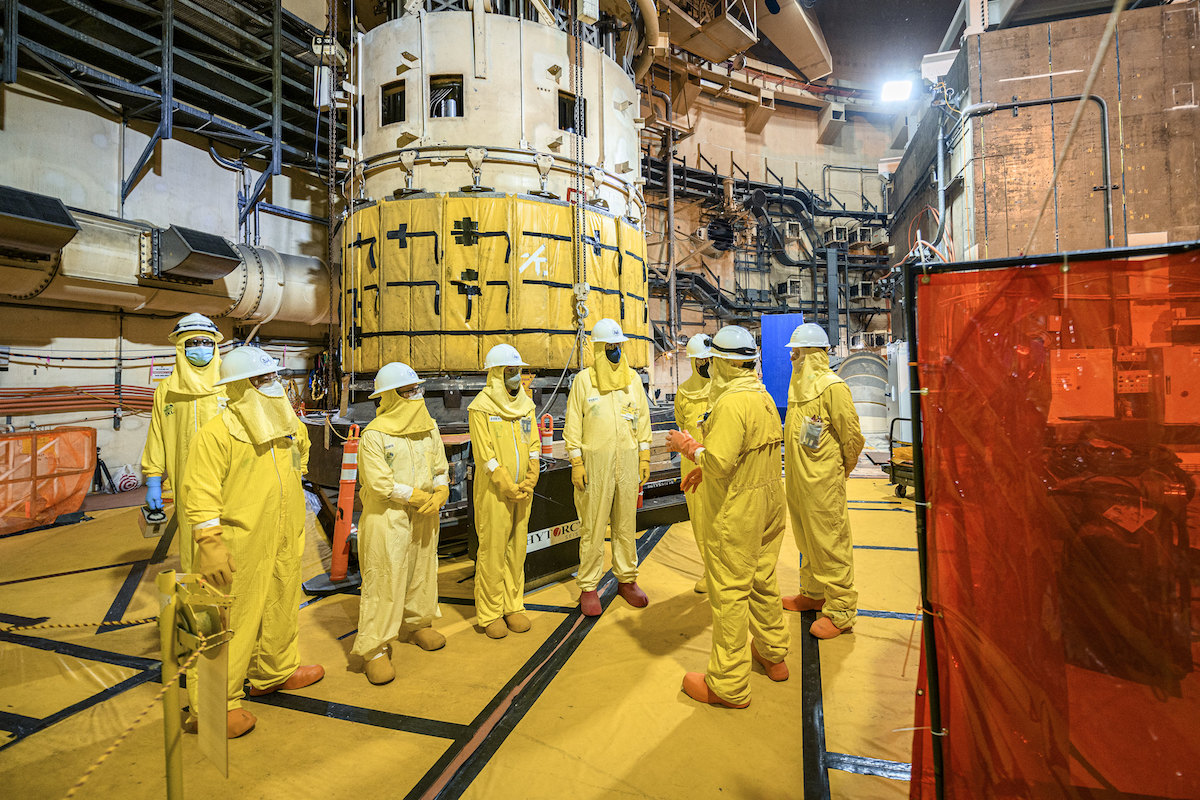
Nuclear Regulatory Commission Chairman Christopher T. Hanson (fourth from right) is with other NRC staffers and licensee personnel in protective gear inside Unit 3 containment at the decommissioning San Onofre Nuclear Generating Station. (courtesy of Southern California Edison/FlickrCommons)
With a handful of dissenting votes, a legislative panel has advanced a draft measure that proponents say merely provides the opportunity to discuss changing Wyoming statutes to enable temporary storage of high-level radioactive fuel waste from nuclear power plants.
The Minerals, Business and Economic Development Committee on Tuesday voted in favor of the draft bill Used nuclear fuel storage-amendments, which means the committee will sponsor the measure when the full Legislature convenes in January.
Committee Co-chairman Rep. Donald Burkhart Jr. (R-Rawlins), a longtime proponent of bringing nuclear fuel waste into the state, first rolled out the potential for new legislation regarding the matter in July, but neither he nor the committee shared a draft of the proposed legislation until weeks before the October meeting. The bill draft would amend past legislation mostly to align existing state statute with updated language regarding commercial nuclear waste storage with the U.S. Nuclear Regulatory Commission and the Department of Energy, Burkhart said.
“This is not a discussion of why or why not to have this,” Burkhart said at the onset of the discussion, adding that the committee took up the issue at the request of the Legislature’s Regulatory Reduction Task Force. “This is simply to amend the current statute.”
A spent nuclear fuel cask is moved at the Surry Power Station nuclear plant in Virginia in 2007. (Nuclear Regulatory Commission/FlickrCommons)
Burkhart was clear in July when he notified his fellow committee members of the pending proposal in draft form — which he shared with them, but not with the public — that nuclear storage held financial promise. The outlook for Wyoming’s fossil fuel-dependent budget is trending downward, and the state could reap more than $4 billion a year from nuclear waste storage, “just to let us keep it here in Wyoming,” he said then.
Also in July, Burkhart said he’d recently visited with a private landowner in Fremont County who, as in the past, is interested in selling land for such a storage facility. The land purchase would cost an estimated $2 million, Burkhart had said, and it would cost about $400 million to build the facility. “None of which would come from the state,” he said. “It would all come from private enterprise.”
Click the link to read the article on The Denver Post website (John Aguilar). Here’s an excerpt:
September 29, 2024
Westminster is making it clear the city doesn’t want to increase access to hikers and cyclists visiting the Rocky Flats National Wildlife Refuge — the one-time site of a Cold War nuclear weapons plant that continues to spark health worries 30 years after it closed. The city last week became the second community surrounding the 6,200-acre federal property to withdraw from an intergovernmental agreement supporting construction of a tunnel and bridge into the refuge, home to more than 200 wildlife species, including prairie falcons, deer, elk, coyotes and songbirds. Broomfield exited the $4.7 million Federal Lands Access Program agreement four years ago, and both cities point to potential threats to public health from residual contamination at the site — most notably the plutonium that was used in nuclear warhead production over four decades — for their withdrawal…
Westminster’s withdrawal comes less than a month after a federal judge denied several environmental organizations a preliminary injunction that would have stopped the project cold. The plaintiffs had sued federal agencies in January, claiming the refuge is not fit for human use.
As part of the City Council’s 4-3 vote last week, Westminster will not pay the nearly $200,000 it owes to the project. The city also will no longer complete a 0.4-mile trail segment in its Westminster Hills Open Space property that would bring hikers and cyclists traveling from the east to the bridge to cross into Rocky Flats.
The News:Agenda 47 — the Trump campaign’s platform — promises to develop 10 “Freedom Cities” on “empty” public lands in the Western United States if he is elected president.
Context: After Trump lost the 2020 election, the ultra-right-wing Heritage Foundation, along with help from dozens of former Trump administration staffers, set about to create Project 2025, a “playbook” for Trump just in case he managed to win this November’s presidential election.
Suffice it to say, Project 2025 is downright terrifying, as this excellent analysis by Michelle Nijhuis and Erin X. Wong reveals. In fact, it’s so weird — and so unpopular — that Trump has scrambled to distance himself from the whole endeavor, even claiming he doesn’t know anything about it or the people pushing it. That’s despite having praised the plan during a speech to the Heritage Foundation in 2022, despite the fact that many of the plan’s architects were in his administration, and despite the fact that his VP candidate J.D. Vance wrote the foreword to Heritage Foundation President Kevin Roberts’ new book.
But it doesn’t really matter, because Trump has his own authoritarian plan. It’s called Agenda 47, and serves as a template for the only slightly less creepy sounding Republican Party Platform. Agenda 47 is a bit shorter and less detailed than the 900-page Project 2025, which maybe makes it slightly more palatable to certain voters, but is equally nuts and just as scary. It vows to protect freedom of speech and cut funding for any school that teaches “inappropriate racial, sexual, or political content.” If elected, Trump and company would also “deport pro-Hamas radicals and make our college campuses safe and patriotic again.” Nothing fascist about that!
When it comes to public lands and the environment, Trump plans to do more of what he did last time he was in the White House — which is to say eviscerate environmental, health, safety, and worker protections in the name of “energy dominance” and corporate profit. The GOP platform also calls for using federal land for housing development. In theory this would bolster supplies of housing, thereby reducing prices and alleviating the housing crisis. The theory is deeply flawed, however, and though it may sound well-intentioned, ultimately it is just another ploy to privatize public land.
On this and other initiatives both Agenda 47 and the GOP platform (which are near-mirrors of each other) are scant on details. Hoping to learn more, I delved into Trump’s Agenda 47 archives and … holy crapoli! I had to wonder if Trump’s running for president or for the mayor of Crazytown — he’s the hands-down favorite for the latter.
Last March the Trump campaign unveiled its Agenda 47. Apparently it wanted to modernize the old “make America great again” slogan, so it went instead with:
Agenda47: A New Quantum Leap to Revolutionize the American Standard of Living.
Despite making no sense, you gotta give them credit for having a forward-looking slogan rather than the backward-looking one (which they have since reverted to, by the way). Indeed, it’s so forward-looking that they would “create a new American future.” Silly ol’ me thought that the future was always new on account of being, you know, the future and all.
And what will this new future look like? Freedom Cities!
You’re probably thinking: Why the hell would anyone want to build ten new cities in the drought-stricken West when there’s not enough water to go around now? What’s the point anyway? To make a few real estate developers incredibly rich? To realize a megalomaniac demagogue’s dream of building new cities to match some bizarre ideological vision? Will Trump resurrect Albert Speer to design the new cities?
Apart from the big picture flaws, this whole thing is riddled with wrong from start to finish. Let’s break it down:
“… open up the American frontier.” Are you friggin’ kidding me? Is this from the Trump campaign or the Andrew Jackson’s Corpse campaign? Referring to the Western U.S. as the “frontier” was racist and ignorant in the 19th century. It was intended to portray the region — and the Indigenous people who live there — as a wild and savage place that needed to be tamed and/or killed by EuroAmerican invaders so they could steal the land and put it into the public domain so some dumbass could come along and build some Freedom Cities there a couple centuries later so they could create a new American future. Using the term now is still ignorant and racist and just downright stupid.
“Hundreds of millions of these acres are empty.” Oh, really? Well, let’s see, the Bureau of Land Management oversees about 248 million acres and the Forest Service another 193 million acres. So, basically, Trump’s saying that at least half of America’s public lands are “empty.” This is age old code (also see “underutilized”) for describing landscapes that haven’t been industrialized, drilled, mined, grazed to death, or otherwise ruined. Of course, none of the public lands are actually empty, but I think y’all know that.
Trump assures us these cities won’t be built on “national parks or other natural treasures.” Thing is, if Trump and his ilk get their way, there will be precious few natural parks or monuments or ‘natural treasures’ remaining. Certainly you remember how the Trump administration eviscerated Bears Ears and Grand Staircase-Escalante National Monuments. There’s zero reason to expect him not to do the same if he were elected again — only to a further degree.
If this whole Freedom Cities thing sounds like something a couple sixteen year olds would dream up while getting stoned while sitting on some desert butte (Free Doritos for everyone, brah!), then just read on. Trump would also “modernize transportation,” not by building trains and buses or even electric cars, but by bolstering efforts to develop “vertical-takeoff-and-landing vehicles for families and individuals.” And to help make these and all of America’s cities “beautiful,” they’ll build “towering monuments to our true American heroes.” Does anyone else catch a whiff of Nicolae Ceausescu or even Albert Speer while reading this?
So these brand new cities, built on public land, would be swarming with people-carrying quad-copters swerving to miss one another and the monumental statues of Donald Trump and Andrew Jackson and Tucker Carlson. And how will they people these cities after carrying out the “largest deportation in American history”? They’ll offer “‘Baby Bonuses’ for young parents to help launch a new baby boom.”
If that seems zany, now imagine having one of these metropolises plopped down smack dab in one of your favorite swaths of “empty” public lands. Eek! Sounds like fodder for a dystopian horror film, working title: Agenda 47.
⛏️Mining Monitor ⛏️
Sign in the Lisbon Valley of southeastern Utah. Jonathan P. Thompson photo.
When two trucks hauling uranium ore rumbled out of Energy Fuel’s Pinyon Plain Mine near the Grand Canyon Tuesday on their way to the White Mesa Mill in Utah, Navajo Nation President Buu Nygren sent law enforcement officers to stop them. The trucks managed to get off tribal land before the police could catch them, but the next shipments are likely to be stopped. It’s the latest episode in a long-simmering battle between the tribe and the uranium industry — and a test case for tribal sovereignty.
Whether the U.S. uranium mining industry is experiencing a full-on renaissance or is merely having zombie-dream twitches isn’t yet clear. But the ore shipments represent the clearest sign of life, yet, since it is the first time freshly mined ore will be processed in years. Tribal nations, advocates, and lawmakers have pushed back against both the mine and the mill for years due to the potential for contaminating groundwater aquifers.
In 2012, the Navajo Nation banned uranium shipments across tribal lands. But it is not clear whether it applies to the federal and state highways used by Energy Fuels’ trucks.
Energy Fuels had previously agreed to give the Navajo Nation and other stakeholders a two-week notice before shipping any ore; they actually didn’t notify anyone until after the trucks left the mine. Arizona Attorney General Kris Mayes got involved, and issued a statement reading: “Hauling radioactive materials through rural Arizona, including across the Navajo Nation, without providing notice or transparency and without providing an emergency plan is unacceptable.”
And now Arizona Gov. Katie Hobbs has helped broker a pause in shipments to give the Navajo Nation and Energy Fuels a chance to work things out.
***
The Pinyon Plain Mine and White Mesa Mill get all of the attention, but the mining industry — uranium and otherwise — is also stirring elsewhere. Some quick hits:
Energy Fuels is also doing work at its Whirlwind Mine right on the Colorado-Utah border above Gateway and on its La Sal Complex, which sits less than a mile away from the community of the same name — and a school. Energy Fuels is also looking to develop the Roca Honda Project on Forest Service land near Mt. Taylor in New Mexico.
Utah regulators have accepted Anfield Energy’s application to restart its Shootaring Canyon mill near Ticaboo, Utah, which means the state can now begin its review. Anfield hasn’t had as much luck with its operating plan for its Velvet-Wood Mine in the Lisbon Valley: The BLM’s Monticello Field Office deemed it incomplete, and wouldn’t even consider it until Anfield filled in numerous blanks.
Egad! The BLM is actually raising mining claim maintenance fees. That’s the amount one has to pay when staking, or locating, a claim and once every year after that. It was $165. Next month it will shoot up to $200 per claim (plus a $25 processing fee and $49 location fee tacked onto the initial payment). That’s a whopping 20% increase, but still seems to be a pretty darned good bargain and is unlikely to dissuade speculators.
The Energy Permitting Reform Act, a bill making its way through Congress, would codify mining companies’ ability to stake mining claims on public lands to use as waste dumps and for other ancillary purposes. It’s just one of the ways the legislation, which is being pushed as a way to speed up clean energy projects, would benefit the extractive and fossil fuel industries. Originally pushed by Sens. Joe Manchin and John Barrasso, some Democrats, including Sen. Martin Heinrich of New Mexico, have signed on in support.
Coal fired plant near Hayden with the Yampa River 2015. Photo credit: Ken Nuebecker
Click the link to read the article on the Big Pivots website (Allen Best):
August 17, 2024
Will there be a water bonus as we close coal plants? In the short term, yes. It’s harder to say in the long term. Here’s why.
Use it or lose it. That’s a basic premise of Colorado water law. Those with water rights must put the water to beneficial use or risk losing the rights to somebody who can. It’s fundamentally anti-speculative. But Colorado legislators this year created a major exception for two electric utilities that draw water from the Yampa River for coal-burning power plants. They did so through Senate Bill 24-197, which Gov. Jared Polis signed into law in Steamboat Springs in late May.
The two utilities, Xcel Energy and Tri-State Generation and Transmission Association, plan to retire the five coal-burning units — two at Hayden and three at Craig — they operate in the Yampa River Basin by late 2028. These units represent Colorado’s largest concentration of coal plants, 1,874 megawatts of generating capacity altogether. That’s 40% of Colorado’s total coal-fired electrical generation. Together, they use some 19,000 acre-feet of water each year.
What will become of those water rights when the turbines cease to spin? And what will replace that power? The short answer is that the utilities don’t know. That’s the point of the legislation. It gives the utilities until 2050 to figure out their future.
While the legislation is unique to the Yampa Valley, questions of future water use echo across Colorado as its coal plants — two units at Pueblo, one near Colorado Springs, one north of Fort Collins, and one at Brush — all will close or be converted to natural gas by the end of 2030.
This story was originally published in the July 2024 issue of Headwaters Magazine. Photo above of the Hayden Generating Station and the Yampa River was taken by Ken Neubecker in spring 2015. All other photos by Allen Best unless otherwise noted.
Both Xcel and Tri-State expect that at least 70% of the electricity they deliver in 2030 will come from wind and solar. The final stretch to 100%? That’s the hard question facing utilities across Colorado — and the nation and world.
Natural gas is expected to play a continued role as backup to the intermittency of renewables. Moving completely beyond fossil fuels? No one technology or even a suite of technologies has yet emerged as cost-effective. At least some of the technologies that Xcel and Tri-State are looking at involve water.
Fossil fuel plants use less than 1% of all of Colorado’s water. Yet in a state with virtually no raw water resources left to develop, even relatively small uses have gained attention. Colorado’s power future will have implications for its communities and their water, but how exactly that will look remains unknown.
Emissions Goals
The year 2019 was pivotal in Colorado’s energy transition. State lawmakers adopted legislation that specified a 50% economy-wide reduction in greenhouse gas emissions by 2030 and 100% by 2050. A decade before, that bill would have been laughed out of the Colorado Capitol. Even in 2019, some thought it unrealistic. But proponents had the votes, and a governor who had run on a platform of renewable energy.
Something approaching consensus had been achieved regarding the risks posed by climate change. Costs of renewables had plummeted during the prior decade, 70% for wind and 89% for solar, according to the 2019 report by Lazard, a financial analyst. Utilities had learned how to integrate high levels of renewables into their power supplies without imperiling reliability. Lithium-ion batteries that can store up to four hours of energy were also dropping in price.
Colorado lawmakers have adopted dozens of laws since 2019 intended to dramatically reduce greenhouse gas emissions. Photo credit: Allen Best/Big Pivots
Tied at the legislative hip to the targets adopted in 2019 were mandates to Colorado’s two investor-owned electric utilities, Xcel Energy and Black Hills Energy. By 2030 they must reduce emissions by at least 80% compared to 2005 levels. Both aim to do even better.
Xcel, the largest electrical utility in Colorado, was already pivoting. In 2017, it received bids from wind and solar developers in response to an all-sources solicitation that caused jaws across the nation to drop. In December 2018 shortly after the election of Gov. Polis, Xcel officials gathered in Denver to boldly declare plans to reduce emissions by 80% by 2030. Platte River Power Authority, the provider for Fort Collins and three other cities in the northern Front Range, later that month adopted a highly conditioned 100% goal. In January 2020, Tri-State announced its plans to close coal plants and accelerate its shift to renewables — it plans to reduce emissions by 89% by 2030. In December 2021, Holy Cross Energy, the electrical cooperative serving the Vail and Aspen areas, adopted a 100% goal for 2030. It expects to get to 91% by 2025.
Colorado Springs Utilities burned the last coal at the Martin Drake power plant along Fountain Creek in August 2022. Photo credit: Allen Best/Big Pivots
Colorado’s emissions-reduction goals are economy wide, not just for power production. In practice, this means replacing technologies in transportation, buildings and other sectors that produce greenhouse gas emissions with low- or no-emissions energy sources. As coal plants have closed, transportation has become the highest-emitting sector. Colorado had 126,000 registered electric vehicles and hybrids as of June but hopes to have 940,000 registered by 2030. Buildings pose a greater challenge because most of us don’t replace houses the way we do cars or cell phones. Solutions vary, but many involve increased use of electricity instead of natural gas.
A final twist that has some bearing on water is Colorado’s goal of a “just transition.” House Bill 19-1314 declared that coal-sector workers and communities were not to be cast aside. Efforts would be made to keep them economically and culturally whole.
Possible Water Dividends
The Cherokee Generating Station north of downtown Denver is now a natural gas-fired power plant.
Where does this leave water? That’s unclear and, as the 2024 legislation regarding the Yampa Valley spelled out, it is likely to remain unclear for some time. The law prohibits the Division 6 water judge — for the Yampa, White and North Platte river basins — from considering the decrease in use or nonuse of a water right owned by an electric utility in the Yampa Valley.
In other words, they can sit on these water rights through 2050 while they try to figure what technologies will emerge as cost competitive. Xcel Energy and Tri-State will not lose their water rights simply because they’re not using them during this time as would, at least theoretically, be the case with other water users in Colorado.
Conversion of the Cherokee power plant north of downtown Denver from coal to natural gas provides one case study of how energy shifts can affect water resources. Xcel converted the plant to natural gas between 2010 and 2015. Its capacity is now 928 megawatts.
Richard Belt, a water resources consultant for Xcel, says that when Cherokee still burned coal, it used 7,000 to 8,000 acre-feet of water per year; since 2017, when natural gas replaced coal, it uses 3,000 to 3,500 acre-feet per year.
Does that saved water now flow downstream to farmers in northeastern Colorado?
“If the wind is really blowing, there could be some water heading downstream on certain days,” Belt answered. In other words, there’s so much renewable energy in the grid that production from the gas plant at times is not needed. A more concrete way to look at this conversion, Belt says, is to step back and look at Xcel’s water use more broadly across its system. It also has the Rocky Mountain Energy Center, a 685-megawatt combined-cycle natural gas plant along Interstate 76 near Keenesburg that it bought in 2009 and began operating in 2012. With the plant came a water contract from Aurora Water.
Xcel has been renegotiating that contract, which it projects will be effective in early 2025. The new contract will allow Xcel to take water saved at Cherokee and instead use it at the Rocky Mountain Energy Center. That will allow it to use 2,000 acre-feet less of the water it has been leasing from Aurora each year. Belt says it will save Xcel customers around $1 million a year in water costs.
“Another way to look at this dividend is that we’re going to hand [Aurora] two-thirds of this contract volume, around 2,000 acre-feet a year, and they can use that water within their system,” Belt explains.
Other coal-burning power plants have also closed in recent years, with water dividends of their own. One small coal plant in southwestern Colorado at Nucla, operated by Tri-State, was closed in 2019. In 2022, Xcel shut down one of its three coal units at the Comanche Generating Station in Pueblo.
Colorado Springs Utilities stopped burning coal at its Martin Drake coal-fired plant in 2021, which is located near the city’s center, and replaced it with natural gas. It used some 2,000 acre-feet of water per year in the early 2000s, and was down to only 14 acre-feet per year in 2023. Colorado Springs Utilities — a provider of both electricity and water — delivers 70,000 to 75,000 acre-feet of water annually to its customers. Whatever water savings were achieved in that transition will be folded into the broader operations. The city’s remaining coal plant, Ray Nixon, burns both coal and natural gas. The city delivers about 2,000 acre-feet per year to Nixon to augment groundwater use there.
The 280-megawatt Rawhide coal-fired power plant north of Fort Collins is to be shut down by 2030. Platte River Power Authority, which owns and operates the plant, had not yet chosen a replacement power source as of June 2024. Platte River delivers electricity to Estes Park, Fort Collins, Longmont and Loveland.
The Cherokee plant along the South Platte River north of downtown Denver uses significantly less water since tis conversion from coal to natural gas. Photo credit: Allen Best/Big Pivots
That leaves just the 505-megawatt Pawnee among Colorado’s existing coal plants. The plant near Brush is to be retrofitted to burn natural gas by 2026. The water dividend? Xcel is trying to keep its options open.
The one commonality among all the possible power-generating technologies that Xcel may use to achieve its goal of emissions-free energy by 2050 is that, with the exception of some battery technologies, they all require water, says Belt. And that, he says, means it would be unwise to relinquish water without first making decisions about the future.
That’s why this year’s bill was needed. Colorado’s two biggest electrical providers, Xcel and Tri-State, both with coal plants retiring in the Yampa Valley, have questions unanswered.
The Future of Energy
Strontia Springs Dam and Reservoir, located on the South Platte River within Waterton Canyon. It is ranked #32 out of 45 hydroelectric power plants in Colorado in terms of total annual net electricity generation. Photo by Milehightraveler/iStock
What comes next? Obviously, lots more wind and solar. Lots. The graph of projected solar power in Colorado through this decade looks like the Great Plains rising up to Longs Peak. Construction of Xcel’s Colorado Power Pathway, a 450-mile transmission line looping around the Eastern Plains, will expedite renewables coming online. Tri-State is also constructing new transmission lines in eastern Colorado. The plains landscape, San Luis Valley, and other locations could look very different by the end of the decade.
Very little water is needed for renewables, at least once the towers and panels are put into place.
You may well point out that the sun goes down, and the wind doesn’t always blow. Storage is one holy grail in this energy transition. Lithium-ion batteries can store energy for four hours. That works very effectively until it doesn’t. Needed are new cost-effective technologies or far more application of known technologies.
One possible storage method, called iron-rust, will likely be tested at Pueblo in 2025 by a collaboration between Xcel and Form Energy, a company that proclaims it will transform the grid. It could provide 100 hours of storage. Tri-State’s electric resource plan identifies the same technology.
Granby Dam was retrofitted at a cost of $5.1 million to produce hydroelectricity effective May 2016. It produces enough electricity for about 570 homes. Photo/Northern Water
Other potential storage technologies involve water. Pumped-storage hydropower is an old and proven technology. It requires vertical differences in elevation, and Colorado has that. In practice, finding the right spots for the two reservoirs, higher and lower, is difficult.
Xcel Energy’s Cabin Creek project between Georgetown and Guanella Pass began electrical production in 1967. In this closed-loop system, water from the higher reservoir is released through a three-quarter-mile tunnel to the second reservoir 1,192 feet lower in elevation. This generates a maximum 324 megawatts to help meet peak demands or to provide power when it’s dark or the wind stops blowing. When electricity is more freely available, the water can be pumped back to the higher reservoir. Very little water is lost.
Near Leadville, the U.S. Bureau of Reclamation has a pumped-storage hydropower project at Twin Lakes, the Mt. Elbert Power Plant, with a more modest elevation difference. The plant can generate up to 200 megawatts of electricity.
Graphic credit: Joan Carstensen
A private developer with something similar in mind has reported reaching agreements with private landowners along the Yampa River between Hayden and Craig. With private landowners, the approval process would be far easier than if this were located on federal lands. Cost is estimated at $1.5 billion.
Belt points out that the Federal Energy Regulatory Commission has streamlined the permitting process for pumped-storage hydro but that technology remains expensive and projects will take probably 10 to 12 years to develop if everything goes well.
“During that 10 to 12 years, does something new come along? And if you’re committed to pumped storage, then you can’t pivot to this new thing without a financial impact,” he says, explaining a hesitancy around pumped storage.
Green hydrogen is another leading candidate in the Yampa Valley and elsewhere. It uses electrolysis to separate the hydrogen and oxygen in water. Renewable energy can be used to fuel the electrolysis. That’s why it is called green hydrogen as distinct from blue hydrogen, which uses natural gas as a catalyst. A news story in 2023 called it a “distant proposition.” Costs remain high but are falling. Tax incentives seek to spur that innovation.
Gov. Polis’ administration remains optimistic about hydrogen. It participated in a proposal for federal funding that would have created underground hydrogen storage near Brush. That proposal was rejected, but Will Toor, the chief executive of the Colorado Energy Office, has made it clear that green hydrogen and other emerging technologies remain on the table. Xcel says the same thing. “It’s not something we are going to give up on quite yet,” says Belt. The water savings from the conversion of coal to natural gas could possibly play into those plans.
Gov. Jared Polis stopped by the Good Vibes River Gear in Craig in March 2020 prior to attending a just transition workshop. Photo credit: Allen Best/Big Pivots
Polis is bullish on geothermal, both kinds. The easier geothermal uses the relatively constant 55 degree temperatures found 8 to 10 feet below ground to heat and cool buildings. The Colorado Capitol has geothermal heating, but the most famous example is Colorado Mesa University, where geothermal heats and cools about 80% of the campus. This technology may come on strong in Colorado, especially in new construction.
Can heat found at greater depths, say 10,000 feet or from particularly hot spots near the surface, be mined to produce electricity? California generates 10.1% from enhanced geothermal, Nevada 5.1%, and Utah 1.5%. Colorado generates zero. At a June conference, Polis said he thought geothermal could produce 4% to even 8% of the state’s electricity by 2040. Geothermal for electric production would require modest water resources.
Nuclear? Those plants, like coal, require water. Many smart people believe it may be the only way that civilization can reduce emissions as rapidly as climate scientists say is necessary to avoid catastrophic repercussions. Others see it as a way to accomplish just transition as coal plants retire.
Costs of traditional nuclear remain daunting. Critics point to projects in other states. In Georgia, for example, a pair of reactors called Vogtle have been completed but seven years late and at a cost of $35 billion, more than double the project’s initially estimated $14 billion price tag. The two reactors have a combined generating capacity of 2,430 megawatts.
New reactor designs may lower costs. The Nuclear Regulatory Commission in 2023 certified design of a small-modular reactor by NuScale. It was heralded as a breakthrough, but NuScale cancelled a contract later that year for a plant in Idaho, citing escalating costs.
With a sodium fast reactor, integrated energy storage and flexible power production, the Natrium technology offers carbon-free energy at a competitive cost and is ready to integrate seamlessly into electric grids with high levels of renewables. Graphic credit: http://NatriumPower.com
Greater optimism has buoyed plans in Wyoming by the Bill Gates-backed TerraPower for a 345-megawatt nuclear plant near the site of a coal plant at Kemmerer. It has several innovations, including molten salt for energy storage and a design that allows more flexible generation, creating a better fit with renewables. Ground was broken in June for one building. An application for the design is pending with the U.S. Nuclear Regulatory Commission. Gates has invested $1 billion and expects to invest many billions more in what he estimates will be a $10 billion final cost. He also hopes to see about 100 similar plants and reduced costs. Other companies with still other designs and ideas say they can also reduce costs. All these lower-cost nuclear solutions exist in models, not on the ground. Uranium supply remains problematic, at least for now, but more difficult yet is the question of radioactive waste disposal.
Into The Future
The potential for nuclear is balled up in the issue of just transition. Legislators in 2019 said that coal communities would not be left on their own to figure out their futures. What this means in practice remains fuzzy.
Consider Pueblo. Xcel Energy on August 1 is scheduled to submit to the Colorado Public Utilities Commission what is being called the Pueblo Just Transition Electric Resource Plan. Through that plan, Xcel must determine to what extent it can, through new generating sources, leave Pueblo economically whole after it closes the coal plants. Existing jobs will be lost, although others in post-closure remediation of the site will be gained. What, then, constitutes a just transition for Pueblo?
What will Xcel propose in October for Pueblo as it makes plans for the retired of the last of the Comanche coal-burning units in 2030? Photo credit: Allen Best/Big Pivots
A task force assembled by Xcel Energy in January delivered its conclusions after nearly a year of study: “Of all of the technologies that we studied, only advanced nuclear generation will make Pueblo whole and also provide a path to prosperity,” concluded the task force. They advised that a natural gas plant with carbon capture would be a distinctly secondary choice.
What will happen with the water in Pueblo? Xcel Energy has a take-or-pay water contract with Pueblo Water for 12,783 acre-feet per year for the Comanche Generating Station. It must pay for the water even if it does not take it. Pueblo Water has a similar take-or-pay contract for 1,000 acre-feet annually for the 440-megawatt natural gas plant operated by Black Hills Energy near the Pueblo airport.
The draw of these water leases from the Arkansas River isn’t that notable, says Chris Woodka, president of the Pueblo Water board, even in what he describes as a “small year,” with low flows in the river. These water leases constitute some 5% or less of the river’s water, Woodka says. Xcel could tap that same lease for whatever it plans at Pueblo. And if it has no use? “We haven’t had many conversations around what we would do if that lease goes away, because it is so far out in the future.”
Xcel and Tri-State both own considerable water rights in the lower Arkansas Valley, near Las Animas and Lamar. Neither utility has shared plans for using the water, as the ideas of coal or nuclear power plants that initially inspired the water purchases never moved forward. Water in both cases has been leased since its acquisition to Arkansas Basin agricultural producers in order to maintain an ongoing beneficial use.
Yampa River. Photo credit: Yampa River Integrated Water Management Plan website
Why don’t Tri-State and Xcel lease their water in the Yampa River as they do in the Arkansas? Jackie Brown, the senior water and natural resources advisor for Tri-State, explains that there is no demand for additional agricultural water in the Yampa Basin. About 99% of all lands capable of supporting irrigated agriculture already get water. This is almost exclusively for animal forage. This is a valley of hay.
However, the Yampa River itself needs more water. The lower portion in recent years has routinely suffered from low flows during the rising heat of summer. Some summers, flows at Deerlodge, near the entrance to Dinosaur National Monument, have drooped to 20 cubic feet per second. Even in Steamboat, upstream from the power plants, fishing and other forms of recreation, such as tubing, have at times been restricted.
One question asked in drafting the legislation this year was whether to seek protection with a temporary instream flow right for some of the 45 cfs that Tri-State and Xcel together use at the plants at Craig and Hayden. The intent would have been to protect the delivery of some portion of that water to Dinosaur National Monument through 2050. That idea met resistance from stakeholders.
Instead, a do-nothing approach was adopted. Those framing the bill expect that most of the time, most of the water will flow downstream to Dinosaur anyway. In most years, no demands are placed on the river from November through the end of June. The challenge comes from July through October. The amount of water, used formerly by coal plants, that reaches Dinosaur will depend upon conditions at any particular time. Have the soils been drying out? Has the summer monsoon arrived?
The Yampa River at Deerlodge Park July 24, 2021 downstream from the confluence with the Little Snake River. There was a ditch running in Maybell above this location. Irrigated hay looked good. Dryland hay not so much.
“Even if you’re adding even half of that [45 cfs], it is a big deal,” says Brown. “If you can double the flow of a river when it’s in dire circumstances it’s a big deal.”
A study conducted by the Colorado River Water Conservation District several years ago examined how much water released from Elkhead Reservoir, located near Hayden, would reach Dinosaur. The result: 88% to 90% did.
Brown says river managers will be closely studying whether the extra water can assist with recovery of endangered fish species and other issues. “There’s a lot of learning to be done. My key takeaway is that that’s really going to contribute to the volume of knowledge that we have and the future management decisions that are made.”
A larger takeaway about this new law is that it gives Colorado’s two biggest electrical providers time. Xcel and Tri-State don’t know all the answers as we stretch to eradicate emissions from our energy by mid-century. Many balls are in the air, some interconnected, each representing a technology that may be useful or necessary to complement the enormous potential of wind and solar generation now being created. All of these new technologies will require water. Some water in the conversion from coal is being saved now, but it’s possible it will be needed in the future.
No wonder Xcel’s Belt says its “imprudent in a very water-constrained region to let go of a water asset that you may not get back, until you know how some of these balls are going to land.”
Moab tailings site with Spanish Valley to the south
Click the link to read the article on The Deseret News website (Amy Joi O’Donoghue). Here’s an excerpt:
August 6, 2024
Sixteen million tons of radioactive uranium tailings once sat near the banks of the Colorado River, putting the waterway in peril of contamination on the outskirts of Moab. Removal began in 2009 and was halted for a time due to lack of funding for the U.S. Department of Energy cleanup project, but work is continuing at a steady clip — with nearly 15 million tons shipped by rail to a disposal cell about 30 miles away at Crescent Junction. At this rate, the tailings removal may be completed by next year, but much work remains to be done afterward for full remediation of the area in which the uranium mill operated for nearly three decades…
Mary McGann, a Grand County commissioner who heads up the steering committee involved in the project, said she envisions something similar to Las Colonias Park in Grand Junction, Colorado. It, too, was a remediation site for tailings removal and it, too, is adjacent to the Colorado River…
Contamination from what the locals call “The Pile” has been a problem for the Colorado River in Grand County — before the establishment of the Moab Uranium Mill Tailings Remedial Action, or UMTRA, Project. But the project established groundwater wells to prevent the leaching and to serve other useful purposes.
During the reporting period, which ran in mid-July of 2023 to mid-July this year, officials noted there were over 1,036,719 tons of uranium mill tailings shipped by rail four times a week. To date, the project has shipped more than 14.8 million tons, or about 92% of the total estimated 16 million tons in the tailings pile to be moved. During that same reporting period, more than 151,162 tons of debris was placed in the disposal cell — also shipped by rail. That includes the successful removal of 14 autoclaves — each weighing 16,000 pounds, according to project spokeswoman Barbara Michel.
Dolores River near the confluence with the San Miguel River. Photo credit: Jonathan P. Thompson
Click the link to read the guest column on The Durango Herald website (Regina Lopez-Whiteskunk). Here’s an excerpt:
The Dolores River Canyons represent a significant portion of the cultural heritage for the Ute People that serve as a place of spiritual connection, a place to connect with our ancestors’ stories and traditional practices. These lands are not merely scenery; they are the very foundation of the Ute Mountain Ute identity. Increased mining would not just disrupt the delicate balance of the ecosystem, it would sever the cultural ties that bind my people to part of our ancestral home.
The future of the Ute Mountain Ute Tribe, and Indigenous communities across the country, lies in the enduring strength of our cultural heritage. Protecting the Dolores River Canyons is not just about safeguarding the environment; it’s about ensuring that future generations of Indigenous youth can grow up connected to their land, steeped in the traditions of their ancestors. Imagine the richness of a future where Ute children learn about their history by exploring the canyons, not by reading about the environmental devastation wrought by a bygone mining industry.
Let us choose the path that honors the past, protects the present and secures a brighter future for generations to come. Let us choose to leave a legacy of respect and cultural preservation, not one of environmental destruction and broken promises.
The News:Western Colorado’s Mesa and Montrose counties propose a 30,000-acre national conservation area for the Lower Dolores River corridor as an alternative to the proposed 400,000-acre national monument. While this may look like a peace offering or compromise of sorts from counties that have opposed protections of any kind, it is just as likely an attempt to block any sort of designation and will probably only further fan the flames of controversy. It’s the latest volley in a half-century-long battle over the fate of the beleaguered river.
The Context:The current controversy over the Dolores River takes me back to when I was a youngster in the early ‘80s. McPhee Dam was under construction on the Dolores River, its proponents having vanquished a movement that sought to block the dam and keep the river free. My parents had been on the losing side of the fight, and I can distinctly remember my father blaming the defeat, at least in part, on outsider environmentalists — including Ed Abbey — deriding the pro-dam contingent as a bunch of “local yokels.
I’m sure my dad took it personally. He was a fourth-generation rural Coloradan, had graduated from Dolores High School, and his mom and sisters still lived in Dolores — apparently making him a “yokel,” even though he opposed the dam. But also he saw it as a major strategic misstep. Not only were these people insulting locals, but they were falling into the pro-dam contingent’s trap, bolstering the dam-building effort in the process.
More often than not, these land protection fights are framed as well-heeled elitist outsiders and Washington D.C. bureaucrats imposing their values on and wrecking the livelihoods of rural, salt-of-the-earth local ranchers and miners. And in almost every case it is a gross oversimplification, at best, and at worst is an inaccurate portrayal and a cynical attempt to disempower locals — and anyone else — who favor land protection. So when those anti-dam folks caricatured the pro-dam contingent as local yokels, they were not only alienating locals who may have been on their side, but also validating the false depiction of the situation.
Fresh snow on Bears Ears. Photo credit: Jonathan P. Thompson/The Land Desk
We saw this play out in the battle over the Bears Ears National Monument designation and Trump’s shrinkage of it in a gross way. The anti-monument contingent insisted that all “locals” were opposed to the monument — and the media largely bought into it — never mind the fact that effort to establish a monument in the first place was driven by local Navajo Nation and Ute Mountain Ute citizens, and was taken up by tribal nations who have inhabited the landscape in question since time immemorial. Never mind that the anti-monument “locals” were backed by mining corporations, right-wing think tanks, and conservative politicians from all over (including a Manhattan real estate magnate and reality TV personality who became President). Utah’s congressional delegation even had the gaul to attempt to disenfranchise and silence the voices of tribal leaders because they happened to be based on the other side of a state or county line that was arbitrarily drawn based on arbitrary grids by dudes in Washington D.C.
The movement to protect the Dolores River has been portrayed in much the same way over the last several decades. It has its roots in 1968, when U.S. Rep. Wayne Aspinall, a Democrat from Colorado’s Western Slope, pushed through the Colorado River Basin Project Act, authorizing the construction of five Western water projects. One of them was the Animas-La Plata Project, a byzantine tangle of dams — including one on the Animas River above Silverton — along with canals, tunnels, and even power plants. Another was the Dolores Project, which included building McPhee Dam several miles downstream of the town of Dolores, which would impound water to lengthen the irrigation season for the Montezuma Valley and allow water to be sent, via canal, to the dryland bean farmers around Dove Creek.
The Dolores River, below Slickrock, and above Bedrock. The Dolores River Canyon is included in a proposed National Conservation Area. Photo: Brent Gardner-Smith/Aspen Journalism.
The prospect of another river being stilled by another giant monolith sparked a movement to block the dam and to designate the Lower Dolores River corridor as a Wild and Scenic River, which would have prohibited mining and oil and gas leasing, while also ensuring enough water would be left in the stream to keep the river “wild and scenic,” which is to say a lot more water than zero, which was the lower river’s flow from mid-summer into fall due to irrigation diversions.
Local farmers were generally in favor of the dam — and against Wild & Scenic designation, since it would likely deprive them of some irrigation water during dry times. But their cause was also backed by powerful agricultural interests on the state level, the pugnacious Durango attorney Sam Maynes, Sen. Gary Hart, the Colorado Democrat, and, probably most importantly, the Ute Mountain Ute Tribe, which would receive a portion of the vast amounts of water to which they were entitled from the Dolores Project. The project was ultimately authorized (though I doubt the local yokel comment had all that much to do with it, really). Construction of McPhee Dam began in 1979 and the reservoir began filling in 1983.
La Plata Mountains from the Great Sage Plain with historical Montezuma County apple orchard in the foreground.
No matter how one feels about dams, you have to admit it had some benefits. In 1978 the federally funded Dolores Archaeological Program was launched to survey, excavate, and study the rich cultural sites that were spread out across the area to be inundated by the reservoir. It was a huge project that brought a slew of researchers to the area, significantly advanced scientific knowledge of the Ancestral Puebloan people who inhabited the region for centuries, and provided the seeds for future archaeological work and organizations, including the Crow Canyon Archaeological Center.
And, contrary to opponents’ fears, the dam didn’t kill the river. Rather it was like putting the river’s manic-depressive flows on lithium. The massive spring runoffs were tempered, but water managers released enough water in most years to scour beaches and preserve Snaggletooth’s whitewater snarl. And for the first time in a century the lower Dolores didn’t run dry in July. In fact, the year-round flows were enough to build and sustain a cold-water fishery for trout in the first dozen or so miles below the dam and a habitat for native fish below that. The Ute Mountain Ute Tribe got both drinking water from the project as well as enough to irrigate a major agricultural enterprise near the toe of Ute Mountain, providing much needed economic development. The Town of Dove Creek receives water from the project as do the formerly dryland farmers, allowing them to diversify their crops. The dam’s completion happened to coincide with the demise of the domestic uranium mining industry, meaning that threat mostly went away as well, along with the need for added protections.
The Dolores River at its confluence with the San Miguel River. Jonathan P. Thompson photo.
Unfortunately, drier times set in and the current megadrought, now going on a quarter century, has depleted the river’s flows and reservoir levels. In order to keep the irrigation ditches flowing as deep into the summer as possible, dam managers have released almost no water during 14 of the last 24 years, essentially desiccating the stream bed below the dam and throwing the riparian ecology out of whack. In the midst of it all the uranium industry made a short-lived comeback between 2006 and 2012. Now it seems to be emerging from its zombified state once again and is targeting numerous sites along the Dolores River. The river runs through the Paradox Formation, as well, meaning it could be targeted by lithium and potash miners. Meanwhile, visitation to the Lower Dolores River has ramped up — along with the impacts — as social media posts reveal the canyons to more people and as the Moab crowd seeks new places to play.
Dolores River watershed
All of that spawned new Wild & Scenic campaigns for the Lower Dolores, but after it became clear they couldn’t get past political hurdles, stakeholders came together to work on a compromise, resulting in a proposal to create a national conservation area on 60 miles of river corridor below the dam, which would withdraw the land from new mining claims and oil and gas leases, bring more attention to the plight of this sorrowful and spectacular river, and possibly more funding to river restoration efforts. But it would leave another 100 miles of the Lower Dolores unprotected, in part because Mesa and Montrose Counties withdrew their support for the plan. Thus the proposal for President Biden to designate 400,000 acres as a national monument.
That proposal, perhaps predictably, has sparked a backlash and an anti-national monument campaign partly fueled by disinformation. And, just as predictably, it’s being falsely framed as a fight pitting locals vs. outsiders. It’s true that a survey commissioned by Mesa County of about 1,200 registered voters in Mesa, Montrose, and San Miguel Counties found that 57% of respondents oppose the national monument proposal. That shows that more locals oppose it, but that quite a few support the initiative, as well. And Center for Western Priorities director Aaron Weiss found that the survey may be biased since its creators consulted with national monument opponents, but not proponents, about which questions to ask and how to word them. And it shows.
For example, the survey precedes one set of questions with: “Currently, uranium mining in the Dolores River Canyon area in the west end of Montrose County impacts the local economy by providing tax dollars and jobs. The current national monument proposal would allow some but not all existing permit holders to continue to operate, but it has not been decided if the proposal would allow new permits or permit renewals in the future.” But this is misleading, because the uranium mining industry remains virtually dead, so the economic impact is zero to negligible. Furthermore, a national monument grandfathers in all existing valid mining claims and has no effect on patented (private) claims. So even if there were operating mines, a monument wouldn’t hamper operations. [ed. emphasis mine] Other questions were similarly misleading by implying that a national monument designation would remove management from the BLM or Forest Service.
Tellingly, the survey also found that 72% of respondents support existing national monument designations “such as Browns Canyon, Chimney Rock, and Colorado National Monument.” Why? Because they value conservation and they’ve seen that national monuments don’t hurt the economy or agriculture or significantly restrict access. That they are less sure about a new national monument might have something to do with the opponents’ simplistic and unfounded argument against it, which is that it could “impose severe economic hardships,” without explaining how.
Nevertheless, Mesa County used the survey to justify a resolution opposing the national monument and supporting its proposal for a vastly scaled down national conservation area. Again, this tactic is an echo of ones used by Bears Ears National Monument opponents. National Conservation Areas don’t inherently offer more or less protections or restrictions than national monuments, but they do need to be passed by Congress. Given how dysfunctional our Congress is, that could take years or even decades.
Yet the Lower Dolores River needs help now. No, a national monument won’t solve all its problems; it may not help the river, itself, at all. Already the fight over the proposal has shone a spotlight on a remote, largely unknown area, which will surely draw more visitors and more damage. A national monument designation at least would provide the possibility of protection against future development and burgeoning crowds.
The Dolores River between Rico and Dolores in southwestern Colorado on Memorial Day 2009. Photo credit: Allen Best/Big Pivots
Sources/Usage: Public Domain. View Media Details
The Dolores River, CO. (Olivia Miller, USGS).The historic flume hanging from a cliff above the Dolores River in western Colorado. This stretch would likely be included in a proposed national monument. Jonathan P. Thompson photo.Dolores River skeleton plant (Lygodesmia doloresensis). Photo by Peggy Lyon via Colorado Natural Heritage ProgramNathan Fey, seen here paddling the Lower Dolores River. The lower Dolores River depends on a deep snowpack for boating releases from McPhee Reservoir. (Photo courtesy Nathan Fey)A view of the Dolores River below Slickrock.The Dolores River in southwestern Colorado on Memorial Day in 2009. Photo/Allen BestPonderosa Gorge, Dolores River. Boating is popular on the Lower Dolores River, which is being considered as a National Conservation Area. Photo credit RiverSearch.com.St Louis Tunnel Ponds June 29, 2010 – view south towards Rico. Photo via the EPA.The Dolores River shows us what’s at stake in the fight to protect the American West — Conservation ColoradoPhoto via the Sheep Mountain AllianceLone Cone from the Dolores RiverDolores River south of Lizard Head PassDolores River above DoloresWestern San Juans with McPhee Reservoir in the foregroundDolores RiverDolores River near BedrockDolores River Canyon near Paradox
Comanche Generating Station. Photo credit: Allen Best/Big Pivots
Click the link to read the article on the Big Pivots website (Allen Best):
June 26, 2024
In one sense, Adam Frisch was an anomaly on the agenda of an energy conference held in Pueblo last Friday. He’s a Democrat, making a second run for Congress after narrowly losing in 2022 to Lauren Boebert in Colorado’s Republican-leaning 3rd Congressional District. The district’s largest city, Pueblo, once was reliably Democratic but has become a political toss-up.
Republican legislators, both current and former, were present at the conference, but I didn’t notice any Democratic legislators, even from Pueblo. Why that is, it’s hard to say.
Credit Frisch with knowing how to play to his crowd. He tipped his hat to natural gas several times even as he talked about how geothermal would use much the same skills sets and machinery.
He talked extensively about domestic energy mining and energy production. “There’s no green energy without mining, just none,” he said. He suggested that even now, burning wood may produce more energy than solar – although he did acknowledge Colorado has far more solar capacity than the national average. He took swipes at the “Colorado Capitol,” a reference to the Democrats who have run the show since the 2018 election and who have passed dozens of bills with the intent of pushing and pulling Colorado into a giant pivot that will dramatically reduce greenhouse gas emissions.
For the conference on the Pueblo campus of Colorado State University, Frisch dressed in a style that suggested allegiance to his party: blue jeans, blue shirt and blue sports jacket. But he has some tip-toeing to do in this Congressional district. He’s an Aspen resident, a member of the city council when that city’s municipal utility, Aspen Electric, succeeded in achieving 100% renewables. And Frisch by no means disavows climate change.
“Whether I’m in Durango or Boulder or up in Rangely, Colorado, I would say the same thing, that there is a climate crisis,” he said at the outset of his remarks in the conference’s opening session. “It’s hotter and drier. Everybody knows this. People are planting at different times, they’re harvesting at different times, they’re hunting at different times. But we need to figure out if we truly want to try to solve this problem.”
When running as an “outsider,” it’s useful to point to perceived hypocrisies among the elites. In Colorado, the prime candidate is Boulder.
“I need to poke fun a little bit at my former zip code, because in 2019 Boulder County, of the 3,147 counties in the country, (had) on a per-capita basis the most greenhouse gas emissions per person in the country.”
Congressional candidate Adam Frisch explains why generation will be important. Photo/Allen Best
True? Well, not really. It wasn’t Boulder County but one zip code within the county that spawned many stories in 2020. And it wasn’t total greenhouse gas emissions per capita, but only those provoked by buildings. For that matter, the University of Michigan researchers reported that were able to include only two-thirds of the nation’s counties in the study.
With those caveats in mind, they did find that the buildings in zip code 80510 produced 23,811 pounds of carbon dioxide per person. That zip code is in and around Allenspark, along the road between Boulder and Estes Park. It’s a place of knotty-pined cabins that burn a lot of propane gas as well as newer and some very large homes that likely use electricity.
The methodology of the researchers also examined the sources of electricity, and by that measure the heavy coal in the electrical mix bumped the figures higher. That area is served by a member cooperative of Tri-State Generation and Transmission or Xcel Energy, and in 2019 both were still very heavily invested in coal — including coal burned at Pueblo.
One other detail: that same study found that a zip code in San Francisco, the bastion of woke politics, actually had the nation’s lowest per-capita greenhouse gas emissions for buildings.
Details, details, details
That was par for the day. Just as important as who was at this energy summit and the information they shared was who was not there and what was not said.
The event was sponsored by Action Colorado, formerly known as Colorado 22, a reference to the counties of southwestern Colorado and the San Luis Valley that are included. Think of it as patterned after the much older Club 20.
The morning agenda had various speakers, but most notable was a defense of natural gas in buildings. The afternoon was almost entirely about the promise of nuclear energy.
Interspersed through the day were speakers from the International Brotherhood of Electrical Workers, or IBEW. They told about their lives and about their work. They spoke very well, very effectively. I spent eight years in Toastmasters trying to smooth my tongue of rusted iron into moments of silver. These guys were like professionals as they talked about growing up on ranches, about the dangers of working with electricity, about building better lives for themselves and their families.
The background question for the day’s conversation was what will happen when the last of Pueblo’s three coal-burning units becomes quiet. One of the three coal-burning units at Comanche Generating Station has closed, another will in 2025, and the third is to become silent no later than Jan. 1, 2031, as per the decision by the Colorado Public Utilities Commission.
(In my message to Big Pivots subscribers of June 13, I vaguely and imprecisely referred to 2030. To add some confusion, Gov. Jared Polis last week said 2029.)
What will replace the tax base and jobs in Pueblo and Pueblo County?
President Joe Biden visited the CW Wind factory in Pueblo, the world’s largest manufacture of towers for wind turbines, in November 2023. Photo/Allen Best
Pueblo is a river town, bisected by the Arkansas River. It’s a transportation hub for both highways and rail. It is above all a place that makes things. I am sure it has Ph.D.s among its 111,000 residents, but it has blue-collar DNA. Work gloves could be the city’s logo.
The steel mill was first and maybe even now remains foremost, hulks of rust rising above I-25 even as a new mill is now taking shape. The mill began producing rail in 1882, and that’s still the primary product, if the lengths have been extended to quarter-mile sections. It was called CF&I when I was young, and although I have no personal memories, Pueblo was still a rich ethnic stew in the mid-20th century, a cauldron of immigrants who labored under a film of coal smoke. You don’t have to go far to find people whose fathers and grandfathers and perhaps great-grandfathers had walked to the mill, lunch buckets in hand, from their houses in the Bessemer and other close-by neighborhoods.
That includes the former mayor, Nick Gradisar, and the fellow I had lunch with at the conference, Joseph Griego. Gradisar, a former board chair for Action Colorado, the organization sponsoring this conference, had a vison of pivoting Pueblo to a green-energy economy. He was handily defeated in the election last year.
Some of that pivot, however, had already started before he even became mayor.
On Saturday morning, after the conference, I awoke in our motel room on Pueblo’s north side soon after daybreak and set out to get photographs. I drove south on I-25, pausing during shift change at the gates of the steel mill, which is now owned by EVRAZ North America. Based in London, majority ownership was held by Russian oligarchs, cronies of Putin, most notably Roman Abramovich, who alone owned between a quarter and a third of the company. Evraz said in 2022 after the Russian invasion of Ukraine that it would sell its North American assets, but nothing has come of that. As best I can tell, Putin cronies still have a stake in Pueblo.
Continuing south out of the city, I turned off from I-25 at the Stem Beach turnoff, then headed northeast on Lime Creek Road, putting Greenhorn Mountain in the rearview mirror.
Greenhorn was originally Cuerno Verde, the name given by Spanish colonizers to two leaders, the father and son, of a band of Comanches. They were known for their distinctive headdress.
The younger Cuerno Verde was killed there in 1779 by the Spanish troops led by Juan Batiste de Anza and their Apache, Ute and Pueblo allies. And with the Comanche weakened, the Great Plains in Colorado with their plentiful bison became more available to some other immigrants, the Cheyenne and Arapahoe.
The alignments of what became Colorado were, in the 18th century, as convoluted as they are in the 21st century, but the conflicts for the time being now draw only figurative blood. By that measure, these disagreements about the energy transition are mild indeed even if one former legislator at the Pueblo conference described the politics he left behind at the Colorado Capitol as “toxic.”
The Lime Creek Road constitutes Pueblo’s industrial alley. First in this sequence is the former wind turbine factory formerly owned by the Danish company Vesta but purchased in 2021 by CS Wind, a South Korean company. The factory produces towers that are 90 meters tall and weigh 240 tons. President Joe Biden was there last November to give a pep talk about the clean energy agenda.
A little farther along is a turnoff to another set of gray industrial buildings rising up from the plains, the GCC cement plant and limestone quarry, one of two remaining cement plants in Colorado with the recent closure of a plant at Lyons.
The day before, a speaker at the conference – in the morning, non-nuclear session — representing a company called Carbon America, had spoken about the hopes to sequester carbon dioxide under cap rock in a geologic formation northeast of Pueblo. Two potential partners exist in the Pueblo area, this one and another near Florence. They manufacture cement from lime.
Carbon America sees carbon dioxide created in this process –none of it through combustion — as being one market for carbon sequestration along with the almost pure stream of carbon dioxide being emitted by corn ethanol plants. The company’s office is about a mile from my own in suburban Denver.
As I continued north, the three giant smokestacks of Comanche 3 rose higher. Before I got there, though, I first saw the low-rising rows of solar panels, a virtual sea of them amid the cacti.
The first solar farm, located directly east of the coal plant, was developed by Eric Blank, who has now become the chair of the Colorado Public Utilities Commission. Then, in 2021, completion of a far larger array of solar panels was completed. This project, Bighorn, was on land owned by Evraz around Comanche Station. It can generate 300 megawatts of direct current or 240 megawatts of alternating current. Through the artifice of credits, the solar production allows the steel mill to proclaim it has solar-made steel. (It also matters that the plant works with recycled steel, which requires less heat).
Still heading toward Comanche, I drove under transmission lines. whether generated by solar or for by coal units. However electricity is generated, it must be transmitted to metro Denver and wherever else. Will a nuclear plant transmit electricity at Comanche sometime in the 2030s?
The Pueblo area has Colorado’s two remaining limestone quarries and cement kilns, including this one along Lime Creek Road. Photo/Allen Best
The tone for the conference was set by the panel that followed Adam Frisch.
The panel consisted of representatives of three of Colorado’s four privately-owned utilities that sell methane, the primary constituent in natural gas, to consumers for building heat and water cooling.
Curbing methane emissions from Colorado’s buildings may be Colorado’s most difficult nut to crack. We don’t swap out buildings the way we do cars or cell phones.
Ken Fogle is a marketing vice president for Atmos Energy, one of Colorado’s two regulated gas-only utilities, meaning that they don’t also sell electricity. Black Hills Energy does sell both electricity and gas, but not necessarily in the same place. It was represented by Tom Henley, the senior public affairs director. And there was Michael Sapp, the state public affairs director for Xcel Energy, with sells both gas and electricity, and in largely the same areas.
The Monday prior to the conference, the Colorado PUC commissioners had issued their formal 141-page decision about Xcel’s proposed clean heat plan. The PUC commissioners rejected a lot of Xcel’s ideas.
The plan was in response to legislation adopted in 2021 that said that the gas utilities needed to figure out how to start reducing emissions from the natural gas they delivered to their customers for heating of space and water. It’s one of maybe a half-dozen bills taking aim at methane, a powerful greenhouse gas that the Environmental Defense Fund says is responsible for about 30% of today’s global warming driven by human action.
“For those of you don’t know, natural gas has been kind of under the microscope, shall we say, for a number of years now down at the state capitol,” said Black Hills’ Henley.
The panelists in Pueblo said they thought the clean-heat legislation adopted in 2021 required too much, too soon. A major grievance is that the legislation required a 4% reduction in emissions by 2025 compared to a 2015 baseline – but ignoring the role of population growth. In effect, said several panelists, this means a 20% reduction.
Nobody argued whether climate change is real or the role of greenhouse gas emissions in causing climate change. That debate has, at least formally, passed. The argument is whether the reduction goals are realistic.
It’s a legitimate question. But this was not a panel created to further the dialogue. Instead, aided by softball questions, the remarks drifted toward preserving the status quo. These are companies who don’t want to change their business models in light of the evidence of climate change.
“How do we support legislators who favor an all-of-the-above energy mix,” they were asked.
“We’ve got to talk to people that are electing their officials to make sure they know what their officials are doing in Denver,” said Fogle, the Atmos representative. “I don’t think a lot of folks would agree with what’s happening in Denver when you go to these places like the Western Slope or Southeastern Colorado. I don’t think they’d agree with what’s happening in Denver. So you got to get the people involved and activate the base.”
Then another question. “Dems control the House, Senate and governor’s office, how do you navigate policies that are aimed at mandated, forced beneficial electrification, and what strategies do you try to deploy to work with that agenda?”
The key strategy that emerged in the remarks of panelists is to emphasize cost of adopting other technologies that will end the need for natural gas in buildings. Going electric is expensive, and natural gas is affordable. And there’s truth to that. Staying the course is the cheapest alternative. Cost can matter.
Ironically, along the way in this discussion about natural gas, there was a plug for nuclear. But when the agenda moved to nuclear that afternoon that cost almost entirely disappeared from the conversation.
That seems to be a pattern.
Former PUC commissioner Frances Koncilja explains the task force perspective as to what Pueblo needs after all the units in the Comanche Generating Station close. Photo/Allen Best
While some reading this might conclude otherwise, I am actually neutral about nuclear as a long-term solution. As I’ve written before, one of the leading climate change scientists, James Hansen, has embraced the need for nuclear. I know people in Boulder County – yes, in that place that many want to see as a hotbed of cross-breeding of privilege and wokeism — who believe it is necessary.
It would certainly solve a lot of problems. Even now, 20% of U.S. power comes from nuclear power plants.
Then there’s the matter of Colorado’s declared intention of not leaving behind coal communities in this transition. Frances Koncilja, a former PUC commissioner, in 2023 co-chaired a task force created by Xcel Energy that produced a report in January. The Pueblo Innovative Energy Solutions Advisory Committee Report heartily recommended a nuclear power plant to replace Comanche.
Pueblo County has done its part to reduce emissions, she said. Pueblo County will be responsible for a 36% reduction in greenhouse gas emissions by Xcel Energy and 20% statewide from the electric sector.
She emphasized the obligation of Colorado. “Just transition means that coal communities should not only be no worse off with the closure of coal facilities but also replace the coal generation with high-paying and highly-skilled jobs and lost tax base so that coal communities have an opportunity to prosper, grow and reimagine their local economies.”
Koncilja did not specifically cite the 2019 law, which in my read is a little more fuzzy than how she summarized it. Colorado does not owe Pueblo a one-for-one replacement.
The law says the “effects of coal plant closures on works and communities have the potential to be significant if not managed correctly.” It also mentions the state’s intention to “assist workers and communities impacted by changes in Colorado’s coal economy.” It also mentions a “moral commitment.”
The Pueblo Innovative Energy Solutions Advisory Committee she co-chaired recommended nuclear because of the 300 jobs with a salary range of $60,000 to $200,000 and annual tax payments of $95 million. In 2021, Xcel and its two co-owners of Comanche 3, one of the coal-burning units, collectively paid $31 million.
She also pointed to strong comparisons in wealth to other counties in Colorado, specifically Aspen/Pitkin County, Vail/Eagle County, Boulder County and Denver.
Exploitation of fossil fuels has left Pueblo far, far behind these other locations.
One unit of Comanche Generating Station has ceased operation and the other two will before 2031 gets underway. Photo/Allen Best
The afternoon was rich with speakers with a wealth of information about different types of nuclear technology that are in some stage of development. There were many details, but almost entirely absent were those most useful for relevancy in Pueblo and Colorado altogether. That begins with cost.
One speaker said his company’s technology will be able to deliver electricity for 3 cents a kilowatt-hour – making it competitive with renewables. But, of course, it has not been deployed yet.
When the representative from nuclear powerhouse Westinghouse concluded, she took several questions. The first was: What is the cause of the most significant pushback you get?” Cost, she replied.
Cost infamously rose to $35 billion, more than double original projections, on the two Vogtle units that have come on line recently in Georgia.
But what about the advanced nuclear designs? True enough, the Nuclear Regulatory Commission in early 2023 approved the design of small modular reactors. But NuScale, the company that had sought the approval for deployment at Idaho Falls, just a few months later cancelled the order. The problem? Escalating costs.
Can Bill Gates disprove us naysayers? He was in Wyoming on Monday to help break ceremonial ground for a nuclear plant near the site of a coal plant at Kemmerer. The company has a pending application with the U.S. Nuclear Regulatory Commission for the plant design. Gates and company hope for completion in 2030, a brisk pace.
Gates has put in $1 billion into TerraPower and the U.S. Department of Energy has $2 billion promised for the project. Gates, in an interview on Face the Nation on Sunday morning (see transcript), said he expects to invest several billion more. He estimated completion price at $10 billion. He also said he hopes to 100 projects using the same nuclear technology “to really make an impact.”
A sea of solar panels exists around Comanche Generation Station along with many transmission lines that export the power to Xcel Energy’s customers. Photo/Allen Best
In a seminar several weeks before, Duane Highley, chief executive of Tri-State Generation and Transmission, said he thought the price will not be bent down until about 2035 or beyond to a point where it can be justified for his members in places like the San Luis Valley and the corn-and-millet and wheat-and-ranch country of eastern Colorado.
To be fair, Highley said the cost of geothermal for electrical production is no better at this point. The comparison may not be the most useful. The technologies compete in two different cost arenas. Simply put, nuclear is a bigger gamble, the entry bid at a higher level.
But the larger point is that we have a whole host of technologies competing to be the final answer to 100% emissions-free energy — and nuclear is just one.
So why the bandwagon for nuclear? Will Colorado really throw cost considerations out the window and became the test lab for advanced nuclear technologies?
Highley, in his interview,(which you can read elsewhere in this issue), said he wished the federal government would bankroll the next-generation nuclear technology, such as for use on military bases. That would get us over this gigantic hump of price.
It would still leave us with puddles of radioactive waste hither and thither with that huge issue unresolved. Our past recklessness in places such as Rocky Flats, between Arvada and Boulder, leaves many uncomfortable.
And finally, there is this question: Why do nuclear advocates in Colorado think they can continue to make their case without addressing these hard questions.
The best I can figure is that nuclear has become a stand-in for coal and a political statement that borders on religion. Because Aspen, Boulder and Denver likes renewables, we need to be for nuclear. That’s why I found the talking points of the congressional candidate from Aspen so interesting. (And, to be honest, speaking to a Pueblo crowd and leading with the fact that you’re from Boulder likely would not be the wisest way to introduce yourself).
But what was Xcel Energy up to in creating this task force? What did it truly hope to accomplish? A mere distraction, a way to gain leverage against the Democratic majority at the Colorado Capitol?
I’m still scratching my head. I probably will be still until Xcel submits its proposal to the PUC in five weeks.
Kathleen Tsosie remembers seeing her dad come home every evening with his clothes covered in dirt. As a little girl, she never questioned why, and she was often more excited to see if he had any leftover food in his lunchbox.
“We used to go through his lunch and eat whatever he didn’t eat,” Tsosie said, recalling when she was around 4 years old. “And he always had cold water that came back from the mountain.”
Tsosie’s father, grandfather, and uncles all worked as uranium miners on the Navajo Nation near Cove, Arizona, from the 1940s to the 1960s. The dirt Tsosie’s father was caked in when he arrived home came from the mines, and the cold water he brought back was from the nearby springs.
In the late 1960s, Tsosie said her grandfather started getting sick. She remembers herding sheep with him and how he would often rest under a tree, asking her to push on his chest because it hurt.
Tsosie said she was about 7 years old when her uncles took her grandfather to the hospital. At the time, she didn’t know why he was sick, but later on, she learned he had cancer. Her grandfather died in October 1967.
Over a decade later, Tsosie’s father also started getting sick. She remembers when he came to visit her in Wyoming; she was rubbing his shoulders when she felt a lump. She told him to get it checked out because he complained about how painful it was.
Her father was diagnosed with cancer in 1984 and went through treatments, but died in April 1985.
“When my dad passed away, everybody knew it was from the mine,” Tsosie said. He was just the latest on a long list of Navajo men from her community who worked in the uranium mines and ended up getting sick and passing away.
She recalls how her father used to tell her that, one day, it may happen to him, but she did not want to believe him. Her dad worked in the uranium mines for over 20 years.
The sickness did not stop there. In February of 2007, Tsosie was diagnosed with breast cancer, and she would spend years in treatment and eventually go into remission in December 2007.
But, this year, Tsosie got the news in February that her cancer has returned, and she is now taking the steps toward getting treatment.
Tsosie’s family history with uranium mining and growing up in an area downwind from nuclear testing sites is similar to many Navajo families in Arizona, Utah and New Mexico. Her family is among the thousands potentially impacted by radiation from nuclear weapon testing, according to National Cancer Institute research.
Because of that history, Tsosie became an advocate for issues related to downwinders and uranium mine workers from the Navajo Nation, including the continuation of the Radiation Exposure Compensation Act.
The Radiation Exposure Compensation Act, or RECA, provides a program that compensates individuals who become ill because of exposure to radiation from the United States’ development and testing of nuclear weapons.
RECA was initially set to expire in 2022, but President Joe Biden signed a measure extending the program for two more years. Now, it’s set to expire in less than a month.
Tsosie first heard of the program in the 1990s after her mother applied for it because her father was a uranium mine worker. She remembers the day her mother got a compensation check for $100,000 and handed it to her.
“She gave it to me, and she said, ‘This is from your dad,’” Tsosie said, adding that her mother didn’t go into many details at the time, only saying that families with loved ones who died of cancer were getting checks.
Tsosie said she was upset about the check because her father had died, and $100,000 was nothing in comparison.
“I was really mad, and that’s just how the federal government thinks of us as Navajo people,” she explained.
The second time she worked with RECA was for her own case. After her cancer treatments concluded in December 2007, she took some time to heal before determining in March 2008 whether she qualified for RECA. She did qualify and received compensation.
Since RECA was passed in 1990, more than 55,000 claims have been filed. Of those, more than 41,000 claims, or about 75%, have been approved — and roughly $2.6 billion had been paid out as of the end of 2022.
Claims for “downwinders” yield $50,000. For uranium mines and mill workers providing ore to construct nuclear weapons, claimants typically receive $100,000.
Proving that exposure to nuclear waste and radiation causes cancers and other diseases is difficult. However, the federal program doesn’t require claimants to prove causation: They only have to show that they or a relative had a qualifying disease after working or living in certain locations during specific time frames.
In July 2023, the U.S. Senate voted to expand and extend the RECA program, and it was attached as an amendment to the National Defense Authorization Act, which funds the Department of Defense.
It could have extended health care coverage and compensation to more uranium industry workers and “downwinders” exposed to radiation in several new regions — Colorado, Missouri, New Mexico, Idaho, Montana, and Guam — and expanded coverage to new parts of Arizona, Nevada and Utah.
The defense spending bill for 2024 was signed into law on Dec. 22 by Biden, but the RECA expansion was cut from the final bill before it landed on his desk.
When she heard that the Radiation Exposure Compensation Act amendments failed to pass, Tsosie said it really impacted her, and she cried because so many people deserve that funding.
“I know what it feels like. I know what it feels like to suffer,” she said.
The sunset of the Radiation Exposure Compensation Act is approaching fast, and leaders from the Navajo Nation are urging Congress to act on the expansion bill that has been waiting for the U.S. House of Representatives to take it up for more than two months.
“Time is running out,” Justin Ahasteen, the executive director of the Navajo Nation Washington Office, said in a press release.
“Every day without these amendments means another day without justice for our people,” he added. “We urge Congress to stand on the right side of history and pass these crucial amendments.”
The bill passed through the U.S. Senate with a bipartisan 69-30 vote on March 7. But since being sent to the House on March 11, the bill hasn’t moved.
The RECA expansion bill would include more communities downwind of nuclear test sites in the United States and Guam. It would extend eligibility for uranium workers to include those who worked after 1971. Communities harmed by radioactive waste from the tests could apply for the program, and expansion would also boost compensation payments to account for inflation.
“The Navajo Nation calls for immediate passage of S. 3853,” Ahasteen said in a press release. “This is to ensure that justice is no longer delayed for the Navajo people and other affected communities.”
Ahasteen told the Arizona Mirror in an interview that congressional leaders holding the bill back due to the program’s expense is not a good enough reason not to pass it.
“They keep referencing the cost and saying it’s too expensive,” he said. But, he explained, the RECA expansion is only a sliver of U.S. spending on foreign aid or nuclear development.
And it shouldn’t even be a matter of cost, Ahasteen said, because people have given their lives and their health in the interest of national security.
“The bill has been paid with the lives and the health of the American workers who were exposed unjustly to radiation because the federal government kept it from them and they lied about the dangers,” he said.
Navajo uranium miners at the Rico Mine in 1953. (Source: The Navajo Uranium Miner Oral History and Photography Project at the Center for Southwest Research, University Libraries, University of New Mexico)
From 1945 to 1992, the U.S. conducted a total of 1,030 nuclear tests, according to the Arms Control Association.
Many were conducted at the Nevada Test Site, with 928 nuclear tests conducted at the site between 1951 and 1992, according to the Nevada National Security Site. About 100 of those were atmospheric tests, and the rest were underground detonations.
According to the United Nations Scientific Committee on the Effects of Atomic Radiation, atmospheric tests involved unrestrained releases of radioactive materials directly into the environment, causing the largest collective dose of radiation thus far from man-made radiation sources.
Between the 1940s and 1990s, thousands of uranium mines operated in the United States, according to the United States Environmental Protection Agency. Most operated in Colorado, Utah, Wyoming, New Mexico and Arizona, typically on federal and tribal lands.
The number of mining locations associated with uranium is around 15,000, according to the EPA, and of those, more than 4,000 have documented uranium production.
Navajo Nation leaders advocated and worked with officials in Washington, D.C., for decades to get the amendments added to the RECA that would benefit more Navajo people who have been impacted by uranium mining, as well as radiation exposure.
Their efforts continue with the current expansion bill: Navajo Nation President Buu Nygren, Navajo Nation Council Speaker Crystalyne Curley and the Navajo Nation Washington Office team have been working on an advocacy push this week with congressional leaders.
“Our people have borne the cost of America’s nuclear program in their health and well-being,” Nygren said in a written statement. “The amendments we advocate for today are not merely legislative changes; they are affirmations of justice and a commitment to heal the wounds of the past.”
On May 14, Nygren and Curley met with former Navajo uranium miners and members of Congress to urge passage of the amendments before RECA expires in a few weeks.
“As the Navajo Nation, we feel that that’s the best fit for us, especially for our miners,” Curley told the Mirror about her support of the expansion bill.
Curley said she’s spent her time in Washington educating congressional leaders about the Navajo Nation and the impact uranium mining has had on their people.
“A lot of our Navajo fathers, grandparents, and uncles went into these mines without any protection,” she said. “And now, many decades later, we’re dealing with the health effects.”
The legacy of uranium mining has impacted the Navajo Nation for decades, from abandoned mines to contaminated waste disposal.
From 1944 to 1986, nearly 30 million tons of uranium ore were extracted from Navajo lands, according to the EPA, and hundreds of Navajo people worked in the mines, often living and raising families in close proximity to the mines and mills.
Ahasteen said those numbers show exactly how large the uranium operations were on the Navajo Nation and the impact it would have on the Navajo people.
“There are photos on record to show Navajo people being exploited, not given any proper protective equipment, but (the federal government) knew about the dangers of radiation since the ’40s,” Ahasteen said. “They were given a shovel and a hard hat, and they were told: Go to work. You’ll earn lots of money. You’ll have a nice life, and we did that, but it didn’t work so well for us.”
Although the mines are no longer operational across the Navajo Nation, contamination continues, including 523 abandoned uranium mines in addition to homes and water sources with heightened levels of radiation.
The health risks associated with this contamination include the possibility of lung cancer from inhaling radioactive particles, as well as bone cancer and impaired kidney function resulting from exposure to radionuclides in drinking water.
“We want to remind all of the members of Congress that it was because of the Navajo Nation that we are where we are today,” Ahasteen said. “It is because of the uranium workers (that) the United States is the nuclear power that it is today.”
Ahasteen said the Navajo people have demonstrated their patriotism for the U.S. time and time again, but the country continues not to recognize that.
“That’s really what’s appalling,” he added.
As of December 2022, the U.S. Department of Justice stated that 7,704 claims from tribal citizens representing 24 tribal nations had been filed with the RECA program, 5,310 had been granted and more than $362.5 million had been awarded.
Navajo people make up 86% of the claimants, according to the DOJ, and they have received awards totaling more than $297 million.
RECA’s downwind affected area covers land within multiple federally recognized tribal nations, including the Navajo, Hopi and White Mountain Apache.
Ahasteen provided RECA claim numbers for Arizona as of April 2023. A total of 15,603 RECA claims had been submitted in Arizona, 3,052 of which came from the Navajo Nation.
“That accounts for about 20% of all claims in Arizona,” he said.
In New Mexico, he said that there were a total of 7,300 claims, and 2,900 were Navajo.
“That means 40% of all of New Mexico claims are Navajo,” Ahasteen said. “Combined between Arizona and New Mexico, Navajo makes up about a fourth of all RECA claims.”
Ahasteen said it is disappointing that the program is approaching expiration and that the expansion bill still hasn’t moved in the House.
“We are hopeful that when it is brought to the House floor for a vote, Congress will speak, and they will move forward with the amendments because it’s the right thing to do,” he added.
Arizona Mirror is part of States Newsroom, a nonprofit news network supported by grants and a coalition of donors as a 501c(3) public charity. Arizona Mirror maintains editorial independence. Contact Editor Jim Small for questions: info@azmirror.com. Follow Arizona Mirror on Facebook and Twitter.
In February 2023, the current Radiation Materials License holder, Colorado Legacy Land (CLL), declared insolvency and stated they could no longer maintain staff to ensure site security or continue regular operations. The Department of Public Health and Environment (CDPHE) took emergency action and contracted with the existing company, Ensero Solutions LLC, to continue with the necessary on-site activities. CDPHE assumed the monitoring program including wells and air monitoring stations because CLL had abandoned these responsibilities.
At the end of February, the CDPHE sent a letter to residents of Lincoln Park who have been part of the well-monitoring program established decades ago to keep track of groundwater contamination associated with the former Cotter Uranium Mill. The agency was asked for permission to access properties and test wells as had been done routinely in the past by either Cotter or CLL.
At the Community Advisory Group (CAG) meeting on April 16, Shiya Wang, CDPHE Radiation Project Manager, announced that of the 38 letters sent to well owners, only 16 responses were received to allow CDPHE representatives to continue the monitoring program. If you, the well-owner, receive a follow-up letter, please take the time to complete your information and get it back to the CDPHE. Any questions can be directed to the agency or the CAG at its Facebook page, “Lincoln Park/Cotter Community Advisory Group”
The reason for monitoring, as stated in the letter, is: “Continuous sampling of environmental media provides valuable data to both the State and to the Lincoln Park Community regarding the migration of hazardous constituents in the environment that have been associated with historical operations at the Site. Residents are encouraged to continue providing access to the sampling location so that this information can continue to assist the State’s, as well as the community’s, understanding of the current conditions in the area.
Click the link to read the article on the KNAU website. Here’s an excerpt:
May 1, 2024
Navajo leaders signed onto legislation Tuesday asking President Joe Biden to use his executive authority to halt uranium transportation on the Navajo Nation ahead of some of the first scheduled trips. The Pinyon Plain Mine near the South Rim of the Grand Canyon began production in December. Mine owner Energy Fuels is expected to transport uranium ore on highways through northern Arizona and the Navajo Nation to a southern Utah mill. The legislation emphasizes the historic impact uranium mining has had on the Navajo people.
“During the Cold War, the demand for uranium surged, prompting extensive mining operations on Navajo lands without adequate environmental safeguards, resulting in lasting devastation to land, water, and public health, including high rates of cancer and other illnesses among Navajo uranium miners and their families.”
Now this is what I’m talking about: Last week, the Biden administration forked out $7 billion to states, tribal nations, and non-profits to carry out its Solar for All program aimed at expanding rooftop and residential solar and energy storage access to low-income folks and other underserved communities. About $1.7 billion of that cash will go to the West (see breakdown below). This is what I call a win-win-win-win situation:
Win 1 = It will add more solar power to the nation’s energy mix, hopefully displacing some fossil fuel generation, which will result in cleaner air and fewer greenhouse gas emissions.
Win 2 = This added solar will be on rooftops or vacant lots in or near towns or cities, reducing the need to blanket the desert with photovoltaics, which can be hugely destructive to ecosystems and wildlife habitat.
Win 3 = Rooftop and community-level solar installations will increase residents’ self-sufficiency and reduce dependency on the grid, which is becoming less and less reliable as more frequent and severe extreme weather events damage infrastructure and utilities are forced to shut off power to reduce wildfire hazard. Plus, many homes that lack access to electricity, especially on tribal lands, will now have power.
Win 4 = This program has the potential to radically transform the residential solar landscape, redistributing this exclusive amenity now reserved to homeowners who can afford to spend tens of thousands of dollars upfront on a solar system, to, well, all of us, including renters.
Recipients include:
Colorado Energy Office: $156 million for single-family and multifamily rooftop solar statewide.
New Mexico Energy, Minerals, & Natural Resources Department: $156 million to “help overcome existing barriers to widespread adoption of distributed solar generation” by expanding access to shared solar beyond the new community solar program.
Utah Office of Energy Development: $62 million to launch a new program to “strengthen the market for deploying residential-serving solar … for disadvantaged and low-income homes”
Montana and Wyoming and Idaho, Bonneville Environmental Foundation: $131 million to “expand economic and environmental benefits of solar to low-income, tribal, and disadvantaged communities.”
Colorado-based Oweesta Corporation: $156 million to “address adoption barriers to Native residential and community solar deployment” in tribal lands across the nation.
Executive Office of the State of Arizona: $156 million to “bring the benefits of the state’s abundant solar resources to the state’s low-income and disadvantaged communities.”
California Infrastructure Economic Development Bank: $250 million to reach “the homes and businesses statewide that are most in need of affordable, reliable clean energy.”
Nevada Clean Energy Fund: $156 million
Hopi Utilities Corporation: $25 million to deploy residential solar and storage systems on the Hopi Reservation, where 35% of households do not have electricity and those that do experience frequent and extended outages.
GRID Alternatives (Western Indigenous Network Solar for All) $62 million. Provides grants and incentives and technical assistance to deploy tribal residential solar, prioritizing communities in Arizona, Colorado, Nevada, New Mexico, and Utah.
Alaska Energy Authority, $62 million, to partner with Alaska Housing Finance Corporation to deploy solar photovoltaic infrastructure statewide.
Oregon Department of Energy, $87 million
Washington State Department of Commerce, $156 million
Alaska, Tanana Chiefs Conference $62 million to provide tribal residents with residential and community solar.
***
And the good news keeps a coming: Wind, solar, hydropower, and geothermal generation supplied more than 100% of California’s energy demand on 39 of 47 days this spring. It wasn’t all day, by any means, but anywhere from about 15 minutes on some days to just over nine hours on April 20.
That is to say that a state of 39 million people, with one of the world’s largest economies, ran on non-fossil-fuel energy sources for more than nine hours. That’s a big deal.
Sure, it was on a Saturday in spring, when power demand tends to be lower, and on 4/20, when I guess a lot of people might have been outside smoking dope, which may or may not have affected electricity use. And a small percentage of that power came from large hydropower dams, which have their own problems and which California does not apply toward its renewable portfolio standards. Still, it’s a milestone that wasn’t imaginable a couple of decades ago, when coal generation dominated the power grid and utility-scale solar and wind power barely registered.
Most of the power came from utility-scale solar installations (California grid operators don’t track rooftop solar output, but it contributed by reducing overall demand). In fact, the state’s collective solar systems not only met demand, but exceeded it enough to charge grid-scale batteries and still have enough left over to export to other states. On some days there was so much solar they had to curtail generation — or basically throw it away.
Here’s what it looked like:
Graphic credit: Jonathan P. Thompson/The Land Desk
The green line represents electricity demand for the day. Part of the reason it dips during the middle of the afternoon is because that’s when rooftop solar output is at its peak, and rooftop solar reduces grid demand since folks are using power from their own panels rather than taking it from the grid. Source: CAISO.
And then there’s the dreaded solar duck curve to deal with. This refers to the shape of the electricity net-demand graph on sunny days (net-demand is determined by subtracting solar and wind supply from demand since they aren’t “dispatchable” power sources). On a number of days this spring, solar output was so high that it pushed the net-demand curve down into negative territory in the middle of the day. The real problem’s start when the sun sets and solar output suddenly diminishes. The net-demand curve shoots back up, forcing grid operators to fire up natural gas generation to “follow the load,” or meet demand.
But even that dynamic is changing as an ever-increasing amount of that late afternoon load spike is being met with power from grid-scale batteries that had been charging all day. On the evening of April 16, for example, another milestone was reached when battery storage discharge became the largest energy source on California’s grid, contributing nearly as much power as natural gas and nuclear generation combined for about an hour. Just this week, California announced it had surpassed 10,000 megawatts of battery storage capacity — a 1,250% increase from just five years ago.
Batteries alone, however, won’t get California or the West to 100% clean energy. The region will also need more of what’s known as “geographic smoothing,” or moving power around the region to fill gaps left when wind and solar generation drop off. This might include sending Wyoming wind power to California when the sun stops shining, or shipping California solar to Colorado during the middle of the day. Achieving this will require better regional integration of the grid and power markets. Just yesterday the Biden administration announced a plan to spend $331 million to help build out transmission lines, an important step in realizing this goal.
A pronghorn hangs out among Wyoming wind turbines. Better integration of the Western grid would allow California and Arizona to draw on Wyoming wind to back up solar when the sun goes down. Jonathan P. Thompson photo.
NEWS: Another proposed pumped hydropower storage project on the Navajo Nation bites the dust.
CONTEXT: One way to store energy is in batteries. Another way is with pumped hydropower facilities, usually consisting of two reservoirs, one above the other. Surplus power from the grid, usually generated by solar or wind during the day, is used to pump water from the lower to the upper reservoir. When the power is needed, such as when the sun sets and solar drops off, water is released from the upper reservoir and gravity propels it through a turbine that feeds electricity into the grid before emptying into the lower reservoir to begin the cycle anew.
It’s smart technology, capable of providing massive amounts of energy just when it’s needed. The problem is, these things require water, dams, reservoirs, pumping plants, and pipelines, all of which can have an impact. That means properly siting these facilities — and working with stakeholders before finalizing plans or applying for permits — is important. And, well, so far, a lot of developers haven’t done a great job with that, and now it’s biting them in the butt.
Confluence of the Little Colorado River and Colorado River; Credit: EcoFlight
A few months ago the Land Desk reported on federal regulators’ rejection of seven proposed pumped hydropower storage projects on the Navajo Nation, while also establishing a policy of denying any project on tribal land if the tribe opposes it. The regulators deferred a decision on one additional proposal — the massive, three-reservoir Big Canyon project that would be on Navajo Nation land along a tributary of the Little Colorado River. The Navajo Nation initially had expressed concerns about the proposal without explicitly opposing it. After the new policy was put in place, the tribe clarified its opposition. This week, the Federal Energy Regulatory Commission followed its new policy and rejected the permit.
It’s a bummer to see so many clean energy proposals go down in flames. Had they been built, the projects would have contributed mightily to the Western energy transition. Their failure, however, is not on the tribal nation or advocates who opposed the projects. The developers are to blame for faulty siting decisions and for failing to adequately consult with stakeholders at the very beginning of the process. That would save everyone a lot of headaches, and it might even result in some good projects getting built in the right places.
For more on the proposals and their problems, check out this excellent piece — complete with great maps — by the Grand Canyon Trust’s Daryn Akei Melvyn.
📸 Parting Shot 🎞️
Ute Mountain in the spring. Jonathan P. Thompson photo.
Representatives from the U.S. Environmental Protection Agency met with Cove community members last week to discuss the agency’s decision to place the Lukachukai Mountains Mining District on the National Priorities List. Although the meeting was intended to be informational, tribal, Navajo EPA and community leaders expressed their uncertainty about whether the federal government will actually start addressing the cleanup of the abandoned uranium mines that landed the site on the EPA list, also known as the Superfund program. The mining district encompasses Navajo Nation communities of Cove, Round Rock and Lukachukai in the far northeastern corner of Arizona.
“We are looking at what happened in the past and how the federal government could have prevented a lot of this contamination,” said Council Delegate Amber Kanazbah Crotty, “could’ve prevented our community from getting sick. What I don’t want them (children) to have to deal with is another three or four decades before actual action happens.”
[…]
Phil Harrison remembers when his childhood community of Cove was alive with family gatherings, ceremonies, rodeos, farming and ranching, but after decades of uranium contamination, those days are a thing of the past…Harrison’s father was a miner in the uranium mines of Cove, which was where uranium was first discovered on the Navajo Nation. Uranium production in the northern and western Carrizo Mountains of the Navajo Nation began in 1948, peaked in 1955 and 1956 and declined to zero again by 1967.
A first of its kind U.N. study by conservation scientists finds nearly half of internationally protected migratory species are on their way to extinction.
Humans are driving migratory animals—sea turtles, chimpanzees, lions and penguins, among dozens of other species—towards extinction, according to the most comprehensive assessment of migratory species ever carried out.
The State of the World’s Migratory Species, a first of its kind report compiled by conservation scientists under the auspices of the U.N. Environment Programme’s World Conservation Monitoring Centre, found population decline, a precursor to extinction, in nearly half of the roughly 1,200 species listed under the Convention on Migratory Species (CMS), a 1979 treaty aimed at conserving species that move across international borders.
The report’s findings dovetail with those of another authoritative U.N. assessment, the 2019 Global Assessment Report on Biodiversity and Ecosystem Services, that found around 1 million of Earth’s 8 million species are at risk of extinction due to human activity. Since the 1970s, global biodiversity, the variation of life on Earth, has declined by a whopping 70 percent.
Scientists and economists use complicated models to try to predict how fast the world can transition away from fossil fuels. The Washington Post analyzed 1,200 modeled pathways for the world to shift to clean energy and found that only four of them showed the world hitting the 1.5C target without substantially overshooting or using speculative technology (like large-scale carbon capture) that doesn’t yet exist. At this point, many experts believe that the economy is too stuck on fossil fuels to transition fast enough for 1.5 degrees.
Does that mean we’ll pass catastrophic tipping points?
Arctic Ocean. Photo credit: The European Commission
That’s a more difficult question. Scientists don’t know exactly when certain tipping points — like the collapse of the Greenland ice sheet or the release of greenhouse gases from thawing permafrost — will occur. It’s very hard to predict and model these types of catastrophic changes.
And 1.5C isn’t a magic threshold; it’s not as though as soon as we pass that number, Antarctic ice sheets will collapse and ocean circulations will grind to a halt. But one thing is certain: For every tenth of a degree of warming, tipping points are more likely. Two degrees is worse than 1.9 degrees, which is worse than 1.8 degrees, and so on.
And at each tenth of a degree, the infrastructure and systems that the world has built — electric grids, homes, livelihoods — will become more strained. Our modern world simply was not designed for temperatures this high. At some level, the final temperature of the planet isn’t what matters most. It’s where countries can actually get carbon emissions to zero — and stop contributing to future warming altogether.
Click the link to read the article on The Washington Post website (Shannon Osaka). Here’s an excerpt:
It’s official: For the past 12 months, the Earth was 1.5 degrees Celsius higher than in preindustrial times, scientists said Thursday [February 8, 2024], crossing a critical barrier into temperatures never experienced by human civilizations. According to the European Union’s Copernicus Climate Change Service, the past 12 months clocked in at a scorching 1.52 degrees Celsius (2.74 degrees Fahrenheit) higher on average compared with between 1850 and 1900. At some level, that’s not surprising — the past 12 months have been scorching, as a warm El Niño cycle combined with the signal of human-caused warming generated heat waves and extreme weather events around the globe.
“This El Nino maximum is riding on top of a base climate that is continuously warming due to climate change,” Andrew Dessler, a climate scientist at Texas A&M University, said in an email. “The combination of them is what’s giving us such hot global temperatures.”
But does this mean that the world’s most famous climate goal is out of reach? Not … exactly. Here’s what you need to know:
In the 2016 Paris climate agreement, almost 200 nations agreed to keep the global average temperature from exceeding 2 degrees Celsius (3.6 degrees Fahrenheit) above preindustrial levels — and to “pursue efforts” to keep it below 1.5 degrees Celsius. The latter addition largely came from pressure from small-island states, who are at risk of disappearing under rising seas if temperatures get much higher. Scientists have shown that holding the temperature riseto 1.5C could mean the survival of coral reefs, the preservation of Arctic sea ice and less deadly heat waves…
Does this mean we have missed the 1.5C climate goal? No. There’s actually some disagreement about what exactly counts as breaching that threshold — but scientists and policymakers agree that it has to be a multiyear average, not a single 12-month period. Scientists estimate that without dramatic emissions reductions, that will happen sometime in the 2030s. But there could be other single years or 12-month periods that cross the line before then.
Can we still avoid passing 1.5C? Most scientists say passing 1.5C is inevitable. “The 1.5-degree limit is deader than a doornail,” Columbia University climate scientist James Hansen said in a call with reporters late last year.
+ UT nixes Bears Ears swap; Mining Law reform … NOT!
Though it sits just 10 miles from the Grand Canyon’s south rim, the controversial Pinyon Plain (née Canyon) uranium mine goes unnoticed by the millions of people who drive past it on their way to the national park. It’s tucked in among the trees about two miles off the highway, and its total above-ground footprint is a mere 17 acres — smaller than an upscale shopping center in Flagstaff.
Officials at Energy Fuels, Pinyon Plains’ operator, highlight the facility’s inconspicuousness when responding to opposition to plans to rev up the mine. Curtis Moore, Energy Fuels’ VP of marketing, told the Navajo-Hopi Observer in 2022 that the mine “is about as small and low-impact as commercial mining gets.” There’s no gaping open pit like those at the copper mines further south in Arizona nor hulking piles of waste rock and toxic tailings and, Moore insisted, the Pinyon Plain is the most heavily regulated conventional mine in the nation, which should prevent it from contaminating groundwater or the air.
Moore’s assurances don’t ease the concerns of many Havasupai people, however, who are affected by the mine in ways that transcend regulations and the scope of conventional Western science. “We have a belief system that they don’t understand,” Havasupai elder Carletta Tilousi told The Guardian in 2022. “In our stories, that area where the mine is located is Mother Earth’s lungs. So when they dug the mine shaft, they punctured her lungs.”
This is the sort of potential harm that almost never makes it into environmental impact statements or regulators’ considerations of proposed projects. That may be changing. The United States Geological Survey has published a new report on uranium mining near the Grand Canyon, one that incorporates Indigenous knowledge to identify exposure pathways that standard risk analyses might miss. The report, by Carletta Tilousi (Havasupai Tribe) and Jo Ellen Hinck (USGS), is an eye-opening read.
In the Grand Canyon-area, high-grade uranium ore often occurs in geologic features known as breccia pipes, prompting prospectors to stake hundreds of claims there from the 1940s to the 1980s, when the domestic uranium mining industry collapsed. Interest was revived in 2007, when prices shot up again, and more claims were staked. The Pinyon Plain Mine — which was developed years ago but never produced ore — sits a few miles from Red Butte, a landform held sacred by several tribal nations, and in Mat Taav Juudva, or “sacred meeting corridor” for the Havasupai. It is now within the boundaries of Baaj Nwaavjo I’tah Kukveni – Ancestral Footprints of the Grand Canyon National Monument. New mining claims can’t be staked here, but since Pinyon Plain was an existing, valid claim when President Biden established the monument last year, it is grandfathered in.
The Havasupai Tribe has pushed back against uranium mining for decades, saying it endangers their health, land, and culture. The Pinyon Plain Mine sits above the Redwall-Muav aquifer, and mining could contaminate this precious store of groundwater. Indeed, when the mine shaft was sunk in 2016, it encountered a perched aquifer, which drained into the shaft. This not only threatens the tribe’s drinking water, but also its very existence. The report quotes Havasupai Vice-Chairman Edmond Tilousi thusly: “If the R-Aquifer becomes contaminated, and we must abandon our ancestral home of Supai Village, we will leave the blue-green waters of Havasu Creek behind and consequently will cease to be the Havasuw Baja. While we may still breathe air, we, the People of the Blue Green Water, will have become extinct.”
The aquifers are just one exposure pathway. Others will appear in standard risk assessments of mines, like this one:
Typical conceptual site framework for a mining site that highlights human health and ecological risk assessment considerations. From Park and others (2020). Source: Conceptual Risk Framework for Uranium Mining—An Update to Include Havasupai Resources at Risk. Credit: The Land Desk
And yet others are typically overlooked. This updated contaminant exposure framework shows both the pathways revealed by standard analyses, and those identified through Indigenous knowledge and the Havasupai perspective:
Contaminant exposure framework for uranium mining in the Grand Canyon region from the Havasupai perspective. Photographs by Blake McCord and Dawn Beauty. Source: Conceptual Risk Framework for Uranium Mining—An Update to Include Havasupai Resources at Risk. Credit: The Land Desk
This new report, “Expanded Conceptual Risk Framework for Uranium Mining in Grand Canyon Watershed—Inclusion of the Havasupai Tribe Perspective,” gives a far more holistic view of mining and its impacts than standard analyses. As such, it gives a much more complete vision of what is actually at stake. Hopefully other researchers and federal agencies will take note and follow the authors’ lead.
I will admit that I was pretty psyched to hear that Congress was finally taking up mining law reform. After all, the General Mining Law of 1872 hasn’t been significantly altered since then President Ulysses S. Grant signed it into law. Isn’t it about time to tighten things up a bit and end the 152 years of public land giveaways? Apparently not.
Yes, Congress is considering the Mining Regulatory Clarity Act. But no, it is not reforming the law in a good way.
See, the law currently says that for a mining claim to be valid, the claimant has to prove it contains a valuable mineral deposit. And if it’s not valid, then a mining company can’t use or occupy the claim. For decades, this requirement was more or less ignored when it came to mining companies using invalid claims on public lands to store waste rock or mill tailings. But in recent years, judges have handed down some significant rulings — most notably the Rosemont decision — blocking mines from storing waste on invalid, unproven claims.
The “Clarity Act” pushed by Rep. Mark Amodei, a Nevada Republican, would essentially validate invalid claims by removing the “valuable mineral” requirement. The language from the bill reads: “A claimant shall have the right to use, occupy, and conduct operations on public land, with or without the discovery of a valuable mineral deposit,” if the claimant pays their location fee and annual maintenance fees.
In other words, it further loosens an already lax and antiquated law.
🤯 Annals of Inanity 🤡
It really seems as if the Republican-led Utah legislature is looking to one up Congress in the dysfunction department. Nearly every day we hear some news of boneheadedness coming out of Capitol Hill, and nearly every time it’s follow up by something even more head-scratching out of Salt Lake City.
This week’s moronic moment comes to you courtesy of Gov. Spencer Cox and his comrades in the legislature, who put the kibosh on a land exchangethat would have swapped out state parcels in Bears Ears National Monument for federal land outside the monument. You might be thinking that Utah felt like they were getting the short end of the stick here, and merely wanted to renegotiate. But in fact, as Utah’s School and Institutional Trust Lands Administration officials and Utah’s congressional delegation will tell you, the swap is a really good deal for the state and for the schools and institutions revenues from the lands support.
The exchange would allow SITLA (Utah’s School and Institutional Trust Lands Administration) to dispose of discrete parcels within the monument with minimal revenue-generating potential. In return, they’d receive consolidated blocks of Bureau of Land Management land in areas targeted for lithium, potash, uranium, helium, oil and gas, and/or residential development. Meanwhile the BLM would rid itself of the headache of dealing with all of these little inholdings within the monument. SITLA officials estimated the swap would net the state hundreds of millions of dollars in additional revenue over the long term, which was good enough for Utah’s entire congressional delegation to sign onto federal legislation that would have ratified the deal (it stalled out, however, which opened the door to this week’s withdrawal).
So what’s changed that would spur the withdrawal? Nothing. Cox and his Republican colleagues claim they made this imbecilic move because: the BLM “has signaled that it will adopt an exceptionally restrictive and unreasonable land management plan {for Bears Ears NM} that would negatively impact the communities surrounding the Monument and the state’s public school children…”
Yes, Utah’s elected leaders are throwing away hundreds of millions of dollars for public schools because they perceived “signals” about something they didn’t like. The draft management plan for Bears Ears NM hasn’t even been released, and even if it is restrictive as all get out, canceling the exchange will do nothing to change it. Nothing! All this little political circus act will do is, yes: Take money away from public school children.
In other words, this whole thing is merely an exercise in ideology-driven stupidity. Echoing their GOP brethren in Washington, D.C., Utah’s Republicans are acting against their constituents’ best interest in order to make a political point. Only not even they know what that point might be.
The uranium-mining buzz is reaching a fevered pitch lately as uranium prices climb above $100 per pound, the highest since October 2007. I already reported on Energy Fuels’ intent to begin or resume production at its Pinyon Plain and La Sal complex mines. But nearly every day another press release lands in my inbox touting a big find or big plans somewhere on the Colorado Plateau.
Let’s start with the headline that irks me the most: “Churchrock could pump out 31 million lb of US uranium over three decades, Laramide PEA shows.” On its surface, this one looks like just another attempt to drive up share prices. And it probably is. But it’s the location and the name that gets to me: The project is just a couple of miles from the 1979 Church Rock disaster, when a uranium mill tailings dam failed, sending 94 million gallons of acidic liquid raffinate and 1,100 tons of uranium mill tailings rushing down the Puerco River and across the “checkerboard” area of the Navajo Nation. The slug of material, containing an estimated 1.36 tons of uranium and 46 trillion picocuries of gross-alpha activity, continued past Gallup and down the Puerco for another 50 miles or more, seeping into the sandy earth and the aquifer as it went, and leaving behind stagnant and poisonous pools from which livestock drank.
The Rio Puerco, an ephemeral tributary of the Rio Grande, west of Albuquerque, crossing the eastern edge of the Tohajiilee Indian Reservation; December 2016. By Dicklyon – Own work, CC BY-SA 4.0, https://commons.wikimedia.org/w/index.php?curid=54602926
It seems like an appropriate site for a memorial, warning about the potential dangers of mining and energy development. But a new mine? I’m afraid so. For years, Hydro Resources worked to build an in-situ recovery operation there (and at another site closer to Crownpoint). ISR is a form of mining in which a solution is pumped underground to dissolve the uranium ore and then it’s pumped back out and processed. As one might expect, area residents, the Navajo Nation, and environmental advocates pushed back on the proposal.
Last year Laramide bought the project from Hydro Resources and is now looking to jumpstart it. I doubt it will come without a fight. In other mining news:
It seems like an appropriate site for a memorial, warning about the potential dangers of mining and energy development. But a new mine? I’m afraid so. For years, Hydro Resources worked to build an in-situ recovery operation there (and at another site closer to Crownpoint). ISR is a form of mining in which a solution is pumped underground to dissolve the uranium ore and then it’s pumped back out and processed. As one might expect, area residents, the Navajo Nation, and environmental advocates pushed back on the proposal.
Last year Laramide bought the project from Hydro Resources and is now looking to jumpstart it. I doubt it will come without a fight. In other mining news:
Laramide is busy these days: They also recently announced the U.S. Forest Service has restarted the environmental review and permitting process for the company’s proposed La Jara Mesa project north of Grants, New Mexico. During the uranium industry’s last “renaissance” (lasting from 2007 to 2011), Laramide looked to open an underground mine on Cibola National Forest land. They made it as far as a draft environmental impact statement, released in 2012, before low uranium prices stalled the project.
Nexus Uranium says it will begin exploratory drilling on its Wray Mesa claims near La Sal, Utah, on the northern edge of the Lisbon Valley.
Anfield’s subsidiary, Highbury Resources, acquired another 12 Department of Energy uranium leases from Gold Eagle Mining in the Uravan Mineral Belt in western Colorado. The tracts are near Slickrock, on Monogram Mesa south of the Paradox Valley, and near Uravan. Anfield also says it plans to reopen the Shootaring uranium mill near Ticaboo, Utah, although it appears to have made little progress in that regard.
Thor Energy says it has found high-grade uranium at its Wedding Bell and Radium Mountain projects on a mesa just east of the Dolores River in western Colorado.
Kraken Energy got the Bureau of Land Management’s go-ahead to drill on Harts Point, right along the northeast border of Bears Ears National Monument in Utah. This is the second time the company (or its partners Atomic Minerals and Recoupment Exploration) have purportedly received a drilling permit for the slickrock peninsula adjacent to the Indian Creek climbing area. The first time the company failed to come up with a reclamation bond and the permit was cancelled.
Australia-based Okapi Resources is set to begin exploratory drilling near Cañon City, Colorado, raising concerns among the locals.
And, perhaps the only big buzz in the lithium space right now (lithium prices are in the dumps): American Battery Metals is pushing its Lisbon Valley lithium project. Well, that is to say they are looking to get exploratory drilling permitted.
The experts tell us an energy gap looms. Fossil fuels are phasing out, and solar and wind power can’t produce enough electricity to meet the demand in coming decades.
But that’s not the thinking of Amory Lovins, the 76-year-old co-founder of RMI, formerly the Rocky Mountain Institute in western Colorado.
A Harvard and Oxford dropout who’s been called the “Einstein of Energy Efficiency, Lovins said recently: “If we do the right things, we’ll look back and ask each other, ‘What was all the fuss about?’”
Lovins became famous in the 1970s after his research told him that building more polluting coal-fired power plants was a destructive mistake. His solution then was greater efficiency and reliance on renewables, and they, he insists, are still the answer.
“Though it’s invisible, efficiency will cut 50% of energy use and up to 80% if we do the right things,” he told me recently. “Most of the energy we use is wasted, which makes it much cheaper to save it, rather than buy it or burn it.”
According to a recent Princeton paper, he’s right: 84% of all energy consumed goes to waste during delivery or by leakage.
To prove it decades ago, he built a passive solar, super-insulated house at 7,100 feet of elevation in Old Snowmass, Colorado. It never had a heating system though winters regularly recorded 40 degrees below-zero temperatures.
When I arrived there recently at 8 a.m. it was 12 degrees F. Yet the house featured banana and papaya trees growing in natural light around a koi pond.
We became acquainted when he read my January 2023 Writers on the Range column entitled; “The energy gap nobody wants to tussle with.” I’d advocated building small modular nuclear reactors to bolster the grid when the wind doesn’t blow and the sun doesn’t shine.
The Crossing Trails Wind Farm between Kit Carson and Seibert, about 150 miles east of Denver, has an installed capacity of 104 megawatts, which goes to Tri-State Generation and Transmission. Photo/Allen Best
Lovins became famous in the 1970s after his research told him that building more polluting coal-fired power plants was a destructive mistake. His solution then was greater efficiency and reliance on renewables, and they, he insists, are still the answer.
“Though it’s invisible, efficiency will cut 50% of energy use and up to 80% if we do the right things,” he told me recently. “Most of the energy we use is wasted, which makes it much cheaper to save it, rather than buy it or burn it.”
According to a recent Princeton paper, he’s right: 84% of all energy consumed goes to waste during delivery or by leakage.
To prove it decades ago, he built a passive solar, super-insulated house at 7,100 feet of elevation in Old Snowmass, Colorado. It never had a heating system though winters regularly recorded 40 degrees below-zero temperatures.
When I arrived there recently at 8 a.m. it was 12 degrees F. Yet the house featured banana and papaya trees growing in natural light around a koi pond.
We became acquainted when he read my January 2023 Writers on the Range column entitled; “The energy gap nobody wants to tussle with.” I’d advocated building small modular nuclear reactors to bolster the grid when the wind doesn’t blow and the sun doesn’t shine.
Lovins called to set me straight, and after a second conversation and more research, I’m beginning to think he’s right.
Though Lovins has many solutions for the energy gap, he touts three major ways to find more energy in what we already do. Tops on the list is changing how we build and retrofit existing structures because buildings consume 75% of the electricity we buy.
Most energy jobs in the United States are already increasing efficiency, ranging from upgrading windows and other retrofits, far outpacing the shrinking fossil fuels industry. (energy.gov)
As one example, Lovins advocates “outsulation” for older structures, defined as adding exterior insulating panels to save heat. Courtesy of the European Union, my Irish in-laws recently had their house “wrapped” and saw their heating bills plummet.
His second way is demand-response, which Lovins calls flexiwatts. An example is cycling air conditioners off for 15-30 minutes at a time, a barely noticeable adjustment that cuts demand for peaker-power plants, those big emitters of greenhouse gases.
His third way is using renewables more effectively. Diversifying renewables by location and type within a region evens gaps from windless and cloudy weather.
Coyote Gulch’s shiny new Leaf May 13, 2023
As for electric cars being a drain on the grid, they will prove to be sources of electricity, he said, as the next generation batteries will be cheaper and likely have double the storage. Daytime solar stored in vehicles will be bi-directional, spooling out power during peak evening demand.
Lovins also cites LED lights dramatically cutting the cost of energy. In just a decade, they’ve become 30 times more efficient, 20 times brighter and 10 times cheaper.
Lovins is quick to admit that an energy gap remains, but he predicts a single-digit gap—6%—between what renewables produce and what’s needed. That, he said, can be made up by stored, green hydrogen or ammonia, manufactured from water and air with solar energy, and burned in existing gas plants.
As for nuclear power plants, Lovins said even the best-case scenarios for the next generation of nuclear generators are at least a decade away, and at least eight times more costly than renewables today.
“It’s better to use fast, cheap and certain rather than slow, costly and speculative,” he said.
Though cutting loose from fossil fuels is a massive undertaking, Lovins said America is on track. “We are on or ahead of schedule on renewables, with 85% of net new additions to the grid from renewables, and $1 billion invested in solar in the United States daily.”
For these reasons and more, Lovins sees our energy future as more of what we’re already doing—only smarter and faster. [ed. emphasis mine]
Let’s hope that he’s right. Dave Marston is the publisher of Writers on the Range, writersontherange.org, an independent nonprofit that exists to spur lively dialog about the West. He lives in Durango, Colorado.
Denver Water’s administration building is powered by solar panels. Photo credit: Denver Water.
Pictorial representation of the In situ uranium mining process. Graphic credit: (source: Heathgate Resources)
Click the link to read the article on The Denver Post website (Elise Schmelzer). Here’s an excerpt:
[Marijane] Sisson is among many residents of South T Bar Ranch alarmed by an Australian company’s plans to drill in the subdivision as a way to learn more about the uranium deposits beneath it. An appeal by a homeowner to stop the prospecting failed last week, allowing Global Uranium and Enrichment to proceed. It could drill as many as 20 holes in the area this year. While original homeowners in the community owned some of the mineral rights and knew drilling was a possibility, the plans caught others by surprise, said Skip Blades, who owns three parcels in South T Bar Ranch. He appealed the company’s plans…
The drilling by Global Uranium and Enrichment, previously known as Okapi Resources, comes as prices for the radioactive element soar. They reached a 16-year high Monday as global supplies tighten and demand for nuclear power rises — and as alternatives to oil and gas energy become more appealing. The market shift has spurred the opening of new uranium mines in the United States for the first time in eight years — including three in the Mountain West.
The company plans to drill over a 60-day period between May and December. The goal is to extract samples of the rock and minerals for further study. Crews will work 24/7 to drill 5-inch-diameter holes 700 feet into the ground to collect the samples, according to the company’s application for a Colorado Division of Reclamation, Mining and Safetypermit. Each hole will require a drill pad area of 6,400 square feet, cleared of grass and rocks, and will remain open for about six days. After the samples are extracted, the company will fill and cover the holes. More than 1,400 such holes have been drilled in the vicinity as different companies have come and gone…
Blades and Sisson worry the drilling could disrupt wildlife and contaminate their water supply. The drills will push through underground aquifers. Some of the drilling will occur near Tallahassee Creek, which feeds into the Arkansas River. Company representatives and staff from the Division of Reclamation, Mining and Safety said water contamination was unlikely. Company representatives also said they would comply with wildlife officials’ recommendations to mitigate harm to wildlife and would try to minimize disturbances to the neighborhood. In a written response to Blades’ formal complaint, a company representative said the drill areas would quickly revegetate. The company also said it would point lights toward the ground at night to minimize light pollution, adding that noise from the drill to be used “is relatively muted when compared to other drills.”
Perhaps you’ve seen the latest viral Facebook meme about the ungodly amount of mined material needed to manufacture an electric vehicle. If not, you’ve probably seen one like it, maybe bashing EVs, maybe solar panels or wind turbines or some other clean energy technology (often accompanied by a gory image of a purported lithium mine). The implication is always the same: That “green” technology you’re so fired up about isn’t green at all — in fact, it’s destroying the earth.
Normally I wouldn’t give these things a second thought. After all, they are memes, which by their very nature are simplistic and aimed at triggering the most primal emotional response, usually some flavor of fear.
But this particular one — an inventory of the many tons of ore that must be mined to produce the materials in a Tesla model Y battery — has been especially infectious, it seems, and has made its way onto many of my social media pals’ feeds. Some of my friends have used it to argue against purchasing an EV, others have rightly questioned its veracity, while still others have posted counter-memes debunking it.
Since the Land Desk covers lithium mining and other impacts of the clean energy transition, I figured I’d use this meme — circulated by someone named Jackie — as an opportunity to add some context. That’s because, regardless of whether the meme is accurate or not, it does bring up an important question: Are electric vehicles merely an instance of problem shifting, or transferring the equivalent environmental impacts from one technology to another?
The post in question, let’s call it Jackie’s Meme, claims that 250 tons of earth must be moved to obtain the lithium, nickel, manganese, and cobalt in a typical EV battery, and a Caterpillar 994A used for this purpose would burn about 264 gallons of diesel in 12 hours, offsetting the carbon emissions reductions you’d get from driving the car.
These are certainly eye-opening numbers, even if they are a bit off (I came up with a figure of 69 tons of material moved, not 250, but more on that later). But they are also irrelevant in isolation, since the only thing we can conclude is that manufacturing an EV requires mining, just like mining was required to produce the laptop I’m writing this on, the desk it’s sitting atop, and the data center responsible for delivering the information to you. In other words, building an EV has an impact on the environment, maybe even a big one.
Coyote Gulch’s shiny new Leaf May 13, 2023
But you don’t buy an EV because it’s good for the environment. You buy it because it’s less bad for the environment than a conventional vehicle (and for other reasons, such as performance, fuel savings, and so forth). Without including a comparison of how much material and mining is needed for a conventional vehicle vs. an electric one, the meme is useless, meant only to scare people away from doing anything.
And that may have been the intent. But another reason for the omission is that accurate apples to apples comparisons of the total amount of mined material needed for an average ICE vehicle vs. an average EV are hard to find. That said, we do know that EVs generally are heavier than their gas-powered counterparts due to the large, dense batteries (although they have far fewer moving parts). And we do know that EVs require far more of certain minerals, such as lithium, cobalt, nickel, and copper.
This IEA graphic is a good one for those particular minerals:
Source: International Energy Agency
Manufacturing an electric vehicle, then, requires about six times as much of the listed materials as a conventional car. I suspect this disparity might shrink somewhat if steel (iron), aluminum, and molybdenum were also included, but it wouldn’t change the basic fact: EVs are more mineral intensive than ICE cars.
And whether the mineral is steel or nickel, cobalt or platinum, extracting it requires moving, hauling, milling, and smelting huge amounts of rock to get a relatively minuscule amount of target mineral. That’s why the Bingham Copper Mine near Salt Lake City is 2.5 miles wide and nearly 4,000 feet deep. And the more rock and ore you mine, the larger the volume of waste, or tailings and waste rock and, generally speaking, the greater the environmental impact1. Here’s a great graphic showing the ratio of total material moved to ore mined to commodity produced:
From the Energy Transitions Commission. Hat-tip to Hannah Ritchie’s excellent Sustainability by the Numbers newsletter for pointing me to this resource.
Jackie apparently used this sort of math to get to the 250-tons figure. I think she’s off: using the IEA figures and the above graphic, I find that an EV would actually require moving about 69 tons of earth. But when you’re talking dozens of tons, it doesn’t really matter that much. Jackie’s point still stands: You’ve gotta mine a lot of stuff to make an EV.
So, go ahead, buy that gasoline guzzler and feel good about it. You’re doing the planet a favor!
Just kidding.
Sure, maybe when they come out the factory door, a new EV has a larger environmental footprint than its gasoline-powered counterpart. But once you start driving the things, the gasoline car’s impact grows at a much faster rate than the EV’s because of, well, gasoline.
Let’s say you live in New Mexico, and drive your car about 14,400 miles per year (the average for the state per registered vehicle), and you have an average car that gets about 22 miles per gallon. You’ll burn through 654 gallons of gasoline and your tailpipe will spew out about 6.4 tons of climate-warming carbon dioxide each year, along with a nasty cocktail of health-harming and smog-forming pollutants such as sulfur dioxide, carbon monoxide, nitrogen oxides, benzene, and particulates.
That’s on top of the impacts of drilling for the oil from which the gasoline is derived. Drilling and hydraulic fracturing a single well can use 10 million gallons or more of fresh water. The 1,300 gallons of crude oil needed to produce your car’s annual gasoline use will be accompanied by as much as 7,800 gallons of briney, contaminated wastewater that must be disposed of — often in deep injection wells that can trigger earthquakes. Planet-warming methane, along with harmful volatile organic compounds, can spew from oil wells, pipelines, and refineries. Pipelines rupture regularly, spilling wastewater, oil, or diesel — sometimes they even explode. And petroleum refineries are major pollution sources as well.
Electric vehicles don’t have tailpipes, so you’re not polluting the neighborhood by driving one around2. Yes, electric vehicles must be charged, and yes, some of that electricity is likely to be generated by burning fossil fuels, which requires extraction and creates pollution and other environmental impacts. But EVs generally are more efficient than gasoline powered cars, especially the gargantuan SUVs Americans are so enamored with, so even if you charge on a natural gas-generation-dominated grid you’re likely emitting less carbon per mile. Study after cradle-to-grave study has found that EVs have lower emissions over their lifecycle than their gasoline-powered counterparts, even when battery production3 and raw material mining is accounted for.
This is a Euro-centric graph from Carbon Brief, but it gets the point across. And believe me, an average “Euro car” is likely far more efficient than an average U.S. conventional car. Source: Carbon Brief.
EVs’ environmental advantages will continue to build as the electricity grid is further decarbonized and fossil fuel generation is displaced by solar, wind, geothermal, small hydropower, and nuclear. Large-scale battery recycling efforts are ramping up, which will reduce the amount of mining needed to build the things, and battery technology is advancing: They are becoming more energy dense and new lithium-, cobalt-, and nickel-free batteries are being developed. Researchers and startups are working to extract lithium from geothermal brine, allowing them to generate electricity and produce battery materials in one shot. And some hardrock mining operations are electrifying their haul trucks and other equipment and building solar arrays to power operations.
The upshot: If you need to purchase a new vehicle, and you’re trying to choose between an electric one or a gasoline-powered one, the EV probably would be a better choice for the environment over the long haul — regardless of the scare-memes.
Still, even that meme serves a purpose: It reminds us that we won’t get out of this mess by producing and consuming more stuff, no matter how “green” it may be. [ed. emphasis mine] Simply clogging up the roads with electric vehicles, blanketing the deserts with solar panels, building new dams, or filling our homes with “sustainable” goods won’t solve the problems created in the first place by overconsumption and waste. Economic and cultural systems must be overhauled or even overthrown. And the incessant hunger for more, more, more must be tempered at last.
THE NEWS: The anticipated and feared nuclear renaissance suffered a major blow this week when Oregon-based NuScale and Utah Associated Municipal Power Systems killed plans to construct a small modular nuclear reactor power plant in Idaho. Several years in the making, the project had become too expensive and there were too few subscribers to make it financially viable.
THE CONTEXT: As the need to cut greenhouse gas emissions from the electric power sector has grown more urgent over the last couple of decades, so-called climate hawks have increasingly looked to nuclear power as a decarbonization tool. That’s because the nuclear reaction — like solar or wind energy — emits zero carbon when generating power. And even when mining, processing, and enriching uranium as well as building the nuclear plant are taken into account, nuclear power still emits far less than fossil fuels.
These pro-nuclear climate hawks, or green nuclear evangelists, as I like to call them, tend to brush aside safety concerns and the problem of storing the spent reactor fuel, otherwise known as radioactive waste. And they often completely ignore the impacts of uranium mining, past and present. But it’s more difficult to get around the astronomical cost of building a new conventional nuclear reactor: The price tag for the Vogtle plant in Georgia, still under construction, is around $31 billion so far.
So, the green nuclear evangelists have focused on keeping existing plants, such as Diablo Canyon in California, open. And, to a lesser extent, on developing smaller, unconventional reactors that won’t cost so much.
The euphemistically named Carbon Free Power Project was supposed to fit the bill. It was pushed by a Portland startup called NuScale, which would include 12 60-megawatt reactors installed on the vast Idaho National Laboratory, and the Utah Association of Municipal Power Suppliers, or UAMPS. With 46 members scattered across the Interior West, UAMPS would own and operate the plant, while NuScale would build the reactors.
When I wrote about the project five years ago, NuScale claimed that its small modular reactors, or SMRs, would be safer and use less water than conventional reactors. But the big selling point was their relatively low buy-in cost. A utility could, theoretically, build a micro-nuke plant for less than $2 billion upfront, which ain’t exactly cheap but also isn’t $31 billion. The reactors would be manufactured in a facility, then trucked to the installation; what NuScale lost in economies of scale, it hoped to offset with the volume of reactors produced. NuScale’s main investor, the Fluor corporation, also benefited from oodles of federal subsidies.
NuScale managed to clear a number of regulatory hurdles, but the project would only come to fruition if UAMPS succeeded in selling the concept to its members. This wasn’t easy: It ran into early resistance in Price, Utah, where leaders feared it would help kill the local coal industry; in Truckee, California, because it would hamper the community’s efforts to go 100 percent renewable; and in Los Alamos, New Mexico, where residents were leery of investing in unproven technology, not to mention the high projected operating costs relative to other energy sources. Anti-nuclear activists in Utah and Idaho battled the project, too, mostly because it would use a lot of water and add to the growing stockpile of radioactive waste.
In the ensuing half-decade, projected costs continued to rise, scaring off more of the potential subscribers. And several major wind and solar and battery storage projects have also moved forward, making such a plant less desirable — even if it is “carbon free.”
The euphemistically named Carbon Free Power Project was supposed to fit the bill. It was pushed by a Portland startup called NuScale, which would include 12 60-megawatt reactors installed on the vast Idaho National Laboratory, and the Utah Association of Municipal Power Suppliers, or UAMPS. With 46 members scattered across the Interior West, UAMPS would own and operate the plant, while NuScale would build the reactors.
When I wrote about the project five years ago, NuScale claimed that its small modular reactors, or SMRs, would be safer and use less water than conventional reactors. But the big selling point was their relatively low buy-in cost. A utility could, theoretically, build a micro-nuke plant for less than $2 billion upfront, which ain’t exactly cheap but also isn’t $31 billion. The reactors would be manufactured in a facility, then trucked to the installation; what NuScale lost in economies of scale, it hoped to offset with the volume of reactors produced. NuScale’s main investor, the Fluor corporation, also benefited from oodles of federal subsidies.
NuScale managed to clear a number of regulatory hurdles, but the project would only come to fruition if UAMPS succeeded in selling the concept to its members. This wasn’t easy: It ran into early resistance in Price, Utah, where leaders feared it would help kill the local coal industry; in Truckee, California, because it would hamper the community’s efforts to go 100 percent renewable; and in Los Alamos, New Mexico, where residents were leery of investing in unproven technology, not to mention the high projected operating costs relative to other energy sources. Anti-nuclear activists in Utah and Idaho battled the project, too, mostly because it would use a lot of water and add to the growing stockpile of radioactive waste.
In the ensuing half-decade, projected costs continued to rise, scaring off more of the potential subscribers. And several major wind and solar and battery storage projects have also moved forward, making such a plant less desirable — even if it is “carbon free.”
Pronghorn and wind turbines, Wyoming. Jonathan P. Thompson photo.
KEMMERER—TerraPower, backed by billionaire Bill Gates and the U.S. Department of Energy, plans to build the pilot “Natrium” liquid-sodium-cooled nuclear energy plant here, hoping its success will spur the deployment of Natrium and other small nuclear reactors throughout the nation and around the world.
A schematic of TerraPower’s proposed Natrium nuclear power plant. Credit: TerraPower
The next-generation technology presents myriad considerations for the Nuclear Regulatory Commission, which has authority over the safety, security and environmental implications of such facilities. It would also be the first industrial nuclear facility in Wyoming, and locals have many questions:
Does the NRC take seismic activity into account? When might the spent radioactive fuel waste be shipped off to a permanent storage facility? Will there be regular NRC inspections, and how often?
Sen. Dan Dockstader (R-Afton), however, shares another concern that is top-of-mind for locals who are eager for the economic boost that developers promise: Can the NRC speed up the approval process “if you get the right people in place?
“I’m running out of time planning and creating legislation to make sure this all comes together,” he said.
Dockstader was among more than 100 local residents who attended the NRC’s two information sessions here Tuesday. The agency sent a dozen staff members to this isolated southwestern Wyoming town of 2,400 to field questions about what many anticipate will be an expedited review process.
Review process
TerraPower and its contractors have already drilled more than 100 boreholes here to help “investigate” the suitability of the location, according to the company, and it plans to begin construction of the sodium testing facility and other non-nuclear portions of the 345-megawatt Natrium nuclear reactor energy plant in 2024.
Sen. Dan Dockstader (R-Afton) poses a question to Nuclear Regulatory Commission officials during a public meeting Nov. 7, 2023, in Kemmerer. (Dustin Bleizeffer/WyoFile)
The nuclear plant will be “co-located” next to PacifiCorp’s Naughton power plant just outside of Kemmerer. One coal-burning unit at the plant was converted to natural gas, and the two remaining units there will be converted to natural gas in 2026.
Before the company can begin assembling the nuclear components, however, it must complete a licensing application that can pass the NRC’s review process, which includes several opportunities for the public to weigh in on the proposal. The NRC expects to receive TerraPower’s application, and initiate the official review process in March.
“Now is an opportune time to conduct this initial outreach and to explain the analysis process of reviewing applications for construction and operation,” NRC’s Chief of Advanced Reactor Licensing William Jessup said.
Although the NRC is developing a new review process specific to “advanced” reactors such as Natrium, which uses molten sodium as a coolant instead of water, TerraPower has tentatively agreed to seek approval via the long existing “Part 50” review, according to Jessup. It includes multiple review tracks, each with a safety and environmental component: one to consider a construction permit, and another to consider an operating license. The process requires the NRC to produce an environmental impact statement — all of which include public input and multiple opportunities for the normal administrative and legal challenges that come with large federal permitting activities, Jessup explained.
Typically, the arduous NRC review can take up to seven years or more to complete — with no guarantee of final approval. Last year, the NRC denied Oklo Power, LLC’s application to build a “fast reactor” in Idaho for allegedly failing to provide sufficient information on the facility’s design.
TerraPower — which is embarking on its first NRC licensing attempt — hopes to win approval much sooner, however, thanks in part to the 2019 Nuclear Energy Innovation and Modernization Act. The law — championed by Sen. John Barrasso (R-Wyoming) — set a maximum review timeline of 36 months. Additionally, TerraPower expects to help the NRC trim that timeline even further by filing information ahead of schedule.
It all depends on TerraPower submitting thorough information that doesn’t require many requests to fill in unanswered questions, according to the NRC.
Patricia Vokoun, Mallecia Sutton and William Jessup of the Nuclear Regulatory Commission field questions during a public meeting Nov. 7, 2023, in Kemmerer. (Dustin Bleizeffer/WyoFile)
“If we have all of these discussions and address all of these topics before the application even comes in, then you would expect that it may make the review go faster,” Jessup told WyoFile.
Questions
Many locals are eager for the potential economic boon the $4 billion project might bring to this region, which has long relied on the diminishing coal industry to power its economy. But many of the same people, and others, are concerned about the high-stake risks that come with a nuclear facility.
Does the NRC take seismic activity into account?
Yes, NRC officials said, adding that they are aware that there is seismic activity in the Rocky Mountain Region.
Several residents, including Rep. Scott Heiner (R-Green River), asked when the radioactive spent fuel might be transported to a permanent storage facility.
“Is there a permanent solution for waste that is being worked on at this time?” Heiner asked.
No, there is no permanent nuclear fuel waste repository in the U.S. at the moment, NRC officials said. Though NRC staff in attendance indicated they “anticipate” one will be built, others have long indicated that there’s no clear path to building a permanent repository, which has been discussed for decades.
For now, that means spent nuclear fuel will be “temporarily” stored on site — for how long, nobody knows.
The NRC also fielded questions about how nuclear fuel will be transported to the facility and how safety of those radioactive materials will be ensured. The NRC, along with several other federal agencies, closely manage the transport of such materials in cooperation with state agencies, according to staff members. A specific plan, however, will be worked out in the NRC’s review, they said.
NRC representatives also assured locals that they will maintain partnerships with local emergency managers and state environmental authorities.
Many questions about TerraPower’s Natrium design, however — such as water consumption and where the company will find enough construction and permanent workers — are up to the company to answer. However, most of those details — with the exception of information that the NRC agrees to deem proprietary — will be included in the application and public review, according to NRC staff.
“That’s the reason we’re here tonight,” Jessup said. “We’re here to get the message out early about our process and how to interact.”
Colorado and Wyoming are collaborating to support a regional team working to power innovative pathways toward climate resiliency by utilizing data, predictive modeling and cutting edge technology to address key challenges. The Colorado-Wyoming Regional Innovation Engine (CO-WY Engine) is one of 16 finalists in the first-ever National Science Foundation (NSF) Regional Innovation Engines Competition, which will award up to $160 million in funding over the next ten years.
Officials in both states recognize the opportunity to secure federal funding that will transform the region into a national leader in developing climate-resilient and sustainable technologies and expand economic opportunities and workforce development in these key areas.
To elevate the CO-WY Engine, Colorado and Wyoming have both committed to align resources that will support the Engine’s goals, including increased engagement of the business community with the region’s research institutions and Federal Labs; attracting more funding to support the commercialization and monetization of new technologies; and growing diversity within the region’s workforce to include rural communities.
“We are thrilled to partner with Wyoming on this plan as Colorado is leading our country on environmental tech to help address climate challenges. This funding will grow the work of our universities and federal labs while creating more jobs,” said Gov. Jared Polis.
“The pathway to a prosperous global future will be paved with adequate, affordable energy and a rigorous commitment to a healthy environment,” Gov. Gordon said. “Wyoming understands the urgency of addressing climate challenges. Our unequaled leadership in innovating and developing needed technologies supports Wyoming’s all-of-the-above energy strategy. This approach will grow our economy, develop our workforce and support thriving communities.”
The CO-WY Engine, spearheaded by Innosphere Ventures, looks to transform the region into a leader in the development and commercialization of climate-resilient and sustainable technologies. These technologies will support communities across the region and the country to monitor, mitigate and adapt to climate impacts. They are expected to have direct applications to water resource management, agriculture technology, and extreme weather, including wildfires and flooding.
“We can solve so many climate-related challenges with technology-driven solutions, and NSF funding will dramatically increase what we can accomplish,” said Mike Freeman, CEO of Innosphere Ventures and lead of the CO-WY Engine’s proposal to the NSF. “We are pleased to have the support of both Colorado and Wyoming, which have such a strong history of collaboration and share our commitment to creating an inclusive, nationally and internationally relevant Engine that employs a diverse workforce and benefits rural and urban communities alike.”
Among the initiatives being explored by Colorado and Wyoming, the Wyoming Business Council, Wyoming Venture Capital, the Colorado Office of Economic Development and International Trade, and Colorado’s Venture Capital Authority are assessing the possibility of a venture capital fund or funds that will invest in startups commercializing technologies that emerge from the CO-WY Engine.
These commitments build upon existing collaboration between the two states, including a four state Memorandum of Understanding (MoU) with New Mexico and Utah to create the Western Inter-State Hydrogen Hub to advance a regional hydrogen economy. Colorado and Wyoming have also signed an MoU outlining the states’ commitments to explore the development of direct air capture to reduce carbon dioxide in the atmosphere.
“Across the Midwest and Mountain States, Wyoming and Colorado rise to the top as one of only a handful of regions that have the talented workforce, collaborative business ecosystem, and research and development capabilities to become a national leader in developing climate resilient technologies. NSF funding will accelerate that growth exponentially, and we are committed to working with Colorado to seize this opportunity,” said Josh Dorrell, CEO of the Wyoming Business Council.
“In Wyoming, Colorado has found a nimble partner equally committed to growing a strong, diversified economy, engaging urban and rural communities alike, and leveraging our regional strengths to create new commercial opportunities that also create climate resiliency. Elevating shared priorities and resources like a regional venture capital fund will directly support the development of the CO-WY Engine as a national and global leader in climate-resilient technologies,” said Eve Lieberman, OEDIT Executive Director. The NSF Engines program envisions supporting multiple flourishing regional innovation ecosystems across the U.S., spurring economic growth in regions that have not fully participated in the technology boom of the past few decades.The NSF is expected to announce successful Regional Innovation Engines this fall.
Dave Marston has written a profile of friend of Coyote Gulch Allen Best. Click the link to read the article on the Writers on the Range website (David Marston):
Usually seen with a camera slung around his neck, Allen Best edits a one-man online journalism shop he calls Big Pivots. Its beat is the changes made necessary by our rapidly warming climate, and he calls it the most important story he’s ever covered.
Best is based in the Denver area, and his twice-a-month e-journal looks for the radical transitions in Colorado’s energy, water, and other urgent aspects of the state’s economy. These changes, he thinks, overwhelm the arrival of the telephone, rural electrification and even the internal combustion engine in terms of their impact.
Global warming, he declares, is “the biggest pivot of all.”
Whether you “believe” in climate change — and Best points out that at least one Colorado state legislator does not — there’s no denying that our entire planet is undergoing dramatic changes, including melting polar ice, ever-intensifying storms, and massive wildlife extinctions.
A major story that Best, 71, has relentlessly chronicled concerns Tri-State, a wholesale power supplier serving Colorado and three other states. Late to welcome renewable energy, it’s been weighed down with aging coal-fired power plants. Best closely followed how many of its 42 customers — rural electric cooperatives — have fought to withdraw from, or at least renegotiate, contracts that hampered their ability to buy cheaper power and use local renewable sources.
Best’s first newspaper job was at the Middle Park Times in Kremmling, a mountain town along the Colorado River. He wrote about logging, molybdenum mining and the many miners who came from eastern Europe. His prose wasn’t pretty, he says, but he got to hone his skills.
Because of his rural roots, Best is most comfortable hanging out in farm towns and backwaters, places where he can listen to stories and try to get a feel for what Best calls the “rest of Colorado.” Pueblo, population 110,000 in southern Colorado, is a gritty town he likes a lot.
Pueblo has been forced to pivot away from a creaky, coal-fired power plant that created well-paying jobs. Now, the local steel mill relies on solar power instead, and the town also hosts a factory that makes wind turbine towers. He’s written stories about these radical changes as well as the possibility that Russian oligarchs are involved in the city’s steel mill.
In 2015, signs supporting coal were abundant in Craig, Colo. Photo/Allen Best
Best also vacuums up stories from towns like Craig in northwestern Colorado, home to soon-to-be-closed coal plants. He says he finds Farmington, New Mexico, fascinating because it has electric transmission lines idling from shuttered coal power plants.
His Big Pivots may only have 1,091 subscribers, but story tips and encouragement come from some of his readers who hold jobs with clout. His feature “There Will Be Fire: Colorado arrives at the dawn of megafires” brought comments from climate scientist Michael Mann and Amory Lovins, legendary co-founder of The Rocky Mountain Institute.
“After a lifetime in journalism, his writing has become more lyrical as he’s become more passionate,” says Auden Schendler, vice president of sustainability for the Aspen Ski Company. “Yet he’s also completely unknown despite the quality of his work.”
Among utility insiders, and outsiders like myself, however, Best is a must-read.
His biggest donor has been Sam R. Walton’s Catena Foundation — a $29,000 grant. Typically, supporters of his nonprofit give Big Pivots $25 or $50.
Republican River in Colorado January 2023 near the Nebraska border. Photo credit: Allen Best/Big Pivots
Living in Denver allows him to be close to the state’s shot callers, but often, his most compelling stories come from the rural fringe. One such place is the little-known Republican River, whose headwaters emerge somewhere on Colorado’s Eastern Plains. That’s also where Best’s grandfather was born in an earthen “soddie.”
Best grew up in eastern Colorado and knows the treeless area well. He’s written half a dozen stories about the wrung-out Republican River that delivers water to neighboring Kansas. He also sees the Eastern Plains as a great story about the energy transition. With huge transmission lines under construction by the utility giant Xcel Energy, the project will feed renewable power from wind and solar to the cities of Denver, Boulder and Fort Collins.
Best admits he’s sometimes discouraged by his small readership — it can feel like he’s speaking to an empty auditorium, he says. He adds, though, that while “I may be a tiny player in Colorado journalism, I’m still a player.”
He’s also modest. With every trip down Colorado’s back roads to dig up stories, Best says he’s humbled by what he doesn’t know. “Just when I think I understand something, I get slapped up the side of the head.”
Dave Marston is the publisher of Writers on the Range, writersontherange.org, an independent nonprofit dedicated to spurring lively conversation about the West. He lives in Durango, Colorado.
Just for grins here’s a gallery of Allen’s photos from the Coyote Gulch archives.
Top photo, Vestas located a factory to produce wind turbines in Pueblo in 2010 and has added other renewable energy elements even as the coal-burning units have begun to retire. Photo credit: Allen Best
The Thunder Wolf Energy Center east of Pueblo, near Avondale, has 100 megawatts of battery storage. Credit: Big PivotsRebecca Mitchell. Photo credit: Allen BestPhoto credit: Allen Best/Big PivotsThe Yampa River emerging from Cross Mountain Canyon in northwest Colorado had water in October 2020, but only the second “call” ever was issued on the river that year. Photo/Allen BestOn May 17, Rabbit Ears Pass still had plentiful snow for Muddy Creek, a tributary to the Colorado, and for the Yampa River tributaries. Photo/Allen BestByron Kominek on a February afternoon at the site of his late grandfather’s farm, which he calls Jack’s Solar Garden. Photo/Allen BestThis canal in the South Platte Valley east of Firestone, north of Denver, could conceivably also be a place to erect solar panels without loss of agricultural productivity. Photo/Allen BestCanal in the San Luis Valley. Photo credit: Allen Best/Big PivotsSnow blankets buildings and all else in Steamboat Springs. The larger of the two ski areas there had received as much snow by mid-January ad it did all of last season. Photo/Allen Best
Bill McKibben, right, conferring with Land Institute founder Wes Jackson at the 2019 Prairie Festival, has strongly motivated many, including some CRES members. Photo/Allen BestIrrigation in the San Luis Valley in August 2022. Photo/Allen BestNorthern Colorado on July 9, 2021, sunset with Longs Peak in the background. Photo credit: Allen Best/Big PivotsHorizontal sprinkler. Photo credit: Allen Best/Big PivotsA turbine whirls on a farm east of Burlington, Colo. Colorado’s eastern plains already have many wind farms—but it may look like a pin cushion during the next several years. Photo/Allen BestSan Juan Mountains December 19, 2016. Photo credit: Allen BestVail has begun methodically removing grass from its parks from areas that serve little purpose, partly with the goal of saving water. Buffehr Creek Park after xeriscaping. Photo: Town of Vail Glen Canyon Dam, December 2021. Credit: Allen BestYampa River. Photo credit: Allen Best/The Mountain Town NewsSaguache Hotel. Photo credit: Allen Best/The Mountain Town NewsSkyline Drive at night Cañon City. Photo credit: Vista Works via Allen Best/The Mountain Town NewsThe proposal would have Xcel continue tax payments to Pueblo and Pueblo County until 2040.Drilling rigs along the northern Front Range in 2013. Photo/Allen Best
A scorcher has settled over the entire Southwestern United States, with highs expected to hit the triple digits for several days in a row from Bakersfield to Las Vegas to Grand Junction. Phoenicians will be doing the Summer Solstice Swelter during that long day and short night—the minimum temperature is sticking at just below 90 degrees, to give even those used-to-be-cool predawn hours an ovenlike ambience.
That type of heat can cause the human body to go haywire, short-circuiting the renal system, causing the brain to swell, blood pressure to drop, heart-rate to increase, blood clots to form. Last year this heat-caused cascading failure proved fatal for more than 300 people in greater Phoenix.
Heat-associated deaths by year in Maricopa County, Arizona. Source: Maricopa County Public Health.
Now, the electricity grid is not a living organism, but it can behave like one in a variety of ways. And just as excessive heat can ripple through the vital organs of the body, so too can it trigger chain reactions and feedback loops in the power system that keeps society churning along. Which is why during heatwaves like this one—that threatens to drag on in varying degrees of intensity throughout the summer—the power often goes out, right when folks need it most to keep their homes habitable.
To continue with the body metaphor, the grid has a heart, made up of all of the generators such as power plants and wind farms and so forth; a circulation system made up of arteries (high voltage transmission lines) and capillaries (distribution lines that carry power to your home or business); and organs, or the electricity consumers. The supply of power generated must always be equal to the collective demand. If demand kicks up, then the grid operators (the brain) have to increase the output of the “heart” accordingly.
In the West, we get our power from the Western Interconnect, which is actually broken up into about 38 separate grids, each with its own heart and brain and organs.
On a summer’s afternoon, as the temperature rises, thermostats signal air-conditioners to start running in order to keep homes and businesses comfortable and—in some cases—survivable. Cooling space requires a lot of energy. A 2013 study found that during extreme heat events, about half of all electricity use goes toward space-cooling of some sort. So when some 18 million residential AC units, plus all of the commercial units, kick in across the West, it increases the demand—or load—on the respective electricity grids significantly.
Some of that sudden increase in demand is offset by a corresponding uptick in solar generation, if available on the grid, and wind power—assuming the wind’s blowing at the time. The problem is, solar generation tends to peak in the early afternoon, but temperatures—and therefore AC-related demand—peak a few hours later. Grid operators need to turn to other resources in order to match that late afternoon peak.
Probably the best source of “peaking” power is a hydroelectric dam, which is essentially a big battery in that it stores energy in the form of water that can be run through turbines to generate power at the flip of a switch. Except, well, in the hottest, driest years, just when that hydropower is most needed, hydroelectricity is in short supply thanks to shrinking reservoirs.
Meanwhile, the nuclear reactors that are currently in service can’t be ramped up or down to “follow the load.” The same goes for coal power plants. Still, those sources provide important baseload, a fairly constant stream of power. Yet many thermal power plants run less efficiently when the ambient temperature is high, and nearly all of them—whether nuclear, coal, or natural gas (steam, not turbine)—need billions of gallons of water per year for cooling and steam-generation purposes, another problem during drought. And the warmer that water is, the less effective it is: Nuclear plants have been forced to shut down because the cooling water is too warm.
Since grid operators have no control over wind or solar generation and there aren’t enough batteries online yet, they have little choice but to turn to natural gas peaker plants, which can be cranked up quickly but are also expensive to run and emit more pollutants than conventional plants, including greenhouse gases that warm the climate and exacerbate heat waves and drought. Sometimes even that’s not enough to meet demand and grid operators must “shed load,” or do rolling power outages.
But usually all that power being pumped out of the giant, multi-generator heart of the grid is sent across the deserts in high-voltage transmission lines, where we once again run into heat-related problems: Power lines work less efficiently in high heat, causing them to sag, break, and come into contact with vegetation, which can ignite wildfires. And wildfires, in turn, can bring down transmission lines, thereby triggering chain reactions that can ripple through the entire grid and kill power—and air conditioning—for millions.
And that smoke? It’s not so good for solar power: Smoke from wildfires was so thick last summer that it blotted out the sun and diminished solar power generation in California, which meant grid operators had to scramble to make up for the loss.
Even when the power does make it to the air conditioners without triggering disasters, troubles remain. Air conditioners work by pulling heat from indoors and blowing it outside, as anyone who has walked past an AC vent when its running has experienced. Multiply that phenomenon by hundreds of thousands and you’ll get an increase in nighttime temperatures and exacerbate the urban heat island effect, according to a study by an Arizona State University researcher. Not only are the emissions from generating power to run the air conditioners heating things up, but so is running the air conditioners, themselves.
And heat doesn’t affect everyone equally. Various studies have found that heat disproportionately affects people of color and those who live in lower-income neighborhoods. That’s in part because those neighborhoods don’t have as many trees or green-spaces, which mitigate the urban heat islands. And it’s also due to the fact that they are less likely to be able to afford air conditioning equipment or the electricity to run them. It’s just another way in which wealth inequality ripples throughout society, creating health inequality, quality of life inequality, opportunity inequality, and so forth.
The first priority is to help the people who are most affected by the heat and the resulting grid failures, while also reducing greenhouse gas emissions so as not to exacerbate the heat even further. And we need to pursue solutions for the grid, by installing more batteries and energy storage, breaking down the divisions between the balkanized grids in the West, expanding transmission in some places to enable moving clean power across big distances so that solar and wind from the Interior can match up with California’s demand peak, while also focusing on micro-grids for fire-prone areas and rooftop solar paired with batteries—for everyone, not just the wealthy—so that the grid becomes somewhat redundant.
It’s a massive challenge, but we have to take it on before it’s too late.
***
And on the lighter side, please witness comedian Blair Erskine’s impression of a spokesperson for the Texas grid:
Craig Station is the No. 2 source of greenhouse gas emissions in Colorado, behind Comanche station at Pueblo. Photo/Allen Best
Click the link to read the article on the Big Pivots website (Allen Best):
No doubt, nuclear energy has key advantages. So why isn’t it likely to be the silver bullet to replace coal plants in Craig, Pueblo and other places?
Oliver Stone has a new movie, “Nuclear Now,” that made its Colorado debut in Boulder on May 1. In it Stone argues that the grave risks posed by climate change require we embrace nuclear energy.
A few hours before, at a hearing in Denver, state legislators heard an even more urgent equation. “Anybody who opposes nuclear I believe is a climate denier,” an individual testified before the Senate Transportation and Energy Committee.
And in Pueblo that evening, city council members heard about a committee formed by Xcel Energy to study options to replace tax base, jobs, and electrical generation once the last coal plant there closes. The group will hear about nuclear.
In the background is the federal government, offering gambling money on all sorts of decarbonization solutions, including nuclear.
Mauna Loa is WMO Global Atmosphere Watch benchmark station and monitors rising CO2 levels Week of 23 April 2023: 424.40 parts per million Weekly value one year ago: 420.19 ppm Weekly value 10 years ago: 399.32 ppm 📷 http://CO2.Earthhttps://co2.earth/daily-co2. Credit: World Meteorological Organization
People on the left and right find common ground in support of nuclear energy, but their motivations differ. Some, like Stone, the movie-maker, are driven by the existential danger posed by climate change. Even the pleasant days of spring are spoiled by news that the carbon dioxide detector atop Mauna Loa has recently rolling past 425 parts per million. We’re still barreling toward a much rockier climate road. Climate scientists have long talked about tipping points. It’s like your head turning gray, one hair at a time — until suddenly, it all goes gray or white.
Some in Colorado see nuclear energy replacing coal plants. The last coal unit at Pueblo will close no later than 2031. Xcel has guaranteed property tax revenues through 2040, but not to 2070, the original retirement date. Craig also faces giant uncertainties. Increased tourism? “We don’t want to become sheet-changers,” one Moffat County landowner told me.
Western Montrose County, where a uranium boom occurred during the 1950s —and which lost a small coal plant in 2019, is also interested in nuclear.
HB23-1247, titled “Assess Advanced Energy Solutions in Colorado,” now awaiting the governor’s signature, will direct study of nuclear energy but also other options. All have upsides but questions marks. Green hydrogen, made from renewables and water, can store energy for use when renewables are unavailable. However, the technology remains costly. Too, some scientists question whether accidental release of hydrogen into the atmosphere will create as many problems as it solves.
Nuclear can also backup intermittent renewables. Nuclear does provide 20% of U.S. electricity. We have a fleet of nuclear-powered submarines. They seem to operate without problems. But some questions remain about nuclear safety. Would you want a large-scale reactor in your town or city? I have to also wonder about nuclear technology falling into the wrong hands.
St. Vrain, Colorado’s only nuclear power plant, operated only a decade before its owner, Public Service Co. of Colorado, pulled the plug on it and, in the early 1990s, converted it into a natural gas plant. Spent fuel is stored on site. Photo: Allen Best/Big Pivots
Many have been closely following the progress in Wyoming of a nuclear plant planned next to a coal plant at Kemmerer. TerraPower, the company founded by Bill Gates in 2008, says it will require less water and produce less nuclear fuel waste while plugging nicely into old coal plants. It projects cost of $4 billion for this plant that will use Natrium technology.
WyoFile reported that while in Kemmerer during early May, Gates called it a “pioneering move,” key to the global energy future. This project is projected to be ready in in 2030. PacifiCorp, a major regional power provider, has said it could add five more such Natrium reactors at existing coal-fired plants in Wyoming and Utah.
Another potential model is assembly-line-style production of small modular reactors, lowering costs. That sounds appealing, but by definition that model will not replace the big coal plants at Pueblo and Craig. For that matter, it does not yet exist.
Here in Colorado, I hear people with degrees in nuclear engineering express doubts about nuclear. State Sen. Chris Hansen, at the recent legislative hearing, objected to how a witness had characterized his skepticism about nuclear. “It has nothing to do with science or technology,” said Hansen, who has a degree in nuclear engineering. “It’s the cost profile.” He cited a recent Georgia reactor that came in at $33 billion, three times the projected cost. It’s not the only example.
Chuck Kutscher got his master’s degree in nuclear engineering and worked in the nuclear sector California before turning his attention to solar in 1978 and moving to Colorado. “New nuclear power plants, including new U.S. reactor technologies currently under development, will likely be too expensive and take too long to build to make a significant contribution to climate change mitigation,” he says.
In Boulder, Oliver Stone’s movie talked little of costs. But in Pueblo, a representative of Idaho National Laboratory, speaking to a municipal energy study group, openly conceded that cost remains the million dollar question.
She misplaced a comma or two in that string of zeroes, though. It’s the billion dollar question. Many billions.
Allen Best is a Colorado-based journalist who publishes an e-magazine called Big Pivots. Reach him at allen.best@comcast.net or 720.415.9308.
Bill Gates addresses a crowd of local leaders in Kemmerer May 5, 2023, joined by Chris Levesque, Tara Neider and Mark Werner of TerraPower. (Dustin Bleizeffer/WyoFile)
KEMMERER—Despite the engineering, finance and permitting challenges that have dogged the U.S. nuclear power industry for decades, Wyoming can count on the successful launch of the Natrium nuclear power plant here, according to TerraPower officials and the company’s owner, Microsoft billionaire Bill Gates. The plant is slated to begin operation in 2030.
“I look forward to coming and seeing this plant as it becomes reality,” Gates told a packed room of local and state leaders at the Best Western Plus Fossil Country Inn & Suites on Friday. “We’ll have lots of challenges building this in real life, but we’ve put a lot of innovation in it to keep it simple and to make sure that we don’t run into any surprises as we move along.”
A schematic of TerraPower’s proposed Natrium nuclear power plant. Credit: TerraPower
Gates and a team of TerraPower leaders held several meetings with state and local officials to provide an update on the project touted as an economic boon that will help Kemmerer, Diamondville and other regional communities shift to a lower-carbon energy economy.
The $4 billion Natrium demonstration project is part of Gates’ vision for an “advanced” nuclear energy design that can be replicated throughout Wyoming and the world — a vital investment desperately needed to meet the global challenges of climate change and growing demand for electricity, according to Gates.
The Natrium nuclear power facility outside Kemmerer will be co-located with the Naughton coal-fired power plant, pictured May 5, 2023. (Dustin Bleizeffer/WyoFile)
“This is a design 12 years in the making,” Gates said. “This is a pioneering move that would be a big part of how we keep electricity reliable and keep the United States at the forefront of providing energy technology.”
Natrium project
The promise of TerraPower’s Natrium design is its small industrial footprint combined with a liquid-sodium cooled “fast reactor,” according to the company. The Natrium plant will generate 345 megawatts of steady electric generation and includes a power storage component that allows it to “flex” up to 500 megawatts for short periods.
The design requires less water and produces less nuclear fuel waste, according to TerraPower. The company says the reactors are ideal for plugging into existing coal-fired power plant infrastructure — a critical solution for communities reliant on coal plants that are slated for retirement.
That’s why TerraPower chose to site its first Natrium reactor near the Naughton power plant outside Kemmerer. One of three coal-burning units at Naughton has already been converted to natural gas, and PacifiCorp plans to convert the other two units to natural gas in 2026.
Once the Natrium reactor is in operation, PacifiCorp plans to include the plant in its power generation fleet. TerraPower and PacifiCorp are considering adding five more Natrium reactors at existing coal-fired power plants in Wyoming and Utah.
‘This is real’
TerraPower’s selection of Kemmerer to launch its Natrium fleet has created a lot of anticipation for a region of the state that’s suffered from the decline in coal power. Financing and licensing new nuclear reactors is a notoriously difficult feat. Although TerraPower promises to clear those hurdles, the company already has had to push back its planned in-service date by two years due to a fuel supply snag.
Gov. Mark Gordon addresses an audience in Kemmerer May 5, 2023, joined by Microsoft billionaire Bill Gates, along with Chris Levesque, Tara Neider and Mark Werner of TerraPower. (Dustin Bleizeffer/WyoFile)
The Natrium design requires high-assay, low-enriched uranium fuel. TerraPower cut ties with the Russian state-owned Tenex — the only facility in the world with the capacity to supply commercial volumes of HALEU — after Russia invaded Ukraine.
Although TerraPower was already working with Congress and the Department of Energy to expand the U.S. commercial HALEU supply chain, the Natrium project may now depend on how quickly the federal government can “downblend” enough weapons-grade uranium, according to the company.
Despite the challenge, TerraPower expects to begin to receive its first HALEU fuel deliveries in 2025. Construction on the non-nuclear portions of the plant will begin in 2024.
“We’re going to start that activity as soon as we get the environmental permits because we really want to show you all that this is real,” TerraPower President and CEO Chris Levesque said…
Dustin Bleizeffer is a Report for America Corps member covering energy and climate at WyoFile. He has worked as a coal miner, an oilfield mechanic, and for 25 years as a statewide reporter and editor primarily… More by Dustin Bleizeffer
Wyoming’s largest utility will either retire or convert #coal-fired units to natural (#methane) gas, sparing only two coal-burning units in the state beyond 2030
Wyoming coal will play a shrinking role in PacifiCorp’s energy supply portfolio as the utility adds more wind and solar power and either retires or converts its coal-fired power units in the state to natural gas.
Only two of the utility’s 11 coal-fired power units currently operating in the state will continue burning coal beyond 2030 — Wyodak near Gillette and Unit 4 at the Dave Johnston plant in Glenrock — according to the utility’s biennial Integrated Resource Plan filed on Friday. Several coal units will be spared from earlier decommissioning plans and instead be converted to natural gas — Jim Bridger units 3 and 4 in 2030 and Naughton units 1 and 2 in 2026.
Dave Johnston Unit 3 will be retired in 2027, and units 1 and 2 will be retired in 2028 rather than 2027.
All told, PacifiCorp will cut its coal-fired power generation capacity across its six-state operating region by 1,153 megawatts by 2026 and 3,000 megawatts by 2032, and replace it with wind and solar energy, battery storage, nuclear power, wholesale power purchases and energy efficiencies, according to the company, which operates as Rocky Mountain Power in Wyoming.
PacifiCorp plans a major shift from coal to solar, wind, nuclear and battery storage. (PacifiCorp)
“Our Integrated Resource Plan is designed to determine the lowest-cost options for customers, adjusting for risks, future customer needs, system reliability, market projections and changing technology,” said Rick Link, who serves as PacifiCorp senior vice president of resource planning, procurement and optimization.
No carbon capture for coal
One option that doesn’t fit those parameters is retrofitting decades-old coal-fired power units with carbon capture, use and sequestration technologies. PacifiCorp also filed a mandatory report to the Wyoming Public Service Commission Friday to update officials on its call for bidders to possibly install CCUS facilities at its coal units in the state — an action mandated by Wyoming law.
“Through 2042, the [analysis] for all CCUS variants result in higher costs than the preferred portfolio,” PacifiCorp said in its 48-page report. The summary suggests it will cost Wyoming ratepayers “$514 million [to retrofit] Dave Johnston Unit 2, $857 million for Dave Johnston Unit 4, and $1.3 billion for Jim Bridger units 3 and 4.”
Of the 54 companies that PacifiCorp sought bids from, only 21 qualified and only three participated in mandatory site visits, PacifiCorp said. The bidding and analysis also confirmed that adding CCUS to an existing coal-fired power unit drastically reduces a facility’s generation capacity, which would require replacing that lost capacity.
PacifiCorp is still working with vendors to explore the potential for taking on CCUS retrofits, however.
Three of four coal-burning units at PacifiCorp’s Dave Johnston coal-fired power plant near Glenrock will be decommissioned by 2028, according to the utility’s 2023 Integrated Resource Plan. (Dustin Bleizeffer/WyoFile)
“The company has determined that Dave Johnston Unit 4 and Jim Bridger units 3 and 4 remain potentially suitable candidates for CCUS and are being further analyzed under the company’s RFP process approved by the [Wyoming Public Service Commission] in the initial application,” PacifiCorp said in its report.
CCUS retrofits remain a significant cost and power-delivery-reliability risk for Wyoming ratepayers, Powder River Basin Resource Council Chairman David Romtvedt said.
“Ratepayers should not be asked to cover the costs of uneconomical energy projects,” Romtvedt said in a prepared statement. “Instead, we support the addition of cost effective and environmentally responsible renewable energy sources to the company’s overall energy profile.”
Renewable shift and potential nuclear
PacifiCorp’s updated Integrated Resource Plan, which looks ahead 20 years, includes quadrupling its wind and solar resources to 20,000 megawatts by 2032, backed with an additional 7,400 megawatts of energy storage.
The utility still envisions taking ownership of TerraPower’s Natrium nuclear energy facility at Kemmerer — which is expected to begin operating in 2030 — and possibly taking on two more small modular reactors co-located at coal plants in Utah.
Utility giant PacifiCorp hopes to achieve net-zero greenhouse gas emissions by 2050. (PacifiCorp)
The expansion of renewable and low-carbon electric generation facilities is accompanied by approximately 2,500 miles of new transmission lines, many of which will connect Wyoming renewable sources to PacifiCorp service territories in the West. All told, the power shift and transmission buildout should result “in a system-wide 70% reduction of greenhouse gas emissions from 2005 levels by 2030, an 87% reduction by 2035 and a 100% reduction by 2050,” PacifiCorp reported.
Paramount to those greenhouse gas emission savings is curbing the utility’s reliance on coal.
“Driven in part by ongoing cost pressures on existing coal-fired facilities and dropping costs for new resource alternatives, of the 22 coal units currently serving PacifiCorp customers, the preferred portfolio includes retirement or gas conversion of 13 units by 2030 and 20 units by year-end 2032,” PacifiCorp said.
Though it remains to be seen how PacifiCorp’s shift away from coal and toward a lower-carbon energy portfolio will affect jobs and revenue in the state, the company’s plan acknowledges a larger energy industry shift and opportunities for the state, according to Romtvedt.
“Greater use of renewable energy will help us to ease the dislocation caused by the transition away from extractive resources while developing a more sustainable energy future that can support stable economies in our communities,” he said.
THE NEWS: The Biden administration approved a scaled-back version of ConocoPhillips’ massive Willow oil and gas drilling project in the National Petroleum Reserve-Alaska, drawing condemnation — and a likely lawsuit — from environmentalists, climate hawks, and residents and leaders of Nuiqsut, the Inupiaq community nearest to the proposed drilling site. Meanwhile the fossil fuel pushers’ celebration was sullied by Biden’s announcement he would limit or ban drilling on some 16 million acres in the Arctic Ocean and elsewhere on the petroleum reserve.
THE CONTEXT: Though not unexpected, the news of the approval sent shock waves throughout the environmental community. After all, Biden promised during his campaign to halt all drilling on federal lands. He’s had a tough time living up to the pledge during the last two years, sometimes due to factors out of his control. But green-lighting a 200-well development — along with oodles of associated infrastructure and roads — on federal land blatantly breaks the promise, even though the approved version is 40% smaller than what ConocoPhillips aimed for and the company will relinquish 68,000 acres of leases in the project area as a condition of approval.
Biden did not make the decision to break his promise and risk alienating his progressive base lightly. Nor, in my opinion, did he do it simply to better his chances of re-election. I think he did it because he was under intense pressure from Alaska state lawmakers, Native Alaska leaders and the state’s entire congressional delegation to sign off on the drilling. That included Republican Sen. Lisa Murkowski, one of the few remaining pragmatic leaders in the GOP and someone Biden doesn’t want to alienate. And, more importantly, Democratic Rep. Mary Peltola, the first Alaska Native woman elected to Congress, who fervently supported the Willow project even as she acknowledged its environmental impacts.
Peltola argued that allowing the project to go forward was the best way to ease the energy transition’s impacts on Alaska’s most vulnerable communities. Not only would it generate huge amounts of tax revenue for the fossil fuel-dependent state, she said, but it would also form a “bridge to fill the gap” as the state and nation move away from fossil fuels.
While Peltola’s argument was convincing, obviously, it also reveals the pitfalls of becoming too reliant on fossil fuel extraction and the jobs and revenues it can provide. This dependency forces the communities most affected by extractive industries and climate change to supplicate themselves to the very industries that harm them most in order to survive.
And now for a mini-data dump:
576 million: Barrels of oil expected to be extracted by the Willow project over its 30-year lifetime.
239.4 million: Metric tons of associated indirect carbon dioxide-equivalent emissions expected to result from burning all that oil.
110,000: Barrels of oil the project is expected to extract daily once operational (in 8 to 10 years from now).
12 million: Barrels of oil U.S. fields currently produce daily.
1.8 million: Barrels per day of oil produced in New Mexico, alone.
1,700; 400; 450: Number of workers expected to be employed by the project during the eight-year construction phase; the drilling phase; and operational phase, respectively.
$10 billion: Revenue federal royalties and state and local taxes on the project is expected to generated for Alaska over its lifetime.
Mining Monitor
Sen. John Barrasso, the Wyoming Republican, has introduced a bill that would ban uranium imports from Russia or Russian-owned entities. The bill has support from a broad slate of Western-state Republican lawmakers as well as from Democratic Sen. Martin Heinrich of New Mexico. On its face, the legislation is aimed at defunding Putin’s war machine. But an intended side effect is that it could revive the dying domestic uranium industry.
Chronically low uranium prices caused by an abundance of global supply coupled with flagging demand have reduced the U.S. uranium mining industry to a shadow of its former, heavily subsidized self. U.S. mines produced nearly 44 million pounds of uranium concentrate in 1980; in 2021 they kicked out just 21,000 pounds. More than 95% of the uranium that fuels U.S. reactors is now imported.
While just 14% of those uranium imports come from Russia, another 35% comes from Kazakhstan, where many of the mines are operated by Russia’s Rosatom or its subsidiaries. That means Barrasso’s bill could potentially cut off up to nearly half of the uranium imports into the U.S. That would skew the supply-demand balance, cause prices to shoot up, and give an economic incentive to operators to restart mothballed uranium mines in Utah, Wyoming, Colorado and New Mexico.
It’s not at all clear, however, that Barrasso’s bill will pass. The extremist wing of the Republican party has developed a fondness for Russian President Vladimir Putin so may not support a bill aimed at diminishing the authoritarian’s power. And progressive Democrats might be wary of propping up the domestic uranium industry, given its legacy of harming the land, water, and people of the West.
White Mesa Mill. Photo credit: Energy Fuels
Energy Fuels, which operates the White Mesa uranium mill in southeastern Utah and owns several mines in the West, has long favored uranium import restrictions. Apparently this sentiment doesn’t extend to uranium-bearing radioactive waste.
State inspection reports reveal that the White Mesa mill last year received 660 metric tons of radioactive waste from a facility in, get this, Estonia. Yep, Estonian rare earth elements processor Silmet shipped about 2,000 55-gallon drums of “alternate feed material” over ocean and land to the mill outside Blanding so that Energy Fuels could reprocess it and store the waste onsite. Silmet pays Energy Fuels to essentially serve as its de facto waste dump.
Currently Energy Fuels relies on the alternate feeds branch for nearly all of its uranium production and a good chunk of its income, according to SEC filings. Last year the company received $2.6 million, or about 21% of its total revenues, from the Estonian firm Silmet. That was for both alternate feed payments from and sales of rare earth carbonates to Silmet…
West snowpack basin-filled map March 14, 2023 via the NRCS.
From the Snowed-in Department
From the lowlander’s perspective, the storm that moved into Southwest Colorado late last week might not have seemed like much. Most areas below 7,000 feet or so received only rain or Schneeregen (German for a slushy combination of rain and snow) that didn’t really accumulate. But in the high country it was real snow, if a bit sloppy, wet, and heavy. That heightened the avalanche danger enough for the Colorado Department of Transportation to shut down the highways in and out of Silverton for more than 24 hours.
And at least one slide, the Telescope near the Muleshoe turn on the south side of Red Mountain Pass, ran really big, as the CDOT photos below illustrate.
Sign in the Lisbon Valley of southeastern Utah. Jonathan P. Thompson photo.
Click the link to read the article on the ProPublica website, by Mark Olalde, Mollie Simon and Alex Mierjeski, video by Gerardo del Valle, Liz Moughon and Mauricio Rodríguez Pons
ProPublica is a Pulitzer Prize-winning investigative newsroom. Sign up for The Big Story newsletter to receive stories like this one in your inbox.
In America’s rush to build the nuclear arsenal that won the Cold War, safety was sacrificed for speed.
Uranium mills that helped fuel the weapons also dumped radioactive and toxic waste into rivers like the Cheyenne in South Dakota and the Animas in Colorado. Thousands of sheep turned blue and died after foraging on land tainted by processing sites in North Dakota. And cancer wards across the West swelled with sick uranium workers.
The U.S. government bankrolled the industry, and mining companies rushed to profit, building more than 50 mills and processing sites to refine uranium ore.
But the government didn’t have a plan for the toxic byproducts of this nuclear assembly line. Some of the more than 250 million tons of toxic and radioactive detritus, known as tailings, scattered into nearby communities, some spilled into streams and some leaked into aquifers.
Congress finally created the agency that now oversees uranium mill waste cleanup in 1974 and enacted the law governing that process in 1978, but the industry would soon collapse due to falling uranium prices and rising safety concerns. Most mills closed by the mid-1980s.
When cleanup began, federal regulators first focused on the most immediate public health threat, radiation exposure. Agencies or companies completely covered waste at most mills to halt leaks of the carcinogenic gas radon and moved some waste by truck and train to impoundments specially designed to encapsulate it.
But the government has fallen down in addressing another lingering threat from the industry’s byproducts: widespread water pollution.
Moab tailings site with Spanish Valley to the south
Regulators haven’t made a full accounting of whether they properly addressed groundwater contamination. So, for the first time, ProPublica cataloged cleanup efforts at the country’s 48 uranium mills, seven related processing sites and numerous tailings piles.
At least 84% of the sites have polluted groundwater. And nearly 75% still have either no liner or only a partial liner between mill waste and the ground, leaving them susceptible to leaking pollution into groundwater. In the arid West, where most of the sites are located, climate change is drying up surface water, making underground reserves increasingly important.
ProPublica’s review of thousands of pages of government and corporate documents, accompanied by interviews with 100 people, also found that cleanup has been hampered by infighting among regulatory agencies and the frequency with which regulators grant exemptions to their own water quality standards.
The result: a long history of water pollution and sickness.
Reports by government agencies found high concentrations of cancer near a mill in Utah and elevated cancer risks from mill waste in New Mexico that can persist until cleanup is complete. Residents near those sites and others have seen so many cases of cancer and thyroid disease that they believe the mills and waste piles are to blame, although epidemiological studies to prove such a link have rarely been done.
“The government didn’t pay attention up front and make sure it was done right. They just said, ‘Go get uranium,’” said Bill Dixon, who spent decades cleaning up uranium and nuclear sites with the state of Oregon and in the private sector.
Tom Hanrahan grew up near uranium mills in Colorado and New Mexico and watched three of his three brothers contract cancer. He believes his siblings were “casualties” of the war effort.
“Somebody knew that this was a ticking atomic bomb,” Hanrahan said. “But, in military terms, this was the cost of fighting a war.”
A Flawed System
When a uranium mill shuts down, here is what’s supposed to happen: The company demolishes the buildings, decontaminates the surrounding soil and water, and encases the waste to stop it from leaking cancer-causing pollution. The company then asks the Nuclear Regulatory Commission, the lead agency monitoring America’s radioactive infrastructure, to approve the handoff of the property and its associated liability to the Department of Energy’s Office of Legacy Management for monitoring and maintenance.
ProPublica’s analysis found that half of the country’s former mills haven’t made it through this process and even many that did have never fully addressed pollution concerns. This is despite the federal government spending billions of dollars on cleanup, in addition to the several hundred million dollars that have been spent by companies.
Often, companies or agencies tasked with cleanup are unable to meet water quality standards, so they request exemptions to bypass them. The NRC or state agencies almost always approve these requests, allowing contaminants like uranium and selenium to be left in the groundwater. When ingested in high quantities, those elements can cause cancer and damage the nervous system, respectively.
Bill Dam, who spent decades regulating and researching uranium mill cleanup with the NRC, at the DOE and in the private sector, said water pollution won’t be controlled until all the waste and contaminated material is moved. “The federal government’s taken a Band-Aid approach to groundwater contamination,” he said.
The pollution has disproportionately harmed Indian Country.
Six of the mills were built on reservations, and another eight mills are within 5 miles of one, some polluting aquifers used by tribes. And the country’s last conventional uranium mill still in operation — the White Mesa Mill in Utah — sits adjacent to a Ute Mountain Ute community.
So many uranium mines, mills and waste piles pockmark the Navajo Nation that the Environmental Protection Agency created a comic book superhero, Gamma Goat, to warn Diné children away from the sites.
NRC staff acknowledged that the process of cleaning up America’s uranium mills can be slow but said that the agency prioritizes thoroughness over speed, that each site’s groundwater conditions are complex and unique, and that cleanup exemptions are granted only after gathering input from regulators and the public.
“The NRC’s actions provide reasonable assurance of adequate protection of public health and safety and the environment,” David McIntyre, an NRC spokesperson, said in a statement to ProPublica.
“Cleanup Standards Might Suddenly Change”
For all the government’s success in demolishing mills and isolating waste aboveground, regulators failed to protect groundwater.
Between 1958 and 1962, a mill near Gunnison, Colorado, churned through 540,000 tons of ore. The process, one step in concentrating the ore into weapons-grade uranium, leaked uranium and manganese into groundwater, and in 1990, regulators found that residents had been drawing that contaminated water from 22 wells.
The DOE moved the waste and connected residents to clean water. But pollution lingered in the aquifer beneath the growing town where some residents still get their water from private wells. The DOE finally devised a plan in 2000, which the NRC later approved, settling on a strategy called “natural flushing,” essentially waiting for groundwater to dilute the contamination until it reached safe levels.
In 2015, the agency acknowledged that the plan had failed. Sediments absorb and release uranium, so waiting for contamination to be diluted doesn’t solve the problem, said Dam, the former NRC and DOE regulator.
In Wyoming, state regulators wrote to the NRC in 2006 to lambast the agency’s “inadequate” analysis of natural flushing compared to other cleanup options. “Unfortunately, the citizens of Wyoming may likely have to deal with both the consequences and the indirect costs of the NRC’s decisions for generations to come,” the state’s letter said.
ProPublica identified mills in six states — including eight former mill sites in Colorado — where regulators greenlit the strategy as part of a cleanup plan.
When neither water treatment nor nature solves the problem, federal and state regulators can simply relax their water quality standards, allowing harmful levels of pollutants to be left in aquifers.
County officials made a small area near the Gunnison mill off-limits to new wells, and the DOE suggested changing water quality standards to allow uranium concentrations as much as 475 times what naturally occurred in the area. It wouldn’t endanger human health, the agency said, because people wouldn’t come into contact with the water.
ProPublica found that regulators granted groundwater cleanup exemptions at 18 of the 28 sites where cleanup has been deemed complete and liability has been handed over to the DOE’s Office of Legacy Management. Across all former uranium mills, the NRC or state agencies granted at least 34 requests for water quality exemptions while denying as few as three.
“They’re cutting standards, so we’re getting weak cleanup that future generations may not find acceptable,” said Paul Robinson, who spent four decades researching the cleanup of the uranium industry with the Southwest Research and Information Center, an Albuquerque-based nonprofit. “These great mining companies of the world, they got away cheap.”
NRC staffers examine studies that are submitted by companies’ consultants and other agencies to show how cleanup plans will adequately address water contamination. Some companies change their approach in response to feedback from regulators, and the public can view parts of the process in open meetings. Still, the data and groundwater modeling that underpin these requests for water cleanup exemptions are often wrong.
One reason: When mining companies built the mills, they rarely sampled groundwater to determine how much contamination occurred naturally, leaving it open to debate how clean groundwater should be when the companies leave, according to Roberta Hoy, a former uranium program specialist with the Wyoming Department of Environmental Quality. She said federal regulators also haven’t done enough to understand certain contaminants at uranium mills.
In one recent case, the NRC fined a mining company $14,500 for incomplete and inaccurate groundwater modeling data. Companies use such data to prove that pollution won’t spread in the future. Freeport-McMoRan, the corporation that owns the fined mining company, did not respond to a request for comment.
At a 2013 conference co-hosted by the NRC and a mining trade group, a presentation from two consultants compared groundwater modeling to a sorcerer peering at a crystal ball.
ProPublica identified at least seven sites where regulators granted cleanup exemptions based on incorrect groundwater modeling. At these sites, uranium, lead, nitrates, radium and other substances were found at levels higher than models had predicted and regulators had allowed.
McIntyre, the NRC spokesperson, said that groundwater models “inherently include uncertainty,” and the government typically requires sites to be monitored. “The NRC requires conservatism in the review process and groundwater monitoring to verify a model’s accuracy,” he said.
Water quality standards impose specific limits on the allowable concentration of contaminants — for example, the number of micrograms of uranium per liter of water. But ProPublica found that the NRC granted exemptions in at least five states that were so vague they didn’t even include numbers and were instead labeled as “narrative.” The agency justified this by saying the groundwater was not near towns or was naturally unfit for human consumption.
Lincoln Park/Cotter Mill superfund site via the Environmental Protection Agency
This system worries residents of Cañon City, Colorado. Emily Tracy, who serves on the City Council, has lived a few miles from the area’s now-demolished uranium mill since the late 1970s and remembers floods and winds carrying mill waste into neighborhoods from the 15.3-million-ton pile, which is now partially covered.
Uranium and other contaminants had for decades tainted private wells that some residents used for drinking water and agriculture, according to the Department of Health and Human Services. The company that operated the mill, Cotter Corp., finally connected residents to clean water by the early 1990s and completed cleanup work such as decontaminating soil after the EPA got involved. But the site remains without a final cleanup plan — which the company that now owns the site is drafting — and the state has eased water quality standards for molybdenum, a metal that uranium mining and milling releases into the environment.
“We have great concerns about what it might look like or whether cleanup standards might suddenly change before our eyes,” Tracy said.
Jim Harrington, managing director of the site’s current owner, Colorado Legacy Land, said that a final cleanup strategy has not been selected and that any proposal would need to be approved by both the EPA and the state.
Layers of Regulation
It typically takes 35 years from the day a mill shuts down until the NRC approves or estimates it will approve cleanup as being complete, ProPublica found. Two former mills aren’t expected to finish this process until 2047.
Chad Smith, a DOE spokesperson, said mills that were previously transferred to the government have polluted groundwater more than expected, so regulators are more cautious now.
The involvement of so many regulators can also slow cleanup.
Five sites were so contaminated that the EPA stepped in via its Superfund program, which aims to clean up the most polluted places in the country.
At the Homestake mill in New Mexico, where cleanup is jointly overseen by the NRC and the EPA, Larry Camper, a now-retired NRC division director, acknowledged in a 2011 meeting “that having multiple regulators for the site is not good government” and had complicated the cleanup, according to meeting minutes.
Homestake Mining Company of California did not comment on Camper’s view of the process.
Only one site where the EPA is involved in cleanup has been successfully handed off to the DOE, and even there, uranium may still persist above regulatory limits in groundwater and surface water, according to the agency. An EPA spokesperson said the agency has requested additional safety studies at that site.
“A lot of people make money in the bureaucratic system just pontificating over these things,” said William Turner, a geologist who at different times has worked for mining companies, for the U.S. Geological Survey and as the New Mexico Natural Resources Trustee.
If the waste is on tribal land, it adds another layer of government.
The federal government and the Navajo Nation have long argued over the source of some groundwater contamination at the former Navajo Mill built by Kerr-McGee Corp. in Shiprock, New Mexico, with the tribe pointing to the mill as the key source. Smith of the DOE said the department is guided by water monitoring results “to minimize opportunities for disagreement.”
Tronox, which acquired parts of Kerr-McGee, did not respond to requests for comment.
May 2022 wildfire smoke obscured the throat of an ancient volcano called Shiprock. Photo credit: Allen Best/Big Pivots
All the while, 2.5 million tons of waste sit adjacent to the San Juan River in the town of 8,000 people. Monitoring wells situated between the unlined waste pile and the river have shown nitrate levels as high as 80 times the limit set by regulators to protect human health, uranium levels 30 times the limit and selenium levels 20 times the limit.
“I can’t seem to get the federal agencies to acknowledge the positions of the Navajo Nation,” said Dariel Yazzie, who formerly managed the Navajo Nation Environmental Protection Agency’s Superfund Program.
At some sites, overlapping jurisdictions mean even less cleanup gets done.
Such was the case near Griffin, North Dakota, where six cows and 2,500 sheep died in 1973; their bodies emitted a blue glow in the morning light. The animals lay near kilns that once served as rudimentary uranium mills operated by Kerr-McGee. To isolate the element, piles of uranium-laden coal at the kilns were “covered with old tires, doused in diesel fuel, ignited, and left to smolder for a couple of months,” according to the North Dakota Geological Survey.
The flock is believed to have been poisoned by land contaminated with high levels of molybdenum. The danger extended beyond livestock. In a 1989 draft environmental assessment, the DOE found that “fatal cancer from exposure to residual radioactive materials” from the Griffin kilns and another site less than a mile from a town of 1,000 people called Belfield was eight times as high as it would have been if the sites had been decontaminated.
But after agreeing to work with the federal government, North Dakota did an about-face. State officials balked at a requirement to pay 10% of the cleanup cost — the federal government would cover the rest — and in 1995 asked that the sites no longer be regulated under the federal law. The DOE had already issued a report that said doing nothing “would not be consistent” with the law, but the department approved the state’s request and walked away, saying it could only clean a site if the state paid its share.
“North Dakota determined there was minimal risk to public health at that time and disturbing the grounds further would create a potential for increased public health risk,” said David Stradinger, manager of the Radiation Control Program in the North Dakota Department of Environmental Quality. Contaminated equipment was removed, and the state is reevaluating one of the sites, he said.
“A Problem for the Better Part of 50 Years”
While the process for cleaning up former mills is lengthy and laid out in regulations, regulators and corporations have made questionable and contradictory decisions in their handling of toxic waste and tainted water.
More than 40 million people rely on drinking water from the Colorado River, but the NRC and DOE allowed companies to leak contamination from mill waste directly into the river, arguing that the waterway quickly dilutes it.
Federal regulators relocated tailings at two former mills that processed uranium and vanadium, another heavy metal, on the banks of the Colorado River in Rifle, Colorado, because radiation levels there were deemed too high. Yet they left some waste at one former processing site in a shallow aquifer connected to the river and granted an exemption that allowed cleanup to end and uranium to continue leaking into the waterway.
The Bluewater disposal site was a uranium-ore-processing site addressed by Title II of the Uranium Mill Tailings Radiation Control Act (UMTRCA). The site transitioned to DOE in 1997 administered under the provisions of a general Nuclear Regulatory Commission (NRC) license.
For a former mill built by the Anaconda Copper Company in Bluewater, New Mexico, the NRC approved the company’s request to hand the site off to the DOE in 1997. About a decade later, the state raised concerns about uranium that had spread several miles in an aquifer that provides drinking water for more than 15,000 people.
The contamination hasn’t reached the wells used by nearby communities, and Smith, the DOE spokesperson, said the department has no plans to treat the uranium in the aquifer. It’s too late for much more cleanup, since the DOE’s Office of Legacy Management’s mission is to monitor and maintain decommissioned sites, not clean them. Flawed cleanup efforts caused problems at several former mills after they were handed off to the agency, according to a 2020 Government Accountability Office report.
“Uranium has been overplayed as a boom,” said Travis Stills, an environmental attorney in Colorado who has sued over the cleanup of old uranium infrastructure. “The boom was a firecracker, and it left a problem for the better part of 50 years now.”
“No Way in Hell We’re Going to Leave This Stuff Here”
Mining companies can’t remove every atom of uranium from groundwater, experts said, but they can do a better job of decommissioning uranium mills. With the federal government yet to take control of half the country’s former mills, regulators still have time to compel some companies to do more cleanup.
Between 1958 and 1961, the Lakeview Mining Company generated 736,000 tons of tailings at a uranium mill in southern Oregon. Like at most sites, uranium and other pollution leaked into an aquifer.
“There’s no way in hell we’re going to leave this stuff here,” Dixon, the nuclear cleanup specialist, remembered thinking. He represented the state of Oregon at the former mill, which was one of the first sites to relocate its waste to a specially engineered disposal cell.
A local advisory committee at the Lakeview site allowed residents and local politicians to offer input to federal regulators. By the end of the process, the government had paid to connect residents to a clean drinking water system and the waste was moved away from the town, where it was contained by a 2-foot-thick clay liner and covered with 3 feet of rocks, soil and vegetation. Local labor got priority for cleanup contracts, and a 170-acre solar farm now stands on the former mill site.
But relocation isn’t required. At some sites, companies and regulators saw a big price tag and either moved residents away or merely left the waste where it was.
“I recognize Lakeview is easy and it’s a drop in the bucket compared to New Mexico,” Dixon said, referring to the nation’s largest waste piles. “But it’s just so sad to see that this hasn’t been taken care of.”
We solicited feedback on our findings from 10 experts who worked or work at the NRC, the Environmental Protection Agency, the Wyoming Department of Environmental Quality, the Southwest Research and Information Center, the University of New Mexico and elsewhere. Additionally, we interviewed dozens of current and former regulators, residents of communities adjacent to mills, representatives of tribes, academics, politicians and activists to better understand the positive and negative impacts of the uranium industry and the bureaucracy that oversees uranium mill cleanup.
We also traveled to observe mill sites in New Mexico, Utah and Colorado.
Map of Abandoned Uranium Mines on the Navajo Nation. Credit: EPA
Many Western states have declared they will achieve all-renewable electrical goals in just two decades. Call me naïve, but haven’t energy experts predicted that wind, sun and other alternative energy sources aren’t up to the job?
Alice Jackson, former CEO of Xcel energy’s Colorado operation, was blunt at a renewable energy conference in February 2020: “We can reliably run our grid with up to 70% renewables. Add batteries to the mix and that number goes up to just 72%.”
Grid experts now say that Jackson’s number is 80%, but still, how will that utility and others produce that missing power?
A schematic of TerraPower’s proposed Natrium nuclear power plant. Credit: TerraPower
Bill Gates and a raft of other entrepreneurs see the answer in small, modular nuclear reactors, pointing to the small nuclear engines that have safely run America’s nuclear submarines for decades.
Here’s what we know about these efficient reactors: They’re built in factories, and once in operation they’re cheap to keep going. Each module is typically 50 megawatts, self-contained, and installed underground after being transported to its site. The modular design means that when more power is needed, another reactor can be slotted in.
Breakthrough features include safety valves that automatically send coolant to the reactor if heat spikes. This feature alone could have eliminated disasters like Fukushima or Chernobyl, where water pumps failed and cores started melting down.
If small nuclear modules don’t fill the renewables gap, where else to find the “firm power” that Jackson says is needed? The Sierra Club calls on pumped hydro and geothermal as sources of reliable electricity you can just flip on when renewables slow down. But the best geothermal spots have been taken, and pumped hydro has geographic limits, and environmental resistance.
Another proposal is linking grids across the country for more efficiency. The idea is that excess wind blowing in Texas could be tapped after the sun goes down on California’s solar farms. This holds incremental promise but progress has been routinely blocked by conservative lawmakers.
There’s also the cost argument — that renewables are cheaper. In a fossil-fuel-dominated grid that’s true. However, MIT points out that as renewables dominate the grid, on-demand forms of power rise in value.
The extreme danger to the grid is the dreaded “dunkelflaute,” a German word for cloudy, windless weather that slashes solar and wind power generation for weeks.
So the problem remains: To avoid rolling blackouts, we need reliable power at the right times, which are usually from 5-8 p.m. That’s when people come home and fire up their gadgets and appliances.
The increasing demand for electricity only adds to the problem: A 2020 Washington Post articlepredicted that electrification of the economy by 2050 would result in a usage bump of 38%, mostly from vehicles. Consider Ford’s all-electric F150 Lightning, cousin to the bestselling gasoline F150. The $39,000 entry-level truck was designed to replace gasoline generators at job sites, meaning vehicle recharge happens when workers go home, just as renewables flag.
This calls into question what many experts hope car batteries can provide — doing double duty by furnishing peak power for homes at night.
Longer-lasting storage batteries have long been touted as a savior, though Tara Righetti, co-director of the Nuclear Energy Research Center at the University of Wyoming, has reservations. “There are high hopes that better batteries will be developed. But in terms of what is technically accessible right now? I think nuclear provides an appealing option.”
Meanwhile, small nuclear reactors are underway, with Bill Gates’ TerraPower building a sodium-cooled fast reactor in the coal town of Kemmerer, Wyoming. One 345-megawatt reactor, which generates enough electricity for 400,000 homes, will be paired with a molten-salt, heat storage facility.
Think of it as a constantly recharging battery in the form of stored heat. In the evening as renewable power flags, it would pump out 500 megawatts of power for up to 5 hours.
These reactors also tackle the little-known problem of cold-starting the electrical grid after an outage. In 2003, suffering a blackout, the Eastern grid could not have restarted with renewables alone.
However we choose to close the energy gap, there’s no time to lose. Wild temperature swings have grid operators increasingly nervous. California has come close to rolling blackouts, and temperatures in the West now break record after record.
As our climate becomes more erratic, reliable electricity is becoming a matter of life and death.
Dave Marston is the publisher of Writers on the Range, writersontherange.org, an independent nonprofit dedicated to spurring lively conversation about the West. He lives in Colorado.
Uranium and vanadium radioactive warning sign. Photo credit: Jonathan P Thompson
Click the link to read the article on the PropPublica website Mark Olalde, Mollie Simon and Alex Mierjeski, video by Gerardo del Valle, Liz Moughon and Mauricio Rodríguez Pons
ProPublica is a Pulitzer Prize-winning investigative newsroom. Sign up for The Big Story newsletter to receive stories like this one in your inbox.
In America’s rush to build the nuclear arsenal that won the Cold War, safety was sacrificed for speed.
Uranium mills that helped fuel the weapons also dumped radioactive and toxic waste into rivers like the Cheyenne in South Dakota and the Animas in Colorado. Thousands of sheep turned blue and died after foraging on land tainted by processing sites in North Dakota. And cancer wards across the West swelled with sick uranium workers.
The U.S. government bankrolled the industry, and mining companies rushed to profit, building more than 50 mills and processing sites to refine uranium ore.
But the government didn’t have a plan for the toxic byproducts of this nuclear assembly line. Some of the more than 250 million tons of toxic and radioactive detritus, known as tailings, scattered into nearby communities, some spilled into streams and some leaked into aquifers.
Congress finally created the agency that now oversees uranium mill waste cleanup in 1974 and enacted the law governing that process in 1978, but the industry would soon collapse due to falling uranium prices and rising safety concerns. Most mills closed by the mid-1980s.
When cleanup began, federal regulators first focused on the most immediate public health threat, radiation exposure. Agencies or companies completely covered waste at most mills to halt leaks of the carcinogenic gas radon and moved some waste by truck and train to impoundments specially designed to encapsulate it.
But the government has fallen down in addressing another lingering threat from the industry’s byproducts: widespread water pollution.
Creating a balance of water that’s taken from aquifers and water that replenishes aquifers is an important aspect of making sure water will be available when it’s needed.
Image from “Getting down to facts: A Visual Guide to Water in the Pinal Active Management Area,” courtesy of Ashley Hullinger and the University of Arizona Water Resources Research Center
Regulators haven’t made a full accounting of whether they properly addressed groundwater contamination. So, for the first time, ProPublica cataloged cleanup efforts at the country’s 48 uranium mills, seven related processing sites and numerous tailings piles.
At least 84% of the sites have polluted groundwater. And nearly 75% still have either no liner or only a partial liner between mill waste and the ground, leaving them susceptible to leaking pollution into groundwater. In the arid West, where most of the sites are located, climate change is drying up surface water, making underground reserves increasingly important.
ProPublica’s review of thousands of pages of government and corporate documents, accompanied by interviews with 100 people, also found that cleanup has been hampered by infighting among regulatory agencies and the frequency with which regulators grant exemptions to their own water quality standards.
The result: a long history of water pollution and sickness.
Reports by government agencies found high concentrations of cancer near a mill in Utah and elevated cancer risks from mill waste in New Mexico that can persist until cleanup is complete. Residents near those sites and others have seen so many cases of cancer and thyroid disease that they believe the mills and waste piles are to blame, although epidemiological studies to prove such a link have rarely been done.
“The government didn’t pay attention up front and make sure it was done right. They just said, ‘Go get uranium,’” said Bill Dixon, who spent decades cleaning up uranium and nuclear sites with the state of Oregon and in the private sector.
Tom Hanrahan grew up near uranium mills in Colorado and New Mexico and watched three of his three brothers contract cancer. He believes his siblings were “casualties” of the war effort.
“Somebody knew that this was a ticking atomic bomb,” Hanrahan said. “But, in military terms, this was the cost of fighting a war.”
A Flawed System
When a uranium mill shuts down, here is what’s supposed to happen: The company demolishes the buildings, decontaminates the surrounding soil and water, and encases the waste to stop it from leaking cancer-causing pollution. The company then asks the Nuclear Regulatory Commission, the lead agency monitoring America’s radioactive infrastructure, to approve the handoff of the property and its associated liability to the Department of Energy’s Office of Legacy Management for monitoring and maintenance.
ProPublica’s analysis found that half of the country’s former mills haven’t made it through this process and even many that did have never fully addressed pollution concerns. This is despite the federal government spending billions of dollars on cleanup, in addition to the several hundred million dollars that have been spent by companies.
Often, companies or agencies tasked with cleanup are unable to meet water quality standards, so they request exemptions to bypass them. The NRC or state agencies almost always approve these requests, allowing contaminants like uranium and selenium to be left in the groundwater. When ingested in high quantities, those elements can cause cancer and damage the nervous system, respectively.
Bill Dam, who spent decades regulating and researching uranium mill cleanup with the NRC, at the DOE and in the private sector, said water pollution won’t be controlled until all the waste and contaminated material is moved. “The federal government’s taken a Band-Aid approach to groundwater contamination,” he said.
White Mesa Mill. Photo credit: Energy Fuels
The pollution has disproportionately harmed Indian Country.
Six of the mills were built on reservations, and another eight mills are within 5 miles of one, some polluting aquifers used by tribes. And the country’s last conventional uranium mill still in operation — the White Mesa Mill in Utah — sits adjacent to a Ute Mountain Ute community.
So many uranium mines, mills and waste piles pockmark the Navajo Nation that the Environmental Protection Agency created a comic book superhero, Gamma Goat, to warn Diné children away from the sites.
NRC staff acknowledged that the process of cleaning up America’s uranium mills can be slow but said that the agency prioritizes thoroughness over speed, that each site’s groundwater conditions are complex and unique, and that cleanup exemptions are granted only after gathering input from regulators and the public.
“The NRC’s actions provide reasonable assurance of adequate protection of public health and safety and the environment,” David McIntyre, an NRC spokesperson, said in a statement to ProPublica.
“Cleanup Standards Might Suddenly Change”
For all the government’s success in demolishing mills and isolating waste aboveground, regulators failed to protect groundwater.
Between 1958 and 1962, a mill near Gunnison, Colorado, churned through 540,000 tons of ore. The process, one step in concentrating the ore into weapons-grade uranium, leaked uranium and manganese into groundwater, and in 1990, regulators found that residents had been drawing that contaminated water from 22 wells.
The DOE moved the waste and connected residents to clean water. But pollution lingered in the aquifer beneath the growing town where some residents still get their water from private wells. The DOE finally devised a plan in 2000, which the NRC later approved, settling on a strategy called “natural flushing,” essentially waiting for groundwater to dilute the contamination until it reached safe levels.
In 2015, the agency acknowledged that the plan had failed. Sediments absorb and release uranium, so waiting for contamination to be diluted doesn’t solve the problem, said Dam, the former NRC and DOE regulator.
In Wyoming, state regulators wrote to the NRC in 2006 to lambast the agency’s “inadequate” analysis of natural flushing compared to other cleanup options. “Unfortunately, the citizens of Wyoming may likely have to deal with both the consequences and the indirect costs of the NRC’s decisions for generations to come,” the state’s letter said.
ProPublica identified mills in six states — including eight former mill sites in Colorado — where regulators greenlit the strategy as part of a cleanup plan.
When neither water treatment nor nature solves the problem, federal and state regulators can simply relax their water quality standards, allowing harmful levels of pollutants to be left in aquifers.
County officials made a small area near the Gunnison mill off-limits to new wells, and the DOE suggested changing water quality standards to allow uranium concentrations as much as 475 times what naturally occurred in the area. It wouldn’t endanger human health, the agency said, because people wouldn’t come into contact with the water.
ProPublica found that regulators granted groundwater cleanup exemptions at 18 of the 28 sites where cleanup has been deemed complete and liability has been handed over to the DOE’s Office of Legacy Management. Across all former uranium mills, the NRC or state agencies granted at least 34 requests for water quality exemptions while denying as few as three.
“They’re cutting standards, so we’re getting weak cleanup that future generations may not find acceptable,” said Paul Robinson, who spent four decades researching the cleanup of the uranium industry with the Southwest Research and Information Center, an Albuquerque-based nonprofit. “These great mining companies of the world, they got away cheap.”
NRC staffers examine studies that are submitted by companies’ consultants and other agencies to show how cleanup plans will adequately address water contamination. Some companies change their approach in response to feedback from regulators, and the public can view parts of the process in open meetings. Still, the data and groundwater modeling that underpin these requests for water cleanup exemptions are often wrong.
One reason: When mining companies built the mills, they rarely sampled groundwater to determine how much contamination occurred naturally, leaving it open to debate how clean groundwater should be when the companies leave, according to Roberta Hoy, a former uranium program specialist with the Wyoming Department of Environmental Quality. She said federal regulators also haven’t done enough to understand certain contaminants at uranium mills.
In one recent case, the NRC fined a mining company $14,500 for incomplete and inaccurate groundwater modeling data. Companies use such data to prove that pollution won’t spread in the future. Freeport-McMoRan, the corporation that owns the fined mining company, did not respond to a request for comment.
At a 2013 conference co-hosted by the NRC and a mining trade group, a presentation from two consultants compared groundwater modeling to a sorcerer peering at a crystal ball.
ProPublica identified at least seven sites where regulators granted cleanup exemptions based on incorrect groundwater modeling. At these sites, uranium, lead, nitrates, radium and other substances were found at levels higher than models had predicted and regulators had allowed.
McIntyre, the NRC spokesperson, said that groundwater models “inherently include uncertainty,” and the government typically requires sites to be monitored. “The NRC requires conservatism in the review process and groundwater monitoring to verify a model’s accuracy,” he said.
Water quality standards impose specific limits on the allowable concentration of contaminants — for example, the number of micrograms of uranium per liter of water. But ProPublica found that the NRC granted exemptions in at least five states that were so vague they didn’t even include numbers and were instead labeled as “narrative.” The agency justified this by saying the groundwater was not near towns or was naturally unfit for human consumption.
Lincoln Park/Cotter Mill superfund site
This system worries residents of Cañon City, Colorado. Emily Tracy, who serves on the City Council, has lived a few miles from the area’s now-demolished uranium mill since the late 1970s and remembers floods and winds carrying mill waste into neighborhoods from the 15.3-million-ton pile, which is now partially covered.
Uranium and other contaminants had for decades tainted private wells that some residents used for drinking water and agriculture, according to the Department of Health and Human Services. The company that operated the mill, Cotter Corp., finally connected residents to clean water by the early 1990s and completed cleanup work such as decontaminating soil after the EPA got involved. But the site remains without a final cleanup plan — which the company that now owns the site is drafting — and the state has eased water quality standards for molybdenum, a metal that uranium mining and milling releases into the environment.
“We have great concerns about what it might look like or whether cleanup standards might suddenly change before our eyes,” Tracy said.
Jim Harrington, managing director of the site’s current owner, Colorado Legacy Land, said that a final cleanup strategy has not been selected and that any proposal would need to be approved by both the EPA and the state.
Layers of Regulation
It typically takes 35 years from the day a mill shuts down until the NRC approves or estimates it will approve cleanup as being complete, ProPublica found. Two former mills aren’t expected to finish this process until 2047.
Chad Smith, a DOE spokesperson, said mills that were previously transferred to the government have polluted groundwater more than expected, so regulators are more cautious now.
The involvement of so many regulators can also slow cleanup.
Five sites were so contaminated that the EPA stepped in via its Superfund program, which aims to clean up the most polluted places in the country.
At the Homestake mill in New Mexico, where cleanup is jointly overseen by the NRC and the EPA, Larry Camper, a now-retired NRC division director, acknowledged in a 2011 meeting “that having multiple regulators for the site is not good government” and had complicated the cleanup, according to meeting minutes.
Homestake Mining Company of California did not comment on Camper’s view of the process.
Only one site where the EPA is involved in cleanup has been successfully handed off to the DOE, and even there, uranium may still persist above regulatory limits in groundwater and surface water, according to the agency. An EPA spokesperson said the agency has requested additional safety studies at that site.
“A lot of people make money in the bureaucratic system just pontificating over these things,” said William Turner, a geologist who at different times has worked for mining companies, for the U.S. Geological Survey and as the New Mexico Natural Resources Trustee.
If the waste is on tribal land, it adds another layer of government.
The federal government and the Navajo Nation have long argued over the source of some groundwater contamination at the former Navajo Mill built by Kerr-McGee Corp. in Shiprock, New Mexico, with the tribe pointing to the mill as the key source. Smith of the DOE said the department is guided by water monitoring results “to minimize opportunities for disagreement.”
Tronox, which acquired parts of Kerr-McGee, did not respond to requests for comment.
San Juan River Basin. Graphic credit Wikipedia.
All the while, 2.5 million tons of waste sit adjacent to the San Juan River in the town of 8,000 people. Monitoring wells situated between the unlined waste pile and the river have shown nitrate levels as high as 80 times the limit set by regulators to protect human health, uranium levels 30 times the limit and selenium levels 20 times the limit.
“I can’t seem to get the federal agencies to acknowledge the positions of the Navajo Nation,” said Dariel Yazzie, who formerly managed the Navajo Nation Environmental Protection Agency’s Superfund Program.
At some sites, overlapping jurisdictions mean even less cleanup gets done.
Such was the case near Griffin, North Dakota, where six cows and 2,500 sheep died in 1973; their bodies emitted a blue glow in the morning light. The animals lay near kilns that once served as rudimentary uranium mills operated by Kerr-McGee. To isolate the element, piles of uranium-laden coal at the kilns were “covered with old tires, doused in diesel fuel, ignited, and left to smolder for a couple of months,” according to the North Dakota Geological Survey.
The flock is believed to have been poisoned by land contaminated with high levels of molybdenum. The danger extended beyond livestock. In a 1989 draft environmental assessment, the DOE found that “fatal cancer from exposure to residual radioactive materials” from the Griffin kilns and another site less than a mile from a town of 1,000 people called Belfield was eight times as high as it would have been if the sites had been decontaminated.
But after agreeing to work with the federal government, North Dakota did an about-face. State officials balked at a requirement to pay 10% of the cleanup cost — the federal government would cover the rest — and in 1995 asked that the sites no longer be regulated under the federal law. The DOE had already issued a report that said doing nothing “would not be consistent” with the law, but the department approved the state’s request and walked away, saying it could only clean a site if the state paid its share.
“North Dakota determined there was minimal risk to public health at that time and disturbing the grounds further would create a potential for increased public health risk,” said David Stradinger, manager of the Radiation Control Program in the North Dakota Department of Environmental Quality. Contaminated equipment was removed, and the state is reevaluating one of the sites, he said.
“A Problem for the Better Part of 50 Years”
While the process for cleaning up former mills is lengthy and laid out in regulations, regulators and corporations have made questionable and contradictory decisions in their handling of toxic waste and tainted water.
More than 40 million people rely on drinking water from the Colorado River, but the NRC and DOE allowed companies to leak contamination from mill waste directly into the river, arguing that the waterway quickly dilutes it.
Federal regulators relocated tailings at two former mills that processed uranium and vanadium, another heavy metal, on the banks of the Colorado River in Rifle, Colorado, because radiation levels there were deemed too high. Yet they left some waste at one former processing site in a shallow aquifer connected to the river and granted an exemption that allowed cleanup to end and uranium to continue leaking into the waterway.
For a former mill built by the Anaconda Copper Company in Bluewater, New Mexico, the NRC approved the company’s request to hand the site off to the DOE in 1997. About a decade later, the state raised concerns about uranium that had spread several miles in an aquifer that provides drinking water for more than 15,000 people.
The contamination hasn’t reached the wells used by nearby communities, and Smith, the DOE spokesperson, said the department has no plans to treat the uranium in the aquifer. It’s too late for much more cleanup, since the DOE’s Office of Legacy Management’s mission is to monitor and maintain decommissioned sites, not clean them. Flawed cleanup efforts caused problems at several former mills after they were handed off to the agency, according to a 2020 Government Accountability Office report.
“Uranium has been overplayed as a boom,” said Travis Stills, an environmental attorney in Colorado who has sued over the cleanup of old uranium infrastructure. “The boom was a firecracker, and it left a problem for the better part of 50 years now.”
“No Way in Hell We’re Going to Leave This Stuff Here”
Mining companies can’t remove every atom of uranium from groundwater, experts said, but they can do a better job of decommissioning uranium mills. With the federal government yet to take control of half the country’s former mills, regulators still have time to compel some companies to do more cleanup.
Between 1958 and 1961, the Lakeview Mining Company generated 736,000 tons of tailings at a uranium mill in southern Oregon. Like at most sites, uranium and other pollution leaked into an aquifer.
“There’s no way in hell we’re going to leave this stuff here,” Dixon, the nuclear cleanup specialist, remembered thinking. He represented the state of Oregon at the former mill, which was one of the first sites to relocate its waste to a specially engineered disposal cell.
A local advisory committee at the Lakeview site allowed residents and local politicians to offer input to federal regulators. By the end of the process, the government had paid to connect residents to a clean drinking water system and the waste was moved away from the town, where it was contained by a 2-foot-thick clay liner and covered with 3 feet of rocks, soil and vegetation. Local labor got priority for cleanup contracts, and a 170-acre solar farm now stands on the former mill site.
But relocation isn’t required. At some sites, companies and regulators saw a big price tag and either moved residents away or merely left the waste where it was.
“I recognize Lakeview is easy and it’s a drop in the bucket compared to New Mexico,” Dixon said, referring to the nation’s largest waste piles. “But it’s just so sad to see that this hasn’t been taken care of.”
We solicited feedback on our findings from 10 experts who worked or work at the NRC, the Environmental Protection Agency, the Wyoming Department of Environmental Quality, the Southwest Research and Information Center, the University of New Mexico and elsewhere. Additionally, we interviewed dozens of current and former regulators, residents of communities adjacent to mills, representatives of tribes, academics, politicians and activists to better understand the positive and negative impacts of the uranium industry and the bureaucracy that oversees uranium mill cleanup.
We also traveled to observe mill sites in New Mexico, Utah and Colorado.
The Kemmerer coal mine (left) and Naughton coal-fired power plant, pictured Jan. 19, 2022. The power plant will be retired in 2028 when TerraPower commences operations for its proposed Natrium nuclear reactor power plant at the same location. (Dustin Bleizeffer/WyoFile)
Having already agreed to take on one nuclear power plant in Wyoming, western utility giant PacifiCorp will now consider adding five more to its electric generation fleet by 2035, by co-locating “small modular reactors” where it plans to retire coal-fired power plants in Wyoming and Utah.
PacifiCorp, which serves customers in six western states and operates as Rocky Mountain Power in Wyoming, will join nuclear energy developer TerraPower to study “the potential for advanced reactors to be located near current fossil-fueled generation sites, enabling the companies to repurpose existing generation and transmission assets for the benefit of [PacifiCorp’s] customers,” the companies announced in a joint statement Oct. 27.
Before choosing locations, “both companies will engage with local communities.”
“This is just a first step, as advanced nuclear power needs to be evaluated through our resource planning processes as well as receive regulatory approval,” Rocky Mountain Power President and CEO Gary Hoogeveen said in a prepared statement. “But it’s an exciting opportunity that advances us down the path to a net-zero energy future.”
A schematic of TerraPower’s proposed Natrium nuclear power plant. Credit: TerraPower
PacifiCorp entered into a tentative agreement in 2021 to take ownership of TerraPower’s first-of-its-kind Natrium nuclear power facility slated for construction at the Naughton coal-fired plant site outside Kemmerer. The plant is scheduled to begin operations in 2028. PacifiCorp would take ownership sometime thereafter.
Coal-to-nuclear shift
Nuclear power is emerging as a potential strategy to help PacifiCorp meet low-carbon emission standards — particularly in California, Oregon and Washington — while also meeting continuous power reliability and making use of its existing coal-fired power facilities.
The utility plans to convert fuel sources or retire at least six coal-burning units in Wyoming by 2035, taking offline about 2,691 megawatts of continuous “baseload” power capacity, or more than 36% of the state’s coal-fired power generating capacity, according to PacifiCorp data and WyoFile calculations. It plans to shut down its entire coal-fired power fleet in the state by 2039, according to its 2021 Integrated Resource Plan.
A turbine whirls on a farm east of Burlington, Colo. Colorado’s eastern plains already have many wind farms—but it may look like a pin cushion during the next several years. Photo/Allen Best
Aside from potentially replacing coal plants with nuclear reactors, PacifiCorp plans to add more than 3,700 megawatts of new wind power by 2040 throughout its six-state region, including in Wyoming, while adding commercial-scale solar power and battery storage.
Wyoming lawmakers have passed a suite of bills aimed at delaying coal-plant closures in the state by forcing regulated utilities like PacifiCorp to retrofit coal units with carbon capture utilization and sequestration technologies. But so far, the cost-benefit of CCUS retrofits haven’t penciled out for PacifiCorp or Black Hills Energy, according to the companies.
Legislators and the state’s top energy officials, however, are also enthusiastic about adding nuclear to the state’s power mix. Not only would it provide replacement jobs for coal-plant workers, but some hope it would also help revive Wyoming’s languishing uranium mining sector.
“Wyoming has been working hard to develop a nuclear industry — from the supply chain via our uranium reserves all the way through the value chain to produce zero-emissions electricity that can then be used as feedstock for other net-negative emission products,” Wyoming Energy Authority Executive Director Glen Murrell wrote WyoFile. “The news that [TerraPower and PacifiCorp are] taking on an additional feasibility study to potentially deploy more reactors in the area will strengthen the industry and create jobs and growth for Wyoming’s benefit.”
TerraPower’s Natrium Project Director Tara Neider visits with Wyoming Rep. Scott Heiner (R-Green River) during a Jan. 19, 2022 meeting with officials from TerraPower and PacifiCorp. (Dustin Bleizeffer/WyoFile)
It makes sense to begin analysis and planning for multiple nuclear power reactors now because TerraPower needs to deploy the technology “at scale” if it’s going to prove the Natrium technology commercially viable, University of Wyoming energy economist Rob Godby said.
“You have to look that far down the road when you’re talking about this sort of technological change if you’re [selling nuclear plants to a utility],” Godby said. “So it makes sense for both TerraPower and PacificCorp.”
Targeting Wyoming
TerraPower, backed by Microsoft billionaire Bill Gates, selected PacifiCorp’s Naughton power plant at Kemmerer for its demonstration Natrium nuclear power plant in November 2021. Engineering and geologic sampling work is ongoing at the Kemmerer location. Construction is slated to begin in 2024 and bring 2,000 workers to the tiny community.
The company is looking to the U.S. Department of Energy to cover about half of the estimated $4 billion cost of the Kemmerer plant, contingent on a 2028 in-service date.
That schedule, however, was thrown into question after Russia invaded Ukraine earlier this year. TerraPower cut ties with the Russian state-owned Tenex — the only facility in the world with the capacity to supply commercial volumes of high-assay, low-enriched uranium fuel. The company is working with DOE and Congress to speed up the development of a domestic HALEU supply chain, including the potential to “downblend” weapons-grade uranium to meet initial fuel needs at Kemmerer by end of 2025, according to TerraPower.
Yet some doubt the viability of adding new nuclear power to the grid under such a time constraint. The Oregon Public Utility Commission in March declined to formally acknowledge PacifiCorp’s plans for Natrium to be a part of its future electrical generation portfolio.
TerraPower is confident of a speedy federal permitting process and that a domestic HALEU supply will come into play, however, and is moving forward with the project as scheduled, a company official told WyoFile.
Kemmerer and PacifiCorp’s Naughton power plant make an ideal location for TerraPower’s demonstration Natrium plant due to “local community support, the physical characteristics of the site, the ability to obtain a license from the U.S. Nuclear Regulatory Commission for the site, access to existing infrastructure, and the needs of the grid,” the company said.
Those same factors make other locations in Wyoming a prime target for Natrium facilities, according to the company.
In its initial analysis to choose a location for its demonstration plant now slated for Kemmerer, TerraPower had also considered the Jim Bridger plant near Rock Springs, the Dave Johnston plant in Glenrock and the Wyodak plant near Gillette — all owned by PacifiCorp.
“We have been impressed and humbled by our work with the Kemmerer community and PacifiCorp,” TerraPower President and CEO Chris Levesque said in a prepared statement. “We look forward to evaluating new potential sites for Natrium plants that have the same energy expertise and capabilities as our demonstration site.”
In the spring of 1951, a 31-year-old Texan geologist by the name of Charlie Steen staked 11 mining claims in the Lisbon Valley in southeastern Utah. He was guided to the spot not by a Geiger counter’s reading—he couldn’t afford one of those—but by intuition and his geological knowledge. He was convinced that the Valley, which follows a salt anticline between Moab and Monticello, contained rich uranium ore some 200 feet below the surface.
Steen finally was able to rustle up the funds to explore the claims in July of the following year. And as he drilled into the earth on his Mi Vida claim, he hit a dark gray rock: It turned out to be pitchblende, or high grade uranium ore.
Steen would ultimately become a millionaire, his find would lure prospectors from all over the nation to the Colorado Plateau, and Moab would be transformed from a sleepy Mormon town with a touch of tourism to a boisterous uranium boom town where, according to one account, millionaires were sleeping in Cadillacs and offering hundreds of dollars for lodging in the county jail.
Credit: The Land Desk
As demand for the minerals used in electric vehicles and other clean energy application soars and federal efforts to bolster domestic supply chains intensify, prospectors are again converging on the Western U.S. in search of the next big find. Some are sampling subterranean brines for lithium, others are reviving old copper mines, and still others—banking on geopolitical tensions driving up the price of uranium—are going after their own Mi Vida-like strike.
Passage from a story in the Moab Times-Independent, July 1956, referring to the way the Steen-inspired prospecting frenzy died off within a few years because making millions off uranium mining proved more difficult than it appeared from afar.
To get a sense of if and how this rush might be playing out in the Four Corners region, the Land Desk delved into a year’s worth of new mining claims staked in southeastern Utah and western Colorado. I limited the geographical scope so as not to be overwhelmed by the sheer number of claims, which turned out to be a wise choice: More than 1,200 mining claims were filed with the Bureau of Land Management in Utah’s San Juan and Grand Counties alone over the past 12 months.
My research led me to two conclusions. One is that in a sort of rerun of the 1950s, the Lisbon Valley of southeastern Utah will be a focal point for this 21st century land rush. The other is that Bears Ears National Monument were restored just in the nick of time, as many of the new claims push right up against its boundaries.
While a few individual mining claims were staked, most of the filings were in bulk, where a single claimant located as many as 500 claims at one time. I focused on those for this report. Let’s get into the biggest ones filed between Oct. 13, 2021 and Oct. 13, 2022:
URANIUM
Recoupment Exploration Co. LLC—a wholly owned subsidiary of Atomic Minerals Corporation—filed 324 claims totaling 6,500 acres on Harts Point, which borders Indian Creek outside the Needles District of Canyonlands National Park. The tribal nations that originally proposed the establishment of Bears Ears National Monument wanted Harts Point to be included. But the Obama administration ultimately left it out, most likely as a concession to uranium and oil and gas interests. Now it forms a sort of peninsula of un-protected land reaching into the national monument where mining claims and oil and gas leasing can continue. In an Atomic Minerals press release, CEO Clive Massey remarked: “The Harts Point area is an excellent exploration target. We staked the ground based on historical drill data indicating Chinle Formation sandstones with significant gamma ray kicks in three holes … ”
White Canyon UraniumLLC filed 33 lode claims of 20.66 acres each on Wingate Mesa in San Juan County, Utah, just southwest of Fry Canyon. These claims lie just outside Bears Ears National Monument. This is another area that was proposed for national monument protection but did not receive it.
While White Canyon Uranium lists a Salt Lake City law firm’s address on its claim filings, it appears to be a branch of Consolidated Uranium (which in August 2021 registered CUR White Canyon Uranium, LLC with the state of Utah). Canada-based Consolidated Uranium, according to its website, recently “completed a transformational strategic acquisition and alliance with Energy Fuels Inc. … and acquired a portfolio of permitted, past-producing conventional uranium and vanadium mines in Utah and Colorado.”
That acquisition included the Daneros Mine, which is in the same area as the new claims. Energy Fuels runs the White Mesa Mill and lobbied both the Obama and Trump administrations to move or shrink the boundaries of Bears Ears National Monument.
Consolidated Uranium Sage Plain LLC filed 84 lode claims at 20.66 acres each in San Juan County. These are mostly on a mesa between Monticello and the Lisbon Valley and seem to be aimed at adding acreage to an existing Sage Plain and Rim Mine projects. Consolidated Uranium, which is allied with Energy Fuels, also owns the Tony M Mine at the foot of the Henry Mountains and the Daneros Mine in the White Canyon area.
Clean Nuclear Energy Corp stakes 300 lode claims, each 20.66 acres, in San Juan County, for a total of 6,219 acres. The claims are on Wray Mesa, which is on the southern toe of the La Sal Mountains near the community of La Sal. A few months after the claims were filed, Basin Uranium entered into a letter of intent to acquire 100% interest in the Wray Mesa project. In its news release, Basin noted: “The Property is contiguous to and adjoins Energy Fuel’s fully-permitted and production-ready La Sal projects which includes a number of past-producing uranium and vanadium mines.” Energy Fuels owns the White Mesa Mill. The Vancouver-based company announced in September they received permits to begin exploratory drilling at the project.
Kimmerle Mining LLC out of Moab, which gained notoriety for staking uranium mining claims within Bears Ears National Monument after Trump shrunk the boundaries, filed 47 claims in San Juan and Grand Counties. The claims are scattered about, and some seem to be following or anticipating some of the big bulk claims noted here. At least one is on the northeast slope of the La Sal Mountains, others are west of the town of La Sal, and still others are in the Lisbon Valley. Kimmerle has claims all over the area and has leased some out and worked others in the past.
LITHIUM
Boxscore Brands of Las Vegas, Nevada, file 102 placer claims, at 20 acres each (2,040 acres total) in the Lisbon Valley in San Juan County, Utah. Boxscore Brands is “An American Lithium and New Energy Company” that is looking to extract lithium—used in EV and grid-scale batteries—from ancient subterranean brine deposits. They say their method is “environmentally friendly.” They are probably referring to a form of direct lithium extraction, which pulls geothermal brine from deep underground, filters out the lithium, then re-injects the water. The method requires no strip-mining or evaporation ponds.
The claims were staked for its Lisbon Valley Project, which is in the pre-exploration stages. The company’s website notes: “This asset provides access to the targeted brine deposits. Historical data show a substantial commercially viable concentration of lithium brine.” Read the technical report for the project.
The oil and gas industry is also active in the Lisbon Valley and a copper mine is being revived there, too.
Blackstone Resources Corp. of Midvale, Utah, filed 294 lode claims, at 20.66 acres each, between Moab and Green River south of Dead Horse Point in Grand County. We weren’t able to find much reliable information on Blackstone, in part because it’s a very common name for companies. But it shares a Las Vegas address with A1 Lithium, which is the same as Anson Resources, which recently embarked on a lithium exploration project in the same area. These claims appear to add to existing claims owned by A1/Anson that are part of its Paradox Basin Lithium Project. Anson’s plan can be found here. The odd thing is that these lithium projects typically file placer claims, not lode claims.
OTHER/UNKNOWN
American Potash LLC (based in Vancouver BC) filed128 placer claims in Grand County, Utah, between Moab and Green River. These claims are an extension of the company’s Green River Project.
Potash evaporation ponds in the red rock outside Moab, Utah. Source: Google Earth.
Geobrines International filed 18 claims in Grand County, Utah, near the town of Thompson Springs (which is right off of I-70). Geobrines is a Colorado-based company that says it specializes in providing geothermally sourced brines for use for minerals extraction and geothermal energy applications. Plus, they do something with carbon capture and sequestration. I’m guessing they’re looking to do some lithium extraction on these claims.
TAKEAWAYS
By my estimates, this adds up to more than 20,000 acres of public land that has been “claimed” by corporations for potential mining. But it’s not a reason to panic. At least not yet. It’s so easy and cheap ($165 maintenance fee) to stake a mining claim, thanks to the 1872 Mining Law that still applies, that companies or individuals can literally do so just for the heck of it. And they can’t do much without getting permits first.
That said, this apparent land rush on lithium- and uranium-bearing lands is an indicator in where the industry may be headed (more mining) and which regions it may be targeting (the West). It’s a wake-up call, in other words.
But it’s also incomplete. I found very few new claims in western Colorado, even in the Uravan Mineral Belt. That’s not due to a lack of interest. To the contrary, much of the prime mining land there has already been claimed and even patented, so it can’t be claimed again (only bought or sold, which is something that wouldn’t appear in BLM records). Also, uranium-bearing lands have been withdrawn from the public domain and put under the Department of Energy’s leasing program—those lands can’t be “claimed” under the 1872 Mining Law.
The most emphatic conclusion here is that the 1872 Mining Law should be scrapped and replaced with modern regulations. It’s unconscionable that an individual or corporation can simply claim public land without any advance notice, opportunity for public comment, or tribal consultation and that it can be done for a measly $165. It’s illogical and unfair that companies can rip open the land, extract and profit off Americans’ minerals, and not pay a cent in royalties. Even the inadequate 122-year-old Mineral Leasing Act, which governs oil and gas and coal development on public lands, is an improvement.
A modern mining upsurge is already underway. Isn’t it time to bring mining regulations into the 21st century?
The front sign of the White Mesa Mill located south of Blanding, Utah. It is a uranium ore processing facility operated by Energy Fuels Resources. Photograph taken on 2019-01-22T19:36:57Z. Steven Baltakatei Sandoval – Own work
Click the link to read the guest column on The Guardian website (Greta Thunberg). Here’s an excerpt:
Governments may say they’re doing all they can to halt the climate crisis. Don’t fall for it – then we might still have time to turn things around
Maybe it is the name that is the problem. Climate change. It doesn’t sound that bad. The word “change” resonates quite pleasantly in our restless world. No matter how fortunate we are, there is always room for the appealing possibility of improvement. Then there is the “climate” part. Again, it does not sound so bad. If you live in many of the high-emitting nations of the global north, the idea of a “changing climate” could well be interpreted as the very opposite of scary and dangerous. A changing world. A warming planet. What’s not to like?
Perhaps that is partly why so many people still think of climate change as a slow, linear and even rather harmless process. But the climate is not just changing. It is destabilising. It is breaking down. The delicately balanced natural patterns and cycles that are a vital part of the systems that sustain life on Earth are being disrupted, and the consequences could be catastrophic. Because there are negative tipping points, points of no return. And we do not know exactly when we might cross them. What we do know, however, is that they are getting awfully close, even the really big ones. Transformation often starts slowly, but then it begins to accelerate.
The German oceanographer and climatologist Stefan Rahmstorf writes: “We have enough ice on Earth to raise sea levels by 65 metres – about the height of a 20-storey building – and, at the end of the last ice age, sea levels rose by 120 metres as a result of about 5C of warming.” Taken together, these figures give us a perspective on the powers we are dealing with. Sea-level rise will not remain a question of centimetres for very long.
The Greenland ice sheet is melting, as are the “doomsday glaciers” of west Antarctica. Recent reports have stated that the tipping points for these two events have already been passed. Other reports say they are imminent. That means we might already have inflicted so much built-in warming that the melting process can no longer be stopped, or that we are very close to that point. Either way, we must do everything in our power to stop the process because, once that invisible line has been crossed, there might be no going back. We can slow it down, but once the snowball has been set in motion it will just keep going…
“This is the new normal” is a phrase we often hear when the rapid changes in our daily weather patterns – wildfires, hurricanes, heatwaves, floods, storms, droughts and so on – are being discussed. These weather events aren’t just increasing in frequency, they are becoming more and more extreme. The weather seems to be on steroids, and natural disasters increasingly appear less and less natural. But this is not the “new normal”. What we are seeing now is only the very beginning of a changing climate, caused by human emissions of greenhouse gases. Until now, Earth’s natural systems have been acting as a shock absorber, smoothing out the dramatic transformations that are taking place. But the planetary resilience that has been so vital to us will not last for ever, and the evidence seems to suggest more and more clearly that we are entering a new era of more dramatic change.
Climate change has become a crisis sooner than expected. So many of the researchers I’ve spoken to have said that they were shocked to witness how quickly it is escalating.
It’s one of those days when the clouds pile up in the azure blue, their shadows gliding across the sandstone and sage, offering a bit of relief from the late June heat. They also promise rain, but I have my doubts. This is the Paradox Valley, after all, which lives up to its name in more way than one, a place of beauty and brutality.
The Uravan Mineral Belt, which roughly follows the lower Dolores River in western Colorado, slices perpendicularly across the Paradox Valley just like the river, giving it its name. The mineral belt, meanwhile, got its name from the elements that lie within: vanadium and uranium. The belt was the center of the radium boom from the early 1900s into the 1920s and was ravaged for uranium from the 1940s into the 1980s. Vanadium was mined here in between.
Dolores River watershed
Jennifer Thurston, the executive director of the Colorado mining watchdog group INFORM, tells me there are 1,300 mining sites, abandoned and otherwise, in the Dolores and San Miguel River Basins, making it among the most heavily mined sites in the West. And it shows.
I’m here with Thurston and Soren Jespersen to take a look at myriad wounds inflicted by the mining industry, most still gaping and oozing with uncovered waste rock, rusty equipment, and other detritus decades after they were last active. But this is more than a journey into the past, it’s also a look at what might happen again in the not-so-distant future. A renewed interest in nuclear energy as a low-carbon power source and a desire to source reactor fuel domestically could wake the U.S. uranium industry from its long dormancy and rouse some of the mineral belt mines back into action.
“Here we go again,” Jespersen, of Colorado Wildlands Project, said earlier in the day, as we examined what looked a tombstone-looking monument marking the internment site of nearly 1 million tons of radioactive tailings from the Naturita Mill. “Are we going to stumble blindly down the same path?” Thurston and Jespersen are both working, in their own way, to prevent that from happening.
Abandoned car and uranium mine in the Uravan Mineral Belt. Jonathan P. Thompson photo.
The U.S. uranium industry has been on a downward slide since the eighties. First the 1979 Three Mile Island incident gave Americans the nuclear power jitters (Chernobyl, in ’86, didn’t help matters). Then the Cold War ended, allowing the fissionable material in dismantled nuclear warheads to be downgraded to a concentration that could be used as reactor fuel, and opening up Russian and former Soviet republic markets to the world. Uranium prices dropped significantly, gutting the domestic mining industry. Now at least 95% of all of the uranium used to fuel American reactors is imported from Kazakhstan, Canada, Australia, Russia, and other countries.
After the Fukushima disaster it seemed as if nuclear power would gradually fade away, at least in the U.S. New conventional reactors are simply too expensive to build and low natural gas prices and a flood of new renewables on the power grid threatened to make the existing, aging nuclear fleet obsolete. But as the effects of climate change become more and more apparent, and the sense of urgency around the need to decarbonize the power sector intensifies, climate hawks are giving nuclear power a new look.
The Diablo Canyon nuclear plant outside San Luis Obispo, California, for example, is scheduled to shut down in 2025, but now California Gov. Gavin Newsom is leading a push to keep it open longer. His reasoning: The state’s grid doesn’t have the renewable generation capacity yet to replace the big plant, meaning if it were to close now grid operators would have to rely on carbon-emitting natural gas-fired generation.
Meanwhile, a Bill Gates-backed firm called TerraPower is working to build an advanced nuclear reactor in Kemmerer, Wyoming, and Oregon startup NuScale is looking to install a battery of small modular reactors at the Idaho National Laboratory and sell power to small, Western utilities.
Any of these initiatives, on their own, can’t revive the U.S. uranium industry. But this mild resurgence in nuclear power, paired with the fallout (only figurative, we hope) of Russia’s invasion of Ukraine, has caused the price of uranium to double over the last couple of years. If that trend continues—and if the federal government pitches in subsidies for the industry—it might be enough to make U.S. uranium mining economically feasible and spark renewed interest in the Uravan Mineral Belt.
The JD-7 open pit mine in the Paradox Valley. The landscape was torn apart to remove the overburden, but the mine never produced any ore. Jonathan P. Thompson photo.
“Mining has to be part of this energy solution,” Thurston says. “The problem is, mining is not just about siting, but also bringing regulations into modern times and the future. It’s about convincing the government it’s not 1872 anymore.”
Thurston has tirelessly worked to bring regulations and regulators out of the 19th century, sometimes by dragging them into court. She was instrumental in the fight to block a proposal to build a uranium mill in the Paradox Valley several years ago and more recently has forced regulators to revoke long-idled mines’ “temporary cessation” status, clearing the way for them to be cleaned up. (For more on her efforts, check out this Land Deskdispatch from March.
Jespersen is taking a different tack, he explains as we stand next to the confluence of the San Miguel and Dolores Rivers, swatting away pesky horse flies. His organization was formed with the aim of achieving landscape level protection for Bureau of Land Management lands on the Colorado Plateau. In this case, they are looking at the Dolores River watershed, specifically the lower, northern end, which manages to be spectacular, remote, and industrialized by uranium mining, all at once.
A piece of that is moving forward. In July, Sen. Michael Bennett introduced a bill that would establish a National Conservation Area along the Dolores River from McPhee Dam to the San Miguel County line, just upstream from Bedrock and the Paradox Valley. That would add a layer of protections to a 76-mile stretch of the river corridor, including prohibiting new mining claims. However, it would not stop mining on existing claims or Department of Energy leases, both of which are abundant.
Looking down the Dolores River from its confluence with the San Miguel. Jonathan P. Thompson photo.
But, thanks to local political opposition, Bennett’s bill leaves out the lower 100 river miles—along with serpentine canyons, slickrock expanses, isolated mesas, and the western edge of the Uncompahgre Plateau. Jespersen and Colorado Wildlands Project are looking to up protections on that remaining section, specifically the area from the Dolores River’s confluence with the San Miguel River downstream. During uranium mining times, much of that section of river was dead, thanks to tailings and other waste dumped into the river from the mills and mines. But still other areas remain relatively unmarred and even qualify for wilderness designation.
We drive along the Dolores River, stop for lunch at the Bedrock recreation area, which was once a well-tended and crowded takeout zone for Dolores River rafters. But since McPhee Dam’s operators have released little more than a trickle into the river due to aridification, the picnic area no longer serves much of a purpose and is sad-feeling and overgrown. Thurston tells us mining speculation has picked up in the area, but not much else. And then she explains a sort of ore pre-processing technique called ablation that some mining companies are hoping to use to save costs and maybe get around regulations.
Jennifer Thurston walks near the head frame of the JD-5 mine above the Paradox Valley. Jonathan P. Thompson photo.
Then we drive into the heart of the wreckage on a nearby mesa. From there we see the JD-7, a big, open pit mine in the Paradox Valley that never even produced ore. Now it sits idle and unreclaimed. We peer down into the darkness of a mine shaft and poke around in a dilapidated building where packrats have taken up residence among old equipment. This is one of the mines that INFORM won a cleanup case against, but regulators haven’t approved a reclamation plan, so nothing’s happened. “This whole formation is basically Swiss cheese,” Thurston says as we ponder yet another abandoned site, replete with a couple of ancient cars with “straight eights” under the hoods. And we go out to a point where we can look out on the landscape and see the web of roads scraped through the piñon, juniper, and sagebrush decades ago to give prospectors access to every inch of this vast space.
It’s heartbreaking to see, but hopeful, too, as the land is slowly healing. Yet it’s infuriating to think that the wounds may one day be torn open again.
Sylvie’s Seat and the La Sal Mountains. Jonathan P. Thompson photo.
Well how about that. You may remember our story last month about the Horseshoe-Gallup oil field and about how a determined group of activists and land protectors were trying to bring regulators’ attention to the blight there. Not only did they get the Bureau of Land Management’s attention, but they got their boss—Interior Secretary Deb Haaland—to come out and see one of the worst sites. Haaland also announced $25 million in federal funding to plug and reclaim orphaned oil and gas wells in New Mexico during her visit.
"Prior to the event the delegation toured the Chuza oil and gas wells…"
Most of the $9-$10 billion that Xcel Energy will spend in the next few years will be spent on Colorado’s eastern plains. Why is this such a big deal for Colorado?
Click the image to go to Xcel’s project page and the interactive map.
Colorado will soon embark on a change with few rivals in the last 100 years. Think of the dismantling of geography by construction of Interstate 70 through the tunnels, over Vail Pass, and through Glenwood Canyon. Think of Denver International Airport. Think of the arrival of electricity to farms and small towns in the 1930s and 1940s.
Within a decade, Xcel Energy, the state’s largest electrical utility, will retire all its coal plants, convert one to burn natural gas, and add massive amounts of wind on Colorado’s eastern plains and solar generation, some of it in the Western Slope’s Grand Valley, along with batteries nad perhaps other storage, as it pursues a mid-century goal of net-zero carbon. Combined with potentially 740 miles of new transmission lines looping around eastern Colorado, this investment in new generation could hit $9 billion to $10 billion. Xcel will likely get its final green light from state regulators in the next month, maybe two.
This has repercussions beyond Xcel Energy, which sells more than half the electricity in Colorado. It also delivers wholesale sales to some municipalities and cooperatives, including Holy Cross Energy, Yampa Valley Electric, and Grand Valley Power.
Is this money well spent? If you’re a climate hawk, as I am, convinced we must dramatically reduce our emissions of greenhouse gases, this represents a giant step forward. We must immediately reduce emissions from electrical generation and also displace fossil fuels in transportation and buildings.
True, China’s emissions keep growing. But Colorado can lead the United States by example, and the United States can lead the world.
Some people, even champions of this transition, disagree with the precise pathway. For example, if demand were shaved through energy efficiency and other programs, will less investment in new generating resources be needed, says Western Resource Advocates, an environmental group.
From Colorado eastern plains, already dotted with wind turbines, come other complaints about cluttered skylines. This is not universal. Other plainsmen (and women) welcome the property taxes local governments will realize and the lease payments to land owners.
Nuclear power represents another question. Colorado’s lone experiment with nuclear power, at the St. Vrain plant near Greeley, went seriously awry. But now come efforts with presumably smaller and hence lower-risk modular reactors, such as are being planned in Idaho and also Wyoming. Cost, more than safety, is the fulcrum for the debate. Nuclear has had exorbitant cost overruns. Will this new technology be better?
Comanche 3, a coal plant in Pueblo, has become the symbol for this energy transition. It was approved 18 years ago by Colorado regulators, a $1 billion investment (in today’s dollars). Utilities had been building ever-bigger coal-fired coal plants, abetted by natural gas plants to meet peak demands, for a half-century. Few were willing to give credence to the vision of renewable energy. I remember in about 2008, a geologist in Meeker who still hoped for the dream of milking hydrocarbons from the oil shale of northwestern Colorado. “We can’t run a civilization on windmills,” he fumed.
We still can’t. And as somebody pointed out to me, even wind turbines need oil and grease and so forth. But we can do far, far more than Xcel or most others thought just 18 years ago.
Cheyenne Ridge, located between Burlington and Cheyenne Wells, near the Kansas border, is one of many wind projects on Colorado’s eastern plains. Soon, new transmission will enable far more wind and solar projects. Photos/Allen Best Photo credit: Allen Best/The Mountain Town News
This has come in increments. Almost simultaneous with approval of Comanche 3 came Colorado’s first renewable energy mandate. Xcel fought it. Then it set out to comply. Costs of wind tumbled dramatically, and then so did solar. Something of the same thing is now happening with lithium-ion batteries.
It’s not yet possible on a large scale to affordably eliminate all emissions. But also note this. In 2005, when Xcel began building Comanche 3, about two-thirds of its electricity came from coal plants. Within a decade, it will be close to zero. We’re moving fast, because we can and because we must.
Will there be adverse consequences beyond altered prairie vistas on the Great Plains? Quite possibly. With I-70, what once was close to a full-day journey from Grand Junction to Denver was shortened to a long morning. But the highway has made mountain valleys a little less lovely and far more noisy.
This course correction in our energy foundation may also prove to have flaws that may require further altering. And in 18 years we may look back and wonder if we should have held off just a little longer for a technological breakthrough instead of making Colorado’s eastern plains look like Paul Bunyan’s playground for Erector Set creations.
What we cannot afford is to do nothing. Given what we know today, about the cost of energy and the cost of climate change, this massive investment soon to happen looks to be the wisest path forward.
Your climate solutions journey begins now. Filled with the latest need-to-know science and fascinating insights from global leaders in climate policy, research, investment, and beyond, this video series is a brain-shift toward a brighter climate reality.
Climate Solutions 101 is the world’s first major educational effort focused solely on solutions. Rather than rehashing well-known climate challenges, Project Drawdown centers game-changing climate action based on its own rigorous scientific research and analysis. This course, presented in video units and in-depth conversations, combines Project Drawdown’s trusted resources with the expertise of several inspiring voices from around the world. Climate solutions become attainable with increased access to free, science-based educational resources, elevated public discourse, and tangible examples of real-world action. Continue your climate solutions journey, today.
Click the link to read the article on the Rolling Stone website (Jeff Goodell). Here’s an excerpt:
The clock is running on the climate crisis, but we have the tools and knowledge — and the crickets — that we need
The climate crisis is here, and heartbreak is all around us. The early promise of dramatic action from President Biden is sinking in the old mud bog of fossil-fuel politics. Meanwhile, despite 40 years of warnings from scientists and the decline in the cost of clean energy, carbon pollution is still increasing and the world is heating up as fast as ever. The final sentence of last February’s U.N.’s latest Intergovernmental Panel on Climate Change (IPCC) report on the impacts of that warming is stark and unequivocal: “Climate change is a threat to human well-being and the health of the planet. Any further delay in concerted global action will miss a brief and rapidly closing window to secure a livable future.” Or as U.N. Secretary-General António Guterres put it after an IPCC report on the mitigation of climate change was released this month: “Investing in new fossil fuels infrastructure is moral and economic madness.”
[…]
1. Tax carbon.
In February, Rhode Island Sen. Sheldon Whitehouse took to the Senate floor for his 280th “Time to Wake Up!” speech about the climate crisis. The centerpiece of Whitehouse’s plan was the need for a tax on fossil fuels. It is an argument that speaks to a truism of economics: to make something scarce, tax it…
Leaf charging at the Lionshead parking facility in Vail September 30, 2021.
2. Electrify everything.
In the U.S. there are roughly 290 million cars and trucks, 70 million fossil-fueled furnaces, 60 million fossil-fueled water heaters, 20 million gas dryers, and 50 million gas stoves. What if all those were electrified? Saul Griffith, an Australian American engineer and author of Electrify: An Optimist’s Playbook for Our Clean Energy Future, thinks electrification can reduce 80 percent of U.S. emissions by 2035…
A solar parking facility at Rutgers University in Piscataway, New Jersey, with an output of 8 megawatts of electricity.
3. Go local with solar.
It’s now obvious: The future is solar on homes, solar on apartment buildings, solar on malls, solar on parking lots, solar on fast-food joints, burrito stands, and strip clubs. With the sun, small is beautiful. Wasted space becomes a platform for power generation. With solar, cost has always been a problem, but that is ending now as the price of solar panels has plummeted over the past decade. Nobody pretends that you are going to make steel from solar, or that it will be the best way to generate power in every situation,but it is clean and reliable and won’t go down in a blackout like the one in 2021 that left 11 millions Texans freezing in the dark for days and was responsible for as many as 700 deaths…
Xcel Energy proposes to close two of its coal-fired generating units at Comanche, indicated by smokestacks at right. The stack at left, for the plant completed in 2010, provides energy for a portion of Aspen and for the Roaring Fork and Eagle valleys. In the foreground is the largest solar farm east of the Rocky Mountains at its opening. Photo/Allen Best
4. Buy out coal plants.
Coal is the dirtiest, most carbon-intensive fossil fuel, responsible for 30 percent of global carbon emissions. The biggest coal burner is China, which consumes more coal than the rest of the world combined. Here in the U.S., coal is slowly being displaced by cheap gas, wind, and solar. But there are still 179 active coal plants, generating 20 percent of U.S. electricity. Shutting them down and replacing them with cleaner, cheaper energy is the fastest way to lower carbon emissions and slow the climate crisis. “The transition beyond coal is inevitable,” says Justin Guay, director for global climate strategy at the Sunrise Project. “But the timeline on which it happens isn’t.”
[…]
Denver School Strike for Climate, September 20, 2019.
5. Start telling the truth about the climate crisis.
How much is that $2 million house on the beach going to be worth when there’s an octopus swimming through the living room? What’s going to happen to all those refineries on the Gulf Coast as the demand for oil plummets? Banks and corporations face huge financial risks as the age of climate disruption accelerates. One just-published report found around $343 billion in weather- and climate-related economic losses in 2021 alone, the third-costliest year on record. A 2019 study concluded that 215 of the world’s largest companies face nearly $1 trillion in climate-related risk as soon as 2024. Very little of this is disclosed in corporate financial reports. “The coronavirus pandemic has laid bare just how vulnerable the United States is to sudden, catastrophic shocks,” Sarah Bloom Raskin, Biden’s nominee to the Federal Reserve Board of Governors, wrote in The New York Times. “Climate change poses the next big threat.”
[…]
Denver Water’s planned new administration building via the Denver Business Journal
6. Build denser, fairer, more humane cities.
Urban life is far gentler on the planet than suburban life. People who live in cities spend less time stuck in traffic in their SUVs; they have better access to local food; they live in buildings that are more efficient. But cities need a climate upgrade too: more bikes, better public transit, more green space…
Bears Ears Protest in Salt Lake December 2, 2017. Photo credit: Mother Jones Magazine
7. Get loud and hit them where it hurts.
The biggest roadblock to climate action has always been the cowardice and complicity of our political leaders. For many, the lack of significant accomplishments at last year’s Glasgow climate talks and the failure of Biden’s Build Back Better agenda have been a brutal awakening. “Activists have become jaded because there’s been a lot of promises from politicians without a lot of action to back it up,” says Dana Fisher, an environmental-activism expert at the University of Maryland and author of American Resistance. “A lot of young people are looking at other tactics now.”
[…]
Graphic credit: The Nature Conservancy
8. Fund small-scale geo-engineering research.
Maybe Dr. Evil wants to deliberately fuck with the Earth’s climate, but nobody else does. Nevertheless, it’s probably inevitable, given the risks we face. There are many potential forms of geoengineering, from brightening clouds to stabilizing glaciers, but the technology that gets the most attention is solar engineering, which amounts to scattering particles in the stratosphere to reflect away sunlight and cool the Earth. Scientists know it works because it’s essentially what volcanoes do (particles injected into the stratosphere from Mount Pinatubo, which erupted in 1991, cooled the planet 0.6 C for more than a year, until they rained out of the sky)…
9. Eat crickets!
America’s (and, increasingly, the world’s) appetite for meat is barbecuing the planet. Livestock eat up a lot of land, drive deforestation, and are carbon-intensive in their own right. Without reforming industrial agriculture and reducing meat consumption, it will be virtually impossible to limit warming to 2 C, much less 1.5 C…
Protest against Enbridge’s Line 3 pipeline in Minnesota. Photo: Dio Cramer
10. Fight and win the culture war.
Much has been said about the failure of Big Media to cover the climate crisis. It’s too often pigeonholed as an environmental issue rather than a slow-rolling planet-wide catastrophe. Or it’s infused with “both-sidesism,” in which journalists are duped into the false idea that there is any real debate about the fundamentals of climate science. Or it’s just not discussed at all. When Hurricane Ida slammed into the Gulf Coast late last summer, six of the biggest commercial TV networks in the U.S. — ABC, CBS, CNN, Fox, NBC, and MSNBC — ran 774 stories about Ida, an analysis by the watchdog group Media Matters found. Only 34 of those stories mentioned climate change. Mark Hertsgaard, the executive director of Covering Climate Now, an initiative dedicated to improving climate reporting, calls it “media malpractice.”
Energy Fuels’ White Mesa Mill from inside Bears Ears National Monument. Photo credit: Jonathan Thompson
Click the link to read the article on The Denver Post website (Conrad Swanson). Here’s an excerpt:
The White Mesa Mill produces refined uranium, vanadium and rare earth compounds used for nuclear fuels, the creation of steel, batteries and electric cars. Toxic compounds left over from the process, called tailings, are poured into massive ponds on site. White Mesa residents take note when smoke rises from the mill and keep close watch over the tailing ponds, Badback said. They cough painfully when the wind blows. Children suffer from respiratory problems and adults worry about cancer. Little information is shared with those in White Mesa, part of the Ute Mountain Ute Tribe’s territory that extends into Colorado and New Mexico, Badback said. Residents are mostly on their own.
Documents obtained and analyzed by The Denver Post show that Utah regulators have cited the mill at least 40 times since 1999 for violations ranging from administrative issues and failures to adequately collect and report data to “discharging pollutants” into the state’s waterways. For all those violations the mill has paid a total of $176,874.91 in penalties. For context, in the third quarter of 2021, Energy Fuels, the company that owns and operates the mill, reported that it had more than $100 million in cash. Monitoring wells at the site show concentrations of uranium, nitrates, cadmium, nickel and more regularly testing above state limits. Uranium levels at one well spiked over 600% higher than acceptable federal limits for drinking water, data collected by the mill shows.
Tribal officials say recent protests and official appeals against contamination in the ground water only resulted in state regulators raising the thresholds for acceptable limits. Experts hired by the tribe caught leaks at the tailing ponds and say other leaks are likely. Ultimately tribal officials and residents in the area say they’re concerned the toxins will seep deeper into the ground and contaminate the Burro Canyon Aquifer — which is already showing signs of contamination — and then into the Navajo Aquifer underneath, on which some 50,000 Native Americans depend.
Bonita Mine acid mine drainage. Photo via the Animas River Stakeholders Group.
Click the link to read the opinion piece from the San Juan Citizens Alliance (Mark Pearson) on The Durango Herald website:
Our region hosts an abundance of abandoned mine sites and orphaned oil and gas wells.
They contaminate our water and air with acid mine drainage and leaking methane. They are the legacy of decades of resource extraction, and unfortunately, taxpayers often end up with the liability to reclaim the damage.
The Bipartisan Infrastructure Act passed in November includes billions of dollars for abandoned mine reclamation and plugging orphaned oil and gas wells. But more importantly, rules are needed to head off the creation of future problems.
Most of us are likely familiar with abandoned mines that dot the hillsides above Silverton and elsewhere, but the ones of most concern are those draining water laden with heavy metals. Our region also contains more 30,000 oil and gas well sites, and a surprising number are inactive with rusted equipment bleeding methane, a potent greenhouse gas.
Abandoned mines and orphaned wells are derelicts without any responsible owner willing or financially capable of reclamation. These sites are not intentionally created, but creep up on us as owners change over the decades and lose interest or capacity to keep them operating. An owner might hope that metal or oil prices will spike and lead to a resurgence of extraction, but these sites have marginal reserves to begin with, and eventually owners may just walk away, leaving someone else on the hook for cleanup.
One important means to prevent these liabilities from burdening taxpayers is to require reclamation while a financially viable owner still exists. That’s the basis of Colorado’s Mined Land Reclamation Act, which allows mines to “temporarily” cease production for a limited period. If production does not resume, then it is in the interest of the state and taxpayers to make sure reclamation starts while someone responsible is still around.
Screenshot of Old uranium sites in Colorado via The Denver Post
The uranium mines scattered across the Dolores River basin are a case in point. Most haven’t operated for decades, but over the past 40 years owners kept hoping that uranium prices might reach a level that again spurred production. But at some point, reality needs to set in and owners should start undertaking efforts to reclaim mines. That’s the point of Colorado’s reclamation law.
Orphaned oil well. Photo credit: DroneDJ.com
Orphaned oil and gas wells are similarly vexing. A nearby example is dozens of rusting, derelict, leaking wells west of Farmington in an area called the Hogback. State and federal records list these as active, but the rust and the fact one needs a high-clearance four-wheel-drive vehicle to even reach them is ample evidence the wells haven’t produced in many years. The companies associated with them have long since vanished, with phone numbers disconnected. If today’s price of oil hasn’t spurred any renewed activity, it seems unlikely anything would.
Colorado hopes to prevent additional orphaned wells by increasing bonds posted by oil companies. The bonds ideally should be ample enough to cover the costs of plugging and reclaiming wells in the event the companies disappear, so as to keep taxpayers off the hook.
It seems common sense to head off future problems, and forestall asking for billions in tax dollars like the Infrastructure Act provides, but not all agree. Right now, the mining industry is aggressively opposing rules about temporary cessation at hardrock mines, arguing for loopholes that allow mines to be idled and largely abandoned for decades, just in case someday they might again become profitable.
The plague of abandoned mines and orphaned wells proves the worth of Benjamin Franklin’s adage that an ounce of prevention is worth a pound of cure. We can hope state officials to appropriately translate that advice into rules.
Mark Pearson is executive director at San Juan Citizens Alliance. Reach him at mark@sanjuancitizens.org.
Denver School Strike for Climate, September 20, 2019.
Click the link to read the article on The Guardian website (Bill McKibben). Here’s an excerpt:
Democracies are making more progress than autocracies when it comes to climate action. But divestment campaigns can put pressure on the most recalcitrant of political leaders
At first glance, last autumn’s Glasgow climate summit looked a lot like its 25 predecessors. It had:
A conference hall the size of an aircraft carrier stuffed with displays from problematic parties (the Saudis, for example, with a giant pavilion saluting their efforts at promoting a “circular carbon economy agenda”).
Squadrons of delegates rushing constantly to mysterious sessions (“Showcasing achievements of TBTTP and Protected Areas Initiative of GoP”) while actual negotiations took place in a few back rooms.
Earnest protesters with excellent signs (“The wrong Amazon is burning”).
But as I wandered the halls and the streets outside, it struck me again and again that a good deal had changed since the last big climate confab in Paris in 2015 – and not just because carbon levels and the temperature had risen ever higher. The biggest shift was in the political climate. Over those few years the world seemed to have swerved sharply away from democracy and toward autocracy – and in the process dramatically limited our ability to fight the climate crisis. Oligarchs of many kinds had grabbed power and were using it to uphold the status quo; there was a Potemkin quality to the whole gathering, as if everyone was reciting a script that no longer reflected the actual politics of the planet.
Now that we’ve watched Russia launch an oil-fired invasion of Ukraine, it’s a little easier to see this trend in high relief – but Putin is far from the only case…
The cost of energy delivered by the sun has not risen this year, and it will not rise next year…
As a general rule of thumb, those territories with the healthiest, least-captive-to-vested-interest democracies are making the most progress on climate change. Look around the world at Iceland or Costa Rica, around Europe at Finland or Spain, around the US at California or New York. So part of the job for climate campaigners is to work for functioning democratic states, where people’s demands for a working future will be prioritized over vested interest, ideology and personal fiefdoms. But given the time constraints that physics impose – the need for rapid action everywhere – that can’t be the whole strategy. In fact, activists have arguably been a little too focused on politics as a source of change, and paid not quite enough attention to the other power center in our civilization: money. If we could somehow persuade or force the world’s financial giants to change, that would yield quick progress as well. Maybe quicker, since speed is more a hallmark of stock exchanges than parliaments.
And here the news is a little better. Take my country as an example. Political power has come to rest in the reddest, most corrupt parts of America. The senators representing a relative handful of people in sparsely populated western states are able to tie up our political life, and those senators are almost all on the payroll of big oil. But money has collected in the blue parts of the country – Biden-voting counties account for 70% of the country’s economy. That’s one reason some of us have worked so hard on campaigns like fossil fuel divestment – we won big victories with New York’s pension funds and with California’s vast university system, and so were able to put real pressure on big oil. Now we’re doing the same with the huge banks that are the industry’s financial lifeline. We’re well aware that we may never win over Montana or Mississippi, so we better have some solutions that don’t depend on doing so. The same thing’s true globally. We may not be able to advocate in Beijing or Moscow or, increasingly, in Delhi. So, at least for these purposes, it’s useful that the biggest pots of money remain in Manhattan, in London, in Frankfurt, in Tokyo. These are places we still can make some noise.