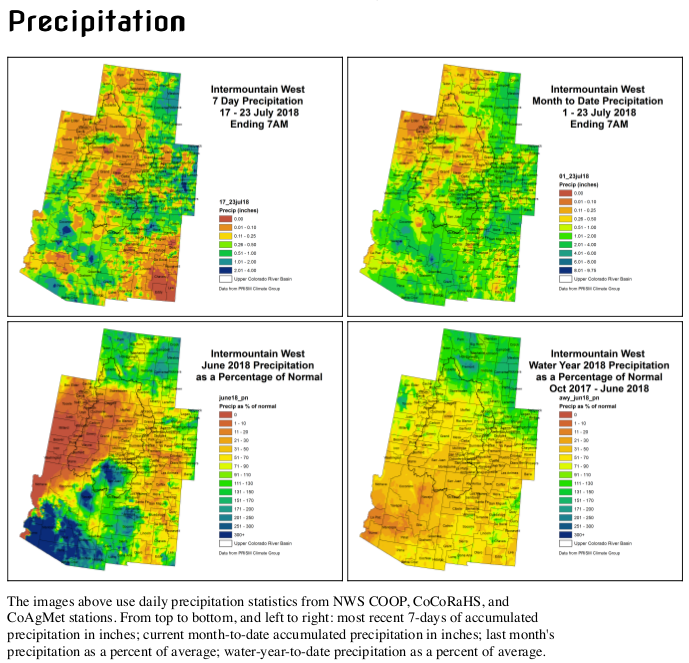
Highlighting the event was newly hired state climatologist Russ Schumacher. He gave a presentation offering some explanations about the extremely dry season we experienced this past winter. Schumacher confirmed that Colorado experienced one of the driest winters on record, after experiencing the 30th wettest year in 2017. The state experienced a bump after a heavy snowstorm in early April pushed precipitation numbers a bit closer to average.
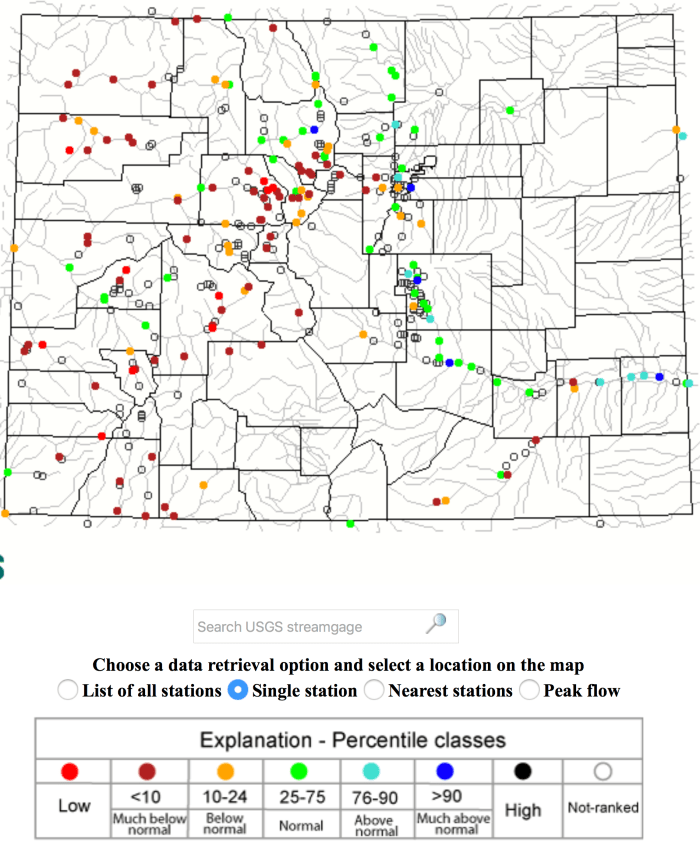
Schumacher also confirmed that snowpack was terrible this past season. While Summit and most of the northeast portions of the state did OK, the southern part of the state did not. In the southwest, for example, snowpack levels averaged out between 30 and 40 percent of normal.
“There’s a clear dividing line between north and south,” Schumacher said. “Summit County is kind of at the middle of that. North of Summit, snowpack and precipitation are pretty OK, even above average. But in the south, they really struggled.”
Schumacher said warmer temperatures was a big factor for why the southern part of the state has been suffering.
“Everywhere in the southwest was extraordinarily warm,” Schumacher said. “Pretty much everywhere west of the divide was record warm, everywhere else that wasn’t was close to that.”
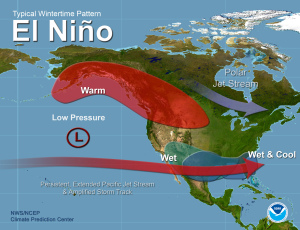
Schumacher attributed the warmer temperatures, especially in the southern part of the state, to the La Niña weather pattern that pushes the jetstream north and creates dry, warm conditions in the south and western parts of the state.
The long-term problem for Colorado’s waterways is how long these patterns can continue before it becomes a crisis. That’s where Andy Mueller, the new general manager for the Colorado River District and the night’s other featured speaker, came in.
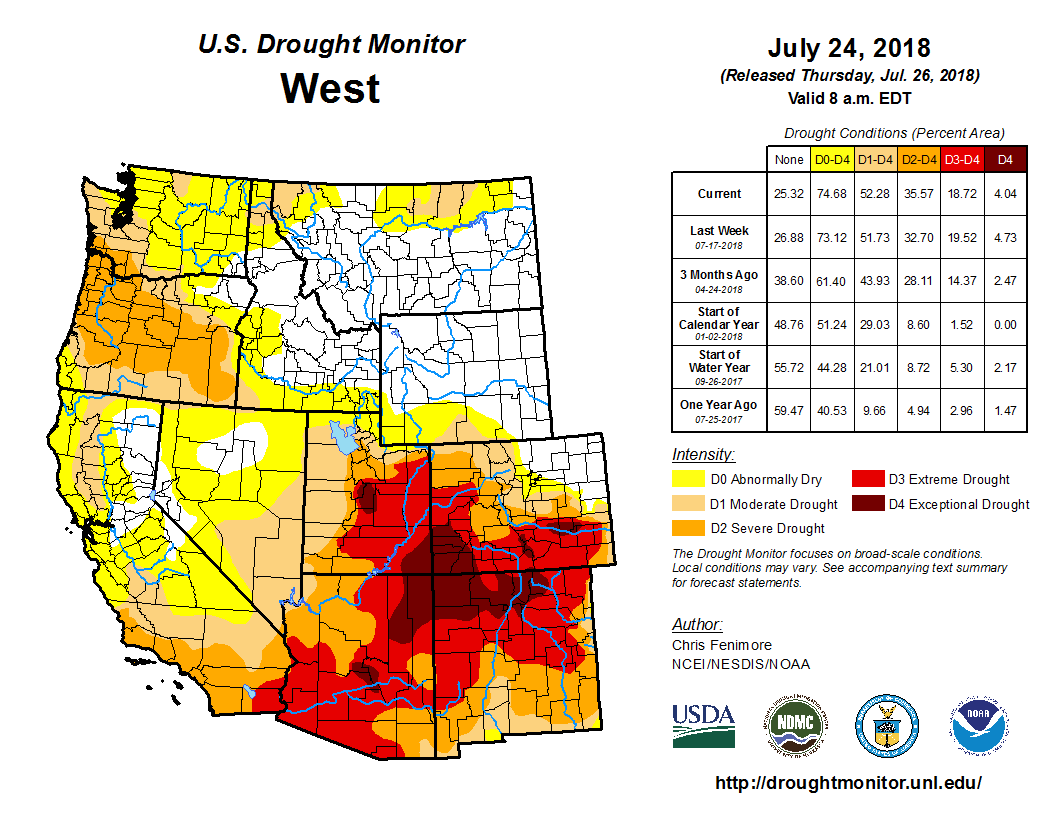
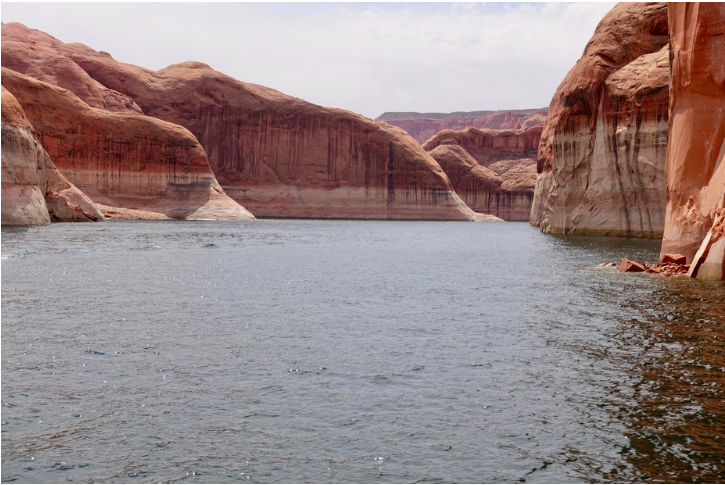
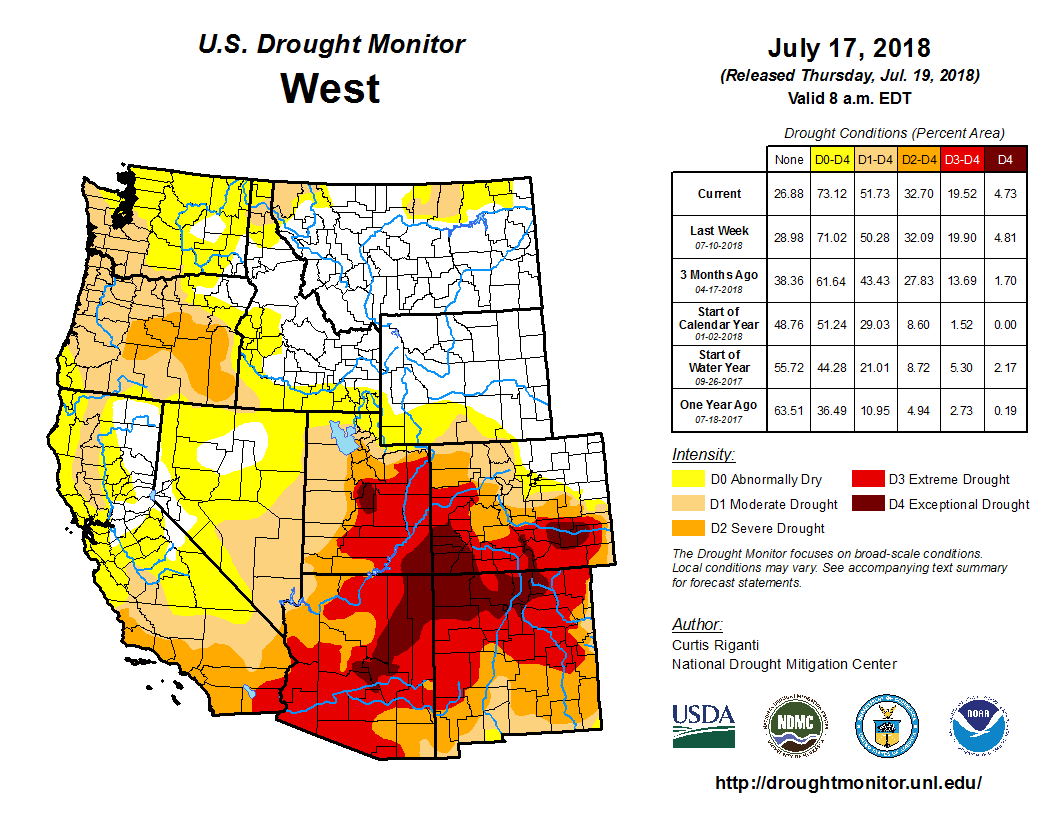
Mueller pointed out that the current U.S. drought monitor has over 80 percent of Colorado’s population experiencing some form of drought, with the southwest experiencing extreme drought. But the problem extends beyond Colorado’s boundaries. However, Mueller said the biggest concern going forward are water flows going west to Lake Powell, one of the most important water reservoirs in the country.
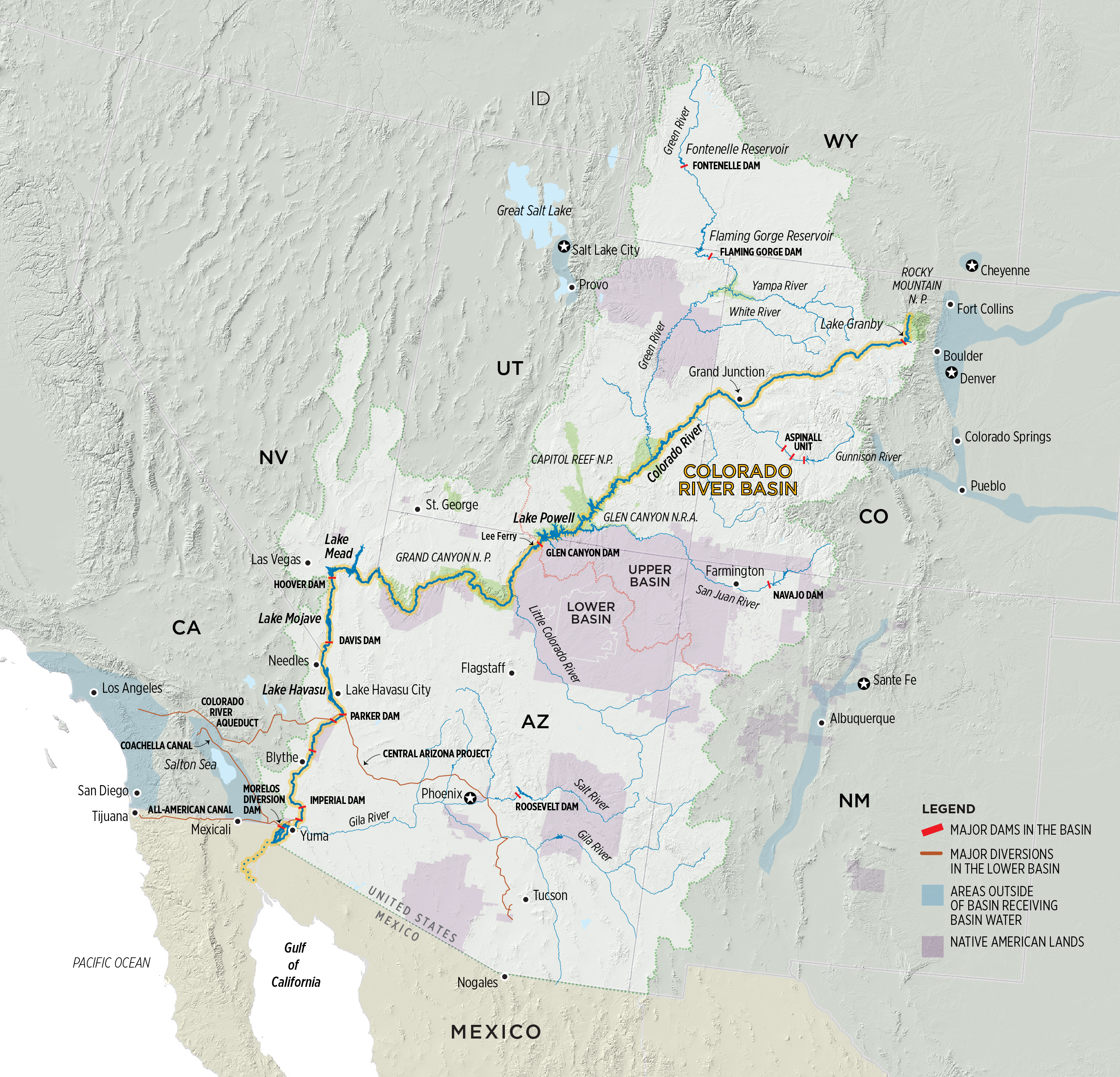
Mueller called Lake Powell the state’s “water savings account.” Under the Colorado River Compact signed in 1922, the Upper Basin states — Colorado, Utah, Wyoming, and New Mexico — are required to keep an annual flow of 7.5 million acre-feet per year flowing from Lake Powell to Lake Mead and the Lower Basin states — Arizona, Nevada and California. At the moment, flow into Lake Powell is forecasted to be at around 3.1 million acre-feet, or around 43 percent of average, because of the lack of snow melt…
If Lake Mead — which is currently at 1,084 feet above mean sea level and has been less than half full for well over a decade — drops to 1,075 feet, [the 2007 Shortage Sharing Agreement] will activate and force cuts to water users downstream. That will have a domino effect that may lead to water cuts for Upper Basin states as well. There may be severe water rationing, shutdowns of hydroelectric dams and a whole other set of emergency measures that have never before been instituted by the Department of the Interior. That means economic uncertainty for a wide variety of industries including ranching, skiing and electricity.
“To avoid that, Lake Powell is expected to pump out and drop 20 feet this summer,” Mueller said. “It’s currently at 54 percent of capacity.”
Mueller added that while catastrophe will probably be avoided this summer, it might not be next year or the year after that. Because of this complex water dance, Mueller said it was important for agricultural water users with senior claims in the Western Slope to maintain those claims, because if they’re abandoned they are abandoned forever.
“It keeps the water in our streams for our recreational users and for our quality of life here on the Western Slope,” Mueller said. “It keeps that water flowing to the West. Because they have those senior rights, they are able to pull that water downstream and not let it get diverted away.”
Mueller attributed the dangerously low water levels to overusage from lower basin states, but also in large part to climate change…
That means the overdevelopment in Colorado — which includes water-hungry lawns and outdoor irrigation — is not sustainable. Mueller ended his presentation with a dire warning and plea for the land-use people to start listening to water-use people.
“From the Colorado River District’s perspective, this has to stop,” Mueller said, pointing to a slide of a cookie-cutter subdivision near Denver. “We need the folks across the state putting these massive subdivisions in to realize that this is not OK. This is putting all of us in danger of significant chaos and the possibility of a compact curtailment.”
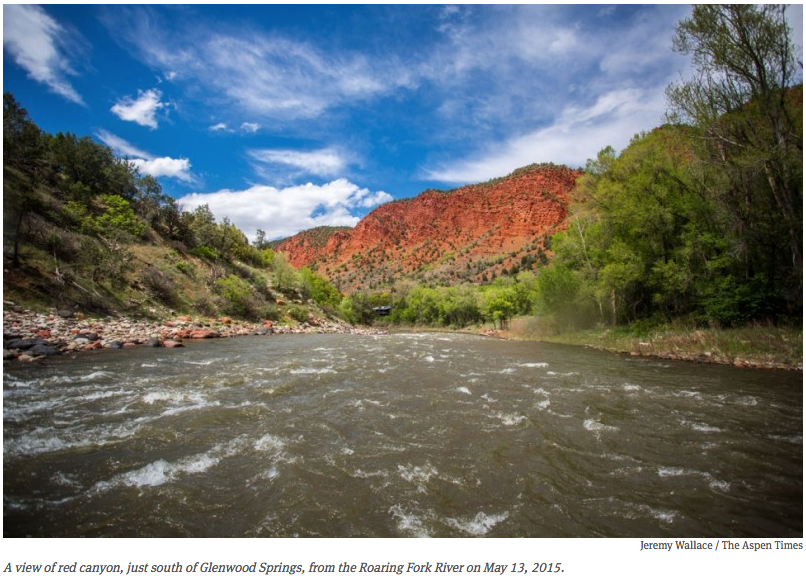
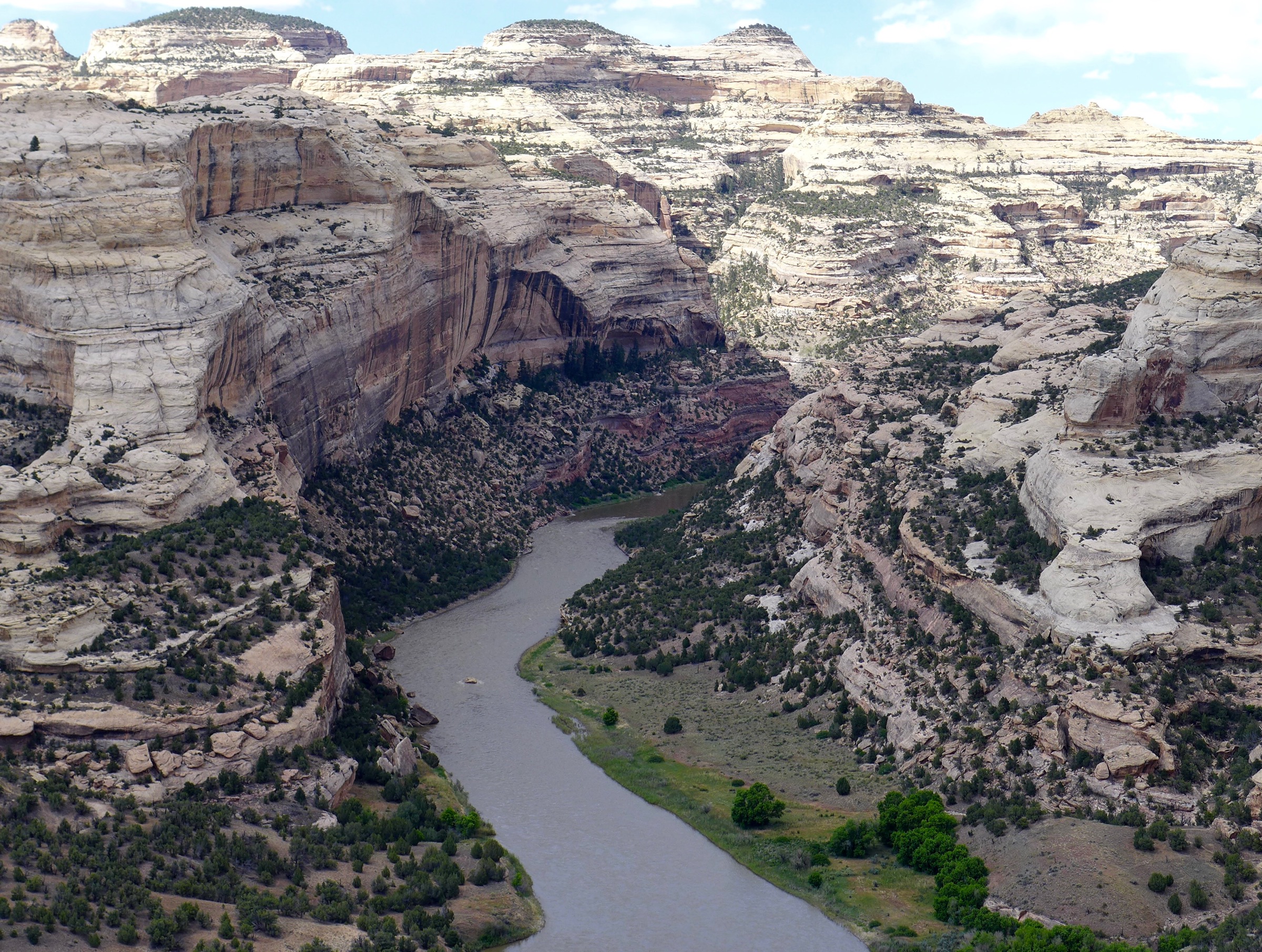
The upper Colorado River, above State Bridge. Photo: Brent Gardner-Smith/Aspen Journalism
From Governor Hickenlooper’s office via The Loveland Reporter-Herald:
Gov. John Hickenlooper signed Senate Bill 18-066 into law Monday, reauthorizing the Colorado Lottery through 2049.
“The Colorado Lottery is the only lottery in the nation that commits nearly all of its yearly proceeds to outdoor recreation or habitat and wildlife conservation,” Michael Hartman, executive director of the Colorado Department of Revenue, said in a press release. “Coloradans can rest assured that their lottery game spending will continue to support the incredible resources that make our state so special, including supporting the capital needs of our state’s great school systems.”
According to the release, in the last five fiscal years, the lottery has distributed more than $670 million to its four beneficiaries — the Conservation Trust Fund, Colorado Parks and Wildlife, Great Outdoors Colorado and the Building Excellent Schools Today program.
Since its start in 1983 through fiscal year 2017, the Colorado Lottery has returned to more than $3.1 billion to its beneficiaries.
The money is distributed 50 percent to the Great Outdoors Colorado Trust Fund, 40 percent to the Conservation Trust Fund, and 10 percent to Colorado Parks and Wildlife. GOCO funds in fiscal year 2018 are capped at $66.2 million and funds that exceed the cap will go to the Colorado Department of Education’s Public School Capital Construction Assistance Fund, according to the lottery website.
The current structure of the primary lottery beneficiaries has been in place since 1992, when the people of Colorado voted to the amend the Colorado constitution and create the Great Outdoors Colorado Trust Fund.
Lottery funds have been used to create and restore hundreds of miles of trails, protect hundreds of miles of rivers, create thousands of jobs, add thousands of acres to the state parks system, create more than 1,000 parks and recreation areas, and protect over 1 million acres of land.
Under a reauthorization passed by the Colorado Legislature in 2002, the Lottery division was extended 15 years from 2009 to 2024. The new bill adds 25 years, authorizing the lottery until 2049.
From Western Resource Advocated (Bart Miller @WaterBart). Click through and read the whole article for the in-depth look at western snowpack by state. Here’s an excerpt:
Snowpack in the West is essential to creating healthy flowing rivers that support recreation, tourism, and habitat for thousands of species. Communities also rely on the snowpack to fill reservoirs that supply cities and towns with a steady supply of drinking water all year-round.
Why is snowpack important to the West?
Snowpack in the West is essential to creating healthy flowing rivers that support recreation, tourism, and habitat for thousands of species. Communities also rely on the snowpack to fill reservoirs that supply cities and towns with a steady supply of drinking water year-round.
What are the major trends in snowpack in the West this year?
We can monitor how current snowpack will impact streamflow later in the year by measuring something called Snow Water Equivalent (SWE). SWE is the amount of water contained within the snowpack. The Natural Resources Conservation Service maps below show percentage of SWE on the first of every month compared to what has been considered normal over an almost 30-year period.
Any basin colored in red, orange, or yellow means there is currently less snowpack than what is considered normal.
Any basin colored in green or blue means there is currently the same or more snowpack than what is considered normal.
Westwide SNOTEL basin-filled map May 3, 2018 via the NRCS.
Here’s the discussion from the Colorado Basin River Forecast Center:
The Colorado Basin River Forecast Center (CBRFC) geographic forecast area includes the Upper Colorado River Basin, Lower Colorado River Basin, and Eastern Great Basin.
Water Supply Forecast Summary:
The month of April was generally dry over much of the CBRFC forecast area. While the month was not void of storm systems the greatest precipitation impacts were limited to the northern Bear River Basin, Yampa River Basin, Colorado mainstem headwaters, and parts of the Gunnison River Basin. In every month of the 2018 water year dating back to last October at least some part of the Colorado River Basin or Great Basin has experienced very dry conditions with monthly precipitation less than 50 percent of average. Only February of 2018 saw widespread precipitation that was near or above average in areas that are the primary contributors to the April-July runoff. However, even then impacts were limited to the upper Colorado River Basin as very dry conditions were widespread in the Great Basin.
April-July water supply volume forecasts increased from those issued in early April in parts of the Yampa River Basin, Colorado River headwaters, eastern headwaters of the Gunnison River Basin and some headwaters of the Green River Basin in Wyoming. The most significant decreases from early April occurred in the Dolores River Basin, Sevier River Basin, and Duchesne River Basin.
Forecasts are highest with respect to average in the Green River Basin of Wyoming, Colorado mainstem headwaters, and in northern parts of the Bear River Basin. Lowest forecasts with respect to average are in the southern basins of the forecast area and include the Dolores River Basin, San Juan River Basin, Sevier River Basin, and Virgin River Basin.
April-July unregulated inflow forecasts for some of the major reservoirs in the Upper Colorado River Basin include Fontenelle Reservoir 900 KAF (124% of average), Flaming Gorge 1000 KAF (102% of average), Blue Mesa Reservoir 350 KAF (52% of average), McPhee Reservoir 62 KAF (21% of average), and Navajo Reservoir 200 KAF (27% of average). The Lake Powell inflow forecast is 3.00 MAF or 42% of average.
Upper Colorado, Great, Virgin River Basins: 2018 April-July forecast volumes as a percent of 1981-2010 average (50% exceedance probability forecast)
On Wednesday, scientists at the University of California in San Diego confirmed that April’s monthly average atmospheric carbon dioxide concentration breached 410 parts per million for the first time in our history.
We know a lot about how to track these changes. The Earth’s carbon dioxide levels peak around this time every year for a pretty straightforward reason. There’s more landmass in the northern hemisphere, and plants grow in a seasonal cycle. During the summer, they suck down CO2, during the winter, they let it back out. The measurements were made at Mauna Loa, Hawaii — a site chosen for its pristine location far away from the polluting influence of a major city.
Increasingly though, pollution from the world’s cities is making its way to Mauna Loa — and everywhere else on Earth.
In little more than a century of frenzied fossil-fuel burning, we humans have altered our planet’s atmosphere at a rate dozens of times faster than natural climate change. Carbon dioxide is now more than 100 ppm higher than any direct measurements from Antarctic ice cores over the past 800,000 years, and probably significantly higher than anything the planet has experienced for at least 15 million years. That includes eras when Earth was largely ice-free.
Not only are carbon dioxide levels rising each year, they are accelerating. Carbon dioxide is climbing at twice the pace it was 50 years ago. Even the increases are increasing.
That’s happening for several reasons, most important of which is that we’re still burning a larger amount of fossil fuels each year. Last year, humanity emitted the highest level of greenhouse gas emissions in history — even after factoring in the expansion of renewable energy. At the same time, the world’s most important carbon sinks — our forests — are dying, and therefore losing their ability to pull carbon dioxide out of the air and store it safely in the soil. The combination of these effects means we are losing ground, and fast.
Without a bold shift in our actions, in 30 years atmospheric carbon dioxide will return back to levels last reached just after the extinction of the dinosaurs, more than 50 million years ago. At that point, it might be too late to prevent permanent, dangerous feedback loops from kicking in.
This is the biggest problem humanity has ever faced, and we’ve barely even begun to address it effectively. On our current pace, factoring in current climate policies of every nation on Earth, the best independent analyses show that we are on course for warming of about 3.4 degrees Celsius above pre-industrial levels, enough to extinguish entire ecosystems and destabilize human civilization.
Climate change demands the urgent attention and cooperation of every government around the world. But even though most countries have acknowledged the danger, the ability to limit our emissions eludes us. After 23 years of United Nations summits on climate change, the time has come for radical thinking and radical action — a social movement with the power to demand a better future.
Of the two dozen or so official UN scenarios that show humanity curbing global warming to the goals agreed to in the 2015 Paris Accord, not one show success without the equivalent of a technological miracle. It’s easier to imagine outlandish technologies, like carbon capture, geoengineering, or fusion power than self-control.
Our failed approach to climate change is mostly a failure of imagination. We are not fated to this path. We can do better. Yes, there are some truly colossal headwinds, but we still control our future. Forgetting that fact is sure to doom us all.
On Tuesday, the Mauna Loa Observatory recorded its first-ever carbon dioxide reading in excess of 410 parts per million (it was 410.28 ppm in case you want the full deal). Carbon dioxide hasn’t reached that height in millions of years. It’s a new atmosphere that humanity will have to contend with, one that’s trapping more heat and causing the climate to change at a quickening rate.
In what’s become a spring tradition like Passover and Easter, carbon dioxide has set a record high each year since measurements began. It stood at 280 ppm when record keeping began at Mauna Loa in 1958. In 2013, it passed 400 ppm. Just four years later, the 400 ppm mark is no longer a novelty. It’s the norm.
“Its pretty depressing that it’s only a couple of years since the 400 ppm milestone was toppled,” Gavin Foster, a paleoclimate researcher at the University of Southampton told Climate Central last month. “These milestones are just numbers, but they give us an opportunity to pause and take stock and act as useful yard sticks for comparisons to the geological record.”
Earlier this year, U.K. Met Office scientists issued their first-ever carbon dioxide forecast. They projected carbon dioxide could reach 410 ppm in March and almost certainly would by April. Their forecast has been borne out with Tuesday’s daily record. They project that the monthly average will peak near 407 ppm in May, setting a monthly record.
Carbon dioxide concentrations have skyrocketed over the past two years due to in part to natural factors like El Niño causing more of it to end up in the atmosphere. But it’s mostly driven by the record amounts of carbon dioxide humans are creating by burning fossil fuels.
“The rate of increase will go down when emissions decrease,” Pieter Tans, an atmospheric scientist at the National Oceanic and Atmospheric Administration, said. “But carbon dioxide will still be going up, albeit more slowly. Only when emissions are cut in half will atmospheric carbon dioxide level off initially.”
Even when concentrations of carbon dioxide level off, the impacts of climate change will extend centuries into the future. The planet has already warmed 1.8°F (1°C), including a run of 627 months in a row of above-normal heat. Sea levels have risen about a foot and oceans have acidified. Extreme heat has become more common.
All of these impacts will last longer and intensify into the future even if we cut carbon emissions. But we face a choice of just how intense they become based on when we stop polluting the atmosphere.
Right now we’re on track to create a climate unseen in 50 million years by mid-century.
Click here to go to the US Drought Monitor website. Here’s an excerpt:
Summary
This U.S. Drought Monitor week saw a series of storm systems track across the continental U.S. bringing beneficial rains to portions of the Mid-Atlantic, Northeast, and South. Out West, the storm systems brought rain and mountain snow to higher elevations as well as cooler temperatures to the northern half of the region coming into the weekend after a period of record-setting warmth across parts of the West last week. Unfortunately, the storm systems steered north of drought-stricken areas of the Southwest that saw further deterioration in conditions on this week’s map. In the southern Plains, light shower activity provided some minor relief to dry pasture and rangelands as well as helped to reduce wildlife danger. In Texas, some isolated heavy rainfall activity brought relief to the western Panhandle and Trans-Pecos region. Moving eastward, cool temperatures and scattered shower activity helped improve drought-related conditions in parts of the Mid-Atlantic and Southeast…
On this week’s map, conditions continued to deteriorate in parts of the region, including southwestern Oklahoma and portions of Texas that have largely missed out on recent rainfall events during the past 30 days. In southwestern Oklahoma and north-central Texas, areas of Exceptional Drought (D4) expanded in response to poor soil moisture conditions and below normal precipitation during the past several months. According to the Oklahoma Mesonet, southwestern Oklahoma received only 37% of normal precipitation for the last 60-day period. The April 30th USDA NASS Oklahoma Crop Weather Report noted that 66% of the wheat crop was reported to be in poor to very poor condition while rye was worse off at 83% (poor to very poor). In Texas, some isolated shower activity helped to reduce areas of Extreme Drought (D3) in the western Panhandle and areas of Severe Drought (D2) in the Trans-Pecos region. According to the May 1st USDA Weekly Weather and Crop Weather Bulletin, topsoil moisture statewide in Texas was reported as 67% (short to very short). Elsewhere in the region, drought-free areas of northern Mississippi and southwestern Tennessee received 2-to-3 inches of precipitation during the past week. Average temperatures for the week were below normal (1-to-8 degrees) across the region with the largest negative anomalies observed in Mississippi and Tennessee…
On this week’s map, areas of Abnormally Dry (D0) and Moderate Drought (D1) expanded in North Dakota including the introduction of Severe Drought (D2) in the northern part of the state in response to reported poor soil moisture conditions and precipitation shortfalls during the past 60 days. According to the April 30th USDA NASS North Dakota Crop Progress and Condition Report, topsoil moisture was reported as 45% (short to very short moisture) with subsoil moisture at 50% (short to very short). Additionally, hay and roughage supplies were rated 55% (short to very short). In northeastern Montana, improvements were made in areas of Abnormally Dry (D0), Moderate Drought (D1), and Severe Drought (D2) in response to overall improvement in conditions (streamflows, soil moisture, lack of drought-related impacts) since last fall. Since the beginning of the Water Year (Oct. 1st), precipitation across the region has been below normal with the exception of eastern Montana, northwestern Wyoming, and central/north-central Nebraska. During the past week, the region was generally dry and temperatures were generally above normal…
A series of storm systems passed through the region beginning late last week, bringing rain and mountain snow as well as cooler temperatures to the northern half of the region. In contrast, most of the drought-stricken Southwest remained warm and dry with areas of southeastern California and southwestern Arizona reaching the low-100s during the 7-day period. This continued dry pattern led to expansion of areas of Severe Drought (D2) and Extreme Drought (D3) in the western half of Arizona. In Mohave County, Extension Agents are reporting very poor rangeland conditions with stock ponds going dry and water hauling necessary. Despite record-to-near-record low snowpack conditions across the mountains of Arizona, the Salt River Project is not expecting shortages or restrictions. In north-central New Mexico and south-central Colorado, an area of Exceptional Drought (D4) was introduced, covering the Sangre de Cristo Range to reflect record-to-near-record snowpack levels since the beginning of the Water Year. According to the May 1st USDA Weekly Weather and Crop Weather Bulletin, topsoil moisture in New Mexico was rated 90% short to very short while subsoil moisture was rated 89% short to very short. During the past week, average temperatures were near normal in the Far West and above normal (5-to-15 degrees) across the remainder of the West…
Looking Ahead
The NWS WPC 7-Day Quantitative Precipitation Forecast (QPF) calls for moderate-to-heavy accumulations ranging from 2-to-3 inches across the eastern Central Plains, Texas, and the Midwest (Iowa, northern Illinois, Michigan, southern Wisconsin). Out West, lesser accumulations (<1.5 inches) are expected in parts of the Intermountain West, central Rockies, and southern portions of the northern Rockies. Similar accumulation totals are forecasted for the Northeast and portions of the Mid-Atlantic. The CPC 6-10-day outlook calls for a high probability of above-normal temperatures across the West, the Plains, New England, and the Southeast while below-normal temperatures are expected in Michigan and south Texas. In terms of precipitation, below-normal precipitation is expected across most of the eastern half of the continental U.S. with the exception of Florida where there is a high probability of above- normal precipitation. Above-normal precipitation is expected in a swath extending from west Texas through New Mexico and Colorado to Idaho. Further west, below normal precipitation is expected in northern California and much of the Great Basin.
Westwide SNOTEL basin-filled map May 3, 2018 via the NRCS.
Winter Park Resort reported 10 inches of new snow last night, with up to 7 inches more expected today. Arapahoe Basin and Loveland also had significant new snow.
According to meteorologist Joel Gratz at OpenSnow.com, between the official reports above, which were measured at 5 a.m., and when he wrote his report at 7 a.m., it appears an additional 2-4 inches of snow have already accumulated.
The so-called “Ag Barometer” is a survey of 400 agricultural producers representing corn, soy, wheat, cotton, dairy, pork and beef. It shows optimism among farmers has dipped dramatically.
David Widmar is an Agricultural Economist at Purdue University where the surveys are compiled. He pointed to NAFTA and trade tariffs with China as some of the main culprits for the uncertainty in US agriculture right now.
On top of that, he pointed out, we’ve had some “pretty tough weather” lately. He said warmer temperatures and droughts particularly in the West have discouraged farmers about their prospects this year. That makes them more cautious.
There you have it folks: It was a crappy winter in the Four Corners Country. As of May 1, the San Juan Mountain snowpack, also known as the gargantuan “reservoir” at the headwaters of the region’s major rivers, is just about drained dry. While the snow season is not quite over — a winter storm has settled into the San Juans as I write this — the current numbers almost guarantee that the spring runoff will be meagre and fire season will be rough.
The only bit of good news is that this winter is turning out to be only the second driest over the last three decades — at most monitoring stations, 2002’s numbers were even lower. Also, as one moves northward, the situation tends to improve somewhat. On Red Mountain Pass, for example, the snowpack is currently at about 50 percent of average for this date, and is tracking above levels of 2002, 2012 and 1981.
At the Vail Town Council’s afternoon meeting on Tuesday, May 1, representatives from the Eagle River Water & Sanitation District provided an update about current snowpack, as well as the progress of a water-efficiency plan for the district.
As you’d expect, the snowpack on Vail Mountain is far below “normal” levels, based on a 30-year median. The most recent data shows that snowpack is still far below that level, but spring storms finally boosted Vail’s snowpack above the record-low snow year of 2011-12. Better yet, while snowpack on Vail Mountain had melted away at this point in 2012, there’s still snow on the hillsides right now…
The news is better at measurement sites on Copper Mountain and Fremont Pass, the sites nearest the headwaters of Gore Creek and the Eagle River, respectively.
At Copper Mountain, snowpack is very close to normal, while Fremont Pass’ snowpack is slightly above normal.
That’s good news for both Gore Creek and the Eagle River.
Still, water supplies won’t be plentiful, perhaps closer to the drought of 2001-02.
District communications manager Diane Johnson told council members that 2012 compelled the district to do some serious work on water conservation. District employees have kept up that work, she said.
In addition to day-to-day work, the district is also working on a water efficiency plan required by the Colorado Water Conservation Board. Local districts that have those plans are eligible for grants and loans from that state agency.
Following a Monday meeting in Salt Lake City, Colorado River water users are pledging to move past two weeks of public fighting between an Arizona agency and four states that divert water from the river. The Arizona utility — the Central Arizona Water Conservation District (CAWCD) — said at the meeting that it regretted having used rhetoric that inflamed tensions…
On Monday, the agency apologized for its rhetoric and said it hoped to begin to repair its frayed relationship with the state agency, an arm of the governor’s office, to work on the drought plan.
“CAWCD regrets that intra-Arizona issues have impacted other parties in the Colorado River basin,” a CAWCD spokesperson wrote in a statement. “Specifically, CAWCD regrets using language and representations that were insensitive to Upper Basin concerns, and resolves to have a more respectful and transparent dialogue in the future. As a result of the meeting, CAWCD has committed to beginning a fresh conversation within Arizona, including with ADWR and other stakeholders, to chart a path forward for an effective Drought Contingency Plan.”
The meeting was less an attempt to resolve the conflict and more a chance to start talks.
“Our objective for this meeting was not to resolve all issues but, rather, to identify a path forward for our talks,” James Eklund, who represents the state of Colorado in the negotiations, said Tuesday in a statement. “Despite these encouraging messages, the jury is still out.”
He said that any progress forward would be in the district’s actions.
It’s unclear how much of an impact the meeting will have in solving the issue that upset the Upper Basin enough to send a rare letter that singled out CAWCD. While CAWCD said it regretted its rhetoric, the agency was quiet about whether it would change its strategy.
The meeting didn’t resolve the issue, says James Eklund, the Colorado representative on the Upper Colorado River Commission, but CAP officials did offer an apology.
“District representatives expressed regret about their use of rhetoric in describing the policy of maximizing reservoir releases solely for the benefit of the [Central Arizona Water Conservancy] District at the expense of the rest of the Colorado River Basin,” Eklund said in a written statement.
States in the river’s Upper Basin — Colorado, Wyoming, Utah, New Mexico — accused CAP and CAWCD of manipulating how much water the project received to avoid a shortage, while still gaining more water from those states’ biggest reservoir, Lake Powell.
In response to a series of public statements and an infographic sent to CAP’s Twitter followers demonstrating this strategy, Upper Basin representatives sent a letter in mid-April saying CAP’s behavior, while within the rules, was a violation of the watershed’s collaborative spirit. The larger basin-wide feud was borne out of a dispute within the state of Arizona over which agencies have final authority to decide how to conserve water…
Meeting attendees did not schedule a follow up meeting to further address the issue, and a meeting between CAWCD and state of Arizona water officials has yet to be scheduled.
The dust up caused at least one city to pull out of a Colorado River conservation program meant to boost reservoir levels. The city of Pueblo, Colorado’s water department cited CAP’s behavior in rescinding its proposal to participate in the System Conservation Pilot Program.
“This river really only works and functions the way we’ve designed it if trust is in abundance and we’re truly viewing the entire basin as connected,” Eklund says. The discussion in Salt Lake City was a starting point, “but the proof of progress will be in [CAP’s] actions.”
The development of drought is a complex process that involves multiple, interwoven relationships between precipitation, land surface temperatures, soil moisture, humidity, and atmospheric patterns. Often, drought is typified by the combination of a lack of precipitation and hot temperatures. However, the exact relationship between the two is not yet fully understood, nor is the role that temperature plays in the development of drought.
The particular challenge that the Drought Task Force faced was something of a chicken-and-egg dilemma; droughts are driven and exacerbated by high temperatures and land surface dryness, but when is temperature the leading driver of a drought, and when is it a response to dry conditions?
There is an interesting relationship between surface temperatures and surface moisture, known in the scientific community as the Bowen ratio; when the ground is dry, incoming solar radiation will heat the land more than it would have otherwise. This can also be explained as follows: when the ground is dry, heat from the sun does not have to expend energy to evaporate the already-dry soil, and instead heats the air to a more intense degree, causing air temperatures to rise.
This relationship suggests that dry soils can drive a rise in temperature, like a heat wave. However, on the flip side, hot temperatures can accelerate the evaporation of moisture in the ground (also known as high evaporative demand), which dries out the surface, which, in turn, can lead to a feedback loop of increased surface temperatures and heat waves. There are other factors, as well, that further complicate and blur the dynamics of heat and moisture; relative humidity and winds also play a role in depleting or sustaining surface moisture.
The Drought Task Force explores this complicated process and examines the potential for more extreme droughts and heat waves to impact the United States. The findings also reveal opportunities for further research to improve sub-seasonal drought prediction.
EcoFlight celebrated its 15th anniversary in 2017. Over that time it has whisked thousands of journalists, policymakers of both political parties and stakeholders such as ranchers, scientists and environmentalists up in aircraft for an aerial perspective of landscapes at the center of one environmental debate or another.
“The airplane is such an incredible tool,” said Bruce Gordon, who founded EcoFlight and serves as executive director and its other primary pilot. The advantage is people in a plane have a 360-degree view. They aren’t trying to absorb the vast Western landscape by looking left and right out a car windshield. That creates a unique, broader perspective and often results in greater understanding of issues.
Gordon calls it conservation in the cockpit. EcoFlight, he said, is the environmental air force.
“We can give the land a voice,” Gordon said.
Basalt-based photographer Peter McBride learned the value of the bird’s-eye view when he enlisted EcoFlight’s help on his project tracing the Colorado River and what happens to it before it reaches the Sea of Cortez.
“In general, they offer a perspective on water and natural resources that we don’t get on the ground,” he said.
He recalled he once gained a new perspective on the effects of logging in a national forest via the air. A 50-yard-wide swath of trees was left untouched next to a highway but beyond that the forest was clear-cut. The perspective wouldn’t have been possible without the flight.
McBride was so impressed with EcoFlight’s mission that he started volunteering a few years ago on its board of directors.
EcoFlight works with about 300 conservation groups on efforts such as preservation of national forests from oil and gas development, opposition to uranium mining on the rim of the Grand Canyon, expansion of coal mines in Wyoming and various effects of climate change.
In many cases, its conservation partners ask EcoFlight for assistance getting people up in the air for a different perspective.
“People now see this as a tool they try to factor into their (planning),” Gordon said.
In other cases, EcoFlight takes the initiative to offer flights, such as with the Thompson Divide oil and gas controversy west and southwest of Carbondale (see related story). It aims to help direct policy in those cases.
“What stokes my passion and fire is the people I work with, the donors, and the scientists and activists, the people on the ground,” Gordon said.
The groups accomplish more by working together. “All of these conservation groups are a piece of the puzzle,” he said…
Gordon’s partner in life and at EcoFlight is Jane Pargiter, who joined the organization in 2004 and is vice president. Pargiter grew up in South Africa and was a lecturer at a university when she got involved in the anti-apartheid movement. She got blacklisted for her activism and moved to the U.S. for safety at the urging of her father. She ended up in Aspen and found her activism spirit renewed by EcoFlight.
“What it did was it enabled me to have the kind of passion I had when I was fighting the end of apartheid. It’s the same sort of thing where you are using your soul and your heart but you’re also using your mind,” Pargiter said.
EcoFlight averages about 400 hours of flying with people per year but 2017 was particularly busy. The number of flights jumped 40 percent.
Journalists were present in 63 percent of the flights last year. The influence of news coverage that results from taking reporters up in the air is incalculable. EcoFlight also has multiple files of still photography and video of imperiled Western landscapes that media outlets can use simply by giving credit.
The organization also takes a large number of high school and university students up in the air each year to study environmental issues. The nonprofit organization’s budget for 2017 was about $480,000.
Just as rewarding as the media coverage and work with students, Pargiter said, is taking up elected officials and policymakers on different sides of issues and seeing a meeting of the minds unfold.
“The plane happens to provide a really great platform for that because you’re putting people from different backgrounds into this tiny little bubble of a cockpit together where they’re physically touching, they’re all nervous, they’re all excited,” she said. “So they’re sharing similar emotions even though they could be from opposite sides of the aisle politically or morally even, but they find that they have a lot in common so it allows them to suddenly see the landscape in a different way.”
Once on the ground, parties often discuss what they saw and that’s when the value of the flights becomes evident.
“They learn that they’re really not that far apart,” Pargiter said.
In this national political climate, that’s more important than ever, she said.
Colorado River Road. Once you get on it, it’s hard to get off. Brent Gardner-Smith/Aspen Journalism
Here’s the release from the Central Arizona Project (DeEtte Person):
Central Arizona Water Conservation District (CAWCD) is grateful for the opportunity to have met on April 30th with the Upper Colorado River Commission representing Colorado, New Mexico, Utah, Wyoming, and the United States. In addition, the Arizona Department of Water Resources (ADWR) and Denver Water participated in the meeting on the phone.
Concerns from the Upper Basin Commissioners were heard and respected, and there was a productive discussion. All parties recognize there is still much work to do. The Commissioners and CAWCD are resolved to returning to the collaborative processes, and important relationships, that have defined the successes for which the Colorado River Basin has been famous for two decades. The meeting was an opportunity to express intent, and going forward we must focus on results.
CAWCD regrets that intra-Arizona issues have impacted other parties in the Colorado River basin. Specifically, CAWCD regrets using language and representations that were insensitive to Upper Basin concerns, and resolves to have a more respectful and transparent dialogue in the future. [ed. emphasis mine]
As a result of the meeting, CAWCD has committed to beginning a fresh conversation within Arizona, including with ADWR and other stakeholders, to chart a path forward for an effective Drought Contingency Plan. We believe that a renewed collaborative process will ultimately support development of broad-based solutions with our Colorado River Basin colleagues to benefit the entire Colorado River system.
The Central Arizona Project, which provides water to about 5 million people, pledged to be more cooperative with other river users and promised “to have a more respectful and transparent dialogue in the future.”
[…]
The tension boiled over last month after the Arizona utility said it was trying to keep water levels in a major reservoir high enough to avoid any reduction in its share but low enough to require other users to send more water into the river.
That angered officials in Colorado, New Mexico, Wyoming and Utah, who accused the Central Arizona Project of manipulating the water at the expense of others and putting the entire river system in jeopardy.
James Eklund, Colorado’s representative on Colorado River issues, said the Arizona utility’s goal was “gaming the system.”
The Central Arizona Project initially denied the accusations and described its approach as good management. But after meeting with its critics Monday in Salt Lake City, the utility released a statement saying it “regrets using language and representations that were insensitive” to other river users.
It also pledged to cooperate on drawing up a multi-state plan for possible shortages in the river, which appear more and more likely because of the drought and climate change.
Other users had grown impatient over delays in completing the drought plans and accused the Central Arizona Project of stalling to avoid the water cutbacks the plans might require.
Colorado and Wyoming officials said Tuesday they were encouraged by the Central Arizona Project’s new statement but were waiting to see how it follows through.
“I think we heard an apology yesterday, certainly for the rhetoric they used,” said Patrick T. Tyrrell, Wyoming’s representative on the Colorado River. “The jury’s probably still out till we see what happens with their actions going forward.”
No single authority oversees the river — instead, it is governed by international treaties, interstate agreements and court rulings known collectively as “the law of the river.” The seven states in the Colorado River system are Arizona, California, Colorado, Nevada, New Mexico, Utah and Wyoming…
For years, the seven states, the federal government and Mexico have relied largely on negotiations to settle their disagreements without public rancor or lawsuits. That made the Arizona dispute stand out and prompted critics to say the Central Arizona Project was threatening to wreck the cooperative spirit of the river states.
At the April 16 Windsor Town Board work session, Dennis Wagner, director of engineering for Winds or, said the town has several options as it considers how best to meet the water needs of current and future residents.
Right now, the town is reliant on other sources to treat its water, so it has to pay the city of Greeley and the Fort Collins-Loveland and North Weld County water districts.
But some town board members want to give Windsor a way to avoid those price tags, even if that doesn’t happen for many years.
The regional water treatment plant also would serve Severance, Eaton and the Fort Collins-Loveland Water District.
Eaton is also feeling the pressures of providing for future growth, said Gary Carsten, town administrator for Eaton, so being part of the regional project would help prepare the town to serve future residents.
In 2017, the partners hired Black and Veatch Engineering to study the possibility. That plant would be east of Interstate 25 and just north of Colo. 14. The challenge with that plant, Wagner said, will be finding enough water to treat to justify the cost at $25 million for Windsor’s portion.
At its April 9 meeting, the Windsor Town Board also approved a plan to continue discussions with Broe Infrastructure about another water treatment plant at Great West Industrial Park.
That plant, which the town would eventually buy, would pull about 1,300 acre-feet of water per year from the ground and treat it.
If all goes according to plan, Windsor Town Attorney Ian McCargar said construction on that water treatment plant would start in 2019 and be finished by 2021.
Windsor is hoping much of that water will come from Northern Integrated Supply Project, of which Eaton is also a part. The project, which would create two new reservoirs to supply the region, has been in the works for about 18 years, said Mayor Kristie Melendez.
Windsor gets its water rights from the Colorado Big Thompson project, which brings water across the Continental Divide from the upper Colorado River and North Poudre Irrigation Co. It’s enough for now, but town officials are concerned it won’t stretch as the town grows and everyone in northern Colorado is trying to provide enough water to serve their residents.
Buying into NISP, Windsor officials said, could ensure that water is available.
The town is expected to spend $86.6 million on the project before it’s completed, including a $2 million payment next year.
Wagner said the project cost keeps going up as the project keeps getting put off and construction costs rise.
Melendez said some partners are skeptical about NISP ever being completed, because the project is taking so long. Currently, it’s expected to be built from 2021-25, if the planning and approval process continues without any issues, but Melendez said she’s not convinced that will happen, because of continual postponements.
Fearsome gusts of desert wind routinely kicked up swirling clouds of choking dust over Owens Lake on the east side of the Sierra Nevada after 1913, when its treasured snowmelt and spring water was first diverted into the Los Angeles Aqueduct.
It was not until 2001, and under a court order, that the Los Angeles Department of Water and Power began transforming the lake’s grim heritage, flooding portions where toxic, powder-fine dust exceeded federal pollution standards.
In what is now hailed as an astonishing environmental success, nature quickly responded. First to appear on the thin sheen of water tinged bright green, red and orange by algae and bacteria were brine flies. Then came masses of waterfowl and shorebirds that feed on the insects.
On Saturday, Owens Lake was designated a Western Hemisphere Shorebird Reserve Network site of international importance, joining an exclusive group of 104 areas between Alaska and the southern end of South America certified for their outstanding numbers of birds.
Saturday’s designation is part of a growing movement across the nation and around the world that sees wetlands as crucial connections to natural vistas that are receding as the planet heats up and development spreads.
Rob Clay, director of the shorebird reserve network headquartered in Plymouth, Mass., said it is also testament to a Los Angeles dust mitigation project that “demonstrates how human welfare and biodiversity conservation are intrinsically linked.”
The county commissioners on Tuesday approved a contract to work with the nonprofit river coalition on continued revegetation in key areas of the flood-damaged canyon with a $175,342 grant from the Colorado Water Conservation Board. To match the grant, the county and watershed coalition will put in $175,386, part in cash and part in staff and volunteer resources.
Commissioners Donnelly and Steve Johnson voted 2-0 at their weekly administrative matters meeting to approve the contract, allowing county resources to be used for the project. Lew Gaiter, the third commissioner, was absent.
The county’s in-kind contribution will be worth $23,490, including work by weed specialist Casey Cisneros, and its cash share will be $94,797 from the Larimer County Disaster Fund. The watershed coalition will pitch in $7,250 in cash and $49,849 of in-kind help, including volunteer labor.
This project will focus on the Big Thompson River near Drake, Cedar Cove and Jasper Lake as well as the North Fork of the Big Thompson from Drake all the way to Glen Haven.
Restoration projects have focused heavily on both private and public land along these areas, but additional work is needed for continued weed management and erosion control, said Shayna Jones, coalition director.
“These are areas that received a lot of time and effort in the past,” said Jones. “This is about making sure those improvements are maintained and stay on the right trajectory. … We’ll be able to identify the key focal areas that need a little more attention.”
This work, Donnelly said, is important to the fishery of the river, which is an economic driver for the region, to recreation along the river and to the quality of water that the river delivers to residents, including those who live in Loveland. These projects, he said, help restore the ecosystem and all river functions.
Led by California, the states of the Lower Colorado River Basin had their lowest consumptive water use in 2017 since 1992, according to a near-final tally by the U.S. Bureau of Reclamation. The final numbers won’t be out until mid-May, so could change slightly, but at this point they won’t change much. And they show that, despite the chaotic politics you’ve been hearing about lately, Lower Colorado River Basin water users are pushing their water use in the right direction.
In each case, the three Lower Basin states in different ways and on different time scales have been confronting the reality that they had come to depend on more water than the river could provide in the long run. Policy interventions that include municipal conservation, agricultural conservation, and ag-to-urban water transfers are shifting the water balance in the right direction…
At 6.782 million acre feet, that’s the lowest since 1992, before the Central Arizona Project was completed – the last big straw sucking water out of Lake Mead.
When the final numbers are completed, they’ll be published here.
FromThe Grand Junction Daily Sentinel (Dennis Webb):
A public presentation related to an ongoing study might seem to envision a possible new, million-acre-foot reservoir not far upstream of Lake Powell in southeast Utah as a means of helping Powell’s water levels…
The presentation, which the consultant doing the study has been using to provide public updates on it, includes a map showing a triangle over what Wockner says is the Dirty Devil River near its confluence with the Colorado River. A label pointing to the triangle refers to a million-acre “Water Bank Reservoir.” But Kuhn, who is involved with the risk study, said the consultant, John Carron of Hydros Consulting, placed the reservoir there just for demonstration purposes.
Kuhn said the idea was to discuss storing that much water for banking purposes anywhere within the Upper Basin river system, from Powell itself to upstream reservoirs. That storage could include newly created storage, he said, but any new storage would likely have to overcome the challenge of cost-competitiveness versus using existing storage space, not to mention considerations such as environmental impacts and political viability.
The water-banking concept — discussed again Wednesday in a meeting in Grand Junction of representatives of stakeholder groups for West Slope basins of the Colorado River watershed — would entail conserving water through temporary irrigation fallowing and other means and then storing that water to help shore up Powell levels. Water officials are concerned that continuing drought could drop those levels low enough that it could jeopardize hydropower generation and the ability of Upper-Basin states to meet legal obligations to deliver water downstream.
Powell itself, with its huge size and current large amount of unused storage space, is an obvious and convenient place to consider banking water, according to Kuhn and other water officials. The Bureau of Reclamation reports that as of the end of March, it had about 13 million acre-feet of water in it, and was about 53 percent full. Many upstream reservoirs are less well-positioned to bank water for the long term because they’re designed to fill in wet years.
However, the challenge when it comes to Powell is how to figure out how to ensure any water that’s banked there can actually go toward helping protect the reservoir’s levels rather than being subject to release downstream based on other agreements dictating operations of Powell as part of the larger Colorado River system.
But Kuhn says there’s a precedent for what’s called intentionally created storage or surplus already in place in the Lower Basin, taking advantage of vacant storage space in Lake Mead.
“It’s more than just a conceptual idea. It actually works,” said Kuhn, who said that shows the concept can work elsewhere in the Colorado River Basin.
If new storage is considered, one possibility that could be evaluated is in far northwest Colorado. The Rio Blanco Water Conservancy District in Rangely has been looking at a possible storage project at Wolf Creek, a tributary to the White River on the Moffat County line. Kuhn said that reservoir could be built for local needs in Rio Blanco County, but also sized up to help bank water for Powell. But he said it wouldn’t provide enough space, nor is the White River big enough, for such a reservoir to meet the entire water bank needs.
Rather, storage for a bank could be spread out among multiple reservoirs.
Kuhn believes new storage can’t be ruled out as a possibility.
“I think the (Upper) Basin has to be open to all suggestions and then weed them out,” he said.
The U.S. Department of Agriculture’s (USDA) National Institute of Food and Agriculture (NIFA) today announced the availability of up to $80 million in funding for integrated projects to increase sustainable production of food and agricultural products. Funding is made through a new program in NIFA’s Agriculture and Food Research Initiative (AFRI) – Sustainable Agricultural Systems (SAS) program. AFRI is authorized by the 2014 Farm Bill, which aims to address challenges in food, agriculture, natural resources, and human sciences.
SAS program focuses on system-level approaches that promote transformational changes in food and agricultural systems within the next 25 years. SAS supports trans-disciplinary projects that aim to transform agricultural systems that provide safe, nutritious, abundant, and affordable food for a growing population, while enhancing economic opportunities for Americans, especially those in rural areas.
Applications are solicited for projects focused on increasing agricultural productivity; optimizing water and nitrogen use efficiency; protecting yield losses from stresses, diseases and pests; reducing food-borne diseases; and advancing development of biobased fuels, chemicals, and coproducts.
Eligible applicants include colleges and universities, 1994 Land-Grant Institutions, and Hispanic serving agricultural colleges and universities. NIFA reviews all proposals accepted in NIFA’s competitive grant programs through an external peer review process. Specific details on panel meetings, review formats, and evaluation criteria may vary among programs.
A letter of intent is a prerequisite for the submission of an application. The deadline to submit a letter of intent is June 27, 2018.
Solutions to water needs lie in the hands of the next generation, said U.S. Secretary of Agriculture Sonny Perdue. He was in Denver April 27 for a conversation about water with former Secretary of Agriculture Tom Vilsack, who serves as a special advisor to Colorado State University, as part of the inaugural Water in the West Symposium.
“We’re seeing a lot of millennials getting their hands back into the soil,” Perdue said.
Perdue and more than 30 experts in water – ranging from conservationists, politicians, researchers, farmers, to business professionals – shared their insights during the two-day event. The sold-out Symposium drew more than 400 attendees and highlighted the greatest challenges surrounding water in the Western region. Experts explored best practices and proposed solutions to address emergent challenges – all efforts that will be continued at the future Water Resources Center at the National Western Center.
Topics discussed during the Symposium included:
Funding for water projects
Federal, state, and local policies surrounding water
Water is an endless topic of discussion in the West. Especially in Colorado – the only headwater state in the continental United States, which means all of the water in the state flows outside state boundaries – everyone has an interest and a stake in water, but leaders at the Symposium firmly held the importance of collaboration in working toward solutions around water challenges.
“These issues are not partisan, and we should not allow them to become partisan,” said U.S. Senator Michael Bennet (D-Colo.), during the Symposium. “We can actually solve these problems; and we might find ourselves able to accomplish a lot — and we should.”
Tony Frank, president of CSU and chancellor of the CSU System, joined other speakers in reiterating the theme that water needs to be at the forefront of conversations around growth of cities, agricultural production, economic development, recreation – and all aspects of the future.
“As you’ve heard virtually every speaker say, what happens around water will in a very real sense influence the world we leave to future generations,” said Frank.
More from Colorado State University:
Related news from the Water in the West Symposium
A $10 million grant to fund the Irrigation Innovation Consortium was announced; the consortium is a collaborative research hub involving five university partners, including CSU, that will be built in Fort Collins in the next three years.
Bicycling the Colorado National Monument, Grand Valley in the distance via Colorado.com
FromThe Grand Junction Daily Sentinel (Gary Harmon):
Stage I fire restrictions are to go into effect Friday, far earlier than the May 22 restrictions in 2012, according to the Mesa County Sheriff’s Office and fire chiefs of several municipalities and fire-protection districts. That year, an extremely dry winter, coupled with a hot, dry summer, fueled multiple, destructive wildfires across the state, including a blaze that burned nearly 14,000 acres southwest of De Beque.
Authorities said this is the earliest imposition of fire restrictions they could recall.
“One reason we are going in so early with restrictions is that we are seeing severe to extreme drought conditions and the predictions are that it’s going to be a pretty bad fire season,” sheriff’s spokeswoman Megan Terlecky said.
“The conditions we are experiencing are the most dangerous fire conditions we have had in recent memory and the potential for serious wildfire is staggering,” Mesa County Sheriff Matt Lewis said. “We want to ensure everyone has ample opportunity to understand these fire restrictions and adjust their plans accordingly.”
Firefighters in the Grand Valley already have battled the 12-acre Rosevale and 220-acre Skipper Island fires, both of which were started by humans and whipped by gusting winds. The Rosevale fire destroyed a mobile home and several outbuildings and vehicles.
Another reason to move quickly was to put residents and others on early notice that fireworks won’t be allowed this year…
Under the restrictions, campfires are allowed only in designated fire pits or fire rings and smoking is allowed outdoors only in a developed recreation site or in an area at least 6 feet in diameter that is clear of all combustible material.
Open-burn season was closed in the county immediately. Agricultural burns are allowed only with a permit issued by the fire marshal, who is to conduct an on-site inspection to verify precautions have been met, issuing permits on a case-by-case basis.
Open-burning season in the city of Grand Junction already was scheduled to end on Monday.
Gross Dam enlargement concept graphic via Denver Water
FromThe Boulder Daily Camera (Lurline Underbrink Curran):
I would like to share why I support Denver Water’s Gross Reservoir Expansion project.
While located in Boulder County, the project obtains the water from Grand County — a county that is currently the most impacted county in the state of Colorado for transbasin diversions. You must wonder why the county and its citizens, stakeholders in the Colorado River Basin, along with Trout Unlimited support this project.
The reason is the Colorado River Cooperative Agreement, which is an historic agreement with statewide environmental benefits which were fought for and gained through sometimes difficult and long negotiations. It has been hailed as a new paradigm and one that will serve as an example of what can be gained when dealing with a finite resource like water. The signatories to this agreement represent the entire Colorado River Basin, and I had the honor of acting as Grand County’s lead negotiator in this agreement. I worked for Grand County for 33 years, retiring as county manager in 2015. I have lived in Grand County over 60 years and have deep roots and interest in the well-being of our waterways.
The environmental benefits gained by Grand County, which include additional flows, river ecosystem improvements, use of Denver Water’s system, participation in an adaptive management process called Learning by Doing, money for river improvements, just to name a few, are necessary to protect and enhance the Fraser and Colorado rivers. Without these benefits, these rivers will continue to degrade, with no hope of recovery or improvement.
Those who oppose the project offer no solutions to the already stressed aquatic environment of the Fraser and Colorado rivers. Through the Learning By Doing format and a public private partnership, partners have already implemented a river project on the Fraser as an example of what can be done. This project immediately produced improvements that were astounding. Colorado Parks and Wildlife can verify this claim. This essential work will not continue without the CRCA.
The impacts that are associated with the construction of the Gross Reservoir Enlargement are substantial and one sympathizes with those who will experience them, but the reality is they will end. Mitigation for the construction impacts can be applied. However, without the CRCA, the impacts to the Fraser and Colorado rivers will continue with no hope of improvement.
The environmental enhancements and mitigation that are part of the CRCA cannot be replicated without the reservoir expansion project, and the loss of these enhancements and mitigation will doom the Fraser and Colorado rivers in Grand County to environmental catastrophe.
Here’s the release from NASA (Steve Cole, Alan Buis):
A pair of new spacecraft that will observe our planet’s ever-changing water cycle, ice sheets, and crust is in final preparations for a California launch no earlier than Saturday, May 19. The Gravity Recovery and Climate Experiment Follow-On (GRACE-FO) mission, a partnership between NASA and the German Research Centre for Geosciences (GFZ), will take over where the first GRACE mission left off when it completed its 15-year mission in 2017.
GRACE-FO will continue monitoring monthly changes in the distribution of mass within and among Earth’s atmosphere, oceans, land and ice sheets, as well as within the solid Earth itself. These data will provide unique insights into Earth’s changing climate, Earth system processes and even the impacts of some human activities, and will have far-reaching benefits to society, such as improving water resource management.
“Water is critical to every aspect of life on Earth – for health, for agriculture, for maintaining our way of living,” said Michael Watkins, GRACE-FO science lead and director of NASA’s Jet Propulsion Laboratory (JPL) in Pasadena, California. “You can’t manage it well until you can measure it. GRACE-FO provides a unique way to measure water in many of its phases, allowing us to manage water resources more effectively.”
Illustration of the NASA’s Gravity Recovery and Climate Experiment Follow-On (GRACE-FO) spacecraft, which will track changes in the distribution of Earth’s mass, providing insights into climate, Earth system processes and the impacts of some human activities. GRACE-FO is a partnership between NASA and the German Research Centre for Geosciences. Credits: NASA/JPL-Caltech
Like GRACE, GRACE-FO will use an innovative technique to observe something that can’t be seen directly from space. It uses the weight of water to measure its movement – even water hidden far below Earth’s surface. GRACE-FO will do this by very precisely measuring the changes in the shape of Earth’s gravity field caused by the movement of massive amounts of water, ice, and solid Earth.
“When water is underground, it’s impossible to directly observe from space. There’s no picture you can take or radar you can bounce off the surface to measure changes in that deep water,” said Watkins. “But it has mass, and GRACE-FO is almost the only way we have of observing it on large scales. Similarly, tracking changes in the total mass of the polar ice sheets is also very difficult, but GRACE-FO essentially puts a ‘scale’ under them to track their changes over time.”
At the Harris facility at Vandenberg Air Force Base in California, one of the twin GRACE-FO satellites is integrated with the multi-satellite dispenser structure that will be used to deploy the satellites during launch. Credits: Airbus
A Legacy of Discoveries
GRACE-FO will extend the GRACE data record an additional five years and expand its legacy of scientific achievements. GRACE chronicled the ongoing loss of mass from the Greenland and Antarctic ice sheets and mountain glaciers. That wealth of data shed light on the key processes, short-term variability, and long-term trends that impact sea level rise, helping to improve sea level projections. The estimates of total water storage on land derived from GRACE data, from groundwater changes in deep aquifers to changes in soil moisture and surface water, are giving water managers new tools to measure the impact of droughts and monitor and forecast floods.
GRACE data also have been used to infer changes in deep ocean currents, a driving force in Earth’s climate. Its atmospheric temperature profile data, derived from measurements of how signals from the constellation of GPS satellites were bent as they traveled through the atmosphere and received by antennas on the GRACE satellites, have contributed to U.S. and European weather forecast products. GRACE data have even been used to measure changes within the solid Earth itself, including the response of Earth’s crust to the retreat of glaciers since the last Ice Age, and the impact of large earthquakes.
According to Frank Webb, GRACE-FO project scientist at JPL, the new mission will provide invaluable observations of long-term climate-related mass changes.
“The only way to know for sure whether observed multi-year trends represent long-term changes in mass balance is to extend the length of the observations,” Webb said.
An Orbiting Cat and Mouse
Like its predecessors, the two identical GRACE-FO satellites will function as a single instrument. The satellites orbit Earth about 137 miles (220 kilometers) apart, at an initial altitude of about 305 miles (490 kilometers). Each satellite continually sends microwave signals to the other to accurately measure changes in the distance between them. As they fly over a massive Earth feature, such as a mountain range or underground aquifer, the gravitational pull of that feature tugs on the satellites, changing the distance separating them. By tracking changes in their separation distance with incredible accuracy – to less than the thickness of a human hair – the satellites are able to map these regional gravity changes.
A global positioning system receiver is used to track each spacecraft’s position relative to Earth’s surface, and onboard accelerometers record non-gravitational forces on the spacecraft, such as atmospheric drag and solar radiation. These data are combined to produce monthly maps of the regional changes in global gravity and corresponding near-surface mass variations, which primarily reflect changes in the distribution of water mass in Earth’s atmosphere, oceans, land and ice sheets.
In addition, GRACE-FO will test an experimental Laser Ranging Interferometer, an instrument that could increase the precision of measurements between the two spacecraft, by a factor of 10 or more, for future missions similar to GRACE. The interferometer, developed by a German/American instrument team, will be the first in-space demonstration of laser interferometry between satellites.
“The Laser Ranging Interferometer is an excellent example of a great partnership,” said Frank Flechtner, GFZ’s GRACE-FO project manager. “I’m looking forward to analyzing these innovative inter-satellite ranging data and their impact on gravity field modeling.”
GRACE-FO will be launched into orbit with five Iridium NEXT communications satellites on a commercially procured SpaceX Falcon 9 rocket from Vandenberg Air Force Base in California. This unique “rideshare” launch will first deploy GRACE-FO, then the Falcon 9 second stage will continue to a higher orbit to deploy the Iridium satellites.
GRACE-FO continues a successful partnership between NASA and Germany’s GFZ, with participation by the German Aerospace Center (DLR). JPL manages the mission for NASA’s Science Mission Directorate in Washington.
Lake Powell April 12, 2017. Photo credit Patti Weeks via Earth Science Picture of the day.
Click here to read the newsletter. Here’s an excerpt:
Powell Forecast (USBR)
Expected Operations
The operation of Lake Powell and Lake Mead in this April 2018 24-Month Study is pursuant to the December 2007 Record of Decision on Colorado River Interim Guidelines for Lower Basin Shortages and the Coordinated Operations of Lake Powell and Lake Mead (Interim Guidelines), and reflects the 2018 Annual Operating Plan (AOP). Pursuant to the Interim Guidelines, the August 2017 24-Month Study projections of the January 1, 2018, system storage and reservoir water surface elevations set the operational tier for the coordinated operation of Lake Powell and Lake Mead during 2018.
Consistent with Section 6.B of the Interim Guidelines, Lake Powell’s operations in water year 2018 will be governed by the Upper Elevation Balancing Tier. With an 8.23 million acre-feet (maf) release from Lake Powell in water year 2018, the April 2018 24-Month Study projects the end of water year elevation at Lake Powell to be above 3,575 feet above sea level (feet), and the end of water year elevation at Lake Mead to be below 1,075 feet. Therefore, in accordance with Section 6.B.4 of the Interim Guidelines, Lake Powell operations will shift to balancing releases for the remainder of water year 2018. Under Section 6.B.4, the contents of Lake Powell and Lake Mead will be balanced by the end of the water year, but not more than 9.0 maf and not less than 8.23 maf shall be released from Lake Powell. Based on the most probable inflow forecast, this April 24- Month Study projects a balancing release of 9.0 maf in water year 2018; however, the actual release in water year 2018 will depend on hydrology in the remainder of water year and will range from 8.23 to 9.0 maf. The projected release from Lake Powell in water year 2018 will be updated each month throughout the remainder of the water year.
Whatever destruction beavers inflict, however, is far outweighed by their immense ecological value. In the course of reporting my book, Eager: The Surprising, Secret Life of Beavers and Why They Matter, I’ve witnessed these miraculous mammals helping people tackle just about every environmental problem under the sun. In droughty Nevada beaver ponds are raising water tables, sub-irrigating pastures and helping ranchers feed their cattle. In Washington they’re storing water to compensate for declining snowpack. In Rhode Island they’re filtering out agricultural pollution. According to one report, restoring beavers to a single river basin, Utah’s Escalante, would provide tens of millions of dollars in benefits each year.
And beavers don’t just furnish us with ecosystem services — they also sustain a vast menagerie. From wood frogs to warblers, mink to mergansers, sage grouse to salmon, there’s hardly a creature in North America that doesn’t seek sustenance in beaver-built ponds, marshes or meadows. In North Carolina biologists are even mimicking beavers to create habitat for the St. Francis satyr (Neonympha mitchellii francisci), an endangered butterfly whose preferred sedges flourish only in sunlit, beaver-sculpted wetlands.
The conundrum, then, is this: What will it take to square beavers’ proclivity for nurturing life with their tendency to damage infrastructure? How do we reap their benefits without incurring their costs?
Last week I traveled to the town of Agawam, Mass., for some hands-on training in castorid coexistence. My companion for the day was Mike Callahan, founder of the nonprofit Beaver Institute. Since 1999 Callahan has installed more than 1,300 flow devices — pipe-and-fence contraptions that control beaver flooding without requiring trappers to kill the offending rodents. If you appreciate having beavers in your backyard but aren’t keen on snorkeling through your basement, a flow device might just be the solution you’re looking for.
On this day the conflict fell along a road: Beavers had wedged gooey wads of cattails, sticks and mud into a culvert, preventing the adjacent wetland from draining through the pipe. If the water rose too high, Callahan explained, it could wash out the road. To forestall that disaster, we assembled a rectangular wire fence, its sides 16 feet long, and pounded its posts into the mud at the wetland’s bottom. As we worked the vibrato screech of red-winged blackbirds and jackhammering of pileated woodpeckers attested to the pond’s fecundity. The completed flow device effectively surrounded the culvert, preventing beavers from plugging the aperture. (Other designs incorporate concealed pipes to keep water flowing without alerting rodents to the source of the leak.) While beavers would likely be tempted to dam along the fence, Callahan hoped its considerable length would discourage them.
“The goal is to end up with a truce,” he told me.
Callahan’s apparatuses might look simple, but they’re sufficient to thwart nature’s most tireless builders. In one 2005 paper, Callahan found that his culvert-protecting flow devices succeeded 97 percent of the time. Other researchers have observed equally impressive results. A 2008 study found that for every dollar the Virginia Department of Transportation spent on flow devices along the state’s roads, it reaped more than eight dollars in savings on road maintenance and beaver trapping — over $370,000 altogether. And beaver researcher Glynnis Hood recently calculated that a dozen flow devices installed in a wetland park near Edmonton could save Alberta’s government around $180,000.
Even Wildlife Services, beavers’ bete noire, shows fitful signs of coming around. In a 2013 review of various flow device models, Wildlife Services biologists acknowledged that “tools and techniques are currently available to integrate non-lethal beaver management into landscape-scale management plans.” Although the agency’s trappers have been notably slow to apply flow devices in the field, there’s reason to hope that future springs will bring lower kill counts.
“To keep every cog and wheel,” wrote Aldo Leopold, “is the first precaution of intelligent tinkering.” Beavers, the animals who double as ecosystems, are among our most important cogs, fundamental to the conservation of North America’s water, wetlands and wildlife. Here’s hoping our tinkering gets more intelligent in the years to come.
Researchers with the U.S. Geological Survey are hoping a monthslong experiment to release low, steady flows of water from Glen Canyon Dam will give the eggs that bugs lay just below the water’s surface a better chance at survival. It starts this weekend…
Scientists are anticipating a 26 percent increase in black flies and midges by next summer, and the eventual return of bigger bugs seen in other stretches of the Colorado River that largely have disappeared from a prized fishery known as Lees Ferry. When insects thrive, so do fish, bats, birds and other predators, scientists say.
Insects attach their eggs to hard surfaces like rocks, wood or cattails near the river’s shore. Fluctuations in the water for hydropower create artificial tides that can expose the eggs and dry them out.
If they’re not back underwater within an hour, they die, said Jeff Muehlbauer, a research ecologist with the Geological Survey.
The so-called bug flows are part of a larger plan approved in late 2016 to manage operations at Glen Canyon Dam, which holds back Lake Powell. The plan allows for high flows to push sand built up in Colorado River tributaries through the Grand Canyon as well as other experiments with the flow that could help non-native trout.
“It’s an ongoing endeavor to understand first, what’s the status of all these different resources — the fish, the sandbars, the cultural resources — and then making adjustments based on how the ecosystem is changing,” John Hamill said, a volunteer with Trout Unlimited who helped work on the plan.
The flows won’t change the amount of water the U.S. Bureau of Reclamation must deliver to three states and Mexico. The lower water levels on the weekend would be offset by higher peak flows during the week, the agency said. Still, hydropower is expected to take a $335,000 hit.
The Department of the Interior will conduct the first experimental flow at Glen Canyon Dam since implementing its Long-Term Experimental and Management Plan (LTEMP) in 2016. The goal is to provide enhanced habitat for the lifecycle of aquatic insects that are the primary food source for fish in the Colorado River.
Experiments under LTEMP consist of four flow regimes: high flows, bug flows, trout management flows, and low summer flows. Collaborative discussions among technical experts resulted in a decision to begin this first experiment on May 1 and continue through August 31, 2018. It will slightly modify the schedule and flow rates of water releases from Lake Powell through Glen Canyon Dam, Arizona. The normally scheduled monthly and weekly release volumes will not be affected.
Flows during the experiment will include steady weekend water releases with routine hydropower production flows on weekdays that include normal hourly changes in release rates. Those steady weekend flows are expected to provide favorable conditions for aquatic insects to lay and cement their eggs to rocks, vegetation, and other materials near the river’s edge. Steady weekend flows will be relatively low, within four inches of typical weekday low water levels. It is unlikely casual recreational river users will notice the changes in water levels.
“Experiments like these are an important tool as we continue to work collaboratively to balance the need to deliver water and power resources with our obligation to actively preserve and protect the river system through Glen, Marble, and Grand canyons,” said Dr. Timothy Petty, Assistant Secretary for Water and Science. “We expect this experiment will positively benefit crucial insect populations, which will benefit the entire ecosystem while limiting the impact on other resources and Colorado River users.”
The decision to conduct this experiment was based on input from a collaborative team, including Department of the Interior agencies—Bureau of Reclamation, National Park Service, U.S. Geological Survey, U.S. Fish and Wildlife Service, Bureau of Indian Affairs—the Department of Energy’s Western Area Power Administration, six consulting American Indian Tribes, and all seven of the Colorado River Basin States. Before proceeding with these experiments, experts determined there would be no unacceptable adverse impacts on other resource conditions. Technical experts with the Department of the Interior have coordinated the experiment’s design to optimize benefits to the aquatic ecosystem throughout the Grand Canyon while meeting all water delivery requirements and minimizing negative impacts to hydropower production.
Insects expected to benefit from this experiment are an important food source for many species of fish, birds, and bats in the canyon. Beyond expected resource benefits, this experiment will also provide scientific information that will be used in future decision making.
For more information about flow volumes, please visit the following websites:
Brad Udall, a senior water and climate research scientist at CSU, telling a crowd of water mavens on April 27 in Denver that Colorado faces a drier future, which means more fires. Udall studies the Colorado River basin and says there's been a 20 percent decline in water in the system since 2000.
DENVER – Some heavy hitters were invited by Colorado State University to speak at the inaugural Water in the West Symposium in Denver last week, including U.S. Secretary of Agriculture Sonny Perdue, the prior secretary of agriculture; Tom Vilsack of Iowa; U.S. Sen. Michael Bennett; and Gov. John Hickenlooper.
But the two players likely to have the biggest long-term impact on water in the West — climate change and drought — were escorted to the event at the McNichols Civic Center Building in downtown Denver by Brad Udall, a senior water and climate research scientist at CSU who studies the Colorado River Basin.
Udall’s version of climate change came wearing a T-shirt Udall designed with five “climate basics” listed on it: “It’s warming; It’s us; Experts agree; It’s bad; We can fix it.”
“The outlook is for a much drier Colorado” Udall told an audience of about 400 people on Thursday, which means less water and more fires in the state.
And he noted, “climate change is water change.”
Brad Udall, a climate researcher at CSU, has boiled down his findings to fit on a t-shirt. He told an audience at the inaugural Water in the West Symposium to expect a drier Colorado due to rising temperatures caused by human-induced climate change.
‘Odd and unusual’
Colorado State is preparing to build a new water center in partnership with Denver Waver on the National Western Center campus that’s being developed on the site of the long-running stock show in Denver.
And the symposium was a way of illustrating how one aspect of the new water center will function by bringing people together to talk about water policy and science.
The current 18-year-drought in the Colorado River Basin now has a name: the “Millennium Drought,” and it’s got Udall spooked.
“Something very odd and unusual is going on here,” Udall told the symposium crowd.
He said the period from 2000 to 2017 “is the worst drought in the gauged record” of the Colorado River and that flows have declined an average of 20 percent a year since the turn of the century due to rising temperatures.
It’s also time, Udall said, to consider that “drought” is no longer an apt description for what Colorado is facing, which is really long-term “aridification.”
“‘Drought’ implies we’re going to get out of it,” Udall said.
A slide from Brad Udall's presentation on April 26, 2018 at the CSU Water in the West Symposium. The slide describes the 20 percent drop in Colorado River flows since 2000, a condition Udall expects to also be the case in 2050.U.S. Secretary of Agriculture Sonny Perdue, left, shakes hands with Tom Vilsac, the prior secretary of agriculture, on Friday in Denver during the Water in the West Symposium put on by CSU. Perdue, a Republican, and Vilsac, a Democrat, had a civil and well-informed exchange about water and ag in front of about 400 people.
Insidious issue
Perdue, who was governor of Georgia in 2007 during an extreme drought in that state, said Friday that he learned that drought brings out intense emotions in competing water users.
“Drought is probably one of the most insidious, stressful occasions that I can think of,” Perdue said, in large measures because “you have no idea when it is going to end.”
He acknowledged that water shortages in Georgia are rare compared to Colorado and the West.
“We found ourselves with some of the issues that I know you all are wrestling with, and that is the things that happen between municipalities, agriculture, recreationalists, endangered species, and all those things,” Perdue said.
Perdue, a Republican in President Donald Trump’s cabinet, was interviewed onstage by Vilsack, a Democrat who led the Department of Agriculture under President Barack Obama and is now working with CSU on food and water issues.
The exchange between the two was civil, given the current political climate, and it ended with the two of them reaching out to warmly shake hands and look each other in the eye.
Sen. Michael Bennett (D-Colorado) said Friday at the Water in the West Symposium in Denver that Coloradoans are going to have to trust each other when it comes to water, even if they disagree on things. Bennett also praised Colorado's 2015 state water plan, saying it is a testament to people coming together.
Fire budget
Perdue had also been praised earlier in the day by Sen. Bennett, a Democrat, for Perdue’s help in passing a bill to restore operational funds to the U.S. Forest Service that had been eaten up by the cost of fighting major fires in the West.
Bennett said he’d been working on the issue for nine years and considered both Perdue and Vilsack, for his earlier help on the issue, “heroes of Colorado.”
Bennett also praised the Colorado Water Plan published by the Colorado Water Conservation Board in 2015.
While acknowledging that the plan is “not perfect” and some people find it lacking in details, while others consider it too detailed, Bennett said the plan is a testament to how the state came together over water, “understanding that there is no way we can address this issue if we are at each other’s throats.”
Gov. Hickenlooper leaving the stage Thursday at the Water in the West Symposium in Denver. Hickenlooper, who said he is literally counting the days until his term ends, can count as his legacy the 2015 Colorado Water Plan.
Legacy plan
Gov. Hickenlooper, who signed the executive order in 2013 calling for a state water plan by 2015, spoke to the symposium Thursday, noting that with 259 days to go, he is now actually counting the days until his term of office ends.
He said the water plan, which weighs 4 pounds and took countless meetings over two years to produce, was referred to in the governor’s office during the process as “the colossal exercise.”
Regardless of what one thinks of the plan itself, the governor’s water-planning process did result in a working agreement between water interests on Colorado’s Front Range and Western Slope over a future potential new transmountain diversion under the Continental Divide.
Senior water mangers from both the Front Range and West Slope praised that agreement, or “conceptual framework,” as recently as April 18 at a regional water meeting in Grand Junction.
Given this year’s low snowpack, Hickenlooper also said Thursday the state was now “drawing up the paperwork” to activate the second stage of the state’s drought management plan.
Editor’s note: Aspen Journalism is covering rivers and water in collaboration with The Aspen Times, which published this story on Monday, April 30, 2018, and with the Glenwood Springs Post Independent, which published the story on Tuesday, May 1, 2018, the Vail Daily, which published the story on May 1, 2018, and the Summit Daily News, which published it on May 1, 2018.
Fifteen miles of the Rio Grande are dry in the Bosque del Apache Wildlife Refuge area south of Socorro, but that’s no accident of nature.
The drying out of the river, which started April 1, is an intentional process aimed at preserving water resources, according to David Gensler, water operations manager for the Middle Rio Grande Conservancy District…
“We don’t have enough water to keep everything wet,” Gensler said. “We began drying the river while we had some water (in storage) to work with, drying it slowly and controlled so fish can migrate upstream.” He said the U.S. Fish and Wildlife Service has been rescuing endangered silvery minnows trapped in pools during the drying-out operation.
West Drought Monitor April 24, 2018.
Gensler has good reason to be cautious. Exceptional drought, which translates into “as bad as it gets,” has invaded portions of New Mexico for the first time since May 2014…
The most recent map, released by the U.S. Department of Agriculture’s drought monitor, shows 9 percent of New Mexico – in the northeast and northwest parts of the state – in exceptional drought. About 37 percent of the state is in extreme drought, the second-most serious category, and almost 99 percent is experiencing some level of drought.
There has been little or no snowpack in the mountains, and, as a result, next-to-no runoff.
But there will be water for farmers this year, Gensler said, because of good storage in El Vado and Heron reservoirs in Rio Arriba County. He said there are about 84,000 acre feet in El Vado and 40,000 acre feet in Heron…
And although Gensler notes that this has been an abysmally bad year for precipitation, he said some rain north of Chama earlier this month put 10,000 acre feet of water into El Vado.
That rain was indeed a rare occurrence in New Mexico the past six months. What water there is in New Mexico reservoirs is due, in large part, to really good rains in late September and early October. But since then, not much…
Exceptional drought conditions started creeping into the northern part of the state earlier this month. Before then, Fontenot said, May 27, 2014, was the last time that degree of drought had been recorded in New Mexico. If history is any indicator, it could get much worse than the 9 percent it is now. Fontenot said that in a drought that stretched from May 2011 to May 2012, as much as 49 percent of the state was in exceptional drought and that in 2013, exceptional drought blanketed up to 45 percent of New Mexico.
According to Brian Domonkos, Colorado Snow Survey Supervisor at the U.S. Department of Agriculture’s Natural Resources Conservation Service, precipitation in April brought the northern half of the state to near-average levels of snowpack for the year. That was a surprise, he said, since by this time of year, snowpack already is starting to melt, but from the Gunnison River Basin north, nearly all basins saw gains in snowpack numbers.
The southern half of the state, though, fell further behind average. The snowpack south of the Gunnison River Basin has already started to melt, and this part of the state didn’t receive as much moisture as its northern counterpart…
The majority of Colorado is considered to be in some level of a drought, according to the University of Nebraska-Lincoln’s U.S. Drought Monitor, last released on April 26 with data updated on April 24. Areas of extreme drought expanded in southern Colorado. The only area of the state not considered to be in a drought or abnormally dry is the northeastern and north central parts of the state.
Eric Brown, spokesperson for Northern Water, which collects water on the West and East Slope and provides water for much of northeastern Colorado, said April’s moisture was very beneficial for the area, especially considering the abnormal dryness throughout the month of March…
The South Platte River Basin was at 89 percent of normal levels as of April 26, after peaking at 93 percent after some of the storms in April, Brown said. The Colorado River Basin, which is where Northern Water’s large Colorado-Big Thompson project captures the majority of its water, has also seen increases from the recent moisture. Before the storms in April, it hovered around 80 percent of the average, and is now at 86 percent of the historic average, according to snowpack data from the USDA’s Natural Resources Conservation Service.
The added moisture in some parts of the state should make for better runoff this spring, which helps paint a prettier picture for farmers in the northern part of the state. Plus, Brown said the direct moisture falling on farmland should have improved soil quality…
And those gains in soil moisture were much needed. According to the Drought Monitor, topsoil moisture in Colorado was 53 percent very short to short as of April 22, but that was an 8-point improvement from the previous week. That said, winter wheat conditions declined for the week ending on April 22, with a 5 percent increase to 29 percent of the crop rated very poor to poor in Colorado.
In early April, the Northern Water board of directors voted to increase their C-BT project quota allocation for 2018 to 80 percent from its 50 percent quota in November. The C-BT quota sets the percentage of water from the project each participant can use for the year, and the 80 percent quota means that in 2018, each water user can use 8/10 of each acre-foot of water they own. For example, if someone owns rights to 100 acre-feet of water, they can use 80 of those acre-feet of water over the year.
Brown said the allocation was increased based on strong levels of regional water storage and the below-average precipitation this winter. As a whole, Colorado’s reservoir system is at 110 percent of its historic average, according to the Natural Resources Conservation Service. He also said that the quota each year is set to ensure enough water is left in the reservoir system to protect future years’ water supply.
As we move into the spring and summer, Domonkos said the further south you go in Colorado, the more worried farmers are likely starting to get about moisture levels — and they’re not wrong, he said.
On April 19, Monte Vista City Council approved a resolution enacting watering restrictions for all of the city’s water customers. The restrictions take effect on May 1, 2018 and are as follows.
Residential and Commercial businesses with odd numbered addresses are allowed to water on odd numbered calendar days and even numbered addresses can water on even numbered calendar days. No watering is allowed on Sundays and no watering is allowed between 10:30 a.m. and 5:00 p.m.
The restrictions are in effect beginning May 1, 2018 and extending until October 1, 2018. City Council exempted gardens from watering restrictions. For those that want to plant new grass, they can request a variance with a simple letter containing their name, address, and approximate area they want to landscape. The City Manager or his designee will draft a letter back either approving or disapproving the request.
United Fire Authority’s public information officer Eric Holmes warns residents to exercise caution near waterways, which are colder and flowing stronger than people might suspect…
The spring runoff is now starting to get underway, and that means more dangerous conditions, added Brian McInerney, hydrologist with the National Weather Service in Salt Lake City…
Utah is coming off a much below-average snow accumulation season, with most areas of the state picking up just half of the snow than is typical.
McInerney said that while runoff volumes are low — they will be half of what the state gets on average between April and the end of July — the water will still pose a threat.
The Elkhead Reservoir filled April 11, and Stagecoach Reservoir is expected to fill within the next two weeks, as long as flows remain steady. Snowpack in the Yampa/White River Basin is at 86 percent of the average, according to the Natural Resource Conservation Service. The Yampa River is projected to flow at 64 percent of its long-term average flow this year, according to the Colorado River District.
Still, water managers are concerned about the impacts a long-term drought could have on Moffat County and its rivers.
Statewide graphs of snowpack this year have been similar to the water year in 2002, which was a record low year for reservoir storage and river runoff. Twelve Colorado counties, including Bent, Crowley, Delta, Garfield, Gunnison, Kiowa, Montrose, Las Animas, Pitkin, Pueblo, Mesa and Otero have been designated as primary natural disaster areas by the U.S. Department of Agriculture due to losses and damages caused by the recent drought.
During the winter, drought conditions have crept toward Moffat County from the southwestern part of the state. Southwestern Moffat County is experiencing severe drought conditions. Central Moffat County faces moderate drought conditions, and eastern Moffat County is abnormally dry, according to the U.S. Drought Monitor.
On April 1, the Colorado River District said it anticipated it would send only 43 percent of the long-term average amount of water it sends downstream to Lake Powell between April and July…
With more and more drought years occurring, water managers are growing more and more concerned about meeting compact requirements.
The Colorado River basin is expected to contain 20- to 35-percent less water in the Upper Colorado River Basin by 2100, due to rising temperatures. Compound that with population growth and a growing demand for Colorado River Basin water on both Colorado’s Front Range and in Lower Basin communities, the river is being “pulled at both ends,” said Andy Mueller, general manager of the Colorado River District, during last week’s State of the River event.
When the elevation of the waterline in Lake Powell falls below 3,525 feet, the Glen Canyon Dam cannot reliably produce power, Mueller said. Power generated by the dam produces revenue to operate several major reservoirs, including the Blue Mesa, Morrow Point and Crystal Reservoirs in Colorado and the Flaming Gorge Reservoir in Wyoming and Utah. It also helps fund the Upper Colorado Endangered Fish Recovery Program.
On [April 24, 2018], Lake Powell sat a few inches above 3,609 feet, only 84 feet above that critical line.
Within Colorado, Western Slope agriculture is the largest consumptive use of water in the Colorado River Basin, according to the Colorado River District. About 69 percent of the water depleted in the basin goes to growing food, feed and livestock on the Western Slope. The next greatest portion of use is municipal and industrial use on the Front Range, which takes 18 percent of the depletions in the Colorado River.
That’s how Socorro County farmer Chris Lopez feels about the drying Rio Grande…
“They may make us cut back on the water, but if we’re able to water between the cutting, we’ll be able to make a crop. That’s what happened five or six years ago.”
That said, Lopez doesn’t remember a time when the Rio Grande has dried up in this area so early in the spring. His family farms along the river between Luis Lopez and San Antonio.
“It is completely dry in San Antonio,” Lopez said.
Bosque del Apache National Wildlife Refuge Manager Kevin Cobble told El Defensor Chieftain last week the river is dry for a stretch of at least 14 miles, including on the refuge. Travelers will notice a completely dry Rio Grande as they drive over the river bridge on U.S. 380 in San Antonio.
“It started on the refuge and went north,” Cobble said. “I know it’s up to the bridge on 380 in San Antonio. It may be a little beyond that.”
“It usually doesn’t get this dry until the end of May,” Lopez said. “But then they’ll usually release the water to save the silvery minnow.”
[…]
The early drying of the Rio Grande has threatened the silvery minnow on the refuge. It forced the U.S. Fish and Wildlife Service to perform a rescue of about 15,000 silvery minnows on the refuge.
The Bureau of Reclamation is coordinating with the U.S. Fish and Wildlife Service to ensure fish rescue crews are active in the areas of the river that have dried. It is working with the Middle Rio Grande Conservancy District, Albuquerque Water Utility Authority, and other stakeholders on an operational pulse to facilitate silvery minnow egg collection efforts.
Cobble said the drying of the river could impact other endangered species that live on the refuge…
A dry winter is being blamed for the early drying of the river.
“It was one of the worst snow melts, if not the worst, in about 80 years,” Cobble said.
Middle Rio Grande Conservancy District chief hydrologist David Gensler said the water flowing in the river is about 1/6th of what it was last year when snow melt was above average.
“I think we had 18 percent of the snowpack we had last year,” Gensler said.
The lack of moisture in the winter had an effect on Lopez.
“Last winter, we didn’t get any moisture,” Lopez said. “I planted alfalfa in the fall and lost the entire crop.”
[…]
Gensler said a change in regulations to protect species such as the silvery minnow forced water in storage to be released into the river earlier.
Lopez has a well, and has had to do some adjusting this spring. Lopez said he has done some shifting around with his chile crop.
Middle Rio Grande Conservancy District Board Member Valarie Moore agrees with Lopez that farmers won’t be affected as much by the drying of the river.
“Thankfully, we don’t have to entirely depend on the Rio Grande,” Moore said. “Thankfully, we have a lot of water stored in El Vado (Reservoir).”
[…]
Officials expect the river to dry within the Albuquerque reach later this spring or early summer before monsoon rains can perhaps provide some relief.
The Town of Ridgway recently announced voluntary outdoor water restrictions — which isn’t necessarily surprising, given the current drought engulfing the entire state, and beyond — but mandatory restrictions could soon follow, according to town manager Jen Coates.
That’s alarming, especially since Coates explained mandatory outdoor water restrictions haven’t been implemented in town for at least a decade, if not longer. (Coates has lived in Ridgway for the past 13 years, and been town manager since 2010.)
[…]
Colorado, along with several other Western states, has been experiencing harsh drought conditions this season. According to a map released April 19 by the U.S. Drought Monitor — a partnership between the National Drought Mitigation Center at the University of Nebraska, the USDA and NOAA — dry conditions in Colorado have moved from “extreme” to “exceptional,” the monitor’s highest category. The monitor ranks drought conditions on a scale of five, from D0 (abnormally dry) and D1 (a moderate drought) all the way to D3 (extreme drought) and D4 (exceptional).
Mandatory restrictions in Ridgway may come down from the town or be the consequence of a “water call,” which would be made by officials in Montrose County, Coates said. During such an event, the town would be required to send its water elsewhere, per the call decision.
Coates explained that the town uses a couple of different water sources — mainly ditch water — which are either directed to the town water-treatment plant for the potable-water system or used to irrigate public parks as part of the town’s non-potable water system that doesn’t require treatment at the water plant. All of the town’s water sources contribute to the town’s water reservoir. Currently, the town isn’t using water from the reservoir, but it would have “a limited supply of water (in the reservoir) if other water sources are restricted (or called elsewhere),” Coates said.
Water-usage concerns are nothing new to Ridgway, she added, but the town hasn’t had an official plan outlining ways to deal with such circumstances until this year, when town officials adopted a Water Conservation and Management Plan at the April 11 council meeting. The plan includes six stages and accompanying actions, including restriction practices, for water use…
The current voluntary restrictions include no irrigating between the hours of 9 a.m. and 6 p.m., as well as no irrigating at all on Mondays. The restriction also instructs people not to irrigate when it’s windy, in an effort to “minimize evaporation,” according to a town news release. Properties on the south side of State Highway 62 and Hunter Parkway may irrigate on Tuesdays, Thursdays and Saturdays. North side property owners have Wednesdays, Fridays and Sundays to irrigate…
For more information about the recently adopted Water Conservation and Management Plan, visit the town’s website at http://colorado.gov/ridgway and scroll to the Public Notices section at the bottom of the page.
The Four Corners drought has reached a more critical level, and as the wildfire threat heightens, forecasters say there is little hope for relief this summer.
The drought is rooted in a dry spell that began in October and reaches from southern California to central Kansas. Conditions are even worse in the Four Corners, where Montezuma and La Plata counties have warranted the description “exceptional drought.”
Brad Rippey, a meteorologist with the U.S. Department of Agriculture, said the conditions that arise for an “exceptional drought” are considered a 1-in-50-year chance.
“It’s pretty significant in the context of history,” Rippey said.
He authored the U.S. Drought Monitor, a partnership between the National Drought Mitigation Center at the University of Nebraska, the U.S. Department of Agriculture and the National Oceanic and Atmospheric Administration. It ranks drought conditions on five levels ranging from “abnormally dry to “exceptional drought.”
Rippey blamed the current conditions on a dry winter and early spring…
In the Cortez area, National Weather Service forecaster Matt Aleksa said only 1.6 inches of precipitation has fallen since Jan. 1. That’s 2.4 inches less than the 4 inches the county normally receives by this time of year. Last year, the area accumulated 4.07 inches of precipitation by mid-April. Meteorologist intern James Fowler added that Cortez also hit record high temperatures four times this year. Temperatures on Jan. 1 reached 57 degrees, beating the record of 54 degrees, and Jan. 10 beat the record of 59 degrees with a high of 61. On Jan. 20 and Feb. 2, the temperatures were tied with the highest temperatures ever recorded on those dates – 60 and 61 degrees, respectively…
The drought has already resulted in fire bans and a lower expectations for irrigators.
A Dolores Basin snowpack that came in at half its normal level means McPhee Reservoir will not fill to capacity, and farmers may receive 20 percent less water this season. The Dolores Water Conservancy District estimates that full-service irrigators will have 17 inches of water per acre available for their crops, down from 22 inches per acre when McPhee is full.
The carryover storage of 125,500 acre-feet – water left in the reservoir from last winter’s above-average snowpack – is only helping to ease the pain…
Aleksa said the short-term outlook for Montezuma County remains bleak, with lower-than-normal precipitation and higher-than-normal temperatures through June. But he offered a glimmer of hope, saying that some climate models predict a monsoon will carry heavy precipitation into the area starting in July.
According to the Arizona Department of Water Resources, 2018 is a record year, but this is not a record to cheer for. The water runoff season (January-May) in the Salt-Verde watersheds is likely to be the driest since records have been collected. ADWR’s Arizona Water News summarized the situation with information from multiple sources. The Salt River Project’s runoff totals in the Salt and Verde reservoir systems for the period January-March are at their lowest since 1913. These discouraging totals come in the wake of a disappointing December-February snowpack season, which produced most of the snowpack only at the highest elevations in the watershed. Using SNOTEL data, the Natural Resource Conservation Service estimated snowpack values in the range of zero to 40 percent of normal. The spring does not hold much hope for moisture either. Forecasts indicate Arizona will experience drier than normal weather through at least the first half of April, and chances do not look good for a “Miracle May” like the one that rescued the Colorado River in 2015.
Here’s the Westwide SNOTEL basin-filled map via the NRCS.
Westwide SNOTEL basin-filled map April 30, 2018 via the NRCS.
Colorado, New Mexico, Utah and Wyoming met with the Central Arizona Project in Salt Lake City Monday. There was no immediate word on the outcome.
The states have accused the Arizona utility of trying to avoid a reduction in its share of the river while others are conserving.
The states said that threatens to wreck years of cooperation aimed at protecting the river, which serves 40 million people in seven U.S. states and Mexico.
The utility denied the allegations. It serves about 5 million people.
James Eklund, Colorado’s representative at the meeting, declined to discuss specifics. Central Arizona Project spokeswoman DeEtte Person had no immediate comment.
The real problem isn’t one water user striving to achieve a “sweet spot” in reservoir levels to maximize its own water use; it’s the failure so far of the basin states to adjust to the new hydrology. Region-wide aridity and a warming climate just might force that hand for them.
Over the last week, those of us who eat, sleep, and drink Colorado River issues have watched with alternating measures of surprise, concern, and alarm as water users from the Upper Basin states publicly called out the operators of the Central Arizona Project (CAP) for “gaming” reservoir levels to maximize water deliveries to Arizona. The worry is that CAP’s efforts to find a “sweet spot” in managing the Colorado River has the effects of undoing nearly a decade of collaborative conservation successes and threatens to pull the entire Basin into shortage more quickly than is already likely.
Media coverage of this dustup has been welcome, highlighting the complexity and conflicting motivations at the heart of efforts to manage the Colorado River as a water supply for seven states and 40-plus million people. The states and major water users along the river agreed in 2007 to a set of guidelines that spelled out collaborative responses to drought and shortages in water supply. But these guidelines don’t resolve the tension between an ethic of “we’re all in it together” and the long-practiced tendency of each state to maximize their own water use. More critically, the guidelines are a good effort to respond to short-term drought, but deftly avoid the substantive management changes needed to address permanently diminished flows associated with long-term aridity.
Conflict between states and water users is regrettable, but more so, there is a missed opportunity within ongoing multi-state negotiations to fully acknowledge what all of us privately admit… there isn’t going to be enough water in the Colorado River in the future to fulfill all of the previously made promises. If the Colorado basin ever really provided a reliable fifteen to seventeen million-acre-foot (MAF) supply, those days were brief, and they are long gone. The consensus of climate science and hydrology points toward a future in which Colorado River flows total 12 MAF or less, perhaps as low as 9 MAF. The real problem isn’t one water user striving to achieve a “sweet spot” in reservoir levels to maximize its own water use; it’s the failure so far of the basin states to adjust to the new hydrology. Region-wide aridity and a warming climate just might force that hand for them.
In this regard, Arizona certainly could be doing more. Individual users of Colorado River water, some of the major urban water providers, and an irrigation district or two, have shown innovation and commitment to conserving water and creating more flexible tools for sharing their water resources. Likewise, cities in southern Nevada and southern California have demonstrated real foresight, either in reducing demand or developing resilient local water supplies as alternatives to uncertain and declining Colorado River imports. But as a whole, the states that share the river haven’t yet shown a full commitment to solving the underlying problem of getting by with a smaller share of Colorado River water.
If there’s a silver lining in last week’s airing of dirty laundry, maybe, just maybe, it’s in the way the family feud has highlighted our need to get to the real issues. As the basin looks toward negotiations around a new set of operating guidelines to succeed those adopted in 2007, let’s hope they can bring a spirit of innovation and honest, intentional, collaboration to meet this challenge.
Recycled and reused water was a recurrent theme in comments at the inaugural Water in the West Symposium in downtown Denver on Thursday, particularly in regards to Colorado’s South Platte River Basin.
The 243,000-square-mile basin includes Denver and other cities of the northern Front Range, with a population now of 3.5 million expected to grow to 6.1 million by 2050. Viewed as an economic region, it includes not only the nation’s 9thmost agriculturally productive county, Weld County, but also arguably what Mazdak Arabi, associate professor at Colorado State University, suggested is the fastest-growing economic river basin in the United States.
But the South Platte Basin has, from the 1890s forward, outstripped its native supplies, depending instead upon vast amounts of water imported from across the Continental Divide.
“Any water imported from the Western Slope should be reused and recycled to extinction,” said Mizraim Cordero, vice president of government affairs for the Denver Metro Chamber of Commerce.
Bruce Karas, vice president of environment and sustainability for Coca-Cola North America, talked about “cleaning up water as much as they can and reusing it” in its operations.
Dan Haley, chief executive of the Colorado Oil & Gas Association, talked about recycling of water used in hydraulic fracturing. Fracking, he said, uses only 0.10 percent of Colorado’s water each year, and the wells created by the fracking operation typically produce for 25 to 30 years.
Colorado always has had de facto water reuse. Water drained off a farmer’s field goes into the river and becomes the source for another farm downstream. Ditto for sewage treatment. The South Platte River is virtually a trickle at times as it flows through Denver—until enlivened once again (at least by standards of the arid West) by the gushing waterfall of releases from the Metro Wastewater Reclamation District’s treatment plant.
Beginning in 2010, with completion of Aurora’s Prairie Water Project, reuse was stepped up. Aurora drilled wells along the South Platte near Brighton and now pumps the water 34 miles and 1,000 feet higher to a high-tech treatment plant along E-470 and then mixes it with more water imported directly from the mountains.
This water infrastructure has also been put to use in the expanded WISE partnership, which was directly referenced by Bart Miller, of Western Resource Advocates. Denver Water provides some of its rights to reuse its water imported from the Western Slope to assist south metro communities that have been heavily reliant upon diminishing aquifers.
That recycling itself combined with stepped up conservation in the metro area does itself pose a growing problem of its own. Jim McQuarrie, chief innovation officer at the Metro Wastewater Reclamation District, said total dissolved solids in the South Platte River have been rising. “The river is getting saltier and saltier and saltier,” he said. “We are creating a salt loop.”
Salt can be removed, creating a brine that poses a disposal problem. The technology is also expensive, as was mentioned by Mike Reidy, senior vice president of corporate affairs for Leprino Foods.
Leprino is the nation’s largest supplier of mozzarella cheese, most of which is produced in Western states and most of which is consumed in Eastern states. Part of that production comes from two cheese factories in Colorado, the first in Fort Morgan and more recently a plant in Greeley on the reclaimed site of the former Great Western sugar factory along the Poudre River.
In its operations, Leprino can reuse water, but not as completely as it would like. Reverse osmosis does a “pretty good job” of cleaning up water, but is very expensive. “It uses a lot of electricity. There has to be a better way.”
Figuring out that better way, Reidy went on to say, might be one role for the new water research campus being developed jointly by Denver Water with Colorado State University.
This was the coming-out conference for this new partnership. The Water Resources Center is to be located on the grounds of the soon-to-be-redeveloped Great Western Stock Show complex north of downtown. It’s bisected by I-70, with the most visible infrastructure being the aging but still functional Denver Coliseum. Both policy and technology research foci are envisioned.
The partnership was formally announced last September, but even then, much was yet to be worked out.Jim Lochhead, chief executive of Denver Water, at the initial announcement, said the exact research area was yet to be determined,as well ashow to set the work apart from that being done elsewhere.
A continued exploration of that question was another theme in at least the first day of the Water in the West Symposium. CSU will plan to move its water quality laboratories to the campus. Tony Frank, the president of CSU, said the lab conducts 200,000 water-quality studies per year.
Frank also talked about emergingwater issues: nutrient loading, abandoned mine pollution and – yet again – the push to use recycled water. That reuse, he added, “will require innovation and a number of different policy innovations to ensure we protect public health while using water efficiently.”
Yet another suggestion came from Brad Udall, a senior climate research scientist at Colorado State University. He has carved out a specialty in trying to understand how the changing climate is impacting the Colorado River Basin. A 20 percent decline in precipitation has occurred in the basin—the source of much of the water of both cities and farms in eastern Colorado —from 2000 to 2017. This is despite a 5 percent increase in moisture content in the warming atmosphere.
“Something very odd and unusual is going on,” Udall said.
About half the volume of the reservoirs has been lost during this period, about two-thirds of which can be explained by reduced precipitation.
Increased temperatures that cause evaporation as well as transpiration, explain about a third. Temperature inducted losses in the basin will more than triple by 2050, he said, and increase almost six-fold by the end of the century.
Snowpack remains a mystery. “We really don’t know what is going on (with the snowpack),” he said in suggesting a topic area.
Perhaps the most over-arching statement came from Cordero, from the Denver Metro Chamber of Commerce, who suggested that the campus can became the NREL (National Renewable Energy Laboratory) for water.
Lochhead neatly summarized the reason for the symposium and the new partnership and research center at the Stock Show Complex by using a phrase he has often used since becoming chief executive of Denver Water. Colorado, he said, cannot grow the next 5 million people the same way it did the first five million residents.
Former U.S. Secretary of Agriculture Tom Vilsack opened the first day of the inaugural Water in the West Symposium likening the situation around water to a book he reads to his grandchildren – a book where there was a problem. First, the children’s book characters try to avoid the problem, then they try to ignore the problem, then they try to bury the problem.
“All without realizing that within each problem there is enormous opportunity,” said Vilsack, who serves as a special advisor to Colorado State University. “There is an incredible opportunity to lead a national and global effort in this area, that’s why this convening is so important.”
The Symposium, presented by CSU and held at the McNichols Civic Center Building in downtown Denver, sold out with 400 attendees, and showcased more than 30 speakers from across the state and nation representing diverse perspectives in water. Farmers, policy makers, researchers and educators, conservationists, associations, consortiums, corporate professionals, cities, utilities, municipalities, agribusinesses and hundreds of businesses and individuals who rely on water for the production of their goods and services filled the room, representing more than 200 different organizations.
The Symposium is the initial step as CSU prepares to begin construction on the Water Resources Center, the first building to be constructed on the new National Western Center campus, in Spring 2019.
The discussion at the Symposium mirrors what will happen at the Water Resources Center – mirrors the effort to educate, mirrors that innovation will play a key role, and mirrors that policy will continue to be important, Vilsack said.
The lineup
Vilsack joked that the Symposium is the first conference he’s ever been to without built-in breaks, which will “show how serious we are about this.”
A full day of programming on Thursday included speakers and panels around:
Water challenges and opportunities
The Colorado Water Plan
Colorado water successes and challenges
A forum featuring Colorado gubernatorial candidates
Dr. Tony Frank, president of CSU and chancellor of the CSU System, noted the University’s importance as a convener for the conversation around water – a conversation furthered by the Symposium and the future Water Resources Center.
Land grant universities such as CSU are about breaking down boundaries, creating new knowledge, and disseminating that knowledge, Frank said.
“We’re going to see that really apply at the Water Resources Center. You’ll see a robust application of innovation,” he said. By listening to one another and respecting diverse perspectives, “I’m confident that the conversations we will have will be fruitful.”.
Speakers echoed Frank’s charge of the importance of the issue of water having an impact on everyone and having the power to galvanize diverse interests to collaborate around it.
“We do realize that every drop counts. We all live here, we breathe the same air that you breathe, we drink the same water that you drink,” said Dan Haley, president and CEO of the Colorado Oil & Gas Association.
“Yes, I’m a CSU graduate; yes, I’m the Colorado Commissioner of Agriculture, but at the end of the day, I’m a farmer and rancher from Yuma County, Colorado,” said Don Brown. “Water is a great connector; we all need it, we all use it.”
Mizraim Cordero, vice president of Government Affairs for the Denver Metro Chamber of Commerce, said water is important to the entire state, and water policy and sustainability is key to attracting businesses.
“We care about our agriculture industry, our tourism industry, our beverage production industry, our energy industry,” said Cordero. “We want to make sure that in Colorado – not just Denver but all of Colorado – the economy is thriving.”
The conversation commencing because of the Symposium is in essence “a beginning of the virtual water center,” Vilsack said.
Brown agreed.
“It hasn’t even been built and look what it’s already doing … this is just the beginning.”
FromColoradoPolitics.com (Marianne Goodland) via The Durango Herald:
Among the discussion points throughout the day was the state’s water plan, developed through an executive order in 2013 from Gov. John Hickenlooper and completed in 2013. It lays out a blueprint for dealing with a potential shortage facing the state in the coming decades…
Hickenlooper has tasked the Colorado Water Conservation Board (CWCB) with implementation of the plan and the General Assembly has put starter funds into it – roughly $15 million in the past two years and another $7 million in the 2018-19 budget through the annual CWCB projects bill.
One of the big questions is what happens to the plan when Hickenlooper leaves office next January and a new governor takes the helm. Whether all of the candidates at Thursday’s forum had ever read it was another question.
Some of the top-tier gubernatorial candidates – Republicans Walker Stapleton and Doug Robinson and Democrat Cary Kennedy – were “no-shows” for the forum. So was Democratic U.S. Rep. Jared Polis, who was in Washington but he sent a surrogate, water attorney Courtney Krause.
Those who did attend: businessmen Republicans Victor Mitchell and Greg Lopez; and Democrats and Lt. Gov. Donna Lynne and former state Sen. Mike Johnston.
And then there was a last-minute addition: Scott Helker, a libertarian candidate who told Colorado Politics in January that he hoped a run for governor might lead to other offices, like state Senate or some other political position.
Candidates discussed how the water plan should move forward, as well as finding the dollars to do it; the future of the outdoor recreation economy; innovation, awareness and citizen involvement; and shortages on the over-appropriated Colorado River.
Mitchell said he supports the state water plan. He said he would look for storage solutions to keep water on the Eastern Plains and seek incentives for farmers to grow more water-efficient crops. He also said the state should fully fund the water plan but didn’t offer ideas on how to do that.
Johnston said the state should figure out what its top priorities are for the water plan and how to fund it. His platform includes changes to the Taxpayer’s Bill of Rights to allow for public investment in infrastructure, which for him includes roads, bridges and water.
He said he also would look for ways to avoid “buy and dry” – the practice of buying up farmland for its water rights – and come up with incentives for conservation in municipal and agricultural water use.
Lynne identified several issues, including an effort to galvanize people to understand that the state is in crisis, which she said is helped somewhat by the critically low snowpack predicted for the state this year. As for funding the plan, she indicated it would take a partnership among federal, local government, private entrepreneurs and water providers.
Krause, speaking on Polis’ behalf, called for a community effort to fund the plan, including a ballot measure, which she said would require the governor to work with the legislature and with other stakeholders.
Lopez said Hickenlooper deserved credit for coming up with the plan and called for the use of state lottery dollars, rather than a change to TABOR or asking taxpayers for more money.
Helker talked about beavers, and how when he was a child, someone had used dynamite to blow up a wall he’d built near beaver ponds near his home. The stream that fed the ponds never went dry until then, he said.
A rapid-fire series of questions followed. Mitchell, when asked about the role of research universities in Colorado’s water future, called for block-grant funding in life sciences research. Johnston, asked about the outdoor recreation industry, said he would seek reauthorization of Great Outdoors Colorado, which provides grants for outdoor recreation and conservation projects and would protect in-stream flows for the fishing and rafting industries…
Lopez’ topic was how to protect rivers and how to ensure the state’s water supply in the face of the low snowpack. “We need to get more moisture,” he said, but added that he also would look for ways to speed up the permitting process for storage.
Lynne, asked about how to get people of color, low-income and tribal communities engaged in water conversations, pointed out that as lieutenant governor she is already having those conversations with the tribes in her role as state head of Indian affairs.
Krause, on the topic of entrepreneurship, pointed to Polis’ track record on entrepreneurial activities but focused largely on improving the market for industrial hemp.
Finally, the candidates took a moment to address a question on how to convince Coloradans that their lives depend on water. Embrace conservation, said Mitchell. Use the governor’s office as a bully pulpit, said Johnston. Raise awareness, added Lynne. Start with water education in grade schools, Krause said. Talk about water every day, or every week or every month, Lopez suggested.
Click here to view the Tweets from the symposium (click on latest, start at the bottom of the page).
The principal is exactly similar to plan table surveying, it may be stated as “The position of the object with ref to the base line is given by the intersection of the rays drawn to it form each end of the base line” In plane tabling most of the work is executed in the field while in this method it is done in the office. Credit: AboutCivil.com
Here’s the release from the US Bureau of Reclamation (Marlon Duke):
The Bureau of Reclamation awarded a $6.6 million contract to Geomatics Data Solutions, Inc. of Hillsboro, Oregon, for a 5-year agreement to provide agency-wide professional photogrammetry services, April 16, 2018.
Photogrammetry is the science of making measurements from photographs. Input is collected from photographs, such as aerial photographs, and used to create tools such as maps, drawings, measurements, or a 3-D models of real-world objects or scenes.
Geomatics Data Solutions, Inc. will provide high-resolution photogrammetry in support of technical evaluations conducted in all five Reclamation regions. These evaluations include historical analysis of aerial photography data, the creation of digital surface models and digital elevation models, thematic mapping of river planforms, bathymetric surveys, vegetation mapping, evaluations of land-use change, and the documentation of as-built site conditions for the monitoring of construction activities.
Initial photogrammetry work will be in support of Reclamation activities in the Upper Colorado Region, including sections of Wyoming, Idaho, Nevada, Utah, Colorado, Arizona, New Mexico, and Texas. Geomatics Data Solutions, Inc. may also perform work in Reclamation areas of responsibility throughout all 17 contiguous states west of the Mississippi River, during the contracted dates, as additional photogrammetry services are needed outside of the Upper Colorado Region. However, emergency response support will be limited to the Upper Colorado Region.
This contract will help enable Reclamation to carry out its mission to manage, develop, and protect water and related resources in an environmentally and economically sound manner in the interest of the American public.
Long bar with multiplex projectors. Photogrammetry, Topographic Division, U.S. Geological Survey. Denver, Colorado. 1955. Photo credit: USGS
The decision to pull the license came after a five-year legal challenge from environmental groups including the Sheep Mountain Alliance, Rocky Mountain Wild and Center for Biologic Diversity. The groups have long opposed a plan hatched in 2009 by Energy Fuels Inc., of Toronto, Canada, to build a uranium mill on 880 acres in Paradox Valley, west of Nucla in Montrose County.
They filed a legal challenge against a key radioactive materials license granted for the project in 2013 by the Colorado Department of Health and Environment.
Energy Fuels has since sold the assets of the mill project, including the radioactive license, a company spokesman said Friday. Documents show the license was being held by Piñon Ridge Resources Corp.
On April 17, District Court Judge Richard W. Dana recommended the proposed mill’s radioactive license be revoked after concluding that Energy Fuels failed to demonstrate adequate environmental protections, including prevention of wind-dispersed radioactive materials, contamination of groundwater and protection of plants and wildlife. The ruling also questioned whether there was adequate water to operate the mill and tailings ponds.
Two days later, in an April 26 letter, the Colorado Department of Health informed Piñon Ridge Corp. CEO George Glasier that its radioactive materials license has been revoked.
“Although the Department believes the original decision on the license application was appropriate, the department has elected not to challenge Judge Dana’s decision. As such, this decision provides the Department with the rationale to revoke the license,” wrote Jennifer Opila, Radiation Program Manager for the health department’s hazardous materials division.
Environmental groups applauded the decision.
“We were extremely concerned with the impacts that a new uranium mill would have on the delicate sagebrush ecosystem of the Paradox Valley and the impacts downstream to endangered Colorado River fish,” said Matt Sandler, staff attorney with Rocky Mountain Wild. “Those impacts were simply unacceptable, and we’re happy to know that corporations who want to revive the uranium industry in Colorado will be required to fully comply with the laws aimed at protecting the environment.”
[…]
Lexi Tuddenham, executive director or Sheep Mountain Alliance, based in San Miguel County, said the decision helps to resolve the uncertainty about the project in the community and encourages a more diversified economic future that does not rely on the toxic uranium industry.
“The decision is a long time coming,” she said. “The impacts to the ecosystem and public were unacceptable. The mill was really a pipe dream, more speculation that contributes to the historic boom and bust cycle of mining that has been difficult for this area’s economy.”
The region is turning to hemp farming and outdoor recreation because they are more sustainable and do not pollute the environment, she said.
This is the second time the CDPHE granted, then revoked the radioactive license for Piñon Ridge. After it was granted in 2011, environmental groups challenged it, pointing out that the state had not held a public hearing as required. A judge agreed and invalidated the permit. After a five-day hearing in Nucla, the state reapproved the license in 2013, which was again revoked this week.
Travis Stills, an attorney with Energy and Conservation Law in Durango, represented the environmental groups in the case.
He said Dana’s ruling was based on community testimony and scientific evidence that indicated the mill plan questionable.
“The project plan had big holes in it and did not protect water, life and air,” he said. “Experts testified that micro-climates and inversions would have caused the valley to be socked in with industrial emissions.”
The towns of Telluride and Ophir also objected to the mill, fearing that prevailing winds would carry radioactive pollution onto the local snowpack and San Miguel watershed, Stills said.
From the Colorado River District via The Summit Daily:
Russ Schumacher, Colorado’s newly named state climatologist, will deliver the keynote address at the Summit State of the River meeting set for Wednesday, May 2, at the Silverthorne Pavilion.
Bureau of Reclamation and Denver Water officials will also discuss reservoir operations at Green Mountain and Dillon, and new Colorado River District general manager Andy Mueller will address Western Slope water priorities.
Western Colorado had a difficult snow year this past winter, although Summit County did well with roughly 95 percent of the annual average snow level through April. Parts of southern Colorado, however, saw snowpack percentages as low as the 30s and 40s.
As a result, Colorado River Basin inflow into Lake Powell is projected to be 41 percent of average. Colorado’s new state climatologist, Russ Schumacher, will address these weather trends and more at the Wednesday, May 2, Summit State of the River free public meeting at the Silverthorne Pavilion. Light food will be available at 5:30 p.m. The program begins at 6 p.m.
The Colorado River District’s new general manager, Andy Mueller, will also be a featured speaker. The River District board hired Mueller this past December to take over for longtime water leader Eric Kuhn, who retired. Mueller will talk about how protecting irrigated agriculture in western Colorado is tied to recreational use of water, environmental values and Lake Powell.
Summit County water commissioner Troy Wineland will discuss local water supply and streamflow predictions. Also, officials from the Bureau of Reclamation and Denver Water will be on hand to detail operations this year at Green Mountain and Dillon reservoirs, two key water bodies in Summit County.
This is the 25th edition of the Summit State of the River water education meetings. Sponsors are the Blue River Watershed Group and the Colorado River District.
On the first day of the inaugural Water in the West Symposium on April 26 in Denver, there was a lot of talk surrounding what already is being done when it comes to conserving the water needed by agriculture, cities and businesses, alike.
One of the panels included a mix of city, business, oil and gas and agriculture leaders.
They each shared why water is not just important to them, but how their industries attempt to save as much water as they can.
AGRICULTURE
Colorado Department of Agriculture Commissioner Don Brown talked about irrigation and how it’s used by the agriculture industry to increase crop yields.
He said conservation in agriculture means a few different things.
“Usually it means use less, but in agriculture it also means more crop per drop,” he said…
Colorado has two of the top 25 agriculture counties in the nation. No. 9 is Weld County and No. 24 is Yuma County.
The common factor: water.
Weld County is in the South Platte River Basin and Yuma is within the Ogallala Aquifer region.
Weld County is home to one of Leprino Foods’ facilities. Mike Reidy, senior vice president of corporate affairs for Leprino, said that when the company was looking for a location they were looking for access to dairies and raw and waste water…
He said the company strives to use best practices. They’re close to the city’s waste treatment plant and will treat the water for reuse after it is used at the facility…
CLIMATE CHANGE
Brad Udall, senior water and climate research scientist for the Colorado Water Institute, pointed to climate change in the conversation about future water supplies.
“It would be irresponsible of us to develop this state without planning for the amount of water that we’re going to need,” said Sen. Michael Bennet, (D) Colorado.
Bennet is among hundreds attending the first-ever ‘Water in the West’ Symposium in Denver this week, hosted by Colorado State University.
“We all acknowledge that no more water is being created,” Bennet said. “We have to find ways of using the water we have more efficiently, more responsibly.”
[…]
One of the central issues this year is drought. A dry winter on the plains and low snow pack in the high country could be catastrophic, especially to lower basin states if the pattern continues…
The central question along the front range: Do we have enough water to support the roaring pace of growth?
“If we’re not smart about it, the answer to that is going to be, ‘No,’” Bennet said.
Click here to listen to an interview with John Fleck from Colorado Public Radio (Rachel Estabrook):
The drought in Colorado and around the Southwest gives this story particular resonance: In anticipation of future droughts, states along the Colorado River have come together in recent years to agree to unprecedented water conservation experiments. But John Fleck, director of the University of New Mexico Water Resources Program, tells Colorado Matters that there are cracks in the cooperation — signs that years of work could be at risk.
Former U.S. Secretary of Agriculture Tom Vilsack opened the first day of the inaugural Water in the West Symposium likening the situation around water to a book he reads to his grandchildren – a book where there was a problem. First, the children’s book characters try to avoid the problem, then they try to ignore the problem, then they try to bury the problem.
“All without realizing that within each problem there is enormous opportunity,” said Vilsack, who serves as a special advisor to Colorado State University. “There is an incredible opportunity to lead a national and global effort in this area, that’s why this convening is so important.”
Follow the conversation
Watch Colorado State University Denver Center social media for live updates at #WaterintheWest2018 as the Water in the West Symposium continues through Friday, April 27.
The symposium, presented by CSU and held at the McNichols Civic Center Building in downtown Denver, sold out with 400 attendees, and showcased more than 30 speakers from across the state and nation representing diverse perspectives in water. Farmers, policy makers, researchers and educators, conservationists, associations, consortiums, corporate professionals, cities, utilities, municipalities, agribusinesses and hundreds of businesses and individuals who rely on water for the production of their goods and services filled the room, representing more than 200 different organizations.
The Symposium is the initial step as CSU prepares to begin construction on the Water Resources Center, the first building to be constructed on the new National Western Center campus, in Spring 2019.
The discussion at the Symposium mirrors what will happen at the Water Resources Center – mirrors the effort to educate, mirrors that innovation will play a key role, and mirrors that policy will continue to be important, Vilsack said.
The lineup
Vilsack joked that the Symposium is the first conference he’s ever been to without built-in breaks, which will “show how serious we are about this.”
A full day of programming on Thursday included speakers and panels around:
Water challenges and opportunities
The Colorado Water Plan
Colorado water successes and challenges
A forum featuring Colorado gubernatorial candidates
Dr. Tony Frank, president of CSU and chancellor of the CSU System, noted the University’s importance as a convener for the conversation around water – a conversation furthered by the Symposium and the future Water Resources Center.
Land grant universities such as CSU are about breaking down boundaries, creating new knowledge, and disseminating that knowledge, Frank said.
“We’re going to see that really apply at the Water Resources Center. You’ll see a robust application of innovation,” he said. By listening to one another and respecting diverse perspectives, “I’m confident that the conversations we will have will be fruitful.”.
Speakers echoed Frank’s charge of the importance of the issue of water having an impact on everyone and having the power to galvanize diverse interests to collaborate around it.
“We do realize that every drop counts. We all live here, we breathe the same air that you breathe, we drink the same water that you drink,” said Dan Haley, president and CEO of the Colorado Oil & Gas Association.
“Yes, I’m a CSU graduate; yes, I’m the Colorado Commissioner of Agriculture, but at the end of the day, I’m a farmer and rancher from Yuma County, Colorado,” said Don Brown. “Water is a great connector; we all need it, we all use it.”
Mizraim Cordero, vice president of Government Affairs for the Denver Metro Chamber of Commerce, said water is important to the entire state, and water policy and sustainability is key to attracting businesses.
“We care about our agriculture industry, our tourism industry, our beverage production industry, our energy industry,” said Cordero. “We want to make sure that in Colorado – not just Denver but all of Colorado – the economy is thriving.”
The conversation commencing because of the Symposium is in essence “a beginning of the virtual water center,” Vilsack said.
Brown agreed.
“It hasn’t even been built and look what it’s already doing … this is just the beginning.”
Click here to view the #WaterintheWest2018 hash tag. (Click on the “Latest” button.)
The Central Arizona Aqueduct delivers water from the Colorado River to underground aquifers in southern Arizona. UT researcher Bridget Scanlon recommends more water storage projects like the aqueduct to help protect against variability in the river’s water supply. U.S. Bureau of Reclamation.
It’s reasonable to ask whether the fracas over Colorado River water management, which has pitted the Central Arizona Project against just about everyone else in the basin, is evidence that the thesis of my book – that we are in an era of unprecedented collaboration in Colorado River governance, that water is not really for fighting over – was wrong.
I think it’s the opposite. There would have been a time when it would have simply been assumed that of course the Central Arizona Project would optimize its water orders (a smart friend has steered me away from some of the more incendiary language I had used – “manipulated” or “gamed”) to maximize releases from Lake Powell. The uproar this month is striking precisely because the uproar is happening at all – that in a new era of collaboration, what CAP was doing is an offense to a new cooperative, collaborative norm.
The Mined Land Reclamation Board voted 3 to 2 to deny Transit Mix Concrete’s application for a permit for the proposed Hitch Rack Ranch quarry following more than 10 hours of testimony at a two-day hearing in Colorado Springs.
The decision is a major blow for the company and a victory for nearby residents and environmental groups, who have argued the proposed quarry off Colorado 115 could threaten the area’s groundwater and wildlife habitat, including that of the threatened Mexican spotted owl…
The state’s Division of Reclamation, Mining and Safety allows applicants to ask for reconsideration, and the courts may offer other avenues for the company.
Driven by concerns that mining could disrupt the fragile underground system of rock cracks that holds the area’s water supply, board members John Singletary, Jill Van Noord and Bob Randall voted to deny the application. During deliberations ahead of the vote, Randall said there were no guarantees that mining wouldn’t impact groundwater that supplies residents’ wells and those impacts could “be difficult to minimize.”
Karin Utterback-Normann and Forrest Luke voted to approve the application, saying that they believe Transit Mix met or exceeded state requirements related to assessing the quarry’s potential effects.
Lauren Duncan and Tom Brubaker recused themselves from the decision.
After the board’s vote, opponents shook hands and hugged one another…
Transit Mix initially applied for a permit from the state in 2016. The board rejected that by the same vote as it did the second, 3-2, citing some of the concerns raised by neighboring residents – the threat to water and wildlife habitat.
The state board also found that the company hadn’t proved it had the legal right to access Little Turkey Creek Road, which serves as the only access for a group of residents.
After the board denied its first application, Transit Mix filed a petition for reconsideration to the state Mining Division, arguing that opponents improperly presented new evidence at the application hearing.
The company later withdrew that petition and filed another, with the 4th Judicial District Court in Colorado Springs, asking a judge to review the board’s decision. The board, as well as more than 90 individuals and organizations who objected to the initial proposal, were named as defendants.
Quarry foes have called the lawsuit an attempt by Transit Mix to intimidate opponents and scare them into silence.
Earlier this month, Transit Mix attorneys filed a motion to dismiss the lawsuit. Liz Titus, an attorney representing Transit Mix, testified that the company wanted to avoid the “procedural quagmire” that might occur if the board approved its second application, but the court invalidated the board’s denial of its first application.
Transit Mix submitted a second application to the state in the fall, reducing the size and life of the proposed quarry and moving the operation south of Little Turkey Creek Road.
More than 500 letters of objection and about 150 letters of support were filed with the state’s Mining Diviison, which recommended that the board approve the application.
Project opponents include the El Pomar Foundation and the Nature Conservancy, which manages the Aiken Canyon Preserve neighboring the quarry site. Both organizations have been deeded pieces of land along the quarry’s proposed boundaries that are destined to one day become preservation areas.
The company publicized new offers in exchange for approval of the quarry, winning endorsements from several Colorado Springs City Council members and state legislators. Transit Mix said it would close and reclaim the Pikeview Quarry, an unsightly scar on the foothills of northwest Colorado Springs, if it was able to open the new mine. The company also announced earlier this month that, if it got permission to mine the Hitch Rack Ranch, it would sell the Pikeview property to the city at a discounted rate so that a “world-class” mountain bike park could be built on the land.
When asked about the bike park proposal on Thursday, Cole said: “Pikeview has another 10 to 20 years of life left, and there’s no indication that Transit Mix would close it without another source of aggregate.”
Here’s a backgrounder from Pikes Peak Trout Unlimited (Michele White):
In early 2016, Transit Mix submitted an application with the Division of Mined Land Reclamation Board to develop a new quarry on the Hitch Rack Ranch. This historic ranch is known for 1,200-acres of prime mountain wilderness bordered by the Nature Conservancy’s Aiken Canyon and also bordered by the protected landscape of the Ingersoll Ranch. Therefore, the initial application faced opposition from the conservancy, from the trustees of the Ingersoll estate, and from homeowners along Highway 115.
The Colorado State Land Board owns the mineral rights beneath the Hitch Rack Ranch and had already issued a mineral lease to the Transit Mix Company for exploration purposes, which is their legal right. Subsequently, the Division of Mined Land Reclamation (DMLR) initially recommended that Transit Mix be automatically be granted approval for submitting a mining plan.
Opponents to this quarry were able to successfully present their argument (included impacts upon wildlife, threatened and endangered species, traffic on Highway 115, impacts on neighborhoods, road access, safety issues, and possible degradation of water quality and availability) and stop the quarry at that time. Therefore, a year ago, DMLR Board denied Tranist Mix permission to open the quarry.
Transit Mix requested the board to reconsider citing the objectors’ lack of evidence in support of their statements. The result is that the original application has been augmented to address the local concerns and the mine plan is currently under renewed judicial review.
Enter Pikes Peak Trout Unlimited
In September, 2017, Kris McCowen, Chairman of the Highway 115 Citizens Advisory Committee, contacted David Nickum, of Colorado Trout Unlimited, to enlist TU’s support in opposing the quarry. Nickum forwarded the documents for review to Pikes Peak Trout Unlimited.
NOTE: Pikes Peak Trout Unlimited is not against mining and Transit Mix has a history of successfully mining aggregate at other quarries within the bounds of specified regulations.
In November, 2017, PPTU President, Allyn Kratz, and V.P. of Government Affairs, Michele White, reviewed the documents in support of the mine plan and made a recommendation to the PPTU board that we, as a chapter, write a letter in opposition of the quarry based on its location and the adverse impact on trout population in Little Turkey Creek.
In December, 2017, PPTU wrote a letter to Ms. Amy Eschberger of Colorado Division of Mining and Safety stating that in our professional opinion, the site is too sensitive an area to operate a mine near trout habitat. The quarry operation and its footprint, as proposed in the application, is remiss in addressing the trout population. Another adverse discovery is the geologic hazards at the proposed site. Michele White is a certified professional geologist with an extensive background in evaluating mining proposals. Her evaluation of the drilled core logs and regional structures (faults) precludes positive support of the quarry at this location.
There is now a major barrier to the proposed quarry at the old Hitch Rack Ranch on the southwest side of El Paso County. With a close vote three to two vote the Colorado Mined Land Reclamation Board (CMLRB) denied a mining permit for the quarry.
Transit Mix wants to close a current quarry on the northwest side of Colorado Springs and open a new one on the old ranch property. It is private property and owners want to go ahead with the deal. There are also some business and political leaders who believe this is good for the local economy.
Neighbors, environmentalist and other political leaders are strongly opposed. Their list of reasons include, the scar it would create on the mountainside, environmental impact on wildlife, traffic safety, and the potential threat to fragile ground water.
In the end, just one issue influenced the vote. The board said they had too many questions about the threat to ground water.
Hitch Rack Ranch quarry proposed site via Pikes Peak Trout Unlimited.
Click here to go to the US Drought Monitor website. Here’s an excerpt:
Summary
The southern High Plains’ second wildfire outbreak in less than a week preceded the arrival of storm system that provided much-needed rainfall on April 20-21. Rainfall in the Plains’ drought-affected areas generally totaled around an inch or less. (Additional rain fell across portions of the central and southern Plains on April 24-25 but will be largely reflected next week.) The fires peaked in intensity on April 17, when southwesterly winds fanned flames amid soaring temperatures, but continued into the following day when winds shifted to a northwesterly direction. Oklahoma’s two largest April wildfires—the Rhea Fire (in Dewey County) and the 34 Complex (in Woodward County)—were nearly fully contained by April 24 after destroying more than seven dozen structures and charring approximately 350,000 acres of brush and grass. Meanwhile, drought continued to intensify in parts of the Southwest, where dry, windy weather prevailed. In contrast, another round of heavy rain struck portions of the South and East, as the slow-moving storm system that had produced beneficial rainfall on the southern Plains eventually drifted eastward…
A striking contrast between drought and non-drought areas persisted in a southwest-to-northeast oriented band stretching across north-central Texas and central Oklahoma. Rain provided modest drought relief in Oklahoma and northern Texas, but did not reach most of the region’s other drought-affected areas. Amarillo, Texas, received precipitation totaling 0.49 inch on April 20-21, boosting its year-to-date total to 0.74 inch (20 percent of normal). Meanwhile, some expansion of dryness (D0) and moderate to extreme drought (D1 to D3) was observed across western, central, and southern Texas. By April 22, the U.S. Department of Agriculture indicated that topsoil moisture was rated 67% very short to short in Texas and 53% very short to short in Oklahoma. The value in Oklahoma represented a 19-point improvement from the previous week’s value of 72% very short to short. The southern Plains’ rain also aided wildfire containment efforts. Through April 24, U.S. year-to-date wildfires had consumed 0.96 million acres of vegetation, compared to the 10-year average of 0.85 million acres, according to the National Interagency Fire Center. Just to the east, wet weather persisted in the mid-South, where topsoil moisture was at least one-third surplus on April 22 in Mississippi (49%), Tennessee (46%), and Arkansas (35%)…
Following the previous week’s significant drought reductions across the northern Plains, there were no further changes during the drought-monitoring period that ended on the morning of April 24. However, some short-term precipitation deficits have been observed during the last month near the Canadian border in North Dakota and Minnesota, and this area will be closely monitored. Through April 24, month-to-date precipitation totaled 0.15 inch (21 percent of normal) in Grand Forks, North Dakota, and 0.28 inch (25 percent) in International Falls, Minnesota. Farther south, high winds and dramatic temperature fluctuations preceded the April 20-21 rainfall event. For example, Dodge City, Kansas, notched consecutive daily-record lows (19 and 23°F, respectively) on April 15-16, followed by a daily-record high of 94°F on April 17. Dodge City also clocked a wind gust to 66 mph on the 17th, shortly after the passage of a strong cold front ended the short-lived hot spell. By April 19, daily-record lows were observed in Kansas locations such as Russell (26°F) and Wichita (31°F). (Russell and Wichita had also reported daily-record lows on April 16—with 18 and 21°F, respectively.) Some additional precipitation arrived on April 24, as the monitoring period ended. In most cases, the precipitation was highly beneficial but did not provide significant or sustained drought relief. On April 22, topsoil moisture was rated 64% very short to short in Kansas and 53% very short to short in Colorado. For both states, that represented an 8-point improvement (from 72 and 61% very short to short, respectively). Winter wheat condition actually declined during the week ending April 22, with the portion of the crop rated very poor to poor increasing from 24 to 29% in Colorado and from 46 to 49% in Kansas…
Mostly dry weather prevailed during the drought-monitoring period that ended on the morning of April 24, except for some snow in the central Rockies. In eastern Oregon, moderate drought (D1) was expanded where recent dryness has reduced topsoil moisture and caused a deterioration in rangeland and pasture conditions. Statewide, Oregon’s topsoil moisture was rated 26% very short to short by the U.S. Department of Agriculture on April 22, up from 18% the previous week. On the same date, USDA rated 28% of Oregon’s rangeland and pastures in very poor to poor condition. Farther south, ongoing and intensifying drought continued to threaten water supplies in portions of the Four Corners States. Exceptional drought (D4) was expanded in the Four Corners region, as two smaller D4 areas were merged. Extreme drought (D3) was expanded in parts of eastern Utah and southern Colorado. On April 22 in New Mexico, topsoil moisture was 90% very short to short, while subsoil moisture was 92% very short to short. New Mexico’s winter wheat was rated 71% very poor to poor, while rangeland and pastures were 58% very poor to poor. Arizona’s rangeland and pastures were in even worse shape-79% very poor to poor on April 22, compared to the statewide 5-year average of 34%. In the hardest-hit drought areas, Southwestern snowpack remained abysmal-or had already melted-leaving little hope for spring and summer runoff. Meanwhile, statewide reservoir storage on April 1 stood at 72% of average for the date in Arizona and 70% in New Mexico. Arizona’s Verde River system contained just 44% of its average April 1 storage, down sharply from 133% at the same time a year ago…
Looking Ahead
A storm system crossing the Southeast will drift into the Mid-Atlantic States on Friday and reach eastern Canada during the weekend. Meanwhile, a Pacific storm will traverse the Northwest and northern Plains, bearing rain and snow. Five-day precipitation totals could reach 1 to 2 inches or more along the northern Atlantic Coast and from the Pacific Northwest to the northern Rockies. In contrast, dry weather will prevail during the next 5 days in much of the Midwest, as well as southern California and the Desert Southwest.
The NWS 6- to 10-day outlook for May 1 – 5 calls for the likelihood of above-normal precipitation in the Southwest, as well as the central and southern Plains, mid-South, and Midwest. In contrast, generally warmer- and drier-than-normal weather should prevail in the middle and southern Atlantic States, the Pacific Northwest, and northern California.
The U.S. Department of Agriculture has designated Mesa and Otero counties in Colorado as primary natural disaster areas due to losses and damages caused by a recent drought.
Farmers and ranchers in the following contiguous counties in Colorado also qualify for natural disaster assistance. Those counties are: Bent, Delta, Gunnison, Las Animas, Pitkin, Crowley, Garfield, Kiowa, Montrose and Pueblo.
Farmers and ranchers in the contiguous counties of Grand and San Juan in Utah also qualify for natural disaster assistance.
Qualified farm operators in the designated areas eligible for the Farm Service Agency’s emergency (EM) loans, provided eligibility requirements are met. Farmers in eligible counties have eight months from the date of the declaration of April 12, 2018, to apply for loans to help cover part of their actual losses. FSA will consider each loan application on its own merits, taking into account the extent of losses, security available and repayment ability. FSA has a variety of programs, in addition to the EM loan program, to help eligible farmers recover from the impacts of this disaster.
Other FSA programs that can provide assistance, but do not require a disaster declaration, include: Operating and Farm Ownership Loans; the Emergency Conservation Program; Livestock Forage Disaster Program; Livestock Indemnity Program; Emergency Assistance for Livestock, Honeybees and Farm-Raised Fish Program; and the Tree Assistance Program. Interested farmers may contact their local USDA service centers for further information on eligibility requirements and application procedures for these and other programs. Additional information is also available online at http://disaster.fsa.usda.gov.
From the Associated Press (Ken Miller) via WeatherBug.com:
Extreme and exceptional drought conditions have contributed to wildfires in Colorado, Kansas, Oklahoma, Texas and New Mexico, delaying the growth of or destroying grass and wheat used to feed cattle in spring.
“Finding hay out here in this part of the state is next to impossible,” according to rancher Darrel Shepherd of Custer, Oklahoma, about 80 miles (129 kilometers) west of Oklahoma City. “Pastureland is really hard to find right now … the wheat, with the drought and all, the wheat is no good.”
Northwestern Oklahoma and the Oklahoma Panhandle — nearly 20 percent of the state — are rated in exceptional drought, the most severe category. Exceptional drought is also reported in parts of the Texas Panhandle, Colorado, Kansas, New Mexico and in Utah and Arizona.
Federal agriculture officials in New Mexico said ranchers may not have feed to maintain their herd sizes and that some are already trimming their herds, while farmers along the Rio Grande are bracing for less water to irrigate their crops.
In northwestern Oklahoma, two large wildfires that burned about 545 square miles (1412 sq. kilometers) destroyed pastures, but rains this past weekend helped firefighters bring the flames under control and began the process of restoring grassland.
“This last weekend was a godsend … not enough to erase the drought,” said Oklahoma State University agricultural economist Derrell Peel. “But it’s a first step and the time of year is right for the grass to green up in the next few weeks.”
Rains are needed to continue through at least the beginning of June in order to prevent Oklahoma ranchers from being faced with downsizing herds, Peel said, but even if that happens, he doesn’t expect any impact on the price of beef.
“I don’t think this area is big enough,” Peel said. “We’re still seeing an increase in beef production” nationwide.
Both Shepherd and Woods County Extension Agent Greg Highfill said ranchers in surrounding states are donating as much hay as possible to help keep livestock fed.
“Because of the drought there isn’t as much extra hay to be donated as in other years,” according to Shepherd. “People are being very generous and giving what extra hay they have.”
Shepherd said he doesn’t know where the hay is coming from, but is thankful for what has been provided.
“There’s a lot of hay from out of state being shipped in. We don’t have all we need but we’re getting more in each day,” he said. “You just can’t thank those people enough.”
The drought is rooted in a dry spell that began in October and is considered “extreme” from southern California to central Kansas. Conditions are even worse in the Four Corners region and the Oklahoma and Texas panhandles, warranting their description as “exceptional.”
[…]
Climatologists consider the months from October to April to be a “recharge” period, with showers and snow replenishing water supplies in the Southern Plains. However, the most recent significant rain in the area came in early October.
“The memory of that precipitation has long went out the back door,” Fuchs said. Temperatures have largely been above normal over the same period, triggering evaporation that can carry a lot of moisture away before it has a chance to soak into the ground. There is very little snowpack remaining except on the highest peaks.
A map Fuchs presented during a conference call with reporters showed a sharp distinction on either side of a line from near Fort Worth, Texas, to near Chicago. Moist areas of Arkansas and Missouri were within 100 miles of arid conditions in Kansas and Oklahoma…
Wildfires have scarred many areas of Colorado, Kansas, New Mexico, Oklahoma and Texas. Oklahoma forestry officials said Monday that the Rhea fire, which had burned 448 square miles (1,160 square kilometers) was 74 percent contained but not expected to spread beyond existing fire lines because of higher humidity and lighter winds.
Colorado River Basin in Colorado via the Colorado Geological Survey
FromAspen Journalism (Brent Gardner-Smith) via The Aspen Times:
About 120 water managers gathered Wednesday to discuss how to keep enough water in Lake Powell and avoid a demand from downstream states for more water under the Colorado River Compact, and they agreed to keep studying potential solutions.
The meeting, held at the Ute Water Conservancy District, brought together members of four Western Slope basin roundtables to discuss the third phase of an ongoing “risk study” that seeks to define how much water might be needed to flow toward Lake Powell during a sustained dry period instead of being put to use growing crops.
Basin roundtable boundaries
The basin roundtables operate under the guise of the Colorado Water Conservation Board, a state agency charged with planning to meet the state’s water needs and its obligations under the interstate water compact negotiated in 1922.
If Lake Powell — which today is 52 percent full and at 3,610 feet in elevation — drops below 3,490 feet, then the hydropower plant in Glen Canyon Dam, which backs up the Colorado River to form Lake Powell, won’t be able to continue producing electricity.
And as the water level in the reservoir falls, it also makes it increasingly hard to release the volume of water necessary for the upper Colorado River basin states to meet their obligation to the lower basin states under the compact.
“I don’t want to project that it’s coming, but the possibility of it happening exists,” said Karen Kwon, an attorney at the Colorado Attorney General’s Office who works on Colorado River issues, about the potential for a “compact call.”
And she told the audience of water managers and users that the “hydrology is tanking” as the upper Colorado River basin continues to be mired in an 18-year dry period.
An ongoing study conducted by a consultant for the Colorado River Water Conservation District has found that a series of severely dry years could produce the need to send 1 million acre-feet — about 10 Ruedi Reservoirs full of water — down to Lake Powell to keep it at sustainable levels.
“Those are big volumes of water,” Carron said, and not easy to find in a pinch, especially after water in big upstream reservoirs such as Flaming Gorge also has been released to bolster water levels in Lake Powell.
The water is envisioned to come from ranchers who voluntarily agree to fallow their fields, which in Colorado are mainly fields of alfalfa, in exchange for money, and send the water toward Lake Powell instead of using it for irrigation.
But there is a long list of unanswered questions about the concept, including where the water from the “conserved consumptive use” effort could be stored until needed.
John Carron of Hydros Consulting of Boulder, who is leading the water-modeling study, showed a graphic Wednesday of a “hypothetical” reservoir, or “water bank,” near the Colorado-Utah state line that would hold 1 million acre-feet of water, but he also said the saved water could be stored in Lake Powell itself or in existing reservoirs in Colorado.
“The best place to put it is in Lake Powell,” said Eric Kuhn, the former general manager of the Colorado River District, who continues to work part-time for the district.
However, right now there is no way, at least from a policy or legal standpoint, for the upper basin states to store water in Lake Powell in a designated, and protected, pool of water within the reservoir, as there is in Lake Mead.
And, Carron said, trying to “bank” 1 million acre-feet of water in existing reservoirs in the upper basin states is problematic.
Alden Vander Brink, the manager of the Rio Blanco Water Conservation District in Rangely, and a board member at the Colorado River District, asked why not work toward building new “wet water” storage projects.
Vander Brink is currently leading an effort to gain approval for a dam and reservoir called the Wolf Creek Reservoir, which would hold up to 1.2 million acre-feet of water from the White River.
A lot of questions were posed but left unanswered at Wednesday’s meeting, including the true cost of trying to reduce the risk of Lake Powell dropping too low, how water left in rivers and streams could be guaranteed to reach the big reservoir, how a compact call would actually unfold and who it would affect, and how much money it might take to entice ranchers to fallow fields and participate in a large water banking or “demand management” program.
Rachel Richards, a Pitkin County Commissioner who serves on the Colorado River Basin roundtable, said Wednesday she was concerned that a demand management program doesn’t try to solve a water shortage problem while at the same time allowing new growth and development to make the problem worse.
She also said the solution to the state’s water shortages should be equally shared on both sides of the Continental Divide.
At the end of the meeting, none of the attendees disagreed with the proposal to keep studying the issue. A proposed outline of the next phase of the study is to be brought back before the basin roundtables and then to the directors of the Colorado Water Conservation Board for their review and approval.
Aspen Journalism is collaborating with The Aspen Times on the coverage of rivers and water. More at http://www.aspenjournalism.org.
On Tuesday, April 24, 2018, Gov. John Hickenlooper signed the Mussel-Free Colorado Act into law in a short ceremony at the Colorado State Capitol Building in Denver. The new law provides a stable funding source of $2.4 million for Colorado Parks and Wildlife’s Aquatic Nuisance Species Program for 2019 and beyond.
In February, the House passed the bill 44 – 20. The bill passed the Senate 24 – 10 in March.
“This is a huge win for protecting Colorado’s water,” said CPW Director Bob Broscheid. “Stable funding for the ANS program means a stable future for Colorado.”
The law requires Colorado residents to purchase a $25 ANS stamp for their boat. Non-residents must purchase a $50 stamp. The new law also:
Continues Tier 2 Severance Tax appropriations, when available, to cover the remainder of the $4.5 – $5 million annual cost of ANS program implementation
Increases fines for ANS-related violations. The fine for unlawful boat launches without inspection will be raised from $50 to $100. The fine for knowing importation of ANS into the state will be raised from $150 to $500 for a first offense.
Allows CPW to charge labor/costs incurred to store and decontaminate intercepted vessels.
Encourages federal partners to take responsibility for ANS inspection funding at their reservoirs.
Why do we need a mussel-free Colorado?
Zebra and quagga mussels are not native to the nation’s rivers, lakes and reservoirs and are considered our most serious invasive species threat. Adult infestations harm aquatic ecosystems and fisheries by disrupting the food web and outcompeting native species. They cause enormous problems for water infrastructure used for municipal, agriculture and industrial purposes by attaching to, clogging and impairing water storage, treatment and distribution systems.
Eradicating an adult mussel infestation in an open water body is nearly impossible. Controlling infestations becomes a permanent and expensive part of normal operations post invasion. Colorado has implemented an effective prevention program to stop mussel introduction by inspecting and decontaminating watercraft before they enter our waters and ensuring that users clean, drain and dry their own watercraft in between each use.
Almost all the states east of Colorado have a zebra or quagga mussel infestation. A mandatory watercraft inspection and decontamination program, coupled with monitoring and education, is the best approach to keep Colorado free of the invasive mussels and other ANS.
In 2017, Colorado inspectors intercepted 26 boats infested with adult mussels coming in from out of state – a new record. Colorado has intercepted more than 145 boats infested with adult mussels since the ANS Program began in 2008. The number of infested boats increase each year and there have already been six infested boats intercepted in 2018.
Colorado’s ANS Program was in Jeopardy
The Colorado ANS Program was authorized by the Colorado Legislature in 2008 utilizing severance tax funds. CPW has leveraged those funds with federal and local grants to fund the ANS Program since inception. However, severance tax is a fluctuating source and federal funds have been reduced in recent years. The Mussel-Free Colorado Act is essential to providing a stable base of funding for the ANS Program to be leveraged with other dollars for the continued protection of water infrastructure, natural resources and maintaining recreational access to lakes and reservoirs. This funding source is critical to protecting our waters and water infrastructure from irreversible invasion.
Pueblo Water’s decision comes after four states and Denver’s municipal water agency accused the Arizona agency — the Central Arizona Water Conservation District — of undermining Lake Powell elevations by manipulating the complicated supply-and-demand rules that govern water orders.
“Given our recent knowledge of the actions taken by [CAWCD] we cannot, in good conscience, participate in the program,” Seth Clayton, Pueblo Water’s executive director, wrote in the letter.
The letter, dated April 18, comes as the Arizona agency is set to meet next week with negotiators for the Upper Basin states of Colorado, New Mexico, Utah and Wyoming. The Colorado River is split into two basins with two main reservoirs. The Upper Basin stores water in Lake Powell and the Lower Basin stores water in Lake Mead, 30 miles outside of Las Vegas.
The Arizona agency at the center of the controversy, CAWCD, has kept quiet in recent days, despite increasing media attention, so as not to affect the outcome of those discussions.
The Lower Basin states of Arizona, California and Nevada are also scheduled to meet on May 2, although that meeting had been scheduled before the letters to CAWCD were reported last week. The commissioner for the Bureau of Reclamation had been invited to that meeting.
The Pueblo letter confirms what Upper Basin water managers feared — that Arizona’s actions would dissuade water users from joining the conservation program. The program, which is in its pilot phase, pays water users to conserve. The hope is that the conserved water, by not leaving the system, will boost the elevation of Lake Powell. The Arizona agency has said it wants to maximize the amount of water it gets from the Upper Basin, which stores water in Lake Powell.
“[Upper Basin water users] do not want to be putting water into Lake Powell if it gets immediately pulled down to feed this policy that the district is trying to advance,” said James Eklund, who represents the state of Colorado on the Upper Colorado River Commission.
CAWCD has said its strategy is to help Arizona prepare for shortage, noting that its actions are permissible under current Colorado River rules. In a statement last week, a spokesperson said: “We have been reaching out to our partners in the Upper Basin, hoping to clarify apparent misunderstandings, and to facilitate in-person, collaborative discussions aimed at finding solutions that will benefit the communities and environment served by this mighty river.”
Here’s the update from the CWCB/DNR (Taryn Finnesey/Tracy Kosloff):
Exceptional drought has been introduced into the four corners region of Colorado as persistent precipitation deficits continue. While early April storms have helped improve conditions throughout northern Colorado, the southern half of the state remains extremely dry. Conditions are somewhat tempered by strong reservoir storage, but water providers are already seeing increased demands and implementing restrictions. Agriculture is also seeing loss of winter wheat and strong winds have fueled early fires. Water year-to-date accumulation at Mesa Verde is the lowest in its 95 year record.
As of April 19, exceptional drought has been introduced in southwest Colorado, covering 4 percent of the four corners region, primarily in Montezuma and La Plata County. Extreme drought, D3, covers 21 percent of the state; severe drought 29 percent and 16 percent is classified as moderate drought. An additional 15 percent of the state is currently experiencing abnormally dry conditions (see image on reverse side).
As of April 19, statewide snowpack at SNOTEL sites is 69 percent of average. However, there is a stark contrast between conditions in the southern half of the state and the northern half. The Gunnison basin has the lowest snowpack on record while the Southwest basins and Rio Grande have already achieved their peak snowpack and have now seen a 50 percent melt off of their snowpack.
Many southern basins’ year –to-date precipitation, based on SNOTEL is tracking near 2002; while other sites have the lowest in the nearly 40 year record (see image on reverse side).
Reservoir storage statewide is at 114 percent of normal, with all basins above average. The Arkansas basin is reporting the highest average storage at 131 percent. The Southwest basins of the San Miguel, Dolores, Animas & San Juan have the lowest storage levels in the state at 101 percent of normal. While still above average, storage levels have begun to decline from previous months.
The Surface Water Supply Index (SWSI) values have declined for April 1, with much of the western slope classified as extremely dry. These values are largely driven by below average streamflow forecasts. The sub- basins with the highest values are a result of large reservoirs such as Lake Granby and John Martin Reservoir (See image on reverse side).
Streamflow forecasts are well below average for the vast majority of the state with the South Platte the only basin with any near normal projections. The southern half of the state continues to see declines, and the southwest corner has streamflow forecasts below 50 percent of average.
Longterm forecasts indicate below average precipitation into May coupled with increased likelihood of above average temperatures.
Statewide snowpack basin-filled map April 23, 2018 via the NRCS. Note Rio Grande did not render correctly. It was at 31% of normal on April 22, 2018.
Statewide SNOTEL water year-to-date precipitation is below average across much of the state but particularly in the south with some sites in the San Miguel, Dolores, Animas and San Juan Basins recording all time lows.
Colorado Drought Monitor April 17, 2018.
Southern Colorado has continued to see an expansion of drought conditions through the snow accumulation season, with exceptional conditions now present in Montezuma and La Plata counties.
April 1 Surface Water Supply Index values are well below normal for the western half of the state, with the driest regions in the four corners area.
Despite subpar snow accumulation in the heart of winter 2017/18, the snowpack in the mountains near Steamboat Springs — and with it, the water supply that refresh the river — has continued deeper into the spring than is normal.
Karl Wetlaufer, a hydrologist with the Natural Resources Conservation Service told Steamboat Today in May 2017 that snowpack typically peaks in this region April 10. The good news for irrigators and paddlers is that the snowpack has continued to build into April 2018.
Improbably, the meager snowpack that accumulated in January and February has been compensated for by heavy spring snow at elevations above 9,000 feet. And that bodes well for filling reservoirs and fueling kayak play parks.
The Yampa peaked at 2,640 cfs in 2017.
The view of the upper Yampa Valley from the west side of Rabbit Ears Pass this week belies the amount of water yet to flow from the southern end of the Park Range and feed spring runoff in the Yampa River.
From a pullout on U.S. Highway 40, it was plain to see April 21 that the valley floor was completely devoid of snow and low elevation runoff from the hay meadows is complete.
The Yampa River was flowing well below the median for the date at 320 cubic feet per second April 22, according to the U.S. Geological Survey. But that same day, the river began to rise steeply until it reached 600 cfs on April 24.
That flow was still a little more than 200 cfs below median for the date. But the current trend doesn’t necessarily signal a weak spring runoff.
The Conservation Service was reporting Tuesday that the water stored in the remaining snow in the mountains of the Yampa/White River Basin has climbed to 89 percent of median this spring. On the west side of Rabbit Ears Pass, the number is 93 percent of median.
Colorado snow survey supervisor Brian Domonkos reported this month that Northwest Colorado represents the healthiest snowpack in the state. And the Colorado Basin River Forecast Center in Salt Lake City, Utah, predicts the Yampa will begin to climb through April 29 to almost 700 cfs when the National Weather Service expects daily high temperatures on the valley floor to range into the mid- to high-60s on Friday and Saturday.
After a winter of below-average snowfall, Steamboat Springs water providers have implemented Stage 2 water restrictions that will go into effect Tuesday.
The restrictions will impact customers of Mount Werner Water, the city of Steamboat Springs, Steamboat II Metro District and Tree Haus Metro District.
Among the restrictions, homeowners will only be allowed to water their lawns on certain days in an effort to conserve water…
As of Tuesday, the snowpack on Buffalo Pass was 91 percent of average. For most of the winter the snowpack was below 80 percent of average.
Before enacting restrictions, water providers also look at long-term weather forecasts.
According to the three-month outlook prepared by the National Oceanic and Atmospheric Administration, there is a 33 percent chance that precipitation in the region will be below average during the next three months. There is a 40 percent chance that the temperatures will be above average…
During Stage 2 water restrictions, no outdoor watering is allowed between 10 a.m. and 6 p.m.
People with an odd-numbered address are only allowed to water on Monday, Thursday and Saturday. Those with an even-numbered address can water Sunday, Tuesday and Friday. No one is allowed to water on Wednesdays.
If one irrigation system is used by multiple addresses, either schedule can be used.
Special permits can be issued for new lawns and trees.
People washing their vehicles at home should use a bucket and a spring-loaded hose nozzle.
Drinking water should not be used to clean hard surfaces like driveways and sidewalks.
We are thrilled to introduce the Goldman Environmental Prize winners for 2018! Each of these individuals has moved mountains to protect the environment and their communities, and changed the world in ways large and small. Get to know these incredible Prize winners and learn more about how you can support their work.
Makoma Lekalakala and Liz McDaid, South Africa
As grassroots activists, Makoma Lekalakala and Liz McDaid built a broad coalition to stop the South African government’s massive secret nuclear deal with Russia. On April 26, 2017, the High Court ruled that the $76 billion nuclear power project was unconstitutional—a landmark legal victory that protected South Africa from an unprecedented expansion of the nuclear industry and production of radioactive waste.
Khanh Nguy Thi, Vietnam
Khanh Nguy Thi used scientific research and engaged Vietnamese state agencies to advocate for sustainable long-term energy projections in Vietnam. Highlighting the cost and environmental impacts of coal power, she partnered with state officials to reduce coal dependency and move toward a greener energy future.
Claire Nouvian, France
A tireless defender of the oceans and marine life, Claire Nouvian led a focused, data-driven advocacy campaign against the destructive fishing practice of deep-sea bottom trawling, successfully pressuring French supermarket giant and fleet owner Intermarché to change its fishing practices. Her coalition of advocates ultimately secured French support for a ban on deep-sea bottom trawling that led to an EU-wide ban.
Manny Calonzo, The Philippines
Manny Calonzo spearheaded an advocacy campaign that persuaded the Philippine government to enact a national ban on the production, use, and sale of lead paint. He then led the development of a third-party certification program to ensure that paint manufacturers meet this standard. As of 2017, 85% of the paint market in the Philippines has been certified as lead safe.
LeeAnne Walters, United States
LeeAnne Walters led a citizens’ movement that tested the tap water in Flint, Michigan, and exposed the Flint water crisis. The results showed that one in six homes had lead levels in water that exceeded the EPA’s safety threshold. Walters’ persistence compelled the government to take action and ensure that residents of Flint have access to clean water.
Francia Márquez, Colombia
A formidable leader of the Afro-Colombian community, Francia Márquez organized the women of La Toma and stopped illegal gold mining on their ancestral land. She exerted steady pressure on the Colombian government and spearheaded a 10-day, 350-mile march of 80 women to the nation’s capital, resulting in the removal of all illegal miners and equipment from her community.
The world’s foremost environmental prize has announced more female winners than ever before, recognising the increasingly prominent role that women are playing in defending the planet.
The struggle for a healthy planet may sometimes feel like a series of defeats, but this year’s Goldman environmental prize celebrates six remarkable success stories, five of them driven by women.
From an anti-nuclear court ruling against former South African president Jacob Zuma and Russian leader Vladimir Putin to a campaign that nudged the Vietnamese government from coal to renewable energy, the winners – unveiled on Earth day yesterday – are all grassroots activists who have taken on powerful vested interests.
In Latin America, the winner is Francia Márquez, an Afro-Colombian community leader who led a 10-day, 350-mile march of 80 women from the Amazon to Bogotá that prompted the government to send troops to remove illegal miners who were polluting rivers with cyanide and mercury.
Like many previous winners, she faces immense risks. The dangers of environmental activism have been evident in the murder of two Goldman-prize recipients in the past two years.
The 2015 winner Berta Cáceres – a Honduran indigenous rights and anti-dam campaigner, was killed less than a year after collecting the award. Ten months later, a 2005 winner – Mexican activist Isidro Baldenegro López – was gunned down in the Sierra Madre mountain range. Earlier this month, one of last year’s winners, Rodrigue Katembo – a park ranger in the Virunga sanctuary for mountain gorillas – lost six of his colleagues in a massacre by militia groups.
Márquez said insecurity is also a fact of life in her campaign.
“We constantly receive death threats from militias, leaders, organisations and communities. Protecting the environment and land will always result in dispute between those who want the territory to live and those who want it to fill their pockets with money,” she told the Guardian. “This award is a recognition of the collective struggle of all peoples in the world who care for the environment … and all the leaders who have been killed for the cause of caring for our common home.”
A law student and a single mother of two, the 35-year-old has been an environment and community activist since she joined a campaign against a hydroelectric dam at the age of 13.
The increasingly prominent role of women in environmental activism has been recognised by this year’s prizes. Since 1990, six awards – one for each habitable continent – have been announced by the Goldman prize foundation, which was set up by an member of the Levi Strauss family who made a fortune in the insurance business.
This is the first time that five of the six are women. The winners include South African anti-nuclear activists Makoma Lekalakala and Liz McDaid, Vietnamese clean-energy advocate Nguy Thi Khanh, US clean-water defender LeeAnne Walters, and French marine-life champion Claire Nouvian. The one male winner is Philippine anti-lead campaigner Manny Calonzo.
Márquez says she will use the award to promote a new mode of economics and politics based on life-giving “maternal love” rather than “dead” extractivism.
“The first thing we need is to be more aware of the historical moment in which we find ourselves: the planet is being destroyed, it’s that simple, and if we do nothing to avoid it we will we will be part of that destruction,” she said. “Our time has come, we must act, we have a responsibility to future generations to leave a better world, in which taking care of life is more important than producing cumulative wealth.”
Most people do not realize that managing water in the West represents a larger effort than putting a man on the moon.
The wells, reservoirs and ditches needed to direct water for both agriculture and municipal uses have been a major accomplishment of mankind. Many forget that the land we live on was once abandoned by civilizations because of drought. To secure the future of water in the West, there is much more work to be done.
I am happy to be introducing legislation this year that both directs funds to the advancement of water projects in Colorado, and legislation that would allow for aquifer storage and recovery — two major components in the immediate future for Colorado water.
For years we have been drilling wells and pulling water out of the aquifers bellow us. In states like California and Texas, the aquifers have been overused, leading to compaction. This compaction destroys one of our most important natural resources. Colorado needs to work toward saving these natural reservoirs so that we can use them in the future.
Rep. Marc Catlin, of Montrose, and I began a very important bill when he introduced HB 18-1199. This bill is referred to as the aquifer recovery and storage bill here at the capitol. What it creates is a process for the Ground Water Commission to approve aquifer storage and recovery plans. This is very important to offsetting how much water we are pulling from our wells and it will help avoid the compaction and eventual collapse of our aquifers in Colorado.
HB18-1199 was signed by the governor on April 9.
Above the ground, Rep. Jeni Arndt, of Fort Collins, and I have been hard at work trying to fund water resources projects in Colorado. SB18-218 appropriates $36 million from the Colorado Water Conservation Board construction fund or the Department of Natural Resources to fund projects such as satellite monitoring systems, water forecast programs and the continuation of watershed restoration programs.
The advancement of these projects allows us to have more control over water resources in the state of Colorado, allowing for us to control our own future. This year’s water forecasts are grim and are concerning to many. It is important — even in years when we are fortunate to have adequate water — that we continue to plan and build for the worst. Appropriating these funds will allow us to continue to do so. It will allow our cities to grow, our farmers to farm, mines to mine and our rivers to flow.
Water is very important for the Western Slope. Multiple states, millions of people and another nation rely on us being responsible with our water. This is why we work so hard to bring legislation to further our water interest, and we thank you for the opportunity to make this happen.
The dispute centers on interpretations of a set of guidelines water managers agreed to in 2007, which called for conservation and a basin-wide approach to water management. Those guidelines are also linked to the fate of the watershed’s two biggest reservoirs: Lake Powell and Lake Mead. If Mead drops too low, Powell sends more water to balance it out.
The Upper Colorado River Commission and Denver Water accused the Central Arizona Project, managed by the Central Arizona Water Conservancy District (CAWCD), of manipulating their water orders to keep Lake Mead from dipping to a level where a shortage would be declared, while keeping it low enough to get more water from Lake Powell’s reserves.
Central Arizona Project (CAP) officials say they’re ordering water wisely under the guidelines and that they’ve done nothing wrong…
The feud pulls back the curtain enough to give us all a glimpse at some truths about how we manage arguably the Western U.S.’s most important water source:
1. No one person is in charge of the Colorado River.
Given the Colorado River’s importance to life in the West — like the fact it provides water to 40 million people in the country’s driest reaches — one would think there’s some group of people who oversee how the river is divvied up.
But there isn’t.
Management of the river is brought to life by an amalgamation of compacts, treaties and more than a century of case law often referred to as the “Law of the River.” The actors in the Basin — like cities, farmers, irrigation districts, the federal government and conservation groups — all know those rules, built on a foundation called the Colorado River Compact. The compact is a 1922 agreement among all states that receive the river’s water. To this day, it receives healthy doses of both praise and derision in Westerners’ conversations about it.
2. Public shaming is how water managers police themselves.
Because there’s no police force regularly checking in on big water users within the Colorado River Basin, most of the enforcement of rules and norms comes down to the water users themselves.
The letters sent to CAP are a great example of how simple norm-breaking can quickly turn into a multi-state water feud. CAP officials were not coy about their strategy, taking to Twitter to blast out an infographic of their attempt to keep Lake Mead at a “sweet spot,” ensuring additional water from Lake Powell. It was a way to push back against a proposal from Arizona Gov. Doug Ducey that would give the state more control over some water conservation. They communicated the strategy to a room of 20 reporters in late February.
But in the eyes of the Upper Basin, CAP crossed a line.
“Although we have heard these things, we certainly have not seen it become what appears such a blatant, actual publicly-stated policy of CAWCD,” says Don Ostler, the Upper Colorado River Commission’s executive director.
No one accused CAP of breaking the rules. Instead the complaints were that CAP was being sneaky and manipulative.
And how do you bring someone back into the fold who’s perceived as going rogue? You shame them, says Doug Kenney, director of the Western Water Policy Program at the University of Colorado Boulder.
Some of Kenney’s work has received funding from the Walton Family Foundation, which also provides funding for KUNC’s Colorado River coverage.
“The [enforcement] mechanism is usually a social mechanism,” Kenney says. “And the mechanism is all of the other parties get in your face and say, ‘Hey, come on. This isn’t really the spirit of what we’re doing here, let’s get back to working cooperatively.’”
3. The weather plays a role.
The winter of 2018 was pretty dry. The flow into Lake Powell is currently projected to be 46 percent of average during the highest runoff months of April, May, June and July.
The drought that has plagued the southwestern U.S. is now in its 18th year, leaving some to wonder whether this drought is a glimpse at the future in the Colorado River Basin. Warmer temperatures are already sapping the river’s flow.
If this had been a wet year with high snowpack in the Rocky Mountains, there’s a good chance the accusatory letters would’ve never been sent, Kenney says. But scarcity can sometimes lead to conflict
4. This dust up could necessitate federal intervention.
If there’s one thing that most water managers along the river agree on, it’s that they’d rather not live their lives under fiat from the federal government. Even though the decentralized method of river management is sometimes messy, there’s an aversion to federal intervention written into the DNA of the West.
That’s why it’s surprising to see Colorado River District general manager Andy Mueller telling Colorado Public Radio’s Grace Hood that it might be time to bring in the Bureau of Reclamation to force everyone to play nice. That could be a negotiating tactic to get CAP to the table (again, the aversion to federal intervention runs deep).
Still, anytime you see a water manager calling on the Bureau of Reclamation for help in negotiating, it’s notable.
5. This dispute could reignite stalled talks.
No one likes being locked in an intractable argument with a colleague, even if one side is pretty sure they’re right. In the history of Colorado River management, Doug Kenney says this barely registers as a serious fight. Go back at least one generation if you want to see brawls over the river.
“This sort of thing happened all the time,” he says. “There was a lot of distrust and a lot of tension and a lot of name-calling.”
For years now the latest generation of river managers patted themselves on the back for how well they work together. Still, talks to hammer out a Drought Contingency Plan among Lower Basin water managers have stalled, and the 2007 guidelines at the heart of this current dispute are set to expire and will have to be renegotiated in the next couple years.
All this bluster could lend itself well toward getting players to the bargaining table sooner than later, Kenney says.
Lake Powell April 12, 2017. Photo credit Patti Weeks via Earth Science Picture of the day.
Current United States Secretary of Agriculture Sonny Perdue and Former US Secretary of Agriculture Tom Vilsack are among the experts joining Colorado State University’s inaugural Water in the West Symposium on April 26-27, 2018 at McNichols Civic Center Building, 144 W. Colfax Ave., Denver.
The Symposium will bring more than 370 participants and 30 leading water authorities from across the nation to speak to the future of water in the Western region.
“When you think about water and the variety of uses that we put water to. It’s an amazing natural resource and something obviously that life depends on,” said Vilsack, who joined CSU as a special advisor on the National Western Center project in April 2017, has been key to visioning the Symposium.
“It’s not just life that depends on [water], economic opportunity depends on it, the opportunity to enjoy and entertain and to recreate depends on it, the opportunity to have safety and security in your home depends on it, your public health depends on it, it’s an amazing resource and it’s one, frankly, that most of us take for granted,” he said.
The Symposium will seek to understand water issues from a multidisciplinary perspective and set the stage for the research, policy work, and outreach focus for the future Water Resources Center, the first building to be constructed on the new National Western Center campus, and will address topics such as:
Research and innovation in water across sectors
Financing water projects
Federal perspectives on Western water issues
Connections between food, energy, and water in the West
“I think the time has come to really understand the role that water plays in our lives, to treat it as the precious natural resource that it is and to figure out ways that we can ensure that future generations will have sufficient water to do all of the variety of activity that water currently does today,” said Vilsack.
Vilsack said the event is key to communicating the urgency of addressing water issues and bringing leadership across business, agriculture, recreation, conservation, and a variety of other sectors to the table to begin the necessary work to identify solutions.
“I think the time has come to really understand the role that water plays in our lives. To treat it as the precious natural resource that it is, and to figure out ways that we can ensure that future generations will have sufficient water to do the variety of activities that water does today,” Vilsack said.