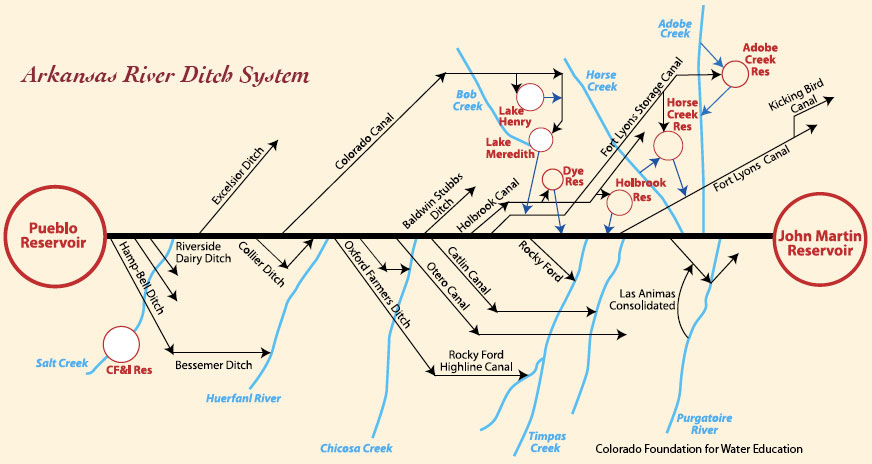
The Arkansas Valley Super Ditch Company will hold two shareholder meetings November 18 to gauge interest in the proposed leasing program

A picture named arkbasinditchsystem.jpg

From The Pueblo Chieftain (Chris Woodka):

The meetings both will be on Nov. 18: 1 p.m. at the Gobin Community Building in Rocky Ford; and 6 p.m. at the Lamar Community College Bowman Building. Shareholders on the Bessemer, Catlin, Fort Lyon, High Line, Holbrook, Otero and Oxford canals were sent letters last week with information about two lease agreements that would sell water to Aurora and the Pikes Peak Regional Water Authority over the next 40 years…

The Super Ditch board has approved agreements that would allow:

– Leases of up to 8,020 acre-feet per year to the Pikes Peak group in El Paso County for the next 40 years. The amount of water could increase to 20,000-25,000 acre-feet per year over time.

– Leases of up to 10,000 acre-feet per year to Aurora in three years out of 10, subject to restrictions specified under intergovernmental agreements until 2048.

Only the consumptive use of water could be leased and farm ground would have to be dried up during the lease period. Leases would be for $500 per acre-foot and the Super Ditch would be responsible only for moving the water to Lake Pueblo. The rate would escalate according to the Colorado Municipal League Utilities Index, and the leases could be extended by mutual agreement.

More Arkansas Valley Super Ditch Company coverage here and here.

Schweizer said the Super Ditch board has talked about limiting the participation to 30-35 percent of acreage.

Arkansas Valley: Pure Cycle is looking for ways to make some dough on its investment in valley irrigation water

A picture named arkbasinditchsystem.jpg

From The Pueblo Chieftain (Chris Woodka):

“We haven’t changed our plans at all,” said Mark Harding, president of Pure Cycle. “We’re still very interested in participating in this municipal-agricultural partnership.”[…]

Shortly after the purchase, Harding explained that Pure Cycle was looking for opportunities to use the water within the Arkansas River basin, as well as its stated intention of building a pipeline to take the water from the valley. Harding was among those who incorporated the Arkansas Valley Super Ditch in 2008, improving the chances that those Fort Lyon shares could be used within the valley.

Pure Cycle inherited conditions that were put on its Fort Lyon farms when High Plains A&M attempted to change the use of the water. In 2003, the Fort Lyon board approved moving the water outside the ditch, provided it was taken in rotation. In 2004, District 2 Water Judge Dennis Maes denied High Plains’ application to change the use of water because it was speculative. The Colorado Supreme Court upheld that ruling following a challenge by High Plains. Pure Cycle announced plans to build a pipeline from the La Junta area when it bought the water in 2006, although it soon became apparent those plans were years away. Pure Cycle now serves only about 300 homes, although it is in line to provide water for 24,000 acres of future development on the former Lowry Range east of Aurora, as well as a 5,000-unit development on Sky Ranch. For now, Pure Cycle continues to farm the land it owns on the Fort Lyon…

Harding also is noncommittal on what impact participating in the Super Ditch would have in stopping or delaying a pipeline from the Lower Arkansas Valley. “There are limitations on exchange potential, so I’m not sure what infrastructure would be necessary,” Harding said. The Super Ditch has filed for an exchange decree that would move water up the river and into Lake Pueblo, which still has to be approved in Water Court. Approval of ditch companies, county commissioners and other agencies also is needed before contracts can be drafted.

Meanwhile, Aurora’s hands are tied by intergovernmental agreements with respect to buying and drying more agricultural land. Here’s a report from Chris Woodka writing for The Pueblo Chieftain. From the article:

“We can become a farmer,” Aurora Mayor Ed Tauer said this week. “We can’t move the water [newly acquired water rights], however, so it’s unlikely we’d buy a large amount.” At a meeting with the Arkansas Valley Super Ditch board Tuesday, Tauer talked about putting water supplies from existing or new farms purchased by Aurora into the pool of water rights that could be used for the Super Ditch. That possibility is also accounted for in a 2009 agreement with the Lower Arkansas Valley Water Conservancy District that allows Aurora to participate either as a buyer or seller of water through the Super Ditch.

A 2003 agreement with the Southeastern Colorado Water Conservancy District — fortified by the 2004 six-party intergovernmental agreement — doesn’t limit Aurora from acquiring new water rights in the Arkansas Valley, but does prevent it from using existing infrastructure or changing the use of any new water rights, said Mark Pifher, director of Aurora Water.

More Arkansas Valley Super Ditch coverage here and here.

Aurora: Prairie Waters Project update

A picture named prairiewaterstreatment.jpg

From Water and Wastewater (Lori Irvine):

The city of Aurora recently celebrated the completion of the Prairie Waters Project, an innovative and environmentally friendly water system that was finished ahead of schedule and more than $100 million under budget.

A large Colorado crowd excited to see the completion of the $653 million project gathered Friday, Oct. 8, for the system’s formal dedication. Speakers included Aurora Mayor Ed Tauer, Interim City Manager Nancy Freed, Aurora Water Director Mark Pifher, former Aurora Water Director Peter Binney and CH2M HILL Chairman and CEO Lee McIntire whose company provided design and program management services.

The project is the fastest, most cost-effective and environmentally sustainable way to meet Aurora’s water needs and went from design to completion in just five years. Construction broke ground in July 2007. The system includes 34 miles of 60-inch diameter pipeline, three pump stations, a natural purification area and a new water treatment facility that is one of the most technologically advanced in the country.

More Prairie Waters coverage here and here.

Aurora inks deal with the Arkansas Valley Super Ditch Company

A picture named arkbasinditchsystem.jpg

From The Pueblo Chieftain (Chris Woodka):

The board sees the move as a way to preserve water rights ownership in the Lower Arkansas River basin while providing Aurora with the certainty it needs in water resource planning. “The reason we started working on the Super Ditch was because of the reality that the cities have water needs, part of which was going to come from agricultural water,” said John Schweizer, Super Ditch president. “These leases will allow us to spread the effects of moving water over a number of ditches and avoid the bad effects of buy and dry. These leases will provide farmers with another crop with a guaranteed price and help them manage their risk and their business.”

Under agreements reached with other water users in the Arkansas Valley, Aurora can lease water only three years of every 10. The leases are confined to years when Aurora’s water supply is at less than 60 percent capacity, as a way to make up for lost yield from the Arkansas Valley water rights it owns in Crowley, Lake and Otero counties…

Major provisions of the agreement between the Arkansas Valley Super Ditch and Aurora:

– Aurora could buy up to 10,000 acre-feet of water per year until 2048 for any three years in a 10-year period up to a maximum of 145,200 acre-feet, provided that Aurora may lease more frequently in the final 15 years. The terms are the same as in Aurora’s 2003 agreement with the Southeastern Colorado Water Conservancy District, which was reaffirmed in a six-party intergovernmental agreement in 2004.

– Aurora would pay $500 per acre-foot annually, which would be adjusted according the Colorado Municipal League index of Colorado utility costs.

– The Super Ditch, in cooperation with the Lower Arkansas Valley Water Conservancy District, will provide legal counsel, engineering and other services to change water rights on the participating ditches. Aurora may participate as a co-applicant.

– Aurora is responsible for storage and exchange above Lake Pueblo. Aurora has obtained a contract from the Bureau of Reclamation for storage in Lake Pueblo and exchange to Twin Lakes for 10,000 acre-feet of water annually until 2048.

– Aurora agreed to support in concept legislation that would allow administrative approval of long-term temporary water transfers by the State Engineer.

– Aurora agreed to work with the High Line Canal board of directors and shareholders to sustain support of the Super Ditch water leasing program. Aurora reached a similar leasing agreement with the High Line board in 2008.

– The agreement is contingent on the signup of a sufficient amount of water, since water right owners in the Super Ditch are not required to participate in any specific lease agreement.

– Bylaws of participating ditches must be amended by Feb. 1, 2011.

– Aurora must comply with its 2009 agreement with the Lower Ark district, which stayed a federal lawsuit by the Lower Ark district against Reclamation over the Aurora contract. That agreement would extend restrictions on moving water out of the valley past the current 2048 date.

– County 1041 permits and Aurora City Council approval are required.

More Arkansas Valley Super Ditch coverage here and here.

Aurora: Water treatment system background

A picture named watertreatment.jpg

From the Aurora Sentinel (Sara Castellanos):

The city’s water supply is derived primarily from snowmelt runoff in the Colorado, Arkansas and South Platte river basins. The water is then stored in 12 reservoirs and lakes including Aurora, Homestake, Twin Lakes and Rampart. It’s transported to the city from as far as 180 miles away through pipes, tunnels and pumps. There are nine staff members at the Wemlinger Treatment Plant who have more than 200 years of combined experience in the water quality field, with extensive knowledge in the world of chemistry. “It’s awesome to be associated with so many people who care so much about making really great water,” [Sherry Scaggiari, quality control supervisor] said. “We don’t say, ‘OK, what’s the level we have to meet?’ We say, ‘We are going to do better than that, and we are going to lead the industry.’”[…]

The contaminants in the city’s water are far below the allowable level mandated by state and federal laws. For example, the maximum contaminant level of total coliform bacteria, which is naturally present in the environment, is no more than 5 percent per month. The highest monthly percentage found in Aurora’s water was 0.52 percent, according to the 2010 Water Quality report. Only one sample was found positive for total coliform bacteria out of 2,268 samples. Hard work has paid off for the employees at the Wemlinger Treatment Plant. In 2009, the plant was awarded the “Excellence in Water Treatment” status after undergoing three levels of review by the American Water Works Associations’ Partnership for Safe Drinking Water program. Wemlinger is one of six treatment plants in the country to receive the award.

More water treatment coverage here.

Aurora: Prairie Waters dedication recap

A picture named prairiewaterstreatment.jpg

From the Aurora Sentinel:

Hundreds of people attended the Prairie Waters Project opening celebration last week at the Peter Binney Water Purification Facility near the Aurora Reservoir…

It is expected to increase Aurora’s water supply by 20 percent and deliver up to 10,000 acre-feet of water per year…

“Water projects in the arid west don’t just happen,” said Mark Pifher, director of the city’s water department, at the celebration. “They require the natural resource itself — the water, many permit approvals, technological means to capture that water, to treat it and distribute it, and perhaps most importantly … projects of this nature need the political will to bring them forward from design to fruition. This project possessed all of those attributes.”

More Prairie Waters coverage here.

Aurora: Prairie Waters dedication today

A picture named prairiewaterstreatment.jpg

From the Denver Business Journal (Cathy Proctor):

The project (website here) boosts Aurora’s water supply by 20 percent — about 3.3 billion gallons of water a year. It came in ahead of schedule and $101 million under the original $754 million budget, said Greg Baker, spokesman for the Aurora Water Department. “We’re ahead of schedule and well under budget,” Baker said. “How often does a city get to say that?”

Water equivalent to what Aurora gets from the Western Slope, uses and sends into the South Platte River is pumped out of the river near Brighton, then filtered through a series of gravel and sand beds into a pipeline. The 34-mile pipeline sends the water to a new treatment plant. From there it goes on to city residents and businesses — who use it before its returned to the river. It’s a continuous loop of use and re-use. “It’s one of the most sustainable new water supplies in the Southwest,” said Scott Ingvoldstad, a spokesman for CH2M Hill. “It combines natural purification with a state-of-the-art new treatment facility that uses the latest technology to ensure that Aurora will have a sustainable and high-quality water supply for many decades. “It uses water rights that Aurora already owns and recaptures them in the South Platte River so that they didn’t have to build a new dam on the Western Slope. It’s making the most efficient use of the water rights that they already own,” Ingvoldstad said.

More Prairie Waters coverage here and here.

Englewood and Aurora agree to long-term water deal

A picture named southplattecanoe.jpg

From the Englewood Herald (Tom Munde):

“This is a very good good agreement for both cities,” Stu Fonda, utility director, said as he presented the proposal to the Englewood City Council during the Sept. 7 study session. “The proposal changes the old agreement under which we received an average of 238 acre feet of water a year. The new agreement calls for Englewood to receive 509 acre feet of water single use water. Aurora benefits because it provides that city with water that can be reused over and over. There is no specific amount designated but I would guess the amount of reuse water they realize will exceed what they are providing us.” Fonda said the proposed intergovernmental agreement with Aurora calls for that city to annually deliver the water to Englewood by routing it to Chatfield Reservoir between July 1 and Aug. 15. Englewood then will send water down to city ditch, where it will either be stored in McLellan Reservoir or sold to Highlands Ranch…

Fonda said the additional 271 acre feet of water from Aurora is a valuable asset since water is valued at between $10,000 to $20,000 an acre foot. Using those figures, the additional water is worth between about $2.7 million and $5.4 million.

More South Platte Basin coverage here.

Arkansas Valley ag future

A picture named rockyfordditch.jpg

From The Pueblo Chieftain (Chris Woodka):

In the two years he’s been butting heads with the state Division of Water Resources, [Dan Henrichs, superintendent of the High Line Canal] has not been able to reconcile how irrigating with sprinklers could increase water use. There are so many variables — the market price of crops, the type of crop planted, how much water is running down the ditches, whether it just rained, how much water your neighbor is using, whether he’s just cut hay and is bypassing flows, whether it’s raining on the hay just cut, whether a hail storm has wiped out more valuable crops …

“This is not about a bunch of old farmers who want to sell their water and move to an island,” Henrichs said. He ticked off the names of a dozen young farmers who’ve bought farms in the 10 years he’s been superintendent on the High Line.

It’s getting harder to buy land because speculation has driven water prices up. Land under the High Line has sold for as much as $5,700 an acre, more than double what it was a decade ago.
Circumstances vary, but it’s usually farmers “born and bred into the life” who are purchasing the land with the intent to farm far into the future…

The High Line board has given Henrichs unusual latitude as superintendent to travel widely and represent it on water issues. Henrichs is a member of the citizens advisory group for the Fountain Creek Watershed Flood Control and Greenway District and on the Arkansas Basin Roundtable.
He was a forceful presence in the Vision Task Force that led to the Fountain Creek district. He constant registered complaints as part of the task force looking at consumptive use rules.
There’s a reason for all that. “Where are they going to come next?” Henrichs said, reviewing the Pueblo Board of Water Works foray into the Bessemer Ditch, Aurora’s purchases on the Rocky Ford Ditch and water grabs that sucked Crowley County dry. “They’re going to come to the High Line.”[…]

The events since the historic drought of 2002 bear that out. Rather than sell their water rights after the worst rain year in history, the High Line farmers worked out a lease agreement to sell water to Aurora in 2004-05. Colorado Springs joined in the second year of that deal. Most farmers on the High Line will tell you that the Aurora deal was nothing but a blessing. It allowed them to pay off debt or make needed improvements after a farming season that could have bankrupted them. Soon after, High Line and Aurora jointly filed in Division 2 Water Court to make exchange rights permanent so that if the need for another lease deal arose, they could avoid a time-consuming substitute water supply plan. The High Line-Aurora deal set the stage for the Arkansas Valley Super Ditch, a water lease-fallow land program that includes shareholders from seven ditches, including the High Line. High Line countered with its own leasing program and plans that could include a pipeline to the thirsty cities of the north. This year, a new wrinkle was added when the Woodmoor Water and Sanitation District contracted to buy several farms at the end of the High Line Canal. Moving the water would require a change in the ditch company bylaws, so for now the High Line board will not approve the transfer.

Many High Line farmers do not oppose the sale of water rights — they see it as their right as property owners to sell to whomever they want and bristle when outsiders tell them they cannot. Still, they are wary that taking water out of the ditch could reduce the flows that carry water to their own headgates, and will do what it takes to protect the ditch.

More coverage from Chris Woodka writing for The Pueblo Chieftain. From the article:

…Vernon John Proctor, is a board member of the High Line Canal and takes a longer view of the problems agriculture has faced. The current recession began in 2008, but farmers hardly noticed, other than when fuel prices increased, Proctor said. “We’ve been in a suppressed economy for years. Everything we buy is at retail, and everything we sell is at wholesale,” he said…

Proctor was among farmers who leased water to Aurora in 2004-05, and was a member of the board that negotiated the details. He said the lease prevented him from having to sell the water rights. “I’m not looking at selling, I plan to pass everything on to my sons if possible,” Proctor said. “When you can’t produce a crop, you need something to fall back on. As long as you can stay above water, it’s a good life. You are your own boss. “But if you get into trouble, the land and the water are your only assets.”

More Arkansas Basin coverage here.

The Arkansas Basin Roundtable gets ‘tipping point’ study pitch

A picture named arkansasriverbasin

From Wikipedia:

In sociology, a tipping point or angle of repose is the event of a previously rare phenomenon becoming rapidly and dramatically more common. The phrase was coined in its sociological use by Morton Grodzins, by analogy with the fact in physics that adding a small amount of weight to a balanced object can cause it to suddenly and completely topple.

Here’s a report about the proposed tipping point study of dry-ups in the Arkansas Valley, from Chris Woodka writing for The Pueblo Chieftain. From the article:

At the roundtable meeting, economists Richard Gardner and George Oamek stressed they are doing preliminary work, and could not readily answer questions about deeper economic impacts. Roundtable members wanted to know if the study would look at the relative wealth of the people who remain in an area, and whether they would be newly affluent sellers of water or welfare recipients. The economists said that could vary by community, and they were unwilling to draw a broad conclusion.

Turns out, the answers — for Crowley County, at least — were already detailed in a background paper for the study.

Gardner, Oamek, David Kracman and Ken Weber prepared a community economic profile for Crowley County that weighs the gains and losses to the county, factoring in the development of prisons to replace the agricultural jobs lost.

The result is a distressing template for other communities, showing that population growth has come only in the form of prison inmates, that new jobs went to people in other counties and that poverty is increasing.

“Crowley County is a testament to the negative externalities that communities bear when large amounts of water rights are sold out of the region,” the report states. “The loss of an important basic industry can ripple through Main Street and take down communities.”

More Arkansas Basin coverage here.

The Upper Ark’s Terry Scanga is keeping a close eye on Aurora’s leasing operations

A picture named arkansasriverbasin

From The Pueblo Chieftain (Chris Woodka):

[Terry Scanga’s] concern is what Aurora does in the years when it has more water than it needs to satisfy its primary service area — the city of 300,000 people. By entering long-term contracts to provide water to others, Aurora is increasing the chances it would have to call for more water from its sources in the Arkansas and Colorado basins…

What really irks Scanga is a deal Aurora reached last year with Nestle Waters North America to supply augmentation water for 200 acre-feet annually, at a cost of about $800 per acre-foot. The contract is for 10 years, subject to availability of water. “Nestle was a double whammy because it also takes water out of the basin,” Scanga said. At the time the deal was reached, the Upper Ark district had been negotiating with Nestle for a higher price, about $1,200 per acre-foot. Ironically, the Upper Ark was involved because the water would be provided by Salida, which through its own decree is restricted to use the water within its own service area — city limits. “Our rates were based on funding something needed in this basin. Salida couldn’t sell it under their decree, and Nestle didn’t have a decree,” Scanga said. “The money would have gone for storage, which would in the long run give Nestle a firm supply. The key was, we were expecting Nestle to come back and negotiate.” Instead, Aurora snapped up the contract, a move that four members of the city’s 11-member council actually opposed. Some said it had little benefit to Aurora. Earlier this year, the Upper Ark district filed comments on the substitute water supply plan Nestle needs to use Aurora’s water, specifically asking the Colorado Division of Water Resources not to allow Arkansas Valley water to be used in the Nestle contract. “The proposed lease of water by Aurora to Nestle has the potential to defeat the purpose of (the 2003) IGA,” attorney Julianne Woldridge wrote in the comments. The state agreed, and restricted Aurora to using Colorado River water in augmenting Nestle depletions in the final March plan…

In late 2009, Aurora and its new partner, Climax Mines, filed for a change of rights on the Columbine Ditch. In that application Aurora seeks to add additional places and types of use for the water in the Arkansas River basin, a move the Upper Arkansas district opposes.

Aurora also entered an agreement with South Metro Water Supply Authority in late 2009 that has the potential to add more uses for water from all three basins to the South Platte area. Aurora already provides water for everything from the upscale community of Roxborough, to gravel pits, to farmers downstream, through its South Platte system.

More Aurora coverage here.

Aurora Water wins a ‘Best of the best’ award at AWWA taste test competition

A picture named waterfromtap

Here’s the release the AWWA via Earth Times:

The American Water Works Association (AWWA) today announced that Wisconsin’s Stevens Point Water Department won the annual “Best of the Best” Water Taste Test. The event, composed of regional winners from water-tasting competitions across North America, was held at AWWA’s Annual Conference and Exposition (ACE10) in Chicago.

Stevens Point Water Department, now known throughout North America for its tasty water, has reliably provided Stevens Point residents with groundwater since 1922.

Second place in the competition was awarded to the New York City Department of Environmental Protection while Lincoln Water System of Nebraska and Silverdale Water District of Washington tied for third place.

Other “Best of the Best” participants in today’s competition included: City of Allegan, MI; City of Blythe, GA; Aurora (CO) Water [ed. emphasis mine]; Ave Maria (FL) Utility Company; Massachusetts Water Resources Authority; Village of Canajoharie (NY) Water Works; Guaraguao Treatment Plant, Ponce, PR; City of Hamilton, OH; Hardin County (KY) Water District No. 2; Kearns (UT) Improvement District; Marshalltown (IA) Water Works; Moorhead (MN) Public Service; San Patricio (TX) Municipal Water District; St. Charles (LA) Water District No. 1; City of Stratford, ON; Valley City (ND) Public Works; and the Village of Park Forest, IL.

An esteemed judging panel rated each water system on its flavor characteristics. Judges included Dr. Stephen Booth of Kennedy/Jenks, who is also chair of AWWA’s Taste and Odor Committee; Monique Durand, engineer at Hazen and Sawyer, P.C and member of the Taste and Odor Committee; Dr. Pinar Omur-Ozbek, research assistant professor in the Department of Civil and Environmental Engineering at Colorado State University; and Matt Rodewald, reporter for Chicago’s NBC affiliate.

This is the sixth year AWWA has held the national competition. Previous winners are Macon (GA) Water Authority (2009), the Louisville (KY) Water Company (2008), Oklahoma City Water and Wastewater Utility (2007) and Illinois American Water, Champaign District (2006 and 2005).

ACE10 gives its more than 12,000 attending water professionals a chance to network and stay abreast of innovative technology and best practices for providing safe water. To facilitate professional development, AWWA offers two exhibit hall education sessions, six in-depth Sunday workshops and 92 professional sessions.

AWWA is the authoritative resource for knowledge, information, and advocacy to improve the quality and supply of water in North America and beyond. AWWA is the largest organization of water professionals in the world. AWWA advances public health, safety and welfare by uniting the efforts of the full spectrum of the entire water community. Through our collective strength we become better stewards of water for the greatest good of the people and the environment.

More Aurora coverage here and here.

Nestlé Waters North America’s Chaffee County Project to start delivering Arkansas Basin water to Denver bottling plant next month

A picture named nestlehaffeepipelinec

From the Colorado Independent (Scot Kersgaard):

Not everyone is happy about this. Buena Vista and Salida have birthed a protest movement that has been more noisy than effective. By some estimates, 80 percent of the roughly 17,000 people in Chaffee County are opposed to this diversion of water. Still, when it came time to issue permits, the three-member Board of County Commissioners was unanimous in approving Nestle’s plans. In the end, it was probably a combination of fear and Old-West style property rights values that carried the day for Nestle.

Commissioner Tim Glenn, the lone Democrat on the board, told a local reporter “Out and out denial of the permit… well you know what would’ve happened… we would have been sued.”

Commission Chair Frank Holman, on the other hand, thinks the Nestle deal is good for the county. “It is a good thing,” he said. “The county will get 12 to 15 new full-time truck driver jobs out of this. And those jobs are sorely needed,” he said…

Holman plays down concerns. He said that most of the water Nestle will be draining away would have flowed directly into the Arkansas, so the Aurora augmentation water more than makes up for what will be piped to Johnson Village and poured into trucks. He adds that the deal is now a matter of private property rights. Nestle now owns the land where the water originates, he said, and the company has leased the augmentation water to replace the water its carting away, so Nestle is well within its rights. “Nestle is a good neighbor,” he said. “They are giving us money to help with schools. They are creating a conservation easement on their land. And they are creating river access for fishermen.” Nestle has given $500,000 to two local school districts as an endowment from which the districts can spend the interest or earnings. The company has verbally promised to create a conservation easement on most of the land it has purchased, but no easement has yet been recorded…

Nestle is paying Aurora $160,000 a year for the water. The amount paid increases 5 percent a year for the first 10 years of the lease. After 10 years, Nestle has the option of requesting a second 10-year term. If Aurora agrees, the price will increase 3 percent a year for the final 10 years. Nestle can break the agreement at any time. Aurora can only break the deal if it can demonstrate that it needs the water for its own uses. The Aurora City Council voted 7 to 4 to approve this deal last year.

“The thing that gets me most fired up,” said Graham, “is how illogical it is to take our water, pipe it five miles to a truck plant, send 25 trucks of it to Denver every day, and then put it in plastic bottles. Considering that anyone can just turn a tap in their home and get the same water. It is just absurd.”

More Nestlé Waters North America’s Chaffee County Project coverage here and here.

Attorney General Suthers proposes $1.6 million settlement for Lowry Landfill

A picture named lowrylandfill2008

From The Denver Post (Bruce Finley):

Companies that contributed to pollution at the 508-acre site and now would pay damages to the state, include Molson Coors Brewing Co., ConocoPhillips Co., Gates Corp., Shell Oil Co., Cyprus Amax Minerals Co., Roche Colorado Corp., S.W. Shattuck Chemical Co. and Alumet Partnership. The Metro Wastewater Reclamation District and the cities of Littleton, Englewood and Lakewood also would pay.

State prosecutors focused on lost public use of groundwater. “This settlement provides an equitable and appropriate solution to address the injuries at the Lowry Landfill Superfund Site,” state Attorney General John Suthers said. “The agreement will allow Colorado to move forward on resource restoration instead of spending years locked in costly litigation.”[…]

Denver set up the landfill in 1964 using land in Arapahoe County that had been used as a bombing range and conveyed by the federal government. Companies dumped about 138 million gallons of liquid industrial waste at the site near Gun Club Road and East Hampden Avenue between 1965 and 1980. Then, Waste Management Inc. ran the landfill for garbage disposal until 1990. An Environmental Protection Agency investigation in 1994 established the presence of hazardous substances in the groundwater, surface water and soils. A cleanup that began in the mid-1980s — run by the state with EPA supervision — is still incomplete.

The settlements, proposed in U.S. District Court, depend on comments received over a 30-day period. Under one settlement with Denver, Waste Management and Chemical Waste Management Inc., about $500,000 would be used for loans to low- and middle-income households needing sewer repairs to help improve groundwater…

EPA officials monitor efforts to contain and reduce a toxic plume in shallow groundwater, [EPA spokesman Rich] Mylott said. That water is being treated. State and federal cleanup officials have indicated no significant health risk linked to contamination at the landfill.

More superfund coverage here.

Fryingpan-Arkansas Project: Federal legislation to allow Aurora’s use of project facilities making little headway in D.C.

A picture named fryingpanarkansasproject.jpg

From The Pueblo Chieftain (Chris Woodka):

Little progress has been reported in attempts to change federal legislation to allow Aurora to legally use the Fryingpan-Arkansas Project to move water out of the Arkansas Valley. Aurora and the Lower Arkansas Valley Water Conservancy District are attempting to persuade federal lawmakers to change the law as part of a settlement of the Lower Ark’s 2007 lawsuit against the Bureau of Reclamation…

While there have been numerous behind-the-scenes, often closed-door meetings among lawyers, staff and lawmakers since then, there has been no movement toward federal legislation, according to a joint brief by attorneys Stuart Somach, for Aurora, and Peter Nichols, for the Lower Ark. The brief was filed Wednesday in the Denver U.S. District Court. “For the majority of the current 111th Congress, the U.S. House of Representatives and Senate have both been preoccupied with drafting, debating and passing health care reform legislation, and more recently with financial reform legislation,” the lawyers reported. “This preoccupation and the upcoming congressional election have rendered it difficult for Colorado’s delegation to fully engage in the process for developing the necessary legislation to implement the settlement agreement.”

Nevertheless, there have been meetings with lawmakers and Secretary of Interior Ken Salazar toward drafting the legislation, which includes many of the same provisions that once were bundled in attempts to gain approval for the Preferred Storage Options Plan sponsored by the Southeastern Colorado Water Conservancy District. Meetings this year began Jan. 20, when Aurora met with representatives from the Lower Arkansas Valley Super Ditch, when negotiations on possible leases were opened. No deals have been reached…

On March 9, staff from the Lower Ark district and Aurora met with other PSOP parties: Colorado Springs Utilities, Pueblo Board of Water Works, city of Pueblo, the Southeastern Colorado Water Conservancy District and Fountain. The meeting was not open the public or press, a change from a negotiating process that Salazar, then a U.S. senator, used in 2007 to attempt to solve PSOP. It apparently did not include other parties that had been invited to the PSOP meetings, such as Pueblo West, Lake County, Pitkin County or the Colorado River Conservation District…

Aurora made presentations to the Lower Ark district on March 23, which were covered in The Chieftain. The presentations detailed progress on Super Ditch negotiations, Aurora’s commitment to pay $2 million for Lower Ark projects and shared Aurora’s experience in water lease programs. Meetings with lawmakers began in March, when Aurora and the Lower Ark met with U.S. Sen. Mark Udall and his staff in Washington. Udall directed his staff to set up meetings with staff from other members of the Colorado delegation to discuss the legislation sought under the settlement agreement. There was no public mention of the meetings until the federal court brief was filed. In the March 22-24 trip, Aurora and the Lower Ark district also met with U.S. Rep. Ed Perlmutter and staff for U.S. Sen. Michael Bennet, and U.S. Reps. Mike Coffman, Betsy Markey and Doug Lamborn. Lower Ark officials also met with Ken Salazar’s staff. The first legislative staff meeting was at Udall’s Denver office, was April 30, as staff from the offices of Udall, Bennet, Perlmutter and U.S. Rep. John Salazar met with Lower Ark and Aurora attorneys.

More Aurora coverage here and here.

Ruedi Reservoir operations update

A picture named ruedidam.jpg

From email from Reclamation (Kara Lamb):

If you’re interested in what releases from Ruedi Reservoir to the Fryingpan River will look like this spring, then Wednesday May 12, 2010 needs to be on your calendar. On that day, Reclamation will host the first of two Ruedi Reservoir operations meeting scheduled for this year.

The May 12 meeting will be held at the Basalt Town Hall, 101 Midland Avenue, Basalt, from 7:00—9:00 p.m.

The primary focus of the meeting will be on Ruedi Reservoir’s operations over the past water year (2009) and projected operations for the current water year (2010). Included in the presentation will be an overview of Reclamation’s role as a water resource manager in Colorado.

As always, the meeting will conclude with a public question and answer session.

A second operations meeting will be held at the same location in late July. The second meeting will provide an update on projected reservoir operations for the month of August and for early fall, key fishing seasons in Basalt, Colo.

For more information, please contact Kara Lamb, Public Information Coordinator for Reclamation’s Eastern Colorado Area Office, by phone or e-mail: 970/962-4326 or klamb@usbr.gov or visit our Website at http://www.usbr.gov/gp/ecao/ruedi.html.

More Fryingpan-Arkansas Project coverage here and here.

Aurora: Prairie Waters Project update

A picture named prairiewaterstreatment.jpg

From The Pueblo Chieftain (Chris Woodka):

If it weren’t for an array of metal electrical boxes and some pipes sticking up from the ground, there would be little to indicate that a state-of-the-art water system is percolating under your feet. Driving along the pipeline, which follows E-470 for about half of its 34 miles north to Aurora, you try not to blink or you’ll miss the pump station visible from the freeway. When you reach the Peter D. Binney Water Purification Facility just below Aurora Reservoir, you’re tempted to walk inside and ask for the park ranger. There’s water cascading down some steps into a clear blue pond — called a forebay. “There’s not much to see until you get into the water treatment plant,” Aurora Water director Mark Pifher apologizes…

“About 90 percent of our water is reusable in the system from all sources,” Pifher said. “Since all sources come through the treatment plant in Denver, we will use them all in the same proportion.” Aurora draws water from the South Platte, Colorado and Arkansas river basins, and reusing more of it through Prairie Waters will cut down on the amount it takes from its sources. Initially, the $659 million Prairie Waters Project will recycle up to 10,000 acre-feet — 3.25 billion gallons — each year.

“The footprint’s there so we can expand it to 50,000 acre-feet as we grow,” Pifher said. That would nearly double Aurora’s water supply from its current yield of about 58,000 acre-feet…

The first water moved through it this week, as workers and engineers tested the lines installed over the past three years. The project is more than 90 percent complete and a formal dedication is planned in September…

Aurora ratepayers will finance about 60 percent of the project, while new growth in the city is expected to pay for the rest. That’s a somewhat unusual mix for a water project, with more cost usually assigned to growth, but the drought hardening aspect of the project benefits Aurora’s current users, who have been under constant restrictions for water use since 2002. Once Prairie Waters is up and running, it will not take any additional employees to run it. The pump stations require periodic maintenance, and the automated water purification plant requires only six operators, Baker said.

More Prairie Waters coverage here and here.

Roaring Fork Conservancy warns that Nestlé Waters Chaffee County Project will include transmountain water

A picture named nestlehaffeepipelinec.jpg

Nestlé Waters North America announced last year that they had struck a deal for augmentation water from Aurora via Twin Lakes for the bottled water giant’s Chaffee County Project. Nestlé Waters’ plan is to truck 200 acre-feet or so out of basin to Denver for bottling. The Roaring Fork Conservancy is spreading the word in the valley, according to a report from Scott Condon writing for the Glenwood Springs Post Independent. From the article:

A plan by a subsidiary of Nestlé to bottle water near Buena Vista could have implications for the Roaring Fork and Fryingpan rivers, the Roaring Fork Conservancy warned this week. It also signals that the beverage industry is on the prowl for high mountain spring sites in Colorado’s mountains — another potential threat to limited water supply of the Roaring Fork watershed, said Tim O’Keefe, education director for the Roaring Fork Conservancy, a Basalt-based nonprofit focused on water quality and quantity issues. “We’re trying to use what’s happening in [Buena Vista] to sound the alarm,” O’Keefe said…

Aurora diverts water from Grizzly Reservoir, about 10 miles east of Aspen. That water is piped via the Independence Pass Transmountain Diversion Project to the east side of the Continental Divide, dumped into Lake Creek and stored in Twin Lakes Reservoir. Aurora also diverts water from the upper Fryingpan basin through the Busk-Ivanhoe Project to Turquoise Reservoir, which also feeds Twin Lakes. Numerous documents tied to the Nestlé plan indicate that Twin Lakes is among the sources Aurora can use to sell water to Nestlé to augment the Arkansas River, according to G. Moss Driscoll, an attorney who recently interned with the Roaring Fork Conservancy and helped with the position paper on bottled water. “There’s no doubt it will involve transbasin water,” Driscoll said.

[Aurora] intends to use water purchased from Lake County ranches and the Columbine Ditch to feed the Arkansas River directly and fulfill its augmentation contract. Water from Twin Lakes is listed as a possible source for augmentation, but is unlikely to be used, Baker said. Even if it is, very little comes from the upper Fryingpan and Roaring Fork drainages. The vast majority of Aurora’s water diverted from the mountains comes from Homestake Reservoir, another source that leads to Twin Lakes. In a strict accounting sense, some Roaring Fork water could be used to augment the Arkansas River, Baker said, but it would be a rare occasion and a small amount.

The Roaring Fork Conservancy counters that Nestlé’s bottling scheme is just another way, however small, that the Roaring Fork watershed is being tapped. “The two springs Nestlé is proposing to draw water from are fed directly by the Arkansas River, the flows of which are bolstered by transmountain diversions from the Roaring Fork Watershed,” the conservancy’s paper said. “On average each year, 37 percent of the runoff in the Upper Roaring Fork Subwatershed and 41 percent of the runoff in the Upper Fryingpan Subwatershed is diverted to the Arkansas River Basin.”

The conservancy is sponsoring the screening of a film called “Tapped” to educate people about the broader issues surrounding bottled water. The documentary is a “behind-the-scenes look into the unregulated and unseen world” of an industry that is trying to turn water into a commodity. It’s from the producers of “Who Killed the Electric Car” and “I.O.U.S.A.” The movie will be shown at 7 p.m. on March 31 at the Wheeler Opera House in Aspen and at 7 p.m. on April 6 at the Church at Carbondale. Tickets are $9.

More Roaring Fork watershed coverage here.

Aurora: Prairie Waters Project update

A picture named prairiewaterstreatment.jpg

From the Aurora Sentinel (Sara Castellanos):

Once it’s completed later this year, city officials guarantee that Aurora residents will have enough water to sustain them during droughts for decades…

The goal of the project, which broke ground in July 2007, is to collect water from the South Platte River in Brighton and deliver it to the city through a 34-mile-long pipeline, while using state-of-the-art technology to purify the water to the highest degree. When the project is completed in a few weeks, it could increase Aurora’s water supply by 20 percent and deliver up to 10,000 acre-feet of water per year…

The project was funded by raising residential water prices and tap fees, and by issuing $450 million in bonds to be repaid over 30 years. The total estimated cost of the project at completion is $659 million, lower than the original projections of $755 million. “We were the beneficiary of an unfortunate deep recession,” said Pifher, who became the city’s water director in 2008 following Peter Binney, who originally conceptualized the Prairie Waters Project. “As a consequence of the recession there were many contractors out there looking for work and they were going to bid as low as they could just to keep their people gainfully employed.”[…]

Much of the project also uses new ideas, Pifher said, not only in terms of the technology that was implemented, but also because the water department found a way to maximize its water rights to the full extent. “The water resource is so scarce today in the arid part of the West that you can’t just go out and appropriate new water,” he said. “So you have to find a way to make use of what you have. That in itself is sort of cutting edge. When you combine all these cutting edge concepts, you do have a state-of-the-art facility and I think this will become the model for similar projects in the West.”

Other counties in the state in search of alternative water sources, such as Douglas County, would also be able to lease some of the excess water that would be produced as a result of the project, he said…

The project begins north of Brighton, off of State Highway 8 and County Road 85, at the site of the South Platte River. The first step in purifying the water from the South Platte River takes place underneath more than 100 acres of open space, where only a few, small man-made structures hint to what’s happening underneath your feet. “If you drove past this, you would never know this is where Prairie Waters begins,” said Greg Baker, spokesman for the water department. “And that was the idea.” More than 22 tunnels were constructed under roadways, waterways and railroad crossings so nearby people, wildlife and environment wouldn’t be disrupted. Water travels from the river through gravel and sand, which are natural filters, to 17 wells located about 300 feet from the river. The gravel and sand act as purifiers that filter out pharmaceuticals and personal care products. Baker said the project was designed so that the filtration systems from Brighton to Aurora would thoroughly remove pharmaceutical products, as city officials expect that the U.S. Environmental Protection Agency will make that a requirement in the near future. Water samples have already been taken from the wells and studies by the Colorado School of Mines show that about 90 percent of the purification process occurs from the river to the wells. “That’s the neatest thing, as far as I’m concerned,” Baker said. “We’re not using any high technology, we’re not using a tremendous amount of energy to do this, and yet we’re addressing probably one of the biggest issues in water today which is the pharmaceutical industry.”[…]

From the North Campus, the water will flow along the pipeline that largely follows the E-470 highway. The pumping stations are located in Brighton, Commerce City and Aurora, and each station has one 1,250 horsepower pump and one 600 horsepower pump to push the water to Aurora over a nearly 1,000-foot increase in elevation. The water will then flow to the Peter D. Binney Water Purification Facility, where the water is further filtered using 14 ultraviolet reactors and activated charcoal to destroy unwanted contaminants.

More Prairie Water Project coverage here and here.

Lake Pueblo: Flood control waiver from U.S. Army Corps of Engineers

A picture named puebloreservoir.jpg

Aurora’s water may not spill this spring, according to a report from Chris Woodka writing for The Pueblo Chieftain. From the article:

Under operational rules, Lake Pueblo’s elevation must be lowered by April 15 to provide space to contain flood waters. About 3,000 acre-feet of water could be spilled. The water spilled would be in excess-capacity accounts held by users outside the Southeastern Colorado Water Conservancy District and spilled on a pro-rata basis. The largest account is Aurora’s, but the Round Mountain Water District in Custer County and the town of Victor in Teller County also have water storage in Lake Pueblo. If snowpack upstream of Lake Pueblo remains below average, however, water users will be granted a two-week extension to move water out of the reservoir under the agreement between the Corps and the Bureau of Reclamation, which operates Lake Pueblo. The agreement allows storage of up to 10,000 acre-feet above flood-control levels until May 1, said Ray Vaughan, manager of the Fryingpan-Arkansas Project. “This is a one-time, temporary, two-week extension,” Vaughan told the Southeastern Colorado Water Conservancy District board Thursday.

More Fryingpan-Arkansas Project coverage here.

Aurora: Prairie Waters Project update

A picture named prairiewaterstreatment.jpg

From The Denver Post (Carlos Illescas):

Prairie Waters, the city’s new $659 million water-purification and -recycling system, will be completed ahead of schedule and almost $100 million under budget. Project managers attribute the savings to good planning and trimming nonessential features from the plant. They also say the bad economy helped ratchet costs down. Contractors desperate for work submitted low bids for many of the jobs in the construction of the system, Aurora Water spokesman Greg Baker said. “We took advantage of a strong bidding environment,” he said…

The city has raised residential water prices, nearly quadrupled tap fees and issued $450 million in bonds to pay for the project…

In good-water years, Aurora could lease water to communities such as Douglas County that are searching for new water sources. “Aurora Water has found something that of course will answer their concerns but also something to help the metropolitan area,” said Rocky Wiley, a former water-management planner for Denver Water who now works for a consulting firm. “It’s a viable answer, and it’s wet water,” Wiley said…

Up to 50 million gallons of water a day will be treated at the purification facility. During peak-demand periods, water treated at the facility will be mixed with mountain water and piped to homes.
“You’re always planning for the hottest day in July, when people are watering their lawns, taking showers, washing their cars, when every spigot is open,” Baker said. “We had to make sure our water supply would meet that demand.”

Aurora Water officials expect to dedicate the facility in September and will begin testing the system by December. It is scheduled to be running in full by the late spring or early summer of next year.

More Prairie Waters coverage here and here.

Aurora: Summer watering restrictions update

A picture named watersprinkler.jpg

From the Aurora Sentinel (Sara Castellanos):

The Aurora City Council voted unanimously to keep this year’s watering restriction the same as last year, with residents being able to pick which days they can water their lawns as long as they don’t water more than three days per week. Greg Baker, Aurora Water Department spokesman, said the vote means that water conservation techniques have been embraced by residents and have been effective in the past. “For the second year, council has expressed that the conservation ethic has been woven into the social fabric of the community,” Baker said in a statement. “Residents know that watering your lawn more than three days-a-week is not only unnecessary, but wasteful. We have the latitude to provide a little more flexibility to everyone’s busy day by letting them choose the days they want.”

More conservation coverage here.

Lake Pueblo storage update

A picture named puebloreservoir.jpg

Update: From KKTV.com (Jason Aubrey):

According to Vaughan, there are several reasons for the vast amount of water. One reason is the plentiful amount of precipitation that’s been falling for the last five years. The last time the reservoir was this full, a drought devastated its supply. It was down to a quarter of its capacity, or just over 21 billion gallons in October 2003. Another reason is because water has been moved downstream from several lakes to make space for Spring run-off from the western slope. With snowpack this year currently near the “average” range, the bureau hopes to capture 14 to 16 billion gallons of water. The third reason for the high water level is the Winter Water Storage program. Before the conservation program, farmers would simply flood their fields in the winter. Most of this water would eventually evaporate or move downstream and become useless before it could be used. Presently, the winter water storage system allows groups to store water in the reservoirs Flood Control space from November 15 through March 15.

From The Pueblo Chieftain (Chris Woodka):

As of Monday, the lake’s level was at 4,881.52 feet in elevation, meaning more than 261,200 acre-feet of water is behind Pueblo Dam — with more coming in daily. Lake Pueblo has not been that full since March 2000, according to Bureau of Reclamation records…

Federal rules on operation of the dam require storage to be capped at 256,949 acre-feet after April 15 to ensure the dam has the capacity to contain a flood. “Some of the canal companies plan to start taking out carry-over water by April 1,” said Roy Vaughan, manager of the Fryingpan-Arkansas Project. Farmers are storing about 15,000 acre-feet of winter water and project water in Lake Pueblo in accounts that must be cleared by May 1. About half of that is expected to be released by April 15. That still would leave about 5,000 acre-feet too much in storage, and the water could be spilled.

Part of the reason Lake Pueblo is full is that Reclamation has moved water from Twin Lakes and Turquoise Lake to make room for imports through the Boustead Tunnel later this year. Right now, snowpack in the Roaring Fork basin is about 89 percent of average, and 98 percent in the Arkansas River basin. Under similar conditions, imports of the year have totalled 45,000-50,000 acre-feet, Vaughan said.

More Fryingpan-Arkansas Project coverage here.

Fryingpan-Arkansas Project: Lower Ark and Southeastern working to get Aurora federal legislative approval to use the project

A picture named puebloreservoir.jpg

From The Pueblo Chieftain (Chris Woodka):

The Lower Arkansas Valley Water Conservancy District sued the Bureau of Reclamation in federal court over a 2007 contract that allows Aurora to store and exchange water at Lake Pueblo. As part of a settlement last year, the Lower Ark and Aurora agreed to try to persuade Congress to adopt legislation that officially lets Aurora into the Fry-Ark project. The federal court case was put on hold for two years. Thursday, the South- eastern Colorado Water Conservancy District board was given a progress report on how that legislation is developing. “It all will depend on whether Rep. (John) Salazar is ready to move or not,” Executive Director Jim Broderick said. Reps. Salazar, Betsy Markey and Ed Perlmutter — all Colorado Democrats — hosted meetings about the possibility of legislation and other water issues in Rocky Ford and Lamar last year. By the end of the year, no legislation had been introduced. The Southeastern district has supported the Aurora legislation since 2003, as part of its own agreement with the suburban Denver city of 300,000…

Meanwhile, the two districts took slightly different tacks this week in dealing with two water court filings by Aurora. Aurora is seeking a change of use for water in the Busk-Ivanhoe Ditch, which it shares with the Pueblo Board of Water Works. The ditch was once agricultural and owned by the High Line Canal. Pueblo already has a decree for uses other than agriculture. Aurora and Climax Molybdenum have formed the Fremont Pass Ditch Co. after buying the Columbine Ditch from the Pueblo Board of Water Works last year. They are seeking a change of use related to their own operations. Both are transmountain diversions, and identical water court cases have been filed in Water Divisions 1, 2 and 5.

The Lower Ark board Wednesday voted to enter the cases in order to monitor them and to protect the interests of their own transmountain diversion, the Larkspur Ditch. Lower Ark is buying Larkspur, which imports water from the Gunnison River basin, from the Catlin Canal. The Southeastern board voted to file a statement of opposition in the Busk-Ivanhoe case because the diversion for that tunnel is above the Fry-Ark collection system on the Western Slope.

More Fryingpan-Arkansas Project coverage here and here.

Aurora: City council receives water infrastructure news

A picture named fountainpavementdrawing.jpg

From the Aurora Sentinel (Aaron Cole):

According to Greg Baker, spokesman for the city’s water department, much of the city’s current sewage and water pipes are ending their 50-year life cycle within the next 10 years, and may need significant maintenance. “They all have aging infrastructure,” he said. “We’re coming up on a perfect storm in 10 years.”

That perfect storm includes aging sewer mains underneath the city’s streets, as well as other delivery systems within the city.

More infrastructure coverage here.

Aurora: City files for change of use for Busk-Ivanhoe rights, teams with Climax Molybdenum to change Columbine Ditch rights

A picture named turquoiselake.jpg

From The Pueblo Chieftain (Chris Woodka):

Aurora bought half of the Busk-Ivanhoe water system from the High Line Canal Co. in 1987, following the purchase of the other half from the ditch company by the Pueblo Board of Water Works in 1971. Aurora filed for a change of use decree in Division 2 Water Court in December. Identical applications have been filed in Division 1 (South Platte) and Division 5 (Colorado River) water courts. The project brings water from Ivanhoe Lake, located at 11,500 feet elevation on a tributary of the Fryingpan River west of Hagerman Pass, through a former railroad and highway tunnel to Busk Creek, which empties into Turquoise Lake near Leadville…

{Aurora] has imported more than 3,000 acre-feet per year from Busk-Ivanhoe for the past few years. The Pueblo water board manages the system, which includes two live-in caretakers at Ivanhoe Lake, but Pueblo and Aurora share the water equally. In its application, Aurora states it intends to use the water for all purposes in two basins, rather than its existing decree for agriculture in the Arkansas River basin. Aurora would continue some of those uses, but would also apply water to its delivery and reuse systems in the South Platte basin. Aurora takes the water through the Homestake Project, which it shares with Colorado Springs. In the application, Aurora lists its Box Creek Reservoir, located between Turquoise and Twin Lakes, as a potential storage place, even though it has not been built. It also lists several recharge pits or reservoirs in the South Platte River basin that have not been built.

Meanwhile here’s the lowdown on the Columbine Ditch, from Chris Woodka writing for The Pueblo Chieftain. From the article:

The Fremont Pass Ditch Co., owned by Aurora and Climax, filed an application for change of water rights in Division 2 Water Court in Pueblo last month. Identical applications were filed in Division 5 (Colorado River) and Division 1 (South Platte) water courts. The Pueblo water board sold the Columbine Ditch to the Fremont Pass Co. last year for $30.48 million, as part of its financing for the purchase of about 27 percent of the water rights on the Bessemer Ditch in Pueblo County.

The Columbine Ditch, located at 11,500-foot-elevation Fremont Pass 13 miles north of Leadville, is about two miles long and was built to serve irrigators in 1931. It diverts water from three small streams in the Eagle River watershed over the pass near Climax mining operations. The water board purchased the ditch in 1953 to meet long-term needs and changed the decree to municipal and other uses appropriate to its needs in 1993. The average yield of the ditch was about 1,700 acre-feet annually, but because of long-term limits that was expected to drop to 1,300 acre-feet per year. Aurora and Climax are seeking further uses, including snowmaking, wetlands creation and direct reuse among others. They also are asking the court to approve new places of use, including at the Climax Mine, a gravel pit reservoir near Leadville and in the Arkansas or South Platte basins as part of Aurora’s extensive water system.

More transmountain/transbasin diversion coverage here.

Raw water systems winter operations

A picture named twinlakesdiversionsystem.jpg

Here’s a look at winter operations for Pueblo’s raw water system, from Chris Woodka writing for The Pueblo Chieftain. Click through and read the whole thing. Here are a couple of excerpts:

“When we plow the roads out, those banks of snow start to melt and freeze again until they turn hard as rocks. The trucks can get pretty banged up, so those guys have to be careful,” said Bud O’Hara, water resources division manager for the Pueblo Board of Water Works. Avalanches, broken bulldozer blades and survival in a dozen feet of snow are all part of the job for those who maintain and clear the systems that bring the water over. “Every one is different,” O’Hara said.

The Twin Lakes system, where a caretaker lives year-round, is in a bowl of mountains where avalanches are common. Those who live with them say you can hear them coming. In the winter, the caretakers at Grizzly Lake, located in the high country of the Roaring Fork valley near Independence Pass, have to drive to Leadville through the Twin Lakes Tunnel for supplies because the drifts are too high to make the trip to Aspen. Their lifestyle is isolated in the remote valley.

More Pueblo Board of Water Works coverage here and here.

Arkansas Valley: Highline Ditch shareholders meeting recap

A picture named arkbasinditchsystem.jpg

From The Pueblo Chieftain (Chris Woodka):

High Line shareholders Monday agreed to Aurora’s request for more engineering on the ditch that sold Aurora water in a lease agreement to speed the city’s recovery from the 2002 drought. The decision came after a long day of re-examining the past deal with Aurora, complaints from shareholders that they are not being kept informed and debates about the merits of forming a leasing company vs. joining the Super Ditch. “We want to know if we should begin working on the engineering to move forward to get a permanent water right to lease to Aurora or others,” said Tom Simpson, Aurora engineering supervisor for the Arkansas Valley. “Do the shareholders want to move forward?” About five hours later, shareholders voted to allow Aurora to continue the engineering studies that will make future water deals easier.

Aurora and the High Line Canal jointly filed for an exchange water right in 2005 after a two-year lease program that was deemed successful by all involved. Aurora was able to replenish its badly depleted reservoirs, while High Line farmers had an instant source of income after a couple of tough farming years. The exchange right, however, still would require a substitute water supply plan from the state Division of Water Resources. Aurora wants to get started on a change of use decree in water court because it would save time in the future…

Simpson said the 2008 agreement is merely a framework and does not obligate shareholders. In fact, it benefits High Line by providing a $15,000-$25,000 annual maintenance payment. In the past two years, High Line has taken the payment by leasing water from Aurora for prices of $5-$10 per acre-foot. “We did not intend to say that anyone has to lease to Aurora rather than anyone else,” Simpson said. Aurora also has had preliminary discussions with the board about long-term leases in the future. The city is limited by a 2003 agreement with the Southeastern Colorado Water Conservancy District about how much water it can lease from the Arkansas Valley.

High Line is also exploring forming its own water leasing company, Superintendent Dan Henrichs said, in explaining a $70,000 grant from the Colorado Water Conservation Board. The canal wants to spend $30,000 of that toward setting up a company, and $40,000 to study water quality at the point on the river near its headgate. The idea would be to build a pipeline on land the canal owns on the north side of the river to serve customers in northern El Paso County or the South Platte River basin, Henrichs said. Other ditches could be brought into the plan, which might not materialize for 25 years, Henrichs said…

One board member candidly expressed his dismay over the afternoon’s arguments: “I’m disappointed,” said Vernon John Proctor. “I thought we were going to have a meeting about what was best for the High Line Canal Co., not talk about the Super Ditch and the Lower Ark.”

More coverage of the meeting from Chris Woodka writing for The Pueblo Chieftain. From the article:

The biggest immediate problem facing the 87-mile-long ditch in Pueblo and Otero counties includes a stretch of canal that has washed out in recent years. If the canal were to break during irrigation season, it could mean three months without water for 23,000 acres of farmland.

The ditch company also had to take out a loan to build a new caretaker’s home at Boone and spend down reserves to repair another house in Manzanola. Those are the type of routine concerns large ditches traditionally face. But much of Superintendent Dan Henrichs’ time is spent outside the routine jobs, attending regional or state water meetings on behalf of the High Line board. He also is developing a project that eventually could lead to a program to sell water through leases outside the ditch.

In 2008, Henrichs applied for a $325,000 state grant to fund steps that lead to a leasing program, a future pipeline north and water quality studies. The ditch company was awarded $70,000 for part of the studies by the Colorado Water Conservation Board. “The board’s thinking in applying for the grant was maximizing the value of our water,” the board’s president, Stan Fedde, told shareholders who questioned why the canal company was moving in that direction…

Many farmers are older, and may be looking to retire. Selling water at higher prices is a way to pay off debts or may be the closest thing they have to a 401(k) plan. That’s played out in different ways throughout the valley in the past few years:

Most of the remaining shares on the Rocky Ford Ditch were sold to Aurora, which bought half of the ditch in the 1980s. Aurora and Colorado Springs bought the vast majority of the Colorado Canal in the 1980s as well.
The Fort Lyon Canal agreed to allow High Plains A&M (now Pure Cycle) to move water from the canal as long as it was done in rotation. High Plains bought about 20 percent of the ditch.
Nearly half of farms on the Amity Canal were purchased by the Tri-State Generation and Transmission Association in order to use the water in future power projects.
The Pueblo Board of Water Works bought 27 percent of shares on the Bessemer Ditch for future water use.

The High Line was faced with the same pressures during the drought and many shareholders were looking at selling. Instead, they held on to their water rights by selling water to Aurora under a lease agreement…

The arrangement with Aurora has had other benefits for the ditch, other than an infusion of cash that paid down debt, bought new equipment and allowed repairs on farms. Aurora improved structures on the ditch and built an augmentation station that will allow future leases. Henrichs pointed out that Aurora has helped High Line by providing crews to burn ditches when weeds became a problem. Shareholders Monday also recognized the value of Aurora’s engineering studies of the canal, voting to give the city permission to develop more studies toward a 2005 exchange case and Aurora’s plans for an upcoming water court case to change the use of High Line water. The Aurora lease agreement also opened the door for other cooperative ventures. The High Line wants to draw in other canals, at the ditch-board level, to sell water. Meanwhile, the Super Ditch has formed with shareholders from seven canals and an agreement in hand to enter a long-term lease with Pikes Peak Regional Water Authority in 2011.

More Arkansas River Basin coverage here.

Bottled water under fire

A picture named bottledwater.jpg

Bottled water and newfound caution approaching all things water is the subject of this article from Moises Velasquez-Manoff writing for the Christian Science Monitor. He ties his story to Nestlé Waters Chaffee County Project. From the article:

Citing myriad concerns, a group of [Chaffee County] residents has objected vigorously. They worry about impacts to the watershed and to nearby wetlands. They say that climate change, predicted to further dry Colorado and the Southwest, warrants a precautionary approach to all things water-related. And, pointing to fights other communities have had with the company, they say they simply don’t want Nestlé as a neighbor. Nestlé counters that these concerns are overblown. The company says: The amount of water it plans to withdraw is negligible; the project will bring many benefits – economic and otherwise – to the community; and the company, the largest water bottler in North America, is an upstanding corporate citizen…

But many say the greater story – about a growing world population of more than 6.5 billion faced with a limited supply of fresh water – is, in fact, just beginning. Experts not directly involved in the Chaffee County situation point to it as evidence of rising sensitivity to water issues everywhere. They cite a growing number of disagreements between communities and bottled-water firms around the US – in Maine, California, Florida, and Michigan, among other places – as evidence. “There is a growing interest in water as a whole [and] growing scarcity in the Western United States,” says Peter Gleick, president of the Pacific Institute in Oakland, Calif., a nonprofit that does research and policy analysis in the areas of environment and sustainable development. “And when people pay more attention, it sort of makes it harder to do the things [bottled water companies] used to do without any opposition.”

These companies have now become the focus of campaigns against bottled water in general. Organizations like Corporate Accountability International and the Environmental Working Group rail against bottled water for a number of reasons, the environmental impact of plastics among them. (Lauerman points to Nestlé’s new ecoshape bottles, which, he says, use 30 percent less plastic than most.) The groups also argue that consumption of bottled water – paying for something that’s already cheaply available – leads to neglect of municipal water infrastructure, to everyone’s detriment. The US Conference of Mayors has urged cities to stop buying water and has called for an investigation into how much the industry costs taxpayers. (By one estimate, 40 percent of bottled water comes from municipal sources, not springs.)…

But the assumption underlying these laws – that water is in limited supply – is the correct one, says Robert Glennon, author of “Unquenchable: America’s Water Crisis and What to Do About It.” Other states often allow “a limitless number of straws in the glass,” he says. But in Colorado, if you can’t replace it, you can’t take it. “That’s exactly what I think we should do,” he says.

More Nestlé Waters Chaffee County Project coverage here and here.

Aurora: Sewer rate hike in offing?

A picture named wastewatertreatmentwtext.jpg

From the Aurora Sentinel (Adam Goldstein):

Residents may face a 6-percent increase in the city’s sewer and storm drainage rates in 2010, a spike that would result in an increase of about $1 a month for the average residential water customer. The Aurora City Council is set to vote on the proposed increase, as well as suggested changes to the city’s water service connection fees, during its meeting on Oct. 12. According to staff from Aurora Water, the suggested changes to the sewer and storm drainage rates stem from rate increases from the Metro Wastewater Reclamation District, which conveys the city’s wastewater to treatment plants outside Aurora. “If we elect not to choose the 6-percent (increase) in 2010, we’ll erode our financial strength,” said Greg Baird, deputy director of business services for Aurora Water, during a council meeting in September. “Whatever we don’t do in 2010, we’ll have to make up for in ’11, ’12, ’13 and ’14. We could eat into our reserves and whatever financial strength we have, but that potentially increases our revenue requirement in future years.” If approved by the council, the recommended water-rate increases would go into effect at the beginning of 2010.

More infrastructure coverage here.

Aurora wins American Water Works taste test

A picture named waterfromtap.jpg

Bump and update: From the Aurora Sentinel (Adam Goldstein):

Aurora Water will move on to the next level of the competition, representing the Rocky Mountain Section of the AWWA during the “Best of the Best” taste test, to be held at the AWWA Annual Conference and Exposition in Chicago in June 2010.

From The Denver Post:

The city was crowned the winner at the recent Rocky Mountain selection of the American Water Works Association Taste Test. A five-member panel decided that Aurora water had the best appearance, smell, taste and overall impression. Denver Water and the Centennial Water and Sanitation District were among other local utilities entered.

More Aurora coverage here.

National League of Cities: Energy, Environment and Natural Resources (EENR) Steering Committee annual fall meeting

A picture named prairiewaterstreatment.jpg

Here’s a release from the National League of Cities (Carolyn Berndt):

The Energy, Environment and Natural Resources (EENR) Steering Committee took several steps toward addressing this year’s work plan at its fall meeting in Aurora, Colo. With a full agenda, the committee, led by Chair Claude Mattox, councilmember from Phoenix, focused on: sustainability and climate change; water infrastructure and supply; and product stewardship and waste reduction.

In addition to approving two existing resolutions on climate change, the committee approved new policy language relating to renewable energy and infrastructure siting.

Several speakers informed the discussion. Corey Buffo from the U.S. Environmental Protection Agency spoke about a green building code initiative to provide local governments with building code information. Joe Goffman from the U.S. Senate Environment and Public Works Committee provided an update on the status of climate change legislation in the Senate. Finally, Anders Riel Muller from Baltic Sea Solutions in Palo Alto, Calif., spoke about a new partnership to visually map local climate change initiatives.

After hearing from two speakers on different legislative proposals for funding the nation’s water infrastructure needs, the committee amended and approved an existing resolution on water infrastructure. Mark Pifher, director of Aurora Water, also spoke to the committee about Colorado water law, the Colorado River compact and the Aurora Water reuse plan.

Additionally, the committee approved new policy language on electronic waste and a new resolution relating to product stewardship.

Finally, the committee heard from Mike McHugh from Aurora Water about the impact of the mountain pine beetle on Colorado and western forests. Bark beetles were a priority policy issue for the committee in 2008. The committee approved new policy language relating to invasive species.

The committee voted to update and renew current NLC resolutions on water infrastructure, sustainability initiatives, climate change, climate change adaptation, bark beetles and environmentally friendly shoreline systems. Additionally, the committee voted to incorporate a recurring resolution on the Low Income Home Energy Assistance Program into existing policy.

Aurora Councilmember Brad Pierce hosted the EENR meeting. A number of related field visits were held throughout the meeting, including a visit to the city’s new municipal center, the National Renewable Energy Laboratory, Plains Conservation Center and the Peter D. Binney Water Purification Plant.

The EENR Policy and Advocacy Committee will meet at the Congress of Cities in San Antonio to review policy recommendations. The committee will meet on Wednesday, November 11, and welcomes conference attendees at the meeting.

Interior Secretary Salazar appoints Deanna Archuleta to work ‘full-time’ on Southern Delivery System mitigation requirements

A picture named sdspreferredalternative.jpg

Here’s a recap of yesterday’s meeting on water issues in Pueblo hosted by Ken Salazar, from Chris Woodka writing for The Pueblo Chieftain. From the article:

Deanna Archuleta, deputy assistant secretary for water and science, will work “full-time” on the issue, Salazar said at a water issues summit in Pueblo…

Salazar called Fountain Creek a “shared resource” that is important to Colorado Springs and Pueblo, as well as the downstream farms and cities. As a U.S. senator, Salazar urged the Fountain Creek Vision Task Force to make the creek a “crown jewel” and he applauded the task force and state lawmakers for making the Fountain Creek Flood Control and Greenway District a reality. As secretary of the Interior, Salazar said he now has the authority to make sure the promises made by Colorado Springs to win approval for building the Southern Delivery System from Pueblo Dam are fulfilled. “Deanna Archuleta will help to identify the resources we need to get this done,” Salazar said. “I’m looking forward to working on this project,” Archuleta said after the meeting. “There has been exceptional collaboration and phenomenal work so far on this. It really is precedent-setting.” Salazar said Archuleta will lead a team directly inside the secretary of Interior’s office that includes Bureau of Reclamation Commissioner Mike Connor…

Salazar voiced strong support for the Arkansas Valley Conduit, a $300 million project authorized by Congress this year that would build a drinking water line from Pueblo Dam to Lamar and Eads. “I am 100 percent behind getting the Arkansas Valley Conduit built,” Salazar said. “I will look at our budget to see if there is any money we can put into it. Unless we get this process moving, we are not going to get it done.”[…]

Secretary Salazar also said the “right kind of limits” on taking water from the Arkansas River basin have to be found before federal legislation is crafted to allow Aurora to use the Fry-Ark Project. “It’s not going to happen unless my big brother’s (Rep. Salazar’s) concerns can be satisfied,” he said.

Here’s a look at U.S. Representive John Salazar’s views on legislation that would allow Aurora to benefit from Fryingpan-Arkansas facilities, from Chris Woodka writing for The Pueblo Chieftain. From the article:

No federal legislation to allow Aurora to use the Fryingpan-Arkansas Project will pass unless U.S. Rep. John Salazar is part of the discussion on how that legislation is drafted. The Colorado Democrat made that clear Friday in his closing remarks at a water summit he and his brother, Secretary of the Interior Ken Salazar, hosted in Pueblo. “I’ve always been one to seek the middle ground on issues, but I’m adamant on agriculture,” Rep. Salazar said. “I want to make sure we don’t destroy one economy to make another.”[…]

In March, the Lower Ark and Aurora agreed to work for a change in federal legislation that would legitimize Aurora’s use of the Fryingpan-Arkansas Project. They later obtained a stay in the Lower Ark’s lawsuit against the Bureau of Reclamation, which in 2007 issued a 40-year storage and exchange contract for excess capacity in Lake Pueblo. “We believe these issues can be solved and we’re working to solve them,” Aurora Mayor Ed Tauer said.

There was no mistaking Rep. Salazar’s parting words, however. “I don’t like to be excluded when legislation is proposed. I want to be part of that discussion,” Salazar said.

More Arkansas Basin coverage here, Arkansas Valley Conduit coverage here and here, Super Ditch coverage here and here, Fryingpan-Arkansas Project coverage here and here.

Castle Rock is teaming up with Denver, Aurora and the South Metro Water Supply Authority for joint operations

A picture named southmetrowaterauthority.jpg

From the Douglas County News Press (Chris Michlewicz):

Town council entered into an intergovernmental agreement Aug. 25 with Denver, Aurora and the South Metro Water Supply Authority, of which Castle Rock is a member. The WISE partnership – which stands for Water Infrastructure and Supply Efficiency – is a joint collaboration to explore opportunities to acquire water and share infrastructure to support the development of water in the South Platte Project Region, an area that stretches from Chatfield Reservoir to the small town of Balzac, Colo., on the eastern plains.

The agreement promotes regional cooperation among water providers and enables the participants to share costs on large projects instead of duplicating efforts. It also brings bigger partners into the mix, said Heather Beasley, water resource engineer with Castle Rock’s utilities division. The partnership does not obligate the town to participate in projects. Members will bring opportunities to the group for discussion, but each entity can decide individually if it wants to join in, Beasley said.

More Denver Basin aquifer system coverage here and here.

Nestlé Waters Chaffee County Project update

A picture named nestlehaffeepipelinec.jpg

Click here to read Lee Hart’s analysis of last moment tactics from Nestlé Waters before the Chaffee County Commissioners approved the 1041 permit.

Here’s a release from Nestlé Waters via PRNewswire.com:

On August 19, Chaffee County Board of County Commissioners unanimously directed County legal counsel to prepare resolutions of approval for Nestle Waters North America to produce spring water for its Arrowhead Spring Water Brand.

Nestle Waters has been actively engaged in Chaffee County since 2007. In November 2008, the company applied for a Special Land Use Permit (SLUP) and 1041 Permit. The process has included numerous public hearings, extensive community dialogue, thousands of pages of scientific, economic, and ecological and environmental data collection and research. The process is thorough, comprehensive, and involves the review of a number of different independent consultants and agencies with diverse areas of expertise, and the review and approval of the Planning and Zoning Commission and Board of County Commissioners.

“Chaffee County is a special place, we appreciate the many community members we’ve had the privilege to meet who have provided valuable advice and helped to shape our project to better fit this community,” said Bruce Lauerman, Nestle Waters North America’s Natural Resource Manager in Colorado. “We have a unique opportunity to protect a natural water resource, preserve beautiful open space, create local jobs and provide additional funds for education and other needs in the local community.”

For nearly two years, Nestle Waters has been working together with local residents, conducting site tours, and reaching out to local agencies and businesses to tailor this project to best fit the needs and desires of Chaffee County citizens. Included as part of its permit application, Nestle Waters voluntarily added a comprehensive community giving effort that will provide: a $500,000 endowment for local education initiatives; a permanent conservation easement to protect Nestle’s 115 acres along the Arkansas River; in-stream fishing access at the Ruby Mountain and Bighorn Spring Sites; multi-million dollar local contracts to Chaffee County construction companies to construct the five-mile pipeline; programmatic annual giving to locally identified needs in the community; opportunities for environmentally-focused field work with local college and high school students; a comprehensive, wildlife-habitat restoration project of the old Ruby Mountain fish hatchery (which will incorporate a number of local agencies and interested groups); and a commitment to hire at least 50% of its truck drivers from the local area.

As part of the conditions of its 1041 and SLUP permits, Nestle Waters will be required to provide a comprehensive land management plan of the spring sites, to include the hatchery restoration, surface water and groundwater monitoring and mitigation plans, protection of bighorn sheep habitat, streambank and wildlife friendly fencing, and other environmental, construction, and land use conditions. Long-term hydrologic monitoring, initiated in 2007 will continue throughout the life of the project.

“We appreciate the efforts made by the County Commissioners, Planning Commission, and Staff during this lengthy and complex permitting process,” said Lauerman. “We look forward to continuing our partnership with this community and working together to benefit the Arkansas River Valley for years to come.”

For more information about Nestle Waters North America’s operations in Colorado, please visit: http://www.Nestlewatersco.com

More Coyote Gulch coverage here and here.

Nestlé Waters Chaffee County project: Chaffee County Commissioners approve 1041 permit

A picture named nestlehaffeepipelinec.jpg

From The Pueblo Chieftain (Tracy Harmon):

Nestle will be able to pump a maximum of 200 acre-feet of water annually from one spring source at the 16-acre Ruby Mountain Spring site of Nathrop between Salida and Buena Vista…

The commission on Wednesday finalized a list of nearly 50 conditions that deal with environmental, economic-development and water issues. Nestle will be required to establish a $500,000 endowment to fund science, environmental or Chaffee County school projects, plus establish and perpetually replenish a $200,000 mitigation fund to cover the county’s administrative costs for overseeing the permit condition reviews and other unforeseen expenses. In addition, Nestle will be required to hire local contractors, buy supplies locally and employ at least 50 percent of its truck drivers from Chaffee County. Nestle also has pledged to obtain a conservation easement for the property so it will remain open space and can never be developed.

“One area I really struggle with is the project benefits. Do they outweigh future development of that property or those resources?” Commissioner Tim Glenn said. “The alternatives of what might happen, I can see, will be 2-acre subdivisions with wells and septic tanks. “Is that going to be a benefit to the area? In some regards, yes; in some regards, no,” Glenn said…

“My issue was water and long-term water loss. With augmentation, there is no doubt the water is being replenished in time, place and amount. I believe all the conditions satisfy my concerns; we’ve worked hard for the citizens,” Commissioner Dennis Giese said…

“I am pleased with a unanimous vote for approval with the conditions. We will bring a very good project to Chaffee County that will improve the economy, provide open space preservation and restore the (old private) fish hatchery,” said Bruce Lauerman of Nestle.

More coverage from The Mountain Mail (Jennifer Denevan):

County staff members were directed to write separate resolutions – one for the 1041 permit and another for the special land use permit. The resolutions will be considered during a future regular business meeting. Some changes were made to the conditions considered by commissioners during the special meeting Wednesday and must be rewritten, but will be included in both resolutions…

Commissioners discussed conditions with which they had issues and determined how they needed to be rewritten. They wanted to ensure wording fits needs and intent. Commissioners requested clarification of the cost reimbursement fund and the fishing access stipulation. The cost reimbursement fund is money Nestlé would put aside for three types of project-related costs including anticipated and unanticipated – such as lawsuits. Commissioners also discussed the fishing access condition. Holman and Tim Glenn disagreed about access being allowed in the Bighorn Springs area. After rewording the condition, commissioners agreed if Colorado Division of Wildlife personnel don’t find it suitable, Nestlé won’t be required to create a river access point.

More coverage here and here.

Nestlé Waters Chaffee County Project: Chaffee County Commissioners approve 1041 permit

A picture named nestlehaffeepipelinec.jpg

From The Colorado Springs Gazette (R. Scott Rappold):

But county commissioners voted 3-0 to issue a 1041 land-use permit, with a host of conditions they said will address the concerns…

The company draws water from 50 springs around the country, but this will be the first in Colorado. Nestle says it plans to tap several other springs in the state.

More coverage here and here.

Pueblo Board of Water Works board meeting recap

A picture named bessermerditch.jpg

The PBOWW finished up the sale of the Columbine Ditch and approved a 3.2 percent rate hike this week. Here’s a report from Chris Woodka writing for The Pueblo Chieftain. From the article:

The 3.2-percent rate hike will raise a little more than $1 million to pay debt service on $23 million in bonds, said Seth Clayton, finance division manager. “We will be coming back in November for another increase to cover our normal operations,” Clayton told the board. Clayton estimated the total increase for 2010 would be about 8 to 9 percent, with another 6 to 8 percent in 2011. That’s lower than initial projections of 10 percent each year…

“Nobody in the community is in favor of a rate increase,” President Nick Gradisar said. “But the people I talk to are in favor of what we are doing on the Bessemer.” The bonds would be issued Oct. 22…

The Columbine sale would close Sept. 21. Columbine Ditch is on Fremont Pass 13 miles north of Leadville and brings water to the Arkansas River from the Eagle River basin. Climax needs the water because it lost a water court claim to Denver Water and plans to expand in the future, said Bud O’Hara, water resources division manager. The agreement also would keep Aurora from objecting in the eventual change of use case for the Bessemer Ditch shares, and would also take the Pueblo water board out of the change of diversion case associated with the Columbine. The Columbine water already is available for all uses under the water board’s decree, so it will not require a change of use decree…

The water board is now looking at 67 contracts for a total of 5,339 shares at $10,150 each, with another 10.5 shares pending on the Bessemer Ditch, Hamel said. There are about 20,000 shares on the ditch. The water board plans to spend about $60 million, and will begin closing contracts in September using funds already in the water development fund and from lease revenue.

More Pueblo Board of Water Works coverage here and here.

Aurora Reservoir gives up new state record channel catfish

A picture named channelcatfish.jpg

From Fox21.com:

Stone, who fishes Aurora Reservoir with unwavering devotion, said he never set out to break any records on what he thought was just another typical morning at his favorite fishing hole. “I’ve been coming out to Aurora Reservoir pretty much every weekend, rain or shine, since 2003,” said Stone. “That morning I planned on fishing for trout and walleye but never expected to catch a catfish, much less anything of that size.”

Denver, South Metro and Aurora to coordinate and share supply facilities?

A picture named fraservalleycollection.jpg

Denver, Aurora and the South Metro Water Supply Authority are exploring ways that facilities could be shared to optimize supply distribution, according to a report from Chris Woodka writing for The Pueblo Chieftain. From the article:

Denver Water, Aurora Water and the South Metro Water Supply Authority are preparing a report that would identify how water supply systems could be shared, Aurora Water Director Mark Pifher said. “We’re underutilizing our resources,” Pifher told a joint meeting of the Interbasin Compact Committee and the interim legislative water resources committee. “We’re looking at ways to share our infrastructure, but it may require relief in water law to give us the additional flexibility to make that kind of project work.” By capturing flows that are not used, there would be less pressure in the short term on agricultural water rights. In the long run, there would be reduced costs for storage and pipelines if the water providers are working together, Pifher said…

A study of how the three entities could work together is being prepared and will be released later this year, Pifher added. Together, the water providers supply almost 500,000 acre-feet of water to a population of about 1.7 million. South Metro includes 13 separate water providers that have been looking at their own study of how to jointly use resources better…

Denver Water is in the midst of a 10-year plan aimed at reducing per-capita water consumption by at least 20 percent. It is also looking at possible projects to physically reuse water. Aurora’s $750 million Prairie Waters Project, now under construction, will recapture its return flows from the regional wastewater treatment plant and pump them 34 miles upstream. Return flows from water imported from the Western Slope, from Denver Basin aquifers or taken as consumptive use from ag dry-ups, in some cases, can be reused to extinction under state water law. Most of the water is not physically reused now, but exchanged against native flows. A 1999 study indicated there are about 200,000 acre-feet of reusable water in the Denver Metro area, with about 133,000 acre-feet coming through wastewater plants.

More Coyote Gulch infrastructure coverage here.

Aurora (along with the Climax molybdenum mine) to buy Columbine Ditch

A picture named cotransmountaindiversions.jpg

From The Pueblo Chieftain (Chris Woodka):

Aurora City Council Monday gave the green light for the deal, which would match an offer of $30.48 million from Ginn Development for a private ski resort at Minturn. The council’s action was final because a waiver of reconsideration was included in the initial motion. Pueblo City Council Monday approved the sale on first reading, a requirement under the city charter any time an asset is sold. Council’s final approval will be on the July 27 agenda.

Aurora was able to match the offer because of a clause in a 1997 lease agreement with the Pueblo water board that gave it a right of first refusal if Pueblo sold any of its transmountain water rights. The contract specifies that only water brought into the Arkansas Valley from the Western Slope can be used in the Aurora leases. “Aurora’s concern was that if we sold any of our assets we would not have the ability to supply water for the lease,” said Alan Hamel, executive director of the Pueblo water board. “At the time we had no plans to sell any assets.”[…]

Aurora and Climax formed a partnership called the Fremont Pass Ditch Co., with Aurora controlling two-thirds of the company and holding an option to buy the entire Columbine Ditch in the future, said spokesman Greg Baker. Aurora earlier bid $30.5 million on the Columbine, but wanted to spread out payments over five years. The city reallocated its resources to offer the full amount this year, as Ginn Development had in its bid. “This is high-quality mountain water, and you don’t see that for sale too often,” Baker said. “The fact that it comes into the basin above Twin Lakes makes it perfect for us.” Since the Arkansas River does not flow directly into Twin Lakes – where Aurora removes water from the Arkansas Valley through the Otero Pipeline and Pumping Station – Aurora would have to exchange water from the Columbine Ditch into its accounts. But the exchange opportunities are greater near the headwaters and Aurora has other ways to use the water in the Arkansas Valley, Baker said.

Climax mine, owned by Freeport-McMoRan Copper & Gold Inc., is located on Fremont Pass and could use the water directly. Last year, the company said it is still revamping the mine with the intention of reopening, but timing could be delayed by a weak economy.

More Coyote Gulch coverage here and here.

Pueblo Board of Water Works is trying to work out the details to finance Bessemer Ditch water rights acquisitions

A picture named bessermerditch.jpg

From The Pueblo Chieftain (Dennis Darrow):

Nick Gradisar [board chair], addressing the Greater Pueblo Chamber of Commerce’s monthly luncheon at the Pueblo Convention Center, said the utility is considering a combination of rate hikes, outside water leases and the sale of Pueblo’s interest in the Columbine Ditch on the Western Slope. The increase in local water rates could amount to 10 percent a year for two years, Gradisar said. The extra revenue would go toward repaying a $22 million bond issue the utility is considering as the last piece needed to finance the deal.

The water board recognizes the hardship an overall 20 percent rate hike could cause on low- and fixed-income homeowners in particular, Gradisar said. To further emphasize his point, he shared census statistics about Pueblo’s high poverty rates and low household income levels. Accordingly, the board welcomes public feedback on how to possibly limit the rate hikes, particularly for low-income people, Gradisar said. One idea he wants studied is a so-called “lifeline” discount rate that some utilities charge their poorest customers, Gradisar said…

Overall, though, the board views the rate hike is justified by the long-term value of the water the utility would acquire, Gradisar said. The deal would keep the Bessemer water at home, lessen the utility’s reliance on Western Slope water and aid the recruitment of businesses, Gradisar said. Also, local water rates are currently among the lowest in the state and other communities such as Colorado Springs are spending at even higher levels to strengthen their water resources for the next half-century, Gradisar said…

The rate hike would be in addition to the utility’s continued reliance on water leases and also the sale of the Columbine Ditch, Gradisar said. The ditch sale – either to the city of Aurora or, if that city declines, to a Minturn resort developer – is expected to generate about half of the needed money for the deal, or about $30 million cash, he said. On water leases, Gradisar said the lease program, including a lease deal with Aurora that is the target of criticism by some in Pueblo, currently makes up a significant portion – about 19 percent – of the utility’s current revenues. If not in place, local water rates would need to rise another 19 percent to keep the books balanced, he said. One Aurora lease that nets $550,000 a year is set to expire by 2011.

More Coyote Gulch coverage here and here.

Nestlé Waters Chaffee County Project: Climate science and the project

A picture named nestlehaffeepipelinec.jpg

Lee Hart continues her coverage in the Salida Citizen of the Chaffee County Commissioners deliberations over Nestlé Water’s Chaffee County Project 1041 permit.

First up is a long post about the lack of discussion about climate change in the debate over Nestlé’s plans to truck 200 acre-feet or so of water out of basin to Denver for bottling. Read the whole article, here are a couple of excerpts:

Yet here in Chaffee County, conservation and climate change didn’t merit so much as a passing mention as the Board of County Commissioners began deliberations on a multi-decade commercial water harvesting proposal, even as an overwhelming majority of scientific studies anticipate a reduction of total water supply by the mid-21st century is likely to exacerbate competition for over-allocated water resources especially in the fast-growing West. The county’s own consultants, Colorado National Heritage Progam, cautioned commissioners: “In the interest of maintaining the wetland plant communities, any proposed development plan that impacts water resources should take into consideration global climate change.” Yesterday, CNHP ecologist Delia Malone, writing as a private citizen, spoke out on what she called the commissioners’ “short-sightedness” in dismissing climate change from deliberations on the water harvesting project proposed by Nestle Waters North America. Without a trace of ambiguity, a 2008 report by Western Water Assessment asserts, “Climate change will affect Colorado’s use and distribution of water.” The report notes that “changes in long-term precipitation and soil moisture can affect groundwater recharge rates; coupled with demand issues this may mean greater pressure on groundwater resources.”[…]

As inextricably as hyrdrogen is linked to oxygen at water’s most basic level, so too it seems the scientific community believes climate change must be factored into any decision-making that impacts natural resources. “Basically anybody in 2009 who is thinking about water resources, water planning, water supply . . . if they’re not thinking about climate change, they’re missing the mark,” explained scientist John Katzenberger, executive director of the Aspen Global Change Institute. Katzenberger was also a contributor to a 2008 report published by the National Resources Defense Council and the Rocky Mountain Climate Organization entitled, “Hotter and Drier, The West’s Changed Climate.”

Hart and the Salida Citizen are running a letter sent to the Chaffee County Commissioners from Ecologist Delia Malone. From the article:

Regardless of all the good, hard data out there, Malone lamented the commissioners dismissing the role of climate change in their deliberations about Nestle. Indeed, countless scientific books and research papers from all corners of the globe have written about the certainty of impending water shortages due to climate change that is already measurable…“Accessible water is rare and for Chaffee County to just give it away is really short-sighted,” Malone said. “You can’t get it back and when you really need it, it will be too late.”

More Coyote Gulch coverage here and here.

Nestlé Chaffee County Project: Recap of commissioner’s July 1 meeting

A picture named twinlakesreservoir.jpg

Here’s the next part of Lee Hart’s recap of the July 1 meeting of the Chaffee County Commissioners working meeting for Nestlé’s Chaffee County Project. She writes:

Commissioner Tim Glenn tried to explain the gravity of Scanga’s testimony to fellow commissioners who either didn’t seem to understand the intricacies of water law and prior appropriation or simply did not share Glenn’s concerns. Glenn noted it was Scanga’s role to go “to bat for every water right and ag producer” in the valley and that he found Scanga’s testimony “fairly compelling.”[…]

“If you have a senior water right (as Aurora does), you can take it unless something in writing says you can’t take it,” Glenn explained to his fellow commissioners. Glenn said he’d feel better if Nestle’s augmentation came from a local entity that would probably care more about protecting local water resources than Aurora. Alternatively, Glenn suggested getting an agreement in writing that Aurora won’t draw down depletions and invoke its ability to exchange in a drought year and will only use water sources outside the Arkansas River Valley to supplement any municipal shortfalls created by the Nestle lease. But Glenn, always the pragmatist, said, “I seriously doubt that could happen.”

It’s really pretty simple. Aurora is leasing Twin Lakes water to Nestlé. The Twin Lakes decrees are pretty senior in priority. In times of low water — say, a drought — the river is governed by calls in any given stretch. Calls are made when someone with a decreed water right asks for their water. If current demand in that stretch exceeds the volume of water called for, water is doled out in order of priority, oldest first. So, again in a given stretch, a decreed party might just fall out of priority. This is determined by the decree and ditch company or project rules. Ditch companies generally allocate water equally — so much water per share.

The water that Aurora is leasing to Nestlé is for augmentation. The water will be released from storage at Twin Lakes to the Arkansas mainstem to pay the river for the water that Nestlé plans to pump at Hagen Spring. They’ll always pay this water to the river unless they fall out of priority which has been rare. Remember, Twin Lakes water comes from the rainy side of Colorado. The folks that will be effected in a drought are those junior to Aurora’s Twin Lakes rights.

Nestlé plans to truck 200 acre-feet or so of spring water per year to Denver for bottling.

More Coyote Gulch coverage here and here.

Nestlé Chaffee County Project: Recap of July 1 commissioners meeting

A picture named nestlehaffeepipelinec.jpg

Here’s an in-depth look at the July 1 Chaffee County Commissioners meeting from Lee Hart writing for the Salida Citizen. She writes:

Clearly, the biggest annual economic beneficiary of Nestle’s project, other than the company itself, isn’t even in this valley [or basin]. Under terms of a 10-year water lease agreement, Nestle will pay Aurora $200,000 each year for 200 acre feet of water to replace the spring water it will harvest here. The lease may be renewed for an additional 10-year period.

More Coyote Gulch coverage here and here.

Nestlé Waters Chaffee County Project: Commissioners delay decision on special use permit

A picture named nestlehaffeepipelinec.jpg

From The Pueblo Chieftain (Tracy Harmon):

Commissioners debated everything from water rights to economic impact and traffic and wildlife concerns before deciding they need staff, especially a water attorney, to set out a list of conditions to consider before they can vote on the proposal.

Nestle’s proposes to augment the water it uses by purchasing water from the city of Aurora. And it is that proposal, that drew the biggest amount of concert from at least one of the three com- missioners. “I really struggle on this whole deal,” said Tim Glenn, commissioner. “The general manager (Terry Scanga) of an agency (Upper Arkansas Water Conservancy District) charged with protecting the water of not only Chaffee but also Fremont and Custer counties raised a significant concern. “He is going to bat for every water right and every ag producer in the valley and I felt his testimony was compelling along those lines,” Glenn said. Scanga raised concern about the potential harm to the valley should Aurora evoke senior water rights during a drought year and cause problems with ag producers with more junior water rights. Glenn said 200 acre feet is “perhaps not a huge amount of water but when you get the compounded effect in a drought year when there is storage depletion” then the net effect could be as much as a 2,000 acre feet deficit…

Glenn suggested one possible solution could be persuading Nestle to use local entities to augment their water because they would be more sensitive to local ag producers. “I suspect Aurora really doesn’t care about Chaffee County,” Glenn said. Another solution, Glenn said, is to get Aurora to agree not to evoke its ability to use exchange water and cause more damage in a cycle of drought years, but “I seriously doubt that would happen.”

The commission will meet again Aug. 5 to continue deliberating the issue. At that meeting they will have a list of conditions they can impose which will help them with a decision.

More Coyote Gulch coverage here and here.

Colorado to pony up $4.5 million to Lend Lease

A picture named prairiewaterstreatment.jpg

The editors of the Aurora Sentinel believe that Lend Lease’s project could have been save with some state dough and participation in the Prairie Waters Project. Here’s an editorial. They write:

Two things should have happened. Either the project should never have been allowed to get as far as it did, or the state should have intervened to help produce needed water. Even before Lend Lease was chosen as the developer in 2006, state officials were well aware of the lack of available water for the project. In this part of the state, there are two possible sources of water for development of any significance: Aurora and Colorado Springs. The project is really too far from Colorado Springs to be financially feasible. That leaves Aurora.

Aurora is in the process of building its massive Prairie Waters Project, bringing water from downstream of the South Platte River. Part of that plan calls for a future reservoir in the vicinity of the existing Aurora Reservoir, just north of the defunct Lowry Bombing Range project. The state could easily have ponied up in some fashion to share in the expense of Prairie Waters and the new reservoir, but didn’t. Such a partnership could have provided the sustainable water supply that any significant development on this land will require.

Instead, the state allowed the deal to die and now must pay Lend Lease millions for its trouble. What a waste. State land board officials say the work completed by Lend Lease could be helpful for a future project, but there clearly will never be one without a water deal.

More Coyote Gulch coverage here and here.

Arkansas Valley Super Ditch: A plan to keep cities from picking off farms one by one

A picture named measuringwithweir.jpg

The two congressional town halls in the Arkansas Valley held last week were called to talk about legislation that would allow Aurora to use Fryingpan-Arkansas facilities to move water out of basin. However the Arkansas Valley Super Ditch Company was discussed at length. Here’s a report from Chris Woodka writing for The Pueblo Chieftain. From the article:

Super Ditch is needed as a way to keep cities from picking off farms one-by-one to harvest their water, supporters said. Some argued water should be tied to the land and no dry-ups, even temporary, should occur. Farmers countered that without programs like the Super Ditch, there will be more buy-and-dry transfers like the valley has seen in the past. Farmers believe that including Aurora increases the value of water that is marketed, while others contend that the water can be just as successfully marketed within the valley.

The main issue discussed last week centered on whether Super Ditch should be used to move water out of the valley to Aurora – mirroring the purpose of the visits from Reps. Betsy Markey, John Salazar and Ed Perlmutter, all Colorado Democrats…

Gary Barber of the Pikes Peak Regional Water Authority, while arguing for cooperation, said that group signed a memorandum of understanding three years ago to buy water from the Super Ditch. Economic studies for the Super Ditch by the Lower Ark showed El Paso County water users were willing to pay 67 percent more than Aurora for annual purchases of water.

During the town hall meetings, it was also pointed out that Aurora has an existing arrangement with the High Line Canal in Rocky Ford to buy – under a lease agreement that temporarily dries up farm ground – the water it needs. Mark Pifher, director of Aurora water, said Aurora is constrained by weather conditions and the limits of previous agreements on the amount of water it can take from the valley outside the water rights it owns…

Those who wish to market water through the Super Ditch, however, say they ought to be able to deal with whomever they wish, and the valley market alone isn’t big enough…

Heckman was one of many farmers speaking for the Super Ditch. Their stories, shared in the hallways outside the town hall meeting as well as those formally presented, had the same plot: Farmers are an aging group of businessmen who have worked hard to develop the value of their land without realizing the full monetary reward. For irrigated farms, the value of the water is far greater than the land itself. The water is tied to a property right. If their children don’t wish to continue farming, they face a decision on whether to cash out and sell the farm Ñ cities pay top dollar. Marketing strategies like Super Ditch provide a profitable option…

“The Super Ditch gives us a choice,” [Dale] Mauch said. “You wouldn’t have seen so many sales if we’d had something like that in place … Leasing is the only way we can survive.”

There were frequent testimonials from farmers who either sold water rights or temporarily sold their water to Aurora. The High Line Canal lease agreement in 2004-05 saved farms and Aurora made improvements on the canal. Aurora helped Rocky Ford farmers who sold their water rights install drip irrigation systems and let them continue using some of their water for 10 years in order to give the farmers time to find replacement sources. “I can give you the names of 13 shareholders (on the High Line) who the bankers were lining up to sell,” Dan Henrichs, High Line Canal superintendent, said. “Because of the lease, they are still here.”

More Coyote Gulch coverage here and here.

Legislation that would authorize Aurora to use Fryingpan-Arkansas facilities to move water out of basin would also fund study of expansion for Turquoise Lake and Lake Pueblo

A picture named turquoiselake.jpg

From The Pueblo Chieftain (Chris Woodka):

The $8 million study of storage in the Arkansas Valley is actually the primary stated purpose of suggested legislation by the Lower Arkansas Valley Water Conservancy District and Aurora that is meant to settle a federal lawsuit the Lower Ark has filed against the Bureau of Reclamation. “The additional storage space is crucial to Pueblo and the future of this valley,” said Bud O’Hara, division manager for water resources for the Pueblo Board of Water Works at Thursday’s town hall. O’Hara said the proposed legislation also provides water quality monitoring and fosters cooperation among all water users in the valley…

The legislation being proposed now also would allow other users in the Arkansas Valley outside Southeastern’s boundaries – which take in most cities, towns and farmland in tightly defined parts of nine counties – to enter excess-capacity contracts. Those types of contracts also have been issued for years by Reclamation as well. The Southeastern district presently has no beef with either type of contract, said Jim Broderick, executive director. “Those contracts are allowed, at a higher rate than for users within the district,” Broderick explained. The legislation guards against the increase of diversions from the Colorado River basin, but it does not explicitly limit future diversions from the Arkansas River basin. Aurora is limited in how much water it can take in the next 37 years by the 2003-04 agreements. An agreement with the Lower Ark district extend those limits beyond 2046. The proposed federal legislation does not speak to whether other water users could tap into the Fryingpan-Arkansas Project to move water out of the valley – neither authorizing nor expressly prohibiting others outside the basin who may seek excess-capacity contracts. That could leave the issue of where water is moved open to the interpretation by Reclamation, as it has interpreted past acts of Congress in making its rules.

More Coyote Gulch coverage here and here.

Aurora: Settlement with Lower Ark over long-term contract with Reclamation

A picture named puebloreservoir.jpg

Here’s a recap of last week’s congressional town hall meeting in Rocky Ford, from Adam Goldstein writing for the Aurora Sentinel. From the article:

Those who supported the position that Congress should enact legislation that would facilitate the export of water from the basin and those who argued that such a move would endanger the rights of water holders in the basin’s communities both expressed their positions in a civil public setting. “We had about 30 speakers … Of those 30 speakers, about two-thirds were very favorable toward this settlement that Aurora has reached with the Lower Arkansas,” Perlmutter said. “Nine out of the 30 were opposed, but not adamantly opposed. It was a more positive meeting than I expected.”

Thursday’s meeting in Rocky Ford was the second public forum held in as many days in the region, and saw input from local residents, media representatives and public officials like Perlmutter, D-Colo., Rep. John Salazar, D-Colo., Rep. Betsy Markey, D-Colo., Aurora Mayor Ed Tauer and Aurora Water Director Mark Pifher.

At issue was the role Aurora should play in exporting water out of the Arkansas River Basin. Supporters of legislation that would ease Aurora’s ability to export water from the basin cited potential financial benefits for the area’s farmers, which included maximizing the value of water through the recently formed Super Ditch project.

More Coyote Gulch coverage here and here.