Aspen claims Fry-Ark Project creates ‘obligation’ for Castle Creek Reservoir

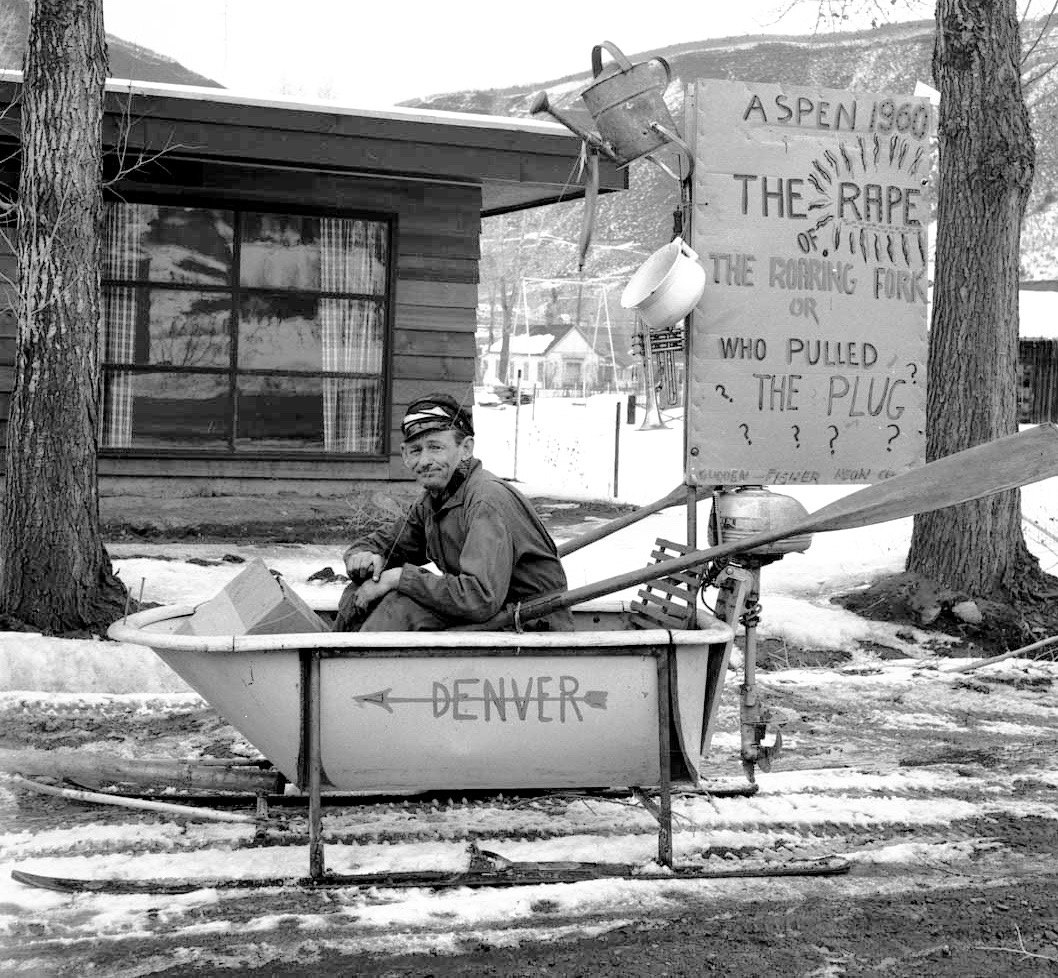
Freddie Fisher in his 1954 Winterskol float. Fisher was a professional musician who ran a ramshackle fix-it shop and yard in Aspen and sent in a regular stream of witty letters to The Aspen Times. In the mid-1950s, the proposed Fryingpan-Arkansas project was being reviewed at the local, state and federal level, and Aspenites were concerned about the amount of water that would be diverted from the Roaring Fork River watershed, on top of the amount already being diverted by the Twin Lakes-Independence Pass project.
Freddie Fisher in his 1954 Winterskol float. Fisher was a professional musician who ran a ramshackle fix-it shop and yard in Aspen and sent in a regular stream of witty letters to The Aspen Times. In the mid-1950s, the proposed Fryingpan-Arkansas project was being reviewed at the local, state, and federal level, and Aspenites were concerned about the amount of water that would be diverted from the Roaring Fork River watershed, on top of the amount already being diverted by the Twin Lakes-Independence Pass project.

Editor’s note: The following is the fourth and final part in a series exploring the city of Aspen’s historic intent in filing for and maintaining conditional water rights for storage reservoirs on Castle and Maroon creeks.

By Brent Gardner-Smith, Aspen Journalism

ASPEN – The city of Aspen has said for decades that legislation approving the Fryingpan-Arkansas Project gives a certain status to the potential Castle Creek and Maroon Creek reservoirs.

However, it’s hard to discern just what that status is, and federal and regional water officials are dismissive of the city’s claims.

Built in the 1960s and early 1970s, the Fry-Ark Project is one of the larger transmountain diversion systems in Colorado. It diverts water from the headwaters of the Roaring Fork River, including Hunter, Midway, and No Name creeks, along with large amounts of water from the many tributaries in the headwaters of the Fryingpan River.

In all, the project includes 16 diversion structures that direct an average of 57,000 acre-feet of water a year to the Boustead Tunnel, which runs under the Continental Divide. The gathered water then flows to Turquoise Reservoir near Leadville and into the Arkansas River basin, serving both Front Range cities and agriculture on the eastern plains.

A key component of the Fry-Ark Project is Ruedi Reservoir above Basalt, which was built in the early 1960s as “compensatory storage” for Western Slope water users. Water collected in Ruedi does not flow to the East Slope.

Plans to divert water from the Fryingpan River date back to the 1930s, but the Fry-Ark Project as largely configured today was the result of intensive planning efforts and discussions that took place throughout the 1950s and early 1960s.

Aspenites in the 1950s were well aware of the looming Fry-Ark Project, especially as the Twin Lakes-Independence Pass project, built in the 1930s, was already diverting large amounts of water off the top of the Roaring Fork River.

For example, in the 1954 Winterskol parade, local musician, letter-to-the-editor writer and junkyard operator Freddie Fisher created a witty float about the looming “rape of the Roaring Fork” that featured himself sitting in a bathtub-boat on skis while pondering the question, “Who pulled the plug?”

A detail of the cover of a 1975 EIS on the Fry-Ark Project that was prepared the Bureau of Reclamation.
A detail of the cover of a 1975 EIS on the Fry-Ark Project that was prepared by the Bureau of Reclamation.

In the legislation

As the city is often quick to point out, the federal Fry-Ark legislation does in fact state that a feasibility report on a reservoir on a “tributary of the Roaring Fork River” should be prepared by the Department of the Interior; and if such a reservoir made economic sense, then the feasibility report should be submitted to Congress for review.

“The secretary [of Interior] shall investigate and prepare a report on the feasibility of a replacement reservoir at or near the Ashcroft site on Castle Creek, a tributary of the Roaring Fork River above its confluence with the Fryingpan River with a capacity of approximately 5,000 acre-feet,” the authorizing legislation states, “but construction thereof shall not be commenced unless said report, which shall be submitted to the president and the Congress, demonstrates the feasibility of said reservoir and is approved by Congress.”

The city maintains that the language, “at or near the Ashcroft site on Castle Creek,” still pertains to the potential Castle Creek Reservoir two miles below Ashcroft.

The operating principles for the Fry-Ark Project, which were hashed out by both entities on both sides of the Continental Divide, also address Ashcroft Reservoir.

“The Ruedi Reservoir shall be constructed and maintained on the Fryingpan River above the town of Basalt with an active capacity of not less than 100,00 acre-feet,” the principles state. “In addition thereto and in order to offset adverse streamflow conditions on the Roaring Fork River above the town of Aspen which might occur as a result of the project enlargement of the Twin Lakes Reservoir, the Ashcroft Reservoir on Castle Creek, or some reservoir in lieu thereof, shall be constructed on the Roaring Fork drainage above Aspen to a capacity of approximately 5,000 acre-feet: Providing, however, That the Ashcroft Reservoir shall be constructed only if the Secretary of the Interior after appropriate study shall determine that its benefits exceed the costs … ”

It also further defines Ashcroft Reservoir by stating that “‘Ashcroft Reservoir’ means not only the reservoir contemplated for construction on Castle Creek, a tributary of the Roaring Fork River, but also, unless the context requires otherwise, any other reservoir that may be constructed in the Roaring Fork Basin above the town of Aspen in lieu of that reservoir.”

To better understand the city’s claim, it’s instructive to view the potential Castle Creek Reservoir as “son-of” Ashcroft Reservoir, which in turn is “son-of” Aspen Reservoir.

For much of the long planning stage of the Fry-Ark Project, it included an “Aspen Reservoir,” which would have stored 28,000 acre-feet of water behind a tall dam at the bottom of the North Star-Stillwater section of the Roaring Fork River, just east of Aspen.

However, opposition to the Aspen Reservoir, primarily from James H. Smith Jr., owner of the North Star Ranch in Aspen, eventually caused Ruedi Reservoir above Basalt to be built instead of Aspen Reservoir.

One of the reasons Aspen Reservoir was attractive to water planners at the time was that it could be used to fill in low flows in the Roaring Fork River below the Salvation Ditch, a large irrigation ditch that diverts water at Stillwater Drive, near the entrance to Mountain Valley.

The combination of the Salvation Ditch, the Independence Pass diversions from the 1930s, and the coming Fry-Ark diversions meant the Fork through Aspen would be often dropped to exceedingly low levels, which is often the case today. And so it was felt that a compensatory reservoir east of Aspen, above the Salvation Ditch, would help keep more water, and fish, in the river.

But opposition by Smith, who was well connected in Washington, D.C., having served as assistant secretary of the Navy for aviation, helped kill the idea of Aspen Reservoir.

In the wake of the decision to abandon Aspen Reservoir, local, state, and federal water officials agreed to include a mention of another potential reservoir, Ashcroft Reservoir, or an alternate nearby reservoir, in the authorizing legislation for the Fry-Ark Project, as something of a consolation prize for Aspen.

Ashcroft Reservoir was once envisioned to be formed by a 140-foot-tall dam near the Elk Mountain Lodge property that would back up 9,056.7 acre-feet of water behind it.

The water right tied to Ashcroft Reservoir was eventually cancelled for lack of adequate due diligence in the 1970s, but today the city of Aspen still considers Castle Creek Reservoir, which is designed to hold 9,062 acre feet, to be the legitimate offspring, at least in the context of the Fry-Ark Project, of Ashcroft Reservoir.

But officials at the Bureau of Reclamation, the Colorado River Water Conservation District, and the Southeastern Water Conservancy District all say that the language in the Fry-Ark approvals has no direct bearing today on either of the two potential reservoirs that Aspen says it still intends to build someday when necessary.

A large portion of the meadow in the North Star nature preserve east of Aspen was flooded in June 2015. The expanse of water offers a glimpse of what the long-planned Aspen Reservoir might have looked like.

An ‘unmet obligation’

Officials at the city of Aspen, speaking on background, have characterized the tie to Fry-Ark Project as an “unmet obligation” to the city. The obligation, as the city sees it, is to at least prepare a feasibility study of a reservoir on a tributary of the Roaring Fork River.

That “obligation” has been referenced a number of different ways over the years by the city, including most recently on Oct. 10, 2016, when Aspen City Council unanimously approved a resolution declaring their intent to file a diligence application this year for the conditional water rights it holds tied to potential reservoirs on Castle and Maroon creeks.

“Whereas, when these water rights were appropriated, this reservoir storage was an important component of Aspen’s long term water supply plan, particularly since the Fryingpan-Arkansas project was proceeding without the originally planned compensatory storage reservoir on the upper Roaring Fork River,” the council’s 2016 resolution stated.

The city filed two diligence applications on Oct. 31, one for Castle Creek Reservoir and one for Maroon Creek Reservoir. As of Wednesday afternoon, three environmental groups and three private landowners had filed statements of opposition in the cases, and Pitkin County, the U.S. Forest Service, and Trout Unlimited are expected to file statements by the end of the week.

American Rivers, Wilderness Workshop, and Western Resource Advocates have filed statements in both cases. In the Maroon Creek case, Roaring Fork Land and Cattle Co., which is controlled by billionaires Tom and Margot Pritzker, filed a statement. And in the Castle Creek case, Double R Creek Ltd and Asp Properties LLC filed statements. Double R Creek is controlled by Robert Y.C. Ho of Hong Kong and Asp Properties is controlled by Charles Somers, the CEO of SBM, a building services company located in McClellan, Calif.

Here’s how the city described the Fry-Ark relationship to the Division 5 Water Court in 2010, during the most recent diligence review of the water rights for the potential Castle Creek and Maroon Creek reservoirs:

“The Frying Pan-Arkansas Project, authorized by legislation dated August 16, 1962, authorized construction, operation and maintenance of a replacement reservoir on Castle Creek to furnish water required for protection of western Colorado water users,” states a proposed decree from the city’s water attorneys. “This reservoir was contemplated to have a capacity of 5,000 acre-feet, but this reservoir was never built.”

But not everyone agrees that the Fry-Ark legislation “authorized construction, operation and maintenance” of a reservoir on Castle Creek.

The city in 2010 also told the state there was a direct link between the Fry-Ark Project and its potential Castle Creek and Maroon Creek reservoirs.

“In 1965, taking precautions to ensure that its water rights were protected in the event the Frying Pan-Arkansas Project reservoir was in fact never built on Castle Creek, the city of Aspen filed applications seeking its own conditional water rights for storage on Castle Creek and Maroon Creek, i.e., the Castle Creek Reservoir and Maroon Creek Reservoir water rights for which diligence is sought herein,” the city’s 2010 diligence filing stated.

And in a 1990 water management plan, the city stated that “the authorizing act and operating principles of the Fryingpan-Arkansas Project require the Bureau of Reclamation to prepare a feasibility study on a reservoir of up to 5,000 acre feet, in order to offset adverse streamflow conditions in the Roaring Fork River above Aspen.”

But while a feasibility study may be called for in the Fry-Ark legislation, it is difficult to find anyone outside of the city of Aspen who thinks the call is still relevant.

The end of the tunnel that delivers water diverted from Hunter, Midway and No Name creeks as part of the Fry-Ark Project. The City of Aspen says their is a lingering unmet obligation in the Fry-Ark Project to study the potential Castle Creek Reservoir.
The end of the tunnel that delivers water diverted from Hunter, Midway, and No Name creeks as part of the Fry-Ark Project. The city of Aspen says there is a lingering unmet obligation in the Fry-Ark Project to study the potential Castle Creek Reservoir.

Ancient history?

Sterling Rech, a public affairs manager with the Bureau of Reclamation, recently said, in response to questions about the city’s claim, that the Fry-Ark legislation “requested an investigation but explicitly did not authorize Ashcroft Reservoir unless the report demonstrated feasibility and subsequently, Congress approved it. There is no record of that approval in Reclamation law.”

Rech was asked to double-check with senior Reclamation officials on the point, and after doing so, stood by his statement that the Fry-Ark Project “did not authorize” a reservoir in the Castle Creek valley.

Given that officials at Reclamation would be the ones within the Interior Department to prepare a feasibility study on Castle Creek Reservoir, this would seem to be relevant to the city’s position.

Jim Pokrandt, director of community affairs for the Colorado River District, said the mention of the Ashcroft Reservoir in the Fry-Ark legislation, or a nearby reservoir in lieu of it, “is ancient history versus current events.”

The River District played a key role in developing the operating principles that still guide the Fry-Ark Project. And it’s the entity that originally filed for the conditional water rights on Ashcroft Reservoir in 1959.

“Being mentioned and studied in the context of the Fry-Ark does not bestow anything special at this point in time,” Pokrandt said of the city’s claim.

Chris Woodka, the issues manager for the Southeastern Water Conservancy District, had a similar take. Southeastern was created explicitly to manage the water diverted by the Fry-Ark Project and was instrumental in shaping its authorizing documents.

But Woodka also dismissed any link between the potential Castle Creek Reservoir and the Fry-Ark Project.

“It really doesn’t have a direct connection anymore to the Fryingpan-Arkansas Project,” Woodka said.

However, city officials still beg to differ.

The outfall of the Bousted Tunnel, which delivers water from the Roaring Fork and Fryingpan rivers to the East Slope.
The outfall of the Boustead Tunnel, which delivers water from the Roaring Fork and Fryingpan rivers to the East Slope.

Feds still obligated?

Officials at the city say, on background, that it is clear that a reservoir on a tributary of the Roaring Fork — somewhere above Aspen — was included in the Fry-Ark authorizing legislation, and it was done so by none other than legendary West Slope Congressman Wayne Aspinall, who served in the U.S. House of Representatives from 1949-1973.

And the city says that the obligation still remains for the Department of the Interior to conduct a feasibility study on such a reservoir.

City officials also point to a 2007 letter in regard to potential federal approval of new reservoirs in the Arkansas River basin to hold water diverted from the Fry-Ark project.

In that letter, the city and Pitkin County told the federal government that if it was going to study new reservoirs on the East Slope, it should also study reservoirs on the Western Slope, and by implication, the Ashcroft Reservoir or its successor, Castle Creek Reservoir.

“It is important that the Western Slope’s present and future water supply and storage requirements (for both consumptive and non-consumptive uses) be placed on a par with those of the Eastern Slope and included in all discussions on H.R. 1833,” the city and Pitkin County wrote in a letter to Congressman John Salazar in 2007 regarding pending legislation for the PSOP project, or Preferred Storage Options Plan. “Any feasibility study resulting from H.R. 1833 must address Western Colorado’s present and future regional water needs, not just investigate ways to mitigate impacts from an increase in trans-mountain diversions.”

According to city officials, the city felt it had leverage to ask for such a study because of the language regarding Ashcroft Reservoir in the Fry-Ark legislation. And that a study of Western Slope storage would have had to look at reservoirs such as Castle Creek Reservoir.

Be that as it may, the city’s claim of a lingering obligation in the Fry-Ark project is still out there, but with no clear resolution of how much standing it gives, or might someday give, the Castle and Maroon creek reservoirs.

One reason it is uncertain is that the city has never directly asked the Department of the Interior to produce a feasibility study on the Ashcroft Reservoir, or a successor, based on the obligation claimed by the city in the Fry-Ark legislation.

As such, the “unmet obligation,” if it exists, is still outstanding. And city officials say they’ll see what value it has at some point in the future.

Editor’s note: Aspen Journalism, the Aspen Daily News, and Coyote Gulch are collaborating on the coverage of water and rivers. The Daily News published this story on Thursday, Dec. 29, 2016.

Pueblo Reservoir: Reclamation awards master storage contract to Southeastern District

Pueblo dam releases
Pueblo dam releases

Here’s the release from the Southeastern Colorado Water Conservancy District (Chris Woodka):

The Southeastern Colorado Water Conservancy District has signed an Excess Capacity Master Storage Contract with the Bureau of Reclamation, culminating an effort that began in 1998.

“This is a great opportunity for the communities of the Arkansas Valley, which allows us to assist and provide them with a more secure water supply for the future,” said Bill Long, president of the Southeastern District board. “It’s been a very long process, much longer than we anticipated, but well worth it.”

The master contract allows participants to store water in Pueblo Reservoir when space is available. Pueblo Reservoir was built by Reclamation to store Fryingpan-Arkansas Project water and for flood control. But it rarely fills with Project water. Excess capacity contracts allow water from other sources, including Fry-Ark return flows, to be stored in Pueblo Reservoir.

The initial contract will allow 6,525 acre-feet of water to be stored in 2017, which will become the minimum number for future years. The contract allows storage of up to 29,938 acre-feet annually for the next 40 years.

For 2017, 16 communities signed subcontracts with the Southeastern District to participate in the master contract. Another 21 communities plan to join once the Arkansas Valley Conduit is built, and do not have an immediate need to join the contract.

Participants in 2017 include: Canon City, Florence, Fountain, La Junta, Lower Arkansas Valley Water Conservancy District, Olney Springs, Rocky Ford, Penrose, Poncha Springs, Pueblo West, St. Charles Mesa Water District, Salida, Security, Stratmoor Hills, Upper Arkansas Valley Water Conservancy District, Widefield.

“It’s a big step for the District,” said Jim Broderick, executive director of the Southeastern District. “The ability to use excess-capacity storage on a long-term basis has been a goal of the District for almost 20 years. This will add certainty to the process.”

Reclamation first issued excess capacity contracts in 1986. Last year, more than 29 excess-capacity contracts were issued more than 60,000 feet – one quarter of the available space in Pueblo Reservoir. For many years, Pueblo Water, Colorado Springs Utilities and Aurora Water were the major entities that used the contracts on an annual basis.

Pueblo became the first community to get a long-term contract in 2000. Aurora first used its long-term contract in 2008. In 2011, Colorado Springs, Fountain, Security and Pueblo West obtained a long-term contract as part of Southern Delivery System.

The next step for the Southeastern District is the Arkansas Valley Conduit. Reclamation anticipates completing the feasibility study later this year, which will allow construction to begin.
“The master contract is absolutely essential to the conduit,” Long said. “It will give us long-term reliability for a clean water supply.”

Arkansas Valley Conduit Comanche North route via Reclamation

Southeastern water district approves $30 million budget — @ChieftainNews

Fryingpan-Arkansas Project via the Southeastern Colorado Water Conservancy District

From Southeastern Colorado Water Conservancy District via The Pueblo Chieftain:

A $30 million budget was approved Thursday by the Southeastern Colorado Water Conservancy District board of directors.

The budget is the largest in the history of the district because it reflects spending $12 million in the first phase of a hydropower project at Pueblo Dam. The board is scheduled to consider approval of that project at a special meeting later this month.

“This is an exciting time for the district, with many new opportunities coming to fruition after years of effort by the district board and staff,” said Jim Broderick, executive director. “Every day we are coming closer to fulfilling the vision of those who came before us almost 60 years ago when the district was formed.”

The hydropower project now includes the district and Colorado Springs. The Pueblo Board of Water Works pulled out as partners last month, because it would realize few benefits from the project. When completed, the $20 million project will generate 7.5 megawatts of electric power and become a source of revenue for the district’s Water Activity Enterprise.

The budget’s other large-ticket items include repayment of federal funds for construction of the Fryingpan-Arkansas Project, $7 million, and Fountain Valley Conduit, $5.8 million.

About $24 million is still owed for construction of the Fryingpan-Arkansas Project, which began in 1965. The project includes Ruedi Reservoir, a collection system in the Hunter Creek-Fryingpan River watersheds, the 5.4-mile Boustead Tunnel that brings water across the Continental Divide, Turquoise Lake, the Mount Elbert Forebay and Power Plant, Twin Lakes and Pueblo Reservoir.

The Fry-Ark debt is repaid through a 0.9-mill property tax in the nine-county area covered by the district.

The Fountain Valley Conduit serves Colorado Springs, Fountain, Security, Stratmoor Hills and Widefield, which pay a special property tax.

The operating fund of the district will be $2.3 million, and is funded by a 0.03 mill levy and transfers from the Enterprise fund. The Enterprise operating fund will be $1.8 million, and is mostly funded by fees and surcharges on water activities.

Other than hydropower, the Enterprise will administer excess-capacity storage contracts for district participants for the first time in 2017. The Enterprise also expects the federal feasibility study for the Arkansas Valley Conduit and an interconnection of the north and south outlets on Pueblo Dam to be completed later in 2017. The feasibility study is the final step that must be taken before construction begins.

Widefield Water and Sanitation stops use of contaminated aquifer water — The #Colorado Springs Gazette

Widefield aquifer via the Colorado Water Institute.

From The Colorado Springs Gazette (Jakob Rodgers):

The Widefield Water and Sanitation District became the last major water system to stop using well water from the tainted aquifer, according to the district’s water manager, Brandon Bernard.

As of Nov. 10, all of the district’s customers receive cleaner surface water from the Pueblo Reservoir.

“We’re looking forward to moving forward without having to worry about PFCs,” said Bernard, using an acronym for the toxic chemicals.

The announcement ends one chapter of a water crisis that sent thousands of residents scrambling for bottled water…

The contamination has spawned two class-action lawsuits against companies that manufactured the foam. The Air Force, which found the chemical harmful to laboratory animals as early as the 1970s, also is studying its role in the contamination by drilling several test wells around Peterson Air Force Base…

For months, local water officials raced to limit residents’ exposure to the chemicals, which remain unregulated by the EPA.

Fountain officials shut off their wells in fall 2015 – relying instead on cleaner water from the Pueblo Reservoir. But other water districts couldn’t meet customers’ demands this past summer without using contaminated well water.

Security Water and Sanitation Districts weaned itself from the aquifer in September.

Officials for all three water districts are optimistic that customers will no longer receive contaminated water from the aquifer, unless its cleansed of the toxic chemicals.

Officials in Security and Fountain have previously voiced plans to build treatment plants to filter the fouled water. Water rates there could rise to help finance those projects.

Widefield officials, however, are conducting two test projects to determine whether ion exchange or granular activated carbon filters best remove the chemicals, Bernard said.

Widefield’s test projects, which began in October, are expected to last six months, he said.

The district also is planning a $1 million project to install a pipe under Interstate 25 capable of bringing in more water from the Pueblo Reservoir. Widefield has several thousand acre feet of water stored at the Pueblo Reservoir, and officials there are no longer concerned about running out of water rights this year.

District leaders also plan to meet with Air Force officials on Thursday to coordinate how the military can help filter water. In July, the Air Force vowed to spend $4.3 million to supply bottled water and well water filters for the affected communities.

Unlike other water districts, Widefield is not planning to raise rates in 2017 to pay for the water projects, Bernard said. Rather, they will be paid for using reserve funding.

Customers are only likely to pay for operations costs once a treatment plant is built, he said.

“It’s nice just to not have to worry about our customers being concerned,” Bernard said. “And now we can just move forward with fixing the problem.”

Photo via USAF Air Combat Command

El Paso County struggles to fill water needs — The Pueblo Chieftain #COWaterPlan

Upper Black Squirrel Creek Designated Groundwater Basin
Upper Black Squirrel
Creek Designated Groundwater Basin

From The Pueblo Chieftain (Chris Woodka):

In a way, the whole reason a state water plan is needed lies north of the Pueblo County line.

In the Arkansas River basin, three-fourths of the future need identified in a 2008 study was in El Paso County, the fastest growing area in the region. Like Denver, the metropolitan growth has the potential to dry up rural farming areas.

Not all of the growth is in Colorado Springs; it’s in outlying areas, as well.

For more than a decade, The Pueblo Chieftain has documented the progress of the Southern Delivery System, purchases of water rights by El Paso County cities or water providers, and water quality issues, such as changing limits on groundwater contaminants.

Cherokee Metro District President Jan Cederberg and Fountain Water Engineer Mike Fink give their viewpoints on Colorado’s Water Plan, based on questions supplied by The Chieftain on behalf of the Arkansas Basin Roundtable.

Cherokee, a district that sits like an island within Colorado Springs, over the last decade has looked at various pipelines from other areas to meet its water needs.

Fountain, a city south of Colorado Springs, gets its water from several sources but is relying heavily on SDS, which also allows it to draw more water through the Fountain Valley Conduit.

How do we fill the gap in the Arkansas River Basin within the Colorado Water Plan and Basin Implementation Plan?

Cederberg: Given that the river is already over-appropriated, we will all need to keep on a continuous path of improving water efficiency, but recognize that alone will not close the gap. We will also need to collaborate with our friends and neighbors in the basin to make best use of the water resources available through innovative arrangements such as alternative transfer methods. Ultimately, water uses are likely to be prioritized to “highest and best uses” in response to market economics.

Fink: Each water supplier and all of the major water users in the Arkansas Basin will need to participate in the effort to fill the gap. All elements of the water supply pantheon should be reviewed for improvements in yield, improvement of efficiencies in the sources, in the transportation, storage and treatment, delivery and return flow management and conservation (both the supply side and the demand side).

What projects do you plan to fill the gap?

Cederberg: Cherokee Metropolitan District’s primary supply is alluvial groundwater in the Upper Black Squirrel Creek designated basin. We will continue considering the purchase of water rights from that basin as they are made available.

We also recently developed a new Denver Basin well field near Black Forest, approximately 15 miles north of our main service area. Although this supply is regarded as unsustainable for the long term, it is drought-proof and can be used in conjunction with junior water rights to help meet dry-year demands. We will grow this well field and consider strategies to extend the life of this Denver Basin supply.

In addition, the Cherokee Metropolitan District is collaborating with several other members of the Pikes Peak Regional Water Authority to consider a regional water system that would allow efficient delivery of water from the Fountain Creek/Arkansas River system.

Fink: Fountain Utilities adopted a comprehensive Water Master Plan in 2007. It was a decisional study that confirmed our participation in the Southern Delivery System Project, but it also provided a longer planning horizon for development of supply diversity and redundancy, treatment options, transmission system planning and delivery system planning.

One foundational element of the 2007 Water Master Plan was a dedication to enhancing the City’s Water Conservation efforts.

The projects that Fountain Utilities will either continue or commence implementation to improve our ability to meet the demands that increased population require include the following:

1. Southern Delivery System — SDS is an important addition to our utility’s supply system, but it is only a tool to move water from the Pueblo Reservoir and treat that water; SDS does not provide water, it only moves and treats water. Each of the participants is required to bring their own water to the pipe.

2. Return flow management — Fountain, as a beneficiary of the Fryingpan-Arkansas Project, receives an allocation of transbasin water delivered through the Fountain Valley Authority transmission and treatment system. This allocation is usable to extinction and the City will continue to maximize the use of this water through effective return-flow management.

3. Continued use of local groundwater resources — Fountain has groundwater wells that are both in the Fountain Aquifer and in the Widefield Aquifer. These are renewable resources that must have depletions augmented by surface water. Fountain’s continuing challenge is to treat the water from these sources to the quality that not only meets the Clean Drinking Water Standards, but that also maintains compliance with Health Advisories for trace contaminants.

Fountain, with Widefield and Security, is also pursuing the Widefield Aquifer Recharge Project. This long-term, renewable resource will divert flows from Fountain Creek into a treatment facility, inject the treated water into the Widefield Aquifer for storage that does not have evaporative losses, retrieve that water and treat it to drinking water standards.

How do we keep the gaps for agriculture and municipalities from becoming bigger?

Cederberg: We must continue to improve water efficiency on all fronts. As Cherokee has faced water supply challenges in recent years, we have asked our customers to conserve through watering restrictions and a tiered rate structure.

Their response, as proven through water demand data over time, has allowed us to reduce our demand forecast per home by more than 25 percent. In addition, Cherokee has developed an indirect reuse system by which reclaimed water recharges our main water supply aquifer.

Fink: All of the tools that the Colorado Water Plan examined (conservation, agriculture, storage, watershed health, education and outreach) will be needed to address demand, but I think that the coordination between water resource planning and land-use planning has possibly the most positive potential for closing the gap.

The one wild card in the identified tools in the Water Plan is innovation, and I am a firm believer that Colorado has the innovators to bring different and effective tools to the jobs than anyone has yet.

High Fryingpan water flows are 
vexing anglers

An angler on the Fryingpan River, in the flat section not far below the reservoir, with a flow of 250 cfs. Releases from Ruedi for the benefit of endangered fish in the Colorado RIver near Palisade have brought the river up to 300 cfs.
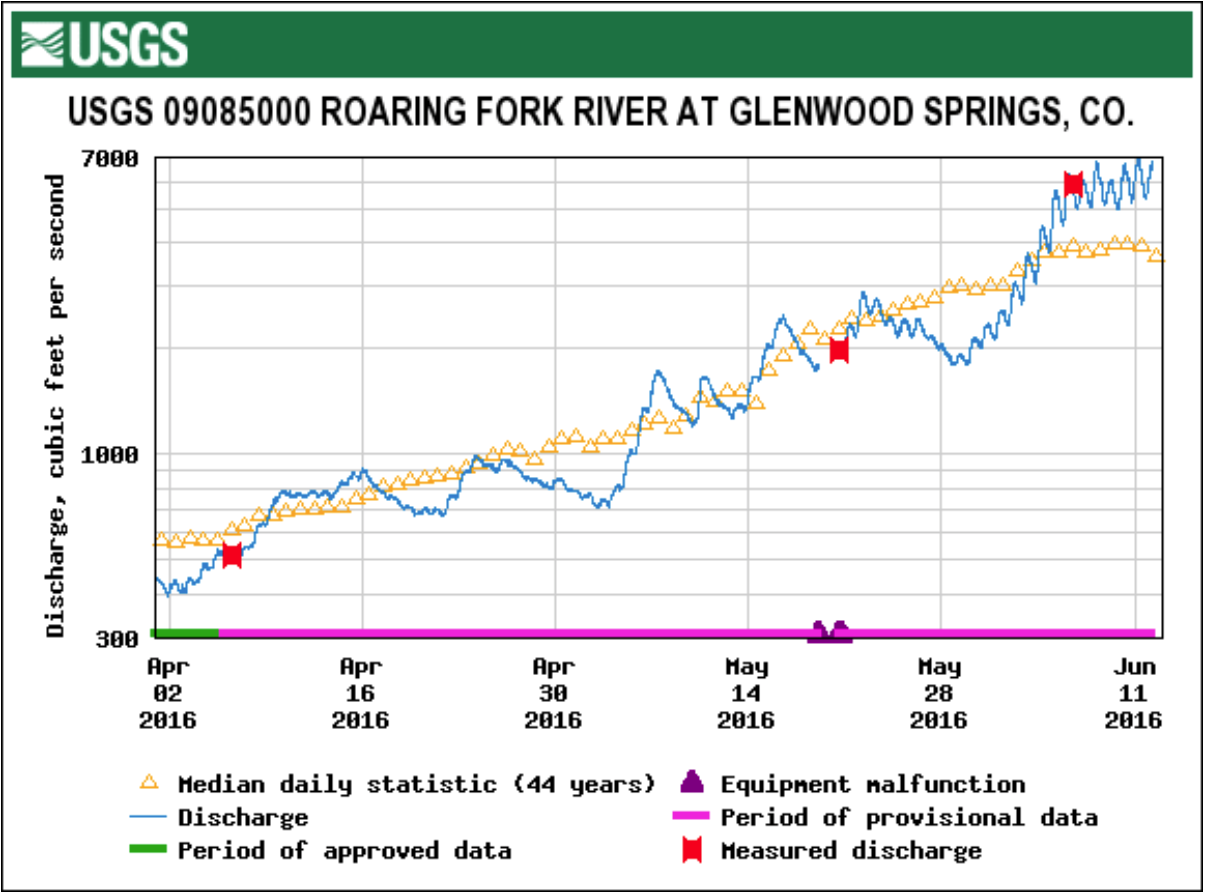
A USGS graphic showing the increase in flows in the Fryingpan River below Ruedi Reservoir from Aug. 11 to Aug. 13, 2016. The flows were increased 50 cfs from 250 to 300 cfs.

By Brent Gardner-Smith, Aspen Journalism

BASALT – Flows in the lower Fryingpan River below Ruedi Reservoir were increased on Friday afternoon to about 300 cubic feet per second, much to the dismay of professional and private anglers who prefer a flow of no more than 250 cfs.

“We get cancellations at 250 and up,” said Warwick Mowbray, owner of Frying Pan Anglers in Basalt, during a meeting Thursday night in Basalt’s town hall on flows in the Fryingpan. “People say ‘We can’t wade.’”

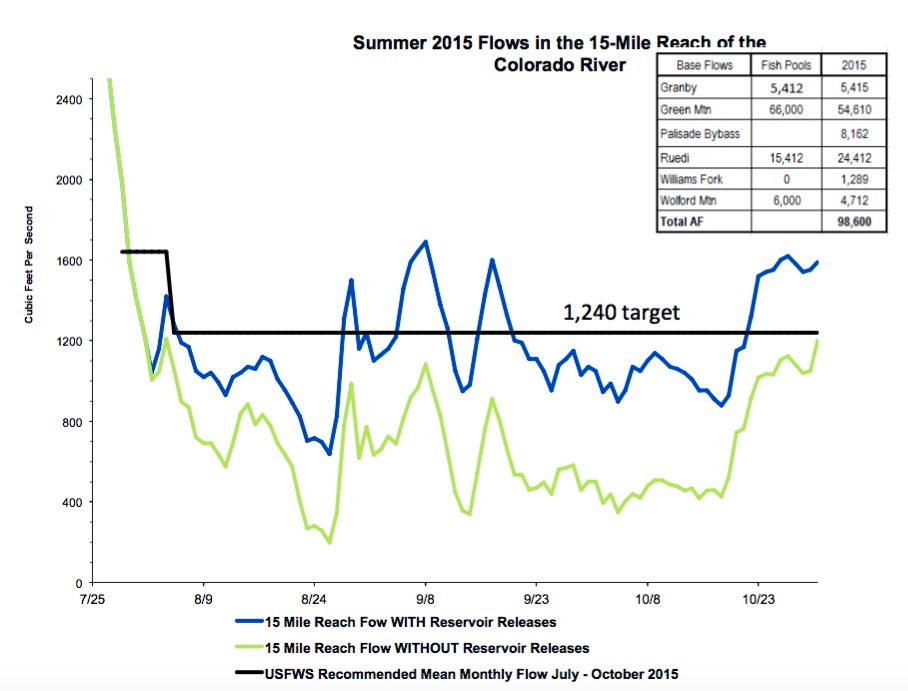
Releases from Ruedi were increased Friday in order to send more water to the “15-mile reach” of the Colorado River between Palisade and Grand Junction for the benefit of endangered fish species struggling to survive in the river below several big irrigation diversions.

But the water released from Ruedi and sent down the Fryingpan, Roaring Fork and Colorado rivers to the 15-mile reach at the direction of the U.S. Fish and Wildlife Service erodes the quality of the trout-fishing experience on the lower Fryingpan, according to Will Sands, manager of Taylor Creek Fly Shops in Basalt and Aspen.

“Over 250 cfs changes the dynamic of the environment of the river for hatches and the abilities of the visiting angler,” Sands said. “It hits 300 and we start getting cancellations.”

Rick Lofaro, director of the Roaring Fork Conservancy, seconded the concerns of the professional anglers.

“When you have additional water coming down, it challenges wading and changes the character of the river,” he said, likening higher flows in the Fryingpan to paying for a backcountry powder tour only to find no fresh snow. “I think there is a big difference between 250 and 300 from an accessibility and wade-ability level.”

The conservancy commissioned a study in 2014 that showed fly-fishing contributes $3.8 million to Basalt’s economy.

Thursday’s meeting in Basalt was called by officials from the Bureau of Reclamation and the Fish and Wildlife Service, and about a dozen citizens showed up to discuss likely releases from Ruedi for the balance of the summer.

Tim Miller, a hydrologist with the Bureau of Reclamation who manages Ruedi Reservoir, said releases below the reservoir would likely be around 300 cfs into September, but could be as high as 350 cfs if there is a call for more water from irrigators in the Grand Junction area.

Since July 18, flows in the lower Fryingpan have been running steadily at around 245 cfs, a sweet spot for anglers.

Jana Mohrman, a hydrologist with the Fish and Wildlife Service, manages a pool of water in Ruedi that can be released to keep enough water in the 15-mile reach.

She works toward meeting seasonal flow levels — now 1,240 cfs — in the Colorado River near Palisade by directing “fish water” to that point on the river from a variety of upstream reservoirs, including Ruedi, Wolford and Green Mountain.

This week, flows in the Colorado River near Palisade had dropped to the point where several fish passages designed to allow native endangered fish to swim upstream toward Rifle were not functioning due to low water levels.

“I’m using Ruedi to get my fish passages open,” Mohrman said.

As such, she directed the Bureau of Reclamation to release another 50 cfs from Ruedi starting Friday. That was on top of the 140 cfs of “fish water” that was already being released, which was in addition to about 110 cfs of routine releases from the reservoir.

The crest of the dam across the Fryingpan River that forms Ruedi Reservoir, which can hold 102,373 acre-feet of water.

Fish water

Mohrman’s pool of “fish water” in Ruedi equals about 15,000 acre-feet of water. But she can also use, for the second year in a row, about 9,000 acre-feet of water owned by the Ute Water Conservancy District in Grand Junction and leased to the Colorado Water Conservation Board for use in the fish-recovery program.

On Wednesday, during a weekly conference call of regional reservoir managers and irrigators, Mohrman was pressured by irrigators in the Grand Valley to release more water from Ruedi along with water they were releasing for the fish from Green Mountain Reservoir, which serves as a back-up supply water for the Grand Valley.

Last year, 24,412 acre-feet of water was released from Ruedi to the benefit of the fish recovery program and a similar amount is likely to be released this year. In all, Ruedi can store 102,373 acre-feet of water.

Of that, about 41,000 acre-feet is owned by various entities, and can also be released upon demand in a dry year. Should that occur, flows in the Fryingpan could rise still higher, and not just because of the fish-recovery program.

“These demands on the reservoir are only going to grow,” said Miller of the Bureau of Reclamation. “This isn’t going away.”

The lower Fryingpan River on Thursday, Aug. 11, flowing at about 250 cfs.

Conflicting priorities

Dan Turley, a homeowner in the Fryingpan River Valley and an avid angler, asked Mohrman if the endangered fish program was a higher priority than the recreational economy of Basalt.

“This is not a trivial inconvenience,” Turley said of flows in the Fryingpan going up to 300 cfs. “It makes the river not viable to fish for a great majority of people.”

And Turley said it’s not just about Basalt’s economy.

“A lot of people from Aspen come down here and fish,” he said. “They are staying at The Little Nell. This is a big deal.”

“It’s always been considered,” Mohrman said, referring to the local fly-fishing economy and a targeted flow of 250 cfs in the Fryingpan. “And we have always said we would try to maintain 250. But we also have to recover these fish, and we’ve built all these structures to try and get them up to Rifle to get back into their natural habitat. And that is a higher priority than the 250 target.”

The goal of what’s called the Upper Colorado River Endangered Fish Program is to maintain populations of four species of large fish native to the Colorado River, the Colorado pikeminnow, razorback sucker, bonytail, and humpback chub.

If the program fails to maintain viable populations of native fish, diverters in the Colorado River basin could be faced with extensive environmental reviews of their diversion’s effects on the endangered fish — something regional water managers want to avoid.

As long as the fish populations are stable or growing, the recovery program provides blanket environmental protection. Trouble is, Mohrman said the fish are not doing all that great as they are being preyed upon by non-native fish in addition to struggling with low river levels.

A USFWS employee holding a smallmouth bass, caught via electrofishing, that just swallowed a native bluehead sucker. Non-native fish eating  young native fish is a big obstacle to developing healthy populations of native fish.
A USFWS employee holding a smallmouth bass, caught via electrofishing, that just swallowed a native bluehead sucker. Non-native fish eating young native fish is a big obstacle to developing healthy populations of native fish.

Bypass pipeline?

Rachel Richards, a Pitkin County commissioner who has focused during her tenure on water issues, attended Thursday’s night meeting.

She raised the idea of a pipeline or flume that would allow water to be released from Ruedi without flowing down the river itself.

“We’ve always talked a little bit about should there be a separate flume or waterway for the Ruedi releases so they are not destroying the Fryingpan,” Richards said.

She also said that Pitkin County and Basalt had voiced concerns in the past about releasing “fish water” from Ruedi and making Basalt a “sacrificial lamb for water needs elsewhere in the state.”

At the conclusion of Thursday’s meeting, Mohrman said she would work with irrigators and reservoir managers to see if more water can’t be released from reservoirs other than Ruedi.

“I’ll try and cut it back as the Green Mountain Reservoir ups its releases and our fish passages stay open,” she said. “I understand your very serious concerns.”

Editor’s note: Aspen Journalism, the Aspen Daily News, and Coyote Gulch are collaborating on coverage of rivers and water.The Daily News published this story on Saturday, August 13, 2016.
Arkansas River Basin: “Those releases help keep the rafting industry afloat” — Alan Ward

Twin Lakes collection system

From The Pueblo Chieftain (Chris Woodka):

After a wet spring, summer has been relatively dry, and drought conditions are creeping back into Colorado, particularly over the Rocky Mountains in the center of the state and the Rio Grande basin.

River flows have dropped, so Reclamation and Pueblo Water are running water from accounts in upper reservoirs to Lake Pueblo. This serves two purposes: Creating space for imports next spring and providing water for the voluntary flow program that extends the commercial rafting season.

Finding the additional space in Clear Creek, Twin Lakes and Turquoise reservoirs was problematic this year, because reservoirs still were full from a very wet 2015. Twin Lakes filled early with native water and delayed imports from the Western Slope.

The Fryingpan-Arkansas Project has delivered more than 58,760 acre-feet so far, about 90 percent of what had been expected when allocations were made in May.

The Southeastern District, which determines allocations, will adjust agricultural deliveries, because cities already had requested less water than they were entitled to receive.

Pueblo Water imported about 13,500 acre-feet of water, about 92 percent of normal. Part of the reason was the lack of free space at Twin Lakes, and part was due to maintaining long-term limits since storage space was scarce anyway, said Alan Ward, water resources manager.

Pueblo Water will lease more than 21,700 acre-feet of water this year because of the potential storage crunch earlier this year.

Even so, Pueblo Water had 49,133 acre-feet of water in storage at the end of June, which was down from last year, but 17,600 acre-feet more than was in storage at the end of May. Most of the gain came in the upper reservoirs, and is now being sent to Lake Pueblo, where it is needed for leases and to make space, Ward said.

“Those releases help keep the rafting industry afloat,” Ward said.

Open house for #Colorado Springs’ new SDS pipeline draws 1,200 — The Colorado Springs Gazette

Southern Delivery System map via Colorado Springs Utilities

From The Colorado Springs Gazette (Matt Steiner):

More than 1,200 people endured 90-degree temperatures Saturday in eastern Colorado Springs to learn more about Colorado Springs Utilities’ new Southern Delivery System.

During the SDS Waterfest at the Edward W. Bailey Water Treatment Plant on Marksheffel Road, kids and adults interacted with community volunteers at hands-on educational booths. And most of those on hand were treated to a guided tour of the state-of-the art facility…

David Schara, 42, said he is a Colorado Springs native and has watched as CSU and city officials spent more than 20 years planning the Southern Delivery System which began piping water north out of Pueblo Reservoir in late April.

“It’s much needed,” David Schara said. “As the city grows, they had to do something.”

David Schara said he and others have been skeptical over the years since CSU introduced the SDS in the Colorado Springs Water Plan of 1996. According to Schara, the biggest concern was about the capacity of Pueblo Reservoir, which he said has been “pretty low at times.”

The Southern Delivery System cost $825 million. Forte said that presently the SDS takes care of about 5 percent of the Colorado Springs Utilities customers and produces about 5 million gallons of water each day.

During Saturday’s event, CSU handed out free water bottles and had refill stations throughout the event where visitors could rehydrate with water from the Pueblo Reservoir. The hands-on exhibits allowed kids to make snow, touch a cloud, shoot water from a fire hose, and learn more about how CSU uses water supplied by the SDS…

Forte said the Waterfest was designed to thank customers “for their patience” over the last couple of decades while the SDS became reality.

“Our citizen-owners have come out to see what we’ve been talking about for the last 20 years,” Forte said. “It’s just a fun day.”

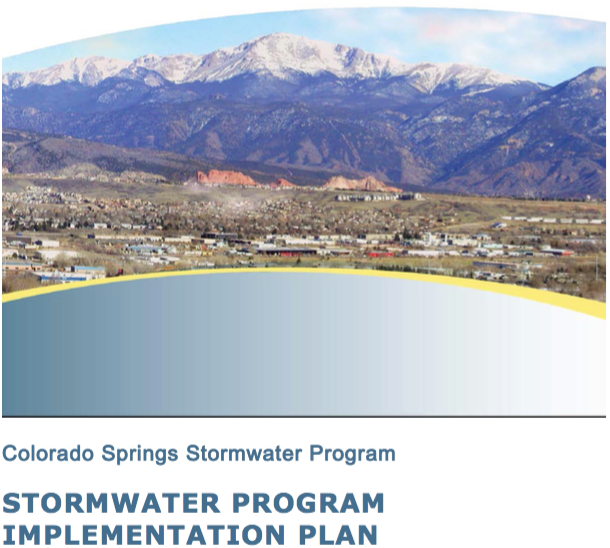
#Colorado Springs: “Sustainable stormwater funding and management is not optional” — John Suthers

coloradospringsstormwaterimplementationplan072016cover

Click here to read the plan.

Here’s the release from the City of Colorado Springs:

The City of Colorado Springs today released the draft Stormwater Program Improvement Plan designed to dramatically improve the city’s infrastructure and meet federal requirements.

City Public Works Director Travis Easton provided this statement.

“Today the City of Colorado Springs has released a draft Stormwater Improvement Plan. This is significant for our stormwater program, our citizens, and our City. The draft Stormwater Program Improvement Plan reflects strong leadership by the Mayor and City Council. We began this effort last fall and we reached a preliminary draft in January. Today’s release includes updates through July 2016.
“The City’s Public Works Department would appreciate the public’s comments and suggestions for improvement of the plan over the next 60 days. We will take public input into account and release the Plan in final form shortly thereafter.

“Thank you in advance for helping to shape this plan, and being a part of the process.”

Individuals wishing to provide feedback on the plan can contact Richard Mulledy, the City’s Stormwater Division Manager at stormwater@springsgov.com or by mail to: Richard Mulledy, Stormwater Division Manager, City of Colorado Springs, 30 S. Nevada Avenue, Suite 401, Colorado Springs, CO 80901.

The City of Colorado Springs and Colorado Springs Utilities have committed to investing a total of $460 million over 20 years, beginning this year. The commitments essentially replace the city Stormwater Enterprise that was defunded in 2009.

“Fixing the stormwater issues that we inherited stemming from the dissolution of the stormwater enterprise has been a top priority for me and the City Council,” said Colorado Springs Mayor John Suthers. “Sustainable stormwater funding and management is not optional – it is something that we must do to protect our waterways, serve our downstream neighbors, and meet the legal requirements of a federal permit.”

From The Pueblo Chieftain (Chris Woodka):

Colorado Springs this week released its draft stormwater plan, which was spurred earlier this year by negotiations with Pueblo County commissioners over permits for the Southern Delivery System.

The 305-page implementation plan mirrors the terms of an intergovernmental agreement, outlining at least $460 million in expenditures over the next 20 years and restructuring the city’s stormwater department. It was released Wednesday on the city’s website (http://coloradosprings.gov).

It’s important to Pueblo because work within Colorado Springs is expected to reduce damage along Fountain Creek.
Work already has started on some of the projects that are expected to benefit Pueblo County as well as Colorado Springs. A total of 61 of the 71 critical projects have downstream benefits to Pueblo and other communities, in a March assessment that included input from Wright Water Engineers, which has been hired by Pueblo County as consultant for Fountain Creek issues.

That list can change, depending on annual reviews of which work is needed, according to the IGA.

The plan also attempts to satisfy state and federal assessments that the existing stormwater services failed to meet minimum conditions of the city’s stormwater permits. An Environmental Protection Agency audit last year found Colorado Springs had made no progress on improving stormwater control in more than two years.

This year, Colorado Springs formed a new stormwater division and plans on doubling the size of its stormwater staff.

The plan includes a funding commitment of $20 million annually by the city and $3 million per year by Colorado Springs Utilities to upgrade creek crossings of utility lines.

The plan acknowledges that Colorado Springs significantly cut staff and failed to maintain adequate staffing levels after City Council eliminated the city’s stormwater enterprise in 2009. Pueblo County suffered significant damage, including the washout of part of Overton Road and excess debris in the Fountain Creek channel through Pueblo, during prolonged flows last May.

Other parts of the Pueblo County IGA expedited funding for flood control studies and projects by the Fountain Creek Watershed Flood Control and Greenway District, as well as providing an additional $3 million for dredging in Pueblo.

Pueblo County gives federal Bureau of Reclamation land access for Arkansas Valley Conduit field work

Arkansas Valley Conduit Comanche North route via Reclamation

From The Pueblo Chieftain (Jon Pompia):

In a brief meeting Monday, the Pueblo County commissioners approved a resolution granting permission to the federal Bureau of Reclamation to access county property for field work associated with the proposed Arkansas Valley Conduit.

Reclamation officials will conduct surveys and soil testing related to the conduit alignment, the commissioners learned. The county will be notified by Reclamation before entry onto county property is taken.

In voting to OK the resolution, Commissioner Liane “Buffie” McFadyen noted, “It makes me a bit more optimistic it (the conduit) could happen in my lifetime.”

SECWCD seeks $17.4 million for Pueblo Dam hydroelectric project

Hydroelectric Dam
Hydroelectric Dam

From The Pueblo Chieftain (Chris Woodka):

A hydropower project at Pueblo Dam has been given a green light by the Bureau of Reclamation and is in line for a $17.4 million state loan.

A finding of no significant impact was issued last week for the project being spearheaded by the Southeastern Colorado Water Conservancy District. Other partners in the project are Pueblo Water and Colorado Springs Utilities.

The Southeastern district will seek a $17.4 million loan for the project from the Colorado Water Conservation Board today. The loan would be for 30 years at 2 percent interest.

The new north outlet works at Pueblo Dam -- Photo/MWH Global
The new north outlet works at Pueblo Dam — Photo/MWH Global

A 7 megawatt hydropower facility is anticipated at the north outlet works, which was constructed by Utilities as part of the Southern Delivery System.

“A hydropower plant and associated facilities will be constructed at the base of Pueblo Dam, utilize the dam’s north outlet works and immediately return flows to the Arkansas River downstream of the dam,” said Signe Snortland, area manager of Reclamation’s Eastern Colorado Area Office.

The next step will be negotiation of a lease of power privilege contract.

About 1.4 miles of new power and fiber optic lines also will be constructed to connect the hydropower plant to Black Hills Energy’s substation at Lake Pueblo.

Construction is expected to begin later this year, with the first power generation to begin in 2018.

Lake Pueblo: Reclamation sets comment deadline on excess capacity water storage contract

Pueblo Dam
Pueblo Dam

From The Pueblo Chieftain (Chris Woodka):

Negotiations are continuing with participants in a master contract for the excess capacity storage of water in Fryingpan-Arkansas Project facilities, primarily Lake Pueblo.

The Bureau of Reclamation released a public notice in The Pueblo Chieftain on Saturday seeking comments on its draft master contract with the Southeastern Colorado Water Conservancy District.

The deadline for comments to the Eastern Colorado Area Office in Loveland is Sept. 15.

The contract was negotiated in January, but did not include storage amounts. The district is in the process of meeting with each of the participants on the details of subcontracts, which will be submitted to Reclamation in order to finalize the contract, said Jim Broderick, executive director of the district.

“We’ll be meeting with all the participants in August,” Broderick said.

In the environmental impact statement for the master contract, there were 37 participants seeking nearly 30,000 acre-feet (9.7 million gallons) annually.

More than half of those were participants in the Arkansas Valley Conduit, but others included several communities in the Upper Arkansas Valley, Pueblo West and El Paso County communities.

@USBR Releases Finding of No Significant Impact for Pueblo Hydropower Project

Pueblo dam releases
Pueblo dam releases

Here’s the release from the US Bureau of Reclamation (Patience Hurley):

The Bureau of Reclamation has completed the environmental study process and released the necessary documents for the Pueblo Hydropower Project to move forward.

“Final Environmental Assessment (EA) and Finding of No Significant Impact (FONSI) were completed to address a request from Southeastern Colorado Water Conservancy District, Board of Water Works of Pueblo, and Colorado Springs Utilities to develop hydropower at the federally-owned Pueblo Dam,” said Signe Snortland, Area Manager for Reclamation’s Eastern Colorado Area Office.

The next step for Reclamation is to enter into a contract called a Lease of Power Privilege. This contract authorizes the use of federal lands, facilities, and Fryingpan-Arkansas Project water to construct, operate, and maintain a 7 megawatt hydropower facility at the Pueblo Dam. The project utilizes a “run of river” design that harnesses water releases from Pueblo Dam to generate power and provide a clean, renewable source of energy.

“A hydropower plant and associated facilities will be constructed at the base of Pueblo Dam, utilize the dam’s north outlet works, and immediately return flows to the Arkansas River downstream of the dam,” said Snortland.

About 1.4 miles of new power and fiber-optic lines will also be constructed to connect the hydropower plant to the existing Black Hills Energy’s Pueblo Reservoir Substation. Construction is anticipated to begin in late 2016 with power generation anticipated in 2018.

The EA and FONSI are available online at: http://www.usbr.gov/gp/ecao/nepa/pueblo_hydropower.html

For additional information or to receive a printed copy of the EA/FONSI, please contact Terence Stroh at 970-962-4369 or TStroh@usbr.gov.

SDS opens the tap for Security — The Pueblo Chieftain

All that was left at the end of 75 minutes of speeches was to have a sip of SDS water. Photo via the Colorado Springs Independent.

From The Pueblo Chieftain (Chris Woodka):

Security will be able to use increased capacity in the Southern Delivery System pipeline to deal with contaminated well water in the Fountain Creek aquifer.

Security Water District reached an agreement with Colorado Springs Utilities to increase the amount of water transported through SDS in order to eliminate perfluoralkyl substances, or PFASs, in drinking water.

“The start of SDS could not have come at a better time,” said Roy Heald, Security Water general manager. “We always said SDS was being built to improve reliability to the existing water systems and the situation with PFASs in drinking water underscores that.”

SDS went online in April.

The cause of the PFAS contamination is unknown, but it typically finds its way into water systems through manufacturing processes or deicing at airports.

When contaminants were first detected, Security stopped using some wells and initiated voluntary watering restrictions.

Security, located south of Colorado Springs, historically blended equal parts well water and surface water. The majority of customers are not affected by PFASs, but in some parts of the district increased use of groundwater normally would be needed to meet summer watering demands.
Security also gets some of its water from the Fountain Valley Conduit, which, like SDS, pumps water from Lake Pueblo to El Paso County.

“We are pleased to work with our longtime SDS partner Security Water to help resolve the water contamination issues,” said Dan Higgins, Colorado Springs Utilities chief water services officer. “SDS is already showing how critically important it was for all the communities who partnered to build it.”

Meanwhile, here’s a report about the public meeting held yesterday about the problem from Bruce Finley writing for The Denver Post. Here’s an excerpt:

More than 1,000 people south of Colorado Springs packed a high school Thursday night and buffeted government officials with questions and concerns about an invisible toxic chemical contaminating public water supplies…

Colorado Department of Public Health and Environment officials repeated recommendations — especially for women and children, because they may be more vulnerable to the perfluorinated chemicals (PFCs) — to switch to other water as a precaution.

“You may or may not be getting your tap water from an area of concern,” CDPHE water-quality official Tyson Ingals told residents. “We have about 60,000 people in the areas of concern. We estimate 10,000 to 15,000 may be receiving water with PFCs above the level of the heath advisory.”

What about schools? residents asked. How long have people here been drinking water tainted with PFCs? What about property values? Should pets be drinking different water? Could organically home-grown vegetables be tainted?

Local utility officials in Widefield, Security and Fountain — all partially dependent on municipal wells drawing from tainted groundwater — assured residents they are intensifying efforts to dilute supplies by mixing in cleaner water piped from Pueblo, 40 miles to the south. A CDPHE preliminary health assessment has found elevated cancer in the area, but officials emphasized no link to PFCs has been established…

Officials from El Paso County, the CDPHE and the military now are looking more closely at contamination in the Widefield-Security-Fountain area. Of 43 private wells tested recently, county officials have received results from 37 tests, with PFC levels in 26 exceeding the EPA limit, spokeswoman Danielle Oller said.

In Security, all 32 municipal wells are contaminated, and water officials ranked the wells based on levels of contamination. One well where the level was nearly 20 times higher than an EPA health advisory limit has been shut down. Security officials urged voluntary cutbacks in lawn watering to reduce the need to use contaminated groundwater.

Security Water and Sanitation District manager Roy Heald has divided the city into three zones and said about 25 percent of residents live in a zone receiving water from contaminated wells. The residents in two other zones “are supplied water mainly from surface water sources,” Heald said…

Next week, utility officials plan to begin re-plumbing, installing new pipelines, trying to blend in more water from Pueblo into that zone and other areas…

Air Force representatives at the forum, where residents filled an auditorium, adjacent cafeteria and stood in hallways at Mesa Ridge High School, said the Air Force will pay $4.3 million to set up temporary treatment systems — while local utilities address the long-term implications of contaminated groundwater and a possible fix. Military airfields are suspected as a source of PFC contamination, and a broad investigation is planned, with drilling in October at Peterson Air Force Base east of Colorado Springs.

“Our short-term to mid-term solution is to use more surface water, which is not affected by these contaminants. Our mid-term to long-term solution will be to treat the groundwater,” said Heald, who met with Air Force officials and will continue those discussions. Security also has requested financial help from the EPA, CDPHE and elected officials.

“Security Water is a relatively small water district, and the costs of managing this issue is expensive for our customers,” Heald said.

Security residents typically pay about $25 a month for their water.

Widefield officials said they’ll set up a free bottled water distribution station — limiting residents to 10 gallons a week. They’re relying as much as possible on water from Pueblo, although they may draw from contaminated wells to meet peak demands during summer as temperatures rise.

Fountain utility officials planned to notify residents about PFCs in notices mailed along with July water bills. Fountain normally draws from eight municipal wells, all now contaminated with PFCs above the EPA limit, and has shifted to water from Pueblo while contract engineers search for a solution.

Yet Ingals from CDPHE pointed out that these cities “cannot function on surface water alone. … There are groundwater wells that are being pumped. … The wells kick on and off at different intervals. … Because it is not predicable, we cannot tell you that it always is safe…

CDPHE experts in February began a preliminary assessment of cancer rates in the area south of Colorado Springs and on June 30 completed a report showing elevated cancer rates. The CDPHE team found lung cancer rates 66 percent higher than expected, bladder cancer up 17 percent and kidney cancer up 34 percent. CDPHE officials emphasized there’s no clear link to PFCs…

The assessment looked at births from 2010-14 and all cases of 11 types of cancer from 2000-2014 in 21 census tracts covering Security, Widefield and Fountain. CDPHE researchers compared these with birth and cancer data from the rest of El Paso County.

They found no spike in low birth weights in the areas where water is contaminated with PFCs. But there were a higher-than-expected rates of lung, kidney and bladder cancers.

“Of these types of cancer, only kidney cancer has been plausibly linked to PFC exposure in human and laboratory animal studies,” Van Dyke said.

The increases may be explained by higher rates of smoking and obesity in the area. Smoking and obesity, CDPHE officials said, may be factors explaining the increased kidney cancer.

More coverage from The Colorado Springs Gazette (Jakob Rodgers):

Residents from across Security, Widefield and Fountain flocked to hear more than a dozen federal, state, local and military officials hold a town hall about the work being done to clean the water in the Widefield aquifer.

As the evening wore on, one question rose above the rest: Why must residents have to incur more costs for bottled water and home filters because of a problem that wasn’t their fault?

“Why does the consumer have to pay more?” one man asked, to applause. He received no answer…

Roughly 60,000 people are served by water districts pulling from the contaminated Widefield aquifer, most of whom are in Security, Widefield and Fountain, officials said Thursday.

However, the majority of those people receive clean surface water pumped in by the Pueblo Reservoir. About 10,000 to 15,000 people receive contaminated water from wells tapped into the aquifer – and even they sometimes receive clean surface water, depending on daily water usage, a state health official said.

In general, those affected homes are along the western portions of Security and Widefield. Fountain has switched to clean surface water…

Throughout the meeting, officials stressed they are doing all they can to fix the problem.

Within a month, the Widefield Water and Sanitation District plans to set up a water dispensing site, allowing residents along the western portions of Widefield to receive up to 10 gallons of water a week. It is also working on a construction project to pump in more surface water.

Security officials announced a deal Thursday with Colorado Springs Utilities to increase the amount of Southern Delivery System water it will receive.

The project, which could take three months to complete, will likely end the community’s reliance on well water until a more permanent solution can be implemented. It might, however, come at the cost of higher water rates next year, the district’s water manager said.

Fountain officials also are working on a treatment plant.

Widefield aquifer via the Colorado Water Institute.

#COWaterPlan: Dealing with the “gap”

Clear Creek Reservoir

From The Pueblo Chieftain (Chris Woodka):

This is the first in a continuing series about how Colorado’s Water Plan will be put into action.

New sources of water are unlikely, so the Arkansas River basin’s focus should be on which crops or landscapes are irrigated, because irrigation is the largest use of water.

Pueblo Water plans to increase storage in key locations above, in and below Lake Pueblo.
Although we won’t find the water supply we want, wise use and efficient water management can stretch the supply we have.

That’s the outlook from Alan Ward, water resources manager for Pueblo Water.

Ward has been involved with filling municipal water needs during the severe drought of 2002 and the more prolonged drought of 2011-13.

He oversees a complex water leasing program that allows Pueblo to make the fullest use possible of its water portfolio.

Ward was part of Pueblo Water’s team that purchased more than one-quarter of the Bessemer Ditch water rights to secure future supply, and as a result is now a member of the canal company’s board of directors.

Colorado’s Water Plan was unveiled last year as an evolving way to meet water needs for the state for decades to come.

The process to develop the document was exhaustive, with hundreds of meetings, thousands of comments and 10 years of effort. It will take even more work to implement the plan and to focus activities that are in line with the plan’s objectives.

To gain a better understanding of how policymakers view the plan, The Pueblo Chieftain and Arkansas Basin Roundtable is asking key individuals three basic questions: How the gap will be filled, what projects are anticipated and what actions can be taken to prevent the gap from getting bigger.

Here are Ward’s answers:

How do we fill the gap in the Arkansas River basin within Colorado’s Water Plan and the Basin Implementation Plan?

“Since the water of the Arkansas River basin is already completely appropriated, the ‘gap’ is really the difference between the water supply we have and the water supply we’d like to have.
I am not optimistic about the prospects of increasing supply. There is no currently unused supply to develop locally within the Arkansas River basin, so an increased supply would have to be imported from elsewhere.

“I think that the expense along with the political and environmental hurdles make importation of new water supply into the Arkansas River basin very complicated and climate change may lead to even less supply on both the Eastern and Western slopes.

“As an alternative, I believe the focus in the Arkansas River basin should be on adapting to having less water than we would like. Storage is key to making the most efficient use of the available water supply.

Storage allows for some control of the timing and location of the limited water supply so that it can be used when and where it is most needed.

Storage also provides the flexibility to move water in ways that can enhance recreational opportunities and minimize environmental impacts.

“Irrigation, whether for crops and livestock grazing or lawns and urban landscapes, is the primary consumptive use of water in the Arkansas Basin (and most of the western United States). I believe that there just isn’t the water capacity to increase the amount of irrigated land, so there needs to be some difficult discussions about what gets irrigated. If urban irrigation increases, then agricultural irrigation will have to decrease or vice versa. It is important to note that urban irrigation has been on a downward trend so there is probably room for some urban growth without an overall increase in the amount of urban irrigation.

“Determining where water should be used for irrigation is a complex problem.

Because water rights are a private property right that can be transferred to new uses, there can be tensions about what role government should play in shaping the free-market movement of water rights and what involvement local communities should have in the transfer of water rights. Finding the right balance between the rights of individuals to use their property as they wish and achieving the desired outcomes of the broader public will be difficult.

“Other water uses such as domestic (including indoor urban), environmental, recreational and industrial are extremely important, but they are so small relative to irrigation use that changes in these water uses will only have minor impacts on the ‘gap’ at a basinwide scale.”

What projects do you plan to fill the gap?

“Pueblo Water is looking to add storage capacity at three key locations for its operations.

“Clear Creek Reservoir can be enlarged to provide additional storage in the Upper Arkansas River basin, which may facilitate better management and optimization of Pueblo’s water imported from the Western Slope.

“Pueblo Reservoir is ideally located in that it is low enough in the basin that a significant amount of water flows into it from upstream.

Many of the largest water users can take delivery of water from the reservoir either by pipeline or by release down the Arkansas River. Enlargement of Lake Pueblo could provide flexibility and water management efficiencies to Pueblo Water and many other urban, rural and agricultural water users.

“Storage located a short distance downstream of the city of Pueblo would allow for more efficient reuse of Pueblo Water’s fully consumable water supplies while at the same time optimizing the timing of flow on the Arkansas River through Pueblo for recreational and environmental benefits.

“Pueblo Water has committed to partner with Colorado Springs, Aurora, Fountain, Pueblo West and the Southeastern Colorado Water Conservancy District in developing this type of storage in order to recapture water that the parties could have captured at Lake Pueblo if not for the Pueblo Flow Management Program (recovery of yield storage).”

How do we keep the gaps for agriculture and municipalities from becoming bigger?

“Keep expectations for water supply in line with actual water supply, plus encourage wise use and efficient water management, including expansion of storage.”

#ColoradoRiver: Ruedi Reservoir expected to fill next week #COriver

Sunrise at Ruedi Reservoir October 20, 2015. Photo via USBR.

From email from Reclamation (Peter Soeth):

Releases from Ruedi Reservoir are anticipated to remain at 125 cfs throughout the weekend. It is expected to fill next week. If the basin gets any significant rainfall, the reservoir may fill sooner and releases may have to be increased.

You may check the releases and reservoir elevation at http://www.usbr.gov/gp-bin/arcweb_rueresco.pl.

Twin Lakes Tunnel opens for more transmountain diversions

The east end of the Twin Lakes Tunnel on May 16, 2016.

The east end of the Twin Lakes Tunnel on June 6, 2016.
A graph showing the level of water flowing through the Twin Lakes Tunnel this week. The tunnel began diverting water, after being closed for two weeks, on Tuesday, June 28, 2016.

ASPEN – The unnatural order of things was restored Tuesday as the Twin Lakes Tunnel began diverting water to the east again from the headwaters of the Roaring Fork River, after having been closed for two weeks.

The tunnel was closed temporarily after constraints in water rights required that it stop diverting from the Fork, Lost Man and Lincoln creeks, and other tributaries in the headwaters.

The tunnel under the Continental Divide had been diverting about 620 cubic feet per second (cfs) before diversions were stepped down over a three-day period from June 14 to 16, when the tunnel closed.

The reintroduced native flows down the Fork and Lincoln Creek added noticeable intensity to the river as it made its way through the Grottos, Stillwater and Slaughterhouse reaches near Aspen.

One of the constraints on the legal rights of the tunnel is that when the Colorado Canal in Ordway can divert freely because there is plenty of water in the lower Arkansas River, it cannot demand water from the Roaring Fork.

But the spring runoff has slowed, pinching the supply of water available to the canal from the Arkansas. As such, it can now legally call for water from the Roaring Fork.

“The Colorado Canal is being called out, so we can start diverting the tunnel under the direct flow portion of the right,” wrote Kevin Lusk, the president of the board of the Twin Lakes Reservoir and Canal Co. and a principal engineer at Colorado Springs Utilities, in an email Tuesday.

The other constraint was that the Twin Lakes Reservoir and Canal Co. had filled its storage allotment of 54,452 acre-feet of water in Twin Lakes Reservoir.

With that “bucket” filled, and the Colorado Canal still in priority, the tunnel had to be closed.

Not all of the water diverted from the Fork’s headwaters goes to the Colorado Canal, however, as the Independence Pass Transmountain Diversion System, of which the Twin Lakes Tunnel is the key component, now also helps meet water needs in several Front Range cities.

The diversion system is technically owned by the Twin Lakes Reservoir and Canal Co., which is based in Ordway. But Aurora, Colorado Springs, Pueblo West, and Pueblo own almost all of the shares in the company.

On Tuesday, the Twin Lakes Tunnel, which begins at Grizzly Reservoir on Lincoln Creek, was opened back up and about 200 cubic feet per second began flowing east, primarily from Lincoln Creek and the creeks in Brooklyn, New York, and Tabor gulches.

In response, levels in the Roaring Fork River near Aspen fell sharply.

The river at Difficult Campground, for example, was flowing at 390 cfs at 6 a.m., Tuesday morning, but had fallen to 244 cfs by 8 p.m.

And the measuring gauge on Stillwater Drive, just below the North Star Nature Preserve, showed the river flowing there at 510 cfs at 6 a.m. and at 311 cfs by 8 p.m.

On Wednesday, Lusk said that new calls for water from various shareholders in the Twin Lakes Reservoir and Canal Co. mean that water from Lost Man Creek and the main stem of the Fork would soon be added to the flow of water being sent east through the tunnel.

Lusk said he expected the tunnel to continue diverting water through the summer.

This marked the second year in a row the Twin Lakes Tunnel was forced to cease diverting due to wet conditions on the east side of the pass.

During most of the time the Twin Lakes Tunnel was closed, diversions continued to flow as usual through the Bousted Tunnel, which sends water east from the headwaters of the Fryingpan River, as well as from Hunter, Midway, and No Name creeks near Aspen.

Around 800 cfs has been flowing through the Bousted Tunnel for most of June.

And according to the Pueblo Chieftain, the total diversion from the Fry-Ark project so far this year is about 51,000 acre-feet of water.

Add that to the approximately 25,000 acre-feet diverted so far by Twin Lakes, and it means about 76,000 acre-feet has been diverted from the Roaring Fork River watershed so far this year, not counting what may have been sent through the Busk-Ivanhoe Tunnel, which also diverts from the upper Fryingpan.

Ruedi Reservoir, by comparison, can hold 102,373 acre-feet.

Editor’s note:
Aspen Journalism, the Aspen Daily News, and Coyote Gulch are collaborating on coverage of rivers and waters. The Daily News published a version of this story on Thursday, July 30, 2016.

#Colorado Springs helps districts with water contamination — KOAA.com

From KOAA.com (Jessi Mitchell):

The water districts are all connected through the Fountain Valley Authority and the Southern Delivery System project, which just went online last week. Right now, the SDS is coming in handy for Fountain, Security and Widefield.

Colorado Springs ratepayers turned Thursday’s public meeting about updates to the long-term Integrated Water Resource Plan into a Q&A session, asking what happens when neighboring districts are impacted by fracking, drought and contamination. Springs Utilities revealed to News 5 that the company is already helping in the efforts to deliver clean water to the three impacted communities after learning they had man-made compounds above the EPA’s new advisory level in their groundwater. “Right now, Springs Utilities staff is working with the staff of those entities to determine how they can use their allocations through the Fountain Valley Authority and SDS to augment their groundwater sources,” says CSU water resources manager Brett Gracely.

Colorado Springs shares the Widefield aquifer where the PFCs were found, but it has not used any water from it since the early 2000s. Now the other, smaller districts are scrambling to find other options. Springs citizens agree they should be good neighbors, but are still concerned about their own water. Ratepayer Dennis Moore says, “We’ve got to do something to help them, but how do we help them within our own resources without depleting our resources? It’s going to be interesting, so they’ve got to find a manageable way to do that.”

Instead of using its planned share of Pueblo Reservoir water through SDS and the FVA pipelines, Colorado Springs is letting the others siphon off a greater allotment, using other already established sources to provide water to its customers. Gracely says, “Because it’s a joint public health concern, it’s not well-defined, so we’ll do what we can in terms of in-kind services and our existing collaborations.”

As Colorado Springs continues to explore new options for retaining and delivering water for future generations, citizens agree that it is better to have extra as an insurance plan, since you never know when you will need it. “I remember back when, when people were fighting SDS and everything,” says Moore, “and now I’m beginning to see it’s a very good reason to have it.”

Widefield aquifer via the Colorado Water Institute.

“The history of #Colorado Springs is a history of bold and ambitious water projects” — Mayor John Suthers

From The Pueblo Chieftain (Chris Woodka):

Usually a water treatment plant just sits off to the side of a city, pumping along with little notice unless something goes wrong.

But more than 300 people gathered Friday at the Edward W. Bailey treatment plant on Colorado Springs’ east side to dedicate the Southern Delivery System.

A choir belted out “God Bless America” with its inspiration, Pikes Peak, as a backdrop. People who had worked on the project over its more than 20-year history reconnected. At the end, there was a grand toast with — what else? — a jigger of water from keepsake mini-jugs.

“The history of Colorado Springs is a history of bold and ambitious water projects,” Mayor John Suthers told the crowd. “Without those bold and ambitious water projects, Colorado Springs would be a city of only 20,000 or 30,000.”

Instead it has grown to 450,000, and with SDS makes it possible for the city to get bigger.

That made most of the people at the ceremony happy. Suthers and others praised the regional benefits of SDS, urging cooperation in areas such as economic development and transportation.

“Water has been our community’s greatest challenge and its greatest resource,” said Jerry Forte, CEO of Colorado Springs Utilities. “Nothing happens without water.”

Forte detailed the history of the $825 million water pipeline from Pueblo Dam to Colorado Springs, explaining that planning dates back to 1996, when the idea crystallized in the Colorado Springs Water Plan. It was one of four alternatives in the document, but the only one that made it to the finish line.

It was a tortured run, however, filled with disputes in Lake, Chaffee, Fremont, Pueblo and Crowley counties. Forte nodded at the entanglements only briefly.

“There were lots of opportunity to build character and relationships,” he deadpanned as the crowd started chuckling.

Instead, he concentrated on the accomplishments that led to SDS, recognizing former officials such as Lionel Rivera, who was mayor of Colorado Springs when a deal was made in 2004 on Arkansas River flows through Pueblo. Seated next to Rivera was Randy Thurston, who pushed his fellow members on Pueblo City Council to approve the agreement. He enumerated the benefits of SDS to Colorado Springs’ partners Fountain, Security and Pueblo West.

Forte also lamented that SDS required 470 permits, which was a good set-up line for Sen. Cory Gardner, R-Colo., who joked: “How many of you thought SDS stood for Still Doing Studies.”

On a serious note, Gardner praised the collaboration it took to build SDS, saying more projects like it are needed, citing their importance in Colorado’s Water Plan.

“If we do not invest in water projects, Colorado will see a shortfall of 500,000 acre-feet per year,” Gardner said. “That’s five times the supply of Colorado Springs.”

While the event maintained a festive spirit, some from Pueblo County who attended were more low-key in their assessment of SDS.

“Technologically, it’s an amazing accomplishment,” said Bill Alt, whose property on Fountain Creek is being destroyed because of increased flows from the north. “I’m not sure all the cooperation they were talking about is there. I’d have to say the stormwater agreement probably benefit everyone.”

Jane Rhodes, who also owns land on Fountain Creek, said there are still challenges ahead in dealing with Fountain Creek flooding.

“The first of the $50 million payments will come, and one of those projects is on my land,” Rhodes said. “I’m glad SDS is done so the projects can get started.”

From 9News.com (Maya Rodriquez):

Fifty million gallons: it’s the amount of water that will be flowing through a new water system every day.

It’s called the Southern Delivery System, or SDS. It is the largest water system built in the western U.S. so far in the 21st century.

The planning for it began 20 years ago. After nearly a billion dollars and more than 470 permits later, it’s now a reality in Colorado Springs.

“In the whole western United States, water is probably the most precious commodity that we have and all of us need to do what we can to steward water,” Colorado Springs Utilities CEO Jerry Forte said.

That is where the system comes in – it is designed to treat water efficiently, as more and more people move to southern Colorado.

“This is all the piping that goes put to the finished water tank to be delivered to the customer,” said Operations Superintendent Chad Sell. “One of the most state of the art facilities in Colorado.”

The system serves more than a half million people in Colorado Springs, parts of Pueblo and the communities of Fountain and Security. Within 50 years, though, 900,000 people are expected to get their water from SDS.

“I think the long-term vision that put this in place means we’re good for the next 50 years,” said Colorado Springs Utilities Board Chair Andy Pico. “We have water. Water in the West is critical.”

Even as they celebrate the opening of the SDS as it stands now, they’re already planning for a second phase that will eventually expand it to handle more water for more people.

Colorado Springs officials say the SDS project did not receive any state or federal dollars. The 830-million dollar project, which also came in more than $100 million under budget, is being funded through bonds and will be paid for by its water customers of today and the next 30 years.

From KRDO.com (Angelica Lombardi):

After more than 20 years of planning and construction, Colorado Springs Utilities dedicated the historic Southern Delivery System water project at the Edward W. Bailey water treatment plant Friday morning.

On April 28, history flowed out of this historic Southern Delivery System for the first time.

It took decades of planning and six years of construction and Friday morning the hard work was recognized.

“I’ve been involved in this project for 14-plus years. To see it complete with excellence and all the people who contributed. I was overwhelmed,” said Jerry Forte, CEO of Colorado Springs Utilities…

“It’s amazing for Colorado Springs and our partners. It means water for the future. We call Southern Delivery ‘water for generations’ and what that means is our children and grandchildren will be able to have water in Colorado Springs for 50, 60-plus years from now,” said Forte.

The water is pumped out of the Pueblo Reservoir and makes its way through 50 miles of pipeline going through three pump stations and ending at Colorado Springs…

It took more than 470 permits to finalize the project.

SDS Facts

  • The Water Treatment Plant has approximately 200 miles of electrical wires and cables, enough to stretch from the Water Treatment Plant site nearly to the International Space Station or the Pueblo Reservoir four times.
  • The Water Treatment Plant used enough rebar to fill 54, 50-foot rail cars or a train half-a-mile
  • If the concrete masonry blocks used in construction of the Water Treatment Plant were stacked, they would be four-and-a-half times taller than Pikes Peak.
  • The raw water tank at the Water Treatment Plant has a capacity of 10 million gallons, enough to fill 200,000 bathtubs.
  • 5,401 truckloads of pipe to SDS projects
  • Net tons of steel used for pipe furnished was 37,810.
  • From the Colorado Springs Independent (Pam Zubeck):

    Some 400 to 500 people gathered at the Edward W. Bailey Water Treatment Plant, 977 N. Marksheffel Road, Friday morning to dedicate the Southern Delivery System pipeline project.

    The project, 20 years in the making,d represents the service, safety, commitment and excellence brought to bear by hundreds, even thousands, of people, said Colorado Springs Utilities CEO Jerry Forte.

    He noted that the project adds another noteworthy item to Colorado Springs’ water history, which began in the late 1800s when city founder Gen. William Jackson Palmer built the El Paso County Canal from Fountain Creek on what is now 33rd Street, Forte said.

    SDS, he noted, will provide water for generations to come.

    SDS first appeared in the city’s water master plan in 1996 and was geared to supply water to the 20,000-acre Banning Lewis Ranch, which had been annexed into the city in 1988. Only a fraction of that property is built out, but SDS now is viewed as a crucial component of the city’s existing system to ensure redundancy. Most of the city’s water comes from transmountain systems built in the 1950s and 1980s. SDS brings water from Pueblo Reservoir.

    Although Rep. Doug Lamborn heralded the project for not requiring federal money, the Pueblo Dam and reservoir project was part of the Frying Pan-Arkansas project built in the 1960s and 1970s by the Department of the Interior’s Bureau of Reclamation, along with a special district that collected property tax money in the region. SDS, obviously, wouldn’t have been possible without that reservoir on the Arkansas River.

    City Council President Merv Bennett demonstrated the span of time needed to plan and build SDS by noting 11 Councils have played key roles in the project. He recognized El Paso County Commissioner Sallie Clark, a former Council member, who he said laid the groundwork for relationships with Pueblo officials; former Mayor Lionel Rivera, who oversaw the project as both mayor and a Council member; Randy Thurston, former Pueblo City Council member; former Vice Mayor Larry Small, who now runs the Fountain Creek Watershed Flood Control and Greenway District, which grew from SDS negotiations; and Margaret Radford, former Council member who now works for an SDS contractor, MWH Global.

    CSU Chair Andy Pico boasted that the project was originally envisioned to cause water rates to increase by 121 percent, but it has required increases to rates of only 52 percent. The $825 million project came in $160 million under budget.

    Mayor John Suthers also spoke. His role might have been one of the most pivotal, because he sorted out a mess created by his predecessor, Steve Bach, in terms of the city’s stormwater situation, which had become a nearly insurmountable barrier to the project.

    First, Suthers had to deal with federal and state clean-water regulators who have accused the city of failing to comply with the Clean Water Act for years before Suthers took office in June 2015. Those negotiations are ongoing. Second, Suthers had to find a quick solution to stormwater improvements to satisfy Pueblo County commissioners, who threatened to reopen the city’s SDS construction permit. (Bach opposed a ballot measure in 2014 that would have funded stormwater work.)

    Suthers finessed a deal in which the city agreed to spend $460 million in the next 20 years to upgrade and maintain the city’s drainage facilities. Pueblo officials accepted the deal, clearing the way for water to begin flowing through the SDS pipeline in late April, as scheduled. (Bach was invited to, but did not attend, Friday’s SDS dedication.)

    Suthers said the city would have remained a tourist town of 20,000 but for its water resources. “Our future is bright, and we are poised for continued success,” he said.

    In a surprise development, U.S. Sen. Cory Gardner, R-Colo., showed up and lauded the city for the project. “It can’t be said enough how important water infrastructure is to the state of Colorado,” he said. “It’s our past. It’s our present, and it’s our future. It’s my hope this [project] can be replicated throughout Colorado, because water will continue to drive our success.”

    Others who spoke included CSU’s Chief Water Officer Dan Higgins, and the project director since 2007, attorney John Fredell, who became the face of SDS in the past decade through contracting, negotiations with neighbors, legal wrangling and interviews with the media. About 470 permits were required for the project.

    As Forte said, “We never would have reached this point today without one person,” that being Fredell.

    When Fredell stepped to the dais, he received a standing ovation from a crowd that included elected officials, contractors, project partners, officials from surrounding towns and Pueblo, Utilities employees and citizens.

    Fredell, in turn, thanked Forte for his “trust and vision and leading every step of the way.”

    After the speeches, the crowd was invited to open gift boxes at each chair which contained a commemorative coin and a little glass of SDS water, used to toast the project.

    All that was left at the end of 75 minutes of speeches was to have a sip of SDS water. Photo via the Colorado Springs Independent.
    All that was left at the end of 75 minutes of speeches was to have a sip of SDS water. Photo via the Colorado Springs Independent.

    To take a trip back in time through the Coyote Gulch history of the Southern Delivery Click here and click here.

    #Runoff #Snowpack news: Clear Creek closed to tubing, South Platte pretty much melted-out

    Clear Creek at Golden gage April 1 through June 12, 2016.
    Clear Creek at Golden gage April 1 through June 12, 2016.

    From KWGN (Drew Engelbart):

    Park Rangers were enforcing and informing visitors of the tubing and swimming restriction along Clear Creek on Saturday.

    Jefferson County Sheriff’s Office announced the restriction on Thursday, citing dangerous conditions because of high water.

    These temporary restrictions apply to Clear Creek in unincorporated Jefferson County, as well as those portions of Clear Creek within the City of Golden, including Vanover Park.

    Colorado’s Own Channel 2 spotted two people with tubes ready to hop in the water were stopped short by onlookers who informed them tubing was restricted.

    Water activities prohibited by the order include all single-chambered air inflated devices such as belly boats, inner tubes, and single chambered rafts, as well as “body-surfers” and swimming.

    Kayaks, paddle boards, whitewater canoes and multi-chambered professionally guided rafts and river boards are exempt, but are encouraged to observe extreme caution due to the safety concerns surrounding swift moving water and floating debris.

    Arkansas River at Moffat Street Pueblo April 1 through June 12, 2016.
    Arkansas River at Moffat Street Pueblo April 1 through June 12, 2016.

    From The Pueblo Chieftain:

    Authorities said the water of the Arkansas River where the rescue happened [ed. 3 young people rescued from the Arkansas River Tuesday, June 7] was flowing fairly fast. Earlier in the day, it was measured at 4,300 cubic feet per second — fast but not unusual during the annual spring runoff.

    Roaring Fork River at Glenwood Springs gage April 1 through June 12, 2016.
    Roaring Fork River at Glenwood Springs gage April 1 through June 12, 2016.

    From The Aspen Times (Erica Robbie):

    Rapids on the Roaring Fork River are expected to peak this weekend, said Aspen Fire Department Chief Rick Balentine, citing information from the Colorado Basin River Forecast Center.

    Balentine said the currents are “dangerously high” now and cautioned those on the water to wear some form of safety flotation device.

    According to the Centers for Disease Control and Prevention, 88 percent of people who drown in boating accidents are not wearing a life vest, Balentine said.

    He cited another Centers for Disease Control and Prevention stat noting alcohol is a factor in 70 percent of water-recreation accidents.

    “These are pretty stark facts,” Balentine said. “If you see somebody about to do something stupid, say something…

    On Thursday, the river flow hit around 1,640 cubic feet per second, Ingram said.

    River officials often draw a parallel between one cubic feet per second and one basketball — meaning 1,640 cubic feet per second is the equivalent to about 1,640 basketballs rushing down a river at once.

    Ingram expects the Slaughterhouse area, one of the faster, more thrilling sections of the river, to reach between 1,800 and 2,200 cfs this weekend.

    Cache la Poudre at Canyon Mouth water year 2016 through June 12, 2016.
    Cache la Poudre at Canyon Mouth water year 2016 through June 12, 2016.

    From The Fort Collins Coloradoan (Jacy Marmaduke):

    The National Weather Service in Denver extended a flood advisory for the Poudre in Larimer County and Weld County. The river isn’t projected to reach flood stage through early next week, but residents can expect minor flooding of low-lying areas along the river, according to the advisory.

    South Platte River Basin snowpack sat at 194 percent of its historical average on Friday morning and was even higher earlier this week thanks to remnants from spring snows. That’s significant for the Poudre, which is fed by mountain snowpack in addition to water from the Colorado-Big Thompson project.

    As temperatures soar into the 90s this weekend, snowmelt will push the river to 6.7 feet at the canyon mouth by Sunday morning, the advisory said. Flood stage is 7.5 feet, and the river stood at 6.2 feet Friday morning.

    At 6 feet, water covers the bike path and trail along the river in and near Fort Collins.

    southplatteriverbasinhighlo06112016

    From The Greeley Tribune (Katarina Velazquez):

    Colorado has twice as much snowpack than normal for this time of year, according to the latest snowpack report from the U.S. Department of Agriculture.

    The cool, wet weather in May contributed to the exceptional water supply Colorado appears to have heading into the summer. According to the report, as of June 6, the state was at 201 percent of the average for snowpack, compared to last year’s 95 percent.

    “This should be a good year waterwise for cities and for farmers; that’s the bottom line,” said Brian Werner of the Northern Colorado Water Conservancy District.

    The fact that snow is still visible in the mountains at this time of year means the runoff should last longer than it usually does, which in turn means less water will be pulled from reservoir storage later in the year, he said.

    And the snowpack is especially good in the northern Colorado area. The majority of remaining snowpack in Colorado exists in the northern mountains, especially in watersheds such as the South Platte and Upper Colorado, which are above 10,000 feet.

    As of June 6, both river basins that feed into northern Colorado — the Upper Colorado River Basin and the South Platte River Basin — were above 200 percent of the median snowpack.

    As for reservoir storage, the state is currently at 108 percent of average, according to the June 1 update from the Natural Resources Conservation Service. This is exactly where the state was last year, as well.

    The Upper Colorado River Basin is at 110 percent of average for reservoir storage and the South Platte River Basin is at 112 percent of the average.

    Werner said the Colorado-Big Thompson project is 20 percent above normal, which is promising at this point in the year. The Colorado-Big Thompson project is a series of reservoirs, pipelines, diversions and ditches that provides water to municipalities, farmers and other water users throughout northeastern Colorado.

    Werner said going into summer, farmers and cities should be in good shape if nothing drastic occurs within the upcoming months.

    “We shouldn’t have any major water worries this year,” he said.

    #Snowpack #Runoff news: So far it’s been a good water year, but not huge — The Pueblo Chieftain

    Westwide SNOTEL map May 19, 2016 via the NRCS.
    Westwide SNOTEL map May 19, 2016 via the NRCS.

    From The Pueblo Chieftain (Chris Woodka):

    If you just went by the numbers on the map of state snowpack, you’d be digging out the mittens and skis to enjoy a winter wonderland in the high country.

    But the state’s lush snow numbers are more a function of timing, not quantity. [ed. emphasis mine]

    Colorado snowpack moisture content was reported at 144 percent of median on Thursday, largely because of late spring snowstorms last week and cool temperatures that kept it from melting.

    “I’m not sure it means a lot,” said Roy Vaughan, manager of the Fryingpan-Arkansas Project for the Bureau of Reclamation, at the Southeastern Colorado Water Conservancy District’s monthly meeting Thursday.

    He showed graphs that explained why the numbers look so good right now. In most years, the snow would have already begun a precipitous melt-off by now, and that may happen with warmer temperatures this weekend.

    In the Arkansas River basin, the total snowpack briefly climbed higher than the average peak for the entire season — usually that occurs in mid-April. The snowpack was listed at 158 percent, but that’s mostly because some high-altitude sites are 2-5 times normal, while lower points already have melted out.

    The same is true of the Rio Grande basin, which was listed at 153 percent of normal.

    Reclamation projects that 65,000 acre-feet of water will be brought over the Continental Divide this year through the Fryingpan-Arkansas Project. While above average, it would be far from a record year. It would rival last year’s imports of 72,000 acre-feet, which increased throughout the season because of heavy rains.

    Storage in the Arkansas River basin remains at high levels with nearly all reservoirs at above-average elevation.

    Pueblo’s precipitation for the year is 5.19 inches, more than an inch above normal, but an inch less than at this time last May, when it rained nearly every day.

    From The Pueblo Chieftain (Chris Woodka):

    Farms will get a lot more water from the Fryingpan-Arkansas Project as cities curtailed their requests for water under the Southeastern Colorado Water Conservancy District’s annual allocation.

    Because many municipal storage accounts are full, they did not take as much water as they would otherwise be entitled to. About 53 percent of Fry-Ark water is tabbed for cities.

    Instead, the cities took only about 16 percent, leaving 84 percent for agriculture.

    The district projects there will be about 52,500 acre-feet of water available to allocate this year, the net amount from about 65,000 acre-feet that could be brought through the Boustead Tunnel into Turquoise Lake from the Fryingpan River on the other side of the Continental Divide. The difference accounts for obligations to deliver water, evaporation and transit losses.

    Only 80 percent of the allocations will be delivered initially, providing a cushion if less water is imported.

    Even though imports are higher this year, cities requested less water because storage is higher, said Garrett Markus, engineer for the district.

    Both Pueblo and Pueblo West declined their allocations this year. El Paso County cities were allocated about 3,700 acre-feet; cities east of Pueblo, 4,500 acre-feet; cities west of Pueblo, 214 acre-feet.

    Agricultural ditch companies requested more than 100,000 acre-feet of water, but will get only 43,200 acre-feet of water that’s available. The largest ditch, the Fort Lyon Canal, will get 17,000 acre-feet.

    “It’s always good to see a little more go to agriculture,” said Carl McClure, of Crowley County, who chairs the allocation committee.

    Another 15,200 acrefeet of return flows will be allocated to well associations or farmers to replace depletions of groundwater under either state well or surface-water irrigation improvement plans. Fort Lyon farmers are exercising their first right of refusal for about 4,900 acre-feet of that total.

    Senate bill would ease conduit cost to Lower Ark towns — The Pueblo Chieftain

    Arkansas Valley Conduit Comanche North route via Reclamation
    Arkansas Valley Conduit Comanche North route via Reclamation

    From The Pueblo Chieftain (Chris Woodka):

    A bill that would ease the cost burden of the Arkansas Valley Conduit to local communities got its first hearing in the U.S. Senate water and power subcommittee Tuesday.

    The bill, S2616, would allow miscellaneous revenues from the Fryingpan-Arkansas Project to be applied to the local match of the conduit.

    Legislation in 2009 allowed those revenues to be applied to the federal cost of building the $400 million conduit.

    Because of the 65-35 cost share, however, the Southeastern Colorado Water Conservancy District will face heavy expenses. The bill would allow the district’s share to be paid first, with any funds not needed being used to repay the federal share.

    Under the new law, the costs of Ruedi Dam, the Fountain Valley Conduit and South Outlet Works still would be repaid before funds could be used for the conduit. Like the Arkansas Valley Conduit, they are all parts of the Fryingpan-Arkansas Project which was authorized in 1962.

    The district is anticipating up to $100 million in loans from the Colorado Water Conservation Board — $60 million already has been committed, said Bill Long, president of the district board.

    He presented the committee with a letter of support from the CWCB.

    Long, a Las Animas businessman and Bent County commissioner, detailed the water quality problems faced by the Lower Arkansas Valley. Those include radioactivity, salts and sulfates. The 40 communities involved in the project serve more than 50,000 people and face increasingly strict regulatory standards, he said.

    “S2616 will achieve the goal of significantly reducing federal outlays while providing a reliable, safe drinking water supply to the rural communities in the Lower Arkansas River Valley,” Long said. “The alternative — contaminated supplies which pose a significant threat to public health and prohibitive costs for individual system improvements — is unacceptable.”

    Sen. Cory Gardner, R-Colo., a member of the committee, and Sen. Michael Bennet, D-Colo., are co-sponsors of the legislation.

    “Water is a precious resource in Colorado and throughout the west. As home to the headwaters for 20 states, our communities continuously look for ways to conserve water,” Bennet said.

    During the hearing, Estevan Lopez, commissioner for the Bureau of Reclamation, lent his support to the bill.

    “While we are still undertaking a detailed analysis of the full implications of such a reallocation of federal receipts, the reallocation of federal revenues to a non-federal entity for the benefit of that non-federal entity should be given careful consideration,” Lopez said.

    Lopez said about $21 million in appropriations already has been provided through this year. At least $3 million is anticipated this year.

    Construction on the conduit is expected to begin in 2019.

    Once the conduit is completed, there would be a 50-year repayment of the 35 percent local share that is addressed in S2616.

    Pueblo County Children’s Water Festival recap

    From The Pueblo Chieftain (Chris Woodka):

    You could sit all day and stare at the Pueblo Dam and not have a clue about why it’s there, who built it and what it’s for.

    Or, if you’re lucky enough to be a fourth- or fifth-grader in Pueblo County, you could spend a day filled with fun activities and learn everything from water safety to the water cycle — including the Pueblo Dam and the kitchen sink.

    The Children’s Water Festival began in 1999 and continues each year since, except for 2015, in early May at Colorado State University-Pueblo. About 1,800 fourth- or fifth-graders attend each year from Pueblo City Schools (D60), Pueblo County School District 70 and private schools.

    In 2015, the festival was canceled, ironically, because of weather. It was wet and cold the entire month of May, but the big concern was the possibility of thunderstorms. The 2016 program was geared for fifth-graders, who had missed their chance as fourth-graders last year.

    “The kids have always enjoyed it,” said Linda Hopkins, a retired employee of the Bureau of Reclamation, who helped coordinate the festival for many years.

    She explained that the Pueblo event was patterned after the Nebraska Groundwater Festival, which started in Grand Island, Neb., in 1988.

    Internally, Reclamation decided a Pueblo festival would be a good idea in 1999. By then, there were a few other water festivals for children in some other parts of Colorado.

    Reclamation in 1999 was involved in one of its most controversial periods in Pueblo since it built Pueblo Dam in the 1970s. The dam was being reinforced to improve its stability, a move that some interpreted as a precursor to enlargement that could benefit large municipal users such as Colorado Springs and Aurora.

    “Part of it was to get the bureau’s name out there in a positive way, but mostly it was to expose the kids to water information,” Hopkins recalled. The idea was that the children would take the information home and discuss it with parents or other family members.

    Local water providers were immediately supportive, and continue to contribute resources and people each year. The festival has operated smoothly, organizing squadrons of teachers, students and parents armed only with coolers of sack lunches and a big appetite for a six-hour course of water games, lessons and contests.

    This year’s festival, held last Tuesday at CSU-Pueblo, was sponsored by Reclamation, the Lower Arkansas Valley Water Conservancy District, the Southeastern Colorado Water Conservancy District, the Pueblo Board of Water Works, Pueblo West and the St. Charles Mesa Water Conservancy District. CSU-Pueblo makes the entire campus available for activities.

    “We have a closeout meeting after the festival each year, then start meeting in September or October to plan the next year,” said Toni Gonzales, of the Southeastern district.

    The presenters range from high school students to water professionals. With the exception of the Mad Science demonstration — a crowd-pleasing experience that goes beyond water — all of the presenters are volunteers.

    “I came to one of these when I was in fourth grade,” said Tony Valenzuela, a member of the Future Farmers of America and Pueblo County High School student.

    On Tuesday, he was demonstrating how to set irrigation siphon tubes. The process involves coaxing water through a 4-foot metal tube by capping one end and firmly jiggling it. Farmers use the skill to flood irrigate crops planted in furrows.

    “Our family used to farm,” Valenzuela said.

    Erik Duran, fire inspector for the Pueblo Fire Department, went over a math lesson with the visual aids of 1-gallon and 5-gallon water cans and a pumper truck that can hold up to 3,000 gallons.

    “That hose can pump 1,500 gallons per minute, so how long would it take to empty the tank?” Duran said.

    “Two minutes!” the students responded, but you could tell they were thinking: “How long before we get to shoot the hose at those targets?”

    Nearby, other students were solving a simpler equation as workers from Pueblo Water demonstrated in real time what happens when a pipe leaks under pressure. Water was shooting out in a 20-foot plume and the goal appeared to be finding out the minimum time running through water (while screaming) in order to soak the maximum amount of clothing.

    About three seconds, apparently.

    If you go to a water festival, chances are good you’ll get wet.

    On the stage of Hoag Hall, Pueblo County High School students gave a theatrical demonstration of the hydrologic cycle, including the popular song: “Evaporation, Condensation, Precipitation, Runoff.”

    Well, it was mostly popular because the high school students invited all the teachers in the auditorium to join them onstage in an impromptu line dance.

    Other outside displays demonstrated the water cycle, how to stay safe while boating or forest health. Inside, students in one room conducted a mock water court, applying Colorado’s water law to a manufactured dispute. In another, Water Wizards from competing schools answered some tough questions that ranged from global to local in scope.

    Tough?

    Such as: “How many gallons are used to produce the typical Pueblo lunch (hamburgers, French fries and a soda).”

    That’s downright cruel to a kid who hasn’t eaten lunch yet and can look forward only to the peanut butter and jelly sandwich in the cooler. Still, one young lady had the gumption to answer: 1,500 gallons?

    Correct, or roughly half a fire truck.

    Water festivals are becoming more popular. Trinidad hosted its first in 2012, at the height of a drought. Salida and Colorado Springs are looking at starting their own.

    After 17 years, Pueblo’s version continues to give kids a chance to soak up water knowledge.

    Funding for the Arkansas Valley Conduit makes it out of US Senate

    Arkansas Valley Conduit Comanche North route via Reclamation
    Arkansas Valley Conduit Comanche North route via Reclamation

    From The Pueblo Chieftain (Chris Woodka):

    A bill that includes $3 million for the Arkansas Valley Conduit passed the U.S. Senate today on a 90-8 vote, with both Colorado senators working to include funding for the conduit.

    The Energy and Water Development Appropriations bill (HR2028) has passed the House and now will go to President Barack Obama to sign into law.

    The $3 million for the conduit will continue work on planning and land acquisition for the conduit, which will provide clean drinking water from Pueblo Dam along a 120-mile route to Lamar and Eads. A total of 40 communities serving 50,000 people will benefit.

    “Some of the pieces have finally started falling into place,” said Bill Long, president of the Southeastern Colorado Water Conservancy District, the sponsor of the conduit.

    Long will travel to Washington, D.C., next week to testify on behalf of legislation (S2616) that would allow the district to use miscellaneous revenues from the Fryingpan-Arkansas Project to repay nonfederal loans. The legislation is key to making the cost of the conduit, which could be as high as $400 million, affordable to Arkansas Valley communities, he said.

    The $3 million was included in the administration’s budget, and Sen. Michael Bennet, D-Colo., said he fought to keep it in the bill.

    “The Arkansas Valley Conduit is a critical project to deliver clean drinking water to dozens of communities in Southeast Colorado,” Bennet said. “The president’s budget included this crucial funding, and we fought to ensure it was included as the bill moved through the Senate.”

    The conduit is part of the original Fryingpan- Arkansas Project, but was not built because of the expense. Now, the communities in the Lower Arkansas Valley are seeking its construction because of the escalated cost of other methods of treating water in order to reach state and federal water quality standards.

    “The federal government made a commitment more than five decades ago, and this funding ensures Congress is doing its part to fulfill that promise,” Bennet said. “We will continue to pursue any avenue necessary to ensure this project is completed as promised.”

    Sen. Cory Gardner, R-Colo., applauded the vote because it assisted the conduit, as well as the National Renewable Energy Laboratory in Golden.

    “I’m proud to have secured the funding for two important provisions in this appropriations package that directly affect Colorado,” Gardner said. “The Arkansas Valley Conduit project will result in cleaner, safer water in Southeast Colorado, and this important funding was approved to assist in the cost of construction.”

    Bennet and Gardner are co-sponsors of S2606, the bill Long is scheduled to testify about next week.

    History in the Making: SDS Starts Water Delivery [April 28]

    Here’s the release from Colorado Springs Utilities:

    One of the largest water infrastructure projects completed in the U.S. this century started delivering water today to homes and businesses in Colorado Springs, Colo. The commencement of the Southern Delivery System (SDS) culminates decades of planning and nearly six years of construction.

    See video.

    “The Southern Delivery System is a critical water project that will enable the continued quality of life southern Coloradans enjoy. The water provided through SDS means future economic growth for our community,” said Jerry Forte, Chief Executive Officer of Colorado Springs Utilities.

    Not only does SDS meet the immediate and future water needs of Colorado Springs and its project partners Fountain, Security and Pueblo West through 2040, it also increases system reliability should other parts of the water system need maintenance or repairs. The project will also help provide drought protection, a significant benefit in the arid west.

    Construction started in 2010 and concluded in 2016. Originally forecast to cost just under $1 billion, SDS is started on time and more than $160 million under budget costing $825 million.

    “On time and under budget are words rarely used to describe large infrastructure projects,” said John Fredell, SDS Program Director. “We adopted a philosophy that ‘these are ratepayer dollars’ and managed the project with exceptional rigor. It was the responsible approach to spending hundreds of millions of dollars of public money.”

    Components of SDS
    SDS is a regional project that includes 50 miles of pipeline, three raw water pump stations, a water treatment plant (pictured above), and a finished water pump station. It will be capable, in its first phase, of delivering 50 million gallons of water per day and serving residents and businesses through 2040.

    Key permits and approvals for SDS required $50 million in mitigation payments to the Fountain Creek Watershed District, funding for sediment control, habitat improvements and other environmental mitigation measures. Additionally, Colorado Springs and Pueblo County, just this week, both approved an intergovernmental agreement requiring Colorado Springs to invest $460 million over 20 years to improve the management of stormwater that makes its way into Fountain Creek.

    Early on in the project, SDS program leaders agreed to spend at least 30 percent of construction dollars on local contractors. More than $585 million, or about 70 percent of the SDS budget, went to Colorado businesses.

    “SDS is one of the most important projects many of us will ever work on,” said Forte. “This is a legacy project – one that benefits so many people today, tomorrow and for generations to come. This is an amazing day for our organization and for southern Colorado.”

    The new north outlet works at Pueblo Dam -- Photo/MWH Global
    The new north outlet works at Pueblo Dam — Photo/MWH Global

    From the Associated Press via The Aurora Sentinel:

    Water has begun flowing into Colorado Springs through a new 50-mile pipeline from the Arkansas River.

    The city says the $825 million Southern Delivery System started operating Thursday.

    The system is designed to handle growth in the state’s second-largest city until 2040 and provide a backup for its current aging system.

    Pueblo West, Fountain and Security also get water from the pipeline.

    The project includes modifications to Pueblo Dam on the Arkansas River, three pumping stations and a treatment plant.

    Separately, Colorado Springs had to commit $460 million to reduce sediment in Fountain Creek. The sediment harms downstream communities in Pueblo County, and the county threatened to revoke a required permit for the pipeline if the issue wasn’t addressed.

    SDS: “It has been a lot to get this Pueblo County agreement out of the way and taken care of successfully” — John Fredell

    Southern Delivery System construction celebration August 19, 2011 via The Pueblo Chieftain
    Southern Delivery System construction celebration August 19, 2011 via The Pueblo Chieftain

    From The Colorado Springs Gazette (Billie Stanton Anleu):

    The $825 million Southern Delivery System’s treatment plant was ready to serve drinking water Wednesday, as a project 20 years in the making finally made its debut.

    The distribution system will be turned on Thursday to deliver water to Colorado Springs, Security and Fountain, and water will begin reaching those customers Friday. The SDS already supplies water to Pueblo West, which needed early assistance after a major water pipe in its system broke.

    “Things are going great, just like we’ve always planned,” SDS Project Manager John Fredell said Wednesday. “We’ve worked on a lot of these issues a long time to get ready.”

    The project hit a snag last year when Pueblo County, which had issued the essential SDS 1041 permit, began seriously pressuring Colorado Springs leaders.

    The county insisted on more city stormwater projects to protect downstream residents from excessive flows, sediment buildup and water quality degradation in Fountain Creek.

    The City Council signed an intergovernmental agreement April 20. It promises, among other things, to spend $460 million on 71 mutually beneficial stormwater projects over the next 20 years, with Colorado Springs Utilities guaranteeing any funds the city can’t provide.

    Pueblo County commissioners approved that pact Monday, enabling SDS to kick off its operations on Wednesday, the target date set years ago.

    “It has been a lot to get this Pueblo County agreement out of the way and taken care of successfully,” Fredell acknowledged. “But I really did not fear that it wasn’t going to happen. It was just a matter of timing.”

    Colorado Springs Mayor John Suthers has spent much of his first year in office negotiating with Pueblo County and with the U.S. Environmental Protection Agency on the city’s long-time stormwater program deficiencies.

    Dan Higgins, chief water services officer for Utilities, called it “a great day.”

    “I look back at all the things we’ve seen our team experience,” Higgins said. “We’ve been through so much together. It’s just a fantastic experience for everybody that’s been involved.”

    As usual, Fredell credits his project team for a job well done.

    “I’m telling you, without all these great people putting out every ounce of energy they have, we couldn’t have done it,” Fredell said. “And to me that’s just so cool, to bring all these people together and they’re all pulling in the same direction.

    “To me, that’s the coolest thing. I feel like the whole team, we have stronger friendships now than when we started. How many teams can say that? To me, that’s absolutely incredible.”

    The project team determined in July 2009 that the SDS would start operating in April 2016.

    “I’ll feel better Friday,” admitted Kim Mutchler, who has worked on SDS for Utilities’ government and corporate affairs team. “There’s a lot going on between now and then.

    “I’m happy for these guys who have been on this project for so long. It’s just exciting to see (Utilities) board members and previous council members. We had a couple out there yesterday seeing (the plant) for the first time. It’s nice to see them excited.”

    From The Pueblo Chieftain (Chris Woodka):

    The need for Colorado Springs to control stormwater on Fountain Creek was always tied to the Southern Delivery System, and the new agreement with Pueblo County is designed to cement the relationship.

    During the permitting process for SDS, stormwater control was mentioned in both the Bureau of Reclamation environmental impact statement and Pueblo County’s 1041 permit.

    Ever since Colorado Springs City Council abolished its stormwater enterprise in 2009, the city engaged in political gymnastics to assure Pueblo County it was doing enough.

    Monday’s completion of an intergovernmental agreement should represent an end to political bickering over stormwater, because it spells out very clearly what has to be done over the next 20 years.

    Commissioners were quick to point out Monday that the items contained in the agreement are not the only things Colorado Springs must do in relation to SDS under the 1041 permit. But they have to do these things:

    Fund stormwater control with at least $460 million over the next 20 years.

    The funding will go toward 71 projects on a set schedule that can be adjusted only if both parties agree.

    The amount of funding steps up from at least $20 million per year in the first five years to at least $26 million per year in the last five.

    While the money can be matched with other funds, Colorado Springs must come up with the minimum amount, but the sources are not specified. Annual reports are required.

    Colorado Springs also is required to resolve any conflicts with the IGA that might result from action by the Department of Justice, EPA and Colorado Department of Public Health and Environment over the city’s failure to meet the terms of its municipal stormwater permit from 2013-15.

    A provision of the IGA requires Colorado Springs to notify Pueblo County of any variance to its drainage criteria manual. The failure to apply the document to new development was among deficiencies identified by the EPA in its audit of Colorado Springs’ stormwater permit.

    Regional cooperation on Fountain Creek.

    The IGA triggers the first two payments of $10 million each that were negotiated under the 1041 permit. Five annual payments of $10 million are required. The money must be used for a dam, detention ponds or other flood control structures that protect Pueblo from flows on Fountain Creek that have increased because of growth in Colorado Springs and El Paso County.

    The first payment is actually $9,578,817, because of credits for payments already made and an “index” fee, which amounts to interest payments. It will come within 30 days.

    The second $10 million payment will be made Jan. 15.

    The payments go to the Fountain Creek Watershed Flood Control and Greenway District, which was created by the state Legislature to improve Fountain Creek.

    Formed in 2009, the district grew out of discussions between the two counties. Pueblo County Commissioner Sal Pace sponsored the legislation when he served as a state representative.

    The IGA also provides $125,000 to the district, which will be used in part to help fund a state study of a dam or detention ponds on Fountain Creek. The money is in addition to the $50 million required under the 1041 permit. The Fountain Creek board will determine exactly how the money is spent.

    Both Pueblo County and Colorado Springs agree to work with other governments to find a permanent source of funding for the Fountain Creek district.

    Colorado Springs also will pay $3 million over three years to the city of Pueblo for repairs to levees, dredging and removal of debris or vegetation in Fountain Creek.

    Pueblo is required to match the money, but can use about $1.8 million that Pueblo County is still holding from $2.2 million Colorado Springs was made to pay for dredging in Pueblo. Some of the money was spent on demonstration projects.

    The agreement also specifies that any disputes will be handled in the same way as disagreements in the 1041 permit. If not successful, legal action over the IGA would be handled in Pueblo District Court.

    Southern Delivery System to be turned on today after decades — The Pueblo Chieftain

    Southern Delivery System map via Colorado Springs Utilities
    Southern Delivery System map via Colorado Springs Utilities

    From The Pueblo Chieftain (Chris Woodka):

    Colorado Springs Utilities plans to begin using the Southern Delivery System today, more than seven years after getting the green light from Pueblo County and the Bureau of Reclamation to build it. “We plan on 5 million gallons a day initially, but we may go less. It depends on how we use it,” said John Fredell, SDS project director. “On Thursday, the water we pump will be turned into our system.”

    SDS will be able to operate after an agreement was reached on Fountain Creek stormwater control on issues not explicitly covered in Pueblo County’s 1041 permit. The new agreement contains funding benchmarks that were not originally in place.

    Over the next 40 years, the amount of water pumped through SDS could increase to as much as 75 million gallons a day. Another 18 million gallons a day could be pumped to Pueblo West, which through a special agreement already is using SDS for its water supply.

    The treatment plant as built can treat up to 50 million gallons per day, but eventually could be expanded to treat up to 100 million gallons per day.

    As part of SDS, the city of Fountain can receive more of its water through the Fountain Valley Conduit, a line built from Pueblo Dam in the early 1980s as part of the Fryingpan-Arkansas Project.

    The other partner in SDS is Security Water and Sanitation, which serves an unincorporated area south of Colorado Springs and has an immediate need for a new water source because of well contamination.

    Construction on the $825 million project began in 2011, one year after the Bureau of Reclamation approved the final contract for the use of Lake Pueblo as part of the project. In 2009, Reclamation issued a record of decision that allowed the project to be built.

    Also in 2009, Pueblo County commissioners approved a land-use permit under the 1974 HB1041, which lets cities or counties regulate projects that cross their boundaries.

    SDS includes a new connection built at Pueblo Dam, three pump stations, a water treatment plant and a treated water pump station. The North Outlet Works, Juniper Pump Station just northeast of Pueblo Dam and about 17 miles of buried 66inch diameter pipeline are the features of SDS in Pueblo County.

    The project grew out of water resources plans that began in the late 1980s, when Colorado Springs purchased controlling interest in the Colorado Canal system in Crowley County.

    In order to use the water, as well as provide redundancy for its other sources of water, Colorado Springs developed a Water Resource Plan in 1996. That plan identified other alternatives to bring water to Colorado Springs, including a route from a new reservoir at Buena Vista, a Fremont County pipeline and a line from Crowley County.

    By the early 2000s, the Buena Vista reservoir was eliminated by environmental protests, and Utilities ruled out Crowley County because of the expense of overcoming water quality issues. By 2008, Fremont County and Pueblo Dam were being seriously considered.

    The Pueblo Dam option was chosen in Reclamation’s record of decision as the route.

    In the second phase of SDS, which is anticipated to begin between 2020-25, two reservoirs would be built on Williams Creek east of Fountain. The upper reservoir would be terminal storage for the pipeline from Pueblo Dam, while the lower one would regulate return flows from Colorado Springs’ wastewater treatment plant into Fountain Creek.

    SDS is designed to serve a population of 900,000, about twice the current number living in Colorado Springs.

    The 1996 water resources plan came at a time when Colorado Springs’ population had increased from 70,000 in 1960 to 330,000 in 1996. Utilities already is working on a 50-year plan to meet its future water resource needs.

    More Coyote Gulch Southern Delivery System coverage here and here.

    Mark Pifher and Dallas May join the Southeastern #Colorado Water board of directors

    Fryingpan-Arkansas Project via the Southeastern Colorado Water Conservancy District
    Fryingpan-Arkansas Project via the Southeastern Colorado Water Conservancy District

    From The Pueblo Chieftain (Chris Woodka):

    Two new board members from opposite ends of the water spectrum joined the Southeastern Colorado Water Conservancy District Thursday.

    Dallas May, 58, a farmer and rancher from the Lamar area, and Mark Pifher, 65, a former director of Aurora water, were appointed to the board by 10th Judicial District Chief Judge Deborah Eyler and sworn in Thursday.

    Eyler consults with district judges from the areas where appointments are made, because the Southeastern district covers a nine-county area. Terms are for four years.

    May is a fourth-generation farmer who owns water shares on the Fort Lyon Canal, Amity Canal, Lower Arkansas Water Management Association and other ditches in the area. He replaces Leonard Pruett, who served one term on the board.

    “I’ve been passive and always thought someone else would make the decision,” May said. “But given some of the controversial issues going on, I decided it was time to get involved.”

    May said he is most concerned with protecting the water rights of those who choose to continue farming.

    “My concern is that irrigation water does not depart the valley and leave it a wasteland,” May said.
    He also would like to see the completion of the Arkansas Valley Conduit, the top priority project of the Southeastern district.

    “It’s ironic and absurd that Rocky Mountain snowmelt flows past us and we have to buy bottled water,” May said, regarding the need for the conduit. “It’s absurd that people try to buy it and pipe it into another water basin.”

    Pifher, 65, of Colorado Springs, replaces Harold Miskel on the board.

    Miskel, a retired Colorado Springs Utilities executive, had served since 2002.

    Pifher four years ago left Aurora water to work on the Southern Delivery System for Colorado Springs Utilities, retiring last year. He continues as a consultant on SDS and water quality issues. He is the former executive director of the Colorado Water Quality Control Commission.

    His expertise on state water issues and additional time on his hands since his retirement led him to apply.

    “I hope to continue the work already started by the district on the Arkansas Valley Conduit, the use of water resources and the opportunities for storage,” Pifher said. “I will give a municipal point of view to the board.”

    Reappointed to the board were: Gibson Hazard of Colorado Springs, who has been on the board for 28 years; Kevin Karney, an Otero County rancher and commissioner, now in his eighth year; and Vera Ortegon of Pueblo, a former City Council and water board member, who has been on the board for 12 years.

    Officers were elected as well. Bill Long of Las Animas is president; Gary Bostrom, Colorado Springs, vice president; Ortegon, secretary; and Ann Nichols, Manitou Springs, treasurer.

    Southeastern #Colorado Water board meeting recap

    From The Pueblo Chieftain (Chris Woodka):

    Full reservoirs in the Arkansas River basin point to the need for even more storage when dry years return, the Southeastern Colorado Water Conservancy District learned Thursday.

    “I don’t think people realize how close we were to spilling water this year,” said Jim Broderick, executive director. “This is the reason you need more storage. People think of storage only during drought and when it’s flooding. We need to get past that and look at additional storage to capture more water.”

    The storage situation may not be entirely settled, because heavy rain in May could mean some water safely stored may be released.

    “Unless we have another Miracle May, we’ll be all right,” said Phil Reynolds, of the Colorado Division of Water Resources.

    To get to “all right,” however, water users have cooperatively released water from Lake Pueblo to meet flood control requirements.

    Capacity in Lake Pueblo was decreased by 11,000 acre-feet, to a total of 245,000 acre-feet, this year because of sedimentation. Space for 93,000 acre-feet is reserved for flood control after April 15. That was complicated this year because of high residual storage from 2015.

    Aurora, whose water would be first to spill, leased its stored water to farmers last year. The Pueblo Board of Water Works used early leases to move some of its water out of storage, but still has higher than usual levels in reserve.

    The Lower Arkansas Valley Water Conservancy District moved about 1,500 acre-feet into the permanent pool at John Martin. Colorado Parks and Wildlife moved 5,000 acre-feet of water it leased into Trinidad Reservoir.

    But the valley may be running out of places to store water.

    “Moving forward in how we move and manage water, storage is a key component,” said Alan Hamel, who was president of the Southeastern district board when the Preferred Storage Option Plan was developed and now represents the basin on the Colorado Water Conservation Board. “This basin needs water storage in the upper basin, more in Pueblo and below Pueblo.”

    PSOP, which developed in the late 1990s, was abandoned by the district after multiparty negotiations broke down in 2007, but certain elements moved ahead. One of those was how excess capacity in Lake Pueblo could be better used.

    Right now, there are about 27,000 acre-feet of water in the so-called if-and-when accounts that might be vulnerable to spills. Another 57,000 acre-feet of winter water likely would not spill this year, unless more water than expected is collected through the Fryingpan-Arkansas Project.

    About 65,000 acrefeet of Fry-Ark water is expected to be brought into Turquoise Lake through the Boustead Tunnel, if conditions remain average, said Roy Vaughan, manager of the project for the Bureau of Reclamation.

    “But that’s a moving target,” Vaughan said.

    "Miracle May" -- Upper Colorado River Basin May 2015 precipitation as a percent of normal
    “Miracle May” — Upper Colorado River Basin May 2015 precipitation as a percent of normal

    SDS: #Colorado Springs councillors OK stormwater agreement with Pueblo County

    Southern Delivery System map via Colorado Springs Utilities
    Southern Delivery System map via Colorado Springs Utilities

    From The Colorado Springs Gazette (Billie Stanton Anleu):

    The City Council committed Colorado Springs on Wednesday to spend more than $460 million over 20 years on a stormwater projects pact with Pueblo County.

    The intergovernmental agreement, negotiated chiefly by Mayor John Suthers, is expected to resolve Fountain Creek stormwater problems for downstream residents and avert lawsuits threatened by the U.S. Environmental Protection Agency through the Department of Justice and by Pueblo County.

    Further, the accord would allow Colorado Springs Utilities’ Southern Delivery System to start pumping water as scheduled on April 27.

    Pueblo County officials threatened to rescind that $825 million project’s 1041 permit, which they issued in April 2009, if the city didn’t ante up enough guaranteed funding for stormwater projects.

    The deal now hinges on a vote by Pueblo County’s three commissioners, set for 9 a.m. Monday.

    Any delay of the SDS would reduce the worth of warrants on equipment and work while leaving four partner communities – Colorado Springs, Pueblo West, Fountain and Security – without the water deliveries they expect.

    The council, meeting in special session Wednesday, didn’t hesitate to approve the pact. Only Councilwoman Helen Collins, a steadfast foe of government spending, dissented in the 8-1 vote.

    The agreement calls for 71 stormwater projects to be completed by 2035. Engineers for Pueblo County and Colorado Springs chose the projects and will review them each year to allow for fluctuating priorities.

    The money will be spent in five-year increments, at a rate of $100 million the first five years followed by $110 million, $120 million and $130 million. Any private developers’ projects or other efforts would be in addition to the promised amounts.

    If the projects aren’t completed in time, the accord will be extended five years. And if Colorado Springs can’t come up with the money required, the city-owned Utilities will have to do so.

    The agreement was tweaked slightly Wednesday, on request of the Pueblo County commissioners, to increase one miscalculated payment to a water district by $332, to add the word “dam” to references to a study of water-control options, and to add “and vegetation” to a clause about removing debris from Pueblo’s city levees. A clause was added to note that after the agreement expires, both sides agree to coordinate and cooperate with one another, as they always will be upstream-downstream neighbors.

    “This is basically an investment in this city,” said water attorney David Robbins, a consulting lawyer for the council. “The stormwater facilities would have ultimately had to be built anyway. They benefit your citizens, not just the people downstream.”

    Asked about the option for a dam, Robbins said, “It has been studied, studied again, and another study may add to our knowledge, but doesn’t require this city to contribute any more money. The dam would require moving two railroads and an interstate highway. Just the facility relocation costs make it quite expensive.”

    Colorado Springs has failed to properly enforce drainage regulations, conduct adequate inspections, require enough infrastructure from developers or properly maintain and operate its stormwater controls, the EPA found during inspections in August.

    The downstream victim has been Pueblo County, which saw Fountain Creek sediment increase at least 278-fold since the Waldo Canyon fire in 2012, degrading water quality and pushing water levels higher, Wright Water Engineers Inc. found during a study for the county last year.

    Sediment increased from 90 to 25,075 tons a year, while water yields rose from 2,500 to 4,822 acre-feet, the engineers found.

    As Colorado Springs development sprawls, the amount of impermeable pavement grows. So the city also is beefing up its long-underfunded Stormwater Division, increasing the staff of 28 to 58 full-time employees, mostly inspectors, and more than doubling the $3 million budget for compliance to about $7.1 million.

    The city and Utilities negotiated for nearly a year with Pueblo County, as Colorado Springs has beefed up its stormwater program to fix the problems and fend off the threats of lawsuits.

    From The Pueblo Chieftain (Chris Woodka):

    The Pueblo Board of Water Works would like to see up-front bonding and longer term for an intergovernmental agreement between Pueblo County and Colorado Springs.

    Still, it’s probably the best deal possible, the board agreed during comments on the proposed deal at Tuesday’s monthly meeting.

    In February, the board provided its input with a resolution recommending certain actions to Pueblo County commissioners.

    Colorado Springs City Council approved the deal Wednesday, while Pueblo County commissioners will meet on it Monday. It provides $460 million for stormwater projects over the next 20 years, triggers $50 million in payments over five years for Fountain Creek dams and adds $3 million to help dredge and maintain levees in Pueblo.

    “One of the things we encouraged Colorado Springs to do was bond the projects up front,” said Nick Gradisar, president of the water board. “It would be to everyone’s advantage to do the projects sooner rather than later.”

    Board member Tom Autobee said the agreement is comprehensive, but was uncertain about the 20-year timeline for improvements.

    “What I’d like to see is to extend it beyond 20 years for the life of the project,” Autobee said. “We need to look at that.”

    Board member Jim Gardner was assured by Gradisar that Pueblo County is guaranteed a voice in which projects are completed.

    “They have a priority list and can’t switch unless both sides agree, as I understand it,” Gradisar said.

    “This is a great opportunity to correct the issues,” said Mike Cafasso.

    “What we said got listened to,” added Kevin McCarthy. “I think this is the best deal we’re going to get.”

    From The Pueblo Chieftain (Chris Woodka):

    Colorado Springs won’t need the full use of the Southern Delivery System for years, but some can’t wait for the $825 million water pipeline to be turned on.

    Pueblo County commissioners heard testimony supporting a proposed agreement with Colorado Springs designed to settle issues surrounding the City Council’s decision to abolish its stormwater enterprise after the county had incorporated it into conditions for a 1041 permit in 2009.

    “One in five people in Pueblo County live in Pueblo West and are impacted by SDS,” said Jerry Martin, chairman of the Pueblo West metro board. “With the newest break, we will depend on SDS for a very long time.”

    Pueblo West joined the SDS project as a costsaving alternative to a direct intake on the Arkansas River downstream of Pueblo Dam. It shared in the cost of permitting and building the pipeline.
    Last summer, it used SDS when its own pipeline broke.

    Pueblo West’s main supply comes from the South Outlet Works and crosses under the river. The new break is more severe, Martin explained.

    An agreement reached last summer allows Pueblo West to use SDS before it is fully operational, and settled some lingering legal issues related to Pueblo West’s partnership in SDS.

    Security Water and Sanitation District, located south of Colorado Springs, also needs SDS to go online before summer, said Roy Heald, general manager of the district.

    “Security has an immediate need for water because there are emerging contaminant in our wells,” Heald said.

    Seven of the district’s 25 wells into the Fountain Creek aquifer were found to be contaminated earlier this year. The solution is to blend water from the Arkansas River with the well water to dilute contaminants. Right now, Security gets enough water from the Fountain Valley Conduit to make its supply safe. But in summer, water demands will increase, Heald explained.

    Larry Small, the executive director of the Fountain Creek Watershed Flood Control and Greenway District, said the agreement paves the way for flood control projects seven years after the district was formed.

    Small was on City Council when the stormwater enterprise was abolished on a 5-4 vote. He voted against eliminating the fee that was then in place. He was hired to run the Fountain Creek district two years later. The district has representatives from both Pueblo and El Paso counties.
    The district was formed by the state Legislature out of concerns about the effect of El Paso County’s growth on Fountain Creek and the danger that is posed to Pueblo.

    The $460 million for Colorado Springs stormwater projects over the next 20 years is needed to slow down Fountain Creek, but that doesn’t mean Pueblo would be protected. There are at least 18 projects south of Colorado Springs involving either detention ponds or dams that the district wants to get started on.

    That process would get a kick start with $20 million in the next nine months if the agreement is approved by commissioners and Colorado Springs City Council in the next week. Three more payments of $10 million over the next three years would follow under terms of the 1041 agreement.

    “This agreement says that we’re not just going to put something in place, but that we’re going to monitor it,” Small told commissioners. “It’s a cooperative, collaborative process. We don’t have to rely on rumors and innuendo.”

    The city of Pueblo also would benefit from a potential $6 million in Fountain Creek dredging or levee maintenance projects that would cost the city only $1.2 million over the next three years. Pueblo Stormwater Director Jeff Bailey last week told The Pueblo Chieftain that the city has projects lined up, depending on how the funds are structured.

    A separate $255,000 project to dredge between Colorado 47 and the Eighth Street bridge already is in the works. It would be funded by Pueblo County, the Lower Arkansas Valley Water Conservancy District, the Fountain Creek district and the state.

    For Colorado Springs, SDS is a 40-year solution to provide water both for future growth and redundancy for the major water infrastructure it already has in place. Earlier comments to commissioners from Colorado Springs officials indicated only about 5 million gallons per day initially would flow through the SDS pipeline to El Paso County. It has a capacity of 75 million gallons per day.

    Colorado Springs Mayor John Suthers said warranties on the project kick in when testing on SDS is completed at the end of this month, however, so Colorado Springs also would like to see the pipeline up and running by next week.

    SDS: Pueblo County Commissioner’s public meeting recap #Colorado

    Riding high: A baby alligator rests on its mother's head to keep away from the water and attract some sun.The magical image was taken by was taken in St. Augustine Alligator Farm, Florida, in by John Moran via @MailOnline.
    Riding high: A baby alligator rests on its mother’s head to keep away from the water and attract some sun.The magical image was taken by was taken in St. Augustine Alligator Farm, Florida, in by John Moran via @MailOnline.

    From The Pueblo Chieftain (Chris Woodka):

    It was like putting a dog collar on an alligator.

    Everyone in the room agreed it needed to be done, but some were nervous about getting bitten or how you’d take the darned thing for a walk. Yet, even the alligator celebrated the partnership.

    That was the tone for Monday’s work session of the Pueblo County commissioners to hear comments on a proposed stormwater agreement with Colorado Springs. Colorado Springs City Council and commissioners are anticipating finalizing the agreement next week.

    The deal would require Colorado Springs to spend $460 million over 20 years to slow down water in the city, pay the first $20 million in $50 million for Fountain Creek dams south of the city in nine months and pay $3 million to Pueblo for Fountain Creek dredging, among other provisions meant to protect Pueblo.

    Those payments are on top of 1041 permit conditions that must be met in order for the Southern Delivery System (a pipeline between Lake Pueblo and Springs) to be operated. The new agreement is needed because Colorado Springs City Council abolished the city’s stormwater enterprise in 2009.

    “(Colorado Springs) leadership has the best intentions, but how vulnerable are the funds?” asked Bill Alt, a Fountain Creek landowner. “It’s going to take years to have an effect on the Lower Fountain.”

    Alt, who lives just north of Pueblo, explained that Fountain Creek last year carved three new “canyons” on his property — as much as 60 feet wide, 25 feet deep and 1,800 feet long.

    “In the words of Yogi Berra, it’s deja vu over and over and over,” he said.

    Others joined his concerns, including Hector Arambulo and Frank Childress, who said Colorado Springs growth has made Fountain Creek’s problems more severe and voters have not supported past stormwater control efforts.

    Ray Petros, Pueblo County’s water attorney, said the county has multiple options for enforcing the agreement. The funding is guaranteed through Colorado Springs Utilities payments to the city, the contractual arrangement could be battled in Pueblo District Court, the 1041 permit is still enforceable and the federal government also is taking action to make sure Colorado Springs cleans up its act.

    “Could you stop SDS from flowing?” Alt asked.

    “The remedies under the 1041 are complicated,” Petros answered. “But suspension of deliveries is one of the remedies.”

    Several current and former public officials addressed the issue:

    John Singletary, former chairman of the Lower Arkansas Valley Water Conservancy District, said the agreement could trigger the type of cooperation the district has sought for years.

    “Did we get everything we wanted? Probably not,” Singletary said. “But finally, we’ve found a way Pueblo County and El Paso County can work together.”

    Mark Carmel, a member of the Pueblo West Metro District board speaking for himself, was less optimistic and said the deal should be made permanent, not just for the 20-year time span it covers.

    “What happens after 20 years?” Carmel said. “It’s not right that developers get profits while our people lose their property.”

    Larry Atencio, a Pueblo City member speaking for himself, said the deal should also include support for a dam on Fountain Creek if studies show it would be the best protection for Pueblo.

    Aurelio Sisneros, former Pueblo County treasurer and a past member of the Arkansas River Compact Administration, said a dam on Fountain Creek is the ultimate solution.

    Charles Garascia, who has lived in Pueblo for eight years, said the county needs to look into flood plains and flood insurance alternatives.

    Urging approval of the agreement were Jerry Martin, chairman of the Pueblo West board; Larry Small, executive director of the Fountain Creek Watershed Flood Control and Greenway District; and Roy Heald, general manager of the Security Water and Sanitation.

    Martin and Heald said their communities need SDS now. Small said the funding provided in the agreement is crucial for its success.

    Tom Strand, a Colorado Springs City Council member, said the agreement would ensure cooperation on stormwater projects and eliminate further stormwater challenges as SDS moves ahead.

    “It’s a partnership I’m excited to be moving forward on,” Strand said.

    Commissioners avoided saying much about the comments made Monday and agreed to consider approval at their regular meeting next Monday.

    “We’re going to take careful consideration of all the comments and questions, as well as any others who want to weigh in,” Commissioner Terry Hart said.

    From The Denver Post (Bruce Finley):

    Pueblo County leaders on Monday heard from residents who mostly favored a deal that would commit Colorado Springs to spend $460 million cleaning Fountain Creek.

    That deal, if finalized, would clear the way for Colorado Springs to turn on its $825 million Southern Delivery System to siphon up to 50 million gallons a day of Arkansas River water northward 50 miles from Pueblo’s reservoir.

    The deal also would give Pueblo $125,000 for an engineering study for a water supply project of its own: a possible dam along the creek to create another reservoir.

    Pueblo has threatened legal action against Colorado Springs’ fouling of Fountain Creek with sediment-laden stormwater runoff.

    The 27 or so Pueblo residents at Monday’s forum included nine who spoke in favor of a draft deal reached with Colorado Springs leaders this month. Two opposed it.

    Pueblo County commissioners decided to seek legal advice on the deal Wednesday before voting April 25 — two days before Colorado Springs engineers plan to switch on their new siphoning system.

    “Getting to this agreement has been an arduous journey,” Commissioner Buffie McFadyen said.

    Failure to filter sediment and contaminants out of stormwater runoff that ruined the creek “has been a decades-long problem,” McFadyen said. “It appears the city of Colorado Springs is actually recognizing its issues. I believe it is sincere.”

    Building a dam along a cleaner Fountain Creek “has been a suggestion by community members,” she said, adding that no location has been set and that opponents argue a dam would be a massive sediment trap.

    “Could it work? That’s what is so important about doing the engineering study.”

    From The Colorado Springs Gazette (Billie Stanton Anleu):

    A tainted aquifer and busted water pipe are two more reasons the Southern Delivery System needs to be turned on April 27 as planned, water officials told Pueblo County commissioners Monday.

    Security has had to close seven of its more than 25 wells because of contamination in the Widefield aquifer, said Roy E. Heald, general manager of the Security Water District.

    Perfluorinated compounds, PFCs that could harm human health, were found in the aquifer in February by the U.S. Environmental Protection Agency.

    Security has resorted to dilution, but the dilution must be stepped up as summer approaches, Heald said.

    “So it’s critical to have the Southern Delivery System turned on this month as scheduled,” he said.

    Pueblo West is relying on SDS water. Colorado Springs Utilities sprang to the rescue when a major Pueblo West water pipeline burst in February. Utilities bailed the town out last July, too, after a smaller water line broke.

    “This (break) may require us to stay on that (SDS) line for a very long time,” warned Jerry Martin, president of the Pueblo West Water Board.

    He, too, urged commissioners to sign an intergovernmental agreement with Colorado Springs so the $825 million water project can start pumping 5 million gallons of water a day from the Pueblo Reservoir to Pueblo West, Security, Fountain and Colorado Springs.

    The county threatened last year to revoke the project’s 1041 permit, which it issued to Utilities in April 2009.

    Back then, Colorado Springs still was using a stormwater enterprise fund to ameliorate problems on Fountain Creek that wreak havoc on downstream users. The then-City Council eradicated the fund that November, though, infuriating Pueblo County officials who had relied on those stormwater efforts when they signed over the permit.

    That permit wasn’t the only worry facing newly seated Mayor John Suthers last year, though.

    In October, the U.S. Department of Justice warned Colorado Springs that the EPA might file a lawsuit because of the city’s failure to properly provide, maintain and inspect stormwater controls. The Colorado Department of Public Health and Environment then echoed that threat.

    The city and Utilities have been negotiating for 10 months with Pueblo County, as the city has beefed up its stormwater program to fix the problems and fend off the threats of lawsuits.

    Colorado Springs proposed a pact last week that would provide $460 million in stormwater projects, maintenance and operations through the year 2035, money that would be spent over and above grants or other funds.

    So the county commissioners’ public hearing Monday was set to hear residents’ opinions on the agreement.

    Also urging approval was Larry Small, director of the Fountain Creek Watershed, Flood Control and Greenway District.

    Calling it the best stormwater management plan he’s seen in 43 years, Small said: “This is better than efforts we were taking as a community to incrementally deal with (stormwater). This is better because it has measurable objectives. It has clearly defined projects, clearly defined funding and a clear funding source.”

    And the key element is a requirement that the city and county jointly reassess the projects and process every year, ensuring communication, collaboration and cooperation, he said.

    But some Pueblo residents remained skeptical.

    “What choices do you have if Colorado Springs reneges? You can go to court. They have more lawyers than they can use,” said resident Bill Alt.

    “The stormwater agreement manual says people with detention ponds must abide by these rules. They’ve had rules for years, and they haven’t been abided by. Are there any penalties for someone who violates it?”

    Commission water attorney Ray Petros cited four conditions that ensure compliance: Utilities’ guarantee to provide the money if the city fails to do so, contractural enforcement that can be upheld by Pueblo County District Court, potential permit suspension if obligations aren’t met, and the EPA and state health lawsuit threats that underscore the city’s need to comply.

    “So we think it’s enforceable,” Petros said.

    John Singletary said he’s comfortable with the pact.

    “Did we get everything we want? Probably not. But finally we can find a way that Colorado Springs, El Paso County and Pueblo County can work together,” Singletary said. “When I was on the Lower Arkansas (Water Conservancy District), it meant a lot to me to protect people downstream. I feel very comfortable with how this is drawn up.”

    The Colorado Springs City Council is expected to sign the accord during a special meeting Wednesday, and Pueblo County’s Board of County Commissioners is to vote Monday – two days before the SDS is scheduled to start operating.

    #Colorado Springs hoping to flip the switch on SDS, Pueblo County public meeting today

    Southern Delivery System map via Colorado Springs Utilities
    Southern Delivery System map via Colorado Springs Utilities

    From The Denver Post (Bruce Finley):

    As water pressures mount, Colorado Springs engineers are about to switch on one of the West’s boldest new water projects: an $825 million pipeline to siphon up to 50 million gallons a day of Arkansas River water from Pueblo, 50 miles away.

    This highly contentious Southern Delivery System has been 27 years in the making. It resolves a core quandary for Colorado Springs (pop. 350,000), built on a high-and-dry, flood-prone plain away from rivers, with only two creeks to sustain people.

    The project will pull from [the Fryingpan-Arkansas Project Pueblo Reservoir] — pumping water northward, uphill 1,500 feet — to support growth.

    But there’s a hitch. Pueblo is demanding that Colorado Springs first commit to pay another $460 million before turning on the system as scheduled April 27 to clean up the dirty runoff Colorado Springs sends to Pueblo in Fountain Creek.

    Colorado Springs leaders told The Denver Post last week they will agree, to avoid a legal war. Pueblo County officials, still reviewing a draft agreement, said they want to hear from residents Monday.

    “If Fountain and Monument creeks were our only sources of water, we would only be a town of 25,000 people,” Colorado Springs Mayor John Suthers said in an interview after a treatment plant for the siphoned water was dedicated.

    The SDS system “is an amazing engineering feat,” Suthers said. “It will take care of the future water needs of Colorado Springs for up to 50 years of growth.”

    Pueblo and Colorado Springs officials agreed to vote on the deal April 26, the day before water engineers click a computer mouse to fire up the system.

    For decades, Pueblo has been fighting Colorado Springs over the fouling of Fountain Creek, which flows from the Springs to Pueblo. The problem is stormwater runoff — chemical contaminants and sediment washing into the creek…

    Under a draft deal, Colorado Springs would spend $460 million over 20 years to complete 71 stormwater cleanup projects. These include creation of ponds that slow and filter runoff and planting vegetation along drainage channels to stabilize sediment.

    Colorado Springs will rely on general fund revenues from sales taxes to cover the $460 million, Suthers said. “If we have a downturn, we may have to look at something else.”

    City Council president Merv Bennett said, “We’ve got to fix the stormwater problem. If we don’t do this, the EPA could require us to do it. This is a good deal.”

    […]

    Eleven 2,000-plus horsepower pumps will propel the water from the reservoir through a 66-inch-diameter underground pipeline for 50 miles with an overall elevation gain of 1,500 feet.

    The water must be used within the Arkansas River Basin, ruling out sales to south Denver suburbs. And wastewater, after treatment, must be returned via Fountain Creek to Pueblo.

    Colorado Springs residents have paid for the system through water bills, which increased by 52 percent over four years.

    City officials have been working since 1989 to install the system. “You have to handle all the legal, the permits, the right of way …,” said Edward Bailey, 80, who has led the efforts and whose name now appears on the treatment plant.

    Moving water to people around the West entails altering the natural environment, Bailey said. “We have to do it right. We shouldn’t leave a big footprint. … I understand Pueblo and their concerns. We need to be very environmentally sensitive, but we cannot be preservationists.”

    […]

    “Water drives our economic viability, our economic prosperity,” SDS program director John Fredell said.

    “Now we’ve got it. Now we’re ready to go in Colorado Springs.”

    From The Pueblo Chieftain editorial board:

    Although we appreciate and commend the work of Pueblo County commissioners, the county planning department, county attorneys and Wright Water Engineers, we implore county officials to take more time before approving the 1041 permit that would allow water to flow from Lake Pueblo to Colorado Springs via the Southern Delivery System.

    Cartoon via The Pueblo Chieftain
    Cartoon via The Pueblo Chieftain

    Who owns the water in Ruedi Reservoir? The list includes, indirectly, ancient fish.

    There are three main types of water in Ruedi Reservoir.
    There are three main types of water in Ruedi Reservoir.

    By Brent Gardner-Smith, Aspen Journalism

    BASALT — Knowing who owns, or controls, the water in Ruedi has become of greater public interest since 2013, when all of the water in the reservoir was sold, as the new ownership regime could change how much water is released from the reservoir in any given year.

    And how much water is released from Ruedi has implications for the quality of the trout fishing on the lower Fryingpan River and the health of four species of endangered fish in the Colorado River below Palisade.

    Given that, we thought it worth figuring out who owns the water in Ruedi, and the resulting list, signed off on by the Bureau of Reclamation, is below.

    There are three types of water in Ruedi. The first is “fish water,” or water held in storage in Ruedi until it is released to benefit struggling populations of native fish in the Colorado River between Palisade and Grand Junction, in what’s known as the 15-mile reach.

    The fish water is released from Ruedi and sent down the Fryingpan River, which flows into the Roaring Fork River in Basalt, which in turn flows into the Colorado River in Glenwood Springs.

    The second type of water in Ruedi is “contract water.”

    This is water that has been sold by the Bureau of Reclamation to recover the costs of building and operating the reservoir.

    Contracts for annual delivery of water from Ruedi 
vary in size from 12,000 to 15,000 acre-feet (AF) and there are now over 30 individuals and entities with water contracts.

    When these Ruedi water owners are called out by senior downstream water rights holders, most significantly the large diverters near Grand Junction collectively known as “the Cameo call,” then they can ask Reclamation to release their “augmentation” water in Ruedi instead of stopping their normal use of water from their local sources.

    In practice, this does not happen very often. But in a dry year, it could be important to many of the contract holders.

    The third type of water can be viewed as “reservoir water.”

    This is water not generally released from the reservoir, and includes the “dead” pool, the “inactive” pool, the “recreation and regulatory” pool and the “replacement” pool in Ruedi.

    Ruedi was built, in part, to provide a “replacement” pool for the big upstream diversions of the Fry-Ark project, but these various “reservoir” pools are not a big factor in shaping the amount of flow out of the reservoir.

    An angler in the Fryingpan River last fall, when the river was running about 300 cfs.
    An angler in the Fryingpan River last fall, when the river was running about 300 cfs.

    2015 flows

    The question of how much water was flowing out of Ruedi, and who owns it, became an issue for many anglers on the lower Fryingpan River in September and October last year, when the river was consistently flowing at about 300 cubic feet per second.

    At that level, the river can be hard to wade across, and local fly-fishing guides began to get complaints from some regular customers, who prefer levels in the 230 to 250 cfs range.

    The river was high last year because 24,412.5 AF of water was released from Ruedi to help the endangered fish. This was an increase from 2014 and 2013, when 15,412 AF and 10,412 AF was released, respectively, as fish water.

    There are three sub-pools of fish water in Ruedi, totaling 15,412.5 AF.

    The first pool is 5,000 acre feet of fish water under contract to the CWCB and provided to the U.S. Fish and Wildlife Service for use in the 15-mile reach.

    The second pool of fish water contains 5,412.5 AF. This pool is under contract to the Colorado River District, which acts as a custodian for the water on behalf of Western Slope interests.

    The third pool contains another 5,000 AF and remains under the control of Reclamation, which considers it available for use in four-out-of-five years, or 80 percent of the time.

    This third pool of fish water is, in essence, “extra” water that is provided by Reclamation to help the fish when conditions in Ruedi allow.

    So while there is a total of 15,413.5 AF of fish water in Ruedi, only 10,413.5 AF of it is counted in our tally under the heading of “fish water.” We list the third pool of 5,000 AF, under the heading of fish water, but it is actually included in the “reservoir water” category.

    A view of Ruedi Reservoir showing the face of the dam, the spillway, the building that houses a hydropower plant, and an overflow outlet just above it. The pool just below the outlets often has the biggest fish on the river lurking within it.
    A view of Ruedi Reservoir showing the face of the dam, the spillway, the building that houses a hydropower plant, and an overflow outlet just above it. The pool just below the outlets often has the biggest fish on the river lurking within it.

    Contract water as fish water

    In addition to the 15,413.5 AF of fish water released in 2015, there was also 9,000 AF of contract water released as fish water, which was a new development for both Ruedi and the lower Fryingpan River.

    The 9,000 AF of contract water released as fish water was part of a 12,000 AF pool of water bought in 2013 by Ute Water Conservancy District in Grand Junction.

    Ute Water bought its 12,000 AF for $15.6 million, or $1,300 an AF, to use as a back-up source of water. But last year it entered into a lease contract with the CWCB, at $7.20 an AF, so that the water could be used instead to benefit the endangered fish.

    After Ute Water and CWCB finalized a lease arrangement in August to release up to the full 12,000 AF, only 9,000 AF could be released by the end of October without bringing flows over 300 cfs in the lower Fryingpan.

    This year, though, Ute Water and CWCB hope to get an earlier start on releasing the full 12,000 AF as fish water, on top of the three pools of fish water totaling 15,412.5 AF.

    If they succeed, that could mean 27,412.5 AF of water could be released from Ruedi as fish water, and flows in the Fryingpan could again be in the range of 300 cfs.

    Given the discussion of water in Ruedi, a lingering question is, how much of the other contract water can be turned into fish water?

    Bob Rice, a contracts specialist at Reclamation, said some of the water in contracts held by the Colorado River District could potentially be used for fish water, but it is currently unlikely that they will be.

    While other contracts may also include the flexibility for the water to be used for “piscatorial,” or fish, uses, almost all of the water held by other contract holders is limited to use within their individual jurisdictions, and not in the 15-mile reach. The 12,000 acre-feet owned by Ute Water is a rare case, as the 15-mile reach is within their boundary.

    So while more contract water may not turn into fish water in the future, it is the case that a fair amount of contract water could also be released along with fish water, at the request of the owners of the water. And that could bring the river up.

    A map showing Ruedi Reservoir, the Fryingpan River, and the 15-mile reach on the Colorado River near Grand Junction.
    A map showing Ruedi Reservoir, the Fryingpan River, and the 15-mile reach on the Colorado River near Grand Junction.

    The list

    Here’s the list of who owns water in Ruedi, by acre-feet.

    Some entities have multiple contracts for water in Ruedi. In those instances, we have added up the AF in each contract and combined them and included the amount of AF in each contract in parenthesis.

    Ownership of Water in Ruedi Reservoir

    Fish Water

    5,000 AF Colorado Water Conservation Board, for 15-mile reach
    5,412.5 AF Colorado River District, for 15-mile reach

    Subtotal: 10,412.5 AF

    (5,000 AF) (CWCB, for 15-mile reach, available 4-out-of-5 years. It’s often used as fish water, but technically it is in the “reservoir water” pool).

    Contract Water

    12,000 AF Ute Water Conservancy District
    11,413.5 AF Colorado River District (500, 530, 700, 4,683.5, 5,000)
    6,000 AF Exxon Mobil Corp.
    2,000 AF Colorado River District (tied to 5,412.5 fish water as “insurance” water)
    1,790 AF Basalt Water Conservancy District (300, 490, 500, 500)
    1,250 AF Battlement Mesa Metropolitan District
    600 AF West Divide Water Conservancy District (100, 500)
    550 AF City of Rifle (200, 350)
    500 AF Town of Basalt (200, 300)
    500 AF City of Glenwood Springs
    500 AF Snowmass Water and Sanitation District
    500 AF Town of Carbondale (250, 250)
    400 AF Mid-Valley Metropolitan District (100, 300)
    400 AF City of Aspen
    400 AF Town of New Castle
    400 AF Garfield County
    330 AF Summit County
    300 AF Town of Silt (83, 217)
    200 AF Town of Palisade
    185 AF Ruedi Water and Power Authority
    150 AF Wildcat Ranch Association (50, 100)
    140 AF Wildcat Reservoir Company
    125 AF Town of DeBeque (25, 100)
    100 AF Crown Mountain Park and Recreation District (38, 62)
    100 AF W/J Metropolitan District
    75 AF Town of Parachute
    43 AF Starwood Water District
    35 AF Thomas Bailey
    30 AF Elk Wallow Ranch LLC
    21 AF Owl Creek Meadows
    20 AF Westbank Ranch Homeowners Association
    15 AF Owl Creek Ranch Homeowners Association
    15 AF Ted and Hilda Vaughan
    Subtotal: 41,087.5 AF

    Reservoir Water

    28,000 AF replacement pool
    21,778 AF recreation and remaining regulatory pool
    1,032 AF inactive pool
    63 AF dead pool
    Sutotal: 50,873 AF

    Total Water

    102,373 AF

    #Colorado Springs gets serious as storm clouds pile up — The Pueblo Chieftain

    The confluence of Fountain Creek and the Arkansas River in Pueblo County -- photo via the Colorado Springs Business Journal
    The confluence of Fountain Creek and the Arkansas River in Pueblo County — photo via the Colorado Springs Business Journal

    From The Pueblo Chieftain (Chris Woodka):

    A proposed agreement between Pueblo County and Colorado Springs related to the Southern Delivery System took a year to pound out and centers on Colorado Springs’ failure to control stormwater.

    Last April, Pueblo County commissioners were moving toward a compliance hearing for the 1041 permit that allowed Colorado Springs to build its $825 million pipeline project from Pueblo Dam to Colorado Springs.

    At the time, Colorado Springs claimed it had spent $243 million on stormwater projects from 2004-14, but Pueblo County officials were skeptical.

    A memo to commissioners from staff called the Colorado Springs accounting “conflicting and inconsistent.”

    That launched a more thorough investigation that has taken as many turns as Fountain Creek itself toward reaching a final agreement.

    Newly elected Colorado Springs Mayor John Suthers last summer proposed spending $19 million annually on a year-to-year basis to make up for the Colorado Springs City Council’s decision to abolish its stormwater enterprise in 2009. For just three years, the enterprise had generated about $15.2 million annually.

    But a scathing EPA audit released in November revealed Colorado Springs had failed to meet even the minimum conditions of its state stormwater permit, opening the door for more mitigation.

    “It elevated our status by showing that what people in Pueblo had been saying for years was true,” said Pueblo County Commissioner Terry Hart.

    In January, Suthers offered Pueblo City Council and commissioners a 10-year, $19 million plan, which was met with little interest.

    Council’s resolution asked for $500 million over 10 years, and commissioners questioned how projects would be verified. In early March, Suthers went public with Colorado Springs’ proposal to put a minimum of $460 million into projects over the next 20 years. He indicated that Colorado Springs Utilities was anxious to get SDS on line by April 27 to assure that warranties on water pumping and treatment are in place after testing concludes.

    Later in the same week, on March 11, commissioners wrote to the Bureau of Reclamation updating 1041 permit compliance in anticipation of beginning SDS operations. Stormwater management on Fountain Creek was the major unresolved issue that could keep SDS from being turned on.

    A month later, Pueblo County had obtained what commissioners and lawyers say are enforceable provisions to make sure Colorado Springs complies.

    “This is a contract,” Hart said. “It has specific actions Colorado Springs has to meet, and gives us a seat at the table.”

    Hart said the proposed IGA provides an additional layer of enforcement, on top of the 1041 provisions, which remain in place, and the federal Department of Justice enforcement of the Clean Water Act.

    The proposed IGA also benefits Colorado Springs because it provides evidence of tangible steps toward compliance with the federal law, Hart said.

    “Fixing the stormwater issues that we inherited stemming from the dissolution of the stormwater enterprise has been a top priority for me and the (Colorado Springs) City Council,” Suthers said in a statement released Monday. “Sustainable stormwater funding and management is not optional — it is something that we must do to protect our waterways, serve our downstream neighbors and meet the legal requirements of a federal permit.”

    More coverage from Chris Woodka writing for The Pueblo Chieftain:

    Protecting Pueblo from Fountain Creek flooding will take projects in Colorado Springs, Pueblo and everywhere in between.

    A proposed intergovernmental agreement for Southern Delivery System between Colorado Springs and Pueblo County will kick-start projects in all areas, Pueblo County Commissioner Terry Hart said.

    “This agreement allows the communities to get moving and tackle projects,” Hart said. “Lots of elements have value to all of the communities.”

    Commissioners will hear public comments on the proposed agreement at a work session on Monday with a possible vote scheduled for April 25. There’s a lot to take in.

    Last year, the county hired Wright Water Engineers to document the issues on Fountain Creek in the most comprehensive study to date. The Wright study connected the dots between Colorado Springs growth and deteriorating conditions on Fountain Creek, finding that 370,000 tons of sediment annually are stranded between Colorado Springs and the confluence with the Arkansas River each year.

    That build-up is decreasing the ability of levees installed nearly 30 years ago to protect Pueblo.

    “One of the best recommendations tions we had was to retain Wright Water Engineers,” said Commissioner Liane “Buffie” McFadyen. “I don’t think we’d be here without the work they did.”

    One of Wright’s findings was that projects up and down Fountain Creek are needed to correct problems and protect Pueblo.

    That includes the 71 projects within Colorado Springs that are covered under a $460 million, 20year commitment in the proposed IGA. Of those, 61 benefit Pueblo, so it was important for Pueblo to have a place at the table to determine timing of the projects, Hart said.

    Under the proposed agreement, Pueblo’s engineers would be able to annually review progress of the projects, which over time will make up about two-thirds of the total Colorado Springs stormwater budget.

    The 2013 sediment transport study by the U.S. Geological Survey showed there is some benefit to Pueblo from detention ponds in Colorado Springs. Those are among the first structures to be built under the proposed agreement. Work already has started on one in Sand Creek.

    That study also showed the biggest benefit to Pueblo, both for controlling high flows and trapping sediment, would be a large dam between Colorado Springs and Pueblo.

    “To build a dam, we have to get going now.

    We need to know where it goes and what it looks like,” Hart said.

    The Fountain Creek Watershed Flood Control and Greenway District is prepared to start working on those issues, but lacks funds. The IGA would provide $20 million from Colorado Springs in the next nine months to begin work on the dam question.

    Those would be the first of five $10 million annual payments that were earlier negotiated by Pueblo County as part of its 1041 permit for SDS.

    The district’s budget includes $2.5 million this year to continue a study of whether one or several dams could be built and to evaluate the relative cost effectiveness of alternatives.

    The proposed agreement is important because the money might otherwise not start arriving until January 2017 at the soonest, and possibly even later if SDS were to be delayed in court, Hart said.

    It also provides $125,000 for routine administrative tasks of the Fountain Creek district as a patch until more permanent funds are lined up.

    Finally, work on the Pueblo levee system along Fountain Creek is the most important way to protect Pueblo in the short term, according to the Wright report.

    The city of Pueblo has the primary responsibility for maintaining the levees and the new agreement would add $3 million over the next three years for that purpose. Pueblo would have to match those funds.
    Pueblo County already is holding about $1.8 million, so Pueblo’s share would be $1.2 million, or $400,000 annually to leverage $6 million or more in improvements.

    “We know $50 million isn’t going to be enough to build a dam,” Hart said. “We’re counting on the communities to bring in other grants or other funding for all the other projects as well.”

    From the Colorado Springs Independent (Pam Zubeck):

    The cost of deferred maintenance came into sharp focus Monday when Pueblo County and the city of Colorado Springs announced a 20-year, $460million deal to correct the Springs’ neglected flood-control system and pave the way for good relations over activating Springs Utilities’ $825million water pipeline from Pueblo Reservoir.

    The agreement will cost the city an average of $23 million a year — 53 percent more than the $15.2 million raised by the city’s previous Stormwater Enterprise fee. The fee, adopted in 2007, was abolished in 2009 to comply with Issue 300, a ballot measure mounted by anti-tax activist Douglas Bruce as a way to end the “rain tax.” That action infuriated Pueblo County, which issued a construction permit in April 2009 for the Southern Delivery System pipeline in part on spending made possible by the stormwater fee.

    Now, the city will pay considerably more.

    “This IGA requires Colorado Springs to commit much more than [the Stormwater Enterprise] for stormwater mitigation to address the past practices of overlooking the stormwater problems and to address future issues,” Pueblo County Commissioner Sal Pace said in a release.

    Mayor John Suthers told City Council on Monday it’s the city’s problem “regardless of the level of public support.” Besides opposing the enterprise in 2009, voters in 2014 rejected a regional drainage authority and fees, a measure opposed by former Mayor Steve Bach.

    “This is not a problem that those of us in this room created,” Suthers said. “I’m not going to point fingers. But the fact of the matter is, it’s a problem we inherited. It’s a problem we have to deal with.”

    He also noted that while city general funds and Springs Utilities rates will fund the agreement, nothing precludes developing a different funding source, such as fees or special taxes. Suthers also pointed out the IGA will “go a long way” toward resolving negotiations with the Justice Department over the city’s 2013 and 2015 Clean Water Act violations, which could bring fines and/or a court decree mandating levels of spending.

    As outlined by Pueblo County, the intergovernmental agreement’s terms:

    • Colorado Springs will spend $460 million during the next 20 years on 71 stormwater projects.

    • If those projects aren’t finished by 2035, the IGA renews for five years at another $26 million per year.

    • Pueblo County will play a “significant role” in timing, prioritization, selection and verification of mandated projects under a “strong mechanism for enforcement.”

    • Utilities will pay the city of Pueblo $3 million ($1 million a year for three years) to protect its levees, in addition to $2.2 million already paid for that. But the money must be spent in the year in which it’s given, said David Robbins, outside attorney representing the Springs.

    • Utilities also will make a one-time $125,000 payment to the Fountain Creek Watershed, Flood Control and Greenway District to help fund operations and studies, including whether to dam Fountain Creek.

    • Utilities’ previously agreed-to payments to the Fountain district of $50 million over five years will be accelerated; the first payment of $9.6 million is due within 30 days of IGA approval. Then, four equal payments of $10 million will be made annually starting in January 2017. The money will fund erosion and flood control.

    While the IGA’s funding is subject to annual appropriations in compliance with the Taxpayer’s Bill of Rights, the IGA is guaranteed by the Utilities enterprise, which can commit to a multi-year agreement, a city spokeswoman says.

    Council and Pueblo County commissioners are expected to approve the IGA in coming weeks in advance of the April 27 scheduled activation of SDS.

    Southern Delivery System map via Colorado Springs Utilities
    Southern Delivery System map via Colorado Springs Utilities

    Aspen’s deep well application draws interest in water court

    The Roaring Fork River, looking upstream from No Problem Joe Bridge, in February 2016. This stretch of river runs along a proposed deep well site.
    The Roaring Fork River, looking upstream from No Problem Joe Bridge, in February 2016. This stretch of river runs along a proposed deep well site.

    by Brent Gardner-Smith, Aspen Journalism

    ASPEN – Six statements of opposition have been filed in water court regarding the city of Aspen’s application for several new water rights, including rights for water from a well that may be drilled 3,000 feet down to reach a major underground aquifer.

    The city is seeking rights for the new well, as well as increased diversions of 1.5 cubic foot per second from the Roaring Fork River into the Riverside Ditch, and a storage right of 1.5 acre-feet of water in Snyder Pond, which is in Snyder Park on Midland Ave.

    Aspen has also filed an augmentation and exchange plan that involves releasing up to 7.85 cfs of water from the 400 acre-feet of water the city owns in Ruedi Reservoir on the Fryingpan River.

    Such back-up water plans can protect junior water rights in the event of a call for water from holders of senior downstream water rights.

    The city filed its application on Dec. 31, 2015.

    Attorney Paul Noto of the water law firm of Patrick, Miller and Noto, filed a statement of opposition on March 31 on behalf of five entities, including The Wonderful Company, which is owned by Stewart and Linda Resnick.

    The Resnicks, said by Forbes to be worth over $4 billion, own an estate east of Aspen that the Pitkin County assessor estimates is worth $15.8 million.

    Along with the Wonderful Co., there are four other parties represented by Noto in the case: the Stage Road Homeowners Association; Russell B. Wight, Jr.; Mountain Queen, Inc.; and Rocky Mountain Property II Trust.

    In his sparsely worded statement of opposition, Noto suggests his clients’ concerns include the use of the proposed underground water, the use of water from Ruedi Reservoir and the use of an unspecified irrigation ditch that he claims the city “has no ownership in.”

    Also filing a statement on March 31, the deadline to do so, was a collection of entities controlled by Daniel Och, the CEO of Och-Ziff Capital Management Group, who owns a home on Willoughby Way.

    The entities are called Red Mountain Willoughby Associates, LLC, RMWW Holdings, LLC, RMWW Holdings 25 QPRT, and RMWW Holdings 30 Year QPRT.

    “Opposers are the owners, users and beneficiaries of water rights that might be adversely affected by the granting of the application filed herein,” the statement of opposition from the Red Mountain entities states, without raising specific issues with the city’s application. Attorney Mark Hamilton of Holland and Hart filed the statement.

    The Stillwater Ranch Open Space Association, the Duroux Ditch Co., the Basalt Water Conservancy District, and a state agency, the Colorado Water Conservation Board, also each filed a statement of opposition in the case.

    The Stillwater Ranch Open Space Association is tied to a neighborhood of luxury homes, upstream of the Aspen Club.

    The Duroux Ditch Company owns and manages the Duroux Ditch, which diverts water from Hunter Creek and sends it across Red Mountain to Willoughby Way.

    The members of the Duroux Ditch Co. include Och, Will Mesdag, a former partner in Goldman Sachs and the founder of Red Mountain Capital Partners, LLC, and Bennett Goodman, a senior managing partner at the Blackstone Group and founder of the company’s GSO Capital Partners.

    Christopher Geiger, an attorney with Balcomb and Green representing the Duroux Ditch Co., noted in his statement of opposition that the city must prove that its claimed water rights “are not speculative.”

    Gleaning a party’s true intent from a statement of “opposition” can be hard to do, as statements don’t always signal litigious intent. Such statements can be filed as a means to learn more about a proposed new water right or to simply monitor a case.

    But attorneys do sometimes suggest project-specific concerns in their statements of opposition.

    “Applicant claims a tributary underground water right that is not fully augmented and is thus contrary to law,” was one point made in the filing by attorney Noto.

    Noto’s mention of a “tributary underground water right” refers to the city seeking the right to drill down to reach an ancient aquifer sitting in a layer of Leadville Limestone below Aspen.

    A map from the city's water rights application showing the location of the potential Queen Street Aspen Well.
    A map from the city's water rights application showing the location of the potential Queen Street Aspen Well.

    Deep Well

    The Aspen Queen Street Well is proposed for a site just off Queen St., in the Prockter Open Space, which borders the Roaring Fork and is across Neale Ave. from Herron Park.

    The city is seeking the right to draw 3.3 cfs from the deep well primarily as a back-up water supply, but its application also seeks a long list of potential uses, including the production of geothermal energy.

    The city also wants to increase diversions from the Roaring Fork River and into the Riverside Ditch, by 1.5 cfs. Today the ditch, from its head gate near the Aspen Club, winds through residential areas near Riverside Drive, goes under Highway 82, and then passes through Snyder Park.

    The city said it intends to use 1 cfs from the additional diversions into the Riverside Ditch to fill, re-fill and freshen Snyder Pond, which is used to irrigate Snyder Park, and to use .5 cfs to irrigate the Prockter Open Space and neighboring Herron and Newbury parks.

    But the new water right would also include many other potential uses.

    A map from the city's water rights application showing Newberry and Herron parks and Prockter Open Space.
    A map from the city's water rights application showing Newberry and Herron parks and Prockter Open Space.

    Aug plan

    In a proposed augmentation plan, the city proposes to back-up its new water rights when needed by releasing water from Ruedi Reservoir. Ruedi water would protect the ongoing use of the Queen Street Well, as well as the other elements in its application, in the face of a downstream call.

    The state, however, has concerns about the city’s proposed water rights.

    In its statement of opposition, the CWCB said, “the proposed plan for augmentation and exchange may not replace depletions in the proper time, place and amount, which could injure the CWCB’s instream flow water rights.”

    The CWCB holds an instream flow right of 32 cfs in the Roaring Fork between Difficult Creek and Maroon Creek and a right of 30 to 55 cfs, depending on the season, between Maroon Creek and the Fryingpan River.

    “Terms and conditions should be included in the decree to ensure that the proposed change will not injure the CWCB’s instream flow water rights,” the statement of opposition from CWCB said.

    The city is aware of the concerns of the CWCB and other water rights owners.

    Phil Overeynder, an engineer with the city who oversees long-range water planning, said in February that the burden will be on the city to show that its use of water from a new Queen Street Well will not harm any other water rights.

    A status conference in the case, number 2015CW3119 in Division 5 water court in Glenwood Springs, has been set for April 28.

    Editor’s note:
    Aspen Journalism and the Aspen Daily News are collaborating on coverage of rivers and water. The Daily News published this story on Monday, April 11, 2016.

    Please also see: “City of Aspen files for a water right tied to a deep new well”

    #Colorado Springs and Pueblo County are still wrangling over stormwater problems — Colorado Springs Independent

    From the Colorado Springs Independent (Pam Zubeck):

    April 27 is the red-letter day for which Colorado Springs Utilities has waited at least 15 years. But now nobody wants to talk about it.

    Mayor John Suthers refuses to discuss it. So do the three Pueblo County commissioners.

    The taboo topic? Activation of the long-awaited, $825 million Southern Delivery System pipeline that will pump 50 million gallons of water a day from Pueblo Reservoir.

    At issue is a rift between Colorado Springs and Pueblo County over the city’s stormwater management, or lack thereof. The city agreed to control drainage, which ultimately flows down Fountain Creek to Pueblo, as part of the so-called 1041 construction permit issued by Pueblo County in 2009. But it hasn’t done so.

    Now, only weeks before SDS is turned on, Pueblo County says in a March 11 letter to the Bureau of Reclamation it might suspend the permit unless “enforceable” guarantees for stormwater control are incorporated into a pending intergovernment agreement.

    Whether Pueblo County can stop water from flowing through the pipeline is in question, but Pueblo County officials hope their long-standing complaints to the bureau over stormwater eventually get traction.

    Bureau spokesman Buck Feist tells the Independent that suspending SDS “is unnecessary” now, because progress is being made in complying with various SDS requirements. But he notes the bureau has authority to stop the project if the city fails to meet requirements of the Bureau of Reclamation’s 2009 Record of Decision, and that includes contracts with others, such as the 1041.

    Months ago, Suthers and City Council vowed to spend $19 million annually on stormwater needs, but that apparently hasn’t satisfied Pueblo County. In an early March interview with the Gazette, Suthers bemoaned Pueblo County’s refusal to accept the city’s new offer to spend $445 million over 20 years on drainage, an average of $22.5 million per year…

    Since then, Suthers has clammed up on that topic, as well as a related issue — the Environmental Protection Agency’s findings, in 2013 and again in 2015, that the city violated its federal stormwater discharge permit conditions.

    “We are unable to discuss either matter at present due to the pending nature of both the EPA investigation and the continuing discussions with Pueblo,” Suthers’ communications manager Jamie Fabos says via email. She also noted no information will be released “until we have a result to share with our stakeholders and residents.”

    In response to a Colorado Open Records Act request for correspondence with Pueblo County about the IGA, the city claims there were no responsive records, which suggests negotiations are verbal.

    The city withheld its communications with the EPA and Justice Department, citing a CORA exemption for documents subject to a court order or Supreme Court rule. While the Indy couldn’t find a lawsuit involving the EPA violations, a court decree could be issued mandating that the city deal with stormwater problems.

    But that might be “several months” away, with Department of Justice spokesperson Wyn Hornbuckle saying via email the negotiations are in the “early stages.”

    Meantime, Pueblo County commissioners can’t comment, because the 1041 permitting process is a quasi-judicial function, barring them from making public statements ahead of a hearing, a county spokesman says.

    Pueblo County, though, has documented the city’s failed stormwater system for years in letters to the Bureau of Reclamation. In a March 11 letter, the county noted that “negotiations on a proposed IGA continue to progress,” but added that “absent an enforceable IGA” that would address inadequate stormwater controls, county staff is “likely” to recommend county commissioners “temporarily suspend commercial operations of the SDS” and perhaps suspend or amend the 1041 permanently.

    That’s the last thing Colorado Springs needs, because a noncompliance finding could impact its deals with the bureau to use Pueblo Reservoir. As Feist says via email, “Contracts between Reclamation and SDS participants do provide the bureau with the authority to immediately cease storage or conveyance of water until the commitments are implemented, if such action becomes warranted.”

    Feist also says the law allows the Bureau of Reclamation to reopen the Environmental Impact Statement for SDS in certain circumstances.

    As those issues loom, Colorado Springs needs to turn on the tap to test the new water treatment plant within designated warranty periods, says SDS project director John Fredell. Also, at least one SDS partner, Pueblo West, is using SDS on an emergency basis and needs regular deliveries as soon as possible, he says.

    Asked if he plans to stick to the April 27 date, Fredell says, “I’m planning on it.” Asked if it will pose a hardship to the city if the pipeline isn’t activated on that date, he says, “It depends on how things shake out with our other systems.” He didn’t elaborate.

    Among Pueblo County’s other complaints cited in the March letter is concern over Utilities’ Fountain Creek wetlands project. Completed in 2014 at a cost of $4.2 million, the project stabilized the creek’s banks and installed flora to improve water quality and to prevent erosion and reduce sediment washing down the creek to Pueblo.

    But heavy rains and high creek flows last year disrupted the wetlands. While Fredell calls the project “a total success” for its boulder-laden banks’ withstanding the flows, it did get “beat up.”

    “There was 20,000 CFS [cubic feet per second of water] in that storm,” he says. “It did get banged up, and there was a lot of sediment” jarred that filled the area. The project was designed to withstand 15,000 CFS.

    Fredell estimates repairs, now underway, at $1 million, but a single wetland won’t solve the creek’s problems. He says at least 10 detention facilities and other improvement projects are needed to curb flooding and sediment transport.

    The Fountain Creek Watershed Flood Control and Greenway District agrees, but needs money, which is another complaint of Pueblo County and a point of contention in the IGA debate. The 1041 permit requires Utilities to pay $10 million annually for five years after the pipeline delivers water. The county contends test flows started last fall, and the first payment was due in January.

    The city says the first installment isn’t due until January 2017, assuming SDS is turned on this year.

    It’s worth noting that some other agencies with a stake in SDS — including El Paso County, Colorado Department of Public Health & Environment, city of Fountain, Security Water and Sanitation Districts and Colorado Parks and Wildlife — have expressed no issues to the Bureau of Reclamation about Utilities’ permit and contract compliance.

    Southern Delivery System map via Colorado Springs Utilities
    Southern Delivery System map via Colorado Springs Utilities

    #COWaterPlan: How #Colorado is trying to get beyond zero-sum water wars — The High Country News

    Here’s a column George Sibley writing for the The High Country News. Click through and read the whole thing. Here’s an excerpt:

    The self-styled sensible people today seem to take it for granted that Americans have lost any capacity for working through difficult problems, especially where cultural differences are concerned. That attitude has certainly surfaced in response to Colorado’s water planning process. Given the absence of additional unappropriated water, the sensibles say, more water for one group means less water for other groups, an unacceptable zero-sum situation, especially across Colorado’s transmountain and rural-urban “divides.”

    Colorado historian Patricia Limerick lent credence to that zero-sum thinking in her contribution to a “Citizen’s Guide to Colorado’s Transbasin Diversions,” published by the state’s Foundation for Water Education. “There is no moral algebra,” she said, “for calculating whether retaining water to support commercial development on the Western Slope is better or worse than transporting water to support commercial development on the Front Range.”

    Her statement reflects the first-come-first-served approach of metropolitan Denver toward West Slope water until late in the 20th century. It is a legal approach under the longstanding “prior appropriation” doctrine (first in time, first in right), but one of questionable morality. Colorado’s big federal transmountain diversions in that same period – the Colorado-Big Thompson and Fryingpan-Arkansas projects – transcended the letter of the law and carefully worked through a more just process that resulted in compensatory storage and maintenance of “live streams.”

    The goal was to ensure that future development of the Western Slope would not be sacrificed, however legally, to the thirsty and more populated Front Range.

    If water were the only factor in the equations between Colorado’s “divides,” then zero-sum skepticism might be warranted. But it is never just about water. All uses of water, from irrigated fields to municipal utilities to float trips, also involve the application of money and ideas to water. So when water is moved from Colorado’s rural Western Slope to the Front Range, Front Range money to implement ideas for how to make up that loss should be moved back across the Continental Divide to maintain the equation.

    This is already happening to a greater extent than the water-war stories in the press suggest. The Colorado Water Plan that skeptics question coincided with two successful transmountain negotiations that anticipated most of the “conceptual framework” for diversions in the new Water Plan: the Moffat Tunnel Firming Project negotiated between Denver Water and the Colorado River District, acting on behalf of 37 West Slope partners; and the Windy Gap Firming Project between Grand County on the West Slope and Northern Water’s Municipal Subdistrict (the Longmont-Fort Collins urban corridor).

    A screenshot from the website for Colorado's Water Plan.
    A screenshot from the website for Colorado’s Water Plan.

    A sweet spot for fish water: water for ancient fish a bother for veteran anglers

    The crest of the dam across the Fryingpan River that forms Ruedi Reservoir, which can hold 102,373 acre-feet of water. Photo courtesy Bureau of Reclamation.
    The crest of the dam across the Fryingpan River that forms Ruedi Reservoir, which can hold 102,373 acre-feet of water. Photo courtesy Bureau of Reclamation.

    BASALT – Anglers, and almost certainly fish, can sense how much water is running down a river at any given time.

    Last summer and fall, for example, some fly-fishermen who regularly wade in the Fryingpan River below Ruedi Reservoir thought there was too much water flowing out of the reservoir, as the river was running at 275 to 300 cubic feet per second. At that level, the river can be hard to cross in places.

    Flows were up in the Fryingpan last year because a record amount of water was being released from Ruedi for the benefit of the 400 or so remaining Colorado pikeminnow living in 15 miles of the Colorado River between Grand Junction and Palisade.

    Yet there still wasn’t enough water in the river for the pikeminnow last summer, despite a total 24,412 acre-feet of water released from Ruedi and sent down the Fryingpan, Roaring Fork and Colorado rivers. The “fish water” sent out of Ruedi last summer and fall may have helped the native fish struggling to survive in the heavily depleted Colorado River, but it still wasn’t enough on many days in August, September and October to reach the target flow level of 1,240 cfs set by biologists.

    The same water sent downstream to make ancient fish in the Colorado River happier made veteran anglers on the Fryingpan River crankier. A similar scenario may play out again this summer, as up to 27,412 acre-feet of “fish water” is poised to be released from Ruedi this year to benefit the fish in the Colorado. On its way down, the water could cause late summer and early fall flows to rise again in the Fryingpan to 250, 300 or 350 cfs.

    Ruede fish water releases by AF and CFS

    A graph from USFWS showing the flow target of 1,240 cfs in 15-mile last August, September and October, actual flow in blue, and what flow would have been without releases of fish water from various upstream reservoirs. In short, the fish water helps meet the target flows, but it is still not enough. Source: USFWS
    A graph from USFWS showing the flow target of 1,240 cfs in 15-mile last August, September and October, actual flow in blue, and what flow would have been without releases of fish water from various upstream reservoirs. In short, the fish water helps meet the target flows, but it is still not enough. Source: USFWS

    Experienced anglers

    “My perfect flow for the ‘Pan, where everything is gravy, dry-fly fishing is perfect, and older people can get around, is 220 cfs,” said Marty Joseph, manager of Frying Pan Anglers. “Three hundred cfs is on the high side, especially for the older guys.”

    A big part of “wadability” is “crossability,” or whether someone can get across the river to fish a better hole without the water rising above their waist and sweeping them off their feet.

    “There are a lot of spots on the river, especially where I like to fish, where its crossable at 250 cfs with a client,” Joseph said. “But at 300 cfs, you can’t cross at that same spot.”

    Last year’s flow, especially the steady 300 cfs that ran down the ‘Pan in late September and early October, caught the attention of many of his regular clients.

    “We do get most of our experienced guys at the end of season, and a lot of them are older, and a lot of them are very particular, and they’ve been coming here for 10 or 15 years, and then all of a sudden they see this hike in the flows, and they’re having trouble with that,” Joseph said.

    140730_fishing_JC

    Frustrating flow

    At least 10 of his clients wrote letters to him complaining about the high flows, and those letters recently were sent to the Colorado Water Conservation Board, which has a role in sending fish water out of Ruedi.

    “We enjoyed our time at Taylor Creek cabins again this fall,” wrote one client to Frying Pan Anglers, “but, I should let you know that fishing was not very good attributed to the very high flows (300 cfs) in the Frying Pan (sic) River. These flows prevented us from wading in many areas of the river we are accustomed to fish. This was disappointing and frustrating.”

    Frying Pan Anglers is one of the two larger fly-fishing guide services in Basalt. The other is Taylor Creek Fly Shops.

    An economic analysis commissioned in 2014 by the Roaring Fork Conservancy found that anglers spend $3.3 million a year on fly-fishing trips to Basalt, factoring in their total spending from fishing equipment to guides to lodging.

    A survey included with the analysis found that “wadeable flows on the river” was the second highest concern of visiting anglers after “insect hatches.” Of those surveyed, 37 percent said they would spend more days on the Fryingpan if the number of days when the river was flowing over 250 cfs was reduced.

    But the flow levels out of Ruedi could be going up in the future.

    A view of Ruedi Reservoir showing the face of the dam, the spillway, the building that houses a hydropower plant, and an overflow outlet just above it. The pool just below the outlets often has the biggest fish on the river lurking within it.
    A view of Ruedi Reservoir showing the face of the dam, the spillway, the building that houses a hydropower plant, and an overflow outlet just above it. The pool just below the outlets often has the biggest fish on the river lurking within it.

    Water flavors

    There are three types of water released each summer and fall from Ruedi, a major storage reservoir for the Colorado River Basin opened in 1968 with a capacity of 102,373 acre feet. The first is a base flow, which in the absence of other water is 110 cfs. On top of that can be a fairly steady flow of “fish water” released at a rate that has varied over the last five years from 100 to 189 cfs. Last year, the flow rate of the fish water from Ruedi did not go above 175 cfs.

    And on top of the layer of fish water can be a relatively thin layer of “contract water.” That’s water released in accordance with contracts the federal Bureau of Reclamation, which built the reservoir, has with 30 different owners. These pools of stored water are not often released, but the contracts do range from as little as 15 to much as 12,000 acre feet and collectively total 39,000 acre feet, so there is potential for significant future releases.

    The dam manager working for the Bureau of Reclamation looks for the sweet spot on the Fryingpan and tries to deliver enough fish and contract water to meet demands while also keeping the river at a level that works for anglers. But that may be harder to do in the future, as there is more fish water than ever in Ruedi, and all of the available contract water has been sold, which means more people may call for it to be released, especially in the late summer and fall.

    A map showing the location of the 15-mile reach.
    A map showing the location of the 15-mile reach.

    Sweet spot

    Officials with the U.S. Fish and Wildlife Service value water in Ruedi because it only takes two days for it to get to the critical reach where the pikeminnows and other endangered fish enjoy “feeding, breeding and sheltering.”

    Over the years, officials have developed a pool of 15,412.5 acre feet of fish water in Ruedi. Then last year, the Colorado Water Conservation Board gave Fish and Wildlife another pool of water by leasing 12,000 acre feet from Ute Water Conservancy District, a water provider in Grand Junction.

    Ute Water bought 12,000 acre feet of water in Ruedi in 2013 for $15.6 million to use as a back-up supply. It’s the biggest pool of contract water in the reservoir. And rather than leave it there, Ute Water entered into a lease with the CWCB to use it as fish water in 2015.

    The CWCB, in coordination with Fish and Wildlife, then released 9,000 acre feet of the 12,000 acre-foot pool in September and October. It would have released more if not for its self-imposed limitation of flows not to exceed 300 cfs.

    Ute Water plans to lease 12,000 acre feet to the CWCB again this year to send down the Fryingpan River and on to the Colorado River to benefit the fish. Between the existing 15,412.5 acre feet of fish water in Ruedi, that could bring up releases to 27,412.5, which the ancient native fish might appreciate.

    Danielle Tremblay of Colorado Parks and Wildlife holding a Colorado pikeminnow collected on the Colorado River in Grand Junction. An apex predator in the Colorado, pikeminnows used to be found up to six feet long and weighing 100 pounds.
    Danielle Tremblay of Colorado Parks and Wildlife holding a Colorado pikeminnow collected on the Colorado River in Grand Junction. An apex predator in the Colorado, pikeminnows used to be found up to six feet long and weighing 100 pounds.

    Big, old fish

    The Colorado pikeminnow, which is considered an indicator species for ecosystem health in the 15-mile reach, “evolved as the main predator in the Colorado River system,” states a 1999 programmatic biological opinion, or PBO, that guides recovery efforts for the fish.

    “It is an elongated pike-like fish that during predevelopment times may have grown as large as 6 feet in length and weighed nearly 100 pounds,” the PBO states.

    One pikeminnow with a radio tag was tracked swimming up the Colorado River nearly 200 miles from Lake Powell to the 15-mile reach above Grand Junction between April and September 1982, a year of very high flows.

    Another endangered fish, the humpback chub, likes to live in deep fast-moving water. About 1,800 to 1,900 wild native chub are still making a go of it in the Black Rocks and Westwater sections of the Colorado, downstream from Loma.

    Two other species, the razorback sucker and bonytail, have had a tougher time over the years, although hatchery-bred suckers are now said to be doing fairly well.

    A razorback sucker fresh from the Colorado River.
    A razorback sucker fresh from the Colorado River.
    A graph, courtesy of the Colorado River District, showing the releases of fish water in 2015 from four Western Slope reservoirs: Green Mtn, Ruedi, Wolford and Granby. The graph shows that flows from Ruedi, in blue, were fairly steady last summer and fall.
    A graph, courtesy of the Colorado River District, showing the releases of fish water in 2015 from four Western Slope reservoirs: Green Mtn, Ruedi, Wolford and Granby. The graph shows that flows from Ruedi, in blue, were fairly steady last summer and fall.

    Of AF and CFS

    To make up for low flows in the Colorado where the fish live, a total of 1.3 million acre feet of water since 1998 has been sent downstream from regional reservoirs. Of that total, 329,032 acre feet came out of Ruedi and flowed down the Fryingpan. On its way, the water has apparently helped, not hurt, the trout stream, but it has compromised wadability.

    Complaints about flow levels have been recognized in previous environmental reviews on the impacts of storing and releasing fish water in Ruedi. And the benchmark to try and hit was 250 cfs.

    But a recent modeling effort by Colorado Parks and Wildlife suggested 300 cfs was also an acceptable wadability level, and that level was used last year to guide releases on the Fryingpan.

    “We have done some surveys in the past, and using modeling, came up with 300 to 350 cfs is where you significantly lose wadablity in the river,” said Kendall Bakich, a wildlife aquatic biologist with Colorado Parks and Wildlife. “But angler experience is a little different than what a model can say, so that’s where that 300 target came from.”

    But on March 21, after reading the letters to Frying Pan Anglers, officials from the CWCB and the Fish and Wildlife Service said at a meeting in El Jebel that they will try to keep releases to the 250 cfs level this summer.

    “Our board said that staff should work with the Bureau of Reclamation and angling interests to try and accommodate to the extent practicable angling concerns so that releases of water under the water lease agreement shall not cause the flows to exceed 250 cfs,” said Ted Kowalski, a section chief of the CWCB, referring to the CWCB’s recent approval of renewing the lease with Ute Water for the 12,000 acre feet of water.

    It’s not a firm cap, though, and if necessary to meet the goals of the endangered fish program, releases could go to 300 cfs, and the river to 350 cfs after tributary flow is factored in.

    Joseph at Fryingpan Anglers said the fishing wasn’t bad at 300 cfs, and that experienced guides can still find good spots to wade with clients. But Joseph has his concerns.

    “My worry is this year they say 300 is acceptable and next year it’s going to be 350, and two, four, five years, it is going to 400 cfs,” Joseph said. “They’re slowly just going to keep moving on it.”

    That’s also a concern of some local officials.

    “One of the fears that we’ve had from the very beginning here, and one these days it’s going to come true, its that the Fryingpan is going to be converted from a gold medal trout fishery, with a occasional high releases, to a sluiceway that does basically nothing but deliver water downstream,” said Mark Fuller, the director of the Ruedi Water and Power Authority, which recently sent comments on the issue to the CWCB.

    Personnel from U.S. Fish and Wildlife Service electrofishing on the Colorado River. The results from monitoring  fish populations on the Colorado between Rifle and Lake Powell is now of regional interest.
    Personnel from U.S. Fish and Wildlife Service electrofishing on the Colorado River. The results from monitoring fish populations on the Colorado between Rifle and Lake Powell is now of regional interest.

    Fish Patrol

    Fuller and regional water managers understand the value of working to keep the endangered fish alive in order to avoid enforcement of the Endangered Species Act.

    “The 500-pound gorilla in the room is the PBO,” said Larry Clever, general manager of Ute Water, referring to the 1999 programmatic biological opinion.

    The PBO requires that progress be made on sustaining the endangered fish. If not, an extensive environmental reviews known as “section 7 consultations” may be required under the ESA for all new or improved water projects on the upper Colorado River system.

    “If those four endangered fish don’t make it, everybody has a section 7, for everything,” Clever said. “And, oh, we did one on a pipeline expansion. It cost $2.4 million. If the PBO goes south, we’re all in trouble.”

    A USFWS employee holding a smallmouth bass, caught via electrofishing, that just swallowed a native bluehead sucker. Non-native fish eating  young native fish is a big obstacle to developing healthy populations of native fish.
    A USFWS employee holding a smallmouth bass, caught via electrofishing, that just swallowed a native bluehead sucker. Non-native fish eating young native fish is a big obstacle to developing healthy populations of native fish.

    The Upper Colorado River Endangered Fish Recovery Program has been managing regional efforts to see what can be done for the fish both in the spring, when peak flows of at least 15,660 cfs are important to the fish, and in the late summer and early fall.

    The goal is to stabilize populations through a variety of methods, including river flows, removing predatory non-native fish that eat young native fish and improving native fish passage around diversion dams.

    As the 2016 runoff season approaches, water managers up and down the Colorado River are poised to again coordinate, via a weekly conference call, the release of fish water from reservoirs in the upper Colorado River basin.

    They’ll do so for the sake of the remaining 400 adult Colorado pikeminnows, and their optimistic offspring, who desire at least 810 cfs of water in the fall, if it is a dry year, and 1,260 cfs if it is a normal year.

    And for visiting anglers, they’ll also work to keep flows in the Fryingpan near 250 cfs.


    Editor’s note:
    Aspen Journalism and the Aspen Daily News are collaborating on coverage of rivers and water. The Daily News published this story on Sunday, March 27, 2016.

    SDS: Pueblo County and #Colorado Springs are still talking 1041 permit requirements

    From The Pueblo Chieftain (Chris Woodka):

    Pueblo County and Colorado Springs continue to negotiate over the 1041 permit for Southern Delivery System, but there has been no resolution of issues regarding stormwater control.

    “We’re still engaged in negotiations,” Pueblo County Commissioner Terry Hart told The Pueblo Chieftain this week. “We have made it clear that if we are able to pound out an agreement, it will be tentative and open to public review.”

    Meanwhile, Pueblo West, an SDS partner, won’t jump into the fray.

    Colorado Springs Mayor John Suthers earlier this month laid out a plan to apply $450 million to stormwater projects on Fountain Creek and its tributaries over the next 20 years.

    Many of those projects would benefit Pueblo County as well as Colorado Springs, and Pueblo County would have a say in prioritizing the projects, Suthers said.

    The proposal is an attempt to make up for Colorado Springs’ decision to abolish its stormwater enterprise in 2009, and its failure to comply with state and federal stormwater permits.

    Pueblo County officials publicly were cool to Suthers’ suggestion, pointing out that negotiations on several points have been underway for nearly a year. Meanwhile, Pueblo City Council and the Pueblo Board of Water Works adopted resolutions supporting Pueblo County in negotiations.

    This week, Pueblo West Metropolitan District board member Mark Carmel attempted to get the board to weigh in on the negotiations, but other members of the board declined.

    Carmel said the 20-year timeline proposed by Colorado Springs is too short and Pueblo could still be at risk from flooding on Fountain Creek caused by growth to the north. His proposal was not considered by the board.

    As a result, Carmel is exploring his own candidacy for Pueblo County commissioner for the principle purpose to “influence a true agreement on SDS.”

    “We need leaders who will not roll over and play dead to Colorado Springs; leaders who must remain vigilant to achieve a permanent solution to flooding before new SDS water magnifies the problem,” Carmel said.

    Jerry Martin, president of the Pueblo West board, said he is generally satisfied with how Colorado Springs has treated Pueblo West in SDS.

    Pueblo West became part of the SDS project in 2007, agreeing to take water from it rather than directly from the Arkansas River below Pueblo Dam as a backup to its own pipeline from the dam and as a way to increase capacity of its water system. The agreement also designated Colorado Springs as the lead negotiator for SDS.

    Pueblo West has used its connection to SDS twice, once last summer and the other beginning last month, as a way to get water. Agreements signed in relation to that settled issues among Pueblo West, Pueblo County and the city of Pueblo related to water issues, but not the 1041 permit with Colorado Springs.

    “Colorado Springs has performed well during the disaster last summer and now,” said Martin. “We remain silent, because we’re not involved with Fountain Creek flooding. This current resolution is between Pueblo County and Colorado Springs.”

    Southern Delivery System map via Colorado Springs Utilities
    Southern Delivery System map via Colorado Springs Utilities

    CWCB approves releases of 300 cfs from Ruedi Reservoir in 2016

    A graph showing CWCB releases in October and September 2015 as compared to total releases from Ruedi Reservoir in the same time frame. The graph illustrates how CWCB;'s water, leased from Ute Water, made up the total release levels. Note also that the 9,000 acre-feet of water released by CWCB was only part of the 24,412 acre-feet of water from Ruedi delivered to the 15-mile reach.
    A graph showing CWCB releases in October and September 2015 as compared to total releases from Ruedi Reservoir in the same time frame. The graph illustrates how CWCB;'s water, leased from Ute Water, made up the total release levels. Note also that the 9,000 acre-feet of water released by CWCB was only part of the 24,412 acre-feet of water from Ruedi delivered to the 15-mile reach.
    This graphic from CWCB compares flows from Ruedi Reservoir in 2015 with flows in the 15-mile reach in the Colorado River, along with the target environmental flow of 1,240 cfs.
    This graphic from CWCB compares flows from Ruedi Reservoir in 2015 with flows in the 15-mile reach in the Colorado River, along with the target environmental flow of 1,240 cfs.

    LA JUNTA – The directors of the Colorado Water Conservation Board have given their staff the go-ahead to let 12,000 acre-feet of water out of Ruedi Reservoir this year to benefit endangered fish in a 15-mile reach of the Colorado River above Grand Junction.

    The board’s unanimous approval to renew a one-year lease with the Ute Water Conservancy District came last week in a meeting in La Junta. The approval includes the condition that releases from the dam should not go above 300 cubic feet per second, or bring overall flows in the lower Fryingpan River above 350 cfs.

    And after hearing of complaints by clients of Basalt-based fly-fishing outfitters about last year’s releases, also at the 300 cfs level, the CWCB board additionally gave its staff the flexibility to try and keep the release levels at or below 250 cfs to make it easier for wading anglers.

    A meeting with local stakeholders about the CWCB’s planned releases from Ruedi this year is set for today at 4 p.m. in El Jebel at the Eagle County building.

    Two CWCB officials are expected to attend the meeting: Ted Kowalski, the head of CWCB’s interstate, federal and water information section; and Linda Bassi, the section head of the agency’s instream flow program.

    In a memo written in advance of the CWCB board meeting, Kowalski and Bassi had noted that last year’s releases from Ruedi “by most accounts, worked very well for everyone involved.”

    But on March 15, two days before the Ruedi lease was on the CWCB’s agenda, Marty Joseph, the manager of Frying Pan Anglers in Basalt, sent the agency a list of 32 clients upset about conditions last year on the Fryingpan River during the first year of CWCB releases from Ruedi.

    “The ideal flow for our older clients is around 220 cfs, please take this into consideration for future water flows on the Frying Pan (sic) River,” Joseph told the CWCB in an email on March 15. “We only started collecting emails for about three weeks before our season was over last year (Oct. 5, 2015). We could easily have had 10 times more if we started it at the beginning of the season.”

    Joseph’s email was followed the next day by an email to Bass at the CWCB from Warwick Mowbray, also of Frying Pan Anglers. He sent in ten letters from clients complaining about the flows. He said he had requested comments from clients back in October about the high flows at the request of Jana Mohrman, a hydrologist with the U.S. Fish and Wildlife Service.

    One client told Frying Pan Anglers, “this past August, the flow rate at the beginning of my stay was 25O cfs then increased to just over 300 cfs and then dropped to around 28O cfs. The fishing was adversely affected by both the high flow and the numerous fluctuations in the rate.

    “Additionally, for the first time while fishing the Frying Pan River, I lost my balance and fell in the river,” the client said. “This occurred on a number of occasions. I felt that wading my normal sections of the river were unsafe due to the high flow rate. If the high flow rates experienced this past summer become the norm for the Frying Pan, it is likely that I will find another location for my fishing trips.”

    Another client said that their trip to the area “was especially disappointing as my son and I took our eight-and-half-year-old grandson wading for the first time. With the 300 (cfs) flows, only place on the whole twelve-mile stretch of the ‘Pan’ was a few feet from shore at the shallows at the dam where it was safe enough for him.”

    See letters one, two, three, four, five, six, seven, eight, nine and ten.

    A USGS graph showing flows on the Fryingpan River, at Rocky Ford below the dam, from July 1 to Nov. 1, 2015. The gauge records direct releases from Ruedi dam, as seen in the linear nature of the flow rate.
    A USGS graph showing flows on the Fryingpan River, at Rocky Ford below the dam, from July 1 to Nov. 1, 2015. The gauge records direct releases from Ruedi dam, as seen in the linear nature of the flow rate.
    A graph showing the releases from Ruedi Reservoir in summer and fall 2014. Releases were relatively close to 300 cfs, but did reach the steady 300 cfs level. The graph also shows flows were much higher in Oct. 2015 than Oct. 2014.
    A graph showing the releases from Ruedi Reservoir in summer and fall 2014. Releases were relatively close to 300 cfs, but did reach the steady 300 cfs level. The graph also shows flows were much higher in Oct. 2015 than Oct. 2014.

    Flow numbers

    It should be noted that the CWCB’s releases of water were only one factor in the overall flow in the lower Fryingpan River last summer and fall.

    Last year, for example, releases from Ruedi Reservoir, which is managed by the Bureau of Reclamation, generally ranged from 275 to 300 cfs from early August to mid-October, according to the USGS gauge just below the Ruedi dam.

    But the releases of water controlled by CWCB came only in parts of September and October and never contributed to more than 170 cfs of the total river flow, according to the CWCB.

    For example, from Sept. 3 and 20, the CWCB sent 6,000 acre-feet down the Fryingpan, at the rate of 170 cfs.

    And between Oct. 6 and 17, the CWCB sent another 3,000 acre-feet downstream, also at 170 cfs.

    The CWCB is not the only entity releasing water from Ruedi to reach target flow levels in the 15-mile reach. As a graphic presented by Kowalski notes, a total of 24,412 acre feet was released from Ruedi last year to flow to Grand Junction.

    But beyond the nuances of whose water was being released by the Bureau of Reclamation for what purpose, the perception by some anglers was that the river was higher than usual, especially in the fall.

    Acknowledging anglers

    During his presentation to the CWCB board on March 17, Kowalski acknowledged the recently-arrived complaint letters from anglers about flows in the Fryingpan.

    “If there are ways that we can accommodate angling interests, we will do so,” Kowalski said, noting it will be easier to do this year if it is drier than last year.

    But Kowalski said any concessions to anglers would be a lessor priority for the agency than meeting CWCB’s “intended purpose of the full 12,000 acre feet being dedicated to the 15-mile reach.”

    Kowalski also noted that Ruedi is, after all, “a water supply reservoir.”

    “We are paying state dollars for specific purposes, and the endangered species purposes are important to the state and to water users within the state,” Kowalski said. ”Nevertheless, we want to be sensitive to the local concerns and we’re looking forward to the meeting and a spirited discussion.”

    The CWCB plans to pay $7.20 an acre foot to lease the 12,000 acre feet of water owned in Ruedi by Ute Water. The water can be used for instream flow purposes, and the CWCB holds an instream flow right of 581 cfs in the 15-mile reach.

    Russ George, who represents the Colorado River basin on the CWCB board, favored keeping release levels at 300 cfs, despite the concerns of some anglers.

    “First of all, I don’t know who it is that can’t fish with a little bit more water,” said George, who is now chair of the CWCB board. “Twenty-five cfs is not a lot of water in that river. So I’m a little confused, but that’s probably because I’m a poor fisherman.

    Jay Skinner, an instream flow specialist at Colorado Parks and Wildlife, told the CWCB board the flows were not having an impact on the quality of the fishery on the lower Fryingpan.

    “My understanding of that whole issue of the 250 to 300 cfs is more ‘fishability’ than its impacts on the fishery itself,” Skinner said.

    But the water from Ruedi is apparently helpful to the fishery in the 15-mile reach and, secondarily, to the major water providers and managers in Colorado and the upper Colorado River basin.

    Humpback chub graphic

    Helping ancient fish

    The program’s goal is to maintain populations of four species of large native fish, the Colorado pikeminnow, razorback sucker, bonytail, and humpback chub. A key part of the effort is keeping flows in the 15-mile reach at 1,240 cfs or higher.

    The program also helps protect the status of 1,216 water-diversion projects in Colorado and their collective ability to move 2.1 million acre-feet of water a year off the river.

    If the ancient warm-water fish species in the 15-mile reach above Grand Junction start to disappear completely, lawsuits regarding compliance with the Environmental Species Act could lead to reduced diversions on the river.

    “The program serves as the environmental compliance for hundreds of diversions and water storage projects in the upper basin,” Kowalski said.

    In 1988, regional water interests began to collaborate on the Upper Colorado River Endangered Fish Recovery Program.

    And while non-native fish eating young native fish remains a primary obstacle to growing populations, there are signs the recovering program is making a difference.

    For example, in 2015, 1,331 small “young-of-year” Colorado pikeminnows were collected from Colorado River backwaters, according to the 2015-2016 report on the program.

    “This was the highest catch in this reach of river in 30 years,” the report said.

    And, Kowalski noted, the U.S. Fish and Wildlife Service, in its annual review of the program, recognized last year’s lease of water from Ute Water as contributing to the effort.

    Bonytail graphic Colorado pikeminnow graphic Razorback sucker

    Editor’s note: Aspen Journalism and the Aspen Daily News are collaborating on coverage of rivers and water. A version of this story was published by the Aspen Daily News on Monday, March 21, 2016.

    #ColoradoRiver: The CWCB approves lease for endangered fish #COriver

    Upper Colorado River Endangered Fish Recovery Program
    Upper Colorado River Endangered Fish Recovery Program

    From The Grand Junction Daily Sentinel (Dennis Webb):

    A state board has agreed to renew a lease with the Ute Water Conservancy District to boost local flows in the Colorado River later this year to benefit endangered fish.

    The Colorado Water Conservation Board’s action this week comes despite concerns about impacts to recreational fishing in the Fryingpan River near Basalt. The water would come from Ruedi Reservoir, which is in the Fryingpan River Valley.

    The CWCB is planning a meeting today at 4 p.m. at Eagle County’s El Jebel Community Center to hear and address those concerns.

    The deal involves water Ute Water owns in Ruedi. The water is a backup supply for Ute Water as well as a source to meet potential new demand. Last year, the CWCB agreed to lease up to 12,000 acre-feet of water, and ended up using 9,000 acre-feet in September and October at a price of $7.20 per acre foot, or $64,800.

    Last year’s one-year lease is renewable for up to five years.

    Last year’s extra water boosted flows in what’s known as the 15-mile reach of the Colorado River upstream of its confluence of the Gunnison River, benefiting four endangered fish — the humpback chub, bonytail, Colorado pikeminnow and razorback sucker.

    The lease arrangement also provided some operational flexibility for the U.S. Fish and Wildlife Service “and operators of other reservoirs that release water in late summer to benefit the endangered fish habitat,” according to a memo to the CWCB board from its staff.

    The water also was run through the Ruedi Reservoir and Orchard Mesa Irrigation District hydropower plants, providing additional benefits, according to the memo.

    On the minus side, CWCB has been hearing in recent weeks from angling interests who say more river in the Fryingpan makes it hard to wade in the river and also could affect hatches of aquatic insects, impacting trout in the river and the fishing. The Fryingpan is considered a world-class flyfishing river.

    CWCB has agreed to keep the water releases below 300 cubic feet per second, but fishing advocates want them limited to 250 cfs.

    CWCB staff member Ted Kowalski said the agency is willing to work with fishing interests to keep flows below 250 cfs where possible, depending on hydrology and how dry a year it is.

    Kirk Webb, assistant manager of Taylor Creek Fly Shops in Basalt, which offers guided fishing trips, said flows higher than even 150 cfs can make it harder for older clients to safely wade and cross the river, limiting their access. Higher flows also can force fish to gather in certain areas rather than spreading out, he said.

    Still, while he said more water can “put a damper” on hatches, he said he also sees benefits to higher flows, including an overall benefit to the fishery. And he said guide operations also can benefit downstream on the Roaring Fork River in late summer if more water comes in from the Fryingpan, cooling down the Roaring Fork and improving fishing, while also boosting float-fishing conditions.

    Jay Skinner, instream flow specialist with Colorado Parks and Wildlife, told the CWCB that hatches are temperature-dependent, and he questions how much higher flows would influence them on the Fryingpan.

    “I have a hard time imagining that adding this amount of water from a deep reservoir to an already very cold river has a lot of impact on the hatches,” he said.

    Water from Ruedi may again be released for endangered fish in 15-mile reach

    Holding water. The Ruedi spillway and dam on the Fryingpan River above Basalt.
    Holding water. The Ruedi spillway and dam on the Fryingpan River above Basalt.

    BASALT – The Colorado Water Conservation Board is poised to approve a second round of water releases from Ruedi Reservoir for the benefit of endangered fish in a 15-mile reach of the Colorado River above Grand Junction.

    Like last year, the CWCB wants to release up to 12,000 acre-feet of water from Ruedi and send it down the Fryingpan, Roaring Fork and Colorado rivers to help struggling populations of Colorado pikeminnow, razorback sucker, ponytail, and humpback chub.

    The CWCB signed a lease with the Ute Water Conservancy District in August to release the district’s 12,000 acre-feet, a back-up supply of water that it owns in Ruedi.

    In September, 6,000 acre-feet of water was released from Ruedi, and another 3,000 acre-feet of water was released in October.

    In an effort to maintain both fishing in the Fryingpan and hydropower production at the Ruedi dam, the flow rate did not exceed 300 cubic feet per second during the two months of releases, or cause the Fryingpan to go above 350 cfs.

    The CWCB paid Ute Water $64,800 for the 9,000 acre-feet of water it actually used against its 12,00 acre-feet lease agreement. The price offsets what the U.S. Bureau of Reclamation charges Ute Water for managing the water in Ruedi.

    Ute Water provides water to over 80,000 people in Palisade, Clifton, Grand Junction, Fruita, Loma and Mack. The district’s main water sources are on the Grand Mesa.

    It paid $15.6 million in 2013 to the Bureau of Reclamation for the 12,000 acre-feet in Ruedi. It’s a back-up or emergency water supply for Ute Water that can also be used for instream flow purposes.

    Concluding in a March 17 memo that last year’s release program “by most accounts, worked very well for everyone involved,” CWCB staffers are now proposing entering into a second one-year lease for Ute Water’s 12,000 acre-feet of Ruedi water.

    At a CWCB board meeting Thursday in La Junta, CWCB staffers will seek approval for a lease with the same terms as last year, or 12,000 acre-feet for $86,400. The agency has $435,000 to spend for instream flow purposes from its Conservation Species Trust program.

    The 2016 lease between CWCB and Ute Water includes the same release limit of 300 cfs and the same river-flow cap of 350 cfs below Ruedi.

    CWCB staffers are set to meet with local stakeholders in the Eagle County Building in El Jebel on Monday, March 21, at 4 p.m. to talk about this year’s “lease and release” program.

    The meeting is, somewhat awkwardly, four days after the lease is to be considered by the CWCB board of directors.

    Mark Fuller, director of the Ruedi Water and Power Authority, which is coordinating Monday’s meeting in El Jebel, said it wasn’t possible to schedule a meeting before this week’s CWCB meeting.

    Ruedi Water, Pitkin County and the city of Aspen have all told the CWCB they have concerns about the release program, including that it might set a precedent for higher flows in the lower Fryingingpan, which could crimp recreation.

    Higher flows in the river make wading trickier for anglers, and releases drop the water levels in the reservoir, making it harder to launch and take out boats.

    The lower Fryingpan River in March.
    The lower Fryingpan River in March.

    CWCB pleased

    In their March 17 memo, CWCB staffers said last fall’s release of 9,000 acre-feet “resulted in higher flows in the 15-mile reach and provided some operational flexibility for the U.S. Fish and Wildlife Service and operators of other reservoirs that release water in late summer to benefit the endangered fish habitat.”

    The CWCB, a state agency charged with both water-supply planning and environmental protection, holds an instream flow right of 581 cfs in the 15-mile reach, which starts at the river-wide roller dam in lower DeBeque Canyon above Palisade.

    “This reach is sensitive to water depletions because of its location downstream of several large diversions,” a CWCB memo from May 2015 states. “It provides spawning habitat for these endangered fish species as well as high-quality habitat for adult fish.

    “Due to development on the Colorado River, this reach has experienced declining flows and significant dewatering during the late summer months, and at times, there are shortages in the springtime,” the memo adds.

    The CWCB’s release program has the support of the Colorado Water Trust, Western Resource Advocates, The Nature Conservancy and Trout Unlimited.

    But Ruedi Water also expressed concern about how the program may change long-standing water management practices on the lower Fryingpan.

    The authority, in a May 2015 letter to CWCB, said the benefits of helping endangered fish “must be balanced with protection of existing economic, recreational and environmental values that have been fostered by Ruedi Reservoir management practices over the last 40-plus years.”

    Editor’s note: Aspen Journalism and the Aspen Daily News are collaborating on coverage of rivers and water. The Daily News published this story on Monday, March 15, 2016.

    SDS: No agreement with Pueblo County yet, April start-up uncertain

    The new north outlet works at Pueblo Dam -- Photo/MWH Global
    The new north outlet works at Pueblo Dam — Photo/MWH Global

    From The Pueblo Chieftain (Chris Woodka):

    It’s not clear whether the Southern Delivery System will be up and running by the end of April as Colorado Springs desires.

    “We’ve seen significant movement, and the commissioners understand the sense of urgency,” said Pueblo County Attorney Greg Styduhar. “But that does not mean we will not continue to apply the same critical eye and comprehensive analysis we have used so far.”

    Pueblo County, through its 1041 permit, might not have filled in all the boxes associated with turning on the water by that time, and has been working with Colorado Springs Utilities to complete the checklist. But it has taken time to work through issues, particularly the question of stormwater.
    “Both sides have been working diligently and there have been some concessions, but no meeting of the minds,” Styduhar said. He said a final version of an agreement should emerge in the next few weeks, and the commissioners would like to give the public the opportunity to comment.

    Once a deal is reached, the public process could add another month for more review.

    For almost a year, the county and Utilities have been negotiating an IGA that would allow SDS to start up. The meetings started as an alternative to a “show-cause” hearing on whether Colorado Springs Utilities was meeting all of its commitments under the 1041 agreement. Few details of the talks have emerged up until this week.

    Meanwhile, the pipeline from Pueblo Dam to Colorado Springs already has been pressed into service, twice, to supply Pueblo West, which along with Security and Fountain is an SDS partner. Testing continues and Colorado Springs wants to fire up SDS by the end of April, when testing ends and warranties kick in.

    Anxious to get things moving, Colorado Springs Mayor John Suthers this week revealed a proposal to Pueblo County that puts more than $450 million into play over 20 years to fix drainage problems on Fountain Creek. It also would pave the way to release $50 million over five years to build flood control structures on Fountain Creek between Colorado Springs and Pueblo.

    The offer increases the amount of money on the table, the range of projects and the time frame, all of which Pueblo County has continued to fight for in negotiations. Styduhar agrees with Suthers that it would be an enforceable contract, citing Supreme Court decisions that back that viewpoint.

    The question is timing.

    “Certainly, there is a time crunch,” Styduhar said. “But it’s still important to look at it with
    a critical eye.”

    Southern Delivery System map via Colorado Springs Utilities
    Southern Delivery System map via Colorado Springs Utilities

    #Colorado Springs stormwater plans now total $445 million over 20 years, 73 critical projects

    Fountain Creek
    Fountain Creek

    From The Pueblo Chieftain (Chris Woodka):

    Colorado Springs is upping the ante for what it would pay for stormwater control on Fountain Creek after getting a cold shoulder by Pueblo officials from presentations in January.

    “I’ve dug and dug and dug,” Colorado Springs Mayor John Suthers told The Pueblo Chieftain editorial board Monday. “This is an enforceable contract.”

    Colorado Springs is offering to spend at least $445 million over 20 years on 73 critical projects that have benefit both to the city and Pueblo County. That is more than double than the $190 million over 10 years If the projects are not done by that time, Colorado Springs would spend another $24 million annually until they are complete.

    The offer was made Friday to Pueblo County commissioners as part of negotiations over the 1041 permit for the Southern Delivery System.

    In addition, the city is offering to make EPA requirements enforceable by Pueblo County, to pay for $125,000 in administrative costs of the Fountain Creek district, offer more help with dredging and provide $3 million more for dredging Fountain Creek in Pueblo.

    Finally, it would release the first $10 million for Fountain Creek dams to the district as part of the condition to provide $50 million over a 5-year period.

    Colorado Springs wants to tie up all of the loose ends with the 1041 permit by the end of April, when testing of SDS will be complete.

    “The city is not going to delay operating the system and let warranties expire on a $900 million project,” Suthers said, adding that litigation would be the next step if an agreement with Pueblo County cannot be reached.

    Pueblo County commissioners must decide whether commitments made in the 1041 permit have been met before SDS is turned on. There is no timetable for when that would happen.

    In January, Suthers and other Colorado Springs officials met with the commissioners, Pueblo City Council and the Pueblo Board of Water Works on the stormwater issue. Commissioners asked for more long-term assurances and more commitment to resolving Fountain Creek concerns. City Council asked for $500 million over 10 years, along with other conditions. Even the water board, which works cooperatively with Colorado Springs Utilities, backed the county.

    Suthers outlined how the $445 million would be spent over the 20year period, escalating from about $20 million annually to $25 million per year. It would not include any outside grants. Payments would be guaranteed by excess revenue payments from Colorado Springs Utilities that total about $32 million a year.

    Pueblo County engineers, at Colorado Springs’ expense, would be able to jointly review projects in order to ascertain benefits.

    “CSU is an enterprise, and will guarantee the expenditures if we fall short,” Suthers said. [ed. emphasis mine]

    There would be fines of up to $1 million annually if the required amounts were not spent, he added. Provisions for dispute resolution are included, and Colorado Springs would pick up the legal tab if Pueblo County prevailed in a court case.

    Initially, the money would come from city cutbacks, refinancing and Utilities. That would not preclude Colorado Springs from identifying a permanent source of funding.

    “Also, whatever we resolve with the EPA by court order or consent decree would be incorporated in the IGA, so is enforceable by Pueblo County,” Suthers said, referring to the city’s current violation of its stormwater permit under the Clean Water Act.

    SECWCD and Reclamation sew up master storage contract

    lakepueblomarinanearpueblowest

    From The Pueblo Chieftain (Chris Woodka):

    In the world of water it happened in the blink of an eye.

    Terms for a master contract for excess capacity storage in Lake Pueblo were negotiated between the Bureau of Reclamation and the Southeastern Colorado Water Conservancy District in January in a four-hour session.

    “That’s unheard of in recent history,” attorney Lee Miller said.

    The negotiations for Aurora’s storage contract in Lake Pueblo, Southern Delivery System and the Windy Gap project by the Northern Water Conservancy District took weeks or months to complete and were hotly contested.

    The Southeastern district used those negotiations to streamline its own process. The district had the advantage of preparing for the meeting for 13 years, Miller added.

    The terms are essentially the same as SDS gained during its negotiations with the Bureau of Reclamation in 2010. The storage rate will be $40.04 cents per acre-foot (325,851 gallons) in 2017, and increase in subsequent years.

    Colorado Springs Utilities, which led SDS negotiations, was stunned in 2010 when Reclamation announced it would use a market rate rather than cost of service in determining storage charges for long-term contracts.

    Southeastern avoided the surprise.

    “We worked hard for the last four years to determine the factual basis for the rates,” Miller said.

    The contract potentially could be used by water providers from Salida to Eads. In its environmental impact statement, Reclamation modeled impacts for 37 water providers who would need nearly 30,000 acre-feet of storage through 2060.

    Many of the participants are planning to use the Arkansas Valley Conduit, while others (Fountain, Security and Pueblo West) also have a contract through SDS.

    “Now that we have a contract, we will begin working on subcontract with the participants,” Miller said. “Once we get a contract with an actual number (for storage), Reclamation will put it out for public review.”

    SDS North Outlet Works at Pueblo Dam supplies Pueblo West after pipeline failure

    The new north outlet works at Pueblo Dam -- Photo/MWH Global
    The new north outlet works at Pueblo Dam — Photo/MWH Global

    From The Colorado Springs Gazette (Billie Stanton Anleu):

    For the second time in eight months, the Southern Delivery System is providing water to Pueblo West after a pipeline break, help that “could mean the difference between life and death,” in the words of one Pueblo West official.

    The repeat bailout for those 35,000 residents comes even as Pueblo County rethinks the critical 1041 permit granted to Colorado Springs Utilities to pump Arkansas River water from the Pueblo Reservoir.

    The massive water project is scheduled to start pumping 5 million gallons of water a day on April 27 to Pueblo West, Colorado Springs, Fountain and Security.

    As Pueblo County negotiates with the City of Colorado Springs for more stormwater projects to protect it from Fountain Creek surges, using the 1041 permit as its bargaining chip, the Pueblo West Metro District’s recurring reliance on SDS underscores the benefit of redundant water systems.

    “This is the second time SDS has stepped in to supply water to Pueblo West when there was a problem, and I just think it evidences the fact that, No. 1, SDS is important not only to Colorado Springs, but also to other water users, including Pueblo West,” said Colorado Springs Mayor John Suthers.

    “And we have evidenced a wholly cooperative attitude to make sure our partner in this project continues to have uninterrupted water delivery,” Suthers said. “We are trying to be as cooperative as we can. We think we’re all in this together, and we hope we get reciprocal cooperation coming back the other way.”

    Pueblo County commission Chairwoman Liane “Buffie” McFadyen said, “The (system) redundancy has always been Pueblo West’s mantra as to why they entered the agreement with Colorado Springs Utilities on SDS, and it’s tangibly being demonstrated right in front of us.

    “It’s a huge concern having municipal drinking water as well as water to fight fires,” McFadyen said, especially because 11,000 households and some commercial customers depend on the Metro District for water.

    Asked how county negotiations are proceeding with Colorado Springs for Fountain Creek stormwater projects, McFadyen said, “Very thorough. And comprehensive. I can say we hope we won’t go to court (with the city), but it’s not something we would rule out.”

    Requests for comment were not returned by key Metro District leaders: Manager Darrin Tangeman, Utilities Manager Scott Eilert and board member Jerry Martin.

    But Metro District officials did join an emergency conference call with the county, other SDS partners and the U.S. Bureau of Reclamation late last week to ensure that Pueblo West could tap into the SDS North Outlet Works and continue delivering water with no disruptions over the weekend.

    “I just think it’s wonderful that Pueblo West has the opportunity to back up its systems,” said John Fredell, SDS project manager. “We’ve said all along there are three reasons for SDS: growth in all our communities, to back up our systems and for security, staving off water shortages.”

    SDS also allows the partners to take down their systems for repairs while still getting water, Fredell said. Although an agreement allows Pueblo West to use the North Outlet Works for 30 days, SDS will provide “whatever it is they need,” he added. “They may have to rebuild that whole pipe under the (Arkansas) river.”

    SDS also provided water to Pueblo West in July after a pipeline crack was found in its South Outlet Works on the other end of the Pueblo Reservoir dam.

    “We aren’t just talking drinking water and sprinklers for lawn maintenance,” Pueblo West Fire Chief Brian Caserta told the Pueblo Chieftain at the time.

    “A rupture of that single supply line would mean no water to fight fire. Having a redundant water supply in a crisis could mean the difference between life and death,” said Caserta, then the Metro District’s interim director.

    Lake Pueblo operations update

    Pueblo dam releases
    Pueblo dam releases

    From the La Junta Tribune-Democrat (Bette McFarren):

    The abundance of water has caused the Pueblo Reservoir to make plans to start limited spills to control the water level. The top of the active conservation surface elevation is 4,880.38 feet or 245,373 acre-feet. The reservoir is, as of Tuesday, at or above 259,000 a.f. The level must be down to the active conservation number by April 15, so the reservoir will start 2,000 cubic feet per second controlled releases sometime in April, currently projected to be April 12.

    The normal end of the winter water season is March 15. Ditches were encouraged to start taking winter water on March 1, if possible, to reduce the total acre-feet in the reservoir. If the farmers are able to take the water early, they will offset the possibility of losing some of their winter water in the required spills. First week of March, most ditch companies will be looking at pre-irrigating so they don’t lose their carry-over winter water from last year, said Jeanette Myers of the Colorado Division of Water Resources.

    $5 million in the US budget for the Arkansas Valley Conduit

    From The Pueblo Chieftain (Chris Woodka):

    More funding for the Arkansas Valley Conduit has started flowing from the federal government.

    An additional $2 million in discretionary funds will be shifted to this year’s conduit budget by the Bureau of Reclamation. Another $3 million is included in President Barack Obama’s 2017 budget, Sen. Michael Bennet, D-Colo., announced today.

    Bennet worked with local officials, Reclamation and the administration to increase funding. The conduit already received $500,000 this year.

    “We’ve been pushing the Administration and Congress to live up to the commitment it made more than five decades ago to communities in southeast Colorado,” Bennet said. “This funding will help move this project forward, and we will continue to fight to keep these additional resources in next year’s budget to ensure Coloradans in these communities finally have a reliable source of clean drinking water.”

    Bennet will work with congressional leaders and the appropriations committee to try to ensure the money remains in the budget. Congressional gridlock in the past few years has kept funding at minimal levels.

    “This was truly a bipartisan effort,” said Bill Long, president of the Southeastern Colorado Water Conservancy District, the local agency guiding the effort to build the conduit. “It’s certainly better to have $2.5 million than to work with than $500,000.”

    The money will go toward engineering, legal work and land acquisition over the next three to five years that will allow construction of the pipeline to begin.

    The goal is to raise about $5 million annually during that period. The Southeastern district is working with Reclamation to attempt to apply other revenues from the Fryingpan-Arkansas to move conduit work forward.

    Once construction begins, it will take larger amounts of money to build the conduit, which is potentially a $400 million project. The conduit will bring clean drinking water to 50,000 people in 40 water districts from St. Charles Mesa to Lamar.

    The plan is to filter the water at Pueblo Water’s treatment plant, then move the water to other systems via the conduit. Most of those systems rely on wells and are struggling to meet water quality standards.

    Arkansas Valley Conduit Comanche North route via Reclamation
    Arkansas Valley Conduit Comanche North route via Reclamation

    SDS: Water treatment plant nearly finished — the Colorado Springs Independent

    From the Colorado Springs Independent (Pam Zebeck):

    It won’t be long before the new Edward W. Bailey Water Treatment cranks up to filter water coming from Pueblo Reservoir through the Southern Delivery System pipeline…

    …a few weeks ago, we got the royal tour of the water treatment facility on Marksheffel Road from two operators — Chad Sell and Jay Hardison — who are as excited as little kids who just got new bicycles for Christmas. They’re happy because a redesign of the project placed most treatment processes under one roof, making it not only more efficient but much more convenient to be monitored by Colorado Springs Utilities staff.

    SDS project manager John Fredell explains how Utilities got a good deal from bidders: “What we said is, ‘We want to see your value engineering ideas right up front.’ One said, ‘We can shrink this way down, put it all under the same roof and still deliver the same quantity and same quality of water, and we can do this with four miles less piping.’ Four miles!”

    […]

    There’s nothing extraordinary really about the Bailey treatment plant, named for a former long-time Utilities water division employee. The plant uses a traditional processes of flocculation, sedimentation and ozone to filter water and deal with any taste and odor problems.

    But there are certain design features that take the operators into account. For one thing, the plant can be controlled off-site by an operator using a mobile device. Also, access to the pipes below the various stages of treatment are readily accessible for maintenance and repairs. And, the plant will require only six employees on duty at any given time. It has a 10-million-gallon holding tank.

    The plant is built so that it can be easily expanded from 50 million gallons a day to 100 million gallons, Hardison notes. “Here’s a pad for a future generator,” he says. “We can add another generator and go to 100, like for our great grandkids.”

    While the whole system could become operational within just a few months, for now, operators are running it through the rinse cycle to be sure all is in working order. “So we’re currently testing all the processes out,” Hardison says. “We’re stopping and starting the plant, trying to get it fine-tuned. Plants run really well when they’re run all the time, continuously. If you stop and start, they’re not very good. We’re almost to the point where we will run it continuously.”

    He adds that one thing operators will learn during the testing is the “bookends of the low end and high end” of what the plant is capable of.

    Southern Delivery System map via Colorado Springs Utilities
    Southern Delivery System map via Colorado Springs Utilities

    SDS: Mayor Suthers tries to calm Pueblo councilor/commissioner complaints

    Last section of pipe for Southern Delivery System photo via The Colorado Springs Gazette
    Last section of pipe for Southern Delivery System photo via The Colorado Springs Gazette

    From KOAA.com (Jessi Mitchell):

    A Colorado Springs delegation, headed by Mayor John Suthers, took a trip to Pueblo Monday, and stormwater was the topic of discussion with both Pueblo County commissioners and city councilors.

    Commissioners talked with the Springs leaders at length about a new inter-governmental agreement that will make sure stormwater management is a priority for years to come. They are working quickly to finalize the details before turning on the Southern Delivery System…

    So Colorado Springs and Pueblo County are talking it out. On Monday, Suthers showed off all his city’s progress towards stormwater management since he was elected last year, with a new $19 million a year mitigation plan. He says unlike broken promises in the past, an additional inter-governmental agreement will ensure those measures continue beyond his tenure, with assurances to spend more than $200 million on stormwater in the first decade.

    Suthers says, “Rather than having the voters say, ‘no we don’t want to pay this,’ we will be contractually, and by court order, obligated to have a sustainable, appropriately funded stormwater system.”

    Pueblo County commissioners still want more input in which stormwater mitigation projects come first, namely the ones that directly impact their constituents, but the governments say they are working together better now than ever before. “Hopefully reasonable people can find reasonable solutions without having to go to court,” says McFadyen, “and likely that will be an inter-governmental agreement with enforceability clauses that both parties can agree on.”

    “These are tough problems,” admits Suthers, “but they need to be resolved and I think both sides definitely want to resolve them.”

    The Colorado Springs group also presented to Pueblo city councilors Monday evening, talking specifically about Fountain Creek and the funds they have given to help dredge the sediment built up over the past year.

    From the Colorado Springs Independent (Pam Zebeck):

    Mayor John Suthers got an earful from Pueblo County commissioners Monday after laying out the city’s plan to deal with its stormwater problem.

    The city is in a tiz, because Pueblo County now has leverage to force the city of Colorado Springs to make good on past promises to control storm runoff, which empties into Fountain Creek and brings sediment rushing down to Pueblo. The creek, overwhelmed by flood waters, already has claimed hundreds of acres of farmland.

    Now, as Colorado Springs gets ready to activate the Southern Delivery System pipeline from Pueblo Reservoir, it must meet requirements of a construction permit, commonly called a 1041 permit, granted by Pueblo County in 2009.

    On top of that, the city is facing a federal consent degree or court order to comply with federal Clean Water Act requirements for its stormwater system due to years of noncompliance.

    “We’re going to solve this problem and not kick the can down the road,” Suthers told commissioners Monday afternoon at a meeting in Pueblo. “A federal consent decree or judgment cannot be ignored, and neither can an IGA [intergovernmental agreement] with Pueblo.”

    Pueblo County Commissioner Terry Hart noted the Springs has “breached” promises to deal with stormwater in the past, most notably by doing away with the Stormwater Enterprise in late 2009. Suthers noted that came after a ballot measure was approved by voters, which essentially required the city deep-six the enterprise. He said the city’s new scheme, to carve out $16 million a year from the general fund with another $3 million a year contributed by Colorado Springs Utilities for 10 years, doesn’t rely on voter approval.

    But Hart wants the IGA to extend well beyond 10 years. In fact, he proposed the IGA last for the life of the SDS project, which could be 30 to 40 years.

    He also asked if Colorado Springs was willing to suspend activation of the SDS pipeline until the IGA is worked out. Not likely, Suthers said, due to warranties on the components of SDS.

    Hart also suggested the city pump more money into Fountain Creek restoration beyond $50 million agreed to as part of the 1041 permit.

    Suthers said he’s “nervous” committing the city “into perpetuity” but said an IGA could be hammered out that allowed for additional terms beyond 10 years if certain triggers are met.

    Pueblo County Commissioner Sal Pace asked if Colorado Springs could commit a substantially greater amount per year than the $19 million now identified under the IGA, to which Suthers said the amount could go up to $25 million per year based on inflation. But he noted that huge increases, such as up to $50 million a year, aren’t likely.

    On one thing everyone seemed to agree: The solution doesn’t lie in another court battle. Hart noted Colorado Springs could outspend Pueblo in court, and Suthers later told media that a lawsuit isn’t the answer. That said, Hart said he wants an “enforcement mechanism,” should Colorado Springs yet again fail to meet its promises, such as the authority of Pueblo to stop flows through SDS for noncompliance. That idea seemed to be a non-starter, although Suthers was willing to discuss another demand by Hart — to allow Pueblo County officials to participate in negotiations with the Environmental Protection Agency and the Justice Department regarding its noncompliance with stormwater discharges.

    Suthers said he hopes to iron out an IGA within the next 30 days.

    From The Colorado Springs Gazette (Billie Stanton Anleu):

    Pueblo County commissioners were gracious but appeared unappeased Monday by Colorado Springs leaders’ promises to resolve stormwater issues that have hit downstream communities hard.

    And the Pueblo City Council, in a symbolic gesture, unanimously passed a resolution Monday night to support county efforts to hold Colorado Springs accountable for stormwater problems along Fountain Creek and recommend a 10-year plan in exchange for allowing Colorado Springs Utilities to keep its 1041 permit and commence with the Southern Delivery System…

    Work on the first priority project, a detention pond on Sand Creek, starts next week. Colorado Springs has hired Richard Mulledy, a professional engineer who previously worked for the City of Pueblo and most recently has been deputy director of water resources for Matrix Design Group in Colorado Springs, as Stormwater Division manager. He starts work Feb. 22.

    While Colorado Springs leaders outlined a long list of measures being undertaken to address the stormwater issue, officials with Colorado Springs Utilities and the city remained baffled by the intertwining of what they see as two separate measures.

    Utilities has met every condition of its 1041 project, said SDS Director John Fredell. On April 27, the project is to start pumping 5 million gallons of Arkansas River water a day initially from Pueblo Reservoir to Pueblo West, Colorado Springs, Security and Fountain.

    Colorado Springs, meanwhile, is negotiating with the U.S. Environmental Protection Agency, which accused the city in October of neglecting stormwater needs for years. A two-day EPA inspection turned up deteriorating infrastructure, inadequate inspections and excessive sedimentation, among other problems.

    At stake is the city’s own water permit.

    The effort to hold Utilities’ 1041 permit ransom because of municipal stormwater failures by Colorado Springs is mixing apples and oranges, Suthers and Fredell noted. But Pueblo city and county leaders see the permit for the $825 million SDS as the best bargaining chip to get what they want.

    When Suthers assured Pueblo city leaders that more than $250 million worth of stormwater work would be done in 10 years, newly elected Pueblo City Councilwoman Lori Winner cited a CH2M Hill engineering study from 2013 saying the stormwater needs amounted to more than $500 million.

    “It’s really a wish list,” Suthers said. “The voters are not going to give me $50 million a year. I don’t want to make any agreement contingent on whether (local anti-tax activist) Doug Bruce likes it or not.”

    Because Colorado Springs voters repeatedly voted down stormwater measures in recent years, as Bruce exhorted them to oppose the “rain tax” in 2014, Suthers and the council decided to pay for that need directly from the city budget. The fire and police departments were squeezed and raises frozen in the 2016 budget to find the money.

    “I’ll never come up with $500 million,” Suthers said in a rare show of exasperation. “There’s just no way in hell.”

    The Pueblo commissioners repeatedly intoned the need for solid enforcement measures in any intergovernmental agreement.

    “We as a community have heard a lot of promises from your community for a very long time,” Commissioner Terry A. Hart said. ” . Whatever we do going forward, we can’t base it on mere promises.”

    The only “silver lining” in the city’s problems with the EPA is that any resulting federal decree will serve as a mandate, ensuring that the pact with Pueblo County is enforced, Suthers said.

    Another enforceable provision would be to designate Utilities, as a long-time city enterprise, to meet the financial requirements through its annual “excess revenue” returns to the city if Colorado Springs failed to meet its stormwater obligation.

    Hart questioned whether a fifth branch of Utilities couldn’t be created to handle stormwater. But that would require a change in the City Charter, approval by Colorado Springs voters, who have opposed all recent stormwater measures, and other complex machinations involving ratepayers who don’t live in the city, said Andres Pico, chairman of the Utilities board.

    Commissioner Sal Pace questioned whether the SDS couldn’t be turned off if sufficient stormwater work isn’t done, or whether the project could be delayed while a new agreement is drafted.

    Neither idea is feasible, however. The SDS is a sprawling system with water treatment plants, pumping stations and precise chemical requirements that cannot be stopped once it gets started. And the notion of delaying it would cause Utilities to lose time on its warranties, some on millions of dollars worth of work and equipment, Suthers said.

    Asked what would happen after a 10-year agreement, the mayor said language could be added to renegotiate the pact every 10 years, with a clause for inflationary increases.

    “We’re going to continue our negotiations with the county and everybody else involved and try to resolve this issue,” Suthers said Monday evening.

    As for the commissioners’ questions earlier in the day, he said, “I thought they brought up good points that can be the basis for more negotiations.”