Stormwater control ‘lumped in’ with SDS — The Pueblo Chieftain

Fountain Creek
Fountain Creek

From The Pueblo Chieftain (Chris Woodka):

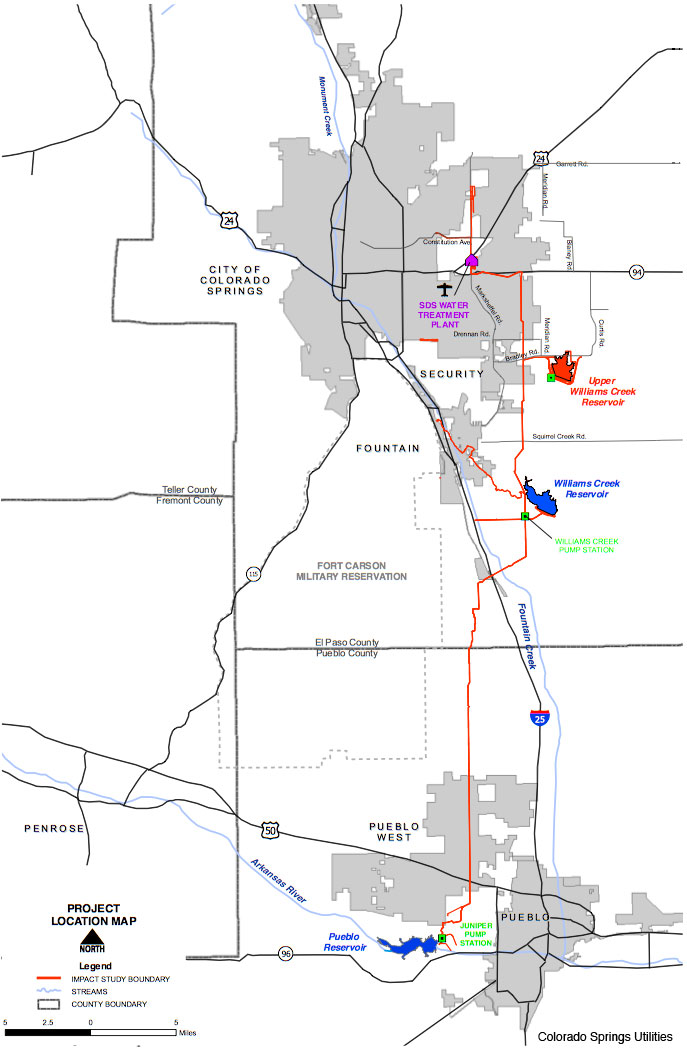
John Fredell, project director for Southern Delivery System, last week tried to build a case that the EPA’s enforcement action on the failure of Colorado Springs to maintain stormwater control is unrelated to SDS.

He told the Pueblo Board of Water Works that Pueblo County’s 1041 permit for SDS only applies to ensuring new development won’t increase Fountain Creek flows.

“It’s not all lumped into SDS,” Fredell said, trying to convince the water board of his position.

But a review of the history leading up to the county’s 1041 permit shows he is wrong.

The first sentence of condition No. 23 in the 1041 permit indeed mimics the incremental approach taken by the Bureau of Reclamation, holding Colorado Springs liable for new development as a result of SDS. That’s exactly the point Fredell made.

Further on in the condition, however, it states:

“Regulations shall comprehensively address peak flow conditions, runoff volumes, and flood hazards, incorporating at a minimum all relevant components of existing regulations of Colorado Springs.”

It also calls for maintaining all structures and complying with stormwater permits, things the EPA says Colorado Springs has not done.

Presumably, those regulations would not apply only to new growth, but to the entire city of 186 square miles that already exists — 20 percent of the Fountain Creek watershed.

Beyond that, Fountain Creek was always a big part of SDS.

Stormwater permits and the need to control flows into Fountain Creek are mentioned in the 2004 intergovernmental agreement that was used to get support for SDS from the city of Pueblo and the Pueblo Board of Water Works. On its face, Colorado Springs’ lapsed performance appears to put it in violation of the IGA.

When the Fountain Creek Vision Task Force began meeting in 2006, many conversations mentioned the increased flows that would occur when SDS was in operation. Planning for more flows was added to an ongoing effort to deal with flows that already had increased as Colorado Springs grew from the 1970s on.

The demise of Colorado Springs’ stormwater enterprise was foreseen by Pueblo County’s attorney in comments in 2008 as the environmental impact statement for SDS was being prepared by Reclamation.

Reclamation did not consider the possibility, saying comments about stormwater were unrelated to the federal permit in its responses. The record of decision that approved SDS made the assumption the stormwater enterprise would stay in place before and after the project was built.

So Pueblo County put additional assurances that Colorado Springs would be responsible for controlling water going into Fountain Creek. It also required the city to pay $50 million to a district that had not yet been created.

The Fountain Creek Watershed Flood Control and Greenway District was formed by the state Legislature in 2009 to improve Fountain Creek and administer those funds, and has taken Utilities to task over the timing of payments.

The county’s 1041 regulations also were written and adopted when a stormwater enterprise that generated $15.8 million in revenue annually already was in place.

More coverage from Chris Woodka writing for The Pueblo Chieftain:

Who said this?

“The City of Colorado Springs is moving forward to address long-term stormwater management.”

No, it wasn’t Colorado Springs City Council President Merv Bennett talking to the Pueblo Board of Water Works last week. The above quote came from Mayor Lionel Rivera during a presentation by Colorado Springs Utilities officials to the Pueblo City Council on July 11, 2005.

They were there to assure Pueblo that Colorado Springs was dead serious when it came to living up to the conditions of an Intergovernmental Agreement signed a year earlier. An agreement that would eventually pave the way for the construction of the Southern Delivery System.

More than a decade later, Colorado Springs Utilities and political leaders are back in town trying to head off a rising tide of outrage in Pueblo County that has been bubbling up the last two months. In November, Colorado Springs learned it faces Environmental Protection Agency enforcement action for failing to meet the minimum requirements of its state stormwater discharge permit.

“They come down here and tell us what they think we want to hear, and then they do nothing,” said Lower Arkansas Valley Water Conservancy District General Manager Jay Winner. “How many times are we going to let that happen?”

Last week, the Pueblo Board of Water Works and Lower Arkansas Valley Water Conservancy District heard what Colorado Springs had to say for itself. This week, Pueblo County commissioners and Pueblo City Council will get more of the same.

On Monday, Colorado Springs Mayor John Suthers and others is scheduled to meet with commissioners at 1:30 p.m. and with City Council at 7 p.m.

What Colorado Springs is offering involves more than lip service. There are real dollars on the table.

The city will double the size of its stormwater staff by the end of 2017, and a new stormwater director will be on board within a month. About $12 million a year will be spent on capital projects to begin to address a $535 million backlog, and $7 million for maintenance. There is another $1.5 million from other city departments directed toward maintenance.

There will be 70 actions to meet the deficiencies outlined in the EPA audit, Utilities reported.

Several slides in the Colorado Springs presentation show before and after photos of neglected drainage ditches that were highlighted in the EPA audit.

Not everyone’s convinced this is a step forward.

“Those trees in the drainage ditches must have been growing for two years to reach that size,” Winner said. “When you look at the numbers they’re throwing around, you have to wonder what happened during the seven years they didn’t have a stormwater enterprise. Are they just playing catch-up, or is this a real improvement?”

That’s been a common pattern, a review of documents about stormwater collected over the past 11 years reveals.

For instance, the progress report of stormwater improvements given to Pueblo City Council in 2007 are identical to a list of unfinished business presented to Colorado Springs City Council in 2009 as it was demolishing the stormwater enterprise after it had been operating for two years on a $15.8 million annual budget. The list of most critical projects then totaled about $40 million and none of them had been touched.

The total backlog was about $500 million.

Although the Lower Ark district, then-Rep. Sal Pace, county commissioners and other local officials pressured Colorado Springs on stormwater, there was little action for two years. The city adopted a new strong-mayor form of government and its council membership completely turned over in a four-year period. At one point, the city failed to send an elected representative to meetings of Fountain Creek district for six months in 2011.

Finally, in 2012, the city’s attorney advised then-Mayor Steve Bach that, in his legal opinion, Colorado Springs ought to be spending at least $13 million annually to control stormwater. Colorado Springs City Council and El Paso County commissioners answered by forming a regional stormwater task force, which Bach opposed on the grounds that Colorado Springs should manage its own storm systems, ultimately dooming regional stormwater control.

By 2014, the $500 million project list was scrapped after a stormwater task force decided it was old and outdated — largely because of new damage from the Waldo Canyon Fire in 2012 and to a smaller degree, the Black Forest Fire in 2013.

In a new study, CH2MHill came up with 239 projects totaling almost $535 million in Colorado Springs, carefully weeding out obsolete and duplicated projects. Of those, 44 totaling $160 million were called high priority, which indicated there are public health or safety issues evident, according to the engineers’ report.

The regional cost, which included all needed work on Fountain Creek and its tributaries in El Paso County, was $723 million.

Later in 2014, El Paso County voters rejected a proposal by the task force to raise $40 million annually with a regional drainage district to address all those issues.

The huge backlog was mentioned at both the water board and Lower Ark meetings, with some trying to do the math at how long it would take to address the problems if the $12 million annual capital expenditure stays in place — say 40 or 50 years.

But Colorado Springs backs away from saying those lists will ever be completed or that they even mean anything.

At the Lower Ark meeting last week, Colorado Springs Utilities consultant Mark Pifher called the $534 million figure a “wish list,” insisting that projects with the highest priority would be tackled first. Utilities board Chairman Andy Pico told the water board that work will start soon on the highest priority projects.

Meanwhile, Colorado Springs has found the $841 million needed to build SDS, a project that will supply the city with the water it needs for the next 40 years, completing all major construction in just five years.

“They’ve done what they wanted to do, while doing the minimum to comply with their obligations to Pueblo,” Winner said. “How much longer are we going to put up with that?”
Pueblo West official tells Pueblo County to renegotiate the SDS 1041 permit

Pueblo West
Pueblo West

From The Pueblo Chieftain (Chris Woodka):

A Pueblo West Metropolitan District board member wants Pueblo County commissioners to renegotiate the 1041 agreement for the Southern Delivery System.

“There are numerous, fatal flaws in the present 1041 agreement; too many to mention,” Pueblo West board member Mark Carmel told the Pueblo Board of Water Works this week. “I respectfully suggest that the 1041 permit must be renegotiated to create a true agreement.”

It’s a significant development because Pueblo West is a partner in the SDS water pipeline project, and has already benefited from an emergency use of SDS last summer.

The metro board took a position on Jan. 12 that its water should not be held hostage during the current SDS discussions, but Carmel made it clear that he was speaking as an individual at Tuesday’s water board meeting. The metro board will meet with Colorado Springs Utilities at 5:30 p.m. Tuesday to address Carmel’s concerns.

Both the water board and Pueblo City Council are pondering resolutions requiring more action on stormwater in relation to SDS. Pueblo County commissioners are in the process of determining 1041 compliance on stormwater and other issues in the permit.

The Lower Arkansas Water Conservancy District has requested action by the Bureau of Reclamation under the federal SDS contract and by the Pueblo County commissioners under the 1041 permit to delay SDS until a stable source of stormwater funding is found.

Carmel, a former Pueblo County engineer, said he has seen firsthand the damage Fountain Creek causes in Pueblo. He wants to make sure Colorado Springs has adequate stormwater control measures in place.

“As Colorado Springs’ partner in the SDS project, I believe perhaps Pueblo West bears the most local responsibility to ensure SDS is implemented in such a way that the city of Pueblo does not get wiped out by floodwaters, in our name, if we stand by and do nothing,” Carmel said.

He said politicians’ current assurance of $19 million in annual funding for stormwater improvements in Colorado Springs is not adequate because future councils could easily reverse the action.

“A 10-year intergovernmental agreement is not worth the paper it is written on under the Taxpayer’s Bill of Rights, because it may be canceled at any budget cycle,” he said.

Carmel said the 1041 agreement should be renegotiated to avoid future misunderstandings.

“Now is the time to ask Colorado Springs to cooperatively renegotiate the terms of the SDS 1041 permit to ensure that it is a win-win deal for both communities,” Carmel said. “Any deal that fails to prevent flooding in Pueblo — through a permanent funding mechanism that cannot change with each election — is not a win for Pueblo.”

Fountain, Widefield, Security [water] systems contain chemicals linked to health hazards — the Colorado Springs Business Journal

Fountain Creek Watershed

From the Colorado Springs Business Journal (John Hazlehurst):

Known as perfluoroalkyls, or PFAs, research suggests the chemicals are potent carcinogens and endocrine disrupters at levels far below the Environmental Protection Agency’s provisional exposure limits for drinking water.

And no one seems to know where the contaminants are coming from — or even that they were there in the first place. The city of Fountain’s 2015 Drinking Water Quality Report doesn’t mention PFAs or any other “unregulated reportable contaminant.”

Ron Woolsey, who heads Fountain’s Water Department, was unaware of any PFA contamination of the city’s water supply or of the EPA test results. It’s not clear if the EPA reported these results to the three affected systems.

“We get about 70 percent of our water from the Frying Pan/Arkansas project, via Pueblo Reservoir,” he said. “The remaining 30 percent comes from wells in Fountain and wells on the Venetucci Farm that we share with Security and Widefield. When [CSU’s] SDS [Southern Delivery System] comes on line, we’ll get 100 percent of our water from Pueblo Reservoir.”

CSBJ provided Woolsey with links to source documents uncovered for this story.

“Thanks for that information,” he said. “You’re sort of the canary in the coal mine for us. We’re going to investigate further, talk to [Colorado Department of Public Health and Environment] and figure out what the next step will be. Those [PFA substances] sound pretty alarming.”

Both Colorado Springs and Pueblo use Fry-Ark water, and no PFAs were detected in their water systems.

It could be that water from Fountain Valley wells or surface water sources are contaminated by either landfills or residue from industrial processes, but no one is really sure.

Pueblo Dam hydroelectric project DEIS is on the street

Pueblo dam releases
Pueblo dam releases

From The Pueblo Chieftain (Chris Woodka):

A draft environmental assessment statement has been completed for a proposed 7-megawatt hydroelectric plant at Pueblo Dam.

The Bureau of Reclamation is accepting comments until Jan. 30 on the project.

The project is a joint eort of the Southeastern Colorado Water Conservancy District, Colorado Springs Utilities and the Pueblo Board of Water Works.

Two generators designed to operate at both high and low flows would be constructed on the North Outlet Works, which was built as part of the Southern Delivery System. A separate connection for hydropower was included in the design.

Electrical generation would not consume any water, operating on flows that already are released from the dam.

The Western Area Power Administration would have first opportunity to purchase power, which would be available to Black Hills Energy or Utilities if WAPA declines.

However, the power lines would be connected to the Black Hills substation that provides electricity to the Juniper Pump Station that provides power for SDS to pump water to Pueblo West and El Paso County.

The assessment notes there would be potential temporary impacts on air quality, water quality and wildlife (including some fish die-o) during construction.

Long-term eects would be less noticeable and not significant, because the flows into the Arkansas River, state fish hatchery, South Outlet Works or the SDS pipeline are not altered, according to the document.

The draft environmental assessment statement may be found at http://usbr.gov/gp/nepa/sopa.

Comments should be addressed to TStroh@usbr.gov.

For copies or more information, call Terence Stroh, 970-962-4369.

SDS — American Infrastructure Magazine “Water Project of the Year”

Colorado Springs circa 1910 via GhostDepot.com

From American Infrastructure Magazine (Genevieve Smith):

Not many cities can claim their infrastructure was of leading concern from the beginning, but Colorado Springs is one of them. Concrete evidence was left in a time capsule by one of the city’s founding engineers, Edwin W. Sawyer, via documents dated in 1901 which state, “It seems to me that nothing except the lack of water can stop the growth of a city so desirable for residence as this…Our people are becoming aroused to the need of securing at once all the available reservoir sites and water rights…”

Southern Delivery System route map -- Graphic / Reclamation
Southern Delivery System route map — Graphic / Reclamation

Continuing in the same water-conscious spirit as those earlier citizens, three different mayors and at least eight previous city councils have been involved and invested in the planning of the Southern Delivery System, American Infrastructure magazine’s Water Project of the Year.

Awarded for its forward-thinking and comprehensive approach to water management, the regional project will be built in phases through 2040 based on customer demands, and will bring water from Pueblo Reservoir to Colorado Springs and partner communities, Fountain, Security, and Pueblo West.

The project is more than a simple fix for major pipelines that are now over 50-years-old and nearing capacity; Jerry Forte, the current CEO of Colorado Springs Utilities, hopes that this project “will serve as an engine, driving more efficiency, effectiveness, and reliability in our system.”

The new north outlet works at Pueblo Dam -- Photo/MWH Global
The new north outlet works at Pueblo Dam — Photo/MWH Global

Phase I, which is now under construction, will transport water from Pueblo Reservoir through approximately 50 miles of underground pipeline, and is on schedule for April 2016. The project is estimated to cost $841 million at completion (thus far, under budget by $156 million)…

The four-part Water Resource Plan, of which the SDS is the major component, includes conservation, non-potable water development, existing system improvements, and major water delivery systems (the SDS itself). After the 2002 drought heightened public awareness of water scarcity, Colorado Springs has been able to make improvements to increase the efficiency of the existing water system before constructing SDS. Today, their per capita residential water use is among the lowest in the region. Colorado Springs also has the second-largest nonpotable water system in the state and has expanded their use of non-potable water in recent years.

Fountain Creek Watershed

Like any other project, this process hasn’t gone without headaches. However, clearing some of these hurdles was no easy feat, including dozens of permits and an Environmental Impact Statement that took almost six years to complete. In order to mitigate concerns that the proposed SDS would cause damage to Fountain Creek and surrounding wetland areas, a significant portion of the $1.4 billion overall cost of the project is a $75 million in wastewater system improvements to help prevent wastewater spills into Fountain Creek, a $50 million payment to the newly formed Fountain Creek Watershed Flood Control and Greenway District; additional payments will be allocated towards various mitigation and flow maintenance programs on Fountain Creek in the future.

Southeastern Colorado Water Conservancy District board approves 2016 budget

Fryingpan-Arkansas Project via the Southeastern Colorado Water Conservancy District

From The Pueblo Chieftain (Chris Woodka):

A $22.5 million budget was reviewed Thursday by the Southeastern Colorado Water Conservancy District board.

The board will meet at 11 a.m. Dec. 3 to give final approval to the budget.

Most of the budget, about $12.3 million, goes toward repaying the federal government for construction of the Fryingpan-Arkansas Project. Of that, $5.3 million repays the Fountain Valley Conduit through an assessment only on the portion of the district in El Paso County, according to a presentation by Leann Noga, finance coordinator.

Districtwide, a 0.9 mill levy will collect about $7 million to repay the Fry-Ark debt. The rate will not change.

A total operating budget of $4 million is projected, funded by a 0.035 mill levy, specific ownership tax, enterprise contract revenues and grants.

The district’s primary projects in the coming year will be continued work on the Arkansas Valley Conduit, negotiating a federal contract for an excess capacity master contract to store water in Lake Pueblo and adding hydropower to the North Outlet Works at Pueblo Dam.

The hydropower project is a joint venture with Colorado Springs Utilities and Pueblo Water and is expected to total $5.2 million, but the cost is reflected in the Southeastern district budget since it is the lead agency.

Snowpack news: Good start to the water year

From The Pueblo Chieftain (Chris Woodka):

Although it’s way too early to make a prediction, the water year so far is shaping up better than last year.

“We’re in much better shape than we were at this time last year,” Alan Ward, water resources manager for Pueblo Water, said Tuesday.

All the indicators are good — maybe too good if there is such a thing when it comes to water supply.

Snowpack, boosted again by a storm this week, is above average in both the Arkansas and Colorado river basins.

Pueblo is storing nearly 50,000 acre-feet of water (16.3 billion gallons) in four reservoirs (Lake Pueblo, Clear Creek, Turquoise and Twin Lakes).

“We have more than we’d like at Twin Lakes, but we’re waiting to see how likely a spill (at Lake Pueblo next spring) will be before we move it down,” Ward said.

Lake Pueblo began storing winter water Sunday and is likely to reach capacity in April, when water above a certain level has to be evacuated to make room for flood control.

That depends, however, on whether conditions stay wet over the next few months. The National Weather Service Climate Prediction Center shows it is likely that conditions will be wetter than average through next May.

From The Pueblo Chieftain (Chris Woodka):

Lake Pueblo is likely to fill to the brim and some water stored there released to make room for flooding next spring.

The prognosis came Thursday at the meeting of the Southeastern Colorado Water Conservancy District.

“The bad news is the (Army) Corps (of Engineers) will not provide deviation this year,” said Jim Broderick, executive director of the Southeastern district. “The good news is they would be glad to take an informal look at our requests.”

The Corps has granted a deviation from a regimen that requires a certain level in Lake Pueblo by April 15, allowing water to remain in the reservoir until May 1, when flows increase and calls for water typically increase.

By that time, the reservoir is usually swollen from winter water storage and more water from upstream reservoirs that has been moved by the Bureau of Reclamation or other users.

Going into the winter, Lake Pueblo is at 138 percent of average, storing about 185,000 acre-feet of water. If average amounts of water are moved in over the winter, almost 20,000 acre-feet of water stored in Lake Pueblo by then could “spill,” or be released early.

One of the ideas Broderick mentioned was to use a sliding pool, based on the likelihood of flooding, that would allow for additional storage later in the season.

Opening the concept up formally could have the drawback of the need for an environmental impact statement that potentially could result in an even more restrictive storage regime.

This year resulted in nearly record flows on the Arkansas River, said Bill Banks, new chief of the U.S. Geological Survey in Pueblo. Nearly 1 million acre-feet of water flowed past the gauge at Avondale this year, which is at the top of the range over the past 40 years and nearly twice the typical year.

The Corps has granted deviation in storage criteria in recent years, partly for repairs and construction on the Arkansas River levee. That would not be needed this year.

Last spring’s high flows resulted in filling some of the flood-control capacity in Lake Pueblo.

Arkansas River Basin: Winter water storage starts up

Straight line diagram of the Lower Arkansas Valley ditches via Headwaters

From The Pueblo Chieftain (Chris Woodka):

Some Arkansas Valley farmers remember — and not too fondly — the cold, blustery and sometimes snowy days around this time of year when they’d venture out to irrigation headgates and fight the ice to move water.

For the past 40 years, most have not had that chilly experience. The water is stored either in Lake Pueblo, John Martin Reservoir or along the Arkansas River in a ditch company’s reservoir.

On Sunday, winter water storage began this year, reflecting one of those unusual cases when all of the water interests in the Arkansas River basin appear to be rowing in the same direction.

“The best thing we did was the winter water program,” said Carl Genova, a Pueblo County farmer, when he left the Southeastern Colorado Water Conservancy District board in 2009. “The district was able to get all those people together.”

To be fair, achieving harmony in the program was no simple task. Ditch companies that had snarled at each other for a century came together in 1975 when Pueblo Dam had been completed to fulfill a vision from the Dust Bowl days of the 1930s.

The idea isn’t complicated: You hold back the flows of the Arkansas River for a few months when no crops are growing for use later in the season.

But the execution of that concept is as complicated as the hit-or-miss, use-it-or-lose-it water conditions farmers in Southeastern Colorado have always labored under.

The winter water storage program was voluntary for the first 12 years, until a court decree was issued in 1987. The decree required participation not only by ditch companies, but by Pueblo and Colorado Springs as well. The Southeastern district administers and the U.S. Bureau of Reclamation and Corps of Engineers operate two of the reservoirs used in the program.

And, oh yeah, Kansas also accused Colorado of violating the Arkansas River Compact when it filed suit in the U.S. Supreme Court in 1985. The special master in the case threw out that claim a decade later.

Winter water has operated every year since 1975, with the exception of 1978, when the Catlin Canal refused to join because of a lawsuit with the Colorado Game and Fish Department. The program was diminished in 1998-99, when the safety of dams program lowered the level of Lake Pueblo temporarily so the dam could be reinforced.

In most years, it boils down to a math problem for farmers to contemplate during the chilly months. The water is allocated to the participating ditch companies and stored where they can best use it.

Over the past 20 years, it has stored an average of about 130,000 acrefeet (40 billion gallons) of water annually for use in the following irrigation season. The water is stored from Nov. 15-March 15.

During wet years, some winter water spilled — about 300,000 acre-feet total — from Lake Pueblo because there was no place to store it. Priority storage in Lake Pueblo goes to ditch companies that do not have their own reservoirs.

In recent years, there have been some quirky ripples surrounding the winter water program.

The release of water through Pueblo to support its Gold Medal trout fishery in the winter months became an issue during negotiations surrounding Pueblo Water, Aurora and Colorado Springs use of Lake Pueblo in 2004. The cities agreed not to exchange water into Lake Pueblo during low-flow periods.

The city of Pueblo had placed boulders in the river below Pueblo Dam to improve fish habitat, and having water during the river months became more critical. Pueblo already was gaining a reputation as a winter fishing mecca during times when other sites were less accessible.

The very next year, Arkansas River flows dried up as the winter water program sought to balance its accounts in Lake Pueblo because too much water had been stored in reservoirs below Pueblo.

After the same thing happened briefly in 2007, water users agreed to leave 100 cubic feet per second in the river and sort out the accounting later.

Three years later, the Pueblo Conservancy District needed to make emergency repairs to the levee through the Downtown Whitewater Park, partly caused by concrete anchors of parts of the kayak course that were attached to the levee.

By storing winter water in Lake Pueblo, flows in the Arkansas River are kept artificially low, making for favorable construction conditions.

That lesson was remembered last year, when the district began a complete rebuild of the levee through Pueblo and timed the work in the river bottom to the reduced flow period.

Winter water storage also places a very junior call on the river, 1910, that allows many junior rights in the Arkansas River basin — both upstream and downstream — to use or store water that might otherwise not be available.

Southern Delivery System moving along

Southern Delivery System route map -- Graphic / Reclamation
Southern Delivery System route map — Graphic / Reclamation

From The Pueblo Chieftain (Chris Woodka):

Colorado Springs Utilities got a clean bill of health from Pueblo County’s weed manager Monday and answered questions raised at a Sept. 25 hearing about revegetation along the 17-mile route of the Southern Delivery System through Pueblo County.

Still, commissioners want more time to study documents submitted and continue a public hearing on SDS 1041 permit commitments to 9 a.m. on Dec. 8.

Utilities needs to fulfill conditions of Pueblo County’s 1041 permit for SDS in order to turn on its pipeline from Pueblo Dam to Colorado Springs next April. Revegetation compliance also would release $674,000 Pueblo County is holding under of the permit.

Utilities revealed it has spent more than $5.3 million on revegetation work already.

Colorado Springs provided point-by-point assurances on 17 issues raised on Sept. 25, when experts from both camps agreed Utilities had tackled the problem with state-of-the-art methods. Utilities also provided documentation from contractors that the work was done correctly, and that most landowners were satisfied with the work.

“We need to work through the (final) issues to protect the citizens of Pueblo County,” said Commissioner Terry Hart, who made a motion to take the comments under advisement and continue the hearing. “What we’re trying to do is look at the work in its totality.”

Hart, along with Commissioners Liane “Buffie” McFadyen and Sal Pace, had little criticism of Utilities’ report, which pledged further work with landowners as well as reviewing procedures already put in place to bring land disturbed by SDS construction back to its original condition or better.

“It’s light years ahead of other projects,” Hart said.

Bill Alt, who manages Pueblo County’s weed control program through the Turkey Creek Conservation District, agreed. Alt toured the pipeline route last week and said Colorado Springs has lived up to its responsibilities to reseed ground disturbed by SDS.

“The grass is up and doing well,” Alt said.

“Some of the tamarisk has been dug up by the roots and removed, and the topsoil has been replaced as in any mining operation.”

The problem is that the areas on either side of the 150-foot path of SDS are still susceptible to tumbleweeds (Russian knapweed) and tamarisk, which could still find their way back onto the treated area, particularly on the route north of U.S. 50, Alt said.

Some landowners have mowed or grazed the revegetated areas prematurely instead of allowing new grasses a chance to get established, he added.

“Everything is fine for what we looked at,” Alt said. “We did not go on Walker Ranches, although I would like to go because that’s where the erosion is.”

The Walker Ranches crossing is being handled under a $7.4 million settlement as a result of a jury verdict.

Colorado Springs also said it is working on a settlement with Dwain Maxwell, a Pueblo West resident who complained about the project at an earlier hearing. Utilities also has taken on a separate project to divert floodwater around a property just south of Walker Ranches in Pueblo West.

From KOAA.com (Jessi Mitchell):

As part of the deal, the utility company had to repair the land after digging up 50 miles of dirt to bury the 66-inch pipe, restoring at least 90% of the vegetation that was in place before. CSU showed the county that they have gone above and beyond the requirements, but commissioners have not yet released them from the commitment.

“The work that we’ve got done so far is already light-years ahead of other projects,” admits commissioner Terry Hart. Pueblo County commissioners applauded CSU for its nearly $5.4 million efforts to re-seed and irrigate the lands it plowed through to plant the SDS pipeline.

Landowners agree, giving high praise in a report to the way workers left things better than before.

CSU’s SDS permitting and compliance manager Mark Pifher says, “We put in a very extensive irrigation system. If I had to guess, it’s probably the biggest irrigation system ever installed in Colorado.

Commissioners had lots of questions when they first met to review the re-vegetation process in September, many of which addressed future concerns over erosion and management of the property. Pifher says doing a good job is about more than protecting the pipeline; it is about respecting the landowners as well. “It’s important that you do it with a mindset that this is like your property,” says Pifher, “how would you like it restored and put back into its historic condition, if you will.”

Bill Alt has been working closely with the group to oversee the management of noxious weeds throughout the easements, which have been removed on the property in question, but remain nearby and are likely to spread. Alt suggests CSU send a notice to the owners about maintaining the landscaping moving forward. “It needs some tender, loving care,” says Alt, “and it’s good for your property because it keeps the property value up. It’s not something you’re ashamed to show a realtor or other people.”

Commissioners will meet with Colorado Springs Utilities again Dec. 8 to make sure no other questions arise before checking re-vegetation off the long SDS checklist. The only other big issue standing in the way of water flowing north is Colorado Springs’ stormwater management efforts.

To access all official documents on the SDS, including CSU’s latest report, click here.

Arkansas River winter storage program update: “We can’t predict where the water will be stored” — Phil Reynolds

Pueblo Dam
Pueblo Dam

From The Pueblo Chieftain (Chris Woodka):

Conditions are right for a big year of winter water storage, but the problem may be where to put it all.

“We can’t predict where the water will be stored,” Phil Reynolds of the Colorado Division of Water Resources told the annual meeting of the winter water storage group.

The group is made up of the large canals east of Pueblo. After Pueblo Dam was completed in 1975, irrigators were able to curtail flows during the winter months and use the water later in the season. Under a court decree, water is stored from Nov. 15-March 15 under the program administered by the Southeastern Colorado Water Conservancy District.

Last year, more than 128,000 acre-feet (41.7 billion gallons) of water was stored in Lake Pueblo, John Martin Reservoir or oŸ-channel reservoirs operated by some of the ditch companies. That’s more than the five-year average and close to the 20-year average.

The problem this year is that record rains in May and early June filled up most reservoirs.

While some of the water was used during the relatively dry months at the end of summer, reservoirs in the Lower Arkansas Valley are well above normal.

Winter conditions could be wet because of a strong El Nino condition. In similar years, that has meant a heavy spring runoff, said Terry Dawson of the Bureau of Reclamation.

Lake Pueblo is already at 138 percent of capacity — a capacity that recently was deemed smaller because of sedimentation in the reservoir.

“We are afraid at this point we may be in danger of spilling,” Dawson said.

But it won’t be the farmers’ water that spills. There are still 22,723 acre-feet of this year’s winter water that will be released next spring, and an estimated 50,000 acre-feet of new water that could come into Lake Pueblo this winter.

Before that could spill, however, water stored in temporary accounts or under long-term municipal contracts would be released.

Anticipating that, Aurora, whose water would spill first, already is making plans to drain its account through leases to Colorado Parks and Wildlife, which will use the water in the Great Plains Reservoirs that are part of the Amity Canal system.

Reynolds identified more than 100,000 acrefeet of practical storage space that could be used downstream of Lake Pueblo. There are also 140,000 acre-feet available in the Great Plains Reservoirs.

However, winter water must be distributed equally to canal companies, and John Martin or the large reservoirs operated by Amity and the Fort Lyon Canal cannot be used by everyone.

The space in Lake Pueblo will get even tighter during the winter water program because Reclamation plans to run some water from Turquoise and Twin Lakes into the reservoir to make room for next year’s Fryingpan-Arkansas imports.

“We’ll need to know where and how much you plan to store, so we know what’s stored in Lake Pueblo and what can be moved,” said Jim Broderick, Southeastern executive director.

Straight line diagram of the Lower Arkansas Valley ditches via Headwaters Magazine, Colorado Foundation for Water Education

Southeastern Water board meeting recap: Lake Pueblo sedimentation discussed

Pueblo dam releases
Pueblo dam releases

From The Pueblo Chieftain (Chris Woodka):

Lake Pueblo is slowly filling with sediment that has reduced its capacity to hold water by about 7 percent over the last 40 years.

The equivalent of 19 feet of dirt over a football field, or 19 acre-feet, is coating various parts of the bottom of the reservoir, a natural consequence for any lake fed by streams and rivers.

The capacity for conservation storage — accounts that can be emptied and refilled — is down to 245,800 acre-feet.

The Bureau of Reclamation made the determination to apply the new limits at the beginning of the water year on Oct. 1 based on data collected in 2012, said Roy Vaughan, manager of the Fryingpan- Arkansas Project. It’s the first detailed look at sedimentation since 1994, when Reclamation found deposits were less than expected because the Arkansas River maintained its current at the bottom of the lake.

At Thursday’s meeting of the Southeastern Colorado Water Conservancy District board, the impact on future storage was discussed.

“We’re looking at water for the next generation,” said Jim Broderick, executive director of the Southeastern district. “We’ve been in a wetter period for the last couple of years, and reservoir levels have been near the top.”

About 25,000 acre-feet — nearly the amount Pueblo Water pumps in a year — could spill next spring if weather conditions are normal through the winter months and water is used in the same fashion as in the past. Lake Pueblo water levels still are about 138 percent of average, even though some water has been released over the past three months.

“What are the solutions?” Broderick asked Vaughan.

“Enlargement or dredging,” Vaughan replied quickly. “It’s been a 7 percent reduction over (40) years. That’s not to say something could be put in place. But what are the costs and who’s willing to pay?”

A third option would be to time storage and releases among users of the dam.

Two of the options, enlargement and re-operations, were considered in the district’s Preferred Storage Options Plan, largely abandoned when it stalemated after a decade of contention among Arkansas Valley water users.

Re-operations have largely been addressed by long-term federal contracts that overlay the basic protocol for Pueblo Dam’s operation.

Physical enlargement of the dam likely would mean reopening negotiations.

Dredging has its own issue. For one thing, the sediment is broadly spread over the floor of the lake, and is not lying in a big chunk that could be scooped out. According to the Reclamation report, it’s not settling in the area immediately above the lowest outlet on the dam.

Dredging might also worsen water quality, adding costs for treatment.
There are other economic considerations.

“The Fry-Ark water will stay in place because it’s cheap,” Broderick said. “But can you get your water out if you bring it in from transmountain sources? How much is the water worth? If we lose storage, how do we replace that?”
Board member Vera Ortegon said water users have managed water in the past so it does not spill. Water does not actually shlosh out of the dam, but is released to keep levels low enough to contain potential floods from upstream.

“We have not spilled much, have we?” Ortegon asked.

“No,” Vaughan said. “But we use additional storage in wet years, and then it’s pulled down in a dry cycle. You have to figure out what to do in wet years, so enlargement still comes into play.”

More from the Chieftain:

Lake Pueblo

  • Lake Pueblo began storing water in January 1974 and released water the next year.
  • Its total crest is almost 2 miles long, with 23 concrete buttresses in the center of the earthen dam.
  • Its original capacity to store 265,000 acrefeet for conservation use has been reduced to 245,800 acrefeet
  • The 550foot spillway at an elevation of 4,898 feet is designed to carry 191,500 cubic feet per second when the reservoir is at maximum elevation, 4,919 feet. That has never happened.
  • There are five outlets on the dam, all with multilevel intakes: Bessemer Ditch (393 cfs), the north outlet works (1120 cfs), the spillway outlets (8,190 cfs), the fish hatchery (30 cfs) and the south outlet works (345 cfs). To reduce flooding downstream, releases to the river are usually kept below 6,000 cfs.
  • Flows below the dam are timed to match water coming into the reservoir, except when water is being released from accounts or stored by exchange or in the winter water program.
  • Sedimentation could be accelerated if erosion increases on tributaries above Lake Pueblo, including runoff from areas damaged by large wildfires (such as the Royal Gorge Fire in 2013) or prolonged rain (such as road washouts in Fremont County earlier this year).
  • Fryingpan-Arkansas Project operations update: Surplus supply going into water year 2016

    From The Pueblo Chieftain (Chris Woodka):

    What to do with all the water?

    The Southeastern Colorado Water Conservancy District tackled the question Thursday by approving additional allocations requested by cities and farms in the Arkansas Valley.

    But more than half of additional water brought in by the Fryingpan-Arkansas Project will be carried over to next year and added to next year’s allocations.

    In May, the district allocated about 46,000 acre-feet (15 billion gallons), with about one-third going to cities and two-thirds to farms. But continued wet conditions added another 22,500 acre-feet to the amount available for allocation.

    A total of 72,000 acrefeet were imported, but some of it goes for other obligations or to account for losses.

    Wet conditions and the way water has to be delivered or accounted for cut down on demand for the additional water, Executive Director Jim Broderick explained.
    Most cities had plenty of water in storage and not many places to store additional water.

    “A lot of people were at their limit and not making request,” Broderick said. “It’s been a wet year and there is no place to put the water. Everything got full.”

    The big exception was the Pueblo Board of Water Works, which did not take any water from the first allocation. Pueblo Water took 6,500 acre-feet. All told, cities added 8,200 acre-feet to their supplies.

    The large canal companies downstream did not jump at all of the additional water either, because there was no way to store it for when it would be needed. About 2,600 acre-feet were allocated during the second round.

    That still leaves about 11,700 acre-feet that was brought over from the Fryingpan River basin through the Boustead Tunnel into Turquoise Lake for later distribution in the Arkansas River basin.

    “It will be applied to the first allocation next year,” Broderick said. “My guess is that a lot of the water is going to be available to agriculture.”

    That could create a problem even with average moisture next spring, raising the possibility that water stored in excess capacity, or if-and-when accounts, could spill.

    About 55,000 acre-feet of if-and-when water is stored in Lake Pueblo now, about one-quarter of the water in the reservoir.

    Some winter water could also spill, if the amount exceeds 70,000 acre-feet. About 24,000 acre-feet are now in storage. However, winter water could be stored downstream as well.

    Turquoise and Twin Lakes are nearly storing at capacity. Lake Pueblo is at 80 percent of capacity, but 145 percent of average for this time of year, according to Roy Vaughan, manager of the Fry-Ark Project for the Bureau of Reclamation.

    If water conditions are typical, 26,000 acre-feet could spill next spring, but it is too soon to make an accurate prediction, Vaughan said. But he said most forecasts are calling for at least 100 percent of snowpack.

    “Part of the question is are we bringing water in and using it that year, or are we storing it?” Broderick said. “For the past few years, we have been using other water and storing (Fry-Ark) water.”

    Fryingpan-Arkansas Project via the Southeastern Colorado Water Conservancy District
    Fryingpan-Arkansas Project via the Southeastern Colorado Water Conservancy District

    Arkansas Valley Conduit Project is Updated — The Prowers Journal

    Arkansas Valley Conduit Comanche North route via Reclamation
    Arkansas Valley Conduit Comanche North route via Reclamation

    From The Prowers Journal (Russ Baldwin):

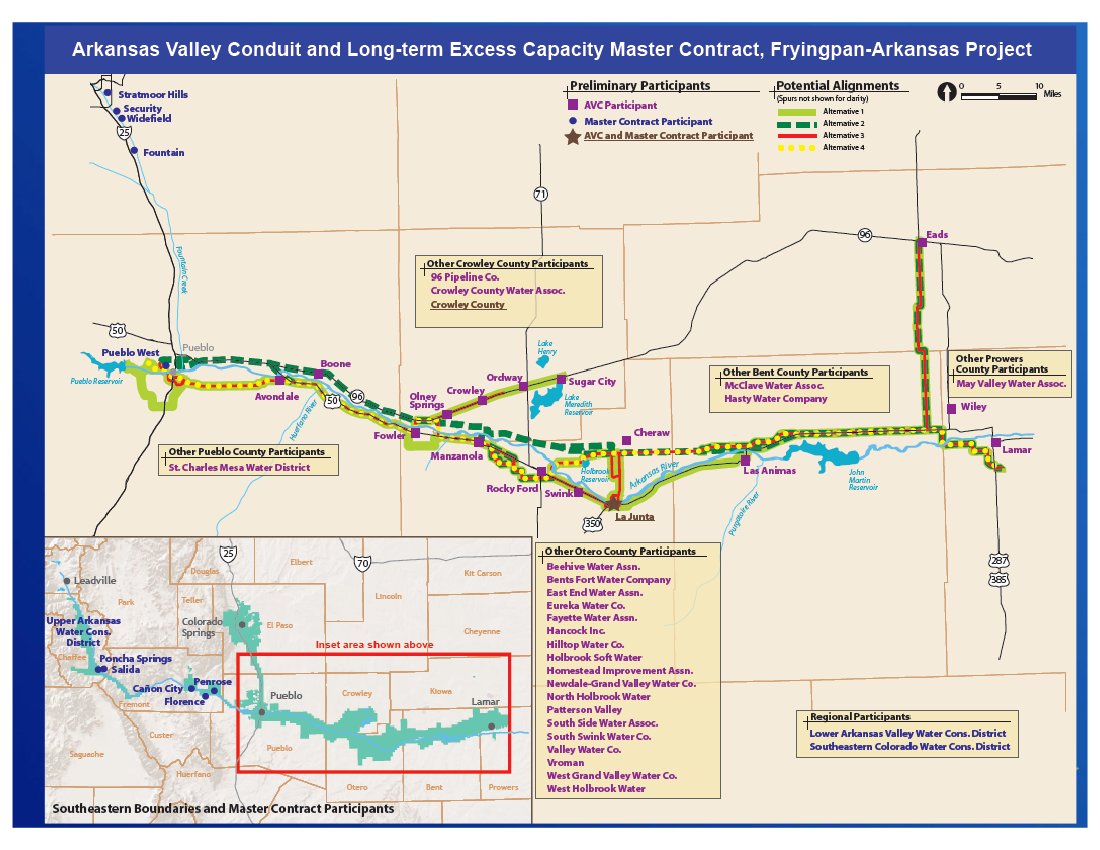
    The alignment of the Arkansas Valley Conduit project was updated for Prowers County Commissioners and interested citizens during an informational meeting on Wednesday, September 2. The $400M project, to move 15 million gallons of water per day to 39 entities between Pueblo and Lamar, was proposed in the early 1960s. Because of lack of funding, it has made little progress until the past several years. Jean Van Pelt, Project-Program Coordinator for the Southeastern Colorado Water Conservancy District, and members of the Bureau of Reclamation, described the latest plans, concentrating on the path the water conduit will take through Prowers County, leading up to the City of Lamar’s two water storage tanks south off of Memorial Drive. Van Pelt stated that the group was also seeking, ”Local input on different infrastructures or features they may not be aware of that could affect the alignment.”

    Kevin Meader, Principal Engineer for the Conservancy District said, “The Bureau is working on the preliminary design. We started that a year ago after the record of decision was issued on the Environmental Impact Statement. At that time we identified the preferred alternative for the conduit. By next year, we’ll put together an updated cost estimate which will go to Congress for appropriations for final design and construction towards the end of next year. From that we can move into final design and we’re looking at about 2017 and 2018 and the initial bidding on construction contracts is expected by around early 2020.” He added that if Congress approves the cost, it won’t be funded all at once, but probably in $25M to $45M payments over several years. Van Pelt added that in 2011 Congress agreed to share the project costs with the communities on a 65%/35% basis, and the $140M balance will not have to be borne by the 39 entities. Construction would begin at Pueblo Dam and head east to Lamar with a junction to Eads. Holly, Bristol, Granada and Hartman are not included in the conduit plans as those communities decided to opt out of a contract with the S.E. Water Conservancy District when the project was first proposed over 50 years ago. Van Pelt, when asked if they could opt back in, replied the process would be lengthy and costly for each of the communities, and any work on the conduit would be stalled while the necessary studies were conducted on constructing those new routes.

    Meader pointed out the water supply would be a supplemental, not a primary water source, which would become palatable only after each entity provided its own disinfectant procedure before making it accessible to the public. The water would be strictly for human use and not for any ag-related purposes. He added that water quality in some communities along the pipeline, such as La Junta, Boone or Fowler, has shown a need for a potable water source.

    #ColoradoRiver: Colorado Water Conservation Board to Release Ruedi Reservoir Water for Endangered Fish — CWCB


    Here’s the release from the Colorado Department of Natural Resources (Linda Bassi/Ted Kowalski):

    The Colorado Water Conservation Board (CWCB) today [September 2] initiated the release of water from Ruedi Reservoir for the month of September for the benefit of the Colorado River endangered fish.

    On August 31, the CWCB entered into a lease agreement with the Ute Water Conservancy District (UWCD) for water stored in Ruedi Reservoir, located on the Fryingpan River near Basalt, to supplement flows for existing instream flow water rights on the Colorado River. The CWCB approved entering into the Water Lease Agreement with the UWCD during a regular CWCB Board meeting in May 2015. This agreement allows the CWCB to lease between 6,000 acre-feet and 12,000 acre-feet of water from Ruedi Reservoir for instream flow use on the 15-Mile Reach of the Colorado River, located near Palisade, Colorado. No releases will result in overall flows from Ruedi exceeding 300 cfs.

    The so-called 15-Mile Reach provides critical spawning habitat for the following endangered fish: Colorado pikeminnow, razorback sucker, humpback chub, and bonytail. It was determined that the water would be best utilized to preserve the natural environment at rates up to and exceeding the current instream flow rights to meet U.S. Fish and Wildlife Service (USFWS) flow targets for the four endangered fish species in the reach. “These types of ‘win-win’ agreements are needed to assure that Colorado can beneficially use water within Colorado and help recover endangered fish that use the Colorado River for habitat,” said James Eklund, the Director of the CWCB.

    The UWCD was established in 1965 for the purpose of supplying domestic water service to the rural areas of the Grand Valley, encompassing roughly 260 square miles and servicing over 80,000 people. The UWCD originally entered into a Repayment Contract with the U.S. Bureau of Reclamation in September 2013, through which it purchased 12,000 acre-feet of water annually from Ruedi Reservoir. By entering into this lease, the CWCB has access to this water on a short-term basis for the benefit of four endangered fish species. Water released from Ruedi Reservoir under this lease will also be available for non-consumptive power generation immediately above the reach, providing additional late summer benefits to the local area.

    “This is the first time that the Species Conservation Trust Fund has been used to purchase stored water to supplement flows to critical habitat for endangered fish. We are excited that we have been able to use this particular funding source and our instream flow program for this purpose,” said Linda Bassi, Chief of the Stream and Lake Protection Section of the CWCB. Currently, the CWCB holds two instream flow water rights on the reach. Jana Mohrman, Hydrologist for the USFWS for the Upper Colorado River Recovery Program, added that “it’s outstanding to see the initiative and cooperation on behalf of the endangered fish by Ute Water and CWCB.”

    “Colorado has always been on the leading edge of balancing the development of water resources with recovery of endangered species, and this lease is another example of how Colorado has been able to creatively balance those competing interests,” said Ted Kowalski, Chief of the Interstate, Federal & Water Information Section,

    The CWCB has already coordinated with a variety of stakeholders within the affected reaches to implement the releases of this water from Ruedi Reservoir. This coordination will continue throughout the month of September.

    Fountain Creek: “The annual maintenance of the levee [in Pueblo] has been neglected” — Ken Wright

    Fountain Creek
    Fountain Creek

    From The Pueblo Chieftain (Chris Woodka):

    It’s like adding insult to injury.

    As if flooding on Fountain Creek weren’t bad enough, mountains of sand are stacking up north of Pueblo waiting to descend on the channel through the city.

    Dealing with it will take cooperation from the north and decades to correct.

    “It’s like a big anaconda eating an animal and moving it down,” said Ian Paton, part of the Wright Engineering team hired by Pueblo County commissioners to analyze the problem. Commissioners heard a status report on what will be an ongoing study on Friday.

    The problem may be bigger than previously thought, Paton explained.

    The net gain of sediment in Fountain Creek works out to about 370,000 tons a year between Fountain and Pueblo, causing the river to shift its flow in the channel as the increasing amount of material obstructs its path. It keeps piling up year after year as it eats away 20-foot cliffs.

    And, it has become worse since 1980, when Colorado Springs started booming in population and major infusions of water from outside sources — Homestake, Blue River and the Fountain Valley Conduit — began putting more water into Fountain Creek.

    Southern Delivery System, a 66-inch diameter pipeline from Pueblo Dam to Colorado Springs, could increase Fountain Creek flows 60-100 percent, while depleting the Arkansas River through Pueblo. Water quality will become an increasing concern as more sediment is churned up.

    “Population is the driving factor,” said Andrew Earles, Wright’s top water resources engineer. “To have growth, you need water, and since the 1970s, you’ve been putting more and more water into Fountain Creek.”

    Additional water has allowed more growth, and increased base flow threefold.

    But the growth also has increased impervious surfaces — roofs, parking lots and streets — by 10 percent of the total watershed area upstream of Security, and caused base flows, high flows (the kind seen this spring) and big floods to become more intense at all times.

    The Waldo Canyon and Black Forest fires of 2012 and 2013 have caused storms to generate up to 100 times the damage that would have occurred prior to Colorado Springs’ growth surge, Earles explained.

    “We can’t turn back the clock. We can’t put it back to the way it was in the 1950s and ’60s,” Earles said. “We can put it in better shape for the future.”

    A big part of that will be developing ways to deal with increased flows into Fountain Creek at the source.

    That would include detention of floods, bank stabilization and control of tributaries in ways that reduce damage on the main stream.

    Wright Engineers evaluated Colorado Springs and El Paso County estimates of 454 flood control projects that could cost $723 million to complete for their benefit to Pueblo County. About two-fifths of the projects totaling $537 million would reduce destruction to Pueblo.

    Colorado Springs officials are proposing $19 million annually to bring stormwater control back to the level it was before its City Council abolished the stormwater enterprise in 2009.

    “So far we agree with their list,” said engineer Wayne Lorenz.

    Lorenz said a dam between Fountain and Pueblo is “worthy of consideration,” but cautioned that such a oneshot solution could fail.

    “A dam is more of a treatment for a symptom rather than a cause,” Lorenz said. “We can’t put all our eggs in one basket with a dam because it might not happen.”

    Commissioners are also concerned that projects be maintained.

    In Pueblo, the Fountain Creek levees are in need of repair in order to provide the same protection they were designed to give 25 years ago.

    “The levee is badly silted and vegetated, and it would take $2 (million)-$ 5 million to bring it back to standards,” said Ken Wright, head of the engineering firm.

    “The annual maintenance of the levee has been neglected.”

    The fear is new projects on Fountain Creek could sink in the same boat.

    “We need to make sure we’re not just building projects, but have the money to maintain them,” said Pueblo County Commissioner Terry Hart.

    Southern Delivery System testing to start up next month

    Southern Delivery System route map -- Graphic / Reclamation
    Southern Delivery System route map — Graphic / Reclamation

    From The Colorado Springs Gazette (Billie Stanton Anleu):

    Decades of planning and an $829 million investment in Colorado Springs Utilities’ biggest water project ever will be put to the test next month, and the folks behind the Southern Delivery System can’t wait.

    Like children anticipating new bicycles for Christmas, project leaders are eager – not anxious – for the tests to begin. Their confidence is matched only by their pride in the project…

    The water will flow from the Pueblo Dam through three new pump stations to a 100-acre water treatment plant built in Colorado Springs. The plant’s developed area alone could hold 77 football fields, noted Kim Mutchler, of CSU government and corporate affairs.

    The entire system is to begin water delivery next April. But before it does, more tests will be done through September and October.

    Since pipeline construction began in 2011, every piece of pipeline has been tested upon arrival, with each section water-tested once installed. Pump station testing started in July and is continuing into the fall, and small tests have been done for several months at the treatment plant.

    Next month, tests are expected to begin sending water through multiple stages of treatment. Then several system-wide tests will be done through the fall before SDS starts serving customers next year…

    Some of the biggest savings, says SDS Program Director John Fredell, came from the 3.62 percent interest rate on $180 million in 40-year bonds issued in September 2010. In all, $475 million in bonds have been issued.

    But unforeseen cost cuts came, too, as engineers and others reviewed completed designs and plans, then unabashedly pointed to better, less expensive ways to accomplish what needed to be done.

    To wit:

    – The sprawling campus envisioned for the water treatment plant and its 10 million-gallon tank was reconfigured to put all essential functions under one roof, saving 4 miles of piping and more than $65 million.

    – A contract engineer from the Broomfield-based MWH insisted that the three pump stations could be built for under $100 million, contrary to the contractor’s contention. So the project was rebid and built for $75 million. “Those are the benefits of having a really experienced engineer on your projects,” Fredell said.

    – Several million more dollars were saved when a program leader noted that single welds instead of double welds could be used on pipes not handling high pressure.

    – Another $10 million was saved when Dan Higgins, then the SDS construction manager, decided the pipeline beneath I-25 and Fountain Creek should be one long tunnel rather than a series of short tunnels using extensive open trenches, as envisioned by a consulting engineer. The new method also minimized impacts to floodplains, wetlands and mature trees.

    SDS leaders also changed the type of pumps used, opting for more expensive $1 million vertical pumps – 11 in all – that will last longer, have lower electric costs and produce a higher discharge pressure, so another pump station didn’t have to be built in Pueblo.

    “The most expensive commodity is electricity to push the water,” Fredell said.

    But the humongous project also has brought financial benefits hidden to the casual observer.

    When the SDS started in 2009, along with the recession, “We wanted this to be our own stimulus,” Fredell said. “We went on the road to Pueblo and El Paso and Fremont counties and did workshops on how to work with us.

    Last section of pipe for Southern Delivery System photo via The Colorado Springs Gazette
    Last section of pipe for Southern Delivery System photo via The Colorado Springs Gazette

    “Only one company in Colorado can build this size diameter pipe. We got other companies from out of state to bid. But they (the Colorado firm) got over $100 million worth of business during the recession. This project helped keep them from having layoffs.”

    Contracts set a goal of giving 30 percent of business to Colorado companies, with a penalty for those that didn’t.

    “They’ve exceeded the local spend,” Fredell said. “We’ve had over 300 Colorado companies involved and spent $650 million through June, total, and $550 million has stayed in Colorado – $269 million to employers in El Paso County” plus $73 million in Pueblo County and $208 million elsewhere in the state.

    The toughest part of the project has been the permitting and planning, he said, with more than 200 major permits obtained, and about 350 total.

    The greatest challenges there were creating the 3,000-page Environmental Impact Statement (EIS), which took five years, and obtaining the 1041 Permit from Pueblo County.

    The EIS was handled by Keith Riley, SDS deputy program director for CSU, with help from Bill Van Derveer, assistant SDS program director with MWH.

    “The two of them were just brilliant in the way they approached it, got the science for the EIS, got all the people together, and worked well with all the agencies, including the EPA (U.S. Environmental Protection Agency),” Fredell said.

    Two other key players, both now retired from CSU, were Gary Bostrom, chief water services officer, and Bruce McCormick, also a water services officer.

    “That’s one of the things I’m proudest of, the people we’ve had work on this thing. They were just ingenious,” Fredell said. “The credit goes to people like that.

    “This project has been so much fun. I’ve gotten all my white hair on this project. It’s definitely challenged everybody.”

    Reclamation to Host Public Meeting for Ruedi Operations #ColoradoRiver #COriver

    Ruedi Dam and Reservoir
    Ruedi Dam and Reservoir

    Here’s the release from the US Bureau of Reclamation (Patience Hurley):

    The Bureau of Reclamation has scheduled the annual public meeting for Ruedi Reservoir Water Operations.

    August 12: Basalt Town Hall, 101 Midland Avenue, Basalt, Colo., 7 to 8:30 p.m.

    The meeting will provide an overview of Ruedi Reservoir’s 2015 spring run-off and deliver projected operations for late summer and early fall, which are key tourist seasons in Basalt. The meeting will include a public question and answer session.

    For more information, please contact Tim Miller, Hydrologist, Eastern Colorado Area Office, by phone or e-mail: (970) 962-4394, or tmiller@usbr.gov.

    “The Western Slope in Colorado has no more water to give” –WestSlopeWater.com #COWaterPlan #ColoradoRiver #COriver

    Colorado transmountain diversions via the State Engineer's office
    Colorado transmountain diversions via the State Engineer’s office

    From The Aspen Daily News (Collin Szewczyk):

    That theme of cooperation, including striking a balance between consumption and conservation, quickly rose to the surface Friday, as members of the whitewater, conservation and political communities met at Colorado Mountain College in Glenwood Springs to discuss the future of state water policy.

    “To the best of our ability, we don’t want it to be West Slope against East Slope, “ said Heather Lewin, watershed action director for the Roaring Fork Conservancy. “We want to be working together to understand where water comes from, and how to use it most efficiently … so that we can do the best we can for the people who live here and for the environment.”

    Members of the environmental group Conservation Colorado hosted the confab, which was set to coincide with Colorado River Day. The discussion largely revolved around local water issues and the recent release of the draft Colorado Water Plan. As water levels dwindle throughout the West, Colorado is formulating its first state water plan…

    A benefit of the state effort is that many interest groups have gotten together to discuss the issue, creating new partnerships that before may never have been possible, said Kristin Green, Front Range field manager for Conservation Colorado.

    “I think it’s important to recognize the diversity of holders we do have in this state, particularly in this area, that feel very direct effects from how we are managing our rivers,” she said. “Now more than ever we need to make sure all those different voices are being heard.”

    More than 24,000 comments have been made concerning the draft water plan, and the public comment period doesn’t end until Sept. 17, Green said.

    She noted that the second draft of the water plan begins to delve into potential solutions, and suggests a conservation goal of saving 400,000 acre feet by 2050. It’s the start of establishing the criteria officials may want to discuss, she said.

    “There definitely was more meat on the bones,” Green said of the second draft…

    Roaring Fork watershed increases 
quality of the Colorado

    Lewin said that while the Roaring Fork River may be a small component of the overall Colorado River Basin, it still contributes around 1 million acre feet of water to the larger river each year.

    She said the quality and quantity of that water can be very significant farther downstream in both an ecological sense and for its value to industries, municipalities and agriculture. But diversions strain that resource.

    “Having high-quality water in the Roaring Fork makes a big difference of the water quality overall in the Colorado,” Lewin said.

    She added that the river’s gold medal fishing designation is a huge economic boost to the valley. That lofty standard is met when there are at least 60 pounds of trout per acre of water, including at least 12 fish that are 14 inches or longer.

    “That’s a lot of fat fish,” Lewin said. “But [keeping] those fish growing fat, healthy and swimming doesn’t happen in a vacuum.”

    These conditions occur when a river or stream consists of clean water, and is home to an abundant insect population and a healthy riparian area. Lewin said surrounding riparian areas provide shade to cool river temperatures; food for aquatic creatures; erosion control; and help to filter pollutants.

    “As you increase development, and as we diminish stream flows, riparian vegetation becomes one of the first things to really suffer,” she said. “So it’s hard to regenerate cottonwoods without overbanking flows. Cottonwoods are a key part to that riparian vegetation piece.”

    Lewin said the recent wet spring led to the term “miracle May,” a month with a huge amount of precipitation that helped make up for a dry and warm winter. The heavy flows also helped to clear out sediment that built up in areas of the Roaring Fork.

    “One of the biggest transmountain diversions out of the basin, the Independence Pass Tunnel, was shut down for nearly two months,” she said (that was because the East Slope had ample water supplies). “It just started operations about a week ago or so. By closing down that tunnel we were able to really see the full effects of the spring flushing flow and the benefits to the river.”

    Lewin added that old oxbows in the North Star Nature Preserve east of Aspen were again filled with water this spring, putting the wetland area in a more natural state.

    The Roaring Fork Conservancy has also engaged residents in the Crystal River Valley to work on addressing low stream flows. That effort has focused on looking at best practices to manage diversions and return flows, and studying the area’s physical features.

    “We’re trying to see if we can use all of those pieces together in cooperation with the people who live on and around the river, and use that water to do the best we can for the Crystal,” Lewin said.

    Dean Moffatt, a local architect, inquired about efforts to bestow the federal “Wild and Scenic” designation and its protections on the Crystal River.

    “As an organization, we’re certainly supportive of the process,” Lewin replied. “We think that it’s really important and has the potential to be really beneficial.”[…]

    ‘No more water to give’

    Aron Diaz, a Silt town trustee, said there’s a lot of interest among local leaders in the Colorado Water Plan.

    “We’re really in a unique position and have the opportunity to craft Colorado’s water policy at the larger state level,” he said. “But we need to keep in mind how that affects the Western Slope.”

    Diaz said the biggest point of concern is that Front Range basins are still adding placeholders, indicating that they may need more West Slope water to meet demands.

    “We’re pretty tapped out for the amount of water that we have available to us,” he said. “Both with our obligations to stakeholders along the Colorado and those environmental, recreational, agricultural, industrial, municipal needs … as well as our downstream obligations with the compact, we’re really at the limit.”

    There’s a need to set “achievable, but very aggressive conservation goals” to assure every avenue is studied before looking at new diversions, Diaz said. He urged the public to visit westslopewater.com to sign a petition that will be delivered to Gov. Hickenlooper and Colorado Water Conservation Board director James Eklund. It requests that no new diversions of water be made to the Front Range…

    “The Western Slope in Colorado has no more water to give. We, the undersigned western Colorado residents, strongly urge you to oppose any new trans-mountain diversion that will take more water from the Western Slope of Colorado, as you develop Colorado’s Water Plan,” the petition states. “We cannot solve our state’s future water needs by simply sending more water east.”

    Lake Pueblo returning to normal as floodwater released — The Pueblo Chieftain

    Pueblo Dam
    Pueblo Dam

    From The Pueblo Chieftain (Chris Woodka):

    Maybe it’s time to slap a tag on the Arkansas River that says “shrinks when wet.”

    Despite a rainy week, the flow in the Arkansas River is expected to be cut in half today, as the last of stored floodwater is released from Pueblo Dam.

    “We started to cut the flows (Tuesday) afternoon,” said Roy Vaughan of the Bureau of Reclamation. “They should be around 2,500 (cubic feet per second) in the morning.”

    Water levels have allowed most areas of Lake Pueblo to be reopened, although the sailboard area parking lot still is being assessed and some shoreline areas are soft, Lake Pueblo State Park Manager Monique Mullis said.

    “There are still some logs in the water,” Mullis said.

    The park is planning to announce wood collection opportunities in the near future.

    After the water levels drop in the Arkansas River, Colorado Parks and Wildlife, the city of Pueblo and Pueblo County will decide on whether to lift boating restrictions that remain in effect on the river to the Otero County line.

    Wet weather returned to the Pueblo area this week, with storms leaving up to half an inch of rain in Pueblo Monday, an inch in areas west of Pueblo and up to 3 inches in the Beulah and Colorado City-Rye areas.

    Similar rainfall totals were expected through Tuesday night, with even heavier rain expected today, according to Randy Gray of the National Weather Service in Pueblo.

    “The heaviest precipitation should be in the mountain areas in the Sangre de Cristo (Range), Wet Mountains, El Paso and Teller counties,” Gray said. “It should move to the east by Thursday.”

    Up to an inch of rain is expected in the Upper Arkansas Valley and the northern San Luis Valley.

    The new rain kept water levels on Fountain Creek and in the Arkansas River high. Avondale briefly reached flood stage for the first time in a week Tuesday morning, but should return to lower levels as Pueblo Dam releases are cut.

    Fountain Creek levels jumped slightly Tuesday, but were nowhere near the damaging levels in May and June.

    The rain had not caused any new damage to county roads, although some private driveways washed out in the Rye area, said Alf Randall, Pueblo County public works director.

    Fountain Creek continues to cut at Overton Road north of the Pinon Bridge, and negotiations with Pueblo Springs Ranch owners for a byoff pass route continue. The county this week began work on shoring up the northwest dike on the Pinon Bridge to prevent damage, Randall added.

    More Fryingpan-Arkansas Project coverage here.

    Southern Delivery System: Springs, Walker settle for $7.1M — The Pueblo Chieftain

    From The Pueblo Chieftain (Chris Woodka):

    Colorado Springs Utilities and Gary Walker have reached a $7.1 million settlement for the damage to Walker Ranches from the Southern Delivery System pipeline.

    The pipeline crosses 5.5 miles of the 63,000-acre property on its route from Pueblo Dam to Colorado Springs. The $841 million SDS project is scheduled to go online next year and will supply water to Colorado Springs, Fountain, Security and Pueblo West.

    On May 6, a jury awarded Walker $4.75 million, which included a $4.665 million judgment beyond the $82,900 stipulated value of the easement across Walker Ranches. Damages plus interest would have brought the total payment to $5.78 million, according to a joint press release.

    Utilities disputed the amount, and filed an appeal on May 7. Walker Ranches appealed the decision on May 14. Those appeals were dismissed as part of the settlement reached June 16, but announced on Thursday.

    The final agreement resolves all claims for $7.1 million, the press release said.

    Utilities will also install fencing on Walker Ranches to prevent cattle from entering the area of the SDS pipeline scar that is being revegetated, and will work with Walker to erect berms on the property to reduce erosion.

    The agreement also commits both parties to work together in the future to protect the right of way.

    Utilities said the settlement provides more certainty about the ultimate cost of the project, reducing the possibility of an expensive appeals process.

    “It has always been our intent when working with property owners to use the court process as a last resort,” John Fredell, SDS program director, said in the news release. “By successfully resolving these issues with Mr. Walker, we can focus on completing the required revegetation on his property and finishing the SDS project on time and under budget.”

    Walker, when contacted by The Pueblo Chieftain , declined to comment because of the conditions of the settlement.

    During the trial, Walker claimed the SDS project had compromised a $25 million conservation easement on 15,000 acres he was negotiating with the Nature Conservancy. He has used about $13 million from past easements to expand the ranches, which is part of a long-term plan to prevent further urban sprawl in northern Pueblo County.

    Ray Petros, Pueblo County’s special counsel, said he has not seen the settlement agreement, so he is uncertain about how the county’s 1041 permit for SDS would be affected. The county is teeing up compliance hearings later this year on revegetation and Fountain Creek flood control, which are referenced in conditions that are part of the 1041 permit.

    More Southern Delivery System coverage here and here.

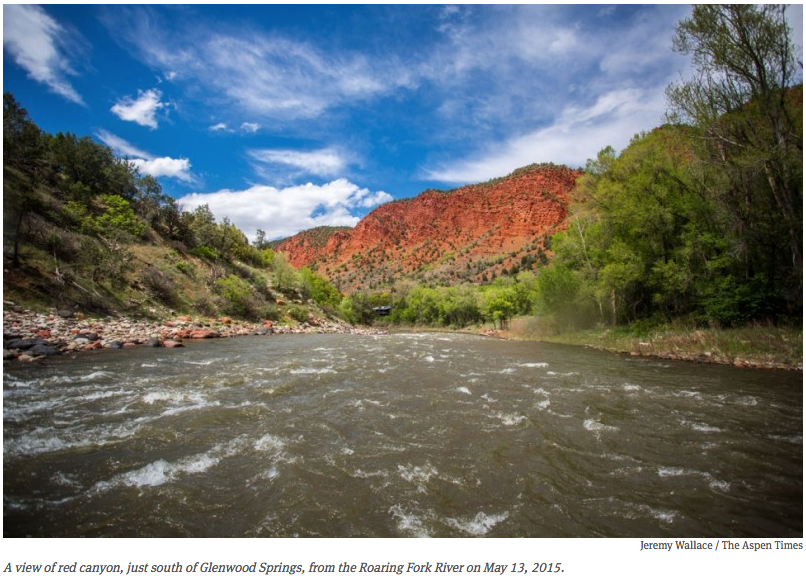
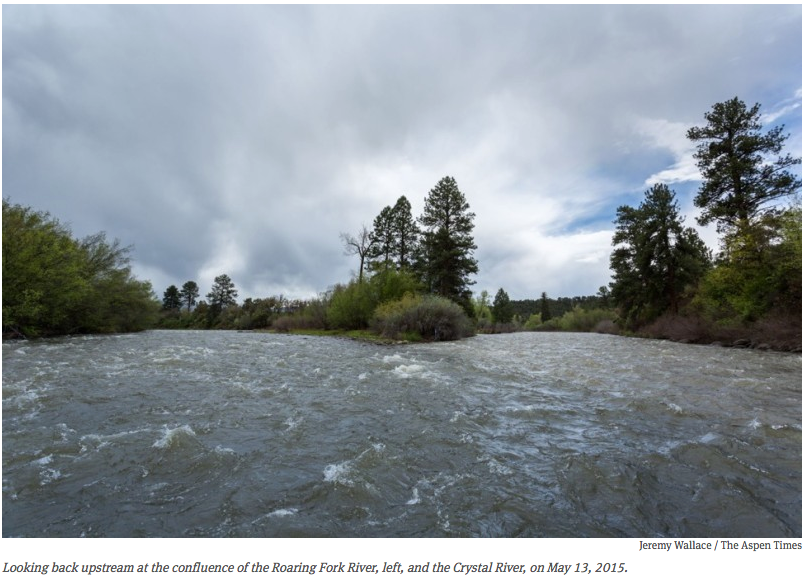
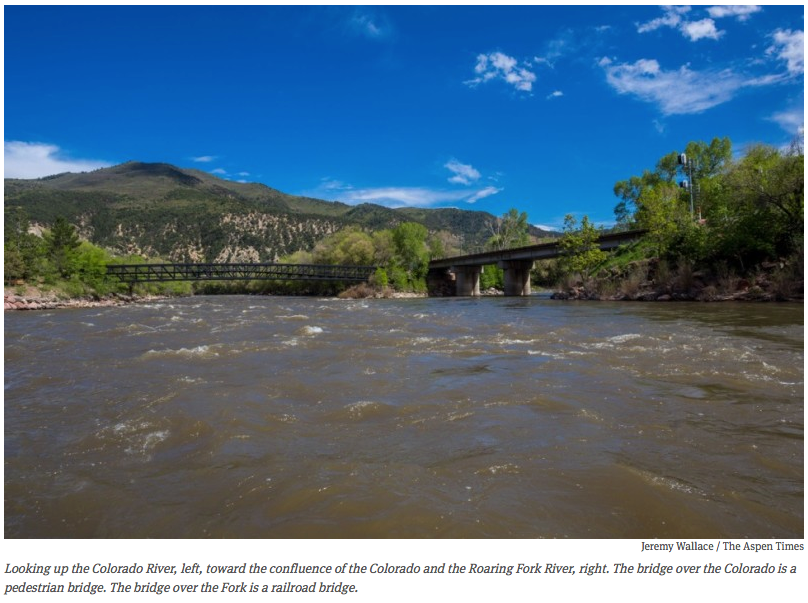
    Watching the mouth of the Roaring Fork River — Aspen Journalism

    railroadbridgeoverroaringforkrivermay2015viaaspenjournalismjeremywallaceaspentimes

    From Aspen Journalism (Brent Gardner-Smith):

    As my raft floated under the railroad bridge at the confluence of the Roaring Fork and Colorado rivers last week, I was wondering just how much water would flow out of the Fork and into the Colorado this year.

    Certainly less than average, given that the snowpack peaked in March and began melting off, I mused, taking a stroke to catch the big eddy that forms just shy of the mighty Colorado, where the Fork comes in across from Two Rivers Park in Glenwood Springs after draining 1,543 square miles of land.

    Perhaps the wet and cold weather of late April and much of May will continue to forestall a sudden flash of melting snow, so what snow we still have in the high country will come off in a nice steady fashion.

    But spinning around the eddy, I knew how easy it was, as a boater, to be wrong about water and weather. It is also, as it turns out, a tricky time of year for professional hydrologists to predict run-off, as data from low-elevation snow-measuring sites tapers off and daily weather conditions can play a big role in shaping how much water flows, and when it does.

    In mid-March, which felt like summer already, a trip on the Green River starting April 12 seemed like a good bet this year to enjoy some warm weather. But a big storm swept in that week and blasted the river with freezing rain.

    The same storm laid down 11 inches of snow on Aspen Mountain by Friday, April 17, making for a memorable closing weekend for some.

    After warming up from that trip, I ventured optimistically out again during the first full week of May, this time on the Colorado River west of Loma. And I was soon engulfed in the downpours of May 5 and 6 that lead to river levels across the region jumping up.

    Between May 5 and May 7, for example, the flow in the lower Fork doubled from a 1,000 cubic feet per second to over 2,000 cfs.

    So when I went out on May 13 for my first trip of the season down the Roaring Fork from Carbondale to Glenwood, I wasn’t surprised that it started raining. It’s just been that kind of season so far — in fact, through May 19, total precipitation in the Roaring Fork River watershed was 204 percent, or double the normal amount of precipitation. according to the Natural Resource Conservation Service (NRCS).

    But the Fork was flowing that day at 1,110 cubic feet per second, which was enough water to have a perfectly nice float, especially as I did see some sun (and some red-wing blackbirds).

    But will the river get much bigger this year, I wondered as I rowed toward Glenwood.

    redcanyonfromroaringforkmay132015apenjournalimsjeremywallaceaspentimes

    Below average flows

    The Colorado River Basin Forecast Center in Salt Lake City forecast on May 19 that the Roaring Fork will most likely peak this year in mid- to late June at 4,300 cfs, as measured at Veltus Park, just above the Fork’s confluence with the Colorado.

    That’s 73 percent of the Fork’s average annual peak of 5,920 cfs, which typically occurs between May 29 and June 23.

    While this year’s likely peak flow of 4,300 cfs is certainly better than the lowest peak flow on record — 1,870 cfs on June 3, 2012 — it’s also way below the historic peak of 11,800 cfs on July 13 in 1995.

    The forecast peak flow has increased given the cool and wet weather in May. So, if April showers bring May flowers, May showers are likely to bring better boating on the Fork in June.

    “I would say it is very likely (the Roaring Fork) will see a below average peak flow this year,” said Brenda Alcorn, a senior hydrologist with the Forecast Center.

    However, she added that what snowpack we do have “is in better shape than it was in 2002 and 2012, so I do not expect a record low peak.”

    But just how much water comes, and when, is now weather dependent.

    “Spring temperatures and precipitation play a significant role in the pattern of snowmelt runoff and consequently the magnitude of peak flows,” Alcorn said. “An extended period of much above normal temperatures or heavy rainfall during the melt period can cause higher than expected peaks, while cool weather can cause lower than expected peaks.”

    On Friday, May 15, Julie Malingowsky, a meteorologist with the National Weather Service in Grand Junction, said the period to at least May 25 looked cooler and wetter than normal, and longer-range forecasts indicate that the next several months could be wetter than normal.

    (Also, see the Intermountain West Climate Dashboard of indicators at Western Water Assessment)

    But probably not wet enough make up for the skinny snowpack.

    “Even though it has been a wet month, we are still drier than normal,” Malingowsky said.

    confulenceroaringforkcrystalriver05132015aspenjournalismjeremywallaceaspentime

    Below average supply

    Another view of this year’s water picture is available from the Natural Resources Conservation Service’s “Colorado Water Supply Outlook Report,” which was published on May 1.

    The report shows that the “most likely” amount of water to reach the bottom of the Roaring Fork between April and the end of July is 450,000 acre-feet, according to Brian Domonkos, a data collection officer with NRCS.

    That’s below the 30-year average of 690,000 acre-feet flowing down the Fork for the period from April to August. (The Roaring Fork delivers, on average, 871,100 acre-feet of water to the Colorado River over a full year, according to the Colorado Division of Water Resources).

    The water-supply report said that current conditions point to “a below normal streamflow forecast picture for much of the state heading into spring and summer of 2015.”

    However, Gus Goodbody, a forecast hydrologist with NRCS, said the amount of water expected to flow out of the Roaring Fork is likely to increase from the May 1 forecast by five to 10 percent, given May’s weather so far.

    “It’s going to go up,” he said.

    Another indicator of potential run-off is the measure of the “snow water equivalent” at SNOTEL measuring sites in the Roaring Fork basin.

    The average from the eight SNOTEL sites in the Roaring Fork basin was 108 percent on May 19, but that’s without complete data from four of the sites.

    That number — 108 percent — has been climbing steadily since May 1, but it’s not an indicator that the snowpack has been growing. What it does show is that the cool and wet weather has slowed the run-off and moved the data closer to the historic average — which, again, bodes well for June boating. But in addition to the snowpack and the weather, there are other factors that dictate the flows in the Fork at Glenwood Springs.

    lookingupthecoloradoriverconfluenceroaringforkaspenjournalismjeremywallaceaspentimes

    Off the top

    An average of 40,600 acre-feet of water a year is collected from the upper Roaring Fork River basin and sent through a tunnel under Independence Pass and into Twin Lakes Reservoir, destined for Aurora, Colorado Springs, Pueblo and Pueblo West.

    The Twin Lakes diversion takes 40 percent of the water out of the upper Roaring Fork basin above Aspen, according to the 2012 Roaring Fork Watershed Plan.

    Another 61,500 acre-feet is collected on average each year from tributaries of the upper Fryingpan River and sent east through the Bousted and Busk tunnels. That accounts for 37 percent of the water in the upper Fryingpan headwaters.

    As such, there are many days when there are rivers heading both east and west out of the Roaring Fork River watershed, and the ones heading east can often be bigger.

    For example, on May 13, while I was floating on 1,110 cfs at the bottom of the Fork, there was 136 cfs of water running under the Continental Divide in the Twin Lakes — Independence Pass Tunnel, which can, and does, divert up to 625 cfs later in the runoff season.

    And the Bousted Tunnel, which transports the water collected from the headwaters of the Fryingpan River, as well as Hunter and Midway creeks in the Roaring Fork basin, was diverting 101 cfs on May 13.

    Meanwhile, the gauge on Stillwater Drive on May 14 showed the main stem of the Fork was flowing, just east of Aspen, at 111 cfs.

    Then there is the water diverted out of the rivers in the basin and into one of the many irrigation ditches along the Fork, the Crystal and other streams in the basin.

    Ken Ransford, a member of the Colorado River Basin Roundtable, estimates that the 12 biggest irrigation ditches on the Roaring Fork and Crystal rivers divert about 115,000 acre-feet of water a year.

    Most of that water eventually finds its way back to the rivers, but the diversions also leave many stream reaches lower than they otherwise would be, and few tributaries are left untouched.

    According to the Roaring Fork Watershed Plan, “flow-altered stream reaches include the Roaring Fork, Fryingpan, and Crystal rivers, as well as Hunter, Lincoln, Maroon, Castle, West Willow, Woody, Snowmass, Capitol, Collins, Sopris, Nettie, Thompson, Cattle, Fourmile, and Threemile creeks.”

    Another factor shaping the flows in the lower Fork are decisions made by regional water managers, including irrigators near Grand Junction and municipal water providers in Denver, that can shape releases from reservoirs such as Green Mountain and Ruedi.

    Who needs water, and when, can also dictate the size of that eddy at the bottom of the Fork. So for now, I’m just glad it’s big enough to float a boat.

    Editor’s note: Aspen Journalism is collaborating with The Aspen Times, the Aspen Times Weekly, and The Glenwood Springs Post Independent on coverage of rivers and water. The Aspen Times Weekly published this story on Thursday, May 21, 2015.

    More Roaring Fork River watershed coverage here.

    Southeastern Water board meeting recap: Lake Pueblo, swollen by 12,000 acre-feet of flood water

    Fryingpan-Arkansas Project via the Southeastern Colorado Water Conservancy District
    Fryingpan-Arkansas Project via the Southeastern Colorado Water Conservancy District

    From The Pueblo Chieftain (Chris Woodka):

    Water, water everywhere.

    Not going to be a problem later in the year, right?

    Hold on.

    The Southeastern Colorado Water Conservancy District Thursday considered the possibilities of how water comes through the Boustead Tunnel into Turquoise Lake under the Fryingpan- Arkansas Project.

    All signs are pointing toward a more-or-less normal year in terms of water supply. Lake Pueblo, swollen by 12,000 acre-feet of flood water, is 132 percent of average. The flood water already was being released on Thursday, raising Arkansas River levels in the wake of the flood surge.

    Turquoise and Twin Lakes are above average in the upper reaches of the Arkansas River, while John Martin Reservoir has begun filling again to its highest level since 2010, about 82,000 acre-feet on Thursday.

    Snowpack levels in the headwaters of both the Colorado and Arkansas Rivers are back to normal, but it’s late in the season and both basins fell short of peak moisture levels this year.

    But very little transmountain water has come over so far, just 4,254 acre-feet of a projected 53,000 acre-feet for the season.

    “It all depends on how it comes off,” said Roy Vaughan, Fry-Ark manager for the Bureau of Reclamation.

    Cold temperatures are preventing the snow from melting at prime rates, as it does at this time of year in some cases.

    “The tunnel hasn’t started to run at full capacity, so we’re behind,” Vaughan said.

    If it warms up too quickly, the Fry-Ark structures won’t be able to capture it. And river levels have to be met on the Western Slope, Vaughan explained.

    In the past decade, the Southeastern district has adopted new policies to avoid over-allocating water early in the season, so it holds back 20 percent of the allocation.

    More coverage from Chris Woodka writing for The Pueblo Chieftain:

    Farms will get a boost in water supply, with nearly average allocations from the Fryingpan- Arkansas Project, but reduced requests from cities for water.

    The Southeastern Colorado Water Conservancy District Thursday approved allocations from the project, based on snow forecasts, which have improved since projections of water supply were made May 1.

    The district projects that 53,000 acre-feet (17 billion gallons) of water will be brought through the Boustead Tunnel into Turquoise Lake. That would mean almost 45,700 acre-feet available for allocation.

    Of that, about one-third will go to cities and two-thirds to farms. Under the district’s allocation principles, the split would be closer to 53 percent municipal and 47 percent agricultural.

    Initially, just 80 percent of the water will be allocated in case conditions change and imports are less than expected. The remaining 20 percent will be available when imports reach the target.

    If more water above the target is brought over, there could be a second allocation.

    Cost of the water is $9 per acre-foot for farms and $9.75 for cities.

    Municipalities reduced their requests significantly this year.

    The Fountain Valley Authority (Colorado Springs, Fountain, Security, Stratmoor Hills and Widefield) requested and received 7,216 acrefeet, but was eligible for 11,625 acre-feet.

    The Pueblo Board of Water Works was eligible for 4,568 acrefeet, but requested and received no water, since Pueblo Water has ample water in storage this year.

    Cities east of Pueblo took slightly less water than authorized, mainly because St. Charles Mesa Water District took just one-sixth of its share. Fowler, Crowley County and Joseph Water all took significantly more water than authorized, while most others were close to average.

    Cities west of Pueblo took slightly more. All received the full amount requested.

    Pueblo West and Manitou Springs, which get water that was redirected from agriculture when Crowley County farms were dried up by Aurora, will each get full allocations of about 155 and 160 acre-feet, respectively.

    The net effect was moving about 9,000 acre-feet to the agricultural side of the ledger, said Garrett Markus, district engineer.

    On the agricultural side, Fort Lyon Canal will received the largest allocation, with 10,653 acre-feet, and it will use 3,135 acre-feet of return flows under a pilot project that allows the ditch to use its own return flows for replacement water under state irrigation rules. Only 58,618 acres of the ditch are eligible for Fry-Ark water. The ditch irrigates 93,000 acres, but owners with more than 960 acres, including Pure Cycle (which has 14,600 acres) are not eligible.

    As usual, requests for ag water far outpaced the available water.

    Farmers asked for 106,570 acre-feet to cover 146,000 acres on 25 canals, ditches or farms. Only 30,024 acrefeet were allocated.

    Another 7,431 acre-feet of agricultural return flows were allocated, 95 percent to the three major well augmentation groups in the Arkansas Valley.

    More Fryingpan-Arkansas Project coverage here.

    Pueblo County considering show cause 1041 hearing for Southern Delivery System

    Southern Delivery System route map -- Graphic / Reclamation
    Southern Delivery System route map — Graphic / Reclamation

    From The Pueblo Chieftain (Chris Woodka):

    Pueblo County is a step closer to calling for a hearing to decide whether to repeal or significantly alter the provisions of a 1041 permit allowing the Southern Delivery System to be built through the county.

    On Monday, commissioners gave direction to staff to release a report to Colorado Springs detailing the progress of an investigation into whether that city’s lack of any specific funding for storm water permits constitutes a violation of the permit.

    According to the report, staff’s recommendation is that, so far, the investigation shows there’s enough evidence to go forward with a show cause hearing on the 1041 document. But staff also asked for permission to hold off on issuing such an order until the first of August.

    Waiting two months would give staff time to continue working with Colorado Springs, hire Denver-based Wright Water Engineering as a storm water consultant and give the new mayor and city council in Colorado Springs time to assess the issues for themselves.

    “I am confident that there is some probability of success in coming up with some solutions to bring to the board, either as revised conditions or new amendments to the agreement,” said Ray Petros, water counsel to Pueblo County.

    Petros said that it’s been six years since there was any dedicated funding in place for Colorado Springs’ storm water improvements and in that time, the number of infrastructure improvements that could help mitigate flows and improve water quality in the Fountain Creek have backlogged to the point that nearly $534 million worth of projects are awaiting completion.

    Staff has been investigating the issue since April. Petros said it has been difficult to ascertain what high-priority projects have been completed or what kind of money has actually been spent on projects that would be beneficial to Pueblo County.

    At the core of the investigation is the Springs’ decision to disband its storm water enterprise in 2009, along with the failure at the polls in 2014 of a measure to establish a new enterprise.

    “Our issue has been from Day 1 that the 1041 permit requires some kind of dedicated funding,” said Commissioner Terry Hart. “No pun intended, but it’s been six years of water under the bridge and we’re painfully aware of that.”

    Petros quoted a few passages within the 1041 permit that mentioned the funding source specifically, including the environmental impact statements attached to the permit.

    The original staff report noted that the delay also gave Colorado Springs Utilities time to respond to information requests, but Hart said he felt Pueblo should set the timeline on that response.

    Public Works Director Alf Randall said that the information requested by staff wasn’t complicated but understood if Colorado Springs staffers preferred to wait until the new mayor and council were sworn in.

    Randall also said it would be good to have the information once Wright Water’s contract with Pueblo was finalized.

    “I don’t understand what would be highly complex about providing staff a list of projects in 2015,” Randall said.

    He said he thought it could be done by June 1.

    The commissioners then directed that the June 1 deadline be included in the memo to Colorado Springs.

    There are likely more investigations to follow. Commissioner Sal Pace asked staff to consider land purchases, reclamaneighbors. tion issues and potential impacts to Pueblo West homeowners in the investigation.

    But the investigation came from a resolution focusing specifically on storm water issues.

    All three commissioners said they would like to see future investigations into those other issues.

    The commissioners also noted that the past week’s rainfall was a reminder of the urgency for the improvements, as runoff from Colorado Springs churned mud and debris in Fountain Creek and eroded property along Overton Road.

    “We have a job to advocate for our constituents and I think the representatives from Colorado Springs, whether they like the process or not, would agree there’s been an impact to the community,” said Commission Chairwoman Liane “Buffie” McFadyen.

    More Southern Delivery System coverage here and here.

    Colorado Springs Utilities plans to appeal judgment that favored Pueblo-area rancher — The Colorado Springs Gazette

    Southern Delivery System route map -- Graphic / Reclamation
    Southern Delivery System route map — Graphic / Reclamation

    From The Colorado Springs Gazette (Billie Stanton Anleu):

    Colorado Springs Utilities has filed notice that it intends to appeal a jury’s $4.6 million judgment in favor of rancher Gary Walker, who let Utilities build a 5.5-mile pipeline on his land for the Southern Delivery System.

    Walker and Utilities had agreed that the easement was worth $82,900, and the pipeline was installed on his northern Pueblo County land in 2012 as a conduit for the Southern Delivery System, or SDS.

    That regional project is designed to pump Arkansas River water from the Pueblo Reservoir to Colorado Springs, Fountain, Security and Pueblo West, delivering up to 96 million gallons a day to those communities. Water delivery was expected to begin in 2016.

    At trial, Walker’s counsel said Walker was negotiating a conservation easement worth more than $30 million with the Nature Conservancy, but degradation of the utility easement destroyed those prospects.

    Colorado Springs, which owns Utilities, “had no opportunity to prepare a rebuttal to this surprise, unprecedented argument,” said the notice of intent to appeal filed late Thursday.

    The notice questions, among other things, how a property value can be agreed upon at $82,000 and then valued at more than $30 million before a jury, and whether it was appropriate to deny the jury an opportunity to view the property.

    The Pueblo County District Court jury deliberated for nine days before rendering its verdict April 23.

    Neither Walker and his attorneys nor the Nature Conservancy returned calls Friday.

    But SDS spokeswoman Janet Rummel said storms on the land drained water onto the pipeline alignment, causing erosion after the easement had been restored.

    “We’ve been working ever since to fully restore it,” Rummel said. “His attorney was claiming actually not as much about the reclamation, but really about his lack of ability to ensure future conservation easements on his property. We really saw no evidence presented that that was the case. That was changing the big concern at the 11th hour of this trial. We need to take into account the effects on our ratepayers.”

    Utilities paid Walker about $720,000 to move his cattle and laid irrigation lines along the easement to ensure that plants for restoration would survive, she said.

    “From our perspective, we’ve gone above and beyond to address the concerns raised.”

    The Fountain Creek Watershed, Flood Control and Greenway District isn’t taking a position on the legal battle, said Executive Director Larry L. Small. But the district is supposed to receive $10 million every year for five years to mitigate the extra flow that Fountain Creek will experience.

    “If this drags on, it could impact SDS from becoming operational – and our revenue. That wouldn’t be too good because we’re waiting for that money to begin doing the work we need to do.”

    From The Pueblo Chieftain (Chris Woodka):

    Rains along the Southern Delivery System pipeline scar through Walker Ranches is again causing flooding problems in northern Pueblo County.

    “Prior to the SDS crossing Walker Ranches, we never had floods like these from that area,” said ranchver Gary Walker. “Mother Nature’s defenses took care of it.”

    Walker is involved in litigation with Colorado Springs over the 5.5-mile stretch of buried 66-inch diameter pipeline. A jury in April awarded Walker $4.665 million in damages, which Colorado Springs is appealing.

    On Friday, rains created a river of mud along the pipeline route, causing some flooding in adjacent areas. Walker supplied aerial photos to The Pueblo Chieftain that show water crossing and sheet off the pipeline scar, with several hundred feet of plastic irrigation pipe — used for revegetation — hanging above a chasm of rushing water.

    Walker said this is a violation of Colorado Springs Utilities’ commitments under Pueblo County’s 1041 permit for SDS because the area has not been returned to pre-construction conditions.

    He first raised the issue of the pipeline route, which crosses arroyos, in 2008. He wanted the pipeline to follow the route of the Fountain Valley Conduit, constructed in the 1980s, which he said would be less damaging to his ranchland.

    “Now Walker Ranches will become part of the flooding problem to downstream residences of Fountain Creek and the Arkansas River,” Walker said. “These are not Biblical events. Our weather is just returning to normal and our drought is ending, as any ‘old-timer’ like me will tell you.

    From The Pueblo Chieftain (Chris Woodka):

    Colorado Springs Thursday appealed a $4.665 million jury award for damages to Walker Ranches by the Southern Delivery System water pipeline.

    The appeal was made in Colorado Court of Appeals in Denver.

    The city’s lawyers said the April 23 verdict was delivered after a nine-day trial without any other findings or calculations.

    The city’s lawyers added they had no chance to rebut the closing argument of Walker Ranches’ lawyers that the SDS pipeline across 5 miles of the property had diminished the value of surrounding land and that testimony did not support the verdict.

    They also claimed the basis for diminished value of the property was not revealed until opening arguments and the value itself only in closing arguments.

    A court judgment on the $4.665 million award was entered Wednesday by Pueblo District Judge Jill Mattoon.

    Gary Walker, whose family owns the land, said the Nature Conservancy was negotiating with him to buy conservation easements for $1,680 per acre on about 15,000 acres, about $25 million.

    “The city had no opportunity to reply to this surprise, unprecedented argument,” Colorado Springs attorneys wrote in the appeal.

    Neither side disputed the value of the $82,900 150-foot-wide utility easement for a buried 66-inch diameter pipeline which Colorado Springs offered $1,400 an acre.

    Colorado Springs’ filing lists 14 points of law, as well as a catch-all “any other issues” that were not covered by crossappeal.

    Among the points raised by Colorado Springs lawyers is whether conservation can be considered the highest and best use for property, a topic Walker elaborated on in an interview with The Pueblo Chieftain after the trial.

    Walker explained that conservation is the main purpose for Walker Ranches and illustrated that by pointing out that the millions of dollars from previous conservation easements was used to purchase more land with the intent of preserving ranch land and open spaces for future generations.

    Colorado Springs’ attorneys also raised the question of whether Mattoon erred by denying the jury an opportunity to view the property.

    More Southern Delivery System coverage here.

    Arkansas Valley Conduit up for $2M boost — The Pueblo Chieftain

    Preferred route for the Arkansas Valley Conduit via Reclamation
    Preferred route for the Arkansas Valley Conduit via Reclamation

    From The Pueblo Chieftain (Chris Woodka):

    An additional $2 million would be funneled to the Arkansas Valley Conduit under an amendment to the water and energy appropriation bill (HR2028).

    The amendment, sponsored by U.S. Rep. Scott Tipton, R-Colo., was approved by the House Thursday. It adds $2 million to the Bureau of Reclamation’s water resources account to advance and complete work on the conduit.

    “As you know, water is the lifeblood of the Western United States and absolutely critical to the vitality of our communities and local economies,” Tipton told the House.

    The move was supported by U.S. Rep. Ken Buck, R-Colo.

    “This project was authorized in 1962 to bring clean drinking water to 40 communities in Southeastern Colorado, many of which are in violation of clean water standards because of naturally occurring elements,” Buck said. “Why don’t we spend some money to benefit future generations instead of ourselves?”

    The Southeastern Colorado Water Conservancy District is lobbying Washington to put more funding in the $400 million Arkansas Valley Conduit, which would bring clean drinking water from Pueblo Dam to 50,000 people from the St. Charles Mesa to Lamar and Eads.

    Only $500,000 was budgeted this year for conduit work.

    More Arkansas Valley Conduit coverage here and here.

    Ute Water hopes to lease 12,000 acre-feet of water stored in Ruedi for endangered fish

    Upper Colorado River Endangered Fish Recovery Program
    Upper Colorado River Endangered Fish Recovery Program

    From The Grand Junction Daily Sentinel (Gary Harmon):

    Aspen and Pitkin County officials are raising questions about plans to send more water from Ruedi Reservoir down the Colorado River to benefit endangered fish.

    The water is owned by the Ute Water Conservancy District, which purchased 12,000 acre feet of Ruedi water in 2012, in anticipation of growth and as a backstop for its more than 80,000 customers and others in the Grand Valley should Grand Mesa supplies dry up in a drought year.

    With no need for Ruedi water this year, Ute approached the Colorado Water Conservation Board about leasing the water to benefit four endangered species of fish in the Colorado — a project that the state agency is considering.

    “This is Ute trying to do something for the environment,” Ute General Manager Larry Clever said on Friday.

    Aspen and Pitkin County officials, however, have questions about the deal and have asked the conservation board to explain it in a meeting Tuesday in Carbondale.

    Aspen and Pitkin county officials want to know more about how the lease would affect the level of the reservoir, electricity generation for Aspen, and the Fryingpan River angling industry below Ruedi Dam, among other concerns.

    Ute paid $15.5 million for the unclaimed water in Ruedi and, Clever said, can call it down the river anytime it wishes.

    “We knew there would be outrage at the Aspen Yacht Club” when Ute told the water conservation board that water for the fish might be available if needed, Clever said.

    “You know why they’re against it,” Clever said. “If I pull water out (of Ruedi), the Aspen Yacht Club wouldn’t be able to float so well.”

    There’s more to it than that, said Mark Fuller, director of the Ruedi Water and Power Authority.

    “We’ve worked for years with the Bureau of Reclamation and Fish and Wildlife Service to handle releases in a way that is compatible with the recreational use on the river, and that’s worked out fairly well under normal circumstances,” Fuller said.

    “Depending how these supplemental releases get managed, that could all go out the window.”

    The Ruedi Water and Power Authority supplies electricity generated at Ruedi Dam to Aspen and other communities. Fluctuating levels in the Fryingpan River also could make it impossible for flycasters to wade into the Gold Medal waters, officials noted.

    Releasing Ute’s water from Ruedi would have another benefit, Clever said.

    “My goal was to put the water in Lake Powell,” which some fear could drop so low as to hinder electricity generation at Glen Canyon Dam.

    That could require the Bureau of Reclamation to take action to lower Upper Colorado River reservoirs to maintain the dam’s generating capacity.

    “If I can put water in Powell, the whole upper basin is in better shape,” Clever said.

    Generating capacity at Ruedi also weighs on his mind, Fuller said. “We would like to be able to work in a proactive and synergistic relationship on how to make different pots of water work together so the Fryingpan doesn’t just become a flume,” Pitkin County Commissioner Rachel Richards said.

    The water conservation board remains interested in reaching a deal with Ute.

    “We applaud Ute Water’s willingness to work with us on an approach benefiting a recovery program that helps water users throughout the Colorado River Basin,” CWCB Director James Eklund said in an email. “We’re all connected throughout Colorado by our most precious natural resource as demonstrated by this important recovery program.”

    More endangered/threatened species coverage here.

    Trial opens on Walker’s SDS costs — The Pueblo Chieftain

    Southern Delivery System route map -- Graphic / Reclamation
    Southern Delivery System route map — Graphic / Reclamation

    From The Pueblo Chieftain (Chris Woodka):

    A contentious jury trial over the value of easements for the Southern Delivery System pipeline crossing Walker Ranches opened Monday in District Judge Jill Mattoon’s courtroom.

    Colorado Springs Utilities offered about $100,000 for the easements, and has paid rancher Gary Walker $720,000 for moving cattle to alternate grazing pastures. Walker claims the value of SDS impacts on his land are $25 million, according to court documents. The 66-inch diameter pipeline has a 50-foot permanent easement and 100-foot temporary easement across 5.5 miles of Walker Ranches.

    The total length of the SDS pipeline from Pueblo Dam to Colorado Springs is about 50 miles.

    Walker spent about eight hours on the stand Monday and Tuesday testifying about the impact SDS has had on his cattle, violating existing conservation easements, introducing toxic materials and invasive species and other issues he has experienced since Colorado Springs constructed the underground pipeline in 2011. Water from the pipeline scar flooded other areas of the ranches and contributed to erosion, Walker said.

    Walker stressed throughout that he does not believe he has been treated fairly in his dealings with Colorado Springs.

    “After dealing with Colorado Springs since 2011, I’m worried about anything that occurs between you and I,” Walker pointedly told Colorado Springs attorneys during a testy cross-examination.

    Colorado Springs in February won an appeal to the state Supreme Court to overturn a $500,000 judgment for court costs awarded by retired District Judge Victor Reyes in December. Walker had claimed Colorado Springs delayed the trial while he accrued costs for expert witnesses.

    Colorado Springs is questioning Walker’s basis for damages, claiming conservation easements do not affect the parcels where the pipeline was built and that Pueblo County’s 1041 permit is an agreement between Colorado Springs and Pueblo County, not individual landowners. One of the conditions of the 1041 permit states that landowners should not have out of pocket expenses because of real estate transactions related to SDS.

    Because of the large volume of documents in the case, the trial is expected to take about two weeks.

    More Southern Delivery System coverage here.

    Water in the West and California’s drought: Why Colorado Springs should care — Colorado Springs Utilities

    Colorado Springs circa 1910 via GhostDepot.com
    Colorado Springs circa 1910 via GhostDepot.com

    From Re:Sources Blog (Patrice):

    Living in the West offers many advantages. Wide open spaces, majestic mountains and amazing recreational opportunities, to name a few. Still, there are challenges and water is certainly one them.

    If you’ve seen the recent news, extreme drought is taking its toll in California. In light of this, we caught up with our own water planners – Abby Ortega and Leon Basdekas – to learn if what’s taking place with our neighbors could affect our community and why we need to stay involved in what’s happening around the region.

    Some of our customers many ask, could what’s taking place in California happen in Colorado?

    Extreme drought can happen anywhere, and we are certainly not immune. We continuously monitor our water supply situation and maintain a storage reserve in our reservoirs to meet customer demand for at least one year.

    Why should we take an interest in or follow what’s happening with drought in the West?

    In Colorado Springs and across the Front Range, we are heavily reliant on the Colorado River for our water supply. The Colorado River starts in Colorado, but we only keep a portion of the flow for use in the state per the Colorado River Compact. The Colorado River also serves Arizona, Utah, Nevada, Wyoming, New Mexico and California (see below for a breakdown). There is also an obligation to Mexico. When any of the states or Mexico are in an extreme drought, their reliance on the Colorado River water may increase, possibly resulting in ripple effects that could negatively impact us. At any given time, the Colorado River supplies about 70 percent of our community’s water. Drought can also affect the levels in Lake Powell and Lake Mead, which part of the western United States relies on for power production.

    Will Colorado Springs experience any impact from the situation in California?

    The California drought will not have direct impacts to our community’s water supply yet. We are working closely with the Upper Basin States to create a proactive contingency plan in the event that storage levels in Lake Mead and Lake Powell drop to critical levels.

    What is Colorado Springs Utilities doing to help protect our community from this type of situation?

    Maintaining a dependable water supply for Colorado Springs residents and businesses is one of our community’s greatest challenges. Continuous long-term water planning is the reason we have a reliable water system today that supports our economy and quality of life. For us, planning is part of our daily responsibilities and includes factors such as water sources, demand, water rights, infrastructure, storage and much more. In addition, we are currently updating our Integrated Water Resource Plan, which provides the roadmap for sustainably addressing water supply and demand issues, while reflecting our community values.

    What can customers do to help?

    The intelligent use of water will always be a priority for our community, which has done a great job of adapting to our semi-arid climate. Our customers continue to find ways to use water wisely and we can help. A good place to start is our website, which has free xeriscape class schedules, efficiency ideas, DIY videos, and more. Folks should also join in the conversations we’re having through the Integrated Water Resource Plan process. There are opportunities for input, whether online or at upcoming meetings.

    More Colorado Springs Utilities coverage here.

    The Fountain Creek District is focusing on maximizing SDS payments from Colorado Springs

    Southern Delivery System route map -- Graphic / Reclamation
    Southern Delivery System route map — Graphic / Reclamation

    From The Pueblo Chieftain (Chris Woodka):

    Big money for flood control on Fountain Creek would become available in January the year after Southern Delivery System begins delivering water.

    But the district that will receive the $50 million in payments over five years wants to make sure the money is safe from Taxpayer’s Bill of Rights legislation that could erode the funds.

    Most likely, the money would begin arriving in 2017, provided that Colorado Springs meets all conditions of its agreement with Pueblo County.

    Last week, the Fountain Creek Watershed Flood Control and Greenway District board asked Pueblo County commissioners and Colorado Springs Utilities to amend the 1041 agreement on SDS to make payments to its newly created enterprise, rather than the district. The resolution passed 9-0.

    “The money has to be redirected so we can comply with the TABOR spending limit,” Executive Director Larry Small explained.

    The money has to be spent on flood control projects that directly benefit Pueblo County, and the district has studies in progress to determine what sort of projects it could be applied.

    The Fountain Creek district is looking at a dam or detention ponds between Colorado Springs and Pueblo to reduce the damage from large floods. It is also tackling the questions of impacts of temporary storage on water rights raised by farmers downstream on the Arkansas River.

    TABOR puts limits on how much spending can increase by publicly funded entities in Colorado, year over year. Small gave his board projections that showed the full $50 million would not be available. The district intends to use the money to leverage other sources of payment.

    Conservancy districts, including Southeastern and the Lower Ark, have long used enterprises to deal with funds collected and spent on top of property taxes. Under state law, the Fountain Creek district can assess up to 5 mills in property tax with voter approval, but it has never approached voters in El Paso and Pueblo counties to initiate any tax.

    More Fountain Creek coverage here.

    Update on the new hydroelectric generation station at the north outlet works at Pueblo Dam

    The new north outlet works at Pueblo Dam -- Photo/MWH Global
    The new north outlet works at Pueblo Dam — Photo/MWH Global

    From The Pueblo Chieftain (Chris Woodka):

    It will be awhile before the turbines start spinning, but work continues toward installing hydroelectric generation at Pueblo Dam.

    An update on the hydropower project was shared by Kevin Meador of the Southeastern Colorado Water Conservancy District staff at this month’s board meeting.

    “We’re working with Black Hills Energy on the pricing of power and what we sell it for. That’s a key piece, and we’re getting close to the nitty-gritty,” Meador told the board.

    The district is working with Colorado Springs Utilities and the Pueblo Board of Water Works on a 7-megawatt generation system that would be installed at the North Outlet Works on Pueblo Dam.

    The structure was built as part of the Southern Delivery System with design allowing for future hydro connection. It would generate about 20,000 megawatt hours annually and could be completed by 2018.

    The total cost of the project is in the $20 million range, and so far about $934,000 has been expended in engineering work.

    In January, the Pueblo County planning commission issued a finding of no significant impact and the U.S. Bureau of Reclamation decided an environmental assessment would be needed. Black Hills completed an interconnection study in December and recommended hooking up to the grid at a newly constructed substation which will serve the SDS Juniper Pump Station.

    More Southeastern Colorado Water Conservancy District coverage here.

    Southern Delivery System: “It’s a wonderful, wonderful day to celebrate” — John Fredell

    From The Colorado Springs Gazette (Jakob Rodgers):

    The last 50-foot pipe of the 50-mile-long Southern Delivery System arrived at a construction site Wednesday, marking a key milestone for the project as it nears completion next year both on time and under budget.

    “We put to rest a lot of doubters that we’d get this done,” said Lionel Rivera, Colorado Springs’ former mayor, who helped approve the project.

    With Kool & The Gang’s “Celebration” playing in the background, a truck hauled the massive blue pipe to a site just south of Pikes Peak International Raceway. Crews will place it underground in the coming weeks, completing a system spanning from Pueblo Reservoir to a new water treatment facility in Colorado Springs, which is under construction.

    More than 7,000 of the steel, 66-inch-diameter pipes were installed since in 2010. That included a mile-long stretch bored 85 feet below Interstate 25 – a tunnel that was $10 million cheaper than creating a surface trench, according to Colorado Springs Utilities.

    Current and former elected officials from across southern Colorado, along with several contractors who have worked on the project, were among scores of people on hand to watch the pipe being delivered. Many signed their names on it.

    “It’s great – we’ve been at this a long time,” said John Fredell, the Southern Delivery System’s program director. “It’s a wonderful, wonderful day to celebrate.”

    Three pump stations and the treatment facility are expected to be completed this year, with the system up and running for customers in Colorado Springs by the first quarter of 2016, Fredell said.

    The project is on track to cost $841 million, below Colorado Springs City Council’s approved budget of $880 million in 2009, which did not account for inflation or rising material costs. The council also serves as Utilities’ board. Those savings rise to about $150 million when factoring in the cost of inflation and increases in material costs, said Fredell, who credited design changes to the pipeline and water treatment facility for much of the savings.

    From the Denver Business Journal (Cathy Proctor):

    One of the biggest water projects in the western U.S. will hit a major milestone this month, when the last piece of 50 miles of pipe is laid for the Southern Delivery System, the $841 million project to bring new water supplies to Colorado Springs and nearby communities.

    The project includes 50 miles of pipeline, three pump stations and a water treatment plant. It will deliver water from the Pueblo Reservoir to Colorado Springs, Fountain, Security and Pueblo West.

    More than 7,000 sections of blue-colored, welded, steel pipe 50 feet long and most of it 66 inches in diameter were installed on the project during the last 3 1/2 years of construction.

    The project spent $204 million on pipe and installation, according to the Colorado Springs Utilities.

    “The pipe is the main artery for this water project and we are extremely pleased with how the pipeline construction went,” said John Fredell, the program director for the Southern Delivery System project.

    The project is in the final year of construction and Fredell said the costs are expected to be nearly $150 million under the original budget…

    Northwest Pipe (Nasdaq: NWPX), based in Vancouver, Washington, manufactured the SDS pipe at its Denver plant.

    Three contractors installed the pipe, Garney Construction, headquartered in Kansas City with an office in Littleton; ASI/HCP Contractors of Pueblo West; and the heavy civil division of Layne, a construction firm based in The Woodlands, Texas, which has four offices in Colorado.

    Construction is continuing on other elements of the Southern Delivery System project, including a $125-million water treatment plant and pump station that will have the capacity to treat and pump 50 million gallons of water per day. Three pump stations will help move water uphill, about 1,500 feet in elevation, from the Pueblo Reservoir, also are under construction.

    Construction on the remaining portions of the project are expected to be finished by the end of 2015.

    From KRDO (Rana Novini):

    Community leaders gathered Wednesday to celebrate the completion of pipeline construction for the Southern Delivery System (SDS). The project consists of more than 7,000 50-foot sections of steel pipe that have been installed over the last three and a half years. The pipe will transport water stored in the Pueblo Reservoir north to Pueblo West, Fountain, Security and Colorado Springs.

    “It’s taken many years and it’s taken many city councils and it’s taken many leaders and many workers to accomplish this,” said Colorado Springs City Councilman Merv Bennett. “Our friends to the south, the Lord gave them the Arkansas River as their delivery system. To the north, Denver has the South Platte River as their delivery system. We have Fountain Creek and we ran out of that water in 1912.”

    Proponents of the SDS argue the pipeline will ensure Colorado Springs and surrounding areas can continue to grow, especially toward eastern El Paso County. The region will have to worry less about drought and watering restrictions.

    “Water is important. It’s the lifeline of a community,” said Lionel Rivera, former mayor of Colorado Springs. “It’s the way you grow and I think we’ve ensured the water supply for at least the next 50 years.”

    Rivera was mayor from 2003 until 2011 and helped get the project rolling. He said Tuesday that it was one of the most rewarding things he did as mayor.

    “It’s very exciting, a little bit emotional to see that pipe,” Rivera said. “It just made me think of all the stuff we had to go through to get this approved. We were told back when we started it that it couldn’t get done from a political standpoint, but we proved the doubters wrong.”

    The project has had opponents over the years, many from Pueblo who are concerned over stormwater issues.

    Though pipeline construction is complete, workers still need to build water treatment plants and pump stations. The first drop of water is expected to be delivered in spring 2016.

    From The Denver Post (Bruce Finley):

    Construction crews are poised to lay the final pipeline link for Colorado’s biggest water project in decades — an $841 million uphill diversion from the Arkansas River to enable population growth in Colorado Springs and other semi-arid Front Range cities.

    Eleven 2,000-plus horsepower pumps driven by coal-fired power plants will propel the water from a reservoir near Pueblo through a 50-mile pipeline with an elevation gain of 1,500 feet.

    This is the first phase, moving up to 50 million gallons a day, for a Southern Delivery System that utility officials estimated will eventually cost $1.5 billion.

    “It means we will have greater water security,” Colorado Springs utilities spokeswoman Janet Rummel said. “Businesses need water. Our communities need water to survive. It means we can continue to serve our population as it grows.”

    Water challenges loom across Colorado, with state officials projecting a 163 billion-gallon shortfall. A few years ago, drought forced Colorado Springs to stop watering municipal parkways and gardens.

    The diverted water can be used only within the Arkansas River Basin, officials said, ruling out sales to south Denver suburbs. And the river water, after treatment, must be returned to downstream farmers.

    Colorado Springs residents have been paying for the project through water bills, which increased by 52 percent over four years. Utility officials spent $475 million from bonds.

    The water will flow by next March, officials said. At full buildout, the system will store water in two new reservoirs east of Colorado Springs.

    The new north outlet works at Pueblo Dam -- Photo/MWH Global
    The new north outlet works at Pueblo Dam — Photo/MWH Global

    From The Pueblo Chieftain (Chris Woodka):

    The Southern Delivery System pipeline’s completion was marked by a contingent of El Paso County officials and a smattering of Pueblo County folks as well.

    For John Bowen, president of ASI Constructors of Pueblo West, the SDS project has meant bread on the table as well as water in the pipes.

    “It’s generated $50 million in contract values for our company,” Bowen said during a ceremony to mark completion of the SDS pipeline from Pueblo Dam to Colorado Springs. “We were able to grow as a business during a time when a lot of contractors were laying people off.”

    ASI was the primary contractor for the connection at Pueblo Dam, as well as 12 miles of the 50-mile SDS pipeline route, and relied on 70 local businesses for support services. The SDS project generated $800,000 in wages for ASI workers.

    More Southern Delivery System coverage here and here.

    More endangered/threatened species coverage here.

    Pueblo Reservoir winter operations update

    Pueblo dam releases
    Pueblo dam releases

    From The Pueblo Chieftain (Chris Woodka):

    Water users are playing the annual guessing game of how much water will be in Lake Pueblo when it comes time to ensure enough space is left for flood protection.

    While there could be a slight chance for a spill, the Bureau of Reclamation is working with other water interests to reduce the odds.

    “The long-term forecast for this spring is for cooler temps and increased precipitation,” said Roy Vaughan, Reclamation’s local manager for the Fryingpan-Arkansas Project.

    Right now the reservoir holds about 247,000 acre-feet, and at the current pace of filling would be at 267,000 acre-feet by April 15 — about 10,000 acre-feet above the limit for flood control.

    Of the total, nearly 49,000 acre-feet is in “if-and-when,” or excess capacity, accounts subject to spill if there is too much water in Lake Pueblo. Fry-Ark Project water would be the last to spill.

    However, the Southeastern Colorado Water Conservancy District is again seeking a waiver to hold a little more water until May 1, the deadline for releasing about 14,500 acre-feet of holdover water.

    At the same time, flows below Pueblo Dam are increasing to balance the winter water program, Division Engineer Steve Witte said.

    “That’s not good news for the work that’s going on along the levee,” Witte said.

    Some winter water also is stored in John Martin Reservoir, which is very low, or in reservoirs owned by ditch companies. Winter water storage ends March 15 and is running close to the 20-year average for the first time in years.

    Arkansas Valley Conduit update: Only $500,000 so far in federal budget, Southeastern Water was hoping for $5.5 million this year

    Preferred route for the Arkansas Valley Conduit via Reclamation
    Preferred route for the Arkansas Valley Conduit via Reclamation

    From The Pueblo Chieftain (Chris Woodka):

    Funding for the Arkansas Valley Conduit has flatlined in the federal budget. Striking a somber tone, Executive Director Jim Broderick broke the news Thursday to the Southeastern Colorado Water Conservancy District. The district sought $5.5 million for the conduit in fiscal year 2016, but so far only $500,000 is included in a constricted federal budget.

    “It’s hard to pinpoint the reason for flatlining,” Broderick said. “But I think this is a short-term problem. … The issue isn’t that we’re dead in the water, we’re just going slow.”

    He speculated that the federal Office of Management and Budget frowned on the project because it has not yet begun moving dirt and a general policy that water-quality projects should involve the Environmental Protection Agency.

    The conduit progress has been overseen by the Bureau of Reclamation, which shifted funds this year to boost conduit funding to about $3 million. However, there may not be much money available.

    Reclamation had a $96 million budget for projects nationwide this year, but allocated $50 million to deal with California drought issues and $30 million to settle claims with American Indian tribes.

    District officials are continuing with attempts to encourage reprogramming federal money for the project. In the interim, the district will work closely with state officials to find money and analyze the workflow toward building the conduit.

    On a positive note, Broderick said the conduit could move up in the federal pipeline by 2019.

    The $400 million conduit would reach 132 miles from Pueblo Dam to Lamar and Eads, and would serve 50,000 people in 40 communities. It was first authorized by Congress as part of the Fryingpan-Arkansas Project in 1962.

    More Arkansas Valley Conduit coverage here and here.

    Stormwater hangs up SDS request — The Pueblo Chieftain

    Southern Delivery System route map -- Graphic / Reclamation
    Southern Delivery System route map — Graphic / Reclamation

    From The Pueblo Chieftain (Chris Woodka):

    Controlling stormwater on Fountain Creek has surfaced as a key issue for use of the Southern Delivery System in light of the rejection of the Pikes Peak Drainage Authority by El Paso County voters in November.

    A proposal to use the SDS pipeline to deliver water to a system just north of Colorado Springs could be a test of Pueblo County’s 1041 regulations for SDS.

    Donala Water and Sanitation District has asked for an exemption or finding of no significant impact from Pueblo County 1041 conditions on its plan to move water from rights it purchased in 2009 on the Willow Creek Ranch south of Leadville.

    A Pueblo County analysis of votes in the Donala district shows its residents rejected stormwater control by a 60-40 margin.

    “Serious concerns over compliance with (1041 conditions) are raised by the failed efforts in El Paso County, including within the city of Colorado Springs and Donala, at establishing, financing and maintaining stormwater controls,” Pueblo County Planner Joan Armstrong wrote in a letter to Donala last week.

    “The recent failure of the November ballot pro­posal in El Paso County on stormwater fees only heightened those concerns.”

    Donala plans to use excess capacity in the SDS pipeline from Pueblo Dam to Colorado Springs and a conveyance agreement with Colorado Springs Utilities to move an average of about 436 acre-feet (143 million gallons).

    SDS is not expected to come on line until at least 2016, and Donala is not the only community interested in using it. Colorado Springs has the majority of capacity in the line, which won’t reach its full volume of 78 million gallons daily for several decades.

    The move would provide about one-third of the water for 2,600 taps serving 8,000 people in the Donala district. It also would reduce Donala’s dependence on non-renewable groundwater from the Denver Basin aquifer.

    Donala asked for the exemption because the amount of water falls short of the 500-acrefoot threshold that normally would trigger a 1041 permit review.

    Armstrong asked Donala to address the question of whether larger amounts of water could be moved through the pipeline.

    She also explained that the county also is interested in the maximum — not just the average — flows that could be moved to Donala through SDS, and in complying with certain conditions of the 1041 permit for SDS, including stormwater control.

    The county asked Donala if it still intends to amend its service plan to control stormwater, as manager Kip Peterson indicated in a 2013 interview with The Pueblo Chieftain.

    The county also wants to know which of the projects identified in the 2013 El Paso County Stormwater Needs Assessment by CH2MHill would serve Donala and whether the district intends to fund or construct any of those projects.

    More Arkansas River Basin coverage here.

    Southern Delivery System: 1 mile bore under I-25, Fountain Creek, and the railroad should be completed 1st quarter

    Southern Delivery System route map -- Graphic / Reclamation
    Southern Delivery System route map — Graphic / Reclamation

    From The Colorado Springs Gazette (Monica Mendoza):

    A giant teeth-gnashing machine is boring its way 85 feet under Interstate 25, two sets of railroad tracks and Fountain Creek. The machine is cutting a 1-mile long tunnel about 20 miles south of downtown Colorado Springs for a section of a massive pipeline project that will carry millions of gallons of water from the Pueblo Reservoir to Colorado Springs. It is the most complicated and dangerous part of the 50-mile stretch of the Southern Delivery System project, said Brian Whitehead, Colorado Springs Utilities project manager. If all goes as planned the tunnel should be completed in the first quarter of 2015.

    “This is the last section of the pipe to be constructed and the most complex part,” Whitehead said. “There are risks – it’s not something anyone can do.”

    Construction on the biggest Utilities project in its history began in 2010. The Southern Delivery System project was envisioned as the way for the city to handle future growth, said Jay Hardison, Colorado Springs Utilities water treatment plant project manager. It took years to plan and receive the proper permits from federal, state and county officials. The plan also was reviewed and approved by the Federal Aviation Administration because the new water treatment plant and holding tank off Colorado 94 are in the flight line near Colorado Springs Airport.

    SDS cost, water rates

    – Project cost: $841 million.

    – Utilities customers’ water rate increased by 12 percent in 2011 and 2012 to cover cost of project.

    – Utilities customers’ water rate increase by 10 percent in 2013 and 2014.

    Southern delivery system timeline

    2009: Final approvals and permits secured.

    2010: Construction started.

    2011: Construction began at Pueblo Dam and on the raw water pipeline.

    2012: Pueblo Dam connection complete.

    2014: Raw water pipeline construction complete.

    2015: Raw water pump stations expected to be complete.

    2016: Water treatment plant and finished water pump stations expected to be completed and SDS delivers water to Colorado Springs, Fountain, Security and Pueblo West.

    2020-2025: Phase 2 could begin to expand capacity at the water treatment plant

    Source: http://www.sdswater.org

    More coverage from Monica Mendoza writing for The Colorado Springs Gazette:

    At the start of the economic recession in 2008-09 work slowed at the Northwest Pipe company, which manufactures pipe in Denver. Then in 2010, the contracts for the massive $841 million Southern Delivery System project started dropping, said John Moore, Northwest Pipe operations manager. Colorado Springs Utilities was building a 50-mile pipeline from Pueblo Reservoir to Colorado Springs.

    “When it dropped, we went from hanging on, hibernation mode, to Pueblo and production,” Moore said. “At the apex, we had 235 people employed working two shifts. For us it meant business was up.”

    Utilities has hired 380 businesses in Colorado to plan and build the pipeline and water treatment plant, spending an estimated $489 million on contracts in the state. Of that, Northwest Pipe won $110 million in work.

    The company made four to five pipes a day. In all it manufactured 7,000 pieces of pipe for the project. Beyond the direct contracts, there was a ripple effect, Moore said.

    “Anytime you have a project this size, you are coordinating with suppliers and trucking companies,” Moore said. For example, during peak production, as many as 25 trucks a day left Northwest Pipe’s manufacturing facility. “We used local suppliers – the truck company was local.”

    “The other thing that might be missed in the number is that most of the people who work on these crews putting the pipe in, there is a lot of inspection required, people making sure they are doing things right,” Moore said. “We have reps coming in, there is a huge travel industry associated with this project in rental cars, hotels and air travel.”

    There is about one mile of pipeline left to complete in the project. Then Northwest Pipe will be done and moving on to water projects in Texas and other states, Moore said. The company has nine manufacturing plants across the country.

    “Across the country, water infrastructure is getting old – water pipes are getting old,” Moore said.

    More Southern Delivery System coverage here and here.

    Southeastern Colorado Water Conservancy District 2015 budget update

    Pueblo dam releases
    Pueblo dam releases

    From The Pueblo Chieftain (Chris Woodka):

    The Southeastern Colorado Water Conservancy District board is expected to approve a $17.9 million budget at its next meeting, 11 a.m. Dec. 4.

    The district last week reviewed the details of the budget and hosted a public hearing. No member of the public attended.

    A mill levy of 0.94 mills is planned, the same as 2014. One mill is an assessment of $1 for every $1,000 of assessed valuation. The district covers parts of nine counties, including Chaffee, Fremont, Pueblo, El Paso, Crowley, Otero, Bent, Prowers and Kiowa.

    The district also makes money through sales of water and grants.

    More than $12 million will go toward repayment of the Fryingpan-Arkansas Project, including the Fountain Valley Conduit. The conduit serves El Paso County communities that pay a dedicated mill levy on top of the district mill levy.

    The district will spend $2.34 million for its own operating expenses, and $3.5 million on enterprise, or business, activity.

    Included in the enterprise fund are the Arkansas Valley Conduit, and an ongoing project to develop hydroelectric power at Pueblo Dam.

    More Southeastern Colorado Water Conservancy District coverage here.

    Pueblo County green lights hydroelectric project at Pueblo Dam

    The new north outlet works at Pueblo Dam -- Photo/MWH Global
    The new north outlet works at Pueblo Dam — Photo/MWH Global

    From The Pueblo Chieftain (Chris Woodka):

    A project to add hydropower to the north outlet at Pueblo Dam has gotten an initial OK from Pueblo County. The county planning department recommended a finding of no significant impact for the project under its 1041 permit process. The FONSI is issued if a project is not expected to have significant social, economic or environmental impact to the county.

    Pueblo County commissioners heard the report Monday.

    The permit is named for the 1974 HB1041 that allows cities and counties to regulate projects with statewide impact.

    The Southeastern Colorado Water Conservancy District, Colorado Springs Utilities and Pueblo Board of Water Works are partners in the project.

    The hydropower plant would generate 7 megawatts of electric power and cost about $20 million. A loan will be sought in 2015 through the Colorado Water Conservation Board to finance the project.

    In September, the Southeastern board heard an update on the project, and learned it would be at least 2018 before power is produced.

    The outlet was modified during construction of the hook-up for the Southern Delivery System, the $841 million pipeline being built by Colorado Springs.

    It also provides the primary flow to the Arkansas River and can be modified in the future to cross-connect with the south outlet, which serves Pueblo, Pueblo West, the Fountain Valley Conduit and the future Arkansas Valley Conduit.

    The project partners are negotiating about who would purchase power generated at the dam.

    More Southern Delivery System coverage here.

    Arkansas Valley Conduit update

    Preferred route for the Arkansas Valley Conduit via Reclamation
    Preferred route for the Arkansas Valley Conduit via Reclamation

    From The Pueblo Chieftain (Chris Woodka):

    A regional water conservation plan already is opening doors for participants in the Arkansas Valley Conduit. The Southeastern Colorado Water Conservancy District has worked with the communities to develop strategies to improve water systems in advance of the conduit’s construction. Benefits include measuring how water is used, plugging leaks and managing pressure.

    “The need is the infrastructure, and that’s what we’re trying to focus on,” said Jean Van Pelt, project coordinator for the Southeastern district. “When the conduit is completed, we don’t want it to connect to aging systems with leaking pipes.”

    The conduit will take clean drinking water 130 miles from Pueblo Dam to Lamar and Eads. Along the way, 40 small communities are expected to tap into the line to bring water to 50,000 people. The $400 million project is at least a decade away from completion.

    The district also is seeking a master contract for storage in Lake Pueblo for conduit participants and other water users in the Southeastern district.

    One of the requirements placed on the communities by the Bureau of Reclamation is to ensure that water is not wasted, so conservation plans are needed.

    “We went out and interviewed all of the conduit participants and we are in the process of integrating the master contract participants as well,” Van Pelt said.

    Large utilities have more resources to employ strategies like rate structures, leak detection, metering, system audits and consumer education.

    The Southeastern district also offers a tool box on its website where communities can pick and choose from ideas for reducing water waste in their systems.

    The regional conservation plan also gives a leg up to private water companies seeking grants to improve their water supply, which require both conservation plans and governmental structure to administer the grant.

    “The plan needs to be in place,” Van Pelt said.

    The conservation plan and tool box have been under development since 2011 at a cost of $50,000-$60,000 per year using grants from Reclamation and the Colorado Water Conservation Board.

    More Arkansas Valley Conduit coverage here.

    Lower Fryingpan River “relatively healthy” — Roaring Fork Conservancy

    Didymosphenia
    Didymosphenia

    From The Aspen Times (Scott Condon):

    The lower Fryingpan River ecosystem is relatively healthy even though an algae with the notorious nickname “rock snot” has taken hold, according to preliminary results of a study commissioned by the Roaring Fork Conservancy.

    Muck from the stream bottom was scooped up from three sites last fall to get a count of macroinvertebrates — bugs that can’t leave the river. An analysis over the winter showed the numbers were in line with results from a similar study in 2003, according to Heather Tattersall Lewin, watershed action director for the nonprofit organization.

    “That was good for us to see,” she told the Basalt Town Council on Tuesday night in a briefing about the preliminary results. Macroinvertebrates provide food for the fish in the river.

    Populations of the American dipper bird, an important indicator species for river health, were also promising, according to Tattersall Lewin. A consultant found 28 mating pairs and observed that 23 of them were successful in producing young.

    Constant monitoring of water temperatures since October 2013 also didn’t produce any red flags…

    The Roaring Fork Conservancy’s study didn’t produce all good news. Rock snot, formally known as Didymosphenia geminate and often called Didymo, appears here to stay.

    The conservancy hired students from Colorado Mountain College in Leadville to monitor the river periodically for rock snot. They searched for the specific algae in the spring and after peak runoff at 20 sites. They found the coverage was in fewer places after runoff and that it wasn’t as dense in places where it was still found, Tattersall Lewin said.

    The CMC students will search for the algae again this weekend to see if it surged back after the lower flows of summer.

    Tattersall Lewin said rock snot isn’t your typical, slippery algae. It grows in clumps in a consistency she compared to coarse toilet paper. It appears to collect more easily on the flat, angular rocks of the Fryingpan than the rounded cobble of the Roaring Fork River, she said.

    The effects of rock snot on the ecosystem aren’t certain. International studies show Didymo is proliferating even in the healthiest streams, according to Tattersall Lewin. Studies are examining whether the growth is related to climate change.

    Rick Lofaro, the conservancy’s executive director, said two management policies by the reclamation bureau, which controls water flows from the dam, appear capable of reducing rock snot. First, maintaining a higher minimum flow during winters and dry times could avoid the buildup. Second, high, sustained water releases during spring runoff would help flush the river and benefit it in numerous ways. The rock snot would disintegrate.

    More Fryingpan River watershed coverage here.

    Twin Lakes Reservoir and Canal Co, Aspen and the #ColoradoRiver District reach deal

    From the Aspen Daily News (Brent Gardner-Smith):

    The city of Aspen and Front Range water interests have reached a compromise 20 years in the making that allows more water to be sent east when the spring runoff is plentiful, in exchange for bolstering flows when the Roaring Fork River is running low in the fall. The deal is between the Twin Lakes Reservoir and Canal Co., which operates transbasin diversion tunnels underneath Independence Pass, and the city of Aspen and the Colorado River District, which works to protect water rights on the Western Slope.

    The deal, which has its roots in a 1994 water court application from Twin Lakes that sought to increase diversions during the runoff in high-snowpack years. It will leave 40 acre-feet of water in Grizzly Reservoir when Twin Lakes exercises its rights under the 1994 proposal. That water will be stored in the 500-acre-foot reservoir and released into the Roaring Fork for about three weeks in late summer, when seasonal flows are at their lowest. The water must be called for and released in the same year it was stored.

    Grizzly Reservoir, located about 8 miles up Lincoln Creek Road near the Continental Divide, is a component of the transbasin-diversion system. A tunnel underneath the reservoir channels water underneath the mountain to the south fork of Lake Creek in the Arkansas River basin, on the other side of the pass.

    Additionally, under the deal, the River District will have the right to store 200 acre-feet of water in Grizzly Reservoir and can call for up to 150 acre feet of that water in a year. Importantly, that 200 acre-feet can be stored long-term in the reservoir until it is called for by the River District, which manages water rights across the Western Slope.

    Another 600 acre-feet will be provided to the River District for seasonal storage in Twin Lakes Reservoir, also on the east side of Independence Pass. The district will then trade and exchange that water with various entities, which could lead to more water staying on the Western Slope that would otherwise be diverted through other transbasin tunnels.

    Twin Lakes diverts an average of 46,000 acre-feet a year from the headwaters of the Roaring Fork and sends it to Colorado Springs and other Front Range cities. The city of Colorado Springs owns 55 percent of the shares in the Twin Lakes Reservoir and Canal Co., entities in Pueblo own 23 percent, entities in Pueblo West own 12 percent, and Aurora owns 5 percent.

    Aspen and the River District intend to cooperatively use the stored water in Grizzly Reservoir to boost late-summer flows in the Roaring Fork as it winds through Aspen proper.

    Water already flowing
    The stretch of the Roaring Fork River below the Salvation Ditch on Stillwater Drive typically runs below environmentally sound flows each year for about eight weeks, according to city officials. And given that this spring saw a high run-off, the three parties to the agreement managed some water this year as if the deal was already signed.

    “At the close of the current water year (which ended the last day of September), Twin Lakes started making releases of some of the water stored for the River District, followed by release of the 40 acre-feet, as directed by Aspen and the River District,” Phil Overeynder, a special projects engineer for the city, wrote in an Oct. 3 memo to city council. “These releases had the effect of increasing flows in the Roaring Fork through the Aspen reach by approximately 20 percent and will last for approximately a three-week period at the end of the lowest flow conditions of the year.”

    Overeynder added that “both Aspen and the River District believe that this agreement, while not perfect, is of real and meaningful benefit to the Roaring Fork.”

    Aspen City Council approved the agreement on its consent calendar during a regular council meeting on Monday. The agreement is on the River District’s Tuesday meeting agenda, and Twin Lakes approved it last month.

    The deal still needs to be accepted by Pitkin County and the Salvation Ditch Co. in order to satisfy all of the details of the water court’s 2001 approval of the 1994 water rights application.

    Junior and senior rights
    In addition to its junior 1994 water right, Twin Lakes also holds a senior 1936 water right that allows it to divert up to 68,000 acre-feet in a single year and up to 570,000 acre-feet in a 10-year period.

    Originally, the water diverted by Twin Lakes was used to grow sugar beets to make sugar, but it is now primarily used to meet the needs of people living on the Front Range.

    The 1936 water right still has some lingering restrictions in high-water years, according to Kevin Lusk, an engineer with Colorado Springs Utilities who serves as the president of the board of the private Twin Lakes Reservoir and Canal Co. Under its 1936 right, when there is plenty of water in the Arkansas River and the Twin Lakes Reservoir is full, Twin Lakes is not allowed to divert water, even though it is physically there to divert, Lusk explained. So in 1994 it filed in water court for a new water right without the same restrictions so it could divert more water to the east. It was dubbed the “Twin Junior,” water right.

    The city of Aspen and the River District objected in court to the “Twin Junior” and the agreement approved Monday is a long-delayed outcome of the case.

    Aspen claimed that if Twin Lakes diverted more water in big-water years, the Roaring Fork wouldn’t enjoy the benefits of the high water, including flooding the Stillwater section and replenishing groundwater supplies. That process, the city argued, helps the river in dry times.

    “We don’t necessarily agree with the theory behind it,” Lusk said of the city’s claim, but added that Twin Lakes agreed to the deal as part of settlement negotiations.

    And since 2014 turned out to be a high-water year, Twin Lakes exercised its right to divert water under its 1994 Twin Junior right, and worked cooperatively with Aspen and the River District to release 40-acre feet of “mitigation water” as described in the pending deal.

    The new agreement between the city, Twin Lakes and the River District is in addition to another working arrangement between Twin Lakes and Aspen related to the Fryingpan-Arkansas diversion project, which diverts water from the headwaters of the Fryingpan River.

    That agreement provides 3,000 acre-feet of water each year to be released by Twin Lakes into the main stem of the Roaring Fork beneath a dam near Lost Man Campground, normally at a rate of 3 to 4 cubic feet per second.

    More Twin Lakes coverage here.

    SECWCD board meeting recap: North outlet works hydropower in 2018?

    Pueblo dam releases
    Pueblo dam releases

    From The Pueblo Chieftain (Chris Woodka):

    The Pueblo Dam could start generating hydropower as soon as 2018. The Southeastern Colorado Water Conservancy District got an update Thursday on its proposal to construct hydropower on the new north outlet works from project manager Kevin Meador.

    “We’re a couple of years from bidding the project,” Meador said. “I’m feeling optimistic at this point.”

    The district, in partnership with Colorado Springs Utilities and the Pueblo Board of Water Works, is working on a lease of power privilege proposal with the federal Bureau of Reclamation. It should be finalized in February.

    An unknown in the project is whether Black Hills Energy, the primary power supplier for the area, will enter a power purchase agreement for the hydropower.

    “That could go very smoothly or take a while,” Meador said.

    If a Black Hills agreement is not reached, another provider could be approached, including Colorado Springs Utilities.

    Utilities constructed the new north outlet works as part of the Southern Delivery System. It will be owned by Reclamation as soon as a contract checklist is completed, said Roy Vaughan, Fryingpan-Arkansas Project manager for Reclamation. The hydropower plant would generate 7 megawatts of electric power and cost about $20 million. A loan will be sought in 2015 through the Colorado Water Conservation Board to finance the project. Construction would begin later next year, Meador said.

    “Generation could begin in the early spring of 2018,” he said.

    More Southeastern Colorado Water Conservancy District coverage here.

    Work begins on Arkansas Valley Conduit route

    Preferred route for the Arkansas Valley Conduit via Reclamation
    Preferred route for the Arkansas Valley Conduit via Reclamation

    From The Pueblo Chieftain (Chris Woodka):

    A $939,000 contract for utility location and land rights acquisition support for the Arkansas Valley Conduit has been awarded to MWH Americas by the Bureau of Reclamation. The contract is another step toward the eventual construction of the conduit, which will bring clean drinking water to 50,000 people in 40 communities east of Pueblo.

    Work begins this month and is expected to take one year to complete.

    The 130-mile-long pipeline will be built from Pueblo Dam to Lamar, with spurs to communities along the way, including St. Charles Mesa, Avondale, Crowley County, Otero County, Bent County, Lamar and Eads in Kiowa County.

    “The objective of this contract is to provide Reclamation with utility locations, current ownership information, legal descriptions and encumbrances affecting the parcels along the route,” said Jacklynn Gould, Eastern Colorado Area Manager for Reclamation.

    The contractor also will prepare a preliminary land acquisition plan and update GIS data.

    The Arkansas Valley Conduit is part of the Fryingpan-Arkansas Project, authorized in 1962. It was never built because of the expense, now estimated at $400 million. A 2009 federal law authorized revenues from Reclamation contracts as a repayment source for the conduit, however.

    The Southeastern Colorado Water Conservancy District is the local sponsor of the project.

    More Arkansas Valley Conduit coverage here and here.

    Fryingpan-Arkansas Project update: “We can’t dry up the creeks” — Kara Lamb #ColoradoRiver

    Fryingpan-Arkansas Project via the Southeastern Colorado Water Conservancy District
    Fryingpan-Arkansas Project via the Southeastern Colorado Water Conservancy District

    From The Aspen Times (Scott Condon):

    The Fryingpan-Arkansas Project diverted about 80,200 acre-feet of water under the Continental Divide to the Front Range this year, according to Kara Lamb, spokeswoman for the U.S. Bureau of Reclamation, which operates the system.

    That is about 67 percent higher than the average diversion of 48,000 acre-feet over the 52-year lifetime of the system, she said. More water was diverted this year because of a higher-than-average snowpack and lots of rain starting in mid-July, according to Lamb.

    Nevertheless, river and stream water levels have dropped to the point where diversions must be stopped to maintain minimum stream flows.

    “This week and next week, we are shutting down the diversion system,” she said Friday. “We can’t dry up the creeks.”

    Ruedi Reservoir is about 93 percent full right now. That’s slightly above average, according to the Reclamation Bureau’s records. The amount of water currently being released from Ruedi Dam is 267 cubic feet per second, about average for Sept. 1.

    Water is still being diverted from the headwaters of the Roaring Fork River east of Aspen. The Independence Pass Transmountain Diversion System has diverted an estimated 59,400 acre-feet thus far this water year, which started in October 2013, according to water data on the Colorado Division of Water Resources website. Kevin Lusk, a water-supply engineer with Colorado Springs Utilities helped The Aspen Times interpret the data on the state’s website.

    The average annual diversion over the past 79 years has been 42,000 acre-feet. This year’s diversion is already 17,400 acre-feet above average, or 41 percent higher.

    The diversion system operated by the Twin Lakes Reservoir and Canal Co. taps a 45-square-mile area at the headwaters of the Roaring Fork River. The system diverts water from the Roaring Fork River near Lost Man Campground. In addition, it diverts some of the water in Lost Man Creek, Lincoln Creek, Brooklyn Creek, Tabor Creek, New York Creek and Grizzly Creek, according to a description on the website of Roaring Fork Conservancy, a Basalt-based nonprofit that monitors water quantity and quality issues.

    The conservancy’s weekly watershed river report, released each Thursday, showed that Twin Lakes Tunnel was diverting water at a rate of 80 cubic feet per second on Aug. 28 from the Roaring Fork River headwaters. Meanwhile, the river was flowing at only 49 cfs in Aspen that same day.

    The Roaring Fork River is dammed near Lost Man Campground. The river below the dam runs at a trickle. It’s replenished to some degree by various creeks before it reaches Aspen.

    Without the diversion, the Roaring Fork River flow would be 129 cubic feet per second in Aspen, or about 2.5 times what it is running now. Superior water rights allow the Twin Lakes Reservoir and Canal Co. to divert an amount greater than the river flow.

    More Fryingpan-Arkansas Project coverage here.

    There are 44 transbasin diversions in Colorado that move water between river basins. Tour some with CFWE! #ColoradoRiver

    USBR finds $2 million for the Arkansas Valley Conduit for the current fiscal year

    Arkansas Valley Conduit Comanche North route via Reclamation
    Arkansas Valley Conduit Comanche North route via Reclamation

    From The Pueblo Chieftain (Chris Woodka):

    The Arkansas Valley Conduit has received $2 million for the current fiscal year through reprogramming of funds within the Bureau of Reclamation, according to Colorado Democratic U.S. Sens. Michael Bennet and Mark Udall.

    “Folks in Southeast Colorado have been waiting a long time for the federal government to fulfill its promise to build the Arkansas Valley Conduit,” Bennet said. “Making these resources available for the conduit is crucial to completing this phase of the project and moving it one step closer to completion.”

    Earlier this year, the senators backed legislation that loosened purse strings within the Bureau of Reclamation and allowed for transfer of funds to projects such as the conduit, which was first authorized in the 1962 Fryingpan-Arkansas Act.

    The Southeastern Colorado Water Conservancy District, sponsor of the project, was dismayed when President Barack Obama’s budget submitted to Congress contained only $500,000 in funding this year. More was needed to complete planning and feasibility analysis before the design work and land acquisition can begin.

    “Southern Coloradans have been counting on the Arkansas Valley Conduit’s construction for access to clean drinking water — they’ve been waiting long enough,” Udall said.

    U.S. Reps. Scott Tipton and Cory Gardner, both Colorado Republicans, also support the conduit and applauded the news.

    “This completion of the Arkansas Valley Conduit will ensure the continued delivery of clean drinking water to families, agriculture producers and municipalities throughout Southeastern Colorado,” Tipton said.

    The $400 million conduit is in its early stages, having gained approval last year from Reclamation for the 120-mile route from Pueblo Dam to Lamar and Eads.

    It would serve 50,000 people in 40 communities by providing filtered drinking water. Most of the communities along the route rely on wells and many of them are facing water quality compliance issues that could force more expensive alternatives to the conduit.

    “The support we have gotten from Congress, Gov. John Hickenlooper and James Eklund of the Colorado Water Conservation Board has been tremendous,” said Jim Broderick, executive director of the Southeastern district. “This will allow us to move the project forward as was intended more than 50 years ago.”

    Hickenlooper praised the decision: “We have worked closely with all parties to stress the need for this conduit and will continue to support Southeastern and local government in the hard work to bring this project to fruition.”

    From Governor Hickenlooper’s office:

    Gov. John Hickenlooper today released the following statement on the Bureau of Reclamation’s decision to redirect $2 million to fund the Arkansas Valley Conduit.

    “The Arkansas Valley Conduit will serve 50,000 people in more than 40 communities in southeastern Colorado. We commend the Bureau of Reclamation for prioritizing this project and thank the leadership of the Department of the Interior, Southeastern Colorado Water Conservancy District, as well our congressional delegation for ongoing efforts to deliver funding for this critical project. We have worked closely with all parties to stress the need for this conduit and will continue to support southeastern and local government in the hard work to bring this project to fruition,” Hickenlooper said.

    The conduit, a water pipeline originally envisioned as part of the federal Fry-Ark Project legislation in 1962, will assist communities experiencing high water treatment costs by providing water from Pueblo Reservoir. The latest funding will assist with preconstruction costs associated with the 130-mile project.

    More Arkansas Valley Conduit coverage here and here.

    Southern Delivery System: Pueblo county firms net $65 million in orders during construction

    Southern Delivery System route map -- Graphic / Reclamation
    Southern Delivery System route map — Graphic / Reclamation

    From The Pueblo Chieftain (Chris Woodka):

    The estimated construction cost of the Southern Delivery System, a water pipeline from Pueblo Dam to Colorado Springs, has been lowered to $841 million, about $145 million less than earlier estimates.

    “It’s our responsibility to manage project costs as closely as possible to protect the investment being made by the SDS partner communities,” said Janet Rummel, spokeswoman for Colorado Springs Utilities.

    The timing of SDS construction saved money primarily because of lower interest rates and lower pricing for materials and services, she said.

    “Competitive bidding has allowed more than 100 Pueblo County-based businesses to benefit from $65 million in SDS spending so far,” Rummel said.

    Although most of the benefit from SDS goes to Colorado Springs, Pueblo West, Security and Fountain also are SDS partners.

    The pipeline has a capacity of 96 million gallons per day, with 78 mgd going to El Paso County.

    Pueblo West will increase its capacity by 18 mgd through a connection to the newly constructed north outlet works.

    Its current connection at the south outlet delivers 12 mgd — just above the metro district’s peak-day delivery. The outlet is shared by the Pueblo Board of Water Works and the Fountain Valley Authority. It also will be the hookup for the Arkansas Valley Conduit.

    Pueblo West has paid $6.5 million for construction of its SDS connection, and estimates it will have paid a net price of $6.7 million — when all bills and refunds are totaled — by 2017.

    The money came from reserves, said Jack Johnston, metro district manager.

    “We have cash-funded the project out of reserves that were collected primarily during the growth years,” Johnston said. “They were fees that were set aside to help build the reserves to do capital projects.”

    Pueblo West got some of the SDS savings, but just for the construction nearest the dam, where its 36-inch-diameter connection splits off from the 66-inch-diameter line that runs 50 miles north.

    “Whatever savings were realized in building the north outlet works were passed on to us,” Johnston said.

    Pueblo West had been negotiating an agreement to turn on SDS ahead of schedule, since its spur from the dam will be ready for use ahead of the rest of the project.

    However, the board last month delayed action on a draft agreement that could allow early turn-on of SDS. If no agreement is reached, the startup would be whenever Colorado Springs gets the go-ahead from Pueblo County to turn on SDS, expected in 2016.

    Colorado Springs must meet Pueblo County’s 1041 permit conditions in order to start SDS.

    Those conditions include $50 million in payments, plus interest, to the Fountain Creek Watershed Flood Control and Greenway District; $15 million for road rehabilitation in Pueblo West; and $2.2 million for Fountain Creek dredging in Pueblo. All of those payments are included in the $841 million construction cost.

    Colorado Springs also will pay $75 million for wastewater system improvements by 2024 within the city under the 1041 permit, but that cost is not included in the estimate.

    More Southern Delivery System coverage here.

    “I have been proud to work for years to ensure the [support for] the Arkansas Valley Conduit” — Sen. Mark Udall

    Arkansas Valley Conduit Comanche North route via Reclamation
    Arkansas Valley Conduit Comanche North route via Reclamation

    From The Pueblo Chieftain (Chris Woodka):

    A draft federal energy and water funding bill includes an additional $90 million for projects such as the Arkansas Valley Conduit, U.S. Sens. Michael Bennet and Mark Udall, both Democrats, said Thursday. The Senate appropriations committee approved the bill, which contains a provision supported by both senators that explicitly makes data collection and design work eligible for funding through these accounts. It will help ensure the Arkansas Valley Conduit is eligible for these funds and sends a clear signal to the Bureau of Reclamation that the conduit is a priority project.

    The board of the Southeastern Colorado Water Conservancy District, conduit sponsor, was dismayed earlier this year when it learned only $500,000 was budgeted for the conduit next year. It is hoping to get at least $3 million for continuing data and design tasks that will lead to construction of the $400 million conduit.

    The conduit is the final piece of the Fryingpan-Arkansas Project, authorized in 1962. When complete, the 130-mile pipeline will provide clean drinking water to 50,000 people in 40 communities east of Pueblo.

    “For more than five decades, folks in Southeastern Colorado have been waiting for the federal government to fulfill its promise to build the Arkansas Valley Conduit.

    That’s far too long for these communities to wait for a reliable source of clean drinking water,” Bennet said.

    “I have been proud to work for years to ensure the federal government supports the Arkansas Valley Conduit. This funding brings the people of Southeastern Colorado one step closer to having a clean, safe and reliable source of water,” Udall said.

    More Arkansas Valley Conduit funding here and here.

    SDS construction reaches Colorado Springs ahead of schedule and under budget — The Colorado Springs Gazette

    Southern Delivery System route map -- Graphic / Reclamation
    Southern Delivery System route map — Graphic / Reclamation

    From The Colorado Springs Gazette (Emily Donovan):

    Huge pipes being tunneled underground near the intersection of Powers Boulevard and Constitution Avenue is the first big sign after almost two decades of work to increase the water available to the Colorado Springs area by a third…

    Pipeline construction at the busy intersection is ahead of schedule, expected to be complete in September rather than November, said SDS spokesperson Janet Rummel…

    A $125 million facility that will be able to process 50 million gallons of water a day, the treatment plant on the east side of Colorado Springs is halfway constructed, also ahead of schedule. Construction began in March 2013 and will be finished in fall of 2015. The plant is expected to put out drinking water in April 2016…

    SDS construction is estimated to cost $847 million – $147 million less than the original estimation in 2009.

    Rummel said money was saved by asking engineers to make designs that would be cost-effective without damaging drinking water quality, like keeping every part of the water treatment plant under the same roof instead of separate buildings.

    This means SDS will cause less of a utilities rate increase for CSU customers than originally expected in 2009…

    “This is the future of Colorado Springs,” said Jay Hardison, CSU water treatment plant project manager.

    More Southern Delivery System coverage here and here.

    Water Lines: Colorado needs a better water plan — Jim Pokrandt #ColoradoRiver #COWaterPlan


    From the Glenwood Springs Post Independent (Jim Pokrandt):

    It’s almost time for football training camps, so here’s a gridiron analogy for Colorado River water policy watchers: Western Colorado is defending two end zones. One is the Colorado River. The other is agriculture. The West Slope team has to make a big defensive play. If water planning errs on the side of overdeveloping the Colorado River, the river loses, the West Slope economy loses and West Slope agriculture could be on the way out.

    This is how the Colorado River Basin Roundtable is viewing its contribution to the Colorado Water Plan ordered up by Gov. John Hickenlooper. A draft plan will be submitted this December and a final plan in December 2015. The Roundtable is assessing local water supply needs and environmental concerns for inclusion into the plan and there is plenty of work to consider in the region. But the big play may very well be the keeping of powerful forces from scoring on our two goal lines.

    Here’s why: Colorado’s population is slated to double by 2050. Most of it will be on the Front Range, but our region is growing too. Mother Nature is not making any new water. We still depend on the same hydrological cycle that goes back to Day 1. So where is the “new” water going to come from? Right now, there seems to be two top targets, the Colorado River and agriculture (where 85 percent of state water use lies in irrigated fields). Colorado needs a better plan.

    The Colorado Basin Roundtable represents Mesa, Garfield, Summit, Eagle, Grand and Pitkin counties. This region already sends between 450,000 and 600,000 acre feet of water annually across the Continental Divide through transmountain diversions (TMDs) to support the Front Range and the Arkansas River Basin.

    That water is 100 percent gone. There are no return flows, such as there are with West Slope water users. On top of that, this region could see another 140,000 acre feet go east. A number of Roundtable constituents have long-standing or prospective agreements with Front Range interests wrapped around smaller TMDs. Existing infrastructure can still take some more water. That’s the scorecard right now. We assert another big TMD threatens streamflows and thus the recreational and agricultural economies that define Western Colorado, not to mention the environment.

    In the bigger picture, the Colorado River Compact of 1922 requires Colorado to bypass about 70 percent of the river system to the state line to comply with legal limits on depletions so six other states can have their legal share of the water. Failure to do so, by overdeveloping the river, threatens compact curtailments and chaos nobody wants to see. For one thing, that kind of bad water planning could result in a rush to buy or condemn West Slope agricultural water rights.

    The Roundtable has heard these concerns loudly and clearly from its own members across the six counties as well as from citizens who have given voice to our section of the water plan, known as the Basin Implementation Plan (BIP). A draft of the BIP can be viewed and comments offered by going online to http://coloradobip.sgm‐inc.com/. It is under the “Resources” tab.

    Jim Pokrandt is Colorado Basin Roundtable Chair.

    More Colorado Water Plan coverage here.