Check out the photo essay from last weekend’s Oh Be Joyful Kayak Race from The Colorado Springs Gazette.
More whitewater coverage here.

Check out the photo essay from last weekend’s Oh Be Joyful Kayak Race from The Colorado Springs Gazette.
More whitewater coverage here.

From The Denver Post (Scott Willoughby):
Nearly 100 competitors — from ages younger than 10 to older than 50 — signed up to race the whitewater slalom Saturday through a course of “gates” strung above the Arkansas River at FIBArk Festival, telling veterans of the Olympic paddling discipline that the sport some have written off as dead on the vine remains ripe for a new generation…
As part of the 62-year-old FIBArk Festival, slalom racing was introduced to “America’s oldest and boldest whitewater festival” in the 1950s, joining the 26-mile downriver kayak race as the technical test for the title of “First in Boating on the Arkansas River.” More than 50 years later, it is still attracting top competitors from around the world, including a half- dozen Olympic athletes and world champions from five nations.
In slalom racing, paddlers negotiate a course similar to that of the namesake skiing discipline, the difference being a two-second penalty for touching any of the 20 gates they paddle past. The skill is evident as kayaks and canoes no shorter than 3.5 meters (about 11 1/2 feet) negotiate tricky river currents in order to pass through the gates in both downstream and upstream directions. Miss the move — or pass through upside down — and the penalty is an insurmountable 50 seconds.
More Arkansas Basin coverage here.
From the Salida Citizen (Steve Stucko):
Head-to-head Boater X action in the Class-V Pine Creek Rapid section of the Arkansas near Granite was the first river event and resulted in a win by Ben Kvanli of Texas. The festival grounds came alive in the afternoon as the boat ramp and F Street bridge provided great views for several exciting finishes of the raft sprints, the hill climb as well as the hilarious antics of the raft rodeo. The new vendor layout in Riverside Park pleased many as they searched for their favorite festival food and enjoyed the evening music lineup.
More whitewater coverage here.

From the Associated Press via the Fort Collins Coloradoan:
Colorado’s governor on Tuesday announced that a group of river rafters and a real estate developer who didn’t want paddlers floating by his property reached a four-year agreement…
The developer’s move [to close a certain reach of the Taylor River] prompted an intense debate over who owns riverways in Colorado, where tourists flock in summers to ride some of the West’s best freshwater rapids. The developer said that rafting trips would disturb a fishing preserve…
A state lawmaker from Gunnison tried and failed to protect rafting rights in a bill considered last session. After the bill failed, both sides vowed to seek ballot initiatives to put the question to voters, and 24 separate questions have been proposed. The four-year agreement announced Tuesday calls for both sides to agree to recall those proposals. Ritter hailed the decision to withdraw the flurry of ballot proposals “courageous.”
However, the “right to float” question isn’t settled. The agreement applies only to the stretch of the Taylor River in dispute, leaving unanswered the question of whether property owners with public rivers on their land can prevent paddlers, even if the rafters don’t stop on privately owned banks. “I do believe it needs to be addressed,” [Matt Brown, an owner of Scenic River Tours] said of permanent floating rights…
Ritter said he’s set up a panel of landowners, commercial and recreational river users and even police to propose a statewide procedure for settling river disputes. The report is due by the end of the year, in time for lawmakers to consider permanent rafting rules next session.
More whitewater coverage here.
From The Pueblo Chieftain (Chris Woodka):
“At some point this summer, we are going to ask to exceed the releases of 10,000 acre-feet,” Tony Keenan of the Arkansas River Outfitters Association told the Southeastern Colorado Water Conservancy District Thursday.
The releases are made under a 1990 voluntary flow management program among several local, state and federal agencies. It allows Fryingpan-Arkansas Project water and other supplies from Turquoise and Twin lakes to be released into the Arkansas River at strategic times to maintain flows for recreation through mid-August and for fish and wildlife during the winter months.
This year, flows surged in late May and early June and temperatures rose and began to melt snow in the mountains. Already, the flows are dropping. “We have about half of what we had in the river 10 days ago,” said Steve Witte, Water Division 2 engineer. The Upper Arkansas River was flowing at about 2,300 cubic feet per second this week, down from more than 5,000 cfs earlier. The flow program calls for a target level of 700 cfs through Aug. 15.
While the program is capped at 10,000 acre-feet of releases, more has been released in the past, if the timing can benefit the Fry-Ark Project, or the needs of big water users like Pueblo, Colorado Springs and Aurora. “I think the water is going to be plentiful, it’s space that concerns us,” said Roy Vaughan, manager of the Fry-Ark Project for the Bureau of Reclamation. For the past two years, space in Lake Pueblo has been tight in the spring, meaning water stored by some users could spill. About one-third of the water in Lake Pueblo now is either excess-capacity or winter water. The lake level is about 131 percent of average. “We could be looking at the same problem next year,” Vaughan said, citing graphs that show Lake Pueblo inflows are running ahead of last year’s supplies.
At the same time, Reclamation is trying to make enough space in Turquoise and Twin lakes to contain water being brought in through the Fry-Ark Project. Projections for water this year are at about 56,000 acre-feet, slightly above average. So far, about 41,000 acre-feet have come over. “We’ve already lost some yield because of the hard runoff,” Vaughan said. When the Boustead Tunnel was carrying its maximum of 945 cfs of water, about 800 cfs was flowing into the Roaring Fork River at the tunnel’s diversion point on the other side of the mountains.
More Arkansas River Basin coverage here.
From The Grand Junction Daily Sentinel:
[White River National Forest] engineers said the agency may not know for several weeks just how much damage occurred as a result of recent accelerated snowmelt that resulted from high temperatures. Meanwhile, the public is being urged to be careful when approaching bridges, especially those having significant accumulation of debris on piers and footings. Such accumulation has been spotted on several bridges and may have caused structural damage requiring significant repairs. People also are asked to report any damage to the Forest Service as soon as possible. The forest’s supervisor, Scott Fitzwilliams, said in a news release, “Flood-damaged infrastructure will be costly to repair but we are committed to doing so as funding becomes available.” Officials got their first idea of the possible damages sustained on the forest when a hiker reported last week that the Lower Cross Creek Bridge in the Holy Cross Wilderness Area near Vail had been washed out.

Here’s the release from Governor Ritter’s office:
Gov. Bill Ritter announced today an agreement has been reached between commercial rafting outfitters and private property owners along the Taylor River. The compromise clears the way for sponsors of 24 competing ballot measures to withdraw their respective proposals from the November ballot, averting an expensive and divisive election fight.
The Governor had asked two outfitters, Three Rivers and Scenic River Tours, and the owners of the Jackson-Shaw property, in May to find a mutually agreeable solution to their dispute.
Gov. Ritter thanked the parties for their hard work and willingness to find common ground. “To reach this accord, both sides had to make difficult concessions, and I appreciate their willingness to do so,” the Governor said. “Today’s agreement marks an important step toward opening a dialogue between landowners and rafters. My hope is that this dialogue will then lead to a fair and efficient dispute-resolution process for the future.
“Colorado’s rivers are essential to all Coloradans, not only for the vital drinking and agricultural water they carry, but also to our overall economy and quality of life,” said Gov. Ritter, who is an avid fly-fisherman. “Anglers, rafters and private landowners may all have separate and unique interests, but they all share a common Colorado interest that is bound together by doing what’s best for our children and the future of our state.
“I also applaud the decision of the sponsors to withdraw their ballot initiatives,” Gov. Ritter added. “The decision of these parties to withdraw these ballot measures was courageous and puts the interests of all Coloradans above their individual interests.”
Said Lewis Shaw, chairman and CEO of Jackson-Shaw Co., which owns the Wilder on the Taylor fishing reserve: “We are pleased to announce a resolution to the dispute on the Taylor River involving commercial rafting and private fishing property. Gov. Ritter has offered much-appreciated guidance to both parties to reach this settlement privately, avoiding possible contentious legislative initiatives or impositions. The agreement permits rafting companies Three Rivers and Scenic River Tours structured access through the private Wilder Ranch property while respecting each parties’ positions for their mutual enjoyment of this beautiful natural resource.”/p>
“Over the years, Colorado’s property owners and rafters around the state, working on a case-by-case basis, have found ways to accommodate each other,” said John Leede, president of the Creekside Coalition, which represents about 600 riparian landowners across Colorado. “We believe this long-standing approach has served Colorado well by balancing the needs of various interests. Our ballot issues were introduced to protect against legislative and ballot proposals from the commercial rafting community that we believed were one sided and would have disrupted the delicate balance between rafters, fisherman and property owners across the state. We are appreciative of the Governor’s leadership in resolving this issue and we will continue to participate constructively in future discussions around these issues.”
The withdrawal of the ballot measures also clears the way for the creation of a task force that will propose a dispute-resolution process to address future conflicts on Colorado rivers.
Gov. Ritter will convene a task force of stakeholders to develop a proposal for resolving conflicts among landowners, anglers and the boating public. The task force will be charged with developing a framework for resolving disputes on Colorado rivers on a stretch-by-stretch basis as those disputes arise. This approach recognizes that disputes vary from place to place and that a one-size-fits-all strategy is unlikely to succeed.
The task force will be led by the Department of Natural Resources and the Governor’s Office. The task force will include representatives from landowners, commercial and recreational river users, local government officials and law enforcement, which has historically been tasked with intervening in such disputes.
The task force will be asked to deliver a report outlining its proposal to the Governor by Dec. 31.
More HB 10-1188 (State Representative Kathleen Curry’s bill to clarify navigation rights) coverage for background on the rift here. More background on the proposed ballot issues for this fall’s elections here.
From The Pueblo Chieftain (Tracy Harmon):
Snowmelt continues to buoy the river flow around 3,000 cubic feet per second which should make for some exciting finishes in the river events. Events kick off from 7 to 9 a.m. Thursday with a pancake breakfast in downtown Salida followed by a 10 a.m. Pine Creek Boater X rafting event…
The 62nd annual event is sponsored by New Belgium Brewing, maker of Fat Tire Amber Ale, making it a must for the brewing company to enter a floatable craft in the Hooligan race slated for 5:30 p.m. Saturday just upstream of the F Street Bridge. “The whimsical factor of FIBArks hooligan craft race is just off the charts — there is nothing like it,” said Shawn Hines of New Belgium Brewing. “We’ll have a homemade boat that we’ll enter and cross our fingers that it keeps us all dry.”
From The Mountain Mail (Arlene Shovald):
Former downriver champion Erich Seidel will be inducted into the FIBArk Hall of Fame during the Heart of the Rockies Chamber of Commerce Business After Hours from 5-7 p.m. Wednesday at Salida SteamPlant. Seidel won the downriver competition in 1953 when the FIBArk celebration was 5 years old. Seidel died in 2003 and his family will receive the honors posthumously on his behalf. His children, Tom Seidel and Christina Seidel-Harrison and grandson Craig Harrison will be in Salida for the ceremony Wednesday. “The family was proud and honored to learn of Erich’s induction into the FIBArk Hall of Fame,” Craig Harrison said. “Erich’s kids, Christina and Tom, both have kayaked casually and Tom competed in the FIBArk Juniors in the early 1970s.” Seidel, a German kayaker, was sponsored by Klepper when he came to Salida in 1953. He worked in Munich, Germany, and in New York for Klepper, primarily as a sales representative.
In 1953 he and a friend, Theo Bock, set up the first slalom course on the Arkansas River to demonstrate gate running and thus introduced that aspect to FIBArk and whitewater sports in America. Seidel and his wife, Helga, moved to Salida in 1954. He and his friend, Xavier Wuerfmannsdobler, explored and paddled rivers of the west and together influenced many local paddlers, among them Eric Frazee who, at 17, represented the United States in the World Champion Slalom in Germany in 1957. Seidel’s name lived on in the Salida area long after he quit competing, because of an event one spring when he made the first successful descent through Brown’s Canyon and fell into a huge hole. His Foldboat was ruined, but he escaped and today the name Seidel’s Suck Hole continues as a dreaded rapid. Seidel had a home in Maysville for awhile, then moved to New York and eventually returned to Germany where he continued kayaking until he was in his early 60s. His former wife was the only person in the family to see him compete at FIBArk, but his son, Tom, has been in Salida almost every year for the festivities and the rest of the family has been here several times. They said they and are delighted to be present for the ceremony Wednesday honoring Erich.
More whitewater coverage here.
From The Denver Post (Scott Willoughby):
Representatives from the Arkansas Headwaters Recreation Area — part of the Colorado State Parks Department — have lifted the high-water advisories for the highly popular Numbers and Royal Gorge sections of the Arkansas River. Representatives from the Colorado River Outfitters Association (CROA) say the move signals a moderation in the heavy spring runoff on the upper Arkansas River, recognized as one of the nation’s most popular locations for whitewater rafting and kayaking on the most commercially rafted river in the world.
Here’s a roundup of whitewater news from Scott Willoughby writing for The Denver Post.

From The Denver Post (Joey Bunch):
Today’s break in the fast, heavy flows is probably a result of Tuesday’s cooler weather, “but it may be short-lived,” said Trest Huse, a hydrologist with the National Weather Service Office in Boulder. Recent temperatures that have been 10 to 15 degrees higher than usual are expected to drop, but an inch of rain is expected east of the Continental Divide, including the Front Range, Friday afternoon to early Saturday.
From the Summit County Citizen’s Voice:
“The inflow to Dillon Reservoir has risen dramatically over the last few days. The average inflow on June 3 was 1,157 cfs, but by June 6 it was up to 2,086 cfs. The current inflow is considerably higher than the forecasted peak, and the flows seem to be rising,” said Bob Steger, manager of raw water supply for Denver Water.
“Dillon Reservoir is currently spilling, and we are concurrently releasing about 300 cfs through the outlet works. The total outflow is currently 1700 cfs and rising. Although we are trying to moderate the outflow by gradually reducing the discharge through the outlet works as the spillage increases, it seems likely that the total outflow will exceed 1,800 cfs, which is the number we attempt to stay below,” Steger added.
Click through and check out the cool photos.
From the Summit County Citizen’s Voice:
“We were able to open the Roberts Tunnel Sunday night because we had a need for water,” said Denver Water’s Bob Steger. As of Tuesday morning, about 350 cfs were flowing through the tunnel, helping to reduce the outflow into the Lower Blue. Steger said he’s not sure how long Denver Water will continue to divert through the Roberts Tunnel. “We only take water when we need it,” he said.
All the major tributaries feeding the Blue surged to near-record levels recently as the snowpack melted all at once. Steger said he suspects a combination of dust on the snow, dead lodgepoles and the first extended warm spell of the spring combined to send the flows spiking to levels far above what was forecast.
From Steamboat Today (Tom Ross):
Joe Sullivan, a supervisory hydrologic technician with the U.S. Geological Survey office in Grand Junction, confirmed Wednesday that the Yampa River likely peaked in Steamboat Springs at 2,920 cubic feet per second at 11:30 p.m. May 30. However, Sullivan held out the possibility that lingering snowpack and a forecast of temperatures in the high 70s and low 80s Friday through Sunday still could push the Yampa to a new 2010 peak.
From Steamboat Today (Zach Fridell):
Hydrologist Bryon Lawrence of the National Weather Service’s Grand Junction forecast office, said the Elk River crested at 7.95 feet at about 2:30 a.m. Tuesday, with a flow of 6,340 cubic feet per second. The river is measured where it crosses Routt County Road 42. The flood stage for the Elk River is 7.5 feet, and water is spilling over the banks onto ranchland in several areas…
The Yampa River, measured at the Fifth Street Bridge, crested at about midnight and surpassed the high water mark measured Sunday, Lawrence said, with an observed peak of 6.72 feet and a flow of 4,317 cfs. The bankfull stage on the Yampa is 6.5 feet, and flood stage is 7.5 feet. Tuesday’s reading is the second time in the past three days the Yampa River has reached a seven-year high.
From the Vail Daily (Lauren Glendenning) via Steamboat Today:
The [Eagle River] crested at 9.3 feet, and had been flowing at 7,240 cubic feet per second, according to a U.S. Geological Survey gauge there. Typical peak flow this time of year is about half that — 3,600 cubic feet per second, Lawrence said. Flood stage is 9 feet. “Unofficially, this is the second highest flow on the Eagle River in Gypsum on record since we’ve had that gauge site there,” he said. Records date back to 1947. The highest the river ever reached was 9.46 feet May 25, 1984, Lawrence said. During that flood, the river’s pace was actually a bit slower than this past flood stage. The river was down to 9.1 feet by Tuesday morning in Gypsum. The Eagle River will be high during the next several days, but it should stay within its banks except in some agricultural areas, Lawrence said.
From the Snowmass Sun
The Roaring Fork River below Aspen was big on Monday. Just how big was anyone’s guess, but it didn’t really matter to those willing to paddle the swollen torrent of chocolate water thundering over Slaughterhouse Falls. The Slaughterhouse gauge indicated that section of the Roaring Fork topped 6,000 cubic feet per second sometime in the wee hours of Monday and was running at 5,700 cfs at about 9:30 a.m. However, the gauge at Emma, below the Roaring Fork’s confluence with the Fryingpan, showed a lower flow, suggesting a malfunction with the Slaughterhouse gauge. Nonetheless, the river wasn’t for the meek. “It’s just crazy raging,” said Jim Ingram, owner of Aspen Whitewater Rafting.
From The Aspen Times (Scott Condon) via the Sky-Hi Daily News:
The National Weather Service issued a flood advisory for the Crystal River above Redstone on Sunday. “Flows on the Crystal River are expected to remain high through Tuesday as warmer-than-normal temperatures result in rapid snow melt,” the weather service statement said. Flood stage on that stretch of river is 5 feet, the advisory said. The river was at 4.3 feet on Sunday evening and was supposed to rise to about 4.9 feet after midnight this morning. The Crystal near Redstone was flowing at 1,680 cubic feet per second (cfs) Sunday evening, according to the U.S. Geological Survey. That was well below the high for the date of 2,550 cfs recorded in 1958, according to the USGS.
The Roaring Fork River was also flowing at a high level Sunday. It was at 3,210 cfs at Emma, a high over the past 12 years, according to the geological survey. The previous high for the date was 2,530 in 2008.
From The Denver Post (Christina Dickinson and Becky Ditchfield):
Flood advisories remain in effect for portions of the Cache La Poudre River in Larimer and Weld Counties, and for the South Platte River in Weld County. Portions of the Big Thompson and Saint Vrain Rivers are also under advisories in Boulder and Larimer Counties.

From The Pueblo Chieftain (Chris Woodka):
Colorado State Parks Tuesday closed the Arkansas River below Pueblo Dam to boating and tubing, with the exception of whitewater kayaks or canoes. The ban only affects the river within state park boundaries, roughly the first mile of river below Pueblo Dam. It does not include the Arkansas Headwaters Recreation Area, upstream of Lake Pueblo, which remains open to all rafting or kayaking. There are area advisories, however, to avoid the Royal Gorge, Pine Creek and the Numbers, three areas known to be dangerous at high water…
Flows were running at 5,100 cubic feet per second just below the dam Tuesday, more than twice the normal flow for this time of year. At Moffat Street, midway through Pueblo, flows were 5,900 cfs. There was no indication about at what levels the restriction would be lifted.
From The Pueblo Chieftain (Chris Woodka):
Farmers and rafting operators are mostly smiles with the heavy runoff in the Arkansas River that began this week. Conditions are just about perfect on the Bessemer Ditch, said Joe Mauro, a produce farmer. “Warm weather, lots of water in the ditch and no hail,” Mauro said, when asked what makes for perfection as crops mature…
Further down the valley, at Lamar, farmers have been happy, as warm days have allowed for the first cutting of hay to be put up. But with 90-degree weather over the last 10 days, some other crops are taking a beating. “We need rain in my area,” said Dale Mauch, who farms on the Fort Lyon Canal. “With irrigating water, you can’t hardly keep up. Some of the corn is getting dry. But it’s been great for haying.” Rainfall has been above average for nearly all of the Arkansas River basin, but has slacked off for the past two weeks in the Lamar area…
Meanwhile, in the Upper Arkansas, rafting has become more exciting during the past few days, said Bob Hamel, owner of Arkansas River Tours and chairman of the Colorado River Outfitters Association. “What we have the ability to do is to move along the river as conditions change,” Hamel said. “The most awesome thing about the Arkansas River is that you can have trips at every level.” News reports of flooding are misleading, he said. “It means the river is full,” Hamel said. While the Royal Gorge is under an advisory, which rafting companies observe, there are still plenty of exciting areas of the river, which are safe for guided tours, he said. “The rapids have more definition,” Hamel said. “These are conditions that we have only once in 15 years.”[…]
The river at Parkdale, west of Canon City, continued to run at record levels, above 5,000 cubic feet per second, for the third consecutive day on Tuesday. Near Buena Vista, the river was running at 4,500 cfs. At Avondale, east of Pueblo, the peak flow was measured at 5,610 cfs Tuesday morning. Water was flowing heavily into Turquoise and Twin lakes Tuesday as runoff continued to peak. Space was made in the mountain lakes over the winter to accommodate water imported through tunnels, which are running at full capacity this week. Storage in the Arkansas River basin was at 105 percent of average at the beginning of the month, while snowpack was only 32 percent of average, according to the Natural Resources Conservation Service. The Fryingpan-Arkansas Project has imported 26,700 acre-feet of water so far, and is on course to meet the forecast of 54,200 acre-feet, said Roy Vaughan, project manager.
From The Denver Post (Sarah Horn):
Throughout Tuesday, flood watches or warnings were issued in Boulder, Eagle, Fremont, Pueblo and Weld counties. Just outside Greeley, 71st Avenue between O and Sixth streets was closed because of 3 to 6 inches of standing water from the Cache La Poudre River. Traffic will be detoured around the flooding until the water recedes, said Margie Martinez, an undersheriff for Weld County. The Jefferson County Sheriff’s Office will enforce a ban on belly boats, inner tubes and rafts on areas of Clear Creek starting today at 8 a.m. An area of the Eagle River below Gypsum reached flood stage Tuesday but retreated to just below the 9-foot flood stage by the afternoon. The Elk River near Milner has stayed slightly above its 7 1/2-foot flood stage.
From The Greeley Tribune (Mike Peters):
The Poudre River Trail was underwater Tuesday in some areas of west Greeley, while 71st Avenue was closed just east of the Poudre River Ranch subdivision. Road barricades were set up by Weld County workers early Tuesday, as water from the Poudre River flooded over 71st Avenue. A nearby parking lot for Poudre Trail walkers was closed, under about 3 feet of water…
Further west, high flows on the Poudre River caused some basement flooding at the Poudre Heights subdivision, south of Windsor, where a crew was busy placing sandbags. The intersection of 7th Street and Riverplace Drive was closed because water from the pond that irrigates the subdivision was flowing over the street.
From the Glenwood Springs Post Independent (Janet Urquhart and Scott Condon):
The U.S. Bureau of Reclamation announced it would make additional releases into the lower Fryingpan River from Ruedi Reservoir, east of Basalt, on Tuesday, after bumping up flows by 100 cubic feet per second on Monday. Flows in the river were expected to hit 650 cfs Tuesday, but the bureau re-evaluated its need to move water and said it would hold the release from the reservoir to 600 cfs. That is “great news” because it keeps the Roaring Fork River more manageable as well, [Pat Bingham, a public information officer with an emergency response team comprising officials from Pitkin County, Basalt, Aspen and the Basalt Fire Department] said. With the contribution of flows out of the Rocky Fork, a tributary to the Fryingpan below the dam, the bureau estimated flows of about 640 cfs coming down the Fryingpan. Flows coming into the reservoir were topping 1,060 cfs, the bureau reported, prompting the need to increase its release out of the lake.
The Post Independent has a photo of the Roaring Fork River at Cascade Falls yesterday.

Make no mistake the snowpack is coming off the mountains in a big rush this weekend. Click on the thumbnail graphic to the right for a current picture. Lots of red all over Colorado.
From the Summit Daily News (Robert Allen):
“Even though things are flowing impressively right now, the overall volume this summer season is still going to be below average,” said Mike Gillespie, snow survey supervisor with the National Resources Conservation Service. The Colorado Basin’s snowpack is 57 percent of average, but reservoir storage levels are averaging 114 percent of normal — which means water supply shortages aren’t expected in the foreseeable future. Snowfall through much of winter was well below normal, but the springtime brought along a few storms that lessened the impact. “It’s not going to be a great year for anyone, but it’s still not a disaster for anyone, either,” Gillespie said.
The Blue River below Dillon Reservoir and the Colorado River near Kremmling are both flowing at more than double the average over the previous 47 years, according to the U.S. Geological Survey at http://waterdata.usgs.gov But while the white stuff is melting early this spring, last year’s larger snowpack flowed out even more quickly; the remaining snowpack by June 1 this year was 185 percent of 2009. The Blue River below Dillon Reservoir is gushing at about 1,410 cubic feet per second. “Last year we saw it as high as 1,850,” Silverthorne public works director Bill Linfield said. “Usually our peak flows in the Lower Blue come in late June, even up to the Fourth of July.”
From the Cañon City Daily Record (Charlotte Burroughs):
[Arkansas River Outfitters owner Tony Keenan] noted the Arkansas River had hit its peak last week at 4,200 cubic feet per second, but recently dropped to 2,500 cfs. “June is the best time for the water level while July and August is the best time for weather,” Keenan said. At the same time, the voluntary management flow program keeps the level at 700 cfs at Wellsville for rafters during July and part of August. Compared to two years ago, “the water is pretty much at typical levels right now once you get the snow melt across the Arkansas River valley,” said National Weather Service metrologist Mike Nosko. “The flood stage is at 9 foot,” Nosko said. “We’re plenty below the flood stage.”
From The Pueblo Chieftain (Tracy Harmon):
The Arkansas River was expected to hit flood stage at midnight and high, fast flows are expected through Tuesday as rapid snowmelt continues across the high country due to record warm temperatures. The National Weather Service in Pueblo issued a flood warning Saturday, predicting the river would crest at 9.2 feet around midnight and remain high through Tuesday before falling below the flood stage of 9 feet in Canon City. The flooding was expected to be minor, as the river has to rise to 11 feet to be considered flowing at a moderate flooding stage…
The river was flowing at 4,060 cubic feet per second at 2 p.m. Saturday at Parkdale, 10 miles west of Canon City, where it had already crested at 4,200 cfs last Sunday. The 4,060 cubic feet per second at Parkdale equates to about an 8.71 foot level in Canon City.
From The Mountain Mail (Audrey Gilpin):
Rob White, Arkansas Headwaters Recreation Area park manager, said the river peaked Sunday – Browns Canyon was running at 3,160 cubic feet per second and the Salida gauge recorded 3,130 cfs. A high water advisory for boaters was in effect for the Numbers and Royal Gorge Tuesday. Wednesday, Browns Canyon was running 2,430 cfs, Royal Gorge was at 3,150 cfs and the Numbers was at 1,900 Wednesday. River levels are coming down.
From the North Forty News (Cherry Sokoloski):
The [North Poudre Irrigation Company] appropriated one acre-foot of early water per share this year, the first time in several years, because of the good supply of water. The total NPIC appropriation this year is six acre-feet, including 2.9 acre-feet of multiple use water, 2.18 acre-feet of ag water and the early water appropriation.
As the area continues to recover from the long drought, soil moisture is finally being replenished. “It’s a lot better than we’ve had for a number of years,” Smith said. Some crops are benefitting from the spring moisture, notably hay and pasture grass. Howard Diehl, whose family has some acreage in dryland crops, said the cool, wet weather has been great for grass. Winter wheat has also benefited, he said…
Stream runoff this spring is predicted to be below normal, according to Brian Werner of Northern Water. Runoff on the Poudre River is projected to be 85 percent of average, with the Big Thompson at 80 percent. The Western Slope, which provides most of the Colorado-Big Thompson storage, is predicted to produce runoff that’s only 75 to 80 percent of average. On the plus side, Werner noted, reservoir storage is very good at present. Local storage is 35 percent above average, and C-BT reservoirs are 15 percent above average. Spring moisture is keeping pressure off the reservoirs, boding well for available water later in the season.
From the Estes Park News:
High water in Estes Park, particularly the Big Thompson River, due to runoff. Public Works and Fire Department are sand bagging near the Post Office to mitigate any higher water.
From the Boulder Daily Camera (Heath Urie):
[Boulder Creek] was flowing Friday at a rate of 120 cubic feet per second. After water begins spilling from Barker Reservoir, creek flows could increase to 320 to 420 cubic feet per second, according to city officials. Flooding is not expected to occur unless a thunderstorm takes place in or around Boulder Canyon, but the increased flow could make swimming and wading dangerous, the city said. Parents are encouraged to keep their children from swimming, wading or playing near the water’s edge.
Update: They canceled the whitewater events for the Teva Games today — too much runoff — according to a report from the Vail Daily.
From The Denver Post (Scott Willoughby):
The Vail Whitewater Park put the world’s top kayakers to the test as gushing snowmelt from the nearby Gore Mountain Range turned the river a muddy orange and carried trees, root balls and other debris into the competition wave. A low bridge ripped the paddle from one competitor’s hand during practice and others suffered scratches to the face and hands from wood collecting in the eddies. “The conditions were incredibly challenging,” head judge Clay Wright said of the contest. “I’ve never seen Gore Creek this high. I thought we were going to see a mobile home floating through any minute.”
Between dodging debris, Dustin Urban of Buena Vista landed a dizzying array of aerial “loops” and whirling “McNasty’s” to top the men’s competition with 590 points. Second place went to 16-year-old junior freestyle world champion Jason Craig of Reno, 90 points behind, followed by Casper Van Kalmouth of the Netherlands. “It was probably the craziest finals I’ve ever participated in,” Urban said. “Changing water levels are always a factor in kayaking, but not quite to the extreme they were today. The wave was always changing. We were all figuring it out as we went.”
Perennial women’s champion and reigning women’s freestyle world champion Emily Jackson of Tennessee went from last to first in her final ride of the three-women women’s finals, notching 260 points to top Australian Tanya Faux’s 180 points. Paddling for Buena Vista’s Colorado Kayak Supply, Haley Mills finished third with 140…
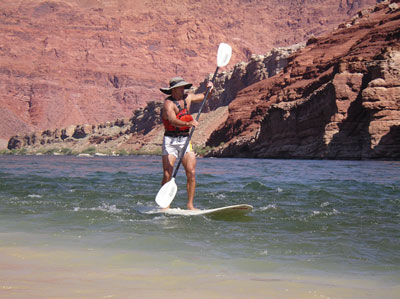
SUP sprint: Hawaiian 15-year-old Noa Ginella was the top paddle surfer among the races’ 40 starters, riding the rising river down the technical 3.5-mile course in 18 minutes, 15.53 seconds.
Kayak sprint: Mike Dawson of New Zealand blazed the Gore Creek downriver race course in 15:38.34 to win. Faux finished first among the women in 16:23.21, two days after claiming the steep creek title on Class V Homestake Creek.
More coverage from Chris Freud writing for the Vail Daily. From the article:
The traditional judging area on the kayaker’s right was underwater. There were numerous course holds for large logs entering the hole, including a entire tree stump. And softballs hit from Ford Park are probably in Grand Junction by now. “The river was amazingly high,” Teva kayaking queen Emily Jackson said. “I’ve been here — what — six, seven years now, and never have I seen water this insane.”
“My whole plan basically went out the window because it was a new wave,” Buena Vista’s Dustin Urban said. But when all was said in done, you can pump the entire Pacific Ocean into the Gore and it won’t matter. Jackson owns the Gore and got her sixth-straight women’s win with a clutch third and final ride, while Urban won his second men’s crown in three years…
With high water, the freestyle finals became a completely different ball game. With the help of the bladders, the creek was rolling at 1,400 cubic feet per square inch (CFS) at the beginning of the women’s competition. A mere 45 minutes later, it was at 1,580 CFS for the men.
More whitewater coverage here.

From email from the Colorado Water Conservation Board (Michelle Garrison):
Coordinated releases from a series of Upper Colorado River Basin reservoirs [began Thursday June 3] and are anticipated to carry on through next week as part of the Coordinated Reservoirs Operations Program.
Managers of the reservoirs completed a conference call today, agreeing to voluntarily run the program this year. The program benefits the endangered fish of the Upper Colorado River Basin.
Green Mountain Reservoir, operated by the Bureau of Reclamation, will increase releases by 200 cubic feet per second (cfs) today and tomorrow. Releases will go up another 400 cfs on Saturday before reaching 1400 cfs in late afternoon. Releases from Green Mountain include inflows bypassed by Dillon Reservoir, operated by Denver Water.
Denver Water also operates Williams Fork Reservoir, which will continue to pass its inflows downstream. Outflows from Williams Fork are currently about 600 cfs but may increase over the weekend with increasing inflows.
Wolford Mountain Reservoir, operated by the Colorado River Water Conservation District, is currently passing inflows of approximately 500 cfs. Outflows will be increased to approximately 200 cfs above inflow by Saturday evening. Inflows may increase over the weekend, further increasing the outflows from Wolford Mountain Reservoir.
Increased outflows from the participating reservoirs may continue through Wednesday, June 9th. The Colorado Basin River Forecast Center (CBRFC) has incorporated these planned reservoir operations into their streamflow forecasts…
More detailed information about forecasted streamflows in the Colorado River basin are available from the CBRFC website at http://www.cbrfc.noaa.gov. A map-based interface allows viewing of hydrographs detailing recent, current and anticipated flows.
“The releases boosting this year’s Colorado River peak are a tonic that will make the river healthier, and that benefits everyone from water users, to recreation, and all the fish that call the river home,” said Bart Miller, Water Program Director for Western Resource Advocates. “All the parties that have come together to make this happen are to be commended.”
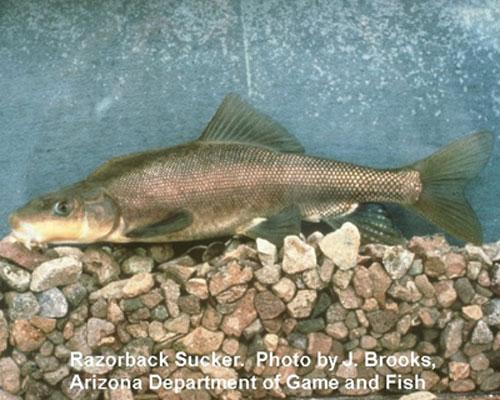
The Coordinated Reservoir Operations program was established in 1995 as part of the Upper Colorado River Endangered Fish Recovery Program. Its purpose is to enhance spring peak flows in a section of the Colorado River upstream of Grand Junction, Colo., determined critical to the survival of four endangered fish species: the humpback chub, razorback sucker, bonytail chub and the Colorado pikeminnow. In years with sufficient snowpack, surplus inflows to the reservoirs can be passed on downstream to benefit these fish.
For more information, contact Kara Lamb, Bureau of Reclamation’s Eastern Colorado Area Office, at (970) 962-4326, klamb@gp.usbr.gov; Jana Mohrman, U.S. Fish & Wildlife Service, at (303) 236-4486, jana_mohrman@usfws.gov or Michelle Garrison, Colorado Water Conservation Board, at (303) 866-3441, ext. 3213, michelle.garrison@state.co.us.
The Upper Colorado River Endangered Fish Recovery Program is a cooperative partnership of local, state and federal agencies, water developers, power customers and environmental groups established in 1988 to recover the endangered fishes while water development proceeds in accordance with federal and state laws and interstate compacts.
From The Durango Herald (Dale Rodebaugh):
There’s a reason for the cafe au lait color of the roiling Animas River that was moving at 4,600 cubic feet a second at the beginning of the week. Mountain snow is melting like crazy, leaving the snowpack in the Animas, San Juan and Dolores watershed at a paltry 19 percent of the 30-year average. Statewide, as of Tuesday, the snowpack stood at 53 percent of average. The North Platte basin registered the highest percentage, 98, while the Arkansas basin was next to the bottom at 32 percent of average.
This year’s snow reserve in the Animas, San Juan and Dolores watershed is pathetic compared to June 1, 2009, when it was 123 percent of average. “Southern Colorado experienced the greatest decline in snowpack percentage in May, leaving only the higher elevations with any significant snow,” Allen Green with the Natural Resources Conservation Service said in a statement. “A general lack of precipitation since early April has decreased the outlook for runoff in the southwestern corner of the state.”[…]
Runoff filled reservoirs to 110 percent of the June 1 average statewide, compared to 95 percent last year, Green said. In the Animas, Dolores and San Juan watershed reservoir levels were 115 percent of average, compared with 96 percent last year. Hal Pierce, the superintendent at Vallecito Reservoir, said Thursday the scant snowpack won’t affect Vallecito. “I’m within two and one-half feet of filling,” Pierce said. “The water is coming up 6 to 8 inches a day, so we’ll fill or be darn close to it in five or six days.” Reservoir levels in the Gunnison and Colorado basins stood at 114 percent of the June 1 average. Rio Grande basin reservoirs had the lowest levels, 90 percent of average.
From the Montrose Daily Press (Joel Blocker):
The Lake Fork of the Gunnison River rushes toward Blue Mesa Reservoir just south of the Red Bridge campground 17 miles north of Lake City. The Lake Fork is running at 1,060 cubic feet per second, according to the USGS Real-Time Water Data for Colorado. This section is open to boaters from the Red Bridge Campground to the Gateview Campground. It’s the most challenging, thrilling stretch, with technical Class III waters that sometimes approach Class IV during high runoff.
From the Summit Daily News (Bryce Evans):
[Veteran river guide Duke Bradford] said the Blue is currently running well. And, as the river may hit its peak in the coming weeks — possibly even days — now’s the time to go down it. “It’s anyone’s guess how long it’ll last, but we should have at least a couple weeks,” he added about the Blue.
The Arkansas, however, is looking to have a long season, possibly past the end of August, due to high amounts of winter precipitation on Hoosier Pass. Bradford said the “Ark” is commonly consistent for boaters, as it has controlled releases from the reservoir.
Clear Creek, in the stretches near Idaho Springs, is already running well and should continue to do so until early August. “That’s the closest, most consistent whitewater we have,” Bradford said.
And in each of the rivers, Bradford said a boater of every ability can find the stretch that’s right for them.
For instance, the Colorado River has arguably the best stretch of class IV and V rapids anywhere in the country in Gore Canyon near Kremmling. There’s a waterfall, long runs, and Bradford said the stretch is strictly for the “active and aggressive” boaters with a whole lot of experience. (Swimming tests — including recovery from under the raft — are required to paddle down the area.) On the other hand, the Colorado also offers some pretty leisurely paced float trips.
From The Grand Junction Daily Sentinel (Dennis Webb):
Mesa County officials are warning the public to expect a two-foot surge in water levels on the Colorado River this weekend. Warm temperatures will contribute to the increase, as will a coordinated release of water from reservoirs in the Upper Colorado River Basin to benefit endangered fish. Strong currents, cold water and debris dislodged by heavy flows will increase the danger of river travel, and the county is urging people to use caution on or near the river. The Mesa County Sheriff’s Department recommended that non-experienced boaters stay off the river, and said canoes, inner tubes and inflatable boats with single-chamber flotation should not be used under current conditions. It also said people always should use life vests on the water and refrain from drug and alcohol use on or near rivers…
Peak flows are expected early next week and should be right around average, said Bryon Lawrence, a hydrologist for the National Weather Service in Grand Junction. But average peak runoffs still demand plenty of respect from river visitors in western Colorado. “We always tell people several things this time of year, and one is never underestimate the force of fast-moving water,” Lawrence said. “And the waters are very cold. I think sometimes people underestimate that, too,” he said. The snowmelt-swollen Colorado River has a water temperature of about 50 degrees right now.
The Colorado River usually peaks between May 29 and June 18, so this year’s peak should arrive around the normal time, Lawrence said. Officials are predicting the river at Cameo will peak Monday night or Tuesday morning between 17,100 and 18,900 cubic feet per second. Its depth there could reach 10.5 feet. In years where conditions allow, the U.S. Bureau of Reclamation and other reservoir operators have agreed to joint releases during peak river flows to help flood river shallows upstream of Grand Junction. Those shallows are considered critical spawning habitat for the humpback chub, razorback sucker, bonytail chub and Colorado pikeminnow. Despite below-average snowpack this year, reservoir storage levels remain good, Lawrence said. Also, a cool spring helped preserve what snowpack there was, and spring storms in the central and northern mountains enhanced it, he said.
Flooding isn’t in the forecast, though. The only area of concern is the Elk River near Steamboat Springs, and even there it’s unlikely to flood, although it may fill the riverbank in places, he said.
From NBC11News.com (James Hopkins):
The coordinated reservoir operations program was established in 1985 to enhance spring peak flows in a section of the upper Colorado river that has been deemed critical for the survival of 4 endangered fish species, the Humpback Chub, Razorback Sucker, Bonytail Chub and the Colorado Pikeminnow. “We’re releasing 1400 CFM so we can reach this high peak flow,” says Hock. Reservoirs are able to bypass the flows because of the past few years of “good” snowpack. The higher river flows help get rid of the silt that builds up on the bottom of the river. “The eggs fall into the spaces between the cobble that were once filled with the silt,” says Osmundson. This gives the eggs a better chance of reaching maturity and hatching. It also increases the amount of food for the fish to eat.
It’s not only these endangered fish that benefit from the higher flows. “That also benefits the people who are fishing and rafting on the river as well,” says Hock. The reservoir release is planned to run through Tuesday next week with peak water levels expected to rise about two feet through town. A short inconvenience for some that will hopefully lead to a brighter future for our endangered species. “It’s been shown that years following higher in stream flows we have more years of reproduction of our endangered fish,” says Osmundson.
From The Fairplay Flume (Danny Ramey):
South Platte River between Eleven Mile and Spinney Mountain reservoirs – Flows for the “Dream Stream” have been around 63.6 cubic feet per second lately…
South Platte River near Deckers – The flows on this portion of the river continue to be low, running between 60-70 cfs.
From email from Reclamation (Kara Lamb):
We have the Ruedi Weather Station available on-line! Please visit the Weather Station at www.usbr.gov/gp/ecao/ruediweatherstation.html. It displays current air temperature, wind speeds, humidity and more. Additionally, because it uses the same transmission system as our water gages, the Weather Station Website also displays water level elevation and reservoir content.
Releases from the dam to the Fryingpan are about 90 cfs. We have not made any changes. However, the Rocky Fork is picking up snow melt and flowing pretty well. I believe the gage below the dam is reading about 125 cfs.
From The Denver Post (Scott Willoughby):
Nine years later, the Teva Mountain Games taking place Friday through Sunday are very much on the map as the nation’s premier celebration of adventure sports and lifestyle. Yet, in many ways, they’re still Vail’s river games — and they’re still brand new. “We always want to be cutting edge from the perspective of trying new things, but we’re also one of the biggest events of its kind. So we sort of have a reputation to uphold as being on the forefront of the adventure sports lifestyle,” said Paul Abling of the Vail Valley Foundation, which took ownership of the former grassroots event late in 2008. “If we’re going to do something new at the Teva Mountain Games, we’re going to go big with it.” The latest addition to the crowded TMG program offers an evolutionary twist to the down-river racing of yore, as whitewater stand-up paddle surfing (SUP) makes its competitive debut on snowmelt-swollen Gore Creek on Saturday and Sunday. Two events dubbed “SUP Surf Sprint” and “SUP Surf Cross” will have paddlers racing downriver on surfboards designed to run rapids, even battling head-to-head in the “cross” format. “It’s going to steal the show, for sure,” said local competitor Ken Hoeve of Gypsum.
More whitewater coverage here.
From The Denver Post (Scott Willoughby):
The typically tranquil Gore Creek, for example, shot up from a mere 450 cubic feet per second at its primary USGS measuring station Thursday to a whopping 1,300 cfs by midnight the next day. That’s nearly triple the flow coming down a creek that begins and ends above 8,000 feet…
“I’m afraid we may not have reached the high-flow period yet,” USGS Colorado spokeswoman Heidi Koontz told The Denver Post on Sunday. “Typically, the high-flow period comes in the middle of June.”[…]
Kayakers converged along the Arkansas over the weekend as Buena Vista christened a pair of new man-made whitewater waves during the annual CKS Paddlefest. The show then moved to Steamboat Springs for the Paddling Life Pro Invitational on Fish Creek and the Yampa River on Monday. Boaters in both places were greeted by a spike of about 1,000 cfs over the course of just a few days, enough to put most paddlers on red alert. Meanwhile, the reputation of the 3-year-old wave park on the Colorado River at Glenwood Springs continued to swell among river surfers, with as many as 15 board surfers lining up among the throng of kayakers waiting to ride the wave on a sunny Saturday afternoon. Roughly 25 more showed up to compete in the second annual Whitewater Stand Up Paddle Surfing Championships held there Monday. As the calendar reaches river season statewide, organizers of the Teva Mountain Games in Vail, Salida’s annual FIBArk Festival, the Lyons Outdoor Games on the St. Vrain, Animas River Days in Durango and the Gunnison River Festival in between are excited to showcase their local treasures and share them with the world.
From Fox21.com (Rachel Welte):
The National Weather Service in Pueblo said Monday sections of the [Arkansas River] are less than a foot away from flood stage, sitting at 8.6 feet…
“If you can imagine 3,000 basketballs going by any given point in the river at any time, that is about the volume of flow we are running, so that is a lot of water,” Tony Keenan said.
More whitewater coverage here.

From Steamboat Today (Joel Reichenberger):
Steamboaters Luke Farny and Karsten Thompson tied for first place in the juniors rodeo, while 16-year-old Denver boater JP Griffith cut through the morning’s slalom course to win that competition…
Action was intense at Charlie’s Hole in downtown Steamboat Springs on the Yampa River for the second consecutive day. Saturday was about area veterans plying their trade on the water, but Sunday was about the children. They shined. Nearly a dozen kayakers took part, top performers ranging in age from 8 to 16. Farny stood out with his ride in the finals. He landed a kick flip as an entry move, then hung in front of the wave, spinning and twisting in the surf for nearly his entire allotted 90-second ride time. When he finally washed out, a second before a whistle signaled his time was over, he was able to paddle to shore with a wide smile.
More whitewater coverage here.

From the Summit Daily News (Bryce Evans):
What: Frisco kayak competition
When: June 12-13
Details: Night trick competition on June 12, followed by kayak rodeo (2-4 p.m., June 13) and kayak race (4:30 p.m., June 13).
More info: Contact Matti Wade of Ten Mile Creek Kayaks at (970) 668-9294
More whitewater coverage here.
From the Glenwood Springs Post Independent (Kevin Keller):
Stand-up paddlers from the Roaring Fork Valley will compete with athletes from as far away as Hawaii. MacArthur said they are expecting about 35 competitors this year. Event promoter Paul Tefft said the event is truly one-of-a-kind. “It’s new, different, and unique,” he said. “The sport is evolving as we speak. My favorite event is the surfing, it’s the most action packed. There are a bunch of new moves, and it’s evolving at a rapid pace.” This year’s champion will be crowned after paddlers compete in three separate events on the Colorado River: A down river race, a new event called Supercross, and the surfing contest on the wave at the whitewater park, the competition’s website said. There are four divisions in the championship: men, women, youth male and youth female…
The race begins at 9:30 a.m. at Two Rivers Park. The paddlers will begin with a mass start at the park and race about six miles downriver to the finish at South Canyon. Supercross starts at 11:30 a.m., adjacent to Two Rivers Park. The event is a race similar to the Winter Olympic snowboard event boardercross. Competitors line up at the launch site, paddle upriver around the first flag, then go into the main current, with one more upriver flag to cross, according to the competition’s website…
The final event is a surfing contest with two or three one-minute rides per competitor, depending on number of competitors. The surfing begins at 2:30 p.m. at the whitewater park and is judged on a point system, with points being awarded for different types of moves. Wilmott said that surfing here is quite different from surfing on the ocean. “Surfing a wave that never ends is harder than it looks,” Wilmott said. “I think the best way to describe it is that the ocean is three-dimensional and the river is five-dimensional.” The competitors will then head back to Two Rivers Park for the awards ceremony, trophy presentation to the overall champions, and some celebration. Registration forms and information are available online at http://www.whitewatersupchampionship.com. Registration payment can be made in person at Two Rivers Park on May 30 from 5 to 7 p.m.
More whitewater coverage here.

From the Cortez Journal (Kimberly Benedict):
The spill, which began at low levels Monday, was expected to reach raftable flows near 800 cubic feet per second by noon Wednesday. “The reservoir is near full,” said Mike Preston, general manager of the Dolores Water Conservancy. “We are on for rafting flows of 800 cfs through Friday. We’re anticipating that we are going to be able to extend rafting into the weekend, although we may have to start ramping down flow Sunday night or some point during the weekend.”[…]
“For a while the irrigation demand had overtaken the inflow of the river, but now that we are near full and warming up we are going to have some water to spill. We just don’t know how much.”[…]
“We started with a reservoir elevation that was lower by over 30,000 feet as compared to last year,” Preston said. “We were filling a bigger hole, and we didn’t have the early warm weather. Fierce winds during the past few weeks also impacted river flows. High winds speed the evaporation of high altitude snow and dry the soil, forcing water into the ground rather than rivers. “Every year is different,” Preston said. “That is what I’m learning. In the good year, like 2008, we’re going to be spilling over a long period of time. A year like this, we don’t know what is up there and how fast it is going to come down.” The Upper Dolores is flowing above 1,500 cfs into McPhee. Upper flows should continue into early June. Up-to-date release information is available at http://www.doloreswater.com/releases.htm.
More Dolores River watershed coverage here and here.
Meanwhile, the Avon whitewater park is open according to a report from the Snowmass Sun. From the article:
Avon’s whitewater park is open and the rapids are flowing perfectly for surfing and play time. The Eagle River is currently flowing at approximately 1,080 cfs.
More whitewater coverage here.
From Steamboat Today (Mike Lawrence):
The city of Steamboat Springs’ Parks, Open Space and Recreational Services Department has closed some sections of the Yampa River Core Trail because of seasonal high water. As runoff-fueled flows surge and abate in local waterways, additional closures and trail detours could occur.
From The Colorado Springs Gazette (Andrew Wineke):
The park, which was officially opened earlier this month, was humorously dubbed “WKRP in Cañon City” (if you’re too young to get the joke, google it) — the acronym stands for Whitewater Kayak and Recreation Park.
“I’ve always thought that we needed a whitewater park,” said Will Colon, co-owner of Raft Masters in Cañon City. “We’ve always let the river run through the city and never really used it.” About three years ago, Colon decided to do something about it. He raised money and brought in experts, pitched the idea to city leaders and pretty soon, WKRP was under way. With a $200,000 grant from Great Outdoors Colorado and $200,000 more in local cash and in-kind contributions, an excavator began laying rock in the riverbed in January between Depot and Centennial parks, around the Fourth Street viaduct.
The core of the park is a pair of man-made waves, dubbed Flytrap and Nessman, where giant concrete blocks were placed in the river and form frothing piles of foam as the Arkansas crashes over them. Kayakers and rafters, and potentially the occasional surfer or boogie boarder, can play in the waves, surfing and cartwheeling and spinning. For rafters and kayakers finishing a Royal Gorge trip, the waves will be a final hit before taking out…
June 25 and 26, the park will host the Royal Gorge Whitewater Festival — a week after the Fibark festival in Salida, the state’s largest. Colon hopes to add more waves to the park and extend the bank improvements upstream. He also hopes the park won’t be just a summertime attraction. “Ideally, we want a wave that will work in the wintertime,” Colon said. “We’re in the banana belt, we have good weather in the winter.”
More whitewater coverage here.

From the Glenwood Springs Post Independent (John Gardner):
Glenwood Springs wastewater customers can expect a 30 percent increase in their sewer bill beginning in June.
The increase of the city’s water and wastewater rates for 2010 was unanimously approved by Glenwood Springs City Council at its May 20 meeting.
The sizable increase in wastewater rates will also be accompanied by a 5 percent rate increase of the treated water for 2010.
The increases are the fifth in as many years and were designed to generate revenue to pay for capital improvement projects, most notably the relocation of the city’s wastewater treatment plant, which cost $33 million. The total cost includes $22.3 million for construction of the wastewater facility. Approximately $4.6 million has paid for construction of the force main that will connect the lift station at the current site on Seventh Street to the new facility in West Glenwood Springs to the south of the Colorado River, and for construction of the access road.
The remaining $6 million covers engineering and associated costs, and a portion will also cover demolition of the existing facility on Seventh Street, according to City Manager Jeff Hecksel.
More wastewater coverage here.
From the Clear Creek Courant (Ian Neligh):
The park celebrated its grand opening May 22. It includes boulders that create specialty chutes and waves for kayakers and other boaters along the 450-foot stretch of Clear Creek just upstream from Mile Hi Rafting. The park also has improved parking and a changing station with environmentally friendly toilets. Eighty percent of the funding for the $400,000 whitewater park comes from a Federal Highway Administration grant through the Colorado Department of Transportation. The rest is split between the county Open Space Commission and Clear Creek County…
The project was overseen by Recreation Engineering and Planning of Boulder, which did designs at similar whitewater parks in Golden, Steamboat Springs and Buena Vista. Groundbreaking for the park was held last August, and work was finished in the creek by mid-autumn to protect the fisheries. Helseth said the creek was moved to one side behind a cofferdam to allow work to be done on the park. “They put those boulders exactly where they wanted them to make the perfect waves for kayaks, and then they actually grouted them into place,” Helseth said. “So now they won’t shift and move anymore, and they’ve really been laid out according to what they have identified as the optimal spacing for kayakers.”
More Whitewater coverage here.

From The Denver Post (Scott Willoughby):
During what served as the peak of whitewater season elsewhere in southwestern Colorado, the scenario is indicative of the conundrum that the Rio Dolores — The River of Sorrows — has become. Once one of the longest undammed rivers in the lower 48 states and a perennial candidate for federal Wild and Scenic River designation, the 250-mile Dolores now loses about 40 percent of its water, an average of 100,000 acre-feet each year, to irrigation withdrawals and trans-basin diversions centered on the McPhee Dam and Reservoir built in the mid-1980s. The result is a boon to agriculture and municipal and industrial water users around the city of Cortez, but at significant cost to the recreational and ecological interests the river once supported. Management is a complex issue that involves several federal, state and local agencies, but many believe there’s ample water to share among these often-conflicting interests.
The first step — already begun by the Cortez-based Dolores River Coalition — is raising awareness of the river. “It really is the forgotten river,” said Bureau of Land Management ranger Ryan Mathis from the Montrose field office, one of three BLM offices…
With just more than 50 cfs trickling out of McPhee Reservoir, there’s little reason to make the once popular trip upstream of the San Miguel confluence anymore. The former gold medal trout fishery below the dam long ago had that designation revoked, and water managers from the Bureau of Reclamation and Dolores Water Conservancy District rarely release enough water for boaters to navigate the 185 miles of river below the dam, despite a study by Trout Unlimited showing an annual shortage of 3,300 acre-feet in the river (leaving nearly 25,000 acre-feet of water in the reservoir unused). Although hope remains for a Memorial Day weekend release, McPhee has yet to spill this year. From 2000-05, it didn’t spill at all…
The Dolores River Coalition is stressing protection of those undeveloped landscapes and increased river flows in order to balance resource management for the full spectrum of human uses and preservation of the ecosystem.

From The Aspen Times (John Gardner):
Just in time for the spring rush, riverbank improvements at the Glenwood Springs whitewater park are nearly complete. The upgrades will make the park more enjoyable for paddlers and spectators alike, according to Glenwood Parks and Recreation Director Tom Barnes. “The wave is already getting some use, which is really cool to see,” Barnes said. Work began on the park in fall 2009. Gould Construction completed the project, which cost a reported $430,000, to transform the rocky and rugged riverbanks into more of a park-like setting to accommodate spectators. While the project included development of a park and several amenities designed to make the viewing experience more comfortable, the improvements were also designed to make the wave in the river more easily accessible for paddlers. Improvements on the north and south side of the Colorado River include observation bleachers and decks for spectators. Additions also include takeouts on both the north and south sides of the river, to the west of the Midland Avenue Bridge, to provide easier exits for paddlers…
A ribbon-cutting event for the whitewater park is scheduled at 5:30 p.m. on Thursday, June 10, with ribbon cuttings at Two Rivers Park and Oasis Creek Park scheduled for 6 p.m.
More whitewater coverage here.
From the Salida Citizen:
Paddlefest acts as the “Kick Off” to the Arkansas River paddling season, drawing hundreds of river enthusiasts to Chaffee County for a weekend filled with boating, on water instruction, kayak competitions, river education, seminars, sales and entertainment. Paddlefest is a unique event that offers educational opportunities for folks with a variety of interests – there will be something for everyone – families, individuals just learning about water sports to hard core professional kayakers. Free demos and basic instruction on Stand Up Paddle boards and recreational kayaks will be offered on the Buena Vista Town Pond. As well as, free whitewater demos on the river.
More whitewater coverage here.

From the Aspen Daily News (David Frey):
State Rep. Kathleen Curry said she “didn’t get it right” in trying to craft a right-to-float bill on Colorado rivers, but strong emotions on both sides of the issue suggest crafting any kind of bill to address the issue will be tricky. “It creates a situation with not a lot of room or even motivation for middle ground,” said Curry, speaking at a State of the River conference hosted by the Colorado River Water Conservation District on Tuesday night…
“We met a great deal of opposition, really from all sides,” Curry said. “I didn’t get it right. We thought we had basically gone down a path of trying to create a compromise.” With no legislation passed, 20 proposed ballot initiatives are pending to resolve the issue on the November ballot. Sixteen were proposed by landowners. Four were proposed by river outfitters. Two of those include language for anglers. Two don’t…
Glenwood Springs water attorney Scott Balcomb argued that if the state wants access through landowners’ properties, it should pay for rights of way, much as governments do for roads. “I’m not against the boating industry. You can tell,” Balcomb said, pointing to a boating logo on his shirt. “I am for respecting the constitutional rights of landowners and getting it done in a proper organized way. Both sides of this controversy badly need to know what the rules are so that the incidents that Ken brought out stop.”[…]
Sitting in the audience, Frying Pan Anglers’ Warrick Mobray said he understood both sides of the argument. As an angler, he wants floating rights. As a landowner, he wants protections. The two sides should sit down and hammer out a compromise, Mobray said, but he admitted, that’s not very likely. “Both sides are nuts,” he said…
Water experts said Tuesday night that Ruedi Reservoir will fill completely, thanks to spring showers which have helped maintain the snowpack.
Meanwhile, here’s an update on the agreement between Wilder on the Taylor and the two outfitters that will allow them to run the river this season, from Seth Mensing writing for the Crested Butte News. From the article:
The offer: follow six rules ranging from timing of the trips to respecting water levels in the Taylor, and take a few trips through the property this summer. Then the two sides can take time to talk about the future…
…Gunnison Rep. Kathleen Curry, who championed the bill in the state house, said she probably will not pursue a similar bill next year, if she is re-elected. “I don’t plan to run legislation next year because … the issue was so contentious the personal toll this bill took was too high. I don’t see the point in working on a ‘compromise’ proposal just to have it killed next year in the legislature by the big money landowner interests,” she says. “If both sides were willing to agree to a solution and then stick by their word when the time came, then I think it would be worth pursuing this issue further. But, based on what happened this year, I have little hope for that.”
Now, outside of ongoing mediation, Shaw is saying he won’t press trespass charges against either Three Rivers or Scenic River Tours if the rafters limit the timing and number of trips, cover Wilder’s liability in the event of an injury and keep their angling flies out of the water. In a statement Shaw said, “While mediation between Jackson-Shaw and the two Taylor River rafting companies continues, Jackson-Shaw recognizes that Three Rivers and Scenic are at the threshold of their commercial rafting season and that it will take time to finalize any formal agreement. Accordingly, as a show of good faith, Jackson-Shaw has decided to give Three Rivers and Scenic permission to float through Wilder on the Taylor this summer.”
As long as boaters have been running the Taylor freely, they have had to take out and portage around a bridge on the Wilder property. Shaw’s offer gives them the permission to continue doing that. The two rafting companies will have to decide how to share the four commercial trips that will be allowed through the property each day, with two going through between 9:30 and 11 a.m., followed by the others between 1:30 and 3 p.m. And even inside the three-month window, Shaw says the rafters shouldn’t float through Wilder when the water level is below 200 cubic feet per second below the Taylor Dam…
According to the release, scheduling conflicts have delayed a second mediation meeting at the Judicial Arbiters Group in Denver, which was started at Governor Bill Ritter’s request. The two groups will meet again May 26. “So long as Three Rivers and Scenic are willing to accept Jackson-Shaw’s permission and follow these simple terms, Jackson-Shaw will allow the rafting companies to conduct rafting trips through the property this summer,” Shaw concluded. “Acceptance by these two rafting companies of these terms will not prevent mediation from continuing. However, it will give the two companies some certainty as the rafting season begins.”
More Colorado River Basin coverage here. More whitewater coverage here.
From the Vail Daily:
ade in Vail Village is ready for action. Although water levels have not yet reached the preferred 400 cubic feet per second, the town has activated the park to take advantage of rising water levels. Free demos at the park will begin Tuesday and continue Tuesday evenings from 5 p.m. to 7 p.m. through June 22. The demos are run by Alpine Quest Sports and instructors will be on hand to demonstrate their skills and to show kayakers how to freestyle. The park has an adjustable whitewater wave that allows kayakers to experience maximum conditions during peak flows. The system will operate into late-June or as runoff allows…
The park’s computer controlled system is being programmed to read the water level each morning, and then automatic adjustments will be triggered to produce the best wave possible throughout the day. Kayakers are asked to leave feedback for the town about any additional adjustments that can be made to the park throughout the season. Feedback forms are available on site or by e-mail at whitewater@vailgov.com.
More whitewater coverage here.
From The Denver Post (Joey Bunch):
Recent cold and snow have meant a slow start to the snowmelt, as most rivers are running below normal, according to the U.S. Geological Survey. The Roaring Fork River at Glenwood Springs was flowing at 962 cubic feet per second Sunday. The 30- year median for this time of year is 1,930 cfs. Rafters on the Colorado River, however, got an earlier start because of dam releases, said Sandra Winslow, manager at Whitewater Rafting LLC, a 36-year-old business in Glenwood Springs. As a result, the Colorado River was running at 2,200 cfs Sunday, she said. The normal peak of the season is late May, but delayed snowmelt could mean a gangbuster season with the fast stream flow later this month.
From the Summit Daily News (Julie Sutor):
Denver Water, which supplies water to about 1.3 million people in the Denver Metro area, has 10 major reservoirs, including Dillon Reservoir, in its water-storage system. “They’re all going to fill, so that’s good news,” Denver Water’s Bob Steger said.
As of May 15, snowpack in the Upper Colorado River basin, which includes Summit County’s Blue River, was 89 percent of average; year-to-date precipitation in the basin totaled 92 percent of average on Saturday. The Colorado River Basin’s peak snowpack this year was 83 percent of the 1971-2000 average peak. Snowpack in the South Platte basin was 106 percent of average on May 15, and year-to-date precipitation was 91 percent of average, which is good news for Summit County. Denver Water gets about half its water from the South Platte basin, and about a quarter from the Blue River basin. So when the South Platte is dry, the agency draws more water from the Blue, including Dillon Reservoir.
As for the quality of kayaking, rafting and fishing on the Blue River below Dillon Dam, that will depend on the next few months’ weather on both sides of the Continental Divide. If wet weather persists, Steger predicts the Lower Blue will have five to six weeks of good rafting and 14 to 15 weeks of good fishing. If the weather turns dry for the next few months, the Blue River will only be conducive to rafting for one or two weeks. But fishing, which is better at lower flows, will be good for 18 to 19 weeks during late spring and summer…
Denver Water is now conducting research to quantify how dust storms affect the timing of snowmelt and peak river flows and the implications the storms have on its operations. Several dust storms have come through Summit County this spring. Drought and human development are the major causes of dust storms, as disturbances to soil allow it to be picked up more easily by winds.
From the Associated Press (Steven K. Paulson) via the Summit Daily News:
Property owners have declared a temporary truce in a dispute with commercial rafters and will allow rafting on their property this summer. Jackson-Shaw, the company that owns the Wilder on the Taylor fishing reserve, said Friday it will grant the two Taylor River rafting companies, Three Rivers Outfitting and Scenic River Tours, permission to float through its property this summer…
Lewis Shaw, chairman of the company, said it will take time to work out a permanent agreement and he wanted to give rafters a chance to begin their season. “While mediation between Jackson-Shaw and the two Taylor River rafting companies continues, Jackson-Shaw recognizes that Three Rivers and Scenic are at the threshold of their commercial rafting season and that it will take time to finalize any formal agreement. Accordingly, as a show of good faith, Jackson-Shaw has decided to give Three Rivers and Scenic permission to float through Wilder on the Taylor this summer,” Shaw said.
Bob Hamel, chairman of the Colorado River Outfitters Association, said it was a nice gesture but rafters believe they don’t need Shaw’s permission to raft the river. Rafting companies were already going ahead with their new season, he said. “Jackson-Shaw is not entitled to grant permission. The permission is in the Forest Service permit. I think this is premature because we’re still in negotiations,” Hamel said.
Mediation between the two rafting companies and Jackson-Shaw began on April 22 and remains ongoing. Both sides have agreed to keep the details of their negotiations secret. Shaw imposed several conditions, including limits on rafting between May 15 and Aug. 15 if there is sufficient water. The companies will be allowed four trips each day between 9:30 a.m. and 11 a.m. and 1:30 p.m. to 3 p.m. so fishermen can also enjoy their sport. Rafters will be allowed on the property to carry their rafts across a bridge…
Rep. Kathleen Curry, an unaffiliated state representative from Gunnison, said she believes voters will side with rafters, who have exercised their rights to use Colorado rivers for decades and have become a symbol of Colorado’s outdoor life. Eric Anderson, who represents a coalition of property owners, including fishermen who barred rafting this year on their property, said he believes fishermen will win in the court of public opinion because their property rights are being threatened.
More coverage from the Colorado Independent (David O. Williams). From the article:
The company that prompted one of the more hotly contested bills of the legislative session – House Bill 1188 dealing with commercial river rafting – announced Friday it would allow two outfitters to float the Taylor River through its property this summer. Officials for Jackson-Shaw, owner of the Wilder on the Taylor fishing reserve, said they will continue mediation efforts with Three Rivers Outfitting and Scenic River Tours while allowing the two companies to continue navigating the river through the private property…
Jackson-Shaw won’t allow rafters to fish the Taylor through the preserve, but they can portage a bridge (go around on land) as long they are “respectful” of the property, and the boaters must also limit the number of trips and stick to certain times and dates. “We believe that these rules are reasonable and will allow the rafting companies to meet demand, operate profitable businesses, and conduct far more commercial trips through the property this summer than last summer,” Jackson-Shaw Chairman and CEO Lewis Shaw said in a release.
Gov. Bill Ritter Thursday said he will work with landowner groups and the commercial rafting industry to resolve differences and avoid a looming ballot measure on the contentious issue.
More HB 10-1188 coverage here. More 2010 Colorado elections coverage here.
From The Grand Junction Daily Sentinel (Charles Ashby):
“What we tried to do with this bill was relate the statutes with reality,” said Rep. Kathleen Curry, the unaffiliated Gunnison legislator who introduced the bill with Sen. Mary Hodge, D-Brighton. “What unraveled the legislative process was the fear of litigation and how the courts would interpret (it). We had a bill that looked reasonable when you read the bill, but the opposition felt like … the courts would make a broader finding and open up everything.”
When Curry introduced the measure in January, it was designed to allow rafters to float down Colorado rivers through private land, touching the riverbed and banks only in cases of emergencies.
But when it reached the Senate, lawmakers there said the idea constituted a taking of private property. As a result, that chamber turned it into a study, but sent it to a nongovernmental organization made up of landowners and water companies, not recreational river users.
Curry said without the bill, a slew of ballot questions may be placed before voters this fall to decide the matter one way or the other. There are 16 pro-landowner measures pending, and four designed to open private land to all rafting.
Regardless of what gets on the ballot in November, Curry predicted the uneasy peace that has existed between rafting companies and landowners will end, and a heated war will erupt this summer between the two sides. She said she already is hearing reports of rafters cutting down fences that property owners have erected to stop them from traversing rivers that cross their land.
More HB 10-1188 coverage here.
From The Denver Post (Jessica Fender):
The six-lawmaker panel deadlocked when members couldn’t settle on rules regarding how, when or whether river enthusiasts should be able to float through private property. The lack of a legislative resolution probably means voters will be asked to settle the fight on the November ballot. Twenty ballot initiatives on the subject are currently waiting in the wings, though that number will certainly be culled before Election Day. Rep. Kathleen Curry, sponsor of House Bill 1188, said none of the initiatives fully address complicated issues such as portage and trespassing that are likely to be glossed over by campaigns on both sides. “We are unable to reach an agreement, but that doesn’t mean the issue goes away,” said Curry, I-Gunnison. “Tensions are up back home, but I couldn’t help them.”[…]
Meanwhile, private mediation on the conflict that brought the bill to the fore continues, according to lobbyist Mike Feeley, who represents land developer Jackson-Shaw. The Texas company purchased both sides of the bank along a 2-mile stretch of the Taylor River and plans an exclusive vacation community. It threatened to bar two Almont rafting outfitters from floating through the property. At Gov. Bill Ritter’s direction, the rafting and land-development companies have started to negotiate a compromise.
More HB 10-1188 coverage here.

From Steamboat Today (Michael J. Mitchell):
The sustainability of one of Colorado’s most sensitive natural resources, our waterways, is being pitted against the demand for recreation and commerce. Floating, while it may seem to be non-consumptive, has impacts on the habitats where it occurs. There is bank damage at put in/take outs, toilets next to rivers, bank side parking lots, trails along rivers, overfishing and trash to name just a few. These impacts add up, resulting in real biological consequences. The impact is not limited to fish; fish-eating bald eagles, water dependent river otters, migratory waterfowl and other riparian dependent species will also be affected if constant boat traffic is present.
The unregulated floating of Colorado rivers is proposed for one of the most precious wildlife habitats in our state; the thin vegetated line along waterways known as riparian habitat. Our riparian habitat represents just 3 percent of the land area but it is essential to sustain 75 percent of our wildlife species. If we were to consider such a major change within one of our National Forests or other federal lands we would be required by law to evaluate the environmental consequences through professional assessments and impact statements. Why would we want less for Colorado’s rivers?
More HB 10-1188 coverage here.
From 9News.com (Jeffrey Wolf/Matt Renoux):
Without massive moisture, rivers like the Colorado, Eagle, and Clear Creek are expected to be 30 percent to 40 percent below average.
That does not mean the rafting season is washed up, thanks to big rivers, like the Gunnison and Arkansas where snow has been pretty good and water flows are expected to be normal. “The Gunnison should flow well, and the Upper Arkansas will have runoff well above 90 percent, or very close to average,” Hummer said.
From The Crested Butte News (Seth Mensing):
Meetings between Three Rivers Outfitters, Scenic River Tours and the Wilder resumed Thursday, April 22 at the request of Colorado Governor Bill Ritter and are still ongoing with a possible agreement that would let boaters and anglers share a two-mile stretch of the river. That is the stick and carrot keeping both sides going. Three Rivers and Scenic River, which are the only two commercial companies running the Taylor, have said that banning them from a two-mile section of water will lead them to financial ruin. But according to Forest Service records obtained by Dick Bratton, a partner with the Gunnison law firm Bratton, Hill, Wilderson & Lock, which is representing the developers of the exclusive Wilder on the Taylor subdivision, Three Rivers only took 62 clients on the disputed section of river last year.
And Brad Roberts, co-owner of Harmel’s Resort just upstream from the Wilder property, isn’t shy about placing the blame for the dispute squarely on the shoulders of Scenic River Tours. “Scenic River Tours has this obnoxious trespassing thing,” Roberts says.
More HB 10-1188 coverage here. More 2010 Colorado elections coverage here.
From Citizen Team via the Salida Citizen:
It’s hard to believe FIBArk is a little over a month away! The FIBArk Board has been hard at work planning this year’s festival, and it’s gonna be the best yet! A great way to give back to this fabulous, FREE festival is to volunteer. We can use people of all shapes and sizes, for jobs big and small. If you have volunteered in the past, or are contemplating helping out this year, we would love to hear from you! Jobs include everything from set-up to take-down, event registration, information booth, pouring beer, educating people at recycling and compost stations, or whatever floats your boat! Grab a friend or two and do it together! Shifts range from two hours to however long you’d like to help us out. For those that want to help staff the New Belgium Brewery beer tent, contact Shannon at 719-221-1988, or email shannon@summitmobility.com. For all other aspects of volunteering, please call Kate at 719-207-2323 or email kateyost@gmail.com. We look forward to hearing from you! Festival dates are June 17–20, 2010.
From The Pueblo Chieftain (Patrick Malone):
On Friday, the House voted to refer HB1188 as amended in the Senate to a conference committee with representatives from both chambers. The bill as originally passed by the House sought to allow commercial rafters to float through private property. In the Senate, it first was amended to open rivers through private property to anyone who wanted to use them — including anglers and individual, noncommercial rafters — and then amended to become a study by the Colorado Water Congress with no action to be taken this session by the Legislature. The Colorado Water Congress is the pre-eminent lobby in the state on issues pertaining to water use. Those changes on Friday faced a vote of the House, where the bill was referred to a conference committee.
More coverage from The Grand Junction Daily Sentinel (Charles Ashby):
When House Bill 1188 cleared the Colorado House in mid-February, it allowed rafters to cross private property but limited how often people can make contact with land. When the Senate debated the bill in March, however, the measure was reduced to a study, and then by a nongovernmental panel that focuses on water issues rather than recreation or landowner rights. As a result, its chief sponsor, unaffiliated Rep. Kathleen Curry of Gunnison, got the House to vote 41-21 Friday to send it to a conference committee of three representatives and three senators. There she hopes a compromise can be drafted. There are 24 proposed ballot questions addressing the issue, and Gov. Bill Ritter even got involved in trying to negotiate a compromise. At issue is the right to float on publicly owned water versus concerns over private property rights.
More coverage from Joe Hanel writing for The Durango Herald. From the article:
Curry asked Friday that the bill go to a conference committee to continue the discussion. The House granted her request on a 41-21 vote. The Senate had adjourned for the day and must agree before a conference committee could begin.
Rep. Jerry Sonnenberg, R-Sterling, urged the House to follow the Senate’s lead and turn the bill into a study. “They had the sense to say, you know what, this is much bigger than what we can deal with right now,” Sonnenberg said.
Curry introduced the bill because of a dispute between a rafting company and a developer in her district. The two sides are trying to negotiate a settlement. “Even if they reach an agreement, the problem still persists throughout the state, and the ballot initiative process is out of our reach,” Curry said in a letter to her colleagues Tuesday.
More coverage from The Pulse- of Colorado Farm Bureau (Garin Vorthmann):
Representative Kathleen Curry, the House sponsor of the measure, did not support the Senate version of the bill which directed the Colorado Water Congress to facilitate a study regarding the issue of rafting through private property and to report back to the legislature in November. Rep. Curry asked for permission to have a conference committee established, which will be made up of 3 members from the House of Representatives and 3 members from the Senate. The committee will then be charged with trying to draft a compromise between the two versions of the bill.
More HB 10-1188 coverage here. More 2010 Colorado legislation coverage here.
From the Crested Butte News (Seth Mensing):
The trick will be to find a way a two-mile section of the Taylor River can be shared by two disparate groups of rafting and fishing clientele who expect something completely different from their respective river experiences.
Mark Schumacher, owner of Three Rivers Tours, representatives from Scenic River Tours and the Colorado River Outfitters’ Association, along with attorney Lori Potter, will sit down with developer Lewis Shaw and his lawyers Thursday, April 22 to make another attempt finding that common ground, with the help of the Judicial Arbiter Group Inc., a team of retired trial and appellate court judges who mediate such disputes.
Schumacher says the mediation is non-binding and either party can walk away at anytime. If that happens without a resolution, his company’s future on the middle section of the Taylor River will rest largely on the passage of House Bill 1188, the Commercial Rafting Viability Act, which was introduced by Gunnison Rep. Kathleen Curry in the last legislative session, or with a November ballot measure.
More HB 10-1188 coverage here.

Here’s an opinion piece penned by Charles White running in The Denver Post. Mr. White maintains that the CWC is the right organization to help shepherd the bill. From the article:
The Colorado Senate made the right decision in referring the contentious proposal to establish a “right to float” on the state’s waterways to the Colorado Water Congress. This was not, as suggested by The Post, a “punt” of the issues. Rather, it was a realistic recognition that more work is needed to address the serious flaws in the original bill. Under House Bill 1188…
The Colorado Water Congress is ideally suited to address each of these issues. Since 1957, it has brought divergent interest groups together to study, negotiate, and propose legislation on a wide variety of topics related to Colorado water. The CWC would convene a broadly representative panel to make recommendations for new legislation that could have much broader public support. This common-sense solution to the current impasse deserves The Post’s endorsement.
More HB 10-1188 coverage here.
From The Pueblo Chieftain (Patrick Malone):
Ritter has met with rafting interests and landowners hoping to broker a compromise “so this doesn’t become some kind of ballot Armageddon.” Since the Senate amended [HB 10-1188] last month, it has been a fixture on the House calendar with no action…
Since a Colorado Supreme Court ruling in the late 1970s that allowed rafters passage through private lands, outfitters and landowners have coexisted mostly harmoniously, Ritter said Monday. But the Western Slope acrimony and resulting bill created a rift. “The controversy that was normally dormant came to the surface,” Ritter said.
The governor said his office has intervened because the specter of numerous ballot initiatives further muddying the water over who can travel Colorado’s rivers and where looms large. To date, 12 proposed initiatives swirling around those questions have been filed with the state for possible placement on the November ballot. Talks between both sides of the issue have been productive at times, and broken down at others, Ritter said. It’s likely a conference committee of the Legislature will soon hear the bill in its amended form, but ideally, Ritter would like to see rafters and landowners calm the waters themselves.
More 2010 Colorado elections coverage here.
From The Denver Post (Jessica Fender):
Gov. Bill Ritter thought the situation could be resolved in a better way when he directed Schumacher, a neighboring outfitter and a Jackson-Shaw representative to develop a use agreement that allowed the two rafting companies to continue their operations, said spokesman Evan Dreyer. “The two sides have a very specific conflict,” Dreyer said. “Seems like they should be able to find some common ground and reach a compromise that doesn’t require a new state law.”
Eric Anderson, a spokesman for a group of landowners fighting the bill and the initiative, said the Schumacher-Shaw matchup upset a balance between river rafters and private landowners that had been working for years.
More 2010 Colorado elections coverage here.
From The Pueblo Chieftain (Chris Woodka):
The head of the [Colorado Water Congress] said this has been a “failure” in water negotiations. While emotions run high over the bill, it is actually an example of how the connections often promoted by the CWC broke down in this case, said Doug Kemper, CWC executive director, at the Arkansas River Basin Water Forum at The Abbey this week. “HB1188 is a failure to use the network,” he said…
The House in February passed a version that gave both commercial rafters the right to float through property around obstacles. The Senate last month passed a different version of the bill, saying current law is unclear and ordering a study of the issue by the Colorado Water Congress to be completed by Oct. 31. The House has yet to reconsider the bill…
The original bill, drafted by Rep. Kathleen Curry, Unaffiliated-Gunnison, had warning flags for the water community, particularly in referring to English common law and the right of navigability, Kemper said. “The CWC came out opposed to the bill,” Kemper said. “Our concern was the word navigable has a meaning at the federal level that starts bringing in federal regulations. “We also wanted to make sure water rights operations were not impacted either with diversion structures or permitting on projects.”
In Colorado, the rafting issue is clouded by a state Supreme Court ruling that said there was no right to float across private property and a subsequent ruling by a state attorney general that said rafters made no criminal trespass if they float through private property, provided they do not touch the banks or bed of the stream…
Kemper said the various ballot titles might boil down to “two or three on each side,” and said regardless of which path the Legislature takes, some are likely to reach the ballot. “It’s coming down to rafters vs. property interests, and if that happens, it’s a failure of the network,” Kemper said. Kemper, who worked for the City of Aurora as it developed water interests in the Arkansas River basin, said the flow agreements and formation of the Arkansas Headwaters Recreation Area show where cooperation can lead. “There has been too much hard work in the Arkansas Valley between rafting interests and the water rights holders for this to become a wedge,” Kemper said.
More HB 10-1188 coverage here.

From The Wall Street Journal (Stephanie Simon):
That blissful setting is fairly well destroyed, [Steve Roberts] contends, when dozens of rubber rafts come bumping past, crammed with tourists of a less contemplative sort. “They come bebopping right on through…going over the dam I built for the fish, yelling ‘Whee!’ ” Mr. Roberts says. “I’ve got 60 boats a day doing that. My guests are unhappy.”
Too bad, the rafting community responds. The state constitution declares Colorado’s river water a public resource. Private landowners can reasonably lay claim to the structural frame of a river—the bottom, the banks, perhaps even the boulders. “But that doesn’t mean they own the water,” says Duke Bradford, who owns two commercial rafting companies. “You can’t privatize a river.”
More 2010 Colorado elections coverage here. More HB 10-1188 coverage here.

From the Pagosa Sun:
This year’s theme is “Common Causes,” and there will be a lineup of notable speakers who will address how water districts and various organizations work together to address common concerns.
In addition to [photographer John Fielder], one of the ranchers interviewed in Fielder’s recent book, “Colorado Ranges,” T. Wright Dickinson, will speak. Other speakers include Dave Grey; David Brown and Josh Linard from the United States Geological Survey; Doug Kemper, executive director of Colorado Water Congress, and Kent Singer, executive director of Colorado Rural Electric Association; and a panel that will talk about water quality work being done.
The registration is $30 for advance registration and $32 at the door, per person. This fee includes morning and afternoon snacks and a buffet lunch. Registration on April 2 begins at 8 a.m., the seminar begins at 8:30 a.m., and the seminar will wrap up at approximately 4 p.m.
It is recommended that advance reservations be made by contacting Jane Maxson at 247-1302.
More San Juan Basin coverage here.
From The Durango Herald (Garrett Andrews):
Provisions in a proposed river ordinance would have prohibited alcohol in closed containers, imposed a curfew from 10 p.m. to 5 a.m. and required life jackets for recreational users. A curfew might still pass in some form, but the alcohol and flotation-device provisions likely will be scrapped because of enforcement and financial considerations. “I believe it’s excessive and would limit access to an affordable and cherished summertime activity,” said Councilor Doug Lyon of the life-jacket provision Tuesday at the study session…
Public consumption of alcohol is illegal on the Animas, but, as Durango Police Chief David Felice said, that’s not an easy law to enforce. “We were down there all last summer watching people with kegs over one shoulder getting into rafts, and there’s nothing we can do. We saw it all day long; we can only cite once it’s open,” he said. What DPD officers would occasionally do is watch for consumption from the shore, follow subjects to the take-outs and issue citations. Felice said strict enforcement can even provide an incentive for drinkers to ditch their cans and bottles, and make collecting evidence more difficult for Felice’s officers.
Here’s a long recap of the issues around HB 10-1188, from Forrest Whitman writing for the Weekly Register-Call/ Gilpin County News. Click through and read the whole thing. Here’s an excerpt:
Last summer Greg Felt said he’d rather die than give up his right to float. Felt is one passionate boater! He laments that despite the fact the state licenses river guides and the federal government issues permits on individual rivers, boaters still paddle under the legal cloud of civil trespass. Last summer he asked, “Do boaters have to become lawyers?” Greg tells some hair-raising tales, including being “sighted in” by a rifleman (who didn’t shoot). For now he’s going to keep floating, he says, no matter what. Said he, it’s “float or die”…
Law gets worked out anew in each generation and river law is no exception. The Curry bill now being debated in the CO State Senate is just one more part of that working out. [Colorado’s first Territorial Governor, Willaim Gilpin] had great faith in the wisdom of “the Great Coloradoan people” to figure out these questions. If we ever do guarantee a right to float, old William Gilpin will be smiling down from the golden dome in Denver. He, at least, knew those boaters on Clear Creek have a right to be there.
More coverage from the Aspen Daily News (Curtis Wackerle):
In six years at the state Legislature, Rep. Kathleen Curry said she has never been involved in a more controversial bill than her “right to float” bill, which the state Senate last week punted to a study committee…
The bill [is] back [in] the House now, and Curry must decide what her next step is. She could go to a conference committee and attempt to convince some of her fellow legislators to move away from the study provision. She was not optimistic that she would end up with the support she needs to pass the bill without the study provision, however…
The amendment “turned the bill into a study, which is a waste of time,” Curry said, noting that studies of the issue have occurred before…
Rachel Nance, a legislative coordinator with the Colorado Association of Realtors, said her group was also concerned about infringing on private property rights. They felt that the proposal went too far, and that the status quo, which allows boaters to float down the middle of a river, but requires them to obtain permission to step on the banks on private land, is good enough, she said.
…the issue is not confined to the Taylor River, [Bob Hamel, head of the Colorado River Outfitters Association] said, noting a similar threat going into this summer on the Yampa River made by a landowner to a commercial float fishing company, and a long line of similar incidents for the past 30 years. “The problem is it keeps resurfacing,” Hamel said. Curry agrees. The state’s rafting industry “is wondering who is going to be next,” she said.
With Curry and the rafting industry opposed to the study provision, forces are gathering for a November ballot question on a right to float law. Should that happen, the ballot language would likely be less friendly to landowners than the compromise bill Curry had carried. For example, a ballot question would likely include private boaters, which Curry’s bill excluded, and would likely include the portage provision. The deadline to file language initiating a ballot question is Friday. “If you think it’s big fanfare now … just wait until we go on TV,” Hamel said.
More 2010 Colorado legislation coverage here.
From the Cortez Journal (Kimberly Benedict):
Representatives from every major stakeholder group in the Dolores River watershed flooded the Dolores Water Conservancy District offices Tuesday for the first full meeting of the Dolores River Dialogue since October 2008. Among the items on the agenda were a presentation on the progress of the Lower Dolores Plan Working Group and a discussion of DRD restructuring. Presentations were also given on native fish populations in the Dolores, recent findings regarding salinity, the work done by the Dolores River Restoration Partnership and information on the 319 Watershed Study…
Created to examine alternatives to a Wild and Scenic River designation for the Dolores River, the group has spent the last year identifying and brainstorming around the plethora of issues involved in river protection. In early December, the group moved into the recommendation phase of the project, mindful of a June 2010 deadline to present recommendations to the Dolores Public Lands Office. “They have come up with 15 consensus recommendations,” [Facilitator Marsha Porter-Norton] said. “The recommendations are pretty solid, but this isn’t the report of the group. I would call them the bulk, but there could be some more recommendations arising.”[…]
The initial recommendations put forward by the group include a desire to continue monitoring and documenting priority archaeology and cultural resources; wildfire management by the Dolores Public Lands Office; the denial of Bradfield Bridge as a launch site at the present time; allowing a viable put-in/take-out to remain in place in the Slickrock area, although a partnership is needed to meet various needs; management of the Big Gyp recreation site rather than decommissioning the site; a continuation of the “first come/first served” policy around usage of campsites; continued partnerships for the management of tamarisk and other invasive plants; and maintaining current management practices of the four-wheel-drive road along the river from the pump station to Slickrock. Through the recommendation process, the group concluded that primary river protection must be secured to ensure the efficacy of the other action steps. “The key thing they have decided is the need for special legislation that would set up some type of area in the Lower Dolores,” Porter-Norton said. “This was arrived at by consensus at the March meeting – something that would be alternative to the Wild and Scenic designation…
In seeking an alternative to Wild and Scenic designation, the group finds itself balancing the need for environmental protection against the desires of recreational use and private land ownership. “There are really two things,” Porter-Norton said. “One is to protect the area, and yet it would also respect the economic development and private property rights. I think the group understands that the area needs to be protected and also that there are a lot of private interests involved.”[…]
The next meeting of the Dolores River Dialogue will take place in the fall. The Lower Dolores Plan Working Group will meet next at 5:30 p.m. April 19, at the Dolores Water Conservancy District. For more information, contact Porter-Norton at 247-8306. On the web: Dolores River Dialogue, http://ocs.fortlewis.edu/drd/.
From The Denver Post (Scott Willoughby):
Before a political end-around coordinated by Senate President Brandon Shaffer and others last Friday, HB 1188, the so-called “River Outfitters Navigation Bill,” had the potential to firmly establish the rights of Colorado’s professional and private boaters to continue floating on rivers that pass through both public and private property. The bill passed in the Senate on Monday, but not before it had been gutted by an amendment effectively reducing it to a privately funded six-month study by the Colorado Water Congress — a group that has already gone on record in opposition to the legislation originally drafted by Rep. Kathleen Curry of Gunnison…
According to Curry, boaters can float through private property without criminal trespass charges if they don’t drop anchor or touch the banks. Boaters lack the same protection for civil trespass complaints. And current law provides no guidance on what to do if a river is blocked by an obstacle such as a fallen tree or, as in the case of the Jackson-Shaw property, a poorly designed bridge.
Above it all, however, Shaw is somehow under the impression that he now owns the river that Russell and others have been floating for decades. “It is my firm opinion any individual or group or company rafting through our private property is committing an act similar to someone walking across your front lawn on a short cut to the grocery store. It may be convenient, but it is nonetheless illegal,” states the letter signed by company president Lewis W. Shaw II. “I encourage you to select counsel who can look freshly at the specific circumstance of private property and rafting in Colorado without merely arranging ideas to confirm a previously espoused opinion.”[…]
Given the vast quantity of private property lining the banks of float-friendly rivers throughout Colorado, Schumacher’s concerns are legitimate. At least one small, underfunded rafting company facing civil trespassing suits already has been put out of business by lawyers representing Shaw and other out-of-state landowners in Colorado — the same lawyers currently sitting on the Colorado Water Congress. Bear in mind that episode occurred shortly after a similar “blue ribbon” panel had been appointed to study the same matter for two years a decade ago. Until the state’s muddled right-to-float laws are clarified on both the civil and criminal sides, others realistically face the same fate…
Contributing to the problem is the antiquated bridge on the Shaw property that becomes dangerously low for boats to pass under when the Taylor runs high. In Shaw’s view, the portage necessary to avoid the hazard constitutes a further violation. Just the same, the developer — who has invested a small fortune in other upgrades — has yet to make good on a promise to replace the bridge and bring it up to code. Amendments allowing short portages around hazardous obstacles in the river and expanding HB 1188’s reach to include private boaters had been approved before last Friday’s tactical death sentence. Those amendments helped establish a solid bill that provided firm legal footing for practices that have been established in Colorado for almost half a century, while the Senate’s final version did nothing more than offer weak politicians an escape clause until the next election.
More HB 10-1188 coverage here.

From Steamboat Today (Joel Reichenberger):
Colorado House Bill 1188, which sought to settle the state’s “right to float” laws, was put on hold rather than voted into law in the state Senate. A study was commissioned and isn’t due to be reported until the end of October, ending for now what some view as a perilous threat to landholders’ rights…
“I support it because it clarifies the rules,” he said Friday. “It has always been a contentious issue. For me, this would allow me to float knowing if I do everything I’ve always been doing, respecting landowners and acting in good behavior, that I’m OK, and I’m not doing anything wrong. It could give me some peace of mind that I’m doing everyone OK.”
The status quo is full of gray area, but oftentimes rafters think they are fine crossing through private property as long as they don’t touch the river bottom or the shore. The bill would have hammered that right into stone and would have made allowance for touching the bottom of the river and the bank…
The bill read as a disaster to [Steamboat-based lawyer Michael Holloran] and those who stood against it. “It is like the state saying, ‘We’ve decided we want people to walk through your house,’ like it would open our doors and let them come through,” Holloran said. “It would have a very serious impact on owners, and it is what I consider an egregious taking of private property.”[…]
The long-term effects of such a bill, he said, could be far more devastating than those short-term changes, removing fishing leases as a potential revenue source for farmers and ranchers who make up the fabric of Steamboat.
More HB 10-1188 coverage here.
From The Durango Herald (Joe Hanel):
Technically, the bill is still alive, but all it does now is ask the Colorado Water Congress to study the issue by Oct. 1. The Water Congress is a private group made up of people interested in water. It is the most prominent water lobbying group in Colorado. Seven Democratic senators, including Bruce Whitehead of Hesperus, voted for a plan by Sen. Al White, R-Hayden, to turn the bill into a study Friday morning in the Senate…
[State Senator Mary Hodge] opposed White’s move to do a study. A previous study led by the Department of Natural Resources began in 2000. It took three years and left the issue unresolved. “A study gets us nowhere,” Hodge said.
Only one Republican, Sen. Greg Brophy of Wray, sided with Hodge. Brophy argued against “another blue-ribbon study instead of solving real problems for people in Colorado.” Brophy said the Water Congress should not handle this issue because anyone who pays for a membership can join. “It’s pay to play,” he said.
Whitehead defended the Water Congress as an established group with a good reputation. “I think they would be open to anybody sitting at the table trying to sort out the mess that this bill has created,” he said…
Doug Kemper, executive director of the Colorado Water Congress, was in Washington, D.C., on Friday and did not know the Senate handed responsibility for the study to his group. “It’s one of those things – if you don’t attend a meeting, you get put in charge,” Kemper said in a phone interview…
Rep. Kathleen Curry, U-Gunnison, introduced HB 1188 after a developer in her district closed a stretch of the Taylor River to rafting companies. She said Friday if the study passes the Senate, she will risk killing the bill by sticking to her original position.
More coverage from Charles Ashby writing for The Grand Junction Daily Sentinel. From the article:
House Bill 1188, introduced by unaffiliated Rep. Kathleen Curry of Gunnison, instead was converted into a study that is to be done by a non-governmental group that primarily focuses on agriculture and municipal water use, not recreation or tourism. The Senate still must formally vote on the bill, which could happen as early as Monday, giving Curry and its Senate sponsor, Sen. Mary Hodge, D-Brighton, the weekend to get the votes they need to change it back into its original form…
“There are problems with the bill … in regards to water rights development in the future,” Whitehead said. “The way the bill is currently drafted, it could prohibit future appropriations on these rivers that will be our future supplies in this state.”
More coverage from The Pulse- of Colorado Farm Bureau (Garin Vorthmann):
The CWC is directed to study the issue, taking into account the “legal, economic, environmental and law enforcement issues related to boating through private property.” The amended version of the bill has one more vote to go through in the Senate then it will be sent back to the House. At that time, the House must decide whether to accept the Senate version of the bill. If they do, the bill will be sent to the Governor. If the House does not accept the updated version, the bill may be sent to a conference committee for additional debate.
More coverage from The Mountain Mail (Audrey Gilpin):
Terry Scanga, general manager of the Upper Arkansas Water Conservancy District, said, “These 11th hour amendments [added last Monday in committee] could directly impact water rights.” He referenced an amended landowner liability section of the bill in which a waterway obstruction doesn’t include “in the least restrictive manner necessary” the following structures: diversions, storage, any fence reasonably necessary for livestock, any existing bridge or any fish habitat. Scanga said “necessary” waterway obstruction is unclear. “This could have an impact on water rights if a landowner can’t divert water to get the full decree. “Sometimes a landowner needs to dam an entire stream to get his full decree.”
Before the amendments Monday, the bill stated, “Nothing in this article shall be construed to create a water right or affect any existing water right in any way.” Scanga said because the bill didn’t involve water rights, the district didn’t take a position. He said he’s asking the district water attorney to draft a memo for the board, and members will determine if the district should become involved. “They snuck amendments into the bill that have nothing to do with its purpose,” he said.
Tim Canterbury, president of the Colorado Cattlemen’s Association, echoed Scanga. “A paramount concern to the association is that the bill, as amended Monday, doesn’t protect senior water rights,” he said. Worried about the minimum obstruction to waterway language of the bill, Canterbury said, “Often, during low water, we have to extend our fence into the river to keep livestock contained. If fences are cut, that’s bad for our business.” He said, “The bill’s never been about a right to navigate or float. Frankly, it’s about the right to trespass.”[…]
Greg Felt, co-owner of ArkAnglers and also a water district board member, said the bill could be less controversial if historically run rivers were listed. “Most commercially run rivers are permitted by state and federal agencies. The master list should consist of about 17 or so rivers. Rivers we’ve all heard of.” Small, rarely run creeks, non-commercially run rivers or future floatable rivers, Felt said, aren’t included in the bill. “Boaters aren’t going to be cutting fences or destroying diversion structures. Boaters are about forward progress. We’re about floating.” Felt mentioned local diversions boaters sometimes portage including a dam near Clear Creek, an area below the Royal Gorge during low flow and a diversion dam at the Division of Wildlife Mount Shavano fish hatchery. “We’re talking about the same rivers and diversions we’ve dealt with before,” he said.
Additional major amendments include omitting reference to English Common Law in connection with navigation rights. Other changes omitted “portage,” replacing it with “incidental contact;” clarifying waterway as a “segment of river on which one or more regulated trips have been run in any year from 2000 through 2009” and extending the bill to private boaters.
More 2010 Colorado legislation coverage here.
From The Durango Telegraph:
In a study session next Tuesday, the Durango City Council will consider changes to existing city ordinance that would ban alcohol on the river and at the put-ins and take-outs; put and end to late-night boating missions; and require personal flotation devices for all private boaters. The City is pursuing the clampdown in light of the exploding number of private boaters, most notably tubers, and escalating tensions between them and residents, particularly at the 32nd Street put in. There are also safety concerns over unprepared or inebriated boaters. Over the last few years, Durango Fire and Rescue has responded to a growing number of stranded river users, most of who are not wearing PFDs or proper foot wear.
If commercial traffic is any indication, the Animas River was the third-busiest in the state last year, with 42,000 paying to get their feet wet. Commercial outfitters were not the only ones keeping busy. In 2009, Durango police arrested 38 people at the 32nd Street put-in and issued 68 citations for everything from drunk and disorderly to open container, indecent exposure and littering. “For a while, it’s been unclear if the river is considered a public place where you can’t have an open container,” said Durango Director of Parks and Recreation Cathy Metz. “These proposed changes would make it clear that, yes, it is a public place.”[…]
And while tubers and rafters can expect big changes this summer, kayakers awaiting the much-talked about Whitewater Park upgrades shouldn’t hold their breath. Although hope was to begin construction late this summer, work on the park has been pushed back, possibly as far as 2012 “We haven’t budgeted yet for 2011, but there is a chance the city might not be able to afford it in 2011 because of budget constraints,” said Metz.
In addition to funding, work on the Whitewater Park is also dependent on approval of a 404 permit from the Army Corps of Engineers. The City is in the process of making revisions to the final permit application and hopes to resubmit it this spring. Metz said the permit is for in-stream work as well as work along the eroded river left bank, paralleling the Animas River Trail. “The plan calls for bank enhancement between the river and trail to stabilize the bank, re-vegetate it and provide better access,” she said. Money for the park, expected to cost upwards to $2 million, would come from the ¼-cent sales tax for park improvements approved by city voters in 2005. The City set aside $550,000 for the project in 2010.
As per provisions of the city’s recreational in-channel diversion water rights, which were secured in 2007, the city must build permanent structures to direct the flow. With its RICD, Durango is allowed use of 185 to 1,400 cubic feet per second, depending on time of year, for the 1,200-foot stretch from Smelter Rapid down.
The design includes four river-wide features as well as various smaller ones, was the end result of numerous public meetings and river-user input, and was completed by Scott Shipley, of S20 Engineering, in Boulder.