
Click the link to read the article on the NOAA website:
January 5, 2024
NOAA and its partners have released the latest Regional Climate Impacts and Outlooks, which recap fall conditions and provide insight into what might be expected this winter.
Fall Temperature Recap
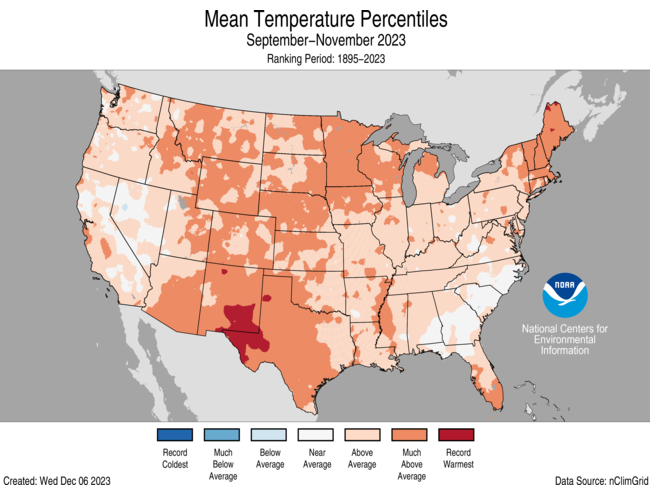
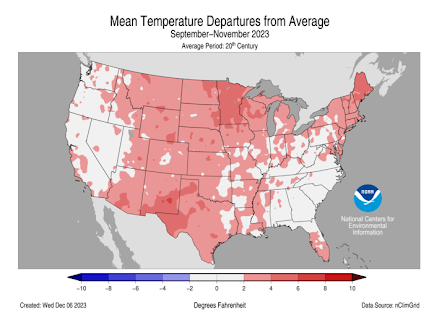
The meteorological autumn (September–November) average temperature for the contiguous U.S. was 56.1°F, 2.5°F above average, ranking sixth warmest on record.
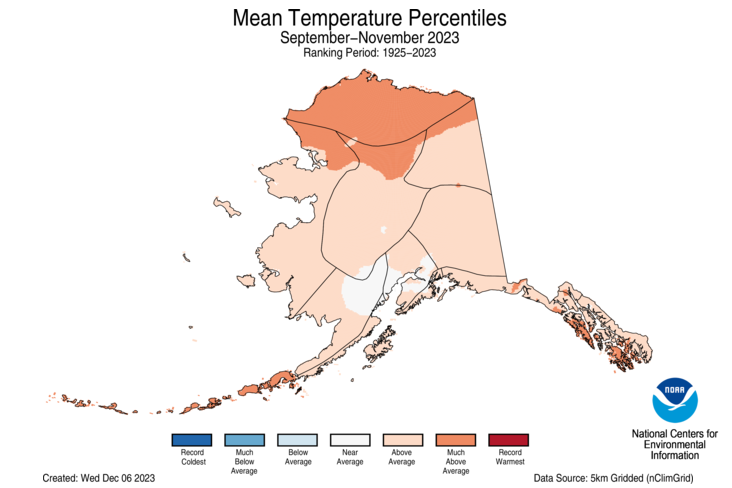
Temperatures were above average across most of the contiguous U.S., with record-warm temperatures observed in parts of New Mexico, western Texas and northern Maine. New Mexico and Texas each ranked third warmest on record, while Maine ranked fourth warmest for this autumn season. An additional 10 states ranked among their top-10 warmest on record for this period. The Alaska autumn temperature was 29.6°F, 3.7°F above the long-term average, ranking 13th warmest on record for the state. Temperatures were above average across most of the state of Alaska while some parts of south-central Alaska saw near-average autumn temperatures.
Fall Precipitation Recap
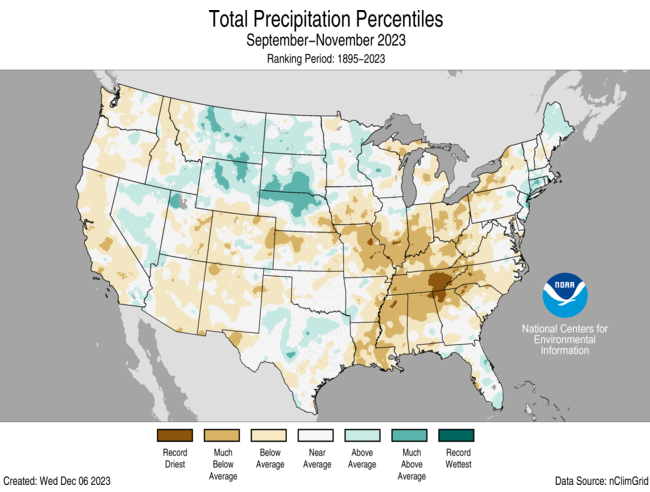
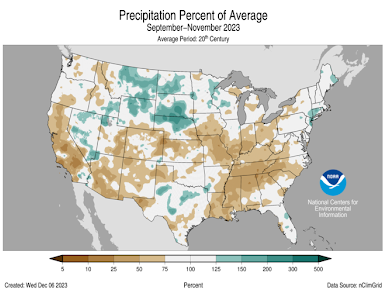
The contiguous U.S. autumn precipitation total was 5.66 inches, 1.22 inches below average, ranking 15th driest in the September–November record.
Precipitation was below average across much of the eastern half of the U.S., the Southwest, California, and in parts of the Northwest and central Plains. Tennessee ranked third driest on record with three additional states in the Mississippi and Ohio Valleys ranking among their top-10 driest autumn seasons on record.
Autumn precipitation was above average from the northern Rockies to the western Great Lakes and in parts of the Great Basin, southern Plains, Northeast and Southeast. No state ranked among their top-10 wettest autumn seasons on record. For autumn season precipitation, Alaska ranked in the wettest third of the record with wetter-than-average conditions observed across much of the state. Near-normal precipitation was observed in parts of the Interior and south Central Alaska, while below-normal precipitation occurred in parts of the Southwest and Aleutians during this season.
Winter Temperature Outlook
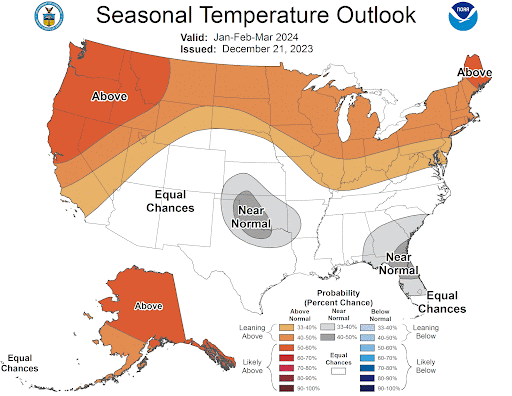
The January–March 2024 Temperature Outlook favors above-normal temperatures for Alaska, the west coast of the contiguous United States (CONUS), the Northern Plains, the Ohio and Tennessee Valley regions, and the Mid-Atlantic. Above-normal temperatures are more likely for western Alaska, parts of the west coast, and New England. Near normal temperatures are favored for the Central and Southern Rockies, and parts of the Central and Southern Plains.
Winter Precipitation Outlook
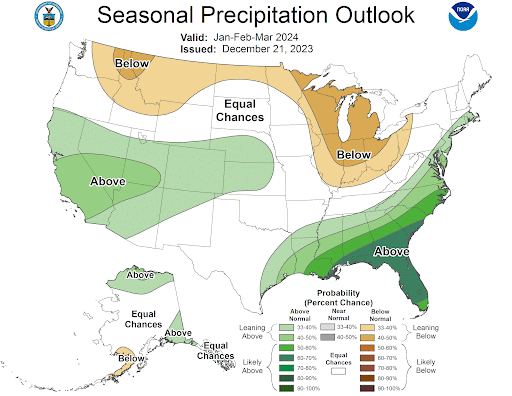
The January–March 2024 Precipitation Outlook depicts below-normal precipitation over southwestern Alaska and above-normal precipitation over northern Alaska. Below normal precipitation is favored from the Northern Rockies to the Great Lakes and into the Ohio Valley. Above-normal precipitation is favored over parts of the west coast, with a slight tilt toward above normal over parts of the central CONUS. The highest confidence for above-normal precipitation is over the Southeast CONUS where influences from El Niño are strongest.
Impacts and Outlooks for Your Region
Get more details for your region in the December climate impacts and outlooks summaries:
- Alaska and Northwestern Canada Region
- Great Lakes Region
- Gulf of Maine Region
- Gulf of Mexico Region (coming soon)
- Mid-Atlantic Region
- Midwest Region
- Missouri River Basin Region
- Northeast Region
- Pacific Region
- Prairies and High Plains Region
- Southeast Region
- Southern Region (coming soon)
- Western Region