NOAA Climate Program Office’s COM Program Awards Nearly Five Hundred Thousand Dollars To Improve Precipitation Datasets

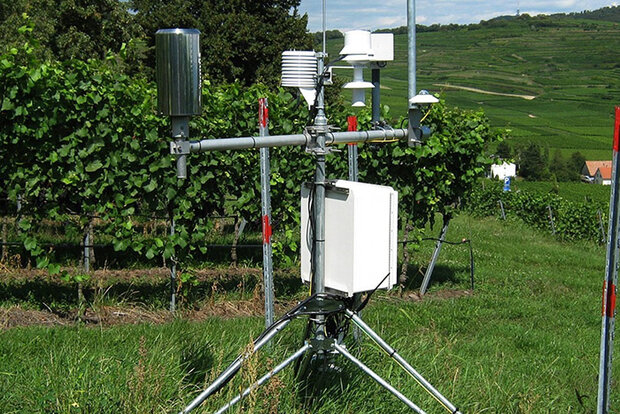
A land-based weather station that takes observations in recurring intervals. These observations are later used for data assimilation and forecasting. Credit: Pixabay

Click the link to read the release on the NOAA Website

January 4, 2024

CPO’s Climate Observations and Monitoring (COM) program is announcing two new two-year projects in Fiscal Year 2023 (FY23) that aim to improve the research on precipitation datasets. The competitively selected projects total four hundred seventy-nine thousand dollars in grants1. These precipitation projects, chosen in response to the Disaster Relief Supplemental Appropriations Act (DRSA) of 2022 and motivated by NOAA’s Precipitation Prediction Grand Challenge (PPGC) strategic objectives, will help improve NOAA monitoring and modeling capabilities. NOAA plays an important role in providing timely and accurate precipitation predictions to protect lives and property.

The Fifth National Climate Assessment, recently released by the U.S. Global Change Research Program, finds that climate change “will continue to cause profound changes in the water cycle, increasing the risk of flooding, drought, and degraded water supplies for both people and ecosystems. These impacts will disproportionately impact frontline communities.” In 2023 (as of November 8), the U.S. has experienced 25 weather/climate disaster events with losses exceeding $1 billion, including two flooding events, 19 severe storm events, one tropical cyclone event, and one winter storm event. 

To reduce the severity of these impacts, NOAA scientists need to build new databases for precipitation information, and these projects will facilitate that work. 

The two new projects2 funded by the COM Program in FY23 are:

  • Improving and Expanding Gridded Snowfall Analyses and Season-to-Subseasonal (S2S) Snowfall Forecasts 
    • Snowfall is a critical resource within the hydrologic cycle of much of the continental United States (CONUS), especially in western states. Given this status, it is important to accurately quantify snowfall to maximize its benefits when it is abundant, and enable mitigation activities when it is lacking. This project will focus on the role of Snow-to-Liquid Ratio in analysis and forecasting by developing an improved methodology for a gridded snowfall product in the CONUS. This methodology will be then applied to create a novel gridded snowfall product for Alaska. The project will also produce a series of research-guided recommendations to produce S2S snowfall forecasts using output from the Unified Forecast System.
    • PI: Andrew Rosenow, University of Oklahoma 
    • CoPI: Peter Veals, University of Utah 
  • Developing Long-term High resolution precipitation dataset using deep learning with multi-source Earth System Data
    • The development of accurate, high-resolution gridded precipitation datasets over a long period of time is crucial for climate monitoring and forecasting. Although useful, current datasets exhibit great discrepancies and have different strengths and weaknesses. This project will develop an improved long-term high-resolution precipitation dataset over CONUS using machine learning techniques. It will integrate radar observations, gauge-based precipitation analysis data, climate reanalysis data, and satellite-based cloud data.
    • PI: Di Tian, Auburn University

1The funding will be distributed over the life of the projects and future-year funding is conditional on appropriations.

2At the time of publication, all awards may not have been accepted by recipient institutions 

Fremont County residents face exploratory uranium drilling “right in the front yard of the community” — The #Denver Post #ArkansasRiver

Pictorial representation of the In situ uranium mining process. Graphic credit: (source: Heathgate Resources)

Click the link to read the article on The Denver Post website (Elise Schmelzer). Here’s an excerpt:

[Marijane] Sisson is among many residents of South T Bar Ranch alarmed by an Australian company’s plans to drill in the subdivision as a way to learn more about the uranium deposits beneath it. An appeal by a homeowner to stop the prospecting failed last week, allowing Global Uranium and Enrichment to proceed. It could drill as many as 20 holes in the area this year. While original homeowners in the community owned some of the mineral rights and knew drilling was a possibility, the plans caught others by surprise, said Skip Blades, who owns three parcels in South T Bar Ranch. He appealed the company’s plans…

The drilling by Global Uranium and Enrichment, previously known as Okapi Resources, comes as prices for the radioactive element soar. They reached a 16-year high Monday as global supplies tighten and demand for nuclear power rises — and as alternatives to oil and gas energy become more appealing. The market shift has spurred the opening of new uranium mines in the United States for the first time in eight years — including three in the Mountain West.

The company plans to drill over a 60-day period between May and December. The goal is to extract samples of the rock and minerals for further study. Crews will work 24/7 to drill 5-inch-diameter holes 700 feet into the ground to collect the samples, according to the company’s application for a Colorado Division of Reclamation, Mining and Safetypermit. Each hole will require a drill pad area of 6,400 square feet, cleared of grass and rocks, and will remain open for about six days. After the samples are extracted, the company will fill and cover the holes. More than 1,400 such holes have been drilled in the vicinity as different companies have come and gone…

Blades and Sisson worry the drilling could disrupt wildlife and contaminate their water supply. The drills will push through underground aquifers. Some of the drilling will occur near Tallahassee Creek, which feeds into the Arkansas River. Company representatives and staff from the Division of Reclamation, Mining and Safety said water contamination was unlikely. Company representatives also said they would comply with wildlife officials’ recommendations to mitigate harm to wildlife and would try to minimize disturbances to the neighborhood. In a written response to Blades’ formal complaint, a company representative said the drill areas would quickly revegetate. The company also said it would point lights toward the ground at night to minimize light pollution, adding that noise from the drill to be used “is relatively muted when compared to other drills.”

SB-28 (#Groundwater Compact Compliance Fund) accounting: Almost entire $30M to retire wells is spent — @AlamosaCitizen #RioGrande

Photo credit: The Alamosa Citizen

Click the link to read the article on the Alamosa Citizen website:

January 21, 2024

Fund will retire approximately 11,296 acre-feet of water

When Colorado Senate Bill 28 was adopted during the 2022 legislative session, it created the Groundwater Compact Compliance Fund with $30 million earmarked for irrigators in the Upper Rio Grande Basin.

The state money derived from Colorado’s share of federal COVID dollars that came through the American Rescue Plan Act would serve to incentivize local farmers to permanently retire more groundwater wells. Doing so would further reduce groundwater pumping and translate to fewer irrigated acres in the Valley as a whole. 

Seven months after opening applications to the fund, the Rio Grande Water Conservation District has enough contracts to spend nearly the entirety of the $30 million. The contracts represent the full retirement of approximately 34 crop circles and partial restrictions on 28 circles, according to an accounting from the Rio Grande Water Conservation District. 

When it’s all said and done, the $30 million will have paid for the retirement of approximately 11,296 acre-feet of water. An acre-foot represents around 326,000 gallons, or enough water to cover an acre of land.

Each application submitted to the Groundwater Compact Compliance Fund was reviewed by the Rio Grande Water Conservation District and Colorado Division of Water Resources. So far six applications representing $4,772,204 have been closed and the RGWCD now owns those water rights, according to deputy general manager Amber Pacheco.

The remaining applications have to be approved or rejected by March 31.

Republican River Basin. By Kansas Department of Agriculture – Kansas Department of Agriculture, Public Domain, https://commons.wikimedia.org/w/index.php?curid=7123610

The senate bill also directed $30 million to sustainability efforts on the Republican River Basin in the eastern plains. Like the Rio Grande Water Conservation District, the Republican River Water Conservation District has been successful in administering the program, Pacheco said.

“We’ve been pretty successful,” she said at the Jan. 16 board meeting of the Rio Grande Water Conservation District. “It’s pretty shocking that in six months that amount of money was obligated.”

A small amount of funding will likely remain after current applications are all reviewed, Pacheco said.

The RGWCD received a total of 27 applications. Here’s a breakdown of applications by subdistrict. The applications represent 11,296 acre-feet of past annual withdrawals that would be retired.

Applications total approximately $29,000,000

14 applications in Subdistrict 1* –  $11,700,000
2 applications in Subdistrict 3* – $1,200,000
1 application in Subdistrict 4 – $500,000
4 applications in Subdistrict 5 – $5,100,000
2 applications in Subdistrict 6 – $1,300,000
4 applications in Subdistrict 7 (Trinchera Subdistrict) – $9,300,000

*SD1 and SD3 both offered some type of incentive on top of the SB28 program.

Rio Grande and Pecos River basins. Map credit: By Kmusser – Own work, Elevation data from SRTM, drainage basin from GTOPO [1], U.S. stream from the National Atlas [2], all other features from Vector Map., CC BY-SA 3.0, https://commons.wikimedia.org/w/index.php?curid=11218868

#Snowpack still below average peak levels — The Alamosa Citizen #RioGrande

Click the link to read the article on the Alamosa Citizen website (Chris Lopez):

January 20, 2024

Current levels are at 71 percent of normal for the Rio Grande Basin

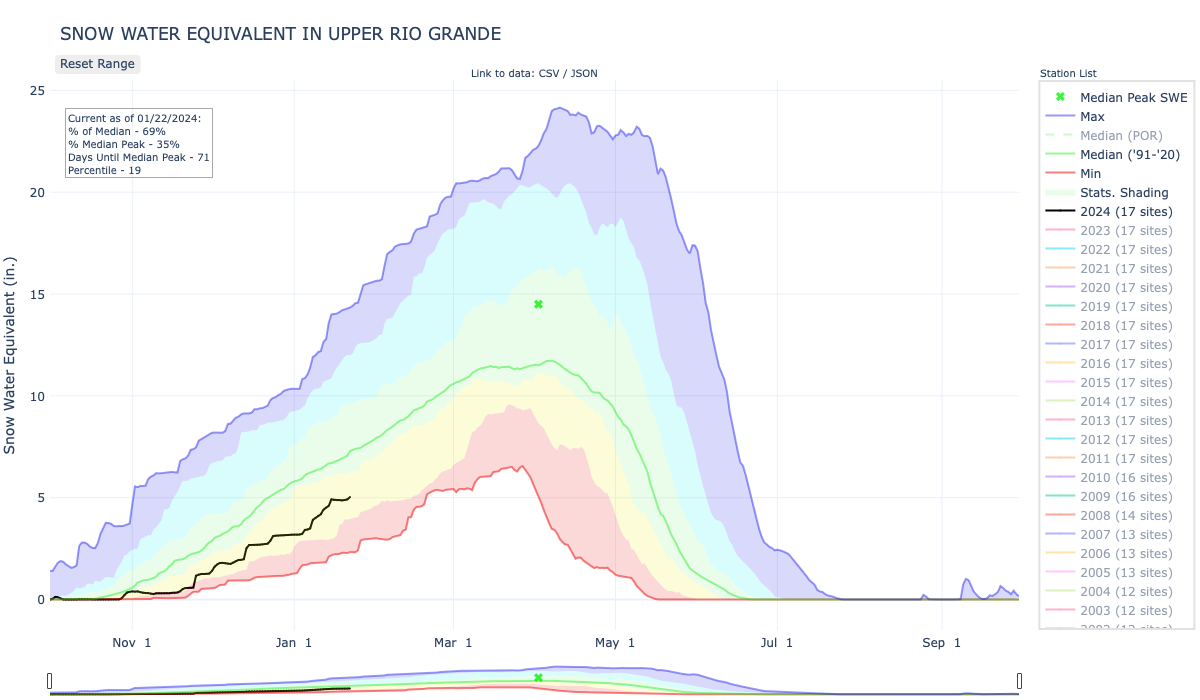
The Rio Grande Basin has about another 70 days to get itself up to average peak levels for snowpack that would deliver a normal spring runoff year for San Luis Valley irrigators in 2024. Water from melting snow in the surrounding mountain ranges also irrigates farm fields in New Mexico and Texas through the Rio Grande Compact. 

The snowpack levels and corresponding 2023 spring runoff was the focus of a presentation at the Rio Grande Water Conservation District’s quarterly meeting held on Tuesday, Jan. 16. Craig Cotten, Division 3 engineer for the Colorado Division of Water Resources, walked water managers through a series of slides showing the conditions of rivers and creeks all critical to Valley’s agricultural economy as well as Colorado’s ability to deliver water to the New Mexico state line for Rio Grande Compact obligations.

Rio Grande and Conejos River

These charts represent the two river systems tied to the Rio Grande Compact and the effect on stream flows from snow runoff during the spring of 2023. The winter of 2022-23 translated into significantly above-average runoff for several months and then by the first of July a drop in streamflows to below average on the Rio Grande and right at average to below on the Conejos River. 

It’s the Rio Grande and Conejos that form the Rio Grande Compact between the states of Colorado, New Mexico and Texas. The annual spring runoff determines how much water Colorado delivers to the New Mexico state line to fulfill its compact obligation. From the 2023 runoff Colorado delivered 29 percent of the streamflow or 208,000 acre-feet of water from the Rio Grande, and 47 percent or around 200,000 acre-feet from the Conejos River.

Los Pinos River near Ortiz

Los Pinos is the main contributor to the San Antonio River, which is a main tributary to the Conejos. Los Pinos had significant above-average runoff that resulted in some flooding on the lower end of the San Antonio in the spring of 2023. With its tributaries, the Conejos River had 411,000 acre-feet or 137 percent of its long-term average in 2023. Again, 47 percent of that water had to be delivered to the New Mexico state line to meet Colorado’s Rio Grande Compact obligations.

Saguache Creek near Saguache

Saguache Creek forms from runoff coming off the San Juan Mountains. It had above-average spring streamflows like others, and ended up below-average when the normal summer rains did not materialize in 2023.

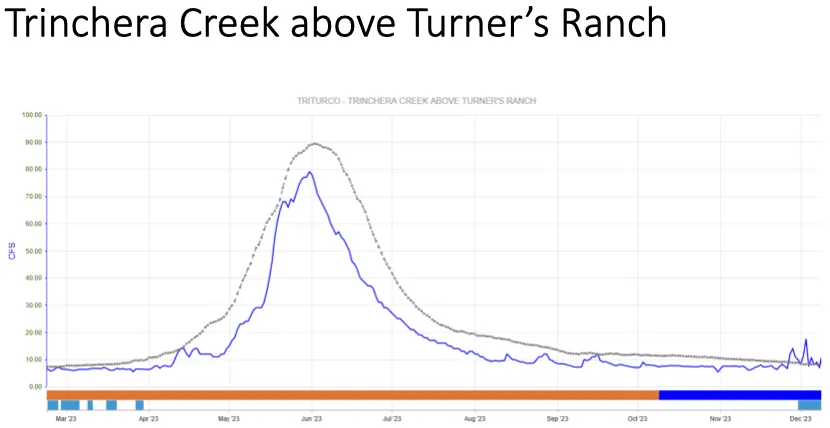
Trinchera Creek above Turner’s Ranch

Trinchera Creek presented the biggest challenges for irrigators in 2023 due to less snow on the Sangre de Cristos than on the San Juans. Trinchera Creek was significantly below average for most of the irrigation season.

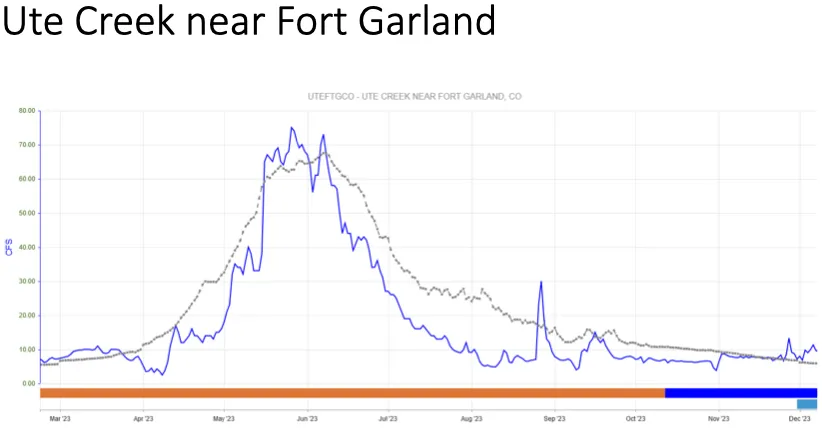
Ute Creek near Fort Garland

Ute Creek too forms from the Sangres. Unlike the Trinchera Creek, it got to average and a bit above for the peak of the 2023 spring runoff and then dropped to below-average streamflows for the year.

Alamosa Creek above Terrace Reservoir

The highlight of the heavy snow from 2022-23 and the corresponding spring runoff was the spilling of Terrace Reservoir for the first time in 40 years. “That was really neat to see,” Cotten said.

Spring and summer 2024 forecasts

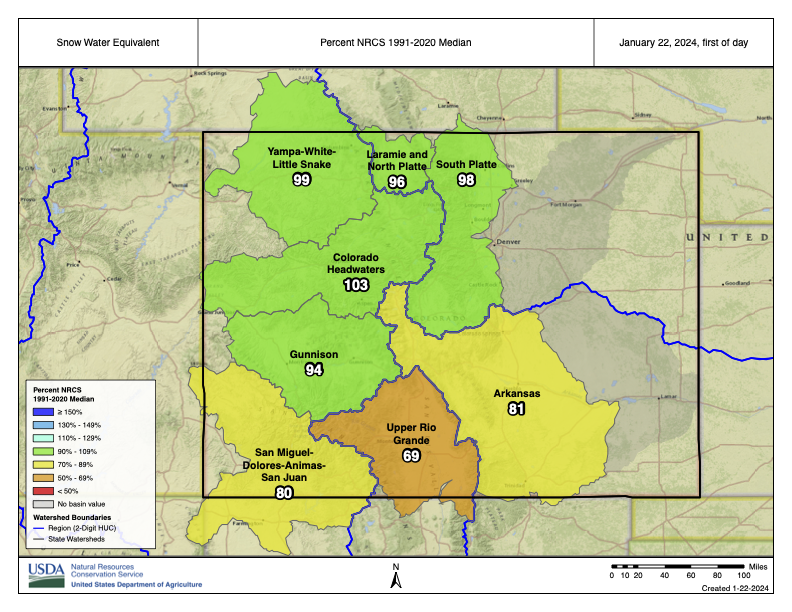
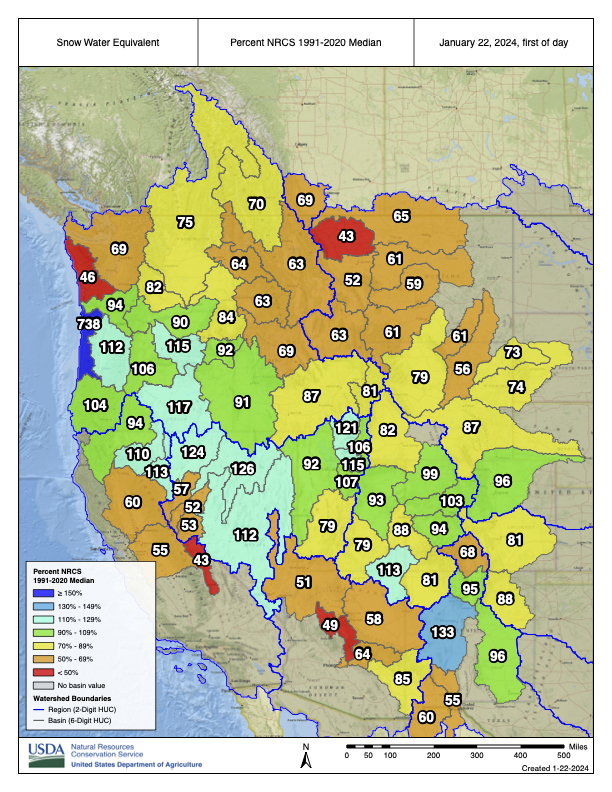
Looking to the 2024 spring runoff, current snowpack levels are at 71 percent of normal for the Rio Grande Basin and the lowest for any basin in Colorado by a significant amount. “We do still have some time to get up that average,” Cotten said. “If we can get some good snowstorms coming our way, hopefully we’ll be in decent shape for this year.”

Precipitation outlook through March shows potential for more snow that would help build up the snowpack for spring water. The spring months show an equal chance for precipitation and then below-average forecasts for the summer months. The temperature forecasts for the summer do not predict the same type of record-setting heat as the summer of 2023.