Changing #Climate Behind Sharp Drop in #Snowpack Since 1980s: Study finds steepest drops in areas of the Northern Hemisphere reliant on snow for water — NOAA #ActOnClimate

Click the link to read the article on the NOAA website (Morgan Kelly):

January 24, 2024

Read the study

Scientific data from ground observations, satellites, and climate models have not agreed on whether climate change is consistently chipping away at the snowpacks that accumulate in high-elevation mountains and provide water when they melt in spring. This complicates efforts to manage the water scarcity that would result for many population centers.

A new Dartmouth study cuts through the uncertainty in these observations and provides evidence that seasonal snowpacks throughout most of the Northern Hemisphere have indeed shrunk significantly over the past 40 years due to human-driven climate change. The sharpest global warming-related reductions in snowpack—between 10% to 20% per decade—are in the Southwestern and Northeastern United States, as well as in Central and Eastern Europe. The study was funded in part by NIDISthrough the NOAA Climate Program Office Modeling, Analysis, Predictions, & Projections (MAPP) program.
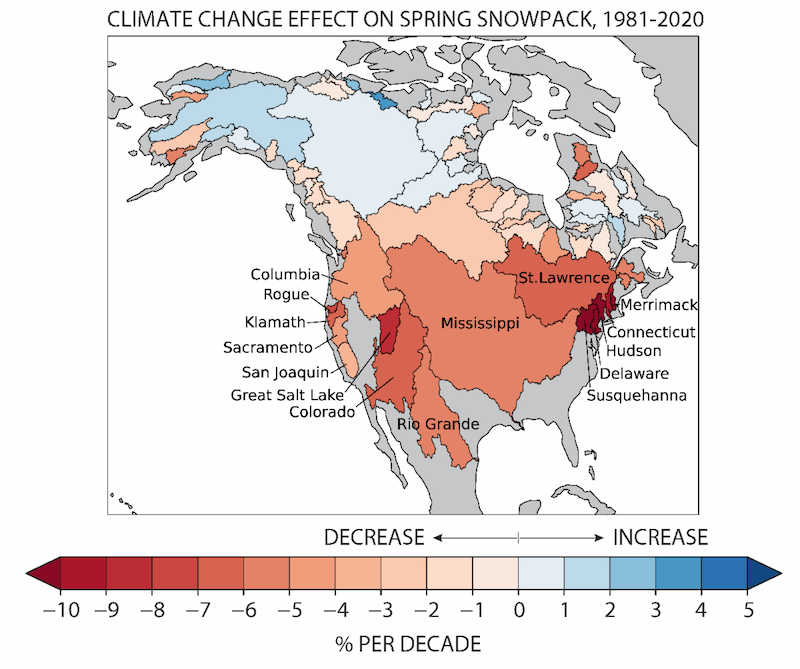
The Southwest and Northeast saw the greatest loss in spring snowpack between 1981 and 2020, raising concerns about water scarcity and economies reliant on winter recreation. The numbers at bottom correspond to the percentage of spring snowpack lost (red) or gained (blue) per decade, with losses concentrated in populated regions. Image by Justin Mankin and Alexander Gottlieb.

Dartmouth researchers Alexander Gottlieb and Justin Mankin report in the journal Nature that the extent and speed of this loss potentially puts the hundreds of millions of people in North America, Europe, and Asia who depend on snow for their water on the precipice of a crisis that continued warming will amplify.

“We were most concerned with how warming is affecting the amount of water stored in snow. The loss of that reservoir is the most immediate and potent risk that climate change poses to society in terms of diminishing snowfall and accumulation,” said Gottlieb.

“Our work identifies the watersheds that have experienced historical snow loss and those that will be most vulnerable to rapid snowpack declines with further warming,” Gottlieb said. “The train has left the station for regions such as the Southwestern and Northeastern United States. By the end of the 21st century, we expect these places to be close to snow-free by the end of March. We’re on that path and not particularly well adapted when it comes to water scarcity.”

Water security is only one dimension of snow loss, said Mankin, an associate professor of geography and the paper’s senior author.

The Hudson, Susquehanna, Delaware, Connecticut, and Merrimack watersheds in the Northeastern U.S., where water scarcity is not as dire, experienced among the steepest declines in snowpack. But these heavy losses threaten economies in states such as Vermont, New York, and New Hampshire that depend on winter recreation, Mankin syid—even machine-made snow has a temperature threshold, one that many areas are fast approaching.

“The recreational implications are emblematic of the ways in which global warming disproportionately affects the most vulnerable communities,” he said. “Ski resorts at lower elevations and latitudes have already been contending with year-on-year snow loss. This will just accelerate, making the business model inviable.”

“We’ll likely see further consolidation of skiing into large, well-resourced resorts at the expense of small and medium-sized ski areas that have such crucial local economic and cultural values. It will be a loss that will ripple through communities,” Mankin said.

In the study, Gottlieb and Mankin focused on how global warming’s influence on temperature and precipitation drove changes in snowpack in 169 river basins across the Northern Hemisphere from 1981 through 2020. The loss of snowpacks potentially means less meltwater in spring for rivers, streams, and soils downstream when ecosystems and people demand water.

Gottlieb and Mankin programmed a machine learning model to examine thousands of observations and climate-model experiments that captured snowpack, temperature, precipitation, and runoff data for Northern Hemisphere watersheds.

The researchers identified the uncertainties that the models and observations shared so they could hone in on what scientists previously missed when gauging the effect of climate change on snow. A 2021 study by Gottlieb and Mankin similarly leveraged uncertainties in how scientists measure snow depth and define snow drought to improve predictions of water availability.

“Snow observations are tricky at the regional scales most relevant for assessing water security,” Mankin said. “Snow is very sensitive to within-winter variations in temperature and precipitation, and the risks from snow loss are not the same in New England as in the Southwest, or for a village in the Alps as in high-mountain Asia.”

Gottlieb and Mankin found that 80% of the Northern Hemisphere’s snowpacks—which are in its far-northern and high-elevation reaches—experienced minimal losses. Snowpacks actually expanded in vast swaths of Alaska, Canada, and Central Asia as climate change increased the precipitation that falls as snow in these frigid regions.

But it is the remaining 20% of the snowpack that exists around—and provides water for—many of the hemisphere’s major population centers that has diminished. Since 1981, documented declines in snowpack for these regions have been largely inconsistent due to the uncertainty in observations and naturally occurring variations in climate.

But Gottlieb and Mankin found that a steady pattern of annual declines in snow accumulation emerge quickly—and leave population centers suddenly and chronically short on new supplies of water from snowmelt.

Many snow-dependent watersheds now find themselves dangerously near a temperature threshold Gottlieb and Mankin call a “snow-loss cliff.” This means that as average winter temperatures in a watershed increase beyond 17 degrees Fahrenheit (minus 8 degrees Celsius), snow loss accelerates even with only modest increases in local average temperatures.

Many highly populated watersheds that rely on snow for water supply are going to see accelerating losses over the next few decades, Mankin said.

“It means that water managers who rely on snowmelt can’t wait for all the observations to agree on snow loss before they prepare for permanent changes to water supplies. By then, it’s too late,” he said. “Once a basin has fallen off that cliff, it’s no longer about managing a short-term emergency until the next big snow. Instead, they will be adapting to permanent changes to water availability.”

Screenshot from the 2024 Climate Change in Colorado report

Get renewables right and get it going — Pete Kolbenschlag #ActOnClimate

Screenshot from the recently released Climate Change in Colorado Report update

From email from Pete Kolbenschlag:

In a world of often competing needs, sometimes it’s harder to find a common path forward than to simply plow one’s own. And when a project to be hurried along is for some greater good, then to steam through the process may seem warranted. This sometimes seems the case for calls to streamline clean energy development or to limit community input into new infrastructure. But shortcuts can make for long delays – and many an ambitious project runs into obstacles by not adequately involving impacted members of the public, who nonetheless will be heard. 

So the Sentinel is correct to call for clarity on utility-sized solar as it has in a recent editorial. Which was also on the mark noting that more solar is welcomed. The opportunity is here now to secure investments in a cleaner energy future. But that does mean that we have to get it right. 

Still, we shouldn’t delay. The need is real. How we power our lives and communities is quickly shifting and western Colorado should lead the way. It isn’t either/or. Siting of energy facilities and how they are integrated with the environment, farms, businesses and neighborhoods should always be a top concern. We must not repeat mistakes from our fossil fuel past when ecosystems and some communities were treated as sacrifice zones in the name of necessity. But we absolutely must transform our energy system and how we power our lives and economy.

Last February, my organization – the Colorado Farm and Food Alliance – issued its report on climate change in the Gunnison River Basin. Then 2023 happened. Last year is being widely reported as the hottest ever recorded as concentrations of greenhouse gasses in the atmosphere – notably CO2 – hit levels likely not seen for millions of years. Meanwhile extreme weather and other climate disruptions continued to reset expectations about scope, onset and frequency.  

Sure, there are still hold-outs who believe climate science is fiction and others who want hard to believe that some yet-unproven technology will allow the burning of methane-gas, oil and coal long into the future. But the economic, political and fact-based reality is that to a growing number of nations, decision-makers and institutions a rapid shift to clean energy is both necessary and inevitable. The data are clear: we must act with urgency and at scale if we are to address climate change. 

That doesn’t skip over the need to meet community needs and issues. Federal legislation has made new funding available to help speed the deployment of more renewables. And the Colorado legislature is considering legislation, and could do more, to help direct where and how this renewable build out occurs. Still, local governments, like county commissioners, should not wait. 

Taking effort to incentivize renewable projects that integrate with and benefit the communities where they are located is key. Not only for fairness but also to smooth development at the pace and scope required. The co-location of facilities, solar with agriculture for instance, or on rooftops and over parking lots, can help to mitigate some of the burden new development can place on others. Opportunities like workforce development programs, consumer cost savings, community-ownership are other outcomes that can and should be encouraged to make clean energy a win for the community as a whole, as well as for the climate.

One example is the agrivoltaics project the Colorado Farm and Food Alliance has been helping to steer in Delta County, that seeks to develop a community-rooted model for solar that pairs with and even benefits agriculture, putting more clean power on the grid while returning the cost-savings from production to its farm-based member-subscribers.

That is one place strong local leadership can help, in Mesa County and elsewhere, to guide where and how such projects are located. And state legislation can create stronger incentives to put more meaningful and community-centered benefits in renewable project design and power generation. For instance, by encouraging utilities, both investor-owned and rural cooperatives, to accept more community-solar on their systems, or making it easier to put solar production cost-savings directly on a consumer’s utility bill, as examples. 

But we need to act now. With federal funding from recent laws, a growing recognition of the challenge at hand, and a willingness to lead we can develop a new energy economy that supports western Colorado communities and livelihoods. We need a thoughtful but strong and steady approach that meets and matches community needs and promptly puts more renewable energy to work powering Colorado.

Puckett Land Co. drops bid for Thompson Creek reservoir water rights — @AspenJournalism #CrystalRiver #RoaringForkRiver #ColoradoRiver #COriver #aridification

This photo shows the Thompson Creek drainage on the right as it flows into the Crystal River just south of Carbondale. A company with oil shale interests has voluntarily abandoned its conditional water rights for a reservoir on Thompson Creek. CREDIT: ECOFLIGHT

Click the link to read the article on the Aspen Journalism website (Heather Sackett):

January 29, 2024

A company with ties to oil shale development in western Colorado has dropped its attempt to maintain water rights for a proposed reservoir on Thompson Creek.

Puckett Land Co. on Jan. 26 filed a motion to dismiss its diligence application for conditional water rights that date to 1966 and are associated with the construction of a 23,983-acre-foot reservoir on Thompson Creek, a tributary of the Crystal River just south of Carbondale. Later that day, a water court judge signed off on the motion, meaning the water rights have now been abandoned.

The Greenwood Village-based company holds interests in 17,500 acres of land in Garfield and Rio Blanco counties, according to its water court filing. Attorney for Puckett Megan Christensen said the decision to voluntarily cancel these water rights was for business purposes. In its November filing, known as a diligence application, Puckett had said that current economic conditions are adverse to oil shale production.

“Puckett has a portfolio of water rights and in looking at them, they made the decision that this one wasn’t worth maintaining anymore, so they decided to just go ahead and dismiss it,” Christensen said in an interview with Aspen Journalism.

The proposed reservoir site had been on BLM land in Pitkin County within the boundaries of an area that the U.S. Forest Service and BLM are proposing to withdraw from eligibility for new oil and gas leases. The proposed Thompson Divide withdrawal area is comprised of 224,713-acres in Garfield, Gunnison and Pitkin counties that generally straddles the ridge of mountains running from south of Glenwood Springs to the northern edge of the West Elk Wilderness, south of McClure Pass.

Carbondale conservation group Wilderness Workshop supports the withdrawal area and celebrated Puckett dropping the water rights as a win for the Crystal River.

“This is great news for the Thompson Divide, the Crystal River, and our local ecosystem and communities,” Will Roush, executive director of Wilderness Workshop, said in a prepared statement. “Puckett’s intention to cancel their conditional water rights demonstrates just how speculative conditional water rights associated with oil shale development are. Other holders of similar rights ought to follow Puckett’s lead.”

Proposed Thompson Creek reservoir

Map: Laurine Lassalle – Aspen JournalismSource: BLM, Pitkin CountyCreated with Datawrapper

Conditional water rights

Puckett is among the companies with an interest in western Colorado oil shale development, who have water rights dating to the 1950s and ‘60s, which were amassed in anticipation of a boom. A report produced by conservation group Western Resource Advocates in 2009 found that there were conditional water rights associated with oil shale development for 27 reservoirs with 736,770 acre-feet of water in the mainstem of the Colorado River basin.

Companies have been able to hang onto these conditional water rights in some cases for over 50 years without using them because Colorado water law allows a would-be water user to reserve their place in the priority system based on when they applied for the right — not when they put water to use — while they work toward developing the water. Under the cornerstone of water law known as prior appropriation, older waters rights get first use of the river.

To maintain a conditional right, an applicant must every six years file what’s known as a diligence application with the water court, proving that they still have a need for the water, that they have taken substantial steps toward putting the water to use and that they “can and will” eventually use the water. They must essentially prove they are not speculating and hoarding water rights they won’t soon use.

But the bar for proving diligence is low. Judges are hesitant to abandon these conditional water rights, even if they have been languishing without being used for decades.

Before Puckett dropped its diligence application, John Cyran, senior staff attorney for Western Resource Advocates’ Healthy Rivers Program, said holding onto conditional rights like these raised speculation concerns.

“The water is being held without a plan to use it, which violates a central tenet in western water law,” Cyran said in an email. “Water shortages are affecting Colorado’s communities, fish and wildlife. We cannot afford to let companies profit off these shortages by holding onto unused conditional water rights.”

Crystal River Ranch was the only entity to file a statement of opposition to Puckett’s application. The deadline to file a statement of opposition is Jan. 31.

Crystal River Ranch also expressed concern that the over-50-year-old water rights had never been used and said that over the five decades Puckett had not shown it would develop them.

“During that period, the applicant has failed to obtain the necessary federal, state and local permits required to develop this reservoir,” the statement of opposition reads. “Therefore, this subject conditional water right must be canceled and abandoned.”

The Thompson Creek water rights had been part of a proposed “integrated system” that includes conditional water rights for two proposed small reservoirs, and a pump and pipeline on Starkey Gulch, a tributary of Parachute Creek. The application did not specifically mention work regarding the Thompson Creek reservoir site in its list of diligence activities and Puckett had said that diligence on any part of the system constitutes diligence with respect to the entire system. It is unclear how the Thompson Creek reservoir would have operated with these other parts of the system, but Christensen alluded to the reservoir being conceived of as additional back-up supply.

Christensen said the water rights applications for the Starkey Gulch components are still going forward because those water rights are closer to Puckett’s landholdings. These diligence applications were filed on Nov. 30 and so far no entities have filed statements of opposition.

Map of oil shale and tar sands in Colorado, Utah and Wyoming — via the BLM

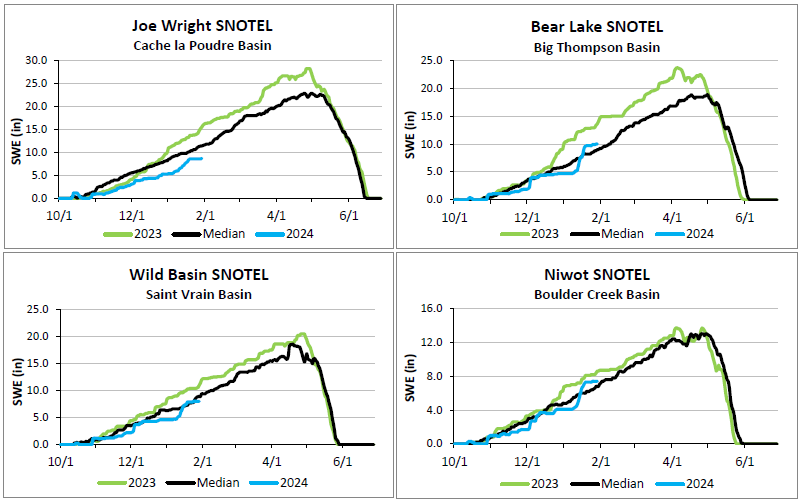
In the last two weeks, #snowpack gains were 137 percent of average at our West Slope stations and 99 percent of average at our East Slope stations — @Northern_Water

January 29, 2024

The West Slope stations are now at 96 percent and East Slope stations are at 93 percent of median snowpack for this date.

Liberal, #Kansas: 2024 Ogallala Aquifer Summit “Building Trust, Mobilizing Collaboration” — Irrigation Innovation Consortium March 18-19, 2024

The Ogallala aquifer, also referred to as the High Plains aquifer. Source: National Oceanic and Atmospheric Adminstration

Click the link for all the inside skinny and to register on the Irrigation Innovation Consortium website:

About: This highly interactive event convenes water management leaders and others from across the Ogallala region to learn about and from each other’s work to slow aquifer decline and support ecosystem and community resilience.

When? Please plan to attend both days :

  • Monday, March 18 1 pm-5 pm CDT & evening social 6:30-8:30 pm
  • Tuesday, March 19 8 am-4 pm CDT