

Click the link to read the article on the WyoFile website (Angus M. Thuermer Jr.):
January 25, 2024
Wyoming’s plan to construct the West Fork Dam in the Medicine Bow National Forest “does not align well” with federal policy and management plans, a forest official wrote in a 2022 brief intended for U.S. Secretary of Agriculture Tom Vilsack.
The Medicine Bow environmental policy analyst who evaluated the state’s plan for the 264-foot high dam also said the proposal might not meet a U.S. Forest Service public-interest standard necessary for a land swap that would enable dam construction.
The critical assessment was penned as Medicine Bow staff prepared a briefing paper on Wyoming’s plan to construct the dam and its 130-acre reservoir in Carbon County to serve fewer than 100 irrigators who want more late-season water. Forest officials sought staffers’ input on the proposed development above the Little Snake River.
Medicine Bow officials were preparing the late-2022 briefing for regional and Washington D.C. officials, unnamed VIPs and Secretary Vilsack, according to documents obtained by WyoFile through a records request.
In an internal Medicine Bow email, forest environmental policy analyst Matt Schweich asked that the briefing paper state that “[t]he Forest is concerned that the State’s current preferred concept does not align well with Forest Service policy and the Forest plan, that it may not be in the public interest, and is likely to be highly controversial with the public.”
Ninety-six percent of comments on the plan opposed the project, a WyoFile tally of submissions showed. Criticism ranged from the project’s environmental impacts to Wyoming’s rosy analysis of public benefits and the state’s willingness to fund the bulk of the project for the benefit of private irrigators.
An ongoing environmental review necessary to advance the Wyoming project will determine whether the dam plan meets federal policies and the Medicine Bow management plan. A federal-state land exchange necessary for construction must be found to be in the public interest. An environmental impact statement and associated reviews of the proposal have been delayed once, and their completion date remains uncertain.
A Medicine Bow spokesman said Schweich’s opinion does not reflect the official position of the agency, which will only be revealed through the environmental impact statement.
Last puzzle piece
The Forest Service, U.S. Natural Resources Conservation Service and U.S. Army Corps of Engineers are working to complete the EIS in a process largely obscured from public view. The emails, however, provide another peek into the thinking of Forest Service specialists regarding the merits of the controversial project.
In another internal discussion previously reported by WyoFile, a Medicine Bow hydrologist expressed worry that the dam proposal wasn’t being thoroughly vetted. Medicine Bow spokesman Aaron Voos dismissed that worry last year, characterizing the criticism as healthy agency discussion.
Schweich added his newly revealed assessment of the dam plan in a Sept. 26, 2022 email exchange as Medicine Bow staffers were preparing a “Hot topic” report for leadership, including Vilsack. Fully four years before that, Wyoming water developers had settled on the size of the dam, the capacity and size of the reservoir and the site of the complex. Wyoming has not deviated significantly from those plans.
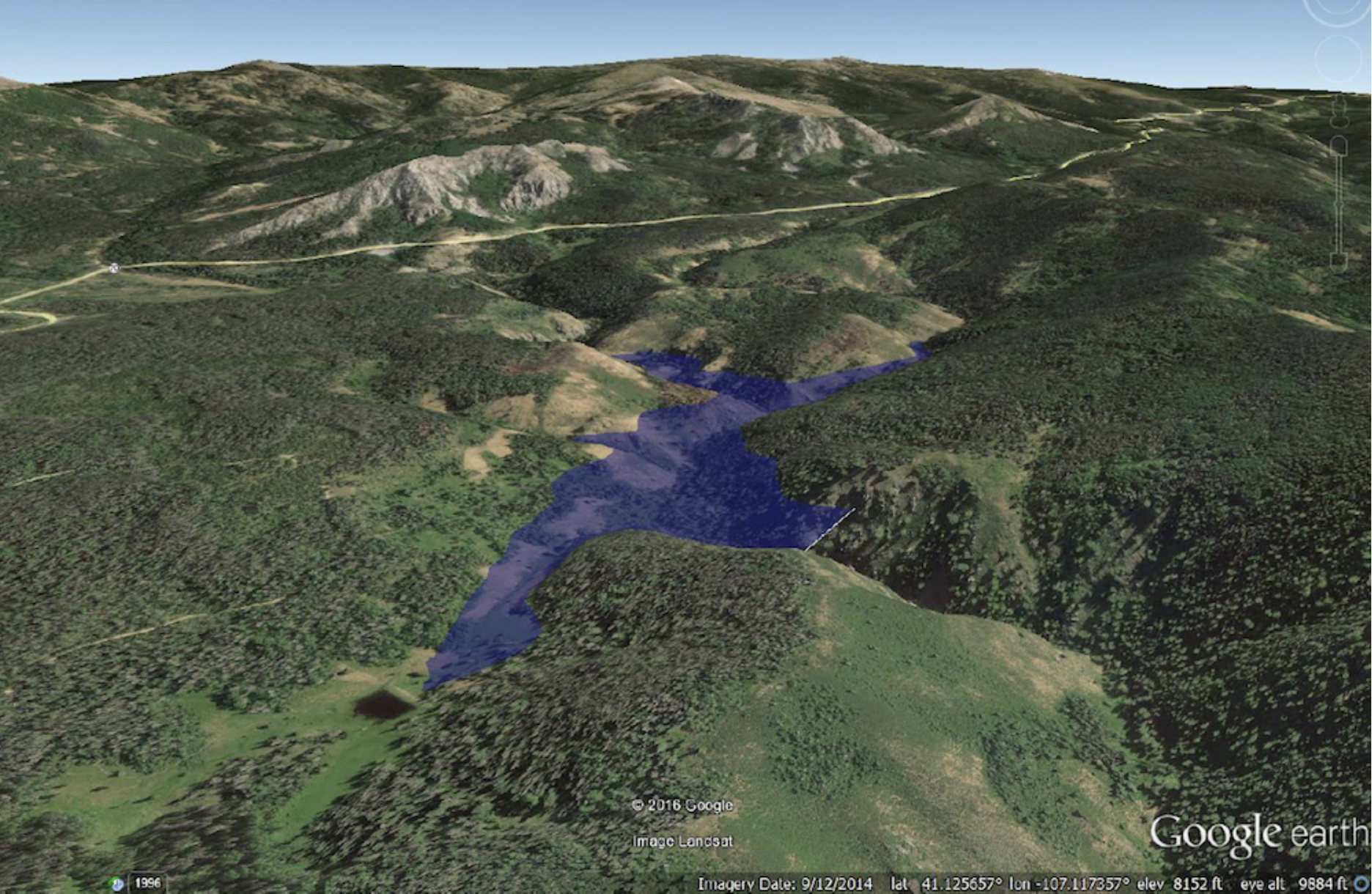
A month before Schweich wrote his 2022 assessment, Wyoming had provided the last piece of the puzzle, telling Medicine Bow officials the state would seek 1,762 acres of forest land in an exchange that would enable construction of the dam and reservoir. Jenifer Scoggin, director of the Wyoming Office of State Lands and Investments, provided that land-swap information to Medicine Bow officials in August 2022,according to a letter she wrote later that year.
Medicine Bow officials appeared to have known the size of the dam and reservoir, their location and the federal acreage Wyoming sought when the officials asked Schweich for his assessment.
A month after Schweich responded, Wyoming submitted its formal proposal to the Medicine Bow for a land exchange and dam construction.
Regardless how well-informed Schweich was when he made his 2022 assessment, spokesman Voos said it was unclear at that time exactly what the state intended.
“[T]he internal, draft email of Hot Topics updates [to which Schweich contributed] is prior to receipt of any formal land exchange proposal from the State,” Voos wrote WyoFile. “At the time, multiple informal discussions were taking place surrounding conceptual ideas.
“Since it was unclear what the State’s future use of any current National Forest System land might have been at that time,” Voos wrote, “then yes, there was the possibility for misalignment with our policy and Plan.”
WyoFile obtained the emails through a Freedom of Information Act request. Although the environmental impact statement is being written largely out of public view, the public had an opportunity to weigh in on the issue before the analysis began. People will be able to comment on the review when it is completed.


Click the link to read the article on the Inside Climate News website (Bob Berwyn):
January 28, 2024
Most of the public seems unaware that global temperatures will soon push past the target to which the U.N. hoped to limit warming, but researchers see social and psychological crises brewing.
As Earth’s annual average temperature pushes against the 1.5 degree Celsius limit beyond which climatologists expect the impacts of global warming to intensify, social scientists warn that humanity may be about to sleepwalk into a dangerous new era in human history. Research shows the increasing climate shocks could trigger more social unrest and authoritarian, nationalist backlashes.
Established by the 2015 Paris Agreement and affirmed by a 2018 report from the Intergovernmental Panel on Climate Change, the 1.5 degree mark has been a cliff edge that climate action has endeavored to avoid, but the latest analyses of global temperature data showed 2023 teetering on that red line.
One major dataset suggested that the threshold was already crossed in 2023, and most projections say 2024 will be even warmer. Current global climate policies have the world on a path to heat by about 2.7 degrees Celsius by 2100, which would threaten modern human civilization within the lifespan of children born today.
Paris negotiators were intentionally vague about the endeavor to limit warming to 1.5 degrees, and the Intergovernmental Panel on Climate Change put the goal in the context of 30-year global averages. Earlier this month, the Berkeley Earth annual climate report showed Earth’s average temperature in 2023 at 1.54 degrees Celsius above the 1850-1900 pre-industrial average, marking the first step past the target.
But it’s barely registering with people who are being bombarded with inaccurate climate propaganda and distracted by the rising cost of living and regional wars, said Reinhard Steurer, a climate researcher at the University of Natural Resources and Life Sciences, Vienna.
“The real danger is that there are so many other crises around us that there is no effort left for the climate crisis,” he said. “We will find all kinds of reasons not to put more effort into climate protection, because we are overburdened with other things like inflation and wars all around us.”
Steurer said he doesn’t expect any official announcement from major climate institutions until long after the 1.5 degree threshold is actually crossed, when some years will probably already be edging toward 2 degrees Celsius. “I think most scientists recognize that 1.5 is gone,” he said.
“We’ll be doing this for a very long time,” he added, “not accepting facts, pretending that we are doing a good job, pretending that it’s not going to be that bad.”
In retrospect, using the 1.5 degree temperature rise as the key metric of whether climate action was working may have been a bad idea, he said.
“It’s language nobody really understands, unfortunately, outside of science,” he said. ”You always have to explain that 1.5 means a climate we can adapt to and manage the consequences, 2 degrees of heating is really dangerous, and 3 means collapse of civilization.”
Absent any formal notification of breaching the 1.5 goal, he hopes more scientists talk publicly about worst-case outcomes.
“It would really make a difference if scientists talked more about societal collapse and how to prepare for that because it would signal, now it’s getting real,” he said. “It’s much more tangible than 1.5 degrees.”
Instead, recent public climate discourse was dominated by feel-good announcements about how COP28 kept the 1.5 goal alive, he added.
“This is classic performative politics,” he said. “If the fossil fuel industry can celebrate the outcome of the COP, that’s not a good sign.” [ed. emphasis mine]
Like many social scientists, Steurer is worried that the increasingly severe climate shocks that warming greater than 1.5 degrees brings will reverberate politically as people reach for easy answers.
“That is usually denial, in particular when it comes to right-wing parties,” he said. “That’s the easiest answer you can find.”
“Global warming will be catastrophic sooner or later, but for now, denial works,” he said. “And that’s all that matters for the next election.”
‘Fear, Terror and Anxiety’
Social policy researcher Paul Hoggett, professor emeritus at the University of the West of England in Bristol, said the scientific roots of 1.5-degree target date back to research in the early 2000s that culminated in a University of Exeter climate conference at which scientists first spelled out the risks of triggering irreversible climate tipping points above that level of warming.
“I think it’s still seen very much as that key marker of where we move from something which is incremental, perhaps to something which ceases to be incremental,” he said. “But there’s a second reality, which is the reality of politics and policymaking.”
The first reality is “profoundly disturbing,” but in the political world, 1.5 is a symbolic maker, he said.
“It’s more rhetorical. it’s a narrative of 1.5,” he said, noting the disconnect of science and policy. “You almost just shrug your shoulders. As the first reality worsens, the political and cultural response becomes more perverse.”
A major announcement about breaching the 1.5 mark in today’s political and social climate could be met with extreme denial in a political climate marked by “a remorseless rise of authoritarian forms of nationalism,” he said. “Even an announcement from the Pope himself would be taken as just another sign of a global elite trying to pull the wool over our eyes.”
An increasing number of right-wing narratives simply see this as a set of lies, he added.
“I think this is a huge issue that is going to become more and more important in the coming years,” he said. “We’re going backwards to where we were 20 years ago, when there was a real attempt to portray climate science as misinformation,” he said. “More and more right wing commentators will portray what comes out of the IPCC, for example, as just a pack of lies.”
The IPCC’s reports represent a basic tenet of modernity—the idea that there is no problem for which a solution cannot be found, he said.
“However, over the last 100 years, this assumption has periodically been put to the test and has been found wanting,” Hoggett wrote in a 2023 paper. The climate crisis is one of those situations with no obvious solution, he wrote.
In a new book, Paradise Lost? The Climate Crisis and the Human Condition, Hoggett says the climate emergency is one of the big drivers of authoritarian nationalism, which plays on the terror and anxiety the crisis inspires.
“Those are crucial political and individual emotions,” he said. “And it’s those things that drive this non-rational refusal to see what’s in front of your eyes.”
“At times of such huge uncertainty, a veritable plague of toxic public feelings can be unleashed, which provide the effective underpinning for political movements such as populism, authoritarianism, and totalitarianism,” he said.
“When climate reality starts to get tough, you secure your borders, you secure your own sources of food and energy, and you keep out the rest of them. That’s the politics of the armed lifeboat.”
The Emotional Climate
“I don’t think people like facing things they can’t affect,” said psychotherapist Rebecca Weston, co-president of the Climate Psychology Alliance of North America. “And in trauma, people do everything that they possibly can to stop feeling what is unbearable to feel.”
That may be one reason why the imminent breaching of the 1.5 degree limit may not stir the public, she said.
“We protect ourselves from fear, we protect ourselves from deep grief on behalf of future generations and we protect ourselves from guilt and shame. And I think that the fossil fuel industry knows that,” she said. “We can be told something over and over and over again, but if we have an identity and a sense of ourselves tied up in something else, we will almost always refer to that, even if it’s at the cost of pretending that something that is true is not true.”
Such deep disavowal is part of an elaborate psychological system for coping with the unbearable. “It’s not something we can just snap our fingers and get ourselves out of,” she said.
People who point out the importance of the 1.5-degree warming limit are resented because they are intruding on peoples’ psychological safety, she said, and they become pariahs. “The way societies enforce this emotionally is really very striking,” she added.
But how people will react to passing the 1.5 target is hard to predict, Weston said.
“I do think it revolves around the question of agency and the question of meaning in one’s life,” she said. “And I think that’s competing with so many other things that are going on in the world at the same time, not coincidentally, like the political crises that are happening globally, the shift to the far right in Europe, the shift to the far right in the U.S. and the shift in Argentina.”
Those are not unrelated, she said, because a lack of agency produces a yearning for false, exclusionary solutions and authoritarianism.
“If there’s going to be something that keeps me up at night, it’s not the 1.5. It’s the political implications of that feeling of helplessness,” she said. “People will do an awful lot to avoid feeling helpless. That can mean they deny the problem in the first place. Or it could mean that they blame people who are easier targets, and there is plenty of that to witness happening in the world. Or it can be utter and total despair, and a turning inward and into a defeatist place.”
She said reaching the 1.5 limit will sharpen questions about addressing the problem politically and socially.
“I don’t think most people who are really tracking climate change believe it’s a question of technology or science,” she said. “The people who are in the know, know deeply that these are political and social and emotional questions. And my sense is that it will deepen a sense of cynicism and rage, and intensify the polarization.”

Unimpressed by Science
Watching the global temperature surging past the 1.5 degree mark without much reaction from the public reinforces the idea that the focus on the physical science of climate change in recent decades came at the expense of studying how people and communities will be affected and react to global warming, said sociologist and author Dana Fisher, a professor in the School of International Service at American University and director of its Center for Environment, Community, and Equity.
“It’s a fool’s errand to continue down that road right now,” she said. “It’s been an abysmal ratio of funds that are going to understand the social conflict that’s going to come from climate shocks, the climate migration and the ways that social processes will have to shift. None of that has been done.”
Passing the 1.5 degree threshold will “add fuel to the fire of the vanguard of the climate movement,” she said. “Groups that are calling for systemic change, that are railing against incremental policy making and against business as usual are going to be empowered by this information, and we’re going to see those people get more involved and be more confrontational.”
And based on the historical record, a rise in climate activism is likely to trigger a backlash, a dangerous chain reaction that she outlined in her new book, Saving Ourselves: From Climate Shocks to Climate Action.
“When you see a big cycle of activism growing, you get a rise in counter-movements, particularly as activism becomes more confrontational, even if it’s nonviolent, like we saw during the Civil Rights period,” she said. “And it will lead to clashes.”
Looking at the historic record, she said, shows that repressive crackdowns on civil disobedience is often where the violence starts. There are signs that pattern will repeat, with police raids and even pre-emptive arrests of climate activists in Germany, and similar repressive measures in the United Kingdom and other countries.
“I think that’s an important story to talk about, that people are going to push back against climate action just as much as they’re going to push for it,” she said. “There are those that are going to feel like they’re losing privileged access to resources and funding and subsidies.”
A government dealing effectively with climate change would try to deal with that by making sure there were no clear winners and losers, she said, but the climate shocks that come with passing the 1.5 degree mark will worsen and intensify social tensions.
“There will be more places where you can’t go outside during certain times of the year because of either smoke from fires, or extreme heat, or flooding, or all the other things that we know are coming,” she said. “That’s just going to empower more people to get off their couches and become activists.”
‘A Life or Death Task For Humanity’
Public ignorance of the planet’s passing the 1.5 degree mark depends on “how long the powers-that-be can get away with throwing up smokescreens and pretending that they are doing something significant,” said famed climate researcher James Hansen, who recently co-authored a papershowing that warming is accelerating at a pace that will result in 2 degrees of warming within a couple of decades.
“As long as they can maintain the 1.5C fiction, they can claim that they are doing their job,” he said. “They will keep faking it as long as the scientific community lets them get away with it.”
But even once the realization of passing 1.5 is widespread, it might not change the social and political responses much, said Peter Kalmus, a climate scientist and activist in California.
“Not enough people care,” he said. “I’ve been a climate activist since 2006. I’ve tried so many things, I’ve had so many conversations, and I still don’t know what it will take for people to care. Maybe they never will.” [ed. emphasis mine]

Click the link to read the article on The Denver Post website (Elise Schmelzer). Here’s an excerpt:
When the Cameron Peak wildfire ripped across northern Colorado in 2020, it left hundreds of thousands of acres charred and dusty — except for a series of beaver ponds tucked inside Poudre Canyon. The wetlands survived the state’s largest recorded wildfire and acted as a buffer as the flames raged through the canyon. And after the flames were extinguished, they served as a sponge to absorb floodwaters sped by the lack of vegetation, minimizing flood damage downstream. But a U.S. Supreme Court decision last year left wetlands like the ones in Poudre Canyon — as well as thousands of miles of seasonal streams critical to the state’s water system — without protection under federal law. The court’s majority limited the coverage of the Clean Water Act, leaving protection gaps for more than half of Colorado’s waters that lawmakers, conservationists, developers and state water quality officials are rushing to fill…Colorado, like many states, relied on the federal government’s permitting process to regulate when people could dig up waterways or wetlands and fill them in — activities known as dredging and filling. Although Colorado has its own Water Quality Control Act that makes it illegal to pollute waters, there is now no process to vet proposed dredge and fill projects, or to issue permits allowing those projects to legally proceed…
Colorado House Speaker Julie McCluskie is crafting a bill this legislative session to give the CDPHE the authority to fill that gap. But key questions remain about how far lawmakers and state officials are willing to go in replacing federal protections…
In May, the high court’s justices ruled 5-4 that wetlands not connected on the surface to another body of federally protected water do not qualify for protection themselves under the Clean Water Act. The law also doesn’t protect wetlands connected to rivers or lakes via groundwater below the surface, the court found, and it doesn’t protect streams that flow seasonally or only after precipitation falls. The ruling left the protection of the newly exempt waters to the states, many of which do not have robust water protection laws…

The Department of Public Health and Environment in July enacted an emergency rule to provide some oversight over dredge and fill activities in waters that lost federal protection…The state policy states that the department will not punish people who dredge or fill in waters if the person notifies the CDPHE, the impacted area is small and the activities comply broadly with the federal law that existed before the Supreme Court decision. The goal, said Nicole Rowan, director of CDPHE’s Water Quality Control Division, is to give developers and others a way to proceed with projects without fearing legal trouble because of ambiguity in the law.