
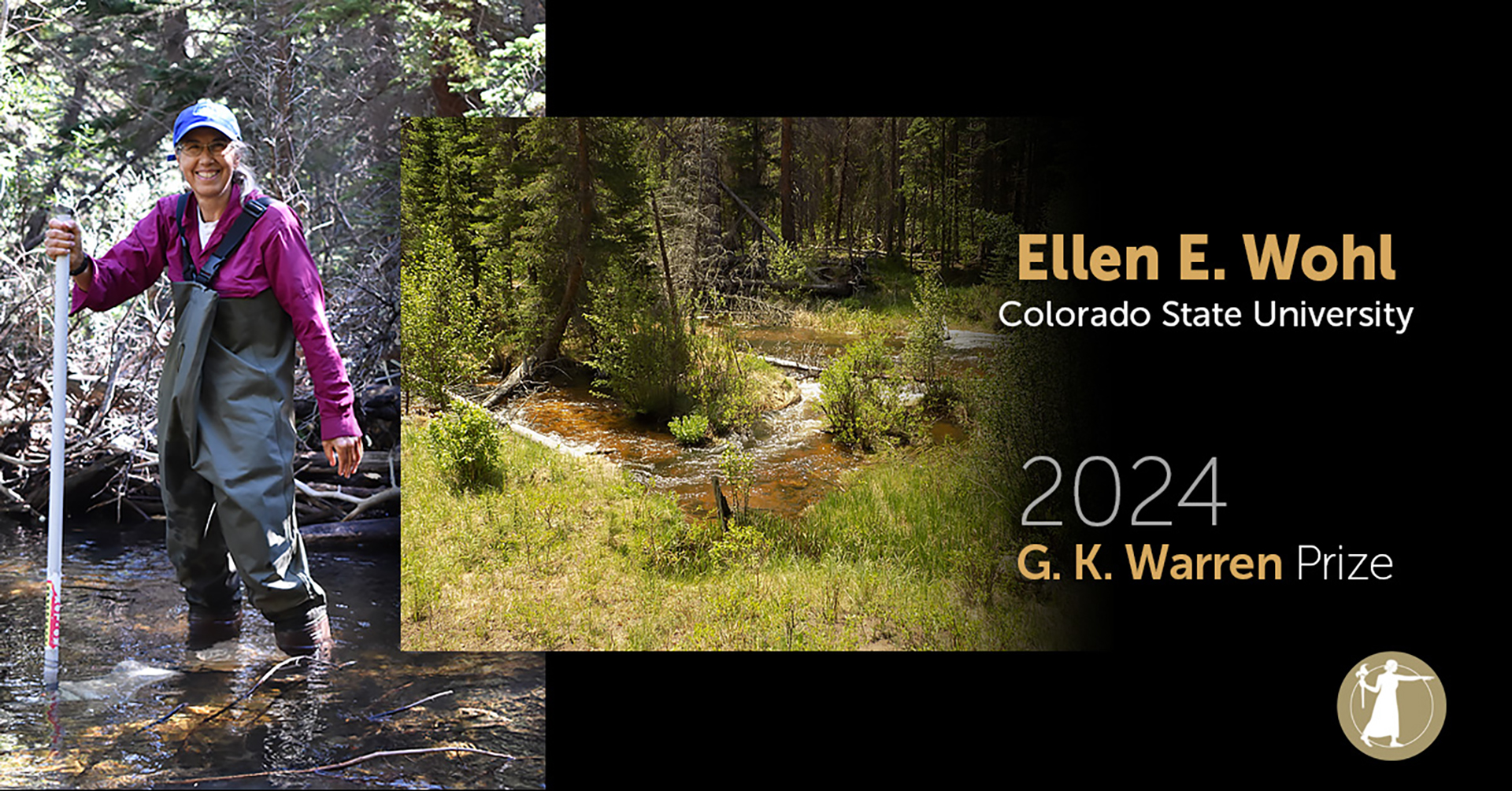
National Academy of Sciences honors geosciences professor Ellen E. Wohl for advancements in river science — Colorado State University #ActOnClimate

University Distinguished Professor Ellen Wohl is being honored for her exceptional research and publication record that has expanded understanding of fundamental river and watershed processes in diverse environments ranging from the Arctic to the tropics. Image provided by the National Academy of Sciences. Graphic credit: Colorado State University

Click the link to read the release on the Colorado State University website (Jayme DeLoss):

Colorado State University Geosciences Professor Ellen Wohl is so at home in rivers and streams that if you manage to catch her in her office on campus, she might be listening to stream sounds while she works.  

The prolific field scientist and University Distinguished Professor has studied rivers and watersheds from ephemeral desert channels to torrents in the tropics on every continent except Antarctica. Today, the National Academy of Sciences announced that it will honor Wohl with the G.K. Warren Prize for her expansive research and advancements in river and watershed sciences. 

“Her work has dramatically influenced and guided river management and restoration worldwide,” the academy said in its announcement. “Wohl is the author of an extensive number of publications and books, introducing broad audiences to river science, and is an extraordinary mentor and role model for women in science.” 

Wohl is what’s known as a fluvial geomorphologist, or a scientist who studies river processes and physical characteristics. She was drawn to CSU by its legacy of water research and its location, where she would have quick access to mountain streams.  

“We have such a great community of people to work with at CSU who are focused on all different aspects of water,” Wohl said. “If I have a question about water chemistry, fish, macro-invertebrates, riparian plants, whatever, there’s somebody I can talk to on campus.” 

Ellen Wohl kayaks on the Great Slave Lake in Canada. Courtesy of Natalie Anderson

Respect for rivers 

Wohl said that she couldn’t resist studying rivers and called them a delightful environment in which to work. They are also critically important, she added.  

“Our survival absolutely depends on them. Particularly in Colorado,” Wohl said. “All our drinking water in the West, certainly in Fort Collins, comes from surface water. That’s not going to change.” 

Her recent research examines how rivers respond to wildfire. After a fire, excess water and sediment rush down denuded slopes, causing flash floods, debris flows and sedimentation in drinking water reservoirs. Wohl’s goal is to improve river resilience for all the living things that rely on the water.  

“What can we do that will make these systems better able to recover after fire and that will have downstream impacts on the communities that drink that water?” 

Wohl said the answer lies in understanding the complexities, or as she calls it “messiness,” of river networks. Many U.S. rivers have been simplified to single channels that flush everything downstream very effectively. Her work has found that restoring some of the historic messiness, including floodplains, branching channels, fallen trees in the water and beaver activity, enhances river resilience.  

Slowing downstream transport also gives microbes that live in the floodplain and underneath streams time to clean the water. Microbes and plants can break down excess nitrate, which is a serious issue along the Front Range, Wohl said. 

Nitrate from agricultural fertilizer, feedlots and burning fossil fuels is transported in the atmosphere and falls as rain, snow or dry deposition on the eastern side of the Continental Divide, ending up in surface water. Consuming excess nitrate in drinking water is detrimental to human health. Excess nitrate in reservoirs also can lead to algae blooms that can be toxic to people and other organisms. Additionally, algae blooms can deplete oxygen in the water, causing fish kills. 

“It’s a great concern for water quality managers to try and do what we can to reduce nitrate levels,” Wohl said. 
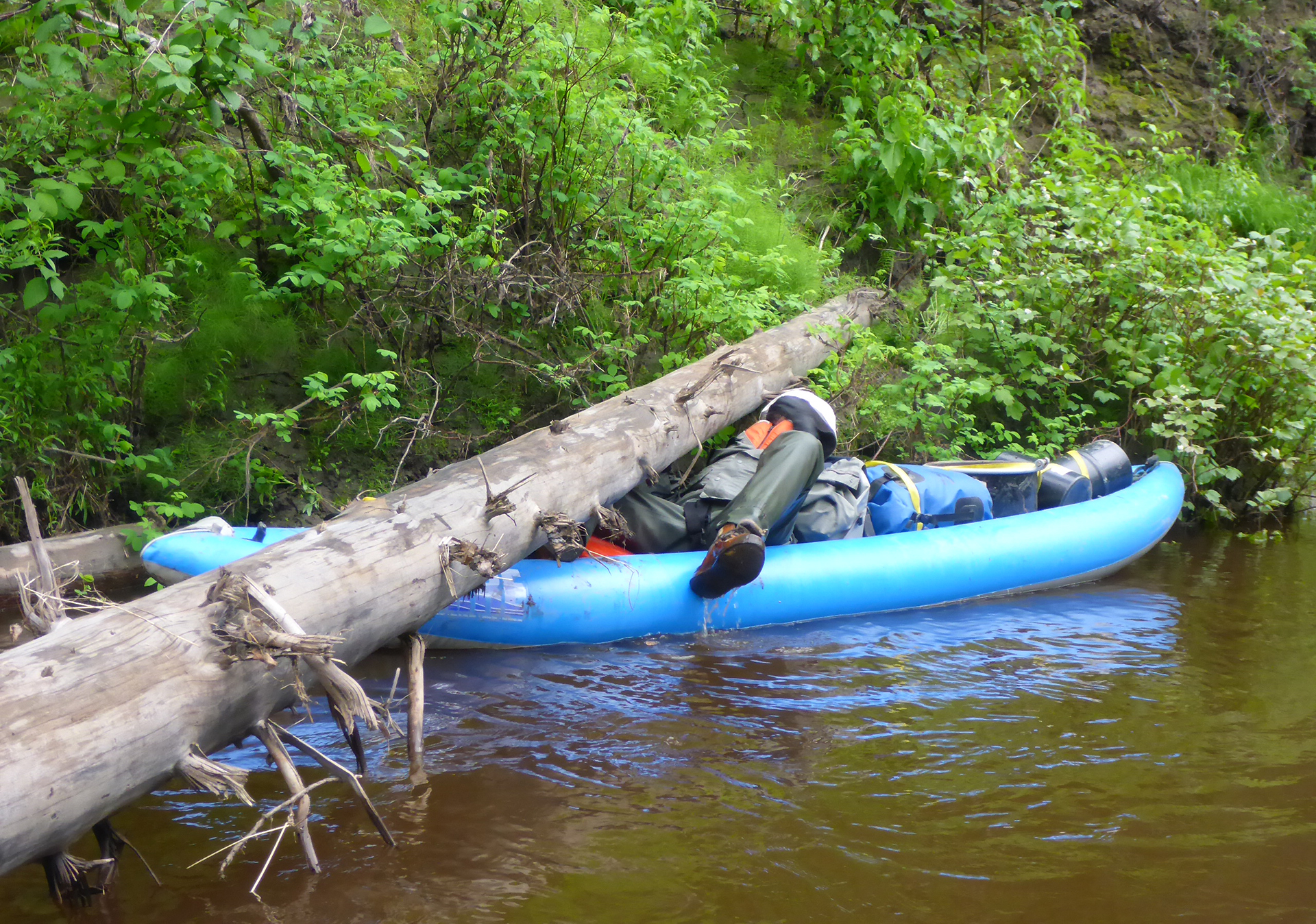
Ellen Wohl does what she calls the “logjam limbo” to avoid portaging around a blockage – an occupational hazard. Courtesy of Ellen Wohl

Dry outlook 

Wohl said Colorado’s future holds “more rainfall, but generally less water” due to continued warming and drying of the climate and human consumption. Snowpack, which supplies water to communities and feeds river ecosystems, will decline, along with river flows throughout the state.  

“The good news is we have some wiggle room because we waste an awful lot of water, so we can conserve a lot more than we use,” she said. “But there’s a limit to how much you can conserve.” 

The 1922 Colorado River Compact, which was renegotiated 100 years later to account for declining flow and a rapidly growing population, was based on a limited record of stream measurements taken during anomalously wet years, Wohl said, so the river’s water was overallocated from the start. Fluvial geomorphologists can extend the streamflow record and estimate long-term water supply by looking at geologic indicators – information that could help with future allocations. 

Benefiting those downstream

Across the diverse environments in which Wohl has worked, the common thread is that they were all shaped by flowing water, the same force that has shaped a career she thoroughly enjoys.  

“In addition to going to all the amazing natural places, by far one of the highlights of my career is working with really motivated, enthusiastic, capable people,” Wohl said.  

The National Academy of Sciences will present Wohl with the G.K. Warren Prize April 28 during the NAS 161st Annual Meeting. The prize is awarded once every five years.  

Wohl plans to use the $20,000 prize to establish a graduate student research fellowship through the Geological Society of America, in honor of her Ph.D. advisor Victor R. Baker. 

Wohl’s award was among 20 announced today by the National Academy of Sciences that recognize extraordinary scientific achievements. View the full list of recipients in the NAS press release.

Screenshot from the recently released Climate Change in Colorado Report update

Save the Poudre is suing to stop NISP project that would provide water to 15 communities — The #FortCollins Coloradoan #PoudreRiver #SouthPlatte #River

U.S. Highway 287 runs through the future site of Glade Reservoir. The Larimer county Board of County Commissioners approved the 1041 Land Use Permit for NISP in September, 2020. Photo credit: Northern Water

Click the link to read the article on the Fort Collins Coloradoan website (Rebecca Powell). Here’s an excerpt:

Environmental group Save The Poudre has filed a lawsuit to try and stop the Northern Integrated Supply Project from going forward to construct two reservoirs and supply water to 15 communities…In the lawsuit, filed Thursday, Save The Poudre says the diversion of water from the Poudre River would cause severe damage to the river, including its aquatic life, the Poudre River Whitewater Park in Fort Collins and the riparian corridor…The lawsuit also alleges that in approving the permit, the Army Corps violated both the National Environmental Policy Act and the Clean Water Act because it didn’t adequately consider alternatives and didn’t choose the least environmentally damaging alternative, respectively…

NISP would divert water from the Poudre and South Platte rivers to store in two new reservoirs: Glade Reservoir north of Fort Collins and the smaller Galeton Reservoir east of Ault. Communities that would be served by the project include the Fort Collins-Loveland Water District and others in Weld and Boulder counties.

Northern Integrated Supply Project (NISP) map July 27, 2016 via Northern Water.

Aridity Could Dry Up Southwestern Mine Proposals — @InsideClimate News

The Bingham Canyon open-pit copper mine in Utah has operated since 1903. David Guthrie/Flickr, CC via Colorado State University

Click the link to read the article on the Grist website (Wyatt Myskow):

Critical minerals for the clean energy transition are abundant in the Southwest, but the dozens of mines proposed to access them will require vast sums of water, something in short supply in the desert.

One by one, leaders from across Arizona gave speeches touting the importance of water conservation at Phoenix City Hall as they celebrated the announcement of voluntary agreements to preserve the declining Colorado River in November.

When Tao Etpison took the mic, his speech echoed those who went before him. Water is the lifeblood of existence, and users of the Colorado River Basin were one step closer to preserving the system that has helped life in the Southwest flourish. Then he brought up the elephant in the room: Arizona’s groundwater protection was lacking, and mining companies were looking to take advantage.

“The two largest foreign-based multinational mining companies in the world intend to construct the massive Resolution Copper Mine near Superior,” said Etpison, the vice chairman of the San Carlos Apache Tribe. “This mine will use, at a minimum, 775,000 acre feet of groundwater, and once the groundwater is gone, it’s gone. How can this be in the best interests of Arizona?”

The question is one the state and the Southwest must answer. Mine claims for the elements critical to the clean energy transition are piling up from Arizona to Nevada to Utah. Lithium is needed for the batteries to store wind and solar energy and power electric vehicles. Copper provides the wiring to send electricity where it will be needed to satisfy exploding demand. But water stands in the way of the transition, with drought playing into nearly every proposed renewable energy development, from solar to hydropower, as the Southwest debates what to do with every drop it has left as the region undergoes aridification due to climate change and decades of overconsumption. 

Mining opponents argue the proposals could impact endangered species, tribal rights, air quality and, of course, water—both its quantity and its quality. Across the Southwest, the story of 2023 was how water users, from farmers in the Colorado River Basin to fast-growing cities in the Phoenix metropolitan area, needed to use less water, forcing changes to residential development and agricultural practices. But left out of that conversation, natural resource experts and environmentalists say, is the water used by mining operations and the amount that would be consumed by new mines.

The San Carlos Apache Tribe has fought for years to stop Resolution’s proposed mine. It would be built on top of Oak Flat, a sacred site to the Apache and other Indigenous communities, and a habitat of rare species like the endangered Arizona hedgehog cactus, which lives only in the Tonto National Forest near the town of Superior. The fate of the mine now rests with the U.S. District Court in Arizona after the grassroots group Apache Stronghold filed a lawsuit to stop it, arguing its development would violate Native people’s religious rights.

But for communities located near the mine and across the Phoenix metropolitan area, the water it would consume is just as big of an issue.

Throughout the mine’s lifespan, Resolution estimates it would use 775,000 acre feet of water—enough for at least 1.5 million Arizona households over roughly 40 years. And experts say the mine would likely need far more. 

Map of the Salt River watershed, Arizona, USA. By Shannon1 – Shaded relief from DEMIS Mapserver (which is PD), rest by me, CC BY-SA 4.0, https://commons.wikimedia.org/w/index.php?curid=14995781

“By pumping billions of gallons of groundwater from the East Salt River Valley, this project would make Arizona’s goal for stewardship of its scarce groundwater resources unreachable,” one report commissioned by the San Carlos Apache Tribe reads. In one hydrologist’s testimony to Congress, water consumption was estimated to be 50,000 acre feet a year—about 35,000 more than the company has proposed drawing from the aquifer.

The Resolution copper mine isn’t the only water-intensive mining operation being proposed. Many of what the industry describes as “critical minerals,” like lithium and copper, are found throughout the Southwest, leading to a flurry of mining claims on the region’s federally managed public lands. 

“Water is going to be scarcer in the Southwest but the mining industry is basically immune from all these issues,” said Roger Flynn, director and managing attorney at the Western Mining Action Project, which has represented tribes and environmental groups in mining-related lawsuits, including the case over Oak Flat.

‘The Lords of Yesterday’

To understand mining in the U.S., you have to start with the Mining Law of 1872.

President Ulysses S. Grant signed the bill into law as a way to continue the country’s development westward, allowing anyone to mine on federal lands for free. To do this, all one needs to do is plant four stakes into the ground where they think there are minerals and file a claim. Unlike other industries that make use of public lands—such as the oil and gas industry—no royalties are paid for the minerals extracted from the lands owned by American taxpayers. 

Flynn referred to mining as the last of the “Lords of Yesterday”—a term coined by Charles Wilkinson, a long-time environmental law professor at the University of Colorado who died earlier this year—referring to the industries like oil and gas drilling, ranching and logging that were given carte blanche by the federal government to develop the West after the Civil War and push Indigenous populations off the land. All of those industry regulations have changed, Flynn said, except mining. 

That’s led mining to be viewed as the top use of public lands by regulators who give it more weight than conservation or recreational activities, he said.

“You don’t have to actually demonstrate that there are any minerals in a mining claim, you don’t have to provide any evidence that there is a mineral there at all,” said John Hadder, the executive director of Great Basin Resource Watch, an environmental group based in Nevada that monitors mining claims. “You can just be suspicious—and there’s a lot of suspicion going around.”

Most of Nevada is completely reliant on groundwater, an increasingly scarce resource. Without water, companies hunting critical minerals can’t mine, Hadder said, so they look to acquire water rights from other users, typically by buying up farms and ranches, changing the economics and demographics of a community. When the mines are developed, they can impact local streams, groundwater levels and the quality of the water as toxins seep into aquifers and surface supplies over the years. Now, with the clean energy transition gaining traction, there’s a new mining boom, prompting increasing concerns over how local ecosystems will be impacted. In Nevada alone, there are more than 20,000 mining claims related to lithium, the biggest of which are, of course, drawing controversy.

A large-scale evaporation pond at the Silver Peak lithium mine on Oct. 6, 2022. The evaporation process can take a year and a half to complete. (David Calvert/The Nevada Independent)

Water’s Role in Mine Fights

In northern Nevada, companies have proposed two massive lithium mines—Thacker Pass and Rhyolite Ridge—in groundwater basins that are already over appropriated. Both have drawn heavy scrutiny, the former for being proposed on a sacred site for local Indigenous tribes that is also range for area ranchers and endangered sage grouse, and the latter for threatening an endangered wildflower found nowhere else in the world. 

Now, Canada-based Rover Metals is looking to drill a lithium exploration project near the Ash Meadows National Wildlife Refuge, a wetland habitat in Nevada near the California border that supports a dozen endangered and threatened species and is one of the most biodiverse places on the planet, which environmentalists call “the Galapagos of the desert.”

“Nevadans almost more than any other state have had to wrestle with the availability or lack thereof of water for development for its entire history,” said Mason Voehl, the executive director of the Amargosa Conservancy, an environmental group that has helped lead the push to protect the refuge. “This is sort of compounding that already really complex challenge.”