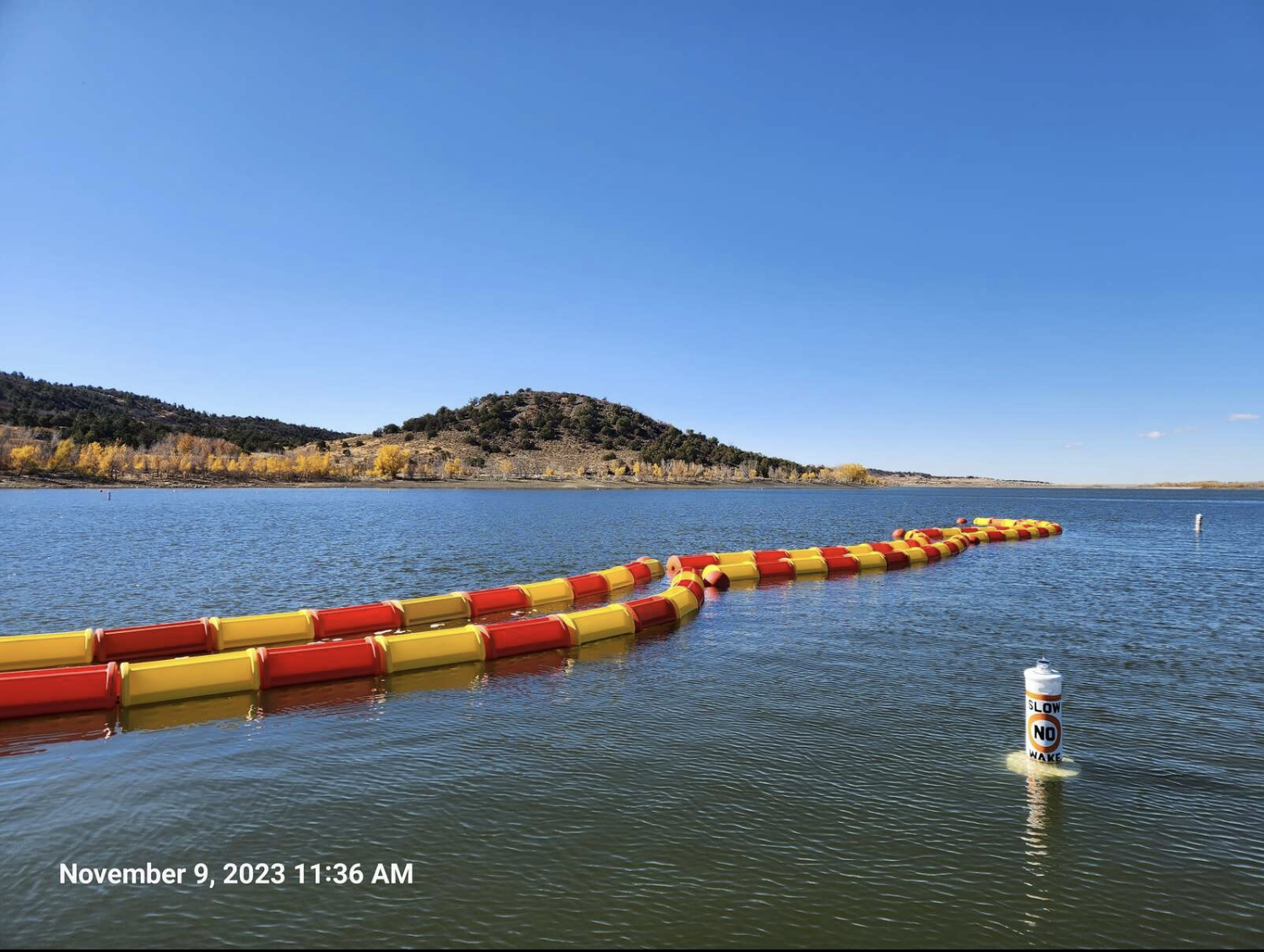
The San Juan National Forest installed a new breakwater near the boat ramp at McPhee Reservoir to protect those using the ramp from dangerous waves. (Courtesy of the San Juan National Forest)
The structure installed to prevent waves from interfering with operations at the boat ramp consisted of roughly 200 oversize tires strung together with cables. The remnants of a previous breakwater – also a pile of car tires – lay stuck in the lake bed, exposed by dropping water levels. But after years of waiting, the trash was removed and an 800-foot shiny new wave attenuator was installed in 2023, thanks to a federal grant and the work of the San Juan National Forest, which manages recreation at the site.
The new breakwater near the boat ramp at McPhee Reservoir cost nearly $600,000 by the time the work and removal of the previous system was completed. (Courtesy of the San Juan National Forest)
The new breakwater, like the one at Lake Nighthorse, is a Wave Eater system composed of floating cylindrical drums that cause surface waves to break and dissipate. The total cost of the installation and removal of trash exceeded $600,000. In 2015, Montezuma County spent over $150,000 of a Colorado Parks and Wildlife grant to build a new breakwater. But the design was lacking, said Tom Rice, recreation staff officer of the Dolores Ranger District…The new breakwater is made of durable yellow and orange polypropylene drums, which, when combined with new, lighted no wake buoys, greatly improve visibility in all weather conditions, day or night, a SJNF spokeswoman said in an email.
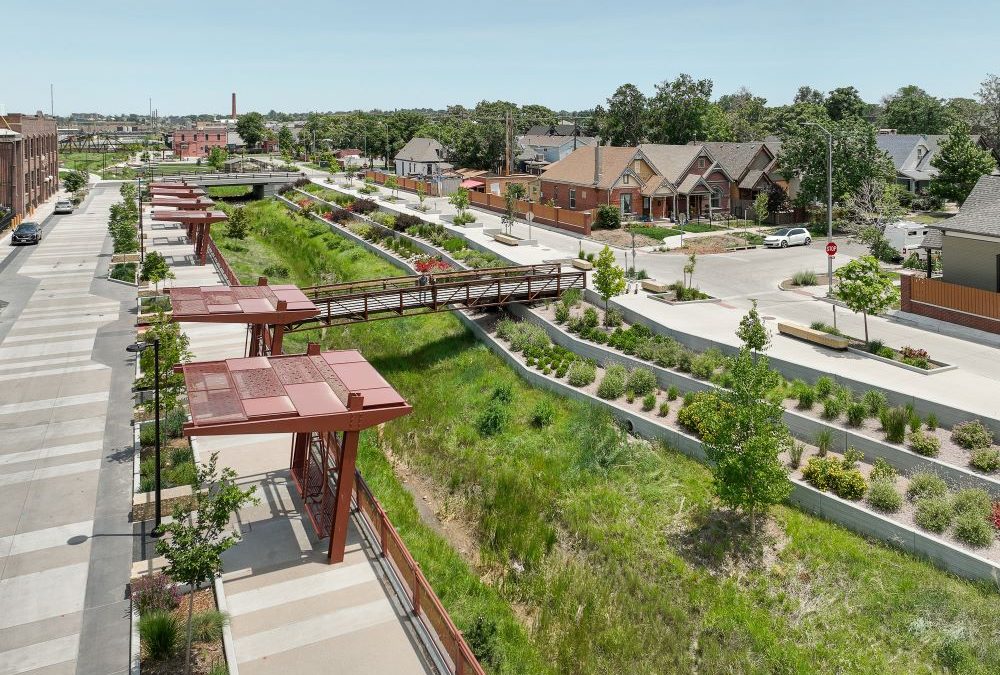
Guided by resident input, the award-winning 39th Avenue Greenway project at the edge of Denver’s RiverNorth neighborhood is an example of One Water in action. The project restored a discontinued rail corridor to improve the aesthetic, create an accessible recreational amenity, and provide stormwater conveyance and filtration as well as 100-year flood protection for the area. (Blake Gordon, Courtesy DHM Design)
Chemically, the water that nature creates is always H2O, regardless of whether it’s suspended in clouds, falling as droplets of rain, or coursing across the land in streams. It’s all one water that cycles through earth and atmosphere. People, however, tend to form water teams that focus on singular aspects of water’s role in our environment and communities.
Some managers oversee dams and reservoirs, while others treat water for drinking. Stormwater, flood control, distribution and piping, wastewater, watersheds and the environment, agricultural ditches and canals—all of these water sectors developed as specialties that don’t, necessarily, join forces or even communicate about overlapping projects and goals. That’s largely because each specialty has had to negotiate separate regulations and policies dictating the how’s and why’s of their water niche. Over time, siloes developed that hindered communities’ and water managers’ ability to take a holistic approach to water use and planning.
But by the early 2000s, a number of water professionals across the globe started to envision a new paradigm. “What if these systems could be collaborating and together break down the divides?” asks Scott Berry, director of policy and government affairs for the US Water Alliance, established in 2008 to facilitate communication and development of what have been coined “One Water” principles. The One Water movement was initiated with a utility-centric focus that sought to create dialogue between stormwater, wastewater and drinking water divisions. But the notion of One Water has since evolved to include a broader, more diverse tapestry of stakeholders, says Berry.
The goals of One Water often vary by site, but in most places, One Water initiatives link water and land planning. Whereas integrated water resource plans usually focus on water alone, a One Water ethic recognizes water’s integration with broader landscapes. Communities can then put that ethic into action by developing a formal One Water plan, which aims to have all of a watershed’s major players at the table in order to craft more sustainable water systems. This means that local governments; private businesses; developers; farmers and agricultural industries; transit authorities; nonprofit organizations; drinking water, wastewater, stormwater, flood and watershed managers; land use planners; environmentalists; and others can all collaborate to share needs and solutions that help finite water resources go farther and achieve multiple benefits for communities and environments.
This country’s largest cities have led the movement to attempt One Water frameworks, with Los Angeles creating its influential One Water plan in 2018. Other cities, such as New York, Seattle, Honolulu and Denver have followed. And now, surveys conducted by the US Water Alliance indicate that about 80 communities across the country are currently pursuing One Water plan development. Most, including Denver, are managing the interrelated aspects of their water systems in a more collaborative way to improve resiliency in the face of climate change and to stretch water resources to serve growing human populations.
“Collaboration can be unwieldy,” acknowledges Berry. But it can also avoid costly and wasteful inefficiencies in spending, and it may even help tackle social injustice. “One Water approaches can address the ways that different neighborhoods have historically received different treatment, and can propose durable solutions that are integrated and equitable,” says Berry.
It’s up to each community to identify a set of objectives that address local priorities: One city might emphasize stormwater reuse, while another might elevate water quality higher on its list.
Sunrise Denver skyline from Sloan’s Lake September 2, 2022.
Colorado Plans and Visions
In September 2021, Denver became the first Colorado entity to pursue integrated One Water strategies through the publication of its One Water plan.
Denver collaborators include those involved in water and land use on many levels: the city’s water and wastewater providers, urban drainage and flood control, various representatives from different departments within the city and county governments, the state, and those who are looking out for the river itself. And they prioritized action items that include promoting water reuse, encouraging overlap between land use and water planning, and developing water policies that support sustainable practices.
Work implementing Denver’s plan is just getting off the ground with monthly meetings among the plan’s collaborators who share ideas, outreach opportunities, and areas where their work overlaps.
For example, the 39th Avenue Greenway project in the Cole and Clayton neighborhoods of north Denver predates the city’s One Water plan (it was completed in 2020) but exemplifies the kind of multi-benefit project that the plan will prioritize. Flood control was the development’s marquee goal, but the design also installed pollutant-filtering green spaces to improve environmental health and playgrounds for families that had historically been underserved by city parks and recreational facilities.
Of course, One Water approaches don’t have to be all-encompassing, as Denver’s is. “You don’t have to do everything, everywhere, all at once,” explains Berry.
Colorado’s leaders are calling for sweeping visions at the state level but not necessarily looking to blanket the state with full-on One Water plans. In the 2023 update to the Colorado Water Plan, the authors urge communities across the state to follow in Denver’s footsteps by including water in “every city and county’s comprehensive plan in ways that embrace the One Water ethic and support inclusion in water and land use planning at the local level.”
“The local level is where the important planning decisions are made for a more sustainable and water-conscious future,” says Kevin Reidy, senior state water efficiency specialist for the Colorado Water Conservation Board (CWCB), the agency that led the development and update to the state water plan and supports water plan goals with project funding and direction. The new 2023 water plan specifically calls out the “One Water ethic” for all communities across the state – going beyond a goal in the initial 2015 Colorado Water Plan, which said that 75% of Coloradans would live in communities that had incorporated water-saving actions into land use planning. The state hasn’t yet conducted a formal survey to measure communities’ progress.
“With more One Water planning happening there can be a growing awareness, cataloging of best practices and tools that make adoption easier as well as documenting case studies that can help achieve a larger vision,” says Reidy. “Ultimately, that vision is strongest when it can integrate water conservation, land use and community values around water.”
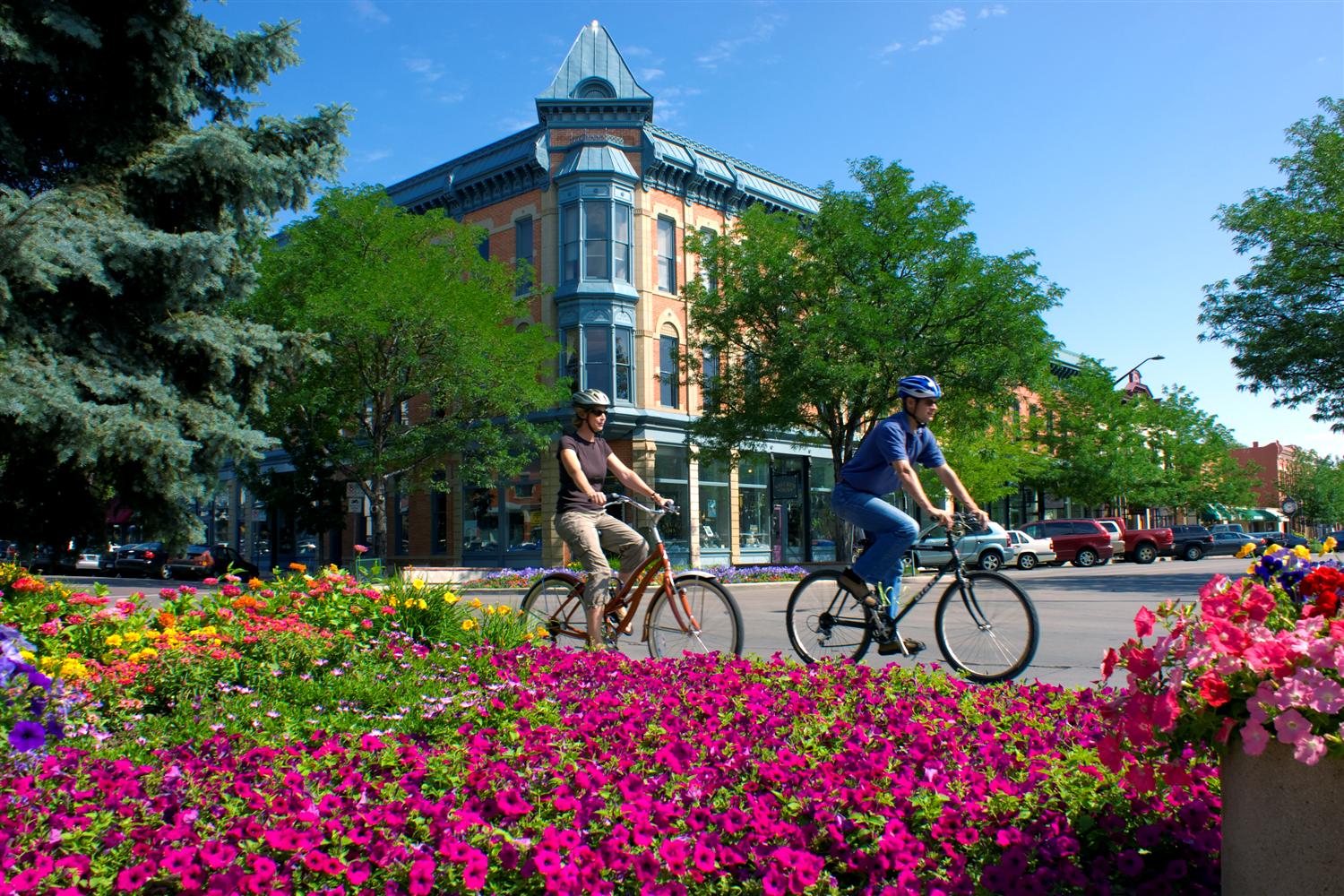
One community that’s begun to yoke synergies is Fort Collins.
This northern Colorado city is unusual in that, in contrast to how things work in Denver, it owns and operates all three traditional water utilities: drinking water, stormwater and wastewater. But each had become siloed, to the point that various arms of the system often competed for funding and purpose. Two years ago, the city hired a consultant to conduct an assessment of the water system, and the resulting recommendation was to align the utilities under a One Water framework.
Jason Graham was hired a year and a half ago to oversee the transformation, and although his job title, executive director of water, doesn’t reference One Water, that movement nevertheless guides his efforts with Fort Collins’ water services at the management level and regionally. That means achieving more overlap between planning, engineering and operations—sectors that had been working in a vacuum, without awareness of what one another was doing. It also requires a landscape-level view of Fort Collins’ water system, upstream to downstream. “The goal is to develop One Water from Cameron Pass through Fort Collins to the South Platte,” says Graham.
The effort is still in its early stages. The leadership team and group structures are established, and now, those teams are about to start defining the city’s strategic principles and priorities for integration. “Given what we have planned, we’re leading the One Water movement certainly within Colorado, and we’re one of the national leaders that people haven’t yet heard about,” says Graham.
The potential overlaps extend far beyond the utilities, to include businesses, developers, neighborhoods, parks, golf courses, citizens, elected leaders and their equivalents in the adjacent county. “Promoting that engagement is a big part of One Water, because that’s what creates a balanced approach to addressing water issues,” says Graham, who has already begun dialogues with area agricultural providers and neighboring water providers.
Surrounding Fort Collins’ urban boundary is an area served by about 20 different water utilities that respond independently to their communities’ widely varying attitudes toward growth—and Graham plans to have conversations in order to explore potential collaborations with all of them.
“Whether our development code and our policies on xeriscaping can be supported by those other water providers, that’s very tricky,” Graham explains. Some citizens support growth while others oppose it—and that struggle links in topics such as affordable housing and social equity, Graham notes, because if you stifle housing creation in a locale that already experiences rising property values, you price out lower-income residents. So while limiting growth may look good from a water-use standpoint, it can also heighten social inequities.
“It can be daunting,” Graham acknowledges. He doesn’t yet know what the limits will be for local collaboration, or how big is too big when it comes to the number of stakeholders involved. “But regardless of whether we can leverage all that, there is a need to have these conversations,” he concludes. And the future benefits of pursuing integration seem worth the present uncertainty, whether surrounding communities work with Fort Collins or not.
He also expects to enjoy cost savings for rate-payers once formerly separate budgets and projects are aligned. “One area would conduct a study that no one else knew about, but now, that one study can do more by serving all buckets,” he explains.
Integration also promises to make Fort Collins more resilient in the face of regional water pressures. “Looking at the Colorado River Compact and the future of northern Colorado, we want to be strategic about the resources that we have,” Graham says. The time for inefficiency has passed. Says Graham, “The community is ready for this conversation to happen. We’re the stewards of this conversation and the protection of this resource.”
Roadmaps for Future One Water Communities
On the campus of Colorado State University, just a few miles from Jason Graham’s office, Mazdak Arabi, PhD, is putting the final touches on a report that’s likely to help many communities across the country understand and embark on One Water integration. The research was performed at Arabi’s One Water Solutions Institute, established within CSU to develop science-driven, evidence-based pathways to water integration. Marrying pure science with practical application is “extremely rewarding for me and the other folks in the One Water Solutions Institute,” says Arabi.
Dr. Mazdak Arabi Photo credit: Colorado State University
The report cites a ladder that they can climb to approach One Water ideals. “It’s a self-assessment framework, not a competitive comparison,” Arabi emphasizes. But, like similar rubrics used by Leadership for Energy and Environmental Design (LEED) to recognize sustainable construction, the forthcoming self-assessment describes three levels of One Water involvement: Onboarding, Progressing and Advancing. Each level describes specific actions that municipalities can follow to identify where they’re at and how to progress.
There is no ultimate state of One Water perfection. Even the most accomplished “level three” municipalities, those who have made the most One Water advances, will continue to self-monitor and engage their communities in pursuit of ongoing innovation. That quest promises dividends for entire communities, says Arabi.
“At the core of our research, we’re looking at ways to make a community more livable, more resilient to changes in population or climate or other pressures,” Arabi explains.
Fresh Water News is an independent, nonpartisan news initiative of Water Education Colorado. WEco is funded by multiple donors. Our editorial policy and donor list can be viewed at wateredco.org.
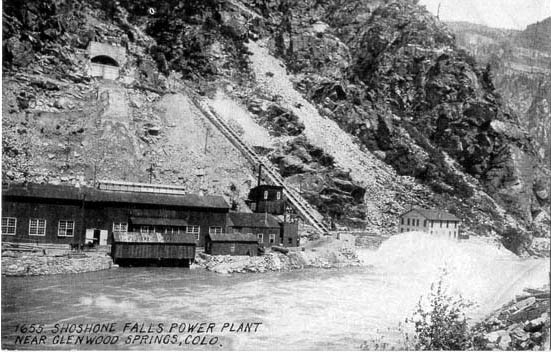
Also on the agenda for Will, Velasco, and other Western Colorado lawmakers is water issues. Earlier this month, the lawmakers both attended the announcement of the Colorado River District’s purchase of the Shoshone water right at the Hotel Colorado in Glenwood Springs…
“Purchase of the Shoshone water rights keeps water in the river. That’s good for fish, that’s good for recreation, that’s good for agriculture, that’s good for West Slope Colorado,” Will said.
The River District will pay nearly $100 million for the water right, and is fundraising now to be able to complete the purchase. Velasco and Will were both confident the assembly would be able to help with the funding to see the deal to the finish line.
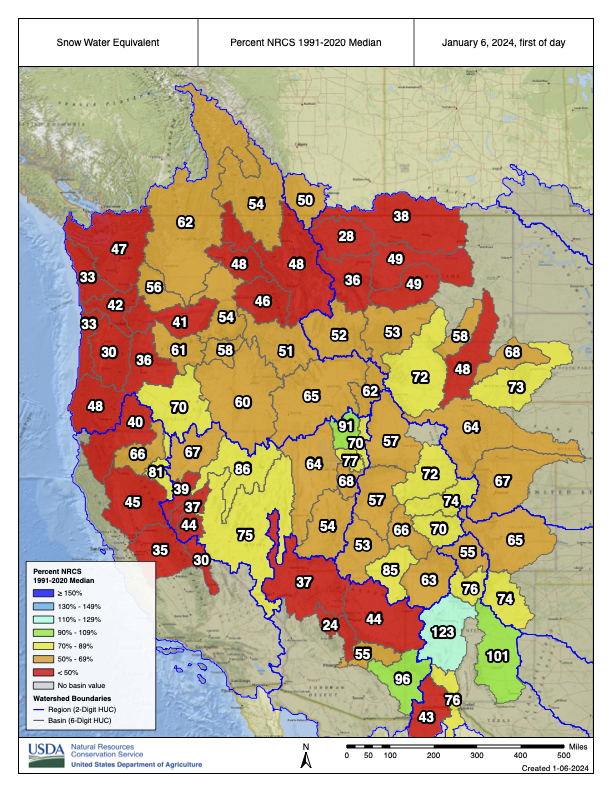
Westwide Snow Water Equivalent percent NRCS 1991-2020 Median January 6, 2024.
Click the link to read the article on the KUNC website (Alex Hager). Here’s an excerpt:
January 2, 2024
Across the West, the winter is off to a dry start. Wide swaths of the Rocky Mountains have lower-than-average snow totals for this time of year, but scientists say there’s still plenty of time to end the “snow drought” and close the gap. High-altitude snowpack has big implications for the region’s water supply. Two-thirds of the Colorado River’s water starts as snow in Colorado’s mountains before melting and flowing to about 40 million people across seven states. Nearly every part of Colorado, Utah and Wyoming has significantly less snow than usual for late December. The latest data from a region-wide network of snow sensors shows snow in many areas with snow totals around 60 or 70% of normal.
“It’s really going to be dependent on what we see in January and February,” said Becky Bolinger, Colorado’s assistant state climatologist. “We’re really going to need an active January and February to make up these deficits and be okay.”
“New plot using the nClimGrid data, which is a better source than PRISM for long-term trends. Of course, the combined reservoir contents increase from last year, but the increase is less than 2011 and looks puny compared to the ‘hole’ in the reservoirs. The blue Loess lines subtly change. Last year those lines ended pointing downwards. This year they end flat-ish. 2023 temps were still above the 20th century average, although close. Another interesting aspect is that the 20C Mean and 21C Mean lines on the individual plots really don’t change much. Finally, the 2023 Natural Flows are almost exactly equal to 2019. (17.678 maf vs 17.672 maf). For all the hoopla about how this was record-setting year, the fact is that this year was significantly less than 2011 (20.159 maf) and no different than 2019” — Brad Udall
Even a few consecutive wet winters aren’t enough to seriously fix the supply-demand imbalance that fuels the West’s water crisis. More than 20 years of dry conditions, fueled by climate change, have shrunk the Colorado River’s water supply, and policymakers have been unable to agree on significant, long-term cutbacks to water use. Experts say it would take five or six consecutive above-average winters to close that supply-demand gap, which is unlikely to happen as climate change makes the region warmer and drier. Dan McEvoy, regional climatologist at the Western Regional Climate Center and Desert Research Institute, said last year’s wet winter was an “anomaly.”
“Lots of data, lots of research, projections, modeling, all point to this continuing trend of warmer winters, less snow and in some cases, less precipitation,” he said.
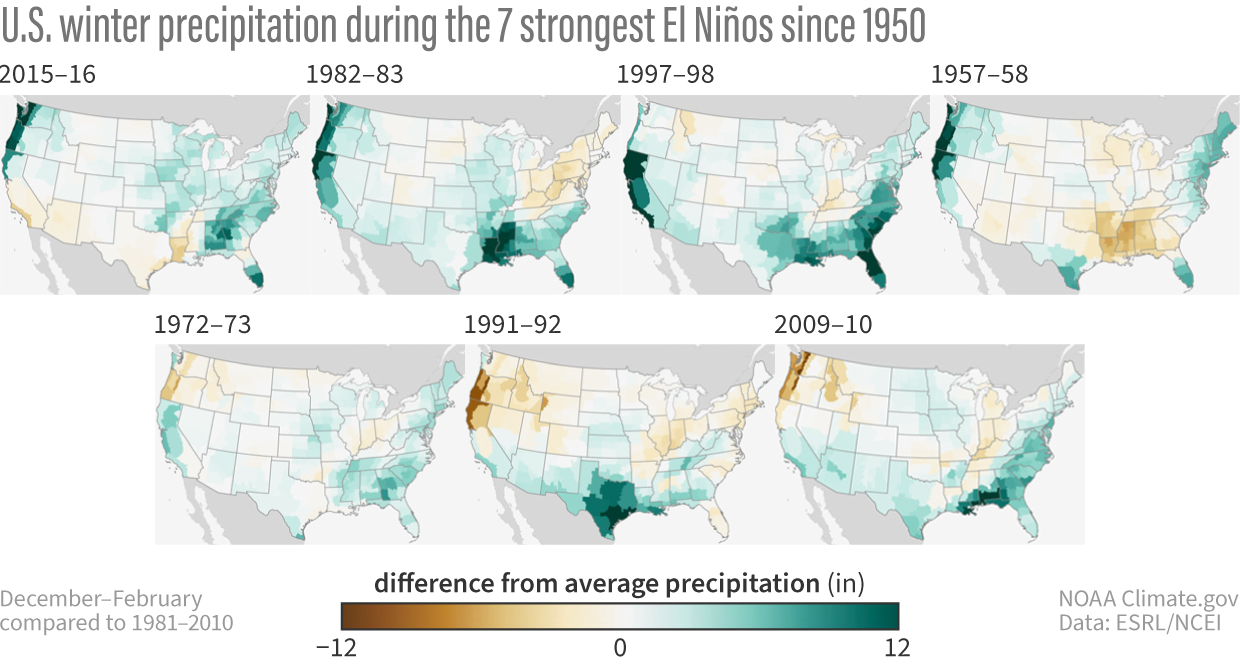
U.S. winter (Dec-Feb) precipitation compared to the 1981-2010 average for the past 7 strong El Niño events. Details differ, but most show wetter-than-average conditions across some part of the South. NOAA Climate.gov image, based on data from NOAA Physical Science Lab online tool.
From the wettest three-month period along the Front Range to the state’s largest hailstone, 2023 was a year of climate extremes for Colorado — and the world. After three years of cool waters, the currents in the Pacific Ocean flipped to an El Niño cycle — an ocean climate pattern that can have a profound effect on landlocked, mountainous Colorado. Typically, a strong El Niño pattern increases the likelihood of increased snow across much of the state, said state climatologist Russ Schumacher. So far this winter, however, the state has received less snow than is typical for this time of year — a stark contrast to last winter, during which heavy snowfall and a wet spring refilled reservoirs and waterways, kicked off the growing season and tamped down on wildfires.
Historically, both the El Niño warming pattern and the related cooling pattern known as La Niña mean more predictable weather patterns for Colorado. With global temperatures soaring — 2023 was the world’s warmest ever recorded — Schumacher that predictability might not hold true for 2024 and beyond…While it has become increasingly more difficult to predict seasonal climate patterns, Schumacher said extreme weather events — from hailstorms and tornadoes to wildfires — are becoming the new [normal] for Colorado.
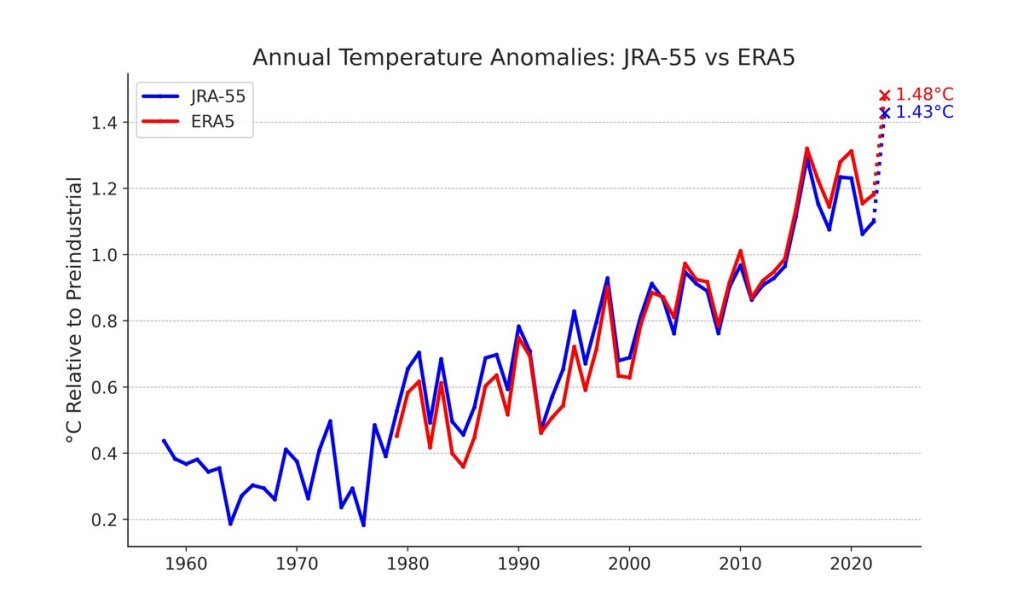
They find it was the warmest year on record by a large margin, at 1.48C above preindustrial levels, higher than the 1.43C that JRA-55 reported earlier this week
From left, J.B. Hamby, chair of the Colorado River Board of California, Tom Buschatzke, Arizona Department of Water Resources; Becky Mitchell, Colorado representative to the Upper Colorado River Commission. Hamby and Buschatzke acknowledged during this panel at the Colorado River Water Users Association annual conference that the lower basin must own the structural deficit, something the upper basin has been pushing for for years. CREDIT: TOM YULSMAN/WATER DESK, UNIVERSITY OF COLORADO, BOULDER
Click the link to read the article on the AZCentral.com website (Brandon Loomis). Here’s an excerpt:
December 14, 2023
The seven states that share the Colorado River’s water celebrated some conservation wins at their annual meeting here this week but quickly began sparring over who will bear the brunt of future pain that they agree a drying climate will dole out. Talk of cutbacks has long focused on the three states collectively known as the Lower Basin — Arizona, California and Nevada — and on Wednesday, representatives of California water districts and tribes signed federally funded deals to leave more water in the river’s largest reservoir over the next two years. On Thursday, interstate rivalries re-emerged as officials from the Upper Basin made clear they expect the Lower Basin to cut back much further before coming after their water. Farmers and other users in the headwaters states of Wyoming, Utah, Colorado and New Mexico already go without in dry years because they don’t have a giant storage pool like the Southwest’s Lake Mead to augment nature…
September 21, 1923, 9:00 a.m. — Colorado River at Lees Ferry. From right bank on line with Klohr’s house and gage house. Old “Dugway” or inclined gage shows to left of gage house. Gage height 11.05′, discharge 27,000 cfs. Lens 16, time =1/25, camera supported. Photo by G.C. Stevens of the USGS.
Source: 1921-1937 Surface Water Records File, Colorado R. @ Lees Ferry, Laguna Niguel Federal Records Center, Accession No. 57-78-0006, Box 2 of 2 , Location No. MB053635.
The upper and lower basins split just downstream of Lake Powell’s Glen Canyon Dam, at Lees Ferry in Arizona, though Lake Powell’s storage is primarily used to ensure the Upper Basin has enough water to fulfill its yearly obligations to the Lower Basin. The Upper Basin states use roughly half as much, and less in years when mountain streams dry up, and concerns over that disparity surfaced Thursday.
“We can’t accept something that continues to drain the system, that puts 40 million people at risk,” Colorado’s river commissioner, Becky Mitchell, told her interstate colleagues at the annual Colorado River Water Users Association conference…
“The one person that you cannot negotiate with is Mother Nature. She will win every time. She’s been telling us what to do,” Mitchell said. “I want an agreement that lessens the pain for all of us, not just some of us.”
“New plot using the nClimGrid data, which is a better source than PRISM for long-term trends. Of course, the combined reservoir contents increase from last year, but the increase is less than 2011 and looks puny compared to the ‘hole’ in the reservoirs. The blue Loess lines subtly change. Last year those lines ended pointing downwards. This year they end flat-ish. 2023 temps were still above the 20th century average, although close. Another interesting aspect is that the 20C Mean and 21C Mean lines on the individual plots really don’t change much. Finally, the 2023 Natural Flows are almost exactly equal to 2019. (17.678 maf vs 17.672 maf). For all the hoopla about how this was record-setting year, the fact is that this year was significantly less than 2011 (20.159 maf) and no different than 2019” — Brad Udall
Click the link to read the article on the NOAA website:
January 5, 2024
NOAA and its partners have released the latest Regional Climate Impacts and Outlooks, which recap fall conditions and provide insight into what might be expected this winter.
Fall Temperature Recap
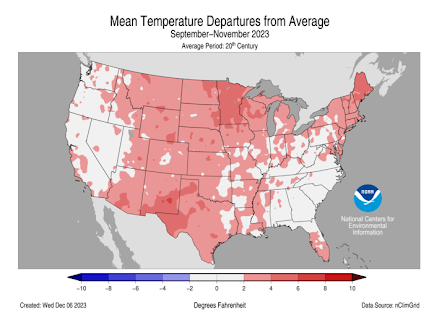
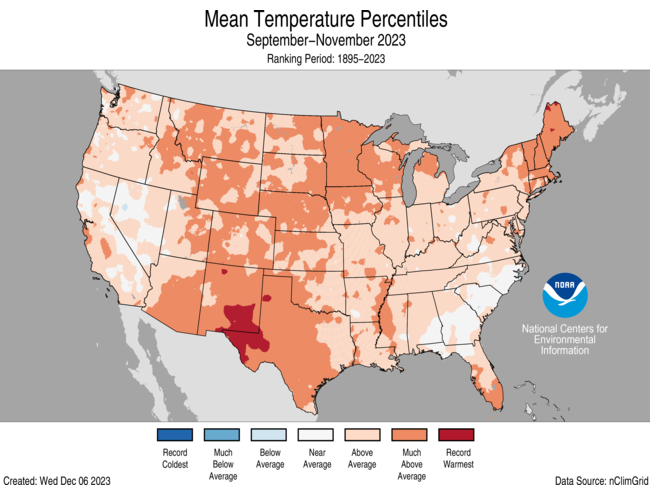
The meteorological autumn (September–November) average temperature for the contiguous U.S. was 56.1°F, 2.5°F above average, ranking sixth warmest on record.
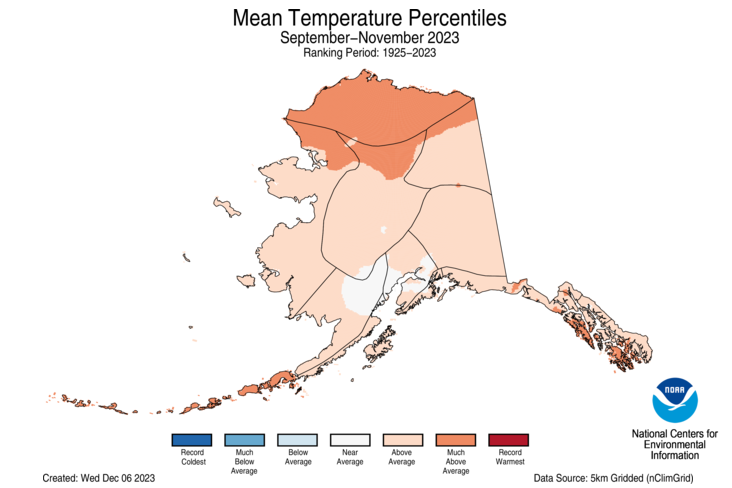
Temperatures were above average across most of the contiguous U.S., with record-warm temperatures observed in parts of New Mexico, western Texas and northern Maine. New Mexico and Texas each ranked third warmest on record, while Maine ranked fourth warmest for this autumn season. An additional 10 states ranked among their top-10 warmest on record for this period. The Alaska autumn temperature was 29.6°F, 3.7°F above the long-term average, ranking 13th warmest on record for the state. Temperatures were above average across most of the state of Alaska while some parts of south-central Alaska saw near-average autumn temperatures.
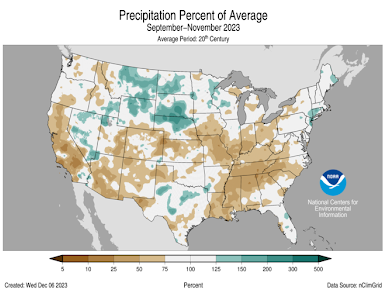
Fall Precipitation Recap
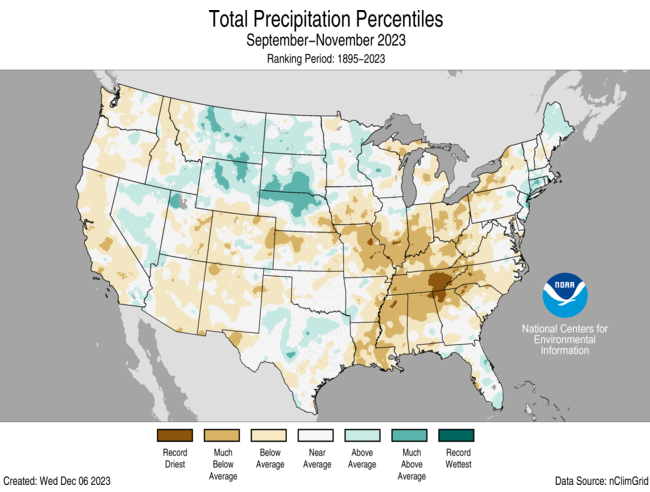
The contiguous U.S. autumn precipitation total was 5.66 inches, 1.22 inches below average, ranking 15th driest in the September–November record.
Precipitation was below average across much of the eastern half of the U.S., the Southwest, California, and in parts of the Northwest and central Plains. Tennessee ranked third driest on record with three additional states in the Mississippi and Ohio Valleys ranking among their top-10 driest autumn seasons on record.
Autumn precipitation was above average from the northern Rockies to the western Great Lakes and in parts of the Great Basin, southern Plains, Northeast and Southeast. No state ranked among their top-10 wettest autumn seasons on record. For autumn season precipitation, Alaska ranked in the wettest third of the record with wetter-than-average conditions observed across much of the state. Near-normal precipitation was observed in parts of the Interior and south Central Alaska, while below-normal precipitation occurred in parts of the Southwest and Aleutians during this season.
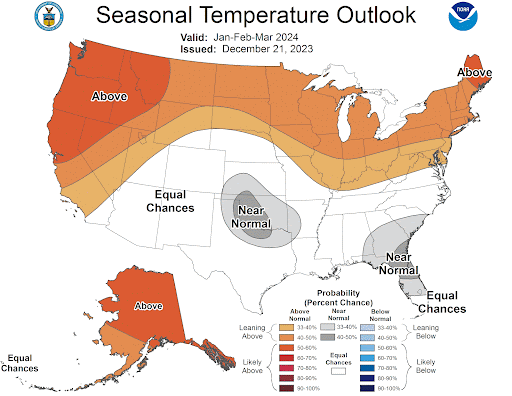
Winter Temperature Outlook
The January–March 2024 Temperature Outlook favors above-normal temperatures for Alaska, the west coast of the contiguous United States (CONUS), the Northern Plains, the Ohio and Tennessee Valley regions, and the Mid-Atlantic. Above-normal temperatures are more likely for western Alaska, parts of the west coast, and New England. Near normal temperatures are favored for the Central and Southern Rockies, and parts of the Central and Southern Plains.
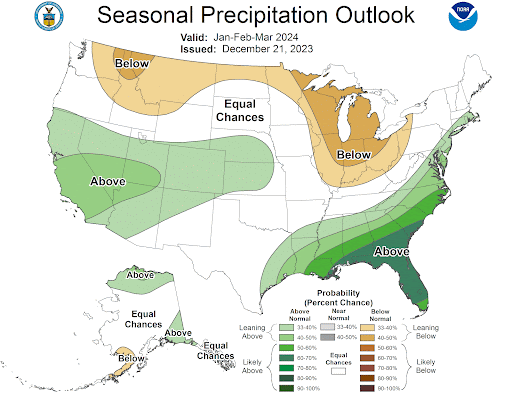
Winter Precipitation Outlook
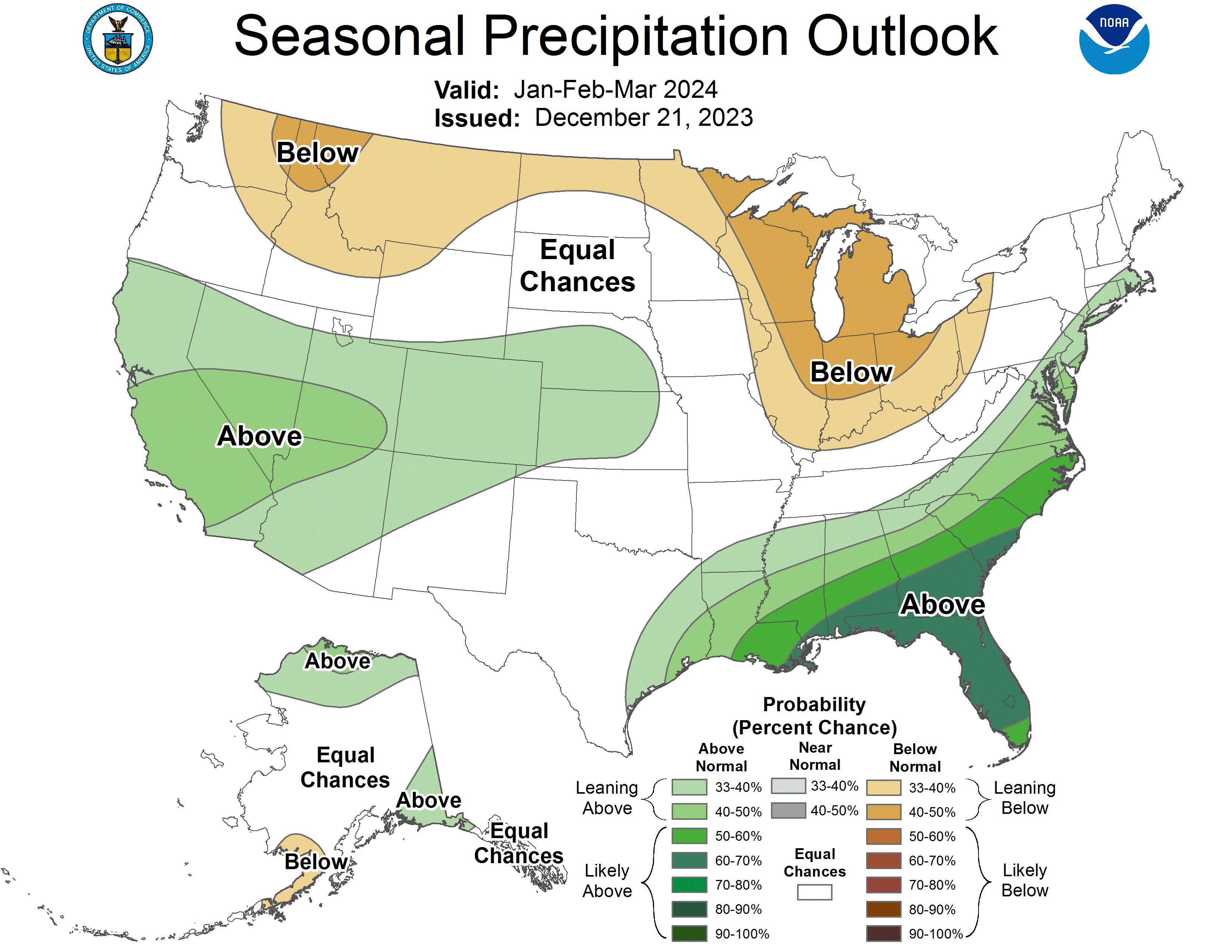
The January–March 2024 Precipitation Outlook depicts below-normal precipitation over southwestern Alaska and above-normal precipitation over northern Alaska. Below normal precipitation is favored from the Northern Rockies to the Great Lakes and into the Ohio Valley. Above-normal precipitation is favored over parts of the west coast, with a slight tilt toward above normal over parts of the central CONUS. The highest confidence for above-normal precipitation is over the Southeast CONUS where influences from El Niño are strongest.
Impacts and Outlooks for Your Region
Get more details for your region in the December climate impacts and outlooks summaries:
Click the link to read the article on the Sky-Hi News website (Ryan Spencer). Here’s an excerpt:
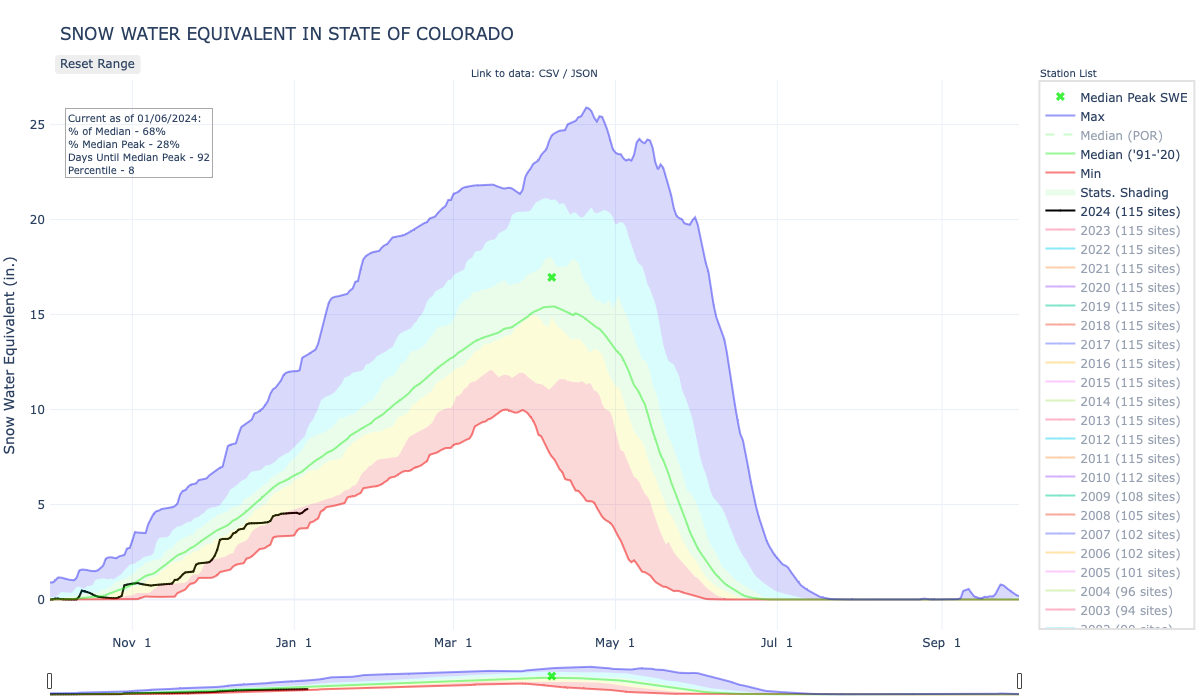
Throughout the state of Colorado, snowpack is generally about 60-70% percent of average, with no one region trending much better than the other, National Weather Service Forecaster David Barjenbruch said Tuesday, Dec. 2. That lands this snow year in the 8th percentile for the state’s historic records, according to historic weather data collected by the U.S. Department of Agriculture.
Westwide Snow Water Equivalent percent NRCS 1991-2020 Median January 6, 2024.
Meanwhile, snowpack conditions in California’s Sierra Nevada Mountains are only about 20-30% of normal, Barjenbruch said. That remains true almost all the way up the West Coast into the mountains of Oregon and Washington, he said. Landlocked states are faring a bit better than the coast, but snowpack conditions continue to trend further behind average than in Colorado. While some parts of Utah are doing slightly better, in Idaho and Nevada, snowpack lingers at about 50-60% of normal, Barjenbruch said…
Colorado Drought Monitor map December 26, 2023.
Throughout Colorado, precipitation remained at or below normal in 2023, Barjenbruch said. Though Colorado was briefly drought-free in July for the first time since 2019, drought has returned more than half the state. Southwest Colorado is experiencing the worst drought conditions, ranging from moderate to extreme drought, while abnormally dry conditions have crept into the northwest part of the state as well as Summit and Grand counties. About 63% of the state is experiencing some level of drought conditions, according to the U.S. Drought Monitor. National Weather Service hydrologist Aldis Strautins noted that in September, Dillon received just 0.65 inches of precipitation, less than half the average for the month. After coming just shy of average in October, the Colorado mountain town received ¾ of an inch of precipitation in November, a month that typically averages an inch of precipitation, and remained more than ¼ of an inch below average in December, Strautins said. Nearby, Breckenridge trended just above normal in September and October, but that was quickly undercut by a dry November that saw only a half inch of precipitation, more than ¾ of an inch shy of the month’s inch average…In Colorado’s prime ski country in and around Summit County, about 2-3 inches of precipitation — the equivalent of 2-4 feet of snow in places above 9,000 feet — would be necessary to get back to normal, Barjenbruch said.