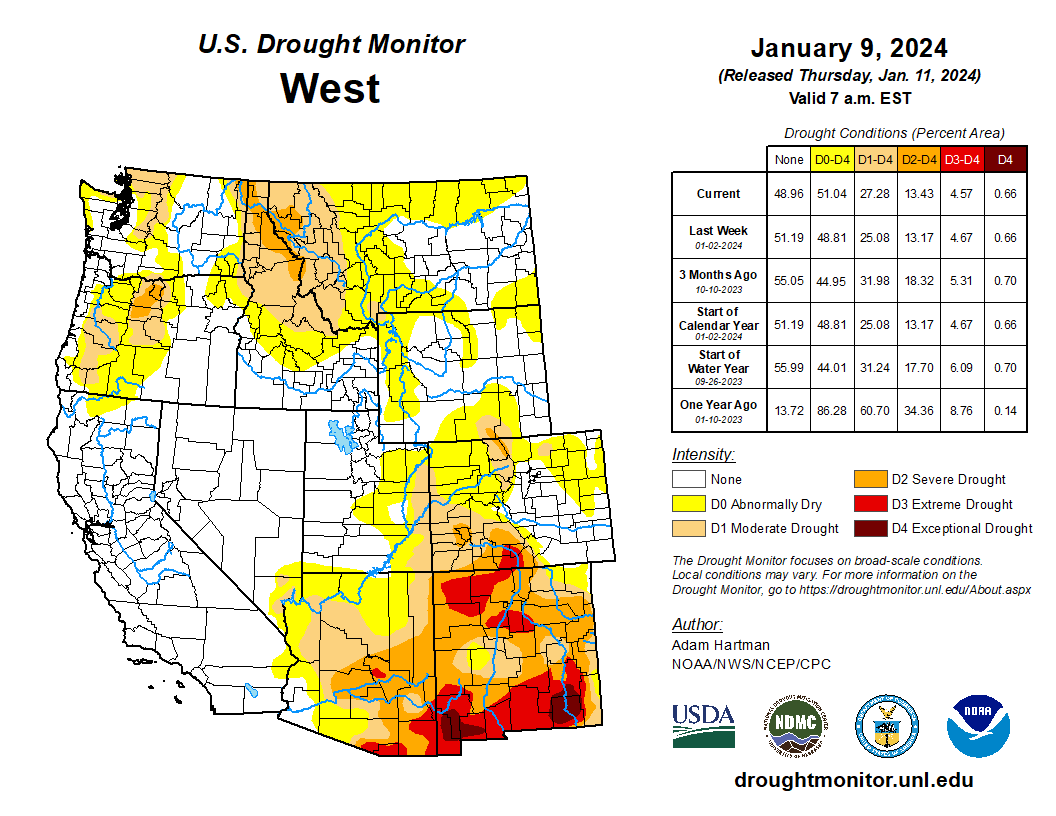
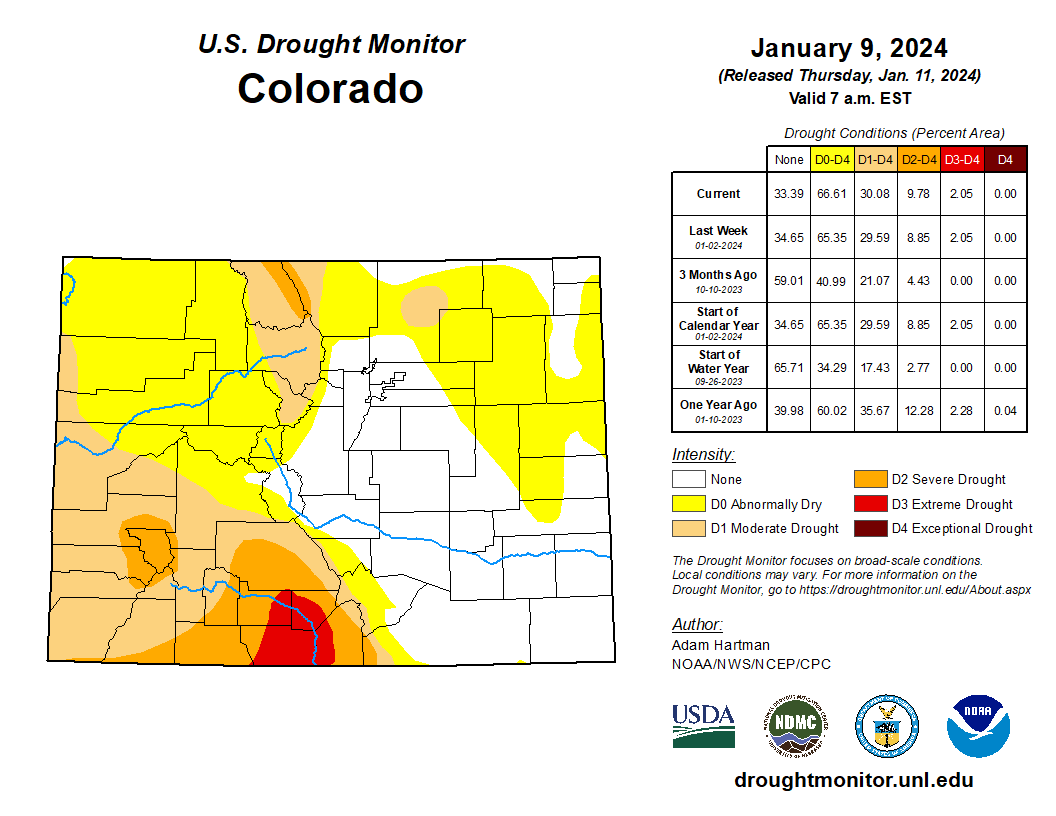
#Drought news January 11, 2024: The storm track has predominantly been displaced S. across the S. half of the U.S. over the past couple of months, which has led to slow deterioration of drought conditions across portions of the W. High Plains and along the Front Range of the Rockies

Click on a thumbnail graphic to view a gallery of drought data from the US Drought Monitor website.

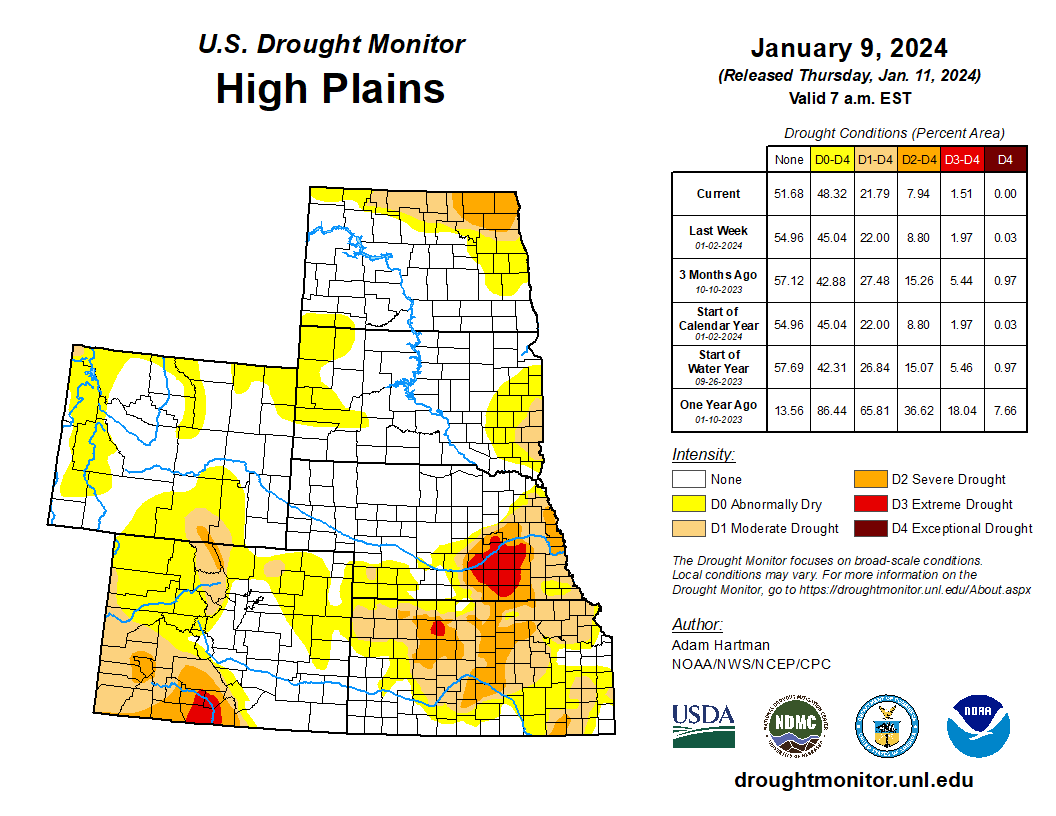
Click the link to go to the US Drought Monitor website. Here’s an excerpt:

This Week’s Drought Summary

It was a stormy week across much of the eastern lower 48 states leading to widespread drought improvements east of the Rockies. A winter storm pummeled the Mid-Atlantic and Northeast over the weekend (January 6-7). Then a second system in its wake was ramping up across the Mississippi Valley toward the end of this week (Tuesday, January 9), bringing heavy rainfall to the Lower Mississippi and the Deep South. More than 2 inches of rain fell in many areas, with localized amounts upwards of 5 inches. Heavy snow also fell across parts of the Central Plains and Midwest as it moved slowly eastward, with snowfall still ongoing across parts of the Midwest and Great Lakes by the end of this week. Across the Intermountain West, it was a wet and snowy week mainly for parts of the Pacific Northwest and isolated locations in the Great Basin and Four Corners region, leading to some targeted improvements. However, several areas experiencing antecedent dryness and drought missed out on the precipitation, leading to further degradations, particularly across the northern Rockies, Front Range, and across parts of the western Colorado Plateau in Arizona. In Alaska, no changes to the drought depiction are warranted this week. In Hawaii, a Kona low spinning off to the north brought heavy bands of precipitation to western portions of the island chain, warranting some improvements to drought conditions. Conversely, another week of warm temperatures and below normal rainfall in Puerto Rico resulted in widespread deterioration of the drought depiction…

High Plains

Storminess in recent weeks has resulted in widespread improvements across the Central Plains. Additional improvements were again warranted this week in the Central Plains, where a couple of storm systems brought wintry precipitation, with weekly snowfall totals of over 5 inches for many areas (locally more than 10 inches), further increasing short-term precipitation surpluses. Unfortunately, the storm track has predominantly been displaced southward across the southern half of the U.S. over the past couple of months, which has led to slow deterioration of drought conditions across portions of the western High Plains and along the Front Range of the Rockies. With another week of below normal precipitation, degradation was again warranted this week. Seasonal snowfall remains below average for many locations and daytime temperatures have been running above normal (and above freezing), exposing soils to evaporation, predominantly from high winds…
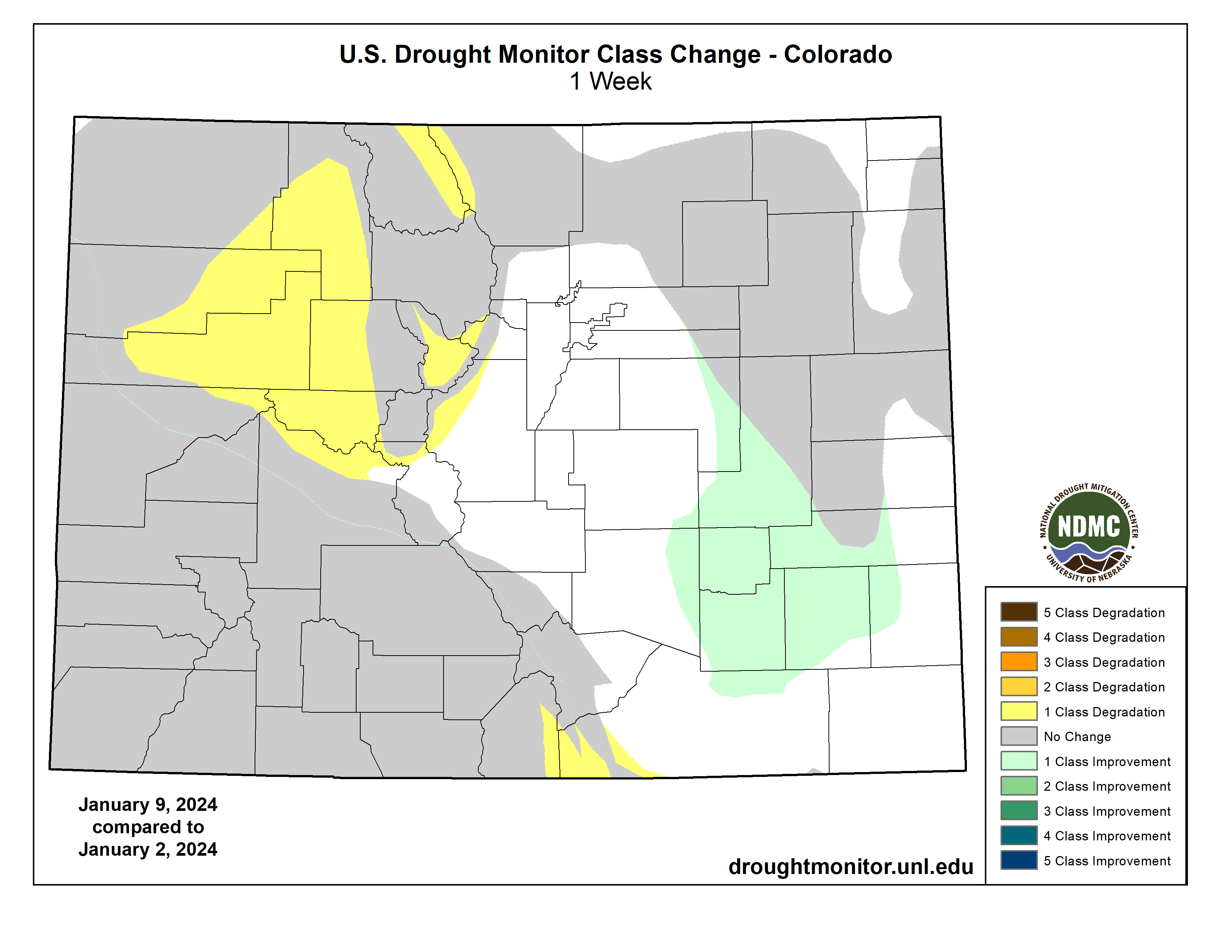
Colorado Drought Monitor one week change map ending January 9, 2024.

West

Targeted improvements are warranted across parts of the Pacific Northwest and New Mexico, where 7-day precipitation totals, in combination with storminess in recent weeks, have improved some of the long-term drought indicators, even improving seasonal snowpack to be closer to normal for several locations. However, some degradation was also warranted in locations that missed out on heavier precipitation amounts this week, and who have experienced below normal precipitation and above normal temperatures over the past few months. Seasonal snowpack is running below normal throughout much of the Intermountain West, although interior portions of the Great Basin are faring a little better. So much of the recent improvements can be attributed to rainfall and improving soil moisture and stream flows…

South

Much needed rain fell this week across much of the South, with many locations across the Lower Mississippi and Tennessee Valleys picking up well over 2 inches of rainfall. However, long-term drought conditions still very much remain in place across much of the Lower Mississippi Valley, with several areas across Louisiana and Mississippi experiencing upwards of 20-inch rainfall deficits over the past year. There are marked improvements in the upper layers of the soils and in some of the short-term drought indices in recent weeks, as the storm track has been active across the Gulf Coast states. However, more rainfall will be needed to dig into the long-term precipitation deficits and recharge groundwater. Improvements to drought conditions are also warranted across parts of the Southern Plains this week, where widespread precipitation totals in excess of 1 inch were received…

Looking Ahead

During the next five days (January 11-15), a storm system is forecast to develop and intensify east of the Rockies, bringing potentially heavy rain and snow to parts of the eastern U.S. In the wake of this storm system bitterly cold temperatures are forecast to spill southward from Canada, leading to dangerously cold temperatures and wind chills across portions of the central and northern U.S.

The Climate Prediction Center’s 6-10 day outlook (valid January 16-20), favors enhanced chances of below normal temperatures across much of the lower 48 states, with the highest chances (greater the 90%) centered over the Middle Mississippi Valley. Conversely, above normal temperatures are favored in the southwest U.S., underneath a mid-level ridge of high pressure that is forecast. Below normal precipitation is favored across many areas east of the Rockies during the next 6-10 days, as dry air moves in behind a departing storm system. However, a frontal boundary is forecast to remain draped across the Gulf of Mexico, bringing increased above normal precipitation chances to southern Texas and the Florida Peninsula. Above normal precipitation is also favored across parts of the West Coast, northern Rockies, and northern High Plains, associated with moist southwesterly flow into the northwestern U.S.
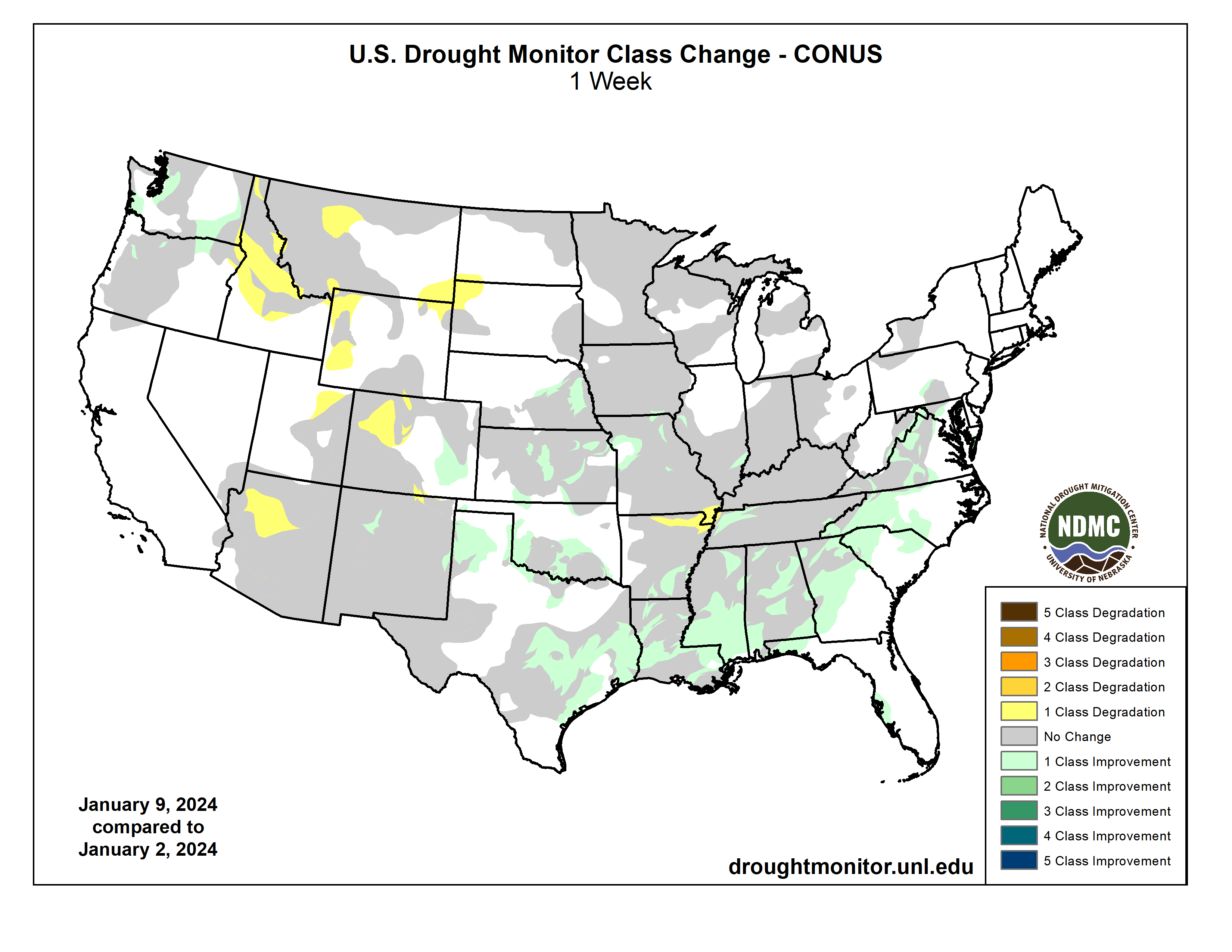
US Drought Monitor one week change map ending January 9, 2024.

About that FB EV-bashing meme — Jonathan P. Thompson (@Land_Desk) #ActOnClimate

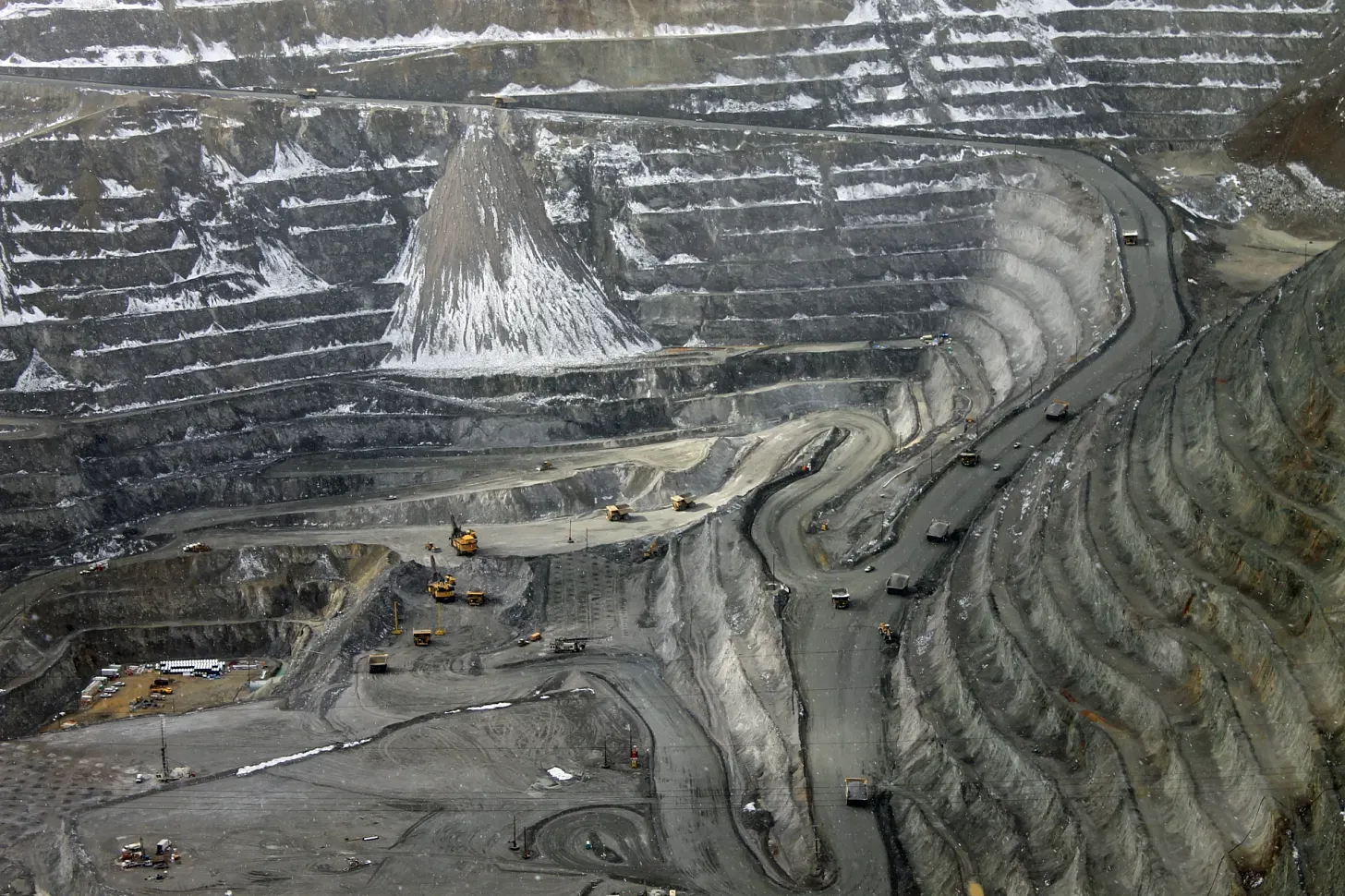
The Bingham Canyon Copper Mine in Utah, one of the planet’s largest human-made excavations. Jonathan P. Thompson photo.

Click the link to read the article on The Land Desk website (Jonathan P. Thompson):

January 10, 2024

Perhaps you’ve seen the latest viral Facebook meme about the ungodly amount of mined material needed to manufacture an electric vehicle. If not, you’ve probably seen one like it, maybe bashing EVs, maybe solar panels or wind turbines or some other clean energy technology (often accompanied by a gory image of a purported lithium mine). The implication is always the same: That ā€œgreenā€ technology you’re so fired up about isn’t green at all — in fact, it’s destroying the earth.Ā 

Normally I wouldn’t give these things a second thought. After all, they are memes, which by their very nature are simplistic and aimed at triggering the most primal emotional response, usually some flavor of fear. 

But this particular one — an inventory of the many tons of ore that must be mined to produce the materials in a Tesla model Y battery — has been especially infectious, it seems, and has made its way onto many of my social media pals’ feeds. Some of my friends have used it to argue against purchasing an EV, others have rightly questioned its veracity, while still others have posted counter-memes debunking it. 

Since the Land Desk covers lithium mining and other impacts of the clean energy transition, I figured I’d use this meme — circulated by someone named Jackie — as an opportunity to add some context. That’s because, regardless of whether the meme is accurate or not, it does bring up an important question: Are electric vehicles merely an instance of problem shifting, or transferring the equivalent environmental impacts from one technology to another? 

The post in question, let’s call it Jackie’s Meme, claims that 250 tons of earth must be moved to obtain the lithium, nickel, manganese, and cobalt in a typical EV battery, and a Caterpillar 994A used for this purpose would burn about 264 gallons of diesel in 12 hours, offsetting the carbon emissions reductions you’d get from driving the car.

These are certainly eye-opening numbers, even if they are a bit off (I came up with a figure of 69 tons of material moved, not 250, but more on that later). But they are also irrelevant in isolation, since the only thing we can conclude is that manufacturing an EV requires mining, just like mining was required to produce the laptop I’m writing this on, the desk it’s sitting atop, and the data center responsible for delivering the information to you. In other words, building an EV has an impact on the environment, maybe even a big one. 

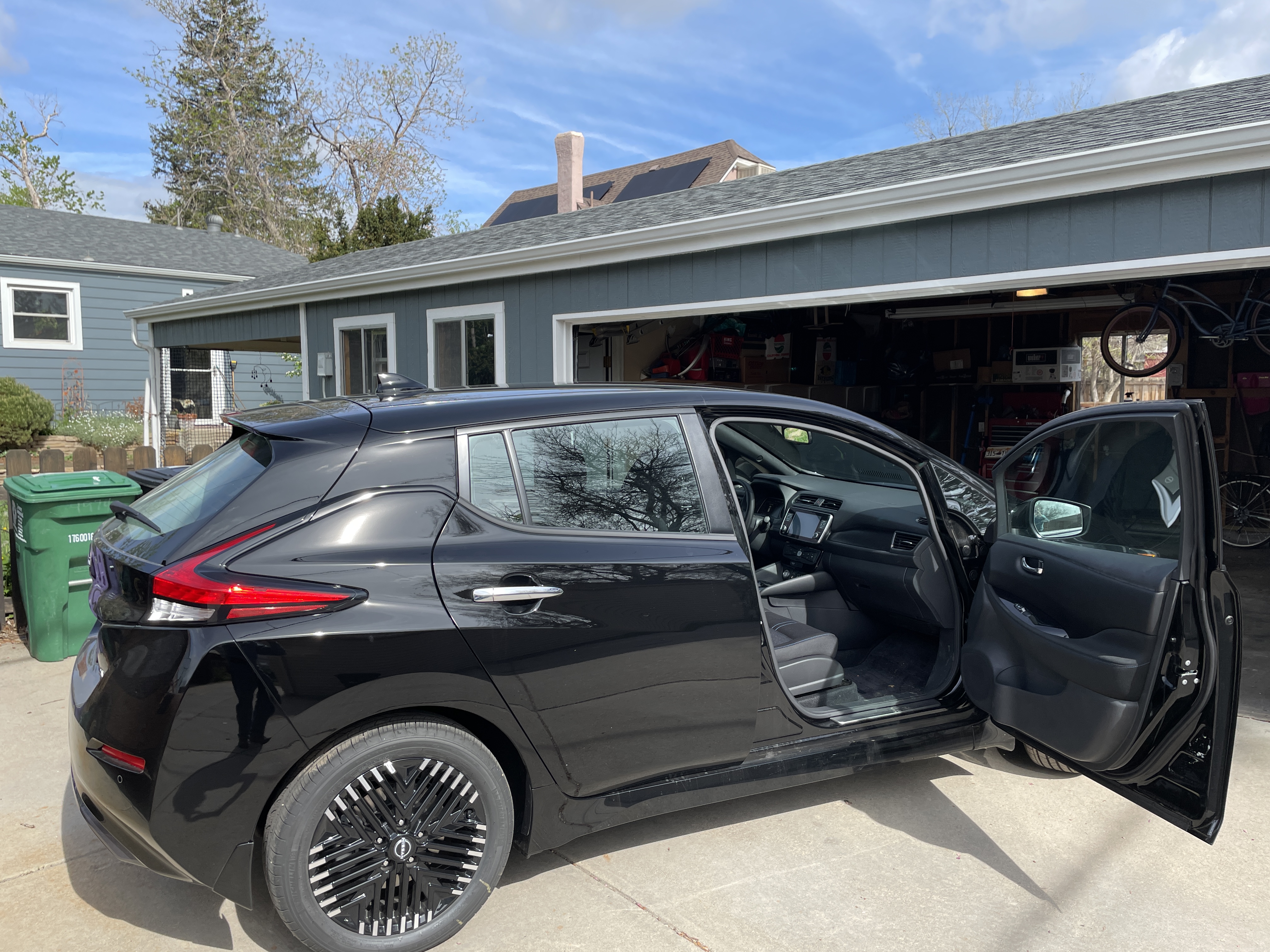
Coyote Gulch’s shiny new Leaf May 13, 2023

But you don’t buy an EV because it’s good for the environment. You buy it because it’s less bad for the environment than a conventional vehicle (and for other reasons, such as performance, fuel savings, and so forth). Without including a comparison of how much material and mining is needed for a conventional vehicle vs. an electric one, the meme is useless, meant only to scare people away from doing anything.

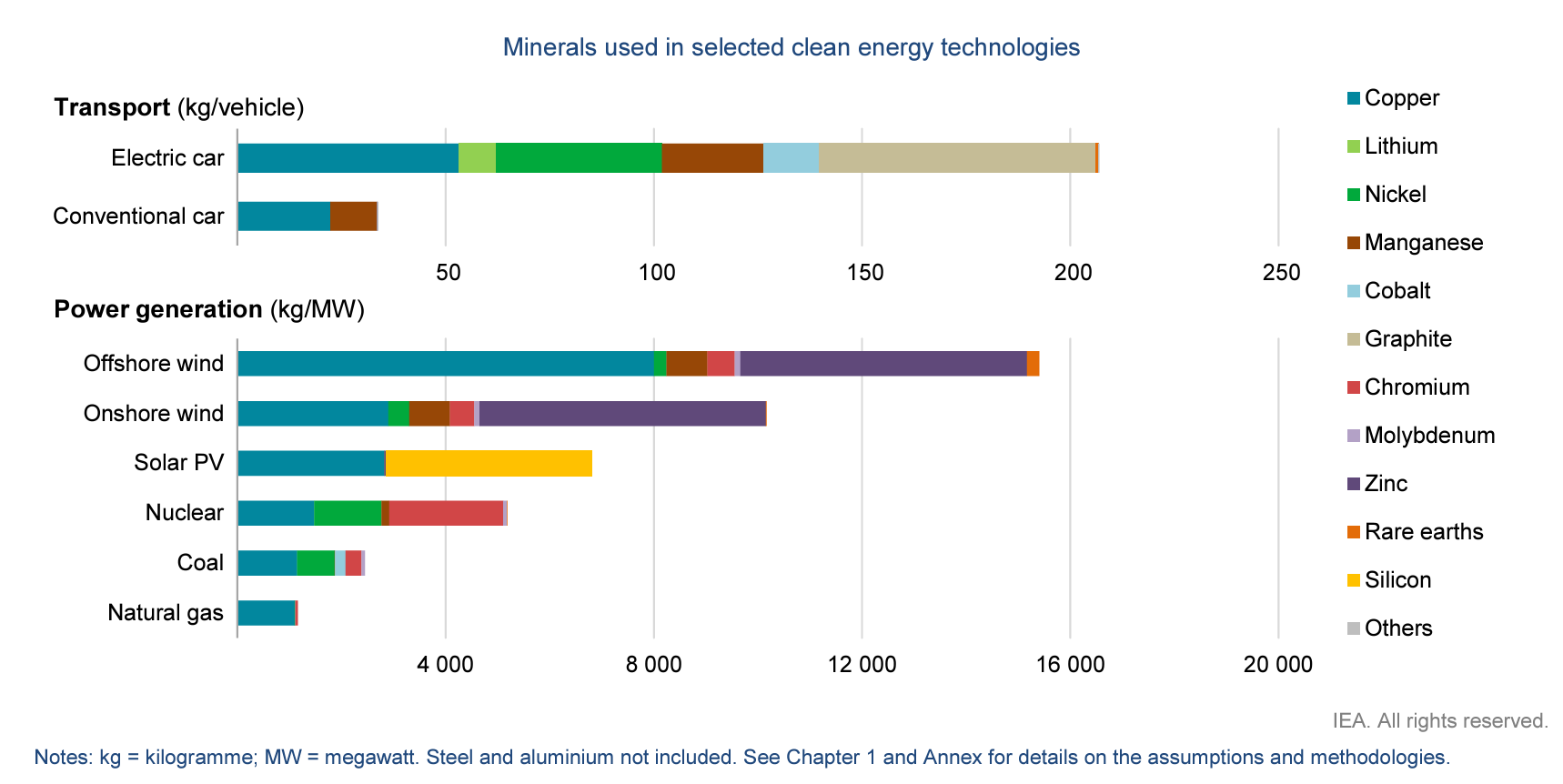
And that may have been the intent. But another reason for the omission is that accurate apples to apples comparisons of the total amount of mined material needed for an average ICE vehicle vs. an average EV are hard to find. That said, we do know that EVs generally are heavier than their gas-powered counterparts due to the large, dense batteries (although they have far fewer moving parts). And we do know that EVs require far more of certain minerals, such as lithium, cobalt, nickel, and copper. 

This IEA graphic is a good one for those particular minerals:

Source: International Energy Agency

Manufacturing an electric vehicle, then, requires about six times as much of the listed materials as a conventional car. I suspect this disparity might shrink somewhat if steel (iron), aluminum, and molybdenum were also included, but it wouldn’t change the basic fact: EVs are more mineral intensive than ICE cars. 

And whether the mineral is steel or nickel, cobalt or platinum, extracting it requires moving, hauling, milling, and smelting huge amounts of rock to get a relatively minuscule amount of target mineral. That’s why the Bingham Copper Mine near Salt Lake City is 2.5 miles wide and nearly 4,000 feet deep. And the more rock and ore you mine, the larger the volume of waste, or tailings and waste rock and, generally speaking, the greater the environmental impact1. Here’s a great graphic showing the ratio of total material moved to ore mined to commodity produced: 

From the Energy Transitions Commission. Hat-tip to Hannah Ritchie’s excellent Sustainability by the Numbers newsletter for pointing me to this resource.

Jackie apparently used this sort of math to get to the 250-tons figure. I think she’s off: using the IEA figures and the above graphic, I find that an EV would actually require moving about 69 tons of earth. But when you’re talking dozens of tons, it doesn’t really matter that much. Jackie’s point still stands: You’ve gotta mine a lot of stuff to make an EV.  

So, go ahead, buy that gasoline guzzler and feel good about it. You’re doing the planet a favor! 

Just kidding. 

Sure, maybe when they come out the factory door, a new EV has a larger environmental footprint than its gasoline-powered counterpart. But once you start driving the things, the gasoline car’s impact grows at a much faster rate than the EV’s because of, well, gasoline. 

Let’s say you live in New Mexico, and drive your car about 14,400 miles per year (the average for the state per registered vehicle), and you have an average car that gets about 22 miles per gallon. You’ll burn through 654 gallons of gasoline and your tailpipe will spew out about 6.4 tons of climate-warming carbon dioxide each year, along with a nasty cocktail of health-harming and smog-forming pollutants such as sulfur dioxide, carbon monoxide, nitrogen oxides, benzene, and particulates.

That’s on top of the impacts of drilling for the oil from which the gasoline is derived. Drilling and hydraulic fracturing a single well can use 10 million gallons or more of fresh water. The 1,300 gallons of crude oil needed to produce your car’s annual gasoline use will be accompanied by as much as 7,800 gallons of briney, contaminated wastewater that must be disposed of — often in deep injection wells that can trigger earthquakes. Planet-warming methane, along with harmful volatile organic compounds, can spew from oil wells, pipelines, and refineries. Pipelines rupture regularly, spilling wastewater, oil, or diesel ā€” sometimes they even explode. And petroleum refineries are major pollution sources as well. 

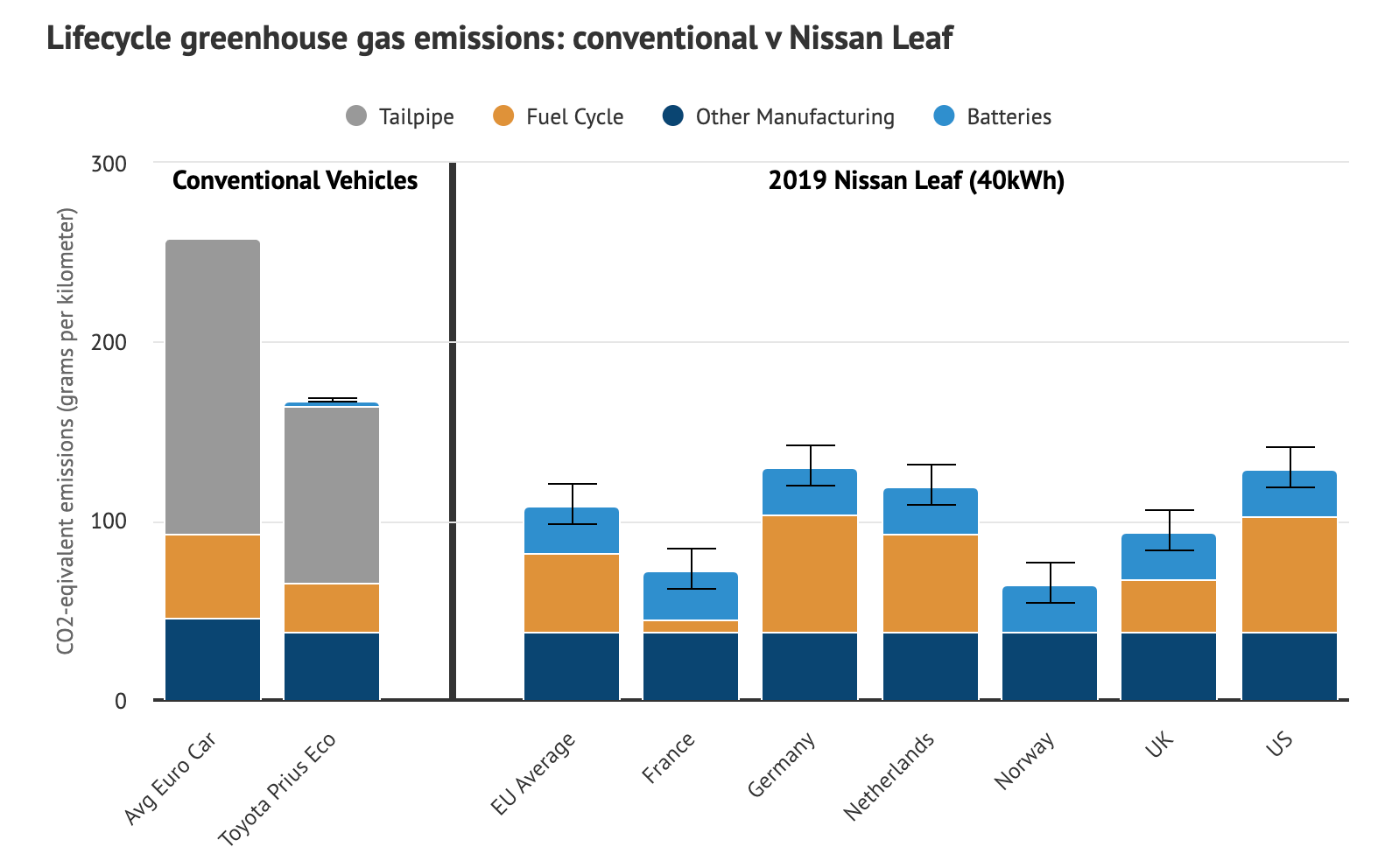
Electric vehicles don’t have tailpipes, so you’re not polluting the neighborhood by driving one around2. Yes, electric vehicles must be charged, and yes, some of that electricity is likely to be generated by burning fossil fuels, which requires extraction and creates pollution and other environmental impacts. But EVs generally are more efficient than gasoline powered cars, especially the gargantuan SUVs Americans are so enamored with, so even if you charge on a natural gas-generation-dominated grid you’re likely emitting less carbon per mile. Study after cradle-to-grave study has found that EVs have lower emissions over their lifecycle than their gasoline-powered counterparts, even when battery production3 and raw material mining is accounted for.

This is a Euro-centric graph from Carbon Brief, but it gets the point across. And believe me, an average ā€œEuro carā€ is likely far more efficient than an average U.S. conventional car. Source: Carbon Brief.

EVs’ environmental advantages will continue to build as the electricity grid is further decarbonized and fossil fuel generation is displaced by solar, wind, geothermal, small hydropower, and nuclear. Large-scale battery recycling efforts are ramping up, which will reduce the amount of mining needed to build the things, and battery technology is advancing: They are becoming more energy dense and new lithium-, cobalt-, and nickel-free batteries are being developed. Researchers and startups are working to extract lithium from geothermal brine, allowing them to generate electricity and produce battery materials in one shot. And some hardrock mining operations are electrifying their haul trucks and other equipment and building solar arrays to power operations.

The upshot: If you need to purchase a new vehicle, and you’re trying to choose between an electric one or a gasoline-powered one, the EV probably would be a better choice for the environment over the long haul — regardless of the scare-memes. 

Still, even that meme serves a purpose: It reminds us that we won’t get out of this mess by producing and consuming more stuff, no matter how ā€œgreenā€ it may be. [ed. emphasis mine] Simply clogging up the roads with electric vehicles, blanketing the deserts with solar panels, building new dams, or filling our homes with ā€œsustainableā€ goods won’t solve the problems created in the first place by overconsumption and waste. Economic and cultural systems must be overhauled or even overthrown. And the incessant hunger for more, more, more must be tempered at last.

New Year’s wishes: A bit more snow, please! #Snowpack levels entering 2024 are underwhelming, but there’s still plenty of time for a turnaround — @DenverWater

Click the link to read the article on the Denver Water website (Todd Hartman):

January 4, 2024

Most of us have a slate of hope for the New Year. Denver Water does too! 

We’re hoping for a bump in the snowpack as winter unfolds.Ā 

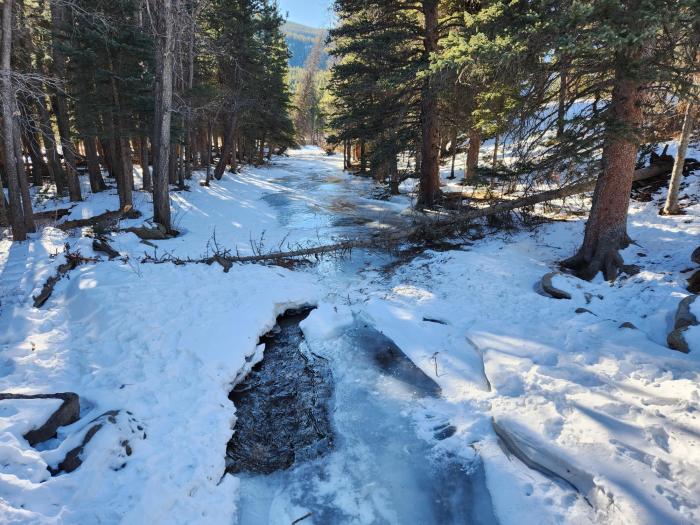
A half-frozen North Saint Vrain creek gurgles through Wild Basin in Rocky Mountain National Park, where warm temperatures and spotty snowpack in early January signaled a slow start to the snow season. Photo credit: Denver Water.

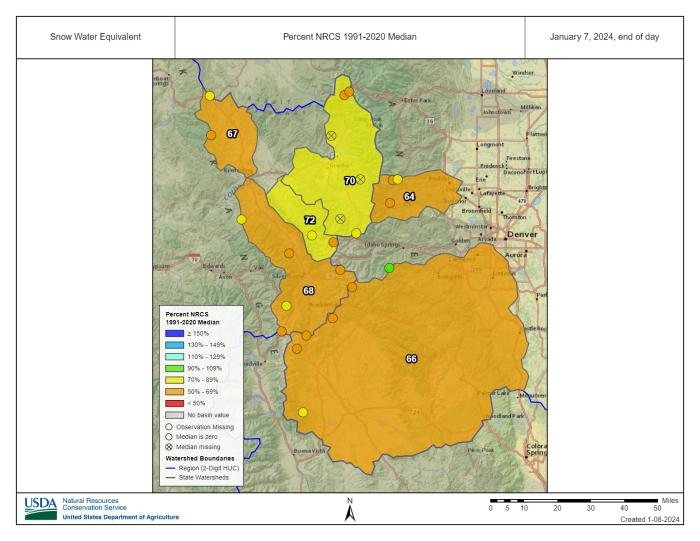
We entered January with ho-hum conditions, with snowpack in the mid-60s in terms of percentage of normal in Denver Water’s two water supply river basins — the South Platte and the Colorado.

That is not a banner start to the 2024 snowpack. 

The last time the Colorado River snowpack started off near the current level was in 2013. For the South Platte however, snowpack is close to where it was last year. 

ā€œI’d rather be ahead than behind, but there’s still plenty of time for improvement,ā€ noted Nathan Elder, Denver Water’s manager of supply. ā€œThe deficits we see currently can still be made up with one big storm.ā€

In the mountain watersheds where Denver Water collects its water supply, the percentage of water held in the snowpack (called the snow water equivalent or SWE), was far below normal as of Jan. 7, 2024, but additional mountain snow is in this week’s forecast. Image credit: USDA National Resources Conservation Service.

Another way to look at the snowpack so far this season is by plotting current snow water equivalent percentages against the normal trajectory through the winter and spring. This graphic looks at Colorado’s snow water equivalent percentages in early January 2024 compared to normal.

This image shows the natural rhythm of Colorado’s snowpack, the state’s frozen water reservoir, as it builds from winter to spring and then melts in the spring runoff. The black line shows Colorado’s snow water equivalent, or SWE, on Jan. 3, 2024, as compared to normal (the green line), and the historical minimum and maximum of snowpack peaks in the spring. Image credit: USDA Natural Resources Conservation Service.

There’s another point that can be made to push back on any early pessimism: Reservoir storage levels are the best since 2019 for Denver Water, at 86% of average versus the 83% that is typical this time of year. Statewide, too, reservoirs are in good shape following a good snow (and rain!) year in 2023.

Last year’s boost in reservoir levels is critical, as the extra water could help nurse water providers through a tough year should conditions remain underwhelming during the next four months of 2024. 

Notably, reservoir conditions on the Eastern Plains are strong, too, boosted by a snowstorm that hit northeast Colorado the day after Christmas. Having high water storage levels for farmers and ranchers is always important because that reduces the potential that Denver Water might need to send more water downstream to meet the demands of older, more senior water rights holders. 

“Below-normal snowpack is always concerning. Recent storms brought a little improvement and we continue to watch the weather and plan for this year’s spring runoff ā€” while hoping for more snow,ā€ Elder said. 

Now is a good time toĀ check for water leaksĀ inside your home, because indoor use in the wintertime matters. Every bit we save in these colder months is water available to us when the warm months arrive.ā€

2024 #COleg: #Colorado lawmakers to push even harder in 2024 to replace lawns, tackle other major water issues — Fresh Water News

Map of the Colorado-Big Thompson Project via Northern Water

Click the link to read the article on the Water Education Colorado website (Jerd Smith):

January 10, 2024

Colorado lawmakers will be asked to weigh in on more than a half-dozen proposed water bills this year that will likely include support for improving the water quality in Grand Lake, significant new funding for replacing thirsty lawns, a pilot program to test using natural systems — such as plants and soils, rather than water treatment plants, to clean up water — and new state-level protection for wetlands.

resolution asking lawmakers to support work to improve the clarity of water in Grand Lake, under consideration for months, is receiving broad-based support from powerful water interests, including Northern Water, said Mike Cassio, president of Grand Lake’s Three Lakes Watershed Association. Cassio is among a group of advocates who have been trying to improve the lake’s once-clear waters for decades.

ā€œNothing official until it makes it to the floor, and it is passed.Ā  However, we are further than ever,ā€ Cassio said.

Forget bluegrass lawns

Ambitious plans are also on the table to boost to $5 million the amount of money the state is putting into an existing turf replacement program. Gov. Jared Polis as well as members of a special Colorado River Drought Task Force have asked that the program be expanded. It was approved by lawmakers in 2022 and given $2 million in funding.

ā€œI would love to see the project continue,ā€ said state Sen. Cleave Simpson, a Republican from Alamosa, ā€œand $5 million seems appropriate,ā€ at least initially.

Simpson, who is general manager of the Rio Grande Water Conservation District, is a sponsor of a bill that would provide at least $1 million to launch a pilot program testing so-called ā€œgreenā€ infrastructure, a term that refers to using such things as plants, wetlands and soils to clean up water, helping offset the use of more expensive tools, such as water treatment plants.

That’s only part of what could be another record-breaking year for funding Colorado water projects, according to Sen. Dylan Roberts, a Democrat from Frisco.

Last year, lawmakers approved $92 million in water funding, Roberts said, money that helps pay for water conservation, planning, dams and irrigation projects, and new technology, among other things.

ā€œLast year’s projects bill (the legislative tool through which funding is approved) was the largest amount of funding on record,ā€ he said. ā€œI am hopeful we can break that record this year.ā€

Roberts said he also hopes to introduce legislation expanding the amount of water available to protect streams and to add more protection for farmers and ranchers who agree to place their water into conservation programs benefiting the Colorado River and potentially other waterways.

Replacing federal wetland protections

Another major initiative likely to surface is a plan to create a state-level program to protect streams and wetlands affected by road-building and construction. Last year, the U.S. Supreme Court, in its Sackett v. EPA decision, drastically narrowed the definition of what constitutes a protected stream or wetland under rules known as waters of the United States. The decision left vast swaths of streams and wetlands in the American West and elsewhere unprotected.

Colorado is among a handful of states seeking to set up its own program to ensure its streams and wetlands are safe even without federal oversight. Last year, theĀ Colorado Department of Public Health and EnvironmentĀ (CDPHE) took temporary, emergency action to protect streams, but state lawmakers must approve any new, permanent program.

The CDPHE has been working with a large group of people on the issue, including farm and water interests, environmentalists, and construction and development firms. But what the new program might contain and how it will fare in the legislature is not clear.

ā€œI think there is a lot of desire to get something like this done,ā€ said John Kolanz, a Loveland-based attorney and water quality expert who represents construction interests. ā€œThe Sackett opinion really changed things. Some people estimate that it has reduced coverage of streams by 50% or more.ā€

As a result, Kolanz said, ā€œThe new state program is going to have to be quite large and it will have significant land-use implications. We’ve got to get it right on the front end.ā€

Fresh Water News was launched in 2018 as an independent, nonpartisan news initiative of Water Education Colorado. Our editorial policy and donor list can be viewed at wateredco.org.

More by Jerd SmithJerd Smith is editor of Fresh Water News. She can be reached at 720-398-6474, via email at jerd@wateredco.org or @jerd_smith.

Grand Lake and Mount Craig. CC BY 2.5, https://commons.wikimedia.org/w/index.php?curid=814879

#Earth reaches grim milestone: 2023 was the warmest year on record — The Los Angeles Times #ActOnClimate

Monthly global surface air temperature [1] anomalies (°C) relative to 1991–2020 from January 1940 to December 2023, plotted as time series for each year. 2023 is shown with a thick red line while other years are shown with thin lines and shaded according to the decade, from blue (1940s) to brick red (2020s). Data source: ERA5. Credit: C3S/ECMWF.

Click the link to read the article on The Los Angeles Times website (Hayley Smith). Here’s an excerpt:

An astonishing seven consecutive months of record-breaking warmth have culminated in a grim milestone for humanity: 2023 was, officially, Earth’s hottest year on record.

That assessment, announced Tuesday by the European Union’s Copernicus Climate Change Service, follows a year in which extreme heat smothered multiple continents simultaneously, pushed ocean temperatures to alarming highs and spurred dire warnings about the worsening effects of climate change. 

ā€œ2023 was an exceptional year with climate records tumbling like dominoes,ā€ read a statement from Samantha Burgess, deputy director of Copernicus. ā€œNot only is 2023 the warmest year on record, it is also the first year with all days over 1 degree Celsius warmer than the preindustrial period. Temperatures during 2023 likely exceed those of any period in at least the last 100,000 years.ā€

The January 1, 2024 #Colorado Water Supply Outlook Report is hot off the presses from the NRCS

Click the link to read the report on the NRCS website. Here’s the summary:

Lousy start to the 2023-24 #snowpack year on the #RioGrande — John Fleck (InkStain.net)

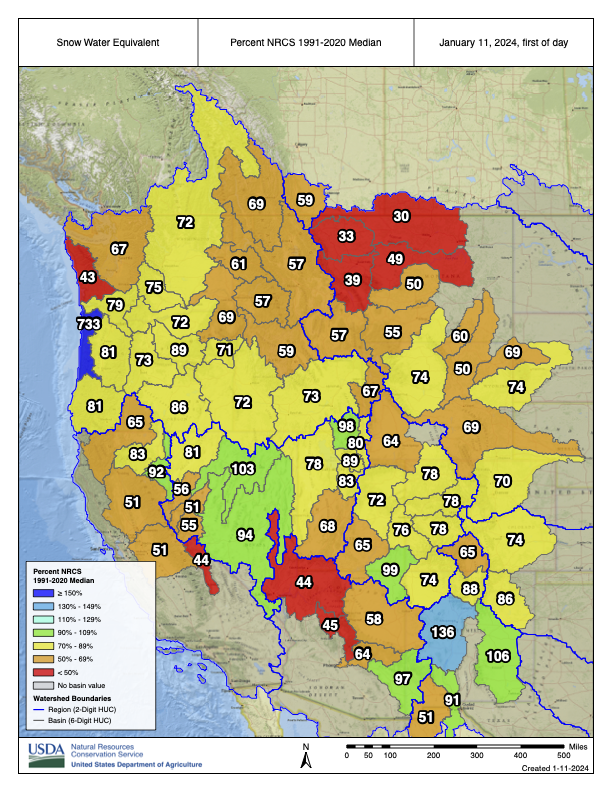
Westwide SNOTEL basin filled map January 11, 2024 via the NRCS.

Click the link to read the article on the InkStain website (John Fleck):

Three months into the 2023-24 water year, we have our first early look at what sort of runoff to expect on the Rio Grande in the coming year, and it doesn’t look great. The January NRCS median forecast for March-July runoff is 42 percent of ā€œnormalā€ at Otowi, the critical forecast point where the Rio Grande enters New Mexico’s Middle Rio Grande. It’s still early in the snow season, with a wide range of possible outcomes depending on the storm patterns over the next few months. But the best possible outcome (statistically a one chance in 20 of this much water) is still below the 30-year median.

In other words, we’re pretty clearly on track for a below-average runoff year.

The forecast uses the NRCS’s new Multi-Model Machine-learning Metasystem (M4) forecasting tool, part of an effort to develop improved statistical tools using machine learning approaches to the big snowpack datasets rather than the principal components analysis used in the past. The peer-reviewed paper laying out the testing done over the last half decade suggests significant improvement in the tricky task of forecasting runoff.

The biggest uncertainty is always the weather, but I’m excited to see the new, improved statistical models shifting from the research world to operations.