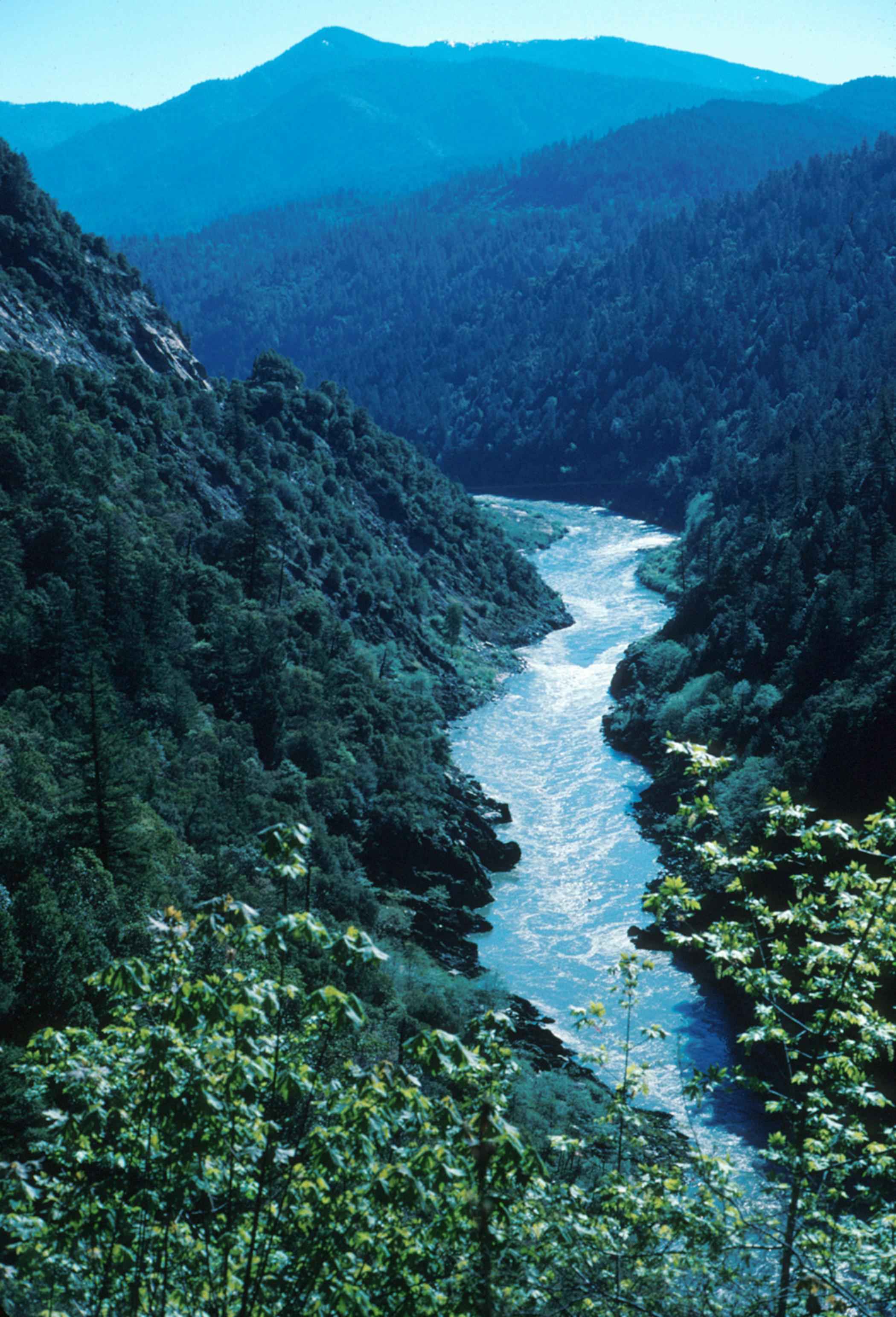
Embark on an exhilarating visual journey as we unveil the awe-inspiring transformation of the Klamath River over 5 months of meticulous deconstruction of Copco 2 dam. Immerse yourself in the grandeur of over 15,000 captivating images capturing the first and smallest of the four dams destined for removal by October 2024. Witness history in the making with the unveiling of the largest river restoration project ever undertaken! This mesmerizing time-lapse is just a glimpse into our ambitious 6-year independent feature film, “Undamming Klamath.” Join us as we bring this monumental river restoration story to life! This is an independent film and time-lapse project that needs your support. Tax-deductible donations through The Redford Center below:
“This was a hugely beneficial storm cycle over the last couple of weeks, both with respect to the water situation and outdoor recreation,” said Russ Schumacher, the state climatologist and the director of the Colorado Climate Center. “Colorado looks a lot better than it did a couple of weeks ago.”
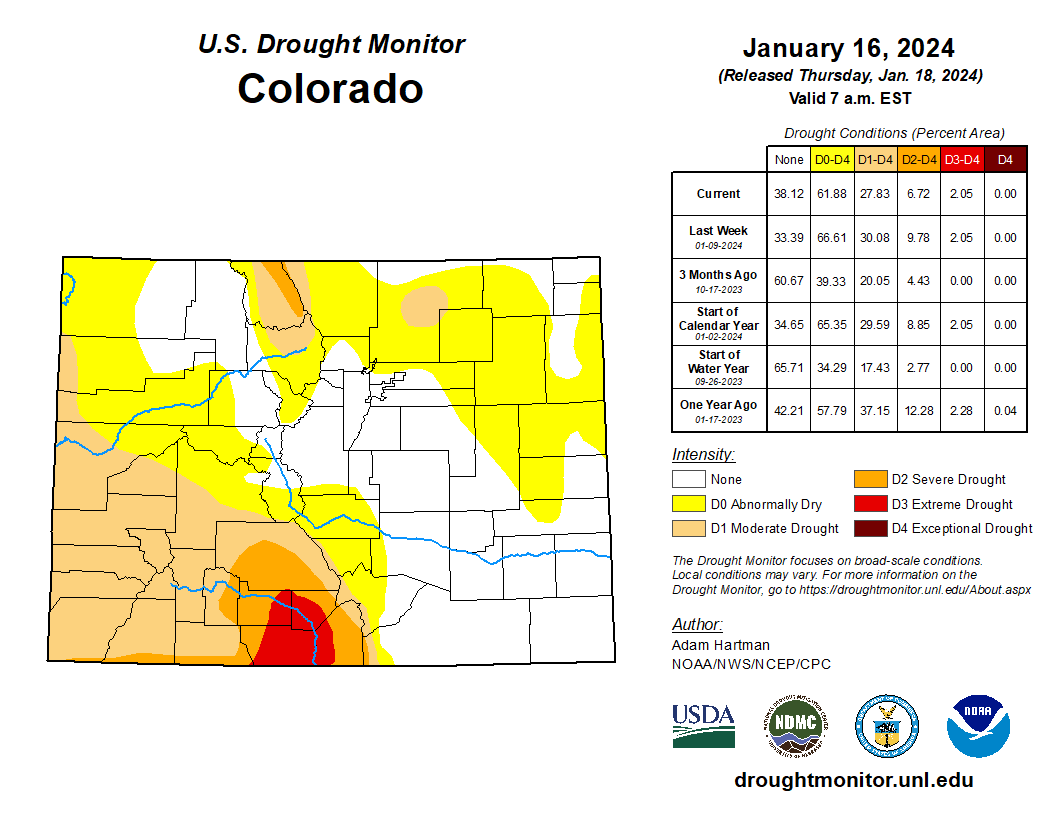
Colorado Drought Monitor map January 16, 2024.
Sixty-two percent of the state was in drought last week, according to the most recent data released by the U.S. Drought Monitor. That’s a slight improvement from 67% before the storms…Not all areas of the state are faring the same. While the snowpack in the Yampa and South Platte river basins are sitting at 98% of median levels, the amount of snow in the Upper Rio Grande basin is at 69% and the snowpack in the San Juan basin is at 80% of median…A swath of land in southern Colorado — including Conejos, Costilla, Rio Grande and Alamosa counties — remained in severe or extreme drought, representing 9% of the state.
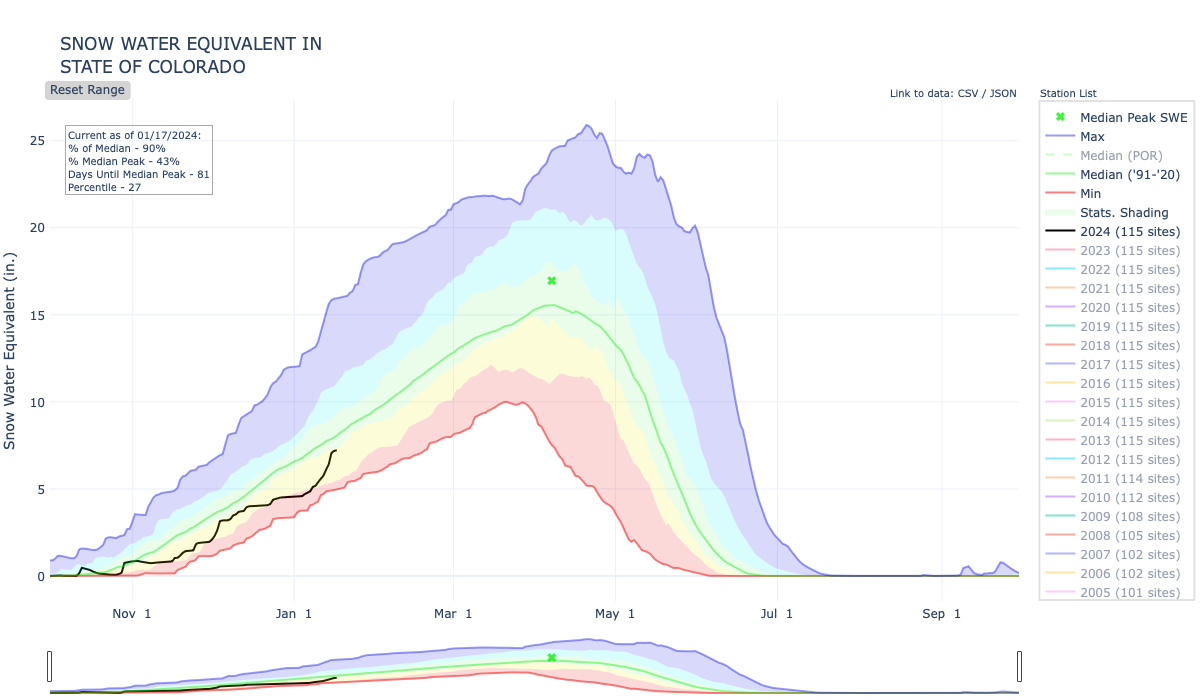
The snowpack in the Colorado River headwaters measured 99% of the median on Monday.
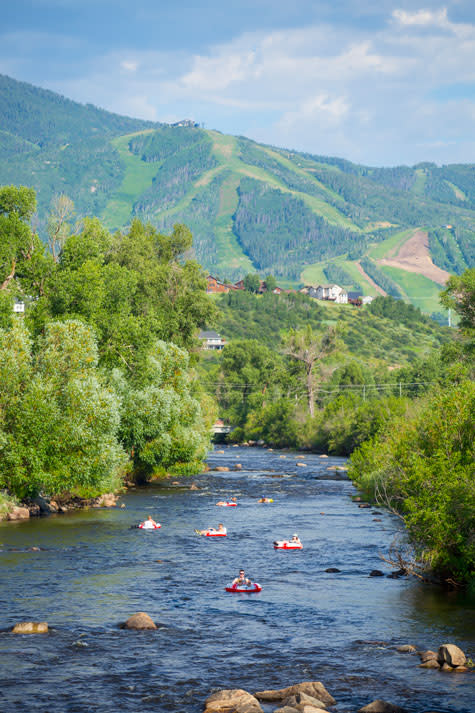
Tubing the Yampa River in Steamboat Springs. Tubing season typically begins in June and lasts through August. Conditions are reliant on the amount of snow-melt and rainfall Steamboat receives. If the water levels are too high or too low tubing will be halted. Photo credit: City of Steamboat Springs
A new forecasting tool to determine closing and opening procedures for the Yampa River is among a set of proposed regulations being discussed by city officials. The proposed policies are aimed at protecting “the biological integrity of the Yampa River while sustainably managing recreation,” according to a report provided to council members last week. Late last year, Parks and Recreation commission members approved the use of the new tool, provided by the Carbondale-based firm Lotic Hydrological, which will set closure and reopening decisions for the Yampa River based on a framework of scientific criteria. Craig Robinson, Parks and Recreation Open Space and Trails Manager, said the current regulations for the criteria to determine river openings and closures “are a little bit vague,” in that they are based on a number of factors and involve consultation with Colorado Parks and Wildlife…
Outfitters and anglers licensed by the city to use the Yampa River agree the health of the river’s ecosystem is most important, but depending on their interests, they don’t necessarily agree over the proposed policies. Backdoor Sports owner Pete Van De Carr noted the proposed system to close and reopen the river will likely result in less frequent but longer-term closures…
Brett Lee, the owner of Straightline Sports, provides angling tours for his customers on the Yampa River. Unlike Van De Carr, he said he welcomes the new opening and closing procedures being pitched by city staff because they will, hopefully, help mitigate the impact of tubing on the river…Adding to system for determining the opening and closing of the Yampa River, the city is also proposing new policies for licensed commercial outfitters that supply tubes and other guided services on the Yampa River. The proposed rules will require any tubes rented by outfitters or sold in the city must have a minimum 30-guage PVC thickness. If approved, they would also implement a three-year permit renewal process for outfitters and will specify that tube allocations for the outfitters are not considered as “real or personal property.” Additionally, if any business owner with tube allocations sells their business — and its tubing allocations — the city must be notified, and the new entity must reapply to assume their allocation.
The experts tell us an energy gap looms. Fossil fuels are phasing out, and solar and wind power can’t produce enough electricity to meet the demand in coming decades.
But that’s not the thinking of Amory Lovins, the 76-year-old co-founder of RMI, formerly the Rocky Mountain Institute in western Colorado.
A Harvard and Oxford dropout who’s been called the “Einstein of Energy Efficiency, Lovins said recently: “If we do the right things, we’ll look back and ask each other, ‘What was all the fuss about?’”
Lovins became famous in the 1970s after his research told him that building more polluting coal-fired power plants was a destructive mistake. His solution then was greater efficiency and reliance on renewables, and they, he insists, are still the answer.
“Though it’s invisible, efficiency will cut 50% of energy use and up to 80% if we do the right things,” he told me recently. “Most of the energy we use is wasted, which makes it much cheaper to save it, rather than buy it or burn it.”
According to a recent Princeton paper, he’s right: 84% of all energy consumed goes to waste during delivery or by leakage.
To prove it decades ago, he built a passive solar, super-insulated house at 7,100 feet of elevation in Old Snowmass, Colorado. It never had a heating system though winters regularly recorded 40 degrees below-zero temperatures.
When I arrived there recently at 8 a.m. it was 12 degrees F. Yet the house featured banana and papaya trees growing in natural light around a koi pond.
We became acquainted when he read my January 2023 Writers on the Range column entitled; “The energy gap nobody wants to tussle with.” I’d advocated building small modular nuclear reactors to bolster the grid when the wind doesn’t blow and the sun doesn’t shine.
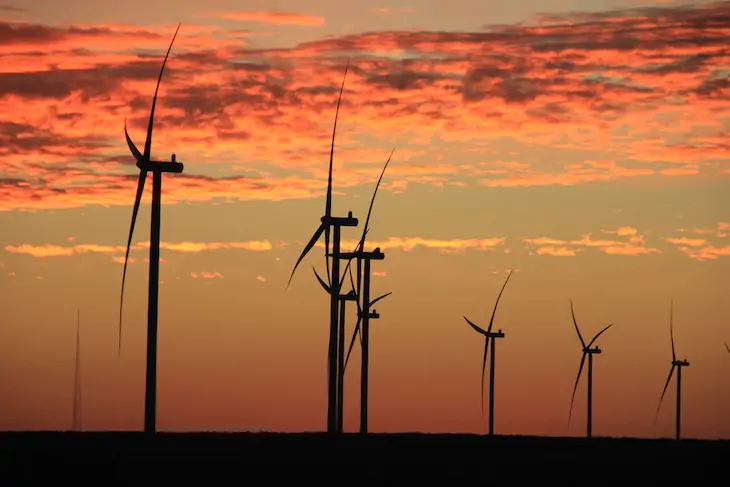
The Crossing Trails Wind Farm between Kit Carson and Seibert, about 150 miles east of Denver, has an installed capacity of 104 megawatts, which goes to Tri-State Generation and Transmission. Photo/Allen Best
Lovins became famous in the 1970s after his research told him that building more polluting coal-fired power plants was a destructive mistake. His solution then was greater efficiency and reliance on renewables, and they, he insists, are still the answer.
“Though it’s invisible, efficiency will cut 50% of energy use and up to 80% if we do the right things,” he told me recently. “Most of the energy we use is wasted, which makes it much cheaper to save it, rather than buy it or burn it.”
According to a recent Princeton paper, he’s right: 84% of all energy consumed goes to waste during delivery or by leakage.
To prove it decades ago, he built a passive solar, super-insulated house at 7,100 feet of elevation in Old Snowmass, Colorado. It never had a heating system though winters regularly recorded 40 degrees below-zero temperatures.
When I arrived there recently at 8 a.m. it was 12 degrees F. Yet the house featured banana and papaya trees growing in natural light around a koi pond.
We became acquainted when he read my January 2023 Writers on the Range column entitled; “The energy gap nobody wants to tussle with.” I’d advocated building small modular nuclear reactors to bolster the grid when the wind doesn’t blow and the sun doesn’t shine.
Lovins called to set me straight, and after a second conversation and more research, I’m beginning to think he’s right.
Though Lovins has many solutions for the energy gap, he touts three major ways to find more energy in what we already do. Tops on the list is changing how we build and retrofit existing structures because buildings consume 75% of the electricity we buy.
Most energy jobs in the United States are already increasing efficiency, ranging from upgrading windows and other retrofits, far outpacing the shrinking fossil fuels industry. (energy.gov)
As one example, Lovins advocates “outsulation” for older structures, defined as adding exterior insulating panels to save heat. Courtesy of the European Union, my Irish in-laws recently had their house “wrapped” and saw their heating bills plummet.
His second way is demand-response, which Lovins calls flexiwatts. An example is cycling air conditioners off for 15-30 minutes at a time, a barely noticeable adjustment that cuts demand for peaker-power plants, those big emitters of greenhouse gases.
His third way is using renewables more effectively. Diversifying renewables by location and type within a region evens gaps from windless and cloudy weather.
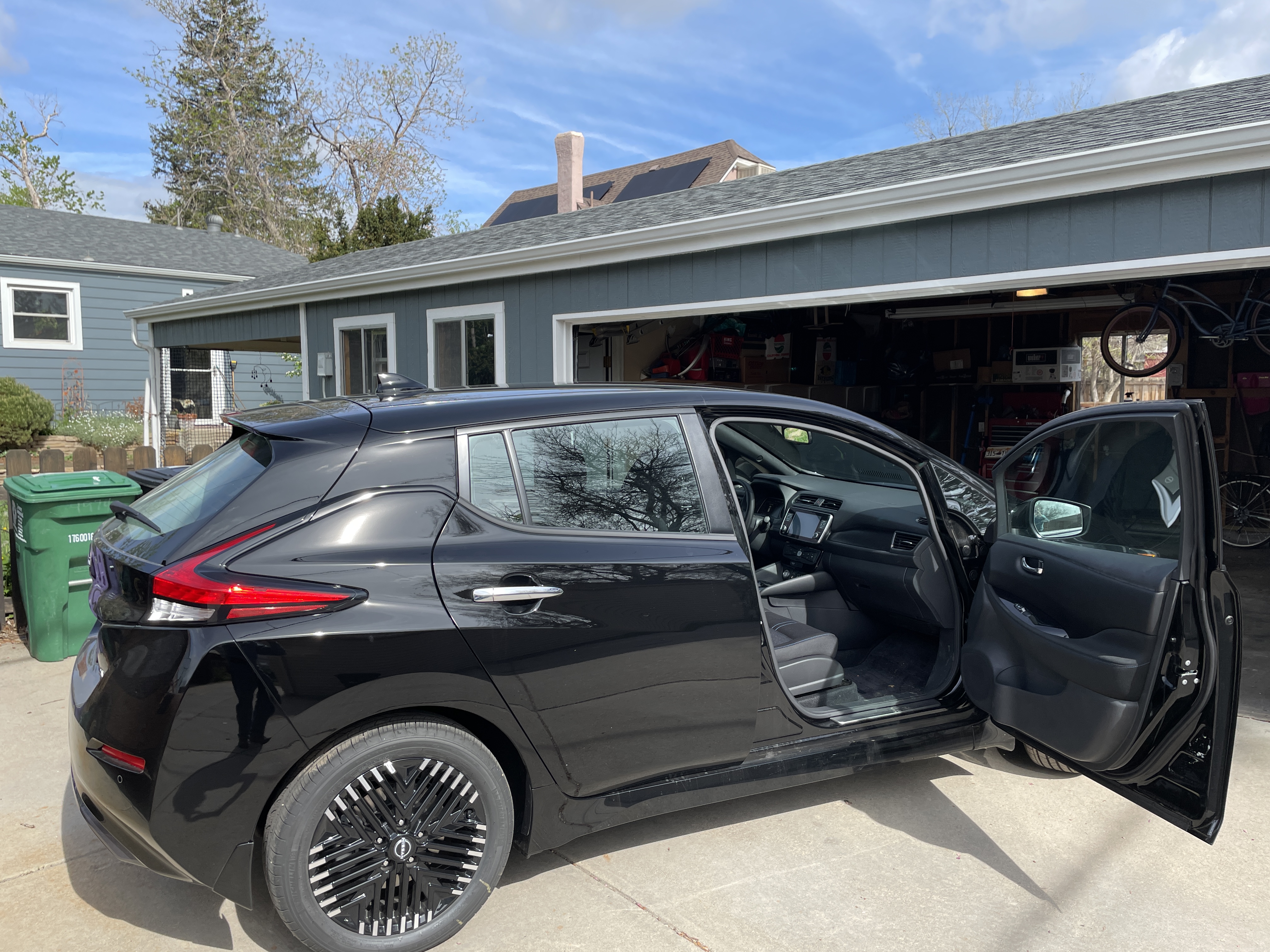
Coyote Gulch’s shiny new Leaf May 13, 2023
As for electric cars being a drain on the grid, they will prove to be sources of electricity, he said, as the next generation batteries will be cheaper and likely have double the storage. Daytime solar stored in vehicles will be bi-directional, spooling out power during peak evening demand.
Lovins also cites LED lights dramatically cutting the cost of energy. In just a decade, they’ve become 30 times more efficient, 20 times brighter and 10 times cheaper.
Lovins is quick to admit that an energy gap remains, but he predicts a single-digit gap—6%—between what renewables produce and what’s needed. That, he said, can be made up by stored, green hydrogen or ammonia, manufactured from water and air with solar energy, and burned in existing gas plants.
As for nuclear power plants, Lovins said even the best-case scenarios for the next generation of nuclear generators are at least a decade away, and at least eight times more costly than renewables today.
“It’s better to use fast, cheap and certain rather than slow, costly and speculative,” he said.
Though cutting loose from fossil fuels is a massive undertaking, Lovins said America is on track. “We are on or ahead of schedule on renewables, with 85% of net new additions to the grid from renewables, and $1 billion invested in solar in the United States daily.”
For these reasons and more, Lovins sees our energy future as more of what we’re already doing—only smarter and faster. [ed. emphasis mine]
Let’s hope that he’s right. Dave Marston is the publisher of Writers on the Range, writersontherange.org, an independent nonprofit that exists to spur lively dialog about the West. He lives in Durango, Colorado.
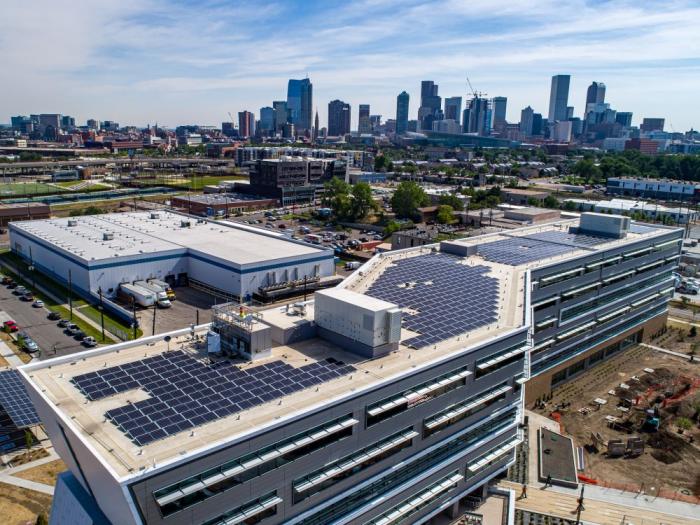
Denver Water’s administration building is powered by solar panels. Photo credit: Denver Water.