#Drought news January 25, 2024: Temperatures were below normal for all areas outside the plains of #Colorado and #Wyoming

Click on a thumbnail graphic to view a gallery of drought data from the US Drought Monitor website.

Click the link to go to the US Drought Monitor website. Here’s an excerpt:

This Week’s Drought Summary

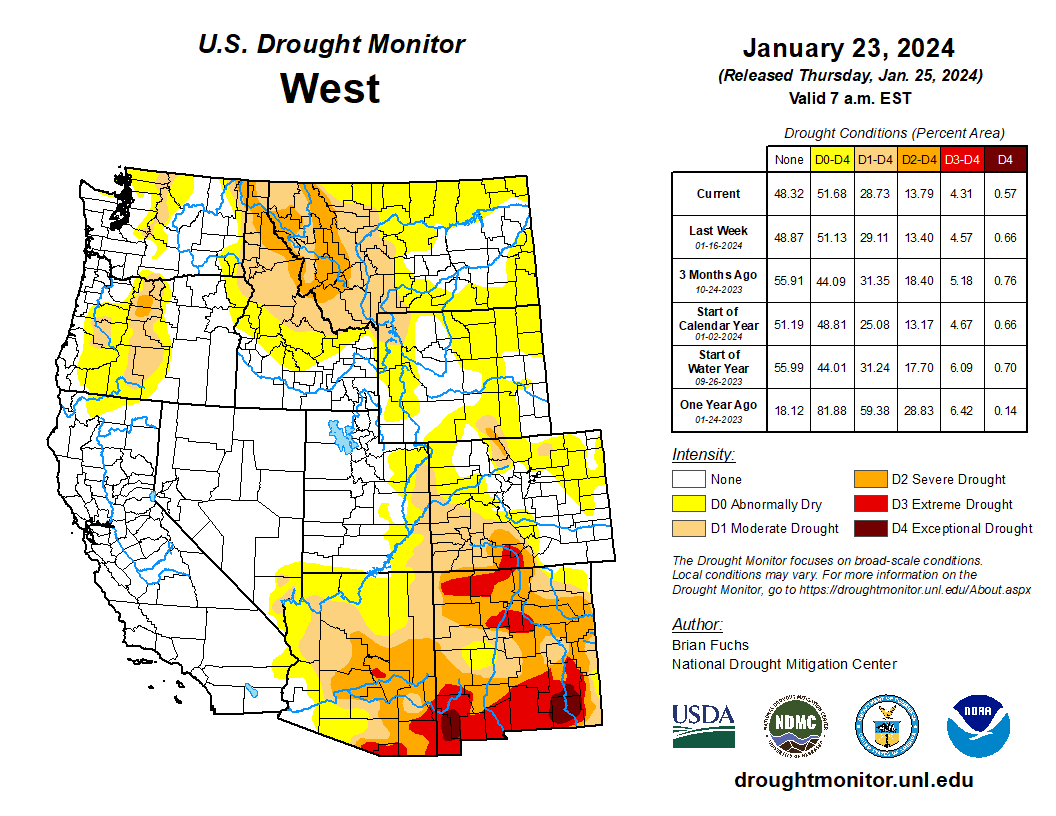
The current period was dry over most of the country with the greatest amount of precipitation occurring along the west coast and from east Texas into Arkansas. Temperatures were well below normal for most locations east of the Rocky Mountains, where departures were 5 degrees or more below normal for most areas. The greatest departures from normal were over Tennessee, Kentucky, and northern portions of Alabama and Mississippi where readings were 20-25 degrees below normal. The warm winter continued in the West with temperatures 5-10 degrees above normal over a majority of the region. The warmer-than-normal temperatures have been a challenge for snow accumulation with many locations, especially in the northern Rockies, having a very challenging start to the snow accumulation season. With an active pattern through the central Plains into the Midwest the past few weeks, a reassessment of drought indicators was done in many locations this week to examine drought intensity levels and adjust where the data supported it. In most instances, drought remains but the data allowed for intensities to be reduced. The end of the period had an active pattern again developing in the southern Plains and into the South where widespread precipitation was anticipated after the data cutoff for this week. These locations will be assessed on next week’s map…

High Plains

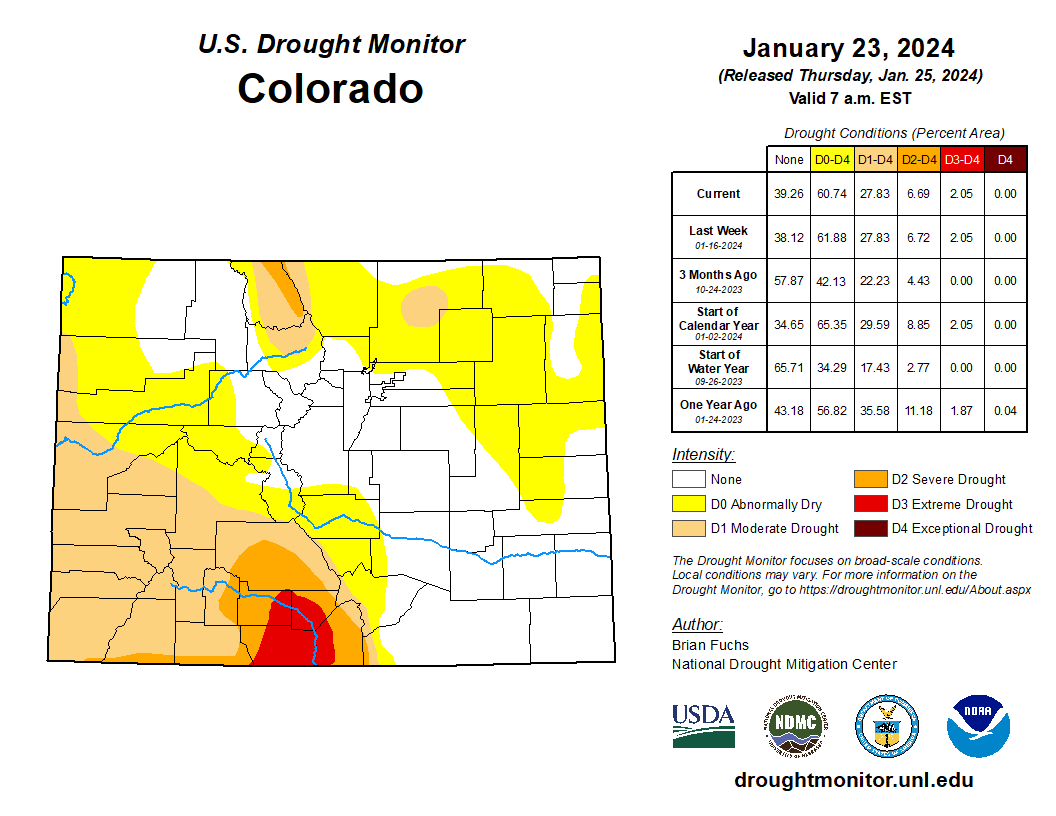
It was a mostly dry week over much of the region with only eastern Kansas receiving widespread, albeit light, precipitation. Temperatures were below normal for all areas outside the plains of Colorado and Wyoming and northern North Dakota where they were 3-6 degrees above normal. Outside of these areas, temperatures were generally 9-15 degrees below normal for the week. The wetter pattern over the last several months allowed for a reassessment of the data to investigate potential changes in the drought intensity levels. It was noted that even though the last 9-12 months have a stronger signal toward the wet spectrum, there are still long-term issues that go out 24-36 months or more in much of the central Plains. In looking at the data, support for the existing extreme drought in eastern Nebraska was not there, so it was improved to severe drought this week. In Kansas, areas of moderate and severe drought were also improved based on the lagging support for these intensity levels. Degradation took place over portions of northern North Dakota and eastern Wyoming where abnormally dry conditions were expanded based on the short-term dryness in these regions…
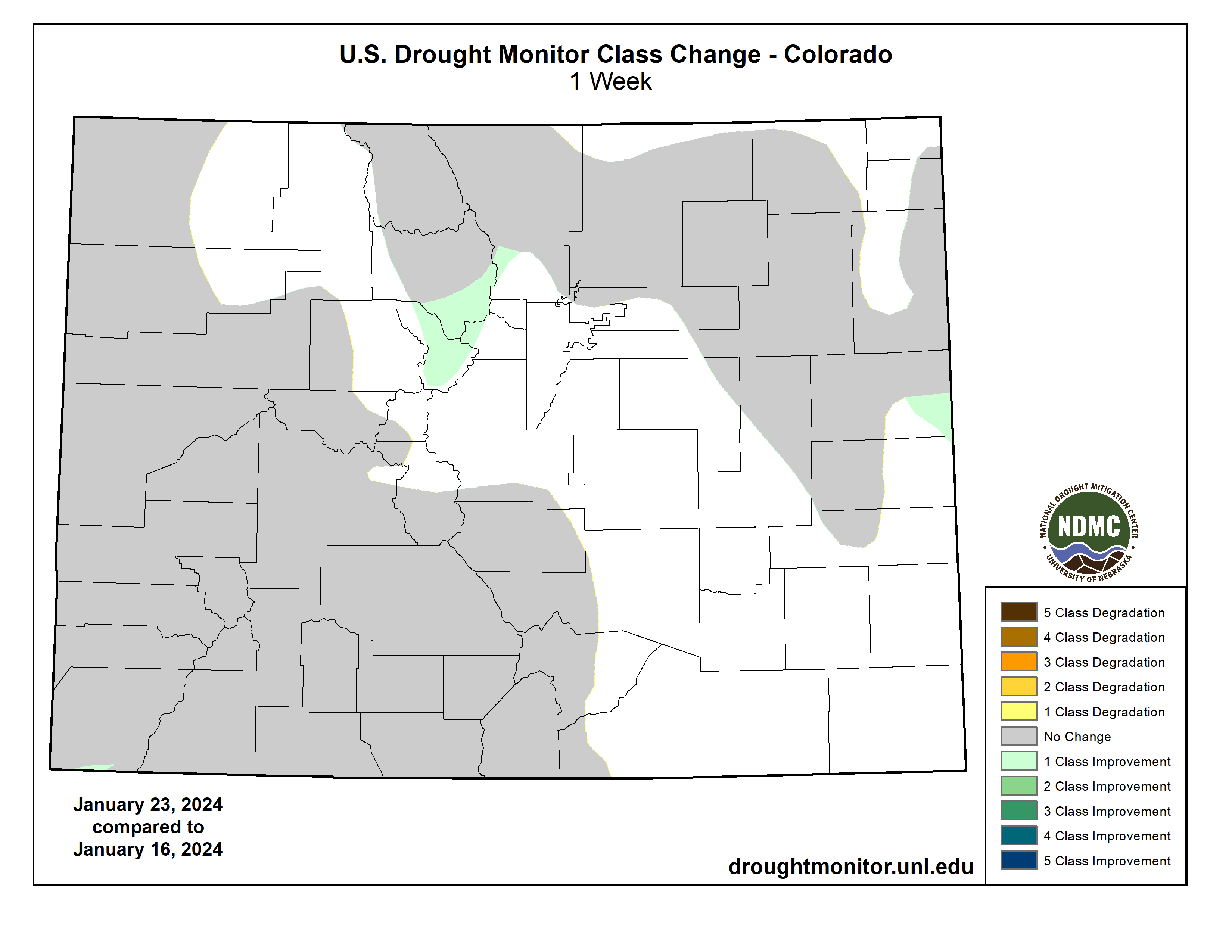
Colorado Drought Monitor one week change map ending January 23, 2024.

West

Above-normal temperatures dominated much of the region with departures of 9-12 degrees above normal over portions of western Wyoming, northern Nevada, central Idaho and northeast Utah. Temperatures were cooler than normal over Washington, northern Oregon, northern Idaho and much of Montana. The greatest rains were along the coast with some flooding issues being reported this week, especially in southern California. Further inland, it remained dry and the dryness coupled with the warmer temperatures has allowed for snow drought to develop, especially in the northern Rocky Mountains. The wetter pattern over the most recent weeks allowed for a reassessment of conditions over New Mexico and into eastern Arizona, where improvements were made. Areas of extreme and exceptional drought were reduced this week in western New Mexico while severe drought was improved in western New Mexico into eastern Arizona. Moderate drought was expanded over western Wyoming and severe drought was expanded over western Montana. Oregon had moderate and severe drought improvements in the west while moderate drought expanded in the central portion of the state. Washington saw moderate drought improved along the northwest coast and western portions of the state with abnormally dry conditions expanding in the north central…

South

Cooler-than-normal conditions dominated the region with departures of 10-15 degrees below normal common in the region. The greatest rains took place in east Texas to southwest Arkansas and into southeast Oklahoma. These rains continued past the data cutoff period and everything from Tuesday morning forward will be assessed on the next map. The rains allowed for some improvements, with a full category change over much of east Texas and improvements to moderate drought over central and northern Arkansas as well as the far northwest corner of Louisiana and southeast Oklahoma…

Looking Ahead

Over the next 5-7 days, the active pattern over the South and Southeast will continue, with much of the region anticipating 3-5 inches of precipitation. The coastal areas of the Pacific Northwest also will remain active with the next system coming ashore. Dry conditions are expected over the central and northern Plains, northern Rocky Mountains and Southwest. Temperatures will flip back to a warmer-than-normal pattern for most of the country, with greatest departures above normal over the northern Plains and upper Midwest.

The 6–10 day outlooks show a high probability of warmer-than-normal temperatures over much of the U.S. during this period with the highest probabilities over the Plains and Upper Midwest. There is a high probability of below-normal temperatures over Alaska and much of Florida. The precipitation outlook has the highest probability of below-normal precipitation over much of the eastern third of the U.S. with the greatest chances over the Ohio River valley. There are above-normal chances of above-normal precipitation over much of the West and into the Plains during this time.

US Drought Monitor one week change map ending January 23, 2024.

2024 #COleg: Resilience and Stewardship for #Colorado’s Waterways, 2024 Legislative Priorities: @Audubon supports proactive water strategies to benefit birds and people — Audubon Rockies

Colorado River. Photo credit: Abby Burk

Click the link to read the article on the Audubon Rockies website (Abby Burk):

A new year brings a new opportunity for Colorado decision-makers to shore up water resource vulnerabilities and accelerate resilience and stewardship practices. Policy is born by addressing a solution to a problem.  Impacts of climate change and unsustainable water demand bring uncertainty to Colorado’s birds, communities, watersheds, and waterways. Resilience and stewardship are top themes for 2024 legislation on water, our most valuable natural resource. Audubon Rockies is busy working with lawmakers, agencies, and partners to prioritize healthy, functioning, and resilient watersheds and river systems for people and birds—the natural systems that we all depend upon.

Below are the two top water priorities for Audubon in the 2024 Colorado legislative session. Please make sure you’re signed up to hear about opportunities to engage with them.

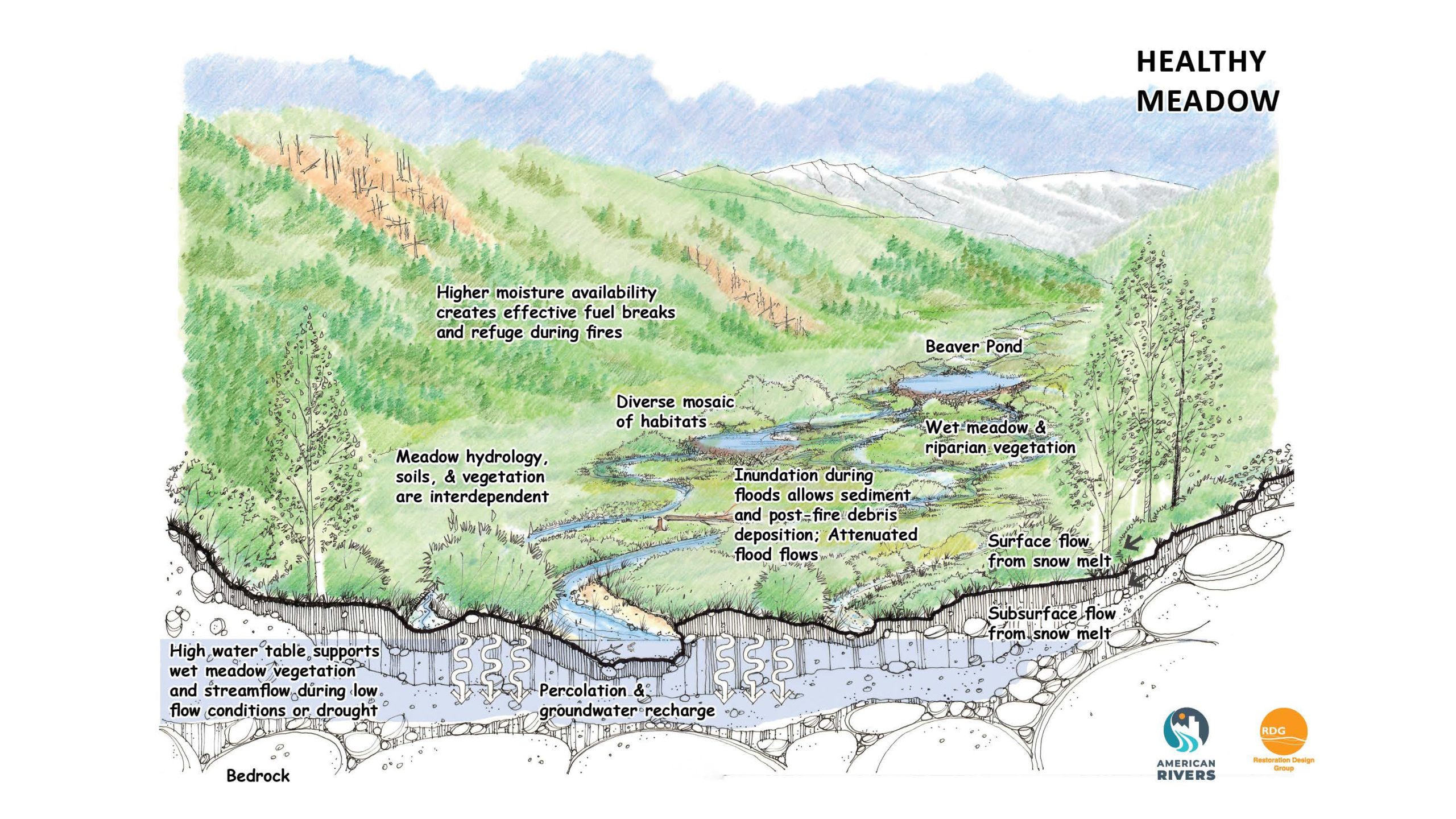
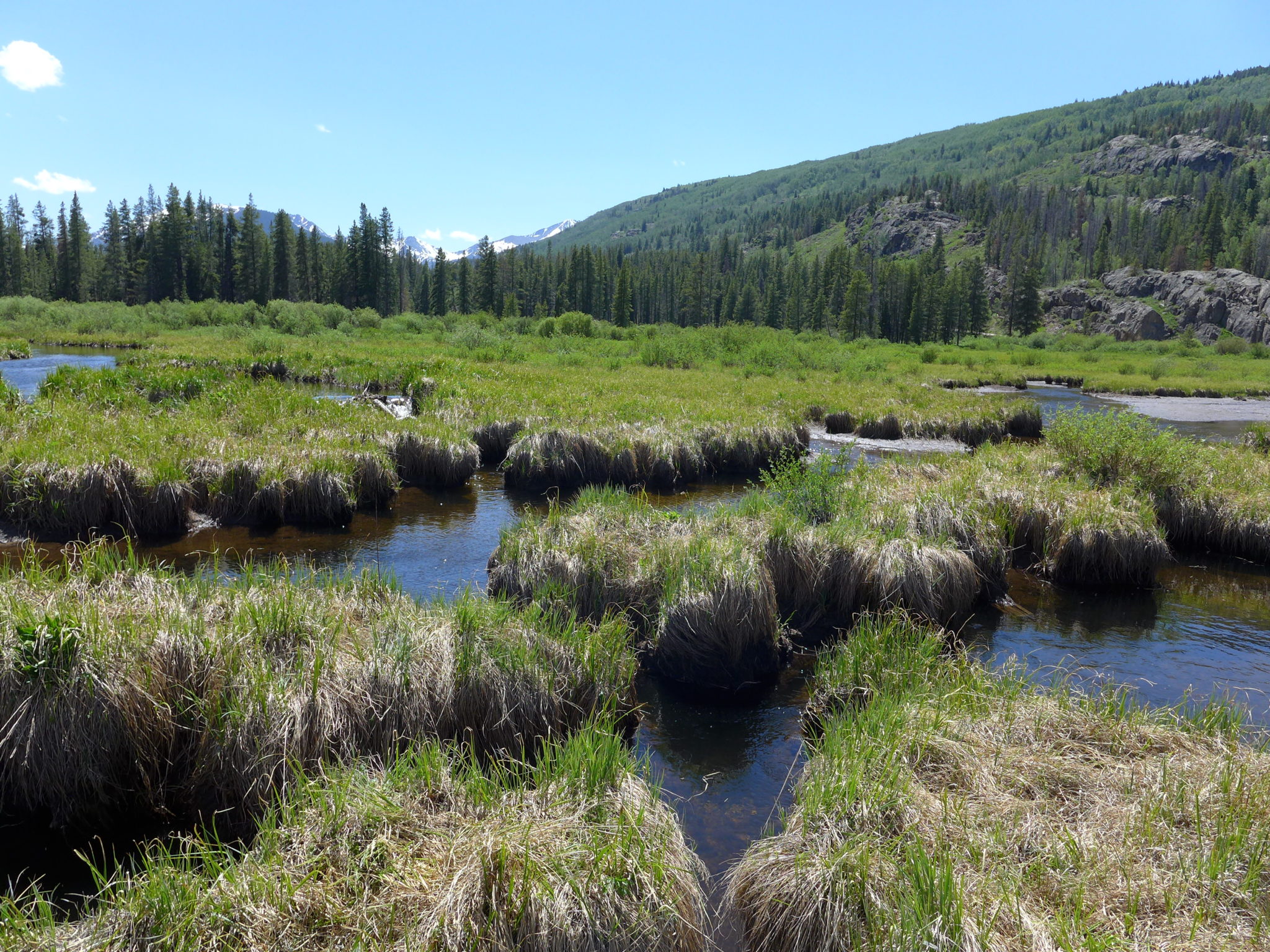
Healthy mountain meadows and wetlands are characteristic of healthy headwater systems and provide a variety of ecosystem services, or benefits that humans, wildlife, rivers and surrounding ecosystems rely on. The complex of wetlands and connected floodplains found in intact headwater systems can slow runoff and attenuate flood flows, creating better downstream conditions, trapping sediment to improve downstream water quality, and allowing groundwater recharge. These systems can also serve as a fire break and refuge during wildfire, can sequester carbon in the floodplain, and provide essential habitat for wildlife. Graphic by Restoration Design Group, courtesy of American Rivers

1. Clean Water Stewardship for Colorado

Speaker of the House McCluskie mentioned the need to restore protections removed from the Sackett vs. Environmental Protection Agency decision in her opening 2024 legislative session remarks:

ā€œWater is intrinsic to the Colorado Spirit, and the lifeblood of our agriculture industry and tourism economies. The recent United States Supreme Court decision about the definition of Waters of the United States leaves many of our waterways in Colorado unprotected. In the wake of this difficult decision, we have an opportunity to take action to reestablish these critical protections.ā€

It is imperative to protect our waterways for all of Colorado to thrive. The United States passed the Clean Water Act (CWA) in 1972 for water quality and related public health protections, realizing the outsized importance of our rivers, streams, and wetlands to communities and wildlife. At the time when waterways were literally burning with industrial waste, Congress recognized the threat to public health and addressed the widespread problem with bipartisan support and passage of the CWA. The CWA aimed to restore and maintain the chemical, physical, and biological integrity of the nation’s waters and took a watershed approach due to the connectivity of waters from headwaters to lowlands. The CWA protects waterways and their many benefits by requiring certain activities such as the construction of highways to minimize or mitigate their impact.

Despite the CWA’s successes over the last 50 years, there has been a lot of litigation and legal interpretations over the years. Most recently, the United States Supreme Court, through the Sackett case decision, effectively rewrote the CWA by severely narrowing the scope of its protections. Before Sackett, the CWA provided for the protection of the majority of Colorado’s wetlands and streams at the federal level

So what is the void created by the Sackett decision for Coloradospecifically? In Colorado, we no longer have a federal partner to help protect our waterways. The decision upended a regulatory system that protected water quality for public health. Wetlands and streams are crucial ecosystems, particularly in Colorado, where we are semi-arid to arid. Before Sackett, the CWA would have protected all Colorado waters with a significant affect on downstream water quality and availability. After the Supreme Court decision, protections were sharply reduced. 

Here are some examples of waterways that now have reduced or no federal protections in Colorado: 

These wetlands, located on a 150-acre parcel in the Homestake Creek valley that Homestake Partners bought in 2018, would be inundated if Whitney Reservoir is constructed. The Forest Service received more than 500 comments, the majority in opposition to, test drilling associated with the project and the reservoir project itself. Photo credit: Heather Sackett/Aspen Journalism
  • Wetlands that are not adjacent to a flowing river

  • Playa lakes, which are groundwater-dependent,
Iron Fen. Photo credit from report “A Preliminary Evaluation of Seasonal Water Levels Necessary to Sustain Mount Emmons Fen: Grand Mesa, Uncompahgre and Gunnison National Forests,” David J. Cooper, Ph.D, December 2003.
  • Fens, (a type of peat-accumulating wetland fed by mineral-rich ground or surface water)
Colorado River headwaters tributary in Rocky Mountain National Park photo via Greg Hobbs.
  • Headwater streams that flow only after precipitation events

In Colorado, 26 percent of streams only flow in response to rainfall, and 59 percent flow seasonally. By some estimates, as much as two thirds of Colorado’s waterways have lost protections.* Nationwide, approximately 63 percent of all wetlands are now unprotected.

With the loss of 3 billion birds in the past 50 years—in part due to dwindling wetlands and significant development of natural spaces—and Audubon science showing that two-thirds of North American bird species are at risk of extinction from climate change, action is needed at the state and federal levels to protect the water bodies and habitat that birds need to survive. Protecting water quality is a bipartisan stewardship issue and brings broad public support. We look forward to working with the state as it creates a wetlands and streams protection program for water quality protection that works for Colorado’s unique waterways. If Colorado does this right, it could be a model for other semi-arid Western states to follow suit. 

Colorado snowpack basin-filled map April 16, 2023 via the NRCS.

2. Resilient tools to deal with long-term uncertainty in the Colorado River

Despite near-term optimism (and a momentary sigh of relief) from a heavy 2023 snowpack and recent January storms, climate change and unprecedented drought conditions in the Colorado River Basin for the last 24 years are threatening Colorado’s ability to satisfy water users, ecosystem needs, water-related recreation, and, potentially, interstate obligations. There are real consequences for people, birds, and every other living thing that depends on rivers in this region. 

In 2023, the Colorado General Assembly determined that it is in the best interest of Colorado to form a task force to provide recommendations for programs to assist Colorado in addressing drought in the Colorado River Basin and the state’s interstate commitments related to the Colorado River and its tributaries (SB-295, Section 1). From August through December 2023, the Colorado River Drought Task Force and a sub-task force on Tribal matters, met to draft a report on recommendations for further actions. You can learn more about the recommendations here.  

As Colorado contends with near-certainty of continued warming, severe drought, and declining river flows over the next several years, we need more flexible ways to manage and deliver water to support the Colorado River we love. Colorado needs tools and resources to proactively respond to drought conditions and maximize the benefits to the state, its water users, and river ecosystems from once-in-a-generation competitive federal funds available to address the Colorado River Basin drought. Audubon will be engaging this session for solutions that will provide new and innovative solutions to the water threats we face.

*The State is waiting for additional guidance from the United States Environmental Protection Agency and Army Corps of Engineers to determine exactly how many of Colorado waters may lose protection.

Colorado Rivers. Credit: Geology.com

Employment opportunity at the Colorado Division of Water Resources: Hydrographer (EPST II)

State Engineer’s Office Division boundaries. Division 1 in Greeley: South Platte, Laramie & Republican River Basins. Division 2 in Pueblo: Arkansas River Basin. Division 3 in Alamosa: Rio Grande River Basin.
Division 4 in Montrose: Gunnison & San Miguel River Basins, & portions of the Dolores River. Division 5 in Glenwood Springs: Colorado River Basin (excluding the Gunnison River Basin). Division 6 in Steamboat Springs: Yampa, White and North Platte River Basins. Division 7 in Durango: San Juan River Basin and portions of the Dolores River. Credit: Colorado State University

Click the link to go to the State of Colorado Job Opportunities website:

Description of Job

OPEN ONLY TO CURRENT RESIDENTS OF COLORADO. This posting may be used to fill more than one vacancy.

Hydrographer duties include measuring and evaluating data to determine the stream flow quantity at assigned stream gaging stations, and maintaining such gages; measuring water flow in canals and ditches in support of state Water Commissioners; servicing, calibrating, monitoring, and repairing all equipment associated with stream gaging stations, including telemetry equipment; inspecting water measurement structures, reporting on their accuracy and recommending solutions to any problems observed; and, evaluating and compiling official flow records for state and federal publication. These duties will be primarily performed within the Colorado River Basin.

Employment opportunity at the Colorado Division of Water Resources: Assistant Division Engineer (PE II)

State Engineer’s Office Division boundaries. Division 1 in Greeley: South Platte, Laramie & Republican River Basins. Division 2 in Pueblo: Arkansas River Basin. Division 3 in Alamosa: Rio Grande River Basin.
Division 4 in Montrose: Gunnison & San Miguel River Basins, & portions of the Dolores River. Division 5 in Glenwood Springs: Colorado River Basin (excluding the Gunnison River Basin). Division 6 in Steamboat Springs: Yampa, White and North Platte River Basins. Division 7 in Durango: San Juan River Basin and portions of the Dolores River. Credit: Colorado State University

Click the link for all the to go to the State of Colorado Job opportunities website:

Description of Job

This posting is open to current and non-current residents of the State of Colorado at the time of submitting your application. However, if you are selected and accept the position, you will be required to establish residence in the State of Colorado.

The purpose of this position is to provide leadership, guidance and oversight to the Division 5 operations group responsible for Augmentation Plan coordination and administration.  This group supports water rights administration by developing methodologies to collect and analyze water diversion and delivery data to verify augmentation plan operators are operating in compliance with all applicable court decrees, statutes, rules and regulations and to analyze Water Court applications, including reports of engineering experts, consult with the Water Court Referee regarding all applications, write reports summarizing the agency’s position and negotiate or provide expert engineering support / testimony to litigate any conditions necessary to protect existing water rights; to supervise professional and technical staff; and provide assistance to the public in understanding Colorado water law.