2024 #COleg: Colorado Bill Protects Wetlands & Streams — Getches-Wilkinson Center

Blanca Wetlands, Colorado BLM-managed ACEC Blanca Wetlands is a network of lakes, ponds, marshes and wet meadows designated for its recreation and wetland values. The BLM Colorado and its partners have made strides in preserving, restoring and managing the area to provide rich and diverse habitats for wildlife and the public. To visit or get more information, see: http://www.blm.gov/co/st/en/fo/slvfo/blanca_wetlands.html. By Bureau of Land Management – Blanca Wetlands Area of Critical Environmental Concern, Colorado, Public Domain, https://commons.wikimedia.org/w/index.php?curid=42089248

Click the link to read the article on the Getches-Wilkinson Center website (Andrew Teegarden):

May 8, 2024

On May 6th, 2024 the Colorado Legislature passed HB24-1379 โ€“ a bill designed to protect the wetlands and streams at risk after the U.S. Supreme Courtโ€™s ruling in Sackett v. EPA (Environmental Protection Agency). The passage of the house bill saw overwhelming support from the regulated community, environmentalists, and concerned citizens.

HB24-1379 would not have been passed if not for the hard work and dedication of the bill sponsors; Speaker Julie McCluskie, Senator Dylan Roberts, Representative Karen McCormick, and Senator Barbara Kirkmeyer. These sponsors worked tirelessly to advocate for our state waters by compromising with and listening to stakeholders throughout the session.

Colorado is one of the first states in the country to pass legislation to restore protections to wetlands and streams from development activities. Other states will be able to model the stakeholder engagement process utilized by the bill sponsors to provide protections from unmitigated development.

The Protect Colorado Waters Coalition was the primary driver behind the campaign which helped HB24-1379 cross the finish line. Both Kristine Oblock, Campaign Manager with Clean Water for All and Josh Kuhn, Senior Water Campaign Manager with Conservation Colorado, upheld the coalition and worked behind the scenes to have foundational elements included in the legislation. For example, the coalition was successful in keeping the current definition of state waters. The bill sponsor went a step further to directly include wetlands within that definition to permanently expand the scope of covered waters. As we detailed in previous posts, the more comprehensive definition of state waters removes the need to quibble over jurisdiction and streamlines the permit process for applicants. Additionally, the coalition advocated for the federal 404(b)(1) guidelines to act as the floor rather than the ceiling for environmental review of permit decisions.

We, here at the Getches-Wilkinson Center, are ecstatic to see the coalition’s efforts result in meaningful legislation designed to protect our aquatic ecosystems for generations to come. Our mission is to promote the sustainability of the lands, air, and water in the Western United States and HB24-1379 aligns with that mission. We look forward to the rulemaking process where the Water Quality Control Commission within the Colorado Department of Public Health and the Environment will promulgate rules to establish how permits are issued, and the requirements applicants must follow.

Ephemeral streams are streams that do not always flow. They are above the groundwater reservoir and appear after precipitation in the area. Via Socratic.org

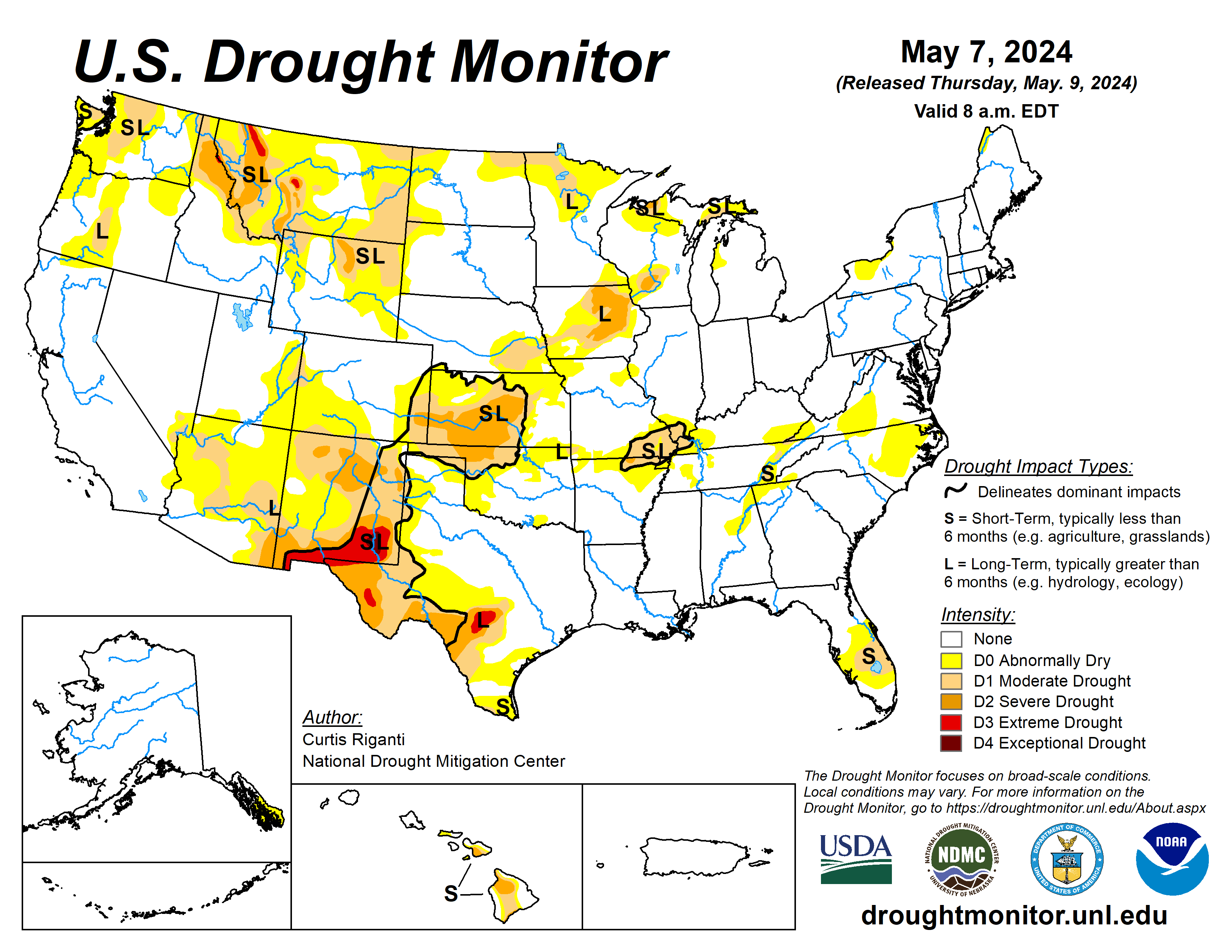
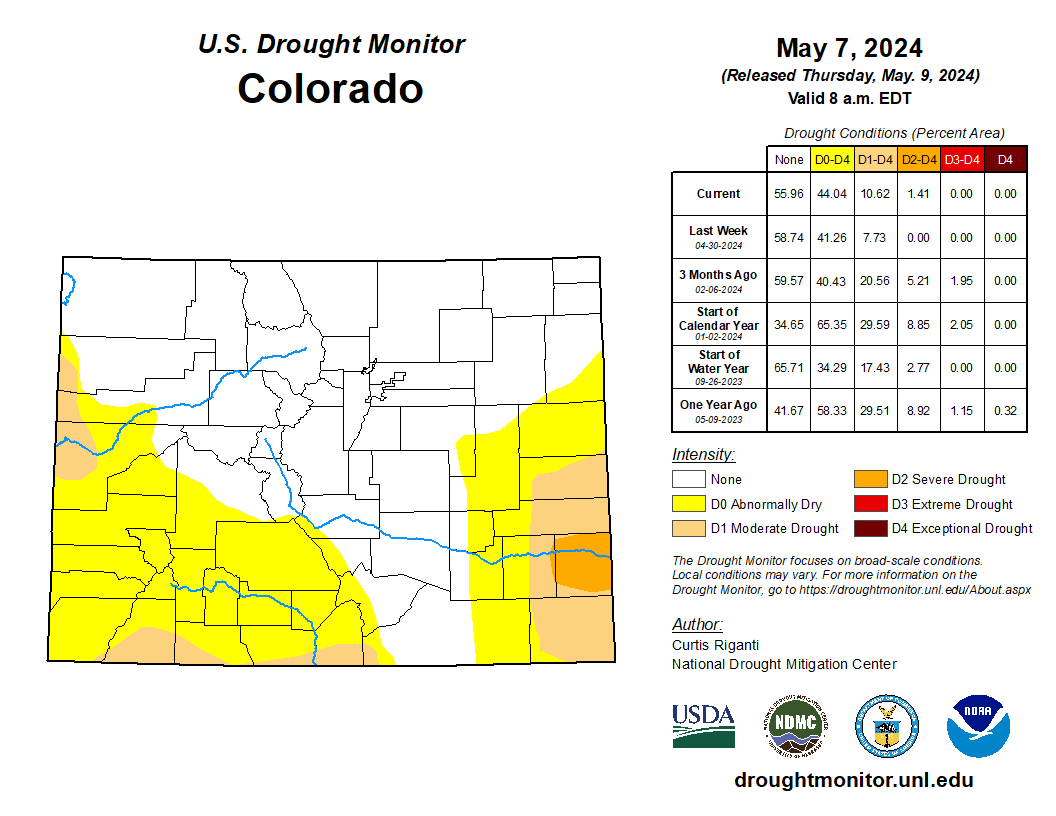
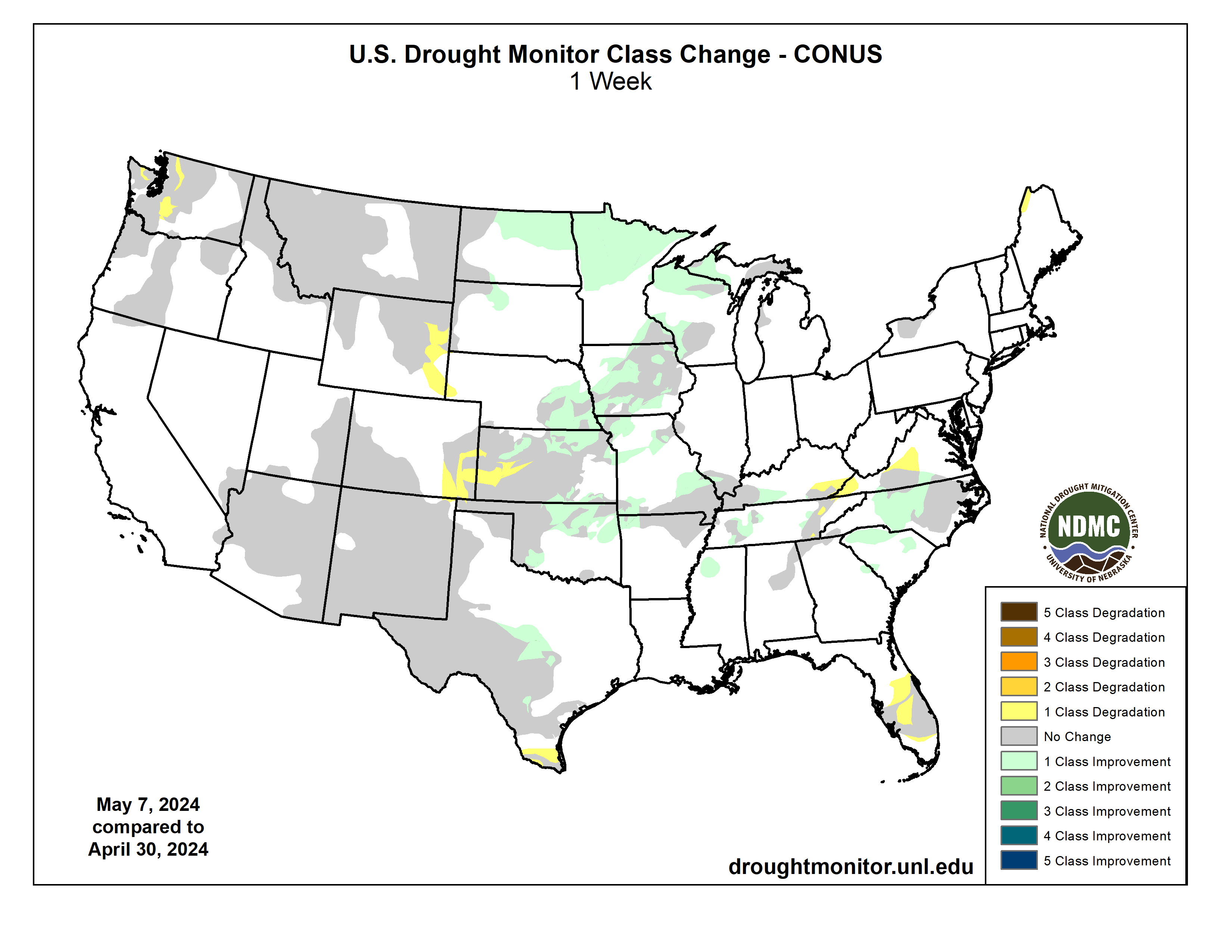
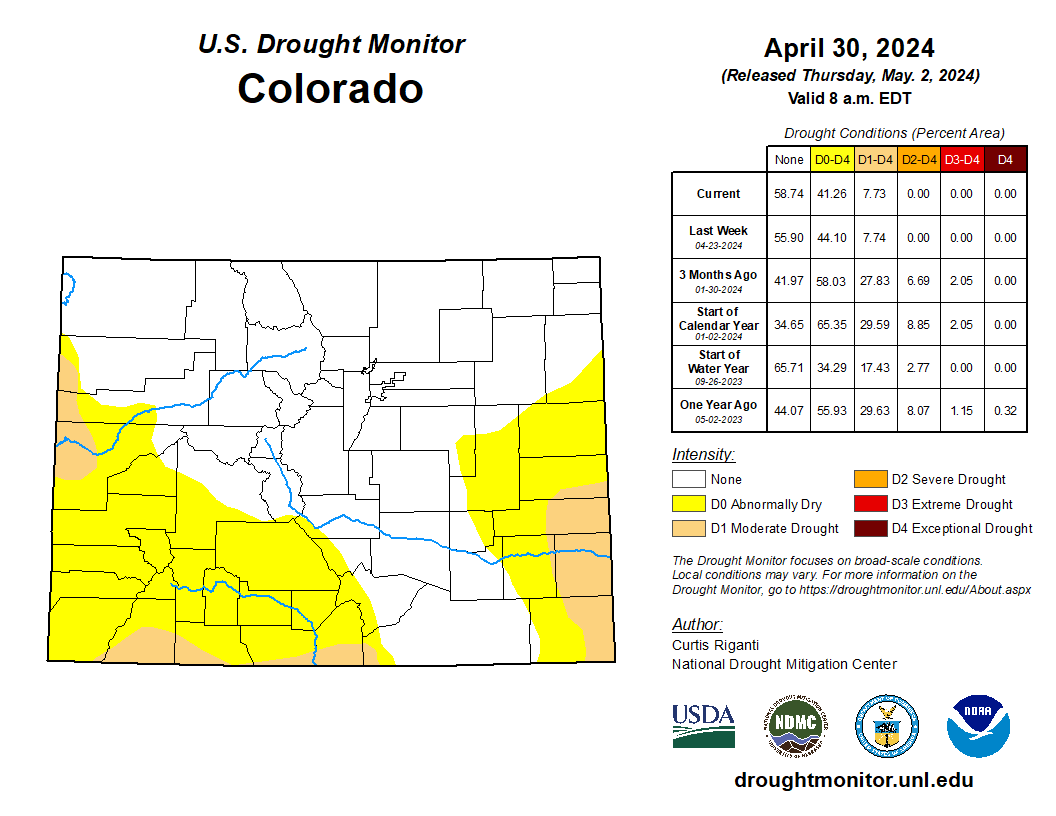
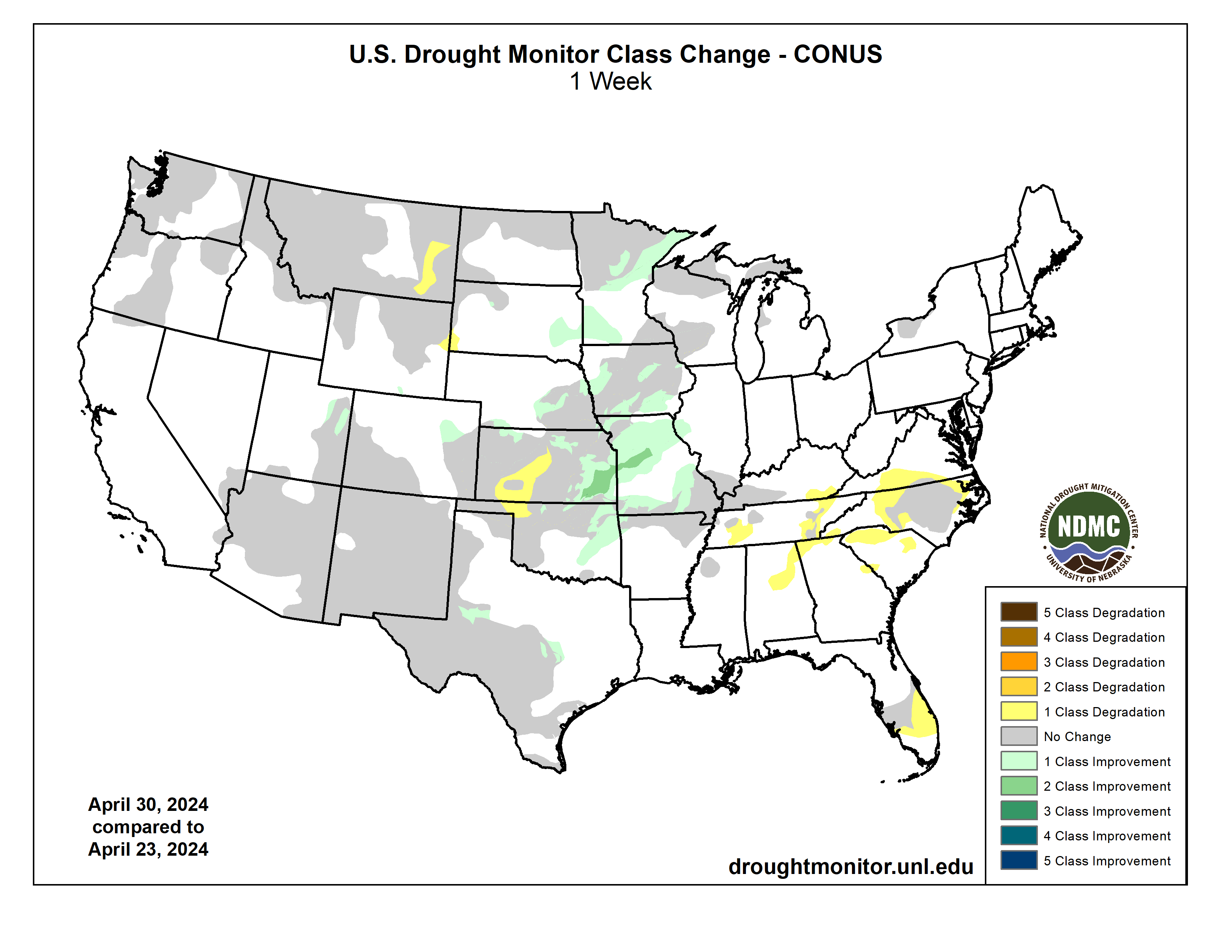
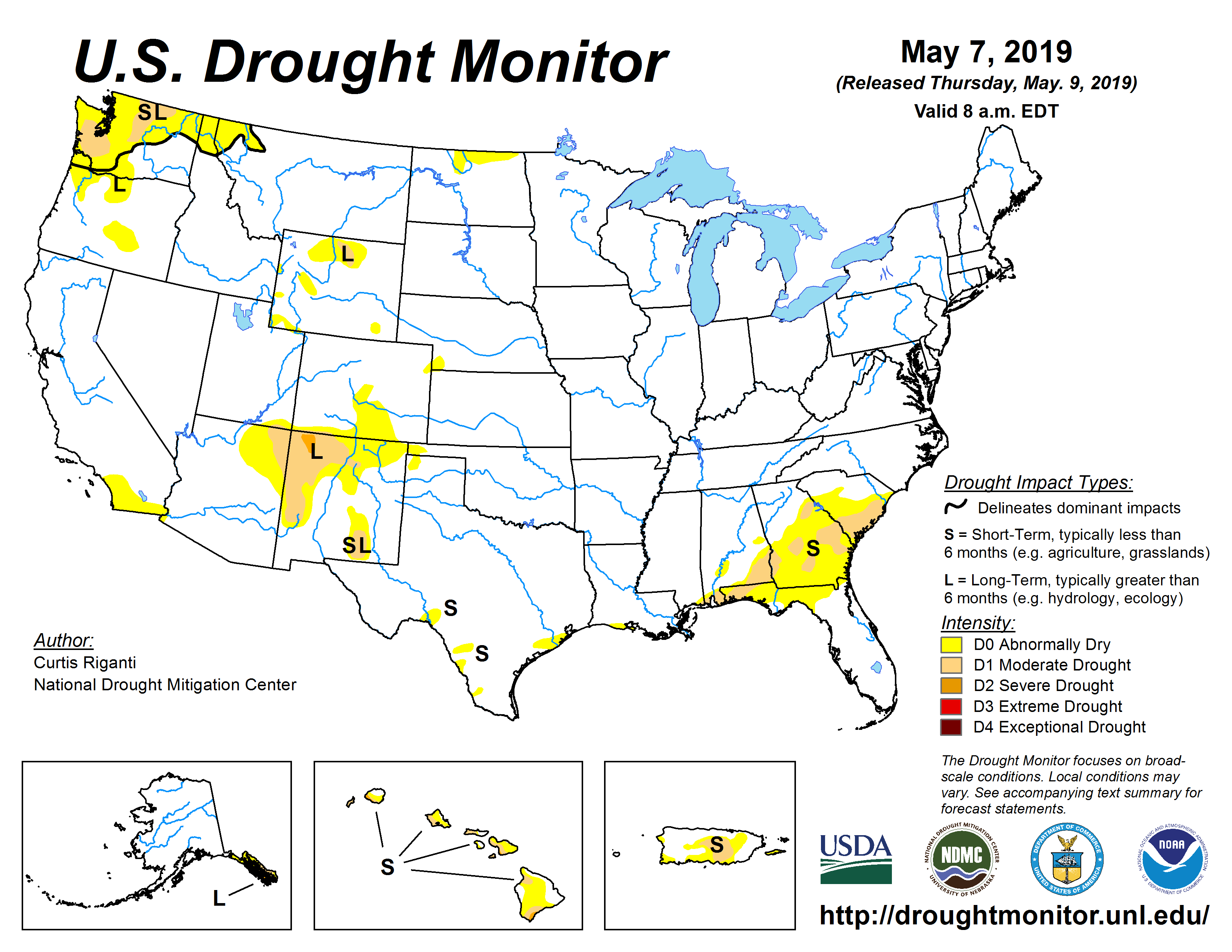
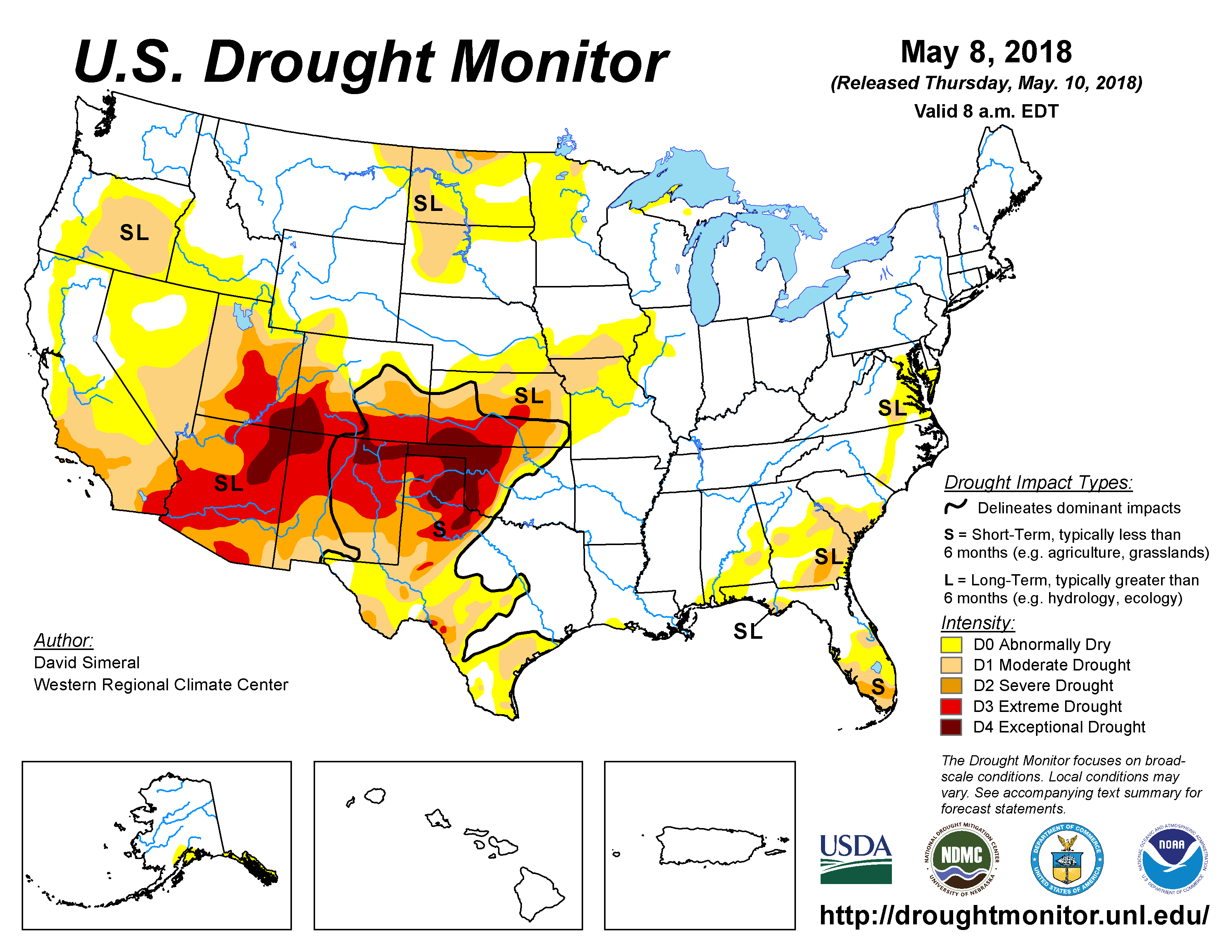
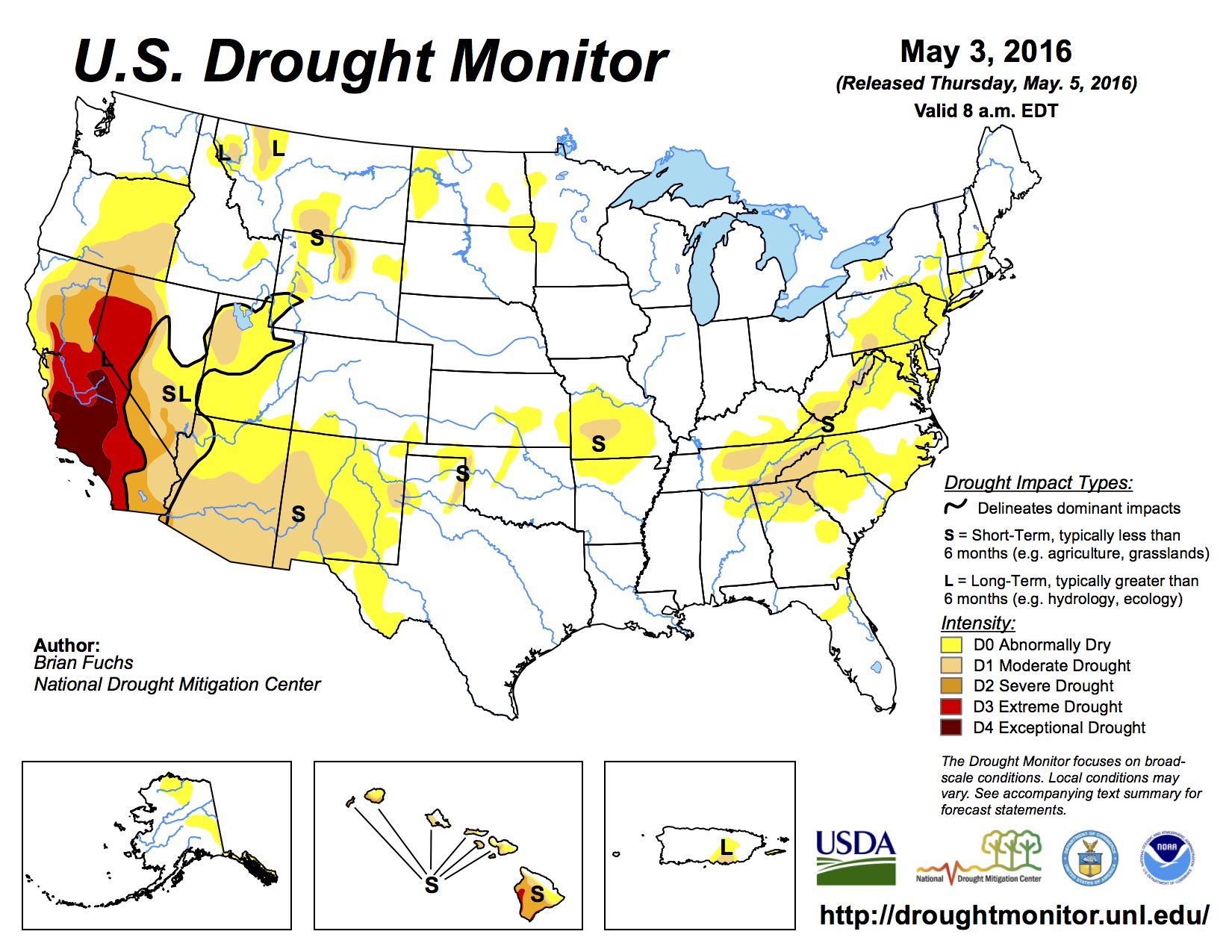
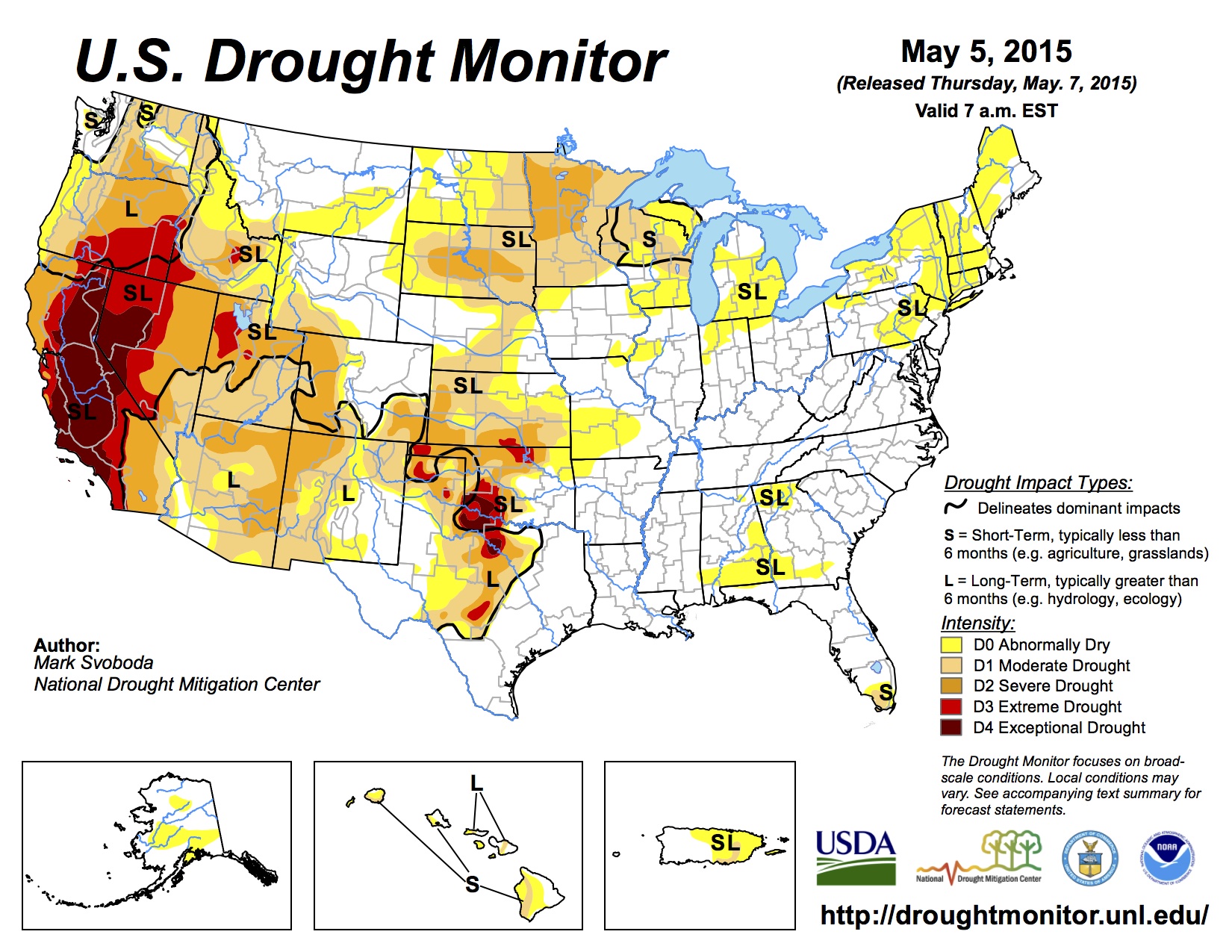
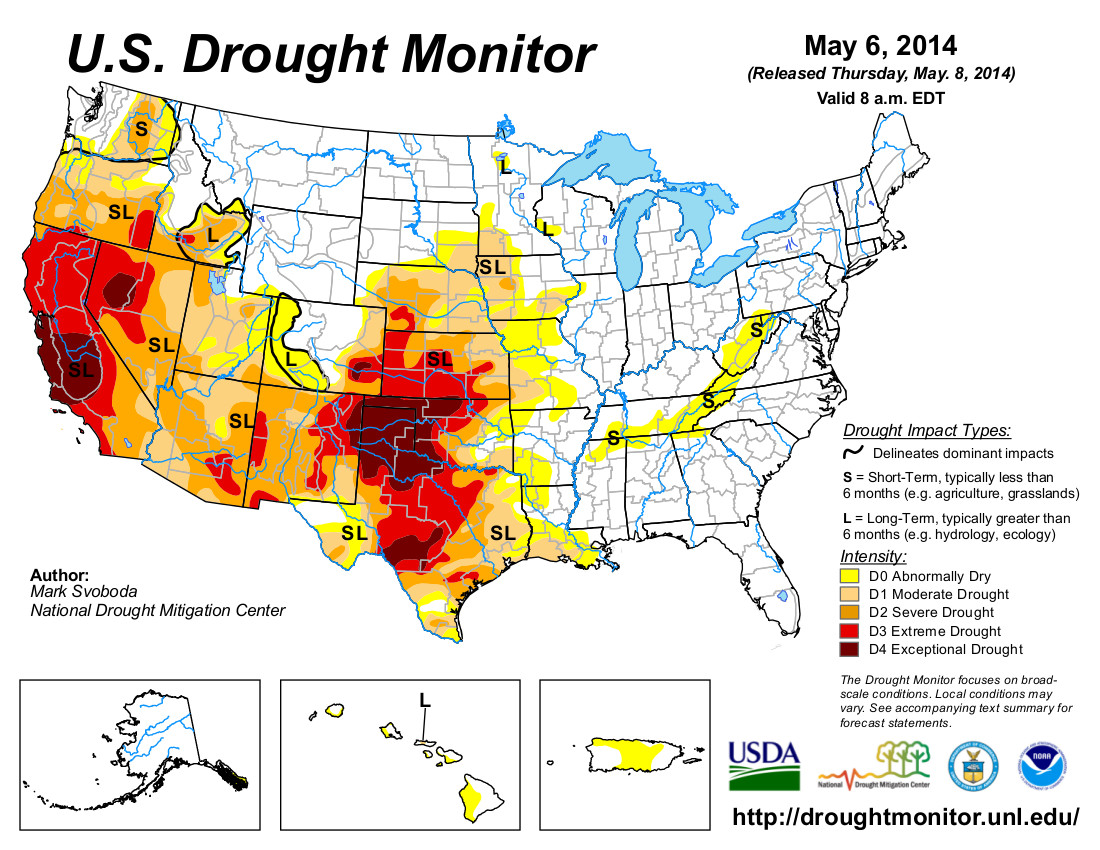
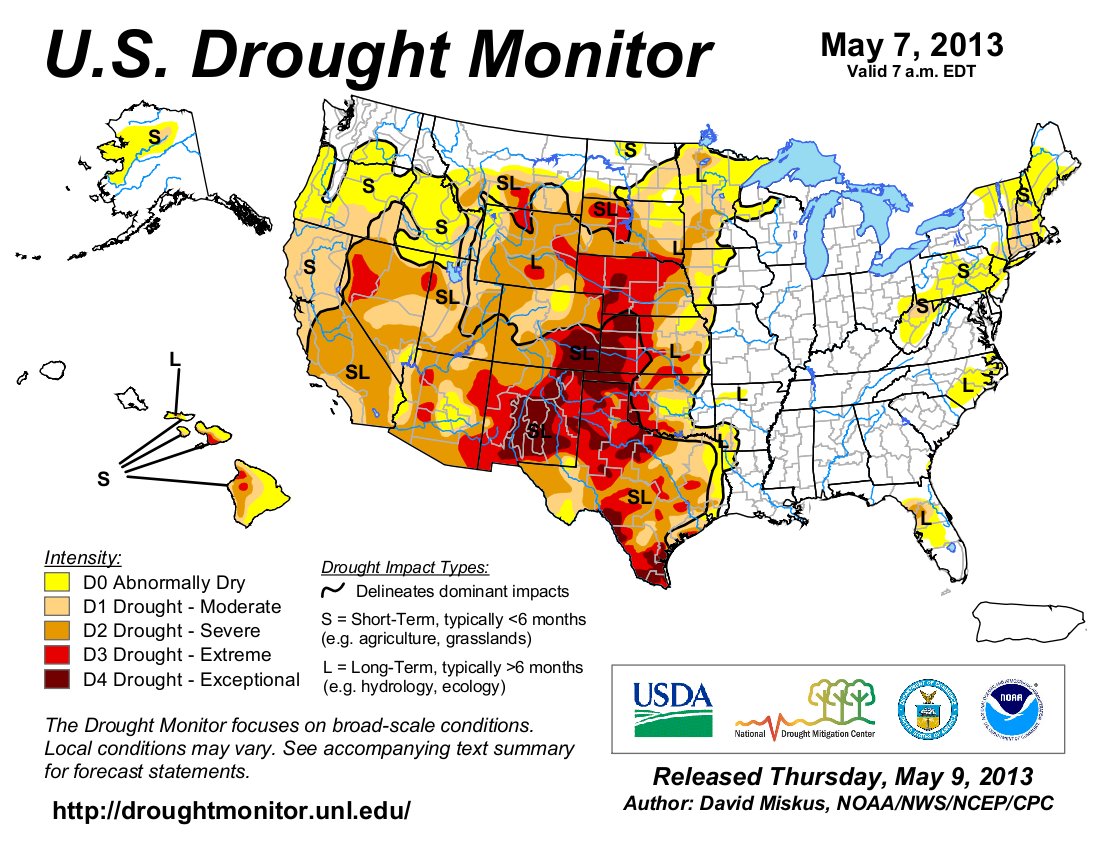
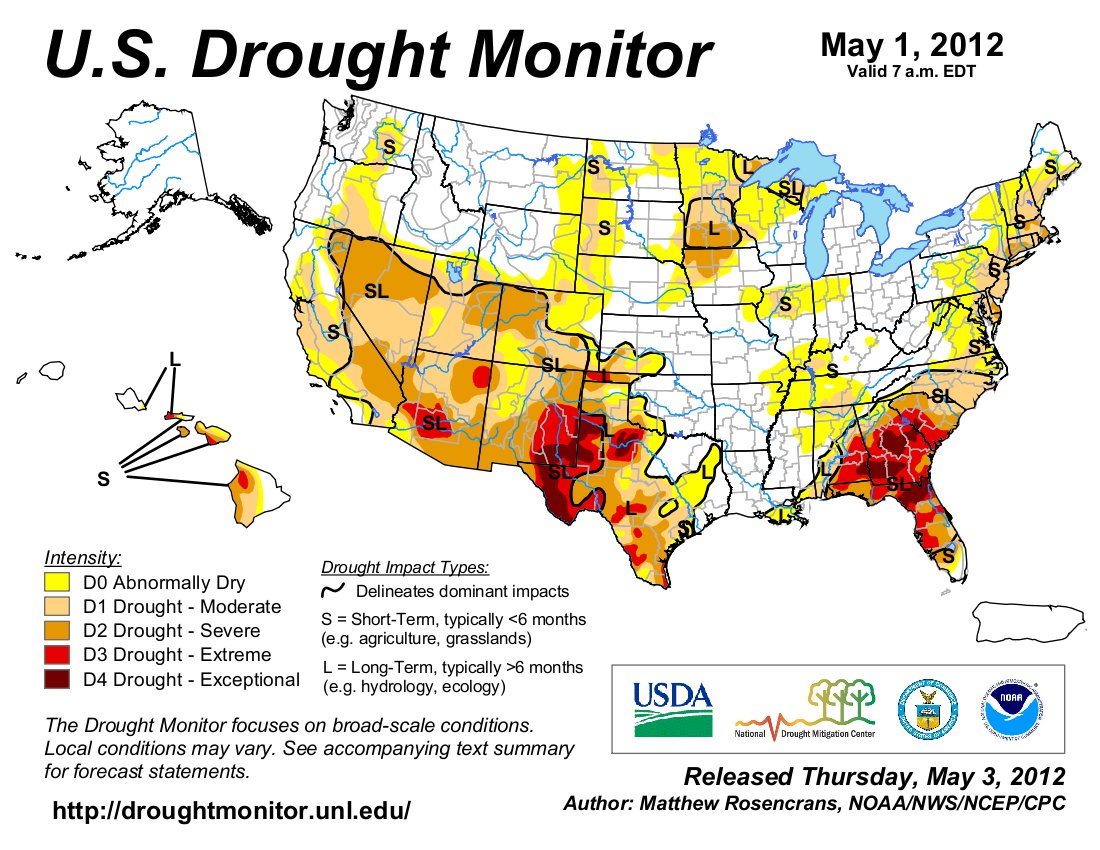
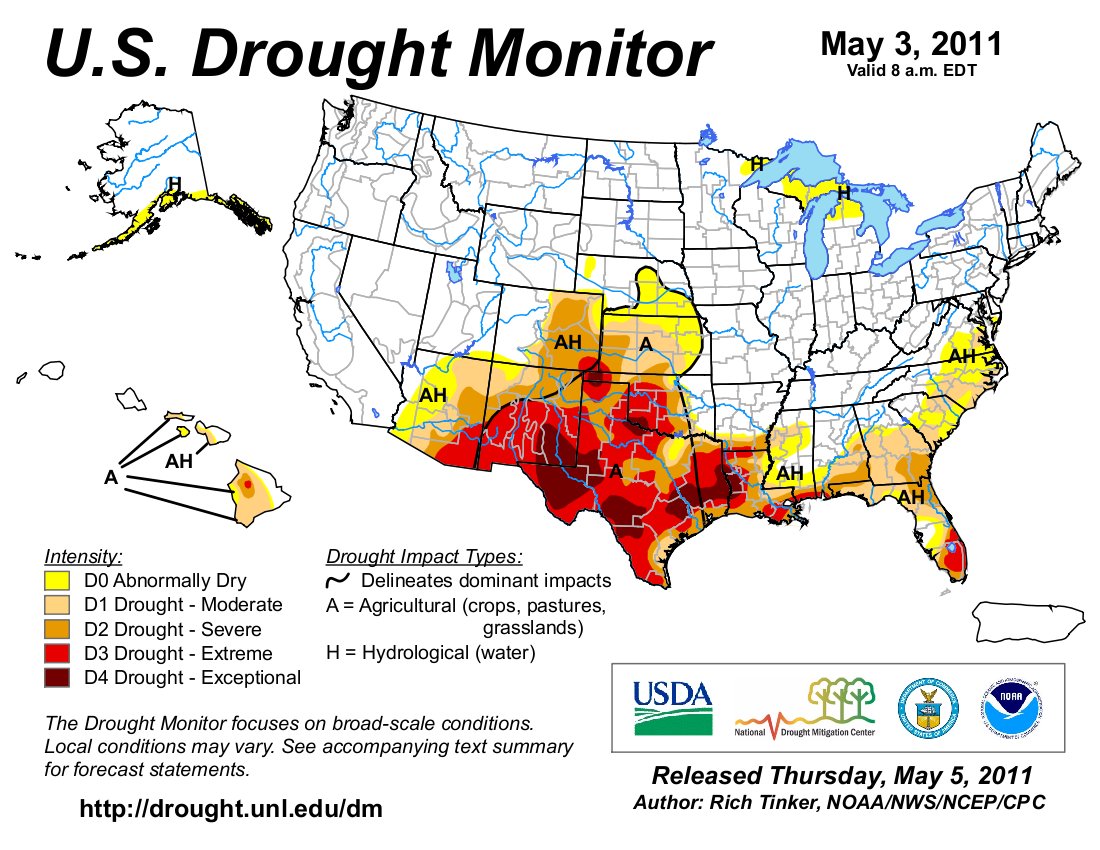
#Drought news May 9, 2024: In S.W. #Kansas and adjacent E. #Colorado #FlashDrought conditions continued and severe and moderate drought expanded in coverage

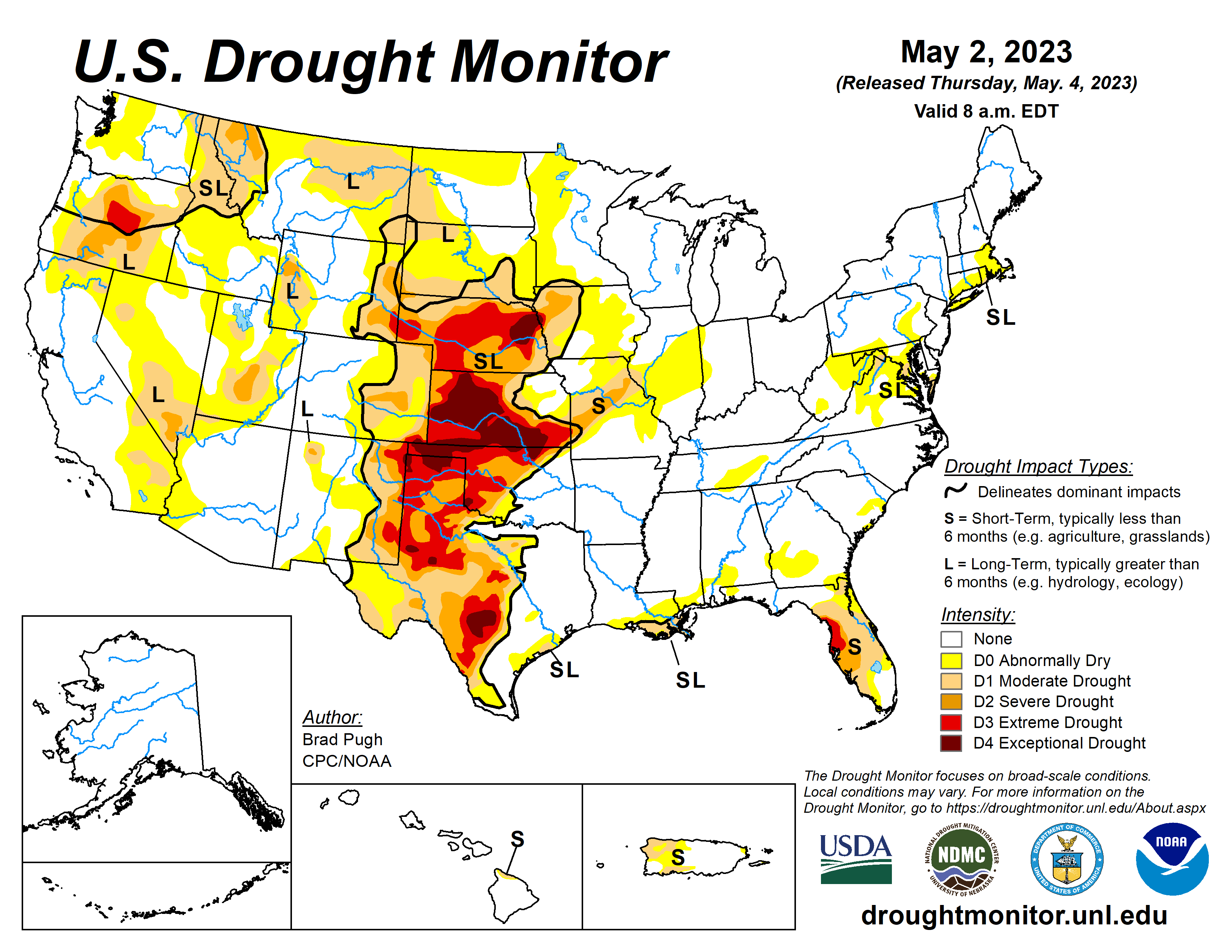
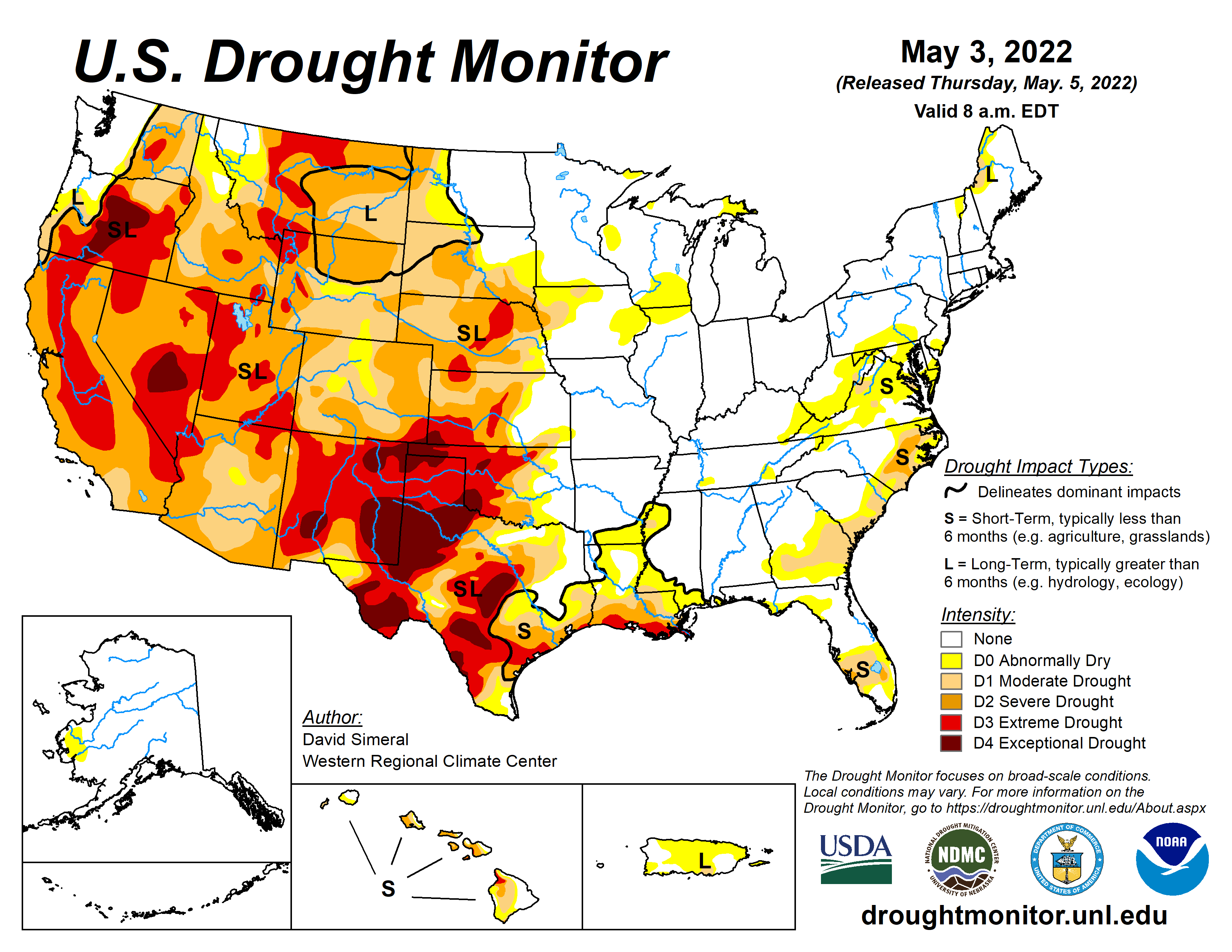
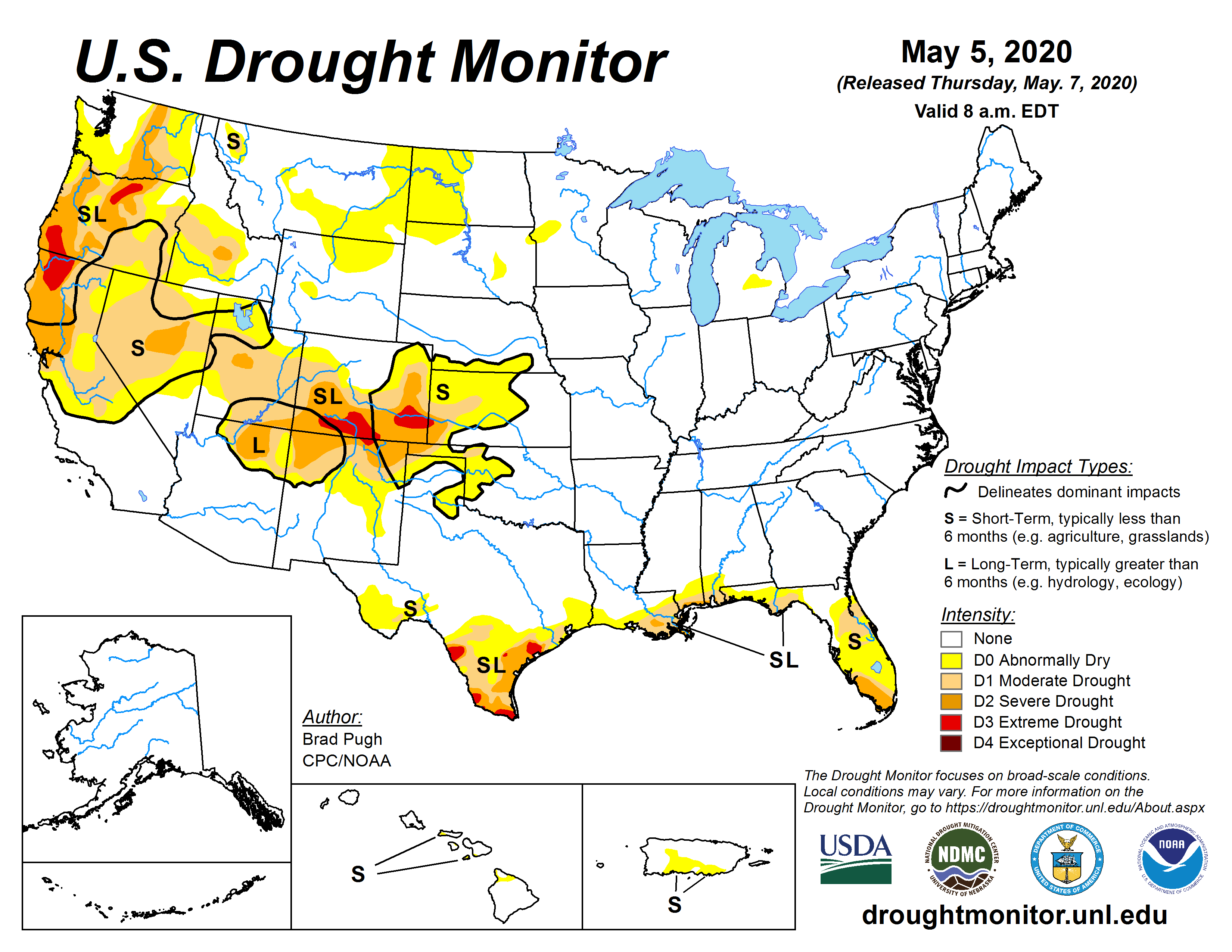
Click on a thumbnail graphic to view a gallery of drought data from the US Drought Monitor website.

Click the link to go to the US Drought Monitor website. Here’s an excerpt:

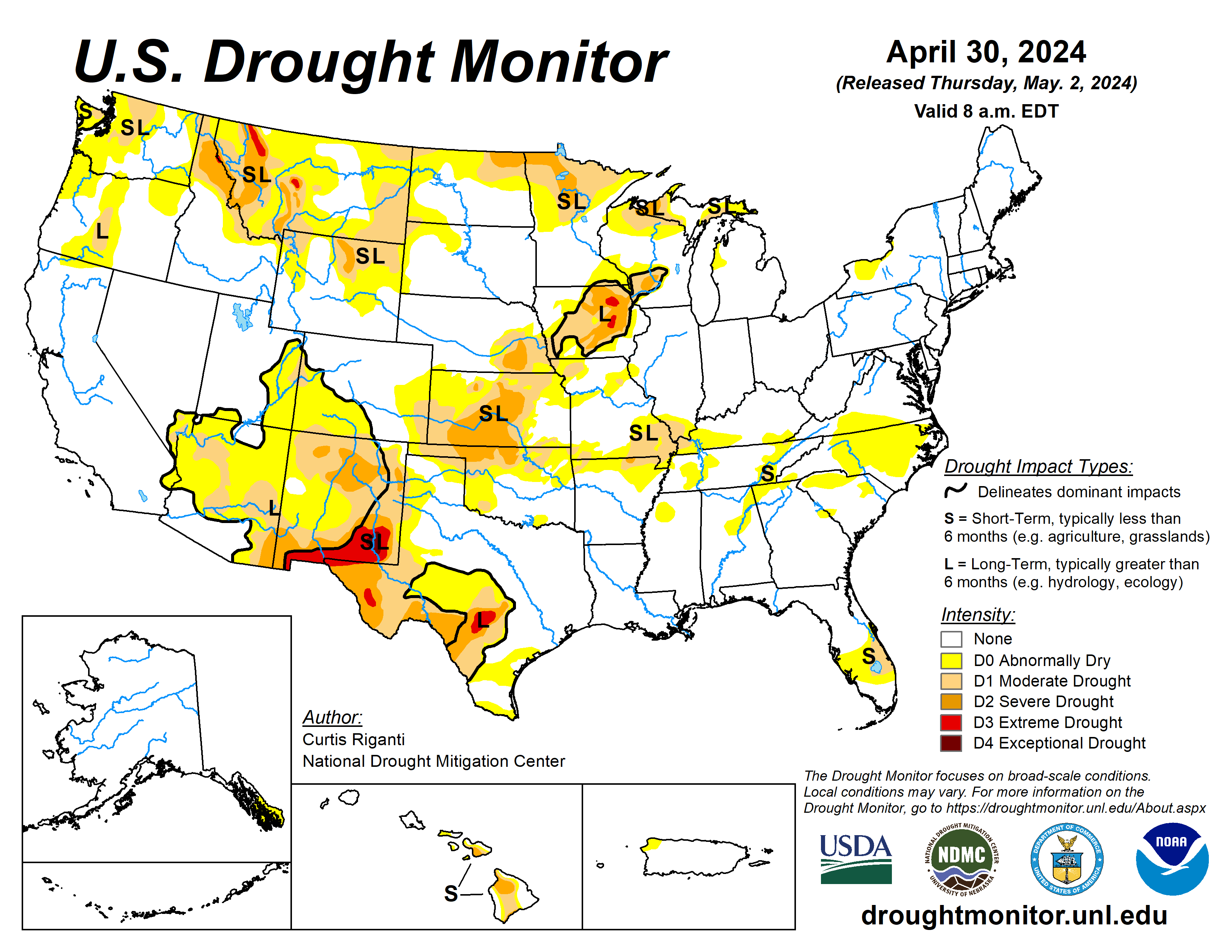
This Week’s Drought Summary

Heavy precipitation fell in western Oregon and adjacent southwest Washington and northwest California this week, and across large portions of the central U.S., as a series of storm systems caused continued bouts of severe thunderstorms and unfortunately included more significant tornadoes. The wet weather across portions of the Great Plains and Midwest led to either scattered or widespread improvements to ongoing drought or abnormal dryness, dependent on precipitation amounts, improvements to soil moisture and streamflow, and the degree of long-term dryness remaining in different locations. In Virginia, the Carolinas, and eastern Tennessee and Kentucky, heavy rains or lack thereof this week led to localized improvements or degradations in areas of short-term moderate drought or abnormal dryness. Very dry weather for the past few months led to increased fire danger in parts of the Florida Peninsula, and short-term moderate drought and abnormal dryness expanded in coverage. In southwest Kansas and adjacent eastern Colorado, mostly to the west of where this weekโ€™s showers and thunderstorms occurred, flash drought conditions continued and severe and moderate drought expanded in coverage. In Hawaii, wet weather continued on the windward sides of the islands, and some improvement to conditions occurred in Lanai and western Maui. Another wet week in Puerto Rico allowed for the removal of abnormal dryness from the northwest corner of the island…

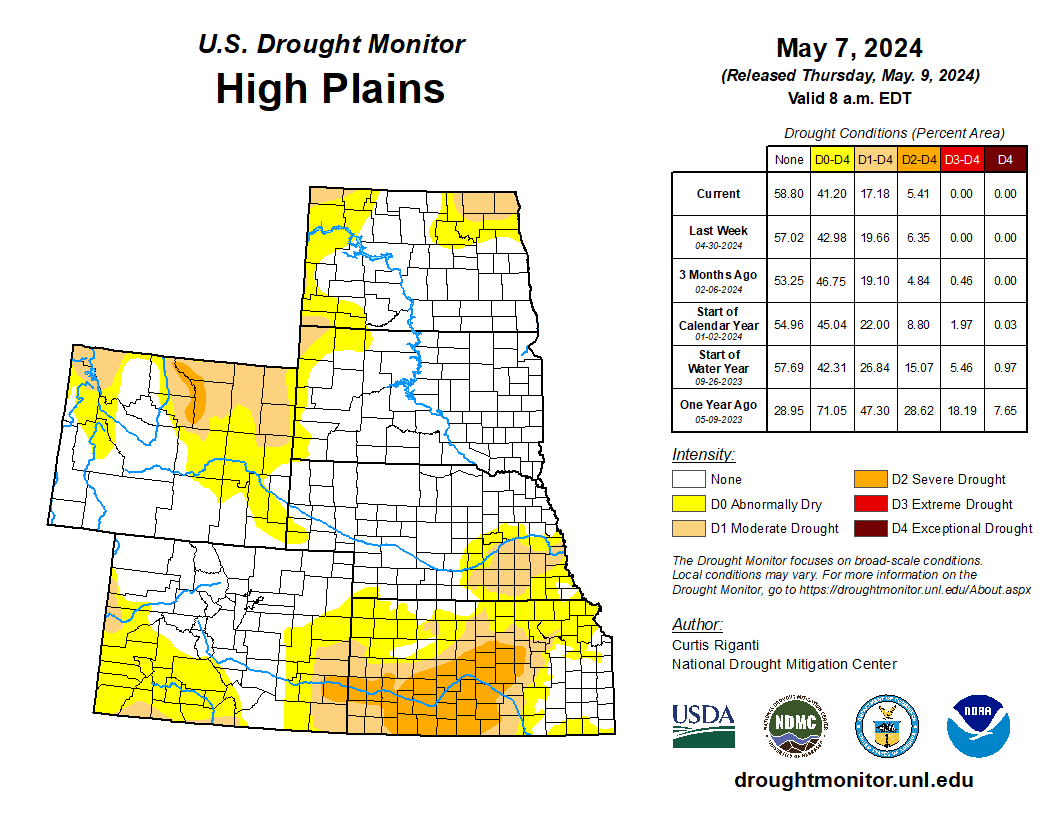
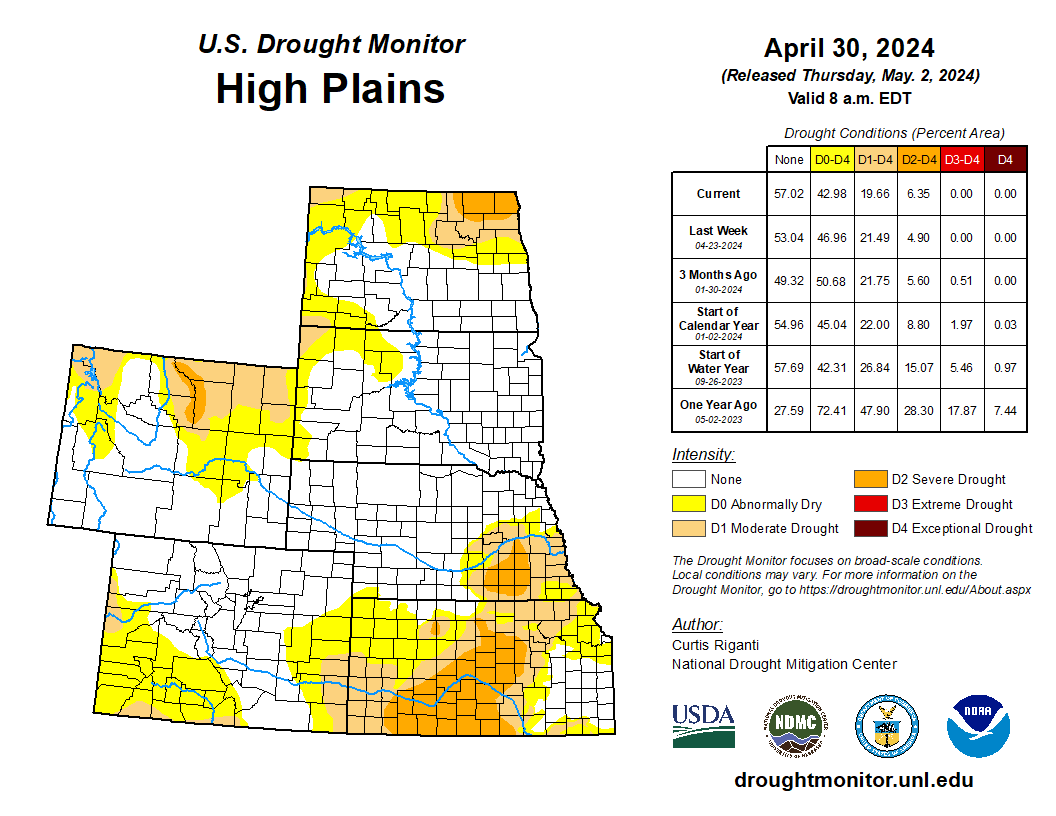
High Plains

Moderate to heavy rain amounts fell in eastern portions of the High Plains region, especially in central and eastern Nebraska, northern and eastern Kansas and eastern North Dakota. Temperature anomalies varied across the region, with temperatures coming in 3-6 degrees above normal in southern Kansas, while northwest Colorado and Wyoming finished the week at 3-9 degrees colder than normal. In eastern Kansas and Nebraska and in eastern North Dakota, heavy rains continued the recent wet pattern, leading to improvements in ongoing drought and abnormal dryness. In parts of eastern Nebraska, improvements were somewhat tempered by remaining long-term precipitation deficits and hydrologic impacts from those deficits. In southwest Kansas and adjacent southeast Colorado, many areas mostly or completely missed out on recent rains, continuing the very dry weather from the last few months, during which Dodge City tied its record for the driest April on record there (with just 0.02 inches of precipitation). In these areas, flash drought conditions continued, and severe and moderate short-term drought expanded. Given the time of year during which this drought began, severe impacts to the wheat crop in portions of Kansas have occurred. Recent dryness led to some expansion of drought and abnormal dryness in portions of eastern Wyoming as well…

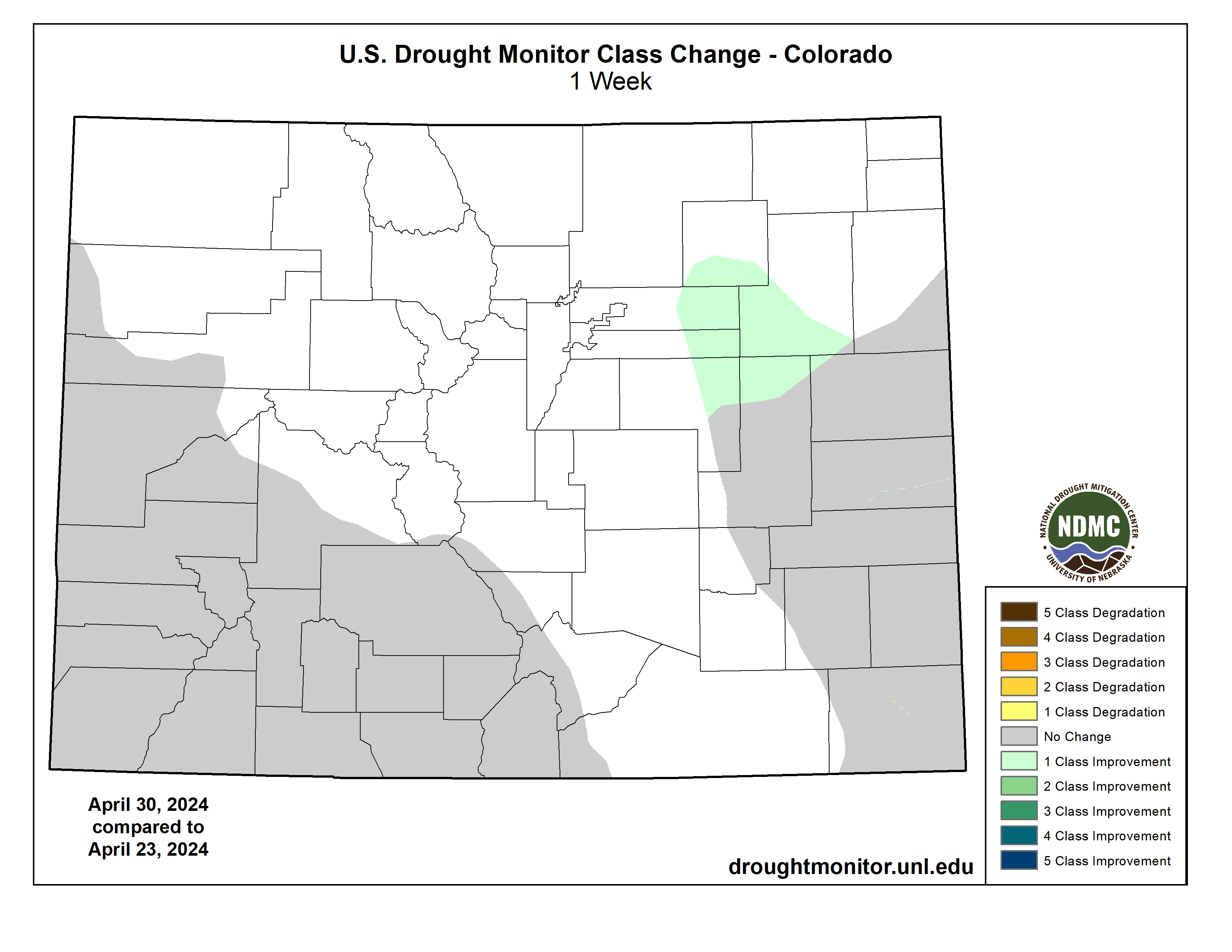
Colorado Drought Monitor one week change map ending May 7, 2024.

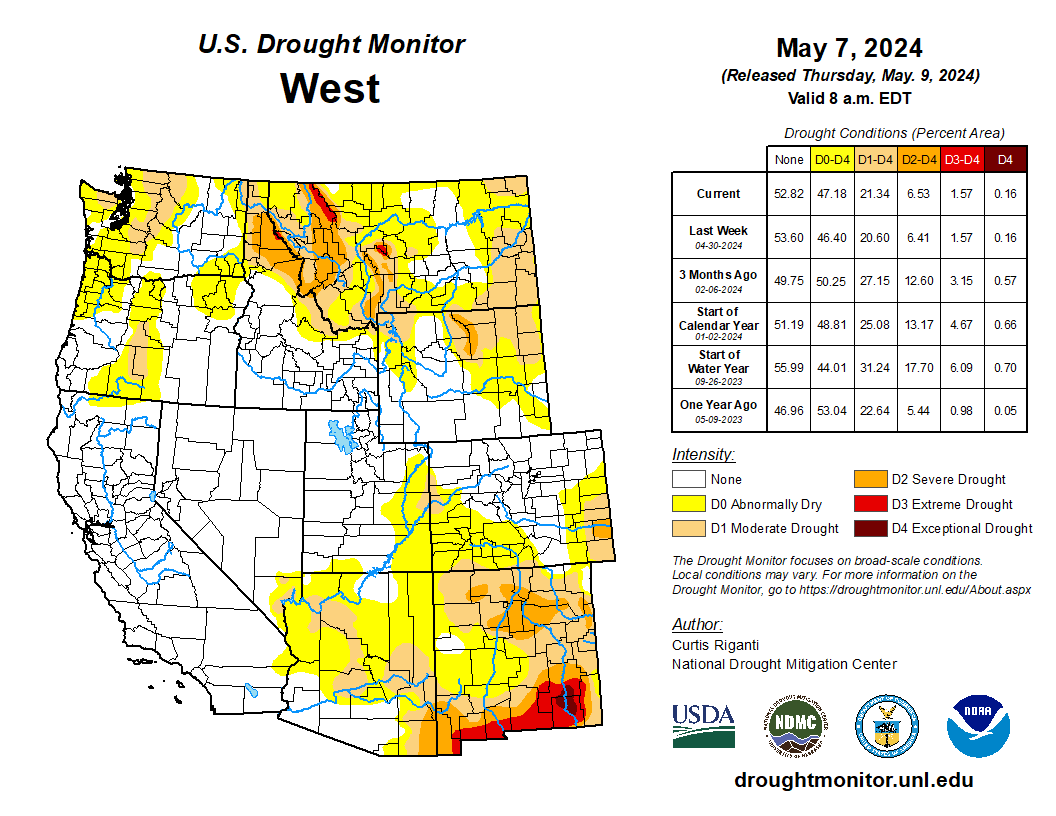
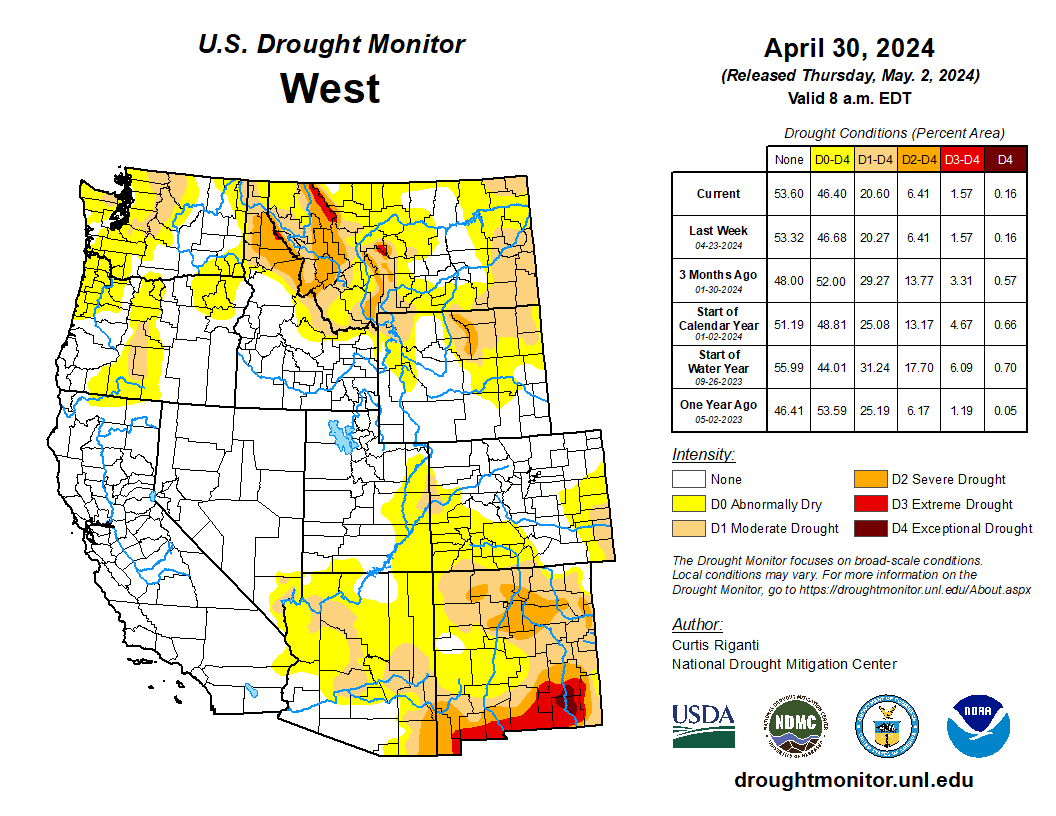
West

The West region this week saw heavy precipitation (locally exceeding 2 inches) fall in eastern Montana, while portions of northern California, northeast Oregon, and western Oregon and southwest Washington also saw heavy precipitation amounts (locally exceeding 5 inches in northwest California and western Oregon). Streamflows improved amid the wet weather in northwest Oregon. Farther north in Washington, short-term dryness continued, especially in parts of the Cascade and Olympic ranges, where snow-water content and streamflow remained low, and moderate drought and abnormal dryness expanded. The heavy rains in eastern Montana ended a recent stretch of dry weather there, preventing any degradation to ongoing drought. The effects of these rains across the eastern plains will be evaluated further next week. Except for eastern New Mexico and parts of Arizona, most of the West region was colder than normal this week. Parts of Oregon, southern Idaho, northern Utah and northern Nevada saw temperature readings 6-12 degrees below normal…

South

Widespread heavy rains fell across portions of the South region, especially in western Arkansas, central and eastern Oklahoma, and central and eastern Texas. Heavier rain also occurred in a few spots in northern Mississippi and Tennessee. Most of the region had warmer-than-normal temperatures this week, with departures of 6-9 degrees above normal being common in northern Mississippi and Tennessee, while 3-6 degrees above normal was common elsewhere. In areas of improvements to drought and abnormal dryness in central and eastern Oklahoma and Arkansas, recent showers and thunderstorms continued to improve precipitation deficits, streamflow and soil moisture. In central Texas, a tight gradient in long-term drought conditions has developed, as heavier rains have recently fallen along the northern edge of moderate to extreme long-term drought conditions. Some reservoirs have seen some recent improvement in levels in the area, though significant deficits remain. In deep south Texas, dry weather over the last month or two has led to significant short-term precipitation deficits, and a small area of short-term moderate drought developed. Heavier rains (or lack thereof) in Tennessee led to small-scale improvements and degradations in areas of moderate drought and abnormal dryness…

Looking Ahead

As of time of writing (the afternoon of May 8), precipitation forecasts from the National Weather Service Weather Prediction Center show mostly dry weather west of the Continental Divide within the contiguous U.S. through the evening of Monday, May 13. East of the Continental Divide, 0.5-1 inch of rain, with locally higher amounts, is forecast for portions of central and eastern Colorado, western Kansas, the Texas and Oklahoma panhandles, western Oklahoma and northeast New Mexico. Heavier rain amounts (locally exceeding 2 inches) are forecast from eastern Texas eastward across Louisiana, southern portions of Mississippi, Alabama and Georgia, and in Tennessee. Separate areas of forecasted rainfall above an inch are in north-central Iowa and from south-central New York to south-central Pennsylvania.

For May 14-18, the National Weather Service Climate Prediction Center forecast favors warmer-than-normal temperatures across most of the contiguous U.S., with the exceptions of portions of the south-central U.S. from Oklahoma to Tennessee and in the northwest half of Washington. Except for far northeast Alaska, the forecast favors colder-than-normal weather in most of Alaska, especially southwest, south-central and southeast Alaska. Near-normal temperatures are most likely in Hawaii. Precipitation forecasts in the contiguous U.S. favor near- or above-normal precipitation across most areas, except for the Pacific Northwest and a small part of southwest Texas. The highest confidence for wetter-than-normal weather is in the Southeast region. Wetter-than-normal weather is favored in most of Hawaii, with the highest confidence for above-normal precipitation in Niihau and Kauai. Above-normal precipitation is also favored in Alaska.

US Drought Monitor one week change map ending May 7, 2024.

#Vermont passes bill to charge #FossilFuel companies for damage from #ClimateChange

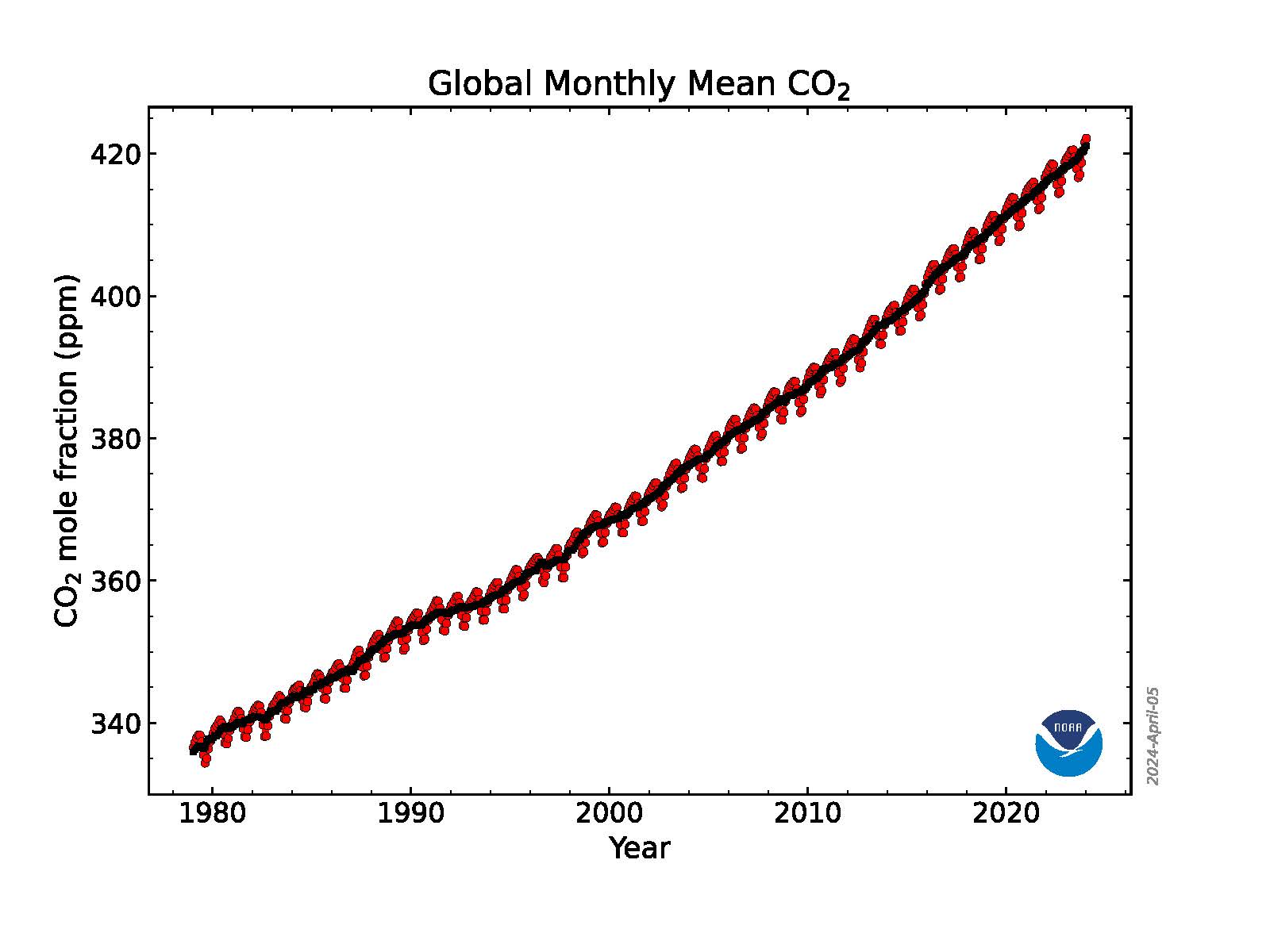
This graph shows the globally averaged monthly mean carbon dioxide abundance measured at the Global Monitoring Laboratoryโ€™s global network of air sampling sites since 1980. Data are still preliminary, pending recalibrations of reference gases and other quality control checks. Credit: NOAA GML

Click the link to read the article on the NBC News website (Maura Barrettย andย Lucas Thompson). Here’s an excerpt:

May 7, 2024

Vermont lawmakers passed a bill this week that is designed to make big fossil fuel companies pay for damage from weather disasters fueled by climate change. The legislation is modeled after the Environmental Protection Agencyโ€™s superfund program, which requires the companies responsible for environmental contamination to either clean sites up themselves or reimburse the government for the costs of work to do so.ย  Vermontโ€™s bill, referred to as itsย Climate Superfund Act, would similarly mandate that big oil companies and others with high emissions pay for damage caused by global warming.

The amounts owed would be determined based on calculations of the degree to which climate change contributed to extreme weather in Vermont, and how much money those weather disasters cost the state. From there, companiesโ€™ shares of the total would depend on how many metric tons of carbon dioxide each released into the atmosphere from 1995 to 2024. The law passed with just three no votes in Vermontโ€™s state Senate in early April, followed by approval in the state House on Monday. The Senate will deliver a final vote later this week before the bill heads to Republican Gov. Phil Scottโ€™s desk.ย  State Sen. Anne Watson, a co-sponsor of the bill, said she hopes that if the law goes into effect, it pushes big oil companies โ€œto become purveyors of renewable energy sources and keep fossil fuels in the ground.โ€

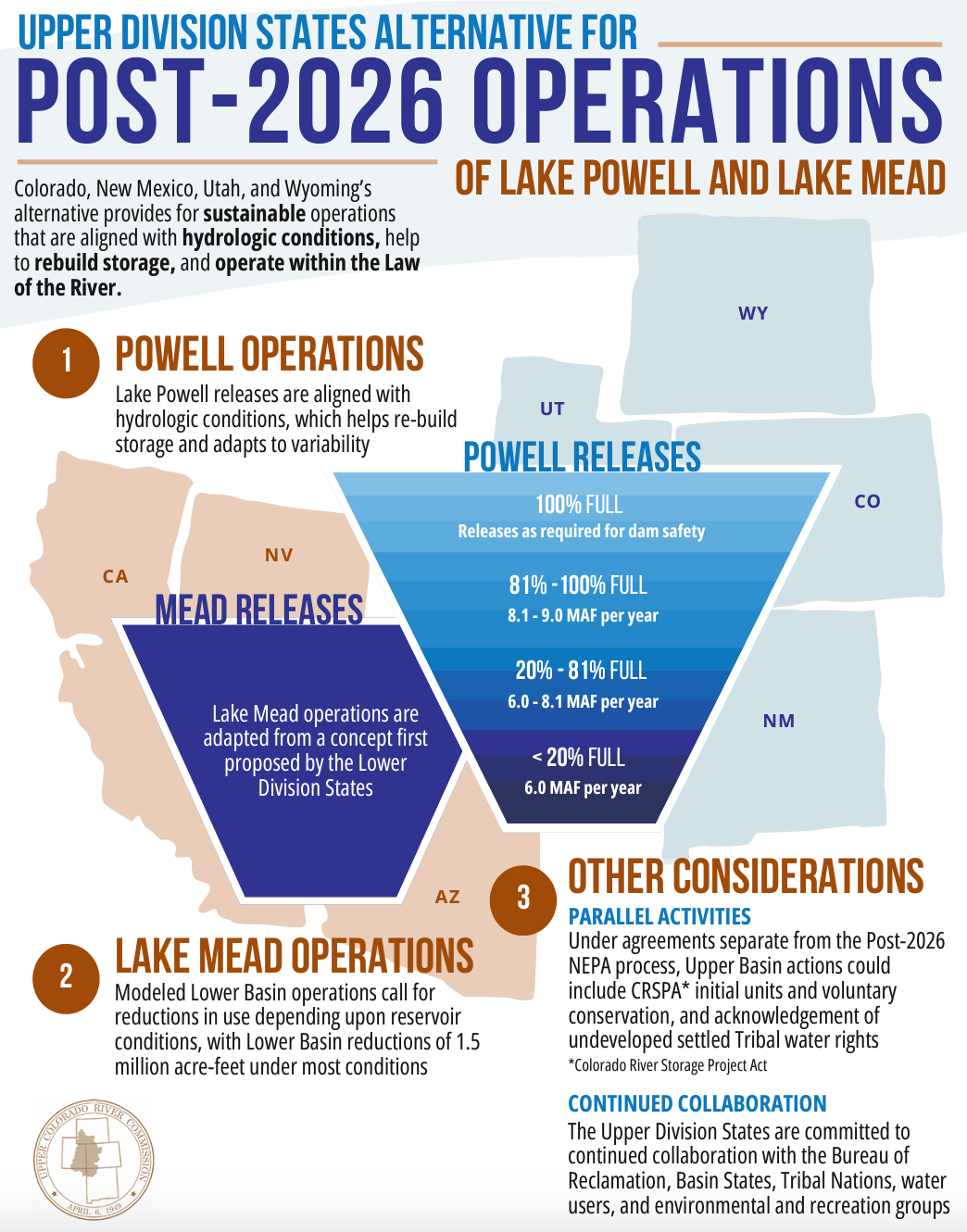
New #ColoradoRiver Guidelines are Only the Beginning: “What we advocate for in the paper is that the other issues not be lost in our rush to solve the mass balance problem” — John Fleck (InkStain.net) #COriver #aridification

The structural deficit refers to the consumption by Lower Basin states of more water than enters Lake Mead each year. The deficit, which includes losses from evaporation, is estimated at 1.2 million acre-feet a year. (Image: Central Arizona Project circa 2019)

Click the link to read the article on the InkStain.net website (John Fleck):

May 9, 2024

Much attention is focused right now on rewriting Colorado River operating rules, to replace the soon-to-expire 2007 reservoir operating guidelines. But there is a growing frustration that the struggle to solve that relatively narrow problem โ€œmass balanceโ€ problem (how much water, and where?) leaves out a range of incredibly important issues:

Thatโ€™s from a new policy brief from my friends and colleagues at the Colorado River Research Group, a collaborative of researchers across the basin whose mission is to provide โ€œan independent, scientific voice for the future of the Colorado River.โ€ The brief grew out of conversations among the groupโ€™s members about both the strengths, as well as the shortcomings, of the current process.

We are mindful that much of what CRRG has been advocating for is directly on the table in the various proposals now being considered for post-2026 river management:

But there are so many other important issues left untouched by the P26 process (sorry, yes, some of us have started shortening it to โ€œP26โ€) that the list we came up with among CRRG members is too long to blockquote here in a blog post โ€“ click through to read the white paper, itโ€™s not too long.

What we advocate for in the paper is that the other issues not be lost in our rush to solve the mass balance problem.

“New plot using the nClimGrid data, which is a better source than PRISM for long-term trends. Of course, the combined reservoir contents increase from last year, but the increase is less than 2011 and looks puny compared to the โ€˜holeโ€™ in the reservoirs. The blue Loess lines subtly change. Last year those lines ended pointing downwards. This year they end flat-ish. 2023 temps were still above the 20th century average, although close. Another interesting aspect is that the 20C Mean and 21C Mean lines on the individual plots really donโ€™t change much. Finally, the 2023 Natural Flows are almost exactly equal to 2019. (17.678 maf vs 17.672 maf). For all the hoopla about how this was record-setting year, the fact is that this year was significantly less than 2011 (20.159 maf) and no different than 2019” — Brad Udall

Audubon getting into Westโ€™s transmission: Organization believes new transmission will be crucial to address #ClimateChange but wants science foundation to do it right — Allen Best (@BigPivots)

Transmission lines and red rock. Photo credit: Allen Best/Big Pivots

Click the link to read the article on the Big Pivots website (Allen Best):

April 30, 2024

Audubon is hiring. The conservation organization wants to bring the science for which it is noted among conservation organizations to the selection of electrical transmission in Colorado and other intermountain states of the West.

โ€œWe donโ€™t want to be an organization that stops something, because climate change is literally the existential threat to birds. And the renewable energy and storage that is needed require more transmission lines. So how do we work together to make this happen?โ€ says Alice Madden, a former state legislator from Louisville who joined the National Audubon Society in March as senior director of climate strategy.Loui

Audubon already has a person working with developers on five proposed transmission lines in the Midwest. There an organized market called a regional transmission organization, or RTO, exists.

Western states remain fragmented in integration of electricity into an organized market. Colorado is akin to an island. The person that Madden hires will be responsible for working with developers to put new lines along highways, railroads, and other areas of disrupted habitat. If that is impossible, then the goal will be to route the transmission in the ways that cause least impact to birds.

โ€œRouting is important, and Audubon has incredible mapping tools โ€ฆ so we can provide a wealth of information,โ€ she says.

The organization already has had success in the West, though. Madden cites the organizationโ€™s work with developers of SunZia, a 550-mile high-voltage direct-current transmission line between central New Mexico and south-central Arizona.

Like most transmission lines, this one had a long history. It was proposed in 2006 and had a 17-year journey to final permitting. Audubon creditsย Pattern Energy, which joined the project in 2018 and partnered with Audubon to initiate early and active engagement with project developers.

โ€œWe literally guided them to best practices for routing, best practices for tower design, ways to avoid interruption of flight patterns,โ€ says Madden.

Plus, the company committed to using an ultraviolet light-based system that was developed at Audubonโ€™s Rowe Sanctuary. At the sanctuary, located along the Platte River in Nebraska, the technology has dramatically reduced mortality among sandhill cranes because of collisions. The technology makes the transmission lines that birds collide with most frequently more visible to them.

A 2023 Audubon report, โ€œBirds and Transmission: Building the Grid Birds Need,โ€ cites the work in New Mexico and Arizona as an approach that is โ€œessential to optimize mitigation for birds, ensure the best data and science are used, and make projects into long-term successes worth of Audubonโ€™s support.โ€

In the reportโ€™s preface, Marshall Johnson, the chief conservation officer for Audubon, speaks to the urgency of replacing fossil fuel generation with renewables. โ€œThe window to slow the rate of global temperature rise is narrowing, but the window still exists. If we are to make the most of this waning opportunity, we need to act quickly.โ€

Johnson goes on to lay out the need to develop renewable generation and then transmit it to population centers. Experts say the United States needs to add effectively double or triple transmission capacity. โ€œHow and where new transmission is constructed will have a tremendous impact on birds and our communities,โ€ he wrote.

Audubon also issued the 2019 report,ย โ€œSurvival by Degrees: 389 Species on the Brink,โ€ย which warned that two-thirds of bird species in North America were vulnerable to extinction unless emissions are lowered.

That same report examined Colorado with greater granularity: 125 out of 241 species are climate vulnerable in summer if temperatures rise 3 degrees C (5.4 degrees F). If temperature rise can be kept to 1.5 degrees C โ€” which appears unlikely โ€” the number of vulnerable species declines to 84.

Colorado in recent years has adopted two laws. One requires the stateโ€™s electrical utilities to join a regional transmission organization so that they can better share low-cost renewables over a broad hunk of real estate and in more than one time zone. Another law created the Colorado Electric Transmission Authority, or CETA, which heard the latest report from Audubon representatives in January. The organization has broad powers to build transmission that will help Colorado deeply decarbonize its electricity sources even as electricity expands into sectors now dominated by combustion of fossil fuels.

State Sen. Chris Hansen, a Democrat from Denver, the author of these and many other key pieces of energy transition legislation, says he believes Colorado and other states need to accelerate development of transmission.

Some have argued that the National Environmental Policy Act needs to be tweaked. Hal Harvey and Justin Gillis, in their 2022 book, โ€œThe Big Fix,โ€ make the case for revisions.

โ€œIn the book, we call for carefully thought-out reform, not just in NEPA,โ€ said Gillis, a former reporter for the New York Times, in an interview with Big Pivots. โ€œThereโ€™s a whole suite of land-use policies where, if we just leave them as is, it will take us 30 to 40 years to do that which really needs to be done over the next 10 years.โ€

Former Colorado Gov. Bill Ritter, in a meeting with Pitkin County commissioners on April 9, mentioned the difficulty of transmission when crossing federal lands and the perceived need for streamlining regulation. Idaho is about 66% federal lands, Nevada is 85% federal lands, Colorado is 35%. NEPA, he said, is part of a broader conversation about whether regulatory review can be streamlined without losing the environmental scrutiny that is needed.

That conversation, Ritter added, is not just a Colorado one, but a national one.

โ€œI just had a conversation with U.S. Senator Michael Bennet, and I think thereโ€™s ambition inside the United States Senate to try and streamline the reform and try and not lose anything in the process. Itโ€™s a federal statute that would have to be passed in order to modify NEPA and theyโ€™re trying to understand how to do that with bipartisan support as we speak.โ€

Madden is wary about reform of NEPA. Those things that motivated the creation of NEPA in 1969 remain. โ€œBut there are many, many ways it can be done faster,โ€ she said. โ€œThis administration in particular has been trying to do that by employing more people to review these projects.โ€

โ€œThere are a lot of red-herrings about why this takes so long. I think the worst problem is not the permitting. It is the interconnection queue.โ€

She says 12,000 renewable energy projects across the United States are waiting to be connected to the grid. She identifies utilities as being the challenge.

The Lawrence Berkeley National Laboratory recently reported nearly 2,600 gigawatts of generation and storage capacity are actively seeking grid interconnections. That is an eight-fold increase since 2014.

The U.S. Department of Energy recently released the Transmission Interconnection Roadmap that offers possible solutions to speeding up the interconnection of clean energy.

See:ย DOE releases first-ever roadmap to accelerate connecting more clean energy projects to the nationโ€™s electric grid.

In her new position at Audubon, Madden has responsibility for implementing the organizationโ€™s climate strategy at the state and local levels. She previously was policy and political director for Greenpeace USA. She had also directed the Getches-Wilkinson Center for Natural Resources, Energy & the Environmental at the University of Colorado School of Law.

Along the way she had also worked at the Department of Energy, was a climate change advisor to Ritter during the last two years of his term, and before that had been a member of the Colorado House of Representatives.

April is the cruelest month (to the #snowpack): Mining Monitor: Lithium operation gets water permit; some hype comes to fruition — Jonathan P. Thompson (SubStack)

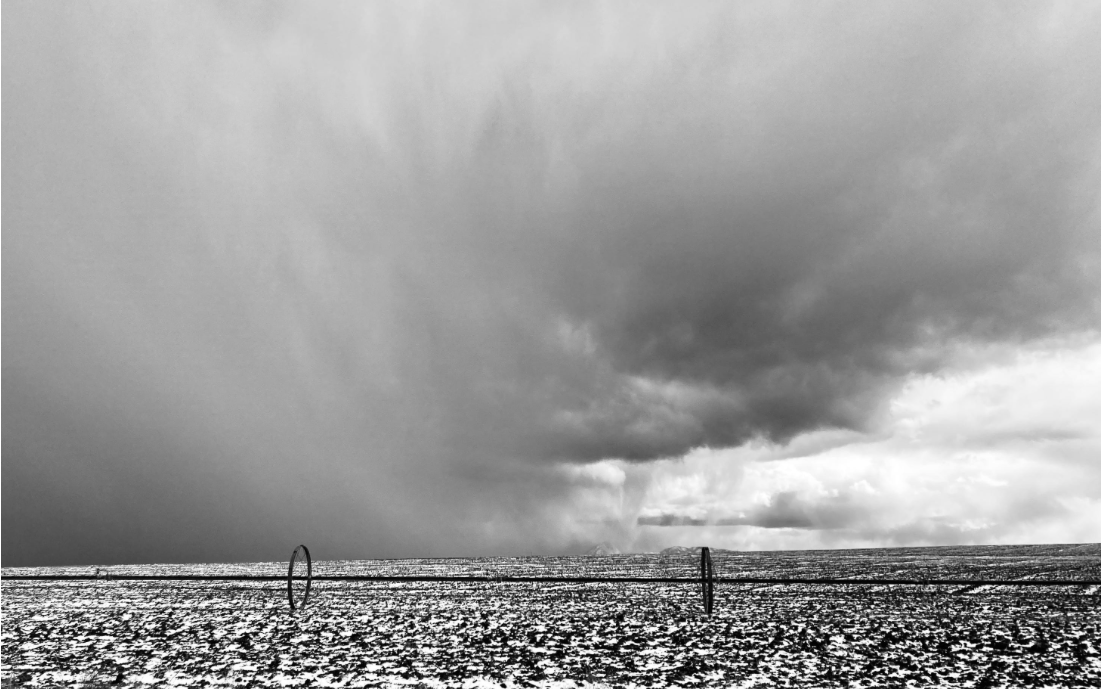
Sprinkler, sky, snowy field. Jonathan P. Thompson photo.

Click the link to read the article on The Land Desk website (Jonathan P. Thompson):

May 3, 2024

๐Ÿฅต Aridification Watch ๐Ÿซ

What a difference a warm, dusty month can make. 

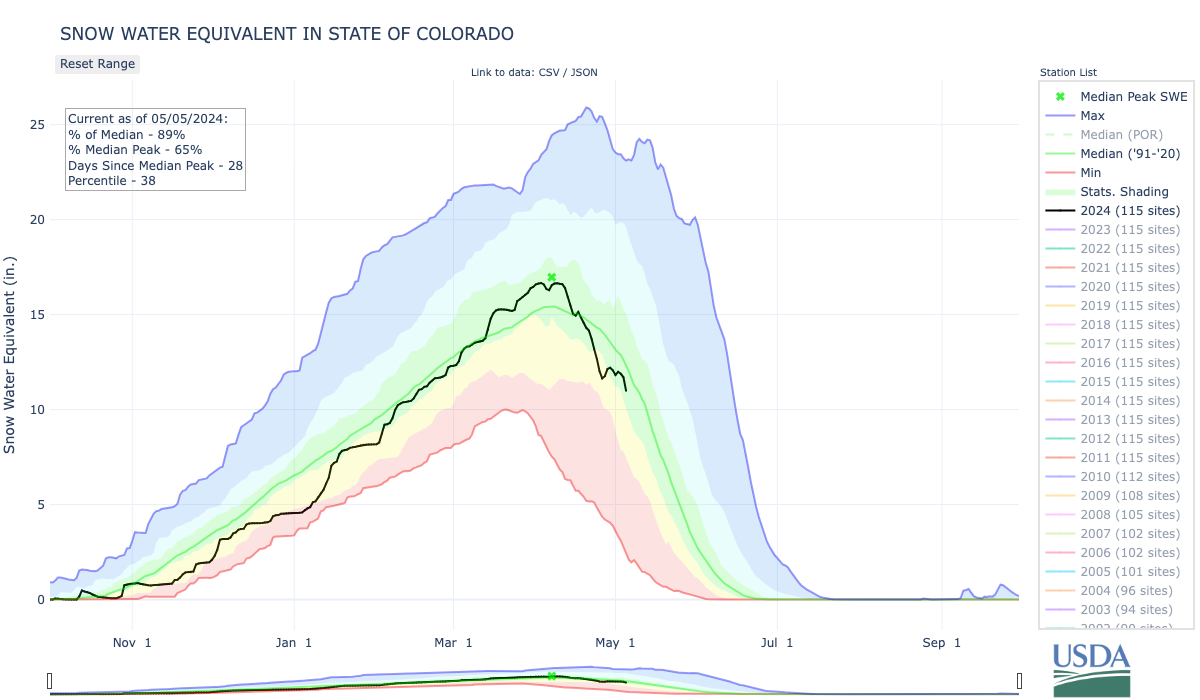
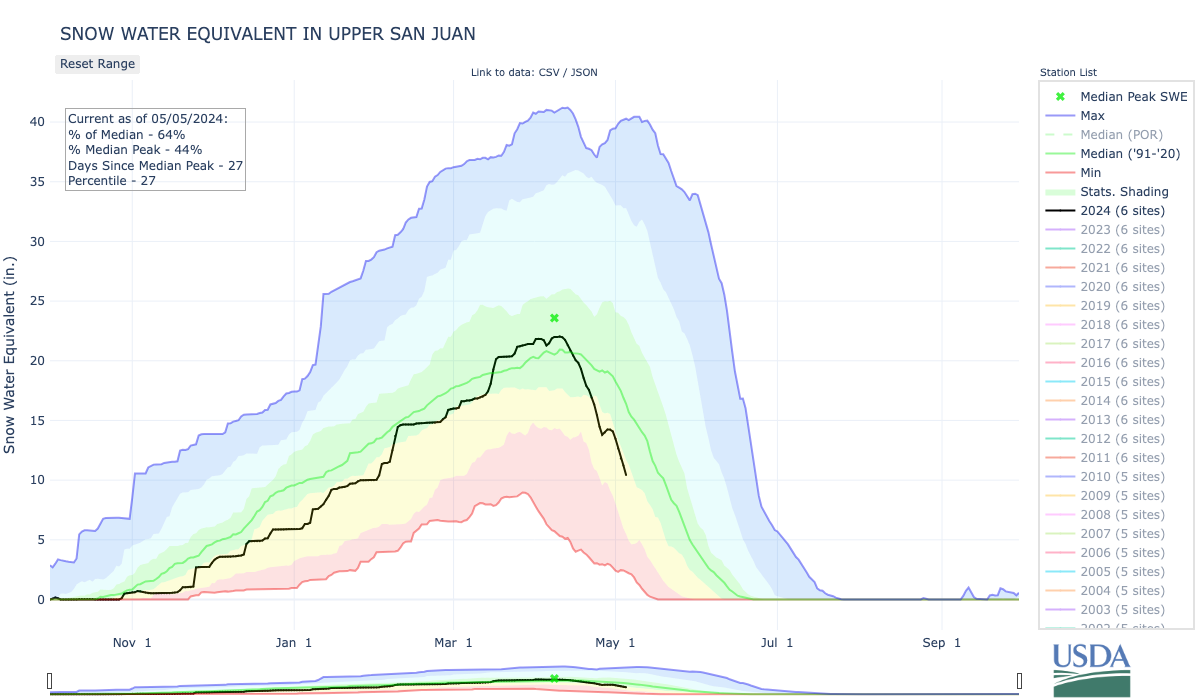
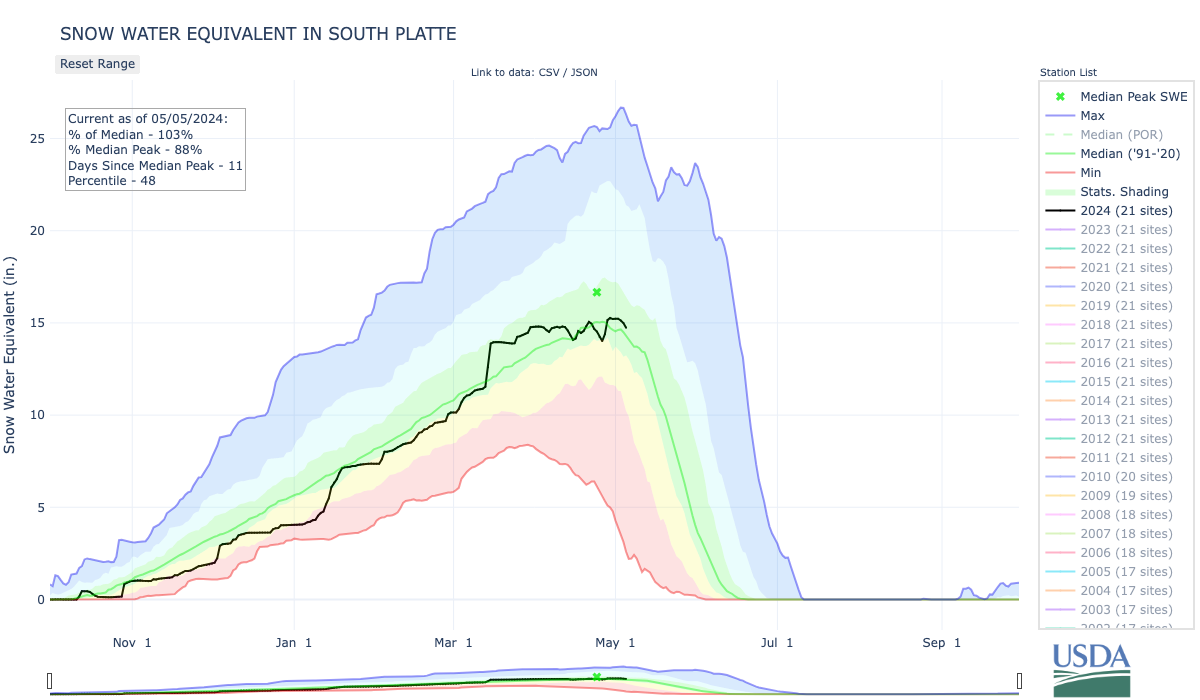
In early April, the Land Desk reported that the snowpack in most of the Southwest was at or above normal, and appeared to be peaking right on schedule, presaging a normal spring runoff. But April turned out to be the cruelest month, after all, sending snowpack levels into a free-fall and dashing hopes for a strong spring runoff on most of the regionโ€™s streams. 

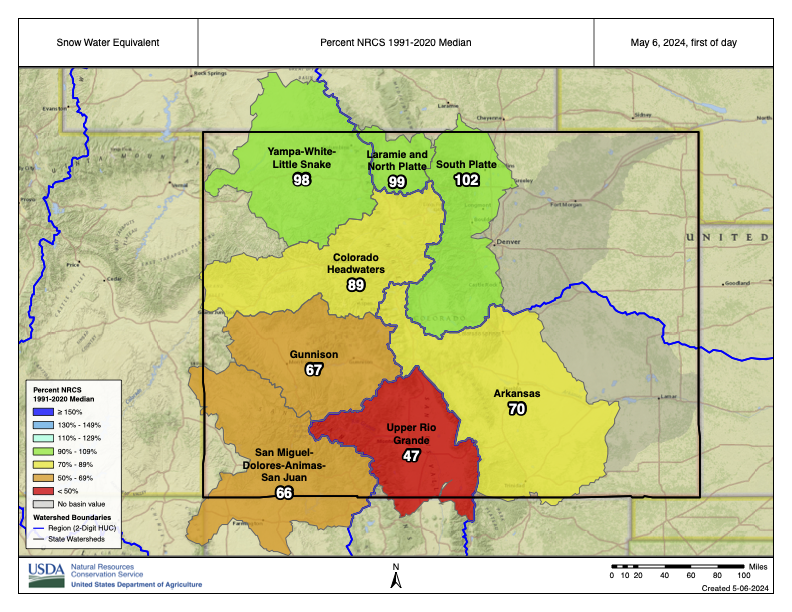
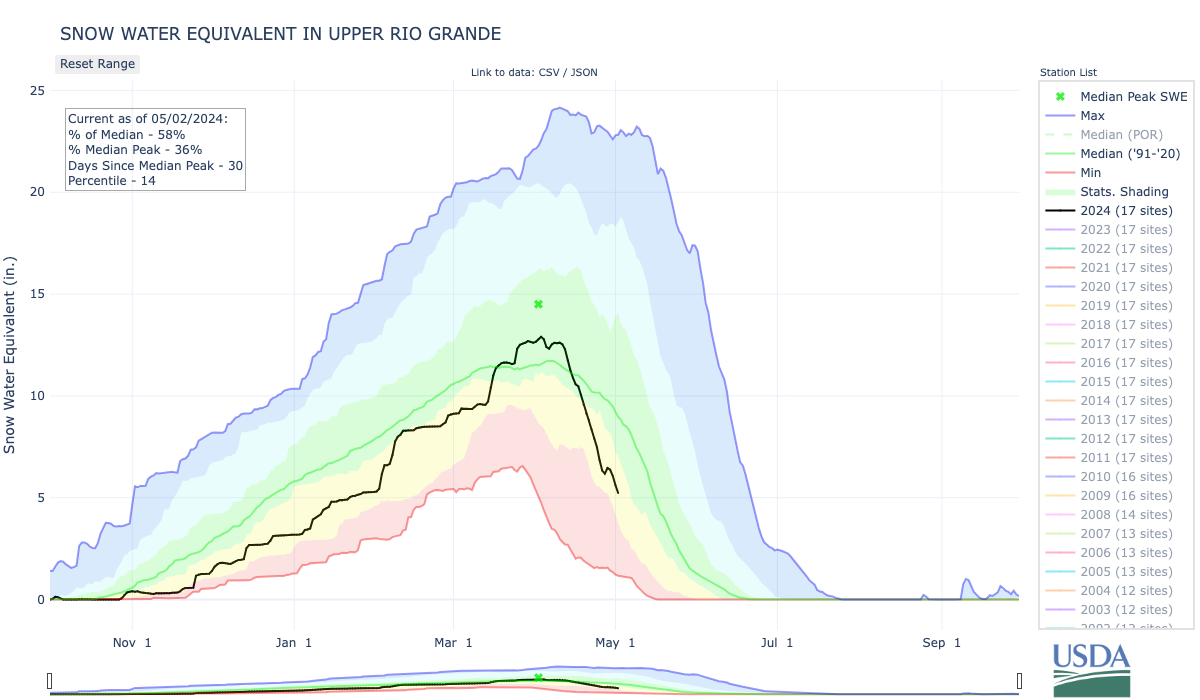
Take the Gunnison River watershed: Snow water equivalent levels peaked on April 9 at a slightly higher than median level โ€” or about 107% of normal. Within a week, the levels had dropped below normal; and by May 1 were at about 75% of the median level for that date, putting it just about even with 2021, which was a horribly dry year. (More charts and graphs below the text).

A similar pattern is seen throughout Colorado, with northern areas (such as the Yampa) generally faring better than those in the southern part of the state (e.g. the Animas and Dolores). There are exceptions: Snowpack in the high La Plata Mountains in southwestern Colorado is still at about 90% of the median and isnโ€™t falling as quickly as in other areas, which is good news for the La Plata River and the โ€œDrysideโ€ farmers who rely on it for irrigation.

Part of the problem was that the spigot from the sky, after spewing generously for much of March, seemed to shut off in mid-April, with the exception of a single good storm near the end of the month. But a bigger factor was the combination of unusually high temperatures throughout the winter along with relentless spring winds and a series of dust events.

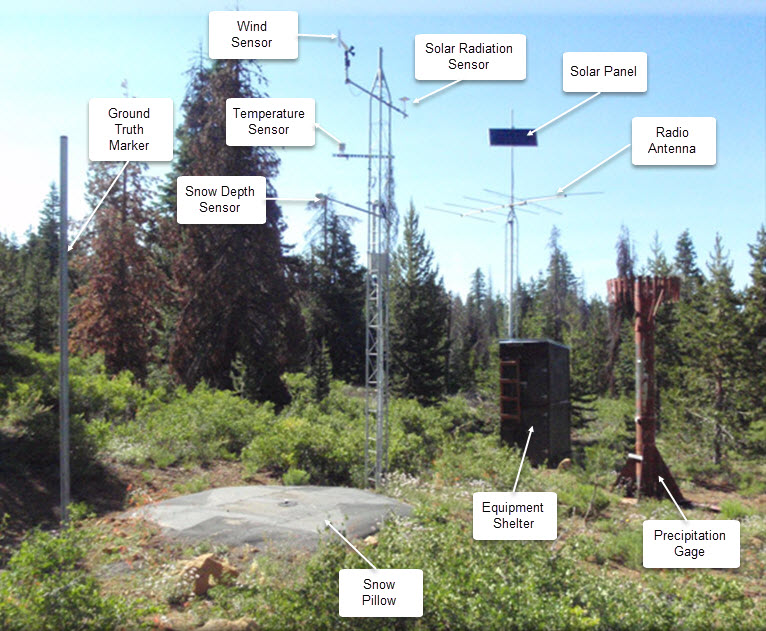
Overall, the United States experienced its warmest meteorological winter(Dec 1 – Feb. 29) on record, and Western states had unusually high temperatures. A sampling of average daily temperature data from individual and river-basin SNOTEL sites reveal that in most cases they were above median for the period of record (which usually reaches back to the late 1980s). 

Hastening the snowmelt have been a series of dust events in the late winter and early spring. The Center for Snow and Avalanche Studies, in its April 22 statewide report, observed dust layers across the Colorado mountains, with severe dust in the McClure Pass and Roaring Fork region, and with Wolf Creek Pass having the heaviest dust in the San Juan Mountains. โ€œPerhaps, besides the Roaring Fork region, overall dust severity is in the โ€˜averageโ€™ category,โ€ wrote CSAS director Jeff Derry, โ€œbut donโ€™t believe, combined with the weather, it canโ€™t have drastic affects on snowpack ablation. Without some meaningful precipitation snowmelt season could be over quickly.โ€

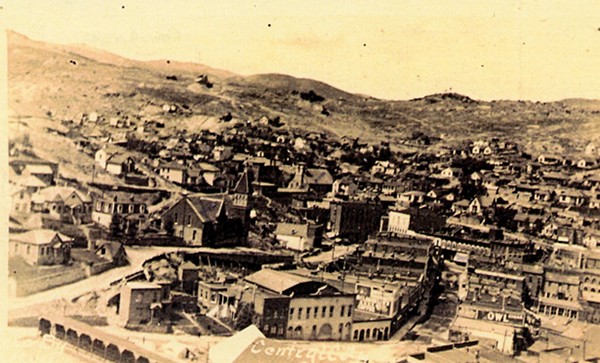
Dust in Western Colorado certainly isnโ€™t new. Old newspapers abound with tales of dusty woe, including this grisly one from May 1911.

In early April, the Dolores Water Conservancy District noted that it was unlikely theyโ€™d release enough water from McPhee Reservoir to enable boating in the Lower Dolores River โ€” even for a short period of time. The deteriorating snow situation makes the prospect of raftable flows above the confluence with the San Miguel River highly implausible. As I write this, the riverโ€™s flow below the dam is barely more than a trickle at 50 cubic feet per second (and around 500 cfs above the reservoir). 

At the beginning of April, the Bureau of Reclamation predicted Lake Powellโ€™s surface level would increase by about 30 feet from late March levels during spring runoff in June, before subsiding back to about 3,563 feet by the end of the year (It was at 3,560 feet on May 1). The agency hasnโ€™t released itโ€™s end of April projections yet, but theyโ€™re likely to be less optimistic now. 

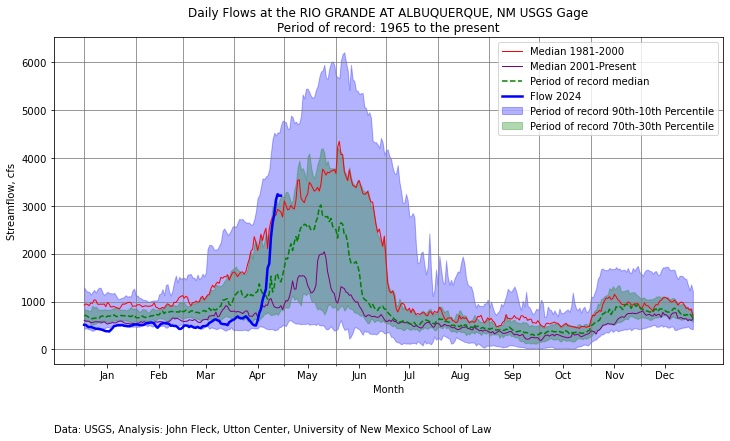
The Animas River in Durango, where the water runs free and flows are influenced entirely by snowmelt, hit 1,600 cfs on April 25 before cooler temperatures brought it back down to 736 cfs. We can get a sense of when and how big peak runoff will be by considering that on May 1 of last year, the snow levels in the basin were about twice what they are now, and the river peaked at 4,500 cfs at the end of May. 

My guess: The Animas River will peak on May 18 at 2,400 cfs. What do you think? Leave your guess in the comments below.

The Animas River Basinโ€™s snowpack was tracking right around median after a wet March, but itโ€™s melting quickly enough that itโ€™s now on a par with 2021, when many a regional irrigator went without water.
Precipitation in the San Juan-Animas-Dolores Basin this water year has been pretty close to normal, but warm temperatures and dust have turned what fell as snow to water sooner than usual.
This shows the averages of the average daily temperatures for a number of SNOTEL stations across the San Juan Mountains in southwestern Colorado. Note that 2024 was warmer than the median for the period of record (beginning in 1987) and was significantly warmer than in the 1990s.
The Northern Rockies have had it tough, as far as snow goes, this year. Snowpack levels in the Upper Green were at their lowest on record in early January. They rebounded to close to normal before declining again in April.
Part of the reason for scant snow is relatively high temperatures. This water year has been the third warmest on record for the Upper Green.

โ›๏ธ Mining Monitor โ›๏ธ

NEWS: Utahโ€™s state engineer approves Blackstone Mineralsโ€™ (aka A1/Anson) proposal to withdraw about 13,755 acre-feet of water from groundwater wells near Green River, Utah, clearing the way for what would be the Four Corners regionโ€™s first direct lithium extraction project

CONTEXT: Australia-based Anson Resources and its subsidiaries โ€” A1 Lithium, Blackstone Minerals, and Blackstone Resources โ€” have staked more than 1,000 federal mining claims, acquired private land, and secured Utah state land leases in and around southeastern Utahโ€™s Paradox Formation over the last several years. They appear to be working on several projects, with their Paradox direct lithium extraction project the furthest along. 

Anson plans to drill 8,000- to 9,000-foot-deep wells just north of the town of Green River, pump brine to the surface, and use resin beads to extract the lithium from the water, without evaporation ponds. After the lithium is extracted, Anson claims theyโ€™ll inject the same amount of water back underground, which if true would mean their consumptive water use โ€” or the amount withdrawn minus the amount returned to the aquifer โ€” will be zero. Last year Anson applied for the right to withdraw water year-round at a rate of 19 cubic feet per second โ€” or about 12 million gallons per day โ€” for non-consumptive use. 

But concerned residents, advocates, and even federal and state regulators have expressed skepticism and concern. Not only is the zero-consumptive use claim somewhat dubious, but pumping that much groundwater could have an adverse effect on the Green River or freshwater aquifers. Plus, the wells will be drilled adjacent to a former uranium mill and current disposal site for radioactive and otherwise contaminated materials, and within the Department of Energyโ€™s โ€œarea of concernโ€ surrounding the site. And they will drill through an aquifer contaminated by those activities.

The red โ€œxโ€s mark the location of Ansonโ€™s wells. The dark rectangle is the radioactive waste disposal cell.

The state, however, felt that Anson adequately addressed these concerns, and granted the water right. It did, however, indicate that if Ansonโ€™s water use was not 100% non-consumptive, the company would be subject to enforcement and fines. The Great Basin Water Network and local residents have called for public meetings with regulators to address their concerns.


Alsoโ€ฆ 

  • Congress has passed legislation banning low-enriched uranium importsfrom Russia, sending it to President Bidenโ€™s desk for signing. While the U.S. does not import large amounts of the reactor fuel from Russia, the ban likely will cause uranium prices to rise and bolster efforts to reopen uranium mines in Utah, Colorado, New Mexico, and Wyoming. (World Nuclear News)
  • Navajo Nation leaders urge the Biden administration to block a mining company from shipping uranium across tribal land from the Pinyon Plain mine near the Grand Canyon to the White Mesa mill in southeastern Utah. (KNAU)
  • Anfield Energy applies for state and federal permits to reopen its Velvet-Wood uranium mine in the Lisbon Valley of southeastern Utah. (news release)
  • Anson Resources (yes, the lithium folks) is launching a uranium exploration project at its Yellow Cat claims just north of Arches National Park in a historically mined area. (proactive)
  • Donโ€™t forget to the visit the Land Desk Mining Monitor Map for more info on mining activity in the Four Corners Country.

Investigating for Ourselves: Dam Proposals on Black Mesa and Beyond — Advocate Magazine The Grand Canyon Trust #ColoradoRiver #COriver #aridification

Click the link to read the article on The Grand Canyon Trust website (Daryn Akei Melvin):

Spring/Summer 2024

Hydropower proposals raise major questions about tribal consent and consultation.

In the spring of 2018, I was invited to visit my partnerโ€™s familyโ€™s “sheep camp” in Nastล‚’a, a sprawling box canyon along the eastern edge of Black Mesa, west of the community of Chilchinbito, on the Navajo Nation.

That spring, my partnerโ€™s relatives had begun renovating their family home, a modest white stone house, where generations of the family had been raised, and which stood only a few hundred yards from the homes of other extended family members. The multi-generational connection to this place was palpable, for despite only having solar power and no running water, relatives both young and old were eager to lend a hand in the renovations that day.ย 

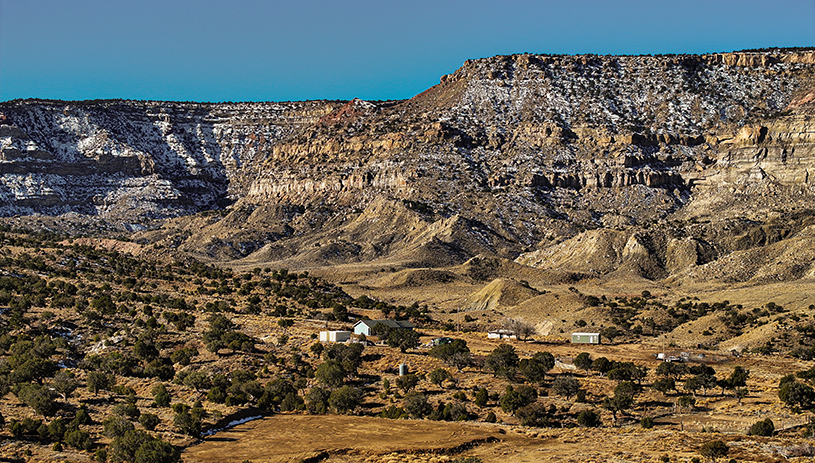
The family home in Nastล‚’a. JHEREMY YOUNG

Later, I was invited by my partnerโ€™s father to walk up the escarpment of Black Mesa, following trails used by generations of my partnerโ€™s family to reach their grazing lands along the mesa top. After an hour-and-a-half trek, we stood at the end of the trail, which was transected by a weathered barbed-wire fence that served as the boundary line between the Navajo and Hopi partitioned lands.

I turned around to look out over the valley below. Little did I know then that much of the dynamic and vibrant landscape I beheld, including the very ground on which I stood, would years later be at the center of three massive pumped storage hydroelectric projects proposed by a company organized by a French entrepreneur under the name Nature and People First Arizona.

In 2022, Nature and People First Arizona applied for preliminary permits to assess the feasibility of building three hydropower projects on Black Mesa, a large plateau that extends across both Navajo and Hopi lands.

STEPHANIE SMITH

Per the project proposals filed with the Federal Energy Regulatory Commission, the three projects simply named Black Mesa South, Black Mesa East, and Black Mesa North would span roughly 40 miles of the Navajo Reservation, occupying the entire northeastern ridge of the mesa, from the community of Chilchinbito to the town of Kayenta.  

What is pumped storage hydropower?

Pumped storage hydropower facilities are essentially low-tech batteries that store energy in the form of water and usually consist of two reservoirs, one above the other. In the case of Black Mesa, the upper reservoirs for the three projects would be placed atop the mesa, while the lower reservoirs would rest at the base of the mesaโ€™s steep face. 

Using surplus power from the grid, usually generated by solar or wind during the day, water from the lower reservoirs would be pumped to the upper reservoirs, and then when demand for power rose, water would be released from the upper reservoirs and propelled by gravity through a turbine, generating electricity before again emptying into the lower reservoirs.ย 

JOAN CARSTENSEN

Many Hopi footprints

As we stood at the boundary line overlooking Nastล‚’a, my partnerโ€™s father noted the footprints of a coyote. 

“How do you say ‘coyote tracks’ in Hopi?” he asked, to which I responded, “iskukveni.”

The fact that this word found its way into our conversation that day was particularly apropos given that the Black Mesa area holds great historical and cultural significance for Hopi people, especially for those of the Isngyam (Coyote Clan). Furthermore, the word kukveni (footprints) serves as a powerful metaphor for Hopi people to comprehend our tangible heritage, whether it be the archaeological remains of former settlements like pottery sherds, stone tools, or petroglyphs, or other physical reminders of our past use and occupation of the land. In every sense, throughout Black Mesa there are indeed many Hopi footprints.

It was then I noticed that the footprints to which my partnerโ€™s father was referring went along the trail ahead of us and crossed under the barbed-wire fence of the boundary line. This brought a smile to my face as coyotes or their signs are often encountered on the road, for to be on the road is to be between situations, to be in transition.

It is perhaps not surprising then that this area, as an ancestral home of the Isngyam, would play a role in the push to transition the United States away from fossil fuels toward renewable “green energy.” This push, however, resulted in an explosion of dam proposals on tribal lands, and these numbers are likely to only increase given federal tax credits to support pumped storage hydropower projects under the Inflation Reduction Act.

Yet, despite being considered a renewable “green energy” option and touted as a means to replace some of the revenue, jobs, and power generation lost with the closure of Navajo Generating Station in 2019, pumped storage hydropower is not without its own issues, including how to fill the reservoirs.ย 

Looking out at Nastล‚’a. RAYMOND CHEE

Astonishing amounts of water

Filling the nine proposed reservoirs on Black Mesa would require an astonishing 147 billion gallons (450,000 acre-feet) of water, but in the applications for preliminary permits the developer was vague on the details of where that water would come from. The applications cited the Colorado River, the San Juan River, and two local aquifers as possible sources but did not indicate the current availability of or legal rights to these sources. 

That means that, potentially, the projects could pump groundwater that has fed the springs and streams of Navajo and Hopi lands for millennia. Over the last century, groundwater has been drawn down by coal mining, power plants, growing populations, and, up until 2005, a slurry line that pumped billions of gallons of water to move coal from the mine in Kayenta to the Mohave Generating Station approximately 273 miles west.

The prospect of adverse cultural, ecological, and environmental impacts has consequently drawn much more opposition than support when it comes to Black Mesa and other pumped storage dam projects proposed on tribal lands.

The Navajo Nationโ€™s Department of Justice, 19 Navajo Nation chapters (local governments), members of the Hopi public, and various grassroots and conservation groups filed comments, concerns, and questions regarding the Black Mesa projects and urged the Federal Energy Regulatory Commission to deny Nature and People First Arizonaโ€™s requested preliminary permits due to the wildly unrealistic nature of the proposals in the arid Southwest, as well as their compounding effects after decades of harm to the people, land, and aquifers of Black Mesa from coal mining.ย 

The author near the edge of Black Mesa. RAYMOND CHEE

Investigating for ourselves

My own personal experience of the Black Mesa area is colored by the contentious Peabody Coal mining operations of the past, for as a child I would occasionally accompany itร apaโ€™pa (our grandfather), a Coyote Clan member, on his visits to the Black Mesa area. During these outings he often lamented the harms the mining operations caused to the land, and the depletion of the most significant water source in the region. He recounted the controversial means by which the Hopi tribal government entered into its lease agreements with Peabody Western Coal Company in the 1960s and how such agreements were negotiated by prominent natural resources attorney John Boyden, who claimed to be representing the Hopi Tribe while actually on the payroll of Peabody. This subterfuge ultimately resulted in unusually advantageous terms for Peabody and gross misrepresentations to the Hopi people of the mineโ€™s impacts on their land.

“Okiwa, kur paร sat itam nuโ€™an unaโ€™iโ€™istu โ€” Regrettably, then we were oh so gullible,”ย our grandfather said.

I recall being particularly amused by his use of the term unaโ€™iโ€™ist as it references those who share in the gullible nature of his wuโ€™ya (clan totem), Coyote, who is prone to believe anything he is told and is therefore easily duped. Yet, as the motifs of Hopi coyote tales are in fact meant to demonstrate the ways in which one should not live, his comment also serves as an admonition that people would do well to question things. For as our grandfather often also said when speaking about his wuโ€™ya, “Puโ€™ Iisaw piw pas hรฌita aw poรฒteโ€™ningwu โ€” It is also Coyoteโ€™s nature always to investigate things for himself.”

Unfortunately, the ability of tribal communities and governments to holistically investigate and assess the positive and negative implications of large-scale projects on their lands, particularly as they endeavor to balance humanitarian and economic needs with cultural preservation and environmental protection, is something that has been historically lacking.

Case in point, historically the Federal Energy Regulatory Commission has not been required to consult with or obtain the consent of the tribe on whose land a project was being proposed before issuing a preliminary permit. In fact, the commission wasnโ€™t even required to notify a tribe when a project had been proposed on its tribal lands.ย 

The need to remedy this oversight became even more apparent in 2020, after preliminary permits were issued for two pumped storage hydropower projects on the lower Little Colorado River not far from its confluence with the Colorado River in the Grand Canyon and within the sovereign borders of the Navajo Nation despite objections by the Navajo Nation, the Hopi Tribe, and the Hualapai Tribe. A thirdย proposal to dam nearby Big Canyonย for hydropower has been pending since 2020.


Update: On April 25, 2024, the Federal Energy Regulatory Commission struck down the proposed Big Canyon Dam.ย Read moreย โ€บ

Following several years of community conversations on the Navajo Nation and in Hopi villages, and informed by the concerns community members voiced, on February 6, 2024, the Hopi Tribe passed Resolution 010-2024 in which the Hopi Tribal Council resolved to petition the Federal Energy Regulatory Commission to update its rules to require tribal consultation and consent for granting preliminary permits for hydroelectric projects on tribal lands.

Less than a week after Hopiโ€™s decision, in a historic reversal of past precedent,ย the commission denied seven preliminary permits for pumped storage hydropower projects across the Navajo Nation, including all three of the Black Mesa storage projects, citing opposition from the Navajo Nation.

STEPHANIE SMITH

In these orders, the commission announced a new policy: “the Commission will not issue preliminary permits for projectsโ€ฆ if the Tribe on whose lands the project is to be located opposes the permit.”

The commission didnโ€™t immediately strike down the Big Canyon project, but instead opened an additional 30-day comment period, likely intended to provide the Navajo Nation an opportunity to make a clear statement about whether or not it opposes the project.

The Hopi Tribe is currently reviewing the Federal Energy Regulatory Commissionโ€™s new policy on tribal consent and speaking with other tribes as potential cosigners on a formal petition urging the commission to establish additional requirements governing tribal consultation and consent before preliminary permits can be issued on tribal lands. Regardless, this recent reversal in policy, at the very least, stands in recognition of tribal sovereignty, grants tribes a legal means of determining the kinds of hydropower projects that happen on their lands, and is a positive, proactive step toward true self-determination and governance for Native people.


Daryn Akei Melvin works as a Grand Canyon manager for the Grand Canyon Trust with a focus on addressing issues related to the Little Colorado River.


EDITOR’S NOTE: The views expressed by Advocate contributors are solely their own and do not necessarily represent the views of the Grand Canyon Trust.

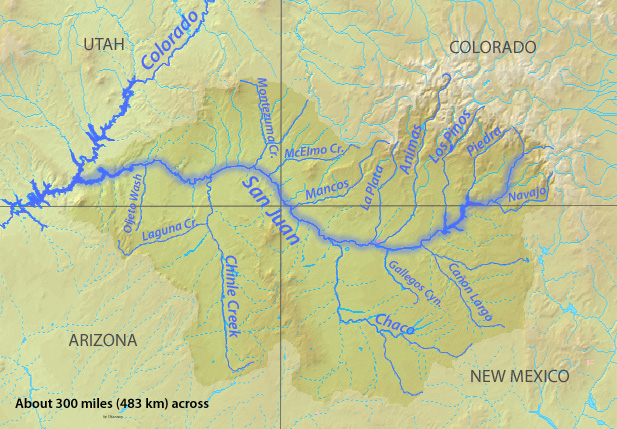
Map of the Little Colorado River basin in Arizona and New Mexico, USA. Made using USGS shaded relief data. By Shannon1 – Own work, CC BY-SA 4.0, https://commons.wikimedia.org/w/index.php?curid=48709569

Critical Effects of Precipitation on Future #ColoradoRiver Flow — American Meteorological Society Journal of #Climate #COriver #aridification

September 21, 1923, 9:00 a.m. — Colorado River at Lees Ferry. From right bank on line with Klohr’s house and gage house. Old “Dugway” or inclined gage shows to left of gage house. Gage height 11.05′, discharge 27,000 cfs. Lens 16, time =1/25, camera supported. Photo by G.C. Stevens of the USGS. Source: 1921-1937 Surface Water Records File, Colorado R. @ Lees Ferry, Laguna Niguel Federal Records Center, Accession No. 57-78-0006, Box 2 of 2 , Location No. MB053635.

Click the link to access the article on the AMS website (Martin P. Hoerling, Jon K. Eischeid, Henry F. Diaz, Balaji Rajagopolan, andย Eric Kuhn). Here’s the abstract:

April 19, 2024

Of concern to Colorado River management, as operating guidelines post-2026 are being considered, is whether water resource recovery from low flows during 2000โ€“2020 is possible. Here we analyze new simulations from the sixth generation of the Coupled Model Intercomparison Project (CMIP6) to determine plausible climate impacts on Colorado River flows for 2026โ€“2050 when revised guidelines would operate. We constrain projected flows for Lee Ferry, the gauge through which 85% of the river flow passes, using its estimated sensitivity to meteorological variability together with CMIP6 projected precipitation and temperature changes. The critical importance of precipitation, especially its natural variability, is emphasized. Model projections indicate increased precipitation in the Upper Colorado River basin due to climate change, which alone increases river flows 5%โ€“7% (relative to a 2000โ€“2020 climatology). Depending on the riverโ€™s temperature sensitivity, this wet signal compensates some, if not all, of the depleting effects from basin warming. Considerable internal decadal precipitation variability (~5% of the climatological mean) is demonstrated, driving a greater range of plausible Colorado River flow changes for 2026โ€“2050 than previously surmised from treatment of temperature impacts alone: the overall precipitation-induced Lee Ferry flow changes span โˆ’25% to +40% contrasting with a โˆ’30% to โˆ’5% range from expected warming effects only. Consequently, extreme low and high flows are more likely. Lee Ferry flow projections, conditioned on initial drought states akin to 2000โ€“2020, reveal substantial recovery odds for water resources, albeit with elevated risks of even further flow declines than in recent decades.

ยฉ 2024 American Meteorological Society. This is an Author Accepted Manuscript distributed under the terms of the default AMS reuse license. For information regarding reuse and general copyright information, consult the AMS Copyright Policy (www.ametsoc.org/PUBSReuseLicenses).Corresponding author: Balaji Rajagopalan,ย balajir@colorado.edu.

A rare dose of hope for the #ColoradoRiver as new study says future may be wetter — KUNC #COriver #aridification

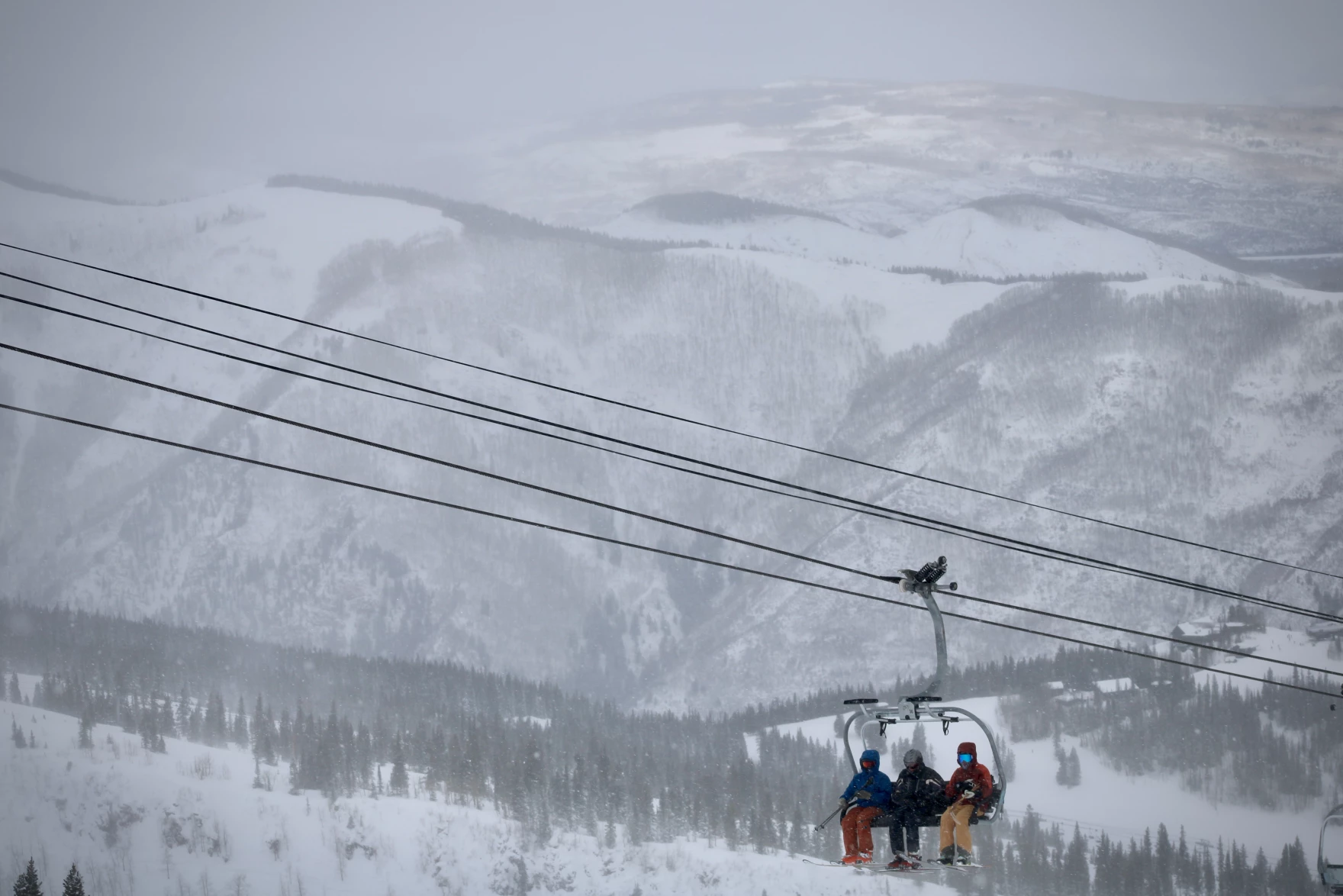
Skiers ride a lift on a snowy morning at Snowmass Ski Area on January 11, 2023. High-altitude snow in Colorado accounts for two-thirds of the water in the Colorado River, and scientists say the next two decades are likely to bring increased precipitation to the area. Alex Hager/KUNC

Click the link to read the article on the KUNC website (Alex Hager):

May 5, 2024

This story is part of ongoing coverage of the Colorado River, produced by KUNC in Colorado and supported by the Walton Family Foundation. KUNC is solely responsible for its editorial coverage.

Good news on the Colorado River is rare. Its reservoirs, the two largest in the country, have shrunk to record lows. The policymakers who will decide its future are stuck at an impasse. Climate change has driven more than two decades of megadrought and strained the water supply for 40 million people across the Southwest.

But a new study is delivering a potential dose of optimism for the next 25 years of the Colorado River. The findings, published in the Journal of Climate, forecast a 70% chance the next quarter century will be wetter than the last.

Projections for Colorado River water supply have largely focused on the impact of temperature. Climate change means the region is getting hotter, which in turn drives a raft of environmental factors that mean less water ends up in rivers and reservoirs. For example, snow melts quicker and is more likely to evaporate. Dry, thirsty soil soaks up snow melt before it has a chance to flow into the nearest stream.

Thisย new study, though, takes a closer look at the impact of precipitation.

Eighty five percent of the Colorado River starts as snow in the regionโ€™s headwaters โ€“ the high-altitude mountains of Colorado and Wyoming. The scientists behind the new paper predict an increase in precipitation over the next 25 years that could be big enough to offset the drying caused by rising temperatures, at least in the short term.

Researchers with the Cooperative Institute for Research in Environmental Sciences at the University of Colorado Boulder used data from the United Nations Intergovernmental Panel on Climate Change, or IPCC, to run forecasting models and form their conclusions.

Those scientists stressed the importance of variability in their findings. While the high end of their forecasts paint a positive picture, their models also showed a small chance that precipitation could go down in the next two decades. Thereโ€™s a 4% chance that river flows could drop by 20% in the next 25 years.

โ€œAll of our thinking, our acting, our management should be humble and recognize the nature in which we live, which is, yeah, you have water, but it is very highly variable,โ€ Balaji Rajagopalan, a water engineering professor who co-authored the study, said.

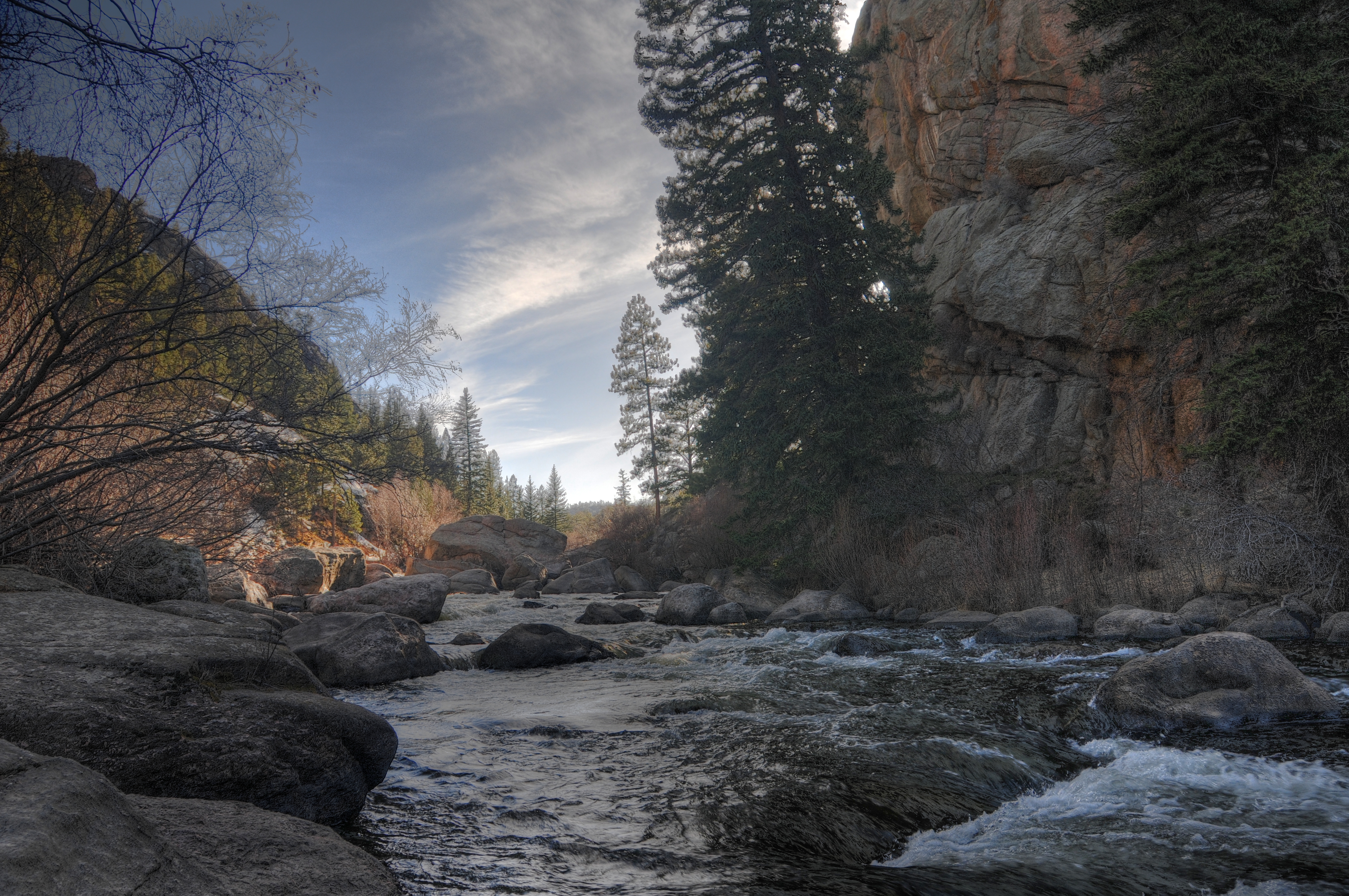
The Colorado River flows through Glenwood Canyon in Colorado on January 29, 2024. Scientists stressed the variability in new findings about precipitation. They emphasized the wide range of possible outcomes for Colorado River flows and said policy makers should build flexible water management rules. Alex Hager/KUNC

Good science about the regionโ€™s climate future is particularly important right now, as Colorado River policy makers renegotiate the rules for sharing its water. The regionโ€™s water crisis is driven by two big themes โ€“ climate change is shrinking supply, and the people in charge have struggled to rein in demand in response.

Right now, theyโ€™re hashing out a new set of rules for managing the river to replace the guidelines that expire in 2026. Rajagopalan said the findings from the new study underscore the need to build flexible rules that can adapt along with climate conditions.

โ€œWe want to emphasize that it’s not like, โ€˜Oh, there’s going to be water around, so letโ€™s go party โ€“ we don’t have to do the hard work that needs to be done in terms of conservation and thoughtful management,โ€™โ€ he said. โ€œIf anything, it speaks to even more reason that you have to.โ€

Another climate scientist, Brad Udall, who was not involved in the study, cast a bit of skepticism on its findings and message. Udall, a climate researcher at Colorado State University’s Colorado Water Institute, said he holds the paperโ€™s authors in high regard, but some aspects of the studyโ€™s approach gave him some โ€œunease.โ€

โ€œWe just canโ€™t rely on these models for precipitation,โ€ he said. โ€œWe can rely on them for temperature, but we canโ€™t rely on them for precipitation. There are just too many issues with them.โ€

He said climate models canโ€™t always dependably predict precipitation because they are based on statistics, as opposed to the physics-based methods used to build long-term temperature forecasts.

Udall, who has referred to himself as โ€œthe skunk in the roomโ€ after years of sharing tough-to-stomach forecasts about the dire future of Western water, pointed to this yearโ€™s runoff as an example of temperatureโ€™s ability to chip away at the benefits of a wet winter.

While snow totals in the Colorado River headwaters region peaked at around 100% of normal, warm temperatures mean flows in the Colorado River are expected to reach about 80% of normal levels.

“New plot using the nClimGrid data, which is a better source than PRISM for long-term trends. Of course, the combined reservoir contents increase from last year, but the increase is less than 2011 and looks puny compared to the โ€˜holeโ€™ in the reservoirs. The blue Loess lines subtly change. Last year those lines ended pointing downwards. This year they end flat-ish. 2023 temps were still above the 20th century average, although close. Another interesting aspect is that the 20C Mean and 21C Mean lines on the individual plots really donโ€™t change much. Finally, the 2023 Natural Flows are almost exactly equal to 2019. (17.678 maf vs 17.672 maf). For all the hoopla about how this was record-setting year, the fact is that this year was significantly less than 2011 (20.159 maf) and no different than 2019” — Brad Udall

2024 Secretarial #Drought Designations cover 570 counties and 345 contiguous counties through May 1, 2024 — @DroughtDenise

Declaration Process Fact Sheet at https://fsa.usda.gov/Assets/USDA-FSA-Public/usdafiles/FactSheets/emergency_disaster_designation_declaration_process-factsheet.pdf

$500 million for #solar energy for tribal families — Source #NewMexico #ActOnClimate

Solar panel at Positive Energy Solar on Sept. 11, 2023. (Photo by Anna Padilla for Source New Mexico)

Click the link to read the article on the SourceNM website (Joaqlin Estus):

April 29, 2024

Look for solar panels to blossom atop low-income homes in Indian Country over the next five years. Last week, the Environmental Protection Agency announced $500 million for tribes as part of $7 billion in grants for residential solar energy. Some $5.5 billion will go to states, and $1 billion to multi-state awards.

The $7 billion will benefit 900,000 households in low-income and disadvantaged communities, said EPA Administrator Michael S. Regan in a prepared statement. โ€œThe selectees will advance solar energy initiatives across the country, creating hundreds of thousands of good-paying jobs, saving $8 billion in energy costs for families, delivering cleaner air, and combating climate change.โ€

โ€œSolar is the cheapest form of electricityโ€”and one of the best ways to lower energy costs for American families,โ€ stated John Podesta, Senior Advisor to the President for International Climate Policy. โ€œTodayโ€™s announcement of EPAโ€™s Solar for All awards will mean that low-income communities, and not just well-off communities, will feel the cost-saving benefits of solar thanks to this investment.โ€

โ€œResidential solar electricity leads to reduced monthly utility bills, reduced levels of air pollution in neighborhoods, and ultimately healthier communities, but too often low-income and disadvantaged communities have been left out,โ€ U.S. Department of Housing and Urban Development Acting Secretary Adrianne Todman said in the statement.

โ€œSunlight is powering millions of homes across the nation, and weโ€™re working hard to ensure Americans everywhere can benefit from this affordable clean energy resource,โ€ stated U.S. Secretary of Energy Jennifer M. Granholm.

EPA awarded $62 million to a nonprofit Native-led organization that brings solar energy to underserved communities, the National Tribal Program of GRID Alternatives.
GRID, in a prepared statement, said โ€œthe National Tribal Program, in coalition with The Alliance for Tribal Clean Energy, Native CDFI Network, and Native Renewables, is poised to revolutionize solar energy access within Native American communities nationwide.โ€

Co-Executive Director of the National Tribal Program Talia Martin, a citizen of the Shoshone-Bannock tribes, said in a statement, โ€œThis funding will enable us to make significant strides in bridging the clean energy gap in Native American communities, supporting their capacity to harness the abundant potential of solar power while fostering tribal economic development and self-sufficiency.โ€

โ€This initiative serves as a vital step towards alleviating poverty, combating climate change, and fostering the creation of sustainable, well-paying green jobs for thousands of tribal members,โ€ said Cheri Smith, Miโ€™kmaq tribal descendant, president & CEO, Alliance for Tribal Clean Energy, in a statement. The money for tribes will support their self-determined efforts to deploy clean energy on tribal lands she said.

โ€œWe believe that everyone deserves access to affordable, and reliable energy solutions,โ€ said Suzanne Singer, Co-Founder and executive director of Native Renewables and a citizen of the Navajo Nation, in a statement. โ€œThrough collaborative efforts like the National Tribal Program, we can support Indigenous communities in their transition to a renewable energy future.โ€

In addition to GRID, the EPA announced three other tribal recipients:

Midwest Tribal Energy Resources Association Inc., Tribal Consortium $62,330,000

โ€œThe Midwest Tribal Energy Resources Association, Inc. and coalition partners GRID Alternatives, the Alliance for Tribal Clean Energy, and the Native Community Development Financial Institute (CDFI) Network will deploy Tribally-owned residential solar, along with storage and necessary upgrades, for the benefit of the 35 Tribes located in Michigan, Minnesota, and Wisconsin. The coalition, headquartered in Wisconsin, will leverage the deep expertise and experience of its members to build a program that empowers Tribes and Tribal energy champions, provides project-deployment technical assistance necessary to plan and build residentially benefiting solar projects on Tribal Lands in the Midwest, and includes workforce development to enhance tribal self-determination and self-sufficiency,โ€ reads the statement.

Oweesta Corporation, Tribal nonprofit $156,120,000

โ€œThe Tribal nonprofit Oweesta Corporation will address adoption barriers to Native residential and community solar deployment by acting as the intermediary between professional services partners, developers, Tribal governments and Tribal organizations. Oweestaโ€™s program will support an equitable spread of solar deployment across all Tribal census tracts nationwide. It will employ a systems-building approach to centralize regulatory compliance information, technical deployment, commercial solar standards, and Tribal housing expertise all within the framework of experienced Tribal Community Development Financial Institutions. Based in Colorado, Oweesta Corporationโ€™s program will operate in Tribal lands across the nation.โ€

Tanana Chiefs Conference, tribal consortium $62,450,000

โ€œAlaska Tribal Solar For All is a partnership between three organizations to provide comprehensive access to the benefits of Tribal residents of Alaska. Tanana Chiefs Conference, the Alaska Native Tribal Health Consortium, and Alaska Housing Finance Corporation each have developed programs that will provide Tribal residents throughout Alaska the opportunity to benefit from solar. Alaska maintains over 40% of the nationโ€™s federally recognized Tribes and is the state with the highest proportion of Alaska Native and American Indian residents (19.6%) in the nation. Whether a Tribal member owns a house with sufficient capacity to manage distributed generation, or a Tribal member lives in a community that operates a tiny isolated microgrid where rooftop solar isnโ€™t feasibleโ€”all Tribal residents of Alaska will have the opportunity to benefit from this project,โ€ reads the statement.

Reclamation Releases Draft Environmental Assessment for Upper Thompson Sanitation District Water Reclamation Facility and Lift Station Improvement Project #BigThompsonRiver #SouthPlatteRiver

Big Thompson River. Photo credit: Upper Thompson Sanitation District

Click the link to read the release on the Reclamation website (Anna Perea):

May 3, 2024

LOVELAND, Colo. โ€” The Bureau of Reclamation released a draft environmental assessment for the Upper Thompson Sanitation District Water Reclamation Facility and Lift Station Improvement Project. The project, located in the Estes Valley of Larimer County, Colorado, consists of construction, operation, and maintenance of a new wastewater treatment facility, two lift stations and connecting pipelines. 

The project will allow the Upper Thompson Sanitation District to meet future wastewater flow estimates and applicable water quality standards and regulations. The replacement of aging and deficient infrastructure will also reduce long-term operation and maintenance costs for the district while allowing for future facility expansion.

โ€œThis project provides opportunities and partnerships to help meet the future wastewater treatment demands of Estes Park residents and visitors within the Upper Thompson Sanitation District,โ€ said Reclamationโ€™s Eastern Colorado Area Manager, Jeff Rieker.

The 2024 Upper Thompson Sanitation District Water Reclamation Facility and Lift Station Improvement Project Environmental Assessment has been prepared in compliance with the National Environmental Policy Act and is available for public review and comment at theย Eastern Colorado Area Office Schedule of NEPA Actions. Please direct any questions to Matt Schultz at 970-461-5469 orย mjschultz@usbr.gov. Please submit comments on the draft environmental assessment to Matt Schultz, Environmental Specialist atย mjschultz@usbr.govย by June 3, 2024.

Historic Agreement with the Federal Government and #Arizona Gives #ColoradoRiver Indian Tribes Control Over Use of Their Water off Tribal Land — Inside #Climate News #COriver #aridification

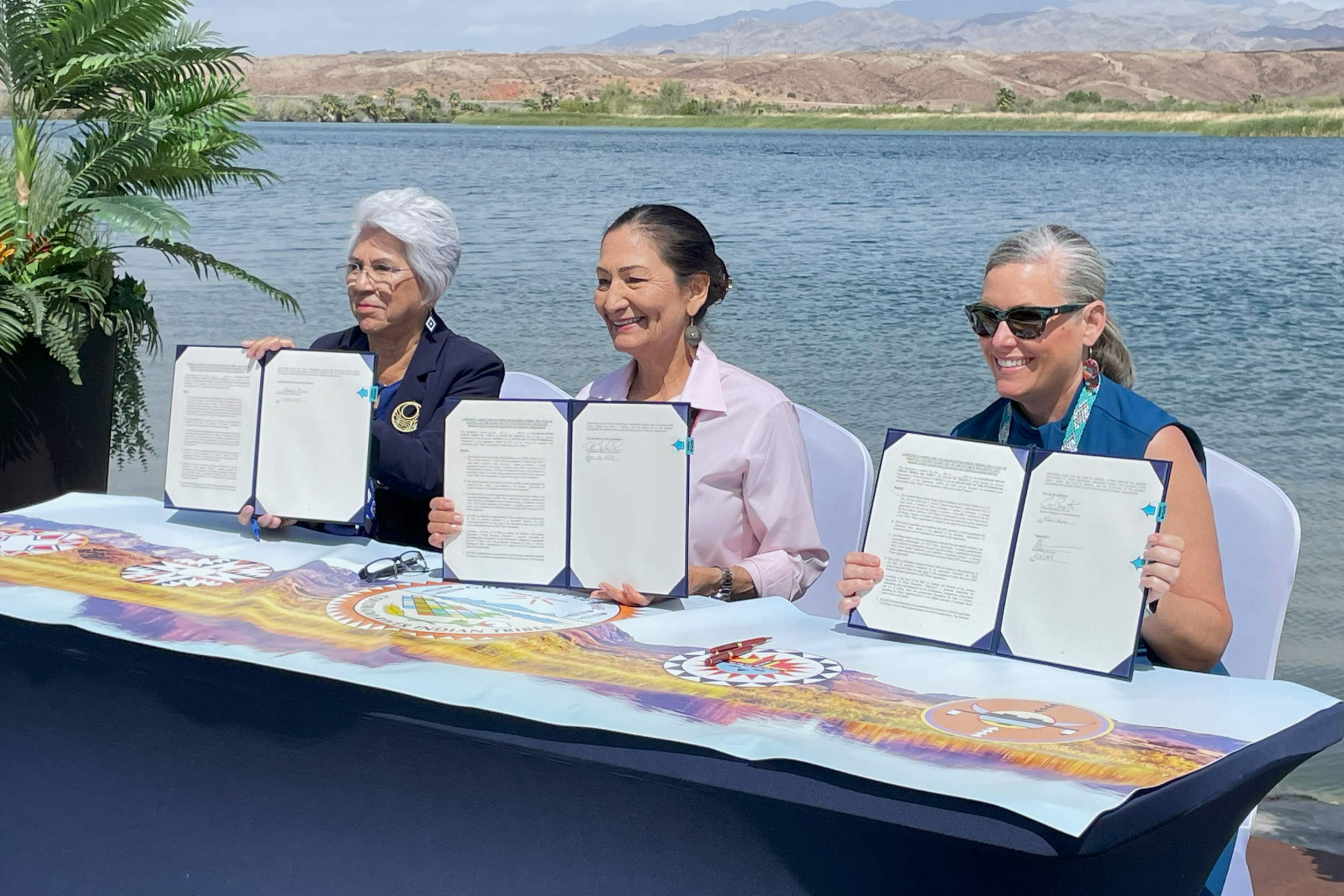
From left: Amelia Flores, Colorado River Indian Tribes chairwoman, Secretary of the Interior Deb Haaland and Arizona Gov. Katie Hobbs approve the tribeโ€™s authority to lease, exchange or store its portion of Colorado River water. Credit: Noel Lyn Smith/Inside Climate News

Click the link to read the article on the Inside Climate News website (Noel Lyn Smith):

May 2, 2024

The deal will help the tribe raise money for infrastructure and services for its members while the water could ease the drought in the Southwest.

PARKER, Ariz. โ€” Against a backdrop of the Colorado River, members of the Colorado River Indian Tribes watched Secretary of the Interior Deb Haaland, Arizona Gov. Katie Hobbs and Amelia Flores, the tribeโ€™s chairwoman, sign a historic agreement on April 26 that asserts the tribeโ€™s right to lease portions of their allocation of the riverโ€™s water to users away from the tribal land.

The agreement between the tribe, the Interior Department and Arizona gives the tribe the ability to lease, exchange or store a portion of its Colorado River water entitlement. As one leader expressed, the tribe is stepping away from the โ€œoutdated frameworkโ€ of federal restrictions that constrained their means to supply water to areas off the tribal land.

The financial gain for the tribe will allow them to invest in services that help tribal members, to build needed infrastructure and update systems for agricultural purposes.

โ€œThis is a significant event in the history of CRIT,โ€ Flores said. โ€œThese agreements clear the path for CRIT to finally be recognized as a central party in all future decisions regarding the Colorado River. โ€ฆ Today, we celebrate the empowerment of our rights to make our own decisions with who, when and how our water sources may be used.โ€

The tribeโ€™s membership consists of the Mohave, Chemehuevi, Hopi and Navajo. The Colorado River flows through the tribeโ€™s land in Arizona and California. The reservation was established in March 1865 for the Mohave and Chemehuevi, both of whom inhabited the region. In later years, Hopi and Navajo relocated to the area.

โ€œThis river flows through us,โ€ said Flores, who is a member of the Arizona Governorโ€™s Water Policy Council, a group established last year and tasked with modernizing the stateโ€™s management of groundwater.

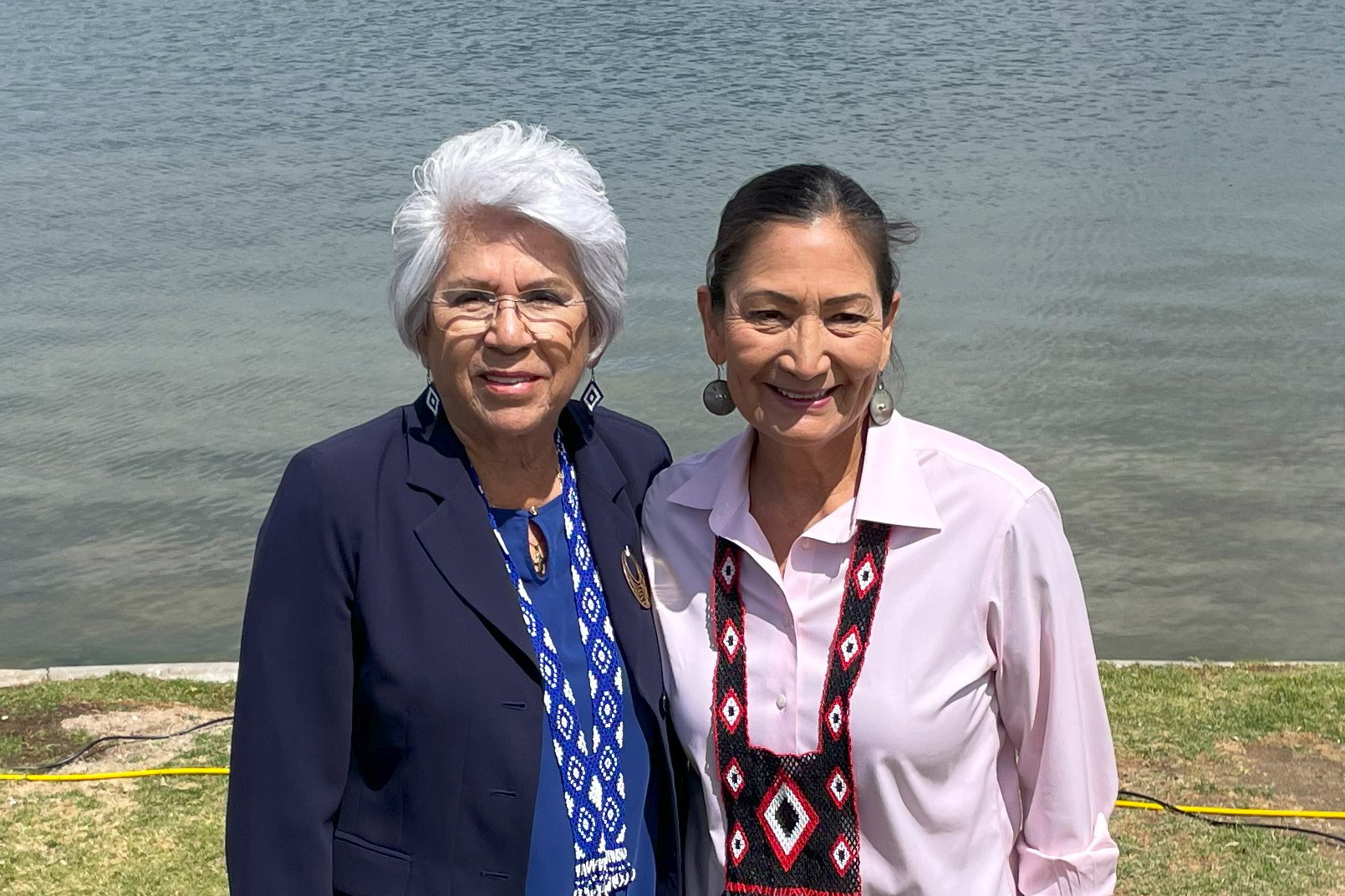
Amelia Flores (left), Colorado River Indian Tribes chairwoman, and Secretary of the Interior Deb Haaland stand next to Colorado River in Parker, Ariz. Credit: Noel Lyn Smith/Inside Climate News

The agreement comes as Arizona deals with ongoing drought and discussions to address climate change.

โ€œToday may mark the end of the work to complete these agreements but it marks the beginning of the next chapter for water conservation in Arizona,โ€ Hobbs said.

โ€œThe implementation of these agreements and the new fundability for the Colorado River Indian Tribes to use their water resources in new and creative ways presents an enormous opportunity for additional conservation and water management solutions as we confront climate change and the stress it is placing on our water supplies,โ€ she added.

The governor said the tribe has been a longtime partner in protecting the Colorado River. This includes a vital role in preventing Lake Mead from dropping levels so low that the reservoir might not have been able to generate power or supply downriver communities in 2019 as part of the drought contingency plan developed by states that receive river water in the lower basin.

A day before the event, Haaland visited the river and toured the Parker Dam, where she heard about how the ongoing drought is impacting communities. She is a member of the Pueblo of Laguna in New Mexico, a state that is part of the Upper Colorado River Basin.

โ€œThe agreement will enable CRIT to continue leading with collaborative strategies in support of the resilience of the Colorado River,โ€ Haaland said. โ€œThis agreement reflects years of cooperation between the federal government, the state of Arizona and the tribes.โ€

She added that it demonstrates the Biden administrationโ€™s commitment to tribal self-determination and sovereignty.

Margaret Vick, the tribeโ€™s water attorney, said the CRIT has always farmed their land, which generates revenue for them.

Welcome signs on Arizona State Route 95 greeting motorists arriving in Parker feature the word, โ€œagriculture.โ€

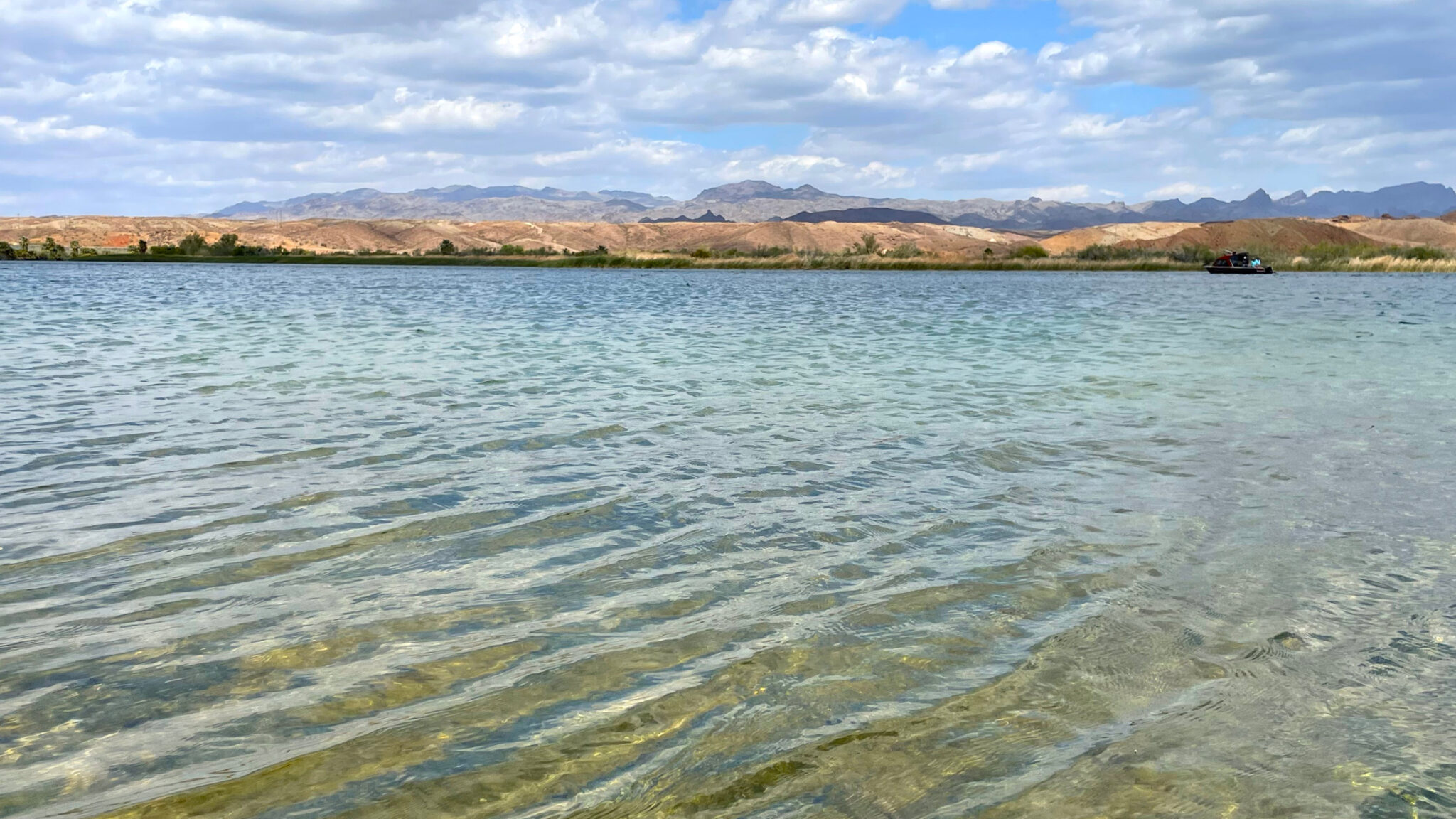
The Colorado River flows through the homeland of the Colorado River Indian Tribes on April 26 in Parker, Ariz. Credit: Noel Lyn Smith/Inside Climate News

Although the tribe holds the largest and most senior right to Colorado River water in Arizona, they were blocked from deciding alternatives for its use outside of their land. According to Vick, the U.S. Supreme Court in 1963 confirmed the tribeโ€™s reserved water rightsโ€”an allocation with priority dates ranging from 1865 to 1876.

โ€œThese early priority dates are the most senior in the lower basin and it is this seniority that makes them such a valuable asset,โ€ she said.

About 40 years ago, tribal leaders started examining the possibility of leasing river water to users outside their reservation. The effort became viable in the last decade because of the looming shortages in the Central Arizona Project, a system of canals that deliver Colorado River water from northern Arizona to the central and southern parts of the state.

โ€œThe council established a singular goal, to obtain and confirm their sovereign authority to enter agreements to lease or conserve water off reservation in exchange for secure revenue,โ€ Vick said.

As part of that effort, tribal members passed a referendum in 2018 that supported leasing river water, she explained.

โ€œThe previous councils have laid the foundation for this legislation, but this council brought it across the finish line,โ€ the tribeโ€™s Vice Chairman Dwight Lomayesva said.

U.S. Sen. Mark Kelly, D-Ariz., introduced the Colorado River Indian Tribes Water Resiliency Act of 2022, which cleared the way for the agreement. President Joe Biden signed the bill into law in January 2023.

This was the first legislation of its kind, and was not easy to get across the finish line, the senator said.

โ€œThis is a big deal for the tribeโ€™s sovereignty, for the tribeโ€™s economy, our collective efforts to protect our water resources and for partners who want to work with the tribe,โ€ Kelly said.

Map credit: AGU

Reclamation announced $21 million from the Bipartisan Infrastructure Law for endangered species recovery and conservation in the #ColoradoRiver Basin #COriver #aridification

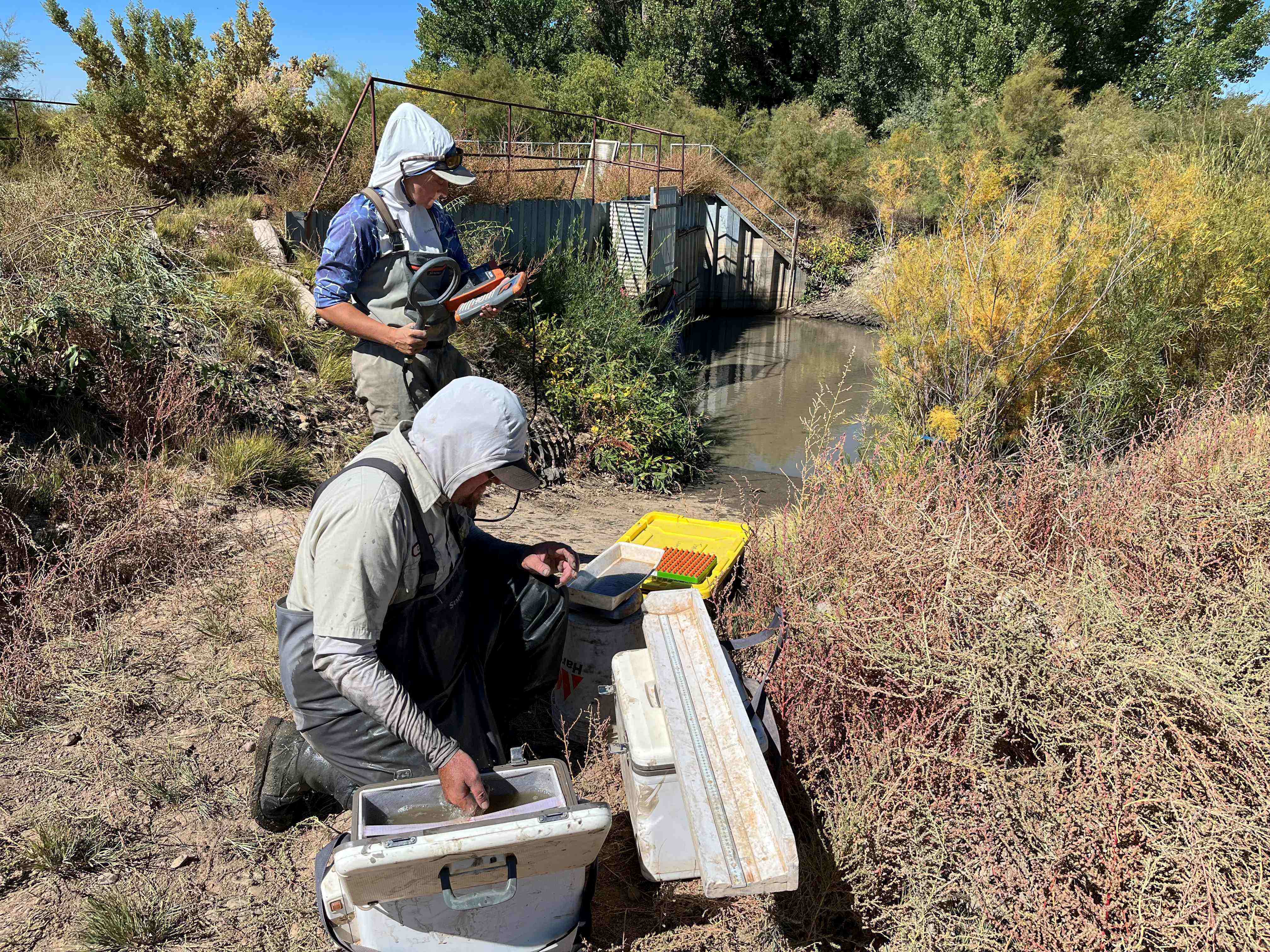
“Biologists weighing, measuring and tagging endanged fish pulled from the decades-old Old Charley water control structure, Ouray National Wildlife Refuge, Utah.” – Reclamation photo by David Speas.

Click the link to read the article on the Bureau of Reclamation website:

May 3, 2024

WASHINGTON โ€“ The Bureau of Reclamation today announced a $21 million investment from President Bidenโ€™s Investing in America agenda for endangered species recovery and conservation in the Colorado River Basin. Project funding from the Bipartisan Infrastructure Law will support the Upper Colorado River Endangered Fish Recovery Program, the San Juan River Basin Recovery Implementation Program and the Lower Colorado River Multi-Species Conservation Program.

โ€œThis funding from the Bipartisan Infrastructure Law will aid us in fulfilling our mission of safeguarding and responsibly managing water resources,โ€ said Commissioner Camille Calimlim Touton. โ€œWith this investment, each of our programs will have the opportunity to advance initiatives aimed at protecting species affected by drought, contributing to environmental sustainability.โ€

The Upper Colorado River Endangered Fish Recovery Program and San Juan River Basin Recovery Implementation Program work to recover endangered and threatened fish in the Upper Colorado River Basin while water development proceeds in accordance with Federal and state laws and interstate compacts. The Lower Colorado River Multi-Species Conservation Program was created to balance the use of the Colorado River water resources in Arizona, California and Nevada with the conservation of native species and their habitats.

The selected projects are:

  • Colorado: $1.2 million for the Upper Colorado River Endangered Fish Recovery Program to design a fish exclusion feature at Lake Catamount, roughly 8.5 miles south of Steamboat Springs. The feature will prevent nonnative Northern pike from escaping downstream to critical habitat for threatened and endangered fish in the Yampa River.
  • Utah and Colorado: $2.6 million for the Upper Colorado River Endangered Fish Recovery Program to address needed repairs that will improve performance and efficiency at the Ouray National Fish Hatcheryโ€™s Grand Valley and Randlett units in Colorado and Utah, respectively, and enhance production of threatened and endangered fish for stocking purposes at Wahweap State Hatchery in Utah.ย Utah:ย $1 million for the Upper Colorado River Endangered Fish Recovery Program to replace the water control structure at Old Charley Wash, a floodplain wetland near the Green River that provides habitat for rearing threatened and endangered fish.
  • New Mexico:ย $5.2 million for the San Juan River Basin Recovery Implementation Program to design and construct a fish passage structure on the San Juan River roughly 17 miles west of Farmington, New Mexico. The structure would allow threatened and endangered fish to migrate upstream beyond an Arizona Public Service Company diversion weir that currently limits fish passage.
  • Arizona, California:ย $10 million for the Lower Colorado River Multi-Species Conservation Program to build rearing ponds for native fishes at the Yuma Meadows Conservation Area.
  • Arizona:ย $1 million for the Glen Canyon Dam Adaptive Management Program to study fish entrainment at Glen Canyon Dam.

This funding builds on a previous $20 million investment announced in 2022 for environmental projects.

Through the Bipartisan Infrastructure Law, Reclamation is investing $8.3 billion over five years for water infrastructure projects, including rural water, water storage, conservation and conveyance, nature-based solutions, dam safety, water purification and reuse, and desalination. Since Bipartisan Infrastructure Law was signed, Reclamation has announced more than $3 billion for more than 440 projects.

Palisade High School Fish Hatchery releases 1,000th razorback sucker into #ColoradoRiver — The #GrandJunction Daily Sentinel #COriver

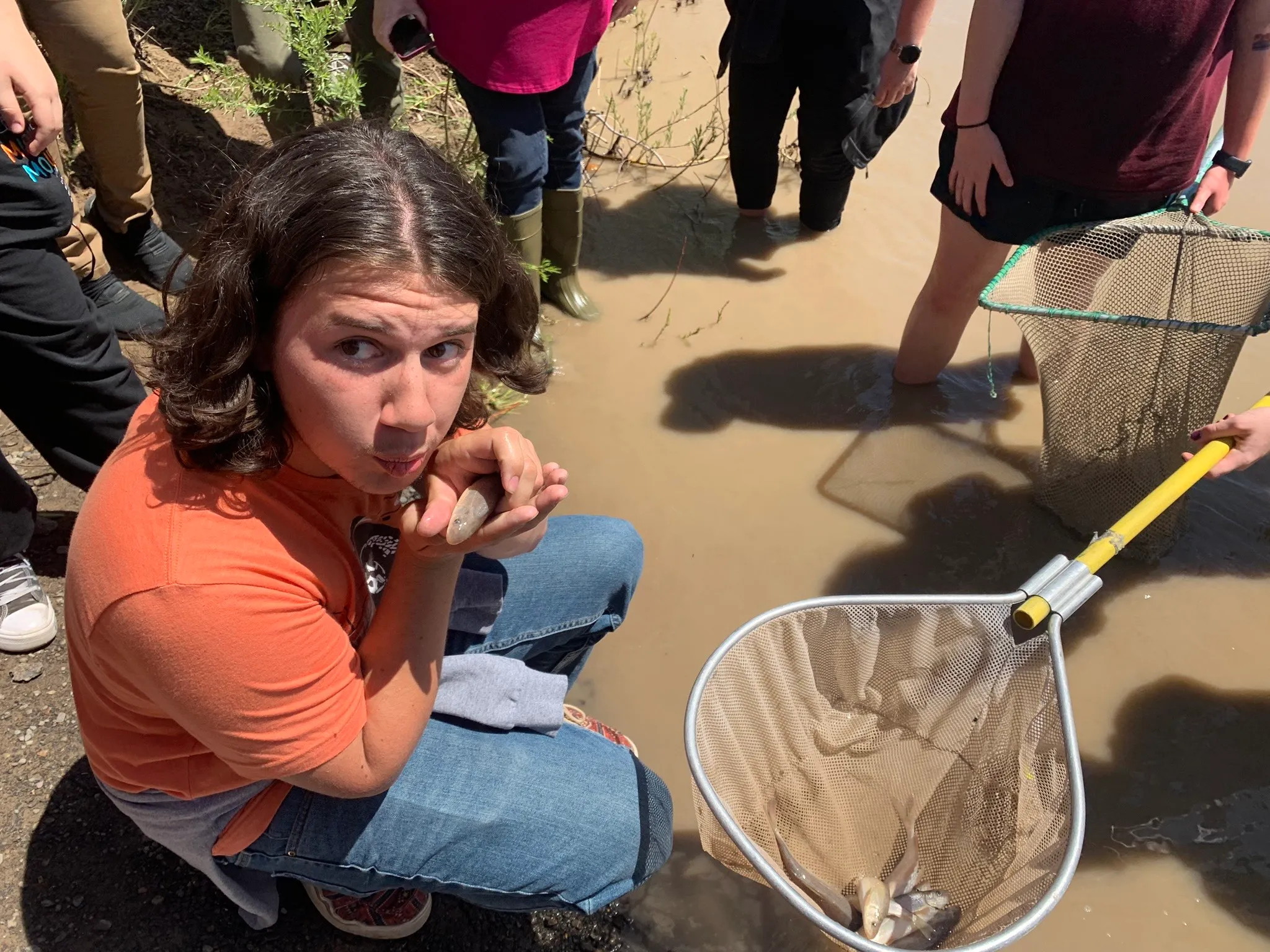
Students from Palisade High School kissed good-bye to hatchery-raised juvenile razorback suckers before releasing them into the Colorado River last month (May 2023). The fish are listed as endangered under the Endangered Species Act, but populations have recovered enough that U.S. Fish and Wildlife Service has proposed to downlist them to threatened. CREDIT: HEATHER SACKETT/ASPEN JOURNALISM

Click the link to read the article and for the photos on The Grand Junction Daily Sentinel website (Nathan Deal). Here’s an excerpt:

May 4, 2024

The Palisade High School Endangered Fish Hatchery program hosted its fourth annual razorback sucker release Friday at Riverbend Park. Students in the program, partnering with the U.S. Fish and Wildlife Service, released 370 razorback suckers into the Colorado River โ€” a single-year record for the program โ€” to surpass 1,000 fish released in the past four years. Many of the fish released, as always, received smooches before being released into the river, as is PHS Endangered Fish Hatchery tradition.

โ€œOur fish release days are always kind of bittersweet. We definitely grow attached to our fish like our pets, so weโ€™re excited to release them, but at the same time, weโ€™re going to miss seeing them every day,โ€ said Palisade Fish Hatchery Teacher Patrick Steele. โ€œWe know this is what weโ€™ve been working all year for. The whole purpose of this is to help to recover this population of endangered razorback suckers. When you get to this point, itโ€™s exciting.โ€

Electric vehicles are suddenly hot โˆ’ but the industry has traveled a long road toย relevance

Everything old is new again. Simon Skafar/E+/Getty Images

Hovig Tchalian, University of Southern California

In 2023, more than 7% of cars sold in the United States were electric vehicles. In some parts of the world, such as Norway, EVs make up a whopping 20% of cars on the road. In California, where I live, almost 60% of people looking for a car in 2021 said they would at least consider getting an EV.

This upswing in demand comes after years of flagging sales. As recently as 2010, fewer than 100,000 cars on U.S. roads were EVs. That number crossed the 1 million mark in 2018, up more than 80% over the prior year.

What explains this seemingly unexpected surge over the past few years?

The key word here is โ€œseemingly.โ€ And the answer reveals an interesting history that most people are completely unaware of.

I teach entrepreneurship at the USC Marshall School of Business, and Iโ€™ve been studying the EV market for more than a decade. When I ask students, โ€œHow long have EVs been commercially available?โ€ most of them will answer five years, or 10, perhaps 20. One person might point to an EV launched by General Motors in the 1990s whose name they canโ€™t seem to remember.

But occasionally, a precocious person โ€“ usually in the back row โ€“ will raise a hand and answer, โ€œSince the early 1900s.โ€

Thatโ€™s almost the right answer.

Electric vehicles and the long road to adoption

EVs are a new old technology. Most people donโ€™t know that theyโ€™ve been commercially available since as far back as the 1890s. Back then, there was a fight over how best to power a car, or what business professors would call a battle for โ€œdominant design.โ€ The options were internal combustion engines, electric and โ€“ as unlikely as it sounds โ€“ steam. Yes, thatโ€™s how long itโ€™s been since that battle was first fought.

Almost 40% of vehicles on the road in the early 1900s were electric. But after Henry Fordโ€™s first Model T, which used an internal combustion engine, left the production line in 1908, they all but disappeared. EVs have been trying to make a comeback ever since. Like the precocious person in the back of my classroom knows, theyโ€™ve been the โ€œnext big thingโ€ for more than 100 years.

So, what factors help explain why EVs lost the battle for dominant design back then โ€“ and why do they appear to have a fighting chance today?

The โ€˜cool factorโ€™ โˆ’ but so much more

Those who point to the Tesla Roadster as the first modern EV point to its reputation as fun, sporty and cool. And theyโ€™re right: The Tesla Roadster did make EVs cool โ€“ if expensive, at over US$100,000 dollars at its launch in 2008.

But there are many more factors that explain the rise in demand and, more importantly, broad adoption of EVs.

One reason for the rise in demand starting in about 2010 is better and more widely available charging infrastructure. In the U.S. in 2009, there were fewer than 500 public and private charging stations nationwide; today, there are more than 100 times as many. That has helped allay consumersโ€™ โ€œrange anxiety,โ€ that nagging fear that youโ€™ll run out of โ€œjuiceโ€ before you can get to a charging station.

But many other factors are also at play: the right set of models and options made available by manufacturers, improved battery and charging technology and the right mix of government regulations and incentives. All have led to healthy consumer demand.
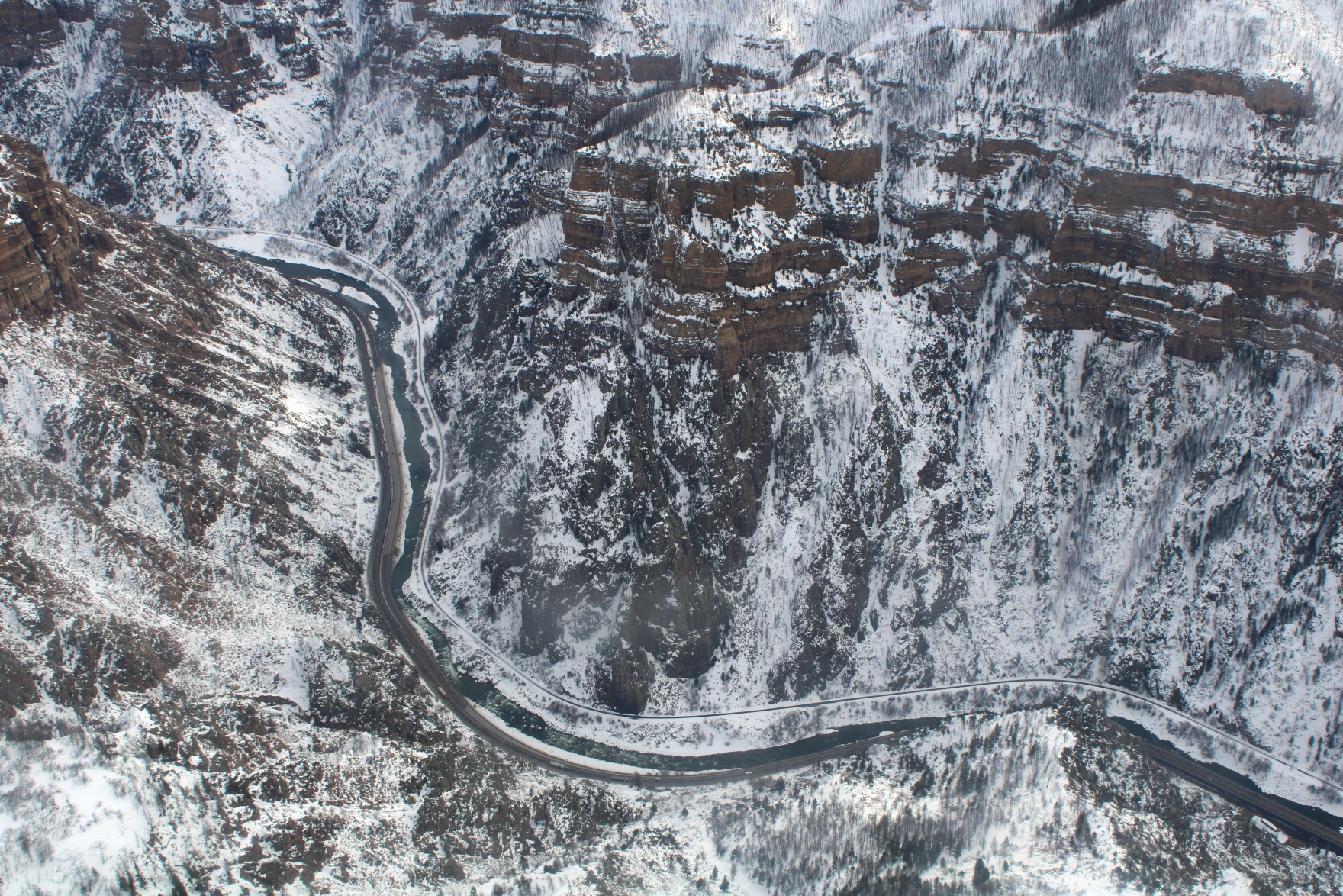
Technology adoption: It takes a village โˆ’ and time

Apart from those technical and economic factors, current studies and my own ongoing research also suggest that the social conversation around EVs โ€“ what everyone in the world says and thinks about them โ€“ has also taken a turn for the better.

Technology adoption is influenced by whatโ€™s known as โ€œpeer effectsโ€ โ€“ the desire to compare oneself with others. Thatโ€™s because people engage in โ€œsocial comparisonโ€ by paying attention to what others like them are doing and, more importantly, how those other people might view their behavior. The same is true, for instance, of solar panel adoption, another technology that, like EVs, has both personal and social benefits.

As I noted earlier, the coolness factor has a positive impact on EV adoption. Driving a cool car matters because that coolness is visible. And when a car has been uncool for so long, a fundamental โ€“ and positive โ€“ change in its public perception can substantially affect demand and adoption.

My research and other studies suggest that a turning point may have come in the mid- to late 2010s, when both public attitudes and charging technology and infrastructure began to improve. It takes a village to birth a market.

The challenge of EV adoption is a reminder that many of our technologies arenโ€™t just tools or devices โ€“ theyโ€™re ways of getting things done. Technology comes from the Greek word โ€œtechne,โ€ which means a practice, a set of habits and a way to accomplish a goal.

Much of our technology, from early word processing software to todayโ€™s streaming services, depends on collective social behaviors and how they change โ€“ or, in many cases, donโ€™t.

For example, the standard โ€œqwertyโ€ keyboard is not intuitive. But because it set the standard, it became the dominant design. Itโ€™s now too efficient, and too socially embedded, to allow for easy replacement.

New technologies canโ€™t even look too different from what weโ€™re used to or they would make it too hard for us to adopt them. Thatโ€™s why EV charging plugs look like โ€“ you guessed it โ€“ gas pump nozzles.

In other words, cool technologies need to be in line with existing behaviors and customs, or theyโ€™ll have to travel a long road toward establishing new ones. Without this alignment, new tech will sit on a shelf for a long time but never succeed โ€“ like EVs almost did.

This article was updated on Feb. 20, 2024, to clarify that 20% of automobiles in use in Norway are EVs.

Hovig Tchalian, Assistant Professor of Entrepreneurship, University of Southern California

This article is republished from The Conversation under a Creative Commons license. Read the original article.

#Snowpack, river levels below median despite โ€˜goodโ€™ March — The #PagosaSprings Sun #SanJuanRiver #ColoradoRiver #COriver #aridification

Colorado Drought Monitor map April 30, 2024.

Click the link to read the article on the Pagosa Springs Sun website (Clayton Chaney). Here’s an excerpt:

May 2, 2024

On April 30, the National Weather Service (NWS) released its drought outlook for May, which states โ€œthe last 4 weeks brought improvement to areas of drought in most of the Rock- ies and Intermountain West.โ€ The outlook depicts much of New Mexico still with areas of persistent drought along with small portions of southern Colorado, including Archuleta County…According to the U.S. Drought Monitor, as of noon on April 30, all of Archuleta County is in an abnormally dry stage, with southwestern parts of the county in a D1 Level Moderate drought. For more information and current drought information, visit https://droughtmonitor.unl.edu/CurrentMap/StateDroughtMonitor.aspx?fips_08007…

The stateโ€™s snowpack was at 114 percent of median on April 9, but, as of April 30, the stateโ€™s snowpack had fallen to 91 percent of median…

As of 11 a.m. on Tuesday, April 30, the Wolf Creek summit, at 11,000 feet of elevation, had 21.8 inches of snow water equivalent, according to NRCS. The Wolf Creek summit was at 63 percent of the April 30 snowpack median. The San Miguel, Dolores, Animas and San Juan river basins were at 64 percent of median, according to the NRCS. The median snowpack peak date is April 2…

The South Platte basin had the highest snow water equivalent in the state at 104 percent of median as of Tuesday, April 30…

According to the U.S. Geological Survey (USGS), the San Juan River was flowing at a rate of 538 cubic feet per second (cfs) in Pagosa Springs at 11 a.m. on Tuesday, April 30. Based on 88 years of water records, the median flow for that date is 712 cfs, with a record high flow of 2,090 cfs in 2019. The lowest recorded flow for that date is 127 cfs in 2002…

As of April 30 at 11 a.m., the Piedra River was flowing at a rate of 577 cfs, which is below the median flow rate of 813 cfs for that date, according to the USGS. The record high flow rate for that date was set in 1973 at 3,270 cfs, while the record low was set in 2002 at 97.7 cfs.

San Juan River Basin. Graphic credit Wikipedia.

Will More Funding Be Directed to #Colorado Water Projects? — The Buzz

Central City back in the day

Click the link to read the article on The Buzz website (Floyd Ciruli):

May 2, 2024

Colorado voters may be asked to direct more sports gaming revenue to water conservation projects.

Jerd Smith of Fresh Water News reports on new legislation with bipartisan support including House speaker Julie McCluskie that will refer a ballot issue to voters in November. It will shift any gaming revenue over a $29 million cap in the original ballot proposition to water projects.

I said the measure should pass with leadership support and that voters are likely to be supportive.

  1. Voters are concerned about water conservation
  2. The measure would not expand gaming or increase taxes
    • Gaming interests (Fan Duel or DraftKings) are not opposed
    • Environmental interests appear supportive

โ€œWhile the original sports betting ballot measure received tepid support, the tax question, if it makes the ballot, may win broader support due to ongoing voter concerns about water conservation and protection and the high-profile crisis on the drought- stressed Colorado River, veteran pollster and political analyst Floyd Ciruli said.

โ€œI have not seen any polls that negate what we knew strongly back then, that water conservation and water protection are environmental issues that Coloradans care strongly about,โ€ he said.”

Link to article:ย Colorado voters may be asked to send more sports betting money to water projects

3 counties contribute $4 million for Shoshone water rights — #Aspen Daily News #ColoradoRiver #COriver #aridification

Shoshone Falls hydroelectric generation station via USGenWeb

Click the link to read the article on the Aspen Daily News website. Here’s an excerpt:

April 26, 2024

During their respective board meetings on Tuesday, Grand County committed $1 million through their Open Lands, Rivers and Trails grant fund; Eagle County expressed its intent to commit $2 million; and Mesa County, $1 million, the press release said. As longtime partners in the Shoshone Water Right Preservation Coalition, these counties represent some of the most populous Western Slope communities from the Colorado Riverโ€™s headwaters to the state line…

The owner of the Shoshone rights is entitled to โ€œcallโ€ for up to 1 million acre-feet of Colorado River water a year. When the Shoshone right calls, some upstream users must leave water in the river so it runs down to Glenwood Canyon, boosting flows. The hydro plant uses the water for power generation and then returns it to the river, meaning the rights also benefit flows downstream of the plant.ย  While Xcel would continue using the water for power production after the sale, the river district is also seeking an instream flow agreement with the state of Colorado, which would allow it to use the water rights simply to prop up river flows even when the plantโ€™s turbines are inactive.ย 

#Aurora Water eyes its biggest storage bucket yet — Fresh Water News #SouthPlatteRiver

Eleven Mile Canyon. By Jay Miller from Fly to Eleven Mile Canyon just outside Colorado Springs – Flickr, CC BY 2.0, https://commons.wikimedia.org/w/index.php?curid=7679044

Click the link to read the article on the Water Education Colorado website (Jerd Smith):

May 2, 2024

Fast-growing Aurora plans to develop a new 200-acre site high in scenic Park County to build the largest reservoir in its system.

The $600 million-plus Wild Horse Reservoir project would store 93,000 acre-feet of water and be nearly twice the size of the cityโ€™s existing Park County storage pond, Spinney Mountain Reservoir, which holds 53,651 acre-feet of water. An acre-foot equals nearly 326,000 gallons of water, enough to serve at least two to four urban households for one year.

The proposed reservoir is among the latest moves by the city to secure future water supplies to meet growth-driven demand as streams and rivers shrink because of climate change.  

Aurora, the third largest city in Colorado, is home toย nearly 400,000 peopleย and is expected to add some 300,000 more by 2070, according to the cityโ€™s website.

Pre-permitting discussions on the project have begun, according to Aurora Water spokesperson Greg Baker, and the process is expected to take at least two years. The reservoir is part of a larger water supply strategy that includes a recent $80.4 million purchase of farm water in the Arkansas River Valley, a deal that is drawing opposition from the Pueblo-based Southeastern Colorado Water Conservancy District.

Park County Commissioner Amy Mitchell declined to comment on the Wild Horse proposal, citing the county commissionโ€™s legal responsibility to review it under whatโ€™s known as a 1041 permit review, a process that gives the county the ability to approve or reject construction projects. That review could happen as early as next year, she said.

Like other cities, Aurora officials say they need to move quickly now to ensure residents and industry will have enough water in the future.

โ€œAre we moving fast? If the opportunity is there, yes, we are taking it. Water will only become more difficult and expensive to obtain,โ€ Baker said.

Aurora raw water facilities. Credit: Aurora Water

Other major new storage projects are being planned by cities along the Front Range, with Parker Water and Sanitation District hoping to build a 72,000 acre-foot reservoir in northeastern Colorado as part of a new municipal farm-water collaboration known as the Platte Valley Water Partnership.

The Aurora and Platte Valley projects are expected to be completed in roughly 10 to 15 years.

For Aurora, the Wild Horse project will provide more opportunities to store water it already owns in the Upper Colorado, the Arkansas and South Platte river basins, and to move that water around, Baker said.

The site lies south and east ofย Spinney Mountain Reservoir.

Prairie Waters schematic via Aurora Water.

The city has a large-scale recycled water program known asย Prairie Waters, which operates by claiming treated wastewater Aurora owns from the South Platte River on the Eastern Plains, filtering it through a series of gravel beds and then piping it back to Auroraโ€™s water treatment facility where it is purified and mixed with fresh water and then delivered to residents and businesses.

But as the water is reused and becomes more concentrated, salinity levels rise, which means less water can be treated and reused. Wild Horse would allow more fresh water to be sent down the river, providing more โ€œblend waterโ€ for Prairie Waters and expanding the amount of reused water Aurora Water can deliver to its customers, Baker said.

Water storage reservoirs have drawn fierce environmental opposition in the past 50 years, according to Ron Redd, manager of the Parker Water and Sanitation District.

In the past, water utilities would dam rivers, forever altering the ecosystem and harming water quality.

Parker and Aurora hope these new reservoirs will have fewer environmental impacts and wonโ€™t set off as many alarm bells because, in part, they wonโ€™t dam rivers or streams, Redd and Baker said. Instead, pipelines will be used to deliver water to the storage ponds.

The City of Greeley walked away from an expansion of its Milton Seaman Reservoir on the North Fork of the Cache La Poudre River in 2021, deciding instead to develop a groundwater and aquifer storage project beneath theย Terry Bison Ranch, something the city believes will be easier to do and will give it more flexibility in managing its water supplies, according to Sean Chambers, director of Greeleyโ€™s Water and Sewer Department…

More by Jerd SmithJerd Smith is editor of Fresh Water News. She can be reached at 720-398-6474, via email at jerd@wateredco.org or @jerd_smith.

Environmental Protection Agency Announces Final Rule to Protect Water Quality Where Tribes have Treaty and Reserved Rights

North American Indian regional losses 1850 thru 1890.

Click the link to read the release on the Environmental Protection Agency website:

May 2, 2024

WASHINGTON  โ€“ Today, May 2, the U.S. Environmental Protection Agency (EPA) announced a final rule that will help protect water quality where Tribes hold and assert rights to aquatic and aquatic-dependent resources. For the first time, this action establishes a clear and consistent national framework for EPA and states to consider Tribal treaty and reserved rights when establishing Water Quality Standards under the Clean Water Act. In addition, this rule advances the Biden-Harris Administrationโ€™s commitment to uphold the United Statesโ€™ treaty and federal trust responsibility to federally recognized Tribes. When implemented, this final rule will better protect waters that Tribes depend on for fishing, gathering wild rice, cultural practices, and other uses.

โ€œPresident Biden is committed to ensuring that all people have access to clean and safe water. Strengthening our regulations to support Tribes and protect precious water resources is essential,โ€ said EPA Administrator Michael S. Regan. โ€œWith this action, EPA is establishing clear rules of the road that will support healthier Tribal communities. We look forward to partnering with Tribes and our state co-regulators to implement Clean Water Act protections consistent with Tribal treaty and reserved rights.โ€

Historically, EPA has addressed Tribal reserved rights under the Clean Water Act on a case-by-case basis in state-specific actions. This practice fostered uncertainty for Tribes, states, and entities seeking to comply with Clean Water Act requirements. EPAโ€™s final rule provides clarity and transparency by revising the federal water quality standards regulation to better protect Tribal reserved rights under the Clean Water Act. With this action, EPA is ensuring that water quality standards are established taking into consideration Clean Water Act-protected aquatic and aquatic-dependent resources where Tribes hold and assert rights to those resources under federal treaties, statutes, or executive orders. This final regulatory framework will be applied consistently while accounting for local conditions and factors to inform the development of specific water quality standards.

With this action, EPA is honoring the federal trust responsibility and striving to protect Tribal reserved rights related to water resources, consistent with commitments outlined in the agencyโ€™s 2021 action plan, Strengthening the Nation-to-Nation Relationship with Tribes to Secure a Sustainable Water Future.

โ€œThe Tribal Reserved Rights rule protects the rights of Tribal citizens, accorded by treaties, statutes, and other federal laws, to hunt, fish, and gather food in their usual and accustomed territoriesโ€”including areas under state jurisdiction,โ€ said National Tribal Water Council Chairman Ken Norton. โ€œWhen treaties are honored as the highest law of the land, as the Constitution directs, it is a victory for Tribes across the nation.โ€

“Upholding treaty reserved rights in Ceded Territories is the right thing to do, both for Tribal members and the environment. As stressors such as climate change, pollutants and development harm the environment, it is increasingly important for Tribal members to have the opportunity to exercise their rights in Ceded Territories,” said Leech Lake Band of Ojibwe Environmental Director, Brandy Toft. “It is our hope that this rule will assist to preserve the Leech Lake Band of Ojibwe’s treaty protected right to harvest resources, such as fish and wild rice for subsistence, for generations to come.”

โ€œIn the Anishinaabe (or Ojibwe) language, gibimaajiโ€™igomin nibi means โ€˜water is life,โ€™โ€ according to Jason Schlender, Executive Administrator of the Great Lakes Indian Fish and Wildlife Commission (GLIFWC). โ€œAnishinaabe people recognize that clean water sustains the more-than-human relatives (natural resources) that they rely on to continue their lifeways. It was these lifeways that our member Tribes were protecting when they reserved the right to hunt, fish, and gather on land that they ceded (or sold) in treaties with the United States. GLIFWC welcomes federal actions that will ensure that water quality is improved and sustained to ensure the continued health of our more-than-human relations.โ€

โ€œElwha Tribe is pleased that the federal rule will ensure that Tribes will be heard,โ€ said Lower Elwha Klallam Tribe Vice-Chairman Russell N. Hepfer. โ€œI always advocate for consultation to occur early and often. Water quality is important for our human health and for our resources. More important for our future generations. Elwha Tribes looks forward to consultation with EPA as this rule is implemented.โ€

The final rule will be effective 30 days after publication in the Federal Register. Learn more about EPAโ€™s final Tribal Reserved Rights rule.

Background

Water quality standards define the water quality goals for a waterbody and provide a regulatory basis for many actions under the Clean Water Act, including reporting on water quality conditions and status; developing water quality-based effluent limits in National Pollution Discharge Elimination System permits for point-sources; and setting targets for Total Maximum Daily Loads.

Big River Updates — #ColoradoRiver District #COriver #aridification

The Upper Basinโ€™s alternative, summed up. Source: Upper Colorado River Commission.

Click the link to read the newsletter on the Colorado River District website:

April, 2024

View the complete public packet including all staff memos by clicking HERE (.pdf)

It has been a busy few months in the interstate and federal arena on the Colorado River. Last fall, Commissioner of the Bureau of Reclamation (BOR) requested that the seven basin states present a consensus-based proposal to the Bureau of Reclamation containing the statesโ€™ collective desire for future operational guidelines for Lakes Powell and Mead.

The Commissioner had requested that this consensus modeling proposal be submitted no later than March 11, 2024. Unfortunately, the seven states were unable to reach a consensus. In fact, the Lower Division States stopped showing up to meetings with the Upper Division States back in mid-January, making it very hard to reach a seven-state consensus. The Upper Division States and the Lower Division States submitted modeling proposals the week before the March 11 deadline.

Those proposals can be found HERE (Upper Division) and HERE (Lower Division) respectively.

โ€œThese proposals are pretty far apart in a lot of ways,โ€ said Dave โ€œDKโ€ Kanzer, Dir. of Science and Interstate Matters for the River District. โ€œBut they all include some significant reductions in the Lower Basin.โ€

  • The Upper Division States propose operating Lake Powell based how full Lakes Mead Powell is October 1st. In their proposal, reductions in the Lower Basin use are dependent on an October 1 Combined Storage Trigger for Lakes Powell and Mead.[1]
  • The Upper Division States also discuss โ€œparallel activitiesโ€ within the Upper Basin which are not part of the federal action or alternatives recommended to be modeled as part of the Post-2026 NEPA process but which may complement the proposal in the future. These include:
    • Releases from Flaming Gorge, Navajo, and Aspinall Unit; and
    • Pursuing a voluntary, temporary, and compensated conserved consumptive use program.

Lower Division States Proposal

  • The Lower Basin proposes a โ€œtotal system contents methodโ€ which bases reductions on volumes of water contained within seven Upper and Lower basin reservoirs[2]ย rather than on Lake Mead and Lake Powell elevations.
  • The Lower Basin proposal acknowledges what it refers to as the โ€œstructural deficitโ€ and commits to reducing Lower Basin water use by up to 1.5 million acre-feet each year when system storage dips below 58% with optional reductions before that.
  • However, when combined system storage dips below 38%, the Lower Basin proposal asks that additional cuts be split evenly between the Upper and Lower Basins.
  • The Lower Basin proposalโ€™s release criteria for Lake Powell are based on reservoir contents in the Upper Basin (Flaming Gorge, Navajo, Blue Mesa, and Lake Powell).

So what does that mean?

The Upper Basin proposal charts a reasonable path forward for the basin. It acknowledges the hydrologic realities of the river as well as the long-standing impacts to communities and industries who have already dealt with decades of involuntary reductions by living within what the river provides each year.

โ€œLiving within the hydrology is something we do here in the Upper Basin every year,โ€ said Andy Mueller, Colorado River District General Manager. โ€œWater users like those in the Uncompahgre Valley Water Users Association have to take a guess at how much water his water users are going to be able to have each year. And until perhaps last year, no one in the Lower Basin has ever been faced with that decision.โ€

On the other hand, the Lower Basin proposal would unfairly burden the Upper Basin when storage volumes are low by forcing reductions in use in the Upper Basin that are equivalent to reductions in the Lower Basin โ€“ even though the Lower Basinโ€™s consumptive use far exceeds use in the Upper Basin by millions of acre-feet. It does not recognize the imperative to live within the hydrologic realities. This approach continues to use failed and outdated math and is unrealistic about the future of the river under the impacts of climate change.

Other Proposals

More recently, at least three other proposals of note were submitted to the Bureau of Reclamation for consideration:

  • A group of 20 of Colorado River basin tribes submitted a set of guiding principles to Reclamation that strongly suggests policy changes to address (HERE) the historical lack of Indigenous voices in the discussion and decision-making processes regarding Colorado River issues and calls for equitable representation.
  • Seven environmental organizations submitted a proposal (HERE) to Reclamation that outlines new flexible operational rules based upon reservoir storage thresholds and climatic conditions. Furthermore, they propose specific stewardship targets related to Grand Canyon flows, endangered fish recovery, and the Colorado River Delta. To support these targets, they propose creating an environmental water bank via purchase and/or conservation actions that would be operated independently from the abovementioned operational thresholds to meet environmental goals.
  • A group of independent water professionals that includes Professors Jack Schmidt and John Fleck along with CRDโ€™s former General Manager, Eric Kuhn, submitted a proposal (HERE) to Reclamation that suggests a new flexible accounting concept be implemented that would allow storage credits to be created and transferred without impacting Colorado River compact accounting. It also suggests creating a new authority under an expanded Glen Canyon Dam adaptive management program and Federal Advisory Committee to enable more operational flexibility to meet multiple objectives beyond water supply objectives.
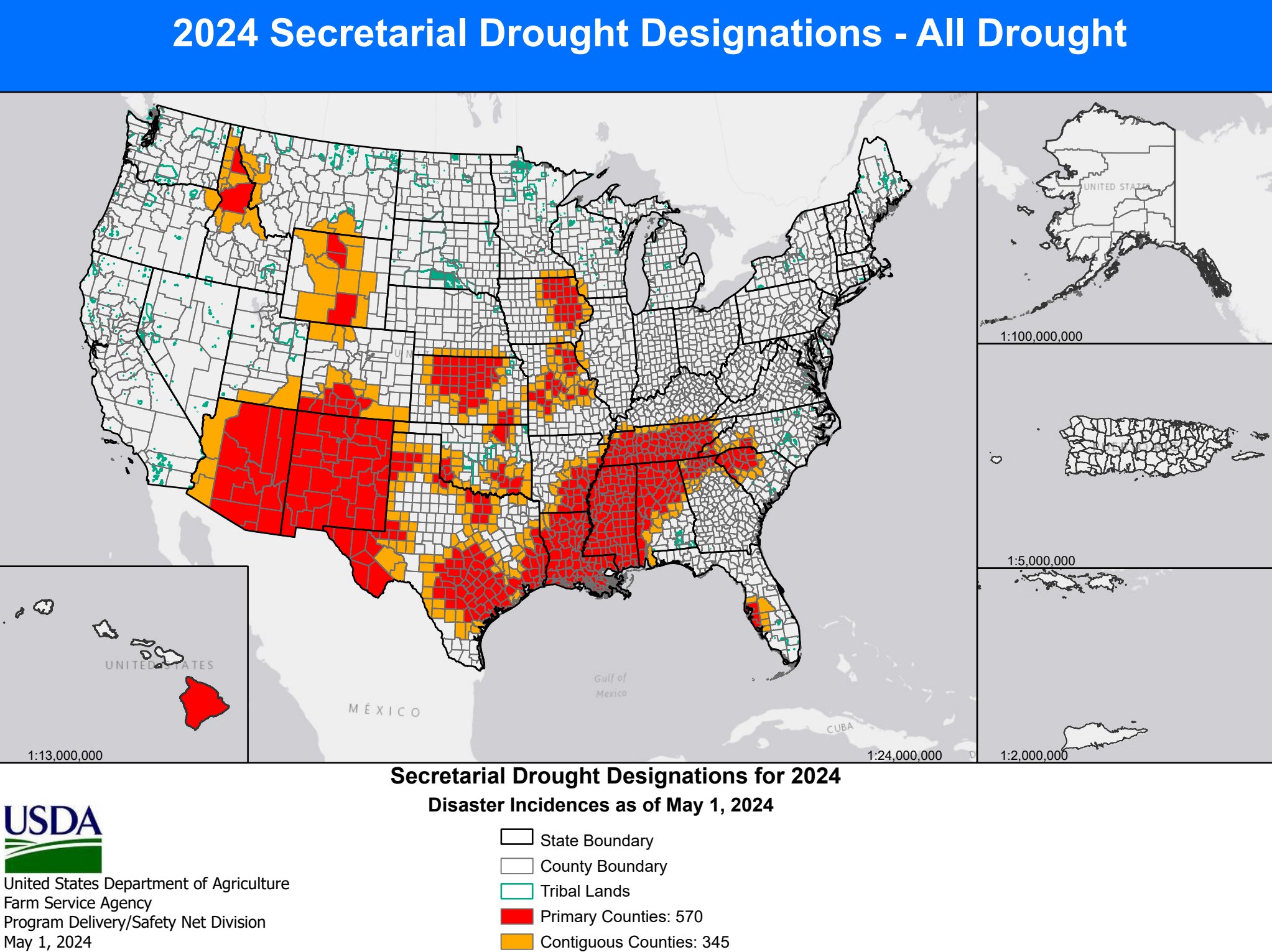
[1] The Trigger is calculated using Lake Powell and Lake Meadโ€™s Storage volume (live storage below flood control elevations) by subtracting a threshold volume from the total live storage. The threshold volume for Lake Powell is 4.2 MAF. The threshold volume for Lake Mead is 4.5 MAF. The threshold volume for the two reservoirs combined is 8.7 MAF.

[2] For purposes of this Lower Basin Alternative, โ€œtotal system contentsโ€ is the total volume of water in live storage within Flaming Gorge Reservoir, Blue Mesa Reservoir, Navajo Reservoir, Lake Powell, Lake Mead, Lake Mojave, and Lake Havasu.

Navajo government asks Biden admin to stop uranium transport across Navajo Nation — KNAU

Graphic credit: Environmental Protection Agency

Click the link to read the article on the KNAU website. Here’s an excerpt:

May 1, 2024

Navajo leaders signed onto legislation Tuesday asking President Joe Biden to use his executive authority to halt uranium transportation on the Navajo Nation ahead of some of the first scheduled trips. The Pinyon Plain Mine near the South Rim of the Grand Canyon began production in December. Mine owner Energy Fuels is expected to transport uranium ore on highways through northern Arizona and the Navajo Nation to a southern Utah mill. The legislation emphasizes the historic impact uranium mining has had on the Navajo people.

“During the Cold War, the demand for uranium surged, prompting extensive mining operations on Navajo lands without adequate environmental safeguards, resulting in lasting devastation to land, water, and public health, including high rates of cancer and other illnesses among Navajo uranium miners and their families.โ€

2024 #COleg: Common Sense Solutions to Protect #Coloradoโ€™s Children — Colorado Times Recorder

Denver smog. Photo credit: NOAA

Click the link to read the guest column on the Colorado Times Recorder website (Heather De Keyser):

May 3, 2024

Coloradoโ€™s air is not as clean as it may seem, and the youngest lungs among us are paying the price.ย  I witness the consequences of Coloradoโ€™s inadequate action on air quality daily as a pediatric lung specialist.

The new legislative efforts led by community, advocates and our elected leaders pave the way for a healthier future for our children.

Iโ€™ve dedicated my career to studying and treating respiratory issues in children and have seen firsthand the damage caused by unchecked pollution. Children living near habitual polluters are more susceptible to developing long-term health issues such as asthma and other breathing disorders. And all children are at higher risk from pollutants entering their developing lungs.  Because of this, when air quality is especially poor, all children are considered a high-risk group. Iโ€™m left with telling children to stay at home and stay inside on beautiful Colorado days, because the air is not safe for them to breathe. This is not merely a professional observation but a personal plea for action.

This package of bills represents hope โ€“ a framework to reduce hazardous emissions from Coloradoโ€™s biggest sources of ozone-forming pollution. Our leaders must not turn a blind eye to the problem; they must take action to require better corporate practices and extend oversight like never before.

If we ignore the realities of poor air quality on our children, we are not merely overlooking unsafe air quality metrics, but disregarding the longevity and quality of life for Coloradoโ€™s kids. 

The responsibilities of my profession extend beyond the walls of a clinic. The efforts to mitigate ozone do not strive to stifle industry, but rather to challenge it to do betterโ€”to be innovate and consider neighbors and future generations.

Coloradans understand the value of our environment and the necessity of guarding it. As residents, parents, and stewards of this great state, I urge our senators and representatives to support this crucial legislation. 

Heather De Keyser, MD is a pediatric pulmonary specialist. She advocates for policy solutions to the growing health threats of climate change with Healthy Air and Water Colorado.

Sweeping #ColoradoRiver settlement will bring water, equity to Navajo communities — AZCentral.com #COriver #aridification

Navajo Mountain March 2023. Jonathan P. Thompson photo.

Click the link to read the article on the AZCentral.com website (Arlyssa D. Becenti). Here’s an excerpt:

May 1, 2024

Two months after Navajo Nation officials released details of a sweeping agreement to secure rights on the Colorado and Little Colorado rivers, there have been numerous community meetings to discuss what it means for people to secure water access. What’s clear is that the settlement, known as the Northeastern Arizona Indian Water Rights Settlement Agreement, is about equity, human rights and securing access to water for the next 100 years for the Navajo people.

โ€œWhatever gets built out is going to get us a lot further to building out the infrastructure that we are going to need anyway if we want to be able to grow at our natural growth rate,” Navajo Nation Attorney General Ethel Branch said during a livestream meeting…

The agreement would settle all of the Navajo Nationโ€™s water rights claims in Arizona, which includes the Colorado River Upper Basin, the Colorado River Lower Basin, Little Colorado River Basin and some groundwater. The proposal will be put into legislation and voted on by the Navajo Nation Council before it is sent to Congress, where lawmakers could make their own adjustments.

Native America in the Colorado River Basin. Credit: USBR

Governor Jared Polis, lawmakers unveil new oil and gas fee in #climate deal aimed at defusing ballot war: Agreement calls for #Colorado Democrats to abandon four bills aimed at tightening industry regulations — The #Denver Post #ActOnClimate

Oil and gas infrastructure is seen on the Roan Plateau in far western Colorado. (Courtesy of EcoFlight)

Click the link to read the article on The Denver Post website (Seth Klamann and Nick Coltrain). Here’s an excerpt:

April 29. 2024

Leading Colorado Democrats and the stateโ€™s oil and gas industry announced a preemptive armistice Monday โ€” one that seeks to defuse the latest round ofย dueling ballot initiativesย andย legislation aimed at the industryย and its environmental impacts. The proposals, described to reporters by Gov. Jared Polis and legislative leadership, include imposing a new per-barrel production fee on the industry and enacting new environmental standards. In exchange, the industry, lawmakers and several environmental groups agreed to abandon recent attempts at regulatory legislation and ballot initiatives…

A key part of the deal takes the form of two new bills set to be introduced in the coming days โ€” roughly one week before the end of the legislatureโ€™s 2024 session. One bill would institute a fluctuating production fee on oil and gas that is expected to generate roughly $138 million annually, based on returns from recent years. Much of that money would go toward supporting transit in Colorado, potentially including metro Denverโ€™s Regional Transportation District. The state also would set aside a slice to help restore public lands impacted by oil and gas production. The second bill would seek to reduce emissions and improve air quality via new permitting and enforcement authority. It would include funding to plug orphan wells and strategies to help communities that are disproportionately impacted by the oil and gas industry, Polis and legislative leaders said at Mondayโ€™s late-afternoon news conference.

Good news: US CO2 emissions continue to decline! — @hausfath

Credit: Zeke Hausfather

More problematic: All those declines are more or less concentrated in the power sector, and we need to make more rapid progress with transportation, industry, and buildings (as well as non-energy emissions from agriculture).

South Catamount Dam project will restrict access — Pikes Peak Courier

South Catamount is one of three reservoirs owned and operated by Colorado Springs Utilities in the North Slope Recreation Area (NSRA) of Pikes Peak. The dam structure, constructed in 1936, requires a major rehabilitation project to enhance its safety and performance. Project work includes resurfacing of the dam’s steel face and replacement of infrastructure in and around the dam. Photo credit: Colorado Springs Utilities

Click the link to read the article on the Pikes Peak Courier website (Doug Fitzgerald)

April 29, 2024ย 

Dam work will restrict access to parts of the North Slope Recreation area this season. The area opened May 1, but critical work continues on the dam at South Catamount Reservoir and will limit access. The reservoir, which holds drinking water for Colorado Springs, is undergoing a major rehabilitation project on its 87-year-old dam. Project work is expected to last through 2025. The water in the reservoir was lowered significantly last year and will remain nearly empty during construction. The reservoir is not available for public recreation during this time…

The reservoir was built in 1937 and features a dam face constructed of steel, a unique feature that is exhibited in only four other reservoirs in the country, including Crystal Creek Reservoir on Pikes Peak. The steel must be resurfaced periodically to protect it from corrosion. Project work includes face resurfacing, and replacement of dam infrastructure and underground pipes.

#ColoradoRiver Research Group Members Offer Post-2026 Alternative — Getches-Wilkinson Center #COriver #aridification

Colorado National Monument from the Colorado River Trail near Fruita September 2014

Click the link to read the article on the Getches-Wilkinson Center website (Doug Kenney):

April 16, 2024

Colorado River Research Group (CRRG) members Jack Schmidt, Eric Kuhn and John Fleck submitted an โ€œalternativeโ€ to the post-2026 EIS process entitled: โ€œManaging the Powell/Grand Canyon/Mead ecosystem after 2026.โ€  In a nutshell, the alternative suggests that the Secretary of Interior be empowered to employ an adaptive management approach allowing releases from Powell to Mead to โ€œbe optimized to meet environmental, recreational, and cultural goals while retaining an interstate accounting system that still meets water-supply objectives.โ€

Read more here.

In blow to green groups, Ninth Circuit upholds federal plan for #ColoradoRiver dam — #Utah News Dispatch #COriver #aridification

A high desert thunderstorm lights up the sky behind Glen Canyon Dam — Photo USBR

by Alanna Mayham, Utah News Dispatch
April 28, 2024

(CN) โ€” Conservationists lost an appeal to the Ninth Circuit on Wednesday as they attempted to force the federal government to reconsider climate change studies in managing the Glen Canyon Dam and Colorado River.

Save the Colorado, Living River and the Center for Biological Diversity initially asked the U.S. Department of the Interior to consider emerging climate science and the severe potential of climate change in updating its management plan in 2016 for the Glen Canyon Dam on Lake Powell, which has a water level 3,564 feet above sea level. Experts say the dam will lose hydropower if the water level drops below 3,490 feet.

During the groupsโ€™ February appeal hearing, Chief U.S. Circuit Judge Mary Murguia and U.S. Circuit Judge Anthony Johnstone, both Joe Biden appointees, questioned whether the Interiorโ€™s absent response violated the National Environmental Policy Act itself and scrutinized the Interiorโ€™s historical water flow modeling.

However, neither of the judgesโ€™ skepticisms outweighed their conclusion that the Interior did not violate environmental law when developing its 20-year plan for managing water releases from the dam or the planโ€™s accompanying environmental analysis.

โ€œAppellants contend that Interior impermissibly elevated hydroelectric power generation in its purpose and need statement. We disagree,โ€ the panel wrote in the unpublished memorandum.
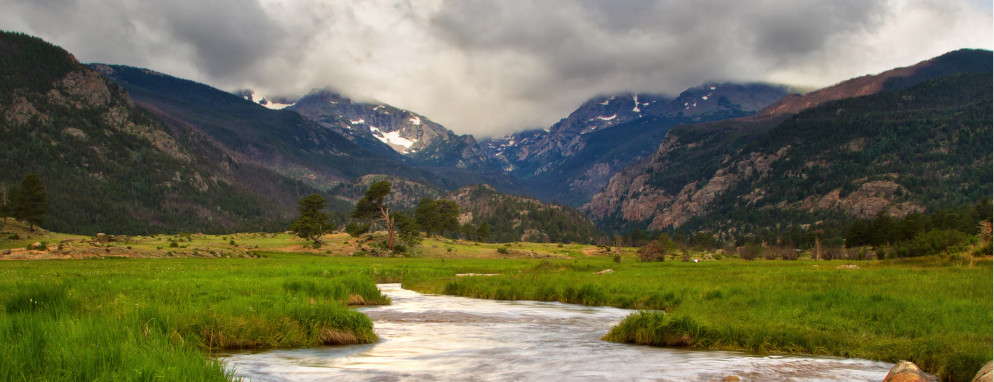
The Bureau of Reclamation and the National Park Service, two sub-agencies of the Interior, eventually developed and considered seven alternative plans to manage water releases from Lake Powell through the Glen Canyon Dam. But the agencies ignored alternative proposals that the conservationists say better account for future climate change.

The conservationists sued in 2019, four months after sending the Interior a letter detailing new research, which still hasnโ€™t been answered. In December 2022, a federal judge sided with the Interior in a summary judgment finding the groups didnโ€™t prove the federal agency hadnโ€™t analyzed the effects of climate change.

U.S. Circuit Judge Michael Hawkins, a Bill Clinton appointee, joined Judges Murguia and Johnstone in denying the groupsโ€™ appeal.

The panel found that the Interior selected a management plan that adequately juggled its obligations under the Grand Canyon Protect Act of 1992 with other relevant regulations, such as the Colorado River Storage Project Act of 1956.

The judges explained how the groupsโ€™ proposals would have either reduced or eliminated hydropower generation at the dam or run afoul of the long-term management planโ€™s limited purpose: to create monthly, daily and hourly water release schedules.

And since the Interiorโ€™s plan controls the timing of water releases from the dam โ€” not the volume of water it must release annually โ€” the panel ruled that the Interior โ€œreasonably focused its climate-change analysis on comparing the performance and effect of each of the seven alternatives under various climate change conditions, rather than providing a full-fledged assessment of water availability in the Colorado River Basin.โ€

By ignoring the groupsโ€™ demand for a supplemental environmental analysis, the panel decided, the Interior made a harmless error.

โ€œBecause there is no indication that the studies contain information โ€˜not already consideredโ€™ or that would โ€˜materially affect the substance of [Interiorโ€™s] decisionโ€™ regarding the timing of water releases from Glen Canyon Dam, no prejudice resulted from Interiorโ€™s failure to respond to appellantsโ€™ letter.โ€

In an email on Wednesday, Center co-founder Robin Silver acknowledged the loss while indicating that the organizationโ€™s fight against federally operated dams is far from over.

Silver wrote, โ€œWe lost. But operations of Glen Canyon Dam still need to be modified, whether itโ€™s by prevention of the movement of exotic fish (mostly bass) through the dam, and the damโ€™s dysfunction owing to the river outlet works falling apart resulting in the increasing need to use the penstocks which will further increase movement of exotic fish thus jeopardizing downstream native fish further.โ€

โ€œStay tuned,โ€ he added, โ€œthere will obviously be more litigation as BuRec continues to ignore River health to provide for subsidized power production.โ€

This article was first published by Courthouse News Service and is republished under their terms of use.

Utah News Dispatch is part of States Newsroom, a nonprofit news network supported by grants and a coalition of donors as a 501c(3) public charity. Utah News Dispatch maintains editorial independence. Contact Editor McKenzie Romero for questions: info@utahnewsdispatch.com. Follow Utah News Dispatch on Facebook and Twitter.

Why a Bigger Grid is Good for the Planet โ€“ and Birds: Audubon is advocating for the rapid expansion of responsibly sited transmission #ActOnClimate

Greater Prairie-Chicken. Photo: Ken Archer/Audubon Photography Awards

Click the link to read the article on the Audubon website (Alice Madden):

April 22, 2024

In Colorado, my home, we are already living with the effects from climate change โ€“ from record flooding, early snowmelt and unheard-of winter wildfires.  These impacts have serious implications for communities as well as birds in the region like Lark Buntings and Mountain Chickadees. In fact, roughly half of bird species in Colorado are threatened with extinction if we donโ€™t slow global temperature rise.  
Recent reports haveย warnedย that the effects of climate change will continue to intensify, and to avoid the worst impacts we need to quickly reduce carbon pollution.โ€ฏIn the U.S., this includes building more wind and solar energy infrastructure and increasing transmission capacity to get that energy safely and effectively from high resource areas to population centers.

Thatโ€™s why Audubon released the Birds and Transmission report in August 2023โ€”and why I joined the organizationโ€™s clean energy team earlier this year. 

Our commitment to advocate for responsibly sited clean energy and transmission infrastructure is central to reaching our climate goals. We know that any infrastructure can pose risks to birds and there is no such thing as impact-free energy development, but our report shares ways that developers can easily avoid, minimize, or offset those impacts. 

Here are some solutions for reducing transmission risks to birds:

  • Avoid high conservation value lands, with special attention to migratory pathways, wildlife corridors, and areas important for species of high risk like prairie-chickens. ย 
  • Upgrade existing lines or expand within existing rights of way. This alone could meet up to half of all additional transmission needs.ย 
  • Increase line visibility through marking devices or illumination with UV lights that birds can readily detect. This method has been shown to reduce collision rates at Audubonโ€™s Rowe Sanctuary in Nebraska.ย 

Investing in meaningful engagement with communities, especially from the outset, will help secure buy-in and reduce the increasing pushback that has stalled transmission projects. In our report, we were able to identify and map priority areas for birds that coincide with existing, planned, and potential transmission build-out. That way, Audubon and other stakeholders can strategically engage early and often with developers as projects are proposed and reviewed.   

Itโ€™s clear that to act on climate, we need to get transmission projects across the finish line sustainably and at the scale needed to meet the moment. As the build-out continues, Audubon will be a voice for birds and our planet, making sure that infrastructure includes science-based solutions so we can build the grid birds need. ย 

ย 

Itโ€™s do-or-die time for a water pipeline #Thornton says it needs to keep home construction alive: Larimer Countyโ€™s commissioners set to decide โ€œcritical voteโ€ on permit for $500 million project — The #Denver Post #PoudreRiver #SouthPlatteRiver

Graphic credit: ThorntonWaterProject.com

Click the link to read the article on The Denver Post website (John Aguilar). Here’s an excerpt:

May 2, 2024

Larimer Countyโ€™sย board of commissionersย will decide the fate of the 70-mile, half-billion-dollar infrastructure project as soon as Monday [May 6, 2024]. As now proposed, the pipelineย would follow an alignmentย thatโ€™s different from the one rejected in 2019…Ultimately, the commissioners will have to balance Thorntonโ€™s demands for water to supportย much-needed housingย in the city of 145,000 against calls by county residents and environmentalists for an alternative that avoids putting the Poudreโ€™s water in a pipe in the first place. They contend other outcomes would maintain the health of the river.

Coloradoโ€™s sixth most populous city wants to move 14,000 acre-feet of Poudre water to the city annually, via a 42-inch-diameter pipe.

Itโ€™s possible a final vote by the commissioners could be delayed until Wednesday, depending on how much more public comment there is Monday…

Carolynne White, an attorney representing Thornton, noted during the hearing that the city has owned its shares in the Poudre River for decades. Itโ€™s been diverting that portion of water into reservoirs northwest of Fort Collins, for use on farms in the area. Those water shares are the ones Thornton would send directly to the city through the pipe, rerouting water that does not flow through Fort Collins currently.

โ€œThis project does not reduce the river flows in the Poudre River,โ€ White said.

#Drought news May 2, 2024: Conditions mostly remained unchanged in the western U.S.

Click on a thumbnail graphic to view a gallery of drought data from the US Drought Monitor website.

Click the link to go to the US Drought Monitor website. Here’s an excerpt:

This Week’s Drought Summary

During the late week and weekend, a large severe weather outbreak brought large hail, damaging winds and numerous intense tornadoes to parts of the central and southern Great Plains and Midwest. The storm systems responsible for the severe weather outbreak also brought widespread moderate and heavy rain amounts to the central U.S., leading to widespread improvements in drought and abnormally dry conditions. To the southwest of the heavy rainfall, in northwest Oklahoma and southwest and central Kansas, severe drought expanded as flash drought continued to take hold during a very dry late winter and early-mid spring, leading to reports of very poor wheat conditions and dust storms. Recent dry weather over the last month, combined with a mostly dry week, led to the development of more areas of abnormal dryness and moderate drought over scattered parts of the Southeast, Tennessee and southeast Kentucky. Conditions mostly remained unchanged in the western U.S., though a few improvements occurred in Colorado and Utah after recent precipitation, while conditions worsened in parts of southeast Montana and the Black Hills region of South Dakota and adjacent northeast Wyoming amid recent dry weather. Heavy rains in the northeast part of Puerto Rico eased drought and abnormal dryness there as streamflows improved and crop stress lessened…

High Plains

Moderate to heavy precipitation fell across much of the High Plains region this week, excluding central and southwest Kansas and northeast Wyoming and southeast Colorado. Mostly warmer-than-normal temperatures occurred in Kansas, Colorado, Wyoming and the western Dakotas, while elsewhere, temperatures were mostly within a couple degrees of normal. While the storms responsible for the rain brought damaging hail and tornadoes in parts of the region, the rainfall helped to alleviate drought conditions in many areas. Eastern Kansas and Nebraska saw improvements in some areas, with parts of southeast Kansas seeing two-category improvements in the areas of heaviest rainfall. Meanwhile, in tandem with severe drought expansion in northwest Oklahoma, severe drought conditions expanded in central and southwest Kansas after another mostly dry week. Flash drought conditions in this region have led to dust storms and very poor wheat conditions…

Colorado Drought Monitor one week change map ending April 30, 2024.

West

Weather conditions were variable across the West this week. Precipitation amounts from 0.5 to 2 inches (locally higher) fell in western parts of Washington and Oregon. Elsewhere, precipitation amounts varied from none to locally up to 2 inches, especially in some high-elevation areas. Temperatures were mostly near normal or a couple degrees below normal in Washington, Oregon, California, Arizona and western New Mexico, while near-normal or warmer-than-normal temperatures prevailed elsewhere. Drought conditions remained mostly unchanged across the region. In northeast Utah, abnormal dryness and moderate drought were reduced in coverage after recent wet weather and low evaporative demand. In southeast Montana, moderate drought grew in coverage as short-term precipitation deficits grew alongside decreasing streamflow and soil moisture…

South

Weather conditions varied widely across the South region this week, with heavy rain falling in parts of Oklahoma, Texas, Arkansas and Louisiana, while other areas were left mostly or completely dry. Temperatures were mostly warmer than normal across the region, especially in Oklahoma and Texas, where weekly readings came in 4-8 degrees above normal, with a few local readings even warmer than that. A few spots in central Texas and the Trans-Pecos region saw improvements to drought or abnormally dry conditions after recent rainfall. In eastern and parts of northern Oklahoma, recent heavy rainfall led to improving conditions. Meanwhile in Tennessee, short-term dryness continued, leading to the expansion of moderate drought and abnormal dryness in eastern Tennessee and the expansion of abnormal dryness in western parts of the state. Flash drought continued to worsen in parts of northwest Oklahoma and adjacent portions of the Texas and Oklahoma panhandles, where severe drought expanded amid quickly drying soils and growing short-term precipitation deficits…

Looking Ahead

Between the evening of Wednesday, May 1 (time of writing), and the evening of Monday, May 6, the National Weather Service Weather Prediction Center is forecasting moderate to heavy rain amounts from central Texas and northern Louisiana northward into the mid-Missouri and upper-Mississippi River valleys. In this region, rainfall amounts are forecast to range from a half inch to locally as high as 3 inches, especially in parts of Oklahoma, Texas and northern Louisiana. Similar precipitation amounts are also forecast in western Washington and Oregon, while some precipitation exceeding 1 inch is also forecast in parts of the northern Sierra Nevada. Mostly dry weather is forecast for eastern Colorado, New Mexico, Arizona, southwest Nevada, southern California and deep south Texas.

For May 7-11, the National Weather Service Climate Prediction Centerโ€™s forecast favors colder-than-normal weather across much of the western U.S., with the highest confidence for colder-than-normal weather centered over Idaho and northern Nevada. Warmer-than-normal weather is expected in much of the southeast half of the contiguous U.S., especially from Texas northeast to the mid-Atlantic. Above-normal precipitation is favored in the northern U.S., especially eastern Montana, while below-normal precipitation is favored in coastal California, southern New Mexico and southern and western Texas, southeast Louisiana and most of Florida.

During the May 7-11 period, colder-than-normal temperatures are favored in southwest, south-central and southeast Alaska, and across all of Hawaii. All of Alaska is favored to receive above-normal precipitation, with confidence highest outside of the far west and northwest. With the exception of the Big Island, the forecast slightly favors above-normal precipitation in Hawaii.

US Drought Monitor one week change map ending April 30, 2024.

Just for grins here’s a gallery of US Drought Monitor early May maps for the last few years.

The #ColoradoRiver just called you for help. Will you answer? New media collaborative seeks answers, solutions for the hardest working river in the West — The Deseret News #COriver #aridification

Prior to 1921 this section of the Colorado River at Dead Horse Point near Moab, Utah was known as the Grand River. Mike Nielsen – Dead Horse Point State Park

Click the link to read the article on The Deseret News website (my Joi O’Donoghue). Here’s an excerpt:

May 1, 2024

This article is published through the Colorado River Collaborative, a solutions journalism initiative supported by the Janet Quinney Lawson Institute for Land, Water, and Air at Utah State University. See all of our stories about how Utahns are impacted by the Colorado River atย greatsaltlakenews.org.

Why the Colorado River matters

The award-winning Great Salt Lake Collaborative is expanding to focus on the Colorado River. This new initiative is made up of 11 Utah newsrooms that have agreed to report on the river, its tributaries and destinations together. As a solutions journalism initiative, collaborative stories will also explain what can be done to adapt to the new realities facing this troubled river, what actions are being taken and why…The expanded scope of this reporting was made possible with a founding gift from Utah State Universityโ€™s Janet Quinney Lawson Institute for Land, Water and Air โ€” but all editorial decisions are made independently by member news organizations in accordance with their respective editorial policies…

As states wrangle for water and the U.S. Bureau of Reclamation looms with new federal management mandates ahead of a 2026 operating guideline, everyone comes from a point of vulnerability. Will there be enough water and what if there isnโ€™t?

โ€œThis is not a quick ship to turn around,โ€ said Burdette Barker, a civil and environmental engineer at Utah State University, talking about the tension between agriculture and water use in the basin.

Map credit: AGU

Biden-Harris Administration Announces $3 Billion for Lead Pipe Replacement to Advance Safe Drinking Water as Part of Investing in America Agenda

Click the link to read the release on the Environmental Protection Agency website:

May 2, 2024

EPA announces latest round of funding toward President Bidenโ€™s commitment to replace every lead pipe in the nation, protecting public health and helping to deliver safe drinking water

WASHINGTON โ€“ Today, May 2, the U.S. Environmental Protection Agency announced $3 billion from President Bidenโ€™s Investing in America agenda to help every state and territory identify and replace lead service lines, preventing exposure to lead in drinking water. Lead can cause a range of serious health impacts, including irreversible harm to brain development in children. To protect children and families, President Biden has committed to replacing every lead pipe in the country. Todayโ€™s announcement, funded by the Bipartisan Infrastructure Law and available through EPAโ€™s successful Drinking Water State Revolving Fund (DWSRF), takes another major step to advance this work and the Administrationโ€™s commitment to environmental justice. This funding builds on the Administrationโ€™s Lead Pipe and Paint Action Plan and EPAโ€™s Get the Lead Out Initiative.

Working collaboratively, EPA and the State Revolving Funds are advancing the Presidentโ€™s Justice40 Initiative to ensure that 40% of overall benefits from certain federal investments flow to disadvantaged communities that are marginalized by underinvestment and overburdened by pollution. Lead exposure disproportionately affects communities of color and low-income families. The $9 billion in total funding announced to date through EPAโ€™s Lead Service Line Replacement Drinking Water State Revolving Fund program is expected to replace up to 1.7 million lead pipes nationwide, securing clean drinking water for countless families.

โ€œThe science is clear, there is no safe level of lead exposure, and the primary source of harmful exposure in drinking water is through lead pipes,โ€ said EPA Administrator Michael S. Regan. โ€œPresident Biden understands it is critical to identify and remove lead pipes as quickly as possible, and he has secured significant resources for states and territories to accelerate the permanent removal of dangerous lead pipes once and for all.โ€

President Bidenโ€™s Bipartisan Infrastructure Law invests a historic $15 billion to identify and replace lead service lines. The law mandates that 49% of funds provided through the DWSRF General Supplemental Funding and DWSRF Lead Service Line Replacement Funding must be provided as grants and forgivable loans to disadvantaged communities, a crucial investment for communities that have been underinvested in for too long. EPA projects a national total of 9 million lead services lines across the country, based on data collected from the updated 7th Drinking Water Infrastructure Needs Survey and Assessment. The funding announced today will be provided specifically for lead service line identification and replacement and will help every state and territory fund projects to remove lead pipes and reduce exposure to lead from drinking water.

The Lead Service Line-specific formula used to allot these funds allows states to receive financial assistance commensurate with their need as soon as possible, furthering public health protection nationwide. The formula and allotments are based on need โ€” meaning that states with more projected lead service lines receive proportionally more funding.

Alongside the funding announced today, EPA is also releasing aย new memorandumย that clarifies how states can use this and other funding to most effectively reduce exposure to lead in drinking water. Additionally, EPA has developedย new outreach documentsย to help water systems educate their customers on drinking water issues, health impacts of lead exposure, service line ownership, and how customers can support the identification of potential lead service lines in their homes.

The Biden-Harris Administrationโ€™s ambitious initiative to remove lead pipes has already delivered significant results for families across the nation. Todayโ€™s latest funding will ensure more families benefit from these unprecedented resources, and support projects like these:

  • West View Water Authority inย Pennsylvaniaย has received $8 million through the Bipartisan Infrastructure Law to replace 750 lead service lines in underserved areas of the community โ€” primarily inย Allegheny County. Of that funding, more than $5.4 million is forgivable, reducing the overall financial burden on ratepayers and the community.
  • Inย Tucson, Arizona, the city received $6.95 million in Bipartisan Infrastructure Law funds to develop lead service line inventories for their nine public water systems. The city will use this inventory to develop a plan to replace lead service lines in the community and improve drinking water quality for residents โ€” many of whom live in low-income and disadvantaged communities.
  • Located in between Chicago and Milwaukee, the community ofย Kenosha, Wisconsinย has been at the forefront of the stateโ€™s efforts to remove 5,000 lead service lines in their community. To accelerate lead service line removal, Kenosha is working with EPAโ€™s Bipartisan Infrastructure Law-funded Water TA team to help customers self-inventory their service line material and apply for federal funding to remove and replace lead service lines.
  • Theย Eastern Band of Cherokee Indians, located across westernย North Carolina, has been selected to received support from the Bipartisan Infrastructure Lawโ€™s lead service line replacement funds to conduct service line inventories and prepare preliminary engineering reports for five of the public water systems on their land.

o view more stories about how the unpreceded investments from the Bipartisan Infrastructure Law are transforming communities across the country, visit EPAโ€™s Investing in Americaโ€™s Water Infrastructure Story Map. To read more about some additional projects that are underway, see EPAโ€™s recently released Quarterly Report on Bipartisan Infrastructure Law Funded Clean Water and Drinking Water SRF projects and explore the State Revolving Funds Public Portal.  

Todayโ€™s allotments are based on EPAโ€™s updated 7th Drinking Water Infrastructure Needs Survey and Assessment (DWINSA) including an assessment of newly submitted information. To date, this is the best available data collected and assessed on service line materials in the United States. Later this summer, EPA will release an addendum to the 7th DWINSA Report to Congress which will include the updated lead service line projections. EPA anticipates initiating data collection, which will include information on lead service lines, for the 8th DWINSA in 2025.

For more information, including state-by-state allotment of 2024 funding, and a breakdown of EPAโ€™s lead Drinking Water State Revolving Fund, please visit EPAโ€™s Drinking Water website.

Rapid snowmelt on New Mexicoโ€™s #RioGrande — John Fleck (InkStain.net)

Snowmelt in the Rio Grande headwaters as of May 2, 2024, courtesy NRCS

Click the link to read the article on the InkStain website (John Fleck):

April 29, 2024

A recent rapid warmup has brought high flows to the Rio Grande through New Mexico. But with a modest snowpack sitting in the mountains to the north, that means we should expect the early rise to be followed by an early drop.

Members of the Inkstain Rio Grande Rapid Response Team (IRGRRT) were busy over the weekend monitoring the river. (โ€œMonitoring the riverโ€ actually just means โ€œgoing for walks, bike rides, and boating the riverโ€ like we do nearly every weekend, but โ€œmonitoring the riverโ€ and โ€œRio Grande Rapid Response Teamโ€ sound cooler and more official than a bunch of river nerds goofing.)

Rio Grande, up out of the main channel, at the Rio Bravo Bridge in Albuquerque South Valley. Photo credit: John Fleck/InkStain

IRGRRT team members saw enough water through the Albuquerque reach to float over many of the sandbars, and flows in some of the overbank shallows beyond the main river channel. Those overbank flows are a mixed bag โ€“ important for ecological system function, less helpful for meeting Rio Grande Compact deliveries to our downstream neighbors with whom we share this river.

Last year, with a much larger snowpack, we saw sustained flows this high (and higher) through the end of June, when the Army Corps of Engineers slammed on the brakes. The tail end of the 2023 runoff sat behind the upstream dams at Abiquiu and Cochiti until Nov. 1, when the Corps began releasing it to meet our delivery obligations to our downstream neighbors. That wonโ€™t happen in 2024.

This yearโ€™s flow shot up with the big warmup two weeks ago melting off the snow in a hurry. Thatโ€™s the rapid drop you see in the snowpack graph above. It may already have peaked, with flows hitting 3,600 cubic feet per second at Otowi (the gage above New Mexicoโ€™s Middle Rio Grande Valley). In response, the Corps has dropped releases at Cochiti. At Albuquerque, the peak hit ~3,200 cfs, and has now settled under 3,000 cfs.

Flows at Albuquerque, April 29, 2024. Graphic credit: John Fleck/InkStain

Thanks to all the IRGRRT volunteers, andย Inkstain supporters.

Romancing the River: Cowboys and Indians — George Sibley (Sibley’s Rivers) #ColoradoRiver #COriver #aridification

Great Seal of the Salt River Pima-Maricopa Indian Community.

Click the link to read the article on the Sibley’s Rivers website (George Sibley):

May 1, 2024

The maze design above is the Great Seal of the Salt River Pima-Maricopa Indian Community, inhabiting a relatively small First People Reservation (53,600 acres) in Arizona at the confluence of the Salt and Gila Rivers. The Gila River system drains most of the state of Arizona โ€“ what there is to drain in the subtropical Sonora Desert. The Gila joins the Colorado River at Yuma, near the Mexican border. The reservation was created in 1879 to get the First People out of the way of the Euro-American tsunami coalescing along the Gila as the city of Phoenix โ€“ which has since grown to surround the reservation with suburbs.

Gila River watershed. Graphic credit: Wikimedia

Given the kind of heraldic symbolockry that makes up most Great Seals, signifying power and glory โ€“ I think that to put a maze on your Great Seal takes a certain admirable chutzpah, the higher humor of those who laugh with their gods rather than just being laughed at by them. But when it comes to water and the Colorado River in general, the maze might be an accurate enough symbol for where we all are today: at the ragged end of a century of building a magnificent hydraulic society that has devolved to a near-collapse at the systemic level. Having cobbled together a strategy for nursing the system under a much-amended set of โ€˜Interim Guidelinesโ€™ through to the end of the interim in 2026, the water mavens of the Colorado River Region are now working, not exactly together, on a plan for operating the river post-2026 for at least a couple decades further into the 21stย century. At this point, the Bureau of Reclamation has received at least four alternative post-2026 management plans at this point: one from the four states above the riverโ€™s canyon region, one from the three states below the canyons, one (at least) from a group of environmentalists, and one we might call the โ€˜eldersโ€™ planโ€™ submitted by Eric Kuhn, Jack Schmidt and their scribe John Fleck. Welcome to the maze: these alternatives will all be analyzed through an Environmental Impact Study over the next year or two or five, andย e pluribus unum,ย a management plan will emerge like the sun at the center of what ought to be the Great Seal of the entire Colorado River.

There is, however, probably no set of river users more experienced at wandering in the maze than the 30 tribes of First People on reservations in the Colorado River Basin. They have been finding their way for a century and a half in a maze whose dead ends for them were to be the end of their cultural lives, if they didnโ€™t backtrack and try another way. But they have now, at this point, come through most of those trials and achieved a growing acceptance of the cultural diversity they bring to American society; the government is no longer practicing an active policy of forced assimilation; and there is a growing interest in their cultural and spiritual ways.

But they seem to still have trouble being taken seriously in the Colorado River Basin as potentially part of the solution of the water challenges rather than just objectified as part of the problem. They have not submitted a post-2026 management plan per se; they have instead submitted a three-page letter that is something between a request and a demand: first, that the federal government meet its trust responsibility to Basin Tribes by actively protecting their Tribal water rights from being first-to-be-cut (irrespective of whether they have already been finally quantified); second, that the government eliminate systemic obstacles to their full development of their water rights; and third, that the government provide a permanent, formalized structure for Tribal participation in implementing the Post-2026 Guidelines, and in any future Colorado River policy and governance. (Click here for their letter.)

As usual, this wants a little historical context. Any discussion of โ€˜Tribal Water Rightsโ€™ requires, for example, a clear understanding of the distinction between โ€˜paper waterโ€™ and โ€˜wet waterโ€™: โ€˜paper waterโ€™ is water which one has a legal right to use; โ€˜wet waterโ€™ is the amount of paper water one can actually afford to put to use with money, time and will.

In 1908 the U. S. Supreme Court gave โ€“ or appeared to give โ€“ the First People tribes a lot of paper water with a very senior right: in a Montana case involving settlers in the Milk River valley and the Ft. Belknap Crow Reservation, Winters v. The United States, the Court said that whenever the federal government reserved public lands for any purpose, it also implicitly reserved the water necessary to carry out that purpose โ€“ and the priority date for that reservation of water would be the date the reservation was created. Also, the standard โ€˜use it or lose itโ€™ mandate of the appropriation doctrine would not apply; the water right would be there whenever the reservation was finally able to develop its paper water.

This โ€˜Wintersย doctrineโ€™ was a real wild card dropped into the federal governmentโ€™s relationship with the First People at the time. Government policy toward the โ€˜Indian problemโ€™ by the turn of the century had advanced beyond โ€˜the only good Indian is a dead Indian,โ€™ to a policy of forced assimilation โ€“ โ€˜Kill the Indian to save the person.โ€™ It was a policy change from an Indian War waged by the cavalrymen, to cowboy work for the Office of Indian Affairs (OIA): roundโ€™em up, corralโ€™em, feedโ€™em โ€“ but donโ€™t letโ€™em get too comfortable because we want to moveโ€™em on into good jobs and a better life as โ€˜real Americans.โ€™

And the OIA cowboys rode for the USA brand, not the Indians. Theirs was the job of carrying out the 1887 Dawes Act, whereby reservations for people who had only known the land and water as commons for everyone (in their band) to use, saw the land divided into private farm plots which they would own individually and be individually responsible for (whatever that meant). Their children were torn from family and clan and hustled off to distant Indian schools were they were taught industrial skills and the advantages of no longer being an Indian. The goal was to facilitate the disappearance of the โ€˜Indian problemโ€™, into the farm towns and industrial cities surrounding the reservations, with a liquor store just down the road at every exit.

Theย Wintersย doctrine was also an unexpected and unappreciated wild card played in the federal-state relationship. Until that assertion by the nationโ€™s highest court, water matters had been left to the states since there was no one-size-fits-all for the variability in climate, state by state. But the creation ofย federalย reserved rights for water in the arid states was capable of blowing large holes in theย state-levelย prior appropriation doctrine the arid and semi-arid states had all adopted as grassroots common law. Dating the reserved water rights to the creation dates of the reservations made the First People (not unjustly) senior to practically every other user โ€“ and then allowing the reservers to hold the water right indefinitely without putting the water immediately to beneficial use โ€“ it was easy to see the federal reserved right as a deadly attack on the appropriation law.

The states eventually struck back at the concept of the federal reserved right. The U.S. Congress tamed the federal reserved right somewhat in 1952 with the McCarran Amendment by Nevada Senator Pat McCarran; this mandated that any federal reserved right would have to go through the standard water right adjudication procedures of the state(s) involved. Further court decisions said that quantification of the reserved water right was limited to the primary purpose of the reservation, and the decree could only be for the minimum amount of water necessary to fulfill that purpose.

On the positive side for the First People, American public opinion about them was mellowing through the first third of the 20thย century, as reflected in the Indian Reorganization Act in 1934. This mostly reversed (for at least a couple decades) the more brutal aspects of the assimilation policies, and restored some local control over First People land and resources; the People were encouraged to create their own tribal governance. The often heavy-handed trustee relationship with the OIA cowboys continued to be a very mixed blessing (especially where water was concerned), but at least self-governance gave them the opportunity to raise a unified voice.

Water continued to be problematic, however. In considering the importance of the federal reserved right in the Colorado River Basin, it is important to note that less than half of the First People tribes were being rounded up and herded in from hunter-forager lives โ€“ or as that life had evolved due to the presence of Spanish horses and the crowding due to population growth and white pressure, the hunter-gatherer-herder-warrior-raider life. These were tribes like the Utes, Navajos, Apaches and Comanches who had decided that, rather switching to agriculture, they would rather fight each other and the Euro-Americans over territory, horses, slaves, and plain love of the skirmish, while raiding more settled People for their subsistence.

Meanwhile, many other First People were well into the transition from hunting and foraging to farming. As the gold and silver rushes brought on the white tsunami in the 1850s and 60s, two First People tribes farming on the Colorado River floodplains and hunting in the adjacent uplands โ€“ the Mojave and Chemehuevi โ€“ actuallyย requestedย that the Office of Indian Affairs create a reservation for them on the river floodplain, yielding their upland hunting grounds for a place the white settlers could not invade.Reservations for the Mojave, Chemehuevi and โ€˜Colorado River Indian Tribesโ€™ (both tribes) were duly created near where California, Nevada and Arizona intersect. Small tribes farming farther down the river also received small reservations, some for groups of only a few hundred people.

Screen shot from episode of “Tom Talks” April 2020.

Then there were the First People who had been irrigating farmland from time immemorable in the Gila River Basin, mostly branches of the Tohono Oโ€™odam People like the Pima and Maricopa, who traced their heritage and culture back to the Huhugam (Hohokam) hegemon that had prevailed in the Gila Basin several hundred years before the Spanish Entrada in the Southwest, and (like all advanced โ€˜civilizationsโ€™) collapsed mysteriously, probably from some combination of over-population and unsustainable economic and cultural complexity.

Many of the First People in the Southwest did not, in other words, evenย needย the supposed advantage of a federal reserved right; they could have filed directly into the state adjudication system for the right to water they had been using beneficially since well before the Euro-American invasion โ€“ย ifย their supposed trustee, the OIA cowboys, had explained the new laws to them and shepherded them into and through the adjudication process, standing up for them as Congress had supposedly charged them to do.

Instead, the First People found their water disappearing as the land filled in around them, upstream and down, and their physical and cultural lives deteriorated accordingly, as well as their sustainable economics. The white settlers irrigating their own lands were not consciously stealing Indian water; they were just participating in the first-come first-served race for resources that the prior appropriation doctrine sets up, and the First People were not privy to the procedures for getting into that race.

The cultural undermining of the Gila River Basin First People in the late 19thย century falls entirely on the failure of their government trustees to help them negotiate the bewildering new appropriation systems. But that is a historical judgment that has to balanced with a little empathy for the OIA cowboys themselves, trapped in the history of Americaโ€™s cowboy epoch. They undoubtedly believed they were just carrying out federal policy, which was assimilation of the First People โ€“ forced when necessary. The โ€˜potโ€™ looking today at that โ€˜black kettleโ€™ has to be aware of the fact that our government still seems to be dominated by representatives who believe โ€“ perhaps not consciously โ€“ that keeping conditions on the reservations generally miserable and hopeless helps bring the First People along to leaving the reservation and becoming real Americans. Otherwise, why would we allow conditions to remain so bad on so many reservations?

But this not a story with the usual unhappy ending. The fact is, some of these First People reservations are bootstrapping themselves back into a state of reasonably well-watered economic and cultural vitality, and are doing a lot of it on their own impetus, with their cowboy trustees riding shotgun to help as necessary with authority and funding. They have actually acquired quite a lot of decreed paper water โ€“ a full third of the total current flow of the river โ€“ but they have only been able to put maybe a fourth of that to work as real water. They will tell you that they are not done โ€“ as their letter to the Bureau indicates โ€“ but will also say they want to work out the use of their water so consumptive use does not increase significantly.

We will look more closely at that apparent contradiction, and how it is unfolding, in the next post.

Meanwhile โ€“ welcome to the maze. Where it might make sense to stop, look and listen to those who have been here longest.

Native America in the Colorado River Basin. Credit: USBR

The spring melt is coming for mountain snow, but not all will make it to the #ColoradoRiver — KUNC #COriver #aridification

A pair of skiers descends Arapahoe Basin Ski Resort on April 22, 2024. Colorado’s Rocky Mountains just reached their peak for winter snow. Soon, it will melt into rivers and reservoirs that combine to supply about 40 million people across the Southwest. Photo credit: Alex Hager/KUNC

Click the link to read the article on the KUNC website (Alex Hager):

April 29, 2024

This story is part of ongoing coverage of the Colorado River, produced by KUNC in Colorado and supported by the Walton Family Foundation. KUNC is solely responsible for its editorial coverage.

High in the Rocky Mountains, spring is the time of year when altitude makes all the difference. Above the treeline, the mountains have been rendered almost featureless, blanketed by the deepest snow theyโ€™ll see all year. Lower down, that white blanket is starting to turn to slush, beginning its spring trickle into the streams and rivers that flow downhill.

Forecasters are optimistic after a relatively strong snow season, but say a variety of weather factors could limit the amount of water that will run off into rivers and reservoirs this spring.

Water managers from across the West are turning their eyes to those high-alpine climes to get a sense of summertime water supply for cities and farms across the region. The Colorado River, which supplies 40 million people from Wyoming to Mexico, gets the vast majority of its water from mountain snow. Two-thirds of that snow falls in Colorado.

Snowpack in the Upper Colorado River Basin โ€“ which includes Colorado, Wyoming, Utah and New Mexico โ€“ appears to have peaked on April 3, within a few days of the average peak date. It is measured by calculating the amount of water held in snow.

At its peak, the amount of water held in snow was right around average when compared to winters across the past three decades, and marked the second-highest peak since 2019.

SNOTEL automated data collection site. Credit: NRCS

A vast network of sensors, often hidden deep in the woods, gathers weather data in different parts of the Rockies, giving climate scientists and water forecasters a robust set of metrics about snow.

On the day the Upper Basinโ€™s snowpack peaked, nearly every sensor in western Colorado and eastern Utah showed snow totals above 90% of average, with many above 100 percent. A handful of stations showed drier conditions, especially around the Green River in Wyoming and the San Juan River in Colorado. Both watersheds included a number of stations that recorded earlier snowpack peaks and melting periods than the rest of the region.

Hurdles on the way to the river

Even though snow totals are about average, there are a few things that stand in the way of that snow reaching rivers and reservoirs once it melts. Becky Bolinger, Coloradoโ€™s assistant state climatologist, expressed some guarded optimism about the stateโ€™s snow data.

โ€œLiving in Colorado, sometimes it’s hard to have those good vibes because it can just turn on a dime,โ€ she said.

Bolinger highlighted two big factors that could mean lower river flows than near-average snow totals might suggest.

The first is dry soil. Hot summers can sap the water out of the ground, leaving it parched when snow starts to fall. Thatโ€™s the case this year, and Bolinger expects that some areas will see that thirsty dirt act like a sponge, soaking up snowmelt before it has a chance to reach rivers and reservoirs.

The second is high temperature. Abnormally warm days, which are becoming more common due to climate change, could cause that water to melt quicker and earlier before evaporating into the air. Bolinger said that is more likely in the warmer parts of southern Colorado, around the San Juan Mountains and Sangre de Cristo Mountains.

Bolinger added that windblown dust from nearby plains could land on mountain snow, causing it to melt faster, since dark colors attract more heat from the sun than pure white snow.

Looking back at El Niรฑo

As winter turns to spring, climate scientists have a chance to compare their early-season forecasts with the outcome of this winter.

This year brought โ€œEl Niรฑoโ€ conditions to the Western U.S, a phenomenon that typically comes around every two to seven years. Itโ€™s a pattern driven by warm water in the Pacific Ocean, which tends to cause warm conditions in the northern part of the West and wet conditions in the southern part. It can be hard to predict the impact of El Niรฑo on Colorado River basin snowpack because the dividing line between those two trends falls in or around Colorado.

This year, El Niรฑo delivered less snow than expected.

โ€œEl Niรฑo will tilt the odds in favor of wetter or snowier conditions over the region,โ€ said Nat Johnson, a meteorologist with the National Oceanic and Atmospheric Administration. โ€œBut it doesn’t rule out the possibility of the opposite outcome. Sometimes, just the influence of our chaotic weather and the climate system can overrule the influence of El Niรฑo.โ€

Grays and Torreys, Dillon Reservoir May 2017. Photo credit Greg Hobbs.

Johnson, who works with the agencyโ€™s Geophysical Fluid Dynamics Laboratory, said that could be the result of other patterns in ocean temperature as well as the unpredictable nature of weather.

Climate change is driving warmer days and earlier snowmelt in the Colorado River basin itself, but it also impacts faraway phenomena that influence the Southwestโ€™s weather, making that weather harder to predict. That may have been the case with this yearโ€™s El Niรฑo.

โ€œGlobal oceans were just so incredibly warm,โ€ Johnson said. โ€œNot just breaking records, but really shattering the records. It just makes me think that just the really unusual warmth that we saw may have been an even bigger factor than we’ve typically seen in recent years.โ€

Planning for an unpredictable future

Data about snow, streams and soil doesnโ€™t just matter to the people living near the mountains. Itโ€™s also watched closely by people hundreds of miles away.

“It’s extremely important,โ€ said Kristen Johnson, manager of Colorado River Programs at the Arizona Department of Water Resources. โ€œThere’s no way around it. We can’t have the Arizona economy without abundant snow in the Upper Basin and efficient runoff from that snow into Lake Powell.โ€

About 36% of Arizonaโ€™s water comes from the Colorado River. That includes sprawling farm fields near the river itself, which forms the stateโ€™s western border with California. It also includes water routed away from the river through a 330-mile canal across the desert for use in Phoenix and its suburbs.

Parts of Nevada and Southern California also rely on faraway snow to fill the Colorado River and the nationโ€™s two largest reservoirs โ€“ Lake Powell and Lake Mead. They have both shrunk to record lows in recent years as a result of climate change and steady demand.

Changing snow patterns, driven by warmer temperatures, are at the heart of a debate about how to manage those reservoirs going forward.

Scientists say the Westโ€™s water crisis goes beyond โ€œdrought,โ€ which is considered to be temporary. Instead, they say the two-decade stretch of dry conditions around the Southwest is a sign of โ€œaridificationโ€ โ€“ a permanent resetting of the baseline for how much water is expected to enter rivers and streams each year.

The seven states which use the Colorado River are currently mired in a standoff about how to manage that shrinking supply in the future. Theyโ€™re divided into two camps and have submitted competing proposals for how to share the river after 2026, when the current guidelines expire.

The Lower Basinโ€™s proposal, submitted by Arizona, California and Nevada, puts forth a new system of distributing water cutbacks in times of shortage that is based on the amount of water currently in reservoirs, rather than projections for future water availability.

โ€œEveryone’s recognizing that relying on forecasts is not the best way to be making decisions,โ€ Arizonaโ€™s Johnson said. โ€œI think we’re just looking to take the guesswork out of making those decisions in the future.โ€

Meanwhile, the Upper Basin states of Colorado, Utah, Wyoming and New Mexico submitted a competing proposal. It suggests entirely different management changes than the Lower Basinโ€™s plan, but also centers around the basic fact that climate change is shrinking the snowpack that feeds the Colorado River, and people need to respond by using less water.

That plan suggests that the four Upper Basin states should be allowed to send less water to their Lower Basin counterparts. Opponents say doing so would go in the face of long standing legal agreements and may not survive challenges in court. The planโ€™s authors frame it as a necessary step to alleviate the sting of climate change from those who are nearest to the snow and feel it the most.

States donโ€™t appear close to compromise when it comes to future Colorado River management, but theyโ€™re under pressure from the federal government to find some agreement before the end of 2024 and avoid any possible complications that could be brought on by a change of presidential administrations after the November election.

โ€˜I Water That Way,โ€™ new music video from the Splashstreet Boys: #Denverโ€™s summer watering rules have never sounded like this — News on Tap

April 29, 2024 | By:ย Jimmy Luthye

Click through to YouTube to follow along with the lyrics.