Can “Floating Pools” be the template for future management of the #ColoradoRiver? — Jack Schmidt and Eric Kuhn (InkStain.net) #COriver #aridification #CRWUA2024

Attendees of the Colorado River Water Users Association watch negotiators Estevan López of New Mexico and Becky Mitchell of Colorado speak on a panel Thursday, December 5, 2024, at the Paris Hotel and Casino. The Upper and Lower basin states are at an impasse about how cuts will be shared and reservoirs operated after 2026. CREDIT: LUKE RUNYON/THE WATER DESK

Click the link to read the article on the InkStain.net website (Jack Schmidt and Eric Kuhn):

January 9, 2024

The press coverage of the December 2024 Colorado River Water Users Association (CRWUA) meeting mostly focused on the ongoing stalemate between representatives of the Upper and Lower Division States over their competing proposals for how the Colorado River Systems’ big reservoirs will be operated after the 2007 Interim Guidelines terminate in 2026.  The headlines included words such as “turbulent”, “bitter”, “bluster”, and “spar”. Indeed, there was tension in the air, and the potential for interstate litigation was a topic of much discussion both on the formal agenda and in the hallways where, traditionally, progress is often made between competing interests.

While the press focus on the tension and divisiveness was unavoidable, I believe that there were good reasons for some guarded optimism.

For the ongoing effort to renegotiate the post-2026 operating guidelines, a consortium of seven environmental NGOs has also made a detailed proposal.  Their proposal is referred to as the “Cooperative Conservation” proposal. One of the four action alternatives that Reclamation will analyze, Alternative #3, is patterned after the NGO submittal.  At CRWUA, John Berggren of Western Resource Advocates, who along with Jennifer Pitt and others prepared the proposal, made a presentation on the proposal.  Like the other submitted proposals, the cooperative conservation alternative proposes sophisticated operational rules for Lakes Mead and Powell based on combined system storage and actual hydrology. Where the Cooperative Conservation proposal breaks new ground is the concept of a Conservation Reserve Pool, and this idea could lead the basin toward a practical on-the-ground solution. Indeed, the Gila River Indian Community introduced at CRWUA a similar concept in the form of a Federal Protection Pool made up of stored water in both Lake Powell and Lake Mead. These proposals, taken separately, together, or in some combined and moderated form, might serve as a catalyst for compromise.

As proposed, both the Conservation Reserve Pool and the Federal Protection Pool would be filled with water conserved by reductions in consumptive use and perhaps augmentation from programs in both basins and this water could be stored anywhere in the system. This water would be “operationally neutral” and thus invisible to the underlying system management operating rules. From an accounting perspective, this Pool would “float” above other water in the reservoirs. Floating Pools operate separately from and above the prior appropriation system of water allocation on the Lower River and are invisible to the rules that dictate annual releases from Glen Canyon Dam. Thus, these proposals impart important operational flexibility.  In many ways, Floating Pools split the baby—they incentivize innovative conservation measures that allow participants to find value they would not have been able to realize under the prior appropriation system—yet they insulate the prior appropriation system and thus are more protective of higher-priority water users than operationally non-neutral ICS.  It’s a stretch to say there is something here for everyone, but there may be enough to kick-start otherwise stalled conversations.

In their proposal, the Lower Division States have offered to take up to 1.5 maf/year of mainstem shortages. Where the two basins remain deadlocked is what happens in those years when shortages exceed the amount the Lower Division States are willing to accept.  The Lower Division States have proposed that the two basins share the additional required shortages up to a maximum shortage of 3.9 maf/year.  The Upper Division States have said, “No, because we already suffer large hydrologic shortages in dry years, and we have not used our full compact entitlement; the Lower Division should cover all of the shortages.” In their presentation, however, the Upper Division Commissioners (UCRC members) left the door open for continuing discussions between the two divisions. In his remarks, New Mexico Commissioner Estevan Lopez stated that under what he referred to as “parallel activities”, the Upper Division States might be willing to discuss conserving “100,000, maybe 200,000 acre-feet per year.”

Water in Floating Pools could be used for a variety of purposes including environmental management, fostering binational programs, and supplementing scheduled water deliveries. During his CRWUA presentation, John Berggren mentioned an obvious use for this pool.  Water stored in the Pool by conserved consumptive use programs in the Upper Division States could be used as an Upper Division contribution during years when mainstem shortages to the Lower Division States exceed a negotiated amount.  Of course, the Lower Basin is unlikely to accept Upper Basin creation of Floating Pools made up of water for which there is no current consumptive use. This water is already “system water” and is now being used by existing Lower Basin water agency. Thus, it would be necessary to develop a program to account for and certify savings in the Upper Basin.  Further, the thorny problem of shepherding (legally protecting the conserved water so that it ends up in system storage) needs to be overcome. For a perspective on this issue, see Heather Sacket. Undeveloped Tribal water is a controversial sticking-point in this regard, with strong feelings and strong arguments on all sides.

If the Upper Division States were to conserve 200,000 acre-feet per year for five years and deposit that saved water in a conservation reserve “Floating Pool”, something like 900,000 acre-feet could be available for shortage sharing (after accounting for reservoir evaporation). (We use 900,000 af as an example only, how much water the Upper Division States would have to contribute and maintain in a Floating Pool would have to be negotiated between the two divisions.)  In their presentation, the Lower Division principals pointed out that had their proposal been in place beginning in 2007, there has yet to be a year when shortage sharing would have been required. Note, this conclusion is very sensitive to “initial conditions.” In 2007, total storage in Lake Mead and Lake Powell was about 8 maf more than it is today. If the 21st century hydrology continues, shortages greater than 1.5 maf/year are likely to occur.

What would the Upper Division States get in return?  During the term of the new post-2026 operating guidelines (which we all assume will also be “interim”), the Upper Division would benefit by the Lower Division agreeing to remove the threat of litigation over a “compact call.” For a perspective on the potential impacts of a “call” in Colorado see The Risks and Potential Impacts of a Colorado River Compact Curtailment on Colorado River In-Basin and Transmountain Water Rights Within Colorado.

Carefully crafted with appropriate guardrails, Floating Pool concepts can be a catalyst for compromise between the two divisions that give both parties something they need.

How do Floating Pool alternatives fit with the Schmidt, Kuhn, Fleck management approach?  Based on our conversations with the authors of the cooperative conservation proposal, we believe the two approaches agree — that our management proposal fits on top of and complements their proposal quite well.  In my presentation at CRWUA, I emphasized that, like future hydrology, there is great uncertainty in the future needs of the river’s ecosystem and society’s values.  It’s almost a certainty that in the future, prescribed annual releases from Glen Canyon Dam will cause an unacceptable and unanticipated outcome to some river or reservoir resource. When that happens, our flexible management approach and accounting system keeps the basins “whole.”

Is using the concept of Floating Pools as a catalyst to break the stalemate between the two basins without warts? – of course not.  There are important considerations regarding the use of undeveloped water—Tribal or otherwise, and the devil is in the details when it comes to developing appropriate guardrails for annual and total accumulation in such a Pool, the number and type of participants, annual debits, and other important qualifications. Even conserving 100,000 acre-feet per year in the Upper Division States, with acceptable verification, could be a stretch, especially if there is less federal money in the future, as there almost certainly will be.  Finally, it might put off addressing fundamental problems with the law of the river until the new post-2026 operating rules again expire. When they do, the 1922 Compact and 1944 Treaty with Mexico will still be in place, and these agreements collectively allocate 17.5 maf/year of consumptive use on a river that is only producing 13-13.5 maf/year of water at the international boundary (and runoff continues to decline).  What the Floating Pool concept might accomplish is to significantly reduce the temptation and threat of unpredictable interstate litigation, keep the basin’s stakeholders talking to each other, and give us time to move toward more foundational change in how the river is managed.

Map of the Colorado River drainage basin, created using USGS data. By Shannon1 Creative Commons Attribution-Share Alike 4.0

Hay is sucking the Great Salt Lake dry: New study finds cattle-feed irrigation is primary culprits in water body’s shrinkage — Jonathan P. Thompson (LandDesk.org) #aridification

Click the link to read the article on the Land Desk website (Jonathan P. Thompson):

January 7, 2025

🥵 Aridification Watch 🐫

Detail from an 1852 map of the Great Salt Lake by J.W. Gunnison and Charles Preuss.

About 18,000 years ago, Lake Bonneville spread across about 20,000 square miles of what is now northwestern Utah. It was some 1,000 feet deep in places during its maximum extent, was fed by snowmelt and runoff from the mountains, and discharged into the Snake River in Idaho. Over the millennia, climate change shrunk the lake, leaving behind the Great Salt Lake and vast salt flats — shimmering plains of light and ghosts of that ancient water body.

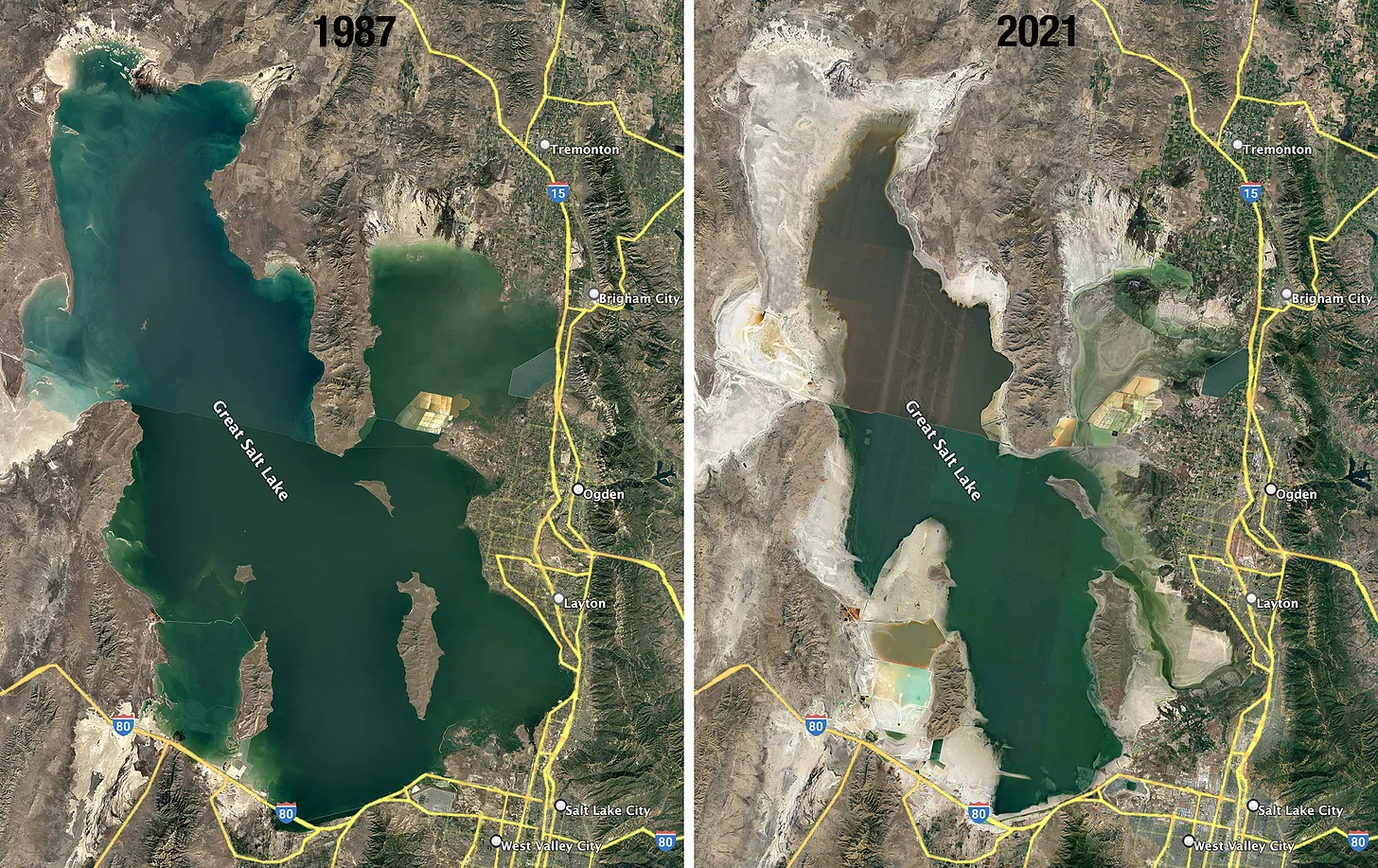
In 1847, upon seeing the remnants of Lake Bonneville, Brigham Young declared it the “right place” for the nascent Church of Jesus Christ of Latter Day Saints to set up its base. Perhaps that was simply because he and his followers were tired of traveling, or maybe he sensed the more-than-passing resemblance to the Dead Sea in the Judeo-Christian holy lands. In any event, the new settlers eventually introduced large-scale agriculture, a rapidly growing population, and industry to the valley — all of which consumed water that would otherwise run into the lake — and eventually the Great Salt Lake began shrinking yet again. In 2022 it reached a record low level, covering just 860 square miles, compared to 2,500 back in the late 1980s.

The Great Salt Lake in 1987 and in 2021. The water dropped so low that Antelope Island ceased being an island. Source: Google Earth.

One culprit is the climate change-exacerbated mega-drought that has dragged on for over two decades. The other is the same infliction that plagues nearly every other Western water body: overconsumption. And a new, detailed accounting of consumption on the lake’s feeder streams finds that the biggest consumer is agriculture, and the crops responsible for guzzling the most water are cattle feed crops such as alfalfa and grass hay.

Though it’s not surprising, it’s always a bit of a downer to be reminded that my Chunky Monkey, green-chile cheeseburger, and yogurt habits are contributing to the depletion of not just the Colorado River, but also the Great Salt Lake.

Source: “Reducing Irrigation of Livestock Feed is Essential to Saving Great Salt Lake” by Brian Richter, et al.

The new study, “Reducing irrigation of livestock feed is essential to saving Great Salt Lake,” by Brian D. Richter, Kat F. Fowler, et al, and published in Environmental Challenges, builds upon other works, including “Emergency measures needed to rescue Great Salt Lake from ongoing collapse,” by Benjamin W. Abbot et al. The titles say it all: The largest saline lake in the Western hemisphere, which nourishes a rich ecosystem, is a major stop along the Pacific Flyway, and supports some 9,000 jobs and $2.5 billion in economic output each year, is in serious trouble.

And rescuing it, the authors say, will “require a massive transformation of agricultural production in the basin, particularly in cattle-feed production. Failure to implement the agricultural adjustments needed to arrest the decades-long decline of the lake will lead to serious and escalating threats to regional-scale public health, a continental-scale migratory flyway, and global-scale shocks in seafood production.”

The new study’s findings include:

  • “The lake’s shrinkage is attributable to anthropogenic consumption of 62% of river water that would have otherwise reached and replenished the lake.”
  • The Great Salt Lake reached its highest level in more than a century in 1987, following a series of extremely wet winters, but has been dropping by about four inches per year on average since then. From 1989 to 2022, the lake lost 10.2 million acre-feet and the surface level dropped 14 feet.
  • Lake shrinkage is bad for human health because it mobilizes dust containing toxic heavy metals such as arsenic, copper, lead, zinc, cadmium, mercury and other metals, many of them from mining runoff.
  • Great Salt Lake is the world’s largest supplier of brine shrimp eggs, a key food source for the aquaculture industry. As the lake shrinks, salinity increases, stressing the brine shrimp and lower production.
  • The lake is a crucial nexus within Pacific Flyway, and the birds eat brine shrimp and brine flies. Wilson’s Phalaropes and Eared Grebes are threatened by the decline of GSL, and they could be listed under the Endangered Species Act, which could impact industry around the lake.
  • Aggregate water consumption from both anthropogenic and environmental (riparian evapotranspiration and lake evaporation) sources exceeded lake inputs from river inflows and direct precipitation by 309,664 acre-feet per year on average from 1989-2022.
  • Irrigated farms now cover 791 square miles within the basin, with 70% of the acreage dedicated to growing cattle feed crops. There’s also public land grazing leases, which cover more than half of the 21,000-square-mile Great Salt Lake basin and provide additional forage for about 10% of all cattle in the basin.
  • The 2022 U.S. Agricultural Census counted nearly 1 million cattle within the basin; about 70% were beef and 30% dairy.
  • Alfalfa farms within GSL basin produce an average of 3.7 tons per acre, for a total of 951,889 tons per year, or a little over half of all the alfalfa grown in Utah.
  • Alfalfa water use per year is estimated at 617,034 acre-feet and other hay use 291,695 acre-feet, for a grand total of more than 900,000 acre-feet (or about 57% of all anthropogenic uses in the basin).
  • About 38% of the cattle feed grown in the basin stays in the basin, with about 25% exported to the Snake River basin in Idaho, and 13% going to California, the nation’s leading milk producer. An estimated 17% is exported internationally, primarily to China and the Middle East.
  • Cattle feed crops in the basin produced an estimated $162 million in cash receipts in 2021, or about .07% of Utah’s GDP. But alfalfa prices jumped about 85% between 2000 and 2021, mainly driven by rising demand from dairy as Americans eat more yogurt and cheese. That makes alfalfa a more lucrative crop for its growers, and ceasing production would have an outsized local impact.

Currently the lake is suffering from an annual water deficit of about 310,000 acre-feet. But researchers believe the strains of climate change will keep driving the deficit higher, and point to the need to bring the lake back up from its diminished levels. Some are pushing for up to 1 million acre-feet in consumption cuts per year, but Richter and company are suggesting a more politically palatable 650,000 acre-feet per year. Still, that’s a boatload of water.

So how to get there? Once again the obvious solution — stop growing alfalfa — is also the most contentious, and far more complicated than it appears. The economic impact would be devastating locally, and would also change the communities’ cultures. Farmers tend to hold the most senior water rights, meaning they legally can continue to use that whatever however they please. And paying farmers to fallow that much land would not only be prohibitively expensive, but also would create other problems, such as dust and noxious weed proliferation.

The authors present a range of less drastic, but still ambitious — and painful — options, including:

  • They found they could reduce crop water consumption by 91,500 acre-feet per year by replacing alfalfa with winter wheat. Split-season irrigation, or reducing the number of cuttings from three to one, could save another 477,130 acre-feet (but would reduce alfalfa and hay production by 61%).
  • Combining split-season irrigation and partial fallowing could achieve the 650,000 acre-feet target, but it would cost $76 million per year for foregone alfalfa production plus $21 million for reduced grass hay production.
  • If the municipal and industrial and mineral extraction sectors cut consumption by 20%, it could reduce the deficit by about 110,000 acre-feet, leaving agriculture to pick up the remaining 550,000 acre-feet through the above strategies.
  • Temporary leasing of agricultural water rights would cost as much as $423 million annually, but would give farmers more flexibility over what they do with the land (and it would only be temporary).

“Ultimately the debate about whether to save the GSL will be about cultural issues, not economics or food security,” the authors conclude. “The potential solutions outlined here implicate lifestyle changes for as many as 20,000 farmers and ranchers in the basin. In this respect the GSL serves as a microcosm of the socio-cultural changes facing many river basin communities in the increasingly water-scarce wester U.S. and around the globe.”

Think like a watershed: Interdisciplinary thinkers look to tackle dust-on-snow

Jonathan P. Thompson

November 5, 2024

🥵 Aridification Watch 🐫

Read full story

The January 10, 2025 #Colorado Water Supply Report is hot off the presses from the NRCS

Click the link to read the report on the NRCS website. Here’s an excerpt:

#Colorado Water Supply Outlook – January 10, 2025: Early Accumulation in Southern Basins, Sustained Development in Northern Colorado — NRCS #snowpack

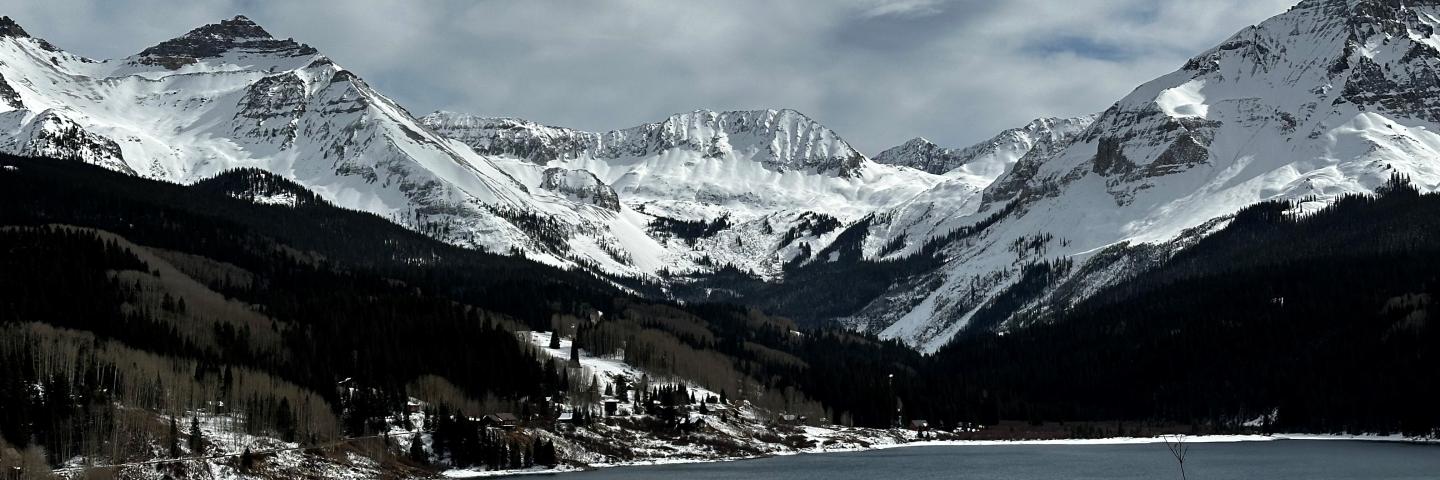
Sheep Mountain. Photo credit: NRCS

Click the link to read the release on the NRCS website:

January snowpack conditions reveal contrasting trends across Colorado, with early season storms boosting accumulation in the southern basins before tapering off, while northern basins were favored through December and received a notable boost from early January storms.


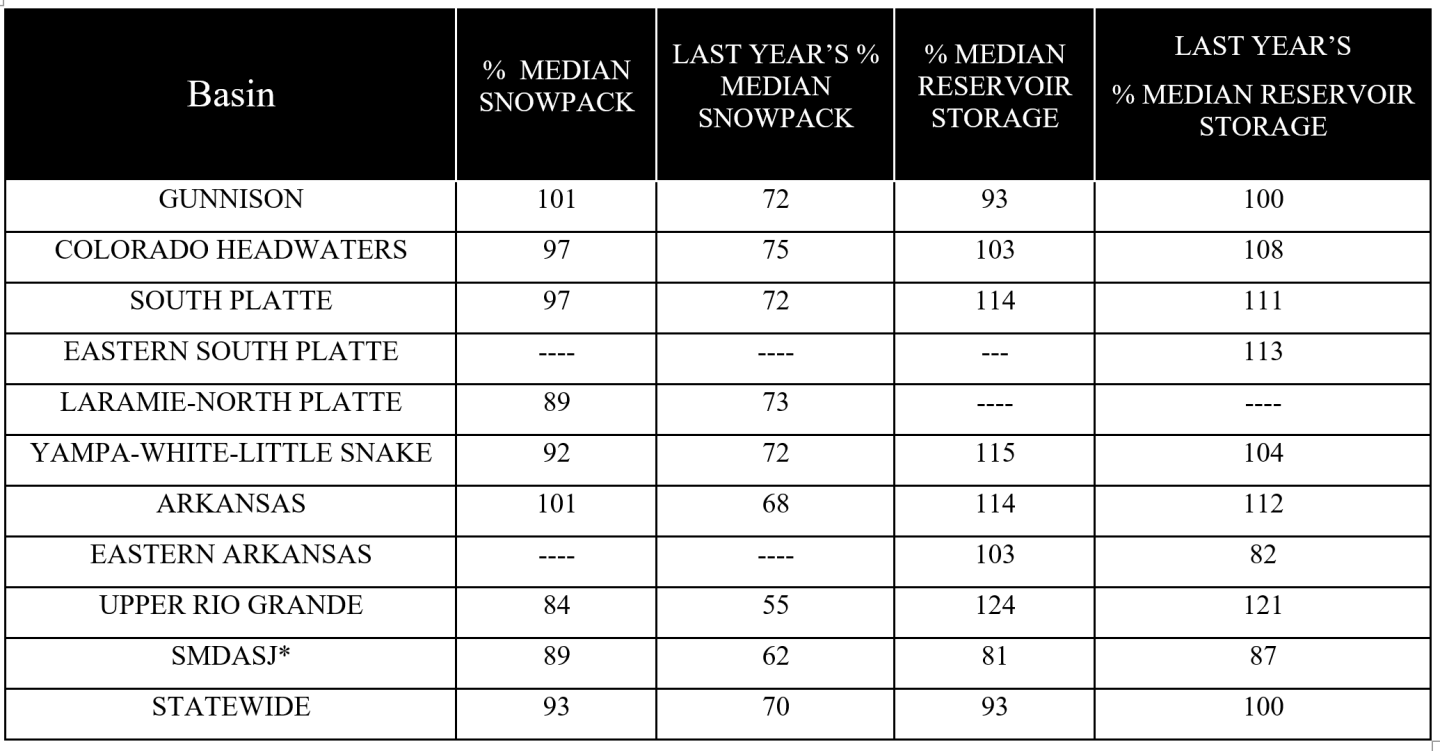
Denver, CO – January 10th, 2025 – Statewide snow water equivalent (SWE) is 108 percent of the 1991-2020 median as of January 7th. For context, SWE at this time last year was 76 percent of median, reflecting very different early season conditions. A notable storm during the first week of January 2025 delivered higher amounts of snowfall to northern basins. SNOTEL site Tower recorded impressive gains, with a SWE increase of 6.3 inches. Statewide, streamflow forecasts at the 50 percent exceedance probability are 99 percent of median. Water year to date precipitation as of January 1st is above normal at 104 percent of median and jumped to 108 percent of median on January 7th.  

Early season storms brought snowfall to southern basins, leading to above average accumulation by mid-November. The combined San Miguel-Dolores-Animas-San Juan (SMDASJ) reached 171 percent of median by mid-November before tapering to 87 percent of median following several dry weeks. Despite recent dry weeks, late season monsoonal precipitation improved soil moisture levels, enhancing the basin’s overall runoff efficiency. At the start of the 2025 water year, soil moisture levels in southern basins ranged from 90 percent to 130 percent of median.  The Upper Rio Grande also had a strong early season start and peaked at 203 percent of median snowpack in November and is now at 82 percent of median. The Arkansas basin is currently at 103 percent of median, maintaining above normal snowpack levels through December.  

Between October and early November, statewide precipitation reached 110 percent of median, with southern basins benefitting most from consistent storms. During this period, basins like the SMDASJ and Upper Rio Grande were well above normal at 186 and 168 percent of median, respectively. In contrast, the South Platte and Laramie-North Platte basins received 55 and 65 percent of October median precipitation, respectively. November precipitation continued a varied trend highlighting a boost in eastern basins such as the South Platte at 167 percent of median and the Arkansas at 209 percent of median. Although December conditions remained dry for most basins, with statewide 30-day precipitation at 74 percent of median on January 1st, northern regions received relatively higher precipitation. For this 30-day period on January 1st the South Platte is at 100 percent of median, the Laramie-North Platte at 103 percent and the Yampa-White-Little Snake at 95 percent of median.  

Streamflow forecasts range from 82 percent in the Laramie-North Platte to 107 percent in the Arkansas basin at the 50 percent exceedance probability. While many forecasts remain near or slightly below median, the range of exceedance probabilities illustrates varying levels of uncertainty across basins. “January forecasts also have the widest range of exceedance probabilities, given that there is still much snow accumulation season to come, so as always we encourage you to consider the full suite of exceedance probabilities in addition to the 50%,” noted Karl Wetlaufer, NRCS forecast hydrologist, emphasizing the importance of monitoring future conditions. Another good reminder to consider the full suite of exceedance forecasts rather than focusing solely on median values when interpreting potential outcomes. 

As of January 2025, reservoir storage across Colorado stands at 93 percent of median statewide, a slight decline from the same time last year but not drastically lower. Reservoir levels reflect carryover from last season, with many basins showing relatively stable conditions. The Arkansas and Upper Rio Grande basins, report 114 and 124 percent of median storage, respectively, highlighting increased storage compared to the previous year. Conversely, the Gunnison and SMDASJ basins report below median storage. “Reservoir levels at this time of year are more of a baseline rather than a predictor, as they depend on upcoming snowmelt contributions during spring runoff,” notes Nagam Gill, NRCS hydrologist. 

* San Miguel-Dolores-Animas-San Juan River basin 
* *For more detailed information about January mountain snowpack refer to the  January 1st Colorado Water Supply Outlook Report. For the most up to date information about Colorado snowpack and water supply related information, refer to the Colorado Snow Survey website.