North Fork Valley team wins prize for innovative agrivoltaics project — Pete Kolbenschlag and Brandy Emesal (#Colorado Farm and Food Alliance) #GunnisonRiver

Vegetable harvest at an agravoltaic operation. Photo credit: Colorado Farm & Food Alliance

Click the link to read the release on the Colorado Farm and Food Alliance website (Pete Kolbenschlag and Brandy Emesal):

Colorado Farm & Food Alliance leads effort to advance in Department of Energy Community Power Accelerator Prize

HOTCHKISS, CO (January 27, 2025) — The U.S. The Department of Energy (DOE) announced this
month that a North Fork Valley solar partnership is one of four teams to win a national $200,000
Community Power Accelerator Prize. The North Fork based team now advances to the third and final
round, and a $150,000 prize, in this community solar competition sponsored by the DOE National Solar
Energy Technologies Office.

The Colorado Farm and Food Alliance-led team seeks to advance several community-based solar projects that prioritize agriculture, community benefit and renewable energy generation. The
Accelerator Prize award will be used for engineering and other studies at Thistle Whistle Community
Solar project near Hotchkiss and to study the feasibility of a second installation at a former coal mine
site near Paonia. Both locations are in Delta County, Colorado.

Partners in developing these projects include Colorado Farm & Food Alliance, Thistle Whistle
Community Solar, Mirasol Agrivoltaics and Switchback Restoration, along with community leaders. The
award will help to advance at least two community solar projects, starting with a small agrivoltaic array
at Thistle Whistle Farm near Hotchkiss. This innovative project will pair agricultural production with solar
energy and provide clean power to local farms and residents through the Delta Montrose Electric
Association (DMEA) grid.

“I am eager to see this project completed, to benefit my farm and to help provide energy cost savings to
other local farms and households,” said Mark Waltermire, owner of Thistle Whistle Farm. “The
Community Power prize has been vital in helping to keep this project moving forward.”
Now completing pre-development, the Thistle Whistle Community Solar project will:

  • Generate clean, renewable energy for local communities
  • Preserve agricultural land through dual-use farming practices
  • Increase energy equity through community-solar, returning cost savings to system subscribers
  • Create new economic opportunities for local farmers
  • Support local food systems while advancing clean energy goals
  • Document best practices for agrivoltaic system design and lessons learned for community solar
  • Monitor wildlife corridors and habitat enhancement
  • Research water conservation benefits in dual-use systems
  • Demonstrate pollinator-friendly vegetation management
  • Study microclimatic effects on crop yields

The second project is in early pre-development, but will help support mine-site remediation and climate
harm reduction at a former coal mine as well as provide an additional community-solar benefit.
“This recognition from the Department of Energy validates our vision for community-based rural
renewables that support both our agricultural heritage and greater energy equity,” said Pete
Kolbenschlag, with the Colorado Farm and Food Alliance and prize team captain. “These projects
demonstrate how rural communities can lead the way in innovative clean energy solutions that preserve
farmland, benefit residents and integrate with local livelihoods.”
The North Fork Valley team is still participating in this national competition. In the third, and final, round
teams must demonstrate that they have secured the funding necessary to develop their community
solar projects. As part of the Phase 3 competition, the project team will be able to present their vision at
the Community Power PitchFest event at the DOE Headquarters in Washington, D.C. on March 6,

The Community Power Accelerator Prize is part of the American Made Challenge program, with
funding coming from the Bipartisan Infrastructure Law passed by Congress in 2021.
As part of its mission, the Colorado Farm and Food Alliance provides a platform for rural leadership to
develop and implement local solutions that model climate action and strengthen farm and food system
resilience. It is the named partner of the Community Power Accelerator Prize.

Mirasol Agrivoltaics is a recently established Colorado nonprofit with a mission to educate about and to
help develop community solar projects in the North Fork Valley. With this award it will be able to fill a
new and needed leadership role in supporting clean energy, cost savings, and community-based
solutions through the Thistle Whistle Community Solar and future projects.

Learning and demonstration gardens at Arbol Farm, Paonia, CO. Photo credit: Colorado Farm and Food Alliance

#CRWUA2024 Through the Eyes of Young Professionals — Oliver Skelly, Aidan Stearns, and Andrew Teegarden (Getches-Wilkinson Center) #ColoradoRiver #COriver #aridification

Colorado River “Beginnings”. Photo: Brent Gardner-Smith/Aspen Journalism

Click the link to read the article on the Getches-Wilkinson Center website (Oliver Skelly, Aidan Stearns, and Andrew Teegarden):

December 17, 2024

The Annual Colorado River Water Users Association (CRUWA) Conference in Las Vegas was one of the busiest in recent years. Part of the increased participation stems from the current impasse in negotiations for the Post-2026 Operating Guidelines for Lakes Powell and Mead. Tensions could be felt in the hallways and discussions by nearly 1,500 attendees.

Pressures came to a head during the Upper and Lower Basin Panels. Colorado’s lead negotiator, Becky Mitchell, noted it was disappointing that all seven of the basin states were in Las Vegas and were unable to set a meeting where potential compromises could be discussed. Another Upper Basin Negotiator, Brandon Gebhart, spoke out against the posturing and inability to compromise.

Others on the Lower Basin Panel, such as JB Hamby, struck a different chord; the Lower Basin has been taking steps to lower water use despite the massive population, agricultural economy, and climate change. These realities are extremely troubling because it seems to be further entrenching the states in their own positions and is reducing their ability to compromise. In fact, Arizona’s Governor Katie Hobbs has begun setting aside money within the state budget for potential litigation efforts on the Colorado River. However, litigation did not seem to be the preferred alternative to solve the current breakdown in negotiations. A separate panel talked about the realities of litigation which could take decades, cost millions of dollars, and put the power to decide the outcome in the hands of judges which cannot fully capture the complexity and needs of each community partner along the river.

Outside of the programming, the entire Getches-Wilkinson Center Staff was honored to attend the Water & Tribes Initiative Luncheon which kicked off the start of the conference. During the lunch, attendees discussed potential alternatives for the Bureau of Reclamation to consider which would provide operational flexibility and account for tribal water usage.

Another highlight was the ability to talk with other colleagues and peers in the water space. Networking at large conferences has been one of the best parts of these events because they allow for more understanding within the water community. Despite the tensions, the water community was able to come together and discuss how we can solve the problems on the Colorado River equitably.

Unfortunately, CRUWA did not result in any big break through or give the states more clarity on how the Colorado will be managed. Although, leaders painted a clear picture of how difficult litigation will become if we are unable to agree. Complex scenarios require complex solutions and until someone can capture and account for all of them, compromise may be difficult to obtain. Allowing compromise and the goal of a stable river basin to drive the creation of alternatives will bring us to a place where all who utilize the river feel heard. Negotiators can get there, but it will take more time and dedicated effort to do so.

Aidan Stearns current 3L at Colorado Law and GWC Research Assistant:

From December 4-6, a variety of Colorado River advocates including lawyers, engineers, legislators, scientists, and tribal representatives gathered at the Paris Hotel in Las Vegas, Nevada for the Colorado River Water Users Association (CRWUA) Conference. This year, which was my first time attending the conference, CRWUA was focused on post-2026 operations of the Colorado River. Negotiations over post-2026 operations have been contentious, to say the least. CRWUA served as an opportunity to share all the various points of view with the Colorado River community.

Since it was my first time attending CRWUA, I had one simple goal heading into the conference: listen. CRWUA further affirmed a belief I held when I started law school almost three years ago: that a degree in environmental engineering would be a beneficial foundation for legal practice. One of the first sessions I attended was about the risks of litigation, where attorneys representing various upper and lower basin interests discussed what the path of litigation may look like based on past precedent. Those panelists are often tasked with the challenge of applying modern engineering and scientific concepts to legal doctrine dating back to the 1800s, something I hope to pursue in my own legal career.

Outside of the conference sessions, my most impactful interactions came from meeting conference attendees and listening to their unique perspective on Colorado River water issues. I spoke to a range of individuals including attorneys who worked solely with upper basin agricultural water users to lower basin tribal councilmembers.

Despite the difficult conversations that were had at CRWUA regarding post-2026 operations, a thread of hope seemed to weave through every session. Julie Vano, the Research Director for Aspen Global Change Institute, emphasized in a panel on extreme weather events the importance of not becoming paralyzed by uncertainty when using models. Panelists also expressed that they felt hope because of the resilience of people. Panelists expressed that there is no one to blame but us, but in that, there is hope in the innovation and partnership that people are capable of. No one person is going to have the magic solution to managing water issues in the Colorado River Basin. The solution is going to come from collaboration along with being able to listen to and respect the perspectives that people bring to the table.

Oliver Skelly, current 3L at Colorado Law and GWC Conscience Bay Company Western Water Policy Fellow:

When the GWC invited me to spend the week before final exams with them in Las Vegas I could hardly contain my excitement: My first CRWUA! And what a time for it, with the ongoing negotiations over the post-2026 guidelines atop the agenda. Studying could wait.

As the conference unfolded, most of what I’d heard about CRWUA’s substance proved true: If you wanted platitudes, pay attention to the panels; if you wanted juicy hot takes, plug yourself into the hallway conversations. “The Upper Basin can’t just keep saying no to everything!” “Lots of snarky remarks from the Lower Basin today.” One attendee told me the words “climate change” were not even allowed in the agenda 10 years ago – a shocking and rather unnerving remark given where things stand now. (Fortunately for all involved, it’s allowed now.)

That said, the official events were not without their fireworks. The threat of litigation has entered the discourse as negotiations appear to be breaking down, and both basin panels made that abundantly clear. And the conference had many other panels discussing interesting ideas, including recent developments with tribal water rights, regenerative agriculture, urban water efficiency measures, and Kevin Fedarko discussing his new book about his walk through the Big Ditch. Still, the large, seemingly immovable rift between Upper and Lower Basin proposals remained center stage. 

The ultimate takeaway is nothing new: The future of the Colorado River remains uncertain. But CRWUA lives on, and it has found itself a new repeat customer. Many thanks to the GWC and its sponsors for making this trip possible for me.

Map of the Colorado River drainage basin, created using USGS data. By Shannon1 Creative Commons Attribution-Share Alike 4.0

The January 2025 24-month study is a major caution sign for the #ColoradoRiver Basin — Eric Kuhn, John Fleck, and Jack Schmidt (InkStain.net) #COriver #aridification

The Tripwire. Credit: InkStain.net

Click the link to read the article on the InkStain.net website (Eric Kuhn, John Fleck, and Jack Schmidt):

January 22, 2025

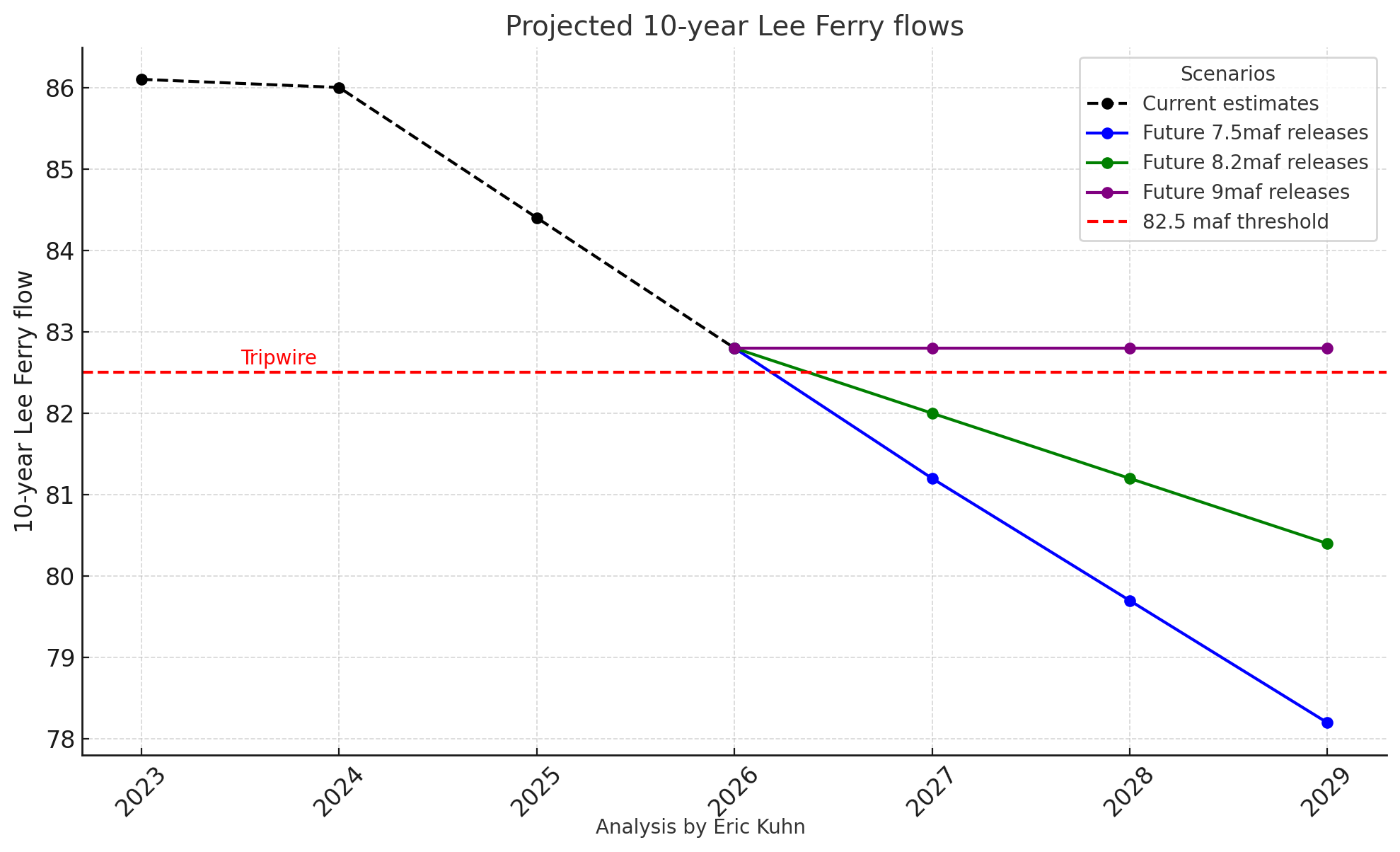
On January 16th, the Bureau of Reclamation released the January 2025 24-Month Study. Based on the January 1st runoff forecast into Lake Powell, the projected “most probable” annual release from Glen Canyon Dam for Water Year 2026 is now 7.48 maf. This needs to be taken as a significant caution sign because it shows that we are on a clear trajectory to hit what Colorado’s Jim Lochhead first called the 1922 Compact’s first “tripwire” (82.5 maf/10-year) as early as 2027. Given the current stalemate between the Upper and Lower Division States over how the reservoir system should be operated, it means the potential for basin-wide litigation is now in the “Red Zone.”

The January 24-Month study is the first in each water year to be based on a published forecast from the Colorado Basin River Forecast Center’s runoff model – the first to be based on actual snowpack. The January 1st runoff forecast for unregulated April-July inflow to Lake Powell was 5.15 maf (about 81% of average). This results in a projected 12/31/2025 elevation of Lake Powell of less than 3575’ making the annual release for Water Year 2026 7.48 maf. Of course, the forecast will change as the winter progresses. In fact, the January mid-month forecast dropped by 300,000 acre-feet to 4.85 maf. At this point in the winter our confidence in the “most probable” forecast is low and in recent years, the track record has been to overstate future runoff suggesting that the we should pay equal attention to the “minimum probable” forecast. (See Wang et al, Evaluating the Accuracy of Reclamation’s 24-Month Study Lake Powell Projections.) Also remember that the actual decision on the WY 2026 release is not made until the Spring runoff is over and the August 24-Month study is released.

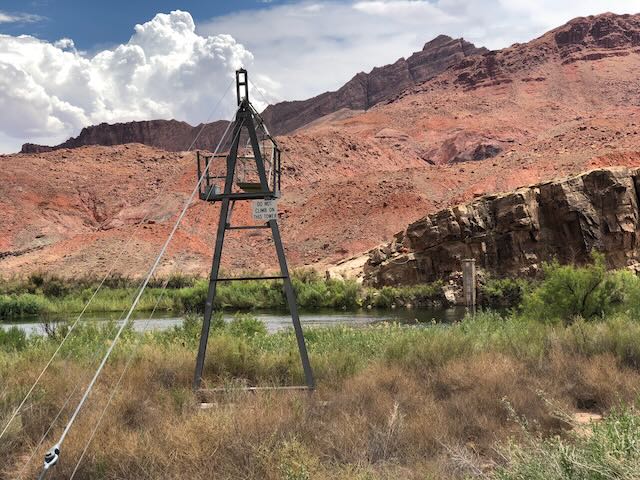
Lee/Lee’s/Lees Ferry on the Colorado River. Photo by John Fleck

A 7.48 maf release from Glen Canyon Dam bodes trouble for the basin because it takes us very close to the tripwire. Simply put, the tripwire is the ten-year flow at Lee Ferry at which the Lower Division States can claim the Upper Division States are in violation of the 1922 Compact. Under the compact, the Upper Division States have two specific flow obligations at Lee Ferry: (1) to not cause the ten-year flow to be depleted below 75 maf every ten consecutive years, and (2) to deliver one half of the annual delivery to Mexico under the 1944 Treaty if the “surplus” is not sufficient. If there is no surplus and the delivery to Mexico is 1.5 maf/year, the Upper Division’s share is 750,000 af/year, resulting in a total ten-year delivery obligation of 82.5 maf. Since under Minute 323, Mexico shares in mainstem shortages, recent annual deliveries have been less than 1.5 maf. To keep the math simple, let’s call the current obligation (with no surplus) 82.0 maf. With a 7.48 maf release in WY 2026, the ten-year flow for 2017-2026 will be about 82.8 maf.

Keep in mind that the obligation of the Upper Division States to Mexico under the 1922 Compact has been a disputed issue since the Treaty was signed in 1944. The Lower Division believes there is no current surplus, thus the obligation is one half of the Treaty delivery. The Upper Division believes that since the Lower Basin is currently overusing its 1922 Compact apportionment, this overuse is surplus, and thus, must be delivered to Mexico. Following this thread, if the overuse is greater than 1.5 maf/year, the Upper Division would have no obligation to Mexico.

With an 82.8 maf ten-year flow at the end of Water Year 2026, the Upper Division States are still slightly above the tripwire with a cushion of about 800,000 af. The problem is what happens in the next one to three years. From 2015-2019 annual the annual Glen Canyon Dam releases were 9.0 maf/year. Note, the annual release from Glen Canyon Dam and the flow at Lee Ferry are not quite the same, the Paria River and leakage around the dam contribute another 100,000 -150,000 af/year to the flow at Lee Ferry (bonus flows). Because of the way the ten-year math works, at the end of WY 2027, the Lee Ferry flow for WY 2017 (~9.2 maf) will drop out and be replaced by the 2027 Lee Ferry flow, thus, to keep the ten-year flow greater than 82.0 maf, the 2027 flow will have to be at least 8.4 maf. AND, there are two more 9.0 maf releases in the pipeline, WYs2018 and 2019! That means that when those drop out of the sequence, the risk of the basin stumbling across the tripwire into litigation grows.

To stay above 82.0 maf, the total deliveries at Lee Ferry for the three-year period of 2027-2029, the annual release from Glen Canyon Dam will have to average about 8.8 maf/year (factoring in the bonus flows). Since 2012, the average unregulated inflow to Lake Powell is about 8.2 maf/year. After deducting 500,000 af/year of gross evaporation from the reservoir, the “net-of-evaporation” annual inflow is only about 7.7 maf/year. Going back to 2000, the net inflow is about 7.9 maf/year. Thus, to avoid going below the 82.0 maf tripwire, it will take either above average (post-2000) hydrology or continuing to draw down Lake Powell levels. If the hydrology is a bit drier than the post-2000 (or post-2012) levels, maintaining at least 82.0 maf/10-year may require drawing Lake Powell below minimum power. As Lake Powell levels approach minimum power, we approach environmental and power generation tripwires.

The fact that we’re on track for another year of below-average inflows to Lake Powell, another 7.48 maf/year annual release from Glen Canyon Dam, and on a trajectory to drop below a 1922 Compact tripwire adds another level of urgency for the basin states to break their current impasse over the how the system will be operated post-2026. The chances of Lee Ferry flows dropping below the 82 maf tripwire are high. The Colorado River Basin needs to be fully prepared before this occurs. With every 24-Month study, the basin’s litigation clock is getting closer and closer to that midnight hour.

Udall/Overpeck 4-panel Figure Colorado River temperature/precipitation/natural flows with trend. Lake Mead and Lake Powell storage. Updated through Water Year 2024. Credit: Brad Udall