
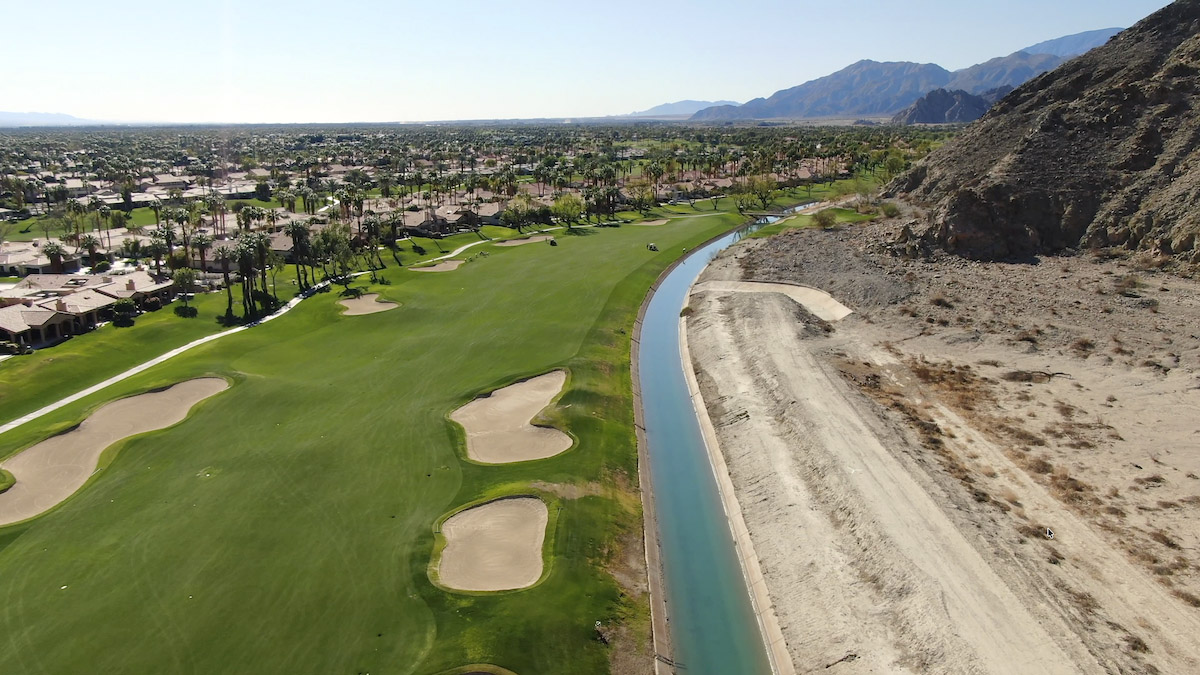
Southern California’s Coachella Valley includes the cities of Palm Springs, Palm Desert. Rancho Mirage, Indian Wells and Indio. It is a hot, dry, low-desert region that nonetheless supports 100 to 120 commercial farms, 120 golf courses, dozens of world-class resorts and one of the nation’s highest rates of per capita water use.1 The Coachella Valley sustains this (artificially) verdant environment with imported water from two sources: 430,000 acre feet of Colorado River water that’s diverted at the Imperial Dam and then conveyed by the Coachella Canal, and 194,000 acre feet of water from California’s State Water Project – but only if there’s sufficient snowpack in the Sierra Nevada mountains.
Both sources of imported water arrive via the Coachella Canal and the majority of it’s used by farms and by aquifer replenishment programs. The remainder is used by golf courses and for the irrigation of commercial landscaping. Municipal water (for residents and businesses) is pumped from the Coachella Valley Groundwater Basin – an aquifer that at one time contained an estimated 39.2 million acre-feet of water, just in its upper 1,000 feet. Municipal water users, who consumed 5.6% more water in 2025 than they did in the previous year,3 natural recharge from rainfall and runoff currently provides about 21,000 acre-feet per year2. So without the imported replenishment water the basin would plunge into an immediate and severe deficit. Water tables would drop rapidly in historically vulnerable zones like the East Valley and Palm Springs.3
This scenario is alarming for a variety of reasons –
The Colorado River is rapidly become unreliable as a source of water.4 Since both sources of imported water depend upon the Coachella Canal for delivery, 100% of the imported water will stop flowing just days after Lake Mead reaches deadpool. Again – not one drop of the imported water that the Coachella Valley depends upon will arrive in the Coachella Valley if that water can’t make it past Hoover Dam. A second, albeit less-likely danger is the known fact that the Coachella Canal crosses over the San Andreas Fault.4
Cheap water encourages farmers to grow water-intensive crops. Coachella Valley farmers who obtain raw irrigation water directly from the Coachella Canal can pay as little as $40.14 per acre foot. This cheap water encourages farmers to grow profitable but water-intensive crops – like alfalfa.5
Municipal water use in the Coachella Valley is increasing. Instead of the Valley’s water consumption falling – as we’ve seen in almost every other Southwestern municipality, the Coachella Valley’s municipal water use continues to increase due to a rising population and an increase in the irrigation of crops and landscaping due to climate change. On April 15, 2026 The Indio Post reported that urban water use – which includes municipal customers, golf courses, and other recreational users, climbed by 12,989 acre-feet, or 5.8% compared to the previous year.
Challenge #1 – Maintaining groundwater levels
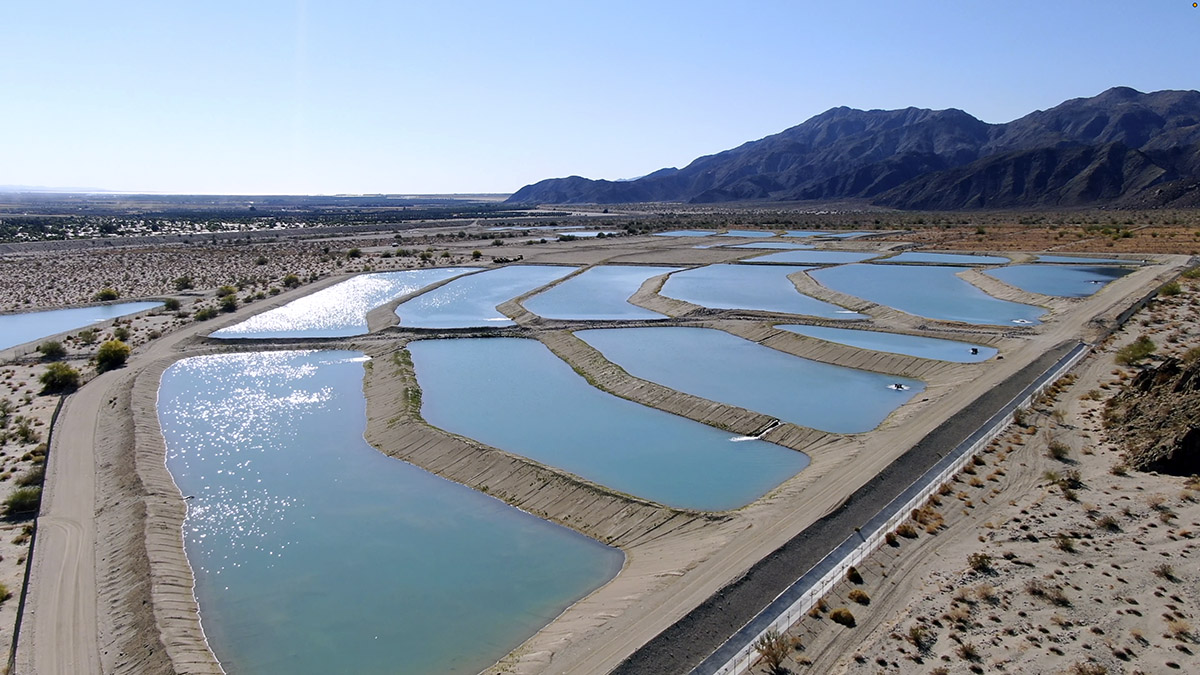
The Coachella Valley Water District and four other water agencies have been doing their best to maintain groundwater levels through the use of groundwater replenishment facilities. These programs are designed to reverse decades of aquifer overdraft and ensure long-term water sustainability. By percolating 165,000 acre feet a year of imported water directly into the ground, the districts have successfully stabilized and even raised groundwater levels in historically depleted areas. But what has been left unsaid is that both sources of imported water – the Colorado River and the State Water Project, both use the same conveyance and both are under severe long-term threat from climate change. Therefore Coachella Valley’s water districts have to plan for the day when they have no sources of imported water, and will have to depend entirely on groundwater.5
Challenge #2 – Convincing residents to use less water
Individuals living in the Coachella Valley city of Bermuda Dunes consume between 217 and 380 gallons of water a day.6 While residents of Rancho Mirage, Palm Desert, Thousand Palms, Indian Wells, La Quinta, and Thermal consumed an average of 188 gallons of water per day. And residents of the Desert Water Agency, which serves Palm Springs and Cathedral City, used an average of 178 gallons of water per day.7 The residents of other comparably-sized desert cities use far less water. On average residents of Tucson use as little as 72 gallons a day, residents of Phoenix 92 gallons, and residents of Albuquerque use just 56 gallons per day.
While the Coachella Valley relies entirely on imported Colorado River water to recharge its aquifers, and loops recycled water back to its farms and golf courses, other Southwestern desert cities have shifted to advanced purification technology that recycles 100% of their wastewater directly back into municipal drinking supplies. In the Arizona cities of Phoenix, Glendale, Mesa, Scottsdale, and Tempe, they treat the recycled water to high standards so it can be used to irrigate sports fields, golf courses, commercial landscapes, and create or restore riparian habitats. It is also used to recharge aquifers and stored underground for use during times of shortage. Recycled water can extend water supplies, improve water quality, reduce discharge and disposal costs of wastewater, and save energy.8
Challenge #3 – Preparing for “Day Zero” when the Coachella Valley receives no more Colorado River water
If the current drought continues and Lake Powell reaches dead pool, it’s estimated that Lake Mead will also reach dead pool within two-to-four years. This means that absolutely no Colorado River water pass beyond Hoover Dam and into the lower Colorado River basin. The Colorado River Aqueduct, the All-American Canal, and the Coachella Canal would be shut down. In this worst-case scenario, the Coachella Valley would survive by pumping from its underground aquifer, though this would immediately trigger a severe, unsustainable deficit. Because the region averages only 3 inches of rainfall annually, its primary long-term buffer would be exhausted without Colorado River and SWA water being available to replenish it.9 To prevent the aquifer from going dry, the State of California would likely enforce extreme water rationing, ban all outdoor ornamental landscaping, and trigger a massive, forced downsizing of the local agricultural sector. 10
Why not do some of these things now instead of waiting until the Colorado River has dried up?
2 thoughts on “Climate change is threatening the Coachella Valley’s Illusion of Abundance”