
America’s Civil War in 1861 overshadowed an earlier conflict in the American West – The Utah War. In 1857 Congress funded a reconnaissance mission that sent a steamship up the Colorado River in support of the U.S. Army’s plan to invade the Utah Territory and to depose Brigham Young, its governor.
by Robert Marcos, photojournalist
The Mormons, first led first by Joseph Smith and later by Brigham Young, were systematically driven from a series of American settlements by hostile neighbors and governmental action between 1831 and 1847. Their forced migration began in Kirtland, Ohio, and Jackson County, Missouri, where religious friction, economic disputes, and political rivalries sparked violent expulsions which included Missouri’s infamous Extermination Order in 18381. The Mormon refugees found temporary asylum in Nauvoo, Illinois, but the murder of Joseph Smith in 1844 reignited anti-Mormon violence that resulted in February 1846 with a Mass exodus out of the United States. An initial group of 1,650 Mormon pioneers traveled westward across the Great Plains in grueling conditions until they reached the Great Salt Lake in July 1847, which they hoped would become a permanent sanctuary for them. Over the next twenty years as many as 70,000 additional Mormons moved into the region which Mormons alternatively called the “State of Deseret” or “Zion”.

Historic Maps show the dramatic changes taking place in the American West
Maps that show the American West in 1847 reveal a dynamic landscape that was on the brink of a profound transformation. Texas had been given statehood in 1845, Oregon was incorporated as a territory in 1848, and California became a state in 1850. The end of the Mexican-American War and the signing of the Treaty of Hidalgo had finally opened the door for the U.S. to expand into the vast Indian lands that had previously been claimed by Mexico.
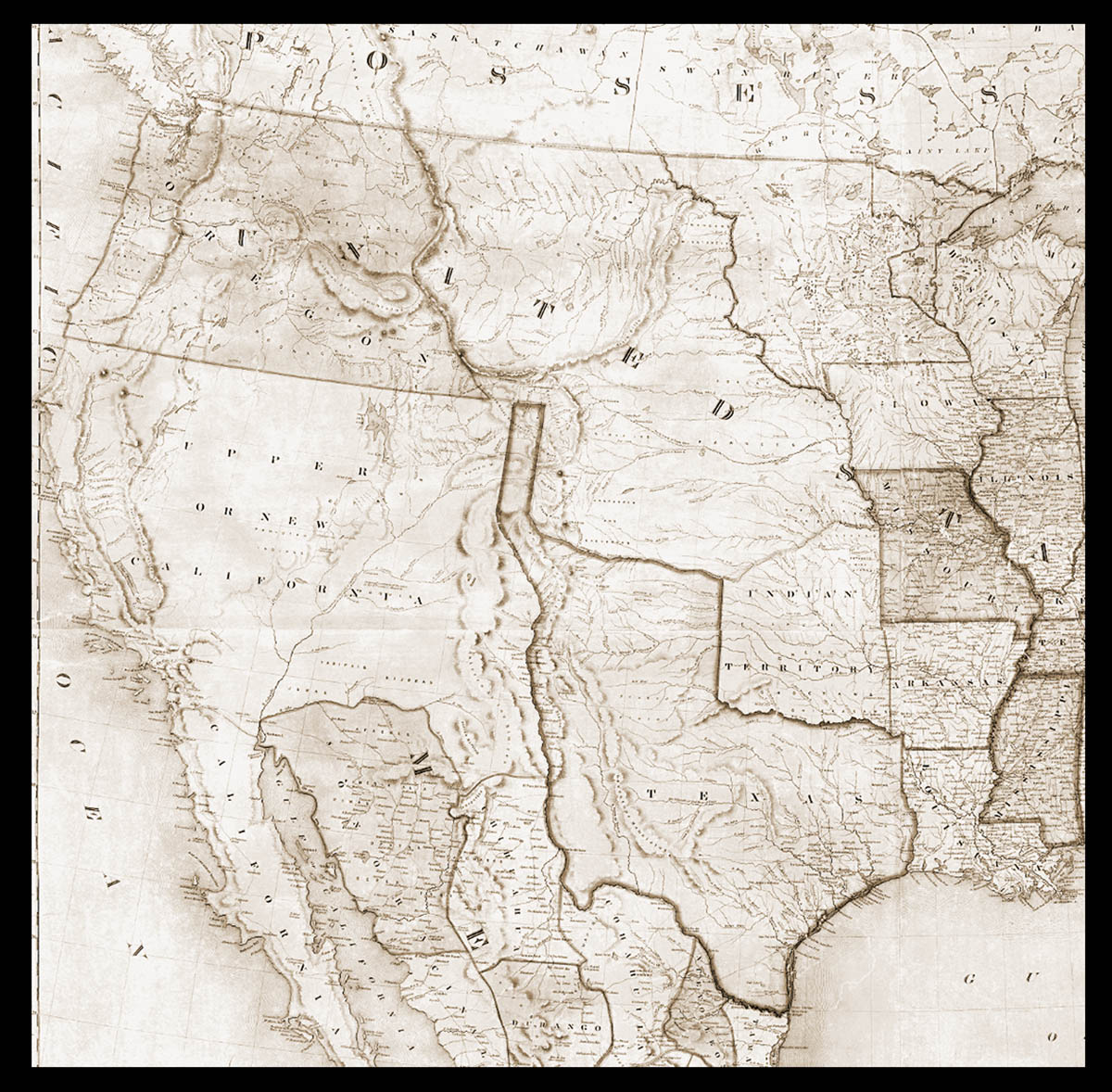
Congress annexes the Utah Territory
In 1849 Brigham Young proposed that the United States incorporate his massive provisional state, which encompassed almost all of modern Utah, Nevada, and Arizona. Congress rejected his idea and instead created a much smaller Utah Territory. To salve the insult to Brigham Young President Millard Fillmore appointed him as the Territorial Governor. But these federal actions outraged voters in the Eastern half of the United States who claimed that by incorporating Utah as a Territory the federal government had in effect sanctioned polygamy and other practices that voters found repugnant, and they demanded that punitive action be taken to put a stop to it.
President orders the Department of War to invade the Utah Territory
On May 28th 1857, President James Buchanan ordered one-third of the U.S. Army to invade the Utah Territory and to depose Brigham Young as its governor. In Utah this action sparked mass hysteria among its citizens, who braced themselves for a full-scale military invasion. In response, the Mormon militia burned US Army supply trains and practiced “scorched earth” tactics which were highly effective in delaying the arrival of the incoming troops.
In support of the invasion Congress passed an Army Appropriations bill that provided $75,000 for a Colorado River Exploring Expedition that would survey the southern end of the Colorado River along with Utah’s southern borders. The Army wanted to find out about the river’s ability to convey troops and supplies from the south, and they also wanted to eliminate a potential escape route that Brigham Young and his militia might make use of.
The $75,000 which Congress had provided was to spent to build and transport a custom steamship that would be rugged enough to survive collisions with rocks and other obstacles known to exist in the Colorado River. The U.S. Secretary of War John B. Floyd appointed Lieutenant Joseph Christmas Ives to command the expedition and to oversee the construction and the transport of the ship they would use to steam up the Colorado River.

The Construction and unbelievable transit of the iron-hulled steamship
Lieutenant Ives chose to have his custom-made 54-foot long steamboat built in Philadelphia. After a successful trial run on the Delaware River, the heavy metal vessel was disassembled, loaded in crates, and transported to a steamship which that brought it south to Colon, Panama. From Colon it was hauled overland on the Panama Railroad to a port on the Pacific where it was loaded onto another steamship bound for San Francisco. Once there the heavy crates were moved to the schooner Monterey, which was sent racing back down the Pacific coast, around the tip of Baja California, then northward to the top of the Sea of Cortez. The schooner would’ve slowed to a crawl as it approached Robinson’s Landing, its destination, where the little iron-clad steamship would be reassembled then finally put to work.1
The Explorer begins its journey with 27 heavily-armed men on board
Thirty days later the Explorer departed from Robinson’s Landing with Lieutenant Joseph Christmas Ives in command and a heavily-armed 27-man crew. David C. Robinson – an experienced sailor who’d served on the riverboat General Jesup piloted the small vessel. Robinson’s ongoing challenge was making headway against fierce oncoming currents that were hellbent on driving all of them back to the Sea of Cortez. There were also shifting sandbars sometimes just inches below the water level, and dramatic tidal bores that rose up from behind them twice a day as the high tides poured in. But thanks to Robinson’s diligent piloting the ship and its crew arrived at Fort Yuma intact – but embarrassed – because Robinson drove them into a sandbar in full view of the hundreds of onlookers who’d gathered at the dock to watch their arrival. Adding insult to injury, upon docking Lieutenant Ives learned that another riverboat Captain George Alonzo Johnson, had beat them by becoming the first steamship captain to have made it all the way north to the infamous Black Canyon, (where Hoover Dam sits now).2

The Explorer Expedition spent two weeks at Fort Yuma before launching northward into (what would’ve been) uncharted territory. Members of the crew who were experienced with cartography took notes of the geography and the river conditions as the Explorer made its way slowly upstream. The crew pulled over multiple times to see what they could learn from Native American tribes who were camped along the river’s shoreline. Nobody knows if Lieutenant Ives was aware that when they passed the confluence of the Gila River they were in the same spot where Hernando de Alarcon had anchored 318 years earlier when he deposited supplies for members of the Coronado Expedition.3
As the crew of the Explorer continued up the Colorado River they observed the landscape transform into a dramatic, forbidding chasm dominated by towering walls of dark, volcanic rock. Lieutenant Joseph Christmas Ives and his men noted that the river grew increasingly narrow, swift, and treacherous, forcing the small steamboat to battle fierce rapids and other hazards lying just beneath the surface. The crew included the geologist John Strong Newberry and the illustrator Balduin Möllhausen, who documented the striking, raw geological formations and the unique desert vegetation that they saw clinging to the sheer cliffs. The crew felt an overwhelming sense of isolation and awe as the sun disappeared every day behind monumental cliffs that seemed to press down on them. Lieutenant Ives famously remarked the “profitless, chaotic locality seemed intended by nature to remain forever unvisited and unmarred by civilization“.4
The voyage ended abruptly on March 8, 1858, when the Explorer struck a sunken rock in the infamous Black Canyon, at the exact spot where Captain George Alonzo Johnson had chosen to turn around, four months earlier. The violent collision dislodged ship’s iron bow, and after reaching the shore the crew realized that their steamboat could travel no further. Lieutenant Ives and several men proceeded to row a small skiff another thirty miles upstream. They mapped the mouth of the Virgin River. The crew finished the expedition by hiking overland to Fort Defiance in Northwestern Arizona.
Meanwhile – the Utah War had come to a complete standstill after harsh winter conditions forced the U.S. Army and the Mormon Brigades to hunker down for the winter. The delay provided time for Thomas Kane – a prominent civilian mediator, to negotiate between both parties which ultimately ended with a peaceful resolution being reached. The Mormons agreed to submit to federal authority, and in exchange they received a full pardon from President James Buchanan.
Although Brigham Young continued as the president of the The Church of Jesus Christ of Latter-day Saints, he stepped down as the Territorial Governor after the Utah War ended, and he passed away on August 29, 1877. The federal government admitted Utah as a state on January 4, 1896, after decades of denial due to the Mormon practice of plural marriage. The polygamy issue was finally resolved in 1890, when Church President Wilford Woodruff issued a manifesto that declared that the church had ceased teaching and practicing plural marriage. This religious shift, combined with Utah later writing a strict anti-polygamy clause into its 1895 state constitution, finally satisfied federal demands for cultural assimilation and cleared the path for statehood.5
.