At its meeting on Feb. 11, the Pagosa Area Water and Sanitation District (PAWSD) Board of Directors nailed down its drought management system.
PAWSD Manager Justin Ramsey went over the trigger points in place for establishing drought stages.
Ramsey said, “The way we’re going now is based upon a couple different trigger points, and it’s also based on the date that the trigger point hit. For example, if Hatcher is down 6 feet and if it’s in late September, no big deal; if it’s in early May we’ve probably got problems coming. So, this way it kind of helps us see what’s coming on.”
He continued, “Later on, in the summer, then we’ll start looking at three other issues: the amount of water in the Hatcher reservoir, the amount of water that’s going down the San Juan River and the state’s drought statement.”
PAWSD Treasurer Glenn Walsh voiced a concern.
“The two triggers early in the season, the call date and the snow water [equivalent] … those just need to be aligned better. If we’re operating off hitting both triggers, then I have less concern. But if we’re operating off hitting one of the two triggers, for instance the call date in 2018 was 4/11, and if we had a 2018-type year, I wouldn’t be comfortable with just starting the year full-blown stage 4 — ‘your lawns are going to die’ — because my impression was 2018 was not that type of year … Even though we do have two indicators that we use up until June 1 and then three that we use after June 1, it would be good if those were aligned so there’s not some discordance where we’re in level 4 then when we turn over to the river and lake level and the regional drought declaration we’re back to level 1 — you know? We’re jumping back and forth,” he said.
“I guess my question is we’re going to trigger the early season stages by one of the two measures, or are we going to go with the least restrictive? … If we’re only going by one trigger, that could wind up being kind of a false alarm,” Walsh said.
Ramsey responded, “Yes and no … They typically do fall fairly close together. … I don’t know how often they do a call before we run out of snow — it’s usually within a week. … Just because the trigger says to do that, if there’s a reason for the board to say, ‘Let’s not do it because of x, y, or z,’we call it. It just gives us a starting point … To go to stage 1, 2, 3, 4 takes a board decision; it doesn’t just do it automatically.”
[…]
At the meeting, Ramsey mentioned that entering a voluntary level 1 or level 2 drought stage in the early season might help to eliminate the chances of reaching level 3 or level 4 later in the season by means of alerting the public to be conservative with their water usage.
“The way we’re moving now, we’re probably going to go at a voluntary level 1, level 2 a little earlier than we have historically. We are not going to charge a surcharge to throw you into level 3 or level 4. When we get into level 2, there will be an increase in excess water use in residential, and when we get to level 3 there will be an excess water use in commercial. But, there will be no surcharge until we get to level 3 and level 4,” notified Ramsey.
He added, “The way I calculated the surcharge was … for every drought stage we have it goes to a decrease on one use by x percentage, so I just assume that we decreased our water use by x percentage, which means that we decreased our income by x percentage, and I’m making it up with that.”
He continued, “The hope is by going into drought mitigation level 1, level 2 voluntary, early … the only way to get to that surcharge is if we were in great dire straits.”
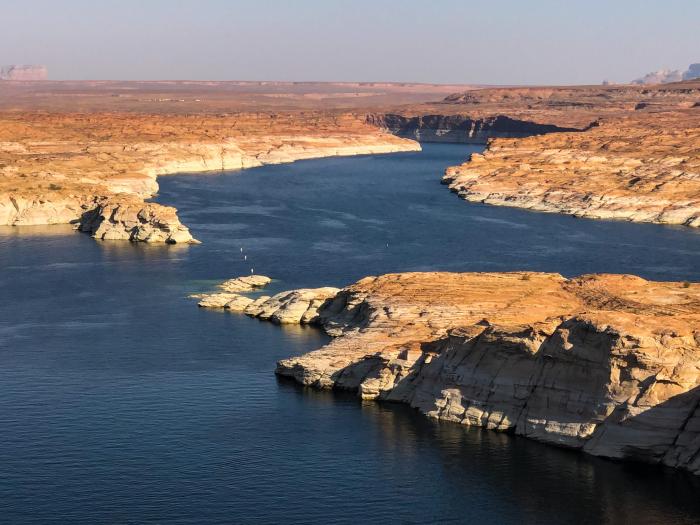
#LakePowell is seen in a November 2019 aerial photo from the nonprofit EcoFlight. Keeping enough water in the reservoir to support downstream users in Arizona, Nevada and California is complicated by climate change, as well as projections that the upper basin states of Colorado, Utah, Wyoming and New Mexico will use as much as 40% more water than current demand. A recent white paper from a lineup of river experts calls those use projections into question. CREDIT: ECOFLIGHT via Aspen Journalism
Paper’s authors say unrealistic projections make it harder to plan for a future under climate change
Some water experts fear that a long-held aspiration to develop more water in the Upper Colorado River Basin is creating another chance to let politics and not science lead the way on river management.
“Alternative Management Paradigms for the Future of the Colorado and Green Rivers,” a white paper released this month by the Center for Colorado River Studies, says that in order to sustainably manage the river in the face of climate change, we need alternative management paradigms and a different way of thinking compared with the status quo.
Estimates about how much water the upper basin will use in the future are a problem that needs rethinking, according to the paper.
The paper says unrealistic future water-use projections for the upper basin — Colorado, Utah, Wyoming and New Mexico — confound planning because they predict the region will use more water than it actually will. The Upper Colorado River Commission’s estimates for future growth are unlikely to be realized and are perhaps implausible, unreasonable and unjustified, the paper says.
“The projection of demand is always higher than what is actually used,” said Jack Schmidt, one of the paper’s authors and the Lawson Chair in Colorado River Studies at Utah State University. “We said you can’t plan the future of the river based on these aspirational use projections when there’s a clear demonstration that we never end up using as much as we aspire to use.”
The Center for Colorado River Studies is affiliated with Utah State but draws on expertise from throughout the basin. The paper is the sixth in a series of white papers that is part of The Future of the Colorado River Project. The project is being funded by multiple donors, including the Walton Family Foundation, the USGS Southwest Climate Adaptation Science Center, the Utah Water Research Laboratory and two private donors, as well as by grants from the Catena Foundation, which is a major donor to Aspen Journalism’s water desk.
According to the paper, between 1988 and 2018 consumptive water use in the upper basin has remained flat at an average of 4.4 million acre-feet a year. This figure is based on the Bureau of Reclamation’s Consumptive Uses and Losses reports. The UCRC’s most recent numbers from 2016 show future water use in the upper basin — known as a “depletion demand schedule” — at 5.27 million acre-feet by 2020 and 5.94 million acre-feet by 2060.
“In percentage terms, these UCRC projections for 2020 are already 23% higher than actual use and would be more than 40% higher than present use in 2060,” the paper reads.
And future water use is unlikely to increase because of three main reasons: thirsty coal-fired power plants are on their way to being decommissioned; land that was formerly used for irrigated agriculture is transitioning to residential developments, which use less water; and there are regulatory and political barriers to more large transmountain diversions from the headwaters of the river to the Front Range.
The white paper’s authors say these unrealistic future projections of water use make it harder to plan for a water-short future under climate change.
“Unreasonable and unjustified estimations create the impression that compact delivery violations, very low Lake Powell and Lake Mead storage content and greater Lower Basin shortages are inevitable,” the paper reads. “Such distortions mislead the public about the magnitude of the impending water supply crisis and make identifying solutions to an already difficult problem even harder.”
The issue is twofold: With climate change, there is not enough water for the upper basin to develop new projects without the risk of a compact call; and if the past three decades are any indication, the upper basin is not on track to use more water in the future anyway.
So why might the UCRC be overestimating future water use? To understand that, one must take a closer look at the Colorado River Compact.
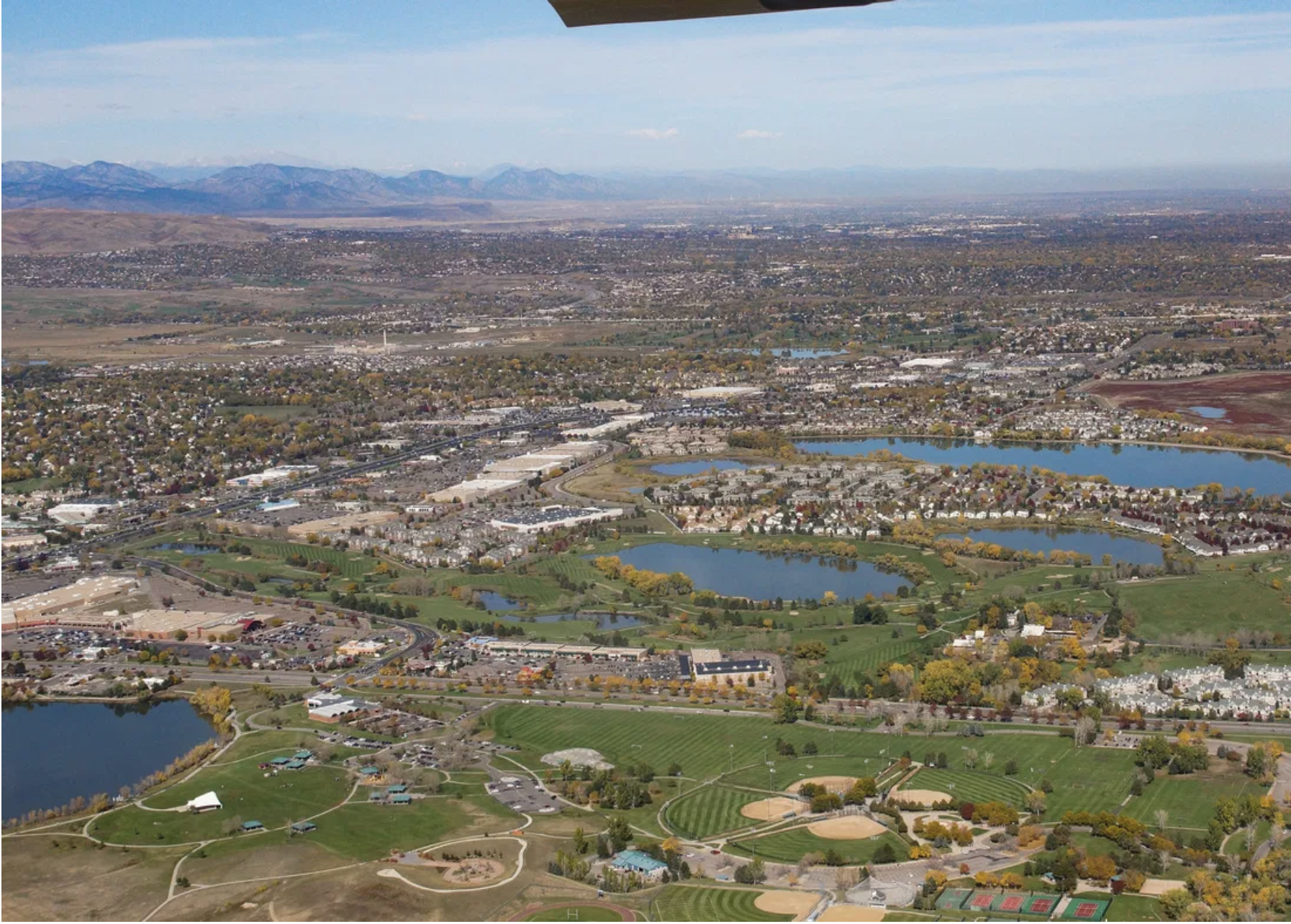
Urban development along Colorado’s Front Range is seen in an aerial photo from the nonprofit EcoFlight. A commission representing states comprising the upper basin of the Colorado River estimates as much as 40% higher water use compared to current levels by 2060, but a recent white paper calls those assumptions into question as says they hamper efforts to realistically deal with climate change. CREDIT: ECOFLIGHT via Aspen Journalism
The law of the river
In 1922, the framers of the Colorado River Compact divided the waters of the river, giving the upper basin and the lower basin — California, Nevada and Arizona — 7.5 million acre-feet each. This amount, known as an apportionment or “entitlement,” was thought to be fair at the time because it gave the slow-growing upper basin time to develop their share of the water without the faster-growing lower basin claiming it first.
The mission of the UCRC is to protect the upper basin’s ability to use its share of the river. And this entitlement is symbolic of the upper basin’s dreams and aspirations: growing cities and towns and thriving agricultural communities.
The problem is that the century-old agreement didn’t account for dwindling flows caused by climate change. Studies have found — under what Brad Udall, one of the paper’s authors and a climate and water researcher at Colorado State University, calls “the new abnormal” — that runoff decreases as temperatures rise.
Compounding the issue is that under the compact, the upper basin is still required to deliver the same amount of water to the lower basin regardless of declining flows.
“The reason we entered into a compact was because we knew we couldn’t develop as quickly as the lower basin, so the whole idea is that we could develop later,” said Jennifer Gimbel, former director of the Colorado Water Conservation Board and interim director at the CSU Water Center. “But as we know, streamflow is not as strong and climate change is cutting into it even more and more, and that puts you into a conundrum.”
The result is that there are 15 million acre-feet of entitlements on paper, not including Mexico’s share, but just 12 million to 13 million acre-feet of water. And that number is likely to decline even further as temperatures rise. Soon, there may not be enough water for the upper basin to meet its compact obligations to the lower basin and to develop new water projects.
“You cannot have a situation where climate change is reducing the yield of the basin and everyone is sticking to what they think their entitlements are under the compact,” said Eric Kuhn, one of the study’s authors. “Something has to give.”
In other words, if the water physically is not there anymore, it doesn’t really matter what the compact says the upper basin is entitled to.
Kuhn is the former general manager of the Colorado River Water Conservation District and also co-author of the 2019 book “Science Be Dammed: How Ignoring Inconvenient Science Drained the Colorado River.” One of the book’s main points is that past Colorado River decision-makers let politics and competition for a limited supply of water — not science — be the main drivers of river management. Because of that, the river was over-allocated from the beginning. Kuhn worries that this trend may be continuing.
“The fear is that this is another opportunity to ignore the science,” he said. “Forget about these projections that show how much water we might have been able to develop 40 years ago and focus on the river that nature has given us with climate change and not the one we wish we had from decades ago.”
Members of the Colorado River Commission, in Santa Fe in 1922, after signing the Colorado River Compact. From left, W. S. Norviel (Arizona), Delph E. Carpenter (Colorado), Herbert Hoover (Secretary of Commerce and Chairman of Commission), R. E. Caldwell (Utah), Clarence C. Stetson (Executive Secretary of Commission), Stephen B. Davis, Jr. (New Mexico), Frank C. Emerson (Wyoming), W. F. McClure (California), and James G. Scrugham (Nevada) CREDIT: COLORADO STATE UNIVERSITY WATER RESOURCES ARCHIVE via Aspen Journalism
Interstate poker game
The upper basin, including Colorado, is currently exploring the concept of a demand-management program, which could reduce water use by paying irrigators to not irrigate. The goal of the program, which would be temporary and voluntary for participants, would be to send as much as 500,000 acre-feet of water to Lake Powell to prop up levels and avoid a compact call.
A compact call could occur if the upper-basin states can’t deliver the 7.5 million acre-feet of water per year to the lower-basin states as required by the compact. This could trigger an interstate legal quagmire, a scenario that water managers desperately want to avoid.
If it appears contradictory that the upper basin is looking at how to reduce water use while at the same time clinging to a plan for more future water use, that’s because it is.
Water attorney Peter Fleming said some are asking why the upper basin is planning to reduce existing depletions while also planning an additional million acre-feet of depletions. Fleming is general counsel for the River District. He also is on the legal committee for the UCRC, but is not speaking on behalf of that organization here. “It seems the upper basin as a whole needs to reconcile that seeming contradiction,” he said.
Some water experts compared the UCRC’s depletion schedule to an interstate chess or poker game, complete with bluffing. The upper basin must insist it will one day put to beneficial use all of its unused share — or else the lower basin, which already uses all of its own share, could somehow claim the unused portion.
“There’s still this fear that if we don’t use our water, the lower basin will establish an economic use and economic reliance on that water, and it will be very difficult to get it back in the future, even though we are entitled to it,” Kuhn said. “The downside to that right now is the water is just not there.”
Lake Powell is seen in a November 2019 aerial photo from the nonprofit EcoFlight. Keeping enough water in the reservoir to support downstream users in Arizona, Nevada and California is complicated by climate change, as well as projections that the upper basin states of Colorado, Utah, Wyoming and New Mexico will use as much as 40% more water than current demand. A recent white paper from a lineup of river experts calls those use projections into question. CREDIT: ECOFLIGHT via Aspen Journalism
UCRC Director Amy Haas said in an email that although the paper is thought-provoking, the authors base their analysis on an obsolete projection of future Upper Basin water use demands from 2007 instead of relying on the current 2016 projections, which show a decrease in future demand as well as a slower rate of projected future demand. She said the authors did not consult the commission on the paper before its release.
Study authors have said that current data from the Bureau of Reclamation wasn’t released in time for the 2016 numbers to be used in the paper, and that they used the most up-to-date information available to them. They also say the differences between the two sets of numbers are minor and don’t change their findings.
What we are working to protect. Culebra-Gallegos maíz de concho grown at Acequia Institute farm in Viejo San Acacio. Photograph by Devon G. Peña
From Water Education Colorado (Willow Cozzens, Samantha Grant, Amelia Nill, and Andrew Primo):
Effective agricultural water planning is critical for a sustainable and resilient future in Colorado. Not only does the agricultural sector account for 86.7% of the state’s consumed water, but agriculture is also the crucial economic and cultural foundation for many communities. The 2015 Colorado Water Plan (CWP), a statewide roadmap for water management, is currently undergoing a multi-year update that includes new information, critical action items, and revised water planning schemes for all sectors. This update will be published in 2022. In order to foster lasting resilience, the CWP update must be more inclusive of all Coloradoans and provide comprehensive planning for historically underserved communities across the state.
True sustainability can not be divorced from empowering all communities. Studies show that systems with many sources of knowledge are generally more resilient. Just as farmers often plant several different crops to prepare for potential vulnerabilities, water planning must strive to be as diverse as possible to create a water resilient future.
Who has been excluded from agricultural water planning?
Colorado has an exciting opportunity to be more inclusive in water planning and subsequently create a truly sustainable CWP. But first, underserved groups must be identified throughout all sectors. This will necessitate nuanced outreach and calls to action. Three groups who have been historically excluded from Colorado water planning in agriculture are:
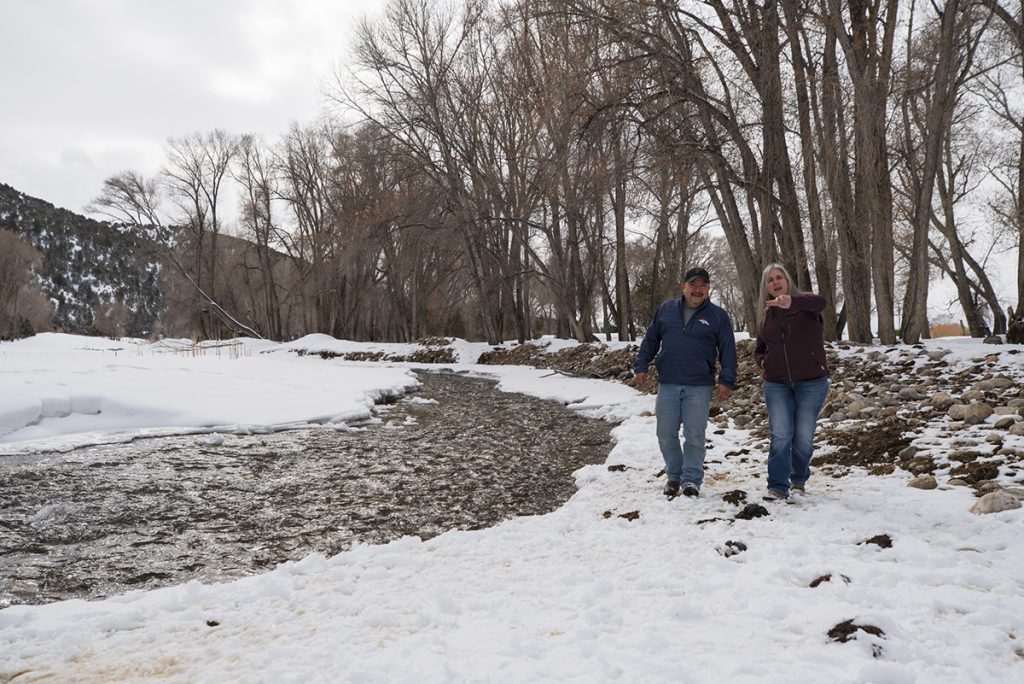
In southern Colorado’s San Luis Valley, Judy Lopez with Colorado Open Lands and landowner Dave Marquez discuss upcoming restoration work on the Culebra River, which traverses his property. Marquez irrigates from the Francisco Sanchez Acequia to grow alfalfa-grass hay. The acequia worked with Colorado Open Lands and the bylaws project to develop bylaws that preserve their oral traditions. Photo by Christi Bode
People who operate under acequia management systems. For communities in Colorado and northern New Mexico, an acequia is a physical system, an irrigation ditch, but it is also a deeply embedded philosophy of community and governance. These producers are primarily Hispanic or Latinx and reside in the San Luis Valley within the Rio Grande River Basin or in the Arkansas River Basin. The term “acequia” is mentioned only once in the entire 2015 CWP — in a footnote of a farmer profile.
Many Indian reservations are located in or near contentious river basins where demand for water outstrips supply. Map courtesy of the Bureau of Reclamation.
Tribal water users. Two federally recognized tribes have designated land reservations within the borders of Colorado: the Southern Ute Indian Tribe (SUIT) and the Ute Mountain Ute Tribe (UMUT). While it must be acknowledged that 48 contemporary tribal nations are historically tied to the lands that make up Colorado, the Ute tribes are holders of federal reserved water rights in the state. Both the SUIT and UMUT tribal reservations are located within the Southwest Basin (e.g. San Juan/Dolores), though the UMUT reservation also includes land in New Mexico and Utah. While the tribes have become more frequent partners in broader interstate negotiations, inclusion at the intrastate level is still limited to the Southwest Basin Roundtable. Given the Ute tribes’ status as the state’s original water users and the unique nature of their federally reserved rights, more efforts should be made to explicitly include tribal representatives in deliberative processes.
Hanging Oyster mushroom columns growing on waste coffeegrounds via Gro Cycle
Urban agricultural producers. Urban agriculture in Colorado may include a variety of production methods and water uses, such as community gardens, hydroponic growing facilities, small-scale market farms, and more. It is important to note that there is not necessarily the same rich history or record of exclusion for urban agriculture as the above two groups. Rather, planning for water in urban agriculture could present an exciting opportunity to foster resilience in the food system and land use planning for the future of Colorado. Before defining demographics and practices within urban agriculture, a standard definition of urban agriculture in Colorado must be implemented.
Tribes are acknowledged in the Southwest Basin Implementation Plan, and acequias are acknowledged in the Rio Grande Basin Implementation Plan. Urban agriculture is not mentioned in the 2015 CWP or in any of the Basin Implementation Plans (BIPs). The BIPs could serve as an opportunity to elevate underserved voices, given their regional focus, and create a space for them at the state level. An equitable and just water planning process at all levels, from local to basin to state, is critical for Colorado’s present and future water needs.
Paving the way toward more inclusivity in Colorado water planning
The Department of Natural Resources has recently announced the formation of a water equity committee, which is set to include representatives from each river basin and each tribal nation. Within this engagement process, Colorado water planners must make the effort to explicitly solicit input and feedback from underserved individuals and groups in agriculture and all other water sectors. Outreach efforts must be nuanced for each community, each conversation, and each stage in inclusive planning. Overall, CWCB should focus on elevating voices of change makers within historically underserved communities and solicit consistent feedback for a more inclusive, equitable, and holistic Colorado Water Plan.
This strategy should aim to advance diverse representation in natural resource planning and provide opportunities for more equitable funding. Explicit inclusion via community outreach may also encourage diversity in water planning schemes, which can in turn create a more sustainable future. The equity committee and the CWCB should reach out to representatives of underserved communities and facilitate dynamic and interactive working sessions where stakeholders can discuss water challenges and opportunities with the CWCB.
In partnership with CWCB and the University of Colorado – Boulder, we conducted an initial working session with a goal of establishing a more inclusive dialogue for producers. This work session, which focused on water issues among urban agriculture producers, will be discussed in a later blog post.
Ideally, such facilitated dialogues will lead to additional working sessions, inclusion in water planning procedures at the state level, participation in Basin Roundtables, submission of public comments, and general advocacy pointed toward agricultural water planning. This approach may foster a more diverse, equitable, and inclusive 2022 Colorado Water Plan, and a better water planning process into the future.
Help define this moment for birds, rivers, and people.
What memories can you recall from five years ago? Well, you may remember that Colorado’s inaugural Water Plan had just been finalized in November of 2015. The Audubon network, our partners, and Coloradans were key in defining the plan. Five years of plan implementation have flown by. As the plan moves forward in its first update, what have we learned to set the course for necessary immediate and long-term steps to ensure water security for people and the environment? We need your statewide engagement, again.
The Water Plan in Short
Colorado’s Water Plan 2015 is a framework pointing the way toward safeguarding Colorado’s water values as population, water variability, and drought increase. Colorado’s water values are supporting healthy watersheds and the environment, robust recreation and tourism economies, vibrant and sustainable cities, and viable and productive agriculture.
The plan’s foundation stands on work by Colorado’s nine basin roundtables and their basin implementation plans, the Interbasin Compact Committee, the Colorado Water Conservation Board (CWCB), partners, and stakeholders statewide. The collaboration that fueled the Colorado Water Plan sparked the state’s largest civic engagement and the CWCB received more than 30,000 public comments on priorities and direction for the plan. Audubon’s network provided nearly 20 percent of general comments received, and Audubon staff provided consented technical environmental resilience and stream ecology language. The top-two categories of all public comments received were support for healthy rivers and better use of water in cities and towns. The unprecedented public engagement truly produced Colorado’s Water Plan.
Without a strong plan and funding for implementation, Colorado’s birds, rivers, and people will face a problematic future with unacceptable consequences.
Why Update Now?
Colorado is changing and the Colorado Water Plan must be responsive. Our population is over 5.7 million today and could nearly double by 2060. With climate change increasing temperatures and making water supply less predictable, rivers are already stretched thin. Within the next few decades, even assuming aggressive water conservation and the completion of dozens of water projects currently being considered, the state could face a shortfall that exceeds 500,000 acre-feet annually.
The plan update will complete in 2022 and map Colorado water resource management for the next seven years. As a headwaters state, the value of Colorado’s rivers flows far beyond its boundaries. Healthy, flowing rivers support all water uses and users—both wildlife and people. Protecting rivers protects our economy, our birds, and our way of life, but their future is uncertain. Audubon was closely involved in the creation of the plan and currently is involved in its implementation. Now, five years later, we’re helping to update the plan.
(Abby Burk and other experts explain how Colorado can best update the Colorado Water Plan.)
How to Engage
Audubon is committed to protecting the health of Colorado’s rivers, ecosystems, and sustainable water supplies—values that benefit everyone. We are working across water interests to show that water connects rather than separates us. Together, we can protect Colorado’s incredible rivers and the birds that depend upon them. Public input on the Colorado Water Plan update will be critical. Here’s how you can participate:
Engage in Your Local Basin
Each of Colorado’s nine basin roundtables has been updating their local water supply and management plans called basin implementation plans (BIPs). Updated BIPs will soon be ready for public review. Click on your basin here to find your basin roundtable website, then click through to the BIP update status. Updated BIPs are getting ready to roll out soon. Also, due to COVID-19 concerns, basin roundtables have been meeting virtually. If you have not already, you can attend a virtual basin roundtable meeting to get to know your basin’s scope of work and your basin’s hardworking volunteers leading local water management efforts.
Engage on the State Plan
Everyone needs healthy rivers. Our hope is that this plan update will represent not only the human needs, but also a healthy ecosystem on which we and our wildlife depend. Currently, the Colorado Water Conservation Board is collecting survey feedback on the direction for the Colorado Water Plan update. Staff and stakeholder input has informed the current thinking, which is summarized in five informational sheets: Water Plan Update Vision, Vibrant Communities, Robust Agriculture, Thriving Watersheds, and Resilient Planning. Please review the information sheets and fill out the survey here.
Audubon Rockies will be asking for local involvement through comments on the basin implementation plans and the statewide plan, so be on the lookout for more timely ways you can engage!
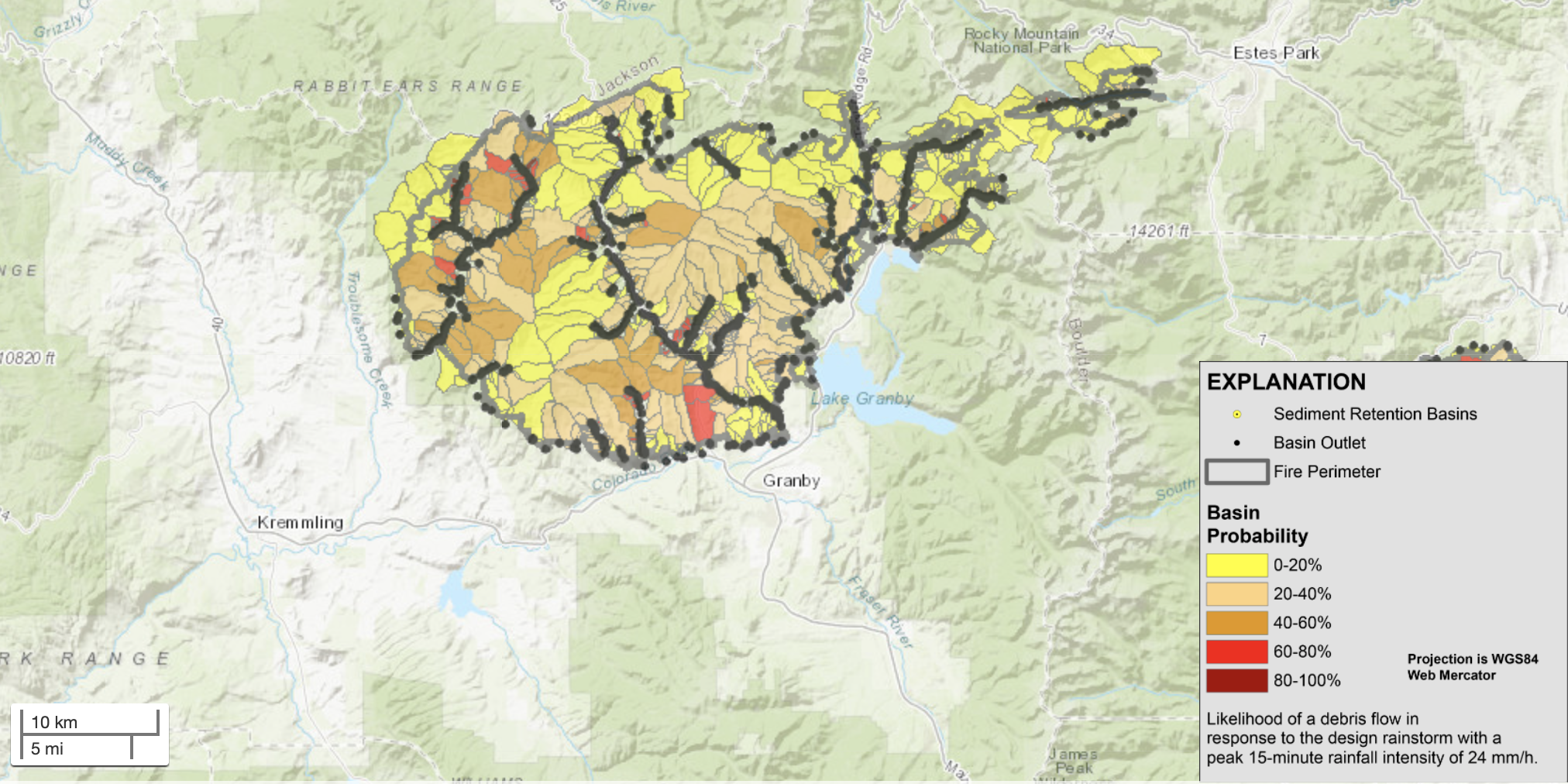
The map above displays estimates of the likelihood of debris flow (in %), potential volume of debris flow (in m3), and combined relative debris flow hazard. These predictions are made at the scale of the drainage basin, and at the scale of the individual stream segment. Estimates of probability, volume, and combined hazard are based upon a design storm with a peak 15-minute rainfall intensity of 24 millimeters per hour (mm/h). Predictions may be viewed interactively by clicking on the button at the top right corner of the map displayed above. Map credit: USGS
One of the biggest concerns following the East Troublesome Fire in Grand County is flooding risk, specifically flooding that picks up debris to create mudflows. Local and national officials are working to get the word out about this new risk and prepare Grand County for a changed landscape this summer…
A number of watersheds were burned in the East Troublesome Fire, including 94% of the Willow Creek Watershed, 90% of the Stillwater Creek Watershed, 42% of the North Inlet Watershed and 29% of the Colorado River Watershed.
Projections have found that water flow from snowmelt and weather events on the burn scar could be 14 times higher than before. According to Grand County Emergency Manager Joel Cochran, the National Weather Service will be monitoring rainstorms that produce even a little bit of rain…
The US Geological Survey has also produced preliminary hazard assessment across the East Troublesome burn scar. The assessment found that most of the water basins in the burn scar present a moderate risk of debris flow hazards with a high risk in certain areas.
County officials have been working to identify specific risks to property and life.
The first part of that included field surveys for damage assessments, which were completed last week. Using additional modeling, risk for various structures have been further assessed and officials are working to communicate that hazard to land owners.
In her Tuesday update to commissioners, Grand County Water Quality Specialist Katherine Morris added that some narrow canyons and roads near flowing water would likely need formal evacuation plans.
The Ella Ditch, which irrigates agricultural land south of Carbondale, placed a call on the Crystal River for the first time ever in 2018. Photo credit: Brent Gardner-Smith/Aspen Journalism
Click here for all the inside skinny and to register.
Join a roundtable discussion focusing on agricultural irrigation infrastructure issues and solutions to inform the 2022 Colorado Water Plan.
The Colorado Water Conservation Board, in partnership with the Colorado Agricultural Water Alliance and Ditch and Reservoir Company Alliance, invites you to participate in a virtual, Colorado Water Plan Update Scoping Workshop focusing on agricultural irrigation infrastructure issues and solutions. The format of the workshop will be an expert roundtable discussion that will inform the scoping process of the Colorado Water Plan Update (more information here: https://engagecwcb.org/colorado-water-plan-update).
The Colorado Water Plan provides a roadmap for addressing water resource challenges; informing strategies, policy development, and programming. The event will be open to the public.
Here’s an in-depth report from Emily Holden, Caty Enders, Niko Kommenda, and Vivian Ho that’s running in The Guardian. Click through and read the whole article and to check out the story map detailing the problem. Here’s an excerpt:
Millions of people in the US are drinking water that fails to meet federal health standards, including by violating limits for dangerous contaminants.
Latinos are disproportionately exposed, according to the Guardian’s review of more than 140,000 public water systems across the US and county-level demographic data.
Water systems in counties that are 25% or more Latino are violating drinking water contamination rules at twice the rate of those in the rest of the country.
America’s worst public water systems – those that have accrued more than 15 “violation points” for breaking standards over five years – serve more than 25m Americans, the research shows. An estimated 5.8m of these are Latino.
Texas, where millions of residents lost access to water and power during the recent storm, has the most high-violation systems, followed by California and Oklahoma. The average number of violations is highest in Oklahoma, West Virginia and New Mexico.
The six-month investigation of five years of Environmental Protection Agency (EPA) and other data also shows how:
Access to clean drinking water is highly unequal in the US, based on race, income and geography
Poorer counties have more than twice as many violation points as wealthy ones
Some water systems report hundreds of violation points year after year without any action from the government and without being required to notify customers
Rural counties have 28% more violation points than metropolitan ones
Scientists and former government officials describe a water regulation system that is broken. “Most policymakers believe compliance with environmental rules is high,” said Cynthia Giles, the former head of enforcement at the EPA under Barack Obama, but that belief was “wrong”.
Experts are most concerned about systems serving smaller communities. They say Latinos are particularly at risk because they often live near industrial farms in California and the west that have polluted local water with nitrates in runoff from fertilizers and manure. They are also more likely to live in the south-west, where arsenic violations are common.
Pumped hydroelectric generation illustrated. Graphic via The Mountain Town News
FromThe Grand Junction Daily Sentinel (Charles Ashby):
The leading Republican in the Colorado House says it’s about time that pumped hydroelectric power plants are considered recycled energy that counts under the state’s renewable energy standard.
One of the reasons why it isn’t already counted as a renewable energy is because, unlike conventional hydroelectric power plants, pumped hydro requires additional power to move water uphill to an upper reservoir so that it can flow downhill to a lower reservoir through a turbine to generate electricity.
House Minority Leader Hugh McKean, R-Loveland, told the House Energy & Environment Committee on Wednesday the technology now exists to do that either with traditional renewable energy or at least to make it all work carbon neutral…
McKean said that most pumped hydroelectric plants don’t generate nearly as much electricity as those fossil fuel plants, but they often are used to help keep power costs to consumers down during peak usage times.
The beauty of them is they can augment power during peak times when costs are higher, thus reducing those costs, and use less expensive electricity to pump the water back uphill during non-peak times, such as late at night, he said…
McKean also said the pumped hydroelectric plants don’t require a lot of energy to pump that water uphill, adding that it can be done in a number of ways, including through stored power from solar, wind or rechargeable batteries.
The measure, HB21-1052, which the committee discussed but hasn’t yet voted on, has support from several rural electric associations, the Colorado Farm Bureau and some environmental groups, such as Trout Unlimited, but only if the bill is amended to ensure guardrails are in place to protect aquatic life from being harmed, something McKean said he plans to do…
Currently, there are only five hydroelectric pump storage stations operating in the state, all of which are located on the Front Range or Eastern Plains, according to a database maintained by the U.S. Energy Information Administration.
That agency also lists 64 conventional hydroelectric plants operating in Colorado, including many on the Western Slope.
Click here to read the update (Megan Holcomb & Tracy Kosloff):
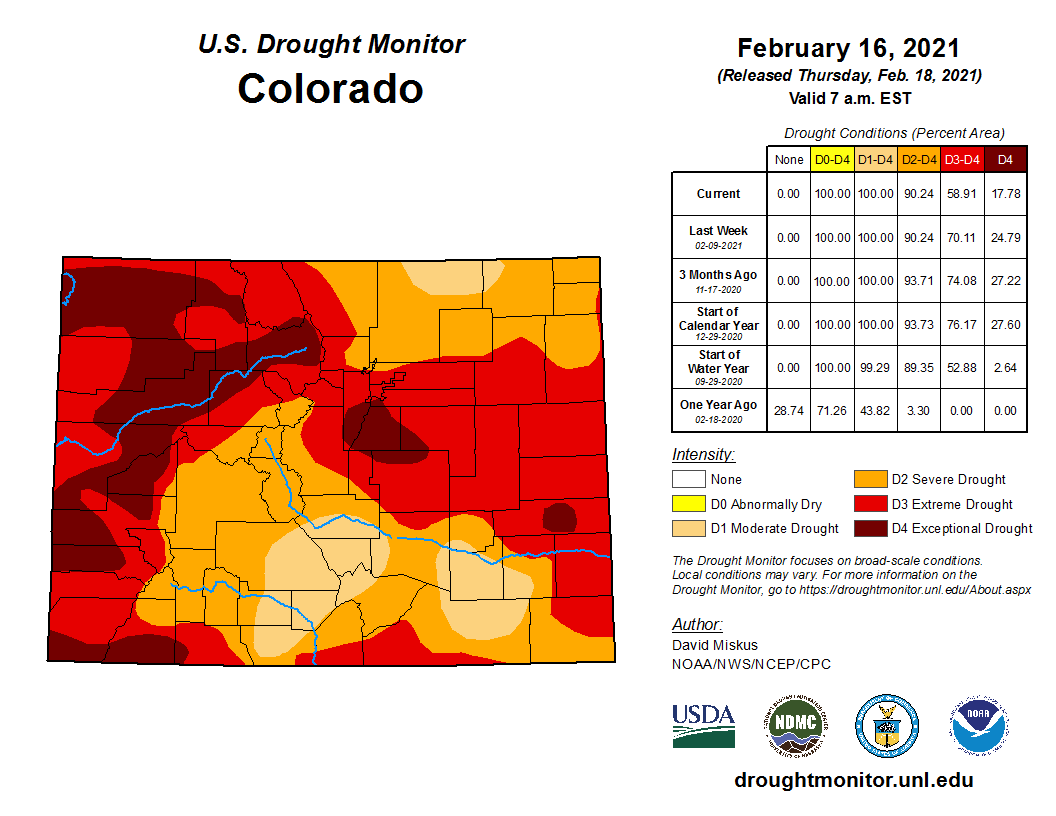
Drought conditions in Colorado continue as we reach our ninth straight month of above-average temperatures combined with eleven months of below-average precipitation. The state experienced the 15th warmest October-January on record and noted an overall increased temperature of 2.5°F above Colorado’s 20th century average. Despite the cold weather in mid-February, the month has shown warmer temperatures west of the divide and record-breaking low temperatures to the east. Holyoke reached their 5th coldest temperature on record at -30°F and Lamar recorded their 3rd coldest temperature at -27°F on the 15th of February.
Colorado Drought Monitor February 23, 2021.
The U.S. Drought Monitor from February 11th recorded exceptional (D4) drought conditions across 25% of the state, which dropped to 18% on the February 18th monitor. Extreme (D3) drought covers 41% of the state; severe (D2) drought covers 30%; and moderate (D1) drought covers 10%.
The 90-day Standardized Precipitation Index (SPI) values from Nov 16 to Feb 13 highlight the northern mountains and central northern areas of the state in dry conditions. Eastern Colorado reflects select areas of above average precipitation after recent January snowstorms. However, the 12-month SPI map provides more accurate depictions of the 2020 deficits across the state.
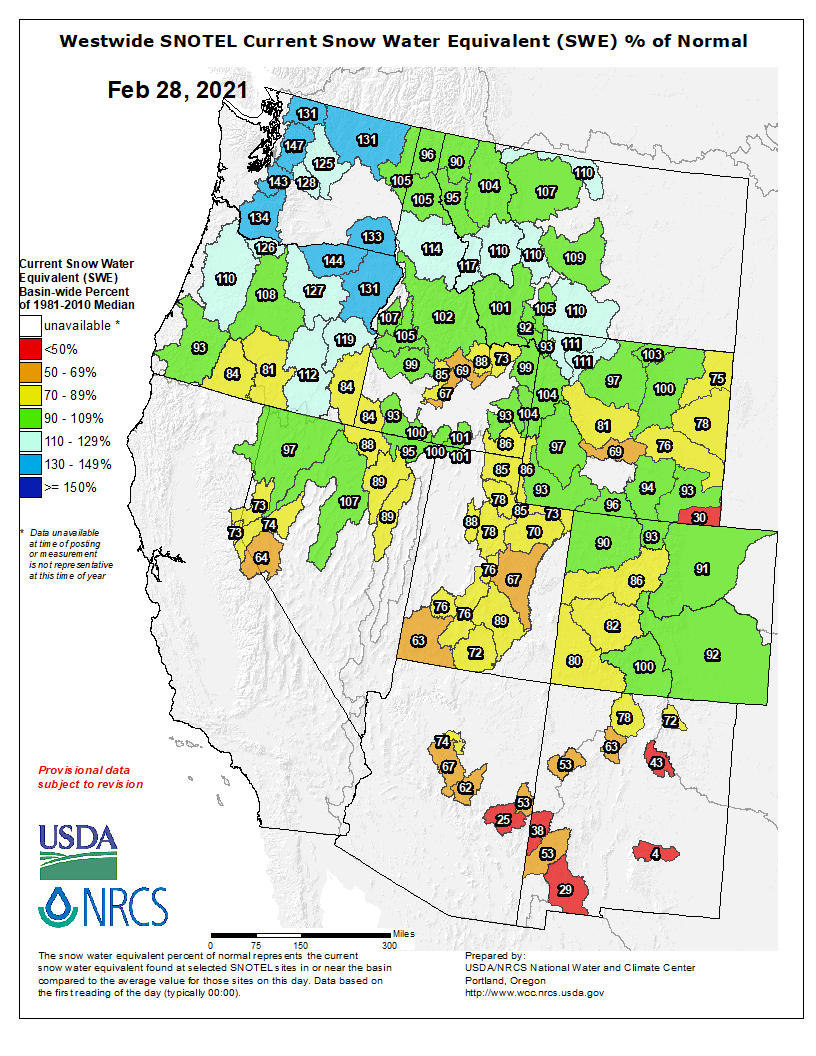
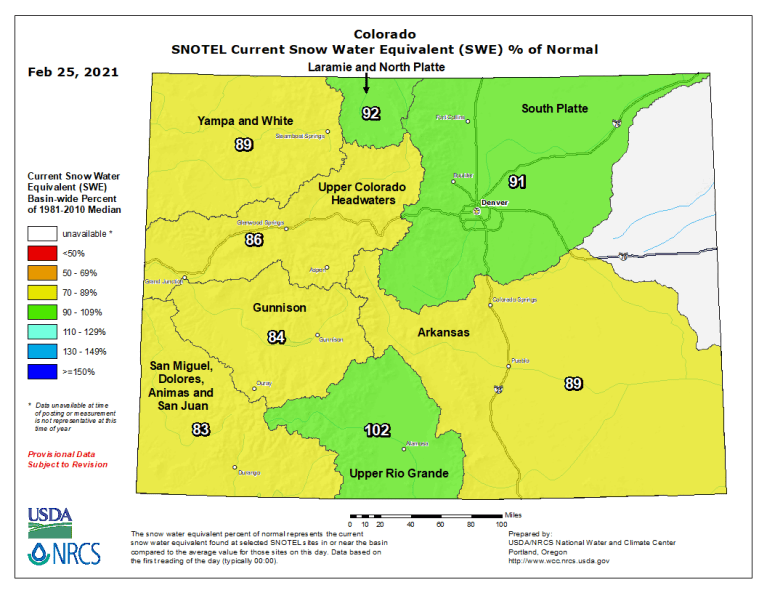
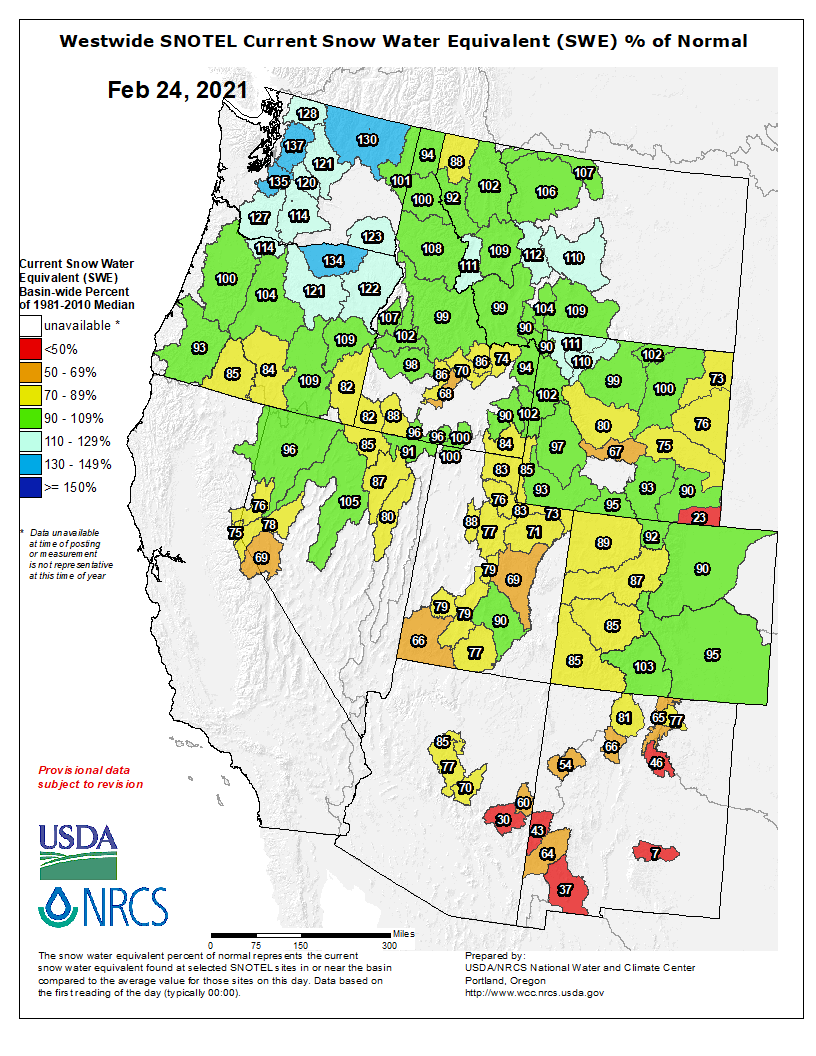
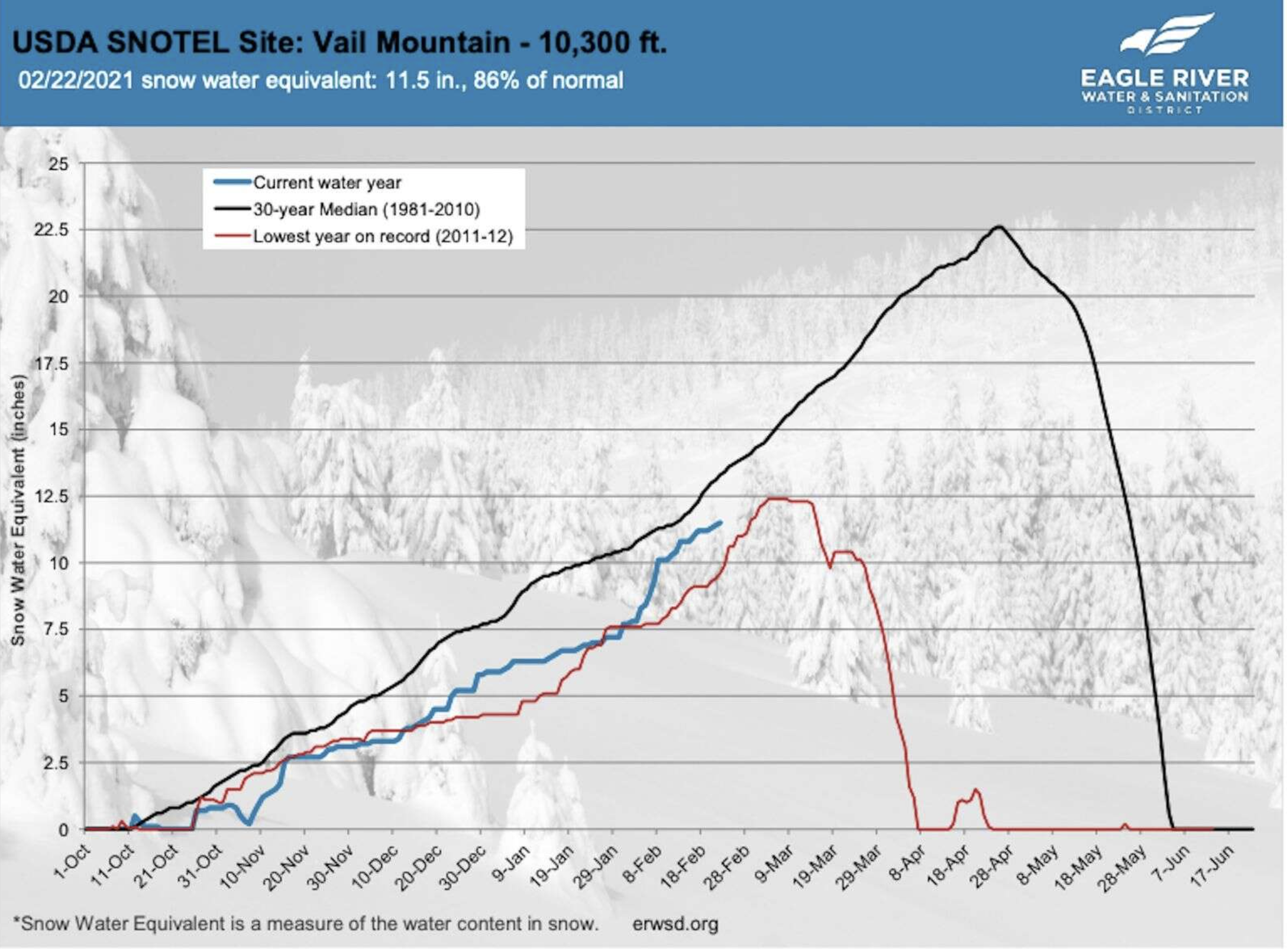
Through January statewide snowpack was 65% of normal. After a few February storms, statewide snowpack rose to 88% of normal as of Feb. 25th. State reservoir storage is currently at 83% of average. Extreme soil moisture deficits and below normal precipitation means all basins should prepare for a low runoff year. The continuance of drought is expected through 2021 and the State Drought Plan remains in Phase 3 activation.
Water providers report slightly below average storage levels and near normal winter demands. Drought management planning and potential restrictions are being discussed through multiple coordinated groups. In January, over 120 water providers completed a CWCB needs survey to inform statewide drought coordination and near-term Municipal Water Task Force efforts.
Measuring snow might seem straightforward, but each environment brings unique challenges for instruments. For example, snowfall in forests gets caught in branches or falls underneath the tree canopy, making it more difficult to measure remotely than snow that falls on an open landscape. To dig into these differences, SnowEx measures snow both from the ground and from the air. Credit: NASA / Jessica Merzdorf
Whether the first snowflakes of winter fill you with glee or make you groan, winter snowfall is a crucial water source for drinking, agriculture and hydropower for more than 1 billion people worldwide.
To plan water management and disaster preparedness during the rest of the year, hydrologists and resource managers need to know how much water each winter’s snowpack holds. Currently, ground or airborne observations of that measurement – called snow-water equivalent, or SWE (pronounced “swee”) – are collected at only a very limited number of locations around the world. However, NASA hopes in the future to launch a global satellite mission to track this precious resource from space.
To design a mission that can measure all the snow characteristics that make up SWE, scientists need to determine what instrument combination to use, since no one instrument can do it alone. Enter NASA’s SnowEx field campaign, which measures snow properties like depth, density, grain size and temperature using a variety of instruments, on the ground and in the air. A potential future NASA global snow mission will combine multiple remote sensing instruments, field observations and models – and SnowEx is discovering the best combination for the job.
(NASA’s SnowEx ground and airborne campaign is a multiyear effort using a variety of techniques to study snow characteristics, and the team began their new field study year in January 2021. Not only is SnowEx learning valuable information about how snow properties change by terrain and season, but they are also testing the tools NASA will need to sample snow from space.
Credits: NASA’s Goddard Space Flight Center / Scientific Visualization Studio / Boise State University)
SnowEx team members Megan Mason and Gabrielle Antonioli take snow samples at one of the 2021 research sites, which is only accessible by skis. Credits: NASA / Gabrielle Antonioli
Measuring snow might seem straightforward, but each environment brings unique challenges for remote sensing instruments. For example, snowfall in forests gets caught in branches or falls underneath the tree canopy, making it more difficult to measure remotely than snow that falls on an open landscape.
To dig into those differences, SnowEx measures snow from the ground and by air. The ground and air teams take similar measurements to compare their results, gauging how similar instruments perform under different conditions.
“Airborne observations allow us to collect high-resolution data over a large area, allowing simulation of remote sensing observations we might get from a satellite, at a range of resolutions and spatial extents,” said Carrie Vuyovich, SnowEx 2021 project scientist, lead snow scientist for NASA’s Terrestrial Hydrology Program and a physical scientist at NASA’s Goddard Space Flight Center in Greenbelt, Maryland. “Ground observations do not have the same spatial coverage, but allow us to validate the sensing technique in multiple, diverse locations, and the small footprint simplifies interpretation.”
This year, the SnowEx team will deploy airborne lidar, radar and imaging systems to measure snow depth, changes in SWE, and the albedo of the snow surface, while collecting similar and complementary data over the same locations on the ground to compare and validate results. The albedo is the fraction of energy from the Sun reflected from a surface, a critical snow property for modeling melt.
There are three primary goals for the SnowEx 2021 campaign. The first goal is to repeat the L-band InSAR airborne measurement time series that was cut short by COVID-19 in spring 2020. (InSAR is a radar technique that estimates snow depth similarly to lidar, tracking changes in how long it takes for radar pulses to travel from the aircraft to the bottom of the snowpack.) This year, the Jet Propulsion Laboratory’s Uninhabited Aerial Vehicle Synthetic Aperture Radar (UAVSAR) instrument will fly on a Gulf Stream 3 (G-3) aircraft weekly over each of six sites in Idaho, Utah, Colorado and Montana, from mid-January through late March.
In 2022, NASA and the Indian Space Research Organisation (ISRO) will launch NISAR, a space-based InSAR mission to study Earth’s surface, including land, water, ice and more. SnowEx’s InSAR explorations will inform future snow research with NISAR and other radar missions. The team will use lidar to validate the InSAR measurements on the ground.
Secondly, the team will use a spectrometer – an instrument that measures the intensity of visible and infrared radiation as a function of wavelength – to study albedo. Measuring albedo with spectrometers is a component of NASA’s Surface Biology and Geology (SBG) study, which is developing research initiatives to better understand Earth’s land and water ecosystems as part of the National Academies of Sciences, Engineering and Medicine’s decadal survey. This is the first year SnowEx is directly targeting high-quality albedo observations, which will be focused in forested, steep terrain during the melt period. The team will fly NASA’s Airborne Visible / InfraRed Imaging Spectrometer-Next Generation, or AVIRIS-NG, over two sites in Colorado during March and April to collect these observations.
A third goal for 2021 is to investigate snow properties in prairie landscapes. Snow is difficult to measure on prairies using the same approaches as over mountains because of their shallower depths.
“Prairie landscapes are identified as a gap in our remote sensing capabilities,” said Vuyovich. “The substrate – the ground underneath – affects the signals and the ability to measure shallow snow. In addition, the spatial distribution of the snow in that environment is different from other environments, and can be difficult to measure and validate. Wind plays a significant role in redistributing snow across the landscape, which includes fields, crops, stubble, and ditches, leaving deep drifts and bare patches.”
On the ground, teams dig snow pits – car-sized holes in the snow that reach down to the ground – and measure snow depth, water content, temperature, reflectance and grain size in the pit walls. Other team members on skis or snowshoes take handheld probe measurements of snow depth and albedo with field spectrometers. Using a snow micropenetrometer, measurements of the force on the probe tip provide detailed profiles of snow hardness and microstructure. The ground team also uses radar to rapidly measure how snow properties vary across the area of a typical satellite sensor pixel. The radar systems are mounted on snowmobiles or towed while skiing.
“This year we have some new instruments, like helicopter- and UAV-based lidar surveys, which allow us to adapt to weather and line up these calibration and validation surveys with the airborne radar. The low cost flight platforms allow more frequent surveys over a given area than from a fixed-wing aircraft, which is important for this time series experiment,” said HP Marshall, an associate professor at Boise State University and SnowEx 2021’s co-project scientist. Airborne lidar works by bouncing laser pulses off the surface and measuring the time it takes for the pulse to return. By tracking differences in timing across the landscape, lidar creates a 3D picture of the height and structure of the surface below. Scientists can calculate snow depth by comparing lidar measurements of the same area when there’s snow, with surveys from when there is no snow.
In addition to collecting observational data, SnowEx’s modeling research helps the team see how snow changes across different terrains and time.
“Modeling fills in the gaps in the remote sensing and ground observations,” said Marshall. “In hard-to-measure areas like forests, models can use remote sensing observations in open areas to define precipitation patterns, allowing predictions of snow properties in the forest. Some of the remote sensing approaches that measure depth, such as lidar, also require models to estimate snow density, to allow conversion of depth to SWE. Between remote sensing acquisitions, models continue to simulate snow conditions. The models can be constantly updated when and where the remote sensing and ground observations of snow properties are available – all three approaches work together to provide the best estimates of snow conditions.”
“People use models for different reasons,” Vuyovich said. “Water managers could use models to help make decisions. NASA’s Terrestrial Hydrology Program and SnowEx efforts will help design what we need from a satellite: what coverage, temporal frequency, accuracy and resolution are needed. Models can also help us fill in the gaps we may get between space-based observations.”
Navigating a challenging landscape
SnowEx team member McKenzie Skiles, an assistant professor at the University of Utah, uses a hyperspectral imager to study the light reflected from the snow surface. This gives the team important information about snow composition and particle size. Credits: NASA / McKenzie Skiles
In the sequential component of each campaign, SnowEx teams at sites across the western United States collect snow data weekly from December through May. Normally, this effort is punctuated by an intensive two- or three-week period of intensive data collection in one area, larger than the other site areas. In order to protect the teams during the ongoing COVID-19 pandemic, however, this year’s campaign will only include the time series. At each site, only local teams within a 2-hour drive of their home base will collect ground observations over a limited area, to avoid the need for overnight stays or gathering in large groups.
“This is a pandemic world, and we’re doing a lot virtually,” Marshall said. “I’m excited that we’re able to navigate this, that we have dedicated local field crews who can do this safely, and that we can still get on the snow. Our committed local field teams include students and researchers from many different government labs and universities, who deploy to their respective fields each week, on the same day as the overflights.”
Most years, NASA and SnowEx partner with local schools and organizations to support citizen science efforts and educational opportunities, but this year, those activities will happen virtually, through blogs, videos, and remote data collection. SnowEx’s primary outreach partner is the Winter Wildlands Alliance SnowSchool, a nationwide program with 70 sites that reaches 35,000 K-12 students. This year, they have developed virtual snow science activities to allow K-12 students to continue to learn about snow during the pandemic (https://winterwildlands.org/homeschool-snowschool/), as well as follow-on activities for schools that have been to Snow School in the past.
“We’re excited this is happening,” said Vuyovich. “With all of these challenges, we’re excited that people are going to get out in the field and that we can continue to push forward. I may not see much snow here in D.C., so I’ll be living vicariously through these photos and blogs.”
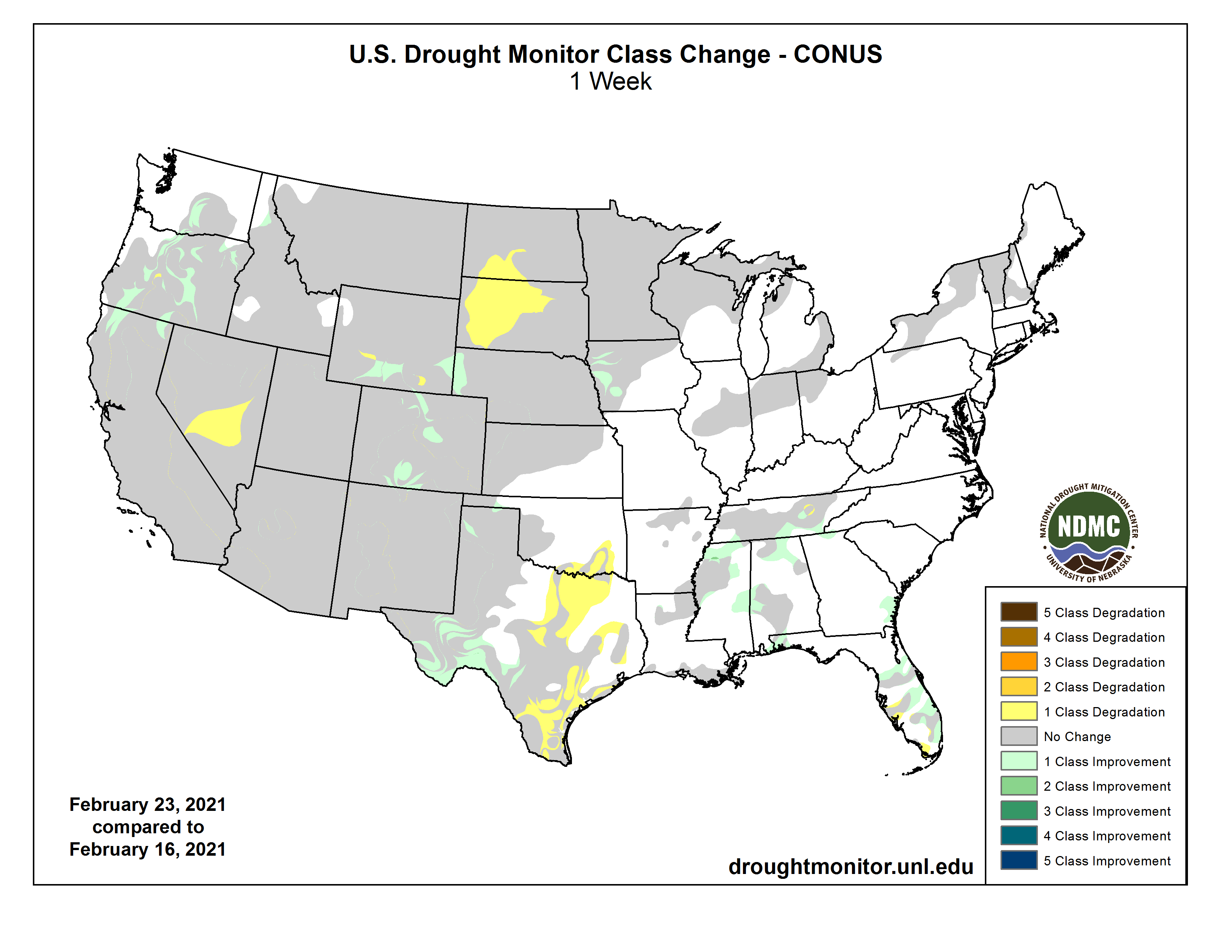
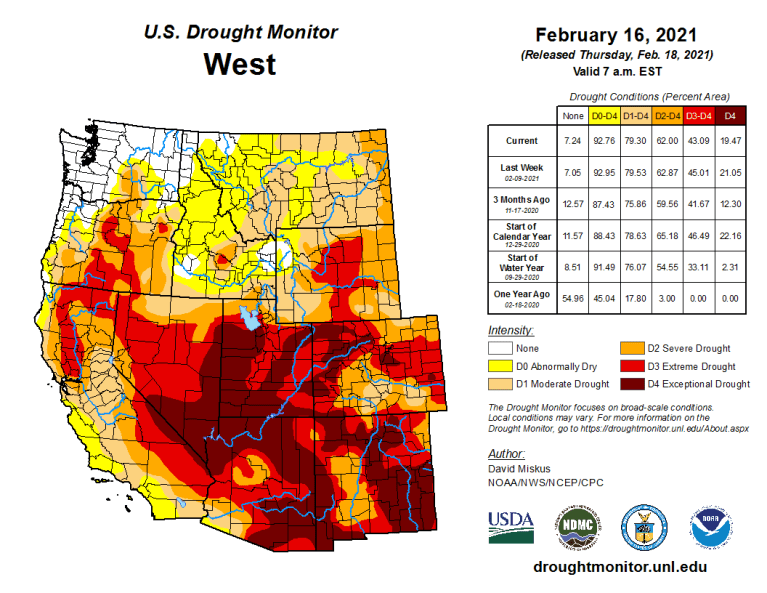
Click on a thumbnail graphic to view a gallery of drought data from the US Drought Monitor.
US Drought Monitor February 23, 2021.
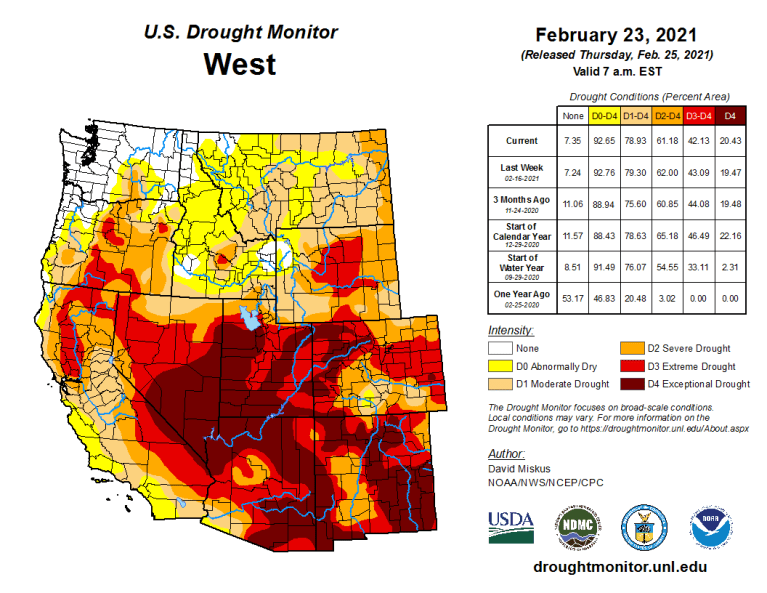
West Drought Monitor February 23, 2021.
Colorado Drought Monitor February 23, 2021.
Click here to go to the US Drought Monitor website. Here’s an excerpt:
This Week’s Drought Summary
After a frigid start to the period, especially throughout the middle third of the Nation where daily temperature anomalies were 30 to 40 degrees F below normal and readings dropped below -40 degrees F in Minnesota and 0 degrees F as far south as central Texas, temperatures finally moderated by week’s end. By Monday, highs had risen into the 40s & 50s degrees F in the Dakotas and 70s and 80s degrees F in Texas. Frequent Pacific storms battered the Northwest, and then tracked southeastward across the Northern and Central Rockies, dropping plentiful moisture on Washington, Oregon, northern California, Idaho, & western Montana, but missing most of the Southwest yet again. Storms also dropped widespread precipitation on much of the Southeast, mid-Atlantic, and coastal New England while most of the Midwest saw light frozen (snow, sleet, freezing rain) precipitation. Dry weather was observed across much of the Plains except in south-central Texas. Weekly temperatures averaged below to much-below normal throughout the lower 48 States except for central and southern Florida. Readings in Alaska remained below-normal except in the southwest and Aleutians, and significant precipitation was limited to along the southwest, southern, and southeastern coasts. Meanwhile, Hawaii experienced increased shower activity, especially on Kauai where some flash flooding occurred. In Puerto Rico, light showers persisted across eastern sections while the northwest remained mostly dry, and dryness/drought increased.
The ensuing 5 days (March 2-6) expects favorable odds for above normal precipitation across much of Alaska and in the Tennessee Valley and Carolinas. Subnormal precipitation should prevail across the North-Central States (northern halves of the Rockies and Plains and Great Lakes region) and along the western Gulf Coast, with Equal Chances (EC) elsewhere in the lower 48 States. Subnormal temperatures are likely in Alaska and the Far West, with above normal readings anticipated for the eastern two-thirds of the Nation (except EC for New England)…
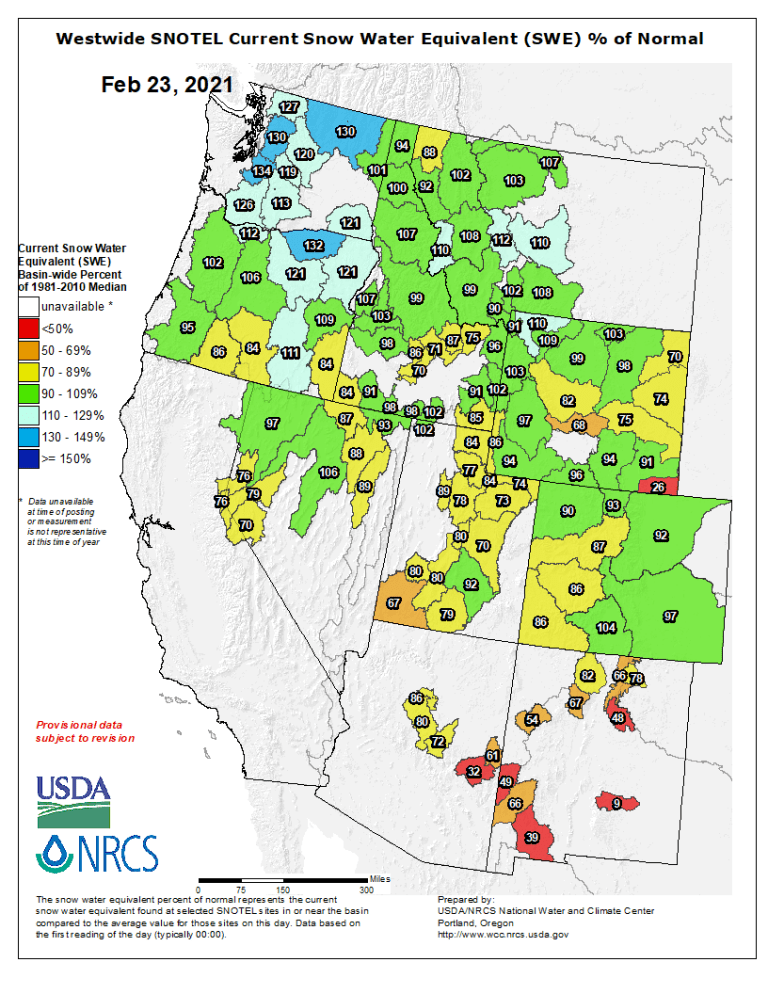
After several weeks of light to moderate snow events in the Central Plains, drier (but still frigid conditions, although moderating by week’s end) weather returned to the region. With the recent improvements in the Central Plains and subnormal temperatures, no changes were made there. Farther north, however, even though precipitation is normally low during the fall and winter seasons, it has been extremely dry during the past 3-4 months (less than 25% of normal), leading to a lack of any snow cover in eastern Montana, western North Dakota, and north-central South Dakota. Short-term indices (1-, 2-, 3-, 4-, and 6-months) were at D3 and D4 levels, thus D2 was expanded southward across south-central North Dakota and central South Dakota, and D1 added in north-central South Dakota. In contrast, additional precipitation in Wyoming and Colorado boosted mountain snow water equivalent (SWE) as of Feb. 23 at or closer to normal, thus some improvements were made across southern and southeastern Wyoming and in parts of north-central and south-central Colorado. A few areas in Wyoming had missed out on the recent snows, so some slight degrading was made to those areas…
Ample Pacific moisture and storms dropped decent amounts of precipitation on the Northwest, especially Washington, Oregon, northern California, Idaho, western Montana, and western Wyoming, with lesser amounts across northern Nevada, central Utah, northern and southern Colorado, and parts of New Mexico. The active Pacific storm track continued to benefit Washington, Oregon, and northern California, along with most northern and central mountains in the West. February 23 basin average SWEs continued to increase toward normal, with most basins in Washington, Oregon, Idaho, western Montana, and northwestern Wyoming at or above normal SWE. Accordingly, some slight improvements were made where recent surplus precipitation fell and the basins had SWEs exceeding 100%. With improvements made last week in northern Nevada and central Utah, and these areas still impacted from the failed Southwest summer monsoon, no changes were made this week, although the basin SWEs were up to 70-80% of normal as of Feb. 23. The light precipitation in New Mexico and eastern Arizona was not enough for any improvements this week. In California’s Sierra Nevada, the Feb. 23 SWE stood at: North – 67%; Central – 72%; South – 50%; statewide summary – 65%. In contrast, central Nevada missed out on the recent storms, and with the failed summer monsoon, conditions have gotten worse, thus D4 was expanded to include central Nevada. In addition, the Impact Lines were adjusted to show that more of the drought in the West was long-term (L) since recent storminess had pushed the short-term indices into various wet categories, although the much drier in the short-term Southwest remained in SL…
Little or no precipitation fell on the Southern Plains except across south-central Texas, improving conditions there, while light to moderate amounts (0.5-2 inches) were measured in the lower Mississippi Valley (Louisiana, Arkansas, Mississippi, Tennessee). Where enough precipitation fell to make a significant dent in the short-term deficiencies, a 1-cat improvement occurred (e.g. northern and eastern Mississippi, southern Tennessee). However, the greatest rains seemed to fall on non-drought areas. In contrast, little or no precipitation fell on south Texas and northeastern Texas into southeastern Oklahoma, expanding drought severity and area there. USGS 7-day average stream flows have dropped into the below to much-below normal levels…
Looking Ahead
During the next 5 days (February 25-March 1), storms will impact the Pacific Northwest, especially Washington, Oregon, and Idaho, and then track southeastward, gathering Gulf moisture before tracking northeastward. A swath of 1-4 inches of rain should fall from northeastern Texas northeastward into the mid-Atlantic, with lighter totals in the New England and the Great Lakes region. Unfortunately, little or no precipitation is forecasted for the Southwest, California, the northern and central Plains, upper Midwest, and Florida. Temperatures will average below normal in the West, Rockies, and northern Plains, and above normal in the eastern half of the Nation.
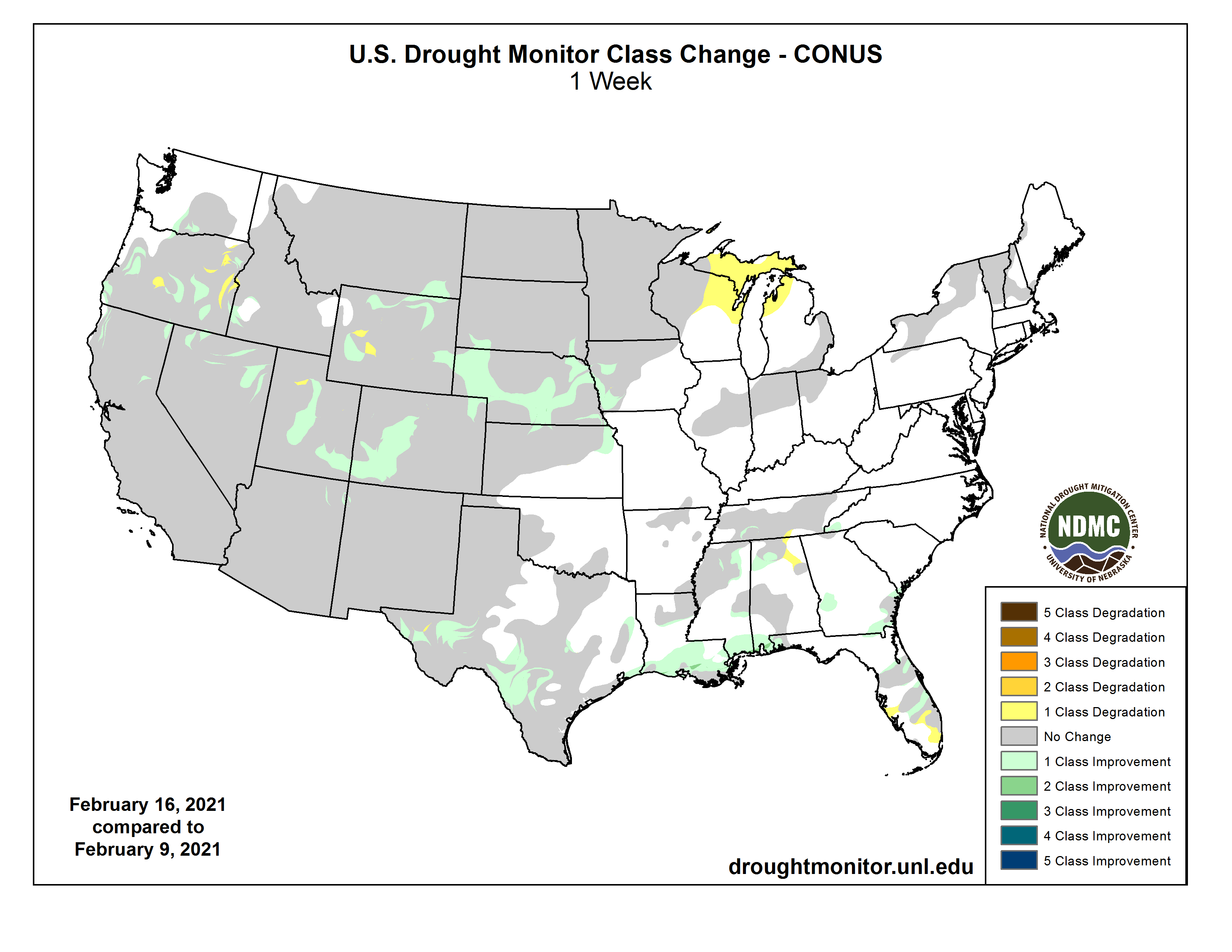
US Drought Monitor one week change map ending February 23, 2021.
During deep freezes, our crews keep on fixing, plowing, ice breaking, measuring, sampling and caretaking.
Cold weather makes for harder work, so when we experienced one of the coldest weeks of the last 30 years Denver Water crews did just that: worked harder.
Last week dam supervisors, water quality trackers and pipe fixers pushed right on through the artic blast to keep the water stored, safe and moving in our system amid the harsh elements that wreaked havoc on so many across the country.
A challenge many homeowners also faced as personal pipes froze and broke as the polar plunge ensued.
Here’s a photo journey highlighting some of our dedicated and can-do colleagues doing their part to blow kisses at the Winter Warlock:
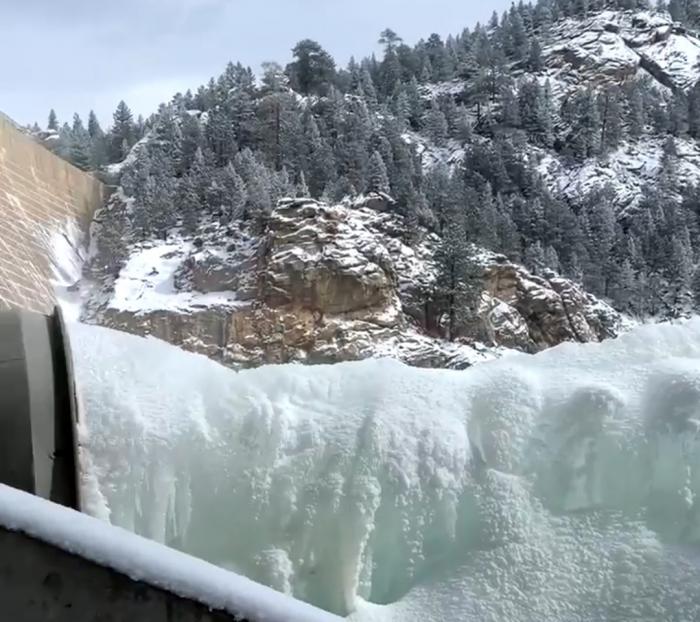
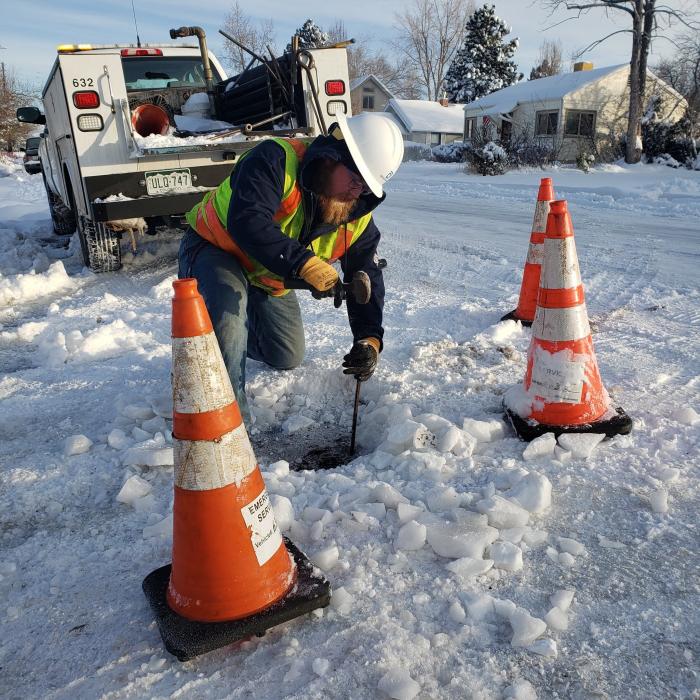
Frosty valves at dams make for a laborious day of icebreaking
On those super-cold weeks like last week, it’s common for ice to build up around valves. That means dam workers need to spend hours breaking ice off the valves, otherwise they could be damaged during operation. Said Andy Skinner, dam supervisor at Gross Reservoir: “I broke the ice away from a valve at night, and it was covered again just a few hours later. At these temperatures, it’s a twice-a-day operation.”
Denver Water staff work through the elements, like recent below zero temperatures, to ensure 1.5 million people continue receiving the high-quality drinking water they expect. Photo credit: Denver Water.
Emergency Services – It takes tough folks to find and stop the flow when a water main breaks in frozen temperatures
Members of Denver Water’s Emergency Services team, like Keegan May in this photo, are the utility’s first responders. They help shut off the water so crews can start their work to repair pipe breaks. (Read, “Breaking point: Temperature swings tough on water pipes,” to learn more about how the ups and downs of winter weather in Colorado impact water mains across Denver.)
But turning off the water flowing through underground pipes can be much more complex than shutting off the water in a house.
This image shows May, a utility tech at Denver Water, working through inches of ice created by below-freezing temperatures to find a shut-off valve.
Keegan May, utility tech at Denver Water, chisels through inches of ice to access a water shut-off valve during a water main break. Photo credit: Denver Water.
On this cold, winter day in 2019, once the cover was located, Denver Water’s crew chiseled through the ice. Then they used a mallet to loosen the cover. Only then could they access the underground shut-off valve to stop the flow of water and begin to make repairs.
Clean water – critical year-round
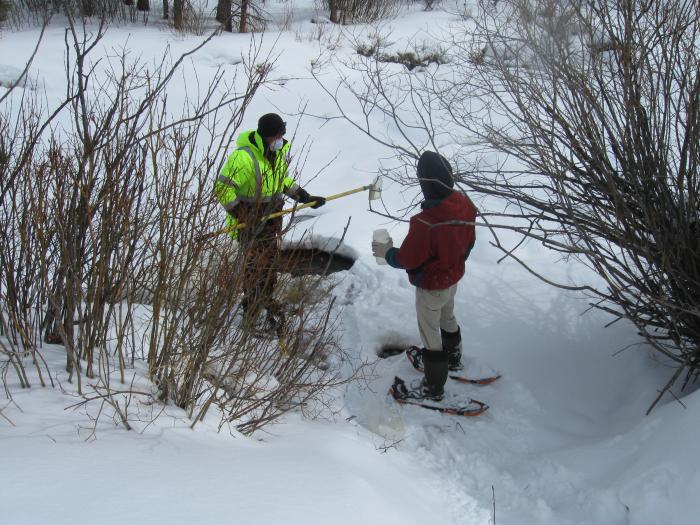
Thirty inches of snow and finger-freezing temps don’t stop our field crews from their appointed rounds. Last week a crew from Water Quality Operations gathered their monthly water samples on the Williams Fork River northeast of Silverthorne.
One tributary stream was frozen over, so Nick Riney smashed through it with his shovel and worked with his colleague Tyler Torelli to scoop out water samples for testing, including assessments they conducted in the field using analytical equipment they set up on the back end of a Sno-cat. All this effort helps Denver Water understand what’s happening on the landscapes across 4,000 square miles of watershed and keeps the utility informed about any changes in high country water chemistry that we’ll be collecting, storing and ultimately cleaning to our high standards before distributing through the metro area.
Each year, Denver Water collects more than 35,000 samples and conducts nearly 70,000 water quality tests. These efforts continually confirm that your drinking water is safe and meets or exceeds federal and state requirements. Photo credit: Denver Water.
Surveying the snow
Our crews also strap on the snowshoes for frequent high elevation treks to take snow measurements, part of our multi-pronged efforts to get a read on the snowpack levels in our collection system in preparation for spring runoff.
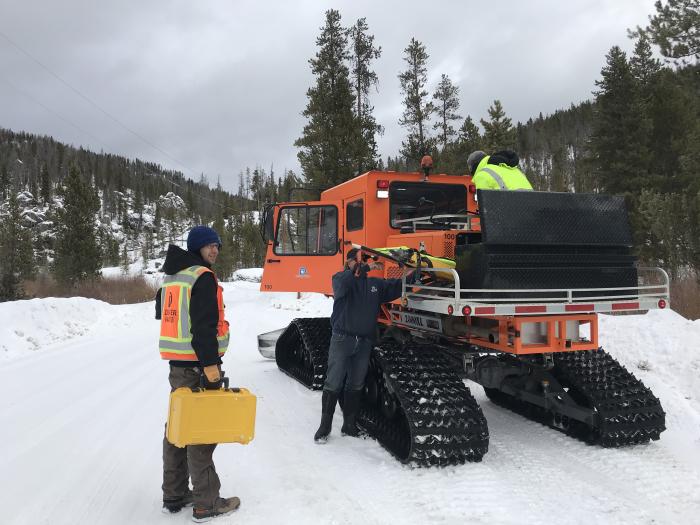
Our surveying team braves the cold as well, heading to all points of our system to get elevation readings for a wide variety of projects, including recalibrating gauges at remote reservoirs. Pictured here was a Sno-Cat trip our surveyors took just a year ago to Meadow Creek Reservoir northeast of Fraser.
Matt O’Malley, Denver Water survey technician, prepares to set up survey equipment near Meadow Creek Reservoir. Photo credit: Denver Water.
Running the plows to keep everything running
Denver Water facilities from the mountains, to the foothills and plains all need to keep the roadways open so workers can do their thing unblocked 24/7.
One of many challenging plowing jobs can be found at Strontia Springs Reservoir where staff not only has to keep clear the 6.5-mile service road that is Waterton Canyon, they need to plow the feeder roads leading to the dam – and the top of the dam itself.
Plowing a 660-foot path across top of the dam is not for anyone with a fear of heights. The dam is 299 feet above the river. Slow and steady is the name of the game as there is no room for wrong turns or slipping.
And sometimes it’s just overcoming the cold itself
One of the coldest spots in Colorado and, indeed at times, the country: Antero Reservoir, on the high South Park plain, near Fairplay. Twice in the last two years, the site has drawn media attention for its bone-grinding readings around 50 below. Two caretakers save their inside work for those dates, but can’t avoid the daily duties outside, when as one of them, Eric Hibbs, puts it, “you can just see the cold, settled in there.” What does he do in face of Yukon-like conditions? “Put on a little heavier jacket.”
And sometimes it’s just overcoming the cold itself One of the coldest spots in Colorado and, indeed at times, the country: Antero Reservoir, on the high South Park plain, near Fairplay. Twice in the last two years, the site has drawn media attention for its bone-grinding readings around 50 below. Two caretakers save their inside work for those dates, but can’t avoid the daily duties outside, when as one of them, Eric Hibbs, puts it, “you can just see the cold, settled in there.” What does he do in face of Yukon-like conditions? “Put on a little heavier jacket.” Photo credit: Denver Water
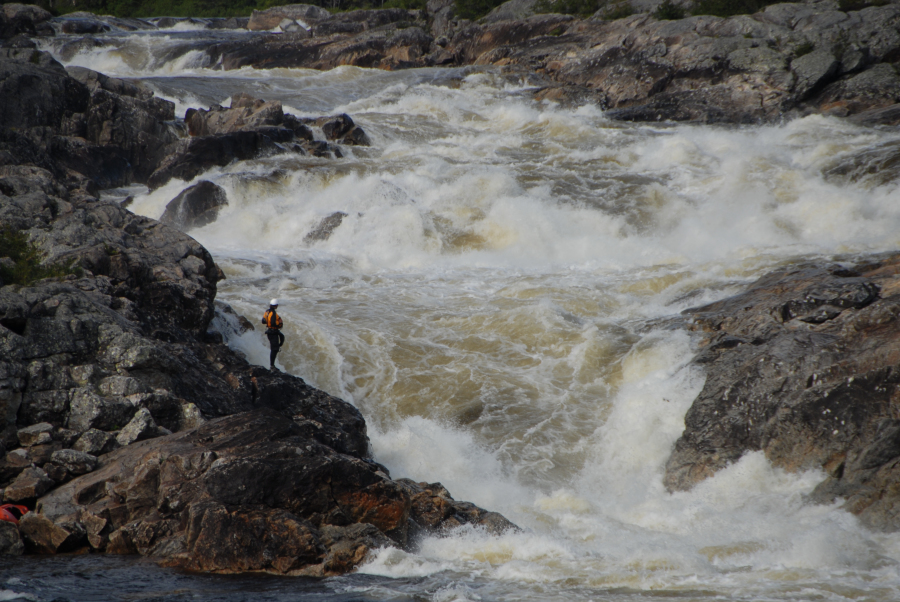
A famous whitewater river in northern Quebec is the first place in Canada to be declared a person, legally speaking, under a new environmental strategy that’s taken off in some other countries.
The Magpie River in Quebec’s Cote-Nord was given legal personhood through twin resolutions by the local Innu council and by the local municipality of Minganie.
That united front, along with the river’s fame, makes it a “perfect test case” in Canada for the idea, according to a Montreal organization specializing in this legal tactic.
As a legal person, the river has nine distinct rights and the possibility of having legal guardians, said the groups in a joint press release…
The idea of treating parts of nature—places or animals—as persons under the law has become increasingly popular in some places, particularly in New Zealand, where Maori groups and that country’s federal government have together created the new status.
In one example, in 2017, New Zealand’s parliament passed legislation declaring the Whanganui River a legal person in the first-ever such case in the world.
It recognized the river, which is almost exactly the same length as the Magpie, as an indivisible, living being and conferred upon it the same rights and responsibilities as a human being.
The act also ended a long-running claims process between the government and Maori.
“It’s a shift of paradigm,” Yenny Vega Cardenas, one of the project’s leaders, told CTV News.
Cardenas is the president of the International Observatory on the Rights of Nature (IORN), which is based in Montreal and drafted the legal resolutions along with the rest of the group.
The idea isn’t just granting rights or protecting the river for future generations, she said, but “recognizing that… we are not the masters of the universe, over nature,” but that the relationship between humans and their environment is far more complicated and intertwined, she said.
The other countries where the strategy has been most used, other than New Zealand, are Ecuador and the U.S., she said.
The U.S. is also the one place where a high-profile effort recently failed: the town of Toledo passed a resolution declaring Lake Erie a person, in order to help them create stronger protections for the lake after toxic algae made the water undrinkable for a period in 2014.
A federal court struck down that resolution last year, saying it was too broad.
The river, almost 300 kilometres long, is famous for a series of rapids that have made it an international destination for whitewater enthusiasts—National Geographic ranked it among the world’s top 10 whitewater rivers.
But that same energy has also put it on the radar of Hydro-Quebec, the province’s state-owned energy corporation that has harnessed huge swaths of northern Quebec and its powerful rivers for hydroelectricity.
There is already one generating station on the Magpie, opened in 2007 by Hydro-Quebec and then sold in 2013 to smaller renewable energy company Innergex, which now owns it in partnership with the Minganie municipality.
However, Hydro-Quebec has shown interest in the river since then, including the river in its strategic plan about a decade ago and sparking a long battle over the idea of new dams on the river. Hydro-Quebec plans abandoned those plans in 2017, saying it didn’t need the extra energy.
In their press release, the groups involved said that their recent move is new way of trying to secure long-term protection for the river, given its appeal for energy producers.
The need to protect the river “has received regional consensus,” the groups wrote, “but the plan to declare the river a protected area has been thwarted for years by state-owned Hydro-Québec, due to the waterway’s hydroelectric potential.”
Hydro-Quebec told CTV that they have indeed “identified it as a river with potential,” and they would like to keep options open to be able to use it for hydropower, but there’s no simmering conflict over it right now.
“We understand that these people made a clear statement about their intention to protect this river,” said Hydro-Quebec spokesman Francis Labbé…
The leader of another Quebec environmental group said the personhood move comes after foot-dragging by the province.
It’s “a way for us to take matters into our own hands and stop waiting for the Quebec government to protect this unique river,” said Alain Branchaud, director of the Quebec chapter of the Canadian Parks and Wilderness Society.
Traumatic as the recent Siberian Express was for some regions of the country, a bigger concern to Colorado State Climatologist Russ Schumacher is the increasing frequency of extreme temperature swings that have hit the state recently in late spring and fall.
“If something like this is going to happen, this is the time we would expect it,” he said of the recent arctic surge that plunged all the way to the Gulf Coast with disastrous consequences.
“We had one of these in 1989,” he added during an appearance at the Colorado Fruit and Vegetable Growers Association annual conference. “They are rare, but they do happen periodically.”
More worrisome to him are the cold outbreaks that have occurred in months like April and October.
“The last two years we’re had some incredibly unusually cold outbreaks in late October, which are very bad for wine grapes among other things,” Schumacher said. “Something similar to that is the big freeze last spring that devastated the peach crop. These are a little harder to sort out in terms of what’s happening, because they are happening amid really warm years.”
He’d like to have a better understanding of why the state has seen single digit temps in October, which he called “a really exceptional thing.”
“We are trying to get better answers as to how things might be changing in a changing climate,” Schumacher said…
Shots of extreme cold are not unexpected at this time of year, [Brian] Bledsoe said. However, the problem is crops like winter wheat that are already stressed by drought are more vulnerable to injury…
Both experts said the drought’s grip was not likely to ease for several more months…
The current La Nina has deviated a bit from its usual pattern, the forecasters said, but now appears to be settling in and creating a stronger signal.
Art Douglas, professor emeritus of atmospheric sciences at Creighton University, has described it as a “rebounding La Nina,” which he has said can be particularly calamitous for significant portions of the U.S., including the Corn Belt.
Bledsoe’s forecasting models showed drought persisting across Colorado and spreading east and north across the Central Plains through the spring, with little sign of relief until August at the earliest…
To this point, it’s the southern mountains that have picked up more winter precipitation, Schumacher observed, but that will likely change…
Speaking as part of a water and weather panel that concluded the CFVGA meeting, deputy state water engineer Tracy Kosloff said the Rio Grande Basin was winning the snowpack lottery so far this year, while further to the south and west, the situation is dire…
Stream-flow forecast for the Upper Rio Grande is 107 percent of normal, with snowpack close to normal. But stream-flow forecasts in parts of extreme southwestern Colorado are as low as 38 percent of normal, with snowpack currently at 86 percent of normal…
This map shows the snowpack depth of the Maroon Bells in spring 2019. The map was created with information from NASA’s Airborne Snow Observatory, which will help water managers make more accurate streamflow predictions. Jeffrey Deems/ASO, National Snow and Ice Data Center
Mountain precipitation, critical for irrigation and reservoir recharge, is so important in Colorado that resource managers and planners are looking to boost information beyond what snow telemetry stations and stream-flow gages can provide. During the CFVGA meeting, Laura Kaatz, a project organizer with Denver Water, discussed the airborne snow observatory project, or ASO, a new flight program aimed at adding high-resolution snow depth imagery to the mix of tools.
Such imaging would detail exactly how much snow is still left in the higher elevations at a specific point in time.
Among them: when should flights occur? What will the data look like? Who houses it and how is it maintained and shared? What value does it have?
A large coalition of industries and agencies are involved in the project and have already identified numerous potential applications, she said, from flood control to road maintenance to recreational applications.
A working group is meeting monthly to discuss how best to advance the project, Kosloff said.
The city of Thornton is building sections of a water pipeline in northern Colorado despite Larimer County’s decision to deny a building permit…
Crews are working on the pipeline this week in Windsor. About five miles of pipeline is already in the ground, according to officials…
The dispute with Larimer County is centered around how Thornton will move that water south to its residents…
Thornton Communications Director Todd Barnes released the following statement to CBS4:
“We are certainly disappointed and disagree with elements of the Larimer County District Court’s decision. Although, we agree with the court’s decision that the commissioners exceeded their authority to require any consideration of a non-pipeline alternative such as sending Thornton’s water down the Poudre River. Thornton was hopeful to move forward in Larimer County with the process of bringing the quality water Thornton owns via pipeline to our residents. We remain committed to ensuring the people of Thornton get the water they own and after taking sufficient time to review the judge’s decision we will determine our next steps.”
FromThe High Country News (Nick Bowlin) [February 24, 2021]:
Water availability is going from bad to worse in the seven states that rely on the drought-stricken river.
Southern California farmers spend their winters watching the snowpack in the Colorado Rockies, and what they see is the climate crisis hitting hard. When it melts, the snow that falls on these peaks will, eventually, make its way into the Colorado River, which connects the Southwest like a great tendon, tying the Continental Divide in Colorado to Southern California’s hayfields, where the Imperial Irrigation District is one of the country’s largest, and pouring from the faucets of urban users in Los Angeles and San Diego.
From California’s perspective, the view upriver is not encouraging. More than half of the upper part of the river basin is in “exceptional drought,” according to the U.S. Drought Monitor, while the Lower Basin is even worse off: More than 60% of it is in the highest drought level. In January, water levels in Lake Powell, the river’s second-largest reservoir, dropped to unprecedented depths, triggering a drought contingency plan for the first time for the Upper Basin states of Colorado, Wyoming, Utah and New Mexico.
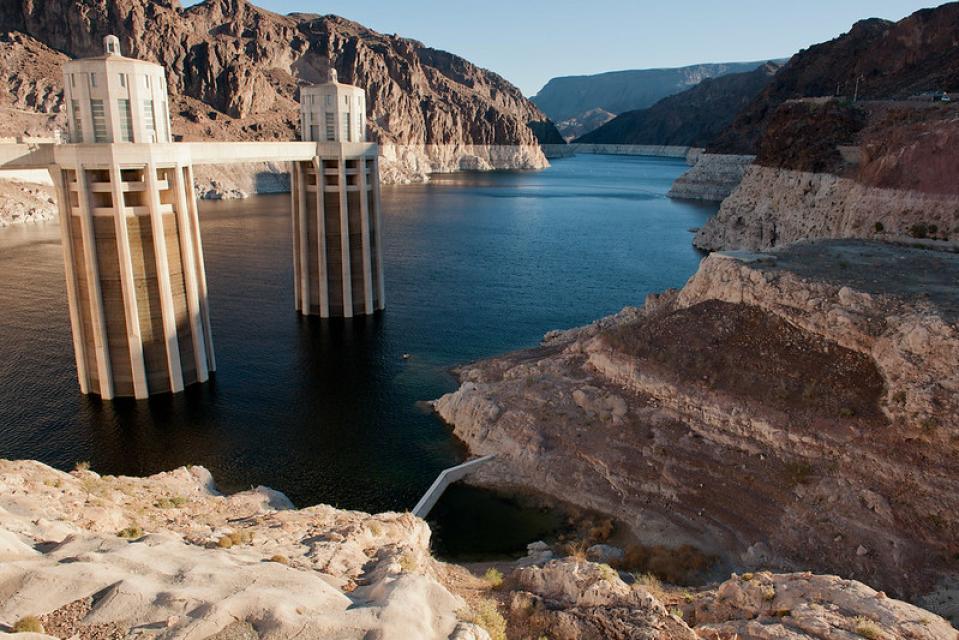
In a photo from 2020, a distinct line around the rocky shore shows how much the water level has decreased in Nevada’s Lake Mead. Photo credit: Roberto (Bear) Guerra/High Country News
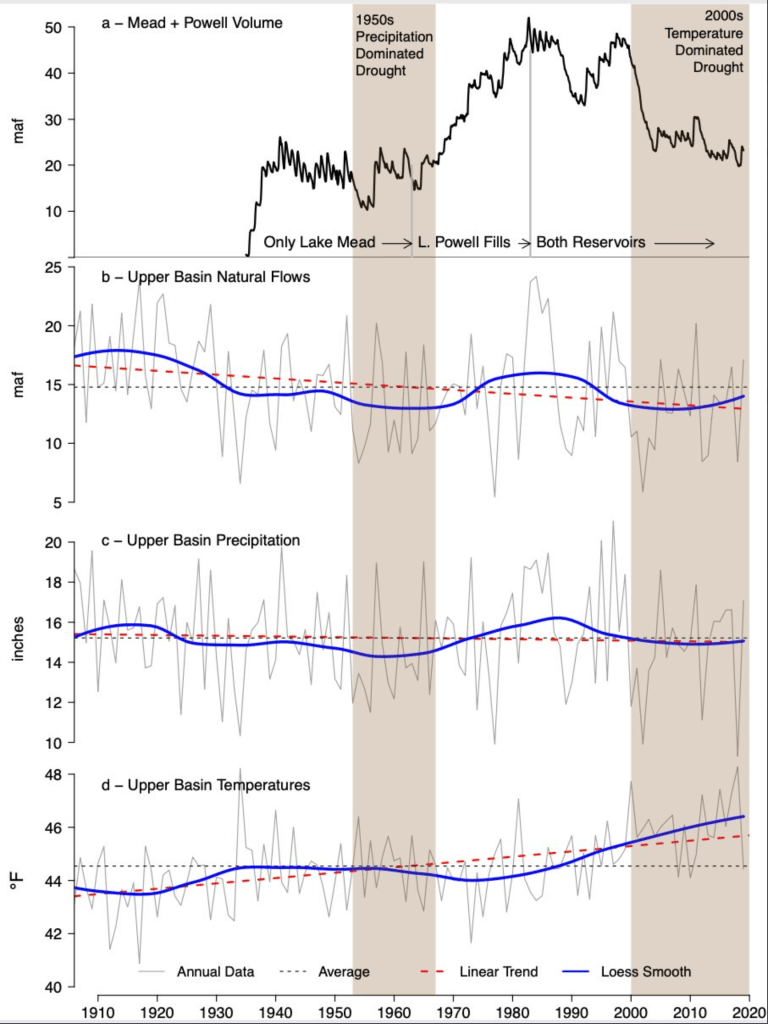
Since 2000, the Colorado River Basin has seen a sustained period of less water and hotter days. This is, as climate scientists like to say, the “new normal.” But within this new normal, there have been exceptional drought years. One of them was 2020. Last year began with an encouraging snowpack in the Colorado Rockies. But a warm spring followed, and, then the seasonal summer monsoons never came to drench the Southwest. The lack of precipitation persisted into the fall and early winter, leaving the basin in a condition dire enough that water policy wonks — not a crowd known for melodrama — have begun using words like “scary” and “terrifying.”
“In the 20th century on the Colorado River, nature was bent to human will,” the study stated. “Because we are now fully consuming its waters, and inflows are expected to decline, in the 21st century humans will be forced to bend to the will of nature.”
The current version of the Colorado River Compact — the legal agreement that governs the river — expires in 2026. It will be renegotiated over the next several years amid a patchwork of interests, including seven Southwestern states, myriad agricultural districts, the Mexican government, some of the nation’s fastest-growing urban areas, including Las Vegas and Phoenix, and many tribal nations, whose legal claims have historically been discounted. A compendium of policies, historic water rights, court rulings, laws and agreements, the Colorado River Compact allocates water for tens of millions of people and some of the most important agricultural regions in the country. The impending renegotiation will determine how that water is distributed as the demand for water outstrips the river’s dwindling flow. Meanwhile, according to numerous models, the impacts of climate change will only intensify. A recent study from the Center for Colorado River Studies predicted that the Lower Basin states of California, Nevada and Arizona could be forced to reduce their take from the river by up to 40% by 2050.
“It’s a red alert,” said Felicia Marcus, a fellow at Stanford University’s Water in the West Program and former chair of the California State Water Resources Control Board. “Everyone knows the red alert is ringing, and we’ve known this is coming for a long time.”
OF ALL THE VARIOUS METRICS available to measure this challenge, storage capacity at the Colorado River’s important reservoirs is one of the most useful. In January, a study by the Bureau of Reclamation estimated that Lake Powell could dip below a crisis threshold by 2022.
This forecast is not the most likely one, but the study triggers a drought-planning process — an acknowledgement that the worst-case scenario could come to pass for one of the country’s most important water storage sites. In 2019, Lake Mead, the largest reservoir in the U.S., hit its own version of this threshold, which led Arizona, Nevada and Mexico to voluntarily limit their Colorado River water use for the first time ever. Put together, both Mead and Powell are on track to reach their lowest recorded levels ever in 2021, KUNC reported. Water levels in Mead and Powell languish at about 40% capacity, according to the most recent figures.
This future complicates the amalgamation of treaties, policies, laws at various levels of government, court decisions and agreements that make up the governance of the river, stretching all the way back to the 1922 Colorado River Compact, the original interstate agreement. To give just one example, the Upper Basin states have long planned increased water use — water that the over-allocated basin can’t afford — thereby increasing the likelihood, according to the study, of a situation where the Lower Basin states would not receive their fair share of water. The result would be a “call” on the river, with the Lower Basin states demanding more water and legally mandated cutbacks for more junior water users higher on the river, including the city of Denver. The ensuing legal fights would be ugly.
This grim future hangs over the next several years, as both the Upper and Lower Basin states renegotiate the Colorado River Compact [ed. the parties to the Colorado River Compact are not renegotiating the compact] and work to reduce the water they use and keep crucial reservoirs filled. But these negotiations are difficult and political, with self-interest competing against the need to do right by the basin as a whole. Meanwhile, sensing profit in scarcity, Wall Street and hedge funds are pushing to privatize Colorado River water and allow markets to trade the resource as a commodity, according to a recent New York Times investigation.
The problem with vast water negotiations like the Colorado River Compact, said Marcus, the Stanford water policy expert, is that every entity, from governments down to people watering their lawns, come to expect the current amount of available water — even if that availability is an outlier or set to change. “Farmers can’t expect that they can plant whatever they want or not expect water to be expensive,” she said. “Urban areas need to get way more efficient, people need to ditch way more lawns.”
Nick Bowlin is a contributing editor at High Country News. Email him at nickbowlin@hcn.org.
A majority of Colorado voters believe the state should spend more money on protecting and conserving its water resources, but they’re not willing to support new state taxes to fund the work, according to a series of bipartisan polls conducted over the past 18 months.
“Roughly 55 percent of voters said the state should spend more money,” said Lori Weigel, a pollster and principal with the firm New Bridge Strategy.
Though the polling also showed some support for such potential tools as a new statewide tourism tax or a bottle tax, that support eroded quickly when likely voters were asked about a new statewide tax, with 39 percent of likely voters saying they were skeptical the state could be trusted to spend the money wisely, Weigel said.
Her comments came Tuesday at a meeting of the Inter Basin Compact Committee (IBCC), a statewide group charged with helping develop consensus-based solutions to the state’s water issues, including funding.
The bipartisan polling was conducted before and after the elections of 2019, when Colorado voters narrowly approved a sports gambling tax whose proceeds will help fund the Colorado Water Plan, and again before and after the elections of 2020. In those contests voters in the Glenwood Springs-based Colorado River District, and the Longmont-based St. Vrain and Left Hand Water Conservancy District overwhelmingly approved new taxes for local water projects.
Funded by For the Love of Colorado, a nonpartisan coalition that includes environmental groups, water utilities and industry groups, the polling was designed to help policy makers and lawmakers decide how best to raise an estimated $3 billion over the next 30 years to help cities and farmers cope with looming shortages, while ensuring streams have enough water for fish and kayakers.
That’s the amount of money estimated to be needed from new sources to fully fund the Colorado Water Plan. But to date, lawmakers and other sources have only been able to provide between $5 million to $30 million annually. And though the new sports betting tax is likely to bring in $6 million to $11 million dollars annually, it will still fall short of the needed revenues.
State officials hope to build on the recent modest, but still significant, 2020 election wins to create a more stable, permanent source of funding.
“For the first time in a long time we’ve had success,” IBCC Chair Russ George told the group on Tuesday.
But the wins and the recent polls show the state must build broad coalitions and work harder to dispel distrust among voters over how any new statewide tax revenues would be spent if they were approved, officials said.
Aaron Citron, a member of the IBCC and a policy analyst with The Nature Conservancy, said the funding shortfall is likely to become more dire without a permanent statewide funding source because traditional sources, such as oil and gas tax revenues, are plummeting as production declines.
“The situation is likely to get worse,” Citron said. “Yes we should emulate what was done so successfully in the Colorado River and St. Vrain districts and figure out how to build that [statewide] trust. It’s possible but it’s going to be tough.
“The assumption [when the Colorado Water Plan was being developed] was that we would be able to have severance tax revenues into the future. But we can expect them to continue to be unstable and continue to decline because of global market pressures, and state and federal greenhouse gas and renewable energy goals,” Citron said. He was referring to state commitments that call for oil and gas and fossil fuels to gradually be replaced with cleaner energy sources, a process that will phase out oil and gas production and the associated tax revenue it generates.
Andy Mueller, general manager of the Colorado River District, said voters in his district were willing to raise their property taxes last fall to help fund local water projects, but there was no local support for using those new taxes to make up for missing state funds.
“The state has an obligation to fund water projects,” Mueller said. “This is a much bigger issue at $100 million a year than the $4.2 million my district was able to raise. It doesn’t get us anywhere if it can’t be leveraged against additional state and federal funding.”
Jerd Smith is editor of Fresh Water News. She can be reached at 720-398-6474, via email at jerd@wateredco.org or @jerd_smith.
The “bathtub ring” at Lake Powell evidences lower flows coming into the reservoir. According to preliminary data from the Bureau of Reclamation, the total inflow into Lake Powell for the 2020 water year was about 6 million acre-feet, just 55% of average. Photo credit: Brent Gardner-Smith/Aspen Journalism
From American Rivers (Sinjin Eberle and Page Buono):
Over the last few weeks, we’ve focused our attention on the recent study published by the Center for Colorado River Studies about the future of the Colorado River, given some alarming new data synthesized by the Center. You’ll likely recognize the authors—Kevin Wheeler, Jack Schmidt, Eric Kuhn, Brad Udall and others—who are no strangers to ongoing dialogue about the river. In our first post, we covered the broad takeaways, the potential ramifications of the study’s finding on water management in the West, and on the importance of the inconvenient science it elevates. In the second post, our “Changed River” edition, we let the line “The Colorado River has been profoundly altered from its highest reaches to its delta” percolate and came out even more committed to the preservation of the river and inspired to consider and address new challenges revealed by the study that will demand even more aggressive action on behalf of the river.
In this, our “Climate & the River” edition, we’ll highlight findings from the study that underscore how important it is that, as we look to the future, we model future hydrology not only by understanding the past, but by looking ahead to the impacts of back-to-back and longer-term droughts paired with warming temperatures that precipitate aridification. As climate scientist Brad Udall likes to say, it’s a “hot drought,” where warmer temperatures are leading to less water in the river, even if precipitation is actually remaining roughly the same.
December 4, 2015 Credit: Sinjin Eberle UT, Lake Powell
The stakes of including, or ignoring, the likelihood of a hotter and drier future in our decision making are high. Authors open their study with this quote for a reason:
“The likelihood of conflict rises as the rate of change within the basin exceeds the institutional capacity to absorb that change.” Wolf, A. T., S. B. Yoffe and M. Giordano (2003).
If you’re eager for the takeaways, you can skip to the bottom of this post. If you’re curious about how they arrived there, and why, read on!
The assumptions we make to inform future management are critical, and when it comes to predicting future hydrologic conditions that answer the questions: “How much water will be available? In what form? And when?”, it is irresponsible not to model and plan—to the greatest extent possible—for the conditions climate science predicts.
Shot of the North Fork of the Gunnison River, Paonia, Colorado. Photo credit: Sinjin Eberle
To that end, the authors compiled diverse sets of data to represent a range of past and future conditions and applied them to the management alternatives that we highlighted in the first blog of this series. The findings of their analysis underscore discrepancies between projections that look solely to the past, those that ground themselves in recent hydrologic regimes, and those that forecast to the future based on various climate projections.
Currently, the Bureau of Reclamation utilizes two different hydrologic model sets, one called the Direct Natural Flow (DNF) and the other called Stress Test hydrology. Each model is derived from the average flows across different periods in history. The DNF model relies on estimated natural flows from 1906-2018. Authors of the study point out that this 113-year period includes what’s referred to as the “20th century pluvial period” from 1906-1929, an unusual, bountifully wet period, from a hydrologic perspective. According to Udall, the patterns represented by the DNF data are unlikely to re-occur in current management timeframes. The Stress Test hydrology skips this period and jumps to a 31-year range between 1988-2018, which includes both high flow years, and years of drought beginning in 2000 – what the authors refer to as the ongoing “millennium drought.” In addition to those, authors integrated or developed the following forward-looking data sets:
Graphic credit: American Rivers
Now, if that looks super technical, it’s because it is! These detailed and diverse data sets allowed the authors to model unique scenarios, including three different scenarios of extended drought, all of which have occurred in the past, and for decreases in runoff associated with the anticipated effects of aridification. They chose these hydrology sets to test alternative management strategies under long periods of low runoff, and the kind of runoff we might see under increasingly warmer temperatures, both of which the authors describe as “…plausible futures that should be considered in planning purposes.” The range of futures hydrology predict average flows at anywhere from 14.76 million acre feet (maf), the flows modeled under the DNF hydrology scenario, and down to 9.71 maf a year under the RCP 8.5_100 data set.
The authors integrated these hydrologic scenarios alongside multiple scenarios for consumptive use and management in an attempt to better understand possible future impacts to the Colorado River, and those who depend on it. As the study points out: there is more work to be done here, and the authors hope this inspires future studies that imagine more management scenarios. But even though they aren’t comprehensive, the overall observations the authors make after running these scenarios are prescient, and compelling.
In a nutshell, the authors state that “climate change is causing flow declines, and additional declines are likely to occur,” and point to the following as both evidence and inspiration for more creative thinking as we plan for the future:
Between 2000-2018, flows in the Colorado River were approximately 18% less than from 1906-1999.
The ongoing drought and low-flow years that we’ve seen since 2000 are, quite likely, not going away any time soon. And even they may not be accurate representations of the future because as temperatures rise and catalyze further aridification of the region, more dramatic declines in flows are likely.
Given the unpredictability of the future paired with the immense likelihood of less, not more water, is it incumbent upon water managers and users to plan and think proactively and creatively.
The DNF hydrology predicts approximately 2 maf/year more than we’ve seen the last 20 years, while the RCP 8.5_100 hydrology predicts nearly 3 maf/year less than we’ve seen in the last 20 years. As Udall says, that 5 maf range is, frankly, enormous.
Authors warn that these conditions paired with unrealistic aspirations for development of future flows will “result in a difficult, basin-wide reckoning.” Incremental tweaks to the management of the river may no longer work, and the study calls upon us to think now about a drier future, not to wait until we’re there. And perhaps to acknowledge that, in many ways, we already are.
From Centennial Water via The Highlands Ranch Herald:
Fourteen Front Range water utilities met this month to collaborate about the locally dry conditions and the potential drought situation ahead. Centennial Water & Sanitation District — the water and wastewater provider for Highlands Ranch and Solstice — was at the table, according to a news release from the district.
“The Drought Coordination Group reconvenes when drought conditions worsen, as determined by the U.S. Drought Monitor,” said Swithin Dick, water resources administrator for Centennial Water, according to the release. “The objective is to coordinate and offer cooperation around local water utilities sharing ideas, tools and messaging.”
Colorado Drought Monitor February 16, 2021.
According to the latest drought monitor (http://droughtmonitor.unl.edu/), released [February 16, 2021], Douglas County is currently experiencing exceptional drought conditions. When looking at Colorado, the entire state is experiencing some level of drought from moderate conditions to exceptional, according to the release.
“As part of our annual planning we look at our water resources including water storage in reservoirs, groundwater supply, and estimating potential runoff from snowpack,” said Dick, according to the release.
Centennial Water’s storage capacity is below average going into March. Over the last five years the district’s average at this time of year has been 8,489 acre feet and it is currently at 5,750 acre feet. To put that in perspective, the average demand annually by Centennial Water customers is 16,500 acre feet.
“April is when we find out where we are at,” Dick said in the release. “Things do not look good at this point. We are beginning to plan now for a low runoff year, which puts us on a drought watch.”
Centennial Water relies on spring precipitation and runoff to boost its water storage, but the reality is that might not come this year, according to the release.
“Centennial Water staff are working diligently in case the dry conditions continue,” said General Manager John Kaufman, according to the release. “We are in a drought and we are taking steps now in anticipation of a dry summer. We are asking customers to start conservation planning and taking steps at home to use water more efficiently.”
Small things that can be done at home include checking for leaks throughout the home and being patient with outdoor watering, according to the release.
“Water budgets for outdoor irrigation begin in April; there is no reason to turn on irrigation before then,” added Kaufman, according to the release.
Water conservation tips, information and the latest news from Centennial Water are available through the monthly Water eNewsletter. To sign up, customers can send an email to info@highlandsranch.org.
Here’s the good news: February was a good month for snowfall in the area. Here’s the bad news: It wasn’t enough to break us from our current drought conditions.
A more-snowy February managed to provide a good bit of catch-up moisture to local snow measurement sites. The “snow water equivalent” at those sites is currently close to normal, as measured by 30-year median snowfall.
But heading into March and April, the area’s snowiest months, it’s easy to fall behind.
For instance, the Feb. 18 snow water equivalent on Vail Mountain was at 89% of normal. Even after a cool weekend with some snow, the Feb. 22 figure had dropped to 86% of normal.
Diane Johnson, a spokesperson for the Eagle River water & Sanitation District, said at least some snow needs to fall just about every day for the snowpack to keep up with normal levels.
The Feb. 22 “snow water equivalent” on Vail Mountain was 86% of the 30-year median. That isn’t enough to break us out of the current drought. Graphic credit: Eagle River Water & Sanitation District
The winter of 2020-2021 is so far better than the record-low season of 2011-2012. That year, the snowpack peaked on March 4. The usual peak in the area comes April 25. A warm March and April also quickly evaporated Vail Mountain’s snowpack in 2012, which at the measurement site was gone by the first week of April.
Little help on the horizon
While this season is at least close to seasonal norms at the moment, there may not be much help coming in the immediate future…
To break our current drought, snowfall and cold temperatures will need to be sustained “over a long period of time.” That isn’t in the forecast.
The National Weather Service Climate Prediction Center’s 30-day forecast, issued Feb. 18, is calling for both above-average temperatures and below-average precipitation for Colorado…
That long range forecast has Johnson concerned.
“We’re preparing for drought this summer,” Johnson said, adding that the district is urging its customers to invest in efficient irrigation systems and outdoor plants that don’t require much water.
“Of course we’re stoked for the snow, but it just doesn’t change the trajectory of this year right now,” Johnson said.
Assistant State Climatologist Becky Bolinger is also concerned about this year’s snowpack.
“We need above average peak snowpack to start chipping away (at the drought),” Bolinger said. Current snowpack is better than it was, she said, but it’s “unlikely” we’ll see the kind of recovery needed.
Almost as important as the snowpack itself is the moisture content of the ground covered by that snow.
Dry soil hurts streamflows
In the spring, soil moisture is the first thing replenished by melting snow. Thirsty ground means less runoff for streams. That means less water flowing to reservoirs and for those who irrigate crops. The Eagle River Valley relies mostly on streamflow for domestic water supplies.
Bolinger added that complicating the deficit in soil moisture has been a four-year stretch in which the area’s summer monsoon rains in July and August haven’t developed. Those rains help keep the ground moist and help maintain streamflows.
Losing those monsoonal rains has also dried out plant life…
The current pattern has been “painful,” Bolinger said. “It’s going to be a tough year in terms of irrigating, and I’m very concerned about the wildfire season. Keep your fingers crossed for the monsoon.”
The U.S. Senate on Tuesday confirmed Tom Vilsack, a former Colorado State University System special adviser, as the agriculture secretary in the Biden administration.
The Senate voted 92-7 to approve Vilsack’s nomination.
Vilsack joined the CSU System in 2017 as a strategic adviser of food and water initiatives at CSU Spur for the Colorado State University System. He also worked as the global chair for the International Board of Counselors on Food and Water Initiatives.
At his Feb. 2 hearing, Vilsack said he plans to prioritize pandemic recovery and climate change during his term. He also spoke of the importance of racial justice and equity and how he hopes to change the USDA…
This will be Vilsack’s second term as the secretary of agriculture as he held the position for eight years in the Obama White House.
Colorado Springs City Council on Tuesday unanimously approved three years of stormwater fee increases that take effect in July.
Several council members acknowledged the fee increases are needed to make up for the city neglecting to maintain stormwater infrastructure and failing to require developers to meet stormwater standards for years, leading to a recently settled lawsuit that will require stormwater control projects to be built…
Residential fees paid through utility bills are to go increase to $7 per month from $5 per month. Residential rates will then go up to $7.50 per month in 2022 and $8 per month in 2023, according to the approved fee structure.
Commercial properties’ monthly fees will go up to $40.50 per acre per month from $30 per acre. In 2022, commercial fees will increase to $43 per acre per month and in 2023 to $45, the proposal shows. The fees are then expected to remain flat through 2035, said Richard Mulledy, Colorado Springs stormwater enterprise manager.
The fee increases are needed to help cover $45 million in projects required by a consent decree approved in the case brought against the city by the EPA, Pueblo County and the Lower Arkansas Valley Water Conservancy District. The lawsuit stated, in part, that stormwater management in the city was underfunded.
Stormwater fees also must cover $460 million the city is spending over 20 years to build 71 stormwater projects as part of its 2016 agreement with Pueblo County. The agreement was needed to allow Colorado Springs to start pumping water needed to fuel city growth from Pueblo Reservoir through its Southern Delivery System pipeline.
Fountain Creek photo via the Fountain Creek Watershed Flood Control and Greenway District
It’s a picture-perfect scene — the snow-dusted Sandia Mountains providing a backdrop to the dormant willow and cottonwood trees lining the Rio Grande.
While the recent snow has provided a psychological salve to the pains of a persistent drought, it won’t go far in easing the exceptional conditions that have taken hold of New Mexico over the past year.
Every square mile of the arid state is dealing with some level of dryness, with more than half locked in the worst category — exceptional drought. And much of the West is no better off, with parts of Arizona, Utah and Nevada among the hardest hit.
DROP IN THE BUCKET
The problem is the recent storms were accompanied by frigid temperatures and wind, making for a double whammy of sorts. Forecasters explained that snow tends to be drier when temperatures are that cold, so there’s less water content in the snow. The wind then blows it away, leaving patches of bare ground.
Typically, about 12 inches (30.48 centimeters) of snow make for an inch (2.54 centimeters) of water when it melts, said Kerry Jones, chief meteorologist with the National Weather Service in Albuquerque. With colder air, those ratios climb and nearly triple the amount of snow is needed to produce that same inch of water.
That means less water to recharge the soil and less that will find its way into rivers and reservoirs this spring…
A good example can be found on Sierra Blanca, a mountain peak in southern New Mexico. The snow-water equivalent measured there is less than an inch, or about 10% of normal, even after the storms.
Heron Lake, part of the San Juan-Chama Project, in northern New Mexico, looking east from the Rio Chama. In the far distance is Brazos Peak (left) and the Brazos Cliffs (right), while at the bottom is the north wall of the Rio Chama Gorge. By G. Thomas at English Wikipedia – Transferred from en.wikipedia to Commons., Public Domain, https://commons.wikimedia.org/w/index.php?curid=1598784
The Rio Chama basin in northern New Mexico has fared better, but even after the storms it lagged at about 86% of normal. Meanwhile, the headwaters of the Pecos River in the Sangre de Cristo range dropped to just 44% of normal…
DEEPER IN THE HOLE
Many places already were dealing with deficits as winter snowpack and spring runoff have become less reliable in recent years. Add to that a contracting monsoon season.
Summer rains were spotty at best across New Mexico, while the mountain city of Flagstaff, Arizona, marked its second consecutive driest monsoon season on record in 2020.
That means whatever water can be squeezed out of the recent snowfall is likely to be soaked up by the dry soil before it can feed any rivers or reservoirs.
Westwide SNOTEL basin-filled map February 23, 2021 via the NRCS.
The Rio Grande — one of the longest rivers in North America — has been reduced to a trickle as it flows through the town of Bernalillo. Its meager flows follow a year in which municipal, state and federal water managers had to ink sharing agreements to keep it from drying up through the Albuquerque stretch.
HARSH REALITIES
Cities across the West have made exponential progress with conservation efforts over the years, while farmers have been installing drip systems, pipelines and high-tech monitors to eliminate evaporation and waste. Still, farmers and ranchers are preparing for what they call harsh realities as long-term forecasts call for more dry, warm weather.
Along the Pecos River, which supplies farms in New Mexico and Texas, irrigation managers in Carlsbad recently set the allotment for this growing season at one-quarter of an acre-foot of water based on snowpack and expected runoff.
According to district records that go back to 1908, never has the allotment been that low. It came close in 1953 with just over one-third of an acre-foot. An acre-foot equals nearly 326,000 gallons (1.2 million liters) and is enough to serve one to two average households a year.
Phil King, engineering consultant for the Elephant Butte Irrigation District on the lower Rio Grande, said the northern mountain ranges are feeling the effects of La Nina, a weather pattern that results in drier conditions…
HANGING IN THERE
Rough. That’s how ranchers have described current conditions to Megan Boatright, a rangeland ecologist with the State Land Office.
Like ranchers always do, they found a silver lining with the recent storms. While the snow might be too dry to put a dent in the drought, they say at least it has a better chance of soaking in rather than causing runoff and erosion. Boatright said that bit of soil moisture could have a positive effect on cool season grasses sprouting in the spring.
Continued drought has forced many ranchers to sell cattle and reduce their herds as they deal with the cost of supplemental feeding and water tanks and wells going dry.
The State Land Office this week acknowledged the added pressures and low beef prices when it set the 2021 grazing fee. It marks the fourth decrease in as many years.
Rio Grande and Pecos River basins. Map credit: By Kmusser – Own work, Elevation data from SRTM, drainage basin from GTOPO [1], U.S. stream from the National Atlas [2], all other features from Vector Map., CC BY-SA 3.0, https://commons.wikimedia.org/w/index.php?curid=11218868
Here’s the release from the U.S. Department of Interior:
The Department of the Interior today announced additional members of the agency leadership team working to steward America’s natural, cultural and historic resources, and honor our nation-to-nation relationship with Tribes.
“As we work to advance President Biden’s vision for a clean energy future that creates good-paying jobs, protects the environment, and powers our nation, we are thrilled to welcome our newest teammates. The diverse experiences of our staff will help us address the four intersecting challenges that the president has made a priority for his administration: COVID-19, economic recovery, racial equity and climate change — all of which disproportionately impact Tribal communities with whom we have a critical trust responsibility,” said Jennifer Van der Heide, Chief of Staff.
Previous leadership announcements can be found here and here. Interior’s political team proudly reflects the diversity of America, with more than 50% identifying as BIPOC (black, Indigenous and people of color) and 80% as women.
The appointees are listed below in alphabetical order along with their new role:
Shakiyya Bland, Ed.D. – Albert Einstein Distinguished Educator Fellow, Office of the Secretary
Daniel Cordalis – Deputy Solicitor, Water
Nada Culver – Deputy Director, Policy and Programs, Bureau of Land Management
Bryan Newland – Principal Deputy Assistant Secretary, Indian Affairs
Biographies are listed below:
Shakiyya Bland, Ed.D. – Albert Einstein Distinguished Educator Fellow, Office of the Secretary
Shakiyya Bland is an educator, mathematics curriculum designer, and equity leader with more than 10 years of experience. Shakiyya produces culturally responsive instructional strategies to support scholars’ racial and cultural identities as contributors to STEM education. Shakiyya is an educational consultant, Institute for Teachers of Color femtor, BetterLesson, Inc. Master Teacher, KSDE Culturally Relevant Pedagogy Consultant, and Albert Einstein Distinguished Educator Fellow. She has served as a Congressional Policy Fellow for the past seven months in Representative Deb Haaland’s office managing priority issues, conducting research, developing legislation and strategies for legislative priorities, and managing and responding to constituent correspondence.
Daniel Cordalis – Deputy Solicitor, Water
Daniel Cordalis has more than a decade of experience working on natural resource and complex water and land management issues on behalf of Tribal governments and conservation groups. Daniel most recently worked in private practice. He previously was an attorney with Earthjustice, the Yurok Tribe, and clerked for the Colorado Supreme Court and the Native American Rights Fund. After graduating from Rice University, Daniel received a M.A. focused on hydrology and a J.D. from the University of Colorado, Boulder. Raised in southwest Colorado, Daniel is a Navajo Tribal member and lives with his family outside Arcata, California.
Nada Culver – Deputy Director, Policy and Programs, Bureau of Land Management
Nada Wolff Culver most recently served as the Vice President, Public Lands and Senior Policy Counsel at the National Audubon Society. Prior to joining Audubon, Nada was the Senior Counsel and Senior Director for Policy and Planning at The Wilderness Society. Nada began her career in the private sector, working on a variety of environmental issues including energy development and environmental remediation, and was a partner with the law firm of Patton Boggs. She is a graduate of Northwestern University and the University of Pennsylvania School of Law.
Bryan Newland – Principal Deputy Assistant Secretary, Indian Affairs
Bryan Newland is a citizen of the Bay Mills Indian Community (Ojibwe), where he recently completed his tenure as Tribal President. Prior to that, Bryan served as Chief Judge of the Bay Mills Tribal Court. From 2009 to 2012, he served as a Counselor and Policy Advisor to the Assistant Secretary of the Interior – Indian Affairs. He is a graduate of Michigan State University and the Michigan State University College of Law. Bryan enjoys hiking and kayaking the shores of Lake Superior, and is a nature photography enthusiast.
Graphic via Unbottle and Protect Chaffee County Water
Here’s the release from Unbottle and Protect Chaffee County Water (Jennifer Swacina):
Nestlé, the world’s largest corporate water bottler, agreed to sell its North American bulk bottled water business (including the Arrowhead brand) to private equity firms One Rock Capital and Metropoulous. This $4.3 billion dollar sale is an especially ominous development in light of Wall Street’s accelerating interest in water trading.
The sale announcement raises many questions about what this means for communities currently entangled in legal hearings and permit negotiations with Nestle Waters. Will Nestle remain a part-owner of the company? In Chaffee County, specifically, will new owners follow through on permit commitments that Nestle has previously made – yet failed to complete – such as a conservation land easement? Are the buyers aware that Nestle failed to meet the required quota for hiring Chaffee County truck drivers, and that Nestle’s latest proposal includes investing in a truck driver training program through Colorado Mountain College?
“Nestle has not proven to be a good neighbor, and the only thing worse than Nestle, is Nestle operating undercover,” said Unbottle and Protect Chaffee County Water co-founder, Jennifer Swacina. “Our commissioners can, at their discretion, simply vote to deny this permit extension. They have all the ammunition they need.”
Unbottle and Protect Chaffee County Water stands in solidarity with other grassroots organizations in Ontario Canada, Maine, Florida, California and Michigan, who have been ringing the alarm about Nestle and water privatization for years. Joint statements have been released through The Story of Stuff Project:
“Nestlé’s motivation is clear: to shed itself of its responsibility for the plastic pollution and environmental degradation its water extraction and bottling has caused and the damage these scandals have done to their brand and bottom line. It is also clear that a private equity firm, freed of Nestlé’s reputational responsibilities, will seek to cut expenses at the cost of the limited promises its predecessor made regarding environmental sustainability and community benefit. We call on elected leaders, regulators, advocacy groups and the media in Canada and the US to ‘follow the money’ and expose this deal to the highest levels of public scrutiny.”
A recent trio of storms that provided significant moisture to many parts of San Juan County has brought the snowpack up to near normal in the mountains of southwest Colorado for the first time all season.
But it did little to make a dent in the drought that has plagued the area for the last year and a half.
According to the U.S. Department of Agriculture’s summary for the San Miguel, Dolores, Animas and San Juan river basins, the snowpack stood at 89% of normal and 84% of average on Feb. 19. That was a significant step up from just 10 days earlier, when those figures were near 60% and falling rapidly.
Sharon Sullivan, a meteorologist for the National Weather Service bureau in Albuquerque, said those figures were buoyed by storms that left 4 to 5 inches of snow in parts of Farmington, Aztec and Bloomfield from Feb. 12 through Feb. 16.
West Drought Monitor February 16, 2021.
But anyone who takes this as a sign that the drought has been chased away would be well advised to curb his or her enthusiasm. According to the U.S. Drought Monitor, most of San Juan County remains locked in exceptional drought, the worst classification. That includes all but the southwest corner of the county, which is characterized as being in extreme drought, the second-worst category, or severe drought, the third-worst category in the five-tier drought system…
The outlook for significant additional moisture is not promising. Sullivan said the long-range forecast calls for above-average temperatures and below-average precipitation in the area.
San Juan County residents may find some small consolation in the fact that conditions are even worse in other parts of the state. According to the drought monitor, 54.2% of the state is characterized as being in exceptional drought — a condition that can lead to the closure of federal lands for fire precautions, the implementation of burn bans by local governments, the encroachment of bears on developed areas, a change in flight patterns by migratory birds and the absence of surface water for agricultural use, leading farmers to rely on wells.
The state’s southeast corner has been hit the hardest, with two counties — Eddy County and Chaves County — entirely in exceptional drought, and four others — De Baca, Curry, Roosevelt and Lea counties — having only small slivers of their territory escaping that designation. Additionally, most of Lincoln and Torrance counties are in exceptional drought.
Colorado Springs Collection System via Colorado College.
The 25 reservoirs in the Colorado Springs Utilities network of water storage, still have several years of water stored. Another dry year could take a toll.
Snowpack started slow in December and January. “February 1st we were looking at snowpack averages maybe 75 to 78% of average,” said [Kalsoum] Abbasi. In the two weeks since then multiple snowstorms helped make up for low totals. Numbers in the water basins important to Colorado Springs are now at or just below normal. It’s certainly a relief to see those numbers go up the past couple of weeks.”February is when data tracking for the Colorado snow season officially begins. It is off to a good start, but the numbers have to be maintained with more storms through May.
From email from the Colorado Cattlemen’s Association (Phil Brink):
Topic: Ag Irrigation Improvement Projects & Funding Sources
Presenters:
1. Gretchen Rank, Executive Director, Mancos Conservation District
2. Dave (“DK”) Kanzer, Deputy Chief Engineer, Colorado River Water Conservation District
You’ll learn about:
Multi-benefit irrigation infrastructure projects implemented in the Mancos River and the North Fork Gunnison River watersheds.
Types of improvements installed, including in-stream diversions, headgates and screens, flow measurement and ditch lining and piping.
Funding sources used to design and install projects, including state and federal grants.
Lessons learned about managing projects and grants.
Webinar Details: Wednesday, March 10, 2021 at 12:00 pm.
The webinar will be recorded, and will be made available later on the CCA Ag Water Network http://www.agwaternetwork.org for on-demand replay.
To prepare your computer or mobile device in advance: https://zoom.us/download Otherwise, you will be prompted to download and install Zoom when you join the meeting.
Contact: phil@brinkinc.biz or erin@coloradocattle.org for more information.
Editor’s Note: This is Part 2 of a three-part series on the city’s decision on whether to approve the Terry Ranch project. It was originally intended as a two-part series but new information presented after the publication of Part 1 necessitated a third part. Part 1 is available here and Part 3 will publish in Sunday’s Greeley Tribune…
Wood, following the publishing of the first part of this series, connected with the Tribune to share his group’s concerns. Much of what he shared is also found on savegreeleyswater.com, and many of the elements of the group’s fears and allegations had already been discussed with the city’s project manager for the project, and its deputy director of the Water and Sewer Department, Adam Jokerst.
What follows is the second part of Jokerst’s responses from a phone conversation, in question-and-answer format, to the issues raised by Wood, Gauthiere and their cohorts, including some further clarification from Jokerst via email about a question raised by Wood in his conversation with the Tribune.
Save Greeley’s Water: Injection of treated Bellvue water may dissolve precipitated uranium ore bodies, causing uranium levels to spike, causing problems with treatment.
Adam Jokerst: We hauled water from the Bellvue water treatment plant and collected that water at the location where the water would tee off the transmission line between Bellvue and Greeley, so the actual point it’d be directed up to Terry Ranch. We hauled that up, injected it underground, stored it for about 24 hours, then for three to four days, withdrew it, tested the quality and tested to see if there were any reactions between injected water and rock. We saw no evidence there would be adverse reactions somehow leeching or mobilizing contaminants.
Before we did this, we ran a variety of models looking at chemistry and geochemistry, predicting these reactions. This was a confirmation of what we thought would occur. Doing this pilot test again conclusively confirmed there won’t be reactions.
We’ll continue to do additional tests when we do the injection to doubly make sure, but we have no indication there will be adverse reactions.
SGW: Terry Ranch is not an exclusive water right in the underground aquifer. The State Land Board land, which checkerboards the ranch, is vulnerable to others filing water rights. Other entities drawing water could result in significantly less annual capacity in order to comply with groundwater extraction rules.
AJ: We have an exclusive right to the groundwater underlying the surface land owned by the Terry Grazing Association. The Terry Grazing Association lands are checkerboarded with State Land Board land, but part of the purchase agreement is an exclusive lease to the water under the State Land Board land. The water under the State Land Board land has not been decreed. It’s not a decreed water right, but if it were decreed, Greeley would have the exclusive lease on the water.
It’s a big aquifer. There are others that could file for non-tributary decrees of the aquifer in different locations, but our modeling shows that there will not be well interference. That means withdrawals from miles away are not going to affect the yield of our rights. This is common. In the Denver Basin, many different entities pump from the same aquifer; typically, there’s no interference between multiple wells. We localize draw-down, so the well depletes the groundwater around itself, but there isn’t interference between wells owned by different people.
Terry Ranch is also in the area of the thickest area of the aquifer, and it typically becomes less thick and shallower as you move from north to south, so Terry Ranch is where the most productive wells are expected to be.
SGW: The proposed Terry Ranch Pipeline Route is very inefficient from a cost and energy standpoint.
AJ: Terry Ranch will cost more to operate than our existing water treatment plants because of the pumping requirements. We will need to pump the water out of the ground, that’s energy, then the water will flow by gravity down to Greeley, but when we inject water, we’ll have to treat it and pump it. So yes, there are energy inputs required that make this more expensive. The point we’ve made about this being a drought supply is these are costs not that are not incurred every year.
An analogy on the spot: I have a commuter car with great gas mileage, and I have an SUV that costs a little more to drive. I don’t drive the SUV every day, though, and so my bottom-line budget is not significantly impacted by having a less-efficient vehicle. In this way, while Terry Ranch will be expensive, we won’t operate it all the time as we do our surface water. So rate impacts will not be as comparably increased, water rights won’t be increased comparably because we’re bringing on a more expensive treatment system. We fully acknowledge it’s more energy-intensive and more expensive, though.
SGW: The Terry Ranch/Wingfoot/City of Greeley talking points (have) referred to the $125 million from Wingfoot as something that Wingfoot is contributing to the deal. It is not a gift; it is a loan with interest. The city would be better served by financing through the Colorado Water Conservation Board.
AJ: It is not a loan.
It’s a complicated agreement. We negotiated in exchange for these credits that we’d get the assets and $125 million. There are options that give Wingfoot the right to sell us credits, Greeley the right to buy back credits, but it’s not like we’re on the hook for a mortgage. We aren’t making monthly or annual payments to Wingfoot.
SGW: The City of Fort Collins applies their sewage sludge to the land upstream of the Terry Ranch aquifer. Currently, Fort Collins applies 2,344 metric dry tons of sewage sludge per year to the property.
AJ: It is happening. Fort Collins owns the Meadow Springs Ranch located primarily on the west side of I-25, just west of Terry Ranch. And Fort Collins disposes the solids left over from waste water treatment through land application. We looked at the risk of these biosolids infiltrating into the ground and making their way to Terry Ranch.
Groundwater moves extremely slow, that’s why this is classified non-tributary, so our experts create da model flow and simulated it’d take about 1,400 years for any solids on the Meadow Springs Ranch to make it to the Terry Ranch aquifer. That’s the most conservative estimate — conservative as in the shortest amount of time.
Over time, contaminates break down, most do, and we feel the risk is low. As we’ve said, repeatedly, we’re not saying there’s no risk of contamination, but it’s very very low risk. And not any more risk than we currently see with our existing surface water supplies.
Surface water can flush out, but in Boyd Lake or Lake Loveland, there’s continuous input of contaminates. There’s no flushing that out. That’s why we treat it. It’d be nice to have pristine water sources untouched by man, but that doesn’t exist. The water department treats that water so it’s safe and great tasting.
Part three of this conversation will be published tomorrow. The city of Greeley announced Friday evening that City Council would allot extra time to public comment — a full hour — during the March 2 council meeting wherein the endorsement for the purchase finalization will be voted upon.
The meeting, which takes place at 6 p.m. March 2, can be commented on via the city’s Zoom platform at greeleygov.zoom.us./j/98241485414. A link is also being provided to sign up to speak, at signupgenius.com/go/4090D4BACAD2AAB9-march. Sign-ups must be made before 5 p.m. March 2.
Residents who wish to comment will be allowed three minutes each, unless more comments than can fit in an hour are presented, in which case the time will be limited to two minutes each to accommodate as many comments as possible.
Residents may also submit comments prior to the meeting in writing at cityclerks@greeleygov.com or by mail to the City Clerk’s Office, 1000 10th St., Greeley, CO, 80631.
FromKUNC (Luke Runyon) via High Plains Public Radio:
The city of Greeley wants to keep growing, and it needs water to do so.
Over the last couple years, city leaders have focused their energy on testing and developing an underground water supply to make that growth possible. The Terry Ranch project, estimated to cost upwards of $318 million to fully build out, would give the city access to an untapped water source — a rarity on the fast-growing, water-tight Front Range.
Unlike the city’s existing water storage, held in reservoirs along the Poudre River northwest of Fort Collins, the Terry Ranch project represents a pivot in how Greeley has developed new water supplies since its inception as the agricultural temperance settlement, the Union Colony, in 1870.
Instead of enlarging one of its existing reservoirs, city leaders are envisioning the massive groundwater basin on the Colorado-Wyoming border, sitting below grazing bison herds, as its way toward future growth, drought resilience and climate change adaptation…
Jokerst stood next to a test well drilled deep into an aquifer that’s held in place by layers of rock below the property. Think of it like an enormous contact lens under the surface, filled to the brim with water. State officials have deemed the aquifer “non-tributary,” meaning it doesn’t drain, or isn’t connected, to a flowing waterway.
The well is delivering treated drinking water from the city’s existing water treatment plant into the aquifer to see what happens to it after spending a few days below the surface. The treated water, the same thing you’d get if you turned on a faucet in Greeley, is trucked into the high elevation grassland by the thousands of gallons. It’s then pumped back out and tested.
As the pump whirred in the background, Jokerst ticked off the factors that he says make this project the smartest way to ensure Greeley can keep growing, without breaking the bank.
“This very well could be the future of Greeley’s water supply,” he said.
City officials have been pitching the Terry Ranch project to residents since making the project public knowledge in June 2020, while at the same time studying its efficacy. Here’s how it would work: Greeley would get the water in the aquifer, and $125 million to cover a portion of infrastructure costs, from a private company, Wingfoot Water Resources. The city would have years to build the pipelines, treatment facility and pump stations needed to draw water out of the aquifer, and put additional water in it.
Water needs aren’t so severe in the city that they’d need to bring it online rapidly, Jokerst said.
The first six miles of pipeline could begin construction in 2022, Jokerst said, while a full project build out could take 15 to 20 years. If dry conditions eat into their existing storage, that timeline could be sped up…
The idea for this new storage project was born out of an old one. The Terry Ranch project came up as an alternative to the city’s proposal to enlarge its Seaman Reservoir on the North Fork of the Poudre River. Expanding dams and flooding riparian habitat — home to at least one threatened species — comes with its own financial and legal problems. And when the aquifer project presented itself as a cheaper alternative capable of storing more water with fewer environmental concerns, Jokerst said the city took it seriously…
Climate change is already raising temperatures across Colorado, and diminishing the snowpack the city relies on. This project is an investment in diversifying how Greeley stores water, as droughts are projected to grow in length and intensity over the next several decades, Jokerst said.
If the Terry Ranch project moves forward and is approved by the city council, Jokerst said Greeley will exit the 15-year federal permitting process to make Seaman Reservoir larger, having spent roughly $19 million on that dam project so far.
Private backer bets on future water needs
The logistical diagram of how water would move from the Poudre River to the aquifer and then from the aquifer to future homes and businesses is complicated. The financial arrangement to make this deal possible is moreso.
By handing over ownership of the water, Wingfoot, which owns the aquifer now, would receive credits, redeemable by developers interested in building within city limits and in need of new water taps.
As part of the deal, Greeley gets a big underground bucket of water and some cash to develop it, while Wingfoot makes their investment back when new water users — like subdivisions, commercial districts and factories — come knocking.
The aquifer under Terry Ranch is estimated to hold 1.2 million acre-feet of water…
In the deal, Wingfoot will receive 12,121 credits, each one equal to one acre-foot.
Right now, developers without ready access to water supplies can pay what’s called “cash in lieu” to Greeley to supply water to new construction. The city’s current cash in lieu rate for one acre-foot is $36,500. When selling the credits, Wingfoot will likely come under that cost to stay competitive with Greeley’s rate, Jokerst said.
While it’s not easy to pin down with certainty the exact value of the water at stake, it’s possible to game out some scenarios. In a highly unlikely hypothetical scenario where Wingfoot sells all 12,121 credits immediately after closing for the slightly discounted price of $36,499, the water credits would be worth $442.4 million…
But the big unknown is how fast Greeley will grow, and how much water it will need…
The Greeley city council is expected to take a final vote on the deal during its March 2 meeting.
At full pool, Lake Mead is the largest reservoir in the United States by volume, but two decades of drought have dramatically dropped the water level behind Hoover Dam as can be seen in this photo. (Source: U.S. Bureau of Reclamation)
FromThe Associated Press (John Locher) via Tucson.com:
Less water for the Central Arizona Project — but not zero water.
Even more competition between farms and cities for dwindling Colorado River supplies than there is now.
More urgency to cut water use rather than wait for seven river basin states to approve new guidelines in 2025 for operating the river’s reservoirs.
That’s where Arizona and the Southwest are heading with water, say experts and environmental advocates following publication of a dire new academic study on the Colorado River’s future.
The study warned that the river’s Upper and Lower basin states must sustain severe cuts in river water use to keep its reservoir system from collapsing due to lack of water.
That’s due to continued warming weather and other symptoms of human-caused climate change, the study said.
The study from Utah State University said Arizona and the other two Lower River Basin states may have to slash their take from the river up to 40% by 2050 to keep reservoirs from falling too low. The other Lower Basin states are California and Nevada.
The study also says the four Upper Basin states must dramatically scale back or kill plans to divert more water from an already depleted river. Those states are Colorado, New Mexico, Utah and Wyoming.
The study appeared as the seven states are preparing to renegotiate the operating guidelines that expire at the end of 2025.
More immediately, the first cutbacks in Central Arizona Project deliveries from the river — primarily to Central Arizona farmers — appear likely for next year…
Eric Kuhn, one of the new study’s co-authors, speculated that over time, the Central Arizona Project will make a bunch of deals with irrigators along the river to buy water rights, following the footsteps of Colorado and Southern California water transfers.
“CAP water flows uphill to the money. Municipalities in Central Arizona have political power and money. How many votes are there along the river vs. how many votes there are in Maricopa County?” said Kuhn, retired director of the Colorado River Water District in Glenwood Springs.
Brad Udall: Here’s the latest version of my 4-Panel plot thru Water Year (Oct-Sep) of 2019 of the #coriver big reservoirs, natural flows, precipitation, and temperature. Data goes back or 1906 (or 1935 for reservoirs.) This updates previous work with @GreatLakesPeck
It’s pretty clear the Imperial Irrigation District, the river basin’s largest water user by far, will also be a target for future water transactions to help cities, [Mark] Udall said. Imperial takes more than one-third of the Lower Basin’s 7.5 million acre-feet annual supply from the river…
Upcoming negotiations: Arizona’s top water officials and some outside water experts and activists are taking different stances toward the impending seven-state river negotiations.
Those talks should start sometime this year, although the Bureau of Reclamation, which runs the reservoirs, isn’t being specific on when.
It’s working on developing a plan “that ensures that all of our partners on the river are able to participate and contribute in a collaborative and meaningful way,” bureau spokeswoman Patricia Aaron said…
Central Arizona Project map via Mountain Town News
Reacting to the negotiations and the new study, a CAP official said that agency has long understood risks to the Colorado River system associated with a hotter, drier future, and realizes that more work is needed to address them for the longer term…
The state has a good start in preparing for the seven-state talks, thanks to the structure of water interest groups the state assembled to put together the 2019 drought plan, said ADWR Director Tom Buschatzke.
“We anticipate looking at a variety of hydrologic futures, how they might impact lake levels, how we might protect those lake levels under those hydrologic scenarios, as well as how our efforts might equate to the frequency or magnitude of reductions,” Buschatzke said…
Retiring coal-fired power plants faster than now planned can save water because they use a lot, Bahr said.
Having water priced more “appropriately” — charging more for water use beyond what homeowners need for drinking, cooking and bathing, is also advisable, she said — something Tucson already does in its water rate structure.
Much of the western United States has seen less than 85% of the snow it is used to getting and it is worrying some about the fire season ahead.
“There absolutely is a lot of concern that we could see another record fire season,” said Ben Livneh, a hydrologist and assistant professor of civil and environmental engineering at the University of Colorado Boulder. “I think people are still getting their bearings on how exactly we got into this situation and what it means.”
2020 saw one of the worst fire seasons in U.S. history. More than 10.27 million acres burned across the country, the most since accurate records began in 1983, and it happened on the heels of a year that brought good moisture.
This year, that moisture is less. According to data from state agencies that track snowpack, the Sierra Nevada Mountains in California have seen 77% of its normal snowfall, Colorado basins are at 93%, and Utah basins are at 82%.
It means it could be another active year for crews meant to protect all of us…
February, March, and April are the snowiest months for the western U.S. so there is time to catch up, but Livneh says it might take an abnormally large amount of snow to get snowpack levels back to normal.
Climate change will both decrease water supplies and increase demand, and the New Mexico Interstate Stream Commission hopes a 50-year water plan will provide the tools and resources needed to navigate the future.
This water plan, which is currently in the first phase of work, is among the Gov. Michelle Lujan Grisham’s priorities.
A study session on Feb. 18 provided the ISC commissioners with background on water planning in New Mexico, from the 19th century belief that rain would come if the land was farmed to the 2018 water plan that highlighted work needed in New Mexico’s 16 water planning regions.
The 50-year water plan will likely be completed in 2022. The ISC is supposed to learn more about it during the March study session.
Regions with limited aquifers rely almost entirely on surface water. Lucia Sanchez, the ISC’s water planning program manager, gave the San Juan River basin as an example of one of those areas. Meanwhile, there are other regions of the state with no surface water. In those regions, they rely almost entirely on groundwater. Sanchez highlighted Lea County as an example of an area that relies on groundwater.
Looking to the future, Sanchez said there is a projected gap in supplies even without accounting for climate change in regions that rely heavily on groundwater. Under a drought scenario, she said all regions of the state will be impacted.
“I almost feel like a state water plan is like somebody asking for directions and that’s easy enough to come up with if you know where the destination is,” said Commissioner Aron Balok. “And I feel like we’ve been asked to come up with directions but haven’t been given the destination, where we want to arrive.”
He explained that New Mexico uses prior appropriation doctrine to react to scarcity. That means the oldest water rights have priority if there is a shortage. Balok said a state water plan should look at alternatives to prior appropriation…
Commissioner Greg Carrasco said it is easier to project future water supplies than to predict what the demand will be for water in 50 years.
The contract between the San Juan Water Conservancy District (SJWCD) and its current board consultant, Renee Lewis, will not be renewed, and the existing contract between the two parties will continue for an additional month.
During the Feb. 15 meeting of the SJWCD board, SJWCD Chair Al Pfister explained that Lewis had sent an email to himself, SJWCD board member John Porco and SJWCD’s legal counsel, Jeff Kane, informing them that she did not want to take on a new agreement with a continuation of services.
Click on a thumbnail graphic to view a gallery of snowpack data from the NRCS.
Colorado statewide snowpack basin-filled map February 19, 2021 via the NRCS.
Statewide Basin High/Low Graph February 18, 2021 via the NRCS.
Yampa and White interactive graph February 19, 2021 via the NRCS.
Colorado River headwaters interactive graph February 19, 2021 via the NRCS.
South Platte River Basin High/Low Graph February 18, 2021 via the NRCS.
San Miguel, Dolores, Animas, and San Juan Basin High/Low Graph February 18, 2021 via the NRCS.
Rio Grande River headwaters Basin High/Low Graph February 18, 2021 via the NRCS.
Laramie and North Platte Basin High/Low Graph February 18, 2021 via the NRCS.
Gunnison River Basin High/Low Graph February 18, 2021 via the NRCS.
Arkansas River Basin High/Low Graph February 18, 2021 via the NRCS.
FromThe Fort Collins Coloradoan (Miles Blumhardt):
Fort Collins picked up about 5 inches of snow Wednesday night, creating icy conditions that prompted the city to go on accident alert for about four hours…
The storm generally produced 4 to 5 inches of snow along the northern Front Range.
Colorado snow totals
Fort Collins: 4-5 inches
Loveland: 4-5 inches
Wellington: 4-5 inches
Laporte: 4-5 inches
Mishawaka: 5.5 inches
Virginia Dale: 5 inches
Poudre Park: 6 inches
Windsor: 3 inches
Greeley: 2 inches
Estes Park: 5 inches
Berthoud: 4.5 inches
Nederland: 10 inches.
Longmont: 5 inches
Boulder: 8-10 inches
Here’s the Westwide SNOTEL basin-filled map for February 19, 2021 via the NRCS.
Click here to read about Greeley Water’s proposed aquifer storage and recovery project:
Greeley has a long history of investing in its water future. The foresight and diligence of past city leaders and water pioneers ensured Greeley continuously seeks opportunities to plan for, and secure, Greeley’s water needs. Terry Ranch is the next frontier.
Top 6 Things You Should Know
The Terry Ranch project would add 1.2 million acre-feet of water to the city’s vast, existing water portfolio. Terry Ranch is an aquifer storage and recovery project, in which an underground pocket of water has been isolated in the rock for thousands of years. While new to Greeley, aquifer storage and recovery is common in the West. Click here to read the facts about Terry Ranch aquifer storage.
Greeley will continue to rely upon its robust surface water supplies and recent upgrades to its Bellvue and Boyd water treatment plants. The Terry Ranch project would be developed over time as a back-up drought supply and long-term water storage asset in wet years. Click here to read an Overview of Terry Ranch and how it would work.
Terry Ranch water contains uranium – like all of the city’s water sources – and the city already has proven it can clean the water to the high standards citizens have come to expect. Click here to read water quality data and testing results.
The federal government required the city to look for alternatives to enlarging Milton Seaman Reservoir. Terry Ranch emerged as the most environmentally friendly alternative among hundreds of water storage options. Click here to read the history and background.
A group called Save Greeley’s Water, spearheaded by John Gauthiere and Paul Wood, both former longtime employees of the city water department according to their various internet profiles, has raised what it sees as concerns about the Terry Ranch project.
Their website, http://savegreeleyswater.com, includes dozens of allegations about the city’s plans for the underground aquifer, and a group of a little more than a dozen people participated in a protest Tuesday around City Hall waving signs that read “Don’t Tread on Greeley’s Water,” “Recall City Council” and “Hell No We Won’t Glow! Roy Otto You Have to Go!” among other, similar things.
The Tribune spoke at length with project manager and deputy director for the Water and Sewer Department Adam Jokerst about these concerns, line-by-line, issue-by-issue. Following are the majority of the group’s claims against the city, along with Jokerst’s answers explaining the city’s position in response, as well as some Greeley Tribune-led followup questions. Jokerst’s comments have been lightly edited for space.
Seaman Reservoir upstream of confluence of the North Fork of the Cache la Poudre River. Photo credit Greg Hobbs.
Save Greeley’s Water: (Pursuing Terry Ranch) Will make acquisition of the U.S. Army Corps of Engineers permit for enlargement of Milton Seaman Reservoir impossible.
Adam Jokerst: It’s unlikely that we would be able to receive a permit to enlarge Milton Seaman Reservoir, and the unlikelihood became more and more apparent as we progressed through the permitting process. We found a less environmentally damaging, practical alternative through the Terry Ranch project. If Terry Ranch goes through, we would pause or suspend permitting for Milton Seaman — not to say we wouldn’t do it sometime well in the future, but Terry Ranch really meets our needs for the foreseeable future.
Greeley Tribune followup: Is permitting the main reason you consider Terry Ranch a better alternative to enlarging the Milton Seaman reservoir? Or are there other advantages of the Terry Ranch project?
AJ: Permitting, that’s the driving issue. It’s just that we live in reality, and it’s easy to say we should go build Milton Seaman, but we have to get those permits. If we can’t get those permits, it’s nota realistic project. That’s number one.
Some other benefits of Terry Ranch compared to Milton Seaman are affordability. Not only is it cheaper, but we can build it over time, and I can’t stress how important that is, because it means we can keep rates low.
We presented in the past rate increases with Terry Ranch versus Milton Seaman, and our rate impacts would be pretty drastic. Rate increases would be pretty drastic with Milton Seaman. We’d have to build it all at once over a few years compared to a fe decades with Terry Ranch.
There are fewer environmental impacts with Terry Ranch, which means we can build right away. That’s important. The fact that there’s no evaporation, that’s big, too.
But, yes, Milton Seaman is a smart project; that’s why the city pursued it for so many years. We’d love to do that, but we live in reality, and we have to — our charge is to develop water supply and water storage. We must do that in a way that’s realistic and cost-effective.
SGW: (The project) will result in the loss of two valuable conditional water rights totaling 14,892 acre-feet. At the current cash-in-lieu price for water, that would be a los of $506,328,000 for Greeley Citizens.
AJ: Greeley filed for what are called conditional water storage decrees. This is a process through Water Court by which an applicant can file for a water right before they have the storage reservoir in place or built where they plan to store the rights. The reason for that is we recognized building reservoirs takes a long time, so these conditional rights hold our place in line for when the reservoirs are eventually built.
There are two water rights, conditional storage rights associated with Milton Seaman. One is the Milton Seaman enlargement decree, for 10,000 acre-feet. It has a 1980s priority. To give context, 1980s priority is extremely junior — junior meaning it only comes into priority during very wet years, and by coming into priority, it means one is able to actually use the water, divert the water, under that right. The second right is called the Rockwell Ranch right. This was filed on a proposed reservoir on the south fork of the Poudre River in the 1970s, at the time a joint project between Greeley and Fort Collins. That’s a little under 5,000.
That (second) right’s already moved from Rockwell to Milton Seaman, recently. Water Court allows us to move those rights. By moving those rights, it gives water providers some flexibility to refine plans for reservoir projects the state understands takes a long time and analysis to develop. Similar to the Rockwell right, we plan on moving these rights to Terry Ranch or to other water storage reservoirs.
We won’t lose these rights. We’ll move them. That’s a fact.
I think there has been some speculation these rights are far more valuable than they are, and I say that because we want to make clear Greeley is not giving up hundreds of millions of dollars in water rights. They’re so junior — most rights we rely on year-in and year-out are 1860s, 1870s-type priorities. These are 1980s priorities. The value of the right is much less than what has been stated. That valuation is very inflated.
Here’s an example of a comparable situation: The city of Fort Collins in 2013 failed to file diligence on the Halligan Reservoir, and that right was abandoned, for somewhere around 33,000 acre-feet. This was a priority senior to Milton Seaman. The city (of Fort Collins) settled with a law firm, and the final settlement was around $2.5 million. I bring that up to illustrate the absurdity of a $500 million valuation.
These rights being so junior, they may only divert water every four or five years in a very wet year. We found with Milton Seaman, those years they come into priority, Milton Seaman may already be full. So they have some use, but they’re not a value that a senior water right on the Poudre River provides.
SGW: Terry Ranch ground water will forever change the perception that Greeley has excellent drinking water. Water samples have shown various degrees of contaminants such as uranium, arsenic and manganese. These contaminants require special treatment to remove.
AJ: Our studies, our diligence activities, are all listed on our website (greeleygov.com/terryranch). I encourage anybody to review those engineering and scientific documents, which prove conclusively the high-quality, treatable nature of the Terry Ranch water.
Graphs showing water-year time series of basin-mean, annual-mean (A) precipitation (millimeters per year), (B) temperature (degrees Celsius), (C) April 1 snow water equivalent (millimeters), (D) surface albedo, (E) surface net radiation (watts per square meter), (F) evapotranspiration (millimeters per year), and (G) discharge per unit area (millimeters per year). Blue curves represent estimates from observations, and grey bands represent ensemble range of model outputs. Black line represents least-squares linear fit.(Credit: Paul (Chris) Milly, USGS)
Streamflow in the Southwestern U.S. is projected to decrease by as much as 36–80% by the end of this century, reports a new study by the U.S. Geological Survey. Decreases of this magnitude would challenge our ability to meet future water demand in this region and could jeopardize compliance with interstate and international water-sharing agreements.
The study projects streamflow for the seven major river basins that comprise the U.S. Southwest, including the Colorado River and Rio Grande basins. Projections were done for three 30-year intervals starting in 2020 using seven different climate models, two greenhouse gas concentration scenarios, and a streamflow model. The maximum projected decreases for the river basins range from 36 to 80%. Some increases are projected as well, mostly during the next 30 years. However, most models suggest that substantial water stresses in the region are likely by about 2060.
Streams in the region provide water for drinking, agriculture, hydroelectric power, recreation, and ecosystems. Water-supply shortages would affect all uses and would affect interstate and international water-sharing agreements. Decreases in streamflow in key areas for interstate and international water sharing agreements show potential declines up to 62%, putting agreement compliance at risk.
The results of this study, reached using an entirely different approach, are consistent with and support those of a recent USGS study that investigates how declining snow cover is playing a key role in decreasing the flow of the Colorado River.
Citation: Miller, O.L., Putman, A.L., Alder, J., Miller, M., Jones, D.K., Wise, D.R., 2021. Changing climate drives future streamflow declines and challenges in meeting water demand across the southwestern United States. Journal of Hydrology X, 11: 100074. DOI:https://doi.org/10.1016/j.hydroa.2021.100074
Click on a thumbnail graphic to view a gallery of drought data from the US Drought Monitor.
US Drought Monitor February 16, 2021.
West Drought Monitor February 16, 2021.
Colorado Drought Monitor February 16, 2021.
Click here to go to the US Drought Monitor website. Here’s an excerpt:
This Week’s Drought Summary
Arctic air spilled into the Nation’s midsection and persisted throughout the week, producing weekly departures of more than 25 deg F below normal from the northern Plains and upper Midwest southward into Texas. Numerous daily record lows were broken, with minimums plunging to -50 deg F in the northern Plains, and sub-zero readings southward into the Texas Panhandle. In contrast, high pressure over the Southwest and Southeast kept temperatures above-normal for the week. With several storm systems traversing along the boundary of the cold vs mild air, ample precipitation, much in the frozen form, fell on most of the West Coast, Intermountain West, Rockies, southern and central Plains, and much of the eastern third of the U.S. The combination of extreme cold and frozen precipitation across the South and Southeast taxed the power grid, made transportation hazardous, and brought down trees. The snows, however, were welcomed in the West as snow packs and basin snow water equivalents (SWE) increased throughout the West, although many basins were still below normal as of Feb. 16, especially in the southern Rockies. Frigid conditions also enveloped Alaska, with precipitation limited to western and southwestern sections. Shower activity continued across Puerto Rico, especially along the northern and eastern portions, but rain was lacking in the northwest. Across Hawaii, a weak cold front brought some showers early in the period, with trade wind conditions and windward showers later in the week…
While bitterly cold air enveloped the High Plains this week (except western Colorado and southwestern Wyoming), frequent storm systems have zipped their way across much of the region, dropping snow across both high and low elevations. After several weeks of decent precipitation, some improvements were warranted for those areas with surplus precipitation out to 2-3 months and wet short-term SPIs. Although longer-term SPIs (>6 months) were still severe, the short-term conditions have been wetter, and this is what these improvements were attempting to depict. This included 1-cat improvements to parts of Nebraska and adjacent western Iowa, sections of Wyoming, southeastern Montana, northeastern Kansas, and portions of Colorado. As mentioned in the Midwest summary regarding western Iowa, low elevation snow melt and infiltration into the soils can have problems, so take these improvements with caution. Fortunately, higher elevation (mountain) snows tend to melt more evenly and slowly. In sharp contrast, storms and precipitation continued to elude the frozen northern Plains, but unfortunately the bitterly cold Arctic air did not…
Another in a series of Pacific storms battered the West Coast and tracked southeastward across the Intermountain West and Rockies, dropping heavy precipitation (more than 4 inches) along the Washington-Oregon-northwest California coasts and on the Cascades, with lighter totals (2-4 inches) falling on the Sierra Nevada. Beneficial precipitation fell farther east on higher elevations of northeastern Oregon, most of Idaho, northern Nevada, central Utah, western and eastern Wyoming, western Colorado, northeastern Arizona, and most of New Mexico. With precipitation increasing over the past 30 days or so, short-term indices not showing D3-D4 on multiple time scales (short-term much wetter), and SNOTEL basin average SWE (as of Feb. 16) improving and getting closer to normal (but still below), some improvements were justified to depict areas with the aforementioned conditions, although long-term drought still remained (going back to the failed southwest summer monsoon). However, there were some small areas of deterioration as not all locales received this beneficial moisture. This included portions of Oregon and Wyoming. No improvements were made for areas with very large deficits, lower weekly precipitation totals, and smaller basin SWEs. With February normally one of the wettest months for California, the moderate precipitation falling on the Sierra Nevada this week was enough to keep conditions stabilized. As of Feb. 16, the northern, central, and southern Sierra Nevada SWEs stood at 68%, 76%, and 54%, and the state average was 69%. When applied to an April 1 (normal peak snow) date, these values dropped to 54, 59, 40, and 53%, respectively. Basin SWEs remained the lowest in the southern Rockies (6-45% of normal), even though light precipitation fell across most of New Mexico…
Arctic air set-up shop in parts of the region, especially Oklahoma, Texas, northern Louisiana, Arkansas, northern Mississippi, and western Tennessee, with wintry weather blanketing or glazing many parts of these states. Although the precipitation was welcome after a rather dry 30-60 days prior, the form it came in (frozen) was not, nor was the Arctic air. With light to moderate totals (0.5-2 inches) from south-central and eastern Texas northeastward across the remaining Southern states, and heavier totals (2-5 inches) in southern sections of Louisiana and Mississippi, some D0 and D1 was improved, especially along the central Gulf Coast. However, since there were 60-day deficits of 3-6″, the precipitation in the lower Mississippi Valley was not great enough to eliminate them, thus many areas remained unchanged. But with the combination of the extreme cold (no evaporation) and widespread precipitation, no deteriorations were made this week…
Looking Ahead
During the next 5 days (February 18-22), temperatures should remain below normal across much of the lower 48 States, although moderating temperatures are expected later in the period in the northern Plains. A vigorous storm system will impact the Southeast and Northeast early in the period, with significant snow and icing possible. Tranquil weather should prevail in the Nation’s midsection, while a series of storms hit the Pacific Northwest, bringing heavy rains to the coast and heavy snows to the Cascades, and light precipitation to the Rockies.
The ensuing 5 days (February 23-27) brings enhanced chances of above-normal precipitation to the northern tier of States, from Washington eastward to the Great Lakes region, and across Alaska. The odds favor subnormal precipitation across the southern half of the Nation. With a pattern change, above-normal temperatures are most-likely across the northeastern quarter of the country, especially in the upper Midwest, across southern sections of the Southwest, and in southwestern Alaska. In contrast, subnormal readings are anticipated in the Northwest and the remainder of Alaska.
US Drought Monitor one week change map ending February 16, 2021.
A powerful sprinkler capable of pumping more than 2,500 gallons of water per minute irrigates a farm field in the San Luis Valley June 6, 2019. Credit: Jerd Smith via Water Education Colorado
Imposing hefty taxes on speculative water sales, requiring that water rights purchased by investors be held for several years before they can be resold, and requiring special state approval of such sales are three ideas that might help Colorado protect its water resources from speculators.
The ideas were discussed Wednesday at a meeting of a special work group looking at whether Colorado needs to strengthen laws preventing Wall Street investment firms and others from selling water for profit in ways that don’t benefit the state’s farms, cities and streams.
The anti-speculation group was created last year by lawmakers and is charged with reporting back to them this August.
As prices for Colorado’s water have soared and Wall Street firms and others have begun buying up agricultural lands and their associated water rights, concern is rising that the state could lose control of its vast, though heavily used, streams and rivers.
“It’s a tough nut to crack,” said Joe Bernal, a rancher and work group member from the Grand Valley on the West Slope, where hedge funds are actively buying land and water.
Water has always been a scarce resource in Colorado. In the 1800s, as miners and farmers were moving in, the courts developed a system so that no one could hoard water, drive up its price, and profit from its sale. To combat the problem, they required that water rights be granted only to those who could put them to beneficial use, whether in farm fields or mines, or in people’s homes and businesses.
Under state law, water is considered a public resource. The legal right to claim it and use it for some beneficial purpose, such as farming or manufacturing or municipal use, must be approved in water court. Once obtained, water rights are considered a private property right and can be bought and sold, again with approval from the courts.
Colorado already has some of the strictest anti-speculation laws in the West.
But the rise in water prices and the purchase of water-rich farms and ranches on the West Slope by deep-pocketed, out-of-state investment firms, as well as in-state efforts to export water from the San Luis Valley, prompted lawmakers in late 2019 to call for more work on the issue.
The work group has yet to make any formal recommendations, but Alex Davis, an attorney for Aurora Water and work group member, said new ideas have to be considered because Colorado’s existing laws were written more than 100 years ago, long before hedge funds existed.
“This idea of appropriating water rights and not using them, we have that covered,” Davis said. “It’s well prevented by the laws that exist. It’s the financial speculation that we’re focused on here. How do you prevent it? It’s a very difficult question.”
Imposing a hefty tax on any profits made in a speculative sale, similar to a capital gains tax, could serve as a disincentive to investors, Davis said.
Still another work group member, Adam Reeves, an attorney with the Denver- and Durango-based firm Maynes, Bradford, Shipps and Sheftel, said forcing certain investors to hold onto water rights for several years before being allowed to sell them again could provide another powerful disincentive.
Still others suggested some kind of state approval by existing water courts or other state authorities could be required, effectively limiting any sales deemed speculative.
But key to any of these tools is defining what is and isn’t speculation.
“What are the criteria by which you determine that ‘x’ investment is speculative and ‘y’ investment is not?” Davis asked. “Any time anyone purchases an asset it’s an investment…when does it become an investment that is problematic or predatory? Is a Colorado billionaire different than a New York billionaire?”
Bernal said any definition of speculation should consider whether transactions in which cities are buying agricultural water with an intent to permanently remove it at some future date to serve a growing population could also be considered speculative and therefore subject to some limitation.
“The concern we all have here is where it might go and who will end up with it. Is it right, is it proper that it go to large municipalities?” Bernal asked. “Why are some of these transactions bad because of who they involve, and what limitations do we put on these transactions, and how does that affect people who’ve owned the water traditionally? Is there something we need to do that doesn’t interfere with private property transactions?”
Work group member Peter Fleming, a water attorney for the Glenwood Springs-based Colorado River District, said the state should be careful not to limit investment in ways that are harmful.
“There is no risk to Coloradans from a non-speculative investment in water,” Fleming said. “We need that to increase productivity and maximum utilization of the state’s water resources.”
The work group has six months to finish its research and craft recommendations for lawmakers to consider later this summer.
The group plans to meet next in March, though a date has not yet been set.
Jerd Smith is editor of Fresh Water News. She can be reached at 720-398-6474, via email at jerd@wateredco.org.d
Carrots or sticks—or, more likely, what mixture? That will be among the questions as Colorado legislators sort through several dozen bills during the next few months that seek to build on the state’s ground-breaking energy and climate laws from 2019.
Foremost among the 13 energy and climate laws of that session was H.B.19-1261, the Climate Action Plan to Reduce Pollution. The law specified economy-wide carbon reduction targets of 26% by 2025 and 50% by 2030, with even deeper mid-century reduction.
The 2019 session provided only a partially defined pathway to reduction. The legislative session that begins today after a month-long semi-hiatus looks to be a big, big year for expanding the tool kit and defining more explicitly the decarbonization path. Some describe it as the session that will be known for beneficial electrification.
“We have obviously done a lot as a state when it comes to climate and energy issues in just the last two years,” said Senate Majority Leader Steve Fenberg at a forum last week sponsored by Empowering Our Future. “But we all know it’s nowhere near what we need to be doing.”
Fenberg urged the 200 energy-change advocates on the video-conferenced town hall to use the accomplishments as inspiration even though, later in the evening, he cautioned against expecting a ban on new natural gas hookups in the built environment.
This is from Big Pivots, an e-magazine tracking the energy and water transitions in Colorado and beyond. Subscribe at http:bigpivots.com
One giant gain in the last two years has been the rash of announced closings of coal plants. If market forces were already aligned behind those closings, some believe Colorado’s action in 2019 hastened at least some of those announcements. The result of closing coal plants will be a dramatically decarbonized electrical supply by the end of the decade that can then be used to decarbonize other sectors, most notably transportation and the built environment.
Legislators, of course, are facing pressures from several sides. Major utilities generally want to go slower, to maintain traditional models of profit, worried about too much disruption.
Environmental advocates want to go faster and have a strong appetite for massive change. “I think it’s alarming to think that we didn’t get to 26% (carbon reduction, as targeted by the law two years ago) even at the height of the stay-at-home orders,” says Jan Rose, an advocate aligned with several organizations.
Memories of wildfires, even in the coldest, sub-zero days of winter, will provide a backdrop for the session. The smoke was awful but also deadly. In Larimer County, heart attacks and other emergencies spiked during the season of smoke, which there began in mid-August with the outbreak of the Cameron Peak Fire and never completely ended until after the first snows of November.
Drivers between Granby and Walden will encounter many scenes of hillsides where only snags remain from the 193,000-acre East Troublesome Fire in October. Water managers say the worst impacts of the fire may be felt with summer rains. Photo credit: Aspen Journalism
“I think this last summer was a real wakeup call for a lot of people—and a lot of lawmakers—about what is at stake here and what it will take for us to solve this problem. I have never experienced anything like the physical and emotional turmoil we saw related to our failure so far to get our climate emissions under control,” she says.
“I think there’s a real sense of urgency. We passed some incredible pieces of legislation in 2019, and we made some progress, but we haven’t made nearly enough.”
Mike Kruger, chief executive of Colorado Solar and Storage Association, also points to this heightened sense of urgency. The goal of 50% decarbonization is less than 9 years away. That goal was premised on the best science available about the reductions that will be needed.
“We can’t just bargain our way to a couple of extra years,” says Kruger. “We need to address things now.”
State Sen. Rachel Zenzinger, a Democrat from Arvada, warns against moving forward in ways that fail to have a sustainable foundation. She describes broad coalitions that define common ground. “That is what is going to make your policies have staying power. That is what will make them work,” says Zenzinger, a self-described moderate who nonetheless has notched a 100% voting record rating from Conservation Colorado during the last four years.
Big Pivots has identified several dozen proposals likely to be introduced by legislators this week and in coming weeks. Some will be reintroductions of bills that were shelved last year because of the covid-induced shortened session, or even bills introduced repeatedly, if in variant fashion. Others will be entirely new.
The two biggest energy and climate bills will center around transportation and building emissions.
“This legislation session will be very focused on progress in both the built environment and transportation to ensure that we are extending the benefit of the (greening) of electricity and start making progress in other sectors that are lagging behind the power sector,” says Zach Pierce, the special climate and energy advisor to Colorado Gov. Jared Polis.
Transportation has replaced electrical generation as the No. 1 source of greenhouse gas emissions in Colorado. In his first executive order as governor in 2019 Polis specified a goal of having 940,000 electric vehicles on roads by 2030. Legislation in 2019 provided tools to advance that. But Colorado needs to hurry harder on transportation decarbonization.
Sen. Faith Winter, a Democrat from Westminster, has not revealed details of the big bill that she is said to have been working on. The transportation bill needs to cover a lot of ground. Colorado’s funding for transportation has fallen short for many years as voters have resisted raising the gas tax (or, if you prefer, the “fee” on gasoline). Now, with electric cars starting to rapidly enter the automotive fleet, there’s a further complication about how to make them pay their way.
As Sen. Winter was unable to make a scheduled interview for this story last Friday, my details on this bill are sketchy and second- or third-hand.
There is no doubt that Colorado’s funding for transportation needs an overhaul. And transportation must change if Colorado is to meet its decarbonization goals built on the foundation of climate science.
What I hear is that this bill will try to address the need for revenue from both electric vehicles, or EVs, and internal-combustion engines, or ICEs. How it will do so is unclear. One way may be through increased registration fees. Another thought is to add a fee for electricity used for charging EVs. Still another idea is to apply a road use fee, not a fuel fee. I’m unsure of the mechanics of that, although it’s been talked about for about 30 years.
“We want a tool that keeps up with the times,” says Ariana Gonzalez, Colorado policy director for the Natural Resources Defense Council.
NRDC wants to see legislation that looks at transportation more holistically, she says, “not penalizing people who travel a lot but providing them more options, whether it’s more fuel-efficient vehicles or more mass transit.”
What does this mean specifically? Well, the Gonzalez interview was conducted in the first week of February, and details were sparse. Others interviewed for this story were similarly short on details except to point out that anti-tax (or fee) opponents still have powerful influence in Colorado. And Polis, in a public interview, conspicuously refrained from talking about either taxes or fees.
Heavy traffic on I-70. Photo credit: Allen Best/The Mountain Town News
A carbon-reduction component, however, has to be a central piece of what Winter proposes. Transportation funding identified in the bill must align with the emissions reductions the governor’s roadmap has identified, says Katie Belgard, of Conservation Colorado.
Land use may be part of the discussion, as dispersed settlement tends to result in more transportation. It was discussed in the state’s decarbonization roadmap release in mid-January.
State Sen. Chris Hansen, a Democrat from Denver, says the transportation bill must deliver “broad-based solutions where each part of the transportation user groups all need to be involved in the solutions.” That package must involve trucks and heavy-duty vehicles, he added.
The Air Quality Control Commission is scheduled to take up transportation this summer as part of its rule-making to achieve decarbonization goals. You can be assured this legislative session will almost certainly produce a big pivot in transportation.
Building emissions will be the focus of a second big bill. Buildings rank fourth in Colorado in responsibility for greenhouse gas emissions. They pose an enormous challenge because the turnover rate is so terribly slow. Most of Colorado’s coal-burning plants were constructed from the late ‘60s to the early ‘80s. Now, they’re rapidly being retired. But you can drive from Pueblo to Brush to Craig in a day and see them all. In contrast, Colorado has perhaps a million buildings, give or take, each with its own small power plant, mostly natural gas furnaces for space heating, gas-powered hot water heaters, and gas stoves.
How to tamp down the combustion of natural gas? The intuitive answer might be to stop building tens of thousands more houses each year that require natural gas. That doesn’t seem to be the direction Colorado is headed, at least not soon.
Polis favors incentives, not mandates, and that was also the language of Fenberg at the Empowering our Future session. He would not, he said, be calling for a ban on natural gas.
“For a few reasons,” he went on to explain. “One, I am not sure the bill would pass, and if it is really about transitioning people’s homes to electricity I want a bill that passes. He also suggested that focusing solely on future buildings without considering how to retrofit existing buildings was misguided. Too, a lot of people like to cook with natural gas, even if they don’t care particularly how their homes are heated.”
It is, he added, an item for “further policy discussion. The goal now is to get as many dollars into homes for heat pumps and other decarbonization techniques.”
In other words, incentives, not mandates.
For example, the Polis budget includes $40 million for clean-energy financial programs, including $30 million for green banking, and another $10 million for various other programs.
Even so, there could be a soft mandate. One approach that was being talked about in recent weeks was a performance-based standard for natural gas utilities, a required reduction in emissions from the natural gas sold to consumers by Colorado’s four natural gas utilities, Xcel Energy, Black Hills Energy, Atmos Energy, and Colorado Natural Gas. But then let the utilities figure out how to achieve this.
Also part of the discussion are required energy efficiency upgrades, or demand-side management. Talk of a carbon tax on methane, similar to the PUC’s social cost of carbon, may have been walked back. I hear that from a good source, but I don’t know that for sure. This has been a fluid environment even in the last two weeks. “Lots of stake-holding going on,” a legislator said at a recent meeting.
There will be themes, though. One is about equity. Legislators in 2019 made it clear that equity needed to be part of the conversations as they applied pressure to create this big pivot in Colorado’s energy foundation. Those of lower incomes, which tend to be racial minorities, need to benefit from this transition. This will be part of the conversation in regard to transportation and other bills, too.
Energy Outreach Colorado has been monitoring the conversation about proposed bills with an interest in how well they affect energy affordability, reliability, and accessibility. “There is a lot of transition happening in the energy space, which is exciting, but that speed of transition can often leave people behind when they are not considered upfront,” says Jennifer Gremmert, executive director .
“I think the aggressive goals the state has will require a lot of shifts in generation, transportation and buildings,” she says. “I think there are a lot of very smart people pulling together good solutions, and we’re looking forward to the process of debate and consideration.”
Another element running through many of the energy and climate bills will be the role of evolving technologies. There’s much talk about hydrogen, for example, but also battery storage. What mix of carrots and sticks will be needed to help induce technological innovation and adoption while remaining agnostic about what the solutions look like?
Even in the shaping of bills, the enormous clout of Colorado’s major utilities and oil-and-gas interests can be detected. Xcel Energy, for example, urged a far slower approach to building electrification, even if it will theoretically benefit by selling more electricity to replace lost gas sales. It cites various concerns, including whether the transmission can be created to deliver the renewables sufficiently fast as needed to supply both electrified transportation and electrified homes.
On Thursday, Feb. 18, Xcel plans to disclose its electric resource plans in advance of its scheduled March 31 filing with the PUC. That could conceivably have a bearing on the legislation.
Geographical schisms also are evident. Boulder and Weld counties share a border but preciously little else on political talking points. As both Boulder and Boulder County seek to replace natural gas in big and remodeled homes, a bill is said to be coming from a Weld County legislator that would ban any bans on natural gas.
Some of those involved in helping shape legislation say they have been advised to trim their proposals, because of time limitations imposed by covid. Hansen, who is part of the legislative leadership team, disagrees. “I don’t think this session will be shortened very much in a functional way,” says Hansen. “All the legislative days we need will be available. This is going to be a very busy and important session. Big legislation typically passes in odd-numbered years, because it’s often harder to get the big pieces done in an election year.”
Fenberg sees opportunity amid the many crises. “In many ways I think the crises in front of us are a massive opportunity to rethink and imagine what we want our society to look like.”
This story attempts to be semi-comprehensive, but it has gaps of which I’m aware and likely important gaps of which I’m unaware. The conversation is fluid, so some information is likely dated. It’s a view from 15,000 or 20,000 feet, with a few clouds obscuring visibility here and there. I hope to follow the legislative session closely, as it is part of Colorado’s Big Pivot.
East Troublesome Fire. Photo credit: Brad White via The Mountain Town News
Wildfire is top of mind
It’s a given that the state will have to step up its response to the prospect of wildfire. The three largest wildfires in Colorado history occurred in 2020.
The East Troublesome Fire wasn’t the largest — that distinction belongs to the Cameron Peak Fire west of Fort Collins—but it was the scariest, racing from north of Hot Sulphur Springs to cover more than 100,000 acres within 24 hours, leaping across the Continental Divide and forcing the evacuation of Estes Park.
That’s a California-sized fire – and more California-type fires are almost certainly headed to Colorado given the rising temperatures and the increasing propensity toward drought, both manifestations of climate change.
“We are absolutely going to focus on wildfire mitigation,” said Senate Majority Steve Fenberg, a Democrat from Boulder, at the February forum sponsored by Empowering Our Future.
Some of this mitigation will involve funding, such as for equipment, and I didn’t dig up anything here. I did hear about two bills that relate to wildfire.
Renewal of 2008 funding opportunity
Bipartisan support has already been lined up for a bill that would renew a law adopted in 2008 that allows the Colorado Water Resources and Power Development Authority to issue bonds for certain projects related to what is often called forest health.
Ellen Roberts, a Republican from Durango, was a state representative in 2008 who was among that original bill’s sponsors. Now out of the Legislature, she has been engaged in a project, the Southwest Wildfire Impact Fund, which seeks to use that legislation to remove vegetation from forested landscapes.
“Dense, unhealthy forests. Increasing drought. Dead trees from insect infestations. All these factors combine to increase the public safety threat of catastrophic wildfire in populated areas of Southwest Colorado, like Durango and La Plata County,” the website says. “There are ways to remove or reduce the dangerous tinderbox of these fuels through forest health treatments and reduce catastrophic wildfire risk, but the region lacks a sufficiently funded, long-term, and coordinated approach to forest restoration on all lands, private or publicly owned.”
After two years of trying, the project Roberts, the Colorado State Forest Service, and others envisioned in southwestern Colorado together still hasn’t launched and only the first phase of the project will get done before the authority for bonding by the state’s water and power authority expires. The second phase of the project may be getting started post-2023, she says.
“It’s tricky,” she says of the project. “It involves local government financing. It involves finding the collaborative pieces between federal and non-federal lands, identifying areas of high risks in watersheds, identifying critical values, public safety, and natural environmental concerns. It’s very complicated, and it takes a lot of collaboration.”
But the project, she says, should serve as a template for those in other places, as reflected in the districts of the bill’s primary co-sponsors: Rep. Marc Catlin, a Republican from Montrose, and Rep. Jeni Arndt, a Democrat from Fort Collins, whose district experienced two big wildfires in 2021.
In the other chamber, Sen. John Cooke, a Republican from Greeley, and Sen. Chris Hansen, a Democrat from Denver, are also sponsors. Their districts include two major water providers, Denver Water and Northern Water.
If not a lobbyist herself, Roberts talks up the bill as resulting in rural job generation but also improved public safety, in that it will reduce the fuels for wildfire. It will also have a climate change component: younger forests absorb carbon, and wildfires create massive amounts of carbon dioxide emission.
“Fire is part of our ecosystems. We aren’t trying to eliminate fire. But we are trying to manage it in a world in which more and more people are moving into the forests of Colorado. So we need to think about it differently. This bill aims at projects that are thinking outside of the box but also dealing with the reality on the ground in terms of needing to think about the forests in areas of high risk.”
Wildfire, power lines
Utilities, already nervous about their liability if power lines start wildfires, were galvanized by the Camp Fire at Paradise, Calif. The fire in November 2018 caused by electrical wires in strong winds resulted in 85 deaths and $16.5 billion in damages and the bankruptcy of Pacific Gas and Electric.
The Colorado Rural Electric Association hopes to see a bill that would give the state’s 22 electrical cooperatives protection from liability if they undertake mitigation efforts. The essential problem is that rights-of-way for distribution lines often were negotiated 30, 40, or even 60 years ago, says Geoffrey Hier, director for government relations for CREA.
“That may have been adequate at the time, but it is no longer adequate,” says Hier. “You have property owners who aren’t necessarily excited about having a utility come in and chop down trees on their property.”
The proposal being shopped to legislators by Heir would give utilities permission to clear trees in 16-foot swathes along power lines, 8 feet on each side. “Under current law, we don’t have the ability to address that,” says Hier. “We need some way to address the identified hazards that fall outside of our rights-of-way in addition to maintaining the right of way.”
The carrot-and-stick approach favored by CREA, modeled on legislation adopted last year by Utah and Missouri, would require the co-ops to submit their mitigation plans to the Public Utilities Commission. In exchange, the co-ops would get shielded from some liability if they filed plans and adhered to their mitigation plans.
Most wildfires of 2020 in Colorado occurred in the service territory of utilities, although none of the fires were caused by wires. However, managers have fretted privately about how even a small fire in the wrong place among very expensive real estate could expose them to enormous liability that could potentially bankrupt the co-op.
Utilities see a huge need for vegetative mitigation that the $88 million proposed for allocation in the state budget will hardly touch. Too, while last year was the largest ever in Colorado in terms of acres burned, this year is already shaping up to be much, much worse, given the absence of snowfall.
If not the size of the federal government, Colorado’s state government has considerable weight through the simple fact of its purchasing power. Some environmental groups have been saying that Colorado needs to use that purchasing power to help shift the markets.
One easy example is in transportation. There, Colorado hopes to move the needle more rapidly toward electrification by getting fleet owners to convert. Colorado, the argument goes, can help move the market itself through fleet purchases of electrified vehicles.
Just Transition funding
Legislators in 2019 created a Just Transition office, with one staff member, and a mission to deliver a final report to legislators by Dec. 31, 2020.
The office still has one employee, Wade Buchanan, the director. But the Polis budget calls for two additional full-time equivalents positions, for a total of 3.5.
“It’s just a down payment. It’s not the money we will need for the programming and for the funding of communities,” says Zach Pierce, special advisor on climate and energy to Gov. Jared Polis. “In a difficult budget year, it’s a statement.”
Various ideas are being talked about among legislators, even if there is no specific legislation (of which I’m aware).
Photo credit: Allen Best/The Mountain Town News
Time to slow emissions from the built environment
There will be a tremendous focus on the built environment, that attention being long overdue, in the minds of many environmental advocates.
The built environmental is No.4 on the list of emission sources in Colorado, behind transportation, electrical generation, and the oil and gas sector. The problem is that to achieve long-term goals of decarbonization will require a broad and deep effort. And unlike cars, which get swapped out every 10 or 15 years, buildings last for decades and, in the case of the house of this writer, well along on the second century (constructed 1889, and later expanded).
What you can expect, said Keith Hay, director of utility policy at the Colorado Energy Office, are proposals that fall into four buckets:
1) Modernizing and updating gas energy efficiency programs, which have not been updated since 2007. This would apply to the gas-regulated utilities: Xcel Energy, Black Hills Energy, Atmos Energy, and Colorado Natural Gas.
2) A requirement that the state’s two investor-owned electrical utilities, Xcel and Black Hills, file plans with the PUC to support beneficial electrification, similar to what was required of Xcel and Black Hills for transportation, but this time for gas. Again, the idea is of incentives but softly pressing down the carbon intensity of the building sector.
3) A renewable natural gas bill proposed by State Sen. Chris Hansen in 2020 that got shelved because of covid.
4) Benchmarking of buildings.
Gas demand-side management
Most buildings in Colorado are heated by combustion of natural gas. A bill being sponsored by Rep. Tracey Bernett, Democrat from Boulder County, would require utilities to expand their energy efficiency efforts, hence reducing demand. She plans to promote it as a jobs-creation proposal, but also one that reduces greenhouse gas emissions. Methane is a powerful greenhouse gas.
“It’s not shutting down gas,” she said when we talked in early February. “We are still going to need gas for a while in our buildings, especially in this colder environment. Things like heat pumps don’t necessarily work well at low temperatures.”
At the time of the conversation, she said the bill would include an “accounting for the external economic costs of burning fossil fuels.” I’ve since heard that this component—essentially a carbon tax applied to methane—has been stripped from the proposal.
So, we’ll see when the bill gets introduced. It’s worth reviewing the thinking of Laurent Meillon of the policy committee of the Colorado Renewable Energy Society. For more than a decade, he has been working with legislators with the hope of passing legislation that causes state regulators to review demand-side management programs through the lens of long-term gains.
It’s worth emphasizing: What he wants to see and what ends up in the bill may be two very different things.
Photo credit: Allen Best/The Mountain Town News
One metric that Meillon wants Colorado to adopt for evaluating demand-side management programs is how capital is treated. “$100 ten years from now is not the same as $100 now,” he explains.
We all know that’s true. That’s why we invest money, instead of just putting it into shoeboxes or at least safe-deposit boxes.
In the case of adding insulation to an attic, though, the investment is viewed through the metric of whether the benefits outweigh the costs in the short term. Will the added insulation save money in the next two or three years?
Viewed through that short-term prism, only the lowest-hanging fruit will be seized. You will add only the minimal amount of insulation. However, if you took a long view, the amount of energy that would be saved and hence the lower cost to the consumer of the course of 30, 40 or 50 years, would be a greater cumulative return on the investment.
Benefits are less when evaluating energy efficiency programs using the weighted average cost of capital, as is now used by Xcel and regulators. If, however, regulators used something called net-present value—a way of viewing the long-term benefits—much more work in energy efficiency could be justified.
The existing system “has turned out to be unfair, inaccurate, and against clean energy and ratepayer interests,” says Meillon.
Then there’s the metric of the external costs of fossil fuels. We know that burning fossil fuels damages the environment and imposes costs even now on people, directly and indirectly. Colorado in the 2019 legislative session recognized this by imposing a social cost of carbon of $46 per metric ton of emissions through which state regulators evaluate generation plans by Xcel and other utilities. Meillon believes the same social cost of carbon should be applied to heating resources when decisions are made.
A decade ago, Meillon was working with then State Sen. Gail Schwartz with this same sweep of ideas. Last year he worked with former State Sen. Mike Foote.
He’s a solar developer with a giant interest in solar thermal. Solar thermal got a bad name in the 1970s when it was introduced – and performed badly. Since then, says Meillon, solar thermal has improved and should be taken seriously. “My first car was a Fiat, and it didn’t work so well, but I did not conclude that all automobiles are crap,” he says.
Solar thermal has continued to struggle to get traction. The renewable portfolio standards first adopted in 2004 and updated several times since have not provided for solar thermal. They provide credits only for production of electricity. As such, there is no financial incentive for creating solar thermal projects. Without that stimulus, solar thermal has struggled to compete against the low cost of natural gas in Colorado.
If slowly, solar thermal is making inroads. One such project is a 44-unit all-electric apartment complex in Longmont. The hot water is pre-warmed by solar.
Photo via Allen Best/The Mountain Town News
Building benchmarking
This is one of the four pillars of the energy legislation described by Hay from the Colorado Energy Office. It would require owners of commercial buildings of more than 50,000 square (actually, there is at least one residential building of more than 50,000 square feet; it’s on the outskirts of Aspen) to collect and report on energy-use benchmarking data and comply with performance standards related to energy and greenhouse gas emissions.
Denver has such a law applicable to buildings of more than 25,000 square feet. It requires tracking of energy use and sharing of that information. It serves as a way of alerting building managers to problems. If they’re using far more energy than the owner of another comparably sized building, it will likely cause them to want to make changes.
This bill has the sponsorship of Representatives Cathy Kipp of Fort Collins, Alex Valdez of Denver, and Tracey Bernett of Boulder County.
The city’s Climate Action website reports that buildings caused 51% of Denver’s emissions. Buildings overall increased energy use 1.2% on average since 2016, but those in the benchmarking program cut use an average 0.4%. This compared to a goal of reducing energy use from buildings 30% by 2030.
The Polis administration decarbonization roadmap reports that the Colorado Energy Office is launching a commercial building benchmarking program that will enable building owners to report energy-use data to a state-wide database.
GHGs embedded in building materials
Look for a bill from Hansen along the same lines as last year’s SB20-159, Global Warming Potential for Public Project Materials. That bill proposed to establish a maximum acceptable global warming amount embodied in concrete, asphalt, and other materials used in public buildings. Concrete has a heavy carbon footprint, for example. This would require designers of state buildings to consider the emissions produced in the creation of those materials and would impose a lid on those emissions.
Dairy cattle Morgan County. Photo credit: Allen Best/The Mountain Town News
Renewable natural gas
Hansen last session sponsored SB20-1250, Adopt Renewable Natural Gas Standard, which would have required the PUC to create a renewable natural gas standard for large natural gas utilities, those of more than 250,000 customers.
The intent is to induce harvesting of methane from dairies, sewage treatment plants, and landfills, but also at least one coal mine near Somerset in the North Fork Valley.
The bill proposed to mandate Xcel Energy to use 5% renewable natural gas by 2025 and 15% within a decade. The bill also would have required the PUC to develop renewable natural gas programs for smaller utilities and require municipal utilities to report emissions from natural gas.
Expect to see that bill return this session. The bill will specify a maximum impact to ratepayers of 2% from the projects.
Environmental groups have been somewhat skeptical. The Colorado Renewable Energy Society policy committee, for example, frets that this may delay the transition from natural gas. Hansen says he has heard concerns about double-counting but indicates that shouldn’t be a problem.
As mentioned previously, I have only glimpses of what this bill will look like, at least in part because it was still being shaped up well into February. It will be big.
“We are very hopeful a large transportation bill comes out of this session,” said Senate Majority Leader Steve Fenberg last week.
He identified the need for multi-modal transit, as well as electrification of transportation. The upshot is that transportation should look very different in just a few years.
Electrical co-ops governance
State Rep. Judy Amabile, a Democrat from Boulder who was elected to fill the seat vacated by term-limited K.C. Becker, the former speaker of the House, has a bill that would seek to reform the governance of Colorado’s 22 electrical cooperatives
Those co-ops serve 30% of electrical consumers in Colorado, and their functioning is often a mystery to those who live in co-op land.
(An aside, I lived in co-op land myself for 21 years, first in Mountain Parks and then Holy Cross Energy, with time spent in Yampa Valley Electric as well, working mostly as a newspaper reporter and editor. I can testify that the co-op business was very, very low profile. It has a higher profile now, but not among the general public. Election turnout remains far lower than for the town board, city council, and county commission elections).
Amabile, whose district expands beyond Boulder to include Grand, Gilpin and Clear Creek counties, all areas served by co-ops, says her bill would address transparency, would require disclosure of compensation, and make it easier for new members of the public to get elected to the boards of electrical cooperatives. This would, she says, also apply to Tri-State—of which 18 of Colorado’s 22 cooperatives are members. (Tri-State, however, also includes members from Wyoming, Nebraska, and New Mexico).
“No other state has the kind of legislation that we are proposing, but they are looking to us so that they can do something similar,” she said at an Empower Our Future forum on Feb. 11, 2021.
Volunteers help to construct the solar system at a low-income, rental-housing subdivision in La Plata County. Photo/LPEA
Solar and some tweaking
Expect several bills in the solar arena.
Revisiting permitting fees
Several years ago Colorado adopted a law that limited how much local jurisdictions can charge for solar permitting such as on rooftops and garages. The goal was to encourage roof-top and other solar development.
Members of the Colorado Solar and Storage Association say that many jurisdictions have figured out ways that avoid the spirit of that law. COSSA wants to see legislation that keeps local jurisdictions hewing to the spirit and avoid end-around fees and restrictions.
Lift the 120% cap?
Senate Majority Leader Steve Fenberg, a Democrat from Boulder, will introduce a bill that would remove the current cap on how much solar capacity customers of Xcel Energy and Black Hills can produce.
Existing law allows residential customers of the investor-owned utilities to get credited for solar-photovoltaic capacity up to 120% of the annual consumption of electricity by the customer. Xcel and Black Hills must credit them with the retail rate, not the wholesale rate, which is far less.
At issue is whether the customers should be able to get greater credit for more than 120%—how much and also how?
Fenberg explains: “The pushback from the utilities on this topic is generally that they don’t want to pay the customer for the energy that is produced above and beyond what the customer uses himself.
“Currently the utility has to pay at the wholesale rate for that excess energy, and they’d like to keep it that way rather than paying at the retail rate. Some would argue that compensating at the wholesale rate is unfair because distributed solar has more value due to the avoided generation and transmission costs as well as avoided environmental externalities.
“However, with that said, the compensation rate isn’t actually the crux of the issue. Their main demand is that customers shouldn’t be able to roll over their excess generation credits at the end of the year. Instead, the utility wants to force the customer to take a check for those excess credits (at the wholesale rate). Currently customers can roll over credits, but the utility fears this will be a bigger threat to them if people are allowed to install larger systems on their roof.”
Colorado Solar and Storage Association members say this issue of exceeding 120% hasn’t been much of an issue. True, concedes Fenberg, but he sees need for even more distributed solar in the future.
“If we’re trying to rapidly electrify people’s homes and their cars, we need to lift this arbitrary cap. Installing a solar system based on your last year’s average electricity use isn’t a relevant cap once that homeowner buys an electric car and an electric heat pump,” Fenberg says.
“Due to economies of scale, it’s much better for that homeowner to build the system based on likely future electricity use rather than past electricity use. Part of the state’s path to reduce emissions is to electrify home heating and transportation, which means the average home will have a much larger electricity load in the future. And if we want to decarbonize that increased electric load, we want more roof-space covered by solar panels.
“Another aspect to this story is the recent Boulder/Xcel settlement. Xcel agreed to advocate for the lifting of the 120% cap in the Legislature this year as part of the settlement.”
Also operative, as he said at a recent forum, is that the utilities are in the business of selling electricity. “They don’t want to have to buy energy from you,” he said.
Battery storage project United Power. Photo credit: Allen Best
Policies to drive equitable expansion of storage
Colorado remains in the infancy of energy storage. Aside from pumped-storage hydro at Cabin Creek and Mt. Elbert, the largest energy storage system in the state is a bank of Tesla Powerwall batteries behind the United Power building along Interstate 25 between Longmont and Firestone. They can store 4 megawatts for up to 4 hours.
Behind the meter, the battery capacity isn’t much greater. Xcel Energy customers have 300 to 400 batteries in the Central Park neighborhood of Denver. Customers of Holy Cross Energy in the Aspen-Vail areas have more batteries, and there may be more scattered around Colorado, particularly in Boulder County.
That must change dramatically in the coming decade. As Colorado quadruples the penetration of renewable energy, it will need to increase storage capacity roughly 250-fold. “The Future of Energy Storage in Colorado,” a report commissioned by the Colorado Energy Office in 2019, called for 1.1 gigawatts of storage by 2030.
“We have a long way to go, and the longer we wait, the steeper the hill to climb,” says Mike Kruger, chief executive of Colorado Solar and Storage Association.
PUC guidance on storage
COSSA wants legislators to give the Public Utilities Commission specific guidance about phasing in storage.
In the past, says Kruger, the PUC has been leery of justifying storage, given its still great cost. That’s understandable. But battery storage provides benefits to the grid, such as in stabilization, that need to factored into the decision-making calculus. COSSA wants legislators to help inform that decision-making process.
Kruger points to a report issued in September 2020, “The Colorado Public Utilities Commission’s Operational Modernization Plan.” The document points to the need for a formal, coherent policy. Options for reducing greenhouse gases from the electric sector “can appear across many proceedings, and a determination in one proceeding may affect the outcome of another proceeding,” the report said.
The report cites the example of battery storage, with its potential to reduce the need for additional electric generation to meet system peak demand: “At the same time, the PUC may be called upon to make decisions regarding investments in battery storage technologies in multiple proceedings that may involve different regulated utilities that occur over a period of months or years.”
Utilities are already starting to invest in batteries. Xcel Energy has awarded bids for 50 megawatts, part of its plans for 275 megawatts in Pueblo and Adams counties. And Colorado Springs Utilities has a power-purchase agreement for the Pike Solar and Battery Energy Storage Systems, which will add 25 megawatts of battery storage by December 2023 to supplement 175 megawatts of solar.
This bill falls under the heading of unfinished business. In 2018, legislators passed a law, HB 18-1270, Public Utilities Commission Evaluation of Energy Storage Systems. The law required the PUC to establish mechanisms for investor-owned electric utilities to procure energy storage systems if certain criteria are satisfied.
COSSA members believe there has been too little movement. Details of exactly what will be proposed were still being worked over in stakeholder outreach in late January. What drives the legislation, though, is a sense of urgency, a desire to make things happen quickly, to decarbonize the economy 50% by 2030.
“We have 8 years and 11 months. We can’t have proceedings in which the stakeholder process takes years before we even get to a proposal. We have to move faster,” says Kruger.
Rules for behind-the-meter storage
Colorado Solar and Storage Association wants to see rules laid down for behind-the-meter storage. It’s still a frontier, when relatively few homes or buildings have battery storage.
Working with the Colorado Municipal League and Colorado Counties Inc., COSSA hopes to come up with state regulations to ensure the spirit of legislation is honored by counties and municipalities. “If the Legislature says it should be $500,” says Kruger of fees. “That means it shouldn’t be $500 plus X, Y and Z.”
Somewhat related in the battery question is where they will be deployed. Will battery storage remain the province of higher-end homes, or will batteries also be part of the lower-income neighborhoods, too?
Colorado legislators in 2019 inserted provisions in several laws designed to ensure that equity is a consideration in energy transition decisions. In the past, those of lower incomes, who tend to be racial minorities, have tended to suffer disproportionate impacts of the fossil fuel-based economy. The intent is to avoid repeating mistakes of the past. Battery storage is one place for this consideration.
COSSA would like to see legislators give the PUC guidance to ensure that equity is a consideration in battery storage programs.
Office of Consumer Counsel
As required by state law, the Office of Consumer Counsel must be reauthorized by statute in this session, if it is to continue to exist.
In 2019, legislators chose to reauthorize the PUC by substantially expanding its purview and mission. It’s possible legislators may do so this year with the Office of Consumer Council. For example, legislators could give much more direction in advocacy for low-income populations in the coming energy transition.
Transmission lines southeast of Denver. Photo credit: Allen Best
Electrical transmission, one of the big missing pieces
This is the bailiwick of State Sen. Chris Hansen, a Democrat from Denver who grew up amid the steady winds of the Great Plains before going off to college and eventually getting a Ph.D. in economic geography from Oxford University
In a sense, he’ll return to his roots this session with three bills that in various ways would help advance development of wind resources in eastern Colorado. But all three components of the bill he has prepared have the word “regional” embedded or implied in their text
Senate Majority Leader Steve Fenberg calls transmission “one of the missing pieces of getting renewables to customers, especially from areas that are traditionally under-represented and don’t have a lot of economic opportunities.”
Streamline PUC permitting
One component would streamline permitting and rules at the state’s Public Utility Commission for new transmission projects. Regulators, Hansen says, need to acknowledge regional benefits when evaluating projects. The bill is a revision of Hansen’s bill from last year, SB20-190, Boost Renewable Energy Transmission Investment.
Transmission authority
A second component would create a transmission authority, which New Mexico already has. The transmission authority’s mission would be to help coordinate development of transmission needed to develop currently stranded renewable assets.
One such area is Bent County, in southeastern Colorado. Studies by the National Renewable Energy Laboratory have found that this county snuggled against the Kansas and Oklahoma borders has some of the steadiest wind in the country. Trucks constantly cross the county on Highway 287 on their way to Denver and other destinations, but no such wire highway exists to get wind-generated electricity from farms to urban markets.
Xcel Energy and Tri-State Generation and Transmission both operate in eastern Colorado, and both have built transmission lines and have plans for upgrade. But the movement has been slower than what Hansen says Colorado needs to execute its energy transformation.
Hansen believes he has a strong argument because there’s something in it for everybody, but especially consumers. Accessing the renewable resources in the state will result in lower rates. Improved transmission should also result in more jobs. “We need to maximize job growth and clean energy, and that is dependent on a robust transmission grid,” he says.
Pushing an RTO
A third component would seek to accelerate integration of Colorado utilities with utilities in other states. Colorado is currently something of an island. It’s connected by electric lines to other states, but not particularly well. There’s been talk and study for four years or more. All utilities say they want this, but action has been lagging. Hansen wants to hurry this along.
The first modest step occurred on Feb. 1 with launch of the energy imbalance market by the Arkansas-based Southwest Power Pool. Colorado participants include Tri-State Generation and Transmission and the Western Area Power Authority. Xcel Energy and three utility partners along the Front Range will begin an imbalance market next year, but that one is conducted by the California Independent System Operator, or CAISO.
The real prize will be creation of a regional transmission organization or RTO, with more tools (and investment) to allow better movement of electrons across broad distances to align with demands. For a deeper dive, see Feb. 12 story, “Why this electric market matters for Colorado decarbonization.”
Hansen professes to see advantages whether going eastward or westward. He does, however, see Colorado’s wind resources contouring wonderfully with the solar resources of Arizona and other Southwestern states
“My observation is that every power operator in the state is supportive of more grid integration, but some are more excited about it than others,” he says
Describing it as a “slam-dunk economic case,” Hansen says he does not expect substantial opposition. A Republican legislator, whom he has not identified, will co-sponsor the bill
This integration must be pushed firmly, he says. If Colorado does end up with what is called a seam, a division within the state, with parts going east and some parts going west., then it must be done in a way that does not harm ratepayers. Examples of both success and failure when seams divide states or regions can be found in other parts of the country.
Changes to give the PUC commissioners more tools
Look for a bill from Sen. Chris Hansen that will seek to modernize the Public Utilities Commission and revise budgeting, giving commissioners more resources and more direct control over staff members.
“We have a PUC that is not well positioned to implement all of the important work that is ahead of us. (The commissioners) need better resources to do their work,” says Hansen.
The PUC is currently embedded within the Department of Regulatory Agencies, and the staff members are answerable to the department director, Doug Dean. Hansen’s legislation would make the staff members, at least some of them, directly answerable to PUC commissioners. The bill would also expand the staff to reflect the increasing workload of PUC commissioners in a time of unprecedented shifts in the world of electricity and, quite likely in the decade ahead, natural gas.
The move has the support of the Colorado Solar and Storage Association. Mike Kruger, the executive director of COSSA, says there needs to be a direct link between the staff member and commissioners given that the commissioners are “responsible for a huge chunk of our decarbonization.”
Kruger also points out to the statutory ban of commissioners meeting in private. All of their interaction is in public meetings. Aside from very specific and narrow proceedings, they meet only weekly. That limited meeting schedule can result in three weeks or a month to make a relatively simple decision about forward movement.
“Given that complication, you definitely need to have a staff that provides the commissioners what they need to make decisions,” Kruger says. “From our perspective, the 2020s will be the decade of deployment for solar and batteries. We will go from around 20% renewable generation to around 80%, a four-fold increase over 9 years. And the PUC is going to guide and direct that. They need to know they are getting the best information and results from their staff.”
PUC processes have often been drawn out. But there’s a sense of urgency about figuring out the way forward reflected in the admonishment by Eric Blank in his first weekly meeting in January as the PUC chairman. Studies can’t take a year or more, he said, but timelines demand a quicker pulse.
Another shot at Community Choice Energy
Rep. Edie Hooton, a Democrat from Boulder, will return this session with her proposal to study community choice energy, also known as community choice aggregation.
The goal of community choice is to accelerate the transition to clean electrical generation by allowing individual communities currently served by Xcel Energy and Black Hills Energy, the state’s two investor-owned utilities, to procure their electricity directly from providers. Those two utilities would still service the distribution lines. Together, Xcel and Black Hills were responsible for 56% of electrical sales in Colorado in 2018, according to a study by the Colorado Energy Office
“Introducing competition into the wholesale electricity sector would encourage a more vibrant wholesale electricity market in Colorado, from which many co-ops and municipal utilities purchase all or part of their electricity,” she writes. “Competition tends to put downward pressure on prices, as well as pressure to increase the renewable energy content in the energy mix.
Hooton also sees this helping other electrical consumers. A more vibrant wholesale market for clean energy “would likely expand the number of independent power producers and power marketers that are active in Colorado, leading to lower wholesale prices and more opportunities for all buyers, including co-ops and municipal utilities.”
The Colorado Municipal League supports the study, as does the Sierra Club, whose “ready for 100” yielded voluntary participation by 14 Colorado communities that formally want to achieve 100% renewable energy between 2025 and 2035. The measure is also supported by Colorado Communities for Climate Action, or CC4CA, which has 34 member communities in Colorado, evenly split between the Front Range and Western Slope. City councils for Denver, Pueblo, Boulder, Golden, and Lafayette have also adopted resolutions of support.
California is the poster child for the effectiveness of pushing clean electrical generation. There, communities authorized to use community choice have entered into long-term contracts for 6,000 megawatts of new-build clean energy sources. There, it’s common for multiple cities and/or counties to form joint power authorities to share administration and combine their purchasing power, governed by a board of elected officials from each member jurisdiction.
A study by the UCLA Luskin Center for Innovation found that nearly 50 communities in California have already reached their 100% renewable energy goals, and the vast majority of them have community choice.
In theory, communities could choose to procure electricity from 100% carbon sources. That’s unlikely, given that renewables have become so much cheaper.
Hooton’s bill— which is co-sponsored by Rep. Cathy Kipp, a Democrat from Fort Collins—would only authorize a study by the Colorado Public Utilities Commission staff between October 2021 and November 2022. The bill authorizes one full-time employee to the study, the money $112,000 spread across two years – to be taken from the Fixed Utility Fund, the surcharge on ratepayer bills that funds the PUC.
If the PUC study looked promising, says Hooton, she would consider sponsoring enabling legislation in the 2023 legislation session. This bill, she emphasizes, only authorizes a study.
Inherent in this study is the potential for gains. She points to a request from Boulder last year for indicative pricing from wholesale suppliers. The city in August received 11 responses that together indicated the city could have 89% renewable energy in 2024 at two-thirds the project cost of Xcel.
She also contends this would add pressure to form a regional transmission organization, or RTO, which would lower costs by expanding the footprint of energy trading in the West and by reducing the needed level of reserve generating capacity.
One thing the study—if approved by legislators—would have to address is what real difference this will make in the latter half of the 2020s, when Black Hills and Xcel are rapidly decarbonizing their electric supplies.
Hayden Station. Photo credit: Allen Best/The Mountain Town News
What about the Air Quality Control Commission?
This was the agency delegated by the 2019 foundational legislation with the largest single authority for devising and executing strategies for achieving the economy-wide decarbonization goals. Elements were also given to the Public Utilities Commission, with it authority for overseeing the decarbonization of the electrical sector and also regulated gas utilities. But the AQCC is numero uno, dai-ichi, number 1.
Does the AQCC have the resources it needs to get the job done? This was a thread in AQCC conversations for much of 2020. Environmental organizations, Western Resource Advocates and the Environmental Defense Fund in particular, argued that the AQCC was moving too slowly. The AQCC personnel, particularly John Putnam, the then-director of environmental programs for the Colorado Department of Public Health and Environment, politely pointed to lack of adequate resources.
I heard that legislators are working to secure more resources for the Air Pollution Control Division, the agency within CDPH&E that works directly with the appointed commission. I was told that Sen. Dominique Jackson was writing the bill. I did not get a response from her.
The question of the AQCC was raised more broadly at the Empowering our Future forum. Senate Majority Leader Steve Fenberg took the question and addressed it broadly, if not in the particulars.
“We got a slow start,” he said. “I think it will accelerate. We are going to start taking a significant bite of the apple in the next few years, tackling our transportation system. And electrifying as much as possible will have a huge impact. Xcel Energy is just about to file their electric resource plan (update: Xcel will release details on Thursday, Feb. 18) that will show there is a lot more of where they think they are capable of going in the next couple of years. Things are happening, and they’re happening pretty fast.”
Among the questions before the AQCC in late 2021 will be whether to approve the request for Earthjustice and the National Parks Conservation Association to order to effect the earlier retirement of coal plants. All but two are scheduled to close by 2030, but the environmental organizations wanted the AQCC to nudge the retirements up a year, to 2028. The AQCC approved that by a 5-2 vote then, the next month, unanimously backtracked for legal procedural reasons, whose intricacies I never understood. Xcel Energy then preempted this by announcing the closure of the Hayden units in 2028.
Could the PUC have the authority to instead order earlier retirements? That was hinted at by State Rep. Edie Hooton, who spoke at the Empowering Our Future forum about adjusting retirements to meet the 2025 decarbonization target of 2026. “There was consideration,” she said. “I don’t know if it will happen this year, not because of will, but because of capacity,” she said.
Divestment policies
Rep. Emily Sirota, a Democrat from Denver, will be carrying legislation again, as she did with her HB 19-1270, to require the Colorado Public Employees’ Retirement Association to review its $45 billion in holdings through the lens of climate change, specifically fossil fuels.
That bill didn’t make it out of committee. Since then, however, New York state’s comparable fund dido go ahead with a gradual divestment strategy in December.
350 Colorado also hopes to find a sponsor for a bill that would allow cities, counties, and other jurisdictions to hold investments in financial institutions that are not FDIC insure. This would allow jurisdictions to avoid the megabanks like Wells Fargo and Chase Morgan, who are FDIC insured and who also invest in fossil fuels.
The Colorado Public Banking Coalition makes no mention of divestment but instead paints a broader picture of rising interest in public banking since the 2008 financial crash. “Currently, over half of the states in the United States have either organized, conducted research, or introduced legislation to promote public banking,” says the coalition.
Tanks from Masters area. Photo credit: Allen Best/The Mountain Town News
Regulation of oil and gas industry, don’t expect much
Don’t look for much here. Senate Majority Leader Steve Fenberg was a primary sponsor of SB19-181, which he describes as the most substantial reform of oil and gas regulation in Colorado in 60 years.
“I think we forget how much that did tackle, because it did so much at once,” he says. The law basically turned Colorado regulation upside down, inverting the mission of regulation to support extraction to instead emphasize community protection values.
It created basic standards for jurisdictions across Colorado, including a minimum setback of 2,000 feet (with some exceptions), while leaving latitude for local jurisdictions to create regulations that are right for them.
What about stopping “fracking?” he was asked at a recent forum, the word fracking being apparently meant to mean drilling for oil and gas altogether.
No, that wasn’t the intention of the 2019 law, he said. And what used to be considered the major players in Colorado have disappeared as a result of acquisitions and mergers. “I think the Wild West days of fracking in Colorado are not over, but they will be soon,” he said. He also noted that the market for Colorado oil and gas extends beyond Colorado, so the demand depends upon national policies.
This is from Big Pivots, an e-magazine tracking the energy and water transitions in Colorado and beyond. Subscribe at http://bigpivots.com
Judge Stephen J. Jouard of Larimer County District Court ruled in favor of the Larimer County Board of Commissioners’ decision to deny the city of Thornton’s application to build a water pipeline in the county, a major blow to the city in its years-long effort to complete the Thornton Water Project by 2025.
The ruling forces Thornton to appeal the decision with the Colorado Court of Appeals or submit a new application, creating new problems for the 26-mile stretch of proposed pipeline in Larimer County.
Jouard’s decision arrived after three years of back-and-forth conversations between Larimer County and its citizens to determine the least disruptive route for Thornton’s pipeline, which the city has determined is necessary to adequately supply water to residents in the future.
“We are certainly disappointed and disagree with elements of the Larimer County District Court’s decision,” said Thornton spokesperson Todd Barnes. “We remain committed to ensuring the people of Thornton get the water they own and after taking sufficient time to review the judge’s decision we will determine our next steps.”
[…]
Thornton filed its first application for the stretch in Larimer County on Jan. 5, 2018. The route in the application was one of four viable paths the pipeline could travel. Larimer County staff said the first application met all the criteria, according to the city’s complaint in Larimer County District Court. However, the county planning commission recommended that the board of commissioners deny the application, which it ultimately did.
In subsequent months, the city revised its application several times over, proposing the alternate routes it initially identified. None of the alternative routes involved diverting water down the Poudre River in place of a pipeline, a suggestion the city has vehemently rejected. However, some citizens and county commissioners have endorsed the Poudre River alternative.
Ultimately, the board issued its final rejection of Thornton’s application March 19, 2019 and said the city’s application didn’t meet seven of the 12 criteria required for approval. The board cited the Poudre River alternative as a reason for its denial. The city filed its civil case in Larimer County District Court April 16, 2019.
Though Jouard ultimately sided with the county commissioners, he didn’t do so completely. He said three of the criteria the board used to deny the application were valid, such as the pipeline being inconsistent with the county master plan and that the pipeline would have “significant adverse effects on associated land without adequate mitigation.” Meanwhile, the judge said there wasn’t enough evidence to support the other four criteria the board cited in its denial.
One of Jouard’s big findings the city celebrated is that the board could not deny the application because of the Poudre River alternative. “We agree with the court’s decision that the commissioners exceeded their authority to require any consideration of a non-pipeline alternative such as sending Thornton’s water down the Poudre River,” Barnes said.
Barnes said the city doesn’t anticipate delays in the overall timeline for the Thornton Water Project’s, which the city plans to complete by 2025. “We’ve prioritized other sections of the project so we have time to work on the issues in Larimer County,” he said.
So far, the city has completed five miles of it in Johnstown and Windsor. Thornton will go before the Weld County Board of Commissioners May 5 for approval of the pipeline’s other major section.
FromThe Fort Collins Coloradoan (Sady Swanson and Jacy Marmaduke):
Jouard’s decision, released Monday, said Thornton officials did not meet three of the criteria required: The plan submitted was not consistent with the county’s Master Plan, did not provide reasonable design or siting alternatives, and did not provide an adequate mitigation plan to any adverse environmental effects of the land, according to court documents.
“Thornton was hopeful to move forward in Larimer County with the process of bringing the quality water Thornton owns via pipeline to our residents,” Thornton’s Communications Director Todd Barnes said in an email statement. “We remain committed to ensuring the people of Thornton get the water they own and after taking sufficient time to review the judge’s decision, we will determine our next steps.”
Barnes did not say if Thornton officials plan to appeal this decision…
Larimer County commissioners included Thornton’s lack of consideration of the Poudre River alternative in their initial denial. In Monday’s court decision, Jouard found the commissioners had no authority to deny the permit because Thornton officials didn’t explore that specific alternate path for the pipeline.
However, Jouard upheld their decision because the application failed to meet multiple criteria.
While disappointed with the court’s ruling, Barnes said Thornton agrees with the court’s decision that the county “exceeded their authority to require any consideration of a non-pipeline alternative such as sending Thornton’s water down the Poudre River.”
Larimer County’s rejection of Thornton’s permit application applies only to the proposed path through unincorporated parts of the county. Thornton has intergovernmental agreements with Windsor and Timnath allowing pipeline construction and is crafting an agreement with Johnstown, Barnes previously told the Coloradoan.
FromCenter Square (Robert Davis) via The Kiowa County Press:
Colorado lawmakers returned to the Capitol to complete the 2021 legislative session on Tuesday after a month-long hiatus…
Wildfire Funding
A bill seeks to transfer money from the state’s general fund to wildfire mitigation efforts. The legislation, which has bipartisan sponsorship, would allocate $6 million to a grant program for forest restoration and wildfire mitigation, $3 million to a wildfire preparedness fund, and $4 million to the Colorado Water Conservation Board Construction Fund.
Wildfire mitigation will be a key topic throughout the legislative session, as the state was hit with historic wildfires last year amid the ongoing COVID-19 pandemic.
Water enterprise
Senate Bill 21-034, introduced by Sen. Don Coram, R-Montrose, would create an enterprise fund with fees paid by consumers. The revenue generated by the enterprise would go towards grants or loans for water providers in the state.
“The fee for each individual metered connection in a drinking water supplier’s public water system is 25 cents per 1,000 gallons of drinking water delivered per month in excess of the first 4,000 gallons of drinking water delivered in that month to the individual metered connection,” according to the bill’s description.
Another proposition that passed in November will reestablish wolves on the Western Slope, though they are already coming in naturally. Sen. Kerry Donovan, D-Vail, said Colorado Parks and Wildlife is studying how best to manage wolves, and legislators need to wait for them to come up with a proposal.
Donovan said the state needs to create a compensation program that is well-funded for ranchers who lose livestock to wolves but also need to reestablish wolves in a way that is good for the species.
While he does not have a bill on water right now, Roberts said there is a committee studying how rules could be strengthened to prevent out-of-state entities from making money off of water resources.
Donovan added that demand management of water is another really important issue, because the state has a legal obligation to share water. What could happen if they are not careful, she warned, is that water rights could become their own market where out-of-state interests start buying up these rights to sell them when water becomes more scarce.
“As well as our Republican colleagues, we are all very tightly aligned on this topic,” Donovan said. “One of the most closely aligned things when party absolutely disappears is when we talk about water.”
Short-eared Owl and Northern Harrier. Photo: Joseph F. Jasper/Audubon Photography Awards
Click here for all the inside skinny and to register.
Audubon Afterschool
For kids 7-11 years-old
Thursday, March 11, 2021 @ 4:00 PM
Zoom
Raptors are found on almost every continent! In this session of Audubon Afterschool, youth explorers will learn about the variety of raptors found in North America and what makes each a unique hunter. From hawks and eagles to owls and falcons, raptors are some of the most charismatic and popular birds.
March 1 is the last day to register, only 20 spaces offered.
Please contact jacelyn.downey@audubon.org for scholarship opportunities for this event.
The Mulwala Canal, an irrigation channel near Berrigan, New South Wales. |Source=Taken by self |Date=2007-02-25 |Author=Mattinbgn
FromBoise State Public Radio (Rae Ellen Bichell) via KUNC:
For farmer Carly Marriott, in Barooga, Australia, selling water is as easy as selling a couch on Craigslist.
“Here’s our account,” she said, opening a website on her smartphone last February. “We want to sell 85 megaliters and we put a price on it of $600.”
In some ways, the website is better than Craigslist, because it takes out the guesswork. It tells you how much your “couches” are actually selling for right now. (There are also several smartphone apps that, as one app puts it, make checking water prices “as easy as checking the weather.”)
It’s not hard to set a price, she said. “You just look at everyone else and what they’re doing.”
Marriott usually grows wheat. But when water is scarce, it becomes expensive, and that means it’s not worth it for them to buy enough water to grow wheat…
It’s a market. And that’s an idea that leaders in some Western U.S. watersheds are eyeing, with proponents saying that, as the New York Times has reported, “water is underpriced and consequently overused.” Australia, meanwhile, has had just such a system for years – revealing the tradeoffs involved…
Murray-Darling Basin Australia
In the Murray-Darling, water rights are more like currency – or like shares in a company – than they are a family heirloom…
[Mike] Young doesn’t think the system is perfect, but he said in the water world, the U.S. system is like a Model T Ford, while Australia has a Cadillac – maybe even a Tesla.
One Nevada ranching community is trying to turn their Model T into a Tesla, by borrowing elements of the Australian system.
Jake Tibbitts is the natural resources manager for Eureka County, Nevada. It’s an area known as Diamond Valley, and he said it has a reputation as a “poster child for water mismanagement.”
“There’s way more water rights than there’s water available on a sustained basis,” he said. There’s about 30,000 acre feet of water that’s consistently available each year in an underground aquifer. But there’s more than four times that amount on the books that people have a right to use.
“The status quo is something we just don’t feel we can live with,” Tibbitts said.
When the community convened in 2015 to talk about what to do, who showed up but Mike Young from Adelaide.
“I really thought maybe he’d be poo-pooed and folks would move on to something else,” Tibbitts said. “But there was a lot of interest by those in attendance at that meeting and some of the concepts.”
It was clear, he said, that water users wanted a market. So they came up with a plan: They would ditch the use-it-or-lose-it setup, where people actually get punished for conserving water, and instead create incentives to save water.
“If they don’t use the water, they can sell it to somebody else, they can move it to another piece of ground that they may have or they can bank it,” he explained. “So in good years, water they don’t use, they can put into the water bank. And then in subsequent years, they can withdraw on that water that they banked when they have a water shortage.”
It wouldn’t be exactly like Australia – water would still be tied to a water right on a specific piece of land and part of that land’s deed. Transactions would happen on paper, not on a smartphone. And water would not be allowed to be moved out of Diamond Valley. But it would be a market (or at least, they hope) where private parties work out an agreement about trading and submit a form to the state engineer to move water from one account to another. Tibbitts said it would be way faster and cheaper than water trading now.
But even if the Diamond Valley manages to pull off this overhaul, it might not be the silver bullet against water woes. Erin O’Donnell, a water law and policy specialist at the University of Melbourne, said the story with Australia’s water market is complicated. The major overhaul happened 15 years ago…
O’Donnell said the government spent an “extraordinary” amount of money – about $13 billion – to buy water for the environment, to keep waterways healthy. The rights to use the rest were up for grabs.
“The right to own water and the physical amount of water became highly tradable,” said O’Donnell. “But there wasn’t a lot of trade until 2007.”
That’s when people really started to panic. The drought was extreme. Irrigators were panic-buying water like toilet paper in 2020. Suddenly, the water market was in action, big time. O’Donnell said state and federal governments alike thought this was good – the water would move to where it was most needed.
Say you’re a rice farmer. Just sell your water this year to someone who needs it to keep their trees alive, like an almond grower. The idea, O’Donnell explained, was that they’d get the water they need, the rice farmer would get an income source and most people would stay in business…
Water became dirt-cheap, and a lot of people saw an opportunity. They started planting very thirsty crops, like almonds and pistachios. New businesses popped up, like stock fund managers for water. The game changed, because water became an easily tradable commodity, and people found ways to make money on it.
O’Donnell said all that is leading to widespread “angst and unhappiness” in places like where Carly Marriott lives. Marriott said farmers, her friend for example, just can’t compete…
On top of that, they’re worried about deep-pocketed investors, like a Canadian pension fund that made the news last year as one of the top owners of water in the Murray-Darling Basin. So far, O’Donnell said, there is no evidence that big investors are driving prices; instead, there’s evidence that water scarcity and the shift to higher value crops is behind it. Still, it’s jarring to someone who’s on the ground producing food for the country…
That brings us back to the U.S. The American Southwest is worried about just this – a farmers’ revolt over any tinkering with frontier-era water law that could make an expansive water market possible. Smaller, contained markets already exist in pockets of the West, like the Colorado-Big Thompson project on the Colorado Front Range, where water held in high mountain reservoirs is converted into units and bought and sold by cities and farmers alike…
[Dustin Garrick] said the question now is, will that delicate progress hold when the Colorado River Basin encounters the “black swan” disasters that climate change is projected to bring? With its biggest reservoirs likely to hit their lowest points ever in the next year, the region could face that test soon.
Amid dry soils and struggling snowpack in Denver Water’s collection area, longer-term Colorado River challenges also loom large.
Denver Water’s supply managers are closely attuned to the dry weather, lagging snowpack and poor soil moisture in its mountainous collection area that could mean heightened efforts to conserve water this summer.
At the same time, the utility is closely engaged with a more persistent and growing long-term challenge: a drying trend across the seven-state Colorado River Basin.
The Colorado River, which feeds into Lake Powell, begins its 1,450-mile journey in Rocky Mountain National Park near Grand Lake, Colorado. Denver Water gets half of its water from tributaries that feed into the Colorado River. Some of these tributaries include the Fraser River in Grand County and the Blue River in Summit County. Photo credit: Denver Water
The two issues go hand-in-hand.
While early snowpack has been underwhelming, a few recent storms brought us closer to average in the two nearby basins that matter most to Denver Water: The South Platte and the Colorado.
Even so, the long-running drought across the southwestern United States persists. And earlier this year, a new warning was triggered after updated projections from the U.S. Bureau of Reclamation suggested poor inflows to Lake Powell could put the reservoir at a level low enough to take new steps.
In short, the BOR said Lake Powell — the massive storage vessel that serves as the bank account for the upper basin states of Colorado, New Mexico, Wyoming and Utah — is at risk of falling below an elevation of 3,525 feet in 2022.
That’s important to Denver Water and many Colorado water users as a century-old law requires states in the upper basin to send a certain allotment out of Lake Powell each year to the lower basin states of Arizona, California and Nevada.
Under major agreements developed between the federal government and the seven states in 2019 called drought contingency plans, Reclamation’s projection initiates a planning process with water leaders across the upper basin states to address ways to avoid further elevation declines in Powell.
This is a trigger point to say, “Hey, it’s time to ramp up our monitoring and planning, to be ready to address the potential further decline in reservoir levels,” explained Rick Marsicek, planning manager for Denver Water. “This was a metric, developed to ensure the upper basin states focus harder on next steps should Lake Powell be at risk of hitting that level.”
Lake Powell ended the 2020 “water year” at an elevation of 3,596 feet above sea level. That is 104 feet below what is considered Powell’s full capacity. The “water year” is a term used by the U.S. Geological Survey to measure the 12-month hydrologic cycle between Oct. 1 and Sept. 30. The October start date is used to mark when snow begins to accumulate in the mountains. Photo credit: Denver Water
Planners focused on 3,525 feet as a trigger point, so as to have time to act before Lake Powell falls another 35 feet, which would threaten its ability to send enough water through turbines to generate hydropower, another important element of Powell’s operations. Hydroelectricity at the dam provides power to more than 5 million customers.
It’s an initial step toward drought contingency plans, which could be triggered as early as 2022 in the Upper Basin. The lower basin’s DCP was triggered last year, when projected shortages in Lake Mead, the other gargantuan Colorado River reservoir — a sister of sorts to Powell — required Arizona and Nevada to pull smaller amounts from supplies stored there.
Signing ceremony for the Colorado River upper and lower basin Drought Contingency Plans. Back Row Left to Right: James Eklund (CO), John D’Antonio (NM), Pat Tyrell (WY), Eric Melis (UT), Tom Buschatzke (AZ), Peter Nelson (CA), John Entsminger (NV), Front Row: Brenda Burman (US), and from DOI – Assistant Secretary of Water and Science Tim Petty. Photo credit: Colorado River Water Users Association
All of this movement comes amid other developments important to Denver Water and water interests throughout Colorado.
The state of Colorado is working with water providers and users across the state to gauge the potential of a “demand management” plan. Such a plan would compensate water users to temporarily and voluntarily conserve water that would flow instead to Lake Powell as a deposit in a sort of bank account. Such a “pool” of water would maintain critical water levels in Lake Powell and could later be released if necessary to assure Colorado River Compact compliance.
Water users kicked off a study related to demand management in 2020. Irrigators in the Kremmling area fallowed some parcels as part of a detailed study on how high-elevation farmland would respond should water be left off the land in some growing seasons.
At the same time, the basin states, in partnership with the federal government, are beginning to dig into a new set of guidelines to help manage river supplies that must be complete in 2026, when an existing set of interim guidelines is set to expire. These guidelines co-exist with the 1922 Colorado River Compact and numerous other agreements that make of the “law of the river,” which split the river between the two big basins and the country of Mexico.
Closer to home, Denver Water and other metro area and Front Range water providers are coordinating in preparation for a year when they may have to toughen summer watering restrictions to address a dry winter and spring. It’s too early yet to know for sure how supplies will look, but the meetings that kicked off this month are an effort to get ahead of the situation and see where watering and conservation messages can be aligned to help the public understand the potential need to reduce outdoor irrigation between May and October.
“There is a lot happening, and that’s a good thing,” Marsicek said. “Far better to overplan and overprepare than to simply hope for the best. We’ve had drought years before, and we have a long-term drought now in the Colorado River Basin. By working together and planning not just for a hot summer, but for a drier long-term future, we can meet this challenge with our eyes wide open.”
The LaPrele dam is an Ambursen style dam, which makes it unique. CREDIT J. E. STIMSON / WYOMING STATE ARCHIVES
FromWyofile.com (Angus M. Thuermer Jr) via The Wyoming Business Report:
Lawmakers appropriated $24.3 million for water development, earmarking significant funding to rebuild the old and suspect LaPrele Dam above Douglas and repair a domestic water line to Midwest and Edgerton.
The Wyoming House and Senate both approved two water bills last week despite questions over cloud seeding and whether the state should prioritize water development over other crucial needs amid the ongoing budget crisis. Much of the money, some of which will be spent over several years, will upgrade aging water infrastructure.
In the largest appropriations, lawmakers earmarked grants of $4.3 million to study replacement of the unconventional and suspect Ambursen-style LaPrele Dam and $7.3 million to rehabilitate the Salt Creek water line to Midwest and Edgerton north of Casper.
Underscoring the need to repair aging infrastructure, one provision in the bills would transfer $7.5 million from a planning to a rehabilitation account to help fund the LaPrele reconstruction. The 137-foot high, 325-foot long dam, finished in 1909, may be the poster child for suspect, aging infrastructure.
LaPrele Dam held 20,000 acre-feet for an irrigation district before operators restricted storage because of safety worries. The $4.3 million allocation would help find a replacement for the unusual buttressed concrete-wall construction that blocks a canyon on LaPrele Creek above Ayres Natural Bridge Park, Interstate 25 and the city of Douglas 27 miles away.
The Water Development Office favors building a new dam downstream at an estimated cost of $50-$80 million, according to the Glenrock Independent…
Bust-town blues
Another big-ticket item addresses aging infrastructure and a lack of maintenance in an oilfield boom community north of Casper that’s gone bust. The bills would grant $7.3 million to the towns of Midwest and Edgerton, two Teapot Dome-Salt Creek oilfield communities that rely on a 45-mile water line.
Midwest and Edgerton were home to a combined 1,500 people in 1980, but by 2010, only 600 lived there. There’s no good water to be found in the area, according to a consultant.
The towns built their transmission line in 1996, didn’t maintain it well and corrosive soils have eaten at it. The line connects to the Central Wyoming Regional Water System at Bar Nunn, which draws water from the North Platte River.
Until it recently failed, part of the towns’ water system operated on a Windows 95 program and a dial-up modem, consultants wrote. Now operators manipulate valves manually. Water meters are plagued by freezing, poorly insulated pits and neglect.
Water spends 20 days in the system before reaching the user, degrading quality with “disinfectant residues and byproduct residuals,” the consultant wrote. As recently as 2017, Edgerton violated a water-quality rule limiting coliform bacteria.
Edgerton must monitor for impacts from its system’s asbestos-cement pipes.
The grant would amount to approximately $12,166 per resident. Those residents’ water bills could double from about $50 a month.
Cloud-seeding graphic via Science Matters
The legislation’s $24.3-million price tag is a fraction of the roughly $315 million Wyoming has already appropriated for water projects. The water Development Office holds those previously allocated funds in earmarked accounts and is poised to spend them. Those appropriations include $156 million for dams and reservoirs, $36 million for a rehabilitation account and $123 million that’s essentially for planning.
With the bills’ approval, water development will have about $35 million to appropriate going into next year’s biennium budget process, Gebhart told lawmakers.
Laws fund the water office annually with about $23.3 million diverted from mineral severance taxes. Because the diversion comes from the first $155 million of taxes generated annually, the arrangement isn’t threatened by declining revenues from fossil fuels.
Wyoming water development will receive that $23 million whether oil sells for $25 a barrel or $77 a barrel, Rep. Steve Harshman (R-Casper) told a House committee. Sen. Brian Boner (R-Douglas) told colleagues the most recent estimate put those tax revenues at $500 million a year, well above the $155 million necessary to generate the expected water office funding.
The state has a couple of dam projects under construction and “probably five or six additional projects at various levels of permitting” Gebhart told a committee. “Not many states are able to do what we’re doing,” he said.
Work is completed on the Big Sandy Dam enlargement in Sweetwater County and planning continues to enable Fontenelle Dam in Lincoln County to disgorge an additional 81,000 acre feet a year, Rep. Eklund said. Reconstruction is ongoing on the suspect Middle Piney Dam, partially located on a landslide.
Fly fishing below Olympus Dam (Colorado-Big Thompson Project) September 17, 2015 via the Bureau of Reclamation
Here’s the release from the Department of Interior:
The Interior Department today took steps to strengthen the Land and Water Conservation Fund (LWCF) by rescinding Trump administration policies that significantly undermined the landmark conservation program. Secretarial Order 3396 revokes an order signed on November 9, 2020 (Secretarial Order 3388) that unilaterally imposed new restrictions to inhibit the availability of LWCF funding for federal land and water acquisitions.
“The Land and Water Conservation Fund has been crucial to protecting public lands, conserving wildlife habitats, and improving access to outdoor recreation. Interior’s actions today affirm our support for one of America’s most successful and popular conservation programs,” said Shannon A. Estenoz, Principal Deputy Assistant Secretary – Fish and Wildlife and Parks. “We look forward to further strengthening this successful program to ensure that all communities – from hikers and sportsmen to urban and underserved communities – have access to nature and the great outdoors.”
In addition to rescinding the November 2020 Bernhardt policy, Secretarial Order 3396 instructs the National Park Service to revise the Land and Water Conservation Fund Assistance Manual to remove the restrictive policies implemented in the previous order, and to reinstate pre-existing implementation of the LWCF state assistance program and Outdoor Recreation Legacy Partnership (ORLP) program. The ORLP program is the only LWCF competitive grant program dedicated to addressing the recreational gap in underserved urban areas.
Since its inception in 1965, the LWCF has funded $4 billion worth of projects in every county in the country. Last year, Congress permanently funded the LWCF at $900 million per year with wide bipartisan support. At no cost to taxpayers, the LWCF supports increased public access to and protection for federal public lands and waters – including national parks, forests, wildlife refuges, and recreation areas – and provides matching grants to state and tribal governments for the acquisition and development of public parks and other outdoor recreation sites.