States seek a โ€˜marriage counselorโ€™ in #ColoradoRiver brawl. Are they too late? — HavasuNews.com #COriver #aridification

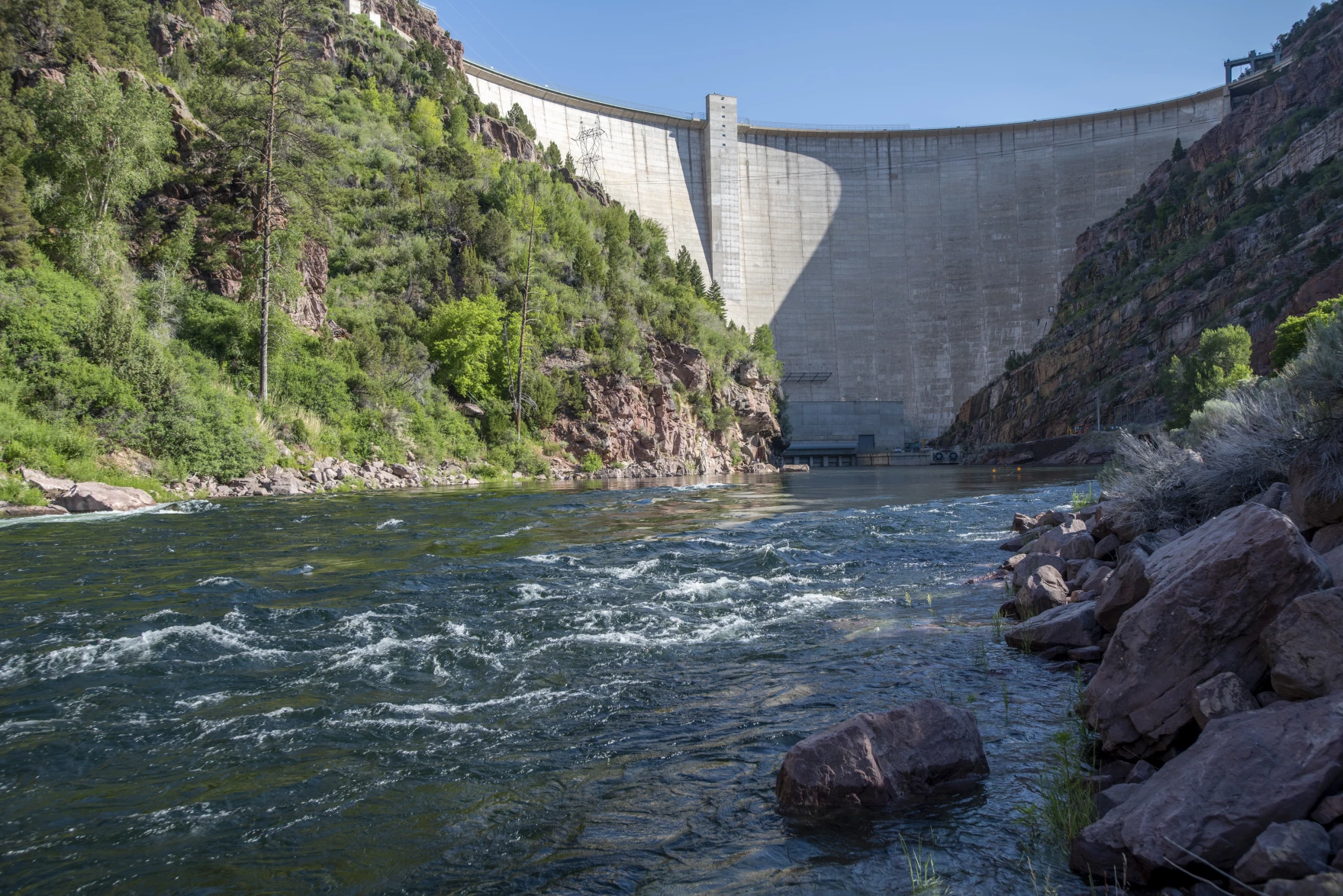
The Hoover Dam is a powerhouse! With an impressive output of about 3 billion kilowatt-hours of electricity annually, it provides enough energy to light up about 1 million households in Nevada, Arizona, and California, ensuring the lights stay on un the Southwest. Photo credit: USBR

Click the link to read the article on The Havasu News website (Alan Halaly). Here’s an excerpt:

May 1, 2026

In a Thursday joint statement, the Upper Colorado River Basin states of Colorado, Utah, New Mexico and Wyoming called for โ€œimmediate mediationโ€ in the yearslong deadlock with the Lower Colorado River Basin states of Nevada, California and Arizona. They offered no details about who could fill that role or which entity would pay for the costs.

โ€œTime is short, but structured negotiations through mediation offer a new path for authentic discussions,โ€ New Mexicoโ€™s Upper Colorado River Commissioner Estevan Lรณpez said in a statement. โ€œEven at this late stage, we should pursue every opportunity to reach a workable agreement.โ€

[…]

Asked about how a mediator could differ from the federal governmentโ€™s intervention or the appointment of a so-called โ€œwater masterโ€ at the U.S. Supreme Court, Entsminger said states are unlikely to view a mediatorโ€™s decision-making as binding.

โ€œItโ€™s certainly not litigation; itโ€™s not even arbitration,โ€ Entsminger said. โ€œItโ€™s more of a marriage counselor.โ€

[…]

Colorado River Board of California Chairman JB Hamby said in a Tuesday statement that his state proposed a mediation process last year. California officials see the need for both long- and short-term solutions, and mediation could push the Upper Basin toward โ€œverifiable water contributions,โ€ Hamby added.

โ€œEffective mediation requires common ground, and the system cannot wait,โ€ Hamby said. โ€œCurrent conditions require immediate, measurable water reductions from every state.โ€

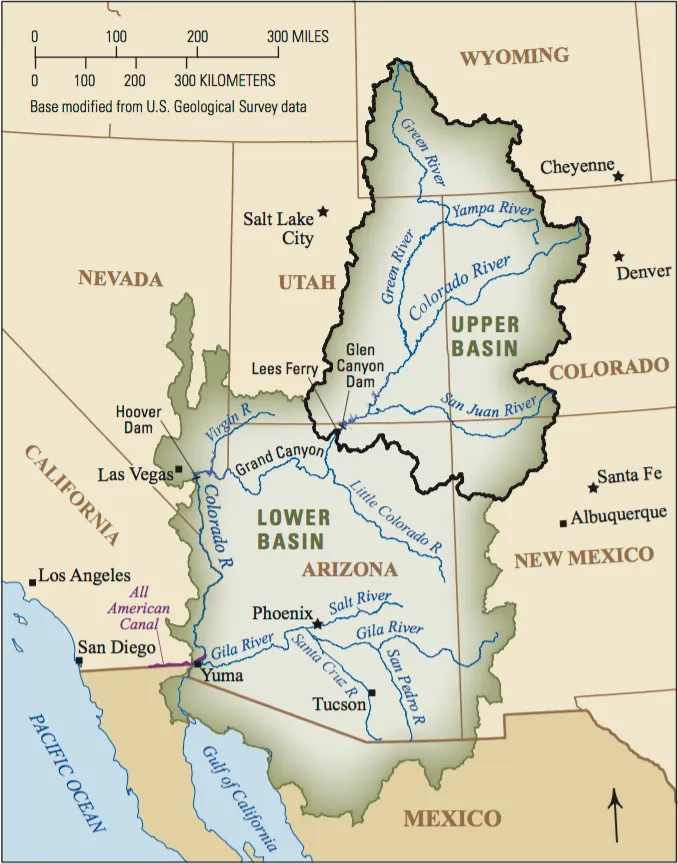
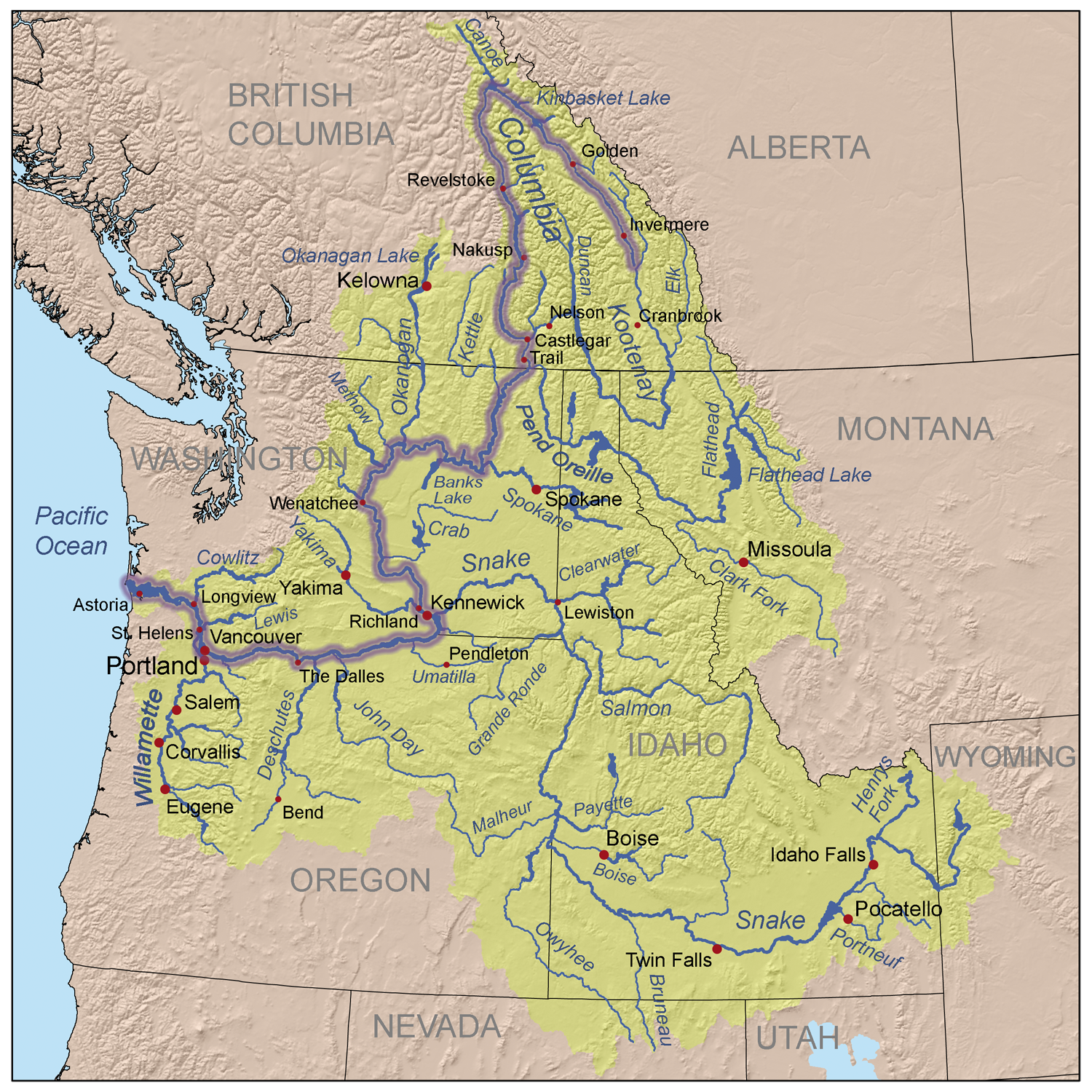
Map of the Colorado River drainage basin, created using USGS data. By Shannon1 Creative Commons Attribution-Share Alike 4.0

Initial fill of Chimney Hollow Reservoir — Northern Water #ColoradoRiver #COriver #aridification #SouthPlatteRiver

Mexican Farmers are unhappy with mandated cuts to Colorado River water

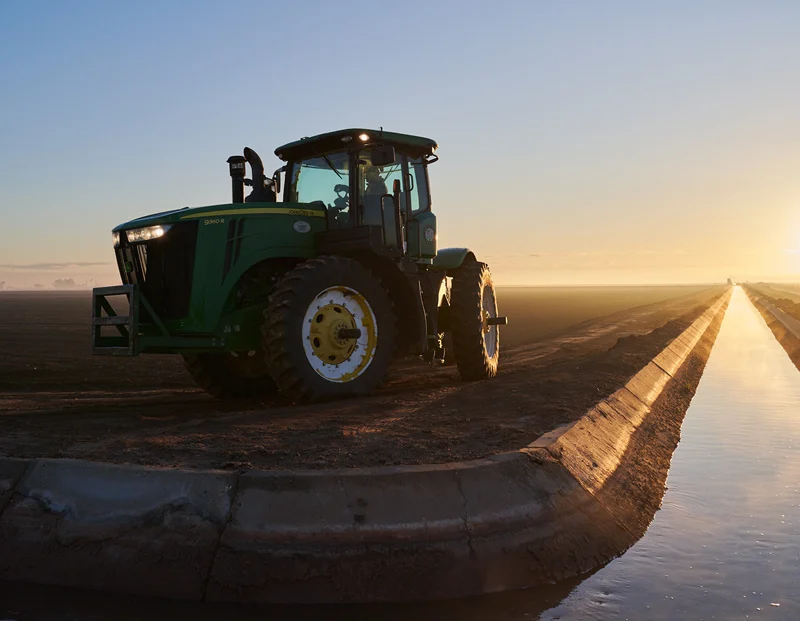
Tomatos being sorted by a farmer in the Mexicali Valley. Photo from Storyblocks

by Robert Marcos

Last week the lower basin states of Arizona, California, and Nevada, along with tribal leaders, offered to leave somewhere between 700,000 to a million acre-feet of water in the Colorado River system through 2027โ€“2028. The states described it as more than 3.2 million acre-feet of savings by 2028 and a way to stabilize Lake Mead and Lake Powell while longer-term negotiations continue.1

What caught my eye about this story is that Mexico – which by law had received 1.5 million acre feet of Colorado River water annually, was already conserving some of that water due to a previous agreement that promised to conserve 400,000 acre-feet between 2023โ€“2026.2

Reportedly, farmers south of the border are unhappy with these arrangements. Farmers in Mexicali Valley said they feel frustrated with the mandatory Colorado River water conservation, and they reported that they’ve been “cheated” out of resources they desperately need to survive. While Mexico agreed to specific water reductions as part of a binational plan with the U.S., many farmers in the Valle de Mexicali have reached a breaking point due to unpaid compensation.3

The prevailing sentiment of farmers in Mexicali Valley is characterized by the following:

Financial Betrayal: Many farmers in Northern Baja’s district 14 agreed to leave thousands of acres of land fallowed in order to conserve Colorado River water – in exchange for $4.5 million dollars in direct payments. However, they claim the Mexican government failed to pay them, which has left these farmers without any income whatsoever.4

Opposition to New Water Laws: Recent sweeping changes to Mexico’s national water law have stripped long-held water rights away from farmers, consolidating control in the hands of the federal government. Farmers view this as a move to prioritize urban centers like Tijuana and Ensenada over agricultural needs.

Sovereignty Concerns: There is a strong feeling that the Mexican government is surrendering national sovereignty by complying with U.S. water demands while its own agricultural sector suffers from “death” through deprivation.

Escalating Resistance: Farmers have responded with aggressive protests, including blockading major trade routes at the U.S.-Mexico border with semi-trucks and seizing control of critical dams. Some have even threatened to “spill” their water or return to farmingโ€”even if unprofitableโ€”just to prevent the government from redirecting it elsewhere.5

Water restriction triggers have changed in #Frisco after ordinance amendment approval due to โ€˜exceptional #droughtโ€™ — The Summit Daily

Dillon Reservoir. Photo credit Greg Hobbs.

Click the link to read the article on The Summit Daily website. Here’s an excerpt:

April 30, 2026

Friscoโ€™s town manager can now implement water conservation measures outside of the standard triggers outlined in the townโ€™s water code after an ordinance under consideration officially passed. Frisco Town Council approved Ordinance 26-10 on first reading at its April 14 meeting and adopted it on second reading at its April 28 meeting. The ordinance amends Article V of Chapter 171 in the town code to add the ability for the town to implement levels of its water restrictions if itโ€™s determined that โ€œsignificantly below-average snowpackโ€ or โ€œsignificantly above average temperaturesโ€ or a combination of these factors, both existing or anticipated, pose a risk to the townโ€™s ability to provide water.ย 

Prior to the amendment, the code used certain streamflow and water well storage levels to trigger levels of the water restrictions…A town meeting recap stated that โ€œas of March 31, the North Ten Mile Creek watershed, which provides Frisco with much of its water,โ€ had only roughly 7.3 inches of snow-water equivalent, which is about half as much liquid water stored in the snow compared to the five-year average.

โ€œThe 2025โ€“2026 winter season produced historically low snowfall across the Rocky Mountain region, resulting in well-below-average snowpack levels that are critical to the Town of Friscoโ€™s municipal water supply. Above-average spring temperatures have further exacerbated these conditions by accelerating snowmelt, increasing evapotranspiration, and driving higher wildfire conditions. These combined factors are significantly reducing available water supply at a time when seasonal demand will be increasing the Townโ€™s daily water production by over 100%. Dillon Reservoir remains below historical storage levels, underscoring the vulnerability of the Townโ€™s water resources and providing a real time visual reminder of just how limited the local hydrologic cycle is this year.โ€

Due to the historically low snowfall, which has led to the most severe drought designation by the U.S. Drought Monitor, town staff recommended moving from the current Phase 1 voluntary measures to Phase 3 mandatory restrictions, which limits โ€œnon-essential outdoor irrigation to two days per week in addition to other restrictions,โ€ according to the town recap.ย Staff explained itโ€™s possible that North Ten Mile Creek may run dry due to the current conditions and forecasts, which would require the town to rely on its wells, โ€œwhich have been resilient even when the reservoir has been very low.โ€

Map of the Blue River drainage basin in Colorado, USA. Made using USGS data. By Shannon1 – Own work, CC BY-SA 4.0, https://commons.wikimedia.org/w/index.php?curid=69327693

As Energy, War and Climate Collide, a Conference in Colombia Charts a Path Beyond #FossilFuels — Bob Berwyn (InsideClimateNews.org)

Click the link to read the article on the Inside Climate News website (Bob Berwyn):

May 1, 2026

While some major fossil fuel producers keep pushing for expanded oil and gas use, which is linked to warfare, economic shocks and ecological damage, more than 50 countries at the first Conference on Transitioning Away From Fossil Fuels began developing plans to shift toward renewable energy systems designed for stability and abundance rather than scarcity and conflict.

At the end of the conference, France, where fossil fuels still power about 60 percent of the worldโ€™s seventh-largest economy, unveiled a pilot roadmapto phase out coal by 2030, oil by 2045 and gas by 2050, and to electrify sectors such as heating and transport. Colombiaโ€™s draft roadmap to largely ditch fossil fuels by 2050 emphasizes that transitioning to renewables could deliver $280 billion for the country in economic benefits.

The countries represented in Santa Marta, Colombia, generate about one-third of global economic activity. They broadly agreed to align their trade and finance policies with their transition plans, potentially creating significant economic momentum toward the faster decarbonization needed to avoid overcooking the planet with greenhouse gases.

The conference can be seen as a climate diplomacy track running parallel with the United Nations Framework Convention on Climate Change, but on a faster train with friendlier passengers, said Ralph Regenvanu, Vanuatuโ€™s minister for climate change adaptation and a leader in efforts to accelerate climate action. 

โ€œItโ€™s very heartening to have the Global North and the Global South in the same room, countries willing to talk about transitioning away from fossil fuels,โ€ he said.

Participants and observers described the meeting as a space where fossil fuels themselves, and not just their emissions, were discussed as the root cause of overlapping crises, from conflict and displacement to economic instability. At past UNFCCC climate talks, those connections were often downplayed, especially in official documents.

The conference was convened by the Netherlands and Colombia during the closing days of COP30 in Belรฉm, Brazil, late last year, as frustration grew over a small number of countries blocking any detailed discussions of phasing out fossil fuels. A follow-up meeting is set for early 2027 in Tuvalu, in the Pacific.

Organizers of the Santa Marta meeting also said the work of a special science panel associated with the conference is critical because media ecosystems are overloaded with climate and energy disinformation. Beyond policy details, discussions at the conference also revealed a shift in how energy is understood, shaped by lived experience and generational memory as much as by economics or technology.

Avoiding Past Mistakes

Until a few decades ago, coal miners were celebrated as heroes of prosperity, while kids grew up with โ€œPut a Tiger in Your Tankโ€ ads promising open-road freedom. Fossil fuels were synonymous with progress; many of the people now shaping energy policy came of age in that world, and the story wasnโ€™t necessarily wrong for that time. But in a more crowded, connected world, that same system is now driving instability and climate degradation, and resisting the transition away from fossil fuels seems like longing for horse-and-buggy transport.

For the countries in Santa Marta, itโ€™s not a question of whether to change, itโ€™s how to change without repeating past mistakes. Veteran policy makers shared space with a younger cohort of advocates and negotiators for whom renewable energy systems are a baseline assumption, not an aspirational goal. Many are from developing countries and experience the risks of fossil fuels as immediate rather than as theoretical, and they challenge the fossil fuel industryโ€™s misleading narrative that their products are needed to alleviate poverty.

โ€œWar right now is one of the largest contributors to the climate crisis,โ€ said Faotu Jeng, founder of Clean Earth Gambia, a nonprofit group that has sparked environmental progress. Jeng noted that military emissions are not accurately accounted for under the Paris Agreement, which aims to limit global warming.

What will Xcel propose for Pueblo as it makes plans for the retirement of the last of the Comanche coal-burning units in 2030? Photo credit: Allen Best/Big Pivots

Navajo Dam operations update: Bumping releases to 500 CFS May 5, 2026 #SanJuanRiver

From email from Reclamation (Conor Felletter):

May 4, 2026

The Bureau of Reclamation has adjusted the release schedule from Navajo Dam due to downstream maintenance activities. On Tuesday, May 5th at 4:00 AM, the release will increase from 450 to 500 cubic feet per second (cfs). A further increase to 550 cfs is planned for Thursday, May 7th at 4:00 AM.

Releases are made for the authorized purposes of the Navajo Unit, and to attempt to maintain a target base flow through the endangered fish critical habitat reach of the San Juan River (Farmington to Lake Powell).  The San Juan River Basin Recovery Implementation Program recommends a target base flow of between 500 cfs and 1,000 cfs through the critical habitat area.  The target base flow is calculated as the weekly average of gaged flows throughout the critical habitat area from Farmington to Lake Powell.  

This scheduled release change is subject to changes in river flows and weather conditions.  If you have any questions, please contact Conor Felletter (cfelletter@usbr.gov or 970-637-1985), or visit Reclamationโ€™s Navajo Dam website at https://www.usbr.gov/uc/water/crsp/cs/nvd.html

Fish out of water: Historic drought leaves little water for endangered species in critical stretch of #ColoradoRiver — Heather Sackett (AspenJournalism.org) #COriver #aridification

The Colorado River flows through Las Colonias Park in Grand Junction, Colo. on April 22, 2026. The river reached an extremely low level due to heavy diversion upstream and record low snowpack. CREDIT: LUKE RUNYON/THE WATER DESK

Click the link to read the article on the Aspen Journalism website (Heather Sackett):

May 1, 2026

With drought and high temperatures putting unprecedented pressure on water users throughout Colorado, from cities to agriculture, thereโ€™s one segment that can be affected first โ€” and maybe worst โ€” when it comes to a lack of water: rivers themselves and the ecosystems that depend on them. 

As cities enact water restrictions and farmers and ranchers prepare for the worst, impacts of the water shortage are readily apparent in a chronically dry stretch of the Colorado River between Palisade and the confluence of the Gunnison River that is critical habitat for endangered fish, known as the 15-mile reach. 

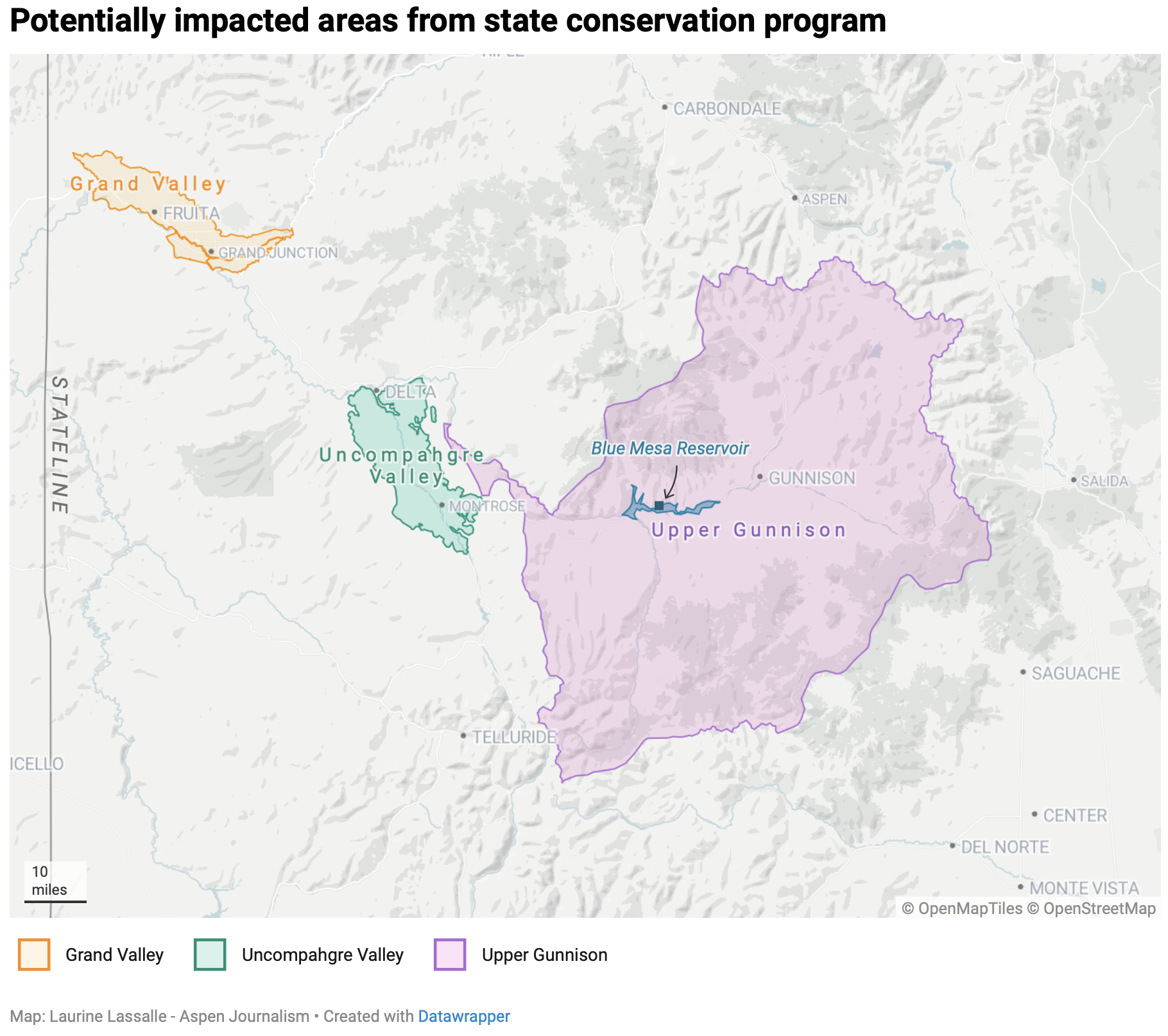
The Upper Colorado River Endangered Fish Recovery Program works to return water to this stretch of river in the Grand Valley, but because of this yearโ€™s historically dry conditions, the program could have only 16,000 acre-feet, half its typical amount of water for fish. 

Beyond that guaranteed amount, the program mostly uses water-sharing agreements that can secure additional acre-feet to boost flows โ€” but only when other users donโ€™t need the water and can voluntarily loan it. This year finds nearly everyone who depends on the Colorado River and its tributaries in dire straits.

Ruedi Reservoir, above Basalt, on the Fryingpan River, April 22, 2026. Photo: Brent Gardner-Smith

There wonโ€™t be any surplus water for fish in the Historic Users Pool, which is stored in Green Mountain Reservoir and is the largest source of water to potentially augment fish flows. A pool of water in Ruedi Reservoir that is available in four out of five years isnโ€™t there, and the program could get only about 340 acre-feet from a pool in Wolford Reservoir upstream of Kremmling that typically has up to 6,000 acre-feet.

โ€œIt is really clear to me that we do not have enough tools in our toolbox to be able to manage for conditions like we have this year in the 15-mile reach,โ€ said Julie Stahli, recovery program director. โ€œWe are so far outside the bounds of what we have ever seen before, that itโ€™s really just hard to be able to make any good decisions.โ€

Stahli said she anticipates the program can contribute about 75 cubic feet per second through mid-July, at which point they will drop it down to 50 cfs, a bare-bones amount that is just enough to keep the riverbed wet. 

This map shows the 15-mile reach of the Colorado River near Grand Junction, home to four species of endangered fish. Map credit: CWCB

โ€œThat is what we are anticipating being able to have for the entirety of the season in the 15-mile reach,โ€ she said.

Side channels on the Colorado River ran dry early during spring runoff on April 22, 2026. Cobble bars and muddy banks emerged as the river receded near Dos Rios Park in Grand Junction, Colo. CREDIT: LUKE RUNYON/THE WATER DESK

As flows plummet, fish could become stranded in pools that are disconnected from the rest of the river, and program managers say they will try to prevent fish from using that stretch of river during times when flows are predicted to be at their lowest. Crews could use netting to keep fish out of the reach or close the flow of water that returns fish to the river after they accidentally enter an irrigation canal, which would keep them in the stretch of river above the diversion that has more water.

โ€œOur main goal at this point is just to keep fish out of that reach,โ€ Stahli said. โ€œThere is not a whole lot of attractive habitat in there right now for fish. Flows dropped so early in the season. Weโ€™re already seeing some pretty dire conditions in April.โ€

For several days in April, flows fell to just over 50 cfs, among the lowest levels in recorded history and far below the recovery programโ€™s target flow for April in a dry year of 1,240 cfs. According to Stahli, the riverโ€™s flow at that low point could be solely attributed to recovery-program water that it had released from upstream reservoirs.

The goal of the recovery program when it was created in 1988 was to protect the humpback chub, razorback sucker, bonytail and Colorado pikeminnow, while also allowing the seemingly opposing goal of developing more water. An aim of the program was to allow farms and cities to continue using water and even expand their use without violating the Endangered Species Act.

Credit: The Land Desk

And the program has had some success, with one of the four species โ€” the humpback chub โ€” being downlisted from endangered to threatened in 2021. (The U.S. Fish and Wildlife Service has also proposed downlisting the razorback sucker.) These fish evolved over millions of years and are only found in the Colorado River basin. In todayโ€™s highly engineered and managed river ecosystem, they live mostly in just a few key locations in the Upper Basin, including the 15-mile reach, and in parts of the Yampa and Green rivers. Grand Junctionโ€™s minor league baseball team has adopted the charismatic fish as its team name and mascot; last year it was the humpback chubs, and now itโ€™s the razorback suckers.

But the program has had trouble meeting target minimum flows in the 15-mile reach, even though upstream water development has not kept pace the way it was expected to. A main culprit is climate change, which has robbed the river of about 20% of its flows during the 21st  century.

โ€œWe just donโ€™t have the tools as a society to be able to handle whatโ€™s happening right now in any cohesive way,โ€ Stahli said. โ€œThis isnโ€™t an endangered fish problem; this is an everyone problem.โ€

Palisade High School students released razorback suckers and bonytails they helped raise into the Colorado River on Friday, May 1. The two species live only in the Colorado River Basin and are endangered. CREDIT: HEATHER SACKETT/ASPEN JOURNALISM

Why is the river dry?

The reach is just downstream of large Grand Valley agricultural diversions, which are used to grow crops such as corn, alfalfa and the famous Palisade peaches, and which can take a combined 1,950 cfs from the river. At certain times of year, there can be more water in the Grand Valleyโ€™s canals than there is in the nearby Colorado River. Collectively, they are the biggest agricultural diversion from the Colorado River on the Western Slope.

โ€œThere has been so much diversion and damming of the river farther upstream,โ€ said Bart Miller, healthy rivers director at environmental group Western Resource Advocates. โ€œThere are a lot of uses right there, and youโ€™re seeing the impacts of all the Front Range diversions. [The 15-mile reach] is a pinch point in the system based on all the water development weโ€™ve done.โ€

Water rights for the environment and recreation were latecomers to the legal system. It wasnโ€™t until the 1970s โ€” nearly 100 years after the most-senior agricultural rights on the Western Slope were established โ€” that Colorado began protecting the value of water in streams with its instream flow program. Under Coloradoโ€™s system of water law, those who use water by taking it out of the river โ€” including farmers, cities and industry โ€” usually have the oldest rights, giving them first use of the resource. Thereโ€™s nothing illegal about drying up a river. 

โ€œItโ€™s like youโ€™re running in a race and itโ€™s four laps around the track,โ€ Miller said. โ€œThe folks with the instream, recreational, environmental values are there at the starting line, but theyโ€™re held back for the first two or three laps. Everyone else is already running. And thatโ€™s why the environment often ends up in a really bad place.โ€

A Palisade High School student puckers up and prepares to kiss a fish goodbye on Friday, May 1 at Riverbend Park in Palisade. About 1,500 juvenile razorback suckers and bonytail, two species of endangered fish that students helped raise in a hatchery, were released into the 15-mile reach of the Colorado River. CREDIT: HEATHER SACKETT/ASPEN JOURNALISM

โ€˜April holeโ€™?

Itโ€™s not totally unheard of to have a small window of diminished streamflows in April. In a phenomenon known as the โ€œApril hole,โ€ irrigation demands in the Grand Valley ramp up, while the needed water remains frozen solid as high-country snowpack. This problem remedies itself within a couple weeks as the snow begins melting. But this year, little snowpack remained by April and water managers think spring runoff at Cameo, where the big Grand Valley diversions are located, peaked during the March heatwave.

Kate Ryan is executive director of the Colorado Water Trust, which works to put water back into streams through temporary water sharing agreements with agricultural, municipal and industrial water users. Although the Water Trust is still finalizing contracts for this year, Ryan said she expects the Water Trust to add about 4,700 acre-feet of water to the 15-mile reach by leasing water from Ruedi Reservoir owned by the town of Palisade, and oil-and-gas company QB Energy. 

In past years, water from this project has been released between the end of July and beginning of October. But that timing may change if the recovery program is trying to keep fish out of the reach.

โ€œWe will make sure that we deliver water at a point that complements the work of the recovery program,โ€ Ryan said. 

The Water Trust has also used the Colorado River Water Conservation Districtโ€™s water marketing program โ€” where acre-feet are available for purchase โ€” to restore water to streams. But the River District board at its April meeting voted to freeze all new contracts, which are usually doled out first come, first served, while staff figures out the best use of the limited water supply. 

The move was part of a series of drought mitigation actions aimed at easing shortages for water users. The board last month also approved a system for prioritizing water sectors, with keeping water in rivers at the bottom of the list: municipal and domestic water needs over agricultural and industrial needs; and agricultural and industrial needs over in-channel uses such as those that benefit the environment, endangered fish and recreation.

The Water Trust this week sent a letter to some water managers recognizing the historic drought and acknowledging that many of its temporary water sharing agreements, which pay water rights holders to leave water in streams, may not operate this year because their agricultural partners may not have enough water for their own use. Projects are voluntary and happen only in years when participants have enough water to share and it can benefit a stream. 

But the letter also said there may be others who are interested in using their water rights to help prop up a stream this year.

โ€œThere is just so much uncertainty right now that we are trying to be as flexible and responsive as possible,โ€ Ryan said.

Palisade High School students released two species of endangered fish into the Colorado River on Friday, May 1, 2026. Target flows for these fish in the 15-mile reach are often not met. CREDIT: HEATHER SACKETT/ASPEN JOURNALISM

Recovery-program officials said this year they will double down on other actions that benefit endangered fish, including removing nonnative predator species such as smallmouth bass and stocking the river with hatchery-raised fish. On Friday, students at Palisade High School released 1,500 young razorback suckers and bonytails that they helped raise into the Colorado River at Riverbend Park in Palisade. 

Recovery-program staff said managing the 15-mile reach this year is about preventing the worst impacts and seeing what lessons can be learned from one of the driest years on record.

โ€œIt is just new terrain,โ€ said David Graf, instream flow coordinator for the recovery program. โ€œI think we are just flying by the seat of our pants in a lot of ways trying to do triage management as opposed to really adapt.โ€

For now, one of the few ways to add water back to a depleted river remains borrowing it from other, more senior users. 

โ€œI think until our water suppliers and state government hear from people that the environment really is a priority, not just the recovery program and need to support endangered species, but also for communities and local economies across the board, itโ€™s going to stay that way,โ€ Ryan said.

Bicycling the Colorado National Monument, Grand Valley in the distance via Colorado.com

#Snowpack news May 4, 2026

Westwide SNOTEL basin-filled map May 3, 2026.
Colorado SNOTEL basin-filled map May 3, 2026.

MAYDAY! #Snowpack Report: And fact-checking #ColoradoRiver claims — Jonathan P. Thompson (LandDesk.org) #COriver #aridification

Muddy Creek living up to its name just before it runs into Paonia Reservoir, which was about 70% full on April 30. Jonathan P. Thompson photo.

Click the link to read the article on The Land Desk website (Jonathan P. Thompson):

May 1, 2026

โ›ˆ๏ธ Wacky Weather Watchโšก๏ธ

If someone were to be dropped from another planet into the North Fork Valley in western Colorado today, they would be forgiven for assuming there is not a water crisis. A thick carpet of green covers the valley floor, the irrigation canals are filled to the brim, trees are leafing out, the river is running and Paonia Reservoir is almost full, and the mountains are still graced with snow.

I didnโ€™t even come from outer space โ€” I think โ€” and I find the contrast between the news reports of water shortages and restrictions and the on-the-ground situation here to be quite jarring. Is it possible that April precipitation has averted the calamity?

A green hay field on a mesa in the North Fork Valley in western Colorado. Jonathan P. Thompson photo.

Yes, a series of storms, some quite abundant, have moved through the Upper Colorado River Basin, boosting snowpack and soothing the desiccated earth. It has certainly felt cooler and wetter than normal, but that was mostly an illusion brought on by the abnormally dry winter and the searing March heatwave. And it hasnโ€™t been nearly enough to offset the warm winter and the lack of snow, as the graphs below indicate.

As for the full ditches, I guess you could attribute that to a โ€œmake hay while the water is availableโ€ sort of ethos. You might as well douse the fields and fill ponds while spring runoff is in full swing and the river still runs, knowing that it may not last beyond June. Meanwhile, Paonia Reservoirโ€™s relatively healthy levels are the result of the Fire Mountain irrigation canal โ€” which relies on reservoir water โ€” being shut down for emergency repairs.

Meanwhile, there is a conspicuous absence here in this agricultural hotspot: There are no blossoms or fruit on apple, cherry, peach, or pear trees. The March heatwave sparked a spectacular orchard super-bloom. That was followed by a devastating freeze that killed all of the fruit, even in orchards where extreme preventative measures were taken, and even โ€œburnedโ€ the leaves on some trees. Wacky weather indeed.

The North Fork of the Gunnisonโ€™s May 1 snowpack this year is tied for the lowest on record with 2012.
The Animas River watershed did get enough of a boost to bring snowpack levels back up above 2002โ€™s for this date. Source: NRCS.
Even with the recent storms, the Upper Colorado River Basin snowpack remained at record-low levels as of May 1. The previous low year (from 40 years of SNOTEL records) was 2012, with 2002 and 2018 not far behind. Source: NRCS.
๐ŸŸ Colorado River Chronicles ๐Ÿ’ง

Phil Lyman, the former and hopeful Utah politician, recently posted this on Facebook:

Just to sum it up: Heโ€™s knocking a federal program that pays willing farmers to voluntarily cut off irrigation to their fields in order to conserve water in an effort to balance Colorado River demand with the shrinking supplies. And heโ€™s blaming it all on California. 

Lymanโ€™s general sentiment is not new, nor is it uncommon among water users in the Upper Basin states. In fact, itโ€™s basically a clichรฉ. Since I was a kid Iโ€™ve heard folks saying something along the lines of: If we donโ€™t use the water, itโ€™ll just run on down to California, where those L.A. folks will guzzle it up to fill their swimming pools and water their golf courses. Itโ€™s a rather simplistic view, and one that doesnโ€™t account for the realities of water law or the way the Colorado River system works. In other words, itโ€™s just plain wrong, and a candidate for Congress โ€” as Lyman is โ€” should know better.

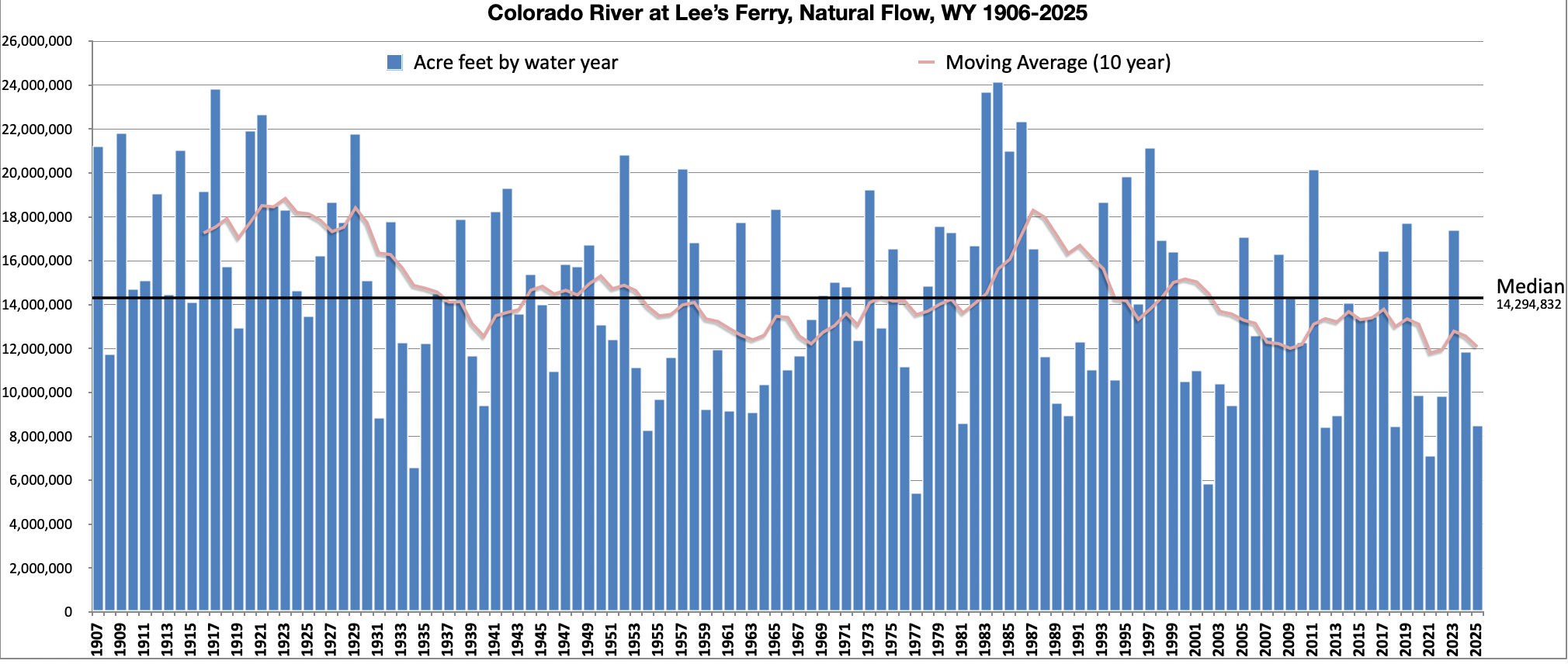
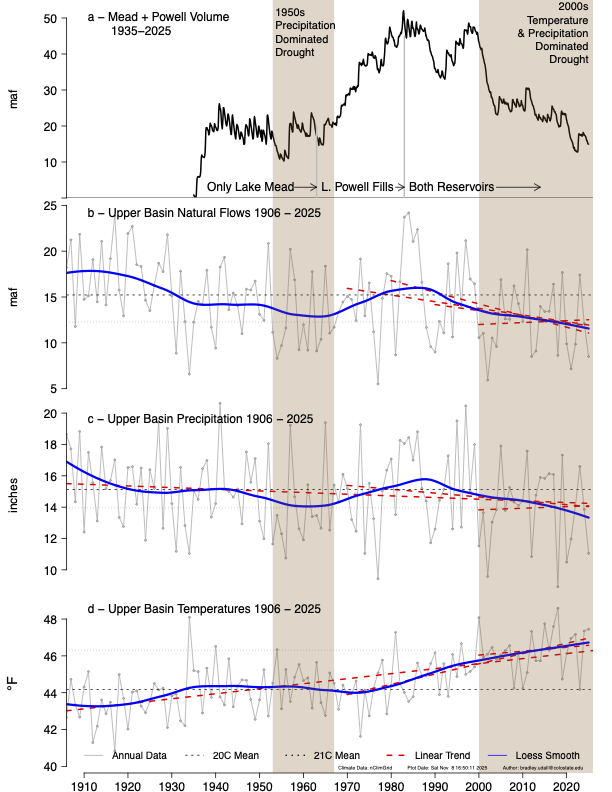
Udall/Overpeck 4-panel Figure Colorado River temperature/precipitation/natural flows with trend. Lake Mead and Lake Powell storage. Updated through Water Year 2025. Note the tiny points on the annual data so that you can flyspeck the individual years. Credit: Brad Udall

The Colorado River and its users have a problem: Demand for the water exceeds supply, and the supply is continually shrinking. Since boosting supply is not a feasible option, demand โ€” i.e. consumptive use โ€” must be reduced significantly. While everyone must make cuts, agriculture is the riverโ€™s largest water user by far, meaning that sector is going to have to make the largest cuts, by volume. This isnโ€™t about demonizing farmers or alfalfa, itโ€™s not about whether Californians or Utahns are more deserving of the water. Itโ€™s simple math.

The farm fallowing program is one way to cut consumption quickly by paying willing farmers to voluntarily forego irrigating some or all of their fields on a year-by-year basis. Itโ€™s not ideal, but it is legal, voluntary, and can save junior water rights holders, including cities and towns throughout the watershed, from being forced to shut off their water intakes. And in no way is farm fallowing exclusive to Utah. Itโ€™s occurring all over the place.

Letโ€™s do a little fact-check of Lymanโ€™s other points:

  • Farm fallowing in Utah is being done to benefit California, which โ€œdemolished its water storage infrastructure.โ€ย No and no. The goal here is to leave a little more water in the river, to keep the whole system from collapsing. Any amount conserved in one place will potentially benefit all other river users, as well as the river itself. Foregoing irrigation on a Utah farm, for example, could help keep the taps on in St. George or some other Utah community that relies on the river. Dams have been removed in California, most significantly four structures on the Lower Klamath River. But those were primarily for hydropower production, not irrigation or water storage, and they are far removed from the Colorado River or any associated water storage.
  • โ€œPaying farmers not to feed us to bail out Californiaโ€™s failures โ€ฆโ€ย Actually, the feds and state and other programs mostly are paying farmers not to grow alfalfa or hay, which feed cattle, and it has nothing to do with Californiaโ€™s โ€œfailures.โ€ Indeed, California grows a lot of alfalfa, too, but it also grows all kinds of vegetables โ€” far more than in Utah.
  • If the water saved in Utah does make it to the Lower Basin and California, then the biggest beneficiary would be โ€ฆ farmers. Most of the water in the Lower Basin goes to the Imperial Irrigation District, where it is used for farming. Those farmers have also been part of the federal fallowing program, and have managed collectively to reduced their Colorado River water consumption by about nearly 1 million acre-feet since 2003.
  • Lyman calls for eliminating or restructuring federal farm fallowing programs.ย Iโ€™m curious if heโ€™s talked to the farmers about this, especially the ones who may lose their water and be forced to fallow anyway. Isnโ€™t it better to get paid not to grow something than to not get paid for it?
  • โ€œโ€ฆ fight to end federal policies that separate water from the people who depend on it. Water rights are property rights.โ€ย We all depend on water; the California farmers depend on water just as much as Utah farmers do. Furthermore, the California farmers also own their land, they have some of the most senior water rights on the Colorado River, and according to the โ€œLaw of the River,โ€ they could likely go to court to force many Utah farmers to stop irrigating altogether, without compensation. The farm fallowing program does not separate water from the farmers, it simply pays them to temporarily forego irrigation.
  • โ€œโ€ฆ end the war on farm water.โ€ย Look, there is not enough water in the Colorado River for everyone. Everyone will have to take cuts, but irrigated agriculture is the biggest user by far, and therefore will have to make cuts in order to balance supply and demand. Itโ€™s simple math: All of Las Vegas and southern Nevada use less than one-tenth of the water that goes to the farms in the Imperial Irrigation District.
  • โ€œโ€ฆ propose that the federal government build and operate desalination plants in California to free up Colorado River water for Utah โ€ฆโ€ย Desalination will likely be a part of the Westโ€™s water future, especially for coastal urban areas. But building the plants, and processing and transporting these kinds of volumes of water, would be outrageously expensive and energy-intensive, which would be especially harmful to farmers, who rely on cheap water.

***

The Bureau of Reclamation recently decreased Glen Canyon Dam releases from about 8,200 cfs to a steady 7,000 cfs (without the usual nighttime reductions). This appears to be the lowest sustained releases since the dam was built, and if continued throughout the entire year would lead to only 5 million acre-feet of annual releases, which would make the Lower Basin states even more grumpy and litigation-happy than they already are.

But not to worry, the feds are still on course to release 6 MAF for the water year, because they released about 10,000 cfs during January and February. Still, itโ€™s going to change the complexion of rafting in the Grand Canyon, for sure, and it is certainly pushing the boundaries of the Grand Canyon Protection Act.

๐Ÿ“ธย Parting Shotย ๐ŸŽž๏ธ

Snow falls on the Abajo Mountains in southeastern Utah as seen from near Dove Creek, Colorado. Jonathan P. Thompson photo.

$40 Million in state water grants flow to drought-stressed #Colorado communities — Jerd Smith (Fresh Water News)

Denver North High School at dusk. Photo credit: Humphries Poli Architects

Click the link to read the article on the Water Education Colorado website (Jerd Smith):

April 30, 2026

The Colorado Water Conservation Board is funneling $40 million to dozens of water projects statewide as communities grapple with a drought emergency that is making saving water more important than ever before.

Among the 136 projects receiving state support this fiscal year, which ends June 30, is a $2.3 million grant that will pay nearly half the cost to install new, automated irrigation control systems across 105 Denver Public School system sites. Another grant, for $227,225, will help the city of Trinidad with early studies on repairing and potentially enlarging Monument Lake Reservoir. 

Photo credit: Monument Lake Resort

Still another grant, for $111,855, will help pay to train and certify metro area teens in becoming turf replacement specialists. Operated by the Neighborhood Resilience Corps, the initiative will replace 23,000 acres of grass at sites that include the Governorโ€™s Mansion and other state facilities.

The grant awards come as Colorado faces a stunning drought year in which winter mountain snows were historically low and a spring heat wave melted those snows early, slashing water available for cities, industries and farms to use.

Aurora, for instance, is expecting just 10% of its normal water supplies this year, according to Tim York, manager of water conservation for Aurora Water, and its reservoirs stand at 57% full.

As cities broadcast the need to cut back water use to preserve water stored in reservoirs, homeowners and businesses have flooded cities like Aurora with requests for help to design drought-proof landscapes and replace thirsty bluegrasses with lawns that need much less water.

โ€œOur approved applications have doubled over what they were last year, so that is pretty good,โ€ York said, referring to applications for Auroraโ€™s landscape conversion program. โ€œOur free design program is similar. We have a waitlist.โ€

He said the CWCB grants, coupled with Auroraโ€™s aggressive water conservation initiatives, are critical to helping the state cope with the drought emergency and create more sustainable water systems.

Aurora is a supporter of the Neighborhood Resilience Corpsโ€™ youth training effort. York said the opportunity to train young people is important.

โ€œAnytime we can do that with young adults who are interested, itโ€™s always a great idea,โ€ he said. โ€œWe might do the conversions, but if we can get that benefit and inspire and teach young adults, why not.โ€ York was referring to the cityโ€™s programs that remove thirsty lawns and replace them with drought tolerant landscapes.โ€ 

Boulder-based Resource Central, another agency that has partnered with the CWCB on statewide conservation efforts, said it is seeing an unprecedented number of requests for its services.

โ€œDemand for conservation programs is off the charts,โ€ said Neal Lurie, president of the nonprofit agency. โ€œWeโ€™ve seen more interest in the first three weeks of this spring season than we did all of last year.

โ€œTo me that says the message is resonating with people that they have an important role to play,โ€ he said. โ€œThatโ€™s good news.โ€

More by Jerd Smith

Colorado Rivers. Credit: Geology.com

Flowering plants evolved ~130 Ma (recent in Earthโ€™s history!). They appeared suddenly in the Cretaceous and diversified quickly — #Colorado Geological Survey

Colorado River Board of #California: Lower Basin States Advance Plan to Deliver up to 3.2 Million AF Through 2028 to Protect #ColoradoRiver — Doug MacEachern, Bronson Mack, and Fernando Castro-Alvarez #COriver #aridification

Udall/Overpeck 4-panel Figure Colorado River temperature/precipitation/natural flows with trend. Lake Mead and Lake Powell storage. Updated through Water Year 2025. Note the tiny points on the annual data so that you can flyspeck the individual years. Credit: Brad Udall

Click the link to read the release on the Colorado River Board of California website:

May 1, 2026

The Lower Basin States of Arizona, California, and Nevada today advanced a plan to stabilize the Colorado River through 2028, responding to declining reservoir levels, record low inflows to Lake Powell, and increasing risk of reaching critical elevations at both Lake Powell and Lake Mead.

Earlier in the post-2026 process, the Lower Basin took a significant step by proposing 1.25 million acre-feet in annual reductions, with an additional 250,000 acre-feet from Mexico, totaling approximately 1.5 million acre-feet per year.

This proposal builds on that foundation with an expanded system conservation program across the Lower Basin with an estimated contribution of at least 700,000 acre-feet. In total, the plan identifies up to 3.2 million acre-feet of water savings to the system through 2028.

The proposal is an integrated package addressing Lake Powell releases, Upper Initial Unit operations, Lower Basin reductions, additional conservation, use of Intentionally Created Surplus, and system infrastructure improvements. Lower Basin contributions are contingent on these coordinated operations to ensure system stability as well as appropriate funding.

โ€œWith this proposal, the Lower Basin is putting forth real action to stabilize water supply along the Colorado River. Weโ€™re putting forward additional measurable water contributions for the system. Without that, the system will continue to decline,โ€ said JB Hamby

โ€œThis proposal is about moving from ideas to implementation,โ€ said John Entsminger. โ€œIt pairs real measurable water contributions with sensible dry-condition operations at Lake Powell and across the Upper Initial Units. Now is the time for every water user in the Basin to double down on water conservation as we face historically dry hydrology.โ€

โ€œThis proposal reflects the creativity and commitment of water users across the Lower Basin who continue to step forward with solutions that support the river,โ€ said Tom Buschatzke. โ€œWe have shown that collaborative, voluntary efforts and reductions that are certain can produce meaningful water savings.โ€

The Lower Basin states recognize the Upper Basinโ€™s call for mediation and are open to that process. However, current conditions require immediate, measurable water reductions from every state. The Lower Basin states stand ready to engage in a meaningful process for long-term solutions while encouraging the Upper Basin to step forward now with verifiable water contributions to help stabilize the system and support a near-term, seven-state bridge.

The Lower Basin states confirmed that the proposal preserves legal accountability under the Colorado River Compact, including Upper Basin delivery obligations, while maintaining a clear path toward a broader agreement among all seven Basin States.

The plan has been advanced to the federal government for consideration as part of the ongoing post-2026 planning process and is intended to provide a near-term bridge through 2028 while long-term operating guidelines are finalized.

Implementation of key elements of the proposal, including expanded system conservation, will require federal partnership. The proposal remains subject to approval by the Arizona Legislature and relevant California and Nevada water agency governing boards.

Press Contacts: 

Arizona: Doug MacEachern, dmaceachern@azwater.gov

Nevada: Bronson Mack, bronson.mack@snwa.com

California: Fernando Castro-Alvarez, fscastro@iid.com

Colorado River “Beginnings”. Photo: Brent Gardner-Smith/Aspen Journalism

The Central #Arizona Project supports historic three-state #ColoradoRiver deal #COriver #aridification

Colorado River. Photo credit: Central Arizona Project

May 1, 2026

The situation on the Colorado River is dire. Flows have reached historic lows and water saved in major storage reservoirs is approaching critical elevations. To date, solutions to the crisis have been elusive, with lengthy litigation looming as the seven states that share the river have been unable to agree on an appropriate remedy to the situation. That is why todayโ€™s announcement that the Lower Division States of Arizona, California and Nevada have come together to announce a bridge proposal that will support the entire Colorado River system through 2028 represents a welcome lifeline and cause for hope. This three-state proposal is a two-year, comprehensive package that will commit a minimum of 3.2 million acre-feet of Lower Division water savings in Lake Mead by 2028

The proposal is a bridge, a pathway to future operations that extend beyond the expiration of the existing river operating guidelines at the end of 2026. However, this massive sacrifice by the Lower Division States is only possible by implementing the entire proposal, which requires a series of critical actions by the federal government. The federal government must commit the remainder of Colorado River drought funding to offset impacts to Lower Division users, create a tribal pool to meet federal responsibilities to tribal communities, and use the reservoirs upstream of Lake Mead for their foundational purpose โ€” meeting water delivery obligations to the Lower Division. Congress built those upstream dams for the purpose of releasing water and meeting minimum obligations to the Lower Division under the Colorado River Compact during an extended drought like the one we face today and now, the dams must be used as mandated by Congress.

Todayโ€™s announcement is the latest in a series of actions by the Lower Division States to preserve the stability of the Colorado River system. Lake Mead would be in the mud if not for Lower Division water users leaving water in the lake to protect the system, and every drop that has been left in Lake Mead is benefiting Lake Powell and the Upper Division by allowing for less water to be released downstream.

But Lower Division actions alone cannot protect the entire system from extraordinarily dry years. This year is an example where, despite the Lower Divisionโ€™s ongoing reductions and contributions, Lake Powell needed additional emergency action.

While this new Lower Division bridge requires no action from the Upper Division states, it is well past time that the Upper Division States agree to be part of the solution by committing to verifiably conserve water and end their out-of-touch demand that the Upper Division be allowed to increase their total uses from a shrinking system.

The Central Arizona Project applauds the Lower Division States for developing the proposal and urges the federal government to speedily approve this emergency effort to bridge the river system through 2028.

Lawsuit Launched to Protect Imperiled Mexican Spotted Owls from #Arizona Copper Mine Project — Russ McSpadden and Melissa Crytzer (Center for Biological Diversity)

Mexican spotted owl, Fort Huachuca, Arizona. By Gary L. Clark – Own work, CC BY-SA 4.0, https://commons.wikimedia.org/w/index.php?curid=45220828

Click the link to read the release on the Center for Biological Diversity website:

April 28, 2026

The Center for Biological Diversity, the San Carlos Apache Tribe and the Lower San Pedro Watershed Alliance today filed aย notice of their intent to sueย the U.S. Bureau of Land Management and the U.S. Fish and Wildlife Service over the Copper Creek Exploration Project near Mammoth, Arizona. The groups say the agencies violated the Endangered Species Act by allowing mining exploration drilling that threatens Mexican spotted owls and other imperiled wildlife.

โ€œFederal officials were warned that Mexican spotted owls are in the area but pushed this mining project ahead anyway and skipped steps required by law,โ€ said Russ McSpadden, a Southwest conservation advocate at the Center for Biological Diversity. โ€œThe Endangered Species Act is supposed to protect imperiled wildlife before damage is done, not after agencies brush aside the evidence and greenlight industrial drilling. This mining project is clearly illegal and it must be stopped.โ€

Todayโ€™s notice focuses on Mexican spotted owls, rare birds who depend on the rugged canyon and forest habitat of the Southwest. Federal data estimates there are roughly 1,300 known owl territories in the U.S., representing only a few thousand birds in small, fragmented and declining populations. Mexican spotted owls have been protected as threatened under the Endangered Species Act since 1993.

โ€œThe Lower San Pedro watershed is one of Arizonaโ€™s most important wildlife corridors, and this exploration project is pushing industrial disturbance into a landscape that is already under pressure,โ€ said Melissa Crytzer Fry, chair for the Lower San Pedro Watershed Alliance. โ€œWhen agencies ignore clear evidence and fail to follow the law, local communities are left to defend the river, the habitat and the species that make this place irreplaceable. We shared trail camera images with the BLM showing Mexican spotted owls in the area and were utterly ignored.โ€

The groups say the BLM approved the drilling project last summer despite receiving photographs showing Mexican spotted owls in the area. The agency still concluded the species was โ€œnot presentโ€ and failed to initiate consultation with the Fish and Wildlife Service, as required by the Endangered Species Act.

The Copper Creek project is already underway, bringing industrial drilling, bright lights, heavy noise, truck traffic, surface disturbance and groundwater pumping into sensitive habitat in and around Copper Creek Canyon, an important tributary of the Lower San Pedro River. These public lands and waterways support significant wildlife resources, including habitat for one of the Southwestโ€™s most vulnerable owl species, and require management based on the best available science.

The notice letter also challenges the agenciesโ€™ analysis of harms to the threatened yellow-billed cuckoo, saying they failed to adequately assess how exploration-related groundwater pumping and noise could affect the birdโ€™s habitat in the Lower San Pedro watershed. Cuckoo rely on healthy streams for habitat and prey during their nesting season.

The agencies failed to analyze how extensive helicopter surveying of the project area may harm both Mexican spotted owls and yellow-billed cuckoos. Aerial surveillance requires helicopters to fly extremely close to the ground, causing loud noise and surface disturbance that can be disruptive to wildlife.

Copper Creek Canyon. Photo credit: Russ McSpadden/Center for Biological Diversity

Research Article — Dust storms: Hidden drivers of extreme rainfall and global precipitation shifts — Yuzhiย Liu, Weiqiย Tang,ย Tianbinย Shao,ย Runย Luo,ย Ziyuanย Tan,ย Danย Li, andย Jianpingย Huang (Science Advances)

Fig. 1. Spatial and temporal patterns of global dust events. (A) Global average frequency of dust events (including dust storms, blowing dust, and floating dust) from 1979 to 2023. The cyan lines in (A) delineate the boundaries between dust source regions and transport regions. The largest markers indicate stations where dust storms are the dominant type of dust events, medium-sized markers represent blowing dust, and the smallest markers denote floating dust. (B), (C), and (D) present the global frequency anomaly time series for dust storms, blowing dust, and floating dust, respectively, over the same period. The curves in [(B), (C), and (D)] are smoothed using a nine-point moving average.

Click the link to access the research article on the Science Advances website (Yuzhiย Liu, Weiqiย Tang,ย Tianbinย Shao,ย Runย Luo,ย Ziyuanย Tan,ย Danย Li, andย Jianpingย Huang). Here’s the abstract:

April 29, 2026

Dust storms, while often seen as harmful, can play an unexpected role in enhancing rainfall. Global observations show that 7-day accumulated precipitation after dust storms exceeds dust-free conditions by up to 9.6 millimeters. Numerical simulations further confirm that dust particles act as ice nuclei, thereby promoting cloud formation and increasing rainfall through the ice crystal effect. Moreover, in regions with rising anthropogenic aerosols, dusts determine precipitation patterns. While elevated levels of anthropogenic aerosols alone tend to boost weak rainfall, the presence of dust aerosols reduces light precipitation and enhances heavier precipitation. Collectively, these findings reveal a dual role of dust storms in shaping global precipitation patterns while adversely affecting the human living environment. This research establishes a mechanistic framework for understanding how dust affects extreme precipitation at the global scale, advancing predictive capabilities for heavy precipitation.

Dust clouds roll across drought-ridden fields near eastern Coloradoโ€™s Lamar in spring 2013. Credit: Jane Stulp via Water Education Colorado

#FortCollins Utilities, ELCO ask for voluntary watering cuts, for now — The Fort Collins Coloradoan #drought

Click the link to read the article on The Fort Collins Coloradoan website (Rebecca Powell), Here’s an excerpt:

April 30, 2026

Two of Fort Collins’ water providers are calling on residents to voluntarily reduce their water use rather than imposing outdoor water restrictions with penalties, for now. Fort Collins City Manager Kelly DiMartino has declared a “water shortage watch,” according to a news release fromย Fort Collins Utilities, which is asking residential and business customers to limit outdoor water use starting May 1.

“By taking voluntary measures now to reduce water use, Utilities customers can actively help lower the chance of mandatory water restrictions if conditions worsen,” the news release stated.

Fort Collins Utilities and East Larimer County Water District, or ELCO, which are two of the city’s three major water providers, are asking customers to:

  • Limit lawn watering to no more than two days per week.
  • Avoid watering between 10 a.m. and 6 p.m.

The West Fort Collins Water District is required to follow city-issued water rationing and restrictions, according to its website. Sunset Water District is managed by ELCO.

Colorado River District Board Approves Immediate #Drought Action #ColoradoRiver #COriver #aridifcation

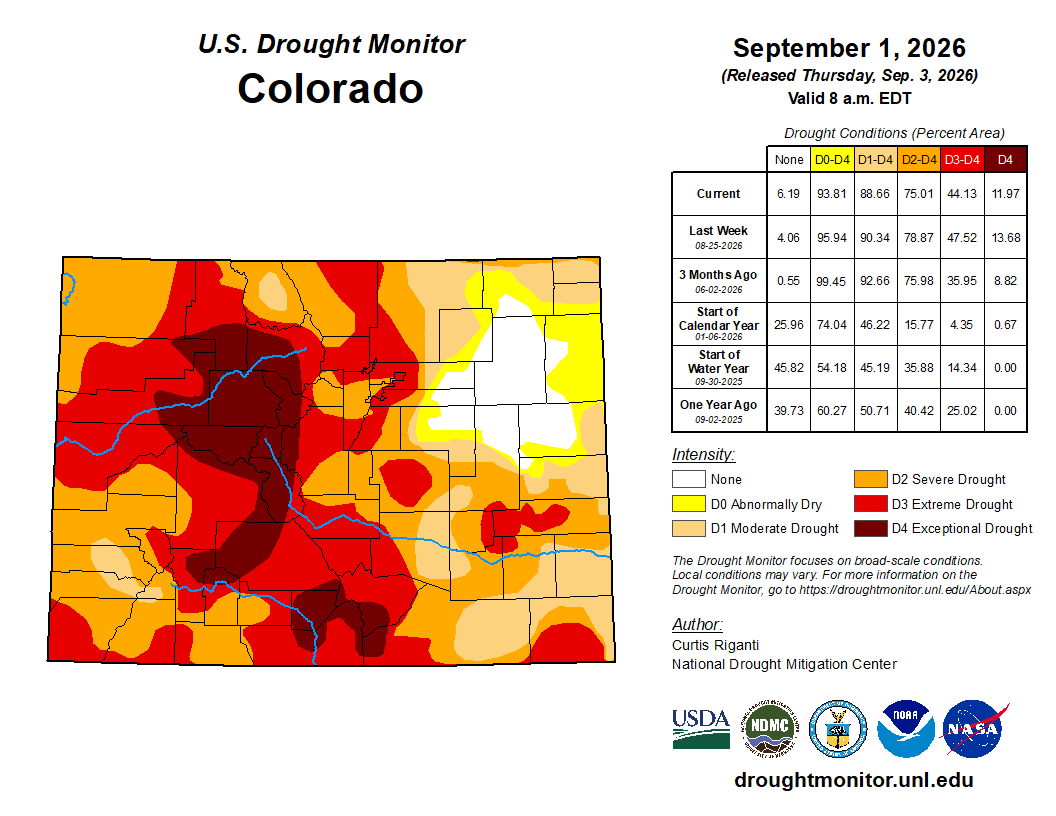
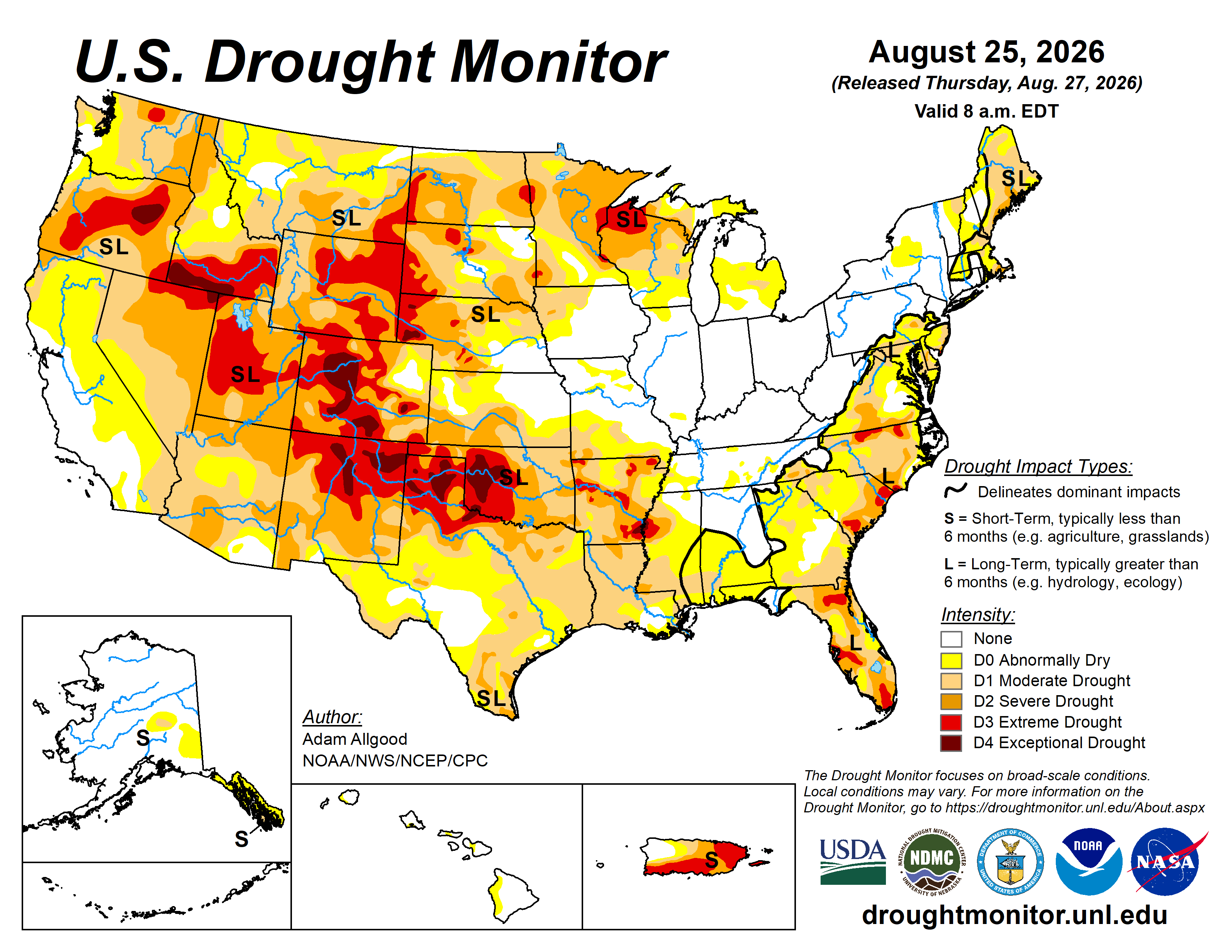
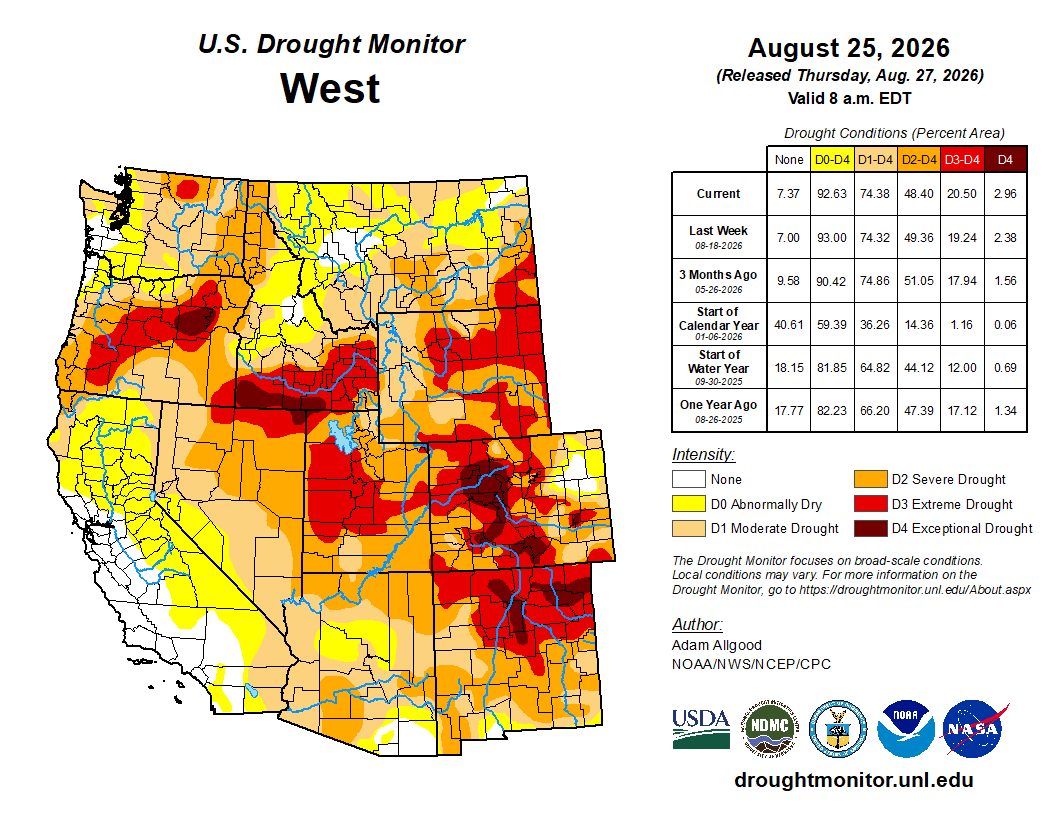
Colorado Drought Monitor map April 28, 2026.

Click the link to read the release on the Colorado River District website (Lindsay DeFrates):

April 24, 2026

On Tuesday, April 21, the Colorado River District board of directors unanimously supported initial actions in response to extreme drought conditions on the western slope. The boardโ€™s actions allocated $450,000 from the Districtโ€™s Community Funding Partnership for strategic water releases from District-owned, District Enterprise, or other storage pools across the western slope. The board also acted to suspend a previous water marketing policy that allowed contracts on a first-come, first-serve basis, instead taking staff recommendation to develop a cooperative approach that best uses available supplies to meet critical needs. The board delegated authority to its Water Supply Projects Committee to consider and approve subsequent contract water leases and funding allocations.

โ€œThis action alone wonโ€™t solve the drought, but it will help meet critical water needs in the short term,โ€ said Hunter Causey, director of asset management and chief engineer for the Colorado River District. โ€œOur reservoirs were built to help communities on the western slope weather exactly this kind of year. Maximizing the use of our available storage now is the responsible thing to do.โ€

โ€œWe were already bracing for a dry summer, but the low snowpack was absolutely flattened by extreme heat in March, leaving statewide water supplies facing unprecedented gaps,โ€ said Colorado River District Board Vice President and Grand County rancher Mike Ritschard. โ€œIrrigators and agriculture producers in Colorado are familiar with working within uncertainty, but when supplies are this limited, we know we have to be especially conscious of balancing our use with the health of the system as a whole.โ€

The Board also prioritized its contract water supplies to first support critical domestic and municipal needs, while striving to then address agricultural and industrial needs. Prioritizing these uses will also boost stream flows and reduce water temperatures through strategic releases. For domestic and municipal uses, the board directed staff to work with water suppliers and land use authorities to provide clear guidance that outdoor water use for lawns and ornamental applications be strictly limited.

โ€œThe reality is that in a year like this, any water that you put on your lawn is water that will not show up in the river,โ€ said Andy Mueller, Colorado River District general manager. โ€œThis drives up water temperatures and negatively impacts the health of the river for everyone downstream, including our local farms and regional food production. We are asking all residential water users and municipalities to consider limiting outdoor water use to one or two days a week. This year, we all need to be asking if we value healthy rivers and local food production over green lawns.โ€

Over the next few weeks, Colorado River District staff will work with constituents and other partners to determine the best use of available supplies in a manner that meets critical needs of the residents of the River District and brings benefits to as many communities as possible.

Please refer to the staff memo, linked HERE, for more details on the initiative.

#Breckenridge imposes outdoor watering restrictions as town engineer declares town-wide water shortage — The Summit Daily #drought #BlueRiver

Click the link to read the article on the Summit Daily website (Allison Moore). Here’s an excerpt:

April 29, 2026

Breckenridge Town Council approved more stringent water restrictions, limiting outdoor watering to two days per week, as town officials respond to drought conditions and declining streamflows in the Blue River. The new Stage 2 restrictions come as the town faces a water shortage tied to this yearโ€™s historically low snowpack and reduced runoff into Goose Pasture Tarn, according to Shannon Cahill, town engineer. The restrictions officially take effect on Friday, May 1.

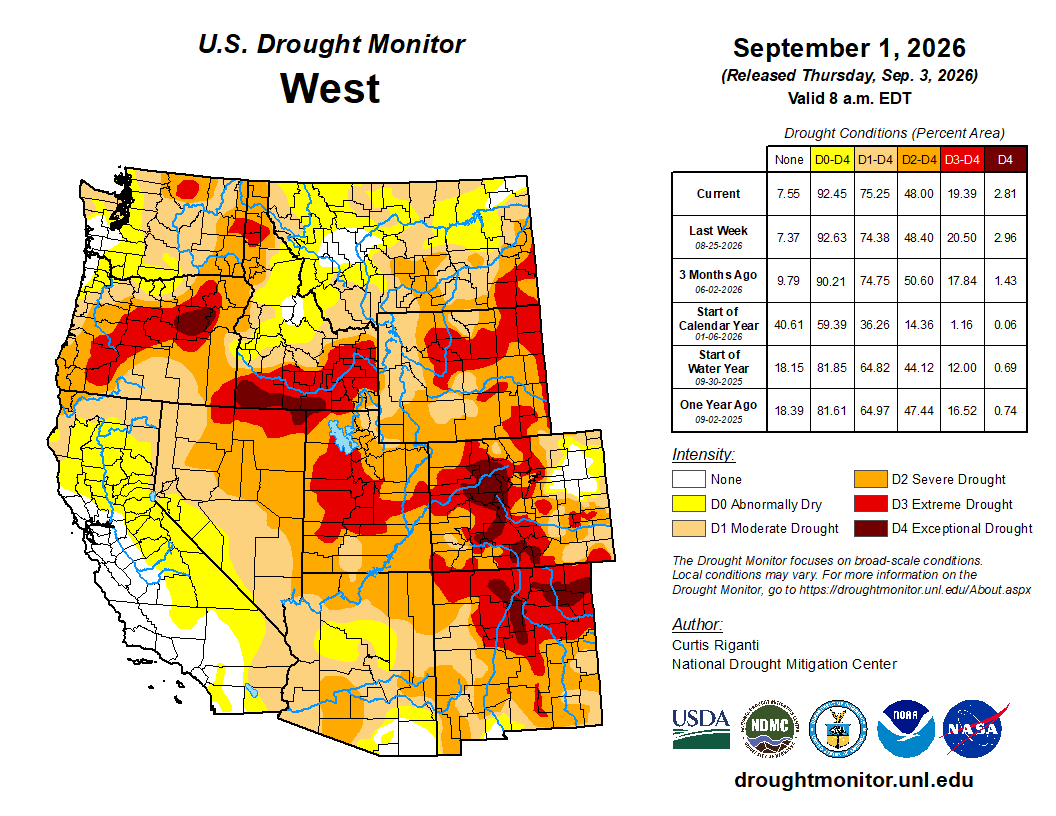
West Drought Monitor map April 28, 2026.

โ€œWe remain in a sphere of drought here in Summit County, throughout the state and the greater Western U.S.,โ€ Cahill told council members at a meeting Tuesday, April 29. โ€œThe historically low snowpack has already directly impacted streamflow in the Blue River, and this subsequently affects the townโ€™s ability to supply treated water to our customers.โ€

Until this week, Breckenridge allowed outdoor watering three days per week. The new temporary restrictions reduce that to two days in hopes of cutting outdoor water usage by roughly 30%. The town largely sources its drinking water from snowmelt (and other high-altitude surface water) collected in the Blue River Basin…The new restrictions exempt any newly installed landscaping, along with hand watering and drip irrigation for flowers and plants. Council member Dick Carleton clarified whether downtown businesses could continue watering flower baskets and using microsprayers.

Map of the Blue River drainage basin in Colorado, USA. Made using USGS data. By Shannon1 – Own work, CC BY-SA 4.0, https://commons.wikimedia.org/w/index.php?curid=69327693

City ramps up enforcement of water use restrictions — #Aspen Daily News #drought

Aspen

Click the link to read the article on the Aspen Daily News website (Lucy Peterson). Here’s an excerpt:

April 30, 2026

…as the city gears up for an unprecedentedly dry summer, it will begin ramping up enforcement on water users who violate the stage 2 water restrictions. That will include issuing formal notices of violation and collecting fines for repeat violations.

โ€œWe are taking this year more seriously, given that itโ€™s conditions we havenโ€™t quite seen before,โ€ Loughlin Molliconi said. โ€œWe want to make sure we can prioritize the most important uses of municipal water without having to degrade any environmental protections or streamflow.โ€

The city water department has issued 11 formal notices of water use violations in 2026, Loughlin Molliconi said. One notice was issued last week. Ten were issued on Wednesday. They were all first-time violations, which donโ€™t come with fines…Aspen City Councilย declared a stage 2 water shortageย last August after declaring a stage 1 water shortage in June. The declaration came after a lackluster monsoon season, and has remained in place because of unusually high winter temperatures that impacted snowfall accumulations and the snow water equivalent in the Roaring Fork watershed. Stage 2 water restrictions are mandatory. Watering of any lawn, garden, landscaped area, tree, shrub or other plant is prohibited from 9 a.m. to 6 p.m. Household watering schedules are also mandatory.

Map of the Roaring Fork River drainage basin in western Colorado, USA. Made using USGS data. By Shannon1 – Own work, CC BY-SA 4.0, https://commons.wikimedia.org/w/index.php?curid=69290878

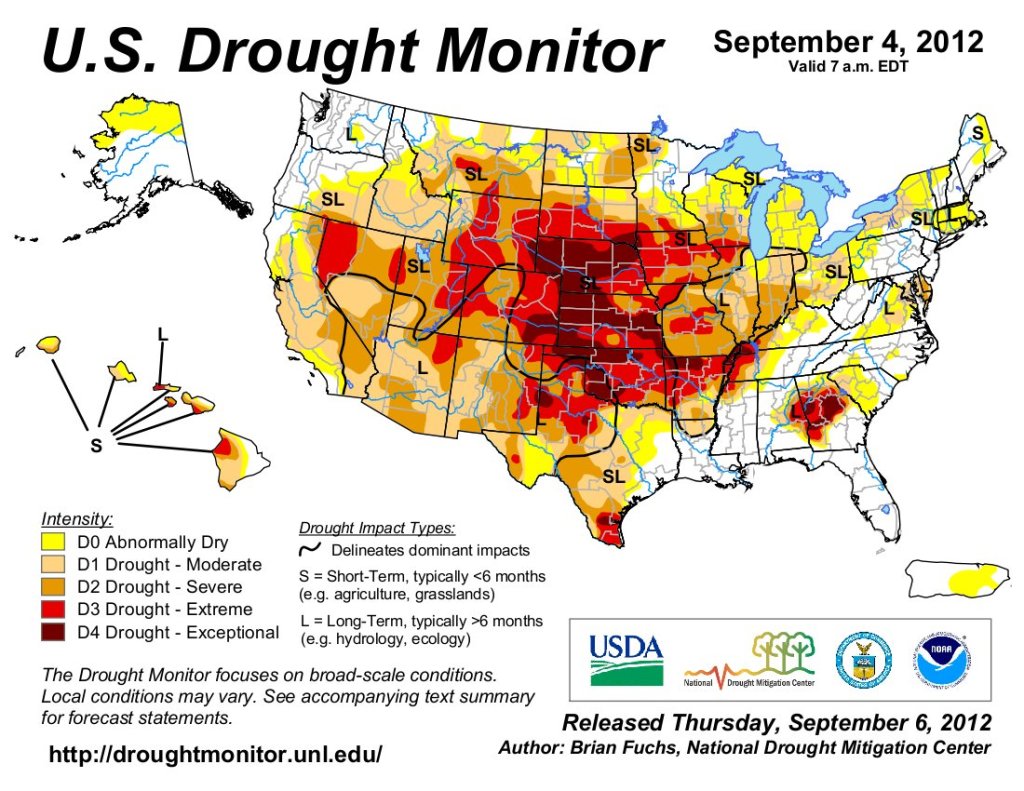
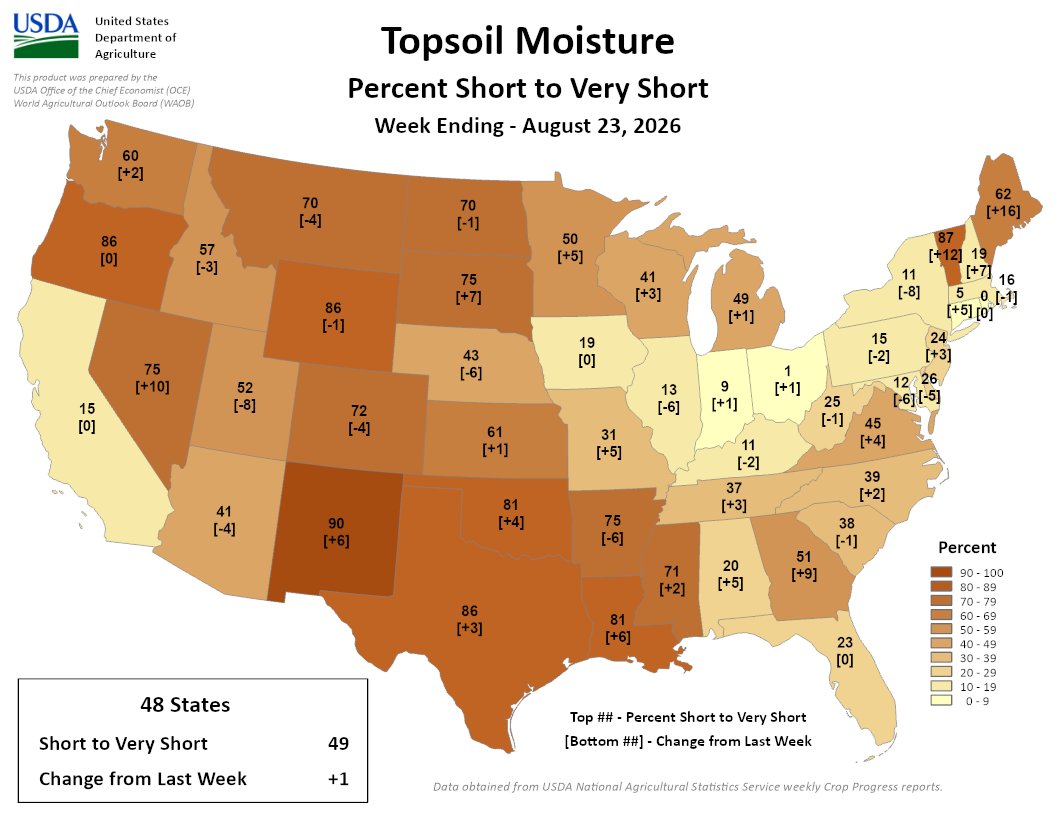
#Drought news April 30, 2026: Topsoil moistureโ€”as reported by the USDAโ€”was rated at least 40% very short to short in all the regionโ€™s states, and led by Colorado (95%)

Click on a thumbnail graphic to view a gallery of drought data from the US Drought Monitor website.

Click the link to go to the US Drought Monitor website. Here’s an excerpt:

This Week’s Drought Summary

Rain continued to bypass the central and southern High Plains, leaving rangeland, pastures, and winter wheat in desperate need of moisture. Farther east, however, showers and thunderstorms continued to ease drought across the eastern Plains, extending into the mid-South and Mississippi Delta. Some of the heaviest rain, accompanied by locally severe thunderstorms, fell from eastern Kansas into the lower Midwest. The remainder of the Midwest also received some precipitation, although some of the regionโ€™s wettest areas in the Great Lakes States got a break from the excessive rain that had led to pockets of record flooding earlier in the month. In contrast, much of New England and northern sections of New York were cool and dry. Elsewhere, unsettled, showery weather prevailed in the West, mainly north of a line from central California to the central Rockies, boosting topsoil moisture, delivering high-elevation snow, and reducing irrigation demands. However, any precipitation did not fundamentally change a mostly bleak Western water-supply outlook for the remainder of the spring into the summer of 2026…

High Plains

Precipitation delivered drought relief to some areas, including parts of southern South Dakota and eastern sections of Nebraska and Kansas. Still, by April 26, topsoil moistureโ€”as reported by the U.S. Department of Agricultureโ€”was rated at least 40% very short to short in all the regionโ€™s states, except North Dakota, and led by Colorado (95%). Winter wheat continued to struggle due to drought and recent freezes, with 65% of Nebraskaโ€™s crop rated in very poor to poor condition on April 26, along with 54% in Colorado and 41% in Kansas. Drought continued to generally worsen in eastern Colorado and western sections of Kansas and Nebraska…

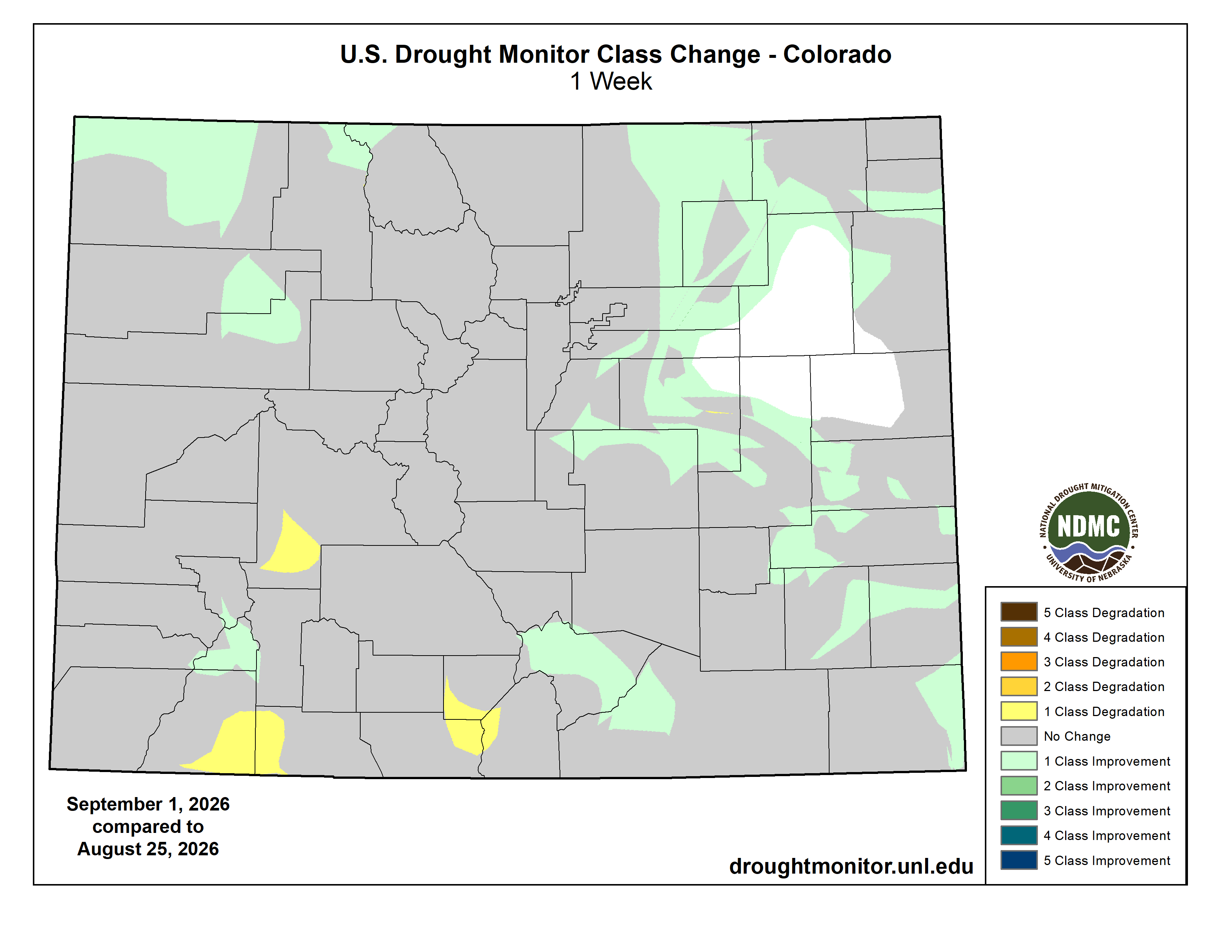
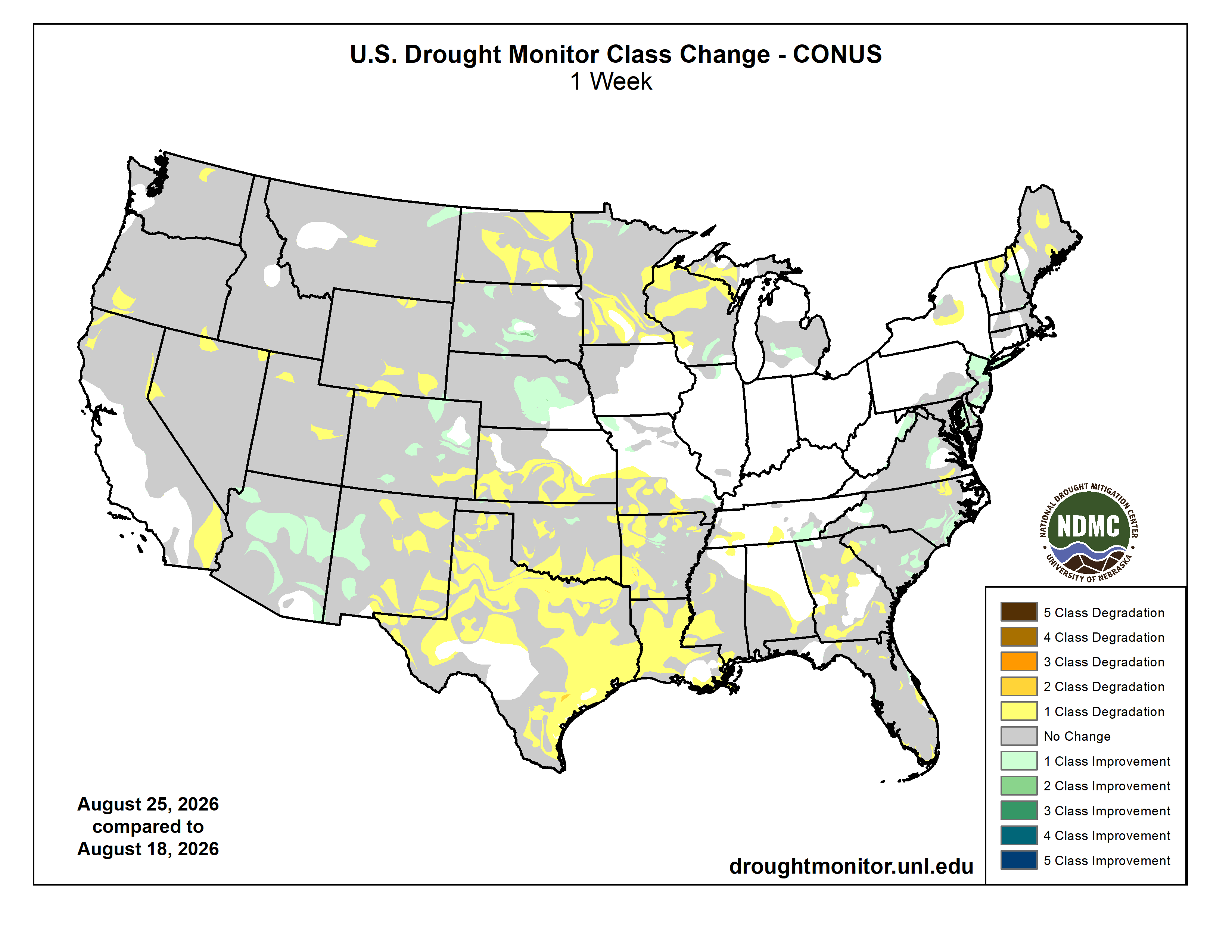
Colorado Drought Monitor one week change map ending April 28, 2026.

West

Any changes in the West were mostly minor and mixed, as cooler weather prevailed and spotty precipitation occurred. In most areas, Western precipitation did not alter bleak water-supply prospects, since most of the mountain snowpack has already melted, except in the northern Rockies. Already in late April, fears of an hydroelectricity generation crisis in the Colorado River Basin have led the Department of Interior to start sending water from Flaming Gorge Reservoir downstream to Lake Powell to help boost water levels. The Department of Interior also indicated that water normally destined for Lake Mead, farther downstream, would be held in Lake Powell. Despite overall lack of impact on Western supplies, any precipitation was largely welcomed, due to positive impacts such as a boost in topsoil moisture and a reduction in irrigation demands. In fact, enough precipitation has recently fallen to warrant a slight reduction in drought intensity in a few areas, including parts of western Colorado, northeastern Oregon, and southeastern Washington…

South

Late in the drought-monitoring period, significant rain overspread portions of the South, resulting in broad reductions in drought intensity. Some of the heaviest rain fell from eastern sections of Oklahoma and Texas into portions of Arkansas, Mississippi, and northern Louisiana. Still, more rain will be needed to ensure full drought recovery, since many of the hardest-hit areas had slipped into extreme to exceptional drought (D3 to D4) in recent weeks. Meanwhile, western sections of the Southโ€”including western Oklahoma and western Texasโ€”remained critically dry, leading to poor rangeland, pasture, and winter wheat conditions, as well as a chronically elevated wildfire threat. Statewide, winter wheat in Texas was rated 56% very poor to poor on April 26, along with 45% in Oklahoma…

Looking Ahead

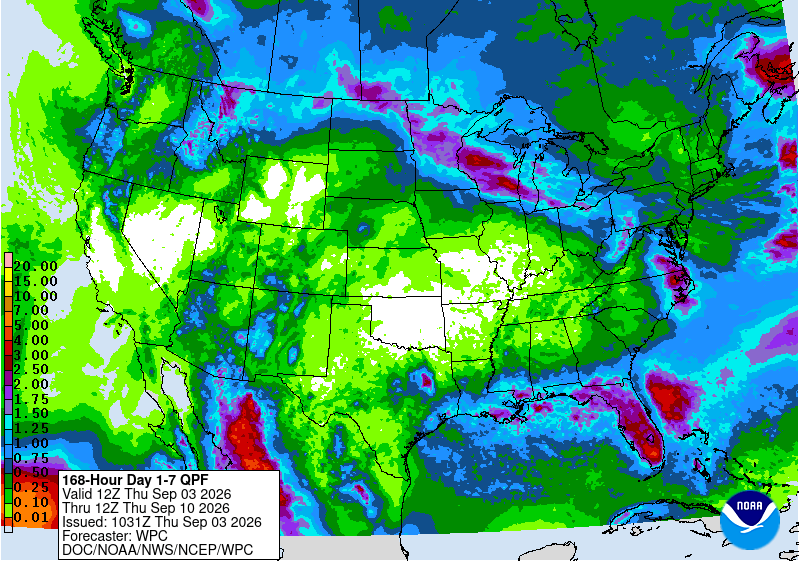
During the next several days, active weather across the South should lead to 1- to 4-inch rainfall totals from much of Texas to the southern Atlantic States. However, some Southern thunderstorms may produce large hail, damaging winds, and isolated tornadoes. The moisture will have a sharp northern edge, with little or no precipitation expected during the next 5 days across the northern and central Plains and Midwest. Generally dry weather will also cover the West, aside from late-season snow in the central and southern Rockies. Elsewhere, a cool pattern across the nationโ€™s mid-section will strengthen, with frost and freezes possible into the weekend across the northwestern half of the Plains into the upper Midwest. By Saturday morning, scattered frost could extend as far south as the Ohio Valley and the southern High Plains.

The NWS 6- to 10-day outlook for May 5 โ€“ 9 calls for the likelihood of cooler-than-normal conditions in most areas east of the Rockies, while warmer-than-normal weather will be confined to an area stretching from the Pacific Coast to the northern Rockies, including the Great Basin and northern Intermountain West. Meanwhile, near- or below-normal precipitation from the Pacific Northwest into the upper Midwest should contrast with the likelihood of wetter-than-normal conditions across the remainder of the Lower 48 States.

Drought Monitor one week change map ending April 28, 2026.

#GlenCanyonDam Faces Its Existential Moment — Brett Walton (circleofblue.org) #ColoradoRiver #COriver #aridification

Glen Canyon Dam. Photo credit: Circle of Blue

Click the link to read the article on the Circle of Blue website (Brett Walton):

April 29, 2026

This story was produced by Circle of Blue, in partnership withย The Water Deskย at the University of Colorado Boulderโ€™s Center for Environmental Journalism.

KEY POINTS

  • Glen Canyon Dam, completed in 1963, was not designed to be operated at extremely low water levels in Lake Powell.
  • The decline of Lake Powell is putting hydropower generation and downstream water deliveries at risk.
  • The Bureau of Reclamation, the federal water manager, is studying options for retrofitting Glen Canyon Dam.

In the span of U.S. history certain years are turning points, milestones in the nationโ€™s story. 1776. 1865. 1929. 1968. Circumstance and consequence conspire to make it so.

For the Colorado River and those who rely on it, 2026 is on the verge of similar prominence. Circumstances in the basin today are that urgent.

Udall/Overpeck 4-panel Figure Colorado River temperature/precipitation/natural flows with trend. Lake Mead and Lake Powell storage. Updated through Water Year 2025. Note the tiny points on the annual data so that you can flyspeck the individual years. Credit: Brad Udall

A slow-developing water supply calamity, decades in the making, has boiled over, like a cold war turning hot. Extreme heat in March โ€“ triple-digit temperatures never witnessed that early in the year โ€“ obliterated a meager snowpack. The basinโ€™s big reservoirs, the supposed buffers against short-term drought, were already uncomfortably low after a quarter-century of declining river flows. They will drop even lower. The amount of water flowing this summer into Lake Powell, the nationโ€™s second-largest reservoir, will be one of the smallest ever measured, barely a trickle.

โ€œThis is unprecedented, but itโ€™s not unpredicted,โ€ said Eric Balken, executive director of the Glen Canyon Institute. โ€œI like to say that this is the most predicted disaster of all time.โ€

Lake Powell is formed by Glen Canyon Dam, a striking 710-ft tall concrete arch braced against ruddy sandstone walls. It plugs the Colorado just after the river enters Arizona. Meant to ensure water deliveries to the lower basin states of Arizona, California, and Nevada, Glen Canyon Dam was finished in 1963 to complement the Colorado Riverโ€™s audacious engineering that distributes water through mountains and uphill to the largest cities in the Southwest and to the regionโ€™s most productive farmland. When full, Lake Powell holds enough water to flood the entire state of Virginia to the depth of one foot.

Climate change and water demand that still exceeds supply have flipped the engineering script. Lake Powell is less than 25 percent full today. Glen Canyon Dam, instead of being a guarantor of water, is now the most significant water chokepoint in the basin. The hard-won asset has become a glaring liability.

The back of Glen Canyon Dam circa 1964, not long after the reservoir had begun filling up. Here the water level is above dead pool, meaning water can be released via the river outlets, but it is below minimum power pool, so water cannot yet enter the penstocks to generate electricity. Bureau of Reclamation photo. Annotations: Jonathan P. Thompson

The reversal of fortune is because of how Glen Canyon Dam was designed. The dam was never meant to be operated at the extremely low water levels that Lake Powell is rapidly approaching. Doing so for extended periods of time could damage the pipes that move water through the dam, according to the Bureau of Reclamation, the federal agency that manages the structure.

Reclamation is now studying its options for retrofitting Glen Canyon Dam to accommodate a lower Lake Powell. It expects to release those findings later this year or in early 2027. As any home remodeler knows, renovating an aging structure is neither quick nor cheap, especially when failure could have disastrous consequences.

In the short term, Reclamation is relying on operational band-aids for Glen Canyon Dam and Lake Powell. With the consent of the seven states in the basin โ€“ Arizona, California, Colorado, Nevada, New Mexico, Utah, and Wyoming โ€“ the agency took unprecedented action this month to prop up the reservoir. Releasing more water from upstream reservoirs and holding back more in Powell will delay Glen Canyonโ€™s infrastructure reckoning. But that day will soon come, and Reclamationโ€™s answer to the damโ€™s engineering problems will have far-reaching implications โ€“ not only for the reliability of the basinโ€™s water supply, but also for its power customers, ecology, and recreation economy.

An Assessment Deferred

Dams are difficult to manage under any circumstance. Management is even more troublesome when operators must balance multiple, conflicting objectives. In Glen Canyonโ€™s case those objectives are water supply, flood control, hydropower generation, and releasing water to protect the ecology downstream in the Grand Canyon โ€“ namely, beach-building and threatened native fish like the humpback chub. This is in addition to ensuring the safe operation of the dam itself.

As of late April 2026, Lake Powell was just 25 percent full and projected to drop to a record low in the next 12 months. Photo ยฉ Brett Walton/Circle of Blue

How to operate Glen Canyon Dam and Hoover Dam, its larger downstream sibling, is what the seven basin states and Reclamation are attempting to figure out right now. The current agreement covers operations through 2026. Reclamation published a draft environmental impact statement, or EIS, in January that would impose severe cuts on water users in the lower basin, particularly Arizona, in part to protect Glen Canyon Damโ€™s fragile infrastructure.

For that reason, water users in the lower basin and elsewhere support an engineering fix for Glen Canyon Dam. Many were incredulous that Reclamation did not include an assessment of dam modifications in its draft environmental analysis.

โ€œThis EIS could have been a great avenue to look at real changes at Glen Canyon Dam that could solve the water delivery problem and some of the ecological problems, too,โ€ Balken said. 

Patrick Dent is the assistant general manager for water policy at the Central Arizona Project (CAP), which delivers Colorado River water to the densely populated center of the state. He said that CAP does not favor any particular fix โ€“ only one that provides dam managers with more flexibility.

โ€œOur primary interest is that they could release water at a lower lake level,โ€ Dent said.

The Gila River Indian Community, which receives Colorado River water through CAP, told Reclamation that the agency has a duty to safeguard the tribeโ€™s water rights, which are at risk if the dam cannot release enough water. โ€œThe United States must take action to fix Glen Canyon Dam,โ€ Gov. Stephen Roe Lewis wrote in a March 2026 letter.

The Colorado Water Conservation Board, which represents that stateโ€™s water interests, said it supports a reevaluation of Glen Canyon Dam, but โ€œin a separate actionโ€ from the EIS.

Becki Bryant, a Reclamation spokesperson, said the agency will release an appraisal study assessing three dam modification alternatives at the end of this year or in early 2027. Any action beyond the study, she said, requires congressional authorization and funding.

Illustration from the report, โ€œAntique Plumbing & Leadership Postponedโ€ from the Utah Rivers Council,
Glen Canyon Institute and the Great Basin Water Network. Courtesy of Utah Rivers Council

โ€˜Antiquated Plumbingโ€™

The tool for managing the damโ€™s multiple objectives, which are a legislative requirement as well as a practical necessity, is the water held in Lake Powell, said David Wegner, a scientist who has worked on Glen Canyon policy for more than four decades. But even water has limits when the engineering is inadequate. โ€œSadly, these dams were not built for multiple objectives,โ€ Wegner said. And Glen Canyon was certainly not built for extremely low water, he added.

Glen Canyon Dam, completed in 1963, was not designed to be operated at extremely low water levels that Lake Powell is now approaching. Photo ยฉ Brett Walton/Circle of Blue

The problem with Glen Canyon is what a coalition of environmental groups calls the damโ€™s โ€œantiquated plumbing.โ€ The groups โ€“ Glen Canyon Institute, Great Basin Water Network, and Utah Rivers Council โ€“ published a report in August 2022 that outlined these engineering deficiencies.

Water can exit Glen Canyon in only three ways. One is the spillways, a pressure-release valve for flooding, which are located at elevation 3,648 feet, near the top of the dam. They are irrelevant today. Lake Powell rests 122 feet below them.

The main exit point is through the eight penstocks, the 15-foot diameter tubes that move water through the turbines to generate hydroelectricity. The penstocks are incapacitated when Powell drops below 3,490 feet. (The lake today is 36 feet higher than that level.) If the lake falls below what is known as minimum power pool, hydropower generation also ceases.

If that happens, water must be released through four 8-foot diameter pipes called the river outlet works. Smaller than the penstocks, the river outlet works are located at elevation 3,370. Below that elevation water cannot be released from Powell, a status known ominously as โ€œdead pool.โ€ (Functionally, the river outlet works may be useless at elevation 3,394, Reclamation says.)

The environmental groups identified two limitations with the river outlet works. One is that they were not designed to be operated full-time. They are a role player, not the star. The other is that their smaller size means less water can pass through them. Thatโ€™s a problem because the upper basin states of Colorado, New Mexico, Utah, and Wyoming are required to send a set amount of water downstream to the lower basin, according to the 1922 Colorado River Compact that divided the river.

The flow restrictions imposed by the river outlet works, if they had to be used full time, means that the upper basin could violate the compact, which could mean water cutbacks imposed by the lower basin.

โ€œItโ€™s just so counterintuitive that the tool that was designed to meet this delivery obligationโ€ โ€“ the construction of Glen Canyon Dam โ€“ โ€œis now going to be the roadblock that may prevent the delivery obligation from being met,โ€ said Balken of the Glen Canyon Institute.

The engineering problems are not a new discovery. Wegner, who was with the Bureau of Reclamation at the time as its Grand Canyon environmental studies manager, helped lead a 1987 National Academies report on Glen Canyon. The report recommended that the Interior Department consider the โ€œinstallation and operation of multiple outlet structuresโ€ at Glen Canyon, which would give dam managers more flexibility with water releases.

Glen Canyon Damโ€™s powerhouse sits at the base of the 710-foot-tall structure. Hydroelectric generation has dropped in tandem with the falling water levels in Lake Powell. Photo ยฉ Brett Walton/Circle of Blue

Glen Canyonโ€™s structural problems were substantiated in 2023, when Reclamation used the river outlet works during an experimental โ€œhigh-flowโ€ release of water to flush sediment downstream and rebuild eroding Grand Canyon beaches.

The high-volume release caused pitting, or cavitation, within the river outlet works, a risk that was heightened due to the physics of water when Lake Powell is low. Reclamation coated the pipes with epoxy as a temporary fix to prevent more damage, a process that took several months. The agency has since used two small-scale physical models at its Technical Service Center in Denver to test dam operations at low water levels and the effect on infrastructure.

Reclamation acknowledged the limitations of the river outlet works in a technical memopublished in March 2024 by Richard Lafond, director of the agencyโ€™s Technical Service Center. The memoโ€™s conclusions were endorsed by the top decision-makers in Reclamationโ€™s Upper Colorado River Office.

โ€œLong term operation of the river outlet works will result in accelerating regular operation and maintenance tasks,โ€ LaFond wrote. Reclamation should โ€œnot rely on the river outlet works as the sole means for releasing water from Glen Canyon Dam.โ€

Wegner put it in starker terms. If the river outlet works had to be relied upon and the pipes began to erode again, then Reclamation could potentially lose control of water flows.

โ€œPotentially that could fail,โ€ Wegner said, meaning an inability to control water releases through the dam if the pipes are structurally compromised. โ€œAnd if that fails, now you have a catastrophe on your hand and you have limited options to manage that catastrophe.โ€ 

In other words, there would be no way to release water downstream into the Grand Canyon and into the lower basin.

Neither Quick Nor Easy

What fixes are possible? Reclamation received $2 million from Congress in the fiscal year 2022 budget for an appraisal study.

Reclamation outlined three engineering possibilities in a 2023 presentation, most of which centered on preserving hydropower generation as Lake Powell declines.

One possibility is a new, lower intake that uses the existing power generation turbines. An intake located deeper in the reservoir would allow Glen Canyon to pass water in what is currently dead pool. But it would entail โ€œincreased risk from penetration through the dam.โ€

The second would connect new power generation equipment to the river outlet works.

The third option is tunneling through the canyon wall and installing a new underground power station. This would also provide more flexibility for water releases.

Reclamation also included three operational or policy changes for power production, including investing in wind and solar to offset hydropower declines.

Other ideas that seemed kooky and fringe just a few years ago โ€“ draining Lake Powell and filling Lake Mead first; changing the basinโ€™s water accounting system โ€“ are now being discussed throughout the basin with more seriousness and candor.

Beyond that presentation, Reclamation has not said much publicly about dam modification. The agency declined an interview request to discuss Glen Canyon Damโ€™s engineering problems.

Whatever direction Reclamation chooses โ€“ an option outlined above or something new โ€“ the process will not be quick or easy. Any change to Glen Canyon must go through an environmental analysis and public comment period. Congress will have to authorize actions and appropriate the funds. Construction alone will take years.

Wegner, who was the staff director for the House Natural Resources Water and Power Subcommittee from 2008 to 2014, knows the difficulty and sees a lack of leadership. โ€œThereโ€™s nobody in Washington who has been willing to lead the charge trying to get Congress to provide authorized funding to do this sort of work.โ€

โ€˜Reservoir Triageโ€™

Because Reclamation is not confident it can operate the river outlet works for an extended run, the agency is focused on keeping Powell above elevation 3,500 feet.

Protecting 3,500 feet comes with all sorts of baggage. It preserves hydropower generation, which power customers appreciate. But in effect the redline at that elevation strands some 4.4 million acre-feet in Lake Powell. (Only 3.7 million acre-feet is technically accessible with the current plumbing.) Some have called this elevation a โ€œde factoโ€ dead pool. Thus, the agitation in the lower basin for a plumbing system within the dam that provides access to this water.

The mineral โ€œbath tub ringโ€ above Lake Powell shows where its water level has been. Photo ยฉ Brett Walton/Circle of Blue

Balken said that downstream water deliveries, not preserving hydropower, should be Reclamationโ€™s biggest concern.

โ€œWhen these decision makers are talking about Glen Canyon Dam from only a hydropower perspective, I think itโ€™s missing the larger point, which is the dam is about to become the biggest roadblock of water deliveries that the basin has ever seen,โ€ Balken said.

Flaming Gorge Reservoir, on the Green River, straddles the Wyoming-Utah border south of Rock Springs. The Flaming Gorge dam, on the Utah side, was completed in 1964 and is a critical component of the Colorado River water storage system. The Green River, the chief tributary to the Colorado River, originates in the Wind River Range, flows to Flaming Gorge Reservoir, then connects with the Colorado River in Canyonlands National Park in Utah.

To avoid the infrastructure risks of dropping below 3,500 feet, Reclamation has started to take extraordinary action. The agency has two emergency levers it is pulling. One is to hold more water back in Lake Powell. Reclamation cut water releases to the legal minimum this year, something it has never done. The other is releasing more water from Flaming Gorge, a reservoir upstream that is in better shape.

As Balken describes it, โ€œThis is reservoir triage.โ€

These emergency actions have serious side-effects. Upstream, Flaming Gorge is expected to lose 35 feet of elevation by next spring, once the extra water has been released. That will hurt the recreation economy of northeastern Utah and southwestern Wyoming โ€“ fewer boat ramps in the water, less fishing access.

These upstream releases have limited utility, Wegner said. โ€œYou can do that once or twice. But you got to then depend upon Mother Nature refilling those reservoirs upstream.โ€

Hoover Dam at low water. Jonathan P. Thompson photo.

Downstream, Lake Mead will drop quickly and it too will approach a level in which hydropower generation at Hoover Dam severely drops. Algal blooms in a warmer, shallower lake could be a problem. โ€œTheyโ€™re going to be robbing Mead to pay Powell,โ€ Balken said.

Trying Not to Hit Bottom

The idea of dead pool โ€“ when Lake Powell can no longer release water โ€“ was almost inconceivable when the reservoir was designed and filled. The official device for measuring Lake Powellโ€™s elevation ends at the top of the penstocks, at elevation 3,477.5 feet. According to Reclamationโ€™s 2024 technical memo, โ€œThis is an indication that reservoir elevations below minimum power poolโ€ โ€“ 3,490 feet โ€“ โ€œwere not anticipated.โ€

Cavitation at the Glen Canyon Dam, the cause of the emergency in 1983 via Flow Science.

Reclamation finished filling the reservoir in 1980. Three years later, after an intense El Niรฑo winter, the damโ€™s upper limits were tested. Floodwaters in the summer of 1983 nearly broke the dam. Such volumes are almost inconceivable now.

In a typical year, Lake Powell would be rising in late April, flush with the deposits of snowmelt from headwater basins in the Rocky Mountains. Not this year. The snowpack peaked in many basins in late February or early March. What little snow there was has already melted. As of April 28, Lake Powell inflows are projected to be just 16 percent of average. Lake level forecasts from mid-April showed a long downward slope for the next 12 months. Those projections were what triggered the emergency release of water from Flaming Gorge and the reduction in Lake Powell releases.

Scientists have been warning about circumstances like this for years. In a defining period for the basin, all the predictions of water supply shocks in the Colorado River from the past two decades are coming to pass.

โ€œWe should have been prepared for this,โ€ Balken said.

The big, big story thisย chart tells: โ€œHoly moly,โ€ said the staff at Big Pivots when this slide was shown at the River District meeting in Glenwood Springs — Allen Best (BigPivots.com) #ColoradoRiver #COriver #aridification

Credit: Colorado River District

Click the link to read the article on the Big Pivots website (Allen Best):

April 26, 2026

The staff at the Colorado River District showed this slide during a session on Colorado River hydrology at the districtโ€™s board of director meeting in Glenwood Springs this past  Tuesday afternoon.

Here in metro Denver, the staff of Big Pivots said something profound like โ€œholy moly!โ€

With moisture coming into Colorado during the next two weeks, itโ€™s possible that the runoff into Lake Powell may surpass that of 2002. This slide says that right now, at Cameo, the gaging station on the Colorado River, east of Palisade, it looks like the spring runoff peaked in late March. The usual is in early June.

Another takeaway from the River District meeting was about Green Mountain Reservoir. The dam that creates the reservoir was built from 1938 to 1943, giving the Western Slope a way to store water as part of the Colorado-Big Thompson diversion that came after World War II. The normal allotment of the reservoir storage for downstream irrigators, mostly in the Grand Junction area, is 66,000 acre-feet.

For the first time in the history of Green Mountain, said Andy Mueller, the River Districtโ€™s general manager, the water is unavailable. Instead, the river district is tapping various pools of water over which it has control to come up with a thimbleful here, a cup there. A creative solution, Mueller called it. Irrigators wonโ€™t become whole, but they will get some help.

โ€œWeโ€™ll survive, and we will continue to survive,โ€ said Mike Ritschard, a director from the Kremmling area and a fourth-generation rancher there, said during a roundup of reports from board members.

Created in 1937, one of the ramifications of the Colorado-Big Thompson water diversion, theย River District has primary responsibility for water matters across 15 of the 20 Western Slope counties.

The Colorado River Water Conservation District spans 15 Western Slope counties. Colorado River District/Courtesy image

President Trump looks to Make America Graze Again: Plus: BLM peddles vacant grazing leases; Wacky weather watch — Jonathan P. Thompson (LandDesk.org)

Photo credit: Jonathan P. Thompson

Click the link to read the article on The Land Desk website (Jonathan P. Thompson):

April 24, 2026

๐Ÿฎ Grazing Gazette ๐Ÿฅฉ

When Donald Trump was elected president for the second time, we all knew what was coming to the nationโ€™s public lands: The administration would favor extractive uses by eviscerating environmental protections, rolling back regulations, and leasing out as much land as possible while handing out drilling permits like Shriners throwing candy at a parade.

Yet there was one realm where I figured the administration couldnโ€™t bestow any more deregulatory gifts, namely public lands grazing. Itโ€™s not that I thought Trump would clamp down on the destructive practice, itโ€™s just that I figured the status quo was about as permissive as it could get. Past administrations, be they Democratic or Republican, have generally shied away from updating or reforming public lands grazing policies out of fear of inflaming the Westโ€™s cowboy culture โ€” even if it is based largely on myth.


The West’s Sacred Cow — Jonathan P. Thompson


But Trump, his Interior Secretary Doug Burgum, and Agriculture Secretary Brooke Rollins are intrepidly going where previous administrations did not dare: grazing reform. Well, sort of, though maybe not in the way public lands lovers might have hoped. In fact, they are doing their best to make grazing policy even more lax with a goal of getting more cattle out there to trample public lands, cryptobiotic soils, and cultural sites.

Last month, Burgum and Rollins announced an MOU between the two agencies designed to โ€œboost the supply of American born, raised, and harvested beefโ€ by cutting โ€œbureaucratic red tapeโ€ and giving the livestock industry more control. The MOU has a goal of โ€œmaintaining grazing capacity wherever possible, including no net loss of Animal Unit Months within allotments,โ€ even if those allotments are degraded or in poor health. In Burgumโ€™s words, one goal is to โ€œpreserve Americaโ€™s ranching heritage for generations to come.โ€ Forgive me for getting anxious whenever I see โ€œheritageโ€ used in conjunction with public lands.

โ€œTodayโ€™s signing sends a clear message: the Trump administration is putting Americaโ€™s farmers and ranchers first,โ€ said Secretary of Agriculture Brooke Rollins. Which brings up the question of what message the administration was sending in February when Trump signed an executive order toย quadruple beef importsย from Argentina in an effort to keep Big Macs affordable.

๐Ÿ—บ๏ธ Messing with Maps ๐Ÿงญ

To help it carry out its mission, the Bureau of Land Management has released anย interactive mapย aimed at putting more cattle and sheep back on public lands. The โ€œfederal grazing lands potentially availableโ€ map shows allotments that have been vacated, often as a result of deals brokered by environmentalists, with the intent of peddling the tracts to livestock operators. While thereโ€™s no guarantee that the BLM would lease out all of the vacant tracts, the presence on the map of the ones vacated for environmental purposes is enough to set off alarm bells.

Grazing allotments listed as โ€œpotentially availableโ€ for leasing on the BLMโ€™s new map. The five parcels closest to Silverton were retired in 2023 to protect bighorn sheep. Source: BLM

For example, the map includes 10 allotments in the high country around Silverton, Colorado, totaling about 70,000 acres. In 2023, the National Wildlife Federation paid the Etchart Sheep Ranch toย vacate five of these allotmentsย in an effort to give Rocky Mountain bighorn sheep more breathing room and protect them from diseases transmitted by domestic sheep. The deal was made with the hope that the leases would be retired permanently. Yet the inclusion on the map indicates they could see domestic sheep once again, emphasizing the need for legislation that would make such retirements perpetual.

Also on the map are the Flodine Park and Yellowjacket allotments in Canyon of the Ancients National Monument near the Colorado-Utah border. In 2005, a rancher gave up the allotments, north and south of McElmo Canyon, respectively, and sold 4,500 acres of adjacent private land to the BLM to add to the national monument. Both allotments and the private land contain a number of intermittent streams, shallow canyons, and numerous cultural sites. They had been grazed relentlessly for decades prior, and showed the wear and tearโ€”much of theย cryptobiotic soil had long before been trampled and destroyedย andย invasive cheat grass had infiltrated the grazed areas. An archaeological assessment conducted later found grazing had damaged dozens of sensitive and cultural sites in the areas.

The Yellowjacket and Flodine Park allotments in Canyons of the Ancients National Monument. They have been vacant since 2005, and a previous effort to lease them out again was halted. Now it looks like they may be back on the block. Source: BLM

In 2010, the BLM, which manages the monument, issued a new resource management plan, which allowed for continued grazing, but also opened the door to permanently retiring vacant grazing allotments if they fail to meet BLM rangeland health standards or when grazing is negatively impacting cultural sites. Five of the 28 allotments in the most heavily visited areasโ€”including Sand Canyonโ€”were cancelled, but not the Flodine Park and Yellow Jacket allotments, which were still in retirement at the time.

Instead, the local county commissioners and a group of ranchers pressured the BLM to reauthorize grazing on both allotmentsโ€”to bring them out of retirement, if you will. The BLM acquiesced, but environmentalists and tribes with roots in the area fought back, forcing the agency to do a more thorough environmental analysis of the proposal. The opposition was enough to prompt the agency at least to delay issuing any leases, and the allotments remain in limbo.

Meanwhile, a team of scientistsย assessed the healing processย on the Flodine Park and Yellow Jacket allotments, which by then had been cow-free for 11 years (though feral horses had grazed there). They compared biocrusts on those allotments to a fenced enclosure that hadnโ€™t seen grazing for 53 years and a plot that was being actively grazed. What they found was both predictable and remarkable: The longer a plot went without cows, the healthier it was, as summed up by these graphs.

Source: Grazing, Rest, and Biological Soil Crust in Canyons of the Ancients National Monument Marc Coles-Ritchie, Lior Gross and Mary Oโ€™Brien, Grand Canyon Trust.

While the natural landscape can eventually heal itself, livestockโ€™s damage to the cultural landscape is irreversible. BLM surveys identified 266 cultural sites on the two allotments, including 35 with โ€œstanding architecture.โ€ At least 43% of those had been damaged by livestock.

Now whatโ€™s left may be in danger, too, at least if those allotmentsโ€™ presence on the new map is any indication. And guess what? Packing these allotments isnโ€™t going to make that steak any cheaper. Only about 1% of American beef is grazed on public lands. 

Check out the BLM Grazing availability map yourself: https://experience.arcgis.com/experience/0a208d6eac6144969213c68519a8cfdd


Mt. Blue Sky at 14,130 feet in elevation on April 22, 2026. Jonathan P. Thompson photo.

โ›ˆ๏ธ Wacky Weather Watch โšก๏ธ

If you were to get all of your information about the Westโ€™s climate from daily weather reports and road condition websites, you might think that April snow showers and deep freezes had ended the snow drought and would lead to big May streamflows.ย After all, it snowed enough in Colorado to turn roads to slip-and-slides and causing aย 75-car pileupย on I-70 near the Eisenhower Tunnel. The temperatures dropped low enough to wipe out most of the fruit blossoms the March heat wave tricked into blooming early. Only the farmers who used extraordinary measures โ€” starting fires or smudge pots in the orchards, running wind machines, etc. โ€” could save some of their summer harvest.

Sunset over the San Juans. Jonathan P. Thompson photo.

Sure, the snow that did fall in April helped, but only enough to elevate snowpack levels to, well, the lowest on record (only by a slightly smaller margin than before). And the freeze was deep, which helped extend the spring runoff in the few areas where there was any snow left. But even there, I suspect that peak runoff has already come and gone (though Iโ€™m not calling the Predict the Peak contest yet!). 

I flew over Coloradoโ€™s mountains the other day and was rather shocked at the dearth of snow, even on the highest peaks. Mt. Blue Sky, formerly Mt. Evans, had only a few patches of white left โ€” at 14,130 feet in elevation. Everything below 10,000 feet appeared to be snowless. While the San Juan Mountains appeared to be in slightly better shape, it was still looking pretty dry. The Animas River watershedโ€™s snowpack remains lower than it was on 2002 on this date.


The (new) water year of our discontent — Jonathan P. Thompson


High temperatures the biggest factor in low #snowpack, low river flows — The #Aspen Daily News #runoff

Click the link to read the article on The Aspen Daily News website (Kari Dequine). Here’s an excerpt:

April 25, 2026

Meteorological records dating back 130 years show a handful of years with winters drier than the 2025-26 winter, said Rebecca Briesmoore, a water resources engineer with the Colorado River District. 

โ€œBut it has been the warmest by far โ€ฆ that has really been the headline: It wasnโ€™t the driest, but it was the warmest โ€” and that is having a huge impact on hydrology and water resources,โ€ Briesmoore said.

She spoke to a packed room of about 150 attendees at Thursdayโ€™s [May 21, 2026] Roaring Fork River: State of the River event hosted by the Colorado River District at the Pitkin County Library…โ€œItโ€™s important for people to know that this year is unprecedented . . . itโ€™s like nothing we have ever seen before,โ€ Briesmoore said. โ€œEvery single drop of water really, really matters. We have to think about how we are using it, and what we are going to do with very, very low water resources.โ€ย 

To a room full of gasps, Briesmoore showed a graph with a star marking the 2026 winter โ€” from October 2025 to March โ€” high above the rest.ย While years including 1902, 1904, 1977, 2002 and 2018 recorded less precipitation, in terms of temperatures thereโ€™s no other year that even came close to 2026.ย 

Map of the Roaring Fork River drainage basin in western Colorado, USA. Made using USGS data. By Shannon1 – Own work, CC BY-SA 4.0, https://commons.wikimedia.org/w/index.php?curid=69290878

The Next El Niรฑo Could Lock Earth Into a Hotter Climate: The Pacific heat pulse is temporary, but scientists warn that its climate impacts are not — Bob Berwyn (InsideClimateNews.org) #ENSO

Amazon wildfires 2024. Credit: Greenpeace

Click the link to read the article on the Inside Climate News website (Bob Berwyn):

April 25, 2026

The Pacific Ocean is a giant climate cauldron, with a powerful heat engine that affects storms, fisheries and rainfall patterns half a world away, and scientists are watching closely to see if itโ€™s about to boil over. 

Their projections suggest the tropical Pacific is simmering toward a strong El Niรฑo, the warm phase of an ocean-atmosphere cycle that can intensify and shift those impacts.

In a world already superheated by greenhouse gases, a strong El Niรฑo during the next 12 to 18 months could permanently push the planetโ€™s average annual temperature past the 1.5 degrees Celsius warming threshold enshrined in scientific documents and political agreements as a turning point for potentially irreversible climate impacts.

Climate scientists also recently published a study showing that strong El Niรฑo events can trigger what they called โ€œclimate regime shifts,โ€ meaning abrupt, lasting changes in heat, rainfall and drought patterns.

El Niรฑo is one of the planetโ€™s biggest natural release valves for ocean heat. The venting starts with periodic shifts of swirling ocean currents and winds over the Pacific. That causes huge stores of tropical ocean heat to surge eastward from the Western Pacific Warm Pool, roughly between Australia and Indonesia, northward to Japan. Those tropical seas are by far the warmest ocean region on Earth, and span an area four times as large as the continental United States.

When that ocean heat spreads across the equatorial Pacific, it spills into the atmosphere in pulses that tilt weather patterns, reroute powerful high-elevation winds, raise global temperatures, bleach coral reefs and disrupt fisheries and ocean ecosystems. The effects hit continents as well, intensifying rainstorms and flooding in some regions, while amplifying extreme heat, drought and wildfires in others.

In 2015, heat from the tropical Pacific helped raise the global annual average temperature irreversibly past 1 degree Celsius above the pre-industrial baseline. And in 2024, Earth experienced the hottest year recorded in human history, aided by another El Niรฑo boost.

Even a moderately strong El Niรฑo during the next 12 to 18 months could drive the average global temperature to about 1.7 degrees Celsius above the preindustrial level, climate scientistย James Hansenย told Inside Climate News. Hansen doubts the world will meaningfully cool back down to below the 1.5 degree Celsius mark after the El Niรฑo fades.

Hot El Niรฑo cycles in the tropical Pacific Ocean release so much energy, as heat and moisture, to the atmosphere, that it affects rainfall and drought patterns halfway around the world. Credit: NASA/JPL

Passing that threshold may not be like falling off a climate cliff, but itโ€™s definitely the point when the edge starts crumbling, with rapid changes to relatively stable systems of forests, water, rain and temperatures that have sustained people and ecosystems for millennia.

Even below the 1.5-degree Celsius threshold, California reservoirs no longer fill in some years and overflow with extreme rainfall in others. Coral reefs from Australia to the Caribbean have bleached beyond recovery and vast tracts of forests burned up in megafires. Traditional crop calendars donโ€™t align with seasons. Deadly nighttime heat rises in cities, killing vulnerable people in apartments that never cool.

โ€œSuper El Niรฑoโ€ Seen as Game Changer

Climate impacts amplified by strong El Niรฑos keep hitting the same vulnerable regions, may be more widespread than previously thought and can persist long after the tropical Pacific cools, according to an El Niรฑo study published December 2025 in Nature Communications. 

The study concluded that โ€œsuper El Niรฑosโ€ are not just passing weather events, but more like climate shocks that can push parts of the Earth system into new states, co-author Jong-Seong Kug wrote in an email. 

The studyโ€™s definition of a super El Niรฑo is when the sea surface temperature anomaly in the tropical Pacific โ€œexceeds 2 standard deviations above normalโ€โ€”not an ordinary fluctuation, but more of a systemic warning sign. 

The impacts are clustered in areas known to be sensitive to long-distance climate connections and regions โ€œthat are already prone to climate regime shifts,โ€ wrote Kug, a climate researcher at Seoul National University in South Korea. 

There are only three super El Niรฑos on record: in 1982-83, 1997-98 and 2015-16. All of them contributed to regime shifts in regional ocean temperatures, leading to unprecedented marine heat waves that destroyed or damaged coral reefs and caused mass die-offs and starvation among many marine organisms, from starfish to seabirds and marine mammals. 

Those impacts, as well as changes in drought and extreme heat over land areas, persisted for years and could shift some regional patterns for decades, according to the study.

Kug said the main โ€œregime-shift hotspotsโ€ in oceans include the central North Pacific, the southeastern Indian Ocean, the southwestern Pacific and the Gulf of Mexico, areas where globally linked atmospheric connections โ€œcan strongly perturb the ocean surface and, in some cases, help anomalies persist.โ€

Kug said the study identified super El Niรฑo regime shifts in East Africa and the Maritime Continentโ€”the island-rich region between the Indian and Pacific Oceans around Indonesia, Malaysia and Papua New Guinea.

Upper #ColoradoRiver states push for mediation on water cuts — Tucson.com #COriver #aridification

Map of the Colorado River drainage basin, created using USGS data. By Shannon1 Creative Commons Attribution-Share Alike 4.0

Click the link to read the article on the Tucson.com website (Tony Davis). Here’s an excerpt:

April 26, 2026

It’s time to bring in a mediator to handle the prolonged dispute over managing the Colorado River between the Upper and Lower Colorado River Basin states, representatives of the four Upper Basin states say.

“The proposal for mediation attempts to address the current deadlock between Upper Basin and Lower Basin approaches and begin to deal with the basinโ€™s dire hydrologic conditions.” said the Upper Colorado River Commission, which represents Colorado, New Mexico, Utah and Wyoming.

“The commissioners believe a structured mediation process can support authentic negotiations and collective action to address the Basinโ€™s operational challenges,”  the commission said in a news release last week.

The request for a mediator to handle this dispute follows about two years of fruitless negotiations among the various state representatives. There have been several major sources of dispute, but the biggest one has been over how the two basins should split the cuts in river water use that would be needed to bring human demand in line with shrinking supply…The Upper Basin states’ request comes not long before the U.S. Bureau of Reclamation is supposed to announce its plan for managing the river, in the absence of an agreement among the basin states. A new plan is necessary because the river’s current operating guidelines expire Sept. 30…

The request for mediation also comes as the river’s condition continues to deteriorate. Hot, dry weather has held down water flows in the river for most of the year, and there’s a risk that spring-summer runoff into Lake Powell will be the lowest on record since Lake Powell started filling in the 1960s.

China surpasses US in research spending โ€“ the consequences extend far beyond scientific ranking andย clout — Caroline Wagner (TheConversation.com)

In a span of a few years, China has outstripped the U.S. in scientific publications, spending and patents. AP Photo/Andy Wong

Caroline Wagner, The Ohio State University

Chinaโ€™s rapid rise in science has hit a milestone. The countryโ€™s investment in research and development has reached parity with โ€“ and by purchasing power measures has surpassed โ€“ that of the United States, according to a March 2026 report from the Organisation for Economic Co-operation and Development. Both nations have crossed the US$1 trillion threshold on research spending.

For 80 years, the U.S. operated the most productive scientific and technological enterprise in human history. Breakthroughs and advances that came from American labs included the internet; the mRNA vaccine; the transistor and its children, semiconductors and microprocessors; the Global Positioning System; and many more.

U.S. scientific and technological leadership was nurtured by sustained public investment in research universities and federal laboratories, as well as a culture of open inquiry. These investments turned scientific discovery into economic strength โ€“ accounting for more than 20% of all U.S. productivity growth since World War II.

In contrast, China had previously spent little to nothing on research and development. Some estimates show that China was among the lowest research spenders worldwide in 1980.

As a policy analyst and public affairs researcher, I study international collaboration in science and technology and its implications for public and foreign policy. I have tracked Chinaโ€™s rise across every major database for more than a decade.

The most recent reports showing that China is now outspending the U.S. on scientific and technological research is a turning point worth understanding clearly because, historically, global leadership in one sector โ€“ including technology and warfare โ€“ feeds into others. U.S. dominance is in question.

Two people in white lab coats and surgical masks looking at a tall metal device
Chinaโ€™s investment in innovation is fostering scientific and technological advances. Jin Liwang/Xinhua via Getty Images

Chinaโ€™s systematic and unrelenting rise

Chinaโ€™s R&D spending milestone caps a series of achievements that have arrived in rapid succession.

In 2019, China surpassed the U.S. in its share of the top 1% most-highly cited papers โ€“ what some call the Nobel class of research. By 2022, it had taken first place globally in most-cited papers overall.

In 2024, China overtook the United States in total scientific publications โ€“ the first time any nation has displaced American dominance since the U.S. itself surpassed the United Kingdom in 1948. Researchers found that China overtook the United States in scientific output even earlier. That same year, China pulled ahead in the Nature Index, which tracks publications in the worldโ€™s most selective scientific journals, posting a 17% advantage over the U.S. in outlets long considered the gold standard of scientific excellence.

In 2024, Chinese entities also filed roughly 1.8 million patent applications, compared to the U.S.โ€™s 603,191 applications.

Given these milestones, itโ€™s possible to argue that China is quickly taking the lead in global science and technology. These are not isolated data points. They mark a structural shift in where the worldโ€™s scientific frontier is being built.

More science is good โ€“ the problem lies elsewhere

Chinaโ€™s ascent is, in one sense, good news. More knowledge, generated by more researchers across more institutions, expands the global pool of discovery from which everyone can draw. The world benefits when science thrives.

The problem is not that China is investing, but that the U.S. is not.

First, the U.S. is divesting from basic, open science. Federal R&D spending in the U.S. peaked in 2010 at roughly $160 billion and fell by more than 15% over the following five years. Federal investment in research and development has been in a long, slow slide โ€“ from a peak of 1.86% of gross domestic product in 1964 to about 0.66% in 2021.

The federal government is no longer the largest spender in R&D: It funded about 40% of basic research in 2022, while the business sector performed roughly 78% of U.S. R&D. While not a problem in itself, industry has simultaneously withdrawn from open scientific publication over the past four decades, shifting from research toward development. The result is a shrinking pool of openly shared scientific knowledge precisely as public investment in it also contracts.

Under the second Trump administration, U.S. government science agencies have been slow-walking proposals for new research. Current budget cuts from the White House threaten to deepen cuts to government spending significantly.

The second is the active restriction of scientific exchange: tightening access to U.S. institutions, scrutinizing international collaborations and raising barriers to foreign-born researchers. These policies, though intended as security measures, work against the openness that has historically made American science productive and attractive to global talent.

I describe this issue as an example of the stockyard paradox, in which securing research assets may weaken the very system these measures aim to protect.

Disinvestment cuts deeper than it appears

The deeper danger for the U.S. economy is that disinvestment and selective engagement in research erodes the capacity to use cutting-edge science regardless of where it is produced.

Absorbing and applying cutting-edge knowledge, whether developed in Boston or Beijing, requires maintaining research institutions and trained workforces, as well as active participation in global networks. This is not a passive process. You cannot free-ride on Chinese science if you have dismantled the institutional and human capital needed to evaluate, translate and apply it.

A nation that hollows out its research base not only falls behind but also progressively loses its ability to benefit from science, including in technologies it is already able to access.

Talent compounds the problem. The U.S. built its scientific dominance partly by being the destination of choice for the worldโ€™s most ambitious researchers. The U.S. leads the world in Nobel Prizes, but, notably, 40% of the Nobel Prizes in chemistry, medicine and physics that were awarded to Americans since 2000 were won by immigrants. The flow of foreign talent is not guaranteed. It follows opportunity, funding and openness.

Researchers who might once have come to American universities are finding welcoming alternatives in Europe, China and elsewhere. https://www.youtube.com/embed/yLvO070E_dI?wmode=transparent&start=0 Around 75% of U.S. researchers are considering leaving the country due to the Trump administrationโ€™s funding policies.

A decision point, not a trend line

Chinaโ€™s milestone in research funding arrives at a moment when the U.S. is deciding whether to maintain its scientific leadership.

Scientific infrastructure does not decline gradually and recover on demand. Doctoral scientists represent a decade or more of training; tacit laboratory knowledge lives in working research groups, not in documents. Once talented young researchers leave the pipeline โ€“ or international talent redirects to other countries โ€“ the capacity is very hard to rebuild. Early warning signs are already visible in the U.S. system: thousands of NIH grants terminated, a collapse in international applications and an exodus of early-career scientists.

What is at stake is not a ranking. It is whether the U.S. maintains the institutional capacity โ€“ the universities, the federal laboratories, the graduate pipelines, the culture of open inquiry โ€“ that made those returns on scientific investment possible in the first place.

Chinaโ€™s rise did not create this decision point, although it brings it into sharp relief. Does the U.S. still want to lead in science? The Information Technology and Innovation Foundation, a nonprofit think tank, estimates that a 20% cut in federal research and development starting in fiscal year 2026 would shrink the U.S. economy by nearly $1 trillion over 10 years and reduce tax revenue by around $250 billion. Others point out that the scientific enterprise has contributed at least half of U.S. economic growth.

That is a lot to lose.

Caroline Wagner, Professor of Public Affairs, The Ohio State University

This article is republished from The Conversation under a Creative Commons license. Read the original article.

Dismantling the U.S. Forest Service harms public lands and communities — Tracy Stone-Manning (WritersOnTheRange.org)

San Isabel National Forest, Nathrop, Colorado, Dave Marston photo

Click the link to read the article on the Writers on the Range website (Tracy Stone Manning):

April 22, 2026

When I led the Bureau of Land Management under President Biden, the hardest part of my job was reassembling the agency after the first Trump administration had scattered its headquarters from our nationโ€™s capital. The move crippled the agencyโ€”as intended. 

That experience led me to understand that the current Trump administrationโ€™s unpopular plan to move the U.S. Forest Service headquarters will be every bit as destructive. It will hurt forests, wildlife and communities that rely upon our public lands and waters.

In 2020, almost 90% of the BLM employees ordered to move West chose not to, forcing them out the door. With those seasoned employees went years of wisdom and knowledge of how things are supposed to work, of how to deliver for the American people. 

Todayโ€™s Forest Service plan goes farther, aiming to close regional offices and shutter dozens of the agencyโ€™s research centers, as we face what some say will be a horrific wildfire season.  

The Forest Service and the BLM combined manage 20% of our countryโ€™s lands and waters. These public lands, the places we camp, hike, watch birds, hunt and simply wander in nature, are truly one of Americaโ€™s best ideas. For Westerners, they are a deep part of our identity.

There is a reason Forest Service headquarters are based in Washington, DC. Itโ€™s where our nationโ€™s leaders work. Believe me, I did not want to move to the capital from my home in Montana to run the BLM, but to be able to fight for Western people and places, I had to go to the seat of our nationโ€™s power. 

I was often in the Interior Secretaryโ€™s offices. I frequently walked to work with the U.S. Fish and Wildlife Service director, talking through thorny problems such as how to protect wildlife while permitting transmission lines. Washington is where people manage relationships with Congress, where budgets get made.

The administration says all their changes are about bringing leadership closer to where the work happens. Thatโ€™s a political talking point, and itโ€™s false.

If DOGEโ€™s dismantling of government agencies last year provides any lesson, then cruelty and disruption are the real point. These changes aim to create chaos, deliver the administrationโ€™s stated goal of traumatizing employees, and imperil the very existence of public lands โ€” lands that belong to all Americans. We improve the management of our forests by giving foresters the resources they need and letting them make decisions based on sound science and collaboration, not by gutting their agency.  

Over the course of the last year, the Forest Service forced or coerced roughly a quarter of its approximately 30,000 employees to leave. In this latest round of engineered chaos, thousands of people will be reassigned and ordered to move. If BLM history is any guide, almost all will leave their positions rather than uproot their families. The agency could soon be left with roughly half its former ranks. 

Think of your job. Now, think of half of your colleagues gone. Would your organization be able to recover from the loss and demoralization to do its work? 

There are inevitable repercussions to this radical attack on our public land management agencies: Campgrounds will close. Trails wonโ€™t be maintained. High fuel loads near communities will go unaddressed. Wildfires will become even harder to fight. More sawmills will close. The health of our land, waters and wildlife will decline. With things going wrong on the ground, some will demand that these lands be transferred to states or sold to private industry.  

Tracy Stone-Manning. Photo via WritersOnTheRange.org

Thatโ€™s exactly what the people in power today want. The choice of Utah for the Forest Service headquartersโ€”home to Senator Mike Lee, who leads the charge on public land selloff, as well as to the state that is suing to try to take over millions of your public landsโ€”reveals the administrationโ€™s true agenda.

The inevitable does not need to happen. There is one power to stop our public lands from being mismanaged to the point of selloff: Itโ€™s the outrage of the American people.

Americans overwhelmingly support public lands and want future generations to enjoy the freedoms found in them. Our public forests, rivers and deserts deserve to be treated better, and the federal land managers who work tirelessly deserve better. Itโ€™s up to us to demand it.  

Tracy Stone-Manning is president of The Wilderness Society and a contributor to Writers on the Range, writersontherange.org, an independent nonprofit dedicated to spurring lively conversation about the West.

Streamflow photos: Upper #YampaRiver and #NorthPlatteRiver — Scott Hummer

Scott Hummer worked for the Colorado Department of Water Resources for many years so he has witnessed many ups and downs for the rivers in northern Colorado. Here are some low flow photos from a recent road trip. First up Stagecoach Reservoir and the Yampa River.

USGS Current Conditions for USGS 09237450 YAMPA RIVER ABOVE STAGECOACH RESERVOIR, COย – above Stagecoach Reservoir…Record Low flow, approximately one third of the flow when I was dealing with record low flows in 2021 up there” — Scott Hummer

“Kremmling gage downstream from the confluence. USGS Current Conditions for USGS 09058000 COLORADO RIVER NEAR KREMMLING, CO” Scott Hummer

Scott also explored the North Platte River.

USGS Current Conditions for USGS 06620000 NORTH PLATTE RIVER NEAR NORTHGATE, COย – about a mile below the gage site, right at Record Low flow.” — Scott Hummer

Scott Hummer at the inlet to Stagecoach Reservoir July 22, 2021 when I was bumming up and down the Yampa River.
Yampa River Basin via Wikimedia.
Map of the North Platte River drainage basin, a tributary of the Platte River, in the central US. Made using USGS National Map and NASA SRTM data. By Shannon1 – Own work, CC BY-SA 4.0, https://commons.wikimedia.org/w/index.php?curid=79266632

The Bureau of Reclamation is planning to increase releases in from #FlamingGorge Reservoir while cutting discharges from #LakePowell — Summit Daily #ColoradoRiver #COriver #aridification

Click the link to read the article on the Summit Daily website (Ali Longwell). Here’s an excerpt:

April 20, 2026

With a historic drought hitting the Colorado River basin, the U.S. Bureau of Reclamation is making preparations to slow releases from the riverโ€™s largest reservoir while increasing withdrawals from an Upper Basin reservoir. 

โ€œGiven the severity of the risks facing the Colorado River system, it is imperative that we take action quickly to protect a resource that supplies water to 40 million people and supports vital agricultural, hydropower production, tribal, wildlife and recreational uses across the region,โ€ said Andrea Travnice, the Bureau of Reclamationโ€™s assistant secretary of water and science in a Friday, April 17 news release…

As a result, the Bureau of Reclamation is anticipating that inflow to Lake Powell will be 29% of the historical average, which it reports is one of the lowest on record. If water levels fall below a certain elevation โ€” below 3,490 feet or roughly 15% of its capacity โ€” it can impact operations, regional power and water supplies as well as reduce hydroelectric power generation. The Bureau is projecting it could hit this minimum power pool level by August. As ofย April 19, Lake Powell and Lake Mead were 24% and 32% full, respectively.ย 

View below Flaming Gorge Dam from the Green River, eastern Utah. Photo credit: USGS

A new reservoir is slowly filling in Northern #Colorado. Its future is still murky — Scott Franz (KUNC.org) #ColoradoRiver #SouthPlatteRiver

Water starts to fill Chimney Hollow Reservoir in Larimer County on Tuesday, April 21. Scott Franz/KUNC

Click the link to read the article on the KUNC website (Scott Franz):

April 22, 2026

At 8 a.m. Tuesday, there was only silence and the occasional crunch of rocks as a dozen people in orange vests waited in a moonlike landscape beneath a 350-foot-tall dam near Loveland.

โ€œNinetey seconds,โ€ a worker called out.

Moments later, it sounded like a waterfall suddenly roared to life as Northern Water started filling Coloradoโ€™s newest reservoir, Chimney Hollow.

โ€œIt’s pretty cool, I mean it’s something we’ve been working on for a long time, so just to see it for real, itโ€™s pretty cool,โ€ Chris Manley, a water quality specialist with Northern Water, said as he watched water gush from a 40-foot-tall concrete tower at the bottom of the reservoir.

By the end of the week, the initial release of 1,500-acre feet of water will rise about 30 feet above the spot Manley and a gaggle of journalists were standing on Tuesday morning.

Engineers will make sure the pipes that will funnel Colorado River water to the reservoir are functioning correctly. It will also give Northern Water a chance to study an issue with the water supply.

The reservoirโ€™s future became murky last year after officials announced that naturally occurring uranium was found in the rock used to build the dam for the reservoir.

Manley said the uranium discovery has set the project back roughly a year. But he said it is an issue Northern Water can manage long term.

Water from Chimney Hollow Reservoir is projected to serve almost a million people on the Front Range. Scott Franz/KUNC

โ€œBut we’ve got to really understand the situation a lot better before we can move forward,โ€ he said.

This weekโ€™s initial fill will provide Northern Water with a real-world test of the water quality that was only previously done in laboratories.

None of the water coming into the reservoir will be released to taps at this point. The reservoir is only being filled to about 2% of its total capacity in the coming days.

โ€œWe’ll be measuring it actually pretty frequently, to see just what is (the water) picking up as it goes up and touches the dam and starts to move some of the sediments around here,โ€ Northern Water spokesperson Jeff Stahla said.

Northern Water officials could not provide a timeline for when water will begin reaching the dozen water suppliers who have signed up to receive it.

Map from Northern Water

The reservoir project cost an estimated $500 million and has been in the planning stages for more than two decades.

Conservation groups have raised concerns about the reservoir.

Jen Pelz, wild rivers program director at the conservation group WildEarth Guardians,told KUNC in 2022 that the project would burden a Colorado River water supply that is already overallocated.

“You can have a bunch of buckets, and you can build more buckets to put water on the front range,” Pelz said. โ€œBut the reality is, if the projected climate change impacts come to fruition โ€” which all indications are, they’re coming to fruition quicker than we even thought โ€” there’s going to be no water to fill those buckets.”

The reservoir is seeing its initial fill during historic drought conditions in the Colorado River basin.

It also happened a day after Denver Water announced it would drain Antero Reservoir near Fairplay to conserve water this summer and minimize evaporation. 

โ€œIt’s definitely very ironic that we’re filling the reservoir in these historic drought conditions, but we’re fortunate that we had a little bit of supply left from last year,โ€ Northern Water Operations Director Jerry Gibbens said. โ€œIt really showcases why storage is so important for our region.

Northern Water officials say the reservoir is a way to boost water security on the Front Range.

โ€œAs we’ve seen this year, water storage is such a key element of our overall water supply in northern Colorado, and this just adds another increment of that supply to a region where our water demands continue to grow,โ€ Stahla said.

The South Platte River Basin is shaded in yellow. Source: Tom Cech, One World One Water Center, Metropolitan State University of Denver.

$600,000 available for flood and #drought resiliency projects in Southwest #Colorado: The Nature Conservancy expects to provide $600,000 to eligible organizations for soil health, water conservation and habitat protection over two funding rounds — The #Durango Herald

West Drought Monitor map April 21, 2026.

Click the link to read the article on The Durango Herald website (Ann Marie Vanderveen). Here’s an excerpt:

April 20, 2026

While much of Southwest Colorado is suffering extreme drought, The Nature Conservancy is offering grants between $25,000 and $100,000 for projects that enhance flood and drought resilience in the region. The funding application is open to state, local, tribal or other public entities โ€“ including schools, conservation districts and nonprofits โ€“ until 5 p.m. May 22…

Projects eligible for funding could include healthy forest initiatives, watershed resilience improvements and methods for increasing agricultural water use efficiency. A second round of funding opportunities funded by up to $600,000 that The Nature Conservancy expects to provide will open in 2027. Projects in that round must be planned for completion by mid-2028…Eligible entities are encouraged to apply through anย online formย and can request the form or forward questions to swcofunding@tnc.org. Awardees will be notified by June 15.

The San Juan River has peaked above 8,000 cfs twice in early October 2025, reaching the highest levels seen since the 1927 flood. Source: USGS.

#Snowpack news April 27, 2026

Westwide SNOTEL basin-filled map April 26, 2026.
Colorado SNOTEL basin-filled map April 26, 2026.

How Guaranteed Utility Profits are Draining Ratepayer Wallets

Two large dome-shaped structures of a power plant, with communication towers and power lines in the foreground, under a clear blue sky.
IllaZilla, CC BY-SA 4.0 https://creativecommons.org/licenses/by-sa/4.0, via Wikimedia Commons

by Robert Marcos

In 2013 Southern California’s San Onofre Nuclear Generating Station was retired eleven years ahead of schedule. This was because of severe, premature wear in the tubes of its replacement steam generators that led to a radioactive leak and made the cost and regulatory uncertainty of a full repair unfeasible for its operators.1 Worse, the closure occurred just after ratepayers in San Diego, Orange, and Riverside Counties had spent $1.88 billion for an overhaul of the plant.2 A year later the California Public Utilities Commission approved a $4.7 billion settlement where ratepayers were made responsible for approximately $3.3 billion of the plant’s closing costs, to be paid over a 10-year period.3

Ratepayers continued to pay for “undepreciated net investments” in the retired nuclear plantโ€”essentially paying off the remaining debt for construction and equipment that had not yet been fully depreciated before the early shutdown. Even after the shutdown, utilities were allowed to collect funds for maintaining safety and security at the retired site.4

The San Onofre debacle illustrates how utilities use regulatory “cost recovery” and “stranded asset” mechanisms to pass billions in losses from failed or retired facilities onto ratepayers. Nationally, this system allows investor-owned utilities to maintain profits even after large projects fail, as seen with coal plant retirements and canceled transmission lines.5

How Ratepayers get Soaked for closed power generation facilities

Utilities nationwide use several key tactics to recover costs from assets that no longer produce power:

Stranded Asset Recovery: When a plant like San Diego’s San Onofre Nuclear Power Plant shuts down prematurely, utilities often seek to recover their remaining “undepreciated investment”. For San Onofre, a controversial settlement originally placed $3.3 billion of the $4.7 billion shutdown cost on ratepayers over 10 years.6

Guaranteed Returns on Failed Investments: Utilities typically enjoy built-in profit margins (often around 9-10%) on their infrastructure investments. Even after a plant is shuttered, they may continue to collect these returns. In the San Onofre case, regulators eventually reduced the shareholder return to less than 3% for the retired assets, which still left customers paying for the principal investment.

Replacement Power Costs: When a major facility goes offline, utilities must buy electricity from elsewhere. Ratepayers often bear these “purchased power” costs. San Diego and Southern California customers saw estimated costs of $350 million to $1.1 billion just for replacement electricity following the San Onofre outage.

Decommissioning Surcharges: Long-term cleanup and waste storage costs are frequently funded through special ratepayer-backed accounts. Decommissioning San Onofre is estimated to cost $4.7 billion, much of which was pre-funded by customers during the plant’s operating years.

The “Uneconomic Dispatch”

This model extends beyond nuclear power to fossil fuels and infrastructure:

Coal Plant “Uneconomic Dispatch”: Utilities nationwide continue to run expensive coal plants that cannot compete with cheaper gas or renewables because they can recover fuel and operation costs from customers. This “uneconomic dispatch” cost U.S. consumers an estimated $24 billion from 2015 to 2024.

Securitization: Some states use “securitization”โ€”issuing low-interest bonds to pay off a utility’s remaining investment in a closed plant. While this can lower customer bills compared to standard utility returns, it still ensures the utility is paid in full for a non-working asset.

Failed Infrastructure: Similar to the faulty steam generators at San Onofre, ratepayers have been held responsible for abandoned projects like PG&E’s scrapped transmission line to Canada ($20 million) and Duke Energyโ€™s retired Crystal River nuclear plant in Florida ($1.3 billion in bonds).

The Pagosa Area Water and Sanitation District approves updated #drought plan — The #PagosaSpringsSun #SanJuanRiver

San Juan River Basin. Graphic credit Wikipedia.

Click the link to read the article on The Pagosa Springs Sun website (Josh Pike). Here’s an excerpt:

April 22, 2026

At an April 9 meeting, the Pagosa Area Water and Sanitation District (PAWSD) Board of Directors approved revisions to the districtโ€™s drought management plan. District Engineer Justin Ramsey opened discussion of the plan, which he explained was a complete rewrite of the previous plan and was adopted in 2020 with a stipulation that it be reexamined in 2026. He added that the district also had to implement the plan in 2025 due to dry conditions, which gave additional insights into how the plan functions. He explained that he recently reconvened the committee that drafted the plan, including PAWSD board members, water experts in the community, business owners and other community members. Ramsey stated that, although there were some changes recommended to the plan, it has, overall, been highly successful. He explained that the drought stages outlined in the plan are entered based on triggers, which are different depending on the time of year.

Early in the year, he stated, the triggers are the snowpack in the mountains, measured by the amount of snow water equivalent (SWE) at the U.S. Natural Resources Conservation Service SNOwpack TELemetry Network (also commonly known as SNOTEL) station on Wolf Creek Pass and the date when the districtโ€™s water supply is cut off on Four Mile Creek due to other senior water users diverting water…If specific SWE levels or a call on Four Mile do not occur by specific dates in the spring, the plan shifts to a different set of drought triggers based on water levels in Lake Hatcher (one of PAWSDโ€™s primary reservoirs), water flows in the San Juan River and the drought stage for Archuleta County designated by the National Integrated Drought Information System (NIDIS). He explained that the amount of water in Lake Hatcher is weighted the most heavily, with flows in the San Juan being the next most influential factor and drought designation being the least. He added that the different drought stages come with different drought surcharges and water rate adjustments…He explained that the first drought stage (voluntary drought) aims to cut water use by 10 percent, while the most severe drought stage (stage four) is intended to cut water use by 50 percent.

West Drought Monitor map April 21, 2026.

The Pagosa Area Water and Sanitation District enters Stage 1 #Drought: New watering restrictions imposed — The #PagosaSprings Sun #SanJuanRiver

Click the link to read the article on the Pagosa Springs Sun website (Josh Pike). Here’s an excerpt:

April 22, 2026

On April 22, the Pagosa Area Water and Sanitation District (PAWSD) entered stage one drought under its drought mitigation plan, imposing new restrictions on irrigation and rate multipliers for high water use. The districtโ€™s drought plan calls for Conservation Service SNOwpack TELemetry Network (SNOTEL) site reaches zero between April 17 and May 1. SWE fell to zero on April 22, triggering stage one drought, according to PAWSD District Engineer Justin Ramsey. During drought stage one, irrigation is permitted only between 6 p.m. and 9 a.m., and residential customers who use more than 5,000 gallons of water a month will have a 1.25 times rate multiplier applied to their water bills. According to the PAWSD website, the imposition of this multiplier will begin to impact customer bills received in May, although the irrigation restrictions will start immediately. The plan notes that gardens may be hand watered using a hose or drip irrigation.

Drip irrigation graphic via Sonoma County Nurseries Resource

The driest year revisited: Five takeaways from 2002 for todayโ€™s #ColoradoRiver, experts weigh in on what we learned during the regionโ€™s worst #drought on record, and how those lessons might help us this year — Annie MacKeigan (WaterDesk.org) #COriver #aridification

The Colorado River carves through mud left behind from Lake Powell when the reservoir was at full pool, near Hite, Utah in October 2022. (Alexander Heilner/The Water Desk with aerial support from LightHawk)

Click the link to read the article on The Water Desk website (Annie MacKeigan):

April 23, 2026

The Colorado River basin has been here before. 

This yearโ€™s historic winter of low snow might feel novel. But recent years give some insight into just how dry the Westโ€™s most important river system can get. This seasonโ€™s scant snowpack is melting rapidly, and turning up memories of other notably dry years. 

Prolonged drought conditions and warming temperatures since 2000 have produced severe single-year droughts in 2002, 2012, 2018 and 2020 in the riverโ€™s headwaters states of Colorado, Wyoming and Utah. As severe drought years continue to put the Southwestโ€™s water infrastructure to the test, communities in the region are grappling with how best to understand and adapt to a changing climate. 

2002 stands as the worst drought on record for the Colorado River, measured as the flow into one of its biggest reservoirs, Lake Powell on the Utah-Arizona border. Itโ€™s possible 2026 could break that record. Back then the year acted as a wake-up call to the regionโ€™s water leaders, spurred important policy changes, and reshaped attitudes around conservation. 

We asked Colorado River experts Eric Kuhn, Jeff Lukas and Jim Lochhead to share five important takeaways from the 2002 drought, and what to know as we enter the warmer, drier months of 2026.  

1. Reservoirs have memory

Reservoirs act as batteries for water availability, charged by inputs such as snowmelt, streams, rivers and precipitation. 

โ€œWhat you did two or three years ago can affect your water supply now,โ€ said Eric Kuhn, former general manager for the Colorado River Water Conservation District. โ€œSo in a good year, if you are conserving, you are actually helping the system out for the next drought.โ€ 

The 2002 drought prompted municipal utilities to rethink their reservoir usage. 

โ€œWater managers and agencies have absorbed several lessons from 2002, including holding something back. Theyโ€™re operating the reservoirs a little differently,โ€ said Jeff Lukas, an independent climate and water researcher who has lived on Coloradoโ€™s Front Range for 40 years. 

By conserving reservoir water, municipal utilities can maintain water storage for less abundant water years of the future. But as dry conditions have dogged the entire Colorado River basin for more than a quarter-century, the systemโ€™s buffer is gone. 

โ€œThe biggest issue is that Lake Powell and Lake Mead were relatively full in 2002,โ€ Kuhn said. Now, both Lake Powell and Lake Mead are at critically low levels, and the water scarcity is increasing the likelihood of multi-state litigation.

In 2002, drought was dealt with on a local level; water utilities were not thinking about drought in terms of the entire river system, but instead how to regulate municipal water use. This yearโ€™s dry conditions are pushing the whole region to the brink. 

2. Conservation can make a big difference, if it is mandatory

Individual contributions to water conservation, adhering to local outdoor watering restrictions for example, can make a difference. Prompted by the 2002 drought, a 2004 University of Colorado study aimed to measure the effectiveness of water restrictions put in place by water providers on the stateโ€™s populated Front Range. 

The study followed municipal water providers Thornton, Aurora, Westminster, Fort Collins, Boulder, Louisville, Lafayette and Denver Water, comparing 2002 usage to average water usage in 2000 and 2001. Researchers determined that water restrictions are most effective when mandatory. Mandatory restrictions in Lafayette reduced water usage by as much as 53%, according to the study. 

The same study found that under mandatory restrictions, savings of expected water use per capita was as successful as 56%, while voluntary restrictions only measured up to 12%. 

Outdoor watering represents a big slice of a cityโ€™s water budget, and 2002 showed utilities that in times of crisis people can rein in their use. 

โ€œEveryone should realize that they can make a small contribution to the solution,โ€ Kuhn said. โ€œEven though their individual contribution might be miniscule, when you add up all their neighbors and other people, itโ€™s not miniscule. Itโ€™s very, very big.โ€ 

Watering a lawn once or twice a week, and not during peak hours, is a practical way to conserve water while keeping grass alive. 

3. This is not a one-off year

Itโ€™s easy to shrug off a dry year and hope for wet weatherโ€™s return. But the long-term trends are concerning. 

โ€œThis is really the 26th year of extreme drought,โ€ said former Denver Water CEO Jim Lochhead. On a larger scale, the seven Colorado River basin statesโ€”Arizona, California, Colorado, Nevada, New Mexico, Utah and Wyomingโ€”have been preparing for worsening drought conditions since the shock of 2002. But river policy hasnโ€™t kept pace with the aridification, leaving the regionโ€™s largest reservoirs at near record lows. 

The Colorado River flows through canyons in northern Arizona in October 2020. (Ross Rice/The Water Desk & LightHawk)

โ€œThis has been a slow moving train that I think the states have known was coming, and they have frankly failed to do anything about it,โ€ said Lochhead, who also represented the state of Colorado amid interstate Colorado River negotiations in the 1990s and early 2000s.

The Colorado Climate Center anticipates droughts to increase in severity and frequency, a trend that is only expected to continue in Colorado and across the Southwest as warming temperatures upend the water cycle. 

โ€œWe should be managing and thinking about water, using water, as though it were always a drought,โ€ Lukas said. 

4. Communities have more practice dealing with drought, but still struggle  

Drought conditions in 2002 led some municipal water utilities to organize and create incentives for conservation, and transformed the urban landscape, swapping grass for more drought-tolerant plants. Those water restrictions allowed municipal water providers to curb water demand while steadily growing in size. However, there is still room for improvement in disproportionately affected communities.  

According to Lochhead, urban areas need to prioritize heat reduction in neighborhoods that have fewer trees in order to lessen the impacts of drought and warming temperatures. Using scarce water supplies to encourage tree-planting and increase shade should remain a priority. 

โ€œI think we need to work with those communities to enhance some landscaping,โ€ Lochhead said. โ€œWhether itโ€™s the homeless population, whether itโ€™s just kids that are out, whatever it may be, those areas are where theyโ€™re pretty hard hit by heat.โ€ 

Farmers and ranchers are used to riding the highs and lows of western weather. But extremely dry years like 2002, and now 2026, can push their operations to the limits. 

โ€œThis is going to be a really tough year,โ€ Lukas said. โ€œYouโ€™re going to have a lot of people selling off their herds and taking insurance out because of low crop yields.โ€

The majority of Coloradoโ€™s annual water supply is used for irrigation, so any proposed restrictions can be costly for the agricultural community. โ€œThere are going to be a lot of farms and ranches that just canโ€™t operate because they donโ€™t have any water,โ€ Lochhead said. โ€œThere are going to be some significant economic consequences.โ€ 

5. Stay aware, even if things seem bleak 

For Lukas, this year and its predecessors test our expectations about what nature can provide.

Even in periods of prolonged drought, there are wet years. โ€œJudging from history, that tends to put everyone back on their heels, a little complacent,โ€ Lukas said, but maintaining water storage relies on year-to-year vigilance, not complacency.  

Another primary concern during drought years is wildfire. With less moisture in the soil, dry vegetation acts as fuel for wildfire, which becomes harder to contain under hot and dry conditions. 

โ€œI worry a lot less about municipal water supply than I do about wildfire,โ€ Lukas said. Many of Coloradoโ€™s notably dry years have also recorded severe and destructive wildfires. 

It comes at no surprise that worsening drought falls in line with worsening wildfires. โ€œClimate change is delivered to people through changes in the hydrologic cycle,โ€ Kuhn said, so being aware of water usage now is just as, if not more important as it was in 2002.

This story was produced and distributed by The Water Desk at the University of Colorado Boulderโ€™s Center for Environmental Journalism.

The Water Cycle. Credit: USGS

Emergency plans for the #ColoradoRiver buy time, not solutions — Caitlin Ochs (High Country News) #COriver #aridification

The Colorado River flows below Glen Canyon Dam in this image from 2021. Photo credit: Caitlin Ochs

Click the link to read the article on the High Country News website (Caitlin Ochs):

April 24, 2026

The federal government ordered Flaming Gorge water released and cuts to Lake Powell releases, to prevent collapse.

Last week, the federal government ordered emergency measures to prevent water levels at Lake Powell from falling so low that Glen Canyon Dam, which created the reservoir, could no longer generate power or deliver water downstream. Without this intervention, models showed that the reservoir could drop below safe operating levels in August, meaning that the river would not have a reliable way to flow past the dam. This would threaten water and power supplies for millions of people across the Southwest, as well as the flow of water through the Grand Canyon.

Westwide SNOTEL basin-filled map April 24, 2026.

Across the Colorado River Basin, an extremely low snowpack combined with a record-shattering March heat wave, have left water managers with few other options. The regionโ€™s reservoirs were already depleted from years of relying on wet winters to balance the growing demand with the ongoing drought.

Flaming Gorge Reservoir, on the Green River, straddles the Wyoming-Utah border south of Rock Springs. The Flaming Gorge dam, on the Utah side, was completed in 1964 and is a critical component of the Colorado River water storage system. The Green River, the chief tributary to the Colorado River, originates in the Wind River Range, flows to Flaming Gorge Reservoir, then connects with the Colorado River in Canyonlands National Park in Utah.

The Bureau of Reclamation ordered releases from Flaming Gorge Reservoir, which straddles the Utah-Wyoming border, to bolster Lake Powellโ€™s water levels. At the same time, the amount of water delivered from Powell to downstream users will be significantly reduced.

โ€œThis is a short-term solution,โ€ said Jenny Dumas, water attorney for the Jicarilla Apache Nation, which sits near the border of Colorado and New Mexico. โ€œItโ€™s going to take time to recover these reservoirs before we can do this again. So while we can exhaust our reserves to avoid system collapse this year, it means reserves wonโ€™t be there next year.โ€

This is not the first time water managers have turned to Flaming Gorge to stabilize the larger river system. In 2022, the federal government ordered the reservoir to release 550,000 acre-feet to stabilize the downstream river system, which disrupted recreation and rattled upstream communities. This time, Reclamation has authorized releases of up to 1 million acre-feet. Over the next year, a third of the reservoirโ€™s storage is expected to be gradually released. By September, water levels are projected to drop about 12 feet.

Flaming Gorge Reservoir stores water from the Green River in Wyoming, and is shared by Wyoming and Utah. Ted Wood/The Water Desk

โ€œThis is an unprecedented release volume โ€” more than double the last time,โ€ said Amy Haas, executive director of the Colorado River Authority of Utah, who briefed communities bracing for the releases at Flaming Gorge Reservoir. โ€œWe really just donโ€™t know the actual impacts of these releases to surrounding communities, and our water users are struggling. My goodness, we are on target to become one of the worst water years on record. The forecasts are stunning to all of us.

The amount of water projected to flow into the river from snowmelt is rapidly declining. Over the first two weeks of April, forecasts for Lake Powell fell by 500,000 acre-feet. The spring forecast is shifting so quickly, some experts believe the releases from Flaming Gorge may need to increase.

โ€œI think itโ€™s a target, and theyโ€™re going to have to revise it,โ€ said veteran water manager and researcher Eric Kuhn, who co-authored a paper last September predicting this kind of shortage and calling for action. โ€œItโ€™s many river miles from Flaming Gorge to Lake Powell. What are the transit losses?โ€

โ€œAlso, when March looked like June, what are June and July going to look like?โ€ he added. โ€œI could easily see that 1 million becomes 1.5 million acre-feet by March of 2027.โ€

Kuhn sees the emergency actions as a sign of broader failure to address the underlying issues that led to the current situation. โ€œThe Department of Interior no longer acknowledges that the fundamental problem is climate change. Weโ€™re dealing with the symptoms of the disease. Weโ€™re not dealing with the underlying problem,โ€ he said. โ€œThe law of the river was written for a river that no longer exists from a hydrologic standpoint.โ€

In a meeting Tuesday, Upper Basin state commissioners acknowledged the need for emergency action but warned that this was not a long-term solution. 

โ€œI want to make darn sure people understand โ€ฆ the incredibly difficult, heartbreaking decisions that are having to be made with the lives of generations of cattle production, and farming communities in the Upper Basin states,โ€ particularly in Utah, said Gene Shawcroft, Utahโ€™s Colorado River commissioner.

Wyoming Commissioner Brandon Gebhardt reported that 13,000 acres of agricultural land in the South Piney drainage on the eastern slopes of the Wyoming Range had been cut off from water, adding that even some of the stateโ€™s oldest and most senior water rights โ€” some dating to 1898 โ€” will likely be impacted. 

โ€œWe expect three of the five Flaming Gorge boat ramps in Wyoming will be rendered unusable, and low reservoir levels will have long-lasting negative impacts on reservoir fisheries,โ€ said Gebhardt. โ€œWe recognize what we are approving today will have significant negative impacts on our water resources, local economies and recreation.โ€

Map of the San Juan River, a tributary of the Colorado River, in Arizona, Colorado, New Mexico and Utah, USA. Made using USGS National Map data. By Shannon1 – Own work, CC BY-SA 4.0, https://commons.wikimedia.org/w/index.php?curid=47456307

Shortage is affecting more than agriculture and recreation. The Ute Mountain Ute Tribe, for example, reported its sacred springs going dry, affecting ceremonies, and the tribal farm will have to operate with just 14% of its normal water supply. Meanwhile, the Jicarilla Apache Nation said it received just 25% to 35% of its contracted water allocation, leaving tribal leaders uncertain about whether they can divert enough water from the Navajo River to meet the communityโ€™s domestic needs.

With no sign of long-term agreement on how to manage the river past September, legal tensions among the basin states remain high.

Arizonaโ€™s Department of Water Resources released a statement agreeing with plans to order upstream releases to stabilize Lake Powell but also warning that the revised downstream releases were โ€œsubstantially less than required under the 1922 Colorado River Compact,โ€ referencing the foundational legal document dividing the river. โ€œFailure to comply,โ€ the release stated, โ€œis itself a serious development that Arizona will assess and respond to accordingly.โ€

Upper Basin state commissioners plan to hold a special meeting to revisit the issue and vote on whether to continue emergency actions past August after assessing water levels and determining whether or not the releases are working.

Regardless of the possible legal battles, the reduced water in the river, infrastructure limits and political gridlock have left basin communities feeling uncertain about their future water security. After the planned releases from Flaming Gorge, if next winter brings another dry year, it is unlikely that upstream reservoirs will have enough water to stabilize Lake Powell.

The basin needs more than emergency actions, Dumas said. โ€œWe really want to emphasize the need for serious and permanent changes in how we use and manage the river to adjust to current and future hydrology.โ€

This story was produced by High Country News, in partnership with The Water Deskat the University of Colorado Boulderโ€™s Center for Environmental Journalism. 

Containerized Aquaponics: vertical agriculture in a closed-loop symbiotic ecosystem

Vertical agriculture using shipping containers that recycle fish water is a method known as containerized aquaponics. This system creates a closed-loop, symbiotic ecosystem where fish and plants mutually benefit one another within a highly controlled environment.1

How the Recirculating System Works

The process mimics natural pond ecosystems through a cycle of nutrient exchange. Fish (typically tilapia, catfish, or trout) are raised in tanks at the base of the container. They produce waste rich in ammonia as they are fed. Beneficial bacteria in the system’s biofilters convert this toxic ammonia into nitrites and then into nitrates, which serve as a natural fertilizer for plants. This nutrient-rich water is pumped upward to irrigate rows of plants stacked vertically in trays or towers. As the plants absorb the nutrients, they act as a natural filter, cleaning the water. This purified water is then gravity-fed or pumped back down to the fish tanks to begin the cycle again.2

Key Components in a Shipping Container Farm

Housed in standard 20-or 40-foot containers, these units include specialized technology to maintain the ecosystem.
Climate Control: HVAC systems regulate temperature, humidity, and CO2 levels regardless of external weather.
LED Lighting: Tailored light spectrums simulate sunlight and optimize plant growth year-round.
Automation & Sensors: Smart systems monitor pH levels, oxygen saturation, and nutrient flow, often allowing for remote management via smartphone.
Renewable Energy: Some modular units, like those from FarmPod, use solar panels to power pumps and lights, making them off-grid capable.3

Benefits and Efficiency

Water Conservation: These systems use up to 90โ€“95% less water than traditional soil-based farming because the water is constantly recycled.
High Yield in a small footprint: A single container can produce the equivalent of 1 to 4 acres of traditional farmland output.
Urban Adaptability: Because they are modular and mobile, they can be placed in parking lots, on rooftops, or in urban “food deserts” to provide hyper-local produce.
Chemical-Free: The closed-loop nature eliminates the need for synthetic fertilizers and pesticides, producing organic-quality crops and fish simultaneously.4

“I am a writer now”– Tom Gauld

my latest books cartoon for @theguardian.com

Tom Gauld (@tomgauld.bsky.social) 2026-04-19T09:44:41.044Z

Although cloud seeding couldnโ€™t save #Colorado from a historically bad #snowpack, the dry winter sparked more interest in it — Sky-Hi News

A cloud seeding generator is located in Grand Mesa. The Colorado Water Conservation Board administers the state’s weather modification program, which permits cloud seeding operations. Colorado Water Conservation Board/Courtesy photo

Click the link to read the article on the Sky-Hi News website (Ryan Spencer). Here’s an excerpt:

April 21, 2026

At least nine states conduct cloud seeding operations, including California, Nevada, Idaho, Utah, Wyoming, New Mexico, Texas and North Dakota

Coloradoโ€™s weather modification program is seeing an increased interest in cloud-seeding technology after the record-low snowpack this past winter. In the past couple of weeks,ย Weather Modification Programย Manager Andrew Rickert said heโ€™s received inquiries from two major ski resorts hoping to learn more about cloud seeding, which can increase the amount of snowfall a storm drops…

Theย Colorado Water Conservation Boardย administers the stateโ€™s weather-modification program, which issues permits to contractors who operate seven permitted winter cloud-seeding projects, all of which are located on the Western Slope…Rickert said he believes that dry years like this โ€œare one of the reasons why we need to look into cloud seeding as a measure to get more snow, to get more moisture out of a system.โ€ But he noted that the technology can only do so much when natural snowfall is low.

โ€œCloud seeding canโ€™t create storms,โ€ he said. โ€œWe need storms to be present with the right characteristics โ€” wind speed, wind direction and the presence of super-cooled liquid water โ€” and when all those things are there, then we can seed the storm to get a little bit more out of it.โ€

The ability of cloud seeding to add to Coloradoโ€™s snowpack was limited this year compared to past years due in large part to the lack of suitable storms that rolled through the state, Rickert said. He noted, however, that the technology still likely added small amounts of extra precipitation to the storms it did seed. In Colorado, he said all seven wintertime cloud-seeding programs use ground-based generator systems and operate from Nov. 1 to April 15, with contractors able to get an extension to the end of April if conditions allow…Two of the stateโ€™s cloud seeding projects โ€” the Central Colorado Mountains River Basins project, which targets the region from about Winter Park to Aspen, and the San Juan Mountains project โ€” are run by Western Weather Consultants, a Durango-based company. Western Weather Consultantsย Lead Forecaster and Assistant Manager Mike Hjermstad said that the regions where both of those projects operate saw far fewer storms suitable for cloud seeding this year.ย  In the central mountains, where there are usually 30 to 40 storms that are suitable for cloud seeding, there were only 20 this season, Hjermstad said. In the San Juan Mountains, there were even fewer storms that were suitable to be seeded. Only about 12 storms rolled through all winter long that could be seeded, he said.

Cloud-seeding graphic via Science Matters

Severe #ColoradoRiver #drought leads to water releases from Upper Basin reservoirs and reduced flows from #LakePowell — #Aspen Public Radio #COriver #aridification

Illustration from the report, โ€œAntique Plumbing & Leadership Postponedโ€ from the Utah Rivers Council,
Glen Canyon Institute and the Great Basin Water Network. Courtesy of Utah Rivers Council

Click the link to read the article on the Aspen Public Radio website (Caroline Llanes). Here’s an excerpt:

April 21, 2026

The agencyย announcedย on April 17 that it would release between 600-thousand and one million acre feet of water from Flaming Gorge Reservoir on the Wyoming-Utah state line over the course of the next year. In addition, Reclamation will reduce the amount of water it sends from Lake Powell through Glen Canyon Dam, decreasing flows downstream through the Grand Canyon and into Lake Mead. Through September 2026, the agency will reduce its annual release volume from about 7.5 million acre feet of water to just 6 million acre feet.

Westwide SNOTEL basin-filled map April 23, 2026.

The drought contingency actions come in response to a water year that has been incredibly dire for the Western United States and the Colorado River Basin. Snowpack has been at record lows for much of the winter, which is bad news for a region that relies on snowmelt for much of its water use. The forecast for runoff into Lake Powell from the entire Upper Basin is forecast to be just 23% of normal. The agency estimates that these combined actions will boost Lake Powellโ€™s elevation by 54 feet over the course of the year, bringing it to 3,500 feet in April 2027.ย Currently, Lake Powellโ€™s elevation is about 3,528 feet. 3,490 feet is the elevation at which hydropower can no longer be produced at Glen Canyon Dam. Any lower, and water will not be able to enter the hydroelectric turbines. Instead, the water has to go through whatโ€™s called โ€œriver outlet works,โ€ which are tunnels that bypass the turbines to get the water downstream to the Colorado River.

The back of Glen Canyon Dam circa 1964, not long after the reservoir had begun filling up. Here the water level is above dead pool, meaning water can be released via the river outlets, but it is below minimum power pool, so water cannot yet enter the penstocks to generate electricity. Bureau of Reclamation photo. Annotations: Jonathan P. Thompson

Seth Arens, a hydrologist at the Western Water Assessment, said Glen Canyon Dam was not designed to have the river outlet works as the primary way to get water out of the reservoir.

โ€œWhen the Bureau of Reclamation has used those river outlet tubes, most of the times they’ve used them, there’ve been some damage to those tubes,โ€ he said. โ€œThey’ve had to repair damages after relatively short uses, you know, a scale of weeks dumping water out of those.โ€

Environmental attorney Chris Winter said itโ€™s clear Reclamation has to take emergency actions to protect its own infrastructure. But, he said the plan leaves a lot of uncertainty and unanswered questions.

โ€œWe’re not going to be able to release a whole bunch of water from Flaming Gorge Reservoir (next year) because that water will have been released this year, and it’s not going to refill if we get another dry year,โ€ he said. โ€œReleases of water from Upper Basin storage units, thatโ€™s like a one-time thing, unless we happen to get some wet years in the future.โ€

View below Flaming Gorge Dam from the Green River, eastern Utah. Photo credit: USGS

Flaming Gorge isย currentlyย about 82% full. Reclamation estimates that its plan will bring the reservoir down to about 59% of its full capacity over the next year. Other Upper Basin reservoirs are not part of the plan at the moment, due to poor forecasted inflows and low water levels. Blue Mesa Reservoir in Western Colorado is currently 47% full and Navajo Lake on the Colorado-New Mexico state line is 63% full. Winter said reducing flows out of Glen Canyon Dam could also lead to legal issues. The Upper Basin states of Colorado, Utah, Wyoming, and New Mexico have not reached a deal with the Lower Basin states of Arizona, California, and Nevada on how to allocate waterโ€”and take cuts to usage in the midst of a changing climateโ€”over the next 20 years. On top of that, reducing flows this year would mark a fulcrum point: the first year that the amount of water at Lees Ferry, just below Glen Canyon Dam, falls below the averages set by the Colorado River Compact of 1922.

April 20, 2026, water supply and water use update for Denver Waterโ€™s system — DenverWater.org #snowpack #runoff

Click the link to read the article on the Denver Water website:

April 20, 2026

Denver Waterโ€™s collection and service areas continue to face severe drought conditions, with historically low snowpack. Denver Water depends on mountain snowpack for its water supply, which serves 1.5 million people in Denver and surrounding suburbs.

As a result, on March 25, 2026, the Denver Board of Water Commissioners declared a Stage 1 drought, seeking a 20% reduction in water use to preserve water levels and avoid even stricter mandatory restrictions later this summer. On April 8, 2026, the board approved the implementation of temporary drought pricing, starting with May water use and reflected in June bills, to signal the premium value of water during droughts and help incentivize customers to save water.

Customers are urged not to turn on automatic sprinkler systems until at least mid- to late-May, or later if possible. It is not necessary to water grass two days per week in April and the beginning of May; keeping automatic systems off will help save water. Occasional hand-watering may be necessary for trees and shrubs during this time. Keep an eye on the weather and let Mother Nature do the watering when she delivers spring rains.


Denver Water’s entire collection system. Image credit: Denver Water.

Snowpack and water supply update

  • Comment from Nathan Elder, Denver Water’s manager of water supply:

“The snow we saw last week brought marginal improvement to snowpack, but itโ€™s still the worst on record, which is doubly concerning as this week is typically our spring peak when the snow levels are the highest. We need our customers to reduce their water use by 20% and help stretch the water we have stored in our reservoirs. Hopefully, working together, we can save water across our service area and avoid increasing restrictions later this summer.” 

  • In Denver Waterโ€™s collection system, snowpack as of April 20, 2026, remained at the lowest levels observed in the past 40 years:
    • Colorado River Basin: 36% of normal, worst on record.ย 
    • South Platte River Basin: 7% of normal, worst on record.
  • Snowpack and melting conditions are unprecedented, with accelerated melting seen since mid-March.ย Customers need to save water to protect the supply we have right now.
  • Streamflow forecasts are calling for runoff levels to be 10-40% of normal in 2026.
  • Reservoir storage conditions are below average; while in reasonably good shape for the time being, far less snowpack is available to help refill them. As of April 20, 2026, reservoirs wereย 80% full, versus an average ofย 85% fullย for this time.

Water use and conservation update

  • Customers can do their part byย making water-efficient upgrades, inside and outside, including rethinking their yards. These steps preserve water supplies and create moreย adaptable and drought-resilient landscapesย that fit naturally into our climate.ย Read on TAP:ย Simple strategies to save water at home.
  • Customers are urged not to turn on automatic sprinkler systems until at least mid- to late-May, or later if possible. When watering season begins, Denver Water will require customers in single-family residential properties to limit watering to no more than two days per week on a set schedule based on their address.
    • Addresses ending inย evenย numbers:ย Sunday and Thursday.
    • Addresses ending inย oddย numbers:ย Wednesday and Saturday.
    • All other customers, including multifamily properties, commercial properties, homeowners associations and government properties, may water only onย Tuesdays and Fridays.
  • In addition, customers will be required to follow Denver Waterโ€™s annual summer watering rules:
    • Water only during cooler times of the day, between 6 p.m. and 10 a.m.
    • Do not allow water to pool in gutters, streets and alleys.
    • Do not waste water by letting it spray on concrete and asphalt.
    • Repair leaking sprinkler systems within 10 days.
    • Do not irrigate while it is raining or during high winds.
    • Use a hose nozzle with a shut-off valve when washing your car.

For its part, Denver Water has proactively reduced its spending, taking steps that include enacting a hiring freeze and reviewing maintenance and other projects to see which ones could be deferred. We are also looking into other ways to increase supply by activating agreements that allow us to capture additional water that is typically unavailable during normal conditions.

This year marks the fifth time since 2000 that Denver Water has issued a Stage 1 drought, and the first since 2013. Prior to 2013, the board declared a Stage 1 drought in 2002, 2003 and 2004.

Denver Water has many resources for homeowners looking for inspiration and information about landscapes that fit naturally into our dry climate. Click here for conservation and efficiency tips for outdoor irrigation and to get more details on ways to ColoradoScape  your property, including through rebates for turf removal and a DIY guide for landscape changes, among many other potential water-saving steps.

Updates about Denver Waterโ€™s reservoir levels, customer water use and snowpack can be found in the Water Watch Report, which is updated weekly in the spring and summer.

This chart shows the cumulative snowpack on April 20, 2026, in the area of the Colorado River Basin where Denver Water captures its water supply. The snowpack is 36% of normal, which ranks as the lowest on record for April 20. Image credit: Denver Water.
This chart shows the cumulative snowpack on April 20, 2026, in the area of the South Platte River Basin where Denver Water captures its water supply. The snowpack is 7% of normal, which ranks as the lowest on record for April 20. Image credit: Denver Water.

New Mexicoโ€™s Time-Honored Irrigation Canals Face Existential Threat: As the #RioGrande dries out months early, water managers look to blessings, prayers and groundwater to save the acequiasย — Tina Deines (InsideClimateNews.org)

Community members participate in a blessing ceremony of the Atrisco Acequia Madre in Albuquerque, N.M. Credit: Tina Deines/Inside Climate News

Click the link to read the article on the Inside Climate News website (Tina Deines):

April 21, 2026

As the Rio Grande dries out months early, water managers look to blessings, prayers and groundwater to save the acequias that have spread water, history and culture to farmers and families since the 16th century.

On a sunny spring morning at the end of March, a woman raised her little girl above an irrigation ditch that runs just west of the Rio Grande in Albuquerqueโ€™s South Valley. The toddler, with a braided head piece crowning her long, brown hair and artificial flowers around her neck, enthusiastically tossed an assortment of colored petals into the water below as a small crowd cheered. 

It was part of a blessing ceremony at the headwaters of the Atrisco Acequia Madre (Atrisco Mother Ditch)โ€”considered to be the oldest and most important of these irrigation canals in the areaโ€”during โ€œPrimera Agua,โ€ an annual celebration that commemorates the first water flow of the season.

The day, sponsored by the Center for Social Sustainable Systems (CESSOS), a local advocacy group, was filled with traditional dances, songs, chants, blessings and speeches about community. But it also included acknowledgments of the water challenges that New Mexico faces. 

New Mexico snowpack April 23, 2026.

This year, New Mexicans are confronting record-low snowpack, which is essential for supplying an even flow of water into acequia systems. Record heat isnโ€™t helping, as it accelerates evaporation throughout New Mexico waterways and has contributed to an early melt off of the already thin snowpack. 

At the March 29 Primera Agua event, temperatures were 14 degrees Fahrenheit above average in Albuquerque, and about a week earlier, the city set a record for the earliest 90-degree day of the year. Like much of the West, the city also experienced its warmest winter on record. 

โ€œEvery year seems like itโ€™s a new bar in terms of the record low,โ€ Paul Tashjian, director of freshwater conservation for Audubon Southwest, said of the low water levels that were already hitting the state in late March. โ€œBut this year is almost like that on steroidsโ€ฆItโ€™s not a pretty picture.โ€

Santiago Maestas, president of the South Valley Regional Association of Acequias, stands next to the Pajarito acequia in Albuquerque, New Mexico. Visual: Lourdes Medrano for Undark

โ€œItโ€™s in Your Bloodโ€

New Mexicoโ€™s acequias date back to the late 16th century, when the Spanish colonized the region. By 1700, what would become New Mexico had around 60 of these community-managed irrigation ditches. Today, there are more than 700 active acequias in the state, many of them concentrated in Northern New Mexico.

The man-made, gravity-fed earthen canals transport snowmelt and river water to fields for flood irrigation. They each have a governing body called a โ€œmayordomoโ€ or โ€œditch bossโ€ and elected commissioners who oversee maintenance, water distribution and conflict resolution. 

Some areas have seen traditional acequias absorbed into larger water conservancy districts. The Middle Rio Grande Conservancy District (MRGCD), for instance, covers a 150-mile stretch of the Rio Grande from Cochiti to Bosque del Apache. Here, MRGCD diverts water from the river to the agencyโ€™s irrigation system, which delivers it to acequia headgates, where local groups take over.

Most acequias across the state, however, still operate as individual political subdivisions.

Dawn Nieto Gouy grew up in Albuquerqueโ€™s historic Los Duranes, a neighborhood where acequias such as the Duranes Lateral run alongside homes and agricultural fields.

โ€œItโ€™s in your blood. Itโ€™s in your soul,โ€ Nieto Gouy said, describing the cultural significance of these waterways. She recalled playing with her best friend alongside an acequia near her home as a child. 

โ€œIt was like I would spend almost a lifetime in a day getting from our house to the end, meeting at the acequia, running around barefoot and playing and bathing, doing whatever we did there,โ€ she said. โ€œAnd then the days would just run away from us.โ€

Despite their long history and cultural importance, acequiasโ€”and the people who depend on themโ€”face an urgent threat from climate change. This year, New Mexicoโ€™s snowpack hit historic lows in early spring, dropping to around 20 percent of normal as of April 20. That record-low snow collided with warmer-than-usual temperaturesโ€”the state experienced its hottest March in recorded history, surpassing the old record by 4.4 degrees Fahrenheitโ€”to produce this outcome. 

People cross a bridge over the Atrisco Acequia Madre during the Primera Agua event in Albuquerque. Credit: Tina Deines/Inside Climate News

In Northern New Mexico, water rights holdersโ€”known as parciantesโ€”expressed concern that the meager snowpack wouldnโ€™t sustain the many acequias that weave through the region. One Santa Fe New Mexican reportdescribed the dire situation in the village of Truchas, where acequias were already running low at the start of the irrigation season.

Further south, MRGCD announced in late March that there may not be enough water this year to meet the needs of its 11,000 irrigators, including acequia parciantes. And as of March 27, the Rio Grande showed early signs of drying at the San Acacia reach, an area that typically begins to diminish in early summer. 

โ€œHistorically, we used to talk about May as being a very early time to see that happen,โ€ said Anne Marken, river operations manager for MRGCD, which oversees irrigation, drainage and river control for around 60,000-70,000 acres of farmland. โ€œLast year it happened in April and we were all very shocked by that, but this year it happened in March.โ€

Praying for Rain

During times of water scarcity, acequia communities have long relied on sharing practices. Users may be assigned specific days or hours when they can access water, for instance. Similarly, MRGCD utilizes rotating water deliveries within its districtโ€”delivering water to different irrigators at different times, depending on availabilityโ€”and is implementing that management strategy this year. 

โ€œWater users are strongly encouraged to take water when it is available, future opportunities may be uncertain,โ€ the agency said in a press release.

Other than that, water managers and acequia parciantes across the state are praying for rain to help replenish the system and water fields.

โ€œThereโ€™s not a ton of tools in our toolbox right now from a water management perspective,โ€ Marken conceded, explaining her department is currently working in a run-of-the-river system, meaning that the only available water is what is in the river. 

Map of the Rio Grande watershed. Graphic credit: WikiMedia

#LakePowell will get a short-term boost amid #ColoradoRiver #drought — Alex Hager (KJZZ.org) #COriver #aridification

Glen Canyon Dam. Photo credit: Robert Marcos

Click the link to read the article on the KJZZ website (Alex Hager). Here’s an excerpt:

April 21, 2026

The nationโ€™s second-largest reservoir will get a boost to keep water levels from dropping too low, but the fix wonโ€™t last long…The Bureau of Reclamation will take water from Flaming Gorge Reservoir in Utah and Wyoming and send it downstream to Lake Powell. The agency, which manages major dams and reservoirs across the Western U.S., will also ratchet back the amount of water released from Lake Powell. The efforts are mainly focused at keeping Glen Canyon Dam running smoothly. If water levels drop much further, Lake Powellโ€™s surface will fall below the intakes that pull water into hydropower generators within the dam…Water levels had been forecast to drop below the hydropower intakes level as soon as this summer…

Illustration from the report, โ€œAntique Plumbing & Leadership Postponedโ€ from the Utah Rivers Council,
Glen Canyon Institute and the Great Basin Water Network. Courtesy of Utah Rivers Council

Reclamationโ€™s plan will likely stave off catastrophe at Glen Canyon Dam, but it will do little to solve the problem that imperiled it in the first place. Climate change has left the river with less supply, and humans have not been able to adequately rein in demand.

โ€œThis action that’s being taken is a band-aid solution for a gaping wound,โ€ said Eric Balken, executive director of the nonprofit Glen Canyon Institute. โ€œIt’s a short-term measure that does not get at the root of the problem, which is over consumption of water.โ€

Colorado River Basin via Rand JIE

Farmers are using cover crops to conserve water and improve soil health

Close-up of rubber boots standing in a grassy field under a blue sky.

by Robert Marcos

In 2022, University of California Davis published the results of a three-year study on covers crops, which was carried out on ten commercial farms and research sites in Californiaโ€™s Central Valley. The study examined the impact of winter cover cropping on soil health and water retention in irrigated agricultural systems with a focus on almond and tomato crops, which are two of the most common crops grown in the region.1

Three cover crop systems were included in the study and then compared with adjacent control fields that were left bare, at the same site. The systems included: 1) a cover crop in processing tomato fields; 2) a cover crop planted in between rows of almond trees; and 3) allowing whatever native vegetation was available to grow in between the almond tree rows. The planted cover crops were a mix of legumes, grasses, and brassicas.

The results were impressive. Researchers found that the cover crop fields had higher levels of soil organic matter, soil nitrogen, and microbial activity, indicating improved soil health. In addition, the cover crop fields had higher levels of water infiltration and retention, meaning that they were better able to hold onto water during periods of drought or water stress. The researchers found that the cover crops did not compete with cash crops for water, and that the same amount of water used in the control fields without cover crops was able to support the same amount of crop yield in the cover crop fields. In one case in Davis, there was heavy rainfall at one point during the study. The water loss via evapotranspiration was greater in the bare control plot, showing that use of cover crops improved water retention.

The study provided important evidence of the benefits of winter cover cropping in California’s Central Valley, particularly for improving soil health and reducing water usage in agricultural systems. The findings suggest that cover crops can help farmers make more efficient use of their water resources, potentially reducing the need for additional irrigation, and providing environmental benefits such as reduced erosion and improved water quality.

Top 5 Cover Crops for use in the Western US

For the Western United States – including the arid regions of California, Arizona, and Nevada, the best nitrogen-fixing cover crops are selected for their drought tolerance and ability to thrive in either high heat or mild winters.2

  1. Cowpea: Best For: Summer heat in low-elevation deserts. Highly drought-tolerant with a taproot that can reach up to eight feet deep to access water. It thrives when temperatures exceed 100ยฐ F and can fix roughly 100โ€“175 lbs of nitrogen per acre. The ‘Iron Clay’ variety is widely recommended for use in the Southwest.
  2. Alfalfa: works best for long-term soil restoration. Often called the “queen of forages,” alfalfa is a perennial legume with deep roots that break up subsoil and reach nutrients deep in the earth. It is one of the most powerful nitrogen fixers, capable of producing 250โ€“500 lbs of nitrogen per acre.
  3. Crimson Clover: Used as winter cover in the Southwest or for spring cover in the north. A fast-growing annual that establishes quickly in the fall to provide winter protection. It is frequently used in mixtures with radish to improve soil structure while fixing roughly 70โ€“150 lbs of nitrogen per acre.
  4. Hairy Vetch: is excellent as a winter-hardy coverage and weed suppression.
    Why It Works: It grows slowly in the fall but resumes vigorous growth in the spring, creating a thick mat that smothers weeds. It is known for high nitrogen fixation (over 100 lbs per acre) and performs well in the cooler, non-agricultural environments of the West.
  5. Lablab: works best during the summer-to-fall transition in Arizona. Lablab is specifically noted for its performance in the hot weather of central Arizona. It produces high biomass and can contribute 50โ€“200 lbs of nitrogen per acre. Unlike some other summer legumes, it continues vegetative growth late into the year without flowering immediately, offering more flexible termination dates for growers.

#Drought news April 23, 2026: Degradation continued across the plains of #Wyoming and #Colorado, with expansion of moderate to extreme drought, severe drought also expanded in western Wyoming

Click on a thumbnail graphic to view a gallery of drought data from the US Drought Monitor website.

Click the link to go to the US Drought Monitor website. Here’s an excerpt:

This Week’s Drought Summary

The week was highlighted by a band of above-normal precipitation extending from south Texas into eastern Oklahoma, Missouri, Illinois, Michigan, and southern Wisconsin. Many areas in this swath received greater than 150% of normal precipitation, with some locations exceeding 400% for the week. From the Ohio Valley south into the Southeast, conditions remained quite dry, with little to no precipitation recorded across most of the region.

The West was also largely dry, with only coastal areas of California and parts of the Pacific Northwest recording above-normal precipitation. Northern portions of the Northeast received rain, with areas from western New York into Maine recording 200% or more of normal precipitation.

Temperatures were near normal to slightly below normal across the West, with departures of up to 5ยฐF below normal in some areas. Portions of the central Plains, Midwest, Northeast, and Mid-Atlantic experienced above-normal temperatures, with departures of 5โ€“10ยฐF above normal. Temperatures in the Southeast were near to slightly above normal, with cooler conditions in the Florida Panhandle…

High Plains

The region was mostly dry, with isolated rainfall in far southeast Nebraska, northern and southeast Kansas, and small areas of Colorado and North Dakota. Temperatures were generally above normal, with the warmest departures in southeast Nebraska and eastern Kansas.

Dryness and a warm spring led to widespread degradation. Extreme drought expanded across central and western Nebraska and into northwest Kansas. Severe drought expanded in central and southwest Kansas, with new extreme drought in far southwest Kansas.

Degradation continued across the plains of Wyoming and Colorado, with expansion of moderate to extreme drought. Extreme drought was also introduced in southern South Dakota.

Some improvements occurred in southeast Kansas, where moderate drought and abnormally dry conditions were reduced due to recent rainfall…

Colorado Drought Monitor one week change map ending April 21, 2026.

West

Precipitation was mixed. Parts of central to northern California, western Oregon and Washington, much of Idaho, and isolated areas in Montana, Utah, and Colorado recorded above-normal precipitation. However, most of the region remained drier than normal.

Temperatures were generally cooler than normal, with northern Nevada experiencing departures of up to 6ยฐF below normal. Southern California and Arizona saw the warmest conditions, with temperatures up to 6ยฐF above normal.

Drought conditions worsened across much of Nevada, with expansion of abnormal dryness to severe drought. Severe drought expanded into northwest Utah, while moderate to severe drought increased in western and southern Arizona. Severe drought also expanded in western Wyoming, and extreme drought was introduced in southwestern Montana.

Oregon and Washington saw slight expansion of abnormally dry to moderate drought, with a small increase in severe drought in southwest Oregon. Southern California also experienced expansion of abnormally dry conditions.

Impacts are becoming more evident as snowpack has largely melted, and early runoff may contribute to future water supply issues… [ed. emphasis mine]

South

Temperatures were above normal across northern and eastern areas, with departures of 2โ€“6ยฐF. Across Texas, temperatures transitioned to below normal in southern and western areas, with departures of 2โ€“6ยฐF below normal.

The heaviest rainfall occurred from central to southern Texas into central and eastern Oklahoma, where totals reached 150โ€“400% of normal. Elsewhere, conditions were mostly dry, including the Texas and Oklahoma Panhandles, and much of Arkansas, Louisiana, Mississippi, and Tennessee.

Where rainfall was sufficient in Texas and Oklahoma, drought conditions improved or were removed. However, drought intensified across Mississippi, where nearly the entire state experienced a full category of degradation and is now 100% in drought.

Extreme drought expanded in eastern Arkansas and northern and southern Louisiana, with moderate drought increasing in southern Louisiana. Severe and extreme drought expanded across western Tennessee, while moderate drought increased in the east. Tennessee is now also fully in drought…

Looking Ahead

Over the next 5โ€“7 days, the highest precipitation chances are expected from the central Plains into the South, Midwest and parts of the Mid-Atlantic. The Pacific Northwest and northern Rockies may also see widespread precipitation.

Temperatures are expected to be above normal across the southern Plains, South and Southeast, with departures of 9โ€“11ยฐF in north Texas and Oklahoma and 5โ€“7ยฐF elsewhere. Cooler-than-normal temperatures are forecast for the northern Plains, northern Rockies, and California, with departures of 9โ€“12ยฐF below normal in North Dakota and Montana and 6โ€“9ยฐF below normal in California.

The 6โ€“10 day outlook shows the highest chances for cooler-than-normal temperatures across the Plains and Midwest, with the greatest potential over the High Plains and upper Midwest. The best chances for above-normal temperatures are in the Pacific Northwest and along the southern Gulf Coast. The greatest likelihood of above-normal precipitation is across much of the central and southern United States, with the highest chances in the Southwest. Meanwhile, the northern United States along the Canadian border is expected to have the best chances for below-normal precipitation.

US Drought Monitor one week change map ending April 21, 2026.