
Widespread Arctic Air Outbreak Anticipated Across Much of the Lower 48 Through Mid-January — @NWSCPC

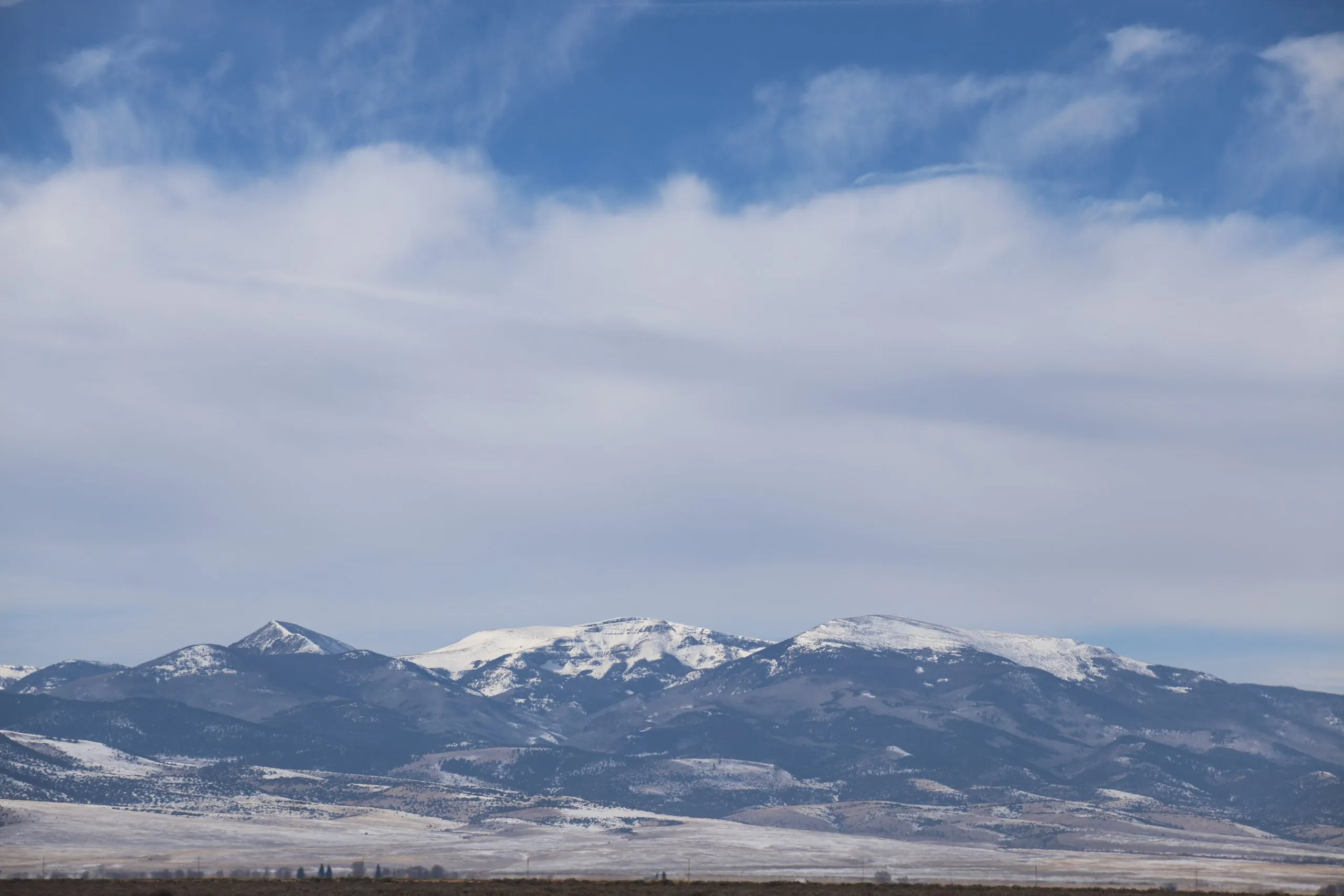
Click the link to read the article on the Alamosa Citizen website (Owen Woods):
Despite a slow start to the snowpack season “it’s not too late to catch up,” says Peter Goble, a climatologist from the Colorado Climate Institute. The El Niño year that we’re currently in could mean good spring precipitation.
“We do see sometimes that we make up early deficits in these El Niño years. So there’s a little bit of a reason to perhaps have some hope there,” he said.
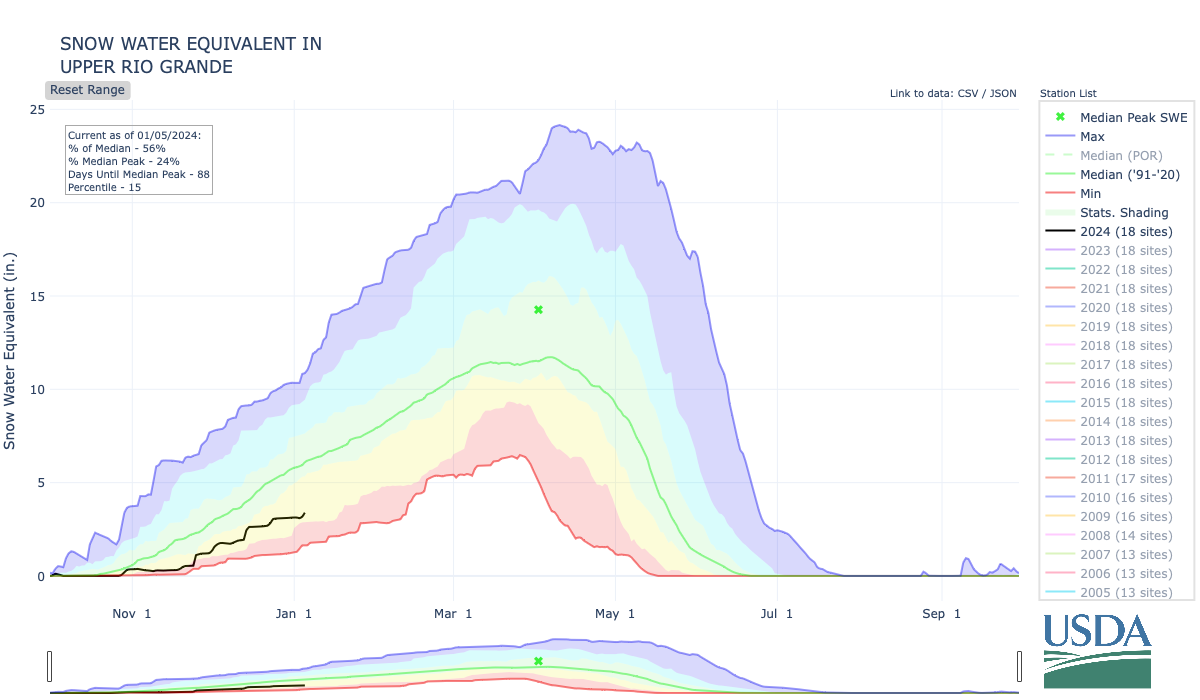
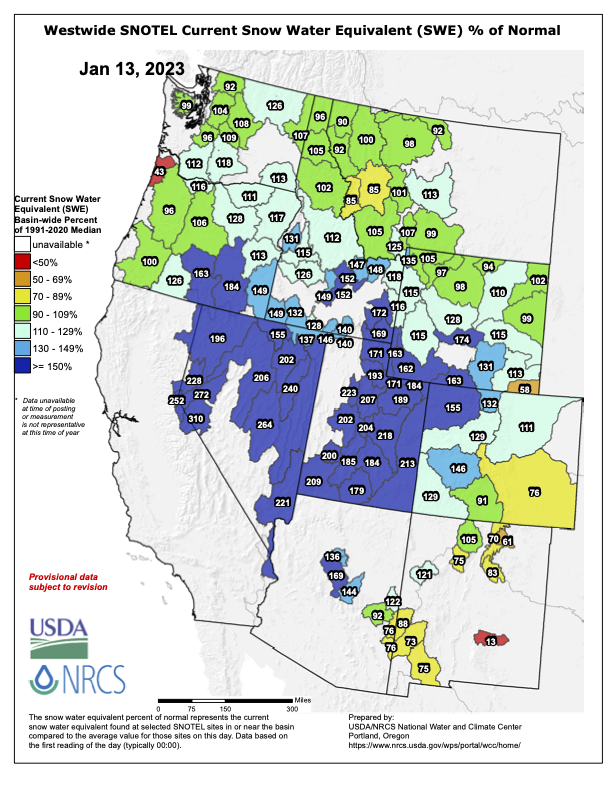
We’re really only in the first third of the snowfall season, but he said that snowpack values in the South San Juans and Sangre de Cristo ranges are in between the 10th and 30th percentile for snow, meaning that 70 to 90 percent of years on record we’ve had higher snowpack values at this point in the snow season than we do right now.
We have a little bit of hope on the horizon, he says, as the first and middle parts of January will be a “little on the wetter side.”
However, the snow we have now, measured through the SNOTEL sites, is the worst snow has looked since January 1, 2018. It’s not as bad as it was, but it’s the worst since then. “We definitely like to see fortunes reverse from here,” he said.
Compared to years like 2020 and 2021, “those were years where we ended up with bad drought conditions in summer in spite of pretty good snowpack numbers at this time of year.” The reason for that he said was that “we went into fall with much drier than normal soils and the spring in those years was quite dry, as well.”
We’re kind of seeing the opposite this year.
It’s been a poor performing snowpack season till this point, but “we’re a little bit shielded because our precipitation earlier this fall and our soil moisture levels are better than we’ve seen in some more recent years.”
It’s not at all a guarantee for El Niño to surprise us with good precipitation, but Goble said there’s reason to have “at least some” optimism that the spring may be on the wetter side of normal. The springs in 2020 and 2021 were on the drier side of normal. “So we may kind of see the reverse of one of those years…. Better moisture in the shoulder season could end up helping us out.”
“Some of the good that came out of conditions earlier this fall, like October,” he said, “those are benefiting us now. We’re in better shape given the snowpack than we could be if conditions last season and even this fall were different.”
Click the link to read the article on The Salt Lake Tribune website (Anastasia Hufham). Here’s an excerpt:
January 4, 2024
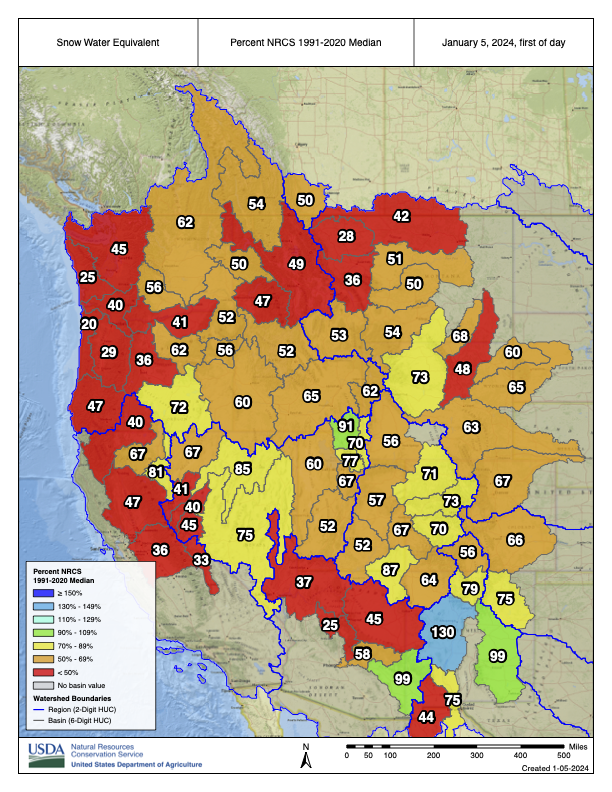
Right now, the entire American West is struggling with snow drought. Snowpack for the Upper Colorado River Basin — which includes Colorado, New Mexico, Utah and Wyoming — stands at a dismal 57.7% of average as of Jan. 3…

“Because of last year and how beneficial it was, Lake Powell made a huge jump,” he said. “But we would need four-plus years like last year in a row to fill it back up.”
This year’s is an El Nino winter. That means that warmer surface temperatures in the Pacific Ocean pull the global jet stream further south, making for wetter winters in the Southwest and drier conditions in the Pacific Northwest. Latitude-wise, Utah sits in the middle. So far, northern Utah experienced one storm cycle in early December, and southern Utah has barely seen any snow. In better news, Utah’s reservoirs stand at 80% full — usually, they’re around 56% full this time of year — and good soil moisture means that this year’s runoff will head efficiently to reservoirs without soaking into the ground…
“One good year is one good year, and we can’t get complacent,” Amy Haas, executive director of the Colorado River Authority of Utah, told The Tribune. “We can’t count on good years. We have to be prepared for anything.”


Click the link to read the article on the Fresh Water News website (Shannon Mullane):
January 3, 2024
LAS VEGAS — Around 8 a.m. Dec. 13, Becky Mitchell swapped flip-flops for heels, donned a blazer and headed out of her Las Vegas hotel room to fight for Colorado’s right to water in a drier future at the biggest water gathering of the year.
At the 2023 Colorado River Water Users Association meeting last month, Mitchell, 49, would glad-hand and spar with 1,700 of the Colorado River’s most powerful water users. As Colorado’s first full-time Colorado River commissioner, Mitchell’s job is to make sure Coloradans don’t lose out as the seven basin states vie for the critical, and limited, resource.
“There’s always some tension within the seven states whether we portray it or not,” Mitchell said. “It’s good for people to see that. We’re dealing with important issues.”
Mitchell, originally from Hawaii, is a Colorado School of Mines graduate who has worked on Colorado water issues for the state since 2009. In addition to serving as Colorado’s representative on the Upper Colorado River Commission, she has also been the director of the state’s top water agency, the Colorado Water Conservation Board.
Now, she’s one of seven state leaders, and the only woman, at the center of negotiations over the crisis-plagued river where warmer temperatures, drought and overuse are jeopardizing vital resources for 40 million people.
Instability in the basin, which provides 40% of Colorado’s water, is just adding to the pressure. Cities, industries and farms could face more severe water shortages by 2050, according to the state’s water plan.
“If you’re not passionate about this, you’re not paying attention,” Mitchell said. “When you look at the science and the history, I don’t know how it doesn’t move you.”
For the federal government and the seven state commissioners the main task at hand is to plan how water is stored and released from the basin’s two largest water savings banks, lakes Mead and Powell, after 2026, when the current operating rules expire.
Based on their decisions and climate conditions, the river and its reservoirs could continue to dry up, as they nearly did in 2021 and 2022, or they could be brought back into balance, with demands for water reduced to match the river’s shrinking supplies.
“Everyone is intent on protecting the interests of their particular constituency,” said Estevan López, New Mexico’s Colorado River negotiator. “Things can get tense at times in these discussions. These are difficult issues for all of us.”

Mitchell in action
A typical day for Mitchell involves a steady flow of meetings, either in Colorado or across the basin states, with the political leaders, experts, utility managers, water users and others in the water community. The conference represented all of that, on hyperspeed, crunched into one windowless, enormous conference hall.
“These things are overwhelming. I think people think I’m more of a people person than I am. I actually like to definitely recharge as much as I can,” Mitchell said, which mostly involved a U2 concert, karaoke and family time at the conference.
The annual gathering offers a chance to hammer home key points in a public forum with attendees from across the Upper Basin — Colorado, New Mexico, Utah and Wyoming — and the Lower Basin — Arizona, California and Nevada, Mitchell said.
Her main point: There’s only so much Upper Basin states can do when water users are already getting cut off each year, she said, while walking, coffee in hand, past slot machines and French-themed shops at Paris Las Vegas Hotel and Casino.
She headed into the first big conference meeting, where she and other state representatives on the Upper Colorado River Commission delivered prepared remarks and state updates to the audience. For Mitchell, that meant rehashing her “irrefutable truths,” a set of standards by which she’ll vet any agreement the basin states propose.
Occasionally, someone stopped her in the hallways or at meals for sidebar conversations. (“Xcel accepted!” one person shared, referencing a historic agreement to purchase some of the oldest water rights in Colorado from Xcel.)
The next morning, tensions flared at the panel as she spoke stridently about her concerns about the negotiations and limitations on the water supply in Colorado, where at least some farmers, ranchers and other water users see their water shut off early as supplies shrink.
Several Coloradans said they felt well-represented by Mitchell during the conference, including leaders of the two tribes with reservation land in Colorado, the Southern Ute and the Ute Mountain Ute.
“She’s strong in heart and mind to get the message out. Being blunt sometimes takes that,” Ute Mountain Ute Chairman Manuel Heart said. Mitchell has advocated for tribes on a whole new level, and without her, they’d be stuck in the status quo, Heart said.
“She’s letting everybody else know: She stands with the tribes, and Colorado stands with the tribes,” said Lorelei Cloud, acting chairwoman of the Southern Ute Indian Tribe. “That’s a big statement to make.”

Working outside of the mold
Mitchell doesn’t fit the traditional mold of a water buffalo in Colorado. Some attendees privately groused that Mitchell’s approach at the panel was too aggressive or her tone too scolding.
Several Coloradans said they loved Mitchell’s spirited and fiery manner. Many Coloradans at the conference were proud of her, said Ken Curtis, general manager of the Dolores Water Conservancy District.
“She did have to earn some respect over some time, and I think she’s earned it,” Curtis said. “Anytime there’s somebody new appointed to a position like this, that pretty much the whole state water community is watching, it’s got to be rough.”
The slowly changing stereotype of a “water buffalo,” an insider term for negotiators of Colorado River agreements, is that of an older, white and male figurehead.
Mitchell is not those things. In her home life, she is the mother of five adult children, three of whom she adopted from Ethiopia where she frequently returns to work on water issues.
At the conference, her big laughs occasionally came with a slight snort, and once or twice, she broke out a Running Man-style dance move in the conference halls. She was frequently the most forceful speaker on the stage, and in past speaking events, she’s gotten choked up while talking about water issues.
“People really see her sincerity, speaking from the heart, and they’re willing to do the same,” said Robert Sakata, a Colorado farmer and member of the Colorado Water Conservation Board.
Mitchell said she has made a conscious decision to not shrink herself in the face of criticism. It is an example taught to her by her mother, she said, and one that she tries to teach to her daughters.
“There’s been a couple times when I’ve tried to be quieter or politer to make myself heard, and it hasn’t worked,” Mitchell said. “I’ve had to make a choice to be in a place that’s more uncomfortable for me. … What we’re fighting for is too important to make myself small to make myself feel comfortable.”
Fresh Water News was launched in 2018 as an independent, nonpartisan news initiative of Water Education Colorado.
Coyote Gulch posts that mention Becky Mitchell
Click the link to read the article on The Water Desk website (Luke Runyon):
January 4, 2024
After years of dry conditions throughout the West, 2023 gave the region’s water managers the greatest gift of all: a hefty snowpack.
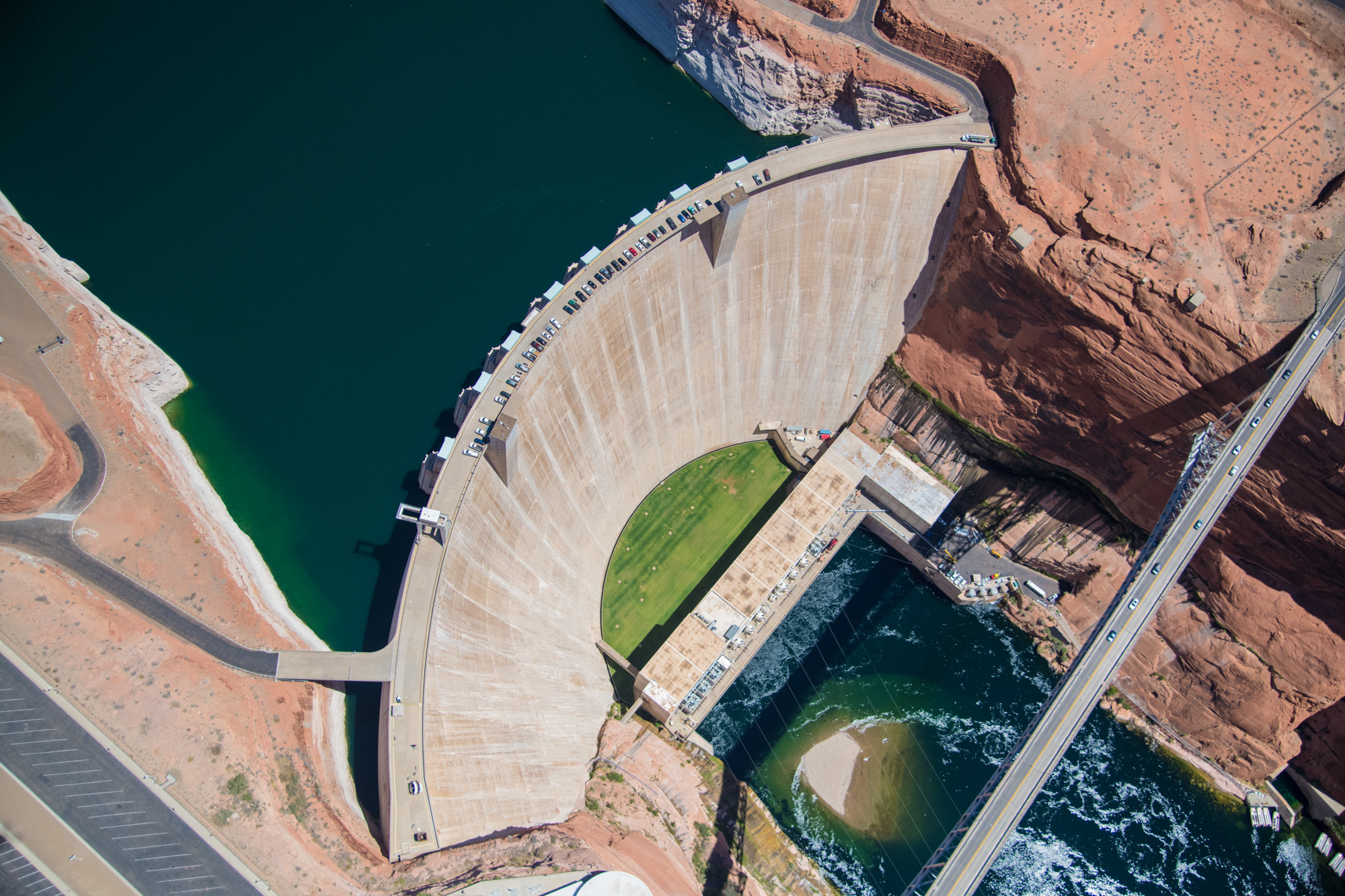
This year’s winter snow eventually melted and boosted the Colorado River’s beleaguered reservoirs. The Hail Mary winter storms came just in time. Without the savior snows, the river’s second-largest reservoir, Lake Powell, was on a glide path toward losing the ability to produce hydropower at Glen Canyon Dam, not to mention the harm to the long-term ecological health of the river and its main tributaries.
But the more nightmarish scenarios of quiet turbines, empty reservoirs, and dry river beds were put on hold this past year, as more snow also means more time. When wet weather returned to the basin, the river’s top negotiators quickly turned their attention away from the short-term emergency in front of them, and toward a more long-term set of solutions. Talk of not “squandering” the gift of time became a standard talking point of decision-makers along the river that supplies more than 40 million people across seven U.S. states, 30 tribal nations and communities in northern Mexico.
One snowy year does not make for a lasting fix for the Colorado River’s fundamental gap between water supply and demand. A new year means new uncertainties over the river’s future. And as it looks now, 2024 promises to be more consequential than the last.
Here at The Water Desk, these are the top things we’re paying attention to in 2024:
1. Reimagining how we manage the Colorado River
The snowy respite in 2023 gave both federal and state-level water managers the brain space to think long-term. A set of 2007 guidelines for the river’s management expire in 2026. In October, the federal Bureau of Reclamation released its preliminary report on what should be included in the talks to renegotiate them. They’ve given the various users — states, tribes, environmental and recreation groups — until March 2024 to submit their preferred plans for analysis and eventual inclusion in a draft set of guidelines later next year.
The current guidelines have quite a few detractors across the river’s Upper and Lower Basins. And what should or shouldn’t be in the new rules has contributed to significant tension among river negotiators.
The various state leaders recently got the chance to publicly posture at the Colorado River Water Users Association conference, held annually in December in Las Vegas. All seven state-level negotiators, including representatives from California, Arizona, Nevada, Colorado, Utah, New Mexico and Wyoming, sat beside each other on stage and made clear there was still distance between their positions on the big-picture problems plaguing the river and how to deal with them. The Arizona Republic’s Brandon Loomis has this excellent recap of what went down.

The panel’s biggest news was a public commitment from the Lower Basin states of California, Arizona and Nevada to address what’s known as the structural deficit. This is the well-documented supply and demand gap that would exist even without climate change sapping snowpack and runoff. The deficit is estimated to be between 1.2 and 1.5 million acre-feet annually, and it has contributed greatly to the dwindling water levels at Lakes Mead and Powell. Who has to take the necessary cuts to account for that amount of water has always been an open question. Now, we have an answer: the Lower Basin states.

“That makes sense. That’s our responsibility,” said J.B. Hamby, California’s river negotiator, at the Vegas gathering. “This is a historic thing coming. It’s on our shoulders to be able to resolve it.”
But in a basin that in recent months has grown increasingly reliant on injections of federal cash to incentivize temporary conservation deals, how state leaders plan to find the funds and the political will to permanently deal with the structural deficit will be something to watch. Any commitments made by those state-level negotiators will need to be sold to a broad range of constituents, who at this point will expect to be handsomely compensated for a permanent cut to their supplies, as POLITICO’s Annie Snider explained in this November piece.
An additional layer of basinwide tension can be summed up in one word: equity. It’s thrown around a lot in discussions of the Colorado River and the economic and social sacrifices needed to bring it onto a more sustainable path. Who should bear the greatest burden of the eventual cutbacks is still unclear. Upper Basin leaders, from Colorado, Utah, Wyoming and New Mexico, often point the finger toward the Lower Basin.
“We’re not interested in striking a deal that allows the continuation of depleting the storage and dragging the system into crisis,” said Becky Mitchell, Colorado’s top river negotiator. Mitchell made clear she felt users in her state were already feeling pain, while those downstream of the large reservoirs have mostly been made whole, even in the driest of years. But with Lower Basin users willing to take on big, intractable issues like the structural deficit, moving forward it will likely be more difficult for Upper Basin leaders to continue to cast all the blame downstream.
One more idea from the Las Vegas conference that’s still largely conceptual, but is gaining some interest from those in power, is to use annual measures of basic hydrology — like snowpack levels and streamflows — to determine how much water ends up being delivered to the basin’s varied users. It sounds simple: only use what nature provides.
But that idea flies in the face of the river’s foundational governing document, the Colorado River Compact, which put fixed volumes of water use on paper, regardless of whether it was a dry or wet year. For now, the idea seems to be more of a talking point than a specific policy proposal, and we will see if proponents can turn it into something Lower Basin users can get behind.
2. Tribal inclusion in policymaking
In recent years, the Colorado River’s 30 federally recognized tribes have grown their influence in the basin’s political landscape. Calls for a more formal tribal role in basinwide negotiations are being amplified by the tribes themselves, and by both state and federal leaders, such as Interior Secretary Deb Haaland.
2023 presented some significant tribal successes. The Gila River Indian Community became a key player in negotiations over the Lower Basin’s conservation plan to secure federal dollars last spring. Federal officials promised the tribe $150 million over three years to leave water they were legally entitled to in Lake Mead.

But in the long-term, deciding what that tribal role, or tribal seat at the negotiating table, could be and should be is unsettled. In June, at a Colorado River symposium at the University of Colorado Boulder’s Getches-Wilkinson Center, Gila River Indian Community Gov. Stephen Roe Lewis called for leaders from all 30 sovereign tribes to be included in talks between federal and state officials. That idea received immediate pushback from state leaders on the feasibility of expanding the table by 30 seats.
Creating a single representative seat for all of the tribes is another option. But that, too, presents challenges. Is it fair or feasible to reduce the varied economies, cultures, geographies and spiritual practices of 30 sovereign nations into a single seat?
While basinwide tribal inclusion still happens in an ad hoc rather than institutional way, a draft agreement to formalize a governing relationship among six tribes and the four Upper Basin states has taken shape. The Upper Colorado River Commission has started inviting representatives from six Upper Basin tribes to participate in regular meetings. Commissioners could formalize the new agreement this February, as The Colorado Sun’s Shannon Mullane recently reported.
There appears to be broad agreement that more formally including tribes in the river’s complex, multi-layered decision-making processes is the most just path to take. Deciding what type of basinwide governance structure will make tribal inclusion more than a talking point could make some progress in 2024 as the basin’s leaders say they finally have the brain space to take on longer-term issues, as KUNC’s Alex Hager reported in his piece from the Las Vegas conference.
3. Winter snowpack can make or break
Snowpack in the southern Rockies entered 2024 with a weak start. There is still a lot of winter left to go, but beginning a new year with a significant snowpack deficit always brings a certain amount of hand-wringing from skiers and water managers alike.
Upper Basin snowpack stands at just 64% of the long-term median. The snowiest months are still to come, but it’s much harder to get to an above-average snowpack after a slow start.
2023 was a stark example of what a wet winter can do. The sense of urgency among the river’s policymakers diminished as the snow piled high. Headlines turned from documenting record lows at the big Colorado River reservoirs, to cheering modest gains in water levels.
The past year’s heavy snows and subsequent rushing rivers came after three successive meager runoff seasons. The gains were significant, but not a total game-changer. As scientists often note, it takes multiple consecutive years of wet conditions to allow large reservoirs like Lakes Mead and Powell to fully recover.
The return of El Niño tipped the scales toward a warmer and wetter winter in the Colorado River basin’s headwaters states. So far, we’ve just been getting the warm, not the wet. No matter how you look at it, we’re having a dry start to winter, as my Water Desk colleague Mitch Tobin lays out in his latest Snow News post.
In 2023, Lower Colorado River leaders said their deal to conserve up to 3 million acre-feet between now and 2026 was enough to bring needed stability to the river’s reservoirs. But that same point was used to justify agreements like the Drought Contingency Plans in 2019 and the 500+ Plan in 2021, which did not provide the long-term stability and certainty that water managers crave.
Scientists, such as Colorado State University’s Brad Udall, say we haven’t been imaginative enoughin envisioning just how bad things could get along the river. Another series of dry winters, the likes of which we’ve seen in the past 25 years, is plausible.
2023 brought a reprieve. How the winter of 2024 will play out is still unclear. Its outcome will undoubtedly have ripple effects, and either amplify or ease the existing tensions playing out across the basin.
The Water Desk’s mission is to increase the volume, depth and power of journalism connected to Western water issues. We’re an initiative of the Center for Environmental Journalism at the University of Colorado Boulder.
