
Click the link to read the article on the KUNC website (Alex Hager). Here’s an excerpt:
January 2, 2024
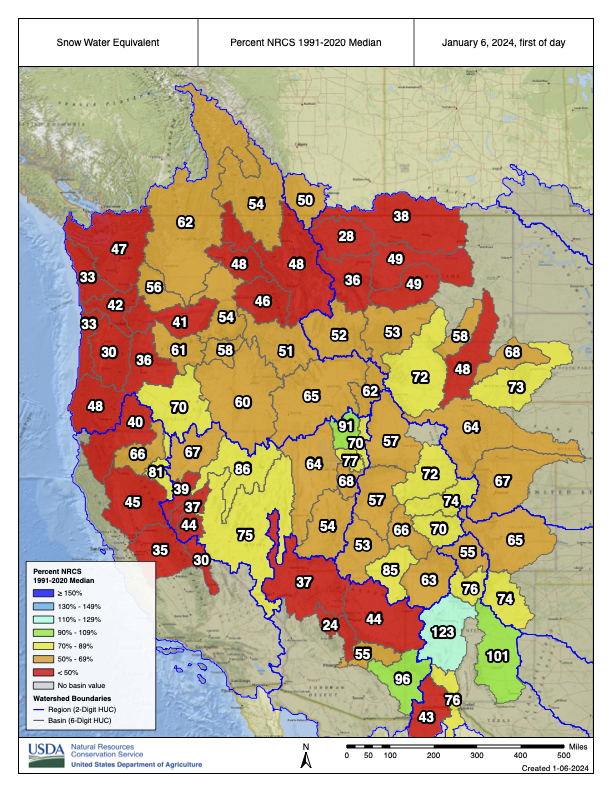
Across the West, the winter is off to a dry start. Wide swaths of the Rocky Mountains have lower-than-average snow totals for this time of year, but scientists say there’s still plenty of time to end the “snow drought” and close the gap. High-altitude snowpack has big implications for the region’s water supply. Two-thirds of the Colorado River’s water starts as snow in Colorado’s mountains before melting and flowing to about 40 million people across seven states. Nearly every part of Colorado, Utah and Wyoming has significantly less snow than usual for late December. The latest data from a region-wide network of snow sensors shows snow in many areas with snow totals around 60 or 70% of normal.
“It’s really going to be dependent on what we see in January and February,” said Becky Bolinger, Colorado’s assistant state climatologist. “We’re really going to need an active January and February to make up these deficits and be okay.”

Even a few consecutive wet winters aren’t enough to seriously fix the supply-demand imbalance that fuels the West’s water crisis. More than 20 years of dry conditions, fueled by climate change, have shrunk the Colorado River’s water supply, and policymakers have been unable to agree on significant, long-term cutbacks to water use. Experts say it would take five or six consecutive above-average winters to close that supply-demand gap, which is unlikely to happen as climate change makes the region warmer and drier. Dan McEvoy, regional climatologist at the Western Regional Climate Center and Desert Research Institute, said last year’s wet winter was an “anomaly.”
“Lots of data, lots of research, projections, modeling, all point to this continuing trend of warmer winters, less snow and in some cases, less precipitation,” he said.