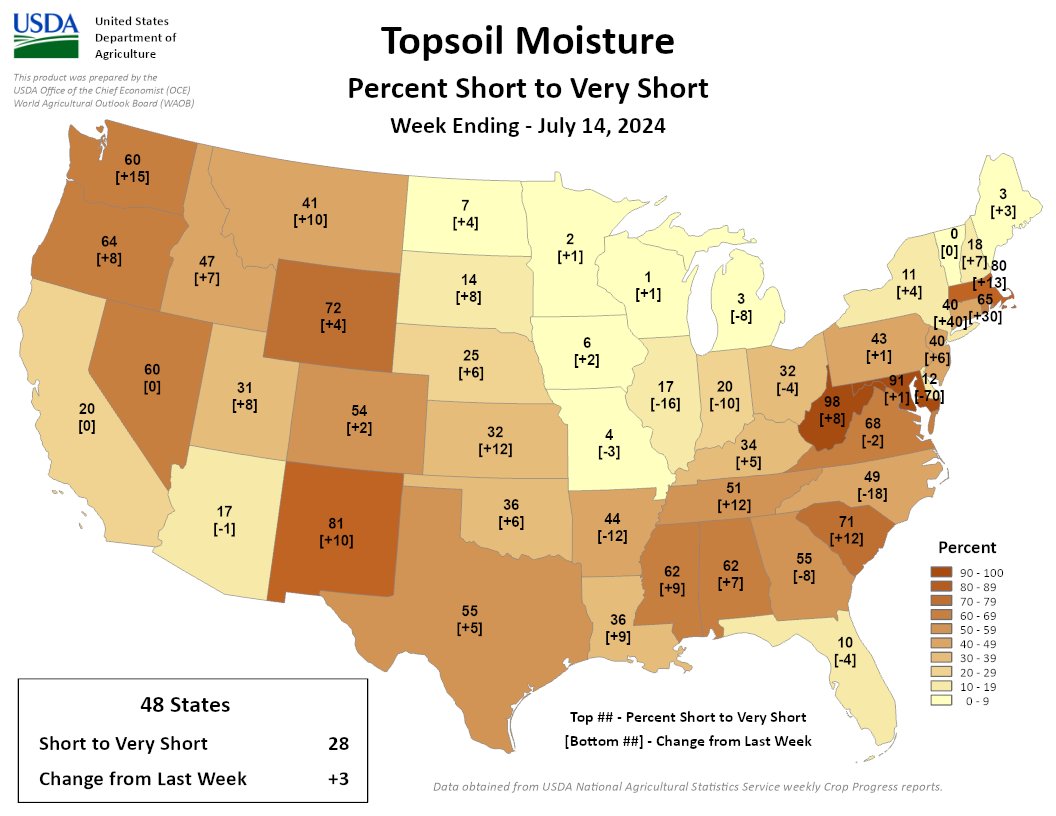
Spots of both improvement and drying in the East and Southeast, while much of the West and Plains dried out. Greatest drying this week was in RI, CT & WA.

Spots of both improvement and drying in the East and Southeast, while much of the West and Plains dried out. Greatest drying this week was in RI, CT & WA.

Click the link to read the article on the Big Pivots website (Allen Best):
July 8, 2024
Tri-State agreement includes provision for water rights valued by Moffat County at $2-3 million
The settlement agreement supported by 16 intervening parties that was submitted to the Colorado Public Utilities Commission has a major provision about water rights.
This is apart from the Colorado legislation passed in the 2023 session that allows Xcel Energy and Tri-State Generation and Transmission the ability to retain the water rights they are now using to produce steam at their coal plants near Hayden and Craig to generate electricity. The utilities will be able to retain their direct-flow rights until 2050 while they figure out whether those water rights will be needed in the future.
The settlement agreement is for augmentation water that Tri-State owns. It is held in Elkhead Reservoir near Hayden. The Colorado River Water Conservation District also holds augmentation water in that reservoir.
Why does augmentation water matter? Because, beginning in 2002, the Yampa River became a river that didn’t always have enough water for everybody than wanted it. In 2018, a drought year, a “call” was put on the river for the first time. And in 2022, the Yampa formally became an administrated river.
That means that if somebody wanted to drill a well in the Yampa River drainage for a new home on a plot of land of 35 acres or less, they needed to come to the table with water that could replenish the river, i.e. augmentation water. This is for all wells after the state designation of March 1, 2022.
To meet the need for augmentation water, Moffat County has been leasing water from the River District. The amount is determined by the amount needed on a per-acre-foot basis.
Jeff Comstock, who directs Moffat County’s Department of Natural Resources, said the precise amount of water that Moffat County will be getting from Tri-State will depend upon a determination in water court. The water given to Moffat County by Tri-State can be used into perpetuity.
Moffat County estimates the value of the augmentation water right that is to be transferred at $1 million to $3 million.

Click the link to read the article on the Big Pivots website (Allen Best):
July 17, 2024
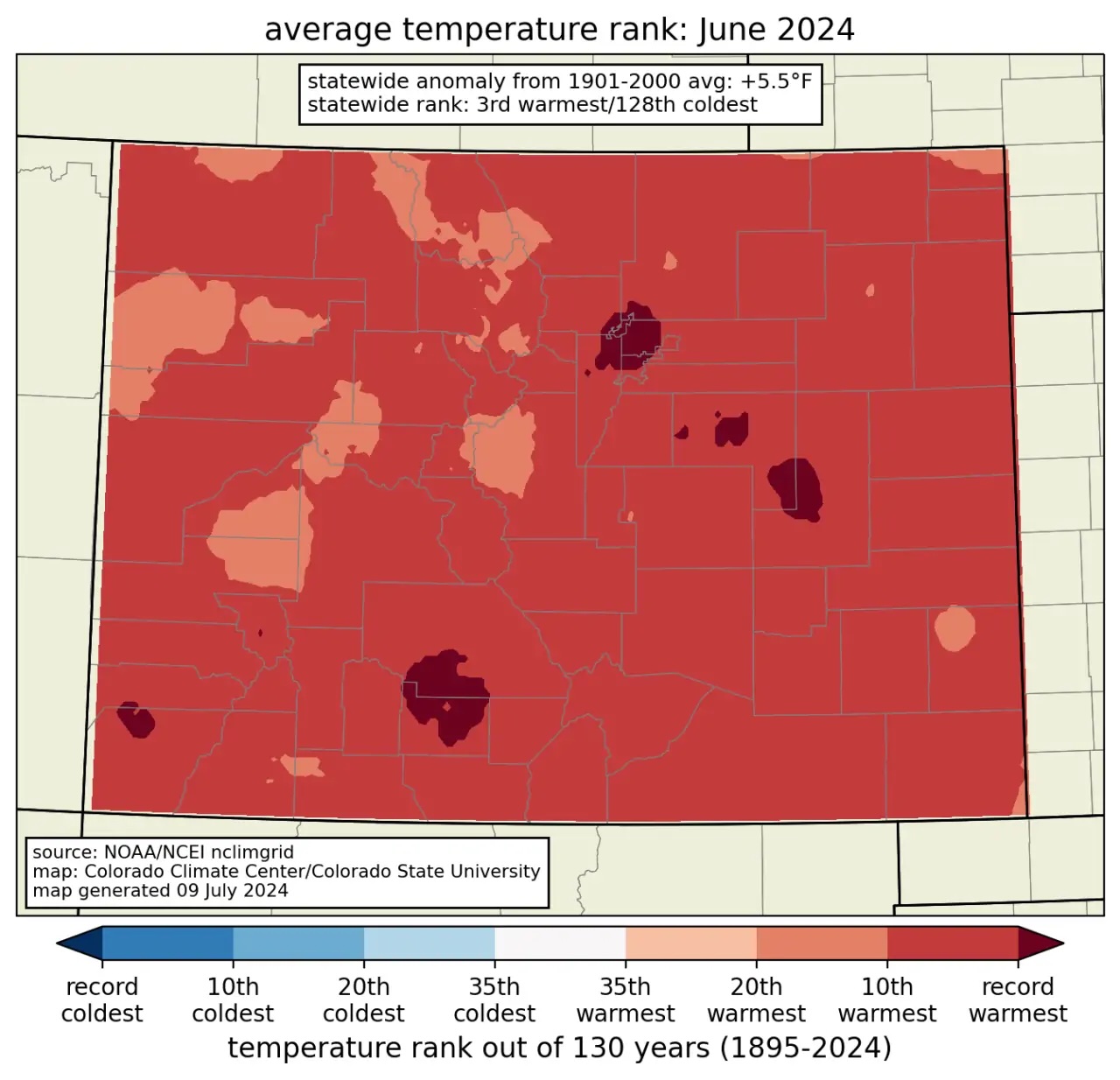
June was indeed the third warmest ever in Colorado
Russ Schumacher, the Colorado state climatologist, reports that June was indeed warm across Colorado. It came in third warmest when averaged across the state as compared to the historical record of the last 150 years.
Only Junes of 2022 and 2012 – and those were years of major wildfires across Colorado. The difference between this June and those was that this year’s June was rainy in the mountains and across the Western Slope, “That is a very unusual combination in summer.” See more here.

Click the link to read the article on the Grist website (Zoya Teirstein):
July 19, 2024
As delegates arrived at the Republican National Convention in Milwaukee earlier this week to officially nominate former president Donald Trump as their 2024 candidate, a right-wing policy think tank held an all-day event nearby. The Heritage Foundation, a key sponsor of the convention and a group that has been influencing Republican presidential policy since the 1980s, gathered its supporters to tout Project 2025, a 900-plus-page policy blueprint that seeks to fundamentally restructure the federal government.
Dozens of conservative groups contributed to Project 2025, which recommends changes that would touch every aspect of American life and transform federal agencies — from the Department of Defense to the Department of Interior to the Federal Reserve. Although it has largely garnered attention for its proposed crackdowns on human rights and individual liberties, the blueprint would also undermine the country’s extensive network of environmental and climate policies and alter the future of American fossil fuel production, climate action, and environmental justice.
Under President Joe Biden’s direction, the majority of the federal government’s vast system of departments, agencies, and commissions have belatedly undertaken the arduous task of incorporating climate change into their operations and procedures. Two summers ago, Biden also signed the Inflation Reduction Act, the biggest climate spending law in U.S. history with the potential to help drive greenhouse gas emissions down 42 percent below 2005 levels.
Project 2025 seeks to undo much of that progress by slashing funding for government programs across the board, weakening federal oversight and policymaking capabilities, rolling back legislation passed during Biden’s first term, and eliminating career personnel. The policy changes it suggests — which include executive orders that Trump could implement single-handedly, regulatory changes by federal agencies, and legislation that would require congressional approval — would make it extremely difficult for the United States to fulfill the climate goals it has committed to under the 2015 Paris Agreement.
It’s real bad,” said David Willett, senior vice president of communications for the environmental advocacy group the League of Environmental Voters. “This is a real plan, by people who have been in the government, for how to systematically take over, take away rights and freedoms, and dismantle the government in service of private industry.”
Trump has sought to distance himself from the blueprint. “Some of the things they’re saying are absolutely ridiculous and abysmal,” he wrote in a social media post last week.
However, at least 140 people who worked in the Trump administration contributed to Project 2025, and policy experts and environmental advocates fear Project 2025 will play an influential role in shaping GOP policy if Trump is reelected in November. Some of the blueprint’s recommendations are echoed in the Republican National Convention’s official party platform, and Heritage Foundation president Kevin Roberts says he is “good friends” with Trump’s new running mate, Senator J.D. Vance of Ohio. Previous Heritage Foundation roadmaps have successfully dictated presidential agendas; 64 percent of the policy recommendations the foundation put out in 2016 had been implemented or considered under Trump one year into his term. The Heritage Foundation declined to provide a comment for this story.
Broadly speaking, Project 2025 proposals aim to scale down the federal government and empower states. The document calls for “unleashing all of America’s energy resources” by eliminating federal restrictions on fossil fuel drilling on public lands, curtailing federal investments in renewable energy technologies, and easing environmental permitting restrictions and procedures for new fossil fuel projects such as power plants. “What’s been designed here is a project that ensures a fossil fuel agenda, both in the literal and figurative sense,” said Craig Segall, the vice president of the climate-oriented political advocacy group Evergreen Action.
Within the Department of Energy, offices dedicated to clean energy research and implementation would be eliminated, and energy efficiency guidelines and requirements for household appliances would be scrapped. The environmental oversight capacities of the Department of the Interior and the Environmental Protection Agency would be curbed significantly or eliminated altogether, preventing these agencies from tracking methane emissions, managing environmental pollutants and chemicals, and conducting climate change research.
In addition to these major overhauls, Project 2025 advocates for getting rid of smaller and lesser-known federal programs and statutes that safeguard public health and environmental justice. It recommends eliminating the Endangerment Finding — the legal mechanism that requires the EPA to curb emissions and air pollutants from vehicles and power plants, among other industries, under the Clean Air Act. It also recommends axing government efforts to assess the social cost of carbon, or the damage each additional ton of carbon emitted causes. And it seeks to prevent agencies from assessing the “co-benefits,” or the knock-on positive health impacts, of their policies, such as better air quality.
“When you think about who is going to be hit the hardest by pollution, whether it’s conventional air water and soil pollution or climate change, it is very often low-income communities and communities of color,” said Rachel Cleetus, the policy director with the climate and energy program at the Union of Concerned Scientists, a nonprofit science advocacy organization. “The undercutting of these kinds of protections is going to have a disproportionate impact on these very same communities.”
Other proposals would wreak havoc on the nation’s ability to prepare for and respond to climate disasters. Project 2025 suggests eliminating the National Oceanic and Atmospheric Administration and the National Weather Service housed therein and replacing those organizations with private companies. The blueprint appears to leave the National Hurricane Center intact, saying the data it collects should be “presented neutrally, without adjustments intended to support any one side in the climate debate.” But the National Hurricane Center pulls much of its data from the National Weather Service, as do most other private weather service companies, and eliminating public weather data could devastate Americans’ access to accurate weather forecasts. “It’s preposterous,” said Rob Moore, a policy analyst for the Natural Resources Defense Council’s Action Fund. “There’s no problem that’s getting addressed with this solution, this is a solution in search of some problem.”
The document also advocates moving the Federal Emergency Management Administration, which marshals federal disaster response, out from under the umbrella of the Department of Homeland Security, where it has been housed for more than 20 years, and into the Department of the Interior or the Department of Transportation. “All of the agencies within the Department of Interior are federal land management agencies that own lots of land and manage those resources on behalf of the federal government,” Moore said. “Why would you put FEMA there? I can’t even fathom why that is a starting point.”
The blueprint recommends eliminating the National Flood Insurance Program and moving flood insurance to private insurers. That notion skates right over the fact that the federal program was initially established because private insurers found that it was economically unfeasible to insure the nation’s flood-prone homes — long before climate change began wreaking havoc on the insurance market.
Despite the alarming implications of most of Project 2025’s climate-related proposals, it also recommends a small number of policies that climate experts said are worth considering. Its authors call for shifting the costs of natural disasters from the federal government to states. That’s not a bad conversation to have, Moore pointed out. “I think there’s people within FEMA who feel the same way,” he said. The federal government currently shoulders at least 75 percent of the costs of national disaster recovery, paving the way for development and rebuilding in risky areas. “You are disincentivizing states and local governments from making wise decisions about where and house to build because they know the federal government is going to pick up the tab for whatever mistake they make,” Moore said.
Quillan Robinson, a senior advisor with ConservAmerica who has worked with Republicans in Washington, D.C., on crafting emissions policies, was heartened by the authors’ call for an end to what they termed “unfair bias against the nuclear industry.” Nuclear energy is a reliable source of carbon-free energy, but it has been plagued by security and public health concerns, as well as staunch opposition from some environmental activists. “We know it’s a crucial technology for decarbonization,” Robinson said, noting that there’s growing bipartisan interest in the energy source among lawmakers in Congress.
An analysis conducted by the United Kingdom-based Carbon Brief found that a Trump presidency would lead to 400 billion metric tons of additional emissions in the U.S. by 2030 — the emissions output of the European Union and Japan combined.
Above all else, Segall, from Evergreen Action, is worried about the effect Project 2025 would have on the personnel who make up the federal government. Much of the way the administrative state works is safeguarded in the minds of career staff who pass their knowledge on to the next cadre of federal workers. When this institutional knowledge is curbed, as it was by budget cuts and hostile management during Trump’s first term, the government loses crucial information that helps it run. The personnel “scatter,” he said, disrupts bottom-line operations and grinds the government to a halt.
Although Project 2025’s proposals are radical, Segall said that its effect on public servants would echo a pattern that has been playing out for decades. “This is a common theme in Republican administrations dating back to presidents Richard Nixon and Ronald Reagan,” he said. “What you do is you break the government, make it very hard for the government to function, and then you loudly announce that the government can’t do anything.”