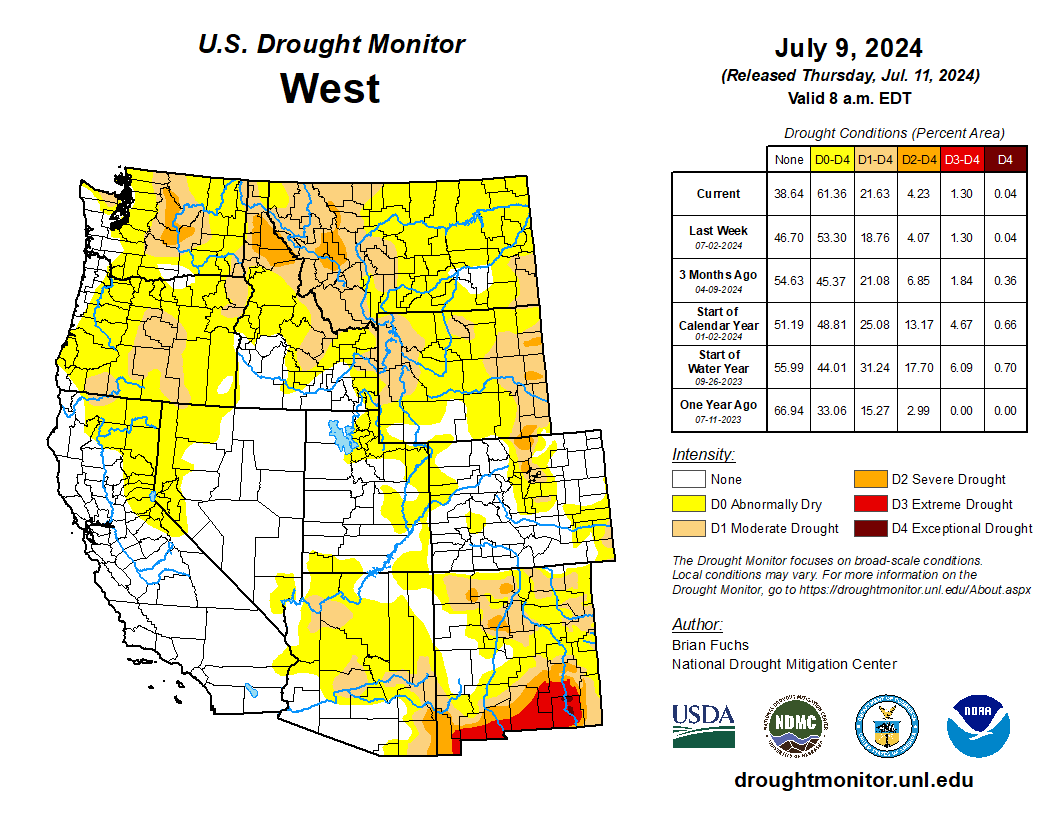
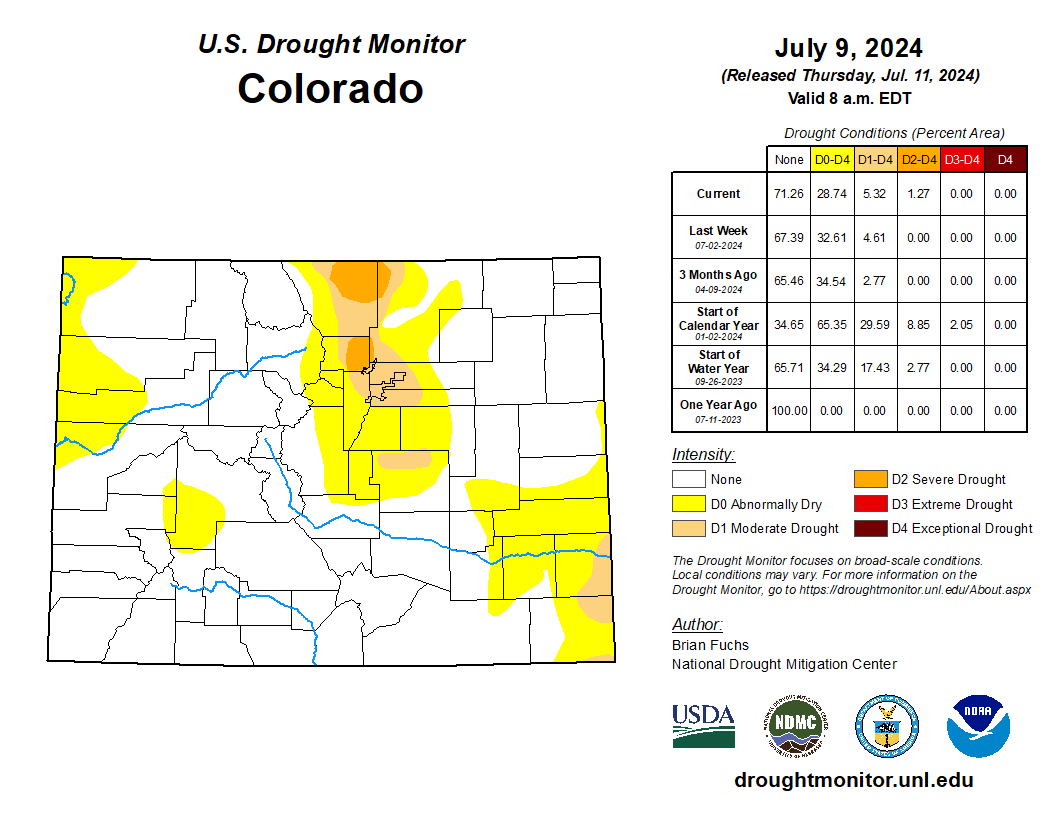
#Drought news July 11, 2024: The driest areas in the High Plains remained in E. #Wyoming and E. #Colorado, Abnormally dry conditions were removed over much of S.W. Colorado and portions of northeast #Arizona

Click on a thumbnail graphic to view a gallery of drought data from the US Drought Monitor website.

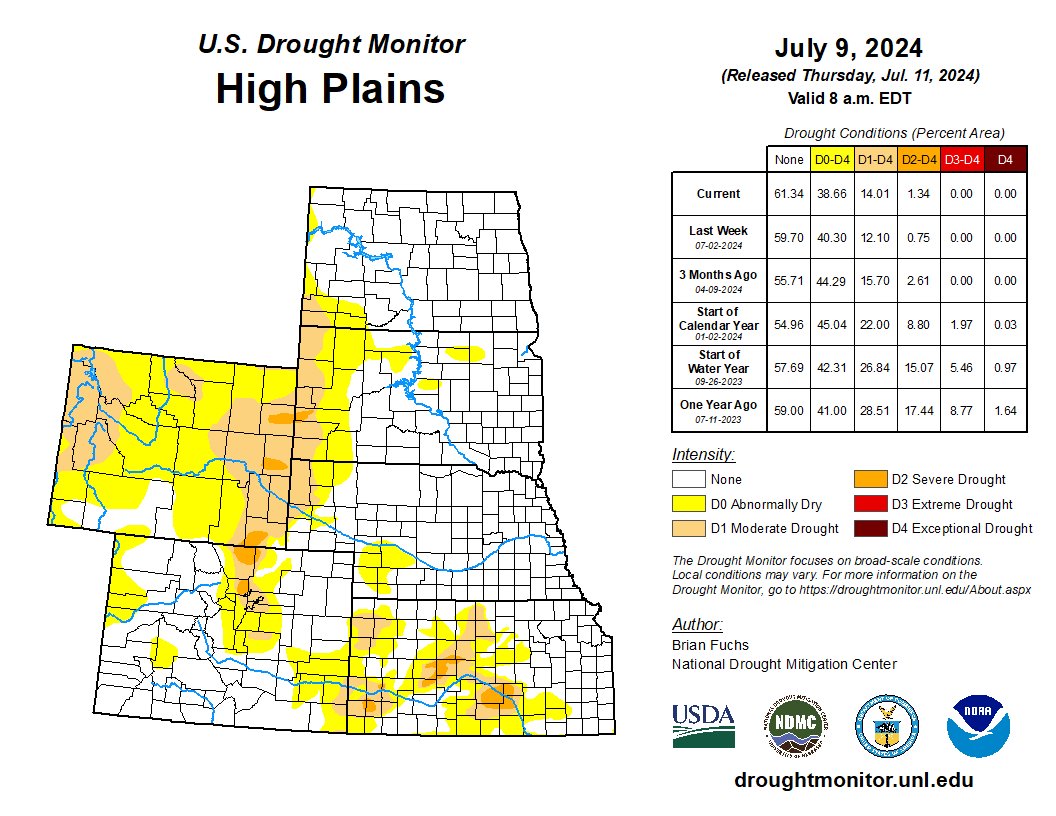
Click the link to go to the US Drought Monitor website. Here’s an excerpt:

This Week’s Drought Summary

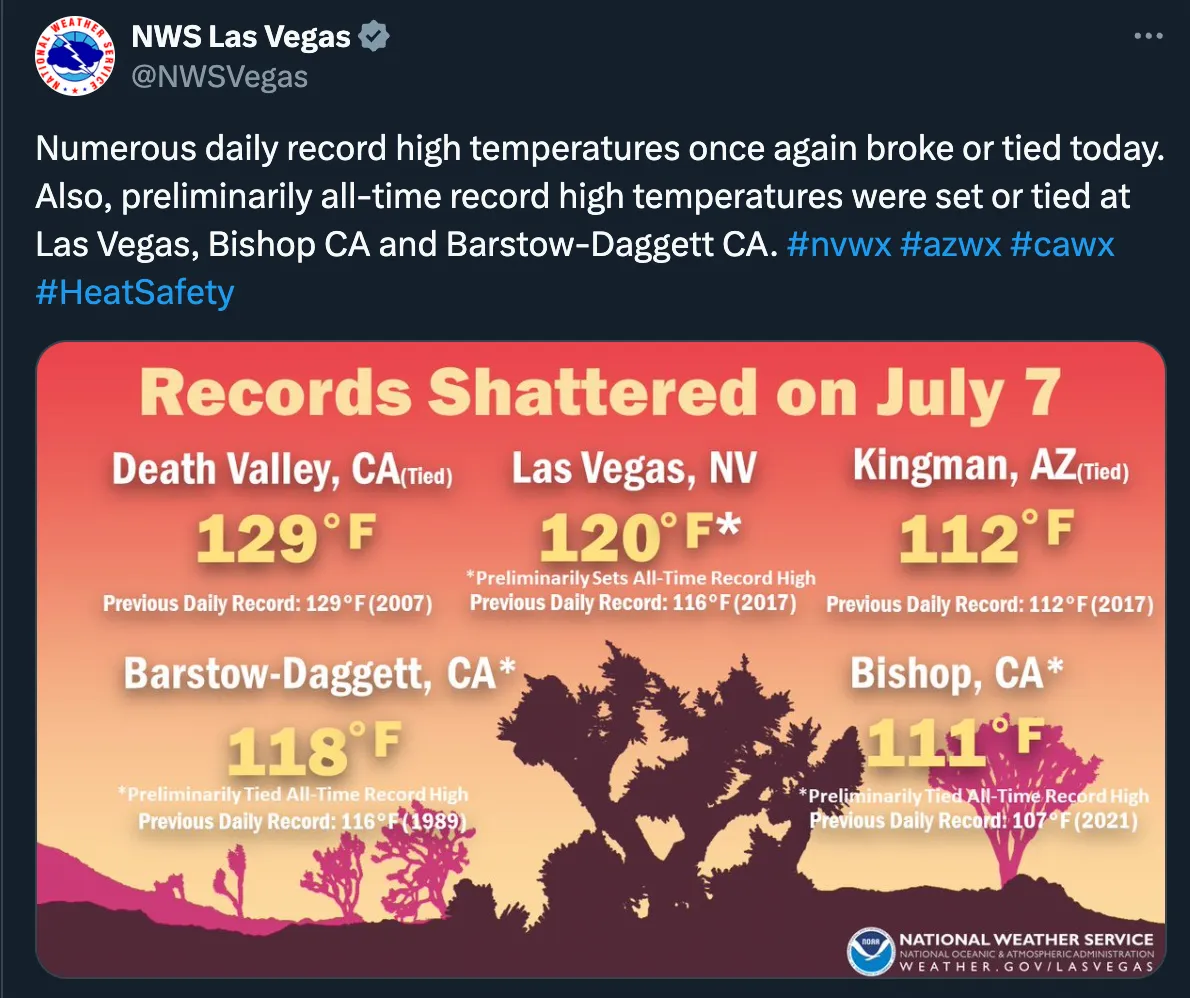
The first landfalling tropical storm of the season came ashore in east Texas and brought significant precipitation to the area and up into the Ozark Plateau. Temperatures were cooler than normal over a large extent of the country from the Rocky Mountains and into the Plains and Midwest where departures from normal temperatures were 3-9 degrees below normal. Excessive heat dominated the West Coast where departures from normal temperatures over much of California were 12-15 degrees above normal. Many records were set, including 120 degrees in Las Vegas, beating the old record by 3 degrees, while Death Valley had 5 consecutive days with high temperatures over 125 degrees topping out at 129 on July 7. Near-normal to slightly above-normal temperatures dominated much of the East and Southeast. Along with the heat, much of the West was dry during the last week. Areas of the Plains recorded well above-normal precipitation with some areas receiving 400-800% of normal precipitation for the week. Spotty rains were common over the Southeast with a very typical summertime pattern of widely scattered thunderstorms accounting for most of the precipitation. The driest areas were from Mississippi and northern Alabama into Tennessee and the Mid-Atlantic. Portions of northern Illinois eastward into Ohio were also dry throughout the week…

High Plains

Like the Midwest, most of the region recorded precipitation during the week with pockets of heavier rains in Nebraska, Kansas, South Dakota and southeast Colorado. Cooler-than-normal temperatures dominated the region with almost all areas below normal for the week. The greatest departures were in Nebraska, South Dakota and Wyoming with temperatures 6-8 degrees below normal. With much of the region drought free, there were pockets of improvement over Nebraska, western Kansas and southeast Colorado where abnormally dry and moderate drought areas were reduced. Dryness in the Black Hills of South Dakota remained, and some expansion of severe drought took place this week. The driest areas remained in eastern Wyoming and eastern Colorado, where most places did not record much precipitation this week and moderate and severe drought conditions expanded along with more abnormally dry areas…

Colorado Drought Monitor one week change map ending July 9, 2024.

West

It was a hot and dry week over the region with only some spotty precipitation in areas of California and Idaho and more widespread precipitation over Montana, western Colorado, and New Mexico. Temperatures were above normal over most all the West with only Idaho, Utah, Montana, Colorado and northern New Mexico below normal for temperatures. Abnormally dry conditions were expanded over a large area of northern California, western Nevada, and Oregon as well as in central Idaho. A significant expansion of moderate drought was introduced over much of Oregon where the short-term dryness coupled with the recent heat has worsened conditions in the state. Additional expansions of abnormally dry conditions were over northeast and southwest Utah, eastern Washington and southwest Wyoming. Moderate drought expanded over central Washington while severe drought expanded over northern Idaho. Improvements were made this week in western Montana to the severe drought and the moderate drought in northern New Mexico. Abnormally dry conditions were removed over much of southwest Colorado and portions of northeast Arizona…

South

Outside of western Oklahoma and north Texas where temperatures were 4-6 degrees below normal, most of the rest of the region was 4-6 degrees above normal for the week. The greatest rains fell over Oklahoma and into portions of central and north Texas. Significant rains were associated with Beryl in east Texas into Louisiana and Arkansas. Those areas that did miss out on rains coupled with the warmer-than-normal temperatures did see drought expand and intensify, mainly over west Texas. Severe and extreme drought expanded over west Texas while all the moderate drought was improved over Arkansas with some additional abnormally dry areas removed. Even with the significant rains in western Oklahoma, only slight improvements were made to the moderate drought and abnormally dry conditions as long-term conditions remained dry in this region…

Looking Ahead

Over the next 5-7 days, some monsoonal precipitation is anticipated over portions of the Southwest, but most of the West overall remains quite dry. The dryness is anticipated to develop over much of the Plains and continuing over much of the Southeast. Coastal areas of the Gulf of Mexico and along the eastern seaboard are anticipating the most precipitation, with the greatest amounts from South Carolina into the Mid-Atlantic. The Midwest is anticipated to remain wet with this pattern extending into the Northeast. Temperatures are anticipated to be above normal over most of the country with the greatest departures from normal over the Pacific Northwest and in the Southeast into the Mid-Atlantic. The Southwest into western and southern Texas is anticipated to be cooler than normal, albeit slightly.

The 6-10 day outlooks show that much of the country is anticipated to have above-normal temperatures during the period, with the greatest chances over the northern Rocky Mountains and the Southeast. The highest chances of above-normal precipitation will be over the Four Corners region and along the Rio Grande in Texas as well as over the coastal regions of the Carolinas. The best chances of below-normal precipitation occurring are from the northern Rocky Mountains into the Great Basin and into central California.
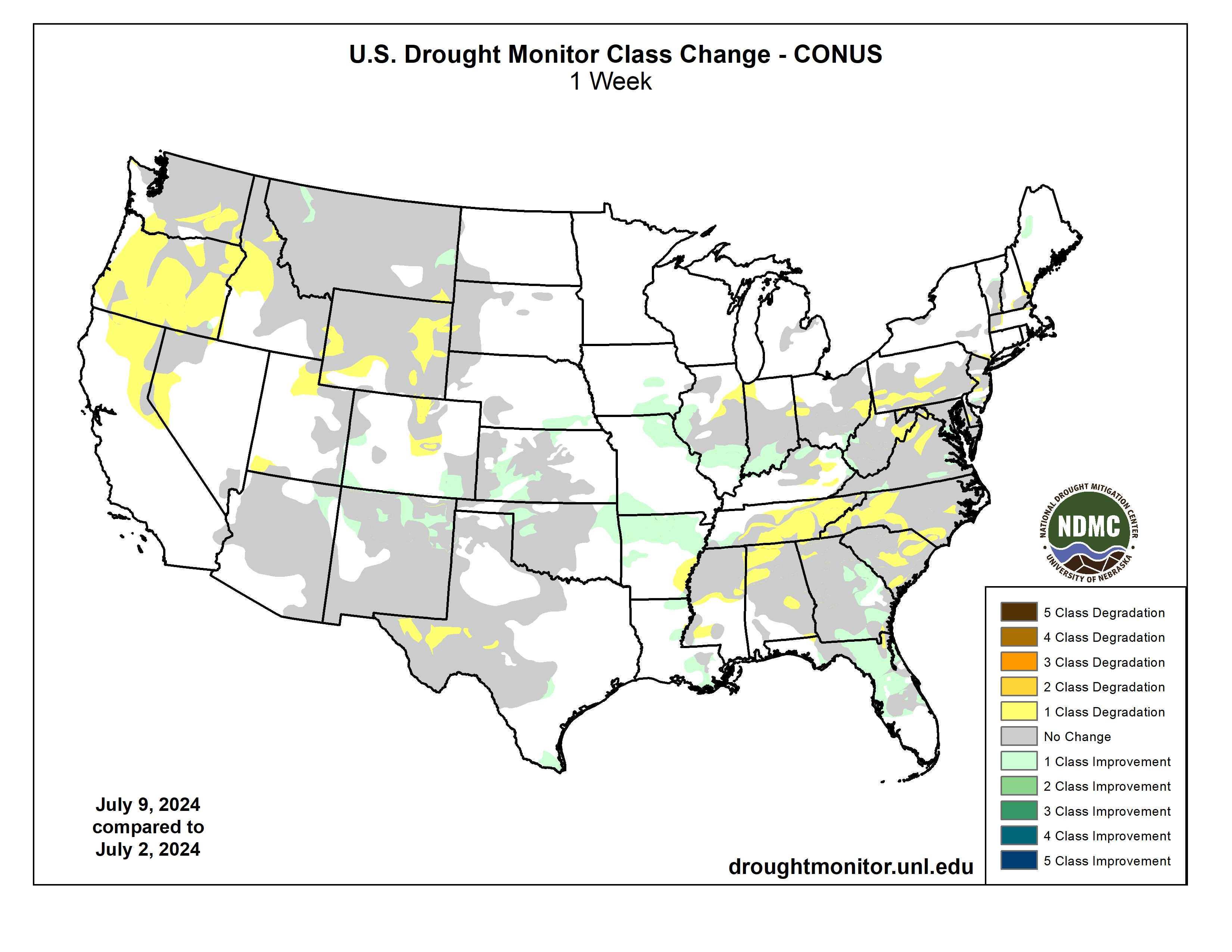
US Drought Monitor one week change map ending July 9, 2024.

River habitat thrives following Eleven Mile Canyon dam removal — The #Fairplay Flume #SouthPlatteRiver

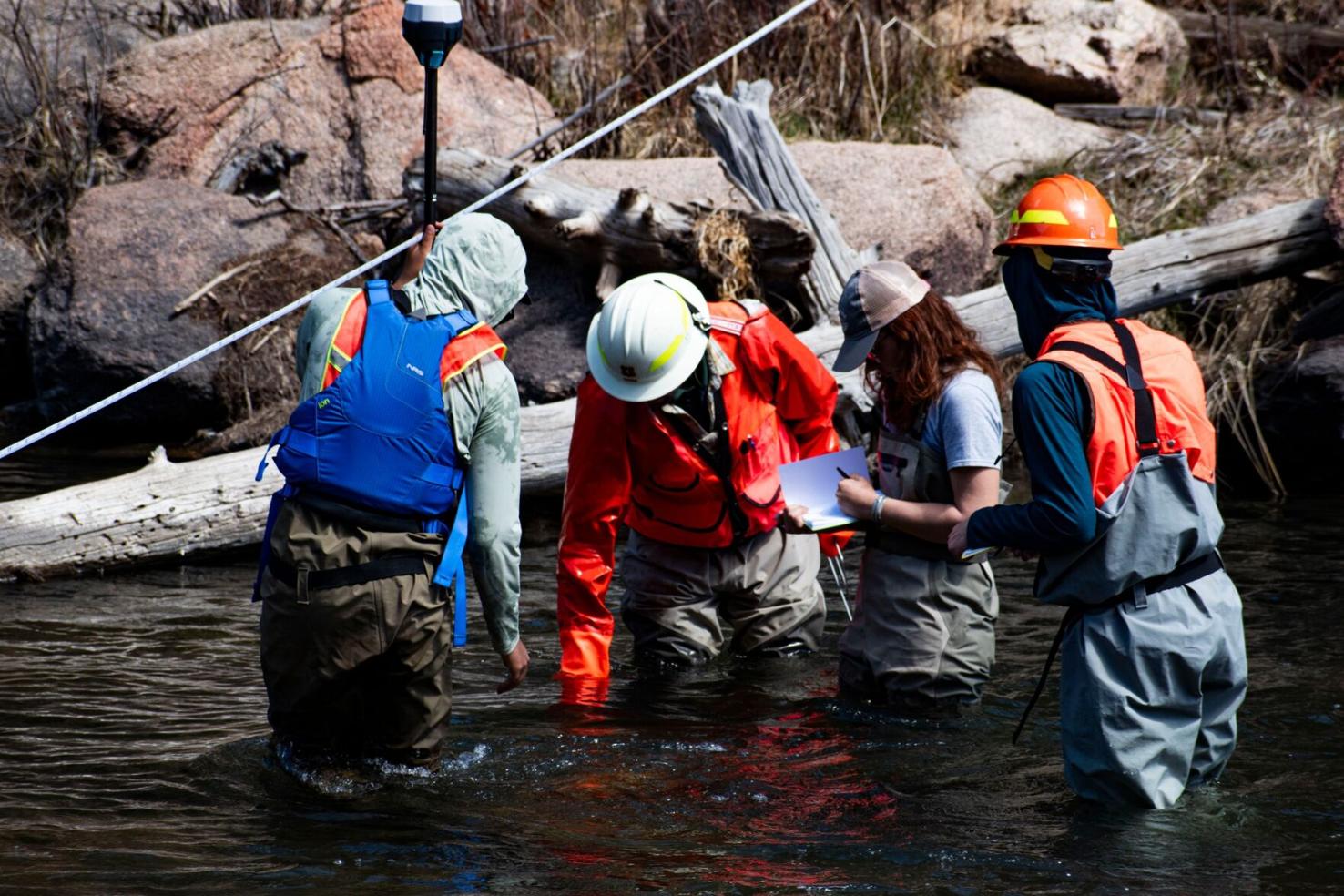
Researchers monitor the river channel at Eleven Mile Canyon. Photo courtesy of US Forest Service Rocky Mountain Research Station.

Click the link to read the article on The Fairplay Flume website (Meryl Phair). Here’s an excerpt:

July 8, 2024

Rainbow and brown trout are free to move as they please through Eleven Mile Canyon once again, following the removal of an unused dam on the stretch of South Platte River near Lake George. The 1952 Colorado Springs Utilities diversion dam was removed last year as part of a $4.8 million project to unite 45 miles of river. The river and its surrounding ecosystems have already seen significant benefits, particularly for fish who make their home in the clear waters of the mountain canyon.

“We have photos of fish attempting to jump the dam when it was in place,” said Charles M. Shobe, a Research Geomorphologist with the Forest Service’s Rocky Mountain Research Station. “Now that they’re able to move upstream, they’re bringing their biomass upstream which provides a better distribution of nutrients throughout the watershed.”

[…]

Scientists from the Rocky Mountain Research Station along with members of the South Park Ranger District conducted river sampling on April 25, mapping the bottom of the riverbed to get information on the shape of the river channel, collecting sediment samples to look at the aquatic habitat of the riverbed and bagging insect larvae to get a measure on who’s there. Measuring in April was essential for the team, Shobe explained, as it was after the dam’s disassembly but before the river that was diverted through a spillway while the dam was taken down, filled the canyon once again. Another sampling will be taken likely in June and then annually through 2027…

Returning the stretch of the South Platte to its pre-dam state will likely first improve habitat for the little insects that live in the stream bed, which in term will revitalize the whole system as fish feed on the insects, and bigger animals like eagles feed on the fish. While the research is still in the works, Shobe said they’ve observed anecdotally a change in the former pond area from finer sediment like mud and sand to coarser, larger sediments like gravel which will be a positive change for the aquatic organisms that swim in the stream as they tend to not do as well in a muddier environment. The buildup of sediment is a unique aspect of the Eleven Mile Canyon dam removal project as unlike other dams where removal of the river obstruction has flushed a wave of collected sediment downstream, a lot of the sediment was able to be dug out from behind the dam before removal. For that reason, downstream impacts aren’t expected, and the scope of the ongoing research will only include a couple 200 feet downstream of the former dam.

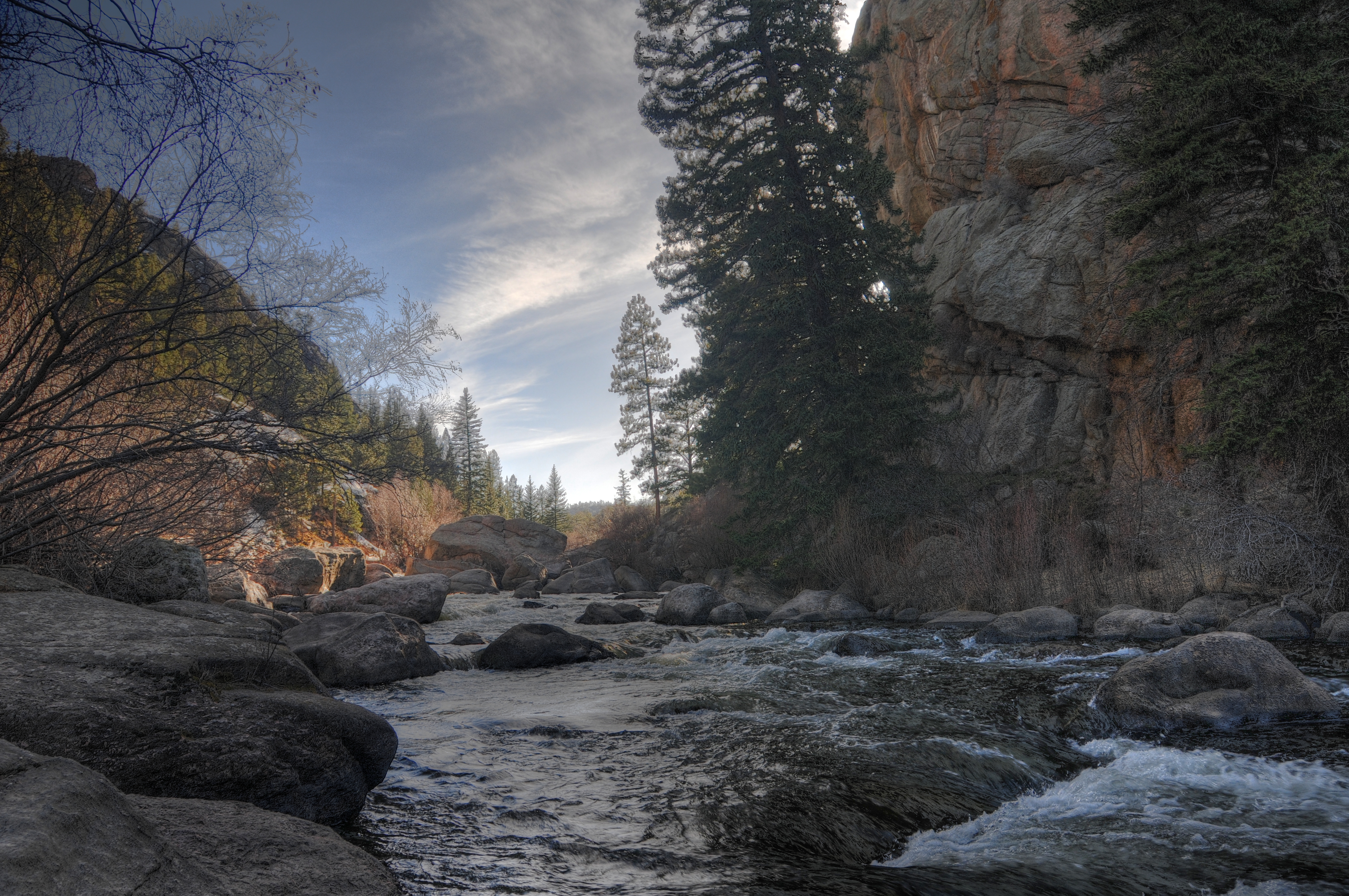
Eleven Mile Canyon. By Jay Miller from Fly to Eleven Mile Canyon just outside Colorado Springs – Flickr, CC BY 2.0, https://commons.wikimedia.org/w/index.php?curid=7679044

New legislation would ratify #ColoradoRiver water settlements for three #Arizona tribes — Arizona Mirror #COriver #aridification

The traditional homelands of the Navajo (Diné) are marked by four sacred mountains that stretch across modern-day Colorado, New Mexico, and Arizona. Credit: Native Knowledge 360º

Click the link to read the article on the Arizona Mirror website (Shondin Silversmith):

July 9, 2024

A bipartisan coalition of Arizona’s congressional delegation introduced legislation to address one of the longest-running water issues facing three Arizona tribes. 

The Northeastern Arizona Indian Water Rights Settlement (NAIWRSA) Act of 2024 would ratify and fund the largest Indian water rights settlement in the country, which will secure water rights for the Navajo Nation, Hopi Tribe and the San Juan Southern Paiute Tribe.

“This legislation and the settlement it ratifies represent a historic step forward in resolving a decades-long water rights dispute, providing certainty and stability for the Navajo Nation, Hopi Tribe, and the San Juan Southern Paiute Tribe,” Democratic U.S. Sen. Mark Kelly said in a written statement. 

Kelly and Kyrsten Sinema, an independent, introduced the act in the U.S. Senate on July 8. Identical legislation was also introduced in the U.S. House of Representatives, where it is cosponsored by Reps. Juan Ciscomani (R-Tucson), Raúl Grijalva (D-Tucson), Greg Stanton (D-Phoenix) and David Schweikert (R-Scottsdale).

“Our historic bipartisan legislation delivers real, lasting results for the Navajo Nation, Hopi Tribe, and San Juan Southern Paiute Tribe by strengthening water security, creating economic opportunities, and providing certainty and stability so their communities can continue to thrive,” Sinema said in a press release.

The Northeastern Arizona Indian Water Rights Settlement Agreement will settle the Navajo Nation, the Hopi Tribe, and the San Juan Southern Paiute Tribe’s claims to the main stem of the Colorado River, the Little Colorado River, and relevant groundwater sources in Arizona.

“Securing water rights for these tribes upholds their sovereignty and lays the path for their growth and prosperity through increased investment in water infrastructure,” Kelly said. “Ratifying this settlement honors our commitment to the tribes and helps secure our state’s water future, and we’ll work together as Republicans and Democrats to get it done.”  

The bill states that the legislation aims to achieve a fair, equitable and final settlement of all claims to rights to water in Arizona for the three tribal nations. 

In addition to settling the tribes’ ongoing water claims in the Colorado River Basin, it includes billions in funding for essential water development and delivery projects for the tribes.

Ciscomani said in a written statement that the settlement and legislation will provide a “long-lasting partnership” between Arizona and the tribes. 

“This not only gives much-needed certainty to the Tribes but allows Arizona to better plan for a secure water future while providing for improved water infrastructure throughout the region,” he said.

As part of the settlement, the three tribes would gain access to reliable and safe water for their community through various outlets, including the upper and lower basins of the Colorado River, aquifers, shared washes and water infrastructure development.

“The Northeastern Arizona Indian Water Rights Settlement Agreement is a monumental achievement and the product of negotiations spanning almost 30 years,” said Leslie A. Meyers, the associate general manager of water resources for the Salt River Project. “Salt River Project has participated in the negotiations from their inception.”

Meyers said SRP enthusiastically supports the bills because the settlement provides the three tribes with the desperately needed water supplies and infrastructure to secure their futures.  

The water settlement authorizes $5 billion to acquire, build, and maintain essential water development and delivery projects, including a $1.75 billion distribution pipeline. 

The three tribes would be guaranteed access to over 56,000 acre-feet of Colorado River water and specific groundwater rights and protections.

Grijalva said that the legislation deserves the full support of Congress because the settlement was the historic culmination of a decades-long effort to bring water to the three tribes.

“As the climate crisis continues to exacerbate an already devastating multigenerational drought, the federal government’s obligation to deliver clean, safe water and water infrastructure to the tribes could not be more pressing,” he said. “I urge my colleagues to move this legislation to the president’s desk quickly.”

Tribal leaders commend legislation introduction

Leaders from the Navajo Nation, Hopi Tribe and the San Juan Southern Paiute Tribe commended the work of everyone involved in writing the settlement and introducing legislation to Congress. 

Tribal councils from all three tribes initially passed bills supporting the water settlement in May. However, Congress must approve the settlement before it can go into law.

“For decades, our Navajo people have lived without piped water in their homes, with many of our elders hauling water over 30 miles roundtrip,” Navajo Nation President Buu Nygren said during a press conference on Tuesday. “More than 30% of the homes on the Navajo Nation lack running water. This is unacceptable.”

Nygren said that the Navajo people are American people, and no one in America should be denied access to water because of where they live. 

“This settlement ensures that the Navajo people will have rightful access to water, providing certainty for our homeland’s future and an equal opportunity for health and prosperity,” he added.

If the act passes Congress, the Navajo Nation water infrastructure it would fund will bring substantial clean, safe and reliable drinking water to Navajo communities in Arizona, according to Nygren’s office. The infrastructure will allow tens of thousands of Navajo people in Arizona to have piped water in their homes for the first time.

“It is a great opportunity here to claim what is ours as Navajo people,” Navajo Nation Council Speaker Crystalyne Curley said Tuesday. “Water is essential to every living thing that we possess in the Navajo way.” 

She said this is the first time a tribe is bringing this large of a water settlement to Congress, and she said it is unfortunate that the Navajo Nation is one of the last tribes in Arizona to bring its water settlement to a federal level.

Curley said it’s as if the Navajo Nation is going up to Congress with an empty cup and begging for both what is rightfully theirs and what they deserve.

“Without this settlement, our communities will remain disproportionately vulnerable to diseases, and development on the Reservation will continue to be restricted by the lack of water infrastructure,” she said in a press release.

Curley noted how the COVID-19 pandemic hit the Navajo Nation particularly hard due to the tribe’s lack of access to clean water and plumbing.

Through the water settlement, the Navajo Nation would gain access to 44,700 acre-feet per year of the Upper Basin Colorado River Water and 3,600 acre-feet per year of the Lower Basin Colorado River Water. 

The Navajo Nation will also lease, exchange, and accrue long-term storage credits for its Arizona water as part of the settlement. The tribe could store Arizona water in two reservoirs in New Mexico and aquifers on the Navajo Navajo for later recovery. 

The Navajo Nation would also be able to engage in inter-basin transfer of Colorado River water in Arizona and divert its water from New Mexico and Utah for use in Arizona. [ed. emphasis mine]

Explorer John Wesley Powell and Paiute Chief Tau-Gu looking over the Virgin River in 1873. Photo credit: NPS

The San Juan Southern Paiute Tribe, which spans Arizona and Utah, will not only receive water rights from the settlement but also ratify the treaty and create their reservation boundaries.

“We are so thankful to Senator Kelly and Senator Sinema for introducing legislation that will not only provide our Tribe with water but will also ratify a treaty negotiated and entered into by the San Juan Southern Paiute Tribe and the Navajo Nation decades ago,” Robbin Preston Jr., president of the San Juan Southern Paiute Tribe, said in a press release.  

“The Tribe has waited far too long to have an exclusive reservation of its own,” Preston added. “The opportunities made available through this legislation will change the lives of our Tribal Members and the trajectory of our Tribe.”

As part of the settlement, the tribe will gain 5,400 acres of land within the Navajo Nation, which will be proclaimed the San Juan Southern Paiute Reservation. The land will be held in trust by the United States.

Preston said the settlement would provide the San Juan Southern Paiute people with reliable electricity, water, and housing. 

“Our people will have opportunities that have never been available to us before,” he added. “This legislation is more than a settlement of water rights; it is the establishment of an exclusive reservation for a Tribe that will no longer be forced to live like strangers in our own land.”

For the Hopi Tribe, the settlement guarantees access to 2,300 acre-feet per year of the Upper Basin Colorado River Water and a little over 5,900 acre-feet per year of the Lower Basin Colorado River Water.

Hopi Chairman Timothy Nuvangyaoma expressed his gratitude to the state, tribes and neighboring communities for working to make the settlement a reality.

“Our collective action means a more secure water future for the Hopi Tribe and all of our neighbors in Northern Arizona,” Nuvangyaoma said.

As part of the settlement, the Hopi Tribe can lease, exchange, and accrue long-term storage credits for its water, store it in aquifers on Hopi land for later recovery and engage in inter-basin transfer of the Colorado River within Arizona.

Native America in the Colorado River Basin. Credit: USBR

#ClimateChange’s coal-smudged fingerprints: A survey of heat-related news from across the West — Jonathan P. Thompson #ActOnClimate #coal

Click the link to read the article on The Land Desk website (Jonathan P. Thompson):

July 9, 2024

🥵 Aridification Watch 🐫

Writing about weather in the climate crisis-era is like navigating an obstacle course littered with critics. One faction chides me if I write about insane rainstorms and flash flooding without attributing them to human-caused climate change; another blasts me for bringing up climate change too often, whether it’s to explain an especially active avalanche cycle or a long-term drought. Even the spate of “billion-dollar disasters” in recent years could be blamed on climate change, sure, but also on more development and humanity in the path of those disasters. 

Quite often those critics are the voices in my own head. Part of this is due to my hankering to learn the history of a place, particularly southwestern Colorado. Every time there’s an “unprecedented” drought or flood, I can look back into my mental archives and find an example of an equally severe one. There was the huge snow year of 1932, when the Durango-to-Silverton train was blockaded for 90 days straight; the great floods of 1911, 1884, 1927, and 1970, which wreaked havoc along the region’s streams and rivers; the dismally dry and warm winter of 1878-79 that preceded the Lime Creek Burn; and the grainy 1918 photo of a water-wagon doing dust control on Silverton’s streets — in January. 

Weather is and always has been wacky, with or without human-caused climate change. So I’m always careful before saying some meteorological event is “unprecedented.” 

But this heat? Damn. It sure does look unprecedented — if the temperature alone isn’t shattering records, the duration of the heat waves are.

A better term than climate change is climate heating, because that’s exactly what’s happening: The planet is heating up as a result of Industrial (and Information) Age humans spewing oodles of greenhouse gases into the atmosphere. And while it may be difficult to find climate change’s figurative fingerprints on every incidence of severe weather, its coal-smudged paw-prints appear to be all over the longer and more severe spells of extreme heat we’ve been perspiring through in recent years. No, every record-breaking high temperature cannot be attributed unequivocally to climate change, but climate change does make these events far more likely to occur.

Last year was the warmest year on our planet since global record-keeping began in 1850, clocking in at 2.12 degrees Fahrenheit warmer than the 20th century average of 57° F. And guess what? This year will likely be even hotter: This June was the hottest June on record, globally, and the 13th consecutive monthly high temperature record. Eeek. 

So, when the mercury in Las Vegas tops out at 120 degrees F and shatters the previous record of 117° F, as occurred last week, I think it’s not a stretch to attribute this specific weather wackiness to the warming climate (with a helping hand from the urban heat island effect, of course). And when this sort of heat stretches across a good portion of the West, follows record-setting, flash-flooding rainfall by a few weeks, and coincides with a hurricane ripping through the Carribean, well, it’s probably safe to assume that it’s all connected, via a warming climate. It is not safe, however, to go outside. 

So, with that out of the way, here’s a rundown of some of the wackiness of late: 

  • Phoenix just endured its hottest June on record, with an average monthly temperature of 97°F, or nearly six degrees above the 1990-2020 normal. So far this summer the daily high temperature has reached 110° F or warmer on 21 occasions, and 118° F on two days; the city has received just .02 inches of precipitation since April 2. Maricopa County officials have confirmed heat caused or contributed to 13 deaths so far this year, with another 162 fatalities under investigation. That’s significantly more than last year at this time.
  • Dozens of monthly maximum high temperature records were broken across the West in June and early July, especially along the West Coast, where the mercury was — and still is — reaching the triple digits day after day. Oregon officials suspect five deaths in the western part of the state in recent days are heat-related
  • Las Vegas shattered its all-time high heat record with 120 degrees F on July 7. The previous record was 117. 

  • A new daily record was set in Death Valley, at 129 F. A motorcyclist touring through the national park died of heat exposure
  • Sixteen locations in the West set monthly precipitation records in June, including:
    • Hovenweep National Monument, with 1.05 inches on June 28;
    • Arches National Park, 1.58” on June 28;
    • Panguitch, Utah, 1.50” on June 26;
    • Quemazon, New Mexico, 5.50” on June 21;
    • Arivaca, Arizona, 2.25” on June 24;
    • Ely, Nevada, 1.58” on June 26;
    • Mormon Mountain, Arizona, 2.30” on June 27. 

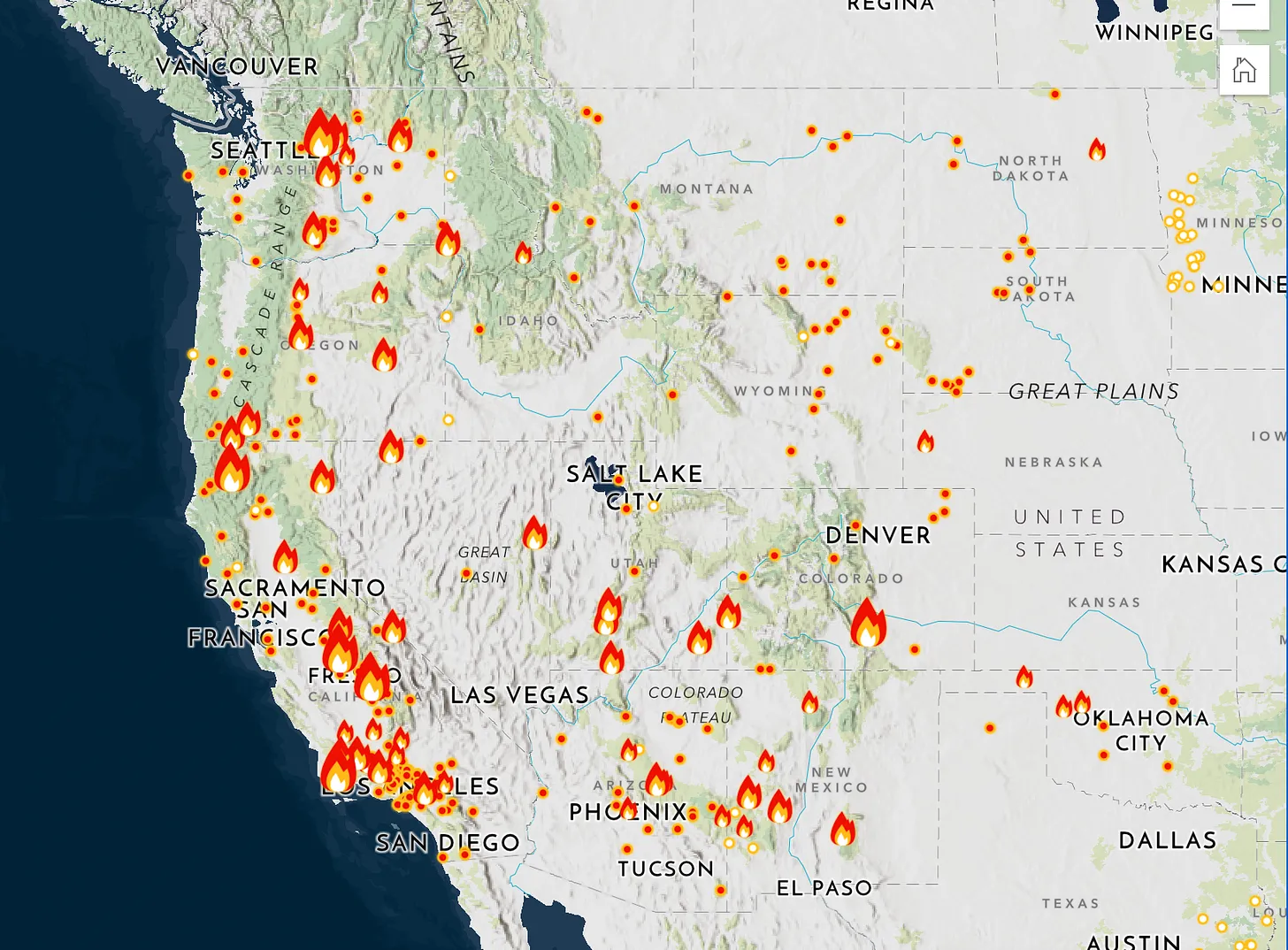
  • Major wildfires are burning across the West. Before I get into the details, do spare a thought for the thousands of people fighting these fires. Not only do the flames and smoke threaten their health and lives, but so does the brutal heat. This is a sampling of some of the new starts (stats as of early a.m. July 9):
    • Silver King in Piute County, Utah, at 10,026 acres, 0% containment; 
    • Deer Springs in Kane County, Utah, (north-northeast of Kanab) at 11,000 acres, 0% containment; 
    • Fisher in Socorro County, New Mexico, at 2,500 acres, 1% containment;
    • Lake in Santa Barbara County, California, at 21,763 acres, 8% containment; 
    • Shelly in Siskiyou County, California, at 4,203 acres, 0% containment (this one is likely to burn a “carbon offset” forest, where corporations pay the owner to not chop down trees so they can continue polluting). Whoops.;
    • Salt Creek Rd in Jackson County, Oregon, 1,700 acres, 2% containment;
    • North in Modoc County, California, 4,380 acres, 50% containment; 
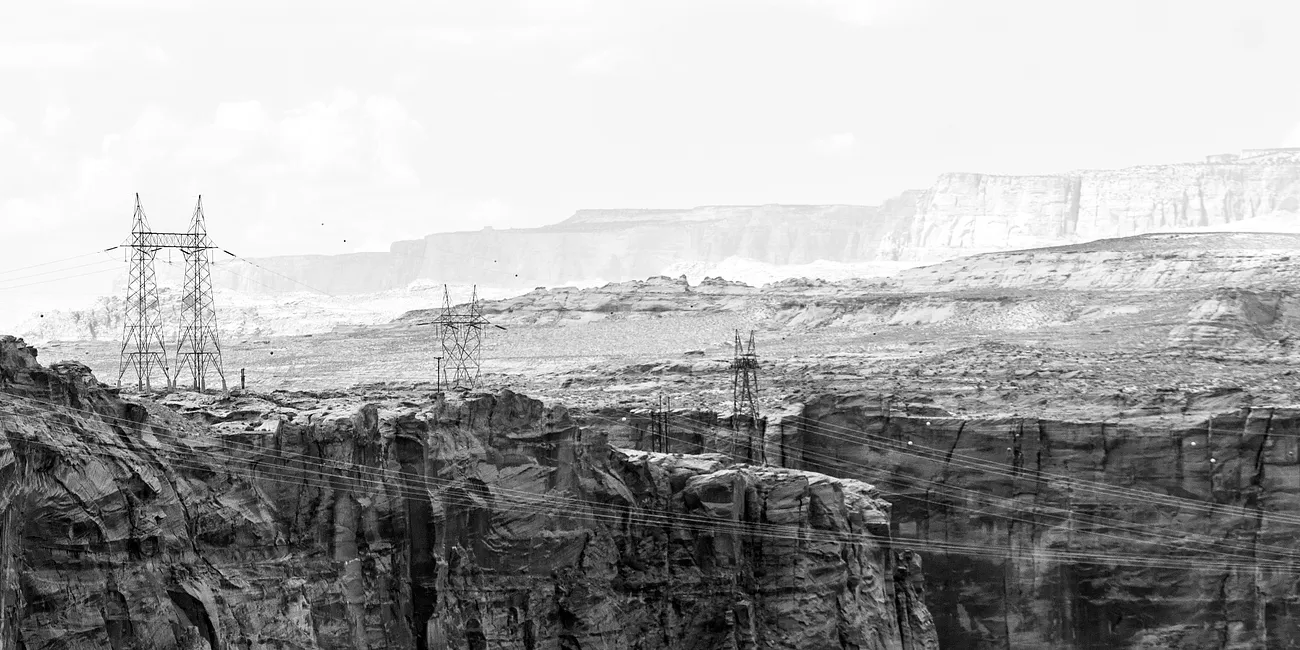
    • Thompson in Butte County, California, which is 100% contained after burning 3,789 acres. I include it here because it forced the shutdown of transmission lines, taking the Oroville Dam hydropower plant offline and depriving the California grid of valuable energy when it needs it to keep air-conditioners running. It’s yet another example of how extreme weather can strain the power grid. 

Explainer: Warming planet, failing gridJONATHAN P. THOMPSON JUNE 16, 2021

A scorcher has settled over the entire Southwestern United States, with highs expected to hit the triple digits for several days in a row from Bakersfield to Las Vegas to Grand Junction. Phoenicians will be doing the Summer Solstice Swelter during that long day and short night—theRead full story

It’s difficult to see how this is sustainable. Consider for a moment the misery the more than 9,000 unhoused people in Phoenix must be experiencing each and every day this summer. Many of them live on the streets and sidewalks, literally, where the concrete and asphalt can reach 160° F or more, hot enough to cause severe burns. Poorly insulated housing without cooling can be nearly as bad. Public cooling centers provide refuge, of course, but are there enough?

Sure, if you can afford it, you can hunker down in your home and crank up the air-conditioner and simply wait out the heat. But you could be waiting for quite some time these days; meanwhile, the growing fleet of air-conditioners will strain the grid, increasing the risk of a widespread power outage, which literally could be deadly in this heat.

There is a limit to this sort of thing, and it seems as if we must be getting close to the point where some places simply become uninhabitable. But if we’ve already reached that point, a lot of folks aren’t aware of it: Maricopa County remains one of the fastest growing metros in the U.S. And during the 12 months from June 2023 through May 2024, 48,000 building permits were issued in the metro area for new, private housing structures — numbers not seen since the great housing bubble of a couple decades ago.

Surely the housing bubble will burst, as it has in the past, before too long. But what about the air-conditioning bubble? Can it really last forever?


🏠 Random Real Estate Room 🤑 

Speaking of people moving to hostile environments, the Amangiri resort near Lake Powell (and the polygamist settlement of Big Water) is now selling lots to those who can afford it. But don’t worry! While homeowners can avail themselves of the resort amenities, they are separated from those low-brow folks (who are forking out up to $6,500 per night to stay there) by a big slab of sandstone — saving them from having to rub elbows with the Kardashians next to the pool under 100°+ heat. And it will only cost you between $5 million and $12 million. For the lot, that is. Gross.

Follow Up

Remember my diatribe from a couple weeks ago about data centers’ excessive power use? Well, the pitfalls of all of that are playing out as I write this. Arizona Public Service, the state’s biggest utility, predicts its customers collectively will set new electricity-demand records this year. And it’s not because of all those new folks moving in or the new homes being built — efficiency gains have actually led to a 5% decrease in overall residential power consumption. It’s thanks to those data centers, of which there are 79 in the state (71 in Phoenix, seven in Tucson, and one in Nogales). It’s all fine and good until the grid crashes on a 118° F day.

A Dog Day Diatribe on AI, cryptocurrency, energy consumption, and capitalismJONATHAN P. THOMPSON — June 28, 2024

🐐 Things that get my Goat 🐐 I will begin this rant with a thank you to a kind reader for this little tidbit that appeared in their response to a column of mine: Ironically, reducing energy consumption will be counterp…Read full story