The City of Grand Junction will host a ribbon cutting on Tuesday, July 2 at 1 p.m. celebrating the reopening ofCarson Lake (also known as Hogchute Reservoir) on the Grand Mesa now that improvements are complete and the reservoir has been refilled. Carson Lake is part of the City of Grand Junction’s water supply network. Following the ribbon cutting, Colorado Parks and Wildlife (CPW), in collaboration with the city, will restock Carson Lake with fish.
In 2021, the City initiated the dam improvement project for Carson Lake which included proactive measures to preserve the life of the dam, improve operations, and enhance safety for residents in the Kannah Creek basin. The improvements required the draining of the reservoir and included reconstructing the outlet pipe assembly and the overflow spillway and channel. An early warning telemetry system was also added to provide real-time monitoring and communication to emergency services agencies and the public should there be a dam emergency. The work was funded in part with a low-interest, $4.3 million loan from the Colorado Water Conservation Board.
In addition to having to drain the reservoir, during construction, the U.S. Forest Service closed National Forest System Road #108 between Land’s End Road and Carson Lake, the parking lot and access to upper trails that start at Carson Lake which have now reopened.
El Vado Dam and Reservoir back in the day. Photo credit: USBR
Click the link to read the article on the Grist website (Jake Bittle):
July 6, 2024
Mark Garcia can see that there’s no shortage of water in the Rio Grande this year. The river flows past his farm in central New Mexico, about 50 miles south of Albuquerque. The rush of springtime water is a welcome change after years of drought, but he knows the good times won’t last.
As the summer continues, the river will diminish, leaving Garcia with a strict ration. He’ll be allowed irrigation water for his 300 acres just once every 30 days, which is nowhere near enough to sustain his crop of oats and alfalfa.
For decades, Garcia and other farmers on the Rio Grande have relied on water released from a dam called El Vado, which collects billions of gallons of river water to store and eventually release to help farmers during times when the river runs dry. More significantly for most New Mexico residents, the dam system also allows the city of Albuquerque to import river water from long distances for household use.
New Mexico water projects map via Reclamation
But El Vado has been out of commission for the past three summers, its structure bulging and disfigured after decades in operation — and the government doesn’t have a plan to fix it.
“We need some sort of storage,” said Garcia. “If we don’t get a big monsoon this summer, if you don’t have a well, you won’t be able to water.”
The failure of the dam has shaken up the water supply for the entire region surrounding Albuquerque, forcing the city and many of the farmers nearby to rely on finite groundwater and threatening an endangered fish species along the river. It’s a surprising twist of fate for a region that in recent years emerged as a model for sustainablewater management in the West.
“Having El Vado out of the picture has been really tough,” said Paul Tashjian, the director of freshwater conservation at the Southwest regional office of the nonprofit National Audubon Society. “We’ve been really eking by every year the past few years.”
Surface water imports from the El Vado system have generally allowed public officials in Albuquerque to limit groundwater shortages. This echoes the strategies of other large Western cities such as Phoenix and Los Angeles, which have enabled population growth by tapping diverse sources of water for metropolitan regions and the farms that sit outside of them. The Biden administration is seeking to replicate this strategy in water-stressed rural areas across the region, doling out more than $8 billion in grants to support pipelines and reservoirs.
“New plot using the nClimGrid data, which is a better source than PRISM for long-term trends. Of course, the combined reservoir contents increase from last year, but the increase is less than 2011 and looks puny compared to the ‘hole’ in the reservoirs. The blue Loess lines subtly change. Last year those lines ended pointing downwards. This year they end flat-ish. 2023 temps were still above the 20th century average, although close. Another interesting aspect is that the 20C Mean and 21C Mean lines on the individual plots really don’t change much. Finally, the 2023 Natural Flows are almost exactly equal to 2019. (17.678 maf vs 17.672 maf). For all the hoopla about how this was record-setting year, the fact is that this year was significantly less than 2011 (20.159 maf) and no different than 2019” — Brad Udall
But the last decade has shown that this strategy isn’t foolproof — at least not while climate change fuels an ongoing megadrought across the West. Los Angeles has lost water from both the Colorado River and from a series of reservoirs in Northern California, and Phoenix has seen declines not only from the Colorado but also from the groundwater aquifers that fuel the state’s cotton and alfalfa farming. Now, as Albuquerque’s decrepit El Vado dam goes out of commission, the city is trying to balance multiple fragile resources.
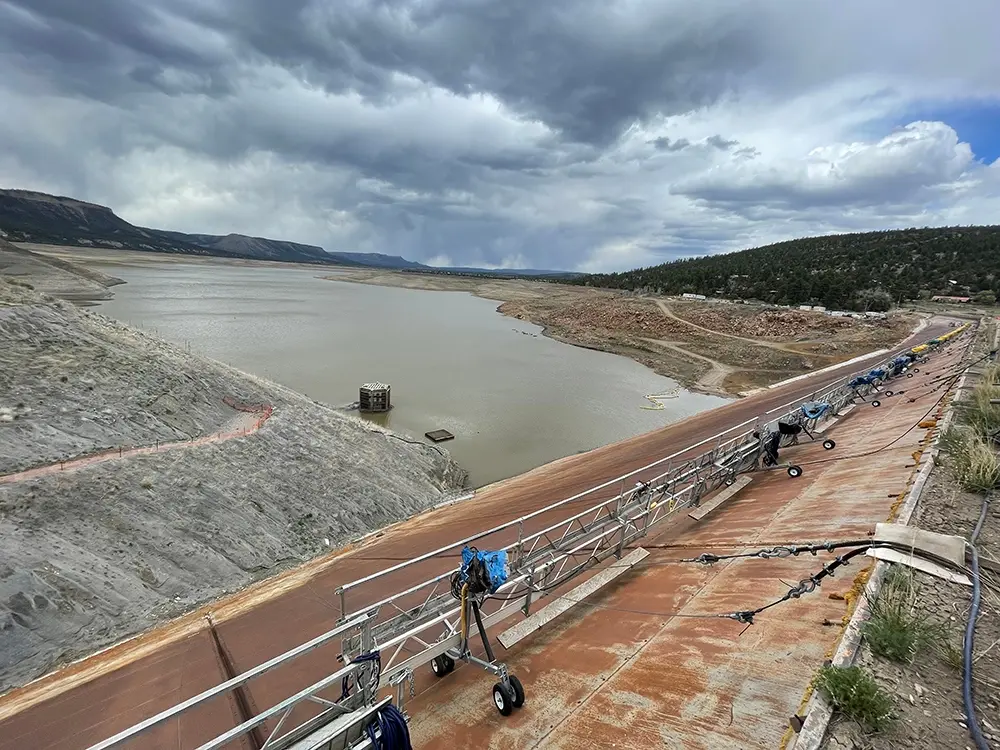
El Vado is an odd dam: It’s one of only four in the United States that uses a steel faceplate to hold back water, rather than a mass of rock or concrete. The dam has been collecting irrigation water for Rio Grande farmers for close to a century, but decades of studies have shown that water is seeping through the faceplate and undermining the dam’s foundations. When engineers tried to use grout to fill in the cracks behind the faceplate, they accidentally caused the faceplate to bulge out of shape, threatening the stability of the entire structure. The Bureau of Reclamation, the federal agency that manages the dam, paused construction and is now back at the drawing board.
Without the ability to collect irrigation water for the farmers, the Bureau has had no choice but to let the Rio Grande’s natural flow move downstream to Albuquerque. There’s plenty of water in the spring, when snow melts off the mountains and rain rushes toward the ocean. But when the rains peter out by the start of the summer, the river’s flow reduces to a trickle.
“We run really fast and happy in the spring, and then you’re off pretty precipitously,” said Casey Ish, the conservation program supervisor at the Middle Rio Grande Conservancy District, the irrigation district that supplies water to farmers like Garcia. “It just creates a lot of stress on the system late in the summer.” The uncertainty about water rationing causes many farmers to forego planting crops they aren’t sure they’ll be able to see to maturity, Ish added.
Construction crews attempt to repair the El Vado dam along the Rio Grande in New Mexico. The federal government has been unable to find a way to stop seepage behind the steel faceplate dam. U.S. Bureau of Reclamation
The beleaguered dam also plays a critical role in providing water to the fast-growing Albuquerque metropolitan area, which is home to almost a million people. As the city grew over the past 100 years, it drained local groundwater, lowering aquifer levels by dozens of feet until the city got a reputation as “one of the biggest water-wasters in the West.” Cities across the region were mining their groundwater in the same way, but Albuquerque managed to turn its bad habits around. In 2008, it built a $160 million water treatment plant that allowed it to clean water from the distant Colorado River, giving officials a new water source to reduce their groundwater reliance.
The loss of El Vado is jeopardizing this achievement. In order for Colorado River water to reach the Albuquerque treatment plant, it needs to travel through the same set of canals and pipelines that deliver Rio Grande water to the city and farmers, “riding” with the Rio Grande water through the pipes. Without a steady flow of Rio Grande water out of El Vado, the Colorado River water can’t make it to the city. This means that in the summer months, when the Rio Grande dries out, Albuquerque now has to turn back to groundwater to supply its thirsty residential subdivisions.
This renewed reliance on groundwater has halted the recovery of local aquifers. The water level in these aquifers was rising from 2008 through 2020, but it slumped out around 2020 and hasn’t budged since.
“We have had to shut down our surface water plant the last three summers because of low flows in Albuquerque,” said Diane Agnew, a senior official at the Albuquerque Bernalillo County Water Utility Authority, which manages the region’s water. Agnew stresses that aquifer levels are only flattening out, not falling. Still, losing El Vado storage for the long run would be detrimental to the city’s overall water resilience.
“We have more than enough supply to meet demand, but it does change our equation,” she added.
The Bureau of Reclamation is looking for a way to fix the dam and restore Rio Grande water to Albuquerque, but right now its engineers are stumped. In a recent meeting with local farmers, a senior Reclamation official offered a frank assessment of the dam’s future.
“We were not able to find technical solutions to the challenges that we were seeing,” said Jennifer Faler, the Bureau’s Albuquerque area manager, in remarks at the meeting.
The next-best option is to find somewhere else to store water for farmers. There are other reservoirs along the Rio Grande, including one large dam owned by the Army Corps of Engineers, but repurposing them for irrigation water will involve a lengthy bureaucratic process.
A spokesperson for the Bureau of Reclamation told Grist that the agency “is working diligently with our partners to develop a plan and finalize agreements to help alleviate the lost storage capacity” and that it “may have the ability to safely store some water” for farms and cities next year.
In the meantime, farmers like Garcia are getting impatient. When a senior Bureau official broke the bad news at an irrigation district meeting last month, more than a dozen farmers who grow crops in the district stood up to express their frustration with the delays in the repair process, calling Reclamation’s announcement “frustrating” and “a shock.”
“If we don’t have any water for the long term, I have to let my employees go, and I guess start looking for ramen noodles someplace,” Garcia told Grist.
Even though there are only a handful of other steel faceplate dams like El Vado in the United States, more communities across the West are likely to experience similar infrastructure issues that affect their water supply, according to John Fleck, a professor of water policy at the University of New Mexico.
“We’ve optimized entire human and natural communities around the way this aging infrastructure allows us to manipulate the flow of rivers, and we’re likely to see more and more examples where infrastructure we’ve come to depend on no longer functions the way we planned or intended,” he said.
As the West gets drier and its dams and canals continue to age, more communities may find themselves forced to strike a balance between groundwater, which is easy to access but finite, and surface water, which is renewable but challenging to obtain. The loss of El Vado shows that neither one of these resources can be relied upon solely and consistently — and in an era of higher temperatures and aging infrastructure, even having both may not be enough.
The headwaters of the Rio Grande River in Colorado. Photo: Brent Gardner-Smith/Aspen Journalism