The June 2024 Intermountain #climate summary is hot off the presses from Western Water Assessment

Click the link to read the assessment on the Western Water Assessment website:

July 11, 2024 – CO, UT, WY

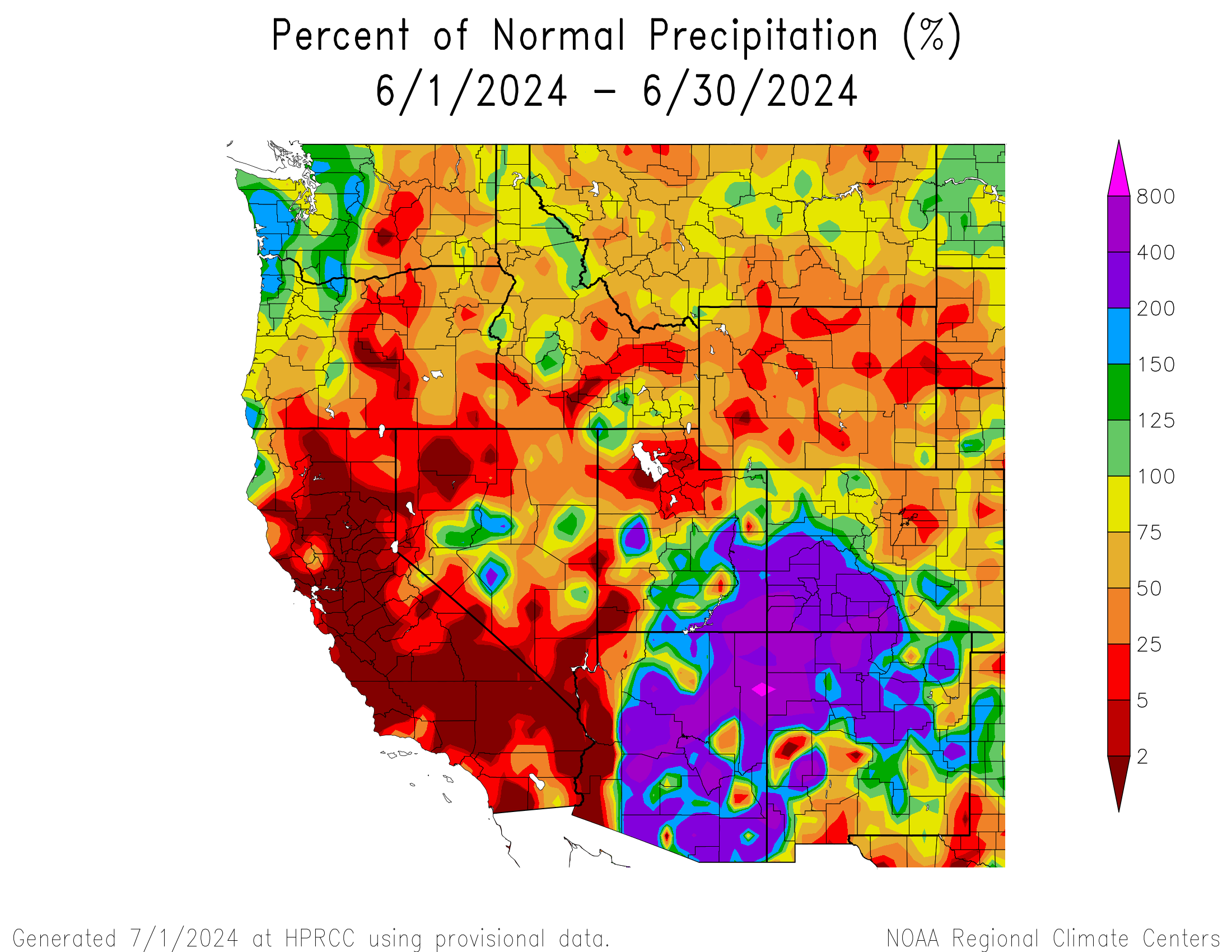
Precipitation conditions ranged from much-below to much-above normal for the region in June. The Four Corners region experienced 400-800% of normal June precipitation while other areas of the region experienced record-dry conditions. Temperatures were above to much-above normal throughout the region in June. Snowpack completely melted out in Colorado, Utah, and Wyoming by June 23. Most regional streamflow gauges recorded normal to above normal flows. Drought conditions improved in Colorado but worsened in Wyoming. The NOAA seasonal outlook for July-September suggests an increased probability of below normal precipitation and above normal temperatures for the entire region.

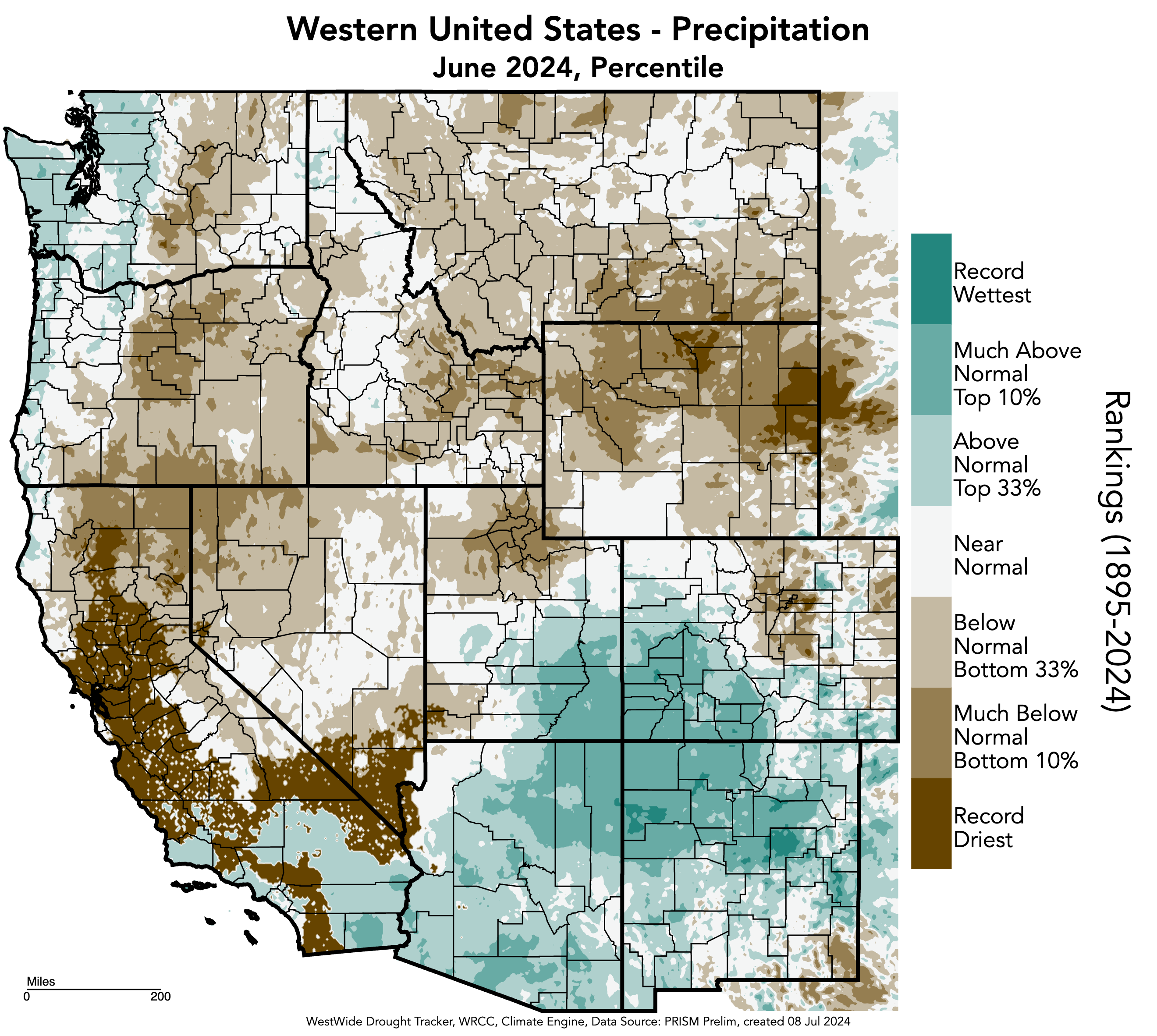
The region experienced mixed conditions in June. 200-400% of average precipitation fell throughout southwestern Colorado and much of southeastern Utah, with 400-800% of normal precipitation in the Four Corners region and south-central Colorado. Large portions of the region experienced much-below average precipitation, with less than 2% of average precipitation west of the Great Salt Lake, in southwestern Utah, and in a small pocket in southwestern Wyoming. Record-dry conditions occurred in northern and eastern Wyoming, southwestern Utah, and east of Denver. Boulder experienced its driest June in exactly 100 years.
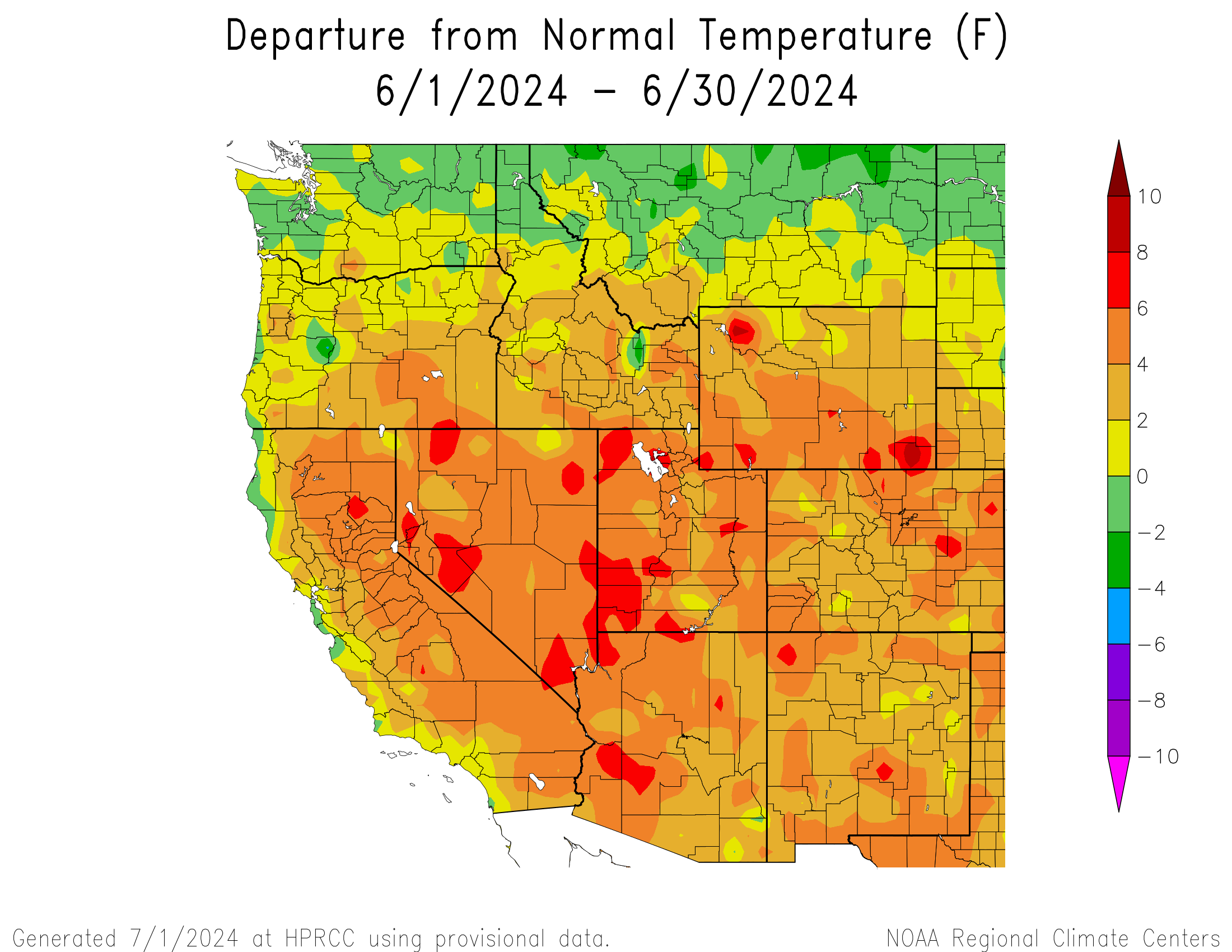
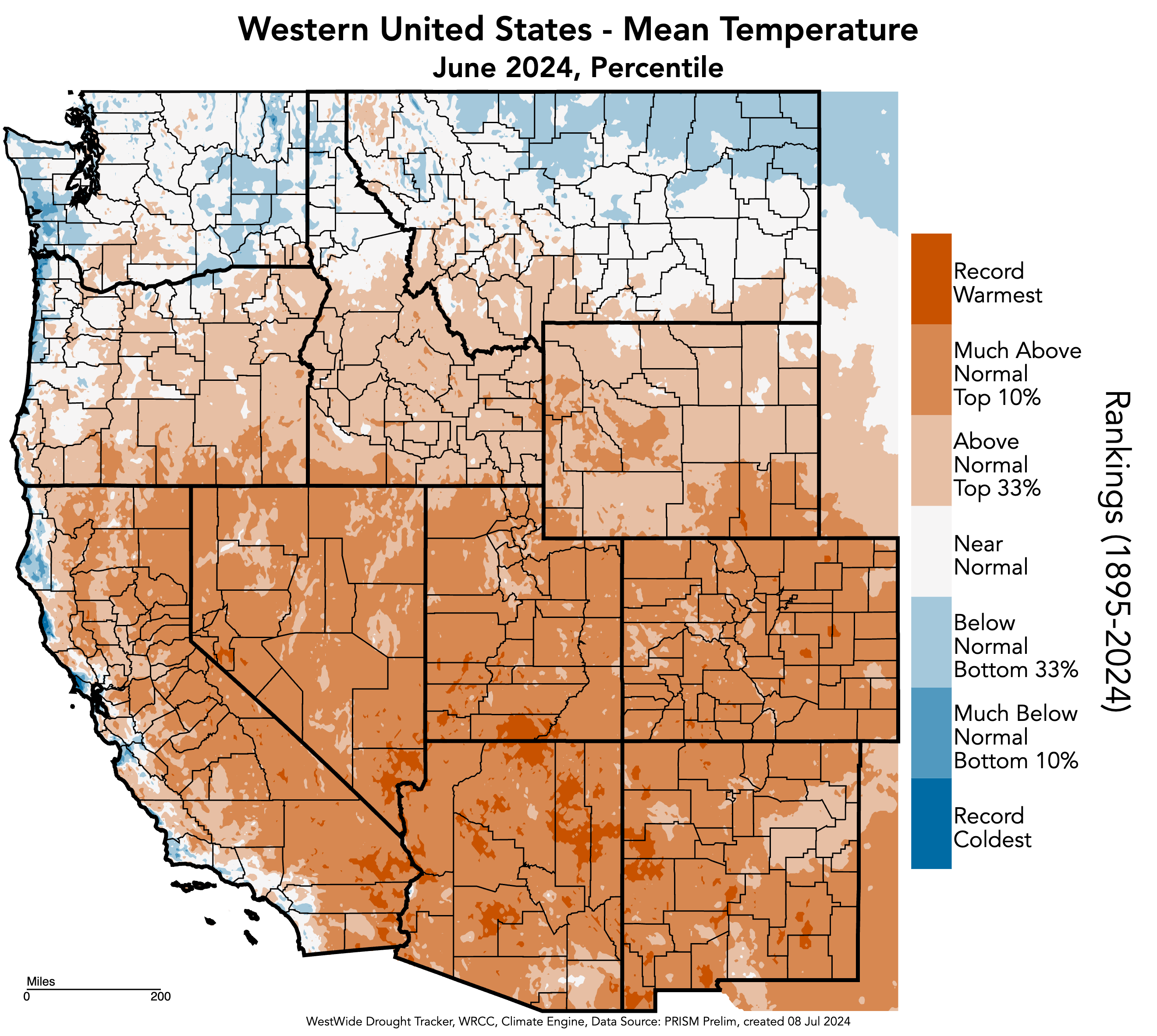
The majority of the region experienced above to much-above normal temperatures. Temperatures of 6-8°F above normal occurred in many pockets throughout the region including eastern Colorado, southern Wyoming, and particularly in northern and southwestern Utah. Temperatures of 8-10°F above normal occurred in northwestern and southeastern Wyoming. Record-warm temperatures occurred throughout the region, particularly in southern Utah.
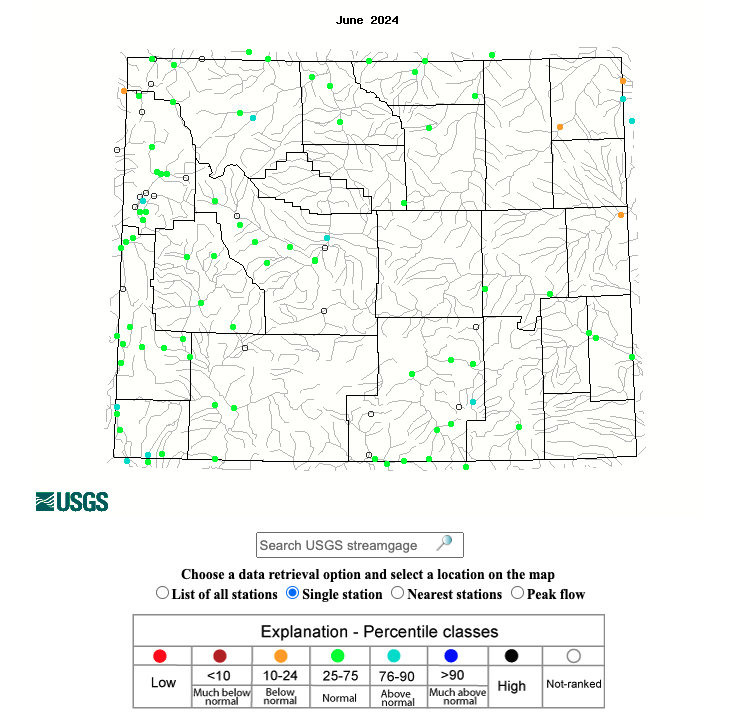
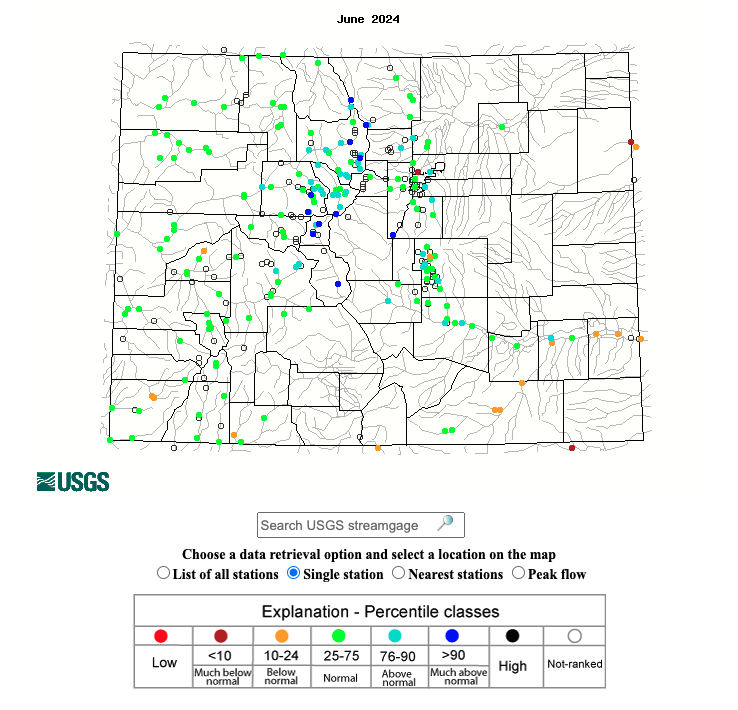
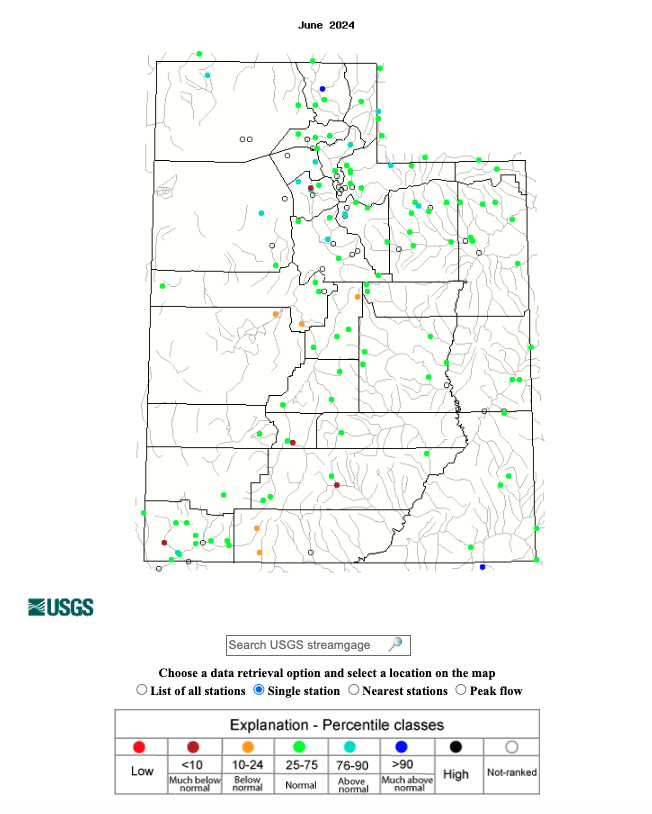
Regional streamflow conditions were near average, with above average streamflow at many sites in northern Colorado and northern Utah. Much-above average streamflow occurred at one site near Logan, Utah and at many sites in northern Colorado along the Front Range and in the Central Mountains, from Larimer County down to Chaffee County.
Regional drought conditions worsened during June and now cover 9% of the region, compared to 8% at the end of May. Moderate (D1) drought expanded in eastern Wyoming and emerged in northern Colorado including the Denver Metro area, with severe (D2) drought emerging in Laramie County in southeastern Wyoming. D2 drought was removed from Prowers and Baca Counties in southeastern Colorado.
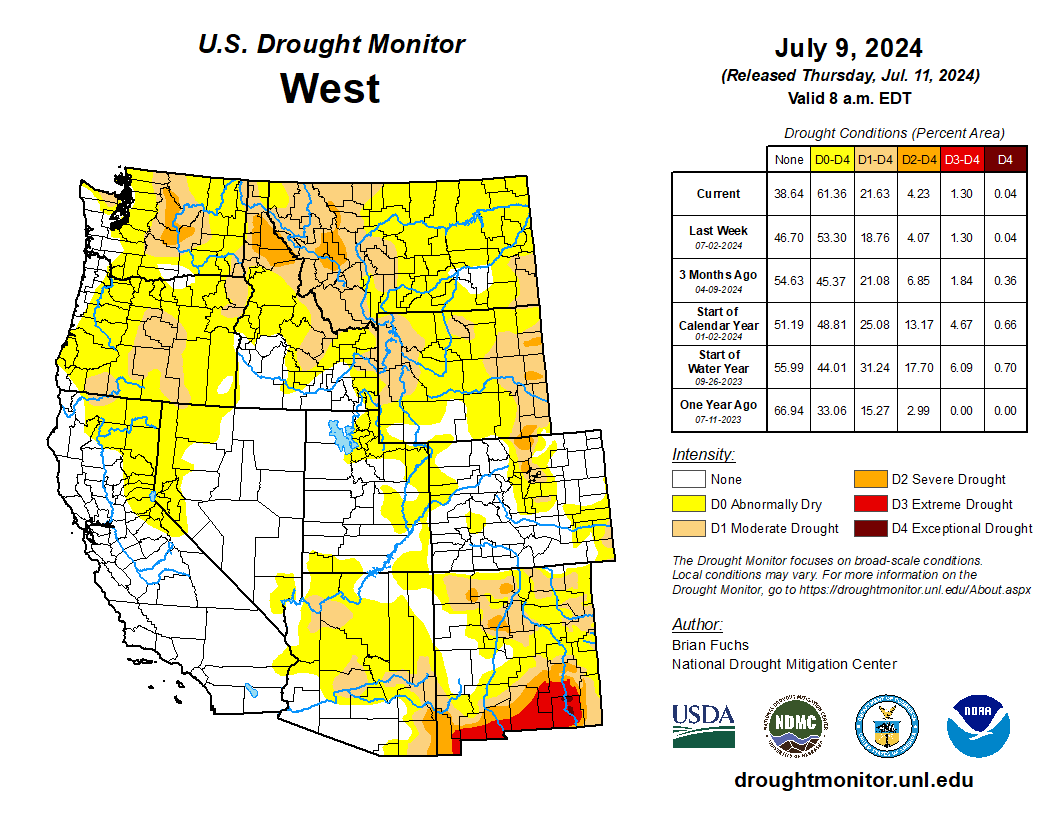
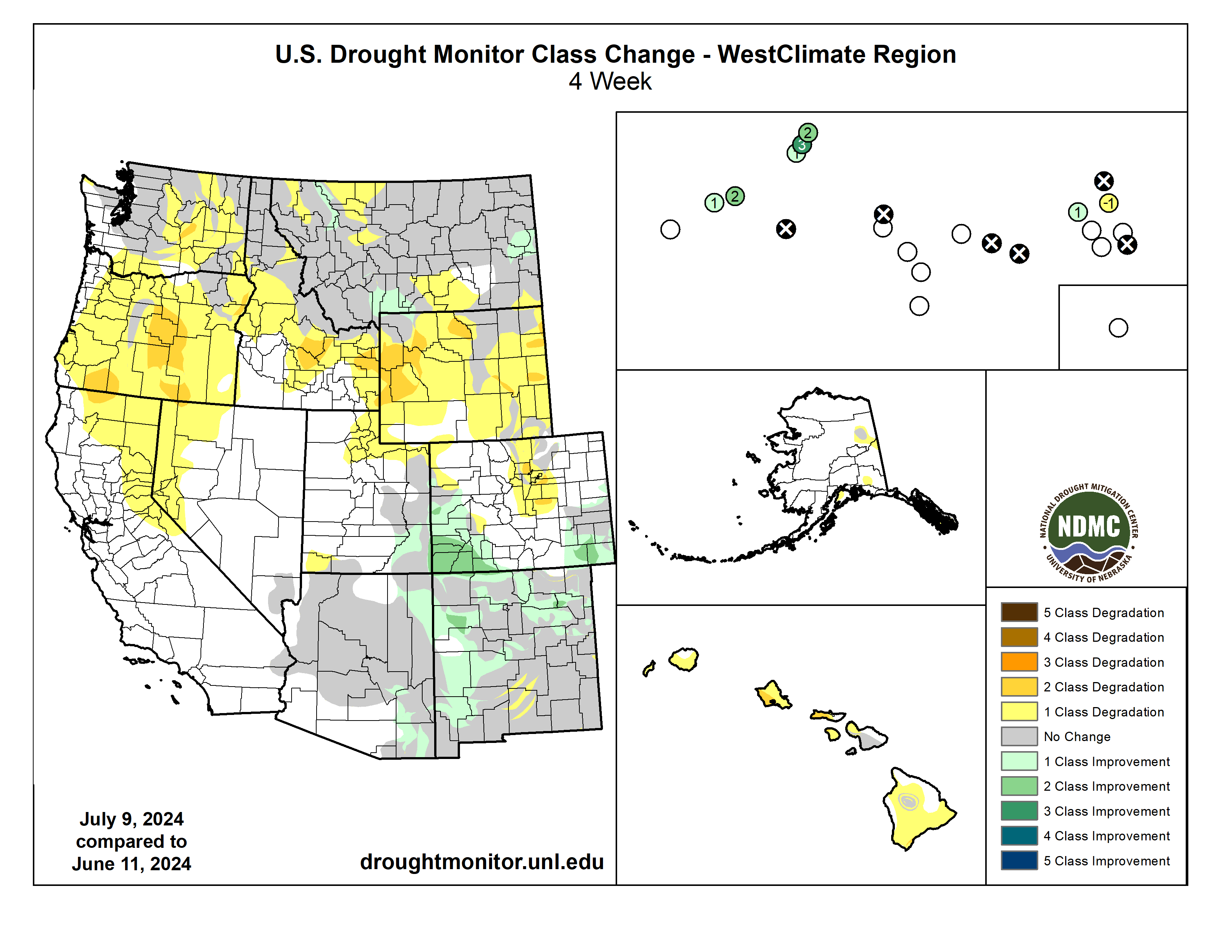
West Drought Monitor map July 9, 2024.

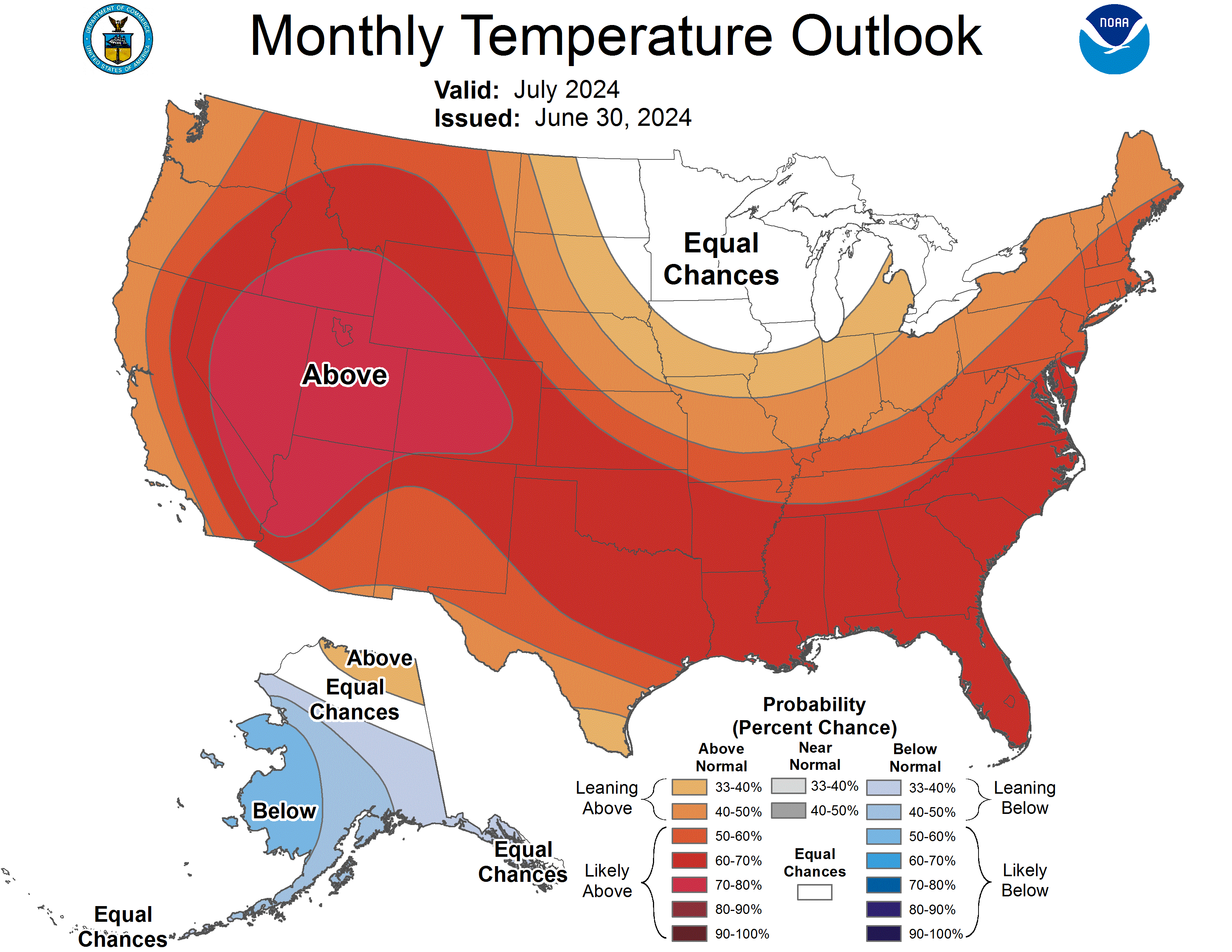
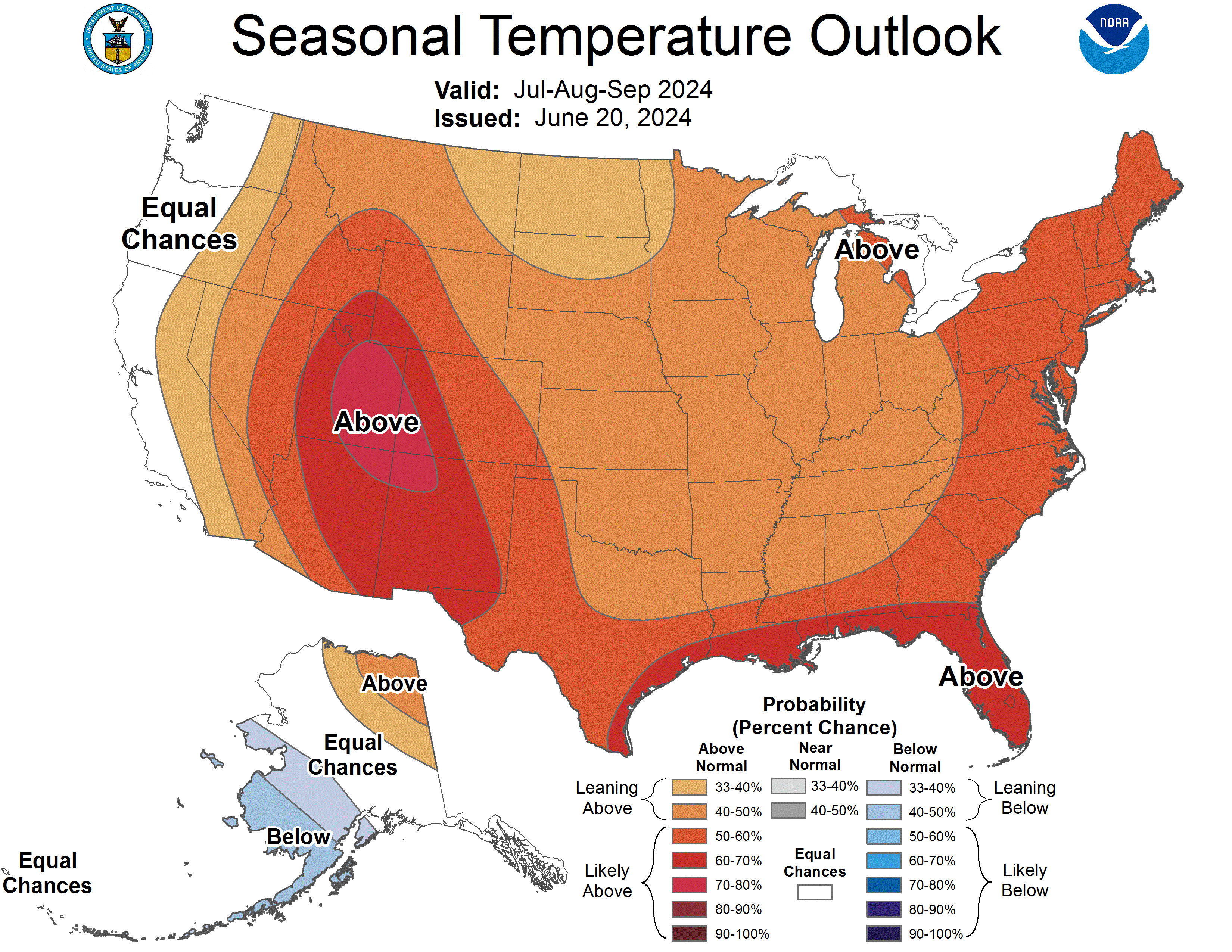
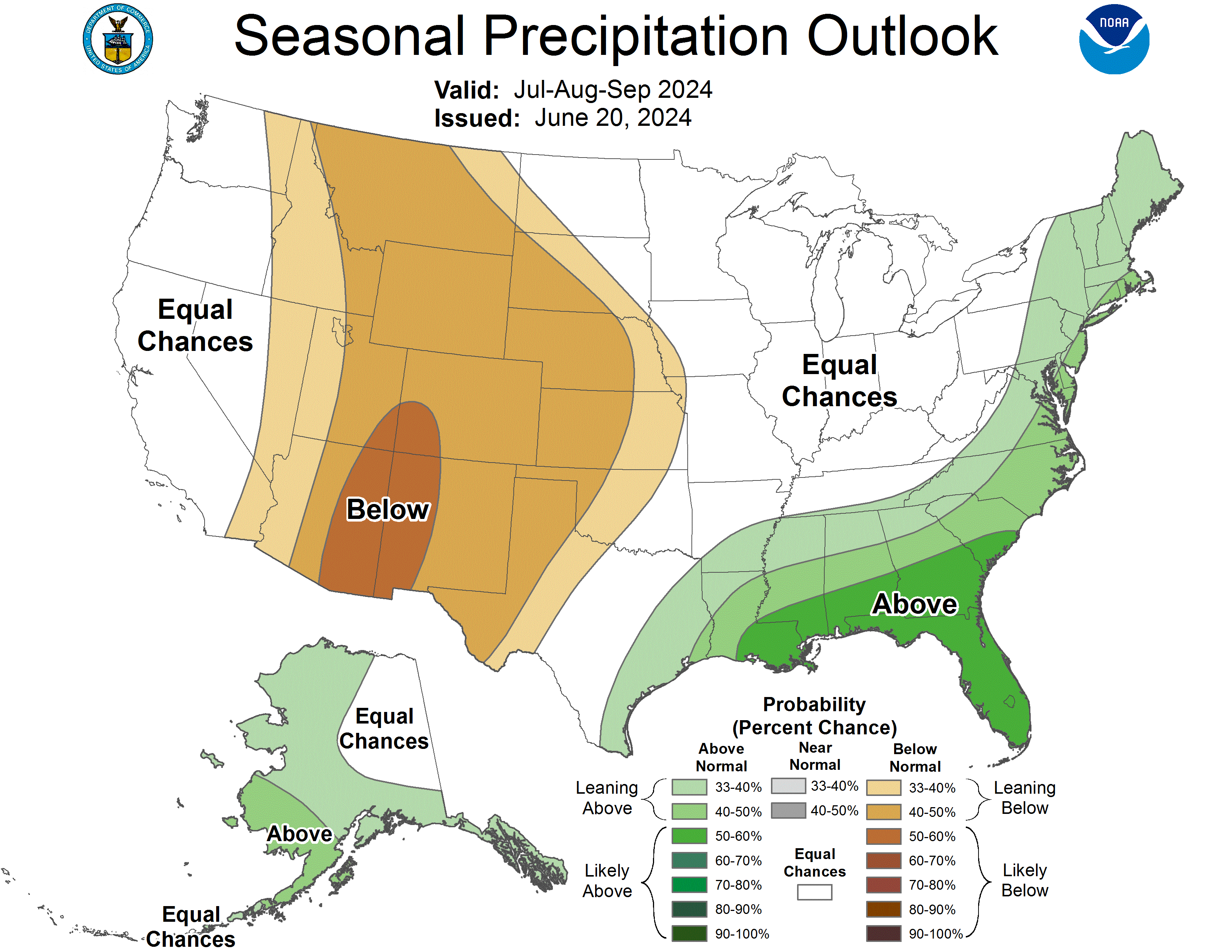
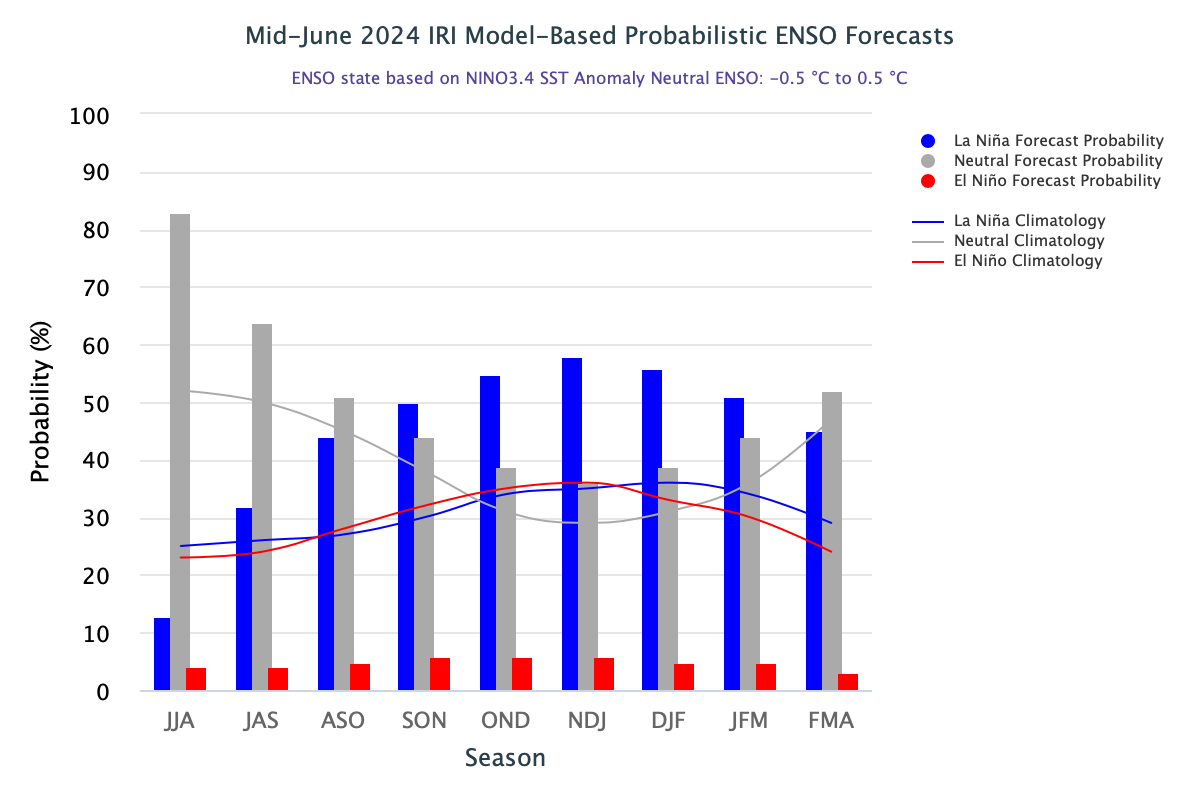
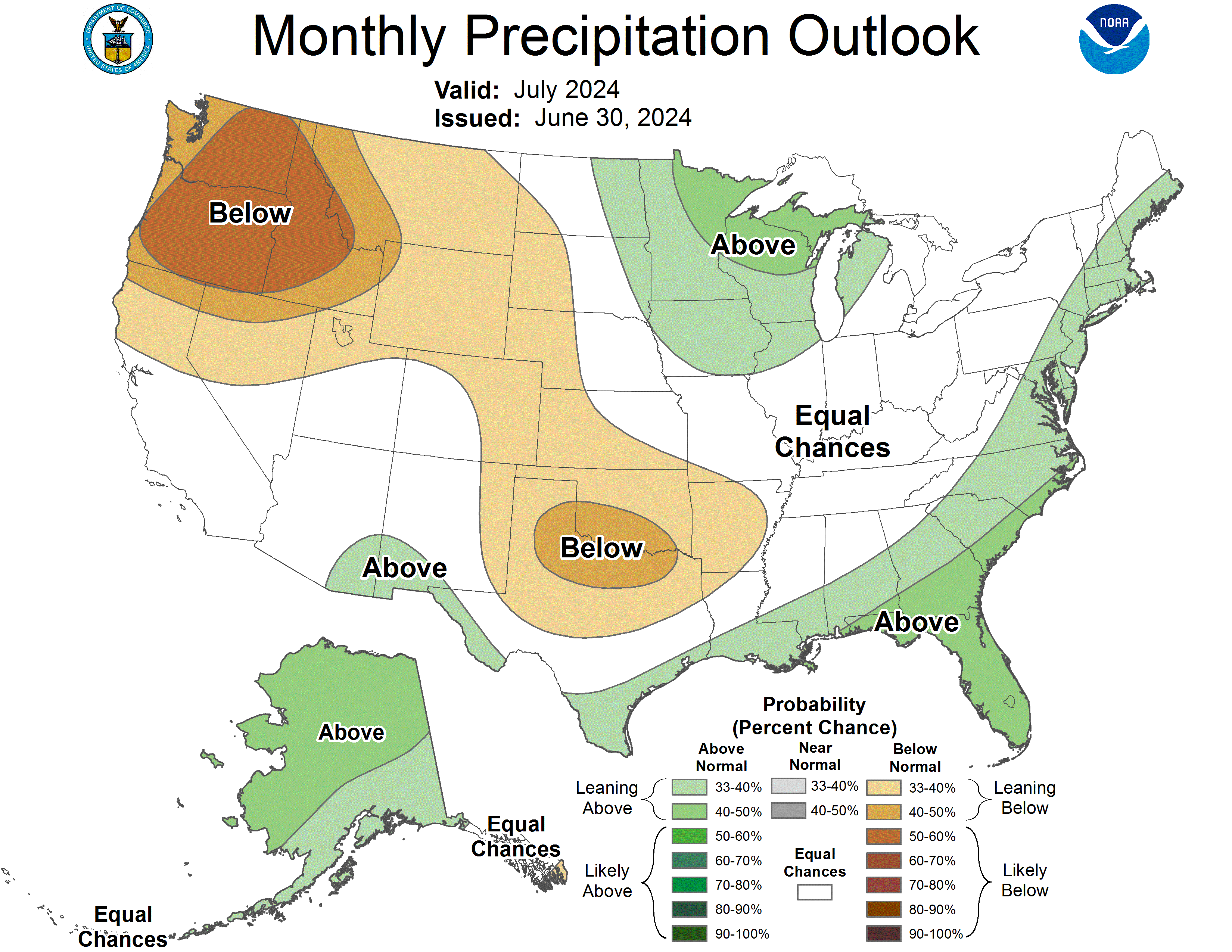
ENSO-neutral conditions continue in the Pacific Ocean. However, as ocean temperatures continue to cool, there is a 50% probability of La Niña conditions existing during September-November. The NOAA monthly outlook suggests an increased probability of below normal precipitation for northern Utah, eastern Colorado, and all of Wyoming, and an increased probability of above normal temperatures for the entire region, with a 70-80% chance of above normal temperatures for western and central Colorado, southwestern Wyoming, and all of Utah. The NOAA seasonal outlook for July-September suggests an increased probability of below normal precipitation, with a 50-60% chance of below normal precipitation in the Four Corners region, and it suggests an increased probability of above normal temperatures, with a 70-80% chance of above normal temperatures in the Four Corners region and the majority of eastern Utah.
Significant weather event: Flash flooding in Moab. On June 21, 2024, Moab experienced severe flash flooding due to a violent storm that drenched the region in over an inch of rain in just 15 minutes. Major roads, including Highway 191 and city streets such as 500 West, were temporarily closed due to flooding and downed power lines. Water overflowed banks and bridges and people were evacuated by authorities at places in town as a precaution to the flash flooding. In a conversation with the Moab Sun, Grand County Emergency Management Director, Cora Phillips, said she was encouraged by improvements in flood alarm systems from the historic flooding in August 2022, but that more work needs to be done. According to Moab City Manager, David Everitt, this flash flood could leave years of repair work, as he says the city is still doing repairs from the aforementioned floods in 2022.
Assessing the Global Climate in June 2024: 13 consecutive months of record-warm global temperatures and the second-lowest June Antarctic sea ice extent — NOAA

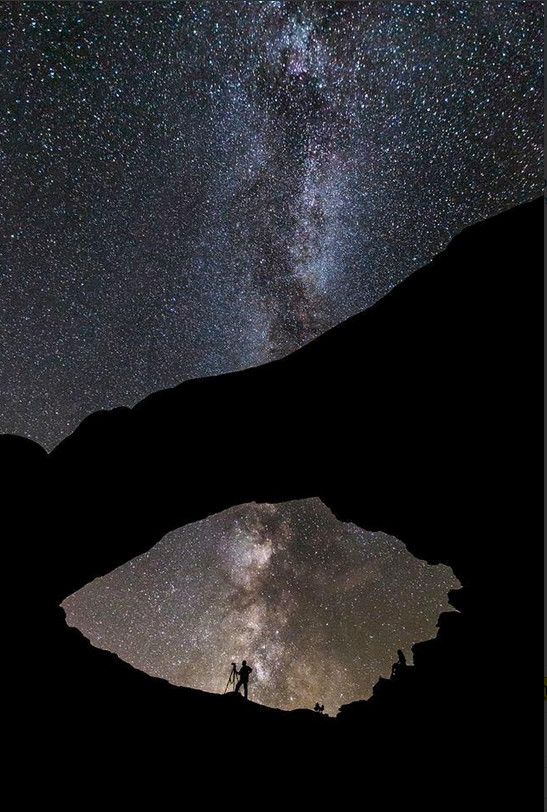
Milky Way Arches National Park October 2013 via the National Park Service

Click the link to read the article on the NOAA website:

July 12, 2024

Highlights:

  • Temperatures were above average over much of the globe with Africa, Asia and South America having their warmest June on record. 
  • Sea surface temperatures were record warm for the 15th consecutive month.
  • Northern Hemisphere snow cover extent and global sea ice extent were both below average.
  •  Global tropical cyclone activity was below average, with only two named storms. 

Temperature

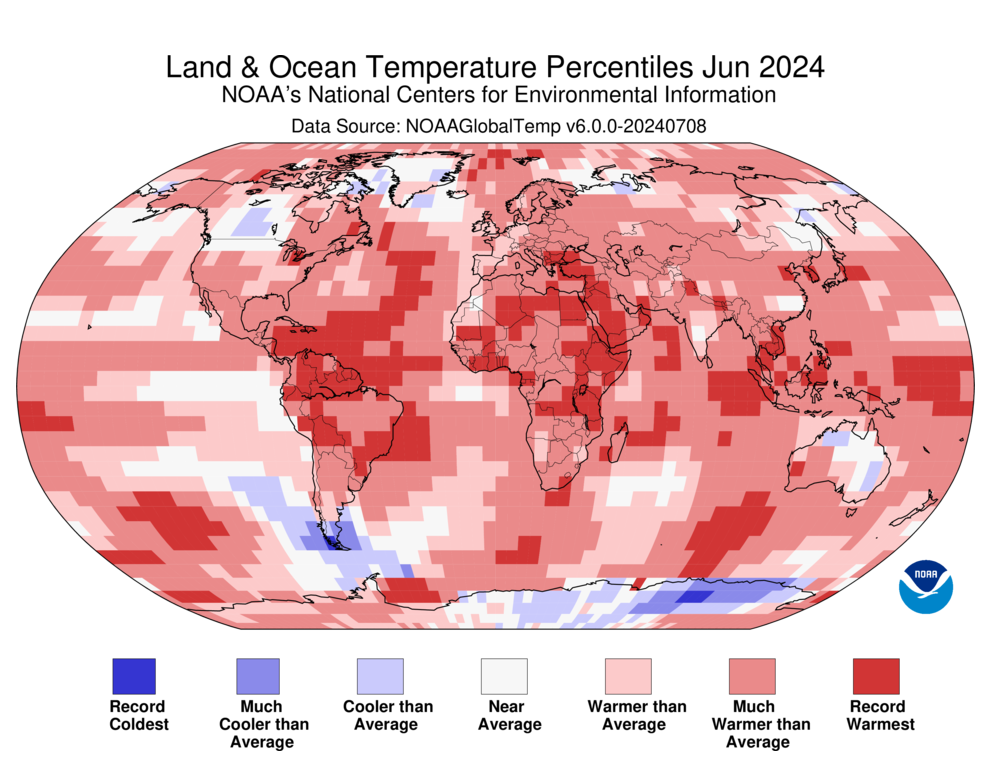
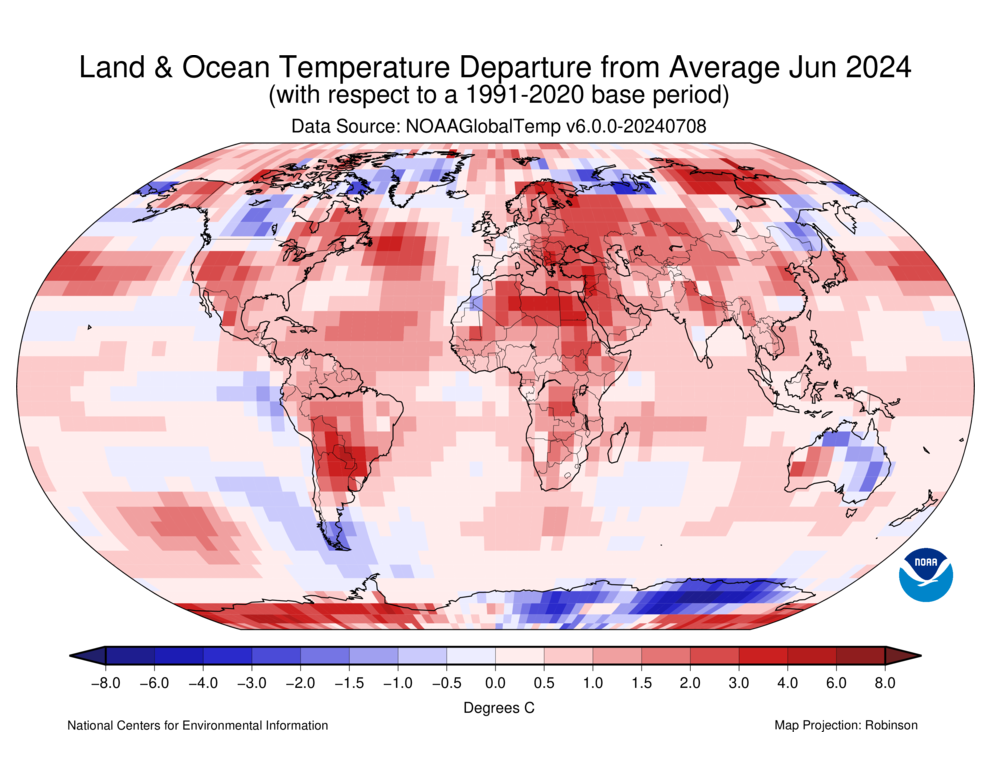
Surface Temperature Departure from the 1991–2020 Average for June 2024 (°C). Red indicates warmer than average and blue indicates colder than average. Credit: NOAA

The June global surface temperature was 2.20°F (1.22°C) above the 20th-century average of 59.9°F (15.5°C), making it the warmest June on record and the 13th consecutive month of record-high global temperatures. According to NCEI’s Global Annual Temperature Outlook, there is almost a 60% chance that 2024 will rank as the warmest year on record and a 100% chance that it will rank in the top five.

June temperatures were above average across most of the global land surface except for western Canada, most of Greenland, southern South America, northwestern Russia, eastern Asia, eastern Australia and much of eastern Antarctica. Africa, Asia and South America each had their warmest June on record while Europe had its second warmest. Sea surface temperatures were above average over most areas, while parts of the tropical eastern Pacific and southeastern Pacific were below average. The global oceans have been record warm since April 2023.

Temperatures in the mid-troposphere (approximately 2–6 miles above the Earth’s surface) were record warm in June, according to satellite data from NESDIS. Each of the past 12 months set global records for the mid-troposphere.

The year-to-date (January–June) global surface temperature was 2.32°F (1.29°C) above the 20th-century average, making it the warmest such period on record. South America, Europe and Africa each had their warmest year-to-date period, whereas North America was second warmest. 

Snow Cover

Northern Hemisphere snow cover extent in June was the 12th smallest on record. Both Eurasia and North America were below average (by 310,000 and 290,000 square miles, respectively). In general, snow cover was below average over most areas except for parts of western Siberia and small parts of China, Pakistan and far-western Canada, which were above-average.

Sea Ice

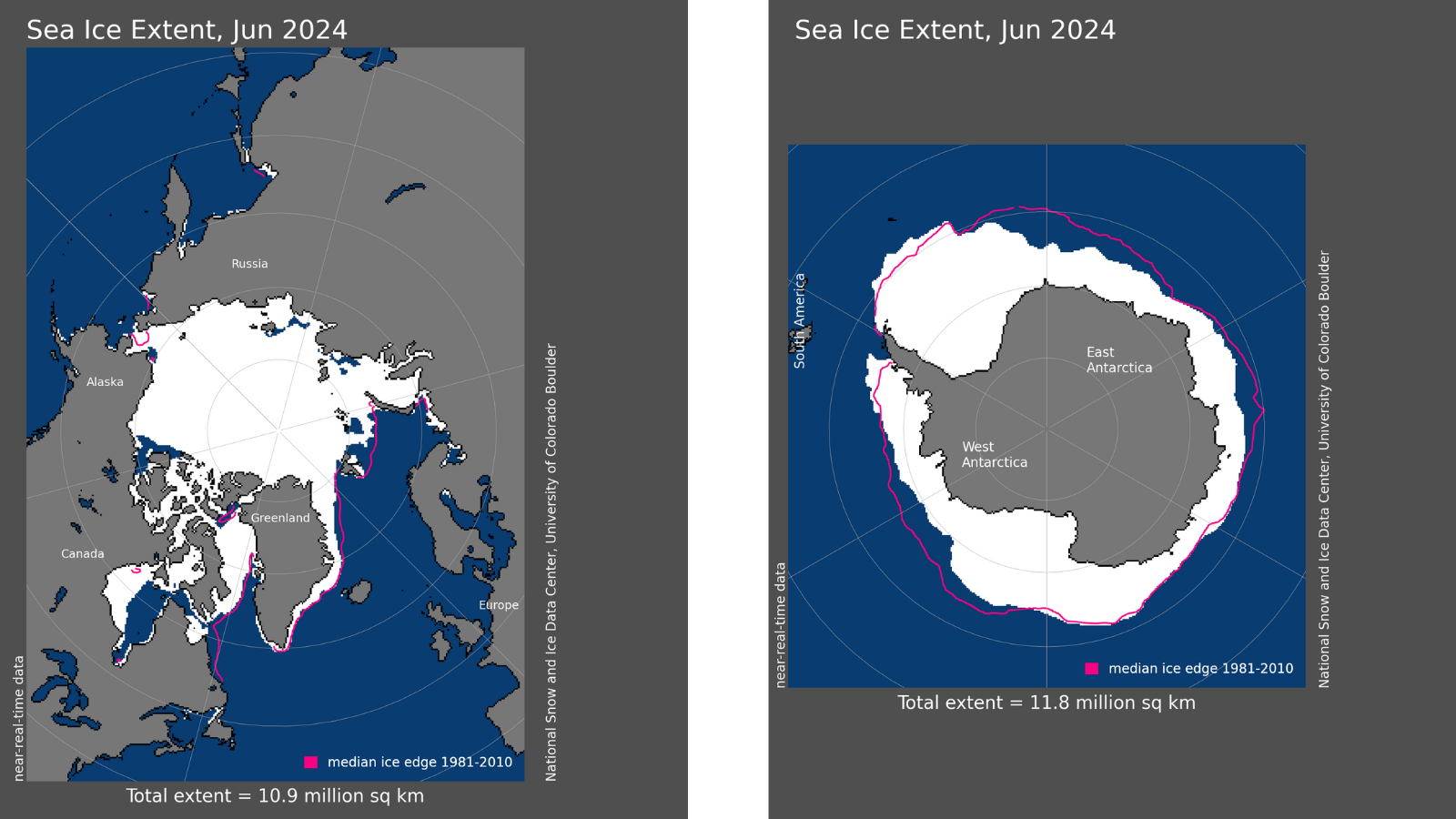
Global sea ice extent was the second smallest in the 46-year record at 8.75 million square miles, which was 810,000 square miles below the 1991–2020 average. Arctic sea ice extent was below average (by 150,000 square miles), and Antarctic sea ice extent was also below average (by 660,000 square miles), ranking second lowest on record.

Tropical Cyclones

Two named storms occurred across the globe in June, which was below the 1991–2020 average. Both storms formed in the Atlantic Basin. The first was Tropical Storm Alberto, which made landfall in northern Mexico. The second was Hurricane Beryl, which ultimately became a Category 5 storm that caused extensive and severe damage across the Windward Islands. Beryl was the earliest Category 5 Atlantic hurricane on record.


For a more complete summary of climate conditions and events, see our June 2024 Global Climate Report or explore our Climate at a Glance Global Time Series.

Commentary: Project 2025 is coming for our public lands: Trump ally William Perry Pendley is a dire threat to our hunting and angling heritage — #Colorado Newsline

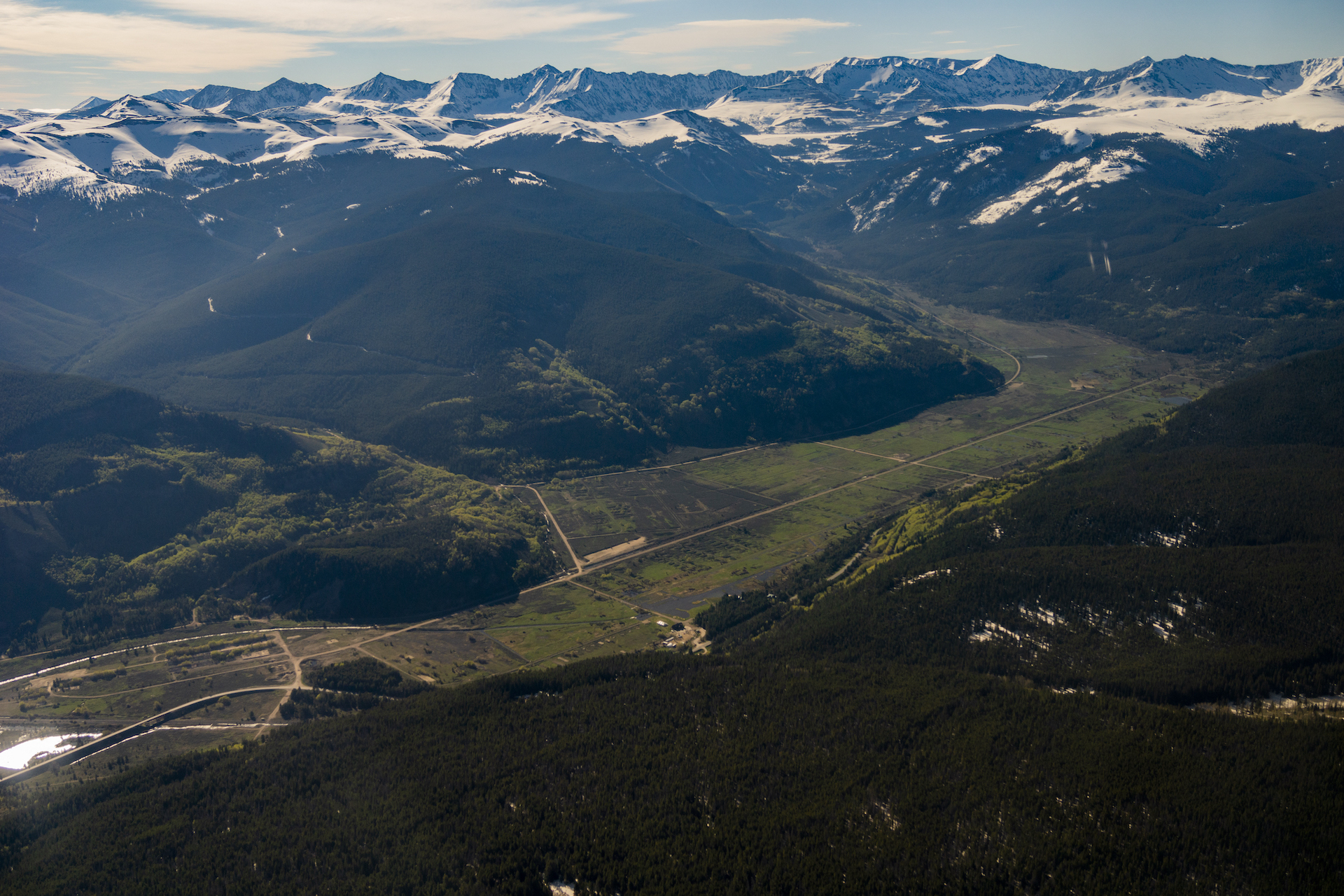
A view of Camp Hale in Colorado. (Courtesy of EcoFlight)

Click the link to read the column on the Colorado Newsline website (David Lien):

July 9, 2024

In his book “Rifle In Hand: How Wild America Was Saved,” renowned hunter-conservationist Jim Posewitz wrote, “In 1776 freedom and equality were radical thoughts. It took a Declaration of Independence, a Revolutionary War, a United States Constitution, and a Bill of Rights to validate these ideas and launch the American aspirations.”

However, a recent Supreme Court decision granting U.S. presidents immunity for any “official acts” has upended these aspirations. For an example of what may follow see the June 2024 op-ed in the Washington Examiner, “Solve the housing crisis by selling government land,” written by William Perry Pendley.

Pendley led the Bureau of Land Management for former President Donald Trump.

Pendley is an anti-public lands zealot and a dire threat to our great public lands hunting and angling heritage. To prove the point, in a July 2020 Vail Daily op-ed I wrote: “In July 2019, Interior Secretary Bernhardt signed an order naming Pendley — a lawyer with a long history of opposition to public lands — acting director of the Bureau of Land Management.”

I added, “During his three-plus years in the White House, Donald Trump has orchestrated the largest reduction of protected public lands in U.S. history, according to a study published in Science, an academic journal … The Trump administration has worked to weaken safeguards for nearly 35 million acres — nearly 1,000 times more than the administration has protected.”

“In addition, the Trump administration has attempted to roll back nearly 100 environmental rules,” I explained. “America’s greatest hunter-conservationist, Theodore Roosevelt, encountered extremists like Donald Trump and William Perry Pendley during his day too. ‘This country has nothing to fear from the crooked man who fails. We put him in jail. It is the crooked man who succeeds who is a threat to this country,’ Roosevelt said.”

Unfortunately, since the Supreme Court ruled that Trump cannot be prosecuted for anything a president’s lawyer might spin as an “official act,” the chances of him ever seeing the inside of a jail cell is slim to none, and you can bet he will double down on his efforts to dispose of our public lands should he regain the presidency.

If anyone has any doubts that American law is now just politics (i.e., the Supreme Court is captured), consider that nowhere in the Constitution is it ever suggested that the holder of the highest office may have free rein to break the law.

In fact, it explicitly states that public officials may be subject to “indictment, trial, judgment and punishment, according to law.” This nation was founded on the principle that there are no kings in America, but Trump’s Supreme Court has paved the way for him to be one, if we let him.

A June 2024 Accountable.US press release documents Pendley’s plans to dispose of our public lands estate: “Controversial former Trump administration official and author of Project 2025’s section on the Department of the Interior William Perry Pendley is calling for a massive sell-off of lands owned by all American taxpayers.”

In “Beyond Fair Chase,” Jim Posewitz wrote: “The natural world sustains us with clean air, unpolluted water, recreation, and natural resources. If we destroy nature, we destroy ourselves.” If you’re a hunter, angler, hiker, climber, mountain biker or anyone who recreates on or values our great public lands estate, beware.

Pendley and Project 2025 are coming for our public lands, and democracy, if “We The People” let them. In the words of Supreme Court Justice Sonia Sotomayor, “With fear for our democracy, I dissent.”

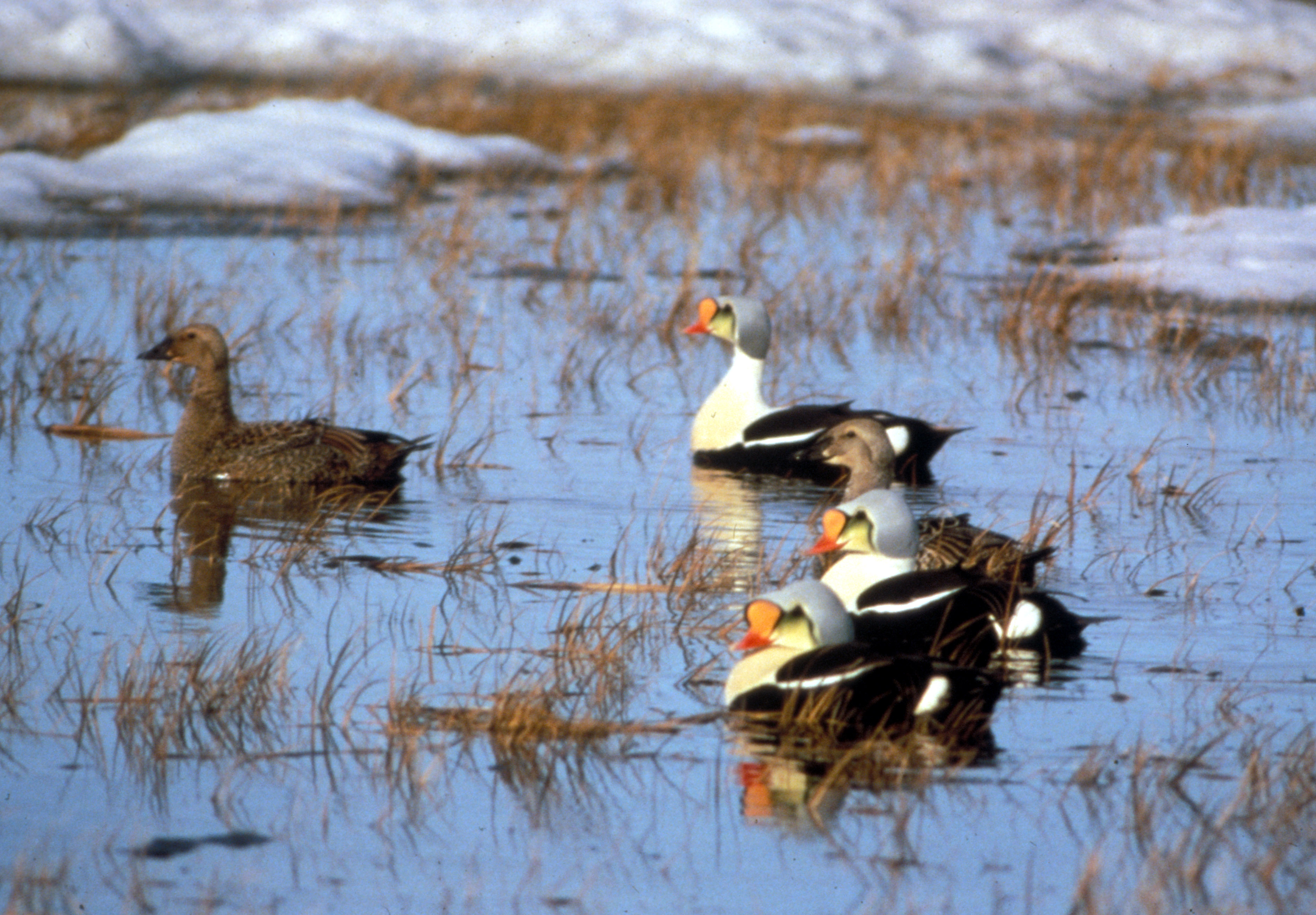
King eiders (male and female) in natural habitat in Alaska wildlife refuge. By Bergman, B (U.S. Fish & Wildlife Service) – http://www.fws.gov/digitalmedia/cdm4/item_viewer.php?CISOROOT=/natdiglib&CISOPTR=3177&CISOBOX=1&REC=3, Public Domain, https://commons.wikimedia.org/w/index.php?curid=10275659

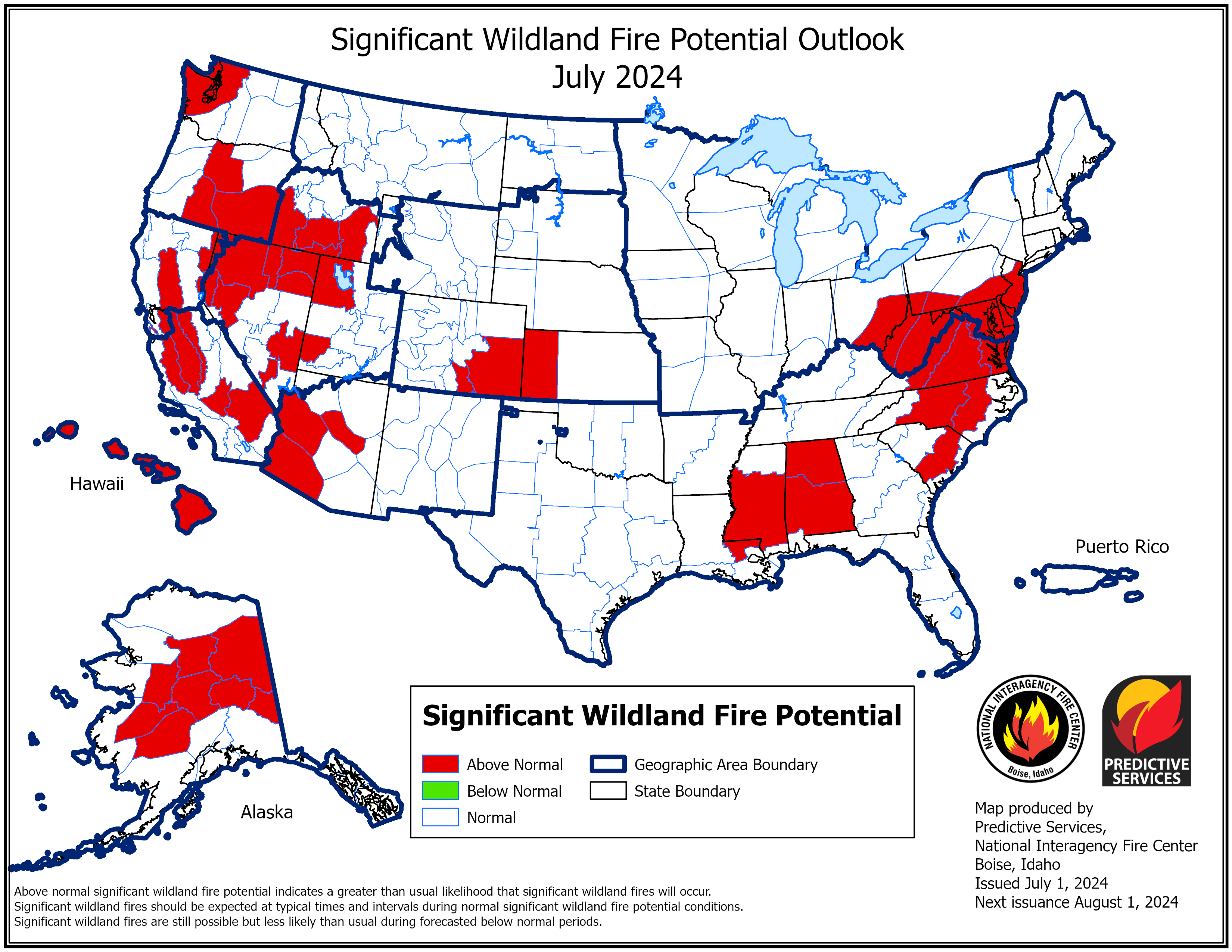
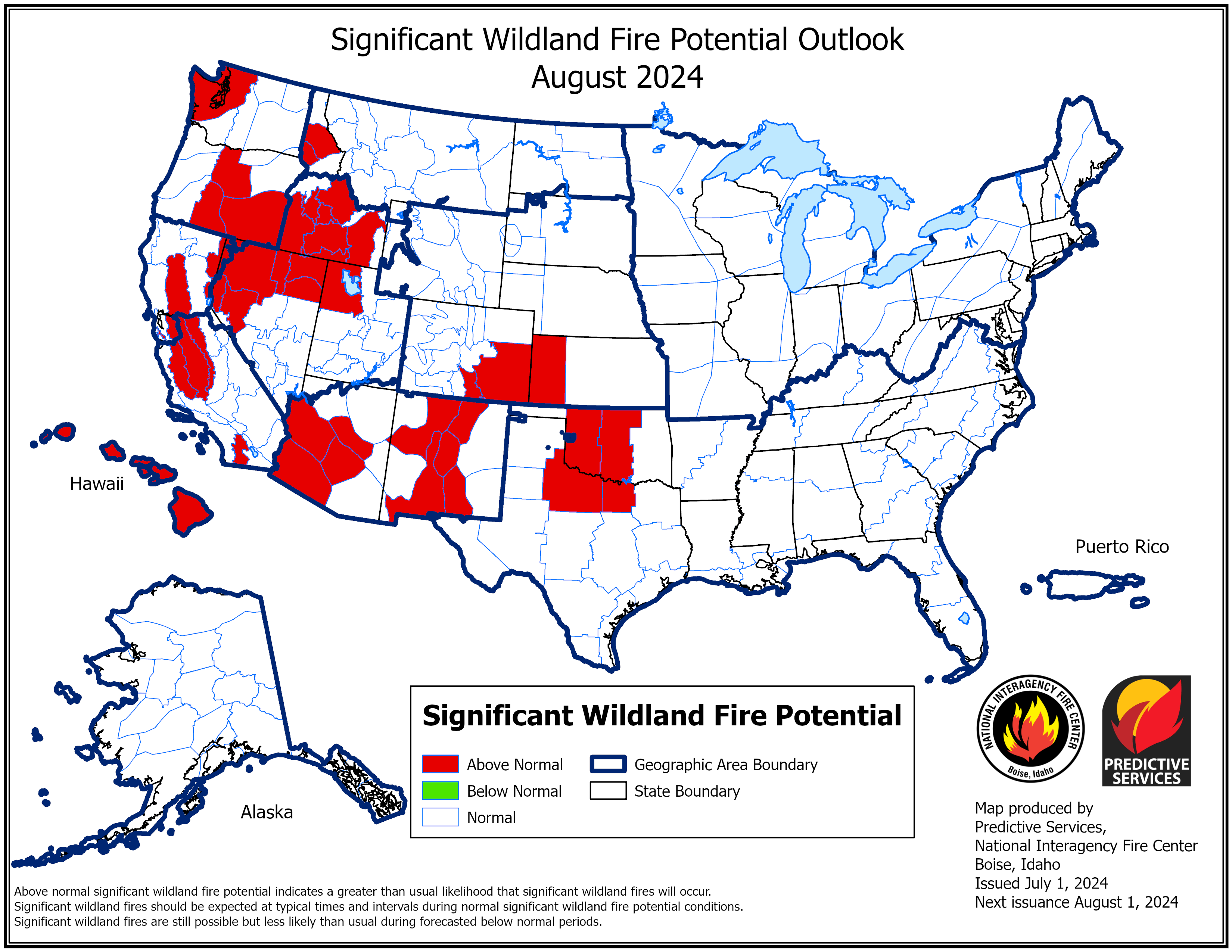
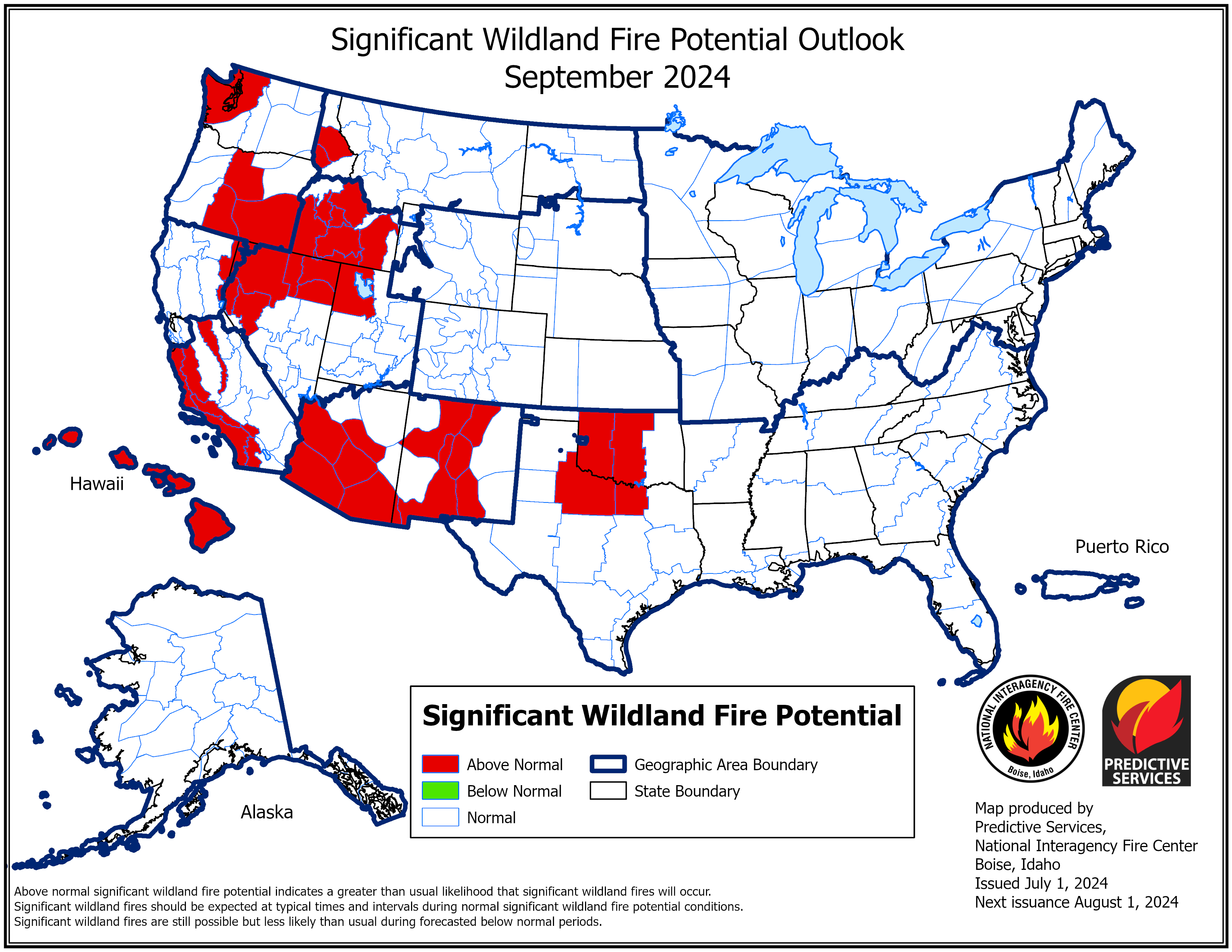
As #FireYear2024 is upon us, take a look at the National Significant Wildland Fire Potential Outlook released by Predictive Services — National Interagency Fire Center