#ColoradoRiver officials vote to explore water conservation “credits” to protect against worst #drought years — Fresh Water News #COriver #aridification

Colorado River headwaters tributary in Rocky Mountain National Park photo via Greg Hobbs.

Click the link to read the article on the Water Education Colorado website (Shannon Mullane):

July 17, 2024

Four states in the drought-stricken Colorado River Basin, including Colorado, want credit for conserving water, but water users and officials have big questions about how to make it happen.

Last year, taxpayers paid farmers and ranchers $16 million to cut their water use in the Colorado River Basin, but the water saved on one farm simply reentered streams, where it could be used by anyone downstream. For years, officials in Colorado, New Mexico, Utah and Wyoming have been considering ways to get credit for that conserved water — to track it, store it in a reservoir, and save it to help the states in the future. Representatives from the four states voted in June to develop a proposal exploring the idea by mid-August.

But building a long-term program to track and store conserved water raises questions about equity, funding, economic impacts and whether the idea is feasible at all.

People are concerned about the bigger picture, said Andy Mueller, general manager of the Colorado River District in Colorado.

“If we’re going to conserve water up here, and if the federal government is going to pay for that conservation with taxpayer dollars, it seems to us that storing it and using it for important public purposes makes sense, rather than sending it downstream to just encourage continued consumption of water [by downstream states],” Mueller said.

Cutting back on water use is a big topic of conversation in the Colorado River Basin, which supplies water to 40 million people and is enduring warmer temperatures and a two-decade megadrought.

Officials from each of the seven states in the basin are weighing who might have to cut their use and how to manage the basin’s reservoirs in high-stakes negotiations over the river’s future after the current rules expire in 2026.
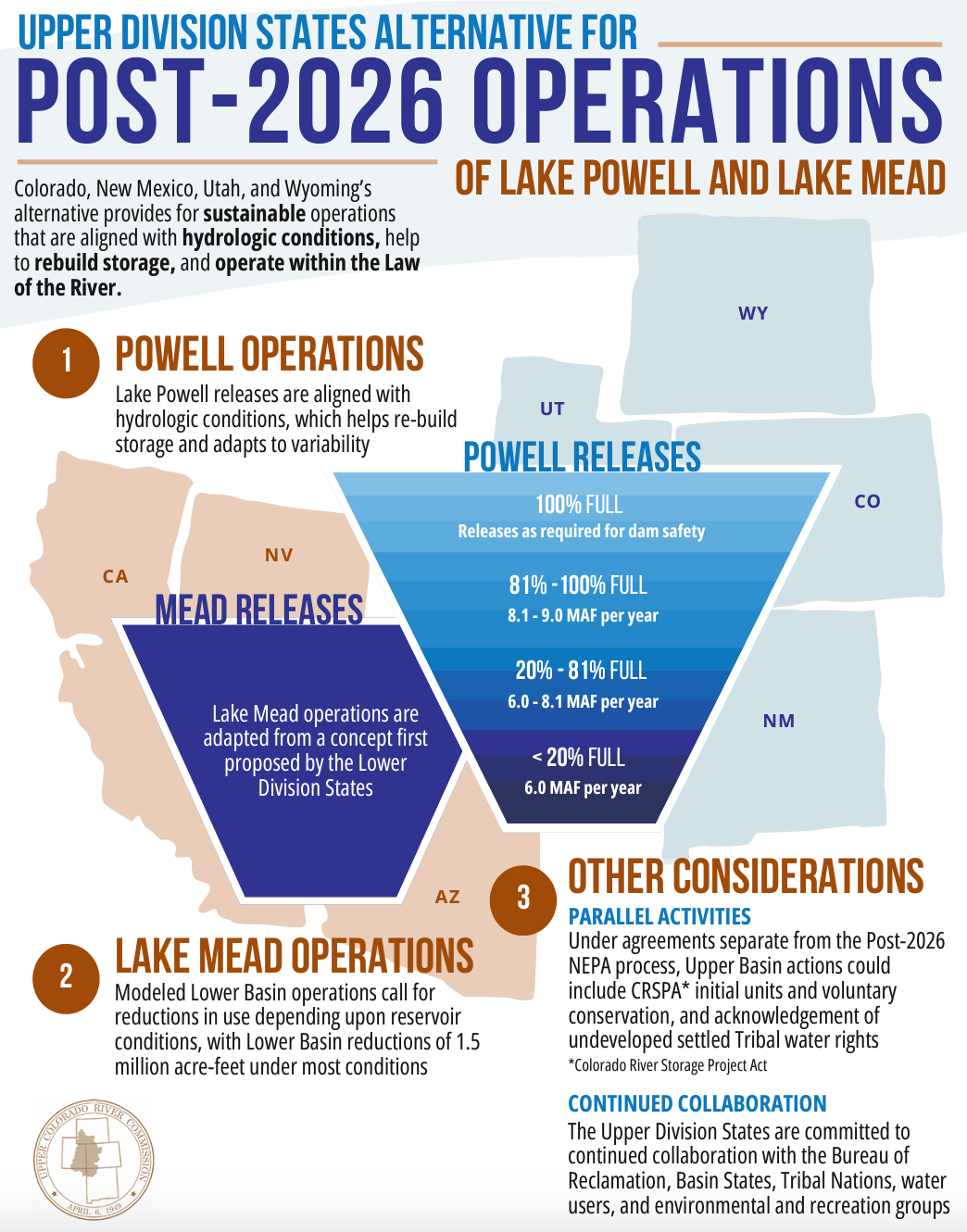
The Upper Basin’s alternative, summed up. Source: Upper Colorado River Commission.

The Upper Basin released a proposal in March that outlined its plan to manage the river after 2026 as part of these negotiations. That proposal includes a commitment to pursue voluntary, temporary and compensated conservation programs.

The June vote of the Upper Colorado River Commission aimed to take that commitment one step forward. The state and federal representatives on the commission want to design a conservation-for-credit program in advance so it’s set up and ready to go if needed.

The commission’s plan could help inform the states’ negotiations, said Amy Ostdiek, who is part of Colorado’s negotiating team and works on interstate water issues for the state’s top water policy agency, the Colorado Water Conservation Board.

“We’ve heard this from water users a lot. … If we’re going to continue doing conservation-type activities, can we explore ways to quote-unquote get credit for it?” Ostdiek said. “It’s worth exploring. … There’s a lot we’d need to work out before we get there.”

Grays and Torreys, Dillon Reservoir May 2017. Photo credit Greg Hobbs.

Big questions from water users

Officials and water users have been kicking around the idea of tracking and storing conserved water for credit for years, and the commission’s August proposal will be the latest iteration of those discussions.

One heavily debated program, called demand management, offered a path toward storing conserved water in a reservoir to help Upper Basin states. But Colorado hit pause on analyzing the idea in 2022 as other Upper Basin states slogged through intense feasibility studies.

Taxpayers paid $16 million in 2023 to conserve water through another program, the System Conservation Pilot Program. Because the program does not track conserved water, there is no certainty where it ends up.

“It inherently just flows downstream and continues to be used by the Lower Basin,” Mueller said. “It really doesn’t do anything other than feed the continued use of the water, rather than encourage conservation of the water.”

The commission’s proposal will try to answer key questions for a program that tracks and stores conserved water, said Chuck Cullom, executive director of the Upper Colorado River Commission. But how will water managers track the actual water down streams, through reservoirs and across state lines? What is a “conservation credit” and how can it be earned? What role would location play?

Mueller of the Colorado River District said the location of the projects ties into big potential equity issues.

Most of Colorado’s participants in the system conservation pilot program so far have been farmers and ranchers on the Western Slope, he said. They helped conserve water by fallowing fields and switching to crops that used less water. But if a farmer stops production, or fallows acres of land to conserve water, it can cut jobs on the farm and spending in the community.

A paid conservation program has to be designed to incentivize participation from all regions of Colorado where Colorado River is used, which includes Front Range cities from Fort Collins down to Colorado Springs and beyond, Mueller said.

Joe Bernal, a rancher in Loma who is participating in the System Conservation Pilot Program, said his concern was how a conservation-for-credit program would be administered.

“Would they work with ditch companies, or would they go with individuals? How much would they offer?” he said. “Would they … help ditch companies and communities protect the viability of agriculture?”

Other water users want to know which reservoirs would store conserved water for credit.

Storing conserved water closer to a river’s source — in high-elevation Upper Basin reservoirs rather than farther downstream — would give the four states more say in when, how much and from where water is released.

Plus, local water users want to conserve water in good years and save it in a nearby reservoir to provide a cushion during the next dry year, said Ken Curtis, general manager of the Dolores Water Conservancy District.

Mcphee Reservoir

Farmers and ranchers in his district are already doing just that: This year, they volunteered to be paid to save water through the system conservation program, and they’re storing it in the nearby McPhee Reservoir to boost carryover water supplies for next year, Curtis said.

The commission’s proposal also aims to define the requirements conservation projects would have to meet to qualify and how years of past water use would come into play.

How to factor in past water use is important to two tribes in Colorado, the Ute Mountain Ute and Southern Ute Indian tribes, said Peter Ortego, general counsel for the Ute Mountain Ute Tribe.

Both tribes have water in a southwestern reservoir that they plan to put to use in the future, but haven’t used yet. Their water does not qualify for use in current paid conservation programs, which raises the question of whether it could qualify for a newer, reimagined conservation-for-credit program, Ortego said.

A program to help the Upper Basin

As officials try to tackle big questions, one thing is clear: Upper Basin water watchers do not want to conserve water if it will just flow downstream to support current use in the Lower Basin.

Congress is currently considering a bill to extend the system conservation pilot program, which does not track where conserved water goes. Meanwhile, officials are dusting off years of analyses about the demand management program, which expires in 2026.

The demand management program created an “account” for up to 500,000 acre-feet of conserved water in Lake Powell. One acre-foot roughly equals the annual use of two to three households.

It’s been frustrating to know the demand management account exists in Lake Powell and to see water being conserved through the system conservation pilot program, or SCPP, that just flows through the reservoir, said James Eklund, a former Colorado water official who helped forge the program and owns a ranch in the pilot program.

“All it needed was to be tagged as DM (demand management) water instead of SCPP water — and it would be water we’d have in our account as Upper Basin states. And we’d be able to point to that water in negotiations,” Eklund said.

But that program is very prescriptive, Ostdiek said.

The account could be used for one purpose: fulfilling the Upper Basin’s interstate water sharing obligations outlined in the 1922 Colorado River Compact, even if river conditions worsen drastically and trigger mandatory cuts in the Upper Basin. The shorthand for this worst-case scenario is a “compact call” or “compact compliance.”

The commission’s upcoming proposal could explore more general uses for credits, including or beyond compact compliance, Ostdiek said.

“I think we need to do some more exploring on what the concept of credit actually means to individual states,” she said, “and think about what the goals would be of that type of approach.”

More by Shannon Mullane

Map credit: AGU

#Coal’s Big Breakdown is Back!: A chart for a sizzling Friday — Jonathan P. Thompson (The Land Desk) #ActOnClimate

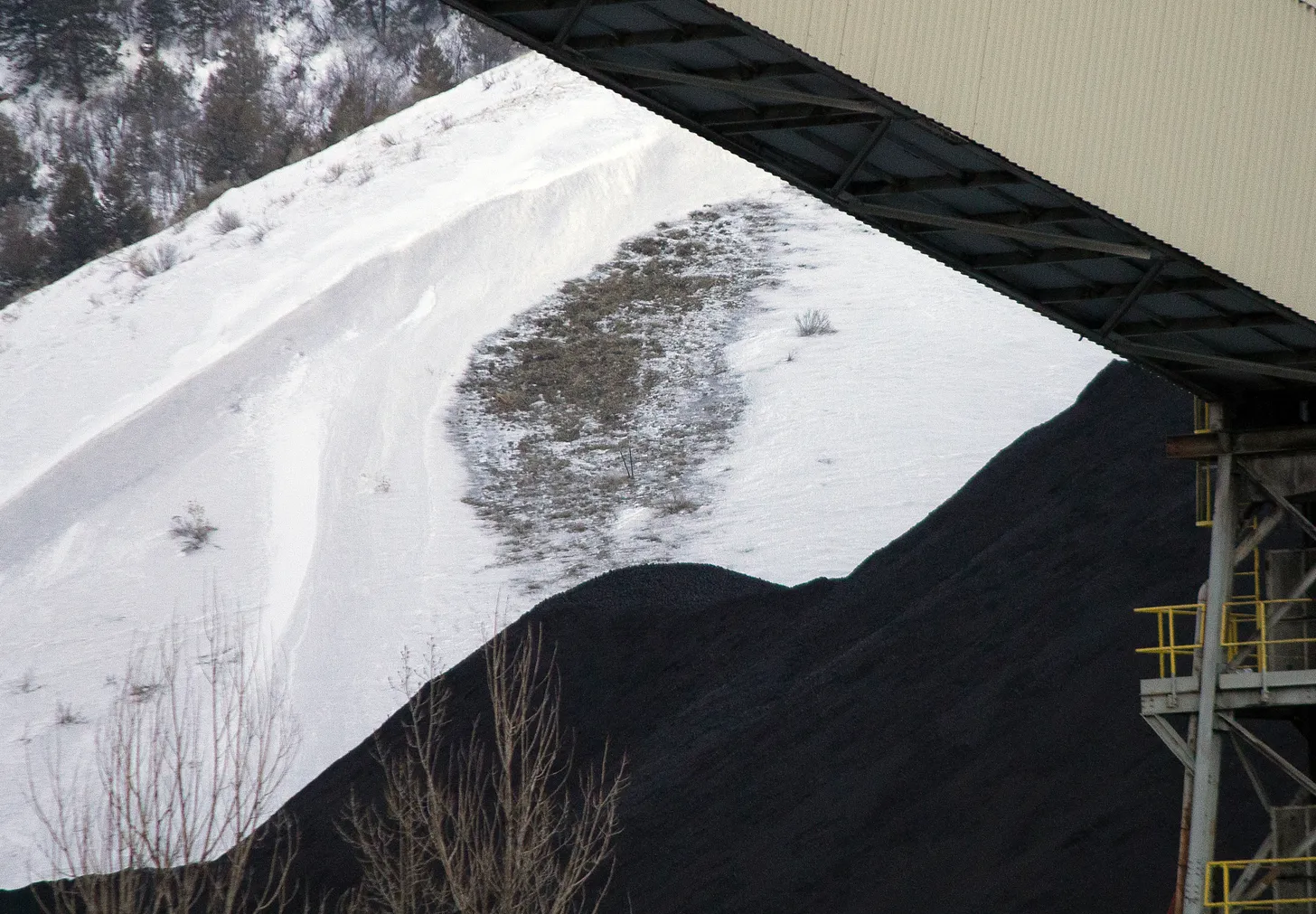
Photo credit: Jonathan P. Thompson/The Land Desk

Click the link to read the article on The Land Desk website (Jonathan P. Thompson):

July 12, 2024

It’s Friday, it’s hot, the world seems to be collapsing in multiple ways, so I thought I’d bring you a bit of good news for a change: Coal’s big breakdown is back. Okay, so it’s not great news for coal-company CEOs, or for the industry workers who will lose their jobs. But for the planet and all the folks who have had to live with coal mining and coal burning and all of its deleterious effects, it’s got to be a relief.

In his excellent book, Fire on the Plateau, the late, great scholar Charles Wilkinson coined the term “Big Buildup” to describe the flurry of postwar development of coal plants (and dams, uranium mining, oil and gas, etc.) on the Colorado Plateau. The Big Breakdown refers to the decline of the coal industry in the West, as big coal plants are mothballed and the mines shut down and, hopefully, reclaimed, and the air cleans itself up as a result.

The Breakdown began back in 2008, during the global financial crisis, when power consumption plummeted. The economy recovered. Coal did not — it had become more expensive than other energy alternatives and is dirtier, besides, so utilities rushed to rid themselves of the old smoke-spewing behemoths. But then, in the wake of the first wave of the COVID-19 pandemic, coal bounced back, sparking a bit of panic among clean air lovers everywhere. And lawmakers in Utah, Wyoming, and other fossil-fuel-fetishizing states rushed to pass laws to interfere in the free market and prop up the dying industry.

Alas, it isn’t working, as today’s chart — showing both electricity consumption and coal consumption — reveals. I’ve run this chart here before, but I wanted to update y’all because I really like it. Not only does it show how the grid is getting cleaner, but also provides a nice graphic look at U.S. energy history over the last 75 years.

Credit: Jonathan P. Thompson/The Land Desk
  • A. Coal was the king of the Industrial Age, of course, providing power to run mines and mills and factories and trains, while also heating homes. But by the 1950s the industry was struggling somewhat, as diesel locomotives supplanted the steam ones, natural gas gained ground for heating and cooking, and huge hydroelectric dams blocked rivers across the West to generate power. As of 1955, only 10% of the Western Grid’s power was generated from coal; nearly all the rest was from hydropower.
  • B. Congress established the Office of Coal Research in 1960 “to encourage and stimulate the production … of coal (and to) maximize the contribution of coal to the overall energy market.”
  • C. The Big Buildup began in the 1960s with the construction of Four Corners Power Plant on the Navajo Nation in northwestern New Mexico. The construction and operation of the plant and adjacent mine were rife with environmental injustice.
  • D. The Clean Air Act passed in 1970. You might think that would be the death knell for coal, pretty much the dirtiest fuel out there. But no, it did little to slow coal-burning and it actually boosted relatively low-sulfur coal from Western mines which emits less sulfur dioxide when burned.
  • E. In 1973 OPEC stopped sending oil and natural gas to the U.S. and its allies to retaliate for U.S. support of Israel in the Yom Kippur War. Further unrest in the Middle East continued to drive up oil and natural gas prices, motivating utilities to burn more coal to generate power.
  • F. President Jimmy Carter took office during these crises in 1977, the same year Atlantic Richfield Company opened its Black Thunder Mine in the Powder River Basin, which would go on to become the world’s largest coal mine. Carter was a walking contradiction, boosting solar and other clean energy and public lands protections on the one hand, and going all in on coal mining and burning on the other. He pushed domestic coal to displace oil or natural gas (much of which was imported) then used to generate power. Carter also hoped to make synthetic transportation fuels from coal and oil shale and he and Congress put billions toward synfuel subsidies.
  • G. In 1978 Congress passed the Industrial Fuels Power Act, which basically banned the construction of any new natural gas power plants (another reaction to the energy crises). Coal was the big winner of that one.
  • H. Carter was also a big pusher of conservation, in rhetoric and policy, and high energy prices bolstered his cause. Electricity consumption flattened and even dropped in the 1980s for the first time in three decades. Yet coal use shot up tremendously at the same time. Under Reagan, electricity use climbed again, but coal consumption dropped. Why? Because OPEC decided to flood the market with oil, lowering oil and gas prices to make them the cheapest fossil fuels for generating electricity.
  • I. Congress amends the Clean Air Act to tackle the acid rain problem, especially in the East and Midwest. Instead of hurting the coal industry, however, it again gave an even bigger boost to the Western mines. The Powder River Basin solidified its status as the nation’s coal bin.
  • J. Peak Coal occurred in 2007. There is virtually no chance U.S. mines will ever produce or plants burn as much coal as they did that year.
  • K. Electricity use plummeted during the 2008 Financial Crisis and coal use dropped with it. As the economy recovered, something strange happened: Electricity use stayed fairly flat, thanks to efficiency and other measures. Coal burning started to recover, but …
  • L. In 2009 natural gas prices crashed after the combination of horizontal drilling and multi-stage hydraulic fracturing opened up vast stores of methane previously believed to be unrecoverable. That glutted the market with gas, making it cost-competitive with coal. Meanwhile, Democrats and even some national environmental groups were pushing natural gas as a “bridge fuel” to get from dirty coal to renewables. At the same time, oodles of solar and wind generating capacity were being brought online, in part thanks to federal incentives. All of this combined to knock King Coal off its throne. It’s been in freefall (with a blip or two) ever since due mostly to fluctuations in natural gas prices.
  • M. The first wave of the pandemic and measures taken to slow its spread helped Americans reduce their electricity use considerably. Because coal was one of the most expensive sources of power on the grid, utilities ditched it first, so the dirty fuel took an even bigger blow. Coal plant retirement plans accelerated and it seemed as if coal could be in its final throes.
  • N. But then the economy recovered along with power use. At the same time, extreme heat drove up demand for more power, hydropower waned, and utilities needed to fill the gap between supply and demand. They turned first to natural gas, which caused prices of that fuel to increase, and then to coal. Thus the Big Breakdown’s dramatic pause in 2021.
  • But the Big Breakdown is back on. In 2023, coal use plummeted once again. And judging by the first quarter of 2024, there will be even less use this year, even as power demand creeps higher.

“Power Madness” in America, the Big Buildup of coal, and a Senate hearing from five decades ago — JONATHAN P. THOMPSON OCTOBER 1, 2020

https://www.landdesk.org/p/power-madness-in-america-the-big-buildup-of-coal-and-a-senate-hearing-from-five-decades-ago Read full story

🥵 Aridification Watch 🐫

There’s a lot of big fires burning out there, with dozens of new starts daily across the West. The McDonald Fire in Alaska was first noticed on July 9; it’s now up to about 150,000 acres. The Cow Valley Fire in Malheur County, Oregon, has grown to 20,000 acres; it was ignited just yesterday. The Silver King Fire in Utah’s Tushar Mountains has charred through about 14,000 acres and forced the cancellation of a major gravel bike race there. There’s also the Babylon Fire south of Dark Canyon within the boundaries of Bears Ears National Monument. It’s grown to about 200 acres in a remote location that, frankly, could use a little bit of therapeutic burning (thanks to our favorite fire lookout readers for tipping us off to it.) Be careful out there, folks!


📸 Parting Shot 🎞️

A datura flower in southern Utah: shy by day; flirtatious and lascivious by night. Jonathan P. Thompson photo.