What’s next after Supreme Court curbs regulatory power: More focus on laws’ wording, less on their goals — The Conversation

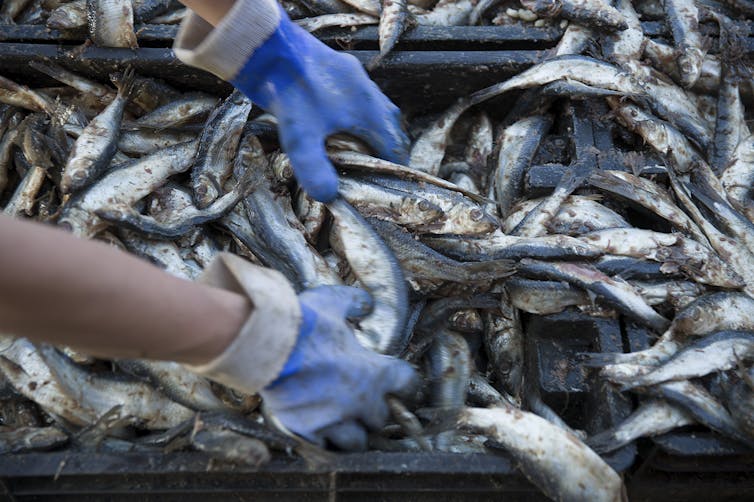
Two fishing companies challenged regulations that required Atlantic herring fishers to pay some costs for observers on their boats. Joe Raedle/Getty Images

Robin Kundis Craig, University of Kansas

Federal Chevron deference is dead. On June 28, 2024, in a 6-3 vote, the Supreme Court overturned the 40-year-old legal tenet that when a federal statute is silent or ambiguous about a particular regulatory issue, courts should defer to the implementing agency’s reasonable interpretation of the law.

The reversal came in a ruling on two fishery regulation cases, Loper Bright Enterprises v. Raimondo and Relentless, Inc. v. Department of Commerce.

This decision means that federal courts will have the final say on what an ambiguous federal statute means. What’s not clear is whether most courts will still listen to expert federal agencies in determining which interpretations make the most sense.

While courts and judges will vary, as a scholar in environmental law, I expect that the demise of Chevron deference will make it easier for federal judges to focus on the exact meaning of Congress’ individual words, rather than on Congress’ goals or the real-life workability of federal laws.

Who decides what the law means?

Chevron deference emerged from a 1984 case that addressed the Environmental Protection Agency’s interpretation of the term “stationary source” in the Clean Air Act. The EPA asserted that a “source” could be a facility that contained many individual sources of air pollutant emissions. This meant, for example, that a factory with several smokestacks could be treated as a single source for regulatory purposes, as if it were enclosed in an imaginary bubble.

In upholding the EPA’s decision, the Supreme Court created a two-step test for deciding whether to defer to a federal agency’s interpretation of a statute that it administers.

In Step 1, the court asks whether Congress directly addressed the issue in the statute. If so, then both the court and the agency have to do what Congress directs.

In Step 2, however, if Congress is silent or unclear, then the court should defer to the agency’s interpretation if it is reasonable because agency staff is presumed to be experts on the issue. Justice John Paul Stevens reportedly told his colleagues, “When I am so confused, I go with the agency.”

The central question in both the Loper Bright and Relentless cases was whether the U.S. secretary of commerce could require commercial fishers to pay for onboard observers they were required to bring on some fishing voyages to collect catch data. Lower courts in these cases deferred to the agency’s interpretation that, under the Magnuson-Stevens Fishery Conservation and Management Act, it could require fishers to pay.

However, in an opinion by Chief Justice John Roberts, the Supreme Court majority concluded that Chevron deference contradicts the Administrative Procedure Act. This broad law governs both the procedures that federal agencies must follow and, more importantly, the standards that federal courts must use to review agency actions.

As the majority pointed out, under the Administrative Procedure Act, “courts must ‘decide all relevant questions of law’” – explicitly including interpreting statutes.

Curbing the administrative state

Since 1984, Chevron deference has become pervasive in federal administrative law. By the Supreme Court’s count, 70 of its own decisions in that time have turned on Chevron deference.

More importantly, thousands of lower federal court decisions – more than 400 a year on average – have deployed Chevron deference on issues ranging from Social Security benefits to workplace safety standards, immigration eligibility and environmental protection requirements.

Chevron deference gave many federal agencies broad flexibility to use laws to address new and emerging problems that Congress did not anticipate. But some members of the current Supreme Court – as well as some federal appellate judges – criticized this doctrine, for two key reasons.

First, it authorized executive branch agencies to interpret federal law and forced courts to accept agencies’ reasonable interpretations. However, since the Supreme Court’s 1803 decision in Marbury v. Madison, it has been the duty of courts – not federal agencies – to say what the law is.

Second, Chevron deference arguably allowed federal agencies to grab more regulatory authority than Congress intended them to have, usurping the legislative branch’s responsibility to make law and delegate authority.

EPA infographic outlining the regulatory process.
Regulatory agencies take general directions written in laws from Congress and develop specific policies to achieve the goals Congress defined. EPA

How much does Loper Bright undo?

The court majority emphasized that prior court decisions upholding agency interpretations based on Chevron deference cannot be challenged solely because of that fact. As Roberts wrote, these holdings “are still subject to statutory stare decisis.”

Stare decisis, or “the thing is decided,” is legalese for why courts will respect prior decisions. In other words, no challenger can go back to a court that relied on Chevron deference and ask the court to change its original decision that the agency’s interpretation was OK.

That’s good so far as it goes. However, many agency interpretations of statutes can be challenged multiple times.

For example, the Clean Water Act protects “waters of the United States.” In 2023, the Biden administration issued new regulations interpreting which bodies of water the law covers. Challengers who disagree with that interpretation can attack the regulations directly and argue that the agencies’ reading of the law is wrong, as the fishing companies did in the Loper Bright cases.

However, under many laws, businesses and individuals can also challenge an agency interpretation at the moment when the agency decides that a general regulation applies specifically to them. These are called “as applied” challenges. After Loper Bright, any time an agency that benefited from Chevron deference goes to apply its interpretation to a new regulated entity, that regulated entity can challenge the agency interpretation – and this time the agency won’t get Chevron deference.

Will federal courts still listen to regulators?

Eliminating Chevron deference will likely worsen an existing division among judges, and justices, about how to go about interpreting statutes. It centers on how much a statute’s purpose and context should matter – or, instead, how much the judge should focus on the “plain meaning” of the particular words that Congress chose to use.

Suppose, for example, that a federal court faced the issue of how to define a vegetable for purposes of determining whether import taxes apply to imported tomato sauce. A plain meaning approach would emphasize that Congress decided to tax vegetables and that tomatoes are fruits; hence, tomato sauce is not subject to the import tax.

An approach focused on Congress’ purpose, in contrast, would emphasize that Congress wanted to tax all imports of savory foods that the public generally considers to be vegetables. Using this approach, the Supreme Court in 1893, in fact, decided that tomatoes were vegetables subject to import taxes.

Federal agencies typically take Congress’ purpose and the context in which regulators act very much into account when they decide what laws mean. For example, when the Food and Drug Administration had to distinguish proteins, which qualify as biologics for regulatory purposes, from chains of amino acids, which qualify as drugs, it focused on Congress’ reasons for creating the two categories. Ultimately, the agency decided that a molecule made up of amino acids had to have a certain level of complexity to qualify as a protein, and hence a biologic.

In contrast, ever since the late Justice Antonin Scalia joined the Supreme Court in 1986, federal judges – and especially Supreme Court justices – have taken an increasingly “plain meaning,” or textualist approach, to statutory interpretation. The current Supreme Court, for example, would almost certainly never have allowed a tomato to be a vegetable.

Dissenting Justices Elena Kagan, Sonia Sotomayor and Ketanji Brown-Jackson, along with many other legal experts, foresee serious problems for future cases that turn on highly technical issues. What will happen when a statute’s nonexpert plain meaning makes no practical sense in a highly technical or scientifically nuanced regulatory regime, such as the FDA classifying biologics and drugs?

Gorsuch, seated, gestures during testimony.
Supreme Court Justice Neil Gorsuch, shown during his confirmation hearing on March 22, 2017, argued in 2022 that Chevron deference ‘deserves a tombstone no one can miss.’ AP Photo/Susan Walsh

How long will the APA matter?

This ruling also may signal that the court plans to pay greater attention to the 1946 Administrative Procedure Act’s primacy in federal administrative law. This statute had been in place for almost 40 years when the Supreme Court decided Chevron in 1984, and the Chevron majority did not see it as a problem at the time.

Now, however, it has become a reason to overturn Chevron deference. Other court-created glosses on administrative law may also be dead doctrines walking.

Congress can and has created different standards of review in other statutes, including the Clean Air Act that led to the Chevron decision. What if a future Congress specifically directs that the implementing agency should take the lead in interpreting a particular statute?

I expect that the Supreme Court would reach for the Constitution and declare any such delegation unconstitutional. In other words, it is probably only a matter of time before Loper Bright’s overruling of Chevron deference becomes a matter of federal constitutional law.

This is an updated version of an article originally published January 17, 2024.

Robin Kundis Craig, Professor of Law, University of Kansas

This article is republished from The Conversation under a Creative Commons license. Read the original article.

Farmers in El Paso area cope with hotter weather, drier days

by Priscilla Totiyapungprasert, El Paso Matters
June 27, 2024

CLINT, Texas – When pecan farmer Guadalupe Ramirez glanced up at the overcast skies last Friday morning, he felt a sense of relief. The drizzle that came wasn’t much, he said, not like the burst of rainfall parts of El Paso received earlier that week. But still, he welcomed the light sprinkle of rain and cooler temperatures – a break, finally, from the relentless stretch of dry, 100-plus degree weather.

“The skies were gray, but not gray in sadness,” Ramirez said. “I thought ‘Oh, this is nice. It’s going to be a nice day.’”

Ramirez was flood irrigating his trees at Ramirez Pecan Farm that morning. The family-run farm, located in the small town of Clint east of the El Paso city limits, has 300 trees whose fruit are small and green in the summer. As the pecans ripen, the husks will turn brown and crack open, ready for harvest in late fall and winter.

But if the trees don’t get enough water, the pecans drop too early. Last summer’s brutal, record-breaking heat could even affect the quality of this year’s pecans if the orchard doesn’t experience a decent monsoon season, Ramirez said.

El Paso is already on track to have a summer that’s hotter than historical average. Last year, the U.S. Department of Agriculture updated its plant hardiness zone map based on decades of temperature data. El Paso shifted half a zone up because of warmer winters.

New pecans, tiny and green, appear in the foliage of trees at Ramirez Pecan Farm, June 21, 2024. Co-owner Lupe Ramirez says that o save resources, a tree stressed by heat and drought may drop its pecans early, leaving him with a far-reduced crop. (Corrie Boudreaux/El Paso Matters)

As climate change and human activities cause higher temperatures, longer heat waves and lower water levels, local farmers have no choice but to adapt if they want to keep their crops alive.

Longer stretches of hotter days “not a one-time deal”

About 9 miles north of Ramirez Pecan Farm, the Loya family also received a sprinkle – not the amount of rain they wanted. Ralph and Marty Loya manage Growing with Sara Farms in Socorro, selling fruit and vegetables from their farm store Bodega Loya, as well as through Desert Spoon Food Hub in El Paso.

Their farm has lost a couple rows of squash already. Workers will have to replant the lost crops, which requires more seed and compost, Marty said.

This June, workers had to harvest crops more quickly because the food can’t sit out in the sun, Marty said. Some food will dry out. Other foods, such as okra, grow bigger and harder. Timing is more critical than ever.

Ralph Loya finds ripe tomato on the vine at Growing With Sara farm, where he employs growing practices he learned from his father and grandfather. (Corrie Boudreaux/El Paso Matters)

It’s not just the timing of harvest. The timing of planting has also affected some crops, said Raymond Flores, farm assistant at La Semilla Food Center in Anthony, New Mexico, just west of El Paso.

Last year the first crop of corn planted in early spring didn’t do well, he said. The area experienced a streak of more than five consecutive weeks of triple-digit temperatures in June and July. Prolonged heat stress sterilized the pollen and affected the flowers, which couldn’t produce much corn.

The second planting around the end of May fared better, Flores said. The extreme heat wave had begun to subside by the time the corn stalks began flowering.

Tomato fertility is also particularly sensitive to the heat, he added. Last year’s tomato harvest came later than usual because the plants couldn’t produce until it cooled down. Workers use shade covers for the tomatoes.

Farmers in general are resilient and have already made changes because of the ongoing drought,” said Tony Marmolejo, operations development manager at Desert Spoon Food Hub. But the duration of last year’s high temperatures caught people off guard.

“When we got hit with the heat wave last year, everyone knew it wasn’t a one-time deal,” Marmolejo said. “Local farmers started making adjustments before this one came about.”

A basket of locally-grown carrots at Desert Spoon Food Hub on May 31, 2023. (Corrie Boudreaux/El Paso Matters)

Marmolejo coordinates with suppliers, mostly organic farms in El Paso and New Mexico, to place orders based on what they have available.

Desert Spoon Food Hub would usually get baby carrots around this time from a farm in Vado, New Mexico. But the carrots came earlier in the year and for a shorter time, Marmolejo said. So far, he’s seen less tomatoes and asparagus coming in. The squash and peaches aren’t coming in as early either.

“Not everybody got rain,” Marmolejo said of the recent break in weather patterns. “They have to use more water because there’s less moisture in the air, less moisture in the soil. But there’s less water supply, so it’s a no-win situation here.”

The El Paso area normally receives an inch of rain from May through June, but has only received 0.07 inches in the past two months, according to National Weather Service data.

Dwindling water supply also a concern

While most of the Ramirez farm is dedicated to pecan trees, it also grows alfalfa for livestock. But Ramirez said they stopped planting alfalfa in the last couple years because they need to save all the water for the pecan trees.

A grackle flies through an irrigated orchard at Ramirez Pecan Farm, June 21, 2024. The water that floods the orchards attracts animals in the summer heat. (Corrie Boudreaux/El Paso Matters)

To plan ahead, workers trim down the trees in the winter so, come summer, there’s less branches to hydrate. It’s a balancing act of quantity and quality. When water is limited, Ramirez has to be efficient if he wants his trees to produce quality pecans.

Ramirez waters his trees through flood irrigation every two to three weeks. 

Letting the soil get too dry and start cracking will stress the roots and make it difficult to retain moisture, he said. Older trees have deeper roots that can tap into the underground water basin, but if it’s a dry year, the water basin level also goes down.

If he receives less water from his allotment, he reduces irrigation to just enough to keep the trees alive, but that’s not enough to have the healthiest trees, he said.

His water allotment fluctuates depending on water levels at Elephant Butte reservoir in New Mexico. The reservoir feeds the Rio Grande canal system from which he and other El Paso farmers draw their water.

Lupe Ramirez, co-owner and manager of Ramirez Pecan Farm, shows the size difference between what he says is an average-sized pecan leaf and a leaf whose growth is stunted by heat and drought, June 21, 2024. (Corrie Boudreaux/El Paso Matters)

Rain helps in ways beyond water conservation. Rainwater has a different profile of nutrients, which includes nitrates, a form of nitrogen, Ramirez explained. The rain also knocks down pests such as aphids from the leaves, he added.

“Maybe it’s wishful thinking,” Ramirez said. “I’m hoping for a good wet season, but climate is changing.”

Monsoon, when the region normally receives the majority of its rainfall, runs from June 15 to Sept. 30. Last year, El Paso received 4 inches of rain, below its historic annual average of 9 inches.

Farmers plan for the future

Ralph Loya has had to water his crops more than usual this past month, using flood irrigation with canal water for the fruit trees and drip irrigation with municipal water for the vegetables. Like Ramirez, he also depends on his allotment from the Rio Grande – a river that’s been a source of irrigation for centuries, but has been choked by increasing development.

His wife, Marty, said they’re considering putting more shade structures on their produce fields as well as a new cover on their greenhouse next year. The shade creates cooler temperatures, which help the soil retain moisture.

Ramirez said he has a shallow well and has thought about installing a deeper well. But wells come with a hefty price tag and don’t address tightening water restrictions, he said.

Lupe Ramirez, co-owner and manager of Ramirez Pecan Farm, poses for a portrait in front of his farm store, where he sells homemade pecan candies and baked goods and raw, unshelled pecans, June 21, 2024. (Corrie Boudreaux/El Paso Matters)

If drought and extreme heat waves continue, small farms with less capital and access to resources could get pushed out of the industry, Flores said.

“The best time to take action against climate change is as soon as possible, but there’s only so much we can do,” Flores said. “It’s a giant system. It’s going to take the collective effort of everyone to change.”

This article first appeared on El Paso Matters and is republished here under a Creative Commons license.

Opinion: Hoping for a miracle to save the #OgallalaAquifer? Prepare for the new Dust Bowl — The #KansasReflector

In this archive photo, an ATV races along the dry bed of the Arkansas River at Dodge City, Kansas. Because of irrigation and other factors, the river has been dry since the late 1970s. Max McCoy

Click the link to read the guest column on the Kansas Reflector website (Max McCoy):

June 30, 2024

In the summer of 1894, a curious railway car plied the tracks of western Kansas, a chemical soup wafting to a sky ruled by a demon sun and chastened by moisture-devouring winds. At the helm of this experiment on wheels, owned by the Rock Island railroad, was a 32-year-old train dispatcher who had convinced railway officials and town leaders across the state that he had the secret to make it rain.

The aspiring rainmaker, Clayton B. Jewell, was an instant celebrity in a parched land thirsting for heroes. Rock Island officials were so confident of his ability they eventually designated three cars for his rain-making experiments, which by their count had succeeded in all of 52 attempts.

Jewell kept the concoction of chemicals he sent to the sky a closely held secret and scoffed at others who said they had achieved similar results with his method. In an 1895 letter to his hometown newspaper, the Topeka State Journal, he boasted that if only he had the necessary equipment he would “wager my life itself that I could produce rain in ten minutes in the clearest of skies.”

Jewell traversed western Kansas in his rainmaking car during the worst drought in Kansas that anybody could remember and the seventh straight year of crop failures. The drought had lasted an agonizing 20 months. The resulting economic chaos had ruined farmers and threatened the businesses, like railroads, that depended on profits from hauling and selling crops.

At Clay Center, W.I. Allen, assistant general manager of the Rock Island line, had in April sat in his private car at Clay Center, and surveyed the dry Kansas prairie.

“We will stop this thing,” Allen declared, as reported by the Kinsley Mercury. “We will send our rainmakers into southern and western Kansas, temper this heat and save the corn crop.”

But no relief was to come.

Map of the Arkansas River drainage basin. Created using USGS National Map and NASA SRTM data. By Shannon1 – Own work, CC BY-SA 4.0, https://commons.wikimedia.org/w/index.php?curid=79039596

“The great Arkansas Valley, one of the richest west of the Missouri River, with its great underflow of water, is to-day a vast desolate waste,” reported the New York Times in August 1894. “Hundreds of square miles of fine crops have been burned up in less than three days, and the cornstalks are scarcely worth cutting for fodder, as all the blades will fall to pieces when handled.”

The harsh reality of agriculture beyond the 100th Meridian, which runs through Dodge City and roughly separates the arid western third of the state from its more humid majority, was already well known. John Wesley Powell, the Grand Canyon explorer and director of the U.S. Geological Survey during the late 19th century, had argued that plans for settlement and development west of the line should be different because of the lack of water. Powell’s warning was ignored, according to Wallace Stegner’s 1954 book on Powell and the West, “Beyond the Hundredth Meridian.”

After the Civil War, a myth took hold on the Great Plains that “rain follows the plow.” This phrase, which expanded on previous notions that once broken the sod would absorb rain like a sponge, was coined in 1881 by Charles Dana Wilber, a journalist and land speculator. Simply planting lush green crops, Wilber wrote, would cool the earth and attract showers.

Many homesteaders staked their futures on the belief that simply breaking ground for crops would attract enough precipitation to allow rain beyond the 100th Meridian, and for a few years it seemed to work. Then came trials that must have seemed Biblical in nature: the locusts and the periodic droughts and terrifying twisters. The economic spasms of bust and boom continued until the Dust Bowl of the 1930s wiped just about everyone out, with southwest Kansas and the Oklahoma panhandle at the center of the disaster.

The Dust Bowl of the 1930s wiped out Midwestern farmers and prompted a mass migration. (Arthur Rothstein/Library of Congress)

The Dust Bowl was the result of severe drought, economic collapse, and poor soil conservation. It was an environmental crisis made worse by greed and bad decisions, and it prompted one of the largest migrations in American history. By 1940, some 2.5 million people had abandoned the plains states. Powell’s warning about settlement west of the 100th Meridian had proven true.

After World War II, technology provided a solution to the problem of farming in the arid West: irrigation.

Flood irrigation — photo via the CSU Water Center

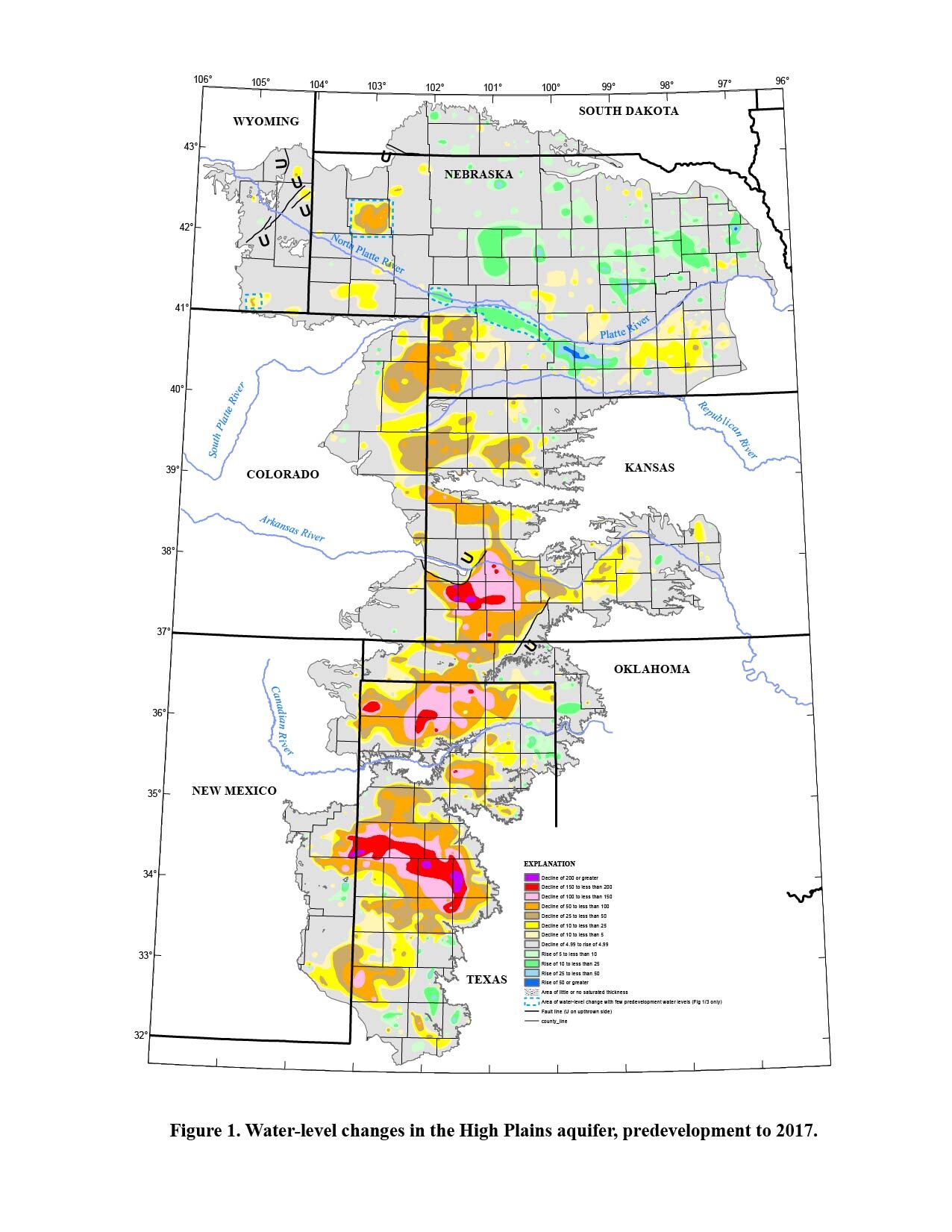
In western Kansas and most of the Great Plains in the first decades of the last century, irrigation meant “flood irrigation.” It was an inefficient method of flooding cropland by diverting the flow of water from a river by way of a canal (or “ditch” as they are mostly called in the West). Ditches are still used to move water from one place to another, but by far the most water used in agriculture in western Kansas is groundwater from the Ogallala Aquifer. The aquifer is one of the world’s largest and lies beneath eight states, from South Dakota to Texas.

McGuire, V.L., and Strauch, K.R., 2022. Data from U.S. Geological Survey.

In the 1950s, it was thought the water in the aquifer was inexhaustible. More and more wells were drilled to reach the aquifer and new delivery methods, chiefly center point irrigation, revolutionized farming. But unlike surface water such as that found in a river, with a relatively quick recharge from rain and snow, the groundwater in the Ogallala Aquifer is prehistoric. It is recharged on a geological time scale. Now we know the aquifer is not inexhaustible. In some places, such as beneath the community of Jetmore, north of Dodge City, the aquifer is already nearing depletion. That depletion is accelerated by climate change and continued over pumping of water.

Once the water is gone, it’s gone for the rest of our lifetimes — and because geologic recharge is so slow, several hundred or perhaps thousands of lifetimes to come. Kansas Reflector’s Allison Kite, in partnership with Stateline reporter Kevin Hardy, reported in May that despite the grim prognosis, one of the state’s locally controlled water management districts has resisted adopting meaningful water conservation methods.

Southwest Kansas Groundwater Management District 3, perched just above the Oklahoma panhandle in the extreme southwest corner of Kansas, is under fire for its travel expenses, lack of a formal conversation policy and its alienation of farmers who would like to conserve water. Despite a budget of $1 million, it has spent little of it on conservation, although executive director Mark Rude argues everything the district does is in the name of conservation. But in contrast to other districts, District 3 is clearly lagging.

The state’s five groundwater management districts were established in the 1970s, according to the Kansas Geological Survey. In 2020, for example, Groundwater Management District 1 used a state law that allows for the creation of “Limited Enhanced Management Areas” to commit farmers to reduce consumption by 50% over seven years.

By 2026, according to a new state law, all districts — including District 3 — will be forced to submit reports to the Legislature and file a water conservation action plan with the state’s chief engineer.

Much of the resistance in District 3 is cultural. Locals like being in control, dislike being told what to do, and consider their legacy water rights sacred. On the district’s website you can read about how the district was organized to “provide for the stabilization of agriculture by establishing the right of local users to determine their own destiny with respect to the use of groundwater.”

Such declarations ignore the rest of us, who have a reasonable right to expect that prehistoric groundwater in the Ogallala Aquifer should belong to us all. But Kansas water rights are based on the “first in time — first in right” principle, which means the earliest users are given priority.

Kansas Aqueduct route via Circle of Blue

Perhaps the thinking of District 3 officials is best represented by a couple of stunts in which thousands of gallons of Missouri River water was trucked 400 miles to southwest Kansas. The project was meant to drum up support for an aqueduct that would take water from the Missouri River in northeast Kansas to a reservoir in Utica. Since water flows downhill, and taking water to the west in Kansas is literally an uphill battle, 15 pumping stations would be required. The ground-hugging aqueduct — really, just a glorified ditch — would cost an estimated $18 billion to build and another billion a year in ongoing costs.

The Kansas aqueduct is a nutty idea, but one that has taken root among some individuals in western Kansas desperate for a solution to continue irrigation after the depletion of the Ogallala Aquifer. Aside from its expense and impracticality, it is a regressive idea that harkens back to the days of ditches and avoids a conversation about us having squandered the resource beneath our feet. It also ignores any objections the folks on the other side of the Missouri River, in Iowa and Missouri, might have to say about us taking water from a river we share.

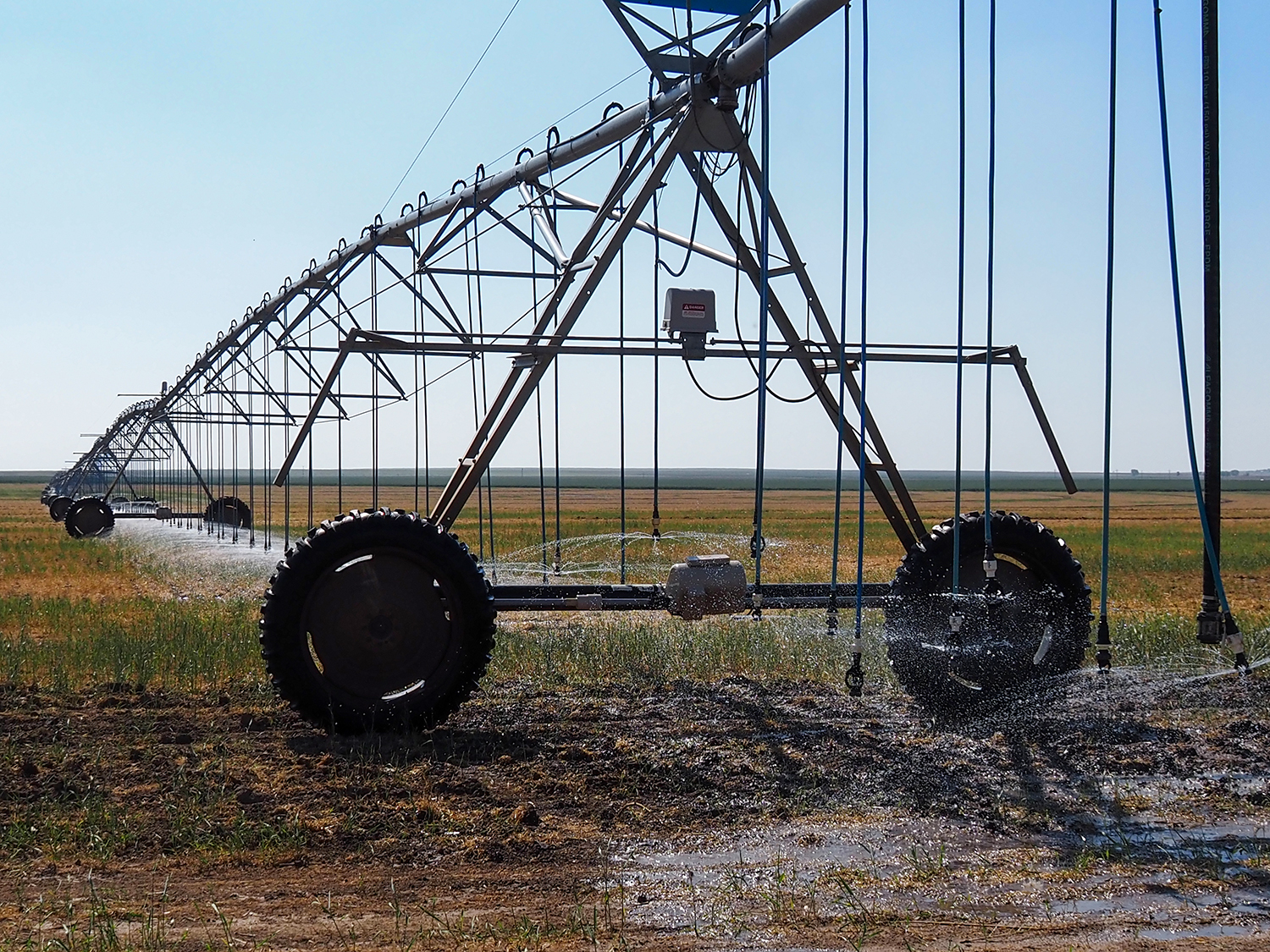
Sprinklers irrigate a field in Hamilton County, Kansas, where some farmers have petitioned to be removed from a local groundwater management district. State lawmakers are pressuring the district to do more to conserve water in the Ogallala Aquifer. (Allison Kite/Kansas Reflector)

The aqueduct is something our 1890s rainmaker, Clayton B. Jewell, might have understood. At least, he might have appreciated how desperate some folks are to believe in a solution that doesn’t really address the problem.

The problem is that agriculture in the state is unsustainable beyond the 100th Meridian without irrigation. Instead of an anomaly, the magnitude of drought that drove the Dust Bowl can be expected to occur with alarming frequency.

“Paleoclimatic data collected for western Kansas indicate a drought as severe as the Dust Bowl occurs there, on average, three to four times a century, according to a Kansas Geological Survey circular. “Based on that probability, there is a 35% chance for a severe drought year in any decade, a 70% chance within a 20-year span, and a 100% chance over the estimated 40-year working lifetime of a western Kansas farmer.”

The new law that requires District 3 to deliver a water conservation action plan was passed in response to the Kansas Water Authority saying last year that the state’s longstanding policy of simply slowing depletion was insufficient to protect the Ogallala aquifer. The law is a step toward the state taking control of water management from local districts if consumption continues to outpace conservation.

The battle over the aquifer’s decline pits good policy against powerful agricultural and political interests. Add to the mix the independence that seems woven into the cultural fabric of southwestern Kansas, and you have the ingredients for a water war that might define the region for decades to come.

But this is one war we may already have lost.

We’ve already killed the Arkansas River in western Kansas, leaving just a dry bed behind. Every other river and stream and creek in that third of the state has also vanished. The natural recharge just isn’t enough to keep water in them. Worse, climate change appears to be driving the arid zone to the east, creating an even bigger water crisis.

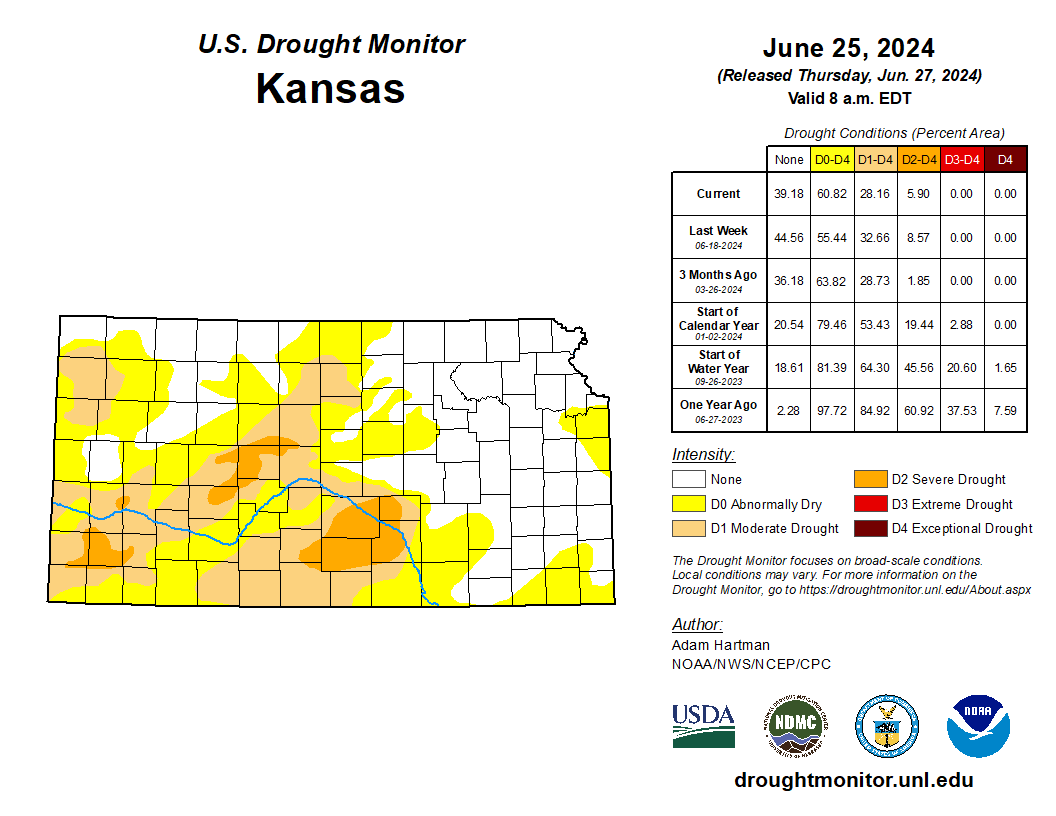
About a third of Kansas counties are currently in a moderate to severe drought, with some of the worst conditions in the area served by District 3, according to the U.S. Drought Monitor. The drought puts pressure on farmers to pump more water instead of voluntarily committing to conserve. It’s difficult to get people to do the right thing when it’s against their economic interests.

If only Jewell’s apparatus had really worked.

The rainmaking railway car was inspected in 1892 by a newspaper reporter who described the mysteries within.

“Inside the laboratory part of the car a wide shelf about two feet from the floor extends from one end to the other,” the correspondent wrote. “On this are many curious-looking bottles and boxes said to contain the chemicals from which the rain producing gases are made.”

There were also pipes, bottles, other laboratory apparatus, and a 24-cell battery. Jewell said the gases produced would rise to 8,000 feet, then condense, creating a vacuum that would be filled with moisture — and produce rain.

“There are many thinking people in Kansas who believe absolutely in Jewell’s rain-making system, and they are encouraging him in every possible way,” wrote the observer. In other quarters, however, Jewell’s work was received with skepticism, and sometimes superstition, as those who prayed for rain regarded his apparatus as the work of the devil.

Jewell died in Coffeyville in 1906, aged 44, from pneumonia.

“For two or three seasons Mr. Jewell did little else besides operating this (rainmaking) car and apparatus,” noted his obituary in the Topeka Capital, “but it was finally abandoned.”

No rainmaker, no aqueduct, and no prayer will save western Kansas from the depletion of the Ogallala Aquifer. The best we can hope for is to reduce consumption, buy a little more time, and adjust to a changing climate and economy. It is time to heed the warning John Wesley Powell gave us so long ago — and prepare for the new Dust Bowl.

Max McCoy is an award-winning author and journalist. Through its opinion section, the Kansas Reflector works to amplify the voices of people who are affected by public policies or excluded from public debate. Find information, including how to submit your own commentary, here.

Rivers of Kansas map via Geology.com

#Aurora defends plans to export #ArkansasRiver Basin water — Heart of the Rockies Radio

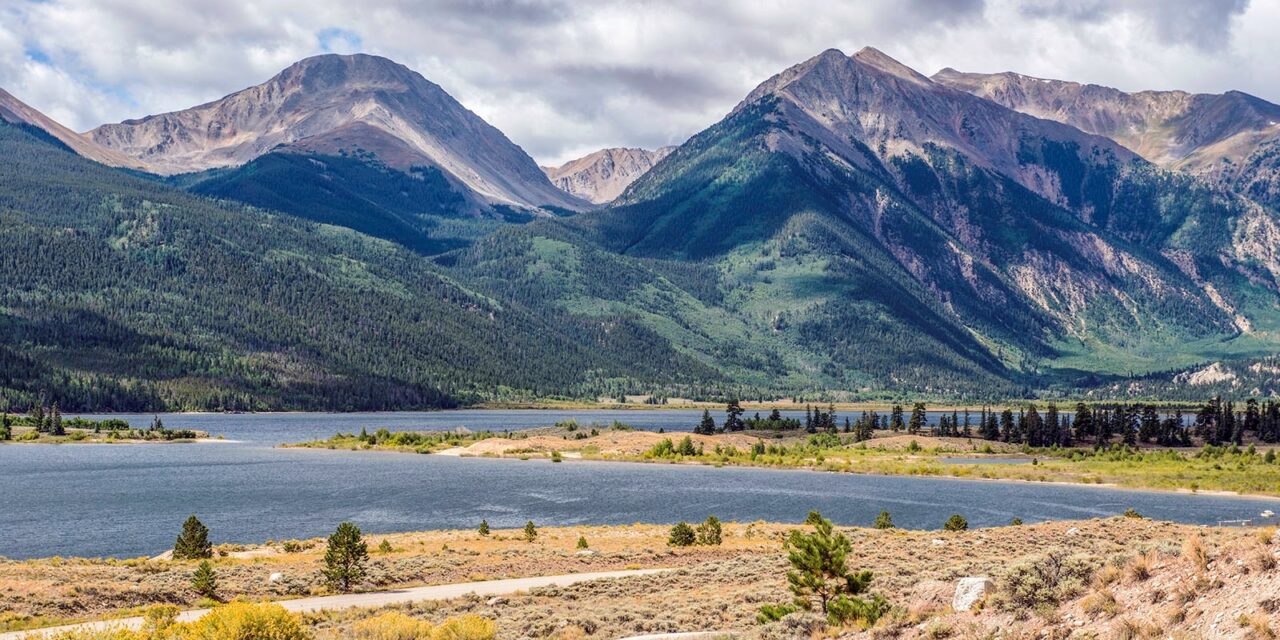
Rocky Mountain vista from State Highway 82 near Twin Lakes, Colorado, U.S.A. Photo credit: Joe Stone/Heart of the Rockies Radio

Click the link to read the article on the Heart of the Rockies Radio website (Joe Stone):

July 1, 2024

Multiple officials with the City of Aurora, the third-largest municipal water provider in Colorado, attended the June board meeting of the Upper Arkansas Water Conservancy District in Salida to discuss their recent purchase of water rights in the Arkansas River Basin.

Aurora paid $80.4 million to buy an Otero County farming operation, including water rights used to irrigate 4,806 acres – about 7,500 acre-feet of water per year, depending on the annual conditions like snowpack and streamflows. Most of those rights are shares in the Catlin Canal Co.

The purchase has been condemned by Chaffee County and the Upper Ark Conservancy District as well as the Southeastern Colorado Water Conservancy District. Both conservancy districts claim that exporting the water to Aurora will violate various terms of intergovernmental agreements, or IGAs, signed in 2003.

The 2003 IGA between Aurora and the Southeastern District states, “Aurora shall not initiate or seek to implement any further permanent transfer of water rights … from sources in the Arkansas River basin” for the next 40 years.

Interruptible Water Supply Agreements

During the meeting, Rick Kienitz, Arkansas Basin water resources manager for Aurora, acknowledged that the city plans to export its newly acquired water three out of every 10 years for at least 30 years using an Interruptible Water Supply Agreement, or IWSA.

IWSAs allow the State Engineer (Division of Water Resources) to approve temporary changes of water use for three out of 10 years without the due process provided by Water Court, which provides a higher degree of protection for water rights that could be injured by changes in water use.

In 2003, the same year that Aurora signed its IGAs with the Southeastern and Upper Ark water conservancy districts, the General Assembly passed legislation (HB 03-1334) allowing these temporary changes of water use.

IWSAs allow water rights owners to lease water for uses other than the court-approved use for that water – e.g., a farmer who owns an irrigation right can lease his water to a city for municipal or industrial use. In this case, Aurora is leasing out the farm and promising to keep the water on the farm for seven out of 10 years.

Prior to 2003, changes of water use had to be approved in Water Court. HB 03-1334 circumvented Water Court, and 10 years later, HB 13‐1130 allowed for IWSAs to be re-approved twice for a total of 30 years.

Aurora was a major supporter of this legislation, which allows the city to export 30% of its Ark Basin water out of the basin over the course of 30 years, and as Kienitz noted, Aurora already gets 25% of its municipal water from the Arkansas Basin.

At the Upper Ark meeting, board member Mike Shields emphasized that Aurora’s plans would take 30% of its newly purchased water out of the basin for decades, which seems to be at odds with the IGAs.

Kienitz asserted that the transfer of this water does not violate the IGAs because it is temporary.

Upper Ark board member Tom Goodwin, who also serves on the Southeastern District board, said the original intent of the IGAs was that “Aurora would not buy more water in the Arkansas Valley.”

Aurora’s plan “seems like a shell game,” Goodwin said. “It gives the impression that, ‘We’ll try to manipulate this any way we can.’ And a lot of our constituents are saying very loudly, ‘Don’t let Aurora take another drop of water.’”

Upper Ark attorney Kendall Burgemeister pointed out that state law does not allow Aurora to use an IWSA “in perpetuity. So eventually, you’ll have to go to Water Court.”

Kienitz said Aurora would “go to the legislature to address that” in order to avoid Water Court, essentially admitting that Aurora will continue to use its political influence to erode state water law enshrined in the Colorado Constitution* – i.e., to continue taking 30% of its Ark Basin water for as long as possible.

Moving Water Upstream

When Upper Ark General Manager Terry Scanga asked if Aurora is planning on drying up all 4,800 acres of farmland in a single year, Kienitz replied, “We can’t rotate acreage” for more than 4,000 acres because the IGAs are more restrictive than the IWSA legislation.

Scanga asked how Aurora plans to move that much water out of the basin in a single year.

“When this is needed, it will be a dry year,” Kienitz responded. “There should be storage space in reservoirs.”

Aurora needs reservoir storage because the process of transferring water from Aurora’s Otero County farming operation into the city’s municipal water system is complicated.

First, it requires a “reservoir exchange” of water – i.e., Catlin Canal water is traded for water stored upstream in Pueblo Reservoir, normally Fryingpan-Arkansas Project water.

Moving water upstream through an administrative or decreed physical exchange is only possible when river flows are sufficient to permit the exchange without injuring senior water rights between the two exchange points.

In dry years exchange potential is limited, but Kienitz did not address this limitation when responding to Scanga’s question.

Little by little, when river flows allow, Aurora can exchange its water into Pueblo Reservoir, built as part of the Fryingpan-Arkansas Project, which brings water into the Arkansas River from the West Slope.

Once Aurora exchanges its Catlin Canal water into Pueblo Reservoir, it plans to trade that water for Fry-Ark Project water in Twin Lakes.

From Twin Lakes, the water could then be diverted and pumped into the South Platte Basin through the Otero Pipeline, jointly owned by Aurora and Colorado Springs.

As stated in the Upper Ark District’s resolution opposing Aurora’s plan, trading water from Pueblo Reservoir for water in Twin Lakes and then exporting it through the Otero Pipeline would reduce Arkansas River flows between Twin Lakes and Pueblo Reservoir.

Preserving Agriculture

Kienitz repeatedly emphasized Aurora’s commitment to preserving agriculture in the Arkansas Basin. He said Aurora plans to maintain ag production on the newly acquired Otero County property by leasing it to “a farming company.”

Upper Ark board member Bill Donley, a rancher in Custer County, asked Keinitz, “How do you keep an alfalfa field if you dry it up?” (Alfalfa is a perennial crop, but in Colorado, it requires irrigation to survive year-to-year.)

“You can’t,” Kienitz replied, so we’ve addressed that through the lease with the farmer to compensate for that loss,” adding that the farmer could also look at growing dryland crops.

According to long-time farmers like Matt Heimrich, attempts at dryland farming on dried-up Ark Basin farmland have not succeeded.

Heimrich farms in Crowley County, which borders Otero County, and he said he’s never seen a dryland crop in Crowley County, nor has his family, which came to the county in the 1950s.

Heimrich told the Colorado Springs Gazette that dryland farming “is a terrible challenge” because soils change after decades of farming. “It’s not that healthy, native soil that you would see on the prairie. … It’s very silty, and when the ground has been used for crop rotation, its ability to sustain dryland seeding or farming is diminished.”

Farmer vs. Developer

The “farmer” with whom Aurora has contracted to run a profitable agricultural business is C&A Companies.

C&A Companies is registered with the State of Colorado as a “holding company,” and its website identifies C&A as “a diversified real estate firm based in Denver.”

The website also states, “C&A and its stakeholders currently own and control one of the largest privately owned water holdings in the West. … The principals … sit on the boards of various metropolitan districts,” which include municipal water operations.

One of those principals is C&A co-founder Karl Nyquist, whose background is in real estate and investment banking.

As Marianne Goodland wrote in a 2018 Colorado Springs Gazette article, “Nyquist isn’t a farmer. He’s a developer with a portfolio of multimillion dollar deals all along the Front Range. He’s also been generous with political contributions over the past half-dozen years.”

Writing for the Pueblo Chieftain in 2011, Chris Woodka reported that Nyquist attempted to export up to 12,000 acre-feet of water per year from the Arkansas Basin to growing Front Range communities in the South Platte Basin.

Nyquist proposed building a $350-million, 150-mile pipeline to move the water but withdrew the proposal in the face of stiff opposition from Lower Ark Basin farming communities.

“Mr. Nyquist claims his pipeline would benefit Prowers County,” reads a Chieftain editorial from 2011. “We think he’s peddling snake oil.”

The Chieftain criticized another of Nyquist’s efforts to remove water from Ark Basin farmland in 2016, stating, “Nyquist has a notorious history of diverting agricultural water from the Arkansas River Valley to the Northern Colorado cities surrounding Denver. … We don’t trust Nyquist.”

Photo: Twin Lakes Reservoir is part of the Fryingpan-Arkansas Project. For Aurora to use its newly acquired water, it will need to get the water into Twin Lakes and then pump it into the South Platte River Basin through the Otero Pipeline.

* During the past 15 years, Ken Baker’s reports to the Upper Arkansas Water Conservancy District have warned that legislative efforts to bypass Water Court are undermining constitutional water law. Baker played a key role in establishing the District, served as its attorney for many years, and consulted with the District on legislative matters until his recent retirement.

Related coverage:
Conservancy District opposes major water purchase by Aurora
Upper Ark District, Chaffee County condemn Aurora water plans

How conservative judges secured a ‘chain saw’ to derail environmental rules — The Washington Post

Coyote Gulch’s Leaf charging at Red Rock Hyundai in Grand Junction May 23, 2023. The Biden administration’s effort to boost sales of electric vehicles while cutting emissions from gasoline-powered vehicles could face a tough test in the courts

Click the link to read the article on The Washington Post website (Maxine Joselow). Here’s an excerpt:

July 1, 2024

Three years ago, President Biden promised to “deliver a whole-of-government approach to the climate crisis,” including by making half of all new cars electricby 2030. Now the Supreme Court has imperiled that broad agenda — and possibly other climate and environment rules for decades to come. In recent rulings, particularly two last week, the high court added obstacles tothe government’s ability to regulate air pollution, water pollution and the greenhouse gases that are heating Earth. The decisions could empower conservative judges on lower courts throughout the country to block even more environmental regulations — not only under Biden but presidents who follow him. The recent rulings are “especially valuable for conservative judges who are inclined towards striking down [environmental] regulations,” said Sam Sankar, senior vice president for programs at the environmental law firm Earthjustice. “They had a knife before; they have a chain saw now.”

On Thursday, the Supreme Court put on hold the Environmental Protection Agency’s plan for cutting industrial air pollution that wafts across state lines. On Friday, the justices overturned the so-called Chevron doctrine, severely limiting the power of federal agencies to regulate fundamental aspects of American life, including the environment. And court rulings in 2022 and 2023 targeted the EPA’s authority to curb greenhouse gases and to protect wetlands from runoff. Together, the decisions underscore how a multiyear campaign by industry and conservative groups is successfully weakening the power of the administrative state, and the EPA in particular.