Opinion: Project 2025 policies should terrify defenders of liberty and democracy: Far-right Heritage Foundation wants to guide a second Trump presidency by pushing its radical vision of America’s future — @WyoFile

Heritage Foundation President Kevin Roberts speaking with attendees at the 2022 AmericaFest at the Phoenix Convention Center in Phoenix, Arizona. (Gage Skidmore/Creative Commons/Flickr)

Click the link to read the article on the WyoFile website (Kerry Drake):

July 30, 2024

It’s not enough to be afraid of the Heritage Foundation’s Project 2025, a blueprint for Donald Trump’s White House return. Terrified is more like it.

The 900-page treatise spells out a plan to turn the United States into a MAGA paradise. That may sound like ecstasy to many Wyomingites who gave Trump his largest state margin of victory in his 2020 failed reelection bid, but it would crash the federal government beyond repair.

That wouldn’t be a good look for a state whose budget relies so heavily on funding from the federal government, but Wyoming’s dismal fiscal future is not the scariest thing on the horizon if Project 2025 gains traction.

It promotes an agenda that stands the idea of separation of church and state on its head, and rewrites federal laws to follow the guiding principles of Christian Nationalism. It throws democracy under the bus and takes away freedoms guaranteed in the Bill of Rights. 

Project 25 claims it wants to restore “God-given rights,” but its authors don’t mention those rights would only be guaranteed for those who worship the deity that has the federal government’s stamp of approval.

The Heritage Foundation, a far-right “think tank,” has produced similar manifestos since the 1970s. It must have worked overtime to create a controversial new vision of government that is anti-public education, anti-public health, anti-environment, anti-non-Christians, anti-abortion, anti-LGBTQ, anti-immigration and anti-federal workers.

What does Project 25 favor in addition to targeting all of the above? Not surprisingly, the plan endorses cutting taxes for the wealthy, matching the primary goal of the first Trump administration. The Heritage Foundation and 100 other right-wing groups that signed on want to finish Trump’s border wall.

Convicted felon Trump backs many of these proposals, including the National Guard and federal agents rounding up and deporting more than 10 million people who aren’t in this country legally. Wyoming residents in favor of kicking out all non-citizens should realize mass deportations will likely include their friends, co-workers and even family members.

Project 2025 wants to eliminate the U.S. Department of Education, end federal public school funding and send the money to private and religious school voucher programs. Wyoming’s Legislature already went down this path by creating “education savings accounts.” 

Do you want to enroll your child in Head Start? Forget about it, because the program won’t exist.

Trump has gone to absurd lengths to drive his golf cart away from the stench of Project 2025 as fast as he can because so many of its recommendations are extremely unpopular.

Don’t be fooled; he’s in bed with these guys. “This is a great group, and they’re going to lay the groundwork and detail plans for exactly what our movement will do,” Trump said at a 2022 Heritage Foundation dinner.

His biggest whopper, though, was this denial: “I know nothing about Project 2025,” Trump wrote on his Truth Social website. “I have no idea who is behind it. I disagree with some of the things they’re saying and some of the things they’re saying are absolutely ridiculous and abysmal. Anything they do, I wish them luck, but I have nothing to do with them.”

As the #GreatSaltLake shrinks, its carbon footprint grows, study finds — #Utah News Dispatch #ActOnClimate

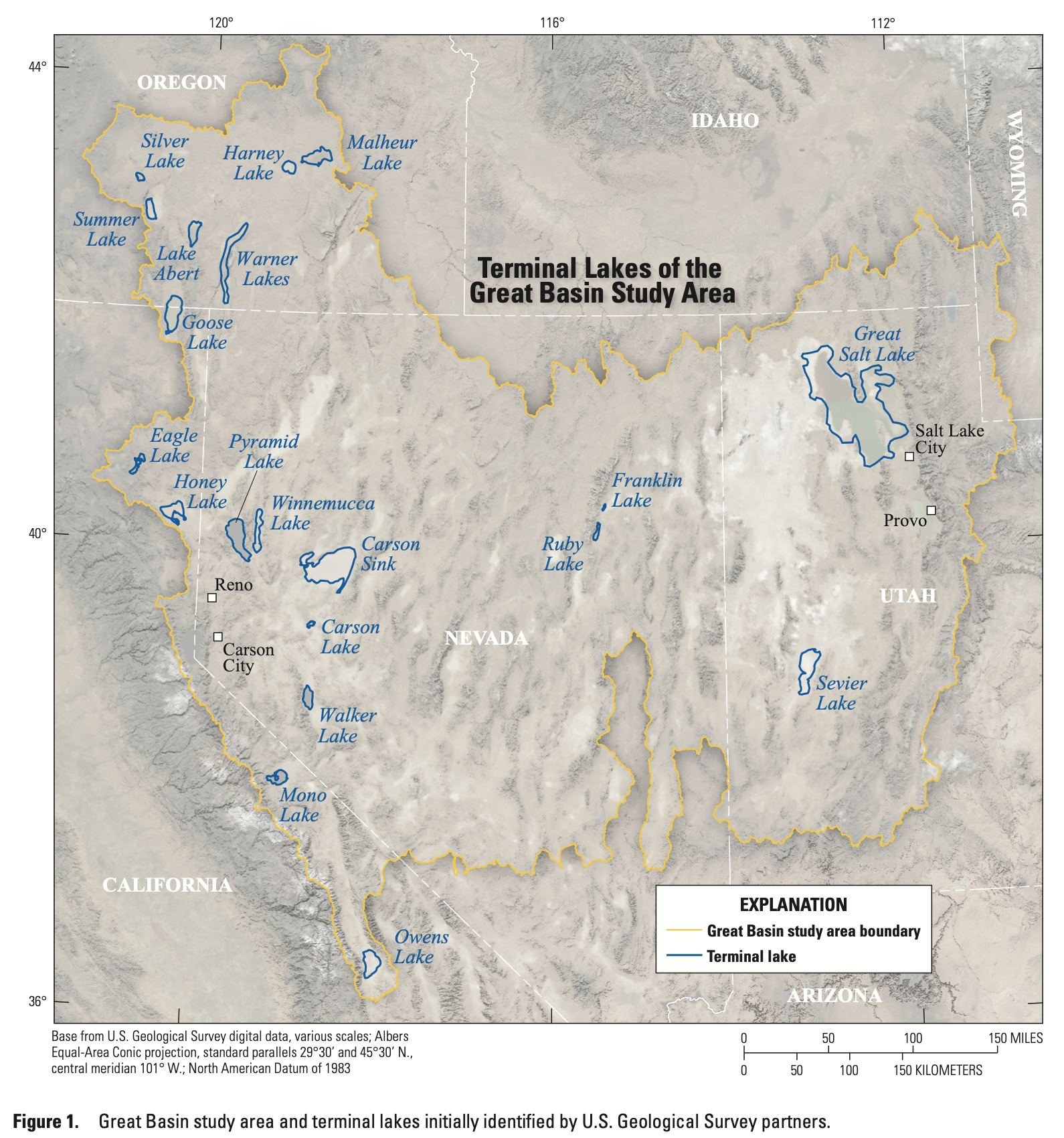
The shores of the Great Salt Lake near Antelope Island are pictured on Tuesday, May 21, 2024. (Photo by Spenser Heaps for Utah News Dispatch)

Click the link to read the article on the Utah News Dispatch website (Kyle Dunphey):

July 30, 2024

Not only does the shrinking Great Salt Lake impact wildlife and expose Utahns to toxic dust, it’s also a major contributor to greenhouse gas emissions. 

That’s according to new research from the Royal Ontario Museum, which published a study last week that found the dry lakebed emitted about 4.1 million tons of greenhouse gases in 2020 alone, most of it carbon dioxide. 

By comparison, Utah as a whole emitted about 59 million tons of carbon dioxide in 2016, according to the University of Utah’s Kem C. Gardner Institute.  

While burning fossil fuels is the largest contributor to human-caused greenhouse gas emissions, the largest terrestrial source — meaning it comes from the earth — is soil. A study published earlier this year in the Institute of Physics’ science journal found that about 80% of the world’s terrestrial carbon is stored in soil. 

Drought causes soil to dry and crack, a process called desiccation, which can lead to increased respiration (the release of carbon dioxide). Cracking can also expose deeper and older stores of carbon dioxide in the soil. 

That’s essentially the scenario researchers found on the Great Salt Lake — as the lake recedes and exposes more dry lakebed, desiccation increases. According to the study, the drying lake is equivalent to a roughly 7% increase in Utah’s total human-caused greenhouse gas emissions. 

“Human-caused desiccation of Great Salt Lake is exposing huge areas of lake bed and releasing massive quantities of greenhouse gases into the atmosphere,” said researcher Soren Brothers. “The significance of lake desiccation as a driver of climate change needs to be addressed in greater detail and considered in climate change mitigation and watershed planning.”

Between April and November 2020, researchers measured carbon dioxide and methane emissions from exposed sediment on the Great Salt Lake, comparing the findings with the estimated release of greenhouse gases from the water. The measurements pointed to a release of about 4.1 million tons of greenhouse gases, 94% of it carbon dioxide. 

The research also found that the carbon emissions are accelerated by warming temperatures, even at areas where the lakebed has been exposed for decades. 

“These analyses showed that the original lake was not likely a significant source of greenhouse gasses to the atmosphere, making the dried-up lake bed a novel driver of atmospheric warming,” the study reads. 

The lake hit its historic low point of 4,188.5 feet in November 2022. Since then, two above-average winters brought increased runoff to the lake, with levels as of Monday at about 4,193.7 feet in the south arm. 

The north arm, which is typically lower and saltier due to the railroad causeway that restricts the flow of fresh water, is at about 4,192 feet. 

The state defines a “healthy” range for the lake between 4,198 to 4,205 feet.

Credit: USGS

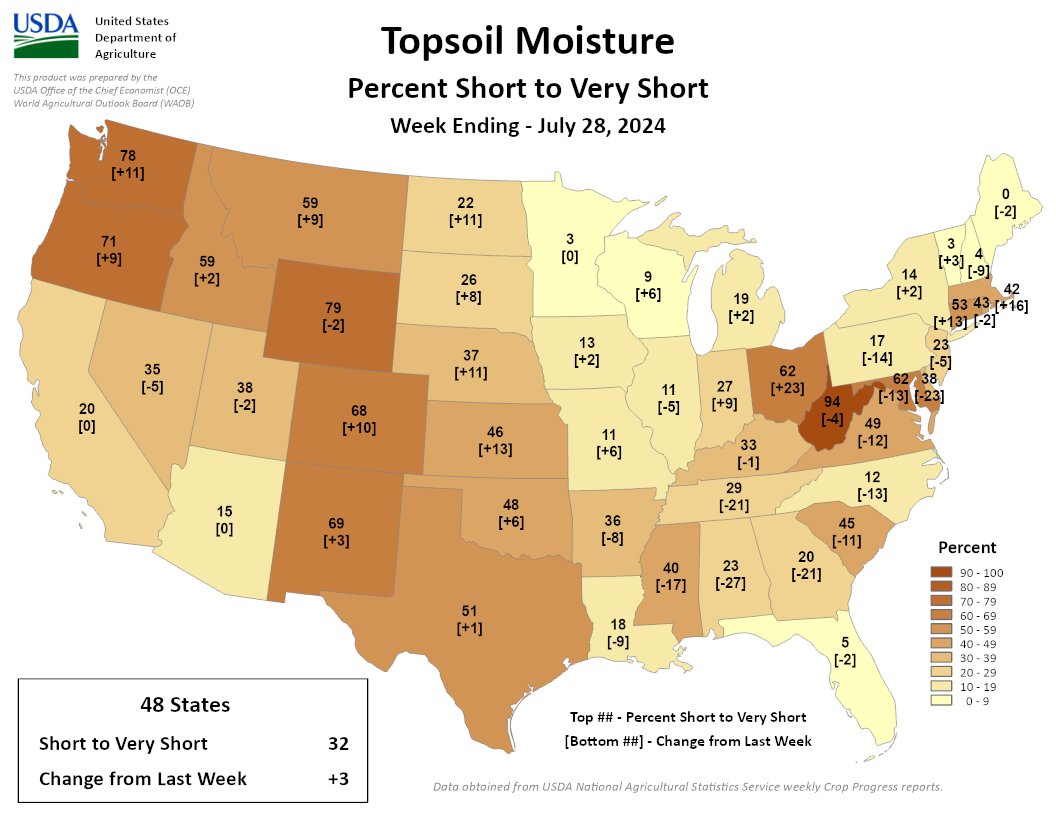
Topsoil Moisture % short/very short 32% of the Lower 48 is short/very short, 3% more than last week — @NOAADrought

Soils dried in the Pacific Northwest, Plains, & parts of the Midwest. Big improvements in topsoil conditions for much of the Southeast.

The American West’s last quarter-century ranks as the driest in 1,200 years, research shows — The Los Angeles Times #ActOnClimate

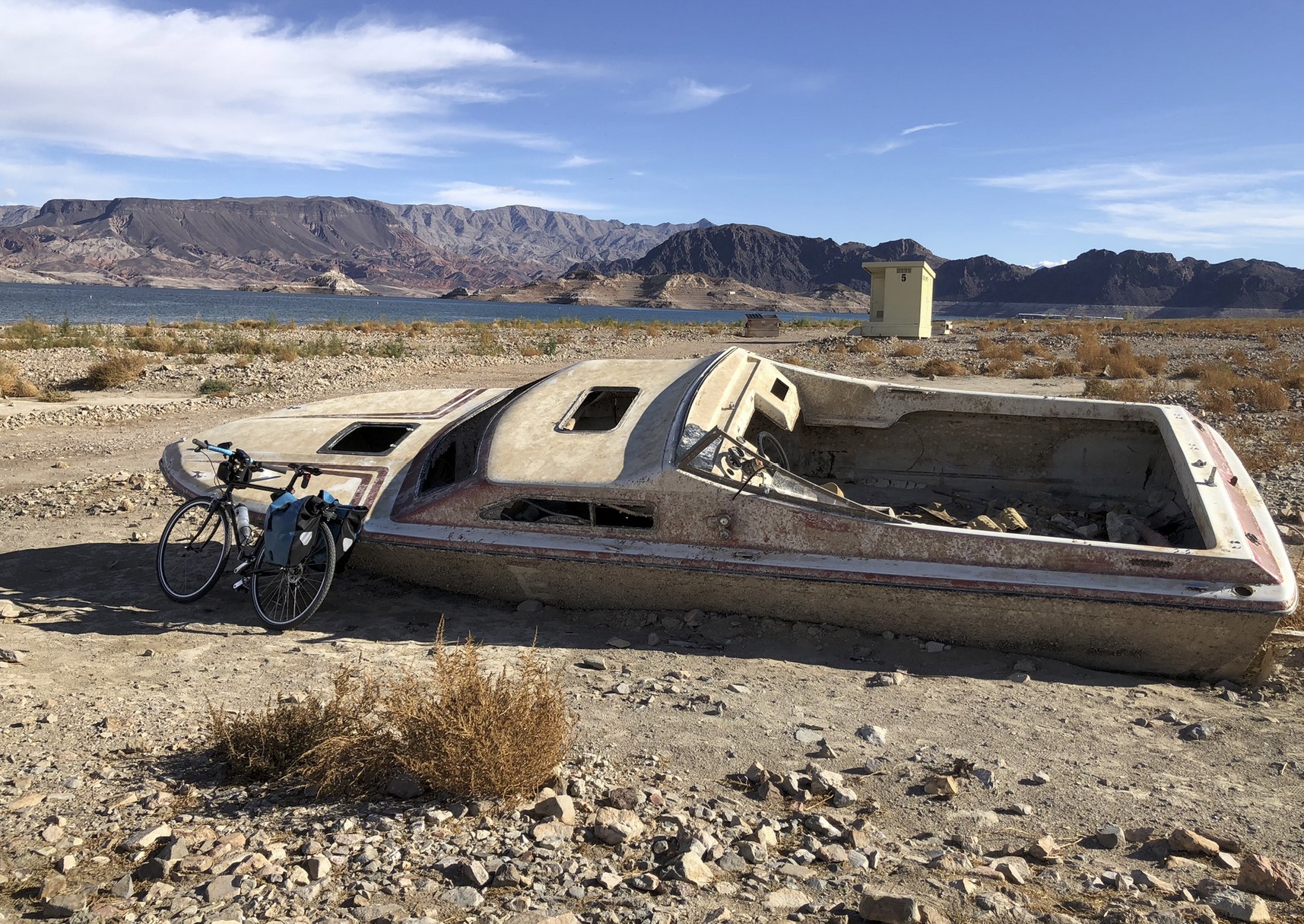
Lake Mead shipwreck. Photo credit: John Fleck

Click the link to read the article on The Los Angeles Times website (Ian James). Here’s an excerpt:

July 30, 2024

Three years ago, climate researchers shocked drought-weary Californians when they revealed that the American West was experiencing its driest 22-year period in 1,200 years, and that this severe megadrought was being intensified by global warming. Now, a UCLA climate scientist has reexamined the data and found that, even after two wet winters, the last 25 years are still likely the driest quarter-century since the year 800.

”The dryness still wins out over the wetness, big time,” said UCLA professor Park Williams.

The latest climate data show that the years since 2000 in western North America — from Montana to California to northern Mexico — have been slightly drier on average than a similar megadrought in the late 1500s…Williams shared his findings with the Los Angeles Times, providing an update to his widely cited 2022 study, which he coauthored with scientists at Columbia University’s Lamont-Doherty Earth Observatory. The new findings reveal that even the unusually wet conditions that drenched the West since the start of 2023 pale in comparison to the long stretch of mostly dry years over the previous 23 years. And that dryness hasn’t been driven by natural cycles alone. Williams and his colleagues have estimated that a significant portion of the drought’s severity — roughly 40% — is attributable to warming driven by the burning of fossil fuels and rising levels of greenhouse gases. The warming that has occurred in the region, an increase of more than 2.5 degrees Fahrenheit since recordkeeping began more than a century ago, has intensified the dry conditions, making the latest megadrought significantly more severe than it would be without climate change…Scientists and policy experts widely agree that adapting to aridification driven by climate change in the western U.S. will require major changes in how limited water supplies are managed for farms, cities and the environment.

“Regardless of what happens in the next few years, which will be dictated mostly by the randomness of weather, as the atmosphere continues to warm we should expect it to continue to degrade our water supply,” Williams said. “A warmer atmosphere is a thirstier atmosphere, and without a compensating increase in precipitation, which has not occurred, humans and ecosystems will be left with less water.”

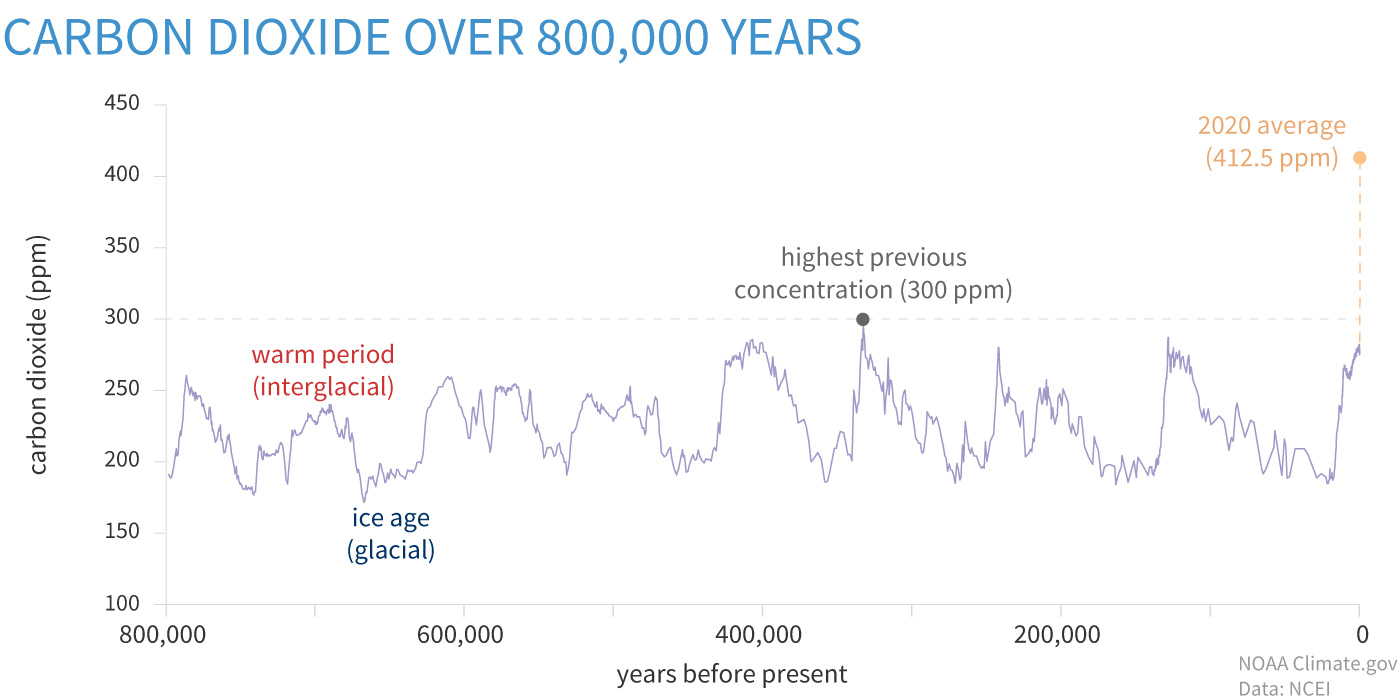
Atmospheric carbon dioxide concentrations (CO2) in parts per million (ppm) for the past 800,000 years. On the geologic time scale, the increase to today’s levels (orange dashed line) looks virtually instantaneous. Graph by NOAA Climate.gov based on data from Lüthi et al., 2008, via the NOAA NCEI Paleoclimatology Program.

Aspinall Unit operations update: Streamflow in Black Canyon will be around 600 cfs, August 31, 2024 #GunnisonRiver #ColoradoRiver #COriver #aridification

Sunrise Black Canyon via Bob Berwyn

From email from Reclamation (Erik Knight):

Releases from the Aspinall Unit will be decreased from 2100 cfs to 1650 cfs by Thursday, August 1st. Releases are being decreased as the baseflow target for the lower Gunnison River will change to 1050 cfs on August 1st.

Flows in the lower Gunnison River are currently above the baseflow target of 1500 cfs. River flows are expected to remain above the new baseflow target with this release reduction.

Pursuant to the Aspinall Unit Operations Record of Decision (ROD), the baseflow target in the lower Gunnison River, as measured at the Whitewater gage, is 1050 cfs for August through December.

Currently, Gunnison Tunnel diversions are 1050 cfs and flows in the Gunnison River through the Black Canyon are around 1050 cfs. After this release change Gunnison Tunnel diversions will still be 1050 cfs and flows in the Gunnison River through the Black Canyon will be around 600 cfs. Current flow information is obtained from provisional data that may undergo revision subsequent to review.

Can viruses help clean wastewater from fracking? It’s a “yes, but” from researchers — Fresh Water News #ActOnClimate

Click the link to read the article on the Water Education Colorado website (Shannon Mullane):

July 25, 2024

After four years of experimentation, a group of researchers in Texas have successfully used a type of virus — used to combat bacterial infections in medicine — to kill bacteria in wastewater from fracking.

This wastewater, which can come with radioactive, cancer-causing materials, and yes, bacteria, often gets shoved back underground for storage. But increasingly, Colorado and other states are looking at ways to clean the wastewater enough that it can be used in other mining operations instead of fresh water. It’s an intriguing idea in Colorado, where fresh water supplies have been strained by a two-decade megadrought.

Could viruses really help? The potential is there — but so are big questions about practicality, researchers say.

“It’s outside-the-box science. We knew that,” said Zacariah Hildenbrand, part of the six-person University of Texas research team that published a study on the viruses in April. “But I mean, necessity is the mother of all innovation here, and we need to find some novel technologies.”

Wastewater, called produced water, is the major waste stream generated by oil and gas production, according to the group’s research published in the peer-reviewed journal Water. The research was funded by Biota Solutions, a Texas-based research company founded to develop viruses to kill bacteria in produced water.

Oil and natural gas can be thousands of feet below the ground’s surface, where it mixes with brackish water. At that depth, the water can include naturally occurring carcinogenic compounds and radioactive materials. It’s so salty that, if used for irrigation, it could kill plants.

During the fracking process, companies pump a mixture of fresh water, sand and chemicals [ed. including PFAS] underground where it mixes with oil, gas and the brackish water. It returns to the surface and is separated from the oil and gas. The result is produced water, which can not be used for drinking or irrigation, per state regulations.

In Colorado, water used for fracking averaged about 26,000 acre-feet per year from 2011 to 2020, or about 0.17% of the water used in the state, according to the Colorado Division of Water Resources. One acre-foot roughly equals the annual water used by two to three households.

The highest volumes of water used for hydraulic fracturing are used within the counties along the Front Range in Denver-Julesburg Basin.

“In an arid state like Colorado, where we’re worried about how much water is getting down the Colorado River, that rubs a lot of people the wrong way. And it should,” said Joseph Ryan, an environmental engineering professor at the University of Colorado.

Attack of the viral “spiders”

The complex cocktail of produced water also comes with another ingredient: bacteria.

Some of the bacteria can corrode pipes while others sour the gas, which makes it stinkier and requires more processing. Both can cost oil and gas companies money, Hildebrand said.

Historically, companies have treated these bacteria with disinfectants, like chlorine and hydrogen peroxide. But over time, the bacteria can become more resistant. To protect themselves, they change their membrane structure to become less permeable — like putting on a raincoat in a storm, he said.

Some companies end up using twice as many chemicals to kill the same amount of bacteria, which is more costly and less environmentally sustainable, he said.

So the researchers set out to test another technology: The bacteriophage.

Bacteriophages are viruses that infect specific bacteria. They’re like the spiders in the “Starship Troopers” movie, Hildebrand said. Once the phage finds its host bacteria, it hooks into the surface of the cell, injects its DNA into the center of the bacteria, and hijacks the bacteria’s replication mechanisms.

Then it reproduces until the bacteria explodes.

The process allows the virus to multiply exponentially and infect more cells. But Hildebrand stressed the virus targets only its specific host bacteria, not any other type of cell.

Bacteriophages have been used for decades in medicine to treat issues like skin infections, indigestion and food poisoning caused by E. coli.

“Under the microscope, at the atomic scale, it’s scary. It’s an all-out civil war between bacteria and viruses,” he said. “But from the human perspective, it’s totally innocuous.”

Is the virus enough?

The researchers’ study showed that bacteriophages successfully deactivated two strains of bacteria found in produced water — but there are some key hurdles that would need to be addressed for the technique to be used by oil and gas operators.

Produced water could include tens of thousands of bacterial strains, which means researchers would need far more strains of viruses to disinfect the produced water. And right now, there aren’t enough commercially available bacteriophage strains to make it happen, Hildebrand said.

“The goal is, we just learn enough from all of the basins that ultimately I build a 200-phage cocktail that’s kind of a kill-all, if you will. It’s a belt-and-suspenders approach,” he said. “Once I build it initially, it will renew itself in the environment.”

After the up-front costs, the bacteriophage technique would cost less than a penny per barrel because the virus renews itself, Hildebrand said based on his economic estimates.

Ryan of CU Boulder has doubts, big ones.

When it comes to reusing produced water, corroding pipes are a small problem compared to the radioactivity, salinity and carcinogenic compounds, he said.

There are so many microorganisms in the water that it would be difficult to affordably find enough bacteriophages to completely disinfect it. There’s no way fixing the minor problems caused by bacteria would be worth the effort and cost, he said.

“It’s a questionable solution to a problem that just doesn’t seem at the top of the list of importance if you’re trying to do something with produced water,” Ryan said.

Hildebrand acknowledged that disinfection alone is not enough to clean produced water to a reusable level, but it would help, especially if the bacteria have become resistant to other disinfection methods.

Ryan is one of 31 people on the Colorado Produced Water Consortium, which includes industry, state, federal and environmental representatives. (He emphasized he was not speaking for the group.)

In 2023, the Colorado legislature created the consortium to study how to reuse and recycle wastewater from fracking. The group is set to publish its fourth study on produced water Aug. 1 — one of nine that will be presented to legislators and state agencies.

Hope Dalton, the consortium’s director, declined to comment on the fresh-out-of-the-lab research.

“Generally speaking, bench-level research is innovative and new and hasn’t been tested,” she said. “Then you go out to industry and use it on the larger, pilot scale. Once it’s proven at the larger, pilot scale, then it can be implemented as practice.”

That’s the next step for the Texas researchers, Hildebrand said.

“Yes, it’s very early stages, but considering how effectively it works … how robust the phages are and how cheap they are to produce, I think it provides a really unique solution moving forward,” he said.

More by Shannon Mullane