
Click the link to read the article on The Land Desk website (Jonathan P. Thompson):
July 9, 2024
🥵 Aridification Watch 🐫

Writing about weather in the climate crisis-era is like navigating an obstacle course littered with critics. One faction chides me if I write about insane rainstorms and flash flooding without attributing them to human-caused climate change; another blasts me for bringing up climate change too often, whether it’s to explain an especially active avalanche cycle or a long-term drought. Even the spate of “billion-dollar disasters” in recent years could be blamed on climate change, sure, but also on more development and humanity in the path of those disasters.
Quite often those critics are the voices in my own head. Part of this is due to my hankering to learn the history of a place, particularly southwestern Colorado. Every time there’s an “unprecedented” drought or flood, I can look back into my mental archives and find an example of an equally severe one. There was the huge snow year of 1932, when the Durango-to-Silverton train was blockaded for 90 days straight; the great floods of 1911, 1884, 1927, and 1970, which wreaked havoc along the region’s streams and rivers; the dismally dry and warm winter of 1878-79 that preceded the Lime Creek Burn; and the grainy 1918 photo of a water-wagon doing dust control on Silverton’s streets — in January.
Weather is and always has been wacky, with or without human-caused climate change. So I’m always careful before saying some meteorological event is “unprecedented.”
But this heat? Damn. It sure does look unprecedented — if the temperature alone isn’t shattering records, the duration of the heat waves are.
A better term than climate change is climate heating, because that’s exactly what’s happening: The planet is heating up as a result of Industrial (and Information) Age humans spewing oodles of greenhouse gases into the atmosphere. And while it may be difficult to find climate change’s figurative fingerprints on every incidence of severe weather, its coal-smudged paw-prints appear to be all over the longer and more severe spells of extreme heat we’ve been perspiring through in recent years. No, every record-breaking high temperature cannot be attributed unequivocally to climate change, but climate change does make these events far more likely to occur.
Last year was the warmest year on our planet since global record-keeping began in 1850, clocking in at 2.12 degrees Fahrenheit warmer than the 20th century average of 57° F. And guess what? This year will likely be even hotter: This June was the hottest June on record, globally, and the 13th consecutive monthly high temperature record. Eeek.
So, when the mercury in Las Vegas tops out at 120 degrees F and shatters the previous record of 117° F, as occurred last week, I think it’s not a stretch to attribute this specific weather wackiness to the warming climate (with a helping hand from the urban heat island effect, of course). And when this sort of heat stretches across a good portion of the West, follows record-setting, flash-flooding rainfall by a few weeks, and coincides with a hurricane ripping through the Carribean, well, it’s probably safe to assume that it’s all connected, via a warming climate. It is not safe, however, to go outside.
So, with that out of the way, here’s a rundown of some of the wackiness of late:
- Phoenix just endured its hottest June on record, with an average monthly temperature of 97°F, or nearly six degrees above the 1990-2020 normal. So far this summer the daily high temperature has reached 110° F or warmer on 21 occasions, and 118° F on two days; the city has received just .02 inches of precipitation since April 2. Maricopa County officials have confirmed heat caused or contributed to 13 deaths so far this year, with another 162 fatalities under investigation. That’s significantly more than last year at this time.
- Dozens of monthly maximum high temperature records were broken across the West in June and early July, especially along the West Coast, where the mercury was — and still is — reaching the triple digits day after day. Oregon officials suspect five deaths in the western part of the state in recent days are heat-related.
- Las Vegas shattered its all-time high heat record with 120 degrees F on July 7. The previous record was 117.
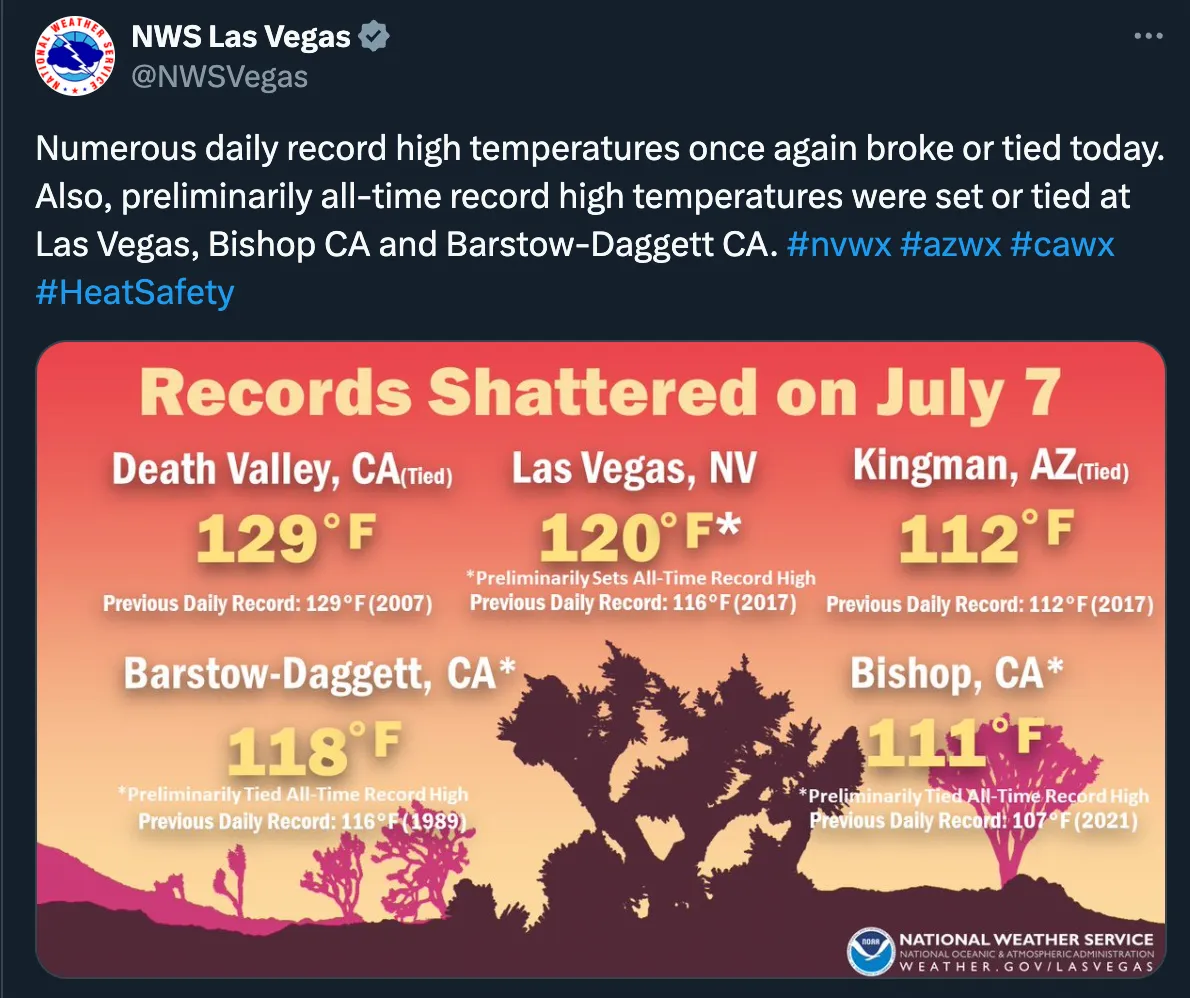
- A new daily record was set in Death Valley, at 129 F. A motorcyclist touring through the national park died of heat exposure.
- Sixteen locations in the West set monthly precipitation records in June, including:
- Hovenweep National Monument, with 1.05 inches on June 28;
- Arches National Park, 1.58” on June 28;
- Panguitch, Utah, 1.50” on June 26;
- Quemazon, New Mexico, 5.50” on June 21;
- Arivaca, Arizona, 2.25” on June 24;
- Ely, Nevada, 1.58” on June 26;
- Mormon Mountain, Arizona, 2.30” on June 27.
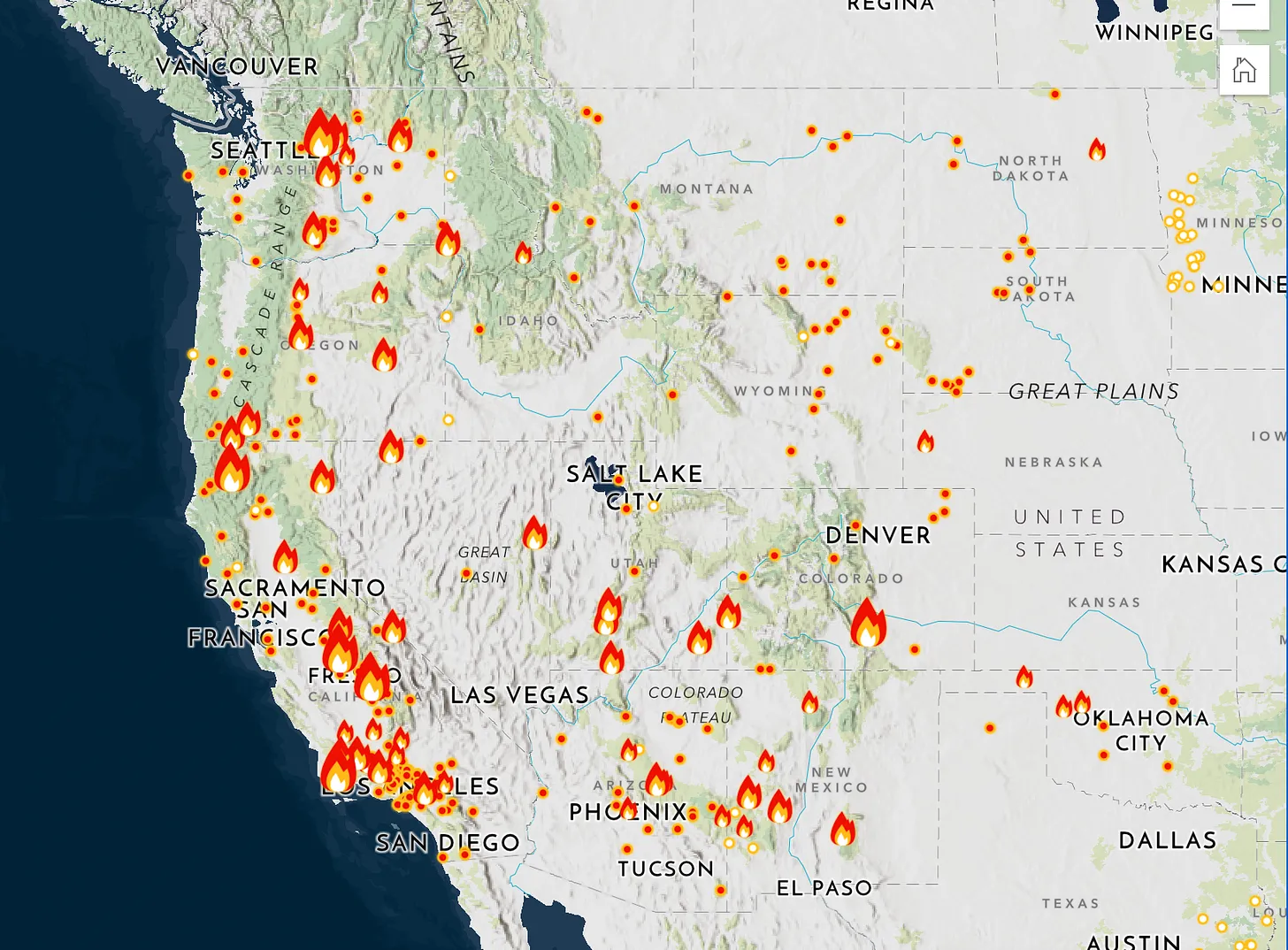
- Major wildfires are burning across the West. Before I get into the details, do spare a thought for the thousands of people fighting these fires. Not only do the flames and smoke threaten their health and lives, but so does the brutal heat. This is a sampling of some of the new starts (stats as of early a.m. July 9):
- Silver King in Piute County, Utah, at 10,026 acres, 0% containment;
- Deer Springs in Kane County, Utah, (north-northeast of Kanab) at 11,000 acres, 0% containment;
- Fisher in Socorro County, New Mexico, at 2,500 acres, 1% containment;
- Lake in Santa Barbara County, California, at 21,763 acres, 8% containment;
- Shelly in Siskiyou County, California, at 4,203 acres, 0% containment (this one is likely to burn a “carbon offset” forest, where corporations pay the owner to not chop down trees so they can continue polluting). Whoops.;
- Salt Creek Rd in Jackson County, Oregon, 1,700 acres, 2% containment;
- North in Modoc County, California, 4,380 acres, 50% containment;
- Thompson in Butte County, California, which is 100% contained after burning 3,789 acres. I include it here because it forced the shutdown of transmission lines, taking the Oroville Dam hydropower plant offline and depriving the California grid of valuable energy when it needs it to keep air-conditioners running. It’s yet another example of how extreme weather can strain the power grid.
Explainer: Warming planet, failing grid — JONATHAN P. THOMPSON JUNE 16, 2021
A scorcher has settled over the entire Southwestern United States, with highs expected to hit the triple digits for several days in a row from Bakersfield to Las Vegas to Grand Junction. Phoenicians will be doing the Summer Solstice Swelter during that long day and short night—the — Read full story
It’s difficult to see how this is sustainable. Consider for a moment the misery the more than 9,000 unhoused people in Phoenix must be experiencing each and every day this summer. Many of them live on the streets and sidewalks, literally, where the concrete and asphalt can reach 160° F or more, hot enough to cause severe burns. Poorly insulated housing without cooling can be nearly as bad. Public cooling centers provide refuge, of course, but are there enough?
Sure, if you can afford it, you can hunker down in your home and crank up the air-conditioner and simply wait out the heat. But you could be waiting for quite some time these days; meanwhile, the growing fleet of air-conditioners will strain the grid, increasing the risk of a widespread power outage, which literally could be deadly in this heat.
There is a limit to this sort of thing, and it seems as if we must be getting close to the point where some places simply become uninhabitable. But if we’ve already reached that point, a lot of folks aren’t aware of it: Maricopa County remains one of the fastest growing metros in the U.S. And during the 12 months from June 2023 through May 2024, 48,000 building permits were issued in the metro area for new, private housing structures — numbers not seen since the great housing bubble of a couple decades ago.
Surely the housing bubble will burst, as it has in the past, before too long. But what about the air-conditioning bubble? Can it really last forever?
🏠 Random Real Estate Room 🤑
Speaking of people moving to hostile environments, the Amangiri resort near Lake Powell (and the polygamist settlement of Big Water) is now selling lots to those who can afford it. But don’t worry! While homeowners can avail themselves of the resort amenities, they are separated from those low-brow folks (who are forking out up to $6,500 per night to stay there) by a big slab of sandstone — saving them from having to rub elbows with the Kardashians next to the pool under 100°+ heat. And it will only cost you between $5 million and $12 million. For the lot, that is. Gross.
Follow Up
Remember my diatribe from a couple weeks ago about data centers’ excessive power use? Well, the pitfalls of all of that are playing out as I write this. Arizona Public Service, the state’s biggest utility, predicts its customers collectively will set new electricity-demand records this year. And it’s not because of all those new folks moving in or the new homes being built — efficiency gains have actually led to a 5% decrease in overall residential power consumption. It’s thanks to those data centers, of which there are 79 in the state (71 in Phoenix, seven in Tucson, and one in Nogales). It’s all fine and good until the grid crashes on a 118° F day.
A Dog Day Diatribe on AI, cryptocurrency, energy consumption, and capitalism — JONATHAN P. THOMPSON — June 28, 2024
🐐 Things that get my Goat 🐐 I will begin this rant with a thank you to a kind reader for this little tidbit that appeared in their response to a column of mine: Ironically, reducing energy consumption will be counterp…Read full story
One thought on “#ClimateChange’s coal-smudged fingerprints: A survey of heat-related news from across the West — Jonathan P. Thompson #ActOnClimate #coal”