
Click the link to access the research letter on the AGU website (Daniel Hogan, Jessica D. Lundquist):
Abstract
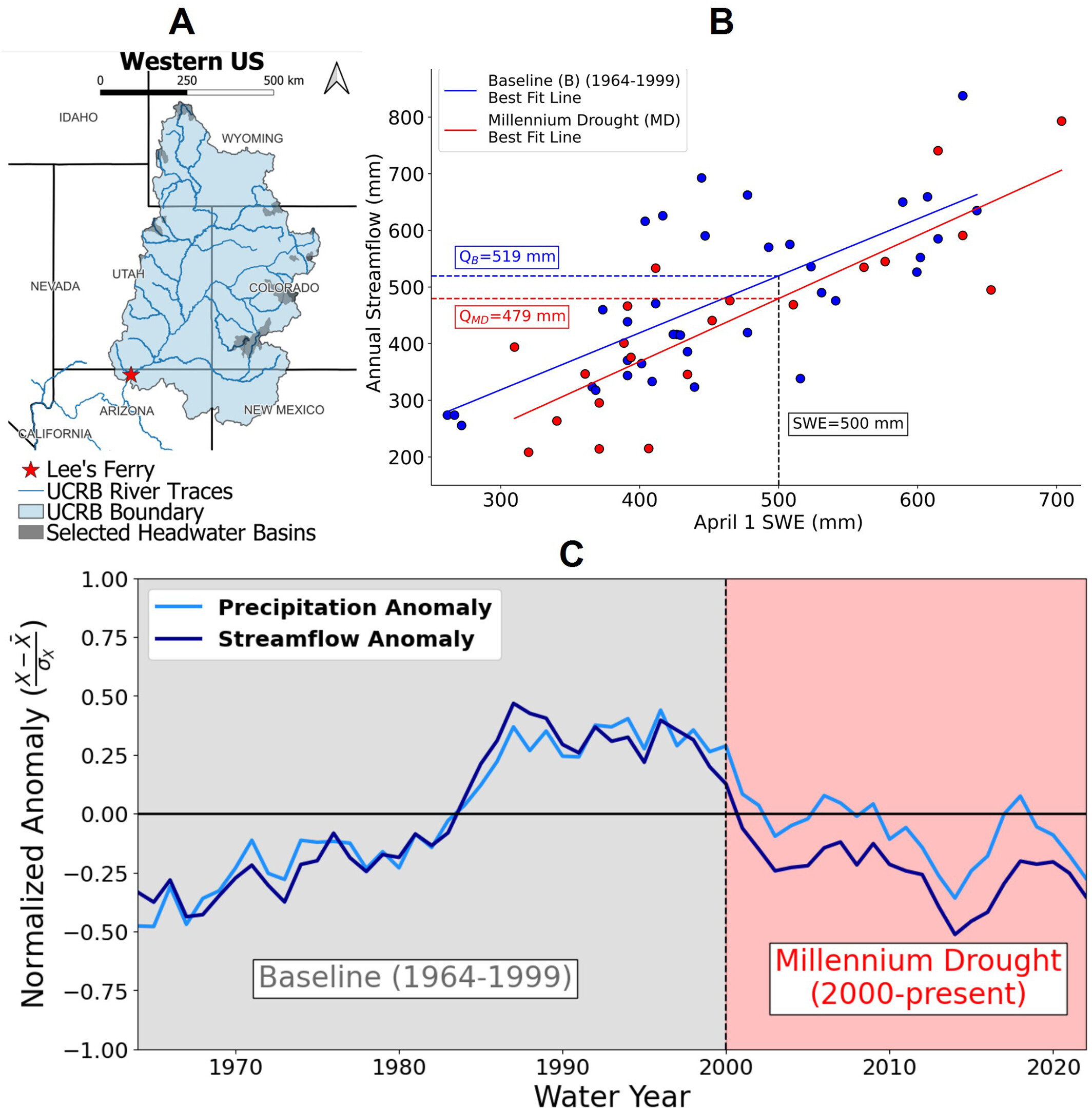
Colorado River streamflow has decreased 19% since 2000. Spring (March-April-May) weather strongly influences Upper Colorado River streamflow because it controls not only water input but also when snow melts and how much energy is available for evaporation when soils are wettest. Since 2000, spring precipitation decreased by 14% on average across 26 unregulated headwater basins, but this decrease did not fully account for the reduced streamflow. In drier springs, increases in energy from reduced cloud cover, and lowered surface albedo from earlier snow disappearance, coincided with potential evapotranspiration (PET) increases of up to 10%. Combining spring precipitation decreases with PET increases accounted for 67% of the variance in post-2000 streamflow deficits. Streamflow deficits were most substantial in lower elevation basins (<2,950 m), where snowmelt occurred earliest, and precipitation declines were largest. Refining seasonal spring precipitation forecasts is imperative for future water availability predictions in this snow-dominated water resource region.
Key Points
- Significant decreases in spring precipitation have been observed since 2000 in headwater basins of the Upper Colorado
- Drier springs have corresponded with greater spring potential evapotranspiration (PET)
- Spring precipitation decreases and PET increases explain much of the variability in observed streamflow deficits in these headwater basins
Plain Language Summary
With over 40 million people dependent on the Colorado River, the 19% drop in streamflow since 2000 has been worrying, especially because its cause is not well understood. To explain this drop, we focused on changes to spring weather in snow-dominated basins, which contribute over 80% of the river’s water. We found spring precipitation decreases since 2000 not only reduced streamflow but also correlated with higher temperatures and evaporation rates and less cloudiness. These impacts combined to intensify streamflow declines in basins with earlier snowmelt. The importance of spring precipitation to Colorado River streamflow underscores the need to improve seasonal precipitation forecasts. Such improvements would enhance water availability predictions for the one billion people worldwide reliant on snow for water resources.