
Click the link to read the article (and to view the cool video from EcoFlight.com) on The Land Desk website (Jonathan P. Thompson):
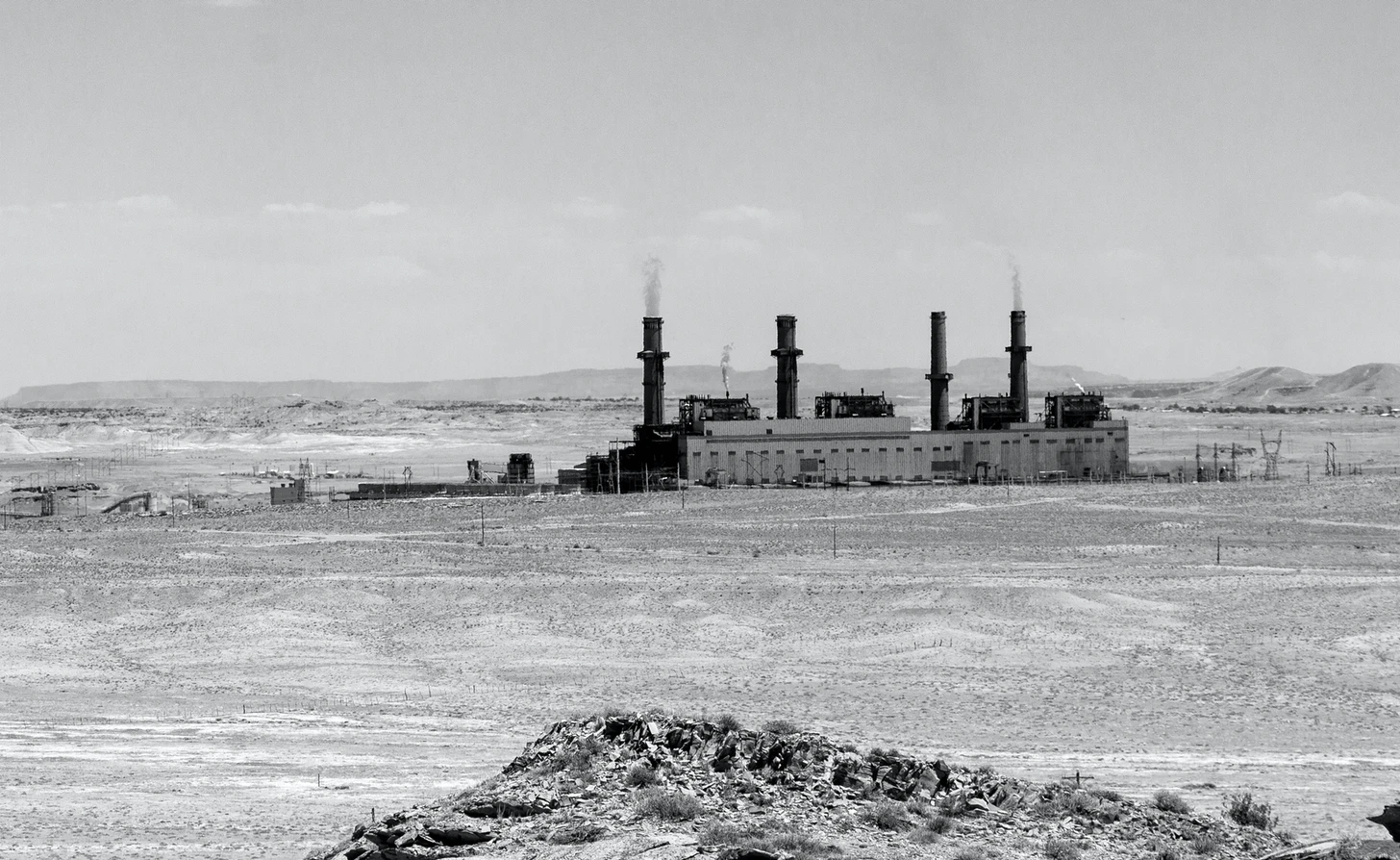
After five decades of spewing sulfur dioxide, ash, mercury, arsenic, carbon dioxide, and other pollutants into the northwestern New Mexico air, the four stacks of the San Juan Generating Station were brought down in spectacular fashion this past weekend. Sadly, I missed it in real life, but even the videos leave me feeling a bit giddy, as the controlled demolition heralds a new, cleaner, hopefully more just era in the Four Corners.
It’s symbolic, of course: The real action happened in September 2022, when the last of the plant’s four units burned through the final ton of coal and the turbine [quit] turning for good. But what a symbol it is, for the region and for me, personally: The power plant, and, to an even larger degree, it’s older, bigger sister plant, Four Corners, have loomed over my existence ever since I was very young.
Four Corners was constructed in 1964, and was the flagship of a massive effort by a consortium of utilities called WEST, or Western Energy Supply and Transmission Associates. They hoped to construct six massive coal-fired power plants and accompanying mines across the Colorado Plateau, which would then ship power hundreds of miles to rapidly growing Los Angeles, San Diego, Las Vegas, Phoenix, and Albuquerque across high-voltage lines.
Not only did the growing supply of cheap power — and air-conditioning and water pumping — help the population of the Southwest’s cities soar, but the marketing caused the average American’s electricity consumption to grow four-fold between 1946 and 1968. “We are, in short, on an energy binge,” Harvey Mudd, Director of the Santa Fe-based Central Clearing House told the congressional committee in 1971, “which, like all binges, can only end in disaster.”
Mudd’s warning may even be more timely in 2024, as we embark on a new electricity binge to power the proliferation of energy-hungry AI-processing and cryptocurrency-mining data centers.
Four Corners Power Plant was the first of the six to go online, sprouting on the edge of the Navajo Nation, atop the Fruitland formation, about 15 miles from Farmington. The relatively sparse population, along with the dearth of environmental regulations, allowed the mine and plant largely to be built under the radar. But once it started churning out juice, and pollution — to the tune of over 400 tons of particulate matter per day, along with sulfur dioxide, nitrogen oxides, and mercury — no one could miss the behemoth. The facility, along with the smog its pollutants gave way to, became a smoke-spewing symbol of energy colonialism, landscape-scale industrialization, and humans’ ability to spoil the environment.
It helped give rise to a regional environmental movement, made up of elected officials, concerned residents, and advocates, which protested the pollution and implored a congressional committee in 1971 to block further power plant construction.
But the impassioned rhetoric fell on deaf ears. After Four Corners came Mojave, Navajo Generating Station near Lake Powell, Huntington in Utah, and San Juan Generating Station, just across the river from Four Corners. They all had better pollution control systems than Four Corners did initially, but together they still kicked out thousands of tons of pollutants along with tens of millions of tons of planet-warming carbon dioxide each year, leaving the Four Corners Region to appear as if it had once again been inundated by a vast sea, only instead of water it was comprised of smog. Only the largest of all those slated to be built, the 5,000-megawatt Kaipairowitz plant, which would have sat on the western shore of Lake Powell eating up coal from land that was later included in Grand Staircase-Escalante National Monument, was not constructed.
I was born in the midst of the Big Buildup in 1970, and not long after I became conscious of the world around me I learned that the haze in the air that blotted out the once-expansive views of my homeland was not natural. And I learned that the main culprit were the new coal-burning power plants that loomed over the sere landscape. It was probably my first understanding of environmental destruction.
A decade and some years later, on a mid-summer’s eve, when I was in my late teens or early 20s, I drove my 1967 AMC Rambler station wagon west from my dad’s house in Cortez, over undulating gravel roads past hay fields, with their perfectly cubical hay bales lined up in a row, casting long shadows across the bright green, monsoon-moistened, freshly cut field. I was headed to The Point, atop the McElmo Dome, out beyond the last bean and hay fields. It was a nice place to camp because of its proximity to Cortez, but more importantly because of the views. You could see all the way to Monument Valley and Navajo Mountain — if the air was clear, which was rare.
I didn’t like the smog, but I also didn’t really know anything different, since the smog was there before I was, and never really abated, given that the power plants churned round-the-clock, every day of the year. I had resigned myself to it; call it normalized degradation.
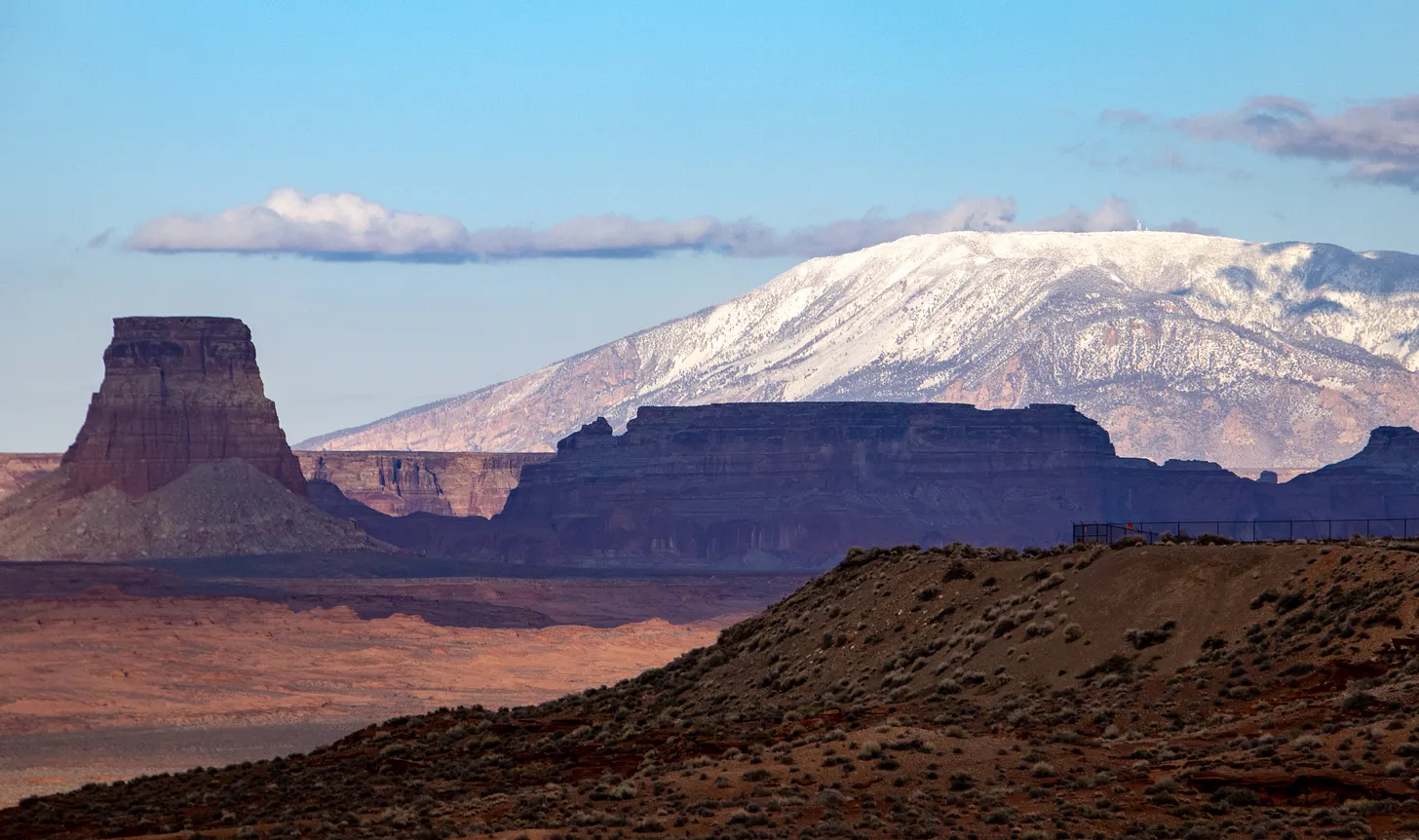
After watching the smog-enhanced sunset, punctuated by distant lightning strikes, I lay out my sleeping bag on the sandstone rim and covered it with a tarp and fell asleep. Deep in the night I was woken by lightning and thunder and huge raindrops pelting the tarp. I snuggled up underneath and let it lull me back asleep. When I awoke before sunrise I was startled by the clarity of the air. I not only could see the landforms of Monument Valley and the dark curve of Navajo Mountain, but I could see fissures in the sandstone and canyons on the mountainside. It was truly glorious to watch the sunlight spread across the landscape like that.
But my revery soon was interrupted. A yellowish-gray amoeba, coming from the south, oozed its way up the canyons toward me. It was no mystery. It was smog, rushing in from the Four Corners and San Juan plants to replace the stuff that had been washed out by the night’s heavy rains. A sadness and anger rose up in me then, and I think it’s lingered ever since, motivating much of what I do.
So it was with a sense of satisfaction that I watched the video of the smokestacks falling into a cloud of their own demise.
Notes from the energy transition — Jonathan P. Thompson
April 19, 2024
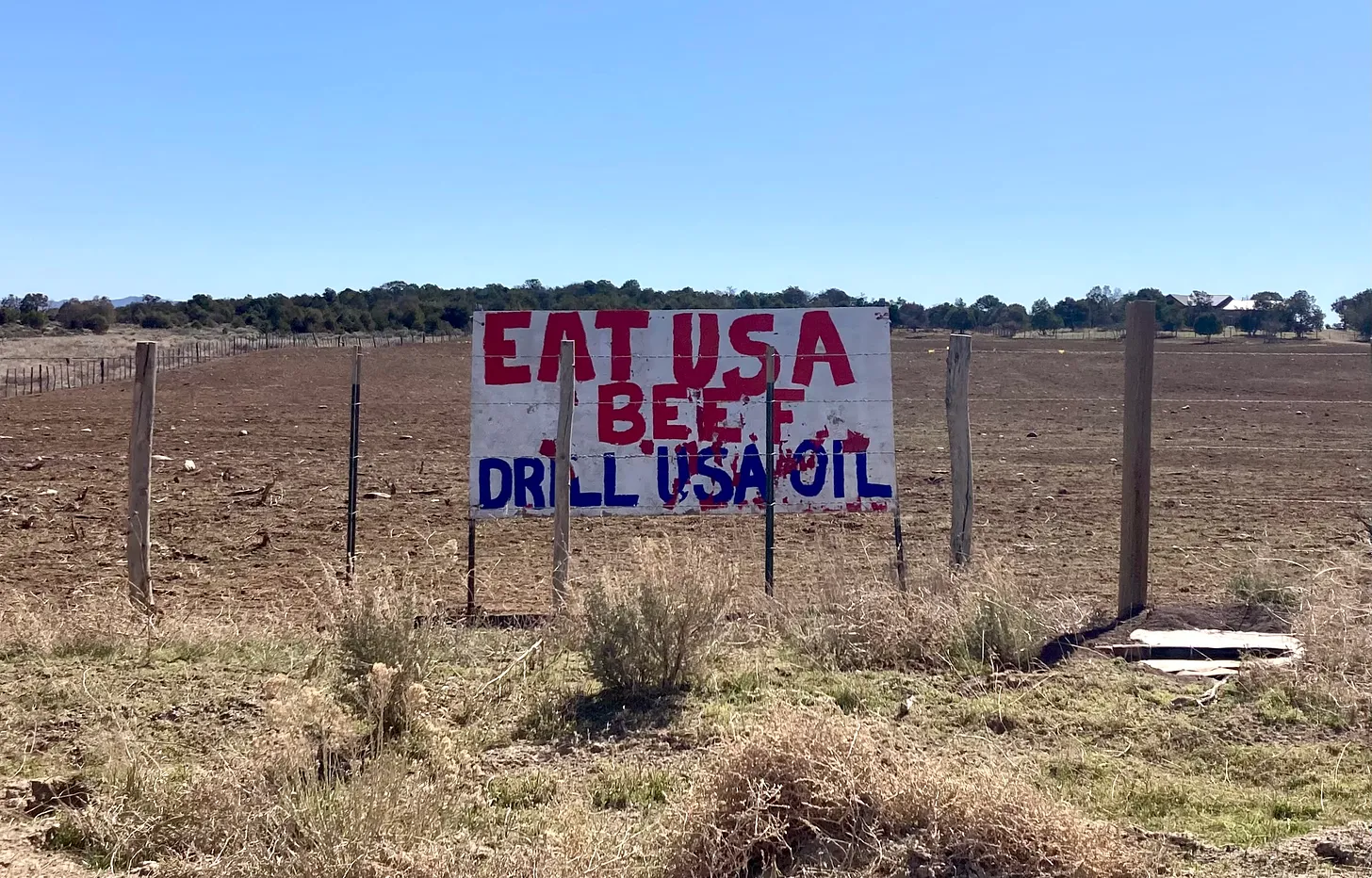
“EAT USA BEEF DRILL USA OIL.” So said the sign, in red and blue lettering against a white background, along a La Plata County road I took on a little trip down to northwestern New Mexico last week. It must have had some effect on me. Because after taking a run through the coalbed methane fields, I headed straight to Blake’s Lotaburger in Aztec and parto…
⛈️ Wacky Weather Watch⚡️
Weather is weird. Always has been. But the last few weeks have been especially wacky in the West, as massive wildfires and resulting smoke meet up with record-breaking high temperatures, monsoonal deluges, and the resulting landslides and flash floods.
We’ve covered the high temps here, so let’s look at the moisture, which should bring relief, but actually wreaks destruction.
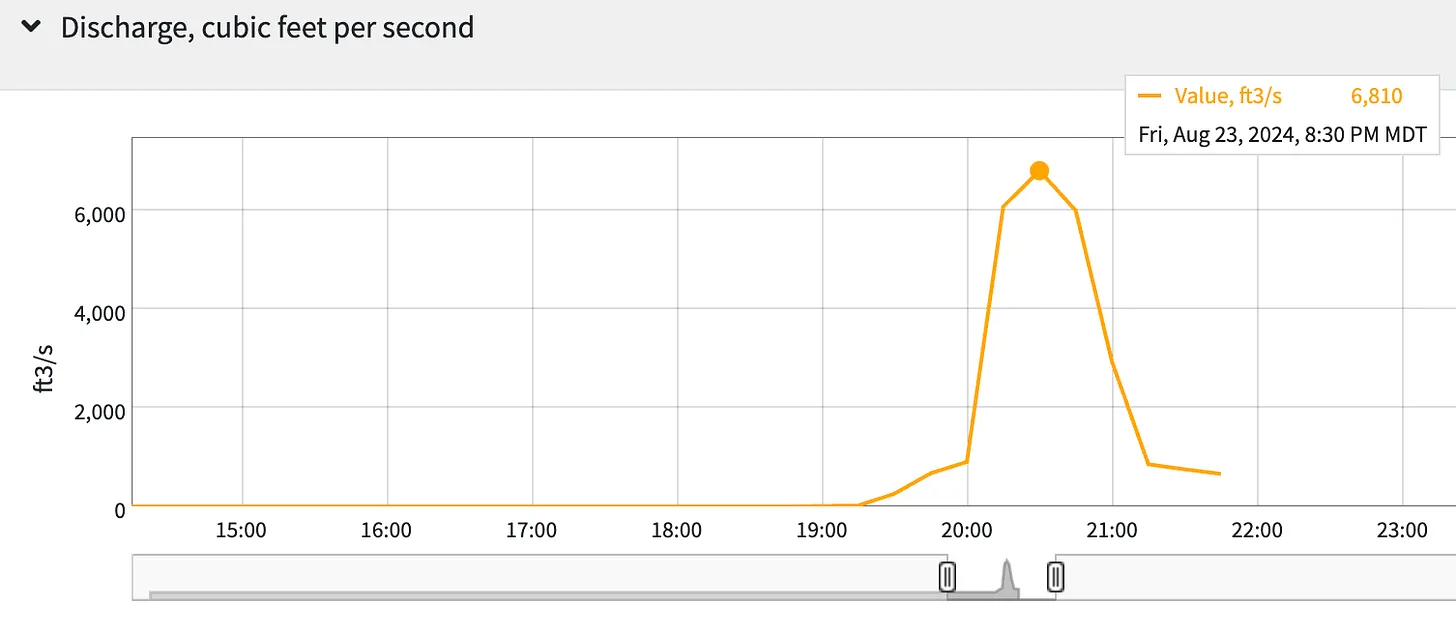
- For the third time this summer, the monsoon mobbed Moab as a series of thunderstorms pounded the area and triggered flash flooding in and around the town. The National Weather Service showed rainfall amounts ranging from .76 inches at the Arches National Park HQ, to .95 inches at Canyonlands, to 1.01 inches at La Sal — all falling in a very short period of time. Mill Creek, which is normally a clear, gurgling brook that flows through the south side of downtown, turned into a raging, chocolate-milk-colored, debris-tossing monster — peaking out at 6,810 cubic feet per second, according to the USGS streamgage. And this one put the “flash” back into “flash flood”: On the morning of Aug. 23, the stream was a mere trickle at .36 cfs; by 8 p.m. that night it had ballooned up to 900 cfs; and it hit its 6,810 cfs high point at 8:30 p.m. before rapidly subsiding.
- Havasu Falls in the Grand Canyon — known for its luminous blue waters — swelled up so quickly after intense rainfall that it overwhelmed the stream gage: The readings simply disappear during the highest flows. But the torrent, which killed one hiker and forced the helicopter evacuation of more than 100 others, was recorded in other forms and it looks like it was a whopper. The Havasupai tribal council has closed their lands to tourists indefinitely in the flood’s aftermath. Good view of how the falls went from captivating to terrifying in a matter of minutes.
- The dry winter in the Northern Rockies is coming home to roost in the form of big wildfires in northern Wyoming and southern Montana, including:
- Flat Rock and Constitution Fires: Together they have charred nearly 80,000 acres near the massive coal mines and in the coalbed methane fields near Gillette, Wyoming.
- House Draw Fire has burned across about 175,000 acres east and south of Buffalo, Wyoming.
- The Remington Fire has scorched nearly 200,000 acres straddling the Wyoming-Montana border east of Sheridan.
- The Fish Creek Fire in Teton County is around 11,000 acres.
And, in Alaska, unusually intense rainfall triggered a landslide/debris flow on a slope in Ketchikan, killing one person, injuring three more, and destroying homes and infrastructure.
It can be tempting to attribute all of this wackiness to climate change — some media outlets are even blaming it for a freak yacht-sinking off of Sicily — it’s not prudent and probably not accurate to do so. Neither the rainfall, nor the floods that resulted, are unprecedented (okay, it’s hard to know with Havasu Falls since the gage failed at the moment of truth). USGS data show that peak streamflows on Mill Creek in Moab, for example, are trending downward over time.
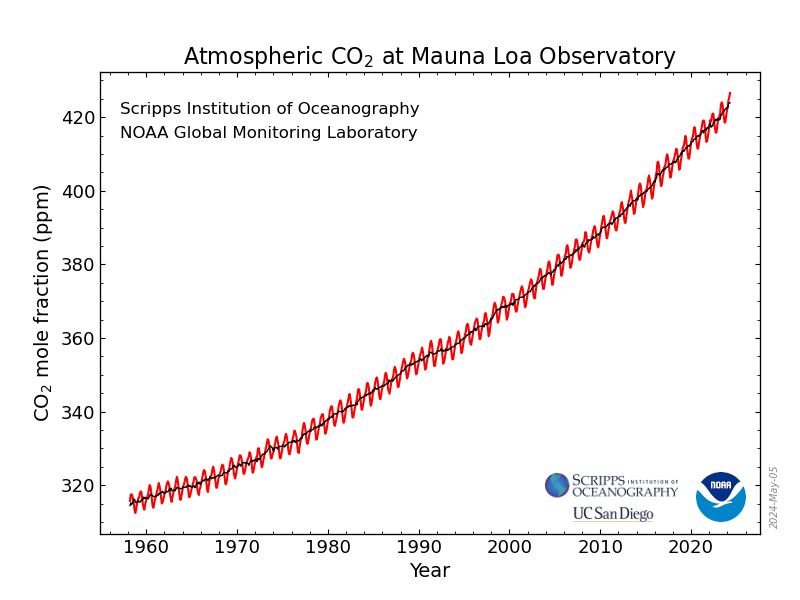
But it is fair to say that as the planet warms, we can expect weather to get wackier and more extreme. What we’re seeing now may just be a mild prelude to what’s yet to come.