Click the link to read the article on the ProPublica website:
by Mark Olalde, illustrations by Peter Arkle, special to ProPublica
December 30, 2024
ProPublica is a Pulitzer Prize-winning investigative newsroom. Sign up for The Big Story newsletter to receive stories like this one in your inbox.
Series: Unplugged:Will Taxpayers Foot the Oil Industry’s Cleanup Bill?
In December 1990, officials in the federal agency tasked with regulating offshore oil and gas drilling received a memo with a dire warning: America faced a ticking time bomb of environmental liability from unplugged oil and gas wells, wrote the agency’s chief of staff. Those wells and their costly cleanup obligations were being concentrated in the hands of cash-strapped drillers at the same time as production was shrinking. (The document, unearthed by public interest watchdog organization Documented, was shared with ProPublica and Capital & Main.)
More than three decades later, little action has been taken to heed that warning, and the time bomb is threatening to explode.
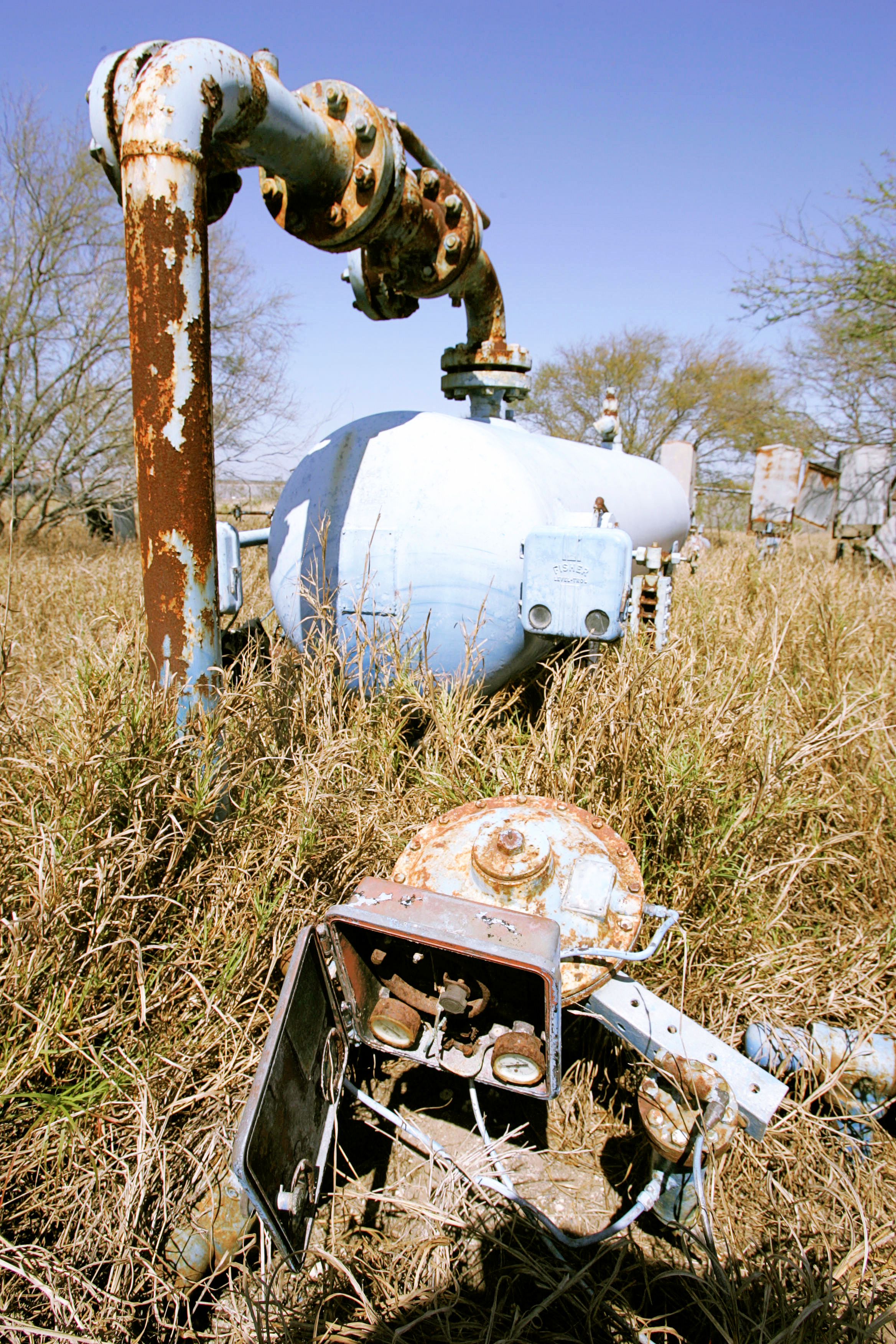
More than 2 million oil and gas wells sit unplugged across the country. Many leak contaminants like brine, methane and benzene into waterways, farmland and neighborhoods. The industry has already left hundreds of thousands of old wells as orphans, meaning companies walked away, leaving taxpayers, government agencies or other drillers on the hook for cleanup.
America’s oil fields are increasingly split between a small number of wells producing record profits and everything else. Researchers estimate roughly 90% of wells are already dead or barely producing.
Consider the Permian Basin, the world’s most productive oil field, stretching from West Texas across southeastern New Mexico.
“The Permian is the oil patch’s Alamo — that’s where it’s retreating to,” Regan Boychuk, a Canadian oil cleanup researcher, said of the oil industry. “That’s their last stand.”
Even here, many wells sit idle and in disrepair. It’s time to plug them, according to a growing chorus of researchers, environmentalists and industry representatives.
The question of who pays for cleanup remains unanswered. Time and again, oil companies have offloaded their oldest wells. Their tactics are not written down in one place or peddled by a single law firm — but companies follow an unmistakable pattern. The strategy, which is legal if followed properly, has become such a tried-and-true endeavor that researchers and environmentalists dubbed it “the playbook.”
Clark Williams-Derry, an analyst with clean-energy-focused think tank the Institute for Energy Economics and Financial Analysis, studies fossil fuel companies’ cleanup costs. “There’s almost a cheerleading squad for shedding your liabilities, like a snake sheds its skin and just slithers away,” he said.
Should you want to become an oil executive and try this strategy yourself, here’s how it works …
As you launch your business, begin by collecting subsidies, tax breaks and other incentives from the government to guarantee you can pump oil and gas profitably. Globally, fossil fuel subsidies total in the trillions each year, according to organizations such as the International Monetary Fund.
Next, start pumping and profiting.
As you set up your business, create layers of shell companies. Down the road, they’ll provide a firewall between you and your liabilities — key among them, cleanup costs.
Once oil and gas production slows, sell low-producing wells. Smaller drillers operating on thinner margins, known in the business as “scavenger companies,” will be happy to take them off your hands.
Rinse and repeat by selling wells as their profits slow to a trickle. They’ll be sold again to ever-smaller companies that teeter on the edge of insolvency. Maintenance and environmental stewardship will usually fall by the wayside as companies eke out a profit. Studies show that the number of environmental violations rises as wells pass to less-capitalized drillers. But these wells aren’t your problem any longer.
Pull any remaining profits before regulators hit you with violations and fines for your remaining wells that aren’t pumping and may be leaking.
Then, idle the wells — pausing production, but not plugging them or cleaning up — and walk away. Regulators are typically tasked with ensuring that as much oil as possible is pumped out of the ground, so rules allow wells to sit idle, instead of being plugged, in case prices surge and it becomes profitable to restart them. However, a study in California found that, after wells are inactive for only 10 months, there’s a 50-50 chance they will never produce again.
Regulators will likely grow tired of asking you to clean up your wells, but you can make the case for leaving them unplugged for now. Pitch grand plans, as other drillers have — maybe repurposing the wells for bitcoin mining, carbon sequestration or the synthesis of hydrogen fuel — that require the wells to remain open.
When regulators’ patience has reached its limit, remind them what will happen if they come down hard on you. Fines or other extra costs could force your business into bankruptcy, leaving your unplugged wells as orphans and taxpayers on the hook. Ask them if they want to be responsible for that catastrophe.
“The root of the problem is there’s no regulator of the oil industry across North America,” Boychuk said, adding that “the rule of law has never applied to oil and gas.”
When regulators finally act, declare bankruptcy. The Bankruptcy Code is meant to protect businesspeople like you who took risks. More than 250 oil and gas operators in the U.S. filed for bankruptcy protection between 2015 and 2021, according to law firm Haynes Boone. (Industry groups estimate there are several thousand oil companies in the country.)
Regulators only require oil and gas companies to set aside tiny bonds that act like a security deposit on an apartment. Because you didn’t clean up your wells, you’ll lose that money, but it’s a fraction of the profits you’ve banked or the cost of the cleanup work. ProPublica and Capital & Main found that bonds typically equal less than 2% of actual cleanup costs.
And as you finalize your exit, the labyrinth of shell corporations you set up should act as corporate law intends, protecting you from future responsibility. Such companies, little more than stacks of paper, will be responsible for your liabilities, not you. Even if regulators know who is behind a company, it becomes increasingly difficult to penetrate each layer of a business to go after individual executives.
“It’s the essence of corporate law,” Williams-Derry said.
Now that you’ve offloaded your wells, you’re free to start fresh — launch a new oil company and buy some of your old wells for pennies on the dollar, a proven option. Maybe you leave oil entirely — that’s also tried-and-true. Or become a vintner and open a winery just down the road from the wells you left as orphans — you wouldn’t be the first.
For its part, the oil industry downplays the so-called playbook and the country’s orphan well epidemic. “There’s a general trend, which is there are very few orphan wells,” said Kathleen Sgamma, who has been among oil companies’ most vocal proponents as president of the Western Energy Alliance, an industry trade group. Plus, she said, companies’ bonds and states’ orphan well funds help pay for plugging.
But those tasked with addressing the reality of the country’s orphan wells disagree. “We have a welfare system for oil and gas. I hope you understand that,” said New Mexico Commissioner of Public Lands Stephanie Garcia Richard, who oversees the state’s public lands. New Mexico has already documented more than 1,700 orphan wells across the state. “We have oil and gas welfare queens.”
In New Mexico, Garcia Richard is trying to hold accountable one of the myriad drillers that have followed key steps in the playbook, the oil company known as Siana.
Siana is made up of two related entities — Siana Oil and Gas Co. LLC and Siana Operating LLC — based in Midland and Conroe, Texas. The company operated 11 wells in southeastern New Mexico in the heart of the Permian Basin.
In reality, Siana is the corporate shield for a man named Tom Ragsdale. After he aggregated his few wells, he generated cash through a trickle of oil and gas production and set up a business injecting other companies’ wastewater into his wells to dispose of it. But the state worried that Ragsdale’s operations were polluting the environment and that he was refusing to pay royalties and rental fees he owed the state, according to State Land Office staff.
Ragsdale did not respond to repeated requests for comment from ProPublica and Capital & Main. He also did not appear for a pretrial conference after the state brought legal action against Siana, court records show, and a state court judge ruled against his companies.
Siana was responsible for at least 16 spills, according to New Mexico Oil Conservation Division data, mainly spilling what’s called produced water, a briny wastewater that comes to the surface alongside oil and gas. “Corrosion” and “Equipment Failure” were among the causes.
The State Land Office hired an engineering firm to study the damage. The firm produced a damning 201-page report in 2018, finding oil and salt contamination exceeding state limits at Siana’s most polluted site. At high enough levels, these substances can kill plants, harm wildlife and impact human health.
The State Land Office estimated that cleaning up that site alone would cost about $1 million.
In 2020, New Mexico won a judgment against Ragsdale’s companies that, with interest, is now worth more than $3.5 million. But it won’t cover the cleanup cost. Between a small bond and the judgment, the state has been able to recover a mere $50,000 or so from Siana and related entities.
When the state tried to collect the rest, Ragsdale placed Siana Oil and Gas in bankruptcy protection in June 2023. Although he listed the company as having millions in assets at the time of the bankruptcy, the company had only $20,500 in a bank account. Court records show Siana is responsible for between $1 million and $10 million in liabilities, including money owed to the state of New Mexico, other oil companies, various counties and others.
Stickers plastered around Siana’s drill sites — on which the company’s name is misspelled — provide phone numbers to call in case of leaks or other emergencies. None went to Ragsdale or Siana employees. A man named William Dean answered one number. He owned a local oil field services company called Dean’s Pumping that was contracted to work on Siana’s wells, but Ragsdale stopped paying its bills, ultimately owing his company tens of thousands of dollars, Dean said.
“He was trying to half-ass things,” Dean said of Ragsdale. “I don’t know what happened to Tom.”
Siana’s bankruptcy case is ongoing, but Ragsdale has been largely unresponsive even in those proceedings.
Siana is, Garcia Richard said, “an exemplar of how our system has failed.” Although he was very nearly free of his old wells, Ragsdale flouted the playbook and ignored the bankruptcy judge’s demands that he participate in the case. In an unusual move, the judge in late September issued a warrant for Ragsdale’s arrest to compel him to hand over certain data. The U.S. Marshals Service was investigating Ragsdale’s whereabouts but had not taken him into custody as of mid-December, according to an agency representative.
The day after the judge issued the arrest warrant, the bankruptcy trustee filed a complaint alleging Ragsdale had committed fraud, siphoning about $2.4 million from Siana to purchase real estate in Houston.
That money could have gone toward cleaning up the mess left to New Mexico taxpayers.
ProPublica and Capital & Main visited Siana’s 11 wells in late 2023. At one drill site, methane leaked from a wellhead that had also stained the surrounding land black from spilled oil. The air was sour with the smell of toxic hydrogen sulfide. A nearby tank that held oil for processing was rusted through. Another had leaked an unidentified liquid. There appeared to be hoofprints where cattle had tracked through the polluted mud.
ProPublica and Capital & Main found oil spills at multiple Siana wells. At others, the idle pump jacks stood silent — corroded skeletons at the end of the line, the detritus of another run through the playbook.
Efforts to reform the system that has shielded oil companies from liability have been haphazard. When the federal government rewrote its rule setting bond levels on federal public land earlier this year, a simple math error meant the government would ask oil companies to set aside around $400 million less in bonds than it would’ve otherwise. And when states have tried to pass reforms, they’ve been stymied by state legislators’ and regulators’ chummy relationships with the industry.
As an ever-greater share of wells go offline and the economy transitions to cleaner forms of energy, policymakers face a choice: Do they focus attention on propping up or cleaning up the industry?
Sgamma of the Western Energy Alliance gives voice to one path forward. “Any time a well goes into an orphan status, it’s not a good thing,” Sgamma said, yet her group has been instrumental in killing efforts to address the orphan well epidemic and the oil industry’s contributions to climate change. Her organization is suing to halt the federal rule that sought to bring bonding levels closer to true plugging costs.
Sgamma co-authored the energy section of Project 2025, the conservative policy paper with deep ties to the first Trump administration that lays out policy priorities for a conservative White House. The plan would “Stop the war on oil and natural gas,” reopen undeveloped habitat from Alaska to Colorado for drilling, increase the number of sales for oil leases on public lands and shrink federal environmental agencies. President-elect Donald Trump has repeatedly indicated this closely aligns with his vision for pumping America’s “liquid gold.” He has begun staffing his administration with pro-oil and gas figures.
The future for which Sgamma is fighting sees a resilient American oil and gas industry, able to “take a lot of punches” while continuing to grow unabated.
Or there’s the future Garcia Richard, who oversees New Mexico’s public land, envisions. She has paused the leasing of public land to drillers until the Legislature forces oil companies to pay state taxpayers higher royalties that reflect fair market rates. She directed her staff to aggressively pursue companies like Siana. And her office is preparing to raise required bonding levels. As she talked about this work, she held up the literal rubber stamp that imparts the State Land Office’s seal on documents, suggesting that’s not how business is done anymore. She also held up a small notebook where she tracks the numerous companies her office is pursuing for polluting the state’s land and water.
In her future, Garcia Richard said, oil drillers wouldn’t behave like Siana and Ragsdale. “A good-acting company is a company that understands there’s a cost of doing business that shouldn’t be borne by the landowner, shouldn’t be borne by the taxpayers,” she said. But in the modern American oil industry, she added, the playbook and the still-burning fuse of the cleanup time bomb represent little more than “Wild West behavior.”