The Front Range Water Council has its eyes on water requirements for oil shale exploration and production

shellfreezewalloilshale.jpg

Water supply planning requires forecasting demand decades into the future. The Front Range Water Council is wary of water requirements for oil shale — the “Next Big Thing” for over a hundred years now — since many of the water rights that oil companies have purchased are senior to most of the large transmountain diversion projects. Here’s a report from the Colorado News Service (Kathleen Ryan) via The Fowler Tribune. From the article:

Jim Lochhead, president of the group and CEO of Denver Water, says half of the Denver water supply comes from the Colorado River, and he’s worried that oil shale production could overtax the river’s resources. “We’re concerned that the BLM and the United States not go too far too fast in their leasing program, before really understanding and quantifying these impacts on the river.”[…]

According to a report from Western Resource Advocates, oil and gas companies hold some rights to Colorado River water which predate the rights held by cities for drinking water. The BLM is expected to have a new plan in place by the end of the year.

More oil shale coverage here and here.

‘Oil shale development would involve intensive use of water’ — Alan Hamel

oilshaledepositscowyutblmostseis.jpg

From The Pueblo Chieftain (Chris Woodka):

“We have to protect the water we have, as well as provide water for endangered species,” said Alan Hamel, executive director of the Pueblo Board of Water Works and a member of the Colorado Water Conservation Board. “Oil shale development would involve intensive use of water, particularly for use in power generation.” Last month, the Pueblo water board and other members of the Front Range Water Council weighed in on the Bureau of Reclamation’s environmental impact statement for oil shale and tar sands…

The Front Range Water Council includes the major organizations that import water from the Colorado River: Denver Water, the Northern and Southeastern Colorado water conservancy districts, Aurora Water, Colorado Springs Utilities, Twin Lakes Reservoir and Canal Co. and the Pueblo water board. Collectively, they provide water to 4 million people, 82 percent of the population in Colorado.

More Front Range Water Council coverage here and here.

New Ceres Report: Oil Shale Development in Western U.S. Poses Significant Risks to Investors

oilshaledepositscowyutblmostseis.jpg

Here’s the link to the report (registration required). Here’s the release from Ceres:

Citing technological uncertainties and a wide range of other risks, a new Ceres white paper supports a federal agency’s proposal to take a cautious approach to oil shale production in the western U.S.

At issue is the Bureau of Land Management’s proposal to focus oil shale production in Wyoming, Utah and Colorado on “Research, Development, and Demonstration” (RD&D) leases only and to reduce the available acreage to about 500,000 acres from nearly two million acres under an earlier plan.

“Given the wide array of uncertainties, BLM’s proposed leasing approach on oil shale makes sense,” said Ceres president Mindy Lubber, citing regulatory risks, water constraints and numerous other questions about various technologies being pursued to extract a non-liquid form of oil from shale rock. “Investors should be similarly cautious in evaluating future investment in this space.”

“Oil shale technologies are still highly speculative, and proving them to be commercially viable will be difficult and require a long period of time with uncertain outcomes,” said Paul Bugala, senior sustainability analyst, extractive industries, at Calvert Investments. “The little that state and federal regulators know about the environmental impacts, especially in the areas of water use and land reclamation, further indicates that caution should be exercised.”

While oil shale reserves beneath the three states in the Green River Formation are vast, holding more than three times the proven reserves of Saudi Arabia, the Ceres white paper, Investor Risks from Oil Shale Development, sends a strong cautionary message to policymakers, investors and companies alike.

The white paper, prepared by David Gardiner & Associates, LLC, identifies five key risks to oil shale development:

Core technological uncertainty: Despite decades of efforts, surface and in-ground technologies for producing oil shale still face many uncertainties. The report states: “The uncertainties around continued testing and development of new technologies and processes for producing oil from oil shale leave a great deal still unknown, including the amount of the resource that is recoverable, the efficiencies and costs of various methods, the impacts on natural resources, and the effects of various technologies on the costs of final products (and thus the competitiveness of oil shale).” The white paper cites an earlier report by the Task Force on Strategic Unconventional Fuels (comprised of federal, state, and local officials) which states: “[t]echnology uncertainty is the largest single risk factor associated with oil shale development. This uncertainty remains even after 50 years of government and industry research to develop a commercially viable retorting technology.”

Market risks: Production of oil shale is characterized by significant capital investment, high operating costs, and long payback periods – at least a decade. Uncertainties about the costs associated with developing a first-generation commercial facility, combined with oil price volatility and other uncertainties, pose investment risks that make oil shale investment less attractive than other potential uses of capital. Sporadic attempts to commercialize oil shale have repeatedly failed once oil prices fall.

Water constraints: Oil shale development’s need for water is a particular concern in water-stressed states such as Colorado and Utah. The report cites estimates showing that surface technologies may require 2 to 4 barrels of water for every barrel of product produced while in-ground technologies may require up to 12 barrels of water per barrel produced. The U.S. Government Accountability Office has suggested that the size of the oil shale industry in Colorado and Utah may be limited by water availability.

Regulatory risks: Lifecycle carbon emissions for oil shale fuels are likely to be 25 to 75 percent greater than for conventional petroleum. This means oil shale development could face risks as carbon-reducing rules and regulations take hold – whether low-carbon fuel standards, a price on carbon emissions, lifecycle emissions requirements, or other measures. Other federal and state environmental regulations, including those related to air and water quality, also pose risks to oil shale development.

Risks from public opposition: Public opposition to oil shale based on the actual or perceived environmental impacts could “derail, delay, or increase the costs of such projects,” says the white paper.

More than 70 percent of the Green River Formation oil shale resources lie beneath federal lands. BLM is presently considering public comments on its proposal to limit development to RD&D leases on 252,181 acres in Utah, 174,476 acres in Wyoming and 35,308 acres in Colorado. A decision is expected in fall 2012.

From the Ceres website:

Ceres is an advocate for sustainability leadership. Ceres mobilizes a powerful coalition of investors, companies and public interest groups to accelerate and expand the adoption of sustainable business practices and solutions to build a healthy global economy. Ceres also directs the Investor Network on Climate Risk (INCR), a network of 100 institutional investors with collective assets totaling more than $10 trillion.

More oil shale coverage here and here.

White River basin: In the event that an economic oil shale production process is developed, is there enough water available?

oilshaledepositscowyutblmostseis.jpg

Here’s a guest column written by Colorado River Basin Roundtable member, Greg Trainor, running in the Grand Junction Free Press that looks at the question. From the article:

In Northwest Colorado, where energy development is a major industry and we hear a constant buzz about oil shale (will it or won’t it take off?), the Yampa-White and Colorado Basin Roundtables determined that water demands from the energy industry must be estimated and a plan developed for where this water might come from. The roundtables commissioned an extensive study to find the answers.

The study showed that water use for oil shale has the potential to dwarf all other energy sector demands for water — but that these needs can probably be met with water from the White River Basin through existing and new reservoir projects.

The technology of a future oil shale industry is uncertain, so future water demands are also uncertain. Past industry efforts and current experimental development employ an array of above-ground and in situ (in place) technologies to extract oil from rock, and projected water use varies among these technologies. The study developed high, medium and low oil production and water use scenarios to develop a range of plausible water use estimates.

The study’s high water use estimate uses data from Dutch Shell’s in situ conversion process, which requires electrical heating and cooling. Water needs include water related to supplying electricity as well as directly in the extraction process. At a high production scenario of 1.5 million barrels/day of oil production, this scenario yields an overall estimate of 110,000 acre-feet of water use per year.

This final “high” estimate is significantly lower than the one generated in the first phase of the study. The earlier estimates assumed all energy needs for extracting oil from shale would be met by coal-fired power plants, while Phase II more realistically assumed that the industry would use gas-powered plants, which use much less water.

The study identified three water supply projects in the White River Basin that could potentially meet an annual demand of 110,000 acre feet/year. These three projects are not the only water supply option available, but do demonstrate that the water needs can be supplied from the White River, via development of junior decrees, with reasonable development costs.

More oil shale coverage here and here.

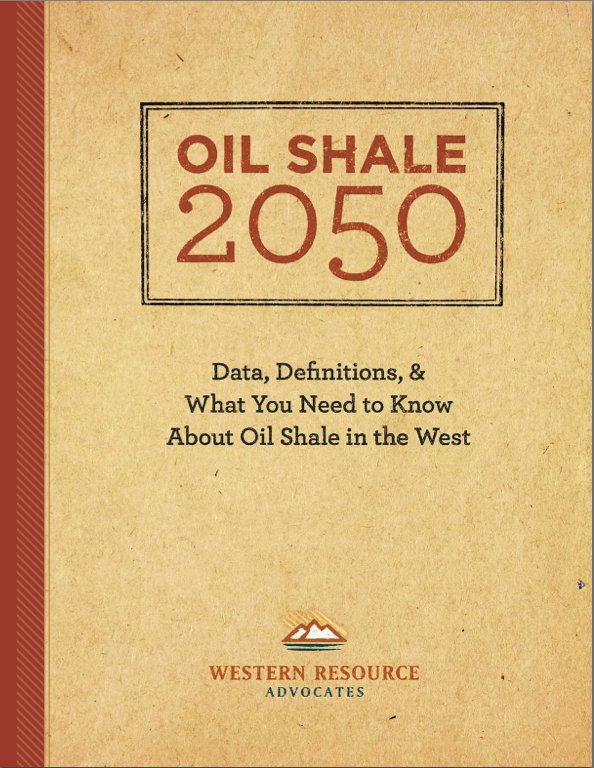
Western Resource Advocates: ‘Oil Shale 2050’ report is hot off the press

oilshale2050wra.jpg

Click here to download a copy of the report Oil Shale 2050: Data, Definitions, & What You Need to Know About Oil Shale in the West. Here’s an excerpt:

As the debate over potential oil shale development in
the western United States continues, Western Resource Advocates (WRA) has focused on understanding the nature of the oil shale deposits; the state of the technologies companies are trying to advance; the environmental, economic, social, and climate impacts of exploiting these deposits; and what development would mean for our energy demands and goals. This report explores these matters.

This report is largely an educational tool, concentrating on the salient issues central to the ongoing debate over the wisdom and feasibility of producing liquid fuel from oil shale. Many of the issues discussed in this report are framed from the perspective of the year 2050. Why 2050? First, it is a baseline that states commonly use to project water demands. It is also roughly the date by which such companies as Royal Dutch Shell predict they might be in a position to produce large quantities of oil from shale, depending on the results of current research and testing…

By the year 2050, economists, biologists, climatologists, and a variety of other scientists predict huge changes to the West. Their models forecast that there will be less water in the Colorado River Basin, with escalating demand from a rapidly growing population. The population of the state of Colorado is projected to swell by 57% over the next 30 years. Utah, the second-driest state in the nation, anticipates a 105% increase in its population by 2050. Because of this growth, in Colorado alone, municipal and industrial water demands are estimated to increase by as much as 83%.

By 2050, the competition for water will be fierce and will only be compounded by climate change. Decisions we make today about a host of concerns, including whether or not to develop oil shale, will directly impact the amount of available water in 2050. As a result of climate change, water in the Colorado River Basin is projected to decrease anywhere from 5% to 20% by 2050. Current projections conclude that we will rely heavily on water currently used for agriculture to cover growing municipal and industrial demands.

By 2050 we might be less reliant on fossil fuels for planes and automobiles. Alternatives might include electric cars powered by renewable sources, or biodiesel made from algae, or energy sources that researchers are not yet exploring.

More oil shale coverage here and here.

State of the Rockies Project: Interior Secretary Salazar says develop but protect the environment at the same time

kensalazarnewmexicoindependent.jpg

From the Associated Press via the San Francisco Chronicle:

Salazar spoke during the State of the Rockies Project conference at Colorado College, where students have been studying how to preserve the Colorado River basin…

…climate change, drought and population growth in the West have heightened interest in how the states and Mexico can continue sharing the [Colorado] river and still support irrigation, hydropower, tourism, recreation, agricultural and municipal needs and wildlife. Salazar said the Colorado River Compact that outlines how seven Western states and Mexico will share the river system’s water was created without the best science or knowledge. The agreement wrongly assumed there was 2 million acre-feet more available than there really is, he said. Nevertheless, he said the compact will not be reopened. Within Salazar’s department, the U.S. Bureau of Reclamation is reviewing ideas for how to address a projected imbalance in Colorado River basin supply and demand.

Meanwhile the U.S. and Mexico continue to negotiate details of how to share the river. Salazar’s appearance Monday came the same day that 25 conservation groups delivered a petition urging the U.S. and Mexico to allow some flows to return to the dried-up delta where the Colorado River flows into the Gulf of California. Salazar said the U.S. and Mexico hope to announce results of the negotiations soon. He didn’t give a timetable.

More coverage from Debbie Kelley writing for the Colorado Springs Independent. From the article:

As President Obama’s appointed U.S. Secretary of the Interior, the San Luis Valley native and 1977 CC graduate is familiar with the problems associated with what’s often called “the hardest-working river” in the nation. “The Colorado River is already a water-short river — more water has been allocated than what that river has today, not only along southern states but with the treaty with Mexico,” Salazar said during the 2012 State of the Rockies Project conference, which continues Tuesday. But Salazar assured the hundreds of conference attendees that his department is working on the issues and hopes to announce a new allocation agreement with Mexico soon.

The river is ruled by a compilation of decrees, rights, court decisions and laws that together are referred to as the “Law of the River.” The keystone is the 1922 Colorado River Compact, an interstate agreement for general water allotments, which Salazar said overestimated by 2 million acre feet the annual amount of water that could be extracted from the river. In response to a question from the audience, Salazar said he doesn’t think the Compact will ever be opened up for negotiation: “The legacies that have been created over 89 years are so embedded in the Law of the River,” he said…

Salazar also seized on the connection between the dwindling water supply and the energy industry, deriding the push by U.S. Rep. Doug Lamborn, R-Colorado Springs, for expanded oil shale development. “We need to let the world know how much water would be required to develop those oil shale resources — the estimates I’ve seen are over 1 million acre feet and some at 2 million,” Salazar said. “Where would that water come from? What’s going to be the consequences to the ranchers and farmers dependent on the Colorado River?”

More Colorado River basin coverage here.

State of the Rockies Project: Will and Zak release a new video — ‘A Paddler’s Perspective on the Colorado River Delta’

willorzakcoloradoriverdelta2012stateoftherockies.jpg

Here’s the link to the video. Will and Zak paddled from the headwaters of the Green River to the Colorado River Delta as researchers for Colorado College’s State of the Rockies Project.

More Colorado River Basin coverage here.

Report: Oil Shale 2050 — Data, Definitions, & Everything You Need to Know About Oil Shale in the West

oilshaledepositscowyutblmostseis.jpg

Oil shale has been the next big thing here in Colorado for over a 100 years now. Here’s the release from Western Resource Advocates (Jason Bane):

Today Western Resource Advocates (WRA) introduced a comprehensive new report about oil shale development titled: “Oil Shale 2050: Data, Definitions & What You Need to Know About Oil Shale in the West.” This timely new analysis of oil shale in the Western United States comes just one week ahead of public meetings planned by the Bureau of Land Management (BLM) to discuss a new federal policy on oil shale development.*

“We looked at this issue inside and out, and based on extensive research, we can’t find a good reason why commercial oil shale development should be pursued in the West,” said David Abelson, Oil Shale Policy Advisor at WRA and the lead author of Oil Shale 2050. “Frankly, I sometimes wonder why this is even a discussion. Oil shale would foul our air and water, soak up enormous amounts of water, and disrupt local economies. And nobody has been able to come up with a viable commercial process to produce it anyway.”

Oil Shale 2050 is the first report to link water demands and regulatory frameworks with potential oil shale development, examining the history of oil shale and key data points all under one cover. The release of Oil Shale 2050 is particularly timely; the BLM is holding public meetings in Colorado, Utah and Wyoming next week to discuss proposed federal guidelines for oil shale research and development, and this report is the ideal guidebook for those discussions.

The report also comes on the heels of a late February announcement by Chevron, in which the company decided to stop working on oil shale research in order to redeploy resources towards fuel sources for which extraction technologies already exist.

“Chevron’s announcement is another in a long line of examples proving that nobody knows how to develop oil shale on a commercial scale,” said Rob Dubuc, Staff Attorney and Oil Shale Expert in WRA’s Utah office. “Oil and gas companies are abandoning oil shale research independently, yet the State of Utah is still preparing to turn over public resources for speculative development. That’s like building a factory before you know how to make the widget. It doesn’t make sense.”

Oil Shale 2050 addresses these issues and more, including:

• What is oil shale and how might it be turned into a fuel source?
• Will oil shale production ever be commercially viable?
• How would oil shale development impact the environment compared to the production of more traditional sources of fuel?
• What are the impacts of diverting large amounts of water for oil shale development? How would that impact present and future demand for water?
• How is oil shale different from shale gas and shale oil?

“Even if we could develop oil shale, we would need a larger conversation about whether we should,” said Mike Chiropolos, Chief Counsel to the Lands Program at WRA. “Annual commercial oil shale production could require one-and-a-half times the water needs of all 1.3 million Denver Water customers. Where would that water come from?”

This year may well be the most important year in the history of oil shale speculation, as upcoming decisions by the Department of the Interior and Congress will fundamentally direct the course of oil shale policy for decades. Oil Shale 2050 will be an invaluable tool for decision-makers as they plot the future allocations of Western lands and energy sources.

To download the complete report or fact sheets, go to www.WesternResources.org/oilshale2050.

*The BLM is holding public meetings on oil shale in Colorado, Utah and Wyoming during the week of March 12. For a list of scheduled meetings, go to: http://ostseis.anl.gov/involve/pubschedule/index.cfm

More coverage from the Colorado Independent (Troy Hooper):

“Water is the defining resource in the West,” Mike Chiropolos, chief counsel for Western Resource Advocates, told reporters on a conference call this week. “There is an enormous uncertainty of what the impacts are of utilizing large quantities of that supply.”

The report, “Oil Shale 2050, comes in advance of the Bureau of Land Management’s meetings in Colorado and Utah next week that ask for public feedback to the Department of Interior’s plan to dramatically scale back the acreage of lands available for oil shale and tar sands development. Federal officials are proposing to cut the Bush-era oil leasing inventory from 1.9 million acres to 462,000 for oil shale and from 431,000 acres to 91,000 for tar sands.

U.S. Rep. Doug Lamborn, R-Colorado, however, is sponsoring H.R. 3408, the “Pioneers Act,” which would revive the Bush-era plan to open vast amounts of public lands in Utah, Wyoming and western Colorado to oil shale and tar sands production. His bill made it out of the House Committee on Natural Resources last month, and House Speaker John Boehner has said oil shale revenues will partly pay for national transportation projects in the next five years.

Oil shale production, however, has yet to be proven commercially viable.

More coverage from KSL.com (Amy Joi O’Donoghue). From the article:

“Oil Shale 2050,” released by Boulder-based Western Resource Advocates, details critical links between the resource development and its use of water in the thirsty West, as well as what the group says is an unproven technology that should be abandoned in pursuit of clean energy alternatives. “The finite research and development dollars available should be invested in clean energy solutions,” said Mike Chiropolos, the group’s chief counsel of its lands programs.

Chriopolos and two other representatives from the organization spoke to the report’s findings in a Wednesday teleconference, noting that after 100 years of trying to pull deposits from the ground, the industry is no closer to success. The trio pointed to the late February decision by Chevron to give up its experimental lease for oil shale in Colorado, instead opting to direct its three staffers on that project to work in other areas. They said they hope that sends a signal to other would-be developers.

More oil shale coverage here and here.

Geologic primer for western Colorado

northtosouthcrosssectioncoloradorivervalleyatparachutecgs.jpg

Here’s a report from the Glenwood Springs Post Independent (John Colson). Click through and read the whole article. Here’s an excerpt:

Peter Barkmann, and environmental geologist and hydro-geologist for the Colorado Geological Survey, offered a primer on the deep geologic history of western Colorado in a presentation last week to the Northwest Colorado Oil and Gas Forum, which meets quarterly in Rifle. Barkmann described the formation of the Mesaverde and other energy-rich rock layers formed from coastal plains sediments deposited 75 million years ago…

The organic deposits of the seaway, laid down over eons, were covered by accumulating layers of rock and sediment. Buried deep underground, subjected to extreme pressure and heat, the organic materials gradually decomposed and permeated the surrounding rock, forming deposits of coal, oil, gas and oil shale.

More Colorado River basin coverage here.

Shell is turning dirt on an experimental oil shale lease in western Colorado

shellfreezewalloilshale.jpg

From the Associated Press via The Washington Post:

Carolyn Tucker of Shell said Thursday that the company continues to make “significant progress” on its oil shale project, which until now has occurred only on Shell land. The Daily Sentinel reports (http://bit.ly/xFbleJ ) Shell is preparing to do a test to address the federal government’s goal of developing oil shale while also extracting, or at least protecting, commercially valuable deposits of nahcolite in the same formations. Shell has three federal leases in Colorado’s Rio Blanco County for research on turning oil shale into oil.

More oil shale coverage here.

Chevron gives up their experimental lease on the ‘Next Big Thing’ in energy — oil shale

oilshaledepositsutwyco.jpg

Oil shale has been the “Next Big Thing” in energy in Colorado for over a hundred years now. Chevron is the latest victim of the non-economic energy source. Here’s a report from the Associated Press via The Denver Post. From the article:

Chevron Corp. is giving up its experimental oil shale lease in northwest Colorado, saying it wants to free up its resources for other priorities. The company is working with the Bureau of Land Management to figure out what to do with the lease, including possibly transferring it to another company, The Grand Junction Sentinel reported Tuesday…

Chevron had been studying using carbon dioxide to draw out kerogen, a petroleum-like substance, from rock. The company said in a statement that the research was “productive.”

More oil shale coverage here.

BLM Announces Public Meetings on Potential Environmental Impacts of Oil Shale and Tar Sands Development

oilshaledepositsutwyco.jpg

Here’s the release from the U.S. Bureau of Land Management (Megan Crandall):

The Bureau of Land Management announced today that it is hosting public meetings in Colorado, Utah, and Wyoming to answer questions about and solicit comments on its oil shale and tar sands Draft Programmatic Environmental Impact Statement (Draft PEIS). The meetings will be held at 7 p.m. at the locations and dates listed below:

Monday, March 12, 2012
BLM Colorado River Valley Office
2300 River Frontage Road, Silt, Colorado
7:00 p.m.-9:30 p.m.

Tuesday, March 13, 2012
Westin Plaza Hotel
1684 West Highway 40, Vernal, Utah
7:00 p.m.-9:30 p.m.

Wednesday, March 14, 2012
Grand America Hotel
555 South Main Street, Salt Lake City, Utah
7:00 p.m.-9:30 p.m.

Thursday, March 15, 2012
BLM Rock Springs Field Office
280 Highway 191 North, Rock Springs, Wyoming
7:00 p.m.-9:30 p.m.

BLM officials will be on hand to take written comments and assist with the commenting process. The Draft PEIS is being prepared by the BLM to assess a range of management alternatives for future oil-shale and tar-sands activities on public lands. The Notice of Availability of the Draft PEIS was issued in the Federal Register on February 3, 2012. A 90-day public comment period began that day and will close on May 4, 2012.

Written comments on the Draft PEIS should be submitted by May 4 using an online comment form on the Draft PEIS Website at http://ostseis.anl.gov. This is the preferred method for commenting. Comments may also be submitted by regular mail to: Oil Shale and Tar Sands Draft Programmatic EIS, Argonne National Laboratory, 9700 South Cass Avenue, EVS 240, Argonne, IL 60439.

From The Rifle Citizen Telegram:

The Bureau of Land Management will host meetings in Colorado, Utah and Wyoming to answer questions about and solicit comments on its oil shale and tar sands Draft Programmatic Environmental Impact Statement (Draft PEIS). The Colorado meeting will be held from 7-9:30 p.m. on Monday, March 12, at the BLM Colorado River Valley Office, 2300 River Frontage Road, in Silt.

More oil shale coverage here and here.

BLM Issues Draft Programmatic EIS for Oil Shale and Tar Sands; Preferred Alternative Identifies Research and Development as Appropriate First Step on Public Lands

oilshaledepositsutwyco.jpg

Here’s the release from the U.S. Bureau of Land Management (Megan Crandall):

The Bureau of Land Management (BLM) has published the Notice of Availability (NOA) of the Draft Programmatic Environmental Impact Statement (PEIS) and Possible Land Use Amendments for Allocation of Oil Shale and Tar Sands Resources on Lands Administered by the BLM in Colorado, Utah and Wyoming. The publication opens a 90-day public review and comment period.

The Draft PEIS analyzes several alternatives for land allocation and resource management. Under the BLM’s Preferred Alternative identified in the Draft PEIS, the BLM would continue to support the research and development of hydrocarbon deposits in an environmentally responsible way that protects scarce water supplies in the arid West.

If the BLM decides to adopt the Preferred Alternative, 461,965 acres would be available for research and development of oil shale, a kerogen-rich rock (35,308 acres in Colorado; 252,181 acres in Utah; and 174,476 acres in Wyoming). In addition, 91,045 acres in eastern Utah would be available for activities related to tar sands, a type of hydrocarbon-wet sedimentary deposit.

“The preferred alternative continues our commitment to encouraging research, development, and demonstration projects so that companies can develop technologies that can lead to economic and commercial viability,” said BLM Director Bob Abbey. “Because there are still many unanswered questions about the technology, water use, and impacts of potential commercial-scale oil shale development, we are proposing a prudent and orderly approach that could facilitate significant improvements to technology needed for commercial-scale activity. If oil shale is to be viable on a commercial scale, we must take a common-sense approach that encourages research and development first.”

To date, technological and economic conditions have not combined to support a sustained commercial oil shale industry in the United States, and there is currently no commercial development of oil shale in the areas under review in the draft PEIS. Lands that would be open to oil shale development under the Preferred Alternative would be available for Research, Development, and Demonstration (RD&D) leases. The BLM could issue a commercial lease after a lessee satisfies the conditions of its RD&D lease and meets all federal regulations for conversion to a commercial lease.

Additionally, following the recommendations of the Government Accountability Office – which determined that several fundamental questions about oil shale technologies remain unanswered, including critical questions about water demands – the United States Geological Survey (USGS) is undertaking an analysis of baseline water resources conditions to improve the understanding of groundwater and surface water systems that could be affected by commercial-scale oil shale development.

Oil shale is a term used to describe a wide range of fine-grained, sedimentary rocks that contain solid bituminous materials called kerogen. It should not be confused with “shale oil,” which is not addressed by the draft PEIS. Kerogen, which is organic matter derived mainly from aquatic organisms, releases petroleum-like liquids when subjected to extremely high temperatures – more than 750 degrees. Developers have been trying to produce oil from this rock in an economically-viable way for more than a century. The majority of U.S. oil shale (and the world’s largest oil shale deposit) is found in the Green River Formation in Colorado, Utah, and Wyoming.

Tar sands are sedimentary rocks containing a heavy hydrocarbon compound called bitumen. They can be mined and processed to extract the oil-rich bitumen, which is then refined into oil. However, unlike the oil sands deposits in Canada, oil is not currently produced from tar sands on a significant commercial level in the United States. Additionally, the U.S. tar sands are hydrocarbon wet, whereas the Canadian oil sands are water wet. This difference means that U.S. tar sands will require different processing techniques.

Any new land allocation decisions made on the basis of the Final PEIS would replace the land allocation decisions made in 2008 that proposed making up to 2 million acres of public lands available for commercial oil shale leasing in Utah, Colorado, and Wyoming and 431,000 acres available for tar sands leasing in Utah. Some Western communities argued that the 2008 PEIS and Record of Decision would have prematurely allowed commercial leasing without technologies having been proven viable and without a clear understanding of impacts on scarce Western water supplies. In response to those concerns and in settlement of litigation, the agency agreed to reconsider the 2008 land allocation decisions.

A 90-day public review and comment period began on February 3, 2012 and is scheduled to end on May 4, 2012.

Public meetings on the Draft PEIS will also be held in Rifle, CO; Rock Springs, WY; Salt Lake City; and Vernal, UT. The public will be notified of the dates and times of these meetings at least 15 days in advance via local media and the project website.

Written comments on the Draft PEIS may be submitted by any of the following methods:

Website – Using the online comment form available on the project Website:

http://ostseis.anl.gov. (This is the preferred method of commenting.)

Mail – Addressed to:

Oil Shale and Tar Sands Resources Draft Programmatic EIS
Argonne National Laboratory
9700 South Cass Avenue—EVS/240
Argonne, IL 60439.

Before including your address, telephone number, e-mail address, or other personal identifying information in your comment, you should be aware that your entire comment–including your personal identifying information–may be made publicly available at any time. While you can ask us in your comment to withhold your personal identifying information from public review, we cannot guarantee that we will be able to do so.

To read the BLM’s Federal Register Notice of Availability click here.

To read the Draft PEIS click here.

More coverage from Catharine Tsai writing for The Associated Press via The Casper Tribune. From the article:

A new draft environmental impact statement released Friday says the preferred plan now is to make 35,308 acres in Colorado, 252,181 acres in Utah, and 174,476 acres in Wyoming available for research. Also, 91,045 acres in eastern Utah would be available for activities related to tar sands. The public has until May 4 to comment on the proposal. The Bureau of Land Management estimates the Green River Formation in Colorado, Utah and Wyoming has about 1.2 to 1.8 trillion barrels of oil resources, but not all may be recoverable…

Following recommendations from the GAO, the U.S. Geological Survey is analyzing baseline water conditions so it can better understand how commercial-scale oil shale development could affect groundwater and surface water systems.

More coverage from Bruce Finley writing for The Denver Post. From the article:

Energy industry leaders said they are anxious to review details of the “draft programmatic environmental impact statement.”

“Any plan that delays development is not conducive to producing the energy that American consumers demand,” American Petroleum Institute spokesman Reid Porter said. “Testing is extremely important. But also there has to be certainty, an operating environment that’s conducive to investment.”

Rio Blanco County Commissioner Ken Parsons said he would prefer to see a plan that moves toward commercial development. “Some of it has to do with jobs, and there’s the energy independence question.”[…]

…Colorado Department of Natural Resources director Mike King backed the deliberative approach. “We need to be thorough and have a full understanding of potential impacts to the environment and our communities before we take steps toward large-scale leasing or development of oil shale.”

A coalition of farmers, ranchers, sportsmen and city officials and others has supported a rollback of the Bush administration’s 2008 push for opening public lands to tap oil shale. “We’re really concerned about the impacts on water. We cannot gamble away our water on oil shale speculation,” said Bill Midcap, director of renewable energy development for the Rocky Mountain Farmer’s Union. “We cannot risk our farm economy.”

More coverage from the Summit County Citizens Voice. From the article:

The BLM released a draft environmental impact statement outlining how the agency will review and potentially revise land use plans in various jurisdictions in the region.
The BLM announcement garnered a favorable reaction from many quarters.

“Having worked for the BLM and Department of the Interior for many years, I know well the challenge of land management,” said Vern Lovejoy, a former outdoor recreation planner with the BLM in Wyoming. “Oil shale can be developed in many places, but we need to make sure we understand the potential impacts on a site-by-site basis before we enter into leases that will forever change the environment. There has to be more of an analysis than ‘out of sight, out of mind.’”

“Hunting and fishing are huge economic drivers in the West – with an economic impact of $1.5 billion in Colorado alone,” said John Ellenberger is the retired big game manager for the Colorado Division of Wildlife. “We cannot afford to risk those jobs and the critical big game habitat deer and elk need to survive. But moving forward with oil shale development prematurely puts at risk this world-class wildlife and the jobs and hunting heritage that healthy natural resources provide to our state.”

“While I have long felt there is potential for oil shale development, it is critical that a number of unanswered questions be resolved before commercial-scale leasing takes place,” Sen. Mark Udall, D-Colorado, said in a prepared statement. “Fully understanding the demands of oil shale development on Colorado’s water and local communities is essential to ensuring responsible development.”

More coverage from Troy Hooper writing for the Colorado Independent. From the article:

“While I have long felt there is potential for oil shale development, it is critical that a number of unanswered questions be resolved before commercial-scale leasing takes place,” Sen. Mark Udall, D-Colorado, said in a prepared statement. “Fully understanding the demands of oil shale development on Colorado’s water and local communities is essential to ensuring responsible development.”

Last year, the BLM announced it would reconsider the Bush-era land leasing plan as part of a settlement of a lawsuit by environmental groups in 2009 that challenged the 2008 action.

“For the sportsmen, farmers, ranchers and communities on the Western Slope that depend on clean air and clean water, making sure development is done right the first time is vital to their way of life,” said Udall, noting that the BLM will be accepting public comment on its plan for the next 90 days.

Sen. Michael Bennet, D-Colorado, issued a statement reminding residents of “Black Sunday,” May 2, 1982, when Exxon’s massive Colony oil shale project went bust on the state’s Western Slope. “In Colorado, we have seen what can happen when we rush into oil shale development,” Bennet said. “We need to be certain we can do this in an environmentally sound, socially responsible and economically viable way– particularly with regard to water, which is critical to farmers, ranchers and the economies of western communities. Secretary Salazar’s announcement marks a balanced and prudent next step in our efforts to ensure that any commercial oil shale development is done in a thoughtful manner. An emphasis on continued research is entirely appropriate in advance of crafting any commercial development guidelines that continue to protect our natural resources and provide a fair return to American taxpayers in the process.”

More oil shale coverage here and here.

Chris Treese (Colorado River District): ‘We’re very concerned about any large project of any kind for Eastern or Western Colorado’

uppercoloradoriverbasinstatesultimatum09011925denverpost.jpg

Mr. Treese was speaking at the Southern Colorado Water Forum this week. Here’s a report from Chris Woodka writing for The Pueblo Chieftain. From the article:

“We’re very concerned about any large project of any kind for Eastern or Western Colorado,” Chris Treese, external affairs manager for the Colorado River Conservation District, told the Southern Colorado Water Forum earlier this week…

Colorado’s weather has been, and will continue to be, unpredictable, however. Water availability is dependent on snowpack, and some climate projections claim there will be less snow in the mountains in the next century. But while warmer temperatures appear to be certain, the jury’s still out on the effect on precipitation levels. “It could be more or it could be less,” Treese said. “One thing is certain: The growing season will be longer, driving up demand.”

At one point, Treese portrayed the Colorado River district as a David facing two Goliaths: demand from Colorado’s Front Range for more water and demand from downstream states in the Colorado River Compact…

If one hiked along the western side of the Continental Divide in North-Central Colorado, only three streams that are not part of a diversion project would be crossed, Treese said…

Last year, several counties and water districts announced the Colorado River Cooperative Agreement with Denver Water that set out certain payments and water deliveries that will allow Denver to divert and store more water in Gross Reservoir, located in Boulder County. Such cooperative deals make sense and show that the Western Slope does not deserve its “Not One Drop” reputation, Treese said.

More Colorado River basin coverage here.

Colorado River Basin: What are the reasonable water management options and strategies that will provide water for people, but also maintain a healthy river system?

coloradoriverbasin.jpg

Here’s a guest commentary written by Eric Kuhn, David Modeer and Fred Krupp running in The Denver Post. The trio are issuing a call to arms of sort, asking for input for the Colorado River Basin Study. Here’s an excerpt:

Management of the Colorado River is a complex balancing act between the diverse interests of United States and Mexico, tribes, the seven basin states, individual water users, stakeholders, and communities. The challenges posed by new growth and climate change may dwarf anything we faced in the past. Instead of staring into the abyss, the water users, agencies, and stakeholder groups that make managing the Colorado River responsibly their business are working together, using the best science available to define the problem, and looking for solutions.

We’re calling our inquiry the Colorado River Basin Study, and we want your help. As Colorado River management professionals, we have a lot of knowledge and ideas, but we know that we don’t have them all. We want ideas from the public, from you, but we need your input by February 1. You can submit your suggestions by completing the online form at: http://on.doi.gov/uvhkUi.

The big question we need to answer is: What are the reasonable water management options and strategies that will provide water for people, but also maintain a healthy river system? We don’t believe there’s a single silver bullet that will resolve all of our challenges. We want to continue to explore the benefits and costs of every possibility, from conservation to desalination to importing water from other regions.

The West was built on innovation and hard work, and that spirit is still strong. Our landscapes and communities are unparalleled in their beauty, resilience, and character. The economic well-being of our rural and urban communities in the Colorado River basin is inextricably linked to Colorado River and its environmental health.

That’s why we are asking for the public’s input to help us craft a study showing a path forward that supplies our communities with the water they need to thrive and protects the health of the Colorado River-and the ecosystems and economies it supports.

More Colorado River basin coverage here.

IEA: ‘Without a bold change of policy direction, the world will lock itself into an insecure, inefficient and high-carbon energy system’

coalfiredpowerplant.jpg

More from the release:

…”Growth, prosperity and rising population will inevitably push up energy needs over the coming decades. But we cannot continue to rely on insecure and environmentally unsustainable uses of energy,” said IEA Executive Director Maria van der Hoeven. “Governments need to introduce stronger measures to drive investment in efficient and low-carbon technologies. The Fukushima nuclear accident, the turmoil in parts of the Middle East and North Africa and a sharp rebound in energy demand in 2010 which pushed CO2 emissions to a record high, highlight the urgency and the scale of the challenge.”

In the WEO’s central New Policies Scenario, which assumes that recent government commitments are implemented in a cautious manner, primary energy demand increases by one-third between 2010 and 2035, with 90% of the growth in non-OECD economies. China consolidates its position as the world’s largest energy consumer: it consumes nearly 70% more energy than the United States by 2035, even though, by then, per capita demand in China is still less than half the level in the United States. The share of fossil fuels in global primary energy consumption falls from around 81% today to 75% in 2035. Renewables increase from 13% of the mix today to 18% in 2035; the growth in renewables is underpinned by subsidies that rise from $64 billion in 2010 to $250 billion in 2035, support that in some cases cannot be taken for granted in this age of fiscal austerity. By contrast, subsidies for fossil fuels amounted to $409 billion in 2010.

More coverage from James Herron writing for The Wall Street Journal. From the article:

To prevent long-term average global temperatures rising more than two degrees Celsius (3.6 degrees Fahrenheit) above preindustrial levels—seen as the maximum possible increase without serious climate disruption—immediate, drastic changes to energy and industrial policies are needed, the IEA said in its World Energy Outlook.

Such a shift looks unlikely given current global economic problems and the move away from low-carbon nuclear power in some countries after the recent nuclear disaster in Japan, the IEA said. Promises to invest to curb carbon dioxide emissions have in many cases failed to acquire legislative urgency.

Meanwhile, Science Daily reports that 99.5% of conservation scientists that participated in a recent survey are concerned about the imminent massive decrease of species biodiversity on the horizon. From the article:

“As with climate change the large level of investment needed if loss of biodiversity is to be stopped will result in an increase of public and political scrutiny of conservation science,” said study author Dr. Murray Rudd from the Environment Department at the University of York. “That makes it important to show how much scientific consensus there is for both the problems and possible solutions.”

583 individuals who had published papers in 19 international journals took part in Dr Rudd’s survey via email. The survey sought to gather opinions on the expected geographic scope of declining biological diversity before posing 16 questions to rank levels of agreement with statements that explored authors’ values, priorities, and geographic affiliation and their support of potential management actions.

“The survey posed the key questions facing conservation science: why people care, how priorities should be set, where our efforts should be concentrated and what action we can take. Scientists were also asked about a range of potentially controversial statements about conservation strategies to gauge shifting opinions,” he said.

The results revealed that 99.5 per cent of responders felt that a serious loss of biological diversity is either ‘likely’, ‘very likely’, or ‘virtually certain’. Agreement that loss is ‘very likely’ or ‘virtually certain’ ranged from 72.8 per cent of authors based in Western Europe to 90.9% for those in Southeast Asia.

Tropical coral ecosystems were perceived as the most seriously affected by loss of biological diversity with 88.0 per cent of respondents who were familiar with that ecosystem type gauging that a serious loss is ‘very likely’ or ‘virtually certain’.

More climate change coverage here and here.

Energy policy — oil shale: Dan Whitney of Shell Exploration and Production Co says rewrite of oil shale programmatic environmental impact statement by the BLM is, ‘a waste of taxpayer money’

colonyoilshaleproject.jpg

From The Grand Junction Daily Sentinel (Gary Harmon):

Whitney spoke during a congressional oversight field hearing conducted by two Colorado representatives, Scott Tipton and Doug Lamborn, both Republicans serving on the House Natural Resources subcommittee on energy and mineral resources…

The new study is holding back applications for three new leases, limiting the kind of innovation and variety of experimentation that will make oil shale a commercial resource, Whitney said…

Another witness, former Grand Junction Mayor Jim Spehar, called on the committee to support the establishment of an oil shale trust fund or similar mechanism to help communities prepare for and deal with the effects of growth if an oil shale industry is to take shape. A relatively small, 500,000-barrel-per-day oil shale industry could add 50,000 new people to northwest Colorado, Spehar said. “That’s why I’m concerned about getting a head start” on development if and when oil shale development does take place, he said. “Current taxpayers shouldn’t have to pay for it.”[…]

Anu K. Mittal of the Government Accountability Office said a study of the potential use of water over the life of an oil shale project can range from one to 12 barrels of water per barrel of the equivalent of oil for an in-situ project, to two to four barrels for an above-ground, retort project. Another analysis offered by the University of Utah’s Institute for Clean and Secure Energy, suggested an average water consumption rate of 2.5 barrels for each barrel of oil from shale, according to Jennifer Spinti, research associate professor at the university.

More oil shale coverage here and here.
Energy policy — oil shale: Congressmen Scott Tipton and Doug Lamborn hold a Committee on Natural Resources subcommittee field hearing in Grand Junction

oilshaledepositsutwyco.jpg

From the Grand Junction Free Press (Sharon Sullivan):

At Wednesday hearing in Grand Junction, Congressmen Scott Tipton (R-CO) and Doug Lamborn (R-CO) repeatedly criticized the Obama administration, claiming the administration is hindering the domestic development of oil shale…

The few non-industry witnesses allowed to testify at the hearing mentioned other factors hampering oil shale development: Technological challenges, low oil prices discouraging investment, and concerns about environmental impacts…

“Oil shale has relatively low energy content and companies have yet to demonstrate net gains in energy production. In essence, commercial oil shale production could use more energy than it would produce,” Frank Smith, of Western Colorado Congress, said.

[Anu Mittal director of Natural Resources and Environment Division at the U.S. Government Accountability Office presented a] report [that] focused on impacts of potential oil shale development on water resources. “Oil shale will require large amounts of water — a resource that is already in scarce supply in the arid West where an expanding population is placing additional demands on water,” Mittal said.

Some analysts project that large scale oil shale development in Colorado would divert water away from agricultural and urban development. Companies have acquired significant water rights within the Colorado and White River Basins of Colorado, and may apply for additional water rights in the future.

Another panelist attending the hearing, Jennifer Spinti, a research associate professor at the University of Utah’s Department of Chemical Engineering and Institute for Clean and Secure Energy, mentioned that the public also needs to be aware of “ancillary water use” of oil shale development. Construction and operation of a nearby power plant to provide energy for an oil shale project would consume significant amounts of water, as well as would water needed to control dust, she said. Potential water contamination is also a concern, Spinti said…

Tipton questioned Helen Hankins, Colorado State Director of the BLM, about the need for another PEIS.

Hankins replied: “The industry is in its infancy. Water, sage grouse, and plants are potentially threatened. There was litigation in 2009 challenging the PEIS — that’s why the (Interior) Secretary is taking a fresh look. It does not affect the six existing (research and development) leases.”

Tipton repeated “regulatory uncertainty is a factor in delaying oil shale research.”

Hankins responded again that a new PEIS will not affect companies’ research and development on private lands, or on the existing leases. “We’re yet many years away from environmental approval and commercially viable oil shale development,” Hankins said. “It gives us time to review the rules.”[…]

“Energy development is one of the key priorities of Secretary Salazar,” Hankins said. “Oil shale is one component of energy development. When it is commercially viable, and environmentally proven, it will be a source.

“However, the BLM’s mission is ‘multiple use.’ Land use plans consider a variety of factors — watershed health, wildlife habitat, as well as energy.”

More coverage from Meghan Gordon writing for Platts. From the article:

Representatives Doug Lamborn and Scott Tipton, both Colorado Republicans, criticized the Department of Interior’s February decision to take a new look at a November 2008 federal rule for commercial development of oil shale. At a field hearing of the House Energy and Minerals Resources Subcommittee in Grand Junction, Colorado, the pair couched the oil shale policy in the same terms House Republicans have approached other energy issues this session, saying federal regulations should not stand in the way of industry creating jobs, reducing oil imports and increasing national security…

“The road to viability for the oil shale industry is reliant on a predictable regulatory structure and an environment in which companies can invest in research and development and create jobs,” Tipton said. “The proper implementation of our environmental and safety regulations already on the books is a far better strategy than adding additional layers of bureaucracy to the process.”[…]

Dan Whitney, Shell’s upstream manager for heavy oil development in the Americas, said the producer understands the importance of water to western states and is committed to using it responsibly. He said the company would address the issue by maintaining a diversity of water rights to give operations the flexibility of multiple sources, developing extraction and processing technologies that need less water and to honing water-management practices such as recycling and storage.

Shell holds three “research, development and demonstration” leases for oil shale development in Colorado.

More coverage from the Associated Press (Catharine Tsai) via The Denver Post. From the article:

Dan Whitney of Shell Exploration and Production Co. said his industry needs a stable regulatory environment and one in which numerous companies can lease public land for research projects.

Researchers noted their need for funding and suggested a specific program focused on Western oil shale.

And Anu Mittal of the GAO said the U.S. Interior Department should be responsible for gathering data on water conditions now, so any potential effects of oil-shale activity can be detected years in the future. Her agency in October had recommended collecting baseline data.

They were among 10 speakers at the Grand Junction field hearing of the House Energy and Mineral Resources Subcommittee. Rep. Scott Tipton and subcommittee chairman Doug Lamborn, both Colorado Republicans, conducted the hearing.

More oil shale coverage here and here.

Natural Resources Defense Council report: Western Water Supply at Risk from Dual Impacts of Oil Shale Development and Climate Change

betweenarockandahardplacecover.jpg

Here’s the release from the NRDC (Serena Ingre):

Cities & farms from Wyoming to Southern California could face water shortages due to oil shale development in the Colorado River Basin and a warming climate

San Francisco, CA (August 18, 2011) – Thirty million people from Wyoming to Southern California who depend on the Colorado River as a major source of water supply, including farmers who produce 15 percent of our nation’s crops, could face unprecedented water shortages if oil shale development increases in the Colorado River Basin alongside unchecked climate change, according to a new report released today by the Natural Resources Defense Council.

“The Colorado River – a critical source of water supply for millions of people – has become a house of cards as water use in recent years has exceeded what the basin provides,” said Monty Schmitt, senior scientist with the Natural Resources Defense Council. “If oil shale development moves forward, it will compete with farms and cities in the West for limited water supplies that will become scarcer because of climate change. The time is now for the Bureau of Reclamation and Colorado River Basin states to tackle this challenge head on, through effective planning, water smart energy policies and dramatic investments in water use efficiency – the reliable water supply of the future.”

NRDC’s report, Between a Rock and a Dry Place: The Water Supply Impacts of Oil Shale Development and Climate Change on the Colorado River Basin Water Supply, explores how oil shale development would exacerbate the looming water crisis for states in the Colorado River Basin – Arizona, California, Colorado, Utah, Nevada, New Mexico and Wyoming. In conjunction with climate change, which is likely to reduce Colorado River Basin’s water supply by 9 to 25 percent by 2050, new oil shale development would further strain future supplies that already are under pressure from current water uses and ongoing growth in urban areas.

Oil shale is found largely in the arid northwestern region of Colorado and in Utah. Producing oil from this rock requires an estimated 3 to 5 barrels of water for each barrel of oil produced. A new oil shale industry producing 1.55 million barrels of oil a day would require a projected 360,000 acre-feet of water a year – the equivalent to one and a half times the city of Denver’s annual water use. This is a “mid-range” estimate of potential water use by oil shale development; high-end estimates of oil shale development could require more than a million acre-feet of water – more than four times Denver’s annual water use.

Agriculture could be most severely affected by future oil shale development. More than half of the water flowing in the Colorado River and its tributaries is used for irrigation. In Colorado, energy companies own senior water rights that could significantly reduce the water available for that state’s agricultural production if oil shale development moves forward. These senior rights would enable energy companies to divert billions of gallons of water from rivers in western Colorado for production of oil shale; much of that water is expected to come initially from agricultural water users. However, the potential impacts could reach other states and Western cities as well.

Agricultural water users today can reduce water consumption during droughts by increasing irrigation efficiency, changing crops or irrigating fewer acres. By contrast, industrial oil shale use could be inflexible in drought years. This inflexible oil shale demand could reduce the existing potential for urban areas to purchase water from agricultural users, increasing the challenge of meeting the water needs of cities during dry periods. Turning flexible agricultural water use into inflexible industrial use could increase basinwide conflicts by reducing water supply to lower basin states, particularly Arizona, making it more difficult to develop a basinwide strategy to live within the long-term supply provided by the Colorado River.

Oil shale processing is also known to significantly degrade both surface and ground water quality. Oil shale tailings and processing waste are known sources of toxic pollutants. For instance, underground oil shale processing that applies heat to oil shale deposits to extract liquefied oil, could become a cause of groundwater contamination. The potential for contamination has been shown by decades of pollution caused by a relatively small amount of spent shale waste at Anvil Points in Colorado.

Finally, the report reveals that oil shale development would significantly contribute to climate change. Oil shale production and refining results in appreciably greater greenhouse gas emissions than conventional oil fuels. Well-to-wheel greenhouse gas emission estimates for oil shale show it to have 23 to 73 percent greater emissions in comparison to diesel.

The report proposes key recommendations that NRDC advocates to ensure California, Colorado and the rest of the West have reliable sources of water:

Develop a Comprehensive Colorado River Basin Plan

The Bureau of Reclamation is currently preparing a Colorado River Basin Water Supply and Demand Study. That study should incorporate the potential state and basin-wide impacts of oil shale development and identify management options to meet future water needs.

Develop State Water Management Plans

Basin states individually and together should develop comprehensive water management plans that take into account current and likely future Basin yield, protection of listed species, climate change, future demand, and opportunities to promote local, state and regional conservation and water use efficiency.

Reconsider Oil Shale Development

Based on current information and existing technologies, proceeding with oil shale development would be inadvisable given significant impacts to water resources and the environment, including increased greenhouse gas emissions. Any further exploration should begin with an analysis of potential impacts to water users, groundwater, and sensitive protected species.

Develop Climate Change Adaptation and Greenhouse Gas Reduction Efforts

Colorado River Basin states should take immediate steps to implement a comprehensive regional greenhouse gas reduction effort, including more energy-efficient construction standards, smart growth planning to reduce vehicle miles travelled, and increased use of clean sources of energy such as wind, solar, and geothermal.

Read more about oil shale and Western water solutions from our water and lands experts:

Bobby McEnaney, public lands analyst: http://bit.ly/qLhAhW

Barry Nelson, senior Western water policy analyst: http://bit.ly/qj7SiS

Edward Osann, senior policy analyst: http://bit.ly/nr2izv

More oil shale coverage here and here.

The DeBeque phacelia and the Parachute penstemon both will be protected under the Endangered Species Act

debequephaceliacenterfornativeecosystems.jpgpagosaskyrocketsteveokanecenterfornativeecosystems.jpg

parachutepenstemonsteveokanecenterfornativeecosystems.jpg

Here’s the release from the Center for Native Ecosystems (Josh Pollock):

Today the U.S. Fish and Wildlife Service announced that two Colorado wildflowers found only on and around the Roan Plateau and South Shale Ridge area are now protected as Threatened species under the Endangered Species Act and have been proposed for critical habitat protections that will be finalized next year. The federal agency identified the primary threat to both species as current and proposed oil and natural gas drilling operations on public lands.

Parachute penstemon, which occurs in only 6 populations on or near the base of the Roan Plateau, and DeBeque phacelia, which is found only in the vicinity of the growing town of DeBeque and South Shale Ridge, were both found by the Fish and Wildlife Service to be at risk of extinction from a variety of threats associated with oil and gas development including new roads pipelines as well as off-road dirt bike and ATV riding.

“Endangered Species Act protection for these two rare and unique wildflowers will help us balance our need for domestic energy production with preserving our natural heritage,’ said Josh Pollock, Conservation Director at Rocky Mountain Wild. “When we work to keep the parts of the natural world that we cannot, including these plants specially adapted to the rugged beauty of Colorado’s West Slope, we leave a legacy for our children that we can be proud of.”

The announcement of protections for these two species is part of a trio of Endangered Species Act listings for wildflowers in Colorado. As part of the same final listing rule, the Fish and Wildlife Service also designated the Pagosa skyrocket as endangered. The Pagosa Skyrocket occurs in only 2 populations near the town of Pagosa Springs and is highly vulnerable to disturbance from residential and commercial development on the private lands where it is primarily found.

“Today three unique facets of Colorado’s stunning and diverse mountain and canyon country got the protection they so desperately needed,” said Pollock. “All three of these listings are necessary and sensible, given how vulnerable each one of these wildflowers is to the ways that we are using and converting the open lands around us here in the West.”

In a separate announcement in the Federal Register, the Fish and Wildlife Service also proposed critical habitat designation for all three species. The proposed habitat designation includes over 19,000 acres for Parachute penstemon and almost 25,000 acres for the more widely distributed DeBeque phacelia. In the case of Parachute penstemon, the proposed designation acknowledged that the current populations alone would be insufficient to ensure the long-term survival and recovery of the species and therefore included a strip of potential recovery habitat at the north end of the Roan Plateau. The Service determined that this area has the same habitat characteristics as the occupied habitat, including exposed slopes of oil shale. For all three species, the Fish and Wildlife Service also took into account the possible effects of climate change on such plants that are so narrowly dependent on particular soil types and expanded their proposed boundaries for the proposed habitat units beyond the edges of the current populations. The agency also identified these buffers around the currently occupied habitat as necessary to protect the base of pollinators—primarily ground nesting bees and wasps—upon which both species depend.

“The critical habitat proposal that comes along with today’s listing is a model of how the Fish and Wildlife Service should consider habitat protections for rare plants with limited ranges in the face of climate change and continued oil and gas drilling on public land,” said Pollock. “The agency appropriately limited their proposal to places that are not already developed, concentrated on federal public lands, and took into account the need for additional habitat for recovery. While we can’t know everything climate change will do to an individual species, we must begin to acknowledge that it will change habitat for many at-risk species and do what we can to protect additional places with that in mind.”

Both species have been official candidates for Endangered Species Act protection for at least twenty years. In the case of DeBeque phacelia, the Colorado species has been on the official waiting list for 31 years. Center for Native Ecosystems (which has now merged to form Rocky Mountain Wild), the Colorado Native Plant Society, and Dr. Steve O’Kane petitioned to move the two species off the candidate list and finalize their protection under the ESA in 2004 and 2005.

“To say that these protections are overdue would be an extreme understatement,” said Pollock, “but the most important thing is that they are in place now. We hope it is in time to secure a future for these three parts of our web of life in Western Colorado along with the dozens of other rare species that carve out a life in the same difficult habitat.”

There will be a 60 day period for public comment on the proposed critical habitat designation for all three species.

Parachute Penstemon

Parachute penstemon, also known as Parachute beardtongue, is a beautiful perennial with lavender-and-white, funnel-shaped flowers. It occurs in only six populations on and around the Roan Plateau. Only three of those populations are considered large enough to be stable, but two of them are on land owned by Occidental Petroleum. Two of the remaining populations are on top of the Roan Plateau in locations recently leased for oil and gas development. Conservation organizations are challenging the leasing on top of the Roan Plateau in court.

Center for Native Ecosystems, the Colorado Native Plant Society, and Dr. Steve O’Kane (one of the botanists who discovered the species in the 1980s) petitioned in 2004 for the parachute penstemon to be moved from the Fish and Wildlife Service’s candidate list and given the protection under the Act it deserved.

A high resolution photograph of Parachute penstemon is available for download (with credit to Steve O’Kane) at http://nativeecosystems.org/wp-content/uploads/Parachute-penstemon_Steve-OKane.jpg

DeBeque Phacelia

DeBeque phacelia is also found near the Roan Plateau. It occurs only on slopes of clay soil around the growing town of DeBeque, west of Rifle, Colorado. All DeBeque phacelia habitat is found within the larger Piceance Basin region that is Colorado’s third largest natural gas producing area, according the Colorado Oil and Gas Conservation Commission. More than ¾ of all DeBeque phacelia habitat had been leased for oil and gas drilling.

DeBeque phacelia is a low-growing annual plant with small yellowish flowers. It relies on a bank of seeds within the soil to continue coming up year after year, and therefore disturbance of the slopes where it is found or even the soil below such slopes can destroy its seeds. The Fish and Wildlife Service found that threats to the wildflower’s seed bank and habitat included natural gas exploration and pipelines, expansion of roads and other oil and gas facilities, and even proposed reservoir projects that would be used to support oil shale development experiments in the area north of DeBeque.

Center for Native Ecosystems, the Colorado Native Plant Society, and Dr. Steve O’Kane petitioned in 2005 for DeBeque phacelia to be moved from the Fish and Wildlife Service’s candidate list and given the protection under the Act it deserved.

A high resolution photograph of DeBeque phacelia is available for download (with credit to Rocky Mountain Wild) at http://nativeecosystems.org/wp-content/uploads/phacelia.jpg

From the Summit County Citizens Voice (Bob Berwyn):

The U.S. Fish and Wildlife Service announced July 27 that the DeBeque phacelia and the Parachute penstemon both will be protected and proposed for critical habitat designations based on threats from current and proposed oil and natural gas drilling operations on public lands…

Parachute penstemon grows in only 6 populations on or near the base of the Roan Plateau, and DeBeque phacelia is found only in the vicinity of the growing town of DeBeque and South Shale Ridge. The proposed habitat designation includes more than 19,000 acres for Parachute penstemon and almost 25,000 acres for the more widely distributed DeBeque phacelia.

In the case of Parachute penstemon, the proposed designation acknowledged that the current populations alone would be insufficient to ensure the long-term survival and recovery of the species and therefore included a strip of potential recovery habitat at the north end of the Roan Plateau. The Service determined that this area has the same habitat characteristics as the occupied habitat, including exposed slopes of oil shale…

As part of the same final listing rule, the Fish and Wildlife Service also designated the Pagosa skyrocket as endangered. The Pagosa Skyrocket occurs in only 2 populations near the town of Pagosa Springs and is highly vulnerable to disturbance from residential and commercial development on the private lands where it is primarily found.

More endangered/threatened species coverage here.

Energy policy — oil shale: Pitkin County wants federal lands to be off limits to oil shale and tar sands development

A picture named oilshaledepositsutwyco.jpg

From the Aspen Daily News (Andrew Travers):

The county commissioners have drafted a letter calling for closing public lands to leasing for oil shale and tar sands development, citing the possible impacts on the quantity and quality of water in the Colorado River and the unknown environmental impact of the technology used to turn oil shale into fuel…

Listing possibly dangerous changes to stream and river flows along with increasing toxin levels in the Colorado River basin, the commissioners’ letter calls for a halt to oil shale leasing. “[W]e believe it is premature to lease lands for such development before the impacts to water are determined,” reads the letter signed by commission chairwoman Rachel Richards.

In its call for public comment, the BLM acknowledged the “nascent character” of technology for oil shale and tar sands extraction. The county letter, as drafted, says the feds can’t responsibly allow the use of that burgeoning technology on public lands…

Along with direct impacts to water and the unknowns surrounding untested shale technology, the county letter notes impacts that drill rigs and infrastructure could have on wildlife in public lands OK’d for shale development…

“Consider whether the amount of energy spent in oil shale production, as it compares to the amount of energy it produces, is worth the potential impact to public health and public lands in the form of air and water quality, the overall health of ecosystems and wildlife populations, and tourism-dependent economies of rural Western Colorado,” the letter says.

From the Colorado Independent (David O. Williams):

James T. Bartis of the RAND Corporation testified on Friday (pdf) before the House Energy and Commerce Committee’s Subcommittee on Energy and Power. He was asked to speak to the alternative fuel provisions in HR 909, the “Roadmap for America’s Energy Future” bill sponsored by Devin Nunes, R-Calif. “Most of the high value resources lie within in a very small area (roughly 30 by 35 miles) within Colorado’s Piceance Basin and within a small portion of the nearby Uinta Basin within Utah,” Bartis said. “Large-scale development of oil shale will cause federal lands to be diverted from their current uses.

“In the absence environmental and economic mitigation measures unprecedented in scope and scale, such development would almost certainly have adverse ecological impacts, and would likely be accompanied by socioeconomic impacts that could be particularly severe, especially in the northwest quarter of Colorado.”[…]

“Section 141(a)(5) makes the claim that ‘Oil shale is one of the best resources available for advancing American technology and creating American jobs,’” Bartis testified. “I have no knowledge of any research that supports this claim. Oil shale has a potentially important role in advancing our energy security and furthering economic progress. I see no reason to promote oil shale as above other promising areas for advancing technology and creating jobs.”

More oil shale coverage here and here.
Energy policy — oil shale: Shell official tells BLM public meeting in Golden that revising Bush-era rules will delay energy independence for the U.S.

A picture named shellfreezewalloilshale.jpg

From the Associated Press (Catherine Tsai) via The Denver Post:

Tracy Boyd, a Shell official, was among speakers at Bureau of Land Management public meetings in Golden on efforts to review the Bush administration plan released in 2008. About 50 people attended afternoon and night sessions…

While some say developing oil shale could help reduce U.S. oil imports, the Government Accountability Office said in a report last year that oil-shale development could have “significant” impacts on water quality and availability. Past studies have shown one to 12 barrels of water, or up to about 500 gallons, may be needed to produce one barrel of oil, the report said…

Companies are still years from finding a profitable way to heat kerogen in the shale to produce oil. “By then, most of us should be driving electric cars,” said Mike Chiropolos of Western Resource Advocates. He and others contend Colorado has other forms of sustainable energy that should be explored before heating rocks to extract oil.

More oil shale coverage here and here.

Energy policy — oil shale: The Bureau of Land Management gets an earful about the perpetual fuel of the future up in Rifle

A picture named oilshaledepositsutwyco.jpg

From The Aspen Times (John Colson):

“If there’s any of you out there who don’t like $4 gas, be prepared for $8 gas,” said Allen Burnham, chief of technology at American Oil Shale LLC, arguing that oil shale development is needed to alleviate U.S. dependence on foreign sources of oil.

“Oil shale development would be perpetuating a negative feedback cycle of dirty technology,” countered Melanie Finan, who also said she thinks the BLM should “draw back on the scale of the amount of land that you want to lease.”

A team of BLM officials held a public input session at Colorado Mountain College – West Garfield Campus on Tuesday, as part of a re-evaluation of oil shale leasing decisions made at the end of the administration of former U.S. President George Bush. The Bush administration, in its final days in office, opened up the 1.9 million acres to oil shale leasing, prompting a lawsuit by environmental organizations arguing the administration had violated federal laws…

Tom Alvarez, public affairs specialist for the BLM in Grand Junction, cited the remarks of Garfield County Assessor Jim Yellico as the most memorable of the meeting, explaining, “All he wanted was honest information, the truth.” “It’d be nice if, with your recommendations, there were some facts, and the truth,” said Yellico, a Glenwood Springs native and a self-proclaimed citizen “concerned about the environment.” He told the BLM team that citizens wanted to hear facts rather than divergent claims and counterclaims made by proponents and opponents of the untried industry. “I would like to see some sort of document that includes the facts, from a source that doesn’t have an agenda,” Yellico concluded…

“I require clean air and clean water to live,” said Richard Vottero of Glenwood Springs, “and I believe this process damages both.” Oil shale development would pollute the air with greenhouse gases and consume vast quantities of water, he said. The government would better serve its citizens by pursuing alternative, clean energy sources that do not pollute or put added pressure on the region’s scarce water resources, he added.

From the Summit Daily News (Janice Kurbjin):

…today’s hearing is slated for 1-4 p.m. and 6-9 p.m. at the Denver West Marriott in Golden. The BLM is initiating a planning process for the future of oil shale development in the West, based on Secretary Salazar’s decision in February to take a fresh look at the oil shale plan that was released in 2008 by the Bush Administration, which opened up 2 million acres of western public lands to oil shale.

More oil shale coverage here and here.
Energy policy — oil shale: The U.S. Bureau of Land Management has three hearings about exploration and production on public lands scheduled, Salt Lake (April 26), Rifle (May 3) and Denver (May 4)

A picture named oilshaledepositsutwyco.jpg

From the Denver Business Journal (Cathy Proctor):

The Denver hearing will be held May 4 at the Denver West Marriott, 1717 Denver West Blvd. in Golden at 1-4 p.m. and 6-9 p.m. The series of seven hearings will begin Tuesday in Salt Lake City. A hearing will be held May 3 in Rifle.

More oil shale coverage here and here.
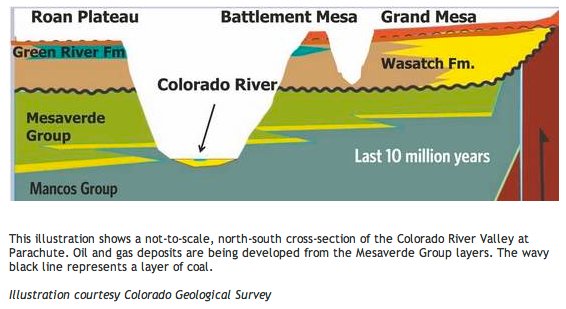
Energy policy — oil shale: Grand Junction Energy Forum & Expo recap

A picture named oilshaledepositsutwyco.jpg

From The Grand Junction Daily Sentinel (Dennis Webb):

Anton “Tony” Dammer, senior vice president of Red Leaf Resources Inc., said a spike in oil prices related to concerns about Libyan leader Moammar Gadhafi’s response to unrest there shows how vulnerable the United States is because of its reliance on foreign oil. “He’s holding us up. He just cost us $20 a barrel. I mean, come on, we can’t do this anymore,” Dammer said at Friday’s Energy Forum & Expo at Grand Junction’s Two Rivers Convention Center.

Dammer is the former director of the Department of Energy’s Office of Naval Petroleum and Oil Shale Reserves, and he founded the DOE’s Unconventional Fuels Program. At Red Leaf, he’s helping pursue a process of producing kerogen from shallow oil shale deposits in northeastern Utah. Red Leaf has shale leases covering 17,000 acres of state school trust lands, and the company plans to undertake a 9,500-barrel-a-day project there that will employ 200 people, Dammer said. Utah welcomes oil shale development, Dammer said.

More oil shale coverage here and here.

The Colorado Basin Roundtable and the Yampa/White Basin Roundtable release energy consumptive use assessment

A picture named yampariverbasin.jpg

Here’s the report, Energy Development Water Needs Assessment, from the Colorado River District website. From the introduction:

The Joint Energy Development Water Needs Committee reported that total demands can be seen in Table 13 of the Final Scenarios report. Maximum water demands are about 120,000 acre-feet per year, a substantial decrease from the 400,000 acre-feet per year in the Phase I study. The reduction stems from 3 primary factors:

1. It was assumed a portion of an in-situ oil shale industry would use some form of down-hole combustion process instead of electrical heaters, which results in reduced electrical generation requirements. We know that from Phase I, water for electrical generation for oil shale actually exceeded the water directly needed for oil shale production.

2. It was assumed combined cycle natural gas fired turbines would be used for electrical generation. These require approximately a third less water. If coal-fired generation was used to meet electrical demand, we believe the generating capacity would occur out of the basin.

3. With extensive input from industry, the committee fine-tuned the unit water demands for oil shale. It believes these revisions are a more realistic estimate of how water might be used in oil shale production. For example, the unit demand estimates reflect information from industry that the in-situ conversion process results in the molecular production of water from the organic compounds in the oil shale.

More Colorado River Basin coverage here. More Yampa River basin coverage here. More White River basin coverage here.

Energy policy — oil shale: Colorado congressman Scott Tipton and Utah congressman Scott Matheson are against a review of the Bush era exploration and production rules

A picture named oilshaledepositsutwyco.jpg

From The Grand Junction Daily Sentinel (Gary Harmon):

Tipton’s 3rd Congressional District includes the world’s largest deposits of oil shale, a sedimentary rock that, when heated, releases a petroleum substance that can be refined into transportation and other fuels.

Across the state line, U.S. Rep. Scott Matheson, D-Utah, said he disagreed with the announcement by Interior Secretary Ken Salazar and Bureau of Land Management Director Robert Abbey to revisit the decisions made under the administration of George W. Bush.

Federal officials are looking over progress made in Utah, where a company with a research-and-development leases says it is producing petroleum with far less water than previous efforts.

“Because of advances made by Utah companies, the effect of oil shale development on water supplies may be greatly reduced,” Matheson said in a statement. “I am an advocate for a level playing field when it comes to access to leasing, so that these emerging technologies are able to compete.”

More coverage from the High Plains Midwest/Ag Journal. From the article:

Rocky Mountain Farmers Union President Kent Peppler praised Secretary of the Interior Ken Salazar’s announcement that Interior will look closely at water issues and agricultural impacts as the discussion of oil shale development moves forward.

“Secretary Salazar described water use as an essential issue in the oil shale debate, and we couldn’t agree more,” Peppler said. “Most of the oil shale lands are on the Colorado River basin, which has been over-allocated from the beginning of the interstate compact. We need to know how much water oil shale developers need, where they expect to get it, and what condition it will be in when they are through with it. Agriculture is the cornerstone of Colorado’s economy and the basis for America’s food security. The secretary understands this, and we urge him to keep it in his thoughts as we move forward slowly on oil shale development.”

More oil shale coverage here and here.

Energy policy — oil shale: Department of Interior policy update

A picture named shellfreezewalloilshale.jpg

From The Colorado Independent (David O. Williams):

“As we all know, the energy challenges our country faces are serious and have gone unaddressed for far too long,” U.S. Bureau of Land Management director Bob Abbey said Tuesday, “and therefore we believe we need to responsibly develop our oil and gas supplies to help us reduce our dependence on foreign oil, but we also must do so in a thoughtful and balanced way.”

Abbey was speaking the same day the BLM filed a settlement in federal district court in Colorado promising to revisit oil shale leasing rules approved in the waning days of the Bush administration in 2008. Those rules opened up 2 million acres of BLM land to commercial oil shale leasing and set a royalty rate of 5 percent. Several environmental groups filed two lawsuits in 2009 challenging those rules.

“The previous 2008 regulations made critical decisions such as royalty rate before the RD&D [research, development and demonstration] program had a chance to deliver information and answers,” U.S. Interior Secretary and former Colorado senator Ken Salazar said. “They put the cart before the horse, and in so doing they heightened the risk of speculation and bad decisions and yet another oil shale bust.”[…]

“From our perspective, oil is perhaps a scarce resource, but water is also pretty scarce here in the arid West, and fish and wildlife habitat and the hunting and fishing and outdoor recreation that habitat provides is a resource that has helped sustain rural communities in the West,” said Kate Zimmerman of the Rocky Mountain Regional Center of the National Wildlife Federation.

Bill Midcap of the Rocky Mountain Farmers Union (RMFU) worries oil shale production could adversely impact his industry as well. “Every drop of water Mother Nature blesses Colorado with has the potential to run out of our state,” Midcap said. “How society chooses to use that water is a really good question. The dependence on agriculture in this state is huge; we are the second largest industry in the state. We can’t just keep doing more with less.”

More oil shale coverage here and here.

Energy policy — oil shale: The Department of Interior proposes a settlement of environmental organizations’ lawsuit over leasing terms

A picture named oilshaledepositsutwyco.jpg

From the Associated Press (Cathy Proctor) via the Denver Business Journal:

The review settles two lawsuits that environmental groups filed in 2009 over the federal government’s rules for commercial-scale oil shale operations, Salazar said. The government hasn’t issued any commercial leases for oil shale production under the 2008 rules. Nor will the review change rules governing existing or proposed leases for oil shale research, a federal spokesman said. The rules for commercial oil shale operations were put forward in the last weeks of President George W. Bush’s administration. They changed oil-shale plans by the Bureau of Land Management, an agency of Salazar’s Interior Department, in Colorado, Utah and Wyoming.

The agreement to review the 2008 rules in coming months was accepted by plaintiffs in the suits, said Kate Zimmerman, an attorney with the Rocky Mountain regional office of the National Wildlife Federation. The federation was one of the 13 environmental groups that were party to the two lawsuits. The review will look at the amount of water available for use in oil shale operations; potential impacts on federal lands, wildlife and watersheds, and the amount of royalties that oil shale production should pay, Salazar said.

The U.S. Geological Survey, another Interior agency, also will analyze the amount and quality of water available to better understand the groundwater and surface water systems that might be affected by commercial-scale oil shale operations, he said. “Oil shale is an important resource for the U.S.,” said Salazar, a former U.S. senator from Colorado. “We need to move forward and examine the possibility of developing oil shale as part of our national portfolio, but we need to do it in a smart way.”

More coverage from The State Colunm (U.S. Senator Michael Bennet):

“This announcement is a welcome step forward in our efforts to ensure thoughtful, responsible development of Colorado’s natural resources while protecting the land, water and way of life we in the West hold dear. Our approach to oil shale development should be both measured and responsible given the potential effects extraction could have on Colorado’s precious water supplies, farmers, ranchers and local communities in the arid West. While we should allow for research and development to proceed, we must also be mindful of the need to protect our land and water and provide a fair return to American taxpayers.

“Beyond today’s announcement of a path forward for commercial leasing rules, I am also pleased to hear that scientists will undertake a full analysis of oil shale in the context of Colorado’s water supply, considering the importance of this precious resource to farmers and local communities.”

More coverage from Sheila Kumar writing for the Associated Press (via Bloomberg). From the article:

The proposed settlement filed in federal court in Denver would give the Bureau of Land Management more discretion when awarding oil shale leases and would remove the 5 percent royalty rates approved by the Bush administration for mining oil shale on public land. The lawsuits by environmentalists challenged the rate as too low. Little is known about the potential environmental impact oil shale development will have on water and wildlife resources, a fact highlighted by the lawsuits. The settlement proposes requiring environmental reviews of commercial development, including impacts on air and water quality and water supplies. “We’re very pleased with the secretary’s emphasis on the importance of water as we move forward with the research and discussion,” said Bill Midcap, the renewable energy development director at the Rocky Mountain Farmers Union.

More from U.S. Representative Jared Polis via The State Column:

“The Department of Interior has taken a well reasoned approach to the future of Oil Shale on public lands with their announcement to take a closer look at how this form of energy could affect our precious and dwindling western water supplies,” said Polis. “The Department has struck a positive balance between researching future potential and ensuring that long term water needs and water impacts will be taken into account before companies invest dollars or the public invests it’s natural resources.”

More oil shale coverage here and here.
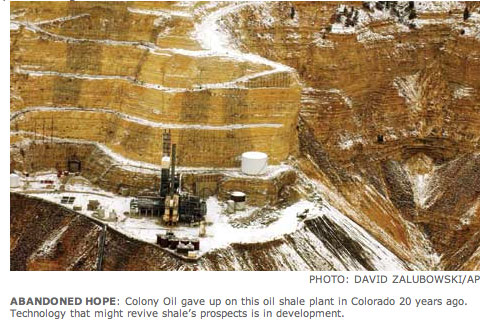
Energy policy — oil shale: The GAO looks at potential water quality impacts

A picture named shellfreezewalloilshale.jpg

From the Aspen Daily News (Brent Gardner-Smith):

“Impacts from oil shale development to water resources could result from disturbing the ground surface during the construction of roads and production facilities, withdrawing water from streams and aquifers for oil shale operations, underground mining and extraction, and discharging waste waters from oil shale operations,” states the GAO report, which was released in October.

The report was prepared at the request of the U.S. House Science Committee, according to Mark Gaffigan, the GAO director of natural resources and environment. “With oil shale, there is a lot of uncertainty,” Gaffigan said, especially as the technology needed to turn rock into oil is expensive and complicated…

“Oil shale development could have significant impacts on the quality and quantity of water resources, but the magnitude of these impacts is unknown because technologies are years from being commercially proven, the size of a future oil shale industry is uncertain, and knowledge of current water conditions and groundwater flow is limited,” the report found. “In the absence of effective mitigation measures, water resources could be impacted from ground disturbances caused by the construction of roads and production facilities, withdrawing water from streams and aquifers for oil shale production, underground mining and extraction; and discharging waters produced from or used in operations.”

It takes water to extract and process the oil shale, water to upgrade the oil shale so it can be transported to a refinery, water to reclaim mine sites, water to generate electricity for the extraction process, and water to meet the residential needs of a growing workforce in the oil shale industry. “Water for most of these activities is likely to come from nearby streams and rivers because it is more easily accessible and less costly to obtain than groundwater,” the report states. “Withdrawing water from streams and rivers would decrease flows downstream and could temporarily degrade downstream water quality by depositing sediment within the stream channels as flows decrease.” The White, Yampa, and Colorado rivers could all be affected by oil shale production, either by serving as the source for water or as the catch-all for polluted surface and ground water…

The GAO also found that ExxonMobil owns “conditional storage capacities of over 161,000 acre-feet on 17 proposed reservoirs in the area.” And if there is not enough water in the White and the Yampa, the Colorado River is just south of the Western Colorado’s oil shale epicenter. “At least one company has considered obtaining surface water from the even-more-distant Colorado River, about 30 to 50 miles to the south of the research, demonstration, and development leases where oil shale companies already hold considerable water rights,” the report states, noting that the costs of transporting and pumping water from the Colorado River would be higher than using water from the White and the Yampa rivers. And it says that some experts think the Green River could be a source of water for oil shale development in eastern Utah…

The GAO report recommends that the Department of Interior “establish comprehensive baseline conditions for water resources” in oil shale country, that it produce a model of groundwater movement in the region, and that it coordinate water research with the Department of Energy.

More oil shale coverage here and here.
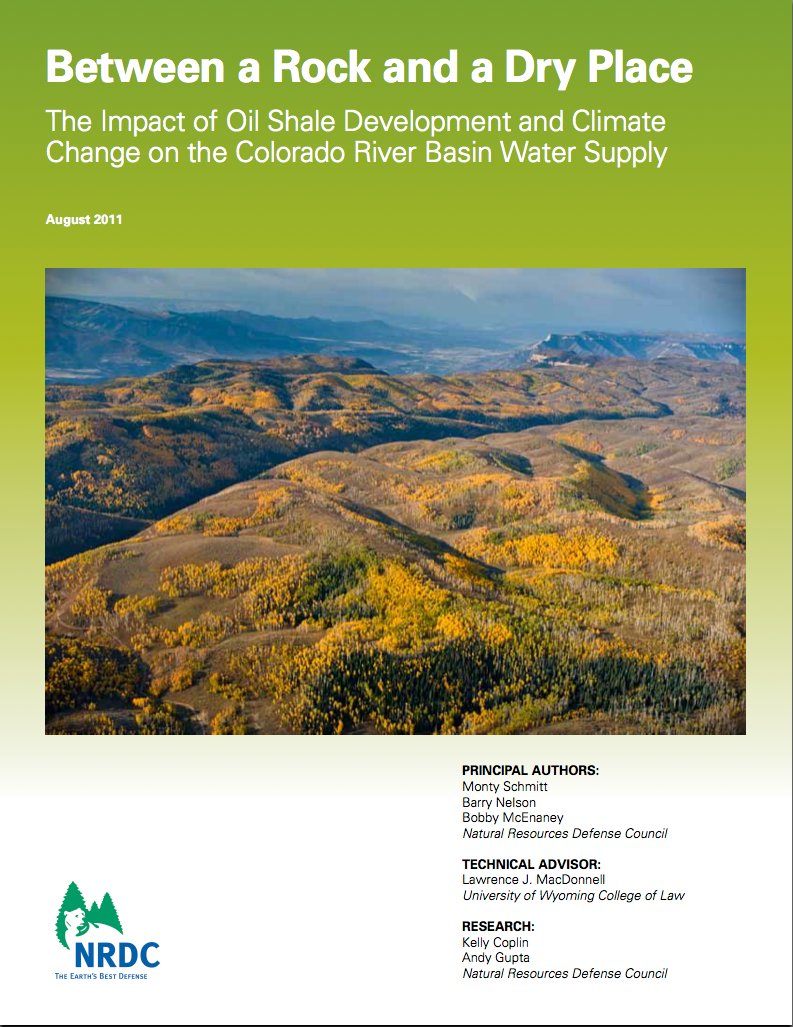
Energy policy — oil shale: The Government Accountability Office warns that oil shale development may impact Colorado water quantity and quality

A picture named oilshaledepositsutwyco.jpg

Here’s the summary for the report from the GAO:

Oil shale deposits in Colorado, Utah, and Wyoming are estimated to contain up to 3 trillion barrels of oil–or an amount equal to the world’s proven oil reserves. About 72 percent of this oil shale is located beneath federal lands, making the federal government a key player in its potential development. Extracting this oil is expected to require substantial amounts of water and could impact groundwater and surface water. GAO was asked to report on (1) what is known about the potential impacts of oil shale development on surface water and groundwater, (2) what is known about the amount of water that may be needed for commercial oil shale development, (3) the extent to which water will likely be available for commercial oil shale development and its source, and (4) federal research efforts to address impacts to water resources from commercial oil shale development. GAO examined environmental impacts and water needs studies and talked to Department of Energy (DOE), Department of the Interior (Interior), and industry officials.

Oil shale development could have significant impacts on the quality and quantity of water resources, but the magnitude of these impacts is unknown because technologies are years from being commercially proven, the size of a future oil shale industry is uncertain, and knowledge of current water conditions and groundwater flow is limited. In the absence of effective mitigation measures, water resources could be impacted from ground disturbances caused by the construction of roads and production facilities; withdrawing water from streams and aquifers for oil shale operations, underground mining and extraction; and discharging waters produced from or used in operations. Estimates vary widely for the amount of water needed to commercially produce oil shale primarily because of the unproven nature of some technologies and because the various ways of generating power for operations use differing quantities of water. GAO’s review of available studies indicated that the expected total water needs for the entire life cycle of oil shale production ranges from about 1 barrel (or 42 gallons) to 12 barrels of water per barrel of oil produced from in-situ (underground heating) operations, with an average of about 5 barrels, and from about 2 to 4 barrels of water per barrel of oil produced from mining operations with surface heating. Water is likely to be available for the initial development of an oil shale industry, but the size of an industry in Colorado or Utah may eventually be limited by water availability. Water limitations may arise from increases in water demand from municipal and industrial users, the potential of reduced water supplies from a warming climate, fulfilling obligations under interstate water compacts, and the need to provide additional water to protect threatened and endangered fishes. The federal government sponsors research on the impacts of oil shale on water resources through DOE and Interior. DOE manages 13 projects whose water-related costs total about $4.3 million, and Interior sponsored two water-related projects, totaling about $500,000. Despite this research, nearly all of the officials and experts that GAO contacted said that there are insufficient data to understand baseline conditions of water resources in the oil shale regions of Colorado and Utah and that additional research is needed to understand the movement of groundwater and its interaction with surface water. Federal agency officials also said they seldom coordinate water-related oil shale research among themselves or with state agencies that regulate water. Most officials noted that agencies could benefit from such coordination. GAO recommends that Interior establish comprehensive baseline conditions for water resources in oil shale regions of Colorado and Utah, model regional groundwater movement, and coordinate on water-related research with DOE and state agencies involved in water regulation. Interior generally concurred with GAO’s recommendations.

More coverage from the Associated Press via The Salt Lake Tribune:

The Government Accountability Office says in a report released Monday that oil shale development could have “significant” impacts on water quality and quantity, but more research is needed to determine the effects. The GAO says up to 12 barrels of water, or about 500 gallons, may be needed to produce a barrel of oil. It urges the Interior Department to coordinate more research.

Here’s a look back at the oil shale bust in the early 1980s from Jim Spehar writing in The Denver Post. From the article:

Tim Schultz, now president of the Denver-based Boettcher Foundation, was a 31-year-old Rio Blanco County commissioner during the Exxon days. Lamm recalls Schultz as one of the local leaders who was not “willing to sell out their heritage for a promise.” Schultz and others backed an industry-funded Oil Shale Trust Fund, which assisted with up-front impact costs and helped soften the bust. “It’s kind of hard to plan for the peaks,” Schultz warns, “but you always want to remember that those valleys are just around the corner.”

More oil shale coverage here and here.

Energy policy — oil shale: Towards a consensus on oil shale development

A picture named shellfreezewalloilshale.jpg

From The Grand Junction Daily Sentinel (Dennis Webb):

What defines a cautionary approach depends upon to whom you talk, however. For [Rocky Mountain Farmers Union president Kent Peppler], writing in a guest column for the website newest.net, the new round of research and development leases being offered by Interior Secretary Ken Salazar, including in Rio Blanco County, are “the right way to go.”

For environmentalists such as Jason Wedemeyer, Western Slope energy organizer for the Colorado Environmental Coalition, issuing a second round of such leases isn’t warranted when the impacts associated with technologies being tried by companies in a first round of leases remain unknown. In Colorado, those leases are held by Shell, Chevron and American Shale Oil LLC. “We want to see results before we lease off more of the Piceance Basin,” Wedemeyer said Thursday as he surveyed existing and proposed lease sites from the air on a plane ride provided by EcoFlight…

Glenn Vawter, executive director of the National Oil Shale Association, thinks any shale development would disturb less land than natural gas drilling and thus have less effect on wildlife. “As with all these things, there will be some impact, but I think there are mitigation measures that … can be put in place,” he said.

Water and wildlife are among a host of issues to be considered during Bureau of Land Management environmental reviews in Colorado and Utah after the BLM’s Washington office decided to advance nominations for the second round of leases for further study. ExxonMobil and Natural Soda Holdings are seeking the Rio Blanco County leases, and AuraSource Inc. wants one in Utah.

While the Colorado Environmental Coalition continues to oppose issuing more leases, Wedemeyer said he is glad the ones Salazar offered are smaller. Companies are seeking 160-acre leases, with the possibility to expand them to 640-acre commercial leases. The first round of 160-acre leases provided for potential expansion to 5,120-acre commercial leases.

More oil shale coverage here and here.

Energy policy — nuclear meets oil shale: Low water use liquid metal-cooled reactors key to proposed process

A picture named liquidmetalcooledreactor.jpg

From Shale and Sands Oil Recovery LLC via PRNewswire:

The method, invented by Thomas O’Brien (Shale and Sands Oil Recovery LLC), utilizes a high temperature nuclear reactor since the output temperature is over 500 degrees Celsius. The types of reactors that produce this heat level are liquid metal-cooled reactors (which use negligible water to operate) and high temperature gas-cooled reactors. With this level of heat production, supercritical material, such as small amounts of water, can be injected into the shale formation initially causing a much higher degree of permeability then forming a reservoir of crude oil that can be pumped from the formation using conventional drilling methods. Thomas O’Brien, a geoscientist with over 30 years of experience and expertise, developed the method by studying and working in the reservoir analysis area then on the use of supercritical materials in concert with experts on oil shale.

Here’s the lowdown on liquid metal-cooled reactors from Wikipedia. From the article:

Disadvantages include difficulties associated with inspection and repair of a reactor immersed in opaque molten metal, and depending on the choice of metal, corrosion and/or production of radioactive activation products may be an issue.

More nuclear coverage here and here. More oil shale coverage here and here.

Energy policy — oil shale: Three research projects are moving on to an NEPA review

A picture named shelloilshaleprocess3

Update: Here’s a release about the oil shale NEPA review from Governor Ritter’s office (Evan Dreyer):

GOV. RITTER STATEMENT ON BLM STEPS TOWARD OIL SHALE RD&D LEASING

Gov. Bill Ritter issued the following statement today regarding the U.S. Bureau of Land Management’s steps toward additional oil shale research activities:

“BLM Director Bob Abbey’s announcement that it will continue to analyze three oil shale research proposals follows Interior Secretary Salazar’s important reforms in Research, Development & Demonstration leasing. The RD&D program that this Administration is implementing has elements that I have long supported, including constraints on the size of leases and substantial due diligence and reporting requirements.

“Colorado has always supported a robust RD&D process to research and evaluate the technologies that could be used to develop oil shale and to better understand the environmental impacts.

“The potential for oil shale development in Colorado, and the economic opportunity that it represents, is huge. But the prospect of commercial-scale activities raises significant questions about how oil shale can be successfully integrated into our state’s economy and how we can protect the state’s environment, water, wildlife and communities.

“The RD&D program is wisely designed to answer fundamental questions about the feasibility of the technologies, their likely impacts on the environment and communities of Western Colorado, and their use of our scarce and valuable water supplies. As I have always maintained, these questions must be answered before oil shale research can transition to commercial development.

“I’m therefore pleased that Director Abbey is taking such a thoughtful approach.”

Here’s the release from the Bureau of Land Management (Matt Spangler/Vince Vogt):

The Bureau of Land Management today announced that it has taken a key step to advance research on an important potential source of domestic energy.

The BLM’s Washington, D.C., Office has completed its review of three nominations for oil shale Research, Development, and Demonstration (RD&D) leases in Colorado and Utah. These second-round leases would allow the proponents to test the feasibility of various oil shale recovery technologies on public lands in the two states. The nominations will now be forwarded to the agency’s Colorado and Utah State Offices for the next phase in the review process.

BLM Director Bob Abbey said, “To determine whether oil shale will be a viable energy source on a commercial scale, we need to support critical research to answer fundamental questions about the feasibility of the technologies, their impacts on the environment and local communities, and their use of water. This second round of leases will help us answer those critical questions so that we can chart a safe, orderly, and responsible path for our energy future.”

Abbey added, “The BLM is committed to careful consultation with all affected stakeholders in the oil shale process, including states, counties and tribes. The analysis that our states will now conduct will help us chart a wise path for western shale oil resources.”

In November 2009, the BLM published a notice in the Federal Register calling for nominations for a potential second round of oil shale RD&D leases, following the awarding of six leases in an initial round in 2007.

The BLM solicited nominations of parcels, not to exceed 160 acres, for the conduct of oil shale research, development, and demonstration under a 10-year lease term. Applicants could also identify up to an additional 480 acres to be reserved for a potential commercial lease, for a total of 640 acres. The lease size available for commercial development was reduced from the 5,120 acres in the first round of leasing because the substantial reserves represented by 640 acres are more than adequate for a major oil shale production operation. The second- round leases would contain substantial diligence requirements, including specific timeframes for submitting plans of development, obtaining state and local permits, developing infrastructure, and submitting quarterly reports.

The BLM received three nominations in early 2010: two in Colorado, from ExxonMobil Exploration, Co., and Natural Soda Holdings, Inc.; and one in Utah, from AuraSource, Inc.

Earlier this year, the BLM formed an Interdisciplinary Review Team (IDRT) with representatives of the Governors of Colorado, Utah, and Wyoming; the Department of Energy; and the Colorado School of Mines. The team recommended that all three nominations be advanced.

The Colorado and Utah offices will now conduct National Environmental Policy Act (NEPA) reviews of the nominations. The analyses may take from four to 18 months to complete, depending upon the complexity of the resource issues to be analyzed.

Oil shale is a fine-grained sedimentary rock containing organic matter from which shale oil may be produced. The organic matter, derived mainly from aquatic organisms, is called kerogen.

According to the United States Geological Survey, the U.S. holds more than half of the world’s oil shale resources. More than 70 percent of the U.S. supply lies on Federal lands in Colorado, Utah, and Wyoming.

From the Deseret News (Amy Joi O’Donoghue):

Colorado and Utah offices of the BLM will now complete a federally mandated environmental review. That could take up to 14 months. One lease is held by AuraSource in Utah, while the other two are in Colorado with Exxon?Mobil Exploration Co., and Natural Soda Holdings Inc.

AuraSource Chief Financial Officer Eric Stoppenhagen said the two-year-old company uses a low-temperature catalytic process to recover oil from oil shale, relying on less than one barrel of water per barrel of shale oil that is produced. Water consumption is driven more by mining and road dust control, as well as reclamation efforts. In China, AuraSource’s plant in Qinzhou has the processing capacity of 1 million tons of oil shale.

BLM’s director Bob Abbey said the projects will serve as a good blueprint to answer fundamental questions about the technology of oil shale extraction. “To determine whether oil shale will be a viable energy source on a commercial scale, we need to support critical research to answer fundamental questions about the feasibility of the technologies, their impacts on the environment and local communities, and their use of water,” Abbey said. “This second round of leases will help us answer those critical questions so that we can chart a safe, orderly and responsible path for our energy future.”[…]

Environmental groups, however, blasted the announcement. “Oil shale is nothing more than a dirty, expensive pipe dream,” said Bobby McEnaney, lands advocate for the Natural Resources Defense Council. “This administration is making smart decisions by investing in clean energy that will create jobs and reduce our dependence on oil. Oil shale undermines that effort,” McEnaney said.

More coverage from the Colorado Independent (David O. Williams):

BLM director Bob Abbey today announced the federal agency has reviewed nominations for three potential lease-holders — ExxonMobil and Natural Soda in Colorado and AuraSource in Utah – and will now forward them on to state regulatory agencies for the next phase of consideration. “The potential for oil shale development in Colorado, and the economic opportunity that it represents, is huge,” [Governor Ritter] said in a release. “But the prospect of commercial-scale activities raises significant questions about how oil shale can be successfully integrated into our state’s economy and how we can protect the state’s environment, water, wildlife and communities.”

“People have been trying to figure out how to suck the hydrocarbons out of these rocks for over a century,” former oil shale worker Craig Thompson said in a release. Thompson is now a professor of engineering at Western Wyoming Community College and on the board of the National Wildlife Federation. “No one has found an economic solution. When Exxon pulled the plug on their $5 billion gamble and laid off 2,200 workers, the West learned a bitter lesson. The last thing we need is another pipe dream and another economic ‘bust.’”

More coverage from the Denver Business Journal (Cathy Proctor):

The leases — the second round of federal oil shale leases offered in recent years — underwent review at federal agency’s headquarters in Washington and now will undergo additional review by BLM personnel in Colorado and Utah, the agency said. The department-level review team included representatives of the governors of Colorado, Utah and Wyoming, the U.S. Department of Energy and the Colorado School of Mines. The team recommended that all three nominations be moved to state-level reviews. The BLM’s Colorado and Utah offices will now conduct National Environmental Policy Act (NEPA) reviews of the proposals, a process that could take four to 18 months to complete, according to the BLM.

More oil shale coverage here.

Energy policy — oil shale: Western Resource Advocates release report on Utah’s oil shale and tar sands efforts

A picture named tarsandstrucks.jpg

Peter Roessmann from Western Resource Advocates sent this link to their report on Utah’s moves into tar sands and oil shale development in email. From the summary:

At first blush, it is easy to fall for the seductive picture painted by tar sands and oil shale supporters. As some describe it, the United States possesses an untapped and unimaginably large reservoir of oil, laced in bitumen deposits or encased in rock and buried on federal lands around the vast Green River formation in Colorado, Utah, and Wyoming.

The numbers seem staggering: It is estimated that Utah tar sands may contain 11 billion bar- rels of oil.2 Estimates of U.S. oil shale reserves range from a half a trillion barrels to more than 1.5 trillion barrels of oil. These resourc- es, the argument goes, would be sufficient to power our country for centuries, and, if developed, would allow us to thumb our nose at Venezuelan dictators and Middle Eastern oil cartels. Right under our feet, these “unconventional fuel” boosters tell us, the United States government controls the means to lower the price of oil on world markets, eliminate our dependency on foreign oil, and send the “peak oil” prophets packing.

It is a seductive thought, isn’t it?

Unfortunately, as the cautionary adage goes, “If something seems too good to be true, it probably is.” The more we research tar sands and oil shale, the more apparent it is that due to the relatively small amount of fuel that could be developed, these energy sources would not decrease in any measurable way our dependence on foreign fuel. Utahns, however, would pay an unacceptable price to pursue a commercial unconventional fuels industry that is still wildly speculative. Before any piecemeal approaches are considered, the cumulative, life-cycle effects of pursuing this industry should be evaluated — including water use, energy use, land disturbance, and the uncertain prospects of reclaiming the mining and processing sites.

Both tar sands and oil shale development present overwhelming challenges and drawbacks. For starters, there are not eleven billion barrels of oil under Utah’s rocky high desert soil. For tar sands, the raw material is a hard mixture of clay and bitumen that needs significant processing to become liquid fuel. In the case of oil shale, there are quadrillions of tons of rock under the desert that, in theory, could be heated (using lots of energy) and transformed into a murky liq- uid called kerogen, which still is not oil. Kerogen could then be upgraded and refined (using more energy) into something we could put in our cars, trucks, and airplanes. The laws of physics tell us that it will require a substantial amount of energy to transform tar sands or oil shale into a fuel that can be used in a car or truck. Any technology to do this would be unavoidably and unacceptably wasteful.

Another inescapable problem posed by commercial tar sands and oil shale development in Utah is the amount of water required to produce oil from bitumen or rock. In Utah, water is without a doubt the most precious — and limited — natural resource. As Don Christiansen, general manager of the Central Utah Water Conservancy District, says on page 20 of this report, “You just can’t get along without water. The human body just will not go on without water. It will go on without oil.”

More coverage from The Salt Lake Tribune (Brandon Loomis). From the article:

The Boulder, Colo.-based legal and policy group commissioned a Boston University geographer to analyze the energy return on investment for oil shale. He determined that most research indicates that, at best, making fuel from the rock would generate twice the energy content of what it takes to produce. That compares to a 20-to-1 ratio or better for petroleum.

More oil shale coverage here and here.

Northwest Colorado Water Forum September 24

A picture named yampariverbasin.jpg

From Steamboat Today (Tom Ross):

The [Yampa/White River roundtable] recommended funding a $220,800 water storage feasibility study in the Yellow Jacket District south of Craig, and the Colorado Water Conservation Board approved it in January. The study is under way, and project consultant Mike Apple gate is among six speakers slated for the forum. Applegate said Wednesday the Yellow Jacket Board, which oversees a district primarily in Rio Blanco County, but including small portions of Moffat and Garfield counties, is a long way from building a water storage facility…

The board of the Yellow Jacket Water Conservation District made it plain in a September 2008 filing in Water Court that it seeks to ensure adequate water supplies for agriculture, but it’s also determined to create adequate supply for a growing oil shale industry in the region. Applegate said the goal of protecting agricultural water is sincere. “If you don’t figure out in advance how to supply water for (energy development), the result can be a ‘buy and dry agriculture’” approach to securing water for energy, he said. In their 2008 filing, the Yellow Jacket Board members anticipated building Thornburgh Reservoir and filling it with conditional water rights from nearby creeks via pipelines. West Milk Creek Canal, for example, is estimated to be able to supply 90 cubic feet per second of water. Axial Creek Canal could be counted on to supply as much as 315 cfs during its peak, the court filing anticipated. Applegate said the system of creeks and canals feeding an offline reservoir (built in a ravine without live water of its own), is just one possibility that will be looked at in the feasibility study.

More IBCC — basin roundtables coverage here.

Energy policy — oil shale: Garfield County Commissioners to get briefing on water requirements for oil shale production September 7

A picture named shelloilshaleprocess3

From the Glenwood Springs Post Independent (John Colson):

Energy industry liaison Judy Jordan is on tap give the Board of County Commissioners an update on the latest estimates about how much water may be needed to extract the estimated 1.2 trillion barrels of “oil” trapped in subterranean rock strata in the Piceance Basin, which is bisected by the Colorado River as it passes through Garfield County…

Jordan told the Post Independent on Friday that she will be basing most of her comments on a recent study by the Colorado River Water Conservation District in Glenwood Springs. That report, according to CRWCD Deputy General Manager Dan Birch, estimated that extracting the shale oil might take as much as 120,000 acre-feet of water per year, which he said translates to roughly one or two barrels of water used for each barrel of oil produced. That is considerably less than the 400,000 acre-feet of water per year estimated in a 2008 study by the URS consulting firm, which translated to roughly 3 to 5 barrels of water consumed for every barrel of oil produced.

But, said Birch, even at the lowered estimate, the oil shale industry would use up to approximately 20 percent of all the Colorado River water now being used by agriculture, municipalities and other users around the Western Slope…

Among the reasons for the reduced estimates of water use, according to the study, is, in part, because earlier estimates were based on the amount of electricity needed to power the “in-situ” process being studied by Royal Dutch Shell. That process would involve using massive amounts of energy to heat up the shale rock in place and draining out the liquid kerogen.

More oil shale coverage here.

Energy policy — oil shale: American Oil Shale is building a processing plant to test their technology

A picture named colonyoilshaleproject.jpg

Oil shale has been the “Next Big Thing” in Colorado for over a 100 years. 2011 could be the year that a company proves to itself and the world that the resource can be produced economically in an environmentally sound way. Here’s a short report from Bloomberg Business Week. From the article:

One of three companies with federal leases to research and develop oil shale in Colorado said it plans to start testing its technology early next year. American Shale Oil said it’s building a processing facility west of Rifle in western Colorado. The company expects to employ about two dozen people during the research phase.

More oil shale coverage here and here.
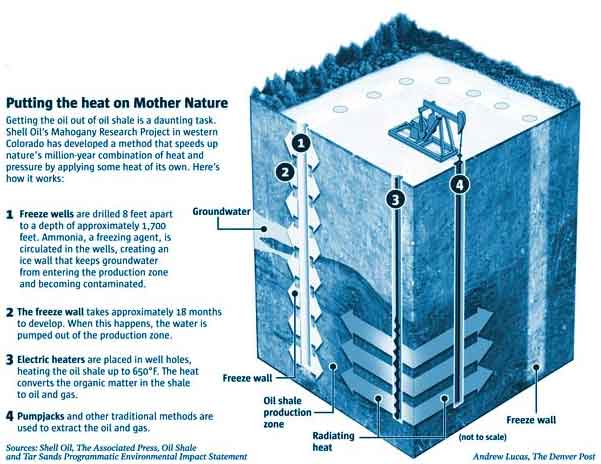
Energy policy — oil shale: Water requirements for production of kerogen less than estimated

A picture named shelloilshaleprocess3

From The Grand Junction Daily Sentinel (Gary Harmon):

Much of the water savings could stem from using natural gas to heat shale in place instead of using coal-fired electrical plants the size of those near Craig, the study suggests. Much also depends on the quality and quantity of what is known as “produced water,” or water drawn out of the earth as a byproduct of heating oil shale.

The study offers no assurance that an oil shale industry eventually or ever will take shape, said Greg Trainor, of the Colorado River Basin Roundtable, one of two that joined forces to commission the study by Boulder-based AMEC, a consulting, engineering and project-management company. It does, however, suggest an oil shale industry could operate with 120,000 acre-feet of water per year, down from previous estimates of 400,000 acre-feet per year.

The assumptions of the report, which forecasts the potential water demand of the industry by 2050, might also turn out to be too rosy, according to Western Resource Advocates, which monitors oil shale developments.

Much of the foundation of the study “represents industry’s hopes,” said David Abelson of Western Resource Advocates, “but with the technologies used in this report being in their infancy, whether these projections come true will not be known for a generation or two.” Previous studies of the potential water demand of oil shale have been based on the need for a dozen coal-fired power plants to generate electricity to heat shale, but it appears natural gas, an abundant energy source in the Piceance Basin, could run gas-turbine generators to produce the needed electricity, but without the water demand of a coal-fired plant. That’s one part of the reduced demand for water.

Much of the demand for water could be met through produced water, which could be used for domestic purposes, revegetation and other purposes, Trainor said.

A third factor that might reduce water consumption in western Colorado would be refining elsewhere the kerogen that results from in-situ heating of shale. Refinery capacity is available in Salt Lake City, meaning refineries wouldn’t have to be built in more remote, arid western Colorado.

Meanwhile, the economics of producing and refining kerogen for fuel still aren’t convincing. Here’s a report from the Summit County Citizen’s Voice. From the article:

A new study commissioned by an environmental group suggests that it takes nearly as much energy to produce fuel from oil shale as the process ultimately yields — and that the emissions of greenhouse gasses associated with oil shale development are disproportionately high compared to other energy sources…

The report was compiled by Dr. Cutler Cleveland, a Professor of geography and environment at Boston University. Cleveland assessed oil shale’s potential for energy return on investment, finding that, with existing technologies, fuel derived from shale has one of the lowest returns of any fuel source, falling between 1:1 and 2:1 when internal energy is counted as a cost. Cleveland said previous studies of oil shale’s energy return have left out the energy used elsewhere in the economy to produce the goods and services needed to extract fuel from oil shale. “Cleveland’s analysis is proof that the impacts to the West would far outweigh any perceived benefits,” said Sheldon. “Westerners must understand the trade-offs they will make if public lands and resources are signed over to private companies in the hopes of making oil shale a transportation fuel source,” she added.

More oil shale coverage here and here.

American Rivers: Upper Colorado is sixth most endangered river in U.S.

A picture named coloradorivergranby

From The Grand Junction Daily Sentinel (Gary Harmon):

The projects, the Windy Gap Firming Project and the Moffat Tunnel Collection System Project, would increase diversions from the upper Colorado River by at least 48,000 acre-feet a year. The threat to the river’s fishery, boating and water supply to downstream users placed the Upper Colorado River at No. 6 in the 2010 list of the nation’s most-endangered rivers by American Rivers…

“Conversely,” American Rivers said, “if the projects incorporate appropriate river protections, they could herald an era of water-supply planning that better balances water development with the needs of the river.”[…]

The Windy Gap project was supposed to go online a year ago, but it was sent back by the U.S. Environmental Protection Agency for a revised draft environmental-impact statement, said Chris Treese of the Colorado River Water Conservation District. The project calls for the construction of Chimney Hollow Reservoir in Larimer County to be supplied by an annual average of 30,000 acre-feet of water diverted through the existing Windy Gap project. It would supply water to more than a dozen municipalities in northern Colorado.

The Moffat project is designed to divert an annual average of 18,000 acre-feet of water collected on the Fraser River Basin through the Moffat Tunnel to an enlarged Gross Reservoir on the Front Range.

More Colorado River Basin coverage here.

American Rivers: Upper Colorado is sixth most endangered river

A picture named coloradoriverbasincgs

From the Colorado Independent (David O. Williams):

The scenic Upper Colorado River between its headwaters in Rocky Mountain National Park and its confluence with the Roaring Fork River has landed the sixth spot on the America’s Most Endangered Rivers list

The national nonprofit group, in concert with other conservation groups such Colorado Trout Unlimited, is calling on the U.S. Army Corps of Engineers and the Bureau of Reclamation to require conservation and efficiency measures in the Final Environmental Impact Statements (FEIS) for both the Moffat Tunnel Collection System Project and the Windy Gap Firming Project. “We can’t continue to take and take water from the Upper Colorado without accounting for the serious impacts to fish and wildlife habitat,” Colorado Trout Unlimited’s Ken Neubecker said in a release. “This is a river on the brink. A vibrant, healthy river system in the Upper Colorado is every bit as important to the future of Colorado as the water it supplies to our farms and cities.”

Recent media coverage has also focused on the growing demands on the Colorado for energy production, including hydroelectric in Glenwood Canyon and oil and gas development further downstream in Garfield and Mesa counties.

The Upper Colorado, though, is a recreational paradise, with world-class whitewater and gold-medal trout fishing. It runs through the heart of the state’s most popular mountain resorts from Grand County to Glenwood Springs, with its tributaries supplying water to ski towns like Breckenridge and Vail. It’s a perennial candidate for federal Wild and Scenic River designation.

More coverage from Tonya Bina writing for the Sky-Hi Daily News. From the article:

“The most endangered river listings get the attention of media and policy-makers,” said Randy Scholfield, spokesperson of Trout Unlimited’s Western Water Project. “It does help to highlight some of the threats facing these rivers and helps them get the grassroots support they need.”

The Upper Colorado considered in the listing flows from about Granby to Dotsero…

The Upper Colorado fit the organization’s criteria for being the subject of major public decisions pending in 2010, specifically the Moffat Firming Project proposed by the Denver Water Board and the Windy Gap Firming Project proposed by the Municipal Subdistrict of the Northern Water Conservancy District. The Upper Colorado, especially the stretch from Granby to Kremmling, can lack healthy peak flows and baseline flows…

Without river protections from cumulative impacts outlined in draft Environmental Impact Statements, advocates fear the river could suffer from further detriment despite on-the-side negotiations for enhancement being conducted by river stakeholders.

“They didn’t consider the accumulative impacts at all like they were supposed to,” Neubecker said of those reports pending Bureau of Reclamation and U.S. Army Corps of Engineers approval. Instead they were saying “that the flows in the river right now are the way they always have been since the beginning of time. We have to be honest with ourselves and everyone on how we use the river.” Neubecker hopes the American Rivers listing can help inform Front Range water users, some of which have little idea “about the connection between what comes out of their faucets and the river resource,” he said.

From 9News.com:

“We really are concerned about destroying the essence of Colorado which includes world-class recreation and beautiful rivers like the Upper Colorado, so we want to make sure there is an appropriate balance struck between the needs of supplying citizens on the Front Range with water and the importance of those benefits of Colorado’s heritage,” [Andrew Fahlund, senior vice president of American Rivers] said…

Currently, meetings between headwater counties and major diverters have the potential to restore river health while also fulfilling domestic and agricultural needs in the state.

From KUNC (Erin O’Toole):

The threat of water diversion from the state’s namesake river has landed the Upper Colorado at number 6 on this year’s list, as compiled by the conservation advocacy group American Rivers. Spokeswoman Amy Kober says they’re primarily concerned about two new proposals – the Windy Gap Firming Project and the Moffat Tunnel Collection System Project. She says both could lower the river flow to the point of threatening its prized trout fisheries “Excessive diversions upset the natural balance of the river, increase water temperatures, and destroy the natural patterns of reproduction for endangered species.”

More Colorado River Basin coverage here.

Energy policy — oil shale: Judge Kane allows ninth delay in conservation group lawsuit

A picture named tarsandstrucks.jpg

From the Associated Press via The Durango Herald:

U.S. District Court Judge John Kane granted the request last week, extending the deadline to July 16. But Kane said he’s not inclined to approve any more delays, noting that the two lawsuits were filed nearly 17 months ago. Federal officials made the latest request because of the oil spill in the Gulf of Mexico. Kane said while he is sympathetic to the “existence of factors beyond Defendants’ control which have contributed to the delay of this proceeding,” settlement negotiations have been under way for nearly eight months. “I strongly urge the parties to either resolve this controversy or prepare to litigate,” Kane said.

The lawsuits by conservation groups claim the Interior Department and Bureau of Land Management violated environmental laws by curtailing public comment and failing to consider impacts on wildlife or the potential effects on climate change. The 13 groups suing also argue that regulations setting the royalty rates for oil shale violate federal law requiring fair-market value for public resources.

More oil shale coverage here and here.

Energy policy — oil shale

A picture named shelloilshaleprocess3

Here’s a video reality check about the development of the “Next Big Thing” from Bob Silbernagel, editor of the Grand Junction Daily Sentinel. Next time you hear someone getting their bloomers in a knot over the potential Saudi Arabia killer deposits in the Piceance Basin you can refer them to Mr. Silbernagel’s analysis. The video is totally safe for work.

More oil shale coverage here and here.
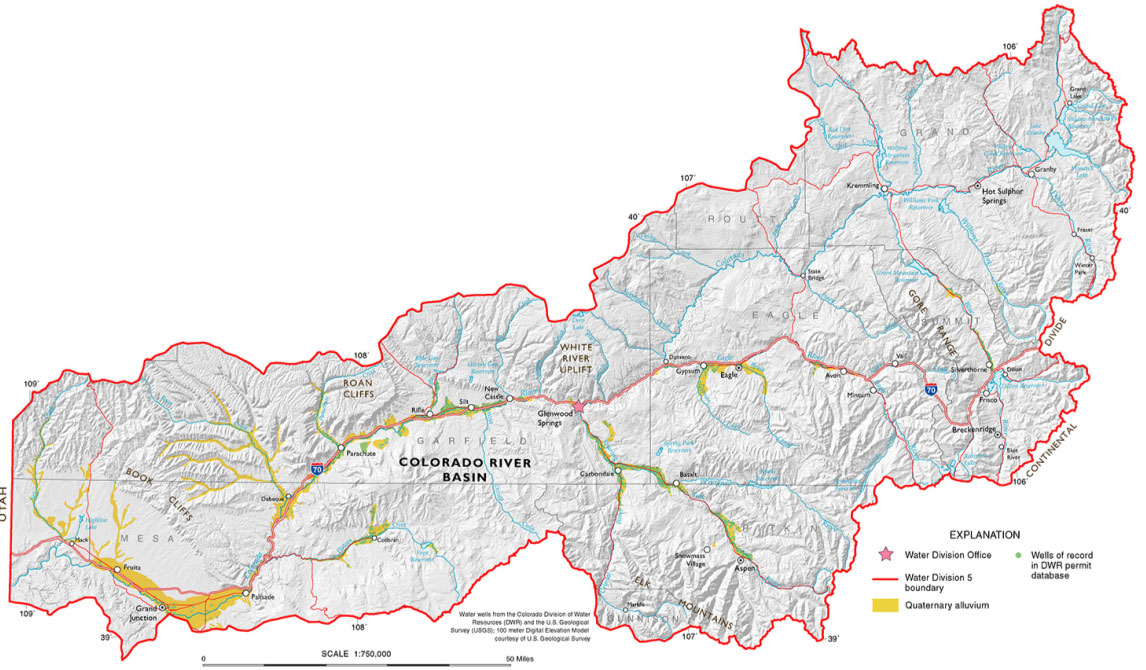
Energy policy — oil shale: Shell withdraws Yampa River water rights application

A picture named shelloilshaleprocess3

Update: From the Associated Press via Steamboat Today (Mike Lawrence):

The water would have been taken out of the river at one or two pumping stations about 75 miles west of Steamboat. It would have been stored in a reservoir capable of holding 45,000 acre-feet of water in Cedar Springs Draw, off the main stem of the Yampa. That potential reservoir’s size could have exceeded the more than 33,000 acre-feet of storage in Stagecoach Reservoir near Oak Creek and the 25,450 acre-feet in Elkhead Reservoir near Craig. Within three months after Shell’s application, 25 local groups and municipalities — including Routt County, Oak Creek, Yampa and the Upper Yampa Water Conservancy District — filed opposition to the application.

The city of Steamboat Springs argued that its water rights in the Yampa River Basin “may be adversely impacted if the subject application is granted without adequate protective terms and conditions.” Shell representatives met with local officials in Steamboat last year to discuss the application and its potential impacts. Litigation was possible.

From The Denver Post (Mark Jaffe):

Shell said in a statement it has decided not to pursue the Yampa water right at this time “in light of the overall global economic downturn that has affected our project’s pace.”

The controversial proposal — seeking about 8 percent of the Yampa’s average spring flow — drew opposition letters from 27 businesses, environmental groups and federal, state and local agencies. “The Yampa is the last river in Colorado with natural peak and low flows,” said Kent Ventrees, who teaches river recreation at Colorado Mountain College. “This is outstanding news for the Yampa.” The natural river sustains endangered fish species and flows through Dinosaur National Monument, where National Park Service officials worried that Shell’s plan would hurt the park.

Shell was seeking a water right to pump water into a new reservoir covering 1,000 acres and 15 billion gallons. The water — taken from a point west of Craig — would have been shipped to the White River basin for use in Shell’s oil-shale program…

Shell’s water-right application was vulnerable to challenges because the water could not be directly put to use, said Drew Peternell, Colorado water- project manager for Trout Unlimited. “They don’t even know how much water they need,” Peternell said. “It was very close to speculation, which is not allowed in Colorado water law.”

More coverage from Dennis Webb writing for The Grand Junction Daily Sentinel. From the article:

Shell spokeswoman Carolyn Tucker said that doesn’t mean the pace of the project has slowed. Rather, it is just maintaining its research focus while adjusting to economic realities. “The global downturn has effects on Shell just like it does on any other company. Some of the resources and some of the plans we’ve made early on don’t ring as true. We have to be more flexible as a company, and some of the research dollars have to be doled out more sparingly,” she said. Tucker added, “We’re not pulling out, we’re not shutting down. We’re just being as flexible as we can with the economic times.”[…]

Shell said it plans to submit permit applications for its first research and development pilot project late this year or early in 2011. “We hold a variety of water rights in northwest Colorado and we have for many years, so we do have water,” Tucker said. Shell had set out to diversify its water rights by seeking 375 cubic feet per second from the Yampa to fill a 45,000-acre-foot reservoir in Moffat County…

David Abelson, oil shale policy advisor for the Western Resource Advocates environmental group, said the WRA opposed the water right application on behalf of four environmental groups. Altogether, he said, 28 statements of opposition were filed against the application, from water districts, local governments, the Colorado Division of Wildlife, several federal agencies and other interests. The Yampa is the state’s only major river with water left to appropriate, Abelson said. “We’re extremely pleased about the decision to save the Yampa for another day,” he said. He said he believes Shell’s decision also supports his organization’s long-held view that oil shale development is not ready for prime time. “The technology is not developed, oil shale has never been economically competitive, and there’s nothing to suggest that either of those hurdles are about to be overcome,” he said…

Theo Stein, spokesman for the state Department of Natural Resources, said of the Shell announcement, “I think that this is an illustration of how complex the interweaving of oil shale issues and water issues is, and the need for a careful and thoughtful (oil shale leasing) process that the Interior Department is managing.”

More oil shale coverage here and here.
Energy policy — oil shale: Shell withdraws Yampa River water rights application

A picture named yamparivereofmaybell.jpg

From the Associated Press via the Los Angeles Times:

Colorado, Wyoming and Utah are thought to hold 800 billion barrels of recoverable oil in shale. But critics of a federal management plan for developing oil shale on public lands say the process would use too much of the region’s scarce water.

Shell was hoping to obtain water rights from the Yampa River. The company, which is the U.S. unit of Royal Dutch Shell, left open the possibility of pursuing the project in the future. “The exact scale and timing for development will depend on a number of factors, including progress on our technology development, the outcome of regulatory processes, market conditions, project economics and consultations with key stakeholders,” the company said in a statement. Shell said the ultimate goal is to create an operation that is economically viable, environmentally responsible and socially sustainable.

The state was notified of Shell’s decision on Tuesday, Colorado Department of Natural Resources spokesman Theo Stein said.

More coverage from Kirk Siegler writing for KUNC. From the article:

A spokesman could not be reached for further comment Tuesday night. But the news is being cheered by a host of environmental groups and local officials. “In northwest Colorado, we were very concerned about the impacts with the current construction technique that they were proposing,” says Routt County Commissioner Doug Monger. The county is one of 25 entities that filed formal protests against Shell’s proposal. Monger says the county also had concerns with the amount of resources that were going to be required to extract the water.

More coverage from Dennis Webb writing for the Grand Junction Daily Sentinel. From the article:

“We reviewed our application in the context of our ongoing research and development activities and, in light of the overall global economic downturn that has affected our project’s pace, have decided not to pursue the Yampa water right at this time,” the company said in a prepared statement.

Grant Junction attorney Mark A. Hermundstad also announced the decision in an e-mail to other attorneys involved in the case, saying Shell was dismissing its claims for conditional water rights. “However, the withdrawal of the Yampa water rights application should not be construed as an indication that Shell is pulling out of oil shale development,” Hermundstad wrote. “Shell intends to continue its oil shale research and development activities with the ultimate goal of creating a commercial oil shale recovery operation that is economically viable, environmentally responsible and socially sustainable.”

More oil shale coverage here and here.

Energy policy — oil shale: Update on current production efforts

A picture named colonyoilshaleproject.jpg

From the Grand Junction Daily Sentinel (Gary Harmon):

The company has run successful tests with the “Electrofrac” technology in its Colony Mine near the east end of the 150-mile stretch and now wants to try it on a larger plot of land leased from the federal government for research and development of oil shale…

The company ran tests for the first time in September on land it owns, proving it could use electricity to heat surrounding rock, setting the stage for further tests of the Electrofrac process. The resistive heating element far beneath the surface will heat up just as the coils in a toaster do, but the ExxonMobil technique heats rock. By heating the surrounding rock to 300 degrees Centrigrade, ExxonMobil hopes to free oil shale’s petroleum-like treasure and allow it to migrate, much like gas or oil, to collection wells that would draw out the kerogen for refining. That heat would be contained within the rock and couldn’t be detected from several thousand feet above on the surface, McGinn said. The process the company envisions calls for the use of horizontal drilling instead of vertical drilling to limit the amount of surface disturbance, McGinn said.

Assuming that the process works on a large scale, ExxonMobil sees tantalizing prospects for shale: up to 162,000 barrels of oil per surface acre at a 50 percent recovery rate. The results suggest a 3-to-1 ratio of energy recovered over energy expended to obtain it, McGinn said…

Even under the most optimistic of scenarios, ExxonMobil sees no production coming from oil shale for 10 to 24 years, McGinn said…

Exxon can use some of the natural gas it’s drilling on the Piceance Basin to supply the electricity needed to collect the kerogen, McGinn said. It appears ExxonMobil can make its process work using about 1.5 barrels of water for each barrel of oil produced, he said. To place that in some perspective, production of 500,000 barrels a day, “and that would be huge,” would require about 3,500 acre-feet per year of water, McGinn said.

Meanwhile here’s a look at an Arizona company’s efforts to use a technology patented in China to mine kerogen from oil shale, from Gary Harmon writing for the Grand Junction Daily Sentinel. From the article:

“AuraSource’s ability to secure high-grade oil shale resource together with its strategic location for processing oil shale puts it in a very unique position to utilize our technology,” Cao Zhide, president of the Energy and Environmental Research Institute of Heilongjiang, said in a statement issued when the 20-year license was granted. “We look forward to a long-term cooperation between our Chinese and U.S. companies.”

AuraSource will apply to participate in the second round of leases of 160-acre research, development and demonstration tracts on shale land in western Colorado and eastern Utah. The process uses what the company calls an “economical and highly-efficient low temperature catalytic process to convert oil shale, bitumen or low-ranking coal to oil, gas and semi-coke.”

AuraSource, which has tested its process with shale in China, uses a surface-retorting process, Stoppenhagen said. “We enter in a catalyst to enable processing of oil shale to occur at a much lower temperature than competing technologies,” Stoppenhagen said. “The other technologies have required much higher temperatures in which the kerogen in oil shale is converted into synthetic crude oil. The higher temperatures make these other technologies more costly and less efficient.”[…]

AuraSource is evaluating the environmental effects of its process, but officials believe “our technology is more environmentally friendly than any current technology in use,” Stoppenhagen said. The company is concerned about the land use, waste disposal, water use, wastewater management, climate change, wildlife impacts, endangered flora and fauna, socioeconomic changes and air pollution, and it is working to minimize effects of the process, he said.

Red Leaf Resources is trying to dig up investors for their open pit mining plans for oil shale in eastern Utah, according to Gary Harmon writing for the Grand Junction Daily Sentinel. From the article:

Once it has the investors, “We believe we can do that from the time of permitting to construction in 18 to 24 months,” said Laura Nelson, vice president of energy and environment for Red Leaf Resources.

Once all its pieces are in place, the company expects to “roast” the shale for three months to bring it to the point it gives up the hydocarbon trapped within, Nelson said. That’s far shorter than the years-long heating period anticipated by many of the companies working on in situ approaches that would leave the shale undisturbed deep below the surface. Red Leaf Resources “EcoShale in-capsule” process will be 92 percent efficient in coaxing the petroleum from the rock and use little water, about one barrel for every five barrels of high-quality oil it produces, Nelson said. Natural gas also will be freed from the shale and used to heat the rods, Nelson said. “We’ll be energy self-sufficient after the first cell,” she said. At full production of 30,000 barrels a day, Red Leaf Resources can deliver its product for $20.21 per barrel, not including transportation, the company said…

Red Leaf Resources is working on 17,000 acres of state-owned lands in Utah. It’s not one of the companies working on federal lands leased out for research and development. After they’ve been heated by the EcoShale process, those lands will look much as they did before, though the mounds will be higher because of the expansion effect from the heating process, Nelson said.

Here’s a look at oil shale potential and current efforts, from Gary Harmon writing for the Grand Junction Daily Sentinel. From the article:

The Green River Formation of western Colorado, eastern Utah and Wyoming is estimated by the U.S. Geological Survey to contain the equivalent of 2 trillion barrels of oil, with the largest portion, 1.5 trillion barrels, residing in the Piceance Basin. That’s about half again what the survey believed was hidden in oil shale 20 years ago…

Royal Dutch Shell is working on three, 160-acre research plots on federal lands in Rio Blanco County aimed at showing that shale can be heated in place to release hydrocarbons. French petroleum giant Total is part of another experimental plot that hopes to show it can recover petroleum from oil shale by burning the deepest parts of the deposits to heat the higher levels and free kerogen above. Petrobras, the Brazilian multinational energy company headquartered in Rio de Janeiro, along with Mitsui & Co., a Japanese investment and trading company, is working with the Oil Shale Exploration Co. on the possibility of duplicating in Utah the operations of Petrosbras’ gas-combustion retort it has operated for 30 years in Brazil. ExxonMobil, the world’s largest energy company, has been working now for years on the shale lands it owns to find an economic way of producing fuel from western Colorado’s rock. Even China has taken an interest in the potential riches of oil shale in general, and specifically those in western Colorado. AuraSource, an Arizona-based, publicly-held company, wants one of the BLM’s 160-acre research parcels, so it can test technology patented by the Chinese government and originally used with coal.

More oil shale coverage here and here.

Energy policy — oil shale: BLM looking for disposal site for 1940s research project Anvil Points waste material

A picture named anvilpoints.jpg

From the Grand Junction Daily Sentinel (Gary Harmon):

The Bureau of Land Management, which is in charge of cleaning up the Anvil Points Oil Shale Research Project located in Garfield County, already has shipped 90,000 cubic yards of material to the Denver-Arapahoe Disposal Site near the Lowry Landfill, bureau spokesman David Boyd said. Delta County officials had been advised that the material might be sent to a landfill there, but Boyd said that seems unlikely. “Right now, it’s not looking like it’s going to go to a Western Slope location,” Boyd said Monday. “It’s not economical.”

The material, which is what remained after oil shale was heated in a retort to release a petroleum-like substance, is known in the industry as “spent shale.” The cleanup of the research facility included a 175,000-cubic yard disposal cell on the site, but officials were aware that it would be too small to take in all the spent shale from the 1940s-era facility, Boyd said. About 85,000 cubic yards of spent shale remain, and officials believe they can deal with 65,000 cubic yards of it, Boyd said. That leaves the 20,000 cubic yards for which officials must find a disposal location. The cleanup is expected to be complete by the end of January, though there will be continued monitoring of the site, Boyd said. As of November, the cleanup cost $18.7 million.

More oil shale coverage here and here.

Energy policy — oil shale: Ecoshale surface mining test said to be successful

A picture named ecoshaleincapsuleprocess.jpg

From the Vernal Express (Mary Bernard):

On Wednesday, Dr. Laura Nelson, vice president of Ecoshale, said the company’s pilot project has produced a high quality oil-shale product. And, “we did so working closely with the Environmental Protection Agency to make an environmentally sensitive product.” Nelson was briefing the Utah Board of Oil, Gas and Mining at the Uintah Basin Applied Technology College in the success of Ecoshale’s feasibility test. Ecoshale’s synthetic product has properties rated by the American Petroleum Institute (API) as 39 condensate oil and between 34 and 35 prompt oil with no fines, or impurities, in the oil. Based on the test study, Nelson projects full-production at 30,000 barrels a day would cost $20.21 per barrel, not including transportation…

“Ecoshale has access to the largest block of surface mine-able resource in region,” says Nelson. “The resource is called kerogen an organic matter with petroleum-like qualities which is heated in above ground capsules to extract oil from the shale.” The shale is mined, crushed and placed into a nearby bentonite-line earthen capsule where the oil product are extracted. It’s a slow heating process that produces a high quality product. The capsule and related structures occupy about five acres. The entire process has been patented by Ecoshale. “Our process has a small footprint, low carbon emissions, uses no water and employs a rapid reclamation of the landscape,” Nelson says. “Additionally, the bentonite lining protects against contact with surface or ground water sources throughout the process.”

More oil shale coverage here.

Energy policy — oil shale: Secretary of Interior Salazar requests probe of 11th hour oil shale leases

A picture named oilshaledepositsutwyco.jpg

From the Houston Chronicle (Jennifer A. Dlouhy):

Salazar, a former Democratic senator from Colorado, said there were “serious questions” surrounding the abrupt changes made to six oil shale research, demonstration and development leases on Jan. 15, five days before former President George W. Bush left office. The changes governed the terms of any future commercial oil shale production on six leased tracts of federal land. Salazar said the questionable changes included the locking in of a potentially “lucrative” 5 percent royalty rate that energy companies pay to the federal government. That rate is well below the double-digit percentage commanded on other public lands. Salazar formally asked Mary Kendall, the Interior Department’s inspector general, to launch an investigation.

The six existing leases that Salazar wants scrutinized include three held by Shell Oil Co. that are already being reviewed as part of a Justice Department probe of former Interior Secretary Gale Norton. Investigators are examining whether Norton illegally steered the oil shale leases to Shell while negotiating with the company for her current job there.

The secretary made his call for a probe public even as he moved to open up new public lands in the West for new oil shale development. Companies will have 60 days to apply for the second round of oil shale research, development and demonstration projects on new tracts in Colorado, Utah and Wyoming. These projects will be limited initially to 160 acres. If energy companies prove they can commercially produce shale oil from the lands, the leases could eventually be expanded to 660 acres — a fraction of the 5,120 acres that would be allowed for commercial production under the initial six contracts.

More coverage from the Colorado Independent (David O. Williams):

But the process remains highly speculative, and environmentalists who have legally challenged the Bush rules say the current technology requires far too much water for arid western lands to support, too much electricity that would further exacerbate global warming and that the process degrades sensitive Rocky Mountain landscapes with adverse impacts on wildlife and tourism. “We want to avoid the booms and busts of the past,” said Salazar, a former U.S. senator from Colorado, referring to a devastating oil shale bust on the Western Slope in the 1980s. “We want to ensure the potential development is done in a way that is environmentally appropriate, and we want to assure that the American taxpayers get a fair return for the potential development of America’s public lands.” The Bush rules called for a royalty rate starting at 5 percent to be paid by oil and gas companies to the federal government for the use of public lands. Critics claim that rate is far too low. “There is a question about how those royalty rates could actually be set when these very important fundamental questions [about technology, water and power] have not been answered,” Salazar said, adding the 11th-hour process was done without public scrutiny and was too favorable to a handful of companies currently holding leases.

From the Colorado Independent (David O. Williams):

The opposition has politicized the debate, Jeremy Boak, head of the Center for Oil Shale Technology and Research at the Colorado School of Mines, told the AP. Boak said Salazar’s decision to limit new RD&D leases and more closely monitor their progress will inhibit research. “I feel like the arguments are highly political arguments, not technical ones,” Boak said.

But Gov. Bill Ritter Tuesday issued a statement supporting Salazar’s new rules for the next round of RD&D leases, as well as his decision to pursue an Interior Department investigation of amendments made to previous leases during the waning days of the Bush administration.

More oil shale coverage here and here.

Energy policy — oil shale: Colorado School of Mines 29th oil shale symposium recap

A picture named shelloilshaleprocess2

From the Associated Press (Judith Kohler) via CBS4Denver.com:

Exxon Mobil’s projections suggest that all forms of energy, including oil shale, will be required to meet the demands, company executive Richard Lowe said during an oil shale symposium at the Colorado School of Mines. Mining the oil shale underlying eastern Utah is an important part of the state’s focus on the economy and energy, said Alan Walker, with the governor’s economic development office and the Utah Science Technology and Research Initiative. He repeated former Gov. Jon Huntsman’s declaration made last year at the same symposium that Utah is open to commercial oil shale development. “I want to let you know that you’re very welcome in Utah,” Walker told the crowd, which included industry and government representatives.

A Colorado official took a more cautious approach, saying the state supports oil shale development. “We think everybody agrees that all options need to be on the table” in energy development, said Bob Randall of the Colorado Department of Natural Resources. But Randall said the state wants more information about the technology, still in the experimental stages, as well as the costs and potential impacts on water supply and quality, environment, public health and communities…

…companies, including Exxon Mobil and Shell Oil, are still testing ways to squeeze the oil out of the rock. Federal and industry officials have said it likely will be at least a decade before commercial development starts. Five leases of 160 acres each were issued on federal land in Colorado and Utah in 2006 and 2007 for research, development and demonstration projects. Randall said nothing has happened on the parcels and Colorado wants the Interior Department to assess those leases before issuing a second round…

The 29th oil shale symposium, hosted by the Colorado School of Mines and the Center for Oil Shale Technology and Research, runs through Wednesday.

More oil shale coverage here.