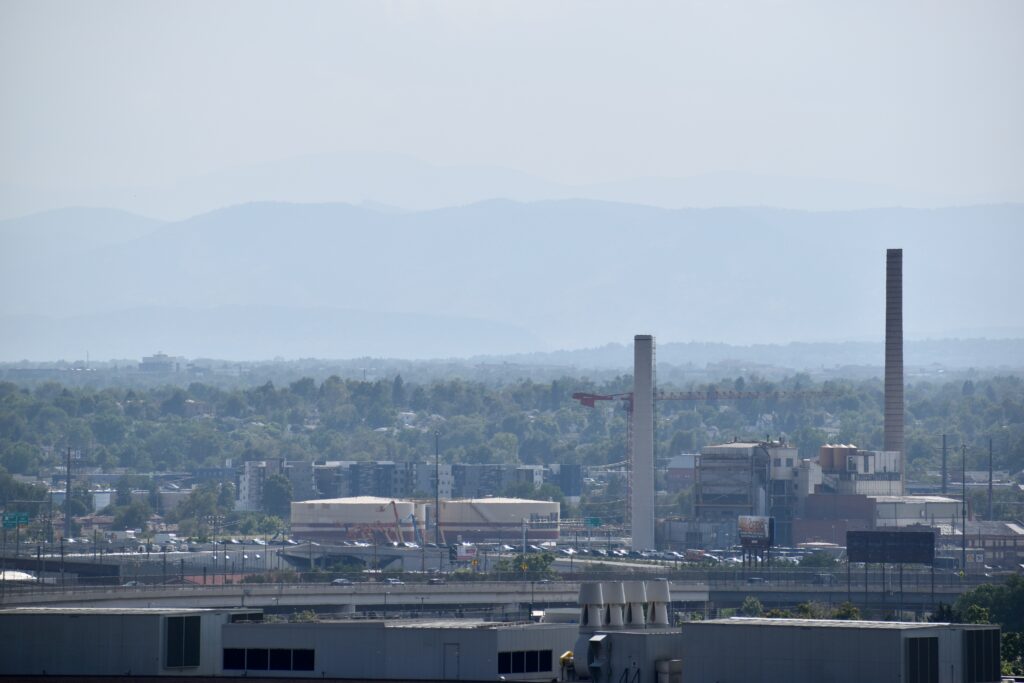
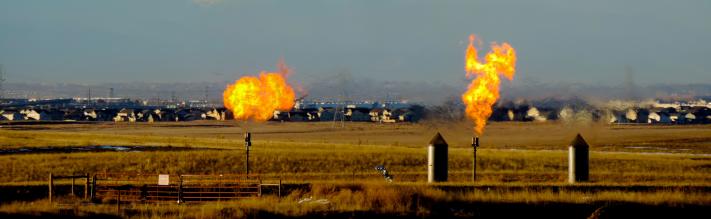
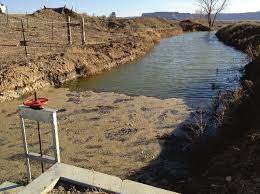
Suncor Refinery with Sand Creek in the foreground July 9, 2022. Photo credit: Allen Best/Big Pivots
Click the link to read the article on the Big Pivots website (Allen Best):
Colorado legislators in 2021 passed a suite of laws that in various ways give state agencies new marching orders that this energy transition will reconcile past wrongs and put people on an equal footing. But there’s a lot to sort through in this.
Now comes the part where the rhetoric about a just transition of the energy economy — paying special attention to disproportionately impacted communities and rectifying past wrongs with the word “equity” in mind — gets tested in the field.
In late July and early August, the three members of the Colorado Public Utilities Commission will take turns hosting six meetings from Lamar to Grand Junction, places selectively chosen because of evidence of disproportionate impacts from energy.
The meetings serve a dual purpose. The commissioners are gathering thoughts about how the state’s four regulated gas-distribution utilities will start changing how we heat buildings and water in order to reduce emissions. They are required to submit what are called clean-heat plans.
The four gas utilities —Xcel Energy, Black Hills Energy, Atmos Energy, and Colorado Natural Gas — must show how they will be able to reduce greenhouse gas emissions 4% by 2025 and 22% by 2030, based on a 2015 baseline.
But the commissioners are also very deliberately meeting in cities that have been identified by mapping tools as having, or being proximate to, disproportionately impacted communities.
Get accustomed to hearing that phrase, now used so often it has been reduced to an acronym in many documents: DIC. Among other things, the commissioners want to better understand how to define equity (as distinct from equality) and what constitutes a DIC community.
It’s an early milestone in Colorado’s difficult and still new process, one parallel to others underway in several states around the country.
Pushing their investigation are five laws passed by Colorado legislators in 2021 that collectively seek to put the hands of those communities on the steering wheel in ways that they have not before.
SB 21-272, “Modernize the Public Utilities Commission,” tells the PUC that it must adopt rules that “consider how best to provide equity, minimize impacts, and prioritize benefits to disproportionately impacted communities and address historical inequalities.”
What are disproportionately impacted communities? This law provides a glimpse:
“Certain communities, both in Colorado and internationally, have historically been forced to bear a disproportionate burden of adverse human health or environmental effects, as documented in numerous studies, while also facing systemic exclusion from environmental decision-making processes and enjoying fewer environmental benefits,” says SB21-272.
The law cites a 2021 report from the Goldman School of Public Policy at the University of California, Berkeley. The project, called Mapping for Environmental Justice, attempted to paint a holistic picture of intersecting environmental, social, and health impacts in individual states, including Colorado.
The study found that “communities of color breathe nearly twice as much diesel pollution and are 1.5 times more likely to live near a Superfund site than white communities. The disparity holds across an array of environmental hazards: from wastewater releases to air toxins, Coloradoans of color are consistently exposed to more pollution.”
This same law, SB 21-272, instructs the PUC to “identify disproportionately impacted communities” and host meetings and in other ways invite input from them to ensure that they will have at least proportionate access to the benefits of retail customer programs, incentives and investments.”
The PUC must go through a rule-making process that governs how the PUC reviews plans by utilities —including not just energy utilities, but also transportation and other sectors it regulates.
The goal is to deliver equity – which will be defined later – in programs and incentives that serve low-income customers and disproportionately impacted communities.
Clean Heat
The second law of relevance, SB 21-264, the “Clean Heat Bill,” requires Colorado’s four natural gas utilities to start figuring out how to reduce fossil fuel combustion from buildings. It gives the largest gas utilities, including Xcel, various ways to achieve a 22% reduction in emissions by 2030. They can, for example, help customers convert to electricity through use of air-source heat pumps. Utilities are required to submit clean-heat plans.
This clean-heat bill also has an environmental justice component. That law also calls out the “historic injustices that impact lower-income Coloradans and black, indigenous, and other people of color who have borne a disproportionate share of environmental risks while also enjoying fewer environmental benefits.”
As the PUC goes about creating the rules for evaluating clean-heat plans, it must hold at least two meetings in disproportionately impacted communities.
In planning six meetings, not just two, the PUC obviously aims for a robust compliance with the letter of the law. The PUC has gone a step beyond, and we’ll explain that later in this article.
Yet a third law, HB 21-1266, called the “Environmental Justice Act,” takes direct aim and, unlike the others, delivers more explicit instructions for the Air Quality Control Commission – an agency within the state’s health department – to engage with disproportionately impacted communities.
The law incorporates demographic factors but delegated to a new Environmental Justice Action Task Force the work of defining what exactly constitutes a disproportionately impacted community. The law also added transition to a more equitable clean energy economy to the mission of the Colorado Energy Office.
Two more laws deserve mention.
SB 21-246, Promote Beneficial Electrification, requires investor-owned utilities to file plans with the PUC that must include “programs targeted to low-income housing or disproportionately impacted communities with at least 20% of the total beneficial electrification program funding” directed to those communities and income levels.
HB21-1105 modified the eligibility standards for low-income programs.
The trajectory
Why did all of this come together in 2021?
Ean Tafoya, of GreenLatinos, who is co-chair of the new task force, says the thinking had been growing for years of the need to “redress” inequities.
In 2019, the first year that Democrats gained a majority in both chambers, as well as the governor’s mansion, the legislators who might have carried the bills were too new to the General Assembly to be effective.
Then came the killing of George Floyd by a Minneapolis police officer in 2020, spurring national protests, including in Denver. This was just months after the covid pandemic descended, hitting minority populations harder.
Those things “helped to galvanize the creation of a more formidable environmental justice coalition,” says Tafoya. This pressure seems to have created “more political room for the politicians to move forward.”
Tafoya also says that this powerful new environmental justice coalition wouldn’t settle for legislation that in early drafts didn’t initially include equity provisions.
In this, he refers to major bills driven by Sen. Chris Hansen of Denver and two Boulder County legislators, Sen. Steve Fenberg and Rep. Tracey Bernett, as well as Rep. Alex Valdez and Rep. Meg Froehlich.
A bill that started out as SB 200 was recreated in SB 1266 with Faith Winter as a primary author. She did not respond to several requests for an interview.
The Environmental Justice Act is sweeping. It requires the Air Quality Control Commission to adopt rules to reduce greenhouse gas emissions from oil and gas operations. It also requires that commission to adopt rules to reduce emissions from the industrial and manufacturing sector in Colorado by at least 20% by 2030 relative to 2015 levels.
Environmental justice, though, is front and center in the law. It requires the Air Quality Control Commission to promote outreach to disproportionately impacted communities by creating new ways to gather input from communities across Colorado, using multiple languages and multiple formats.
The law also created the task force of which Tafoya is a member with the responsibility to make recommendations to legislators of “practical means to address environmental justice inequities” by Nov. 14.
That task force has met four times beginning in December, and it also has five subcommittees that meet monthly.
Pueblo’s Jamie Valdez, who is also on the task force, describes it as a “very difficult process.” But the goal is to avoid compromising as has occurred in the past.
Members have received much testimony “that there has not been enough consideration or responsiveness to community and too much to industry,” he says.
The table has been tilted heavily to a discussion between industry and regulators, to the exclusion of others, says Valdez, who is paid staff and a community organizer for southern Colorado on behalf of Mothers Outfront, a mothers-funded environmental justice organization whose mission is to work for a livable climate for all children.
Equity and equitable
The Colorado Public Utilities Commission has also been moving along. The commission held a workshop in February to get insights from participants about how to implement the environmental justice component of HB21-264, the law that requires the meetings in disproportionately impacted communities. In March, the PUC asked the states’ four natural gas utilities – Xcel, Black Hills Energy, Atmos, and Colorado Natural Gas – to identify three ideas for meeting locations.
Xcel identified Grand Junction, metro Denver, and Pueblo. Black Hills identified Montrose, Rocky Ford, and Yuma. Atmos Energy identified Greeley, Lamar, and Craig.
The utilities were advised to consult a data-rich mapping tool created by the Colorado Department of Public Health and Environment called EnviroScreen. This was a result of the Environmental Justice Bill. When I first looked at this a year ago, I found it primitive. It showed the Wildridge neighborhood north of Avon and the Singletree neighborhood of Edwards to be in an environmentally impacted tract. (That all of us should be so unfortunate as to live in such areas.)
A review for this article shows a sophisticated tool, if still not complete. A tutorial explains it was created “to help identify the relative health burdens and environmental risks facing different communities across Colorado.”
On June 1, the PUC hosted a session on equity initiatives. Kelly Crandell, of the PUC staff, explained the SB 21-272 requirement to promulgate rules that seek to “provide equity and minimize impacts and prioritizes benefits to disproportionately impacted communities that have experienced historical inequalities.”
During the next few months, she said, the PUC commissioners and staff will be focusing on learning things that can be used to shape these new rules, the ones being drawn up to govern how the PUC evaluates plans by utilities.
Crandell carefully distinguished between equality and equity. With the equality, the idea is to provide something to everyone equally. So, your residential rates for electricity will be the same as your neighbors’.
Equity as Crandell explained it has a historical dimension. It recognizes that things may need to change so that others can participate, that actions of the past such as redlining must be acknowledged to properly rectify going forward.
“It’s challenging to an agency such as ours because conversations more traditionally operated in the vein of equality,” she said.
The legislation, she explained, had three dimensions: 1) recognize why certain communities have suffered, such as because of redlining practices; 2) procedural inequalities. How can the PUC make its process more accessible to the public; and 3) broadly prioritizing the benefits of new energy programs to disproportionately impacted communities.
Different sorts of meetings
Most interesting of these meetings may be at Montbello, located in northeastern Denver on the north side of I-70. It will use a new format of outreach.
There, community members will be paid to attend and share their thoughts. The meeting will be led by the Denver Office of Climate Action, Sustainability and Resiliency. That municipal agency has been hosting community meetings. In this case two community-based organizations have been enlisted to put it together.
“The event will include a listening session on energy priorities within these neighborhoods in addition to a discussion about clean heat plans,” the decision notice issued by the PUC on July 6 says. The event will be presented in both English and Spanish.
Ah yes – the clean heat plans. The natural gas utilities must figure out how to reduce emissions from buildings. A small bit of this can be accomplished by augmenting supplies of methane distributed to homes for heating and cooking with what is called renewable natural gas, such as that harvested from landfills. But there are many other tools – including beneficial electrification, including the use of air source heat pumps to displace or at least augment natural gas furnaces. They’re still relatively expensive, though, with a payback that in most cases will take at least several years.
Tafoya observes that focus groups have already found that tax credits won’t work for lower-income residents. “It’s clear that people want down-payment assistance, not just tax credits.”
Colorado is far from alone in trying to look at utility decisions through the new lenses of equity. A report called “Advancing Equity in Utility Regulation” issued in November 2021 by Berkeley National Laboratory notes an effort in California in 2020 requiring “environmental justice” to be part of the state’s mission. New York and Washington also adopted legislation in 2019, the latter state charging the utilities commission with “ensuring that all customers are benefiting from the transition to clean energy.”
In 2021, Massachusetts, Oregon, Illinois, and Maine all passed somewhat parallel legislation along with Colorado.
July 21: Greeley, Greeley Recreation Center, 11:30 a.m. to 1 p.m.
July 21: Denver, Montebello Recreation Center, 5-7:30 p.m.
July 27: Grand Junction, Colorado Mesa University Center, 11:30 a.m.-1 p.m.
July 28: Montrose, Montrose Event Center, 11:30 a.m.-1 p.m.
Aug. 4: Pueblo, Bessemer Community Room at Steelworks Center for the West, 11:30 a.m.-1 p.m.
Aug. 4: Lamar Cultural Events Center, 4:30-6 p.m.
The 5 bills: SB21-272 “Measures to Modernize the Public Utilities Commission.” Requires PUC to identify disproportionately impacted communities (DICs) and to reach out to let them help create new rules.
SB 21-264, “Clean Heat Bill.” Requires natural gas utilities to begin decarbonizing gas distributed to buildings. Requires PUC to hold at least two meetings in DICs.
HB 21-1266 “Environmental Justice Act.” Instructions specifically to Air Quality Control Commission.
SB 21-246, “Promote Beneficial Electrification.” Requires 20% of program funds be used for low-income households or disproportionately impacted communities.
HB21-1105, modifies eligibility standards for low-income programs.
Your climate solutions journey begins now. Filled with the latest need-to-know science and fascinating insights from global leaders in climate policy, research, investment, and beyond, this video series is a brain-shift toward a brighter climate reality.
Climate Solutions 101 is the world’s first major educational effort focused solely on solutions. Rather than rehashing well-known climate challenges, Project Drawdown centers game-changing climate action based on its own rigorous scientific research and analysis. This course, presented in video units and in-depth conversations, combines Project Drawdown’s trusted resources with the expertise of several inspiring voices from around the world. Climate solutions become attainable with increased access to free, science-based educational resources, elevated public discourse, and tangible examples of real-world action. Continue your climate solutions journey, today.
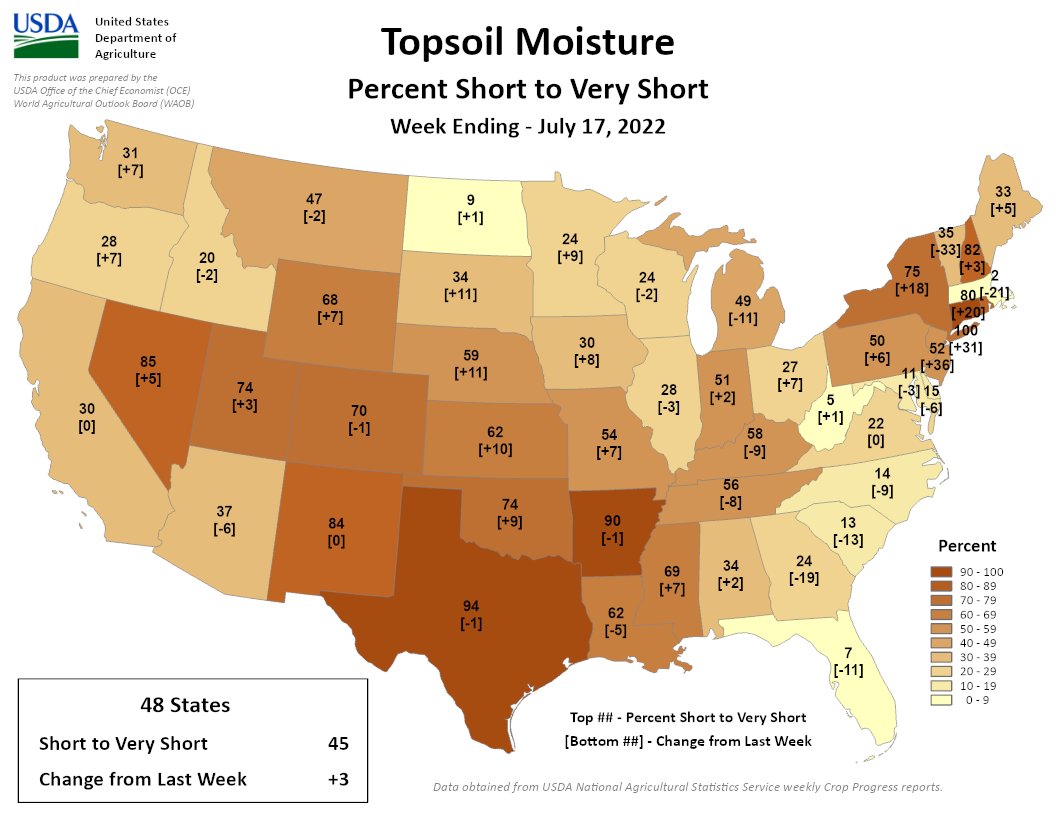
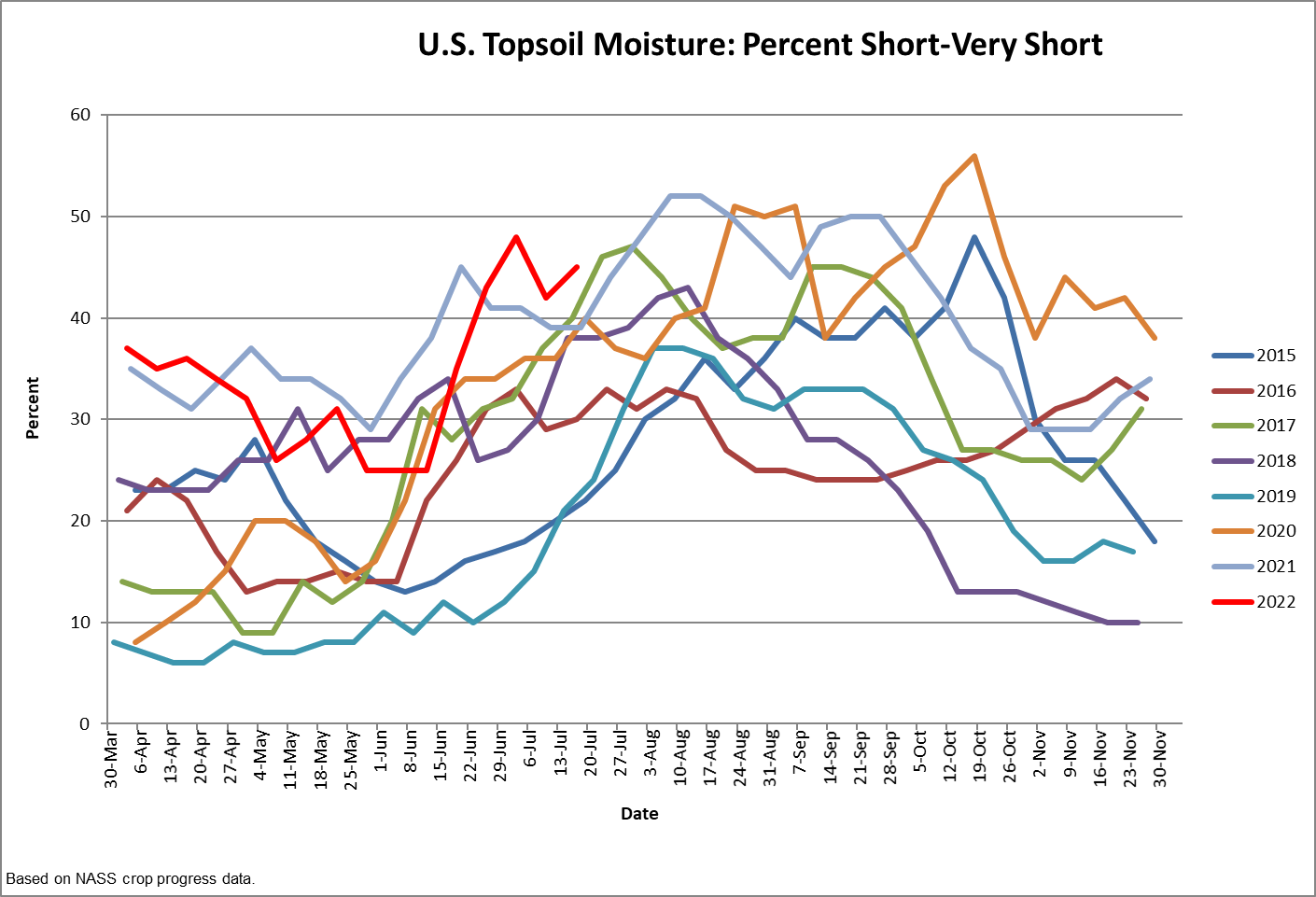
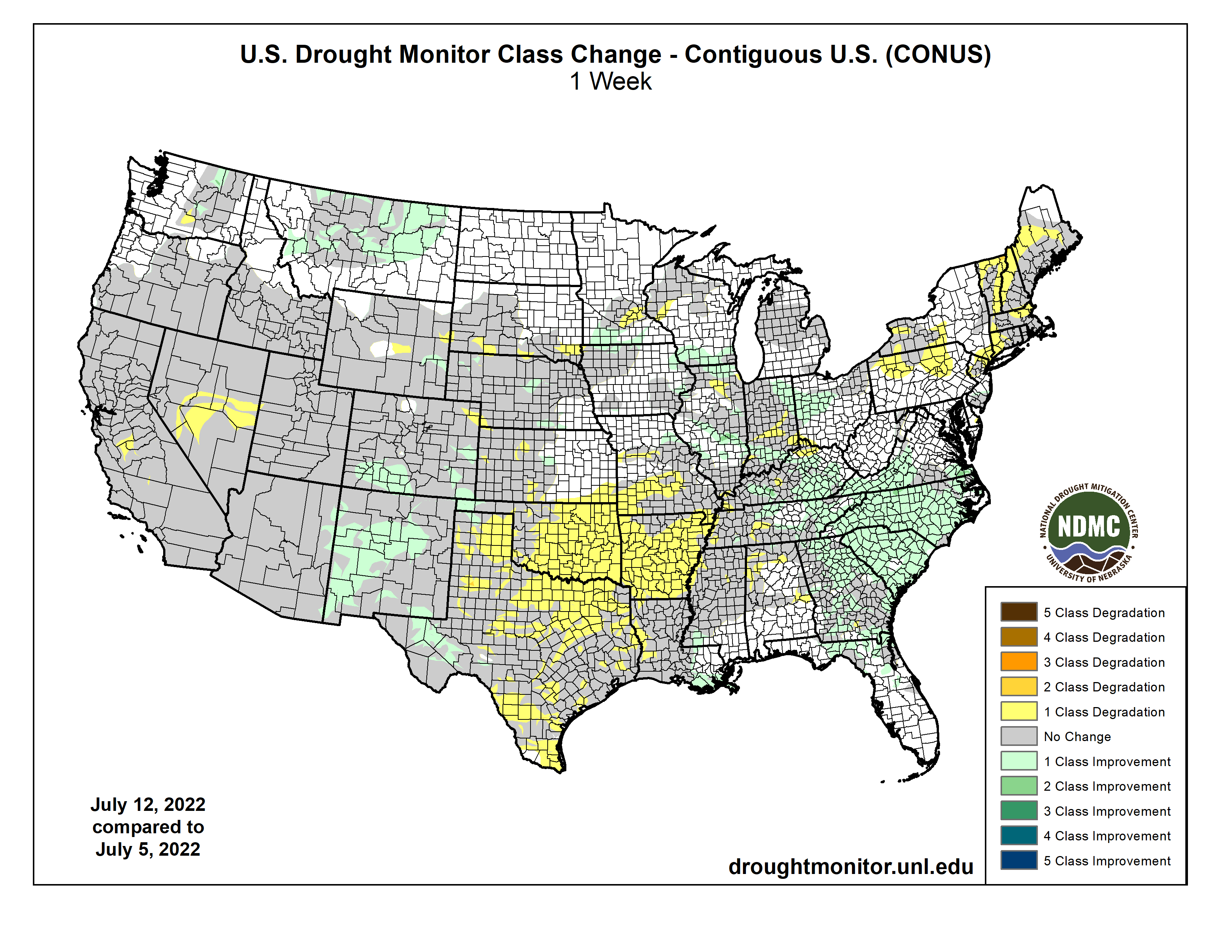
A 3% jump across the Lower 48. The last 3 weeks have seen the highest levels of topsoil moisture short/very short for this time range in 8 years. TX (94%) and AR (90%) have the highest levels short/very short.
Upper Division States 5 Point Plan for Additional Actions to Protect Colorado Storage Project Initial Units:
Dear Commissioner Touton,
The Upper Division States of Colorado, New Mexico, Utah, and Wyoming, through the Upper Colorado River Commission (UCRC), are writing in response to your request that the Colorado River Basin States take
additional actions in response to the continuing drought and depleted system storage. During your testimony to the Senate Natural Resources Committee on June 14, 2022, you asked the Basin States to develop plans to provide an additional 2-4 million acre-feet (MAF) of water in 2023 to protect critical elevations at Lake Powell and Lake Mead. You also indicated that, absent such plans being developed by mid-August, the Bureau of Reclamation is prepared to take unilateral action under its existing authority to protect the system.
The Upper Division States recognize that bringing the system into balance will require collaboration and efforts from all Basin States and water use sectors. Accordingly, we stand ready to participate in and support efforts, across the Basin, to address the continuing dry hydrology and depleted storage conditions. However, the options the Upper Division States have available to protect critical reservoir elevations are limited. The Upper Basin is naturally limited to the shrinking supply of the river, and previous drought response actions are
depleting upstream storage by 661,000 acre-feet. Our water users already suffer chronic shortages under current conditions resulting in uncompensated priority administration, which includes cuts to numerous present perfected rights in each of our states.
In order to proactively support critical infrastructure and resources related to the Colorado River Storage Project Act Initial Units, we have developed a 5 Point Plan. We intend to implement the 5 Point Plan to the
extent it is effective, in conjunction with plans developed for the Lower Basin. The components of the 5 Point Plan are as follows:
(1) Seek amendment and reauthorization of the System Conservation Pilot Project legislation originally enacted in 2014. The amendment will provide for extension of the authorization and reporting periods
to September 30, 2026, and September 30, 2027, respectively, and seek funding to support the program in the Upper Basin. Upon obtaining reauthorization, the necessary funding, and finalizing any
required agreements, we intend to reactivate the program in the Upper Basin in 2023.
(2) Commence development of a 2023 Drought Response Operations Plan (2023 Plan) in August 2022 with finalization in April 2023 consistent with the Drought Response Operations Plan Framework (Framework). A 2023 Plan must meet all the requirements of the Drought Response Operations Agreement and the Framework. These requirements include, but are not limited to, determining the effectiveness of any potential releases from upstream Initial Units to protect critical elevations at Glen
Canyon Dam, and ensuring that the benefits provided to Glen Canyon Dam facilities and operations are preserved.
(3) Consider an Upper Basin Demand Management program as interstate and intrastate investigations are completed.
(4) Implement, in cooperation with Reclamation, the Bipartisan Infrastructure Law for Upper Basin Drought Contingency Plan funding to accelerate enhanced measurement, monitoring, and reporting
infrastructure to improve water management tools across the Upper Division States.
(5) Continue strict water management and administration within the available annual water supply in the Upper Division States, including implementation and expansion of intrastate water conservation programs and regulation and enforcement under the doctrine of prior appropriation.
The challenges in the Colorado River Basin affect us all and require collaboration across the entire Basin. We request your support as we advance our 5 Point Plan, including for federal legislation to reauthorize the System Conservation Pilot Program and for funding to support the Plan through September 2026.
Reclamation data shows that Lower Basin and Mexico depletions are more than double the depletions in the Upper Basin. Therefore, additional efforts to protect critical reservoir elevations must include significant actions focused downstream of Lake Powell. Otherwise, the effectiveness of our 5 Point Plan will be limited.
We look forward to working with you on this critical effort while also developing sustainable long-term solutions to address the challenges we face in the Colorado River Basin.
Becky Mitchell, the state of Colorado’s top water official. (Source: Colorado Water Conservation Board)
From email from the Colorado Water Conservation Board (UCRC Commissioner Rebecca Mitchell):
In coordination with the other Upper Division States of New Mexico, Utah, and Wyoming, Colorado is taking action in response to the call from the Bureau of Reclamation Commissioner Camille Touton to the Colorado River Basin states to conserve a total of 2-4 million acre-feet to protect critical infrastructure at Lake Powell and Lake Mead. The Upper Division States’ 5 Point Plan is outlined in a letter sent to Commissioner Touton by the Upper Colorado River Commission on July 18.
“The challenges facing the Colorado River are significant and require action across the entire Basin. While the options available in the Upper Division states of Colorado, New Mexico, Utah, and Wyoming are limited by hydrologic conditions, we are doing our part to protect the system. The Upper Basin states take water cuts responsive to hydrologic conditions and have also provided a significant amount of water from our upstream reservoirs. On top of these actions, we have developed a comprehensive new 5 Point Plan. But these efforts will be successful only if additional actions are taken downstream of Lake Powell,” said Colorado River Commissioner Becky Mitchell.
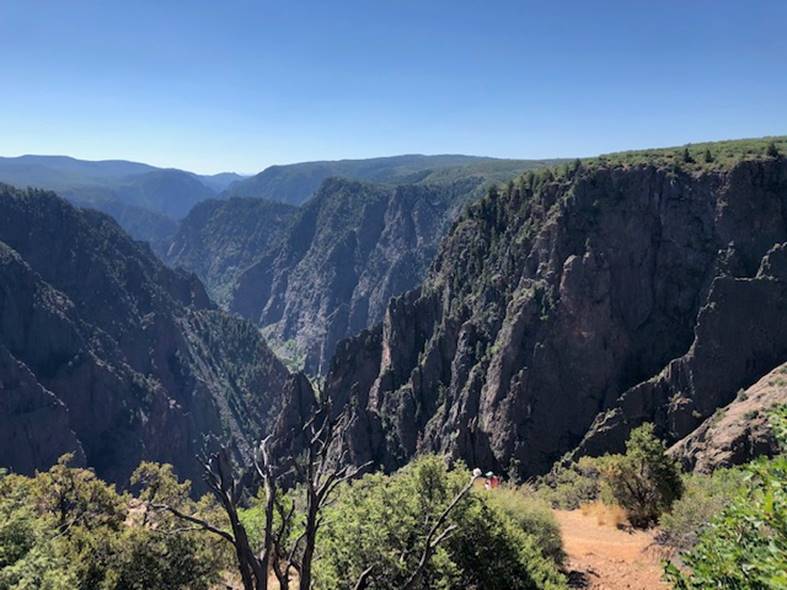
Black Canyon July 2020. Photo credit: Cari Bischoff
From email from Reclamation (Erik Knight):
Releases from the Aspinall Unit will be increased from 1450 cfs to 1500 cfs on Wednesday, July 20th. Releases are being increased to maintain flows above the baseflow target on the lower Gunnison River. The forecasted April-July runoff volume for Blue Mesa Reservoir is 67% of average.
Flows in the lower Gunnison River are currently very near to the baseflow target of 900 cfs. River flows are expected to drop below the baseflow target without this additional increase in release from the Aspinall Unit.
Pursuant to the Aspinall Unit Operations Record of Decision (ROD), the baseflow target in the lower Gunnison River, as measured at the Whitewater gage, is 900 cfs for June, July and August.
Currently, Gunnison Tunnel diversions are 1030 cfs and flows in the Gunnison River through the Black Canyon are around 440 cfs. After this release change Gunnison Tunnel diversions will still be around 1030 cfs and flows in the Gunnison River through the Black Canyon will be near 490 cfs. Current flow information is obtained from provisional data that may undergo revision subsequent to review.
District calls on Front Range diverters to assist in prevention of further fish kills, economic impairment.
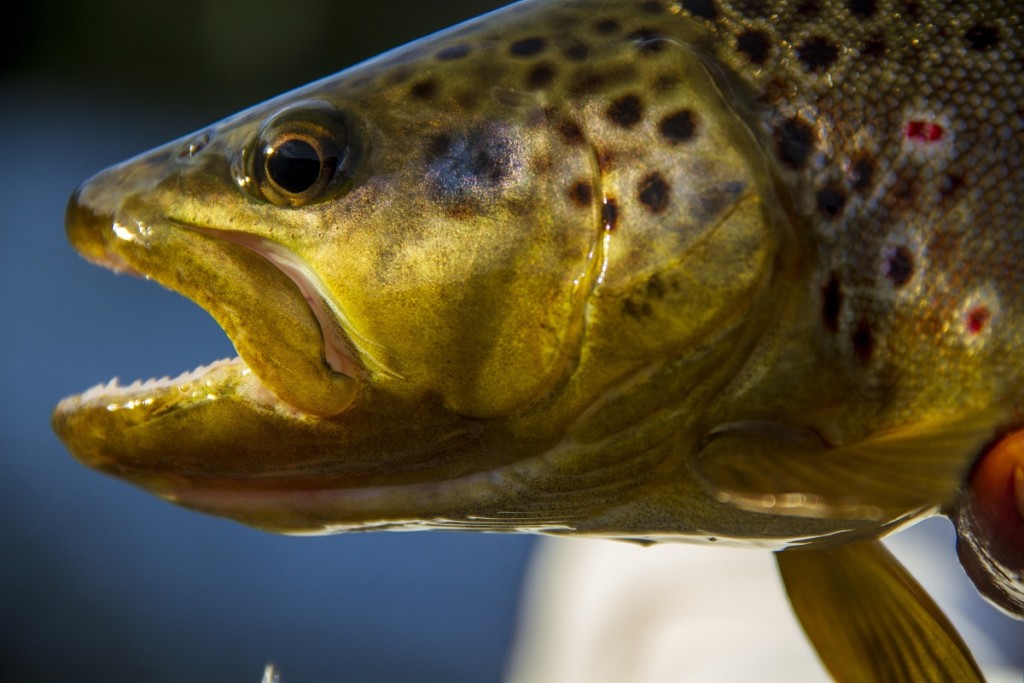
Low flows and high water temperatures are creating critical conditions on the Upper Colorado for the second consecutive year, triggering fishing closures amidst reports of struggling and dying fish. Anticipating these conditions, the Colorado River District chose to release water from an already-reduced Wolford Mountain Reservoir last weekend. This voluntary release generated approximately 200 acre-feet of water to protect the health of the river – and by extension, local economies and downstream water users. District staff, however, says further action is needed.
“Our constituents are seeing fish floating by belly-up and struggling to survive current hot temperatures,” said Brendon Langenhuizen, the River District’s Director of Technical Advocacy. “We’ve also received reports of dead fish along the riverbanks. Since the beginning of July, these new-normal conditions are having major impacts on the Upper Colorado River ecosystem. Colorado Parks & Wildlife’s fishing closures are symptomatic of a larger issue that needs the attention of all water users. Our District has and will continue to do our part with voluntary releases when water is available from our limited resources at Wolford Mountain Reservoir.”
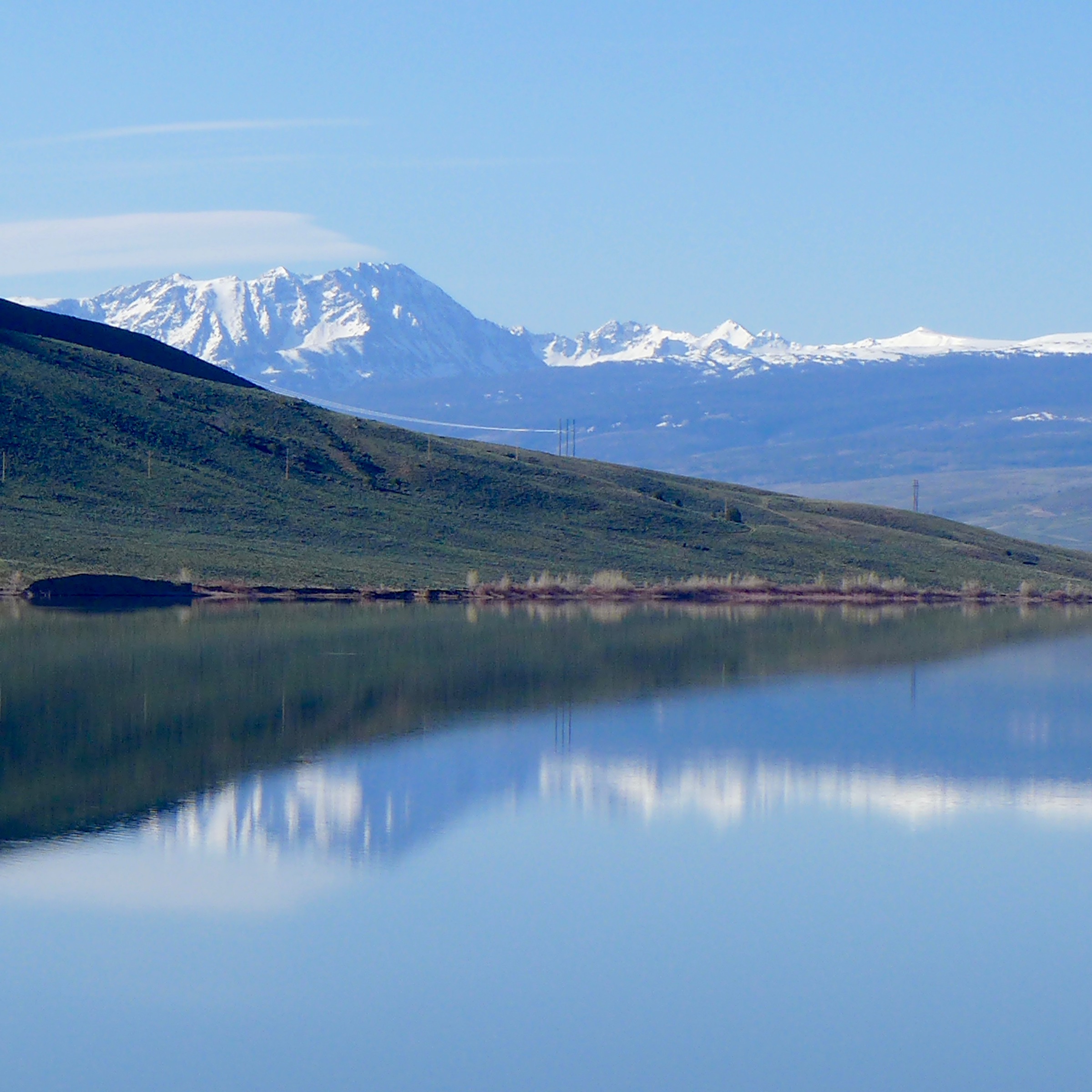
Wolford Mountain Reserovir, and the Gore Range. Photo: Brent Gardner-Smith/Aspen Journalism
Recent monsoonal rains are bringing some relief, but soil moisture issues and hot, dry conditions forecasted for early next week have prompted a need for direct action. In response, the River District began releasing an additional 50 cubic feet-per-second (cfs) Friday morning, July 15, and will continue through Sunday, July 17, providing another 300 acre-feet of water for the river by Monday morning. Limited West Slope water supplies will inhibit the River District’s ability to fully address temperature and flow issues, however.
“We can’t fix this situation alone,” Langenhuizen stated. “Our constituents are asking for help to address the river’s unhealthy conditions causing fish kills. They’re wondering why large Front Range providers are not reducing their transmountain diversions to join the River District in aiding Colorado’s namesake river and the livelihoods it supports.”
The River District urges these water providers to act in partnership with West Slope water users to protect the health of the Upper Colorado River.
Colorado River just after crossing under highway 34. Photo credit: Colorado River District
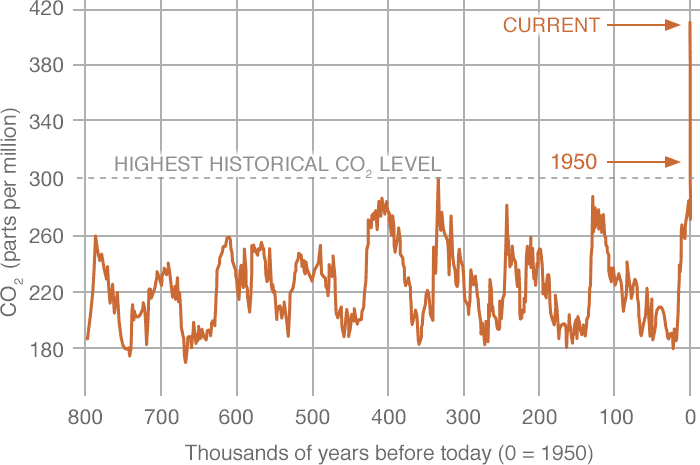
PROXY (INDIRECT) MEASUREMENTS Data source: Reconstruction from ice cores. Credit: NOAA
Click the link to go to the NASA website for all the inside skinny and to use the interactive map:
Carbon Dioxide
LATEST MEASUREMENT: June 2022
419 ppm
Carbon dioxide (CO2) is an important heat-trapping gas, or greenhouse gas, that comes from the extraction and burning of fossil fuels (such as coal, oil, and natural gas), from wildfires, and from natural processes like volcanic eruptions. The first graph shows atmospheric CO2 levels measured at Mauna Loa Observatory, Hawaii, in recent years, with natural, seasonal changes removed. The second graph shows CO2 levels during Earth’s last three glacial cycles, as captured by air bubbles trapped in ice sheets and glaciers.
Since the beginning of industrial times (in the 18th century), human activities have raised atmospheric CO2 by 50% – meaning the amount of CO2 is now 150% of its value in 1750. This is greater than what naturally happened at the end of the last ice age 20,000 years ago.
The animated map shows how global carbon dioxide has changed over time. Note how the map changes colors as the amount of CO2 rises from 365 parts per million (ppm) in 2002 to over 400 ppm currently. (“Parts per million” refers to the number of carbon dioxide molecules per million molecules of dry air.) These measurements are from the mid-troposphere, the layer of Earth’s atmosphere that is 8 to 12 kilometers (about 5 to 7 miles) above the ground.
U.S. Highway 287 runs through the future site of Glade Reservoir. The Larimer county Board of County Commissioners approved the 1041 Land Use Permit for NISP in September, 2020. Photo credit: Northern Water
Click the link to read the article on the Fort Collins Coloradoan website (Sady Swanson and Jacy Marmaduke). Here’s an excerpt:
Crews began conducting rock and soil assessments in June at the site of the planned Glade Reservoir, north of Ted’s Place on U.S. Highway 287. The assessments will give Northern Colorado Water Conservancy District officials site-specific geotechnical and geological information that will inform the design and construction of the Glade Reservoir dam…
The assessment work is expected to continue through November, according to a Northern Water news release. This work includes:
Digging a 1,000-foot-long trench at the main dam site to test materials and drill the foundation
Building a test pad of embankment material types
Producing aggregates and rock fill from quarries and investigating material characteristics
This work is being done ahead of the project’s anticipated approval by the U.S. Army Corps of Engineers, which is expected to make its final determination this year. If that happens, construction could start as early as 2023 with completion expected by 2028.
Northern Integrated Supply Project (NISP) map July 27, 2016 via Northern Water.
State Highway 133 crosses the Crystal River several times as it flows downstream to its confluence with the Roaring Fork River in Carbondale. Some proponents of a federal Wild & Scenic designation are pushing for a quick timeline while others want a more cautious approach. CREDIT: HEATHER SACKETT/ASPEN JOURNALISM
A campaign to protect one of the last free-flowing rivers in Colorado is moving forward, but some proponents say not enough progress has been made over the past year.
Last spring a handful of advocates led by Pitkin County revived an effort to secure a federal Wild & Scenic designation, which would protect the upper Crystal River from future development, dams and diversions. A year into the effort, some say a planned stakeholder process is moving too slowly, while others say a designation can’t be rushed and must be approached carefully and inclusively.
The different philosophies underscore a rift between those who say a cautious and thorough multi-year approach is what’s needed to ensure success and those who say mounting threats to the river, driven by the climate crisis, demand bold and immediate action.
“That difference of opinion concerns me a great deal,” said Kate Hudson, Crystal River Valley resident and western U.S coordinator for Waterkeeper Alliance. “We are at an existential moment both in terms of water and climate and our congressional balance of power that requires we at least try and do this faster. We should at least try to move this as quickly as possible.”
In 2021 Pitkin County Healthy Rivers granted $35,000 to Carbondale-based environmental conservation group Wilderness Workshop to start up a public outreach and education campaign, with the goal of laying a foundation of grassroots support for the effort. The organization has built a website, held events and collected about 1,000 signatures on a petition supporting the designation. The next step will be working with Pitkin County to hire a facilitator for a formal stakeholder process.
At the June Healthy Rivers board meeting, Wilderness Workshop’s Wild & Scenic campaign manager Michael Gorman gave a presentation about progress so far. Board member Wendy Huber asked about the timeline and whether the process should be moving faster. Gorman said a designation could take several more years.
“I’m feeling a little urgency,” she said. “To sort of dilly dally seems to be losing opportunities.”
Grant Stevens, communications director for Wilderness Workshop, said that while he understands the community’s urgency, it’s important to develop a proposal that Colorado’s congressional representatives can get behind. A designation must be approved by Congress and advocates have been in contact with representatives from Sens. Michael Bennet and John Hickenlooper’s offices.
“We want to make sure we have something that a federal elected official will support, and we need to make sure we go through a community-driven process to get to that point,” Stevens said. “We don’t want to rush that.”
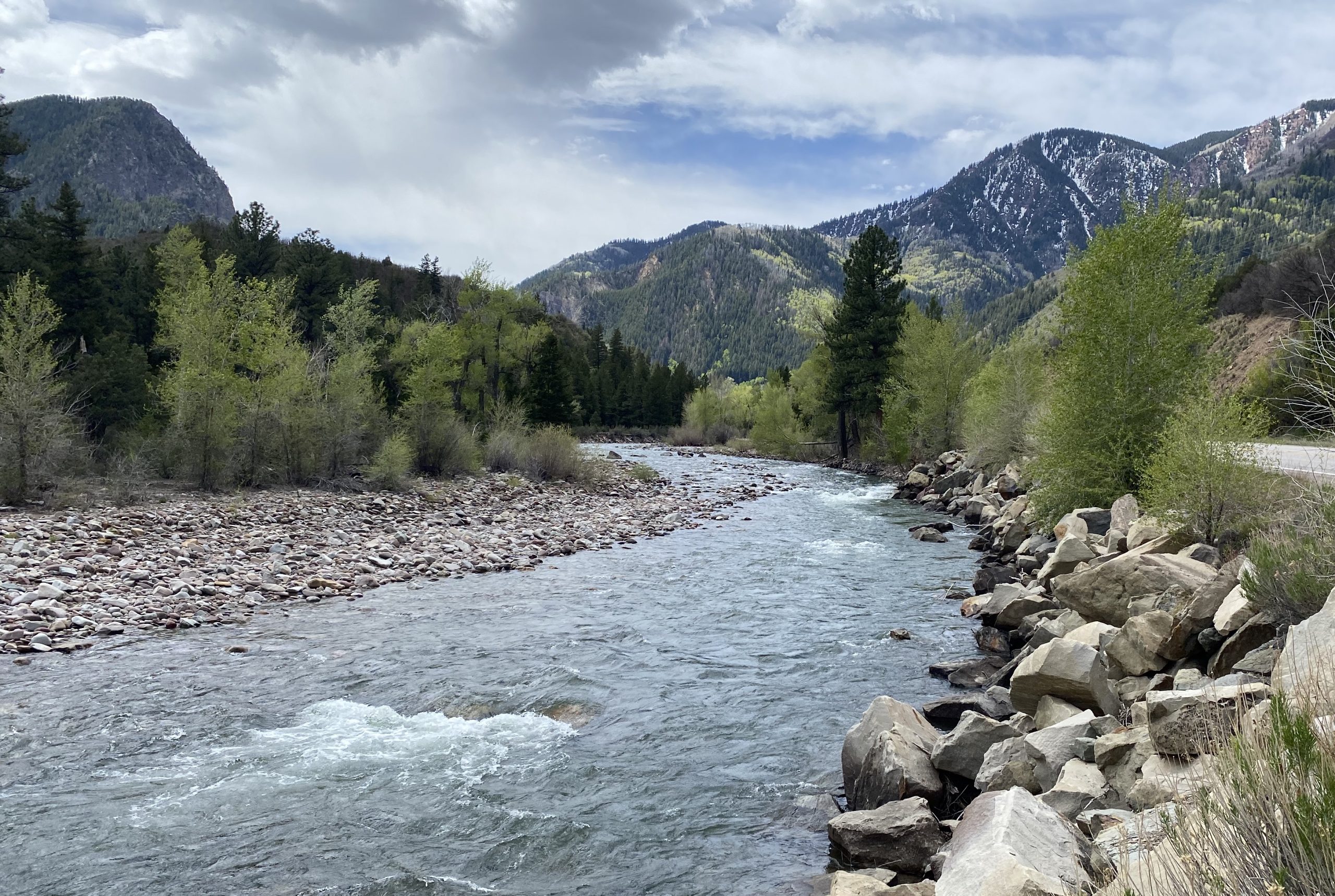
The view looking upstream on the Crystal River below Avalanche Creek. A Pitkin County group wants to designate this section of the Crystal as Wild & Scenic. CREDIT: CURTIS WACKERLE/ASPEN JOURNALISM
Designation details
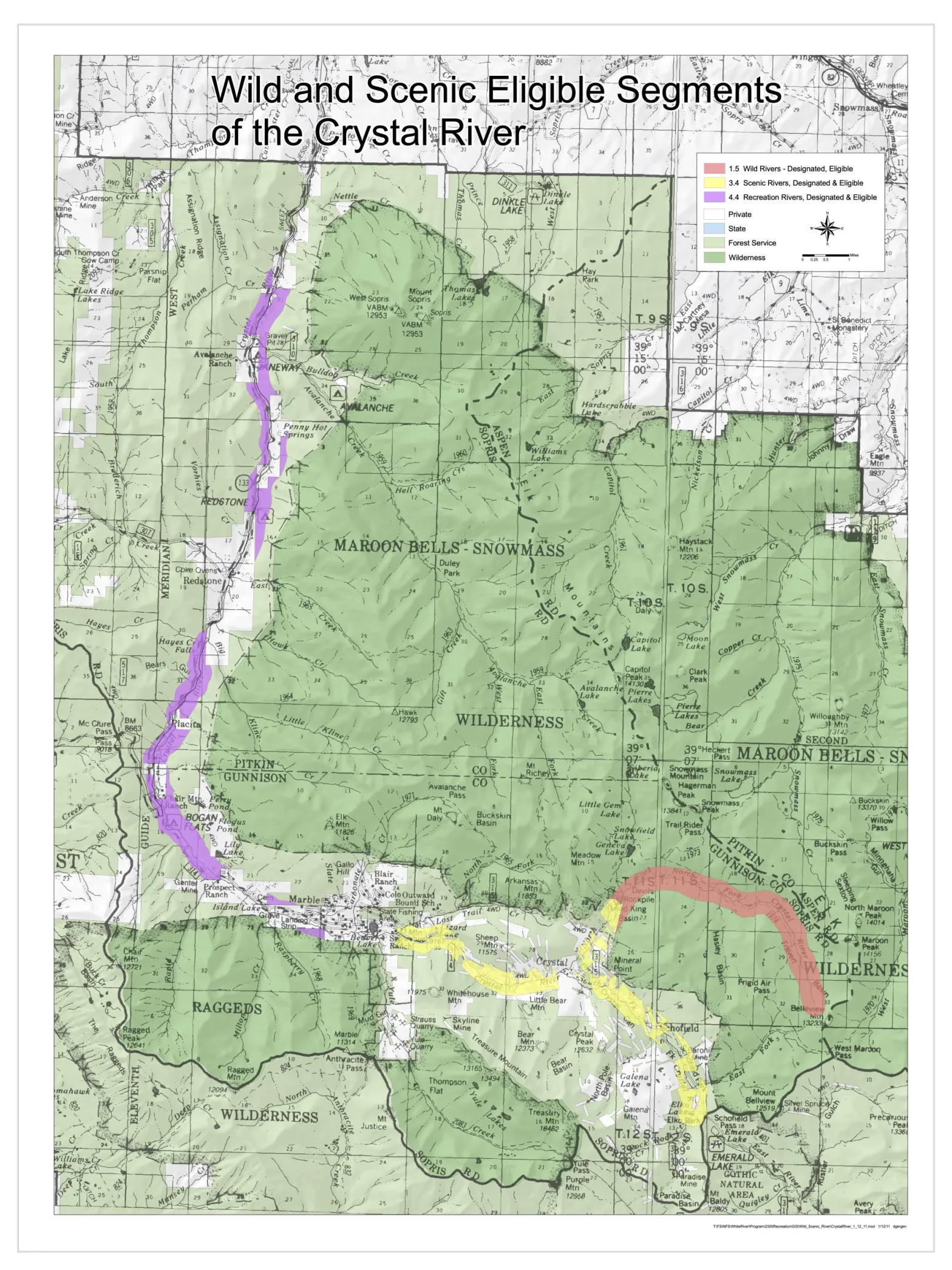
The U.S. Forest Service first determined in the 1980s that the Crystal River was eligible for designation under the Wild & Scenic River Act, which seeks to preserve rivers with outstandingly remarkable scenic, recreational, geologic, fish and wildlife, historic and cultural values in a free-flowing condition. There are three categories under a designation: wild, which are sections that are inaccessible by trail, with shorelines that are primitive; scenic, with shorelines that are largely undeveloped, but are accessible by roads in some places; and recreational, which are readily accessible by road or railroad and have development along the shoreline.
The potential proposal for the Crystal includes all three types of designation: wild in the upper reaches of the river’s wilderness headwaters, scenic in the middle stretches and recreational from the town of Marble to the Sweet Jessup canal headgate. Each river with a Wild & Scenic designation has unique legislation written for it that can be customized to address local stakeholders’ values and concerns.
Cache la Poudre River from South Trail via Wikimedia Foundation.
Despite its renowned river rafting, fishing and scenic beauty, which contribute to the recreation-based economy of many Western Slope communities, Colorado has just 76 miles of one river — the Cache La Poudre — designated as Wild & Scenic. This underscores the difficulty of trying to preserve free-flowing streams, especially in a water-scarce region where some would like to see rivers remain available for future water development.
This map shows the sections of the Crystal River that could be designated wild, scenic and recreational according to the finding of eligibility by the U.S. Forest Service. CREDIT: COURTESY ROARING FORK CONSERVANCY
Stakeholder participation
Since the Crystal flows through Gunnison County and the town of Marble, advocates say getting those residents and elected representatives on board will be key to moving the effort forward. A first attempt at a Wild & Scenic designation, which sought to prevent the possibility of a future dam and reservoir project, couldn’t get buy-in from some Marble residents or Gunnison County. Advocates shelved the discussion in 2016 with the election of President Donald Trump. This time around, they hope to secure at least the participation if not the support of past opponents.
Marble Town Administrator Ron Leach acknowledged there is still a lot of work to be done as far as gauging public sentiment and building awareness.
Leach has been heavily involved in the town’s multi-year process to address overcrowding on the Lead King loop, a popular off-highway vehicle route near Marble. He said when it comes to these things, slow and methodical is the right strategy and that town officials are totally supportive of the Wild & Scenic stakeholders group, in which he participates as the Marble representative.
“The more process, the better the product,” Leach said. “I’ve learned that the hard way. Take it easy and make sure it’s right.”
Gunnison County Commissioner Roland Mason agreed. He said more conversations need to happen before he could say whether Gunnison County would support a designation.
“I appreciate the fact that they are not trying to rush the timeline,” Mason said. “From my perspective it’s moving at a little bit of a slow pace because of trying to get everyone on board but at the same time, it’s kind of necessary.”
But supporters may never get everyone on board. Larry Darien, who owns a ranch on County Road 3 that borders the river, was one of the early opponents to the designation and still remains opposed to Wild & Scenic because of its potential effect on private property.
While the Wild & Scenic Rivers Act does give the federal government the ability to acquire private land, there are many restrictions on those abilities. Condemnation is a tool that is rarely used, according to a Q&A document compiled by the Interagency Wild and Scenic Rivers Coordinating Council.
“I’m not in favor of a dam on the Crystal River and I’m not in favor of water being taken out and sent someplace else and I’m not in favor of Wild & Scenic designation,” he said. “There are other ways we can manage this besides Wild & Scenic and I think that’s the way we need to go instead of getting the federal government involved.”
The alternate route Darien is referring to is a collaboratively created alternative management plan on the Upper Colorado River, which offers some of the same protections as Wild & Scenic, but still allows for some water development.
Advocates will have to decide whether total consensus is a realistic goal and if they should move forward even though some opposition remains.
he headwaters of the Crystal River include the tributary of Yule Creek, the drainage seen to the left from an Eco-Flight, where Colorado Stone Quarries’ marble quarry is located. Some, including Pitkin County, would like to see the Crystal River designated under the federal Wild & Scenic River Act. CREDIT: HEATHER SACKETT/ASPEN JOURNALISM
Threats to the Crystal?
While there may be a general feeling of worry about drought and falling reservoir levels in the Colorado River basin overall, it’s unclear what — if any — specific, imminent threats there are to the upper Crystal River. In 2012, conservation group American Rivers deemed the Crystal one of the top 10 most endangered rivers. This was spurred by plans, which have since been scrapped, from the Colorado River Water Conservation District and the West Divide Conservation District to preserve water rights tied to reservoirs near Redstone.
Still, in a place where much of the state’s headwaters are taken across the Continental Divide to thirsty Front Range cities, Wild & Scenic proponents say it could happen on the Crystal, even if those threats are currently hypothetical. Many of Colorado’s rivers have been overly tapped, but there’s still water left to develop on the Crystal.
“To me, the greatest threat to the Crystal isn’t so much the storage facility, it’s that there’s still water in the Crystal,” said Pitkin County Attorney John Ely. “The biggest risk to the Crystal is just taking water out of the drainage. That’s why I think the (Wild & Scenic) effort is still worth doing.”
Aspen Journalism covers water and rivers in collaboration with The Aspen Times.
Declining snowpack will lead to more variable and unpredictable streamflow. Some of the snowmelt flowing in the Blue River as it joins the Colorado River near Kremmling, Colo., will reach the Lower Basin states. Dec. 3, 2019. Credit: Mitch Tobin, the Water Desk
Click the link to read the article on the NCAR/UCAR website (David Hosansky):
Water resources will fluctuate increasingly and become more and more difficult to predict in snow-dominated regions across the Northern Hemisphere by later this century, according to a comprehensive new climate change study led by the National Center for Atmospheric Research (NCAR).
The research team found that, even in regions that keep receiving about the same amount of precipitation, streamflow will become more variable and unpredictable. As snowpack recedes in a warmer future and fails to provide reliable runoff, the amount and timing of water resources will become increasingly reliant on periodic episodes of rain.
“Water managers will be at the whim of individual precipitation events instead of having four-to-six months lead time to anticipate snowmelt and runoff,” said NCAR scientist Will Wieder, the lead author. “Water management systems in snow-dominated regions are based on the predictability of snowpack and runoff, and much of that predictability could go away with climate change.”
Observations show that snowpack is already melting earlier, and even declining in many regions. This decline will become so pronounced toward the end of the century that the amount of water contained in snowpack at the end of an average winter in parts of the U.S. Rocky Mountains could plummet by nearly 80 percent, the scientists found.
The changes in runoff and streamflow are likely to have cascading impacts on ecosystems that depend on reliable water from snow, the study warns. Although the changes won’t be uniform across regions, more snow-free days and longer growing seasons will put stress on water resources, drying out soils in many areas and heightening fire risk.
The study assumes that emissions of greenhouse gasses continue at a high rate (a scenario known as SSP3-7.0). Wieder said that the most severe impacts on snowpack, runoff, and ecosystems would likely be avoided if society successfully reduced greenhouse gas emissions.
The scientists drew on an advanced set of computer simulations to fill in details about the future of water resources, showing the extent to which changes in temperature and precipitation will alter snow accumulation and runoff patterns in the Northern Hemisphere. Although past research looked at the impacts of climate change on water availability, the new study focuses on the increasing variability of water resources.
The study is being published the week of July 18 in the Proceedings of the National Academy of Sciences. It was funded by the U.S. National Science Foundation, which is NCAR’s sponsor.
“A RACE WITH PREDICTABILITY”
Many regions of Earth rely on the accumulation of snow during the winter and subsequent melting in the spring and summer for regulating runoff and streamflow. For years, however, scientists have warned that the snowpack will become thinner and melt earlier as more precipitation during the colder months falls as rain instead of snow, and as melting occurs at times during the winter instead of the spring runoff season.
To determine how reduced snowpack will affect the variability of water resources, Wieder and his co-authors turned to a powerful NCAR-based climate model: the Community Earth System Model, version 2. They drew on a recently created database of simulations, known as the CESM2 Large Ensemble, to compare a past period (1940-1969) with a future period (2070-2099). The simulations were run on the Aleph supercomputer at the Institute for Basic Science supercomputer in Busan, South Korea.
The results illuminate the extent to which widespread shifts in the timing and extent of water flows will occur in much of the world by 2100. There will be an average of about 45 more snow-free days yearly in the Northern Hemisphere, assuming high greenhouse gas emissions. The largest increases will occur in midlatitudes that are relatively warm and high-latitude maritime regions that are influenced by changes in sea ice.
Many regions that rely the most on predictable relationships between snowpack and runoff will experience the largest loss in predictability because of a sharp decline in reliable pulses of spring runoff. These regions include the Rocky Mountains, Canadian Arctic, Eastern North America, and Eastern Europe. The authors warn that this will substantially complicate the management of freshwater resources, both for society and ecosystems.
“We are in a race with predictability when it comes to streamflow because we’re trying to improve our forecasts through better data, models, and physical understanding, but these efforts are being canceled by the rapid disappearance of our best predictor: snow,” said Flavio Lehner, a professor of earth and atmospheric science at Cornell University and a co-author of the study. “It might be a race we’ll lose, but we’re trying to win it, and that is why we need to study these topics.”
Although the reduced runoff will result in drier summertime soil conditions in much of the Northern Hemisphere, the simulations showed that certain regions — including East Asia, the Himalayas, and Northwestern North America — will maintain soil moisture because of increased rainfall.
“Snow-related metrics are critical for informing society’s management of precious water resources,” said Keith Musselman, a hydrologist at the University of Colorado Boulder and co-author of the study. “As utilities and civil works agencies plan new reservoirs and other infrastructure to adapt to a changing climate, we must address basic research questions about the changing characteristics of winter snowpack and resulting streamflow that we have long relied upon.”
Authors: William R. Wieder, Daniel Kennedy, Flavio Lehner, Keith N. Musselman, Keith B. Rodgers, Nan Rosenbloom, Isla R. Simpson, Ryohei Yamaguchi
Journal: Proceedings of the National Academy of Sciences
Click the link to read the article on the USGS website:
Summer 2023 marks 146 years since the flight of the Nez Perce, when an indigenous tribe crossed Yellowstone in an attempt to reach Canada and during a running battle with the US army.
Yellowstone Caldera Chronicles is a weekly column written by scientists and collaborators of the Yellowstone Volcano Observatory. This week’s contribution is from Cole Messa, Ph.D. student and Professor Ken Sims, both in the Department of Geology and Geophysics at the University of Wyoming.
Throughout its history, Yellowstone has been frequented by numerous indigenous tribes. All of these groups have a unique and cherished tale bonding them with the land upon which Yellowstone sits, but perhaps one of the most harrowing and tragic recent stories is that of the Nez Perce (Nimiipu).
In the summer of 1877, the gold rush and a series of treaty miscommunications resulted in the Nez Perce being driven from their homeland of the Wallowa Mountains in Oregon. A group of about 800 Nez Perce decided to refuse relocation to the newly established reservation, instead opting to seek a new home, led by their soft-spoken and stoic leader, Hinmatóowyalahtq̓it (also known as Chief Joseph). The voyage was meant to be peaceful, but skirmishes with settlers inevitably ensued, often times manifesting as back-and-forth revenge for killings committed during prior encounters. As a result, the Nez Perce’s trek to discover a new home, safe from the relentless encroachment of an ever-growing nation, became marked by fear and bloodshed.
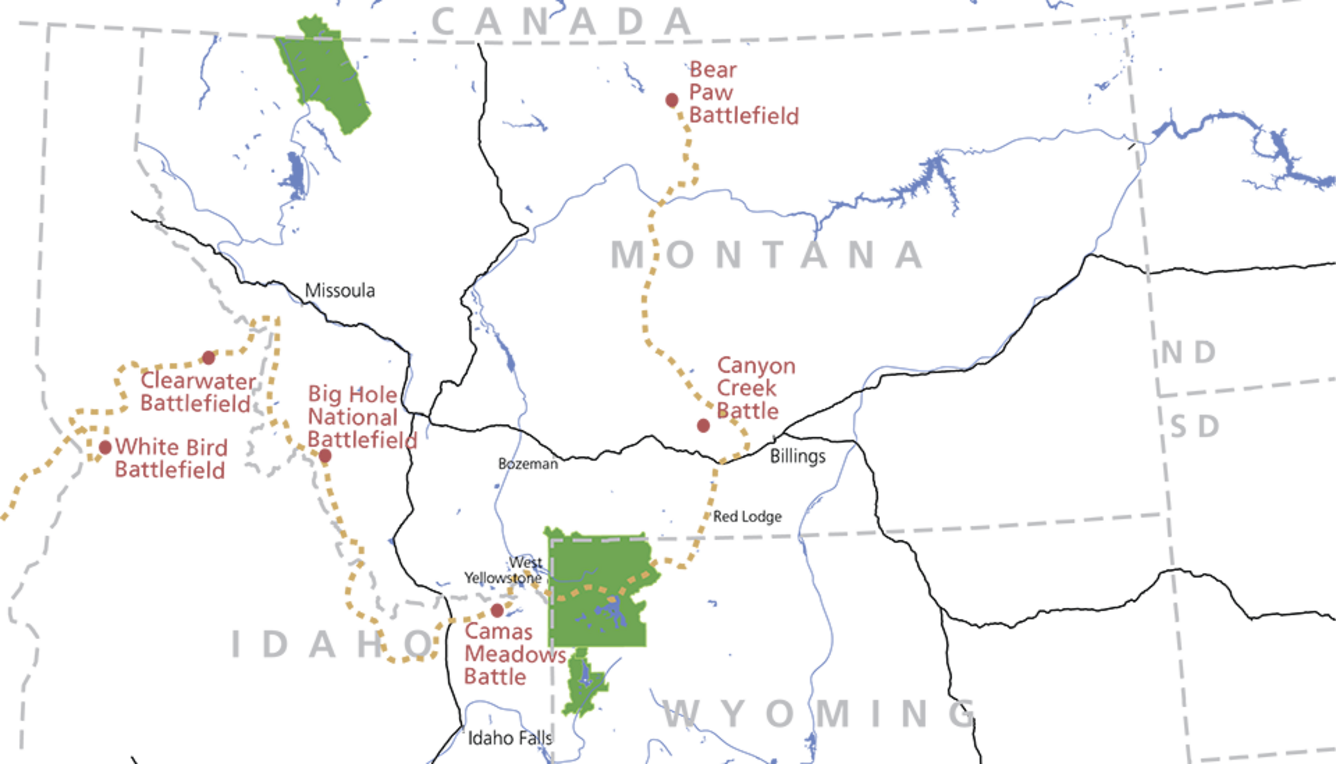
After an initial skirmish in Idaho, the U.S. Army began to pursue the band of Nez Perce on their march east from the Wallowa Mountains, first making contact at White Bird Battlefield in western Idaho on June 17, 1877. While the U.S. Army was being greeted by a 6-person peace party of Nez Perce carrying a while flag, a civilian volunteer opened fire, sparking a battle which resulted in heavy casualties and ignited the flight of the Nez Perce toward Canada. The Nez Perce would continue to encounter the U.S. Army on numerous occasions during their journey, including at the Clearwater Battlefield (northeastern Idaho) and the Big Hole Battlefield (western Montana), before the group entered Yellowstone National Park on August 23, 1877.
Stinging from their loses at the 1876 Battle of Greasy Grass, or as it also known, the Battle of the Little Bighorn, and determined to punish the Nez Perce to discourage other indigenous tribes who might consider rebelling against the rule of the United States, the Nez Perce were pursued by over 2,000 U.S. Army soldiers. Yellowstone was not foreign country to the Nez Perce, who often visited the park in pursuit of its abundant resources and wild game. While within the park, the Nez Perce encountered 25 tourists, and looting of supplies and multiple revenge killings occurred. Today, you can follow the path of the Nez Perce through Yellowstone National Park along park roads near Nez Perce Creek, Otter Creek, Nez Perce Ford, and Indian Pond. The Nez Perce forded the Yellowstone River at Nez Perce Ford, traveled through Pelican Valley and Hoodoo Basin, and passed over the Absaroka Mountains, finally exiting Yellowstone National Park to head north towards the Canadian border, where they hoped to find safety. Before they could reach their destination, the Nez Perce were stopped by the U.S. Army once more in the foothills of the Bear’s Paw Mountains of northern Montana, only 40 miles away from Canada.
Route followed by a band of Nez Perce (or, in their language, Nimiipu or Nee-Me-Poo) in 1877. A band of 800 men, women, and children—plus almost 2,000 horses—left their homeland in what is now Oregon and Idaho pursued by the US Army. The group crossed through Yellowstone National Park in their attempt to reach Canada, and they were ultimately captured by US Army forces in northern Montana. Courtesy of the National park Service Yellowstone Spatial Analysis Center (https://www.nps.gov/yell/learn/historyculture/flightnezperce.htm).
This epic journey of the Nez Perce covered more than 1,170 miles across four states and multiple mountain ranges, and about 250 Nez Perce warriors held off the pursuing US Army troops in 18 battles, skirmishes, and engagements. Ultimately, hundreds of US soldiers and Nez Perce (including women and children) were killed in these conflicts before the Nez Perce surrendered, and Chief Joseph—one of the last surviving chiefs of the band—gave the now-famous speech* in which he said, “From where the sun now stands, I will fight no more forever.” Some of the Nez Perce were able to reach Canada, but the rest, including Chief Joseph, accepted resettlement in numerous reservations throughout the American northwest. Chief Joseph would pass away in 1904 at the age of 64 on the Colville Indian Reservation (WA) of a “broken heart”, per his doctor’s account. He is buried near the village of Nespelem, WA.
Yellowstone National Park is a place of wonder, beauty, and almost spiritual significance to all who look upon its enchanting landscape. But long before western society encroached upon its borders, indigenous people revered this land for its resources and cultural importance. The next time you find yourself driving along Wyoming Highway 296, also known as the Chief Joseph Scenic Byway, on your way to visit Yellowstone National Park, remember the flight, and plight, of the Nez Perce, who walked the very trail upon which you drive.
You can visit numerous Nez Perce Commemorative Sites of Nez Perce National Historical Park along the 1,170-mile Nez Perce National Historic Trail, stretching from Wallowa Lake, Oregon, to the Bear’s Paw Mountains, Montana. For more details, see https://www.nps.gov/nepe/index.htm.
North American Indian regional losses 1850 thru 1890.
Everything I know and love about nature has been passed down to me from my ancestors.
I am only 25 years old but my people have been living in the Amazon rainforest for at least 6,000 years. I follow our ancient traditions that allow us to live in harmony with nature and protect the rainforest in which we live.
When corporations look at my home in the Amazon rainforest, they don’t see the intricacies of the trees’ roots, the way they weave their way in and out of rich soil. They don’t pay attention to the sound of raindrops as they hit leaves, small and large. They do not see a land capable of sustaining life on Earth, a land that needs protection, a land that is sacred. Instead, they see commodities.
Today, my peoples’ mission to protect nature is becoming impossible. The climate is warming rapidly, the animals are disappearing and the flowers are not blooming like they did before.
And when we try to protect our environment from the powers that be, we are bullied, harassed, and sometimes even murdered.
My childhood friend, Ari Uru-eu-wau-wau, was murdered for protecting the forests from illegal loggers, farmers and miners. His story is shared in a documentary I helped produce called The Territory. It was co-produced by the Indigenous Uru-Eu-Wau-Wau people and chronicles their struggle to defend the land on which Ari and his ancestors have lived for millennia.
The murder of British journalist Dom Phillips and indigenous expert Bruno Pereira in the Amazon is not an isolated case. It’s a tragedy that there are so many other cases like this.
My husband is also a journalist based in the Amazon and he has received death threats for reporting on illegal activities. My father, my mother and so many of my friends also face regular intimidation and threats for defending their ancestral land.
The justice we are calling for extends beyond those holding the guns that are killing Earth defenders. We want Brazil’s leaders whose actions or lack thereof, are allowing this violence to go rampant, to be held to account too.
Since President Jair Bolsonaro took office in Brazil three years ago, his administration has made it a priority to weaken environmental protections. The government agency supposed to protect Indigenous Peoples’ rights, was turned against us. This has resulted in grim records for deforestation in Brazil.
Although international pressure from companies and countries which buy agricultural products from Brazil has increased, we cannot ignore the fact that several multinational corporations are still profiting from the anti-environment and anti-indigenous legislation being pushed in Brazil.
That’s why my father, the great Chief Almir Suruí, together with Chief Raoni Metuktire of the Kayapo people, presented a formal request to the International Criminal Court in The Hague last year to investigate what is happening in Brazil. They are demanding that those responsible are held accountable for crimes against humanity.
As we wait for a decision, we wonder: will our evidence be taken seriously? Will the countries that promised to uphold human rights and protect the Earth keep their word? How many more will be killed in a senseless war on the environment and those who protect it before things change?
And much like we must protect peoples’ rights, we need to defend the ecosystems that support us. This is why I am calling on the international community to request the International Criminal Court to recognise the crime of ecocide. Courts around the world have long claimed that they want to fight environmental crime. Now they have the chance to turn their words into actions and recognise the attacks against my home in the Amazon for what they are: ecocide.
I ask world leaders, especially from the Global North: Have you given up living on Earth? Why do indigenous peoples have to protect more than 80% of the world’s biodiversity with so little support while the rich dream of colonising other planets?
The mistakes that have brought us to this climate crisis are a heavy burden. But you cannot run away from it. We can still fight! Join us and support indigenous land defenders.
I have been raised with the understanding that in order to live harmoniously on this planet we must listen to the stars, the moon, the wind, the animals and the trees. We must listen to the Earth. She is speaking and her message is clear: we have no time to waste.
Txai Suruí is an Indigenous leader and activist from the Brazilian Amazon. She leads the Rondônia Indigenous Youth Movement and the Kanindé Association and is the executive producer of the award-winning documentary The Territory.
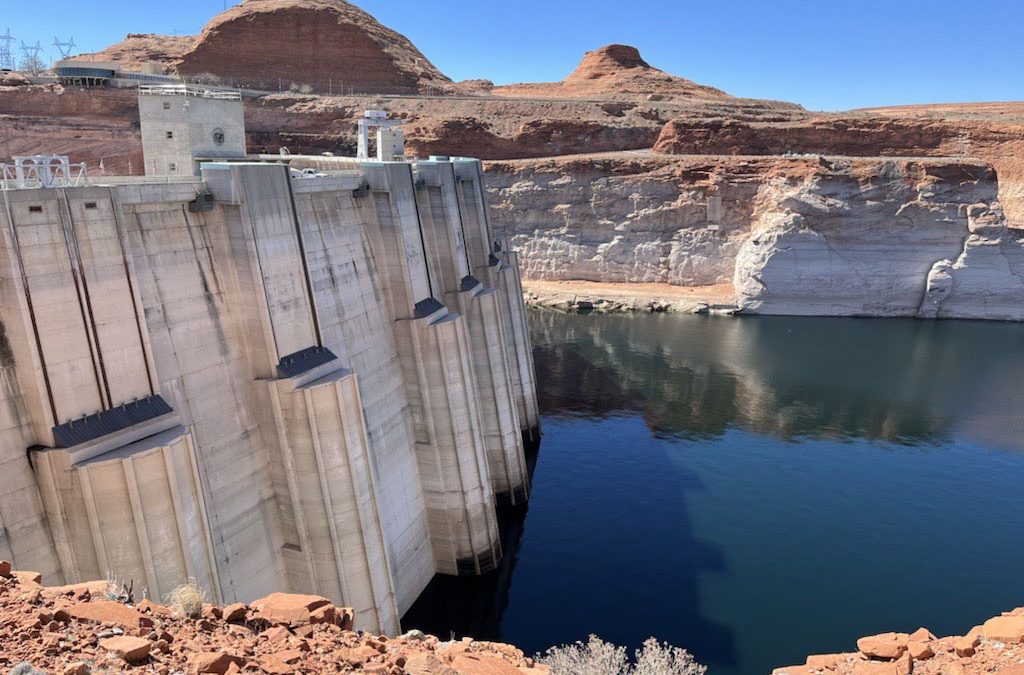
Glen Canyon Dam creates water storage on the Colorado River in Lake Powell, which is just 27% full in June 2022. Bureau data on the reservoir’s water-storage volume showed a loss of 443,000 acre-feet. Credit: U.S. Bureau of Reclamation
It should be obvious to anyone; trying to fill a bathtub with the drain wide open is foolish. This is precisely what the operators of the Colorado River System (Lake Powell and Lake Mead) have been attempting to do for the past 20 years. They have disregarded the increased withdrawals to the Lower Basin states (California, Arizona, and Nevada) and the ubiquitous arid nature of the Southwest.
The Colorado River system and the Colorado Compact Administration were set up with a series of reservoirs recognizing the aridity of the region and the unpredictable amount of annual precipitation. With reservoirs, when water is more abundant the excess can be stored for later use when the inevitably drier periods arrive. In recent years, instead of reserving excess flows in the reservoirs, this excess was released to the lower basin states with the resultant excess draw-down of the vital storage system.
Most of the water supply for the Colorado River System is supplied by the Upper Basin States, Colorado, Wyoming, Utah, and New Mexico. As planned, these states have continuously supplied the required 75-million-acre feet in 10 years, or an average of 7.5 million per year.
The amount of water that each of these states uses each year is completely dependent upon precipitation and in Colorado is allocated strictly by the prior appropriation system without the benefit of a storage system to draw upon for leaner years except for water saved under the prior appropriation system. As such Colorado’s prior appropriation system automatically operates as a forced reduction in water use—a built-in “conservation brake”.
In contrast, the Lower Basin States, California, Arizona, and Nevada receive their Colorado River supply from reservoirs and have the luxury of taking any excess deliveries in wetter years or drawing previously saved water from storage in drier years.
The prudent regime would be to reserve the excess amounts in storage for use during drier periods. Instead of this exercise of prudence, the Lower Basin states have continuously gambled those wetter periods would arrive and replenish the reservoirs.
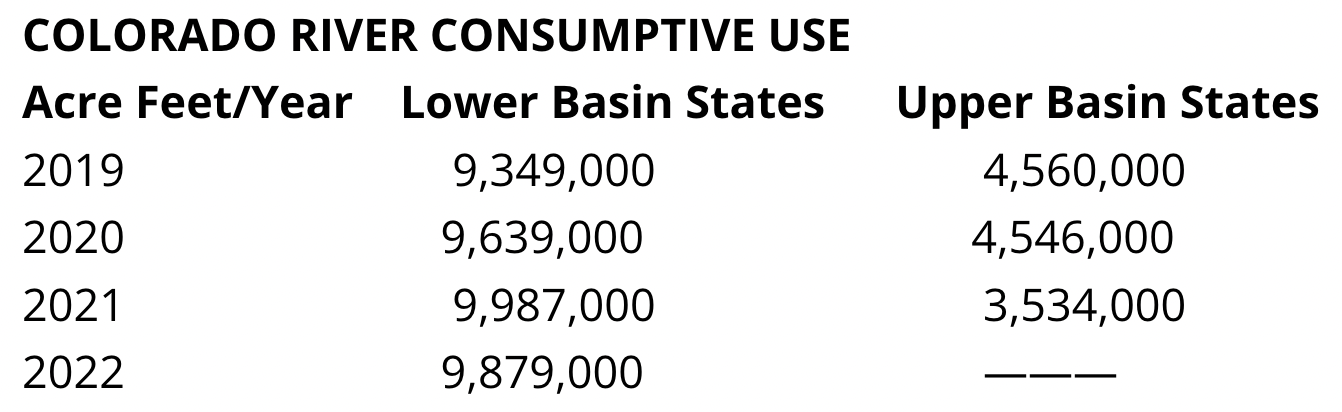
In the chart below, we clearly see how Colorado and the Upper Basin states have reduced their use during drought while the Lower Basin states have increased their use during the same period.
The primary purpose of Lake Powell and Lake Mead is for hydro-power production and secondarily for drinking and irrigation. The falling levels of these reservoirs spell disaster for power production and now the Bureau of Reclamation is sounding the alarm.
Unfortunately, unless drastic measures are taken that significantly reduce the annual draw by the Lower Basin States for the foreseeable future, all Colorado River reservoirs will be jeopardized. Blue Mesa and Flaming Gorge have already been lowered to rescue the Lower Basin reservoirs. The present crisis is more about having allowed the Lower Basin to over appropriate water from the system than the impact of the drier period of the past 20 years.
In Colorado, the Arkansas Basin and the entire Eastern portion of Colorado depend on a significant portion of its water from Colorado River system imports. In the Arkansas, about 15 percent of all river flows are derived from this system.
In drier periods these flows have always been reduced since they are regulated by the prior appropriation system. However, further reductions could come if the Lower Basin is not forced to comply with the Compact. It is possible that political forces could reduce the amount of water exported to the Eastern portion of Colorado — and that includes the Arkansas Basin.
By: Ralph “Terry” Scanga, General Manager. Upper Arkansas Water Conservancy District
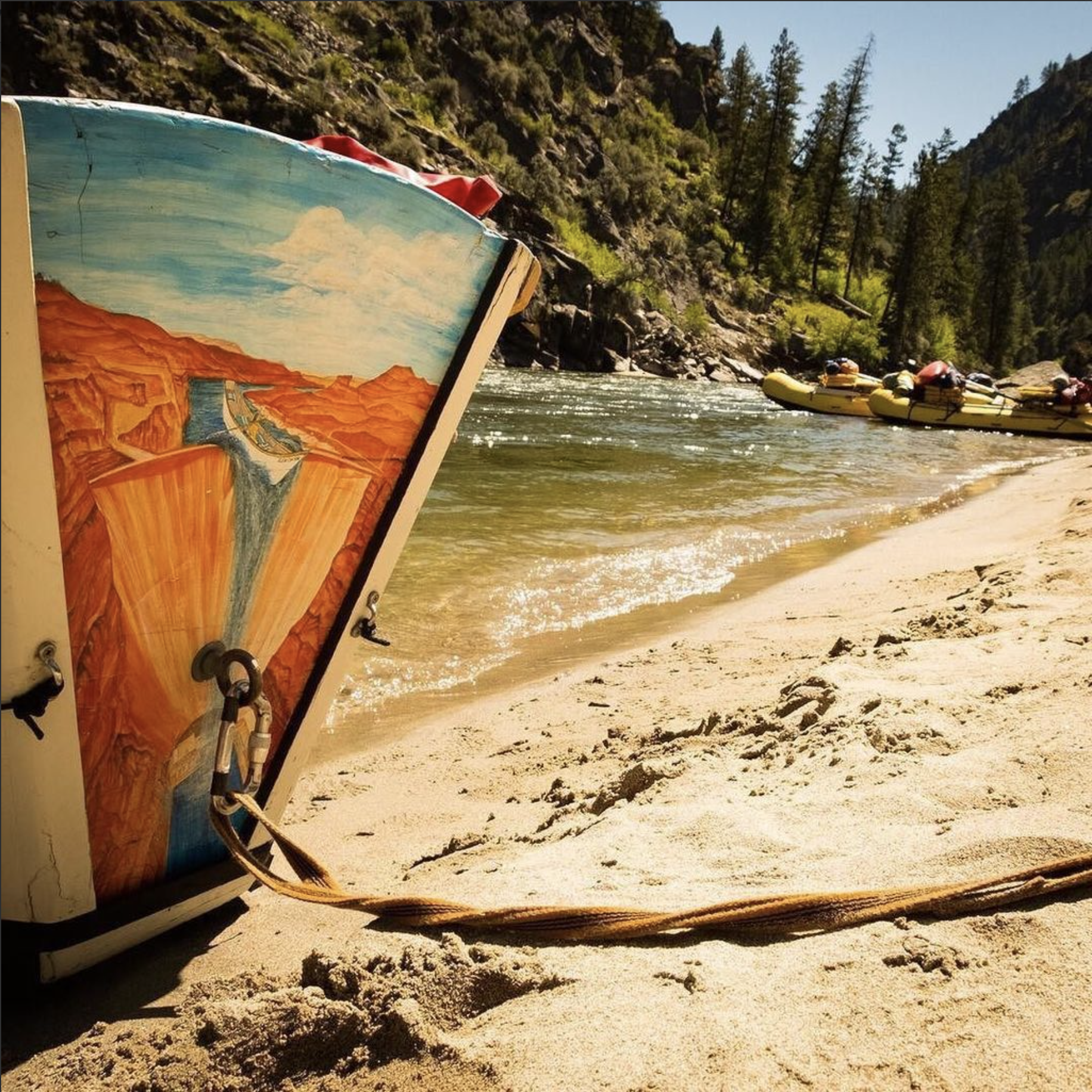
Here’s to weekends on wild rivers! And to cool boats that make a statement. There is no ride like a classic dory – and the Glen Canyon is a special boat. You must give this a try sometime if you haven’t already. So cool! @AmericanRivers
We are working with the National Integrated Drought Information System (NIDIS) to investigate the usability of the drought.gov website. The usability study consists of a short virtual interview to learn about a participant’s affiliation and professional experience, followed by an exercise using scenarios on the website. We are hoping to hear from a diverse set of backgrounds, including farmers, master gardeners, agriculture extension groups, environmental reporters, drought management plan authors, and other water supply professionals…
UNC Asheville’s National Environmental Modeling and Analysis Center (NEMAC) is working with the National Integrated Drought Information System (NIDIS) to investigate the usability of the http://drought.gov website.
A usability study consists of a short virtual interview followed by an exercise using scenarios on the drought.gov website. The session is virtual and typically lasts about 30 minutes. If you are interested in participating, please enter your name and email address in this form.
Your feedback is invaluable and we appreciate your consideration. Usability only works when people like you participate!
I wish everyone on Earth knew how genuinely "off the charts" key planetary trends are right now, and how abnormal and critical it is. Things like atmospheric CO2 fraction, heat extremes on land and ocean, biodiversity loss and extinction rates. All alarms should be going off
Over the last year and a half, I’ve dissected every remark I could find in the press from Senator Joe Manchin on climate change. With the fate of our planet hanging in the balance, his every utterance was of global significance. But his statements have been like a weather vane, blowing in every direction. It’s now clear that Mr. Manchin has wasted what little time this Congress had left to make real progress on the climate crisis.
Since early 2021, congressional Democrats and President Biden have worked relentlessly to negotiate a climate policy package. When Build Back Better passed the House last fall, it included $555 billion in clean energy and climate investments. After four decades of gridlock in Congress, the Democrats were poised to finally pass a major climate bill, with agreement from 49 senators. But yesterday, one man torched the deal, and with it the climate: Mr. Manchin.
By stringing his colleagues along, Mr. Manchin didn’t just waste legislators’ time. He also delayed crucial regulations that would cut carbon pollution. Wary of upsetting the delicate negotiations, the Biden administration has held back on using the full force of its executive authority on climate over the past 18 months, likely in hopes of securing legislation first.
The stakes of delay could not be higher. Last summer, while the climate negotiations dragged on, record-breaking heat waves killed hundreds of Americans. Hurricanes, wildfires and floods pummeled the country from coast to coast. Over the last 10 years, the largest climate and weather disasters have cost Americans more than a trillion dollars — far more than the Democrats had hoped to spend to stop the climate crisis. With each year we delay, the climate impacts keep growing. We do not have another month, let alone another year or decade, to wait for Mr. Manchin to negotiate in good faith.
The climate investments in the bill ranged from incentives for clean power like wind and solar, to support for electric vehicles. They were essential to meeting President Biden’s goal of cutting carbon pollution in half from its 2005 levels by 2030 — the United States’ contribution to limiting global warming to 1.5 degrees Celsius. Congress’s failure to act means that, under the best case scenario with the policies we already have in place, we will only get 70 percent of the way there.
After months of stop-and-start discussions, with Mr. Manchin repeatedly walking away from the negotiations, Congress has largely run out of time. Democrats need to pass their reconciliation package this summer, and despite weeks of round-the-clock effort from Senator Chuck Schumer, the majority leader, and his team, Mr. Manchin has now refused to agree to vote for spending on climate. While he claimed on a West Virginia talk show on Friday that it wasn’t over, that “we’ve had good conversations, we’ve had good negotiations,” this is doublespeak; he simply doesn’t want to be held accountable for his actions. He has consistently said one thing and done another.
Mr. Manchin’s refusal to agree to climate investments will hurt the economy he claims he wants to protect. The package would have built domestic manufacturing, supporting more than 750,000 climate jobs annually. It would have also fought inflation, helping to make energy bills more affordable for everyday Americans. This is particularly ironic since Mr. Manchin said inflation was the chief reason he was uncomfortable with supporting tax incentives for clean energy right now.
Over the past year, Mr. Manchin has taken more money from the oil and gas industry than any other member of Congress — including every Republican — according to federal filings. A Times investigation found that he also personally profited from coal, making roughly $5 million between 2010 and 2020 — about three times his Senate salary. Coal has made Mr. Manchin a millionaire, even as it has poisoned the air his own constituents in West Virginia breathe.
As Upton Sinclair put it: “It is difficult to get a man to understand something, when his salary depends on his not understanding it.”
But one thing I have never understood about Mr. Manchin is how he looks his grandchildren in the eye. While he may leave his descendants plenty of money, they will also inherit a broken planet. Like other young people, Mr. Manchin’s grandchildren will grow up knowing that his legacy is climate destruction.

The largest saline lake in the western hemisphere, the Great Salt Lake dropped to a record low in 2022 as a result of a hot drought that increased evaporation and decreased water flows. USGS technician at the Great Salt Lake July 20, 2021. Photo credit: USGS
The dry conditions blanketing much of the American West are setting records nearly every week. Lakes Mead and Powell, the country’s largest reservoirs by capacity, dropped to new lows this year. The Great Salt Lake did, too. This spring, New Mexico endured its largest ever wildfire. Even with those distinctions, more are likely on the way. The hottest months of the year are still to come.
Shortened time frames are now the norm. Water cuts that were once nearly unthinkable even in the long term in the Colorado River basin are now being implemented in a matter of months, not years or decades. Still, some see opportunity in calamity, a chance to reposition the region for trials to come.
“While the situation is objectively bleak, it is not in my view unsolvable,” John Entsminger, the general manager of the Southern Nevada Water Authority, told a Senate panel on June 14. Basin officials are steeling themselves for short, intense negotiations.
It amounts to a season of potentially long-lasting change for some of the country’s fastest-growing states and biggest economies.
Here are five things to know about how the drought is re-writing the story of America’s drylands.
1) It’s a Hot Drought
The drought is not just a failure of precipitation. Rising temperatures due to global warming are also depleting the region’s rivers.
The mechanisms are easy to understand. Extreme heat bakes the land surface. Warmer, drier air holds more water. Parched soils then gobble rain and melting snow before the water reaches rivers and reservoirs. A thirsty atmosphere evaporates or sublimates its share. Together, they are a powerful one-two punch.
With increasing temperatures, “we’re seeing places that do have drought, the intensification is more rapid,” says Roger Pulwarty, a senior scientist in the physical sciences laboratory at the National Oceanic and Atmospheric Administration.
The Colorado River basin illustrates the impacts of a hot drought. According to the Colorado Basin River Forecast Center, precipitation in the watershed above Lake Powell since October was 94 percent of the 30-year average. In other words, just a tick below normal. Snowpack peaked at 83 percent of average. Yet only a fraction of that water made it into Lake Powell. Runoff into the lake this summer is just 56 percent of average. A hot drought is a stealthy thief.
Glen Canyon Dam creates water storage on the Colorado River in Lake Powell, which is just 27% full in June 2022. Bureau data on the reservoir’s water-storage volume showed a loss of 443,000 acre-feet. Credit: U.S. Bureau of Reclamation
2) Drought Has a Long Reach
When water stops flowing, difficult days are ahead.
Forests become tinder boxes, a spark removed from calamity. Already there have been massive disruptions. U.S. Forest Service staff lost control of a prescribed burn in Santa Fe National Forest in April, resulting in the 341,000-acre Hermits Peak-Calf Canyon fire, the largest wildfire on record in New Mexico.
“Drought, extreme weather, wind conditions and unpredictable weather changes are challenging our ability to use prescribed fire as a tool to combat destructive fires,” wrote Randy Moore, the chief of the U.S. Forest Service, in an incident assessment.
Hydropower is weakened. With less water in reservoirs, generators crank out fewer megawatt-hours, raising the cost of electricity and increasing the risk of summer blackouts. In California last year, hydropower generation was nearly half the 10-year average. This year, Glen Canyon Dam is operating at just 60 percent of its maximum electrical generating capacity due to the drying of Lake Powell.
There are human health consequences when lakes are depleted. Earlier this month, the Great Salt Lake dropped to its lowest point since record-keeping began in 1847. Receding shores expose more lakebed salts and dust, which become a respiratory hazard during windstorms — and can hasten snowmelt in the mountains.
Ecosystems — and the birds and fish that depend on them — are also under stress. Utah regulators have identified high numbers of toxin-producing algae in the southern reaches of Utah Lake, a water body notorious for summer algae outbreaks. In California, sampling carried out in June by the Environmental Protection Department of the Big Valley Band of Pomo Indians revealed algal toxins in Clear Lake that were higher than state advisory levels. These hazardous outbreaks typically worsen deeper in the summer.
3) Cutbacks Are Inevitable
When supply ebbs and reservoirs are near record lows, authorities have one durable tactic: reduce demand.
In fits and starts, that is happening. California regulators passed an emergency order in June that took small steps to address the supply-demand imbalance. The order prohibits businesses, industries, schools, churches, and other institutions from watering “non-functional” grass with potable water. What’s non-functional? Grass that covers median strips and office parks.
Cities and farms that are customers of the two major canals in California — one state and one federal — already had their allocations substantially reduced as a result of below-average reservoirs. With less water, irrigators will fallow more land.
The largest cuts, however, will be in the Colorado River basin. Camille Touton, the commissioner of the Bureau of Reclamation, said in June that the states would have to reduce their draw on the river by two million to four million acre-feet in the next year.
Entsminger of the Southern Nevada Water Authority called the proposed cuts “a degree of demand management previously considered unattainable.”
Their plan is due next month.
4) Drought Is Political
The right to use water in the western states is subject to arcane laws, court decrees, and precedents, some of which date to the era of colonial settlement.
Persistently dry conditions and a reckoning with historical inequities are forcing residents and lawmakers to reassess the established way of doing business.
In June, the Nevada Supreme Court upheld a groundwater management plan for Diamond Valley irrigators that abandons long-held principles of state water law, such as the priority system that privileges senior water rights and “use it or lose it” requirements.
Activists in Arizona are gathering signatures to put groundwater regulation on the ballot. Their citizen’s initiative would ask voters to approve two Active Management Areas in Cochise and Graham counties, places where big farming operations have dried up shallow wells and caused the ground to fracture, damaging highways.
“Dams Not Trains” billboards dot the highways of California’s Central Valley, a plea by the region’s biggest farmers for legislators to redirect their spending preferences. At the same time, a budget proposal in the California Legislature would direct $1.5 billion to buy senior water rights from farmers in order to keep more water in rivers.
A relatively recent development is the political muscle of the region’s Indian tribes. Acting as dealmakers, tribes have emerged as key players in water supply negotiations, particularly in Arizona, where the Gila River Indian Community has leased water to cities and pledged to conserve 129,000 acre-feet this year to boost water levels in Lake Mead.
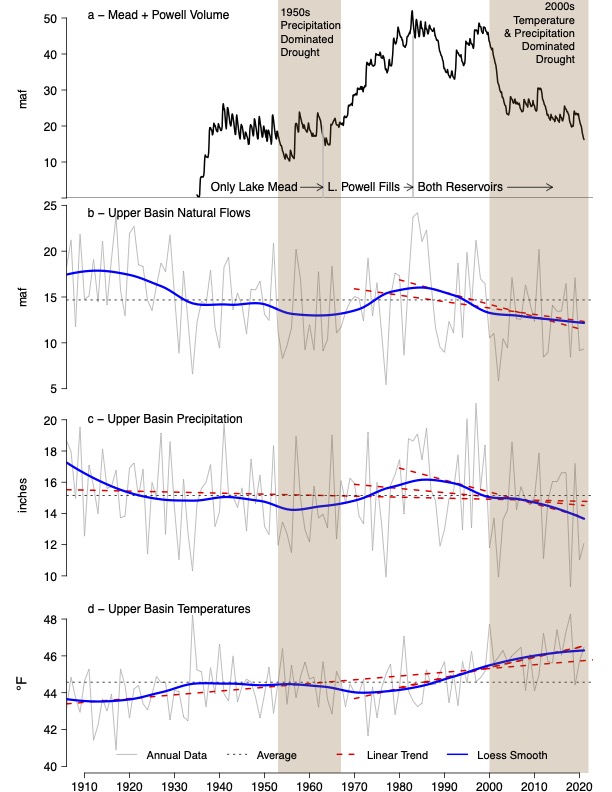
Brad Udall: Here’s the latest version of my 4-Panel plot thru Water Year (Oct-Sep) of 2021 of the Colorado River big reservoirs, natural flows, precipitation, and temperature. Data (PRISM) goes back or 1906 (or 1935 for reservoirs.) This updates previous work with @GreatLakesPeck.
5) Drought Is Probably the Wrong Word
To some researchers and advocates, we shouldn’t even be calling this a drought.
Drought, they say, implies a temporary condition, a deviation from normal.
But what is happening in the Colorado River basin and other western regions is a shift toward a drier climate.
Even though precipitation in this two-decade period is anomalously and historically low, climate modeling suggests that the region is not going to snap back to the wetter periods of a generation ago.
To describe this new era, they prefer a different term: aridification. Clunky, perhaps. But more accurate.
A collective of respected Colorado River scholars argued in a 2018 paper that language change was necessary and could possibly induce behavioral change on the scale required to meet the challenge.
“A very modest starting point,” they wrote, “is to admit words such as drought and normal no longer serve us well, as we are no longer in a waiting game; we are now in a period that demands continued, decisive action on many fronts.”
Brett Walton
Brett writes about agriculture, energy, infrastructure, and the politics and economics of water in the United States. He also writes the Federal Water Tap, Circle of Blue’s weekly digest of U.S. government water news.
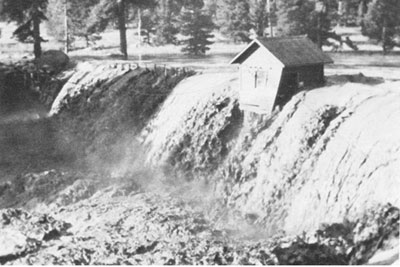
A disaster 40 years ago today changed the face of downtown Estes Park, and its tourism-dependent businesses still are reaping the benefits of a landscaped riverwalk and other improvements…Lawn Lake, at 10,789 feet at the headwaters of Roaring River in what now is Rocky Mountain National Park and eight miles west of Estes Park, originally was a 16.4-acre natural body of water dammed by a glacial moraine. However, in 1903, 12 years before the park’s founding, the Farmers Irrigation Ditch and Reservoir Co. added a dam to supply water to farmlands around Loveland. By 1982, the reservoir covered 48 acres and was up to 35 feet deep. The dam was allowed to remain when the park was founded, but access for maintenance and inspections deteriorated over the years…
Within six weeks after the flood, town trustees approved the EPURA, and the foundation paid the legal costs to develop the ordinance needed. Gov. Dick Lamm obtained a federal disaster declaration from President Ronald Reagan, and the Federal Emergency Management Agency “took over the overall management of trying to put the town together again,” Rosener said. “They were tremendous.”
Foundation members recruited urban designers and “convinced the town to hire them,” Rosener said, “and we created an urban renewal plan. All of my team worked over the next 12 to 14 months to create the plan, construction began in 1984 and was done in about two years.”
One building at the intersection of Elkhorn Avenue and Riverside Drive had to be demolished to make way for the design’s Confluence Park, where the Fall and Big Thompson rivers met, Rosener said. Along Elkhorn, narrow sidewalks were widened and parallel parking eliminated. Private businesses were encouraged to update their properties, Rosener said, and tearing up Elkhorn Avenue to redo it revealed “a main waterline made out of wood slats wrapped in steel bands. There were all kinds of issues with telephone and gas — it was just a spider web when they opened up Elkhorn.” Because East Elkhorn Avenue carried U.S. Highways 34 and 36, “we had to convince the state to give up one lane of traffic” — a decision that aided the beautification but also, three decades later, fueled the controversial one-way “Loop” proposal. But the result, Thomas said, was that “the new urban-renewal authority formed after the flood beautified the town and created a streetscape that totally changed the face of downtown” and provided a venue for some new river-facing businesses. “Instead of having these ugly areas behind stores, they turned the focus back toward the rivers. Now we have the riverwalk, we have park benches, we have new lighting. We have trees planted along Elkhorn Avenue. All of that was the result of the Lawn Lake flood.”
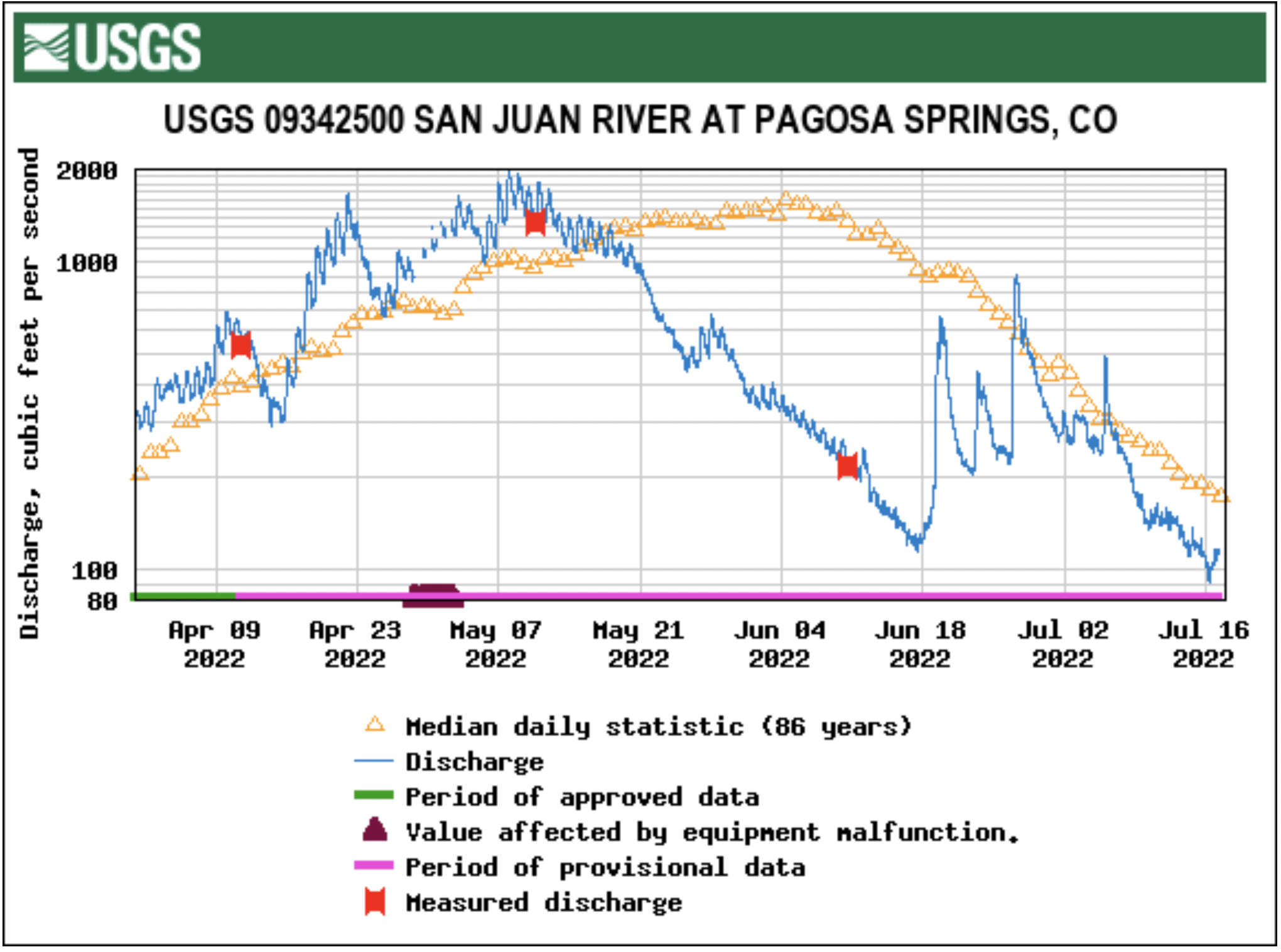
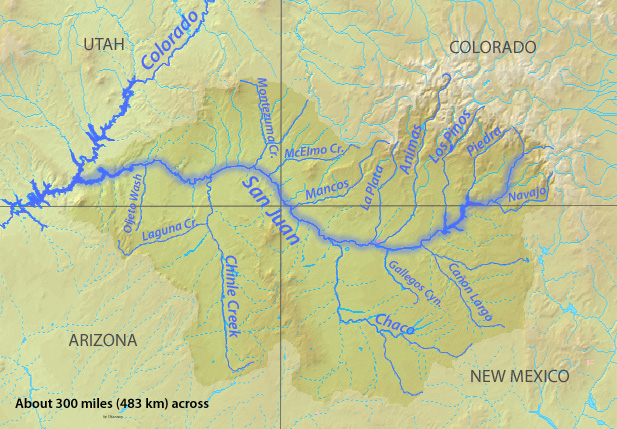
Stream flow for the San Juan River on July 13 at approximately 9 a.m. was 132 cubic feet per second (cfs), according to the U.S. Geological Service (USGS) National Water Dashboard. This is down from a nighttime peak of 150 cfs at 4 a.m. on July 13. Flows are down from last week’s reading of 328 cfs at 9 a.m. on July 6 and from that day’s nighttime peak of 499 cfs at 2:45 a.m. The median flow for July 13 for the period between 1987 and 2022 is 205 cfs. Last year, the San Juan River was at 86.1 cfs at 9 a.m. on July 13, down from a nighttime peak of 102 cfs at 9:15 p.m. on July 12.
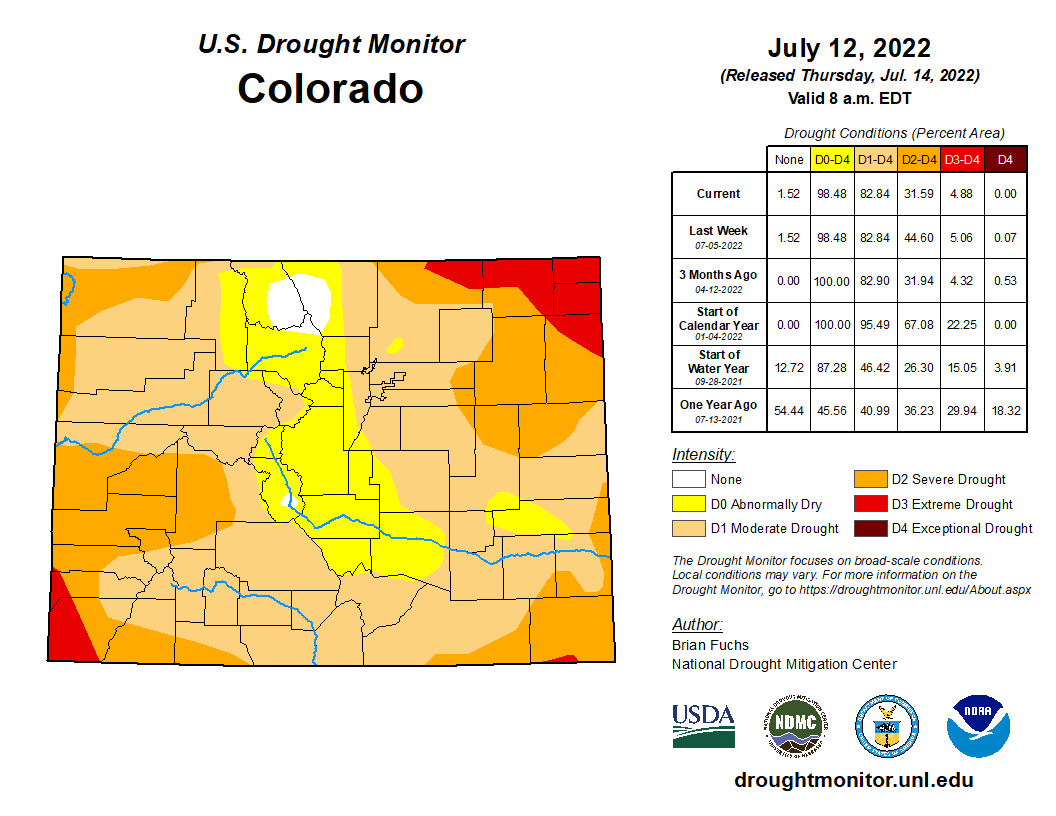
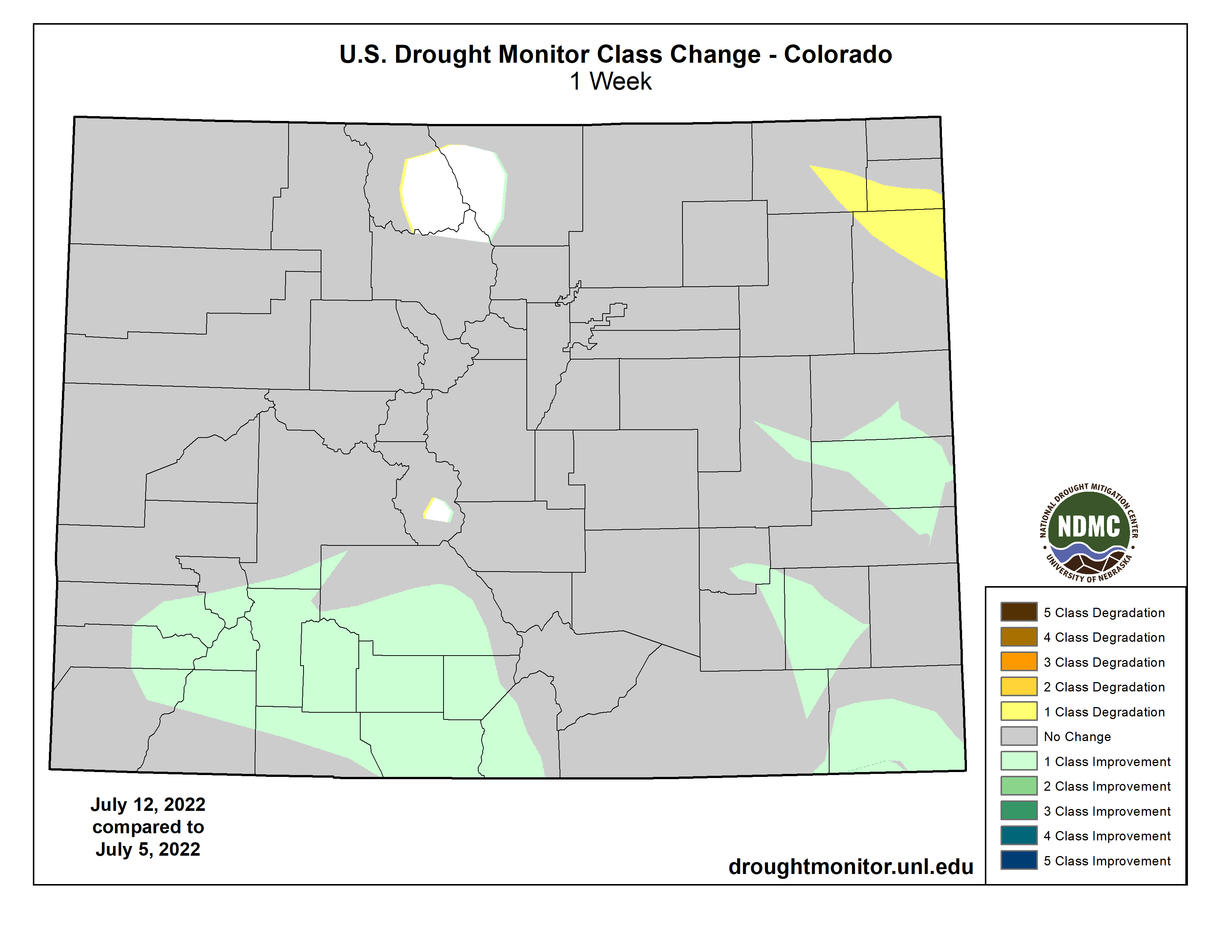
Colorado Drought Monitor map July 12, 2022.
Drought
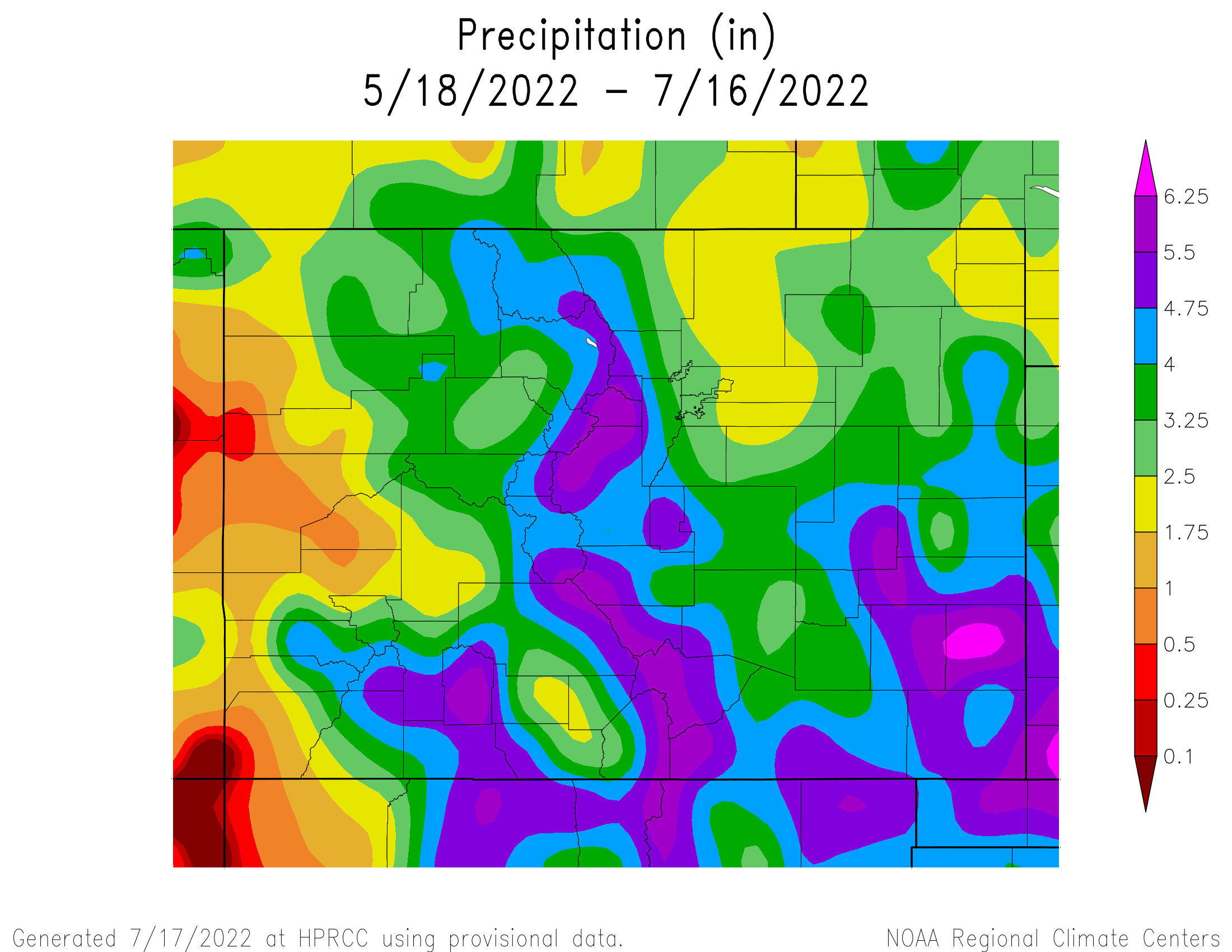
The National Oceanic and Atmospheric Administration (NOAA) National Integrated Drought Information System (NIDIS) reports that 100 percent of the county is experiencing drought. Although June 2022 was the second wettest June in 128 years, with 2.48 more inches of precipitation than normal, 2022 to date is the 33rd driest year in the last 128 years, with 2.84 inches of precipitation less than normal, according to the NIDIS.
The NIDIS places the entire county in a severe drought, which the
website notes may cause farmers to reduce planting, producers to sell cattle and the wildfire season to be extended, among other impacts. The NIDIS also notes that a severe drought is associated with low surface water levels and reduced river flows.
The NIDIS provides an evaporative demand (EDDI) forecast…The forecast for the area indicates that in the next two weeks, the majority of Archuleta County will be experiencing a mix of severe wet and extreme wet conditions while the four-week forecast shows the county will be experiencing a mix of severe wet and moderate wet conditions.
He explained that the engineer had estimated that the cost would be $25 million but that the contractor placed the price at “closer to $40 million,” necessitating that PAWSD reapply for a larger loan.
The meeting will be held at 5 p.m. at the PAWSD administrative office at 100 Lyn Ave.
Brad Udall: Here’s the latest version of my 4-Panel plot thru Water Year (Oct-Sep) of 2021 of the Colorado River big reservoirs, natural flows, precipitation, and temperature. Data (PRISM) goes back or 1906 (or 1935 for reservoirs.) This updates previous work with @GreatLakesPeck.
Now, many of the scientists’ dire predictions are coming to pass, with Lake Mead and Lake Powell nearly three-fourths empty and their water levels continuing to fall. Some researchers say the seven states that depend on the river would have been better prepared had they acted years ago.
“If I’ve learned anything recently, it’s that humans are really reluctant to give things up to prevent a catastrophe,” said Brad Udall, a water and climate scientist at Colorado State University. “They’re willing to hang on to the very end and risk a calamity.”
He said it’s just like humanity’s lack of progress in addressing climate change despite decades of warnings by scientists. If larger cuts in water use were made sooner, Udall said, the necessary reductions could have been phased in and would have been much easier.
Peter Gleick, a water and climate scientist and co-founder of the Pacific Institute, said the collective failure to heed scientists’ repeated warnings is “directly responsible for how bad conditions are today.”
“If we had cut water use in the Colorado River over the last two decades to what we now understand to be the actual levels of water availability, there would be more water in the reservoirs today,” Gleick said. “The crisis wouldn’t be nearly as bad.”
Water levels in Lake Mead have dropped to historic lows over the past year, triggering a shortage declaration on the Colorado River. Some of the frameworks that govern how the river is managed are set to expire in 2026. As states and stakeholders negotiate the next management framework, tribal nations want to make sure they have a seat at the table. Photo by Jeffrey Hayes / Flickr
Several key pieces of the rules that govern the Colorado River Basin are set to expire in 2026, including guidelines for dealing with drought and water shortage. The U.S. Bureau of Reclamation has asked for the public’s input on what should come next. KNAU’s Melissa Sevigny spoke about the opportunity to shape the Southwest’s future with University of New Mexico water policy expert John Fleck.
Who is at the table for these negotiations?
That’s actually such a great question, because it’s not entirely clear. The states—the appointed representatives that each governor appoints on behalf of each of the seven Colorado River Basin states—and then representations of the federal government …. But, there is a strong desire, on the part of a lot of people, and I count myself among those groups, to recognize the fact that tribal communities are sovereign nations [within] the basin that have been traditionally excluded from these processes…and then as a practical matter, major water users within the states also participate either formally at the negotiating table, or if you can imagine a metaphorical meeting room, standing round the back whispering in the ears of the people sitting at the table.
What questions should we be asking about what comes next?
Someone, somewhere is going to be using less water than they are now, a lot less water…But the question is, how do we apportion those cutbacks? Do the states in the Lowe Basin which have been using by far the most water, and arguably overusing, like folks in Arizona, do they have to cutback more deeply?…Do the states in the Upper Basin agree, we need to share the pain and cut back as well?…So there’s really a lot of tension. And then the most interesting tension is broad and spans the entire basin, which is, to what extent are the cutbacks going to be felt in agricultural irrigation communities?…There’s no way around there’s going to be less irrigated agriculture going forward as a result of climate change and drought and the reality that we’ve pretty much drained the reservoirs as far as we can, but the question of how you apportion those cuts and who takes bigger cuts, and who gets compensated for giving up water, perhaps, those are the kinds of questions that are going to be on the table…
Comments can be submitted until September 1 by emailing CRB-info@usbr.gov. More information can be found in the Federal Register.
Wheat production in northeast Colorado is down by half or more, according to reports from area grain elevators, and experts put the blame on .an exceptionally dry year and an infestation of wheat stem sawfly. Although no hard numbers are yet available – the U.S. Department of Agriculture’s field workers are gathering that information now – reports from elevators in Sterling, Julesburg, Peetz and Haxtun are estimating between 20 and 30 bushels per acre and, in some hard-hit areas, as little as three bushels per acre…
Nationwide, the USDA has projected harvests of around 47 bushels per acre, or about 8 percent less than normal. But here in the shadow of the Rocky Mountains, an almost complete absence of moisture has driven that number down even further…
Colorado Drought Monitor map July 12, 2022.
According to the U.S. Drought Monitor released Thursday, northeast Colorado remains in the grip of a severe to extreme drought, wile moderate to severe drought conditions cover most of the rest of the state. The best drought conditions in the state are along the Front Range, where upslope conditions wring water out of moist air moving over the Rockies, although even there it is mostly abnormally dry…
As if the drought wasn’t bad enough, wheat farmers face an old bug with a new appetite. Meyer said wheat stem sawfly has actually been around eastern Colorado since the late 1800s, but kept mostly to hollow-stemmed prairie grasses. The fly lays eggs on grass stems and when the larva hatch, they burrow into the stem and work their way down until the cut the stem off near the ground. Over the past five years, Meyer said, the flies have discovered wheat and increasingly migrated into wheat fields. A tour of area wheat fields by this reporter over the past two weeks showed that some fields showed as much as 50 percent sawfly destruction.
Click the link to read the article on the Esquire website (Charles P. Pierce). Here’s an excerpt:
Water and sewer privatization has been going on for a while now. According to the folks at http://foodandwaterwatch.org, customers of private water systems pay 59 percent higher rates than do customers of public systems, and the rates in areas with private water systems increase an average of three times the rate of inflation.
And, all math aside, if water is not a basic human right, then nothing is. The United Nations declared as much in 2010. As water supplies around the world edge into the critical zone, the time to protect that human right against profiteering and corporate pillage is now, before the situation gets irreversible and we find that all our water is owned by some hedge-fund cowboys with bank accounts in the Caymans.
Turning a buck on water is very much like subletting the air, which I’m sure someone is working on as we speak.
Synopsis: La Niña is favored to continue through 2022 with the odds for La Niña decreasing into the Northern Hemisphere late summer (60% chance in July-September 2022) before increasing through the Northern Hemisphere fall and early winter 2022 (62-66% chance).
During June, below-average sea surface temperatures (SSTs) weakened across most of the central and eastern equatorial Pacific Ocean with SSTs returning to near-average in the east-central Pacific, as reflected by the Niño indices, which ranged from -0.4oC to -1.2oC during the past week. Subsurface temperatures anomalies averaged between 180°-100°W and 0-300m depth were weakly positive in June. Below-average subsurface temperatures persisted near the surface to ~75m depth in the eastern equatorial Pacific Ocean, with above-average temperatures at depth (~100 to 200m) in the western and central Pacific Ocean. Low-level easterly wind anomalies prevailed in the western and central equatorial Pacific, while upper-level westerly wind anomalies continued over most of the equatorial Pacific. Convection remained suppressed over the western and central Pacific and enhanced over Indonesia. Overall, the coupled ocean-atmosphere system was consistent with La Niña conditions.
The most recent IRI/CPC plume average for the Niño-3.4 SST index now forecasts La Niña to persist into the Northern Hemisphere winter 2022-23. The forecaster consensus also predicts La Niña to persist during the remainder of 2022, with odds for La Niña remaining at 60% or greater through early winter. Lowest odds occur during the next few months with a 60% chance of La Niña and a 39% chance of ENSO-neutral during July-September 2022. Subsequently, chances of La Niña increase slightly during the fall and early winter. In summary, La Niña is favored to continue through 2022 with the odds for La Niña decreasing into the Northern Hemisphere late summer (60% chance in July- September 2022) before increasing through the Northern Hemisphere fall and early winter 2022 (62-66% chance; click CPC/IRI consensus forecast for the chances in each 3-month period).
Aerial mulching. Photo credit: Colorado State Forest Service
Click the link to read the article on the KUNC website (Alex Hager):
Work to protect water quality on the northern Front Range resumes this week with a whir of helicopter blades in Poudre Canyon. For the second year in a row, those aircraft will drop mulch on areas burned by the Cameron Peak Fire in 2020 — an effort to stabilize burned soil and keep ashy debris out of rivers.
Colorado’s largest-ever wildfire left a charred moonscape, with soil turned into gray dust and shards of blackened trees and plants littering the ground. When it rains, ash and sediment can be swept downhill into rivers that supply water to town pipes. In 2021, that forced the City of Fort Collins to stop treating water from the river and switch to an alternate supply from Horsetooth Reservoir…
Last year, crews dropped wood shards on 5,050 acres in the Cache La Poudre and Big Thompson watersheds. This summer, they hope to cover nearly 5,000 more — with 3,500 acres identified near the Poudre and 1,200 acres near the Big Thomspon. Those efforts aren’t cheap. Last year’s aerial mulching work cost $11 million. Keeping a helicopter in the air costs $87 each minute, but local utilities justify the expense as a precaution against even more costly treatment that would be necessary without it.
Contractors will begin 2022’s aerial mulching campaign on Thursday, July 14, 2022 starting in the Pingree Park area. It will continue through the summer and fall.
The South Platte River Basin is shaded in yellow. Source: Tom Cech, One World One Water Center, Metropolitan State University of Denver.
Click the link to read the article on the NOAA website (Emily Becker):
I’m in San Diego this week, gazing out across the Pacific toward La Niña’s cool tropical ocean surface. (I’m not here for Comic-Con, but there are a lot of posters around the city that keep that upcoming event in the forefront.) Just over my horizon, La Niña—the cool phase of the El Niño-Southern Oscillation (“ENSO” for short)—remains in force, despite some warming in the sea surface temperature over the past month or so. Forecasters expect La Niña to continue through the summer and into the fall and early winter.
Sea surface temperatures around the equator in the central and eastern Pacific were mostly cooler than average (blue) in June 2022. A few warm pockets (orange) dotted the far eastern Pacific. NOAA Climate.gov map from our Data Snapshots collection.
Ka-Pow!
Numbers-wise, there’s about a 60% chance of La Niña through the summer, ticking up a bit to the mid 60%s around 66% by October–December 2022. The second most likely outcome is ENSO-neutral conditions. El Niño is a distant third, with chances only in the low single digits through the early winter. This forecast isn’t much different from the past couple of months.
The official CPC/IRI ENSO probability forecast. The bars show the seasonal chances for each possible ENSO state—El Niño (red), La Niña (blue), and neutral (gray)—from spring 2022 through winter 2022–23. The forecast is based on a consensus of CPC and IRI forecasters, and it is updated during the first half of the month, in association with the official CPC/IRI ENSO Diagnostic Discussion. It is based on observational and predictive information from early in the month and from the previous month. Image from IRI.
While we’re doing the numbers, let’s see how La Niña measured up last month. As I mentioned above, the cool sea surface temperature anomaly weakened a bit in June, but remained in La Niña territory. (Anomaly = difference from the long-term average, long-term being 1991–2020 here, and the La Niña threshold is -0.5 °Celsius, which is just shy of 1 degree Fahrenheit.) According to the ERSSTv5, our most consistent sea surface temperature dataset, June’s sea surface temperature anomaly in the Niño-3.4 region was -0.8 °C. This is the 7th-strongest negative June anomaly in our 1950–present record.
Three-year history of sea surface temperatures in the Niño-3.4 region of the tropical Pacific for 8 previous double-dip La Niña events. The color of the line shows the ENSO state in the third winter (red: El Niño, darker blue: La Niña, lighter blue: neutral). The black line shows the current event. Monthly Niño-3.4 index is from CPC using ERSSTv5. Time series comparison was created by Michelle L’Heureux, and modified by Climate.gov.
This recent weakening in the Niño-3.4 anomaly—it was -1.1 °C in May—is partly due to a slight diminishment of the trade winds, the prevailing east-to-west winds near the Equator, in the first half of June. When the trade winds weaken, wind-driven evaporative cooling slows and the surface warms. Also, a fairly weak downwelling Kelvin wave, a region of warmer-than-average water under the surface, has been moving from west to east over the past few months , gradually rising toward the surface.
The trade winds re-strengthened over the second half of June, and remain stronger than average as we go to press. This will likely help to cool the surface, and may contribute to an upwelling Kelvin wave, a region of cooler-than-average subsurface water that moves west to east. Along with being a sign that La Niña’s amped-up Walker circulation—the atmospheric response to La Niña’s cooler sea surface—is still present, the stronger trades are a source of confidence in the forecast for La Niña to continue through the summer.
Sea surface temperatures the week of July 9, 2022, showing the warm-to-cool gradient in temperatures across the tropical Pacific Ocean from west to east. Temperatures in the West Pacific Warm Pool, around the Maritime Continent, are above 80 degrees Fahrenheit (yellow-orange), while a cooler tongue of water (blue) extends from the coast of South America to the central Pacific. The prevailing east-to-west trade winds near the equator create this temperature contrast by pushing warm water west and allowing deeper, cooler water to well up to the surface. NOAA Climate.gov image from our Data Snapshots collection.
Zowie!
That said, there may well be short-term fluctuations in the Niño-3.4-region sea surface temperature that flirt with the La Niña threshold. For example, the current weekly Niño-3.4 index is -0.5°C. (This uses a different sea surface temperature monitoring dataset, the OISST.) However, as Michelle detailed a few years ago, ENSO is a seasonal phenomenon, meaning we evaluate it using monthly and seasonal averages, not weekly. Most climate models are predicting that the three-month-average Niño-3.4 index will remain below -0.5°C, another source of confidence in the forecast.
Thwack!
As I mentioned above, the June sea surface temperature anomaly was the 7th-most negative June anomaly on record. Where does the atmospheric response rank? Let’s take a look at the Equatorial Southern Oscillation Index (EQSOI), an index that measures the relative atmospheric surface pressure in the equatorial eastern Pacific versus that in the western Pacific.
The Equatorial Southern Oscillation Index compares pressure anomalies across a broad region of the western tropical Pacific (5 degrees North and South latitude, 80–130 degrees West longitude) to pressure anomalies on the other side of the basin (5 degrees North and South latitude, 90–140 degrees East longitude). NOAA Climate.gov image by Fiona Martin.
When this index is positive, it means the pressure is relatively higher in the east and lower in the west, indicating a stronger Walker circulation. June 2022 tied for third strongest on record (1950–present), which got me wondering about the relationship between the strength of the Walker circulation in the summer to the Niño-3.4 index in the following early winter.
It turns out that the June EQSOI has a correlation of about 0.7 with the Niño-3.4 index in the following November–January period. This is a fairly strong correlation, but by no means does it guarantee any particular November-January outcome. The other tied-for-third June, 2013, was followed by an ENSO-neutral winter. Most other Junes in the range of the 2022 value were followed by La Niña winters, though.
Each dot on this scatterplot shows the atmospheric ENSO conditions each June (horizontal axis) since 1950 versus the oceanic ENSO conditions the following November–January (vertical axis). When the June Equatorial Southern Oscillation Index (ESOI) is negative, winter Oceanic Niño Index conditions are frequently in the El Niño range (red dots), sometimes neutral (gray dots), but rarely in the La Niña range (blue dots). When June ESOI is positive, the winter is usually in the La Niña range, sometimes in the neutral range, but rarely in the El Niño range. The June 2022 EQSOI—shown as an open circle on the horizontal axis—was the third-highest June SOI on record. Data from CPC, image by Climate.gov.
Blammo!
Given all these sources of confidence, why isn’t the probability of La Niña higher? First, while a majority of the climate models do predict continued La Niña, there is still a pretty wide range of potential outcomes. Also, as I mentioned above, the subsurface temperature in the eastern half of the tropical Pacific is a bit warmer than average. If this anomaly is large—much cooler than average, or much warmer—it has a stronger relationship with the eventual Niño-3.4 index. However, when it is pretty small, as it was in June 2022, the outcomes are more varied. Finally, as we’ve covered extensively, a triple-dip (three-peat!) La Niña is a pretty unusual occurrence.
That’s all, folks! I’m going to go dip my toes in the Pacific.
Wildfires in the American West are getting larger, more frequent and more severe. Although efforts are underway to create fire-adapted communities, it’s important to realize that we cannot simply design our way out of wildfire – some communities will need to begin planning a retreat.
Paradise, California, is an example. For decades, this community has worked to reduce dry grasses, brush and forest overgrowth in the surrounding wildlands that could burn. It built firebreaks to prevent fires from spreading, and promoted defensible space around homes.
But in 2018, these efforts were not enough. The Camp Fire started from wind-damaged power lines, swept up the ravine and destroyed over 18,800 structures. Eighty-five people died.
Across the America West, thousands of communities like Paradise are at risk. Many, if not most, are in the wildland-urban interface, a zone between undeveloped land and urban areas where both wildfires and unchecked growth are common. From 1990 to 2010, new housing in the wildland-urban interface in the continental U.S. grew by 41%.
Whether in the form of large, master-planned communities or incremental, house-by-house construction, developers have been placing new homes in danger zones.
First Street Foundation created a national wildfire model that assesses fire risk at the local level to help communities understand and prepare. The map reflects the probability wildfire will occur in an area in 2022. First Street Foundation Wildfire Model
It has been nearly four years since the Camp Fire, but the population of Paradise is now less than 30% of what it once was. This makes Paradise one of the first documented cases of voluntary retreat in the face of wildfire risk. And while the notion of wildfire retreat is controversial, politically fraught and not yet endorsed by the general public, as experts in urban planning and environmental design, we believe the necessity for retreat will become increasingly unavoidable.
But retreat isn’t only about wholesale moving. Here are four forms of retreat being used to keep people out of harm’s way.
Limiting future development
On one end of the wildfire retreat spectrum are development-limiting policies that create stricter standards for new construction. These might be employed in moderate-risk areas or communities disinclined to change.
An example is San Diego’s steep hillside guidelines that restrict construction in areas with significant grade change, as wildfires burn faster uphill. In the guidelines, steep hillsides have a gradient of at least 25% and a vertical elevation of at least 50 feet. In most cases, new buildings cannot encroach into this zone and must be located at least 30 feet from the hillside.
While development-limiting policies like this prevent new construction in some of the most hazardous conditions, they often cannot eliminate fire risk.
Development-limiting policies can include stricter construction standards. The illustration shows the difference between a home on a steep hillside that is hard to defend from fire and one farther from the slope. Emily Schlickman
Halting new construction
Further along the spectrum are construction-halting measures, which prevent new construction to manage growth in high-risk parts of the wildland-urban interface.
These first two levels of action could both be implemented using basic urban planning tools, starting with county and city general plans and zoning, and subdivision ordinances. For example, Los Angeles County recently updated its general plan to limit new sprawl in wildfire hazard zones. Urban growth boundaries could also be adopted locally, as many suburban communities north of San Francisco have done, or could be mandated by states, as Oregon did in 1973.
Halting construction and managing growth in high-risk parts of the wildland-urban interface is another retreat tool. Emily Schlickman
To assist the process, states and the federal government could designate fire-risk areas, similar to Federal Emergency Management Agency flood maps. California already designates zones with three levels of fire risk: moderate, high and very high.
Incentives for local governments to adopt these frameworks could be provided through planning and technical assistance grants or preference for infrastructure funding. At the same time, states or federal agencies could refuse funding for local authorities that enable development in severe-risk areas.
In some cases, state officials might turn to the courts to stop county-approved projects to prevent loss of life and property and reduce the costs that taxpayers might pay to maintain and protect at-risk properties
Threehigh-profileprojects in California’s wildland-urban interface have been stopped in the courts because their environmental impact reports fail to adequately address the increased wildfire risk that the projects create. (Full disclosure: For a short time in 2018, one of us, Emily Schlickman, worked as a design consultant on one of these – an experience that inspired this article.)
Incentives to encourage people to relocate
In severe risk areas, the technique of “incentivized relocating” could be tested to help people move out of wildfire’s way through programs such as voluntary buyouts. Similar programs have been used after floods.
Local governments would work with FEMA to offer eligible homeowners the pre-disaster value of their home in exchange for not rebuilding. To date, this type of federally backed buyout program has yet to be implemented for wildfire areas, but some vulnerable communities have developed their own.
The city of Paradise created a buyout program funded with nonprofit grant money and donations. However, only 300 acres of patchworked parcels have been acquired, suggesting that stronger incentives and more funding may be required.
Removing government-backed fire insurance plans or instituting variable fire insurance rates based on risk could also encourage people to avoid high-risk areas.
Another potential tool is a “transferable development rights” framework. Under such a framework, developers wishing to build more intensively in lower-risk town centers could purchase development rights from landowners in rural areas where fire-prone land is to be preserved or returned to unbuilt status. The rural landowners are thus compensated for the lost use of their property. These frameworks have been used for growth management purposes in Montgomery County, Maryland, and in Massachusetts and Colorado.
Incentivized relocating can be used in severe risk areas by subsidizing the movement of some people out of wildfire’s way. The illustrations show what before and after might look like. Emily Schlickman
Moving entire communities, wholesale
Vulnerable communities may want to relocate but don’t want to leave neighbors and friends. “Wholesale moving” involves managing the entire resettlement of a vulnerable community.
This technique, though, has drawbacks – from the complicated logistics and support needed to move an entire community to the time frame needed to develop a resettlement plan to potentially overloading existing communities with those displaced.
In extreme risk areas, wholesale moving could be an approach – managing the resettlement of an entire vulnerable community to a safer area. Emily Schlickman
Even with ideal landscape management, wildfire risks to communities will continue to increase, and retreat from the wildland-urban interface will become increasingly necessary. The primary question is whether that retreat will be planned, safe and equitable, or delayed, forced and catastrophic.
My family has been raising cattle in the Southwest for almost 50 years, and last year we experienced a first – producers in our valley did not receive any supplemental irrigation water from the reservoir. Agricultural producers in the river valleys and winding canyons of the Southwest are feeling the impacts of climate change. Temperatures are rising, snowpack is decreasing, runoff is occurring earlier in the year, and it’s becoming drier. As climate change continues to impact the Southwest, understanding how these environmental changes impact us will help farmers and ranchers like myself adjust our land management practices to remain resilient to drought and climate change.
Ecosystems Adapt & So Can We!
Areas that receive low amounts of rainfall are especially susceptible to changes in the environment. The plants and animals that live in dry areas are specialized to this unique landscape, and as the world around them changes, they must adapt or face extinction. Fortunately, healthy ecosystems respond to change, and so can we. The key to responding is diversity. Biodiversity is what gives species the genetic advantage they need to adapt to changing environments. The environment is changing, and just as genetic diversity allows for change, farmers and ranchers can proactively use innovative, versatile strategies to respond and help their enterprises survive.
Healthy Livestock Make Happy, Profitable Ranchers
Ensuring livestock remain healthy is the top priority for those who raise animals. Managed grazing that supports healthy soils and robust forage is a must. Lack of water affects the nutritional content and digestibility of forage. This leads to animals – and ranchers – becoming stressed. Adjusting stocking rates and pasture rotation are a few strategies recommended by the USDA Southwest Climate Hub that can help support the health of your pastures, which in turn supports the health of your animals.
Increased temperatures aren’t just uncomfortable; livestock consume more water when it is hot, making stock water especially important when water is scarce. Warmer temperatures also directly impact the health of our livestock, which in turn reduces profits. Providing access to pastures with trees or shade structures where livestock can get out of the sun is just as important as providing access to water.
It’s No Surprise That Plants Need Water
Photo courtesy of Sensa Wolcott
When water is limited, our fields produce less hay, forage and produce, making it challenging to grow what we need to be successful. Changing temperature will affect which crops thrive in particular areas. The Colorado State University Extension office provides many helpful strategies for how we can tackle these challenges. Prepare to make adjustments to the specific plants that you cultivate. Try planting crop varieties that require less water to thrive and research how specific crops use water. Rotate crops in a way that better promotes growth and productivity during drought and incorporate strategies that slow down water and increase infiltration, such as installing contour swales in fields.
Changes in temperature and precipitation patterns will impact the harvest timing of hay and produce and increase the likelihood of weeds popping up. Be prepared for changes in when you typically harvest and focus on increasing biodiversity by planting a mixture of different types of plants in a hayfield or pasture. Variety provides resilience as well as defense against invasive species, which are less likely to move into healthy, drought-resilient pastures and hayfields.
Healthy Watersheds Support Us All
Wetland. Photo courtesy of Sensa Wolcott
Water is critical to life in Colorado because it supports the biodiversity and health of the entire watershed, including the animals and plants so important to farmers and ranchers. Improving irrigation efficiency and upgrading diversion structures can help us adapt to rising temperatures that cause snow to melt and runoff earlier in the year. Early runoff means there is less water later in the season, when animals, plants, and irrigators all need water. Practicing irrigation strategies that encourage keeping rivers wet and implementing practices that increase groundwater storage support healthy waterways and support the needs of farmers and ranchers.
Riparian area management techniques like those mentioned in this article from Agri-Food Canada can benefit producers and the ecosystem. Try fencing livestock out of parts of the riparian corridor to support healthy riparian ecosystems. Livestock can cause erosion and water quality concerns – but well-planned access points that provide livestock with access to crucial drinking water can support both a healthy herd and a thriving waterway.
Farmers and ranchers want to see water in the river – the longer the better – which also supports the health and well-being of the aquatic ecosystem. Protecting our riparian areas is imperative; when our riparian corridors are healthy and thriving, so are we.
We Have a Choice
The future of agriculture is tied tightly to the future of our waters. Healthy ecosystems that have a variety of plants and animals are vital. Choosing innovative management strategies enables us to be good stewards of the natural world while also improving our farms and ranches so that we all can remain resilient in the face of drought and a changing climate.
Sensa Wolcottt.
Sensa Wolcott works as the Watershed Coordinator for the Mancos Conservation District. She is pursuing her Masters in Biology through Miami University’s Project Dragonfly, where her work focuses on community-based conservation and connecting people with the land through dialogue and collaboration. Sensa and her family live on their family owned and operated cattle ranch and enjoys hiking, camping, mountain biking, and photography.
Mancos and the Mesa Verde area from the La Plata Mountains.
Click the link to read the article on the NOAA website:
Globally, June 2022 was the sixth-warmest June in the 143-year NOAA record. The year-to-date (January-June) global surface temperature was also the sixth warmest on record. According to NCEI’s Global Annual Temperature Outlook, there is a greater than 99% chance that 2022 will rank among the 10-warmest years on record but only an 11% chance that it will rank among the top five.
This monthly summary, developed by scientists at NOAA’s National Centers for Environmental Information, is part of the suite of climate services NOAA provides to government, business, academia and the public to support informed decision-making.
Monthly Global Temperature
The June global surface temperature was 1.57°F (0.87°C) above the 20th-century average of 59.9°F (15.5°C). This ranks as the sixth-warmest June in the 143-year record. June 2022 marked the 46th consecutive June and the 450th consecutive month with temperatures, at least nominally, above the 20th-century average. The ten-warmest Junes on record have all occurred since 2010.
The Northern Hemisphere land-only surface temperature for June was 2.81°F (1.56°C) above average, making it the second warmest on record after June 2021. Europe had its second-warmest June on record, largely due to an unusually early heatwave heat wave coming from North Africa. Spain and France recorded temperatures not typically seen until July or August, breaking many temperature records for the month. Asia also had its second-warmest June on record.
Temperatures were above average throughout most of North America, Europe, and Asia and across parts of northern Africa, the Arabian Peninsula, and western and northern Oceania. Parts of China, the Middle East, and northern Africa experienced record-warm temperatures for June. Sea surface temperatures were above average across much of the northern, western, and southwestern Pacific, as well as parts of the Atlantic and eastern Indian oceans.
Temperatures were near- to cooler-than-average across parts of western and southern South America and in small areas of eastern Australia, western Russia, and southern Africa. Consistent with La Niña, sea surface temperatures were below average over much of the south-central, central, and eastern tropical Pacific. There were no areas with record-cold June temperatures in 2022.
Sea Ice
Globally,June 2022 saw the second-lowest June sea ice extent on record. Only June 2019 had a smaller sea ice extent.
June 2022 Arctic (left) and Antarctic (right) sea ice extent. Courtesy of NSIDC and NOAA.
Arctic sea ice extent in June averaged 4.19 million square miles, which is 347,000 square miles — roughly the size of Sweden, Norway, and Denmark combined — below the 1981-2010 average and the 10th-smallest June extent in the 44-year record. According to an analysis by theNational Snow and Ice Data Center(NSIDC), regional sea ice extent was below average in the Barents, Chukchi, East Siberian, and Kara seas and Hudson Bay, while conditions in Baffin Bay were near normal. The 10-smallest June Arctic sea ice extents have occurred since 2010.
Antarctic sea ice extent for June was a record low at 4.68 million square miles, or about 471,000 square miles below average. Following a below-average Antarctic sea ice extent in May, sea ice growth in June was slower than average.
Global Tropical Cyclones
June 2022 produced five named storms across the globe, which is near-normal activity for June. Only one of those, Hurricane Blas, reached tropical cyclone strength (74 mph) in June, but two storms that formed in June later reached cyclone strength in July. The global cyclone activity for January through June remains near normal by most metrics.
Although it was only a tropical storm for about 30 hours, Tropical Storm Alex was the Atlantic’s first named storm of the season. The East Pacific had two named storms in June, which is near-average activity. The West Pacific, which has below-average year-to-date activity, only had one named storm this month.
An active weather pattern over much of the Midwest and Southeast brought with it ample rain over many areas, with some places recording more than 5 inches for the week. Dry conditions were noted in the Northeast, West, and southern Plains where flash drought conditions were impacting vast portions of Texas, Oklahoma, Arkansas and into the lower Mississippi River valley. Monsoonal moisture continued to be spotty over much of Arizona and New Mexico, reaching into portions of west Texas as well as southern Colorado and Utah. Temperatures were near normal to slightly above over most of the U.S., with cooler-than-normal temperatures over portions of the West, Northeast, and Mid-Atlantic and above-normal temperatures over most of Texas, Oklahoma, Arkansas, and southern Missouri…
Most of the region had warmer-than-normal temperatures for the week, with most areas 1-3 degrees above normal. Heavy rains through western North Dakota, central and eastern South Dakota, northwest and central Nebraska, and northeastern Kansas helped with some dryness in the areas. The scattered nature of the rains left many dry, though, as summer thunderstorms were hit or miss in the region. Some improvements were made in Nebraska and central Kansas as well as on the plains of Colorado and Wyoming this week where the short-term wetness helped to alleviate concerns. Degradation took place over central Wyoming, southern South Dakota and western Kansas where longer-term dryness has been in place and most of these areas have missed out on earlier precipitation events. Exceptional drought was removed in southeast Colorado and extreme drought was reduced this week. Southeast Kansas is an area where abnormally dry and moderate drought expanded this week, as they are on the northern fringe of a flash drought that has been developing over the last 4-5 weeks…
Colorado Drought Monitor one week change map ending July 12, 2022.
Cooler-than-normal temperatures prevailed from the Pacific Northwest into much of California and western Nevada, where temperatures were 1-3 degrees below normal. Much of the rest of the region was normal to slightly above normal for the week. Above-normal rains fell in portions of Oregon and Washington as well as in Montana. Monsoonal moisture continues in New Mexico and Arizona, but it is widely scattered in nature compared to earlier in June. The rains did allow for some improvement in areas of New Mexico, where extreme and severe drought were reduced, and western Arizona, where severe drought was reduced. Severe drought was improved in southwest Colorado and much of the drought area of Montana had a full-category improvement. Moderate drought and abnormally dry conditions were adjusted in Washington to show a mix of improvements and some expansion of moderate drought. Extreme and exceptional drought was expanded over central Nevada and exceptional drought was expanded to include more of the San Joaquin Valley in California…
The region was mainly dry outside of some monsoonal moisture that made it into portions of West Texas and the panhandle. Portions of southwest Mississippi into southern Louisiana also benefited from above-normal precipitation this week. Some of the warmest temperatures in the country were observed in the region this week with many places having multiple days of triple-digit heat. Temperatures were 5-10 degrees above normal over much of the region as flash drought has developed. With the rapidly developing situation, without relief from the heat or precipitation, drought will continue to intensify rapidly. There were many changes to the drought intensity of the region this week, with only areas of west Texas and the panhandles of Texas and Oklahoma showing any improvements. Almost all of eastern Oklahoma, northern Texas, and Arkansas had a full-category degradation this week. Further degradation took place over central and southern Texas as well as portions of northern and western Louisiana. Coleman County, Texas had its driest January-to-June period on record going back to 1895. Other counties that had the driest first six months of the year were Bosque, Hamilton, Coryell, Wilson, Karnes, and Bee counties in Texas and Calcasieu Parish in Louisiana. There has been an uptick in the number of cattle sales taking place as water and feed demands are being impacted by the drought…
Looking Ahead
Over the next 5-7 days, it is anticipated that the monsoonal moisture will continue to bring rains throughout the Four Corners region. Active weather over the Midwest, Gulf Coast and Southeast will again bring widespread precipitation. Precipitation in the central Plains and northern Rocky Mountains will be minimal and dry conditions will continue to dominate the West as well as much of the southern Plains. Temperatures during this period will be well above normal over the western half of the U.S. with temperatures 6-9 degrees above normal while cooler-than-normal temperatures will be common over the eastern half with departures of 1-3 degrees below normal.
The 6-10 day outlooks show that the vast majority of the country has above-normal chances of recording temperatures that will be warmer than normal. The greatest probability of above-normal temperatures will be over the central to southern Plains. Alaska has above-normal chances of having cooler-than-normal temperatures during this time. The best chance of above-normal precipitation is over the Southwest and Southeast while much of the rest of the country will likely have below-normal precipitation, with the greatest chances in the Pacific Northwest and southern Plains.
US Drought Monitor one week change map ending July 12, 2022.
They’re seeking opportunity, fairness, and a voice in decision making after a century of exclusion
Mid-morning in early September 2020, leaders from eight tribal nations met with Arizona state legislators, water engineers and policy experts via Zoom. One by one, each recounted their tribe’s history and efforts to secure water for their citizens. Half of the tribes in Arizona have unresolved claims to water. Of the 30 federally recognized sovereign tribal nations in the U.S. segment of Colorado River Basin, the vast majority, 22, are in Arizona.
Meeting that day was the Arizona Governor’s Water Augmentation, Innovation and Conservation Council, a committee of state legislators and water policy experts convened to plan for Arizona’s share of diminishing resources in the Colorado River Basin.
Not quite a year later, in August 2021, federal officials issued the first-ever shortage declaration on the river, resulting in substantial cuts to Arizona’s share of Colorado River water. The state has been working with some of the tribes with resolved, adjudicated water rights to help make up for low water levels.
On that September morning in 2020, two things had become clear: First, tribes like the Navajo Nation, Pascua Yaqui Tribe, and Yavapai-Apache Nation have found a couple of conditions in Arizona’s policy toward negotiating Indian water settlements unacceptable, thus their water rights remain unsettled. And second, tribal nations had been collaborative partners to surrounding communities and were, and continue to be, positioned to play an increasingly pivotal role throughout the basin as more tribal water rights are settled and basin-wide water supplies continue to decline.
Tribes have played a pivotal role in leasing water to support other water users and states as they cope with water shortage, for example. But with so many tribes who still have unsettled water rights and Colorado River flows declining, big questions remain for the 40 million people spread throughout the basin in seven U.S. States and Mexico—many of those questions center around the tribes.
Ticking Clock
Everyone in the basin can hear the clock, ominously dripping time like a leaky faucet. Drip: There is less water than ever before with the basin ensnared in a 22-year megadrought, the worst in the past 1,200 years, according to a recent study published in the journal Nature Climate Change. Drop: Without swift action to conserve water under the growing pressure of demand, the basin may be hurtling toward a water crisis. Drip: The basin’s existing water shortage management framework is set to expire in 2026 so negotiations to craft the next framework are underway; will tribal nations be included in those negotiations? Drop: How will water shortages affect the tribal nations in the Colorado River Basin and what role will those tribes play as all water users cope with shortage?
Generally, the Colorado River Basin’s tribes have some of the senior-most water rights on the river, based on federally “reserved” water rights with priority dates aligned with the dates reservations were established, some as early as 1865.
But even today, 12 of the basin’s tribes (most in Arizona) have unresolved water rights claims, and eight of those 12 have unquantified rights—meaning the amount of water they have a right to is not yet determined. Simply securing those water rights remains a time-consuming and arduous endeavor, in costly settlement negotiations amidst a scrum of other water users staking claims.
The water held by the basin tribes who have legally quantified water rights amounts to no small sum: 22 tribal nations retain 3.2 million acre-feet of water, or an estimated 22% to 26% of all annual water supplies in the basin, according to a 2021 brief from the Water and Tribes Initiative. This amount will likely increase over the years once more tribal water claims are resolved.
Even for tribes with settled or adjudicated water rights, some can’t access the full extent of that water because of lack of infrastructure or funding, or both. In total, just under half, or 1.5 million-acre-feet, of settled or adjudicated tribal rights have not yet been put to use by the tribes.
When adding together that unused water and unquantified water, and considering that tribes plan to fully develop and use their water, other water users in the basin wonder how it will look to integrate expanded tribal water use with existing water uses as water supplies continue to dwindle.
Lack of Representation
In one blinding instant, a flashbulb floods the adobe-walled room, illuminating a row of stoic men: seven state water commissioners standing behind then-Secretary of Commerce Herbert Hoover who sat at a desk. In front of them lies the 1922 Colorado River Compact, the formative agreement to carve up flows of the Colorado River. Within the Palace of the Governors in Santa Fe, N.M., these men divided the river into an upper and lower basin, apportioning the rights to consume 15 million acre-feet of water—their estimation of average annual river flow at the time—between the seven U.S. basin states: Colorado, New Mexico, Utah and Wyoming of the upper basin, and Arizona, California and Nevada of the lower basin, with the opportunity for lower basin states to develop an additional 1 million acre-feet from tributaries below Lee Ferry, Ariz.
The compact ushered in a new era of water management for the Colorado River Basin. But now, 100 years later, when facilitator of the Water and Tribes Initiative, Daryl Vigil, peers at this photograph of Hoover and the state water commissioners, he sees an “all monochromatic photo of older white gentlemen” who made no plan for apportioning any share of water to Native American tribes.
Herbert Hoover presides over the signing of the Colorado River Compact in November 1922. Members of the Colorado River Commission stood together at the signing of the Colorado River Compact on November 24, 1922. The signing took place at the Palace of the Governors in Santa Fe, New Mexico, with Secretary of Commerce Herbert Hoover presiding (seated). (Courtesy U.S. Department of Interior, Bureau of Reclamation)
Since the beginning of U.S. tribal water law, sovereign tribal nations in the basin have been excluded from cornerstone water management decisions despite having senior title to water. Native American water rights were first officially recognized in 1908, over a decade before the Colorado River Compact was signed, with the U.S. Supreme Court’s Winters v. United States decision. The court found that when the federal government “reserved” territories known as reservations, it too had “reserved” sufficient water to fulfill the purposes of the reservations—these water rights are considered established at the date when the reservation was created, making them senior to all uses that came later. But having the right to reserved water didn’t mean that the tribes had access to actual “wet” water or the legal representation to quantify their water rights.
When the 1922 compact was signed, tribes were surviving a multitude of disastrous living conditions and forced assimilation produced by federal Indian policy, established after U.S. violent colonial expansion. Indigenous peoples weren’t recognized as U.S. citizens until 1924, tribal governance wasn’t federally recognized until 1934, and Native Americans couldn’t vote in every state until the 1960s. “We were surviving here on government rations in 1922 when the Law of the River was created,” says Vigil.
A 1928 survey entitled “The Problem of Indian Administration” found that 26 Western Native American reservations and their economic bases were crumbling under management of the U.S. Department of the Interior (DOI), asserting that colonialism largely destroyed their ability to hunt, gather and fish.
The report recommended educating tribes to effectively use their land and water rights, saying that administrators “should be given the duty of seeing that the Indians secure their rightful share of water.” This recommendation was not enough. Assigning concrete legal title to tribal water succumbed to federal delay—a defining feature of water rights disputes for all tribal nations.
Tribes gained some ground when, in 1963, tribal water policy and Colorado River policy intersected in the U.S. Supreme Court’s Arizona v. California decision. Lengthy litigation led up to the decision, with Arizona filing suit in the U.S. Supreme Court to determine how much Colorado River water it could use. To answer that question, the U.S. found it had to assess what reserved water rights were needed for some of the tribes in the lower basin. A special master for the case determined the future needs of each reservation by assessing the amount of practicably irrigable acres and reserving water to irrigate that land rather than considering the reservations’ populations. In his proposed decree, which was upheld by the Supreme Court, the special master entered a quantified water right for five reservations on the mainstem of the Colorado River, granting 905,496 acre-feet of water for 135,636 irrigable acres.
After the case established the standard of quantifying the tribal reserved water right as looking at the amount of water required to irrigate the irrigable acreage on the tribal land, the push to quantify more tribal water rights ensued. But Supreme Court rulings “grew more negative,” according to a presentation from DOI. In 1989, DOI adopted the policy to resolve Indian water disputes through settlement rather than litigation, creating the Secretary’s Indian Water Rights Office. To reach agreement, Indigenous nations must negotiate their rights within a massive tangle of other users staking claims to water within the state where their reservation is located, which can take decades. Once all parties concur, Congress must approve the agreement by passing legislation to fund any tribal water infrastructure projects.
As federal tribal water policy evolved, so too did Colorado River policy. After the 1922 compact, a series of layered agreements—including Arizona v. California and other court decisions, congressional acts, legal settlements, treaties and compacts—known collectively as the “Law of the River” have come to govern the way water is managed and divided throughout the basin.
The latest layers of the Law of the River have been implemented since 2000, in response to years of drought. In 2007, the U.S. Secretary of the Interior adopted the Interim Guidelines for Lower Basin Shortages and Coordinated Operations for Lake Powell and Lake Mead. The Interim Guidelines outline a method to balance the amount of water available between the upper and lower basins. In 2019, upper and lower basin Drought Contingency Plans (DCPs) were developed as additional frameworks to address water shortages and water-saving rules.
The upper basin continues to “equalize” the contents of Lake Powell and Lake Mead per the 2007 guidelines, and continues to pursue water augmentation activities such as cloud seeding. It is also exploring the possibility of developing a demand management program in which water saved or not used in the upper basin could be stored in Powell as a 500,000 acre-foot drought pool, though the Colorado Water Conservation Board put a “hard pause” on Colorado’s demand management investigation in March 2022. For the lower basin, the DCP, a Binational Water Scarcity Contingency Plan with Mexico, and the 2007 guidelines lay out cuts in water deliveries from the Colorado River, triggered by projections of Lake Mead storage elevations. The interim guidelines already outlined cuts but the DCP added additional delivery reductions for the lower basin states and Mexico to absorb. The greatest cuts to lower basin water use will come from Arizona and California but the entire lower basin, including Mexico, will share in scarcity.
When these guidelines and plans were crafted, all but the Lower Basin DCP received little to no tribal input. These plans will expire in 2026, and negotiations for the next phase of shortage-sharing agreements are just beginning.
Native American Timeline. Credit: Water Education Colorado
Vigil, who is also water administrator for the Jicarilla Apache Nation from New Mexico, joined the Water and Tribes Initiative in 2017 to facilitate tribal discussions, protect water rights, and unify tribal interests within the Colorado River Basin. Their tribal leader forums helped spur a coalition of the tribes in the basin to call for inclusion in water framework negotiations.
When new guidelines are developed to govern river management beyond 2026, how will they affect existing tribal water rights or unresolved water claims? “Those are questions that are not yet clear to the Ute Mountain Ute Tribe and probably other tribes,” says Leland Begay, water attorney for the Ute Mountain Ute Tribe, which has adjudicated water rights in Colorado but has not yet resolved its water rights in New Mexico and Utah.
Settled Water Rights for the Colorado Ute Tribes
During the hot summers of his childhood, Lyndreth Wall of the Ute Mountain Ute Tribe would take refuge on Ute Mountain in southwestern Colorado, herding livestock at his grandparents’ sheep camp. They spoke only Ute to him, which he picked up fast, at least conversationally. In those days, the 1970s, the water on Ute Mountain was delicious. “The tribe took care of the water there,” Wall says. But his home tap water in Towaoc tasted like metal. It was “disgusting,” he says, and could make you sick. In White Mesa, their western tribal community in Utah, the water was worse—contaminated by radioactive waste.
For young Wall, his neighbors, family and livestock, the journey to procure drinkable water would be a 30- to 120-mile round trip excursion from Towaoc to Cortez or Mancos, even Durango, Colo. Wall remembers his parents packing buckets in their family pickup—the Wall’s buckets mixed with those of neighbors. This supply would last a few days before they would need more.
Today, more Ute Mountain Ute tribal members have water for drinking and irrigation thanks to the 1986 Colorado Ute Indian Water Rights Final Settlement Agreement, followed two years later by a federal settlement act, and by amendments in 2000, all of which they share with the Southern Ute Indian Tribe. The settlement places the Colorado Ute tribes among the four tribes in the upper Colorado River Basin that have completed water rights settlements, which also means that the State of Colorado is no longer negotiating any tribal settlement agreements.
For the Ute Mountain Ute Tribe, the settlement meant access to Dolores Project water, an entitlement to Animas-La Plata Project water, and rights to over 27,000 acre-feet of water from rivers that flow near or through their reservation. Most years, the Ute Mountain Ute Tribe can access their 25,100 acre-foot water storage allocation from the Dolores Project’s McPhee Reservoir in southwestern Colorado. Water from McPhee began to flow to the Ute Mountain Ute Tribe in 1994 delivering clean drinking water to the tribe for the first time in their history and supporting the development of a hotel, travel center and casino, which provide vital tribal employment and income. The tribe’s new irrigation water from the Dolores Project, up to 23,300 acre-feet per year, supported the development of the highly productive 7,700-acre Ute Mountain Ute Farm and Ranch Enterprise and Bow and Arrow corn mill.
For the Southern Ute Indian Tribe, the settlement wasn’t quite as momentous. “We have seven sources of water, seven rivers, that run to the tribe, so the tribe had been accessing those waters pre-settlement,” says Kathy Rall, head of the water resources division for the Southern Ute Indian Tribe. Before the settlement, the tribe didn’t have quantified rights to that water, Rall says. “Those rights were hammered out and solidified through the settlement,” she says. The Southern Ute Indian Tribe also received an allocation of Animas-La Plata Project water—but the infrastructure was never built for either tribe to access that water.
“Ever since [the Animas-La Plata Project] was constructed, we’ve never used a drop of it, yet we have a certain percentage, not only to us, but also our sister tribe, the Southern Ute,” says Wall, who is now a tribal councilman for the Ute Mountain Ute Tribe. The project allocated more than 60,000 acre-feet per year of municipal and industrial water to the Ute Mountain Ute Tribe and the Southern Ute Indian Tribe, but a series of obstacles has made this water inaccessible.
Lake Nighthorse and Durango March 2016 photo via Greg Hobbs.
The settlement authorized the construction of Lake Nighthorse, just south of Durango, to store Animas-La Plata water for tribal water uses. The project was envisioned to bring water for irrigation, municipal and industrial uses to the tribes and non-tribal water users. But environmental and fiscal concerns resulted in the project being downsized.
A lawsuit halted the construction of Lake Nighthorse’s Ridges Basin Dam in 1992. Groups including the Environmental Defense Fund, Sierra Club, and the Taxpayers for the Animas River argued the dam’s cost was an undue burden for taxpayers and that its construction would threaten the Colorado pikeminnow fish population, which was federally listed as endangered at the time. Christine Arbogast, lobbyist for the Ute Mountain Ute Tribe, Southern Ute Indian Tribe, and neighboring water districts and municipalities, remembers a meeting where an environmental advocate said that with the amount of funding required to build the reservoir project, they could supply the tribe with bottled water for life. “That was the kind of mentality on the side of the environmental community,” says Arbogast.
As project proponents tried to advance Lake Nighthorse, part of the permitting requirement was to propose alternatives to the project. To address the endangered fish issues, the U.S. Fish and Wildlife Service approved an alternative that would allow for reservoir construction but with certain requirements, including a new San Juan River Basin Recovery Implementation Program. The recovery program would go on to manage the river to recover the endangered Colorado pikeminnow and the razorback sucker while allowing water development to continue.
To carry out the Animas-La Plata Project, a 2000 settlement amendment restricted the water in Lake Nighthorse to municipal and industrial use, excluding irrigation. Now referred to as “Animas-La Plata Lite” there was no longer any plan to construct the irrigation canals that would have connected Lake Nighthorse to the tribes and even neighboring water districts and municipalities that were counting on these water supplies throughout the negotiations. The tribes scrapped their plans to expand farmlands as a result. “It was heartbreaking to every single one of them, including the tribes, when we had to make the decision to shelve the irrigation component in order to get this settlement,” Arbogast says.
Some positive outcomes resulted from the settlement, including quantified and adjudicated water rights for the Southern Ute Indian Tribe, access to Dolores Project water for the Ute Mountain Ute Tribe, and funding for both tribes, Rall says. But ongoing lack of access to water stored in Lake Nighthorse and the inability to use that water, if accessed, for irrigation, was “disastrous” she says.
When the project was downsized to the “lite” version “we just kind of said, ‘OK, we’re going to get what we get,’” Rall says. “The tribe went, ‘If we don’t settle now, who knows what we’ll end up with.’”
The settlement means that the tribes’ water allocations are protected, which “does offer the tribes a measure of security in their water rights,” says Amy Ostdiek, head of the Colorado Water Conservation Board’s Interstate and Federal Section. “But there are still critical needs in terms of infrastructure and access to clean drinking water.”
As the settlement stipulates, the moment the tribes begin to use water from Lake Nighthorse, they will each inherit an annual bill of around $800,000 in operations and maintenance costs for the dam and pumping facilities that the federal government is currently footing. At the moment, there is still no infrastructure to deliver the water to the tribes, and the tribes are not prepared to take on those costs, so they haven’t used any of their water. This may change due to the $2.5 billion earmarked in the 2021 Infrastructure Investment and Jobs Act for completion of authorized Indian water rights settlements. Both Colorado Ute tribes are pursuing that funding, with full support from the State of Colorado, according to the Colorado Water Conservation Board (CWCB), but whether they will receive it remains to be seen. Information sessions on the bill between tribal nations and DOI are ongoing.
“We’re trying to find alternatives and ways that we can utilize our water in [Lake] Nighthorse. We want it and it seems like we’re having a water war,” says Wall. “What’s rightfully ours is ours by God. We need to continue to save it for the future of our tribe.”
Water or Land, Not Both
Settling and quantifying tribal water rights claims isn’t just beneficial to tribal nations. The state in which a reservation is located and other water users there benefit from the certainty of knowing how much water is allocated to the tribes so they can make plans to live within and stretch their own share or to work together to send water where it’s most needed.
But Arizona is home, at least partially, to 11 of the 12 tribal nations in the basin who still have unresolved claims to Colorado River water—resulting in uncertainty for the state and the tribes. Many tribal leaders are frustrated by the state’s unprecedented condition for tribes to secure their water rights: In exchange, tribal nations must surrender their right to freely enter fee lands into trust, an essential administrative program of the Bureau of Indian Affairs that lets tribes recover their ancestral homelands. Instead, tribes would need congressional approval to have the Interior Secretary take lands into trust.
“We just believe that the congressional process is a more equitable forum for the discussion of those lands into trust,” says Tom Buschatzke, director of the Arizona Department of Water Resources. He cites the importance of hearing from local communities that could be impacted when the tribes bring additional ancestral homelands into trust and ensuring “politically elected leaders get to make the decision.”
That stipulation is a nonstarter for many tribes, and puts them in a precarious position, weighing their right to re-acquire their ancestral homelands against securing water for their people.
“That’s something we will never agree to,” Yavapai-Apache Nation Chairman Jon Huey told the Governor’s Water Augmentation Innovation and Conservation Council during that September 2020 meeting. The Yavapai-Apache Nation plans to bring land into trust, re-acquiring its homeland to build housing for the growing tribal population.
Already, leaders from the Navajo Nation, Tonto Apache Tribe, Yavapai-Apache Nation, and Pascua Yaqui Tribe in southern Arizona have worked for decades with the state and other water districts to reach a settlement. For example, the Navajo Nation has been in recurring negotiations since 1993.
Tribes also object to a condition proposed by Arizona officials that they waive their right to object to future off-reservation groundwater pumping.
Despite hearing from leaders like Huey, the state has not changed its position. Buschatzke says these conditions are just part of the “give and take” nature of settlements. “Some things you give more of, some things you give less of,” he says. “And the whole package has to fit together for both sides at the end of the day in a way that they can live with it and in a way that they believe, hopefully, that they’re better off with the package than they are without the package.”
DOI remains dedicated to facilitating settlement discussions and is aware of the tribal concerns toward Arizona’s anti-fee-to-trust policy. “We are working from the federal perspective closely with tribal partners and with non-federal entities like the State of Arizona to bring these issues to conclusion and resolution,” says Tanya Trujillo, assistant secretary for water and science at DOI, who has been part of these tribal settlement discussions.
Working Together in Shortage
Water levels in Lake Mead have dropped to historic lows over the past year, triggering a shortage declaration on the Colorado River. Some of the frameworks that govern how the river is managed are set to expire in 2026. As states and stakeholders negotiate the next management framework, tribal nations want to make sure they have a seat at the table. Photo by Jeffrey Hayes / Flickr
Despite some of the barriers to settlement, Buschatzke concedes that settlements provide certainty for tribes and other water users, as well as a way to work collaboratively. And now more than ever, the need to collaborate with tribes has hit harder than in the past.
September 21, 1923, 9:00 a.m. — Colorado River at Lees Ferry. From right bank on line with Klohr’s house and gage house. Old “Dugway” or inclined gage shows to left of gage house. Gage height 11.05′, discharge 27,000 cfs. Lens 16, time =1/25, camera supported. Photo by G.C. Stevens of the USGS. Source: 1921-1937 Surface Water Records File, Colorado R. @ Lees Ferry, Laguna Niguel Federal Records Center, Accession No. 57-78-0006, Box 2 of 2 , Location No. MB053635.
The upper basin states are subject to fluctuations in hydrology, which determine the amount of Colorado River water available for their use. While the 1922 compact allocated the consumptive use of 7.5 million acre-feet of water per year to each the upper and lower basins, the upper basin regularly uses less Colorado River water than agreed to—about 4 million acre-feet per year since 1990. That’s, in part, because the upper basin hasn’t fully developed reservoirs to store extra water in times of plenty and to use its full allocation. Per the compact, upper basin states cannot deplete the river at Lee Ferry, the dividing point between the upper and lower basins, below a certain amount. That non-depletion requirement means the upper basin will likely shoulder the burden of declining flows into the future, and may have to continue to use less water.
Lower basin states rely on supplies stored in Lake Mead, the basin’s largest reservoir, which reached a historic low of just 35% of capacity in August 2021. As Mead’s water level has receded, the lower basin has begun to take cuts to the amount of water it’s drawing from the reservoir, as outlined in the 2019 Drought Contingency Plans. The first big cuts are coming from Arizona—this year it will take 18% less Colorado River water, coming almost entirely from the Central Arizona Project (CAP), slashing its CAP water use by about 30%. The CAP pipes Colorado River water to Phoenix and Tucson, and to irrigators and tribal nations in central and southern Arizona. Agricultural water users will be the first to feel these water reductions, with CAP agricultural water deliveries, mostly in Pinal County, reduced by 65%.
If Lake Mead levels continue to fall, deliveries to lower basin states will continue to be reduced, eventually affecting all lower basin states and Mexico. In February 2022 the U.S. Bureau of Reclamation projected that the reservoir level could likely drop by another 30 feet or so over the next two years, reaching new shortage tiers and triggering more cuts to lower basin states.
Tribes play a critical role in all of this: As Colorado River water supply diminishes, and as more tribes settle their water rights, those tribal water rights could comprise a larger percentage of available senior Colorado River water resources. Take the Colorado River Indian Tribes, consisting of four tribes, the Mohave, Chemehuevi, Hopi and Navajo, with a reservation along the Colorado River at the border between Arizona and California. These tribes hold rights to more than 700,000 acre-feet of mainstem Colorado River water, with more than 660,000 acre-feet of that water in Arizona. These are the most senior water rights in the lower basin, making them the most secure in times of shortage.
Starting in 2016, the Colorado River Indian Tribes entered a short-term pilot project with Reclamation, in which they were compensated for fallowing more than 1,500 acres of farmland so that water could be left in Lake Mead. Those pilot project numbers were upped in 2018. The following year, in 2019, the tribes worked with the State of Arizona on a much larger agreement, as part of the Drought Contingency Plan, committing to fallow farmland and forego water deliveries to the tune of 150,000 acre-feet over three years to help maintain levels in Lake Mead. In exchange for this contribution of water, the tribes are paid $38 million. Now, the tribes are looking to be able to lease their water—something that wasn’t authorized in the Arizona v. California opinion that established their water rights. A bill introduced to the U.S. Senate in December 2021 could allow the tribes to lease part of their water allocation to individuals, businesses, municipalities, governments and others for off-reservation uses to provide additional drought relief and protect natural habitats in Arizona.
Colorado River Indian Tribes Chairwoman Amelia Flores greets Tanya Trujillo, the Interior Department’s assistant secretary for water and science, at the Colorado River Water Users Association December 2021 conference. Photo courtesy U.S. Bureau of Reclamation / Flickr
A January 2022 agreement on the Colorado River in New Mexico does just that. The Jicarilla Apache Nation, New Mexico Interstate Stream Commission and The Nature Conservancy announced a new deal to lease up to 20,000 acre-feet of water per year from the Jicarilla Apache Nation to the stream commission to support threatened, endangered and vulnerable fish and to increase water security for New Mexico. The tribal nation subcontracts some of its other water to users outside the reservation, providing a valuable source of income.
The Colorado Ute tribes and the State of Colorado are wondering whether a similar agreement or lease deal could put their unused Animas-La Plata Project water to work, says Peter Ortego, general counsel for the Ute Mountain Ute Tribe. (Ortego also serves on the Water Education Colorado Board of Trustees.) “The tribes have been eager to see solutions to these problems and the state has been helpful in working with us to find a consumptive use for that water,” says Ortego.
Talks are preliminary and confidential, and the tribes’ settlement legislation is somewhat narrow, Ortego says, specifying that the tribes water can be leased but must be used for municipal or industrial needs within Colorado. Because Lake Nighthorse is in the southwest corner of the state, so close to the border with New Mexico, that doesn’t leave room for a lot of Colorado users to step in and lease water. However, some nearby communities are running short on water and could benefit from the supplies stored in Lake Nighthorse, if an agreement is reached. “I think we’re starting to understand now that if we can all work together to utilize that water, it will be best for the entire region,” Ortego says. “The ultimate goal is to basically keep water in Colorado to help Colorado meet its other obligations.”
More of this water sharing and leasing work could be coming. “We are very open to more discussions with tribes about what additional opportunities may exist,” says Trujillo, who has met with tribes on their ability to contribute water and receive compensation. “I think there is a lot of interest from several different angles to try to do more of that.”
Tribes Unifying in Negotiations
When he became water administrator for the Jicarilla Apache Nation, Vigil began to see how excluded tribal nations were from river management decisions.
From the 2018 Tribal Water Study, this graphic shows the location of the 29 federally-recognized tribes in the Colorado River Basin. Map credit: USBR
No tribes were invited to provide input to the 2007 Interim Guidelines, which dictate reservoir operations in the event of water shortages. The guidelines were negotiated by representatives from each basin state, federal agencies, and with Mexico through the International Boundary and Water Commission—tribal water use was the responsibility of the state that the tribe resided in, so the tribes were treated as stakeholders within the states, not as sovereigns themselves. In 2012, when Reclamation completed the basin-wide Colorado River Basin Water Supply and Demand Study, tribes called attention to the fact that there was no meaningful inquiry into tribal water. It was only after pressure on Reclamation that the agency funded the Colorado River Basin Ten Tribes Partnership Tribal Water Study, which, in 2018 assessed water supplies for a coalition of 10 tribal nations in the upper and lower basins that had previously come together in 1992 to push for more tribal voices in basin water management. The study was not comprehensive of all basin tribes but gave a stronger sense of tribal water supplies. In developing the 2019 DCP, which outlined water-saving plans between the seven U.S. basin states and Mexico, Reclamation consulted with only a few lower basin tribes.
At this Ten Tribes Partnership Meeting in 2018, Southern Ute Indian Tribe councilwoman Lorelei Cloud approved publication of the Tribal Water Study. Photo courtesy of the Southern Ute Indian Tribe
This neglect from state and federal agencies prompted the creation of the Water and Tribes Initiative in 2017. Aiming to support tribes and give them a stronger voice in water management discussions in the region, various leaders formed the initiative, including tribal representatives, policy experts, researchers, conservation groups, state and federal officials and others, co-convened by Vigil and Matt McKinney, co-chair of the University of Montana’s Natural Resources Conflict Resolution Program. “Why wouldn’t you include 30 [tribal] sovereigns who own 25% of the volume of the Colorado River?” says Vigil. “Why wouldn’t you include 30 tribal sovereigns who have been here for millennia?”
As water managers begin to plan, negotiate and draft the next river management framework that will be implemented as the Interim Guidelines and DCP expire in 2026, many tribes are actively trying to gain a seat at the negotiating table. Twenty of the basin tribes have formed an ad hoc group for all 30 of the tribes in the basin called the Colorado River Basin Tribal Coalition. As the most substantive negotiations in developing the next river management framework are likely to unfold over the next two years, the coalition is calling to work together with federal agencies and states as soon as possible. While the next set of guidelines will not affect the status of settled tribal water entitlements, many tribes are concerned that they could affect unresolved water claims, which could still take decades to settle, and their ability to plan for their future.
Rebecca Mitchell, director of the CWCB, has been meeting with the Ute Mountain Ute and Southern Ute Indian Tribes to develop a sovereign-to-sovereign framework, a process for tribes and the State of Colorado to engage on equal ground throughout water management negotiations.
“The scope of the interim guidelines will be limited to operations of the major reservoirs, so it is important to recognize that we cannot resolve all of the issues in the basin throughout that negotiation process,” Mitchell wrote in a statement via email. “Still, it will be imperative to include tribal nations in the process.”
That relationship between the Colorado Ute tribes and state has been great, says Rall with the Southern Ute Indian Tribe. “[Mitchell] is trying to lead the way for other states to do the same, hoping that other states will enter into sovereign-to-sovereign agreements with their tribes to have a seat at the table.”
For Leland Begay with the Ute Mountain Ute Tribe, early involvement in Reclamation’s next framework for managing water shortage is going to be critical for tribes to determine their future—to participate in decisions they were excluded from in years past. “In the past, there’s been a lot of shortcomings on behalf of the Bureau of Reclamation in engaging with tribes at an early stage,” says Begay. “This is an opportunity for Reclamation to meaningfully engage with tribes on how the interim guidelines impact tribes and their water rights and their land.”
It’s difficult not to view the Colorado River Compact in a global colonial context. When the compact was signed in 1922, European colonial powers were still carving up African territories, exploiting resources like copper or rubber. The U.S. empire carved up the Colorado River, splitting it among seven states, dispossessing tribes from their natural relationship with the river, with no plan to deliver them water. While the historical Law of the River can’t be removed from this context, its next era could be one where federal, state and local agencies work collaboratively with tribal nations.
Vigil has a gentle, impassioned cadence when he speaks. The river, he says, has given him a calling, a voice. Tribal nations in the basin are in a much better position today to advocate for their water interests, but it took years—a whole century really—to reach this point. It’s left him wondering: Where are we headed if we don’t start to build a collaborative framework that includes tribes?
While he talked, Vigil would occasionally chuckle or laugh in disbelief, especially about the history of tribal water rights. “I think [the laughter] is a, you know, it’s a Native thing. It’s like a way to deal with the absurdity and like the massive amount of grief that comes with having to acknowledge this and where we’re at. Like every single time.”
Kalen Goodluck is a Diné, Mandan, Hidatsa and Tsimshian journalist and photographer based in Albuquerque, N.M. His work has appeared in High Country News, The New York Times, Popular Science, National Geographic – Travel, NBC News and more.
North American Indian regional losses 1850 thru 1890.
Click the link to read the article on the Colorado Public Radio website (Michael Elizabeth Sakas). Here’s an excerpt:
Colorado’s water leaders have released an updated blueprint detailing how the state will manage and conserve water supplies as climate change and population growth strain the system in unprecedented ways…
In the years since, continued warming, poor snowpack and low river flows have devastated available water supplies for farmers and ranchers. The reservoirs on the Colorado River, which starts in the mountains of Colorado and supplies more than 40 million people in the West with water, have hit critically low levels in the last year. The emergency has prompted the federal government to step in and demand the use of less Colorado River water…
The new analysis in the draft version of the new Colorado Water Plan, which was written by a team overseen by the Colorado Water Conservation Board, finds that cities, towns and industries in Colorado could be short 230,000 to 740,000 acre-feet of water annually by the year 2050 — enough water, depending on different drought and climate scenarios, to supply between 500,000 and 1.5 million homes. As the state faces warmer temperatures and less water, analysis in the draft plan finds that statewide water use in towns, cities and industries will climb between 35 percent and 77 percent by 2050…
The plan calls on leaders of Colorado’s nine river basins — known as roundtables — to identify local needs and projects that the Colorado Water Conservation Board can fund. Right now, about 1,800 such projects have been identified, a running list in various stages of readiness that comes with a hefty price tag: about $20 billion in funding to be fully completed. Some of the proposed projects include building new reservoirs and expanding old ones, watershed improvements, environmental restoration projects and infrastructure improvements.
The pie chart shows how much water each sector uses in Colorado, as well as how much water originating here leaves the state. CREDIT: COURTESY COLORADO WATER PLAN
Navajo Reservoir, New Mexico, back in the day.. View looking north toward marina. The Navajo Dam can be seen on the left of the image. By Timthefinn at English Wikipedia – Transferred from en.wikipedia to Commons., Public Domain, https://commons.wikimedia.org/w/index.php?curid=4040102
From email from Reclamation (Susan Novak Behery):
In response to low flows in the critical habitat reach and increased irrigation, the Bureau of Reclamation has scheduled an increase in the release from Navajo Dam from 500 cubic feet per second (cfs) to 700 cfs for today, Wednesday, July 13th at 12:00 PM, and additional increase from 700 cfs to 800 cfs at 2:00 PM.
Releases are made for the authorized purposes of the Navajo Unit, and to attempt to maintain a target base flow through the endangered fish critical habitat reach of the San Juan River (Farmington to Lake Powell). The San Juan River Basin Recovery Implementation Program recommends a target base flow of between 500 cfs and 1,000 cfs through the critical habitat area. The target base flow is calculated as the weekly average of gaged flows throughout the critical habitat area from Farmington to Lake Powell.
Click the link to read the article on the NOAA website:
Exacerbated by a record-dry June, Alaskan wildfires grow at near-record pace
Key Points:
Credit: NOAA
The average temperature of the contiguous U.S. in June was 70.7°F, which is 2.2°F above average, ranking 15th warmest in the 128-year record. Temperatures across much of the southern half of the Lower 48 as well as from the northern Plains to the Ohio Valley were above average.
June precipitation for the contiguous U.S. was 2.33 inches, 0.60 inch below average, tying with 1930 for 12th driest in the historical record. Precipitation was above average across portions of the Northwest and Southwest. Precipitation was below average in the Great Basin, from the central Rockies to the Great Lakes, across the Deep South and from the mid-Mississippi Valley to the Southeast.
Integrated across the state, precipitation across Alaska ranked driest on record for June and was 0.04 inch less than the previous record set in 1934.
There were nine billion-dollar weather and climate disasters identified during January-June, the fifth-highest disaster count in the 43-year record for this year-to-date period. These disasters consisted of eight severe storm events and one drought event.
The wildfire season continues as large fires burn across portions of the South and Southwest and have grown rapidly across Alaska. Across all 50 states, more than 3.9 million acres have burned from January 1 through June 30 — nearly 2.3 times the average for this time of year.
According to the June 28 U.S. Drought Monitor report, 47.7 percent of the contiguous U.S. was in drought. Due to monsoon rains, parts of the Southwest saw a reduction in extreme to exceptional drought, but drought conditions erupted and/or expanded across parts of the mid-Mississippi Valley and Southeast.Puerto Rico has been in drought for a record 81 consecutive weeks.
Other Highlights:
Temperature
Credit: NOAA
Above-average warmth, associated with a ridge of high pressure, dominated much of the contiguous U.S. during June. Several Southern Tier states had a top-10 warmest June on record including Texas, ranking fifth warmest on record for the month. This is the third consecutive month of extreme heat across Texas, which resulted in a ranking of warmest on record for the April-June period.
Averaged over the first half of the year, the contiguous U.S. temperature was 48.7°F, 1.2°F above the 20th-century average, ranking in the warmest third of the January-June record. Temperatures were above average from California to the Plains and from the central Gulf Coast to New England. Florida and California ranked seventh warmest and South Carolina ranked eighth warmest for this period. Temperatures were below average in parts of the Northwest and the Upper Midwest.
The Alaska statewide June temperature was 52.2°F, 3.0°F above the long-term average. This ranked as the ninth-warmest June in the 98-year period of record for the state. Temperatures were above average across much of the southern half of the state with record warm temperatures across Kodiak Island. Temperatures were near average across much of the North Slope and Northeast Interior divisions. Sitka had its warmest June on record while Anchorage and Kodiak were second warmest. For the first time on record, Anchorage reported daily high temperatures of at least 60°F every day during June.
Credit: NOAA
The year-to-date temperature for Alaska was 24.4°F, 3.0°F above the long-term average, ranking in the warmest third of the record for the state. Above-average temperatures were observed across most of the state and were near average across much of the North Slope and Northeast Interior divisions.
Precipitation
Credit: NOAA
The Pacific Northwest received above average precipitation in June associated with multiple atmospheric river events during the first half of the month and the Southwest received an abundance of precipitation associated with the return of the monsoon season during the second half of June. New Mexico ranked fifth wettest on record. Washington and Oregon ranked seventh and eighth wettest on record, respectively. A dominant ridge of high pressure across the central and eastern U.S. resulted in below-average precipitation totals for the month. North Carolina ranked second driest on record for June and Nebraska seventh driest.
The January-June precipitation total for the contiguous U.S. was 13.84 inches, 1.47 inches below average, ranking in the driest third of the record. Precipitation was above average across portions of the Pacific Northwest, northern Plains, Great Lakes and in pockets from the mid-Mississippi Valley to the Northeast. Precipitation was below average across much of the West and Deep South, as well as portions of the central Plains and Southeast during the January-June period. California ranked driest on record while Nevada and Utah ranked second and third driest for this six-month period, respectively. Texas ranked sixth driest.
Alaska precipitation was near average across the North Slope and portions of the Panhandle, but was generally dry to record dry across much of the state in June. Talkeetna had its lowest June precipitation total since at least 1932. Over the most recent three-month period (April-June), Alaska was also record dry as precipitation averaged across the state was 0.68 inch lower than what was received during the same period in 1954 — shattering that record.
Despite the record-dry conditions of the last three months across Alaska, precipitation averaged across the state for the January-June period ranked in the wettest third of the record and was generally above average across much of southeastern Alaska and near or below average for much of the rest of the state.
Other Notable Events
As of July 1, the largest fire on record in New Mexico, the Hermits Peak Fire, had consumed nearly 342,000 acres and was 93 percent contained. The Black Fire, New Mexico’s second-largest wildfire on record, burned through 325,000 acres and was 70 percent contained as of July 2.
1 million acres burned in Alaska by June 18 — the earliest such occurrence in a year than anytime in the last 32 years. By July 1, 1.85 million acres had been consumed — the second-highest June total on record and the seventh-highest acreage burned for any calendar month on record for Alaska.
The East Fork wildfire in the Yukon River delta region of Alaska is the largest tundra fire on record (since the 1940s) in the Yukon delta at 166,000 acres. Smoke from the ongoing fires created visibility and health concerns across much of mainland Alaska during June.
The elevation of Lake Mead, the nation’s largest reservoir, neared the dead pool, the elevation that prevents the water from flowing downstream from the dam, in late June. On June 30, the lake elevation was 1,043.02 feet above sea level — the lowest elevation since the 1930s when the lake was first filled.
Drought
According to the June 28 U.S. Drought Monitor report, 47.7 percent of the contiguous U.S. was in drought, down about 1.5 percentage points from the end of May, but up 2.4 percent in the last week of June. Drought intensified and/or expanded across the Deep South, Southeast and New England and erupted across portions of the mid-Mississippi and Ohio Valleys. Monsoon rains helped to lessen the drought intensity across parts of the Southwest. Several atmospheric river events aided drought reduction and/or elimination in portions of the Pacific Northwest and the northern Rockies. Drought expanded across Alaska and Puerto Rico and contracted across the Big Island of Hawaii during June.
Billion-Dollar Weather and Climate Disasters
Credit: NOAA
The nine individual billion-dollar events of 2022 include: three general severe weather events, two tornado outbreaks, two hail storms, a derecho event and a broad-area drought event. For this year-to-date period, the 2022 disaster count ranks fifth-highest behind 2017, 2020, 2011 and 2021.
Despite the above-average number of disasters during the first half of 2022, only a small number of fatalities has been reported associated with these events.
With an estimated cost of $2.2 billion, the costliest event to-date was the Southern Severe Weather event that occurred April 11-13.
Since these billion-dollar disaster records began in 1980, the U.S. has sustained 332 separate weather and climate disasters where overall damages/costs reached or exceeded $1 billion (based on the CPI adjustment to 2022) per event. The total cost of these 332 events exceeds $2.275 trillion.
Monthly Outlook
According to the June 30 One-Month Outlook from the Climate Prediction Center, above-normal temperatures are likely across the central and southern Plains and leaning above-normal from the Rockies to the East Coast as well as across southeastern Alaska. Below-normal temperatures are favored along the Pacific Northwest coast. Parts of the Southwest and from the Gulf Coast to the mid-Atlantic coast as well as the western half of Alaska have the greatest chance of above-normal precipitation whereas below-normal precipitation is favored across portions of the Great Basin and the central and southern Plains. Drought is likely to persist over much of the West with some improvement expected across the Southwest and along the west-central Gulf Coast. Drought development is likely from the Lower Mississippi Valley to the Midwest. Outside of the contiguous U.S., drought is likely to persist or develop across portions of Alaska, Hawaii and Puerto Rico, although recent heavy rains may mitigate drought on the eastern portion of Puerto Rico.
According to the One-Month Outlook issued on July 1 from the National Interagency Fire Center, parts of Alaska and Hawaii, eastern Washington to central California, portions of the southern Plains and the east-central Florida coast to the Carolina coast have above normal significant wildland fire potential during July.
Dense stands of Douglas-fir surround South Twin Lake in the Klamath bioregion of northwestern California. Sources/Usage: Public Domain.
Click the link to read the article on the USGS website (Clarke Knight):
A team of federal scientists, academics, and Tribal members recently collaborated on a study that demonstrated the strong influence of Indigenous stewardship on forest conditions in northern California for at least a millennium. Indigenous burning practices coupled with lightning-induced fires kept forest carbon low, at approximately half of what it is today, and kept forests more open and less dense. Forest management and intentional ignitions also resulted in low forest fuel levels that allowed local Indigenous people to produce food and basketry materials, clear trails, reduce pests, and support ceremonial practices for generations.
These stable forest conditions appear to have enhanced the resiliency and health of the fire-prone forests of northern California. However, colonization and twentieth century fire suppression policies have transformed California forests. Forests today are denser and more prone to catastrophic large wildfire than in the past. As restoration ecologists attempt to improve the health of California forests, a key question becomes – restoration to what?
The research team merged multiple lines of evidence from the Klamath Mountains in northern California to help answer this question. They integrated Karuk and Yurok oral histories, Indigenous Traditional Ecological Knowledge (ITEK), a pollen-based vegetation abundance reconstruction, fire scars from tree stumps, a paleofire (past fires that occurred before instrumental record keeping) reconstruction based on sedimentary charcoal, and historic forest inventory data. The evidence was consistent with human management actions on the forest, particularly Indigenous ignitions that kept forest fuels low. Data also show that the current landscape – a dense Douglas fir–dominant forest – is unlike any seen in the preceding 3,000 years.
Figure 1. Idealized vegetation response to climate vs. human activity. Top panel shows climatically-driven vegetation change without the influence of people. Bottom panel shows human-caused vegetation change where increases in fire use create more open forest conditions despite cooler/wetter conditions, such as during the Little Ice Age. Credit: Clarke Knight, USGS.
Climate is often presumed to be the most important control on vegetation dynamics during the pre-colonial period, not people. Periods of wetter and colder conditions often lead to less fire on a landscape, the promotion of more shade-tolerant taxa, and more forest closure (Figure 1, top panel). The authors tested the expected effects of climate on northern California forest conditions and found that climate alone could not account for the trends in their data. For example, during the Little Ice Age – a period of cooler and wetter conditions between 1300-1850AD (600-100 years before present) – the authors found a signal of increased fire and vegetation openness (Figure 1, bottom panel), which they corroborated statistically (Figure 2), indicating human involvement in controlling and shaping the forest environment.
A) Trends in charcoal accumulation (CHAR, a measure of paleofire), Palmer Drought Severity Index (PDSI, a measure of climatic conditions), and vegetation response index (VRI, a measure of forest openness) were plotted through time at Fish Lake, one of two study sites. The Little Ice Age (LIA, blue panel) and Medieval Climate Anomaly (MCA, yellow panel) indicate two time periods of known climatic changes. For example, during the MCA when climate was relatively warmer and drier, CHAR (orange line) increased, in part because forest fuels were drier and easier to burn. B) Trends in correlations between CHAR, PDSI, and VRI over time. There is a significant positive correlation between CHAR and VRI (red line) during the climatically cooler period of the Little Ice Age (600-100 years before present) as predicted by the author’s conceptual model that accounts for human-caused vegetation change through burning practices. Other correlations were found at various times throughout the record. For example, there was a significant positive correlation between CHAR and PDSI around 800 years before present. Modified from Figure 4 in (Knight et al. 2022). Sources/Usage: Public Domain.
This research quantifies what stable, historic forests in California looked like and shows that frequent fire, in part ignited by people, limited forest fuels and shaped the forest for millennia. This finding is important because California is planning to use forest ecosystems to store carbon as part of climate mitigation efforts. The results of this study suggest a large-scale intervention could be required to achieve the historical conditions that supported forest resiliency and reflected Indigenous influence.
Brad Udall: Here’s the latest version of my 4-Panel plot thru Water Year (Oct-Sep) of 2021 of the Colorado River big reservoirs, natural flows, precipitation, and temperature. Data (PRISM) goes back or 1906 (or 1935 for reservoirs.) This updates previous work with @GreatLakesPeck.
From email from the Getches-Wilkinson Center:
This year marked the 42nd Annual Conference on Natural Resources at Colorado Law. Over its rich history, the conference has addressed many different natural resource issues. In more recent years, the Center’s summer conference has explored the major issues in water law and policy in the West.
There is no debate – demands for water across the Colorado River Basin exceed the shrinking supply. Chronic drought, record heat, increasing winds and aridity, as well as rampant wildfires are diminishing the Basin’s overall health and resilience.The historically low levels in Lake Mead and Lake Powell have invited unprecedented federal action and raise the specter of a looming energy crisis. To ensure a sustainable future, these harsh realities will require inclusive collaborations and innovative actions. The return of the GWC Summer Conference brought together a broad array of expertise and diverse perspectives from across the region to candidly discuss these complex challenges. Throughout this conference we examined potential options to advance sustainable water management, expand basin-wide conservation in every sector, and strengthen watershed resilience.
Conference Sessions:
Thursday, June 16: Where We Currently Stand in the Colorado River Basin
The Science: What Does the Climate Science Suggest for the Short- and Long-Term?
The Status, Scope and Timeline of Ongoing Negotiations for the 2026 Guidelines.
Institutional Uncertainty: 100 Years Later, What We Still Don’t Know About the Compact.
The Good (13 MAF/year), the Bad (11 MAF/year), and the Ugly (9 MAF/year). How does the Law of the River work (or not) along this continuum?
Friday, June 17: Building Pathways to a Sustainable Future for All
Crafting a Rural-Tribal-Urban Social Compact in a Warming World.
Water Resiliency Across the System.
Next Generation Voices.
42nd Annual Colorado Law Conference on Natural Resources
Thursday, June 16 and Friday, June 17, 2022
Wolf Law Building, Wittemyer Courtroom
Crystal River rancher Bill Fales stands at the headgate for the Helms Ditch, with Mount Sopris in the background. As part of an agreement with the Colorado Water Trust, Fales could be paid to reduce his diversions from the ditch when the river is low. CREDIT: HEATHER SACKETT/ASPEN JOURNALISM
A Crystal River Valley rancher and a nonprofit organization are teaming up for the second time to try to leave more water in a parched stream.
Cold Mountain Ranch owners Bill Fales and Marj Perry have inked a six-year deal with the Colorado Water Trust to voluntarily retime their irrigation practices to leave water in the Crystal River during the late summer and early fall, when the river often needs it the most. In addition to a $5,000 signing bonus, the ranchers will be paid $250 a day up to 20 days, for each cubic foot per second they don’t divert, for a maximum payment of $30,000.
The water would come from reducing diversions from the Helms Ditch and could result in up to an additional 6 cfs in the river. The agreement would become active in the months of August and September any time streamflows dip below 40 cfs and once becoming active, will extend through October. The agreement will lift if streamflows rise above 55 cfs.
The goal of the program is to use voluntary, market-based approaches to encourage agricultural water users — who often own the biggest and most senior water rights — to put water back into Colorado’s rivers during critical times.
The program has the hallmarks of demand management, a much-discussed concept over the past few years at the state level: it’s temporary, voluntary and compensated. Other pilot programs that focus on agricultural water conservation usually involve full or split-season fallowing of fields, but with this agreement Fales still intends to get his usual two cuttings of hay.
“The idea is to find something that is a flexible way for water rights owners to use their water in years where it makes sense for something different than strictly agricultural practices,” said Alyson Meyer-Gould, director of policy with the Colorado Water Trust. “It’s another way to use their water portfolio.”
Today, Colorado Governor Jared Polis urged the Colorado Department of Public Health and Environment (CDPHE) and other state agencies to take additional steps to improve air quality for Coloradans.
In a letter to key leaders within his administration at the agency level, the Governor wrote: “Clean air is critical to the Colorado way of life. We value protecting our environment, ensuring environmental justice, and promoting better health for all Coloradans. This past legislative session we made substantial progress toward improving our air, including:
Wildfire smoke and ozone have been a daily blur for long range views along the Front Range this summer [2021]. Photo credit: Chase Woodruff/Colorado Newsline
A significant investment over three years to increase resources available to our Air Pollution Control Division (APCD) to right size and modernize the Division. Recent expansion in core responsibilities specifically related to the EPA Ozone non-attainment did not come with adequate resources. These investments now empower the Division to expand monitoring and emissions work, accelerate the transition to cleaner technologies across various industries, and to more thoroughly engage with communities across the state, particularly those most affected by air pollution.
West Grand School District electric school bus. Photo credit: The Mountain Town News/Allen Best
Hundreds of millions of dollars of state money to clean up our transportation system, including resources to position Colorado as a national leader in the electrification of our school bus fleet; substantial resources to decarbonize the industrial and aviation sectors above and beyond current and future greenhouse gas emissions rules; saving people money on transit with free and reduced-cost fares, and significant investments to reduce pollution from the buildings sector.
New plating at the Glenwood Springs water intake on Grizzly Creek was installed by the city to protect the system’s valve controls and screen before next spring’s [2021] snowmelt scours the Grizzly Creek burn zone and potentially clogs the creek with debris. (Provided by the City of Glenwood Springs)
Expanded capabilities across the State to mitigate, prepare for, and respond to disasters such as wildfires, mudslides and flooding and other devastating impacts of climate change.”
The Governor acknowledged that CDPHE and the Air Quality Control Commission have an ambitious agenda over the next 12 months to establish new plans, and standards to improve air quality, reduce greenhouse gas pollution, and reduce paperwork for Colorado businesses.
The Governor also urged CDPHE and the Colorado Oil and Gas Conservation Commission (COGCC) to take steps to improve air permit modeling, the permitting process, and oil and gas emissions reporting, evaluate cumulative impacts, reduce emissions from heavy duty off-road engines, improve collaboration between COGCC and APCD, and provide greater access to air quality information for the public.
Four federal Indian law experts digest the Supreme Court’s ‘shocking‘ decision to grant state governments the power to prosecute crimes in Indian Country.
As part of its recent precedent-breaking spree, the U.S. Supreme Court turned federal Indian law on its head this week on Wednesday, June 29. In the case of Oklahoma v. Castro-Huerta, a majority of five conservative justices sided with the state of Oklahoma, finding that state governments have the legal jurisdiction to prosecute non-Native citizens for crimes committed against Native citizens on sovereign tribal lands. The opinion, authored by Trump-appointed Justice Brett Kavanaugh, breaks with centuries of established federal Indian law. Until this decision, state law enforcement agencies could intervene in Indian Country crimes only by an act of Congress.
The Castro-Huerta case revisited questions of jurisdiction and sovereignty that were central to the landmark July 2020 case McGirt v. Oklahoma. That case concluded that Congress had never disestablished the reservations of the Cherokee, Choctaw, Seminole, Chickasaw and Muscogee Creek nations in Oklahoma — roughly half of the state’s present land base — and that individuals charged with crimes on tribal lands could be prosecuted by either federal or tribal officials. This latest case now narrows the court’s previous ruling on tribal sovereignty in McGirt, and inserts state jurisdiction, as well. As the author of the dissenting opinion, Justice Neil Gorsuch denounced the majority decision reached by his conservative colleagues. “This declaration comes as if by oracle, without any sense of the history recounted above and unattached to any colorable legal authority,” Gorsuch wrote. “Truly, a more ahistorical and mistaken statement of Indian law would be hard to fathom.”
High Country News spoke with four federal Indian law experts in an effort to unpack precisely what this new ruling means for the citizens and nations of Indian Country, and to better understand what the court’s willingness to eschew established precedent will mean for the health of Indigenous sovereignty in the months and years to come.
This conversation has been edited for clarity and length.
High Country News: On Wednesday [July, 2022], the U.S. Supreme Court ruled 5-4 in Oklahoma v. Castro-Huerta that the state of Oklahoma, and presumably all states, have jurisdiction to charge non-Natives committing crimes against Native citizens. How significant of a departure is this from existing precedent, where a state’s right to prosecute in Indian Country required an act of Congress?
Stacy Leeds (Cherokee Nation; foundation professor of law and leadership at the Sandra Day O’Connor College of Law, Arizona State University). Photo credit: High Country News
Stacy Leeds (Cherokee Nation; foundation professor of law and leadership at the Sandra Day O’Connor College of Law, Arizona State University): The ruling represents a shocking disregard for centuries of prior precedent and a profound disconnect from historical context. The most basic tenet for federal Indian law is that the power over Indian Affairs is consolidated with the federal government to the exclusion of the states.
The sweeping language in this case upends the very foundations of the field. The court casually states without citation to any legal authority.
Elizabeth Reese (Yunpoví; assistant professor of law, Stanford Law School): This decision is a sweeping change in Indian law. It flips precedent and existing presumptions on their head. Yesterday, the preemption was that states have no power over crimes in Indian Country. The narrow exception, from McBratney, that states have jurisdiction over non-Indian on non-Indian crime was always a bit of a puzzle, given how contrary its reasoning was to the rest of Indian law decisions. It was treated like an outlier, a case with fragile foundations that scholars would occasionally ask me to make sense of because it was so inconsistent with the rest of federal Indian law doctrine. The holding in this case is ostensibly limited to just non-Indian on Indian crimes, but its reasoning supports a new era where state authority over tribal lands is the default assumption. I barely recognize the federal Indian law or the American history described in the majority opinion — it’s just that off base.
Matthew Fletcher (Grand Traverse Band of Ottawa and Chippewa Indians; foundation professor of law and director of the Indigenous Law and Policy Center, Michigan State University). Photo credit: High Country News
Matthew Fletcher (Grand Traverse Band of Ottawa and Chippewa Indians; foundation professor of law and director of the Indigenous Law and Policy Center, Michigan State University): Castro-Huerta is a dramatic departure and cannot be reconciled with McGirt v. Oklahoma. The court seems to believe that the (1832) Worcester v. Georgia rule that state law has no force in Indian Country — one of the foundations of federal Indian law — is dead. It doesn’t point to any case that says that, so it cannot even point to a year when that general rule went away, but there it is. The majority is going back to what I call “Canary Textualism,” where the Supreme Court takes the lead on national Indian affairs policy instead of Congress or the tribes.
Bethany Berger (Wallace Stevens professor of law, UConn School of Law). Photo credit: High Country News
Bethany Berger (Wallace Stevens professor of law, UConn School of Law): It’s big. It rejects the established law taught to every federal prosecutor working in Indian Country, every law student studying federal Indian law, and agreed to by every state court considering the question.
HCN: I recognize there will be a litany of responses to this question that will be determined by the relationship between states and the bordering tribal nations, but what do you perceive as being the immediate effects of this decision for tribal citizens throughout Indian Country?
Leeds: Read in its most restrictive light, this case is only about state concurrent jurisdiction over non-Indians who commit crimes inside Indian Country. It may lead to more law enforcement confusion in the field because starting Oct. 1, when the expanded Violence Against Women Act kicks in, all three sovereigns will be recognized as having jurisdiction over some situations. Two of those situations, the federal and tribal jurisdiction are expressly provided for by Congress in various statutes. Only one of those situations springs anew by judicial fiat.
Read in its most expansive light, this case seems to support many types of state intrusion into Indian Country with the erasure of Indigenous nations and their rights to be governed by their own laws to the exclusion of state law. Tribal sovereignty is the right to make local laws and be ruled (only) by those local laws. Now it seems as if the court would support states’ rights to pass laws that tribes oppose and the barrier to state power would not be tribal sovereignty and express treaty rights, but instead, whether a case-by-case federal preemption analysis would keep the state at bay.
Reese: You are correct to flag that a lot will depend on what different states decide to do and their relationships with tribes. Immediately, however, this means that non-Indian crime on Indian crime — including the domestic violence cases that led to all the VAWA activism and reform over the last few decades — are now going to fall to the state and federal government. Increased state police presence could happen on tribal lands immediately, and tribal laws or federal law which previously may have shielded non-Indians from certain state law decisions are no longer a shield.
Fletcher: I don’t know that states and counties are going to swoop into Indian Country to subvert federal and tribal criminal justice prerogatives right away, but they could. Suddenly, without any preparation or cooperation, states and counties are a third sovereign in Indian Country. Who knows what could happen? Justice Gorsuch’s dissent provides an easy suggestion for Congress to fix the decision. Some state legislatures could choose — at tribal request — to stand down from exercising jurisdiction. And — though very unlikely given the history of conflict between sovereigns, states and counties — (it) could actually enhance Indian Country criminal jurisdiction.
Berger: It will mean that tribal citizens will face less protection and more abuse by police. We have years of studies of criminal justice on reservations where Congress gave states full criminal jurisdiction, and state jurisdiction just undermines support for tribal and federal systems without increasing effective responses to crime. Tribal victims are less likely to trust or report crimes to state police, and witnesses are less likely to work with them. But states don’t do the effective community policing that makes tribal citizens safer. The Castro-Huerta case is an example of this. For two years, the Oklahoma Department of Human Services had received reports of possible neglect of the victim in this case, a little girl with severe disabilities who could not feed herself and needed five bottles of specialized feeding a day. Her mother had several other children, and her stepfather, Mr. Castro-Huerta, was an immigrant who worked multiple jobs. It was only when Mr. Castro-Huerta and her mother — who had just given birth — brought the child to the emergency room that the state took her into custody. Oklahoma also never notified the girl’s tribe, the Eastern Band of Cherokee Indians in North Carolina, to seek their help in finding a better placement for the child. The state’s response — to arrest the stepfather and sentence him to 35 (years) — is sadly typical in cases involving state criminal jurisdiction in cases involving Indians, focusing just on punishment and not on effective prevention.
HCN: I have a two-parter to end on: First, do you anticipate that the politicization of the court and its ruling today will embolden more states and private entities to challenge the sovereign rights of tribal nations?
Leeds: Yes, this provides the road map for the extension of state power.
Reese: Unfortunately, yes. Tribal sovereignty is even more vulnerable when the court is willing to disregard precedent and history. I fear that this case demonstrates how Oklahoma’s campaign to claw back power was more persuasive to the court than its precedents — that, in the words of Justice Gorsuch in McGirt, that “rule of the strong, not the rule of law” is what we can expect from this five-justice majority.
Fletcher: Justice Kavanaugh’s majority opinion is his first major writing in an Indian law case and it’s not good for Indian Country. He’s firmly in the Scalia-Rehnquist camp of skepticism toward Indian tribes, skepticism toward congressional policy decisions in Indian affairs, and extreme deference to states’ preferences. He claims to be a textualist, but he is happy to deviate from the text to fulfill those political commitments. The jury is still out on Justice Coney Barrett, another justice who has stated a commitment to textualism (and even wrote about textualism in her work as a law scholar). Her opinion in the Ysleta del Sur Pueblo bingo case was a good omen. When she is confronted with relatively clear text, she doesn’t so easily give up on her commitment to textualism just because a state government complains. Her vote in Castro-Huerta is disconcerting, however. We don’t have a separate writing from her in that case so we can’t be sure, but it appears she approved of the assertion of judicial power that has wreaked havoc in Indian affairs since the 19th century.
This court is quite likely the most radically activist court in American history. The court’s overruling of Roe is the tip of the iceberg. The court struck down the separation of church and state as well. In the next term, it’ll strike down affirmative action in higher education as well. This is a self-proclaimed textualist court that gratuitously deviates from its methodological commitments to advance certain political commitments — deference to states, deference to the police, deference to mainstream religion, and extreme skepticism of racial, gender and sexual minorities.
Berger: States and private entities have never stopped challenging the sovereign rights of tribal nations. This case just shows that — after a handful of cases where tribal sovereignty and precedent seemed to get some respect — the Supreme Court remains a very dangerous place for tribal rights.
HCN: And the second part: Given this is our bench for the foreseeable future, how much faith can those invested in the long-term political and legal strength of tribal nations truly put in this court? Particularly, I am thinking about Brackeen v. Haaland, the state-backed Indian Child Welfare Act challenge, among others. Put simply, can tribal citizens (and electeds and attorneys, etc.) trust SCOTUS after this decision?
Reese: Very little and no. I join the growing chorus of legal experts who are criticizing the faith we’ve put in the Supreme Court — particularly since Brown v. Board of Education — to be a guardian of law and the moral arc of the universe’s bend toward justice. We’ve given them a lot of power by putting so much faith in them. Far too much, I think. It’s time to stop waiting for the court to fix things or hoping that the best legal argument will prevail. It’s time to start talking about institutional reform to the Supreme Court, and to the Constitution broadly.
Fletcher: I would not trust this Court much at all, but that’s been true for the entire history of the United States. What makes this Court worse, however, is the extremity of its radicalism and lack of discipline. Nothing is sacred to this Court.
Berger: Given how much easier it is for the Justices to sympathize with states and non-Indians than with tribes and tribal citizens, trusting SCOTUS was never a safe move. For a few years starting in 2016, the Court seemed to be actually paying attention to precedent and the realities of life in tribal communities, and this breaks from that. It’s a bad sign for Brackeen, but that case always played into a lot of justices’ biases. But the choices facing tribes and their citizens are still the same: Try to stay out of the court, and try to make the best case possible if you have to go.
Nick Martin is an associate editor for HCN’s Indigenous Affairs desk and a member of the Sappony Tribe of North Carolina. We welcome reader letters. Email him at nick.martin@hcn.org or submit a letter to the editor. See our letters to the editor policy.
Natural gas flares near a community in Colorado. Colorado health officials and some legislators agree that better monitoring is necessary. Photo credit the Environmental Defense Fund.
Federal, state action needed to implement policies
Colorado leaders say the U.S. Supreme Court’s ruling last week to limit the Environmental Protection Agency’s ability to regulate carbon dioxide emissions from power plants further demonstrates the urgency to enact federal and statewide policies that curb greenhouse gas emissions. The ruling means the EPA needs authorization from Congress to regulate the carbon emissions from power plants. The decision raises questions about how much the federal government can do to fight climate change and the extent that federal agencies can impose regulations. Though the ruling will not affect Colorado’s ability to address climate change on a state level, environmental policy experts say it illuminates the need to find ways to make policy to address the climate crisis facing the state. With the EPA having more limitations to its powers, the court’s decision underscores the importance for states to recognize the threat that climate change poses through policymaking…
Colorado Sens. John Hickenlooper and Michael Bennet expressed a sense of urgency for Congress to take steps to address climate change…
“The bipartisan Clean Air Act has a 50-year track record of effectively protecting public health, curbing air pollution, and safeguarding our environment,” Bennet wrote in a news release. “This decision ignores the clear authority the Act gives EPA to keep our communities healthy and safe. With climate change bearing down on the American West, now is the time to strengthen protections for cleaning up air and water and for cutting climate pollution, not weaken them.”
[…]
[Alex] DeGolia said Colorado has made good efforts to address climate change through policy, such as the passage of House Bill 1261 in the state Legislature in 2019. The bill established statewide goals for reducing emissions over the next 30 years by 90% compared with 2005 levels. However, he said a big thing Colorado can do would be for the Air Quality Control Commission to evaluate the progress the state is making in reaching those targets as a result of the new policies being implemented. Doing that, he said, will help evaluate any gaps between the targets and the projections and eventually establish new regulations to help ensure the targets are met.
“States like Colorado have broad authority to regulate greenhouse gas emissions,” he said. “We just need to double down on our work at the state level and elsewhere, in order to make sure that we are reducing emissions as fast as we can.
A powerful sprinkler capable of pumping more than 2,500 gallons of water per minute irrigates a farm field in the San Luis Valley June 6, 2019. Credit: Jerd Smith via Water Education Colorado
Click the link to read the article on the Colorado Public Radio website (Michael Elizabeth Sakas). Here’s an excerpt:
Farmers and ranchers across the San Luis Valley face a deadline: Their underground water source is drying up from a combination of overuse and a decades-long drought driven by climate change. To restore a balance of supply and demand, farmers and ranchers across the valley need to drastically cut how much water they pump out of the ground, according to the Colorado Division of Water Resources. If they don’t, the state has threatened to step in and shut off hundreds of wells, which local water managers say would devastate the valley’s agriculture-driven economy…
Sarah Parmar, the director of conservation with Colorado Open Lands, a nonprofit that works to protect land from development, looks down at the brittle ground and recounts her first visit to this farm last summer.
“The farmer had a mix of peas and oats that he was growing, and they were up to his waist,” Parmar said. “It’s definitely a very productive farm.”
No food grows here now. The farmer has stopped watering these 1,800 acres. Instead, he’s working with Parmar on a deal to leave that water alone to save the area’s shrinking groundwater supply and keep other farms in operation. The farmer plans to sign a contract with Parmar to permanently end the use of his water rights to grow food here, and that rule would apply to any future owner of the property. Parmar calls the agreement a groundwater conservation easement — and said it could be the first of its kind in the country…
Once the agreement is signed, the farmer plans to sell the land to the Rio Grande Water Conservation District, which will work to revegetate the acres with native plants.
The Keene Ranch community southwest of Castle Rock used 2018 grant funds to assess and reduce wildfire risk to residents’ homes and properties. These before-and-after photos show how dense Gambel oak was cleared to improve defensible space around a home. Photos courtesy of Keene Ranch HOA
This morning in Evergreen, Governor Jared Polis was joined by local and state leaders, legislators, first responders, and local forest mitigation groups today to give an update on the significant progress state, federal, and local entities have made on forest health and wildfire mitigation initiatives since the disastrous fire year of 2020. Over the last 2 years, the Polis administration has committed around $145 million in state funds and leveraged millions in federal funds for forest health and wildfire mitigation work to protect Colorado’s communities, critical infrastructure, and watersheds from future wildfires. Lesley Dahlkemper, Jefferson County Commissioner and State Rep. Lisa Cutter joined today’s event.
“Colorado now has a nearly year-round fire season and our administration in partnership with the legislature are stepping up to better support first responders and communities. More work needs to be done to help protect our homes, our forests and our air so we are continuing our efforts and committing ourselves to significantly expand our wildfire prevention work,” said Governor Jared Polis.
The Colorado Department of Natural Resources is moving $13.3 million for on the ground forest mitigation work and landscape scale projects this year and $44 million dollars to protect and restore watersheds threatened by catastrophic wildfire. The Colorado State Forest Service also saw significant boosts to its grant programs to communities for fuels mitigation work, new funds for a state nursery to support post-fire reforestation, and investments to enhance state wildfire risk awareness campaigns.
The Polis-Primavera administration understands that there are more needs than funds or teams available and has been working hard to get resources and support to where it’s needed most and make an impact on the ground for communities and Colorado’s critical infrastructure.
“We are extremely excited to get funds and these conservation corps and DOC SWIFT crews out to communities who are in immediate need of forest health and wildfire mitigation projects. In many areas of Colorado there are projects waiting for funding or may not have the people power to get off the ground. This Grant is here to kick start these needed projects and place hand crews where they are needed to protect life, property and critical infrastructure. We appreciate the support of the Governor, legislators, our federal partners and local and regional entities who are working hand in hand together on our forest health and wildfire prevention priorities,” said Dan Gibbs, Executive Director, Colorado Department of Natural Resources.
Governor Polis and Director Gibbs discussed the importance of the Colorado Department of Natural Resources’ Colorado Strategic Wildfire Action Program (COSWAP) which has funded over $13 million in wildfire mitigation projects focusing on workforce development and landscape resilience. Within that, COSWAP’s Workforce Development Grant has invested over $6 million to support on the ground wildfire mitigation work by conservation corps or Department of Corrections (DOC) State Wildland Inmate Fire Teams (SWIFT), and wildfire mitigation workforce training. The Landscape Resilience Investment program focuses on larger investments in cross-boundary wildfire mitigation projects with a shared stewardship approach. $7 million has been awarded to 8 landscape projects across 8 counties.
The Colorado Strategic Wildfire Action Program (COSWAP) within the Department of Natural Resources was launched by the Polis administration through the bipartisan SB21-258 to invest $25 million in targeted wildfire risk mitigation, prioritize and fund key mitigation projects. COSWAP is designed to quickly move $17.5 million state stimulus dollars to start on-the-ground work on fuels reduction projects and increase Colorado’s capacity to conduct critical forest restoration and wildfire mitigation work that will increase community resilience and protect life, property and infrastructure.
COSWAP has allocated funding through two grant programs. Workforce Development Grant:
1. 41 Projects, 17 Counties, 3,664 Acres
2. 3 wildfire mitigation workforce training grants supporting over 150 people in receiving S130/S190, S212 and a prescribed fire training exchange.
Landscape Resilience Investment: 8 projects spread throughout COSWAP’s strategic focus areas have been selected for funding. Projects range from $500,000-$1,000,000 and will be matched by $4 million in local, federal, or other state funding.
1. Larimer County: Pole Hill / Waltonia, $1,000,000
2. Boulder County: Phase 1: St. Vrain Forest Health Partnership Project, $1,000,000
3. Jefferson County: Jefferson County Wildfire Safe, $1,000,000
4. RMRI Upper Arkansas – Chaffee County: Upper Arkansas Thrives – Landscape Level Resilience in Chaffee County, $500,000
5. RMRI Southwest Colorado – Mancos Conservation District: RMRI SW Colorado – Northwest Mancos Priority Zone, $1,000,000
6. RMRI Upper Arkansas – Lake County: Lake County CWPP Fuels Reduction Project, $500,000
7. RMRI Upper South Platte – Jefferson Conservation District: Upper South Platte Landscape Resilience, $1,000,000
8. Colorado State Forest Service – Teller County: Teller County Forest Health and Resilience Project (TCFHR), $1,000,000
“The partnership between Colorado conservation corps and the Polis-Primavera administration represents the best of Colorado: channeling resources into an efficient, proven solution that will protect the lives of millions of residents. The COSWAP program helps hundreds of young Coloradans find their purpose through service while addressing the existential crisis of climate change,” said Scott Segerstrom, Executive Director of the Colorado Youth Corps Association following today’s event.
“The Conifer/ Evergreen area has some of the highest wildfire risk in the state and requires funding sources that support mitigation work at multiple scales. Financial support that focuses on community protection is critical to ensuring safe and effective fire response. Implementation of projects in this area is not easily achieved and requires an immense amount of cross boundary collaboration with many partners and landowners,” said Benjamin Yellin, Wildfire Captain, Elk Creek Fire Protection District. “The flexibility of COSWAP in Jefferson County and the Upper South Platte Watershed will fund multiple landscape scale projects, support needed defensible space for residents, while facilitating critical planning processes that will align regional efforts and policy for the future.”
Captain Yellen, Matt McCombs with the Colorado State Forest Service and Garret Stevens with the Jefferson Conservation District spoke at today’s event
In addition to making forest mitigation a priority, Colorado also has invested significantly in watershed protection- a key component of forest restoration. Approximately 80 percent of Colorado’s population relies on forested watersheds to deliver water supplies. Senate Bill 21-240 appropriated $30 million to the Colorado Water Conservation Board for watershed restoration and flood mitigation grants and a statewide watershed analysis. The majority of this funding has gone towards post-fire restoration from the East Troublesome, Cameron Peak, Grizzly Creek, and Calwood Fires.
This year, Governor Polis in partnership with the Colorado state legislature also invested $20 million of American Rescue Plan Act funds to conduct wildfire mitigation work to protect watersheds, provide additional funds for DNR’s COSWAP program, and provide technical assistance and local-capacity to secure federal funding for projects that promote watershed and forest resilience. This spring, the US Department of Agriculture also announced significant federal investments in forest management in Colorado. The USFS 10-Year Wildfire Crisis Strategy directs $18.1 million in Bipartisan Infrastructure Law investments to Colorado National Forests in 2022, and $170.4 million over 2022-2024. Several Colorado projects also secured $6 million through the Collaborative Forest Landscape Restoration Program (CFLRP) this year.
👀 Sneak a peek at the deepest & sharpest infrared image of the early universe ever taken — all in a day’s work for the Webb telescope. (Literally, capturing it took less than a day!) This is Webb’s first image released as we begin to #UnfoldTheUniverse: https://t.co/tlougFWg8Bpic.twitter.com/Y7ebmQwT7j
Deepest-ever view of the cosmos from @NASAWebb. The spiked objects are local stars in our own Galaxy. ignore them. Everything else is an entire galaxy. Many distort into arcs, revealing spacetime curvature from the gravity of a galaxy cluster in the image's center. pic.twitter.com/s1XaOLegae
South of Hesperus August 2019 Sleeping Ute Mountain in the distance. Photo credit: Allen Best/The Mountain Town News
Click the link to read the article on The Denver Post website (Bruce Finley). Here’s an excerpt:
“A lot of reckoning” as Colorado low water flows imperil farming and ranching
The Utes are surviving, for now, by relying on a unique asset: a mill built in 2014 where tribal crews de-husk, grind and package all the corn they can harvest: “Native American Grown whole grain Non-GMO.” Sales nationwide to whiskey distilleries, health-oriented grocery stores and others help make ends meet — even as less water is available. Dry times led reservoir operators to cut the Utes’ water to 10% of their allotment last year and 25% this year. Only 13 of the tribe’s 110 center pivot irrigation sprinklers can run…
Mcphee Reservoir
The agricultural economy of far southwestern Colorado once encompassed more than 75,000 irrigated acres, including 7,700 acres on the Ute Mountain Ute reservation. It relies on the huge McPhee Reservoir completed in 1986, one of the largest and last that the federal government built to enable settlement in the arid Southwest. The reservoir is less than half full. Snowpack in the high San Juan Mountains has been shrinking — recent federal research has found these mountains will be dry before 2080 — and the cumulative impacts are such that runoff toward the reservoir disappears more quickly into parched terrain. The snow melts earlier, complicating planting, and unusually high winds and heavy dust accelerate water depletion.
Towaoc-Highline Canal via Ten Tribes Partnership/USBR Tribal Water Study
By tribal leaders’ own reckoning and multiple historical assessments, the Utes have been dealt repeated bad hands, forced in the 19th Century onto some of North America’s harshest land – high desert southwest of Cortez — with limited access to water.
For thousands of years, Utes migrated in sync with nature’s seasons across valleys and deserts that became Colorado, Utah and New Mexico. A tribal website video celebrates Utes’ role as stewards of the mountains. European settlers displaced them and disrupted nomadic lifestyles. A 1908 U.S. Supreme Court ruling said water on reservations had to fulfill the purpose of the reservations, which included agriculture. Yet, access to sufficient water remains difficult. Ute Mountain Utes lacked domestic drinking water in Towaoc, the tribal capital, until the late 1980s. Tribal members had been hauling snow down from Sleeping Ute Mountain on their backs and melting it.