

Click the link to read the article on the Inside Climate News website (Dan Gearino):
January 11, 2024
What do you call a situation that remains a crisis, but has ever so slightly improved?
I’m asking myself this as I look at the latest water level data for Lake Powell, the reservoir in Arizona and Utah that feeds the Glen Canyon hydropower plant and is a conduit for drinking water for parts of several states.
The level on Monday was 3,568 feet above sea level, according to the Bureau of Reclamation, the federal agency that manages the reservoir and the power plant.
On the same day last year, the water was at 3,525 feet—a difference of 43 feet. That was close to the reservoir’s lowest level since it was initially being filled in the 1960s.
Both the current level and last year’s are much lower than is optimal, following years of drought and overallocation of the reservoir’s water. But officials have some breathing room thanks to last year’s wet winter, which led to an above average, and in some areas, record snowpack that helped replenish some of what had been lost.
“We’ve kind of been digging ourselves out of a hole,” said Bart Miller, the healthy rivers director at Western Resource Advocates, a conservation nonprofit based in Boulder, Colorado. “The one wet year that we had is only getting a part of the way there … We still have a lot of work to do to put our demands for water back into balance with what the river provides.”
He’s talking about the Colorado River, which passes through Lake Powell. The Colorado River Basin is a source of water and hydropower for about 40 million Americans.
But this brief reprieve may soon be done because of low precipitation in recent months. The Bureau of Reclamation has noted the lack of rain and snow and last month reduced its estimate for how much water would flow into the lake in 2024. To give a sense of the scale of the problem, snowpack in the Upper Colorado River Basin was at 65 percent of normal this week.
The lake and its 1,320-megawatt power plant get a lot of attention because of their importance to millions of water and electricity consumers, and because the water level has gotten perilously close to shutting off the flow to the power plant.
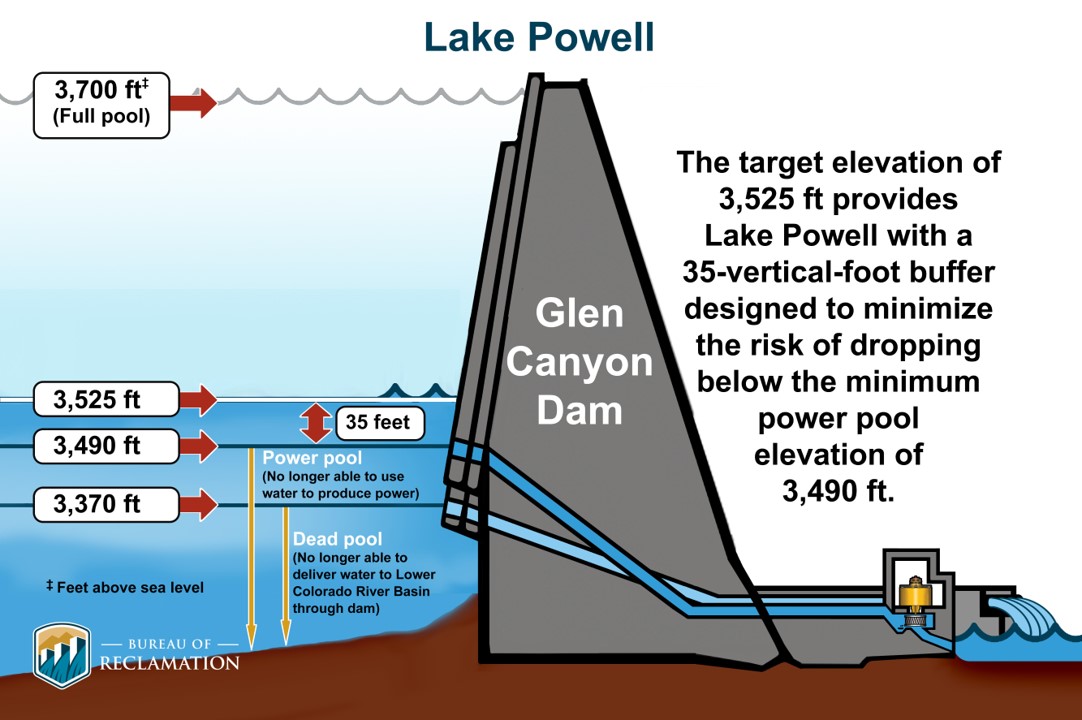
If the level falls to 3,490 feet—78 feet below this week’s reading—water will be too low to spin the turbines that generate electricity.
If the level falls to 3,370 feet—198 feet below this week’s reading—it would reach “dead pool” status, when the water is too low to flow downstream from the dam. The results would be catastrophic for communities south of the dam, as David Dudley explained last year in Sierra magazine.
The Bureau of Reclamation does regular forecasts to have an idea of these risks. A report issued in August projects that there is essentially a zero percent chance that the power plant will be forced offline this year, but a 3 percent chance the water level will drop enough to force a shutoff in 2028.
Lake Powell is one several prominent examples of water resources that are at risk because of drought that climate change has exacerbated and the overallocation of the Colorado River. Downriver is another example, Lake Mead, whose low water levels have led to heightened concerns about the Hoover Dam power plant, as Rhiannon Saegert wrote for the Las Vegas Sun in August.
The Biden administration is working with states that rely on the Colorado River to find ways to conserve water and maintain adequate flow through Lake Powell and Lake Mead. The administration revised the operating guidelines for the lakes in April, including measures to better give notice to operators of irrigation systems and water utilities about water delivery reductions, and giving the Bureau of Reclamation more flexibility to conserve and store water.
“Failure is not an option,” said Tommy Beaudreau, who was then deputy secretary of the Interior, in an April statement.

Let’s take a few steps back. Hydropower plants have long been some of the most reliable sources of carbon-free electricity. The country gets 6 percent of its electricity from hydropower, which is more than any other utility-scale renewable source except for wind.
But drought and other extreme weather events are making hydropower increasingly volatile. The ups and downs show up in national figures; 2021 and 2022 were two of the three lowest years for hydropower generation since 2010, according to the Energy Information Administration. (This doesn’t include 2023, for which full-year records are not yet available.)
The shifts look ever more drastic at the state level.
From October 2022 to September 2023, hydropower generation in Washington State—the national leader in hydropower—was down 23 percent compared to the previous 12-month period.
In that same timeframe, California increased its hydropower generation by 72 percent.
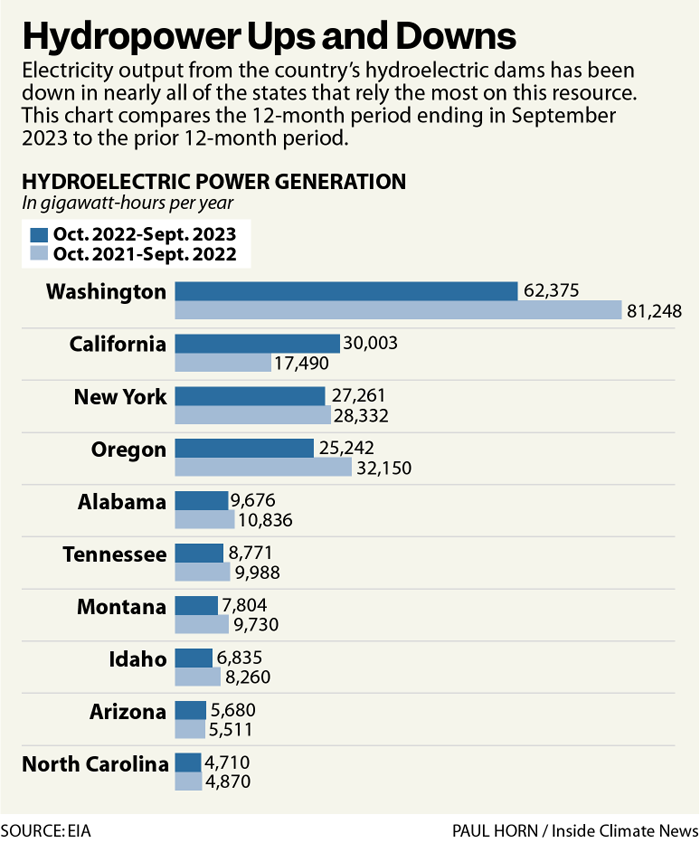
The “why” comes down to local factors such as drought or recovery from drought. For grid operators, the takeaway is that hydropower isn’t as steady as it used to be.
There also is a growing view among environmental and justice advocates that hydropower has harmful effects on plants and animals, and can lead to an increase in methane emissions. And, construction of reservoirs has often displaced Indigenous communities.
Some of those advocates, with support from farmers, are saying the Colorado River should be allowed to flow freely through the area where the Glen Canyon Dam now stands in order to improve the availability of water south of the dam, among other benefits. Ian James of the Los Angeles Times wrote about this in September.
While the idea doesn’t have widespread support, it’s not being dismissed in the way it might have been a decade ago, when the problems with the dam were less apparent.
Federal officials have resources to prepare for declining water levels on Lake Powell, but they are dealing with symptoms of larger problems: climate change and a demand for water that exceeds a shrinking supply.
For now, the news is better than it was last year at this time, but Miller isn’t treating this like a victory.
“We haven’t solved the problem,” he said. “We’re still in this place where we need to do a lot of work.”