
Click the link to access the article on the Nature website (Ralph Trancoso, Jozef Syktus, Richard P. Allan, Jacky Croke, Ove Hoegh-Guldberg & Robin Chadwick). Here’s the abstract:
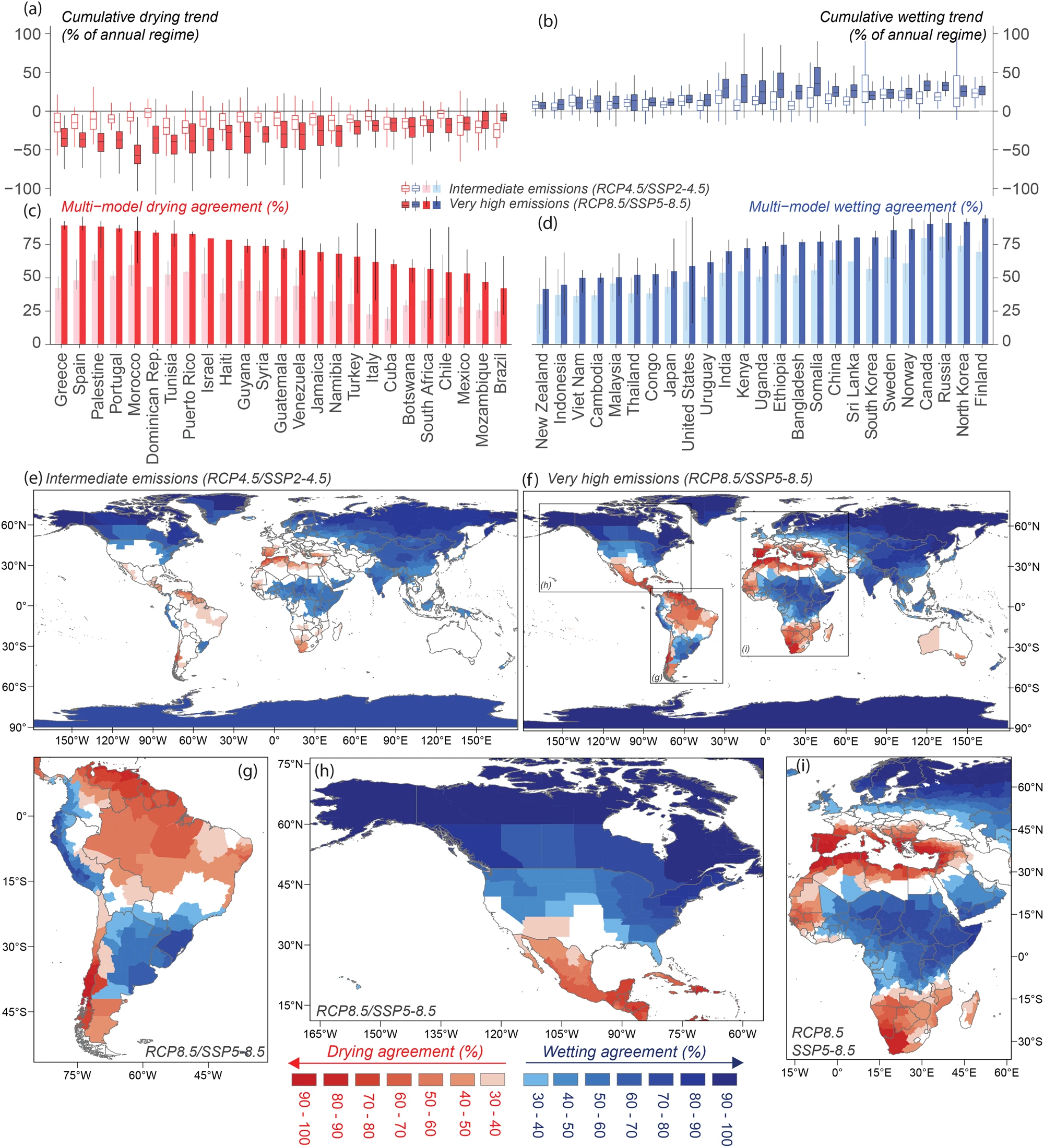
Future projections of precipitation are uncertain, hampering effective climate adaptation strategies globally. Our understanding of changes across multiple climate model simulations under a warmer climate is limited by this lack of coherence across models. Here, we address this challenge introducing an approach that detects agreement in drier and wetter conditions by evaluating continuous 120-year time-series with trends, across 146 Global Climate Model (GCM) runs and two elevated greenhouse gas (GHG) emissions scenarios. We show the hotspots of future drier and wetter conditions, including regions already experiencing water scarcity or excess. These patterns are projected to impact a significant portion of the global population, with approximately 3 billion people (38% of the world’s current population) affected under an intermediate emissions scenario and 5 billion people (66% of the world population) under a high emissions scenario by the century’s end (or 35-61% using projections of future population). We undertake a country- and state-level analysis quantifying the population exposed to significant changes in precipitation regimes, offering a robust framework for assessing multiple climate projections.