#Drought news January 16, 2025: D1 was expanded across southwestern #Colorado due to low snow water equivalent and 60-day SPI

Click on a thumbnail graphic to view a gallery of drought data from the US Drought Monitor website.
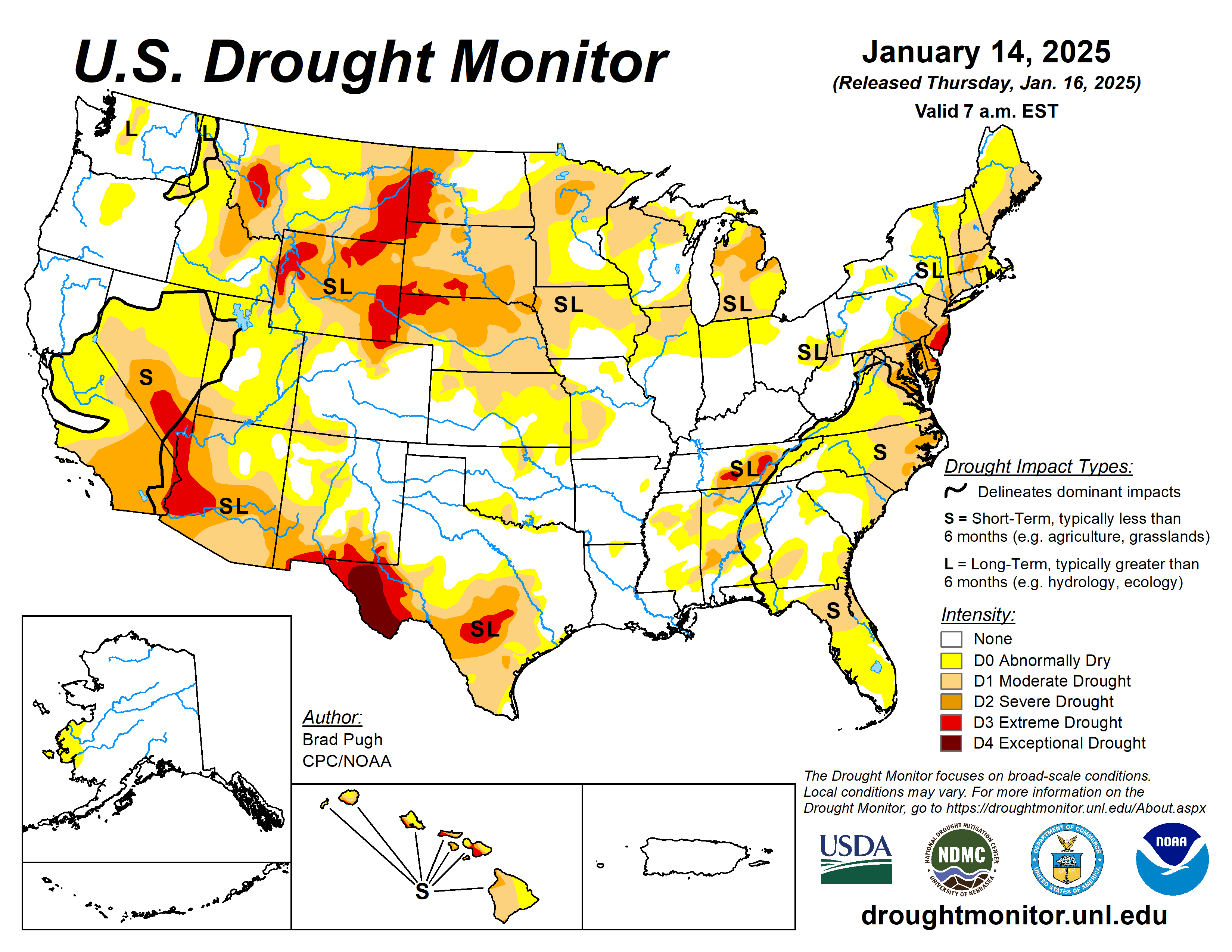
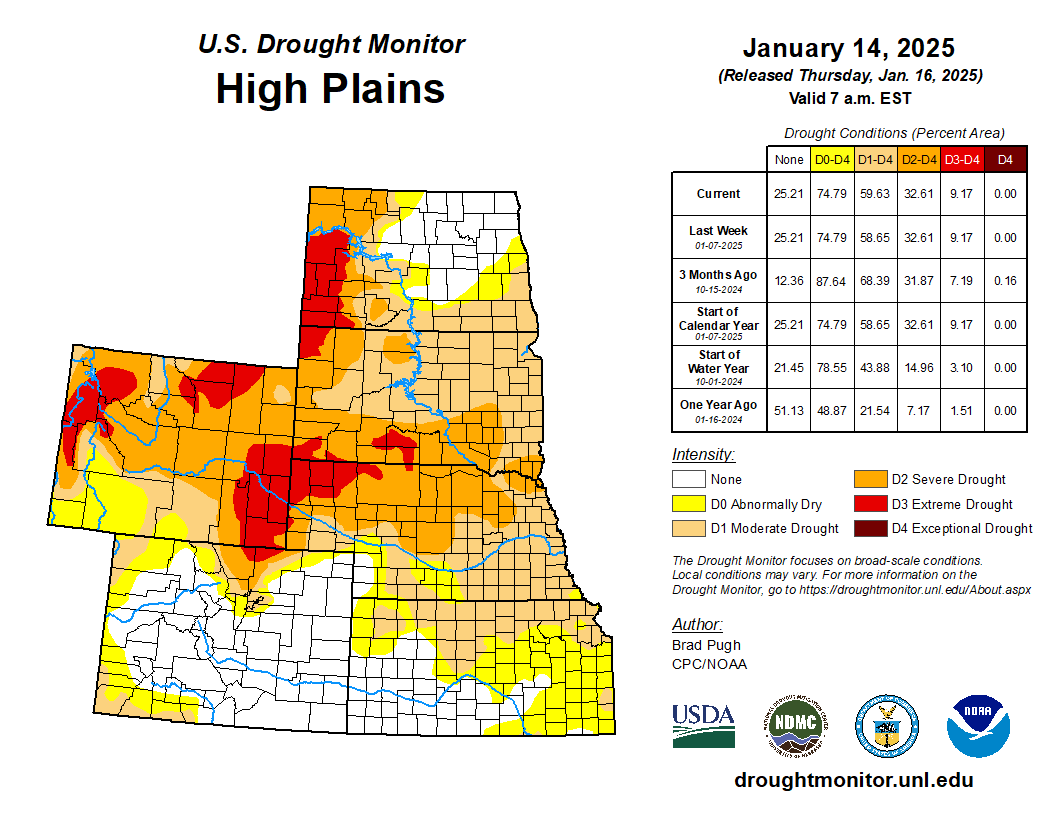
Click the link to go to the US Drought Monitor website. Here’s an excerpt:

This Week’s Drought Summary

On January 9 and 10, a low pressure system tracked along the Gulf Coast and resulted in widespread precipitation (1 to 2.5 inches, liquid equivalent) from eastern Texas and the Lower Mississippi Valley east to the Florida Panhandle. On the northern extent of this storm, snow blanketed areas from Oklahoma and Arkansas to north Georgia. This precipitation during the second week of January supported drought improvement. However, drought expanded and intensified for the Florida Peninsula, eastern North Carolina, west-central Texas, and the Southwest. During the first two weeks of January, multiple Arctic surface highs shifted south from Canada and temperatures (January 1-13) averaged 4 to 8 degrees F below normal for much of the Great Plains, Middle to Lower Mississippi Valley, and Southeast. A very dry start to the wet season continued to affect southern California with worsening drought conditions, periodic Santa Ana winds, and large wildfires. Enhanced trade winds, typical during a La NiƱa winter, resulted in improving drought for the windward side of the Hawaiian Islands…

High Plains

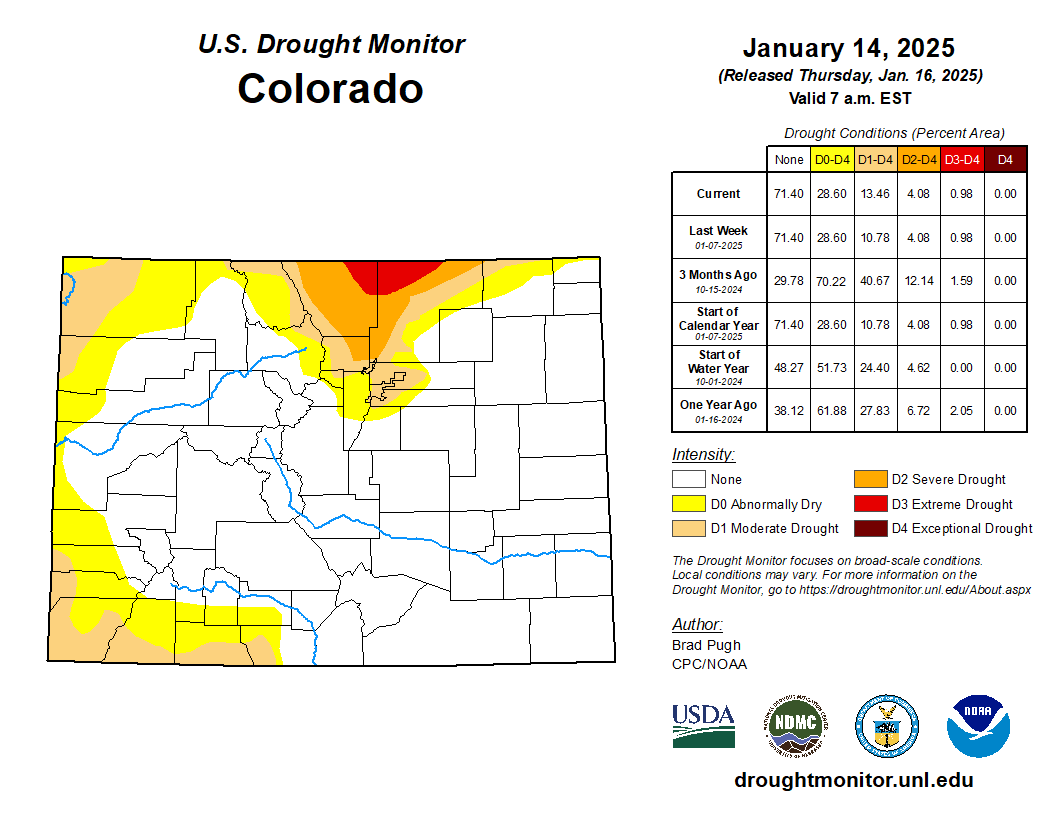
The Central High Plains continued to have worsening drought conditions and moderate drought (D1) was expanded across portions of southwestern Nebraska using 60-day SPI, soil moisture below the 10th percentile, and the NDMC short-term blend. Although light precipitation (less than 0.5 inch, liquid equivalent) fell across parts of south-central to southeastern Kansas, this precipitation was too low to justify any improvements. Elsewhere, across the Central to Northern Great Plains, no changes were made as early to mid-January is a dry time of year. D1 was expanded across southwestern Colorado due to low snow water equivalent and 60-day SPI…
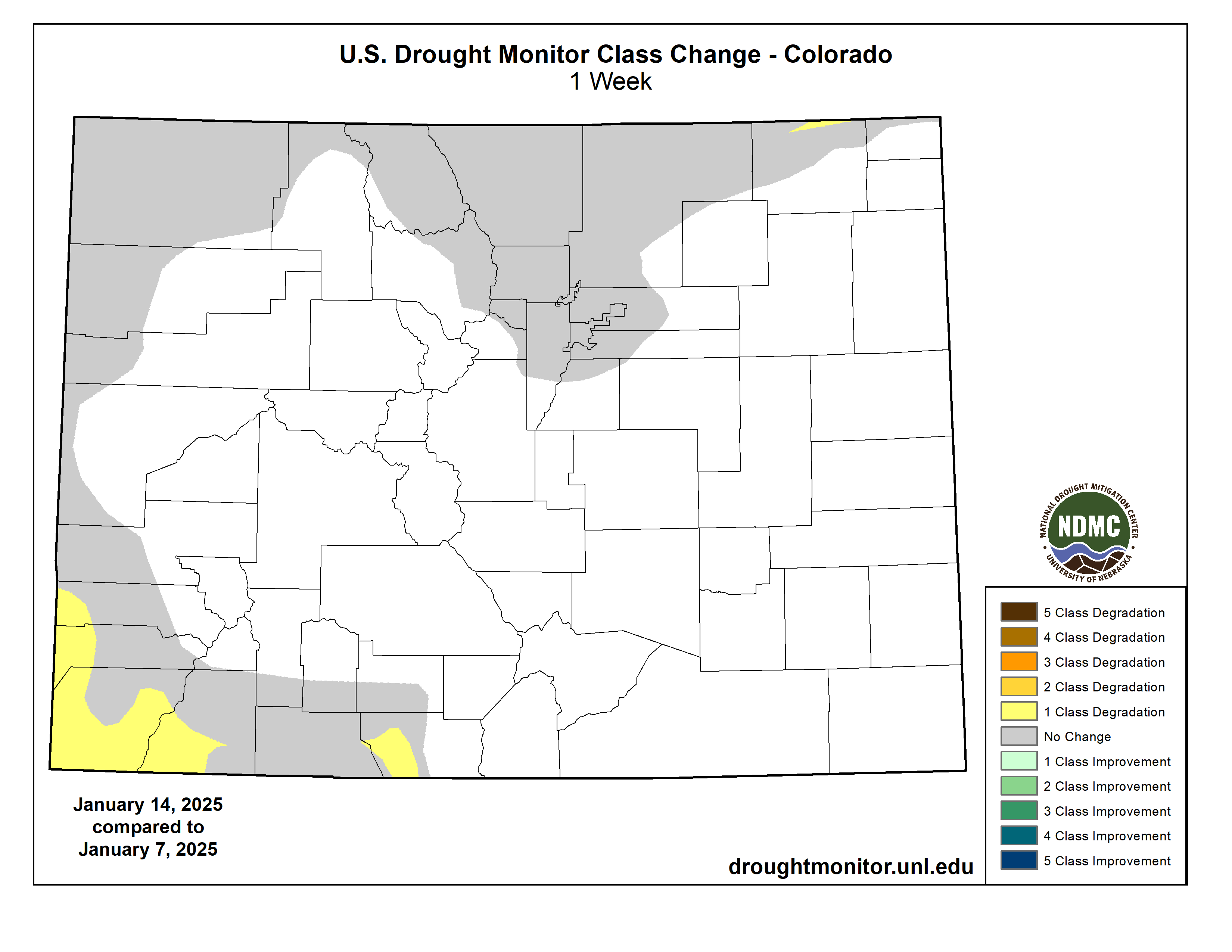
Colorado Drought Monitor one week change map ending January 14, 2025.

West

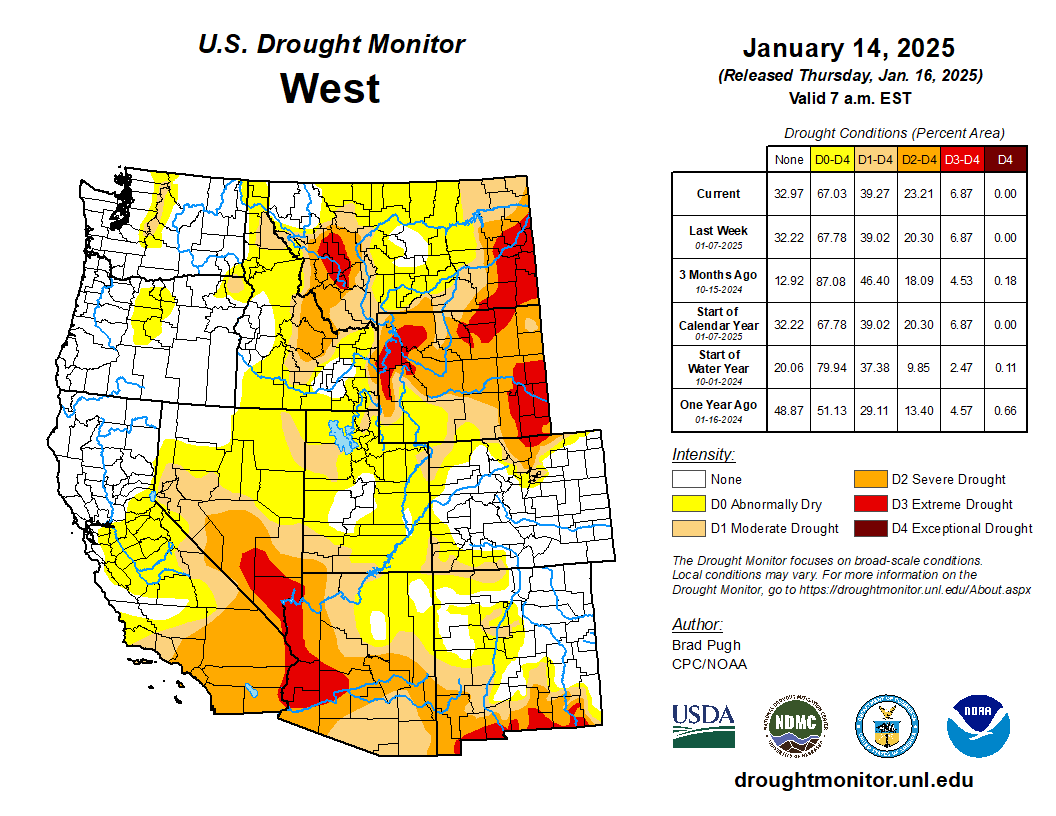
Severe drought (D2) was expanded to include all of southern California due to the very dry start to the water year to date (WYTD) from October 1, 2024 to January 13, 2025. The D2 coverage coincides with where WYTD precipitation has averaged less than 5 percent of normal. [ed. emphasis mine] A number of locations, including San Diego, are having their driest start to the water year. The D2 covers Los Angeles and Ventura counties which are being affected by periodic Santa Ana winds drying out vegetation and large wildfires. Following the two wet winters, the large reservoirs throughout California are at or above-normal. Based on 90-day SPI, declining soil moisture, and low snow water equivalent, a 1-category degradation was warranted for parts of Arizona and southwestern Utah. A mix of improvements and degradations were made to Idaho and the depiction is generally consistent with the 2024-2025 WYTD precipitation and snowpack. Eastern Washington and much of Oregon are drought-free, but low snowpack supports moderate drought (D1) along the northern Cascades of Washington. A 1-category improvement was justified for a portion of central Montana, based on 90-day SPEI along with snow water equivalent (SWE) above the 75th percentile. As of January 14, SWE was above-normal (period of record: 1991-2020) across the southern Cascades along with eastern Oregon and southwestern Idaho. SWE varies for the Sierra Nevada Mountains, those numbers are beginning to decrease after a drier-than-normal start to January. SWE remained well below-normal across the Four Corners Region…

South

More than 1 to 1.5 inches of precipitation (liquid equivalent) supported improvements for portions of eastern Texas, Arkansas, Louisiana, and Mississippi. The small areas of severe drought (D2) were discontinued in northeastern Mississippi due to: 28-day average streamflows near the 20th percentile, soil moisture recovery, and a consensus of SPIs in D1 at worst. In addition, there is no support for maintaining D2 in the NDMC short- and long-term blends. Precipitation during the first two weeks of January resulted in a slight reduction in extreme drought (D3) across south-central Tennessee. For central Texas which received generous precipitation for this time of year, low 28-day streamflows (below the 20th percentile in D1 and 10th percentile in D2) precluded a larger area for a 1-category improvement. D2 to D3 drought was expanded across the Edwards Plateau of Texas due to 28-day average streamflows below the 10th and 5th percentile, respectively…

Looking Ahead

Another Arctic air outbreak is forecast for the central and eastern U.S. during mid-January as surface high pressure shifts south from Canada. By January 20, subzero minimum temperatures are expected as far south as the Central Great Plains, Middle Mississippi Valley, and Ohio Valley. During January 16-20, little to no precipitation is forecast from the West Coast to the Mississippi Valley with light to moderate precipitation amounts (0.5 to 1 inch) limited to the Southeast. These amounts, however, have been sufficient for rainfall to almost keep up with demand, and the near-normal amounts the past 2 weeks have kept the area out of D0 conditions for the time being, but the situation needs to be closely monitored for signs of increasing dryness impacts. Daily rainfall reports are not available for Mili since the start of January 2025, but 45.59ā€ fell during October-December 2024, above the normal of 36.55ā€ and well above the amount needed to keep up with demand, which is sufficient to keep D0 conditions at bay regardless the rainfall during the past 2 weeks.

The Climate Prediction Center’s 6-10 day outlook (valid January 21-25, 2025) favors below-normal temperatures to persist for much of the contiguous U.S. with the largest below-normal temperature probabilities (exceeding 80 percent) extending from the Mid-Atlantic and Ohio Valley south to the Gulf Coast. Elevated above-normal precipitation probabilities are forecast for the northern Great Plains, Gulf Coast, and portions of the Southeast. Below-normal precipitation is favored for the West, Central Great Plains, Midwest, and New England.
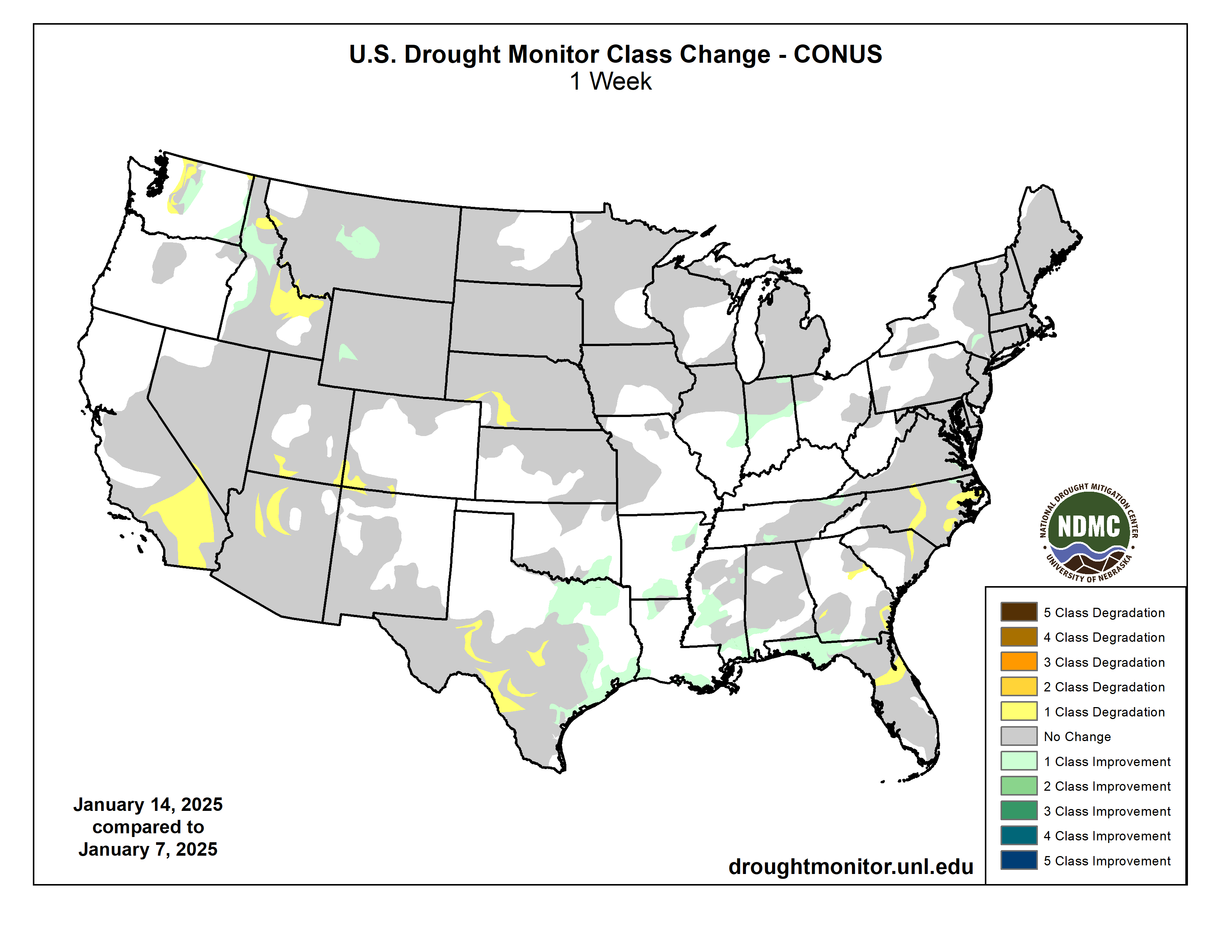
US Drought Monitor one week change map ending January 14, 2025.

Record precipitation in 2024 gave little relief to irrigators: Most of the water ended up in the soil, not the unconfined aquifer — @AlamosaCitizen #RioGrande #SanLuisValley

Gauging station near Mogote on the Conejos River. Record precipitation did not translate to record river flows. Credit: The Citizen

Click the link to read the article on the Alamosa Citizen website:

January 15, 2025

Alamosa never gets 16 inches of total precipitation in a year. Never. Ever. Except that it did in 2024. 

Turns out, 2024 was among the wettest on record across the San Luis Valley going back to 1895, with all six counties registering historic levels of precipitation. Here are the precipitation totals by county, according to data from the NOAA National Centers for Environmental Information:

  • Alamosa County, 16.75 inches
  • Conejos County, 24.29 inches
  • Costilla County, 22.53 inches
  • Mineral County, 32.60 inches
  • Rio Grande County, 19.66 inches
  • Saguache County, 21.86 inches

The headscratching is how so much moisture was realized in a year when the unconfined aquifer of the Upper Rio Grande Basin dropped to near its lowest level, which became problematic for irrigators who are under orders by the state of Colorado to reduce their groundwater pumping to help recover the ailing aquifer.

ā€œTwo things,ā€ said Cleave Simpson, general manager of the Rio Grande Water Conservation District and local hay grower. ā€œWe didn’t have continuous steady snowpack in the winter months that put us in a good position, and then the volume of snow we got was on top of drier conditions last fall where moisture, instead of showing up in a stream, ends up in the ground in soil conditions.

ā€œSo to that end, this year at my farm in October, I get an inch and a half of rain, in October. That never, ever happens. So the hope is then, that nice soil moisture that we got in October will set us up for success.ā€

Craig Cotten, division engineer for the Colorado Division of Water Resources, said the wet 2024 was a boon to local farmers and their efforts to recover the Valley’s aquifers. What it didn’t do was increase the amount of water stored in reservoirs.

ā€œThe reservoirs in the Rio Grande Basin in Colorado typically store water in winter when the senior priority ditches are shut off. The reservoirs can also store during the irrigation season, but only if there is a significant amount of water in the rivers to serve not only the irrigation ditches but the reservoirs as well,ā€ said Cotten.

ā€œThis typically requires very high river flows, which did not occur in 2024 even with the rain events that were the primary reason for the high precipitation total in 2024. The significant rains in the Rio Grande Basin did increase the river flows, but not enough to get the reservoirs into priority. The increase in reservoir storage in 2024 was about typical of what occurs in an average year.ā€

Without the high levels of precipitation in 2024, the critical unconfined aquifer was in danger of falling to a level of storage nobody was expecting to see after years of irrigators working to reduce their groundwater pumping.

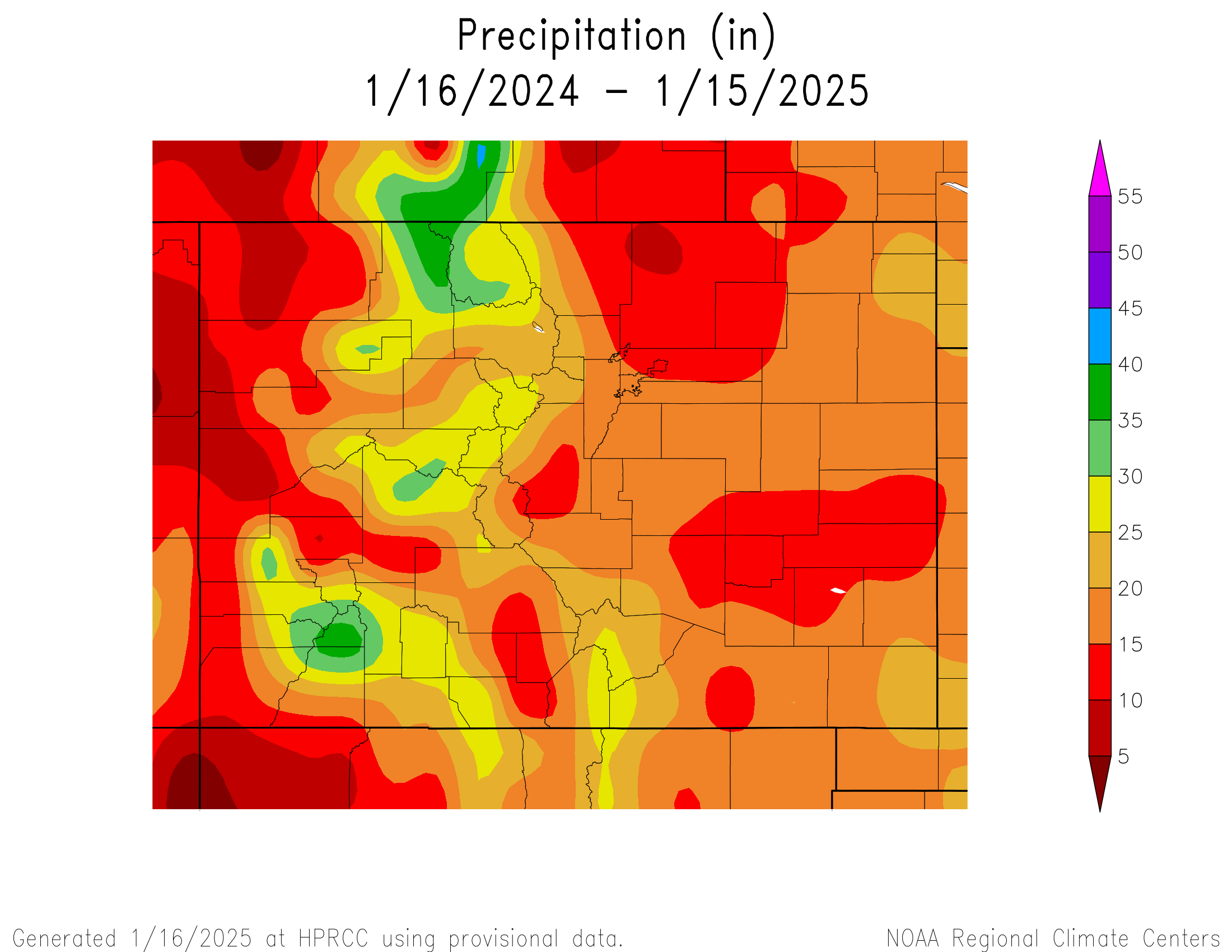
Colorado precipitation for the 12 months ending January 15, 2024. Credit: High Plains Regional Climate Center.

ā€œThe large amount of precipitation in the Rio Grande Basin during the summer of 2024 helped the unconfined aquifer in multiple ways,ā€ said Cotten. ā€œThis precipitation increased the streamflow in the Rio Grande throughout the summer, allowing the ditches and canals to divert more water than they otherwise would have.

ā€œThis increased diversion in turn allowed delivery of a higher amount of water into recharge pits and the aquifer. The precipitation also helped to meet the irrigation needs of the crops, allowing the farmers to not pump their wells as much as they would otherwise.ā€

The hope among local farmers is that the wet fall months of 2024, when October and November delivered more than 11 inches of snow, will translate into an above-average spring runoff and give a boost to surface water coming into the Valley in 2025.

Rio Grande and Pecos River basins. Map credit: By Kmusser – Own work, Elevation data from SRTM, drainage basin from GTOPO [1], U.S. stream from the National Atlas [2], all other features from Vector Map., CC BY-SA 3.0, https://commons.wikimedia.org/w/index.php?curid=11218868

Research letter: Crowdsourced Data Reveal Shortcomings in Precipitation Phase Products for Rain and Snow Partitioning — AGU

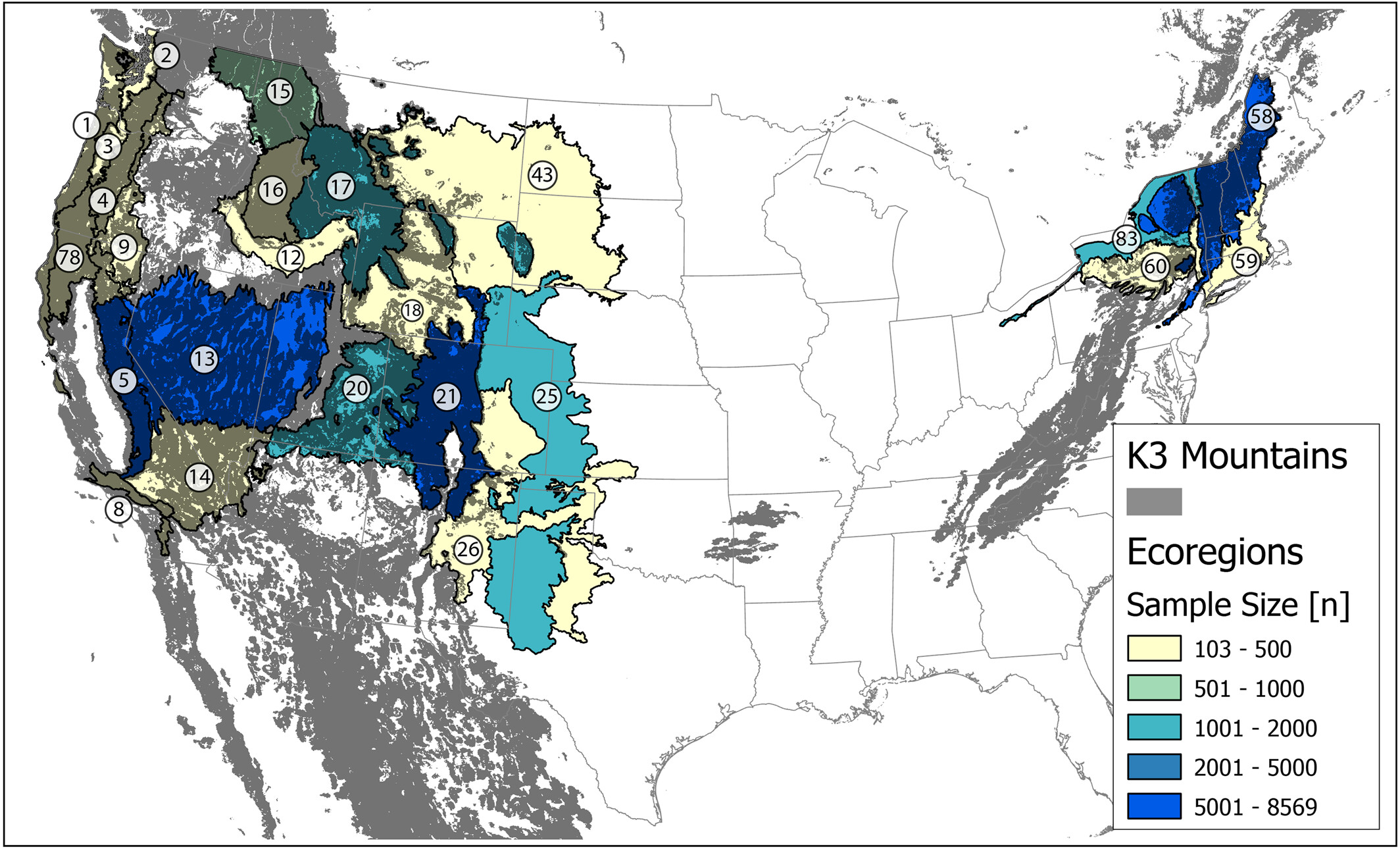
Figure 1: The sample size and spatial distribution of the MRoS data across ecoregions within CONUS. The gray shaded area represents the high-resolution (250 m) global mountains version 3 derived from terrain characteristics (Karagulle et al., 2017; referred to as K3 mountains). The level-3 code for each ecoregion is also shown and they are: 1-Coast Range, 2-Puget Lowlands, 3-Willamette Valley, 4-Cascades, 5-Sierra Nevada, 8-Southern California Mountains, 9-Eastern Cascade Slopes and Foothills, 12-Snake River Plain, 13-Central Basin and Range, 14-Mojave Basin and Range, 15-Northern Rockies, 16-Idaho Batholith, 17-Middle Rockies, 18-Wyoming Basin, 20-Colorado Plateaus, 21-Southern Rockies, 25-High Plains, 26-Southwestern Tablelands, 43-Northwestern Great Plains, 58-Northeastern Highlands, 59-Northeastern Coastal Zone, 60-Northern Allegheny Plateau, 78- Klamath Mountains, and 83-Eastern Great Lakes Lowlands.

Click the link to access the letter on the AGU website (Guo Yu,Ā Keith S. Jennings,Ā Benjamin J. Hatchett,Ā Anne W. Nolin,Ā Nayoung Hur,Ā Meghan Collins,Ā Anne Heggli,Ā Sonia Tonino,Ā Monica M. Arienzo). Here’s the abstract:

December 23, 2024

Reanalysis products support our understanding of how the precipitation phase influences hydrology across scales. However, a lack of validation data hinders the evaluation of a reanalysis-estimated precipitation phase. In this study, we used a novel dataset from the Mountain Rain or Snow (MRoS) citizen science project to compare 39,680 MRoS observations from January 2020 to July 2023 across the conterminous United States (CONUS) to assess three precipitation phase products. These products included the Global Precipitation Measurement (GPM) mission Integrated Multi-satellitE Retrievals for GPM (IMERG), the Modern-Era Retrospective Analysis for Research and Applications (MERRA-2), and the North American Land Data Assimilation System (NLDAS-2). The overall critical success indices for detecting rainfall (snowfall) for IMERG, MERRA-2, and NLDAS-2 were 0.51 (0.79), 0.49 (0.77), and 0.54 (0.53), respectively. These indices show that IMERG and MERRA-2 reasonably classify snowfall, whereas NLDAS-2 overestimates rainfall. All products performed poorly in detecting subfreezing rainfall and snowfall above 2°C. Therefore, crowdsourced data provides a unique validation source to improve the capabilities of reanalysis products.

Key Points

  • The Mountain Rain or Snow citizen science project collected a novel dataset of 39,680 observations of precipitation phases across the US
  • The precipitation reanalysis products performed poorly in detecting subfreezing rainfall and snowfall above 2°C
  • The crowdsourced data provides a unique validation source to improve the capabilities of reanalysis products

Plain Language Summary

Distinguishing between rain and snow is challenging. This study used a unique crowdsourced dataset from the Mountain Rain or Snow (MRoS) project to allow researchers to better assess the accuracy of reanalysis products used to differentiate rain from snow. We compared the citizen science data with results from three reanalysis products. We found that these reanalysis products all performed poorly in detecting rainfall at subfreezing rainfall or snowfall at warmer air temperatures. Crowdsourced data could help enhance methods used to determine precipitation phases and improve real-time weather forecasts.