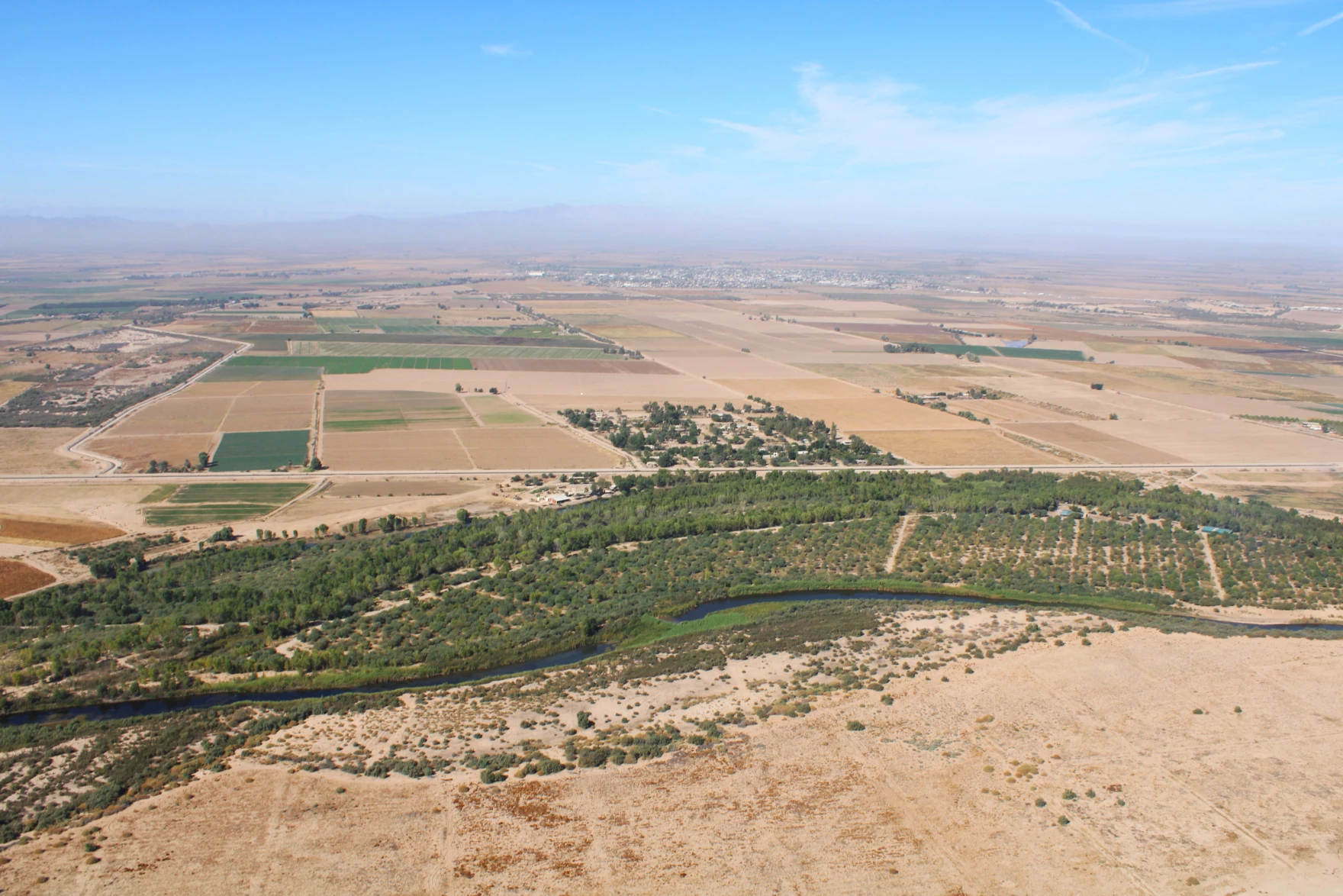
The U.S. Army Corps of Engineers is asking for public comment on the LaPrele Dam demolition plan — #Wyoming Public Radio

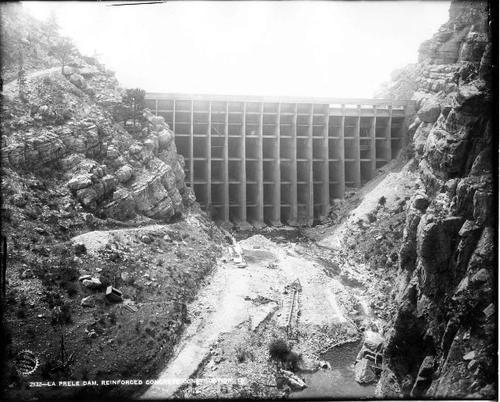
The LaPrele dam is an Ambursen style dam, which makes it unique. CREDIT J. E. STIMSON / WYOMING STATE ARCHIVES

Click the link to read the article on the Wyoming Public Radio website (Jordan Uplinger). Here’s an excerpt:

January 2, 2025

The Army Corps of Engineers and the Wyoming Department of Environmental Quality are reviewing aspects of the controlled demolition of the LaPrele Dam near Douglas. On Nov. 1, the state engineer ordered the destruction of the failing 115-year-old dam by April 1. The announcement was made following inspections that found new cracks on the front face of the structure, suggesting near-irreparable damage to the dam’s foundation. State officials, land owners and locals have been in discussion on how best to handle a situation that the state engineer referred to as an “emergency.”

Despite a search for alternatives, the LaPrele Irrigation District is proposing to mechanically breach or blast the 135-foot-tall concrete dam. Some concrete would partially remain within the dam’s footprint, some would be placed in a rubble chute in LaPrele Creek to prevent excessive erosion and some would go in optional disposal areas. The district is also proposing to use fill material within the creek and reservoir bed to build equipment access ramps to the north side of the dam, a structure to capture sediment and debris from demolition and for a southern access road. The blast is scheduled to happen before April in an effort to avoid spring runoff, but the state has considered the possibility of taking action sooner should the dam deteriorate faster than expected. Emergency permitting procedures have been approved, according to the Corps, in the event that expedited action is required.

Safe Drinking Water Act Turns 50: Landmark law encounters new problems, enduring challenges — Brett Walton (@circleofblue)

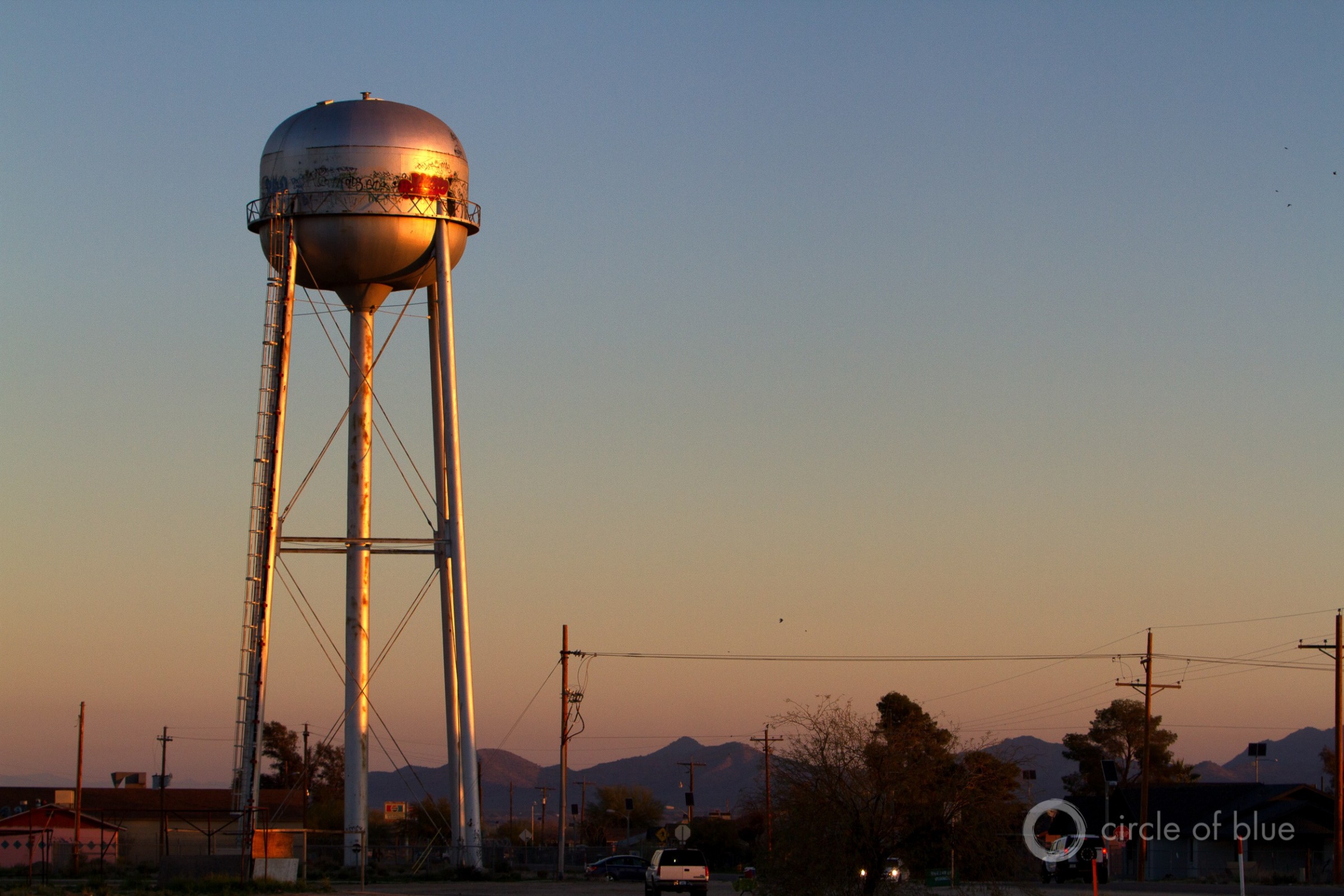
A water tower in Sacaton, the central town of the Gila River Indian Community. Photo © J. Carl Ganter / Circle of Blue

Click the link to read the article on the Circle of Blue website (Brett Walton):

December 16, 2024

The American public, newly conditioned to the health dangers of a polluted environment, was worried.

Media reports documented carcinogens in the lower Mississippi River. The federal government, empowered by recent legislation, sued Reserve Mining Company for dumping asbestos-like fibers into Lake Superior, thereby jeopardizing the water supply for Duluth, Minnesota, and at least four other communities. Congress had just approved groundbreaking laws for cleaner air and ecosystems. What about tap water?

Those were the circumstances in 1974 as a receptive Congress and a supportive-but-cost-conscious Ford administration debated first-ever national drinking water standards.

In the previous four years, lawmakers had passed the Clean Air Act and the Clean Water Act. “Nothing is more essential to the life of every single American than clean air, pure food, and safe water,” Russell Train, then-administrator of the Environmental Protection Agency, wrote to President Gerald Ford. “The time is overdue for a Safe Drinking Water Act.”

Fifty years ago, on December 16, 1974, Ford clinched a public health victory when he signed a bill that joined the pantheon of federal environmental protection laws enacted that decade.

Today, the country still reaps the benefits. Most Americans are provided high-quality water from their taps.

“At a time when the American public is skeptical of the government’s ability to take positive action and improve their lives, the Safe Drinking Water Act is an example of the essential work that our government can and must do to stand up for our well-being,” Radhika Fox, assistant administrator for water at the U.S. Environmental Protection Agency from 2021 to 2024 told a Senate committee last month. “It’s a demonstration of the most basic mission of our government: to safeguard the rights and interests of its people.”

As the Safe Drinking Water Act begins its next half century, it is clear that the law is an essential piece of the country’s project to assure every American access to safe, reliable, affordable water. But there is still much room for improvement. By one estimate, some two million people in the country do not have running water or indoor plumbing at home. Black and Hispanic communities, especially if they are poor, are more likely to have low quality drinking water. The struggles of small water systems that serve dozens or hundreds of people remain problems.

The act was weakened in 2005, following secret meetings between the oil industry and the Bush administration, that advanced oil and gas development by exempting chemical fluids used in fracking from federal oversight.

There are also elements of drinking water provision that the act does not explicitly address. Aging infrastructure, a changing climate, decaying plumbing within buildings, and limited funding for repairs are major impediments. Private well water is not regulated.

Health and environmental groups, seeing the proliferation of chemicals in commerce and their links to cancer, kidney disease, and other chronic ailments, encourage the U.S. Environmental Protection Agency (EPA) to regulate more of these contaminants.

The agency appears to be paying attention. It decided earlier this year to set national standards for six PFAS – the persistent and toxic “forever” chemicals used in non-stick, water-repellent goods and firefighting foams. They were the first additions to the roster of regulated contaminants in decades. Perchlorate, used in explosives and a concern for fetal brain development, is next on the EPA agenda, due to a court order.

A counter argument – offered most passionately by public policy experts and utility leaders – is that the EPA is focusing on the wrong risks. This line of thinking suggests that regulators are targeting new chemical contaminants when they should be more concerned about the reliability of the pipes through which water flows. Utilities and municipalities have limited funds, the argument goes, so the biggest health risks should be addressed first.

Pipe breaks – which occur by the hundreds every day in this country – can pull pathogens into water systems and do immediate harm. Plumbing systems inside buildings, which are not regulated by the Safe Drinking Water Act, can harbor Legionella bacteria, which causes Legionnaires’ disease, a respiratory illness that is the country’s deadliest waterborne disease. It kills about one in 10 people it infects. A Legionnaires’ outbreak in Grand Rapids, Minnesota, that began in 2023 sent 11 people to the hospital.

Chad Seidel, president of Corona Environmental Consulting, worries that the failure to invest in basic infrastructure will result in less reliable water systems that are prone to malfunctioning and spreading disease. Backsliding on infrastructure quality would be detrimental, he said.

“I believe the health risks of regressing are higher than the risk of unregulated contaminants,” Seidel said.

The data show that certain water providers have higher risks of failure. In 1970, the EPA’s drinking water division assessed the quality of water from 969 systems. Most failing systems were small.

So it is today. Small water systems, a half century later, are more likely to violate health standards and monitoring requirements.

The country counts about 50,000 public water systems, most of them small. Many lack the financial strength or managerial know-how to successfully operate. There is a growing consensus that small systems will need to be absorbed into larger neighbors, or form regional entities that take advantage of scale to provide better service.

Amendments to the act in 1996 established a revolving loan fund that is the federal government’s primary vehicle for financing local drinking water improvements. Despite tens of billions of dollars added to the fund in the last three decades, state and local governments still account for about 95 percent of water infrastructure spending. Utility leaders fret that Congress is starting to erode the revolving fund by extracting earmarks from its annual appropriation. In time, this will result in less money available to lend.

“You can’t talk about the future of safe drinking water without talking about how to pay for it,” said Rob Greer, who studies public administration at Texas A&M University.

Water utilities are lobbying for a federal program to assist low-income people with their water bills, as the government does for energy bills. During the pandemic, Congress approved a short-term water bill assistance program but it has expired. A federal program would allow utilities to raise rates to pay for needed repairs, while not burdening their poorest customers with large bills.

Even if adequate funding is secured, there are social and cultural headwinds buffeting utilities. An unknown but rising number of people do not drink their tap water. They do not trust it.

Mistrust is highest among Black and Hispanic communities who are also most likely to have tap water that exceeds federal standards or looks and tastes gross. Notorious tap water failures in Flint, Michigan, and Jackson, Mississippi, in the last decade highlight the ease by which trust can be lost.

Mistrust is illustrated by soaring sales of bottled water and the growing presence of commercial water kiosks, a trend documented by Samantha Zuhlke of the University of Iowa and Manny Teodoro of the University of Wisconsin-Madison. Both bottled water and kiosk water have less regulatory scrutiny than tap water.

Water is an intimate relationship between individuals and their government because water is the “only government service you ingest,” Teodoro said.

The water treatment process

Report: When Risks Become Reality: Extreme Weather In 2024 — World Weather Attribution #ActOnClimate

Click the link to access the report on the World Weather Attribution website:

December 27, 2024

When Risks Become Reality: Extreme Weather in 2024 is our annual report, published this year for the first time.


Every December, people ask us how severe the year’s extreme weather events were. To answer this question, we’ve partnered with Climate Central to produce a report that reviews some of the most significant events and highlights findings from our attribution studies. It also includes new analysis looking at the number of dangerous heat days added by climate change in 2024 and global resolutions for 2025 to work toward a safer, more sustainable world.

Key messages

  • Extreme weather reached dangerous new heights in 2024. This year’s record-breaking temperatures fueled unrelenting heatwaves, drought, wildfire, storms and floods that killed thousands of people and forced millions from their homes. This exceptional year of extreme weather shows how dangerous life has already become with 1.3°C of human-induced warming, and highlights the urgency of moving away from planet-heating fossil fuels as quickly as possible.
  • Climate change contributed to the deaths of at least 3,700 people and the displacement of millions in 26 weather events we studied in 2024. These were just a small fraction of the 219 events that met our trigger criteria, used to identify the most impactful weather events. It’s likely the total number of people killed in extreme weather events intensified by climate change this year is in the tens, or hundreds of thousands. 
  • Globally, climate change added on average 41 additional days of dangerous heat in 2024 that threatened people’s health, according to new analysis by Climate Central. The countries that experienced the highest number of dangerous heat days are overwhelmingly small island and developing states, who are highly vulnerable and considered to be on the frontlines of climate change. The analysis highlights the wide reaching impacts of extreme heat that are underreported and not well understood.  
  • Many extreme events that took place in the beginning of 2024 were influenced by El Niño. However, most of our studies found that climate change played a bigger role than El Niño in fueling these events, including the historic drought in the Amazon. This is consistent with the fact that, as the planet warms, the influence of climate change increasingly overrides other natural phenomena affecting the weather.  [ed. emphasis mine]
  • Record-breaking global temperatures in 2024 translated to record-breaking downpours. From Kathmandu, to Dubai, to Rio Grande do Sul, to the Southern Appalachians, the last 12 months have been marked by a large number of devastating floods. Of the 16 floods we studied, 15 were driven by climate change-amplified rainfall. The result reflects the basic physics of climate change — a warmer atmosphere tends to hold more moisture, leading to heavier downpours. Shortfalls in early warning and evacuation plans likely contributed to huge death tolls, while floods in Sudan and Brazil highlighted the importance of maintaining and upgrading flood defences. 
  • The Amazon rainforest and Pantanal Wetland were hit hard by climate change in 2024, with severe droughts and wildfires leading to huge biodiversity loss. The Amazon is the world’s most important land-based carbon sink, making it crucial for the stability of the global climate. Ending deforestation will protect both ecosystems from drought and wildfire, as dense vegetation is able to absorb and retain moisture. 
  • Hot seas and warmer air fueled more destructive storms, including Hurricane Helene and Typhoon Gaemi. Individual attribution studies have shown how these storms have stronger winds and are dropping more rain. Research by Climate Central found that climate change increased the intensity of most Atlantic hurricanes between 2019 and 2023 – of the 38 hurricanes analysed, 30 had wind speeds that were one category higher on the Saffir-Simpson scale than they would have been without human-caused warming, while our analysis found that the risk of multiple Category 3-5 typhoons hitting the Philippines in a given year is increasing as the climate warms. 

Figure 1: World Weather Attribution studies in 2024.

Resolutions for 2025

  • A faster shift away from fossil fuels – The burning of oil, gas and coal are the cause of warming and the primary reason extreme weather is becoming more severe. Last year at COP28, the world finally agreed to ‘transition away from fossil fuels,’ but new oil and gas fields continue to be opened around the world, despite warnings that doing so will result in a long term commitment to more than 1.5°C and therefore costs to people around the world. Extremes will continue to worsen with every fraction of a degree of fossil fuel warming. A rapid move to renewable energy will help make the world a safer, healthier, wealthier and more stable place. 
  • Improvements in early warning – Weather disasters in 2024 highlighted the importance of early warning systems, which are one of the cheapest and most effective ways to minimise fatalities. Warnings need to be targeted, given days ahead of a dangerous weather event, and outline clear instructions on what people need to do. Most extreme weather is well forecast, even in developing nations. Every country needs to implement, test and continually improve early warning systems to ensure people are not in harm’s way.
  • Real-time reporting of heat deaths – Heatwaves are the deadliest type of extreme weather. However, the dangers of high temperatures are underappreciated and underreported. In April, a hospital in Mali reported a surge in excess deaths as temperatures climbed to nearly 50°C. Reported by local media, the announcement was a rare example of health professionals raising the alarm about the dangers of extreme heat in real-time. Health systems worldwide are stretched, but informing local journalists when emergency departments are overwhelmed is a simple way to alert the public that extreme heat can be deadly.
  • Finance for developing countries – COP29 recently discussed ways to increase finance for poor countries to help them cope with the impacts of extreme weather. Developing countries are responsible for a small amount of historic carbon emissions, but as our research has highlighted this year, are being hit the hardest by extreme weather. Back-to-back disasters, like the Philippines typhoons, or devastating floods that followed a multi-year drought in East Africa, are cancelling out developmental gains and forcing governments to reach deeper and deeper into their pockets to respond and recover from extreme weather. Ensuring developing countries have the means to invest in adaptation will protect lives and livelihoods, and create a stabler and more equitable world. 

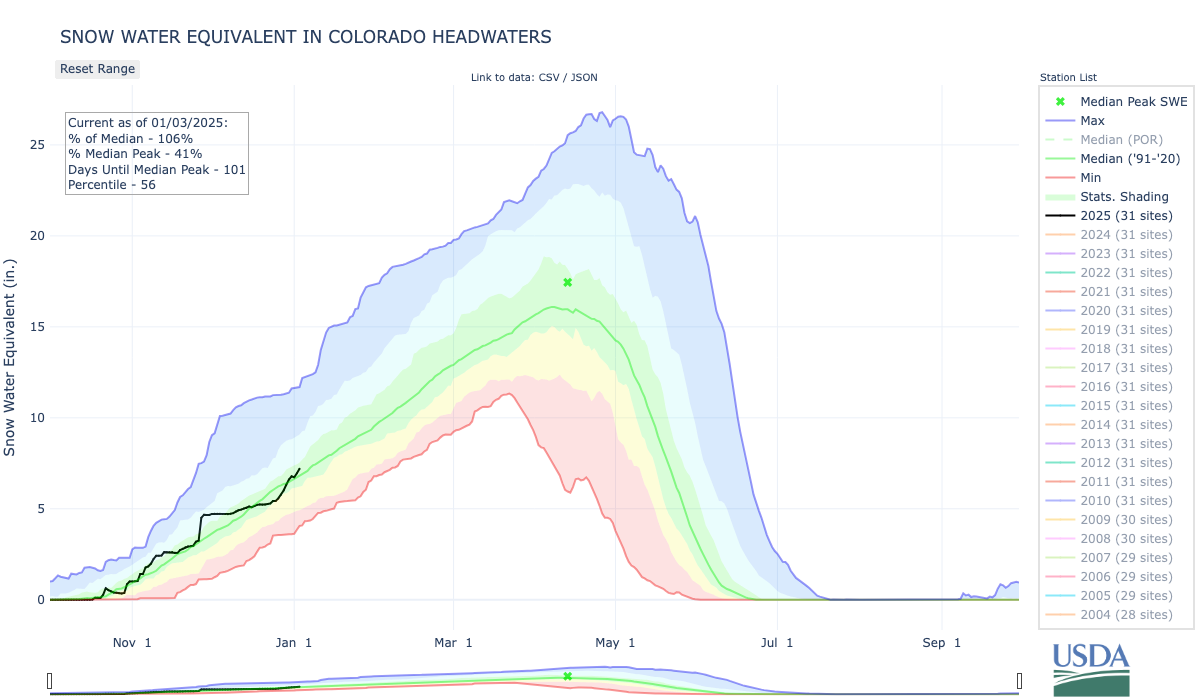
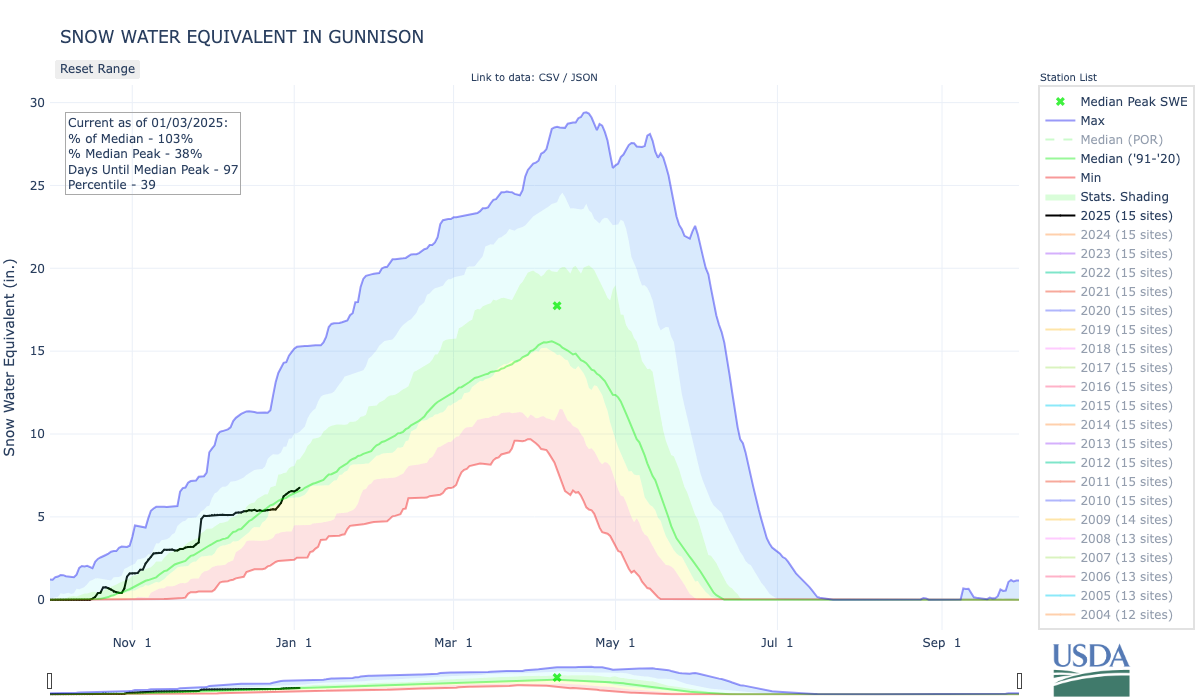
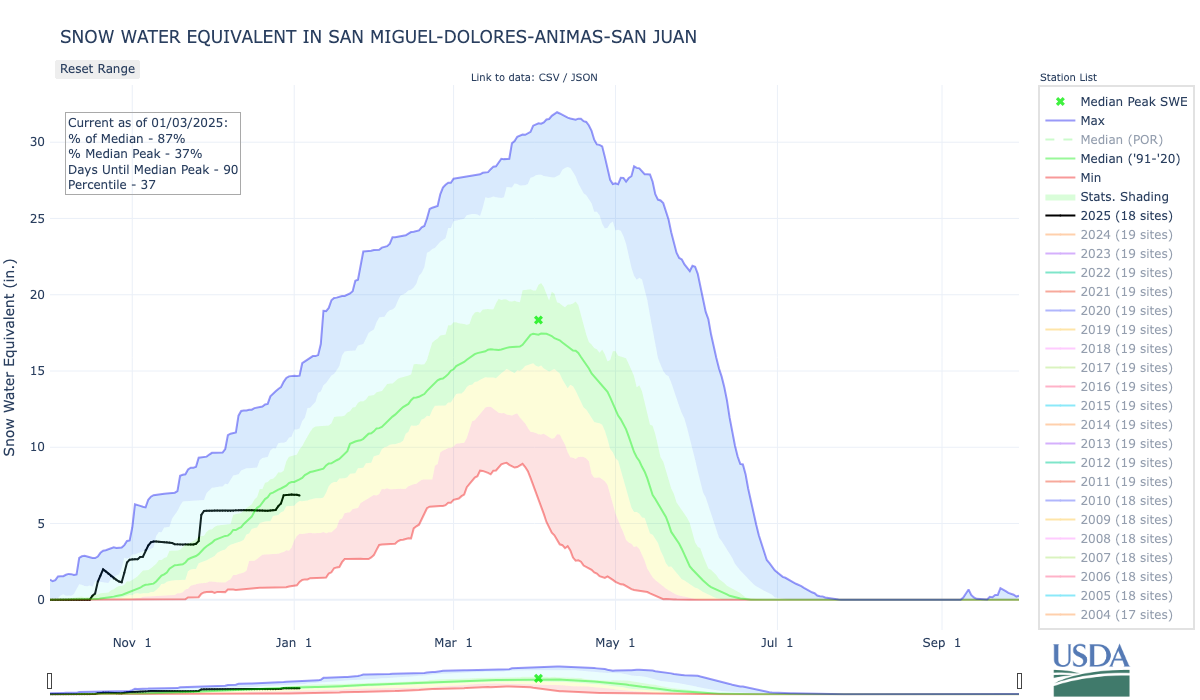
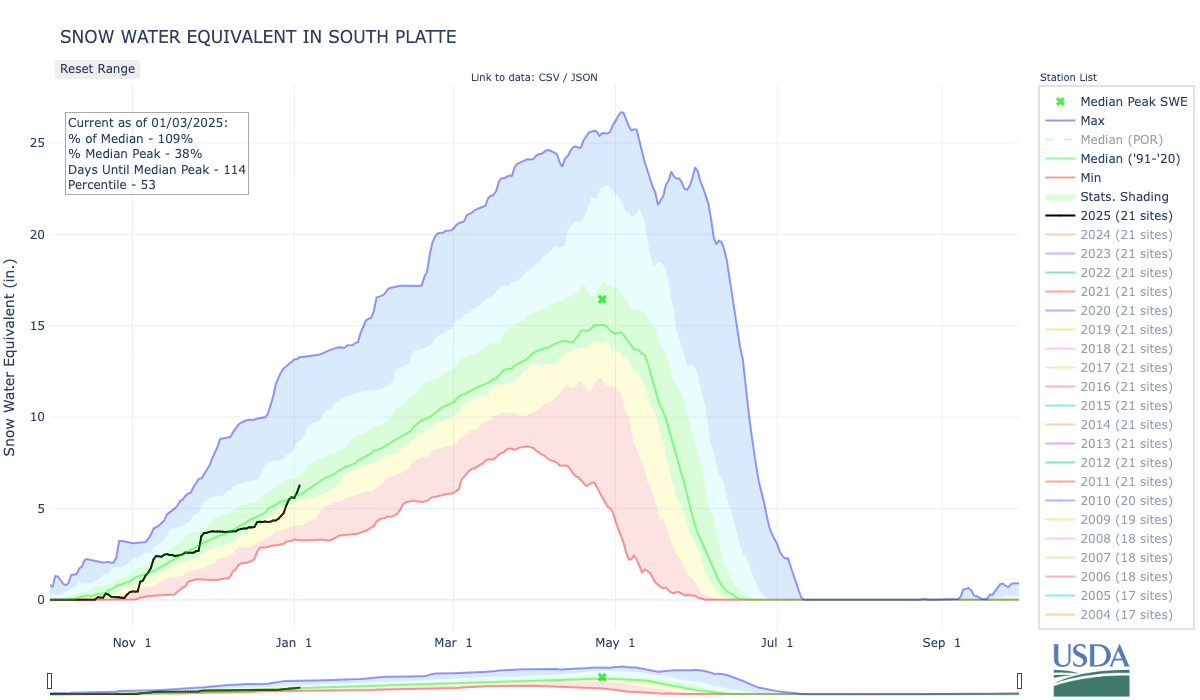
New Year #snowpack update: Bold beginning tapers off: But there’s still a lot of snow season left — Jonathan P. Thompson

October snows above Ouray, Colorado. The Red Mountain Pass SNOTEL showed the snowpack to be 103% of normal as of Jan. 2, 2025. Jonathan P. Thompson photo.

Click the link to read the article on the Land Desk website (Jonatan P. Thompson):

January 3, 2025

🥵 Aridification Watch 🐫

Happy New Year! The Land Desk had a very mellow and relaxing couple of weeks off, and I must admit that I’m struggling to get back into the old routine. And I sure as heck haven’t gotten used to writing “2025” yet. Oy.

But no matter what the calendar may say, we’re one-fourth of the way through the 2025 water year, and one-third of the way through meteorological winter. That means it’s time for a little snowpack update.

Snowpack levels in the watersheds that feed Lake Powell are just about normal for this time of year, thanks to some late-December storms across the region. But as you can see from 2023 (the purple line), there’s plenty of time left for it to be a huge snow year — or a downright crappy one if the precipitation suddenly stops. Source: NRCS.

This snow season got off to a rip-roaring start in much of the West, with some substantial high-country snowfall back in October and November. Then, as is often the case, someone turned off the big sky spigot, the clouds cleared, temperatures warmed, and the early season bounty became mid-winter middling to meager. Meanwhile, the high-mountain snow, while not necessarily melting, began “rotting.” That is, it embarked on the metamorphosis from strong, well-bonded snow, to weak, faceted, depth hoar1.

That’s a problem, because when another layer of snow falls on top of it, the weak layer is prone to failure, resulting in an avalanche. Sadly, avalanches have taken the lives of four people so far this season, all during the last couple of weeks in December. Two of the fatalities occurred in Utah and one in Nevada, all following a late December storm atop a deep, weak layer. The other one was in Idaho on Dec. 15. Two of the victims were on motorized snowbikes, one was a solo split-boarder, and another was on foot or snowshoes. Last season there were 16 avalanche-related fatalities across the West, all occurring after the first of the year.

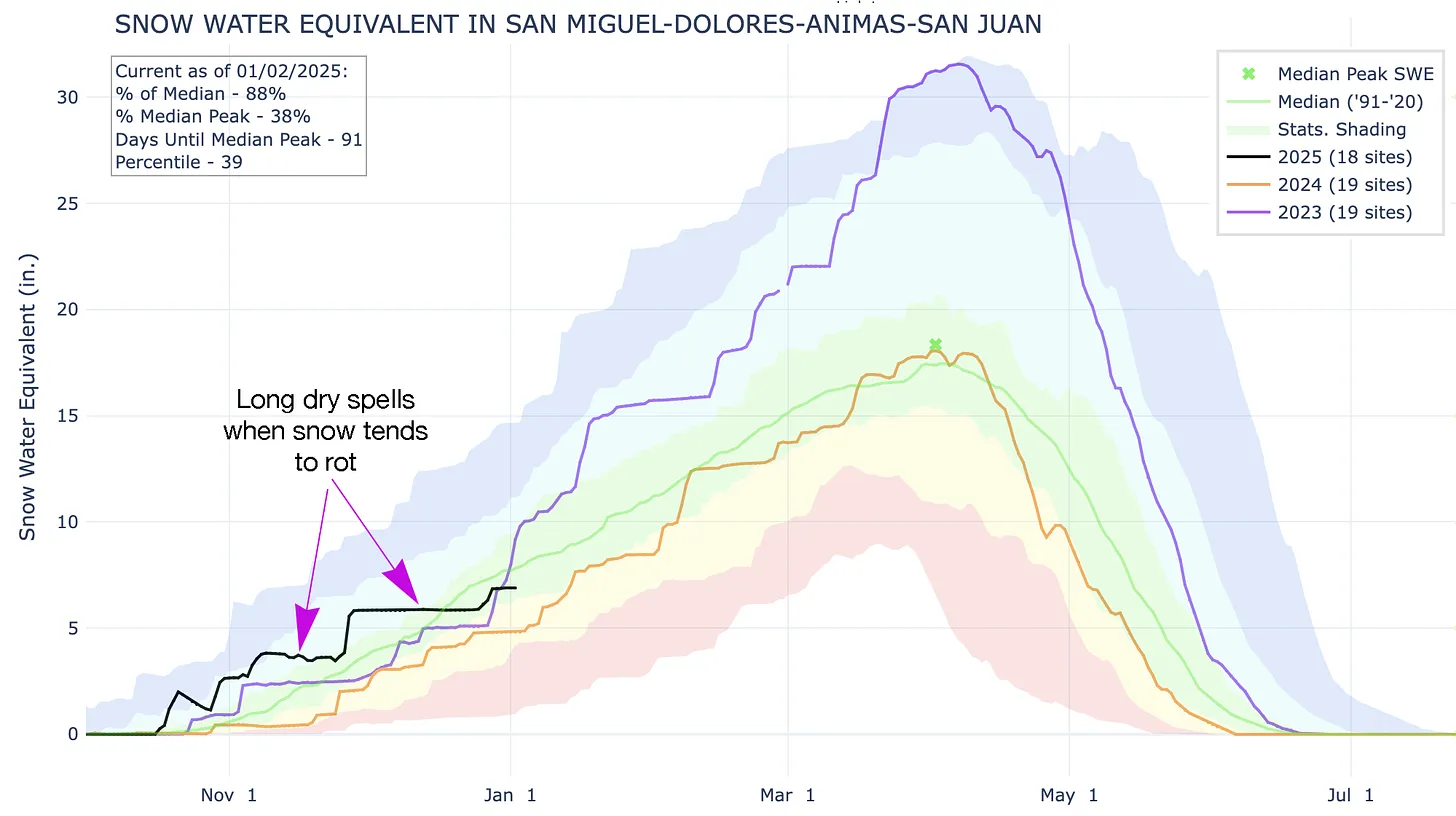
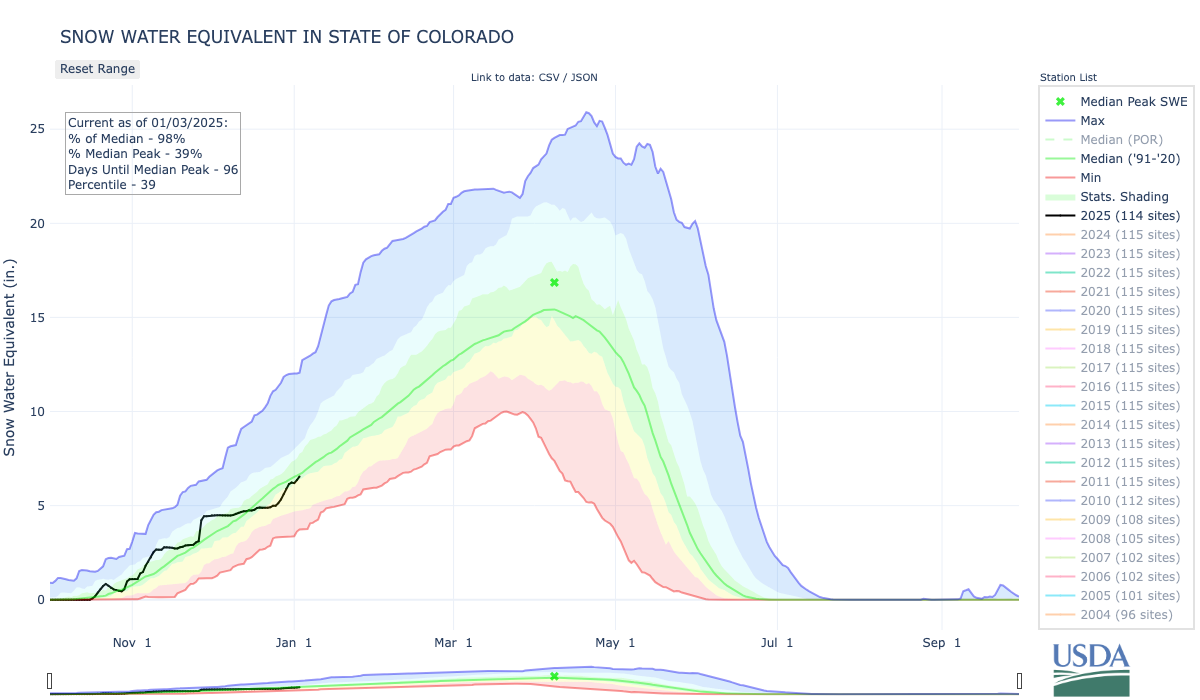
Southwestern Colorado got some good dumps in October and November, pushing the snowpack far above average and into the 90th percentile. But a dry December brought snowpack levels down below “normal” for the 1991-2020 period. Still, this year’s levels almost mirror 2023’s, when snow season didn’t get going until January. Source: NRCS.

Meanwhile, further south, the Sonoran Avalanche Center hasn’t had much action this season, at least not of the snowy kind. Most of the Southwest has been plagued by a dearth of snowfall — and precipitation in general — following a couple good storms in October and November. Temperatures have also been well above average in the southern lowlands. Phoenix set four daily high-temperature records in December, and the average for the month was a whopping seven degrees above normal; Flagstaff was also far warmer than normal and received nary a drop of rain or snow during all of December. And Las Vegas hasn’t received measurable rainfall since it got a bit damp (.08 inches) in mid-July.

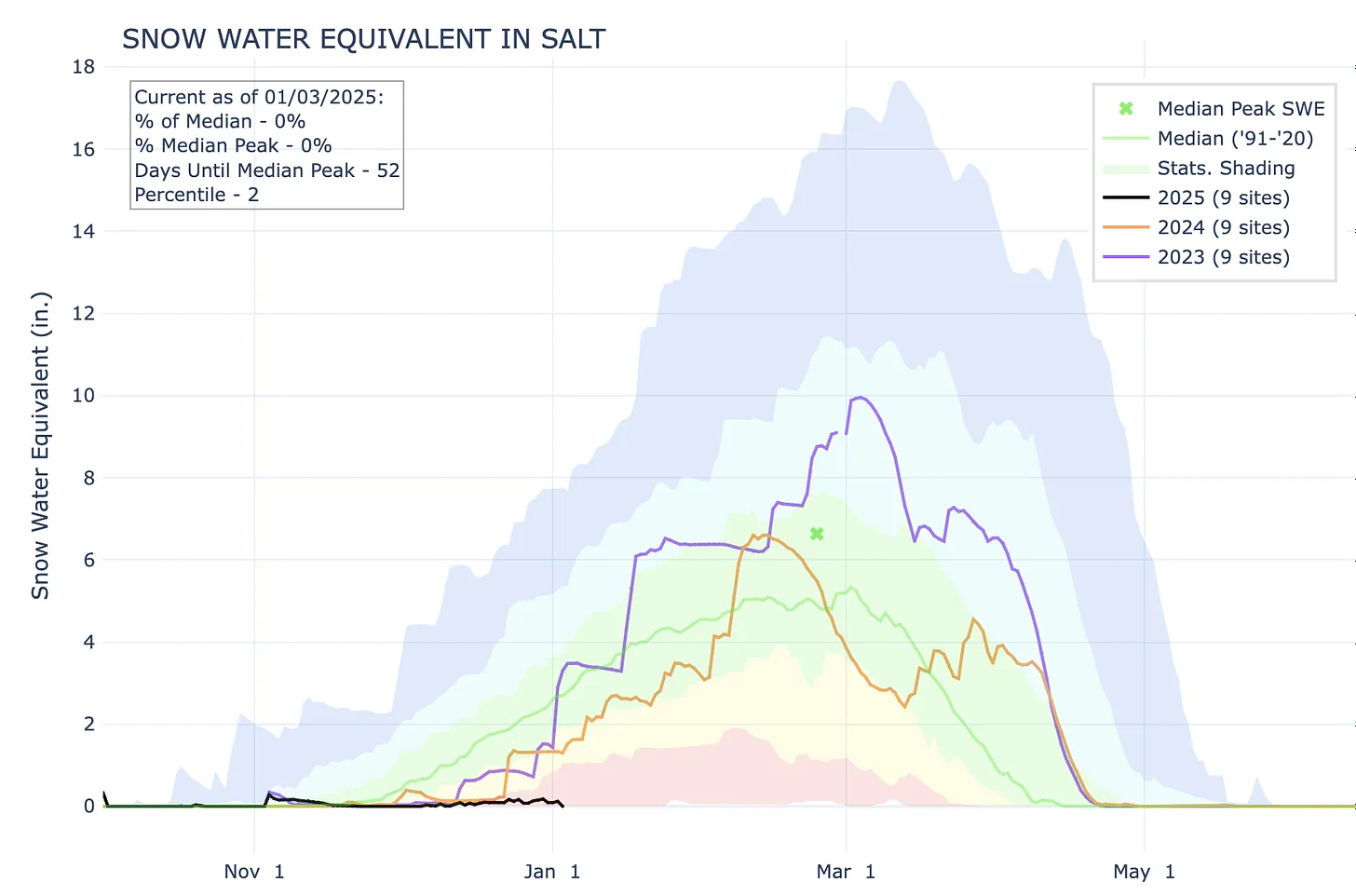
The Salt River watershed in central Arizona has received hardly any snow so far this year and continues to lag far behind the 2023 and 2024 water years. The lack of moisture and unusually high temperatures in December don’t bode well for the region’s runoff. Source: NRCS.
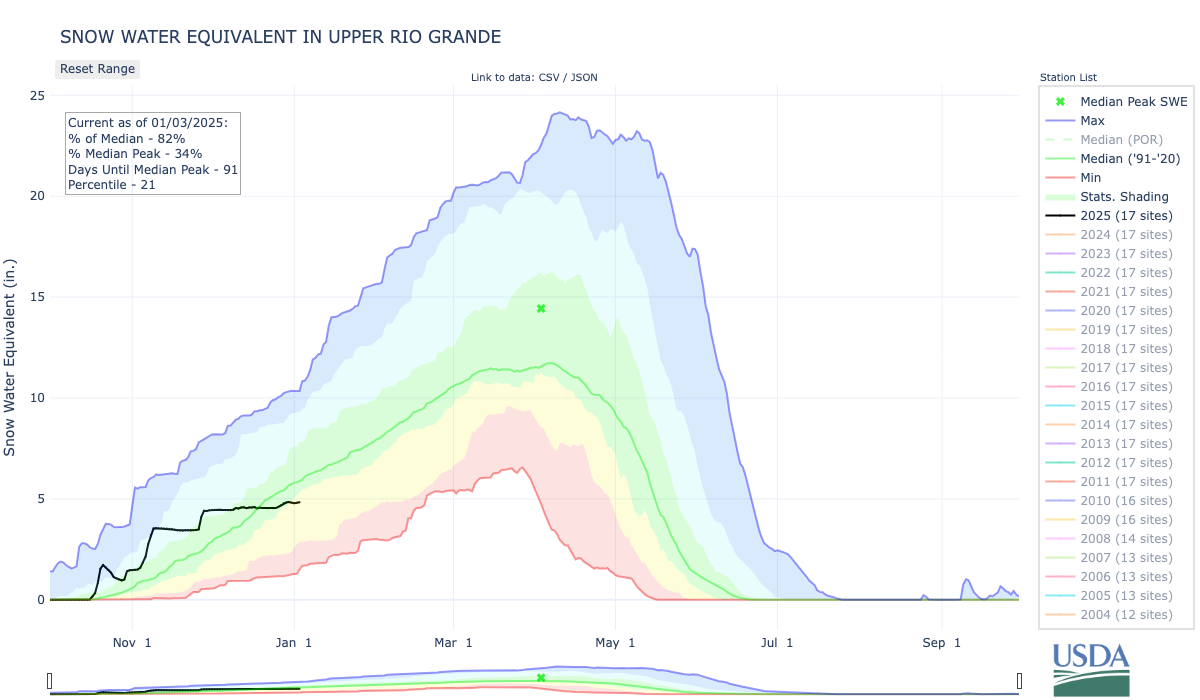
The Rio Grande’s headwaters also started out strong, but have dropped below normal.
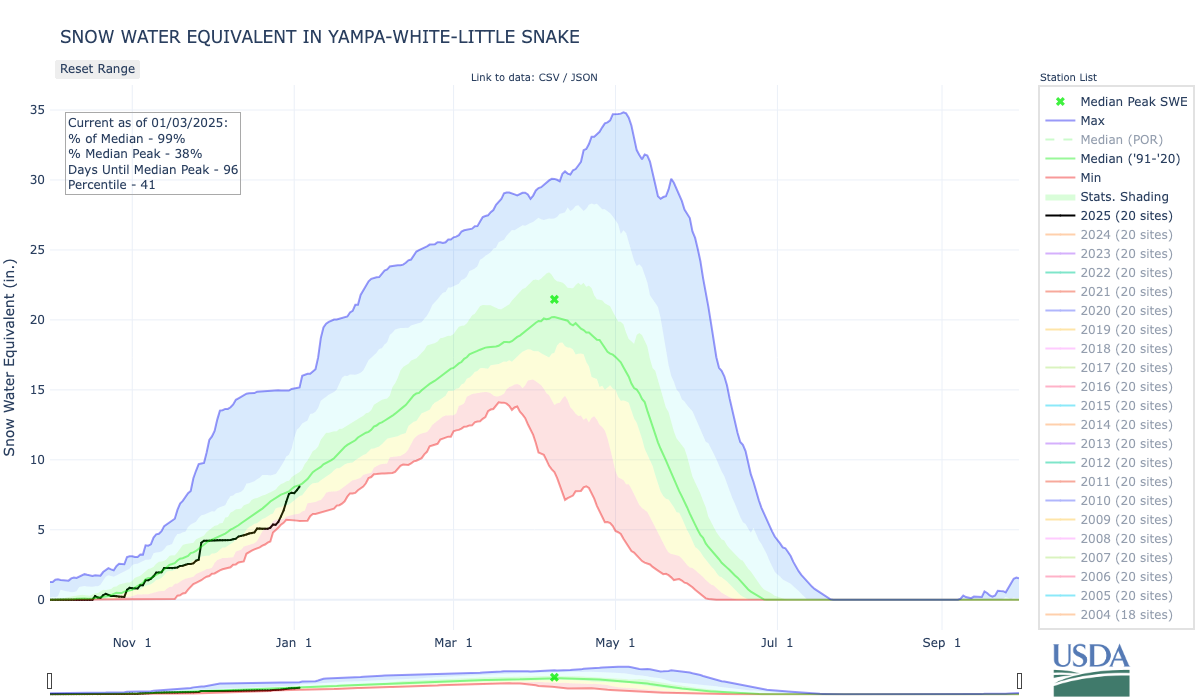
Things were looking pretty grim in western Wyoming’s Upper Green River watershed until December snows pushed the snowpack almost up to normal for this time of year. The entire state was quite dry last year and it’s looking like the drought will persist there.

This does not bode well for spring streamflows, particularly in the Salt and Gila Rivers. The mountains feeding the Rio Grande also are in need of some good storms to keep that river from going dry this summer.

We can take comfort in the fact that in many places in the West, snow-season doesn’t really arrive until February or March. So this could turn out to be a whopper of a winter yet.

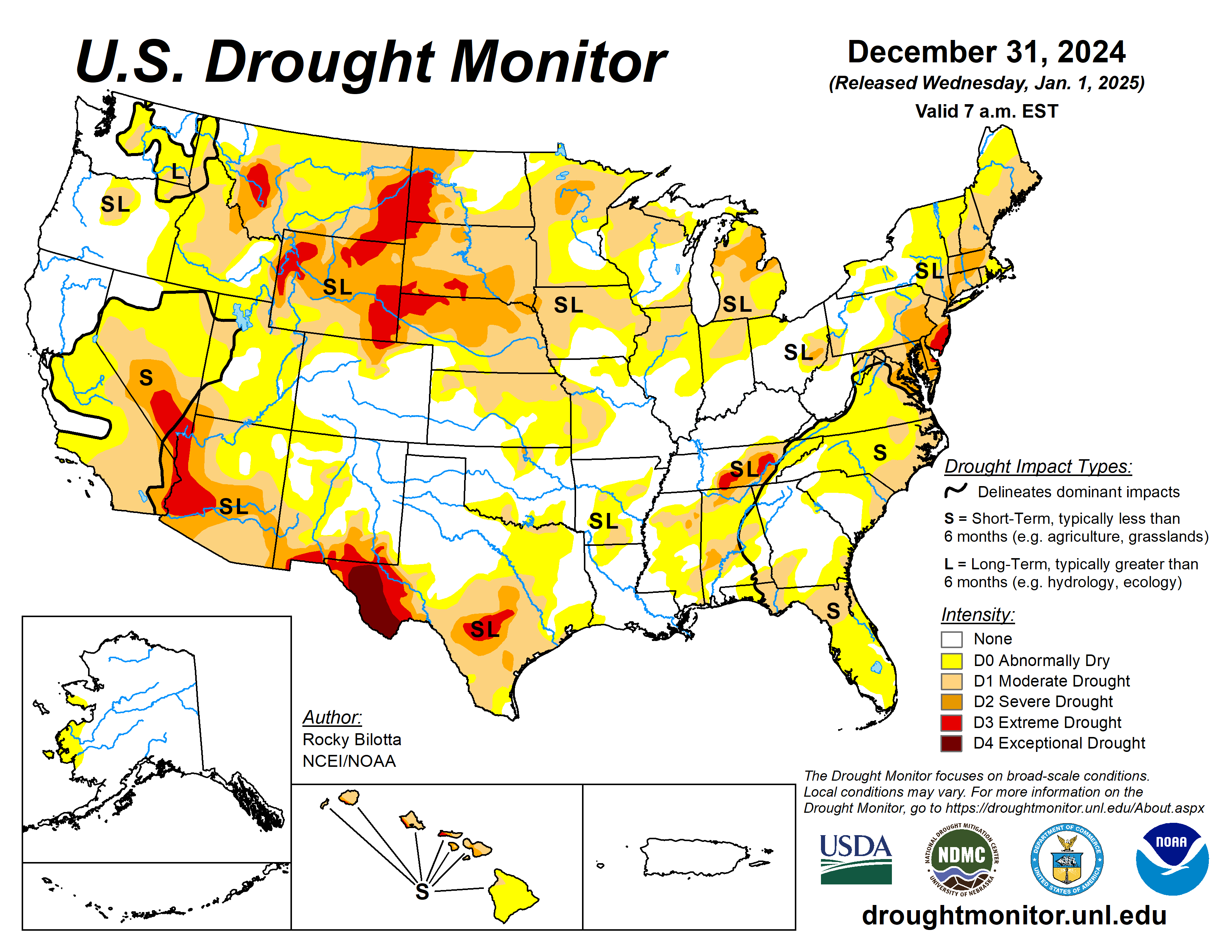
The drought situation a year ago (left) and now (right). While drought has subsided in New Mexico and the Four Corners area, it has intensified dramatically in Wyoming, Montana, parts of Idaho and a swath that follows the lower Colorado River and includes Las Vegas, which has only received .08” of precipitation since April of last year. Source: U.S. Drought Monitor.
For now it looks like there’s no relief in sight for the Southwest or the Northern Rockies.

🌵 Public Lands 🌲

Biden’s getting busy as he prepares to vacate the White House. The Los Angeles Times reports that he plans to designate the Chuckwalla National Monument on 644,000 acres of federal land in southern California, and the Sáttítla National Monument on 200,000 acres in the northern part of the state near the Oregon border. That’s what I’m talkin’ about, Joe! Now do the lower Dolores!

🦫 Wildlife Watch 🦅

The soon-to-be Chuckwalla National Monument lies south of and adjacent to Joshua Tree National Park, an area often targeted by utility-scale solar developers. That’s the sort of development that will now be banned there. Not only will cultural sites be protected, but also wildlife. A new study found that some of the Southwest’s best sites for solar overlap critical habitat for vulnerable species, including in most of southern California.

***

The U.S. Fish and Wildlife Service is seeking any information on the killing of a gray wolf in Grand County, Colorado, in summer of 2024. The wolf, 2309-OR, was part of the Copper Creek pack that was captured by wildlife officials in August, after members of the pack had made a meal out of local ranchers’ livestock. 2309-OR was in bad condition and perished in captivity; a subsequent investigation found that he died of a gunshot wound. It’s illegal to kill wolves in Colorado, not to mention immoral and just a horrible thing to do. The Center for Biological Diversity and other conservation organizations are offering a $65,000 reward for information leading to the arrest and conviction of the shooter.


📸 Parting Shot 🎞️

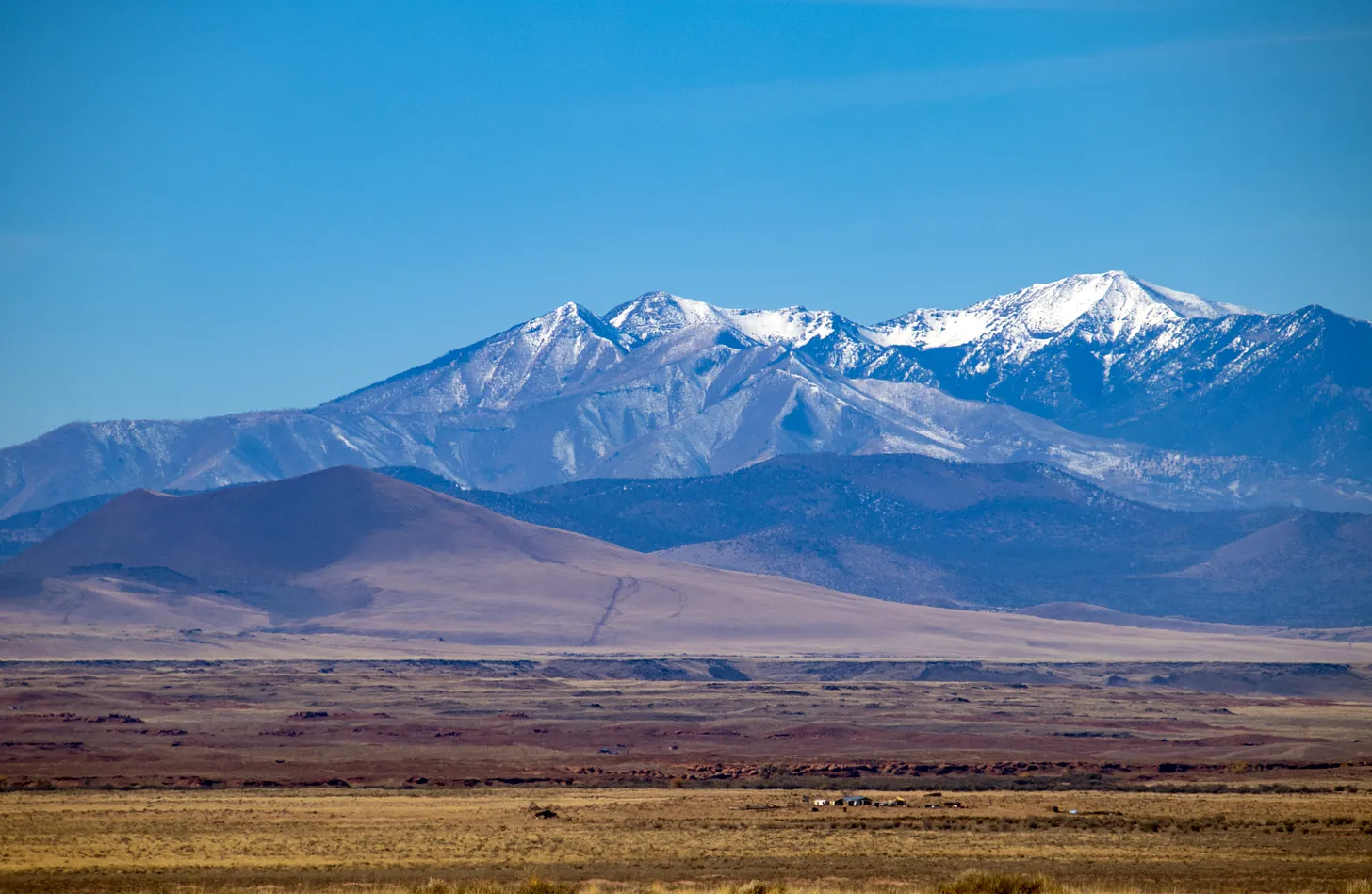
San Francisco Peaks near Flagstaff, Arizona, in mid-November. They had a bit of snow from earlier storms, but haven’t received much since. The Snowslide Canyon SNOTEL site at 9,744 feet in elevation is recording 65% of normal snow water equivalent. Jonathan P. Thompson photo.

1 Andy Gleason, snow nerd extraordinaire, explained it like this after record-high avalanche fatalities during the relatively scant 2021 snow year :

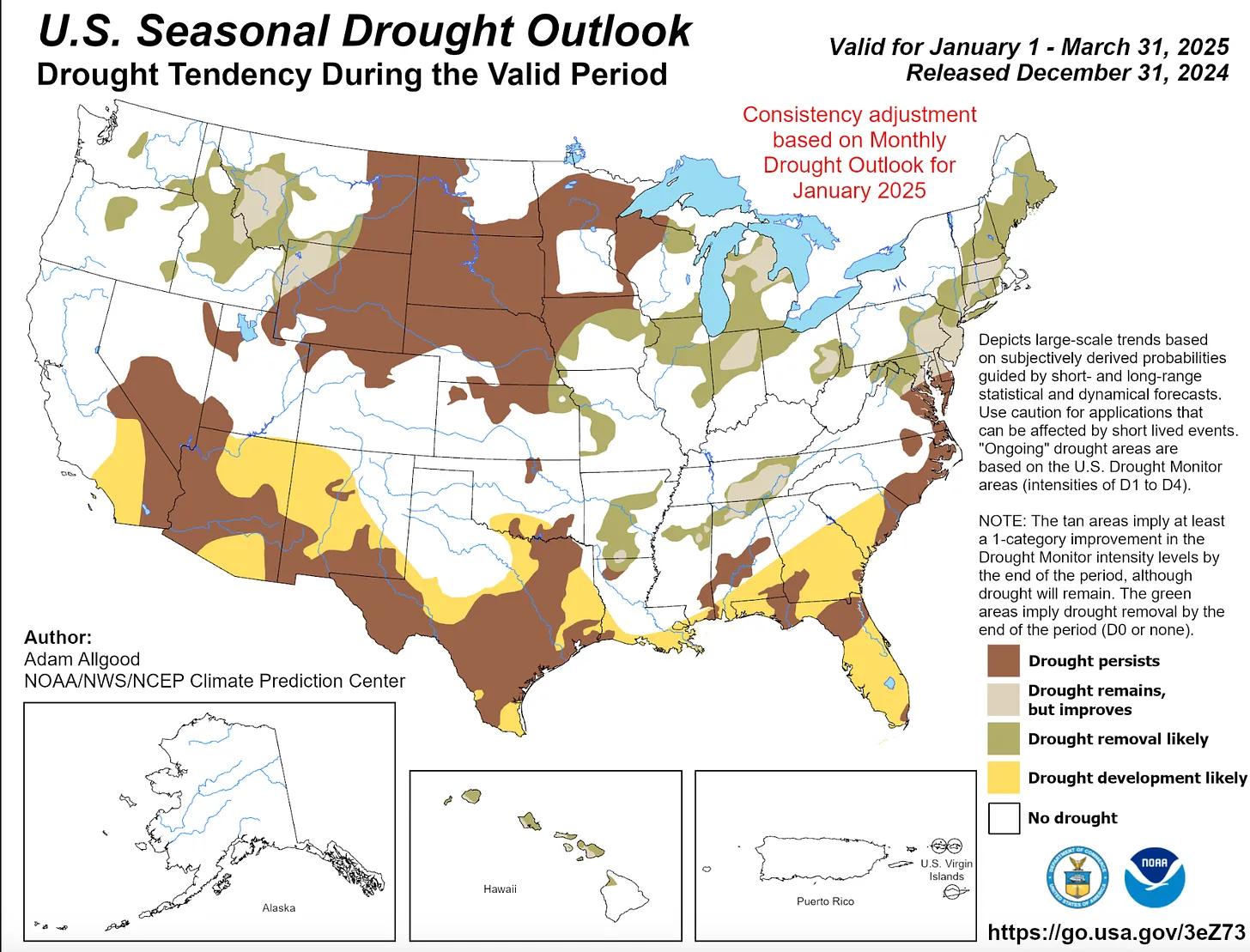
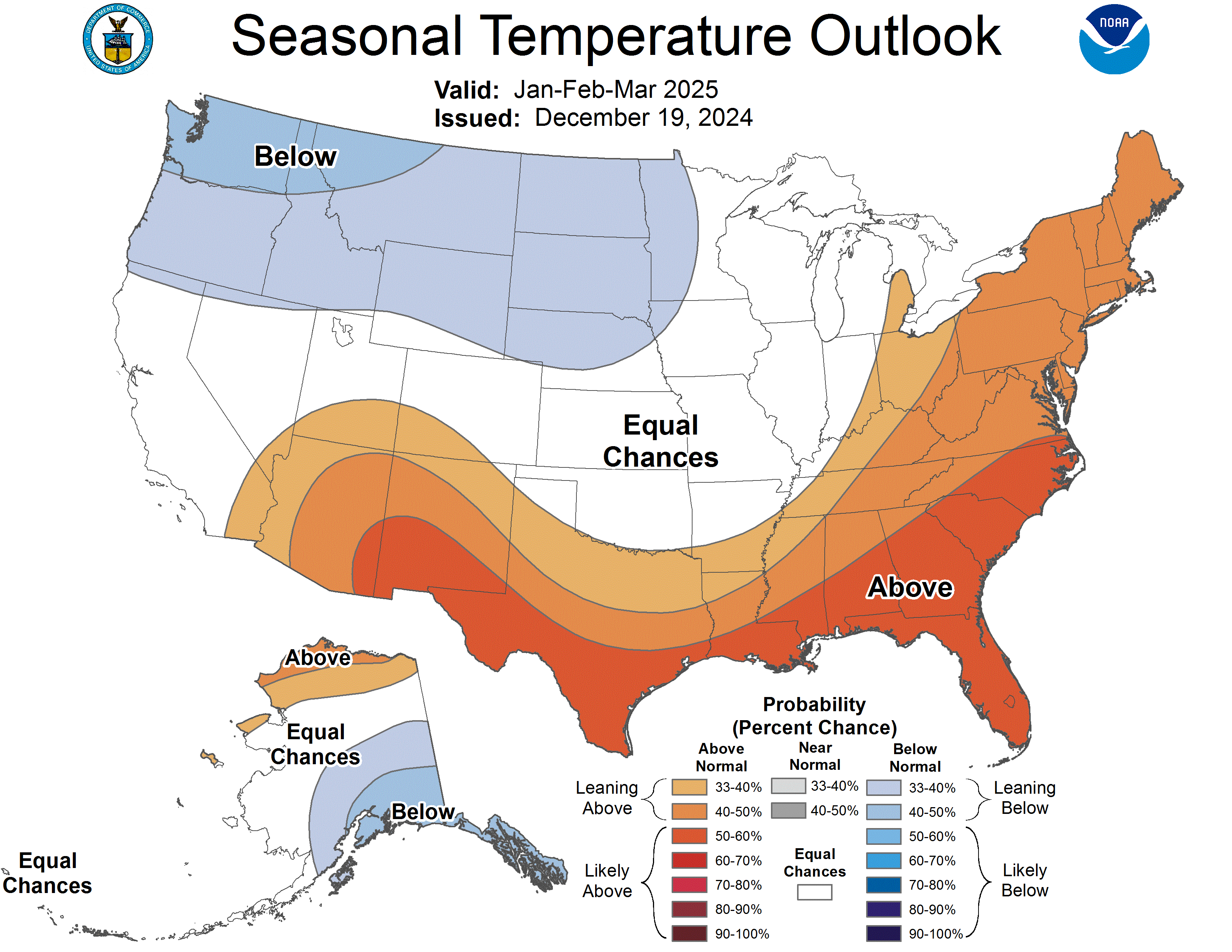
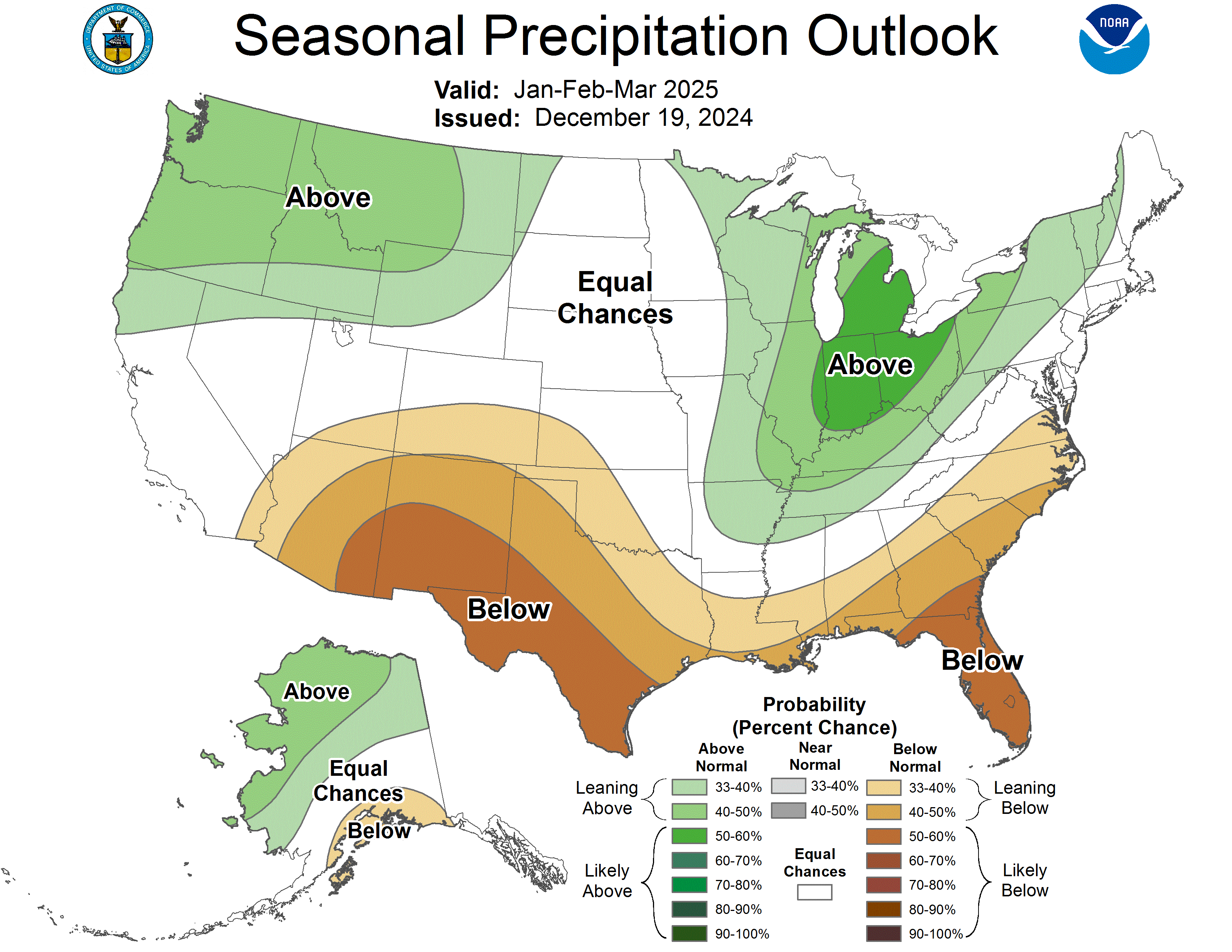
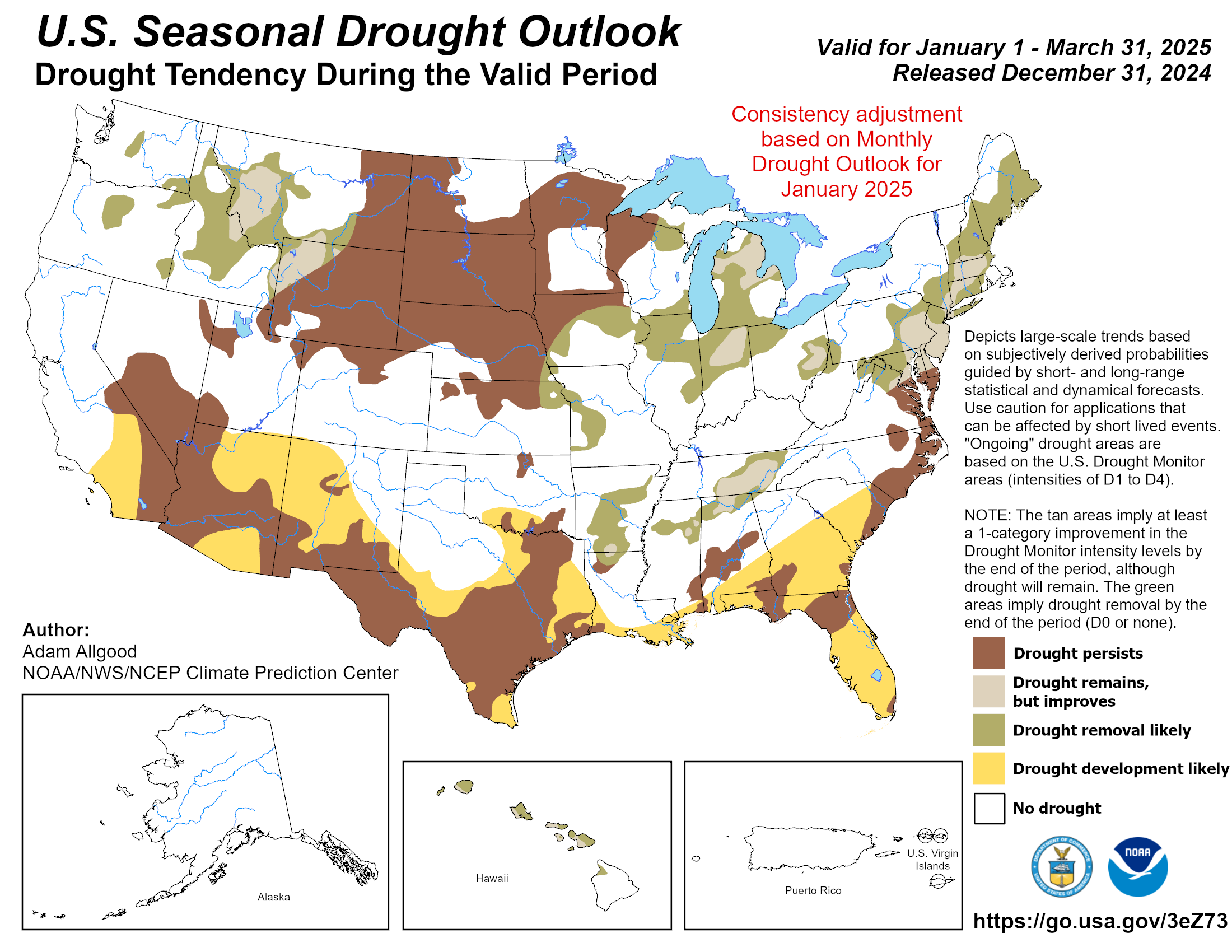
The latest seasonal outlooks through March 31, 2025 are hot off the presses from the #Climate Prediction Center

Jimmy Carter’s overlooked #Colorado nexus: The late president had nuclear training but an interest in renewable energy with impact in Colorado lingering to this day — Allen Best (@BigPivots)

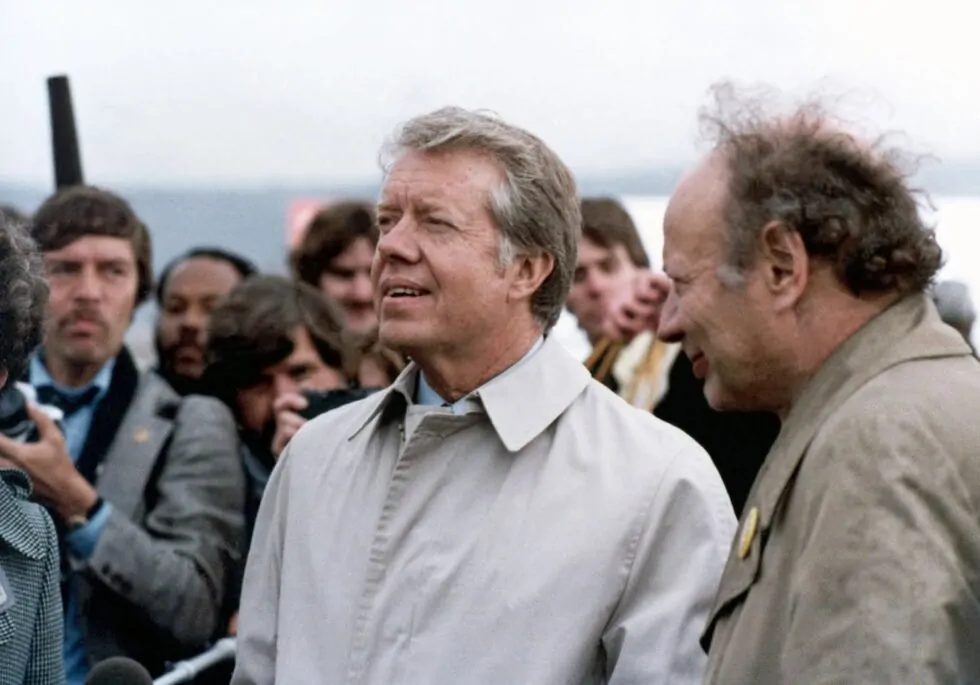
Jimmy Carter at NREL in 1978.

Click the link to read the article on the Big Pivots website (Allen Best):

January 2, 2024

Jimmy Carter had an underappreciated role in Colorado’s story. It started in May 1978 when he announced that the Solar Energy Research Institute in Golden would get $100 million in federal funding.

“Nobody can embargo sunlight,” Carter said. “No cartel controls the sun. Its energy will not run out. It will not pollute the air; it will not poison our waters. It’s free from stench and smog. The sun’s power needs only to be collected, stored and used.”
It was a rare umbrella day in Golden. Carter’s timing for his proclaimed “Sun Day” was off.  But he was on the mark about solar energy in ways that we have yet to fully appreciate.

Carter had advanced schooling in nuclear energy, but by 1975 he was thinking about renewables. He invited Ron Larson, an electrical engineering professor from Georgia Tech, to share lunch and talk about renewable energy.

“At that time there wasn’t much to photovoltaics,” says Larson. “It was over $100 a watt. Now it’s less than $1 a watt.”

Larson moved to Colorado in 1977 to work as SERI’s first principal scientist and stayed in multiple roles in helping pivot our energy use. Since then, thousands have followed.

One component of SERI’s mission to advance use of solar energy was outreach to 300 builders and architects in Colorado to help them learn how to construct houses with lessened need for fossil fuels.

John Avenson, an engineer with AT&T/Bell Labs, was among the beneficiaries. The house in Westminster that he built in 1981 faces south and has large windows coupled with effective shades.

On Facebook the day after Carter’s death, Avenson rued the widespread failure to acknowledge Carter’s early thinking. “Every house built since then should have been this good or better but the program was cancelled by (President Ronald) Reagan,” he wrote.

Avenson’s house near Standley Lake Reservoir was built with a natural gas furnace. He rarely used it, his gas bills never surpassing $180 for a full year. After tweaking and new technology, he was finally satisfied the house would do fine at 20 below without the furnace. In 2016 he had Xcel Energy stub the gas line.

When I visited him on New Year’s Eve, he was wearing a T-shirt and shorts. “I’m an Arizona kind of person,” he said. He keeps the house at 72 to 78 degrees. It will be featured on a Jan. 25 broadcast on PBS.

I asked Avenson about Carter’s death. “Oh, so sad,” he replied. “He influenced my life and didn’t know it.”

Steve Andrews was also influenced by Carter. A veteran of the Vietnam War, he had used the GI Bill of Rights to take college classes in basic engineering. That led to an internship and then a job at SERI. He wrote the guidebook for the 1981 Denver Homebuilders annual Parade of Homes featuring a dozen passive-solar homes across the Denver metro area.

Then, Andrews got laid off. As president, Reagan had no real use for renewable energy. He famously removed the 32 solar panels that Carter had placed atop the White House. He also halved SERI’s budget. Andrews, a recent hire, was among the first to go. The mission of SERI was also narrowed, pushing outreach to the back burner. The director, Denis Hayes, was fired after accusing his bosses at the U.S. Department of Energy of being “dull gray men in dull gray suits thinking dull gray thoughts.”

Later, under a former oilman, President George H.W. Bush, SERI was resurrected as the National Renewable Energy Laboratory. NREL has now expanded to a staff of 3,675 employees and broadened its influence.

Can it be mere coincidence that Colorado, in 2004, had the nation’s first voter-initiated renewable energy portfolio standard? Or that Colorado in recent years has adopted a dozen or more first-in-nation policies and regulations designed to curb greenhouse emissions? We might be guilty of parochial pride, but there can be no doubt that Colorado belongs in any national conversation about the pivot to a new energy economy, to use the title of former Gov. Bill Ritter’s center that is affiliated with Colorado State University.

Ironically, passive-house building has gotten little traction. The economics are unassailable, and the technology just isn’t that difficult. It does take basic site-planning. Andrews, in his post-SERI career, once calculated that 85% of houses in metro Denver face east or west. That results in unwanted summer heat, but little in winter, when it is wanted. Housing should face north and south.

Colorado has decades of work ahead in decarbonizing its buildings. We need to remember what Jimmy Carter understood nearly 50 years ago.

Also worth reading: “Jimmy Carter, Green Energy Visionary,” by Bill McKibben in The New Yorker.

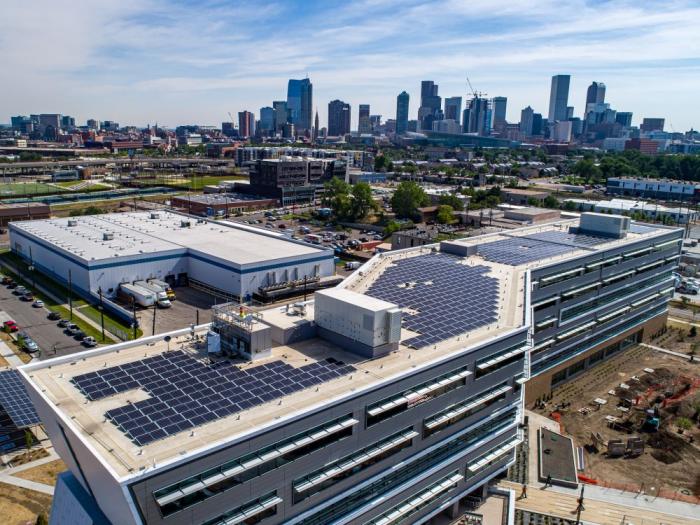
Denver Water’s administration building is powered by solar panels. Photo credit: Denver Water.

#Colorado’s environmental efforts could be in grave peril: 2024 is likely to be hottest year on record. It’s no time for science deniers to be in charge of country’s future — Pete Kolbenschlag (Colorado Newsline) #ActOnClimate

An aerial view of Assignation Ridge in the Thompson Divide area of Colorado. (Courtesy of EcoFlight)

Click the link to read the commentary on the Colorado Newsline website (Pete Kolbenschlag):

December 31, 2024

Some people say that the movement toward renewable energy cannot be stopped by a single regressive administration. But Colorado could be badly harmed if its efforts to transition to clean energy are put on hold. Millions of dollars in investments for rural co-ops, community-based solar, and grid hardening could be in jeopardy, striking a heavy blow to our more resilient future. Worse still, that’s only one piece of what could be coming under a new federal regime.

Colorado’s public lands and water supplies are also in grave peril under the incoming Congress and president. This is despite decades of hard, locally-driven work to secure protections for vital headwaters, hunting lands, forests and habitat, many from a century-long history of extraction. And it’s regardless of rapid warming, persistent drought and an imperiled Colorado River system with no good solutions in sight.

Healthy natural systems guard against ecological collapse. But now various environmental tipping points, that moment in a system where it moves into a new norm and change becomes irreversible, appear at their most precarious moments. During 2024 humans pumped out more climate-choking pollution than ever before. That’s almost 10 years after the acclaimed Paris Agreement, which our president-elect and his cabinet have vowed to abandon.

Global warming presents a clear and present danger to all our livelihoods and well-being. And the United States is already the No. 1 oil and gas producer in the world and a top polluter behind only China. 2024 is likely to be the hottest year ever recorded. Without the sufficient response we careen toward calamity. To meet this moment, the incoming administration and Congress have pledged to pollute more and care less.

That is bad news not only for our lands and water supplies, but for the economic future, too. Our ledgers will already never be free of climate risk. Which is why the debate at the global climate summits is now about who ends up with the bill for loss and damages done and coming. That matters here, too: A recent study correlates rising insurance costs with climate vulnerability and puts much of Colorado in the dark red hazard zone.

In a state where housing is increasingly unaffordable, putting science deniers in charge of our future is just a bad idea. Moving federal agency offices or installing Colorado-based cabinet-members won’t matter if the new administration is just rearranging deck chairs to ensure its patrons have the best seats to watch this escalating disaster.

In fact, fossil fuel “dominance” could make a mess of Colorado, as it does most places it asserts itself. This puts at risk our lands and communities with oil trains, backdoor schemes to subsidize legacy polluters, policies that favor extraction over conservation, and more pipelines for more fracked gas exports. The alternative to slamming head on into a worst future is to stop the harm now and to make systems more resilient to coming disruptions. That means less fossil energy and more conservation of natural places. [ed. emphasis mine]

Milkweed, sweet peas, and a plethora of other flora billow from Farmer’s Ditch in the North Fork Valley of western Colorado. Jonathan P. Thompson photo.

Standing up for Colorado’s liveable future means fighting the expansion of fossil fuel infrastructure and defending places Coloradans have fought for decades to protect – such as Thompson Divide, the Dolores River canyons, or the forests and public lands surrounding critical watersheds and farmlands in places like the North Fork Valley.

That will best limit the extent of further harm and will better secure our natural capital as a hedge against future disruption. By investing in ecological systems through resilient watersheds and healthy lands we guard against uncertainty. By defending these cherished places, we will keep intact critical sources of sustenance and enjoyment for the future and return dividends to those who live, work, and visit here today.

The Dolores River, below Slickrock, and above Bedrock. The Dolores River Canyon is included in a proposed National Conservation Area. Photo: Brent Gardner-Smith/Aspen Journalism.

#Colorado #snowpack levels could be on track for revival with continued wave of winter storms — The #GlenwoodSprings Post Independent

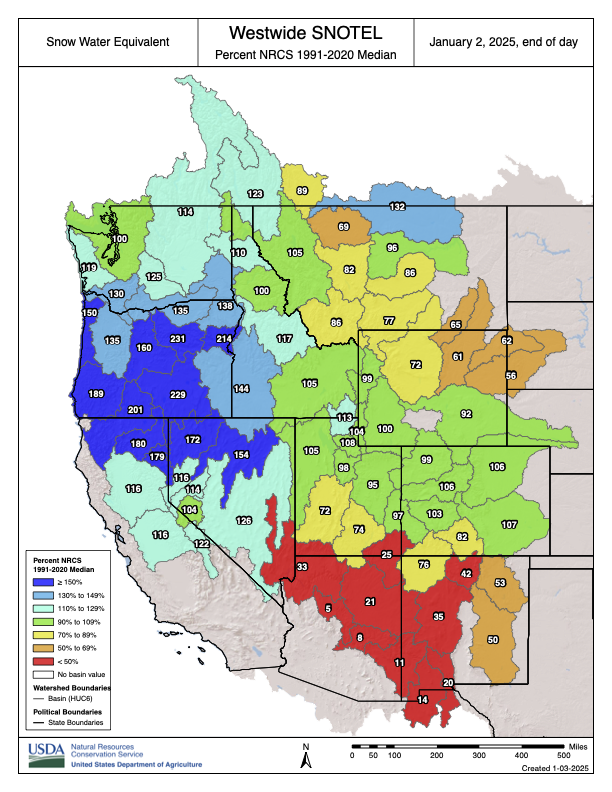
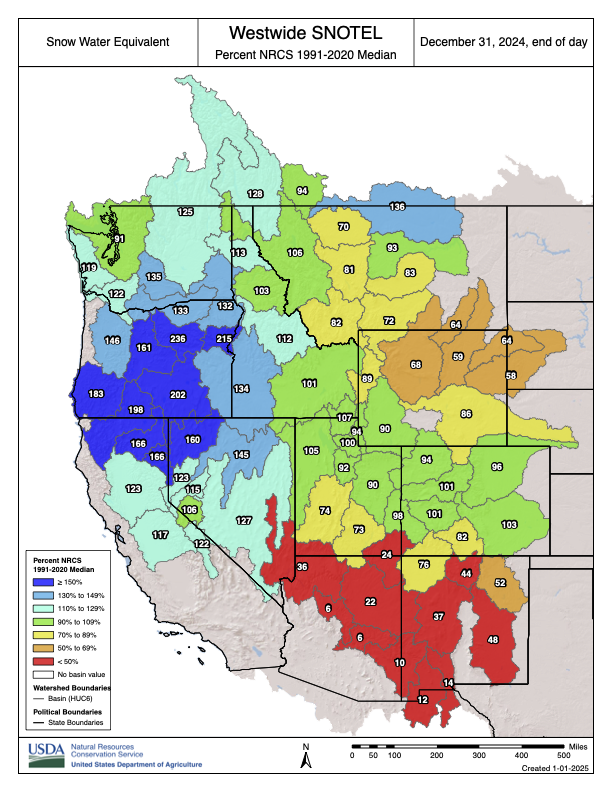
Westwide SNOTEL basin-filled map January 2, 2024 via the NRCS.

Click the link to read the article on the Glenwood Springs Post Independent website (Robert Tann).Here’s an excerpt:

December 27, 2024

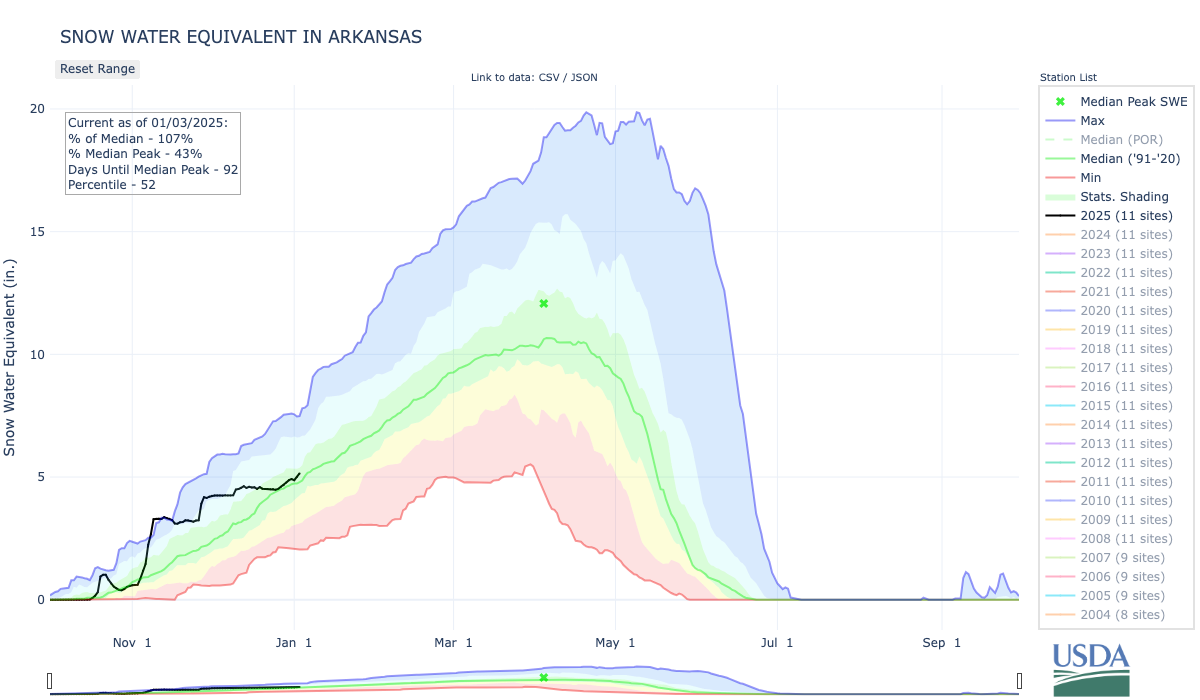
Deflated snowpack levels are beginning to rise again in Colorado after nearly a month of stagnation…A cycle of heavy snow storms in November sent snowpack levels surging well above normal, particularly in the state’s southern regions. But as conditions dried after Thanksgiving, levels flatlined…As of mid-December, statewide snowpack levels have tracked below the 30-year median and even began to approach historical lows for this time of year. But a smattering of storms in the High Country since Christmas have begun to reverse the trend…As of Friday [December 27, 2024], statewide snowpack stood at 87% of the 30-year median, according to data from the Natural Resources Conservation Service. The Arkansas River Basin, which encompasses south-central Colorado, is the only basin in the state with snowpack currently above 100%

#Utah wants to shore up its #Colorado River share with a water ‘savings account’ — KUER #COriver #aridification

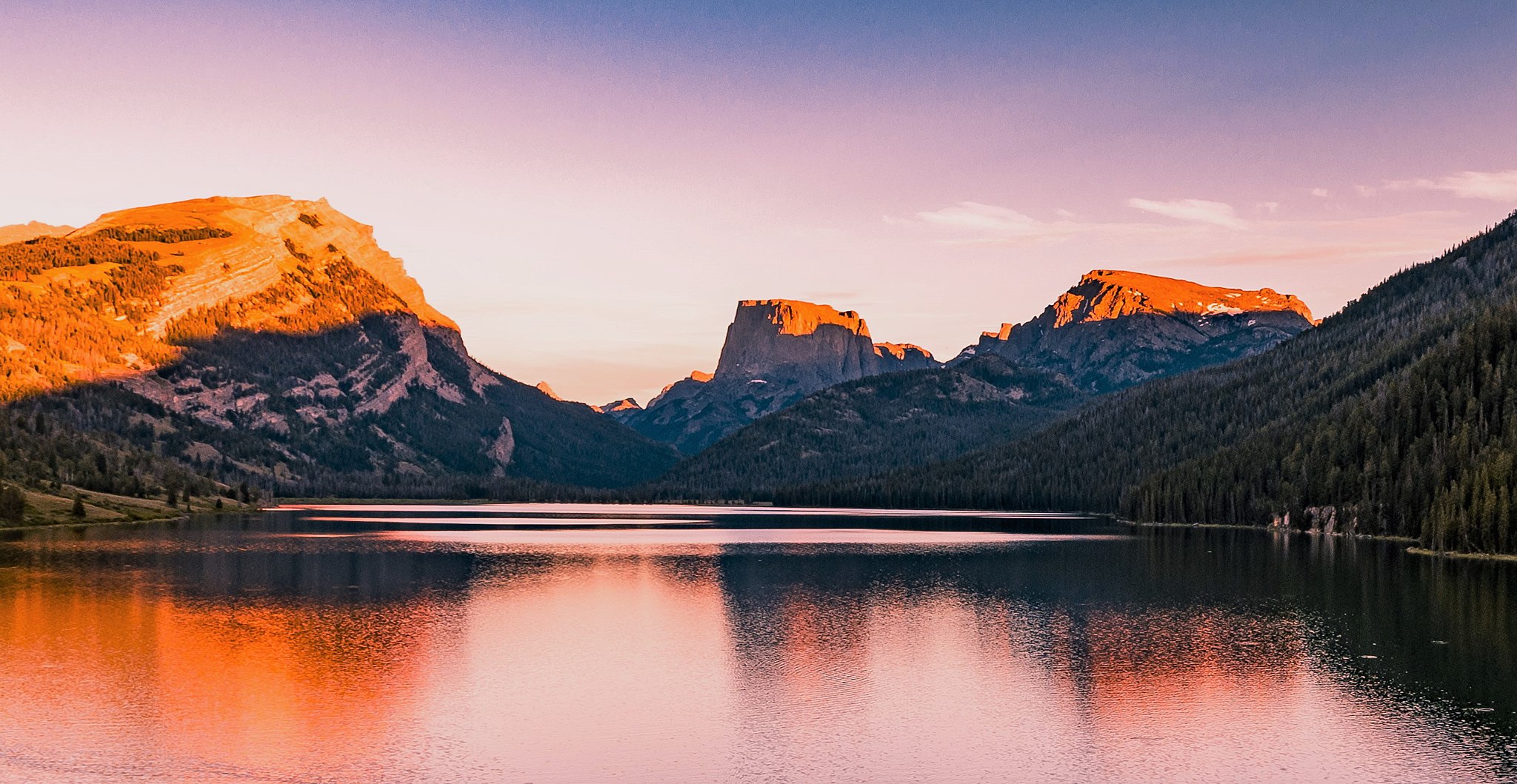
Green River Lakes and the Bridger Wilderness. Forest Service, USDA, Public domain, via Wikimedia Commons

Click the link to read the article on the KUER website (David Condos). Here’s an excerpt:

December 18, 2024

Across Utah, farmers are experimenting with ways to tighten their water use as agriculture, drought and population growth collide to put pressure on the state’s limited water resources. Some are installing more efficient irrigation technology. Others are testing unconventional crops. In Hunt’s case, he’s taking some of his farmland out of commission entirely — for a time and for a price…For the past two years, [Coby] Hunt has taken part in a federal program that pays farmers to temporarily leave their fields empty and lease the conserved water to the government. It’s something that has been going on for years across the Colorado River Basin. Now, Utah is launching its version of that effort. The new multimillion-dollar plan incentivizes conservation and aims to do a better job of tracking that saved water in hopes of getting credit for it in future Colorado River dealings. The practice of leaving a field idle for a season is called fallowing, and Hunt conceded it’s not for everyone.

“Some of the farmers don’t like it. In fact, they don’t like me for leasing my water.”

[…]

Many don’t want the feds involved in their business, he said, or worry the government might take their water permanently if they show they can get by without it. For farmers who grow other crops, like Green River’s famed melons, he said it might not make financial sense to sit out a year and lose your customer base…Hunt usually grows feed for the cattle he raises, so he’s still had plenty to do while this 30-acre field sits empty. Fallowing has just meant he needs to buy hay from elsewhere. He feels good about the amount of water it saves, too. His water right would typically allow him to use six acre-feet of water a year, he said — enough to cover Hunt and the acre he’s standing on over his head. Because his fields are some of the last ones upstream from Lake Powell, it’s easy to imagine the water he conserves making it to the reservoir. That’s why farmers like Hunt are vital to Utah’s new effort to conserve more Colorado River water, called the Demand Management Pilot Program. What’s novel about it is how it will track and document the water savings.

Green River Basin

Critical water quality permits designed to protect streams remain backlogged, but numbers are improving — Jerd Smith (Fresh Water News)

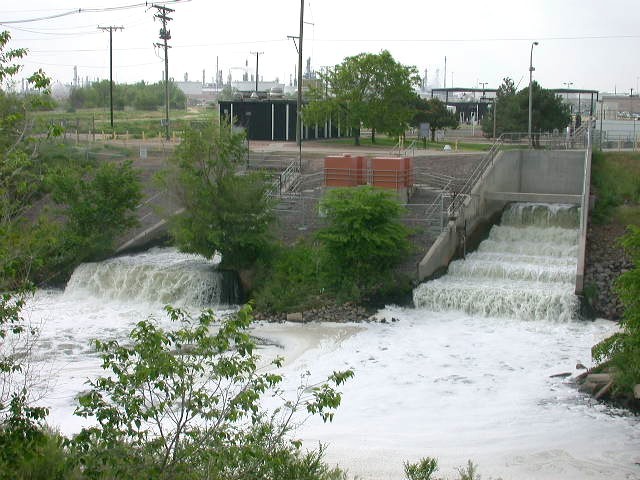
Metropolitan Wastewater Reclamation District Hite plant outfall via South Platte Coalition for Urban River Evaluation

Click the link to read the article on the Water Education Colorado website (Jerd Smith):

January 2, 2024

Colorado health officials say a massive permit backlog that has left hundreds of water systems in administrative limbo has shrunk in the past year, though more work remains.

Last year, 75% of wastewater discharge permits had expired. This year that figure has dropped to 50%, according to the Colorado Department of Public Health and Environment (CDPHE), with 1,384 permits classified as expired. The permits regulate and set standards for removing pollutants from wastewater before it is discharged to streams.

The state’s Water Quality Control Division has wrestled with the problem for several years. In the past two years the state has provided several million dollars to help eliminate the backlog. Major dischargers, such as the City of Aurora and Metro Water Recovery, are among those that have been impacted by the problem.

Under the federal Clean Water Act, entities that discharge fluids into streams, including wastewater treatment plants and factories, must get approval from water quality regulators to ensure what they’re putting into the waterways does not harm them.

Though holders of expired permits are legally allowed to continue discharging, the expiration means dischargers face major uncertainty about what future requirements may be and how much it will cost to meet them, according to the CDPHE.

Protecting streams from pollutants is a tough problem and is getting more difficult as populations grow and climate change reduces the amount of water flowing in rivers, intensifying contamination. Emerging toxins, such as PFAS, also now require treatment. PFAS make up a large class of chemicals used in everything from firefighting foam to Teflon. They are known as “forever chemicals” because they last decades in the environment and the human body. The EPA has just begun setting regulatory standards for them.

The agency has hired a consultant to help it examine new ways of managing the permitting process. It expects to have recommendations for new procedures by midyear 2025, CDPHE spokesperson John Michael said.
“We are committed to finding solutions to address more of the backlog,” he said via email.

The agency is under the gun to do so, in part, because its performance lags the standards set by the EPA, which state that 75% of all discharge permits under the National Pollutant Discharge Elimination System, or NPDES, should be current.

“Timely issuance and reissuance of NPDES permits are important because they can provide greater certainty to the business community and ensure that permits improve environmental protection by reflecting the most recent scientific information,” said Marisa Lubeck, a spokesperson for EPA’s Region 8, which includes Colorado.

“The EPA has encouraged and continues to encourage CDPHE to decrease its NPDES permit backlog, and we are aware the state has acquired additional resources to help with this effort,” Lubeck said via email.

States across the country have wrestled with monitoring and renewing the discharge permits. According to a 2024 EPA analysis, Colorado had the largest permit backlog nationwide, with 81% expired. The average nationwide is 22%. The EPA’s estimate is higher because the state’s method for classifying permits differs from the federal government’s, according to the EPA.

With the new funding, the CDPHE has hired additional staff to address the problem and to shore up long-term finances for the regulatory work by increasing fees the state can charge for the permits.

Colorado State Sen. Barbara Kirkmeyer, a Republican from Brighton and a member of the legislature’s Joint Budget Committee, said she remains concerned that the health department hasn’t fully resolved the problems.

“The bottom line is that there are still a lot of permits in that backlog,” Kirkmeyer said.

And she said cities and wastewater utilities continue to complain about the permitting process, calling it cumbersome and time-consuming.

The Colorado Wastewater Utility Council, which represents municipalities and wastewater treatment providers, did not respond to a request for comment.

More by Jerd Smith

Wastewater Treatment Process

Atlantic Ocean is headed for a tipping point − once melting glaciers shut down the Gulf Stream, we would see extreme climate change within decades, study shows

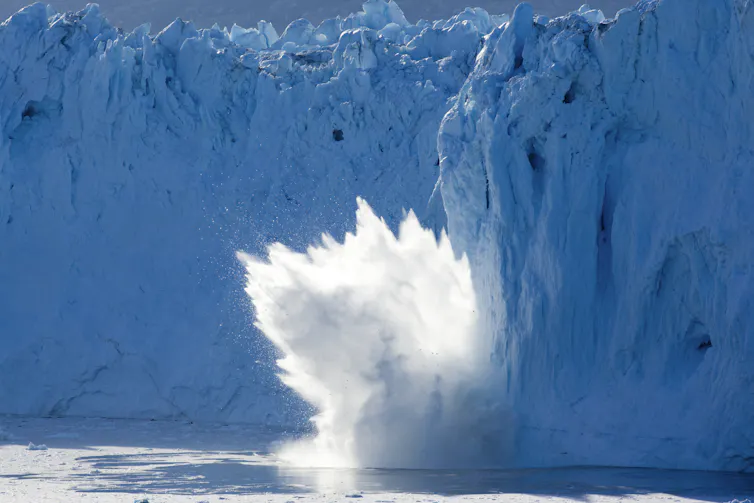
Too much fresh water from Greenland’s ice sheet can slow the Atlantic Ocean’s circulation. Paul Souders/Stone via Getty Images

February 9, 2024

René van Westen, Utrecht University; Henk A. Dijkstra, Utrecht University, and Michael Kliphuis, Utrecht University

Superstorms, abrupt climate shifts and New York City frozen in ice. That’s how the blockbuster Hollywood movie “The Day After Tomorrow” depicted an abrupt shutdown of the Atlantic Ocean’s circulation and the catastrophic consequences.

While Hollywood’s vision was over the top, the 2004 movie raised a serious question: If global warming shuts down the Atlantic Meridional Overturning Circulation, which is crucial for carrying heat from the tropics to the northern latitudes, how abrupt and severe would the climate changes be?

Twenty years after the movie’s release, we know a lot more about the Atlantic Ocean’s circulation. Instruments deployed in the ocean starting in 2004 show that the Atlantic Ocean circulation has observably slowed over the past two decades, possibly to its weakest state in almost a millennium. Studies also suggest that the circulation has reached a dangerous tipping point in the past that sent it into a precipitous, unstoppable decline, and that it could hit that tipping point again as the planet warms and glaciers and ice sheets melt.

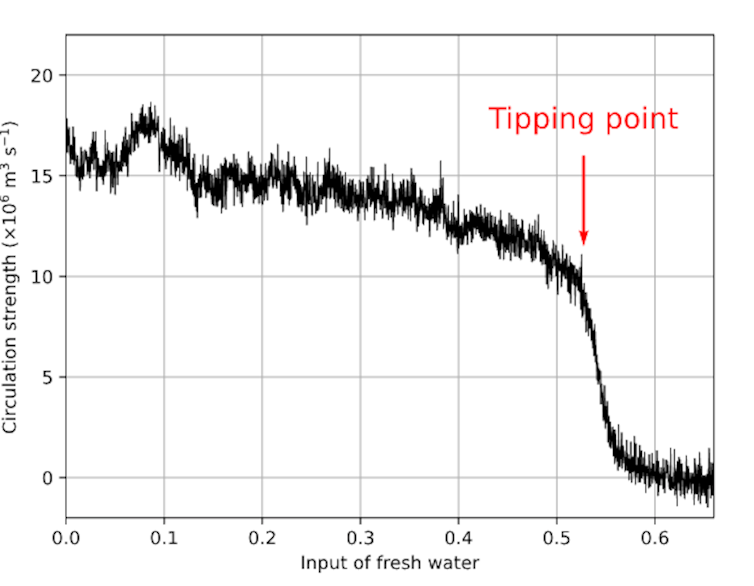
In a new study using the latest generation of Earth’s climate models, we simulated the flow of fresh water until the ocean circulation reached that tipping point.

The results showed that the circulation could fully shut down within a century of hitting the tipping point, and that it’s headed in that direction. If that happened, average temperatures would drop by several degrees in North America, parts of Asia and Europe, and people would see severe and cascading consequences around the world.
We also discovered a physics-based early warning signal that can alert the world when the Atlantic Ocean circulation is nearing its tipping point.
The ocean’s conveyor belt

Ocean currents are driven by winds, tides and water density differences.

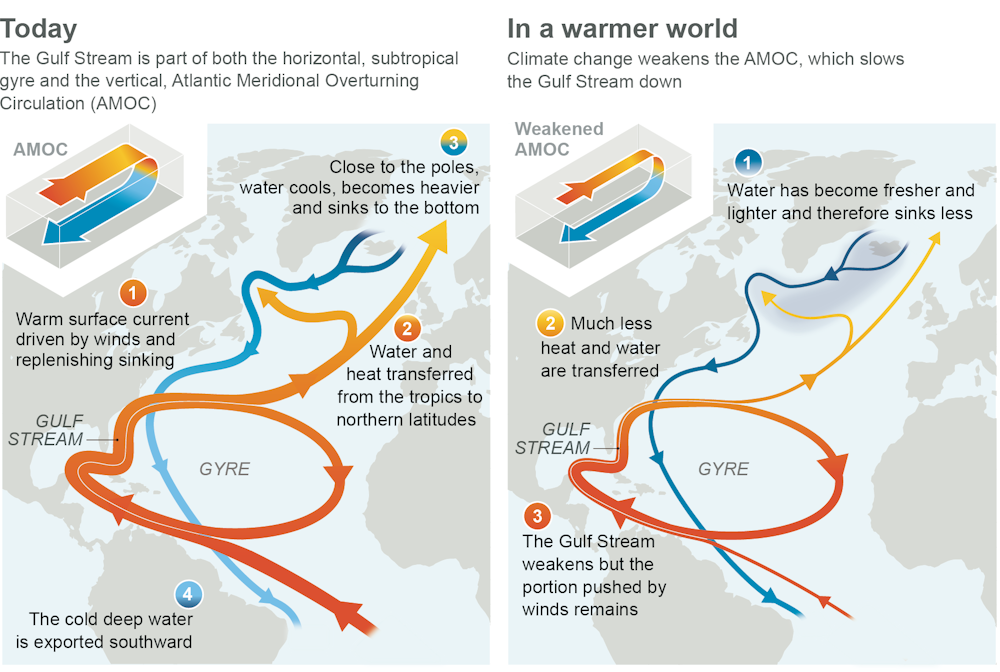
In the Atlantic Ocean circulation, the relatively warm and salty surface water near the equator flows toward Greenland. During its journey it crosses the Caribbean Sea, loops up into the Gulf of Mexico, and then flows along the U.S. East Coast before crossing the Atlantic.

Two illustrations show how the AMOC looks today and its weaker state in the future
How the Atlantic Ocean circulation changes as it slows. IPCC 6th Assessment Report

This current, also known as the Gulf Stream, brings heat to Europe. As it flows northward and cools, the water mass becomes heavier. By the time it reaches Greenland, it starts to sink and flow southward. The sinking of water near Greenland pulls water from elsewhere in the Atlantic Ocean and the cycle repeats, like a conveyor belt.

Too much fresh water from melting glaciers and the Greenland ice sheet can dilute the saltiness of the water, preventing it from sinking, and weaken this ocean conveyor belt. A weaker conveyor belt transports less heat northward and also enables less heavy water to reach Greenland, which further weakens the conveyor belt’s strength. Once it reaches the tipping point, it shuts down quickly.

What happens to the climate at the tipping point?

The existence of a tipping point was first noticed in an overly simplified model of the Atlantic Ocean circulation in the early 1960s. Today’s more detailed climate models indicate a continued slowing of the conveyor belt’s strength under climate change. However, an abrupt shutdown of the Atlantic Ocean circulation appeared to be absent in these climate models. https://www.youtube.com/embed/p4pWafuvdrY?wmode=transparent&start=0 How the ocean conveyor belt works.

This is where our study comes in. We performed an experiment with a detailed climate model to find the tipping point for an abrupt shutdown by slowly increasing the input of fresh water.

We found that once it reaches the tipping point, the conveyor belt shuts down within 100 years. The heat transport toward the north is strongly reduced, leading to abrupt climate shifts.

The result: Dangerous cold in the North

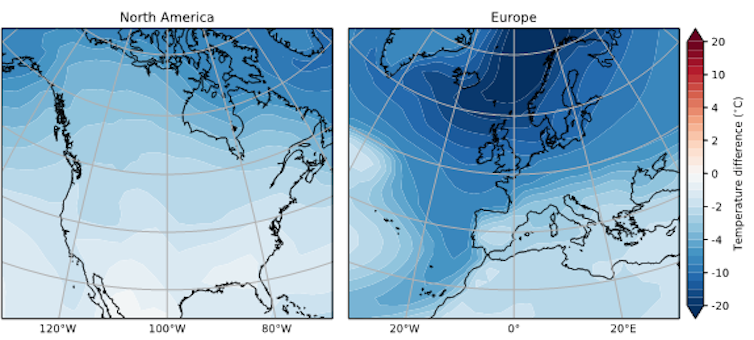
Regions that are influenced by the Gulf Stream receive substantially less heat when the circulation stops. This cools the North American and European continents by a few degrees.

The European climate is much more influenced by the Gulf Stream than other regions. In our experiment, that meant parts of the continent changed at more than 5 degrees Fahrenheit (3 degrees Celsius) per decade – far faster than today’s global warming of about 0.36 F (0.2 C) per decade. We found that parts of Norway would experience temperature drops of more than 36 F (20 C). On the other hand, regions in the Southern Hemisphere would warm by a few degrees.

Two maps show US and Europe both cooling by several degrees if the AMOC stops.
The annual mean temperature changes after the conveyor belt stops reflect an extreme temperature drop in northern Europe in particular. René M. van Westen

These temperature changes develop over about 100 years. That might seem like a long time, but on typical climate time scales, it is abrupt.

The conveyor belt shutting down would also affect sea level and precipitation patterns, which can push other ecosystems closer to their tipping points. For example, the Amazon rainforest is vulnerable to declining precipitation. If its forest ecosystem turned to grassland, the transition would release carbon to the atmosphere and result in the loss of a valuable carbon sink, further accelerating climate change.

The Atlantic circulation has slowed significantly in the distant past. During glacial periods when ice sheets that covered large parts of the planet were melting, the influx of fresh water slowed the Atlantic circulation, triggering huge climate fluctuations.

So, when will we see this tipping point?

The big question – when will the Atlantic circulation reach a tipping point – remains unanswered. Observations don’t go back far enough to provide a clear result. While a recent study suggested that the conveyor belt is rapidly approaching its tipping point, possibly within a few years, these statistical analyses made several assumptions that give rise to uncertainty.

Instead, we were able to develop a physics-based and observable early warning signal involving the salinity transport at the southern boundary of the Atlantic Ocean. Once a threshold is reached, the tipping point is likely to follow in one to four decades.

A line chart of circulation strength shows a quick drop-off after the amount of freshwater in the ocean hits a tipping point.
A climate model experiment shows how quickly the AMOC slows once it reaches a tipping point with a threshold of fresh water entering the ocean. How soon that will happen remains an open question. René M. van Westen

The climate impacts from our study underline the severity of such an abrupt conveyor belt collapse. The temperature, sea level and precipitation changes will severely affect society, and the climate shifts are unstoppable on human time scales.

It might seem counterintuitive to worry about extreme cold as the planet warms, but if the main Atlantic Ocean circulation shuts down from too much meltwater pouring in, that’s the risk ahead.

This article was updated on Feb. 11, 2024, to fix a typo: The experiment found temperatures in parts of Europe changed by more than 5 F per decade.

René van Westen, Postdoctoral Researcher in Climate Physics, Utrecht University; Henk A. Dijkstra, Professor of Physics, Utrecht University, and Michael Kliphuis, Climate Model Specialist, Utrecht University

This article is republished from The Conversation under a Creative Commons license. Read the original article.

The 2024 Water Year summary is hot off the presses from Western Water Assessment: Average temperatures during the 2024 water year were much above average for the entire region

Click the link to read the summary on the Western Water Assessment website:

Water Year 2024 Summary

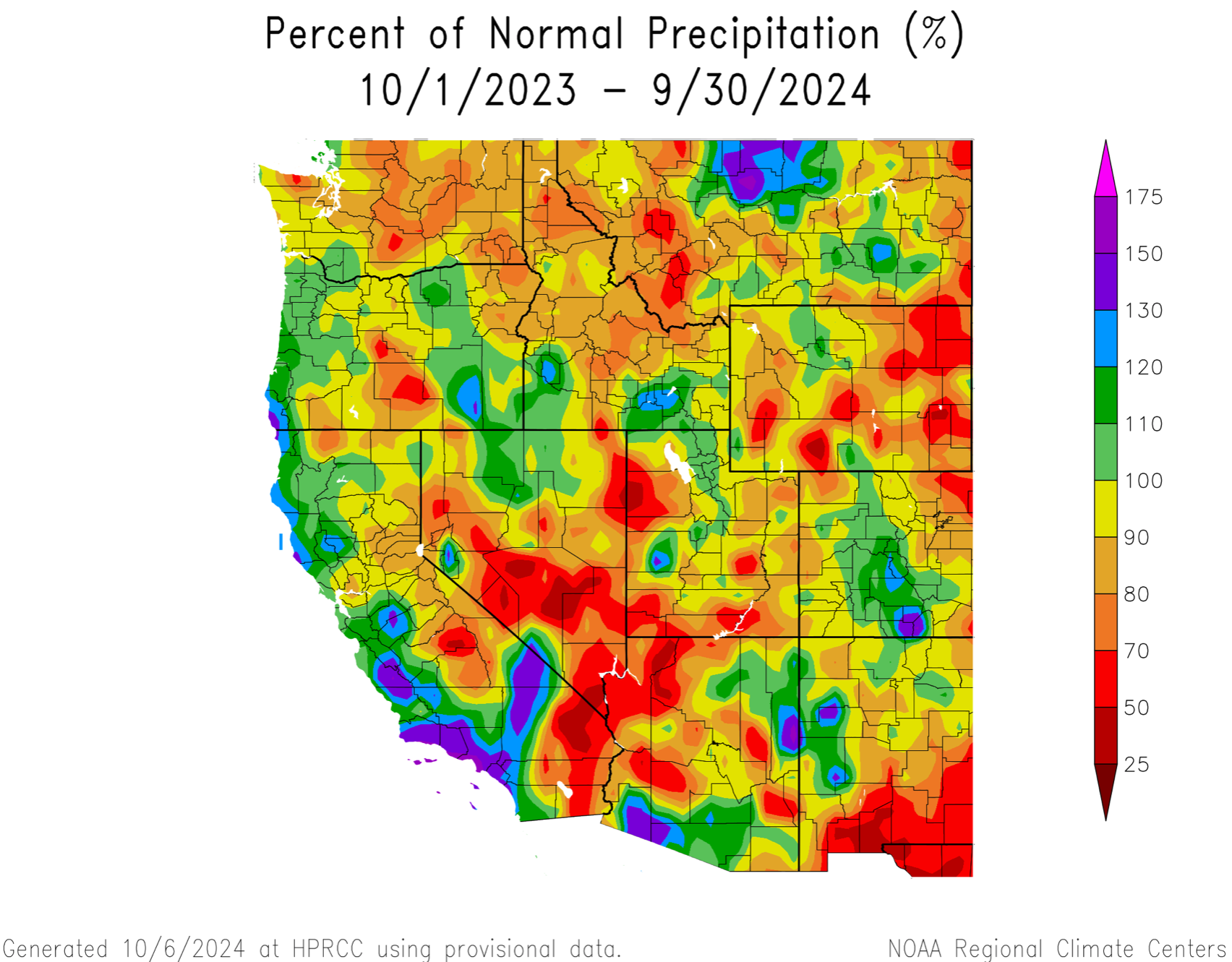
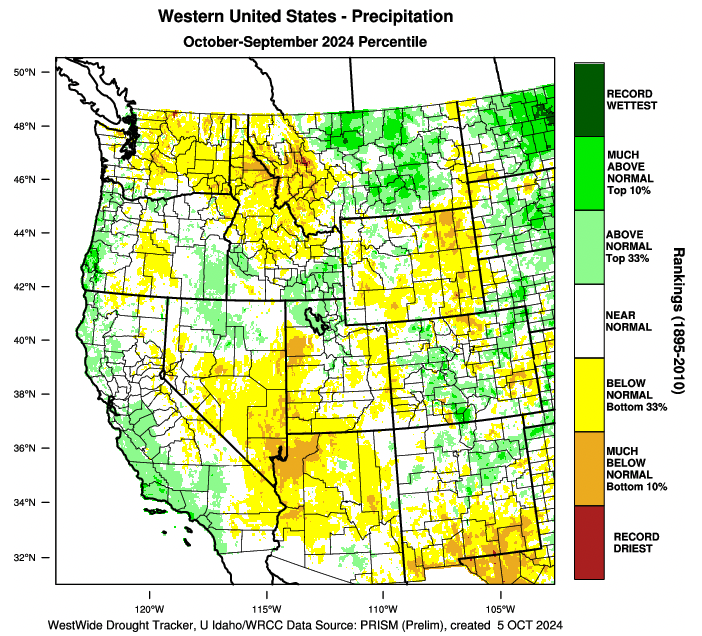
Regional water year precipitation for 2024 was near normal. In Colorado, statewide 2024 water year precipitation was 101% of median, 99% of median in Utah and 94% of median in Wyoming. The two largest basins in our region also experienced near normal water year precipitation with the Upper Colorado River Basin receiving 99% of median precipitation and the Great Salt Lake receiving 105% of median precipitation. On a smaller geographic scale, 2024 brought near to above normal precipitation to northern Utah, central Colorado and northern Wyoming. Areas that were notably dry in 2024 include northeastern Colorado, southern Utah and eastern Wyoming.

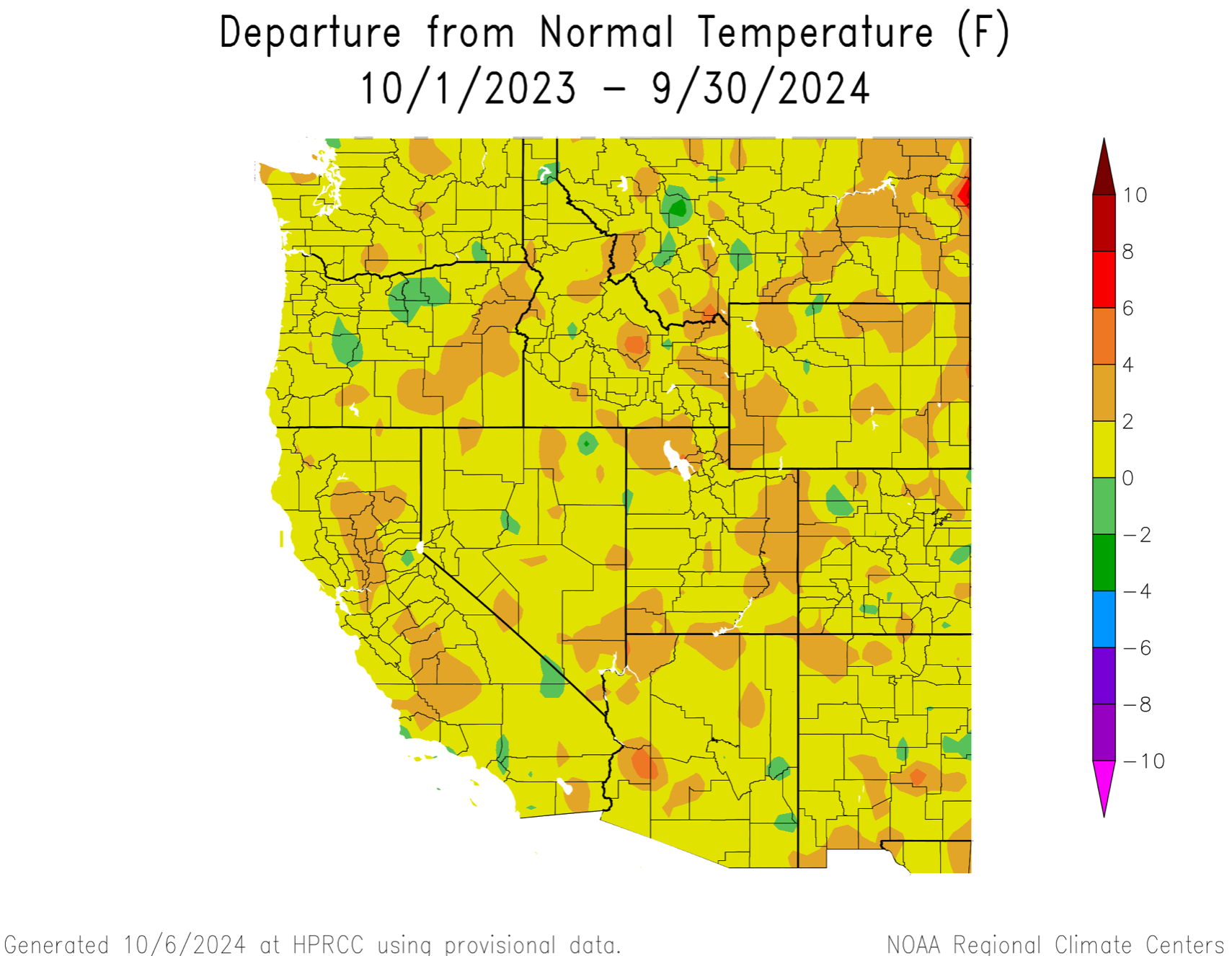
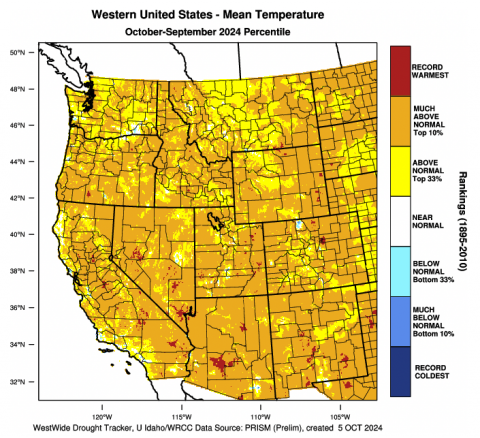
Average temperatures during the 2024 water year were much above average for the entire region. The majority of the region experienced average temperatures that were up to 2ºF above average. Water year average temperature was 2-4ºF above average for several areas including southwestern Utah, eastern Utah, western Colorado and eastern Wyoming. Record high average temperatures during the last 9 months of the water year (January 2024-September 2024 were observed in Fillmore, UT and Laramie, WY. Several other small areas of record hot temperatures were observed throughout the region).

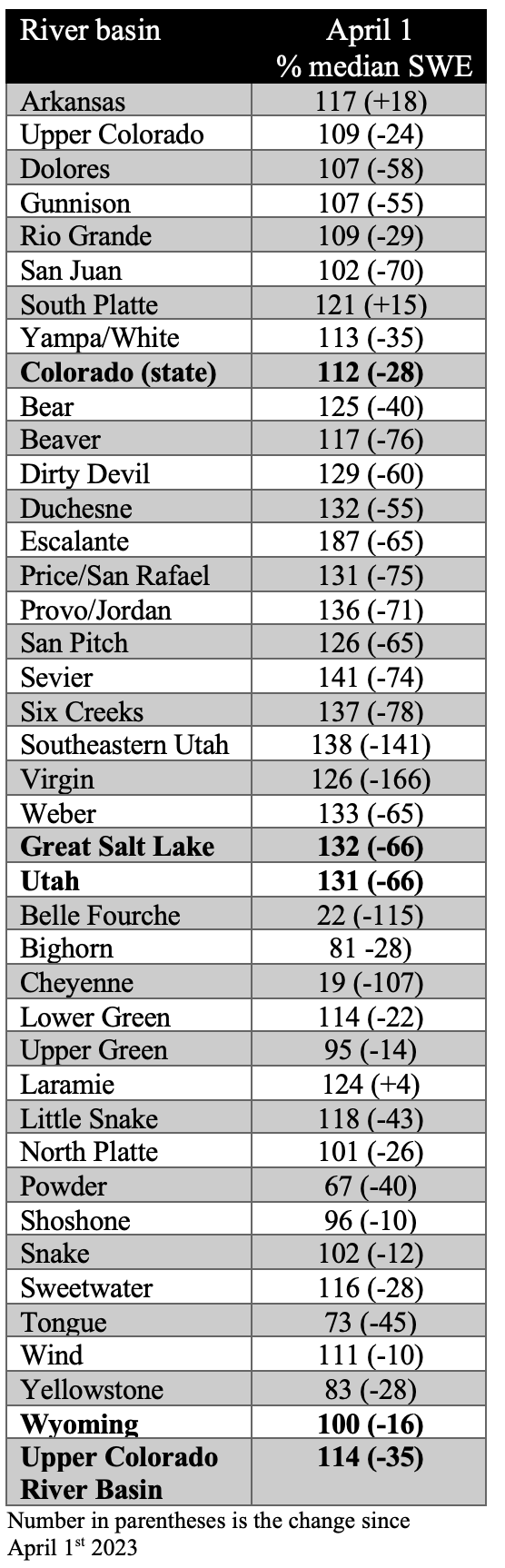
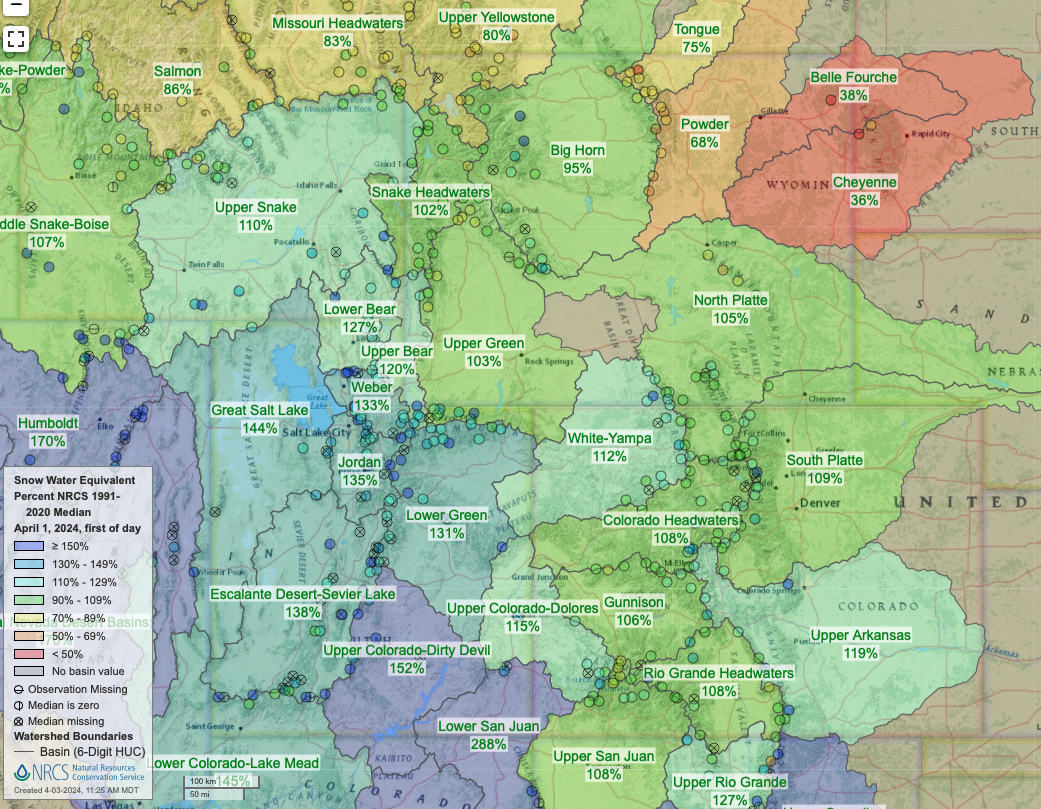
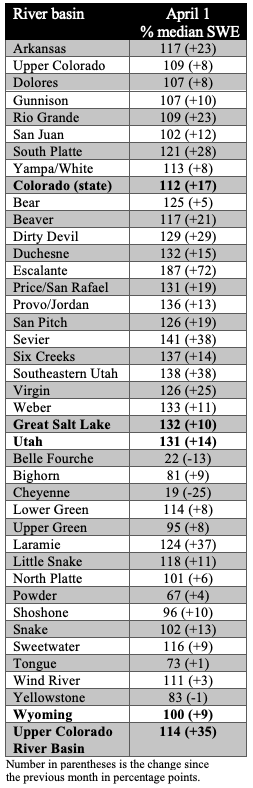
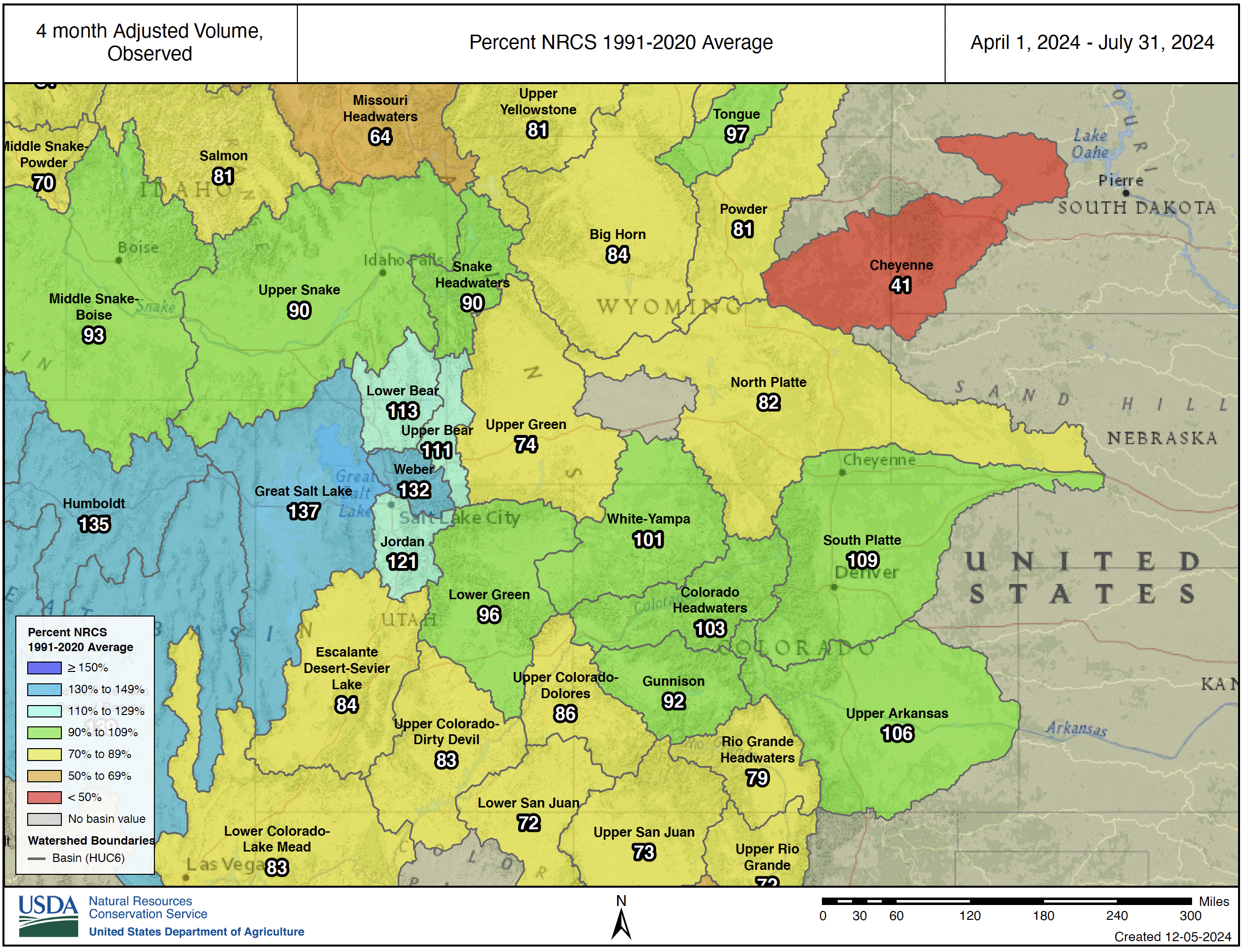
Snowpack in 2024 was near to above average for the entire region except for northeastern Wyoming where snowpack was much below average. Statewide April 1st snow water equivalent (SWE) was near or above average across the region with Colorado receiving 112% of average SWE, Utah with 132% of average SWE and Wyoming with 100% of average SWE. Snowpacks were deepest in the lower San Juan (288% average SWE) and the Dirty Devil River (152% average SWE) Basins and shallowest in the Belle Fouche (38% average SWE) and Cheyenne River (35% average SWE) Basins in northeastern Wyoming. Much of Colorado and Wyoming received near to slightly above average SWE. April 1st SWE was above average for all Utah river basins.

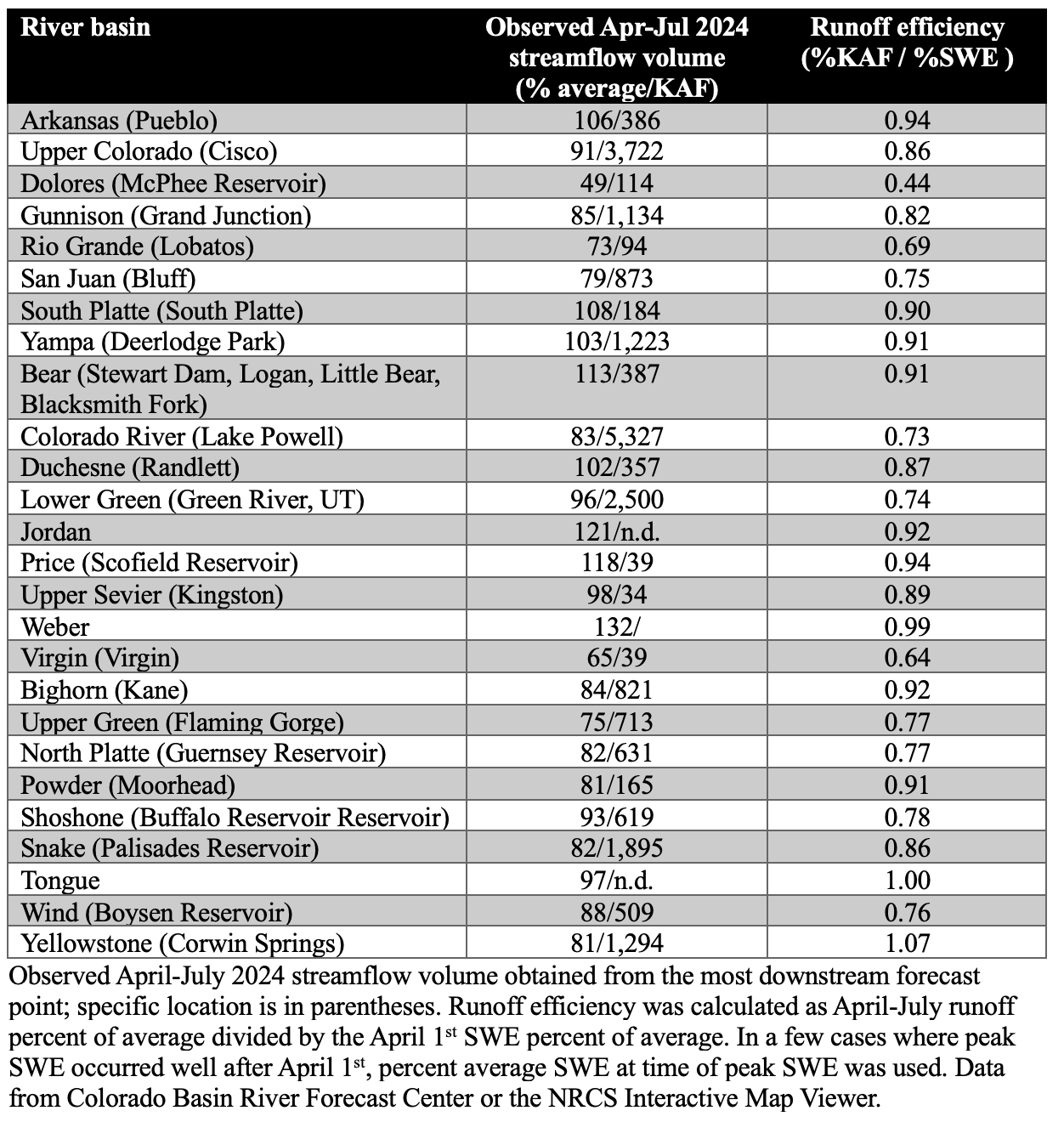
Despite near to above average snowpack throughout most of the region, April-July observed runoff volume ranged from slightly below average in the Wyoming river basins (Big Horn, Upper Green and Powder) and southern river basins (Dirty Devil, Dolores, Rio Grande and San Juan) to above average in the Great Basin (Bear, Great Salt Lake, Jordan and Weber) and Escalante River Basin. Much below average seasonal runoff was observed in northeastern Wyoming’s Cheyenne River Basin. The Weber River Basin observed the highest relative runoff at 132% of average seasonal runoff volume. A rough measure of runoff efficiency, or the proportion of snowpack that makes its way into runoff, was calculated as percent average of observed April-July runoff volume divided by percent average of April 1st SWE. Overall, regional runoff efficiency was relatively high with more than 90% of seasonal snowpack making its way into runoff in the Arkansas, South Platte, Yampa, Bear, Jordan, Price, Weber, Bighorn, Powder, Tongue and Yellowstone Rivers. Low runoff efficiency was observed in the Dolores, Rio Grande and Virgin River Basins. Low runoff efficiency in southwestern Colorado is likely attributed to continued long-term impacts of the drought that began in 2000.

The 2024 water year began with only 9% of the region in drought, largely due to the much above average 2023 water year. By the end of the water year, 36% of the region was in drought. Coverage of drought in Colorado and Utah remained relatively unchanged from the beginning to the end of the 2024 water year. Wyoming, however, experienced a sharp increase in coverage of drought; Wyoming was drought-free at the start of the 2024 water year, but 71% of the state was in drought by October 2024. Development of drought across Wyoming was driven by below normal water year precipitation across most of the state, especially eastern Wyoming, despite average April 1 snowpack conditions. Slightly above average water year temperatures likely exacerbated drought and the water year ended with July-September temperatures that were 2-4 degrees above average.

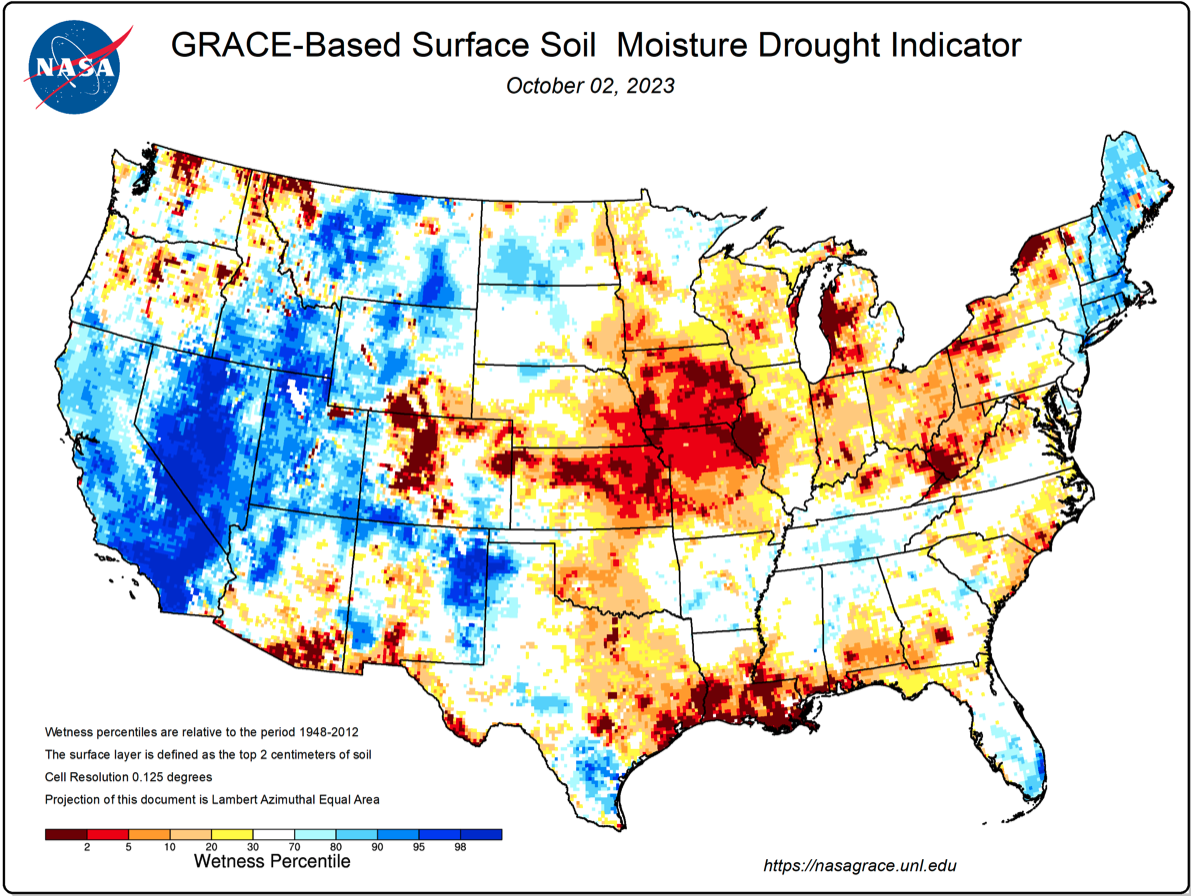
After a very wet 2023 water year, much of the region began the 2024 water year with soil surface moisture above the 80th percentile of NASA GRACE satellite observations, particularly in Utah, western Wyoming and southern Colorado. Areas with notably dry soil moisture to begin the 2024 water year included most of the Colorado Rockies, northeastern Colorado, southwestern Wyoming, and the Bighorn, Uinta and Wind River Mountains. By the end of the 2024 water year, surface soil moisture across most of the region was very low with most locations in the 5th percentile of all years of observation. Only south-central and northeastern Colorado has near average soil moisture conditions. Observations of near surface soil moisture (2” depth) from the NRCS SCAN network indicate similar patterns of wet soils to begin the 2024 water year, especially in the western portion of the region and very dry soils by September 2024. SCAN soil moisture observations indicated much below average soil moisture at the end of the 2024 water year for all river basins except for the Arkansas, Gunnison, Upper Rio Grande and Upper San Juan River Basins. Particularly troubling for the 2025 water year is extremely low soil moisture in the Upper Colorado (33% of median) and Upper Green River (28% of median) Basins.

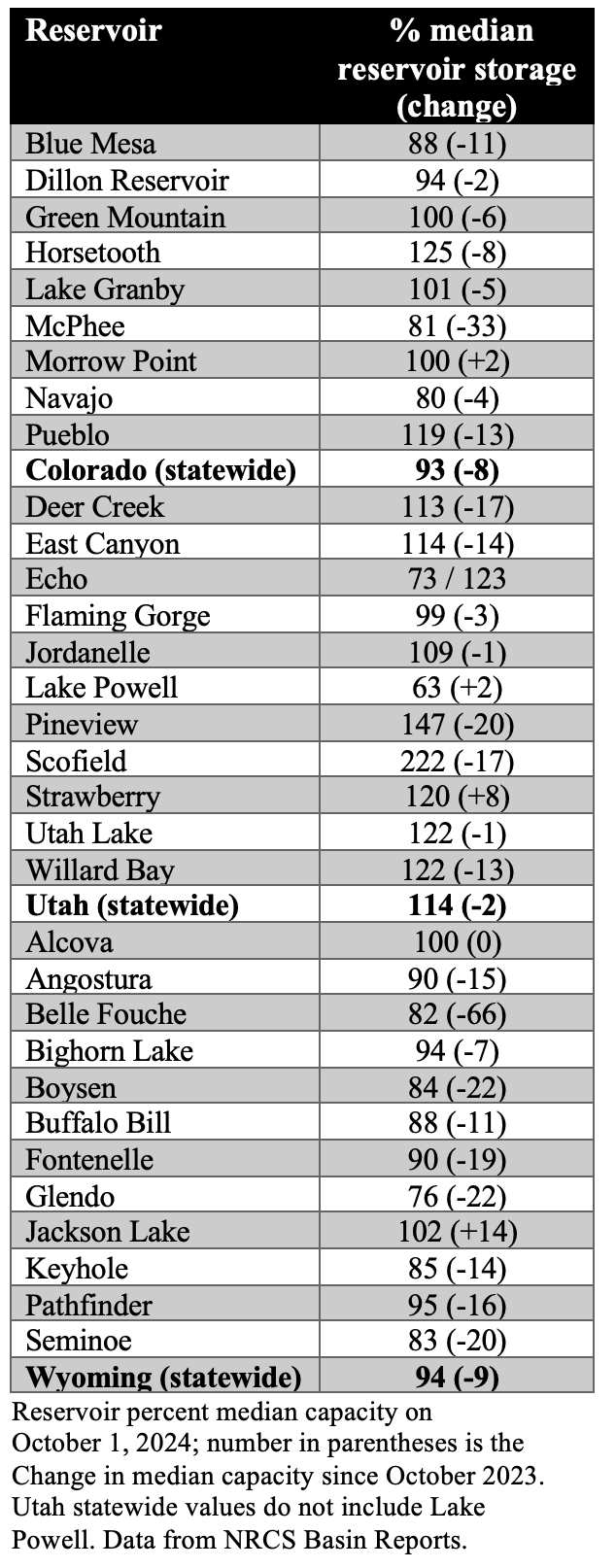
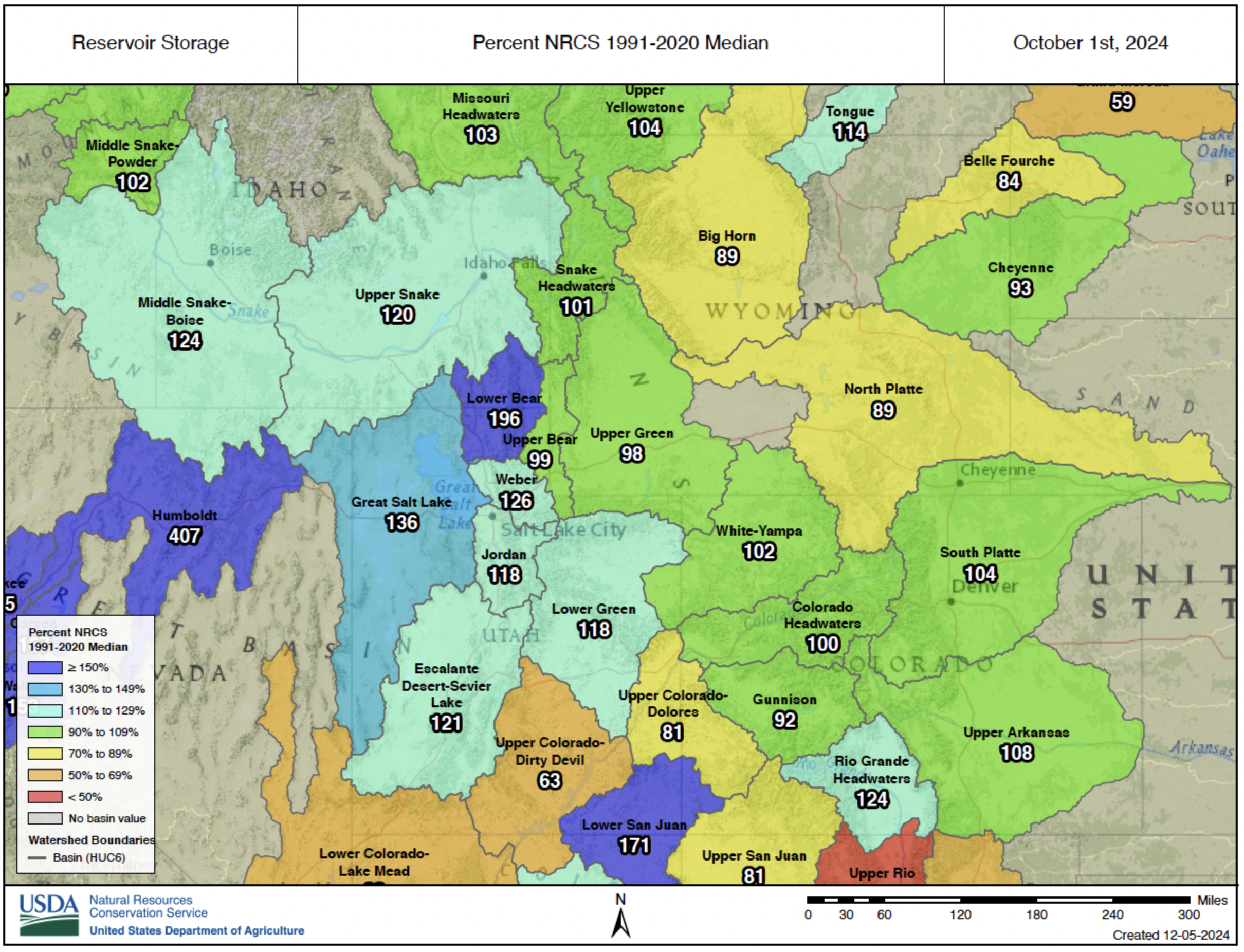
Regional reservoir storage declined slightly from the beginning of the 2024 water year, but remains near median capacity. Reservoir storage is greatest in Utah where reservoirs are at 114% of median capacity, only slightly lower than in October 2023. Despite the onset of drought in Wyoming, reservoir storage is currently at 94% of median capacity, down from 103% in October 2023. The greatest declines in reservoir capacity were found in eastern Wyoming, especially in the Belle Fouche, Bighorn and North Platte River Basins. Storage in large Upper Colorado River Basin reservoirs remains near median capacity except for McPhee, Navajo and Lake Powell. Reservoir storage in Lake Powell was relatively stable during 2024 despite remaining at a low 38% of total storage capacity.

Evidence from Snowball Earth found in ancient rocks on Colorado’s Pikes Peak – it’s a missing link

Rocks can hold clues to history dating back hundreds of millions of years. Christine S. Siddoway

November 21, 2024

Liam Courtney-Davies, University of Colorado Boulder; Christine Siddoway, Colorado College, and Rebecca Flowers, University of Colorado Boulder

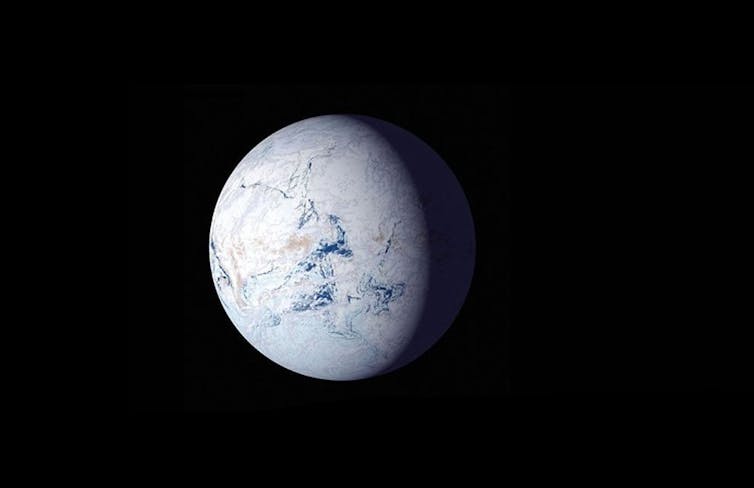
Around 700 million years ago, the Earth cooled so much that scientists believe massive ice sheets encased the entire planet like a giant snowball. This global deep freeze, known as Snowball Earth, endured for tens of millions of years.

Yet, miraculously, early life not only held on, but thrived. When the ice melted and the ground thawed, complex multicellular life emerged, eventually leading to life-forms we recognize today.

The Snowball Earth hypothesis has been largely based on evidence from sedimentary rocks exposed in areas that once were along coastlines and shallow seas, as well as climate modeling. Physical evidence that ice sheets covered the interior of continents in warm equatorial regions had eluded scientists – until now.

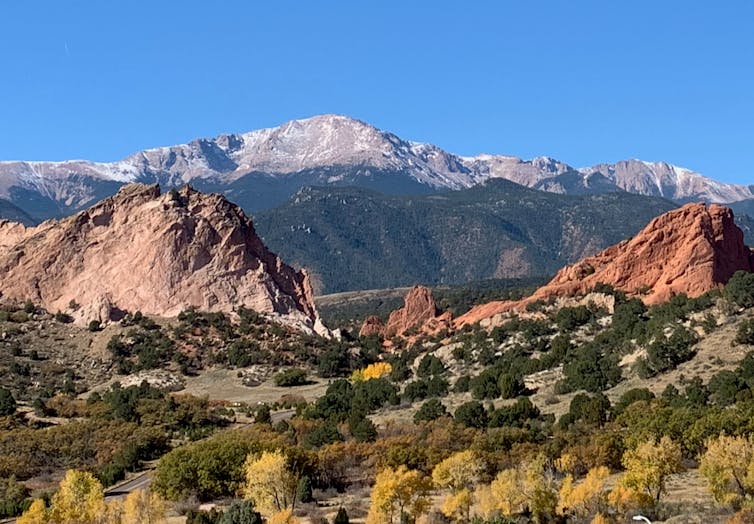
In new research published in the Proceedings of the National Academy of Sciences, our team of geologists describes the missing link, found in an unusual pebbly sandstone encapsulated within the granite that forms Colorado’s Pikes Peak.

An illustration of an icy earth viewed from space
Earth iced over during the Cryogenian Period, but life on the planet survived. NASA illustration

Solving a Snowball Earth mystery on a mountain

Pikes Peak, originally named Tavá Kaa-vi by the Ute people, lends its ancestral name, Tava, to these notable rocks. They are composed of solidified sand injectites, which formed in a similar manner to a medical injection when sand-rich fluid was forced into underlying rock.

A possible explanation for what created these enigmatic sandstones is the immense pressure of an overlying Snowball Earth ice sheet forcing sediment mixed with meltwater into weakened rock below.

A hand holds a rock with dark seams through it and other colors.
Dark red to purple bands of Tava sandstone dissect pink and white granite. The Tava is also cross-cut by silvery-gray veins of iron oxide. Liam Courtney-Davies

An obstacle for testing this idea, however, has been the lack of an age for the rocks to reveal when the right geological circumstances existed for sand injection.

We found a way to solve that mystery, using veins of iron found alongside the Tava injectites, near Pikes Peak and elsewhere in Colorado.

A cliff side showing a long strip of lighter color Tava cutting through Pikes Peak Granite. The injectite here is 5 meters tall
A 5-meter-tall, almost vertical Tava dike is evident in this section of Pikes Peak granite. Liam Courtney-Davies

Iron minerals contain very low amounts of naturally occurring radioactive elements, including uranium, which slowly decays to the element lead at a known rate. Recent advancements in laser-based radiometric dating allowed us to measure the ratio of uranium to lead isotopes in the iron oxide mineral hematite to reveal how long ago the individual crystals formed.

The iron veins appear to have formed both before and after the sand was injected into the Colorado bedrock: We found veins of hematite and quartz that both cut through Tava dikes and were crosscut by Tava dikes. That allowed us to figure out an age bracket for the sand injectites, which must have formed between 690 million and 660 million years ago.

So, what happened?

The time frame means these sandstones formed during the Cryogenian Period, from 720 million to 635 million years ago. The name is derived from “cold birth” in ancient Greek and is synonymous with climate upheaval and disruption of life on our planet – including Snowball Earth.

While the triggers for the extreme cold at that time are debated, prevailing theories involve changes in tectonic plate activity, including the release of particles into the atmosphere that reflected sunlight away from Earth. Eventually, a buildup of carbon dioxide from volcanic outgassing may have warmed the planet again. https://www.youtube.com/embed/PLZze4Yok98?wmode=transparent&start=0 University of Exeter professor Timothy Lenton explains why the Earth was able to freeze over.

The Tava found on Pikes Peak would have formed close to the equator within the heart of an ancient continent named Laurentia, which gradually over time and long tectonic cycles moved into its current northerly position in North America today.

The origin of Tava rocks has been debated for over 125 years, but the new technology allowed us to conclusively link them to the Cryogenian Snowball Earth period for the first time.

The scenario we envision for how the sand injection happened looks something like this:

A giant ice sheet with areas of geothermal heating at its base produced meltwater, which mixed with quartz-rich sediment below. The weight of the ice sheet created immense pressures that forced this sandy fluid into bedrock that had already been weakened over millions of years. Similar to fracking for natural gas or oil today, the pressure cracked the rocks and pushed the sandy meltwater in, eventually creating the injectites we see today.

Clues to another geologic puzzle

Not only do the new findings further cement the global Snowball Earth hypothesis, but the presence of Tava injectites within weak, fractured rocks once overridden by ice sheets provides clues about other geologic phenomena.

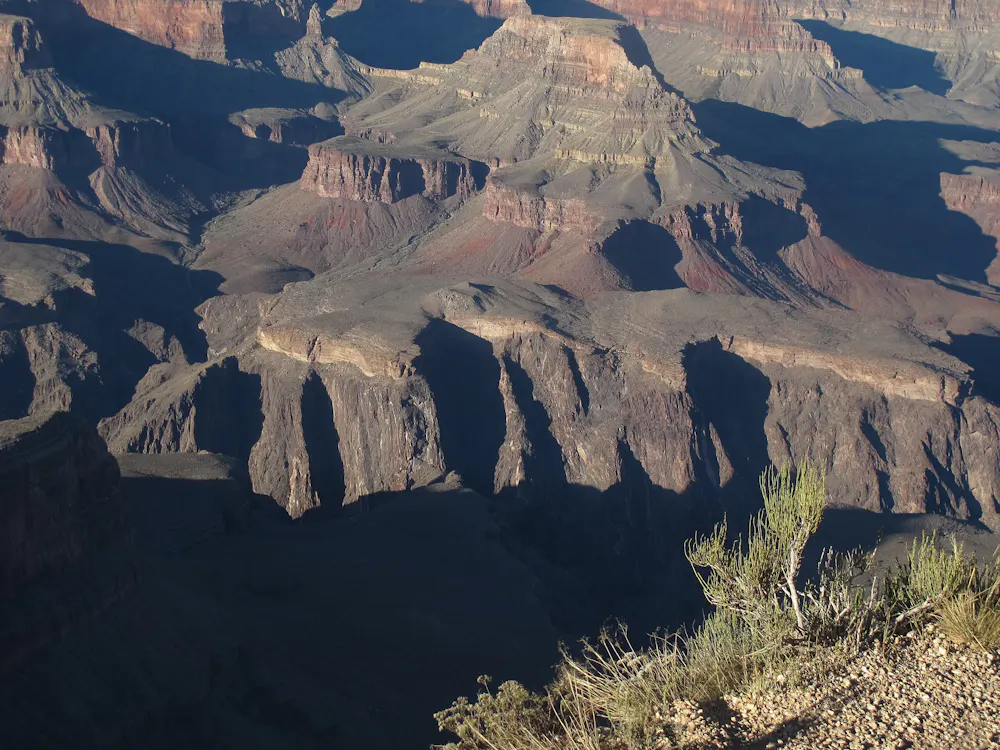
Time gaps in the rock record created through erosion and referred to as unconformities can be seen today across the United States, most famously at the Grand Canyon, where in places, over a billion years of time is missing. Unconformities occur when a sustained period of erosion removes and prevents newer layers of rock from forming, leaving an unconformable contact.

Unconformity in the Grand Canyon is evident here where horizontal layers of 500-million-year-old rock sit on top of a mass of 1,800-million-year-old rocks. The unconformity, or ‘time gap,’ demonstrates that years of history are missing. Mike Norton via Wikimedia, CC BY-SA

Our results support that a Great Unconformity near Pikes Peak must have been formed prior to Cryogenian Snowball Earth. That’s at odds with hypotheses that attribute the formation of the Great Unconformity to large-scale erosion by Snowball Earth ice sheets themselves.

We hope the secrets of these elusive Cryogenian rocks in Colorado will lead to the discovery of further terrestrial records of Snowball Earth. Such findings can help develop a clearer picture of our planet during climate extremes and the processes that led to the habitable planet we live on today.

Liam Courtney-Davies, Postdoctoral Research Associate in Geological Sciences, University of Colorado Boulder; Christine Siddoway, Professor of Geology, Colorado College, and Rebecca Flowers, Professor of Geological Sciences, University of Colorado Boulder

This article is republished from The Conversation under a Creative Commons license. Read the original article.

#Drought news January 2, 2025: Abnormal dryness was expanded in parts of #California, #Arizona, #Utah, #Colorado and #NewMexico this week

Click on a thumbnail graphic to view a gallery of drought data from the US Drought Monitor website.

Click the link to go to the US Drought Monitor website. Here’s an excerpt:

This Week’s Drought Summary

Precipitation fell across much of the U.S. this week, with heavier amounts (> 1 inch) falling across large portions of the Northwest U.S. and from south-central U.S. to the Ohio Valley. Coastal areas of the Pacific Northwest, from Washington to northern California, reported weekly rainfall totals between 2 to 15 inches, while precipitation totals of 2 to 10 inches were reported in areas from eastern Texas to Alabama, as well as parts of the Ohio Valley and the Southeast. Above-normal precipitation supported drought improvements across large portions of the South and Midwest, and in parts of the Pacific Northwest, Midwest and Southeast. Conversely, weekly precipitation totals were below normal in areas of the southwestern U.S., Mid-Atlantic and Northeast. Drought and abnormal dryness were expanded or intensified in portions of the Southwest and in small pockets of the High Plains. Temperatures were above normal across much of the U.S. this week. Areas along the Northern Tier, from northern portions of the West, to the Midwest observed temperatures 10 to 25 degrees above normal. Below-normal temperatures were reported across northern portions of the Northeast, from northern New Jersey to Maine, where departures were up to 5 degrees F below normal this past week. Below-normal temperatures were also observed in small pockets of the Southeast this week…

High Plains

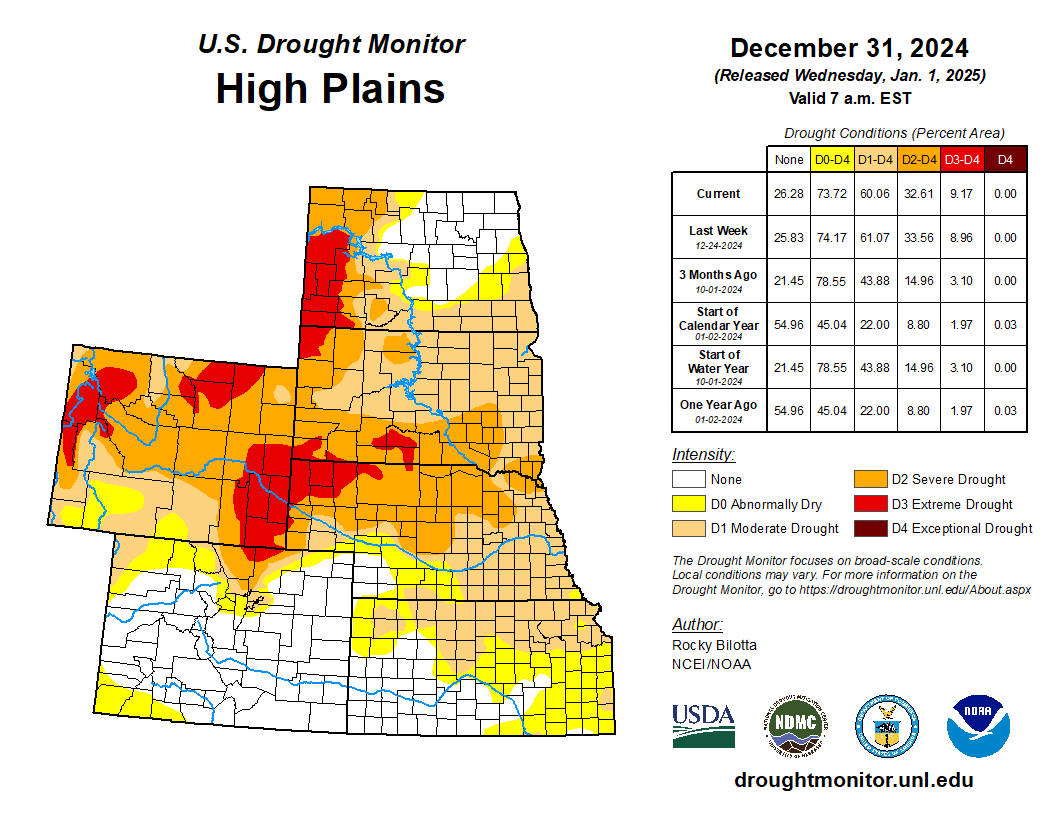
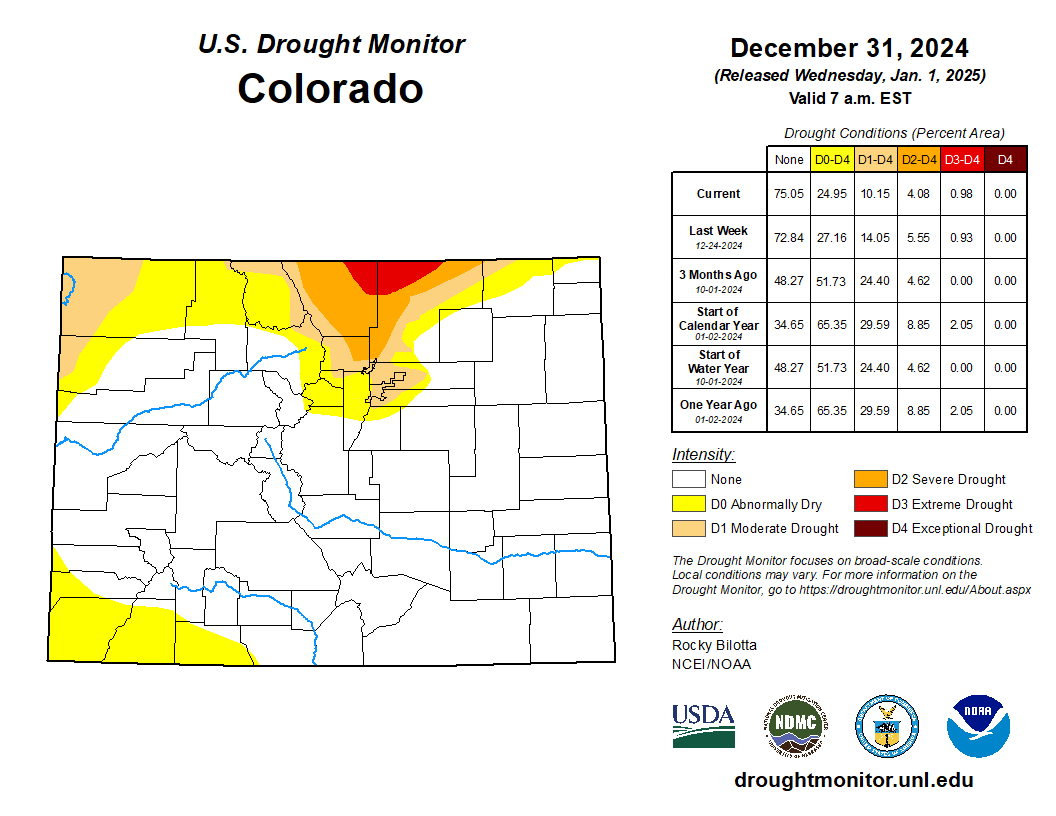
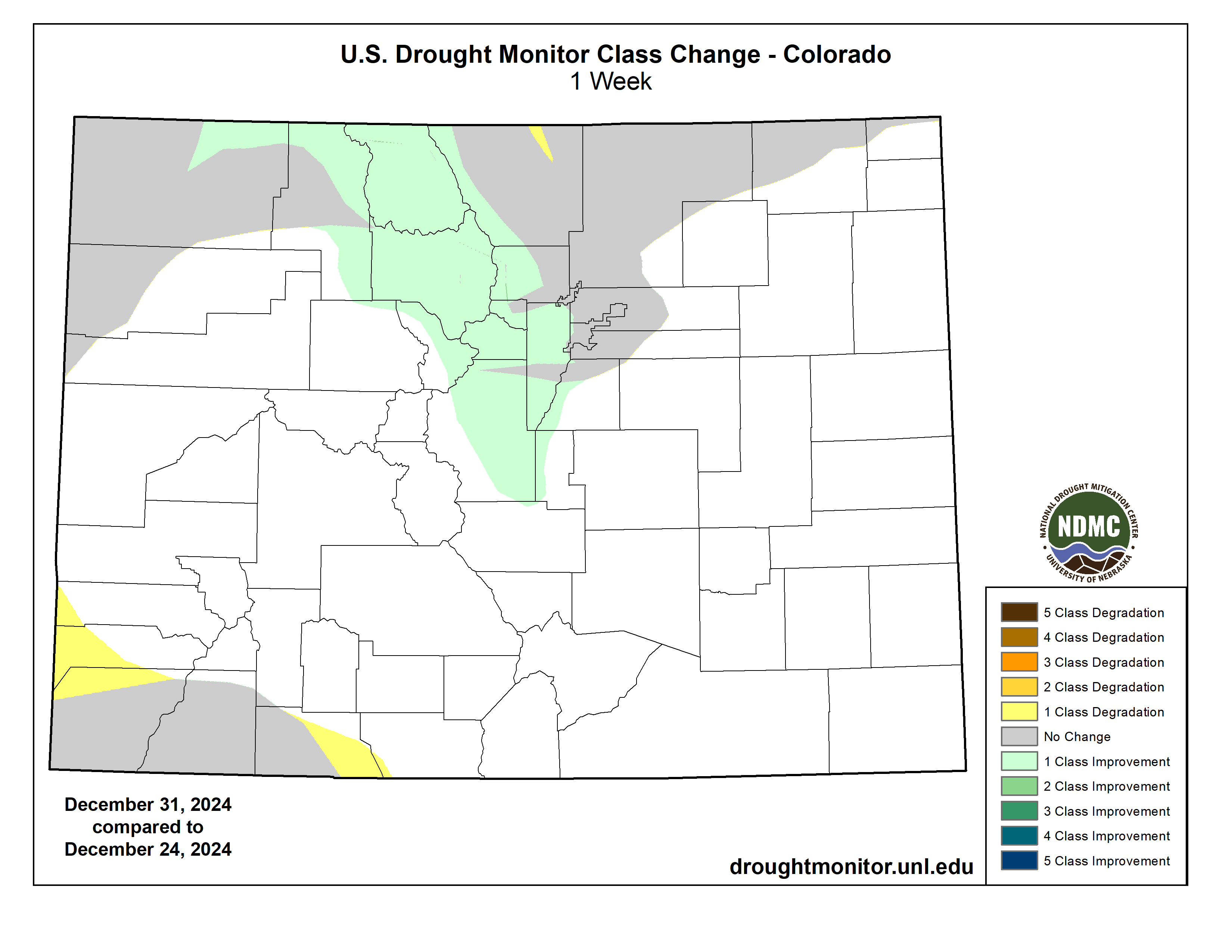
Warm temperature dominated the High Plains this week, with departures ranging up to 20 degrees F above normal, especially along the northern portions of the region. Precipitation fell across much of the region this week, but amounts were not large enough to justify large improvement across much of the High Plains. Extreme drought was expanded in northern Nebraska, while moderate drought was expanded in southeast Kansas. Abnormal dryness was expanded in southwest Colorado, where weekly rainfall totals are 5% to 20% of normal for the week. Small areas of the region did observe heavy rainfall, where rainfall totals were more than an inch above normal. This above-normal precipitation allowed for improvements to be made in South Dakota and along the Wyoming-Colorado border. Moderate to extreme drought were improved in northern Colorado and southern Wyoming, while severe drought was improved in western South Dakota. Abnormal dryness was also improved in areas along the Wyoming-Colorado border this week…

Colorado Drought Monitor one week change map ending December 31, 2024.

West

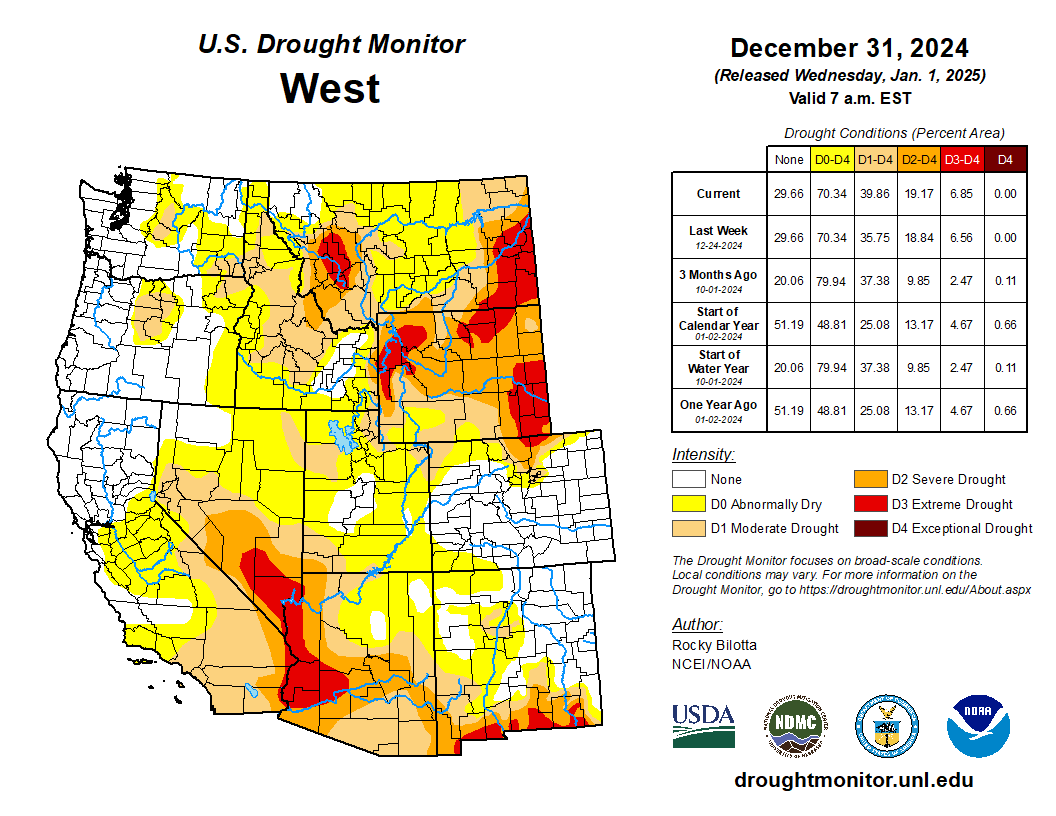
Average temperatures were above normal across nearly the entire region this week, while small pockets of below-normal temperatures were observed in northern California and along the southern coast of California, where temperatures were between 1 to 3 degrees F below normal. Conversely, Montana observed temperatures ranging between 6 to 15 degrees F above normal this week. Precipitation varied across the region this week, with heavy amounts falling in northern portions, while some areas in the southern portions of the region observed no precipitation. In the north, precipitation amounts of 1 inch or greater fell across much of the Pacific Northwest and northern California, with some areas receiving up to 8 inches above normal for the week. Moderate to severe drought were improved in western Montana and eastern Idaho, while moderate drought was removed in southeast Oregon and trimmed in the northeastern part of the state. Abnormal dryness was improved in northeast Oregon and in small parts of eastern Washington and southern Idaho. In the southern part of the region, above-normal temperatures and below-normal precipitation resulted in expansion of drought in Arizona, California and Nevada. Extreme drought was expanded in southern Arizona, while severe drought was expanded in southern and northwestern parts of the state. Moderate drought was expanded in western and eastern Nevada, southern California and across parts of Arizona, while abnormal dryness was expanded in parts of California, Arizona, Utah, Colorado and New Mexico this week…

South

Heavy rainfall was observed across much of the South this week, with precipitation totals ranging between 1 to 8 inches above normal. Above-normal rainfall, with amounts up to 600% above normal, along with improvements shown in short-term SPI/SPEI, streamflow and soil moisture data, supported widespread improvements to drought made from eastern Texas to Mississippi this week. Severe drought was removed along the Oklahoma-Texas and Louisiana-Arkansas borders, as well as from southern Mississippi, and improved in central Texas. Moderate drought was improved over large portions of Arkansas, eastern Texas, and in parts of Oklahoma, Louisiana and Mississippi. Conversely, western portions of Oklahoma and Texas observed below-normal precipitation this week. Moderate drought and abnormal dryness were expanded in small parts of western Texas. Temperatures were above normal across the entire region this week, with departures ranging between 1 to 15 degrees F above normal…

Looking Ahead

During the next five days (December 31, 2024–January 4, 2025), A low pressure system tracking from the Ohio Valley into the Northeast will spread precipitation across those regions Tuesday-Wednesday. Precipitation should fall as rain for most of the Ohio Valley to the coastal areas/lower elevations of the Northeast. Snow is likely in the higher elevation areas of the Interior Northeast like the Adirondacks and the Green and White Mountains. The Pacific Northwest will see a relative break in precipitation on Tuesday after a steady train of atmospheric rivers into the region. But by Tuesday night or Wednesday moist inflow may get renewed there and rounds of precipitation are likely to continue through late week and at times farther east into the northern Rockies. The eastern U.S. can expect one more day of above average temperatures (by 10-15F) on Tuesday, before upper troughing pushes along a series of cold fronts that gradually cool temperatures to near normal on Wednesday and gradually below normal into late week. High temperatures by Saturday are forecast to be around 10-15F below normal for the Ohio Valley to Appalachians and Mid-Atlantic while lows should be 5-10F below average. Colder than normal temperatures will also impact the north-central U.S., and lows could reach 10-15F below zero over northern North Dakota and Minnesota by Friday and/or Saturday. Meanwhile, the amplifying upper ridge over the West will promote warming, with temperatures generally 5-10F above average increasing in coverage by the second half of the week. Locally higher anomalies are likely in the Southwest and highs could reach well into the 70s. Highs of 5-15F above normal may reach into the southern High Plains by next Saturday.

The Climate Prediction Center’s 6-10 day outlook (valid January 5–9, 2025) favors above-normal precipitation across much of the U.S., with below-normal precipitation favored in portions of the Southwest and Northeast, as well as parts of northern Alaska and on southern parts of the Big Island. Increased probabilities for above-normal temperatures are forecast for Hawaii and across much of the West and Alaska, while below-normal temperatures are likely from the northern Rockies to the East Coast, and in northern parts of Alaska.

US Drought Monitor one week change map ending December 31, 2024.

Happy New Year! 2024’s biggest conservation wins for the West — @HighCountryNews

A salmon on the Klamath River is captured just downstream from Wards Canyon, California, to have a radio-tag device attached to its fin on its way upstream. This device will transmit location data to scientists in the Upper Basin, demonstrating information about the salmon’s return to its historic reaches in the freed river. Paul Robert Wolf Wilson/High Country News

Click the link to read the article on The High Country News website (Kylie Mohr):

December 25, 2024

Climate change and encroaching development continue to threaten biodiversity. At the same time, Westerners saw dozens of success stories in 2024. Two national monuments were expanded in California, while conservation gained equal footing with mining and drilling under the Bureau of Land Management’s Public Lands RuleAlaska saw half of the National Petroleum Reserve-Alaska protected from new oil and gas leases, and the previous approval for the Ambler Road project in the Brooks Range was rescinded. Elsewhere in the region, fish returned to their former habitats and swam off the Endangered Species List, while wolf and gray whale populations continued to grow.

Fall-run Chinook Salmon, Oct. 16, 2024, photo by Mark Hereford, ODFW.

Salmon return to once-dammed reaches of the Klamath River

For over a century, dams blocked salmon from returning to their spawning grounds near the headwaters of the Klamath River. But the removal of four of the river’s six dams was completed this year, and in October, biologists saw several hundred chinook salmon above the dam sites. While scientists had expected salmon to return eventually, the appearance of so many fish so soon surprised and delighted the tribes who had ardently campaigned to remove the dams.

Fences come down

Every year, migrating elk, deer, pronghorn and moose are slowed, injured, and even killed by the West’s thousands of miles of barbed-wire fencing. Groups like the National Wildlife Federation (NWF) are working hard to remove barbed wire or replace it with more permeable barriers. According to the Mountain Journal, since 2021, the NWF and its partners have removed 40 miles of fencing from the High Divide region along the Montana-Idaho border. Sublette County, Wyoming, another leader in the wildlife-friendly fencing movement, has worked with state and federal partners to remove or improve more than 700 miles of fencing since 2017.

Gray whale populations rebound

Between December 2023 and mid-February 2024, researchers from the National Oceanic and Atmospheric Administration estimated that 19,260 gray whales migrated along the Pacific Coast — a 33% increase from the previous season. “The numbers are trending up,” NOAA spokesman Michael Milstein told the Oregon Capital Chronicle. “The indications are consistent that the whales have gone from a decline to a recovery.”

The fence line separating sagebrush and historic pastureland marks the north end of of the state of Wyoming’s school trust parcel in Grand Teton National Park, a tract known as the Kelly Parcel. (Mike Koshmrl/WyoFile)

Wyoming parcel approved for sale to Grand Teton National Park

Last year, it looked like an iconic parcel of state trust land outside Jackson, Wyoming, might be sold to a developer, prompting outrage from locals and conservationists. Known as the Kelly parcel, the land offers panoramic views of the Tetons and provides important habitat for migrating pronghorn and other wildlife species. But by law, state trust land must generate revenue for public schools. In November, Wyoming’s top-five state elected officials approved the sale of the parcel to the adjacent Grand Teton National Park for $100 million. The state will likely use the proceeds to purchase oil and gas-rich land in the Powder River Basin.

Wolves part of the pack discovered last summer in Tulare County called the Yowlumni Pack. The pack was found in the Sequoia National Forest near the Tule River Tribe of California’s reservation and ancestral lands. California Department of Fish and Wildlife

Wolf populations boom

An estimated 70 wolves are now living in California, an increase of 26 animals from last year. Two new wolf packs formed in Northern California this year, too. Meanwhile, Colorado saw the formation of its first pack since wolves were reintroduced last year.

Washington river gets legal rights — and other ballot wins

In Everett, Washington, voters approved a ballot initiative that grants the Snohomish River watershed the rights to exist, regenerate and flourish. City residents, agencies and organizations can now sue on behalf of the watershed, and any recovered damages will be used to restore the ecosystem. Also in Washington, voters upheld the 2021 Climate Commitment Act by voting no on Initiative 2117. The act caps and reduces carbon emissions for the state’s largest carbon emitters and raises money for conservation, climate and wildfire resilience statewide. In California, voters passed a $10 billion climate bond that will fund climate resilience projects, protect clean drinking water and help prevent wildfires.

Bear River Massacre site restored

One of the deadliest massacres of Native people in U.S. history happened near what’s now Preston, Idaho, in January 1863. Over 150 years later, the Northwestern Band of the Shoshone Nation is reclaiming the site of the massacre, a place their people once lived, celebrated and danced. Along the Bear River, the tribe is replacing thirsty invasive vegetation with native plants and restoring degraded agricultural fields to wetlands. Eventually, they hope to return an estimated 13,000 acre-feet of water to the parched Great Salt Lake annually. “For thousands of years, this wasn’t a massacre site,” Brad Parry, the tribe’s vice chairman, told High Country News. “We want to make this a place to come to again.”

Volunteers plant native vegetation along the banks of Battle Creek at the Bear River Massacre site in Preston, Idaho. Russel Albert Daniels/High Country News

Apache trout removed from Endangered Species List

In September, after 50 years on the federal endangered species list, Arizona’s state fish — the Apache trout — was declared recovered and removed from the list. The first American sportfish to achieve delisting, it owes its recovery to the White Mountain Apache Tribe as well as to federal and state agencies and nonprofits. In a statement, Interior Secretary Deb Haaland paid tribute to “the transformational power that collaborative conservation efforts — grounded in Indigenous Knowledge — can have on fish and wildlife.”

Extra wetland habitat created for birds

California’s Central Valley is vital to migrating birds, but its wetlands have been almost destroyed by agricultural and urban development. BirdReturns, a program that started in 2014, pays the valley’s rice farmers to create “pop-up” wetland habitat by flooding fields earlier in the fall and leaving them flooded later in the spring. Since its inception, BirdReturns has created 120,000 acres of temporary bird habitat.

Tribally led projects win big

TheAmerica The Beautiful Challenge funds voluntary conservation and restoration projects around the country, consolidating funding from federal agencies and the private sector. Numerous projects led by tribes in the West received money from the program this year, including the Summit Lake Paiute Tribe, which received $2.5 million for fish passage and riparian restoration projects in Nevada; the Pueblo of Jemez, which received $2.1 million for stream and wetland restoration in New Mexico; the Native Village of Tazlina, which received $2 million to incorporate Indigenous knowledge of migratory birds into state and regional meetings and management in Alaska; the Hoopa Valley Tribe, which received $4.5 million to remove invasive barred owls across Northern California; and the Eastern Shoshone Tribe, which received $3 million to expand the Yellowstone Bison Conservation Transfer Program.

This story is part of High Country News’ Conservation Beyond Boundaries project, which is supported by the BAND Foundation. 

Despite dry December, #Durango area surpasses total precipitation compared to 2023 — The Durango Herald #AnimasRiver #SanJuanRiver #ColoradoRiver #snowpack

Lake Nighthorse and Durango March 2016 photo via Greg Hobbs.

Click the link to read the article on The Durango Herald website (Christian Burney). Here’s an excerpt:

According to data captured at the Durango-La Plata County Airport, the Durango area received 14.14 inches of precipitation this year compared to 2023 moisture and precipitation that totaled 10.34 inches. Phillips said June 2024 rains bolstered the total precipitation the city received this year, accumulating 7 inches of rain through June, which is considered above normal for the months of June, July and August. He said 2023 started out with slightly above-normal levels of precipitation, but moisture gave way to a warm and dry summer. That dryness carried into 2024 and was followed up by a strong monsoon season. November storms briefly pushed snowpack above normal, but that momentum flattened again in December, he said.

“Even though it seems dry, our snowpack is actually doing better than it was last year,” he said.

According to Snoflo, a North American climate, hydrology and forecast database, the Upper San Juans had a snowpack level of 32 inches on Saturday, 68% of normal, low for the month of December.

Westwide SNOTEL basin-filled map December 31, 2024 via the NRCS.

A turbulent year on the #ColoradoRiver comes to a close — Alex Hager (KUNC) #COriver #aridification #CRWUA2024

Dusk falls on Lake Powell near Bullfrog Marina on July 15, 2024. The fate of the nation’s two largest reservoirs is still undetermined after a year full of disagreement and uncertainty among the Colorado River’s top policymakers. Photo credit: Alex Hager/KUNC

Click the link to read the article on the KUNC website (Alex Hager):

December 26, 2024

This story is part of ongoing coverage of the Colorado River, produced by KUNC in Colorado and supported by the Walton Family Foundation. KUNC is solely responsible for its editorial coverage.

This year was a bumpy ride for the Colorado River. As 2024 comes to a close, we’re looking at the stories that defined the water supply for 40 million people. Deep divisions between policymakers set the stage for deep uncertainty from Wyoming to Mexico, and those who use Colorado River water are hoping for some more clarity in the years to come. But with an unpredictable new president heading to the White House, they may end up with more questions than answers.

Visit the linked stories below to learn how the year unfolded.

Early disagreement

The biggest headlines of the year came early on the calendar. In March, seven states that use the Colorado River laid bare the deep divisions between them. The rules for sharing its water expire in 2026, and state leaders are under pressure to agree on new guidelines.

Instead of agreeing, they split into two camps and released competing proposals for managing water. The river is shrinking due to climate change, and states need to rein in their demand. Who exactly should cut back on their water use, though, is at the heart of their disagreement.

Shortly after the two state proposals, a group of native tribes released their ownsuggestions for managing the river. A coalition of conservation groups did the same.

Paying for conservation

Discord between the negotiators shaping the river’s future highlighted the need for farm districts and cities to get their own houses in order. Agriculture uses between 70-80% of the river’s water, and much of the pressure to conserve the river falls on farms and ranches.

From the river’s single largest water user in Southern California to tiny family farms in rural Wyoming, the federal government experimented with programs that paid farmers to use less water.

In the Imperial Valley, about two hours inland from San Diego, the farm district inked a deal to take more than $500 million from the Inflation Reduction Act. In exchange, the area’s farmers would leave some water in the nation’s largest reservoir, Lake Mead.

A ditch runs dry through Leslie Hagenstein’s fields near Pinedale, Wyo. on Mar. 27, 2024. Through the federally-funded System Conservation Pilot Program, she was able to make 13 times more than she would have by leasing her fields out to grow hay. CREDIT: ALEX HAGER/KUNC

Meanwhile, a smaller program in the Colorado River’s Upper Basin states – Colorado, Utah, Wyoming and New Mexico did something similar. It paid farmers and ranchers to cut back on water use, but some policy analysts say the program lacks a clear plan for the future.

Cities prepare for a drier future

Cities and suburbs, especially in the driest parts of the Colorado River Basin, are taking matters into their own hands. In an effort to buy some certainty against a future that might see their water allocations get smaller, municipal leaders in Arizona chipped away at multibillion-dollar engineering projects to stretch out their existing water supplies.

In the Phoenix area, cities large and small worked towards a dam expansion that would help them capture more snowmelt from mountains to the north. Some made progress on “water recycling” facilities that can clean up sewage and turn it back into drinking water. Similar efforts are underway in other states, too.

Canyons come back

The past few years have seen dramatically low water levels at the nation’s two largest reservoirs – Lake Mead and Lake Powell – which are both filled by the Colorado River. While that has caused concern for the water managers who want to keep taps and crop sprinklers flowing across the region, some environmental advocates are celebrating the return of habitats that had been submerged for decades.

Now that some portions of Lake Powell have been above water for more than 20 years, scientists are able to study the kind of plants and animals that are repopulating the once-underwater canyons. One study found that it’s mostly native vegetation coming back.

Mexico waits for more water

Uncertainty over the river’s future doesn’t stop at America’s border. In the Colorado River Delta, where the river once reached the sea, environmental groups have created islands of green in the middle of an otherwise barren, dusty landscape.

The Colorado River flows through El Chausse, a restoration site in northeastern Mexico, on October 26, 2024. Photo credit: Alex Hager/KUNC/Lighthawk

The future of those oases depends on negotiations between the U.S. and Mexico. In the past, they’ve designated water specifically for ecological restoration. Conservationists hope they’ll do the same again.

Looking into the past and the future

While this year’s tense negotiations generated frequent headlines about the river’s present, 2024 also provided an opportunity to see how today’s talks are influenced by the past.

A major point of contention between the rival groups of states hinged on the language of a 1922 legal agreement about sharing water. Three words written over a century ago are still shaping the nature of discussions over the river’s future.

Meanwhile, some people watching the negotiations are keeping up a steady drumbeat of calls for ambitious new engineering projects that would secure more water for the Colorado River’s future. The tantalizingly simple solution of piping water from the eastern U.S. to the West just won’t seem to go away, but water experts broadly agree that it’s impractical.

Frustration in the basin

In December, after state leaders had been entrenched in disagreement for months, many involved in Colorado River management grew frustrated. Some commentators voiced those feelings to KUNC ahead of the biggest annual occasion on the Colorado River calendar – a series of meetings in Las Vegas where the public can hear directly from top negotiators.

Water policymakers from (left to right) Utah, New Mexico, Colorado and Wyoming speak on a panel at the Colorado River Water Users Association conference in Las Vegas on December 5, 2024. State leaders are deeply divided on how to share the shrinking water supply, and made little progress to bridge that divide at the annual meetings. Photo credit: Alex Hager/KUNC

“I find it really frustrating to watch them just continue to bicker back and forth rather than coming up with any realistic solutions for the problems that we’re facing,” said Teal Lehto, an environmental activist who goes by WesternWaterGirl on social media.

A Las Vegas showdown

At those meetings in Las Vegas, states made little progress in their negotiations, still mostly sticking to the same points they unveiled in their march proposals. States shared stern words and talked of compromise, but struggled to find common ground.

Awaiting change in the White House

As the year comes to a close, Donald Trump’s return to the White House poses a big question mark for those with a stake in the Colorado River. State negotiators say they do not expect the administration change to shake up their talks, pointing to a pattern of previous presidents leaving water management work mostly to technical experts.

At the same time, some water users worry that Trump may cut spending for water-saving programs that have helped boost the nation’s largest reservoirs during the past few years. Without the federal spending that was set aside by the Inflation Reduction Act, water managers may be forced to come up with new water conservation strategies in 2025.

Map credit: AGU