The health of our waters is the principal measure of how we live on the land — Luna Leopold

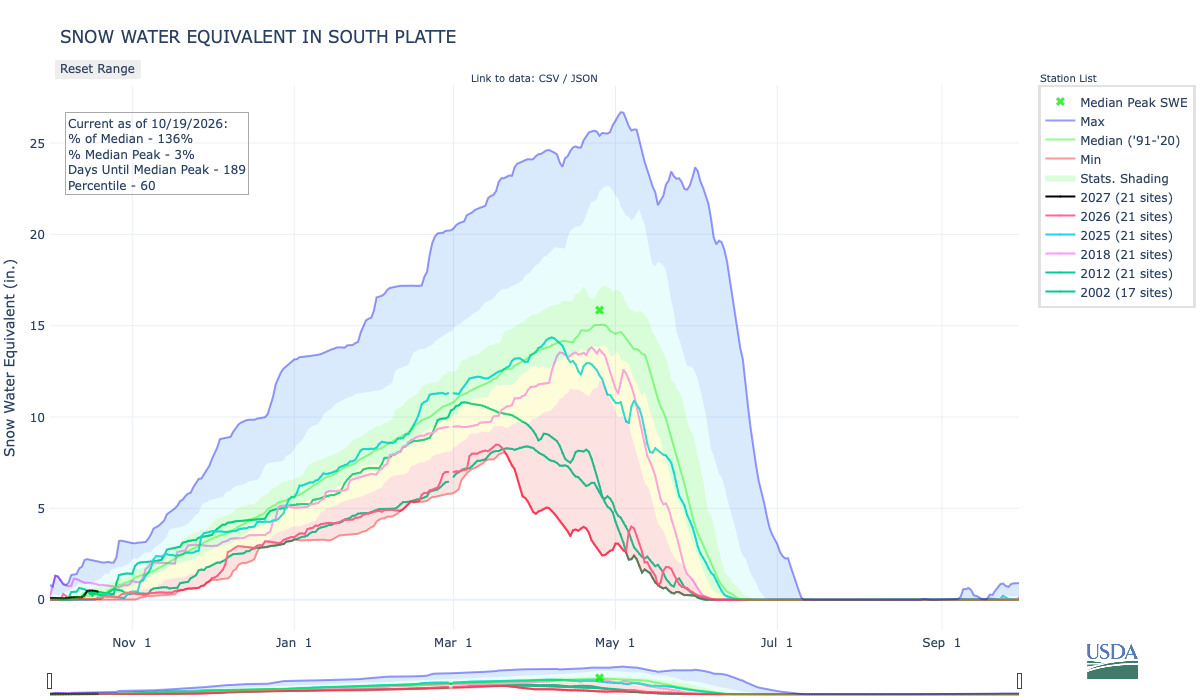
Below is the Snow Water Equivalent in South Platte graph from the NRCS for October 19, 2026. Snowpack is 136% of the median (down 24% one week) and 3% of the median peak (up 2% one week). There was a nice early season bump due to the beautiful storminess last week. There are 189 days until the median peak. I’ve added the lines for 2026, 2018, 2012, and 2002 since the statewide drought is still very pronounced.
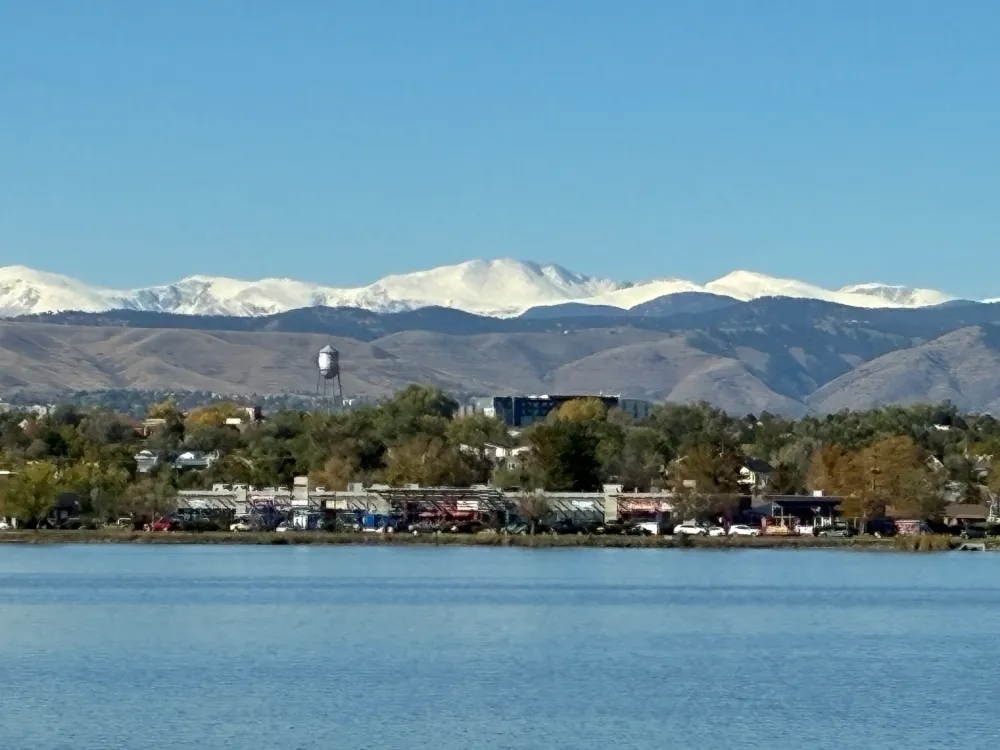
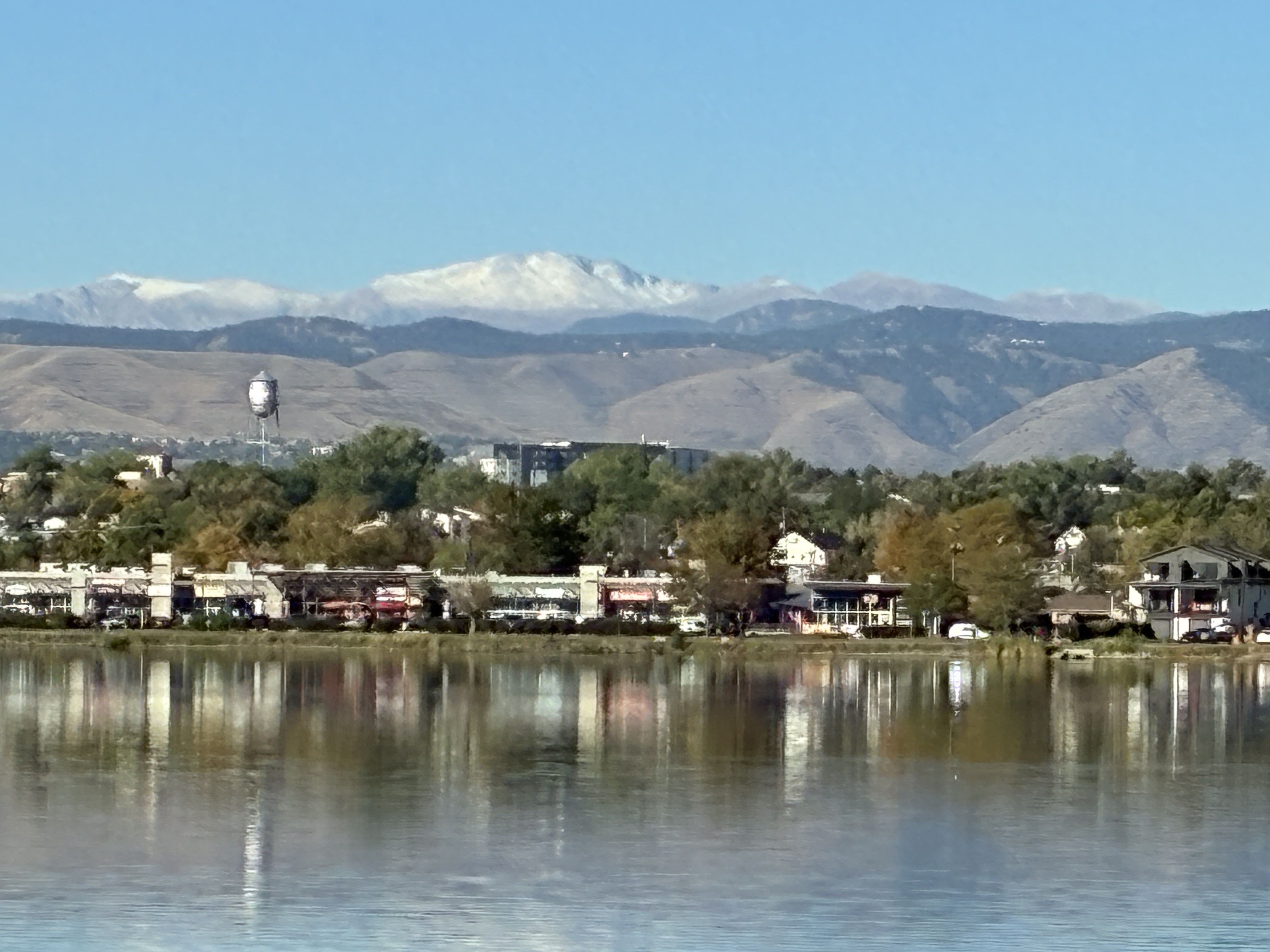
Below is the view of Mount Blue Sky from Sloans Lake in Denver, after the storms last week.
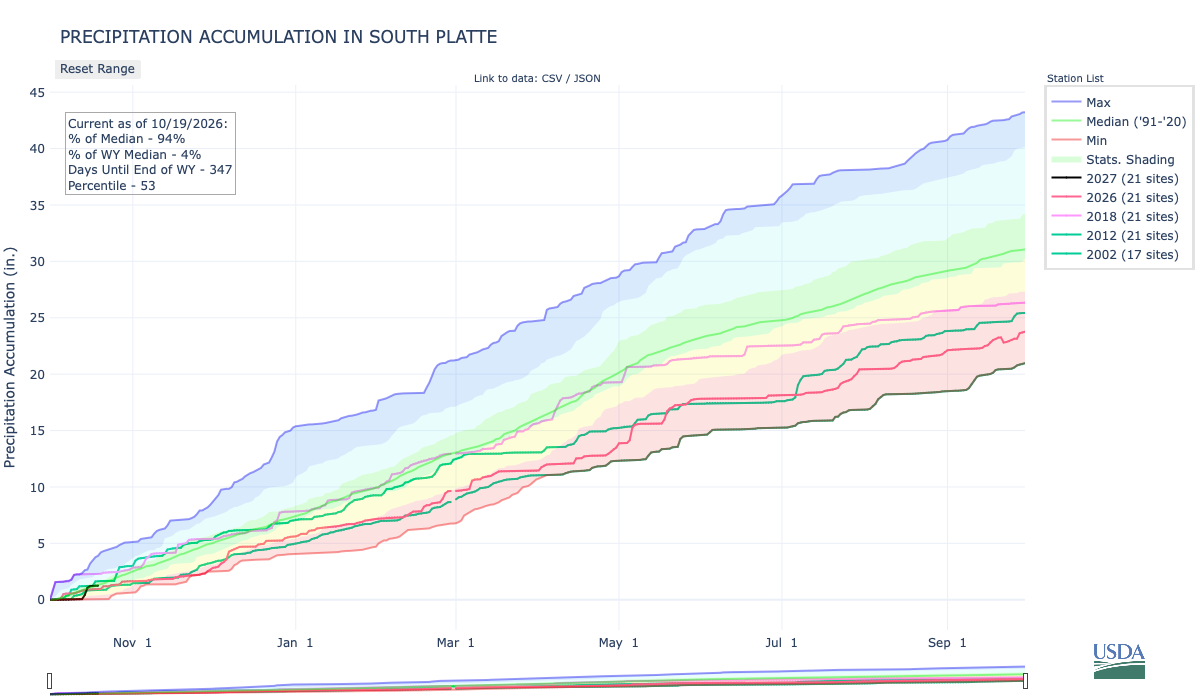
Below is the Precipitation Accumulation in South Platte graph from the NRCS for October 19, 2026. This morning precipitation, at the SNOTEL stations, is at 94% of the median (up 89% one week), and 4% of the water year median (up 4% one week), due to the bump from the beautiful storminess last week. There are 254 days left in the water year. I’ve added the lines for 2026, 2018, 2012, and 2002 since the statewide drought is still very pronounced.
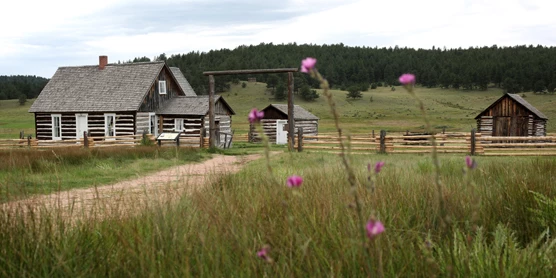
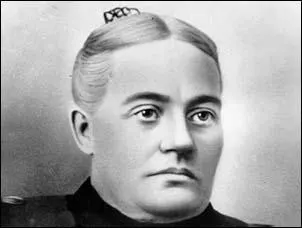
There is a slight chance for showers today, showers are likely Wednesday and Thursday, with a chance for rain/snow Friday and Saturday, in the central mountains. There is a chance for showers Tuesday, Thursday, and Friday, with a chance for rain and snow showers Saturday, in the northern mountains. There is a slight chance for showers Thursday, Friday, and Saturday, down here about 107 miles from Florissant Fossil Beds National Monument near where Adeline Warfield Hornbek settled in the Florissant Valley. From the Nation Park Service:
In 1876, as Colorado celebrated its statehood, Adeline relocated for the last time to an area known as the Florissant Valley. At an elevation of 8500 feet, this alpine valley was covered with large meadows of wild buffalo grass and acres of aspen and pine trees. This was the ideal conditions for a free-grazing cattle ranch. With the help of her neighbors and her teenage children, she built a two-story log house with 5 rooms and a parlor that would be the center of her new ranch. Historically, Adeline would be one of the first women to file a Homesteading Claim in the Florissant Valley and the state of Colorado. Over the next few years, Adeline’s ranch grew and eventually doubled in size. She owned as many as 100 cattle with her own registered cattle brand and employed several ranch hands. As the community also grew, she devoted more of herself to helping the homesteaders of Florissant valley prosper. she helped establish the Florissant school board, which hired a teacher, and built the first school in the area. She opened her home to social events that helped establish Florissant as a successful homesteading community. In 1893, Adeline and other women voted legally for the first time in Colorado. Historians argue that women of the frontier, like Ms. Hornbek, proved they had earned their right to vote. It was not a coincidence that states like Colorado, Utah, and Wyoming were the first to recognize the equality of men and women. Twenty-seven years later, the 19th Amendment gave many women in the United States the right to vote.
Here’s a look at the Colorado 7-Day precipitation map through October 18, 2026 from the High Plains Regional Climate Center. Precipitation in the South Platte Basin along the Continental Divide of the Americas ranged from 0.30” to 1.50″.

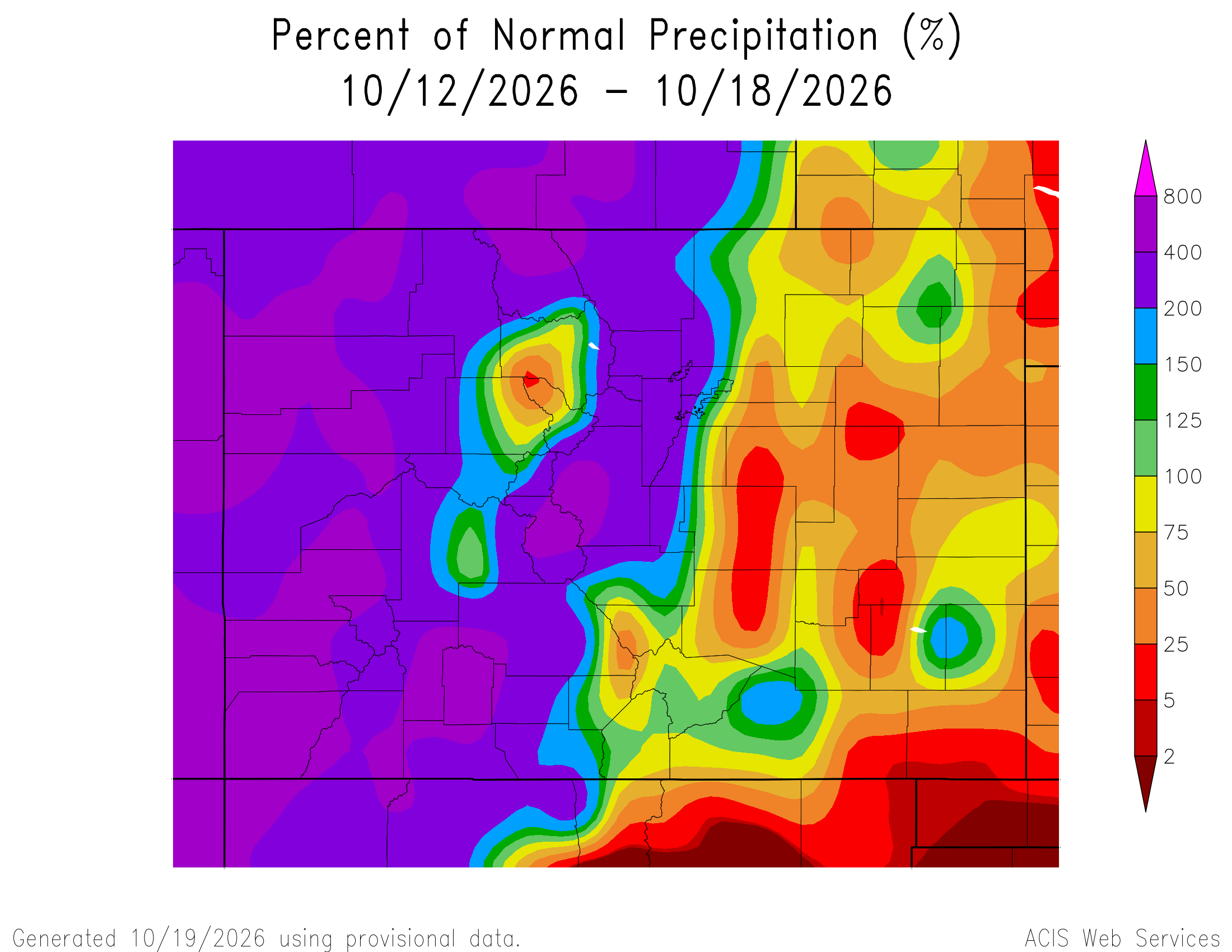
Here’s the Colorado 7-Day percent of normal precipitation map through October 18, 2026 from the High Plains Regional Climate Center. Precipitation in the South Platte River Basin along the Continental Divide of the Americas was 100% to 400% of normal.
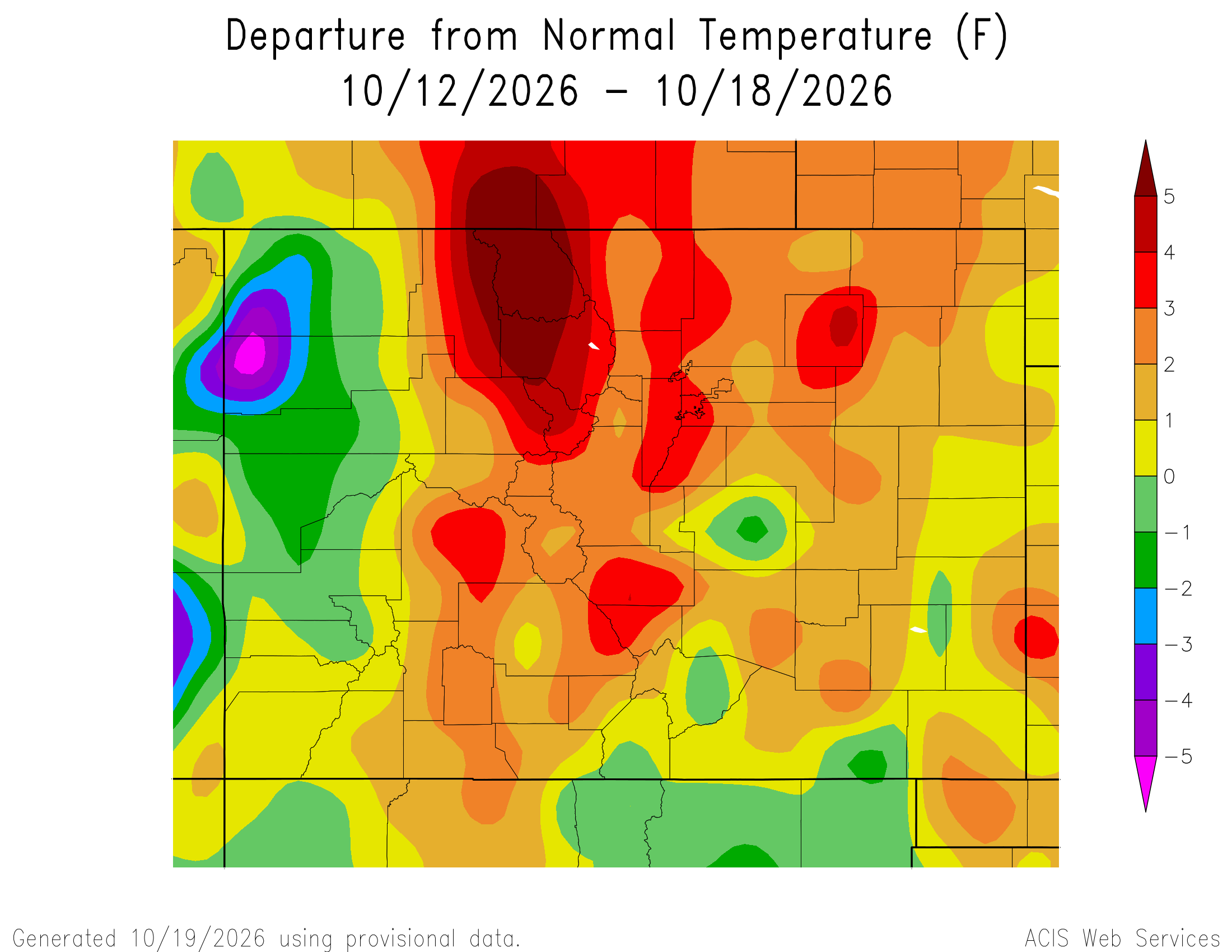
Here’s the most recent 7-Day Departure from Normal Temperature (F) for Colorado through October 18, 2026 from the High Plains Regional Climate Center.
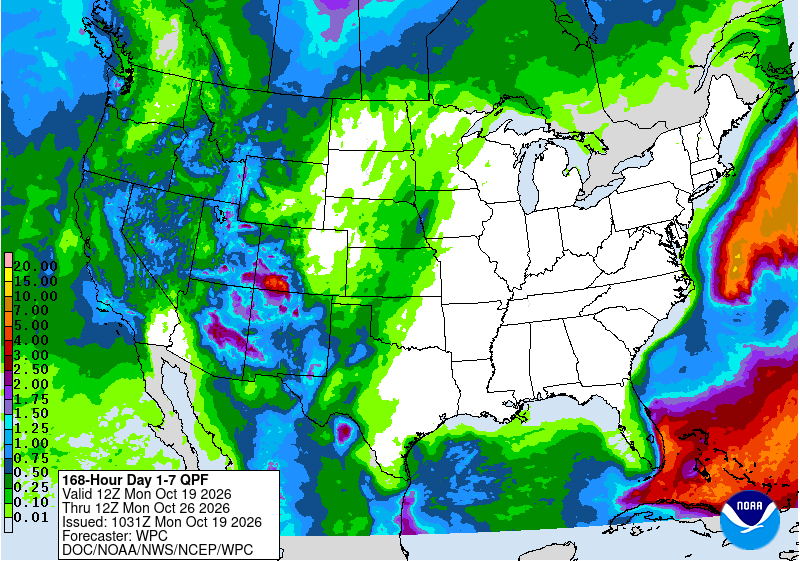
Below is the 7-day Quantitative Precipitation Forecast for the week of October 19, 2026. Precipitation is anticipated for the mountains of the South Platte River Basin and may total up to 0.50″.
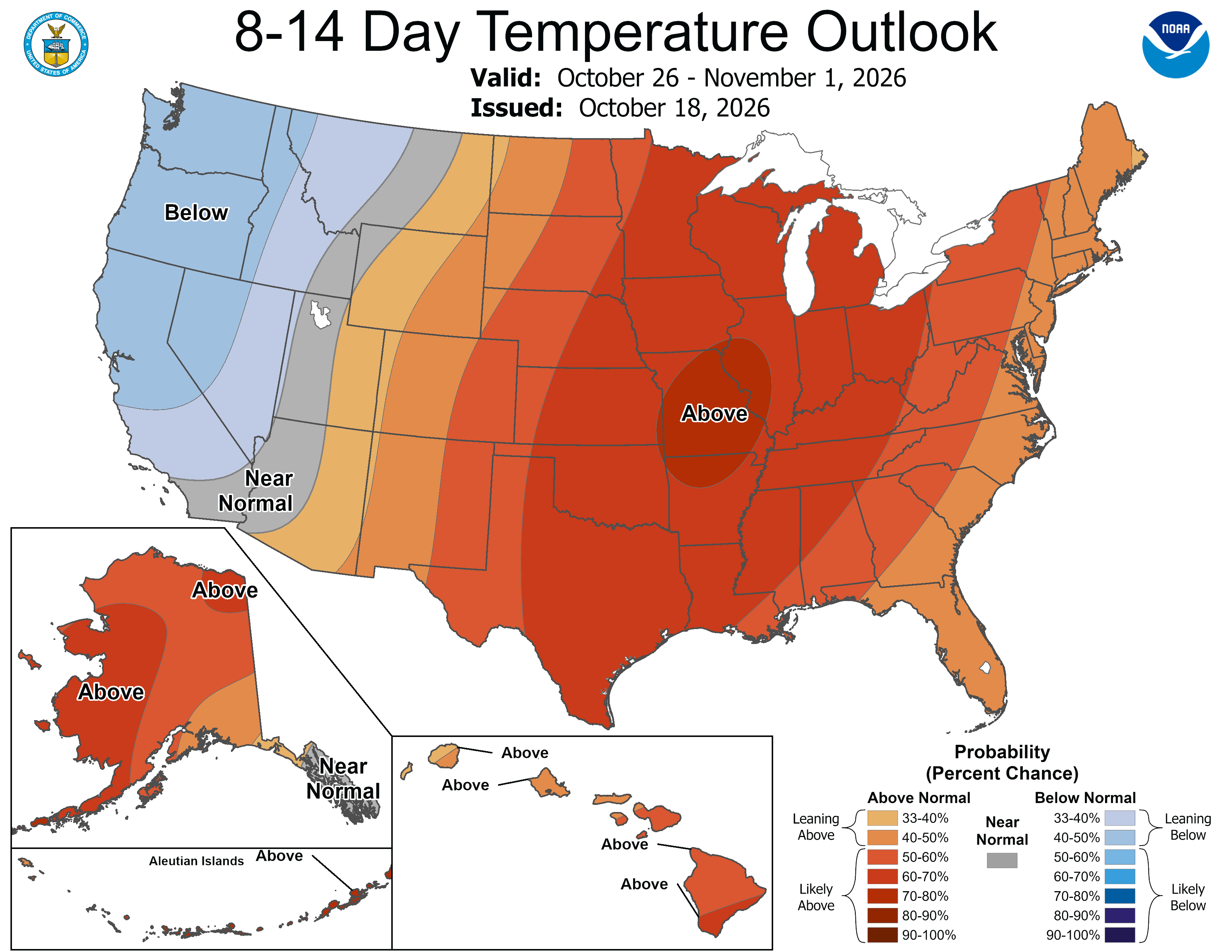
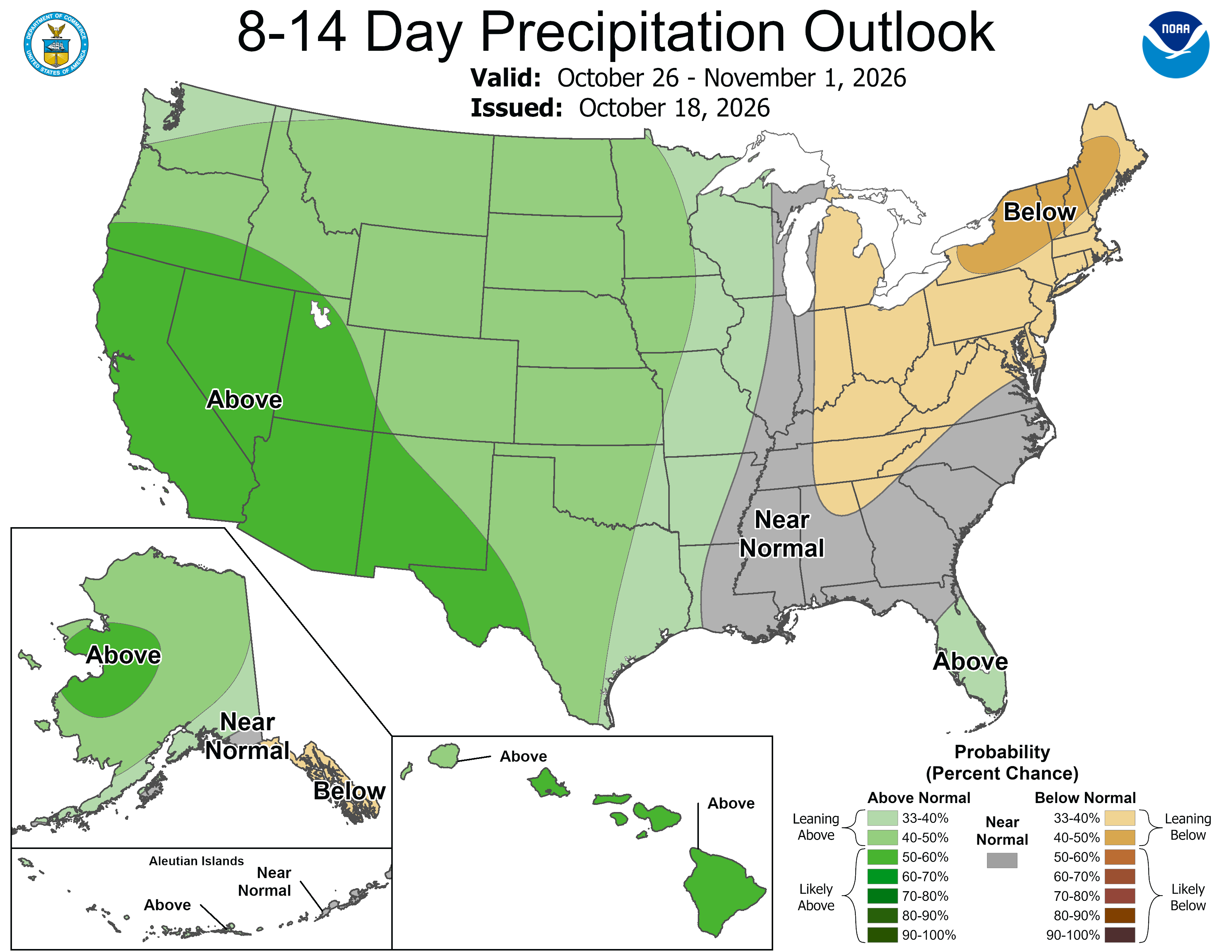
Below are the 8-14 day outlooks from the Climate Prediction Center, issued October 18, 2026, for temperature and precipitation, for the week starting October 19, 2026. The CPC expects above normal temperatures and above normal precipitation for the mountains of the South Platte River Basin.
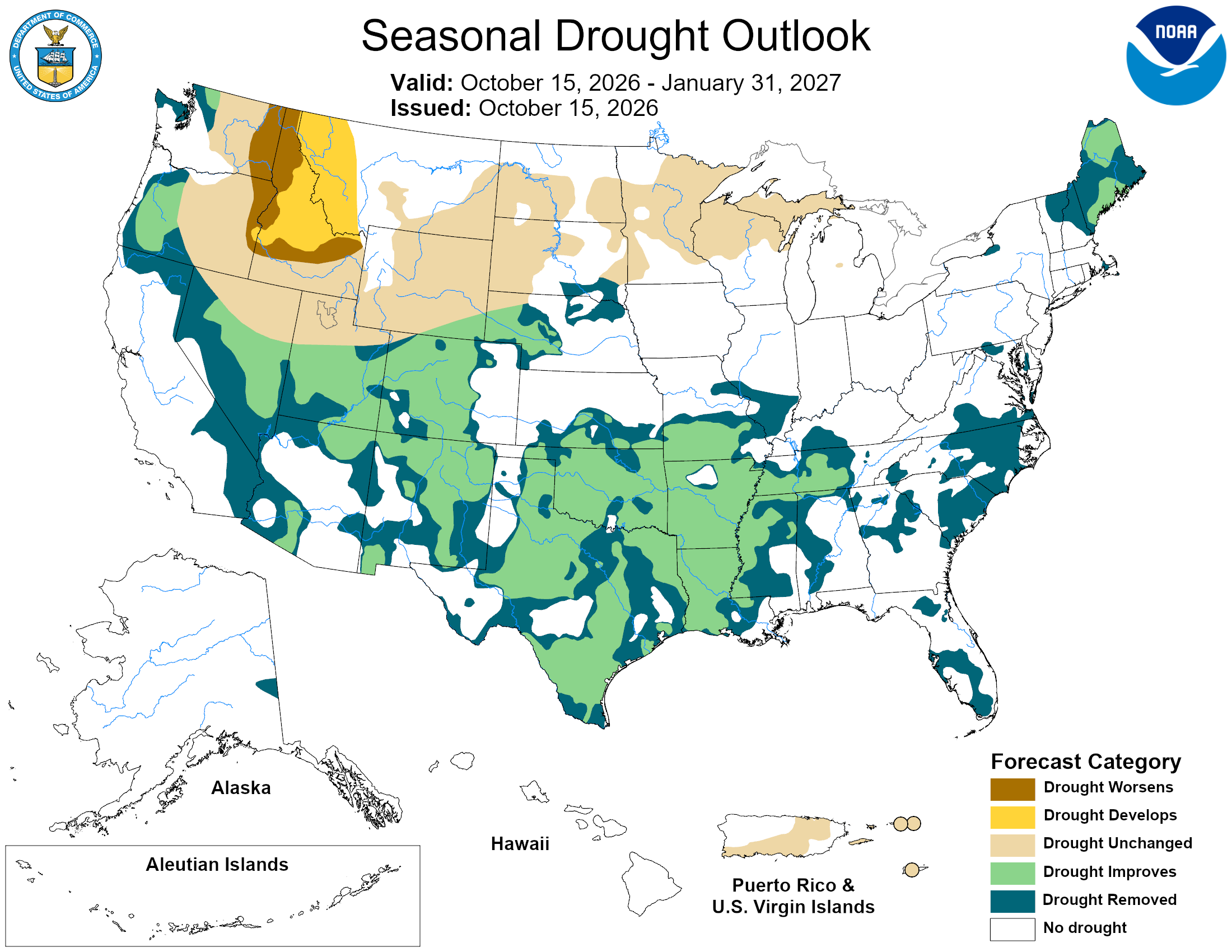
Below is the Colorado Drought Monitor map from October 13, 2026. There was no change in depiction for the South Platte River Basin. Drought and abnormal dryness covers 84.38% of Colorado. The South Platte Basin is experiencing Abnormally Dry, Moderate, Severe, Extreme, and Exceptional drought conditions.

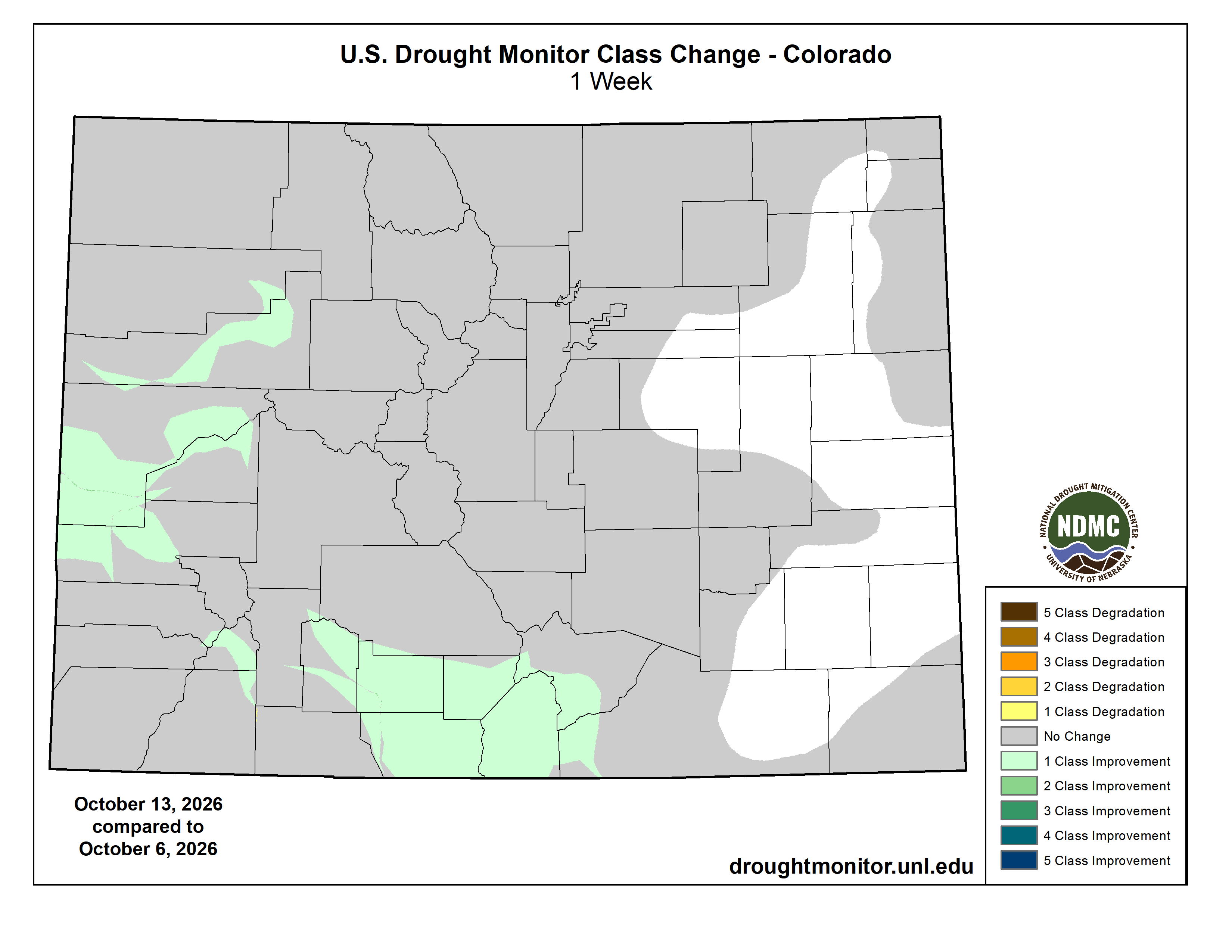
Below is the Colorado Drought Monitor one week change map ending October 13, 2026.
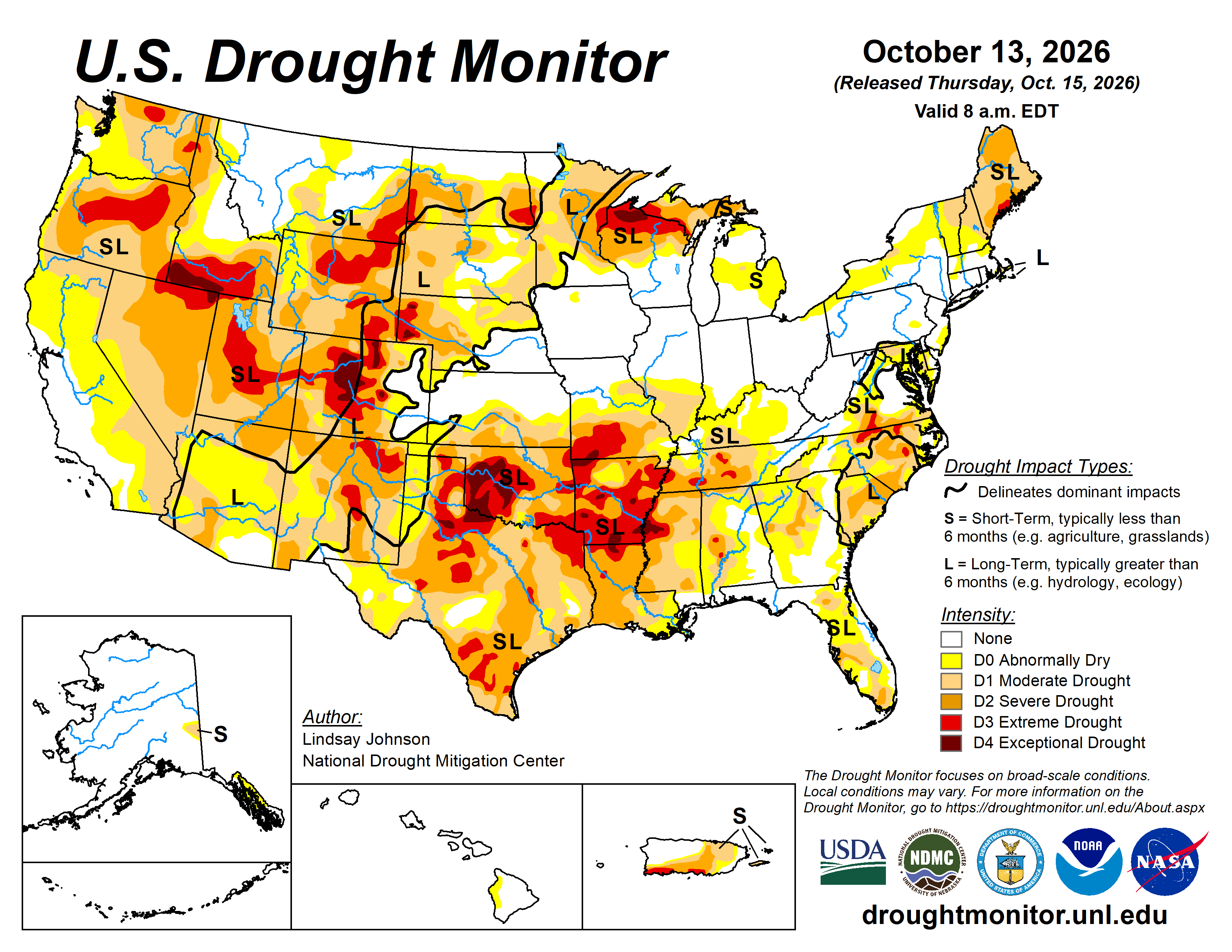
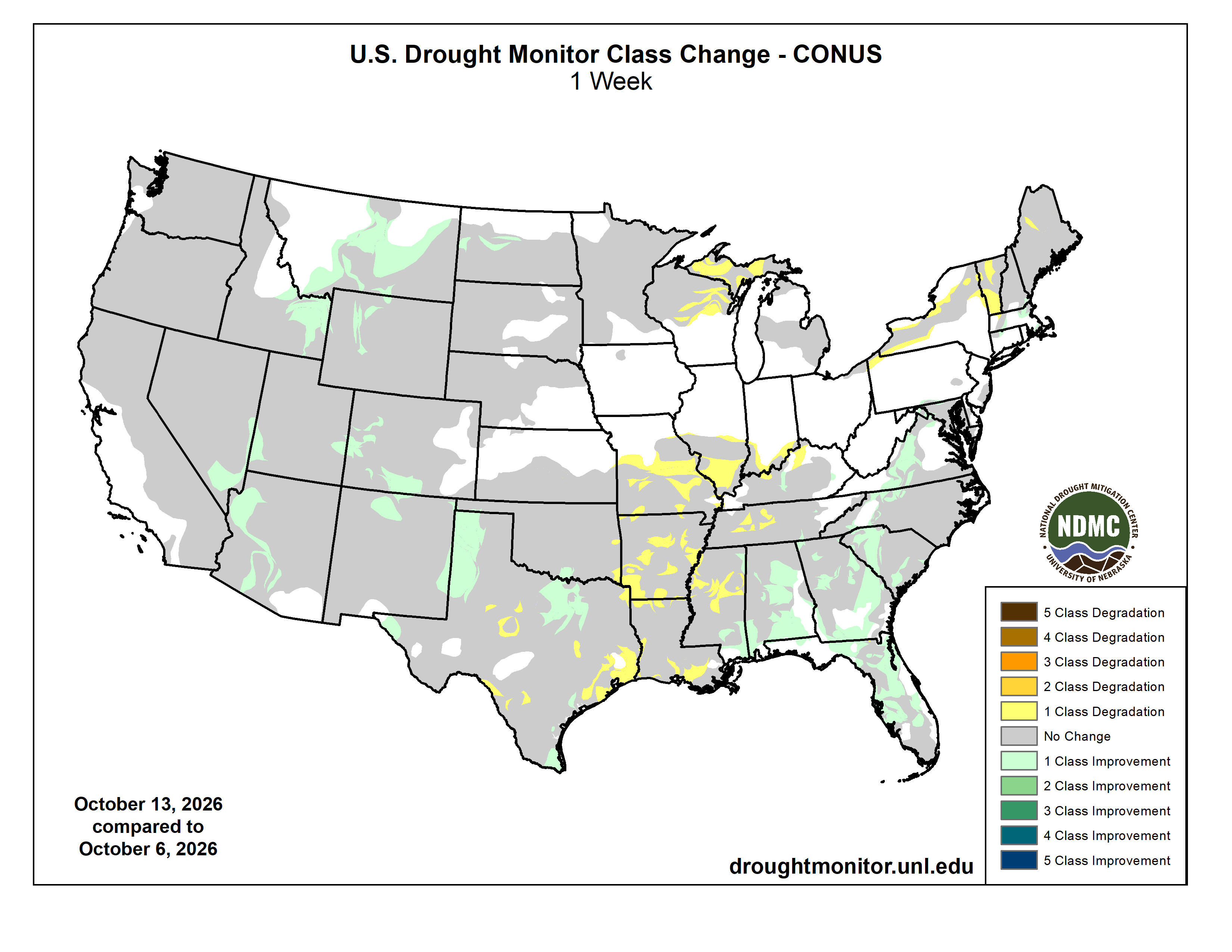
Here’s the US Drought Monitor Map from last week along with the one week U.S. change map.
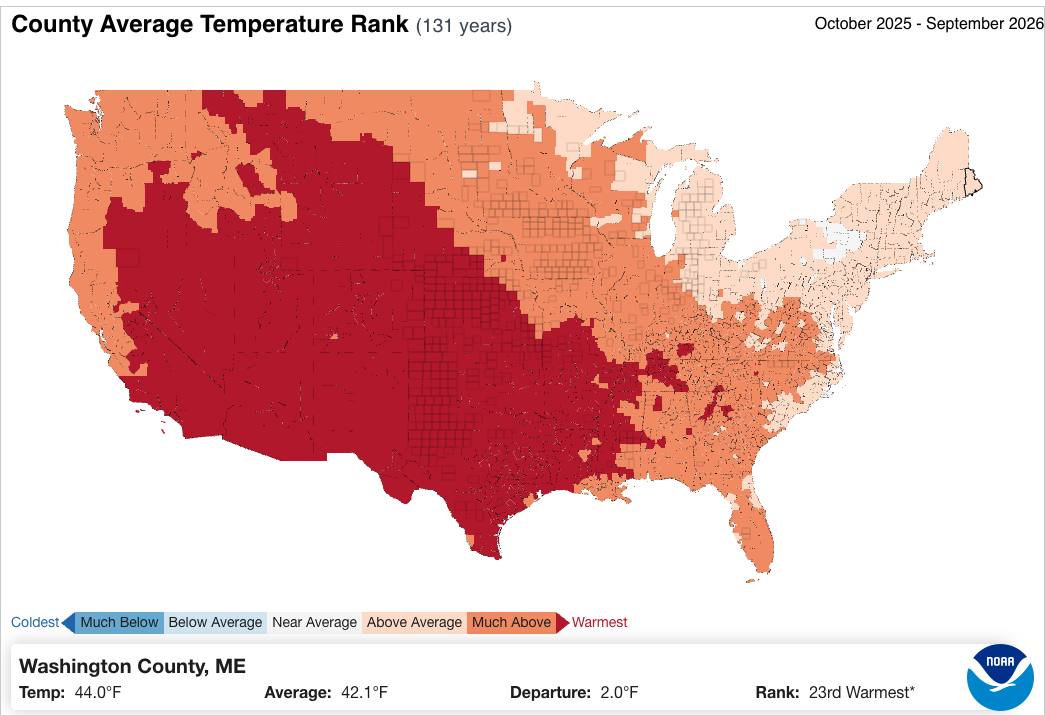
Finally, do you think it’s been warm over the past year? Here’s the County Average Temperature Rank (131 years) for October 2025 through September 2026.
From email from Simon Roebuck:
October 17, 2026
Denver has not recorded any snowfall for the 2026-27 season as of October 17, 2026. The average first measurable snow date, October 19, comes from National Weather Service Boulder records going back to 1882. This WeatherTotals page tracks the current season against that long-running average and updates daily.
By the same date in a typical year, Denver would have seen 2.9 inches of snow. The full-season average for the city is 49.6 inches. The current reading is a station observation from Denver International Airport in the GHCN-Daily network, with quality checks by NOAA. All figures are measured and carry a visible timestamp from WeatherTotals.
Newsrooms can cite any figure on the page with a link back to it and a credit to WeatherTotals (weathertotals.com). The numbers refresh daily, so they stay current through the season. Other cuts of the record, including season-to-date totals and long-run averages for other Colorado cities, are available on request.
About WeatherTotals: WeatherTotals is a free US weather almanac with measured snow, rain and hail totals by state and city from National Weather Service reports, plus aurora visibility by state, an embeddable panel and a free JSON API.
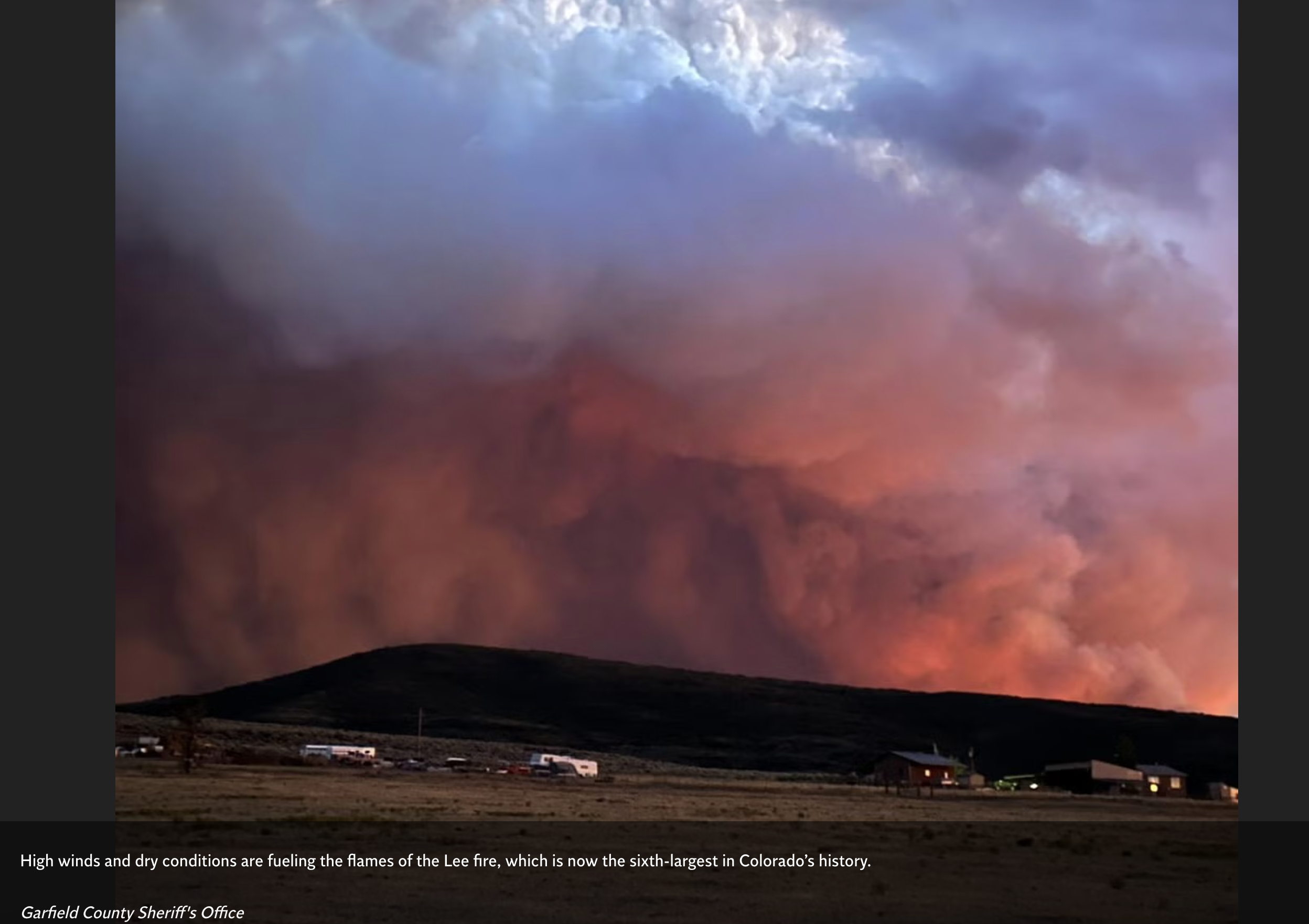
Click the link to read the article on The New York Times website (John Vaillant). Here’s an excerpt:
October 12, 2026
In past years, the U.S. Forest Service’s red-flag warning was sufficient to convey extreme fire risk, but officials this year found it inadequate. In Washington State, they appended a designation typically reserved for life-threatening tornadoes: particularly dangerous situation. This wasn’t adjective inflation — it was a sincere effort to articulate the extraordinary fire conditions that burned nearly 1,000 structures in and around Spokane in August, making it the most destructive wildfire in the state’s history. As of Oct. 5, more than 9 million acres have burned across the United States, the largest area set aflame by this date in more than a decade, and much of the country is still primed to burn. Oregon has declared 2026 the worst fire season in state history. Utah, Ontario, France, Spain, Britain and Belgium have either experienced their worst or are on track to do so. But what’s really striking this year is how many civilians and firefighters across the hemisphere have described lethal combinations of velocity and ferocity. Hundred-meter flames are not uncommon anymore, nor are cyclonic winds with towering fire whirls, corkscrewing skyward like molten ten-story unicorn’s horns. Both phenomena can be precursors for pyrocumulonimbus “fire clouds” — enormous, combustive weather systems that affect entire geographic regions. By growing so big that it becomes a weather system unto itself and so tall that it gyres like a hurricane, effectively controlling the entire air column of a region’s lower atmosphere, the pyroCb, as it’s known, creates optimal conditions for self-perpetuation. Lightning strikes can start new fires 20 or 30 miles beyond the fire’s epicenter, and hurricane-force winds can fan flames to sky-scraping heights while driving embers far beyond any fire break, retardant line or back burn. Simply put, nothing can stop one of these firestorms except a change in the weather or a lack of fuel…
When you place this summer’s fire events alongside persistent drought conditions that have brought water levels to historic lows from western Canada to Siberia, it becomes clearer that severe conditions are playing out across an entire hemisphere. Some might see these as random events. I see a superheated Earth. Add the Asian heat waves that broke 122 degrees Fahrenheit in Xinjiang, China, and “boiled” potatoes in the ground in Yanggu County, South Korea, and there’s no getting around the fact that we — as a species and as a planet — are now living in the future that climate scientists have been warning us about for more than half a century. With these new conditions comes a physical retreat of the human footprint and an aspirational contraction of what humans can do and where we can do it. The contraction is underway not just in terms of coastlines, forests and glacial valleys becoming unsafe or untenable to inhabit, but in terms of previously hospitable spaces becoming uncomfortably hot and smoky. Outdoor activities such as hiking, camping and patio dining have in many places been severely constrained. These impacts are accompanied by a parallel contraction of civic resources: Investment and creative capital previously dedicated to development, expansion and improvement must now be redirected toward repair, recovery and remediation. According to Spokane’s mayor, Lisa Brown, her city’s recovery from August’s fires will take years. Replacing the 16,000 buildings lost in the 2025 Los Angeles fires will most likely take a decade, and the specter of uninsurability looms over the country. Meanwhile, billions of dollars are disappearing from the economy in the form of burned houses and forests, lost wages, lost waterfronts, closed businesses, degraded health and the millions of potential customers who simply decide to stay home because of heat and smoke. Consider, too, how much more we now spend on air conditioning and air filtration. The rawest and most dramatic manifestation of civilizational retreat is mass evacuation during catastrophic fire, and this summer saw some of the biggest ever: Tens of thousands of Americans and Canadians were forced to flee wildfires from British Columbia to Texas. In southern Europe, hundreds of thousands of French and Spanish citizens were evacuated in one of the region’s largest dislocations since World War II, along with many thousands more in neighboring countries. Nepal’s devastating glacier collapse is another ominous indicator: There are dozens of similarly vulnerable communities not just in the Himalayas but also in the Andes, the Alps and the Rocky Mountains.

Click the link to read the article on the KRCC website (Shanna Lewis). Here’s an excerpt:
October 14, 2026
Two wastewater spills totalling nearly 250,000 gallons occurred Tuesday [October 13, 2026] at Pueblo West Metropolitan District’s treatment facility. Both leaks happened during work by contractors to upgrade the district’s ultra-violet disinfection system according to a written release. The bypass system failures involved wastewater at different levels of treatment and disinfection. Water quality testing is underway for Wild Horse Creek and Pest House Gulch, the two tributaries of the Arkansas River affected by the pair of accidental discharges.
Click the link to read the article on the Gunnison Country Times website (Joshua Pike). Here’s an excerpt:
October 8, 2026
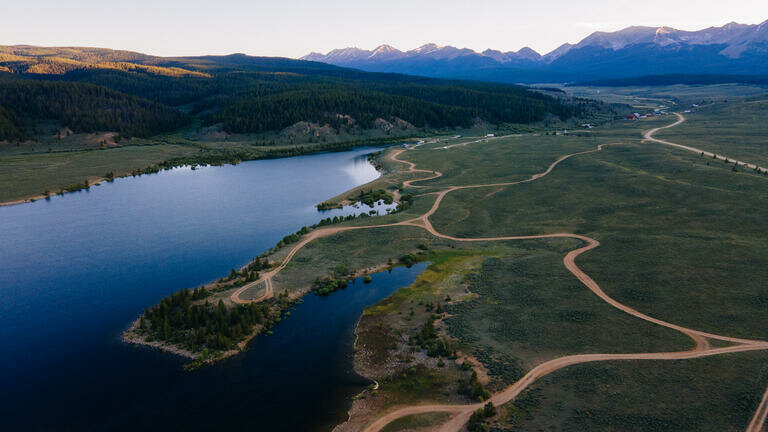
The Upper Gunnison River Water Conservancy District Board of Directors approved lowering the Oct. 31 reservoir level at Taylor Reservoir from 50,000 acre-feet to 48,000 acre-feet at its Sept. 28 meeting. The targeted Oct. 31 water level helps guide releases from the reservoir into the Taylor River downstream, since the level determines how much water is available for release. It also affects how much the reservoir refills over the winter and how much water is available for release the following year. Decisions on reservoir levels and releases are guided by the Taylor Local Users Group, which includes representatives for a variety of recreation interests on the river, irrigators on the Taylor and Gunnison rivers and property owners in the area. Taylor Local Users Group recommendations on releases and reservoir levels must then be approved by the Upper Gunnison River Water Conservancy District, the Uncompahgre Valley Water Users Association, the U.S. Bureau of Reclamation, and the Colorado River Water Conservation District, all of which are signatories to the 1975 agreement that established rules governing the reservoir’s operations…
At the Sept. 28 Upper Gunnison River Water Conservancy District meeting, Don Sabrowski, district president and Taylor Local Users Group chair, explained that, since 2026 is a dry year, the target for the Taylor Reservoir was not to go below 50,000 acre-feet by Oct. 31. According to Upper Gunnison River Water Conservancy District General Manager Sonja Chavez, the district usually aims to keep the reservoir from dropping below 70,000 acre-feet in normal or wet years.

Click the link to read the article on The Pagosa Springs Sun website (Clayton Chaney). Here’s an excerpt:
October 14, 2026
During a meeting held by the Archuleta County Board of Health (BoH) on Sept. 17, the board heard from Water Quality Manager Jessica Green about potential changes to the county’s regulations involving on-site wastewater treatment systems (OWTS). Green commented that the OWTS program “has been pretty overwhelming” for staff since the beginning of the year…Green explained that the inspection ensures the condition of the system is evaluated at the point of a property title being transferred, “which prevents failing systems from being sold without disclosure of risk.”
She also explained that it provides oversight with higher-risk properties through existing exemptions, adding that the state does not define what exemptions are possible and that the county can adjust those exemptions to meet its needs…Green “strongly” recommended that the BoH keep the transfer-of-title program, noting that there is a $115 permit cost associated with the program. She added that if the BoH chooses not to keep the program, there would be a risk that failing systems could be transferred to new property owners without knowing there is an issue.
Here’s the release from Governor Hobbs’ website:
October 16, 2026
Today, Governor Katie Hobbs and the Arizona Department of Water Resources (ADWR) announced the State of Arizona has intervened in a lawsuit brought by Nevada against the Department of the Interior to hold the federal government accountable for failing to enforce Upper Basin water delivery obligations to Lake Mead and prevent cuts of up to 3 million acre-feet per year. In joining this lawsuit, the State will seek to preserve the two-year Lower Basin Agreement while ensuring the federal government is delivering the water to Lake Mead that belongs to Arizona and the Lower Basin states.
“Arizona has always been willing to do our part to protect the Colorado River, but we will not accept a forced federal plan that solves this crisis on the backs of our families, farmers, and businesses,” said Governor Katie Hobbs. “We are drawing a line in the sand. I am taking this legal action alongside Nevada because the federal government refuses to hold the Upper Basin accountable for the water deliveries they owe Arizona, and is threatening to force draconian cuts that go well beyond the Lower Basin Agreement. While we ensure our voice is heard in court, we’ll continue working alongside Nevada and California to implement the Lower Basin Agreement and prevent a devastating cut to Arizona’s Colorado River water.”
“Intervention in the Nevada lawsuit is necessary at this time for Arizona to protect its legal rights to Colorado River water while preserving a path forward to achieving a collaborative outcome with California and Nevada to protect the Colorado River system,” said ADWR Director Tom Buschatzke.
The Lower Basin Agreement is an agreement between Arizona, California and Nevada to protect the future of the Colorado River and prevent forced federal cuts that would slash the Central Arizona Project’s Colorado River allocation by 77% over the next two years. In the Agreement, Lower Basin states commit to conserve over 3.2 million acre-feet in 2027 and 2028 to stabilize the Colorado River system. Finalizing the Lower Basin Agreement remains a priority for the State of Arizona.
Joining this lawsuit ensures that Arizona can protect the State’s interests in any legal outcome and challenge elements of the federal Final Environmental Impact Statement and Record of Decision that unlawfully fail to require deliveries from Upper Basin water reservoirs to Lake Mead. These federal decisions could result in 3 million acre-feet per year in cuts to the Lower Basin states, inflicting devastating water reductions while the Upper Basin States avoid any required conservation.
[ed. The “required conservation” argument is pipe dream. Buschatzke is fixated on the impossible because the Lower Basin has had certainty of deliveries since Hoover dam first filled, while no Upper Basin diverter has ever had that kind of certainty. He fails to acknowledge the difference between mountain rivers, with hundreds of diversions, where most of the water comes from, and desert rivers where there is little precipitation adding to streamflow. The Colorado Division of Water Resources cannot legally force diverters to bypass water and they do not have the ability to shepherd the water to Lake Powell. It is not possible to accurately measure conserved water at this time (apologies to Dr. Parshall). I think the Lower Basin legal position is very strong and they will press the advantage in court which will take a long time to resolve. Meanwhile available water continues to decline and the LB won’t come to the table to negotiate “wet water” vs. “paper water”. The combination of Climate Change and the “Law of the River” drained Mead and Powell, not Upper Basin consumptive use.]
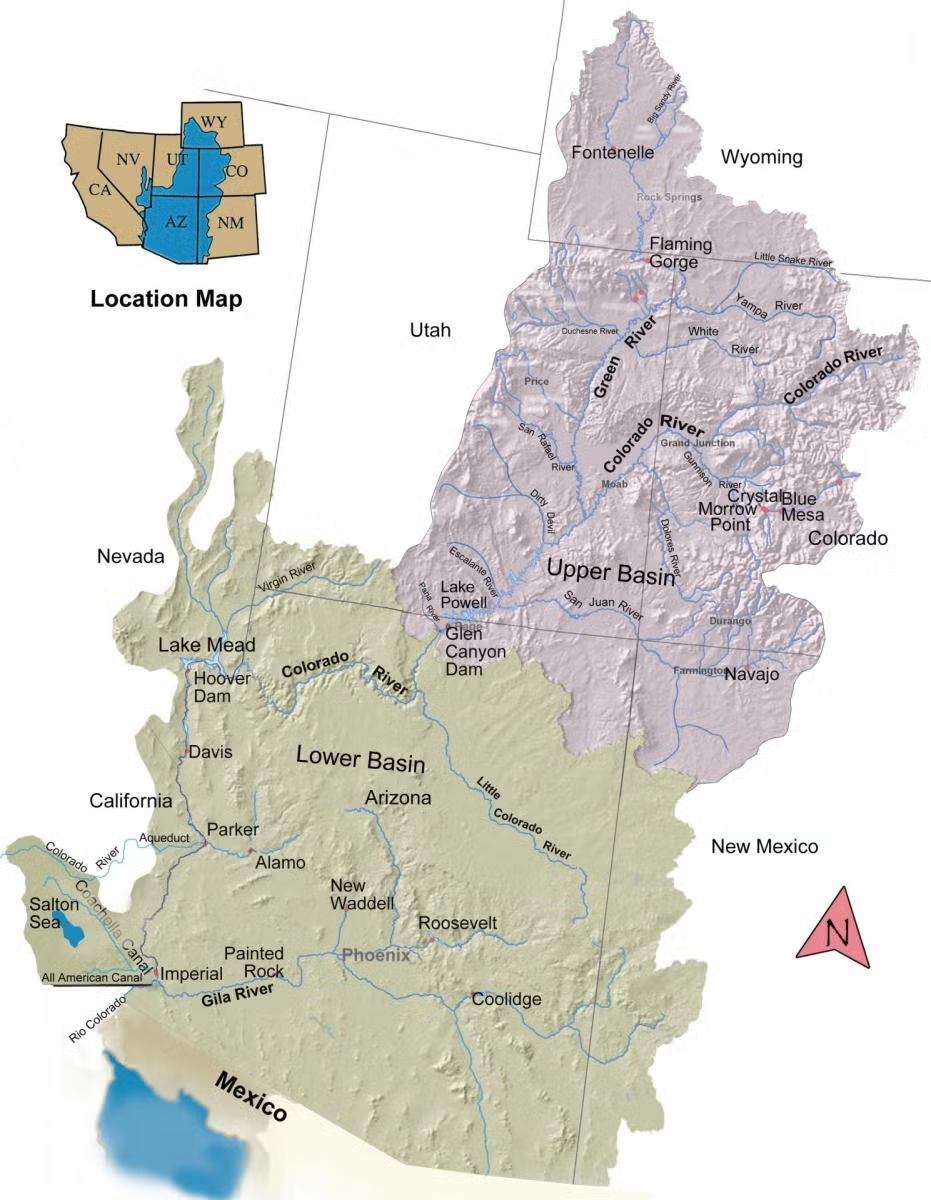
Canyon Records Sessions: Coyote Dances This song is always a lot of fun to play and I play it different every time. Of all the characters; Coyote, the trickster was always my favorite. The stories of Coyote always brought a smile to my face and I still laugh and laugh when my father tells the tales of his mischievous ways. I always envision him dancing under a full moon to this song. Enjoy! — Tony Duncan http://www.TonyDuncanProductions.com #followthenativejourney #canyonrecordssessions #canyonrecords

Click the link to read the article on the Water Education Colorado website (Jerd Smith):
October 15, 2026
Aurora’s proposed Wild Horse Reservoir project, southwest of Denver in Park County, is drawing close scrutiny this fall as it undergoes review under a new state law designed to protect critical wetlands and streams no longer shielded by the federal Clean Water Act.
According to the Colorado Department of Public Health and Environment, Wild Horse represents the first major project to be reviewed under Colorado’s new hard-fought wetland regulations approved in December. They are meant to replace federal rules wiped out by a U.S. Supreme Court case in 2023, Sackett v. EPA, and subsequent actions by the EPA. The CDPHE is responsible for enforcing the new regulation.
Colorado is one of the only states that has succeeded in crafting new rules. That work comes as the federal government continues to narrow protection of wetlands once provided by the Clean Water Act.
“As the federal government continues to roll back [protections], Colorado is going to need to step up. This is an incredibly important milestone for Colorado. All eyes are on this application,” said Sabrina King, water campaign manager for Conservation Colorado, one of the environmental groups that helped craft the bipartisan measure ultimately approved by Colorado lawmakers last year.
The $600 million-plus Wild Horse Reservoir project would store 93,000 acre-feet of water and will be nearly twice the size of the city’s existing Park County storage pond, Spinney Mountain Reservoir, which holds 53,651 acre-feet of water. An acre-foot equals nearly 326,000 gallons of water, enough to serve at least two to four urban households for one year.

The proposed reservoir is among the latest moves by the city to secure future water supplies to meet growth-driven demand as streams and rivers shrink because of climate change.
Aurora Water officials say the reservoir is critical to providing a storage pool closer to the city and that it won’t involve taking additional water supplies from its water in the Eagle River and Homestake Creek. Instead, they say the reservoir will store water they now hold in nearby Spinney Mountain Reservoir, freeing up space to store water it currently owns and uses, but which it doesn’t always have the room to store.
Some of that newly accessible water will be used to help expand Aurora’s large-scale recycled water program, according to spokesman Zachary Henry, helping fulfill its promises to reduce water use even as it expands its collection system.
Still, powerful Western Slope water agencies, including the Colorado River District and the Eagle River Water and Sanitation District, and environmental advocacy group Save The Colorado, have expressed concerns about the proposed reservoir and its impact on the state’s drought-stressed water supplies.
“There is a question if this project involves additional new diversions or are they just moving water that they were already storing and moving in the Homestake Valley,” said Gary Wockner, president of Save The Colorado. “Aurora appears to be claiming that this doesn’t involve new diversion of water, but it is not clear. … The public needs to know.”
Due to these concerns and those of other interested parties, the CDPHE agreed to extend the public comment period to Nov. 19 to give more time for the application to be examined, according to CDPHE spokesperson Kaitlyn Beekman.
Under the new rules, regulators have roughly two years to complete the review process. Aurora officials said they expect construction to take five to six years and that the reservoir is likely to take five to 10 years to fill as climate change continues to shrink streamflows.


Click the link to read the article on the AZCentral website (Branson Loomis). Here’s an excerpt:
September 3, 2026
Key Points
- The CAP board authorized legal action “if necessary” against the Interior Department over its plan to manage shortages on the Colorado River.
- Nevada has already sued the feds over the plan, claiming that it violates the Colorado River Compact and would devastate the Las Vegas economy.
- Arizona lawmakers have set aside money and hired a law firm to sue the federal government, but have not acted yet.
The Central Arizona Project’s board authorized its legal counsel to take legal action “if necessary” against a federal plan to cut Arizona’s share of Colorado River water dramatically in coming years. Board members went into a closed executive session before the Sept. 3 vote to discuss certain “occurrences” that could trigger a lawsuit or other legal filing, and did not specify them when voting unanimously for the authorization. Board member Alexandra Arboleda introduced the motion at the meeting and prefaced it with a statement that the United States Department of the Interior’s 10-year framework for dealing with water shortage “contemplates operations that are contrary to law and devastating to the water users of the Central Arizona Project.”


Click the link to read the article on the Water Education Colorado website (Michael Booth):
September 9, 2026
Aurora Water is in talks to purchase land and water from two of the most historic farms in the Lower Arkansas Valley, adding to farm communities’ worries about “buy and dry” pressure from cities amid historic drought and a dwindling agricultural economy.
But Aurora Water says it has learned lessons from past controversies and is structuring the latest buy-up to preserve southeastern Colorado farm life, not destroy it. Though Aurora Water and the farms say they are in nondisclosure agreements and can’t name the specific sites, Aurora says it wants the contracts to allow the farms to keep some working water every year.
“The farms that have the backing of a city . . . they may be the last farm standing because we have taken a lot of the risk away, or we will be taking risk away that the farmers currently have to struggle with on their own,” said Alex Davis, Aurora Water’s assistant manager for supply.
“I hope that people see the value of what we’re trying to do, and they see that we are really trying to share water with agriculture in a way that allows the city to thrive, and the local community and the agriculture to thrive,” Davis said. “That’s a tough nut to crack, but we think we’re doing it.”
Recent southeastern Colorado water purchases by Aurora Water and other utilities have given the agencies rights to dry up farmland in, for example, three out of 10 years. Many local farmers and water conservancy officials say that casts too much uncertainty on a farm owner’s economic plans. They are also not convinced that farmland can recover after being completely dried up for entire seasons.
Aurora Water says the deals it is negotiating now would be more like taking roughly 30% of the water in a given year, leaving the rest for the family farming to continue every year. That would fallow a similar portion of land to what southeastern farmers already fallow in crop rotations, Davis said. Aurora Water would buy the land and the water rights, and then lease both back to the existing family farm to operate.
Lower Arkansas Valley officials want to see details of Aurora Water’s agreements before judging whether the suburban utility is actually partnering with local farmers, or simply patronizing rural communities in new ways.
“Ultimately, it is up to individual landowners to decide what is best for their farms and their families. At the same time, this situation highlights a much larger issue for Colorado. Farmers need viable alternatives to selling their agricultural water to municipalities as they make decisions about the future of their farms and water rights,” said Jack Goble, general manager of the Lower Arkansas Valley Water Conservancy District.
The district and other southeast Colorado leaders have challenged past farm purchases by Aurora and Colorado Springs as a threat to the local culture and economy. They have demanded that cities and suburbs conserve more water before building more homes, and commit to preserving rural farming and tax bases when making water deals.
“If we want irrigated farming to remain a meaningful part of Colorado’s future, we need policies and conservation tools that allow farmers to benefit from the value of their water while supporting the agricultural economy and communities that depend on it,” Goble said.
Aurora Water says it has agreed to make “payments in lieu of taxes” to keep local communities financially whole in past agreements, and plans to with the new buy-ups as well.
Water officials in southeastern Colorado say they know which historic farms, operating for more than 100 years, are talking with Aurora Water this time around, but did not name them out of respect for the families and the nondisclosure agreements that usually accompany such negotiations.
Eric Hanagan, the family leader of Hanagan Farms in Swink that produces melons, chiles and other produce, said the farm is part of a non-disclosure agreement but did not identify the parties.
When told Aurora Water had said it was negotiating water rights deals that would allow longtime family farms to keep operating, Hanagan said, “Well, it’s important to us, and I think that’s why we have kind of pursued this, an interest in this path.”
Aurora Water says even if it finishes acquisition of additional land and accompanying water rights this year, it will abide by past intergovernmental agreements that say no more than 30,000 acre-feet of water will be taken out of Lower Arkansas farmland each year. The current negotiations with the family farms involve smaller amounts of water than a controversial 2024 agreement Aurora Water made.
That year, Aurora spent $80 million to buy nearly 5,000 acres of farms in Otero County and the more than 6,500 acre-feet of water associated with the land. An acre-foot equals nearly 326,000 gallons of water, enough to irrigate half an acre of corn, or supply at least two urban homes for one year.
Aurora plans to use that water itself in three out of 10 years, leaving it on the farms the rest of the time. Some 4,000 acres of land will be dried up intermittently when Aurora is using the water, according to those who helped negotiate the pact.
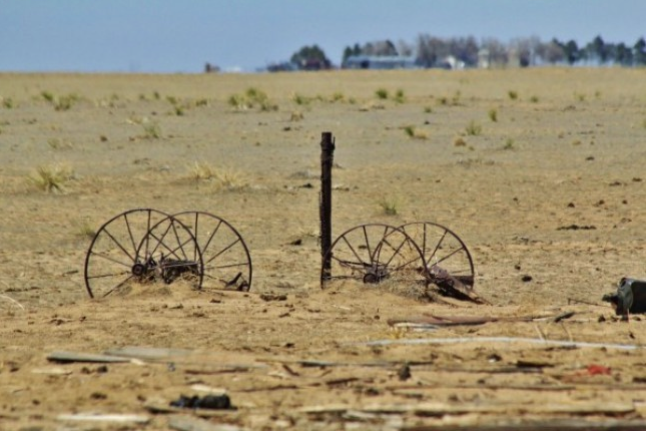
Data shows Colorado’s irrigated farmlands are shrinking. Since 1997, the state has lost 32% of these lands, with areas in the Lower Arkansas Valley seeing losses higher than that, according to an analysis of federal agricultural data by Fresh Water News and The Colorado Sun. Crowley County lost 90% of its irrigated lands in that period. Pueblo has lost 60.2%, and Bent and Otero have lost 37.6% and 35.2%, respectively.
In addition to losing farm tradition, agriculture jobs and tax base for local governments, the transfers of water to cities and suburbs in past decades left dried-up lands unplanted and unreclaimed. Colorado Springs and Aurora have agreed that decades-ago buy-ups were not handled properly, and they claim more recent agreements and a new state law include requirements for reseeding with native grasses and protections against erosion and decline.
Current water purchase negotiations are more realistic, Davis said, about how much of their water the farmers are using in a given year, and how much land is fallowed and goes unirrigated because of longer-term agricultural needs. Alfalfa, a very thirsty crop, is one example, she said. One planting of alfalfa can be harvested for five or more years, but then those fields need to lie fallow for a time before new alfalfa seed is planted.
“I think what a lot of farmers have realized, who would like to participate in the type of deal that we’re structuring here, is that all farmland eventually needs to be fallowed in order to keep the land healthy,” Davis said. “And so if you can have a rotational fallowing schedule that allows portions of the farm to be fallowed on a regular basis, and that’s the water that is moved to the cities, that works better for the farmers, and it works better for the cities.”
Any upcoming deals would not be a strict “30% a year” formula, Davis added.
“Some years, you might only fallow 10% of the farm, 10% of the water. Some years you might move 35% or 40% of the water, and it would be kind of balancing water availability with best farming practices,” Davis said. “We’re looking to prove that a city can really share water with farming operations and keep farms viable.”

From email from ADWR:
October 16, 2026
Today the State of Arizona filed a motion to intervene in the Nevada lawsuit challenging the recent federal decision governing the operation of the Colorado River.
Like Nevada, Arizona believes the federal government’s new operating framework ignores basic elements of the Law of the River and could result in cuts to the state’s apportionment that would devastate Arizona’s economy.
These elements go far beyond and fall outside the Lower Basin Agreement to which we are strongly committed and continue to work with Nevada and California to implement.
Our problems with the federal government’s Record of Decision are twofold.
One: the federal government’s plan fails to deliver the water that Arizona and our fellow Lower Basin states are owed according to the Law of the River.
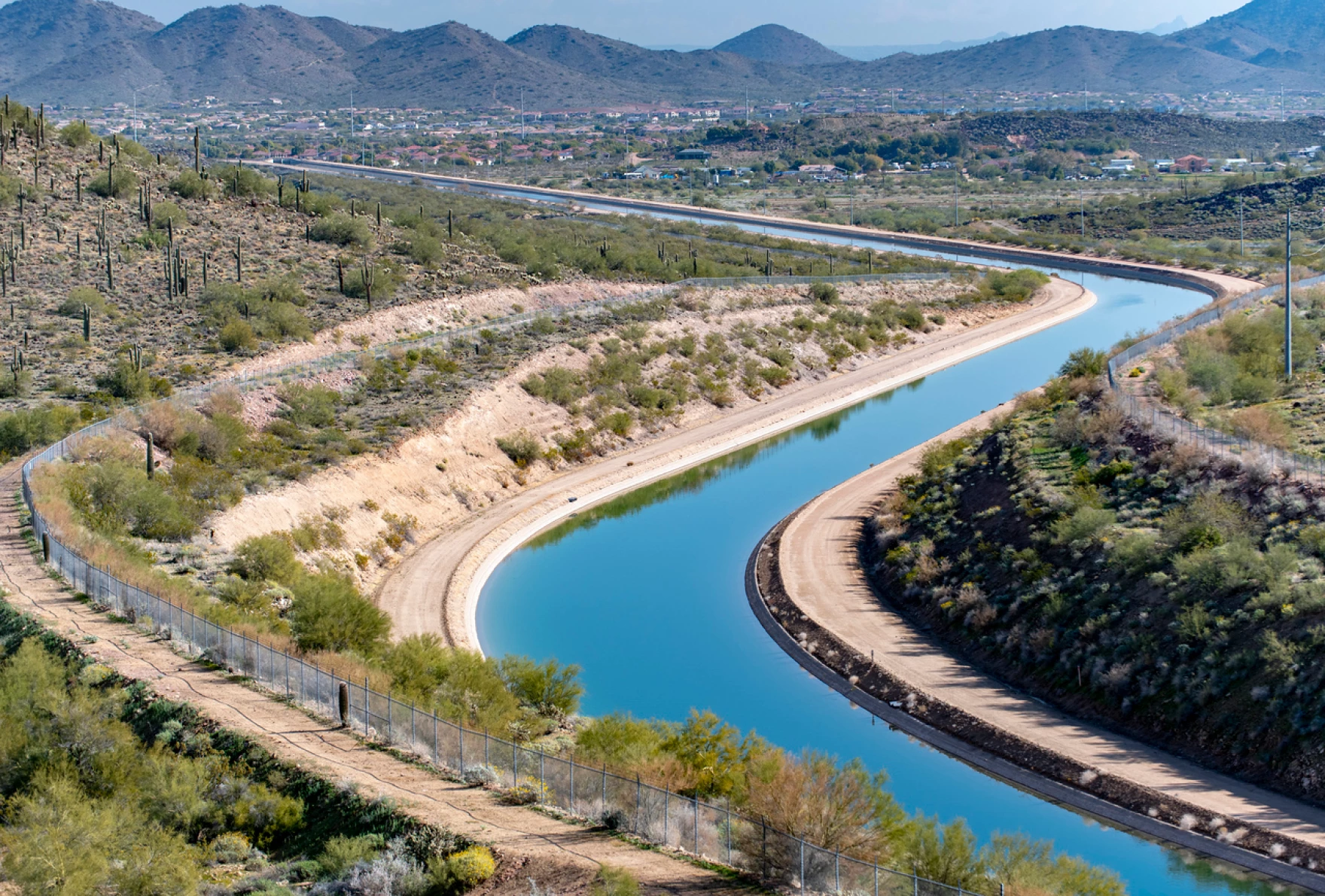
Two: the federal government’s Year 3-10 plan includes a range of “sideboards” that, if triggered, could require reductions to the Lower Basin of up to 3 million acre-feet per year in priority. Such reductions could effectively dry up the Central Arizona Project canal system, as well as many of our on-river communities and would more than double the water cuts agreed to in the Lower Basin Agreement.
Arizona believes that taking this action now provides the best path forward for protecting Arizona water users. We are confident that our negotiations with California, Nevada and the U.S. will move forward. In fact, by taking this step we are protecting the integrity of our Agreement. By joining this litigation we can protect Arizona’s interests, whether that’s before a judge or in any settlement discussions that may ensue.
Arizona’s priority remains the completion of a Lower Basin Agreement with California, Nevada, and the U.S. to share in water reductions over the next two years and to memorialize the Intentionally Created Surplus tool. Through our participation in this litigation we will seek to assure that the agreement is implemented.
The Lower Basin states have contributed millions of acre-feet of water toward stabilizing the river system. With more than 5.5 million acre-feet of Arizona water left in Lake Mead since 2014, no state has sacrificed more. In collaboration with our Lower Basin state partners, the Lower Basin Agreement demonstrates that we are doing more. But the US decision puts the entire burden of sacrifice on the shoulders of three states. We are joining Nevada in challenging that framework.

Click the link to read the article on the Walton Family Foundation website (Ted Kowalski):
September 21, 2026
High in the Colorado Rockies, Grand County lives up to its name. Each year, from elevations of up to 14,000 feet, the snowpack from this formidable range melts to form the headwaters of the Colorado River, whose basin supplies water to more than 40 million people in a thirsty American West.
In 2020, the East Troublesome fire tore through Grand County and Rocky Mountain National Park, scorching nearly 200,000 acres of wilderness and sending sediment cascading into the rivers and reservoirs below.
“In terms of the loss and ferocity of this fire, you almost couldn’t believe what you were seeing,” says Sean Henry, environmental planning manager for Northern Water, the local public agency that manages and delivers the resource.
“We were already in extreme drought, and bark beetles had destroyed 70% of the trees in the years before.”
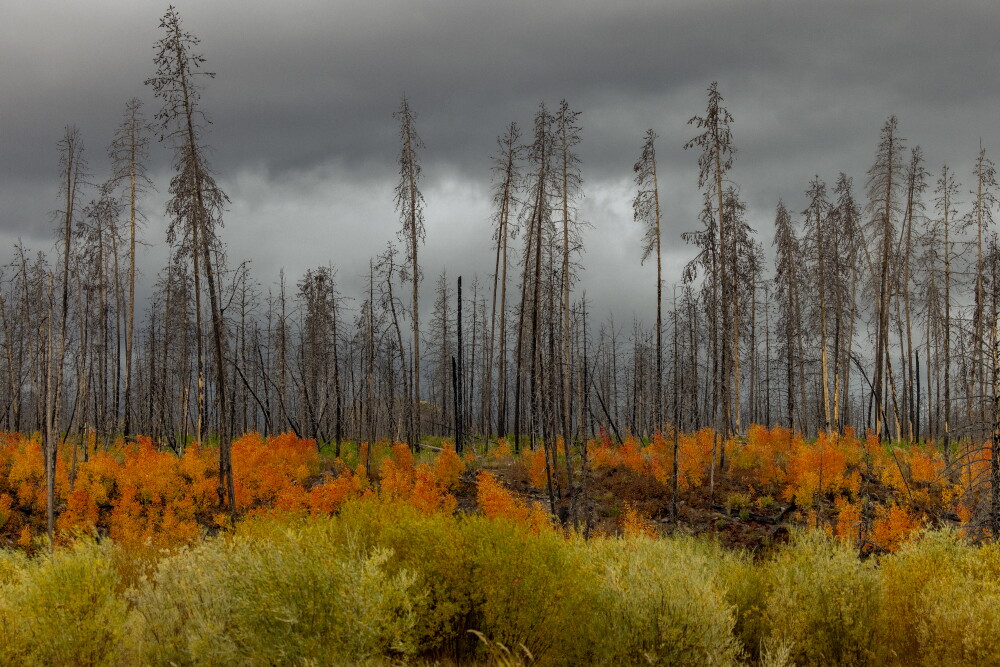
Without water and roots in the soil, the resulting sediment and ash slid right off the burn scar and into the water supply, causing “tremendous water quality problems.”
At the same time, Henry says that the disaster kick-started momentum to find a lasting solution. “There was a huge feeling of motivation. We knew it was time to get to work.”
Today the landscape is being restored in part through work inspired by a critical ally–the beaver.
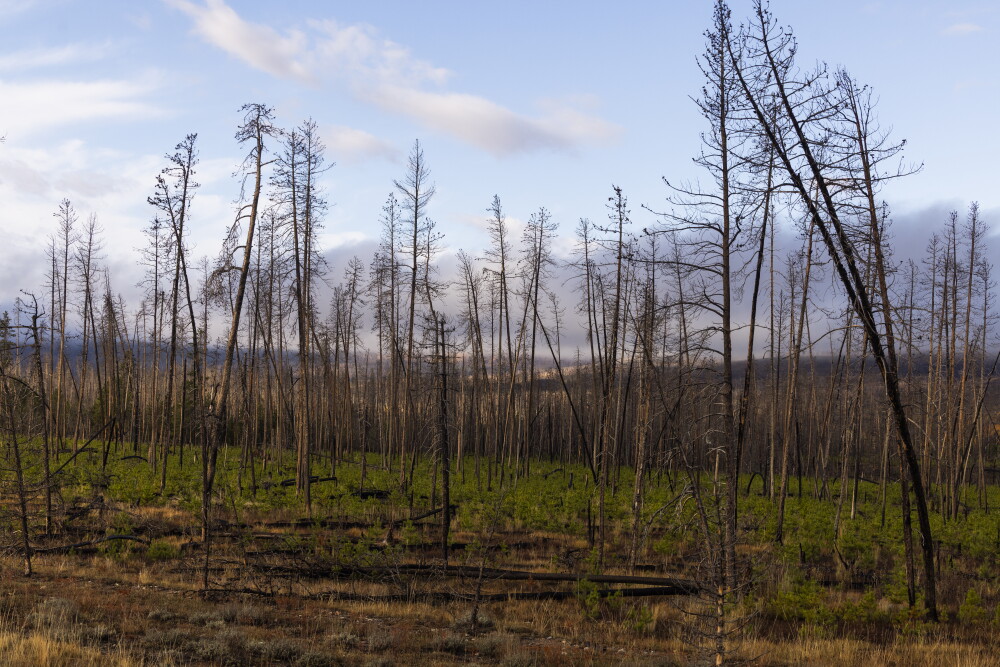
When it comes to regulating water flow, beavers are naturals. Their once-prolific North American population created more than 300,000 square miles of wetland in the United States.
A range of groups including Grand County, Middle Park Conservation District, National Forest Foundation, Northern Water, Three Lakes Watershed Association, The River District, Trout Unlimited and the U.S. Forest Service are supporting strategies to restore the landscape.
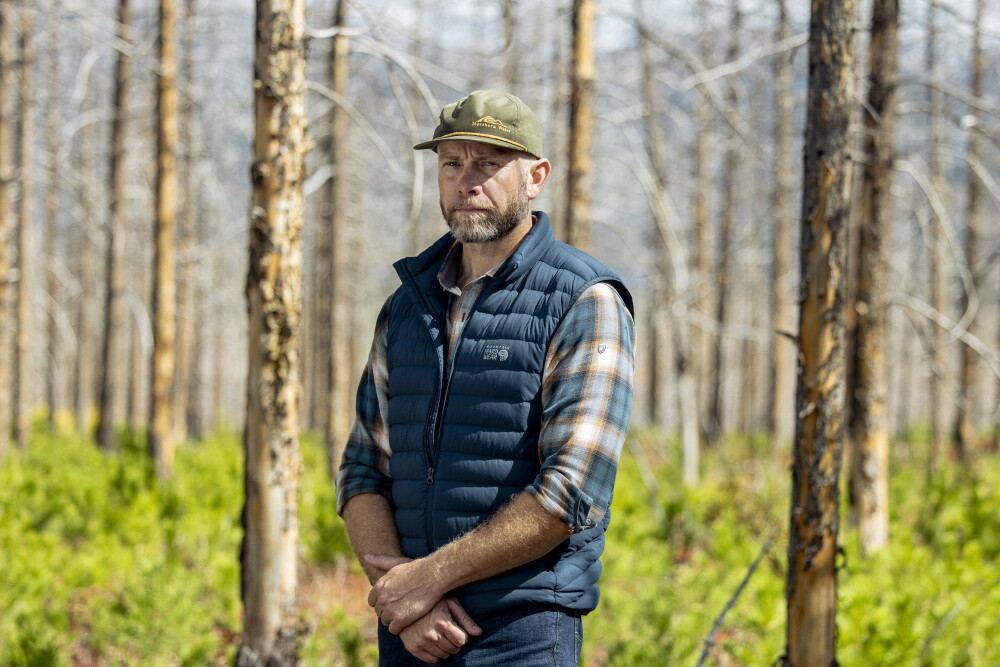
The work includes installing natural structures called Beaver Dam Analogs, Simulated Beaver Structures and Post-Assisted Log Structures within the burn scar. The installations weave wood and soil together to mimic the ecological role of natural beaver dams by slowing down moving water and rehydrating the landscape.
Adde Sharp is a watershed program specialist for the National Forest Foundation, the nonprofit arm of the U.S. Forest Service. She says these low-tech structures act“as a speed bump to the water.”
“When you slow down the flow of water, two things happen,” Sharp says. “One, all of the sediment that the water is carrying is dropped onto the structure, slowly accreting in these deep channels. Once that happens, the water is able to access the floodplain and spread out more and more, nourishing the plant and animal communities around it.”
Adde Sharp is a watershed program specialist at National Forest Foundation. She says low-tech structures that mimic beaver dams help restore water quality by slowing down flows and filtering damaging sediment.
Paired with forest management approaches such as targeted thinning, these efforts are restoring nature’s ability to protect itself from extreme weather, all while providing clearer, sediment-free water for users downstream.
In just a few seasons of work, thousands of tons of sediment from fire runoff is already piling up against the new structures, raising the stream beds in some places by two or three feet. “It’s happening faster than we thought,” says Henry.
In just a few seasons of work, thousands of tons of sediment from fire runoff is already piling up against the new structures, raising the stream beds in some places by two or three feet. “It’s happening faster than we thought,” says Henry. Photo credit: Walton Family Foundation

For Sharp, the work is proof that with a little nudge in the right direction, it’s possible to reverse course on even the most devastating natural disasters.
“I was driving recently, and there are already small trees coming up in the burn scar. The aspen are beginning to change color, like a little pot of gold in the black landscape.”
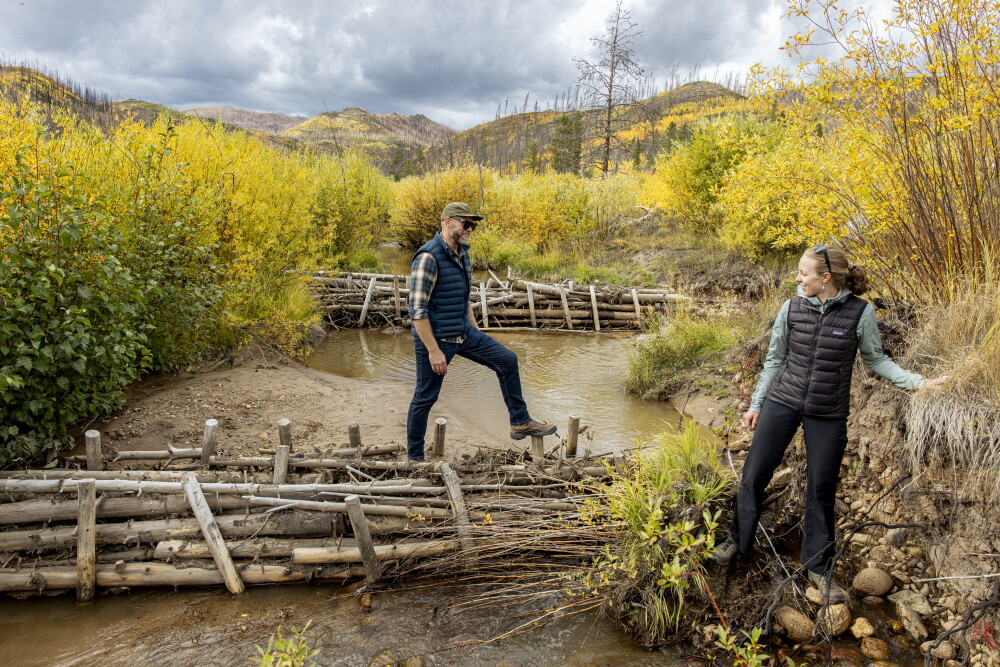
These same strategies are being used in nearby Kawuneeche Valley–not to recover from fire, but to protect against it. Beavers used to thrive in the Kawuneeche Valley, with scattered ponds hydrating the land.
But decades of human impacts and overgrazing by moose and elk depleted the tall willows beavers use both for food and to build their dams. As a result, crucial habitat was lost, beaver populations plummeted, and the land dried up and eroded. This left behind a vastly altered, less resilient landscape.
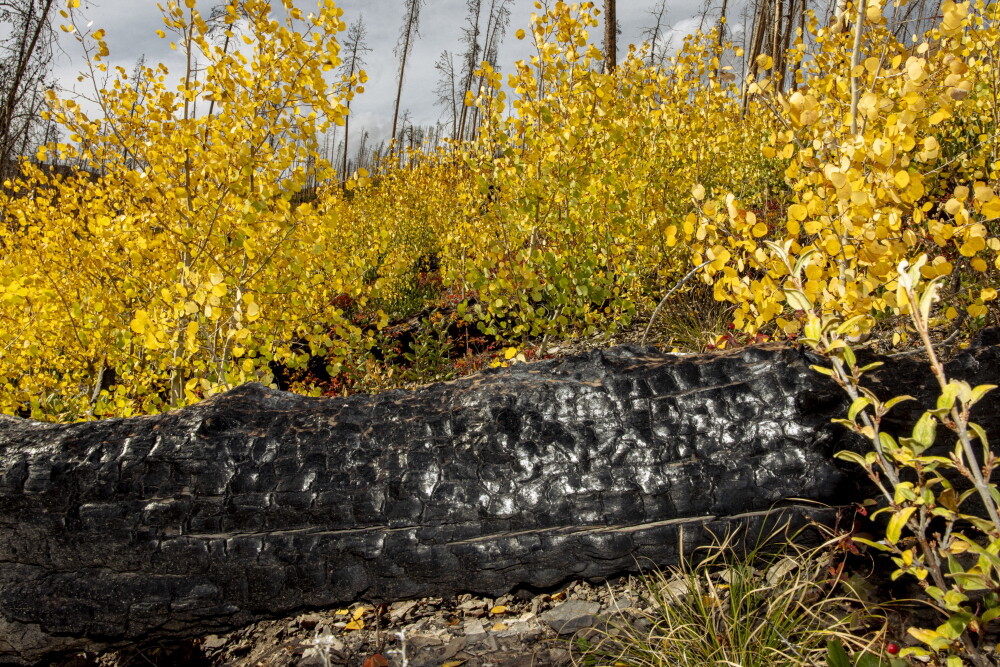
The Kawuneeche Valley Restoration Collaborative was formed as a partnership between Colorado State University, Grand County, National Park Service–Rocky Mountain National Park, The Nature Conservancy, Northern Water, Rocky Mountain Conservancy, the town of Grand Lake and the U.S. Forest Service. The group is working to restore the valley’s natural system to improve water quality, support wildlife and recreational opportunities, and make the area more resistant to future wildfires.
The collaborative hopes that the work will also entice more beavers to return to the valley and maintain the new structures, allowing nature to take the lead.

From email from the City of Fort Collins:
October 15, 2026
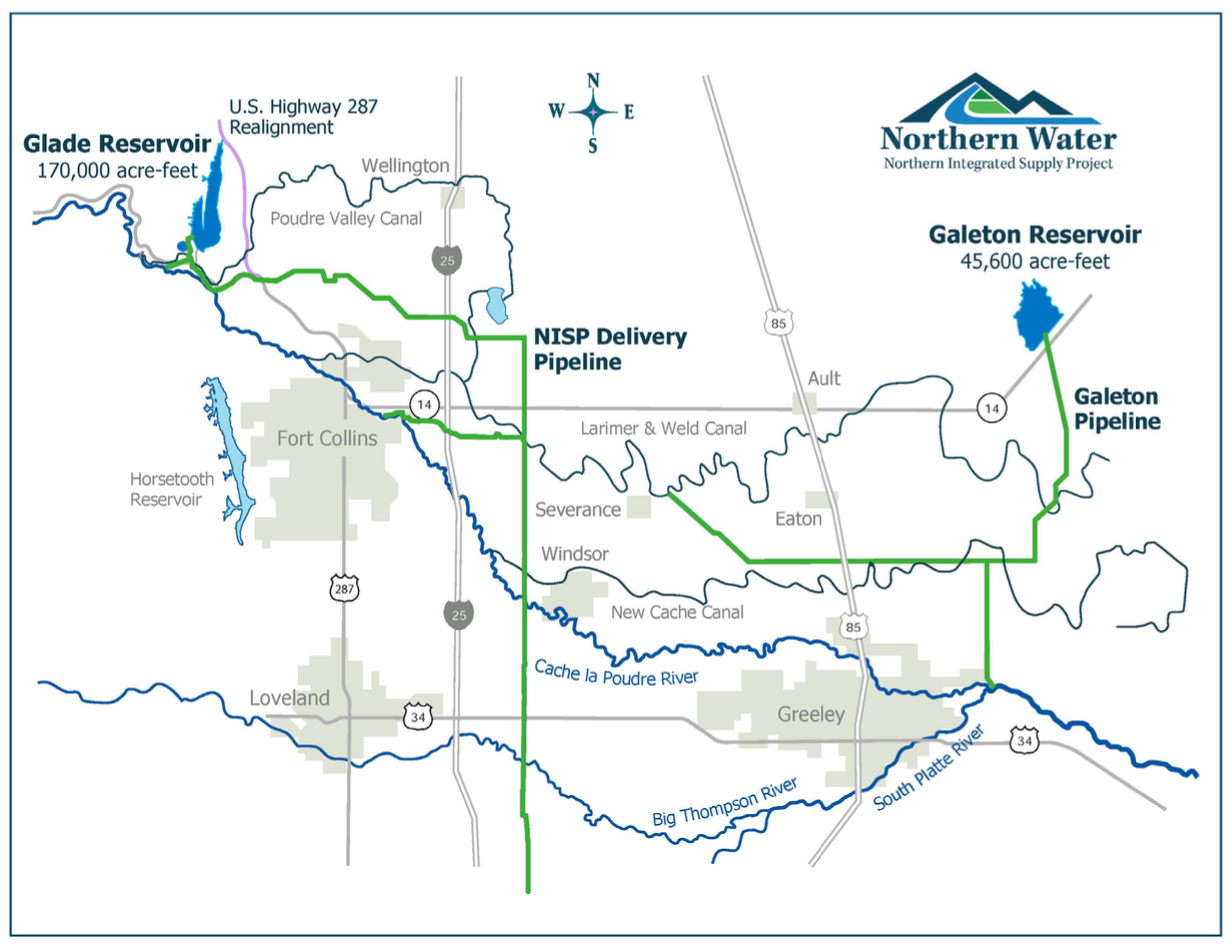
For decades, the City of Fort Collins has been working on the Halligan Project to provide water storage to meet Fort Collins Utilities’ customer demands into the future and provide drought security and resilience. The U.S. Army Corps of Engineers has not yet issued the final permit, and it has become increasingly doubtful the agency will issue an approval. Meanwhile, rising construction and permitting costs have made it increasingly difficult financially. Given these circumstances, the City had a responsibility to investigate other options.
On Oct. 20, City staff will present factors driving a recommendation to City Council to pivot to a different water storage project. Discussion points will include Halligan Project permitting challenges, water storage needs, financial impact analyses, environmental considerations, and overall recommendations to City Council. The City Council materials and agenda will be posted by end-of-business on Oct. 15 at this link.
The City plans to host an informational meeting so community members have a chance to learn what’s next and ask questions. When the date is finalized, we will send another email with the details.
John Paul Helveston, George Washington University
Within three months of the U.S. and Israeli strikes on Iran on Feb. 28, 2026, the average price of gasoline for American drivers climbed from US$2.94 to $4.35 a gallon. If there was ever a moment for Americans to switch to electric vehicles, this was it.
From March to May 2026, in fact, sales of hybrid electric vehicles were 18% higher than over the same months in 2025.
But sales of fully electric vehicles were 16% lower from March to May 2026 compared with the same months in 2025. Some observers took that as evidence that high gas prices alone wouldn’t push Americans toward fully electric cars, but that conclusion misses half the story.
I study car buyers and their preferences, and there is an important distinction between what consumers want and what they can actually buy. Sales reveal what cars people actually bought, but not necessarily what they actually wanted.
When the supply of some kinds of cars can’t keep up with demand, prices rise, and that’s exactly what happened for electric vehicles in 2026.
In 2026, hybrids and all-electric vehicles faced the same jump in demand from the oil crisis. While there were plenty of hybrids available to meet that demand, the same was not true for EVs.
Hybrid production had been growing for years, led by Toyota, which sells about half of the hybrids bought in the United States. As a result, even as sales surged, hybrid inventories on dealer lots were 19% higher in March 2026 than they had been a year earlier.
However, EV production had been in retreat since the tax and spending law President Donald Trump signed in July 2025 ended federal tax credits for EVs. Buyers had been able to get up to $7,500 for new EVs and $4,000 for used ones, but that ended after Sept. 30, 2025.
Automakers responded by cutting back their EV production. General Motors laid off more than 3,400 workers at its EV and battery plants and shifted its Tennessee plant to make batteries for energy storage, not cars. Ford wrote off $19.5 billion from its EV business, ended production of the all-electric F-150 Lightning and converted a Tennessee EV plant to build gas-powered trucks.
Buyers, for their part, rushed to beat the tax credit deadline, pushing EVs to 11.3% of new vehicle sales in September 2025. But by November 2025, after the tax credits ended, their share dropped to 4.3%.
As 2026 progressed and gas prices began to rise, so did EV demand. New EV inventories declined, shrinking from about 130 days of supply in the first quarter of 2026 to 78 days by August – just two days above the supply level of gas-burning cars.
Discounts on new EV models shrank too. My analysis of online listings from marketcheck.com shows the median new EV was listed 9.8% below sticker price in February. By April, the median discount was 6.6%, and 4.7% in June. That’s a sign that dealers saw rising demand, not inventory to clear.
Before the war, prices for used electric vehicles were still drifting down in the wake of the expired used EV federal tax credit. After the war began, they climbed 13% through late June 2026. For a typical used electric vehicle, that’s about $3,500 more.
Other data sources point in the same direction. Recurrent, a company that reports on batteries and used EVs, found that the price of a used 2023 Chevrolet Bolt rose almost 20% from January to June 2026.
And inventories of used electric vehicles dropped too, with only 31 days of supply in May, 23% below the year before.
None of this means the electric vehicle market is healthy. High prices and uncertain access to charging stations are real stumbling blocks for people who are thinking about buying an EV.
But the data doesn’t support the claim that electric vehicle sales stalled in 2026 because Americans don’t want them. Rather, the sales stalled because there weren’t enough EVs available to buy – and there were plenty of hybrids as an alternative.
The distinction matters because automakers have treated a change in the policy landscape as a change in consumer demand, leading to shortages with real costs.
The average new car now sells for about $50,000 and the average new electric vehicle for about $55,000, according to Kelley Blue Book, a company that tracks car prices.
The current situation leaves drivers exposed to the volatility of oil prices with fewer alternatives. The U.S. is the world’s largest oil producer, yet a war in the Persian Gulf raised gas prices significantly in just three months. Oil trades on a global market, so American drivers pay global prices.
Seven months into the war, the pressure on drivers is still going full throttle. Oil was still above $100 a barrel in mid-October, and diesel hit a record $6.52 a gallon on Sept. 22.
Electric vehicle sales haven’t caught up. Argonne’s data show 86,000 of them sold in August, fewer than the 101,000 sold in May, while hybrid sales stayed above 216,000 a month all summer.
Rather than move to increase electric vehicle supply and make them more affordable, federal policy continues to hinder the U.S. electric vehicle sector.
The fuel economy rule released Sept. 28, 2026, loosens efficiency requirements for gas-powered vehicles and in 2028 ends a system that let automakers that beat the standards – mostly EV makers – earn credits for exceeding them and sell those to automakers that fell short. That means automakers will have fewer regulatory incentives to produce EVs going forward.
Regulators say buyers will save $1,289 on the purchase price of a new gas-powered vehicle from reduced engineering and manufacturing costs to make less efficient engines. But the same analysis estimates drivers will spend about $1,600 more on gas over the life of the car, and that’s using fuel price forecasts well below today’s prices. Economists say the administration’s math does not properly account for those fuel costs.

The U.S. has also effectively shut out Chinese automakers, even though nearly three-quarters of the world’s electric cars are built in China. In 2024, Chinese car buyers could choose from over 130 EV models priced under $40,000; American buyers had just four EV models under that threshold. Beyond tariffs of more than 100% on EVs made in China, a Commerce Department rule bars cars from Chinese-linked automakers starting with model year 2027, even if they are built in the U.S. A bill pending in Congress would widen the ban, blocking Chinese investment in U.S. auto factories altogether.
As long as gas stays expensive, the gap between the electric vehicles Americans want and the electric vehicles dealers can sell them is likely to remain. Decisions such as ending the tax credit, rolling back fuel economy standards and banning Chinese technology all make it harder to build them, which means Americans will continue to have fewer affordable electric vehicles to choose from.
John Paul Helveston, Associate Professor of Engineering Management and Systems Engineering, George Washington University
This article is republished from The Conversation under a Creative Commons license. Read the original article.

Click the link to read Marvin Nash’s post on LinkedIn:
Social media is one of the few communication platforms left that allows us to publish true, unfiltered scientific data regarding the success of refining industrial byproduct water—more commonly known as produced water.
Lately, we are seeing more positive coverage from both local and major media outlets. But unfortunately, there is always a “but.”
We cannot eliminate the critics, but we can change the narrative.
For too long, the industry’s response to passion-driven, negative articles—sprinkled with photos of salt on the ground, contaminated streams, or leaking orphan wells—has been to publish another defensive white paper.
It is not moving the needle fast enough.
While political adversaries battle, and NGOs clash with corporate interests, regulatory permits sit delayed. Meanwhile, our biggest collective challenge is being ignored: Stewardship.
We need a bridge, not another debate.
There are currently two US-issued patents that provide a proven, patented process from acquisition to destination for putting industrial byproduct water to beneficial use.
It faces resistance from both sides:
NGOs often push back because this patent provides a viable, structured pathway that actually supports energy production through strict guardrails.
Some in the energy industry hesitate due to licensing agreements or fees.
But let’s remember: innovation and entrepreneurship are what made America what it is today. It isn’t for the faint of heart. Maybe we weren’t missing the desire to do what’s right—maybe we were just missing the link to bring us together.
I often think of Keith Stelter’s passion to clean the roads (now the Stelter Initiative). Let’s put our call to Stewardship 1st . Let’s define Fit For Purpose 2100, and as I was recently challenged to add: Fit for YOUR Purpose. You now have a new tool in the toolbox besides a white paper. You have a proven process.
What do you have to lose by trying it? #Fit For Purpose 2100
#Sustainability #ProducedWater #WaterStewardship #EnergyInnovation #EnvironmentalSolutions #CleanTech
Click the link to read the article on the Ink Stain website (John Fleck):
October 13, 2026

2026 provided a remarkable convergence of a natural experiment on New Mexico’s Middle Rio Grande (a river and therefore irrigation system with little or no water) and the rapid advancement of what I’ve come to think of as “Curiosity Exploder Tools” (CETs, also more commonly known as LLMs or AI).
We’ve got European Space Agency satellites flying overhead every five-ish days hoovering up data, Google Earth Engine processing power in “the cloud,” and now tools like Codex and Claude Code to handle the fiddly bits of code writing, driving down the transaction costs of asking a question by orders of magnitude.
So I wondered: With little or no Middle Rio Grande Conservancy District ditch water for non-Prior and Paramount Pueblo land this year, what happened? As Robin Sloan said, “‘Ask for what you want’ is a key skill for the 21st century.”
We don’t have meters on irrigated land in the Middle Rio Grande, so remote sensing is the best we can do.
This uses MRGCD’s spatial mapping of irrigated parcels, with Normalized Difference Vegetation Index (NDVI), a measure of plant greenness, using observations from the European Space Agency’s Sentinel-2 satellites. 10 meter resolution roughly every five days. “Green” here is not an either/or, it’s a more-or-less thing. I chose an NDVI cutoff based on a reading of 0.45, benchmarked against an MRGCD dataset from 2021 of parcels either irrigated or fallowed. The cutoff is arbitrary (but sane based on my 2021 control set), the relative scale is what matters.
The satellite can’t tell us the difference among ditch water, wells (both irrigation and domestic), municipal water, and trees with their roots in the shallow aquifer. But as I wrote with a group of colleagues earlier this year, “Agencies don’t use water, people do.” All four can be present on these parcels. I checked precipitation, it’s not throwing off the numbers.
I’ve now got a stunning set of maps of this on my hard drive – MRGCD non-Pueblo land by division and sub-section, year by year – a record of how people are greening the valley ditch by ditch and parcel by parcel. As Robin Sloan said, ask for what you want. Curiosity Exploder Tools.
However you interpret it, the satellite data suggests a significant reduction in 2026 consumptive use of water on these parcels, a remarkable water conservation success story, if you will.
n.b. “Study” design by John Fleck in conversation with Claude Code, data processing pipeline by Claude Code with Google Earth Engine analysis.

Click the link to read the article on The Land Desk website (Jonathan P. Thompson):
October 12, 2026
Note: I started writing this as the intro to today’s Newswire. Then it occurred to me that today is Indigenous Peoples Day, and some other holiday for certain cultures, and folks probably aren’t going to be into reading the news. So here’s a little impression of the current storm soaking parts of the Southwest, and some photos.
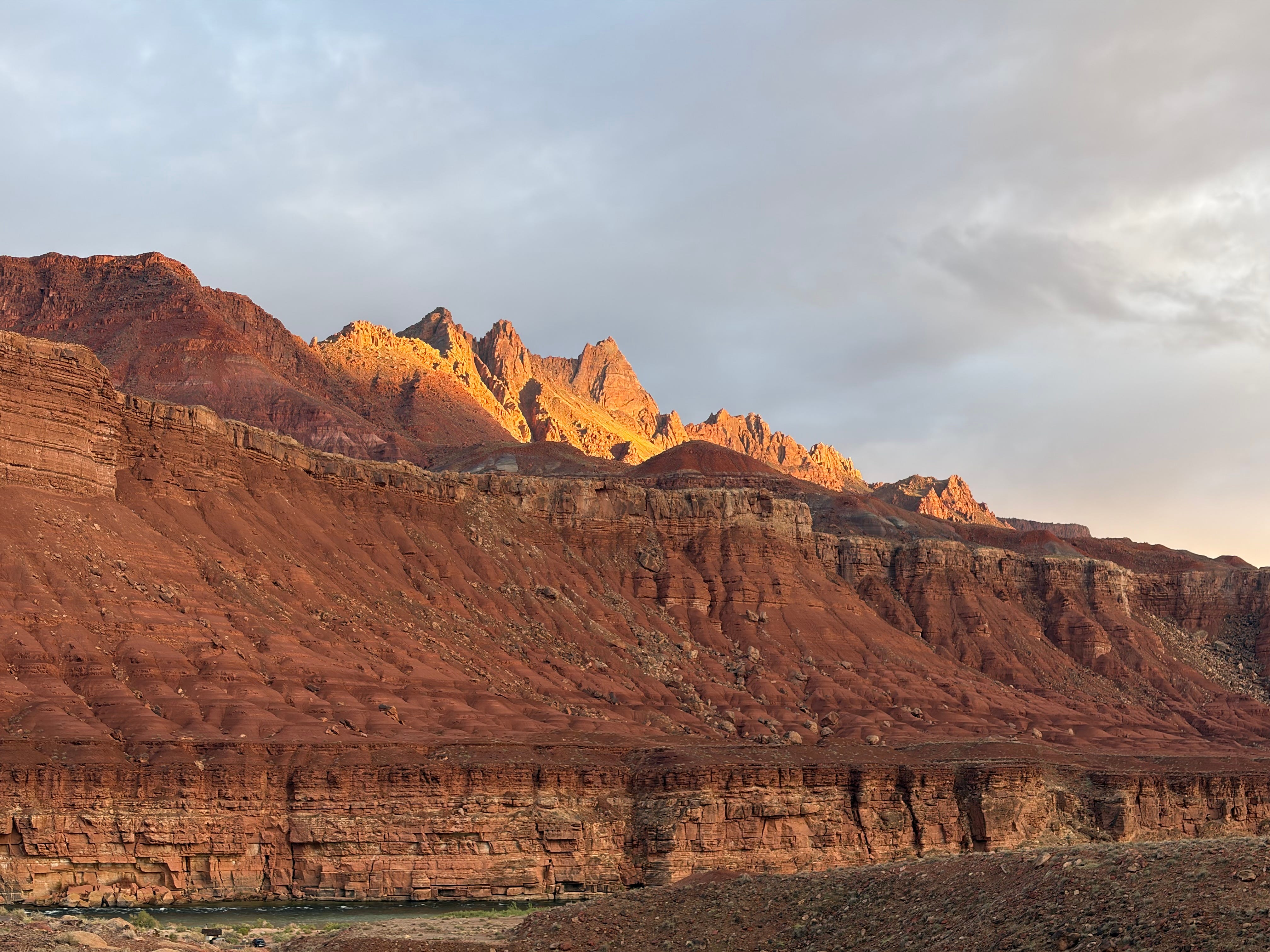
10/11/2026
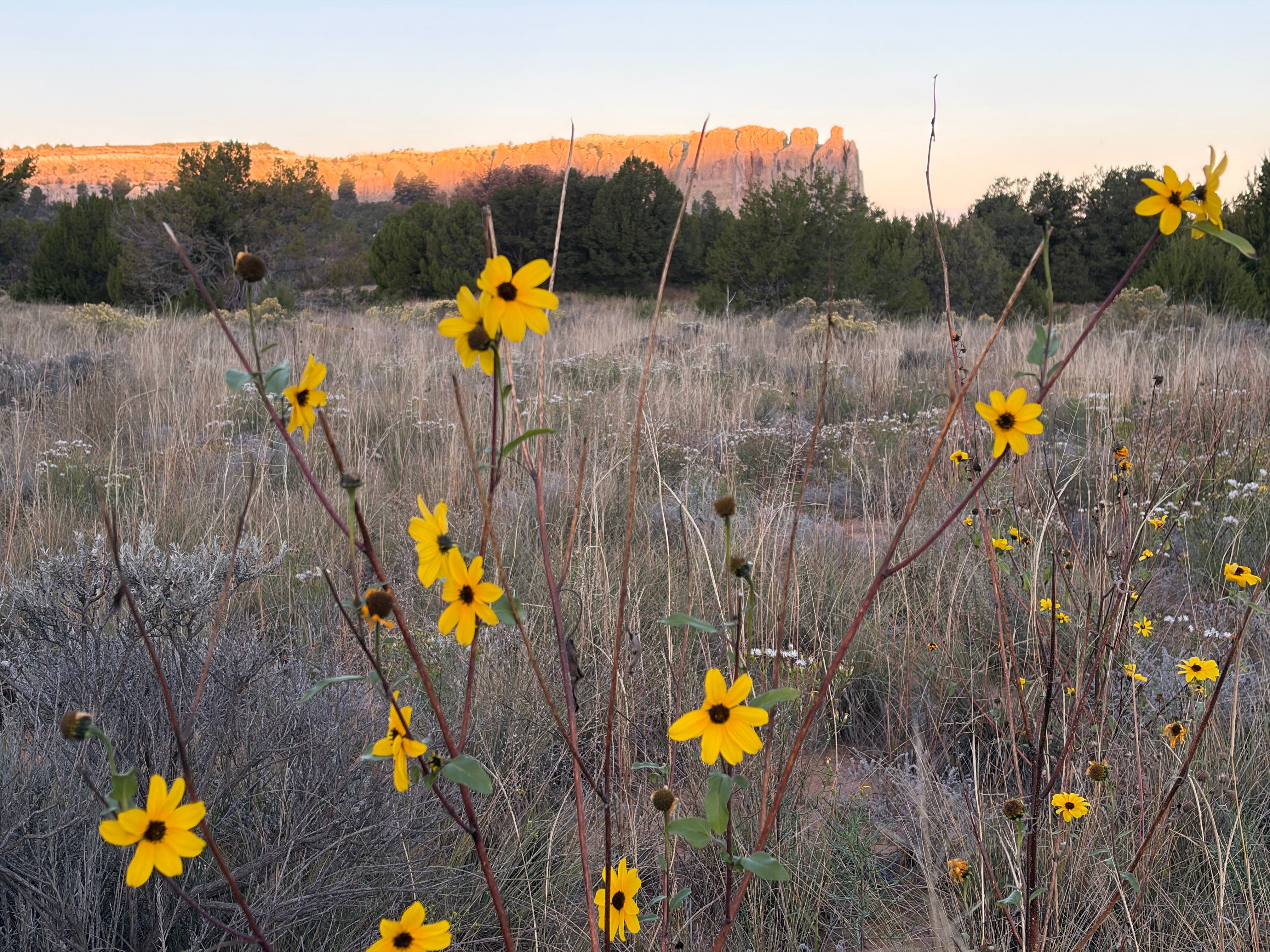
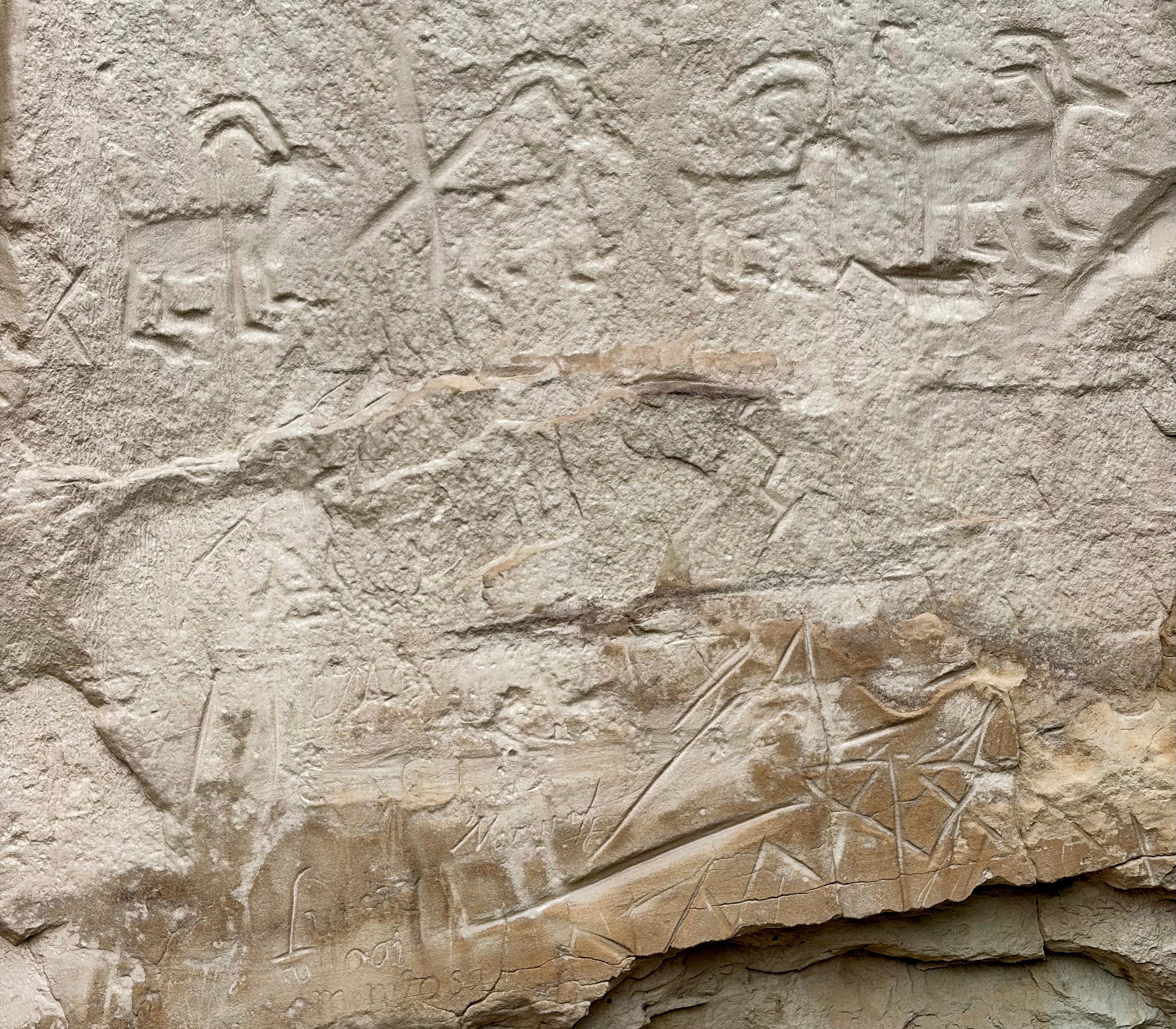
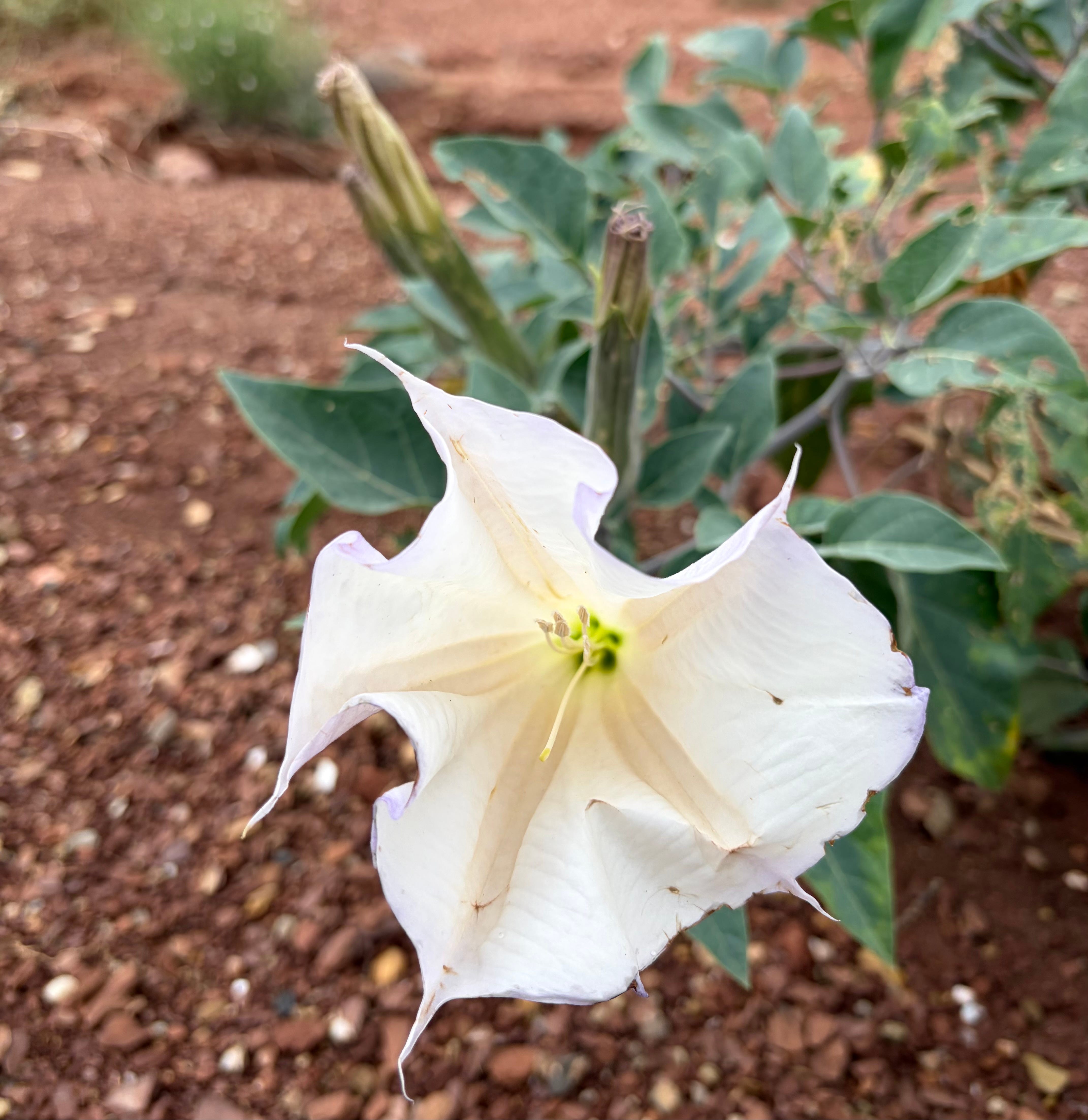
I woke up early this morning, before dawn, in my little tent in El Morro National Monument in west-central New Mexico. The skies, frogbelly gray the day before, had cleared up, the moon was new, and the stars and the milky way sprawled across the blue incomprehensibly. I crawled out before sunrise to see first light falling on the big bleached sandstone fin of A’ts’ina, aka El Morro, delighting as sunflowers and winterfat and daisies danced in the warm breeze.
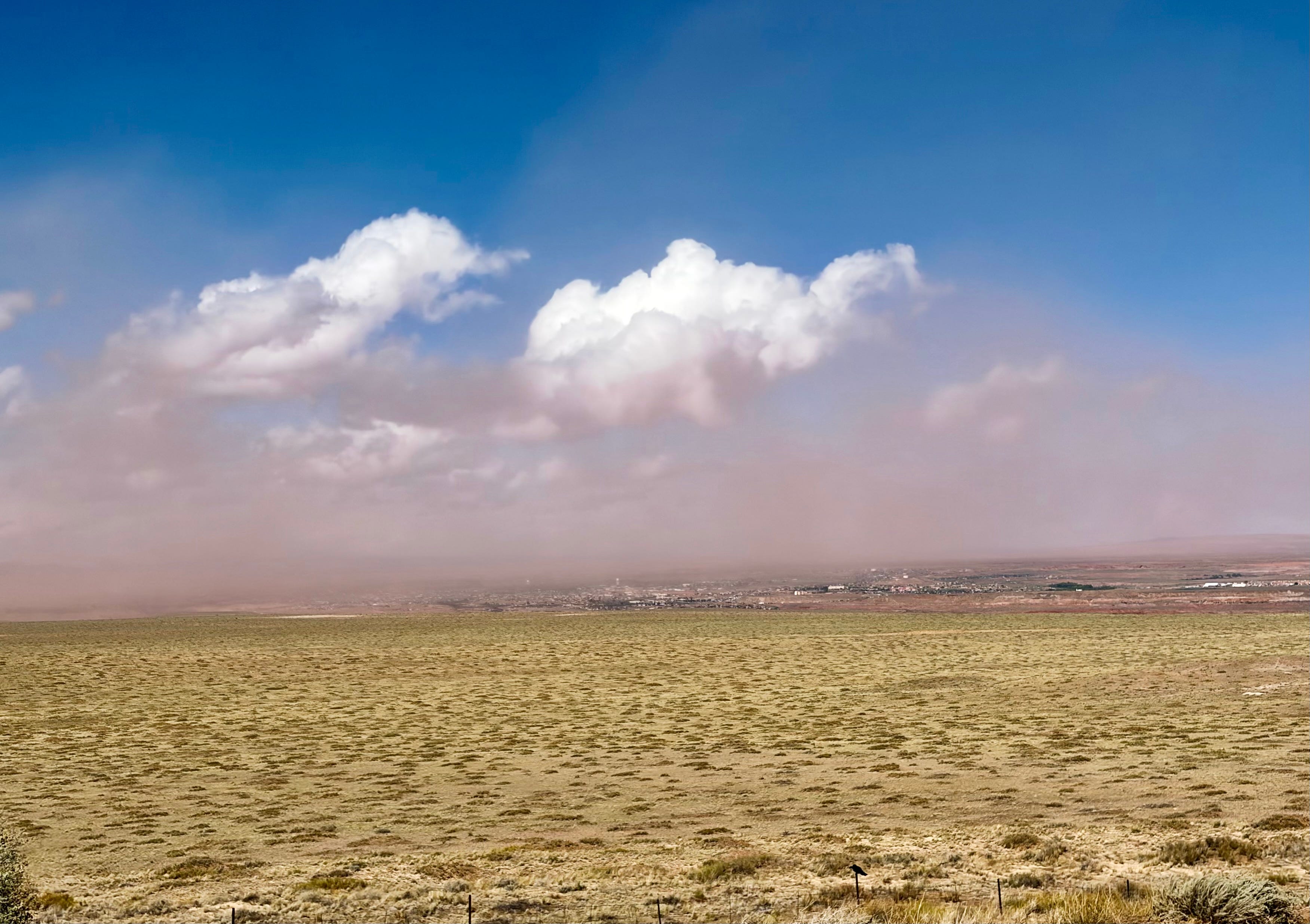
Then, because I’m not the sharpest tool in the shed, I broke camp, loaded up El Burro Blanco, and headed west about five hours, across the Navajo Nation and the Hopi Mesas, through a quasi-haboob in Tuba City, to Lees Ferry — and right into the brunt of the remnants of Tropical Storm Rachel. Now it’s Sunday evening and I’m sitting in the cab of the truck, which shudders with each forceful gust of wind, waiting for the rain to stop long enough to set up my tent, which of course won’t do much good if it is shredded by another one of these 50-mph gales.
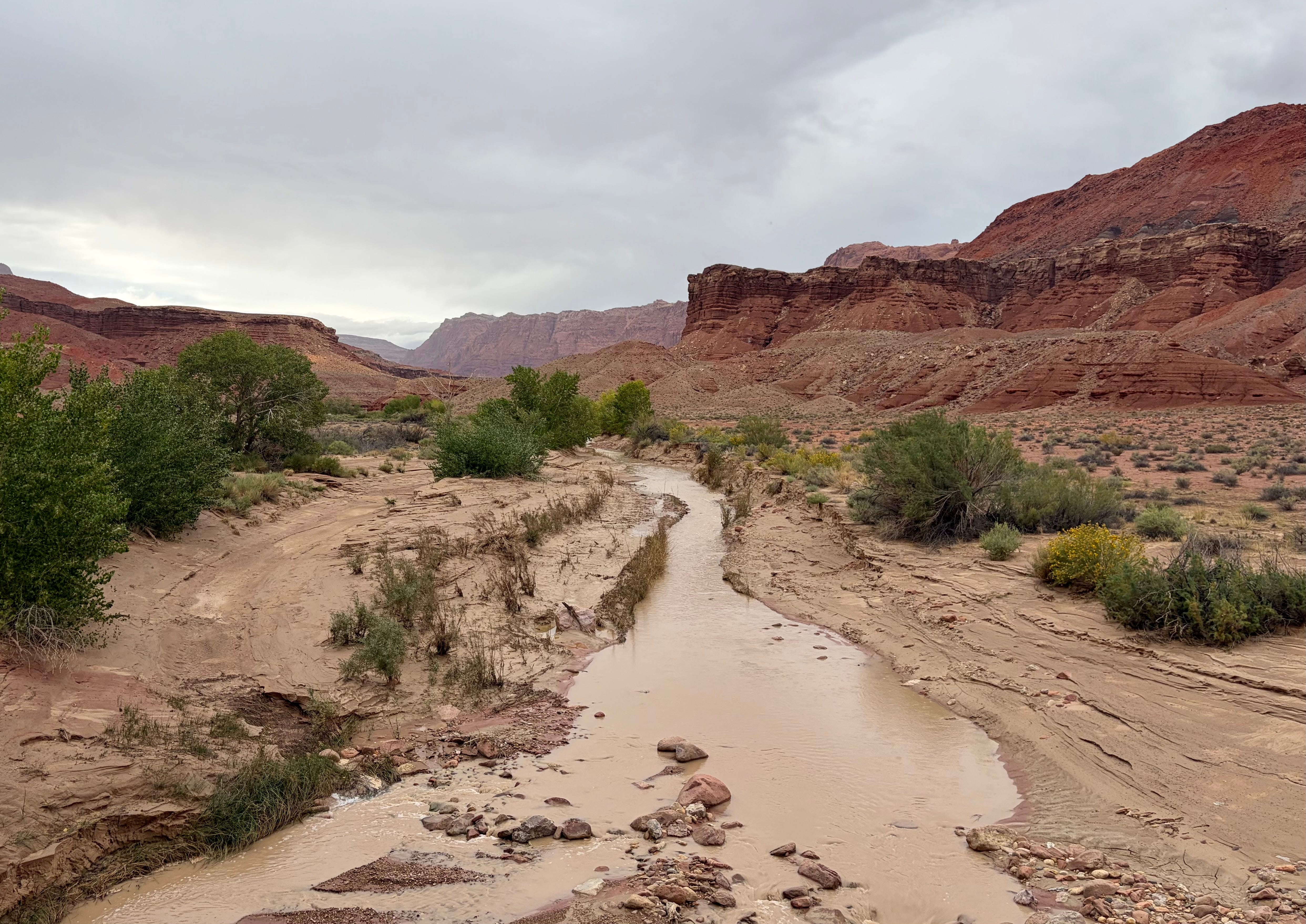
Yeah, the Southwest is getting battered again. So far, however, it hasn’t brought the expected abundance of moisture to Lees Ferry, which appears to be on the eastern fringe of the storm’s main path, which is veering diagonally in a northeasterly direction from San Diego. Presumably it’s raining harder to the west of here, in the Las Vegas-St. George area, and also north of here: The Moab 240 ultramarathon was cancelled Sunday due to heavy rain and flash floods, and about 70 runners and volunteers were stranded at an aid station near Bridger Jack Mesa and had to be evacuated.
The storm is not over, by any means. It’s supposed to keep up through Wednesday, at least, and may even bring substantial snow to the high country.
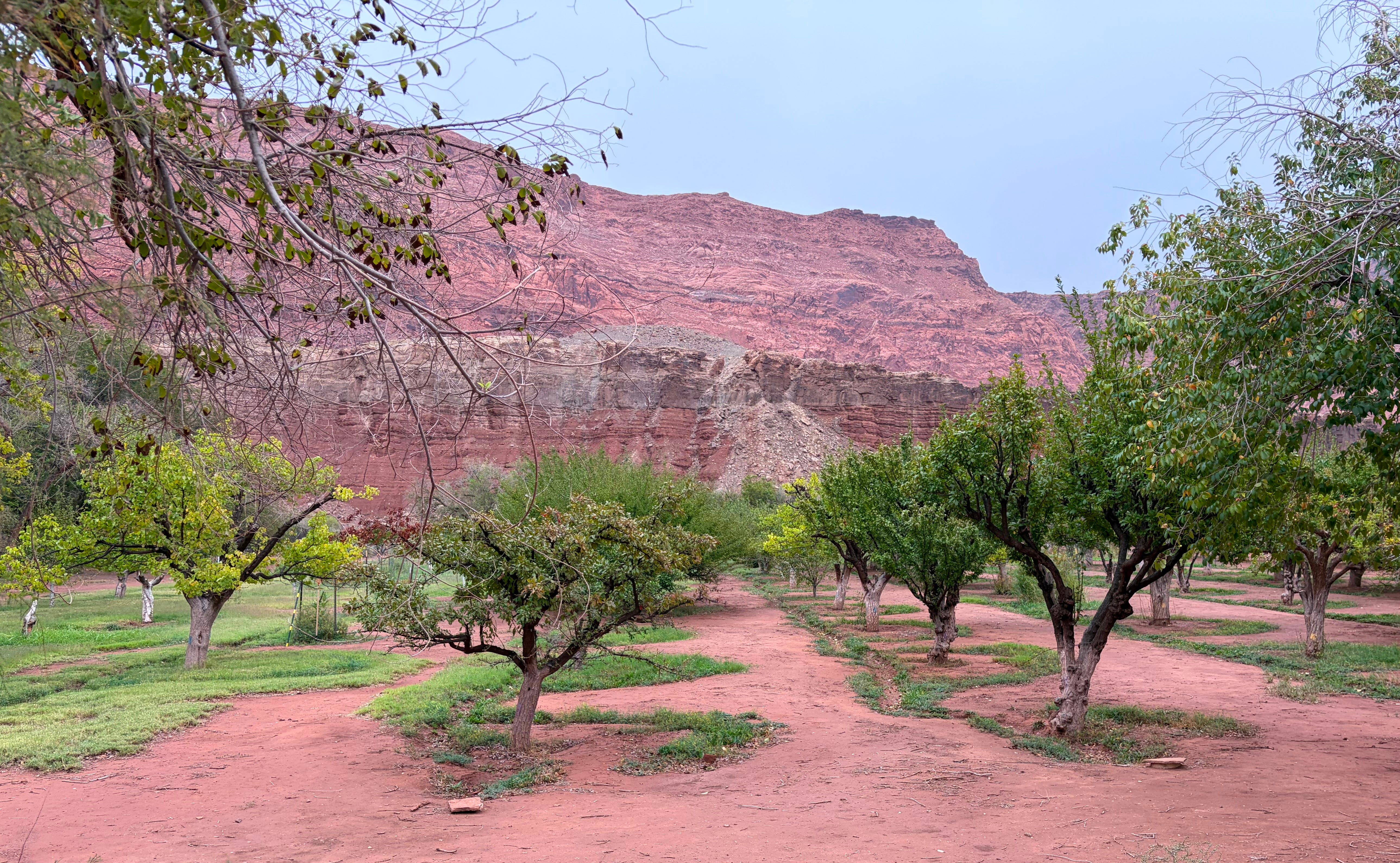
10/12/2026
The rain stopped long enough for me to set up the tent, though the wind continued howling into the night. But when I awoke around 2 a.m., the air was still, the only noise the gurgle of the Colorado River, and the stars were everywhere.
This morning’s flash flood alert has yet to materialize, but it has been raining on and off for a couple of hours, and the Paria River is substantially larger than it was yesterday, growing from about 20 cubic feet per second to nearly 500 cfs overnight. If I were to wait around, I might see it rage even more, since the USGS streamflow gage at Kanab is recording 2,000 cfs. But that might be a pretty long wait, and I want to go up to Page and get a gander at Glen Canyon Dam and the great big Lake Powell bathtub ring.
For more on what to call Lees Ferry … :
To Lees or not to Lee’s; Mike Lee goes after roadless rule; Trump steps up oil and gas leasing — Jonathan P. Thompson


Click on a thumbnail graphic to view a gallery of drought data from the US Drought Monitor website.
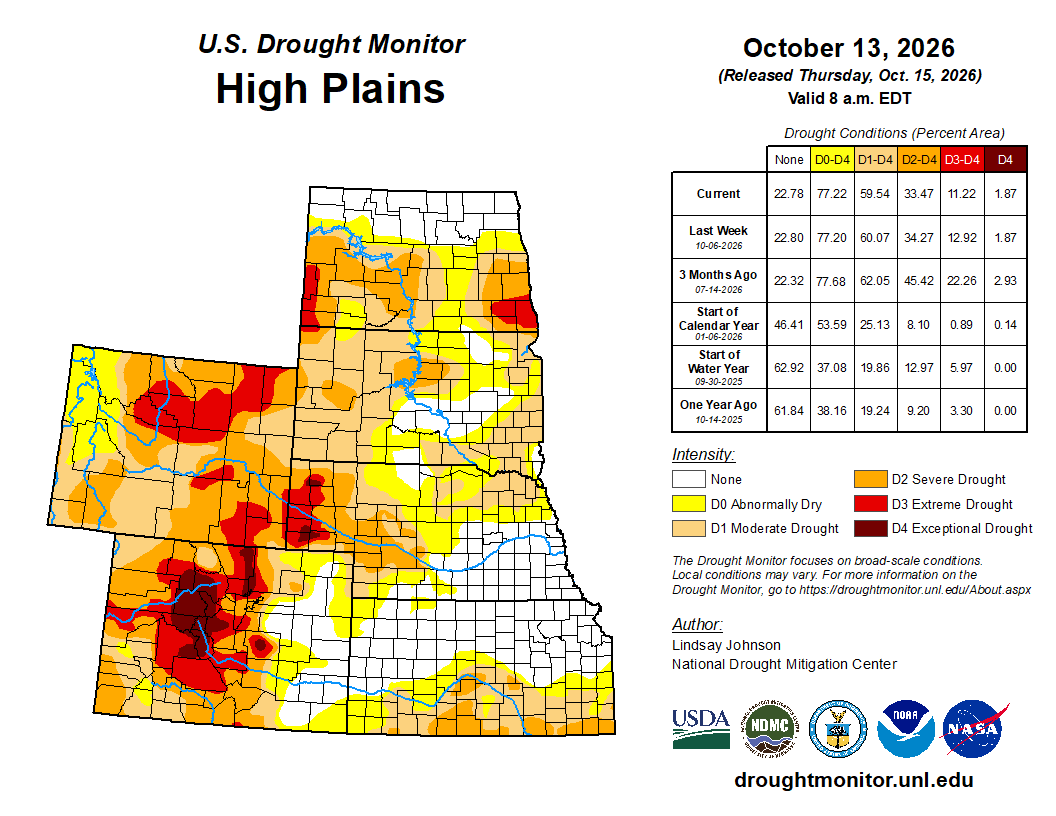

Click the link to go to the US Drought Monitor website. Here’s an excerpt:
This Week’s Drought Summary
Drought conditions changed considerably across the U.S. this week. Heavy rain and early-season snow brought relief to parts of the West and Southeast, while unusually warm and dry weather continued to worsen drought across portions of the Midwest and South. In the West, a strong storm system combined with moisture from the remains of Hurricane Rachel, bringing rain and mountain snow to parts of the region. Snowfall totals reached 11 inches near Philipsburg, Montana, and nearly 10 inches at Great Falls, Montana, while rain and snow also affected portions of Idaho, Wyoming and Utah. Additional precipitation across the Southwest helped improve drought conditions in parts of Arizona, New Mexico and the Rockies. Despite these improvements, significant drought persisted across portions of the Great Basin and Southwest.
Farther east, temperatures averaged 8 to 16 degrees above normal across portions of the Plains and Midwest. Combined with limited rainfall, the unusual warmth contributed to worsening drought across Wisconsin and the Upper Peninsula of Michigan. A broader area of drought deterioration extended from southern Illinois and Indiana through Missouri and Kentucky into the lower Mississippi Valley and Tennessee. Some of the most significant deteriorations occurred across southwestern Missouri, southern Arkansas and northern Louisiana, where persistent warmth and rainfall deficits continued to intensify drought conditions. In contrast, recent rainfall supported localized improvements across western and northern Texas, including portions of the Texas Panhandle.
The Southeast experienced some of the week’s most widespread improvements as Hurricane Isaias brought heavy rainfall to the region, with totals exceeding 12 inches in parts of the Florida Panhandle and southern Alabama. Although the rainfall caused localized flooding, it also helped ease drought from Virginia through the Carolinas, Georgia, Alabama and Florida, with some locations improving by more than one drought category. In the Northeast, drought changes were mixed and largely depended on where precipitation fell. Areas receiving beneficial rainfall experienced localized improvements, while drought persisted or worsened in locations that missed the heavier precipitation…
High Plains
Drought conditions remained largely unchanged across the High Plains, with localized improvements across portions of North Dakota, Wyoming and Colorado and limited deterioration in Kansas. Temperatures averaged 8 to 16 degrees above normal, with locally greater departures. The unusually warm conditions increased evaporative demand and contributed to continued moisture losses, particularly where precipitation was limited. Most of the Dakotas, Nebraska and Kansas received little precipitation during the week, with widespread areas recording less than 25 percent of normal. Localized precipitation occurred across portions of Wyoming and Colorado, but amounts were generally insufficient to produce widespread drought relief.
Localized improvements in North Dakota were supported by precipitation received during the current and preceding weeks, which helped ease short- and mid-term moisture deficits. Elsewhere, drought conditions remained largely unchanged across South Dakota, Nebraska, Kansas and much of the eastern plains of Wyoming and Colorado, where a lack of meaningful precipitation and lingering longer-term deficits supported existing classifications. In Kansas, localized degradations occurred across eastern border with Missouri, where continued dryness and above-normal temperatures contributed to worsening short-term conditions. Despite these changes, significant drought persisted across portions of the western High Plains, particularly in Wyoming and Colorado, where longer-term precipitation deficits and soil moisture shortages continued to limit recovery…
West
Drought conditions improved across portions of the West, with the most widespread improvements occurring across the Southwest and Intermountain West. A strong upper-level storm system interacting with moisture from the remnants of Hurricane Rachel brought beneficial precipitation to portions of the region Oct. 10–12. According to the National Hurricane Center, Rachel dissolved over the southwestern U.S. on Oct. 11, although its remnants continued to produce heavy rainfall and gusty winds across the Southwest. The storm system also brought early-season snow to portions of the northern Rockies, including Montana and higher elevations of Idaho, Wyoming and Utah. Temperatures were unusually warm ahead of the storm across portions of the northern Rockies before falling sharply as colder air moved into the region. In Great Falls, Montana, temperatures reached the lower 80s ahead of the storm before dropping into the upper 30s during its passage (NWS Great Falls, Montana). Farther south, Idaho Falls, Idaho, recorded a high of 47 degrees on Oct. 13, approximately 14 degrees below normal (NWS Pocatello, Idaho).
Significant snowfall occurred across portions of Montana Oct. 10–12, with reported totals including 11 inches at Black Pine SNOTEL near Philipsburg, Montana, 9.7 inches at Great Falls Airport in Montana, 9 inches near Bearmouth and 8 inches near Anaconda and Livingston, Montana. Higher-elevation observations included 1.50 inches of snow-water equivalent at Black Pine SNOTEL and 0.80 inches at Barker Lakes SNOTEL (NWS Missoula, Montana). In eastern Idaho, Idaho Falls recorded 1.30 inches of precipitation from Oct. 10–13, including 0.87 inches on Oct. 11 (NWS Pocatello, Idaho). Rain and higher-elevation snow also affected portions of Wyoming and Utah, while precipitation reached parts of Colorado and the Southwest. In contrast, much of the Pacific Northwest and portions of California remained relatively dry.
Drought improvements were concentrated across portions of Arizona, New Mexico, Utah and the Rocky Mountains of Colorado and Wyoming, where recent precipitation and improving short- and mid-term moisture conditions supported localized reductions in drought severity. In northern New Mexico, extreme drought (D3) was reduced, while portions of Utah experienced reductions in severe drought (D2) and extreme drought (D3). Additional improvements occurred across western and north-central Montana and portions of Idaho, where rain and mountain snow helped ease existing moisture deficits. In Arizona, localized improvements continued following substantial drought relief during the preceding week, although longer-term deficits persisted. Elsewhere, drought conditions remained largely unchanged across Washington, Oregon, California and much of Nevada. Despite these improvements, significant drought persisted across portions of the Great Basin, Southwest and northern Rockies…
South
Drought conditions were mixed across the South, with localized improvements in portions of Texas, Mississippi and Tennessee contrasting with widespread deterioration across the lower Mississippi Valley. Rainfall from Hurricane Isaias largely missed the region, with its precipitation only brushing portions of the Alabama-Mississippi border and leaving much of the drought-affected area without meaningful rainfall. Persistent precipitation deficits, unusually warm temperatures and elevated evaporative demand contributed to further drying across the region. These conditions followed record-breaking September warmth, when Texas, Oklahoma, Arkansas and Louisiana experienced their warmest September in 132 years of records, while Tennessee and Mississippi recorded their second- and third-warmest Septembers, respectively (NCEI).
Drought deterioration was concentrated along and near the Mississippi River Valley, extending from eastern Texas and southern Louisiana northward through central Mississippi, Arkansas and west-central Tennessee. Continued precipitation deficits and depleted soil moisture contributed to the expansion and intensification of drought, particularly across Arkansas and northern Louisiana, where exceptional drought (D4) expanded. In contrast, localized improvements occurred across western Texas, including portions of the Texas Panhandle near the New Mexico and Oklahoma borders, where lingering benefits from precipitation during preceding weeks supported reductions in drought severity. Additional improvements occurred across north-central Texas near the Oklahoma border. Farther east, localized improvements in Mississippi and Tennessee were associated with rainfall from Hurricane Isaias, although precipitation was insufficient to provide widespread relief across the lower Mississippi Valley…

Looking Ahead
Over the next five to seven days (Oct. 15-20), the Weather Prediction Center’s (WPC) five-day quantitative precipitation forecast shows a broad area of precipitation extending from the Southwest and southern Plains northeastward into the Midwest and Great Lakes. The heaviest precipitation is forecast from central and eastern Texas into Oklahoma, Arkansas and Missouri, where widespread totals of 2 to 5 inches are indicated, with localized amounts exceeding 5 inches. Additional precipitation of 1 to 3 inches is forecast across portions of the central Plains, Midwest, Ohio Valley and Great Lakes, with locally higher totals. Heavy precipitation is also forecast along the central Gulf Coast and offshore of Florida, while much of California, Nevada and the interior Southwest are expected to remain relatively dry.
The Climate Prediction Center’s 6-10 day temperature outlook (Oct. 19–23) favors above-normal temperatures across much of the central and eastern U.S., including the Great Plains, Midwest, Mississippi Valley, Southeast and Northeast. The strongest probabilities for above-normal temperatures are centered over portions of the central Plains and Mississippi Valley, where continued warmth could increase evaporative demand and contribute to additional drying in areas that miss significant precipitation. In contrast, below-normal temperatures are favored across portions of the western U.S., particularly along the West Coast and into the Great Basin and Southwest. The outlook favors near-normal temperatures, while above-normal temperatures are favored across portions of southeastern Alaska.
The Climate Prediction Center’s 6-10 day precipitation outlook (Oct. 19–23) favors above-normal precipitation across much of the western and central U.S., including portions of the West, northern and central Plains, Mississippi Valley and Upper Midwest. These areas may see additional opportunities for drought relief, particularly where recent precipitation has already improved short-term moisture conditions. In contrast, below-normal precipitation is favored across portions of the Northeast, Mid-Atlantic and Ohio and Tennessee Valleys, where continued dryness could reinforce existing precipitation deficits. Above-normal precipitation is also favored across much of Alaska, including portions of the Interior and Southeast Alaska.

Click the link to read the article on the Sibley’s Rivers website (George Sibley):
October 13, 2026
This will be my last post before what might be our last election – if our would-be tyrant doesn’t succeed in stopping it entirely. I encourage my handful of readers to vote early, and then be prepared to participate in public opposition – make a big noise – to the chaos our PINO will surely try to cause if he doesn’t like the outcomes.
The mainstream media (being mostly owned by billionaires) continue to try to portray this election as just another horse-race between ‘Democrats and Republicans.’ It is not that. This election may be out last chance to salvage what the Trumpsters haven’t yet undermined of our 250-year effort to work out a functional governance by, for and of the people – a representational governance, a form of democracy. At present nearly all of our supposed representatives in Congress who call themselves ‘Republicans’ and many of those who call themselves ‘Democrats’ are clearly ‘owned’ by those with the money to fund their campaigns – the oligarchs and kleptocrats who want to replace that 250-year effort with an authoritarian governance that they believe will be more ‘efficient’ in accommodating them.
The only hope for keeping our 250-year experiment in self-governance going is to replace the sellouts with representation in the mold of Bernie Sanders, Elizabeth Warren, Alexandria Octavio-Cortez and others who truly try to speak and act on behalf of us, rather than of those whom we have all helped make morbidly wealthy. And we will only be successful if it is a decisive victory for the people; one or two percent victories will be challenged and kept in chaos until – well, forever: nearly a third of the voting electorate still believe that Trump was cheated out of a 2020 election victory because Trump says so. He is determined to keep this election from being a conclusive victory against him because he knows that the only way to stay out of prison is to stay in the presidency with a compliant Congress.
So vote as if the future depended on it – because it does. We do not want to live in an oligarchic kleptocracy run by a semi-senile narcissist with his gang of thieves pillaging the people to pay for technologies of mass control, with his army of brownshirt ICE agents running rampant in our streets. If we don’t come out of the election with a Congress at least partially in control of representatives of the people (not just ‘Democrats’ – think of Fetterman), then it is all over.
Meanwhile, back on the banks of the bankrupt Colorado River system. Remembering first that the river system is not the river itself. The river itself is what it has always been: flows of water running through river-carved valleys and canyons because the surrounding land has not put those flows to use in service to living things. The flows move on to other valleys where sometimes they are put to use by plants, forests, wildlife including humans, and sometimes not, then flowing on to other valleys until they all eventually join up and get to sea level, reentering the seas from which they came. Those flows ebb and flow themselves, annually and year-to-year, at the whims of the global climate – which at this point has the human thumb on the scales pushing toward the hotter drier side.
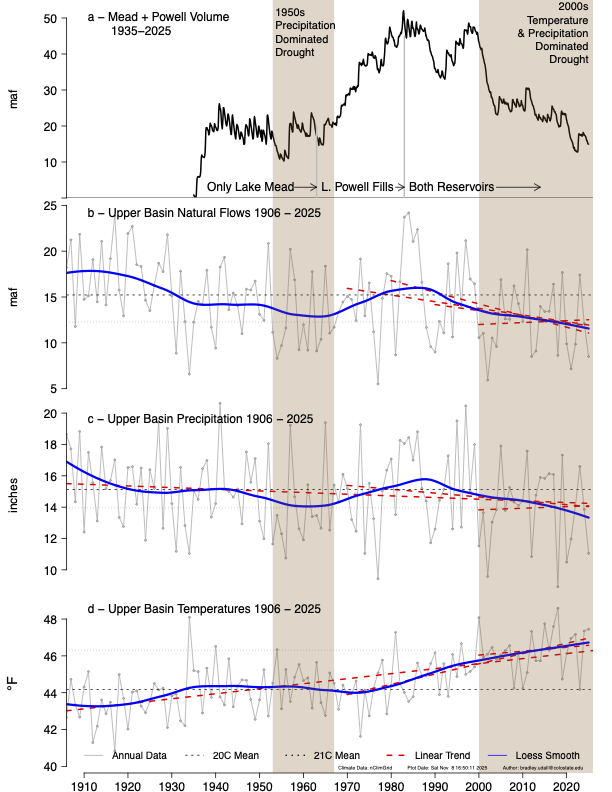
That’s the river; the river system is the structures for storage and distribution we have imposed over the river to even out the natural flows, annually and year-to-year, in service to human life. But the system was designed for a river half again larger than the river we’ve had since the turn of the century; it is beyond rational denial that it was overbuilt for the river we now have (see the graph above), although many continue to deny it for reasons including plain desperation.
That suggestion will come in time, but first I think we need to define the current reality (which bears no resemblance to ‘Compact reality’). The first step is to acknowledge the nature of a desert river, then try to adapt our basic thinking and planning to that.
All rivers are water that the surrounding land and its diverse inhabitants have not managed to put to ‘beneficial use’ for the living ecologies the river runs through. That ‘left-over’ water flows on from its home watershed to larger multiple watersheds where it either gets put to use or doesn’t, and if not, it flows on even larger basins, et cetera. Hydrologists describe streams as ‘gaining’ or ‘losing’: a stream that adds surface and groundwater from a watershed with a high water table is a ‘gaining stream’; a stream that gives up some of it water to a watershed with a lower water table is a ‘losing stream’ (although I think it ought to be called a ‘giving stream’).
Many humid-region rivers continue to collect more water from precipitation that falls on them and their surrounding land, from its headwaters all the way to its ocean estuary. A desert river, on the other hand, gets nearly all the water it will ever have from its headwaters region, with mountains or plateaus high enough to force rising air to cool and release any water vapor it carries as precipitation – mostly winter snow in the case of the Colorado River. Most of the Colorado River headwaters are in the Southern Rockies, but the Wind River Mountains in the Central Rockies generate some of the Green River tributaries, the Colorado Plateau and New Mexico highlands generate the Gila River; smaller basin-and-range mountains the Virgin River, et cetera. But the precipitation that falls on those high places generates 85-90 percent of the water that will make its way into the Colorado River; once it leaves its headwaters and flows into its desert regions, it will gain very little new precipitation.
This transition from gaining streams to losing (giving) streams happens fairly quickly in the Colorado River’s natural basin. The majority of its water comes from highlands above ~8,000 feet elevation – about ten percent of the entire basin. In the Upper Gunnison River watersheds where I live, major Gunnison River tributaries leave the Crested Butte area at 9,000 feet elevation where the average annual precipitation is 23 inches (up to 40+ inches on upvalley); a mere 35 miles down the valley in Blue Mesa Reservoir, at 7,500 feet elevation, the average precipitation has dropped to 10-11 inches. In that short distance, the Gunnison River is already in the high deserts of the Colorado Plateau, and most of the valley below Crested Butte is under irrigation – the river already ‘giving.’. The Gunnison River gets larger as it flows west and north to its ‘grand junction’ with the Colorado River, but that is due to picking up other tributaries; very little precipitation water gets added – even in the summer monsoons, according to a hydrologist working in the Upper Gunnison.
Prior to the Euro-American presence in the basin, the Colorado River ran in extremes: a flood of water while the snowpack was melting in the high headwaters, then a comparative trickle in the late summer and fall after the snowmelt ends. The flood months nurtured riparian life throughout its course, from a narrow strip in some places to broad wetlands, meadows and cottonwood ‘oases’ in other desert places, culminating in a lush labyrinthian delta on a dyke it had built across the Gulf of California with debris from creating the Grand Canyon through the Colorado Plateau. Whatever was left in the stream after it made its way through the delta went back into the ocean from which it had come – and one imagines there were many drier years when there was not enough water left below the delta to go into the ocean after the early summer flood finished.
We tend to make a big deal about the Colorado River no longer flowing to the ocean now due to our heavy use, but there are many desert rivers around the world that don’t flow into the oceans; some forty streams flow into the Great Basin from surrounding mountains and plateaus – some of them respectable rivers like the Truckee, through Reno – and they all gradually disappear there, after nurturing riparian life (including some ranches and towns), enduring evapotranspiration, and sinking into aquifers. President Theodore Roosevelt, often called the father of American conservation, considered freshwater going unused into the ocean to be a ‘waste.’
But understanding the nature of the desert river, and how it is different from a humid-region river like the Mississippi, offers some clues about an intelligent river system for storing and distributing the river. The vast majority of the users of the river’s water, especially the modern human users, are in the desert lands below the headwaters region – the ‘losing’ (‘giving’) portion of the river: in the higher ‘cold deserts’ above the canyon region, and the subtropical ‘hot deserts’ below the canyons.
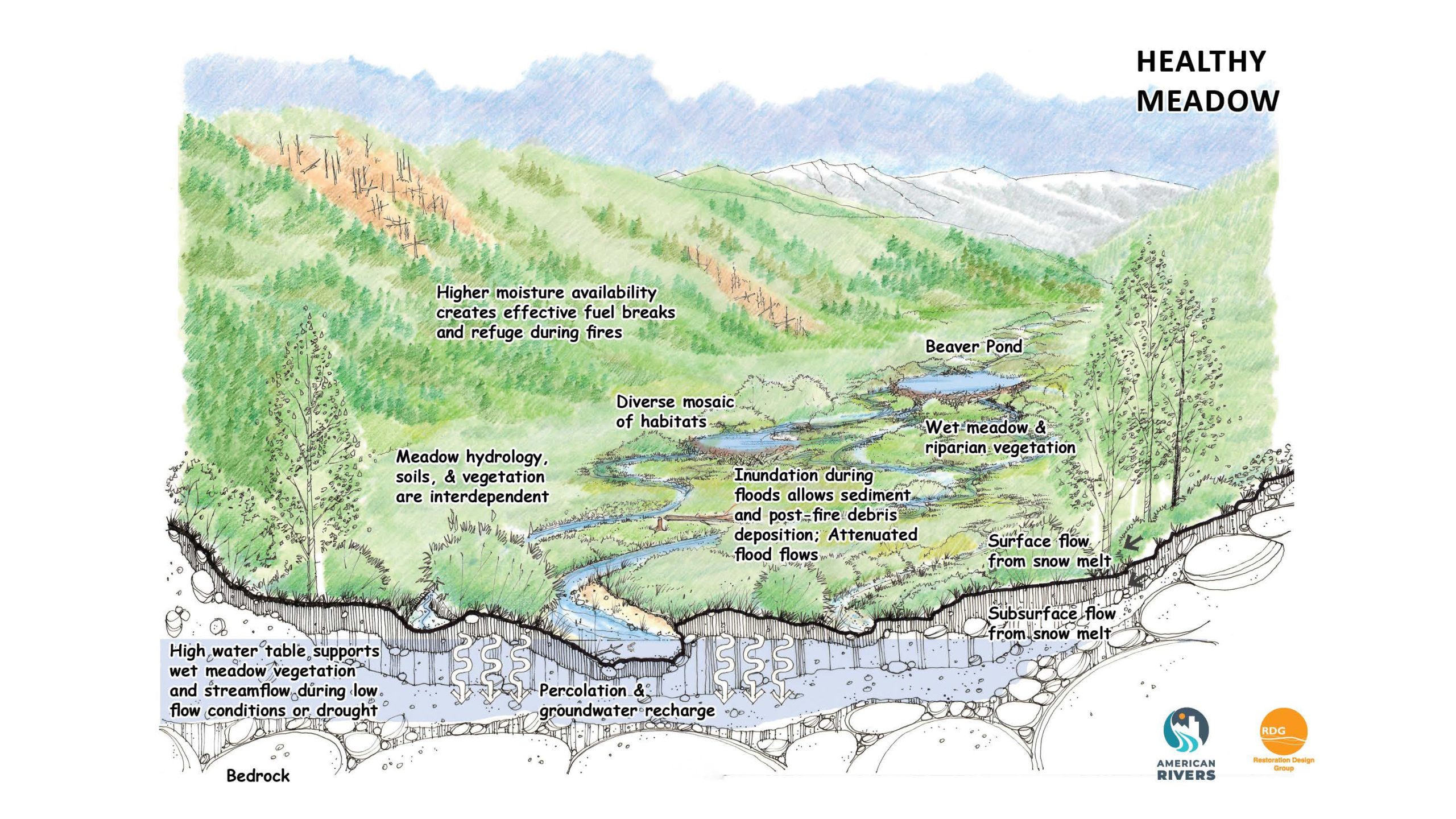
There are also water users in the headwaters region. Largest by far are the forests that ring most of the mountains, along with other plant and animal life inhabiting those mountain-forest regions. There are also humans in the headwaters, mostly in or near towns supporting mining or outdoor recreation, but what makes the most sense is to consider the human users as outliers of the ‘losing’ basin below the headwaters – which they are, literally, producing little of what they need to live there but importing moat of it from or through the desert economy. The forests, on the other hand – as we will see – are intimately involved in the river’s water production processes, in both positive and negative ways.
These two distinctly different parts of the river suggest a more natural division of the river into two ‘basins’ than the political division under the Compact: the ‘gaining river’ and the ‘losing/giving river,’ each to be managed toward a specific goal: for the gaining river, how to optimize the quantity of water flowing out of the headwaters; and for the losing/giving river, how to optimize the uses and minimize unnecessary losses.
This deliberately breaks up the current ‘two-basin division’ – a ‘temporary equitable division’ adopted in 1922 because the compact commissioners did not know enough about their the river or their own state futures to do the eight-way division (including Mexico) they had set out to do. The two-basin division was most basically an expedient way of persuading Congress that they were together in their search for an equitable division that would only become possible when there was ‘a greater fund of information’ that would enable those following them to do a proper division of the use of the river’s waters, but meanwhile – let’s build the big dam.
Dividing the river into its ‘water production’ basin and its ‘water consumption’ basin would have the potential benefit of starting again with nearly all of the users in a single ‘consumption’ basin, while giving them all joint responsibility for taking care of the ‘water production’ basin. It’s a potential start on at least perceiving the river as a single shared responsibility, as opposed to the current perception of each state in it for its own needs and yielding as little as possible to the other states.
That’s where we’ll start next time – with the big question for the losing/giving river, the desert part of the desert river: how to get beyond Compact fantasies, and divide the use of the diminishing river we actually have among the vast multitudes of users (see the graph at the beginning). That’s a point at which I think it would be smart to abandon the hydrologic term ‘losing’ for a more political term – not a ‘losing river’ but a ‘giving river’ -which is what it is once it leaves the headwaters. And the challenge of ‘dividing the gifts’ of the giving river at least starts with a more positive feel than ‘sharing out the losses’ from a losing river….
Meanwhile – vote! As if the future depended on it because it does. [ed. emphasis mine]

Here’s the registration link.
Click the link to read the article on the H2O Radio website (Frani Halperin):
October 6, 2026
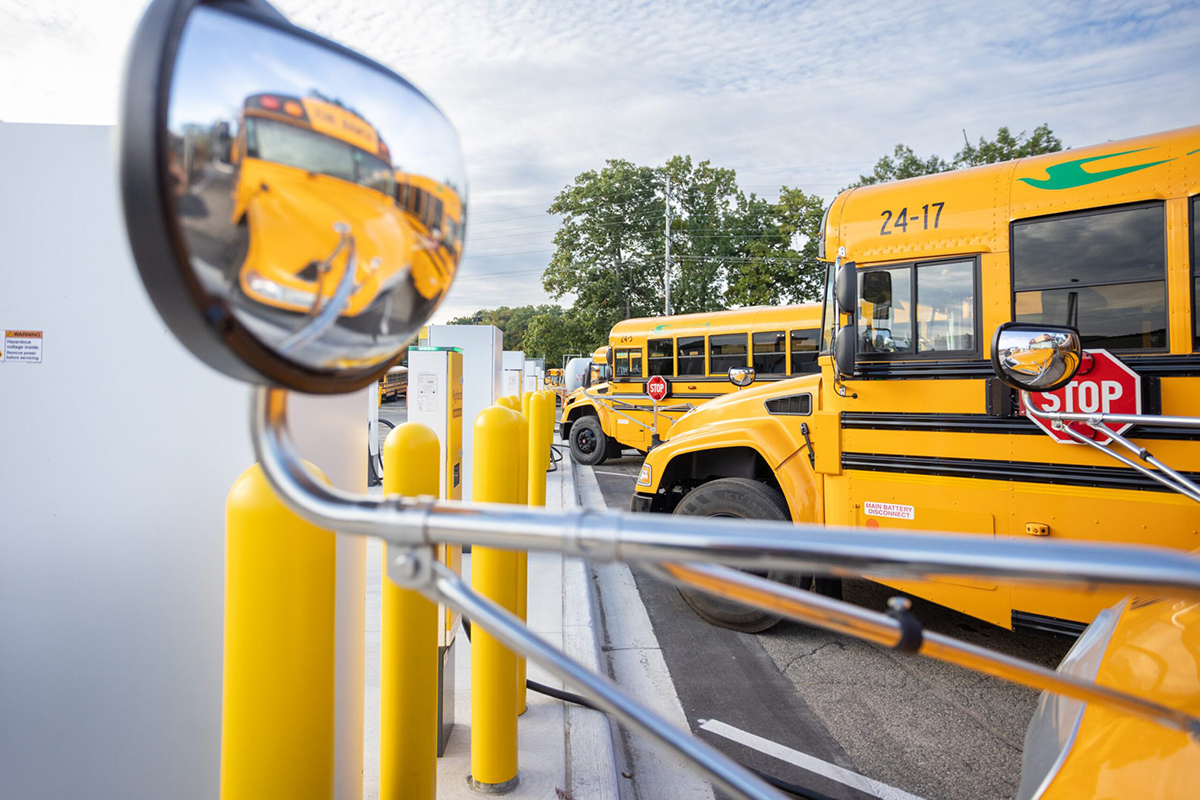
When Thomas Lujan turns the ignition switch on his school bus, he doesn’t hear a thing. Nothing‘s wrong. In fact, everything is going just right. On this September morning, instead of driving a noisy diesel bus, he’s off to collect students in one that’s electric.
Arriving at his first stop, Lujan has high fives and a big smile for children as they board his bus. They’re en route to the Peak To Peak Charter School, a K-12 public school in Lafayette, Colorado, north of Denver. The bus is one of four electric buses the school operates—something Lujan loves to brag about. “They’re very nice to drive. They’re very quiet. They’re limited as far as the range goes, but other than that, they’re great buses and the kids seem to like them.”
Four years ago, Peak To Peak Charter School made the choice to adopt electric buses because they would be more affordable, align with their values to pilot innovative technology, and support their preference not to have to store fuel on site, according to Tracey Sutton, the transportation coordinator. Most school districts that own buses have a shop and a yard where they maintain and refuel their buses. Going electric meant Peak To Peak could avoid this type of infrastructure.
They also had a goal to reduce the amount of diesel fumes that students (as well as staff) were breathing in. That’s an improvement not lost on the kids themselves, who say gas buses were “loud and smoky” and “smelled horrible.”

About 30 miles to the south, Nate Cohen is hoping his students will feel the same way. He is the assistant director of transportation for the Cherry Creek School District that operates south of Denver. This month, they too added electric buses to their fleet with a goal of reducing the emissions their buses were putting into neighborhoods they serve.
Cherry Creek Schools is counting on the new buses to reduce noise pollution. Cohen says we all know when something drives by our houses. Was it a school bus? A garbage truck? A moving van. “You know, it was something,” he says, but now these buses are “just creeping through neighborhoods.” They’re also anticipating how the quiet inside the bus will affect students. “We’ve been told and we’re excited to experience that student management issues decrease significantly because students are not having to yell over the engine, yell over all the noise.”
Vehicle-to-Grid (V2G)While Cherry Creek School District is just dipping their toe into fleet electrification—adding only six buses to a fleet of more than 300—they are also testing the waters of an added technology that Peak To Peak has yet to try—bidirectional charging. That’s where power flows both ways from a utility to charge a bus or from the bus back to the utility to add to the grid.
Cherry Creek Schools took advantage of grants from Xcel Energy, a provider for the Denver metro area, to make the numbers work on bringing on EV buses. Mark Ingram, the director of transportation for Cherry Creek Schools, said a grant from Xcel “paid for the entire cost of all six electric buses. So, we got $2.4 million in rebates; each bus costs $400,000.” They also got an extra $750,000 in rebates for bidirectional charging capabilities.
That helps Xcel to stabilize the grid, so it can meet demand when it’s highest—on weekday evenings when people are home cooking dinner, watching TV, or just having lots of lights on. “In the long term,” Cohen says “that means either not having to build more power plants or the ability to take power plants offline. It just gives them a more stable approach where they can charge us during off-peak hours when they have that capacity, and then when they need additional capacity, we’re able to provide that to them.”
The typical day in the life of a Cherry Creek Schools bus will start with the bus “waking itself up” and if it’s cold, perhaps warming up the cabin while it’s still connected to the grid. After a driver’s inspection, it’s on the road for about two hours and returns to the depot around 9:00 a.m. The bus will then charge until it leaves for the afternoon routes to take students home. After 5:00 p.m., the buses will send energy back to the grid. After the peak demand for electricity ends, the buses will perform a slow charge overnight.
Driving Resilience
Here’s where the partnership with Xcel gets interesting. Not only are the buses able to power the grid when demand is high, but because they are batteries on wheels they could also be driven to an outage location and supply energy.
“An average school bus might have a 200- or 250-kilowatt-hour battery pack. That’s adequate to go back up a high school gymnasium or a community center or an assisted living facility for days,” says Duncan McIntyre, the CEO of Highland Electric Fleets, the company that bundled the equipment, training, and financing that allowed both Peak To Peak and Cherry Creek transition to electric buses. “If your community has 50 electric school buses, which might be cheaper to operate than 50 diesel school buses, there’s this added benefit of being able to drive them around and back up buildings,” McIntyre added.
McIntyre says this so-called “vehicle-to-grid” technology can provide cleaner power than generators that run on diesel to keep facilities a community deems as critical, such as a hospital, functioning. He adds that buildings would need a simple retrofit to install a bidirectional charger and a smart panel to accept the power, but then you have “an incredibly resilient system that can be deployed at a moment’s notice.”
That’s an idea that has more school districts kicking the tires on EV buses as diesel prices spike and climate-driven extreme storms and wildfires affect the grid. McIntyre says “Even with a natural gas heavy grid, the environmental footprint is a huge improvement. An electric motor is much more efficient at converting a unit of power into a unit of propulsion than a combustion engine. It has very few moving parts and is very efficient.”
If a utility has a lot of solar and wind energy, it can generate a lot of power, but it needs to be stored in batteries, so how about in a bus? McIntyre says school buses sit idle for 92 percent of the hours in a year. “So, it’s an incredible opportunity to use the batteries to integrate renewables into the grid, flatten the load curve, and reduce rates for ratepayers.”
Highland Electric Fleets will have a couple thousand school buses in over 100 cities by the end of this year with many of those in Colorado, something Nate Cohen of Cherry Creek Schools calls a “win for the environment, a win for our neighborhoods, and a win for students.”
And it’s a way that electric buses are schooling cities on how to be resilient. 💧
H2O Radio stories are written by humans. We do not use AI in our journalism.
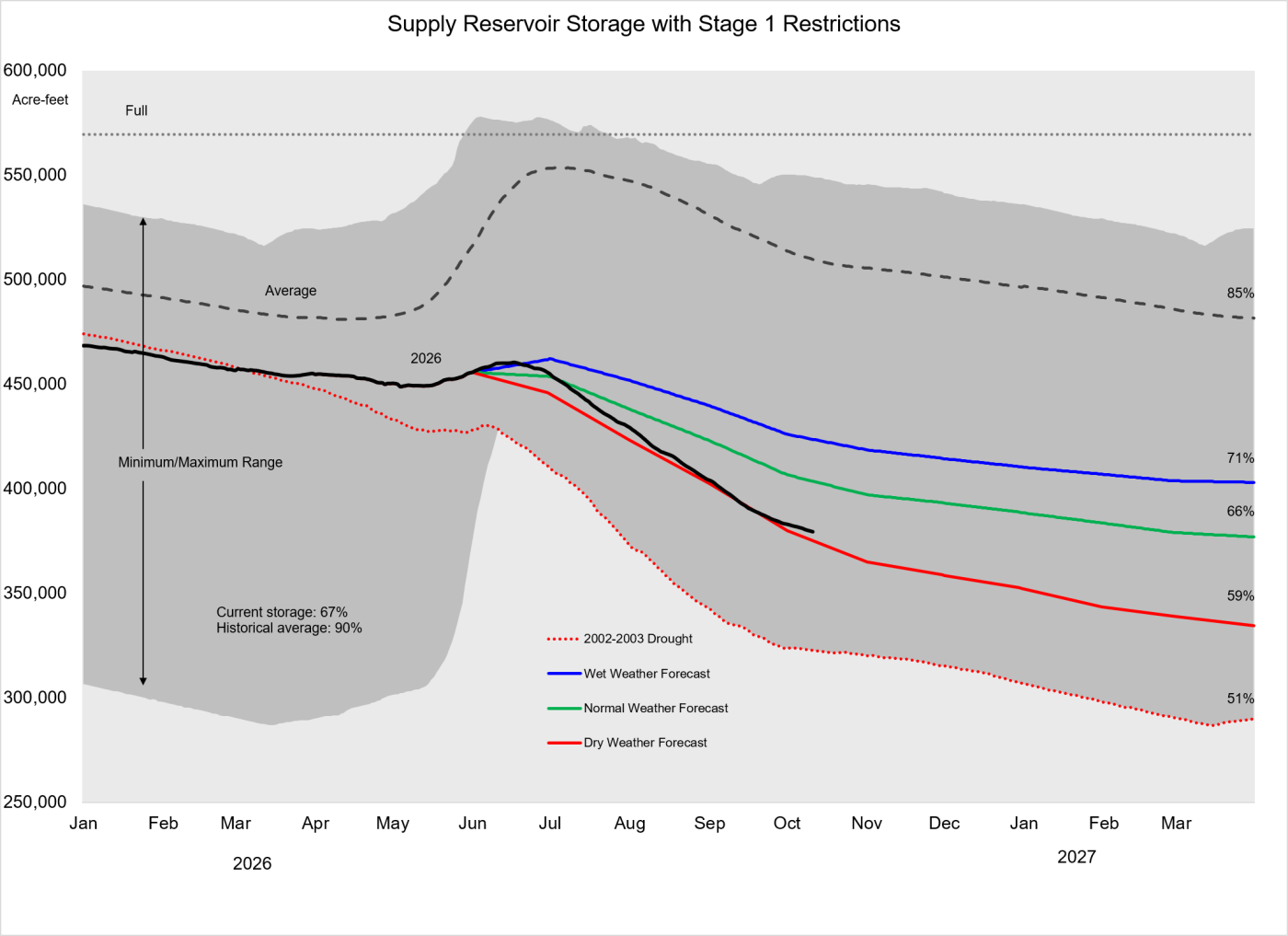
Click the link to read the article on the Denver Water website:
October 12, 2026
Denver Water’s collection and service areas continue to face severe drought conditions, with historically low snowpack. Denver Water depends on mountain snowpack for its water supply, which serves 1.5 million people in Denver and surrounding suburbs.
As a result, on March 25, 2026, the Denver Board of Water Commissioners declared a Stage 1 drought, seeking a 20% reduction in water use to preserve water levels and avoid even stricter mandatory restrictions later this summer. On April 8, 2026, the board approved the implementation of temporary drought pricing, starting with May water use and reflected in June bills, to signal the premium value of water during droughts and help incentivize customers to save water.
On Aug. 26, 2026, the board amended its Stage 1 drought resolution to prohibit lawn watering as of Oct. 1. The ban on lawn watering and all spray irrigation remains in effect until the board determines how and when lawn watering can resume. That means sprinklers need to remain off in spring of 2027, pending an official resolution from the Board of Water Commissioners.
Customers are warned of heavy fines for lawn watering or using spray irrigation after Sept. 30. Penalties for violating the ban begin at $500 for single-family customers.
Snowpack and water supply update
- In Denver Water’s collection system, the 2025-26 snowpack peaked more than a month earlier than normal and at the lowest levels observed in the past 40 years:
- Colorado River Basin: Snowpack peaked March 18, 2026, at 58% of normal, the second-earliest date and second-lowest peak on record. (Typical peak date is April 24.)
- South Platte River Basin: Snowpack peaked March 17, 2026, at 42% of normal, the second-earliest date and the lowest peak on record. (Typical peak date is April 26.)
- Snowpack and melting conditions were unprecedented, with accelerated spring melting that started in mid-March. Customers need to save water to stretch supplies.
- Streamflow forecasts called for runoff levels to be 10-40% of normal in 2026.
- Reservoir storage conditions are below average. As of Oct. 12, 2026, reservoirs were 67% full, versus an average of 90% full for this time.
Water use and conservation update
- Quote from Greg Fisher, Denver Water’s manager of demand planning:
- “Our customers did a great job shutting off their sprinkler systems in response to our Oct. 1 cutoff for lawn watering. Water use Oct. 1 through Oct. 11 was 34% below the five-year average,” said Greg Fisher, Denver Water’s manager of demand planning.
- “This is a good start to preserving our critically important water supplies, because Denver Water’s reservoir storage levels are currently at 67% full, well below the average of 90% for this time of year.
- “We’re all hoping for a good winter, but it’s extremely unlikely that we’ll see enough snow — and more importantly, a robust spring runoff — to fully fill our reservoirs next year. Every customer’s conservation efforts remain especially important as we work together to stretch our storage supplies heading into the winter.”
- Customers can do their part by making water-efficient upgrades, indoors and outdoors, including rethinking their yards. These steps preserve water supplies and create more adaptable and drought-resilient landscapes that fit naturally into our climate. Read on TAP: Simple strategies to save water at home.
- Customers are reminded of the ban on lawn watering and spray irrigation as of Oct. 1.
- Trees, shrubs and perennials may be watered any day with a hand-held hose with a shut-off nozzle or low-volume, non-spray irrigation (such as a drip system). They may not be watered with spray irrigation.
- Denver Water will not be issuing watering exemptions for new turf installations.
For its part, Denver Water has proactively reduced its spending, taking steps that include enacting a hiring freeze and reviewing maintenance and other projects to see which ones could be deferred. We are also looking into other ways to increase supply by activating agreements that allow us to capture additional water that is typically unavailable during normal conditions.
This year marks the fifth time since 2000 that Denver Water has issued a Stage 1 drought, and the first since 2013. Prior to 2013, the board declared a Stage 1 drought in 2002, 2003 and 2004.
Denver Water has many resources for homeowners looking for inspiration and information about landscapes that fit naturally into our dry climate. Click here for conservation and efficiency tips for outdoor irrigation and to get more details on ways to ColoradoScape your property, including through rebates for turf removal and a DIY guide for landscape changes, among many other potential water-saving steps.
Updates about Denver Water’s reservoir levels, customer water use and snowpack can be found in the Water Watch Report, which is updated weekly in the spring and summer.

Click the link to read the article on The Land Desk website (Jonathan P. Thompson):
October 9, 2026
💀 DEADPOOL DATA DUMP 🌊
Lake Powell, the nation’s second largest reservoir, serves as a sort of barometer of the Colorado River watershed’s overall health. The reservoir and river have been struggling since the great aridification’s grim onset in 2002. While the river continues to flow, barely, the 2026 Water Year, characterized by one of the worst snow droughts on record, nearly finished off the reservoir. But in the end, it was saved from dropping to “de facto deadpool” by heavy rain at the beginning and end of the water year, and by larger-than-normal releases from upstream reservoirs.
- 4.46 million acre-feet: Total Lake Powell inflow from the Colorado, Dirty Devil, Escalante, and San Juan rivers in water year 2026. That’s the third lowest on record, behind 2002 and 2021. This is in spite of the fact that the 2026 snowpack was far lower than those two years, and melting mountain snowpack provides about 80% of the river’s water.
- The Colorado River Basin experienced its warmest water year on record (in 131 years) in WY2026.
- 3.72 million acre-feet. Total Lake Powell unregulated inflow in water year 2026. This is the estimate of how much water would have flowed into the reservoir without any supplementary releases from upstream reservoirs. Which is to say, the feds robbed Flaming Gorge, Navajo, and Blue Mesa of about 750,000 acre-feet to save Powell from shrinking even more. That was bad for those upstream reservoirs and the irrigators, anglers, recreational users, and communities that rely on them, and there’s no way it can be repeated if this winter is below average.
- 6 million acre-feet: Total releases from Glen Canyon Dam in water year 2026. This is the lowest release since the very early days of the dam (in the 1960s). This means less water in the Grand Canyon and less water flowing into Lake Mead.
- 181,111 acre-feet: Estimated amount of water that evaporated from Lake Powell in water year 2026. This is equivalent to more than half of Nevada’s total annual allotment from the Colorado River.
- 1.72 million acre-feet: Lake Powell’s water deficit — or the difference between outflows (incl. evaporation) and inflows — for water year 2026.
- 27 feet: Amount the surface level of the reservoir fell in water year 2026, putting it within seven feet of the level the federal governnment has chosen to “defend,” meaning they’ll pull out all the stops to keep it from dropping below that (for reasons the Land Desk has gone over many times before). The late September storms brought the level back up a couple of feet.
Feds release two-year Colorado River plan, Nevada sues — Jonathan P. Thompson
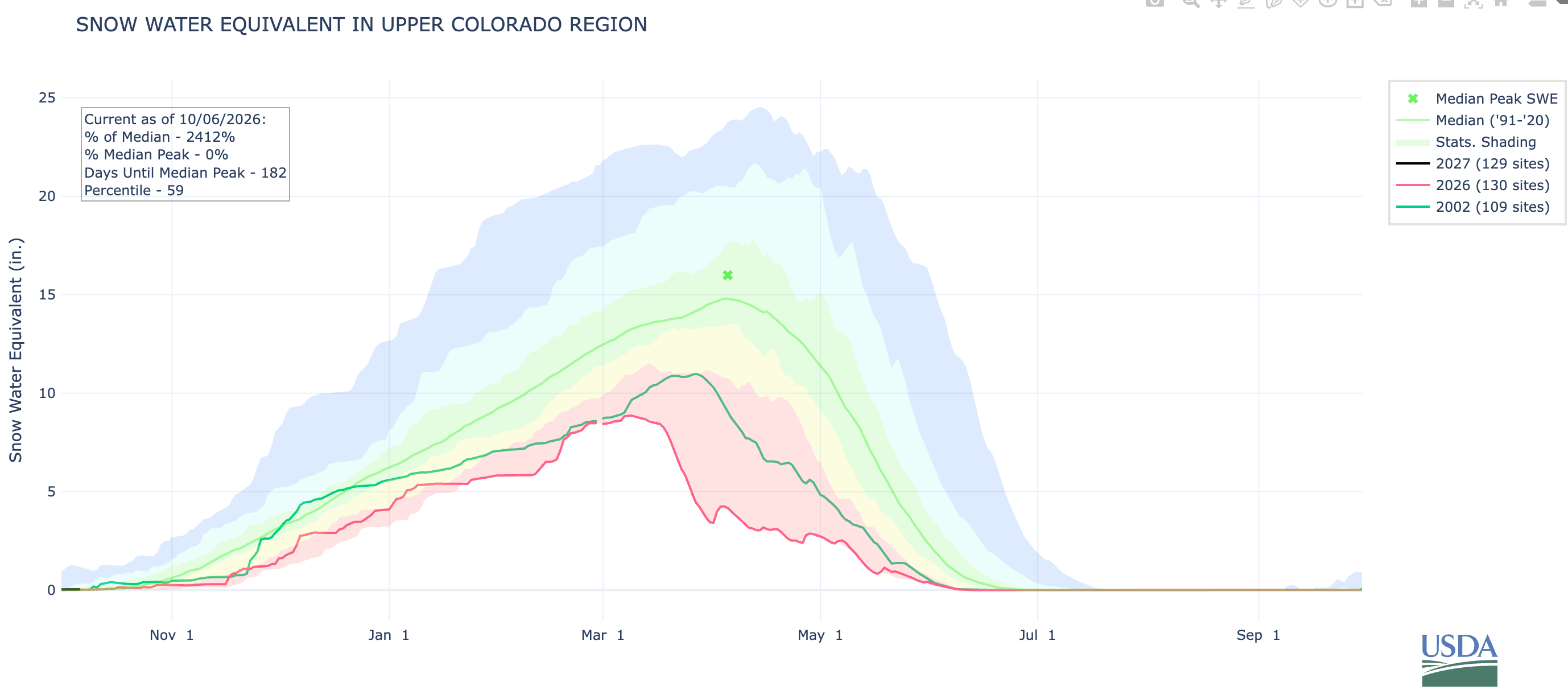
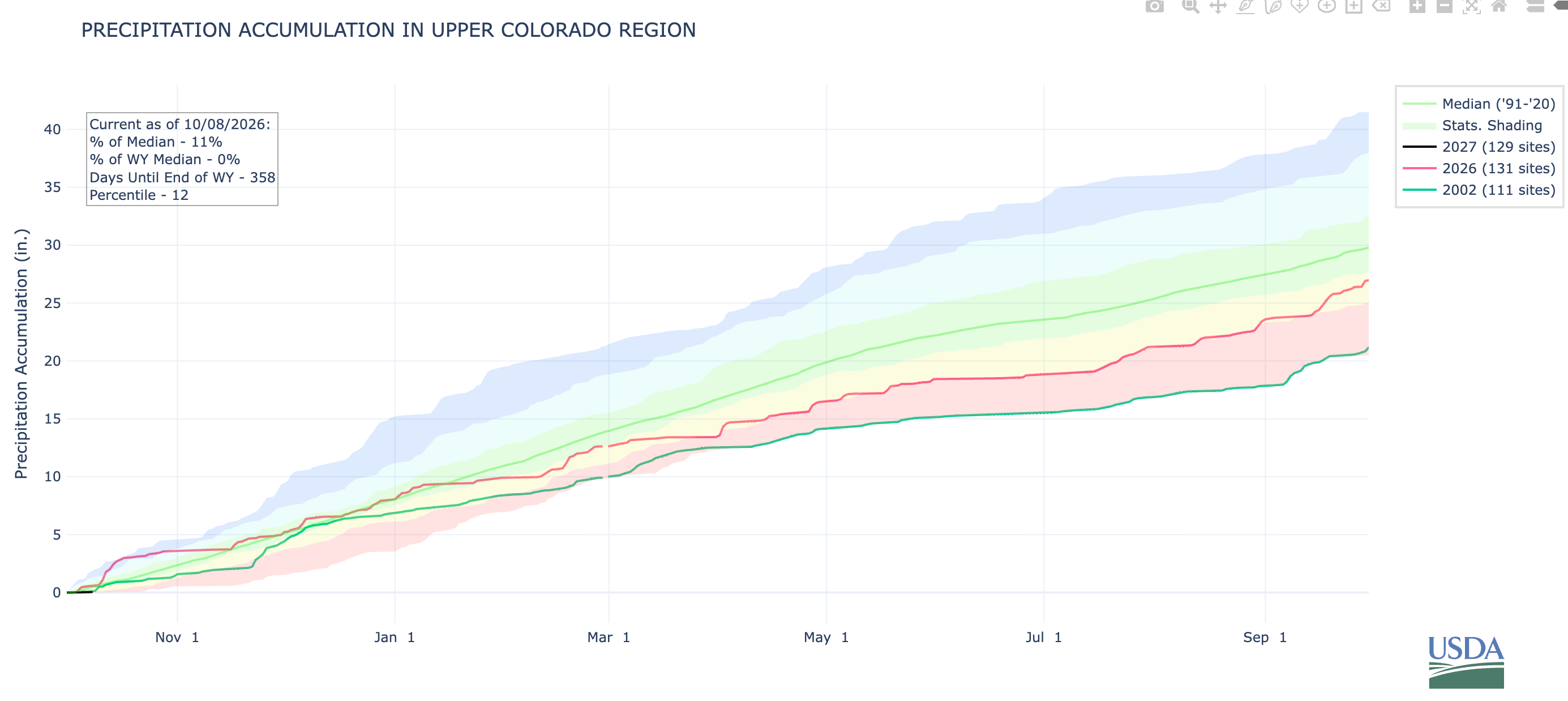
A Colorado River glossary and primer — Jonathan P. Thompson
🛢️ FOSSIL FUEL FOLLIES 📈
THE NEWS: Not one, but two natural gas pipelines ruptured and erupted in flames at nearly the same time on opposite sides of New Mexico. One was in the Permian Basin in Lea County, where a gas line ruptured and caught fire, killing two people. Details of the incident have not been released, nor have the names of the victims. The other was near La Boca, New Mexico, just south of the Colorado line (and can be seen in the video above). It shot flames high into the sky and ignited a wildfire.
THE CONTEXT: Several years ago, as the oil boom in the Greater Chaco Region in northwestern New Mexico was nearing its peak, I sat down in the sleek, modern headquarters of the Bureau of Land Management’s Farmington field office with two BLM officials to talk about the oil boom. Before we got down to business, one of them asked: “Should we show him the scare map?”
The answer, I guess, was yes, because her colleague handed me the paper showing every well ever drilled in the San Juan Basin, with little red dots for gas, black ones for oil.
It was scary. The northern and central sections of the Basin were almost solid red; in the south and west, dense swarms of black dots strung out along the oil-bearing formations. Dark pinpricks surrounded Chaco Culture National Historical Park. Huerfano Mountain, or Dzil Na’oodilii, where First Woman and First Man and then Changing Woman lived — a sort of Garden of Eden in Navajo cosmology — was embroidered with red and black. The BLM office we sat in, on a fine piece of real estate in the upper-class part of town, has three wells within a quarter mile, and a pumpjack grinds away right next to a golf course green down the road.
To find a stretch of land anywhere in the core of the Basin that hasn’t been drilled or isn’t covered by roads, tanks, pipes or some other hydrocarbon-related infrastructure is nearly impossible — the infrastructure is the landscape. “We’ve got so much pipeline in the ground, it’s like rebar,” said the official, with a tinge of glee. “If you had an earthquake, the ground wouldn’t even shake.”
The official seemed less disturbed than simply fascinated by this fact, and also didn’t seem bothered that he and his colleagues were facilitating even more infrastructure by handing out drilling permits by the dozen and clearing the way for thousands of new wells and all the roads, gathering systems, and pipelines that go with it.
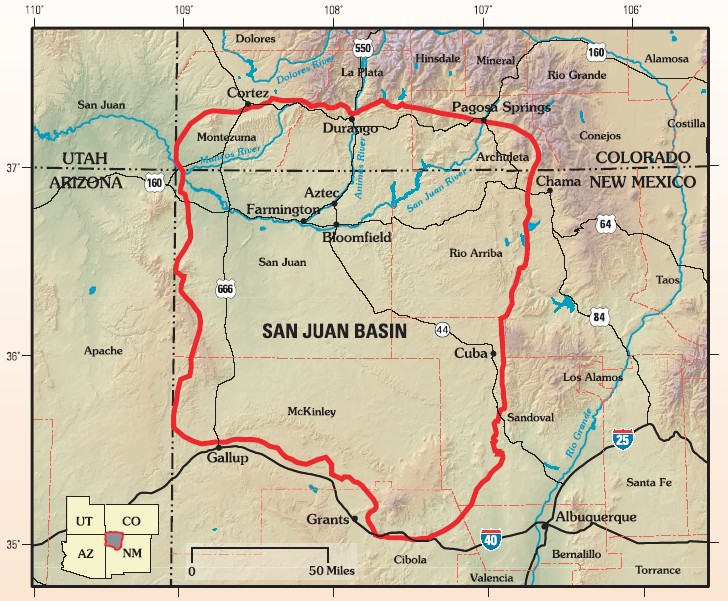
I happen to be writing this at a campsite in the heart of the San Juan Basin gas field. While I can gaze out across the landscape and see nothing but beauty, including the evening’s last light on Dzil Na’oodilii, I am constantly reminded of the ubiquity of the hydrocarbon infrastructure all around me. From just over a little rise comes a slightly squeaky and clanky sound of inadequately lubed bearings, and the low hum and whir of dozens of near and distant pumps and compressors and fans serenades me as I watch the stars unfurl across the big bowl of the sky.
There’s another map of this area that’s even scarier than the one those folks showed me. It includes oil and gas-related “incidents,” which is to say ruptures and spills and explosions and fires and major leaks. Those, too, are all over the map, and happen with disturbing frequency. Usually they’re not as dramatic as the two explosions, but they can be harmful: hundreds of gallons of crude oil sloshed onto the ground and into waterways or aquifers, thousands of cubic feet of methane wafting into the air and adding the potent greenhouse gas to the atmosphere.
When I watch the debate over permitting reform, or read the thoughts of the Abundance crowd, a part of me agrees with the credo of building more. The idea of a new New Deal appeals to me, if done right. Line the highways and interstates with high-voltage transmission lines to carry clean energy across the region, build utility-scale solar on reclaimed coal mines and next to old coal plants and on marginal farmland, build factories to manufacture solar panels and batteries. It would create jobs, revitalize economies, and put more clean energy onto the grid.
Then I hear news about these explosions, look at the oil and gas incident map, and come out here and find that I can’t take a picture of spectacular and sacred landscapes without a tank or well or road or drill pad showing up in it, somewhere. The Abundance folks and the proponents of the permitting reform legislation, or the Bipartisan Affordability and Jobs Act, want to cover the landscape and our communities with even more of this stuff. While many of them support the bill because it would expedite clean energy development, they don’t mind the fact that it would do the same for natural gas and oil and petroleum pipelines. And, in the social media wars raging over this bill, they discount the concerns of environmental groups worry about the cost we pay when blindly adhering to the credo of Build More Stuff.
It makes me want to bring these folks out here to the San Juan Basin and take a little walk across this landscape, which is so suffused with beauty, but also cluttered with the detritus of society’s urge for more, always more.
📸 PARTING SHOT 🎞️

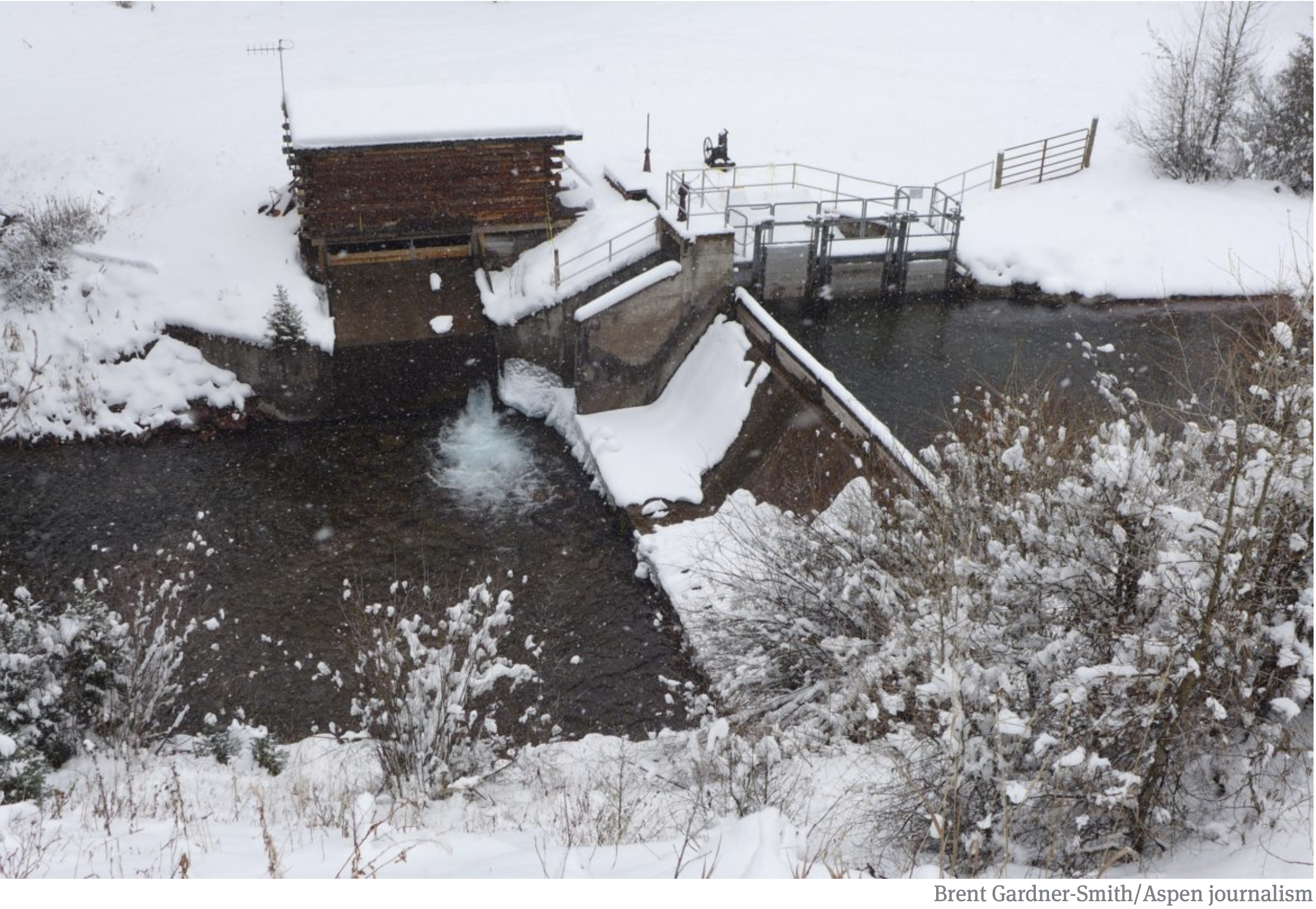
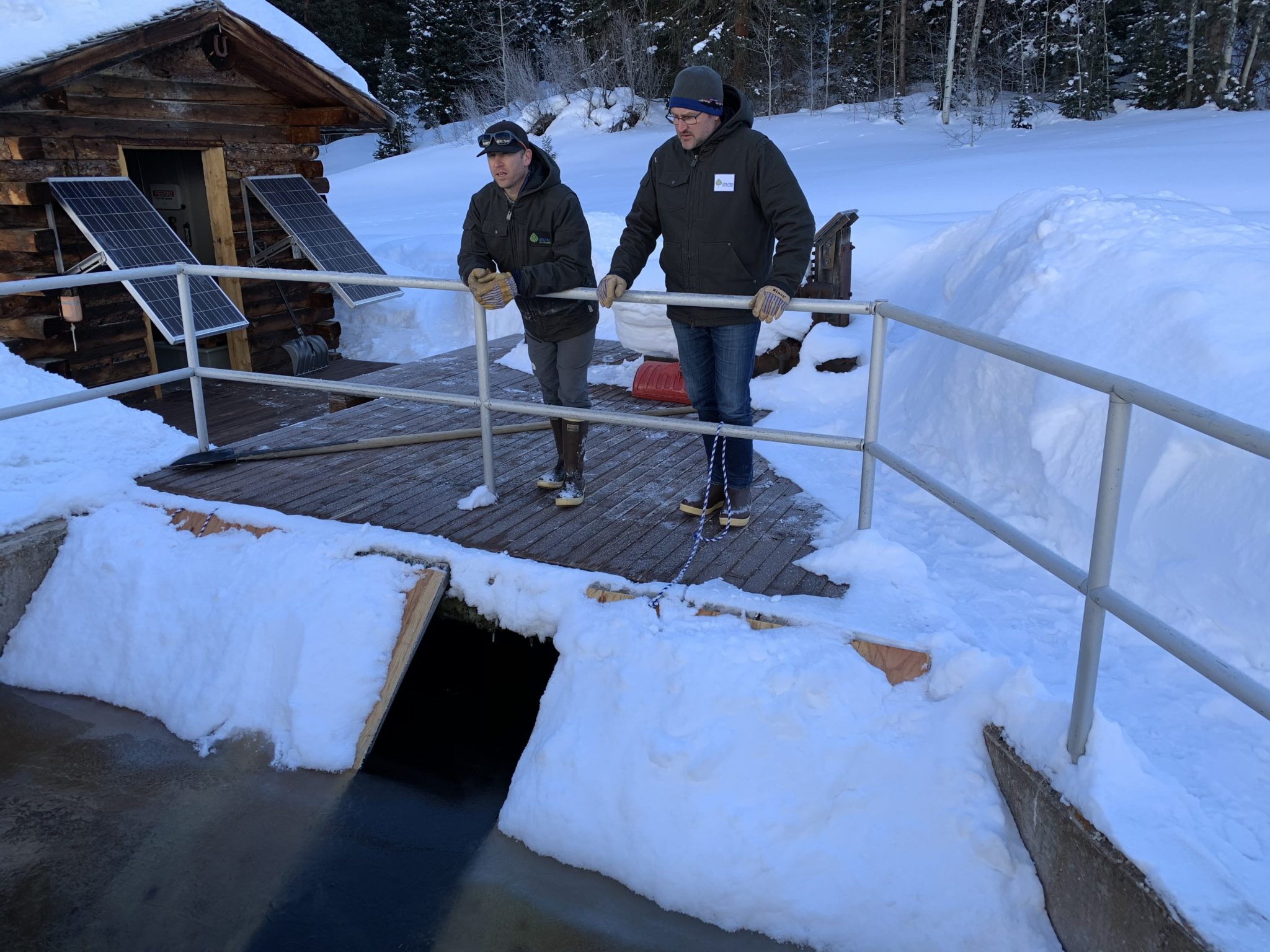
Click the link to read the article on The Aspen Times website (Grace West). Here’s an excerpt:
October 3, 2026
The city of Aspen has decided to remain under Stage 3 Water Shortage heading into winter, in a move that officials are highlighting as unprecedented. Aspen enacted Stage 3 for the first time ever this past May, Utilities Director Erin Loughlin confirmed, and the extension of the restrictions means the critical need to conserve water isn’t over yet.
“Since Stage Three declaration was enacted in May 2026, drought conditions have persisted throughout the Roaring Fork watershed,” said Loughlin. “The overarching concern remains persistently low river flows throughout the Roaring Fork watershed.”
Aspen’s municipal water system depends on the surface water diversions from Maroon and Castle creeks, according to her. The stream flows of both creeks rely on consistent release of water from snowmelt throughout the year — this year, however, the stream flows were compromised by the record-low snowpack during the 2025/26 winter.
“Given meteorological forecasts, the Water Department cannot be certain that forecasted precipitation will improve the snowpack upon which the water system relied upon at this time,” she said. “Staff continues to monitor conditions and will bring any recommended change to council for their review and consideration when appropriate.”
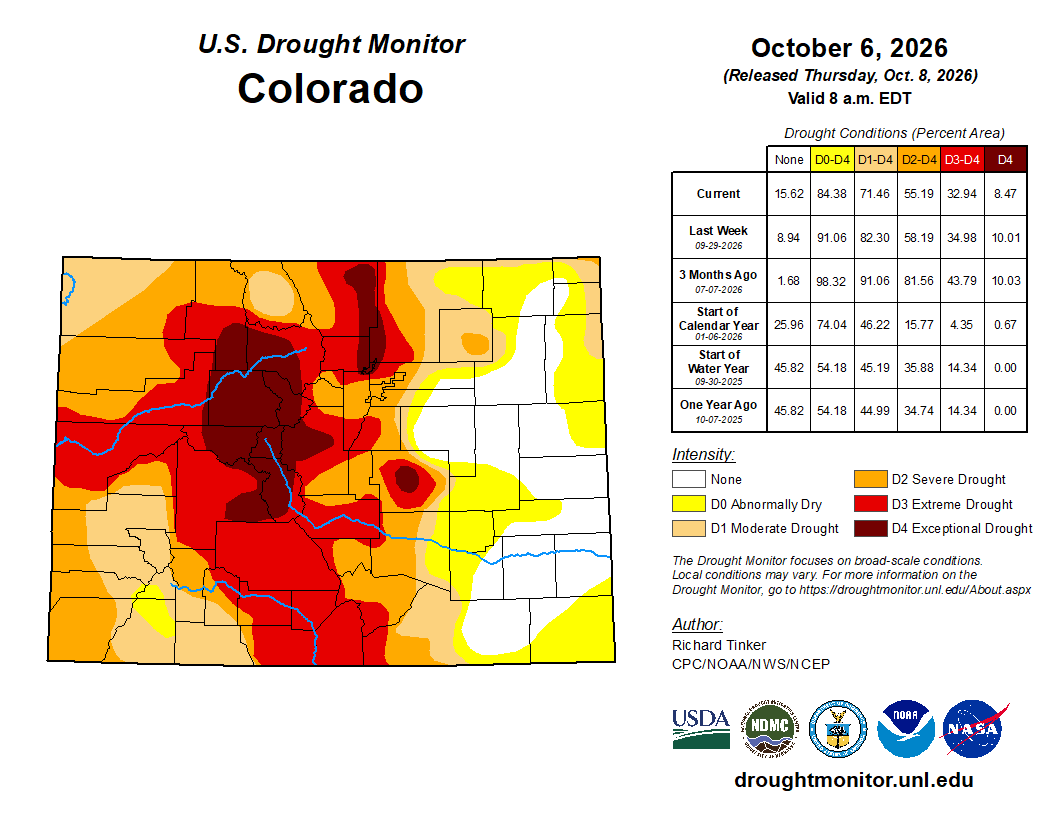
Click here to access the report on the Northwest Colorado Council of Governments website. Here’s an excerpt:
July 2026
Background & Study Purpose
This study is an update to a 2012 Report that explores the relationship between water and economic activity in a portion of western Colorado where the interaction of precipitation, elevation, and location produces water for the Headwaters Region, much of Colorado, and the Western United States.
The Headwaters Region encompasses the headwaters of the Colorado River and its tributaries. The Headwaters Counties consist of Eagle, Grand, Gunnison, Pitkin, Routt, and Summit County, depicted in Figure 1-1, on the next page. The water in the Headwaters Counties plays a special, dual role in meeting the needs of residents, businesses, and visitors while at the same time, meeting legal obligations for providing water to 40 million people in Colorado and the western U.S.
The study rests in the fact that water resources emanating from the Headwaters Counties are neither consistent nor unlimited, subject to considerable future uncertainty. Besides year-to-year weather variations, longer term climate changes are evident, and climate scientists expect these trends in climate change to continue. Regardless, economic activity in the Headwaters Counties is not standing still; leaders there seek prosperity, looking to further develop economic activity in their counties, the same as all counties around the State. At the same time, water providers on the Front Range in Colorado are seeking increased water supplies, identifying transmountain diversions (TMDs) from the Headwaters Counties as a potential source.
Couple this with the uncertainty related to interstate Colorado River allocations under the Colorado River Compact, and it is clear the Headwaters Counties should be worried about water scarcity. In short, all these forces bear down upon the increasingly less predictable but indispensable water supplies originating in the Headwaters Counties.
Representing the Headwaters Counties, the Northwest Colorado Council of Governments (NWCCOG) through its Water Quality/Quantity Committee (QQ) sought a current understanding of the relationship of the local economies to the evolving availability of surface waters. NWCCOG retained Harvey Economics (HE) to prepare this study.
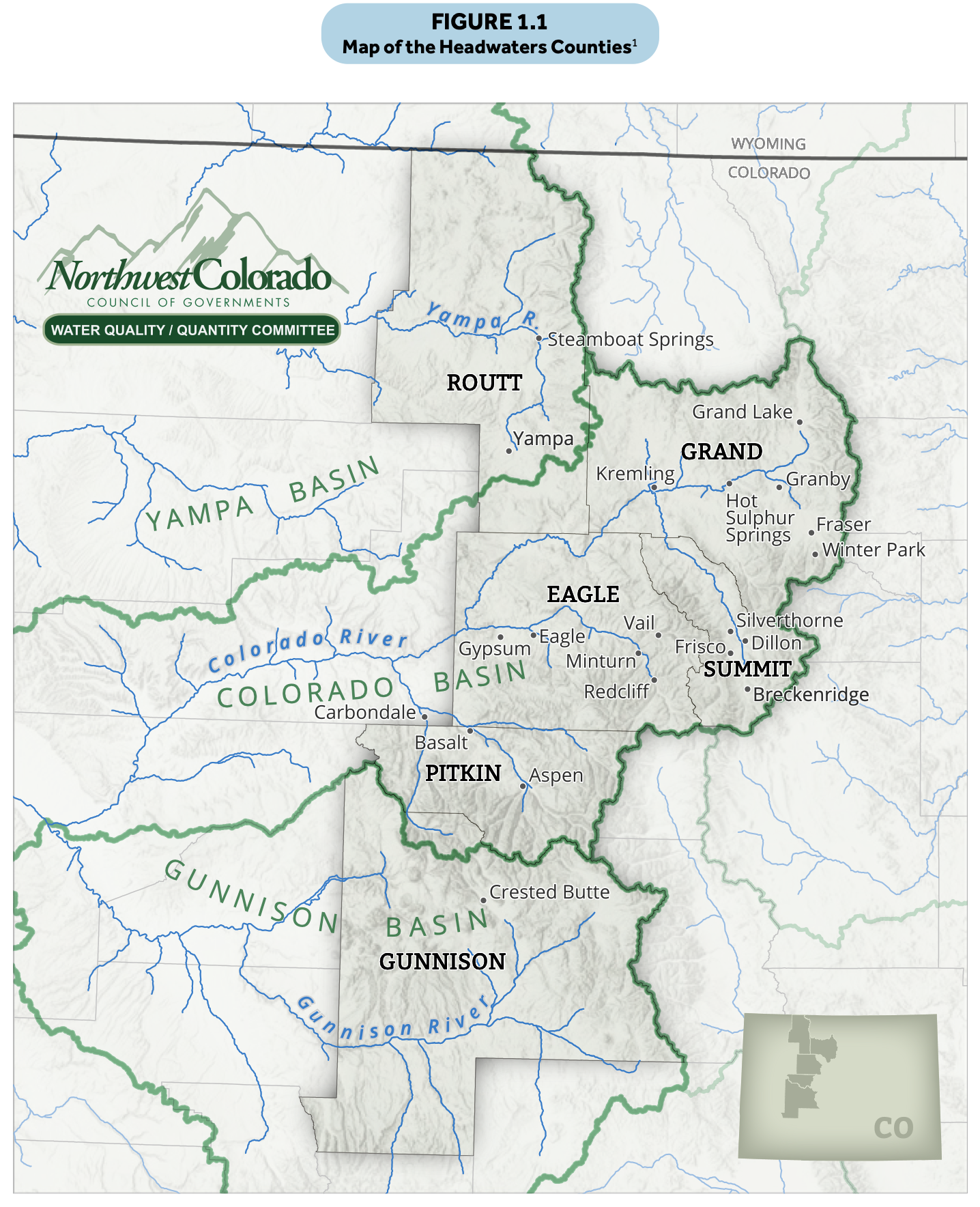
Click the link to read the article on the Ink Stain website (John Fleck):
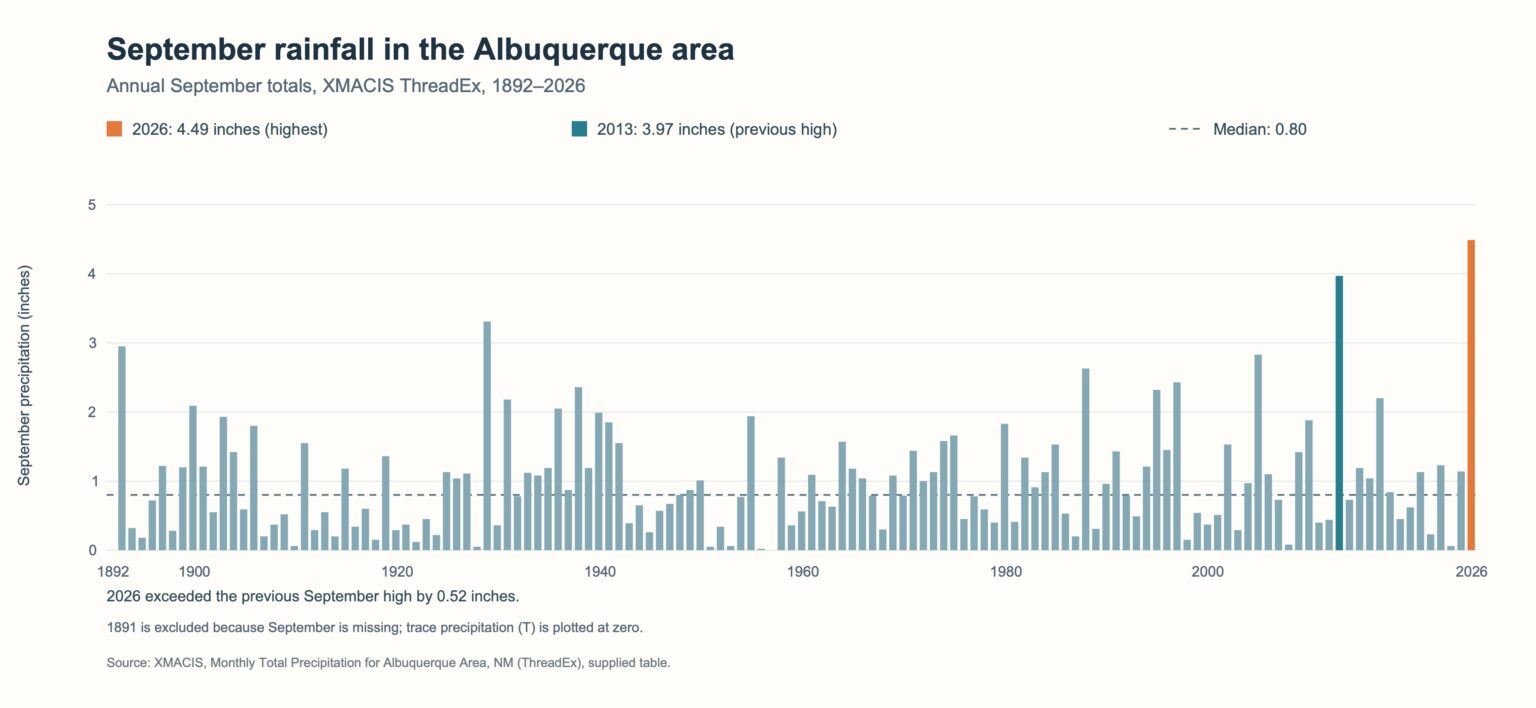
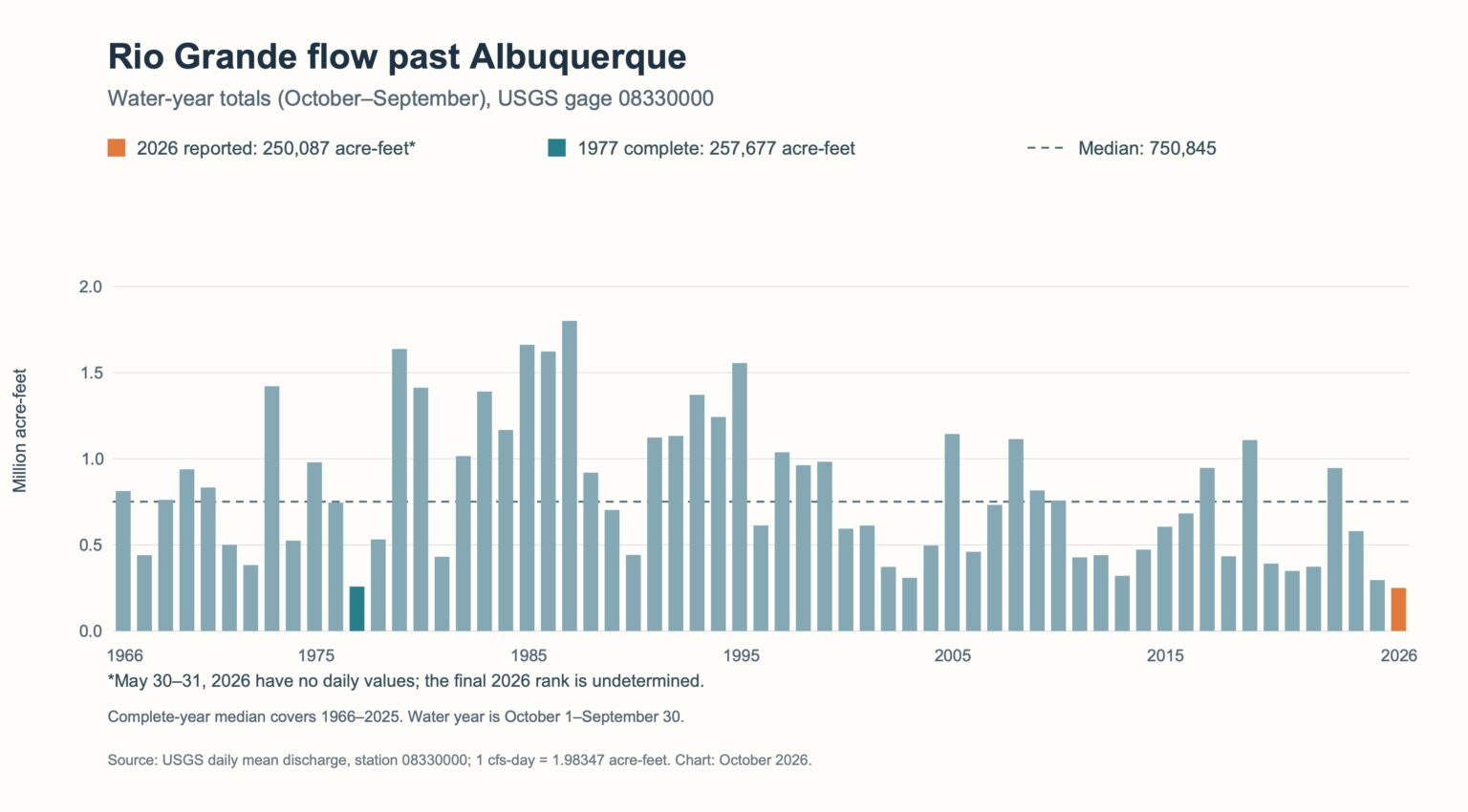
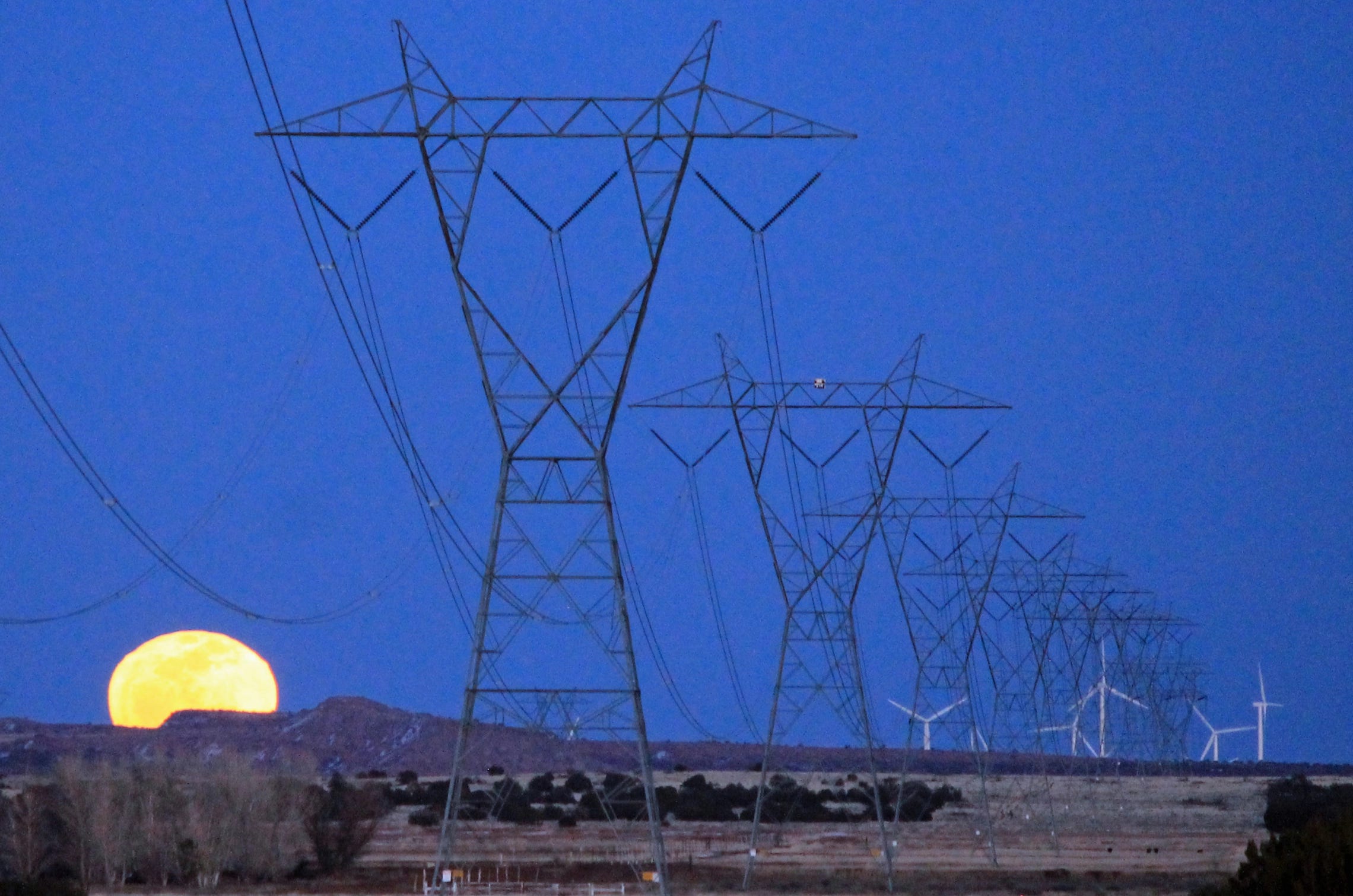
Click the link to read the article on The Land Desk website (Jonathan P. Thompson):
October 5, 2026
🔭 OVERSIGHT 👮🏼
A bipartisan group of federal lawmakers, including Sens. Martin Heinrich (D-NM) and Mike Lee (R-UT), introduced legislation aimed at streamlining and accelerating federal environmental reviews and permitting for major projects on Sept. 30. The Bipartisan Affordability and Jobs Act would lower or remove regulatory hurdles for large-scale renewable and transmission projects, fossil fuel pipelines, mining projects, and other industrial projects such as data centers and accompanying power facilities.
The push for faster permitting has been in the pipeline for years, and garnered the support of the renewable energy industries and climate advocates in more recent years, after seeing huge transmission projects such as SunZia and TransWest Express languish in red tape for nearly two decades due to potential impacts to wildlife and cultural sites. The lines were purportedly designed to carry renewable energy back and forth across the West to provide what’s known as “geographical smoothing” of variable solar and wind resources. These sorts of delays, according to permitting reformists, were stifling the energy transition.

Shortly after the bill’s details were made public, ecologically minded environmental groups raised red flags, warning that, as written, the legislation would weaken bedrock environmental laws, including the National Environmental Policy Act and Endangered Species Act, and take away the public’s power to block or force revisions to projects of all kinds, including ones that will lead to more fossil fuel burning and more greenhouse gas emissions. They pointed out that not only was the notoriously anti-environment Lee sponsoring the bill, but it also had a full-throated endorsement of the American Petroleum Institute.
This triggered a vehement, some might even say toxic, reaction from the climate hawks and Abundance adherents that support reform, and ignited a rhetorical civil war within the environmental movement on social media.

The Abundance movement supports the bill, allying itself with the petroleum and tech industries, because it would make it easier to build large clean energy facilities and the transmission needed to move it around. They are operating on the belief that building more and bigger clean energy projects is the only way to battle climate change — even if it also opens the door to more fossil fuel burning. This theory assumes that the market will favor clean energy projects, even if policy favors “all of the above.”
Marc Levitt, director of environmental regulatory reform for the Breakthrough Institute, called the bill a “heroic breakthrough for permitting reform” and “a massive down payment towards the energy abundant future that Americans deserve.”
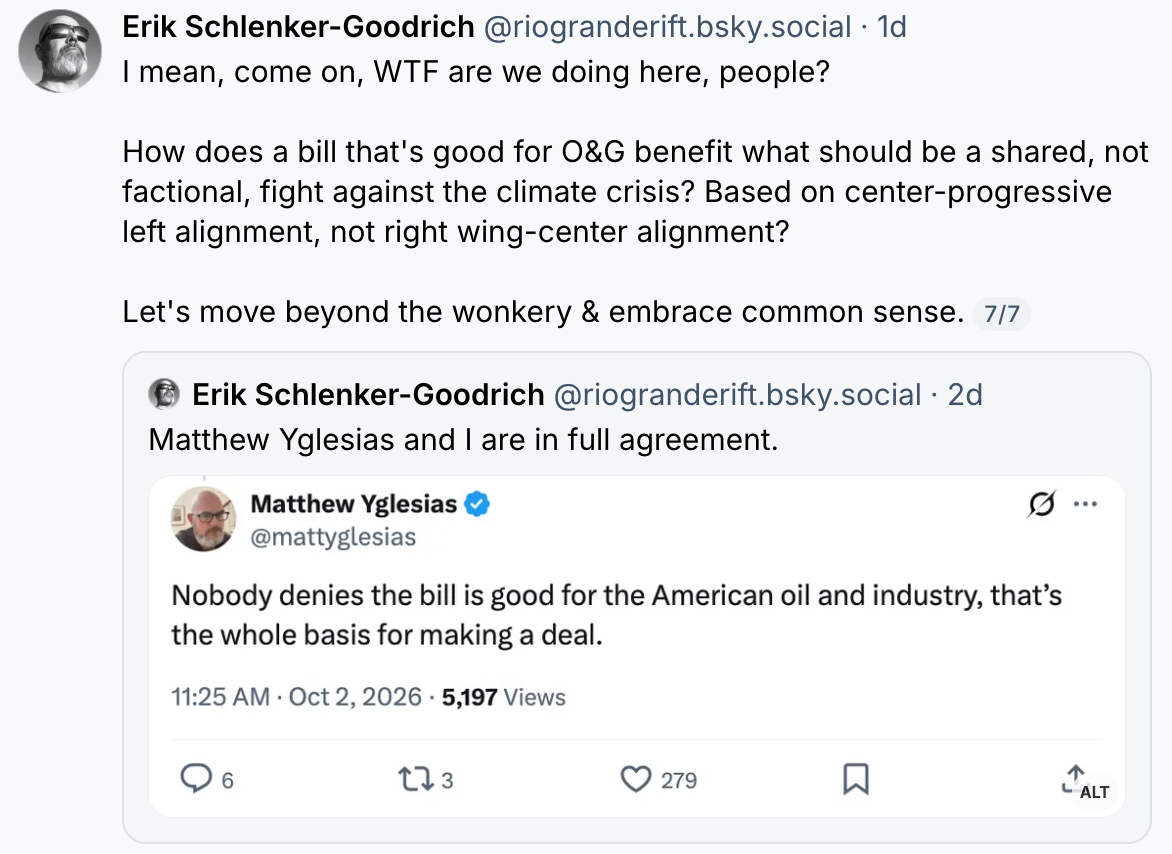
Opponents, however, say that pushing energy development of all kinds will not only decimate cultural and natural resources and burden humans and wildlife, but it also will not do much to solve the climate crisis if every new solar array or transmission line is matched with a new natural gas pipeline or power plant.
“The permitting deal is a betrayal of public lands, water and wildlife, and environmental justice values that Westerners depend on for clean air and water, places to hike, hunt, and fish, and the inestimable sense of freedom the West provides us all,” said Erik Schlenker-Goodrich, executive director of the Western Environmental Law Center based in New Mexico.
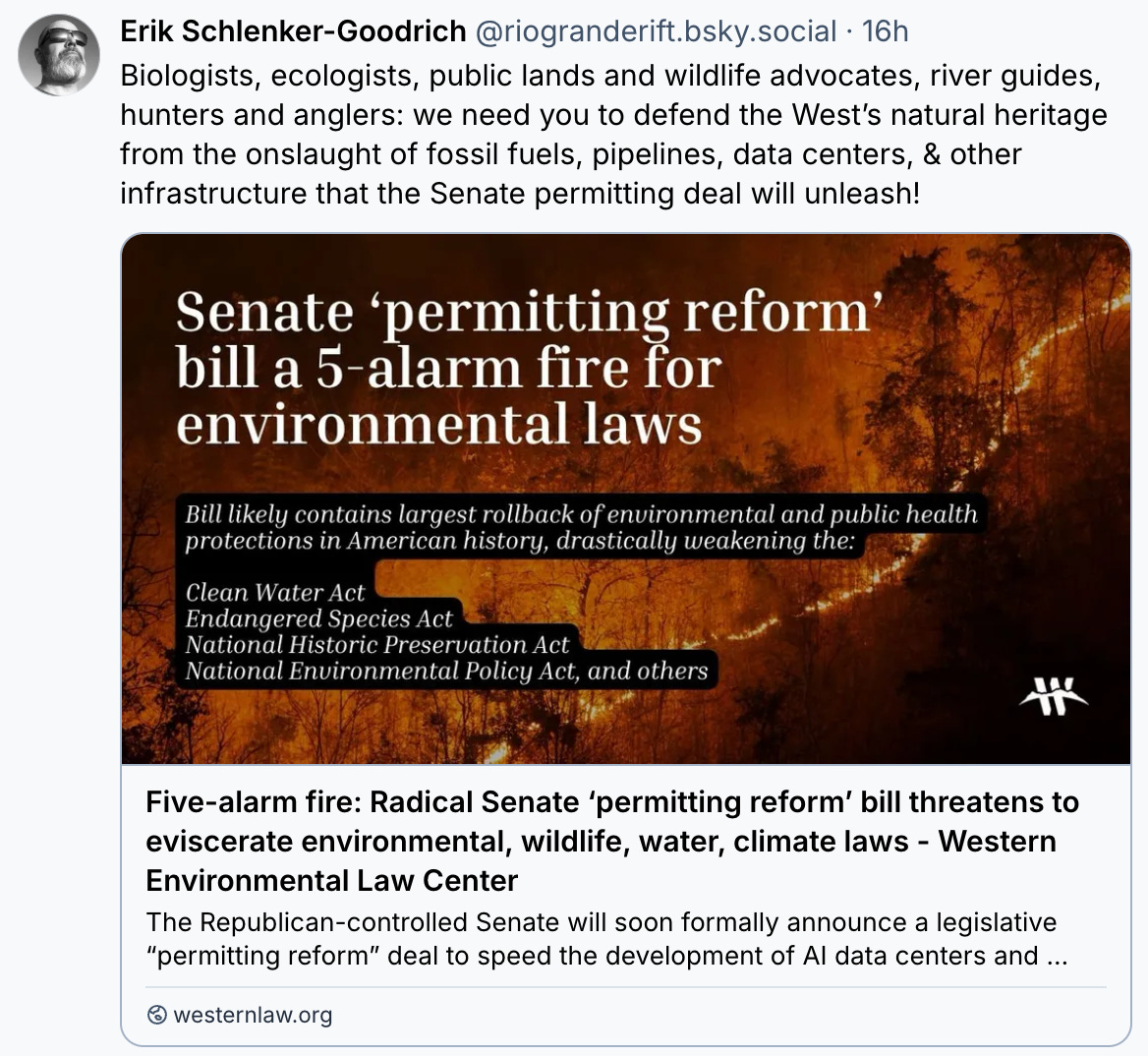
The legislation also raises concerns that the Trump administration could use the legislation to further weaken environmental protections to benefit the fossil fuel, nuclear, mining, and data center industries, while still throwing up roadblocks to solar and wind development.
The Land Desk will have an analysis of the bill and how it might play out on the Land Desk’s beat in the coming days.
🔋ENERGY TRANSITION 🔌
- California Gov. Gavin Newsom signs legislation allowing residents to install plug-in or balcony solar without getting utility approval, along with a suite of other bills that should advance the energy transition. (Climate Colored Goggles)
🐓 REGULATORY CAPTURE CHRONICLES 🦊
- The developer of a proposed pumped hydropower storage project on Black Mesa on the Navajo Nation reportedly tried to pay off, coerce, and bully non-profit Tó Nizhoní Ání into dropping its opposition to the project. The group has stood its ground. (KNAU)
⛏️ MINING MONITOR ⛏️
- Advocacy groups file a lawsuit challenging the U.S. Forest Service’s and Fish and Wildlife Service’s approval of South32’s Hermosa mine expansion onto about 52,000 acres of federal land in the Patagonia Mountains of southern Arizona. The groups accuse the agencies of violating the Endangered Species Act by failing to adequately analyze the projects impacts on threatened wildlife. (Center for Biological Diversity)
🛢️ FOSSIL FUEL FOLLIES
- Arizona Public Service and the Navajo Transitional Energy Company sign an agreement that could allow the Four Corners coal-burning power plant in northwestern New Mexico to continue operating until 2038, seven years later than its scheduled retirement date. APS officials say they need the facility online to meet growing data center-driven energy demand and ensure reliability as grid-battering extreme weather events increase in frequency. (Arizona Republic)
- Tó Nizhoní Ání and San Juan Citizens Alliance file an appeal seeking to block the Interior Department’s approval for the expansion and 110-year life extension of the No Name area of the Navajo Mine in northwestern New Mexico. The mine feeds the Four Corners Power Plant, which is now slated to close in 2038. “It’s disturbing that a federal agency could fast-track a project of this size and scope with almost no credible review, analysis or public consultation,” said Nicole Horseherder, Tó Nizhóní Ání’s executive director. “This permit continues a legacy of corporate interests abusing our resources, tearing up our land, depleting our water and displacing Navajo citizens. Worse still, it’s being done by a Navajo enterprise.” (news release)
- State data show the West Elk coal mine near Somerset, Colorado, is emitting potent greenhouse gas methane and other harmful compounds at nearly four times the permitted rate, spurring environmental groups to call for the mine’s operator to be sanctioned and forced to use the best available technology to slow the leaks. (Colorado Sun)

- Wyoming Gov. Mark Gordon (R) considers legally challenging a new California law that requires a contentious proposed coal export terminal in Oakland to go through a full environmental impact review prior to local agency approval, potentially stifling Wyoming’s effort to send Powder River Basin overseas via a West Coast port. (Cowboy State Daily)
⛈️ WACKY WEATHER WATCH⚡️
- The recent deluges have done a real number on the roads leading into Chaco Culture National Historical Park in northwestern New Mexico. The south road, according to the park’s Facebook page, “is still muddy and slick in places, with patches of deep standing water and wet clay.” Meanwhile, “the former north road (CR 7950) has sustained catastrophic damage at Escavada Wash. This road is completely inaccessible as an entry point to the park. We expect the repair will take a long time. Please do NOT attempt to enter Chaco from the north road.” (NPS)
- Flash flooding washes out sections of the BNSF Railway’s main line alongside the Rio Puerco near the Arizona-New Mexico border. The Rio Puerco lacks reliable streamflow gauges, but the Little Colorado River just downstream from its confluence with the Rio Puerco hit an astounding 6,800 cubic feet per second during the late-September storms in a place that is normally virtually dry. (Navajo Times)
🐟 COLORADO RIVER CHRONICLE 💧
- Reduced water releases from Glen Canyon Dam diminish the Colorado River’s flows in the Grand Canyon, which in turn affects recreation, river ecology, and tribal nations’ sacred places. (High Country News)
🦫 WILDLIFE WATCH 🦅
- A bear wanders into the Aspen farmers market and starts chowing down, apparently unfazed by the high prices. Things like this look cute, but it can end up being deadly for the bear.
🪦 OBITUARY 🏜️
- Ken Sleight, the inspiration for Seldom Seen Smith in Edward Abbey’s the Monkey Wrench Gang, died on Oct. 2 in Moab. Sleight was a river-runner, canyon lover, and lifelong protector of and advocate for Utah’s “Standing Up Country.” “We just lost such a wonderful person,” John Weisheit, director of Living Rivers and friend and mentee of Sleight’s, told The Salt Lake Tribune. “We need more Ken Sleights, not less.” (Salt Lake Tribune)
📖 READING ROOM 🧐
The New Yorker has again ventured into the Four Corners Country, this time with a story by Peter Hessler about the Million Dollar Highway between Silverton and Ouray, “one of America’s scariest roads.” I always enjoy Hessler’s writing, whether about Cairo or Nucla, and this story’s no exception. His descriptions of the many accidents and ensuing rescues on that stretch of road are vivid and, yes, scary. And his history of the area and Otto Mears, the road’s original builder, is compelling. But I have to take issue with the framing of the story, and the headline, which is: “Why doesn’t anyone want to fix one of America’s scariest roads?” To which I’d respond: Does it really need fixing?
Look, traversing Red Mountain Pass can be daunting, especially during the spring freeze-thaw cycle when rocks are dislodged from the cliffs and tumble down onto the asphalt and the Mother Cline’s human-sized icicles hang perilously over the pavement.Sometimes folks tragically go over the edge. Several plow drivers have perished on the road after getting pummeled by the Riverside Slide. In 1963, Reverend Marvin Hudson and his two teenaged daughters were hit by the Riverside, swept into the gorge, and buried (oddly, Hessler leaves this story, one of the most nerve-chilling, out of the story). This problem has been largely solved by simply shutting the road when danger is high.
So sure, the road can be dangerous and nerve-racking, but frankly, I can think of plenty of far scarier — and statistically more dangerous — stretches of road. Highway 550 between Albuquerque and Bloomfield is a virtual carnage factory, especially when the oil and gas fields are busy with water and oil-hauling trucks. Highway 191 between Monticello and Moab is super sketchy — and deadly. Or how about I-10 in the Phoenix area, I-40 just about anywhere, or I-70 dropping from the mountains into the Colorado’s Front Range on a weekend afternoon?
Back in the late 1980s, Colorado spent about a half-billion dollars to “fix” I-70 through Glenwood Canyon. Now it’s the site of multi-vehicle accidents, rockslides, debris flows, and not infrequent closures due to the above. So, yeah, Red Mountain Pass doesn’t need fixing. People just need to slow the hell down and pay attention.
Another control day — Jonathan P. Thompson
Below is the Snow Water Equivalent in South Platte graph from the NRCS for October 5, 2026. Snowpack is 112% of the median and 1% of the median peak. There are 196 days until the median peak. I’ve added the lines for 2026, 2018, 2012, and 2002 since the statewide drought is still very pronounced.

Below is the Precipitation Accumulation in South Platte graph from the NRCS for October 12, 2026. This morning precipitation, at the SNOTEL stations, is at 5% of the median (no change one week), and 0% of the water year median (no change one week). There are 254 days left in the water year. I’ve added the lines for 2026, 2018, 2012, and 2002 since the statewide drought is still very pronounced.
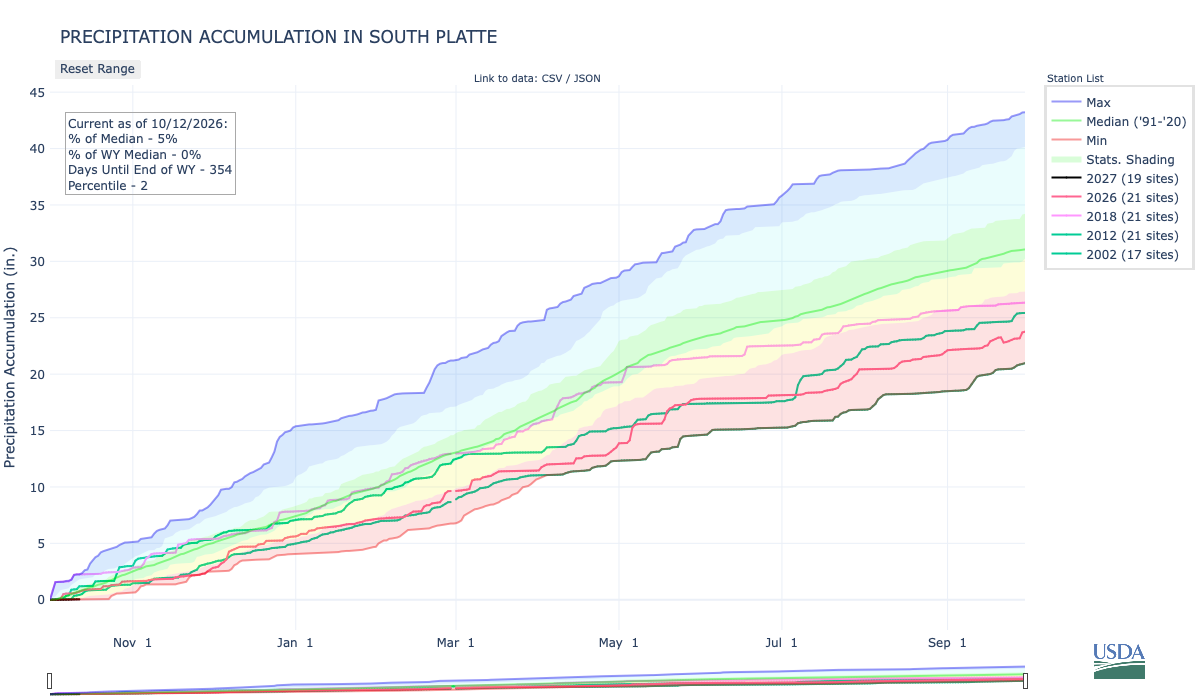
Rain/snow is likely Tuesday and Wednesday, with a slight chance for snow showers Thursday, in the central mountains. There is a slight chance for showers today, rain/snow is likely Tuesday, Wednesday, and Thursday, in the northern mountains. Showers are likely Tuesday and Wednesday, with a chance for showers Thursday, down here about 337 miles from the Indigenous Gardens at Fort Lewis College on Indigenous Peoples Day. From Fort Lewis College:
The sun was shining bright last Friday [October 4, 2026] as more than 200 FLC faculty, staff, students, and community members gathered outside FLC’s Indigenous Garden for its official ribbon-cutting ceremony.
“It’s really beautiful today. And I think this garden’s going to have many days like that,” said Lilliona Benally, one of the FLC students who spent the summer interning at the garden. “It’s also going to have hard days, like all of us. I really want to think about that support, that as much as we’re supporting this garden, we’re going to support each other in the years to come.”
Joslynn Lee, associate professor of chemistry, is an FLC alumna who was key in launching the reconciliation efforts at FLC. She called on those present to consider how Indigenous people connect with plants.
“They’re important because plants are central not only for nutrition, medicinal purposes, ceremonial, and utility, just to name a few, but it’s really the connection that people feel with land, place, and space,’ she said.
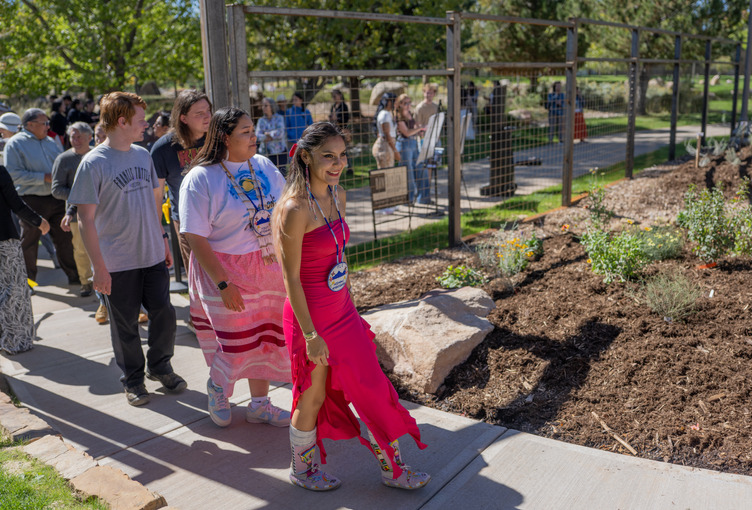

Here’s a look at the Colorado 7-Day precipitation map through October 11, 2026 from the High Plains Regional Climate Center. Precipitation in the South Platte Basin along the Continental Divide of the Americas ranged from 0.00” to 0.40″.

Here’s the Colorado 7-Day percent of normal precipitation map through October 11, 2026 from the High Plains Regional Climate Center. Precipitation in the South Platte River Basin along the Continental Divide of the Americas was 0% to 50% of normal.
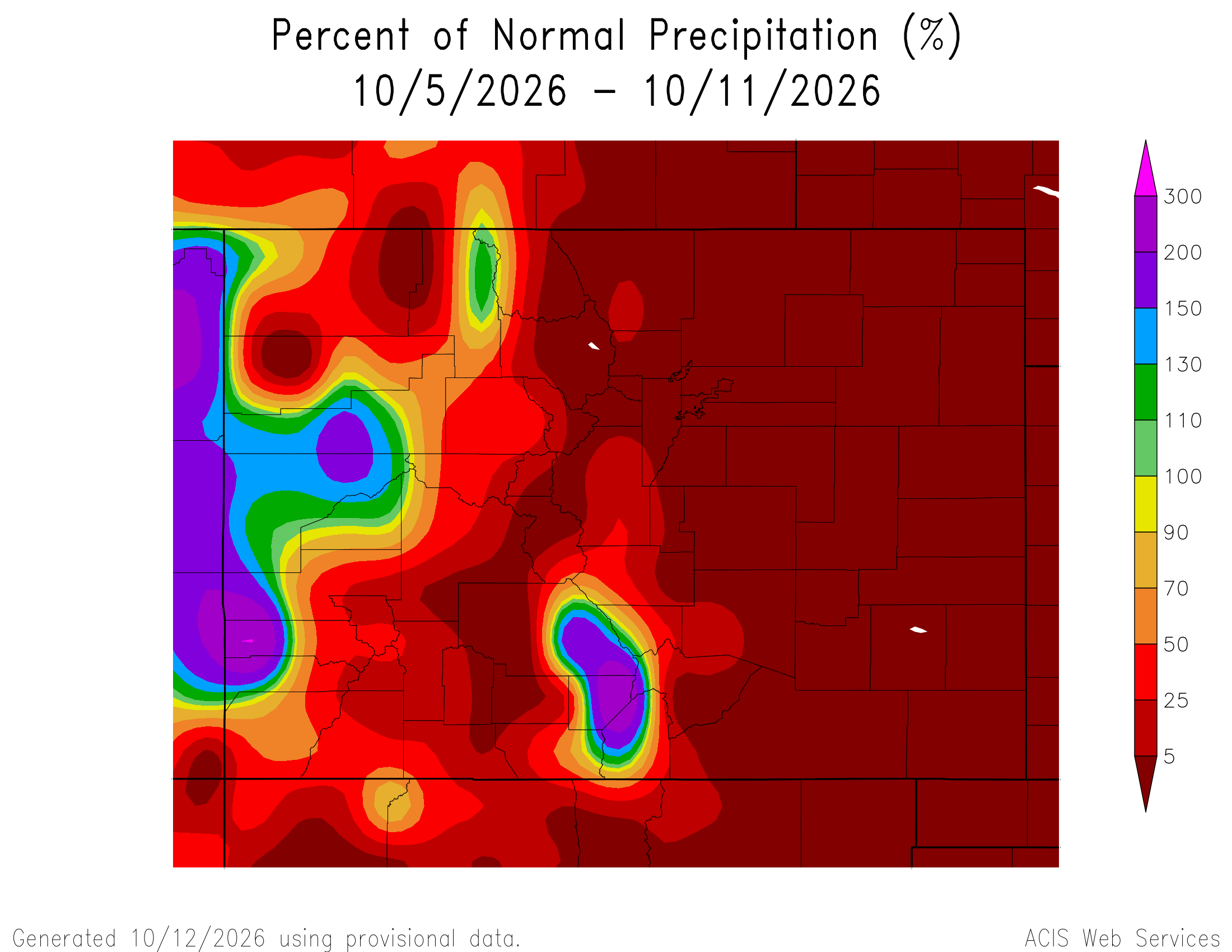
Here’s the most recent 7-Day Departure from Normal Temperature (F) for Colorado through October 11, 2026 from the High Plains Regional Climate Center.
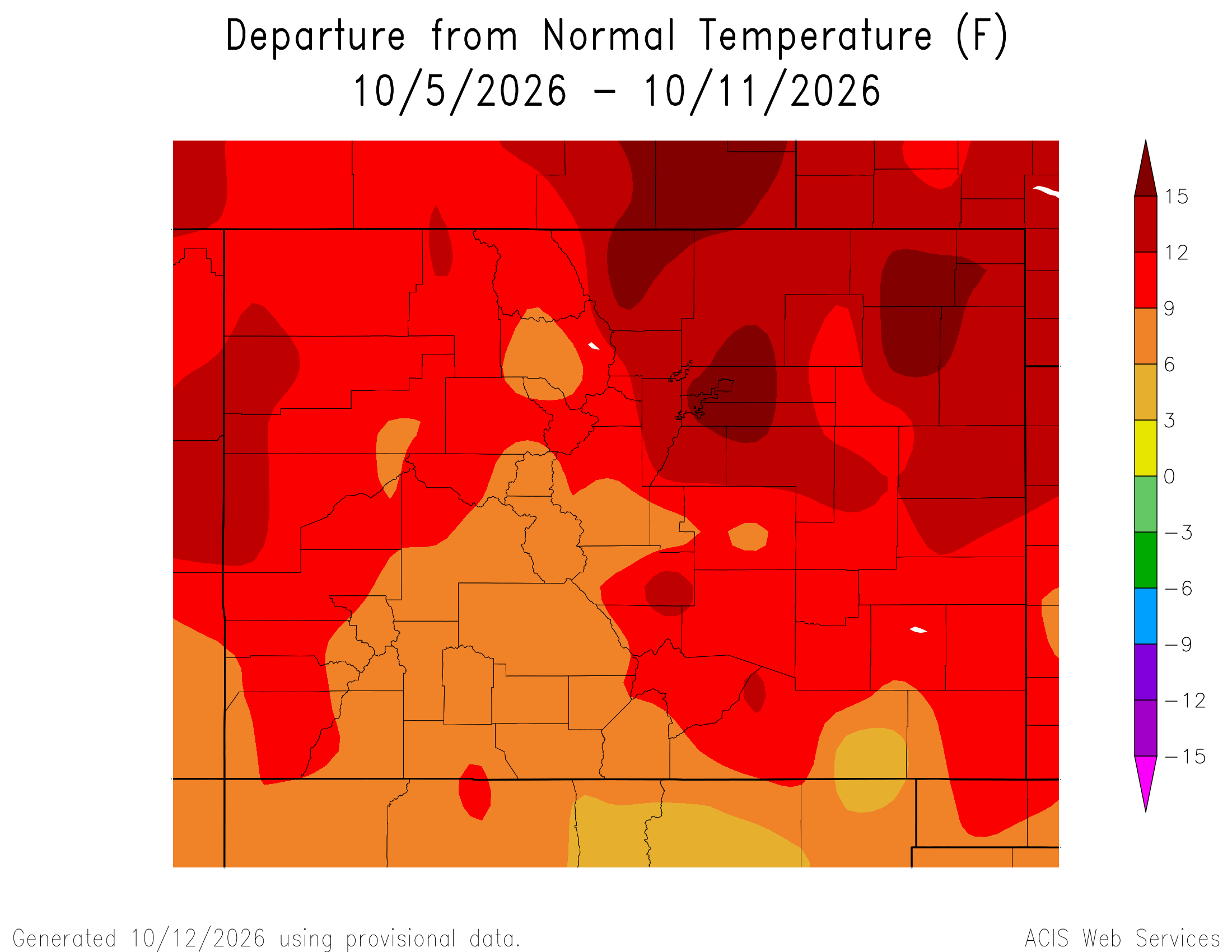
Below is the 7-day Quantitative Precipitation Forecast for the week of October 12, 2026. Precipitation is anticipated for the mountains of the South Platte River Basin and may total up to 1.50″.
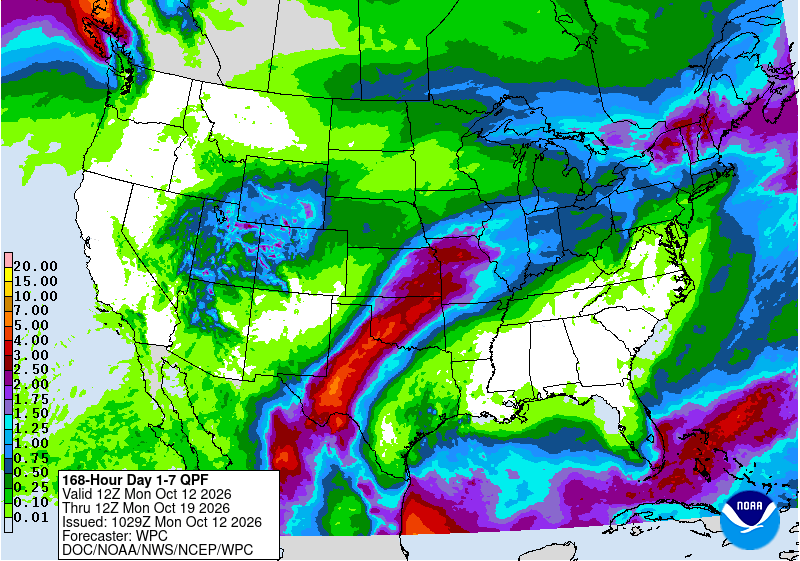
Below are the 8-14 day outlooks from the Climate Prediction Center, issued October 11, 2026, for temperature and precipitation, for the week starting October 19, 2026. The CPC expects above normal temperatures and above normal precipitation for the mountains of the South Platte River Basin.


Below is the Colorado Drought Monitor map from October 6, 2026. There were one class improvements in Weld, Elbert, Arapahoe, and Adams counties. There were two class improvements in Adams and Arapahoe counties. There were one class degradations in Morgan, Logan, Weld, Larimer, Boulder, Douglas, Sedgwick, Arapahoe, and Adams counties. Drought and abnormal dryness covers 84.38% of Colorado. The South Platte Basin is experiencing Abnormally Dry, Moderate, Severe, Extreme, and Exceptional drought conditions.
Below is the Colorado Drought Monitor one week change map ending October 6, 2026.
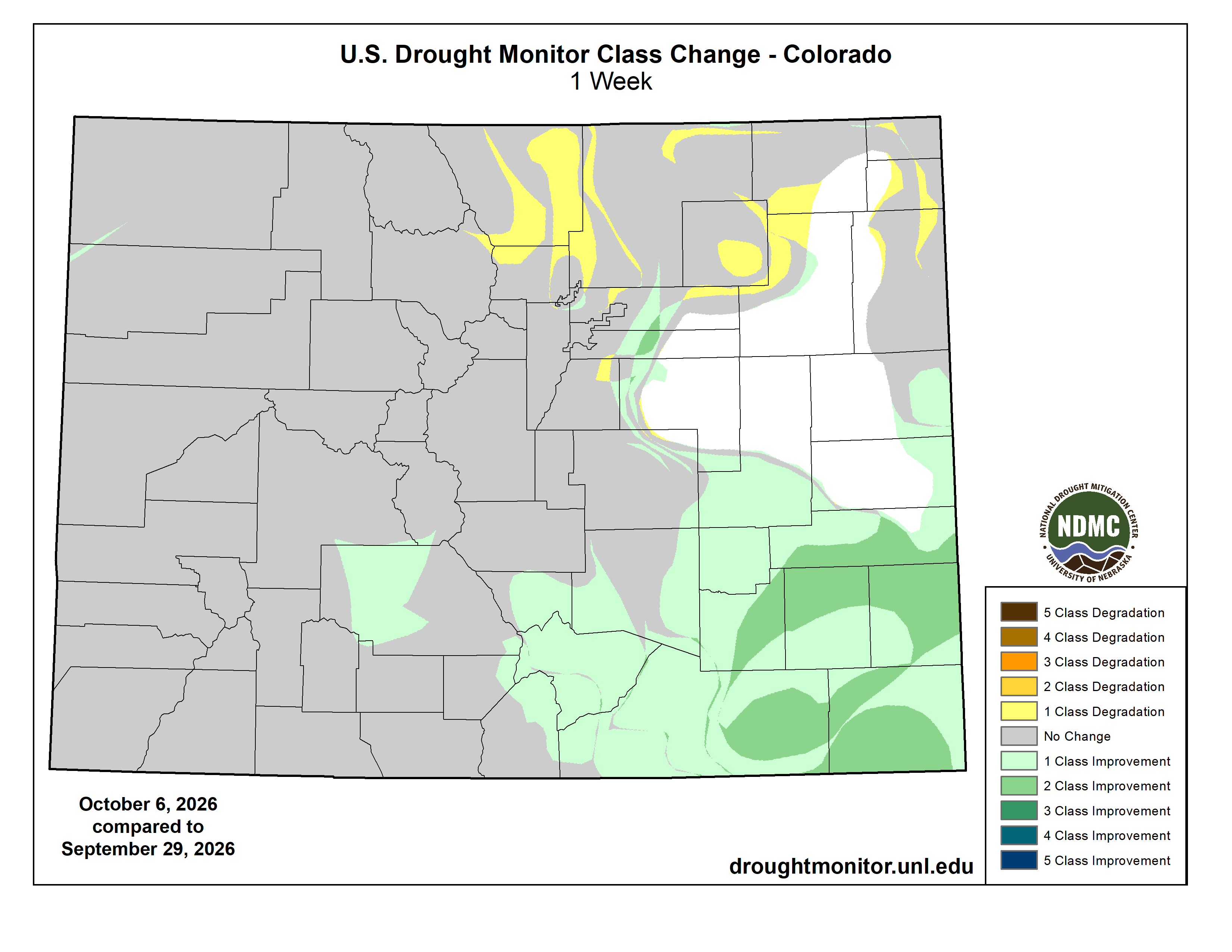
Here’s the US Drought Monitor Map from last week along with the one week U.S. change map.
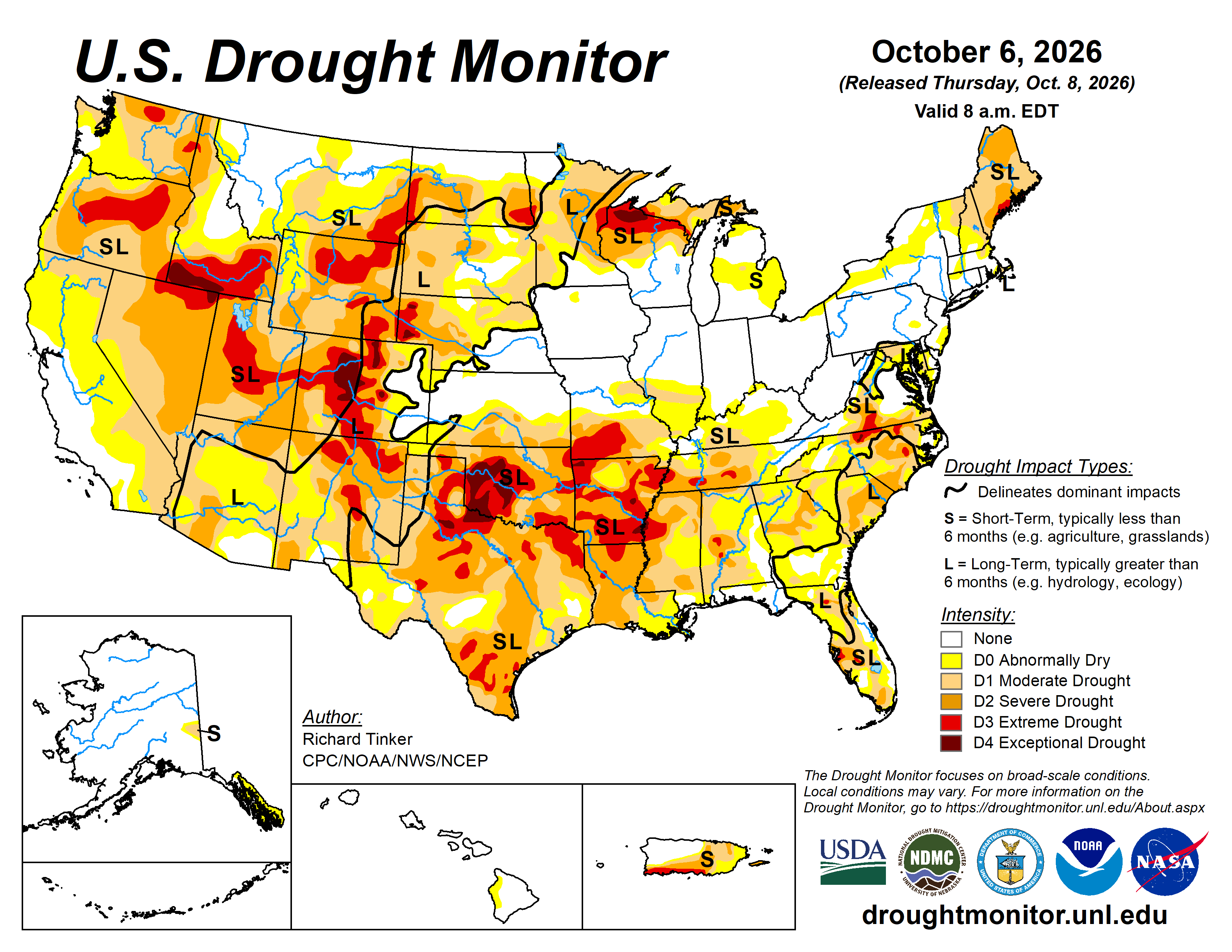
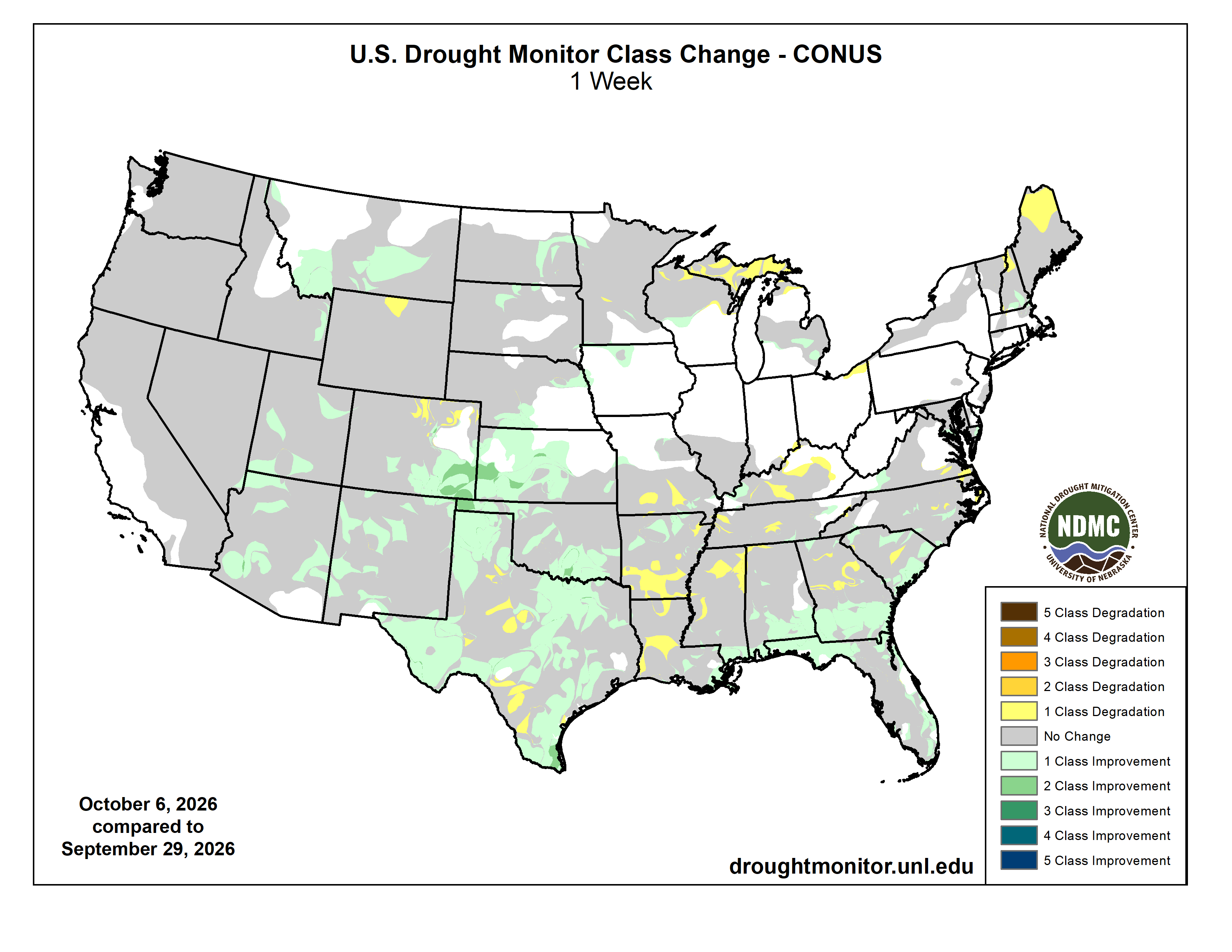
Finally, the Colorado Climate Center released their monthly climate summary for September 2026 for Colorado recently.

Click the link to read the article on the KOAA website (Liv Wood). Here’s an excerpt:
October 5, 2026
A plan to revitalize two of Colorado Springs’ major waterways is generating both excitement and anxiety among residents who would be most affected by the changes. Pikes Peak Waterways, the city of Colorado Springs, and Colorado Springs Utilities are partnering on the COS Creek Plan, a long-term effort to revitalize portions of Monument Creek and Fountain Creek. A feasibility study is currently underway to determine how the vision will come to life. President of Pikes Peak Waterways said the study will be complete in 2027. Other priorities include:
- Nature and Habitat Restoration
- Flood Resilience
- Water Quality
- Trails and Connectivity
- Parks and Gathering Spaces
- Recreation and Safe Creek Access
- Economic Development
- Neighborhood Revitalization
- Public Art and Culture
At the end of a 20-year timeline, the hope is that eight new and revitalized parks will be established.
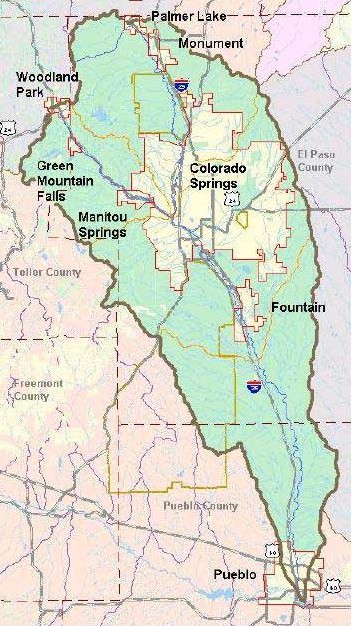

From email from Southeastern Water (Chris Woodka):
October 7, 2026
A contract to repay the federal government for the Arkansas Valley Conduit (AVC) was signed Wednesday, October 7, 2026, by the Southeastern Colorado Water Conservancy District and the Bureau of Reclamation.
“This is an incredibly important day for the District, Reclamation and all of our constituents for the AVC,” said Bill Long, president of the District Board of Directors. “We still have a long way to go, but we are moving forward. This is an important milestone.”
Long held up one of the golden frying pans that were sold up and down the Arkansas Valley in the 1950s to raise money to promote the Fryingpan-Arkansas Project, an effort that eventually led to President John F. Kennedy signing the Fry-Ark Project legislation. The AVC is the final project element of that original Fry-Ark project legislation.
“Without the Arkansas Valley Conduit, the Valley will not be developed as it would have been otherwise. You cannot attract industry without a supply of clean water,” Long said.
Kevin Karney, chairman of the District’s AVC Committee, was an Otero County Commissioner when the AVC was relaunched in 2000. Karney was a member of the group searching for a way to provide better quality water for the Lower Arkansas Valley.
“The only solution that has risen to the top is the Arkansas Valley Conduit,” Karney said.
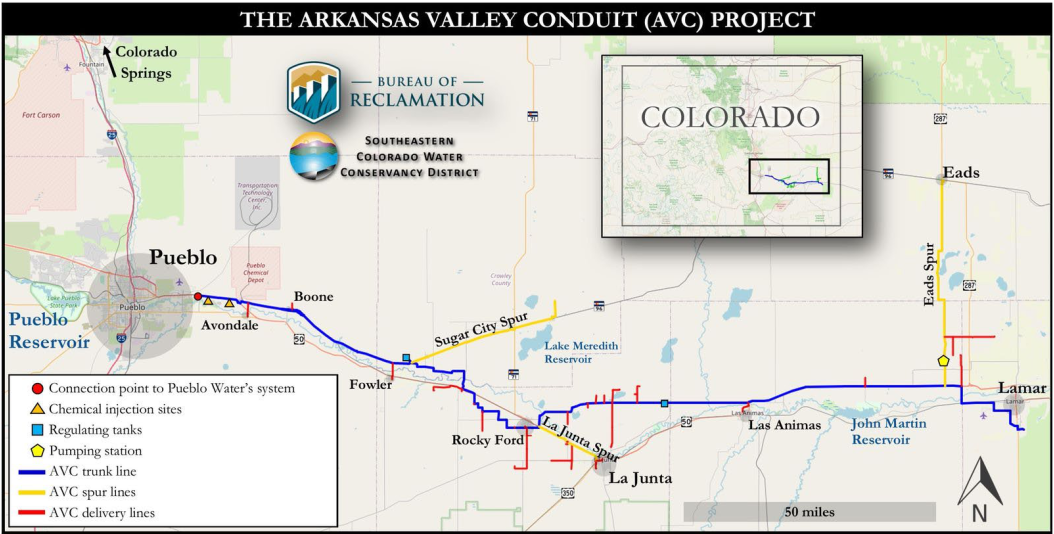
Reclamation and the District are building the AVC in a collaborative project, with Reclamation building the 130-mile trunk line from Pueblo to Lamar and the District building spur and delivery lines to connect 38 water systems to the trunk line. The total cost of the project is estimated to be $1.4 billion.
The AVC will provide water to 50,000 people served by cities, towns, water districts and private water companies.
Participants are required under federal law to pay 35 percent of the AVC’s cost. Any costs incurred by the District for construction of spur and delivery lines will be credited to the 35 percent repayment. The The remainder will be repaid with miscellaneous revenues generated from the Fryingpan-Arkansas Project (mainly from excess storage capacity contracts in Pueblo Reservoir).
The contract defines the responsibilities for design and construction, facilities ownership, and when the repayment period will start with substantial completion of the AVC. Reclamation will retain ownership of the trunk line and related facilities it is building, as well as the SCADA (Supervisory Control and Data Acquisition) System that will be used to operate the AVC. The District will construct and own the delivery lines, and any SCADA system implemented must comply with federal cybersecurity requirements.
The Contract reaffirms Pueblo Water’s role for conveyance of AVC water using capacity in its system in accordance with the conditions outlined in the 2022 Three-Party Contract between Reclamation, the District and Pueblo Water.
Provisions are included that would allow delivery of AVC water to participants before the AVC Project is completed. The Contract defines how costs for water delivered, supplies, and various services will be divided between the District and Reclamation prior to completion of construction.
When the AVC is substantially complete, responsibility for all OM&R costs will be transferred to the District. The District is developing a cost model in order to provide reliable estimates of operation, maintenance and replacement (OM&R) at partial and full capacity.

Click the link to read the article on the KRCC website (Shanna Lewis). Here’s an excerpt:
October 7, 2026
A new collaboration between state and local organizations in the San Luis Valley aims to conserve and protect the region’s water and lands. The San Luis Valley Conservation and Legacy Project’s objectives include leveraging the area’s natural assets and cultural heritage to create economic opportunity. A recent gathering of local and state leaders identified ways to support agriculture and outdoor recreation in the region and serve the long-term interests of communities. Priorities include safeguarding water resources in both the Rio Grande River and in the groundwater aquifers. That could include paying farmers to leave water in the river and its tributaries to help create and maintain healthy riparian environments for wildlife, fishing recreation and agriculture by potentially paying farmers to leave water in the river and its tributaries. Also among the goals are promoting a regional identity and cooperation among various stakeholders, as well as attracting responsible tourism that brings money to the area without increasing the risk of wildfire, trashing the environment or straining search and rescue teams.

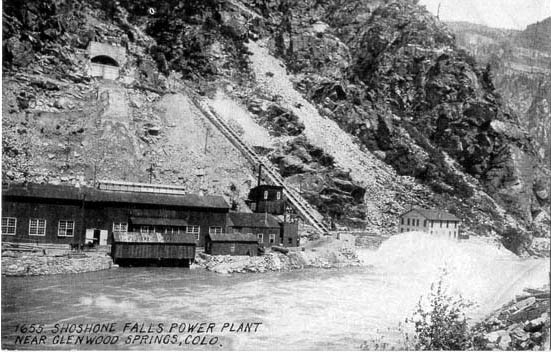
Click the link to read the article on The Sopris Sun website (Amy Hadden Marsh). Here’s an excerpt:
October 7, 2026
Representatives of the Colorado River Water Conservation District (CRWCD) presented a detailed update about West Slope water, Shoshone water rights and more. Taking a look at water conservation proportionality, Lindsay DeFrates, CRWCD public information officer, later told The Sun that the CRWCD believes that proportionality is critical as the state investigates how to implement the Contribution Program, which allocates Colorado’s share of federal money awarded to the Upper Basin states to conserve water. “It will pay people to use less water,” she said. At Monday’s meeting, CRWCD General Manager Andy Mueller expressed concern regarding the disproportionate impact of water conservation on western Colorado agriculture. “If you don’t have state laws requiring proportionality from all Colorado River users, meaning the Front Range as well, all of that water not only comes off the West Slope, it comes out of West Slope [agriculture],” he said.
Colorado’s conservation goal is 100,000 acre-feet of water. “If all of that comes out of West Slope [agriculture], that’s a big hit to our local economies, to our small towns, to our agricultural industry, and it may be just the beginning of what we view as a permanent program,” Mueller added.
As for the Shoshone water rights issue, CRWCD’s Strategy Chief Amy Moyer told the BOCC that the purchase price is $99 million and all but $1.6 million has been raised from the CRWCD, the federal government and state and local governments, including $3 million from Garfield County. “Our plan is to continue working with communities up and down the river,” Moyer said. “But we may want to sit down with you as we look to close that $1.6 million gap.”
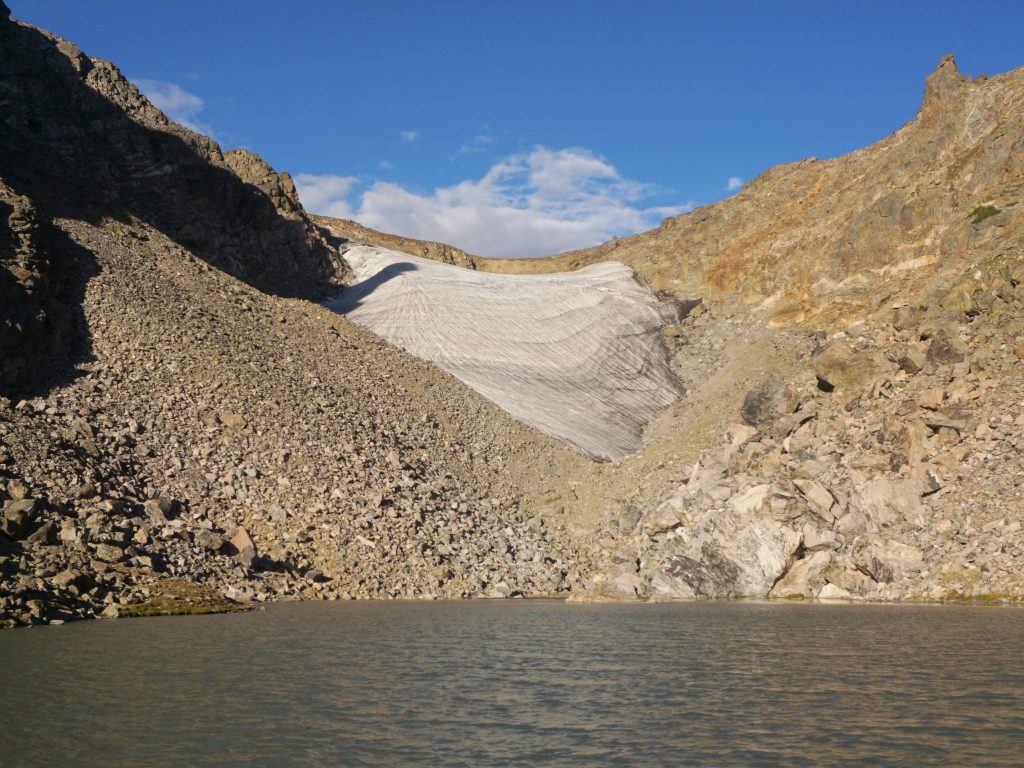
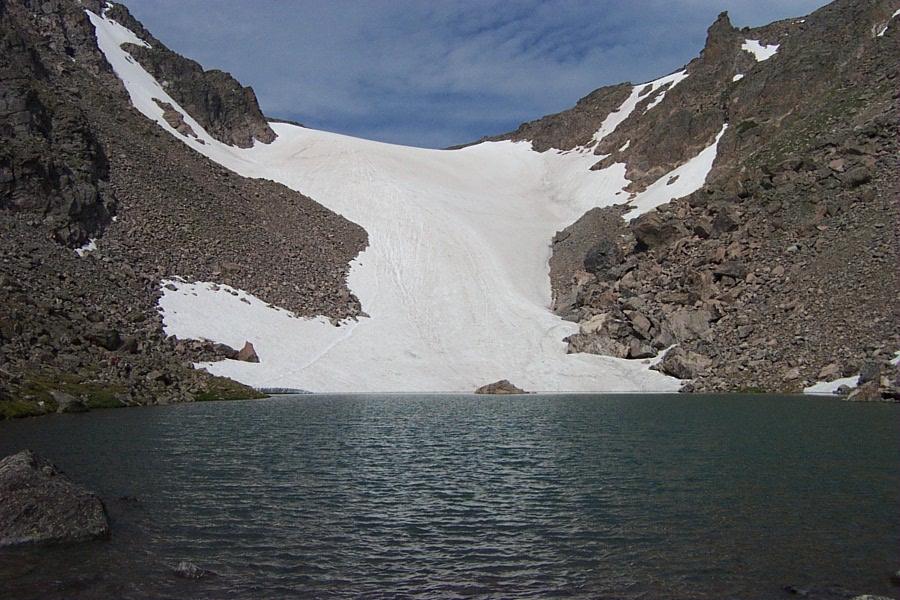
Click the link to read the article on the Summit Daily website (Ryan Spencer). Here’s an excerpt:
October 10, 2026
Colorado State University Associate Professor of Geoscience Dan McGrath is a glaciologist who has studied glaciers all over the world, including in Greenland, Antarctica, Alaska, Asia and here in Colorado. Colorado’s mountains were carved by glaciers, which form cirques, or bowl-shaped valleys through erosion and are especially common across the Front Range and in places like Rocky Mountain National Park, McGrath said. But it is somewhat of an open question whether Colorado has any true glaciers left.
“I generally throw out that Andrews and Arapaho are the two most glacier-like features that we have left in the state,” McGrath said. “You would need to have evidence that they’re flowing to indicate that they’re still glaciers — and there have not been any kind of comprehensive surveys of their flow velocities or ice thickness that allows us to say definitively these are glaciers.”
The U.S. Geological Survey lists 16 glaciers in Colorado, but that includes places with perennial snowfields like St. Mary’s that “clearly have not been glaciers for a very long time and may no longer even have snow and ice in them,” McGrath said. These glaciers have been melting since what is known as the “Little Ice Age” from about 1750 to 1850, but until recent decades the melting had occurred slowly as winter snow accumulation and summer melt tended to balance out, he said. If any of Colorado’s snowfields are still glaciers, McGrath said they’re moving very, very slowly — especially as they melt at increasing rates, as the climate has steadily warmed due to human activities. Global temperatures have risen about 2 degrees Fahrenheit on average worldwide since 1850, with the warming trend increasing in recent decades, according to the National Atmospheric Administration. Statewide, the Climate Change in Colorado report found that annual average temperatures warmed by 2.3 degrees between 1980 and 2022 and are expected to warm another 1-4 degrees by 2025. After Colorado faced its worst snowpack and hottest summer on record, the state’s perennial snowfields have experienced rapid ice loss, and in cases like St. Mary’s — total disappearance.
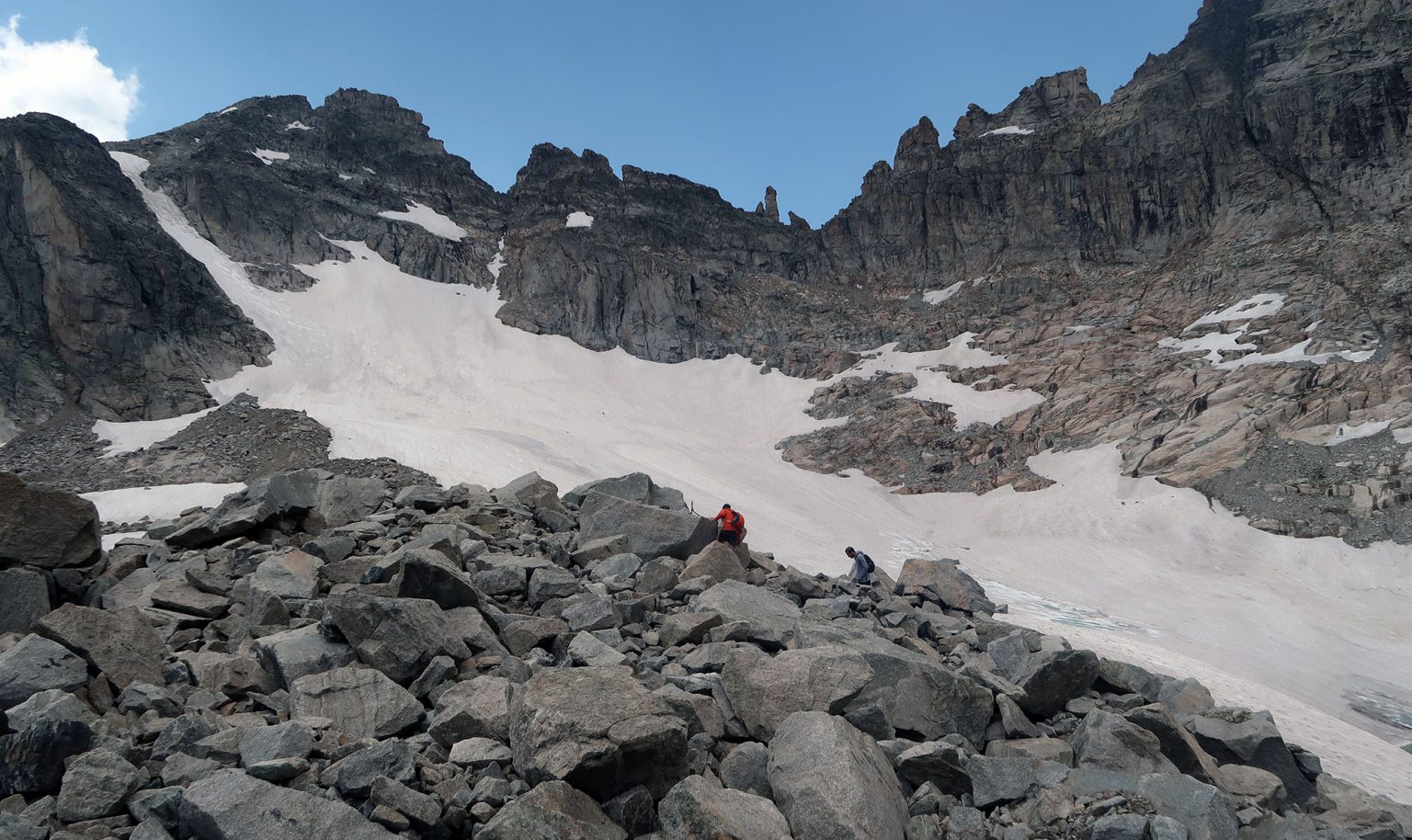
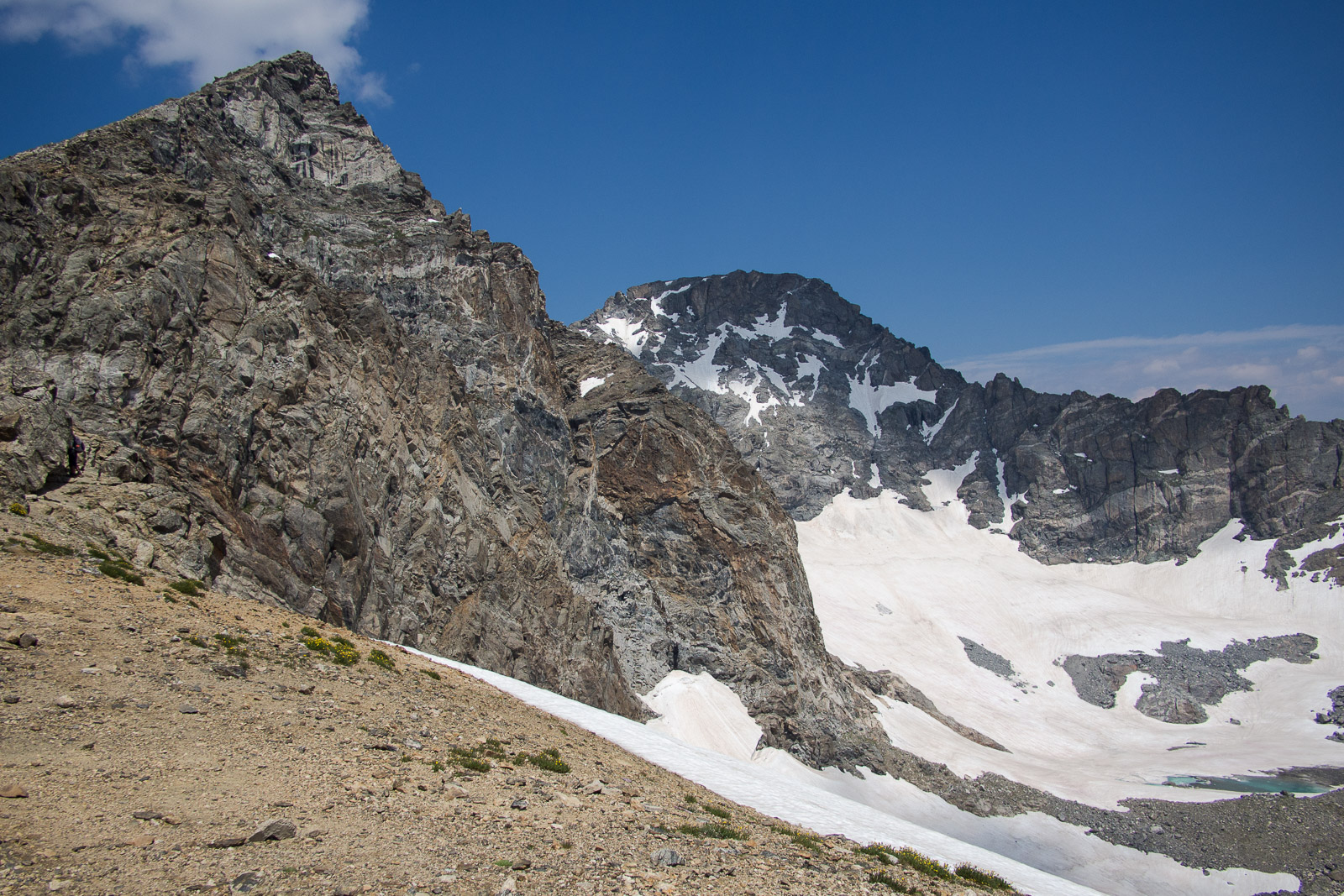
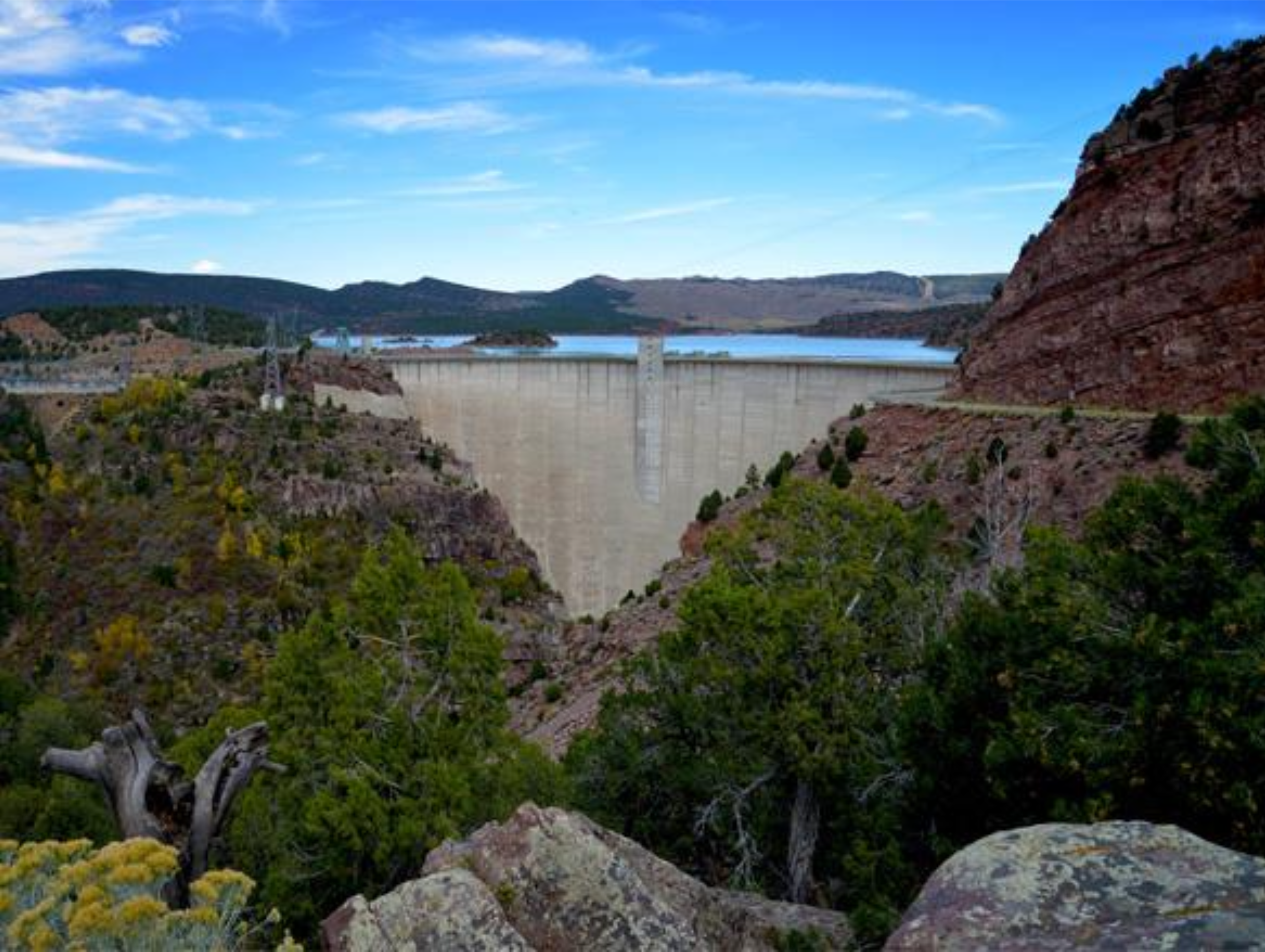
Click the link to read the report on the Getches-Wilkinson Center website (Eric Kuhn,* Anne Castle,† Jack Schmidt,‡ Kathryn Sorensen,§ Katherine Tara**). Here’s the Introduction:
October 6, 2026
SUMMARY OF KEY POINTS
- In 1956, Congress authorized the Upper Initial Units—Flaming Gorge Reservoir, Navajo Reservoir, and the Aspinall Unit (UIUs)—for a variety of water use purposes in the Upper Colorado River Basin, including compliance with the 1922 Colorado River Compact (1922 Compact). The historical record is clear that the primary reason these reservoirs exist is to satisfy the math of the 1922 Compact and the obligations it imposed on the Upper Division States regarding flows at Lee Ferry.
- The size and operation of the UIUs was based on the math of the river as we understood it from the 1930s through the mid-1950s (natural flows, projected uses, and the drought of record). This math no longer works. Total water use in the Colorado River Basin has consistently exceeded the available supply since 2000. Until this fundamental problem is solved, releasing water from the UIUs only delays necessary permanent reductions in water use and provides some degree of temporary management flexibility.
- The 1948 Upper Basin Compact contemplates delivery of a required quantity of water at Lee Ferry. Article V gives the Upper Colorado River Commission (UCRC) the authority to allocate the capacity of the UIUs between providing water for use within the Upper Division States and providing water for common benefit purposes (delivering water to Lee Ferry). The policy has always been that 100% of the capacity of Navajo Reservoir is allocated for water use in New Mexico and 100% of the capacities of Blue Mesa and Flaming Gorge Reservoirs is allocated for common benefit purposes.
- There is no doubt that Flaming Gorge and Blue Mesa Reservoirs exist to meet a portion of the obligation of the Upper Division States under Article III of the 1922 Compact. As of October 1, 2026, the ten-year Lee Ferry flow will be about 81.2 million acre-feet (MAF), and under the Lower Division States’ interpretation of the 1922 Compact, the Upper Division States may be in a compact deficit by 800,000 acre-feet (or more).
- Yet over 2.0 MAF of water remains in active storage in Flaming Gorge Reservoir; more than enough water to erase the deficit and put the Upper Division states back in compact compliance as interpreted by the Lower Basin, if only for the short term.
- The Upper Division States assert that they are in full compliance with the 1922 Compact.¹ Thus, in their view, delivering additional UIU water to Lee Ferry now would be a waste of stored water that they may need in the future. They question why yet another reservoir should be further drawn down when the Basin has not solved the fundamental problem of demand exceeding supply.
- The stored water available in Flaming Gorge Reservoir has increased in importance to the entire basin. The Lower Division states view it as a source of water that can be delivered at Lee Ferry to supplement the releases from Lake Powell and thereby fulfill the obligations of the Upper Division States under the 1922 Compact. The Bureau of Reclamation is using Flaming Gorge as a source of water to protect critical infrastructure at Glen Canyon Dam, including hydropower generation. The Upper Division States view Flaming Gorge as a source of water for their current and future benefit; the water stored there could be used to comply with an adverse decision by a court or Special Master.
- There remain unresolved issues concerning the use of water stored in the UIUs, with seemingly conflicting provisions in the 1948 Upper Basin Compact and the 1970 Long-Range Operating Criteria that currently govern the operation of these reservoirs. These issues could govern future releases from the UIUs but have not been explicitly addressed in the Post-2026 Record of Decision or the 2027-2028 Operating Rules.
- The math of the 1922 Compact and its Lee Ferry flow provision, together with the directives of the Long-Range Operating Criteria, can no longer be reconciled with today’s hydrology and long-term average basin-wide consumptive use. The Basin States can argue about compliance with various conflicting provisions, but the fundamental problem is that the rules were designed for a different river. We need new operating rules that reflect the river we have today. The choice in finding these new rules is likely to be between a compromise that is painful to all parties or a zero-sum Supreme Court decision that determines who gets what little water there is and who does not.
INTRODUCTION²
The 1956 Colorado River Storage Project Act (1956 CRSPA)³ authorized construction of Glen Canyon Dam, which created Lake Powell, and three additional major upstream storage projects; Flaming Gorge Dam and Reservoir, Navajo Dam and Reservoir, and the Curecanti Unit (Blue Mesa, Morrow Point, and Crystal Dams and Reservoirs, now called the Aspinall Unit). The 1956 CRSPA was designed as a broad authorization for Upper Basin water development within the bounds of the 1922 Compact. The legislation authorized construction of storage dams, powerplants,⁴ numerous irrigation projects, and trans-basin diversions. Among the purposes of 1956 CRSPA were “regulating the flow of the Colorado River, storing water for beneficial consumptive use, making it possible for the States of the Upper Basin to utilize, consistently with provisions of the Colorado River Compact, the apportionments made to and among them in the Colorado River Compact and the Upper Colorado River Basin Compact, respectively . . ..”⁵ Flaming Gorge, Navajo, and the Aspinall Unit⁶ are collectively referred to as the “Upper Initial Units” (hereafter, UIUs). The three UIUs’ total live storage capacity is 6.15 million acre-feet (MAF), of which 5.10 MAF is “active” storage.⁷ On October 1, 2026, the total live storage in the three reservoir systems was 3.47 MAF. The Appendix contains a detailed description of each of the UIUs, with information on capacity, operations, and contract obligations.
For over 60 years, the three UIUs have been storing system water and producing hydroelectric power. These reservoirs, however, previously played a relatively small role in the operation of federal reservoirs of the Colorado River Basin (Basin) as a whole. The focus of the Basin’s competing interests has primarily been on operation of Glen Canyon Dam and Hoover Dam that form Lake Powell and Lake Mead, respectively. These two reservoirs are the largest in the United States and presently store approximately 66% of all the water in the 12 federal reservoirs reported in Reclamation’s 24-Month Studies. During the debate and development of major policy actions for the Colorado River, such as the 1970 Coordinated Long-Range Operating Criteria,⁸ 2001 Interim Surplus Guidelines,⁹ and the 2007 Interim Guidelines,¹⁰ the operations of the UIUs were barely mentioned. However, as storage in Lake Powell and Lake Mead has declined, the importance of the UIUs has increased.
The Bureau of Reclamation (Reclamation) operates each of the three UIUs under separate Records of Decision (ROD). Each is operated in a manner that balances many competing interests such as: storage for 1922 Compact compliance, the delivery of stored water for Upper Basin consumptive uses, the delivery of water in fulfillment of Tribal water right settlement obligations, flood control, hydropower generation, on-reservoir recreation, downstream river recreation, sport fisheries in the reservoir and in the stream below the reservoir, and the flow needs of threatened and endangered fishes. Reclamation operates the UIUs in a transparent manner, and each has a local constituency that is closely involved in how their project is operated.
The UIU obscurity honeymoon ended in 2019 when the Upper Division States proposed what became the Drought Response Operations Agreement (DROA) as a component of their 2019 Drought Contingency Plan.¹¹ Arguably, under federal law, the Secretary of the Interior (Secretary) has broad authority to unilaterally move water from the UIUs downstream to Lake Powell. However, Reclamation took a more collaborative approach in the DROA: it was an inter-governmental agreement among the US (through Reclamation) and the states of Colorado, New Mexico, Utah, and Wyoming. DROA authorized releases from the UIUs to the extent necessary to achieve the stated operational objective of minimizing the risk of Lake Powell falling below a target elevation of 3525 ft, and thereby:
- helping to ensure the Upper Division States will continue fulfilling their interstate water compact obligations while exercising their rights to develop and utilize the Upper Basin’s Compact apportionment,
- maintaining the ability to generate hydropower at Glen Canyon Dam, and
- minimizing adverse effects on resources and infrastructure in the Upper Basin.¹²
DROA is subject to numerous constraints, including:
- Water available in the UIU reservoirs,
- Protection of authorized purposes of each CRSP unit (water supply, endangered species, recreation, hydropower, etc.),
- Consultation with the Upper Division States and the Upper Colorado River Commission, and
- Operating criteria established in the agreement and the associated Records of Decision.
In 2021, a total of 181,000 acre-feet of DROA releases were planned pursuant to the Secretary’s emergency authority: 125,000 acre-feet from Flaming Gorge, 36,000 acre-feet from Blue Mesa, and 20,000 acre-feet from Navajo. Due to dry conditions, the 20,000 acre-feet release from Navajo Reservoir was cancelled, resulting in a total release of 161,000 acre-feet.¹³ DROA was implemented again in 2022 pursuant to consultation and agreement with the Upper Division States—approximately 463,000 acre-feet of water from Flaming Gorge Reservoir were released. Both releases were intended to help maintain an operational target elevation of 3525 ft in Lake Powell.¹⁴ The DROA water released from Flaming Gorge Reservoir and Blue Mesa Reservoir in 2021 and 2022 was completely recovered after the moderately wet winter of 2023.¹⁵ DROA includes specific provisions addressing storage recovery after a DROA release is made. DROA expires contemporaneously with the 2007 Guidelines, but operations to recover storage releases made before Oct. 1, 2026, continue for as long as necessary.¹⁶
In response to the near-record low 2026 runoff and the unprecedented low reservoir levels in Lake Mead and Lake Powell, DROA releases were again implemented to supplement Lake Powell levels, and this time with even greater urgency and impact. To help maintain the elevation of Lake Powell above 3500 ft, on April 23, 2026, Reclamation began making additional DROA releases from Flaming Gorge Reservoir.¹⁷ According to the September 2026 24-Month Study, the planned release from Flaming Gorge will total one million acre-feet between April 2026 and April 2027, but Reclamation retains the flexibility to adjust the timing and amount based on actual hydrologic conditions. Citing contractual obligations and unusually low storage, there are no planned DROA releases scheduled for 2026 from either Blue Mesa Reservoir or Navajo Reservoir.¹⁸
As annual Colorado River Basin runoff in the 21st century is consistently lower than in the 20th century and the “Ratchet Effect” is evident in reservoir storage basin-wide, disputes over the operation of the UIUs between the Upper Division States and Lower Division States have increased and indeed now are nearly as critical and strident as the disputes over water deliveries from Lake Powell to Lake Mead.¹⁹ The Lower Division States’ May 1, 2026, Proposal for Short-Term Operations of the Colorado River included proposed operating criteria for the UIUs that would expand their role in maintaining Lake Powell elevations and effectively subordinate the refilling of the UIUs until there is sufficient water in Lake Powell to support the delivery of 8.23 MAF per year.²⁰ The stated intent is “to share the benefit of improved hydrology between both basins.”²¹ On May 13th, 2026, the director of the Arizona Department of Water Resources told the Arizona Re-Consultation Committee that under Arizona’s interpretation of the Law of the River, the 1956 CRSPA specifically subordinates the delivery of contract water from the UIUs and the refilling of those reservoirs to water deliveries to the Lower Basin and Mexico under the 1922 Compact.²²
The Upper Division States believe the operation of the UIUs proposed by the Lower Division States is outside the scope of the Post-2026 NEPA process and cannot be incorporated into the Record of Decision as part of the 2027–2028 operations plan.²³ Further, some UCRC commissioners pointed out that under the 1956 CRSPA, there are multiple purposes of the UIUs including supporting consumptive uses within the Upper Basin.²⁴ At the 2026 Getches-Wilkinson Center Conference on the Colorado River, then-Acting Reclamation Commissioner Scott Cameron noted that Reclamation would aggressively operate the UIUs under their RODs to help manage Lake Powell levels, but added that the Secretary has, and will use, if necessary, emergency authorities to operate the UIUs outside the bounds of their RODs.²⁵
The Record of Decision (ROD) released on August 21, 2026, for the “Decision Framework for Colorado River Guidelines: Coordinated Operations of Lake Powell and Lake Mead (2027–2036)” addressed the operation of the UIUs in a general manner. The ROD states:
“In carrying out the Decision Framework, the Department will continue to coordinate the operation of Lake Powell, Lake Mead, and the Colorado River Storage Project (CRSP) Upper Initial Units – specific reservoirs above Lake Powell – pursuant to Section 602 of the Colorado River Basin Project Act of 1968 (CRBPA). Consistent with each facility’s existing ROD, the CRSP Upper Initial Units remain an operational tool available to the Secretary, when necessary, to release additional water to increase the elevation at Lake Powell to protect critical Federal infrastructure.”²⁶
While the Decision Framework Operational Sideboards of the ROD include the “Potential for maximum use of CRSP Upper Initial Units within their respective RODs to release additional water if needed to protect critical infrastructure,” they also allow for greater releases than described in their respective RODs:
“The Decision Framework establishes consultation thresholds associated with critical reservoir elevations. When projected reservoir conditions approach or fall below the consultation thresholds identified in the operational sideboards, the Secretary will coordinate and consult with the Basin States, Basin Tribes and other affected parties, as appropriate, regarding additional operational actions that may be appropriate to reduce risks to critical Federal infrastructure and maintain system reliability.²⁷”
Further, “Such consultations may include consideration of additional reductions in water use, adjustments to coordinated reservoir operations of Lake Powell and Lake Mead, use of the CRSP Upper Initial Units, or other operational actions.”²⁸
Notably, the Decision Framework does not mention using the UIUs for making deliveries of water to Lee Ferry when there is insufficient water in Lake Powell for compliance with the 1922 Colorado River Compact (1922 Compact).
UIU storage recovery timing and amounts are not specified in the 2027-2028 Operating Guidelines,²⁹ but Interior’s response to the Lower Basin’s May 1st proposal stated that it:
“intends to refill the UIUs as soon as practicable to ensure water remains available for any additional infrastructure protection releases, while avoiding further risk to critical infrastructure during recovery operations. Based on prior operational experience, recovery operations were initiated once Lake Powell was no longer projected to continue declining. Reclamation would apply a similar approach for future UIU recovery operations and would consider actual hydrology and Basin-wide conditions before initiating recovery actions.³⁰”
What is clear is that the water stored in the UIUs is an increasingly important resource coveted by the Upper Division States, the Lower Division States, Basin Tribes,³¹ and Reclamation. It is also clear that each of these entities has a different perspective on the priorities under which the UIUs will be operated in the future. But it is important to recognize that while the water released by the UIUs in 2021, 2022, and 2026 provided critical benefits, especially for maintaining Lake Powell above target thresholds, DROA-like releases are not a solution to the Basin’s fundamental problem – systematic use of more than the available water supply. The operation of the UIUs may buy time and provide additional flexibility for reservoir system management, but it does not create any new water.
The debate over the future use of the UIUs has also exposed and amplified several long-standing disputes over the interpretation of the key provisions of the Law of the River,³² and ambiguities in the major federal legislation that authorized the construction and operation of the river’s major federal reservoirs. A primary disputed issue facing the Colorado River Basin today is how much water must flow at Lee Ferry to satisfy the Upper Division States’ 1922 Compact obligations. As stated above, delivering water to Lee Ferry was a core purpose for both Lake Powell and the three UIUs.³³
On August 24, 2026, the state of Nevada, the Colorado River Commission of Nevada, and the Southern Nevada Water Authority filed a complaint for declaratory action and injunctive relief requesting a declaration that the ROD, Final Environmental Impact Statement, and 2027-2028 Guidelines are in violation of the Administrative Procedure Act, the National Environmental Policy Act (NEPA), and the Law of the River.³⁴ The complaint requests an injunction halting the implementation of the ROD and Operating Guidelines. Among other arguments, the plaintiffs claim that the Secretary failed to consider the exercise of authority to operate the UIUs in compliance with the Law of the River and NEPA.
The ROD states that the UIUs will be the subject of a new DROA agreement (referred to as a “framework”) that is currently being negotiated among Reclamation and the Upper Division States. This proposed agreement, drafts of which have not been released to the public, has already received criticism from the State of Arizona. If finalized, it could also be the subject of future litigation.³⁵ In the remainder of the paper, we explore the history of the UIUs from their conception to the present day to provide context and rationale for future operations.
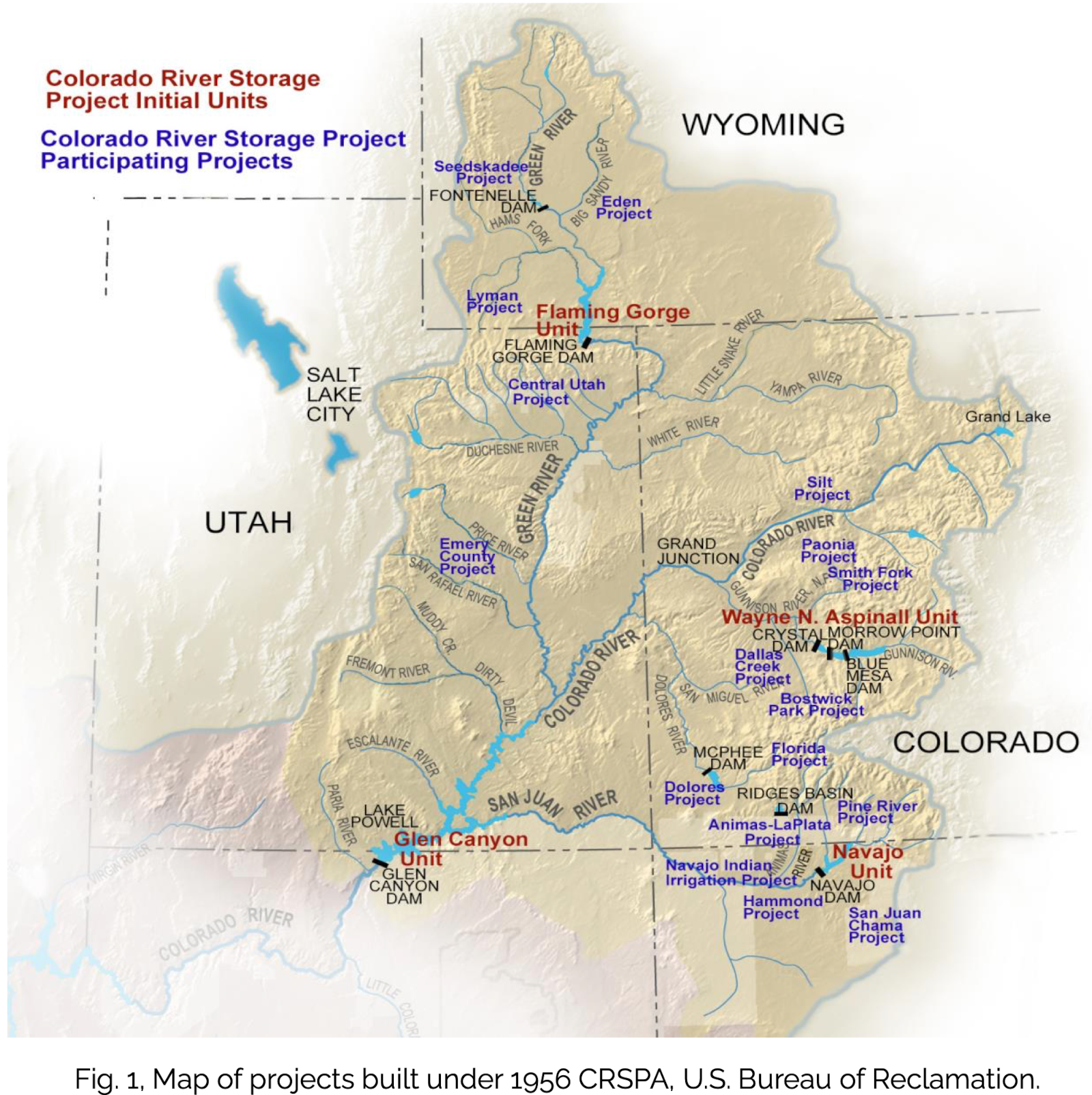
* Retired General Manager, Colorado River Water Conservation District.
† Senior Fellow, Getches-Wilkinson Center, University of Colorado Law School; former US Commissioner, Upper Colorado River Commission; former Assistant Secretary for Water and Science, US Dept. of the Interior.
‡ Center for Colorado River Studies, Utah State University; former Chief, Grand Canyon Monitoring and Research Center.
§ Director of Research, Kyl Center for Water Policy, Arizona State University; former Director, Phoenix Water Services.
** Staff Attorney, Utton Transboundary Resources Center, University of New Mexico.
1 The position of the Lower Division States is that the Upper Division States must not deplete the ten-year flow at Lee Ferry below 75 MAF PLUS deliver half of the annual treaty delivery to Mexico. The normal treaty delivery is 1.5 MAF, so the total ten-year delivery obligation could be 82.5 MAF. In recent years, under Minutes 323 and 330, the annual delivery has been less, but because these Minutes also create water that Mexico can store – calculating how much delivery the Upper Division States must share is not a simple matter. In any event, however, it appears that 81.2 MAF is less than the required 10-year flow pursuant to the Lower Division States’ legal position.
1 The Upper Division States do not agree that their obligation to Mexico under Article III(c) of the 1922 Compact is half of the annual delivery to Mexico under the 1944 Treaty every year. For more information, see Eric Kuhn, et. al, The 1922 Compact is Now the Obvious Elephant in the Negotiating Room, Oct. 6, 2025, https://www.colorado.edu/center/gwc/media/707.
2 This paper describes the authorization of the UIUs, the events leading up to that authorization, and some of the debate that resulted in the compromises in the 1956 Colorado River Storage Project Act (1956 CRSPA). The authors recognize that there are several detailed histories of CRSPA that address different aspects of its origins and come from a different perspective. Among these are: MARC REISNER. CADILLAC DESERT: THE AMERICAN WEST AND ITS DISAPPEARING WATER (1986, Viking Press); M. HARVEY, A SYMBOL OF WILDERNESS: ECHO PARK AND THE AMERICAN CONSERVATION MOVEMENT (Univ. N.M. Press 1994, 2nd Ed. Univ. of W.A. Press, 2000). Recognizing the value and insights of these previous works, this paper seeks to place the UIUs and their origins within the context of today’s hydrology and disputes.
3 P.L. 84-485, 70 Statute 105, 43 U.S.C. § 620 et seq.
4 The provision of hydroelectric power and resulting revenues prompted the label “cash register dam” to refer to projects in which the hydropower receipts finance other project construction. Long-Term Drought and Glen Canyon Dam: Potential Effects on Water Deliveries and Hydropower, Congressional Rsch. Serv., Apr. 4, 2023, at 4.
5 1956 CRSPA Preamble.
6 The three reservoirs in the Aspinall Unit are Blue Mesa, Morrow Point, and Crystal. Only Blue Mesa is operated for river regulation and storage. Future references to storage in the UIUs include Blue Mesa, Flaming Gorge and Navajo Reservoirs, but not Morrow Point and Crystal Reservoirs. A number of additional reservoirs were authorized by the 1956 CRSPA (and subsequent federal legislation) as components of participating projects. All of these reservoirs have specific project functions. Several of these reservoirs store a significant amount of water. Strawberry Reservoir, a component of the Central Utah Project, McPhee Reservoir, a component of the Dolores Project, and Fontanelle Reservoir, a component of the Seedskadee Project are three prominent examples.
7 The data sources for this paper are primarily the Hydrologic Database (HDB) and the 24-Month Studies, both maintained or prepared by the U.S. Bureau of Reclamation. We use “live storage” to mean the amount of storage reported in the HDB or alternately, the 24-Month studies. The standard terminology for reservoirs is that live storage is the amount that can be physically withdrawn or released downstream. Active storage is the amount above the power plant penstocks (or primary outlet works for Navajo Reservoir). Inactive storage is the amount between the power plant inlets, and the low-level outlet works. Below the low-level outlet is the “dead pool.” In theory, live storage = active plus inactive storage. In practice, however, each reservoir has a different design and different management issues. It is possible that some live storage may not be accessible for downstream delivery and use. The figures provided for live and active storage in the UIUs do not include Crystal and Morrow Point reservoirs.
8 For more information on the 1970 Long Range Operating Criteria, see https://www.usbr.gov/lc/region/pao/pdfiles/opcriter2005FRN.pdf.
9 The Colorado River Interim Surplus Criteria were adopted in 2001, but were superseded by the 2007 Interim Guidelines, see https://www.usbr.gov/lc/region/g4000/surplus/pdf/Attachments/Attachment_I.pdf.
10 U.S. Bureau of Reclamation, Colorado River Interim Guidelines for Lower Basin Shortages and the Coordinated Operations for Lake Powell and Lake Mead, December 2007, https://www.usbr.gov/lc/region/programs/strategies/RecordofDecision.pdf.
11 U.S. Bureau of Reclamation, 2019 Drought Response Operations Agreement, https://www.usbr.gov/ColoradoRiverBasin/dcp/droa.html.
12 DROA, Sec. I.A.
13 Upper Colorado River Commission (UCRC) Seventy-Third Annual Report (2022), pages 16-17.
14 UCRC Seventy-Fourth Annual Report (2023), page 15. With the DROA releases, Lake Powell reached a low of 3519.92 ft. (MSL), in early April 2023.
15 UCRC Seventy-Fifth Annual Report (2024), page 15. With an estimated natural flow of 17.3 MAF, 2023 was the third wettest year since 2000. We refer to it as a moderately wet year based on comparisons with the 20th Century record. With a natural flow of 17.3 MAF, it is about the same as the ten-year average from 1980-1989 – 17.2 MAF. USBR natural flow database, https://www.usbr.gov/lc/region/g4000/NaturalFlow/index.html.
16 DROA, Sec. II.A.6.
17 U.S. Bureau of Reclamation, 2026 Drought Response Operations Plan, https://www.usbr.gov/ColoradoRiverBasin/documents/dcp/DROA/2026/uc-2026droughtresponseoperationsplan-attachmentsa-h-508-20260423.pdf. Two measures were put in place to maintain the elevation of Lake Powell above 3500 ft. The 1.0 MAF of DROA releases and a reduction of the Water Year 2026 annual release from Glen Canyon Dam from 7.5 MAF to 6.0 MAF.
18 Id.
19 For an explanation of the Ratchet Effect, see Schmidt et al., The Colorado River Water Supply Crisis in a Few Graphs: Part 1 at 8 (June 2026), https://www.colorado.edu/center/gwc/2026/06/18/colorado-river-water-supply-crisis-few-graphs-part-1.
20 Lower Division States’ Proposal for Short-Term Operations of the Colorado River, May 1, 2026, https://www.azwater.gov/sites/default/files/2026-05/2026.05.01%20LB2YearPlanFINAL.pdf.
21 Memo from John Entsminger to Andrea Travnicek, Subject: Lower Division States’ Proposal for 2026–2028 Colorado River Operations, Dated May 1, 2026.
22 AWDR presentation at the ARC Meeting May13, 2026, slide #9, https://www.azwater.gov/sites/default/files/2026-05/2026.05.13%20ARC%20Meeting%20%2313%20FINAL_0.pdf.
23 Letter from UCRC Executive Director Cullom to Acting Commissioner Cullom, dated June 1, 2026, http://www.ucrcommission.com/wp-content/uploads/2026/06/UDS-response-to-BOR-response-to-LB-concept-June-1-2026.pdf.
24 Comments of the individual UCRC commissioners at the April 26, 2026, special meeting of the UCRC where it reluctantly approved the DROA plan.
25 Scott Cameron, Bureau of Reclamation presentation, 2026 GWC Conference, https://www.colorado.edu/center/gwc/2026/06/04/june-4-5-2026-conference-colorado-river.
26 U.S. Bureau of Reclamation, Record of Decision, Framework for Colorado River Guidelines: Coordinated Operations of Lake Powell and Lake Mead (2027-2036) August 2026, https://www.usbr.gov/ColoradoRiverBasin/post2026/decision-doc/P26_RecordofDecision_Final.pdf.
27 ROD at 30.
28 ROD at 27, 30.
29 U.S. Bureau of Reclamation, 2027-2028 Operating Guidelines, https://www.usbr.gov/ColoradoRiverBasin/post2026/decision-doc/2027-2028OperatingGuidelines_Final.pdf.
30 Department Response to Lower Division States’ Proposal for 2027-2028 Colorado River Operations, May 28, 2026.
31 The Ute Mountain Ute Tribe, Southern Ute Indian Tribe, Jicarilla Apache Nation, and Navajo Nation each have significant and unique interests in the operation of Navajo Reservoir. The Ute Indian Tribe of the Uintah and Ouray Reservation has asserted claims to water stored in Flaming Gorge Reservoir.
32 The Law of the River is a complex set of agreements, treaties, court decisions, and regulations that govern the allocation and use of water resources in the Colorado River Basin. A Colorado River Overview: Education, Facts & Statistics, https://coloradoriver.com/statistics-facts/.
33 1956 CRSPA, supra note 3.
³⁴ Nevada v. Burgum, et al, U.S. District Court, District of Nevada, Case 2:26-cv-02665, filed 08/24/2026. See also, https://mavensnotebook.com/2026/08/25/courthouse-news-nevada-files-suit-over-colorado-river-plan/; https://www.gov.nv.gov/press-releases/nevada-files-lawsuit-against-department-of-the-interior-over-colorado-river-operations-record-of-decision.
³⁵ The term “framework” to describe the new DROA was used by the UCRC at its Sept. 15, 2026, Special Meeting. The comments by Tom Buschatzke were made at the August 24, 2026, meeting of the Arizona Reconsultation Committee.
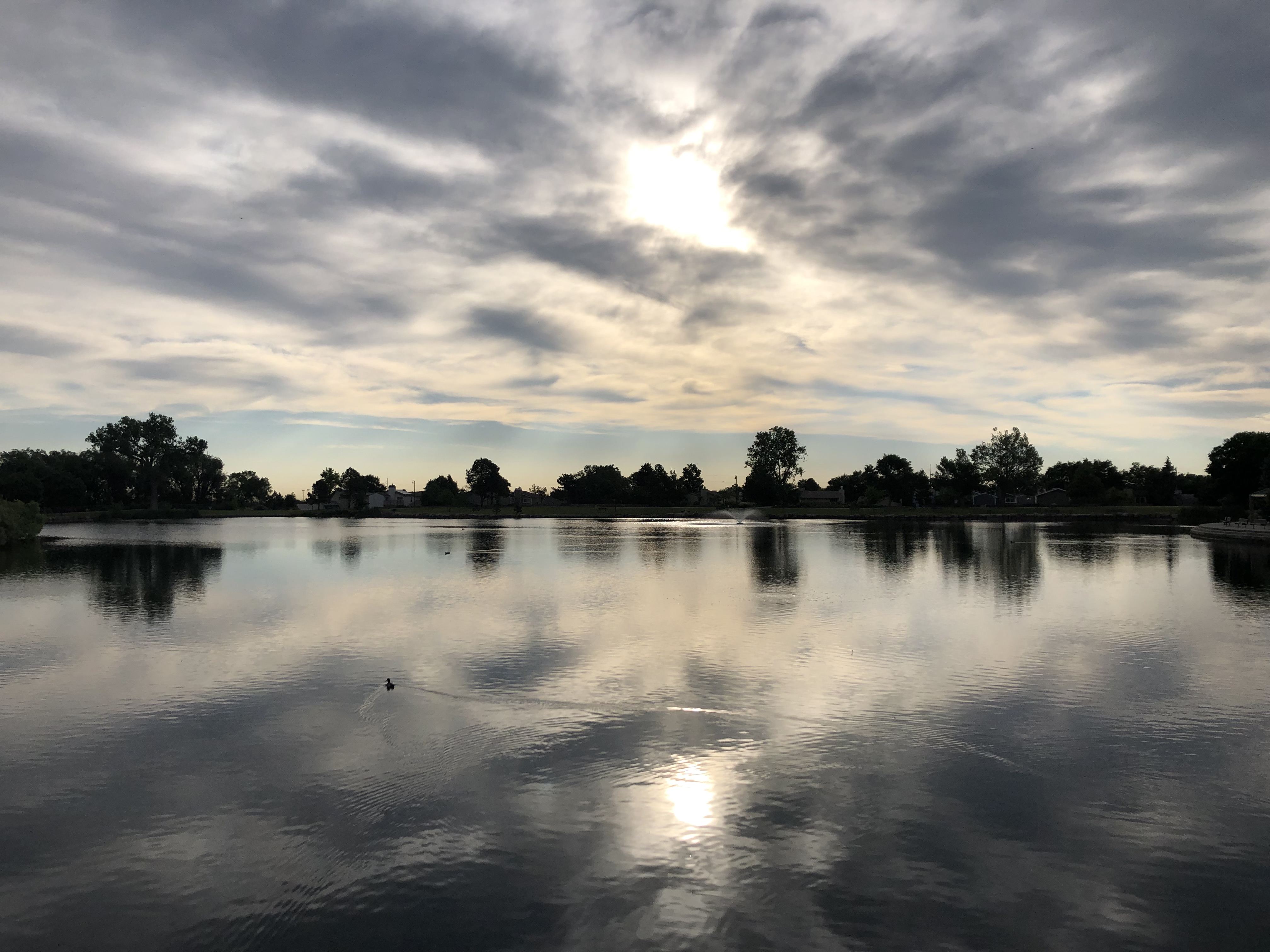
Click the link to read the article on the Big Pivots website (Daniel M. Frey):
October 5, 2026
While fighting over water rights and priorities might take decades, the federal government can start aligning what agriculture pays for federal delivery with what municipal users already pay — without waiting for a new compact or a courtroom fight over title.
We are told that nothing can be done about the Colorado River water crisis while officials allow powerful agricultural interests to keep using more of the river for hay and alfalfa than all cities and other industries in the basin combined.
In the Lower Basin, agricultural water districts pay roughly 6% of what municipal utilities pay at wholesale. That pricing perpetuates waste and low-value irrigation, discourages conservation, and undermines any real chance of restoring the river’s supplies.
Part I of this series (see “Absurdity of the Colorado River crisis,” Big Pivots, Aug. 30, 2026) showed that nearly half the water put to human use in the Colorado River Basin goes to growing feed for cattle — alfalfa, hay and silage — while 40 million people depend on the same river for drinking water.
That is not a hydrology problem. It is a political one, built on the doctrine that the oldest water right always wins, no matter how the world around it has changed.
This installment goes one layer deeper, into the accounting. The story of the Colorado River is not only about who has the legal right to water. It is about how government pricing, contracts, and cost-shifting have supported overuse on low-value crops.
The volumes restated
Forage crops — mostly alfalfa and hay grown to feed livestock — consume close to half of all water used by people across the Colorado River Basin. In 2023, two separate studies by the Western Agricultural Economics Association and the Arizona Department of Agriculture (see Sources) concluded that in the Lower Basin’s desert valleys, a substantial share is shipped overseas: up to 30% of Imperial Valley alfalfa and more than a fifth of Arizona’s hay.
In the Upper Basin, including Colorado, forage crops make up roughly 90% of agricultural irrigation, more than three times what Upper Basin households, businesses and industries consume combined. The degree and complexity of irrigation and infrastructure vary across the upper and lower basin. There are small farms and communities that have closely and carefully integrated water with highly efficient and effective irrigation.
It should also be understood that many farms and ranches in the Colorado River Basin, particularly in the Upper Basin, do not depend upon federal-financed infrastructure. This essay is not about them. Rather, it is about both farms and cities who benefit from federal infrastructure. Cities that are home to millions of people are asked to justify every toilet flush and lawn sprinkler while a crop with a modest market value drains the river. That imbalance might be easier to defend if the irrigators paid a market price. Instead, Lower Basin irrigation districts pay about 6% of what cities pay at wholesale.
How the government built — and then discounted — this system
Almost none of the infrastructure that makes Southwestern irrigation possible was built or paid for by farmers alone. The dams, canals, and reservoirs of the Colorado River system were constructed and financed by the U.S. Bureau of Reclamation, a Department of the Interior agency that has spent more than a century as the largest wholesaler of water in the country.
Under federal reclamation law, the government fronts the capital, and the beneficiaries — irrigation districts, cities, power customers — are supposed to pay it back over time.
Political power derailed equitable pricing during this past century. Reclamation law splits repayment onto two tracks. Municipal and industrial water is repaid over roughly 40 to 50 years — with interest. Irrigation costs are repaid over the same window — interest-free.
Congress wrote the interest-free exemption into the original Reclamation Act of 1902 to spur Western settlement. Homesteaders on arid land had no way to finance dams and canals themselves. Lawmakers reasoned that irrigated farms would eventually generate enough tax base and repayment to justify the up-front public investment.
Cities were not part of that original calculation. Municipal and industrial water became an authorized Reclamation purpose only in 1939, and it was placed on the standard interest-bearing track. The exemption made sense when the goal was populating an unsettled frontier. It has been revisited many times since — always to loosen it — but never ended for a basin now serving forty million urban residents.
That alone would be a meaningful subsidy. It gets larger. Reclamation law also lets irrigation districts apply for “ability to pay” relief. That economic review can cut a district’s repayment obligation below its actual share of construction costs if the government decides the district cannot afford the full amount or that the land is not productive enough to justify full-cost pricing. When those obligations go unpaid, the shortfall does not vanish. It is folded into what other customers pay — chiefly hydropower sales and, on some projects, municipal and industrial users. Cities are not just paying full freight for their own water. On many federal projects, they and power customers are backstopping agriculture’s unpaid balance, too.
In the Colorado River Basin alone, the federal government has put more than $8 billion, in unadjusted dollars, into three programs: Hoover Dam and the All-American Canal, the Colorado River Storage Project and the Central Arizona Project. Compounded at 4.6%, roughly what cities have paid to borrow over the past century, $8 billion would be worth more than $75 billion today. The power and municipal shares of those costs carry interest; the irrigation share does not. The financing model was never hidden. The Storage Project — Glen Canyon, Flaming Gorge, Navajo, and the Aspinall Unit — was promoted in the 1950s on the promise that power and municipal features would be repaid with interest and irrigation would not. Hydropower revenue from those dams still covers irrigation costs judged to be beyond farmers’ ability to pay.
At that rate, repaying a construction cost interest-free over 50 years wipes out about 60% of its value compared with what municipalities pay. Add debt forgiveness, stretched repayment periods and “ability to pay” relief, and the discount grows: economist Richard Wahl found that once interest was counted, irrigators repaid only about fourteen cents of every dollar of irrigation construction costs.
What this looks like in dollars
The gap is not subtle. A December 2025 report from the UCLA Institute of the Environment and Sustainability and the Natural Resources Defense Council analyzed 217 water transactions across the Lower Basin states. The report found that agricultural water districts pay a weighted average of about $30 per acre-foot, while municipal utilities pay about $512.
An acre-foot is 326,000 gallons, enough to supply two to three households for a year. Under this system, a hay farmer’s district pays about $30 and a utility serving a family in Phoenix or San Diego pays roughly $500 — before treatment and local delivery. That is seventeen times as much for the same unit of a scarce public resource.
Federal repayment terms are only one reason for that gap. Under Western water law and most federal contracts, the water itself is essentially free; prices reflect the cost of storing, moving, and treating it, and city systems carry heavier pumping and treatment costs. However, the federal subsidy is part of the gap the public has financed directly — and the part of Washington can most readily change.
Some agricultural districts, including California’s Imperial Irrigation District, the single largest holder of Colorado River water rights, pay the Bureau of Reclamation nothing at all for the water itself. Their contracts do not require payment for the raw supply. When the federal government paid for that same district in 2023 to leave water in Lake Mead, the contract rate was about $776 an acre-foot. The district had asked for as much as $840. Everyone involved already knows what the water is worth.
Who holds the cheap water — 20 large corporate farms
A 2023 ProPublica and Desert Sun investigation found that just twenty large farming entities in California’s Imperial Valley received roughly one-seventh of the entire lower Colorado River’s flow in 2022. That is more water than Wyoming, New Mexico, or Nevada each use in a year.
The water right itself is held by the Imperial Irrigation District, a public agency. Those entities are the largest users of that right, not its owners. As a whole — historic farm families, outside investors, institutional landholders and at least one foreign hay company receives 97% of IID’s water. Every home, school and business in the county combined receives 3%.
Cheap irrigation water is not propping up the rural economy. Imperial County sits on some of the most heavily and cheaply irrigated farmland in the country, yet its per capita income in 2021 was about $19,000 — half the national figure of about $38,000, according to Census Bureau estimates. It posted the highest unemployment rate in California that year.
A 2024 peer-reviewed study of agricultural water productivity across the Colorado River Basin found that the least economically productive counties consume 25% of the Basin’s agricultural water to generate just 3% of its crop revenue. Heavily discounted water is not building broad rural prosperity. Where it produces high value, as in Imperial County, that value is concentrated in a small number of landholders; where it does not, it props up low-value production.
Run the counterfactual. If those same operations paid municipal-scale wholesale rates — $300 to $500 an acre-foot instead of $20 to $30 — the economics of growing export-bound cattle feed in a desert would collapse on their own, without a single acre-foot needing to be fought over in court. Water would move toward higher value uses because it would finally cost what it is worth. That is what a functioning price signal does. Right now, the federal government is underwriting the draining of the river for cheap crops and powerful agricultural interests.
Immediate action does not require new water-rights litigation
The most common argument against fixing this is that it would take years. Because water rights are property, this argument holds, any change must move through negotiation, buyouts, and courts.
That is true if the goal is changing who legally owns the water. It is not true if the goal is changing who pays for the infrastructure that delivers it.
Cost allocation is an administrative and budgetary process, not a property right. The Bureau of Reclamation and the Interior Department already have the statutory tools to reassess “ability to pay” determinations on a going-forward basis, to stop extending new construction-cost discounts to districts irrigating low-value forage crops, and to fully enforce the Reclamation Reform Act’s full-cost pricing for large landholdings. Congress, which wrote the interest exemption into law, can require interest-bearing repayment in new and renegotiated contracts.
Those are the same terms municipal and industrial users already face. Existing repayment contracts cannot simply be rewritten in midstream; they run until they expire or are mutually amended. None of that touches a single farmer’s decreed water right. It stops asking cities and power customers to keep underwriting the next generation of discounts for overuse on low-value crops.
That change would not resolve the Colorado River crisis itself. But it would start doing what a century of “first in time, first in right” has never done: make the cost of water reflect its scarcity. It would let price — not another emergency federal curtailment — begin moving water toward its most essential uses.
Why hasn’t it happened?
The authority sits with the Department of the Interior and the Bureau of Reclamation, which set repayment terms and administer ability-to-pay determinations under reclamation law. Legislative jurisdiction belongs to the House Natural Resources Committee’s Subcommittee on Water, Wildlife and Fisheries and the Senate Energy and Natural Resources Committee’s Subcommittee on Water and Power. Reclamation’s annual budget is funded through the Energy and Water Development appropriations subcommittees in both chambers — not the Interior-Environment subcommittees, whose jurisdiction excludes the Bureau of Reclamation.
The last time Congress meaningfully touched this structure was the Reclamation Reform Act of 1982. Even that act left interest-free repayment and ability-to-pay intact while expanding the size of farms eligible for subsidized water. Since then, as reservoirs have fallen toward dead pool and the federal government has spent billions on emergency conservation payments and drought relief, no bill addressing the underlying interest-free, cost-shifted pricing structure for Colorado River irrigation has reached a committee markup, let alone the floor of either chamber. A review of Congress.gov and GovTrack through August 2026 found none.
The leverage is not confined to a handful of committee chairs in Washington. It runs through the states that depend on the river. Of the 14 U.S. senators representing the Basin’s seven states, seven sit on the Senate Energy and Natural Resources Committee, which has direct jurisdiction over the Bureau of Reclamation and reclamation law:
Sen. John Barrasso (R-Wyo.); Sen. John Hickenlooper (D-Colo.), also on the Water and Power Subcommittee; Sen. Mike Lee (R-Utah), committee chairman; Sen. Martin Heinrich (D-N.M.), ranking member; Sen. Ruben Gallego (D-Ariz.), also on Water and Power; Sen. Catherine Cortez Masto (D-Nev.), also on Water and Power; and Sen. Alex Padilla (D-Calif.), also on Water and Power.
In the House, 11 basin-state representatives sit on the Natural Resources Subcommittee on Water, Wildlife and Fisheries: Chair Harriet Hageman (R-Wyo.), Tom McClintock (R-Calif.), Lauren Boebert (R-Colo.), Celeste Maloy (R-Utah), Jeff Crank (R-Colo.), Melanie Stansbury (D-N.M.), Dave Min (D-Calif.), Adam Gray (D-Calif.), Luz Rivas (D-Calif.), Julia Brownley (D-Calif.) and Joe Neguse (D-Colo.). Jared Huffman (D-Calif.), ranking member of the full committee, serves ex officio.
Four basin-state members — Ken Calvert (R-Calif.), Celeste Maloy (R-Utah), Mike Levin (D-Calif.), and Susie Lee (D-Nev.) sit on the House Appropriations Subcommittee on Energy and Water Development, which writes Reclamation’s budget every year.
According to the same review, none of these lawmakers, of either party, has introduced legislation addressing the interest-free, ability-to-pay repayment structure at the center of this piece. The people with the most direct stake in the outcome — whose constituents are either the cities paying full price or the districts paying a fraction of it — already hold seats on every committee with the authority to change it.
The hard conclusion
This complicated system of senior rights and subsidies, built and protected for a hundred years, leads to an unavoidable conclusion. Under the banner of property rights and support for agriculture, we have allowed a small number of large, politically connected agricultural users to capture much of the water that forty million people depend on.
Almost half of the water put to human use across seven states, from the high Rockies to California, has been turned to private benefit for irrigation of low-value crops, to the detriment of everyone else in the region. Having secured water rights at no cost and federal infrastructure at a steep discount, those same users are demanding to be paid top dollar — more than $800 an acre-foot — to leave that water in the river.
None of this is a call to end Western agriculture or to strip farmers and ranchers of property they hold in good faith. It is a call to stop asking the public to underwrite, at steadily mounting costs, a pricing structure that a small number of landholders have had a century to defend and a well-organized lobby to protect. The technical authority to change the next round of contracts and ability-to-pay reviews already exists inside agencies Congress funds every year. Using that authority still takes political will the basin’s own delegation has not yet shown.
Taking on powerful agricultural interests requires action from representatives of the forty million people who need a sane and sustainable water policy.
Daniel Frey is a Boulder resident, non-practicing CPA and Certified Energy Manager (CEM). He researches and writes on energy and sustainability issues.
Sourcing for essay
Series
Frey, Daniel M. “Absurdity of the Colorado River crisis.” Big Pivots, Aug. 30, 2026. bigpivots.com/the-absurdity-of-the-colorado-river-crisis/ [Part I of this series]
Water use and forage crop exports
Richter, Brian D., et al. “New Water Accounting Reveals Why the Colorado River No Longer Reaches the Sea.” Communications Earth & Environment, vol. 5, 2024, article 134. [source for forage crops’ share of basin water consumption and the Upper Basin 90% figure]
Sall, Ibrahima, Russell Tronstad, and Chia Yi Chin. “Alfalfa Export and Water Use Estimates for Individual States.” Western Agricultural Economics Association, 2023. waeaonline.org/wp-content/uploads/2023/08/Alfalfa-Export-and-Water-Use-Estimates-for-Individual-States.pdf [state-level alfalfa export shares and water embedded in exports, 2022]
Frisvold, George, and Dari Duval. “Understanding the Economics of Arizona Alfalfa.” University of Arizona Department of Agricultural & Resource Economics, via Arizona Farm Bureau, June 26, 2023. azfb.org/Article/Understanding-the-Economics-of-Arizona-Alfalfa [source for exports equal to 22% of Arizona hay and forage production in 2022]
Yachnin, Jennifer. “Can Alfalfa Survive a Fight Over Colorado River Water?” E&E News by Politico, Sept. 8, 2023. eenews.net/articles/can-alfalfa-survive-a-fight-over-colorado-river-water/ [source for up to 30% of Imperial Valley alfalfa exported, citing Family Farm Alliance data]
Water pricing and cost allocation
Garrison, Noah, Isabel Friedman, and Mark Gold. Free Water While It Lasts: An Analysis of Wholesale Water Pricing in the Lower Colorado River Basin States. UCLA Institute of the Environment and Sustainability & Natural Resources Defense Council, Dec. 11, 2025. ioes.ucla.edu/wp-content/uploads/2025/12/Water-Pricing-Report.pdf
Griffiths, Claire. “Report Puts Numbers on Massive Gap in Water Costs in the West.” UCLA Institute of the Environment and Sustainability, Dec. 11, 2025. ioes.ucla.edu/article/report-puts-numbers-on-massive-gap-in-water-costs-in-the-west
“Colorado River Water Is Too Cheap, Particularly for Agricultural Users.” Inside Climate News, Dec. 11, 2025. insideclimatenews.org/news/11122025/colorado-river-water-too-cheap/
Mendoza, Katya. “UCLA Report Finds Farmers Pay Far Less Than Cities for Colorado River Water.” AZPM, Dec. 16, 2025. azpm.org/s/102329-ucla-report-finds-farmers-pay-far-less-than-cities-for-colorado-river-water/
“California Cities Pay a Lot for Water; Some Agricultural Districts Get It for Free.” CalMatters, Dec. 11, 2025 (also republished by U.S. News & World Report). calmatters.org/environment/2025/12/price-of-california-water-cities-growers/
Voice of San Diego. “How Imperial Valley Spends San Diego’s Cash for Water.” Nov. 2, 2023. voiceofsandiego.org/2023/11/02/how-imperial-valley-spends-san-diegos-cash-for-water/ [source for San Diego’s ~$730/acre-foot wholesale price vs. Imperial’s $20]
The 2023 Imperial Irrigation District conservation payments
“The Colorado River’s Biggest User Will Conserve Some Water in Exchange for Federal Dollars.” KPBS Public Media, Dec. 5, 2023. kpbs.org/news/environment/2023/12/05/the-colorado-rivers-biggest-user-will-conserve-some-water-in-exchange-for-federal-dollars [source for the $776/acre-foot payment rate]
Stanford University Water Programs. “Colorado River Allocation.” water.stanford.edu/research/projects/colorado-river-allocation [source for the up-to-$840/acre-foot figure from the 2023-2026 System Conservation Implementation Agreement]
Land, water rights and county-level economics
Wilson, Janet, and Nat Lash. “The Historic Claims That Put a Few California Farming Families First in Line for Colorado River Water.” ProPublica / The Desert Sun, Nov. 9, 2023. propublica.org/article/california-farm-families-gained-control-colorado-river
Lash, Nat, and Janet Wilson. “The 20 Farming Families Who Use More Water from the Colorado River Than Some Western States.” ProPublica / The Desert Sun, Nov. 9, 2023. projects.propublica.org/california-farmers-colorado-river/ [source for the twenty entities and their 2022 water use]
Frisvold, George B., and Jyothsna Atla. “Agricultural Economic Water Productivity Differences Across Counties in the Colorado River Basin.” Hydrology, vol. 11, no. 8, 2024, article 125. doi.org/10.3390/hydrology11080125
U.S. Census Bureau. American Community Survey (ACS), 1-Year Estimates, Table B19301 (“Per Capita Income in the Past 12 Months”), 2021. data.census.gov [national and Imperial County per capita income figures]
Reclamation law, repayment structure, and federal cost allocation
Congressional Research Service. “Bureau of Reclamation Project Authorization and Financing.” CRS In Focus IF10806, Congress.gov. congress.gov/crs-product/IF10806
Congressional Research Service. “Bureau of Reclamation Support for Water Storage Projects.” CRS Report R47987, Congress.gov. congress.gov/crs-product/R47987
U.S. Government Accountability Office. “Bureau of Reclamation: Availability of Information on Repayment of Water Project Construction Costs Could Be Better Promoted.” GAO-14-764, 2014. gao.gov/assets/gao-14-764.pdf
U.S. Government Accountability Office. “Bureau of Reclamation: Reclamation Law and the Allocation of Construction Costs for Federal Water Projects.” GAOREPORTS-T-RCED-97-150. govinfo.gov/content/pkg/GAOREPORTS-T-RCED-97-150/html/GAOREPORTS-T-RCED-97-150.htm
U.S. Government Accountability Office. “Bureau of Reclamation: Information on Allocation and Repayment of Costs of Constructing Water Projects.” GAOREPORTS-RCED-96-109, 1996. govinfo.gov/content/pkg/GAOREPORTS-RCED-96-109/pdf/GAOREPORTS-RCED-96-109.pdf
Wahl, Richard W. Markets for Federal Water: Subsidies, Property Rights, and the Bureau of Reclamation. Resources for the Future, 1989. [source for irrigators’ repayment share once interest is counted]
Congressional Research Service. “Bureau of Reclamation: History, Authorities, and Issues for Congress.” CRS Report R46303, April 3, 2020. congress.gov/crs-product/R46303 [1939 authorization of municipal and industrial water; history of repayment changes]
U.S. General Accounting Office. “Power Marketing Administrations: Cost Recovery, Financing, and Comparison to Nonfederal Utilities.” GAO/T-AIMD-96-169, Sept. 19, 1996. govinfo.gov/app/details/GAOREPORTS-T-AIMD-96-169 [WAPA required to recover about $1.5 billion in irrigation construction costs through power rates]
Reclamation Reform Act of 1982. Pub. L. No. 97-293, tit. II, 96 Stat. 1263.
Federal investment in Colorado River projects
Central Arizona Project. “Explaining CAP’s Federal Repayment: A Cheat Sheet.” Know Your Water News, May 13, 2020 (updated March 8, 2023). knowyourwaternews.com/explaining-caps-federal-repayment-a-cheat-sheet/ [$4.4 billion total cost, 1973-93; $1.646 billion repayment obligation]
U.S. Census Bureau. “September 2025: Hoover Dam.” Stories From the Census Bureau’s History, Sept. 1, 2025. census.gov/about/history/stories/monthly/2025/september-2025.html [$165 million authorized for Hoover, Imperial Dam, and the All-American Canal; power revenue repaid Hoover’s cost with interest by 1987]
Stene, Eric A. “The All-American Canal: Boulder Canyon Project.” Bureau of Reclamation History Program. usbr.gov/projects/pdf.php?id=80
U.S. Bureau of Reclamation. “Colorado River Storage Project.” Upper Colorado Basin Region. usbr.gov/uc/rm/crsp/index.html [Basin Fund repayment of irrigation costs beyond ability to pay]
U.S. General Accounting Office. “Federal Electric Power: Information Concerning the Colorado River Storage Project.” GAO/RCED-90-2FS, Oct. 3, 1989. gao.gov/products/rced-90-2fs
Upper Colorado River Commission. The Colorado River Storage Project to Build a Stronger America. Promotional booklet, 1950s. Colorado River Compact Collection, Utah State Archives. images.archives.utah.gov/digital/collection/p17010coll70/id/21155/
Congressional committee jurisdiction and membership
U.S. House of Representatives, Office of the Clerk. “Committee on Natural Resources” and “Subcommittee on Water, Wildlife and Fisheries,” 119th Congress. clerk.house.gov/committees/II00 and clerk.house.gov/committees/II13
U.S. Senate Committee on Energy and Natural Resources. “Rules, Membership, and Jurisdiction of the Committee on Energy and Natural Resources.” S. Prt. 119-13, March 2025. congress.gov/committee-print/119th-congress/senate-committee-print/59371
U.S. Senate Committee on Energy and Natural Resources. “Subcommittee on Water and Power” membership list. energy.senate.gov/water-power
Heinrich, Martin, and Mike Lee. “Heinrich, Lee Announce Subcommittee Assignments for 119th Congress.” U.S. Senate Committee on Energy and Natural Resources, Feb. 11, 2025. energy.senate.gov/2025/2/heinrich-lee-announce-subcommittee-assignments-for-119th-congress.
U.S. House Committee on Appropriations. “Interior, Environment, and Related Agencies (119th Congress)” and “Energy and Water Development, and Related Agencies (119th Congress),” membership rosters. appropriations.house.gov and democrats-appropriations.house.gov
U.S. Senate Committee on Appropriations. “Subcommittee on Energy and Water Development.” appropriations.senate.gov/subcommittees/energy-and-water-development
Note: Committee chairs, ranking members, and subcommittee rosters reflect the 119th Congress (2025-2026) as of this writing and are subject to change with reassignments, retirements, or a new Congress. The claim that no relevant bill has reached committee markup reflects a review of the sources above and standard legislative trackers (Congress.gov, GovTrack) as of late August 2026, not an exhaustive search of every bill introduced in the 119th Congress; readers relying on this claim for further reporting should verify independently. All committee membership and pricing figures should be verified at their original sources before publication or reproduction.
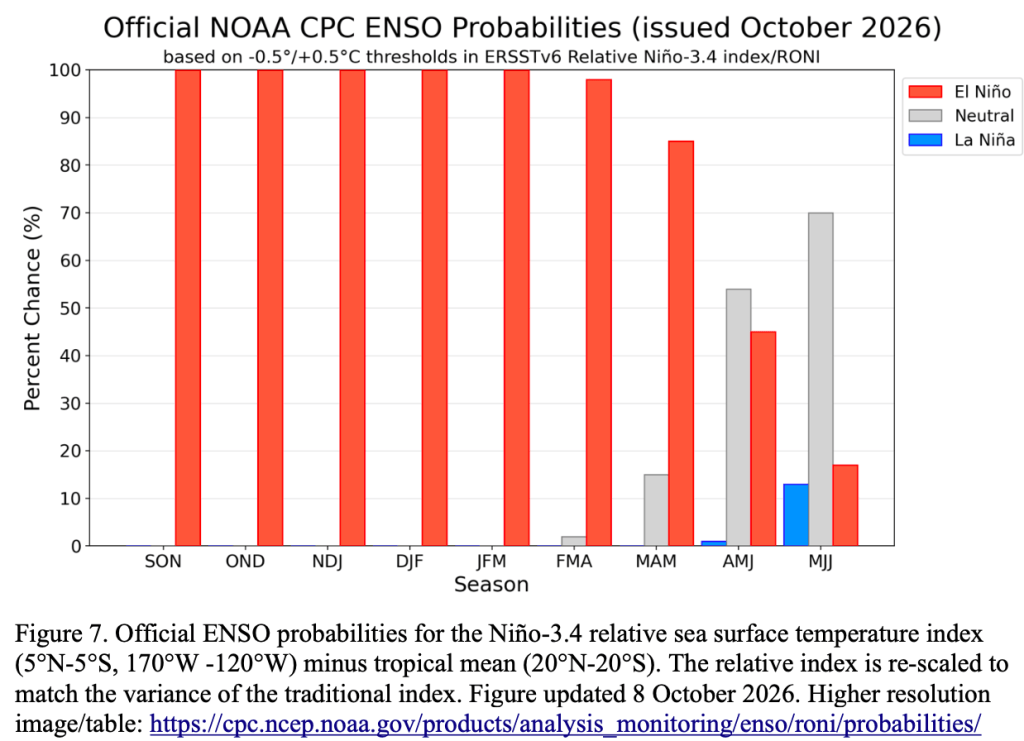
Click the link to read the discussion on the Climate Prediction Center website:
ENSO Alert System Status: El Niño Advisory
Synopsis: El Niño continues to strengthen, with a strong-to-very strong El Niño likely through January-March 2027 (remaining greater than an 83% chance).
El Niño strengthened further last month, with sea surface temperature anomalies exceeding +4.0°C in portions of the eastern equatorial Pacific. Most Niño indices increased in the past month, reaching +2.1°C in Niño-3.4, +3.0°C in Niño-3, and +3.9°C in Niño-1+2. The equatorial subsurface temperature index (average from 180°-100°W) was well above average, reflecting a deeper-than-average thermocline. Subsurface temperatures remained in excess of +10.0°C at depth in the eastern Pacific Ocean. Low-level westerly wind anomalies and upper-level easterly wind anomalies stretched from the western to the east-central equatorial Pacific. Enhanced convection and rainfall persisted from the central to the eastern Pacific, while anomalies remained suppressed over Indonesia.The traditional and equatorial Southern Oscillation indices were significantly negative. Collectively, the coupled ocean-atmosphere system reflected a strengthening El Niño.
The CPC Official ENSO outlook, which synthesizes multiple models from North America and abroad, indicates El Niño will continue to strengthen through the end of the year. Chances remain high for a historic event that would exceed the strength of previous El Niño events dating back to 1950 (+2.5°C or more for a 3-month RONI value): the chance is 54% for September-November, 83% for October-December, and 70% for November-January. With an event of this magnitude, the chances of experiencing impacts consistent with El Niño are larger, though not guaranteed (see CPC outlooks for probabilities of seasonal anomalies). In summary, El Niño continues to strengthen, with a strong-to-very strong El Niño likely through January-March 2027 (remaining greater than an 83% chance).
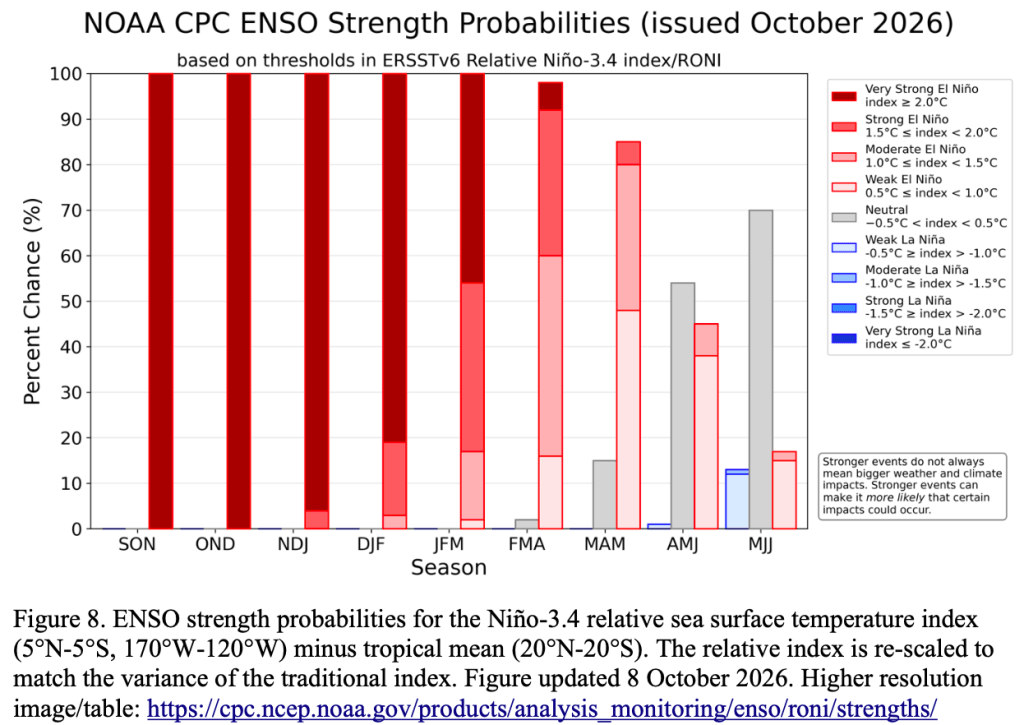
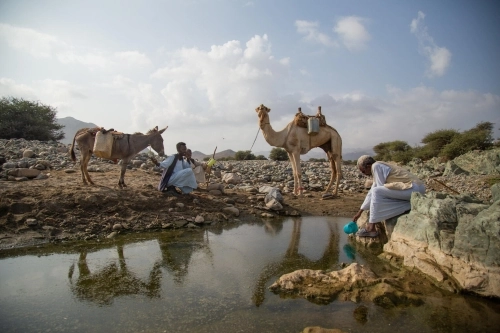
Click here to access the report on the WMO website:
September 11, 2026
The World Meteorological Organization (WMO) has launched its “State of Global Water Resources 2025” report, a comprehensive science-based annual assessment of the hydrological cycle and extreme events in 2025 and over the past five years.
The report finds that rivers across the globe in 2025 had one of the driest years in more than three decades. It shows a continuation of the long-term decline in Earth’s freshwater storage and of glacier retreat, while the water cycle has become more erratic and unpredictable, swinging between too little or too much. The past seven years have seen the fewest rivers with “normal” flows since 1991.
Terrestrial water storage has been in decline since the mid-2010s, while 2025 marked the fourth consecutive year with widespread glacier loss across all regions. Asia and Africa together accounted for at least half of all recorded water-related extreme events and more than 80 per cent of reported associated deaths over the past five years.
Water data availability has improved, but important gaps remain. Africa and Asia are still among the least represented regions in terms of hydrological observations in the report, even though they are most affected by extremes.
The annual State of Global Water Resources report provides a comprehensive quantitative overview of global water resources, with a focus on hydrological variability and trends.
Explore more findings and download the full report here.
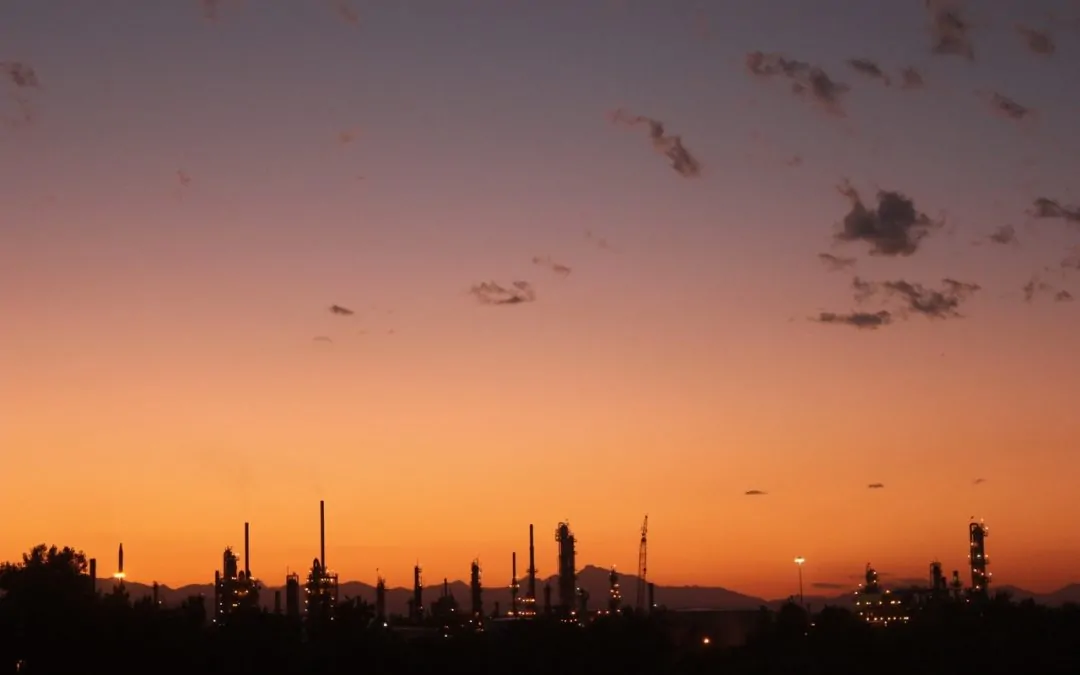
Click the link to read the article on the Big Pivots website (Allen Best):
October 6, 2026
Four paragraphs buried in a story published by the Meeker Herald-Times during mid-June triggered the entry of several Colorado ranchers into the Boulder-Suncor case argued on Monday morning before the U.S. Supreme Court.
The Herald Times is the newspaper of record (and the only one) in Rio Blanco County, which is in the state’s northwestern corner. It’s distinctly rural. Cattle numbers vary by season, somewhere between 16,000 and 25,000. In all seasons they outnumber humans: 6,529 as of the 2020 census.
The newspaper story recounted a June 9 meeting of county commissioners. They heard about agrivoltaics from Longmont’s Byron Kominek (Jack’s Solar Garden) and their county attorney advised them on best legal procedures for setting meeting agendas. The new Colorado State University County extension agent had stopped by to say hello, and the state transportation director for the region delivered an update on highway plans.
In the story’s 32nd paragraph, news was delivered that the county commissioners had agreed to participate in an amicus brief in the Supreme Court case siding with Suncor and Exxon Mobil at a cost to the county up to $17,500.
“The outcome of this decision by the Supreme Court will affect 100 other cases across the United States, so we felt that it was well worth our time and money to try and do the right thing,” explained Commissioner Doug Overton of why Rio Blanco County should add its name to the filing by the Associated Governments of Northwest Colorado.
Deirdre Macnab later read that story at her nearby ranch along the White River. She had a different and visceral reaction as to what constituted the “right thing” in this case.
Unlike many of her neighbors in Rio Blanco County, who have family trees several generations deep, she had arrived in 2020 from Florida and, before that, Manhattan. She has her own Wikipedia entry, which describes her as an “American women’s rights and voting rights activist and sustainable agriculture rancher.”
Macnab decided other voices were needed from Rio Blanco County in this case.
“I called Boulder County and spoke to some of the attorneys there,” she related in a noon-hour session with students at the University of Colorado Law School on Oct. 1. “Would you be interested in hearing from some of the people who are involved in agriculture in the state?” she asked. Yes, they said.
“And it wasn’t very difficult to find a number of ranchers.”
One rancher, a veterinarian, lives near Grand Junction, Macnab told the audience in Boulder, speaking from a remote source.
“She is currently selling her herd of cattle because it does not make financial sense to try to feed her cattle hay through the winter because the heat and the drought this year was so extreme that she was not able to grow the forage that she usually grows. We’re seeing hay prices that have increased by more than 50%. This is just one example of many ranchers that I’ve spoken to.”
Another among her agricultural acquaintances, she said, has pigs near Hayden. “He said his pigs were dying of sunstroke, and he was facing the decision of having to go out of business because for the first time he was having to haul water at a cost of $2,000 to $3,000 a month.”
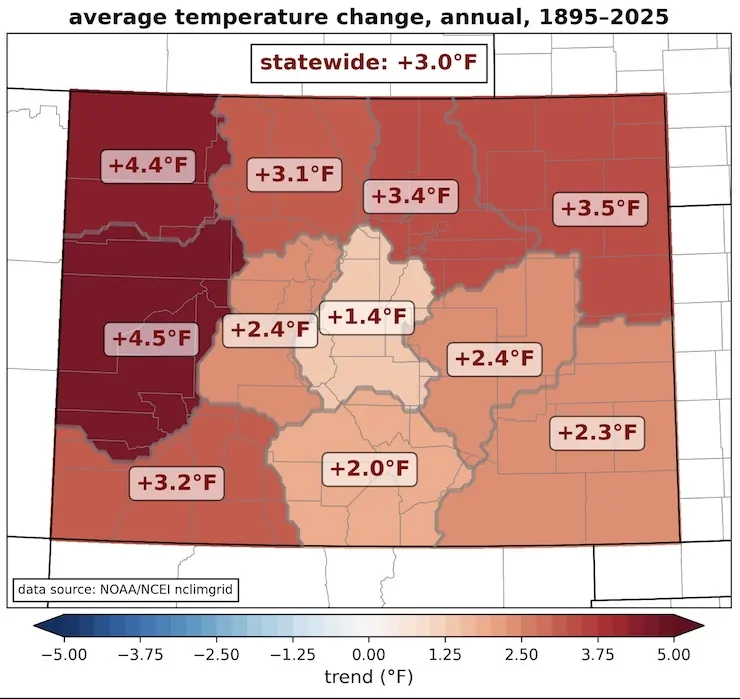
Meeker and other parts of the Western Slope have been warming at a faster rate than Colorado altogether. And Colorado, of course, has warmed rapidly in the last 125 years, particularly during the last 25. A map posted on the Colorado State University’s Colorado Climate Center website tells the story of temperature increases from 1895 to 2025 in shades of pink, orange and red. Far western Colorado from the San Juans north to Wyoming — including both Grand Junction and Rio Blanco County — is deep red.
Macnab began her comments to the law students with a description of the two wildfires in 2025 that afflicted Rio Blanco County. The Lee, the fifth largest in Colorado’s recorded history, and the Elk together covered more than 137,000 acres.
“I have a neighbor rancher,” said Macnab. “He had 60 cows that burned to death. I had another neighbor and close friend whose entire ranch burned, and she nearly lost her house. There were flame marks on her house. A number of ranchers lost miles and miles of fence.”
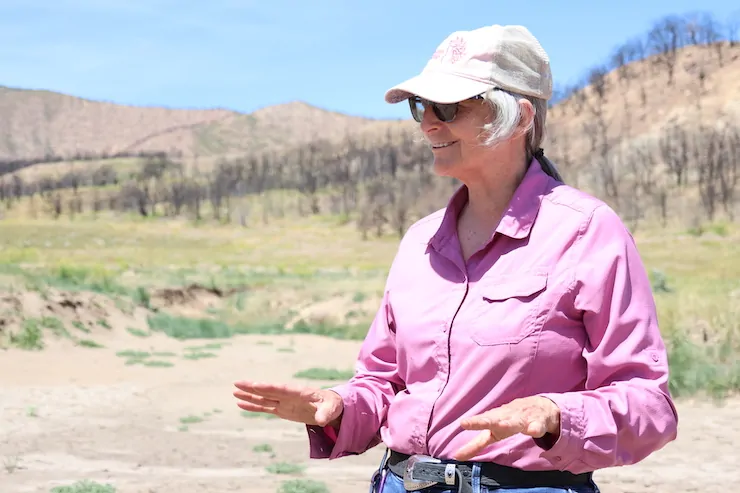
That good friend who nearly lost her house and a great deal of fence, too, was Kathleen Kelley. Kelley had grown up in Meeker and had been ranching since the 1980s, as her father had before.
Like Macnab, Kelley differs from many other ranchers in the White River Valley, where Meeker is located. She drives an electric car. As for the house that didn’t burn, it had triple-pane windows, a rarity everywhere, more costly but more energy efficient. In this case, the triple panes prevented heat from exploding the windows and allowing the flames to leap into the house.
Kelley was unusual in other ways, too. When still in her 20s, she had been elected a Colorado state legislator, the youngest ever female to do so. Now in her 70s, she retired earlier this year after a 20-year stint as a teacher in Meeker. She contributed an essay to Big Pivots in September after the death of Windell Berry. It can be found here.
Being retired, she told Big Pivots, she feels more freedom — and responsibility to speak out. She has had many opportunities in recent months. It began in an account in the The Denver Post last year about the fire. Then, earlier this year, the Trump administration refused funds to aid the ranchers of Rio Blanco County, an apparent case of spite against Colorado. An enterprising New York Times reporter, who had grown up in Colorado Springs, contacted her, resulting in a story in that newspaper this summer.
In recent weeks, she has in turn been contacted first by a reporter from Colorado Newsline and then by other reporters from Los Angeles to Washington D.C. They want to know about her involvement in the lawsuit. Recent days brought more mentions in publications such as Mother Jones and Grist.
Kelley was interviewed by a radio station in Boston in a report that was broadcast on Monday. The radio station also interviewed a county commissioner in Mesa County, which is on the other side of this fence.
These inquiries were not the result of a PR machine. Rather, it appears to have been a case of journalists reading each others’ stories. And it happened very, very quickly..
“I have been involved in a lot of grassroots efforts, but this one was was the least orchestrated one I have ever seen,” she said. It was, she added, not a message massaged by an advocacy group, but rather a group of ranchers saying what they had to say.
“For Colorado ranchers, climate change is not an abstract possibility, but a lived reality that is threatening the economic viability of a way of life that has been central to communities for generations,” says the amicus brief that was filed on behalf of the ranchers.

The brief filed on behalf of Rio Blanco County — the government, not the handful of ranchers — also includes seven other Western Slope counties: Archuleta, Delta, Grand, Garfield, Mesa, Montezuma, and Montrose. That brief argues that the economic interests of the counties would be harmed because they depend upon oil and gas extraction. In Montezuma County (Cortez), between 40% and 50% of county tax revenue has historically come from oil-and-gas production,” the brief says. “The potential impacts of this litigation on those counties are staggering.”
A clear exception is Grand County, which has virtually no oil and gas extraction. (This writer used to live there). Apparently, Grand County is just along for the ride.
The Suncor-Boulder case fundamentally involves climate change, although the specific question before the Supreme Court is over jurisdiction. Boulder and Boulder County (and on the coattails, San Miguel County) sued Suncor and ExxonMobil in 2018, claiming monetary damages resulting from warming and other climate changes caused by greenhouse gas emissions. It cites floods, heat and drought.
This filing was in Colorado courts. The fossil fuel companies tried to get the case moved to federal court, but the Colorado Supreme Court ruled in 2025 that the state courts do have jurisdiction. Suncor, ExxonMobil and their supporters want the Boulder case — and dozens of others like it from elsewhere in the country — decided in federal courts.
Lawyers from the law school in Boulder at the noon session last Thursday sorted through the legal twists and turns of this case in the noon-hour session. It’s complicated.
“You may be experiencing what I’m experiencing, which is kind of a Kafka-esque disorientation of confusion,” said Chris Winter, executive director of the Getches-Wilkinson Center at the University of Colorado Law School. The federal government, he said, wants to have it both ways. It is arguing that this is a federal case while it also says it has no statutory authority to regulate greenhouse gas emissions under the Clean Air Act.
“So that’s awfully confusing. I’m confused. I know a lot of you are confused as well.”
The New York Times, in a report published Sunday, said critics had called the federal government’s position a paradox. “The federal government is trying to get out of the business of regulating greenhouse gases, while also saying it has sole authority to regulate greenhouse gases.”
Confusion continued into Monday morning’s two-hour hearing before the Supreme Court. The Times reported that at least two justices admitted to being confused at various junctures in what the newspaper described as a “complex dispute.”
The question arose whether the federal government could have it both ways. “As I understand it, the EPA has disclaimed the power to regulate greenhouse gases,” said Justice Neil Gorsuch. The Wall Street Journal also reported that questions from Chief Justice John Roberts suggested an openness to Boulder’s argument.
That leaves open some potential for a 4-4 vote next year, which would leave the case in the Colorado Supreme Court. Justice Samuel Alito announced on Sept. 28 that he would not participate because of his ownership of stock in oil and gas companies. In the case of a tie, Boulder would win the question of jurisdiction, leaving the case in Colorado.
The decision will likely not be delivered until next June, possibly July, according to the national reporters who camp out at the Supreme Court.
“The argument was harder to read than most,” said the Times’ Adam Liptak. “The three Democratic appointees were likely votes for Boulder, and Justice Kavanaugh was adamant in his support for the energy companies. But the remaining Republican appointees’ questions were more mixed, and Boulder needs only one of their votes to prevail in light of Justice Alito’s recusal.”
But, once again, it’s a complex case deep into the legal weeds.
In question, at least in part, is whether this case has parallels with the litigation against a handful of tobacco companies in the 1990s that ultimately yielded a $206 billion settlement. In this case, though, the sources of emissions are much more diffuse – and importantly, global. Too, as Gale Norton, a former attorney general in Colorado (and interior secretary in the Bush administration) told the New York Times, fossil fuels have benefited people broadly. The same claim for tobacco is a much more difficult case to make.
Bloomberg, in an Oct. 1 story, said that climate suits, unlike the tobacco suits, have had trouble getting off the ground. The Supreme Court closed one avenue, ruling unanimously in 2011 that states cannot invoke federal law to force utilities to cut greenhouse gas emissions.
Boulder has tried a different approach, filing in state law and using traditional tort doctrines in arguing the oil companies misled the public about the risks of climate change while simultaneously contributing to the problem by producing and promoting fossil fuels.
The Wall Street Journal, in an editorial, took a dim view of Boulder’s case. Boulder, it said, “cannot supplant Congress’s power to regulate commerce among the states. Tolerating Boulder’s raid would blow the Constitution’s doors open to laws like those in New York and Vermont that seek to raid U.S. oil and gas producers for alleged damages caused by global CO2 emissions.”
William Barr, the former attorney general, had something similar to say in a guest commentary in the same publication under the headline: “Boulder Has No Business Making Foreign Policy.”
Boulder’s suit, wrote Barr, “asks a state court to impose potentially enormous liability on selected American energy companies for their alleged contribution to a worldwide phenomenon. Yet the overwhelming share of the conduct at issue lies beyond not only Colorado’s borders but America’s.”
The U.S. Constitution, he said, does not allow state and local governments to make that kind of judgement.
These legal abstractions were largely absent in the remarks of Boulder and Boulder Count officials after the oral arguments before the Supreme Court. Instead, Mayor Aaron Brockett issued a statement that talked about “hotter summers and extreme heat, to drought, declining snowpack, worsening wildfire risk and devastating fires. And every time those impacts intensify, our community pays,” he said.
At her 2,000-acre ranch near Meeker, Kelley on Sunday pondered what connected her and the other ranchers who had filed the brief in August. Jay Fetcher, who has been profiled in Big Pivots, has a ranch northwest of Steamboat Springs, where he has continued the observations of his father, who since the late 1940s began noting the date of the last snow on the ranch. Snow has disappeared earlier over the decades — especially so this year. See: “Along the Elk River, earlier springs and more uncertainty.”
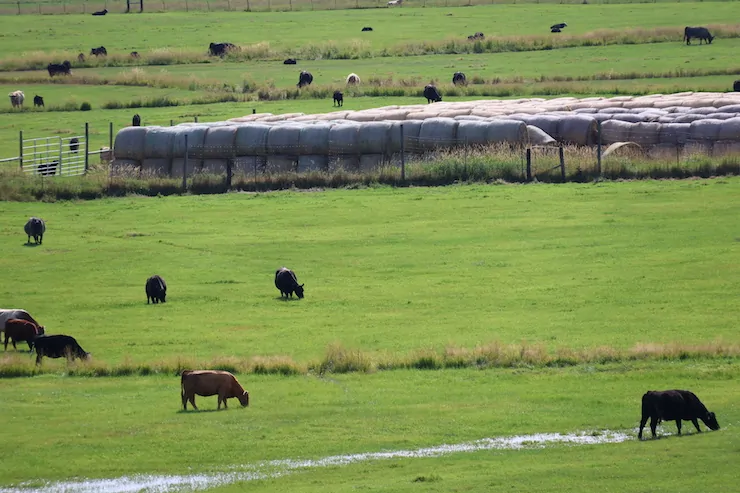
Another rancher, Mike Callicrate, lives in Evergreen but was a bull rider in his younger days and married a Kansas farm girl and has feedlots there. He has an opinionated website called nobull.mikecallicarte.com, where he inveighs against the “oligarchs and multinational corporations” of our food system.
The common theme among these and others who signed onto the brief, said Kelley, was a belief in regenerative agriculture.
Last week, reviewing the filings with the Supreme Court in this Boulder-Suncor case, Kelley noticed the date the oil companies had asked the U.S. Supreme Court to take the case — arguing that Colorado had no jurisdiction: Aug. 8, 2025.
That same day, she said, she and her family were evacuated a second time because of the Lee Fire, leaving her to wonder whether they would have a house to which they could return.
“On one hand these guys are evading responsibility and on the other hand is my family not knowing whether we will be able to afford the impacts of the Lee Fire on our property.
Kelley confides that she rarely cries, but she did when she saw that date.
“That was like a two-by-four with nails.”

Click the link to read the article on The Land Desk website (Jonathan P. Thompson):
September 30, 2026
☘️ ANNALS OF ALFALFA 🍀
It seems like only a few years ago that a PR person from the East Coast emailed me to tell me how surprised she was to read in the Land Desk that alfalfa and other livestock forage crops guzzled up a lot of the West’s water. “I didn’t even know they still grew alfalfa,” she wrote, incredulously. Actually, it was only a few years ago, but my how things have changed in the realm of alfalfa discourse. I’m guessing she and just about everyone else who pays attention has figured that one out by now, as it’s become vogue in certain circles to assert that the solution to the West’s water crisis is simply to stop growing alfalfa and other “low-value” agricultural crops and use the water for cities and data centers, instead. At the very least, they argue, we shouldn’t be exporting alfalfa overseas.
I’m not going to jump into that hornet’s nest again, at least not today. Instead, I dug up a bunch of data and used them to build a handful of graphs that will, hopefully, illuminate the situation a bit and give all parties — alfalfaphobes and alfalfaphiles alike — something to chew on. Call it statistical cud that I’ve gnawed on, masticated, partially digested, and now am handing over to you to derive some nutrients from. (Eww. That’s gross. Sorry.)
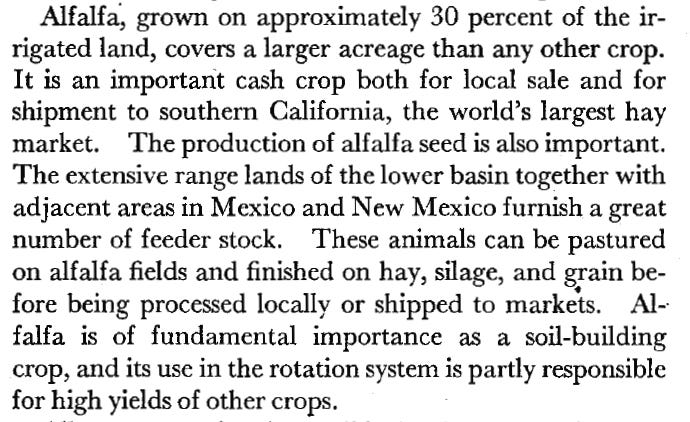

While hay and alfalfa are often maligned as “low-value” crops, farmers also grow it to make money. As you can see from the chart below, farmers in Colorado River Basin states harvested nearly $5 billion worth of hay in 2022. That’s on a par with the Colorado ski industry’s annual economic output.

Over the last two decades or so, Western state farmers have sold an increasing amount of hay, especially alfalfa, to overseas buyers. This is largely due to the growing global taste and demand for cow-milk products. Alfalfa is favored by dairy operations because its high protein content increases milk yield. So if you’re trying to reduce alfalfa demand by quitting beef, you’re barking up the wrong tree; you’ll have to ditch the ice cream and cheese, as well (or switch to goat or sheep milk products).
While hay exports are a billion-dollar-per-year industry, they are dropping off for a variety of reasons, from tariffs and trade wars to China’s shrinking dairy herds and gradually decreasing production here at home.

While the Western hay-export industry brought in over $1 billion in 2022, it’s not quite accurate to say that most of the region’s hay production is for export. Still, more than 20% is quite a lot of Western water to be sending overseas on giant container ships.
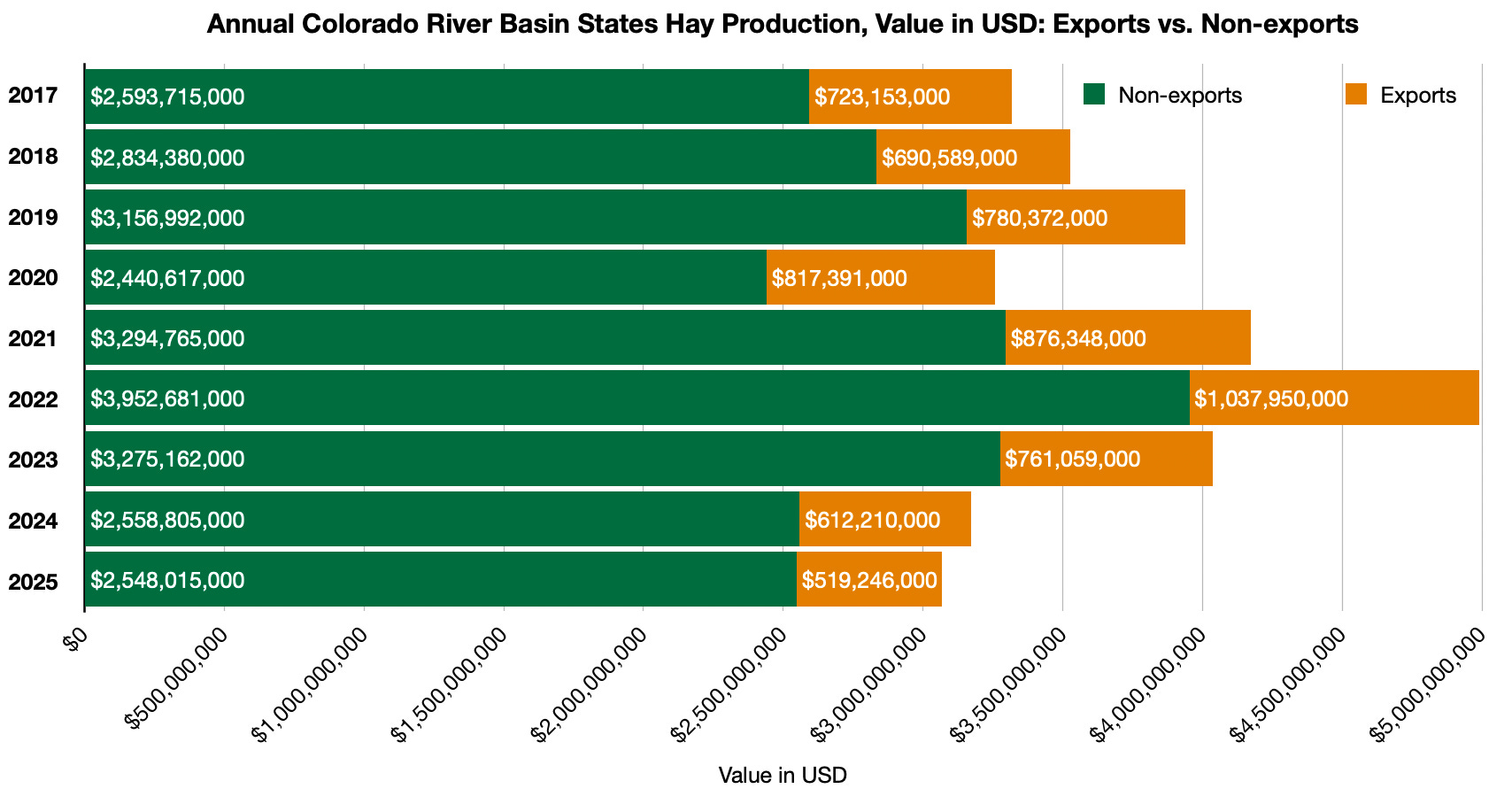
The largest hay exporter in the West is California, with Arizona and Utah trading second and third places. Other Colorado River Basin states export insignificant amounts of hay, according to the USDA’s Foreign Agricultural Service.
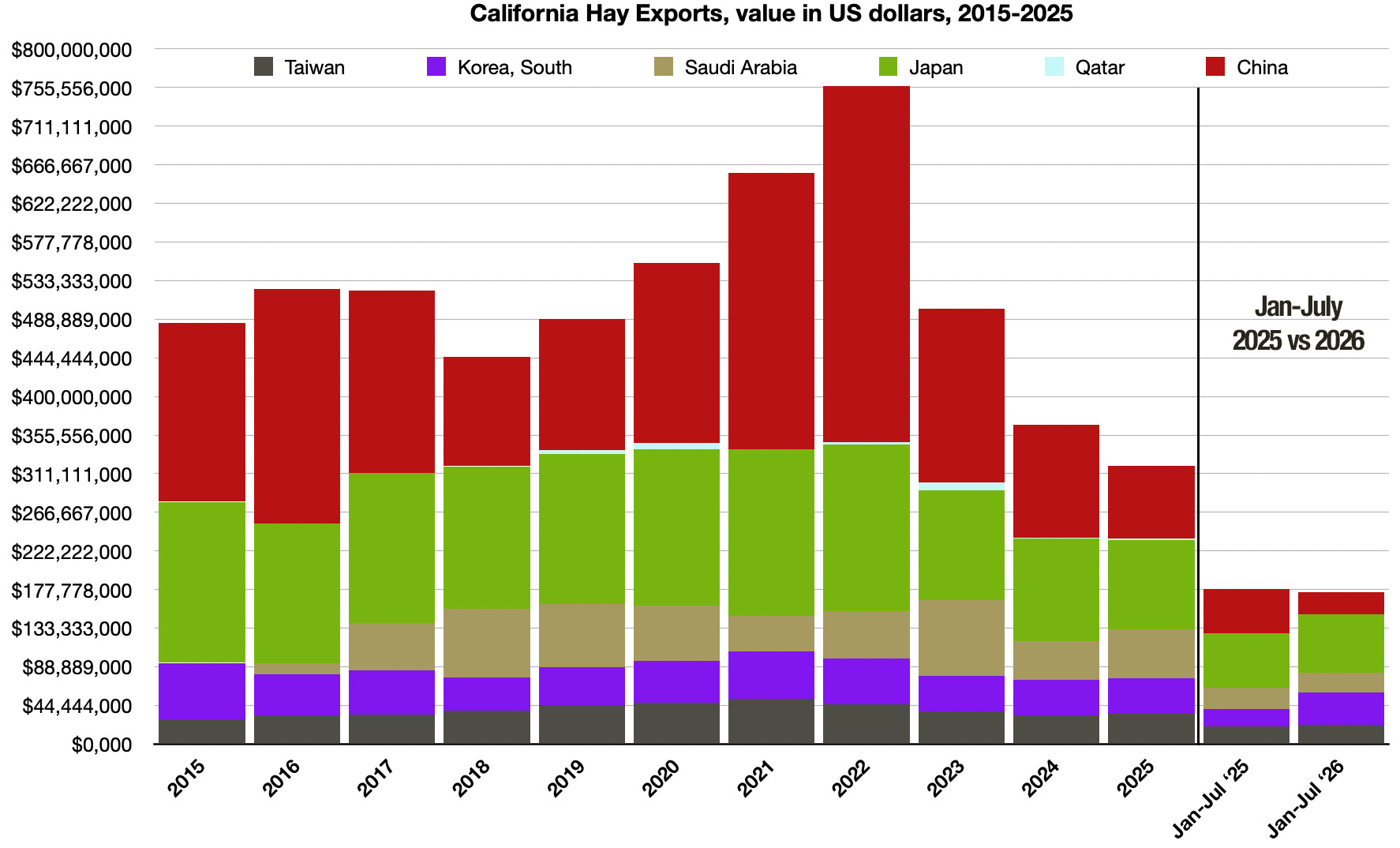

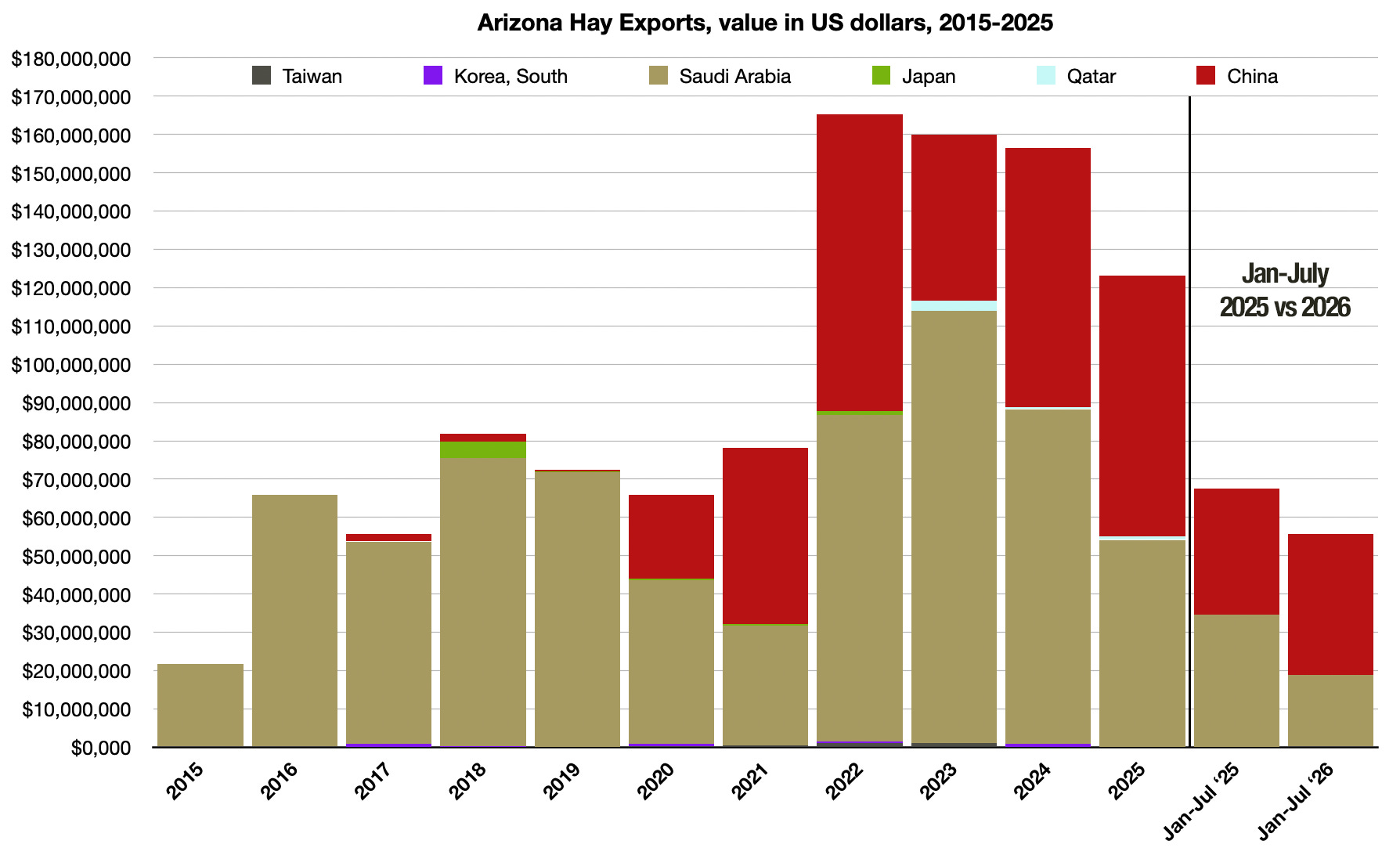
So what’s the takeaway from all of this? Well, like I said, I’m just providing the fodder for you to ruminate on, so to speak.
But it does definitively show that alfalfa and hay aren’t just some kind of side gig for Western farmers. They are important crops. And trying to convince farmers to give them up — along with the nearly $5 billion per year they can generate — is going to be tough, even if it is necessary.
⛏️ MINING MONITOR ⛏️In last week’s dispatch on more mining claims staked in the shrunken Bears Ears National Monument I mentioned a few dozen that appeared to have been located by Land Survey Advisors, including some in the former monument. I was able to finally get past the glitches in the San Juan County database and get confirmation that all 36 claims were, in fact, staked within Bears Ears’ pre-shrinkage boundaries. That brings the total number of new claims in Bears Ears to 72.
I’ll map all of the claims for a future dispatch and will continue to keep my eyes open for more new ones.
📖 READING (&LISTENING) ROOM 📰
- The Magic Southwest podcast has an insightful episode about the lost working-class neighborhoods that once lined the Animas River in Durango. Well, I shouldn’t say they’re “lost.” They were mostly destroyed by the city to make way for roads, sewage treatment plants, parks, or just as a form of urban renewal, if you will. Give it a listen below:
- Heads up Four Corners area folks: I’ll be giving a presentation on the Dolores River as part of a Dolores River Boating Advocates’ event on Friday, Nov. 6, from 6 p.m. to 8 p.m. at the Powerhouse in Durango. Following a short film about Snaggletooth Rapid I’ll speak about my personal relationship with the Dolores River, its history, the way it is a sort of microcosm of the Colorado River as a whole, and about its potential futures. I’ll also throw in a funny little tale about the time I saw Ed Abbey go through Snaggletooth. Tickets are $10 — which will help DRBA defray costs — and seating is limited. There will also be a cash bar. Reserve your spot now.
⛈️ WACKY WEATHER WATCH⚡️
Things are getting crazy down in southern New Mexico, especially near Hatch, where the Rio Grande has jumped its banks and inundated fields, homes, and even I-25. Check out the video below for more. And stay tuned next week when I have a recap of the 2026 water year, which may have been the wackiest on record.
Click on a thumbnail graphic to view a gallery of drought data from the US Drought Monitor website.
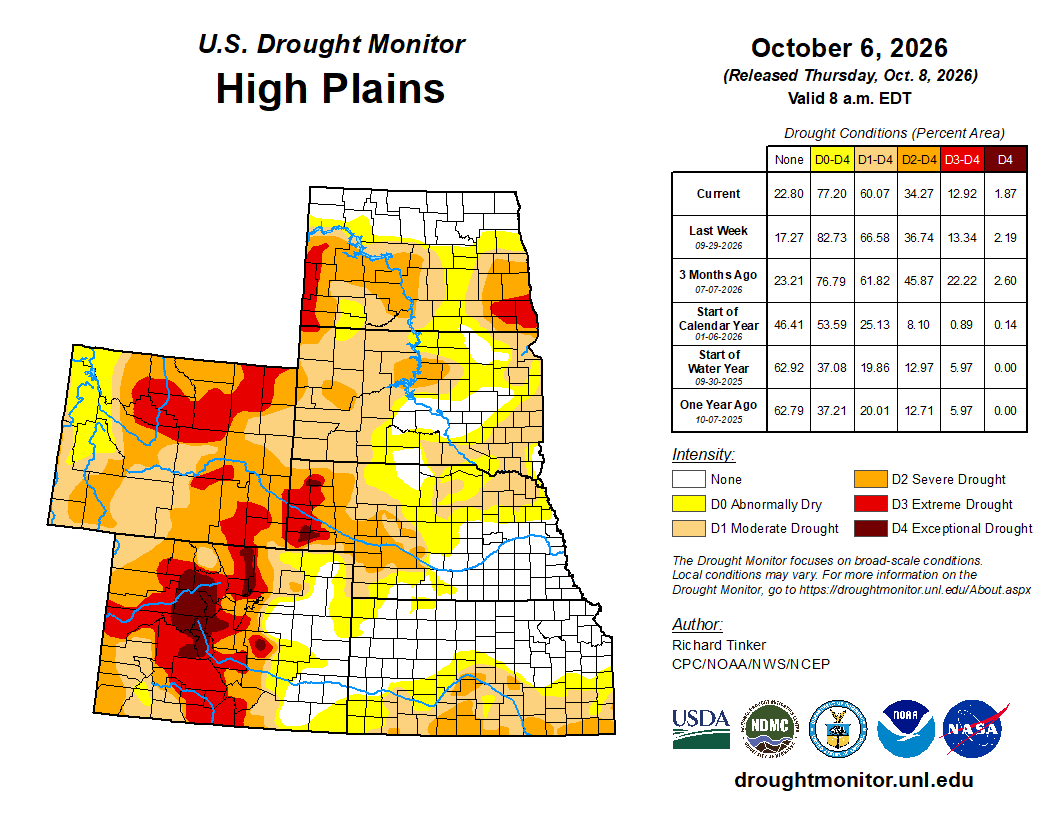

Click the link to go to the US Drought Monitor website. Here’s an excerpt:
This Week’s Drought Summary
Heavy to excessive rainfall impacted significant parts of the Contiguous States this past week. Amounts of 4 to locally over 8 inches of rain were common across south-central and southeastern Georgia, northeastern Florida, the Florida Panhandle, portions of the immediate Gulf Coast, and a swath from central Texas through the middle Red River (South) Valley. This brought an abrupt end to a protracted spell of hot and dry weather across the southern Great Plains that dated back through most of the summer. Dallas, TX recorded 4 inches of rain from September 30 through the first week of October, including a daily total of 3.47 inches on October 1. Prior to that, Dallas recorded only 0.01 inch of rainfall July 16 through September 29 (76 days), and a total of 2.27 inches going back to June 8. Elsewhere, a few broad areas recorded at least 2 inches for the week, including most of the Gulf Coast, southern Alabama, central and southern Georgia, the northern half of Florida, a large stripe through central and adjacent eastern Texas, central through southeastern Oklahoma, and in numerous patches from southeastern Colorado and much of Kansas through southeastern Nebraska, portions of Iowa, northern Missouri, northern Illinois, and the central to southern Great Lakes Region. In some of the wetter locations across the central Plains and adjacent Front Range, impacts improved substantially enough to justify 2-cagegory improvements on the Drought Monitor. Meanwhile, several patches across northern Arkansas, southeastern Missouri, and the adjacent Lower Ohio Valley also received 2 or more inches of rain. Moderate totals exceeding 0.5 inch, with localized totals topping 2 inches, affected areas from the central High Plains and southern half of the Great Plains eastward and northeastward through much of the Mississippi and Lower Ohio Valleys, the central and southern Great Lakes, the Southeast, the Mid-Atlantic Region, and the St. Lawrence Valley. Meanwhile, light precipitation at best was observed through most of the Northeast, the Upper Ohio Valley, the far Upper Mississippi Valley, the northern Great Plains, and most areas from the High Plains to the Pacific Coast outside Kansas, Colorado, and northern New Mexico. Many existing areas of drought that were impacted by the heavy precipitation experienced marked relief, but despite expansive areas receiving little or no measurable precipitation, drought intensification was limited in extent, largely due to the lower temperatures and the typical autumnal decline in human and environmental water demand…
High Plains
Widespread heavy precipitation abetted robust improvement across eastern Colorado, central and western Kansas, and parts of southern Nebraska. Numerous locations reported 3 to locally over 6 inches of rain, which was sufficient to support 2-category improvements in portions of southeastern Colorado and the western half of Kansas. Precipitation amounts declined abruptly north of a line from central Colorado through northeastern Nebraska, and only a few tenths of an inch at best was observed beyond this delineation. Still, improvements were introduced in parts of the central and northern Dakotas where earlier precipitation may have been more beneficial than initially assessed. The only areas of deterioration noted were in northeastern Colorado and part of north-central Wyoming, which consistently have been north and/or west of the heaviest precipitation. Elsewhere, dryness and drought intensities did not markedly change from last week…
West
Moderate to heavy precipitation (0.5 to locally approaching 2.0 inches) fell early in the period across north-central and northeastern New Mexico, but conditions were quiet across the rest of the West Region. There were scattered small areas reporting a few tenths of an inch of precipitation last week, primarily in Montana and the lower Four Corners States, while most sites observed no measurable amounts. But despite the predominantly dry week, fairly substantial areas of improvement were noted as the environmental response to earlier above-normal to heavy precipitation continued. Improvement was most common this week across New Mexico, Arizona, and Montana, with a few areas also noted in southeastern Idaho and Utah. Across almost all of Nevada, Idaho, and the three West Coast States, dryness and drought were essentially unchanged from the prior week…
South
A variable precipitation pattern was observed across Tennessee and the Lower Mississippi Valley last week, resulting in some areas of nominal improvement (scattered across eastern Tennessee, southeastern Louisiana, southern Mississippi, and northern and northwestern Arkansas) and other areas of somewhat increased moisture deficits and deterioration (scattered across central and western Tennessee, southern and eastern Arkansas, northern Mississippi, and central through southwestern Louisiana). Farther west, across Texas and Oklahoma, broad areas recorded heavy to excessive precipitation, resulting in several sizeable areas of widespread improvement. Multiple inches of rain – for the second consecutive week in some areas – induced improvements across most of southeastern and Deep South Texas, and in a swath from central Texas through much of the Red River (South) Valley into central Oklahoma. Farther west, across the Big Bend and the Texas and Oklahoma Panhandles, light to moderate precipitation following the excessive amounts recorded last week led to widespread one-category improvements. Enough precipitation was observed to support 2-category improvements at a few locations in Deep South Texas, south-central Oklahoma, and the western Oklahoma Panhandle. There were a few patches in southwestern Texas and the northern interior missing the heavy precipitation that hit most locations over the past couple of weeks, resulting in scattered spots of deterioration. Improvement was far more common across Texas and Oklahoma, however, as opposed to the mixed bag of changes noted farther east…
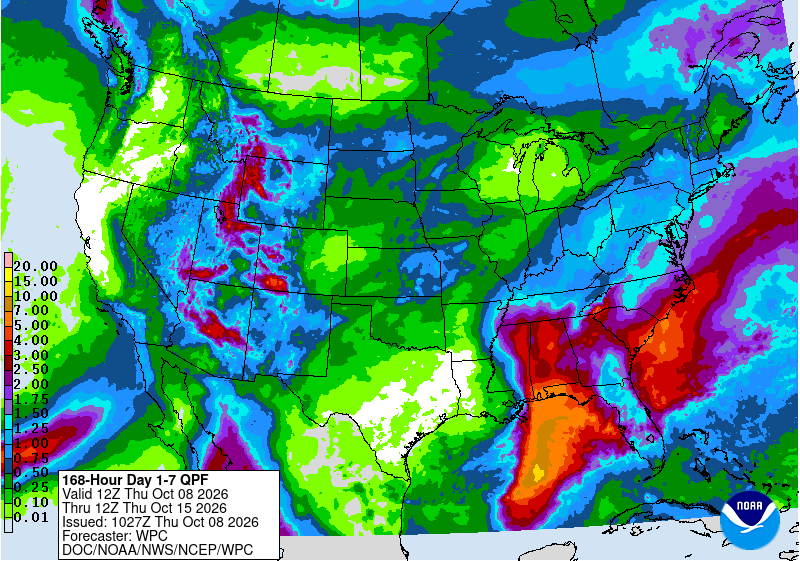
Looking Ahead
During October 7-12, Tropical Storm Isaias in the southwestern Gulf is expected to intensify into a category-2 hurricane and head northeastward and then northward toward the United States. After peaking in intensity and beginning to weaken, landfall is expected somewhere along the north-central or northeastern Gulf Coast late October 9. Once inland, Isaias should weaken more quickly as the remnant circulation tracks northward into the Southeast or adjacent Lower Mississippi Valley. Sustained winds are expected to peak around 105 mph in the northern Gulf, but with weakening expected to start prior to landfall up to a couple hundred miles inland. A surge of tropical moisture is expected to accompany Isaias into the Southeast, bringing moderate to heavy rains into the region, reaching as far northward as the Ohio Valley and Mid-Atlantic Region. By the end of the period, upwards of 7 inches of rain are expected in a few parts of the Florida Panhandle, and amounts exceeding 3 inches are forecast as far north as northern Alabama and adjacent areas in Mississippi and Georgia. Most areas along the Carolinas Coast are also expected to receive over 3 inches of rain. Farther west, another push of tropical moisture into the interior West could bring 3 to 6 inches of precipitation to isolated spots in the higher elevations of northeastern Utah and west-central Wyoming. At least 1.5 inches of rain are anticipated from central Mississippi eastward, reaching as far north as the Tennessee Valley, southern Appalachians, and Mid-Atlantic Region. Scattered locations in the higher elevations of the interior West and southern California Coastal Ranges are also forecast to record over 1.5 inches of precipitation by October 12. Moderate amounts exceeding 0.5 inch should cover southernmost Florida along with the greater Ohio Valley, most of the Appalachians, central and southern New York, and southern New England. Many lower elevations across the interior West are also expected to see at least 0.5 inch. In contrast, little or no precipitation is expected in many areas impacted by dryness and drought, including the Far West to the north and west of the Sierra Nevada, most of the Plains and Great Lakes Region, and western reaches of the Lower Mississippi Valley. Above-normal temperatures are anticipated across a broad swath of the Nation’s Midsection from the southern and central Plains through the Mississippi Valley and the Great Lakes Region. Daily high temperatures are expected to average at least 4 deg. F above normal there, with anomalies exceeding +10 deg. F from north-central Texas through most of Oklahoma and adjacent parts of Kansas, Missouri, and Arkansas. Farther west, most locations from the northern and western Rockies to the Pacific Coast are expecting below normal temperatures, along with most of Montana. Daily highs are expected to average at least 3 deg. F below normal from the Cascades southward and eastward, with anomalies of -8 to -12 deg. F forecast in the northern Great Basin, northern Rockies, and High Plains of Montana.
Wetter than normal conditions are expected over the ensuing 5 days (October 13-17) across a large part of the Contiguous U.S. from the Rockies and northern High Plains eastward through New England, the Mid-Atlantic Region, the southern Appalachians, and the Florida Panhandle. The best odds for unusually heavy precipitation extend from the central and lower Four Corners Region eastward through Texas, the Red River (South) Valley, and the western Lower Mississippi Valley. At least marginally enhanced chances for surplus precipitation also cover all of Alaska and Hawaii. Only west-central and northern California and southwestern Oregon have nominally increased chances of subnormal precipitation. Meanwhile, above-normal temperatures are favored across much of the Pacific Northwest and over a large area including the Southeast, central and southern Appalachians, southern Great Lakes Region, Middle and Lower Mississippi Valley, central and southern Great Plains, and southern High Plains. Warmer than normal conditions are also favored across Hawaii and the central and eastern sections of Alaska. Increased odds of below-normal temperatures are limited to the Northeast and New England.
Just for grins here’s a slideshow of early October US Drought Monitor maps for the past few years.

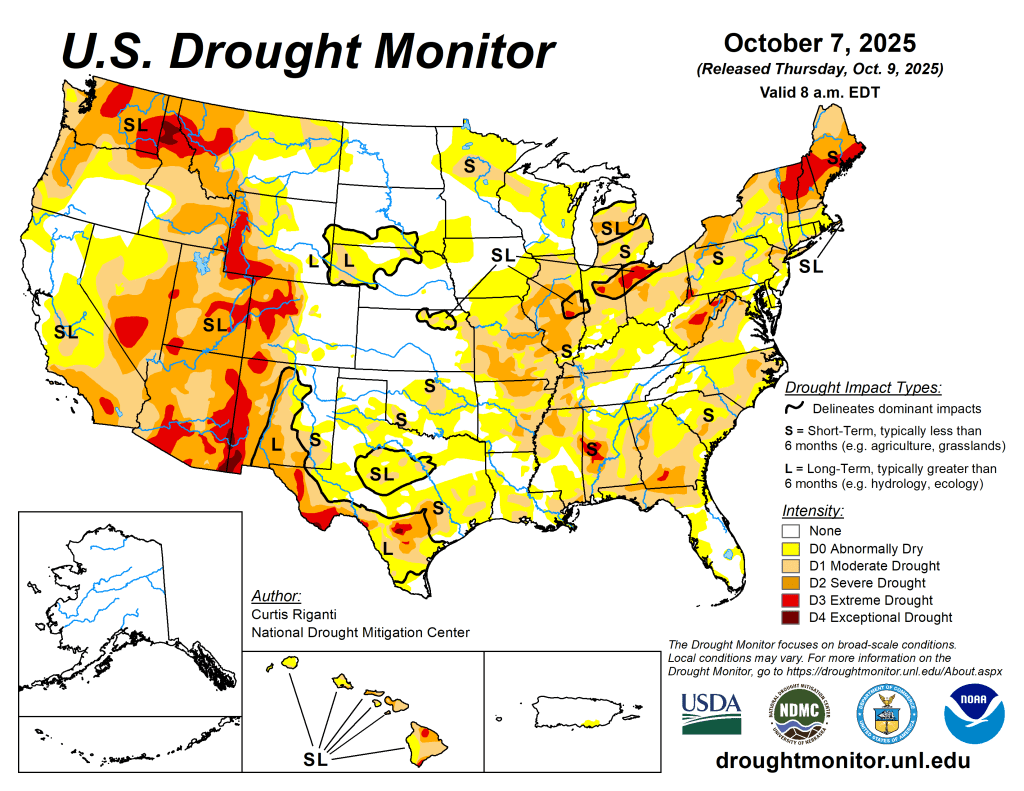
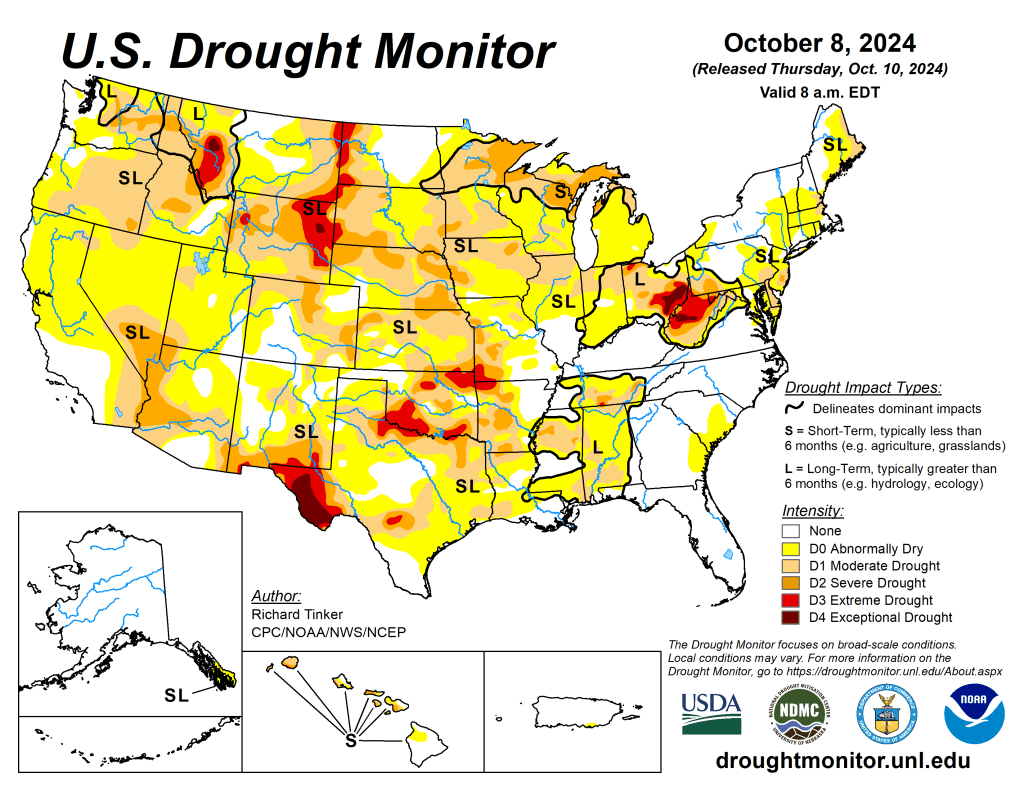
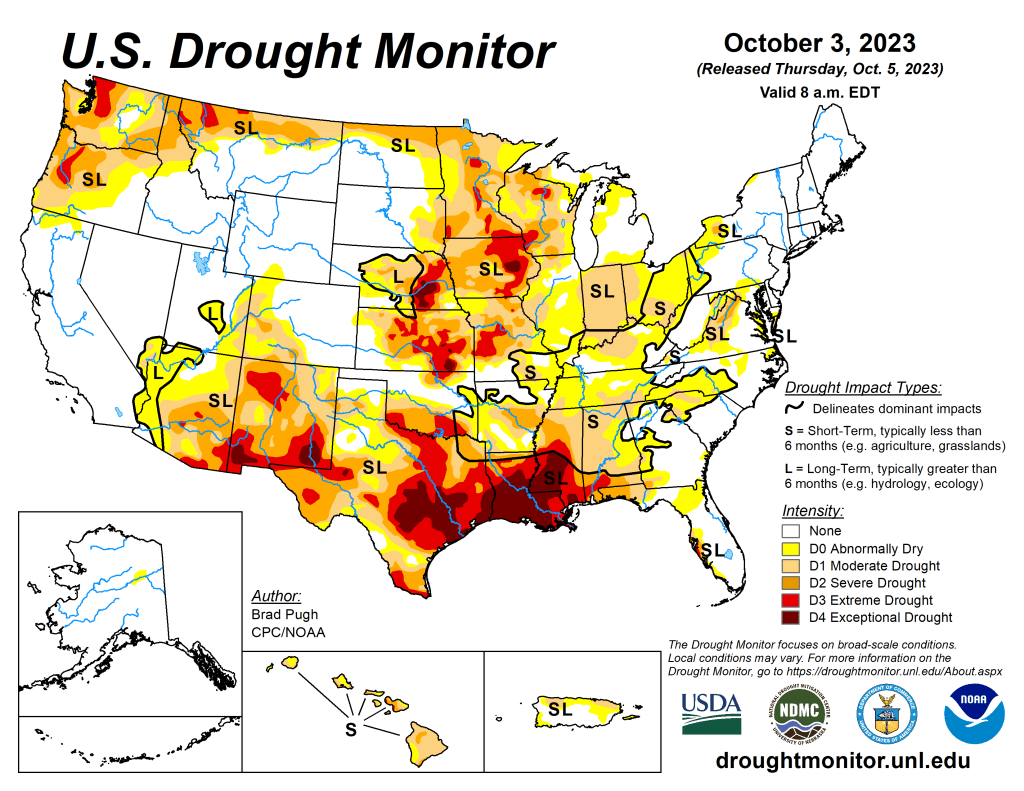
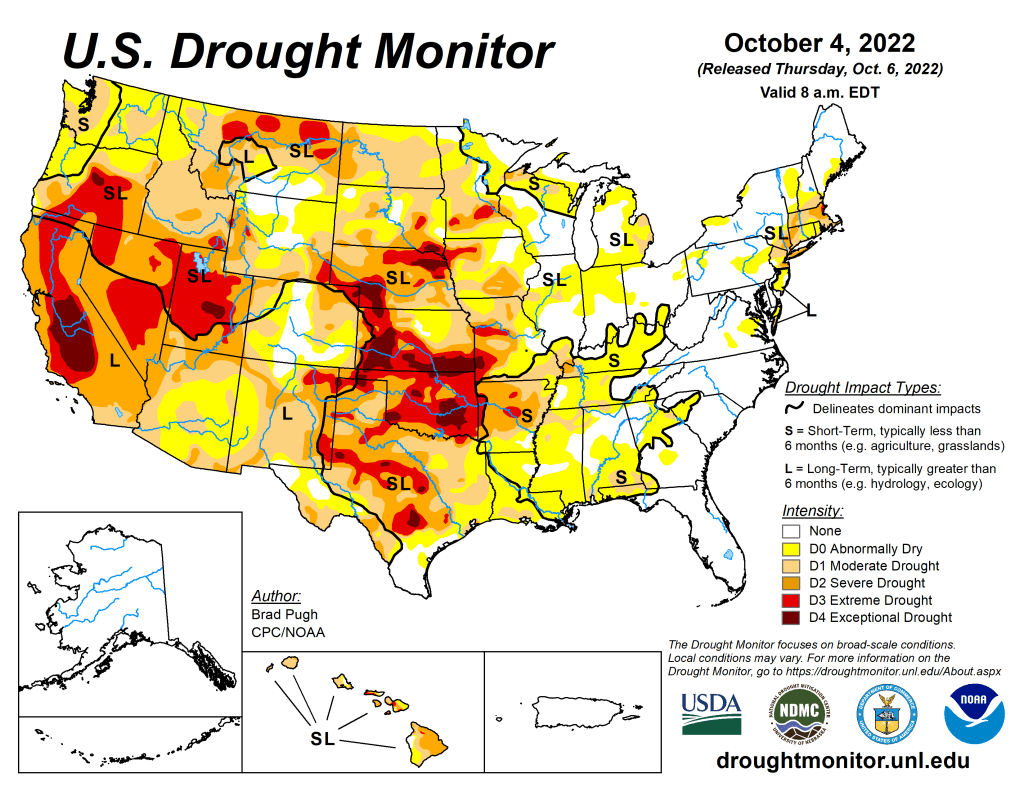

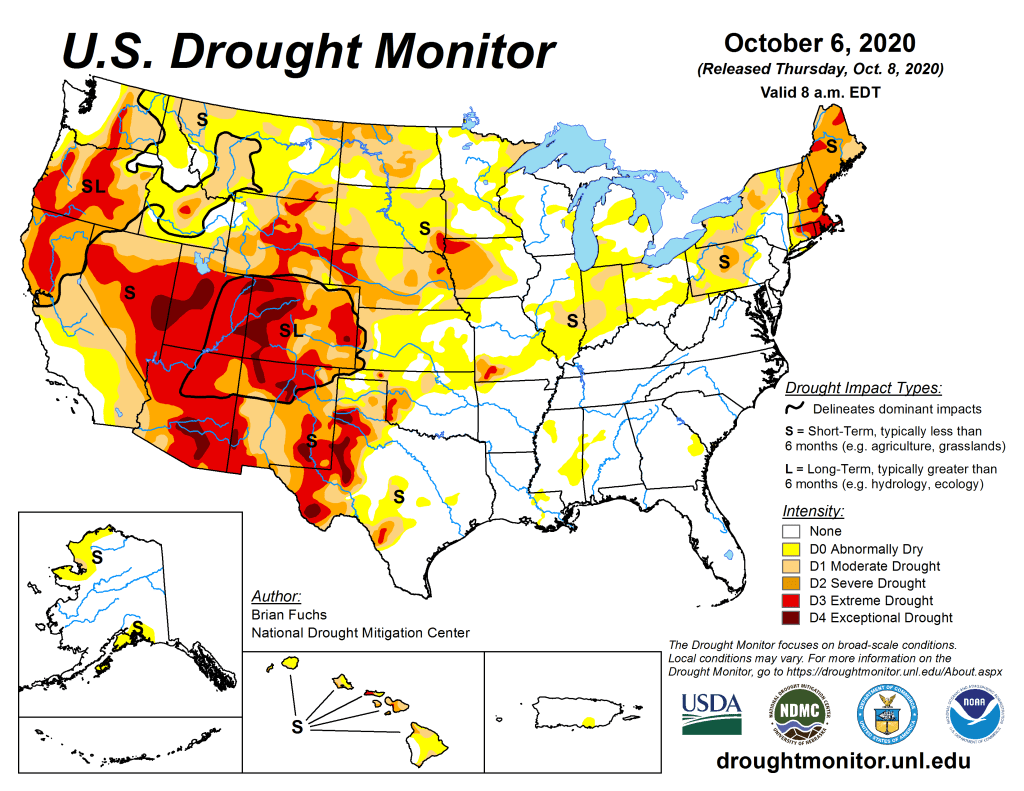

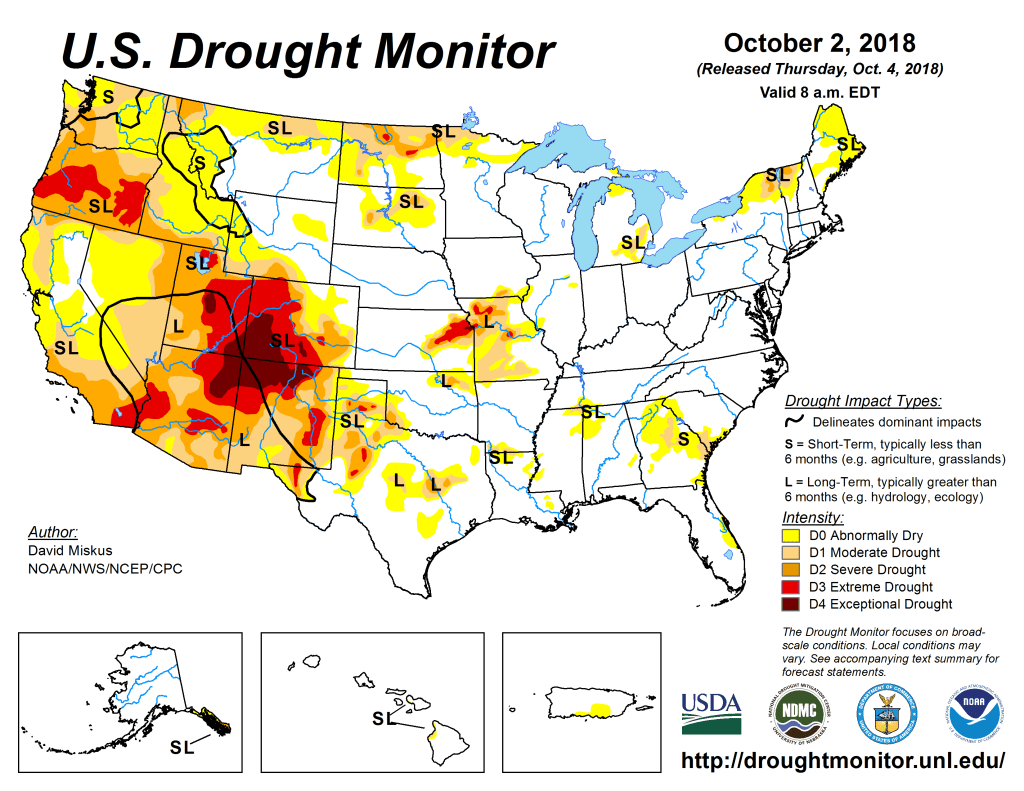
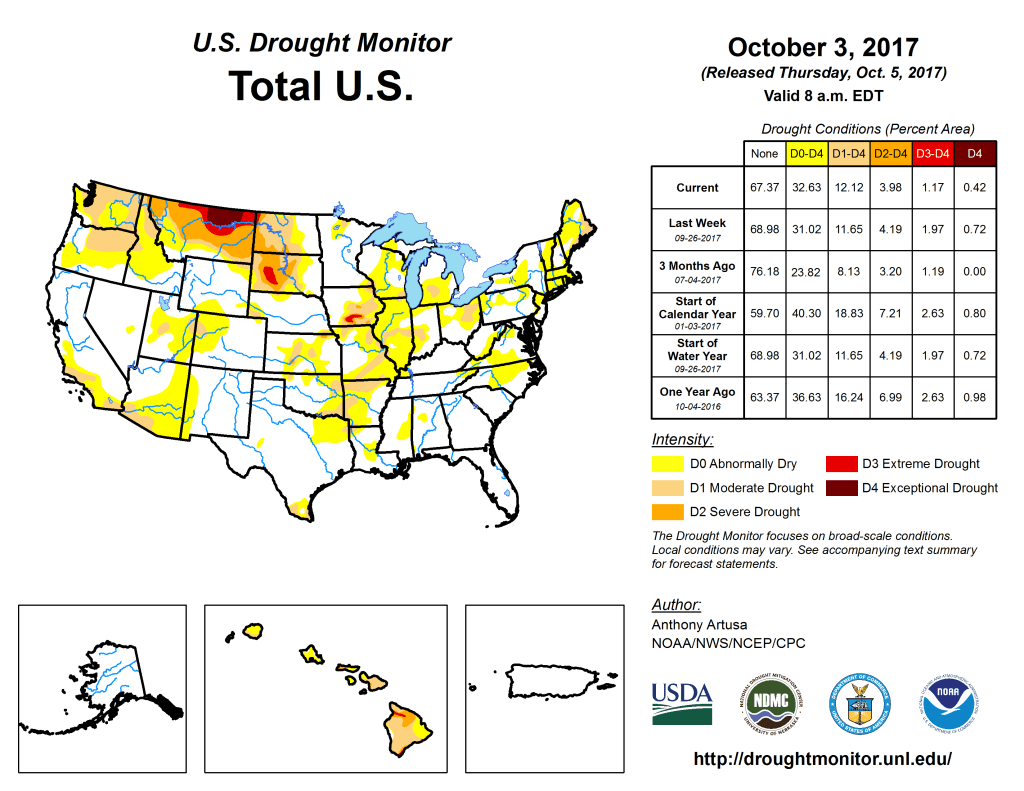


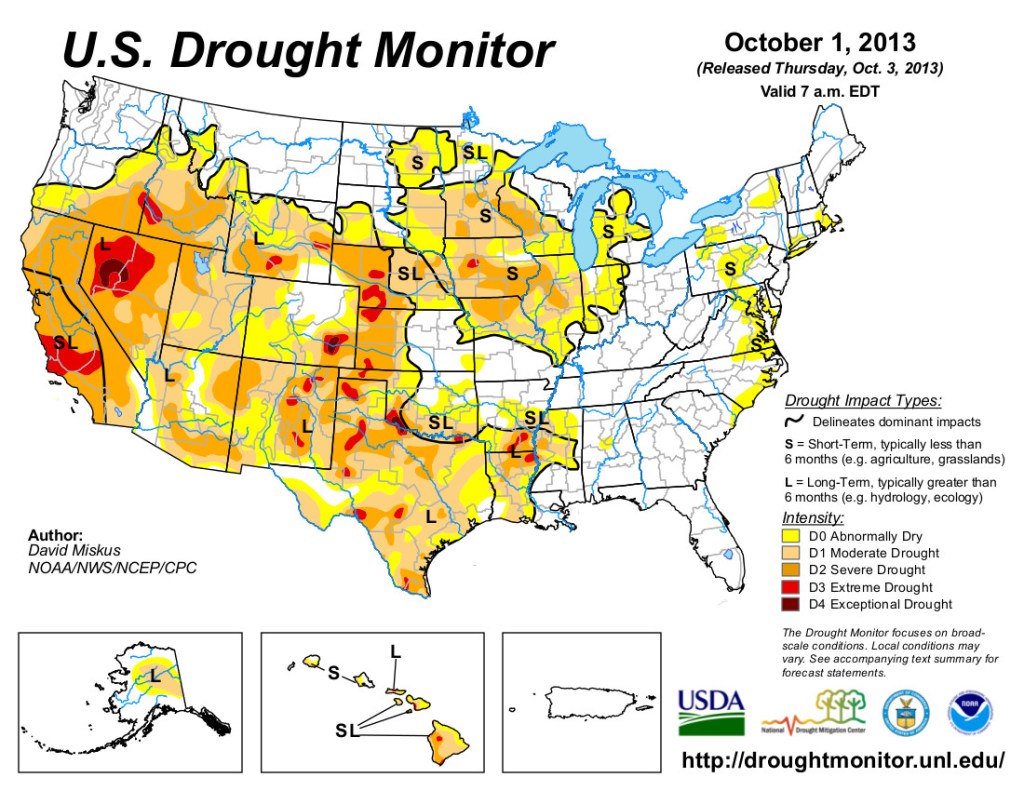
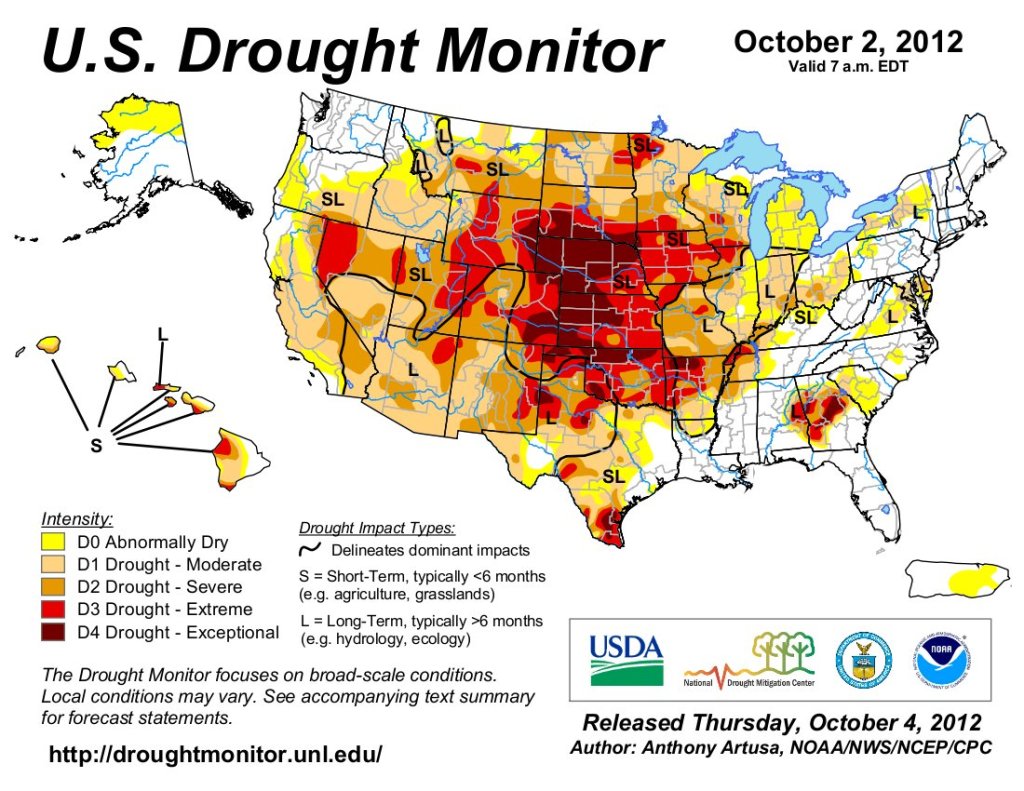

By Brad Barham & Robert Marcos
In 2003 the San Diego County Water Authority (SDCWA) and the Imperial Valley Irrigation District (IID) forged a mutually beneficial water partnership that demonstrated that urban sustainability and agricultural prosperity could thrive together. In their “Quantification Settlement Agreement“, the SDCWA provided major infusions of capital to the IID in exchange for an annual allotment of 200,000 acre feet of Colorado River water, accounting for more than half of the region’s water supply. The SDCWA received an additional 77,700 acre-feet of water that was conserved by lining long stretches of the All-American and Coachella canals.1, 2
At the time of the historic agreement San Diego County’s population had just passed the 3 million mark and 95% of its water had been coming from a single source: the Metropolitan Water District’s Colorado River allotment. Worse – it would be 12 more years until San Diego’s very expensive desalination plant would come online, offering a new source of water that supplies only about 10% of the county’s water use.. This meant that prior to the QSA the county’s water supply was exceptionally vulnerable to shortage.
From the IID’s point of view, their massive 3.1 million acre-foot (AF) Colorado River allotment had a major vulnerability: unlined earthen canals had been losing up to 100,000 AF of water every year through seepage. In addition to this the IID wanted farmers to employ more advanced irrigation systems but their investment costs limited adoption. That changed after the influx of hundreds of millions of dollars from San Diego and the State, which provided the financial lifeline needed to pay for the upgrades.
1. San Diego paid for an array of on-farm conservation upgrades: Under the QSA only water that was saved due to the following efficiency upgrades could be transferred to San Diego. 3
2. System and Infrastructure Conservation: San Diego funds IID’s internal delivery system improvements to generate water efficiency. 4
3. All-American and Coachella Canal Concrete Lining: Paid for via QSA Partnerships
Through the QSA, San Diego secured $257 million in State of California subsidies to pay for the massive physical construction of concrete-lined sections of these earthen canals. This prevents massive water loss from seepage and provides San Diego with an additional ~80,000 acre-feet of water annually. 5
4. Historical Land Fallowing — Paid for through 2017
During the initial years of the QSA (2003–2017), before farmers had time to build modern drip and tailwater systems, San Diego paid for temporary land fallowing to kickstart the water transfer volumes. They also provided $30 million to mitigate environmental and economic impacts on the Imperial Valley from idling those fields. 6
• Coachella Valley Water District (CVWD)
Prior to the QSA the Coachella Valley Water District received as much as 330,000 acre feet of Colorado River water, but those deliveries had been unreliable, and as a result the Coachella Valley’s groundwater was in a state of severe overdraft. Thanks to the QSA, CVWD’s water rights were officially quantified, the district received an immediate, additional 35,000 acre-feet of Colorado River water, and its long-term imported supply was scheduled to steadily increase over time. 7
• Metropolitan Water District of Southern California (MWD)
The Metropolitan Water District of Southern California, the massive wholesale supplier for cities across Los Angeles, Orange, Riverside, San Bernardino, and Ventura counties—was a core player. While MWD took a reduction in some historic surplus supplies to help California stay within its strict 4.4 million acre-foot total river limit, the QSA secured and stabilized MWD’s baseline water rights. It granted MWD reliable access to dry-year water transfers from agricultural areas (like the Palo Verde Valley) and canal-lining projects. This reliably safeguards the water supply for more than 12 million urban Southern Californians outside of San Diego. 8
• The San Luis Rey Indian Settlement Parties (Native Tribes)
A crucial portion of the water saved from the All-American and Coachella canal lining projects was legally designated for five San Diego-area Native American tribes. These included the La Jolla Band of Luiseño Indians, Pala Band of Mission Indians, Pauma Band of Luiseño Indians, Rincon Band of Luiseño Indians, and the San Pasqual Band of Mission Indians. For decades, these tribes had been locked in a fierce federal water rights dispute with local cities. The QSA permanently resolved this by allocating 16,000 acre-feet of water per year from the canal lining projects to these tribes and their partner cities of Escondido and Vista. 9