
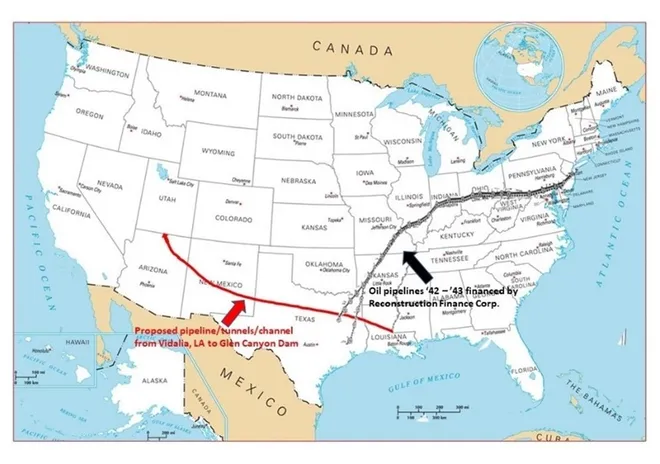
Click the link to read the article on the AZCentral website (Joan Meiners). Here’s an excerpt:
May 3, 2026
Key Points
- The idea of building a pipeline to move water from eastern states to the dry West is frequently proposed to solve water shortages.
- Experts argue a cross-country pipeline is technically feasible but prohibitively expensive, legally complex and environmentally risky.
- Many officials and environmentalists believe more practical solutions involve local conservation, water storage and regional management.
…Kyle Roerink, executive director of the Great Basin Water Network, an organization that works to promote water conservation in the West and has opposed several water pipeline projects, says that “exporting water from the Mississippi Delta will never be a sensible or reasonable solution.” His list of explanations include the “astronomical cost” stemming from eminent domain, permitting, construction, energy management and staffing fees, and the intractability of managing healthful water quality over such vast distances with so many pollution inputs…The southeastern states may also not be as eager to get rid of their water as Arizonans might assume. Coastal erosion due to climate-worsened hurricanes, drilling and other factors mean the Mississippi Delta needs all the sediment transported downstream by its major rivers. The Mississippi’s flows play a role, too, in diluting agricultural chemicals causing hypoxic dead zones in the Gulf as the region navigates its own experiences with unpredictable drought. On top of these broad limitations — which entities across the aisle including the Goldwater Institute, a conservative policy think tank, have deemed “cost prohibitive” as well as practically and environmentally infeasible — there are complex legal water rights obstacles that likely run deeper than the Trump administration’s ability to override.
“The issue of water rights management would be a Byzantine nightmare for such a large scale project,” Roerink told The Republic. “The Mississippi isn’t adjudicated under one set of laws. It is governed under many doctrines in many states. Just as in the West, eastern states have differing state laws governing water allocations in their respective jurisdictions. There are mixes of riparian and appropriation doctrines governing use. The legal framework leads me to believe that the only thing this pipeline would be good for are lawyers who practice in the U.S. Supreme Court.”
[…]
None of this has stopped Arizona leaders, as reader Lisa Nelson asked about, from formally considering cross-country water pipeline proposals. In 2021, the Arizona Legislature voted to appropriate $160 million into a fund to consider importing water from as far as the Mississippi River. In late 2024, Chuck Podolak, director of the Water Infrastructure Finance Authority of Arizona told KUNC’s Alex Hager that the idea still deserves “serious attention.”