The 2020 Colorado Water Congress Annual Convention starts today #CWCAC2020 @COWaterCongress

Posting may be intermittent this week. You can follow the sessions on my Twitter feed @CoyoteGulch and even better, engage using the hash tag #CWCAC2020.

The convention is the place to be this week for all the conversations, networking, and great presentations. Once in a while someone from Colorado water history even shows up.

David Robbins and J.C. Ulrich (Greg Hobbs) at the 2013 Colorado Water Congress Annual Convention

2020 #COleg: HB20-1072, Study Emerging Technologies For Water Management

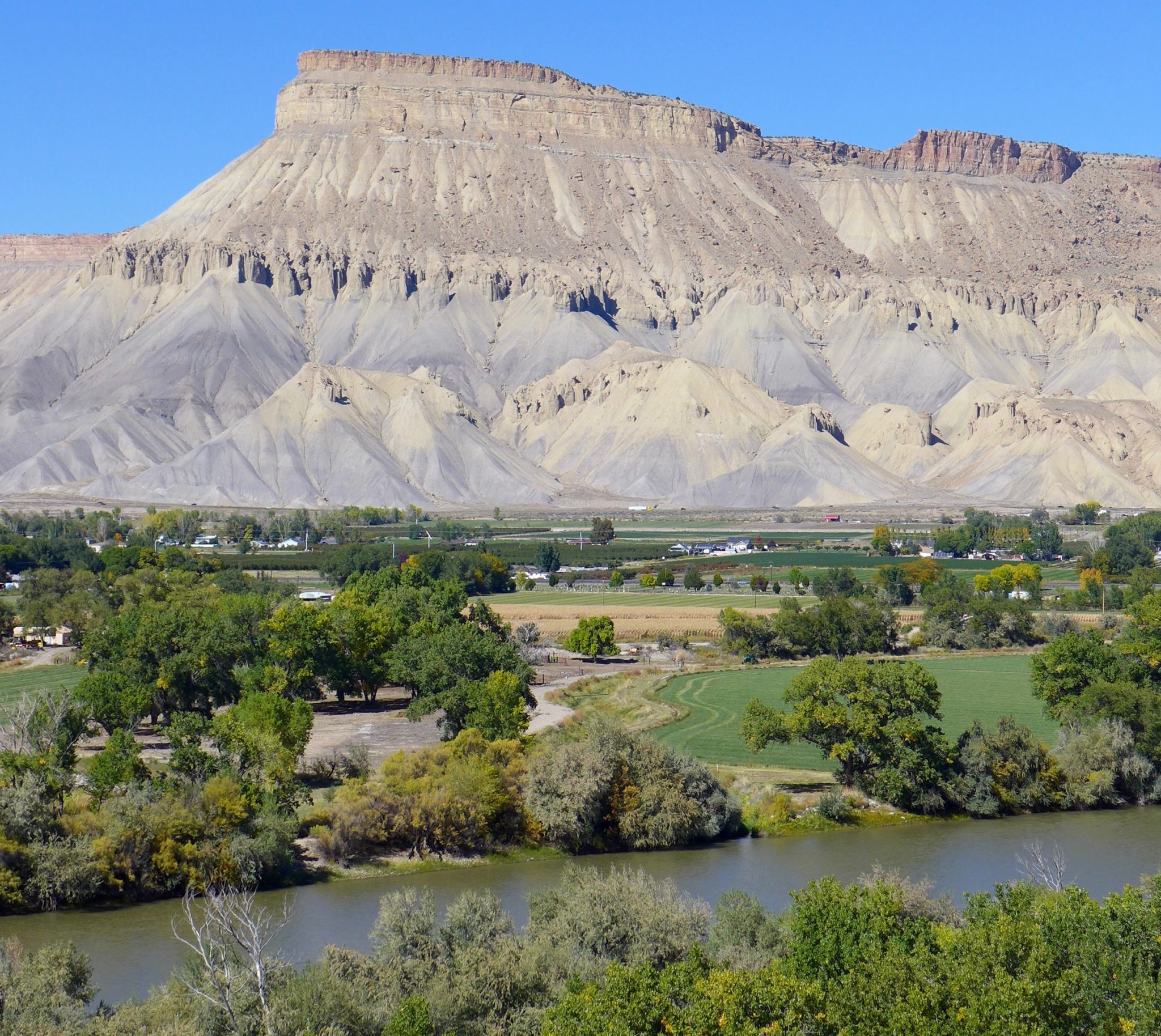
Water from the Colorado River irrigates farmland in the Grand Valley. The state of Colorado is looking into how to fund a program that would pay irrigators to reduce their consumptive use in order to send water downstream to a savings account in Lake Powell. Photo credit: Brent Gardner-Smith/Aspen Journalism

From The Boulder Daily Camera (John Spina):

On the surface, HB20-1072 [Concerning a requirement that the university of Colorado study potential uses of emerging technologies to more effectively manage Colorado’s water supply, and, in connection therewith, making an appropriation, conditioned on the receipt of matching funds from gifts, grants, and donations] appears basic, proposing the state match $40,000 in research funding for the University of Colorado and Colorado State University to study water management technology like remote sensors, cellular and satellite telemetry, areal observation, water resource forecasting and blockchain documentation.

Despite the relatively small dollar amount, the results from this study, said Evan Thomas, the director of the University of Colorado Boulder’s Mortenson Center and co-author of the bill, could create a better understanding of the entire state’s water portfolio and allow for more informed conversations about what can be done to preserve it.

ā€œThese technologies offer greater transparency, which can often lead to greater trust,ā€ Thomas said. ā€œRight now you just have a bunch of ditch riders, people you have to pay to go around and look at meters on people’s lands, and it’s expensive, it’s not done very often, the meters aren’t that good, and the farmers are suspicious. It’s adversarial.ā€

As a result, many water rights holders have strongly resisted any sort of change of use for fear of unintended consequences that could end up interrupting their supply.

Furthermore, because water rights can be reduced if the entire allotment is not put to beneficial use each year, Blake Cooper, Boulder County’s agricultural resource manager, said farmers use as much water as they can, when they can, because they don’t know if it will be there later in the season.

ā€œBut,ā€ Thomas said, ā€œif you have more objective and more regular measures of water use and availability, as well as forecasting, and if you could be paid to conserve water instead of being penalized for using less water, it starts to create market incentives that will facilitate relationships (among water users) and let us to be a lot smarter and proactive about making sure that water is available year-round and year over year.ā€

While these markets already exist, with more robust data on how much water a right holder is using, how much water is currently available, and how much is forecast for later in the season, Thomas said right holders could trade water ā€œquarterly, monthly, or even weekly potentially,ā€ with more certainty it will not effect their own supply later in the year.

Dan Lisco, a hay farmer in Boulder County, installed remote soil moisture monitors on his farm last year. Because he could see when soil moisture was high and wouldn’t absorb any more water, he was able to turn off his center pivot irrigation system for several days throughout the season.

Not only did Lisco say this allowed him to save a little water and nearly eliminate runoff, which can lead to nutrient pollution and soil erosion, but it also cut down on pumping and electricity costs, which helped cover the costs of the monitors.

According to Phytech, the company that makes soil moisture monitors deployed by Lisco, the monitors can reduce a farm’s water use by up to 40%.

With the new technology discussed in House Bill 1072, Lisco could have extrapolated how much less water he was using and how much water was forecast for the rest of the season, then sold off any excess water to another farmer or environmental group looking to keep more water in the river to improve recreation opportunities and wildlife habitat.

Durango: ā€œSecuring Our Water Future,ā€ from 6 – 8 p.m., Thurs., Jan. 23, 2020 — @ConservationCO #COWaterPlan

From The Durango Telegraph (Miss Votel):

Conservation Colorado, which has offices across the state to help organize citizen activism and engagement, will be hosting ā€œSecuring Our Water Future,ā€ from 6 – 8 p.m., Thurs., Jan. 23, at 4Corners Riversports. The goal of the event is to discuss what local residents and businesses can do to help curb water usage, build drought resilience and support the goals of the [Colorado Water Plan]. The meeting will be held in partnership with local members of the Colorado Outdoor Business Alliance, which has 40 members in Southwest Colorado. In addition to free food and drinks, the evening will include an expert panel: Celene Hawkins, of the Nature Conservancy and Colorado Water Conservation Board; Marcie Bidwell, from the Mountain Studies Institute; and a representative from the Ute Mountain Ute Tribe.

ā€œThe point is not to shame people for their water use,ā€ Goodman said. ā€œInstead, we will present more efficient irrigation strategies and programs.ā€ Goodman said the biggest hurdle to implementing the state’s water plan right now is money. It’s estimated that putting the plan into action will require $100 million a year – which might seem like a lot but is a mere drop in the bucket compared to the state’s other budget items, he said. State legislators are currently looking at adding $10 million to next year’s budget toward the plan, and the recently passed Proposition DD, which legalized sports betting, will add about another $10 million a year (that number will be significantly less in its first year of implementation).

Goodman said he hopes next week’s meeting, in addition to providing a dialogue, will spur local citizens to get active and encourage their representatives to fund the water plan.

ā€œThis is a good starting point, our legislators need to know this matters to us and to make it a reality,ā€ he said. ā€œAs great as the water plan is, if we don’t have money behind it, we won’t see results.ā€

Lake Nighthorse and Durango March 2016 photo via Greg Hobbs.

2020 #COleg: #Colorado lawmakers to tackle #ColoradoRiver issues, funding water projects, and environmental streamflows in 2020 — @WaterEdCO #COriver #aridification #COwaterPlan

From Water Education Colorado (Larry Morandi):

Saving water on the Colorado River system, funding the state water plan, and preserving more water for streams are expected to top lawmakers’ water agenda when the Colorado General Assembly begins its work Jan. 8

Saving Water on the Colorado River

Last May the seven Colorado River Basin states signed a drought contingency plan that requires the three lower basin states, Arizona, Nevada and California, to cut water use. It also gives the four upper basin states — Colorado, New Mexico, Utah and Wyoming — the option to create a large-scale water conservation program that would add more water to storage in Lake Powell. That water would be credited to the Upper Basin states and protect them from cutbacks if levels in Powell start to fall below those needed to generate power and to meet water delivery obligations to the Lower Basin. Colorado and other Upper Basin states are exploring whether such a conservation program, known as demand management, is feasible. Any water users who contributed to the new Powell storage account would do so voluntarily and would be paid for their participation.

Where would that water come from? Since irrigated agriculture is the largest user, most of it is likely to come from farmers and ranchers. That troubles Colorado Rep. Marc Catlin, R-Montrose, former manager of the Uncompahgre Valley Water Users Association in southwest Colorado. ā€œWe’re still looking at agriculture as a living reservoir that we don’t have to build,ā€ he says.

But Catlin sees ā€œsome shifting in the conversationā€ about sharing water cuts with East Slope communities, where there’s a growing recognition that ā€œif it hurts western Colorado, it hurts the whole state.ā€ That’s because East Slope urban water providers rely on transmountain diversions for much of their water supply. Denver Water, for example, counts on Colorado River imports for half its water. And since most of those rights are junior — acquired after the 1922 Colorado River Compact was signed — the metro area, along with irrigators in the South Platte and Arkansas River valleys that receive water via transmountain diversions, would also be affected by any cutbacks in Colorado River water deliveries. It is anticipated that those entities and regions would participate in conservation alongside West Slope irrigators.

While the Colorado Water Conservation Board (CWCB) is now examining whether to create such a program, lawmakers this year will consider a bill that would require CWCB to involve the public and the state’s nine river basin roundtables in developing a demand management program. Although CWCB would have final say, it would have to submit any draft program to the Water Resources Review Committee and consider its feedback.

Funding Colorado’s Water Plan

Implementing Colorado’s Water Plan is projected to cost $3 billion over the next 30 years, or $100 million annually. The CWCB and the General Assembly have provided some funding for the water plan, but those amounts cover only a fraction of the water plan’s estimated costs.

Enter Proposition DD, approved by voters in November. It legalizes sports betting and assesses a 10 percent tax on casinos’ net proceeds. The state can collect up to $29 million per year, with more than 90 percent of that going into a newly created Water Plan Implementation Cash Fund run by CWCB. Experience with sports betting in other states suggests that no more than $16 million in tax revenue will be generated annually, and during the first year just $7 million is expected.

Lawmakers are expected to discuss options giving them some say in how CWCB allocates that revenue, but those talks may not result in legislation this year.

Sen. Bob Rankin, R-Carbondale, a member of the Joint Budget Committee (JBC) and prime sponsor of the general fund water appropriations last year, does not expect Proposition DD to affect JBC’s water plan funding recommendations this year. Last year, for the first time, lawmakers approved $10 million in general fund money for the water plan. But Rankin cautions that appropriating another $10 million in general funds to support water plan implementation and demand management development will depend on how revenue forecasts shake out.

Instream Flows

Rep. Dylan Roberts, D-Avon, said he plans to introduce a bill that would expand the existing instream flow loan program. Under current law, a water right holder can loan water to the CWCB to further preserve water for rivers on stream segments where the board already holds an instream flow water right. The loan may be exercised for no more than three years in a single 10-year period. Roberts’ bill would increase the number of years the loan could be exercised from three to five, and allow for two additional 10-year periods.

The proposed bill is similar to one that passed the House of Representatives but was defeated in Senate committee last year. Opposition to that bill centered on the potential impact on historical irrigation return flows from leaving water in the stream rather than applying it on the land, the effects on soils fallowed for long periods, and the tight comment period allotted after a loan application is filed in which opponents can make their case. Those issues were discussed during the interim session, but the Water Resources Review Committee took no action.

Roberts says that recommendations developed by a Colorado Water Congress working group to provide water right holders with more opportunities to comment and protect downstream users will be incorporated into the new bill. With those changes, he’s optimistic that ā€œwe have arrived at a place where more of the water community feels comfortable with the program’s expansion.ā€

Other Issues

The Water Resources Review Committee recommended three other bills for consideration this session. One would address water speculation, with concerns raised that agricultural water rights are being sold to entities with no real interest in farming that are holding those rights for future, profitable transactions. The bill would create a working group to explore ways to strengthen anti-speculation laws and report its findings and recommendations to the committee next year.

Another bill would task the University of Colorado and Colorado State University’s Colorado Water Center with studying new technologies to improve monitoring, management, conservation, and trading of water rights and report back to the committee in 2021.

The final bill would increase the number of state water well inspectors and require rulemaking to help the state engineer identify high-risk wells for inspection.

And although no legislation has yet been drafted, Sen. Kerry Donovan, D-Wolcott, said she anticipates discussion of how to better dovetail water planning with land use development to ensure large new communities have sustainable water supplies.

Larry Morandi was formerly director of State Policy Research with the National Conference of State Legislatures in Denver, and is a frequent contributor to Fresh Water News. He can be reached at larrymorandi@comcast.net.

Fresh Water News is an independent, non-partisan news initiative of Water Education Colorado. WEco is funded by multiple donors. Our editorial policy and donor list can be viewed at http://www.wateredco.org.

George Washington addresses the Continental Congress via Son of the South

#Colorado lawmakers plan to intervene in talks about water cuts — @COindependent

Glen Canyon Dam on the Colorado River in April 2017. The dam is 15 miles upstream from Lees Ferry, Arizona. Photo by Alexander Stephens/courtesy Bureau of Reclamation.

Republicans worry the process has been too ‘secretive’ and could hurt the agriculture industry

Colorado lawmakers want a greater say in how the state manages its Colorado River water supplies.Ā 

The legislative Water Resources Review Committee has endorsed a bill proposal that requires the Colorado Water Conservation Board (CWCB) to consider the committee’s feedback before finalizing a plan to slash the state’s water use in order to send more of it downstream. The Republican-backed proposal won bipartisan support last week from all 10 committee members.

Overuse and climate change is causing a decline in the flow of the Colorado River, which 40 million people, not to mention a major agricultural industry, depend on. The seven states that share Colorado River water supplies are working to ensure enough water makes it downstream to satisfy legal obligations under the 1922 Colorado River Water Compact.

Here in Colorado, water managers are creating a so-called ā€œdemand managementā€ plan to reduce the amount of water siphoned off from the river so that more can be stored in Arizona’s Lake Powell and sent downstream during dry years.

But where that water will come from is yet to be decided and figuring it out has been controversial from the start. The water cuts are intended to be equitable, but agriculture accounts for more than 80% of the state’s water use and part of the state’s demand management plan will include paying farmers to irrigate less. Lawmakers worry land will be leased and permanently taken offline for farming, a process dubbed “lease and cease.”Ā 

ā€œA lot of us that are still out there running a shovel are concerned that we are going to have to change the way we live so that people that just run a sprinkler head and try to grow more sidewalks in town don’t have to change theirs,ā€ said Rep. Marc Catlin, a Republican from Montrose, during a committee hearing last week.Ā Ā 

Angst over the planning grew stronger when the CWCB ask 74 volunteers it selected to brainstorm a demand management plan to sign non-disclosure agreements. The intention was to encourage the free exchange of ideas, but the CWCB came under fire. Republican Sen. Jerry Sonnenberg of Sterling sent CWCB Director Becky Mitchell an email calling the process ā€œsecretive.ā€

Volunteers are no longer required to sign non-disclosure agreements. The tension over the plan is illustrative of a much larger and longer tug-of-war between the executive and the state legislature over how to manage the state’s water supplies in the coming years. GOP Sen. Don Coram, a Republican from Montrose, was visibly steamed at last week’s meeting and his distrust resulted in the drafting of a bill that explicitly requires the CWCB to gather public feedback before coming up with a plan. The proposed bill also requires the Water Resources Review Committee to tour the state and gather feedback on CWCB’s draft of a plan.

“We have to develop trust among the general public. And when we started hearing early on (about) non-disclosure agreements and everything else, it kinda reminded me of … the Colorado Water Plan. It was called the ‘governor’s water plan,'” Coram told the committee. He continued, “It is imperative that the general public be involved in this most important process.”

Water managers are concerned such involvement could slow down critical and urgent multi-state negotiations. Arizona lawmakers almost derailed a major agreement on how to share water cuts earlier this year. A deal was struck just hours before the Bureau of Reclamation said it would step in an issue mandatory water cuts.Ā 

James Eklund, a former CWCB director who represented Colorado on the Upper Colorado River Commission during last year’s drought negotiations, said climate change is forcing managers to act more swiftly. Efforts by lawmakers to gather more public input, he told The Colorado Independent, could make acting quickly more difficult.

“If there’s another 2002- or 2003-type drought this year or next year, the [demand management] program is going need to be stood up very quickly,” Eklund said. “It’s hard for me to see that happening if you’re scheduling outreach meetings.”

CWCB Director Mitchell was not available for comment. The CWCB declined to comment on how the proposed bill would affect drought contingency planning. Sara Leonard, the marketing and communications director for the CWCB, said the board recognizes the importance of public comments and is committed to stakeholder engagement.Ā 

Coram dismissed concerns his bill will slow down multi-state negotiations. “Bullshit,” he responded. He told The Colorado Independent the process fits within the timelines already suggested by the CWCB. There is no hard deadline for finalizing the demand management program. The CWCB plans to issue a status update in July 2020.Ā  Ā 

The committee also approved a bill that would make it harder to speculate on the state’s water supplies — buying up water rights with the intention of selling them at a profit later — and another dealing with new technologies.Ā 

The proposed bills still require committee approval, a vote in the House and Senate, and the signature of Gov. Jared Polis. The legislative session begins Jan. 8.

This article first appeared on The Colorado Independent and is republished here under a Creative Commons license.

2020 #COleg: Interim Water Resources committee proposed bills

State Capitol May 12, 2018 via Aspen Journalism

From The Grand Junction Daily Sentinel (Charles Ashby):

The Legislature’s Water Resources Review Committee approved introducing four bills on [October 24, 2019], two of which are aimed at protecting and improving the state’s water supply.

“We have an incredible opportunity to pilot and deploy new technologies that could revolutionize and improve how we manage and consume Colorado’s most essential natural resource,” said Rep. Dylan Roberts, D-Avon, vice chairman of the 10-member committee, which also includes Rep. Marc Catlin, R-Montrose, and Sens. Kerry Donovan, D-Vail, and Don Coram, R-Montrose.

The water speculation measure, which Donovan and Coram are to introduce in the Senate, calls on the Colorado Department of Natural Resources to convene a special work group to study the extent of water speculation in the state, and report back to the committee by 2021…

The new technology measure, which Donovan also is to help introduce, calls on the University of Colorado and the Colorado Water Institute at Colorado State University to conduct feasibility studies on such things as using sensors to monitor surface and groundwater use and quality, and using aerial and satellite technologies to help monitor water supplies.

The other two measures call on the Colorado Water Conservation Board to broaden its public comment rules for its water resources demand management program, and requiring the Colorado Division of Water Resources to hire more well inspectors.

From Colorado Politics (Michael Karlik):

The Water Resources Review Committee advanced Bill 5, which would set a minimum number of six well inspectors during the next fiscal year. The price tag is estimated at $279,000 in the first year, with the original bill tentatively tying funding to whether voters pass Proposition DD in November. The initiative would legalize sports betting, with tax money going to the state’s water plan.

If DD were to fail, the legislature would have to raise well permit fees by 45%. However, the committee approved an amendment to remove the funding alternatives from the legislation until further consideration. The bill would also prioritize high-risk wells for inspection.

Currently, there are two full-time inspectors and a chief inspector who has duties other than inspections…

Earlier this year, the Colorado Office of the State Auditor found that 4,000 wells were constructed in fiscal year 2018. However, only 310 were inspected—and fewer than 10% of the high-risk wells…

Bill 6 would require the executive director of the Department of Natural Resources to recommend changes to the state’s water anti-speculation law. A spokesperson for the House Democrats said that committee members have heard about people purchasing Western Slope water rights, holding them while the price appreciates, and then selling the rights for a profit.

ā€œI don’t think a hedge fund invests in anything without an expectation of making money off of it. Do we know if that’s speculation? We don’t,ā€ said Sen. Kerry Donovan, D-Vail. ā€œDo we have the needed laws in place to prosecute what could be water speculation under the expectation of demand management? That’s some of what we need to look at.ā€

The committee also advanced Bill 2, which clarifies public comment procedures for any changes to a program for demand management, as well as Bill 3, which directs the University of Colorado and other state agencies to study the feasibility of new water management and monitoring technologies. These include sensors, aerial observation platforms and satellite-based remote sensors.

#COleg: Upper #ColoradoRiver Basin demand management program update, Interim Water Resources Committee meeting recap #COriver #aridification

Changing nature of Colorado River droughts, Udall/Overpeck 2017.

From Water Education Colorado (Larry Morandi):

A local legislator is questioning the need for a new drought contingency plan on the Colorado River that would help boost supplies in Lake Powell and protect the state against a future demand for its water from California, Arizona and Nevada.

State Sen. Jerry Sonnenberg, R-Sterling, has questioned a possible water conservation plan that could become part of the drought plan that all seven states that share the river – Wyoming, Utah, New Mexico, Colorado, Arizona, Nevada and California – signed earlier this year.

As part of that agreement, the Upper Basin states —Colorado, Utah, Wyoming and New Mexico — were for the first time ever given the legal right to store extra water in Lake Powell that is not subject to mandatory releases to the Lower Basin’s Lake Mead. The storage pool is authorized to hold up to 500,000 acre-feet of water — enough for roughly 1 million homes — and could help the Upper Basin meet future obligations to the Lower Basin during an especially dry period on the river.

But now the Upper Basin states are exploring whether it makes sense to create a so-called demand management program that would pay farmers and cities to voluntarily and temporarily slash their water use —and be compensated for it — and to take that saved water and put it in Lake Powell.

Sonnenberg has questioned the need for the program, saying that as long as Colorado complies with the rules of the 1922 Colorado River Compact, its water users should be protected by the courts from any legal demands from the Lower Basin states.

ā€œAre we worried that the Supreme Court would not hold our compact to the letter of the law?ā€ Sonnenberg asked. His questions came during a meeting earlier this month of the state legislature’s Interim Water Resources Review Committee.

In fact, the main concern isn’t the terms of the 1922 compact, but the ability of the Colorado River to continue supplying the 40 million people who rely on its flows. If flows drop too low, due to ongoing drought and climate change, then the Upper Basin might have difficulty meeting its compact obligations to the Lower Basin, putting its water users at risk. Agriculture producers and communities across the state rely on the Colorado River, and major metropolitan areas, including Denver, import Colorado River water to serve their residents and industries.

But Sonnenberg isn’t alone. The likely focus on ag cutbacks troubles Rep. Marc Catlin (R-Montrose), former manager of the Uncompahgre Valley Water Users Association.

ā€œWe’re still looking at agriculture as a living reservoir that we don’t have to build,ā€ he said, ā€œbecause we can just keep chipping away at the acreage.ā€

And Catlin questioned the temporary nature of the program, citing testimony from earlier in the meeting by Colorado State University climate scientist Brad Udall suggesting stream flows throughout the Colorado River Basin will continue to drop due to higher temperatures, earlier runoff and reduced snowpack, creating a permanent, rather than temporary, need for the water.

Rebecca Mitchell, director of the Colorado Water Conservation Board (CWCB), said the water-saving effort could give everyone breathing room, so that if and when Colorado River supplies drop, the seven states can manage the issue themselves, rather than relying on the courts.

Since irrigated agriculture consumes 85 percent of water in the West, cutting back farm water use to fill the Lake Powell pool is one method that would most likely be used if Colorado ultimately decides to create this conservation program. Mitchell and her agency have committed that no matter the shape the program takes it would be voluntary, temporary, and compensated.

Andy Mueller, general manager of the Glenwood Springs-based Colorado River Water Conservation District, said he isn’t sold on the need for the conservation program, but that Colorado water users need to be looking ahead in order to be prepared. ā€œThe concern has to be where we are headed right now,ā€ he said.

Surplus deliveries to the Lower Basin from high water years in 2011 and 2012 have dropped off, he noted, and ā€œwe can see a rising risk of the Upper Basin being in a position where we may violate the compact.ā€

Committee chair, Sen. Kerry Donovan (D-Wolcott), committee chair, said the uncertainty that lies ahead should be dealt with now, ā€œWe don’t know [the potential for a compact call] but not knowing that, and the significance of the issue we’re dealing with, is motivation enough to not go through the experience of learning the answer after (we spend) years in the court system.ā€

The CWCB, which has convened a series of public work groups to study the feasibility of the new drought pool, has not set a deadline for a decision on the program.

#Runoff news

The Cascades, on the Roaring Fork River June 16, 2016. Photo: Brent Gardner-Smith/Aspen Journalism

From The Glenwood Springs Post Independent (Jason Auslander):

A spate of warm weather predicted for the next several days is likely to prompt high flows for this time of year in the Roaring Fork River and other area waterways, forecasters and river watchers said this week.

That’s because the snowpack in the high country remains huge for this time of year, said Valerie MacDonald, Pitkin County’s emergency manager.

ā€œIt’s mind-blowing,ā€ she said Thursday. ā€œIt still looks like winter in a lot of places.ā€

[…]

On Thursday, the Roaring Fork River at Stillwater Bridge east of Aspen was running at about 400 cubic feet per second, said April Long, Clean River Program manager for the city of Aspen. The river is expected to rise to between 600 and 650 cfs in the next three days or so and remain at about that level for the next week, according to predictions by the Colorado Basin River Forecast Center.

And while that is roughly the river’s historic level at about this time of year, generally the rivers are decreasing in flow now rather than rising, which is what’s happening, according to Long and historical data on the CBRFC website…

The river peaked above Aspen on June 21 about 900 cfs, [Greg Smith] said.

Arkansas River headwaters. Photo: Brent Gardner-Smith/Aspen Journalism

From KOAA.com (Caiti Blase):

High and powerful waters in the Arkansas River have now caused a partial breach in a Canon City levee and a section of the riverwalk was forced to close…

The impacted section is about 100 feet and city leaders say that while the ground underneath has been stabilized it’s only a band-aid fix and that part of the trail has collapsed…

Kyle Horne, executive director of the Canon City Area Recreation and Park District, said, ā€œWe started seeing collapsing trail and other things, and we knew that we were going to have problems. We also saw an increase in groundwater in the parking lot in the low area adjacent to the levee.ā€

With the river flowing at a powerful 5,000 cubic feet per second for the last few weeks, Horne said, ā€œIt then gets into areas it normally doesn’t make it into and it starts chewing away at banks.ā€

Eventually, causing a slight breach in the levee and part of the trail to collapse.

Fryingpan River downstream of Ruedi Reservoir. Photo credit Greg Hobbs

From The Aspen Times (Scott Condon):

The U.S. Bureau of Reclamation reduced releases from Ruedi Reservoir earlier this week but hydrologist Tim Miller acknowledged it’s a crapshoot right now whether adjustments will be required as the ample high-elevation snowpack melts out.

Ruedi was releasing in excess of 600 cubic feet per second as part of the Coordinated Reservoirs Operations program for the benefit of four endangered fish. The flows boosted the level of the Colorado River in habitat for humpback chub, razorback sucker, bonytail club and the Colorado pikeminnow upstream of Grand Junction.

Miller said about 5,000 acre-feet of water from Ruedi was released for the endangered fish program. Once the program was over, he dialed the releases back to about 350 cfs to try to ensure the reservoir fills.

The inflow to Ruedi from the upper Fryingpan River dipped to 600 cfs on Tuesday and was at 591 cfs on Thursday. That was about half of the June 22 peak of 1,300 cfs.

The federal River Forecast Center envisioned inflow rising again to 800 cfs and then gradually receding…

The big unknown is how much snowpack remains at high elevations and how it will melt out. Miller said snow telemetry sites in the Upper Fryingpan Valley have melted out. However, those automated sites are at lower elevations. There is still significant snow in higher basins. The warm weather this week is eating into the snowpack. If the inflow to the reservoir spikes again, releases also will increase.

The Rio Grande flowing through the Colorado town of Del Norte. Photo credit: USBR

From The Denver Post (Sam Tabachnik):

The Mineral County Sheriff’s Office reported the [Rio Grande River] will remain closed [as of June 28, 2019] to all boating because of turbulent water and the ongoing search [for a missing boater]…

Thursday was the first day the river was open to boaters, Rice said. The waterway had previously been closed off due to unsafe conditions. Still, officials advised only experienced boaters should take to the water Thursday, Rice said, and people were urged to use extra caution.

Colorado program that enhances streams gets a second chance at expansion this summer — @WaterEdCO

Fryingpan River downstream of Ruedi Reservoir. Photo credit Greg Hobbs

From Water Education Colorado (Shay Castle):

With Colorado’s snowpack at historically high levels and several towns turning their attention from avalanches to potential flooding, most people in the state probably aren’t thinking about preparing for drought years. But state lawmakers, farmers and environmentalists are.

Together, they are working over the summer on potential expansions to a program that allocates water specifically to benefit streams and aquatic habitat in dry times.

The measure failed at the State Capitol this year, but HB19-1218, Loaned Water for Instream Flows to Improve Environment, will be taken up again this summer by the legislature’s Interim Water Resources Review Committee.

The first effort was championed by conservationists like The Nature Conservancy and opposed by some farmers, who worry it could harm water rights reserved for agriculture.

ā€œOur businesses are totally based on the value of those water rights,ā€ said Carlyle Currier, vice president of the Colorado Farm Bureau and a rancher in Molina, Colo. ā€œWe’re very concerned that changes would allow that right to be injured.ā€

Colorado’s Instream Flow Program was established amid the environmental movement of the 1970s to integrate environmental water needs into the state’s intricate system of water rights. Colorado’s water laws work on a priority system: Those whose water rights were established earliest get first dibs in dry years. Before the instream flow law was created, there was no mechanism to establish a water right specifically to keep water in a stream to protect fish and the environment. Rather, water rights were all about diverting that water from the stream.

The Instream Flow (ISF) Program uses water rights within that same priority system to reserve water for environmental purposes, protecting the plants and animals that depend on streamflows.

To date, 9,600 miles of stream have been protected through ISF, according to Linda Bassi, chief of lake and stream protection with the Colorado Water Conservation Board — nearly a quarter of the state’s 40,000 miles of waterways. The CWCB doesn’t have a goal for how many miles of stream it would like to eventually protect, Bassi said, instead taking recommendations from state and federal agencies, local governments and environmental groups for specific stream segments in need of protection.

The CWCB is the only entity that can legally hold ISF water rights. It gets them through establishing new, junior water rights, or by acquiring existing water rights via donation, purchase, lease or other contract. HB19-1218 was concerned with the leasing of existing water rights for ISF purposes.

Under current law, water rights holders can lease their water to the ISF Program only three years out of any 10-year period, and are limited to one 10-year timeline. After that, to maintain ISF protection on a given stretch of stream, the CWCB has to find another water rights holder to lease from, or work out another agreement to preserve the water.

The state can and does employ different means to protect a stretch of water on non-lease years. But ā€œleases are the simplest and easiest way to pull this off,ā€ said Andy Schultheiss, executive director of the Colorado Water Trust, a nonprofit that works with the CWCB on the ISF Program.

Under the proposed legislation, the CWCB would be able to lease water rights for five years out of 10, and the 10-year periods could be renewed twice. Extending protection to 15 years out of 30 will help sustain the environment as drought cycles become more erratic due to climate change, said Aaron Citron, policy advisor at The Nature Conservancy.

ā€œWhat we’re trying to do is provide a tool that can address critically low stream conditions under a more variable future scenario,ā€ Citron said. Even if HB19-1218 had passed as-is, the expanded ISF Program would not ā€œfully meet the need we think we will see under climate change.ā€

Both Schultheiss and Citron agree that the way ISF rights are being used today shows that there is more demand for instream flow protection than supply. Two of three available years have been used in a lease of water from Stagecoach Reservoir near Steamboat Springs to benefit the Yampa River, according to Citron, and the Colorado Water Trust is holding off on using the third for when conditions are most dire.

ā€œLast summer, there were stretches when the only water in the Yampa [River] through Steamboat Springs had been leased [for instream flow],ā€ Schultheiss said.

As far as the state’s farmers are concerned, expanding instream flows goes a step too far. The Colorado Farm Bureau opposed HB19-1218 for the primary reason of protecting existing water rights.

ā€œIt seems like it was a little bit of a backdoor to expand ISF rights without going through the vetting process,ā€ said Currier. ā€œThat’s a little frightening to those of us who own water rights.ā€

To establish a new ISF water right on a particular stream, there is a three-year process that ends with a review by Colorado’s water court to determine, among other things, that the instream right won’t negatively impact other water rights holders. Extending lease periods that significantly without a return to water court could harm farmers, Currier said.

Under the proposed rules, Currier worries that two five-year leases could be stacked back-to-back, leaving water in streams for 10 consecutive years while fields go fallow.

The Farm Bureau is also concerned about a third proposal for the ISF Program. Currently, leased water rights can only be allocated for instream purposes in a quantity great enough to preserve the natural environment ā€œto a reasonable degree.ā€ The Nature Conservancy wants to go beyond preserving existing conditions to allow improvement of natural conditions as well.

ā€œThat language is a little troubling to us,ā€ Currier said. ā€œThat is not a quantitative term. Who determines what’s an improvement? What exactly does that mean?ā€

The CWCB already has the authority to acquire water rights that improve the environment, Citron said, just not for ISF leases.

This and other ISF issues will be discussed at the next meeting of the legislative interim water committee as part of the 2019 Colorado Water Congress annual summer conference, being held Aug. 20-22 in Steamboat Springs. Both sides remain hopeful that a compromise could be reached, though Currier noted farmers are resistant to making changes that they feel haven’t been properly vetted for potential negative impacts.

ā€œWe’re not out to destroy the environment; we’re more dependent on it than the average citizen,ā€ Currier said. ā€œWe really feel the existing water law is written fairly well and we don’t see a lot of need for changes to that.ā€

If the interim water committee is able to craft new language that satisfies agricultural and environmental interests, a new bill will be introduced during the next legislative session, which convenes Jan. 8, 2020.

Shay Castle is a freelance journalist based in Boulder, Colorado. She can be reached at shay.castle6@gmail.com